International Journal of Modern Engineering Research (IJMER)
                    www.ijmer.com          Vol.3, Issue.1, Jan-Feb. 2013 pp-381-385      ISSN: 2249-6645


                    Effect of Hardness, Tensile and Wear Behavior of Al-
                    4.5wt%Cu Alloy/Flyash/SiC Metal Matrix Composites

                      G.N.Lokesh, 1 M.Ramachandra, 2 K.V.Mahendra, 3 T.Sreenith4
             1, 4
                Department of Mechanical Engineering, Acharya Institute of Technology, Bangalore-560090, India
                2
                 Department of Mechanical Engineering, BMS College of Engineering, Bangalore-560019, India
               3
                 Department of Mechanical Engineering, Jyothy Institute of Technology, Bangalore-560062, India

Abstract: Metal-matrix composites (MMCs) have emerged as potential alternatives to conventional alloys in high-strength
and stiffness applications. In the present investigation Al-4.5wt.%Cu alloy reinforced flyash and SiC particulates were
casted by liquid metal stirring casting technique. The 2wt.%flyash with 2, 4, 6wt.%SiC and 4wt.%flyash with 2, 4, 6wt.%SiC
were reinforced in Al-4.5wt.%Cu matrix. The composites were tested for hardness, tensile strength and dry sliding wear
behavior. The results show improved hardness, tensile strength and wear resistance with increase in percentage of
reinforcements. Optical micrograph indicates better bonding between matrix, flyash and SiC particle with no fracture
initiation at matrix particle interface.

Keywords: Flyash, Liquid stir casting, Metal matrix composite, Wear

                                                     I. INTRODUCTION
          The unique properties of the particulate reinforced composite materials are to a great extent dependent on the
unique nature on the matrix-particle interface. The requirement for strong, light and stiff materials has extended an interest in
MMCs. During the past three decades, MMCs have received substantial attention because of their improved strength, high
elastic modulus and increased wear resistance over conventional base alloys. The wide scale introduction of MMCs has been
increasing simultaneously with the technological development. Increased attention has been directed toward particulate
metal matrix composite for tribological applications due to the advantages of MMCs such as good sliding wear resistance,
high load carrying capacity and low density [1]. MMCs are also used in many different fields besides aerospace applications
[2]. The ceramic fiber and particulate- reinforced MMCs have been used to improve the wear resistance in automotive and
aircraft brakes [3], and diesel piston engines [4]. The coal combustion waste product flyash produced by thermal power
plants, is an increasingly urgent problem associated with their storage and disposal [5]. On the other hand, fly ash presents a
unique natural source of the particulate material for light-weight low-cost composites [6]. This is because of the combination
of its low price along with low density, attractive physical and mechanical properties, and advantageous spherical shape,
which is very expensive to produce it in an artificial way. Therefore, information on the reactivity of fly ash with different
molten metals is of high practical importance. SiC reinforced aluminum alloy composites are the typical candidates for
engineering applications in aerospace, military and civil manufacturing industries due to their enhanced mechanical
properties over the corresponding aluminum alloys such as high strength, stiffness, hardness, wear resistance and fatigue
resistance [7-9]. Thus in this paper composites produced with different weight percentage of both flyash and SiC reinforced
in Al-4.5wt%Cu base alloy through stir casting route. Influence of reinforcement on hardness, ultimate tensile strength and
wear properties are studied. Micro photographs using optical microscope has been carried out to investigate the particle-
matrix interface.

                                                 II. EXPERIMENTAL WORK
         A stir casting setup which consisted of a resistance furnace and a stirrer assembly is used to synthesis the
composite. Al-4.5wt. %Cu alloy commercially prepared was melted in a resistance heated muffle furnace and casted in a
clay graphite crucible. Table 1 shows the chemical composition of base alloy, analysed by optical emission spectrometer.

                                    Table1. The chemical composition of the matrix alloy (wt. %)
        Cu           Mg        Si         Fe       Mn       Ni         Pb        Sn         Ti       Zn         Al

        4.51         0.061     0.52       0.59      0.13      0.06      0.03     0.02      0.012     0.12       balance


         The temperature of the melting is increased to 750ºC and it is degassed by cleansed with hexachloroethane tablets.
The density of flyash measured is 2.1g/cm3 with the particle size varying between 49 and 60μm. SiC particle size which is
used to fabricate the composite had an average of 65 μm and density is 3.2g/cm3. The Al-Cu alloy flyash/SiC composite was
prepared by stir casting route. The flyash particles were preheated to 210ºC for two hours to remove moisture. Also the dies
were preheated to 150 ºC for 2-3 hours. Then the molten metal was stirred to create a vortex as sown in Fig 1 and then the
reinforcements were added. The stirrer is maintained approximately 450rpm throughout the process. The stirring was
continued for another 1min even after the completion of particle feeding. The temperature was also monitored
simultaneously during stirring the molten metal. The mixture was poured into the mold and the time taken to fill the mold
                                                            www.ijmer.com                                             381 | Page
International Journal of Modern Engineering Research (IJMER)
                www.ijmer.com          Vol.3, Issue.1, Jan-Feb. 2013 pp-381-385      ISSN: 2249-6645

was 6.1 seconds for base alloy and 9.3 seconds for 4wt%flyash, 6wt%SiC reinforcements. The maximum duration of mixing
was 3min. The clearance of the stirrer from the bottom of the crucible was approximately 10 mm with the melt depth of 120
mm. The stirred dispersed molten metal was poured into preheated S.G. iron moulds and cooled to room temperature.
          Composites produced were subjected to T6 heat treatment. The castings were heated to 450ºC for 12 hours,
quenched in 100ºC water and reheated to 150ºC for 16hours. Then the samples were allowed to cool in the furnace
temperature.


                                   Fig. 1. The molten metal was stirred to create a vortex

        Hardness measurements were performed using a Brinnel hardness tester with a load of 10kgf. Hardness values were
averaged over five measurements taken at different points on the cross-section. Tensile tests were carried out using samples
prepared according to ASTMD3479-1982 standard. These tests were conducted using a computerized universal testing
machine (UTM) with 100KN capacity. Figure 2 shows the tensile specimens after the conduction of test in UTM.


                                        Fig. 2. Composite specimens after tensile test

          Wear test were carried out under dry sliding condition on a pin-on-disc apparatus. A steel disc (AISID2) was used
as counter surface and composites were made into pins having 6mm diameter and 30mm in height. The pins were made to
slide on the steel disc at 60minutes duration under the loads of 10, 15 and 20N. A hardened steel disc (60HRc) was used as
the counter face. Photographs were taken for a polished section of each sample from optical microscope to examine the
effect of the percentage of particle on the wear behavior of the composites,

                                        III. RESULTS AND DISCUSSION
3.1. Hardness
         Hardness tests were performed on as cast and composites to know the effect of flyash and SiC in matrix material.
Hardness of MMCs is increased with increased weight percentage of flyash and SiC particle then that of its parent metal. It is
evident from figure 3 that the hardness of Al-4.5wt. %Cu alloy increased by the addition of 4wt. % flyash and up to 6wt.
%.SiC. This may be due to the harder ceramic particle of SiC and hard flyash particulates. The strengthening of the
composite can be due to dispersion strengthening as well as due to particle reinforcement. Thus flyash as filler in Aluminium
casting reduces cost, decreases density and increase hardness which are need in various industrial like automotive
applications.

                                                         www.ijmer.com                                             382 | Page
International Journal of Modern Engineering Research (IJMER)
                www.ijmer.com          Vol.3, Issue.1, Jan-Feb. 2013 pp-381-385      ISSN: 2249-6645


                  Fig. 3. Brinell hardness number of Al-4.5wt%Cu reinforced Flyash and SiC particulates

3.2. Tensile strength
          Tensile properties indicate that the flyash and SiC addition leads to improvement in the ultimate tensile strength.
The size range of the particle is very wide. Figure 4 shows the effect of flyash and SiC particulate content on tensile
behaviour of the composites. The size ranges of the flyash indicate that the composite prepared can be considered as
dispersion strengthened as well as particle reinforced composite. It is observed that the ultimate strength (UTS) of matrix
alloy is increased with increase in percentage of flyash and SiC reinforcements. This may be due to segregation of particles
and finer grain structure of the castings.


                  Fig. 4. Ultimate tensile strength of Al-4.5wt%Cu reinforced Flyash and SiC particulates

3.3. Wear behaviour
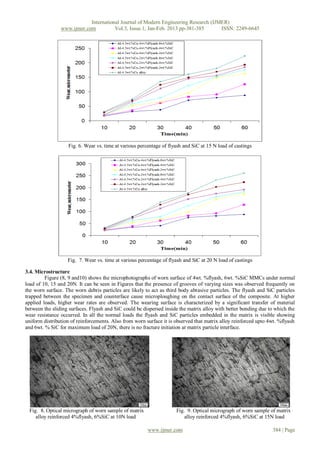
          Dry sliding wear behaviour of matrix alloy reinforced flyash and SiC shows reasonable increase in wear resistance.
It is observed that addition of 4wt. % flyash and 6wt. %.SiC shows lesser wear then other composites. Figure (5, 6 & 7)
shows the weight loss during wear test for different weight percentage of Al-4.5wt.%Cu alloy and Al-4.5wt.%Cu alloy
reinforced flyash and SiC MMCs. The highest weight loss is distinct for matrix alloy and linearly the weight loss decreased
by increasing the percentage of reinforcements. The wear resistance of the composites is considerably improved due to the
addition of 6wt.% SiC particle. Also presence of 4wt.% flyash strengthen the matrix and hence more wear resistance is
observed and therefore volume of wear debris increase with increasing normal load resulting in greater wear loss.


                    Fig. 5. Wear vs. time at various percentage of flyash and SiC at 10 N load of castings
                                                         www.ijmer.com                                            383 | Page
International Journal of Modern Engineering Research (IJMER)
                www.ijmer.com          Vol.3, Issue.1, Jan-Feb. 2013 pp-381-385      ISSN: 2249-6645


                   Fig. 6. Wear vs. time at various percentage of flyash and SiC at 15 N load of castings


                   Fig. 7. Wear vs. time at various percentage of flyash and SiC at 20 N load of castings

3.4. Microstructure
         Figure (8, 9 and10) shows the microphotographs of worn surface of 4wt. %flyash, 6wt. %SiC MMCs under normal
load of 10, 15 and 20N. It can be seen in Figures that the presence of grooves of varying sizes was observed frequently on
the worn surface. The worn debris particles are likely to act as third body abrasive particles. The flyash and SiC particles
trapped between the specimen and counterface cause microploughing on the contact surface of the composite. At higher
applied loads, higher wear rates are observed. The wearing surface is characterized by a significant transfer of material
between the sliding surfaces. Flyash and SiC could be dispersed inside the matrix alloy with better bonding due to which the
wear resistance occurred. In all the normal loads the flyash and SiC particles embedded in the matrix is visible showing
uniform distribution of reinforcements. Also from worn surface it is observed that matrix alloy reinforced upto 4wt. %flyash
and 6wt. % SiC for maximum load of 20N, there is no fracture initiation at matrix particle interface.


 Fig. 8. Optical micrograph of worn sample of matrix                 Fig. 9. Optical micrograph of worn sample of matrix
    alloy reinforced 4%flyash, 6%SiC at 10N load                         alloy reinforced 4%flyash, 6%SiC at 15N load

                                                        www.ijmer.com                                            384 | Page
International Journal of Modern Engineering Research (IJMER)
                 www.ijmer.com          Vol.3, Issue.1, Jan-Feb. 2013 pp-381-385      ISSN: 2249-6645


            Fig. 10. Optical micrograph of worn sample of matrix alloy reinforced 4%flyash, 6%SiC at 20N load

                                                     IV. CONCLUSION
         The results from the experimental work conclude that flyash up to 4% and SiC up to 6% by weight can be
successfully added to Al-4.5wt.%Cu alloy by stir casting route to produce composites. Addition of flyash and SiC improves
the hardness of the composite. Ultimate tensile strength increases with an increase of flyash and SiC particulates. The wear
resistance increases with an increased percentage of flyash and SiC. Optical micro photographs shows better bonding
between matrix, flyash and SiC with no fracture observed at matrix particle interface.

                                               V. ACKNOWLEDGEMENTS
        The author is greatly thankful to Department of mechanical engineering of BMS College of Engineering Bangalore,
and Jyothy Institute of Technology, Bangalore, India, for providing the facility to conduct experiments. Also author
acknowledge M/S. Grindwell Norton Ltd, Renigunta, Andhra Pradesh, for providing SiC particulates for research work.

                                                         REFERENCES
[1]   M. Muratoglu and M. Aksoy, Materials Science and Engineering A282 (2000), pp 91–99.
[2]   Zhangwei Wang, Min Song, Chao Sun, Yuehui He, Materials Science and Engineering A 528 (2011), pp1131–1137.
[3]   T.L. Ho, in: W.A. Glasser (Ed.), Wear of Materials, American Society of Mechanical Engineers, (1977), pp. 70–76.
[4]   R. Munro, International Congress and Exposition, Detroit, MI, 28 February–4 March 1983, SAE Tech Paper 830067.
[5]   J. Sobczak, N. Sobczak and P.K. Rohatgi, in: R. Ciach (Ed.), Advanced Light Alloys and Composites, NATO ASI Series, vol. 59,
      Kluwer Academic Publishers, Dordrecht, The Netherlands, (1998), pp 109.
[6]   J. Sobczak, N. Sobczak, G. Przystas, Utilization of Waste Materials in Foundry Industry on Example of Fly Ashes. State of the Art
      and Application Perspectives, Foundry Research Institute, Cracow, Poland, (1999).
[7]   J.M. Torralba, C.E. da Costa, F. Velasco, J. Mater. Proc. Technol, 133 (2003), pp 203–206.
[8]   Shyong, J. H., and Derby, B, Materials Science and Engineering, (1995) A 197, pp11-18.
[9]   N. Chawla, Y.L. Shen, Adv. Eng. Mater. 3 (2001), pp 357–370.


                                                             www.ijmer.com                                                 385 | Page

Cm31381385

  • 1.
    International Journal ofModern Engineering Research (IJMER) www.ijmer.com Vol.3, Issue.1, Jan-Feb. 2013 pp-381-385 ISSN: 2249-6645 Effect of Hardness, Tensile and Wear Behavior of Al- 4.5wt%Cu Alloy/Flyash/SiC Metal Matrix Composites G.N.Lokesh, 1 M.Ramachandra, 2 K.V.Mahendra, 3 T.Sreenith4 1, 4 Department of Mechanical Engineering, Acharya Institute of Technology, Bangalore-560090, India 2 Department of Mechanical Engineering, BMS College of Engineering, Bangalore-560019, India 3 Department of Mechanical Engineering, Jyothy Institute of Technology, Bangalore-560062, India Abstract: Metal-matrix composites (MMCs) have emerged as potential alternatives to conventional alloys in high-strength and stiffness applications. In the present investigation Al-4.5wt.%Cu alloy reinforced flyash and SiC particulates were casted by liquid metal stirring casting technique. The 2wt.%flyash with 2, 4, 6wt.%SiC and 4wt.%flyash with 2, 4, 6wt.%SiC were reinforced in Al-4.5wt.%Cu matrix. The composites were tested for hardness, tensile strength and dry sliding wear behavior. The results show improved hardness, tensile strength and wear resistance with increase in percentage of reinforcements. Optical micrograph indicates better bonding between matrix, flyash and SiC particle with no fracture initiation at matrix particle interface. Keywords: Flyash, Liquid stir casting, Metal matrix composite, Wear I. INTRODUCTION The unique properties of the particulate reinforced composite materials are to a great extent dependent on the unique nature on the matrix-particle interface. The requirement for strong, light and stiff materials has extended an interest in MMCs. During the past three decades, MMCs have received substantial attention because of their improved strength, high elastic modulus and increased wear resistance over conventional base alloys. The wide scale introduction of MMCs has been increasing simultaneously with the technological development. Increased attention has been directed toward particulate metal matrix composite for tribological applications due to the advantages of MMCs such as good sliding wear resistance, high load carrying capacity and low density [1]. MMCs are also used in many different fields besides aerospace applications [2]. The ceramic fiber and particulate- reinforced MMCs have been used to improve the wear resistance in automotive and aircraft brakes [3], and diesel piston engines [4]. The coal combustion waste product flyash produced by thermal power plants, is an increasingly urgent problem associated with their storage and disposal [5]. On the other hand, fly ash presents a unique natural source of the particulate material for light-weight low-cost composites [6]. This is because of the combination of its low price along with low density, attractive physical and mechanical properties, and advantageous spherical shape, which is very expensive to produce it in an artificial way. Therefore, information on the reactivity of fly ash with different molten metals is of high practical importance. SiC reinforced aluminum alloy composites are the typical candidates for engineering applications in aerospace, military and civil manufacturing industries due to their enhanced mechanical properties over the corresponding aluminum alloys such as high strength, stiffness, hardness, wear resistance and fatigue resistance [7-9]. Thus in this paper composites produced with different weight percentage of both flyash and SiC reinforced in Al-4.5wt%Cu base alloy through stir casting route. Influence of reinforcement on hardness, ultimate tensile strength and wear properties are studied. Micro photographs using optical microscope has been carried out to investigate the particle- matrix interface. II. EXPERIMENTAL WORK A stir casting setup which consisted of a resistance furnace and a stirrer assembly is used to synthesis the composite. Al-4.5wt. %Cu alloy commercially prepared was melted in a resistance heated muffle furnace and casted in a clay graphite crucible. Table 1 shows the chemical composition of base alloy, analysed by optical emission spectrometer. Table1. The chemical composition of the matrix alloy (wt. %) Cu Mg Si Fe Mn Ni Pb Sn Ti Zn Al 4.51 0.061 0.52 0.59 0.13 0.06 0.03 0.02 0.012 0.12 balance The temperature of the melting is increased to 750ºC and it is degassed by cleansed with hexachloroethane tablets. The density of flyash measured is 2.1g/cm3 with the particle size varying between 49 and 60μm. SiC particle size which is used to fabricate the composite had an average of 65 μm and density is 3.2g/cm3. The Al-Cu alloy flyash/SiC composite was prepared by stir casting route. The flyash particles were preheated to 210ºC for two hours to remove moisture. Also the dies were preheated to 150 ºC for 2-3 hours. Then the molten metal was stirred to create a vortex as sown in Fig 1 and then the reinforcements were added. The stirrer is maintained approximately 450rpm throughout the process. The stirring was continued for another 1min even after the completion of particle feeding. The temperature was also monitored simultaneously during stirring the molten metal. The mixture was poured into the mold and the time taken to fill the mold www.ijmer.com 381 | Page
  • 2.
    International Journal ofModern Engineering Research (IJMER) www.ijmer.com Vol.3, Issue.1, Jan-Feb. 2013 pp-381-385 ISSN: 2249-6645 was 6.1 seconds for base alloy and 9.3 seconds for 4wt%flyash, 6wt%SiC reinforcements. The maximum duration of mixing was 3min. The clearance of the stirrer from the bottom of the crucible was approximately 10 mm with the melt depth of 120 mm. The stirred dispersed molten metal was poured into preheated S.G. iron moulds and cooled to room temperature. Composites produced were subjected to T6 heat treatment. The castings were heated to 450ºC for 12 hours, quenched in 100ºC water and reheated to 150ºC for 16hours. Then the samples were allowed to cool in the furnace temperature. Fig. 1. The molten metal was stirred to create a vortex Hardness measurements were performed using a Brinnel hardness tester with a load of 10kgf. Hardness values were averaged over five measurements taken at different points on the cross-section. Tensile tests were carried out using samples prepared according to ASTMD3479-1982 standard. These tests were conducted using a computerized universal testing machine (UTM) with 100KN capacity. Figure 2 shows the tensile specimens after the conduction of test in UTM. Fig. 2. Composite specimens after tensile test Wear test were carried out under dry sliding condition on a pin-on-disc apparatus. A steel disc (AISID2) was used as counter surface and composites were made into pins having 6mm diameter and 30mm in height. The pins were made to slide on the steel disc at 60minutes duration under the loads of 10, 15 and 20N. A hardened steel disc (60HRc) was used as the counter face. Photographs were taken for a polished section of each sample from optical microscope to examine the effect of the percentage of particle on the wear behavior of the composites, III. RESULTS AND DISCUSSION 3.1. Hardness Hardness tests were performed on as cast and composites to know the effect of flyash and SiC in matrix material. Hardness of MMCs is increased with increased weight percentage of flyash and SiC particle then that of its parent metal. It is evident from figure 3 that the hardness of Al-4.5wt. %Cu alloy increased by the addition of 4wt. % flyash and up to 6wt. %.SiC. This may be due to the harder ceramic particle of SiC and hard flyash particulates. The strengthening of the composite can be due to dispersion strengthening as well as due to particle reinforcement. Thus flyash as filler in Aluminium casting reduces cost, decreases density and increase hardness which are need in various industrial like automotive applications. www.ijmer.com 382 | Page
  • 3.
    International Journal ofModern Engineering Research (IJMER) www.ijmer.com Vol.3, Issue.1, Jan-Feb. 2013 pp-381-385 ISSN: 2249-6645 Fig. 3. Brinell hardness number of Al-4.5wt%Cu reinforced Flyash and SiC particulates 3.2. Tensile strength Tensile properties indicate that the flyash and SiC addition leads to improvement in the ultimate tensile strength. The size range of the particle is very wide. Figure 4 shows the effect of flyash and SiC particulate content on tensile behaviour of the composites. The size ranges of the flyash indicate that the composite prepared can be considered as dispersion strengthened as well as particle reinforced composite. It is observed that the ultimate strength (UTS) of matrix alloy is increased with increase in percentage of flyash and SiC reinforcements. This may be due to segregation of particles and finer grain structure of the castings. Fig. 4. Ultimate tensile strength of Al-4.5wt%Cu reinforced Flyash and SiC particulates 3.3. Wear behaviour Dry sliding wear behaviour of matrix alloy reinforced flyash and SiC shows reasonable increase in wear resistance. It is observed that addition of 4wt. % flyash and 6wt. %.SiC shows lesser wear then other composites. Figure (5, 6 & 7) shows the weight loss during wear test for different weight percentage of Al-4.5wt.%Cu alloy and Al-4.5wt.%Cu alloy reinforced flyash and SiC MMCs. The highest weight loss is distinct for matrix alloy and linearly the weight loss decreased by increasing the percentage of reinforcements. The wear resistance of the composites is considerably improved due to the addition of 6wt.% SiC particle. Also presence of 4wt.% flyash strengthen the matrix and hence more wear resistance is observed and therefore volume of wear debris increase with increasing normal load resulting in greater wear loss. Fig. 5. Wear vs. time at various percentage of flyash and SiC at 10 N load of castings www.ijmer.com 383 | Page
  • 4.
    International Journal ofModern Engineering Research (IJMER) www.ijmer.com Vol.3, Issue.1, Jan-Feb. 2013 pp-381-385 ISSN: 2249-6645 Fig. 6. Wear vs. time at various percentage of flyash and SiC at 15 N load of castings Fig. 7. Wear vs. time at various percentage of flyash and SiC at 20 N load of castings 3.4. Microstructure Figure (8, 9 and10) shows the microphotographs of worn surface of 4wt. %flyash, 6wt. %SiC MMCs under normal load of 10, 15 and 20N. It can be seen in Figures that the presence of grooves of varying sizes was observed frequently on the worn surface. The worn debris particles are likely to act as third body abrasive particles. The flyash and SiC particles trapped between the specimen and counterface cause microploughing on the contact surface of the composite. At higher applied loads, higher wear rates are observed. The wearing surface is characterized by a significant transfer of material between the sliding surfaces. Flyash and SiC could be dispersed inside the matrix alloy with better bonding due to which the wear resistance occurred. In all the normal loads the flyash and SiC particles embedded in the matrix is visible showing uniform distribution of reinforcements. Also from worn surface it is observed that matrix alloy reinforced upto 4wt. %flyash and 6wt. % SiC for maximum load of 20N, there is no fracture initiation at matrix particle interface. Fig. 8. Optical micrograph of worn sample of matrix Fig. 9. Optical micrograph of worn sample of matrix alloy reinforced 4%flyash, 6%SiC at 10N load alloy reinforced 4%flyash, 6%SiC at 15N load www.ijmer.com 384 | Page
  • 5.
    International Journal ofModern Engineering Research (IJMER) www.ijmer.com Vol.3, Issue.1, Jan-Feb. 2013 pp-381-385 ISSN: 2249-6645 Fig. 10. Optical micrograph of worn sample of matrix alloy reinforced 4%flyash, 6%SiC at 20N load IV. CONCLUSION The results from the experimental work conclude that flyash up to 4% and SiC up to 6% by weight can be successfully added to Al-4.5wt.%Cu alloy by stir casting route to produce composites. Addition of flyash and SiC improves the hardness of the composite. Ultimate tensile strength increases with an increase of flyash and SiC particulates. The wear resistance increases with an increased percentage of flyash and SiC. Optical micro photographs shows better bonding between matrix, flyash and SiC with no fracture observed at matrix particle interface. V. ACKNOWLEDGEMENTS The author is greatly thankful to Department of mechanical engineering of BMS College of Engineering Bangalore, and Jyothy Institute of Technology, Bangalore, India, for providing the facility to conduct experiments. Also author acknowledge M/S. Grindwell Norton Ltd, Renigunta, Andhra Pradesh, for providing SiC particulates for research work. REFERENCES [1] M. Muratoglu and M. Aksoy, Materials Science and Engineering A282 (2000), pp 91–99. [2] Zhangwei Wang, Min Song, Chao Sun, Yuehui He, Materials Science and Engineering A 528 (2011), pp1131–1137. [3] T.L. Ho, in: W.A. Glasser (Ed.), Wear of Materials, American Society of Mechanical Engineers, (1977), pp. 70–76. [4] R. Munro, International Congress and Exposition, Detroit, MI, 28 February–4 March 1983, SAE Tech Paper 830067. [5] J. Sobczak, N. Sobczak and P.K. Rohatgi, in: R. Ciach (Ed.), Advanced Light Alloys and Composites, NATO ASI Series, vol. 59, Kluwer Academic Publishers, Dordrecht, The Netherlands, (1998), pp 109. [6] J. Sobczak, N. Sobczak, G. Przystas, Utilization of Waste Materials in Foundry Industry on Example of Fly Ashes. State of the Art and Application Perspectives, Foundry Research Institute, Cracow, Poland, (1999). [7] J.M. Torralba, C.E. da Costa, F. Velasco, J. Mater. Proc. Technol, 133 (2003), pp 203–206. [8] Shyong, J. H., and Derby, B, Materials Science and Engineering, (1995) A 197, pp11-18. [9] N. Chawla, Y.L. Shen, Adv. Eng. Mater. 3 (2001), pp 357–370. www.ijmer.com 385 | Page