EDGY
A Disciplined Look
Scott W. Ambler
Consulting Methodologist
Ambysoft Inc.
© Ambysoft Inc. AgileData.org AgileModeling.com 1
Scott Ambler
© Ambysoft Inc. AgileData.org AgileModeling.com 2
• scott@scottambler.com
• Twitter: @scottwambler
• linkedin.com/in/sambler/
Consulting Methodologist
Ambysoft.com
Thought Leader
AgileData.org
Thought Leader
AgileModeling.com
Agenda
• Observations about our environment
• EDGY overview
• Disciplined Agile (DA) overview
• A disciplined look at EDGY
• Parting advice
© Ambysoft Inc. AgileData.org AgileModeling.com 3
Observations About
Our Organizational
Environment
© Ambysoft Inc. AgileData.org AgileModeling.com 4
Threats
© Ambysoft Inc. AgileData.org AgileModeling.com 5
• Increasing pace of change
• Increasing complexity
• The great reshuffle
• Climate change
• Technical debt
• Robotics and artificial intelligence (AI)
• Transformation fatigue
Opportunities
© Ambysoft Inc. AgileData.org AgileModeling.com 6
• Increasing pace of change
• Robotics and AI
• The great reshuffle
• Increasing holistic thinking
• Increasing agility
• New ways of working (WoW)
• New ways of thinking (WoT)
EDGY
© Ambysoft Inc. AgileData.org AgileModeling.com 7
Source
8
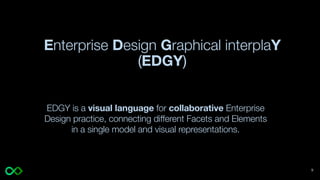
Enterprise Design Graphical interplaY
(EDGY)
EDGY is a visual language for collaborative Enterprise
Design practice, connecting different Facets and Elements
in a single model and visual representations.
9
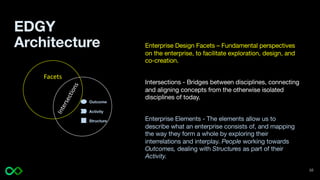
EDGY
Architecture
Facets
I
n
t
e
r
s
e
c
t
i
o
n
s
Enterprise Design Facets – Fundamental perspectives
on the enterprise, to facilitate exploration, design, and
co-creation.
Intersections - Bridges between disciplines, connecting
and aligning concepts from the otherwise isolated
disciplines of today.
Enterprise Elements - The elements allow us to
describe what an enterprise consists of, and mapping
the way they form a whole by exploring their
interrelations and interplay. People working towards
Outcomes, dealing with Structures as part of their
Activity.
Outcome
Activity
Structure
10
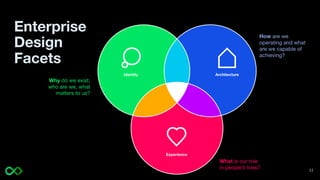
Enterprise
Design
Facets
Identity Architecture
Experience
Why do we exist,
who are we, what
matters to us?
How are we
operating and what
are we capable of
achieving?
What is our role
in people’s lives? 11
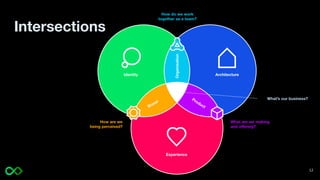
Intersections
Product
Organisation
How are we
being perceived?
What are we making
and offering?
How do we work
together as a team?
Brand
Identity Architecture
Experience
What’s our business?
12
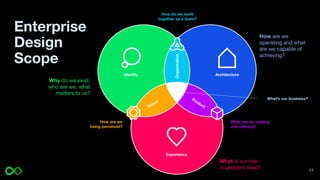
Enterprise
Design
Scope
How are we
being perceived?
Brand
Product
What are we making
and offering?
Organisation
How do we work
together as a team?
What’s our business?
Identity
Why do we exist,
who are we, what
matters to us?
Architecture
How are we
operating and what
are we capable of
achieving?
Experience
What is our role
in people’s lives? 13
Disciplined Agile
© Ambysoft Inc. AgileData.org AgileModeling.com 14
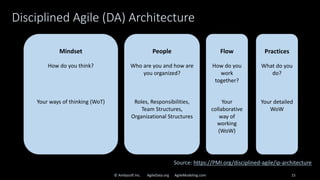
Disciplined Agile (DA) Architecture
© Ambysoft Inc. AgileData.org AgileModeling.com 15
Mindset
How do you think?
Your ways of thinking (WoT)
People
Who are you and how are
you organized?
Roles, Responsibilities,
Team Structures,
Organizational Structures
Flow
How do you
work
together?
Your
collaborative
way of
working
(WoW)
Practices
What do you
do?
Your detailed
WoW
Source: https://PMI.org/disciplined-agile/ip-architecture
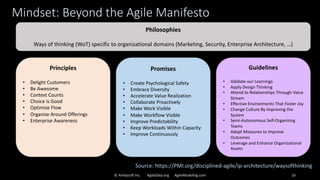
Mindset: Beyond the Agile Manifesto
© Ambysoft Inc. AgileData.org AgileModeling.com 16
Principles
• Delight Customers
• Be Awesome
• Context Counts
• Choice is Good
• Optimize Flow
• Organize Around Offerings
• Enterprise Awareness
Promises
• Create Psychological Safety
• Embrace Diversity
• Accelerate Value Realization
• Collaborate Proactively
• Make Work Visible
• Make Workflow Visible
• Improve Predictability
• Keep Workloads Within Capacity
• Improve Continuously
Guidelines
• Validate our Learnings
• Apply Design Thinking
• Attend to Relationships Through Value
Stream
• Effective Environments That Foster Joy
• Change Culture By Improving the
System
• Semi-Autonomous Self-Organizing
Teams
• Adopt Measures to Improve
Outcomes
• Leverage and Enhance Organizational
Assets
Philosophies
Ways of thinking (WoT) specific to organizational domains (Marketing, Security, Enterprise Architecture, …)
Source: https://PMI.org/disciplined-agile/ip-architecture/waysofthinking
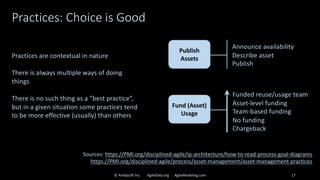
Practices: Choice is Good
© Ambysoft Inc. AgileData.org AgileModeling.com 17
Sources: https://PMI.org/disciplined-agile/ip-architecture/how-to-read-process-goal-diagrams
https://PMI.org/disciplined-agile/process/asset-management/asset-management-practices
Practices are contextual in nature
There is always multiple ways of doing
things
There is no such thing as a ”best practice”,
but in a given situation some practices tend
to be more effective (usually) than others
Fund (Asset)
Usage
Funded reuse/usage team
Asset-level funding
Team-based funding
No funding
Chargeback
Publish
Assets
Announce availability
Describe asset
Publish
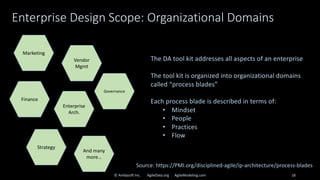
Enterprise Design Scope: Organizational Domains
© Ambysoft Inc. AgileData.org AgileModeling.com 18
Marketing
Finance
Vendor
Mgmt
Enterprise
Arch.
Strategy
Source: https://PMI.org/disciplined-agile/ip-architecture/process-blades
The DA tool kit addresses all aspects of an enterprise
The tool kit is organized into organizational domains
called “process blades”
Each process blade is described in terms of:
• Mindset
• People
• Practices
• Flow
And many
more…
Governance
A Disciplined Look
at EDGY
© Ambysoft Inc. AgileData.org AgileModeling.com 19
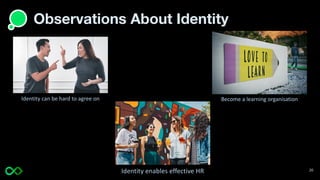
Observations About Identity
Identity enables effective HR
Identity can be hard to agree on Become a learning organisation
20
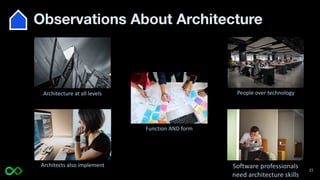
Observations About Architecture
Software professionals
need architecture skills
21
People over technology
Architecture at all levels
Function AND form
Architects also implement
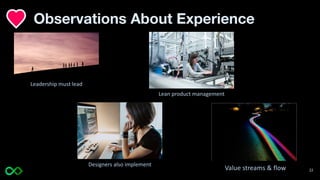
Observations About Experience
Value streams & flow
Leadership must lead
Lean product management
22
Designers also implement
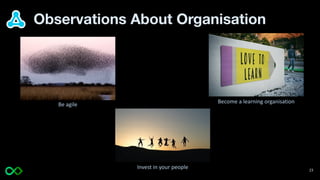
Observations About Organisation
23
Become a learning organisation
Invest in your people
Be agile
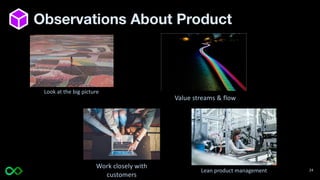
Observations About Product
Work closely with
customers
24
Look at the big picture
Lean product management
Value streams & flow
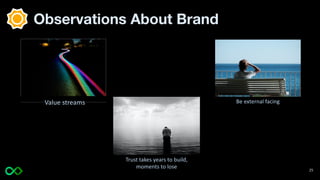
Observations About Brand
25
Value streams Be external facing
Trust takes years to build,
moments to lose
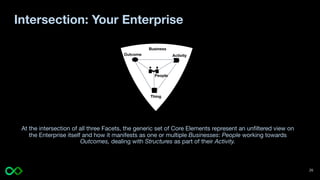
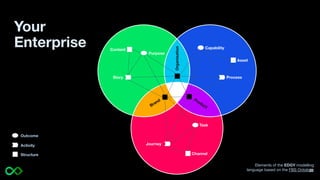
At the intersection of all three Facets, the generic set of Core Elements represent an unfiltered view on
the Enterprise itself and how it manifests as one or multiple Businesses: People working towards
Outcomes, dealing with Structures as part of their Activity.
Intersection: Your Enterprise
Outcome Activity
Thing
People
Business
26
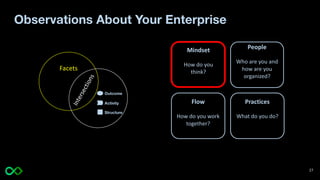
Observations About Your Enterprise
Facets
I
n
t
e
r
s
e
c
t
i
o
n
s Outcome
Activity
Structure
Mindset
How do you
think?
People
Who are you and
how are you
organized?
Flow
How do you work
together?
Practices
What do you do?
27
Your
Enterprise
Brand Product
Organisation
Story
Purpose
Process
Capability
Journey
Task
Outcome
Activity
Structure
Elements of the EDGY modelling
language based on the FBS Ontology
Channel
Asset
Content
28
Parting Advice
© Ambysoft Inc. AgileData.org AgileModeling.com 29
You can do this
It’s going to be hard work
The work will never end
We will do this together
30
Thank You!
© Ambysoft Inc. AgileData.org AgileModeling.com 31
• scott@scottambler.com
• Twitter: @scottwambler
• linkedin.com/in/sambler/
Consulting Methodologist
Ambysoft.com
Thought Leader
AgileData.org
Thought Leader
AgileModeling.com
Backup Slides
© Ambysoft Inc. AgileData.org AgileModeling.com 32
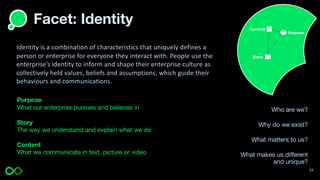
Facet: Identity
Story
Purpose
Content
Who are we?
Why do we exist?
What matters to us?
What makes us different
and unique?
Purpose
What our enterprise pursues and believes in
Story
The way we understand and explain what we do
Content
What we communicate in text, picture or video
Identity is a combination of characteristics that uniquely defines a
person or enterprise for everyone they interact with. People use the
enterprise’s identity to inform and shape their enterprise culture as
collectively held values, beliefs and assumptions, which guide their
behaviours and communications.
33
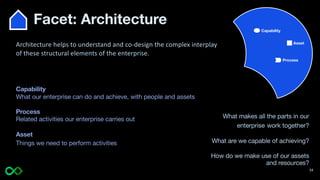
Facet: Architecture
Process
Capability
Asset
What makes all the parts in our
enterprise work together?
What are we capable of achieving?
How do we make use of our assets
and resources?
Capability
What our enterprise can do and achieve, with people and assets
Process
Related activities our enterprise carries out
Asset
Things we need to perform activities
Architecture helps to understand and co-design the complex interplay
of these structural elements of the enterprise.
34
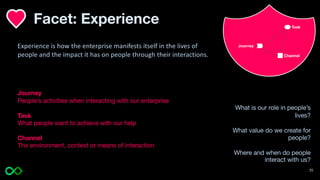
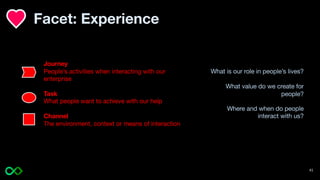
Facet: Experience
Journey
Task
Channel
What is our role in people’s
lives?
What value do we create for
people?
Where and when do people
interact with us?
Journey
People’s activities when interacting with our enterprise
Task
What people want to achieve with our help
Channel
The environment, context or means of interaction
Experience is how the enterprise manifests itself in the lives of
people and the impact it has on people through their interactions.
35
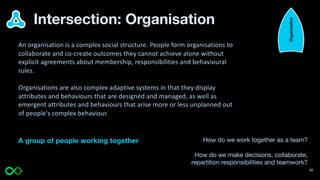
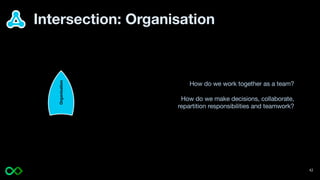
Organisation
Intersection: Organisation
How do we work together as a team?
How do we make decisions, collaborate,
repartition responsibilities and teamwork?
A group of people working together
An organisation is a complex social structure. People form organisations to
collaborate and co-create outcomes they cannot achieve alone without
explicit agreements about membership, responsibilities and behavioural
rules.
Organisations are also complex adaptive systems in that they display
attributes and behaviours that are designed and managed, as well as
emergent attributes and behaviours that arise more or less unplanned out
of people's complex behaviour.
36
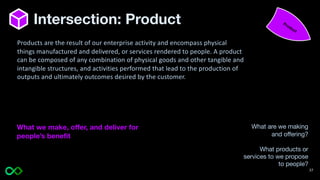
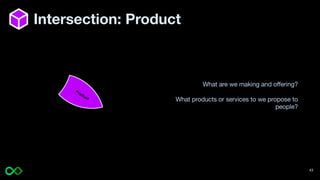
Intersection: Product Product
What are we making
and offering?
What products or
services to we propose
to people?
What we make, offer, and deliver for
people’s benefit
Products are the result of our enterprise activity and encompass physical
things manufactured and delivered, or services rendered to people. A product
can be composed of any combination of physical goods and other tangible and
intangible structures, and activities performed that lead to the production of
outputs and ultimately outcomes desired by the customer.
37
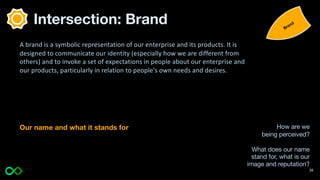
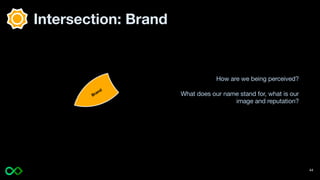
Intersection: Brand Brand
How are we
being perceived?
What does our name
stand for, what is our
image and reputation?
Our name and what it stands for
A brand is a symbolic representation of our enterprise and its products. It is
designed to communicate our identity (especially how we are different from
others) and to invoke a set of expectations in people about our enterprise and
our products, particularly in relation to people's own needs and desires.
38
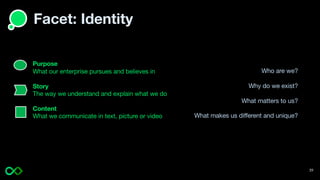
Facet: Identity
Who are we?
Why do we exist?
What matters to us?
What makes us different and unique?
39
Purpose
What our enterprise pursues and believes in
Story
The way we understand and explain what we do
Content
What we communicate in text, picture or video
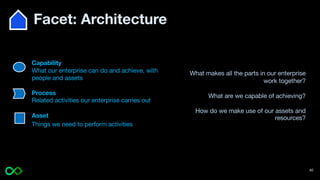
Facet: Architecture
What makes all the parts in our enterprise
work together?
What are we capable of achieving?
How do we make use of our assets and
resources?
40
Capability
What our enterprise can do and achieve, with
people and assets
Process
Related activities our enterprise carries out
Asset
Things we need to perform activities
Facet: Experience
What is our role in people’s lives?
What value do we create for
people?
Where and when do people
interact with us?
41
Journey
People’s activities when interacting with our
enterprise
Task
What people want to achieve with our help
Channel
The environment, context or means of interaction
Organisation
Intersection: Organisation
How do we work together as a team?
How do we make decisions, collaborate,
repartition responsibilities and teamwork?
42
Intersection: Product
Product
What are we making and offering?
What products or services to we propose to
people?
43
Intersection: Brand
Brand
How are we being perceived?
What does our name stand for, what is our
image and reputation?
44

EDGY: A Disciplined Look

  • 1.
    EDGY A Disciplined Look ScottW. Ambler Consulting Methodologist Ambysoft Inc. © Ambysoft Inc. AgileData.org AgileModeling.com 1
  • 2.
    Scott Ambler © AmbysoftInc. AgileData.org AgileModeling.com 2 • scott@scottambler.com • Twitter: @scottwambler • linkedin.com/in/sambler/ Consulting Methodologist Ambysoft.com Thought Leader AgileData.org Thought Leader AgileModeling.com
  • 3.
    Agenda • Observations aboutour environment • EDGY overview • Disciplined Agile (DA) overview • A disciplined look at EDGY • Parting advice © Ambysoft Inc. AgileData.org AgileModeling.com 3
  • 4.
    Observations About Our Organizational Environment ©Ambysoft Inc. AgileData.org AgileModeling.com 4
  • 5.
    Threats © Ambysoft Inc.AgileData.org AgileModeling.com 5 • Increasing pace of change • Increasing complexity • The great reshuffle • Climate change • Technical debt • Robotics and artificial intelligence (AI) • Transformation fatigue
  • 6.
    Opportunities © Ambysoft Inc.AgileData.org AgileModeling.com 6 • Increasing pace of change • Robotics and AI • The great reshuffle • Increasing holistic thinking • Increasing agility • New ways of working (WoW) • New ways of thinking (WoT)
  • 7.
    EDGY © Ambysoft Inc.AgileData.org AgileModeling.com 7
  • 8.
  • 9.
    Enterprise Design GraphicalinterplaY (EDGY) EDGY is a visual language for collaborative Enterprise Design practice, connecting different Facets and Elements in a single model and visual representations. 9
  • 10.
    EDGY Architecture Facets I n t e r s e c t i o n s Enterprise Design Facets– Fundamental perspectives on the enterprise, to facilitate exploration, design, and co-creation. Intersections - Bridges between disciplines, connecting and aligning concepts from the otherwise isolated disciplines of today. Enterprise Elements - The elements allow us to describe what an enterprise consists of, and mapping the way they form a whole by exploring their interrelations and interplay. People working towards Outcomes, dealing with Structures as part of their Activity. Outcome Activity Structure 10
  • 11.
    Enterprise Design Facets Identity Architecture Experience Why dowe exist, who are we, what matters to us? How are we operating and what are we capable of achieving? What is our role in people’s lives? 11
  • 12.
    Intersections Product Organisation How are we beingperceived? What are we making and offering? How do we work together as a team? Brand Identity Architecture Experience What’s our business? 12
  • 13.
    Enterprise Design Scope How are we beingperceived? Brand Product What are we making and offering? Organisation How do we work together as a team? What’s our business? Identity Why do we exist, who are we, what matters to us? Architecture How are we operating and what are we capable of achieving? Experience What is our role in people’s lives? 13
  • 14.
    Disciplined Agile © AmbysoftInc. AgileData.org AgileModeling.com 14
  • 15.
    Disciplined Agile (DA)Architecture © Ambysoft Inc. AgileData.org AgileModeling.com 15 Mindset How do you think? Your ways of thinking (WoT) People Who are you and how are you organized? Roles, Responsibilities, Team Structures, Organizational Structures Flow How do you work together? Your collaborative way of working (WoW) Practices What do you do? Your detailed WoW Source: https://PMI.org/disciplined-agile/ip-architecture
  • 16.
    Mindset: Beyond theAgile Manifesto © Ambysoft Inc. AgileData.org AgileModeling.com 16 Principles • Delight Customers • Be Awesome • Context Counts • Choice is Good • Optimize Flow • Organize Around Offerings • Enterprise Awareness Promises • Create Psychological Safety • Embrace Diversity • Accelerate Value Realization • Collaborate Proactively • Make Work Visible • Make Workflow Visible • Improve Predictability • Keep Workloads Within Capacity • Improve Continuously Guidelines • Validate our Learnings • Apply Design Thinking • Attend to Relationships Through Value Stream • Effective Environments That Foster Joy • Change Culture By Improving the System • Semi-Autonomous Self-Organizing Teams • Adopt Measures to Improve Outcomes • Leverage and Enhance Organizational Assets Philosophies Ways of thinking (WoT) specific to organizational domains (Marketing, Security, Enterprise Architecture, …) Source: https://PMI.org/disciplined-agile/ip-architecture/waysofthinking
  • 17.
    Practices: Choice isGood © Ambysoft Inc. AgileData.org AgileModeling.com 17 Sources: https://PMI.org/disciplined-agile/ip-architecture/how-to-read-process-goal-diagrams https://PMI.org/disciplined-agile/process/asset-management/asset-management-practices Practices are contextual in nature There is always multiple ways of doing things There is no such thing as a ”best practice”, but in a given situation some practices tend to be more effective (usually) than others Fund (Asset) Usage Funded reuse/usage team Asset-level funding Team-based funding No funding Chargeback Publish Assets Announce availability Describe asset Publish
  • 18.
    Enterprise Design Scope:Organizational Domains © Ambysoft Inc. AgileData.org AgileModeling.com 18 Marketing Finance Vendor Mgmt Enterprise Arch. Strategy Source: https://PMI.org/disciplined-agile/ip-architecture/process-blades The DA tool kit addresses all aspects of an enterprise The tool kit is organized into organizational domains called “process blades” Each process blade is described in terms of: • Mindset • People • Practices • Flow And many more… Governance
  • 19.
    A Disciplined Look atEDGY © Ambysoft Inc. AgileData.org AgileModeling.com 19
  • 20.
    Observations About Identity Identityenables effective HR Identity can be hard to agree on Become a learning organisation 20
  • 21.
    Observations About Architecture Softwareprofessionals need architecture skills 21 People over technology Architecture at all levels Function AND form Architects also implement
  • 22.
    Observations About Experience Valuestreams & flow Leadership must lead Lean product management 22 Designers also implement
  • 23.
    Observations About Organisation 23 Becomea learning organisation Invest in your people Be agile
  • 24.
    Observations About Product Workclosely with customers 24 Look at the big picture Lean product management Value streams & flow
  • 25.
    Observations About Brand 25 Valuestreams Be external facing Trust takes years to build, moments to lose
  • 26.
    At the intersectionof all three Facets, the generic set of Core Elements represent an unfiltered view on the Enterprise itself and how it manifests as one or multiple Businesses: People working towards Outcomes, dealing with Structures as part of their Activity. Intersection: Your Enterprise Outcome Activity Thing People Business 26
  • 27.
    Observations About YourEnterprise Facets I n t e r s e c t i o n s Outcome Activity Structure Mindset How do you think? People Who are you and how are you organized? Flow How do you work together? Practices What do you do? 27
  • 28.
  • 29.
    Parting Advice © AmbysoftInc. AgileData.org AgileModeling.com 29
  • 30.
    You can dothis It’s going to be hard work The work will never end We will do this together 30
  • 31.
    Thank You! © AmbysoftInc. AgileData.org AgileModeling.com 31 • scott@scottambler.com • Twitter: @scottwambler • linkedin.com/in/sambler/ Consulting Methodologist Ambysoft.com Thought Leader AgileData.org Thought Leader AgileModeling.com
  • 32.
    Backup Slides © AmbysoftInc. AgileData.org AgileModeling.com 32
  • 33.
    Facet: Identity Story Purpose Content Who arewe? Why do we exist? What matters to us? What makes us different and unique? Purpose What our enterprise pursues and believes in Story The way we understand and explain what we do Content What we communicate in text, picture or video Identity is a combination of characteristics that uniquely defines a person or enterprise for everyone they interact with. People use the enterprise’s identity to inform and shape their enterprise culture as collectively held values, beliefs and assumptions, which guide their behaviours and communications. 33
  • 34.
    Facet: Architecture Process Capability Asset What makesall the parts in our enterprise work together? What are we capable of achieving? How do we make use of our assets and resources? Capability What our enterprise can do and achieve, with people and assets Process Related activities our enterprise carries out Asset Things we need to perform activities Architecture helps to understand and co-design the complex interplay of these structural elements of the enterprise. 34
  • 35.
    Facet: Experience Journey Task Channel What isour role in people’s lives? What value do we create for people? Where and when do people interact with us? Journey People’s activities when interacting with our enterprise Task What people want to achieve with our help Channel The environment, context or means of interaction Experience is how the enterprise manifests itself in the lives of people and the impact it has on people through their interactions. 35
  • 36.
    Organisation Intersection: Organisation How dowe work together as a team? How do we make decisions, collaborate, repartition responsibilities and teamwork? A group of people working together An organisation is a complex social structure. People form organisations to collaborate and co-create outcomes they cannot achieve alone without explicit agreements about membership, responsibilities and behavioural rules. Organisations are also complex adaptive systems in that they display attributes and behaviours that are designed and managed, as well as emergent attributes and behaviours that arise more or less unplanned out of people's complex behaviour. 36
  • 37.
    Intersection: Product Product Whatare we making and offering? What products or services to we propose to people? What we make, offer, and deliver for people’s benefit Products are the result of our enterprise activity and encompass physical things manufactured and delivered, or services rendered to people. A product can be composed of any combination of physical goods and other tangible and intangible structures, and activities performed that lead to the production of outputs and ultimately outcomes desired by the customer. 37
  • 38.
    Intersection: Brand Brand Howare we being perceived? What does our name stand for, what is our image and reputation? Our name and what it stands for A brand is a symbolic representation of our enterprise and its products. It is designed to communicate our identity (especially how we are different from others) and to invoke a set of expectations in people about our enterprise and our products, particularly in relation to people's own needs and desires. 38
  • 39.
    Facet: Identity Who arewe? Why do we exist? What matters to us? What makes us different and unique? 39 Purpose What our enterprise pursues and believes in Story The way we understand and explain what we do Content What we communicate in text, picture or video
  • 40.
    Facet: Architecture What makesall the parts in our enterprise work together? What are we capable of achieving? How do we make use of our assets and resources? 40 Capability What our enterprise can do and achieve, with people and assets Process Related activities our enterprise carries out Asset Things we need to perform activities
  • 41.
    Facet: Experience What isour role in people’s lives? What value do we create for people? Where and when do people interact with us? 41 Journey People’s activities when interacting with our enterprise Task What people want to achieve with our help Channel The environment, context or means of interaction
  • 42.
    Organisation Intersection: Organisation How dowe work together as a team? How do we make decisions, collaborate, repartition responsibilities and teamwork? 42
  • 43.
    Intersection: Product Product What arewe making and offering? What products or services to we propose to people? 43
  • 44.
    Intersection: Brand Brand How arewe being perceived? What does our name stand for, what is our image and reputation? 44