The 
Disciplined 
Agile 
Enterprise: 
Harmonizing 
Agile 
and 
Lean 
Scott W. Ambler 
scott@scottambler.com 
Twitter: @scottambler 
SARAJEVO, 27.10.2014
Before we 
begin… 
© Scott Ambler + Associates 3
© Scott Ambler + Associates 
4 
We’re going to 
cover a lot of 
ground
The Surveys 
• Results of survey-based research will be shared throughout this 
deck 
• Availability: 
– Detailed results are available free of charge at Ambysoft.com/ 
surveys/ 
– Includes all questions as asked, source data, and summary slide 
decks 
• Types of surveys: 
– DDJ: Cross paradigm survey sponsored by Dr Dobb’s Journal 
– Ambysoft: Agile-oriented survey sponsored by Ambysoft Inc. 
– SA+A: Agile oriented survey sponsored by Scott Ambler + Associates 
© Scott Ambler + Associates 5
The Story I’m About 
to Tell 
© Scott Ambler + Associates 6
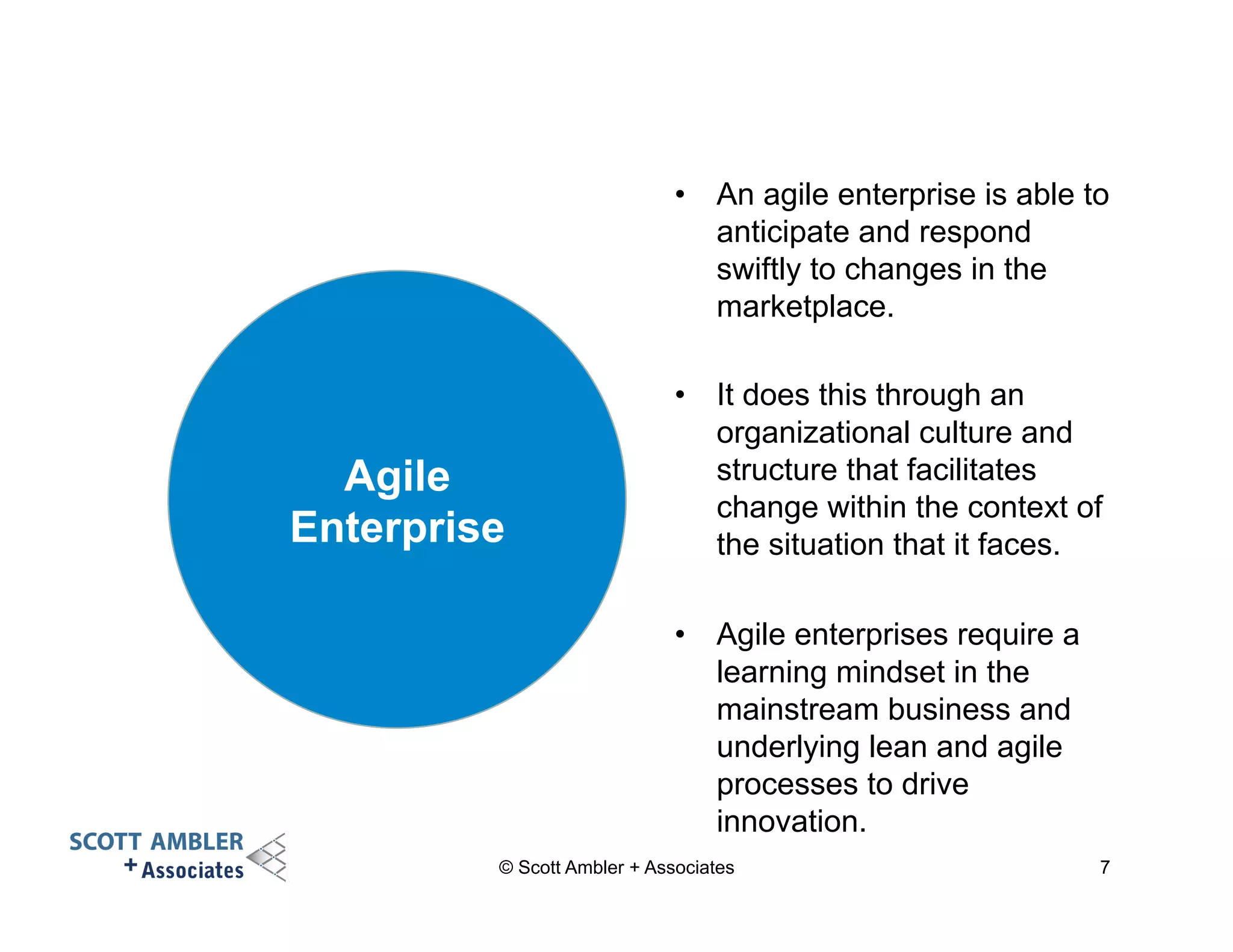
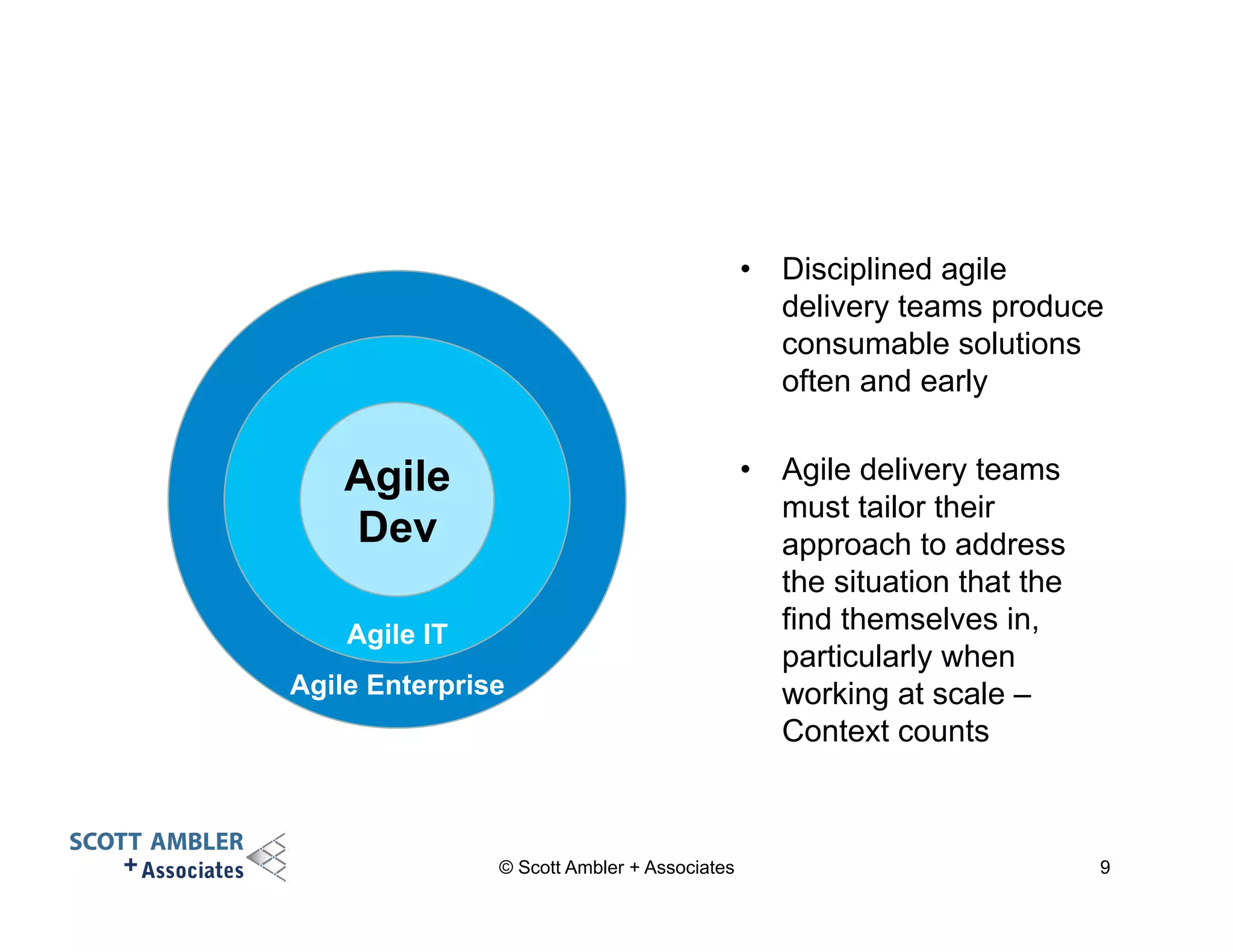
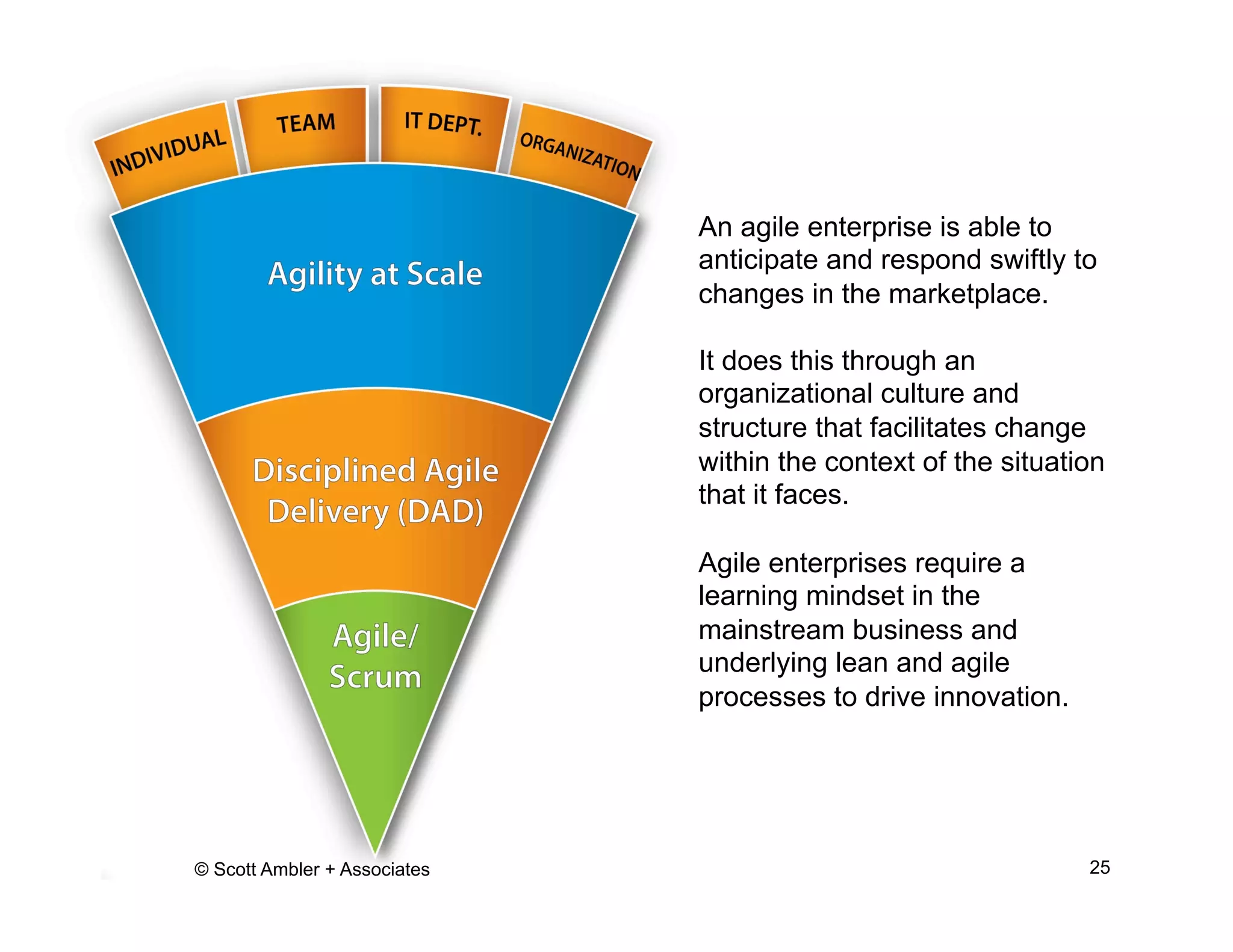
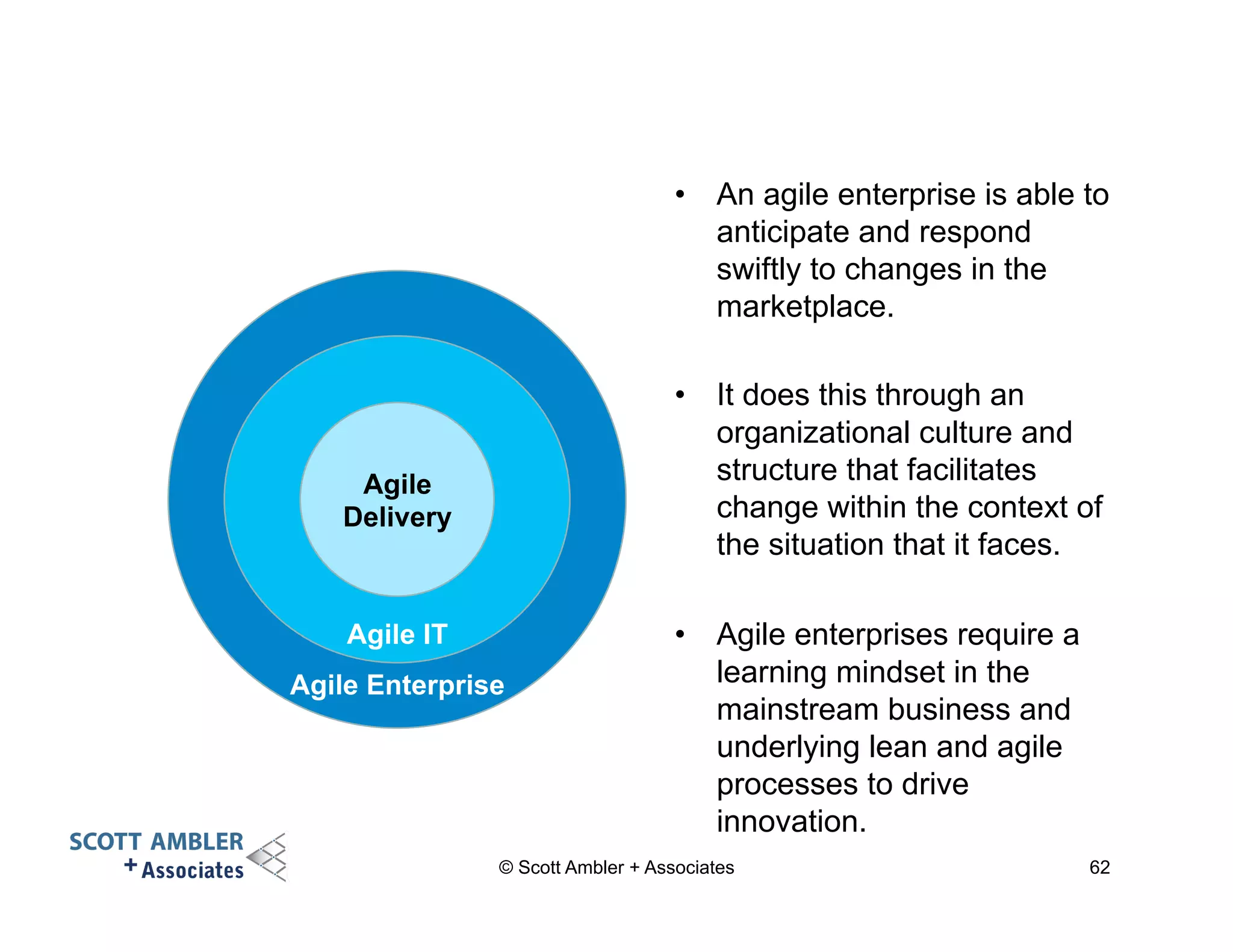
• An agile enterprise is able to 
anticipate and respond 
swiftly to changes in the 
marketplace. 
• It does this through an 
organizational culture and 
structure that facilitates 
change within the context of 
the situation that it faces. 
• Agile enterprises require a 
learning mindset in the 
mainstream business and 
underlying lean and agile 
processes to drive 
innovation. 
Agile 
Enterprise 
© Scott Ambler + Associates 7
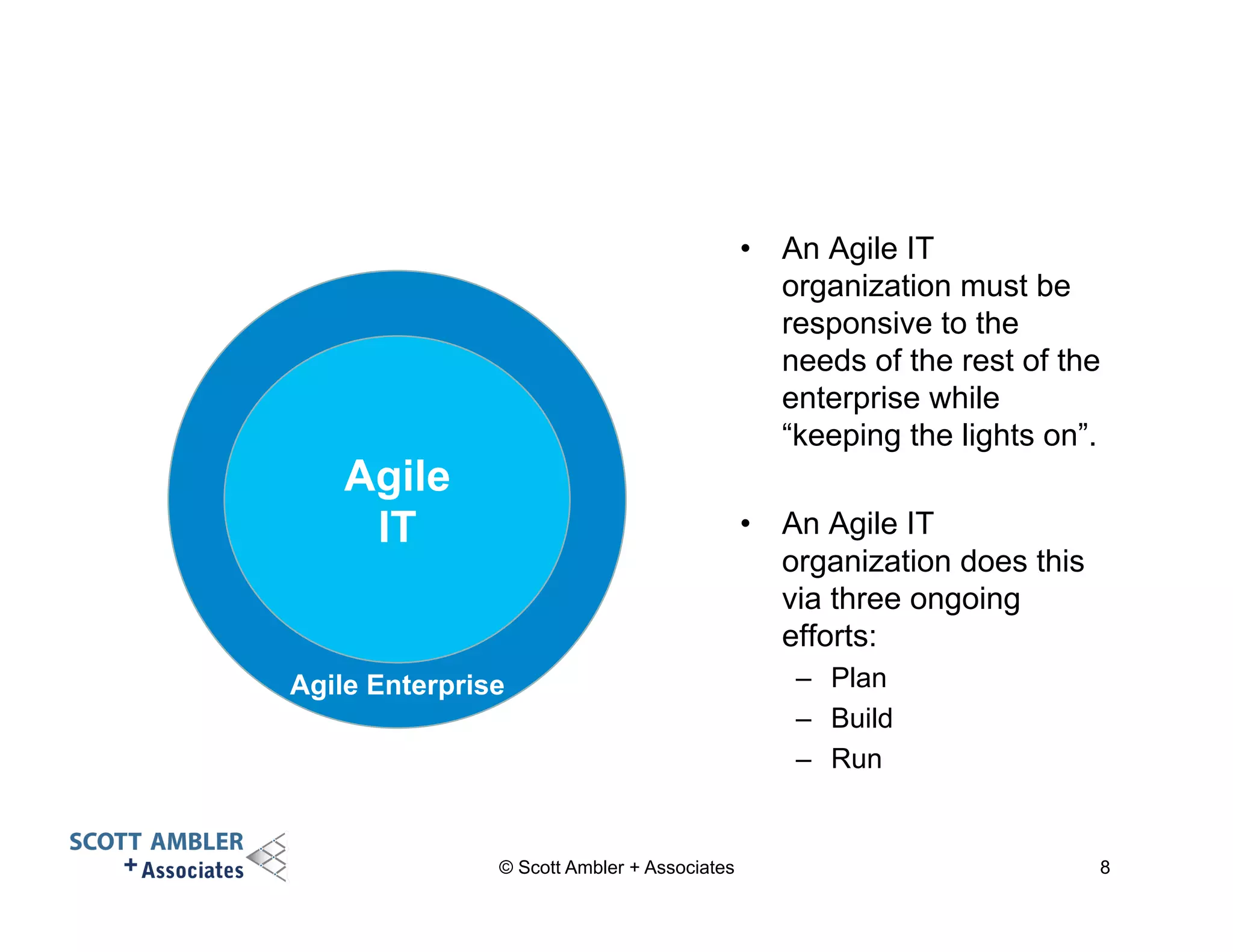
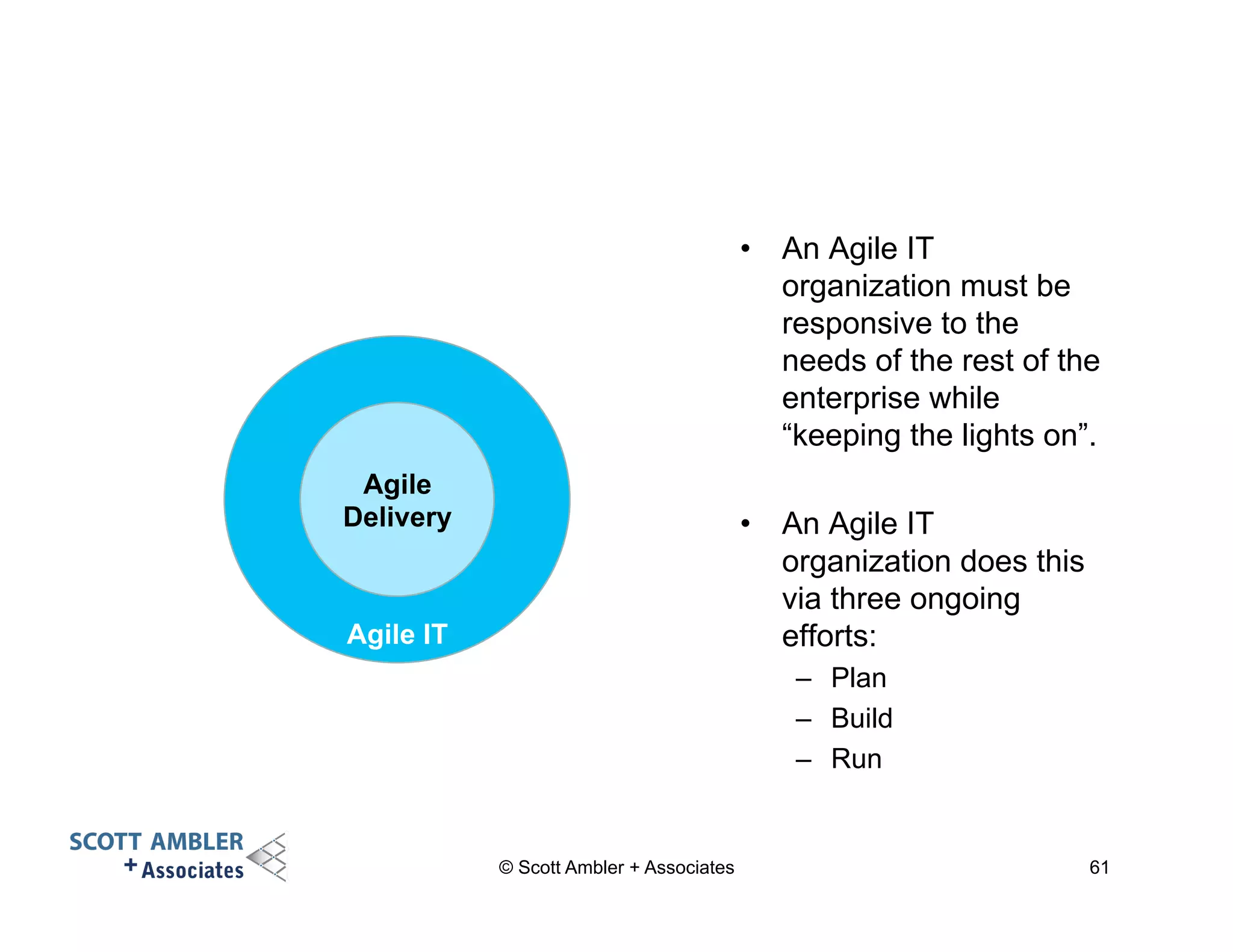
• An Agile IT 
organization must be 
responsive to the 
needs of the rest of the 
enterprise while 
“keeping the lights on”. 
• An Agile IT 
organization does this 
via three ongoing 
efforts: 
– Plan 
– Build 
– Run 
Agile Enterprise 
© Scott Ambler + Associates 8 
Agile 
IT
• Disciplined agile 
delivery teams produce 
consumable solutions 
often and early 
• Agile delivery teams 
must tailor their 
approach to address 
the situation that the 
find themselves in, 
particularly when 
working at scale – 
Context counts 
Agile 
Dev 
Agile Enterprise 
© Scott Ambler + Associates 9 
Agile IT
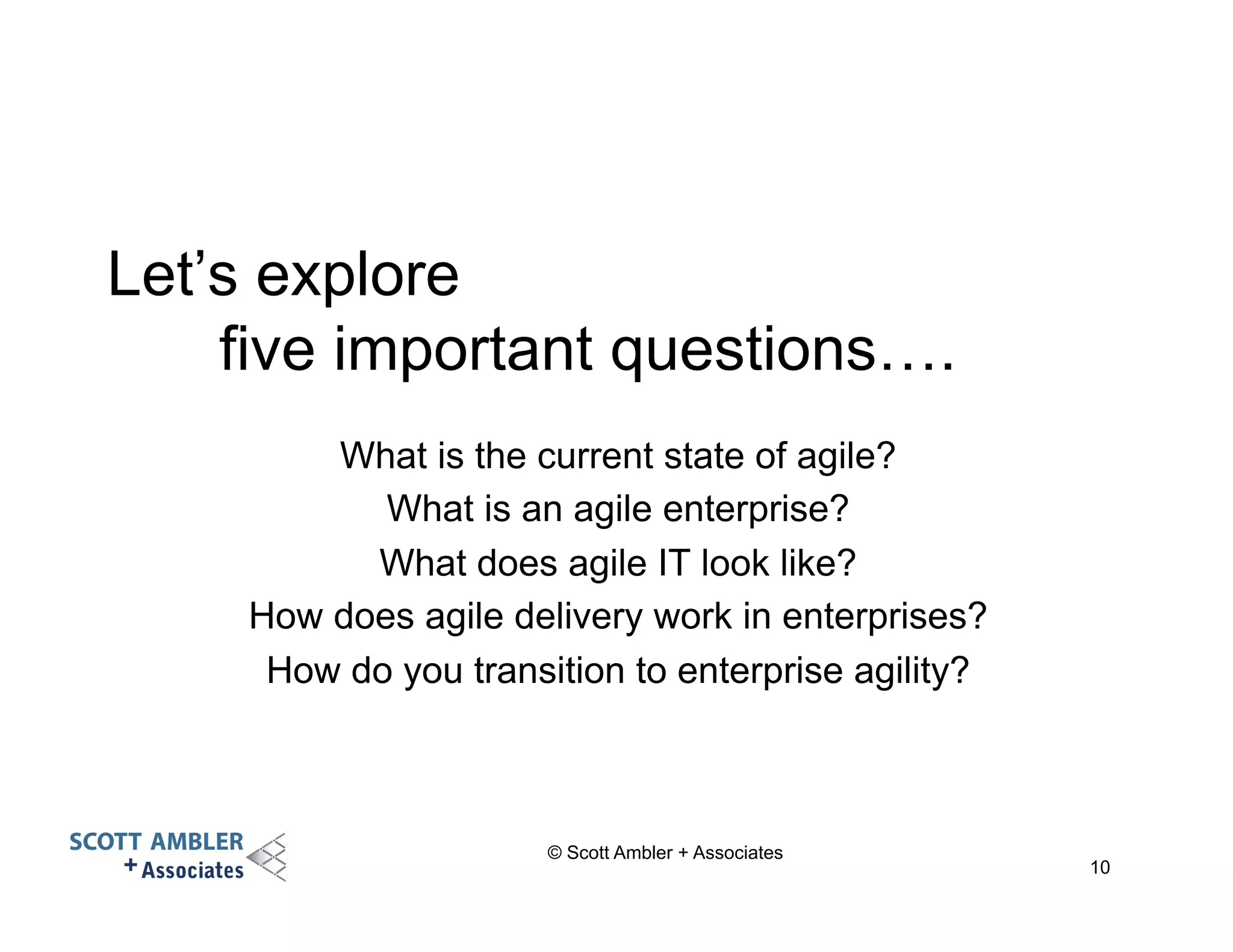
Let’s explore 
five important questions…. 
What is the current state of agile? 
What is an agile enterprise? 
What does agile IT look like? 
How does agile delivery work in enterprises? 
How do you transition to enterprise agility? 
© Scott Ambler + Associates 
10
The 
Current 
State of 
Agile 
© Scott Ambler + Associates 11
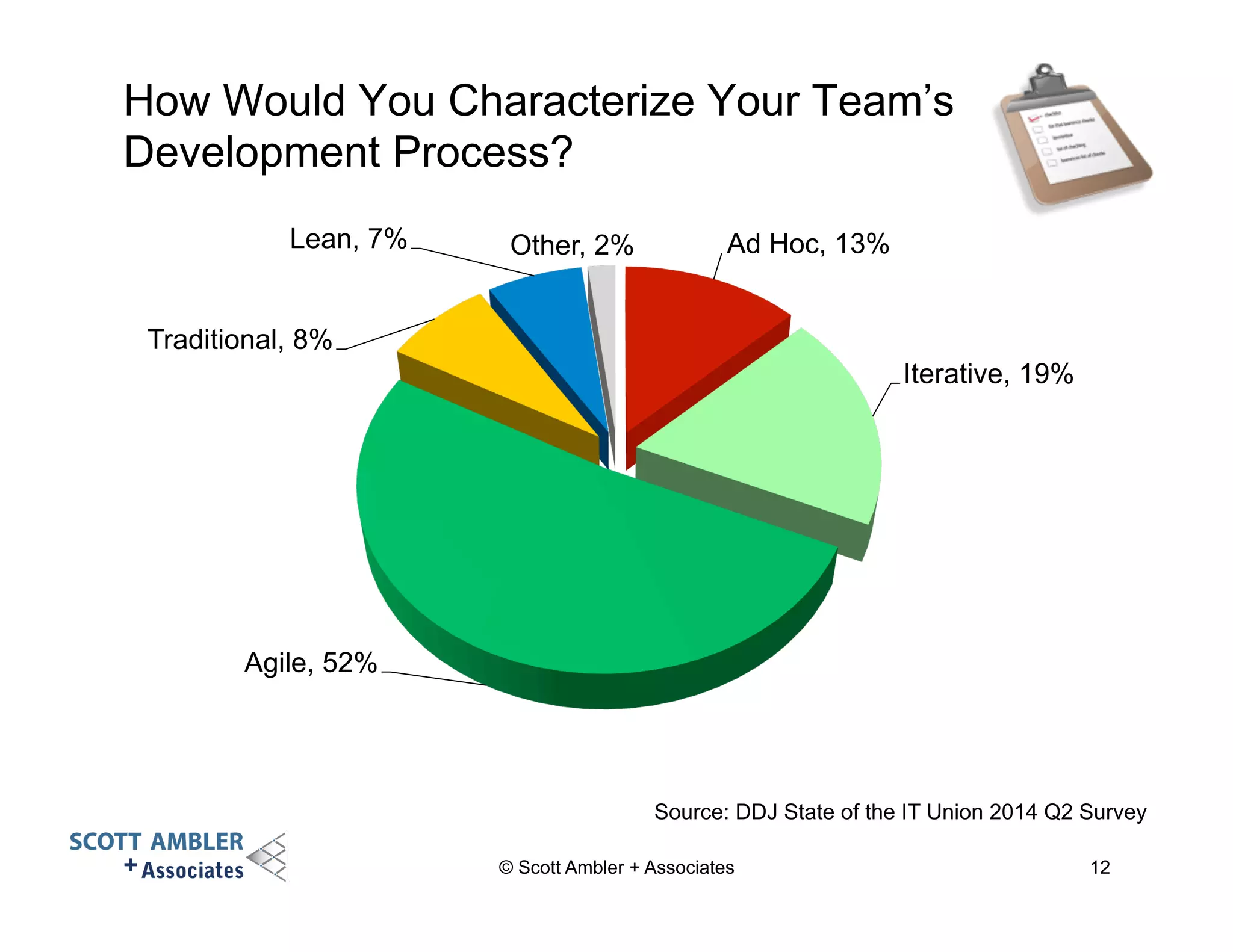
How Would You Characterize Your Team’s 
Development Process? 
Ad Hoc, 13% 
Iterative, 19% 
Lean, 7% Other, 2% 
Traditional, 8% 
Agile, 52% 
Source: DDJ State of the IT Union 2014 Q2 Survey 
© Scott Ambler + Associates 
12
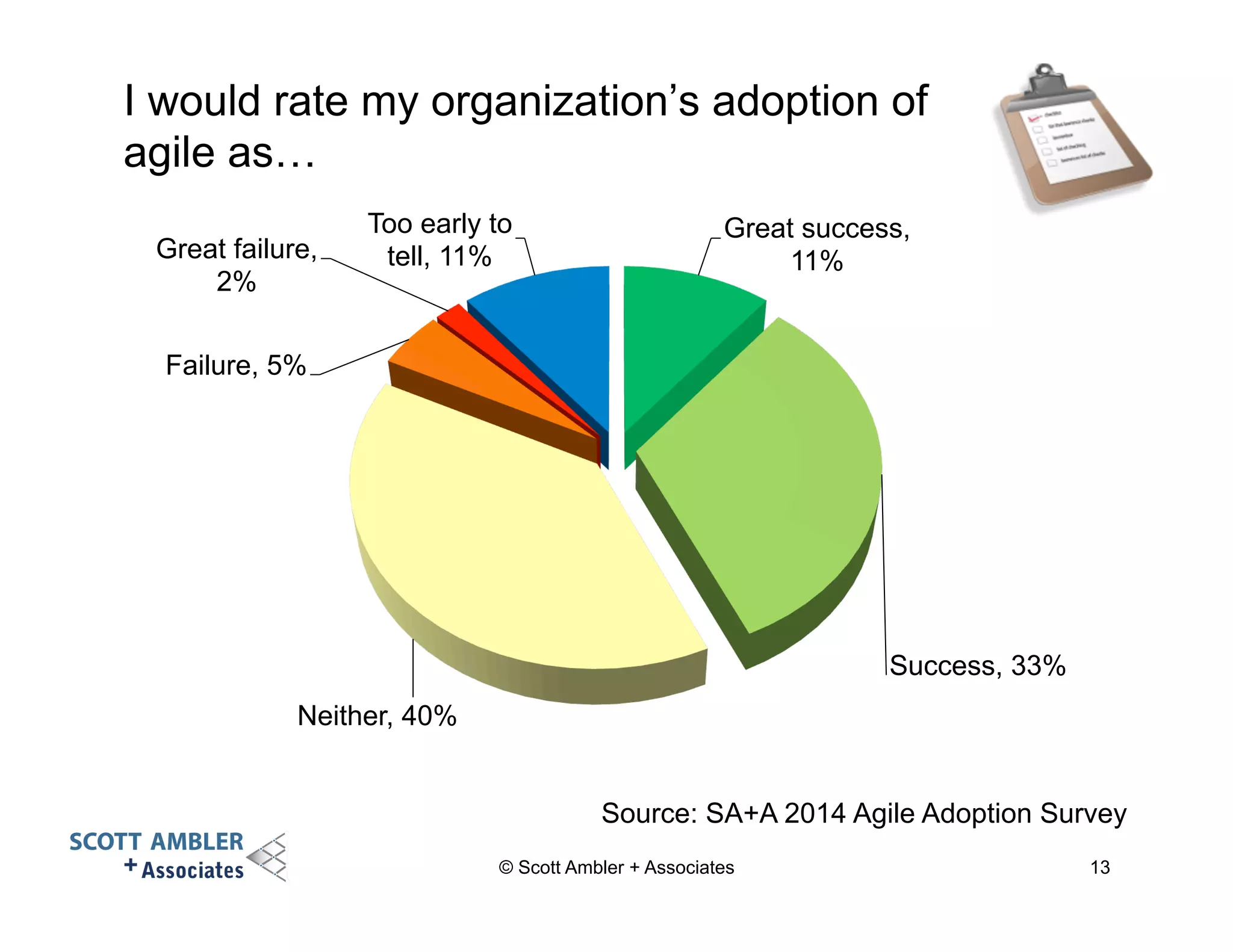
I would rate my organization’s adoption of 
agile as… 
Great success, 
11% 
Success, 33% 
Great failure, 
Failure, 5% 
Neither, 40% 
2% 
Too early to 
tell, 11% 
Source: SA+A 2014 Agile Adoption Survey 
© Scott Ambler + Associates 
13
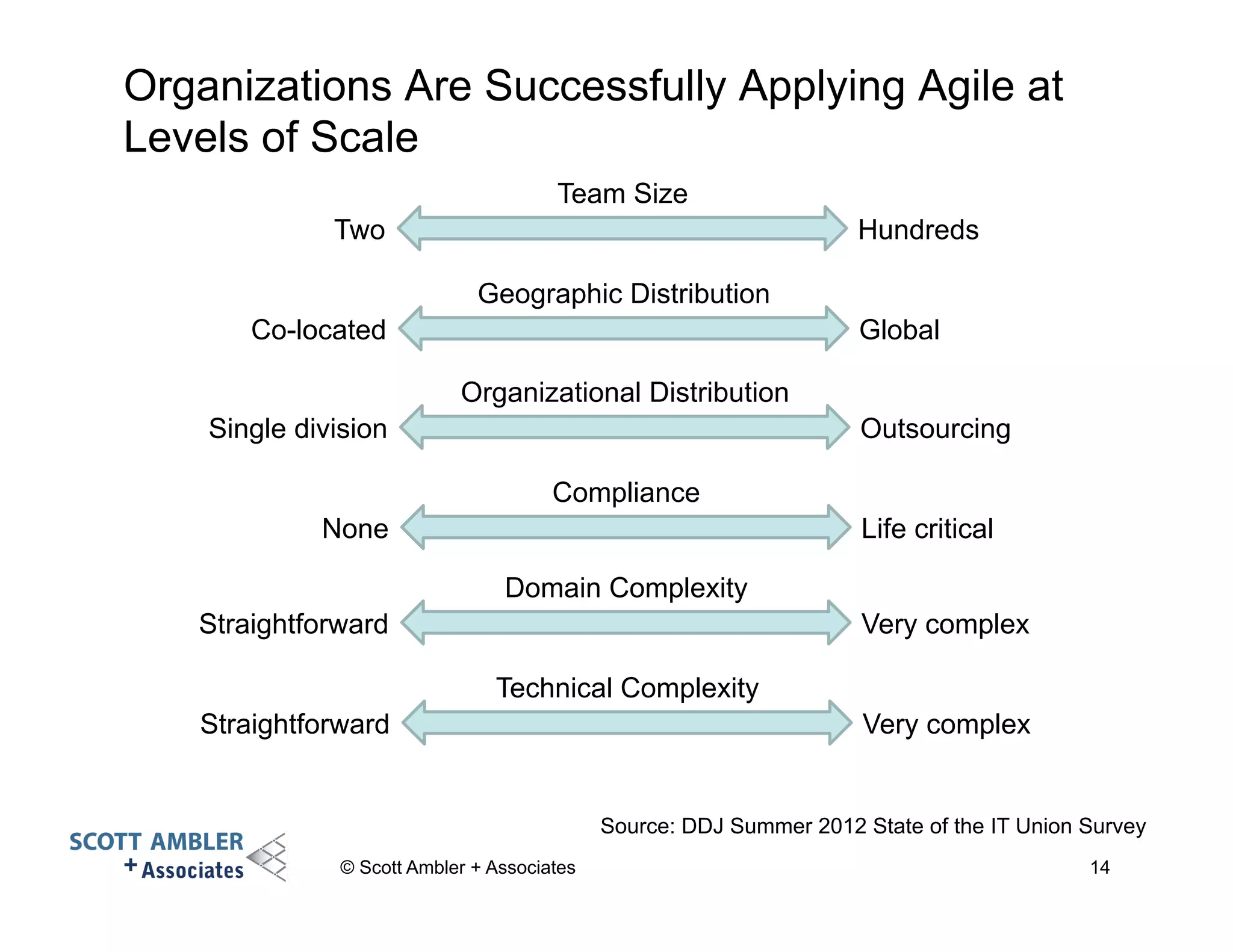
Organizations Are Successfully Applying Agile at 
Levels of Scale 
Team Size 
Two Hundreds 
Geographic Distribution 
Co-located Global 
Organizational Distribution 
Single division Outsourcing 
Compliance 
None Life critical 
Domain Complexity 
Straightforward Very complex 
Technical Complexity 
Straightforward Very complex 
© Scott Ambler + Associates 
Source: DDJ Summer 2012 State of the IT Union Survey 
14
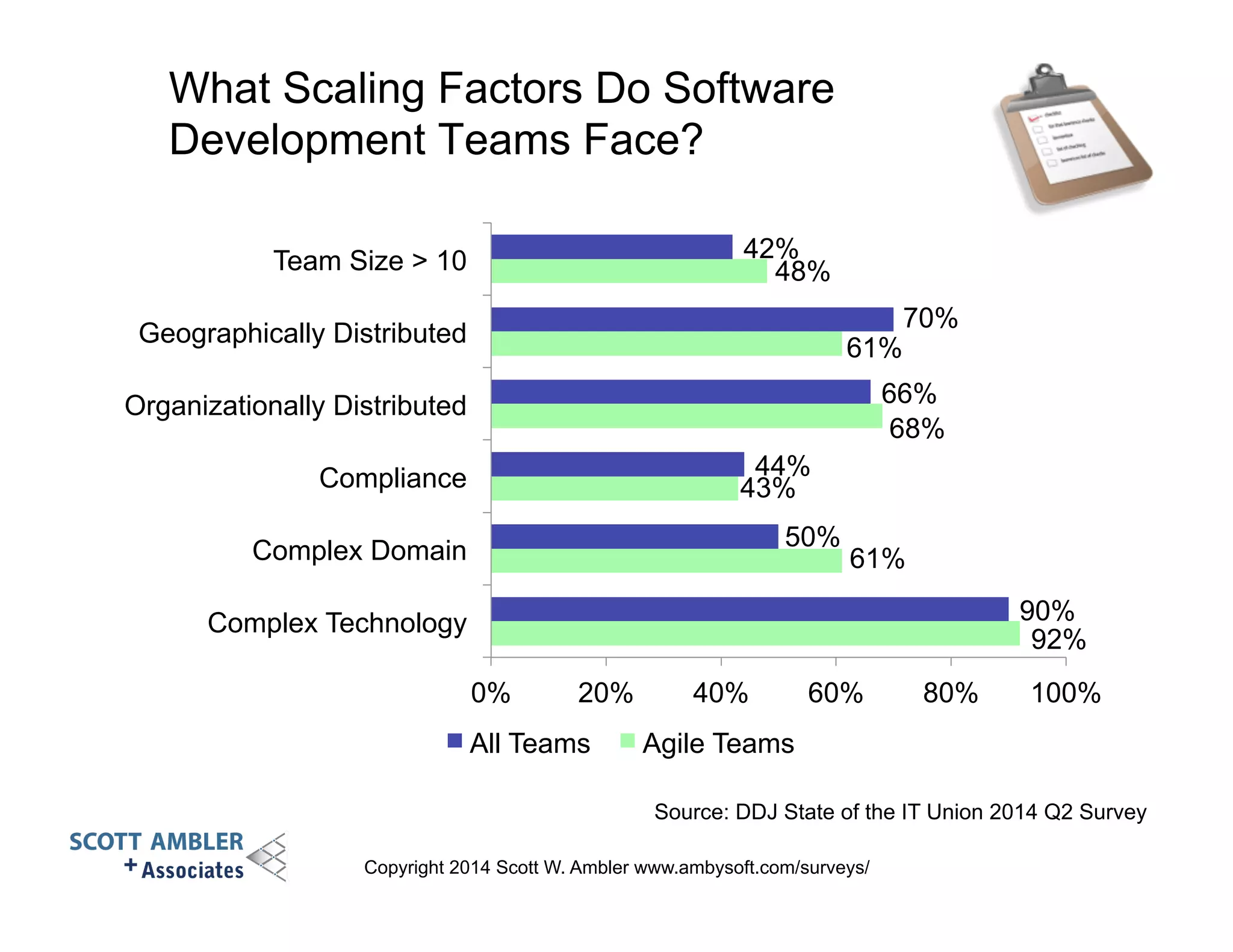
What Scaling Factors Do Software 
Development Teams Face? 
61% 
44% 
Team Size > 10 
Geographically Distributed 
Organizationally Distributed 
Compliance 
Complex Domain 
Copyright 2014 Scott W. Ambler www.ambysoft.com/surveys/ 
92% 
70% 
61% 
43% 
68% 
48% 
90% 
50% 
66% 
42% 
Complex Technology 
0% 20% 40% 60% 80% 100% 
All Teams Agile Teams 
Source: DDJ State of the IT Union 2014 Q2 Survey
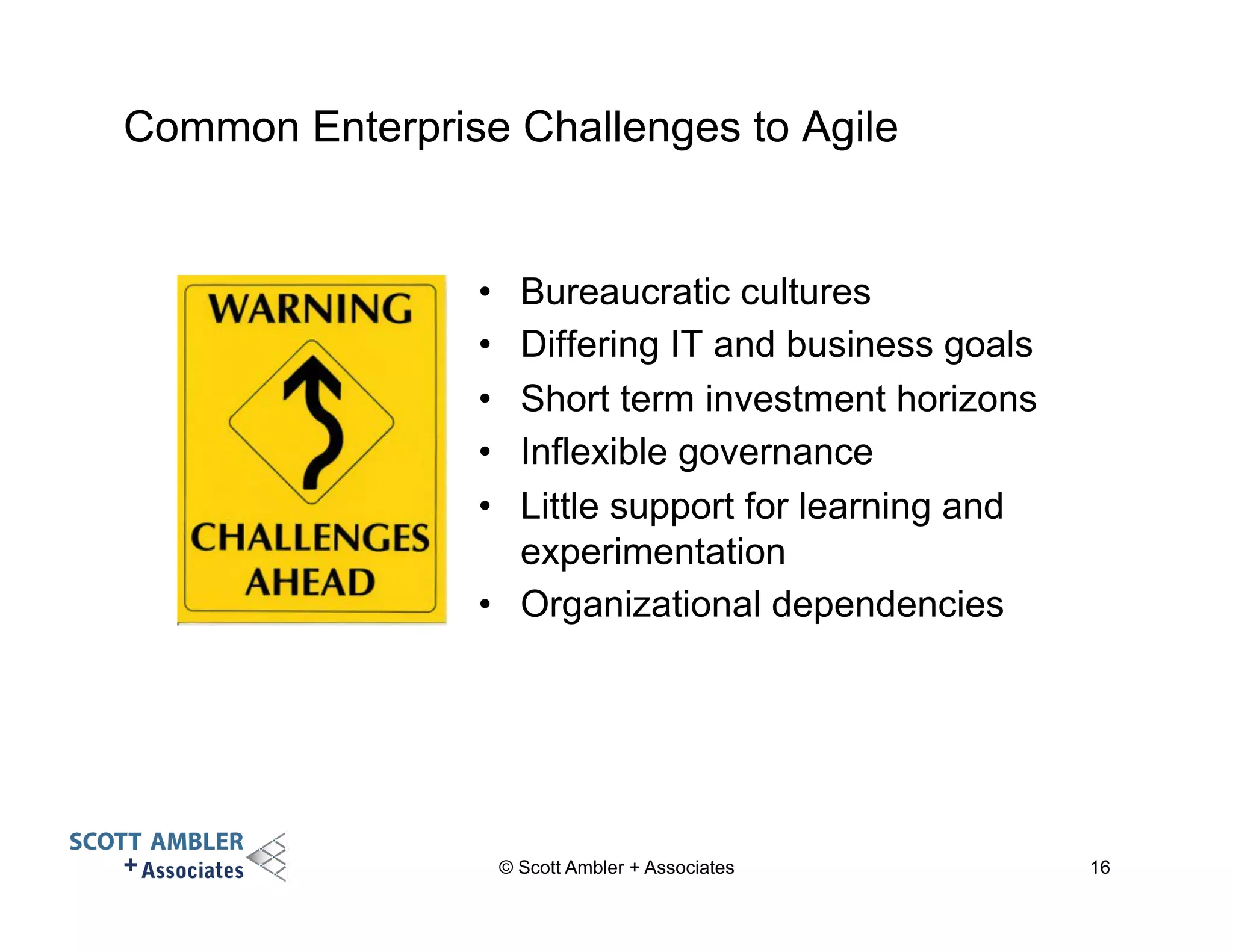
Common Enterprise Challenges to Agile 
• Bureaucratic cultures 
• Differing IT and business goals 
• Short term investment horizons 
• Inflexible governance 
• Little support for learning and 
experimentation 
• Organizational dependencies 
© Scott Ambler + Associates 16
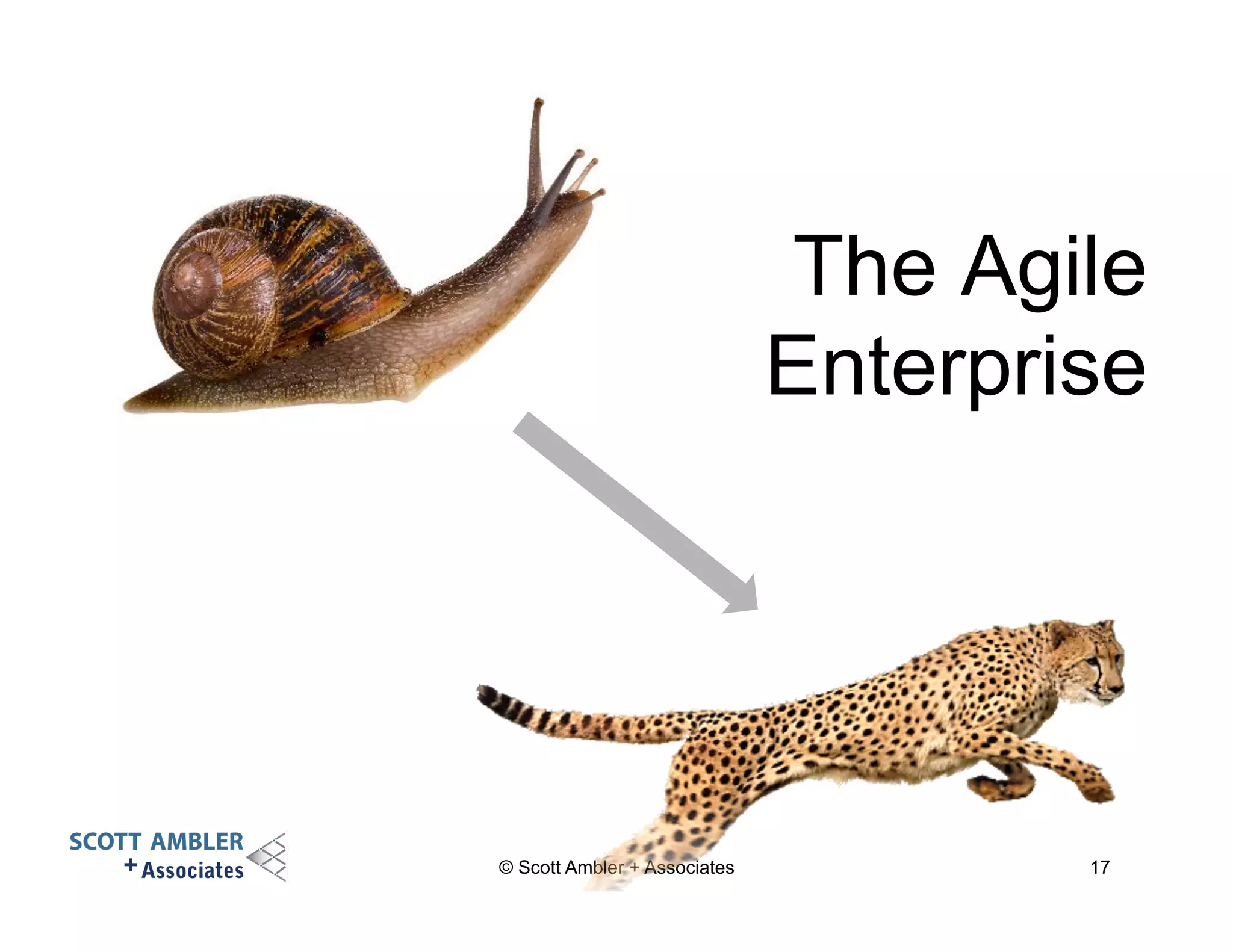
The Agile 
Enterprise 
© Scott Ambler + Associates 17
Let’s assume 
that agile software 
development 
is the center 
of the universe 
for your organization… 
© Scott Ambler + Associates 18
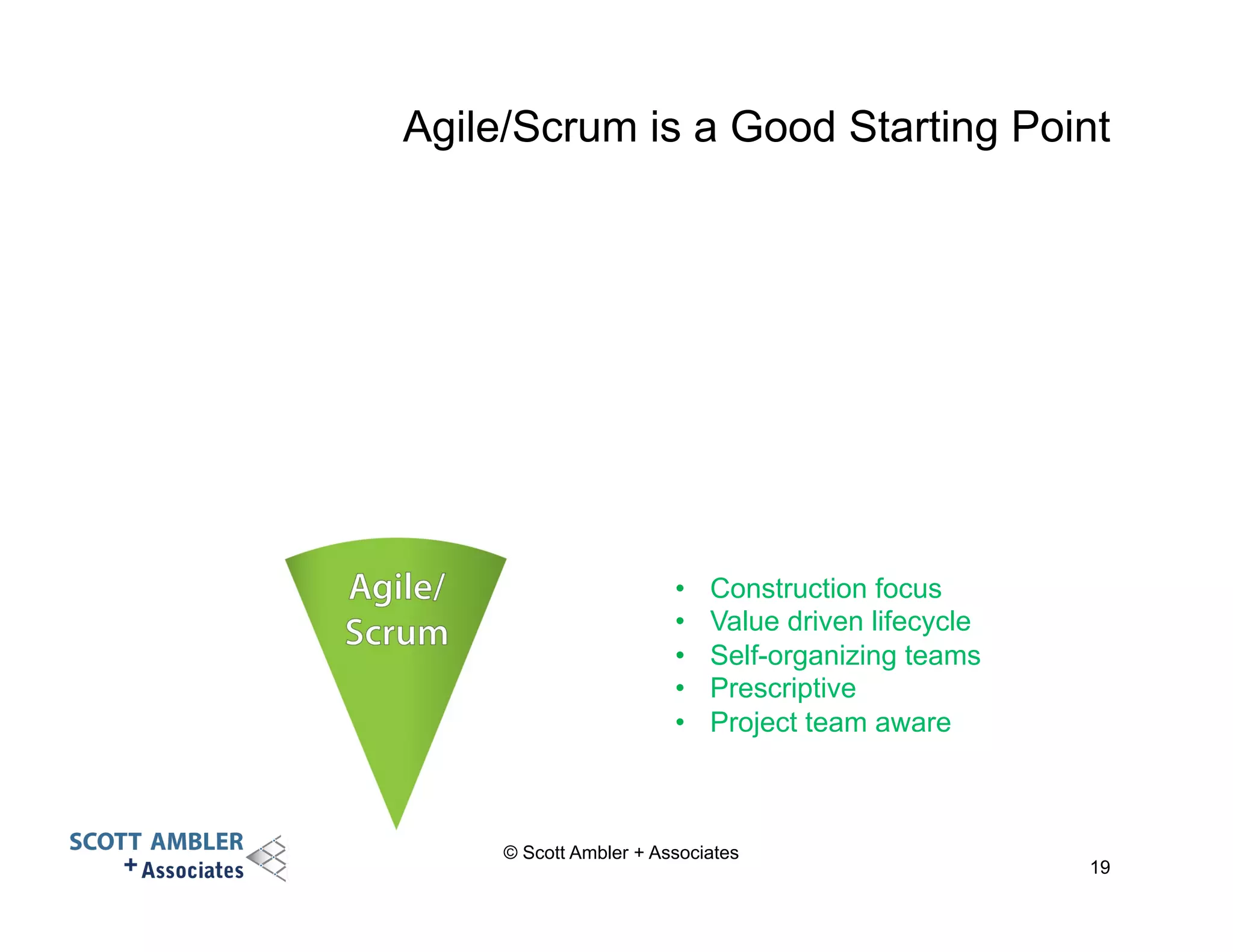
Agile/Scrum is a Good Starting Point 
© Scott Ambler + Associates 
19 
• Construction focus 
• Value driven lifecycle 
• Self-organizing teams 
• Prescriptive 
• Project team aware
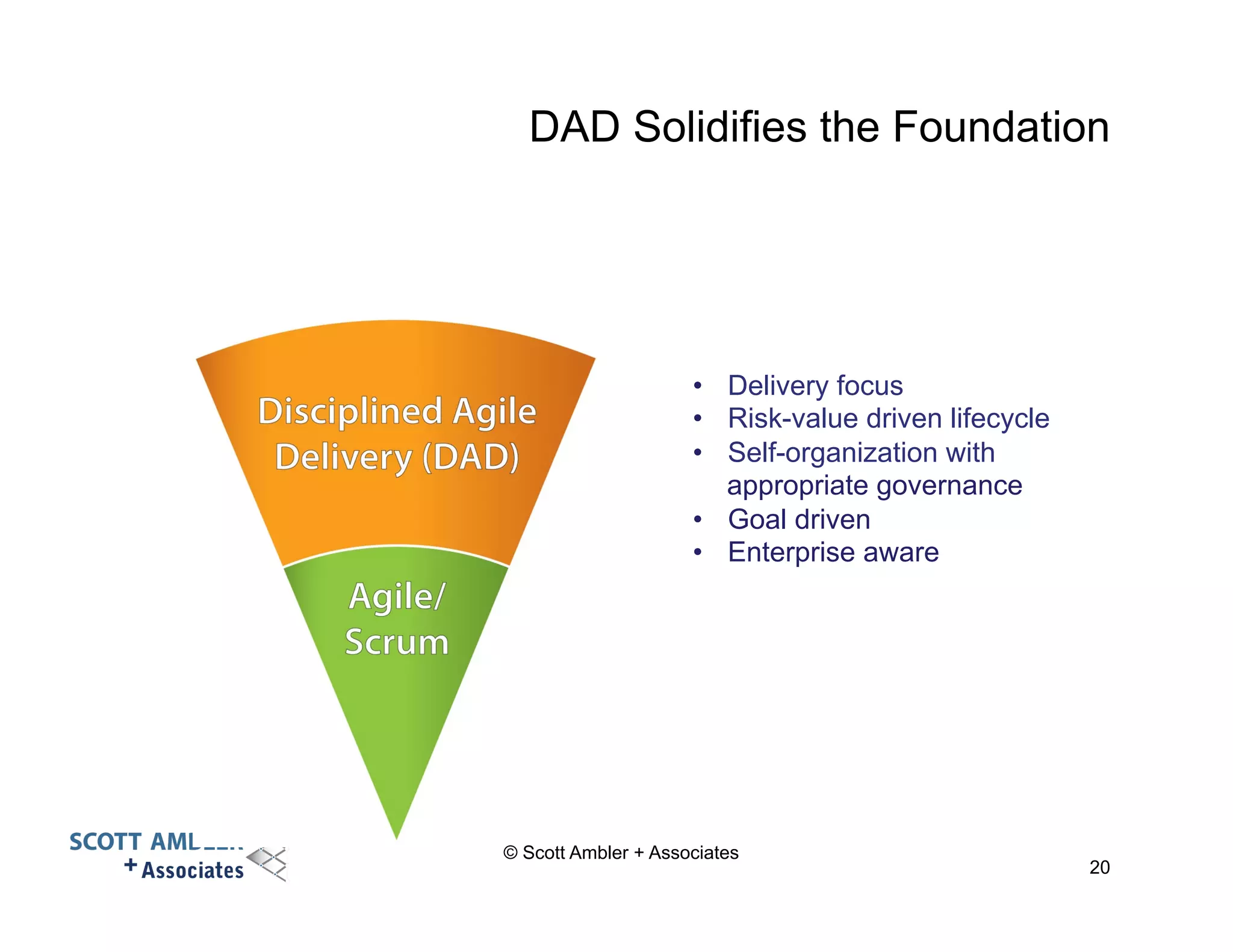
DAD Solidifies the Foundation 
• Delivery focus 
• Risk-value driven lifecycle 
• Self-organization with 
appropriate governance 
• Goal driven 
• Enterprise aware 
© Scott Ambler + Associates 
20
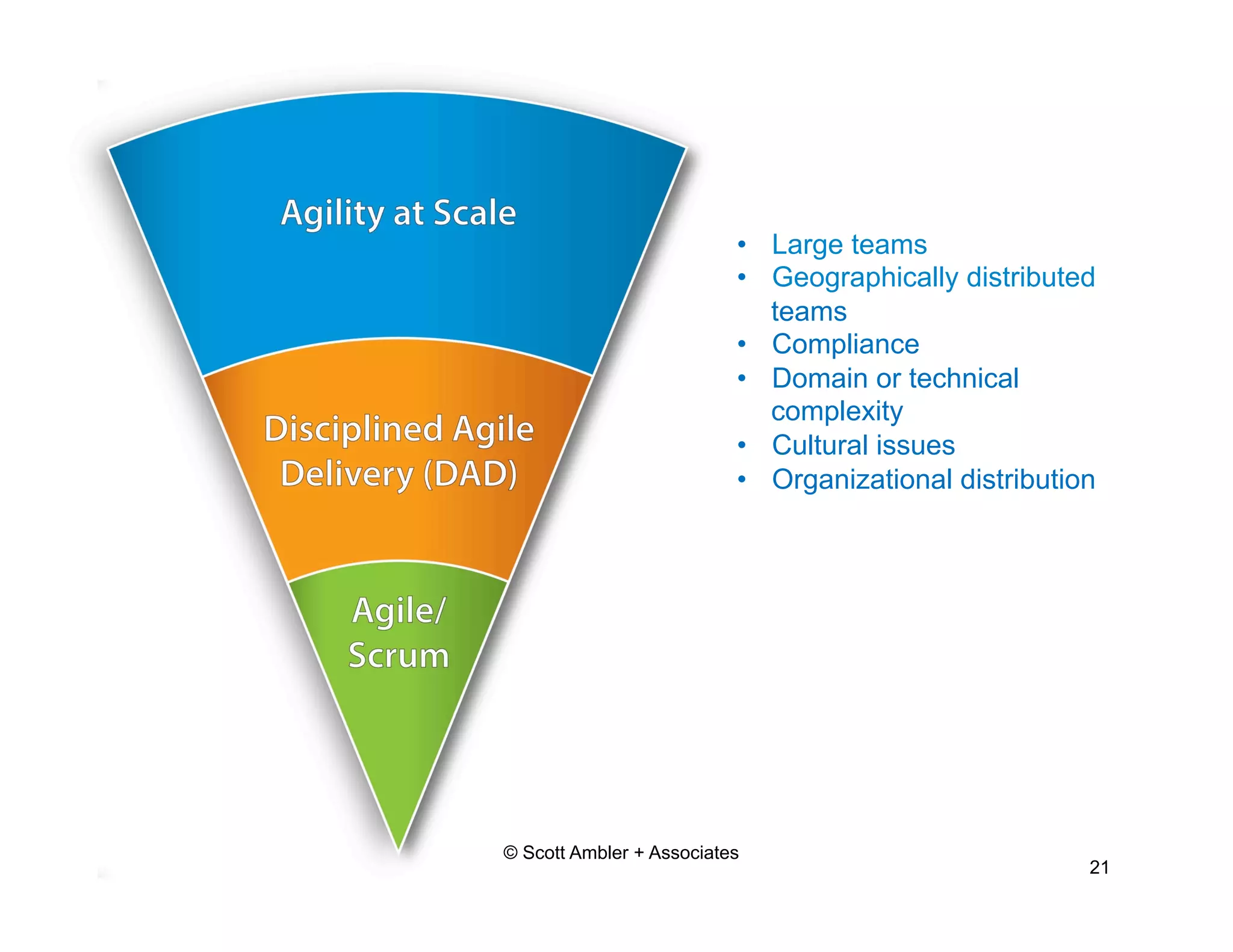
• Large teams 
• Geographically distributed 
teams 
• Compliance 
• Domain or technical 
complexity 
• Cultural issues 
• Organizational distribution 
© Scott Ambler + Associates 
21
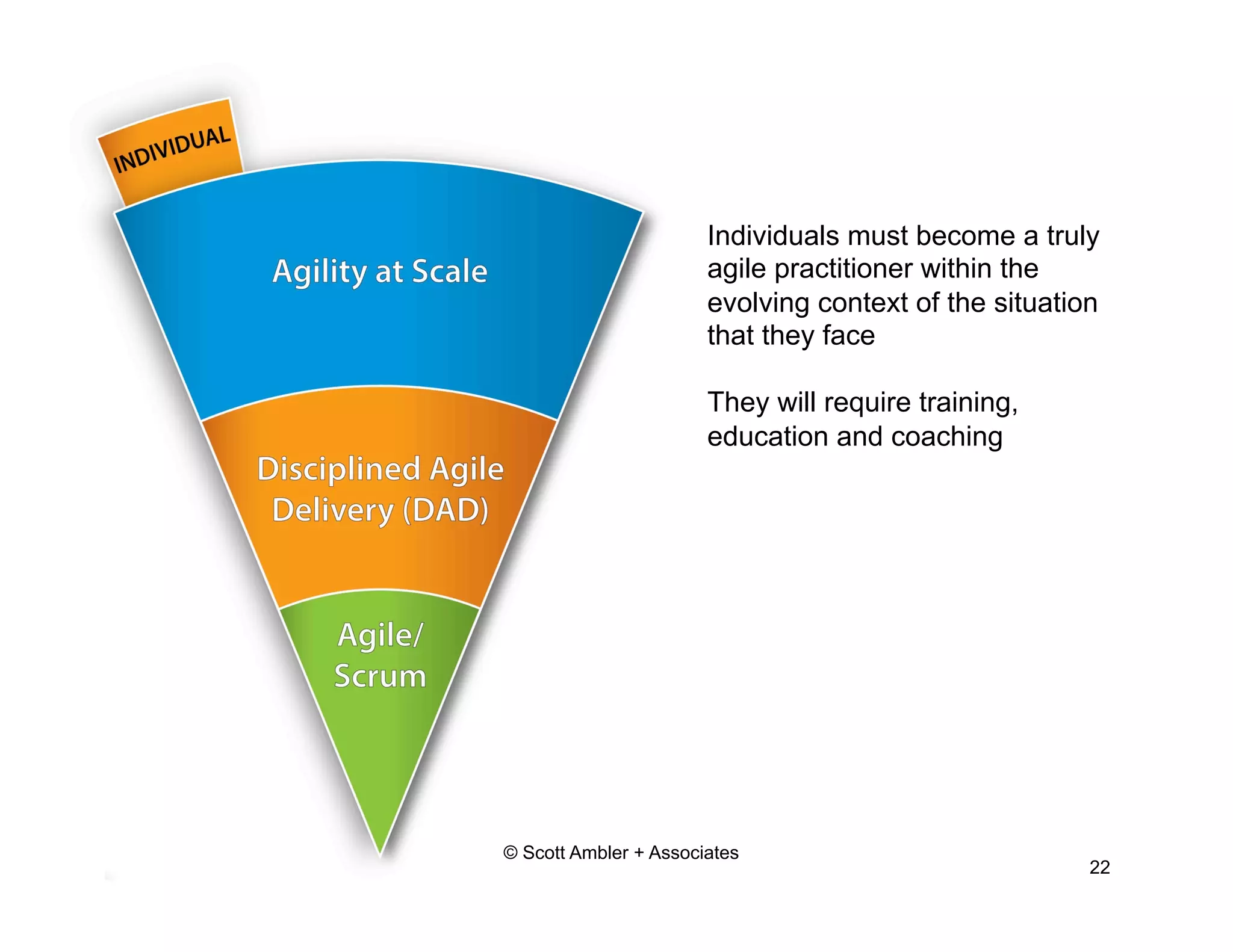
Individuals must become a truly 
agile practitioner within the 
evolving context of the situation 
that they face 
They will require training, 
education and coaching 
© Scott Ambler + Associates 
22
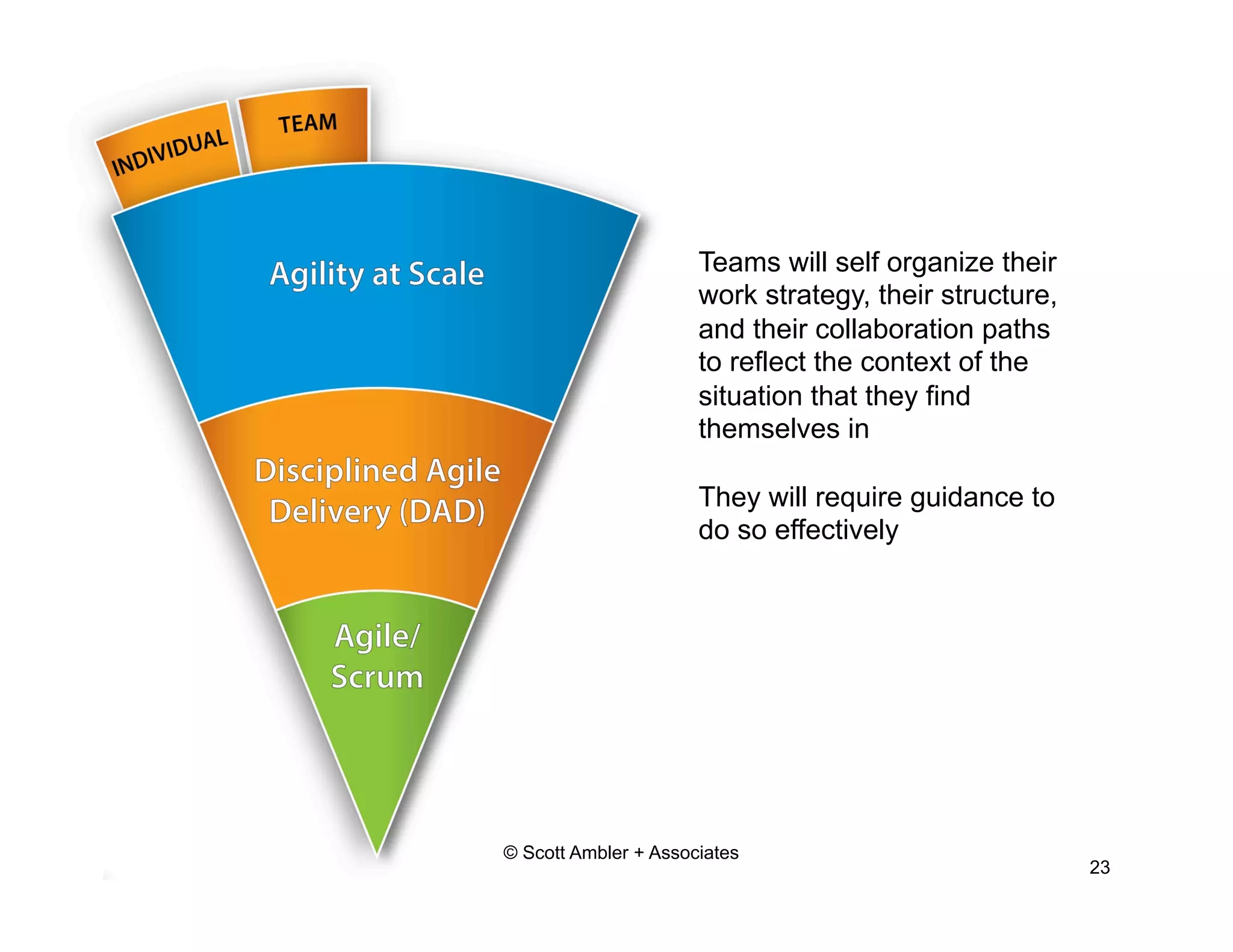
Teams will self organize their 
work strategy, their structure, 
and their collaboration paths 
to reflect the context of the 
situation that they find 
themselves in 
They will require guidance to 
do so effectively 
© Scott Ambler + Associates 
23
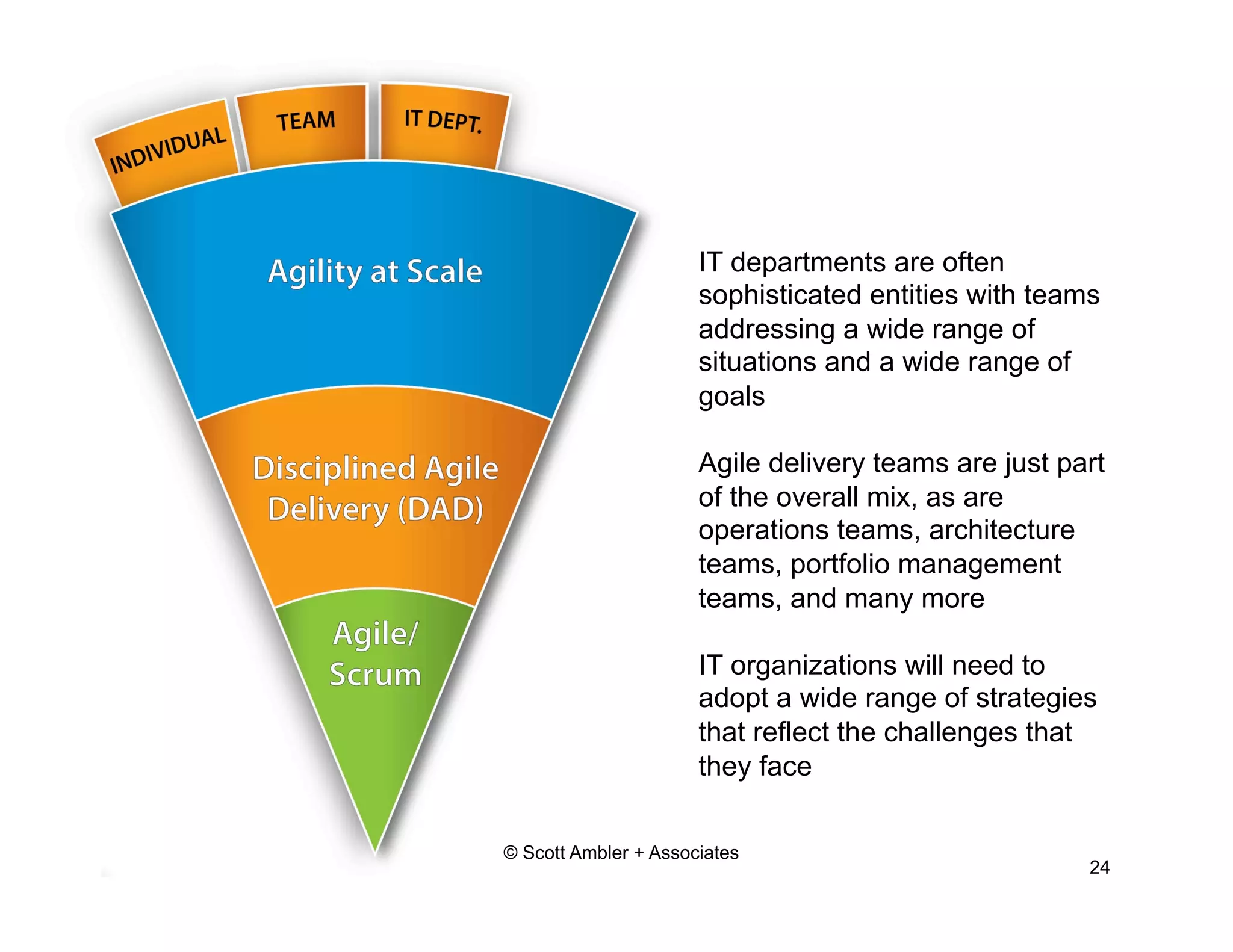
IT departments are often 
sophisticated entities with teams 
addressing a wide range of 
situations and a wide range of 
goals 
Agile delivery teams are just part 
of the overall mix, as are 
operations teams, architecture 
teams, portfolio management 
teams, and many more 
IT organizations will need to 
adopt a wide range of strategies 
that reflect the challenges that 
they face 
© Scott Ambler + Associates 
24
© Scott Ambler + Associates 
An agile enterprise is able to 
anticipate and respond swiftly to 
changes in the marketplace. 
It does this through an 
organizational culture and 
structure that facilitates change 
within the context of the situation 
that it faces. 
Agile enterprises require a 
learning mindset in the 
mainstream business and 
underlying lean and agile 
processes to drive innovation. 
25
The Agile IT 
Department 
© Scott Ambler + Associates 26
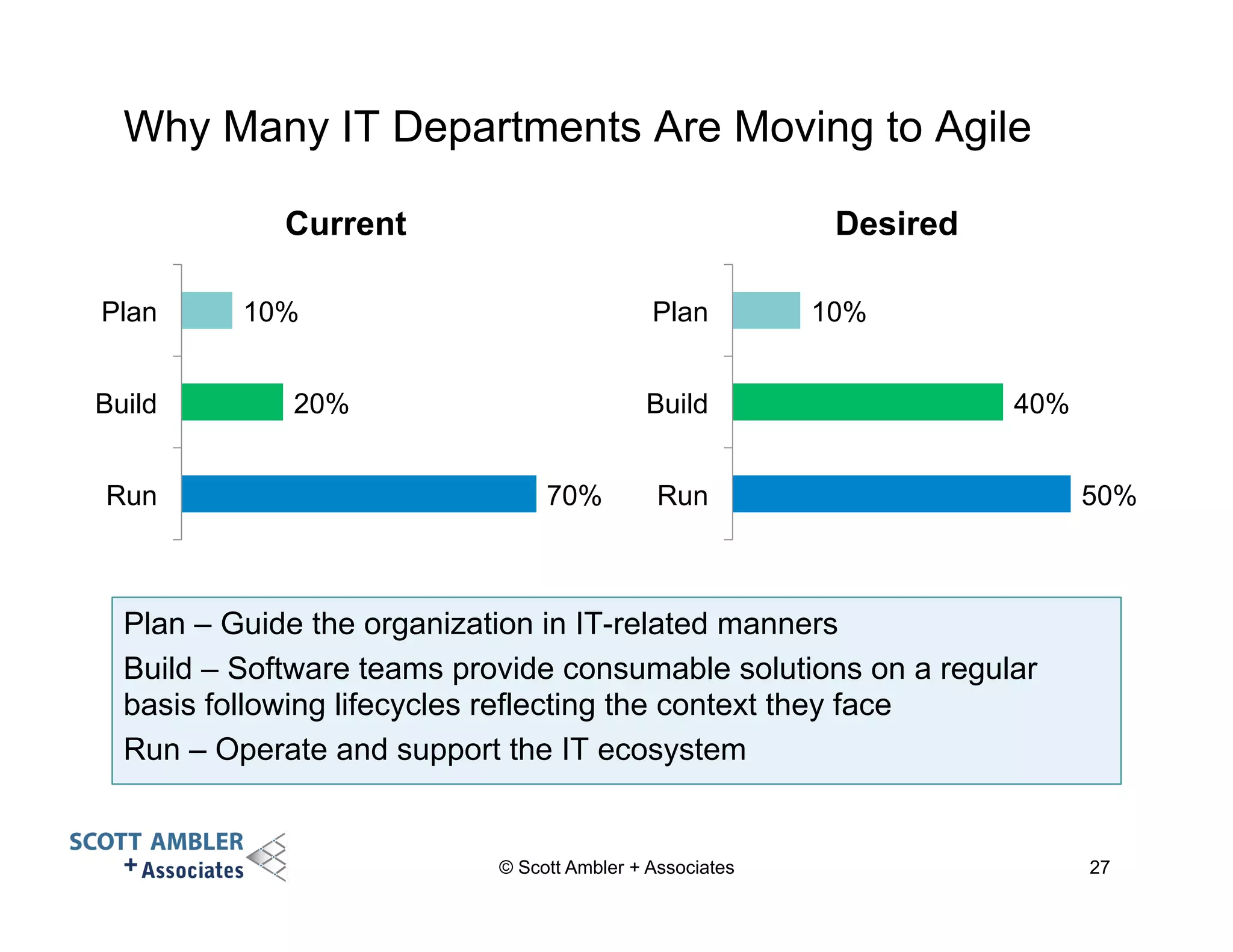
Why Many IT Departments Are Moving to Agile 
70% 
10% 
20% 
Plan 
Build 
Run 
Current 
50% 
40% 
Desired 
10% 
Plan 
Build 
Run 
Plan – Guide the organization in IT-related manners 
Build – Software teams provide consumable solutions on a regular 
basis following lifecycles reflecting the context they face 
Run – Operate and support the IT ecosystem 
© Scott Ambler + Associates 27
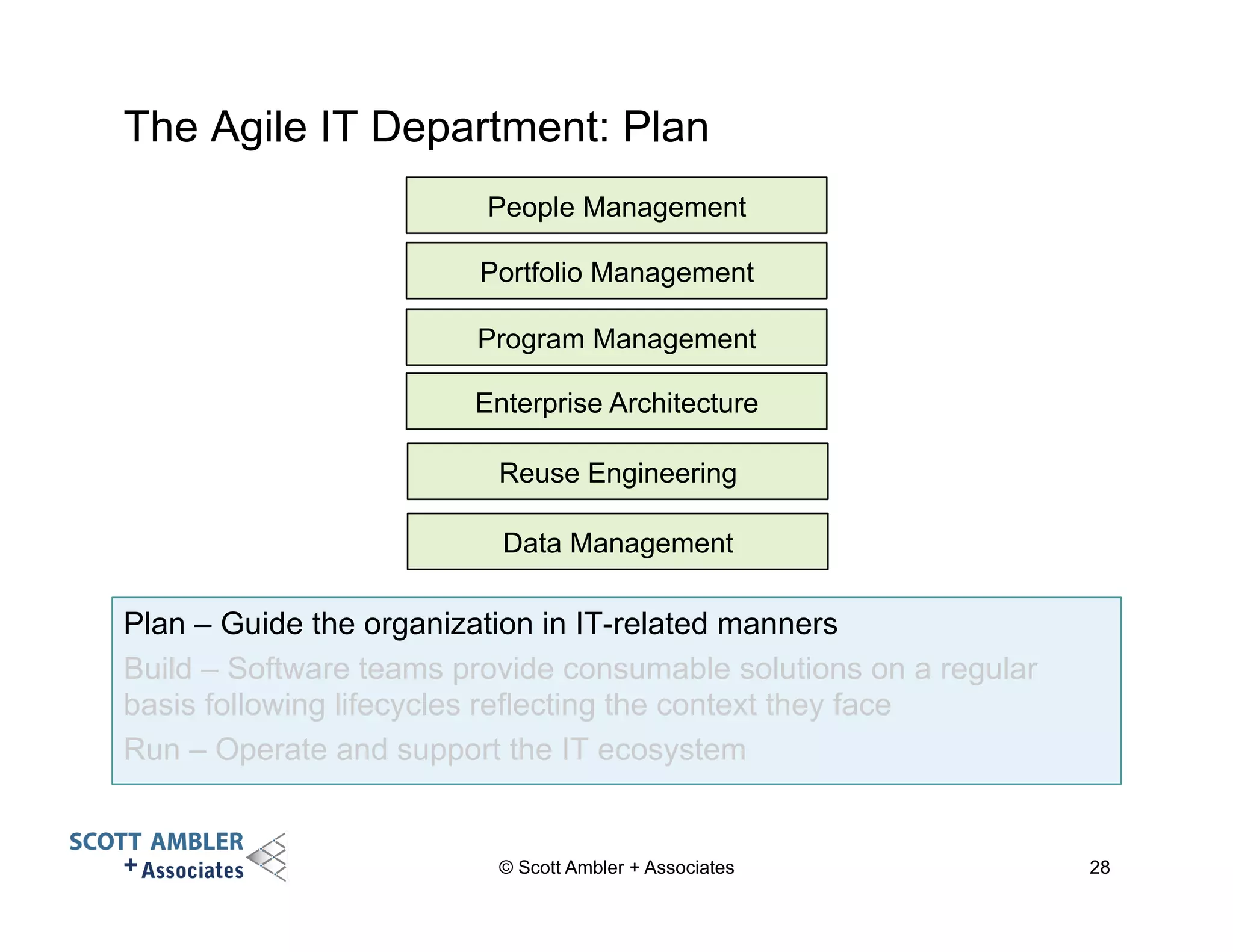
The Agile IT Department: Plan 
People Management 
Portfolio Management 
Program Management 
Enterprise Architecture 
Reuse Engineering 
Data Management 
Plan – Guide the organization in IT-related manners 
Build – Software teams provide consumable solutions on a regular 
basis following lifecycles reflecting the context they face 
Run – Operate and support the IT ecosystem 
© Scott Ambler + Associates 28
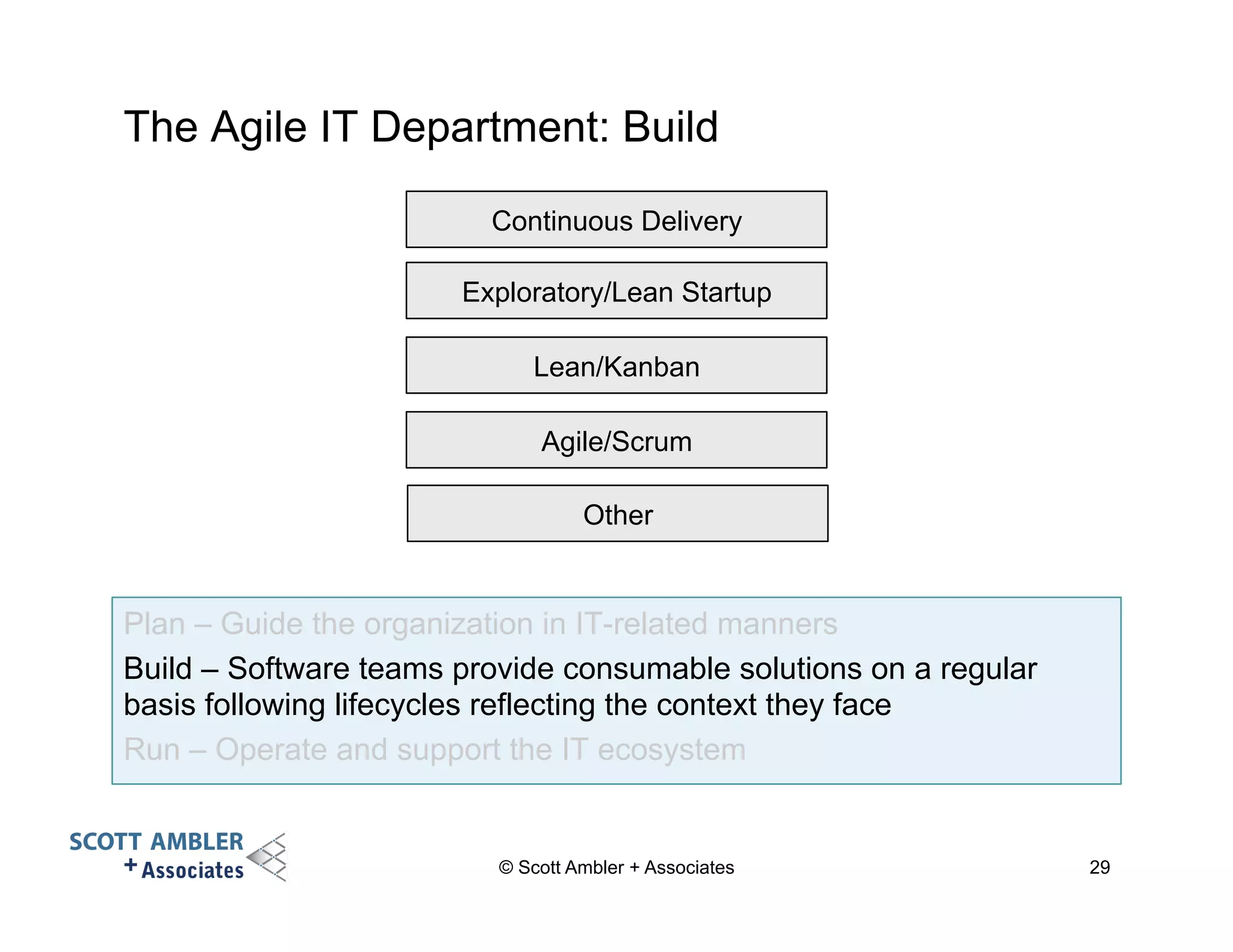
The Agile IT Department: Build 
Continuous Delivery 
Exploratory/Lean Startup 
Lean/Kanban 
Agile/Scrum 
Other 
Plan – Guide the organization in IT-related manners 
Build – Software teams provide consumable solutions on a regular 
basis following lifecycles reflecting the context they face 
Run – Operate and support the IT ecosystem 
© Scott Ambler + Associates 29
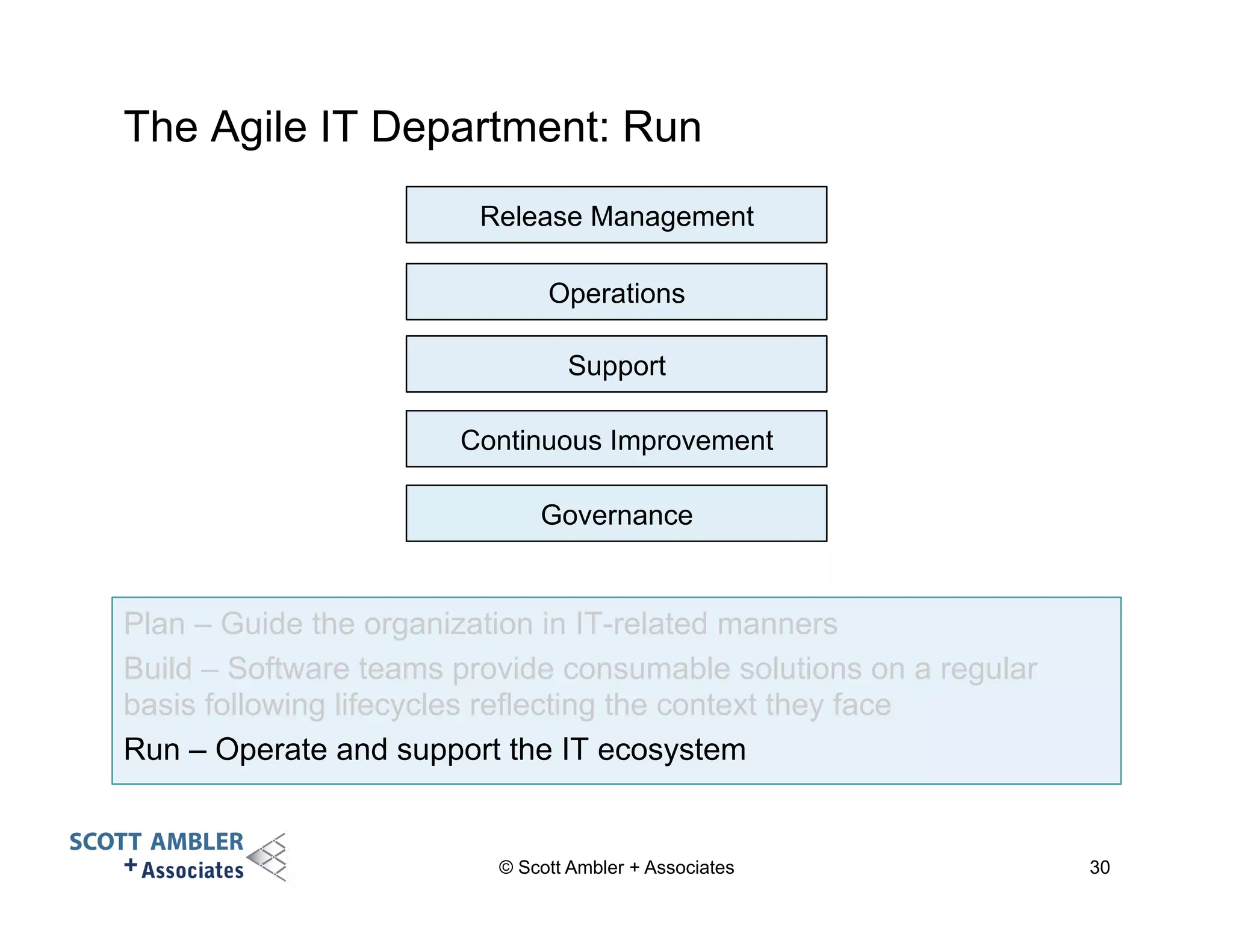
The Agile IT Department: Run 
Release Management 
Operations 
Support 
Continuous Improvement 
Governance 
Plan – Guide the organization in IT-related manners 
Build – Software teams provide consumable solutions on a regular 
basis following lifecycles reflecting the context they face 
Run – Operate and support the IT ecosystem 
© Scott Ambler + Associates 30
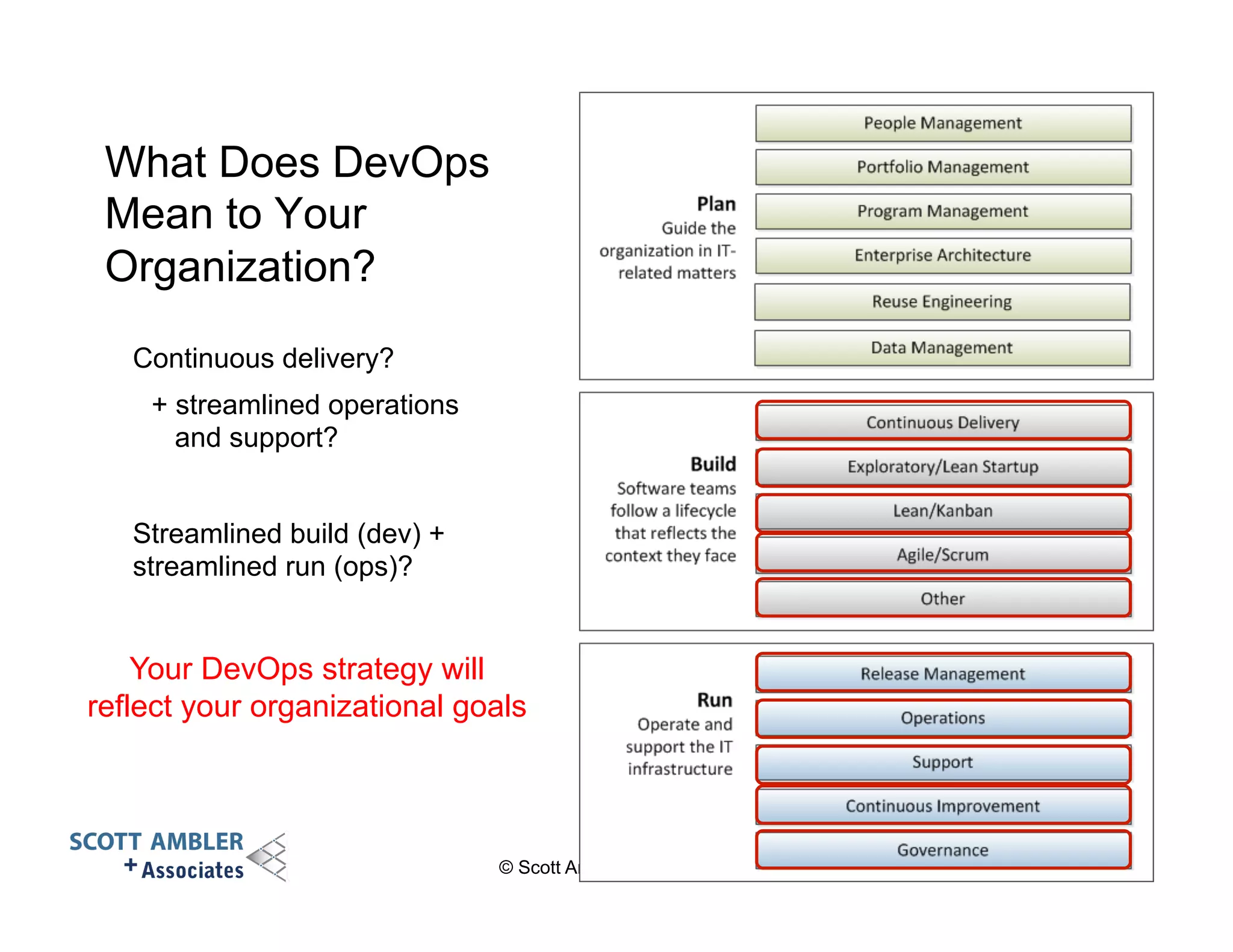
What Does DevOps 
Mean to Your 
Organization? 
© Scott Ambler + Associates 31 
Continuous delivery? 
+ streamlined operations 
and support? 
Streamlined build (dev) + 
streamlined run (ops)? 
Your DevOps strategy will 
reflect your organizational goals
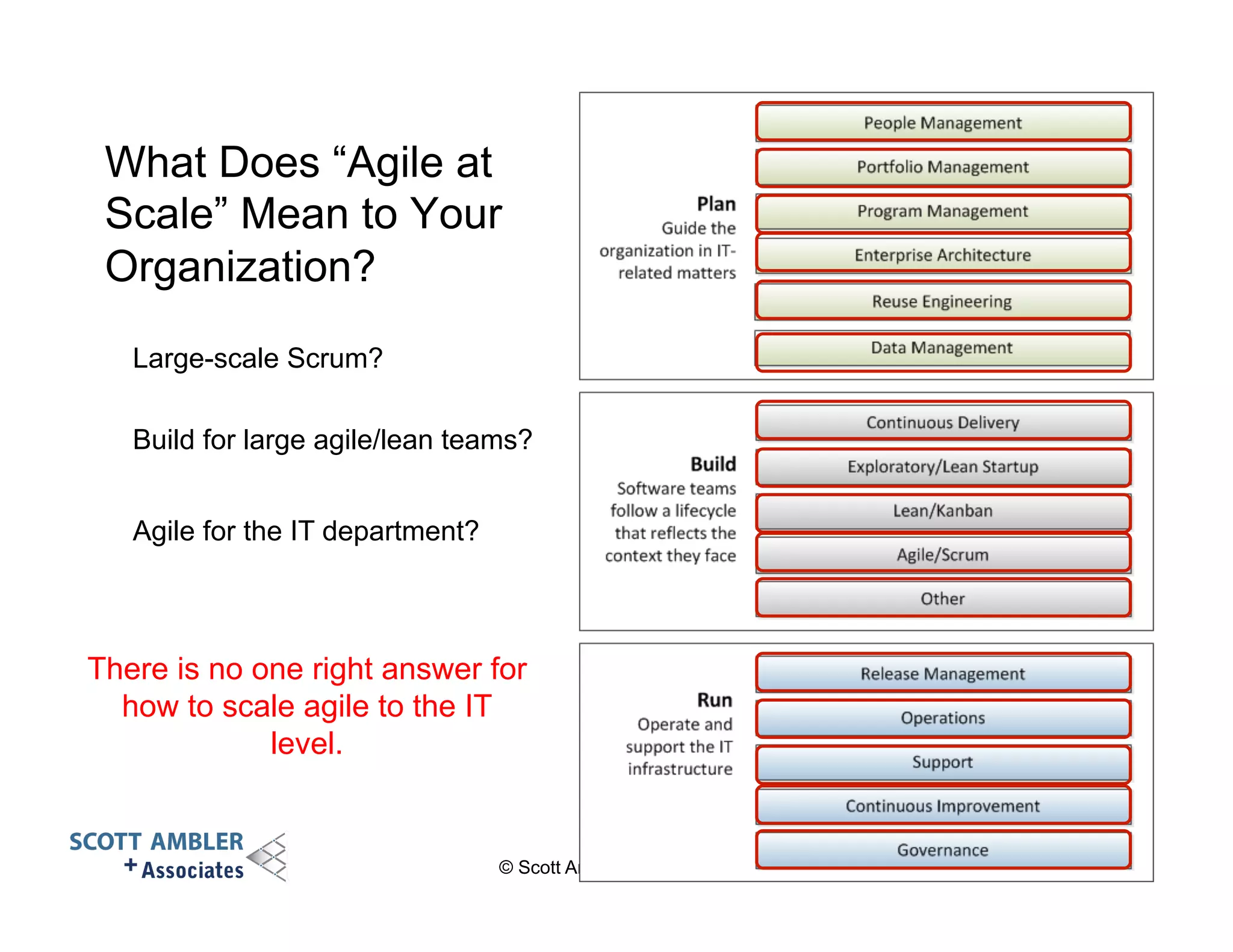
What Does “Agile at 
Scale” Mean to Your 
Organization? 
Large-scale Scrum? 
Build for large agile/lean teams? 
Agile for the IT department? 
There is no one right answer for 
how to scale agile to the IT 
© Scott Ambler + Associates 32 
level.
Disciplined 
Agile 
Delivery 
(DAD) 
© Scott Ambler + Associates 33
Disciplined Agile Delivery 
(DAD) is a process decision 
framework 
The key characteristics of DAD: 
– People-first 
– Goal-driven 
– Hybrid agile 
– Learning-oriented 
– Full delivery lifecycle 
– Solution focused 
– Risk-value lifecycle 
– Enterprise aware 
© Scott Ambler + Associates 34
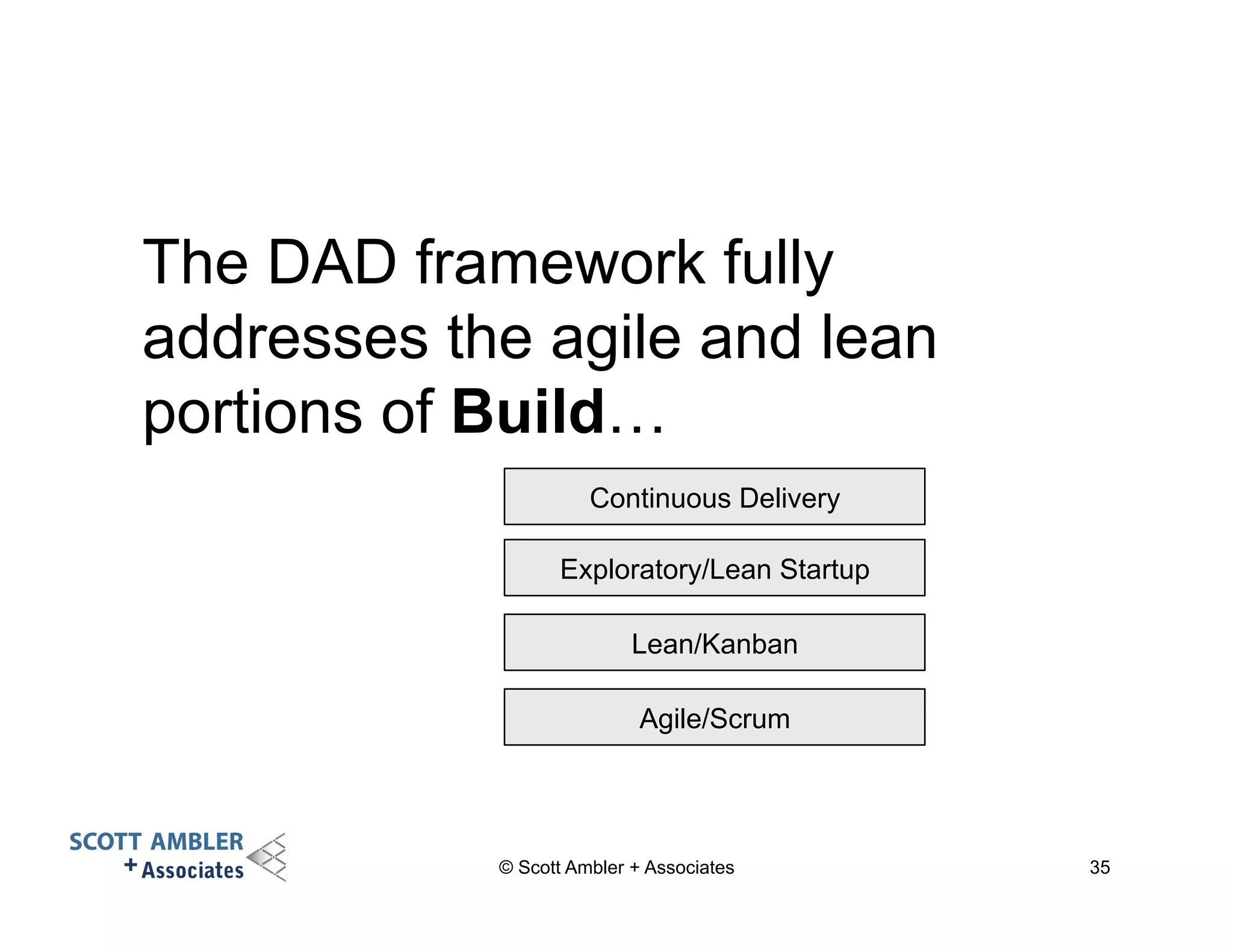
The DAD framework fully 
addresses the agile and lean 
portions of Build… 
Continuous Delivery 
Exploratory/Lean Startup 
Lean/Kanban 
Agile/Scrum 
© Scott Ambler + Associates 35
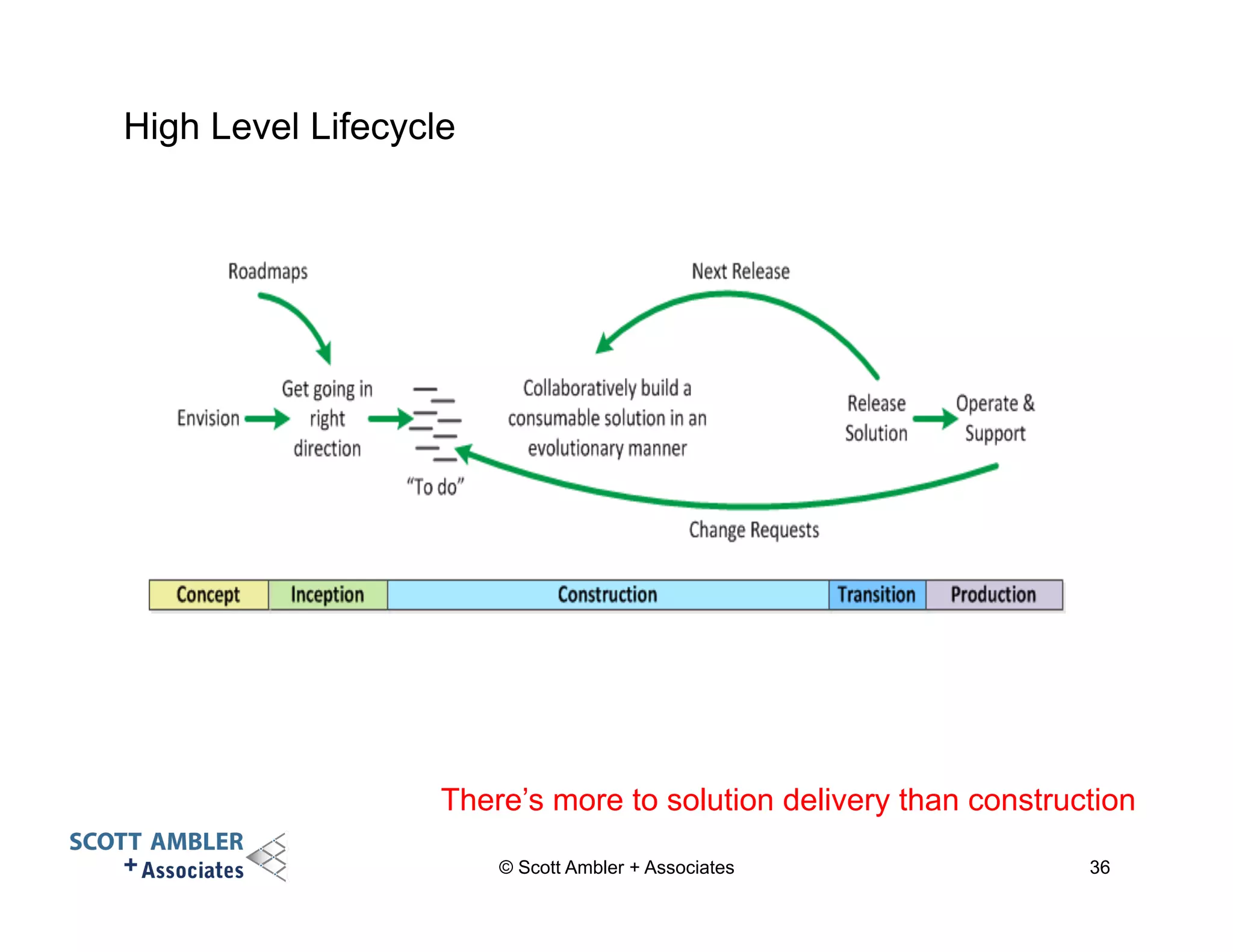
High Level Lifecycle 
There’s more to solution delivery than construction 
© Scott Ambler + Associates 36
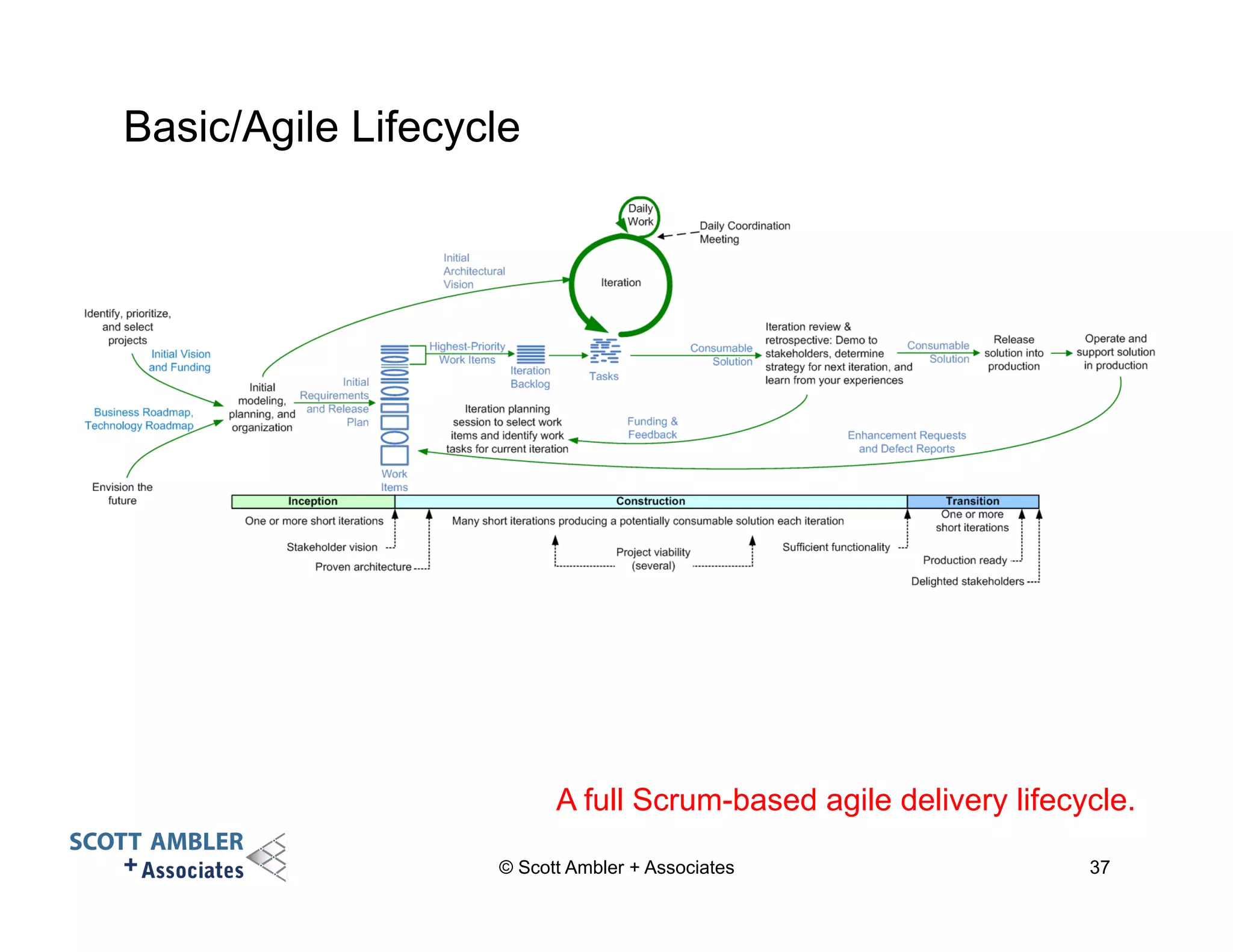
Basic/Agile Lifecycle 
A full Scrum-based agile delivery lifecycle. 
© Scott Ambler + Associates 37
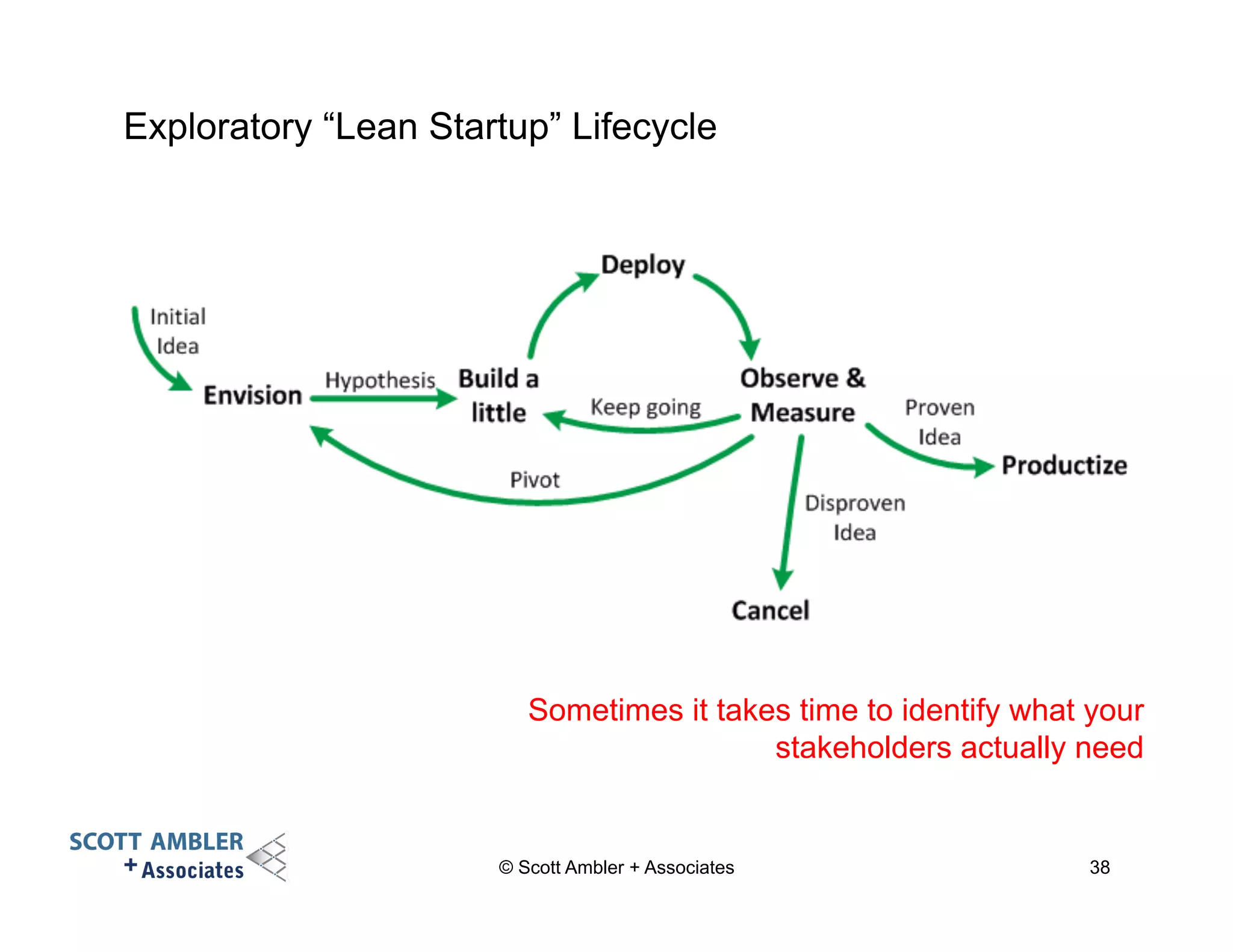
Exploratory “Lean Startup” Lifecycle 
Sometimes it takes time to identify what your 
stakeholders actually need 
© Scott Ambler + Associates 38
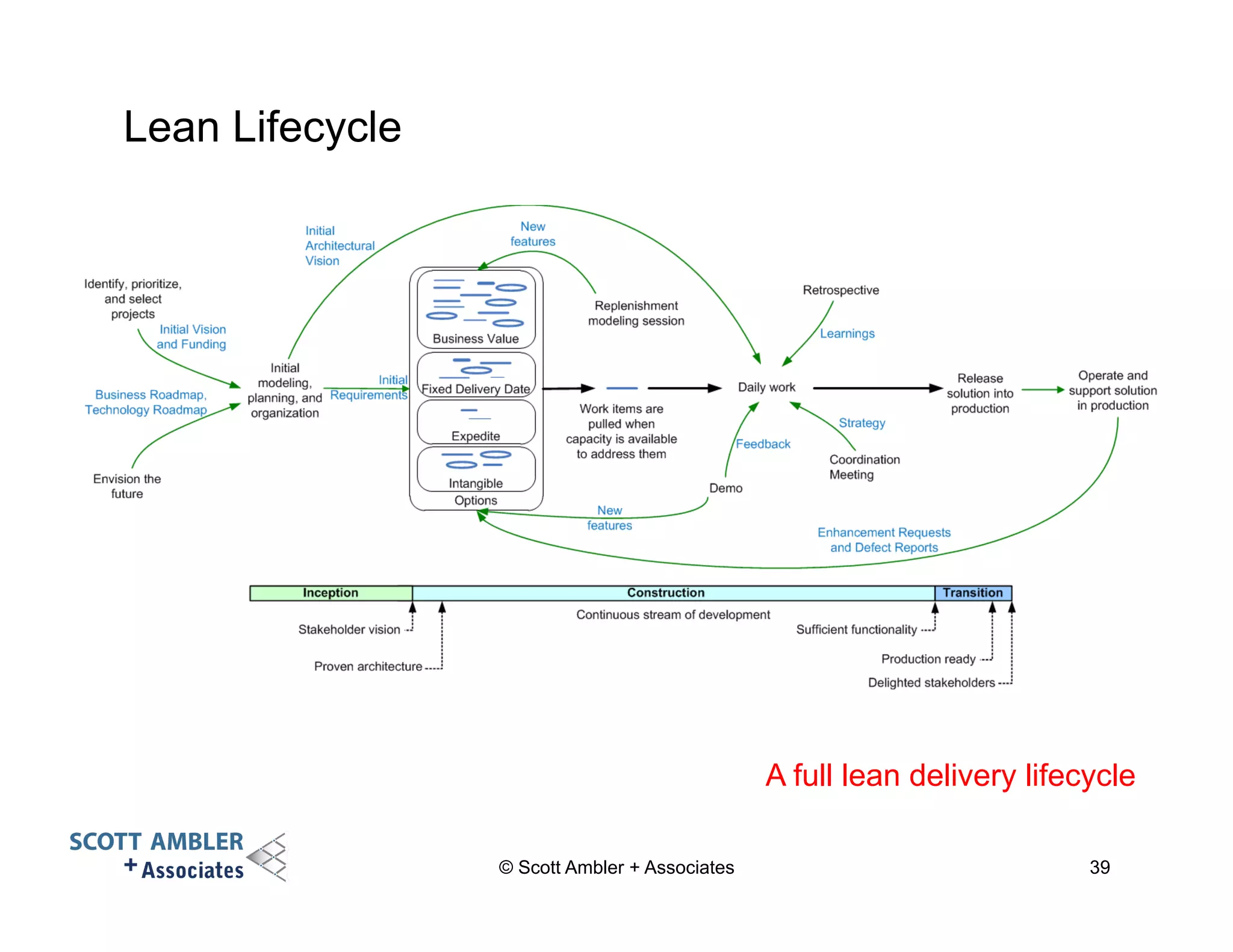
Lean Lifecycle 
A full lean delivery lifecycle 
© Scott Ambler + Associates 39
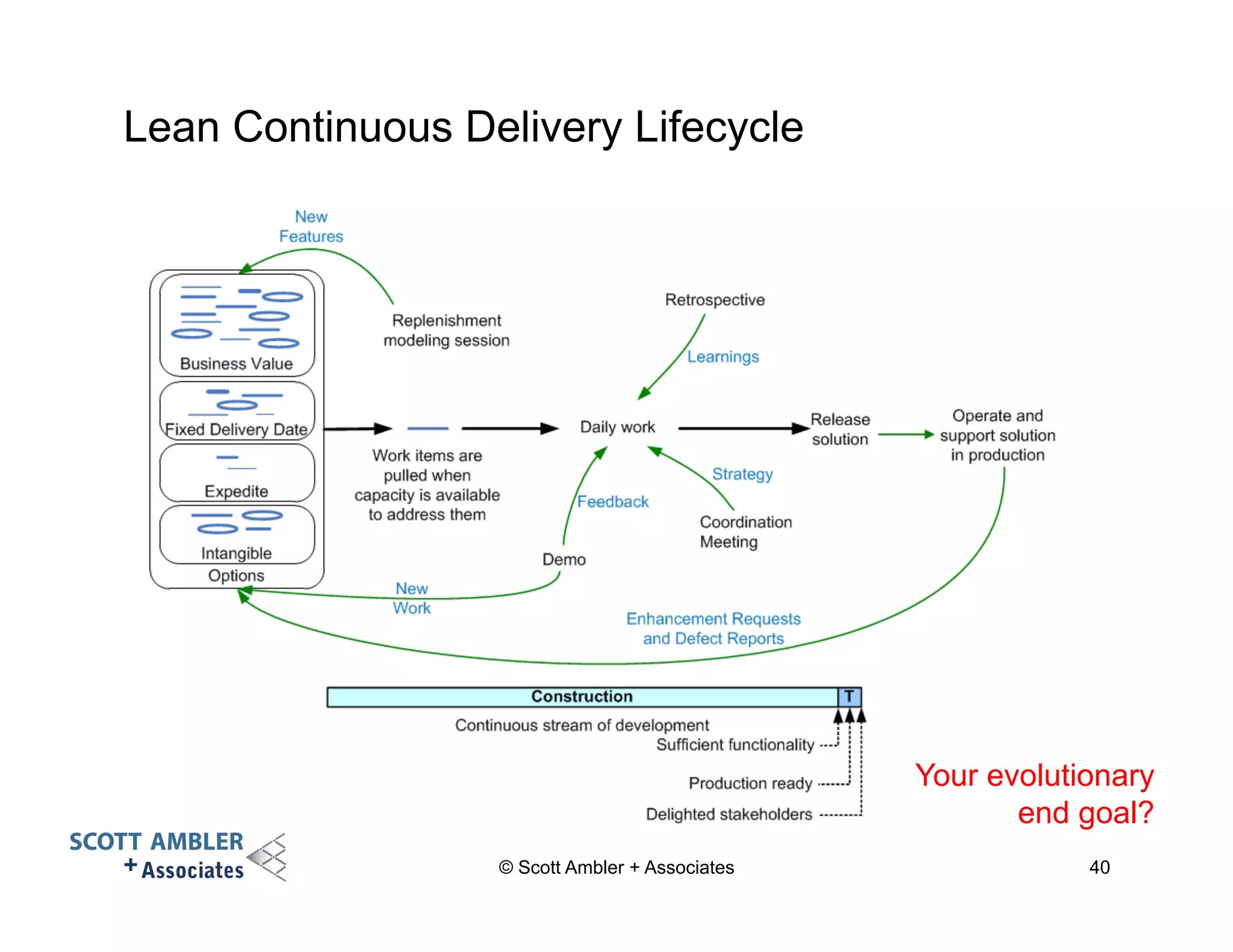
Lean Continuous Delivery Lifecycle 
Your evolutionary 
end goal? 
© Scott Ambler + Associates 40
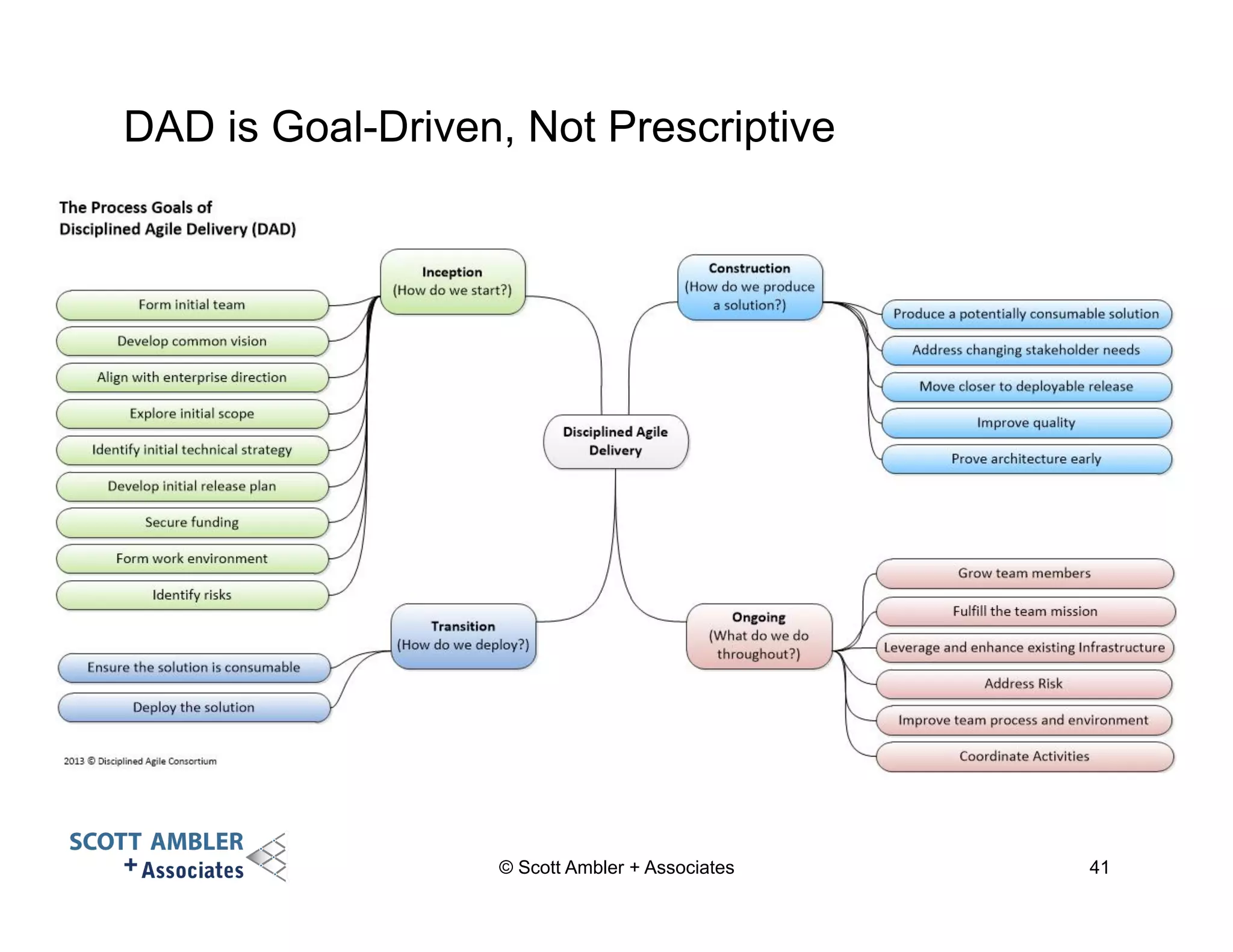
DAD is Goal-Driven, Not Prescriptive 
© Scott Ambler + Associates 41
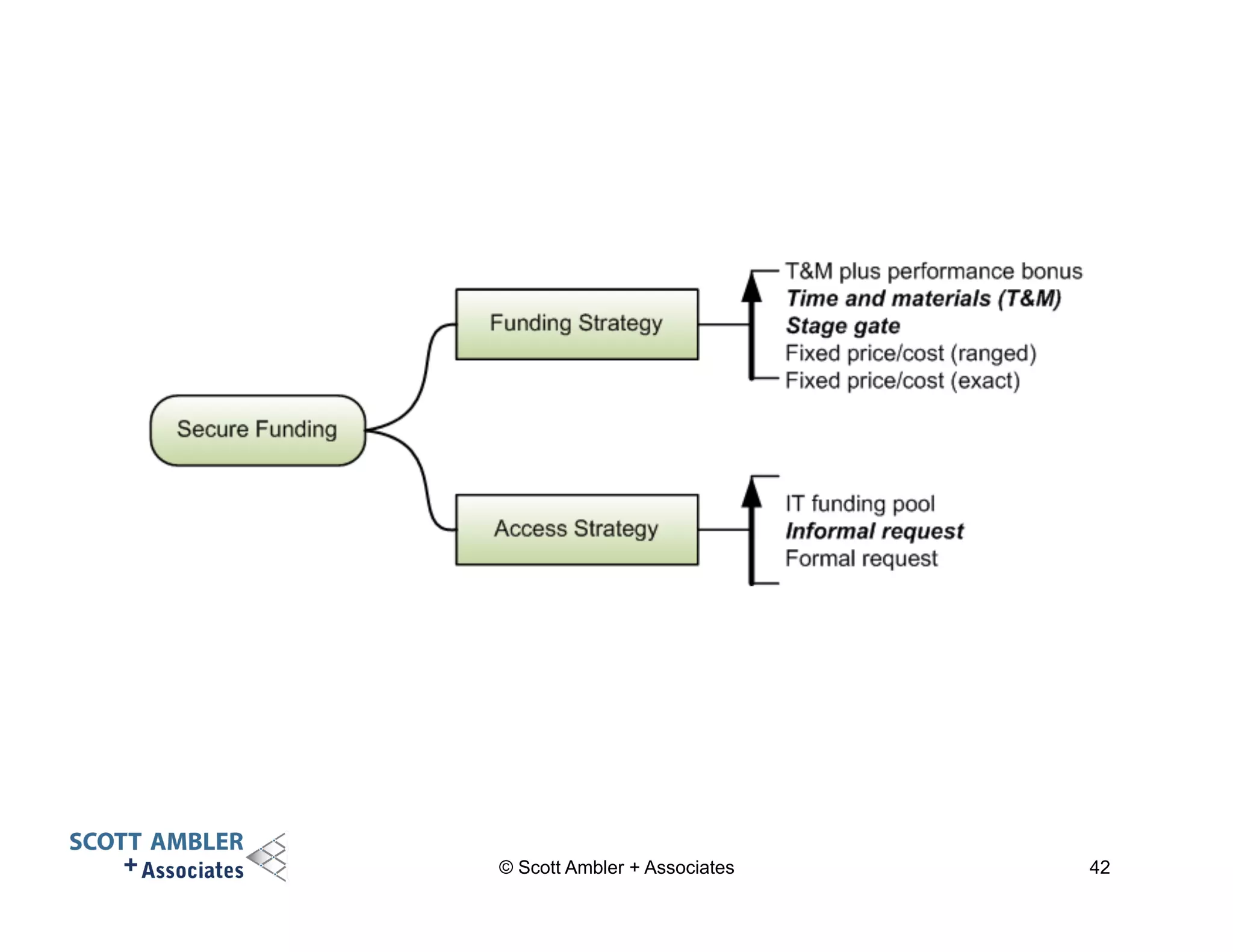
© Scott Ambler + Associates 42
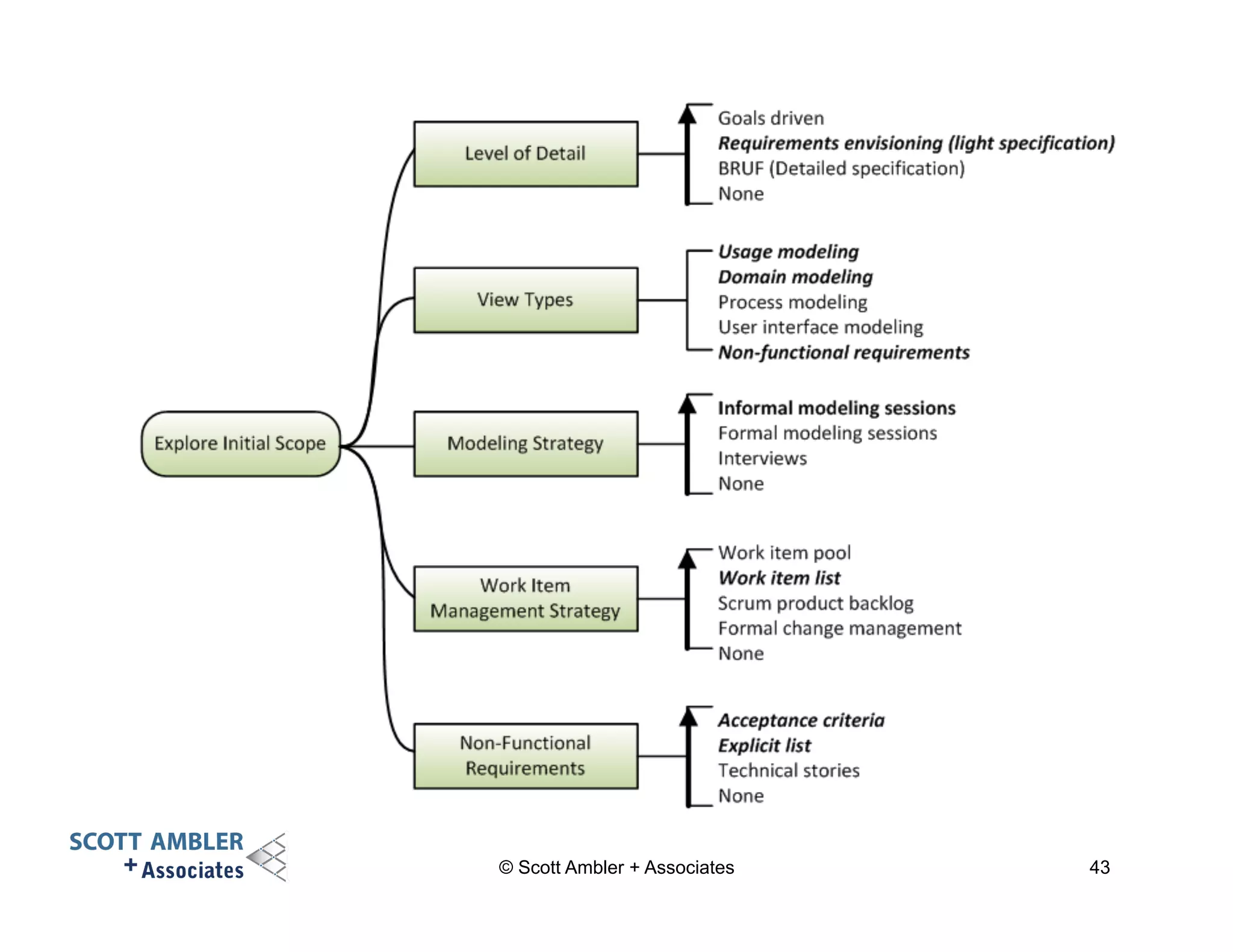
© Scott Ambler + Associates 43
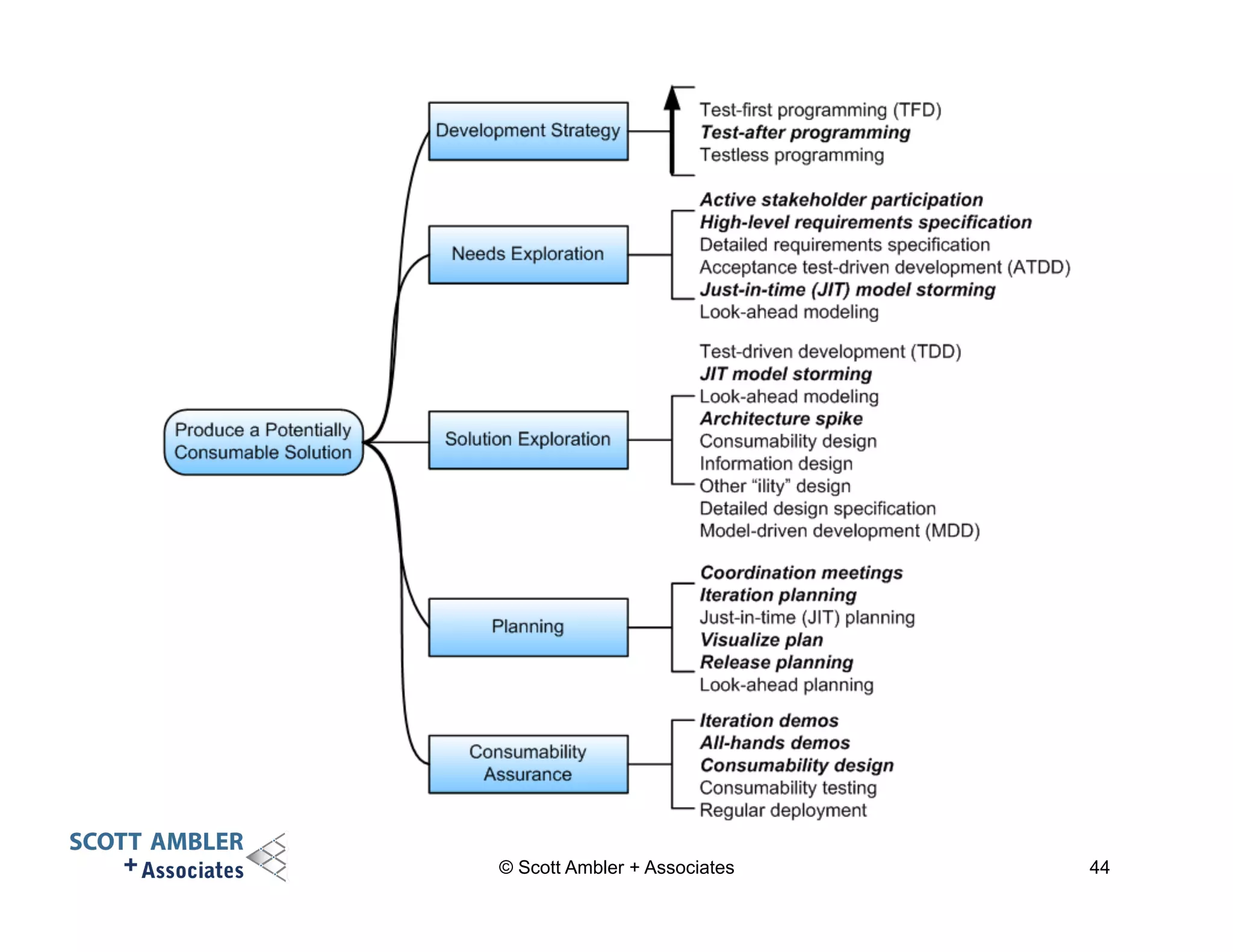
© Scott Ambler + Associates 44
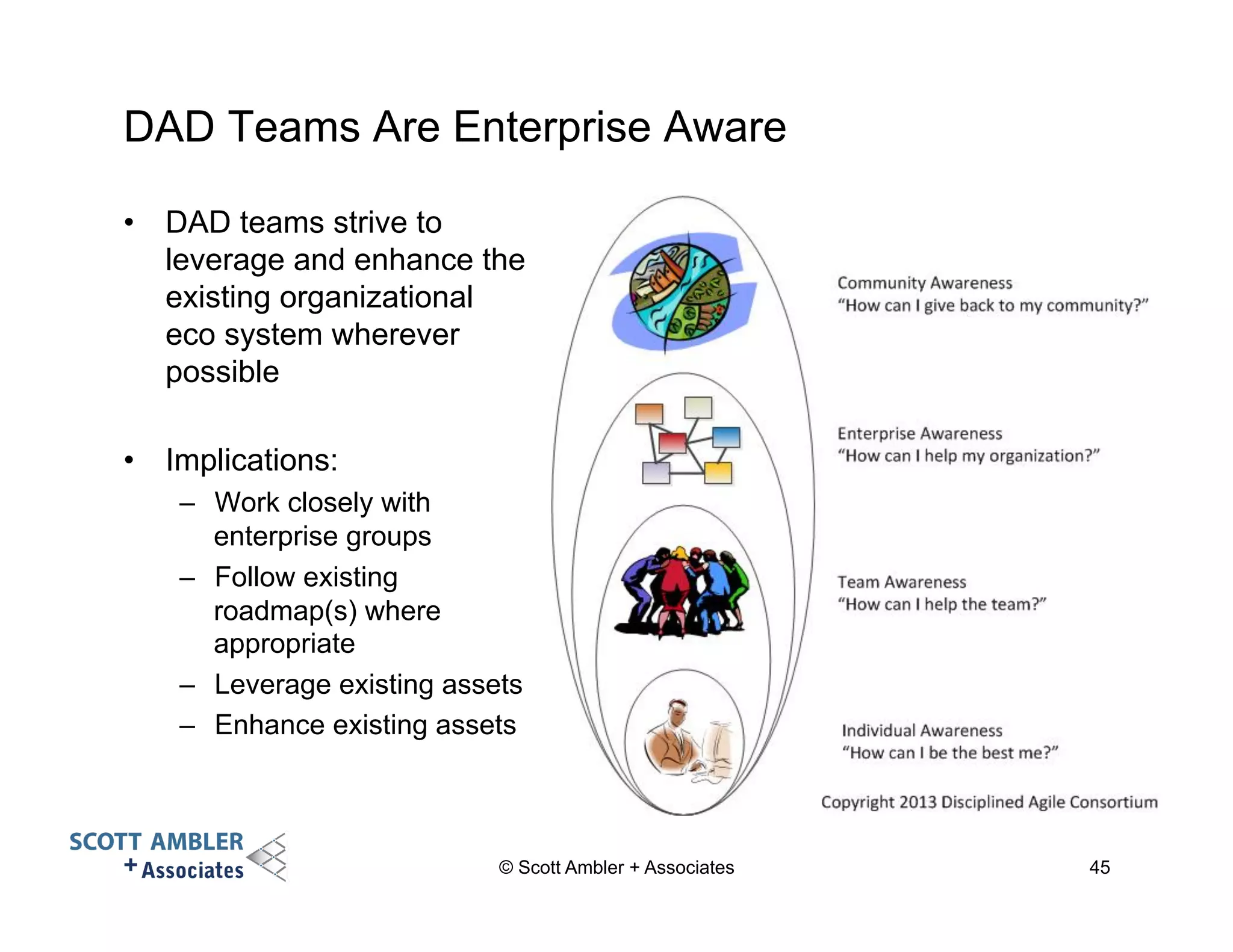
DAD Teams Are Enterprise Aware 
• DAD teams strive to 
leverage and enhance the 
existing organizational 
eco system wherever 
possible 
• Implications: 
– Work closely with 
enterprise groups 
– Follow existing 
roadmap(s) where 
appropriate 
– Leverage existing assets 
– Enhance existing assets 
© Scott Ambler + Associates 45
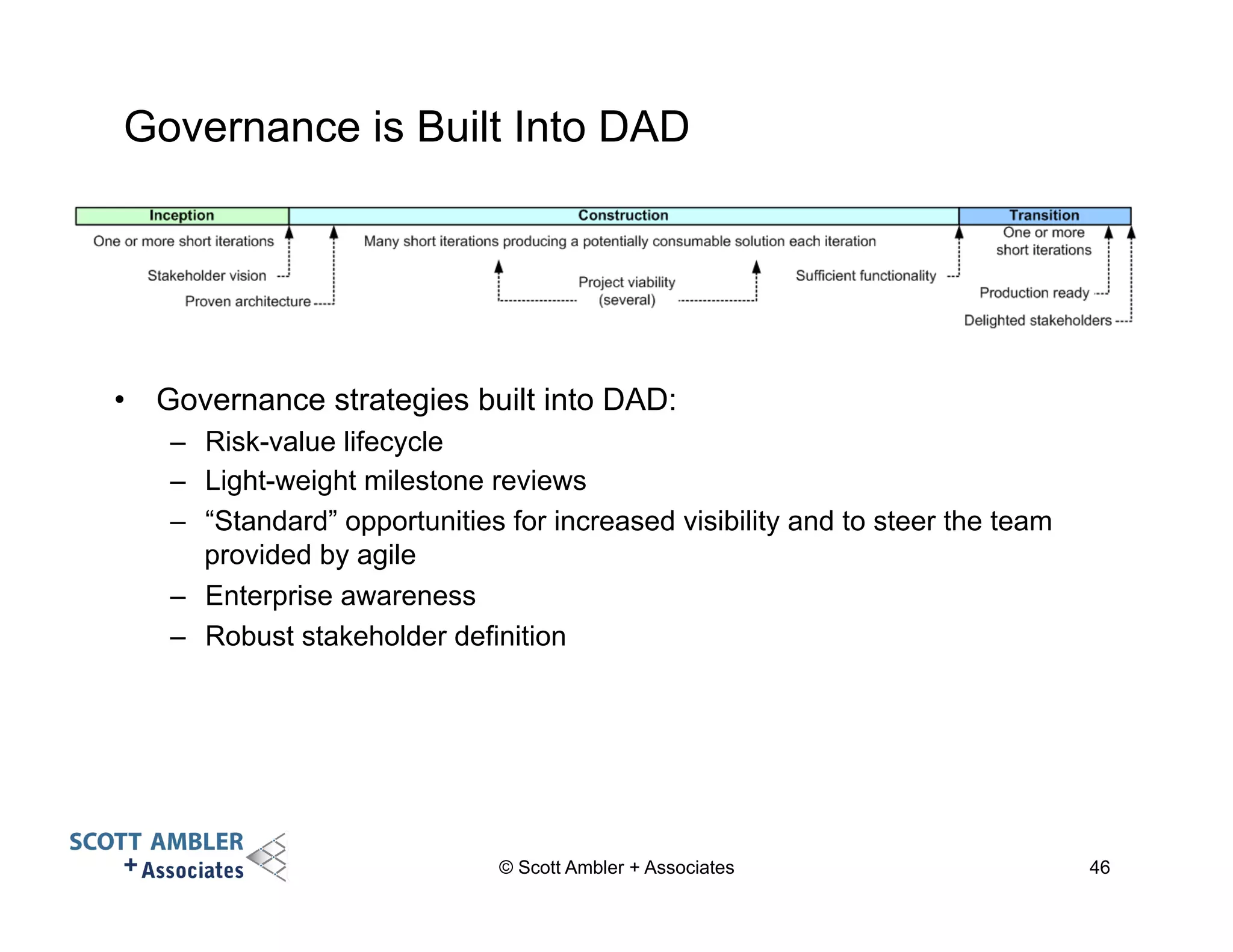
Governance is Built Into DAD 
• Governance strategies built into DAD: 
– Risk-value lifecycle 
– Light-weight milestone reviews 
– “Standard” opportunities for increased visibility and to steer the team 
provided by agile 
– Enterprise awareness 
– Robust stakeholder definition 
© Scott Ambler + Associates 46
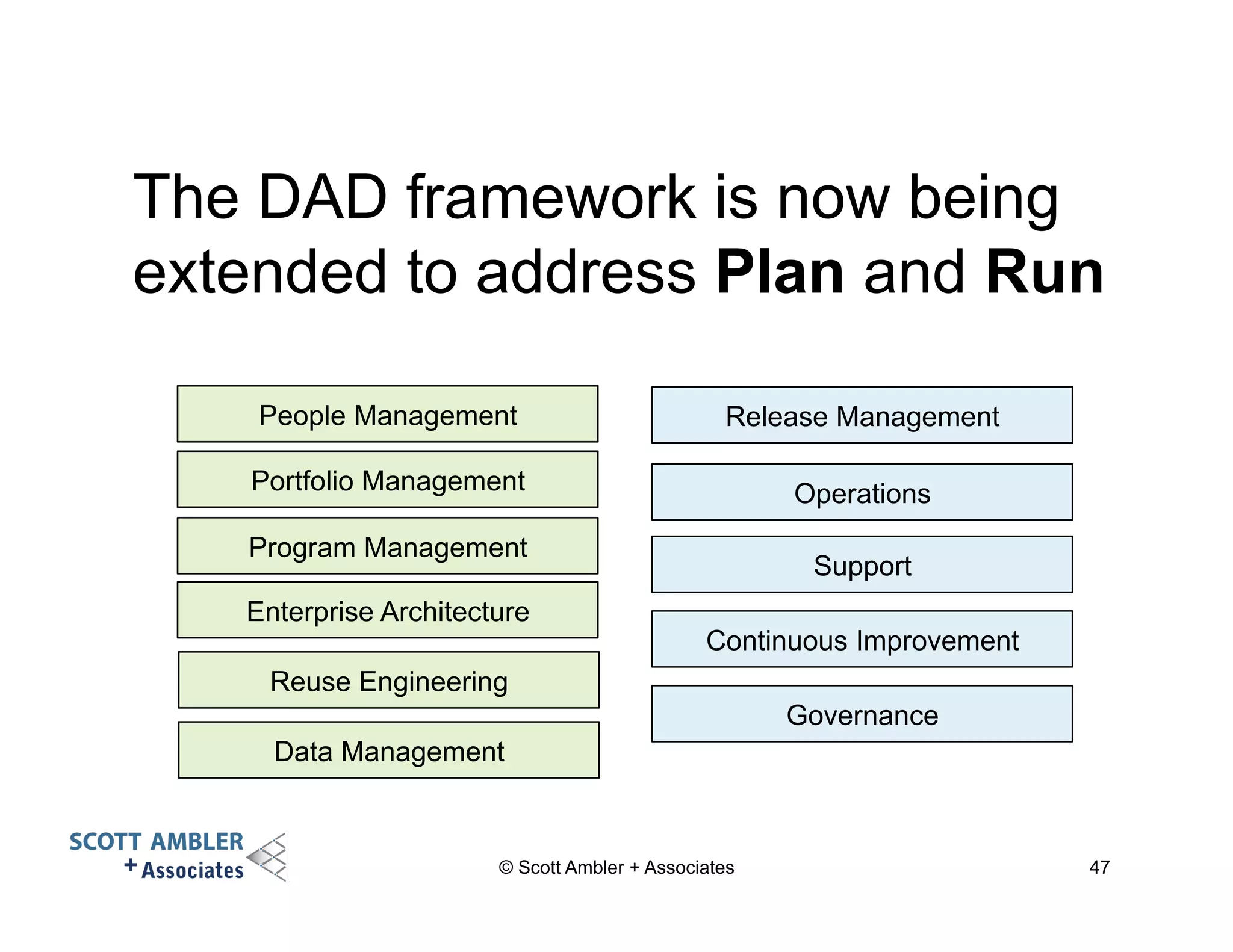
The DAD framework is now being 
extended to address Plan and Run 
People Management 
Portfolio Management 
Program Management 
Enterprise Architecture 
Reuse Engineering 
Data Management 
Release Management 
Operations 
Support 
Continuous Improvement 
Governance 
© Scott Ambler + Associates 47
© Scott Ambler + Associates 48
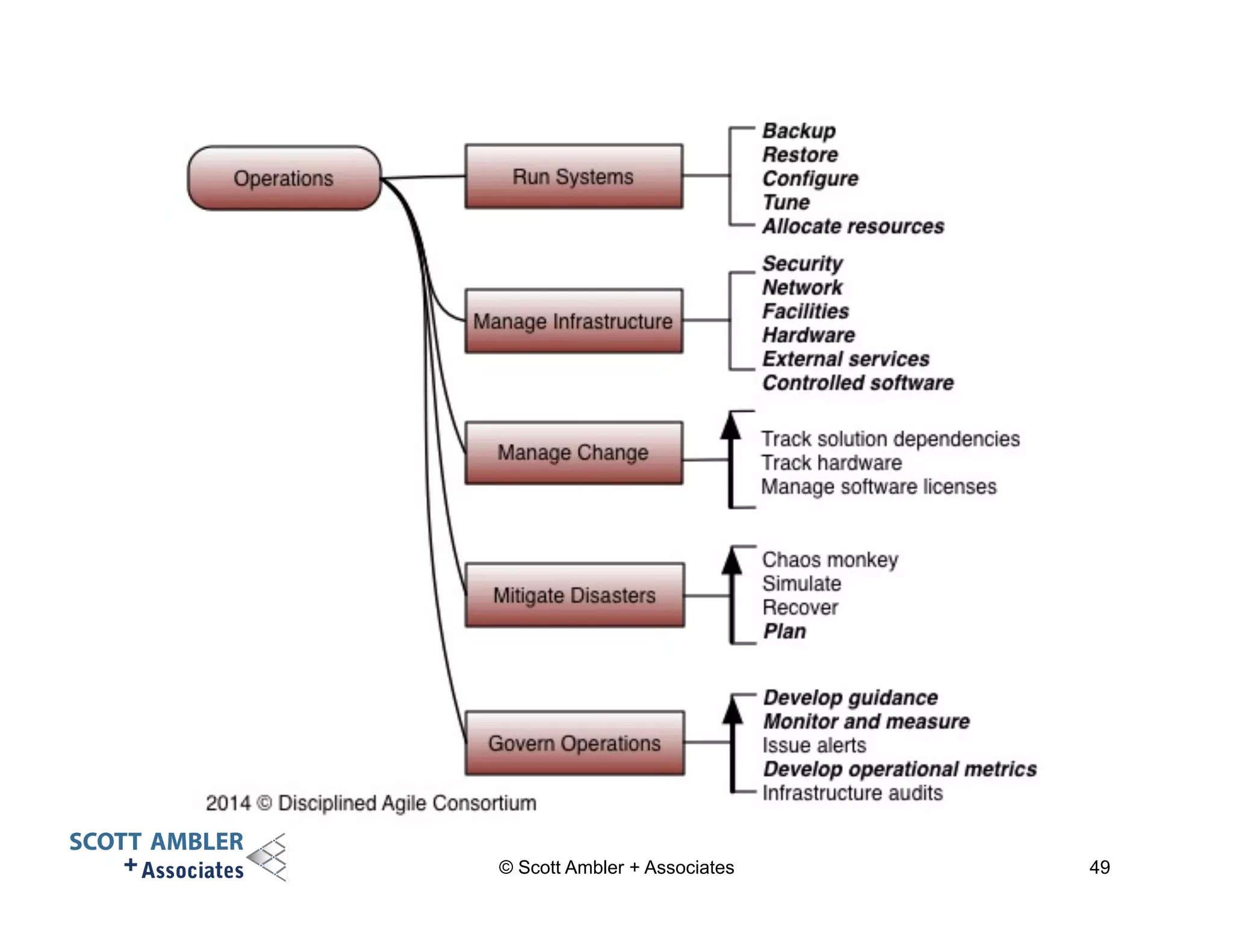
© Scott Ambler + Associates 49
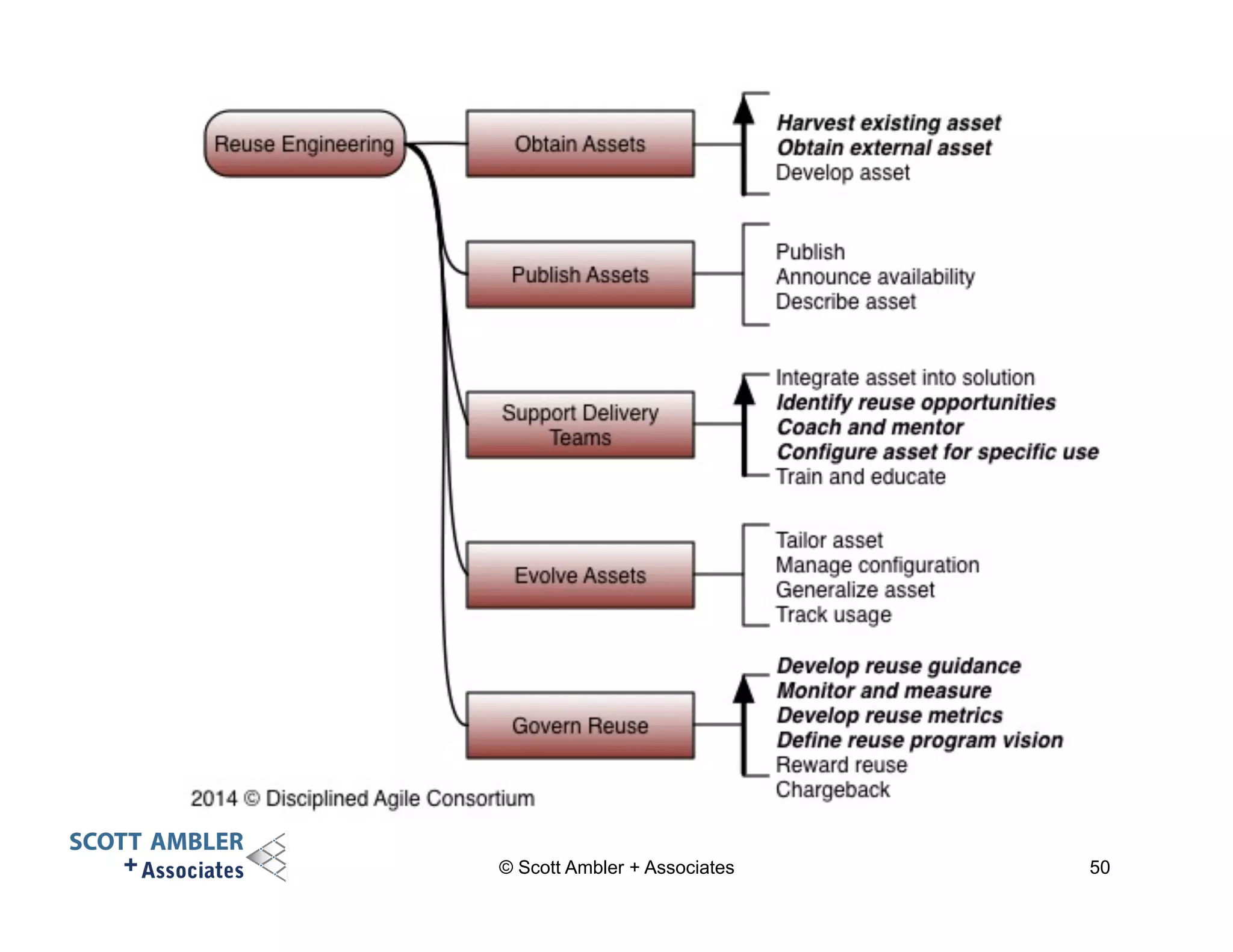
© Scott Ambler + Associates 50
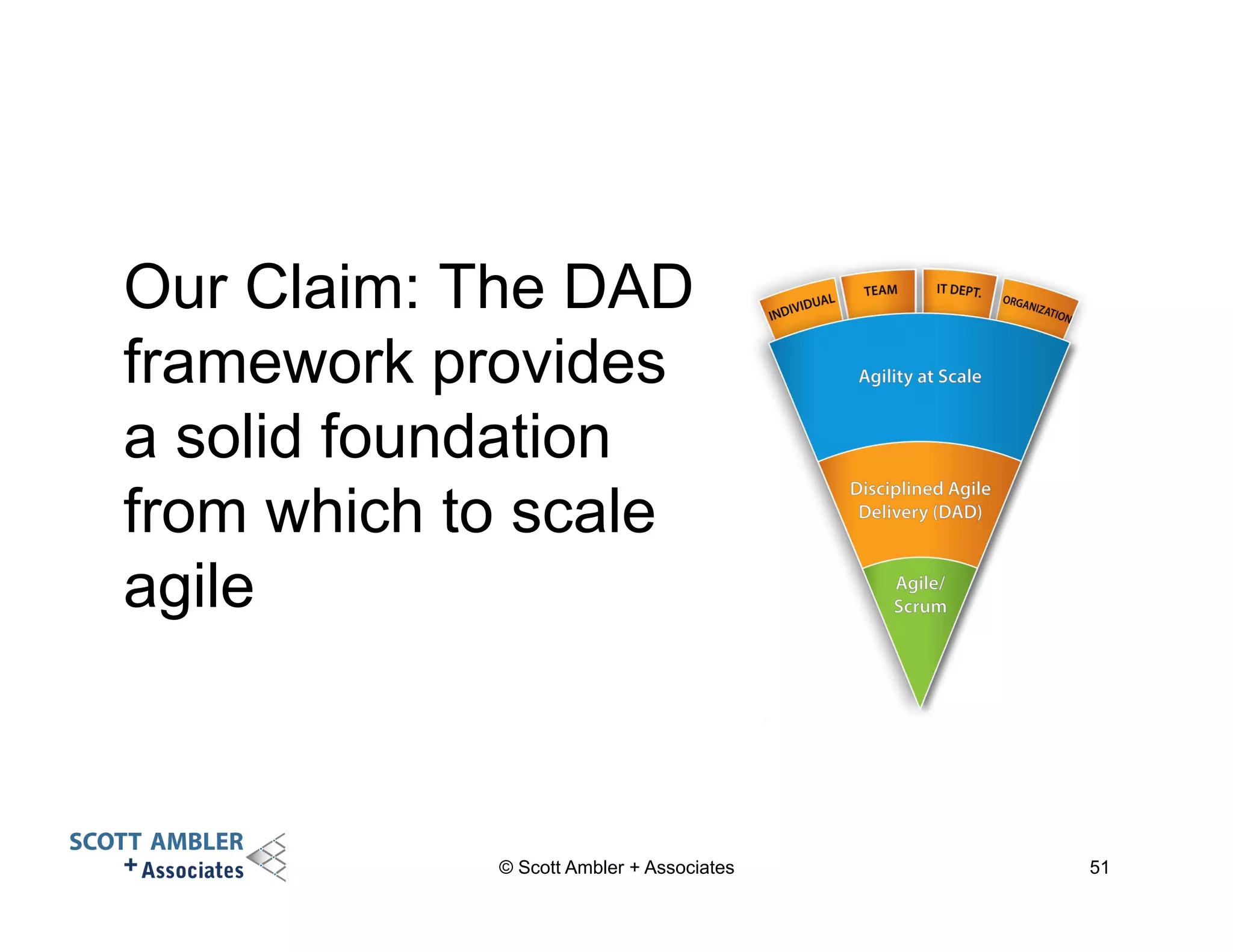
Our Claim: The DAD 
framework provides 
a solid foundation 
from which to scale 
agile 
© Scott Ambler + Associates 51
© Scott Ambler + Associates 
52 
Transforming 
your 
Organization
The Usual Transformation Strategy 
© Scott Ambler + Associates 
Dev 
Team 1 
Dev 
Team 2 
Dev 
Team 3 
Dev 
Team 4 
The Plan: 
Dev 
Team N 
… 
Dev 
Team 1 
Dev 
Team 2 
Dev 
Team 3 
Dev 
Team 4 
What Often Happens: 
Fail 
53 
Observation: 
You must address more than just the build aspects of IT.
An Enterprise Aware Transformation Strategy 
© Scott Ambler + Associates 
Dev 
Team 1 
Dev 
Team 2 
Dev 
Team 3 
Dev 
Team 4 
Dev 
Team N 
… 
Enterprise 
Architecture 
Data 
Management IT Governance … 
54 
Observation: 
Plan and Run have different adoption time frames than Build.
Your Transformation Strategy Needs to Address… 
© Scott Ambler + Associates 
People & 
Culture 
Process 
Tools 
55 
Observation: 
All three categories are 
important and 
interconnected. 70% 
20% 
10%
How difficult were the following issues to 
address during your Agile Adoption? 
Changing our business culture 
Adopting agile technical practices 
Changing our IT culture 
Using our existing tools in an agile manner 
Adopting new agile development tools 
Adopting agile management practices 
Source: SA+A 2014 Agile Adoption Survey 
© Scott Ambler + Associates 
Most 
Difficult 
Least 
Difficult 
56
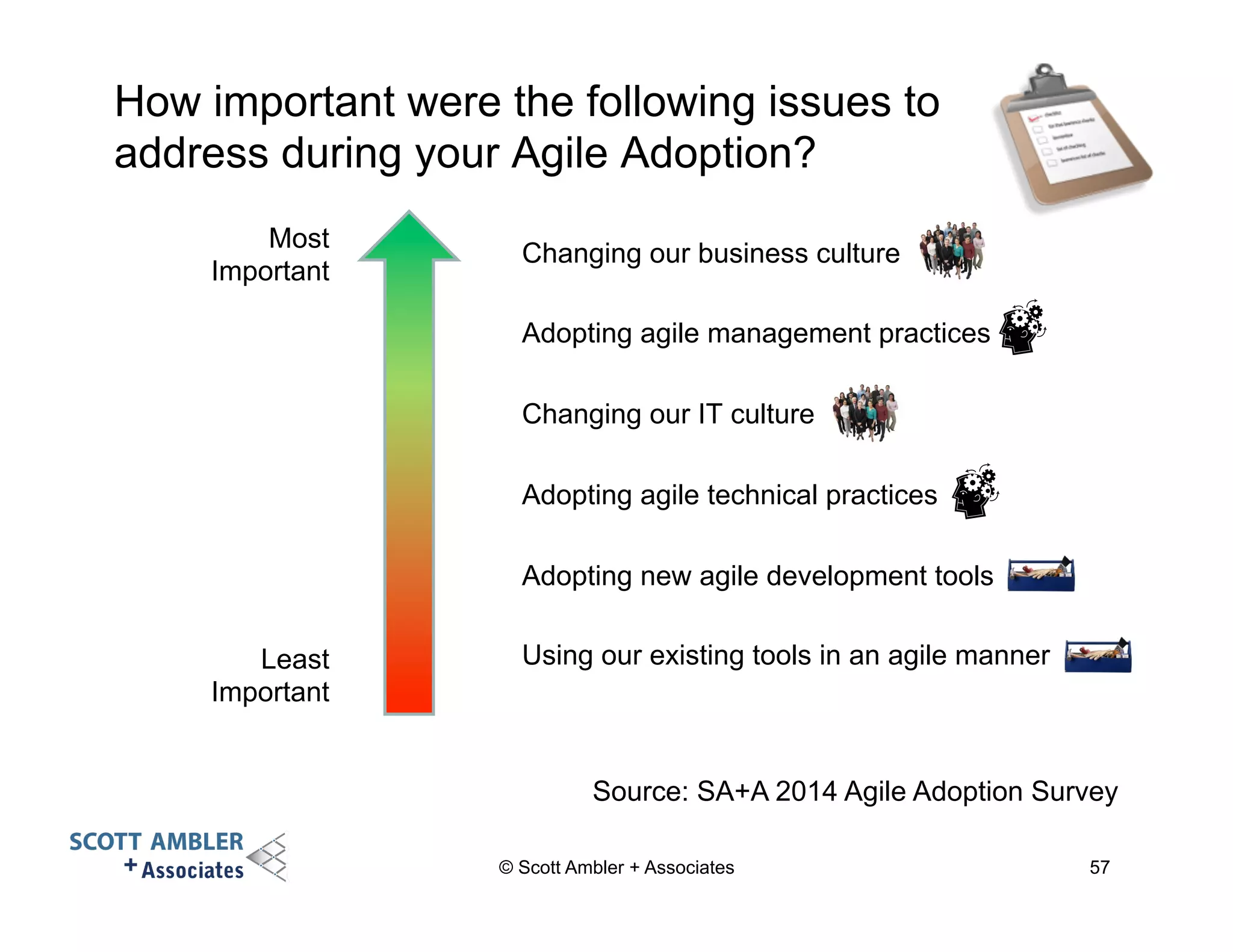
How important were the following issues to 
address during your Agile Adoption? 
Changing our business culture 
Adopting agile management practices 
Changing our IT culture 
Adopting agile technical practices 
Adopting new agile development tools 
Using our existing tools in an agile manner 
Source: SA+A 2014 Agile Adoption Survey 
© Scott Ambler + Associates 
Most 
Important 
Least 
Important 
57
Some Realities of Agile Transformation 
• Coaches are very easy to find, good coaches experienced in enterprise 
agile are not 
• Transforming a few delivery teams is easy, transforming an organization 
is not 
• Effective coaches engage concurrently with: 
– Delivery teams 
– IT teams 
– With the rest of the business 
• Transformation takes: 
– Years 
– Ongoing investment 
– Ongoing sponsorship 
© Scott Ambler + Associates 58
The Story I Told 
© Scott Ambler + Associates 59
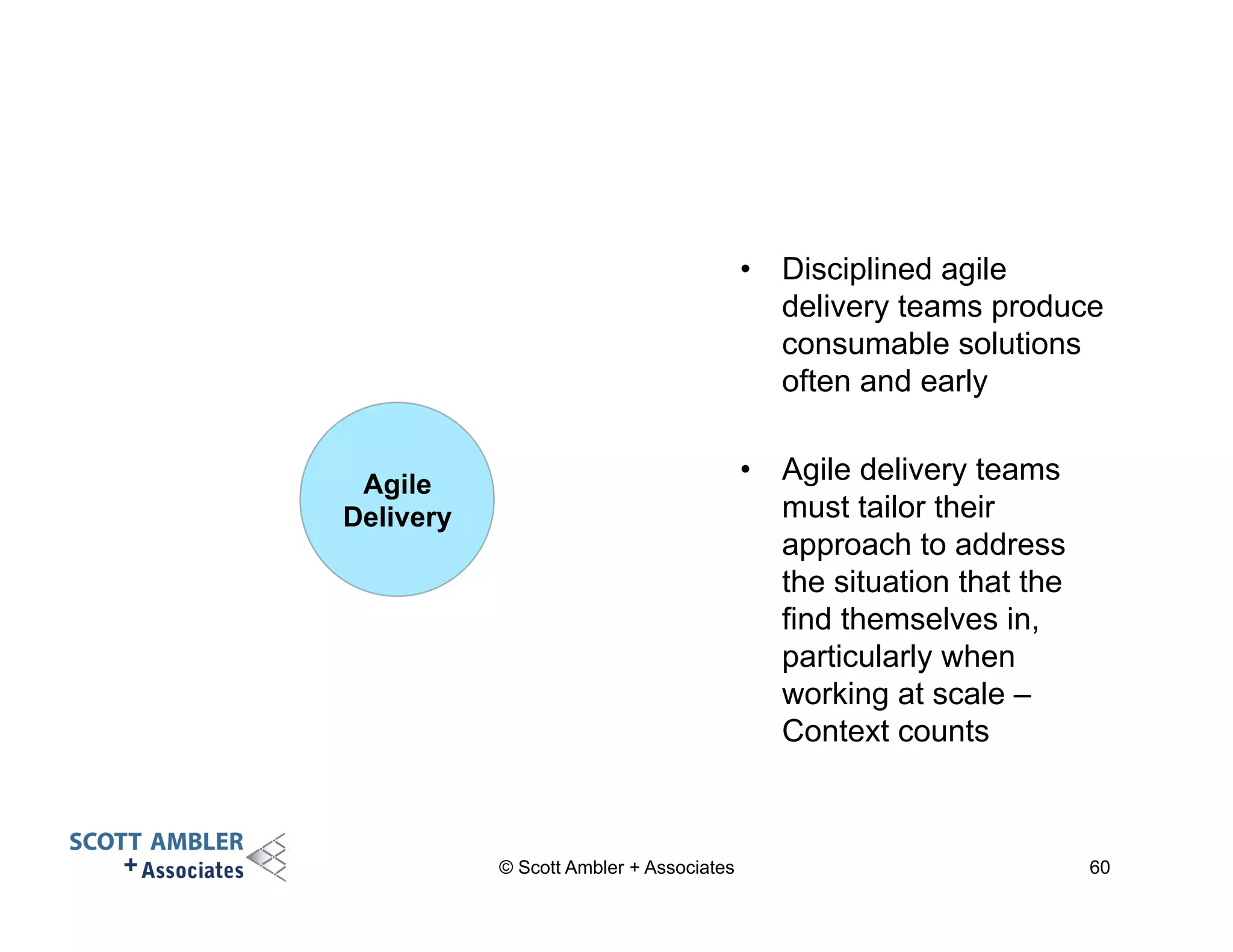
• Disciplined agile 
delivery teams produce 
consumable solutions 
often and early 
• Agile delivery teams 
must tailor their 
approach to address 
the situation that the 
find themselves in, 
particularly when 
working at scale – 
Context counts 
© Scott Ambler + Associates 60 
Agile 
Delivery
• An Agile IT 
organization must be 
responsive to the 
needs of the rest of the 
enterprise while 
“keeping the lights on”. 
• An Agile IT 
organization does this 
via three ongoing 
efforts: 
– Plan 
– Build 
– Run 
© Scott Ambler + Associates 61 
Agile 
Delivery 
Agile IT
• An agile enterprise is able to 
anticipate and respond 
swiftly to changes in the 
marketplace. 
• It does this through an 
organizational culture and 
structure that facilitates 
change within the context of 
the situation that it faces. 
• Agile enterprises require a 
learning mindset in the 
mainstream business and 
underlying lean and agile 
processes to drive 
innovation. 
Agile 
Delivery 
Agile Enterprise 
© Scott Ambler + Associates 62 
Agile IT
My parting advice…. 
Your organization is unique. 
You need to tailor your 
approach to reflect the evolving 
context of the situation that you 
face. 
One “process size” does not fit 
all, one organizational strategy 
does not fit all, nor does one 
tooling strategy. 
© Scott Ambler + Associates 63
Got Discipline? 
DisciplinedAgileConsortium.org 
DisciplinedAgileDelivery.com 
ScottAmbler.com 
© Scott Ambler + Associates 64
Thank You! 
scott [at] scottambler.com 
@scottwambler 
AgileModeling.com 
AgileData.org 
Ambysoft.com 
DisciplinedAgileConsortium.org 
DisciplinedAgileDelivery.com 
ScottAmbler.com 
Disciplined Agile Delivery 
© Scott Ambler + Associates 65
Would You Like This Presented 
to Your Organization? 
Contact us at ScottAmbler.com 
© Scott Ambler + Associates 66
Scott Ambler + Associates is the thought leader behind the Disciplined 
Agile Delivery (DAD) framework and its application. We are a boutique 
IT management consulting firm that advises organizations to be more 
effective applying disciplined agile and lean processes within the 
context of your business. 
Our website is ScottAmbler.com 
We can help 
© Scott Ambler + Associates 67
Additional Slides 
© Scott Ambler + Associates 68
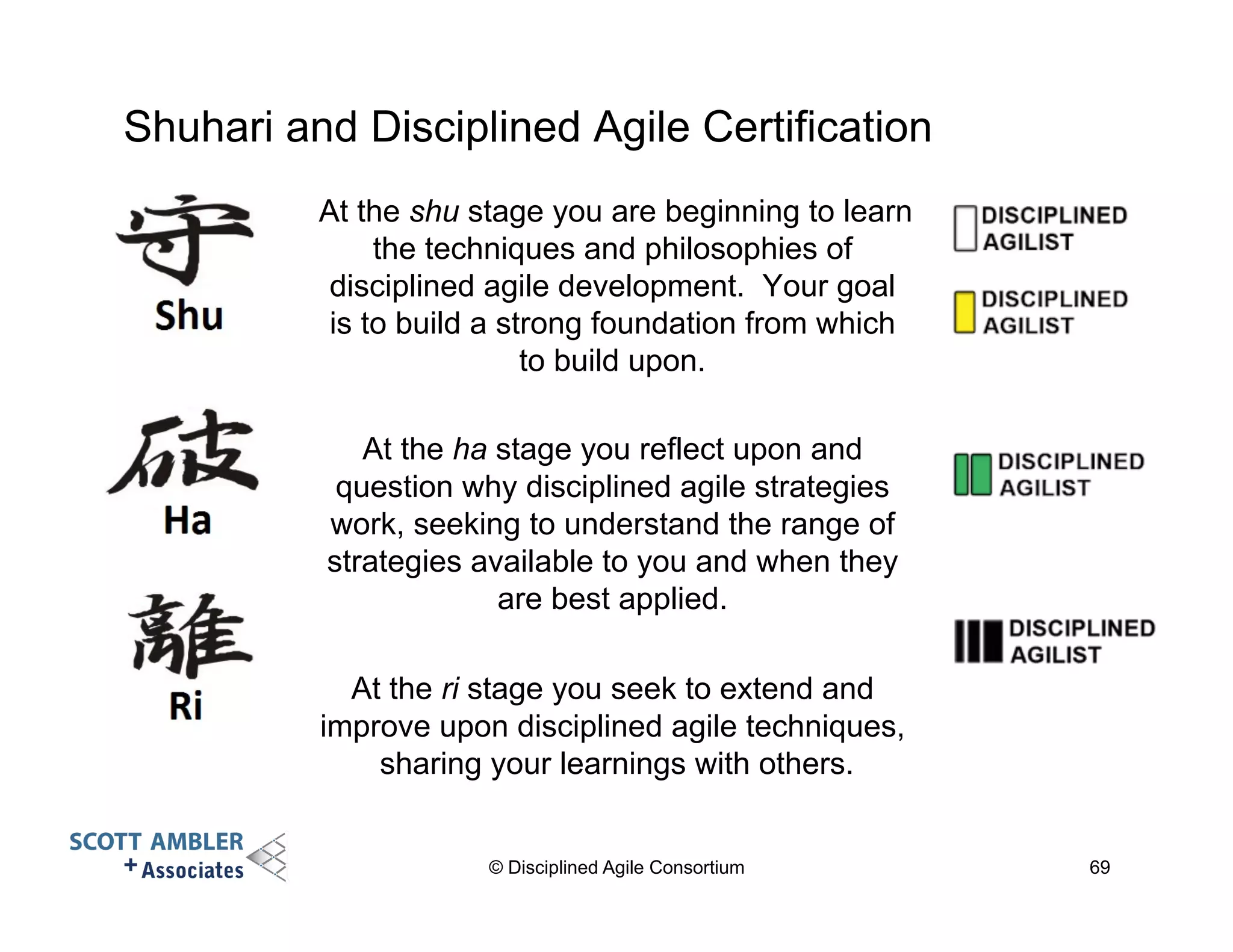
Shuhari and Disciplined Agile Certification 
At the shu stage you are beginning to learn 
the techniques and philosophies of 
disciplined agile development. Your goal 
is to build a strong foundation from which 
to build upon. 
At the ha stage you reflect upon and 
question why disciplined agile strategies 
work, seeking to understand the range of 
strategies available to you and when they 
are best applied. 
At the ri stage you seek to extend and 
improve upon disciplined agile techniques, 
sharing your learnings with others. 
© Disciplined Agile Consortium 69
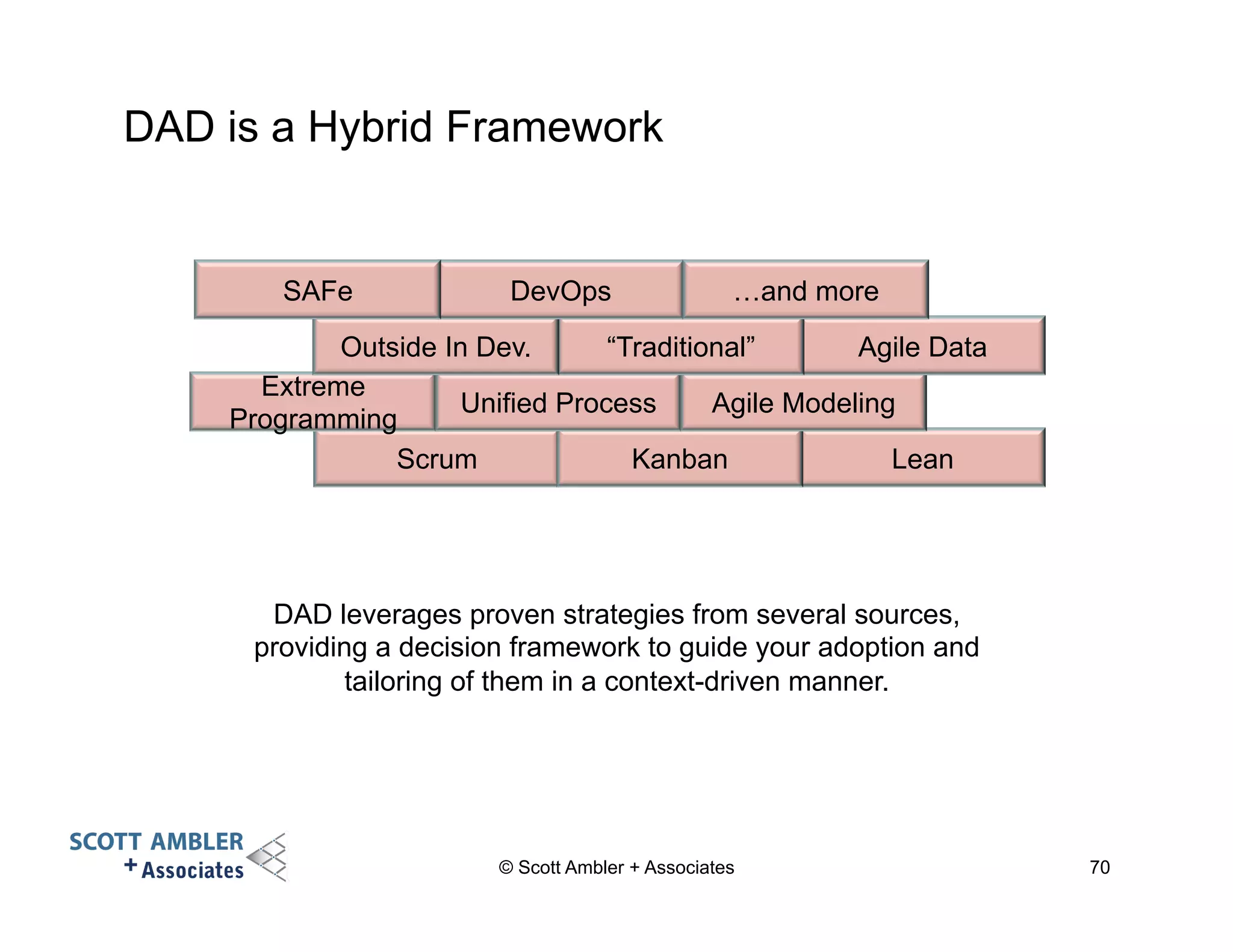
DAD is a Hybrid Framework 
DevOps …and more 
Outside In Dev. “Traditional” Agile Data 
Extreme 
Programming 
Unified Process Agile Modeling 
Scrum 
Kanban Lean 
DAD leverages proven strategies from several sources, 
providing a decision framework to guide your adoption and 
tailoring of them in a context-driven manner. 
© Scott Ambler + Associates 70 
SAFe
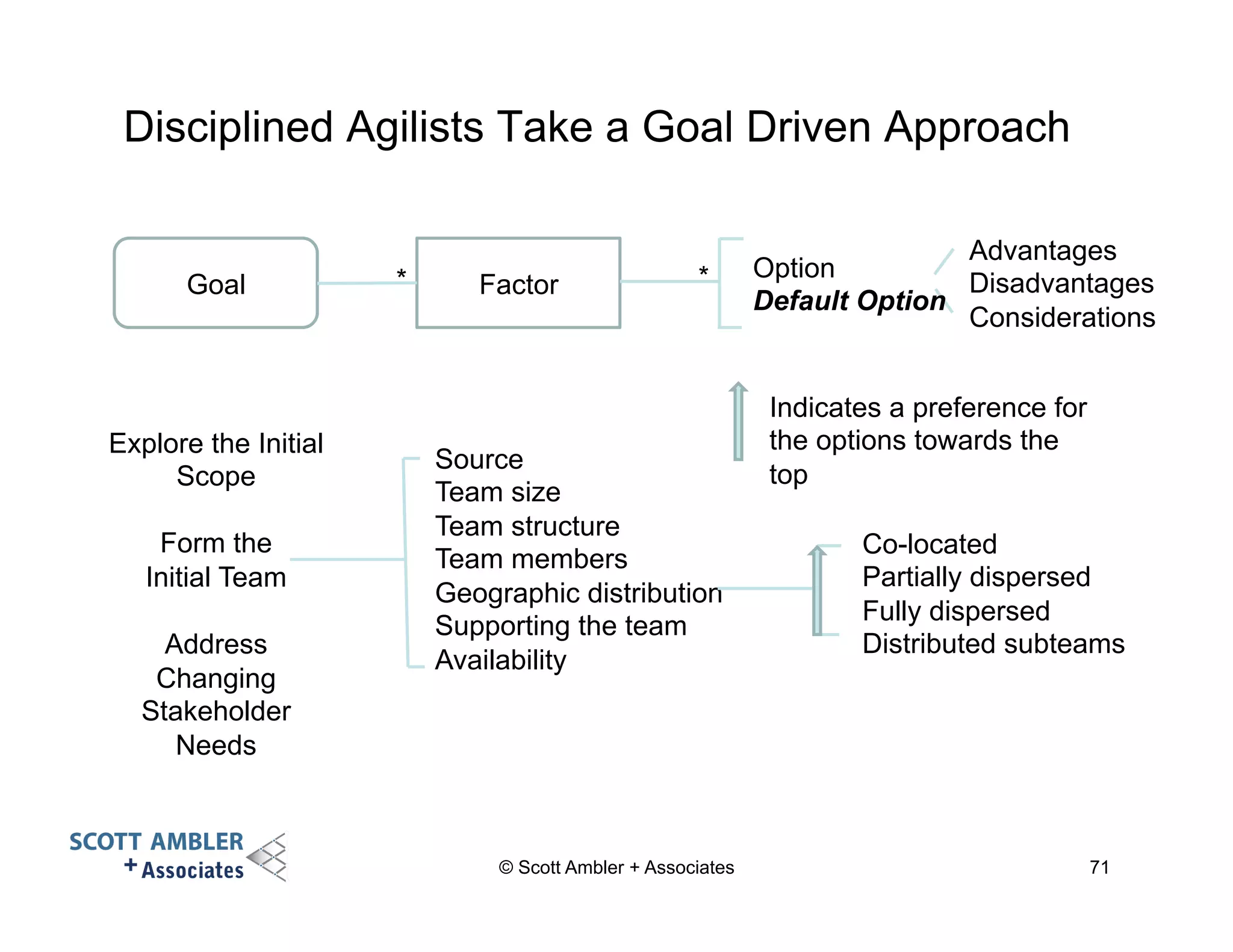
Disciplined Agilists Take a Goal Driven Approach 
* Option 
Goal Factor 
Advantages 
Disadvantages 
Considerations 
Default Option 
* 
© Scott Ambler + Associates 71 
Explore the Initial 
Scope 
Form the 
Initial Team 
Address 
Changing 
Stakeholder 
Needs 
Source 
Team size 
Team structure 
Team members 
Geographic distribution 
Supporting the team 
Availability 
Indicates a preference for 
the options towards the 
top 
Co-located 
Partially dispersed 
Fully dispersed 
Distributed subteams
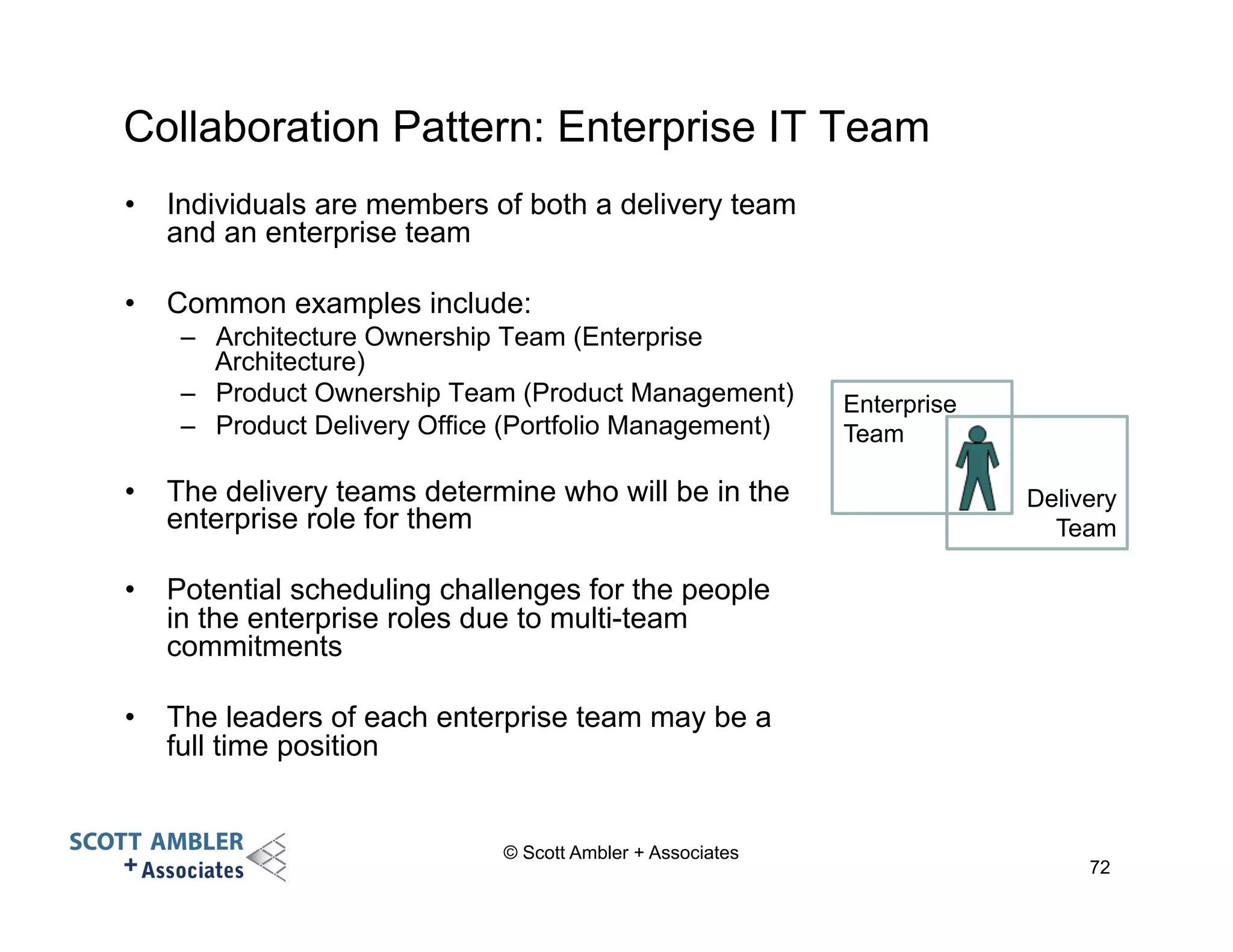
Collaboration Pattern: Enterprise IT Team 
• Individuals are members of both a delivery team 
and an enterprise team 
• Common examples include: 
– Architecture Ownership Team (Enterprise 
Architecture) 
– Product Ownership Team (Product Management) 
– Product Delivery Office (Portfolio Management) 
• The delivery teams determine who will be in the 
enterprise role for them 
• Potential scheduling challenges for the people 
in the enterprise roles due to multi-team 
commitments 
• The leaders of each enterprise team may be a 
full time position 
© Scott Ambler + Associates 
72 
Enterprise 
Team 
Delivery 
Team
Example: Architecture Ownership (AO) Team 
© Scott Ambler + Associates 
73 
• Responsible for developing 
the architecture/technology 
roadmap 
• Delivery teams determine 
who the architecture owner 
(AO) is, and that person 
becomes part of the AO 
team 
• The AO team meets 
regularly to evolve the 
roadmap based on the 
hands-on learnings from the 
AOs 
• Ecommerce organization: 7 
person AO team (of 250 IT 
people) 
• Software product org: 10 
person AO team (of 130 IT 
people)
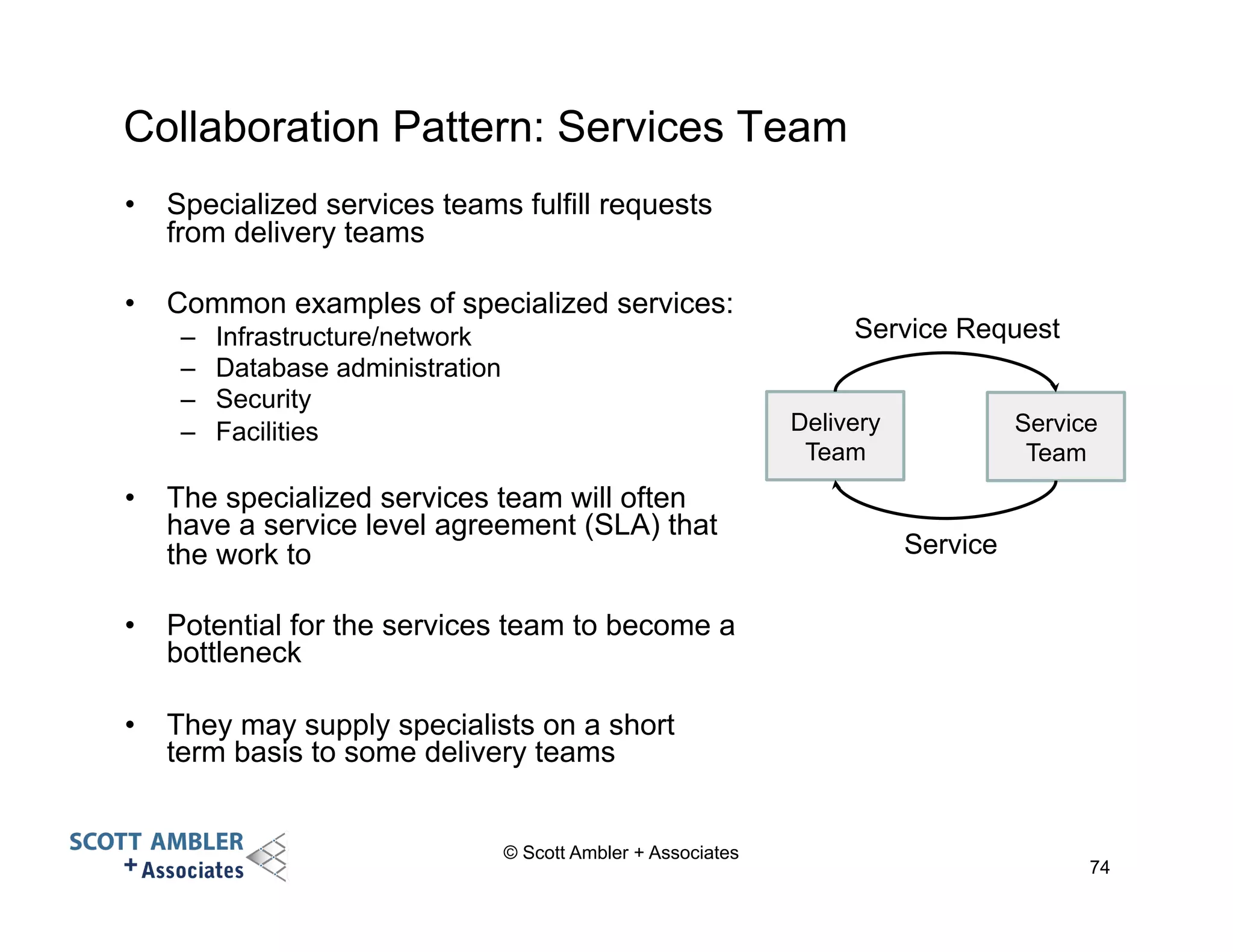
Collaboration Pattern: Services Team 
• Specialized services teams fulfill requests 
from delivery teams 
• Common examples of specialized services: 
– Infrastructure/network 
– Database administration 
– Security 
– Facilities 
• The specialized services team will often 
have a service level agreement (SLA) that 
the work to 
• Potential for the services team to become a 
bottleneck 
• They may supply specialists on a short 
term basis to some delivery teams 
© Scott Ambler + Associates 
74 
Service Request 
Delivery 
Team 
Service 
Team 
Service
Example: 
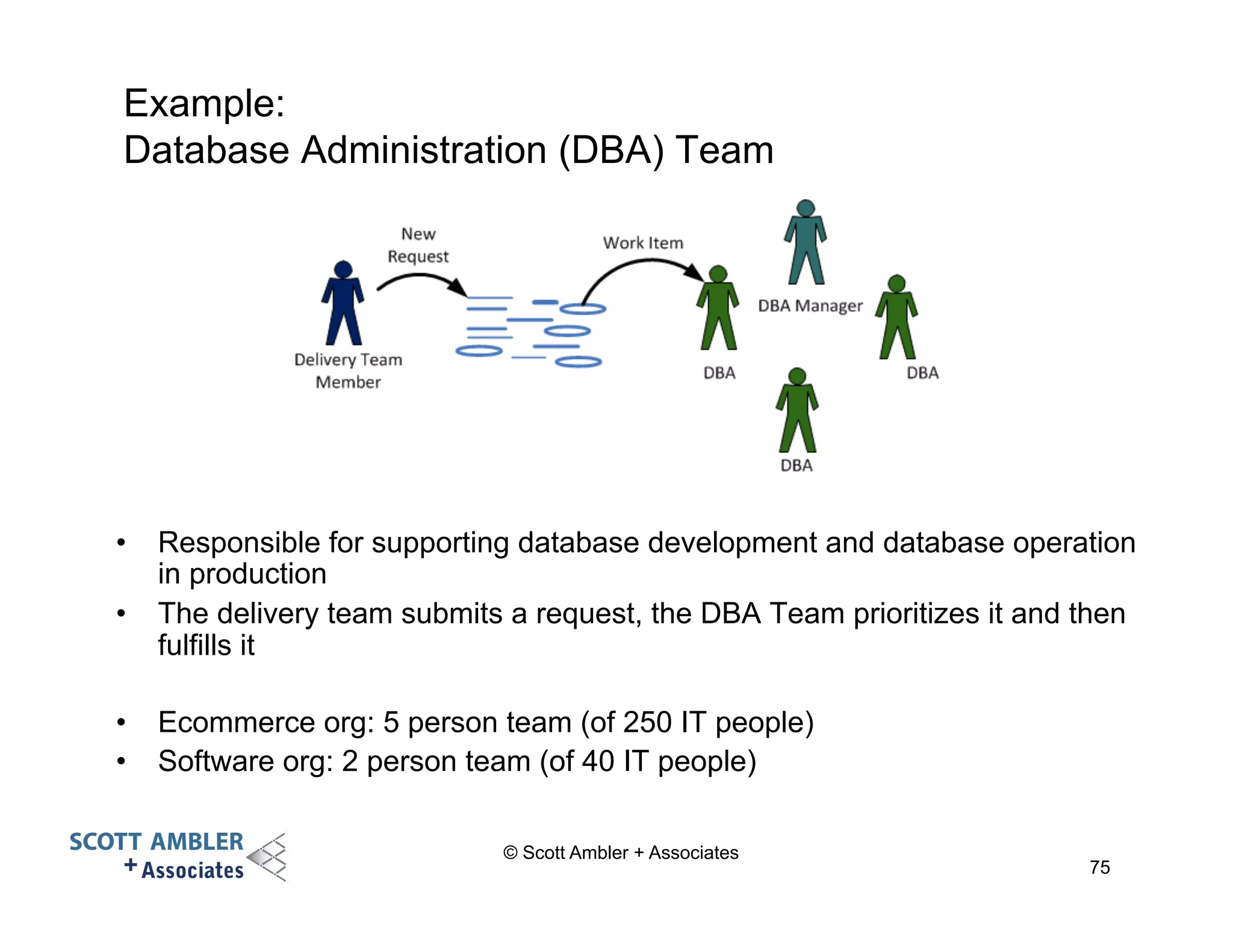
Database Administration (DBA) Team 
• Responsible for supporting database development and database operation 
© Scott Ambler + Associates 
75 
in production 
• The delivery team submits a request, the DBA Team prioritizes it and then 
fulfills it 
• Ecommerce org: 5 person team (of 250 IT people) 
• Software org: 2 person team (of 40 IT people)

The Disciplined Agile Enterprise: Harmonizing Agile and Lean

  • 1.
    The Disciplined Agile Enterprise: Harmonizing Agile and Lean Scott W. Ambler scott@scottambler.com Twitter: @scottambler SARAJEVO, 27.10.2014
  • 3.
    Before we begin… © Scott Ambler + Associates 3
  • 4.
    © Scott Ambler+ Associates 4 We’re going to cover a lot of ground
  • 5.
    The Surveys •Results of survey-based research will be shared throughout this deck • Availability: – Detailed results are available free of charge at Ambysoft.com/ surveys/ – Includes all questions as asked, source data, and summary slide decks • Types of surveys: – DDJ: Cross paradigm survey sponsored by Dr Dobb’s Journal – Ambysoft: Agile-oriented survey sponsored by Ambysoft Inc. – SA+A: Agile oriented survey sponsored by Scott Ambler + Associates © Scott Ambler + Associates 5
  • 6.
    The Story I’mAbout to Tell © Scott Ambler + Associates 6
  • 7.
    • An agileenterprise is able to anticipate and respond swiftly to changes in the marketplace. • It does this through an organizational culture and structure that facilitates change within the context of the situation that it faces. • Agile enterprises require a learning mindset in the mainstream business and underlying lean and agile processes to drive innovation. Agile Enterprise © Scott Ambler + Associates 7
  • 8.
    • An AgileIT organization must be responsive to the needs of the rest of the enterprise while “keeping the lights on”. • An Agile IT organization does this via three ongoing efforts: – Plan – Build – Run Agile Enterprise © Scott Ambler + Associates 8 Agile IT
  • 9.
    • Disciplined agile delivery teams produce consumable solutions often and early • Agile delivery teams must tailor their approach to address the situation that the find themselves in, particularly when working at scale – Context counts Agile Dev Agile Enterprise © Scott Ambler + Associates 9 Agile IT
  • 10.
    Let’s explore fiveimportant questions…. What is the current state of agile? What is an agile enterprise? What does agile IT look like? How does agile delivery work in enterprises? How do you transition to enterprise agility? © Scott Ambler + Associates 10
  • 11.
    The Current Stateof Agile © Scott Ambler + Associates 11
  • 12.
    How Would YouCharacterize Your Team’s Development Process? Ad Hoc, 13% Iterative, 19% Lean, 7% Other, 2% Traditional, 8% Agile, 52% Source: DDJ State of the IT Union 2014 Q2 Survey © Scott Ambler + Associates 12
  • 13.
    I would ratemy organization’s adoption of agile as… Great success, 11% Success, 33% Great failure, Failure, 5% Neither, 40% 2% Too early to tell, 11% Source: SA+A 2014 Agile Adoption Survey © Scott Ambler + Associates 13
  • 14.
    Organizations Are SuccessfullyApplying Agile at Levels of Scale Team Size Two Hundreds Geographic Distribution Co-located Global Organizational Distribution Single division Outsourcing Compliance None Life critical Domain Complexity Straightforward Very complex Technical Complexity Straightforward Very complex © Scott Ambler + Associates Source: DDJ Summer 2012 State of the IT Union Survey 14
  • 15.
    What Scaling FactorsDo Software Development Teams Face? 61% 44% Team Size > 10 Geographically Distributed Organizationally Distributed Compliance Complex Domain Copyright 2014 Scott W. Ambler www.ambysoft.com/surveys/ 92% 70% 61% 43% 68% 48% 90% 50% 66% 42% Complex Technology 0% 20% 40% 60% 80% 100% All Teams Agile Teams Source: DDJ State of the IT Union 2014 Q2 Survey
  • 16.
    Common Enterprise Challengesto Agile • Bureaucratic cultures • Differing IT and business goals • Short term investment horizons • Inflexible governance • Little support for learning and experimentation • Organizational dependencies © Scott Ambler + Associates 16
  • 17.
    The Agile Enterprise © Scott Ambler + Associates 17
  • 18.
    Let’s assume thatagile software development is the center of the universe for your organization… © Scott Ambler + Associates 18
  • 19.
    Agile/Scrum is aGood Starting Point © Scott Ambler + Associates 19 • Construction focus • Value driven lifecycle • Self-organizing teams • Prescriptive • Project team aware
  • 20.
    DAD Solidifies theFoundation • Delivery focus • Risk-value driven lifecycle • Self-organization with appropriate governance • Goal driven • Enterprise aware © Scott Ambler + Associates 20
  • 21.
    • Large teams • Geographically distributed teams • Compliance • Domain or technical complexity • Cultural issues • Organizational distribution © Scott Ambler + Associates 21
  • 22.
    Individuals must becomea truly agile practitioner within the evolving context of the situation that they face They will require training, education and coaching © Scott Ambler + Associates 22
  • 23.
    Teams will selforganize their work strategy, their structure, and their collaboration paths to reflect the context of the situation that they find themselves in They will require guidance to do so effectively © Scott Ambler + Associates 23
  • 24.
    IT departments areoften sophisticated entities with teams addressing a wide range of situations and a wide range of goals Agile delivery teams are just part of the overall mix, as are operations teams, architecture teams, portfolio management teams, and many more IT organizations will need to adopt a wide range of strategies that reflect the challenges that they face © Scott Ambler + Associates 24
  • 25.
    © Scott Ambler+ Associates An agile enterprise is able to anticipate and respond swiftly to changes in the marketplace. It does this through an organizational culture and structure that facilitates change within the context of the situation that it faces. Agile enterprises require a learning mindset in the mainstream business and underlying lean and agile processes to drive innovation. 25
  • 26.
    The Agile IT Department © Scott Ambler + Associates 26
  • 27.
    Why Many ITDepartments Are Moving to Agile 70% 10% 20% Plan Build Run Current 50% 40% Desired 10% Plan Build Run Plan – Guide the organization in IT-related manners Build – Software teams provide consumable solutions on a regular basis following lifecycles reflecting the context they face Run – Operate and support the IT ecosystem © Scott Ambler + Associates 27
  • 28.
    The Agile ITDepartment: Plan People Management Portfolio Management Program Management Enterprise Architecture Reuse Engineering Data Management Plan – Guide the organization in IT-related manners Build – Software teams provide consumable solutions on a regular basis following lifecycles reflecting the context they face Run – Operate and support the IT ecosystem © Scott Ambler + Associates 28
  • 29.
    The Agile ITDepartment: Build Continuous Delivery Exploratory/Lean Startup Lean/Kanban Agile/Scrum Other Plan – Guide the organization in IT-related manners Build – Software teams provide consumable solutions on a regular basis following lifecycles reflecting the context they face Run – Operate and support the IT ecosystem © Scott Ambler + Associates 29
  • 30.
    The Agile ITDepartment: Run Release Management Operations Support Continuous Improvement Governance Plan – Guide the organization in IT-related manners Build – Software teams provide consumable solutions on a regular basis following lifecycles reflecting the context they face Run – Operate and support the IT ecosystem © Scott Ambler + Associates 30
  • 31.
    What Does DevOps Mean to Your Organization? © Scott Ambler + Associates 31 Continuous delivery? + streamlined operations and support? Streamlined build (dev) + streamlined run (ops)? Your DevOps strategy will reflect your organizational goals
  • 32.
    What Does “Agileat Scale” Mean to Your Organization? Large-scale Scrum? Build for large agile/lean teams? Agile for the IT department? There is no one right answer for how to scale agile to the IT © Scott Ambler + Associates 32 level.
  • 33.
    Disciplined Agile Delivery (DAD) © Scott Ambler + Associates 33
  • 34.
    Disciplined Agile Delivery (DAD) is a process decision framework The key characteristics of DAD: – People-first – Goal-driven – Hybrid agile – Learning-oriented – Full delivery lifecycle – Solution focused – Risk-value lifecycle – Enterprise aware © Scott Ambler + Associates 34
  • 35.
    The DAD frameworkfully addresses the agile and lean portions of Build… Continuous Delivery Exploratory/Lean Startup Lean/Kanban Agile/Scrum © Scott Ambler + Associates 35
  • 36.
    High Level Lifecycle There’s more to solution delivery than construction © Scott Ambler + Associates 36
  • 37.
    Basic/Agile Lifecycle Afull Scrum-based agile delivery lifecycle. © Scott Ambler + Associates 37
  • 38.
    Exploratory “Lean Startup”Lifecycle Sometimes it takes time to identify what your stakeholders actually need © Scott Ambler + Associates 38
  • 39.
    Lean Lifecycle Afull lean delivery lifecycle © Scott Ambler + Associates 39
  • 40.
    Lean Continuous DeliveryLifecycle Your evolutionary end goal? © Scott Ambler + Associates 40
  • 41.
    DAD is Goal-Driven,Not Prescriptive © Scott Ambler + Associates 41
  • 42.
    © Scott Ambler+ Associates 42
  • 43.
    © Scott Ambler+ Associates 43
  • 44.
    © Scott Ambler+ Associates 44
  • 45.
    DAD Teams AreEnterprise Aware • DAD teams strive to leverage and enhance the existing organizational eco system wherever possible • Implications: – Work closely with enterprise groups – Follow existing roadmap(s) where appropriate – Leverage existing assets – Enhance existing assets © Scott Ambler + Associates 45
  • 46.
    Governance is BuiltInto DAD • Governance strategies built into DAD: – Risk-value lifecycle – Light-weight milestone reviews – “Standard” opportunities for increased visibility and to steer the team provided by agile – Enterprise awareness – Robust stakeholder definition © Scott Ambler + Associates 46
  • 47.
    The DAD frameworkis now being extended to address Plan and Run People Management Portfolio Management Program Management Enterprise Architecture Reuse Engineering Data Management Release Management Operations Support Continuous Improvement Governance © Scott Ambler + Associates 47
  • 48.
    © Scott Ambler+ Associates 48
  • 49.
    © Scott Ambler+ Associates 49
  • 50.
    © Scott Ambler+ Associates 50
  • 51.
    Our Claim: TheDAD framework provides a solid foundation from which to scale agile © Scott Ambler + Associates 51
  • 52.
    © Scott Ambler+ Associates 52 Transforming your Organization
  • 53.
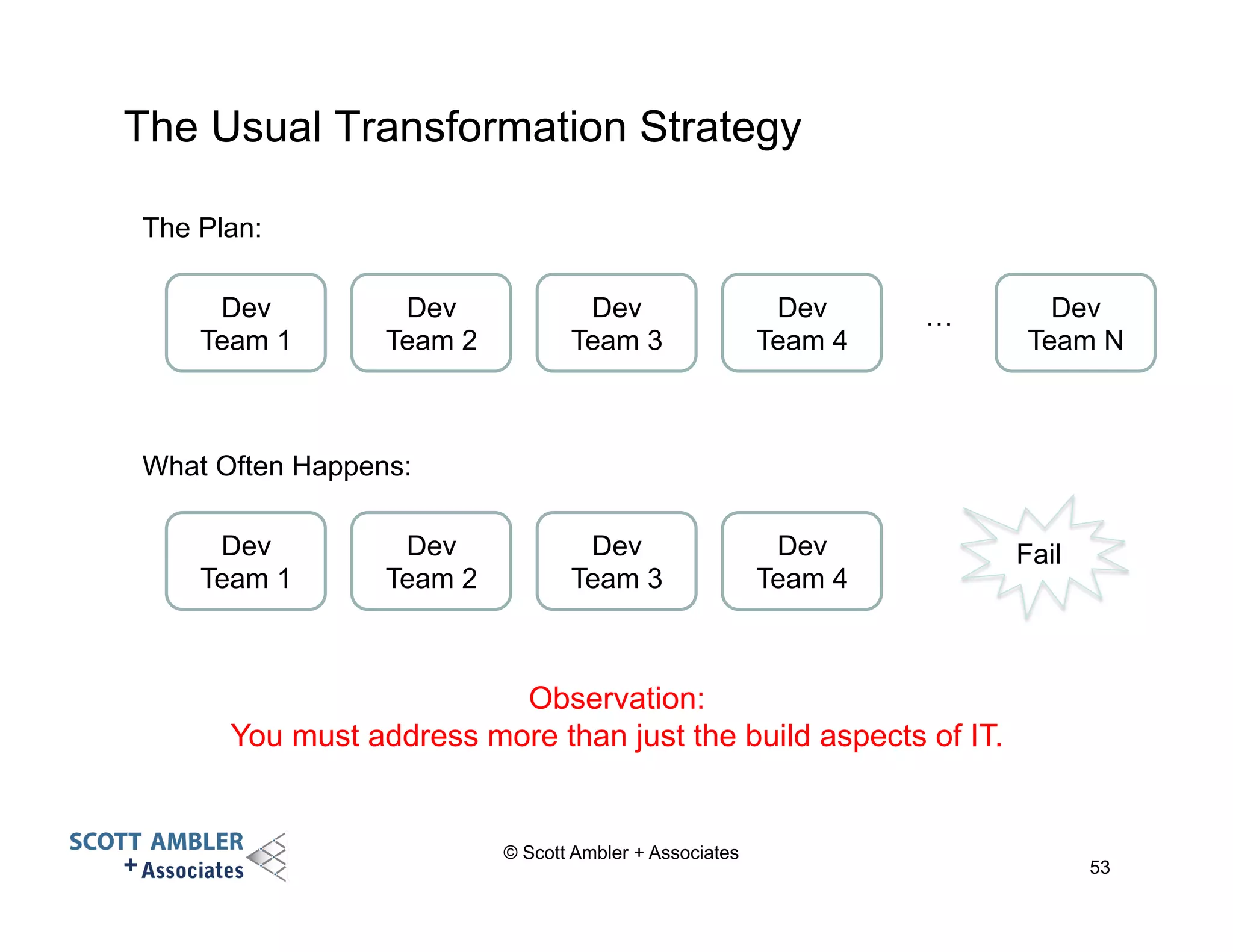
    The Usual TransformationStrategy © Scott Ambler + Associates Dev Team 1 Dev Team 2 Dev Team 3 Dev Team 4 The Plan: Dev Team N … Dev Team 1 Dev Team 2 Dev Team 3 Dev Team 4 What Often Happens: Fail 53 Observation: You must address more than just the build aspects of IT.
  • 54.
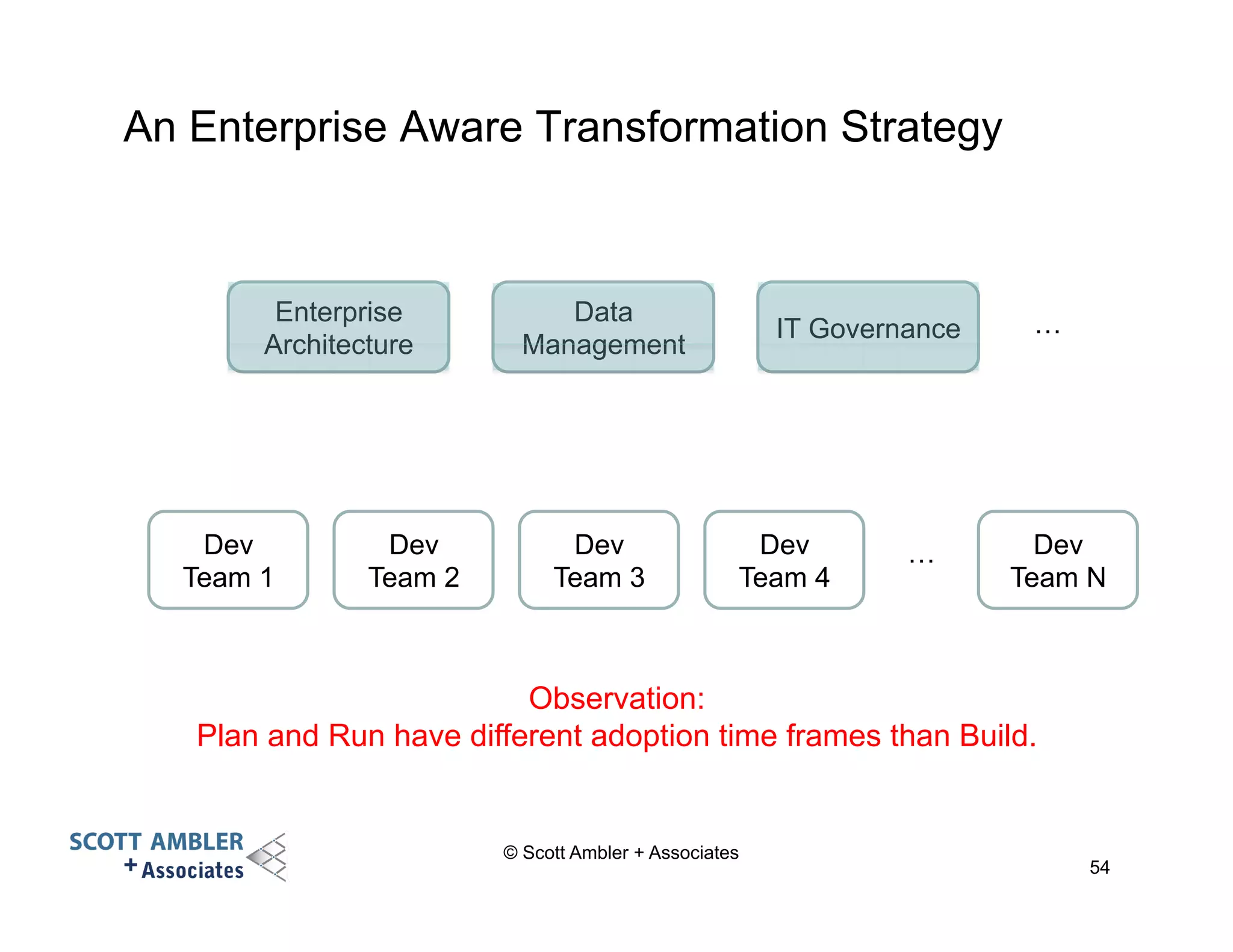
    An Enterprise AwareTransformation Strategy © Scott Ambler + Associates Dev Team 1 Dev Team 2 Dev Team 3 Dev Team 4 Dev Team N … Enterprise Architecture Data Management IT Governance … 54 Observation: Plan and Run have different adoption time frames than Build.
  • 55.
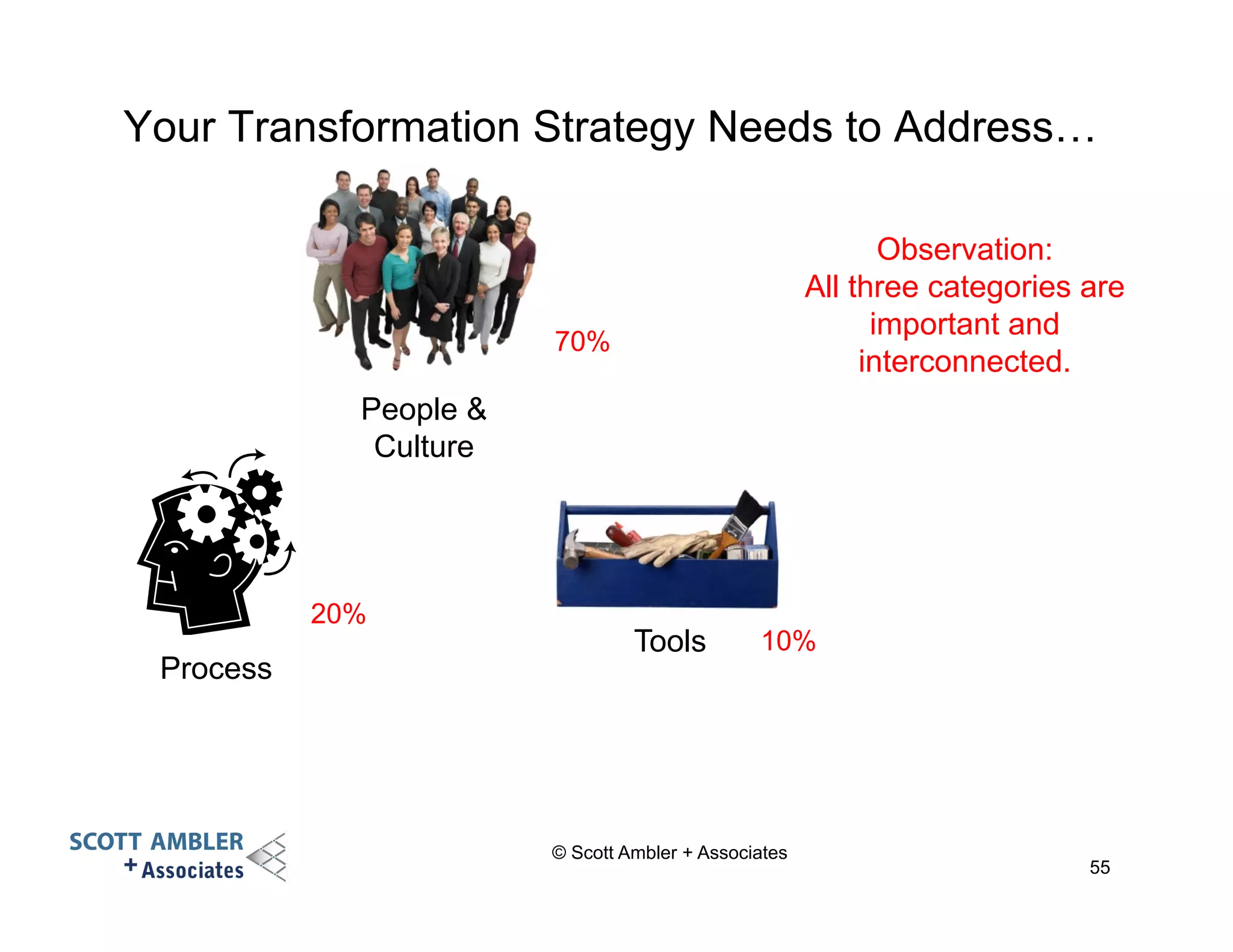
    Your Transformation StrategyNeeds to Address… © Scott Ambler + Associates People & Culture Process Tools 55 Observation: All three categories are important and interconnected. 70% 20% 10%
  • 56.
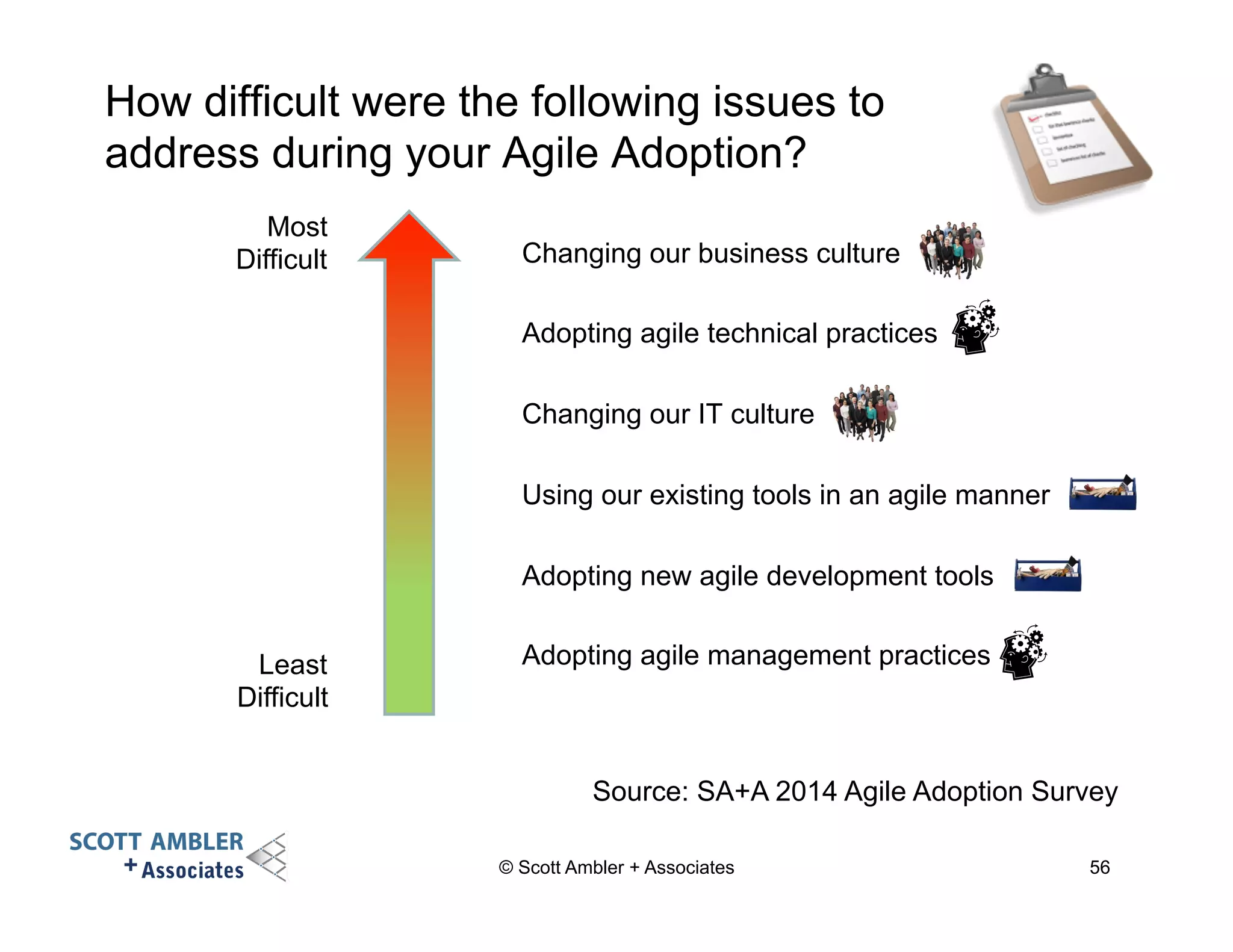
    How difficult werethe following issues to address during your Agile Adoption? Changing our business culture Adopting agile technical practices Changing our IT culture Using our existing tools in an agile manner Adopting new agile development tools Adopting agile management practices Source: SA+A 2014 Agile Adoption Survey © Scott Ambler + Associates Most Difficult Least Difficult 56
  • 57.
    How important werethe following issues to address during your Agile Adoption? Changing our business culture Adopting agile management practices Changing our IT culture Adopting agile technical practices Adopting new agile development tools Using our existing tools in an agile manner Source: SA+A 2014 Agile Adoption Survey © Scott Ambler + Associates Most Important Least Important 57
  • 58.
    Some Realities ofAgile Transformation • Coaches are very easy to find, good coaches experienced in enterprise agile are not • Transforming a few delivery teams is easy, transforming an organization is not • Effective coaches engage concurrently with: – Delivery teams – IT teams – With the rest of the business • Transformation takes: – Years – Ongoing investment – Ongoing sponsorship © Scott Ambler + Associates 58
  • 59.
    The Story ITold © Scott Ambler + Associates 59
  • 60.
    • Disciplined agile delivery teams produce consumable solutions often and early • Agile delivery teams must tailor their approach to address the situation that the find themselves in, particularly when working at scale – Context counts © Scott Ambler + Associates 60 Agile Delivery
  • 61.
    • An AgileIT organization must be responsive to the needs of the rest of the enterprise while “keeping the lights on”. • An Agile IT organization does this via three ongoing efforts: – Plan – Build – Run © Scott Ambler + Associates 61 Agile Delivery Agile IT
  • 62.
    • An agileenterprise is able to anticipate and respond swiftly to changes in the marketplace. • It does this through an organizational culture and structure that facilitates change within the context of the situation that it faces. • Agile enterprises require a learning mindset in the mainstream business and underlying lean and agile processes to drive innovation. Agile Delivery Agile Enterprise © Scott Ambler + Associates 62 Agile IT
  • 63.
    My parting advice…. Your organization is unique. You need to tailor your approach to reflect the evolving context of the situation that you face. One “process size” does not fit all, one organizational strategy does not fit all, nor does one tooling strategy. © Scott Ambler + Associates 63
  • 64.
    Got Discipline? DisciplinedAgileConsortium.org DisciplinedAgileDelivery.com ScottAmbler.com © Scott Ambler + Associates 64
  • 65.
    Thank You! scott[at] scottambler.com @scottwambler AgileModeling.com AgileData.org Ambysoft.com DisciplinedAgileConsortium.org DisciplinedAgileDelivery.com ScottAmbler.com Disciplined Agile Delivery Disciplined Agile Delivery © Scott Ambler + Associates 65
  • 66.
    Would You LikeThis Presented to Your Organization? Contact us at ScottAmbler.com © Scott Ambler + Associates 66
  • 67.
    Scott Ambler +Associates is the thought leader behind the Disciplined Agile Delivery (DAD) framework and its application. We are a boutique IT management consulting firm that advises organizations to be more effective applying disciplined agile and lean processes within the context of your business. Our website is ScottAmbler.com We can help © Scott Ambler + Associates 67
  • 68.
    Additional Slides ©Scott Ambler + Associates 68
  • 69.
    Shuhari and DisciplinedAgile Certification At the shu stage you are beginning to learn the techniques and philosophies of disciplined agile development. Your goal is to build a strong foundation from which to build upon. At the ha stage you reflect upon and question why disciplined agile strategies work, seeking to understand the range of strategies available to you and when they are best applied. At the ri stage you seek to extend and improve upon disciplined agile techniques, sharing your learnings with others. © Disciplined Agile Consortium 69
  • 70.
    DAD is aHybrid Framework DevOps …and more Outside In Dev. “Traditional” Agile Data Extreme Programming Unified Process Agile Modeling Scrum Kanban Lean DAD leverages proven strategies from several sources, providing a decision framework to guide your adoption and tailoring of them in a context-driven manner. © Scott Ambler + Associates 70 SAFe
  • 71.
    Disciplined Agilists Takea Goal Driven Approach * Option Goal Factor Advantages Disadvantages Considerations Default Option * © Scott Ambler + Associates 71 Explore the Initial Scope Form the Initial Team Address Changing Stakeholder Needs Source Team size Team structure Team members Geographic distribution Supporting the team Availability Indicates a preference for the options towards the top Co-located Partially dispersed Fully dispersed Distributed subteams
  • 72.
    Collaboration Pattern: EnterpriseIT Team • Individuals are members of both a delivery team and an enterprise team • Common examples include: – Architecture Ownership Team (Enterprise Architecture) – Product Ownership Team (Product Management) – Product Delivery Office (Portfolio Management) • The delivery teams determine who will be in the enterprise role for them • Potential scheduling challenges for the people in the enterprise roles due to multi-team commitments • The leaders of each enterprise team may be a full time position © Scott Ambler + Associates 72 Enterprise Team Delivery Team
  • 73.
    Example: Architecture Ownership(AO) Team © Scott Ambler + Associates 73 • Responsible for developing the architecture/technology roadmap • Delivery teams determine who the architecture owner (AO) is, and that person becomes part of the AO team • The AO team meets regularly to evolve the roadmap based on the hands-on learnings from the AOs • Ecommerce organization: 7 person AO team (of 250 IT people) • Software product org: 10 person AO team (of 130 IT people)
  • 74.
    Collaboration Pattern: ServicesTeam • Specialized services teams fulfill requests from delivery teams • Common examples of specialized services: – Infrastructure/network – Database administration – Security – Facilities • The specialized services team will often have a service level agreement (SLA) that the work to • Potential for the services team to become a bottleneck • They may supply specialists on a short term basis to some delivery teams © Scott Ambler + Associates 74 Service Request Delivery Team Service Team Service
  • 75.
    Example: Database Administration(DBA) Team • Responsible for supporting database development and database operation © Scott Ambler + Associates 75 in production • The delivery team submits a request, the DBA Team prioritizes it and then fulfills it • Ecommerce org: 5 person team (of 250 IT people) • Software org: 2 person team (of 40 IT people)