AW2
Session 
6/5/2013 10:15 AM 


"Governing Agile Teams:
Disciplined Strategies to Increase
Agile Effectiveness"


Presented by:
Scott Ambler
Scott Ambler + Associates


Brought to you by: 


340 Corporate Way, Suite 300, Orange Park, FL 32073 
888‐268‐8770 ∙ 904‐278‐0524 ∙ sqeinfo@sqe.com ∙ www.sqe.com
Scott Ambler
Scott W. Ambler + Associates

Scott Ambler works with organizations worldwide to help them improve their software
processes. Scott is the founder of the Agile Modeling (AM), Agile Data (AD), Disciplined Agile
Delivery (DAD), and Enterprise Unified Process (EUP) methodologies and creator of the Agile
Scaling Model (ASM). He is the coauthor of twenty-one books, including Refactoring Databases,
Agile Modeling, Agile Database Techniques, The Object Primer 3rd Edition, The Enterprise
Unified Process, and Disciplined Agile Delivery. Scott is a senior contributing editor with Dr.
Dobb’s Journal. Visit his home page ScottAmbler.com and his Agility@Scale blog.
 
Governing Agile Teams
Reality over Rhetoric

© Scott Ambler + Associates

1
The Survey Results Shared in This Presentation

•

All surveys were performed in an open
manner

•

The questions as they were asked, the
source data, and a summary slide deck
can be downloaded free of charge from
Ambysoft.com/surveys/

© Scott Ambler + Associates

2
Agenda
•
•
•
•
•

What is governance?
Disciplined Agile Delivery (DAD)
Agile governance strategies
Measuring agile teams
Parting thoughts

© Scott Ambler + Associates

3
Defining governance
Governance establishes chains of
responsibility, authority and communication
in support of the overall enterprise’s goals
and strategy. It also establishes
measurements, policies, standards and
control mechanisms to enable people to
carry out their roles and responsibilities
effectively.
You do this by balancing risk versus return on
investment (ROI), setting in place effective
processes and practices, defining the
direction and goals for the department, and
defining the roles that people play with and
within the department.

© Scott Ambler + Associates

4
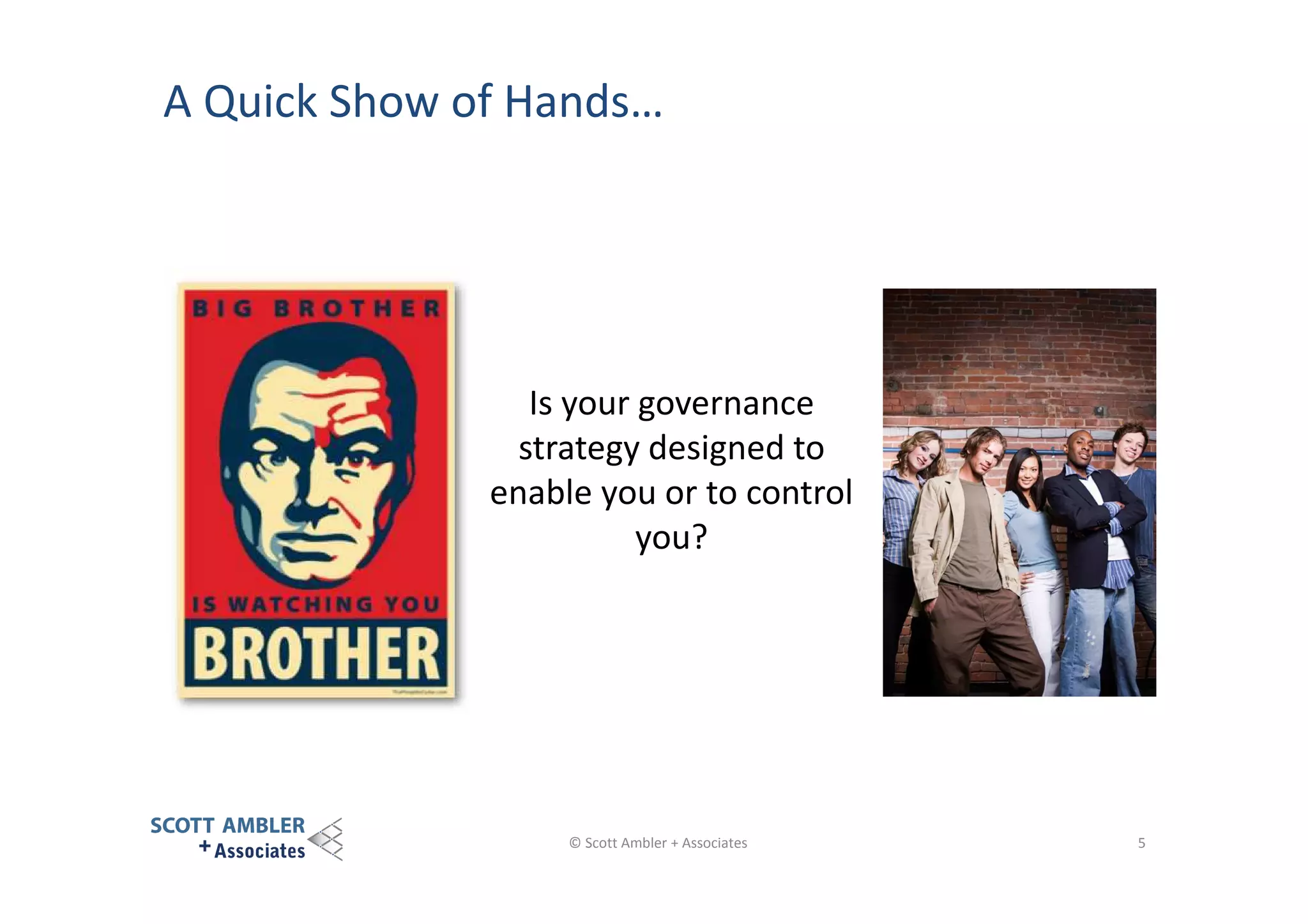
A Quick Show of Hands…

Is your governance
strategy designed to
enable you or to control
you?

© Scott Ambler + Associates

5
Governance Should Address a Range of Issues
•
•
•
•
•
•
•
•
•
•
•
•
•

Team roles and responsibilities
Individual roles and responsibilities
Decision rights and decision making process
Governing body
Exceptions and escalation processes
Knowledge sharing processes
Metrics strategy
Risk mitigation
Reward structure
Status reporting
Audit processes
Policies, standards, and guidelines
Artifacts and their lifecycles

© Scott Ambler + Associates

6
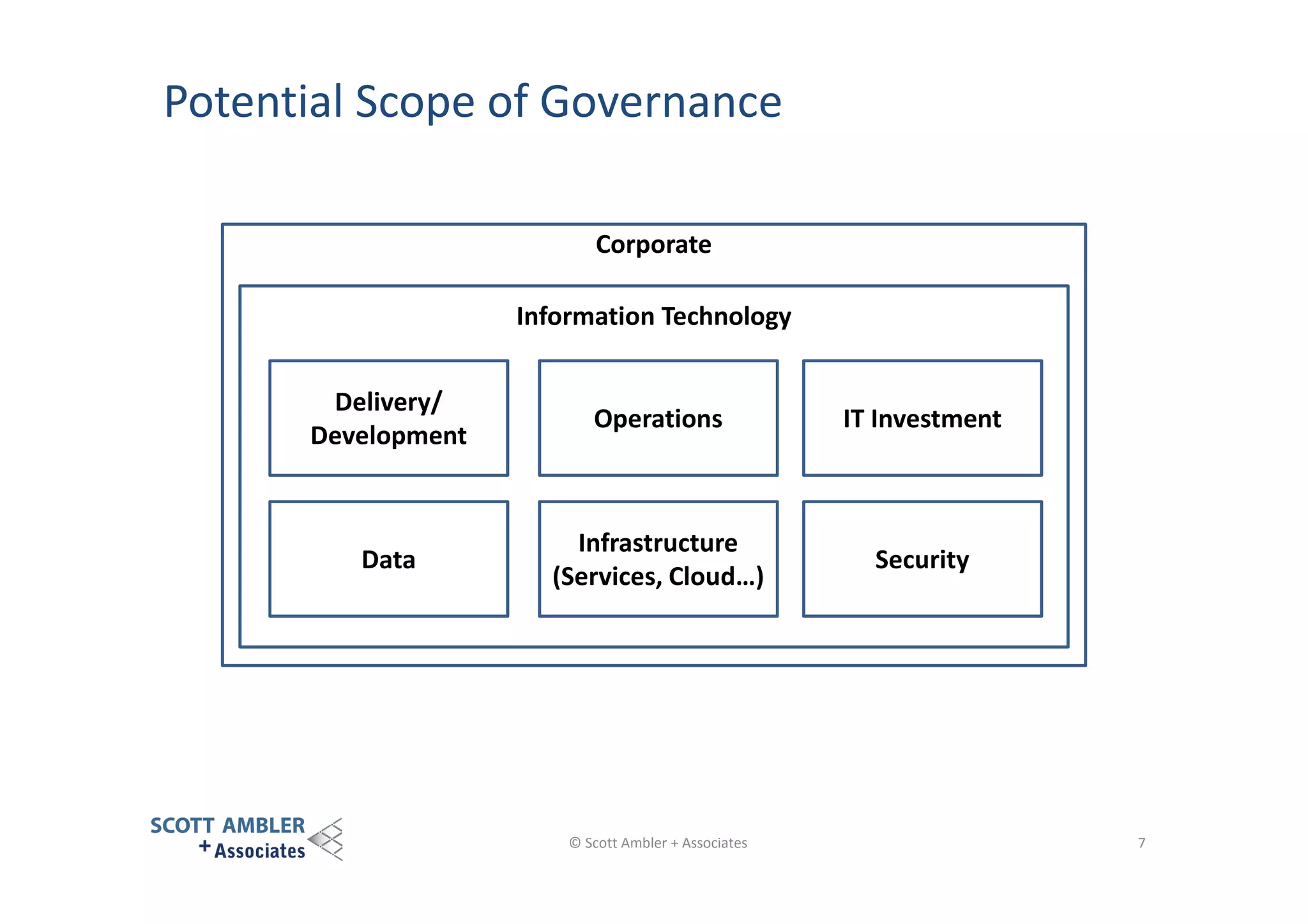
Potential Scope of Governance
Corporate
Information Technology
Delivery/
Development

Operations

IT Investment

Data

Infrastructure
(Services, Cloud…)

Security

© Scott Ambler + Associates

7
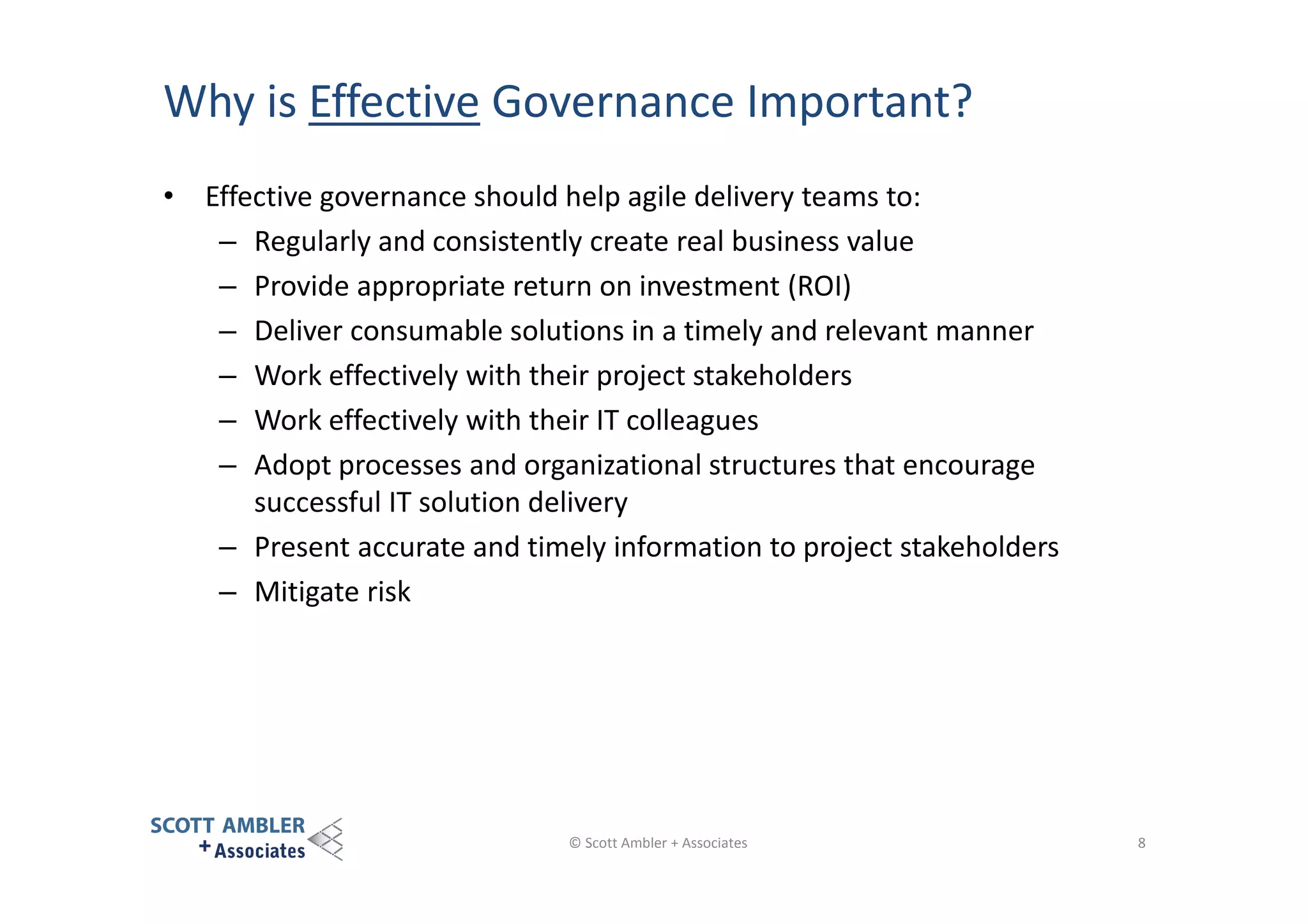
Why is Effective Governance Important?
• Effective governance should help agile delivery teams to:
– Regularly and consistently create real business value
– Provide appropriate return on investment (ROI)
– Deliver consumable solutions in a timely and relevant manner
– Work effectively with their project stakeholders
– Work effectively with their IT colleagues
– Adopt processes and organizational structures that encourage
successful IT solution delivery
– Present accurate and timely information to project stakeholders
– Mitigate risk

© Scott Ambler + Associates

8
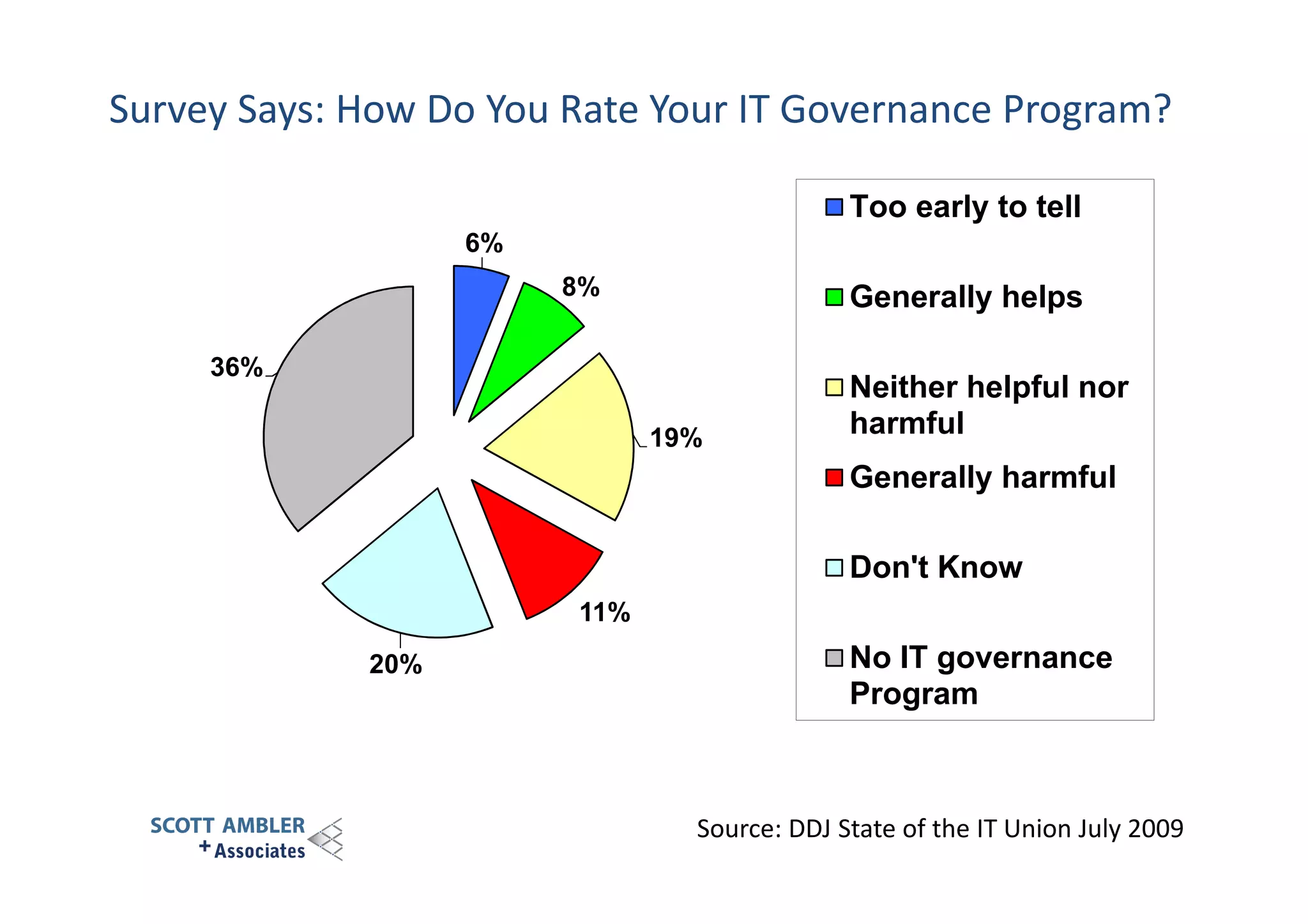
Survey Says: How Do You Rate Your IT Governance Program?
Too early to tell
6%
8%

Generally helps

36%
19%

Neither helpful nor
harmful
Generally harmful
Don't Know

11%
20%

No IT governance
Program

Source: DDJ State of the IT Union July 2009
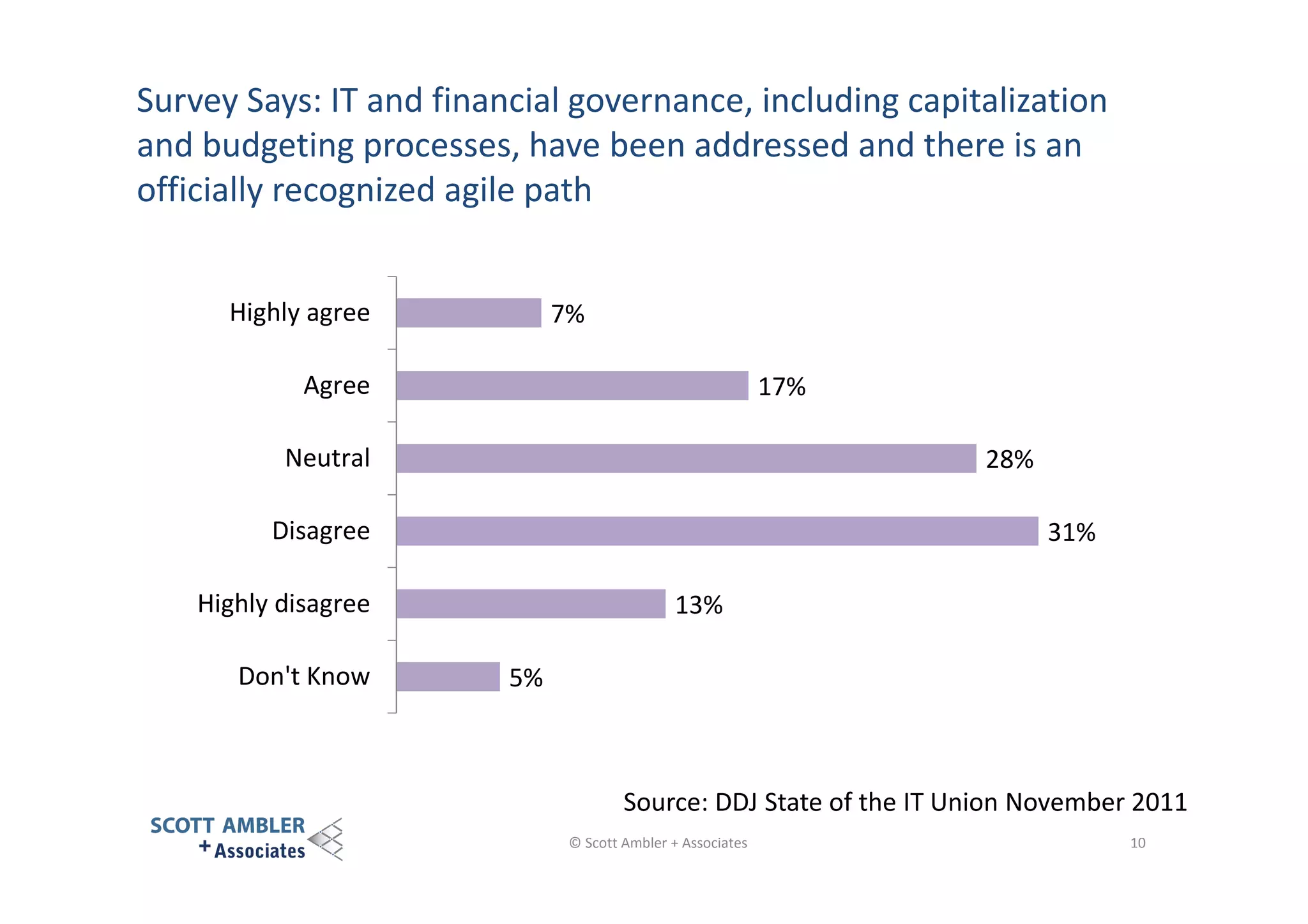
Survey Says: IT and financial governance, including capitalization
and budgeting processes, have been addressed and there is an
officially recognized agile path
Highly agree

7%

Agree

17%

Neutral

28%

Disagree

31%

Highly disagree
Don't Know

13%
5%

Source: DDJ State of the IT Union November 2011
© Scott Ambler + Associates

10
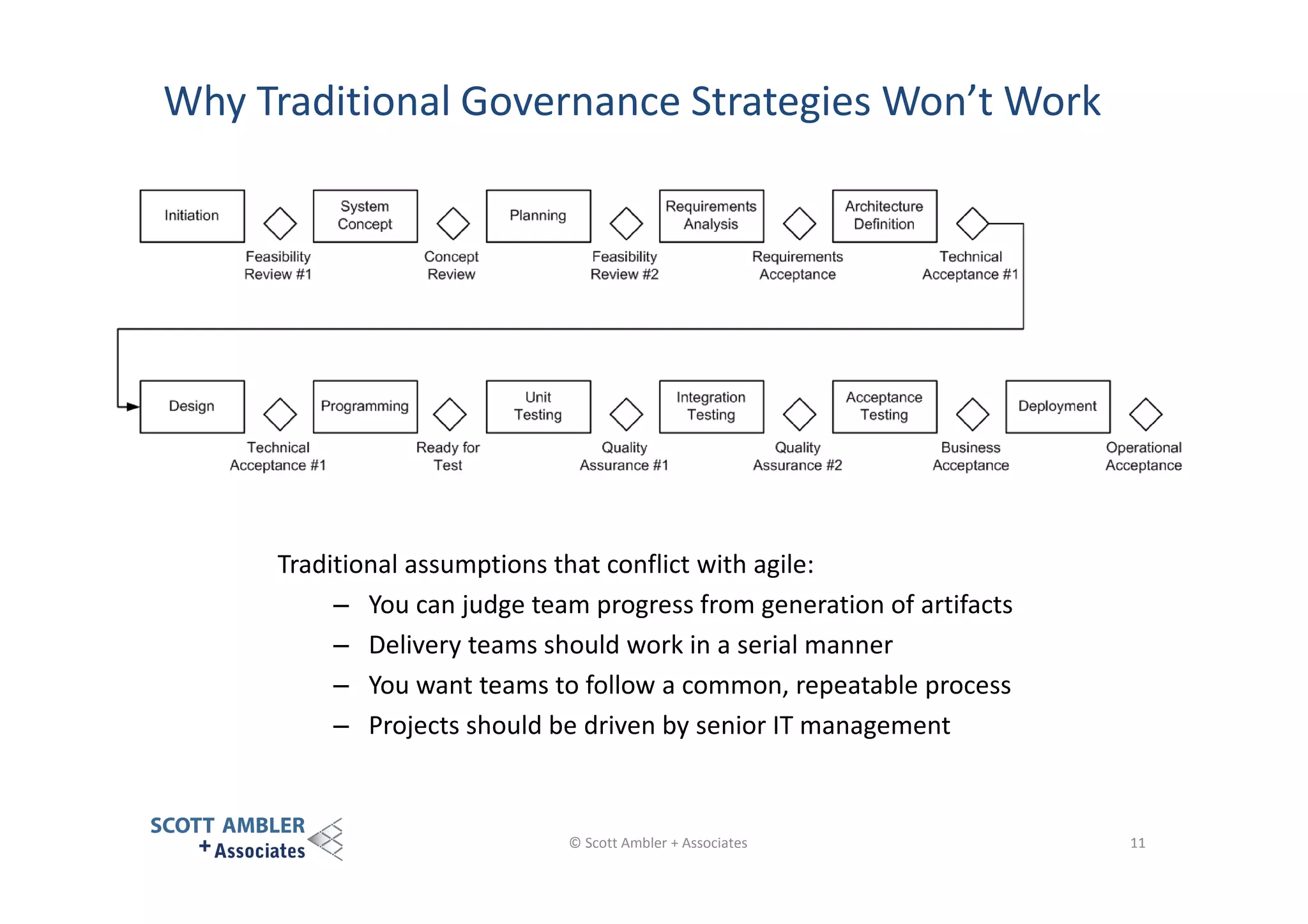
Why Traditional Governance Strategies Won’t Work

Traditional assumptions that conflict with agile:
– You can judge team progress from generation of artifacts
– Delivery teams should work in a serial manner
– You want teams to follow a common, repeatable process
– Projects should be driven by senior IT management

© Scott Ambler + Associates

11
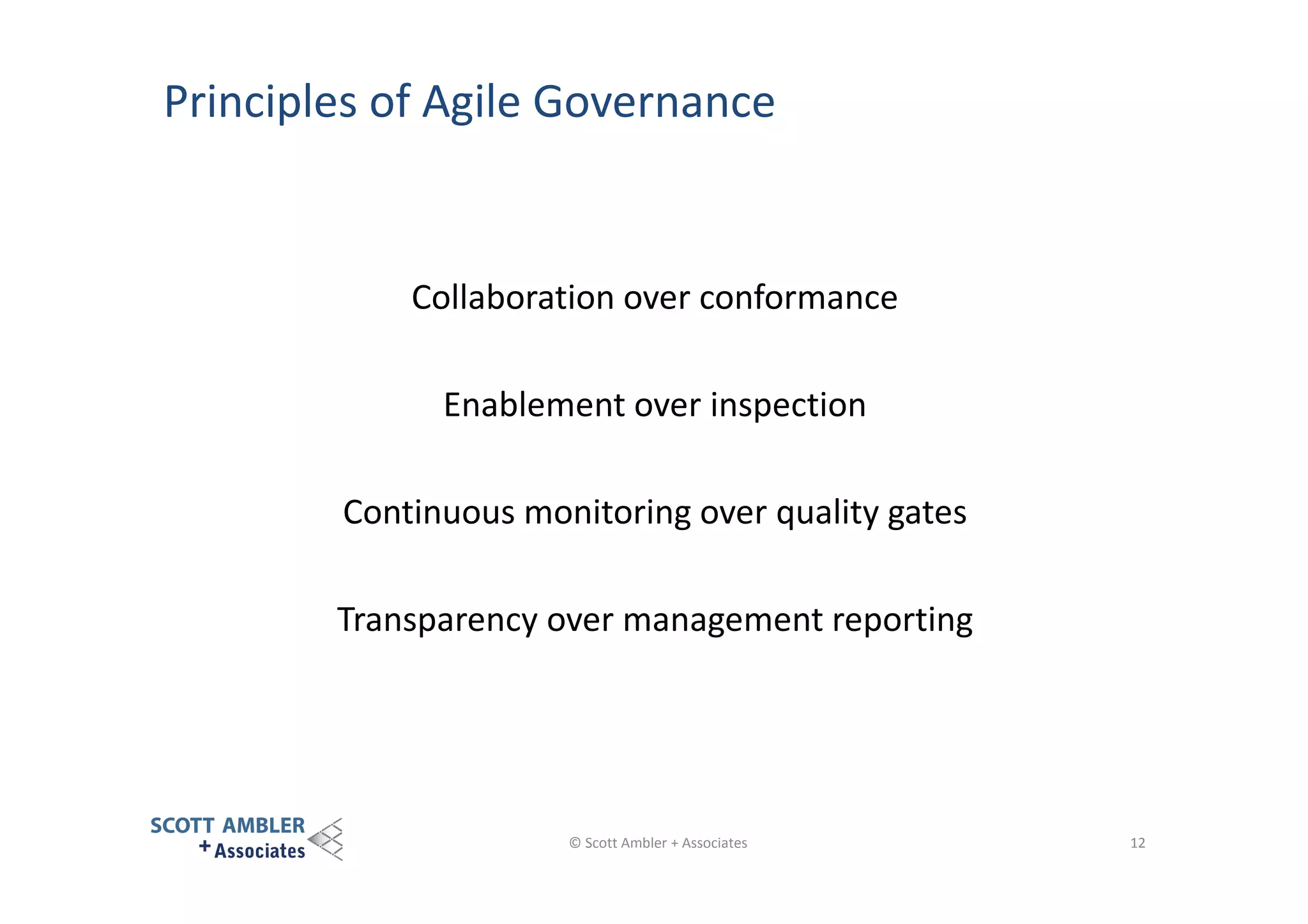
Principles of Agile Governance

Collaboration over conformance
Enablement over inspection
Continuous monitoring over quality gates
Transparency over management reporting

© Scott Ambler + Associates

12
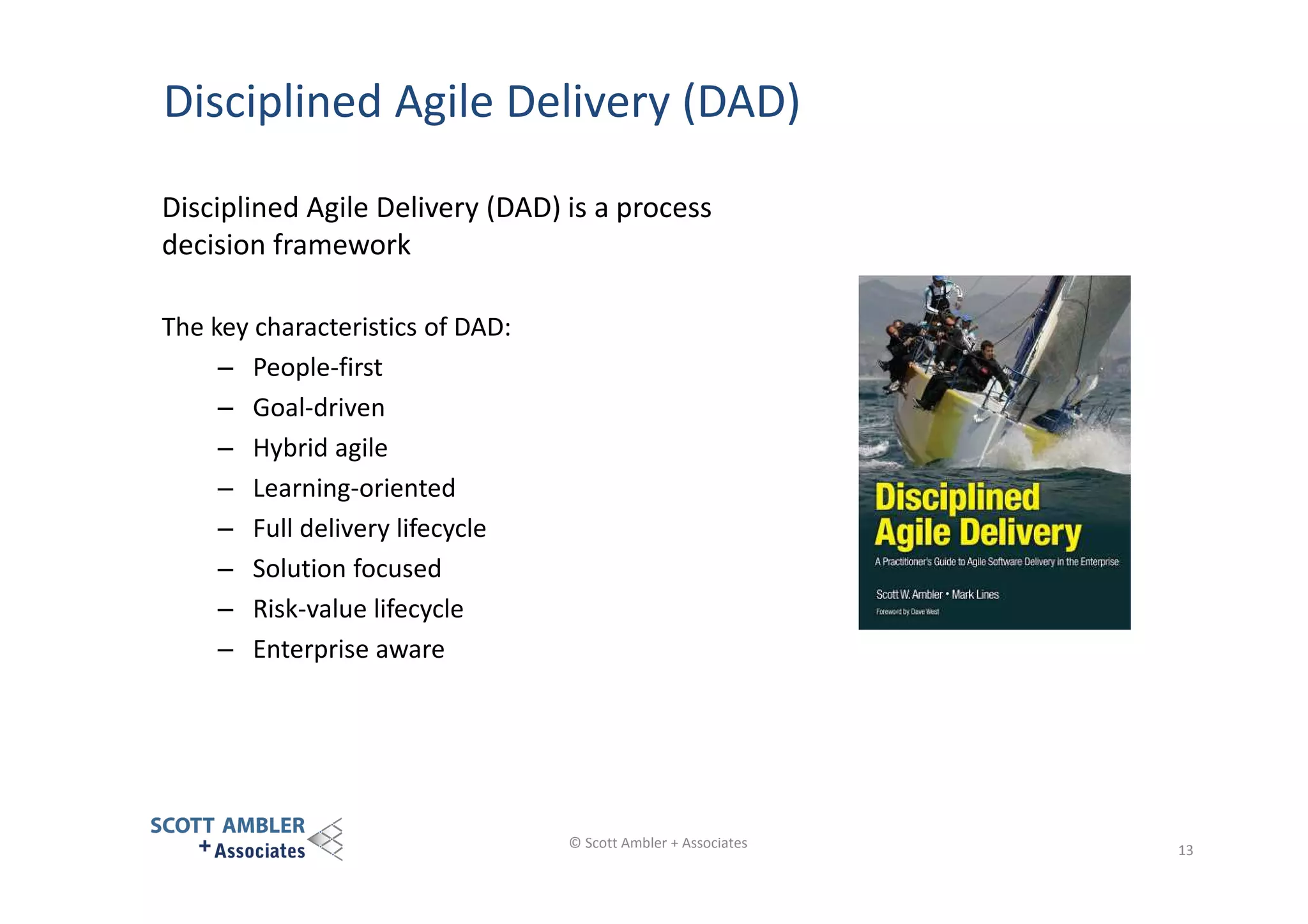
Disciplined Agile Delivery (DAD)
Disciplined Agile Delivery (DAD) is a process
decision framework
The key characteristics of DAD:
– People-first
– Goal-driven
– Hybrid agile
– Learning-oriented
– Full delivery lifecycle
– Solution focused
– Risk-value lifecycle
– Enterprise aware

© Scott Ambler + Associates

13
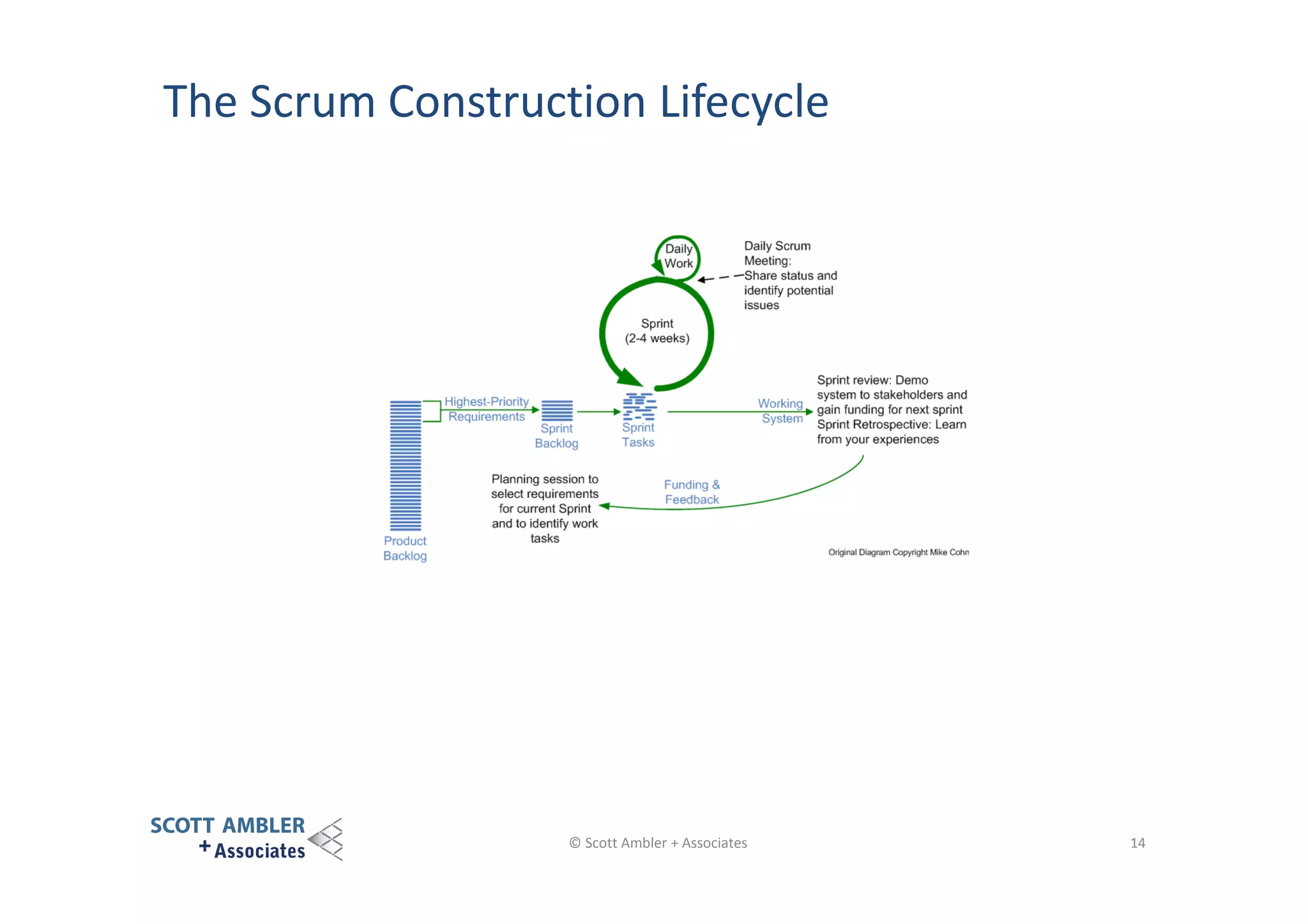
The Scrum Construction Lifecycle

© Scott Ambler + Associates

14
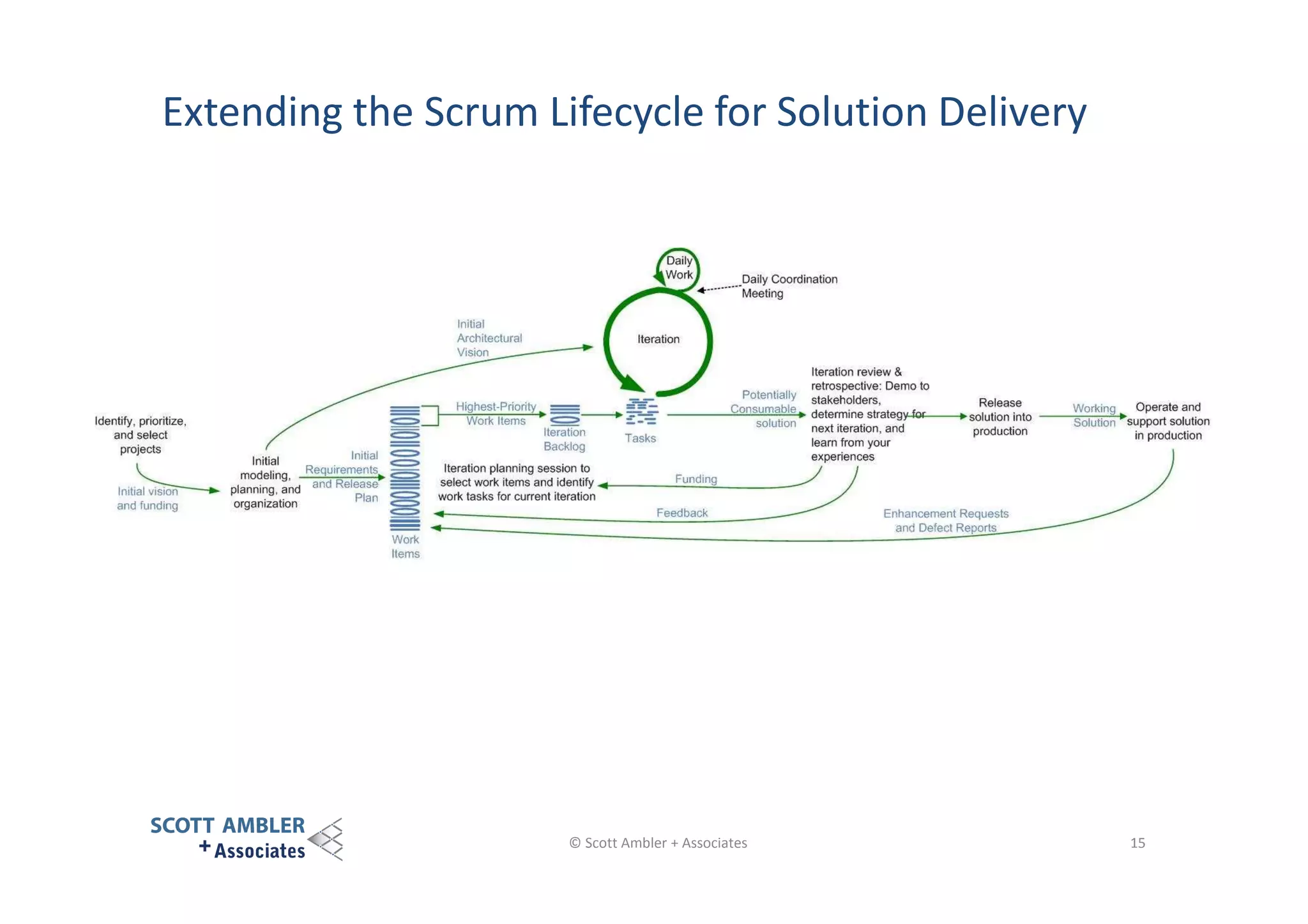
Extending the Scrum Lifecycle for Solution Delivery

© Scott Ambler + Associates

15
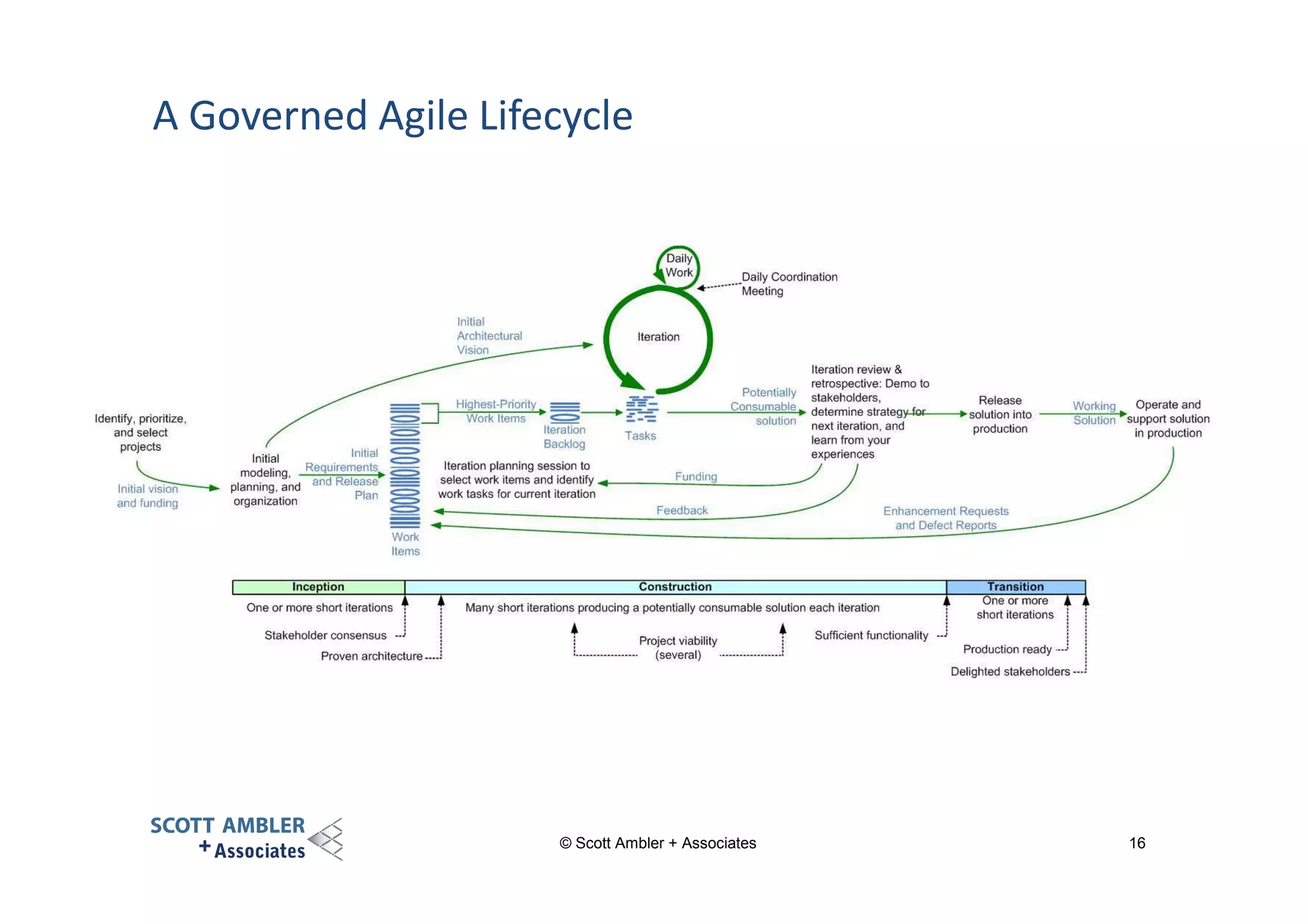
A Governed Agile Lifecycle

© Scott Ambler + Associates

16
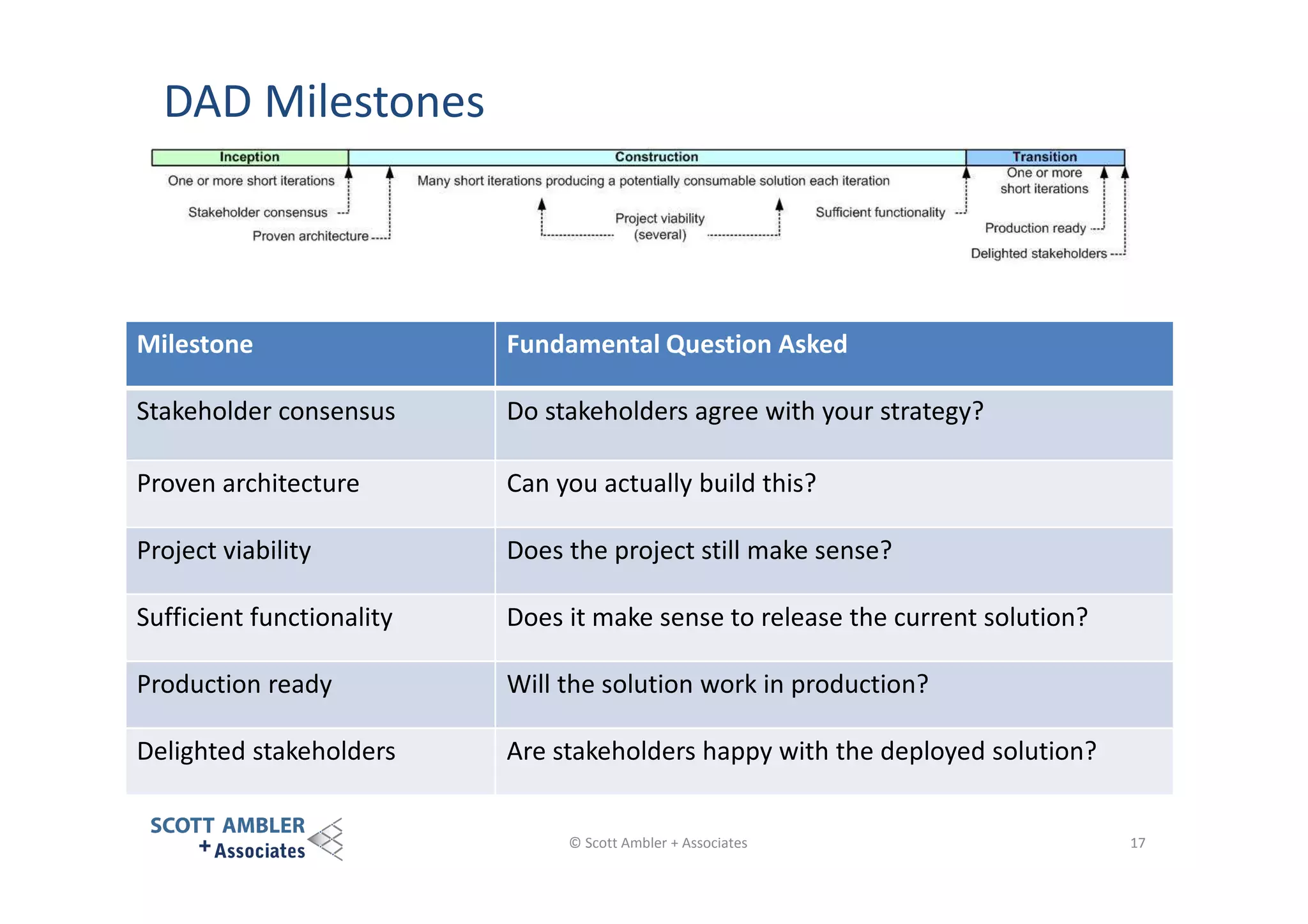
DAD Milestones

Milestone

Fundamental Question Asked

Stakeholder consensus

Do stakeholders agree with your strategy?

Proven architecture

Can you actually build this?

Project viability

Does the project still make sense?

Sufficient functionality

Does it make sense to release the current solution?

Production ready

Will the solution work in production?

Delighted stakeholders

Are stakeholders happy with the deployed solution?

© Scott Ambler + Associates

17
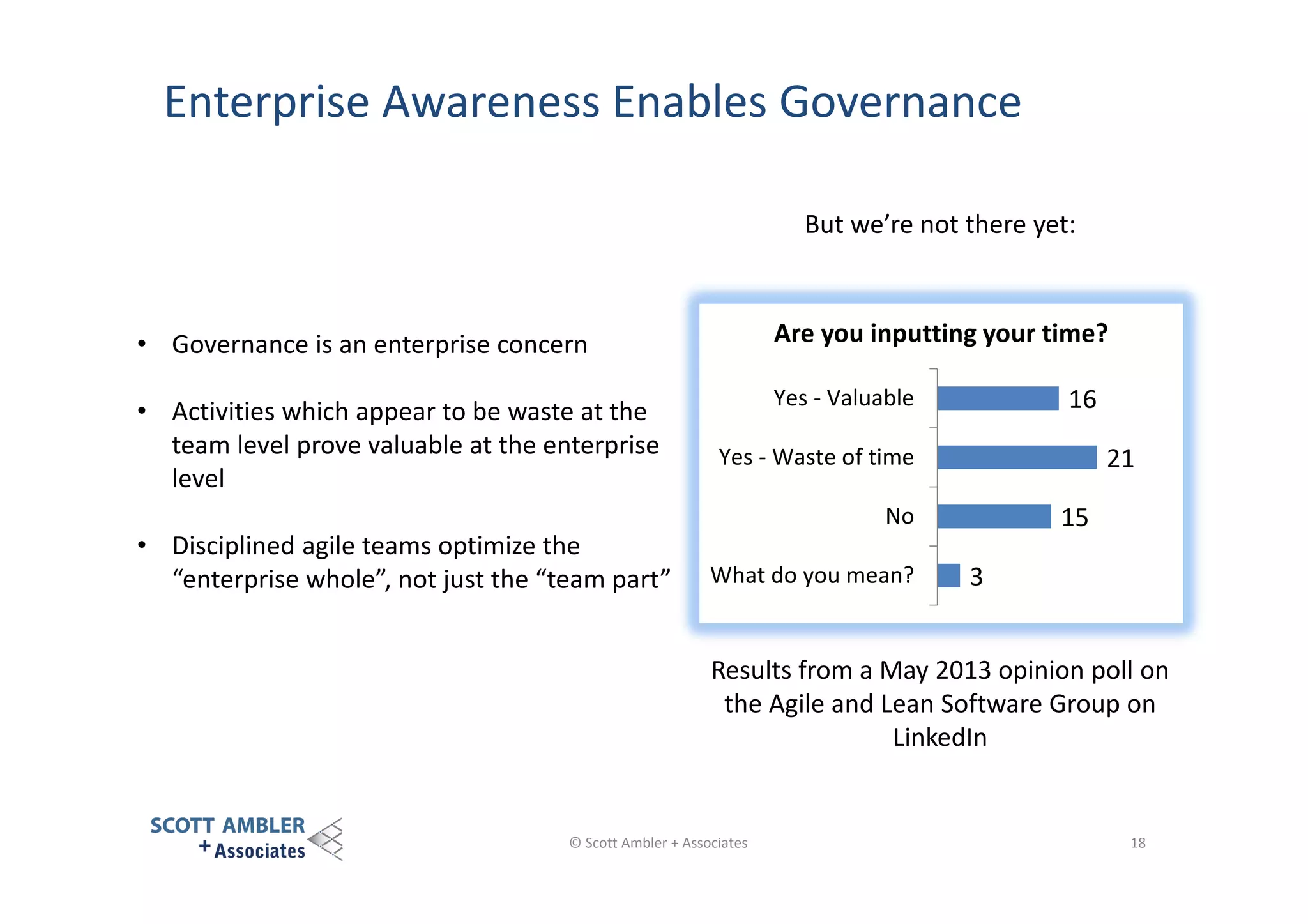
Enterprise Awareness Enables Governance
But we’re not there yet:

• Governance is an enterprise concern

Are you inputting your time?

• Activities which appear to be waste at the
team level prove valuable at the enterprise
level

Yes - Valuable

16

Yes - Waste of time

21

No

• Disciplined agile teams optimize the
“enterprise whole”, not just the “team part”

What do you mean?

15
3

Results from a May 2013 opinion poll on
the Agile and Lean Software Group on
LinkedIn

© Scott Ambler + Associates

18
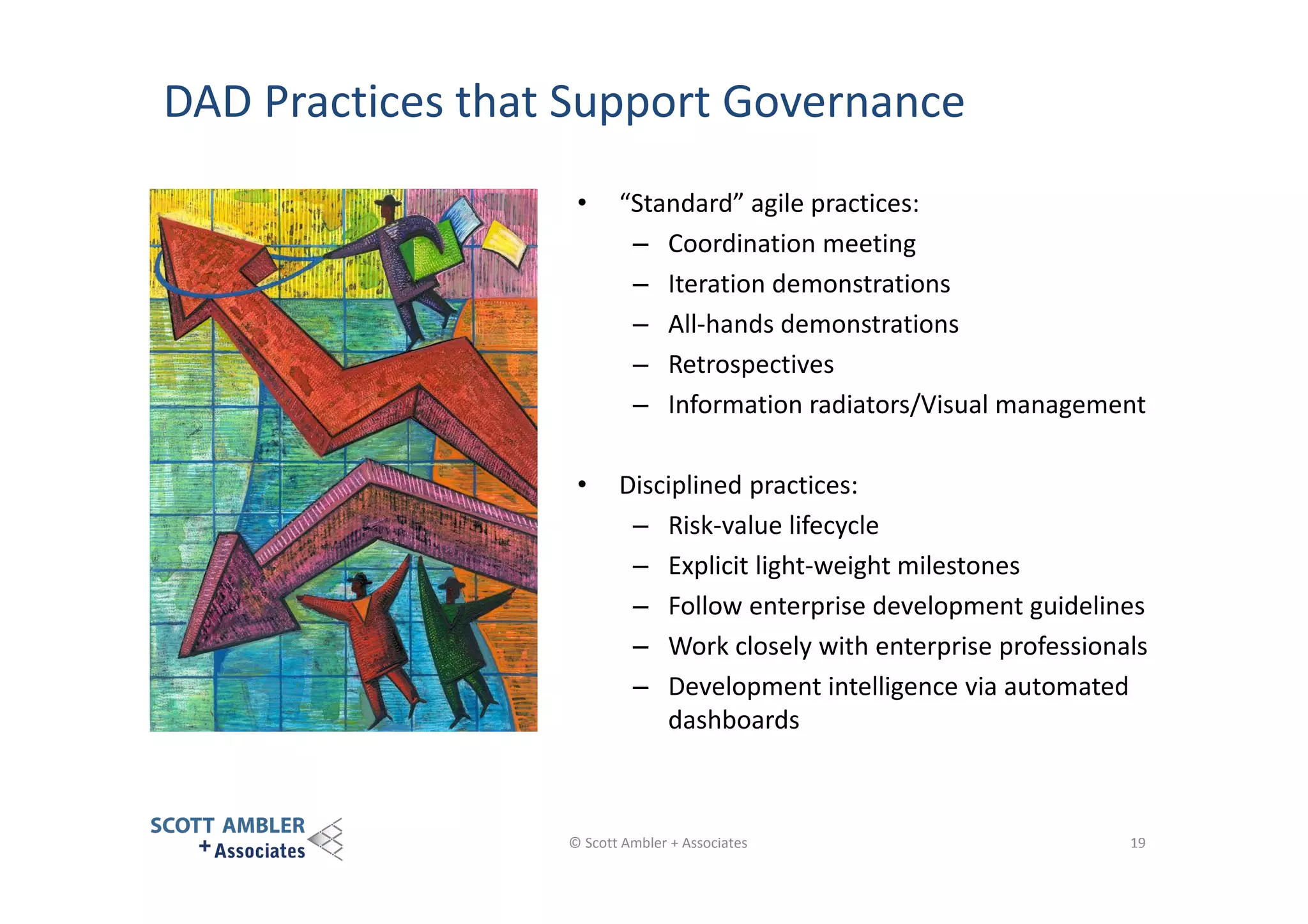
DAD Practices that Support Governance
•

“Standard” agile practices:
– Coordination meeting
– Iteration demonstrations
– All-hands demonstrations
– Retrospectives
– Information radiators/Visual management

•

Disciplined practices:
– Risk-value lifecycle
– Explicit light-weight milestones
– Follow enterprise development guidelines
– Work closely with enterprise professionals
– Development intelligence via automated
dashboards

© Scott Ambler + Associates

19
Measuring Agile Teams
•
•
•
•
•
•
•
•
•
•
•
•
•
•

Talk to people; don’t manage to the metrics
Measure teams, not individuals
Collect several metrics
Trends are better than scalar values
Empirical observation is important but limited
Prefer automated metrics
Some metrics must be gathered manually
Prefer pull versus push reporting
Beware scientific facades
Measure the value of your metrics program
Be prepared to educate people
The value of many metrics diminishes over time
If you collect no metrics at all you’re flying blind
If you collect too many metrics you may be flying blinded

© Scott Ambler + Associates

20
Goal Question Metric (GQM)

The GQM process:
1. Develop a set of corporate, division and project business goals for productivity
and quality
2. Generate questions that define those goals as completely as possible in a
quantifiable way
3. Specify the measures needed to be collected to answer those questions and
track process and product conformance to the goals
4. Develop mechanisms for data collection
5. Collect, validate and analyze the data in real time to provide feedback to
projects for corrective action
6. Analyze the data to assess conformance to the goals and to make
recommendations for future improvements
© Scott Ambler + Associates

21
Some potential goals
• We should invest in IT wisely
• We should provide a healthy work
environment to staff
• Teams should deploy in a timely manner
• Teams should provide real value to
stakeholders
• We should reduce overall technical debt over
time
• Team should produce solutions that of
sufficient quality
• We should comply to appropriate industry
regulations

© Scott Ambler + Associates

22
Potential Metrics
•
•
•
•
•
•
•
•
•
•
•
•

Acceleration
Activity time
Age of work items
Blocking work items
Build health
Business value delivered
Change cycle time
Code quality
Defect density
Defect trend
Effort/cost projection
Iteration burndown

•
•
•
•
•
•
•
•
•
•
•

Lifecycle traceability
Net present value (NPV)
Ranged release burndown
Release burndown
Return on investment (ROI)
Risk mitigation
Stakeholder satisfaction
Team morale
Test coverage
Time invested
Velocity

© Scott Ambler + Associates

23
Goal: Spend IT Investment Wisely

Questions

Potential Metrics

1. How effective is the
investment in IT activities?

1. Business value delivered,
net present value (NPV),
return on investment (ROI)
2. Effort/cost projection

2. What future spending do
we require?
3. Is productivity increasing?

3. Acceleration, business
value delivered, velocity
(trend)

© Scott Ambler + Associates

24
Goal: Deploy in a Timely Manner

Questions

Potential Metrics

1. Is the team working at a
sufficient pace?

1. Release burndown, ranged
release burndown

2. Is the team working
together effectively?

2. Team morale, stakeholder
satisfaction, blocking work
items
3. Age of items, ranged
release burndown

3. Are changing requirements
putting the release date at
risk?

© Scott Ambler + Associates

25
Goal: Reduce Technical Debt

Questions

Potential Metrics

1. What is our current level of
technical debt?

1. Code quality, defect
density

2. Are we improving quality
over time?

2. Build health, defect trends,
test coverage

© Scott Ambler + Associates

26
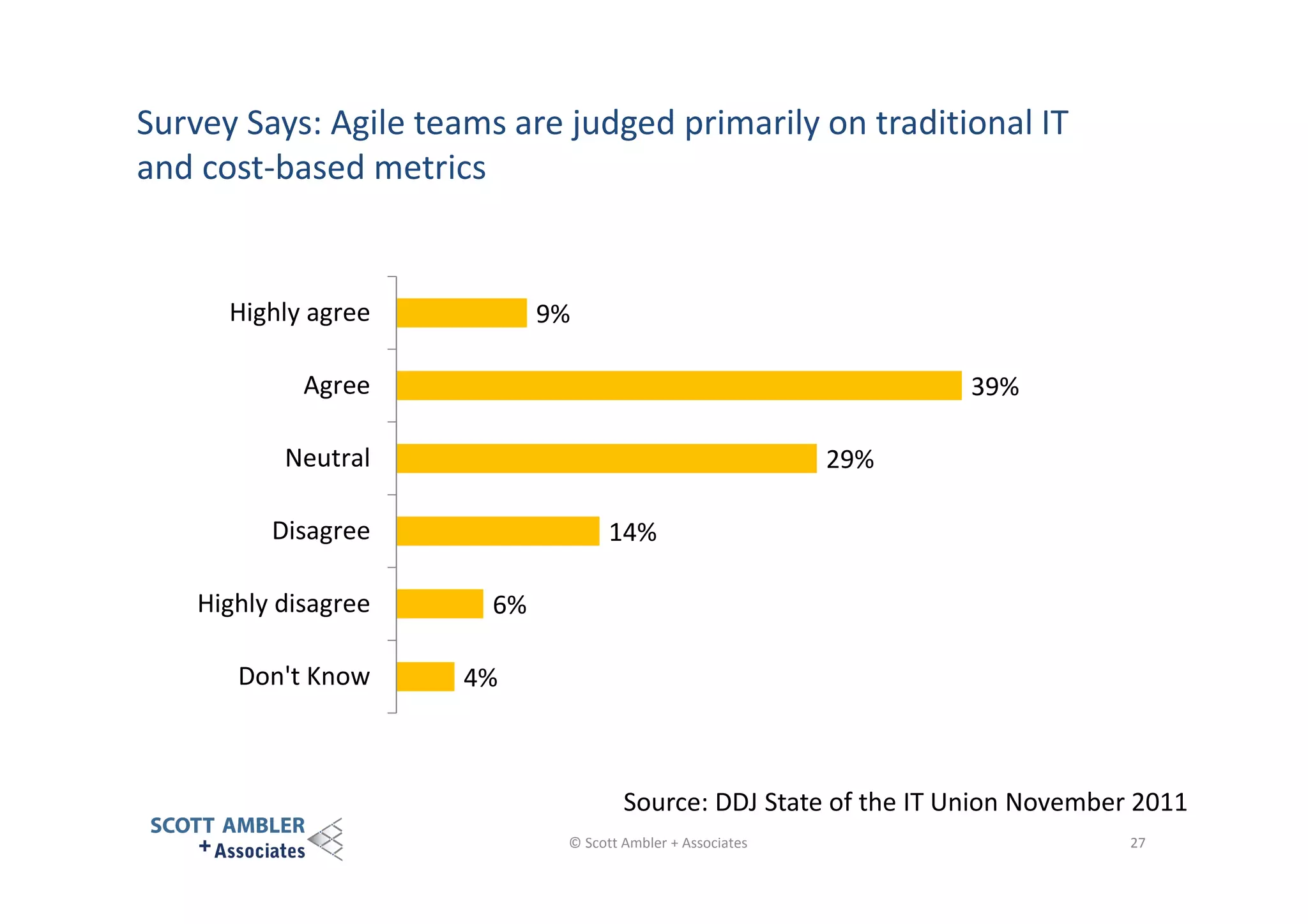
Survey Says: Agile teams are judged primarily on traditional IT
and cost-based metrics

Highly agree

9%

Agree

39%

Neutral

29%

Disagree
Highly disagree
Don't Know

14%
6%
4%

Source: DDJ State of the IT Union November 2011
© Scott Ambler + Associates

27
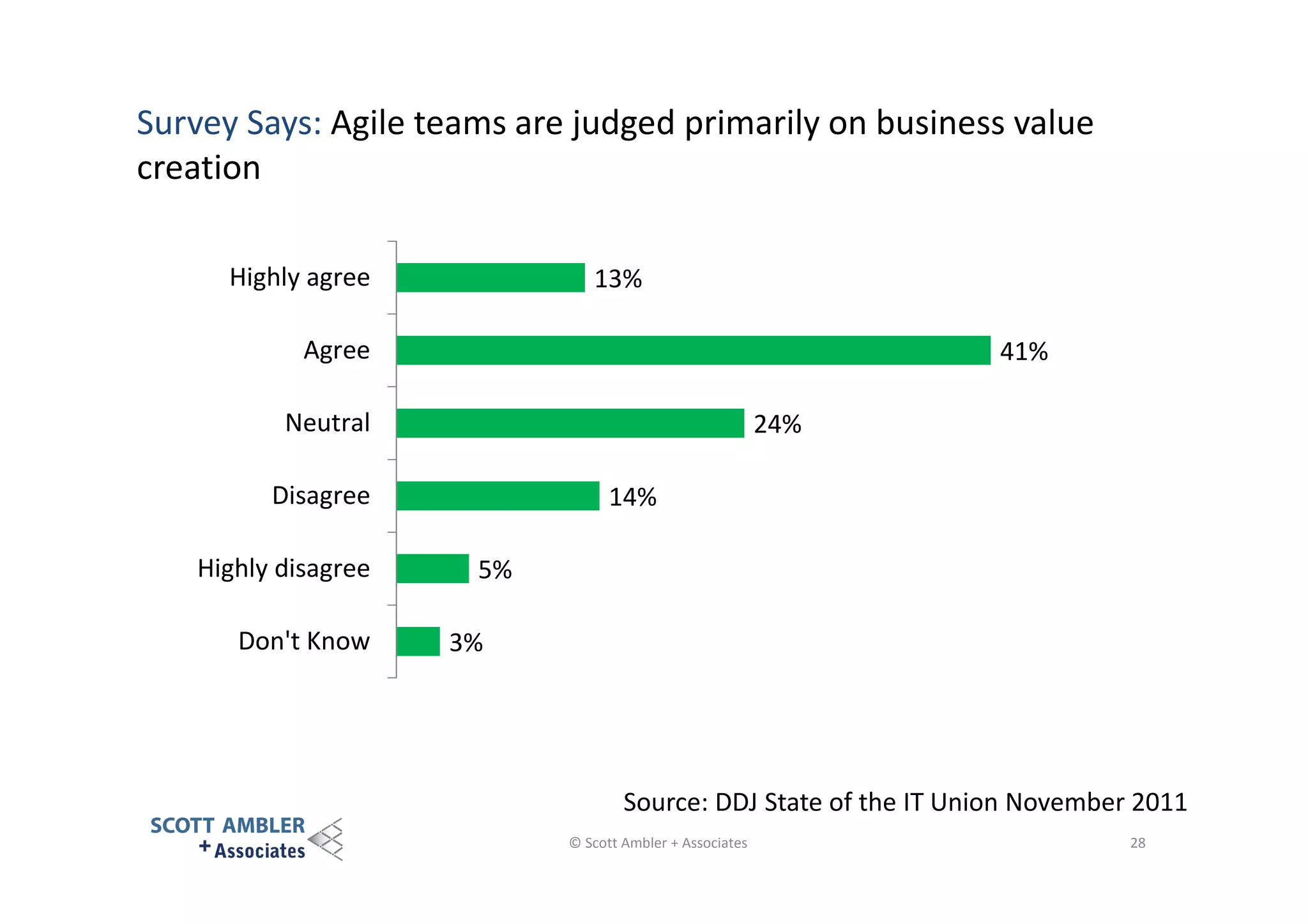
Survey Says: Agile teams are judged primarily on business value
creation
Highly agree

13%

Agree

41%

Neutral

24%

Disagree
Highly disagree
Don't Know

14%
5%
3%

Source: DDJ State of the IT Union November 2011
© Scott Ambler + Associates

28
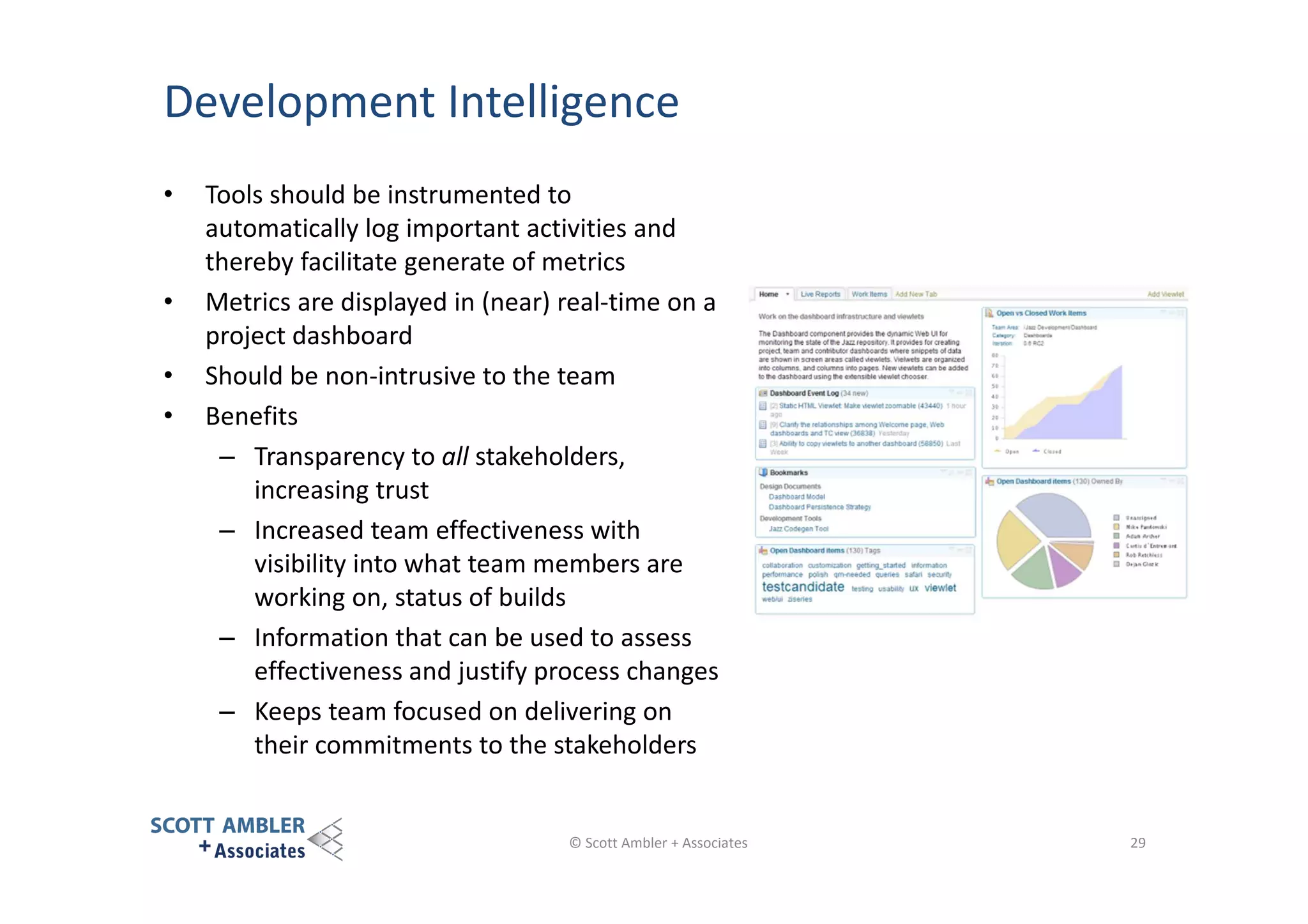
Development Intelligence
•

•
•
•

Tools should be instrumented to
automatically log important activities and
thereby facilitate generate of metrics
Metrics are displayed in (near) real-time on a
project dashboard
Should be non-intrusive to the team
Benefits
– Transparency to all stakeholders,
increasing trust
– Increased team effectiveness with
visibility into what team members are
working on, status of builds
– Information that can be used to assess
effectiveness and justify process changes
– Keeps team focused on delivering on
their commitments to the stakeholders

© Scott Ambler + Associates

29
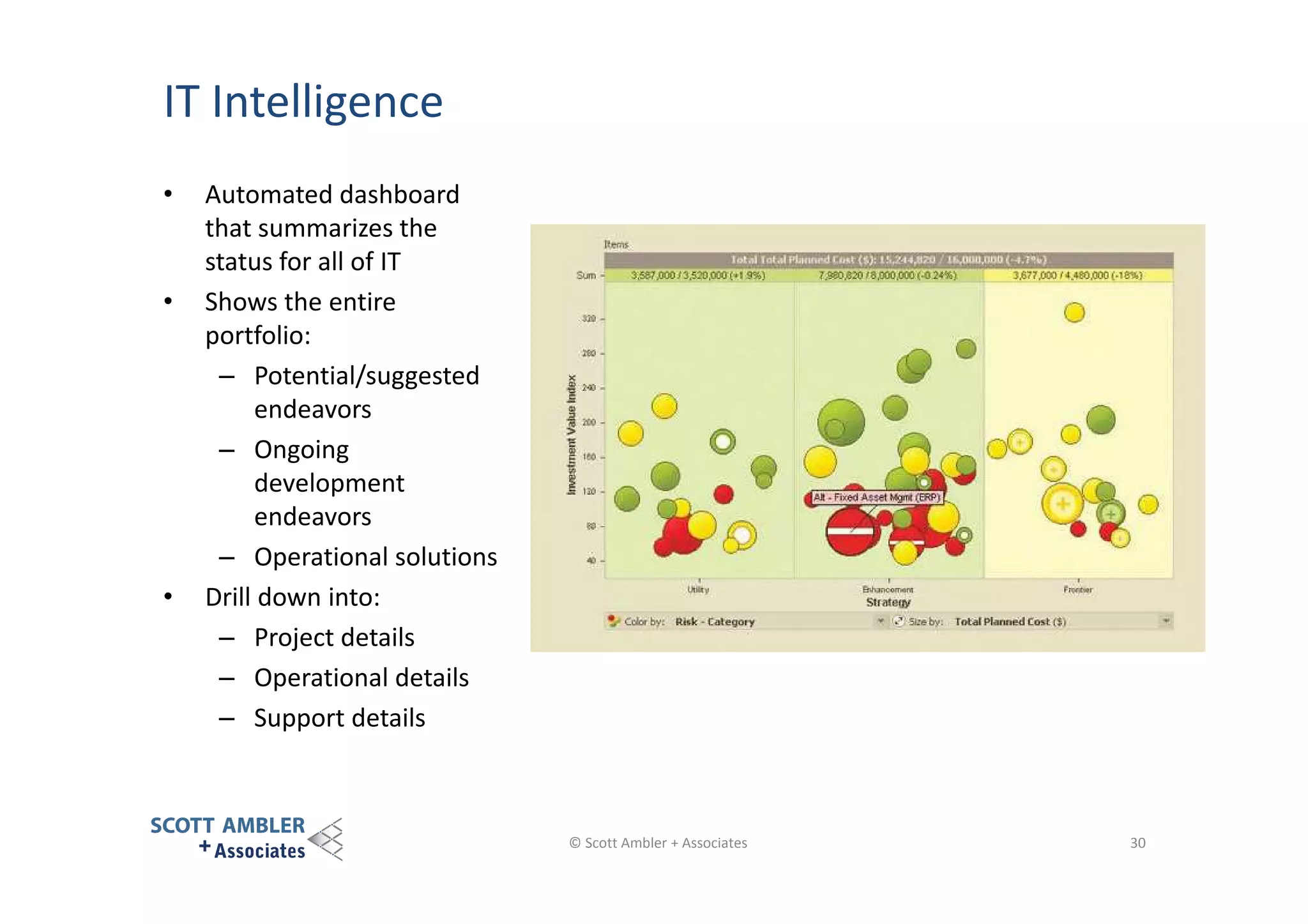
IT Intelligence
•

•

•

Automated dashboard
that summarizes the
status for all of IT
Shows the entire
portfolio:
– Potential/suggested
endeavors
– Ongoing
development
endeavors
– Operational solutions
Drill down into:
– Project details
– Operational details
– Support details

© Scott Ambler + Associates

30
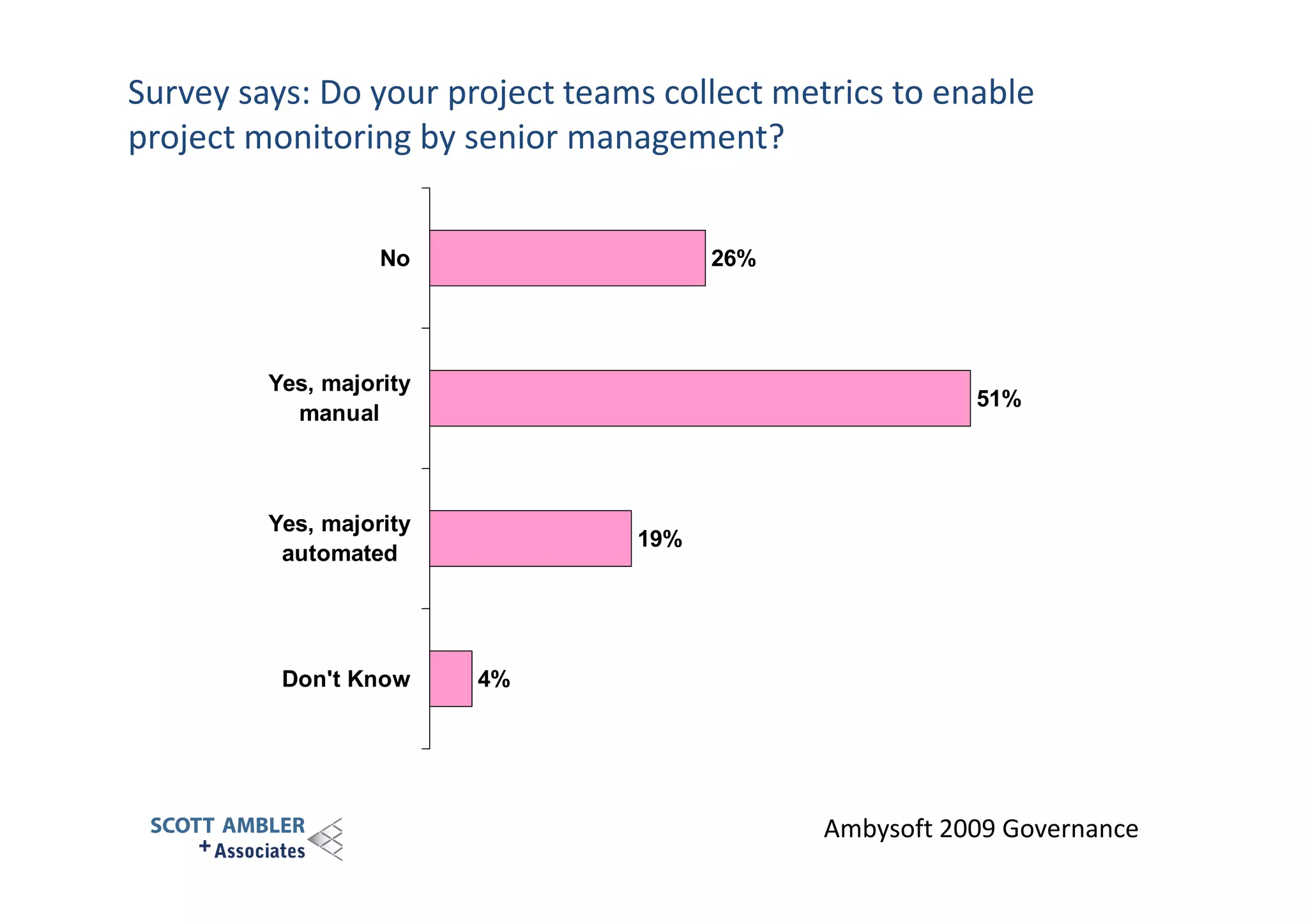
Survey says: Do your project teams collect metrics to enable
project monitoring by senior management?

No

26%

Yes, majority
manual

51%

Yes, majority
automated

Don't Know

19%

4%

Ambysoft 2009 Governance
© Scott Ambler + Associates

32
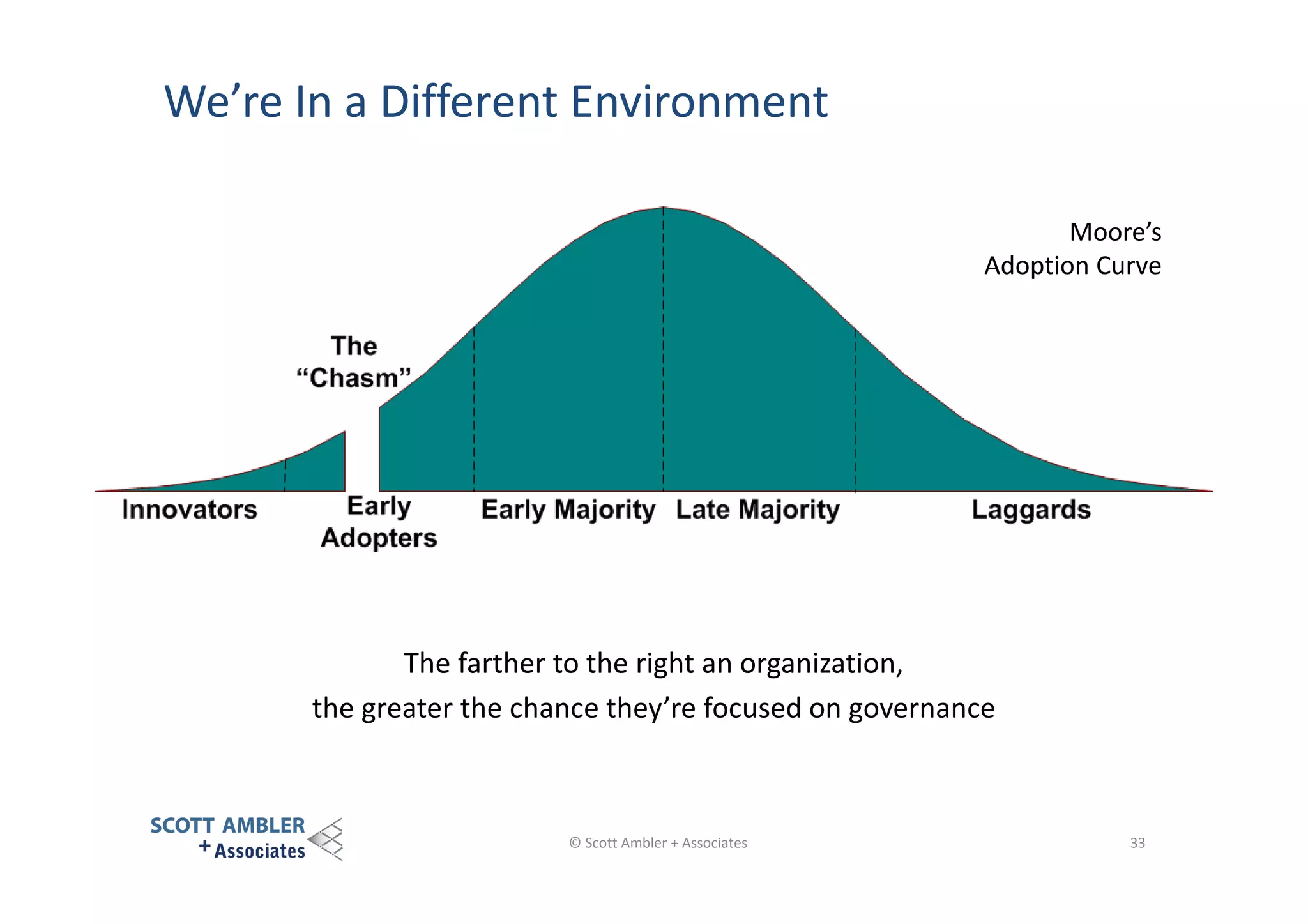
We’re In a Different Environment
Moore’s
Adoption Curve

The farther to the right an organization,
the greater the chance they’re focused on governance

© Scott Ambler + Associates

33
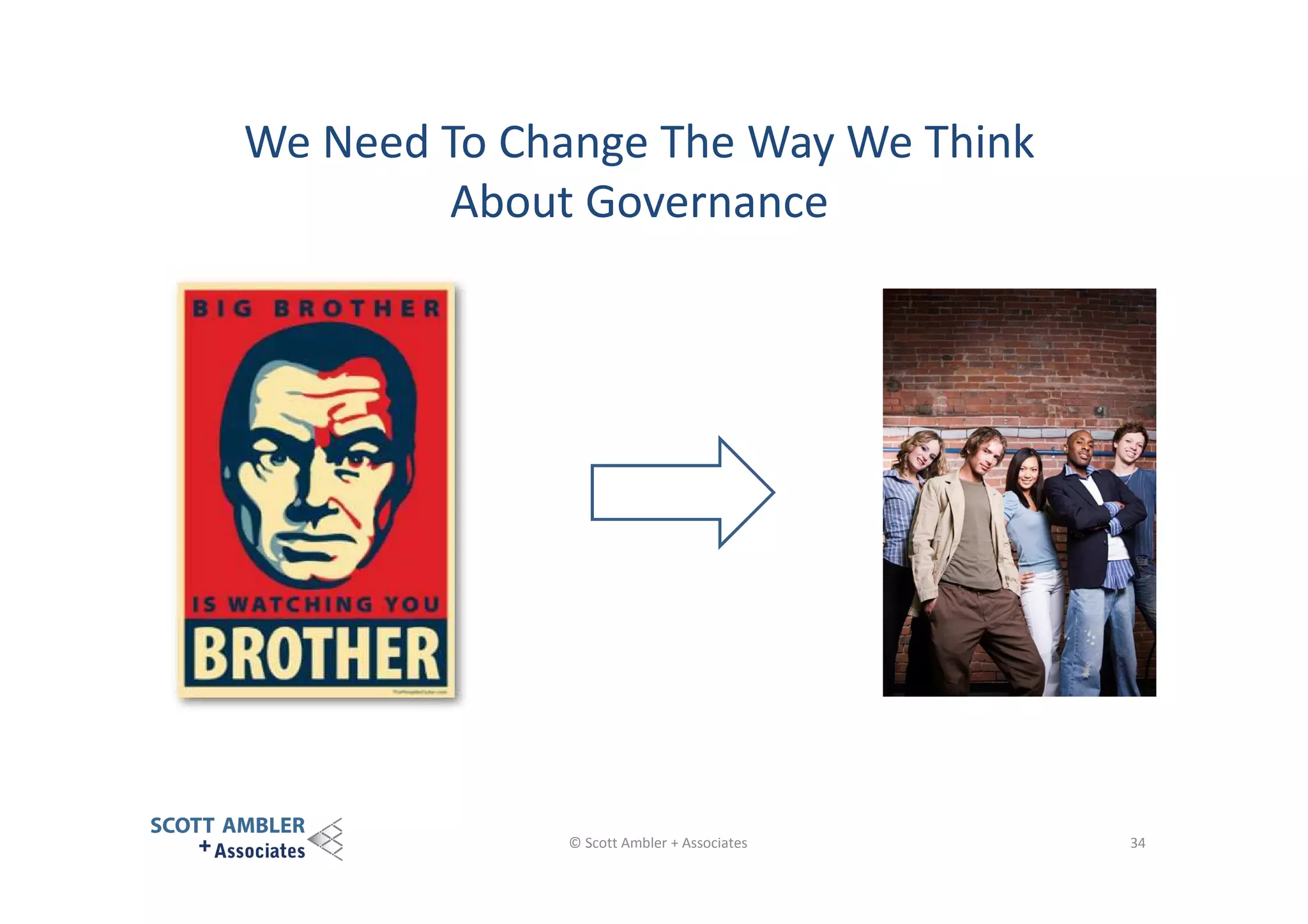
We Need To Change The Way We Think
About Governance

© Scott Ambler + Associates

34
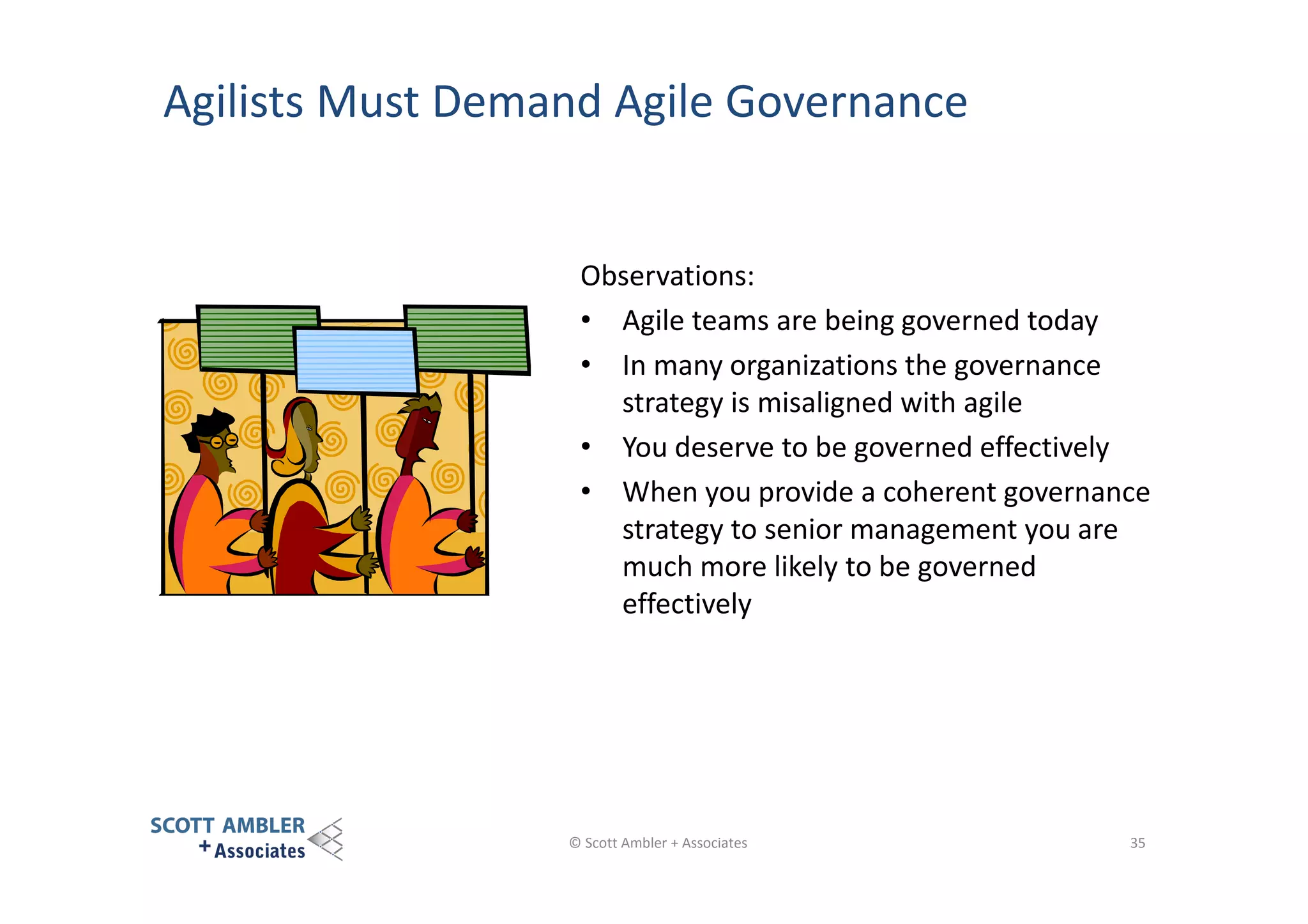
Agilists Must Demand Agile Governance

Observations:
• Agile teams are being governed today
• In many organizations the governance
strategy is misaligned with agile
• You deserve to be governed effectively
• When you provide a coherent governance
strategy to senior management you are
much more likely to be governed
effectively

© Scott Ambler + Associates

35
Principles of Agile Governance

Collaboration over conformance
Enablement over inspection
Continuous monitoring over quality gates
Transparency over management reporting

© Scott Ambler + Associates

36
Got Discipline?
DisciplinedAgileConsortium.org
DisciplinedAgileDelivery.com
ScottAmbler.com

© Scott Ambler + Associates

37
Thank You!
scott [at] scottambler.com
@scottwambler
AgileModeling.com
AgileData.org
Ambysoft.com
DisciplinedAgileConsortium.org
DisciplinedAgileDelivery.com
ScottAmbler.com
Disciplined Agile Delivery
© Scott Ambler + Associates

38
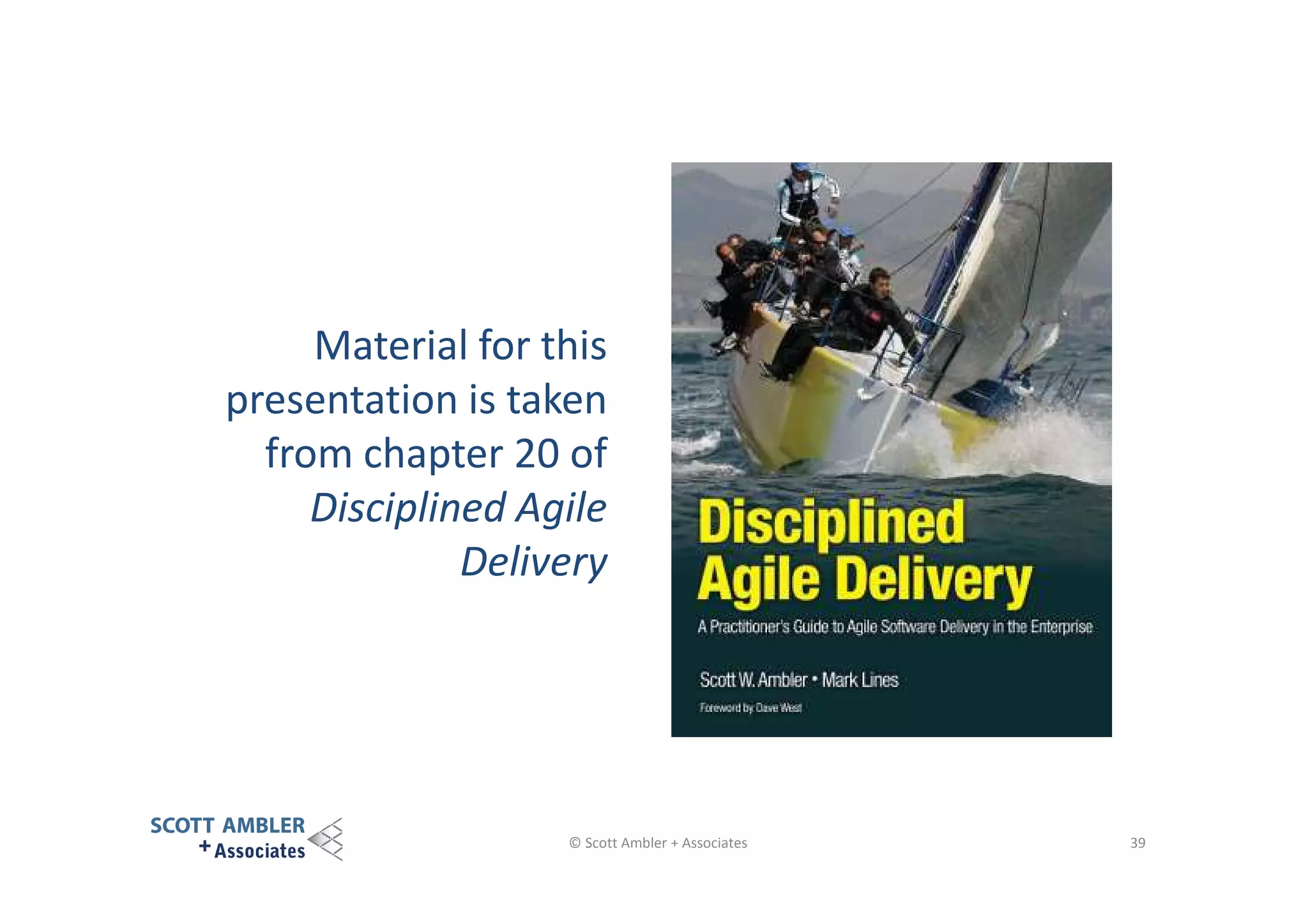
Material for this
presentation is taken
from chapter 20 of
Disciplined Agile
Delivery

© Scott Ambler + Associates

39
Presentation Description
Many organizations have successfully adopted agile on a subset of their projects,
while, at the same time, struggled to do so across entire departments. A common
challenge is the need to overhaul the IT governance strategy so that it will work with
agile teams. This is a serious issue for governance bodies with little or no practical
agile experience, particularly when experience shows that traditional governance
strategies increase the risk of failure on agile projects. Scott Ambler introduces The
Disciplined Agile Delivery framework for managing and monitoring enterprise agile
teams. This framework goes beyond offering an IT governance strategy to provide
advanced strategies such as development intelligence and the goal-question-metric
measurement approach. Learn the do’s and don’ts of governing agile teams, how
governance fits in and enhances the agile project lifecycle, how to measure agile
teams, and most importantly, why teams should demand good governance.

© Scott Ambler + Associates

40

Governing Agile Teams: Disciplined Strategies to Increase Agile Effectiveness

  • 1.
        AW2 Session  6/5/2013 10:15 AM                "Governing Agile Teams: DisciplinedStrategies to Increase Agile Effectiveness"       Presented by: Scott Ambler Scott Ambler + Associates             Brought to you by:        340 Corporate Way, Suite 300, Orange Park, FL 32073  888‐268‐8770 ∙ 904‐278‐0524 ∙ sqeinfo@sqe.com ∙ www.sqe.com
  • 2.
    Scott Ambler Scott W.Ambler + Associates Scott Ambler works with organizations worldwide to help them improve their software processes. Scott is the founder of the Agile Modeling (AM), Agile Data (AD), Disciplined Agile Delivery (DAD), and Enterprise Unified Process (EUP) methodologies and creator of the Agile Scaling Model (ASM). He is the coauthor of twenty-one books, including Refactoring Databases, Agile Modeling, Agile Database Techniques, The Object Primer 3rd Edition, The Enterprise Unified Process, and Disciplined Agile Delivery. Scott is a senior contributing editor with Dr. Dobb’s Journal. Visit his home page ScottAmbler.com and his Agility@Scale blog.  
  • 3.
    Governing Agile Teams Realityover Rhetoric © Scott Ambler + Associates 1
  • 4.
    The Survey ResultsShared in This Presentation • All surveys were performed in an open manner • The questions as they were asked, the source data, and a summary slide deck can be downloaded free of charge from Ambysoft.com/surveys/ © Scott Ambler + Associates 2
  • 5.
    Agenda • • • • • What is governance? DisciplinedAgile Delivery (DAD) Agile governance strategies Measuring agile teams Parting thoughts © Scott Ambler + Associates 3
  • 6.
    Defining governance Governance establisheschains of responsibility, authority and communication in support of the overall enterprise’s goals and strategy. It also establishes measurements, policies, standards and control mechanisms to enable people to carry out their roles and responsibilities effectively. You do this by balancing risk versus return on investment (ROI), setting in place effective processes and practices, defining the direction and goals for the department, and defining the roles that people play with and within the department. © Scott Ambler + Associates 4
  • 7.
    A Quick Showof Hands… Is your governance strategy designed to enable you or to control you? © Scott Ambler + Associates 5
  • 8.
    Governance Should Addressa Range of Issues • • • • • • • • • • • • • Team roles and responsibilities Individual roles and responsibilities Decision rights and decision making process Governing body Exceptions and escalation processes Knowledge sharing processes Metrics strategy Risk mitigation Reward structure Status reporting Audit processes Policies, standards, and guidelines Artifacts and their lifecycles © Scott Ambler + Associates 6
  • 9.
    Potential Scope ofGovernance Corporate Information Technology Delivery/ Development Operations IT Investment Data Infrastructure (Services, Cloud…) Security © Scott Ambler + Associates 7
  • 10.
    Why is EffectiveGovernance Important? • Effective governance should help agile delivery teams to: – Regularly and consistently create real business value – Provide appropriate return on investment (ROI) – Deliver consumable solutions in a timely and relevant manner – Work effectively with their project stakeholders – Work effectively with their IT colleagues – Adopt processes and organizational structures that encourage successful IT solution delivery – Present accurate and timely information to project stakeholders – Mitigate risk © Scott Ambler + Associates 8
  • 11.
    Survey Says: HowDo You Rate Your IT Governance Program? Too early to tell 6% 8% Generally helps 36% 19% Neither helpful nor harmful Generally harmful Don't Know 11% 20% No IT governance Program Source: DDJ State of the IT Union July 2009
  • 12.
    Survey Says: ITand financial governance, including capitalization and budgeting processes, have been addressed and there is an officially recognized agile path Highly agree 7% Agree 17% Neutral 28% Disagree 31% Highly disagree Don't Know 13% 5% Source: DDJ State of the IT Union November 2011 © Scott Ambler + Associates 10
  • 13.
    Why Traditional GovernanceStrategies Won’t Work Traditional assumptions that conflict with agile: – You can judge team progress from generation of artifacts – Delivery teams should work in a serial manner – You want teams to follow a common, repeatable process – Projects should be driven by senior IT management © Scott Ambler + Associates 11
  • 14.
    Principles of AgileGovernance Collaboration over conformance Enablement over inspection Continuous monitoring over quality gates Transparency over management reporting © Scott Ambler + Associates 12
  • 15.
    Disciplined Agile Delivery(DAD) Disciplined Agile Delivery (DAD) is a process decision framework The key characteristics of DAD: – People-first – Goal-driven – Hybrid agile – Learning-oriented – Full delivery lifecycle – Solution focused – Risk-value lifecycle – Enterprise aware © Scott Ambler + Associates 13
  • 16.
    The Scrum ConstructionLifecycle © Scott Ambler + Associates 14
  • 17.
    Extending the ScrumLifecycle for Solution Delivery © Scott Ambler + Associates 15
  • 18.
    A Governed AgileLifecycle © Scott Ambler + Associates 16
  • 19.
    DAD Milestones Milestone Fundamental QuestionAsked Stakeholder consensus Do stakeholders agree with your strategy? Proven architecture Can you actually build this? Project viability Does the project still make sense? Sufficient functionality Does it make sense to release the current solution? Production ready Will the solution work in production? Delighted stakeholders Are stakeholders happy with the deployed solution? © Scott Ambler + Associates 17
  • 20.
    Enterprise Awareness EnablesGovernance But we’re not there yet: • Governance is an enterprise concern Are you inputting your time? • Activities which appear to be waste at the team level prove valuable at the enterprise level Yes - Valuable 16 Yes - Waste of time 21 No • Disciplined agile teams optimize the “enterprise whole”, not just the “team part” What do you mean? 15 3 Results from a May 2013 opinion poll on the Agile and Lean Software Group on LinkedIn © Scott Ambler + Associates 18
  • 21.
    DAD Practices thatSupport Governance • “Standard” agile practices: – Coordination meeting – Iteration demonstrations – All-hands demonstrations – Retrospectives – Information radiators/Visual management • Disciplined practices: – Risk-value lifecycle – Explicit light-weight milestones – Follow enterprise development guidelines – Work closely with enterprise professionals – Development intelligence via automated dashboards © Scott Ambler + Associates 19
  • 22.
    Measuring Agile Teams • • • • • • • • • • • • • • Talkto people; don’t manage to the metrics Measure teams, not individuals Collect several metrics Trends are better than scalar values Empirical observation is important but limited Prefer automated metrics Some metrics must be gathered manually Prefer pull versus push reporting Beware scientific facades Measure the value of your metrics program Be prepared to educate people The value of many metrics diminishes over time If you collect no metrics at all you’re flying blind If you collect too many metrics you may be flying blinded © Scott Ambler + Associates 20
  • 23.
    Goal Question Metric(GQM) The GQM process: 1. Develop a set of corporate, division and project business goals for productivity and quality 2. Generate questions that define those goals as completely as possible in a quantifiable way 3. Specify the measures needed to be collected to answer those questions and track process and product conformance to the goals 4. Develop mechanisms for data collection 5. Collect, validate and analyze the data in real time to provide feedback to projects for corrective action 6. Analyze the data to assess conformance to the goals and to make recommendations for future improvements © Scott Ambler + Associates 21
  • 24.
    Some potential goals •We should invest in IT wisely • We should provide a healthy work environment to staff • Teams should deploy in a timely manner • Teams should provide real value to stakeholders • We should reduce overall technical debt over time • Team should produce solutions that of sufficient quality • We should comply to appropriate industry regulations © Scott Ambler + Associates 22
  • 25.
    Potential Metrics • • • • • • • • • • • • Acceleration Activity time Ageof work items Blocking work items Build health Business value delivered Change cycle time Code quality Defect density Defect trend Effort/cost projection Iteration burndown • • • • • • • • • • • Lifecycle traceability Net present value (NPV) Ranged release burndown Release burndown Return on investment (ROI) Risk mitigation Stakeholder satisfaction Team morale Test coverage Time invested Velocity © Scott Ambler + Associates 23
  • 26.
    Goal: Spend ITInvestment Wisely Questions Potential Metrics 1. How effective is the investment in IT activities? 1. Business value delivered, net present value (NPV), return on investment (ROI) 2. Effort/cost projection 2. What future spending do we require? 3. Is productivity increasing? 3. Acceleration, business value delivered, velocity (trend) © Scott Ambler + Associates 24
  • 27.
    Goal: Deploy ina Timely Manner Questions Potential Metrics 1. Is the team working at a sufficient pace? 1. Release burndown, ranged release burndown 2. Is the team working together effectively? 2. Team morale, stakeholder satisfaction, blocking work items 3. Age of items, ranged release burndown 3. Are changing requirements putting the release date at risk? © Scott Ambler + Associates 25
  • 28.
    Goal: Reduce TechnicalDebt Questions Potential Metrics 1. What is our current level of technical debt? 1. Code quality, defect density 2. Are we improving quality over time? 2. Build health, defect trends, test coverage © Scott Ambler + Associates 26
  • 29.
    Survey Says: Agileteams are judged primarily on traditional IT and cost-based metrics Highly agree 9% Agree 39% Neutral 29% Disagree Highly disagree Don't Know 14% 6% 4% Source: DDJ State of the IT Union November 2011 © Scott Ambler + Associates 27
  • 30.
    Survey Says: Agileteams are judged primarily on business value creation Highly agree 13% Agree 41% Neutral 24% Disagree Highly disagree Don't Know 14% 5% 3% Source: DDJ State of the IT Union November 2011 © Scott Ambler + Associates 28
  • 31.
    Development Intelligence • • • • Tools shouldbe instrumented to automatically log important activities and thereby facilitate generate of metrics Metrics are displayed in (near) real-time on a project dashboard Should be non-intrusive to the team Benefits – Transparency to all stakeholders, increasing trust – Increased team effectiveness with visibility into what team members are working on, status of builds – Information that can be used to assess effectiveness and justify process changes – Keeps team focused on delivering on their commitments to the stakeholders © Scott Ambler + Associates 29
  • 32.
    IT Intelligence • • • Automated dashboard thatsummarizes the status for all of IT Shows the entire portfolio: – Potential/suggested endeavors – Ongoing development endeavors – Operational solutions Drill down into: – Project details – Operational details – Support details © Scott Ambler + Associates 30
  • 33.
    Survey says: Doyour project teams collect metrics to enable project monitoring by senior management? No 26% Yes, majority manual 51% Yes, majority automated Don't Know 19% 4% Ambysoft 2009 Governance
  • 34.
    © Scott Ambler+ Associates 32
  • 35.
    We’re In aDifferent Environment Moore’s Adoption Curve The farther to the right an organization, the greater the chance they’re focused on governance © Scott Ambler + Associates 33
  • 36.
    We Need ToChange The Way We Think About Governance © Scott Ambler + Associates 34
  • 37.
    Agilists Must DemandAgile Governance Observations: • Agile teams are being governed today • In many organizations the governance strategy is misaligned with agile • You deserve to be governed effectively • When you provide a coherent governance strategy to senior management you are much more likely to be governed effectively © Scott Ambler + Associates 35
  • 38.
    Principles of AgileGovernance Collaboration over conformance Enablement over inspection Continuous monitoring over quality gates Transparency over management reporting © Scott Ambler + Associates 36
  • 39.
  • 40.
    Thank You! scott [at]scottambler.com @scottwambler AgileModeling.com AgileData.org Ambysoft.com DisciplinedAgileConsortium.org DisciplinedAgileDelivery.com ScottAmbler.com Disciplined Agile Delivery Disciplined Agile Delivery © Scott Ambler + Associates 38
  • 41.
    Material for this presentationis taken from chapter 20 of Disciplined Agile Delivery © Scott Ambler + Associates 39
  • 42.
    Presentation Description Many organizationshave successfully adopted agile on a subset of their projects, while, at the same time, struggled to do so across entire departments. A common challenge is the need to overhaul the IT governance strategy so that it will work with agile teams. This is a serious issue for governance bodies with little or no practical agile experience, particularly when experience shows that traditional governance strategies increase the risk of failure on agile projects. Scott Ambler introduces The Disciplined Agile Delivery framework for managing and monitoring enterprise agile teams. This framework goes beyond offering an IT governance strategy to provide advanced strategies such as development intelligence and the goal-question-metric measurement approach. Learn the do’s and don’ts of governing agile teams, how governance fits in and enhances the agile project lifecycle, how to measure agile teams, and most importantly, why teams should demand good governance. © Scott Ambler + Associates 40