Welcome  By  Karthik
EDGE TECHNOLOGY AN EVOLUTION IN  MOBILE  TECHNOLOGY
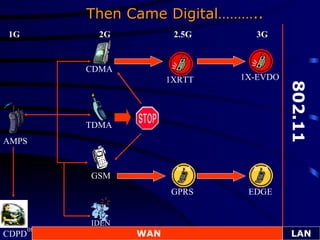
History  In 1 st  G AMPS(Advanced Mobile system) developed in U.S in 1983 In 2 nd  G there was introduction of CDMA,TDMA and GSM Between 2 nd  and 2.5 th  G of GPRS Between 2.5 th  and 3 rd  G there was an introduction EDGE TECHNOLOGY
Then Came Digital……….. AMPS CDPD 1G 2G CDMA TDMA GSM IDEN 2.5G GPRS 1XRTT 3G 1X-EVDO EDGE WAN LAN 802.11
Introduction Enhanced data for global evolution(EDGE) is a high speed mobile data standard,intended to enable second generation global system for mobile communication (GSM) and time division multiple access(TDMA). Transmits data at up to 384 kilobits per second(Kbps)
Topics of Discussion Mobile evolution Edge technology GPRS EDGE system performance Channel coding and frame structure Applications Conclusion
Mobile evolution  1 st  generation mobile communication  2 nd  generation mobile communication  2.5 th   generation mobile communication  3 rd  generation mobile communication  3G and above
EDGE Technology Evolutionary path to 3G services for GSM and TDMA operators Builds on General Packet Radio Service (GPRS)  air interface and networks Phase 1 (Release’99 & 2002 deployment) supports best effort packet data at speeds up to about 384 kbps Phase 2 (Release’2000 & 2003 deployment) will add Voice over IP capability
Enhanced Data rates for GSM Evolution Can increase the capacity and data throughput typically to 3-4-fold over GPRS Theoretical maximum speeds of up to 473 kilobits per second (kbps) Average recognizable data rates between 80 and 130 kbps TDMA carriers must still convert to GSM, then add GPRS before deploying EDGE technology EDGE
2.5G (Between 2G and 3G) Uses General Packet Radio Services (GPRS) technology. GSM and TDMA were enhanced to packet based networks GPRS is primarily a simple software upgrade on GSM and TDMA Easy for the service providers to update their networks
GPRS Packet based networked over existing circuit switched GSM network. GPRS radio resources are used only when users are actually sending or receiving data.  Rather than dedicating a radio channel to a mobile data user for a fixed period of time, the available radio resource can be concurrently shared between several users.  Brings desktop experience to wireless such as web browsing and chat. Enables file transfer and home automation.
2.5G characteristics Data rates  64 – 144 Kbps . A leap from  9.6kbps  of 2G to  64Kbps Packet  based networks. Always-on connectivity. Instant messaging +  small attachments . New wireless standards started emerging.
GPRS shortcomings GPRS packets are sent in all different directions to reach the same destination Potential for packet getting lost or corrupted during the data transmission over the radio link. Though it incorporates data integrity and retransmission strategies, potential transit delays can occur.
EDGE Technology EDGE – Enhanced Data GSM Environment. Developed to increase the bandwidth of GPRS technology. EDGE increased the bandwidth of GSM from  144 Kbps  to  384 Kbps . Migration towards 3G technology started.
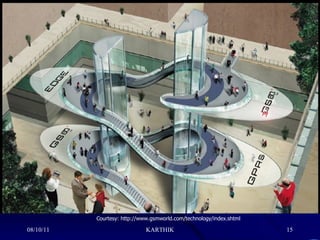
Courtesy: http://www.gsmworld.com/technology/index.shtml
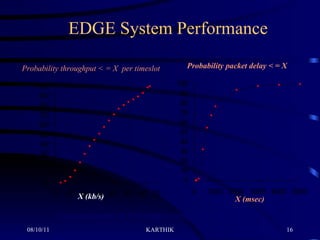
EDGE System Performance Probability throughput < = X  per timeslot X (kb/s) 26 users/sector at 3.84 kbps average load per user Probability packet delay < = X X (msec) % %
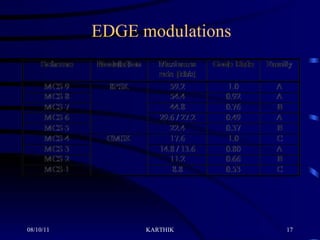
EDGE modulations
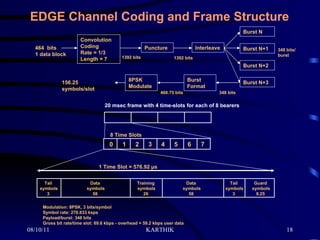
EDGE Channel Coding and Frame Structure 464  bits 1 data block Convolution Coding Rate = 1/3 Length = 7 Puncture Interleave  Burst N  Burst N+1  Burst N+2  Burst N+3  Burst Format 8PSK Modulate  1392 bits 1392 bits 348 bits/ burst 348 bits 468.75 bits 156.25 symbols/slot 0 1 2 3 4 5 6 7 8 Time Slots 1 Time Slot = 576.92 µs Tail  symbols 3 Data  symbols 58 Tail  symbols 3 Data  symbols 58 Training  symbols 26 Guard  symbols 8.25 Modulation: 8PSK, 3 bits/symbol Symbol rate: 270.833 ksps Payload/burst: 348 bits Gross bit rate/time slot: 69.6 kbps - overhead = 59.2 kbps user data 20 msec frame with 4 time-slots for each of 8 bearers
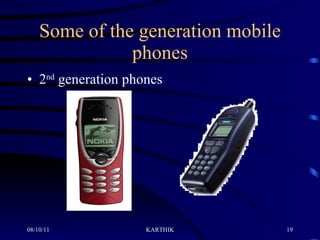
Some of the generation mobile phones 2 nd  generation phones
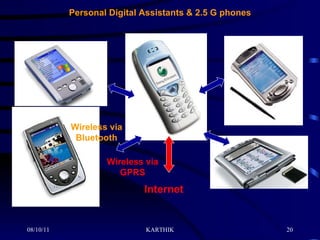
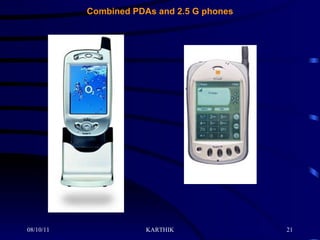
Personal Digital Assistants & 2.5  G phones Wireless via Bluetooth Internet Wireless via GPRS
Combined PDAs and 2.5  G phones
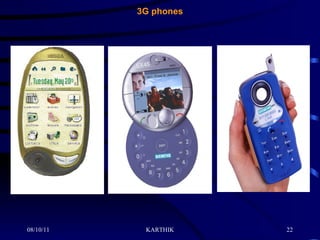
3 G phones
Applications     EDGE enables operators to introduce 3G data applications into existing GSM existing GSM networks and thereby increase the speed of packet oriented transmission three-fold.           Mobile Internet access           Mobile Office           Field sales/service           Wireless access to databases
Application  cont           Electronic commerce: Point of sale Electronic banking    Electronic cash Electronic payment           Messaging           Fleet management           Road guide systems           Security/supervisory systems
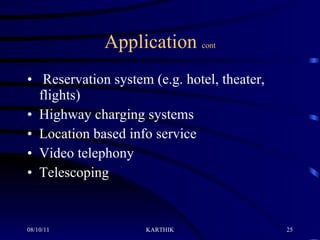
Application  cont Reservation system (e.g. hotel, theater,   flights) Highway charging systems Location based info service Video telephony Telescoping
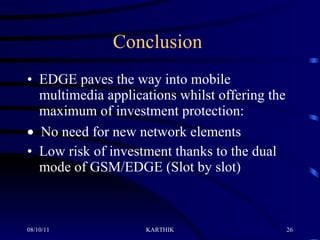
Conclusion  EDGE paves the way into mobile multimedia applications whilst offering the maximum of investment protection:     No need for new network elements Low risk of investment thanks to the dual mode of GSM/EDGE (Slot by slot)
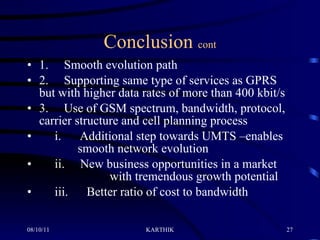
Conclusion  cont 1.     Smooth evolution path 2.     Supporting same type of services as GPRS but with higher data rates of more than 400 kbit/s 3.     Use of GSM spectrum, bandwidth, protocol, carrier structure and cell planning process       i.      Additional step towards UMTS –enables    smooth network evolution       ii.     New business opportunities in a market      with tremendous growth potential       iii.      Better ratio of cost to bandwidth
THANK YOU THANK YOU FOR YOUR PRECIOUS TIME

Edge technology

  • 1.
    Welcome By Karthik
  • 2.
    EDGE TECHNOLOGY ANEVOLUTION IN MOBILE TECHNOLOGY
  • 3.
    History In1 st G AMPS(Advanced Mobile system) developed in U.S in 1983 In 2 nd G there was introduction of CDMA,TDMA and GSM Between 2 nd and 2.5 th G of GPRS Between 2.5 th and 3 rd G there was an introduction EDGE TECHNOLOGY
  • 4.
    Then Came Digital………..AMPS CDPD 1G 2G CDMA TDMA GSM IDEN 2.5G GPRS 1XRTT 3G 1X-EVDO EDGE WAN LAN 802.11
  • 5.
    Introduction Enhanced datafor global evolution(EDGE) is a high speed mobile data standard,intended to enable second generation global system for mobile communication (GSM) and time division multiple access(TDMA). Transmits data at up to 384 kilobits per second(Kbps)
  • 6.
    Topics of DiscussionMobile evolution Edge technology GPRS EDGE system performance Channel coding and frame structure Applications Conclusion
  • 7.
    Mobile evolution 1 st generation mobile communication 2 nd generation mobile communication 2.5 th generation mobile communication 3 rd generation mobile communication 3G and above
  • 8.
    EDGE Technology Evolutionarypath to 3G services for GSM and TDMA operators Builds on General Packet Radio Service (GPRS) air interface and networks Phase 1 (Release’99 & 2002 deployment) supports best effort packet data at speeds up to about 384 kbps Phase 2 (Release’2000 & 2003 deployment) will add Voice over IP capability
  • 9.
    Enhanced Data ratesfor GSM Evolution Can increase the capacity and data throughput typically to 3-4-fold over GPRS Theoretical maximum speeds of up to 473 kilobits per second (kbps) Average recognizable data rates between 80 and 130 kbps TDMA carriers must still convert to GSM, then add GPRS before deploying EDGE technology EDGE
  • 10.
    2.5G (Between 2Gand 3G) Uses General Packet Radio Services (GPRS) technology. GSM and TDMA were enhanced to packet based networks GPRS is primarily a simple software upgrade on GSM and TDMA Easy for the service providers to update their networks
  • 11.
    GPRS Packet basednetworked over existing circuit switched GSM network. GPRS radio resources are used only when users are actually sending or receiving data. Rather than dedicating a radio channel to a mobile data user for a fixed period of time, the available radio resource can be concurrently shared between several users. Brings desktop experience to wireless such as web browsing and chat. Enables file transfer and home automation.
  • 12.
    2.5G characteristics Datarates 64 – 144 Kbps . A leap from 9.6kbps of 2G to 64Kbps Packet based networks. Always-on connectivity. Instant messaging + small attachments . New wireless standards started emerging.
  • 13.
    GPRS shortcomings GPRSpackets are sent in all different directions to reach the same destination Potential for packet getting lost or corrupted during the data transmission over the radio link. Though it incorporates data integrity and retransmission strategies, potential transit delays can occur.
  • 14.
    EDGE Technology EDGE– Enhanced Data GSM Environment. Developed to increase the bandwidth of GPRS technology. EDGE increased the bandwidth of GSM from 144 Kbps to 384 Kbps . Migration towards 3G technology started.
  • 15.
  • 16.
    EDGE System PerformanceProbability throughput < = X per timeslot X (kb/s) 26 users/sector at 3.84 kbps average load per user Probability packet delay < = X X (msec) % %
  • 17.
  • 18.
    EDGE Channel Codingand Frame Structure 464 bits 1 data block Convolution Coding Rate = 1/3 Length = 7 Puncture Interleave Burst N Burst N+1 Burst N+2 Burst N+3 Burst Format 8PSK Modulate 1392 bits 1392 bits 348 bits/ burst 348 bits 468.75 bits 156.25 symbols/slot 0 1 2 3 4 5 6 7 8 Time Slots 1 Time Slot = 576.92 µs Tail symbols 3 Data symbols 58 Tail symbols 3 Data symbols 58 Training symbols 26 Guard symbols 8.25 Modulation: 8PSK, 3 bits/symbol Symbol rate: 270.833 ksps Payload/burst: 348 bits Gross bit rate/time slot: 69.6 kbps - overhead = 59.2 kbps user data 20 msec frame with 4 time-slots for each of 8 bearers
  • 19.
    Some of thegeneration mobile phones 2 nd generation phones
  • 20.
    Personal Digital Assistants& 2.5 G phones Wireless via Bluetooth Internet Wireless via GPRS
  • 21.
    Combined PDAs and2.5 G phones
  • 22.
  • 23.
    Applications   EDGE enables operators to introduce 3G data applications into existing GSM existing GSM networks and thereby increase the speed of packet oriented transmission three-fold.          Mobile Internet access          Mobile Office          Field sales/service          Wireless access to databases
  • 24.
    Application cont         Electronic commerce: Point of sale Electronic banking   Electronic cash Electronic payment          Messaging          Fleet management          Road guide systems          Security/supervisory systems
  • 25.
    Application contReservation system (e.g. hotel, theater, flights) Highway charging systems Location based info service Video telephony Telescoping
  • 26.
    Conclusion EDGEpaves the way into mobile multimedia applications whilst offering the maximum of investment protection:     No need for new network elements Low risk of investment thanks to the dual mode of GSM/EDGE (Slot by slot)
  • 27.
    Conclusion cont1.     Smooth evolution path 2.     Supporting same type of services as GPRS but with higher data rates of more than 400 kbit/s 3.     Use of GSM spectrum, bandwidth, protocol, carrier structure and cell planning process       i.      Additional step towards UMTS –enables smooth network evolution      ii.     New business opportunities in a market with tremendous growth potential       iii.      Better ratio of cost to bandwidth
  • 28.
    THANK YOU THANKYOU FOR YOUR PRECIOUS TIME

Editor's Notes

  • #10 Sdsdghh
  • #11 GSM – Global System and Mobile Communications TDMA – Time Division Multiple Access
  • #16 This pictures visually shows the evolution of wireless technology from 2G to 3G and beyond.