Design Of High Power Amplifier At 3.4 GHz For Satellite
Transponder (IRNSS)
Patel Neel K.
Department of Master Engineering In Communication System Engineering,
L. J. Institute of Engineering and Technology,
Gujarat Technological University,
Ahmedabad, Gujarat
patel.neel2810@gmail.com
Abstract
This paper gives a step-by-step of the design,
simulation and measurement of a Power
Amplifier(PA) operating frequency from 2.5GHz to
4.5GHz. The design of Class A Power amplifier was
performed in Agilent ADS and the performance was
tested with SZA3044Z BJT.
Key Words: RF Power Amplifier, Bipolar Junction
Transistor(BJT), IRNSS, High Gain
I. INTRODUCTION
In a communication satellite serving the earth, the
transponder transforms the received signals into forms
appropriate for the transmission from space to earth. The
transponder may be simply a repeater that amplifies and
frequency signals. In this paper, the technologies of the
major transponder elements are presented and amplifying
devices.
One of the key elements of any spacecraft
transponder is the output transmitter, consisting of a high
power amplifier (HPA) and the associated power supply.
The amplifier is operated at or near saturation (maximum
output power level) to attain a high overall efficiency of
converting dc energy from the power supply into useful
radio frequency (RF) energy that carries information.
The transmitter is required to amplify the
wanted signal without distortions and without other
impairments which would decrease the usefulness of the
signal. Two types of amplifiers (transmitters) are in
common use, electron beam devices (commonly
TWTAs) and solid state power amplifiers (SSPAs). For
the TWTAs, the electrical power supply is often required
to supply a number of high voltages (in the multikilovolt
range), which presents a series of technology and design
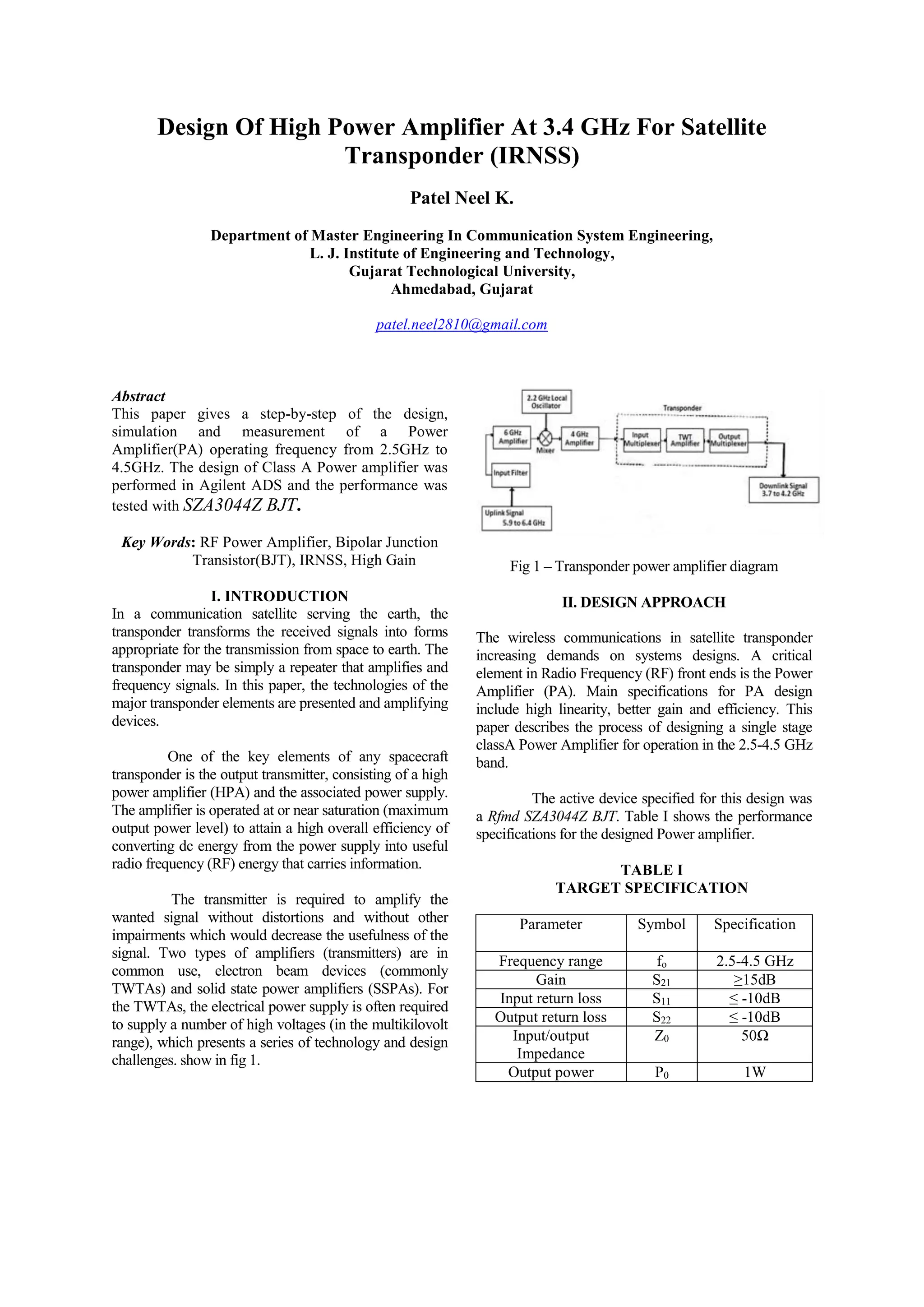
challenges. show in fig 1.
Fig 1 – Transponder power amplifier diagram
II. DESIGN APPROACH
The wireless communications in satellite transponder
increasing demands on systems designs. A critical
element in Radio Frequency (RF) front ends is the Power
Amplifier (PA). Main specifications for PA design
include high linearity, better gain and efficiency. This
paper describes the process of designing a single stage
classA Power Amplifier for operation in the 2.5-4.5 GHz
band.
The active device specified for this design was
a Rfmd SZA3044Z BJT. Table I shows the performance
specifications for the designed Power amplifier.
TABLE I
TARGET SPECIFICATION
Parameter Symbol Specification
Frequency range fo 2.5-4.5 GHz
Gain S21 ≥15dB
Input return loss S11 ≤ -10dB
Output return loss S22 ≤ -10dB
Input/output
Impedance
Z0 50Ω
Output power P0 1W
III. STABILITY CONSIDERATION
Before PA design, it is important to determine the
stability of the transistor. The stability of an amplifier
is very important in the design and if not taken care,
can create self-oscillation of the device due to
reflected wave.
Amplifier is not reliable when it is unstable
condition. The stability of a circuit is characterized by
stability factor. The transistor is stable when K>1 and
∆<1.
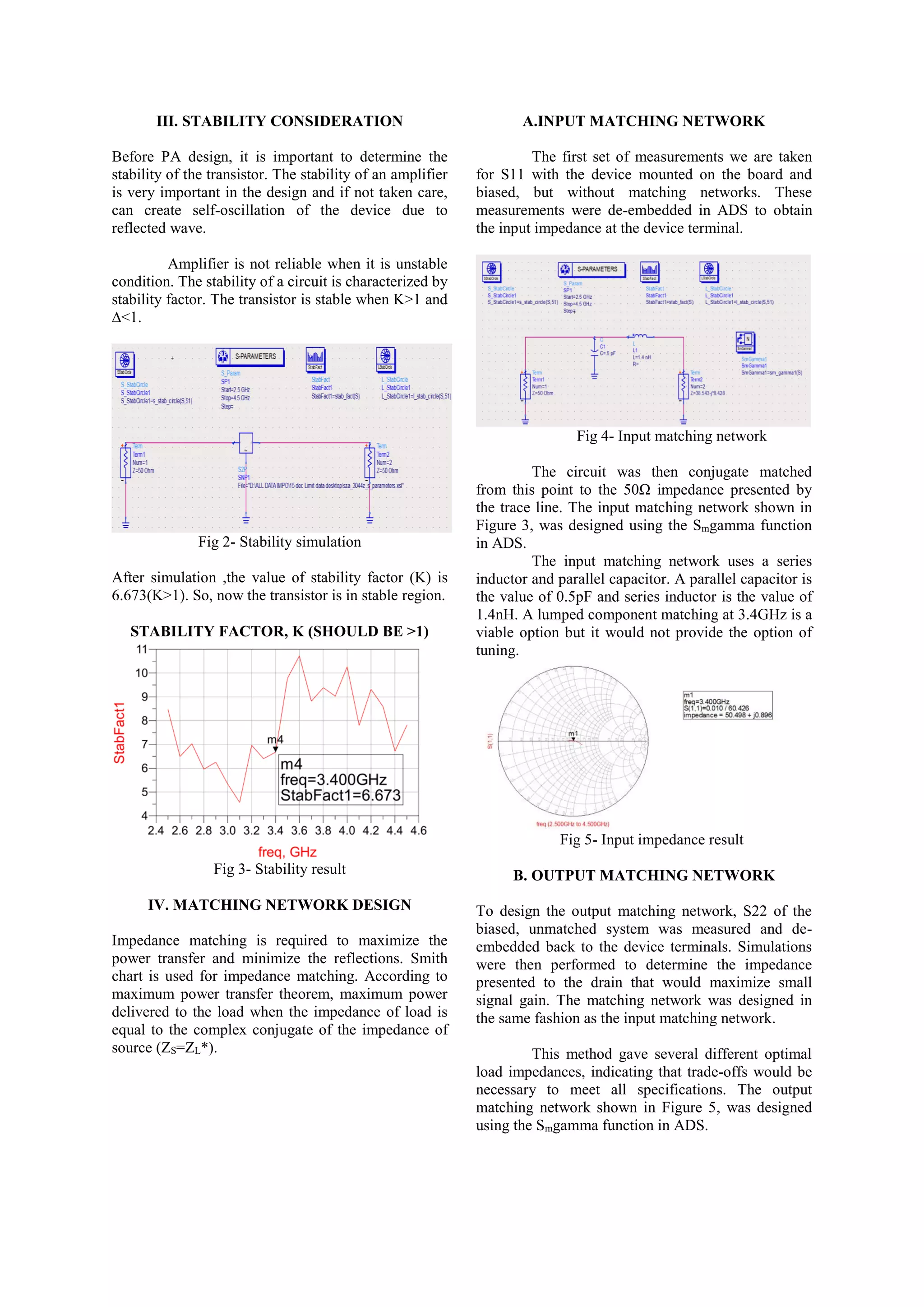
Fig 2- Stability simulation
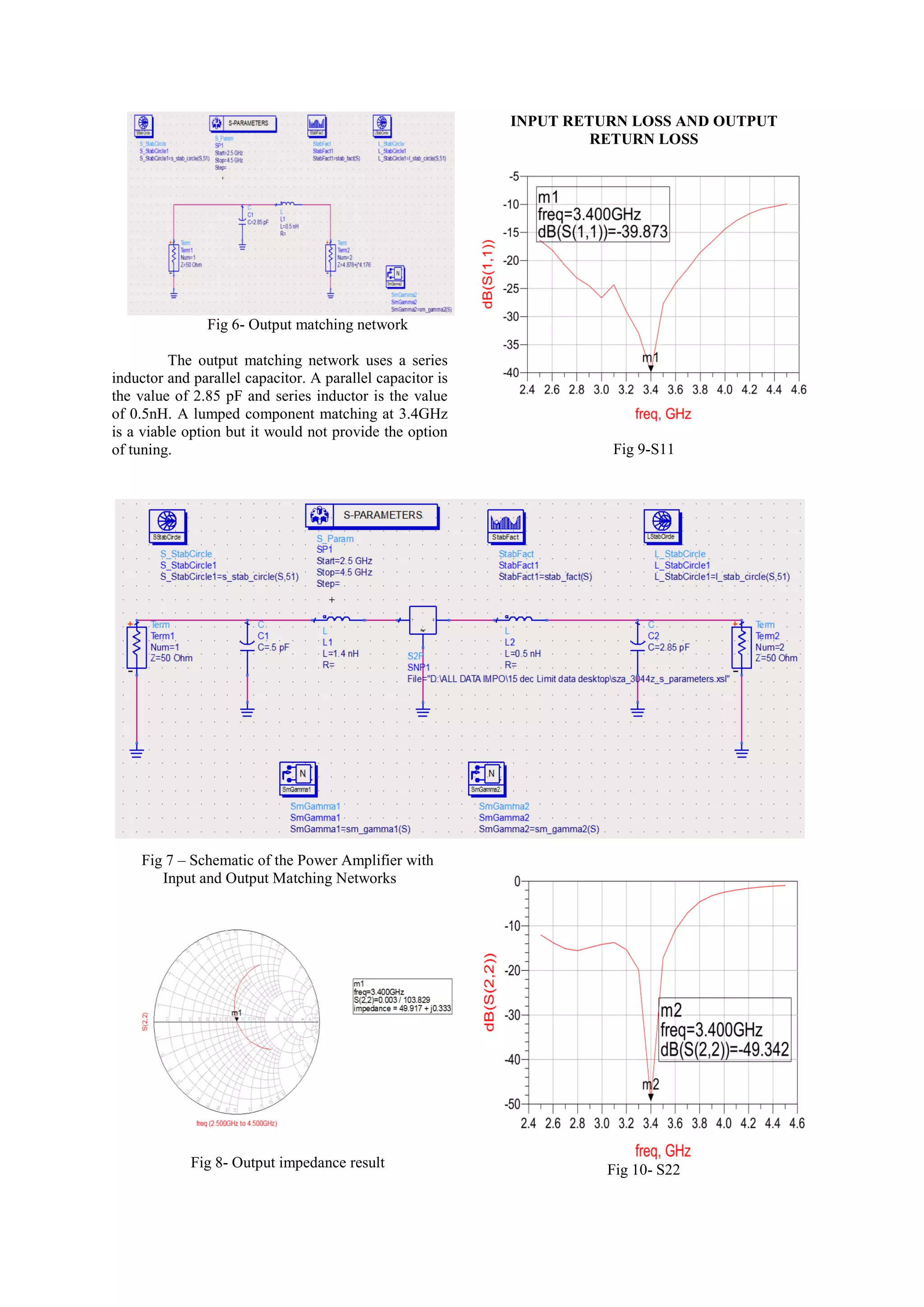
After simulation ,the value of stability factor (K) is
6.673(K>1). So, now the transistor is in stable region.
STABILITY FACTOR, K (SHOULD BE >1)
Fig 3- Stability result
IV. MATCHING NETWORK DESIGN
Impedance matching is required to maximize the
power transfer and minimize the reflections. Smith
chart is used for impedance matching. According to
maximum power transfer theorem, maximum power
delivered to the load when the impedance of load is
equal to the complex conjugate of the impedance of
source (ZS=ZL*).
A.INPUT MATCHING NETWORK
The first set of measurements we are taken
for S11 with the device mounted on the board and
biased, but without matching networks. These
measurements were de-embedded in ADS to obtain
the input impedance at the device terminal.
Fig 4- Input matching network
The circuit was then conjugate matched
from this point to the 50Ω impedance presented by
the trace line. The input matching network shown in
Figure 3, was designed using the Smgamma function
in ADS.
The input matching network uses a series
inductor and parallel capacitor. A parallel capacitor is
the value of 0.5pF and series inductor is the value of
1.4nH. A lumped component matching at 3.4GHz is a
viable option but it would not provide the option of
tuning.
Fig 5- Input impedance result
B. OUTPUT MATCHING NETWORK
To design the output matching network, S22 of the
biased, unmatched system was measured and de-
embedded back to the device terminals. Simulations
were then performed to determine the impedance
presented to the drain that would maximize small
signal gain. The matching network was designed in
the same fashion as the input matching network.
This method gave several different optimal
load impedances, indicating that trade-offs would be
necessary to meet all specifications. The output
matching network shown in Figure 5, was designed
using the Smgamma function in ADS.
Fig 6- Output matching network
The output matching network uses a series
inductor and parallel capacitor. A parallel capacitor is
the value of 2.85 pF and series inductor is the value
of 0.5nH. A lumped component matching at 3.4GHz
is a viable option but it would not provide the option
of tuning.
Fig 7 – Schematic of the Power Amplifier with
Input and Output Matching Networks
Fig 8- Output impedance result
INPUT RETURN LOSS AND OUTPUT
RETURN LOSS
Fig 9-S11
Fig 10- S22
Fig 11- S21 Gain
V. MEASURED RESULTS
The complete schematic of the power
amplifier is shown in the Figure 6. The performance
results are shown in the Figs.9,10,11. The S11 is
shown in Figure 9. The region between 2.5 to 4.5GHz
has S11 in the order of -39.873dB, S22 in the order of
-49.342dB from measurements and the S21 gain
value is 26.412dB shown in Figure 11.
TABLE II
MEASURED RESULTS
VI. CONCLUSION
The power amplifier presented here doesn’t meet
many of the required specifications. Still a Stable
Power amplifier with certain loss of power has been
designed with proper matching networks. But
working on this design provided a lot on insight into
design of power amplifiers and the problems faced
when the specifications require designs to be
extremely competitive in terms of performance.
The choice of transistor in this power
amplifier has influenced the design specifications in
an unexpected manner. To make a power amplifier
utilizing this device, a wide variety of matching
networks should be explored along with an
appropriate device modelling in ADS.
VII. ACKNOWLEDGEMENT
The Author thanks Prof.A.K Sisodia & Ast Prof.
Nimesh M. Prabhakar from L.J.Institute of
Engineering and Technology for technical discussion
& processing support without whom this paper would
never be complected.
VIII. REFERENCES
[1] Tomohiro Senju, Takashi Asano, Hiroshi
Ishimura Microwave Solid-state Department “A
VERY SMALL 3.5 GHz 1 W MMIC POWER
AMPLIFIER WITH DIE SIZE REDUCTION
TECHNOLOGIES” Komukai Operations Toshiba
Corporation, Komukai, Toshiba-cho, Saiwai-ku,
Kawasaki 2 12-858 1, Japan-2001 IEEE, pp. 070-073
,ISBN:0-7803-7161-5/01.
[2] Kevin W. Kobayashi, YaoChung Chen, Ioulia
Smorchkova, Roger Tsai,Mike Wojtowicz, and Aaron
Oki “A 2 Watt, Sub-dB Noise Figure GaN MMIC
LNA-PA Amplifier with Multi-octave Bandwidth
from 0.2-8 GHz” 2007 IEEE - SIRENZA
MICRODEVICES, pp.619 -622,ISBN:1-4244-0688-
9/07.
[3] Paul saad, christian fager, hossein mashad nemati,
haiying cao, herbert zirath and kristoffer andersson ”
A highly efficient 3.5 GHz inverse class-F GaN
HEMT power amplifier” European Microwave
Association International Journal of Microwave and
Wireless Technologies, 2010, 2(3-4), pp.317–
332,DOI:10.1017.
[4] Bilkent University, Nanotechnology Research
Center, Bilkent, Ankara, Istanbul Technical
University, Electrical & Electronics Faculty,Maslak,
Istanbul, Turkey ” Design of High Power S-Band
GaN MMIC Power Amplifiers for WiMAX
Applications” 2011 IEEE, pp.01-04,ISBN:978-1-
4244-6051-9/11.
[5] Ahmed Sayed, Georg Boeck Microwave
Engineering, Berlin University of Technology
Einsteinufer 25, 10587 Berlin, Germany ” 5W
Highly Linear GaN Power Amplifier with 3.4 GHz
Bandwidth”European Microwave Integrated Circuits
Conference 2007 EuMA , pp.631 – 634,ISBN:978-2-
87487-002-6.
[6] U. K. Mishra, P. Parikh, and Y.-F. Wu,
“AlGaN/GaN HEMTs−An overview of device
operations and applications”, Proceedings of the
IEEE, vol. 90, no. 6, June 2002, pp. 1022–
1031,ISBN:2230-7109.
Parameter Symbol Specification Measured
results
Gain S21 ≥15dB 26.412dB
Input return
loss
S11 ≤ -10dB -39.873dB
Output return
loss
S22 ≤ -10dB -49.342dB
Input/output
Impedance
Z0 50Ω 50Ω
[7] U. K. Mishra, L. Shen, T. E. Kazior, and Y.-F.
Wu, “GaN-Based RF Power Devices and
Amplifiers”, Proceedings of the IEEE, vol. 96, no. 2,
February 2008, pp. 287 – 305,ISBN:2230-9543.
[8] S. Keller et al., “Gallium Nitride Based High
Power Heterojunction Field Effect Transistors:
Process Development and Present Status at UCSB”,
IEEE Transactions on Circuits and Systems, vol. 48,
no. 3, March 2001, pp. 552 – 559,ISBN:2278-0181.
[9] U.Schmid et al., “GaN devices for communication
applications: evolution of amplifier architectures”,
International Journal of Microwave and Wireless
Technologies, Cambridge University Press and the
European Microwave Association, 2010, pp. 85–
93,DOI:10.1088/1674-4926/32/9/094003.
[11] Nemati, H.; Fager, C.; Thorsell, M.; Herbert, Z
“High-efficiency LDMOS power-amplifier design at
1 GHz using an optimized transistor model”. IEEE
Trans. Microw. Theory Tech., 57 (7) (2009), pp.
1647–1654,ISSN:3840-7001.
[12] Rollett, J. “Stability and power-gain invariants of
linear two ports”. IEEE Trans. Circuit Theory, 9 (1)
(2010), pp. 29–32,ISBN:978-1-4673-1088-8/12.
[13] Kim, J.; Konstantinou, K.”Digital predistortion
of wideband signals based on power amplifier model
with memory”. Electron. Lett., 37 (2001), pp. 1417–
1418, ISSN:0-7803-8331-1/04.
[14] Nagy, W.; Brown, J.; Borges, R.; Singhal, S.
“Linearity characteristics of microwave-power GaN
HEM”. IEEE Trans. Microw, 51 (2) (2012), pp.660–
664, ISSN:0018-9480.
[15] U. K. Mishra, L. Shen, T. E. Kazior, and Y.-F.
Wu, “GaN-Based RF Power Devices and
Amplifiers”, Proceedings of the IEEE, vol. 96, no. 2,
February 2009, pp. 287 – 305, ISSN:978-1-4244-
2893-9/09.

neelpaper

  • 1.
    Design Of HighPower Amplifier At 3.4 GHz For Satellite Transponder (IRNSS) Patel Neel K. Department of Master Engineering In Communication System Engineering, L. J. Institute of Engineering and Technology, Gujarat Technological University, Ahmedabad, Gujarat patel.neel2810@gmail.com Abstract This paper gives a step-by-step of the design, simulation and measurement of a Power Amplifier(PA) operating frequency from 2.5GHz to 4.5GHz. The design of Class A Power amplifier was performed in Agilent ADS and the performance was tested with SZA3044Z BJT. Key Words: RF Power Amplifier, Bipolar Junction Transistor(BJT), IRNSS, High Gain I. INTRODUCTION In a communication satellite serving the earth, the transponder transforms the received signals into forms appropriate for the transmission from space to earth. The transponder may be simply a repeater that amplifies and frequency signals. In this paper, the technologies of the major transponder elements are presented and amplifying devices. One of the key elements of any spacecraft transponder is the output transmitter, consisting of a high power amplifier (HPA) and the associated power supply. The amplifier is operated at or near saturation (maximum output power level) to attain a high overall efficiency of converting dc energy from the power supply into useful radio frequency (RF) energy that carries information. The transmitter is required to amplify the wanted signal without distortions and without other impairments which would decrease the usefulness of the signal. Two types of amplifiers (transmitters) are in common use, electron beam devices (commonly TWTAs) and solid state power amplifiers (SSPAs). For the TWTAs, the electrical power supply is often required to supply a number of high voltages (in the multikilovolt range), which presents a series of technology and design challenges. show in fig 1. Fig 1 – Transponder power amplifier diagram II. DESIGN APPROACH The wireless communications in satellite transponder increasing demands on systems designs. A critical element in Radio Frequency (RF) front ends is the Power Amplifier (PA). Main specifications for PA design include high linearity, better gain and efficiency. This paper describes the process of designing a single stage classA Power Amplifier for operation in the 2.5-4.5 GHz band. The active device specified for this design was a Rfmd SZA3044Z BJT. Table I shows the performance specifications for the designed Power amplifier. TABLE I TARGET SPECIFICATION Parameter Symbol Specification Frequency range fo 2.5-4.5 GHz Gain S21 ≥15dB Input return loss S11 ≤ -10dB Output return loss S22 ≤ -10dB Input/output Impedance Z0 50Ω Output power P0 1W
  • 2.
    III. STABILITY CONSIDERATION BeforePA design, it is important to determine the stability of the transistor. The stability of an amplifier is very important in the design and if not taken care, can create self-oscillation of the device due to reflected wave. Amplifier is not reliable when it is unstable condition. The stability of a circuit is characterized by stability factor. The transistor is stable when K>1 and ∆<1. Fig 2- Stability simulation After simulation ,the value of stability factor (K) is 6.673(K>1). So, now the transistor is in stable region. STABILITY FACTOR, K (SHOULD BE >1) Fig 3- Stability result IV. MATCHING NETWORK DESIGN Impedance matching is required to maximize the power transfer and minimize the reflections. Smith chart is used for impedance matching. According to maximum power transfer theorem, maximum power delivered to the load when the impedance of load is equal to the complex conjugate of the impedance of source (ZS=ZL*). A.INPUT MATCHING NETWORK The first set of measurements we are taken for S11 with the device mounted on the board and biased, but without matching networks. These measurements were de-embedded in ADS to obtain the input impedance at the device terminal. Fig 4- Input matching network The circuit was then conjugate matched from this point to the 50Ω impedance presented by the trace line. The input matching network shown in Figure 3, was designed using the Smgamma function in ADS. The input matching network uses a series inductor and parallel capacitor. A parallel capacitor is the value of 0.5pF and series inductor is the value of 1.4nH. A lumped component matching at 3.4GHz is a viable option but it would not provide the option of tuning. Fig 5- Input impedance result B. OUTPUT MATCHING NETWORK To design the output matching network, S22 of the biased, unmatched system was measured and de- embedded back to the device terminals. Simulations were then performed to determine the impedance presented to the drain that would maximize small signal gain. The matching network was designed in the same fashion as the input matching network. This method gave several different optimal load impedances, indicating that trade-offs would be necessary to meet all specifications. The output matching network shown in Figure 5, was designed using the Smgamma function in ADS.
  • 3.
    Fig 6- Outputmatching network The output matching network uses a series inductor and parallel capacitor. A parallel capacitor is the value of 2.85 pF and series inductor is the value of 0.5nH. A lumped component matching at 3.4GHz is a viable option but it would not provide the option of tuning. Fig 7 – Schematic of the Power Amplifier with Input and Output Matching Networks Fig 8- Output impedance result INPUT RETURN LOSS AND OUTPUT RETURN LOSS Fig 9-S11 Fig 10- S22
  • 4.
    Fig 11- S21Gain V. MEASURED RESULTS The complete schematic of the power amplifier is shown in the Figure 6. The performance results are shown in the Figs.9,10,11. The S11 is shown in Figure 9. The region between 2.5 to 4.5GHz has S11 in the order of -39.873dB, S22 in the order of -49.342dB from measurements and the S21 gain value is 26.412dB shown in Figure 11. TABLE II MEASURED RESULTS VI. CONCLUSION The power amplifier presented here doesn’t meet many of the required specifications. Still a Stable Power amplifier with certain loss of power has been designed with proper matching networks. But working on this design provided a lot on insight into design of power amplifiers and the problems faced when the specifications require designs to be extremely competitive in terms of performance. The choice of transistor in this power amplifier has influenced the design specifications in an unexpected manner. To make a power amplifier utilizing this device, a wide variety of matching networks should be explored along with an appropriate device modelling in ADS. VII. ACKNOWLEDGEMENT The Author thanks Prof.A.K Sisodia & Ast Prof. Nimesh M. Prabhakar from L.J.Institute of Engineering and Technology for technical discussion & processing support without whom this paper would never be complected. VIII. REFERENCES [1] Tomohiro Senju, Takashi Asano, Hiroshi Ishimura Microwave Solid-state Department “A VERY SMALL 3.5 GHz 1 W MMIC POWER AMPLIFIER WITH DIE SIZE REDUCTION TECHNOLOGIES” Komukai Operations Toshiba Corporation, Komukai, Toshiba-cho, Saiwai-ku, Kawasaki 2 12-858 1, Japan-2001 IEEE, pp. 070-073 ,ISBN:0-7803-7161-5/01. [2] Kevin W. Kobayashi, YaoChung Chen, Ioulia Smorchkova, Roger Tsai,Mike Wojtowicz, and Aaron Oki “A 2 Watt, Sub-dB Noise Figure GaN MMIC LNA-PA Amplifier with Multi-octave Bandwidth from 0.2-8 GHz” 2007 IEEE - SIRENZA MICRODEVICES, pp.619 -622,ISBN:1-4244-0688- 9/07. [3] Paul saad, christian fager, hossein mashad nemati, haiying cao, herbert zirath and kristoffer andersson ” A highly efficient 3.5 GHz inverse class-F GaN HEMT power amplifier” European Microwave Association International Journal of Microwave and Wireless Technologies, 2010, 2(3-4), pp.317– 332,DOI:10.1017. [4] Bilkent University, Nanotechnology Research Center, Bilkent, Ankara, Istanbul Technical University, Electrical & Electronics Faculty,Maslak, Istanbul, Turkey ” Design of High Power S-Band GaN MMIC Power Amplifiers for WiMAX Applications” 2011 IEEE, pp.01-04,ISBN:978-1- 4244-6051-9/11. [5] Ahmed Sayed, Georg Boeck Microwave Engineering, Berlin University of Technology Einsteinufer 25, 10587 Berlin, Germany ” 5W Highly Linear GaN Power Amplifier with 3.4 GHz Bandwidth”European Microwave Integrated Circuits Conference 2007 EuMA , pp.631 – 634,ISBN:978-2- 87487-002-6. [6] U. K. Mishra, P. Parikh, and Y.-F. Wu, “AlGaN/GaN HEMTs−An overview of device operations and applications”, Proceedings of the IEEE, vol. 90, no. 6, June 2002, pp. 1022– 1031,ISBN:2230-7109. Parameter Symbol Specification Measured results Gain S21 ≥15dB 26.412dB Input return loss S11 ≤ -10dB -39.873dB Output return loss S22 ≤ -10dB -49.342dB Input/output Impedance Z0 50Ω 50Ω
  • 5.
    [7] U. K.Mishra, L. Shen, T. E. Kazior, and Y.-F. Wu, “GaN-Based RF Power Devices and Amplifiers”, Proceedings of the IEEE, vol. 96, no. 2, February 2008, pp. 287 – 305,ISBN:2230-9543. [8] S. Keller et al., “Gallium Nitride Based High Power Heterojunction Field Effect Transistors: Process Development and Present Status at UCSB”, IEEE Transactions on Circuits and Systems, vol. 48, no. 3, March 2001, pp. 552 – 559,ISBN:2278-0181. [9] U.Schmid et al., “GaN devices for communication applications: evolution of amplifier architectures”, International Journal of Microwave and Wireless Technologies, Cambridge University Press and the European Microwave Association, 2010, pp. 85– 93,DOI:10.1088/1674-4926/32/9/094003. [11] Nemati, H.; Fager, C.; Thorsell, M.; Herbert, Z “High-efficiency LDMOS power-amplifier design at 1 GHz using an optimized transistor model”. IEEE Trans. Microw. Theory Tech., 57 (7) (2009), pp. 1647–1654,ISSN:3840-7001. [12] Rollett, J. “Stability and power-gain invariants of linear two ports”. IEEE Trans. Circuit Theory, 9 (1) (2010), pp. 29–32,ISBN:978-1-4673-1088-8/12. [13] Kim, J.; Konstantinou, K.”Digital predistortion of wideband signals based on power amplifier model with memory”. Electron. Lett., 37 (2001), pp. 1417– 1418, ISSN:0-7803-8331-1/04. [14] Nagy, W.; Brown, J.; Borges, R.; Singhal, S. “Linearity characteristics of microwave-power GaN HEM”. IEEE Trans. Microw, 51 (2) (2012), pp.660– 664, ISSN:0018-9480. [15] U. K. Mishra, L. Shen, T. E. Kazior, and Y.-F. Wu, “GaN-Based RF Power Devices and Amplifiers”, Proceedings of the IEEE, vol. 96, no. 2, February 2009, pp. 287 – 305, ISSN:978-1-4244- 2893-9/09.