Fluid Mechanics-II
Teacher/Instructor :Engr. Muhammad Sumair
B.Sc. Mechanical Engineering (UET Lahore 2014-2018)
M.Sc. Thermal Power Engineering (UET Lahore 2018-2020)
Introduction to Turbomachinery
• There are two broad categories of turbomachinery known as 1)pumps
and 2) turbines.
• The pump is any fluid machine that adds energy to a fluid. These are
called energy consuming (or energy absorbing) devices since energy
is supplied to them, and they transfer most of that energy to the fluid,
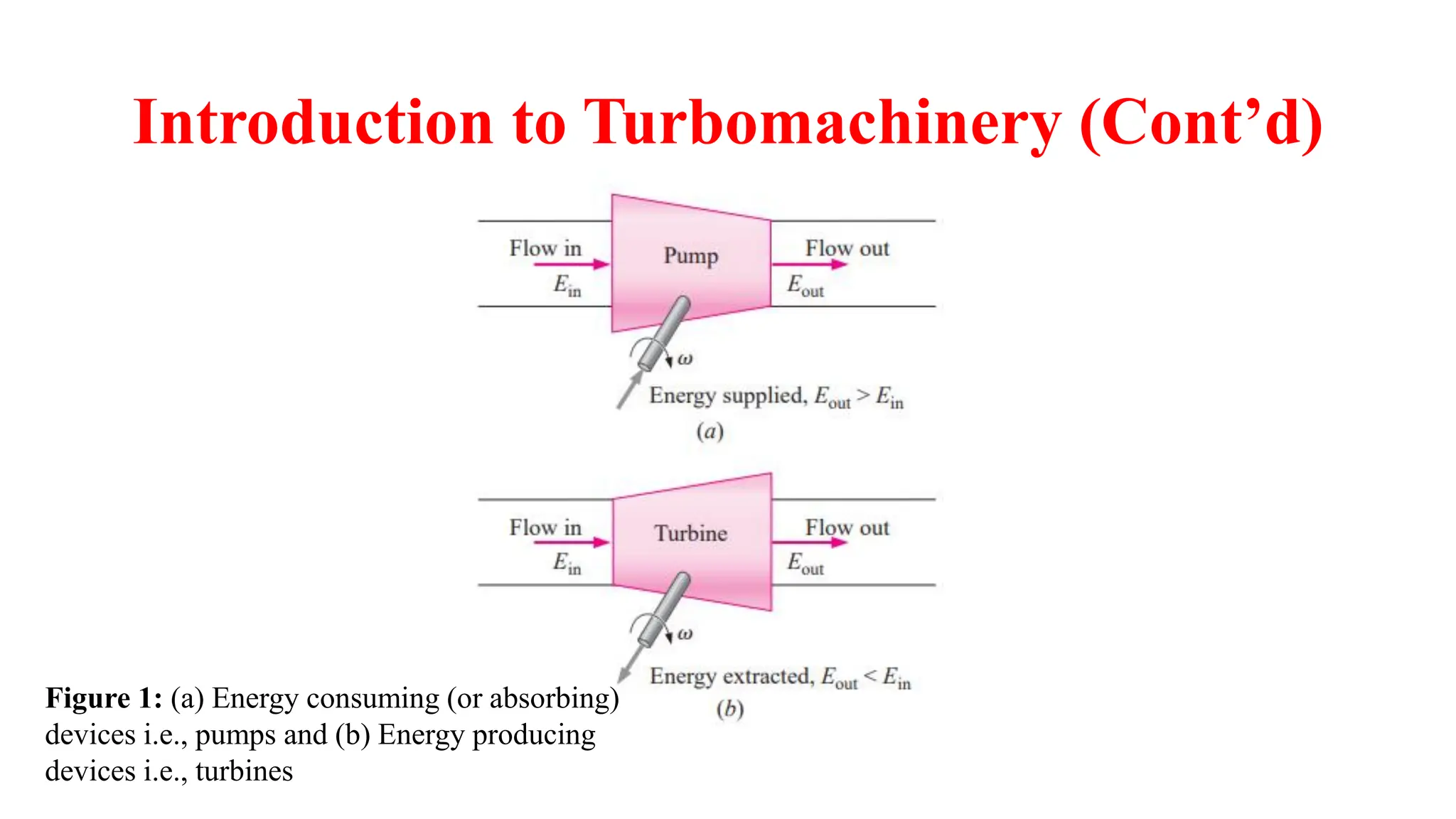
usually via a rotating shaft as shown in Figure 1 (a).The increase in
fluid energy is usually felt as an increase in the pressure of the fluid.
• Turbines, on the other hand, are energy producing devices—they
extract energy from the fluid and transfer most of that energy to some
form of mechanical energy output, typically in the form of a rotating
shaft (Fig. 1b). The fluid at the outlet of a turbine suffers an energy
loss, typically in the form of a loss of pressure.
Introduction to Turbomachinery (Cont’d)
Figure 1: (a) Energy consuming (or absorbing)
devices i.e., pumps and (b) Energy producing
devices i.e., turbines
Hydraulic Turbines
• Hydraulic turbines are defined as the hydraulic machines which
convert hydraulic energy (energy of water) into mechanical energy.
This mechanical energy is further used to run an electric generator
which is directly coupled to the shaft of the turbine. Thus, the
mechanical energy is converted into electrical energy through
generator. The electric power which is obtained from the hydraulic
energy is known as Hydroelectric power.
• Note: Turbine doesn't produce electrical energy, rather it produces
mechanical energy.
• At present the generation of hydroelectric power is the cheapest as
compared by the power generated by other sources such as oil, coal
etc.
Classification of Hydraulic Turbines
• The hydraulic turbines are classified according to the type of energy
available at the inlet of the turbine, direction of flow through the vanes
and head at the inlet of the turbine
1. According to the type of energy at inlet:
(a) Impulse turbine, and (b) Reaction turbine.
2. According to the direction of flow through runner :
(a) Tangential flow turbine,(b) Radial flow turbine, (c) Axial flow turbine,
and (d) Mixed flow turbine.
3. According to the head at the inlet of turbine :
(a) High head turbine, (b) Medium head turbine, and (c) Low head
turbine.
Classification of Hydraulic Turbines
(Cont’d)
• If at the inlet of the turbine, the energy available is only kinetic
energy, the turbine is known as Impulse (or velocity) Turbine. As the
water flows over the vanes, the pressure is atmospheric from inlet to
outlet of the turbine.
• If at the inlet of the turbine, the water possesses kinetic energy as well
as pressure energy, the turbine is known as Reaction (or pressure)
Turbine. As the waters flows through the runner, the water is under
pressure and the pressure energy goes on changing into kinetic energy.
The runner is completely enclosed in an air-tight casing and the runner
and casing is completely full of water.
• If the water flows along the tangent of the runner, the turbine is known
as tangential flow turbine.
Classification of Hydraulic Turbines
(Cont’d)
• If the water flows in the radial direction through the runner, the turbine
is called radial flow turbine.
• If the water flows from outwards to inwards, radially, the turbine is
known as inward radial flow turbine, on the other hand, if water
flows radially from inwards to outwards, the turbine is known as
outward radial flow turbine. If the water flows through the runner
along the direction parallel to the axis of rotation of the runner, the
turbine is called axial flow turbine.
• If the water flows through the runner in the radial direction but leaves
in the direction parallel to axis of rotation of the runner, the turbine is
called mixed flow turbine.
Impulse Turbines
• An impulse turbine is a turbine which runs by the impulse of water.
In an impulse turbine, the water from a dam is made to flow through a
pipeline, and then through guide mechanism and finally through the
nozzle. In such a process, the entire available energy of the water is
converted into kinetic energy by passing it through nozzles. The water
enters the running wheel in the form of a jet (or jets), which impinges
on the buckets, fixed to the outer periphery of the wheel.
• The jet of water impinges on the buckets with a high velocity, and
after flowing over the vanes, leaves with a low velocity; thus,
imparting its energy to the runner.
• The pressure of water, both at entering and leaving the vanes, is
atmospheric. The most common example of an impulse turbine is
Pelton wheel.
Impulse Turbines (Cont’d)
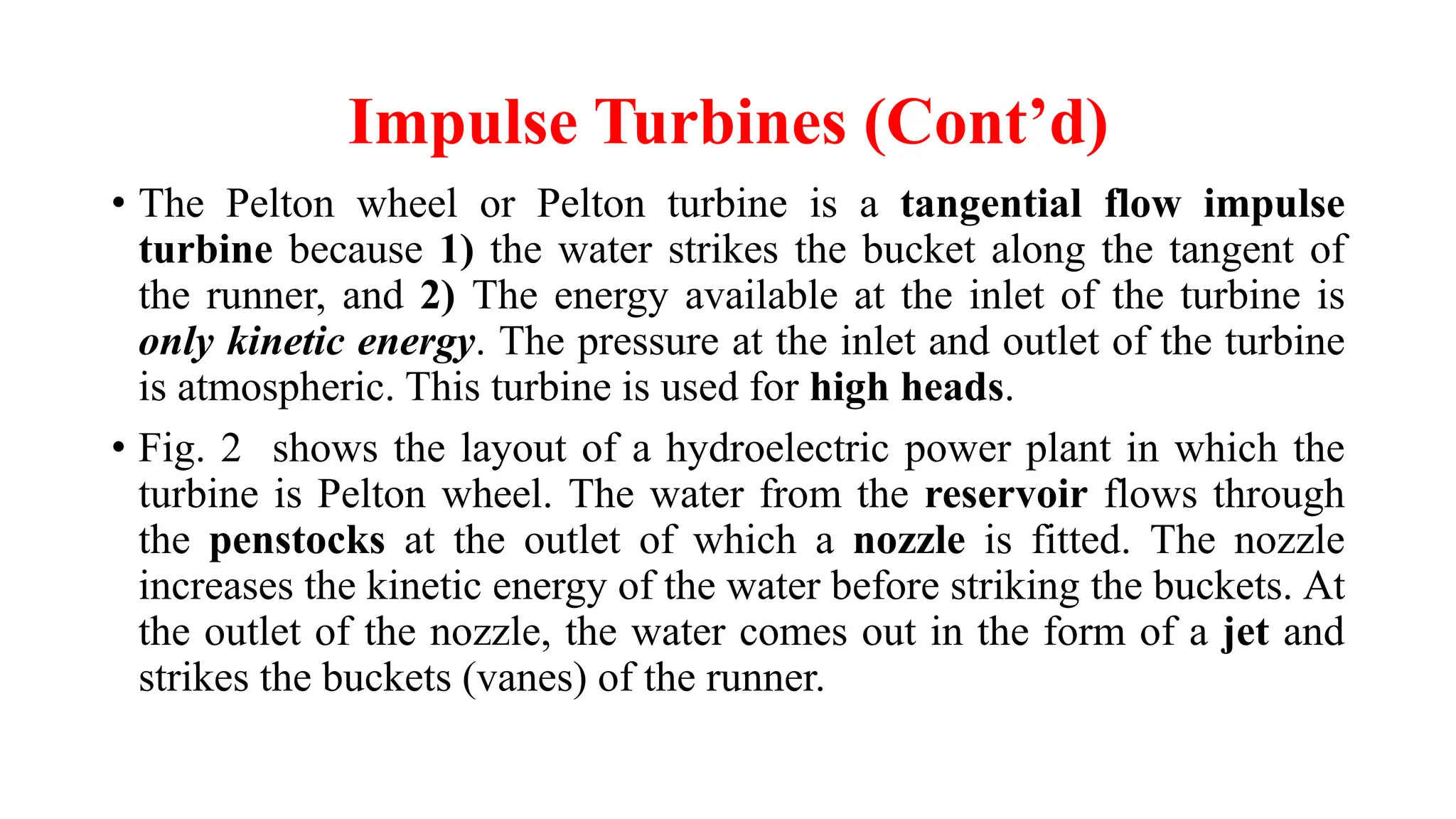
• The Pelton wheel or Pelton turbine is a tangential flow impulse
turbine because 1) the water strikes the bucket along the tangent of
the runner, and 2) The energy available at the inlet of the turbine is
only kinetic energy. The pressure at the inlet and outlet of the turbine
is atmospheric. This turbine is used for high heads.
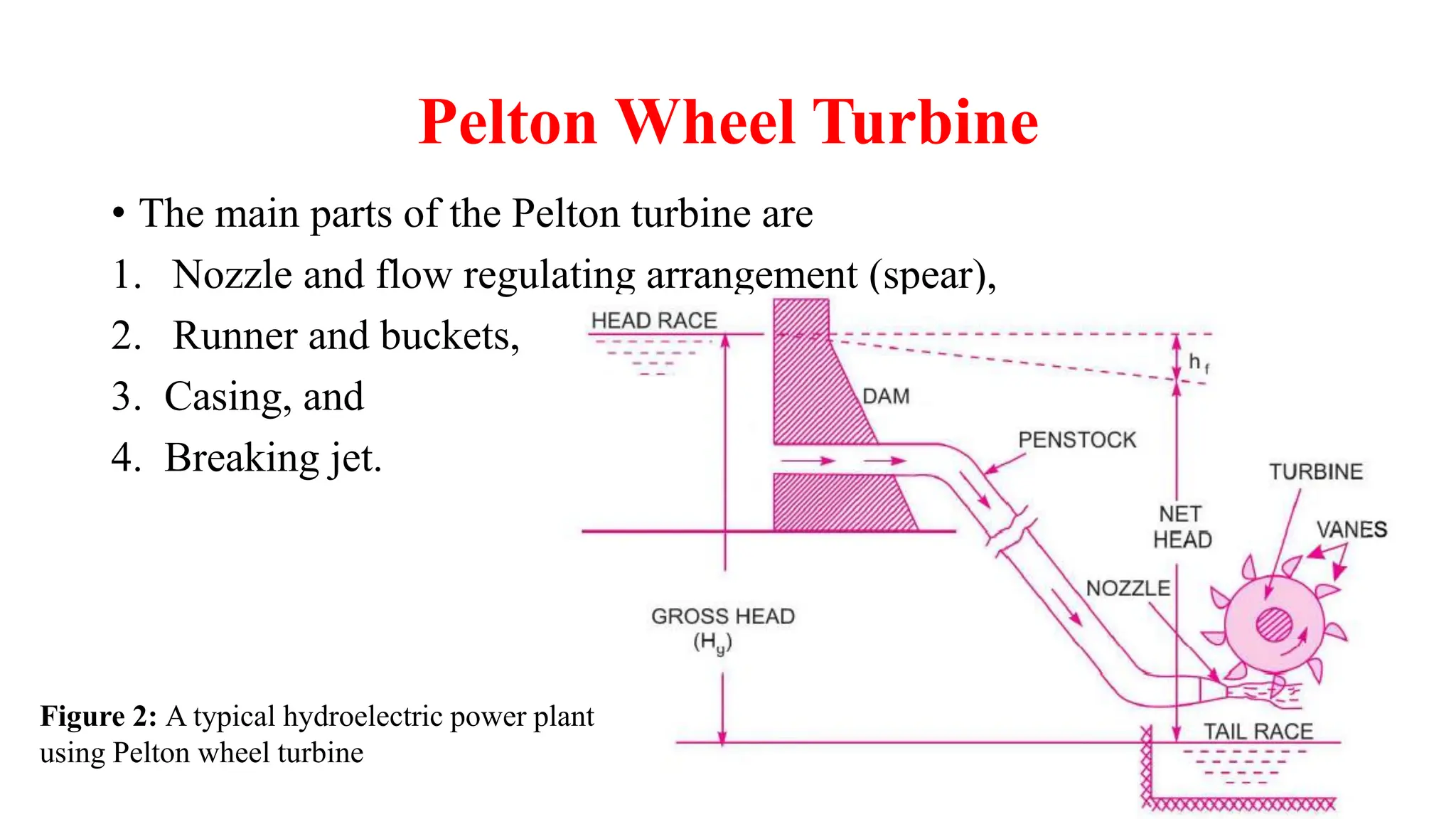
• Fig. 2 shows the layout of a hydroelectric power plant in which the
turbine is Pelton wheel. The water from the reservoir flows through
the penstocks at the outlet of which a nozzle is fitted. The nozzle
increases the kinetic energy of the water before striking the buckets. At
the outlet of the nozzle, the water comes out in the form of a jet and
strikes the buckets (vanes) of the runner.
Pelton Wheel Turbine
• The main parts of the Pelton turbine are
1. Nozzle and flow regulating arrangement (spear),
2. Runner and buckets,
3. Casing, and
4. Breaking jet.
Figure 2: A typical hydroelectric power plant
using Pelton wheel turbine
Pelton Wheel Turbine (Cont’d)
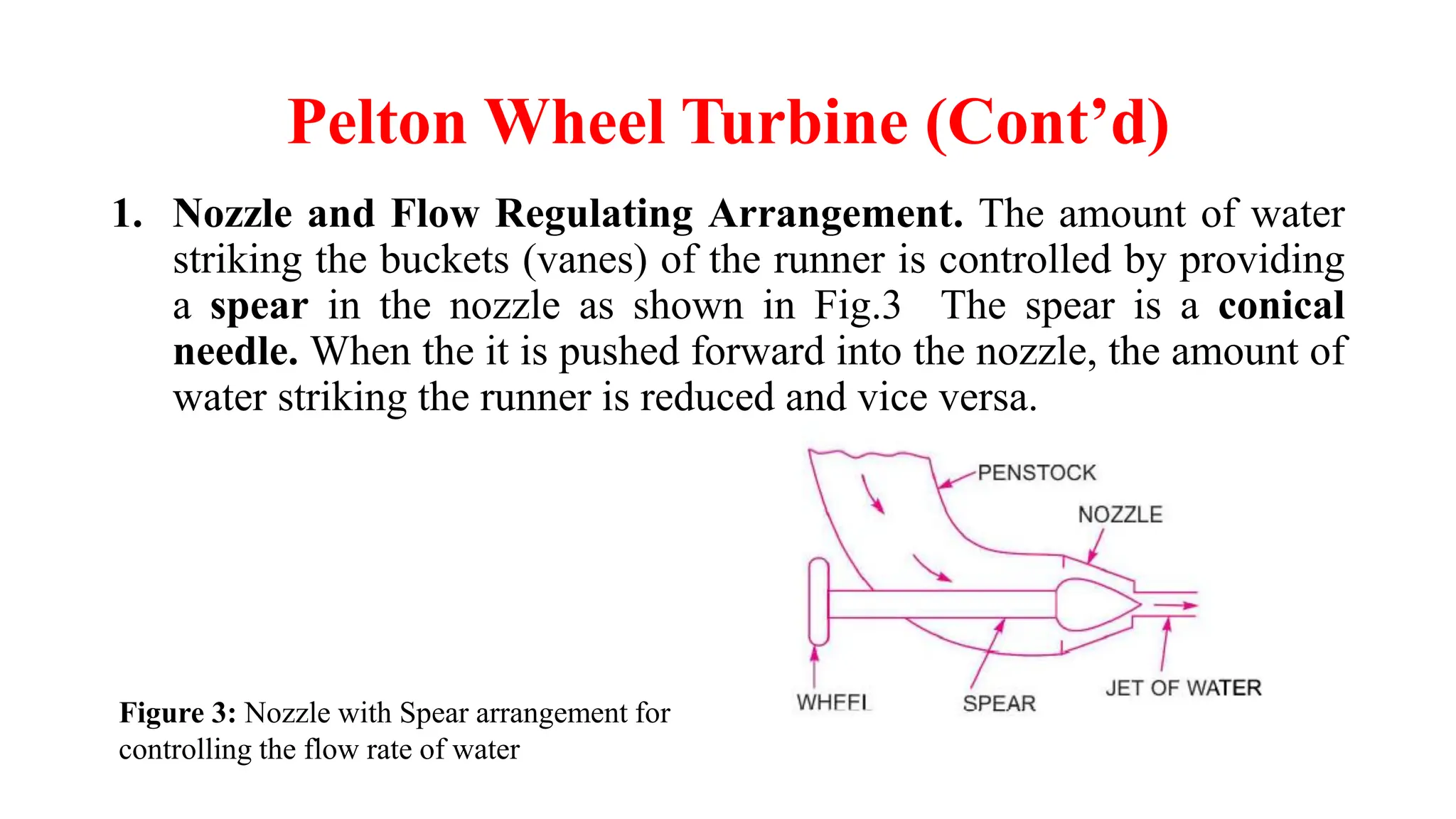
1. Nozzle and Flow Regulating Arrangement. The amount of water
striking the buckets (vanes) of the runner is controlled by providing
a spear in the nozzle as shown in Fig.3 The spear is a conical
needle. When the it is pushed forward into the nozzle, the amount of
water striking the runner is reduced and vice versa.
Figure 3: Nozzle with Spear arrangement for
controlling the flow rate of water
Pelton Wheel Turbine (Cont’d)
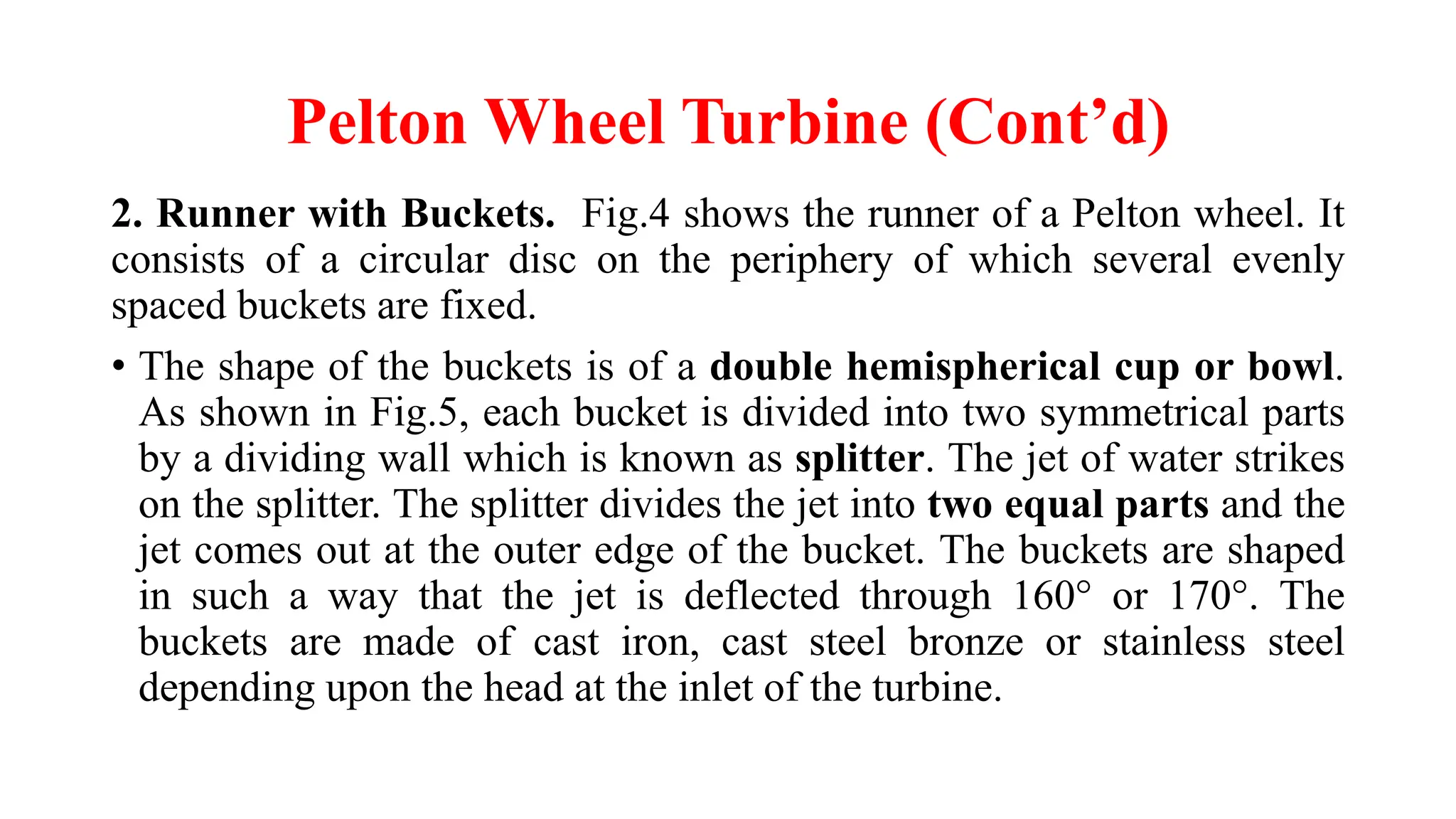
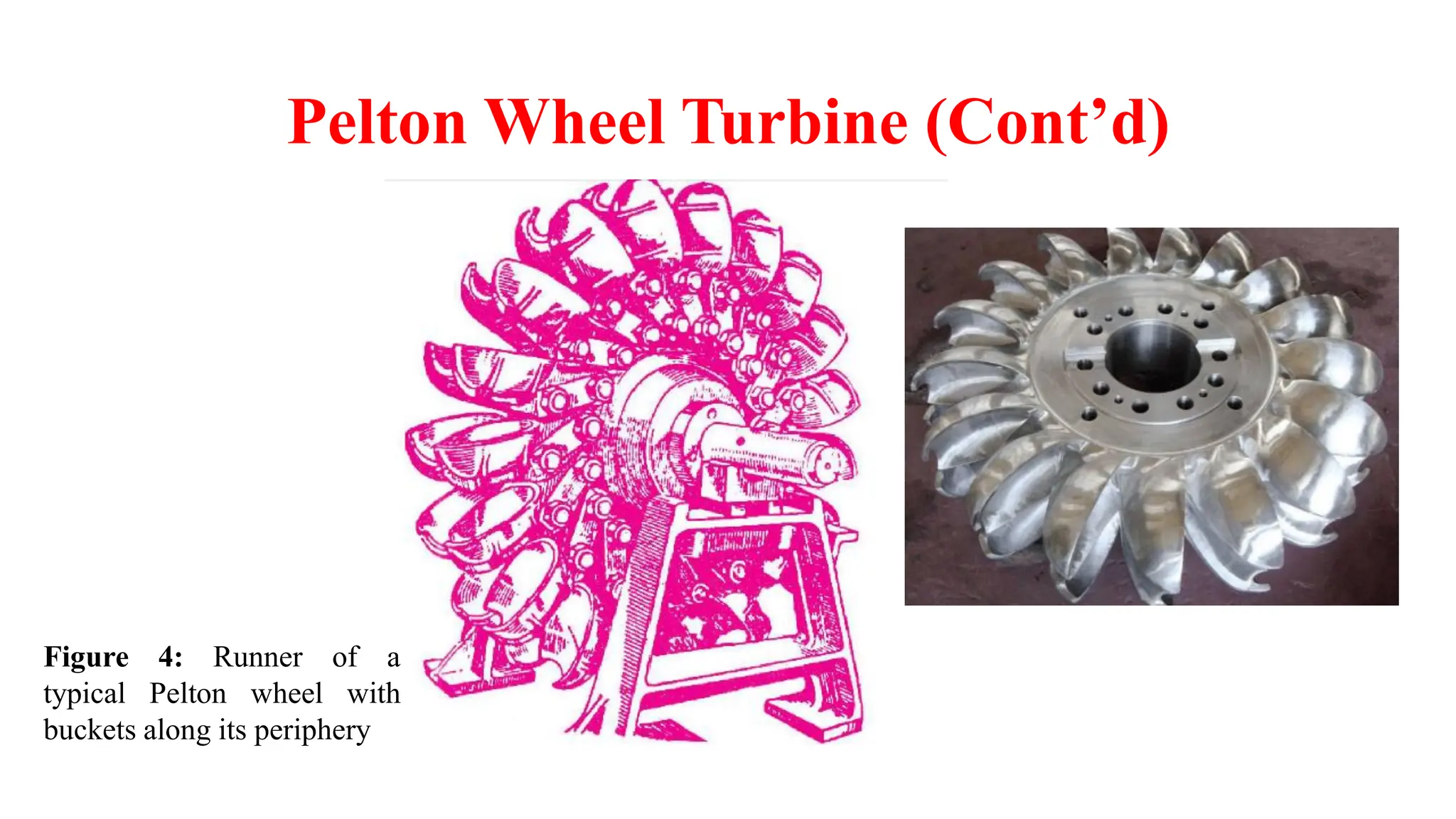
2. Runner with Buckets. Fig.4 shows the runner of a Pelton wheel. It
consists of a circular disc on the periphery of which several evenly
spaced buckets are fixed.
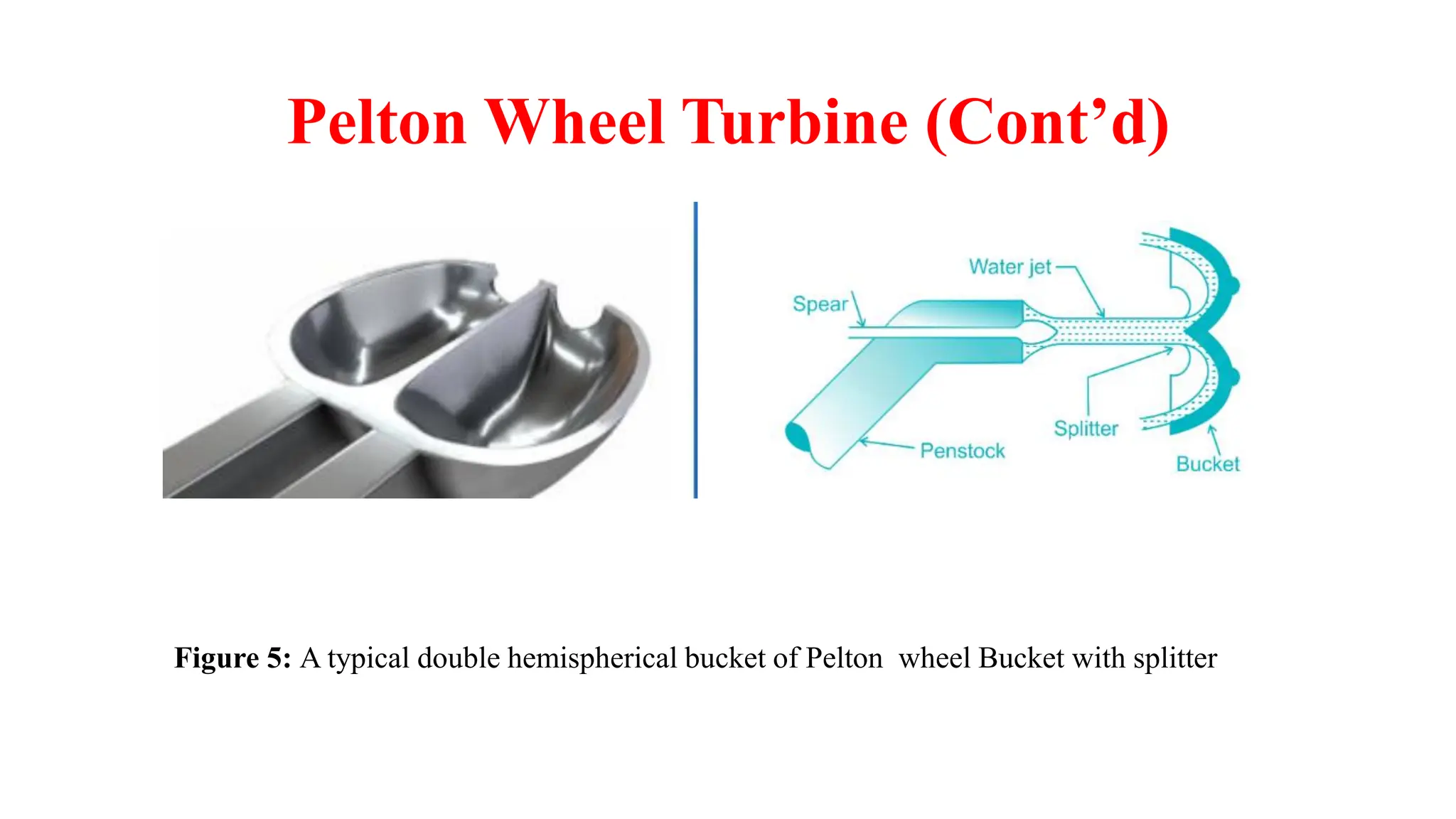
• The shape of the buckets is of a double hemispherical cup or bowl.
As shown in Fig.5, each bucket is divided into two symmetrical parts
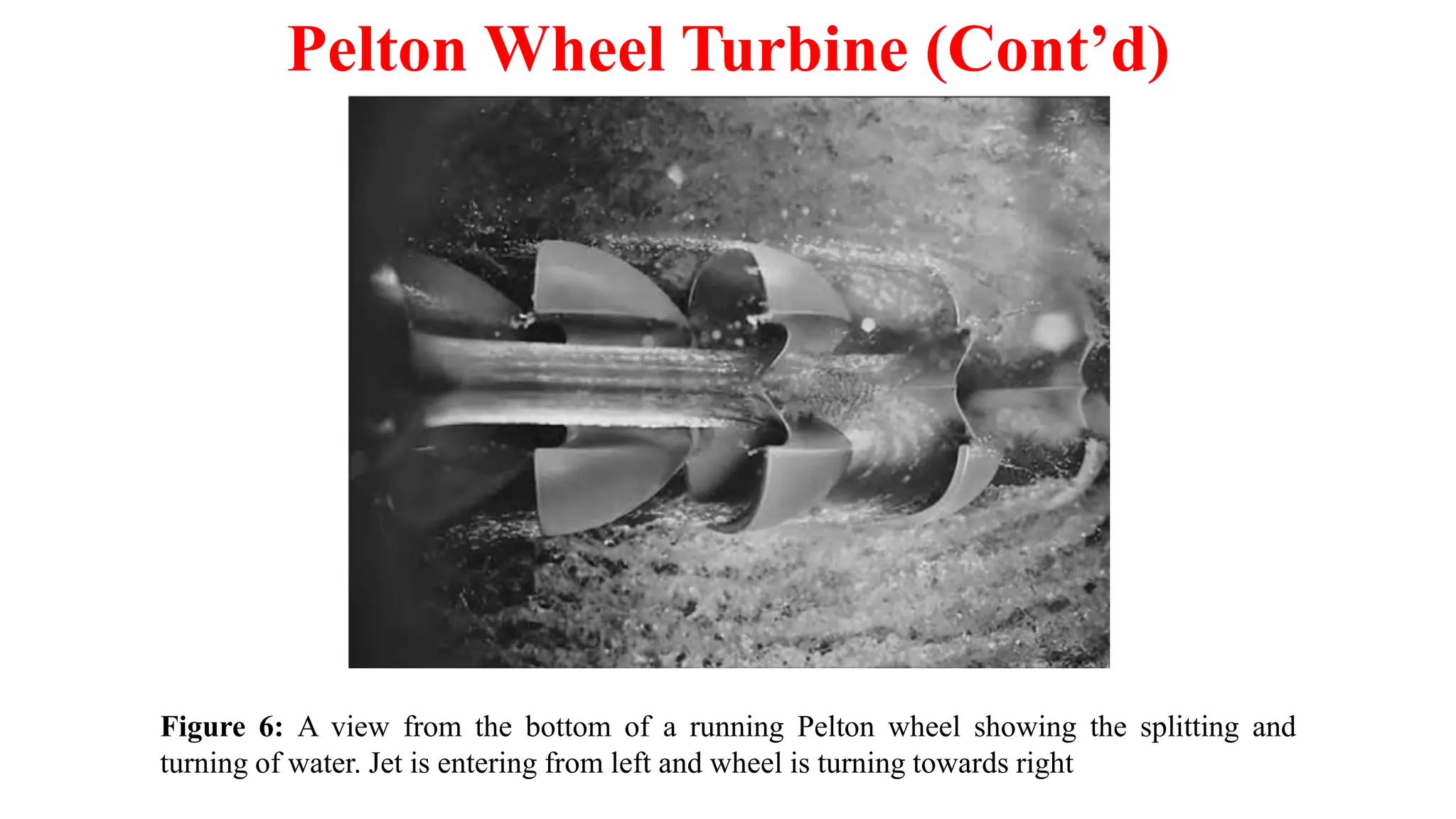
by a dividing wall which is known as splitter. The jet of water strikes
on the splitter. The splitter divides the jet into two equal parts and the
jet comes out at the outer edge of the bucket. The buckets are shaped
in such a way that the jet is deflected through 160° or 170°. The
buckets are made of cast iron, cast steel bronze or stainless steel
depending upon the head at the inlet of the turbine.
Pelton Wheel Turbine (Cont’d)
Figure 4: Runner of a
typical Pelton wheel with
buckets along its periphery
Pelton Wheel Turbine (Cont’d)
Figure 5: A typical double hemispherical bucket of Pelton wheel Bucket with splitter
Pelton Wheel Turbine (Cont’d)
Figure 6: A view from the bottom of a running Pelton wheel showing the splitting and
turning of water. Jet is entering from left and wheel is turning towards right
Pelton Wheel Turbine (Cont’d)
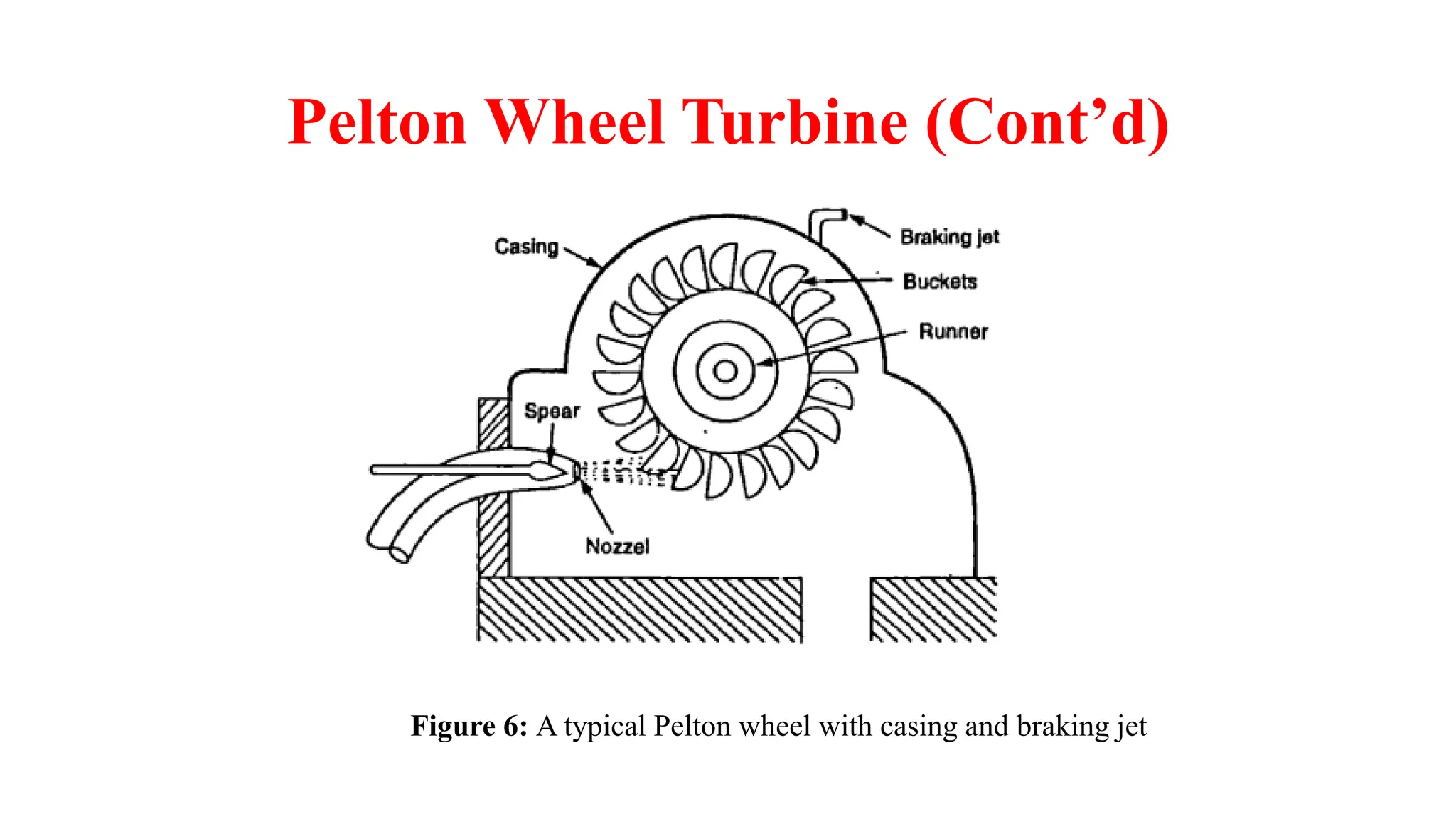
3. Casing. Fig.6 shows a Pelton turbine with a casing. The function of
the casing is to prevent the splashing of the water and to discharge
water to tail race. It also acts as safeguard against accidents. It is made
of cast iron or fabricated steel plates. The casing of the Pelton wheel
does not perform any hydraulic function.
4. Breaking Jet. When the nozzle is completely closed by moving the
spear in the forward direction, the amount of water striking the runner
reduces to zero. But the runner doesn’t stop at once rather it keeps on
revolving due to inertia for sufficient time. To stop the runner in a short
time, a small nozzle is provided which directs the jet of water on the
back of the vanes. This jet of water is called breaking jet.
Pelton Wheel Turbine (Cont’d)
Figure 6: A typical Pelton wheel with casing and braking jet
Velocity Triangles and Work Done for
Pelton Wheel
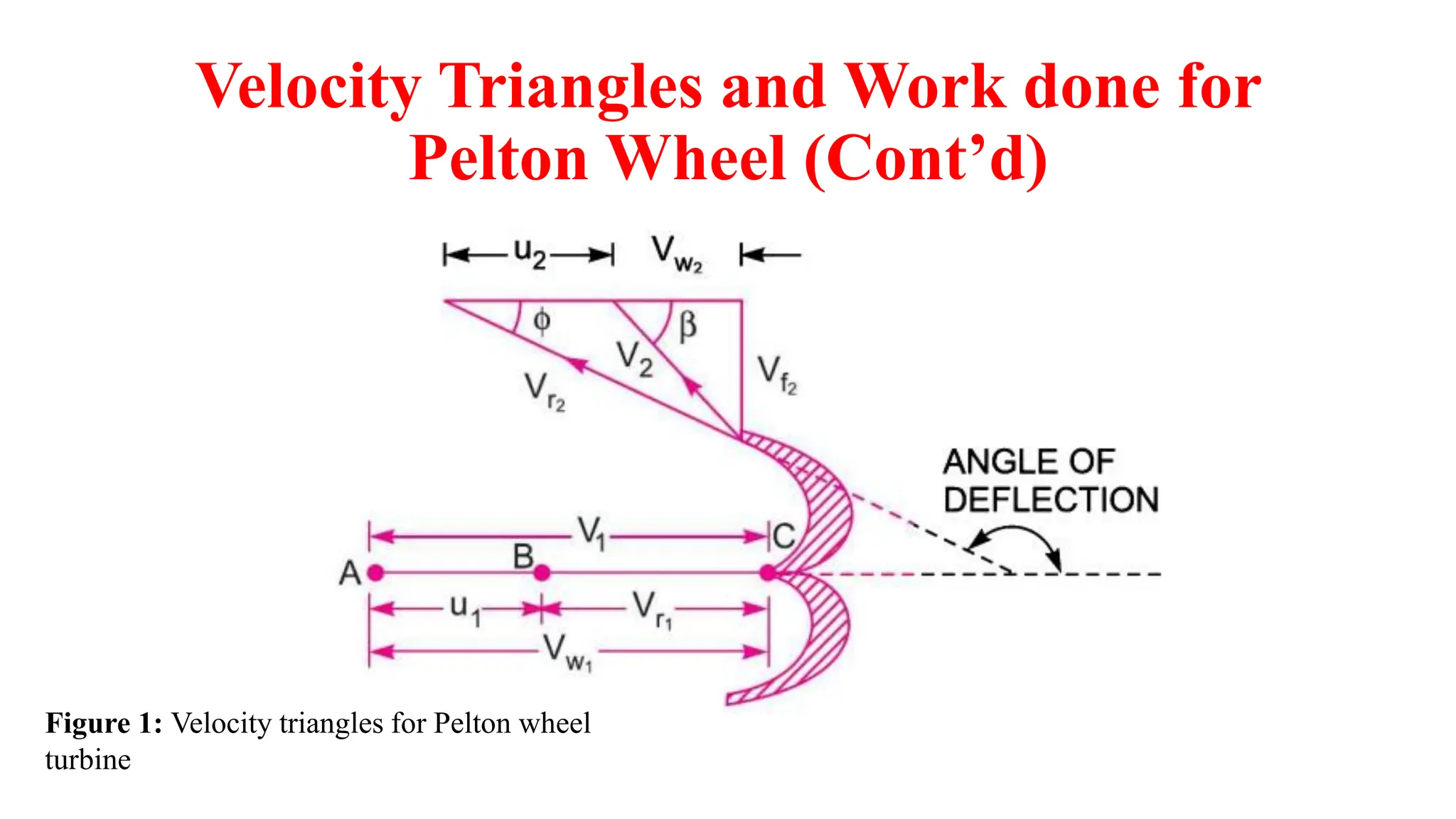
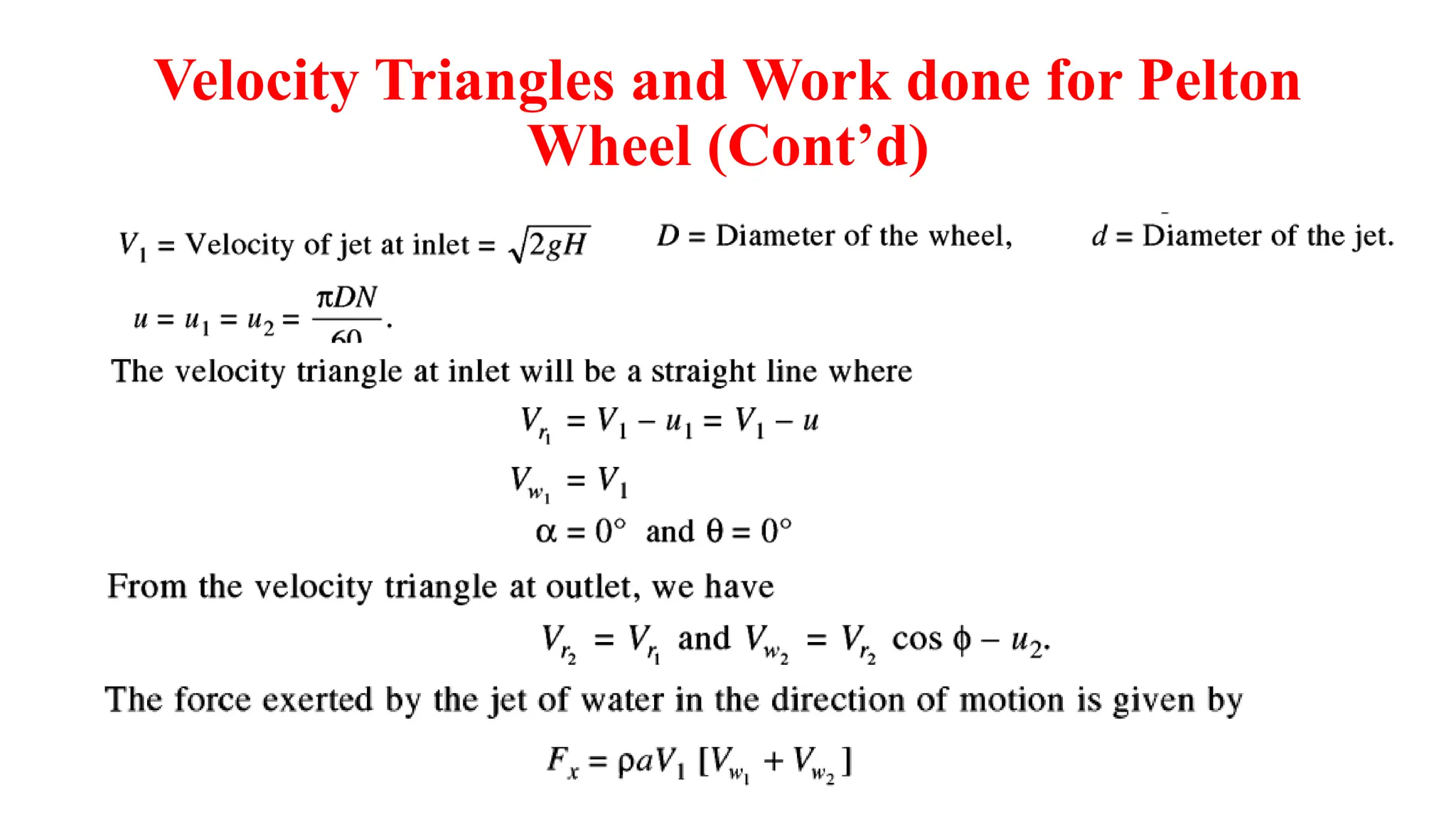
• As mentioned earlier, the jet of water coming out of the nozzle strikes
the bucket at its splitter. The splitter then splits the jet into two parts.
One part of the jet, passing through the inside surface of one portion of
the vane, leaves it at its extreme edge. Same happens on the other
portion of the jet and vane as shown in Fig. 7.
• The splitter is the inlet tip and outer edge of the bucket is the outlet
tip of the bucket. Therefore, the inlet velocity triangle is drawn at the
splitter and outlet velocity triangle is drawn at the outer edge of the
bucket.
Velocity Triangles and Work done for
Pelton Wheel (Cont’d)
Figure 1: Velocity triangles for Pelton wheel
turbine
Velocity Triangles and Work done for Pelton
Wheel (Cont’d)
Velocity Triangles and Work done for Pelton
Wheel (Cont’d)
Velocity Triangles and Work done for
Pelton Wheel (Cont’d)
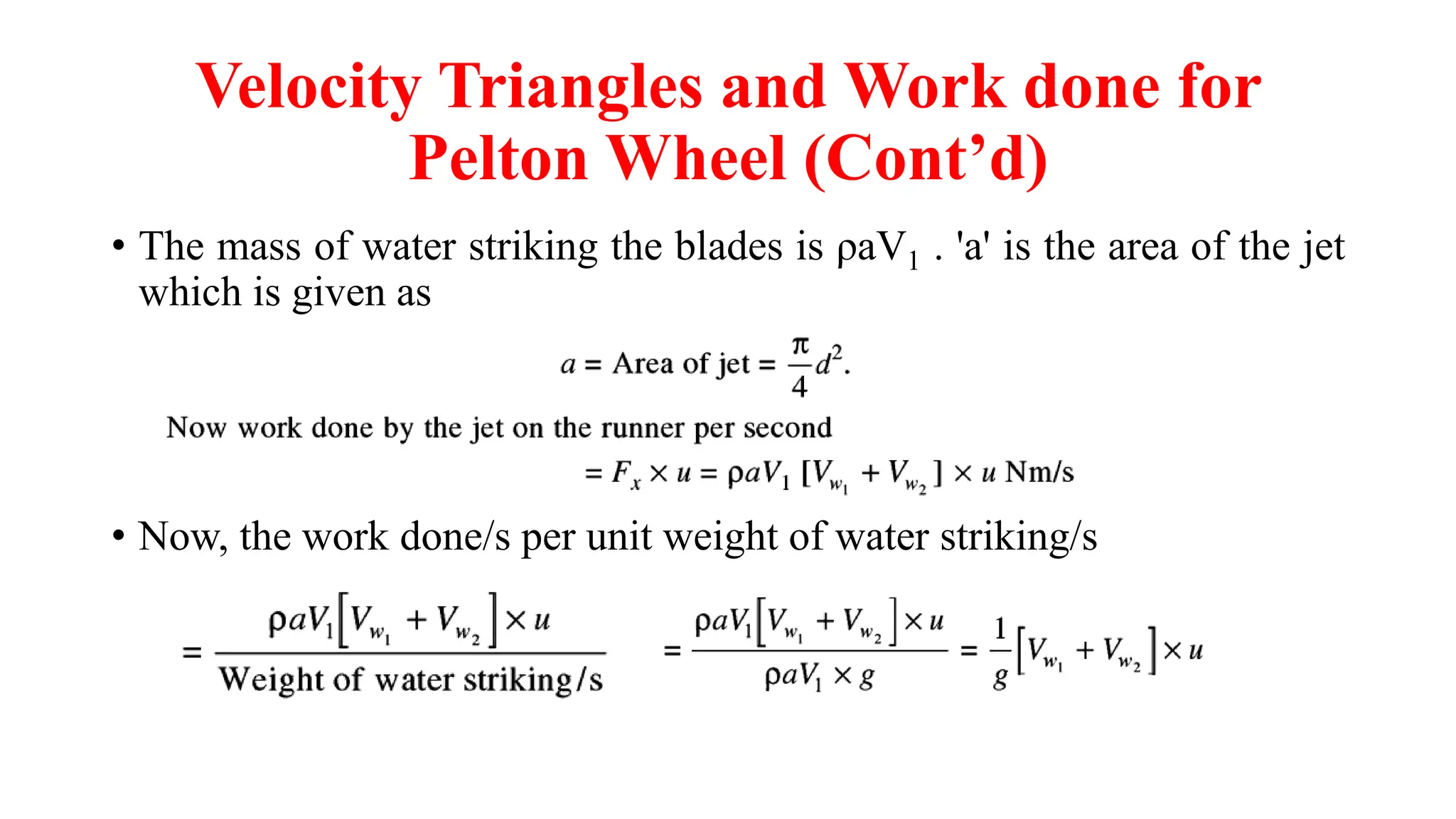
• The mass of water striking the blades is ρaV1 . 'a' is the area of the jet
which is given as
• Now, the work done/s per unit weight of water striking/s
Velocity Triangles and Work done for
Pelton Wheel (Cont’d)
Velocity Triangles and Work done for
Pelton Wheel (Cont’d)
Velocity Triangles and Work done for
Pelton Wheel (Cont’d)
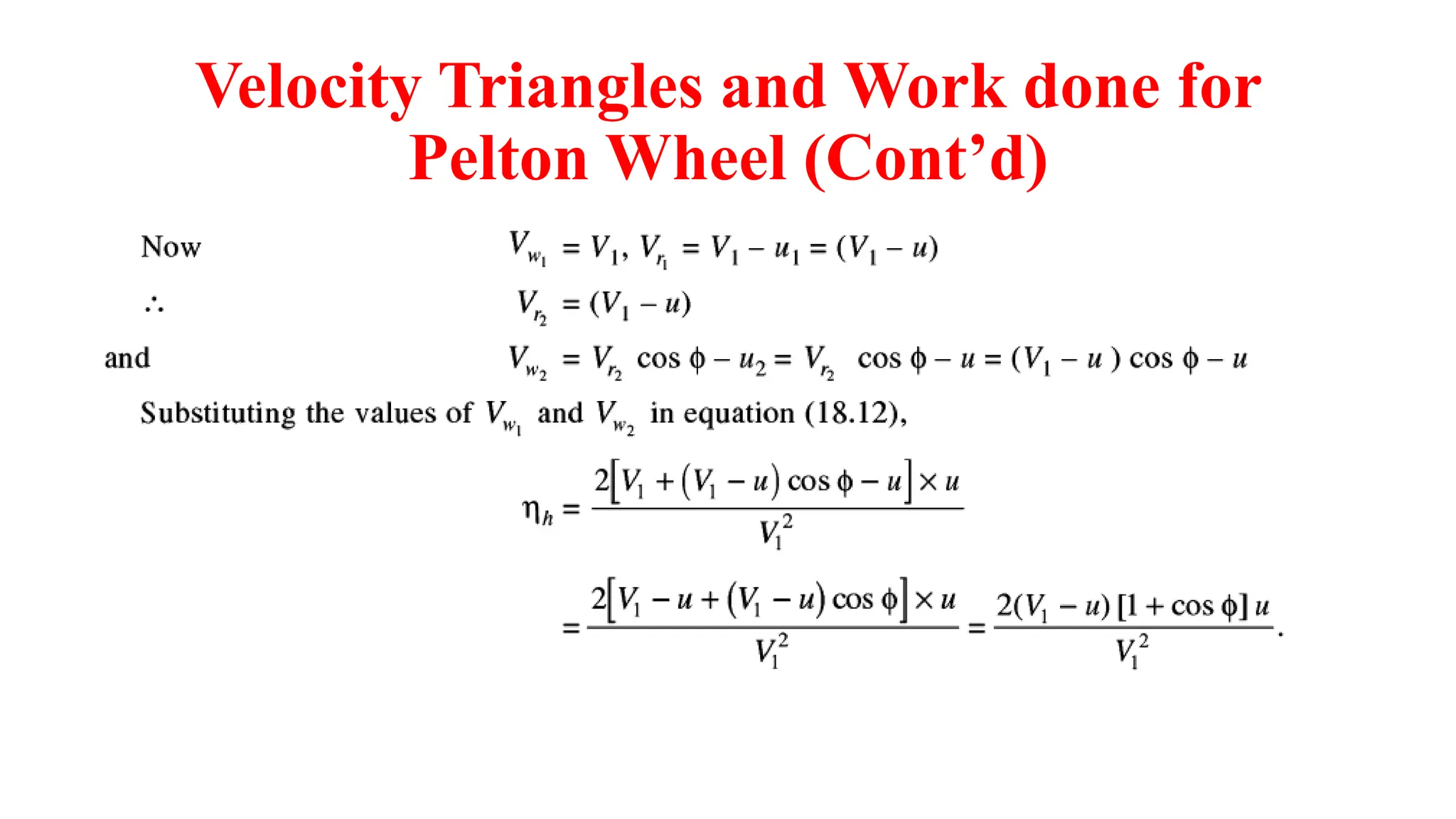
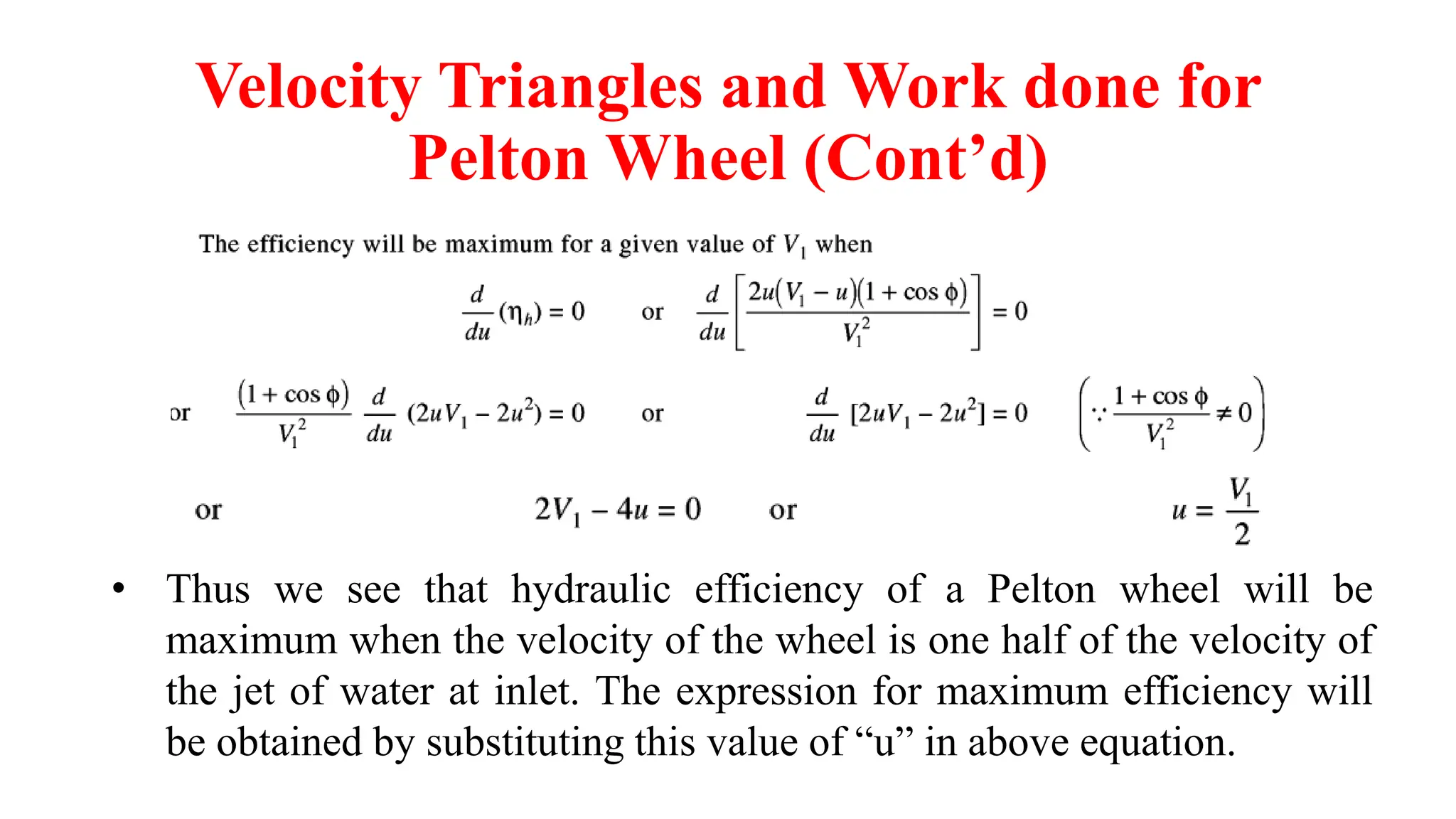
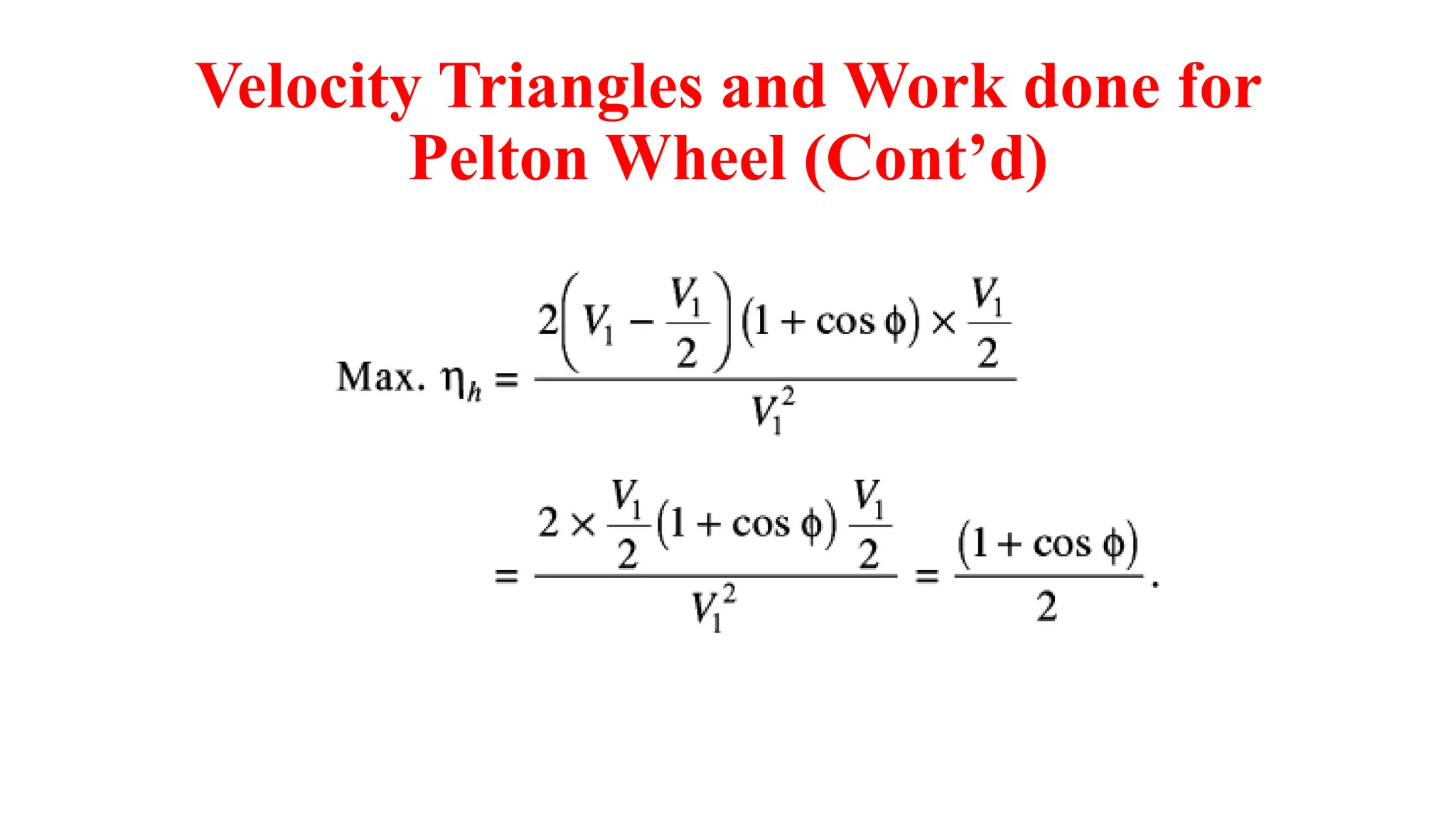
• Thus we see that hydraulic efficiency of a Pelton wheel will be
maximum when the velocity of the wheel is one half of the velocity of
the jet of water at inlet. The expression for maximum efficiency will
be obtained by substituting this value of “u” in above equation.
Velocity Triangles and Work done for
Pelton Wheel (Cont’d)
Efficiencies of Pelton Wheel
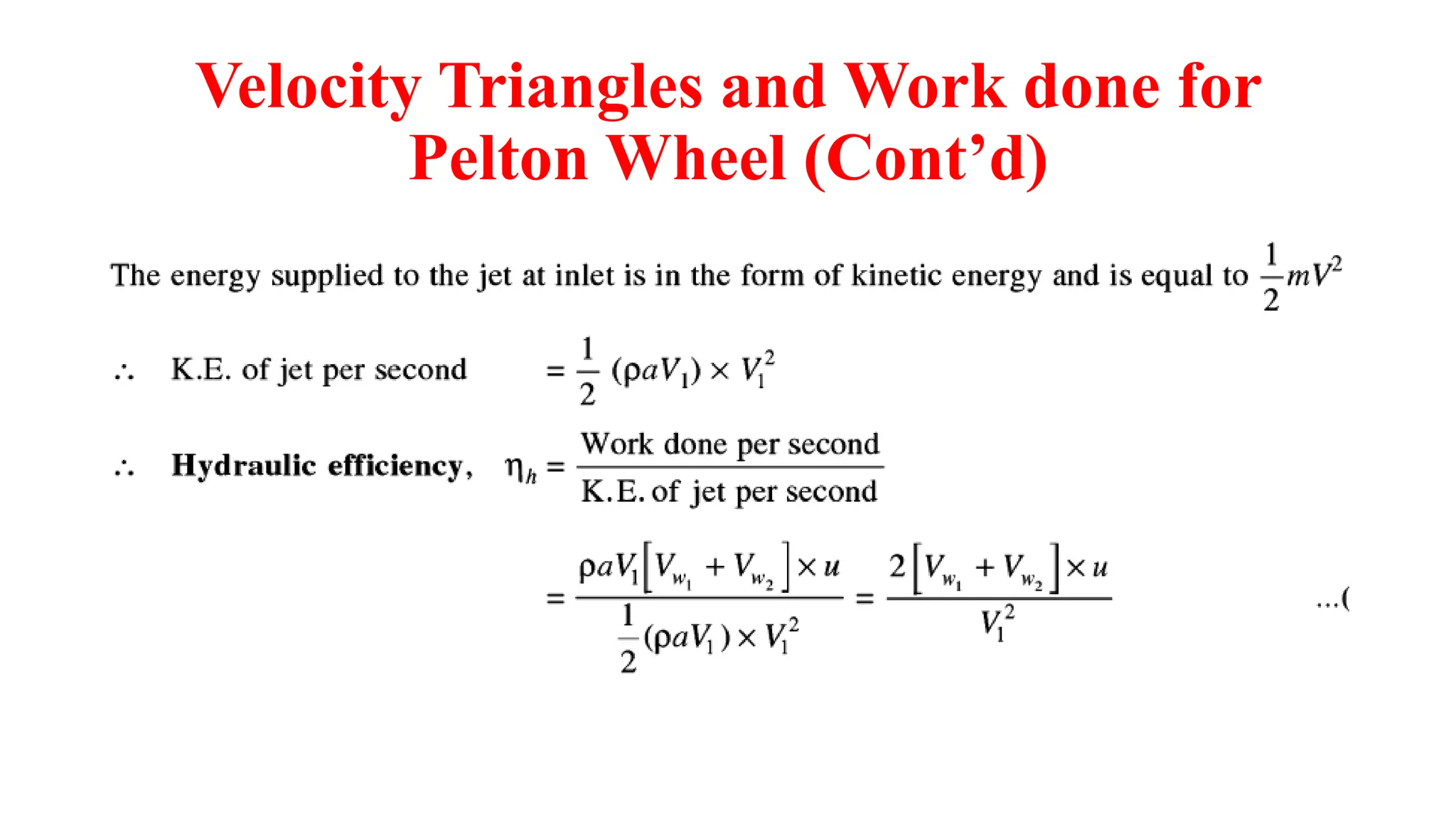
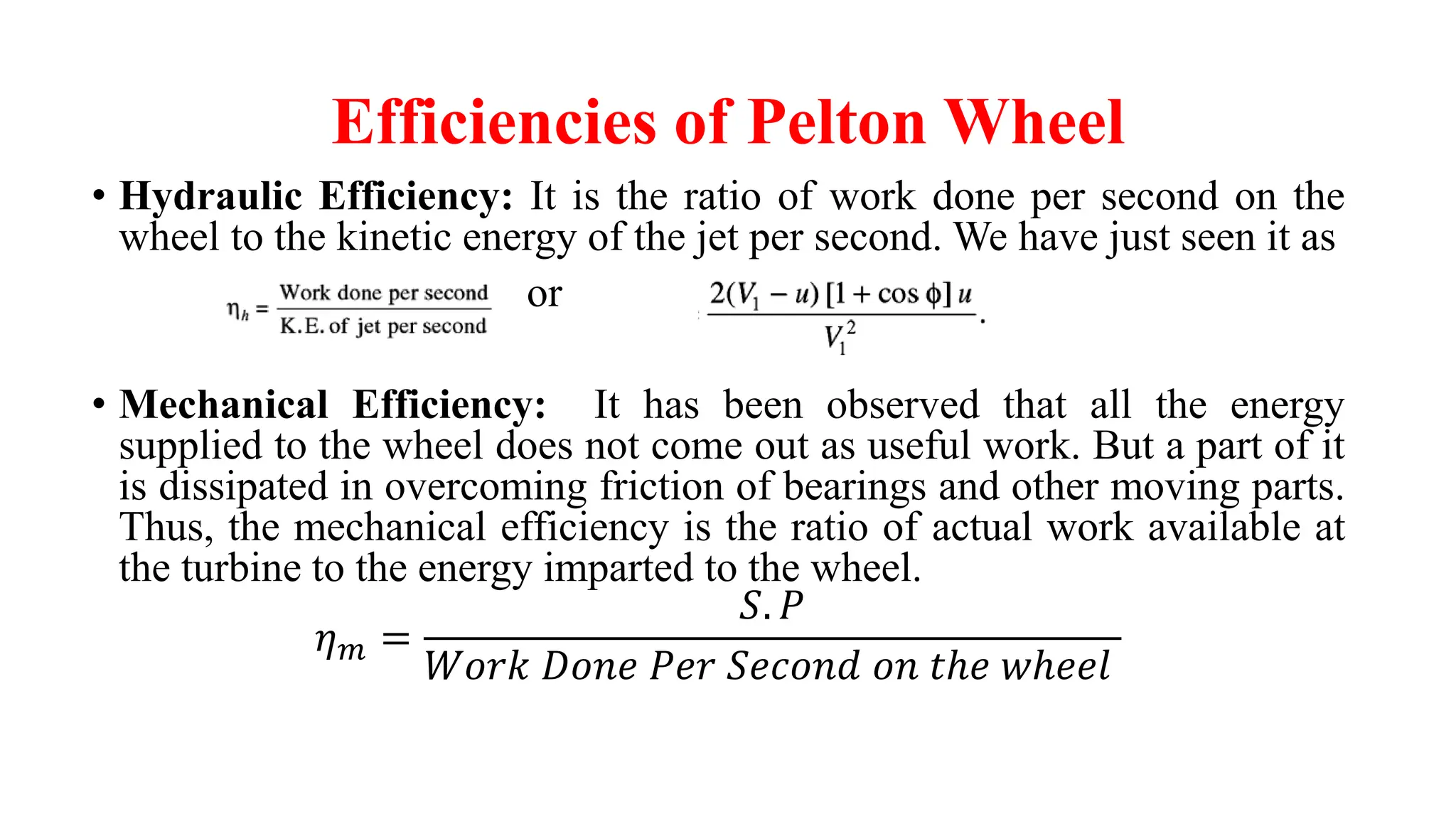
• Hydraulic Efficiency: It is the ratio of work done per second on the
wheel to the kinetic energy of the jet per second. We have just seen it as
or
• Mechanical Efficiency: It has been observed that all the energy
supplied to the wheel does not come out as useful work. But a part of it
is dissipated in overcoming friction of bearings and other moving parts.
Thus, the mechanical efficiency is the ratio of actual work available at
the turbine to the energy imparted to the wheel.
𝜂𝑚 =
𝑆. 𝑃
𝑊𝑜𝑟𝑘 𝐷𝑜𝑛𝑒 𝑃𝑒𝑟 𝑆𝑒𝑐𝑜𝑛𝑑 𝑜𝑛 𝑡ℎ𝑒 𝑤ℎ𝑒𝑒𝑙
Efficiencies of Pelton Wheel
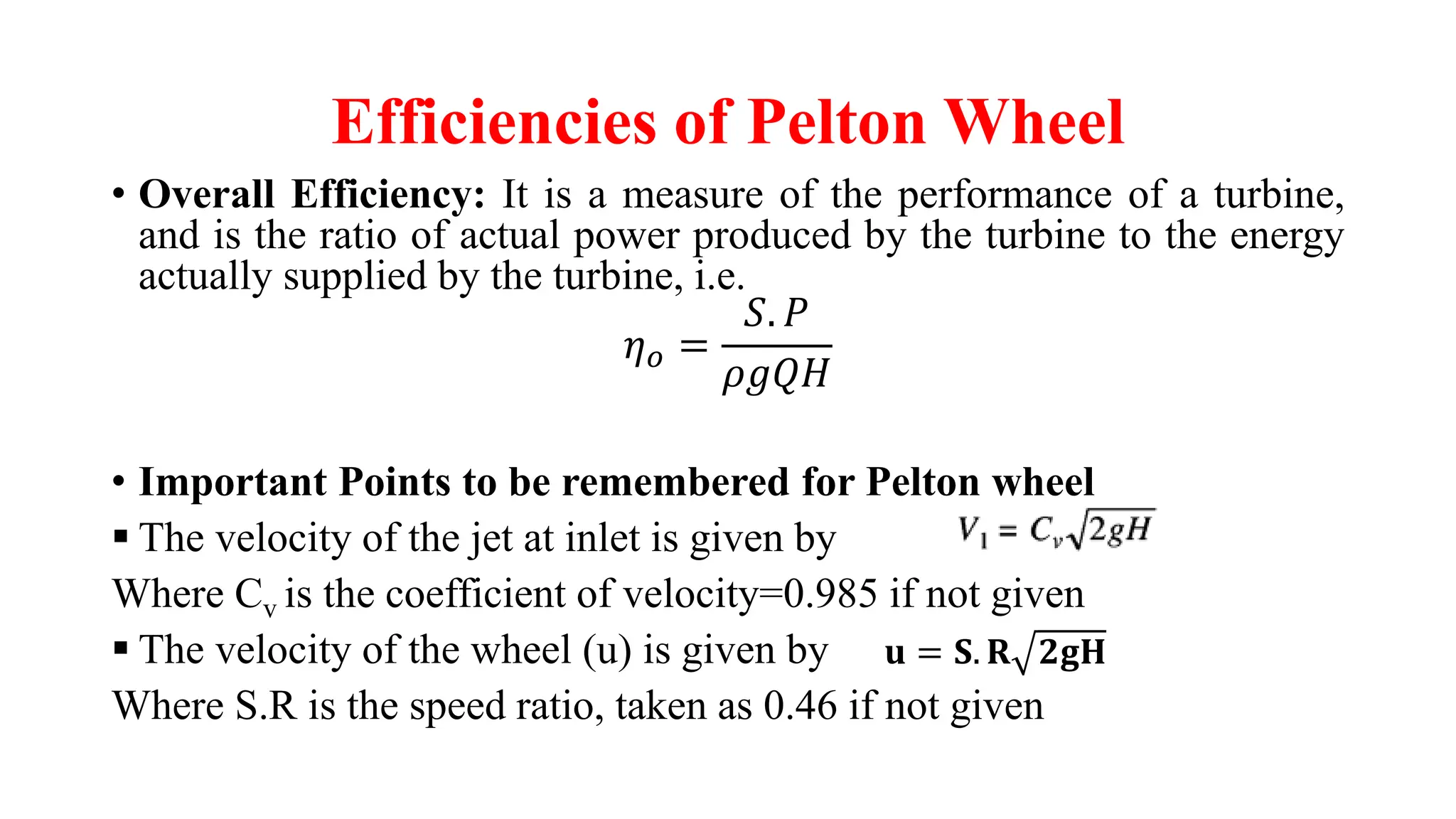
• Overall Efficiency: It is a measure of the performance of a turbine,
and is the ratio of actual power produced by the turbine to the energy
actually supplied by the turbine, i.e.
𝜂𝑜 =
𝑆. 𝑃
𝜌𝑔𝑄𝐻
• Important Points to be remembered for Pelton wheel
▪ The velocity of the jet at inlet is given by
Where Cv is the coefficient of velocity=0.985 if not given
▪ The velocity of the wheel (u) is given by
Where S.R is the speed ratio, taken as 0.46 if not given
𝐮 = 𝐒. 𝐑 𝟐𝐠𝐇
Numerical Problems
• Problem 1: A Pelton wheel has a mean bucket speed of 10 meters per
second with a jet of water flowing at the rate of 700 liters/s under a
head of 30 meters. The buckets deflect the jet through an angle of
160°. Calculate (i) the power given by water to the runner (work done
per second by the water on the runner blades) and (ii) the hydraulic
efficiency of the turbine. Assume coefficient of velocity as 0.98. [Ans:
(i)186.97 kW (ii) 94.54%]
• Problem 2: A Pelton wheel is having a mean bucket diameter of 1 m
and is running at 1000 r.p.m. The net head on the Pelton wheel is 700
m. If the side clearance angle is 15° and discharge through nozzle is
0.1 m3/s, find: (i) Power available at the inlet of the nozzle, and (ii)
Hydraulic efficiency of the turbine. [Ans: (i) 686.7 kW, (ii) 97.18%]
Thanks forListening

FM-II Week 1.pdf of mechanical engineerinf of fluid mechanics

  • 1.
    Fluid Mechanics-II Teacher/Instructor :Engr.Muhammad Sumair B.Sc. Mechanical Engineering (UET Lahore 2014-2018) M.Sc. Thermal Power Engineering (UET Lahore 2018-2020)
  • 2.
    Introduction to Turbomachinery •There are two broad categories of turbomachinery known as 1)pumps and 2) turbines. • The pump is any fluid machine that adds energy to a fluid. These are called energy consuming (or energy absorbing) devices since energy is supplied to them, and they transfer most of that energy to the fluid, usually via a rotating shaft as shown in Figure 1 (a).The increase in fluid energy is usually felt as an increase in the pressure of the fluid. • Turbines, on the other hand, are energy producing devices—they extract energy from the fluid and transfer most of that energy to some form of mechanical energy output, typically in the form of a rotating shaft (Fig. 1b). The fluid at the outlet of a turbine suffers an energy loss, typically in the form of a loss of pressure.
  • 3.
    Introduction to Turbomachinery(Cont’d) Figure 1: (a) Energy consuming (or absorbing) devices i.e., pumps and (b) Energy producing devices i.e., turbines
  • 4.
    Hydraulic Turbines • Hydraulicturbines are defined as the hydraulic machines which convert hydraulic energy (energy of water) into mechanical energy. This mechanical energy is further used to run an electric generator which is directly coupled to the shaft of the turbine. Thus, the mechanical energy is converted into electrical energy through generator. The electric power which is obtained from the hydraulic energy is known as Hydroelectric power. • Note: Turbine doesn't produce electrical energy, rather it produces mechanical energy. • At present the generation of hydroelectric power is the cheapest as compared by the power generated by other sources such as oil, coal etc.
  • 5.
    Classification of HydraulicTurbines • The hydraulic turbines are classified according to the type of energy available at the inlet of the turbine, direction of flow through the vanes and head at the inlet of the turbine 1. According to the type of energy at inlet: (a) Impulse turbine, and (b) Reaction turbine. 2. According to the direction of flow through runner : (a) Tangential flow turbine,(b) Radial flow turbine, (c) Axial flow turbine, and (d) Mixed flow turbine. 3. According to the head at the inlet of turbine : (a) High head turbine, (b) Medium head turbine, and (c) Low head turbine.
  • 6.
    Classification of HydraulicTurbines (Cont’d) • If at the inlet of the turbine, the energy available is only kinetic energy, the turbine is known as Impulse (or velocity) Turbine. As the water flows over the vanes, the pressure is atmospheric from inlet to outlet of the turbine. • If at the inlet of the turbine, the water possesses kinetic energy as well as pressure energy, the turbine is known as Reaction (or pressure) Turbine. As the waters flows through the runner, the water is under pressure and the pressure energy goes on changing into kinetic energy. The runner is completely enclosed in an air-tight casing and the runner and casing is completely full of water. • If the water flows along the tangent of the runner, the turbine is known as tangential flow turbine.
  • 7.
    Classification of HydraulicTurbines (Cont’d) • If the water flows in the radial direction through the runner, the turbine is called radial flow turbine. • If the water flows from outwards to inwards, radially, the turbine is known as inward radial flow turbine, on the other hand, if water flows radially from inwards to outwards, the turbine is known as outward radial flow turbine. If the water flows through the runner along the direction parallel to the axis of rotation of the runner, the turbine is called axial flow turbine. • If the water flows through the runner in the radial direction but leaves in the direction parallel to axis of rotation of the runner, the turbine is called mixed flow turbine.
  • 8.
    Impulse Turbines • Animpulse turbine is a turbine which runs by the impulse of water. In an impulse turbine, the water from a dam is made to flow through a pipeline, and then through guide mechanism and finally through the nozzle. In such a process, the entire available energy of the water is converted into kinetic energy by passing it through nozzles. The water enters the running wheel in the form of a jet (or jets), which impinges on the buckets, fixed to the outer periphery of the wheel. • The jet of water impinges on the buckets with a high velocity, and after flowing over the vanes, leaves with a low velocity; thus, imparting its energy to the runner. • The pressure of water, both at entering and leaving the vanes, is atmospheric. The most common example of an impulse turbine is Pelton wheel.
  • 9.
    Impulse Turbines (Cont’d) •The Pelton wheel or Pelton turbine is a tangential flow impulse turbine because 1) the water strikes the bucket along the tangent of the runner, and 2) The energy available at the inlet of the turbine is only kinetic energy. The pressure at the inlet and outlet of the turbine is atmospheric. This turbine is used for high heads. • Fig. 2 shows the layout of a hydroelectric power plant in which the turbine is Pelton wheel. The water from the reservoir flows through the penstocks at the outlet of which a nozzle is fitted. The nozzle increases the kinetic energy of the water before striking the buckets. At the outlet of the nozzle, the water comes out in the form of a jet and strikes the buckets (vanes) of the runner.
  • 10.
    Pelton Wheel Turbine •The main parts of the Pelton turbine are 1. Nozzle and flow regulating arrangement (spear), 2. Runner and buckets, 3. Casing, and 4. Breaking jet. Figure 2: A typical hydroelectric power plant using Pelton wheel turbine
  • 11.
    Pelton Wheel Turbine(Cont’d) 1. Nozzle and Flow Regulating Arrangement. The amount of water striking the buckets (vanes) of the runner is controlled by providing a spear in the nozzle as shown in Fig.3 The spear is a conical needle. When the it is pushed forward into the nozzle, the amount of water striking the runner is reduced and vice versa. Figure 3: Nozzle with Spear arrangement for controlling the flow rate of water
  • 12.
    Pelton Wheel Turbine(Cont’d) 2. Runner with Buckets. Fig.4 shows the runner of a Pelton wheel. It consists of a circular disc on the periphery of which several evenly spaced buckets are fixed. • The shape of the buckets is of a double hemispherical cup or bowl. As shown in Fig.5, each bucket is divided into two symmetrical parts by a dividing wall which is known as splitter. The jet of water strikes on the splitter. The splitter divides the jet into two equal parts and the jet comes out at the outer edge of the bucket. The buckets are shaped in such a way that the jet is deflected through 160° or 170°. The buckets are made of cast iron, cast steel bronze or stainless steel depending upon the head at the inlet of the turbine.
  • 13.
    Pelton Wheel Turbine(Cont’d) Figure 4: Runner of a typical Pelton wheel with buckets along its periphery
  • 14.
    Pelton Wheel Turbine(Cont’d) Figure 5: A typical double hemispherical bucket of Pelton wheel Bucket with splitter
  • 15.
    Pelton Wheel Turbine(Cont’d) Figure 6: A view from the bottom of a running Pelton wheel showing the splitting and turning of water. Jet is entering from left and wheel is turning towards right
  • 16.
    Pelton Wheel Turbine(Cont’d) 3. Casing. Fig.6 shows a Pelton turbine with a casing. The function of the casing is to prevent the splashing of the water and to discharge water to tail race. It also acts as safeguard against accidents. It is made of cast iron or fabricated steel plates. The casing of the Pelton wheel does not perform any hydraulic function. 4. Breaking Jet. When the nozzle is completely closed by moving the spear in the forward direction, the amount of water striking the runner reduces to zero. But the runner doesn’t stop at once rather it keeps on revolving due to inertia for sufficient time. To stop the runner in a short time, a small nozzle is provided which directs the jet of water on the back of the vanes. This jet of water is called breaking jet.
  • 17.
    Pelton Wheel Turbine(Cont’d) Figure 6: A typical Pelton wheel with casing and braking jet
  • 18.
    Velocity Triangles andWork Done for Pelton Wheel • As mentioned earlier, the jet of water coming out of the nozzle strikes the bucket at its splitter. The splitter then splits the jet into two parts. One part of the jet, passing through the inside surface of one portion of the vane, leaves it at its extreme edge. Same happens on the other portion of the jet and vane as shown in Fig. 7. • The splitter is the inlet tip and outer edge of the bucket is the outlet tip of the bucket. Therefore, the inlet velocity triangle is drawn at the splitter and outlet velocity triangle is drawn at the outer edge of the bucket.
  • 19.
    Velocity Triangles andWork done for Pelton Wheel (Cont’d) Figure 1: Velocity triangles for Pelton wheel turbine
  • 20.
    Velocity Triangles andWork done for Pelton Wheel (Cont’d)
  • 21.
    Velocity Triangles andWork done for Pelton Wheel (Cont’d)
  • 22.
    Velocity Triangles andWork done for Pelton Wheel (Cont’d) • The mass of water striking the blades is ρaV1 . 'a' is the area of the jet which is given as • Now, the work done/s per unit weight of water striking/s
  • 23.
    Velocity Triangles andWork done for Pelton Wheel (Cont’d)
  • 24.
    Velocity Triangles andWork done for Pelton Wheel (Cont’d)
  • 25.
    Velocity Triangles andWork done for Pelton Wheel (Cont’d) • Thus we see that hydraulic efficiency of a Pelton wheel will be maximum when the velocity of the wheel is one half of the velocity of the jet of water at inlet. The expression for maximum efficiency will be obtained by substituting this value of “u” in above equation.
  • 26.
    Velocity Triangles andWork done for Pelton Wheel (Cont’d)
  • 27.
    Efficiencies of PeltonWheel • Hydraulic Efficiency: It is the ratio of work done per second on the wheel to the kinetic energy of the jet per second. We have just seen it as or • Mechanical Efficiency: It has been observed that all the energy supplied to the wheel does not come out as useful work. But a part of it is dissipated in overcoming friction of bearings and other moving parts. Thus, the mechanical efficiency is the ratio of actual work available at the turbine to the energy imparted to the wheel. 𝜂𝑚 = 𝑆. 𝑃 𝑊𝑜𝑟𝑘 𝐷𝑜𝑛𝑒 𝑃𝑒𝑟 𝑆𝑒𝑐𝑜𝑛𝑑 𝑜𝑛 𝑡ℎ𝑒 𝑤ℎ𝑒𝑒𝑙
  • 28.
    Efficiencies of PeltonWheel • Overall Efficiency: It is a measure of the performance of a turbine, and is the ratio of actual power produced by the turbine to the energy actually supplied by the turbine, i.e. 𝜂𝑜 = 𝑆. 𝑃 𝜌𝑔𝑄𝐻 • Important Points to be remembered for Pelton wheel ▪ The velocity of the jet at inlet is given by Where Cv is the coefficient of velocity=0.985 if not given ▪ The velocity of the wheel (u) is given by Where S.R is the speed ratio, taken as 0.46 if not given 𝐮 = 𝐒. 𝐑 𝟐𝐠𝐇
  • 29.
    Numerical Problems • Problem1: A Pelton wheel has a mean bucket speed of 10 meters per second with a jet of water flowing at the rate of 700 liters/s under a head of 30 meters. The buckets deflect the jet through an angle of 160°. Calculate (i) the power given by water to the runner (work done per second by the water on the runner blades) and (ii) the hydraulic efficiency of the turbine. Assume coefficient of velocity as 0.98. [Ans: (i)186.97 kW (ii) 94.54%] • Problem 2: A Pelton wheel is having a mean bucket diameter of 1 m and is running at 1000 r.p.m. The net head on the Pelton wheel is 700 m. If the side clearance angle is 15° and discharge through nozzle is 0.1 m3/s, find: (i) Power available at the inlet of the nozzle, and (ii) Hydraulic efficiency of the turbine. [Ans: (i) 686.7 kW, (ii) 97.18%]
  • 30.