Name: Khaniella FaithPatimo
Subject: Administrative Leadership and Innovation
Day and Time: Saturday. 4:30-7:30 PM
Date Reported: October 5, 2024
EFFECTIVE
COMMUNICATION IN
LEADERSHIP
3.
identifies tips onhow to achieve effective communication
in leadership;
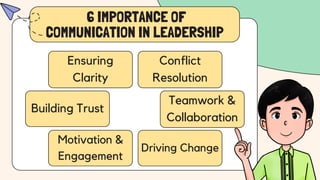
explores the significance of communication in leadership;
reflects on personal communication skills- strength nd
weaknesses.
01
03
04
OBJECTIVES
differentiates types of communication in leadership;
02
4.
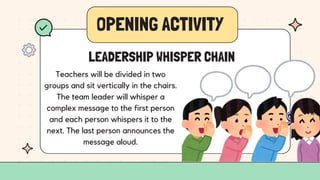
OPENING ACTIVITY
Teachers willbe divided in two
groups and sit vertically in the chairs.
The team leader will whisper a
complex message to the first person
and each person whispers it to the
next. The last person announces the
message aloud.
LEADERSHIP WHISPER CHAIN
5.
“GREAT LEADERS COMMUNICATEAND
GREAT COMMUNICATORS LEAD.”
-Simon Sinek, author and motivational speaker
WORDS OF WISDOM
6.
DISCUSSION PROPER
Communication andleadership are two
intertwined concepts that play a critical role in
shaping the success of any organization,
particularly in the field of education.
EFFECTIVE COMMUNICATION
IN LEADERSHIP
7.
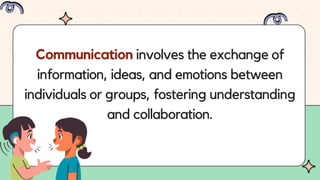
Communication involves theexchange of
information, ideas, and emotions between
individuals or groups, fostering understanding
and collaboration.
8.
Effective communication inleadership
involves clearly conveying ideas, actively
listening, and fostering an open dialogue to
inspire, guide, and align the team toward
shared goals.
Leaders must begood
communicators because they
inspire and empower people
around them, and without good
communication skills, a leader
would never be heard or
understood by others.
1. LISTENING
Leaders whodevote
themselves to actively
listening to their employees
are usually very good at
solving issues quickly and
efficiently.
14.
2. COACHING
It’s astyle that requires
leaders to provide their
workers with a framework
— while also letting them
reach their goals by
choosing their own path.
15.
3. TEACHING
Fundamentally, strong
leadersare also amazing
teachers. This is essential
for helping
employees/members
master new skills and
improve their performance.
16.
4. DIRECTING
The directingstyle of
communication allows
leaders to specify the
steps employees should
take to make progress on
a project.
17.
5. ADVISING
As expertsin their field,
the majority of leaders
will be able to provide
advice to help employees
resolve a
misunderstanding or
handle a tricky situation.
7. DELEGATING
This isarguably the most hands-
off of all leadership
communication styles. It’s a great
way to approach self-driven
employees and offer them more
autonomy.
BE TRANSPARENT
Sharing informationopenly builds trust within the
team and fosters a culture of honesty. When team
members feel informed, they are more likely to feel
secure and valued in their roles (Goleman, 2017).
COMMUNICATE CLEARLY
Using clearand straightforward language
helps avoid misunderstandings, ensuring
everyone is aligned on goals and
expectations. (Covey, 2004).
24.
PROVIDE CONSTRUCTIVE FEEDBACK
Offeringspecific, actionable feedback promotes individual
growth and development among team members.
Constructive feedback helps employees understand their
strengths and areas for improvement, enhancing overall
performance (Goleman, 2017).
25.
ENCOURAGE OPEN DIALOGUE
Creatingan environment where team members feel
comfortable sharing their thoughts leads to innovative
ideas and solutions. When leaders encourage open
communication, they empower their teams to contribute
actively and collaboratively (Brown, 2018).
26.
USE NONVERBAL COMMUNICATIONWISELY
Being aware of body language and facial expressions
can reinforce spoken messages and demonstrate
engagement. (Goleman, 2017).
27.
ADAPT YOUR COMMUNICATIONSTYLE
Tailoring your communication to meet the needs
of different team members enhances
understanding and makes interactions more
effective (Brown, 2018).
CONDUCT REGULAR CHECK-INS
Frequentcheck-ins with team members help maintain
alignment on goals and address any challenges promptly.
Regular communication fosters a proactive approach to
problem-solving and ensures that everyone is on the
same page (Goleman, 2017).
30.
SOLICIT FEEDBACK FROMYOUR TEAM
Actively seeking input from team members shows that
you value their opinions and insights. Encouraging
feedback fosters a culture of collaboration and
continuous improvement, empowering employees to
contribute meaningfully (Brown, 2018).
31.
Effective communication isa cornerstone of
successful leadership, enabling leaders to
inspire, engage, and empower their teams. By
prioritizing transparent communication and
actively fostering an inclusive
environment, organizations can
unlock the full potential of their workforce.
IMPLICATIONS
32.
Ultimately, leaders whomaster the art of
communication will not only drive their teams
toward shared goals but also cultivate a
culture of trust and collaboration that propels
the organization forward.
IMPLICATIONS
33.
Effective communication isessential for
leaders to inspire and engage their teams,
fostering a culture of trust and collaboration.
By prioritizing transparency and inclusivity,
organizations can unlock their workforce's
potential, driving both performance and
innovation.
SYNTHESIS
34.
Organizations should provideongoing training
for leaders to enhance their communication
skills, focusing on active listening and
feedback techniques. Establishing structured
feedback mechanisms will allow team
members to voice their concerns and
suggestions, fostering a culture of openness
and transparency.
RECOMMENDATIONS
35.
Additionally, regular check-insand the use of
collaborative technology can strengthen team
relationships and streamline information
sharing, ultimately improving leadership
effectiveness.
RECOMMENDATIONS
36.
CLOSING ACTIVITY
Reflecting ontoday’s discussion, what
is one communication challenge you
face as a leader, and what steps will
you take to overcome it?
37.
CLOSING ACTIVITY
What isone strength in your
communication style that enhances your
effectiveness as a leader, and what is one
weakness that you believe hinders you to
achieve your fullest potential?
38.
REFERENCES
Brown, B. (2018).Dare to Lead: Brave Work. Tough
Conversations. Whole Hearts. Random House.
Covey, S. R. (2004). The 7 Habits of Highly Effective People:
Powerful Lessons in Personal Change. Free Press.
Goleman, D. (2017). Emotional Intelligence: Why It Can Matter
More Than IQ. Bantam Books.
Pumble. (n.d.). Communication styles for leaders. Pumble.
Retrieved October 5, 2024, from
https://pumble.com/blog/communication-styles-forleaders/