Improving diversity
by Toronto Training and HR
September 2013
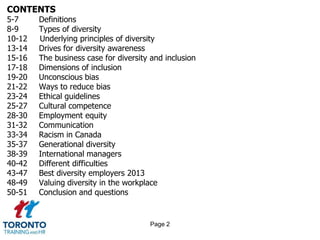
CONTENTS
5-7 Definitions
8-9 Types of diversity
10-12 Underlying principles of diversity
13-14 Drives for diversity awareness
15-16 The business case for diversity and inclusion
17-18 Dimensions of inclusion
19-20 Unconscious bias
21-22 Ways to reduce bias
23-24 Ethical guidelines
25-27 Cultural competence
28-30 Employment equity
31-32 Communication
33-34 Racism in Canada
35-37 Generational diversity
38-39 International managers
40-42 Different difficulties
43-47 Best diversity employers 2013
48-49 Valuing diversity in the workplace
50-51 Conclusion and questions
Page 2
Page 3
Introduction
Page 4
Introduction to Toronto Training
and HR
Toronto Training and HR is a specialist training and
human resources consultancy headed by Timothy Holden
10 years in banking
10 years in training and human resources
Freelance practitioner since 2006
The core services provided by Toronto Training and HR
are:
Training event design
Training event delivery
Reducing costs, saving time plus improving
employee engagement and morale
Services for job seekers
Page 5
Definitions
Definitions 1 of 2
• Diversity
• Primary dimensions
• Secondary dimensions
• Inclusion
Page 6
Definitions 2 of 2
• Barriers
• Discrimination
• Prejudice
• Privilege
• Stereotype
Page 7
Page 8
Types of diversity
Types of diversity
• Social category diversity
• Informational diversity
• Value diversity
Page 9
Page 10
Underlying principles of
diversity
Underlying principles of diversity
1 of 2
• Diversity is an inside job,
meaning that diversity is not
about “them”
• Diversity goes beyond race and
gender
• No one is the target of blame for
current or past inequities
• Human beings are ethnocentric
• The human species resists
changes
Page 11
Underlying principles of diversity
2 of 2
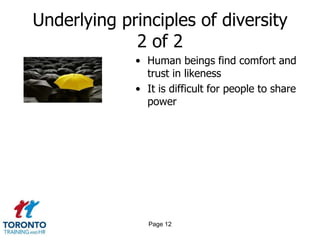
• Human beings find comfort and
trust in likeness
• It is difficult for people to share
power
Page 12
Page 13
Drivers for diversity
awareness
Drivers for diversity awareness
• Demographic trends
• Business environment
• Legal impetus
Page 14
Page 15
The business case for
diversity and inclusion
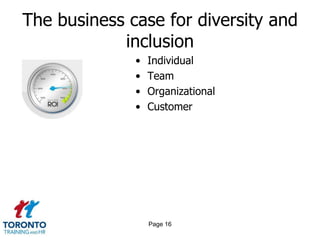
The business case for diversity and
inclusion
• Individual
• Team
• Organizational
• Customer
Page 16
Page 17
Dimensions of inclusion
• Fairness of employment
practices
• Inclusion and participation in
decision making
• Inclusive management and
leadership
• Integration of differences
• Information access and open
communication
Page 18
Page 19
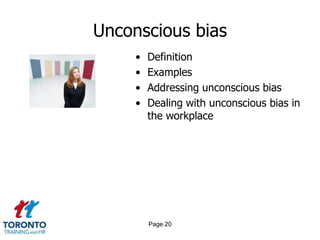
Unconscious bias
Unconscious bias
• Definition
• Examples
• Addressing unconscious bias
• Dealing with unconscious bias in
the workplace
Page 20
Page 21
Ways to reduce bias
Ways to reduce bias
• Implicit bias
• Sample bias
• Become mindful of your own
biases
• Identify alleged benefits of bias
• Identify biases that damage
• Dissect biases to weaken
foundation
• Identify shared kinship
Page 22
Page 23
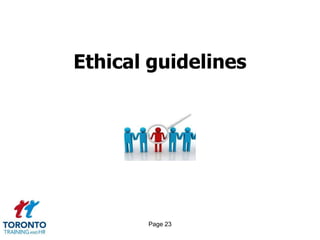
Ethical guidelines
Ethical guidelines
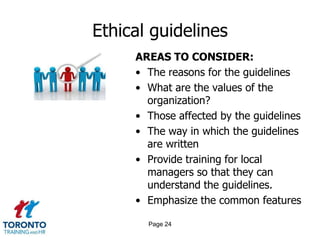
AREAS TO CONSIDER:
• The reasons for the guidelines
• What are the values of the
organization?
• Those affected by the guidelines
• The way in which the guidelines
are written
• Provide training for local
managers so that they can
understand the guidelines.
• Emphasize the common features
Page 24
Page 25
Cultural competence
Cultural competence 1 of 2
• Communication
• Emblems
• Illustrators
• Regulators
• Affect displays
• Adaptors
• Learning cultural competence
Page 26
Cultural competence 2 of 2
CULTURAL PROFICIENCY
 Cultural destructiveness
 Cultural incapacity
 Cultural blindness
 Cultural pre-competence
 Cultural stereotypes
Page 27
Page 28
Employment equity
Employment equity 1 of 2
• Definition
• Disadvantages in employment
• Benefits of employment equity
• Pay equity and the gender pay
gap
Page 29
Employment equity 2 of 2
STAGES INVOLVED
• Senior management
commitment
• Data collection and analysis
• Employment systems review
• Establishment of a work plan
• Implementation
• Evaluation, monitoring and
revision
Page 30
Page 31
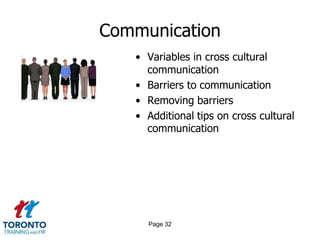
Communication
Communication
• Variables in cross cultural
communication
• Barriers to communication
• Removing barriers
• Additional tips on cross cultural
communication
Page 32
Page 33
Racism in Canada
Racism in Canada
• History
• 21st Century perspective
• Situation in Peterborough
Page 34
Page 35
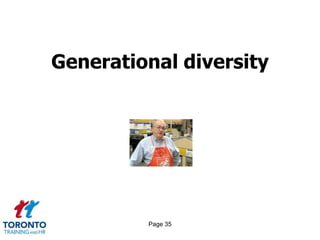
Generational diversity
Generational diversity 1 of 2
• What are the different
generations?
• Benefits of leveraging the
multigenerational workforce
• Influencing factors
• Generational clashes
• Maximizing generational
differences during times of
change
• Bringing the best out of people
• Developing a plan
Page 36
Generational diversity 2 of 2
KEY WORKPLACE DIMENSIONS
• Work style
• Authority/leadership
• Communication
• Recognition/reward
• Work/family
• Loyalty
• Technology
Page 37
Page 38
International managers
• Reasons for low numbers of
female international managers
• Considerations when selecting
suitable talent
Page 39
Page 40
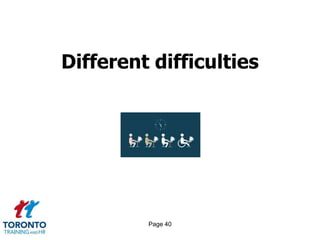
Different difficulties
Different difficulties 1 of 2
• Ableness/disability
• Age
• Athleticism
• Biological sex
• Economic class
• Educational level
• Ethnicity/culture
• Gender identity/expression
• Geographic region
• Hierarchical level
• Immigration status
• Job function
Page 41
Different difficulties 2 of 2
• Marital status
• National origin
• Parental status
• Race
• Religion/spirituality
• Sexual orientation
• Size/appearance
• Skin colour; physical
characteristics
• Use of English
• Working style
• Years of experience
Page 42
Page 43
Best diversity employers
2013
Best diversity employers 2013 1 of 4
Page 44
Best diversity employers 2013 2 of 4
Page 45
Best diversity employers 2013 3 of 4
Page 46
Best diversity employers 2013 4 of 4
Page 47
Page 48
Valuing diversity in the
workplace
Valuing diversity in the workplace
• Organization-wide image
• Concern for equality
• Career development
• Hiring practices
• Management and leadership
Page 49
Page 50
Conclusion and questions
Page 51
Conclusion and questions
Summary
Videos
Questions

Improving diversity September 2013

  • 1.
    Improving diversity by TorontoTraining and HR September 2013
  • 2.
    CONTENTS 5-7 Definitions 8-9 Typesof diversity 10-12 Underlying principles of diversity 13-14 Drives for diversity awareness 15-16 The business case for diversity and inclusion 17-18 Dimensions of inclusion 19-20 Unconscious bias 21-22 Ways to reduce bias 23-24 Ethical guidelines 25-27 Cultural competence 28-30 Employment equity 31-32 Communication 33-34 Racism in Canada 35-37 Generational diversity 38-39 International managers 40-42 Different difficulties 43-47 Best diversity employers 2013 48-49 Valuing diversity in the workplace 50-51 Conclusion and questions Page 2
  • 3.
  • 4.
    Page 4 Introduction toToronto Training and HR Toronto Training and HR is a specialist training and human resources consultancy headed by Timothy Holden 10 years in banking 10 years in training and human resources Freelance practitioner since 2006 The core services provided by Toronto Training and HR are: Training event design Training event delivery Reducing costs, saving time plus improving employee engagement and morale Services for job seekers
  • 5.
  • 6.
    Definitions 1 of2 • Diversity • Primary dimensions • Secondary dimensions • Inclusion Page 6
  • 7.
    Definitions 2 of2 • Barriers • Discrimination • Prejudice • Privilege • Stereotype Page 7
  • 8.
    Page 8 Types ofdiversity
  • 9.
    Types of diversity •Social category diversity • Informational diversity • Value diversity Page 9
  • 10.
  • 11.
    Underlying principles ofdiversity 1 of 2 • Diversity is an inside job, meaning that diversity is not about “them” • Diversity goes beyond race and gender • No one is the target of blame for current or past inequities • Human beings are ethnocentric • The human species resists changes Page 11
  • 12.
    Underlying principles ofdiversity 2 of 2 • Human beings find comfort and trust in likeness • It is difficult for people to share power Page 12
  • 13.
    Page 13 Drivers fordiversity awareness
  • 14.
    Drivers for diversityawareness • Demographic trends • Business environment • Legal impetus Page 14
  • 15.
    Page 15 The businesscase for diversity and inclusion
  • 16.
    The business casefor diversity and inclusion • Individual • Team • Organizational • Customer Page 16
  • 17.
  • 18.
    Dimensions of inclusion •Fairness of employment practices • Inclusion and participation in decision making • Inclusive management and leadership • Integration of differences • Information access and open communication Page 18
  • 19.
  • 20.
    Unconscious bias • Definition •Examples • Addressing unconscious bias • Dealing with unconscious bias in the workplace Page 20
  • 21.
    Page 21 Ways toreduce bias
  • 22.
    Ways to reducebias • Implicit bias • Sample bias • Become mindful of your own biases • Identify alleged benefits of bias • Identify biases that damage • Dissect biases to weaken foundation • Identify shared kinship Page 22
  • 23.
  • 24.
    Ethical guidelines AREAS TOCONSIDER: • The reasons for the guidelines • What are the values of the organization? • Those affected by the guidelines • The way in which the guidelines are written • Provide training for local managers so that they can understand the guidelines. • Emphasize the common features Page 24
  • 25.
  • 26.
    Cultural competence 1of 2 • Communication • Emblems • Illustrators • Regulators • Affect displays • Adaptors • Learning cultural competence Page 26
  • 27.
    Cultural competence 2of 2 CULTURAL PROFICIENCY  Cultural destructiveness  Cultural incapacity  Cultural blindness  Cultural pre-competence  Cultural stereotypes Page 27
  • 28.
  • 29.
    Employment equity 1of 2 • Definition • Disadvantages in employment • Benefits of employment equity • Pay equity and the gender pay gap Page 29
  • 30.
    Employment equity 2of 2 STAGES INVOLVED • Senior management commitment • Data collection and analysis • Employment systems review • Establishment of a work plan • Implementation • Evaluation, monitoring and revision Page 30
  • 31.
  • 32.
    Communication • Variables incross cultural communication • Barriers to communication • Removing barriers • Additional tips on cross cultural communication Page 32
  • 33.
  • 34.
    Racism in Canada •History • 21st Century perspective • Situation in Peterborough Page 34
  • 35.
  • 36.
    Generational diversity 1of 2 • What are the different generations? • Benefits of leveraging the multigenerational workforce • Influencing factors • Generational clashes • Maximizing generational differences during times of change • Bringing the best out of people • Developing a plan Page 36
  • 37.
    Generational diversity 2of 2 KEY WORKPLACE DIMENSIONS • Work style • Authority/leadership • Communication • Recognition/reward • Work/family • Loyalty • Technology Page 37
  • 38.
  • 39.
    International managers • Reasonsfor low numbers of female international managers • Considerations when selecting suitable talent Page 39
  • 40.
  • 41.
    Different difficulties 1of 2 • Ableness/disability • Age • Athleticism • Biological sex • Economic class • Educational level • Ethnicity/culture • Gender identity/expression • Geographic region • Hierarchical level • Immigration status • Job function Page 41
  • 42.
    Different difficulties 2of 2 • Marital status • National origin • Parental status • Race • Religion/spirituality • Sexual orientation • Size/appearance • Skin colour; physical characteristics • Use of English • Working style • Years of experience Page 42
  • 43.
    Page 43 Best diversityemployers 2013
  • 44.
    Best diversity employers2013 1 of 4 Page 44
  • 45.
    Best diversity employers2013 2 of 4 Page 45
  • 46.
    Best diversity employers2013 3 of 4 Page 46
  • 47.
    Best diversity employers2013 4 of 4 Page 47
  • 48.
    Page 48 Valuing diversityin the workplace
  • 49.
    Valuing diversity inthe workplace • Organization-wide image • Concern for equality • Career development • Hiring practices • Management and leadership Page 49
  • 50.
  • 51.
    Page 51 Conclusion andquestions Summary Videos Questions