By-
Group 4
HASNAIN KAREEM
Managing Diversity at
workplace
Diversity:
The concept of diversity is based on individual
acceptance and respect.
It is an understanding that individuals are unique
and different.
Cultural diversity acknowledges the existence of
broad cultural groups within Indian culture.
Cultural diversity has been part of India's history,
and through it, India culture is constantly
developing.
Cultural diversity
Elements of Diversity
Age
Gender
Ethnicity
Race
Physical Ability
Sexual Orientation
Physical
Characteristics
Income
Education
Marital Status
Religious Beliefs
Geographic Location
Parental Status
Personality Type
Ways to incorporate diversity:
Businesses find ways to incorporate diversity into
their workplaces without causing major changes to
the way their companies operate.
Incorporating diversity practices in a workplace can
include
Recruiting from diverse talent pools to make the
company open to employees from various
backgrounds.
Diversity may be infused into advertising practices
to ensure products and services are targeted to all
consumers who represent the target market,
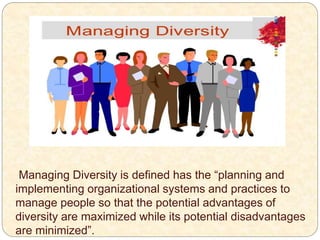
Managing Diversity is defined has the “planning and
implementing organizational systems and practices to
manage people so that the potential advantages of
diversity are maximized while its potential disadvantages
are minimized”.
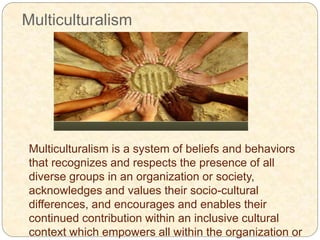
Multiculturalism
Multiculturalism is a system of beliefs and behaviors
that recognizes and respects the presence of all
diverse groups in an organization or society,
acknowledges and values their socio-cultural
differences, and encourages and enables their
continued contribution within an inclusive cultural
context which empowers all within the organization or
Key to growth:
Diversity management is the key to growth in
today’s fiercely competitive global marketplace.
No longer can America’s corporations hide behind
their lack of cultural intelligence.
Organizations that seek global market relevancy
must embrace diversity – in how they think, act and
innovate.
Diversity can no longer just be about making the
numbers, but rather how an organization treats its
people authentically down to the roots of its
business model.
In today’s new workplace, diversity management is
The Future of Diversity:
To better understand the future of diversity
management and its role as a business growth
enabler, think back to when Information Technology
(IT) was viewed as just a cost center.
IT was not associated with driving business growth 20
years ago, but rather as a required cost of doing
business.
 Just like diversity today, many people then thought IT
got in the way of business. Today, IT is considered a
profit center by many and a high priority for
organizations as a business growth enabler.
 In fact, many CIOs (Chief Information Officers) are
next in line for the CEO role. As a result, to be an
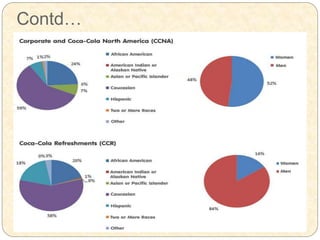
Contd…
Diversity management will begin to develop rapidly, out
from under the traditional human resources and talent
acquisition roles, to assume more dotted-line
responsibilities that will touch corporate strategy,
corporate social responsibility, organizational design &
effectiveness, corporate marketing and even sales.
Therefore, the requirements to be an effective CDO
will mean that they must include operating more
holistically in a general management and operational
capacity to ensure that diversity becomes an
embedded mindset with common threads that touch all
functional areas (internally) and the supply chain
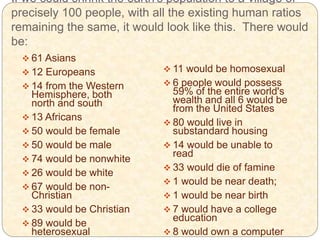
If we could shrink the earth's population to a village of
precisely 100 people, with all the existing human ratios
remaining the same, it would look like this. There would
be:
 61 Asians
 12 Europeans
 14 from the Western
Hemisphere, both
north and south
 13 Africans
 50 would be female
 50 would be male
 74 would be nonwhite
 26 would be white
 67 would be non-
Christian
 33 would be Christian
 89 would be
heterosexual
 11 would be homosexual
 6 people would possess
59% of the entire world's
wealth and all 6 would be
from the United States
 80 would live in
substandard housing
 14 would be unable to
read
 33 would die of famine
 1 would be near death;
 1 would be near birth
 7 would have a college
education
 8 would own a computer
Women in the Workplace:
The need to understand diversity is also driven by
women in the workplace.
Today's workforce has the highest levels of
employment participation ever by women.
The number of dual income families and single
working mothers has increased.
Change in the family structure means that there
are fewer men and women in traditional family
roles.
Therefore, diversity issues cut across both race
and gender.
How Diversity Initiatives Help an
Organization Keep a Competitive Human
Resources Advantage
 Improves corporate
culture
 Improves employee
morale
 Easier recruitment of
employees
 Enables the
organization to move
into emerging markets
 Increases creativity
 Access to overseas
markets.
 Reduction in skill
 Decreased
interpersonal conflict
among employees
 Improves client
relations
 Increases productivity
 Improves the
organization`s bottom
line
 Maximizes brand
identity
 Responsive service
Benefits of Diverse workplace:
Customer service improves when staff understand
and can communicate skillfully with customers from
a range of backgrounds.
The community is also more likely to identify with
and relate to companies that reflect its level of
diversity
Workplace diversity where staff are encouraged to
work in their areas of strength and capability.
Valuing diversity where staff potential is recognized
and developed.
Productive diversity is valuing different experience,
perspectives, skills and the cross-transfer and
integration of these into the company and local
economy.
Possible Barriers
 Limiting area of consideration
 Lack of diverse applicant pool in STEM positions
 Lack of diversity at the senior ranks
 Categorizing people into certain positions
 Always recruiting from same source
 Grooming/developing only one person
 Pre-selection
 “Golf course” meetings
How to Manage Diversity
Steps in Managing Diversity Effectively
Secure top management commitment
Alternative work arrangements
Increase diversity skills
Organizational assessment
Attracting employees
Accommodating work and family needs
Diversity Awareness Programs
5-16
Provide members with accurate information
about diversity
Uncover personal biases and stereotypes
Assess personal beliefs, attitudes, and values
and learning about other points of view
Develop an atmosphere in which people feel
free to share their differing perspectives
Improve understanding of others who are
different
Consequences of Ignoring Diversity:
Ignoring diversity issues costs time, money, and
efficiency.
 Some of the consequences can include
Unhealthy tensions between people of differing
gender, race, ethnicity, age, abilities, etc.;
Loss of productivity because of increased conflict;
Inability to attract and retain talented people of all
kinds;
Complaints and legal actions;
Inability to retain women and people of color,
resulting in lost investments in recruitment and
training.
Considerations and Warnings:
As workplaces become more diverse, employers are
encouraged to take note of communication, training,
recruiting practices and management.
Diverse workforces may be plagued with problems if
employees aren't equipped with the knowledge they
need to communicate effectively with their coworkers,
regardless of their differences.
Diversity training can help reduce interpersonal
conflicts within a company. As a result of efforts to
train employees on diversity issues, management may
see an increase in training and development costs.
Allbusiness.com, an online resource for
entrepreneurs, notes some businesses believe that
costs of diversity are higher than its benefits because
Example 1: Coca-cola Company
 Diversity is at the heart of our
business.
 We strive to create a work
environment that provides all our
associates equal access to
information, development and
opportunity.
 By building an inclusive
workplace environment, we seek
to leverage our global team of
associates, which is rich in
diverse people, talent and ideas.
 We see diversity as more than
just policies and practices.
 It is an integral part of who we
Contd…
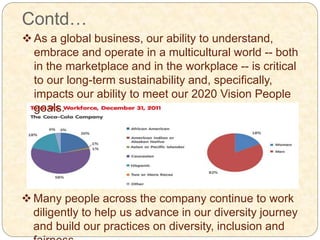
As a global business, our ability to understand,
embrace and operate in a multicultural world -- both
in the marketplace and in the workplace -- is critical
to our long-term sustainability and, specifically,
impacts our ability to meet our 2020 Vision People
goals.
Many people across the company continue to work
diligently to help us advance in our diversity journey
and build our practices on diversity, inclusion and
Contd…
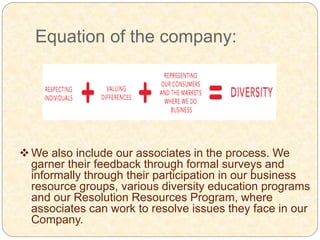
Equation of the company:
We also include our associates in the process. We
garner their feedback through formal surveys and
informally through their participation in our business
resource groups, various diversity education programs
and our Resolution Resources Program, where
associates can work to resolve issues they face in our
Company.
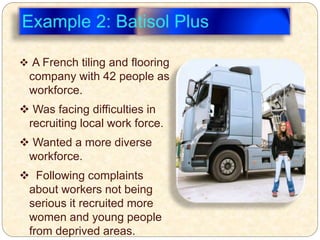
 A French tiling and flooring
company with 42 people as
workforce.
 Was facing difficulties in
recruiting local work force.
 Wanted a more diverse
workforce.
 Following complaints
about workers not being
serious it recruited more
women and young people
from deprived areas.
Suspected reason was discrimination.
 One day full training regarding -
 Power of stereotypes
 Benefits of diversity
 Problems were surprisingly resolved. Employees
were more-
 Efficient
 Independent
 Motivated
 Unexpected outcome-
 Friendship emerged between workers from very
different backgrounds.
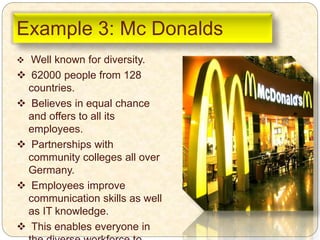
Example 3: Mc Donalds
 Well known for diversity.
 62000 people from 128
countries.
 Believes in equal chance
and offers to all its
employees.
 Partnerships with
community colleges all over
Germany.
 Employees improve
communication skills as well
as IT knowledge.
 This enables everyone in
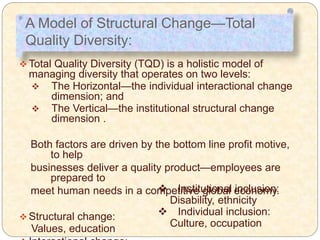
A Model of Structural Change—Total
Quality Diversity:
 Total Quality Diversity (TQD) is a holistic model of
managing diversity that operates on two levels:
 The Horizontal—the individual interactional change
dimension; and
 The Vertical—the institutional structural change
dimension .
Both factors are driven by the bottom line profit motive,
to help
businesses deliver a quality product—employees are
prepared to
meet human needs in a competitive global economy.
 Structural change:
Values, education
 Institutional inclusion:
Disability, ethnicity
 Individual inclusion:
Culture, occupation
Conclusion:
 A diverse workforce is a reflection of a changing world
and marketplace.
 Diverse work teams bring high value to organizations.
 Respecting individual differences will benefit the
workplace by creating a competitive edge and increasing
work productivity.
 Diversity management benefits associates by creating a
fair and safe environment where everyone has access to
opportunities and challenges.
 Management tools in a diverse workforce should be used
to educate everyone about diversity and its issues,
including laws and regulations.

pptx.pptxpptx.pptxpptx.pptxpptx.pptx.pptx

  • 1.
  • 2.
    Diversity: The concept ofdiversity is based on individual acceptance and respect. It is an understanding that individuals are unique and different. Cultural diversity acknowledges the existence of broad cultural groups within Indian culture. Cultural diversity has been part of India's history, and through it, India culture is constantly developing. Cultural diversity
  • 3.
    Elements of Diversity Age Gender Ethnicity Race PhysicalAbility Sexual Orientation Physical Characteristics Income Education Marital Status Religious Beliefs Geographic Location Parental Status Personality Type
  • 4.
    Ways to incorporatediversity: Businesses find ways to incorporate diversity into their workplaces without causing major changes to the way their companies operate. Incorporating diversity practices in a workplace can include Recruiting from diverse talent pools to make the company open to employees from various backgrounds. Diversity may be infused into advertising practices to ensure products and services are targeted to all consumers who represent the target market,
  • 5.
    Managing Diversity isdefined has the “planning and implementing organizational systems and practices to manage people so that the potential advantages of diversity are maximized while its potential disadvantages are minimized”.
  • 6.
    Multiculturalism Multiculturalism is asystem of beliefs and behaviors that recognizes and respects the presence of all diverse groups in an organization or society, acknowledges and values their socio-cultural differences, and encourages and enables their continued contribution within an inclusive cultural context which empowers all within the organization or
  • 7.
    Key to growth: Diversitymanagement is the key to growth in today’s fiercely competitive global marketplace. No longer can America’s corporations hide behind their lack of cultural intelligence. Organizations that seek global market relevancy must embrace diversity – in how they think, act and innovate. Diversity can no longer just be about making the numbers, but rather how an organization treats its people authentically down to the roots of its business model. In today’s new workplace, diversity management is
  • 8.
    The Future ofDiversity: To better understand the future of diversity management and its role as a business growth enabler, think back to when Information Technology (IT) was viewed as just a cost center. IT was not associated with driving business growth 20 years ago, but rather as a required cost of doing business.  Just like diversity today, many people then thought IT got in the way of business. Today, IT is considered a profit center by many and a high priority for organizations as a business growth enabler.  In fact, many CIOs (Chief Information Officers) are next in line for the CEO role. As a result, to be an
  • 9.
    Contd… Diversity management willbegin to develop rapidly, out from under the traditional human resources and talent acquisition roles, to assume more dotted-line responsibilities that will touch corporate strategy, corporate social responsibility, organizational design & effectiveness, corporate marketing and even sales. Therefore, the requirements to be an effective CDO will mean that they must include operating more holistically in a general management and operational capacity to ensure that diversity becomes an embedded mindset with common threads that touch all functional areas (internally) and the supply chain
  • 10.
    If we couldshrink the earth's population to a village of precisely 100 people, with all the existing human ratios remaining the same, it would look like this. There would be:  61 Asians  12 Europeans  14 from the Western Hemisphere, both north and south  13 Africans  50 would be female  50 would be male  74 would be nonwhite  26 would be white  67 would be non- Christian  33 would be Christian  89 would be heterosexual  11 would be homosexual  6 people would possess 59% of the entire world's wealth and all 6 would be from the United States  80 would live in substandard housing  14 would be unable to read  33 would die of famine  1 would be near death;  1 would be near birth  7 would have a college education  8 would own a computer
  • 11.
    Women in theWorkplace: The need to understand diversity is also driven by women in the workplace. Today's workforce has the highest levels of employment participation ever by women. The number of dual income families and single working mothers has increased. Change in the family structure means that there are fewer men and women in traditional family roles. Therefore, diversity issues cut across both race and gender.
  • 12.
    How Diversity InitiativesHelp an Organization Keep a Competitive Human Resources Advantage  Improves corporate culture  Improves employee morale  Easier recruitment of employees  Enables the organization to move into emerging markets  Increases creativity  Access to overseas markets.  Reduction in skill  Decreased interpersonal conflict among employees  Improves client relations  Increases productivity  Improves the organization`s bottom line  Maximizes brand identity  Responsive service
  • 13.
    Benefits of Diverseworkplace: Customer service improves when staff understand and can communicate skillfully with customers from a range of backgrounds. The community is also more likely to identify with and relate to companies that reflect its level of diversity Workplace diversity where staff are encouraged to work in their areas of strength and capability. Valuing diversity where staff potential is recognized and developed. Productive diversity is valuing different experience, perspectives, skills and the cross-transfer and integration of these into the company and local economy.
  • 14.
    Possible Barriers  Limitingarea of consideration  Lack of diverse applicant pool in STEM positions  Lack of diversity at the senior ranks  Categorizing people into certain positions  Always recruiting from same source  Grooming/developing only one person  Pre-selection  “Golf course” meetings
  • 15.
    How to ManageDiversity Steps in Managing Diversity Effectively Secure top management commitment Alternative work arrangements Increase diversity skills Organizational assessment Attracting employees Accommodating work and family needs
  • 16.
    Diversity Awareness Programs 5-16 Providemembers with accurate information about diversity Uncover personal biases and stereotypes Assess personal beliefs, attitudes, and values and learning about other points of view Develop an atmosphere in which people feel free to share their differing perspectives Improve understanding of others who are different
  • 17.
    Consequences of IgnoringDiversity: Ignoring diversity issues costs time, money, and efficiency.  Some of the consequences can include Unhealthy tensions between people of differing gender, race, ethnicity, age, abilities, etc.; Loss of productivity because of increased conflict; Inability to attract and retain talented people of all kinds; Complaints and legal actions; Inability to retain women and people of color, resulting in lost investments in recruitment and training.
  • 18.
    Considerations and Warnings: Asworkplaces become more diverse, employers are encouraged to take note of communication, training, recruiting practices and management. Diverse workforces may be plagued with problems if employees aren't equipped with the knowledge they need to communicate effectively with their coworkers, regardless of their differences. Diversity training can help reduce interpersonal conflicts within a company. As a result of efforts to train employees on diversity issues, management may see an increase in training and development costs. Allbusiness.com, an online resource for entrepreneurs, notes some businesses believe that costs of diversity are higher than its benefits because
  • 19.
    Example 1: Coca-colaCompany  Diversity is at the heart of our business.  We strive to create a work environment that provides all our associates equal access to information, development and opportunity.  By building an inclusive workplace environment, we seek to leverage our global team of associates, which is rich in diverse people, talent and ideas.  We see diversity as more than just policies and practices.  It is an integral part of who we
  • 20.
    Contd… As a globalbusiness, our ability to understand, embrace and operate in a multicultural world -- both in the marketplace and in the workplace -- is critical to our long-term sustainability and, specifically, impacts our ability to meet our 2020 Vision People goals. Many people across the company continue to work diligently to help us advance in our diversity journey and build our practices on diversity, inclusion and
  • 21.
  • 22.
    Equation of thecompany: We also include our associates in the process. We garner their feedback through formal surveys and informally through their participation in our business resource groups, various diversity education programs and our Resolution Resources Program, where associates can work to resolve issues they face in our Company.
  • 23.
     A Frenchtiling and flooring company with 42 people as workforce.  Was facing difficulties in recruiting local work force.  Wanted a more diverse workforce.  Following complaints about workers not being serious it recruited more women and young people from deprived areas.
  • 24.
    Suspected reason wasdiscrimination.  One day full training regarding -  Power of stereotypes  Benefits of diversity  Problems were surprisingly resolved. Employees were more-  Efficient  Independent  Motivated  Unexpected outcome-  Friendship emerged between workers from very different backgrounds.
  • 25.
    Example 3: McDonalds  Well known for diversity.  62000 people from 128 countries.  Believes in equal chance and offers to all its employees.  Partnerships with community colleges all over Germany.  Employees improve communication skills as well as IT knowledge.  This enables everyone in
  • 26.
    A Model ofStructural Change—Total Quality Diversity:  Total Quality Diversity (TQD) is a holistic model of managing diversity that operates on two levels:  The Horizontal—the individual interactional change dimension; and  The Vertical—the institutional structural change dimension . Both factors are driven by the bottom line profit motive, to help businesses deliver a quality product—employees are prepared to meet human needs in a competitive global economy.  Structural change: Values, education  Institutional inclusion: Disability, ethnicity  Individual inclusion: Culture, occupation
  • 27.
    Conclusion:  A diverseworkforce is a reflection of a changing world and marketplace.  Diverse work teams bring high value to organizations.  Respecting individual differences will benefit the workplace by creating a competitive edge and increasing work productivity.  Diversity management benefits associates by creating a fair and safe environment where everyone has access to opportunities and challenges.  Management tools in a diverse workforce should be used to educate everyone about diversity and its issues, including laws and regulations.