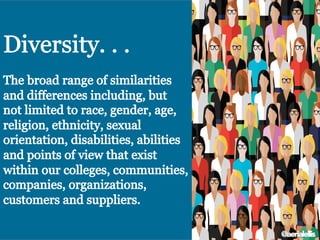
@aerialellis
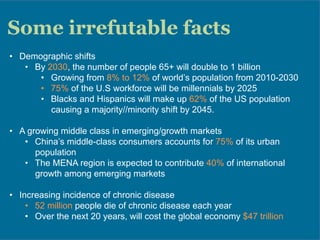
•  Demographic shifts
•  By 2030, the number of people 65+ will double to 1 billion
•  Growing from 8% to 12% of world’s population from 2010-2030
•  75% of the U.S workforce will be millennials by 2025
•  Blacks and Hispanics will make up 62% of the US population
causing a majority//minority shift by 2045.
•  A growing middle class in emerging/growth markets
•  China’s middle-class consumers accounts for 75% of its urban
population
•  The MENA region is expected to contribute 40% of international
growth among emerging markets
•  Increasing incidence of chronic disease
•  52 million people die of chronic disease each year
•  Over the next 20 years, will cost the global economy $47 trillion
Some irrefutable facts
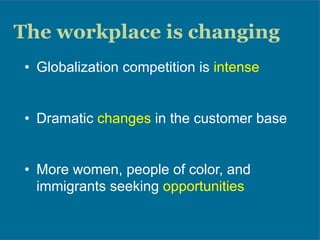
The workplace is changing
•  Globalization competition is intense
•  Dramatic changes in the customer base
•  More women, people of color, and
immigrants seeking opportunities
	
  
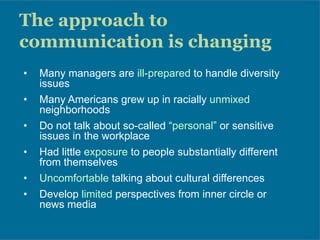
The approach to
communication is changing
•  Many managers are ill-prepared to handle diversity
issues
•  Many Americans grew up in racially unmixed
neighborhoods
•  Do not talk about so-called “personal” or sensitive
issues in the workplace
•  Had little exposure to people substantially different
from themselves
•  Uncomfortable talking about cultural differences
•  Develop limited perspectives from inner circle or
news media
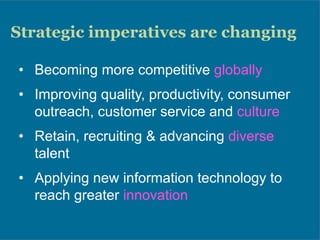
Strategic imperatives are changing
•  Becoming more competitive globally
•  Improving quality, productivity, consumer
outreach, customer service and culture
•  Retain, recruiting & advancing diverse
talent
•  Applying new information technology to
reach greater innovation
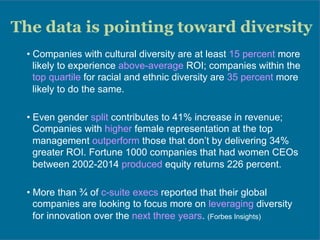
The data is pointing toward diversity
• Companies with cultural diversity are at least 15 percent more
likely to experience above-average ROI; companies within the
top quartile for racial and ethnic diversity are 35 percent more
likely to do the same.
• Even gender split contributes to 41% increase in revenue;
Companies with higher female representation at the top
management outperform those that don’t by delivering 34%
greater ROI. Fortune 1000 companies that had women CEOs
between 2002-2014 produced equity returns 226 percent.
• More than ¾ of c-suite execs reported that their global
companies are looking to focus more on leveraging diversity
for innovation over the next three years. (Forbes Insights)


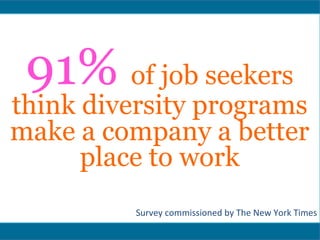
91% of job seekers
think diversity programs
make a company a better
place to work


Survey	
  commissioned	
  by	
  The	
  New	
  York	
  Times	
  
@aerialellis
.	
  
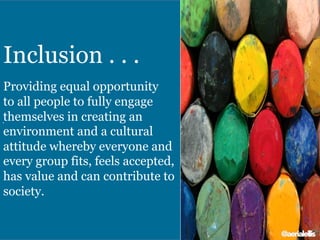
Inclusion . . .
Providing equal opportunity
to all people to fully engage
themselves in creating an
environment and a cultural
attitude whereby everyone and
every group fits, feels accepted,
has value and can contribute to
society.
@aerialellis
 	
  
Diversity	
  is	
  the	
  measure	
  or	
  the	
  varia9on	
  of	
  social	
  and	
  cultural	
  iden99es	
  among	
  employees	
  
exis9ng	
  together	
  in	
  a	
  defined	
  se@ng.	


Inclusion	
  is	
  the	
  mechanism	
  that	
  welcomes	
  all	
  employees	
  to	
  par9cipate	
  and	
  creates	
  feeling	
  they	
  
belong;	
  the	
  state	
  of	
  diversity	
  being	
  acknowledged,	
  heard,	
  respected	
  and	
  supported.	
  
 
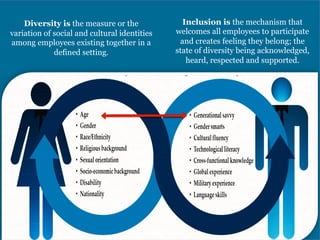
Diversity is the measure or the
variation of social and cultural identities
among employees existing together in a
defined setting.
Inclusion is the mechanism that
welcomes all employees to participate
and creates feeling they belong; the
state of diversity being acknowledged,
heard, respected and supported.
.	
  
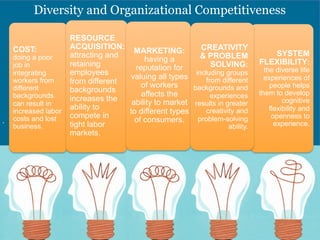
Diversity and Organizational Competitiveness
COST:
doing a poor
job in
integrating
workers from
different
backgrounds
can result in
increased labor
costs and lost
business.
RESOURCE
ACQUISITION:
attracting and
retaining
employees
from different
backgrounds
increases the
ability to
compete in
tight labor
markets.
MARKETING:
having a
reputation for
valuing all types
of workers
affects the
ability to market
to different types
of consumers.
SYSTEM
FLEXIBILITY:
the diverse life
experiences of
people helps
them to develop
cognitive
flexibility and
openness to
experience.
CREATIVITY
& PROBLEM
SOLVING:
including groups
from different
backgrounds and
experiences
results in greater
creativity and
problem-solving
ability.
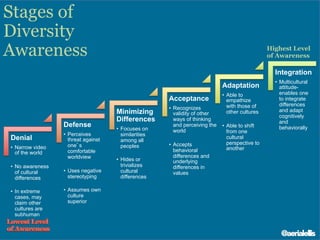
Highest Level
of Awareness
Stages of
Diversity
Awareness
Denial
•  Narrow video
of the world
•  No awareness
of cultural
differences
•  In extreme
cases, may
claim other
cultures are
subhuman
Defense
•  Perceives
threat against
one’s
comfortable
worldview
•  Uses negative
stereotyping
•  Assumes own
culture
superior
Minimizing
Differences
•  Focuses on
similarities
among all
peoples
•  Hides or
trivializes
cultural
differences
Acceptance
•  Recognizes
validity of other
ways of thinking
and perceiving the
world
•  Accepts
behavioral
differences and
underlying
differences in
values
Adaptation
•  Able to
empathize
with those of
other cultures
•  Able to shift
from one
cultural
perspective to
another
Integration
•  Multicultural
attitude-
enables one
to integrate
differences
and adapt
cognitively
and
behaviorally
@aerialellis
© 2013 Thomson/South-Western. All
rights reserved.
1–13
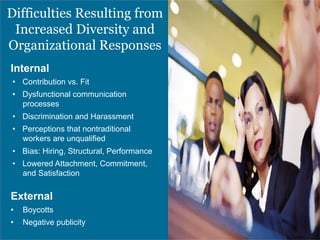
Difficulties Resulting from
Increased Diversity and
Organizational Responses
Internal
•  Contribution vs. Fit
•  Dysfunctional communication
processes
•  Discrimination and Harassment
•  Perceptions that nontraditional
workers are unqualified
•  Bias: Hiring, Structural, Performance
•  Lowered Attachment, Commitment,
and Satisfaction
External
•  Boycotts
•  Negative publicity
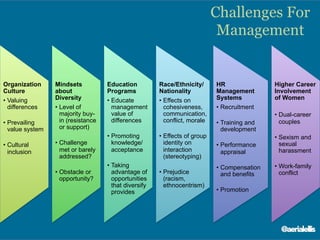
Challenges For
Management
Organization
Culture
•  Valuing
differences
•  Prevailing
value system
•  Cultural
inclusion
Mindsets
about
Diversity
•  Level of
majority buy-
in (resistance
or support)
•  Challenge
met or barely
addressed?
•  Obstacle or
opportunity?
Education
Programs
•  Educate
management
value of
differences
•  Promoting
knowledge/
acceptance
•  Taking
advantage of
opportunities
that diversify
provides
Race/Ethnicity/
Nationality
•  Effects on
cohesiveness,
communication,
conflict, morale
•  Effects of group
identity on
interaction
(stereotyping)
•  Prejudice
(racism,
ethnocentrism)
HR
Management
Systems
•  Recruitment
•  Training and
development
•  Performance
appraisal
•  Compensation
and benefits
•  Promotion
Higher Career
Involvement
of Women
•  Dual-career
couples
•  Sexism and
sexual
harassment
•  Work-family
conflict
@aerialellis
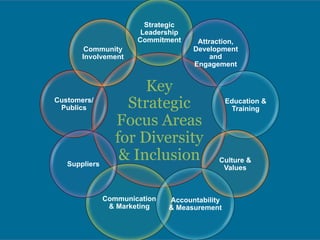
Key
Strategic
Focus Areas
for Diversity
& Inclusion
Strategic
Leadership
Commitment Attraction,
Development
and
Engagement
Education &
Training
Culture &
Values
Customers/
Publics
Communication
& Marketing
Suppliers
Accountability
& Measurement
Community
Involvement
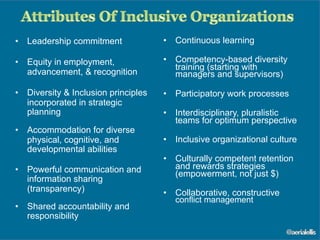
•  Leadership commitment
•  Equity in employment,
advancement, & recognition
•  Diversity & Inclusion principles
incorporated in strategic
planning
•  Accommodation for diverse
physical, cognitive, and
developmental abilities
•  Powerful communication and
information sharing
(transparency)
•  Shared accountability and
responsibility
•  Continuous learning
•  Competency-based diversity
training (starting with
managers and supervisors)
•  Participatory work processes
•  Interdisciplinary, pluralistic
teams for optimum perspective
•  Inclusive organizational culture
•  Culturally competent retention
and rewards strategies
(empowerment, not just $)
•  Collaborative, constructive
conflict management
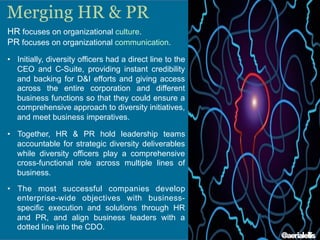
HR focuses on organizational culture.
PR focuses on organizational communication.
•  Initially, diversity officers had a direct line to the
CEO and C-Suite, providing instant credibility
and backing for D&I efforts and giving access
across the entire corporation and different
business functions so that they could ensure a
comprehensive approach to diversity initiatives,
and meet business imperatives.
•  Together, HR & PR hold leadership teams
accountable for strategic diversity deliverables
while diversity officers play a comprehensive
cross-functional role across multiple lines of
business.
•  The most successful companies develop
enterprise-wide objectives with business-
specific execution and solutions through HR
and PR, and align business leaders with a
dotted line into the CDO.
Merging HR & PR
@aerialellis
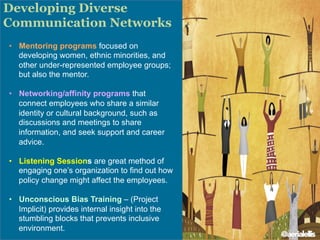
Developing Diverse
Communication Networks
•  Mentoring programs focused on
developing women, ethnic minorities, and
other under-represented employee groups;
but also the mentor.
•  Networking/affinity programs that
connect employees who share a similar
identity or cultural background, such as
discussions and meetings to share
information, and seek support and career
advice.
•  Listening Sessions are great method of
engaging one’s organization to find out how
policy change might affect the employees.
•  Unconscious Bias Training – (Project
Implicit) provides internal insight into the
stumbling blocks that prevents inclusive
environment.
@aerialellis
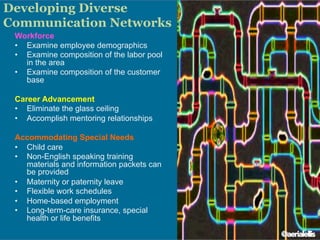
Workforce
•  Examine employee demographics
•  Examine composition of the labor pool
in the area
•  Examine composition of the customer
base
Career Advancement
•  Eliminate the glass ceiling
•  Accomplish mentoring relationships
Accommodating Special Needs
•  Child care
•  Non-English speaking training
materials and information packets can
be provided
•  Maternity or paternity leave
•  Flexible work schedules
•  Home-based employment
•  Long-term-care insurance, special
health or life benefits
Developing Diverse
Communication Networks
@aerialellis
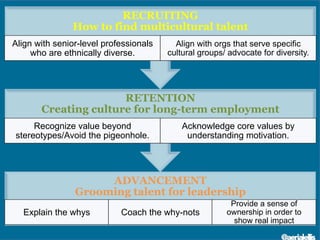
ADVANCEMENT
Grooming talent for leadership	
  
Explain the whys Coach the why-nots
Provide a sense of
ownership in order to
show real impact
RETENTION
Creating culture for long-term employment
Recognize value beyond
stereotypes/Avoid the pigeonhole.
Acknowledge core values by
understanding motivation.
RECRUITING
How to find multicultural talent
Align with senior-level professionals
who are ethnically diverse.
Align with orgs that serve specific
cultural groups/ advocate for diversity.
@aerialellis
21	
  
HOW	
  DO	
  WE	
  MEASURE	
  SUCCESS?	
  
• 	
  Organiza)onal	
  composi)on	
  
–  Workforce	
  demographics	
  vs.	
  RCLF/CLF	
  
–  Analysis	
  of	
  promo9ons,	
  separa9ons,	
  hiring…	


• 	
  Organiza)onal	
  culture	
  
–  Climate/employee	
  surveys	
  
–  EEO	
  complaints,	
  grievances,	
  disciplinary	
  ac9ons	
  
• Organiza)onal	
  performance	
  
–  Line	
  of	
  business	
  objec9ves	
  
–  Outcome	
  metrics:	
  quality,	
  service	
  level,	
  efficiency	


Correlate:	
  Establish	
  baseline	
  in	
  year	
  1,	
  then	
  correlate	
  annually	
  thereaXer	
  to	
  
gauge	
  progress.	
  
What	
  is	
  being	
  measured	
  at	
  your	
  company?	
  Are	
  
managers	
  being	
  rated	
  on	
  D&I	
  ini9a9ves,	
  such	
  
as	
  recruitment	
  and	
  advancement	
  of	
  
underrepresented	
  groups?	
  Are	
  compensa9on	
  
and	
  promo9on	
  9ed	
  to	
  achieving	
  D&I	
  
objec9ves?	
  In	
  order	
  to	
  meet	
  diversity	
  
objec9ves,	
  what	
  is	
  being	
  measured	
  must	
  be	
  
meaningful	
  from	
  the	
  perspec9ve	
  of	
  both	
  the	
  
company’s	
  diversity	
  and	
  business	
  objec9ves.	
  	
  
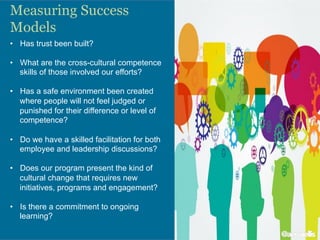
•  Has trust been built?
•  What are the cross-cultural competence
skills of those involved our efforts?
•  Has a safe environment been created
where people will not feel judged or
punished for their difference or level of
competence?
•  Do we have a skilled facilitation for both
employee and leadership discussions?
•  Does our program present the kind of
cultural change that requires new
initiatives, programs and engagement?
•  Is there a commitment to ongoing
learning?
	
  
Measuring Success
Models
@aerialellis
LET’S CONNECT
Aerial Ellis
Strategist | Speaker | Trainer
[Communication, Culture,
Diversity, Change, Community]
Talk to Me:
615.307.0460
Book Me:
hello@aerialellis.com
Work with Me
LinkedIn: aerialellis

Communicating the Case for Diversity and Inclusion

  • 1.
  • 2.
    •  Demographic shifts • By 2030, the number of people 65+ will double to 1 billion •  Growing from 8% to 12% of world’s population from 2010-2030 •  75% of the U.S workforce will be millennials by 2025 •  Blacks and Hispanics will make up 62% of the US population causing a majority//minority shift by 2045. •  A growing middle class in emerging/growth markets •  China’s middle-class consumers accounts for 75% of its urban population •  The MENA region is expected to contribute 40% of international growth among emerging markets •  Increasing incidence of chronic disease •  52 million people die of chronic disease each year •  Over the next 20 years, will cost the global economy $47 trillion Some irrefutable facts
  • 3.
    The workplace ischanging •  Globalization competition is intense •  Dramatic changes in the customer base •  More women, people of color, and immigrants seeking opportunities  
  • 4.
    The approach to communicationis changing •  Many managers are ill-prepared to handle diversity issues •  Many Americans grew up in racially unmixed neighborhoods •  Do not talk about so-called “personal” or sensitive issues in the workplace •  Had little exposure to people substantially different from themselves •  Uncomfortable talking about cultural differences •  Develop limited perspectives from inner circle or news media
  • 5.
    Strategic imperatives arechanging •  Becoming more competitive globally •  Improving quality, productivity, consumer outreach, customer service and culture •  Retain, recruiting & advancing diverse talent •  Applying new information technology to reach greater innovation
  • 6.
    The data ispointing toward diversity • Companies with cultural diversity are at least 15 percent more likely to experience above-average ROI; companies within the top quartile for racial and ethnic diversity are 35 percent more likely to do the same. • Even gender split contributes to 41% increase in revenue; Companies with higher female representation at the top management outperform those that don’t by delivering 34% greater ROI. Fortune 1000 companies that had women CEOs between 2002-2014 produced equity returns 226 percent. • More than ¾ of c-suite execs reported that their global companies are looking to focus more on leveraging diversity for innovation over the next three years. (Forbes Insights)    
  • 7.
      91% of jobseekers think diversity programs make a company a better place to work       Survey  commissioned  by  The  New  York  Times  
  • 8.
  • 9.
    .   Inclusion .. . Providing equal opportunity to all people to fully engage themselves in creating an environment and a cultural attitude whereby everyone and every group fits, feels accepted, has value and can contribute to society. @aerialellis
  • 10.
        Diversity  is  the  measure  or  the  varia9on  of  social  and  cultural  iden99es  among  employees   exis9ng  together  in  a  defined  se@ng.       Inclusion  is  the  mechanism  that  welcomes  all  employees  to  par9cipate  and  creates  feeling  they   belong;  the  state  of  diversity  being  acknowledged,  heard,  respected  and  supported.     Diversity is the measure or the variation of social and cultural identities among employees existing together in a defined setting. Inclusion is the mechanism that welcomes all employees to participate and creates feeling they belong; the state of diversity being acknowledged, heard, respected and supported.
  • 11.
    .   Diversity andOrganizational Competitiveness COST: doing a poor job in integrating workers from different backgrounds can result in increased labor costs and lost business. RESOURCE ACQUISITION: attracting and retaining employees from different backgrounds increases the ability to compete in tight labor markets. MARKETING: having a reputation for valuing all types of workers affects the ability to market to different types of consumers. SYSTEM FLEXIBILITY: the diverse life experiences of people helps them to develop cognitive flexibility and openness to experience. CREATIVITY & PROBLEM SOLVING: including groups from different backgrounds and experiences results in greater creativity and problem-solving ability.
  • 12.
    Highest Level of Awareness Stagesof Diversity Awareness Denial •  Narrow video of the world •  No awareness of cultural differences •  In extreme cases, may claim other cultures are subhuman Defense •  Perceives threat against one’s comfortable worldview •  Uses negative stereotyping •  Assumes own culture superior Minimizing Differences •  Focuses on similarities among all peoples •  Hides or trivializes cultural differences Acceptance •  Recognizes validity of other ways of thinking and perceiving the world •  Accepts behavioral differences and underlying differences in values Adaptation •  Able to empathize with those of other cultures •  Able to shift from one cultural perspective to another Integration •  Multicultural attitude- enables one to integrate differences and adapt cognitively and behaviorally @aerialellis
  • 13.
    © 2013 Thomson/South-Western.All rights reserved. 1–13 Difficulties Resulting from Increased Diversity and Organizational Responses Internal •  Contribution vs. Fit •  Dysfunctional communication processes •  Discrimination and Harassment •  Perceptions that nontraditional workers are unqualified •  Bias: Hiring, Structural, Performance •  Lowered Attachment, Commitment, and Satisfaction External •  Boycotts •  Negative publicity
  • 14.
    Challenges For Management Organization Culture •  Valuing differences • Prevailing value system •  Cultural inclusion Mindsets about Diversity •  Level of majority buy- in (resistance or support) •  Challenge met or barely addressed? •  Obstacle or opportunity? Education Programs •  Educate management value of differences •  Promoting knowledge/ acceptance •  Taking advantage of opportunities that diversify provides Race/Ethnicity/ Nationality •  Effects on cohesiveness, communication, conflict, morale •  Effects of group identity on interaction (stereotyping) •  Prejudice (racism, ethnocentrism) HR Management Systems •  Recruitment •  Training and development •  Performance appraisal •  Compensation and benefits •  Promotion Higher Career Involvement of Women •  Dual-career couples •  Sexism and sexual harassment •  Work-family conflict @aerialellis
  • 15.
    Key Strategic Focus Areas for Diversity &Inclusion Strategic Leadership Commitment Attraction, Development and Engagement Education & Training Culture & Values Customers/ Publics Communication & Marketing Suppliers Accountability & Measurement Community Involvement
  • 16.
    •  Leadership commitment • Equity in employment, advancement, & recognition •  Diversity & Inclusion principles incorporated in strategic planning •  Accommodation for diverse physical, cognitive, and developmental abilities •  Powerful communication and information sharing (transparency) •  Shared accountability and responsibility •  Continuous learning •  Competency-based diversity training (starting with managers and supervisors) •  Participatory work processes •  Interdisciplinary, pluralistic teams for optimum perspective •  Inclusive organizational culture •  Culturally competent retention and rewards strategies (empowerment, not just $) •  Collaborative, constructive conflict management
  • 17.
    HR focuses onorganizational culture. PR focuses on organizational communication. •  Initially, diversity officers had a direct line to the CEO and C-Suite, providing instant credibility and backing for D&I efforts and giving access across the entire corporation and different business functions so that they could ensure a comprehensive approach to diversity initiatives, and meet business imperatives. •  Together, HR & PR hold leadership teams accountable for strategic diversity deliverables while diversity officers play a comprehensive cross-functional role across multiple lines of business. •  The most successful companies develop enterprise-wide objectives with business- specific execution and solutions through HR and PR, and align business leaders with a dotted line into the CDO. Merging HR & PR @aerialellis
  • 18.
    Developing Diverse Communication Networks • Mentoring programs focused on developing women, ethnic minorities, and other under-represented employee groups; but also the mentor. •  Networking/affinity programs that connect employees who share a similar identity or cultural background, such as discussions and meetings to share information, and seek support and career advice. •  Listening Sessions are great method of engaging one’s organization to find out how policy change might affect the employees. •  Unconscious Bias Training – (Project Implicit) provides internal insight into the stumbling blocks that prevents inclusive environment. @aerialellis
  • 19.
    Workforce •  Examine employeedemographics •  Examine composition of the labor pool in the area •  Examine composition of the customer base Career Advancement •  Eliminate the glass ceiling •  Accomplish mentoring relationships Accommodating Special Needs •  Child care •  Non-English speaking training materials and information packets can be provided •  Maternity or paternity leave •  Flexible work schedules •  Home-based employment •  Long-term-care insurance, special health or life benefits Developing Diverse Communication Networks @aerialellis
  • 20.
    ADVANCEMENT Grooming talent forleadership   Explain the whys Coach the why-nots Provide a sense of ownership in order to show real impact RETENTION Creating culture for long-term employment Recognize value beyond stereotypes/Avoid the pigeonhole. Acknowledge core values by understanding motivation. RECRUITING How to find multicultural talent Align with senior-level professionals who are ethnically diverse. Align with orgs that serve specific cultural groups/ advocate for diversity. @aerialellis
  • 21.
    21   HOW  DO  WE  MEASURE  SUCCESS?   •   Organiza)onal  composi)on   –  Workforce  demographics  vs.  RCLF/CLF   –  Analysis  of  promo9ons,  separa9ons,  hiring…     •   Organiza)onal  culture   –  Climate/employee  surveys   –  EEO  complaints,  grievances,  disciplinary  ac9ons   • Organiza)onal  performance   –  Line  of  business  objec9ves   –  Outcome  metrics:  quality,  service  level,  efficiency     Correlate:  Establish  baseline  in  year  1,  then  correlate  annually  thereaXer  to   gauge  progress.   What  is  being  measured  at  your  company?  Are   managers  being  rated  on  D&I  ini9a9ves,  such   as  recruitment  and  advancement  of   underrepresented  groups?  Are  compensa9on   and  promo9on  9ed  to  achieving  D&I   objec9ves?  In  order  to  meet  diversity   objec9ves,  what  is  being  measured  must  be   meaningful  from  the  perspec9ve  of  both  the   company’s  diversity  and  business  objec9ves.     •  Has trust been built? •  What are the cross-cultural competence skills of those involved our efforts? •  Has a safe environment been created where people will not feel judged or punished for their difference or level of competence? •  Do we have a skilled facilitation for both employee and leadership discussions? •  Does our program present the kind of cultural change that requires new initiatives, programs and engagement? •  Is there a commitment to ongoing learning?   Measuring Success Models @aerialellis
  • 22.
    LET’S CONNECT Aerial Ellis Strategist| Speaker | Trainer [Communication, Culture, Diversity, Change, Community] Talk to Me: 615.307.0460 Book Me: hello@aerialellis.com Work with Me LinkedIn: aerialellis