Challenges of Managing a Multicultural Team
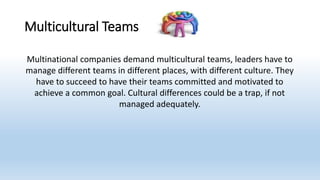
Multinational companies demand multicultural teams, leaders have to
manage different teams in different places, with different culture. They
have to succeed to have their teams committed and motivated to
achieve a common goal. Cultural differences could be a trap, if not
managed adequately.
Multicultural Teams
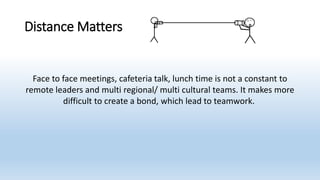
Distance Matters
Face to face meetings, cafeteria talk, lunch time is not a constant to
remote leaders and multi regional/ multi cultural teams. It makes more
difficult to create a bond, which lead to teamwork.
Communication
Clear communication regarding corporate values, roles and responsibilities,
objectives and best practices are crucial to give the direction to the team. Although
formal communication, via emails, business meetings, video conference are
instruments to guarantee understanding of the above, we cannot forget that
informal communication is essential to keep cohesiveness.
Remote leaders should take advantage of formal meeting to keep track of people’s
“state of mind”, client relationship status, work environment, even social and
economic country situation. These subjects directly affect team performance.
Independent Sources of Feedback
It also helps to have alternative sources of information regarding team
and individuals’ performance, attitude and behavior. Sometimes team
or individual performance could be misinterpreted as a cultural
difference, then a trustable local source and 360 performance
evaluation can help to identify the difference.
Be Present and supportive
A remote leader should be present. Although it seems contradictory, the team should fell
the leader presence, though weekly meetings, when he/she shares business news and
follows team’s issues and deliverables. When there is a new team member, daily talk is also
recommended to guarantee adequate handover and integration. These actions do not
substitute a local presence, then regular visits are important to have the face to face factor,
teams have to fell supported and sure the leader will be always “there” to support and
track their performance.
Recognition
Use the best performances as examples to be followed. It will help in
two different ways, the individual will fell recognized and it will give the
example to be followed by other teams. It also be useful if the leader
can leverage an individual expertise to other teams, through a regional
responsibility based on his/her domain area, when best practices can
be shared or specific support is locally demanded.
Managing Conflicts
• Adaptation – Understand and adapt to cultural changes to figure out how to take
them in your advantage
• Structural Intervention – once understood the cultural differences, take the
appropriate speech/ actions and share roles & responsibilities based on their
knowledge and cultural behavior.
• Managerial Intervention – Be the decision maker, when cultural decision making
process don’t match among teams. A decision making process could be endless
due to different thinking, then you need to stablish productive norms
• Exit Strategy – When there is no agreement about a matter which jeopardize
operations or product delivery, sometimes the best action is to remove one or
both members.
Source: J.Brett, K.Behfar and M.C. Kern “Managing Multicultural Teams”, HBR, Nov 2006
Conclusion
There is no recipe to guarantee a successful multicultural teamwork.
The successful leaders on this task, usually understand and respect
cultural differences and take in his/her advantage the alternative ways
of thinking. However, when there is no time to reach an agreement and
decision has to be taken, the leader should be responsible for the
decision and actions to guarantee delivery. Also here Darwin’s law
works, you have to adapt to survive.
Other Sources
• Neely, Tsedal. “Global Teams that Work”, HBR, Oct 2015
• Meyer, Erin. “Managing Multicultural Teams”, HR Magazine, Nov 2014
Images Sources
• PAGE 1 http://www.dreamstime.com/stock-photo-international-flag-cubes-image8331300
• PAGE 2 http://managerialdynamics.com/images/iStock_0team00004490817XSmall.jpg
• PAGE 3 http://3.bp.blogspot.com/-kt5AXWTf4Ww/UJFsoXeFutI/AAAAAAAAATs/Weq0DTxiQDA/s1600/Sem+t%C3%ADtulo.png
• PAGE 4 http://blogs.worldbank.org/publicsphere/strategic-communication-vs-communication
• PAGE 5 http://tonyzambito.com/wp-content/uploads/2014/09/listening.jpg
• PAGE 6
• PAGE 7
• PAGE 8
• PAGE 9

Challenges of Managing a Multicultural Team

  • 1.
    Challenges of Managinga Multicultural Team
  • 2.
    Multinational companies demandmulticultural teams, leaders have to manage different teams in different places, with different culture. They have to succeed to have their teams committed and motivated to achieve a common goal. Cultural differences could be a trap, if not managed adequately. Multicultural Teams
  • 3.
    Distance Matters Face toface meetings, cafeteria talk, lunch time is not a constant to remote leaders and multi regional/ multi cultural teams. It makes more difficult to create a bond, which lead to teamwork.
  • 4.
    Communication Clear communication regardingcorporate values, roles and responsibilities, objectives and best practices are crucial to give the direction to the team. Although formal communication, via emails, business meetings, video conference are instruments to guarantee understanding of the above, we cannot forget that informal communication is essential to keep cohesiveness. Remote leaders should take advantage of formal meeting to keep track of people’s “state of mind”, client relationship status, work environment, even social and economic country situation. These subjects directly affect team performance.
  • 5.
    Independent Sources ofFeedback It also helps to have alternative sources of information regarding team and individuals’ performance, attitude and behavior. Sometimes team or individual performance could be misinterpreted as a cultural difference, then a trustable local source and 360 performance evaluation can help to identify the difference.
  • 6.
    Be Present andsupportive A remote leader should be present. Although it seems contradictory, the team should fell the leader presence, though weekly meetings, when he/she shares business news and follows team’s issues and deliverables. When there is a new team member, daily talk is also recommended to guarantee adequate handover and integration. These actions do not substitute a local presence, then regular visits are important to have the face to face factor, teams have to fell supported and sure the leader will be always “there” to support and track their performance.
  • 7.
    Recognition Use the bestperformances as examples to be followed. It will help in two different ways, the individual will fell recognized and it will give the example to be followed by other teams. It also be useful if the leader can leverage an individual expertise to other teams, through a regional responsibility based on his/her domain area, when best practices can be shared or specific support is locally demanded.
  • 8.
    Managing Conflicts • Adaptation– Understand and adapt to cultural changes to figure out how to take them in your advantage • Structural Intervention – once understood the cultural differences, take the appropriate speech/ actions and share roles & responsibilities based on their knowledge and cultural behavior. • Managerial Intervention – Be the decision maker, when cultural decision making process don’t match among teams. A decision making process could be endless due to different thinking, then you need to stablish productive norms • Exit Strategy – When there is no agreement about a matter which jeopardize operations or product delivery, sometimes the best action is to remove one or both members. Source: J.Brett, K.Behfar and M.C. Kern “Managing Multicultural Teams”, HBR, Nov 2006
  • 9.
    Conclusion There is norecipe to guarantee a successful multicultural teamwork. The successful leaders on this task, usually understand and respect cultural differences and take in his/her advantage the alternative ways of thinking. However, when there is no time to reach an agreement and decision has to be taken, the leader should be responsible for the decision and actions to guarantee delivery. Also here Darwin’s law works, you have to adapt to survive.
  • 10.
    Other Sources • Neely,Tsedal. “Global Teams that Work”, HBR, Oct 2015 • Meyer, Erin. “Managing Multicultural Teams”, HR Magazine, Nov 2014 Images Sources • PAGE 1 http://www.dreamstime.com/stock-photo-international-flag-cubes-image8331300 • PAGE 2 http://managerialdynamics.com/images/iStock_0team00004490817XSmall.jpg • PAGE 3 http://3.bp.blogspot.com/-kt5AXWTf4Ww/UJFsoXeFutI/AAAAAAAAATs/Weq0DTxiQDA/s1600/Sem+t%C3%ADtulo.png • PAGE 4 http://blogs.worldbank.org/publicsphere/strategic-communication-vs-communication • PAGE 5 http://tonyzambito.com/wp-content/uploads/2014/09/listening.jpg • PAGE 6 • PAGE 7 • PAGE 8 • PAGE 9