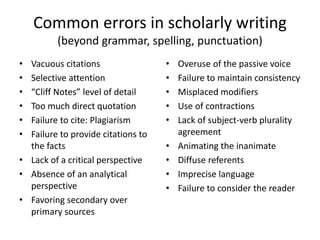

Common errors in scholarly writing
(beyond grammar, spelling, punctuation)
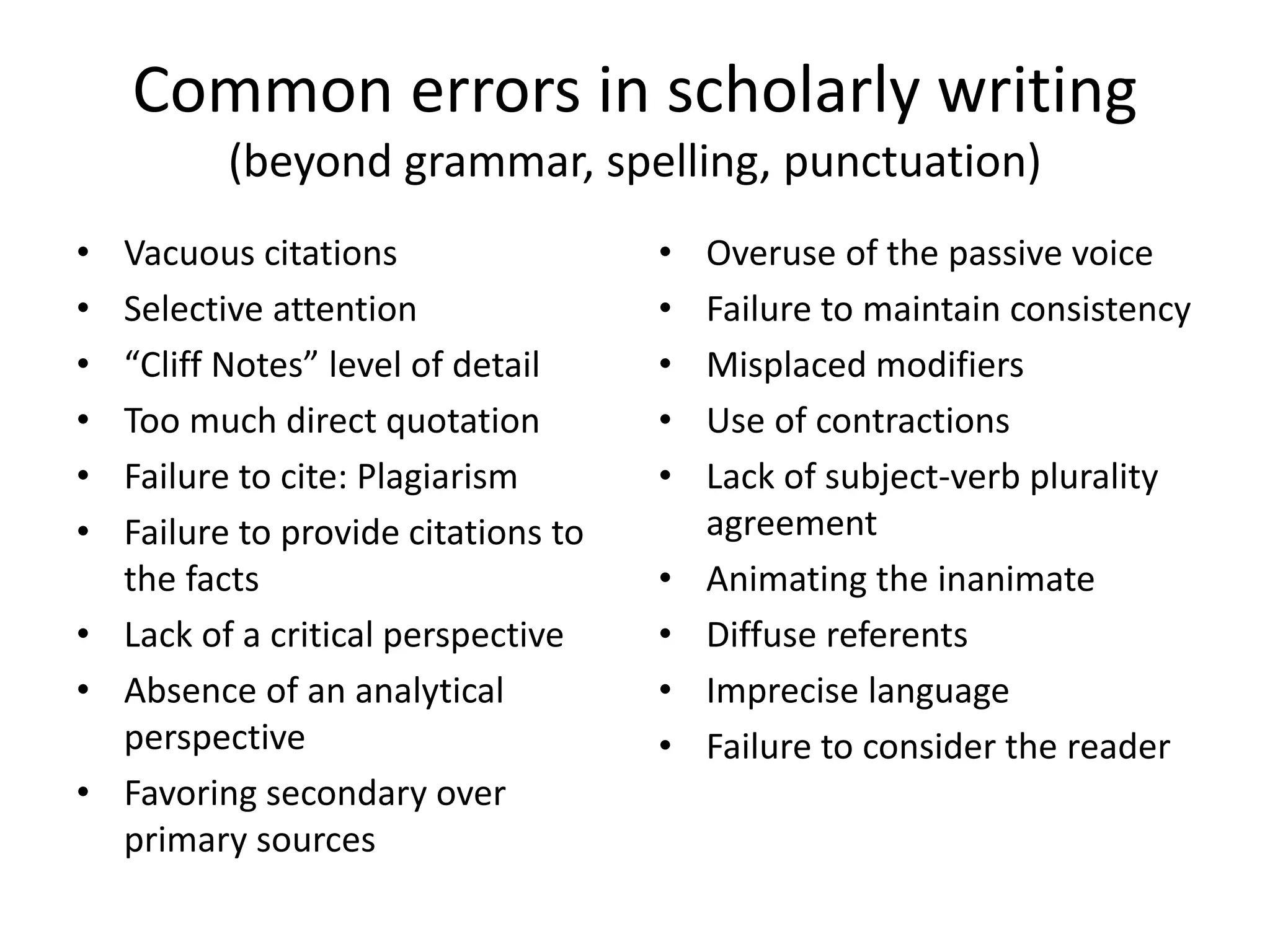
• Vacuous citations
• Selective attention
• “Cliff Notes” level of detail
• Too much direct quotation
• Failure to cite: Plagiarism
• Failure to provide citations to
the facts
• Lack of a critical perspective
• Absence of an analytical
perspective
• Favoring secondary over
primary sources
• Overuse of the passive voice
• Failure to maintain consistency
• Misplaced modifiers
• Use of contractions
• Lack of subject-verb plurality
agreement
• Animating the inanimate
• Diffuse referents
• Imprecise language
• Failure to consider the reader
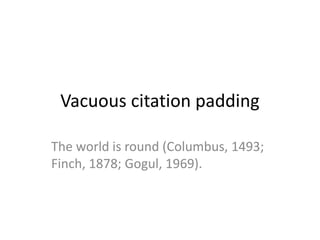
Vacuous citation padding
The world is round (Columbus, 1493;
Finch, 1878; Gogul, 1969).
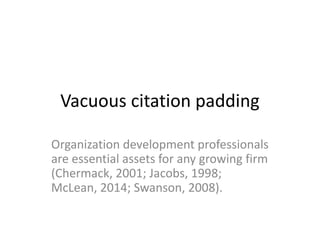
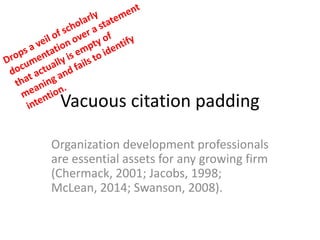
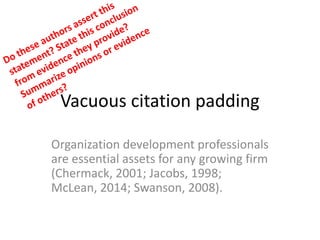
Vacuous citation padding
Organization development professionals
are essential assets for any growing firm
(Chermack, 2001; Jacobs, 1998;
McLean, 2014; Swanson, 2008).
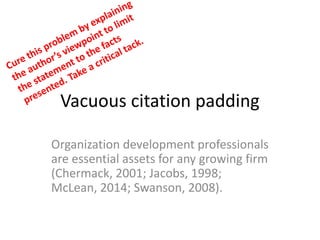
Vacuous citation padding
Organization development professionals
are essential assets for any growing firm
(Chermack, 2001; Jacobs, 1998;
McLean, 2014; Swanson, 2008).
Vacuous citation padding
Organization development professionals
are essential assets for any growing firm
(Chermack, 2001; Jacobs, 1998;
McLean, 2014; Swanson, 2008).
Vacuous citation padding
Organization development professionals
are essential assets for any growing firm
(Chermack, 2001; Jacobs, 1998;
McLean, 2014; Swanson, 2008).
Selective attention
Paying attention to some matters
because they support your argument.
Neglecting other matters because they
fail to support their argument. For
example, describing only studies that
support charter schools.
“Cliff Notes” level of detail
An attempt to be breezy and provide
too much simple summary of what
might be complex ideas.
Too much direct quotation
Over-reliance on long direct quotations.
You might as well tell others to read the
other work rather than yours.
Overt or inadvertent
failure to cite:
Plagiarism
Directly using others’ words as your
own. OR, presenting others’ ideas as
your own.
Failure to provide citations
to the facts
Making an empirical statement without
qualifying and referencing its source.
“Most schools are in urban areas.”
Lack of a critical perspective and
mere appeal to authority
Accepting assertions made by others
without reflection or on the basis of social
status.
“Bill Rothwell, a leader in HRD, believes that
competency modeling is the most important
research topic facing HRD researchers.”
Absence of an analytical
perspective
Failure to recognize similarities and
differences among ideas and organize
them appropriately. Nothing more
than serial summaries of articles.
Favoring secondary
over primary sources
Citation of sources that cite other, more
original sources.
“The Centre Daily Times indicated that
unemployment is increasing in State
College, PA.”
Overuse of the passive voice
The sentence construction “(noun) (verb
phrase) by (noun)” is known as passive voice
or passive construction, because the true
subject is relegated to the end of the
sentence and is thus acted on, rather than
acting, which often weakens the statement.
Overuse of the passive voice
“There is a considerable range of expertise
demonstrated by the spam senders.”
The actors are the “spam senders.”
 “The spam senders demonstrate a
considerable range of expertise.”
Overuse of the passive voice
“We were invited by our neighbors to
attend their party.”
Overuse of the passive voice
“The proposed initiative will be
bitterly opposed by abortion rights
groups.”
Failure to maintain consistency
“The career and technology schools…”
“Schools that focus on career and
technology….”
“Technology and career schools….”
Misplaced modifiers
“The young girl was walking the dog
in a short skirt.”
Misplaced modifiers
(proper placement clarifies meaning)
“The young girl was walking the dog
in a short skirt.”
“The young girl in a short skirt was
walking the dog.”
Misplaced modifiers
(proper placement clarifies meaning)
“The dog was chasing the boy with
the spiked collar.”
Misplaced modifiers
(proper placement clarifies meaning)
“The dog was chasing the boy with
the spiked collar.”
“The dog with the spiked collar was
chasing the boy.”
Use of contractions
Don’t use don’t….
You can’t use can’t….
You shouldn’t use shouldn’t….
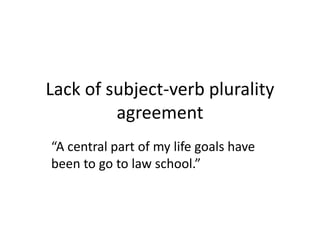
Lack of subject-verb plurality
agreement
“A central part of my life goals have
been to go to law school.”
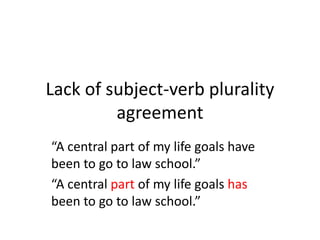
Lack of subject-verb plurality
agreement
“A central part of my life goals have
been to go to law school.”
“A central part of my life goals has
been to go to law school.”
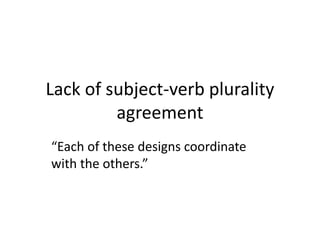
Lack of subject-verb plurality
agreement
“Each of these designs coordinate
with the others.”
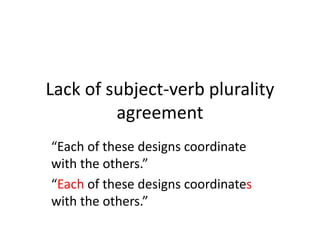
Lack of subject-verb plurality
agreement
“Each of these designs coordinate
with the others.”
“Each of these designs coordinates
with the others.”
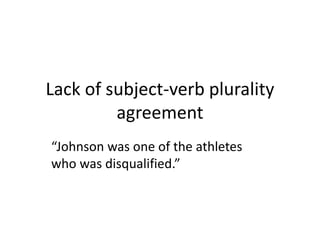
Lack of subject-verb plurality
agreement
“Johnson was one of the athletes
who was disqualified.”
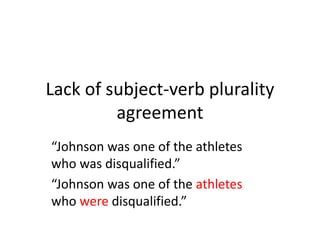
Lack of subject-verb plurality
agreement
“Johnson was one of the athletes
who was disqualified.”
“Johnson was one of the athletes
who were disqualified.”
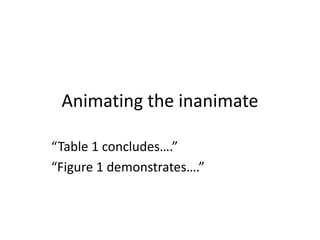
Animating the inanimate
“Table 1 concludes….”
“Figure 1 demonstrates….”
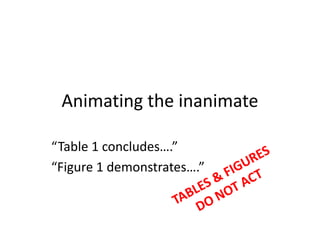
Animating the inanimate
“Table 1 concludes….”
“Figure 1 demonstrates….”
Diffuse referents
“The professors met the students in
the garden. They were interested in
playing chess.”
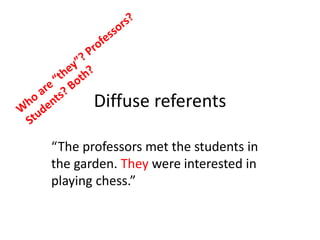
Diffuse referents
“The professors met the students in
the garden. They were interested in
playing chess.”
Imprecise language
“Heart rate”…when you mean “number
of arterial pulsations per minute”
“Achievement” when you mean “%
correctly answered test items”
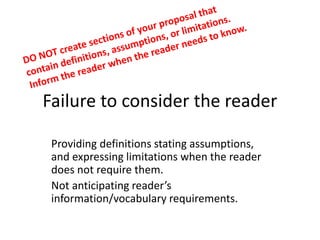
Failure to consider the reader
Providing definitions stating assumptions,
and expressing limitations when the reader
does not require them.
Not anticipating reader’s
information/vocabulary requirements.
Failure to consider the reader
Providing definitions stating assumptions,
and expressing limitations when the reader
does not require them.
Not anticipating reader’s
information/vocabulary requirements.
Common errors in scholarly writing
(beyond grammar, spelling, punctuation)
• Vacuous citations
• Selective attention
• “Cliff Notes” level of detail
• Too much direct quotation
• Failure to cite: Plagiarism
• Failure to provide citations to
the facts
• Lack of a critical perspective
• Absence of an analytical
perspective
• Favoring secondary over
primary sources
• Overuse of the passive voice
• Failure to maintain consistency
• Misplaced modifiers
• Use of contractions
• Lack of subject-verb plurality
agreement
• Animating the inanimate
• Diffuse referents
• Imprecise language
• Failure to consider the reader
A plug…

Common Errors in Scholarly Writing, 2017

  • 1.
    Common errors inscholarly writing (beyond grammar, spelling, punctuation) • Vacuous citations • Selective attention • “Cliff Notes” level of detail • Too much direct quotation • Failure to cite: Plagiarism • Failure to provide citations to the facts • Lack of a critical perspective • Absence of an analytical perspective • Favoring secondary over primary sources • Overuse of the passive voice • Failure to maintain consistency • Misplaced modifiers • Use of contractions • Lack of subject-verb plurality agreement • Animating the inanimate • Diffuse referents • Imprecise language • Failure to consider the reader
  • 2.
    Vacuous citation padding Theworld is round (Columbus, 1493; Finch, 1878; Gogul, 1969).
  • 3.
    Vacuous citation padding Organizationdevelopment professionals are essential assets for any growing firm (Chermack, 2001; Jacobs, 1998; McLean, 2014; Swanson, 2008).
  • 4.
    Vacuous citation padding Organizationdevelopment professionals are essential assets for any growing firm (Chermack, 2001; Jacobs, 1998; McLean, 2014; Swanson, 2008).
  • 5.
    Vacuous citation padding Organizationdevelopment professionals are essential assets for any growing firm (Chermack, 2001; Jacobs, 1998; McLean, 2014; Swanson, 2008).
  • 6.
    Vacuous citation padding Organizationdevelopment professionals are essential assets for any growing firm (Chermack, 2001; Jacobs, 1998; McLean, 2014; Swanson, 2008).
  • 7.
    Selective attention Paying attentionto some matters because they support your argument. Neglecting other matters because they fail to support their argument. For example, describing only studies that support charter schools.
  • 8.
    “Cliff Notes” levelof detail An attempt to be breezy and provide too much simple summary of what might be complex ideas.
  • 9.
    Too much directquotation Over-reliance on long direct quotations. You might as well tell others to read the other work rather than yours.
  • 10.
    Overt or inadvertent failureto cite: Plagiarism Directly using others’ words as your own. OR, presenting others’ ideas as your own.
  • 11.
    Failure to providecitations to the facts Making an empirical statement without qualifying and referencing its source. “Most schools are in urban areas.”
  • 12.
    Lack of acritical perspective and mere appeal to authority Accepting assertions made by others without reflection or on the basis of social status. “Bill Rothwell, a leader in HRD, believes that competency modeling is the most important research topic facing HRD researchers.”
  • 13.
    Absence of ananalytical perspective Failure to recognize similarities and differences among ideas and organize them appropriately. Nothing more than serial summaries of articles.
  • 14.
    Favoring secondary over primarysources Citation of sources that cite other, more original sources. “The Centre Daily Times indicated that unemployment is increasing in State College, PA.”
  • 15.
    Overuse of thepassive voice The sentence construction “(noun) (verb phrase) by (noun)” is known as passive voice or passive construction, because the true subject is relegated to the end of the sentence and is thus acted on, rather than acting, which often weakens the statement.
  • 16.
    Overuse of thepassive voice “There is a considerable range of expertise demonstrated by the spam senders.” The actors are the “spam senders.”  “The spam senders demonstrate a considerable range of expertise.”
  • 17.
    Overuse of thepassive voice “We were invited by our neighbors to attend their party.”
  • 18.
    Overuse of thepassive voice “The proposed initiative will be bitterly opposed by abortion rights groups.”
  • 19.
    Failure to maintainconsistency “The career and technology schools…” “Schools that focus on career and technology….” “Technology and career schools….”
  • 20.
    Misplaced modifiers “The younggirl was walking the dog in a short skirt.”
  • 21.
    Misplaced modifiers (proper placementclarifies meaning) “The young girl was walking the dog in a short skirt.” “The young girl in a short skirt was walking the dog.”
  • 22.
    Misplaced modifiers (proper placementclarifies meaning) “The dog was chasing the boy with the spiked collar.”
  • 23.
    Misplaced modifiers (proper placementclarifies meaning) “The dog was chasing the boy with the spiked collar.” “The dog with the spiked collar was chasing the boy.”
  • 24.
    Use of contractions Don’tuse don’t…. You can’t use can’t…. You shouldn’t use shouldn’t….
  • 25.
    Lack of subject-verbplurality agreement “A central part of my life goals have been to go to law school.”
  • 26.
    Lack of subject-verbplurality agreement “A central part of my life goals have been to go to law school.” “A central part of my life goals has been to go to law school.”
  • 27.
    Lack of subject-verbplurality agreement “Each of these designs coordinate with the others.”
  • 28.
    Lack of subject-verbplurality agreement “Each of these designs coordinate with the others.” “Each of these designs coordinates with the others.”
  • 29.
    Lack of subject-verbplurality agreement “Johnson was one of the athletes who was disqualified.”
  • 30.
    Lack of subject-verbplurality agreement “Johnson was one of the athletes who was disqualified.” “Johnson was one of the athletes who were disqualified.”
  • 31.
    Animating the inanimate “Table1 concludes….” “Figure 1 demonstrates….”
  • 32.
    Animating the inanimate “Table1 concludes….” “Figure 1 demonstrates….”
  • 33.
    Diffuse referents “The professorsmet the students in the garden. They were interested in playing chess.”
  • 34.
    Diffuse referents “The professorsmet the students in the garden. They were interested in playing chess.”
  • 35.
    Imprecise language “Heart rate”…whenyou mean “number of arterial pulsations per minute” “Achievement” when you mean “% correctly answered test items”
  • 36.
    Failure to considerthe reader Providing definitions stating assumptions, and expressing limitations when the reader does not require them. Not anticipating reader’s information/vocabulary requirements.
  • 37.
    Failure to considerthe reader Providing definitions stating assumptions, and expressing limitations when the reader does not require them. Not anticipating reader’s information/vocabulary requirements.
  • 38.
    Common errors inscholarly writing (beyond grammar, spelling, punctuation) • Vacuous citations • Selective attention • “Cliff Notes” level of detail • Too much direct quotation • Failure to cite: Plagiarism • Failure to provide citations to the facts • Lack of a critical perspective • Absence of an analytical perspective • Favoring secondary over primary sources • Overuse of the passive voice • Failure to maintain consistency • Misplaced modifiers • Use of contractions • Lack of subject-verb plurality agreement • Animating the inanimate • Diffuse referents • Imprecise language • Failure to consider the reader
  • 39.