MY VISION FOR CLOSING THE 
ACHIEVEMENT GAP AND INCREASING 
STUDENT ACHIEVEMENT 
Tracey I. Maccia, Ed.D.
FACTS ABOUT THE ACHIEVEMENT GAP 
 A racial achievement gap exists where the average African- 
American or Latino student is roughly 2-3 years of learning behind the 
average white student. 
 A racial gap exists today regardless of how it is measured, including 
both achievement (e.g., test score) and attainment (e.g., 
graduation rate) measures – Averaging math and reading across 
fourth and eighth grade, 48% of African-American and 43% of Latino 
students are "below basic," while only 17% of whites are; this gap 
exists in every state. 
 This racial achievement gap grows in magnitude as a child nears 
entry to the workforce from grade 4 to grade 12 – Between fourth 
and twelfth grade, the gap grows 41% for Latino students and 22% for 
African-American students.
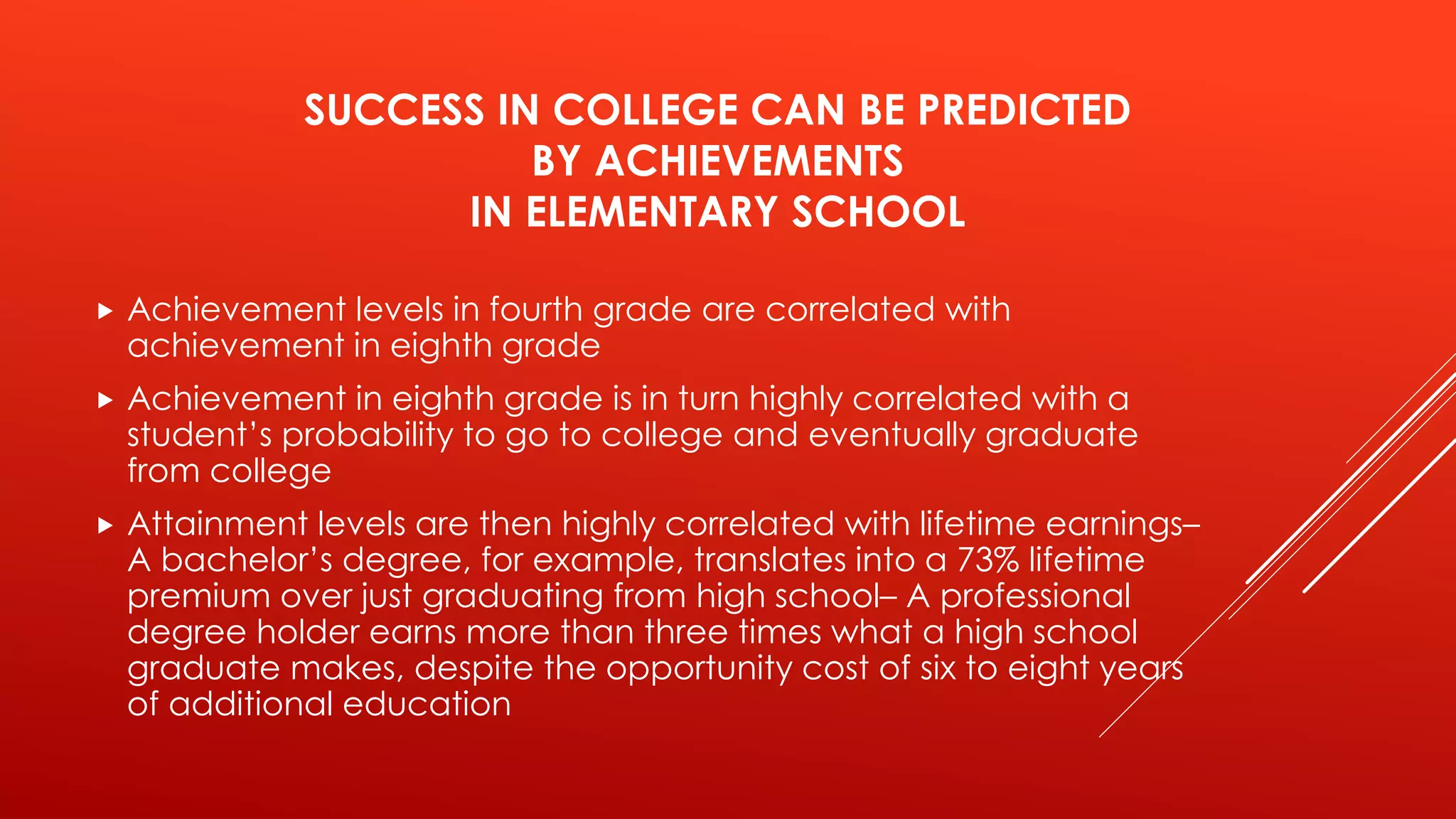
SUCCESS IN COLLEGE CAN BE PREDICTED 
BY ACHIEVEMENTS 
IN ELEMENTARY SCHOOL 
 Achievement levels in fourth grade are correlated with 
achievement in eighth grade 
 Achievement in eighth grade is in turn highly correlated with a 
student’s probability to go to college and eventually graduate 
from college 
 Attainment levels are then highly correlated with lifetime earnings– 
A bachelor’s degree, for example, translates into a 73% lifetime 
premium over just graduating from high school– A professional 
degree holder earns more than three times what a high school 
graduate makes, despite the opportunity cost of six to eight years 
of additional education
CHANGING THE LANDSCAPE 
System differences exist from the state to the classroom level 
even after accounting for income and race, showing that 
policies and school districts can influence student 
achievement. 
School districts also vary in their performance relative to the 
state average, implying that individual districts can lead the 
way in improving minority achievement. 
Within the classroom, factors such as teacher efficacy 
influence student achievement.
TEACHER EFFICACY 
TO IMPROVE STUDENT ACHIEVEMENT 
 Teachers who believe they can teach all children in ways that 
enable them to meet high standards are more likely to exhibit 
teaching behaviors that support this goal. 
 School administrators must intentionally help teachers develop a 
sense of efficacy because, it is not enough to hire and retain the 
brightest teachers— they must also believe they can succeed to 
fully meet the challenges of the task at hand. 
 A large collective body of research reveals that the most powerful 
way to improve student achievement is by working to raise the 
collective efficacy beliefs of their faculties.
STUDENT ACHIEVEMENT AND 
TEACHER EFFICACY 
 Good teachers increase student gains and the effect is amplified 
over time. 
 Commitment to creative teaching and inquiry learning, rather than 
to scripted instruction. 
 Opportunities to team with a critical mass of highly skilled teachers 
who share responsibility for every student’s success. 
 Sufficient resources to get the job done, including new 
technologies, classroom libraries, and instructional supplies, in 
addition to connections with social and health services.
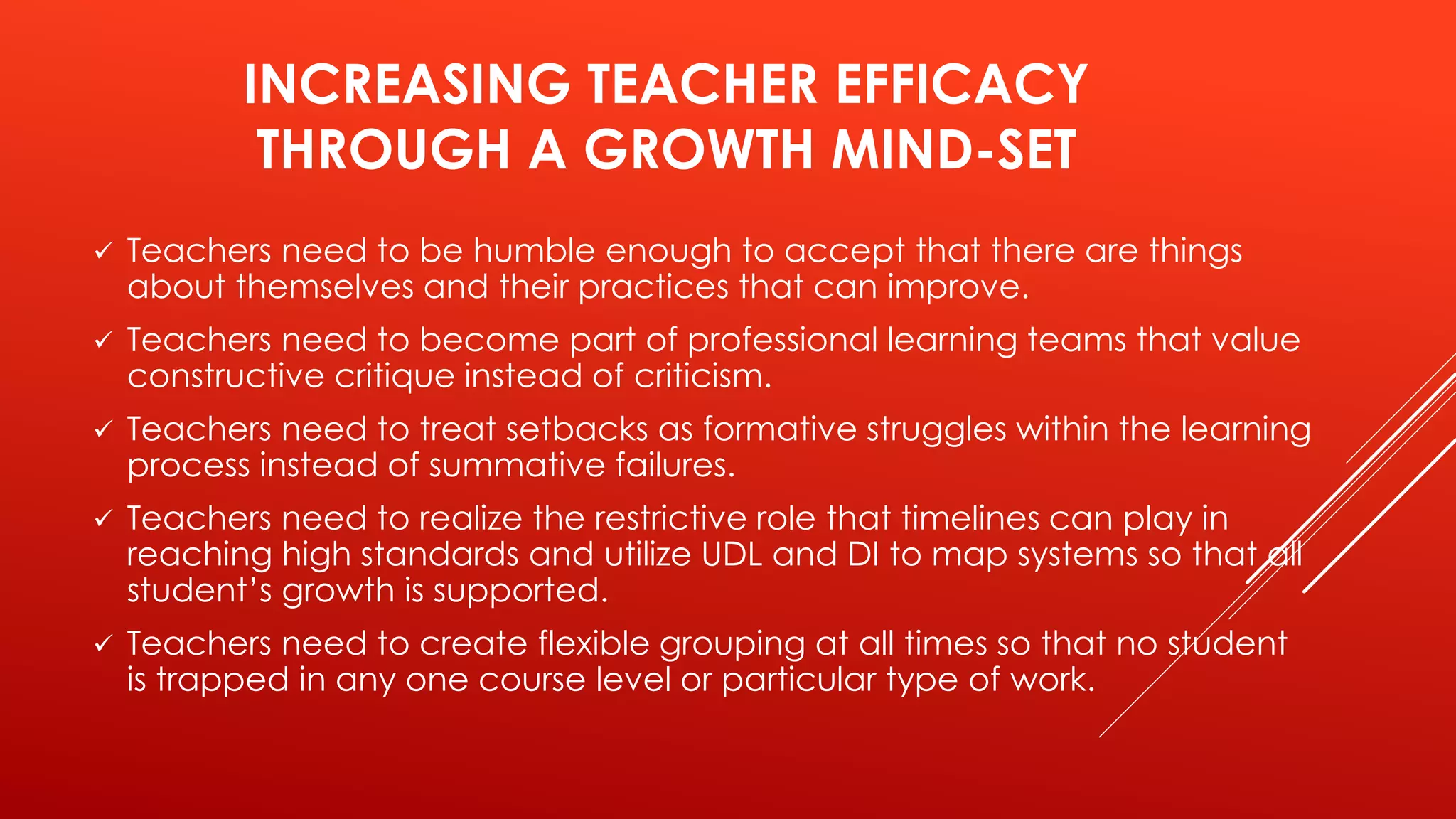
INCREASING TEACHER EFFICACY 
THROUGH A GROWTH MIND-SET 
 Teachers need to be humble enough to accept that there are things 
about themselves and their practices that can improve. 
 Teachers need to become part of professional learning teams that value 
constructive critique instead of criticism. 
 Teachers need to treat setbacks as formative struggles within the learning 
process instead of summative failures. 
 Teachers need to realize the restrictive role that timelines can play in 
reaching high standards and utilize UDL and DI to map systems so that all 
student’s growth is supported. 
 Teachers need to create flexible grouping at all times so that no student 
is trapped in any one course level or particular type of work.
GOAL 
STUDENTS WILL DEMONSTRATE THE 
KNOWLEDGE AND SKILLS NECESSARY 
TO TRANSITION SUCCESSFULLY TO THEIR 
NEXT STEPS OF ADVANCED LEARNING, 
WORK AND CITIZENSHIP
Key Steps to Achieving this Goal 
A common core of rigorous standards for all: 
Set rigorous curriculum standards so that all students 
are challenged and acquire the knowledge and skills 
to be successful in their next steps. 
An aligned P-16 system: 
Implement a continuum of learning by creating fluid 
transitions at every point through the education 
system so that all students have access to high quality 
life-long learning. 
A personalized learning experience for each student: 
Schools need to be safe, culturally competent and 
provide engaging learning environments so that the 
individual needs of all students are met. 
A connected educational community: 
Strengthen relationships between schools, community 
colleges and local communities so that all students 
enter school/ community colleges ready to learn and 
have access to relevant life-long learning experiences. 
A corps of quality educators prepared and ready to 
take on new challenges: 
Train and support teachers for 
excellent teaching for every student. 
A system to provide adequate & appropriately allocated 
resources: 
Provide effective and efficient resource allocation, 
infrastructure and governance to improve student 
achievement.
INTEGRATIVE STUDIES 
 Connections between core academic subject and the students’ 
own lives is important for effective instruction. 
 Integrated studies involves bringing together typically disconnected 
subjects so that students can arrive at more meaningful and 
authentic understanding. 
 Researchers have found that interdisciplinary understanding is the 
hallmark of contemporary knowledge production for our 21st 
century learning skills. 
 It is vital for the 21st century teacher to include only those concepts 
and skills that fit together naturally and validly in an integrated unit. 
 Project Based learning is the gateway for integrated studies.
DIP-STICKS: EFFICIENT WAYS TO 
CHECK FOR UNDERSTANDING 
Research reveals that formative assessment—frequent, interactive 
checking of student progress and understanding to identify learning 
needs and adjust teaching appropriately will increase academic 
achievement. 
Asking students questions like: 
 How much time and effort did you put into this? 
 What do you think your strengths and weaknesses were in this 
assignment? 
 How could you improve your assignment? 
 What are the most valuable things you learned from this 
assignment?
WHY IS GRIT SO IMPORTANT? 
 A large body of research found that one characteristic emerged as a significant 
predictor of student success. And it wasn't social intelligence. It wasn't good looks, 
physical health, and it wasn't IQ. It was grit. 
 Using the “Grit Scale” that Duckworth developed with Chris Peterson, they found 
that grit is a better indicator of GPA and graduation rates. (IQ, however, is very 
predictive of standardized test scores.) 
 Add to this the findings (from Bowen, Chingos and McPherson's Crossing the Finish 
Line) that high school grades have a more predictive value of college success 
than standardized tests, and you may just see a shift from standardized test scores 
to high school GPA by some college admissions officers. As GPA becomes more 
important, grit will become more recognized as a vital part of 21st century student 
success -- as well it should be.
DIFFERENTIATION OF INSTRUCTION 
To differentiate instruction is to recognize students 
varying background knowledge, readiness, language, 
preferences in learning, interests, and react 
responsively. The intent is to maximize each student’s 
growth and individual success by meeting each 
student where he or she is which assists the teaching 
and learning process.
PROMOTING TEACHERS’ CULTURAL COMPETENCE 
TO BETTER SERVE 
CULTURALLY DIVERSE STUDENTS 
 Value diversity 
 Be culturally self-aware 
 Understand the dynamics of cultural interactions 
 Institutionalize cultural knowledge and adapting to diversity
FOCUS ON EARLY LEARNING 
TO IMPROVE SCHOOLS 
High quality early childhood education-researchers 
found that it produces substantial 
educational, social and economic benefit to 
children and society as a whole. 
Response to Intervention in grades K-3 is a 
researched based model having a positive 
effect on student achievement.
FAMILY-SCHOOL-COMMUNITY 
CONNECTIONS 
Parent, family and community involvement in education 
correlates with higher academic performance and school 
improvement. 
Supporting teaching and learning requires addressing 
students’ social service needs, as well as their academic 
ones, and this broad-based support is essential to closing 
achievement gaps.

Achievement

  • 1.
    MY VISION FORCLOSING THE ACHIEVEMENT GAP AND INCREASING STUDENT ACHIEVEMENT Tracey I. Maccia, Ed.D.
  • 2.
    FACTS ABOUT THEACHIEVEMENT GAP  A racial achievement gap exists where the average African- American or Latino student is roughly 2-3 years of learning behind the average white student.  A racial gap exists today regardless of how it is measured, including both achievement (e.g., test score) and attainment (e.g., graduation rate) measures – Averaging math and reading across fourth and eighth grade, 48% of African-American and 43% of Latino students are "below basic," while only 17% of whites are; this gap exists in every state.  This racial achievement gap grows in magnitude as a child nears entry to the workforce from grade 4 to grade 12 – Between fourth and twelfth grade, the gap grows 41% for Latino students and 22% for African-American students.
  • 3.
    SUCCESS IN COLLEGECAN BE PREDICTED BY ACHIEVEMENTS IN ELEMENTARY SCHOOL  Achievement levels in fourth grade are correlated with achievement in eighth grade  Achievement in eighth grade is in turn highly correlated with a student’s probability to go to college and eventually graduate from college  Attainment levels are then highly correlated with lifetime earnings– A bachelor’s degree, for example, translates into a 73% lifetime premium over just graduating from high school– A professional degree holder earns more than three times what a high school graduate makes, despite the opportunity cost of six to eight years of additional education
  • 4.
    CHANGING THE LANDSCAPE System differences exist from the state to the classroom level even after accounting for income and race, showing that policies and school districts can influence student achievement. School districts also vary in their performance relative to the state average, implying that individual districts can lead the way in improving minority achievement. Within the classroom, factors such as teacher efficacy influence student achievement.
  • 5.
    TEACHER EFFICACY TOIMPROVE STUDENT ACHIEVEMENT  Teachers who believe they can teach all children in ways that enable them to meet high standards are more likely to exhibit teaching behaviors that support this goal.  School administrators must intentionally help teachers develop a sense of efficacy because, it is not enough to hire and retain the brightest teachers— they must also believe they can succeed to fully meet the challenges of the task at hand.  A large collective body of research reveals that the most powerful way to improve student achievement is by working to raise the collective efficacy beliefs of their faculties.
  • 6.
    STUDENT ACHIEVEMENT AND TEACHER EFFICACY  Good teachers increase student gains and the effect is amplified over time.  Commitment to creative teaching and inquiry learning, rather than to scripted instruction.  Opportunities to team with a critical mass of highly skilled teachers who share responsibility for every student’s success.  Sufficient resources to get the job done, including new technologies, classroom libraries, and instructional supplies, in addition to connections with social and health services.
  • 7.
    INCREASING TEACHER EFFICACY THROUGH A GROWTH MIND-SET  Teachers need to be humble enough to accept that there are things about themselves and their practices that can improve.  Teachers need to become part of professional learning teams that value constructive critique instead of criticism.  Teachers need to treat setbacks as formative struggles within the learning process instead of summative failures.  Teachers need to realize the restrictive role that timelines can play in reaching high standards and utilize UDL and DI to map systems so that all student’s growth is supported.  Teachers need to create flexible grouping at all times so that no student is trapped in any one course level or particular type of work.
  • 8.
    GOAL STUDENTS WILLDEMONSTRATE THE KNOWLEDGE AND SKILLS NECESSARY TO TRANSITION SUCCESSFULLY TO THEIR NEXT STEPS OF ADVANCED LEARNING, WORK AND CITIZENSHIP
  • 9.
    Key Steps toAchieving this Goal A common core of rigorous standards for all: Set rigorous curriculum standards so that all students are challenged and acquire the knowledge and skills to be successful in their next steps. An aligned P-16 system: Implement a continuum of learning by creating fluid transitions at every point through the education system so that all students have access to high quality life-long learning. A personalized learning experience for each student: Schools need to be safe, culturally competent and provide engaging learning environments so that the individual needs of all students are met. A connected educational community: Strengthen relationships between schools, community colleges and local communities so that all students enter school/ community colleges ready to learn and have access to relevant life-long learning experiences. A corps of quality educators prepared and ready to take on new challenges: Train and support teachers for excellent teaching for every student. A system to provide adequate & appropriately allocated resources: Provide effective and efficient resource allocation, infrastructure and governance to improve student achievement.
  • 10.
    INTEGRATIVE STUDIES Connections between core academic subject and the students’ own lives is important for effective instruction.  Integrated studies involves bringing together typically disconnected subjects so that students can arrive at more meaningful and authentic understanding.  Researchers have found that interdisciplinary understanding is the hallmark of contemporary knowledge production for our 21st century learning skills.  It is vital for the 21st century teacher to include only those concepts and skills that fit together naturally and validly in an integrated unit.  Project Based learning is the gateway for integrated studies.
  • 11.
    DIP-STICKS: EFFICIENT WAYSTO CHECK FOR UNDERSTANDING Research reveals that formative assessment—frequent, interactive checking of student progress and understanding to identify learning needs and adjust teaching appropriately will increase academic achievement. Asking students questions like:  How much time and effort did you put into this?  What do you think your strengths and weaknesses were in this assignment?  How could you improve your assignment?  What are the most valuable things you learned from this assignment?
  • 12.
    WHY IS GRITSO IMPORTANT?  A large body of research found that one characteristic emerged as a significant predictor of student success. And it wasn't social intelligence. It wasn't good looks, physical health, and it wasn't IQ. It was grit.  Using the “Grit Scale” that Duckworth developed with Chris Peterson, they found that grit is a better indicator of GPA and graduation rates. (IQ, however, is very predictive of standardized test scores.)  Add to this the findings (from Bowen, Chingos and McPherson's Crossing the Finish Line) that high school grades have a more predictive value of college success than standardized tests, and you may just see a shift from standardized test scores to high school GPA by some college admissions officers. As GPA becomes more important, grit will become more recognized as a vital part of 21st century student success -- as well it should be.
  • 13.
    DIFFERENTIATION OF INSTRUCTION To differentiate instruction is to recognize students varying background knowledge, readiness, language, preferences in learning, interests, and react responsively. The intent is to maximize each student’s growth and individual success by meeting each student where he or she is which assists the teaching and learning process.
  • 14.
    PROMOTING TEACHERS’ CULTURALCOMPETENCE TO BETTER SERVE CULTURALLY DIVERSE STUDENTS  Value diversity  Be culturally self-aware  Understand the dynamics of cultural interactions  Institutionalize cultural knowledge and adapting to diversity
  • 15.
    FOCUS ON EARLYLEARNING TO IMPROVE SCHOOLS High quality early childhood education-researchers found that it produces substantial educational, social and economic benefit to children and society as a whole. Response to Intervention in grades K-3 is a researched based model having a positive effect on student achievement.
  • 16.
    FAMILY-SCHOOL-COMMUNITY CONNECTIONS Parent,family and community involvement in education correlates with higher academic performance and school improvement. Supporting teaching and learning requires addressing students’ social service needs, as well as their academic ones, and this broad-based support is essential to closing achievement gaps.