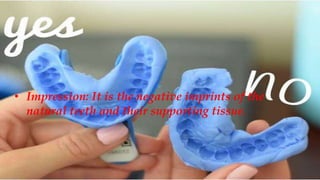
• Impression: It is the negative imprints of the
natural teeth and their supporting tissue.
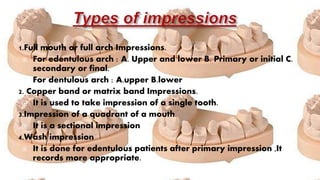
1.Full mouth or full arch Impressions.
 For edentulous arch : A. Upper and lower B. Primary or initial C.
secondary or final.
 For dentulous arch : A.upper B.lower
2. Copper band or matrix band Impressions.
 It is used to take impression of a single tooth.
3.Impression of a quadrant of a mouth.
 It is a sectional impression
4.Wash impression
 It is done for edentulous patients after primary impression ,It
records more appropriate.
The Material used To take impression of Natural
teeth And their supporting tissue are called as
impression materials
 It should be nontoxic and non
irritant.
 It should be elastic in nature.
 It should have good flow.
 Manipulation should be easy.
 It should be dimensionally stable
after setting.
 It should be cheap and easily
available.
 Setting should be less than 5 minutes.
 It should have good shelf life.
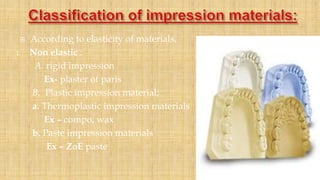
 According to elasticity of materials.
1. Non elastic :
A. rigid impression
Ex- plaster of paris
B. Plastic impression material;
a. Thermoplastic impression materials
Ex – compo, wax
b. Paste impression materials
Ex – ZoE paste
2. Elastic: A . Hydrocolloid
1. Reversible hydrocolloid (agar)
2. Irreversible Hydrocolloid (alginate)
B. Elastomer a. polysulphide
b. silicones
(1. Condensation silicone. 2. Addition
silicone.)
C. polyether.
 According to mode of setting (hardening)
 Set by chemical setting Ex- Alginate,
elastomer
 Set by physical setting Ex- agar, wax,
compound
Non elastic
 Dental plaster or type III plaster is the beta form of calcium sulfate
hemihydrate (CaSO4,1/2H2O)
 A mixture of plaster of paris and water is placed in an impression
tray and pressed against the tissues of ,for Ex a patients edentulous
jaw. The plaster is allowed to harden or set and the impression is
taken.
 It is now used to fill the flask used in denture construction when
setting expansion is not critical and the strength is adequate
according to limits cited in the ADA specification.
 It is usually marketed in the natural white colour, Thus contrasting
with stones which are generally coloured.
COMPOSITION FUNCTION
1. Steric acid -20 P/W
2. Oleic acid -4 P/W
3. Gum coal -19P/W
4. Kauri resin -17P/W
5. Powder soapstone or French
chalk -40P/W
 It gives the plasticity and flow.
 It also gives plasticity and flow.
 It gives the bulk and increases
hardness.
 It gives hardness.
 It gives hardness and plasticity.
ADVANTAGES DISADVANTAGES
1. Can be reused easy to use
2. Non irritant and non toxic
3. It is cheap and easily available
1. Poor dimensional stability
2. Easy to distort when withdrawn
from mouth
3. Does not have sufficient flow
 Used to recordthe final
 of edentulous arches.
 Supplies as two pastes which are mixed together on a paper pad or glass
slab. Zinc oxide paste being white and eugenol paste reddish brown in
colour.
 This enables thorough mixing as homogeneous colour,free of streaks.
 Pastes are dispend in toothpaste like tubes and are mixed in equal vol
 Proportion is achieved by equal length of each paste on mixing slab.
 It is classified as rigid,irreversible, impression material.
 Cementing and insulating medium
 Temporary filling
 Root canal filling material
 Bite registration paste
 Temporary relining material for
dentures
 Impression material for edentulous
patients
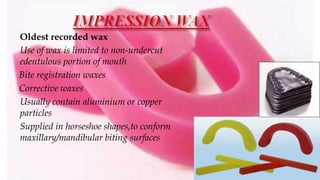
 Oldest recorded wax
 Use of wax is limited to non-undercut
edentulous portion of mouth
1. Bite registration waxes
2. Corrective waxes
 Usually contain aluminium or copper
particles
 Supplied in horseshoe shapes,to conform
maxillary/mandibular biting surfaces
 Colloid means gelatin
substances.
 Materials used to obtain
preliminary final impressions.
1. Irreversible (agar)
 Material cannot return to solution
state after it becomes a gel
 Alginate is the Irreversible
hydrocolloid most widely used for
preliminary impression
These are used where a high degree of accuracy is needed,especially in
crown and bridge work.
They have two main advantages over the hydrocolloid- good tear
resistance and dimensional stability. They are mainly hydrophobic
rubber based materials. All of these materials come in different viscosity
ranging from low to high viscosity. The light bodied material maybe used as
a wash impression over a medium or heavy bodied material.
 First synthetic elastomeric impression material introduced in 1950
 2 paste system
 Available in low ,medium and high consistencies
Made up of a base and accelerator/reactor
Properties
 Dimensionally stable.
 Excellent surface detail.
 Viscosity depends on the brand used
 Very good tear resistance
 Very small setting contraction
 Good shelf life
Advantages
 Dimensional stability
 Accuracy
 Comes in number of different viscosity
 Long working time
 Long shelf life
Disadvantages
 Lead oxide in base plate may have toxic effects
 Staining of clothes due to the lead oxide
 Messy to work with –unpleasant rubbery smell
 Can only be used in a special tray
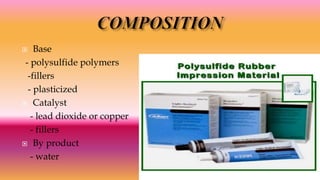
 Base
- polysulfide polymers
-fillers
- plasticized
 Catalyst
- lead dioxide or copper
- fillers
 By product
- water
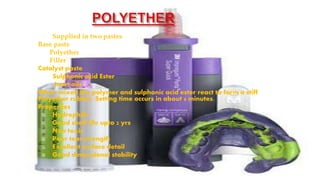
 Supplied in two pastes
Base paste
Polyether
Filler
Catalyst paste
Sulphonic acid Ester
Inert oils
When mixed the polymer and sulphonic acid ester react to form a stiff
Polyether rubber. Setting time occurs in about 6 minutes.
Properties
 Hydrophilic
 Good shelf life upto 2 yrs
 Non toxic
 Poor tear strength
 Excellent surface detail
 Good dimensional stability
Advantages
 Accuracy
 Good on undercuts
 Ease of use
Disadvantage
 May cause allergic reaction
 Poor tear strength
 Rapid setting time
 Stiff set materials
Supplied as a paste and liquid or two pastes,in
light;medium, heavy or very heavy bodied
(putty)
Base paste
Silicone polymer with terminal hydroxy groups
Fillers
Catalyst paste
Crosslinking agent
Activator
 On mixing the two pastes react ,cross linking
occurs and setting takes about 7 minute.
Properties
 Hydrophobic
 Hydrogen gas evolution on
setting
 Moderate shelf life and tear
strength
 Shrinking of impression over time
 Non toxic and non irritant
 Very elastic (near ideal)
 Good surface detail
Advantages
 Accurate
 Ease of use
 Can be used on severe undercuts
Disadvantages
 Hydrogen evolution
 Liquid component of paste
/liquid system may cause
irritation
Properties
 Good shelf life
 Dimensionally stable
 Moderate tear strength
 Excellent surface detail
 No gas evolution
 Non toxic and non irritant
Advantages
 Accurate
 Ease of use
 Fast setting
 Wide range of viscosity
Disadvantages
 Hard to mix
 Sometimes difficult to remove
the impression from the
mouth.
IMPRESSION MATERIALS PROSTHODONTICS

IMPRESSION MATERIALS PROSTHODONTICS

  • 2.
    • Impression: Itis the negative imprints of the natural teeth and their supporting tissue.
  • 3.
    1.Full mouth orfull arch Impressions.  For edentulous arch : A. Upper and lower B. Primary or initial C. secondary or final.  For dentulous arch : A.upper B.lower 2. Copper band or matrix band Impressions.  It is used to take impression of a single tooth. 3.Impression of a quadrant of a mouth.  It is a sectional impression 4.Wash impression  It is done for edentulous patients after primary impression ,It records more appropriate.
  • 5.
    The Material usedTo take impression of Natural teeth And their supporting tissue are called as impression materials
  • 6.
     It shouldbe nontoxic and non irritant.  It should be elastic in nature.  It should have good flow.  Manipulation should be easy.  It should be dimensionally stable after setting.  It should be cheap and easily available.  Setting should be less than 5 minutes.  It should have good shelf life.
  • 7.
     According toelasticity of materials. 1. Non elastic : A. rigid impression Ex- plaster of paris B. Plastic impression material; a. Thermoplastic impression materials Ex – compo, wax b. Paste impression materials Ex – ZoE paste
  • 8.
    2. Elastic: A. Hydrocolloid 1. Reversible hydrocolloid (agar) 2. Irreversible Hydrocolloid (alginate) B. Elastomer a. polysulphide b. silicones (1. Condensation silicone. 2. Addition silicone.) C. polyether.  According to mode of setting (hardening)  Set by chemical setting Ex- Alginate, elastomer  Set by physical setting Ex- agar, wax, compound
  • 9.
  • 10.
     Dental plasteror type III plaster is the beta form of calcium sulfate hemihydrate (CaSO4,1/2H2O)  A mixture of plaster of paris and water is placed in an impression tray and pressed against the tissues of ,for Ex a patients edentulous jaw. The plaster is allowed to harden or set and the impression is taken.  It is now used to fill the flask used in denture construction when setting expansion is not critical and the strength is adequate according to limits cited in the ADA specification.  It is usually marketed in the natural white colour, Thus contrasting with stones which are generally coloured.
  • 11.
    COMPOSITION FUNCTION 1. Stericacid -20 P/W 2. Oleic acid -4 P/W 3. Gum coal -19P/W 4. Kauri resin -17P/W 5. Powder soapstone or French chalk -40P/W  It gives the plasticity and flow.  It also gives plasticity and flow.  It gives the bulk and increases hardness.  It gives hardness.  It gives hardness and plasticity.
  • 12.
    ADVANTAGES DISADVANTAGES 1. Canbe reused easy to use 2. Non irritant and non toxic 3. It is cheap and easily available 1. Poor dimensional stability 2. Easy to distort when withdrawn from mouth 3. Does not have sufficient flow
  • 13.
     Used torecordthe final  of edentulous arches.  Supplies as two pastes which are mixed together on a paper pad or glass slab. Zinc oxide paste being white and eugenol paste reddish brown in colour.  This enables thorough mixing as homogeneous colour,free of streaks.  Pastes are dispend in toothpaste like tubes and are mixed in equal vol  Proportion is achieved by equal length of each paste on mixing slab.  It is classified as rigid,irreversible, impression material.
  • 14.
     Cementing andinsulating medium  Temporary filling  Root canal filling material  Bite registration paste  Temporary relining material for dentures  Impression material for edentulous patients
  • 15.
     Oldest recordedwax  Use of wax is limited to non-undercut edentulous portion of mouth 1. Bite registration waxes 2. Corrective waxes  Usually contain aluminium or copper particles  Supplied in horseshoe shapes,to conform maxillary/mandibular biting surfaces
  • 18.
     Colloid meansgelatin substances.  Materials used to obtain preliminary final impressions. 1. Irreversible (agar)
  • 19.
     Material cannotreturn to solution state after it becomes a gel  Alginate is the Irreversible hydrocolloid most widely used for preliminary impression
  • 24.
    These are usedwhere a high degree of accuracy is needed,especially in crown and bridge work. They have two main advantages over the hydrocolloid- good tear resistance and dimensional stability. They are mainly hydrophobic rubber based materials. All of these materials come in different viscosity ranging from low to high viscosity. The light bodied material maybe used as a wash impression over a medium or heavy bodied material.
  • 25.
     First syntheticelastomeric impression material introduced in 1950  2 paste system  Available in low ,medium and high consistencies Made up of a base and accelerator/reactor Properties  Dimensionally stable.  Excellent surface detail.  Viscosity depends on the brand used  Very good tear resistance  Very small setting contraction  Good shelf life
  • 26.
    Advantages  Dimensional stability Accuracy  Comes in number of different viscosity  Long working time  Long shelf life Disadvantages  Lead oxide in base plate may have toxic effects  Staining of clothes due to the lead oxide  Messy to work with –unpleasant rubbery smell  Can only be used in a special tray
  • 27.
     Base - polysulfidepolymers -fillers - plasticized  Catalyst - lead dioxide or copper - fillers  By product - water
  • 28.
     Supplied intwo pastes Base paste Polyether Filler Catalyst paste Sulphonic acid Ester Inert oils When mixed the polymer and sulphonic acid ester react to form a stiff Polyether rubber. Setting time occurs in about 6 minutes. Properties  Hydrophilic  Good shelf life upto 2 yrs  Non toxic  Poor tear strength  Excellent surface detail  Good dimensional stability
  • 29.
    Advantages  Accuracy  Goodon undercuts  Ease of use Disadvantage  May cause allergic reaction  Poor tear strength  Rapid setting time  Stiff set materials
  • 30.
    Supplied as apaste and liquid or two pastes,in light;medium, heavy or very heavy bodied (putty) Base paste Silicone polymer with terminal hydroxy groups Fillers Catalyst paste Crosslinking agent Activator  On mixing the two pastes react ,cross linking occurs and setting takes about 7 minute.
  • 31.
    Properties  Hydrophobic  Hydrogengas evolution on setting  Moderate shelf life and tear strength  Shrinking of impression over time  Non toxic and non irritant  Very elastic (near ideal)  Good surface detail Advantages  Accurate  Ease of use  Can be used on severe undercuts Disadvantages  Hydrogen evolution  Liquid component of paste /liquid system may cause irritation
  • 32.
    Properties  Good shelflife  Dimensionally stable  Moderate tear strength  Excellent surface detail  No gas evolution  Non toxic and non irritant
  • 33.
    Advantages  Accurate  Easeof use  Fast setting  Wide range of viscosity Disadvantages  Hard to mix  Sometimes difficult to remove the impression from the mouth.