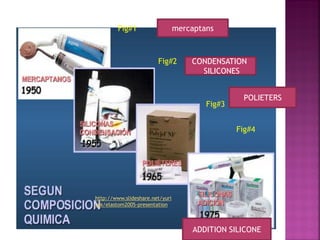
Elastomers
          (polysiloxanes) :
Used to identify materials with a particular
 structure. Are organic materials consisting
  of polymer molecules with the ability to
       "stretch", "develop," compressed
     "ultimately bear to tensions mouth.
Chemically there are four types of
elastomeric impression materials used as:

              1.Polisulfure
2. Silicone condensation polymerization
   3. Addition polymerization silicone
               4.Polyether
Fig#1                    mercaptans


                        Fig#2        CONDENSATION
                                       SILICONES


                                                  POLIETERS
                                         Fig#3


                                                 Fig#4


http://www.slideshare.net/yuri
tek/elastom2005-presentation


                                     ADDITION SILICONE
 According   to the reaction to which they are
  subject to change to a plastic state
 Those who change their status in a physical
  reaction, it is to say, which do not change
  their properties, only its consistency when
  subjected to heat.
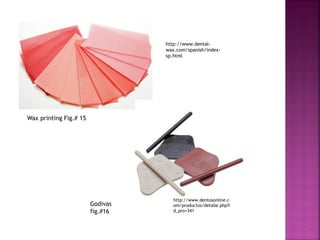
  .       Wax printing
         . Model compounds or Godivas
          .reversible hydrocolloid
http://www.dental-
                                  wax.com/spanish/index-
                                  sp.html


Wax printing Fig.# 15


                                     http://www.dentusonline.c
                        Godivas      om/productos/detalle.php?i
                        fig.#16      d_pro=341
Classification according to their
behavior during setting, hardening or curing.
  elastic:
. Mercaptans.
. Elastomers silicones.
. Polyethers.
  rigid:
  Model compounds or góbidas.
  Waxes.
  Casts.
characteristics to be met by printing
   materials to be considered optimal
               for management
               Easy to handle.
     . Compatibility with oral tissues.
            . There are irritating.
                . Not allergic.
         . Taste and look nice mix.
                   low cost.
  . that when subjected to disinfecting
      solutions preventing alterations
. Hydrophilic Where possible, that does
   not affect the presence of moisture
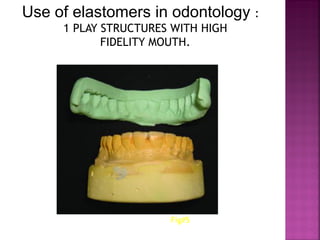
Use of elastomers in odontology :
     1 PLAY STRUCTURES WITH HIGH
            FIDELITY MOUTH.


                      Fig#5
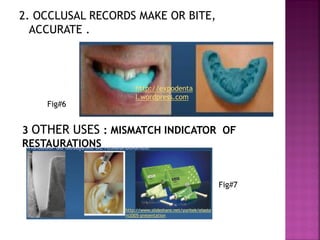
2. OCCLUSAL RECORDS MAKE OR BITE,
  ACCURATE .


                     http://expodenta
                     l.wordpress.com
    Fig#6


3 OTHER USES : MISMATCH INDICATOR OF
RESTAURATIONS


                                                            Fig#7


                 http://www.slideshare.net/yuritek/elasto
                 m2005-presentation
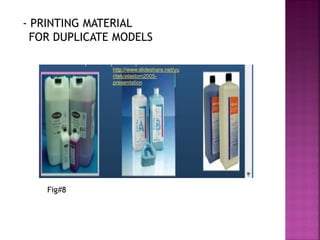
- PRINTING MATERIAL
  FOR DUPLICATE MODELS

               http://www.slideshare.net/yu
               ritek/elastom2005-
               presentation


    Fig#8
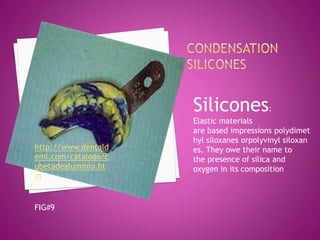
Silicones:
                     Elastic materials
                     are based impressions polydimet
                     hyl siloxanes orpolyvinyl siloxan
http://www.dentald   es. They owe their name to
eml.com/catalogo/c   the presence of silica and
ubetadealuminio.ht   oxygen in its composition
m


FIG#9
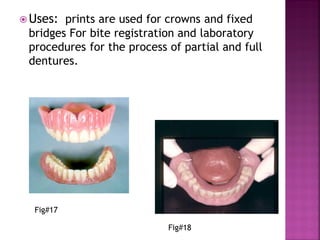
 Uses: prints are used for crowns and fixed
 bridges For bite registration and laboratory
 procedures for the process of partial and full
 dentures.


  Fig#17

                            Fig#18
Condensation silicone
                  composition
polydimethylsiloxane
Ethyl ortho silicate
Silica filler
CATALYST : Tin octoate


Tin octoate
Silicone Rubber
ethyl alcohol.


 The chemical reaction of a condensation silicone is as follows
 silicate ortoalquílico

   polydimethylsiloxane+ silicate ortoalquilico ----
                         polydimethyl siloxane + Alcohol
PROPERTIES:
 . The working time of the silicones is 2-
 4 minutes less than the mercaptans
 Polymerization time: 6-
 3 minutes is comparatively less than the
 mercaptans, the polymerization time can be
 changed with
 temperature temp. High polymerization acce
 lerates
 Dimensional Stability: Like other print
 materials, condensationsilicones contract.
 . Can be reduced using well
 adapted trays with a thickness of 3 to 4mm.
.    Elastic recovery: the recovery is
    approximately 100% higher than virtually all
    other elastic materials.
      Fluency: compared with the mercaptans,
    these materials are morerigid and therefore
    have better flow.
    Flexibility: inflexible compared to the
    mercaptans and more flexible than the
    polyesters
    Toxicity of silicones are not toxic, however it
    is recommended not to touch his hands and
    not take material improperly
    mixedimpressions.

easy handling               .Sensitive to high
  .It is stable over          temperatures
  short periods of time       .Evaporation of alcohol
  .Have different elastic     .Short working
  properties                  time for multiple prints
  .Can be prepared            .Greater contraction of
  with different              polysulfides
  viscosity resists           .Short life
  displacement of the
  gingival tissues
  .It has pleasant taste
  and odor

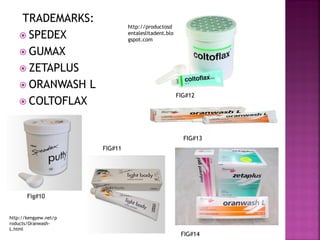
TRADEMARKS:
                                http://productosd
     SPEDEX                    entaleslitadent.blo
                                gspot.com

     GUMAX
     ZETAPLUS
     ORANWASH L
                                                      FIG#12
     COLTOFLAX


                                                        FIG#13
                       FIG#11


       Fig#10


http://kengyew.net/p
roducts/Oranwash-
L.html
                                                       FIG#14
Bibliography:
.Materiales dentales 3ra. AUTOR: Edición MACCHI


.BIOMATERIALES DENTALES . AUTOR: José Luis Cova N.


.La ciencia de los materiales dentales AUTOR: Skinner Phillips 9na.
   Edición


http://html.rincondelvago.com/elastomeros.html


http://www.dentsply.es/Noticias/clinica1403.html


http://www.slideshare.net

Elastomers for dental uses

  • 2.
    Elastomers (polysiloxanes) : Used to identify materials with a particular structure. Are organic materials consisting of polymer molecules with the ability to "stretch", "develop," compressed "ultimately bear to tensions mouth.
  • 3.
    Chemically there arefour types of elastomeric impression materials used as: 1.Polisulfure 2. Silicone condensation polymerization 3. Addition polymerization silicone 4.Polyether
  • 4.
    Fig#1 mercaptans Fig#2 CONDENSATION SILICONES POLIETERS Fig#3 Fig#4 http://www.slideshare.net/yuri tek/elastom2005-presentation ADDITION SILICONE
  • 5.
     According to the reaction to which they are subject to change to a plastic state  Those who change their status in a physical reaction, it is to say, which do not change their properties, only its consistency when subjected to heat. . Wax printing . Model compounds or Godivas .reversible hydrocolloid
  • 6.
    http://www.dental- wax.com/spanish/index- sp.html Wax printing Fig.# 15 http://www.dentusonline.c Godivas om/productos/detalle.php?i fig.#16 d_pro=341
  • 7.
    Classification according totheir behavior during setting, hardening or curing. elastic: . Mercaptans. . Elastomers silicones. . Polyethers. rigid: Model compounds or góbidas. Waxes. Casts.
  • 8.
    characteristics to bemet by printing materials to be considered optimal for management Easy to handle. . Compatibility with oral tissues. . There are irritating. . Not allergic. . Taste and look nice mix. low cost. . that when subjected to disinfecting solutions preventing alterations . Hydrophilic Where possible, that does not affect the presence of moisture
  • 9.
    Use of elastomersin odontology : 1 PLAY STRUCTURES WITH HIGH FIDELITY MOUTH. Fig#5
  • 10.
    2. OCCLUSAL RECORDSMAKE OR BITE, ACCURATE . http://expodenta l.wordpress.com Fig#6 3 OTHER USES : MISMATCH INDICATOR OF RESTAURATIONS Fig#7 http://www.slideshare.net/yuritek/elasto m2005-presentation
  • 11.
    - PRINTING MATERIAL FOR DUPLICATE MODELS http://www.slideshare.net/yu ritek/elastom2005- presentation Fig#8
  • 12.
    Silicones: Elastic materials are based impressions polydimet hyl siloxanes orpolyvinyl siloxan http://www.dentald es. They owe their name to eml.com/catalogo/c the presence of silica and ubetadealuminio.ht oxygen in its composition m FIG#9
  • 13.
     Uses: printsare used for crowns and fixed bridges For bite registration and laboratory procedures for the process of partial and full dentures. Fig#17 Fig#18
  • 14.
    Condensation silicone composition polydimethylsiloxane Ethyl ortho silicate Silica filler CATALYST : Tin octoate Tin octoate Silicone Rubber ethyl alcohol. The chemical reaction of a condensation silicone is as follows silicate ortoalquílico polydimethylsiloxane+ silicate ortoalquilico ---- polydimethyl siloxane + Alcohol
  • 15.
    PROPERTIES: . Theworking time of the silicones is 2- 4 minutes less than the mercaptans Polymerization time: 6- 3 minutes is comparatively less than the mercaptans, the polymerization time can be changed with temperature temp. High polymerization acce lerates Dimensional Stability: Like other print materials, condensationsilicones contract. . Can be reduced using well adapted trays with a thickness of 3 to 4mm.
  • 16.
    . Elastic recovery: the recovery is approximately 100% higher than virtually all other elastic materials. Fluency: compared with the mercaptans, these materials are morerigid and therefore have better flow. Flexibility: inflexible compared to the mercaptans and more flexible than the polyesters Toxicity of silicones are not toxic, however it is recommended not to touch his hands and not take material improperly mixedimpressions. 
  • 17.
    easy handling .Sensitive to high .It is stable over temperatures short periods of time .Evaporation of alcohol .Have different elastic .Short working properties time for multiple prints .Can be prepared .Greater contraction of with different polysulfides viscosity resists .Short life displacement of the gingival tissues .It has pleasant taste and odor 
  • 18.
    TRADEMARKS: http://productosd  SPEDEX entaleslitadent.blo gspot.com  GUMAX  ZETAPLUS  ORANWASH L FIG#12  COLTOFLAX FIG#13 FIG#11 Fig#10 http://kengyew.net/p roducts/Oranwash- L.html FIG#14
  • 19.
    Bibliography: .Materiales dentales 3ra.AUTOR: Edición MACCHI .BIOMATERIALES DENTALES . AUTOR: José Luis Cova N. .La ciencia de los materiales dentales AUTOR: Skinner Phillips 9na. Edición http://html.rincondelvago.com/elastomeros.html http://www.dentsply.es/Noticias/clinica1403.html http://www.slideshare.net