By: Matthew Weik
GEOG 510
2/18/2014
• History of Lyme Disease
• Symptoms
• Establishing a disease reservoir
• Ticks that transmit Lyme disease
• Ixodes scapularis’ life cycle
• Climate’s influence on I. scapularis
• Climate change and Lyme disease
• Hosts as ecological traps
• Conclusion
• Polly Murray, 1975
• Campaigned to force doctors and scientist to research cases of
Juvenile arthritis occurring in Lyme, Connecticut.
• Continued to be considered a rheumatologic condition until the 1980’s
• Willy Burgdorfer, 1981
• Entomologist at National Institute of Health
• Discovered the spirochete bacterium responsible for causing Lyme disease
symptoms within the tick Ixodes scapularis.
• Named it Borrelia burgdorferi, after himself
(Orent 2013)
• Rash is the first noticeable symptom
• 70-80% experience a bull’s eye rash, known as erythema migrans
(EM)
• Which is the result of B. burgdorferi infecting the skin after a tick
bite
• Inflammation, fatigue, fever, and headaches
• Occurs once it enters the bloodstream
• If left untreated, it will spread to the joints, heart, and nervous
system
• Post-Treatment Lyme Disease Syndrome
• Commonly called Chronic Lyme disease
• Happens to 10-20% of infected people
• Could be result of a persisting infection, however it is most likely
due to tissue damage during infection
• Can last for over 6 months
• Nymphs and larvae must alternately feed :
• First a nymph I. scapularis must be infected and feed off of a host.
• Second, a larvae must hatch nearby the same host, and feed of
the same host
• Third, the newly infected larvae must survive to become a nymph
• Fourth, the newly formed nymph feeds from a different host, and
transmit the pathogen to them.
• Popular host species:
• White-footed mouse, Peromyscus leucopus
• Eastern chipmunk, Tamias striatus
• Both are easily infected and easily transmitted to feeding
larvae
(Ogden 2008)
• Blacklegged tick
• Western blacklegged tick
• Ixodus scapularis
• Commonly known as deer tick
• Transmits Lyme disease, anaplasmosis, and babesiosis
• Found in northeastern and upper midwestern U.S.
• Larvae and nymphs feed on small mammals and birds
• Adults feed on large mammals
(CDC 2014)
• Ixodes pacificus
• Able to cause anaplasmosis and Lyme disease
• Found along the Pacific Coast
• Larvae and nymphs feed on small mammals and birds
• Adults feed on deer and large mammals
• Adults and nymphs have been found able to spread disease to humans
(CDC 2014)
• I. scapularis lives for roughly two years
• They feed on hosts only 3 times in life
• Between larval and nymph
• Between nymph and adult
• Between adult and laying eggs (females)
• Female ticks die when laying their eggs
• Once the eggs become larvae they must find a host to feed from
within two winters
www.nature.com
• After feeding to repletion, larvae and nymphs are
vulnerable to their environment
• Relative humidity of a region is important
• Dry areas do not allow immature ticks to find cover, and are
susceptible to water loss because of their size
• Temperature, days above freezing, is also important
• Adult, nymph, and larval ticks are less active during cold
temperatures.
• The white-footed mouse is also poorly equipped for cold
temperatures, and have high winter mortality.
• Providing less host to feed from during spring and
summer in colder climates
(Margos 2012)
(Gatewood 2009)
• Warming temperatures are
predicted to spread geographic
range of I. scapularis through most
of southern Canada by 2020
• Will impact the most densely populated
area of Canada
• Shares border with endemic
populations of Lyme disease in
northeastern and upper midwestern
U.S.
• However, U.S. and European
studies say that climate change is
not enough to increase Lyme
Disease range
• Many factors are responsible for
establishment of Lyme disease in a host
reservoir:
• Order of feeding of uninfected
larvae and infected nymphs from
the same host
• Ability for disease to be transmitted
to and from host species
(Ogden 2006)
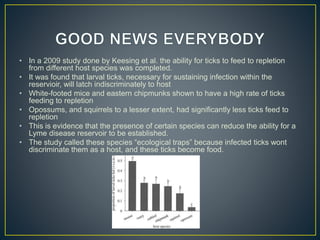
• In a 2009 study done by Keesing et al. the ability for ticks to feed to repletion
from different host species was completed.
• It was found that larval ticks, necessary for sustaining infection within the
reservioir, will latch indiscriminately to host
• White-footed mice and eastern chipmunks shown to have a high rate of ticks
feeding to repletion
• Opossums, and squirrels to a lesser extent, had significantly less ticks feed to
repletion
• This is evidence that the presence of certain species can reduce the ability for a
Lyme disease reservoir to be established.
• The study called these species “ecological traps” because infected ticks wont
discriminate them as a host, and these ticks become food.
• Lyme disease was only recently discovered (1981) to be
caused by a spirochete bacteria: Borrelia burgdorferi
• The symptoms are specific, noticeable, and can be
damaging to tissue if left untreated
• Tick life cycles are about two years in length, therefore
host reservoir of spirochetes must be established for the
disease to persist
• Climate has large influences on tick geographic range,
however predicting Lyme disease occurrence requires
many more factors
• It may be that species, such as opossums, are crucial to
decreasing the availability of Lyme disease hosts and
vectors
Bibliography
“Lyme Disease.” Center for Disease Control and Prevention (CDC). November 15, 2013.
http://www.cdc.gov/lyme/.
“Ticks” Center for Disease Control and Prevention (CDC). February 3, 2014.
http://www.cdc.gov/ticks/.
Diuk-Wasser, Maria A., Gwenaël Vourc’h, Paul Cislo, Anne Gatewood Hoen, Forrest Melton,
Sarah A. Hamer, Michelle Rowland, Roberto Cortinas, Graham J. Hickling, Jean I. Tsao,
Alan G. Barbour, Uriel Kitron, Joseph Piesman, and Durland Fish. “predicting the
density of host-seeking nymphal Ixodes scapularis, an important vector of tick-borne
disease agents in the eastern United States.” Global Ecology and Biogeography 19,
(2010): 504-514.
Hamer, Sarah A., Graham J. Hickling, Jennifer L. Sidge, Michelle E. Rosen, Edward D. Walker,
and Jean I. Tsao. “Diverse Borrelia burgdorferi Strains in a Bird-Tick Cryptic Cycle.”
Applied and Environmental Microbiology 77, No. 6 (2011): 1999-2007.
Keesing, F., J. Brunner, S. Duerr, M. Killilea, K. LoGiudice, K. Schmidt, H. Vuong and R. S.
Ostfeld. “Hosts as ecological traps for the vector of Lyme disease.” Proceedings:
Biological Sciences 276, No. 1675 (2009): 3911-3919.
Leighton, Patrick A., Jules K. Koffi, Yann Pelcat, L. Robbin Lindsay, and Nicholas H. Ogden.
“Predicting the speed of tick invasion: an empirical model of range expansion for the
Lyme disease vector Ixodes scapularis in Canada.” Journal of Applied Ecology 49,
(2012): 457-464.
Margos, Gabriele, Jean I. Tsao, Santiago Castillo-Ramírez, Yvette A. Girard, Sarah A. Hamer,
Anne Gatewood Hoen, Robert S. Lane, Steve L. Raper, and Nicholas H. Ogden. “Two
Boundaries Separate Borrelia burgdorferi Populations in North America.” Applied and
Environmental Microbiology 78, No. 17 (2012): 6059-6067.
Ogden, N.H., A. Maarouf, I.K. Barker, M. Bigras-Poulin, L.R. Lindsay, M.G. Morshed, C.J.
O’Callaghan, F. Ramay, D. Waltner-Toews, D.F. Charron. “Climate change and the
potential for range expansion of the Lyme disease vector Ixodes scapularis in Canada.”
International Journal for Parasitology 36 (2006): 63-70.
Ogden, N.H., M. Bigras-Poulin, K. Hanincova´, A. Maarouf, C.J. O’Callaghan, K. Kurtenbach.
“Projected effects of climate change on tick phenology and fitness of pathogens
transmitted by the North American tick Ixodes scapularis.” Journal of Theoretical
Biology 254, (2008): 621-632.
Olwoch, J. M., B. Reyers and A. S. van Jaarsveld. “Host–parasite distribution patterns under
simulated climate: implications for tick-borne diseases.” International Journal of
Climatology 29, (2009): 993-1000.
Ornet, Wendy. “The Confounding Debate Over Lyme Disease in the South.” Discover.
December 11, 2013. http://discovermagazine.com/2013/dec/14-southern-
gothic#.UwOdT4W5FmO.
Randolph, Sarah E. “Evidence that climate change has caused 'emergence' of tick-borne
diseases in Europe?” International Journal of Medical Microbiology 293, (2004): 5-15.
Randolph, Sarah E. “To what extent has climate change contributed to the recent epidemiology
of tick-borne diseases?” Veterinary Parasitology 167, (2010): 92-94.
Subak, Susan. “Effects of Climate on Variability in Lyme Disease Incidence in the Northeastern
United States.” Aerican Journal of Epidemiology 157, No. 6 (2003): 531-538.

MattWeik_RP1_ClimateTBD

  • 1.
    By: Matthew Weik GEOG510 2/18/2014
  • 2.
    • History ofLyme Disease • Symptoms • Establishing a disease reservoir • Ticks that transmit Lyme disease • Ixodes scapularis’ life cycle • Climate’s influence on I. scapularis • Climate change and Lyme disease • Hosts as ecological traps • Conclusion
  • 3.
    • Polly Murray,1975 • Campaigned to force doctors and scientist to research cases of Juvenile arthritis occurring in Lyme, Connecticut. • Continued to be considered a rheumatologic condition until the 1980’s • Willy Burgdorfer, 1981 • Entomologist at National Institute of Health • Discovered the spirochete bacterium responsible for causing Lyme disease symptoms within the tick Ixodes scapularis. • Named it Borrelia burgdorferi, after himself (Orent 2013)
  • 4.
    • Rash isthe first noticeable symptom • 70-80% experience a bull’s eye rash, known as erythema migrans (EM) • Which is the result of B. burgdorferi infecting the skin after a tick bite • Inflammation, fatigue, fever, and headaches • Occurs once it enters the bloodstream • If left untreated, it will spread to the joints, heart, and nervous system
  • 5.
    • Post-Treatment LymeDisease Syndrome • Commonly called Chronic Lyme disease • Happens to 10-20% of infected people • Could be result of a persisting infection, however it is most likely due to tissue damage during infection • Can last for over 6 months
  • 6.
    • Nymphs andlarvae must alternately feed : • First a nymph I. scapularis must be infected and feed off of a host. • Second, a larvae must hatch nearby the same host, and feed of the same host • Third, the newly infected larvae must survive to become a nymph • Fourth, the newly formed nymph feeds from a different host, and transmit the pathogen to them. • Popular host species: • White-footed mouse, Peromyscus leucopus • Eastern chipmunk, Tamias striatus • Both are easily infected and easily transmitted to feeding larvae
  • 7.
  • 8.
    • Blacklegged tick •Western blacklegged tick
  • 9.
    • Ixodus scapularis •Commonly known as deer tick • Transmits Lyme disease, anaplasmosis, and babesiosis • Found in northeastern and upper midwestern U.S. • Larvae and nymphs feed on small mammals and birds • Adults feed on large mammals (CDC 2014)
  • 10.
    • Ixodes pacificus •Able to cause anaplasmosis and Lyme disease • Found along the Pacific Coast • Larvae and nymphs feed on small mammals and birds • Adults feed on deer and large mammals • Adults and nymphs have been found able to spread disease to humans (CDC 2014)
  • 11.
    • I. scapularislives for roughly two years • They feed on hosts only 3 times in life • Between larval and nymph • Between nymph and adult • Between adult and laying eggs (females) • Female ticks die when laying their eggs • Once the eggs become larvae they must find a host to feed from within two winters
  • 12.
  • 13.
    • After feedingto repletion, larvae and nymphs are vulnerable to their environment • Relative humidity of a region is important • Dry areas do not allow immature ticks to find cover, and are susceptible to water loss because of their size • Temperature, days above freezing, is also important • Adult, nymph, and larval ticks are less active during cold temperatures. • The white-footed mouse is also poorly equipped for cold temperatures, and have high winter mortality. • Providing less host to feed from during spring and summer in colder climates
  • 14.
  • 15.
    • Warming temperaturesare predicted to spread geographic range of I. scapularis through most of southern Canada by 2020 • Will impact the most densely populated area of Canada • Shares border with endemic populations of Lyme disease in northeastern and upper midwestern U.S. • However, U.S. and European studies say that climate change is not enough to increase Lyme Disease range • Many factors are responsible for establishment of Lyme disease in a host reservoir: • Order of feeding of uninfected larvae and infected nymphs from the same host • Ability for disease to be transmitted to and from host species (Ogden 2006)
  • 16.
    • In a2009 study done by Keesing et al. the ability for ticks to feed to repletion from different host species was completed. • It was found that larval ticks, necessary for sustaining infection within the reservioir, will latch indiscriminately to host • White-footed mice and eastern chipmunks shown to have a high rate of ticks feeding to repletion • Opossums, and squirrels to a lesser extent, had significantly less ticks feed to repletion • This is evidence that the presence of certain species can reduce the ability for a Lyme disease reservoir to be established. • The study called these species “ecological traps” because infected ticks wont discriminate them as a host, and these ticks become food.
  • 17.
    • Lyme diseasewas only recently discovered (1981) to be caused by a spirochete bacteria: Borrelia burgdorferi • The symptoms are specific, noticeable, and can be damaging to tissue if left untreated • Tick life cycles are about two years in length, therefore host reservoir of spirochetes must be established for the disease to persist • Climate has large influences on tick geographic range, however predicting Lyme disease occurrence requires many more factors • It may be that species, such as opossums, are crucial to decreasing the availability of Lyme disease hosts and vectors
  • 18.
    Bibliography “Lyme Disease.” Centerfor Disease Control and Prevention (CDC). November 15, 2013. http://www.cdc.gov/lyme/. “Ticks” Center for Disease Control and Prevention (CDC). February 3, 2014. http://www.cdc.gov/ticks/. Diuk-Wasser, Maria A., Gwenaël Vourc’h, Paul Cislo, Anne Gatewood Hoen, Forrest Melton, Sarah A. Hamer, Michelle Rowland, Roberto Cortinas, Graham J. Hickling, Jean I. Tsao, Alan G. Barbour, Uriel Kitron, Joseph Piesman, and Durland Fish. “predicting the density of host-seeking nymphal Ixodes scapularis, an important vector of tick-borne disease agents in the eastern United States.” Global Ecology and Biogeography 19, (2010): 504-514. Hamer, Sarah A., Graham J. Hickling, Jennifer L. Sidge, Michelle E. Rosen, Edward D. Walker, and Jean I. Tsao. “Diverse Borrelia burgdorferi Strains in a Bird-Tick Cryptic Cycle.” Applied and Environmental Microbiology 77, No. 6 (2011): 1999-2007. Keesing, F., J. Brunner, S. Duerr, M. Killilea, K. LoGiudice, K. Schmidt, H. Vuong and R. S. Ostfeld. “Hosts as ecological traps for the vector of Lyme disease.” Proceedings: Biological Sciences 276, No. 1675 (2009): 3911-3919. Leighton, Patrick A., Jules K. Koffi, Yann Pelcat, L. Robbin Lindsay, and Nicholas H. Ogden. “Predicting the speed of tick invasion: an empirical model of range expansion for the Lyme disease vector Ixodes scapularis in Canada.” Journal of Applied Ecology 49, (2012): 457-464. Margos, Gabriele, Jean I. Tsao, Santiago Castillo-Ramírez, Yvette A. Girard, Sarah A. Hamer, Anne Gatewood Hoen, Robert S. Lane, Steve L. Raper, and Nicholas H. Ogden. “Two Boundaries Separate Borrelia burgdorferi Populations in North America.” Applied and Environmental Microbiology 78, No. 17 (2012): 6059-6067. Ogden, N.H., A. Maarouf, I.K. Barker, M. Bigras-Poulin, L.R. Lindsay, M.G. Morshed, C.J. O’Callaghan, F. Ramay, D. Waltner-Toews, D.F. Charron. “Climate change and the potential for range expansion of the Lyme disease vector Ixodes scapularis in Canada.” International Journal for Parasitology 36 (2006): 63-70. Ogden, N.H., M. Bigras-Poulin, K. Hanincova´, A. Maarouf, C.J. O’Callaghan, K. Kurtenbach. “Projected effects of climate change on tick phenology and fitness of pathogens transmitted by the North American tick Ixodes scapularis.” Journal of Theoretical Biology 254, (2008): 621-632. Olwoch, J. M., B. Reyers and A. S. van Jaarsveld. “Host–parasite distribution patterns under simulated climate: implications for tick-borne diseases.” International Journal of Climatology 29, (2009): 993-1000. Ornet, Wendy. “The Confounding Debate Over Lyme Disease in the South.” Discover. December 11, 2013. http://discovermagazine.com/2013/dec/14-southern- gothic#.UwOdT4W5FmO. Randolph, Sarah E. “Evidence that climate change has caused 'emergence' of tick-borne diseases in Europe?” International Journal of Medical Microbiology 293, (2004): 5-15. Randolph, Sarah E. “To what extent has climate change contributed to the recent epidemiology of tick-borne diseases?” Veterinary Parasitology 167, (2010): 92-94. Subak, Susan. “Effects of Climate on Variability in Lyme Disease Incidence in the Northeastern United States.” Aerican Journal of Epidemiology 157, No. 6 (2003): 531-538.