Fibre identification
Technical and non technical methods
Textile fibres
• A large variety of consumer goods made of different textiles are available in
the market under different price segments. Generally, fabrics are labelled
and as per the legal requirement, the manufacturer provides information
about the fibre content. When the fabrics are made into products such as
apparel, home textiles such as curtains, upholstery etc., the label may be
present or it may not provide information on the fibre content. If the fabric
fails to perform as per the end-use requirement, the consumer loses his
investment in the product. Therefore, consumers should have knowledge of
the properties of the fibre in the fabric, so that they can compare its
performance against the price range of fabric and its intended end-use.
• The Textile Fibre Product Identification Act of 1960 brought in by the Federal
Government of the USA has provided the classification and generic names of
the fibres and instructed the manufacturers to provide information on the
fibre content on the label. As per the law, it is mandatory.
Non-technical tests
Nontechnical tests:
• In the absence of special equipment and facilities, one can rely on nontechnical tests such as appearance,
feeling tests and burning tests. These tests have limitations of their own but are helpful to identify the fibre
groups.
• Physical appearance: The physical appearance of fabric sometimes indicates the probable fibre content.
Generally, natural fibres can be identified tentatively. The yarns are drawn from the fabric separately warp-
wise and weft-wise. The parameters checked are
• 1. Fibre length
• 2. Lustre
• 3. Fabric surface
• 4. Fabric Weight
• The fibres are either staple or filamentous. Generally, all-natural fibres are staples except for silk. However,
spun yarns are made even from filament fibres. The Lustre of the fabric can be an indication of fibre content
such as silk, rayon, polyester, or any synthetic fibre. Cotton is dull, but mercerized cotton is bright; silk has a
lustre that is different from other fibres. Rayon has maximum lustre; banana, linen and jute have little lustre
as compared to cotton. Fabric surface may be smooth, soft or hard; wool is soft to touch; bast fibres are
hard to touch; all synthetics are smooth to touch. The fabric heaviness can be tentatively checked in hand. If
it is light in weight but looks voluminous it may be wool. All natural and man-made cellulosic fabrics are
heavy. Linen fabrics are made a little heavier than the other cellulosic fabrics. All synthetics are generally
light in weight.
Cont…
• Feeling Test:
• This test is purely a perception of the feeling of a fabric when it is handled. One acquires
this expertise after handling many fabrics. To understand this skilled perception, run your
fingers over the fabric. When the fingers become warm, it may be a wool fabric. If the
fingers become cool by losing heat, it may be one of the cellulosic fibres such as cotton,
linen, jute or even rayon as they are good conductors of heat. One more example of skilled
perception is silk crepes and chiffons vs rayon/polyester crepes and chiffons. Silk is
smoother to touch, while others are hard to touch. But this test has a limitation in
identifying the exact fibre content.
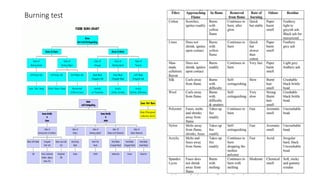
• Burning Test
• Among the nontechnical tests, the burning test may be reliable as it gives scope to identify
the fibre groups used in daily used textiles. The fibres vary in their burning properties and
that makes sense to utilize the test for the identification of the fibres. The yarns from the
fabric should be separated warp-wise and weft-wise for testing. Observations should be
made when the yarns approach the flame, in the flame, the rate of burning, after removing
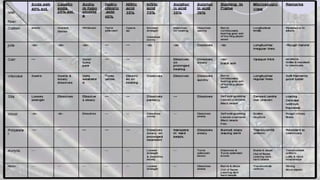
from the flame, the odour and the residue. The table portrayed here has the recorded
observations of the frequently used fibres. It gives a broad conclusion about the fibre
groups present in the given fabric.
Burning test
Technical tests
The Technical tests:
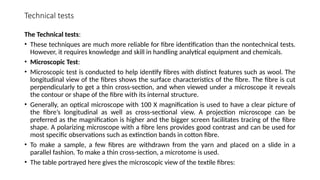
• These techniques are much more reliable for fibre identification than the nontechnical tests.
However, it requires knowledge and skill in handling analytical equipment and chemicals.
• Microscopic Test:
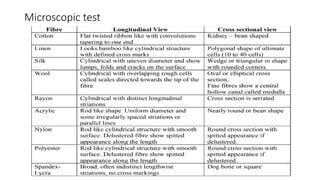
• Microscopic test is conducted to help identify fibres with distinct features such as wool. The
longitudinal view of the fibres shows the surface characteristics of the fibre. The fibre is cut
perpendicularly to get a thin cross-section, and when viewed under a microscope it reveals
the contour or shape of the fibre with its internal structure.
• Generally, an optical microscope with 100 X magnification is used to have a clear picture of
the fibre’s longitudinal as well as cross-sectional view. A projection microscope can be
preferred as the magnification is higher and the bigger screen facilitates tracing of the fibre
shape. A polarizing microscope with a fibre lens provides good contrast and can be used for
most specific observations such as extinction bands in cotton fibre.
• To make a sample, a few fibres are withdrawn from the yarn and placed on a slide in a
parallel fashion. To make a thin cross-section, a microtome is used.
• The table portrayed here gives the microscopic view of the textile fibres:
Microscopic test
Chemical test
• Use of chemicals for
identification or confirmation of
the fibre content in fabrics is the
ultimate technique without the
use of advanced techniques.
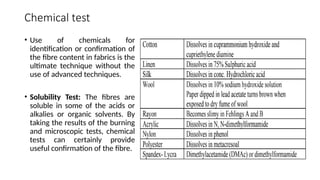
• Solubility Test: The fibres are
soluble in some of the acids or
alkalies or organic solvents. By
taking the results of the burning
and microscopic tests, chemical
tests can certainly provide
useful confirmation of the fibre.
Cont…
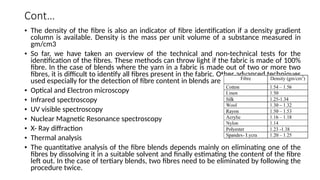
• The density of the fibre is also an indicator of fibre identification if a density gradient
column is available. Density is the mass per unit volume of a substance measured in
gm/cm3
• So far, we have taken an overview of the technical and non-technical tests for the
identification of the fibres. These methods can throw light if the fabric is made of 100%
fibre. In the case of blends where the yarn in a fabric is made out of two or more two
fibres, it is difficult to identify all fibres present in the fabric. Other advanced techniques
used especially for the detection of fibre content in blends are -
• Optical and Electron microscopy
• Infrared spectroscopy
• UV visible spectroscopy
• Nuclear Magnetic Resonance spectroscopy
• X- Ray diffraction
• Thermal analysis
• The quantitative analysis of the fibre blends depends mainly on eliminating one of the
fibres by dissolving it in a suitable solvent and finally estimating the content of the fibre
left out. In the case of tertiary blends, two fibres need to be eliminated by following the
procedure twice.
fibre identification methods, physical and chemical

  • 1.
  • 2.
    Textile fibres • Alarge variety of consumer goods made of different textiles are available in the market under different price segments. Generally, fabrics are labelled and as per the legal requirement, the manufacturer provides information about the fibre content. When the fabrics are made into products such as apparel, home textiles such as curtains, upholstery etc., the label may be present or it may not provide information on the fibre content. If the fabric fails to perform as per the end-use requirement, the consumer loses his investment in the product. Therefore, consumers should have knowledge of the properties of the fibre in the fabric, so that they can compare its performance against the price range of fabric and its intended end-use. • The Textile Fibre Product Identification Act of 1960 brought in by the Federal Government of the USA has provided the classification and generic names of the fibres and instructed the manufacturers to provide information on the fibre content on the label. As per the law, it is mandatory.
  • 3.
    Non-technical tests Nontechnical tests: •In the absence of special equipment and facilities, one can rely on nontechnical tests such as appearance, feeling tests and burning tests. These tests have limitations of their own but are helpful to identify the fibre groups. • Physical appearance: The physical appearance of fabric sometimes indicates the probable fibre content. Generally, natural fibres can be identified tentatively. The yarns are drawn from the fabric separately warp- wise and weft-wise. The parameters checked are • 1. Fibre length • 2. Lustre • 3. Fabric surface • 4. Fabric Weight • The fibres are either staple or filamentous. Generally, all-natural fibres are staples except for silk. However, spun yarns are made even from filament fibres. The Lustre of the fabric can be an indication of fibre content such as silk, rayon, polyester, or any synthetic fibre. Cotton is dull, but mercerized cotton is bright; silk has a lustre that is different from other fibres. Rayon has maximum lustre; banana, linen and jute have little lustre as compared to cotton. Fabric surface may be smooth, soft or hard; wool is soft to touch; bast fibres are hard to touch; all synthetics are smooth to touch. The fabric heaviness can be tentatively checked in hand. If it is light in weight but looks voluminous it may be wool. All natural and man-made cellulosic fabrics are heavy. Linen fabrics are made a little heavier than the other cellulosic fabrics. All synthetics are generally light in weight.
  • 4.
    Cont… • Feeling Test: •This test is purely a perception of the feeling of a fabric when it is handled. One acquires this expertise after handling many fabrics. To understand this skilled perception, run your fingers over the fabric. When the fingers become warm, it may be a wool fabric. If the fingers become cool by losing heat, it may be one of the cellulosic fibres such as cotton, linen, jute or even rayon as they are good conductors of heat. One more example of skilled perception is silk crepes and chiffons vs rayon/polyester crepes and chiffons. Silk is smoother to touch, while others are hard to touch. But this test has a limitation in identifying the exact fibre content. • Burning Test • Among the nontechnical tests, the burning test may be reliable as it gives scope to identify the fibre groups used in daily used textiles. The fibres vary in their burning properties and that makes sense to utilize the test for the identification of the fibres. The yarns from the fabric should be separated warp-wise and weft-wise for testing. Observations should be made when the yarns approach the flame, in the flame, the rate of burning, after removing from the flame, the odour and the residue. The table portrayed here has the recorded observations of the frequently used fibres. It gives a broad conclusion about the fibre groups present in the given fabric.
  • 5.
  • 6.
    Technical tests The Technicaltests: • These techniques are much more reliable for fibre identification than the nontechnical tests. However, it requires knowledge and skill in handling analytical equipment and chemicals. • Microscopic Test: • Microscopic test is conducted to help identify fibres with distinct features such as wool. The longitudinal view of the fibres shows the surface characteristics of the fibre. The fibre is cut perpendicularly to get a thin cross-section, and when viewed under a microscope it reveals the contour or shape of the fibre with its internal structure. • Generally, an optical microscope with 100 X magnification is used to have a clear picture of the fibre’s longitudinal as well as cross-sectional view. A projection microscope can be preferred as the magnification is higher and the bigger screen facilitates tracing of the fibre shape. A polarizing microscope with a fibre lens provides good contrast and can be used for most specific observations such as extinction bands in cotton fibre. • To make a sample, a few fibres are withdrawn from the yarn and placed on a slide in a parallel fashion. To make a thin cross-section, a microtome is used. • The table portrayed here gives the microscopic view of the textile fibres:
  • 7.
  • 8.
    Chemical test • Useof chemicals for identification or confirmation of the fibre content in fabrics is the ultimate technique without the use of advanced techniques. • Solubility Test: The fibres are soluble in some of the acids or alkalies or organic solvents. By taking the results of the burning and microscopic tests, chemical tests can certainly provide useful confirmation of the fibre.
  • 10.
    Cont… • The densityof the fibre is also an indicator of fibre identification if a density gradient column is available. Density is the mass per unit volume of a substance measured in gm/cm3 • So far, we have taken an overview of the technical and non-technical tests for the identification of the fibres. These methods can throw light if the fabric is made of 100% fibre. In the case of blends where the yarn in a fabric is made out of two or more two fibres, it is difficult to identify all fibres present in the fabric. Other advanced techniques used especially for the detection of fibre content in blends are - • Optical and Electron microscopy • Infrared spectroscopy • UV visible spectroscopy • Nuclear Magnetic Resonance spectroscopy • X- Ray diffraction • Thermal analysis • The quantitative analysis of the fibre blends depends mainly on eliminating one of the fibres by dissolving it in a suitable solvent and finally estimating the content of the fibre left out. In the case of tertiary blends, two fibres need to be eliminated by following the procedure twice.