IB203 – EXPORT – IMPORT
PROCEDURES AND
DOCUMENTATION
Unit I
CONTENT
 Introduction: Export
 Basic Export Procedure
 Introduction: Import
 Basic Import Procedure
 Legal Framework
 Export Sales Contract
INTRODUCTION - EXPORT
 Export of goods take place when there is a change of
proprietorship from a resident to a non-resident;
this does not essentially infer that the goods in
question physically crosses the border.
 In some cases, legal terms no change of ownership
takes place such as cross border financial leasing,
cross border deliveries between affiliates of the
same enterprise, goods crossing the border for
significant processing to order or repair.
Export: Order processing quotation (Source: Johnson, 2010)
Export order processing: Order entry (Source: Johnson, 2010)
Export order processing: Shipment (Source: Johnson, 2010 )
BASIC EXPORT PROCEDURE
 Market Research and Setting Objectives of
Distribution
 Trade Regulations
 Making Contacts
 Quotation and Terms
 Sales Contract
 Contract Execution
 Customs Clearance
 Getting paid
Export order processing: Collection (Source: Johnson, 2010)
INTRODUCTION - IMPORT
 Import is explained as bringing products into
own country from a place outside national border.
 It can be said that Import trade refers to the
purchase of goods from a foreign country.
 The procedure for import trade varies from
country to country depending upon the import
policy, statutory requirements and customs
policies of different countries.
 In almost all countries of the world import trade
is controlled by the government.
 The aims of these controls are appropriate use of
foreign exchange restrictions, protection of
indigenous industries etc.
BASIC IMPORT PROCEDURES
 Setting Market Objectives:
 Sourcing Products:
 Trade Regulations:
 Making Contacts:
 Settling Quotation and Terms:
 Financing the Purchase:
 Sales Contract:
 Preparing Payment and Insurance:
 Acquiring Goods:
 Customs Clearance:
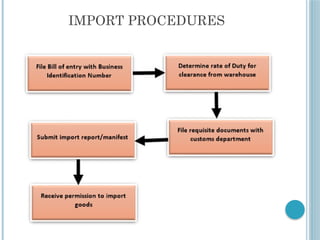
IMPORT PROCEDURES
LEGAL FRAMEWORK
 Foreign Trade (Development and Regulation)
Act, 1992
 Foreign Exchange Management Act, 1999
 The Customs Act, 1962
 Export (Quality Control and Inspection) Act,
1963
EXPORT SALES CONTRACT
1. Ex-works (Ex-W)
2. Free Carrier (FCA)
3. Free Alongside ship (FAS)
4. Free On Board (FOB)
5. Cost and Freight (CIF)
6. Cost Insurance and Freight (CIF)
7. Carriage Paid to (CPT)
8. Carriage and Insurance Paid to (CIP)
9. Delivered at Frontier (DAF)
10. Delivered Ex-Skip (DES)
11. Delivered Ex-Quay (Duty Paid) (DEQ)
12. Delivered Duty Unpaid (DDU)
13. Delivered Duty Paid (DDP)
END OF UNIT I

Export - Import Documentation and Procedures.pptx

  • 1.
    IB203 – EXPORT– IMPORT PROCEDURES AND DOCUMENTATION Unit I
  • 2.
    CONTENT  Introduction: Export Basic Export Procedure  Introduction: Import  Basic Import Procedure  Legal Framework  Export Sales Contract
  • 3.
    INTRODUCTION - EXPORT Export of goods take place when there is a change of proprietorship from a resident to a non-resident; this does not essentially infer that the goods in question physically crosses the border.  In some cases, legal terms no change of ownership takes place such as cross border financial leasing, cross border deliveries between affiliates of the same enterprise, goods crossing the border for significant processing to order or repair.
  • 4.
    Export: Order processingquotation (Source: Johnson, 2010)
  • 5.
    Export order processing:Order entry (Source: Johnson, 2010)
  • 6.
    Export order processing:Shipment (Source: Johnson, 2010 )
  • 7.
    BASIC EXPORT PROCEDURE Market Research and Setting Objectives of Distribution  Trade Regulations  Making Contacts  Quotation and Terms  Sales Contract  Contract Execution  Customs Clearance  Getting paid
  • 8.
    Export order processing:Collection (Source: Johnson, 2010)
  • 9.
    INTRODUCTION - IMPORT Import is explained as bringing products into own country from a place outside national border.  It can be said that Import trade refers to the purchase of goods from a foreign country.  The procedure for import trade varies from country to country depending upon the import policy, statutory requirements and customs policies of different countries.  In almost all countries of the world import trade is controlled by the government.  The aims of these controls are appropriate use of foreign exchange restrictions, protection of indigenous industries etc.
  • 10.
    BASIC IMPORT PROCEDURES Setting Market Objectives:  Sourcing Products:  Trade Regulations:  Making Contacts:  Settling Quotation and Terms:  Financing the Purchase:  Sales Contract:  Preparing Payment and Insurance:  Acquiring Goods:  Customs Clearance:
  • 11.
  • 12.
    LEGAL FRAMEWORK  ForeignTrade (Development and Regulation) Act, 1992  Foreign Exchange Management Act, 1999  The Customs Act, 1962  Export (Quality Control and Inspection) Act, 1963
  • 13.
    EXPORT SALES CONTRACT 1.Ex-works (Ex-W) 2. Free Carrier (FCA) 3. Free Alongside ship (FAS) 4. Free On Board (FOB) 5. Cost and Freight (CIF) 6. Cost Insurance and Freight (CIF) 7. Carriage Paid to (CPT) 8. Carriage and Insurance Paid to (CIP) 9. Delivered at Frontier (DAF) 10. Delivered Ex-Skip (DES) 11. Delivered Ex-Quay (Duty Paid) (DEQ) 12. Delivered Duty Unpaid (DDU) 13. Delivered Duty Paid (DDP)
  • 14.