UNIT 3 Import and Export Procedure (401) SPPU Study notes
1.
UNIT 3
IMPORT PROCEDURE
By
PROF.PRIYANKA PUNJABI
Assistant Professor
Sanjivani arts commerce and science college Kopargaon
Maharashtra
2.
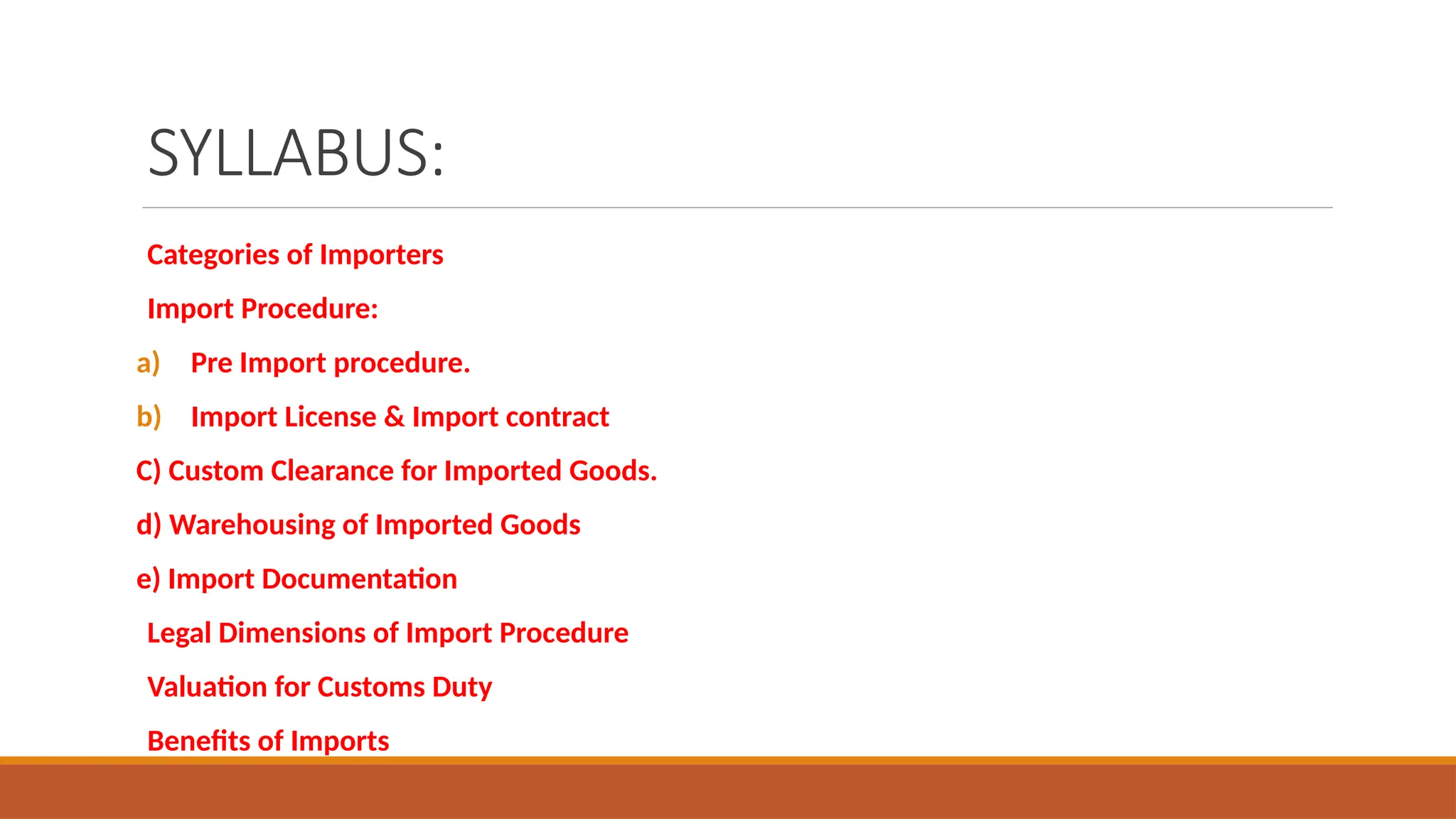
SYLLABUS:
Categories of Importers
ImportProcedure:
a) Pre Import procedure.
b) Import License & Import contract
C) Custom Clearance for Imported Goods.
d) Warehousing of Imported Goods
e) Import Documentation
Legal Dimensions of Import Procedure
Valuation for Customs Duty
Benefits of Imports
3.
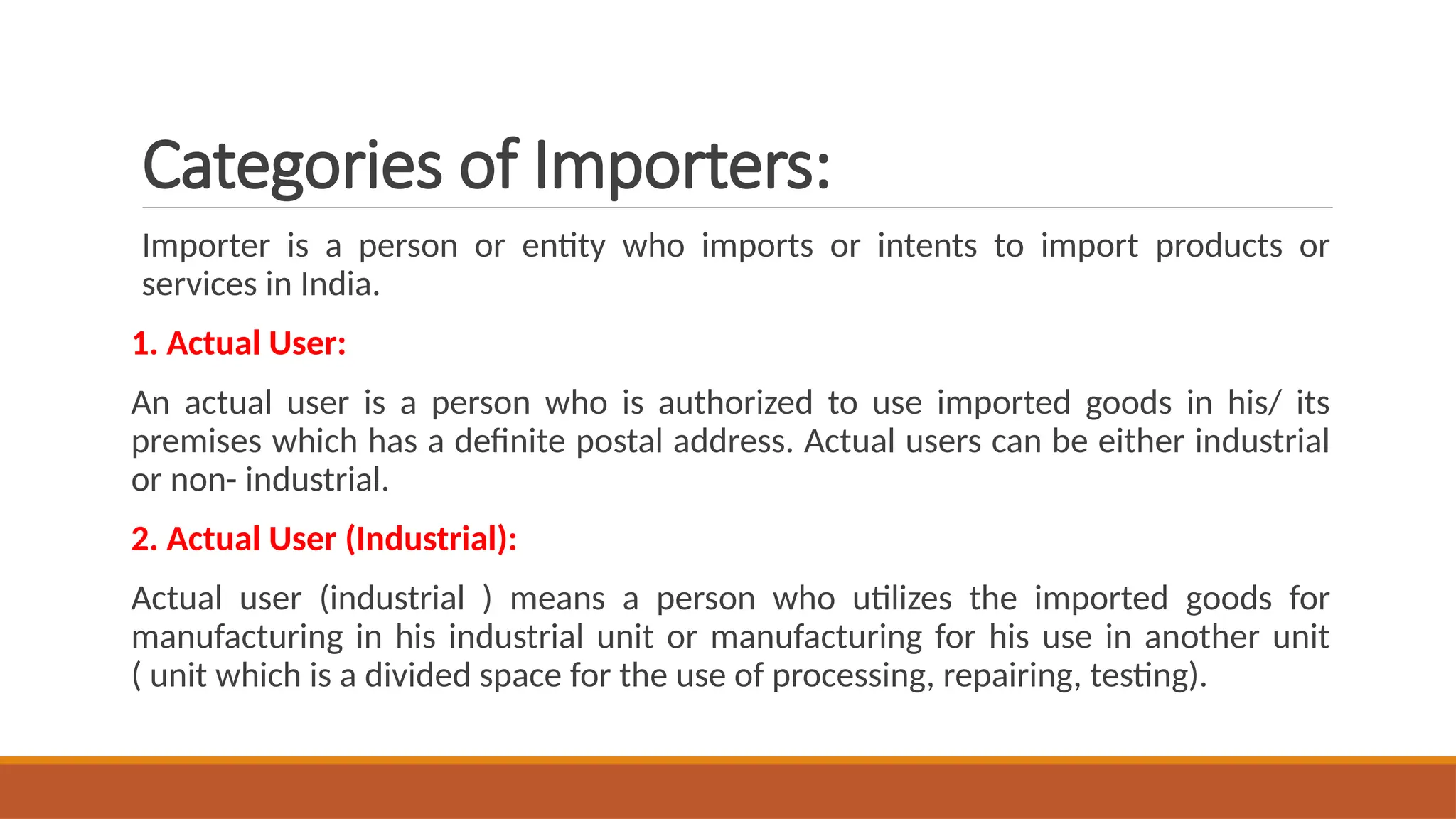
Categories of Importers:
Importeris a person or entity who imports or intents to import products or
services in India.
1. Actual User:
An actual user is a person who is authorized to use imported goods in his/ its
premises which has a definite postal address. Actual users can be either industrial
or non- industrial.
2. Actual User (Industrial):
Actual user (industrial ) means a person who utilizes the imported goods for
manufacturing in his industrial unit or manufacturing for his use in another unit
( unit which is a divided space for the use of processing, repairing, testing).
4.
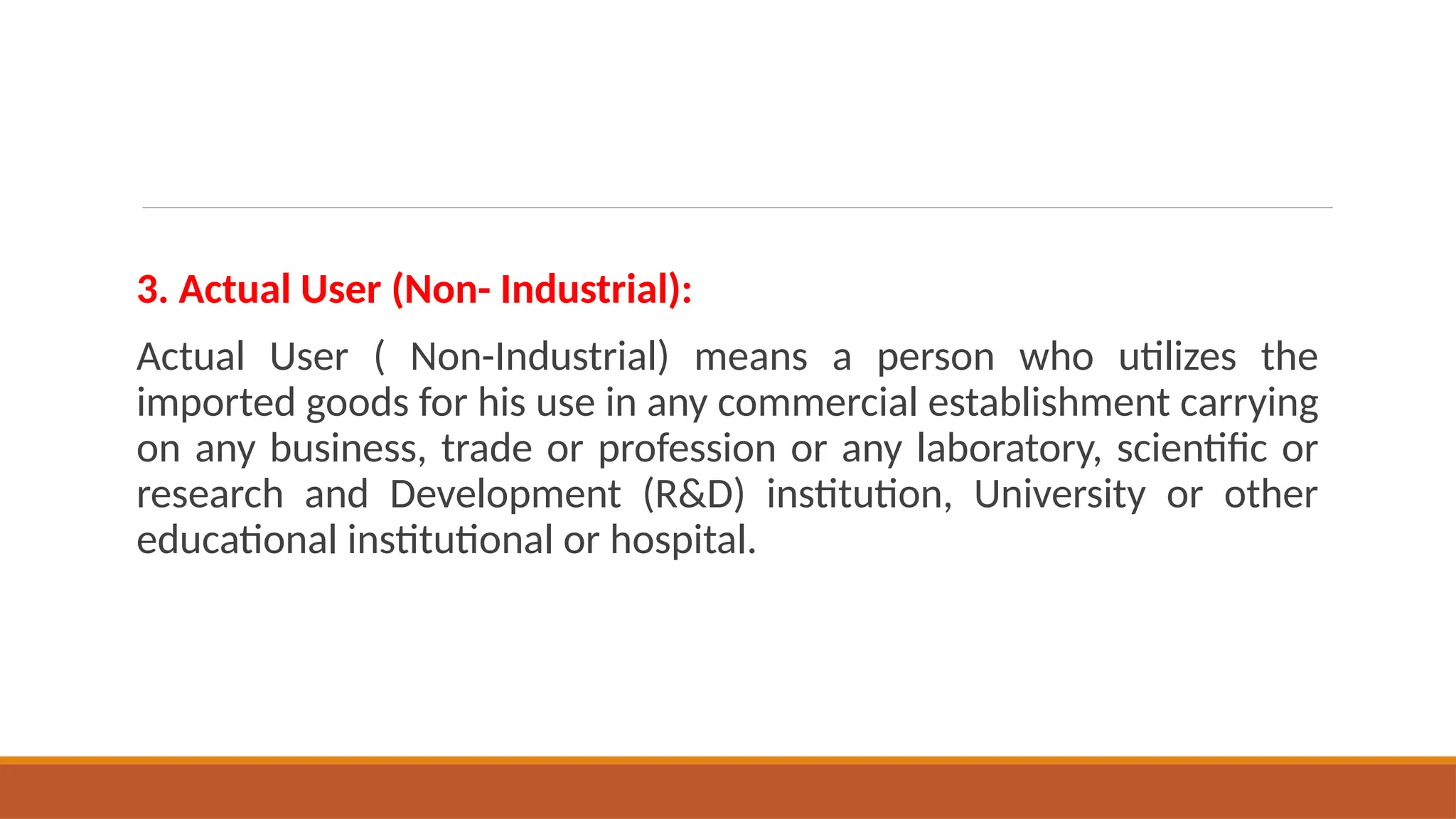
3. Actual User(Non- Industrial):
Actual User ( Non-Industrial) means a person who utilizes the
imported goods for his use in any commercial establishment carrying
on any business, trade or profession or any laboratory, scientific or
research and Development (R&D) institution, University or other
educational institutional or hospital.
5.
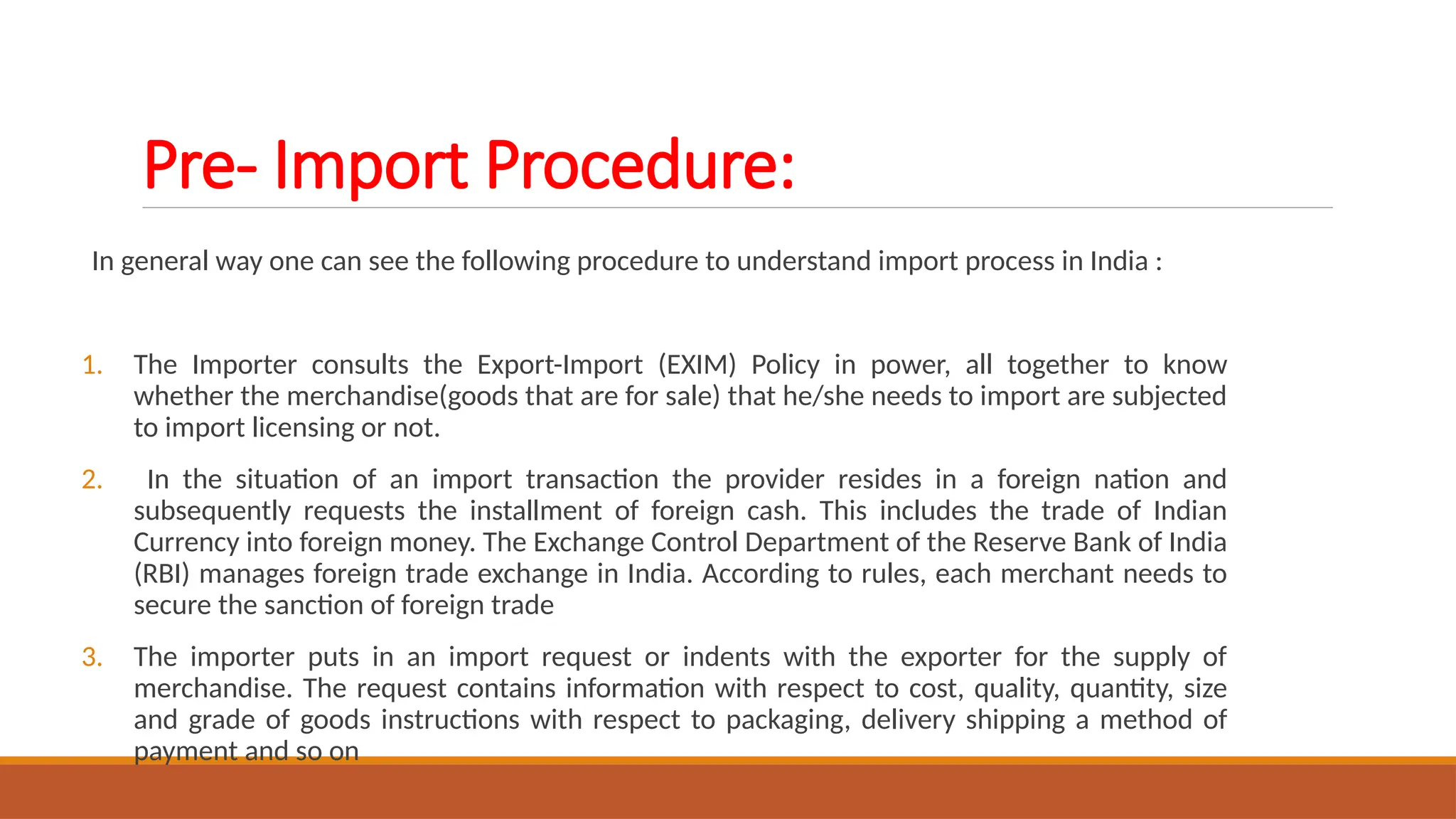
Pre- Import Procedure:
Ingeneral way one can see the following procedure to understand import process in India :
1. The Importer consults the Export-Import (EXIM) Policy in power, all together to know
whether the merchandise(goods that are for sale) that he/she needs to import are subjected
to import licensing or not.
2. In the situation of an import transaction the provider resides in a foreign nation and
subsequently requests the installment of foreign cash. This includes the trade of Indian
Currency into foreign money. The Exchange Control Department of the Reserve Bank of India
(RBI) manages foreign trade exchange in India. According to rules, each merchant needs to
secure the sanction of foreign trade
3. The importer puts in an import request or indents with the exporter for the supply of
merchandise. The request contains information with respect to cost, quality, quantity, size
and grade of goods instructions with respect to packaging, delivery shipping a method of
payment and so on
6.
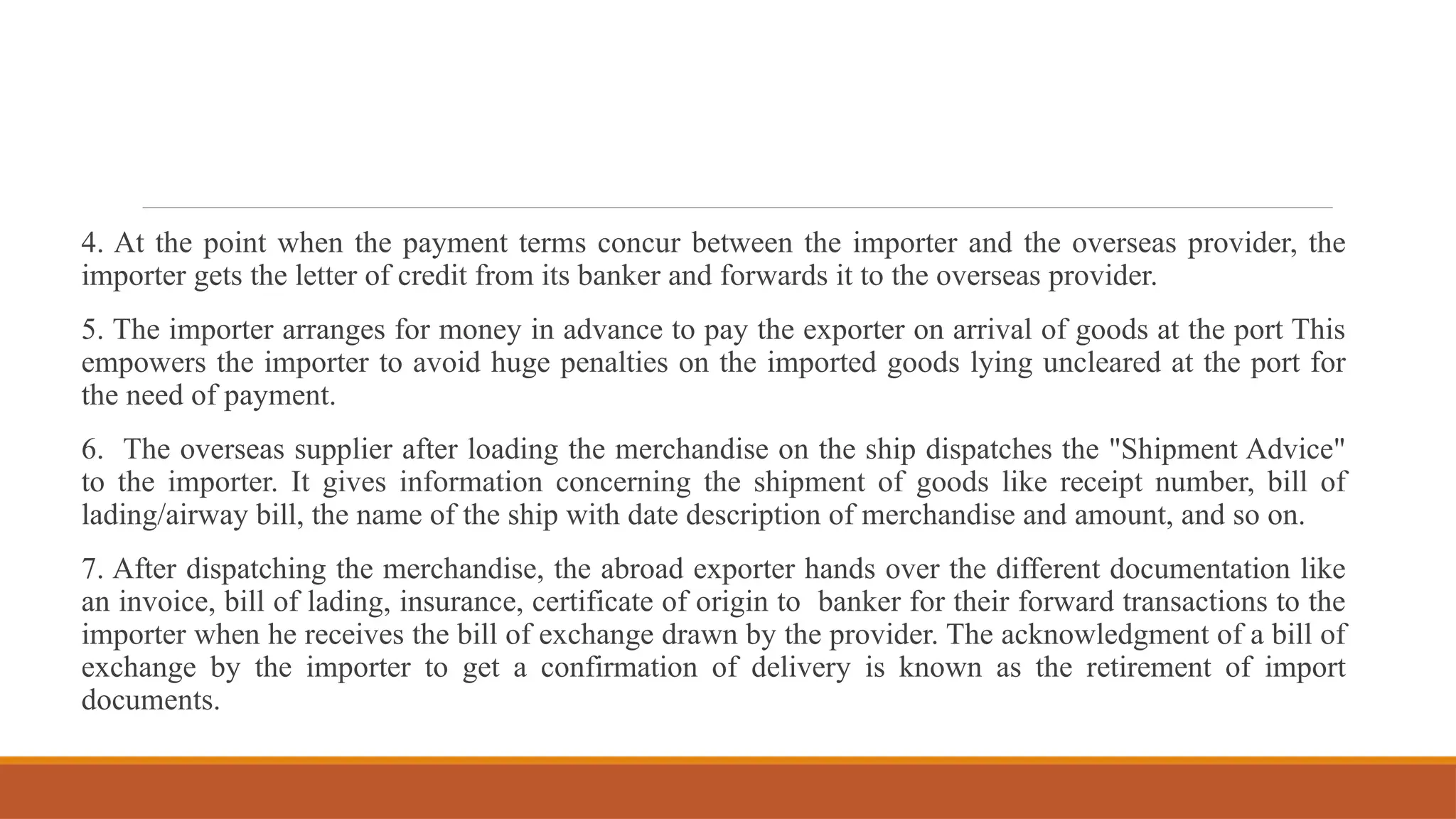
4. At thepoint when the payment terms concur between the importer and the overseas provider, the
importer gets the letter of credit from its banker and forwards it to the overseas provider.
5. The importer arranges for money in advance to pay the exporter on arrival of goods at the port This
empowers the importer to avoid huge penalties on the imported goods lying uncleared at the port for
the need of payment.
6. The overseas supplier after loading the merchandise on the ship dispatches the "Shipment Advice"
to the importer. It gives information concerning the shipment of goods like receipt number, bill of
lading/airway bill, the name of the ship with date description of merchandise and amount, and so on.
7. After dispatching the merchandise, the abroad exporter hands over the different documentation like
an invoice, bill of lading, insurance, certificate of origin to banker for their forward transactions to the
importer when he receives the bill of exchange drawn by the provider. The acknowledgment of a bill of
exchange by the importer to get a confirmation of delivery is known as the retirement of import
documents.
7.
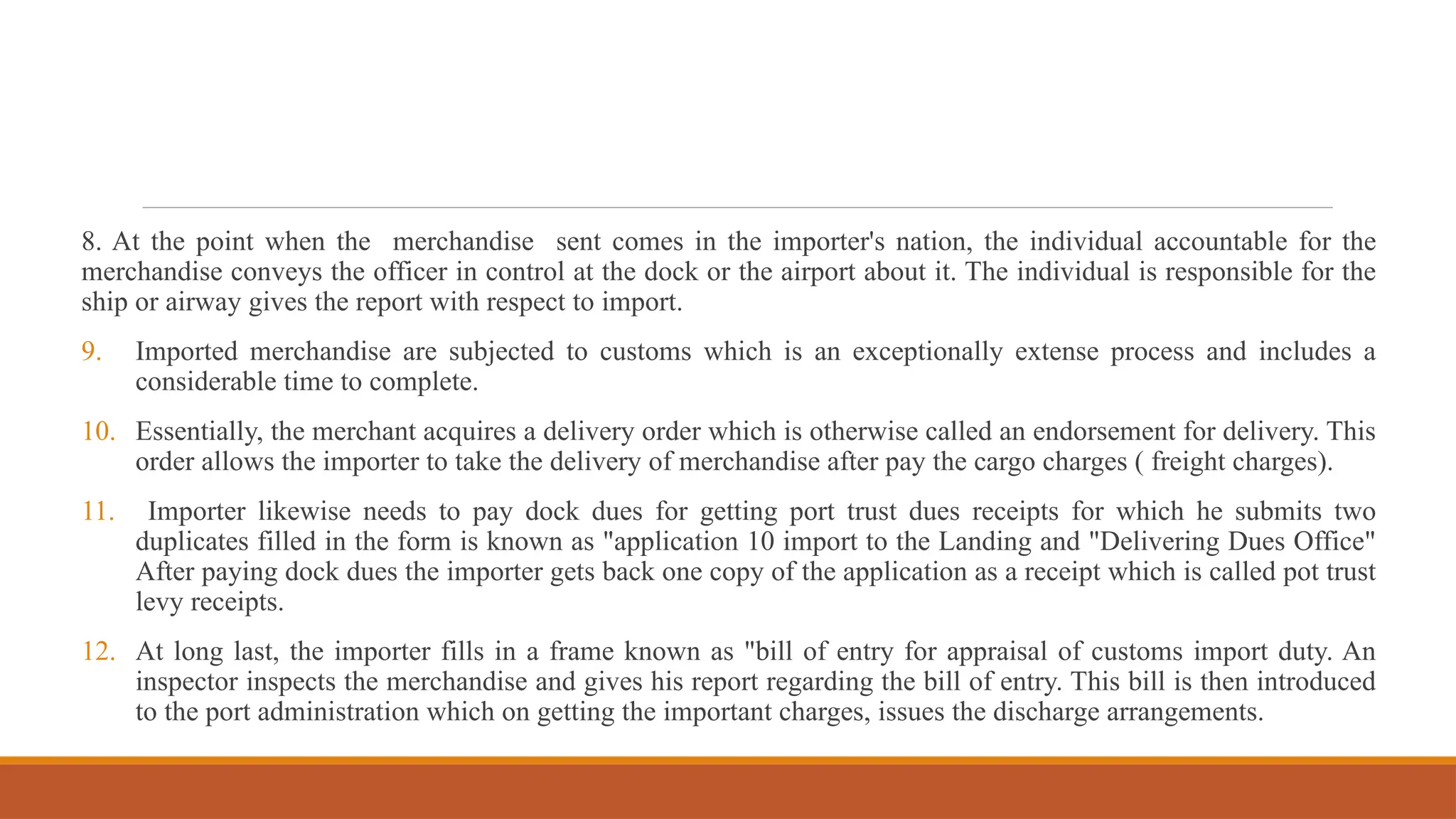
8. At thepoint when the merchandise sent comes in the importer's nation, the individual accountable for the
merchandise conveys the officer in control at the dock or the airport about it. The individual is responsible for the
ship or airway gives the report with respect to import.
9. Imported merchandise are subjected to customs which is an exceptionally extense process and includes a
considerable time to complete.
10. Essentially, the merchant acquires a delivery order which is otherwise called an endorsement for delivery. This
order allows the importer to take the delivery of merchandise after pay the cargo charges ( freight charges).
11. Importer likewise needs to pay dock dues for getting port trust dues receipts for which he submits two
duplicates filled in the form is known as "application 10 import to the Landing and "Delivering Dues Office"
After paying dock dues the importer gets back one copy of the application as a receipt which is called pot trust
levy receipts.
12. At long last, the importer fills in a frame known as "bill of entry for appraisal of customs import duty. An
inspector inspects the merchandise and gives his report regarding the bill of entry. This bill is then introduced
to the port administration which on getting the important charges, issues the discharge arrangements.
8.
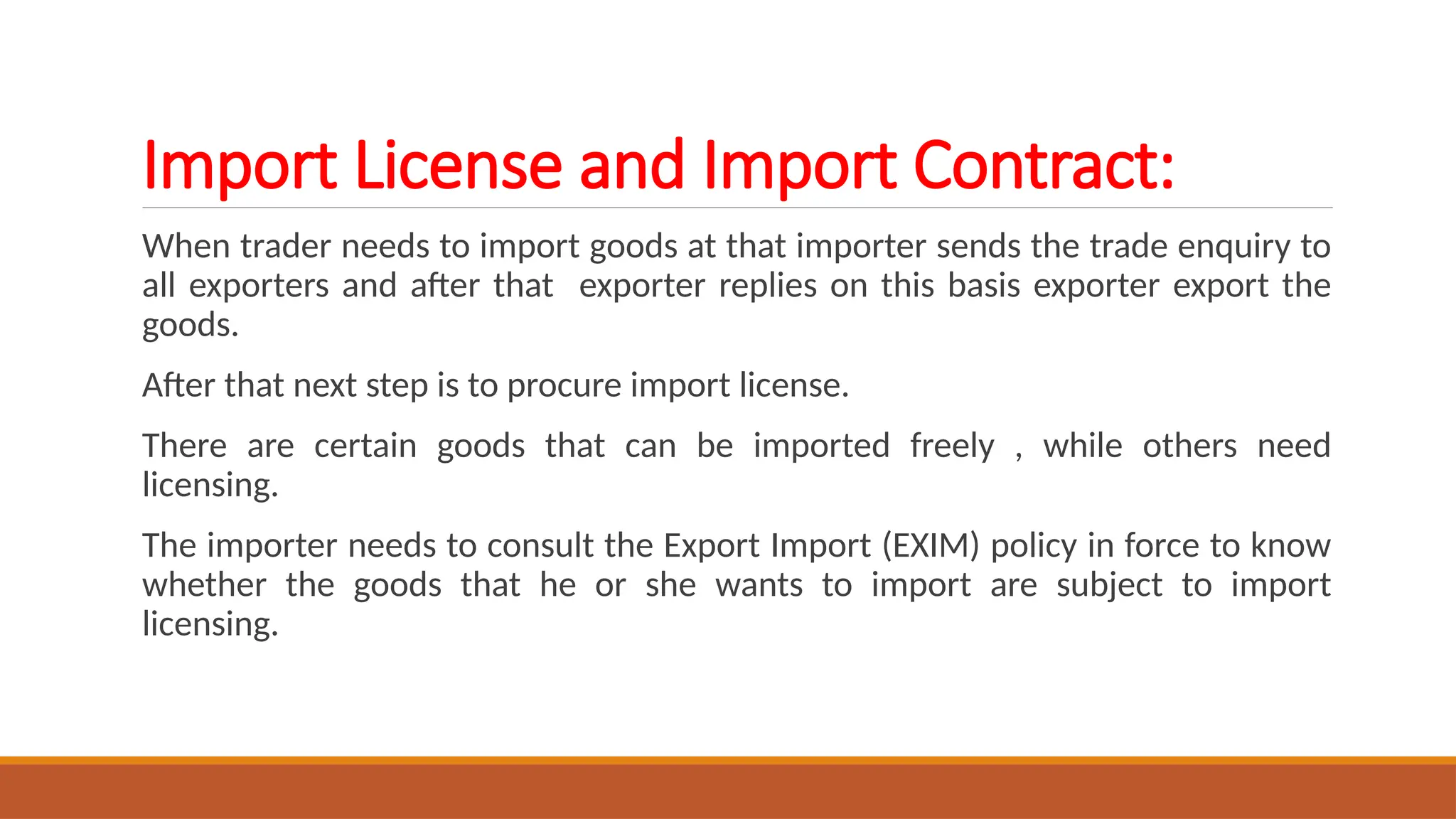
Import License andImport Contract:
When trader needs to import goods at that importer sends the trade enquiry to
all exporters and after that exporter replies on this basis exporter export the
goods.
After that next step is to procure import license.
There are certain goods that can be imported freely , while others need
licensing.
The importer needs to consult the Export Import (EXIM) policy in force to know
whether the goods that he or she wants to import are subject to import
licensing.
9.
In case goodscan be imported only against the licensing the importer needs to
procure an import license, and it is given in EXIM policy that particular good
needs a license than importer should procure that license.
And if he fails to procure license than he will be charged for violation of law with
the penalties.
In India it is mandatory for every importer and also for exporter to get registered
under Directorate General Foreign Trade or Regional Import Export Licensing
Authority and obtain an import export code (IEC) number.
After getting Import Export License anyone can start their business.
10.
This (IEC)number isrequired to be mentioned on most of the import
documents. This number is your identity proof.
Ex: For banking scenario your identity proof will be Pan card, for voting
your identity proof will be Voter Id.
11.
Custom Clearance forImported Goods:
If we are exporting or importing goods , in the both scenario the custom clearance should be done.
On manufacturing of goods the Excise duty is taken by government but as we are importing the
goods from other countries, so that goods are manufactured in other countries then they pay excise
duty to their govt.
This is the revenue generation for the government by taking custom duty.
All the goods imported into India have to pass through custom clearance after they cross the
Indian borders.
Custom clearance is a somewhat tedious process and call for completing a number of formalities.
It is therefore, advised that importers appoint Clearing and forwarding (C&F) agents, who are well
versed with such formalities and play an important role in getting the goods custom cleared.
12.
Firstly the importerhas to obtain a delivery order ( to take delivery from shipping
company) which is otherwise known as endorsement for delivery.
Generally when the ship arrives at the port, the importer obtains the endorsement on
the back of the bill of lading.
This endorsement is done by concerned shipping company.
In some cases endorsing the bill, the shipping company issues a delivery order.
This order entitles the importer to take the delivery of goods.
Of course the importer has to first pay the freight charges (if these have not been
paid by the exporter) before he or she can take possession of the goods.
13.
Warehousing of ImportedGoods:
There are instances when the importer does not want clearance of the imported goods
immediately due to factors such as market price, sale ability, requirement in the
factory of production, paucity of funds etc.
The importer would prefer to warehouse such goods till they are required. Some imported
goods are also warehoused for supplies to EOU units. Goods imported for sale in Duty Free
Shops at International Airports are also warehoused before being sold to international
travelers.
Thus, the Customs Act, 1962 contains specific provisions that facilitate the warehousing of
imported goods. The imported goods after landing may be allowed to be removed to a
warehouse without payment of duty and duty is paid at the time of clearance from the
warehouse.
14.
Legal provisions:
The facilityof warehousing of the imported goods in Custom Bonded
Warehouses, without payment of Customs duty is permitted in terms of
Chapter IX of the Customs Act, 1962.
Appointment of Public Warehouses:
Section 57 of the Customs Act, 1962 provides that the Principal
Commissioner of Customs or Commissioner of Customs may subject to such
conditions as may be prescribed license a public warehouse where dutiable
goods may be deposited.
15.
All the applicationsfor licensing of Public Warehouses shall be carefully examined and
due consideration shall be given to the following criteria for their appointment:
(a) is a citizen of India or registered under any law for the time being in force;
(b) submits an undertaking to comply with such terms and conditions as may be
specified by the Principal Commissioner of Customs or Commissioner of Customs, as
the case may be;
(c) furnishes a solvency certificate from a scheduled bank for a sum of two crore rupees:
Provided that the condition of furnishing a solvency certificate shall not be applicable to
an undertaking of the Central Government or State Government or Union territory or to
ports notified under the Major Port Trusts Act, 1963.
16.
Licensing of PrivateBonded Warehouses:
In the case of private bonded warehouses, the applications for such
licenses have been classified into two categories, namely, storage of
sensitive goods such as liquor, cigarettes, foodstuffs, consumables, etc,
and other non-sensitive goods.
Under the Board's circular no. 99/95 dated 209.1995, the following
guidelines incase of storage of sensitive goods have been provided:
17.
1. Applicants shouldproduce a solvency certificate from a scheduled bank of
repute for a value not less than 50 lakhs.
2. Such warehouses are not to be located in residential areas .
3. The premises should be secure, possess fire-fighting provisions, and easily
accessible to the Customs Officers.
4. Goods deposited should be fully insured for a value at least equal to the
customs duty .
5. The proprietor/partner/director must not be involved in any customs or excise
offense. In case of any involvement in such offenses, the license may be
terminated after following the prescribed procedure .
18.
Special Economic Zones
Alsoknown as a Free Zone or a Bonded Logistics Area, these are
secure geographical locations that house several logistics facilities,
warehouses, processing centers, and associated businesses
belonging to various organizations.
Usually located close to seaports or airports.
Examples of highly successful special economic zones are the JAFZA
(Jebel Ali Free Zone) in Dubai, UAE, the SEZs of India, China, etc.
20.
Bonding of ImportedGoods:
Import of goods to a country normally involves payment of its customs duty, taxes,
or any other charges to the government at the time of import. However, in some
special cases, goods are allowed to be imported without payment of customs duties
and other charges upfront.
These goods are then stored in special warehouses and either cleared or re-
exported at a later point in time, on a need-basis, after payment of the necessary
customs duties and taxes. Such a warehouse where goods are stored temporarily
prior to the payment of customs duties and taxes due on them is called a bonded
warehouse.
Customs duty and taxes are levied only on that portion of the goods that are either
cleared or re-exported. A bonded warehouse is a secure warehouse that comes
under the purview and supervision of national customs.
21.
Goods that arestored in such a warehouse are known as bonded goods. Bonded
warehouses are meant only for the storage of imported goods on which customs
duties and taxes have not been paid.
Once the manufacturing or reprocessing is completed and it is time for the
importer to move the finished goods to the domestic market, the importer has to
pay all customs duties and taxes on the finished goods to the government at the
time of clearance.
22.
Storage Period ofWarehoused Goods:
A bonded warehouse may store deposited goods for up to one year. In the case
of capital goods intended for use in any 100% EOU. such goods can however
be stored up to five years. Extension of the warehousing period is undertaken
by the Commissioner of Customs for six months and by the Chief
Commissioner of Customs for such further period as is deemed fit by him.
The importers should file their applications for extensions well before the expiry of
the initial/extended period of warehousing.
Before granting extensions, officers have to examine the condition of the goods to
see that they are not likely to deteriorate during the extended period. A somewhat
liberal approach in extending the warehousing period in the following categories of
cases is considered if the interests of revenue are not likely to be endangered:
23.
1 Goods suppliedas ship stores/aircraft stores.
2 Goods supplied to diplomats
3. Goods used in the units operating under manufacture under the band scheme
4. Goods imported by 100% EOUS
5. Goods warehoused and sold through duty-free shops.
6. Machinery, equipment, and raw materials imported for building and fitment to
ships.
It is to be noted however that extensions in the warehousing period are not meant to
be granted often but only in such cases where the goods have to be kept in the
warehouse under circumstances beyond the importer's control.
24.
It is notvalid to quote lack of finance to pay the duty as a reason for seeking extensions that
are otherwise given for short periods in case the warehoused goods are likely to deteriorate the
Commissioner of Customs may reduce the one year of warehousing to such shorter period as he
may see fit.
Rate of Interest on Customs Duty in case of Bonded Goods:
In cases where the capital goods for 100% EOUS remain in a warehouse beyond a period of 5
years interest at the rate of 24% per annum, as currently applicable under notification No
10/2001-Cus (NT) dated 13.2001 shall be charged on the customs duty payable at the time of
clearance of the goods for the period from the expiry of the said warehousing period til the date
of payment of duty on the warehoused goods.
In the case of all other goods with effect from 16.2001 interest at the rate of24% per annum is
payable after the expiry of thirty days in the warehouse unde rnotification No. 23/2001 Cus.
(NT) dated 225 2001.
25.
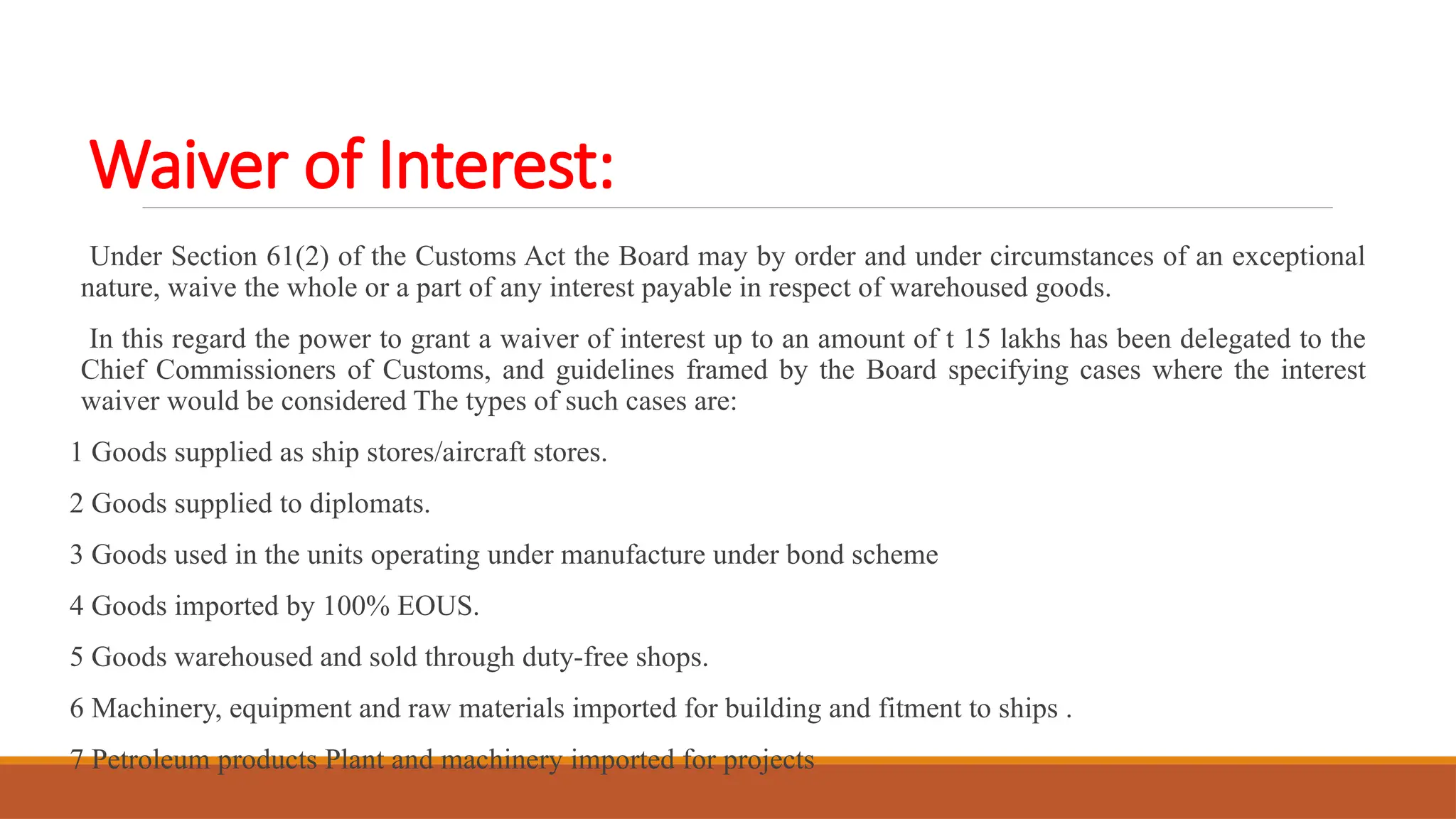
Waiver of Interest:
UnderSection 61(2) of the Customs Act the Board may by order and under circumstances of an exceptional
nature, waive the whole or a part of any interest payable in respect of warehoused goods.
In this regard the power to grant a waiver of interest up to an amount of t 15 lakhs has been delegated to the
Chief Commissioners of Customs, and guidelines framed by the Board specifying cases where the interest
waiver would be considered The types of such cases are:
1 Goods supplied as ship stores/aircraft stores.
2 Goods supplied to diplomats.
3 Goods used in the units operating under manufacture under bond scheme
4 Goods imported by 100% EOUS.
5 Goods warehoused and sold through duty-free shops.
6 Machinery, equipment and raw materials imported for building and fitment to ships .
7 Petroleum products Plant and machinery imported for projects
26.
Valuation of CustomDuty:
Goods imported are assessed to Duty provided they are imported in terms of the
import policy and evaluated for calculation of custom duty by virtues of the nature
of goods or by its end use.
The goods which are not falling in the parameter of the Import Policy are normally
contacted or allowed to be cleared only on payment of heavy penalty.
27.
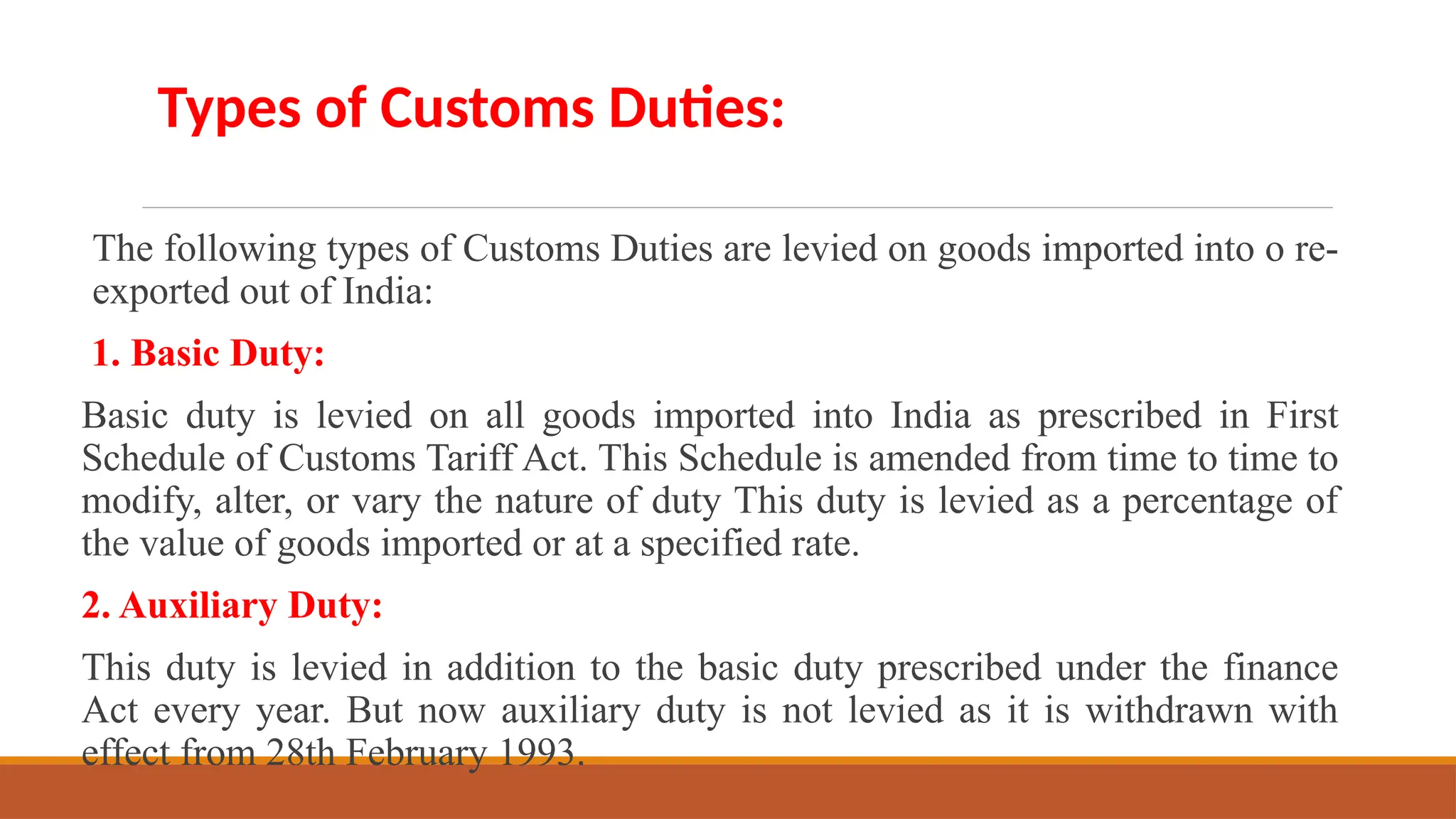
The following typesof Customs Duties are levied on goods imported into o re-
exported out of India:
1. Basic Duty:
Basic duty is levied on all goods imported into India as prescribed in First
Schedule of Customs Tariff Act. This Schedule is amended from time to time to
modify, alter, or vary the nature of duty This duty is levied as a percentage of
the value of goods imported or at a specified rate.
2. Auxiliary Duty:
This duty is levied in addition to the basic duty prescribed under the finance
Act every year. But now auxiliary duty is not levied as it is withdrawn with
effect from 28th February 1993.
Types of Customs Duties:
28.
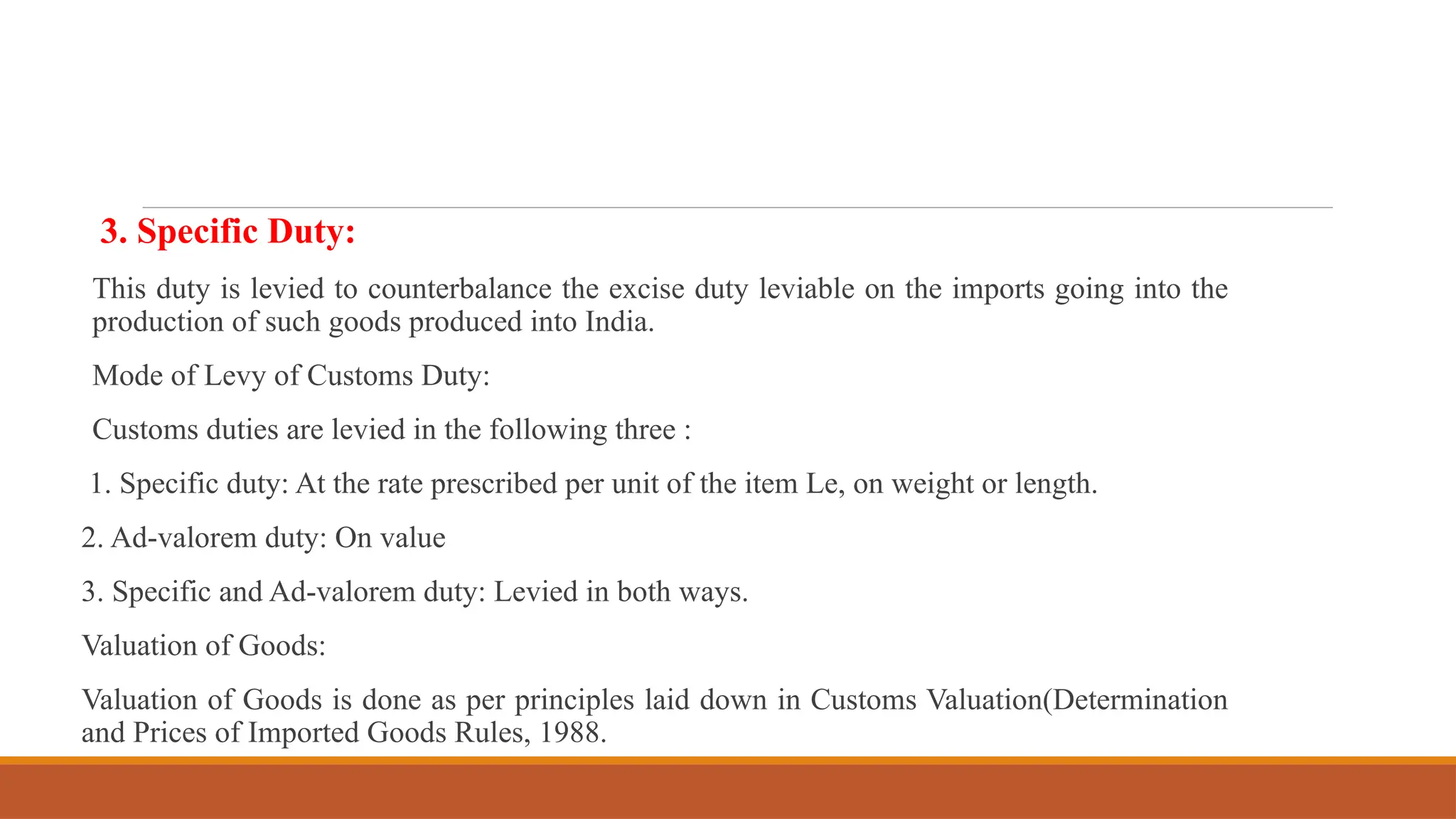
3. Specific Duty:
Thisduty is levied to counterbalance the excise duty leviable on the imports going into the
production of such goods produced into India.
Mode of Levy of Customs Duty:
Customs duties are levied in the following three :
1. Specific duty: At the rate prescribed per unit of the item Le, on weight or length.
2. Ad-valorem duty: On value
3. Specific and Ad-valorem duty: Levied in both ways.
Valuation of Goods:
Valuation of Goods is done as per principles laid down in Customs Valuation(Determination
and Prices of Imported Goods Rules, 1988.
29.
Assessment and Ratesof Customs Duty The assessment of goods to duty is done
on the following basis:
1. Whether the goods covered by the Bill of Entry are such as are regularly
imported.
2. The goods are required to be tested by the Customs House Laboratory for the
fulfillment of license conditions.
3. The customs appraiser wants to see the representative sample before
completing the Bill of entry for verification of the value/description etc.
30.
Demurrage Charges:
The goodsimported and discharges in the Customs are stored in the warehouses of
CWC or Port Trusts or other designated authority Few days "Free Period is allowed for
storage of such goods and thereafterfollowing demurrage or storage charges are levied.
1. Commercial and Non-commercial cargo: 7 calendar days from date of landing.
2. Unaccompanied baggage: 14 calendar days from the date of landing.
Direct Delivery Facility for Imports by Air The facility of "Direct Delivery of goods
imported is allowed to certain goods ske Fresh Fruits Frozen Food, Ufe-Saving Drugs
& Appliances, TV Films. Any cargo requiring special handling/storage and any other
cargo in respect of which order of the Deputy Collector of Customs, Air Cargo Unit
have been obtained in advance permitting direct delivery
31.
Payment of Duty
Importduty may be paid in the designated banks or through TR-6 challans.
Different Customs Houses have authorized different banks for payment of duty and is necessary to check
the name of the bank and the branch before depositing the duty.
For faster clearance of the goods, provision has been made in Section 46 of the Act to allow the filing of
a bill of entry before the arrival of goods. This bill of entry is valid if the vessel/aircraft carrying the
goods arrive within 30 days from the date of presentation of the bill of entry.
Import of goods under specialized schemes such as DEEC and EOU etc. is required to execute bonds
with the customs authorities In case of failure of a bond, the importer is required to pay the duty leviable
on those goods.
The amount of bond would be equal to the amount of duty leviable on the imported goodsThe bank
guarantee is also required along with the bond However, the amount bank guarantee depends upon the
statue of the importer uke Super Star Trading House/Trading House, etc
32.
Legal Dimensions ofImport Procedure:
1. Foreign Trade (Development) Regulation Act, 1992 :
This law governs imports into India and deals with the development and
regulation of foreign trade by facilitating imports into, and augmenting
exports from Induand for matters connected therewith or incidental thereto.
The FTDRA 1992 provides for obtaining of Importer-Exporter Code (EC)
Number from the Director-General of Foreign Trade (DGFT), which is
essential to the Indian buyer for importing goods as well as a relevant
license for importing or exportingThe DGFT is responsible for the execution
of the Import-Export policy and the Ministry of Commerce is the overall in
charge of foreign trade in India.
33.
2. Foreign Trade(Regulation) Rules, 1993:
Foreign Trade Regulation Rules 1993, which inter alia, provide for the grant of a
special license application for grant of a license, fee, conditions for licenses,
refusal of the license, amendment of the license suspension of a license,
cancellation of license, the declaration as to the value and quality of imported
goods, declaration as to the Importer-Exporter Code number, utilization of
imported goods, provisions regarding making, signing of any
declaration/statement or documents power to enter the premises and inspect,
search and seizure of goods, documents, things and conveyance settlement
confiscation and redemption and confiscation of conveyance, etc
34.
3. Foreign TradePolicy(2015-2020):
It is a policy framed from time to time by the DGFT functioning under the Ministry of
Commerce for 5 years at a stretch. It contains the procedure in respect of the import
of various commodities/categories of importers. The Indian importer has to comply
with the provisions herein for the valid import of goods into India)The present import
policy and procedures in respect of various commodities/category of importers are
inter alia, contained in the following publications issued by the Ministry of Commerce
and revised from time to time such as:
(a) Foreign Trade Policy 2015-2020
(b) Foreign Trade Policy 2009-2014
(C) Foreign Trade Policy 2004-2009.
35.
Basic Documentation:
1. ProformaInvoice :
It is a record that contains points of interest with regards to the quality, review,
design, mass, weight, and cost of the exported merchandise and the terms and
conditions on which their transportation will occur.
2. Import Order or Indent:
It is documentation in which the importer orders for supply of imperative
merchandise to the supplier. The order containing the data, for example, amount
and nature of merchandise value, a technique for sending the merchandise, packing
process method of payment, and so forth.
36.
3. Shipment Counsel:
Theexporter sends shipment advice to the importer for telling him that the merchandise
has been dispatched. It contains invoice number, bill of lading/airway bill number and date
the name of the vessel to date the port of export description of products and amount, and
the date of cruising of the vessel
4. Bill of Lading:
It is readied and marked by the captain of the ship recognizing the receipt of merchandise on
board. It contains terms and conditions on which the products are to be taken to the
destination.
5. Bill of Entry:
It is a form provided by the customs office to the importer who filled it at the duration of
getting the merchandise on board.
It must be in triplicate and is to be submitted to the customs office.
37.
6. Letter ofCredit:
It is a document that contains a certification from the importer bank to the
exporter's bank that it is attempted to respect the payment up to a specific sum
of the bills issued by the exporter for transportation of the products to the
importer.
7.Trade Enquiry:
It is written request made by logistic firm (that offers order processing, services
like warehousing, picking, packaging and shipping) to the abroad provider for
giving data in regards to the cost and different terms and conditions for trading
merchandise.
38.
Benefits of Imports
1.Access to Quality Products: Each country has particulars strengths when it
comes to exports. When possible, it's best to get your product from the highest
quality source, even if that means Importing out of the country.
2. High-Profit Margin: A key reason that companies all over the world choose to
import goods is to extend their profit margin. High taxes, wage minimums, and
material costs in certain countries make it more useful to import products from a
country where fees, wages and material costs are considerably lower• Certain
products can cost upwards of 50% less to grow, manufacture or produce abroad.
This situation is particularly common when importing goods where natural
resources are abundant.
39.
3. Reducing Costs:Another major benefit of importing is to reduce the
manufacturing costs. We can get some materials (which can't be created by us)
only in some elements of the globe. Through import, you'll get those materials
very common.
4. Government Aids: The tax concession is also given for a few products. Also,
there are certain incentives for those imports which help in further exports.
40.
5. Raw Materialor Inputs for Exports: Many of the exportable commodities need
certain inputs and raw material which may not be there in the domestic market.
In this situation, imports play an important role.
6. The Best way to adopt the culture of different countries.
7. Introducing new products to the market. Many businesses in India and China
tend to produce goods for the European and American markets Becoming a
leader in the industry.