

1
Liveworkstudio.com London Oslo Rotterdam Sao Paulo
Livework Studio © 2018
Liveworkstudio.com London Oslo Rotterdam Sao Paulo
Livework Studio © 2018
Implementing
Service Design
in the Organization
DOERS. Conference
Budapest
8 March 2018
Marzia Arico
@marziaarico
2
Introduction
18 years, 300 clients, 21 sectors
3
Introduction
Insights from Academia and Practice
4
Introduction
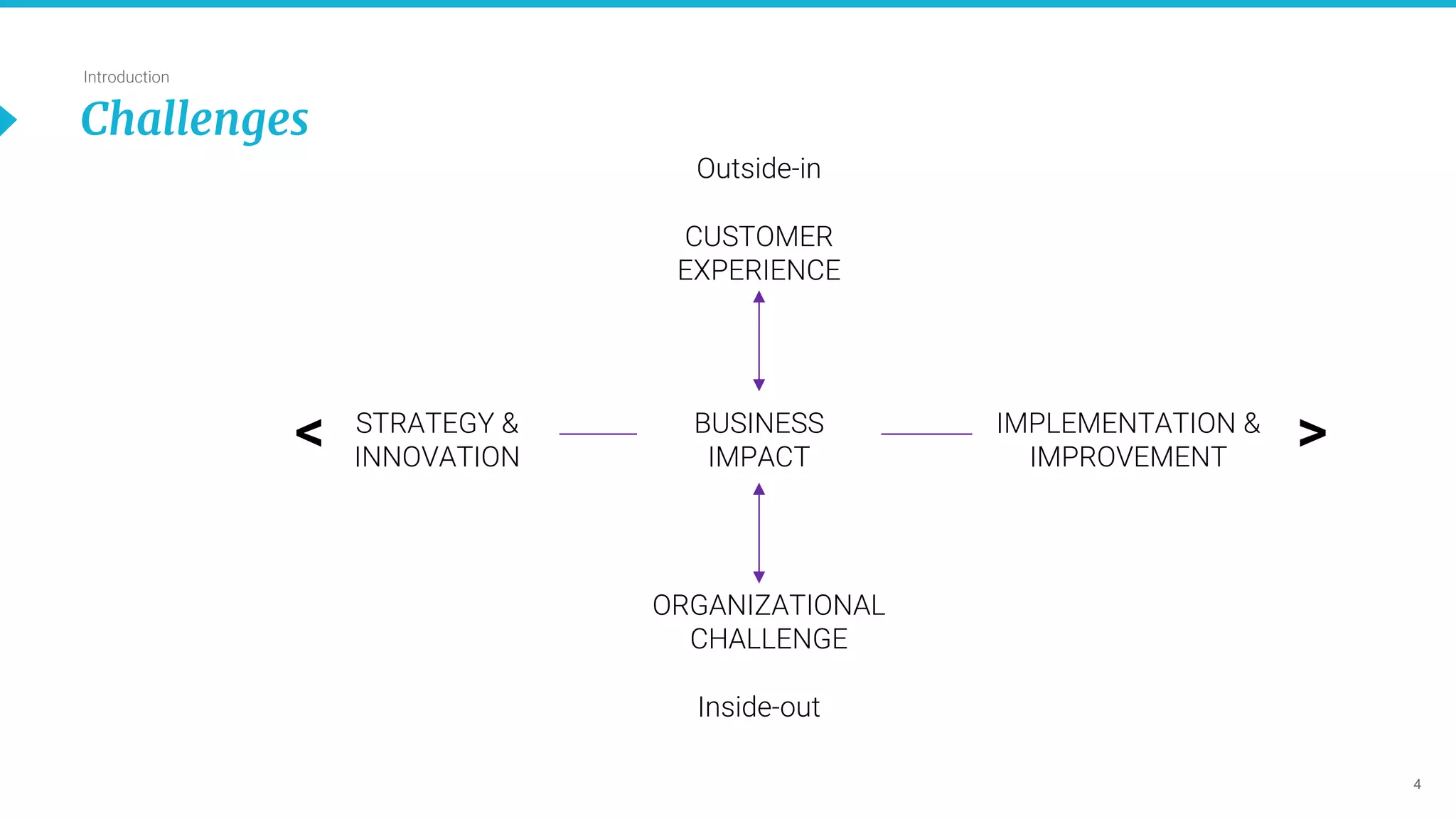
Challenges
BUSINESS
IMPACT
CUSTOMER
EXPERIENCE
ORGANIZATIONAL
CHALLENGE
Inside-out
Outside-in
STRATEGY &
INNOVATION
IMPLEMENTATION &
IMPROVEMENT
< >
5
Introduction
The transformative power
of service design
“Because organizations
now operate in an
environment of constant
change, the challenge is
not how to design a
response to a current
issue, but how to design a
means of continually
responding, adapting and
innovating” (Burns et al.,
2006”
Burns, Cottam, Vanstone, & Winhall
(2006, p.21)
● Service design has a transformative impact on
organizations, providing the opportunity to
generate lasting changes in organizations’
ability to change and innovate.
● Aiming at not only leaving behind a new
solution, but the tools, skills, and organizational
capacity for ongoing change.
6
Introduction
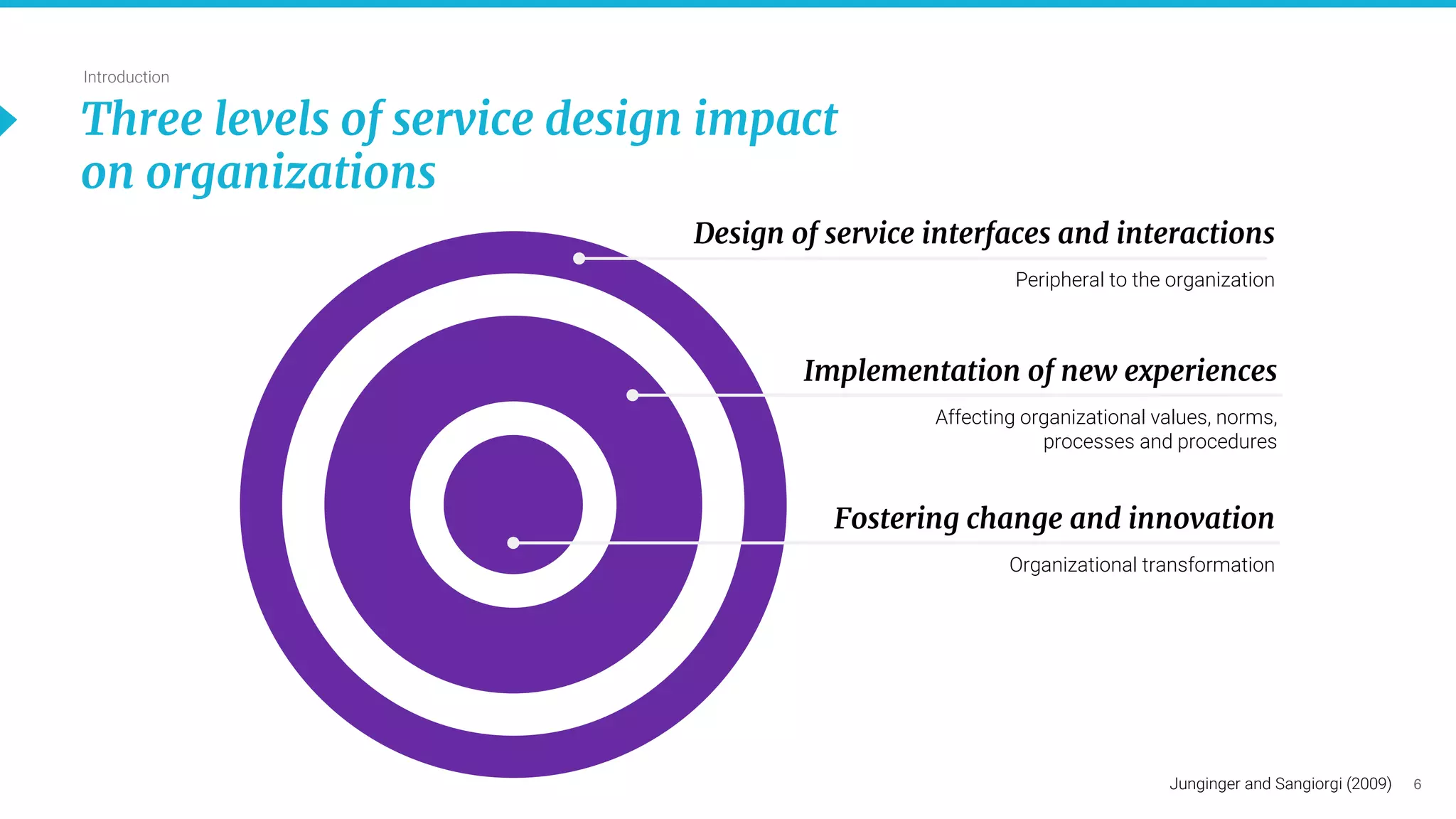
Three levels of service design impact
on organizations
Design of service interfaces and interactions
Peripheral to the organization
Implementation of new experiences
Affecting organizational values, norms,
processes and procedures
Fostering change and innovation
Organizational transformation
Junginger and Sangiorgi (2009)
7
Introduction
Sure …
8
Service Design
Adoption
Part I
9
Part I
Three elements for service design adoption
1. Awareness of service design principles and practices
2. Dedicated resources
3. Enabling structures
10
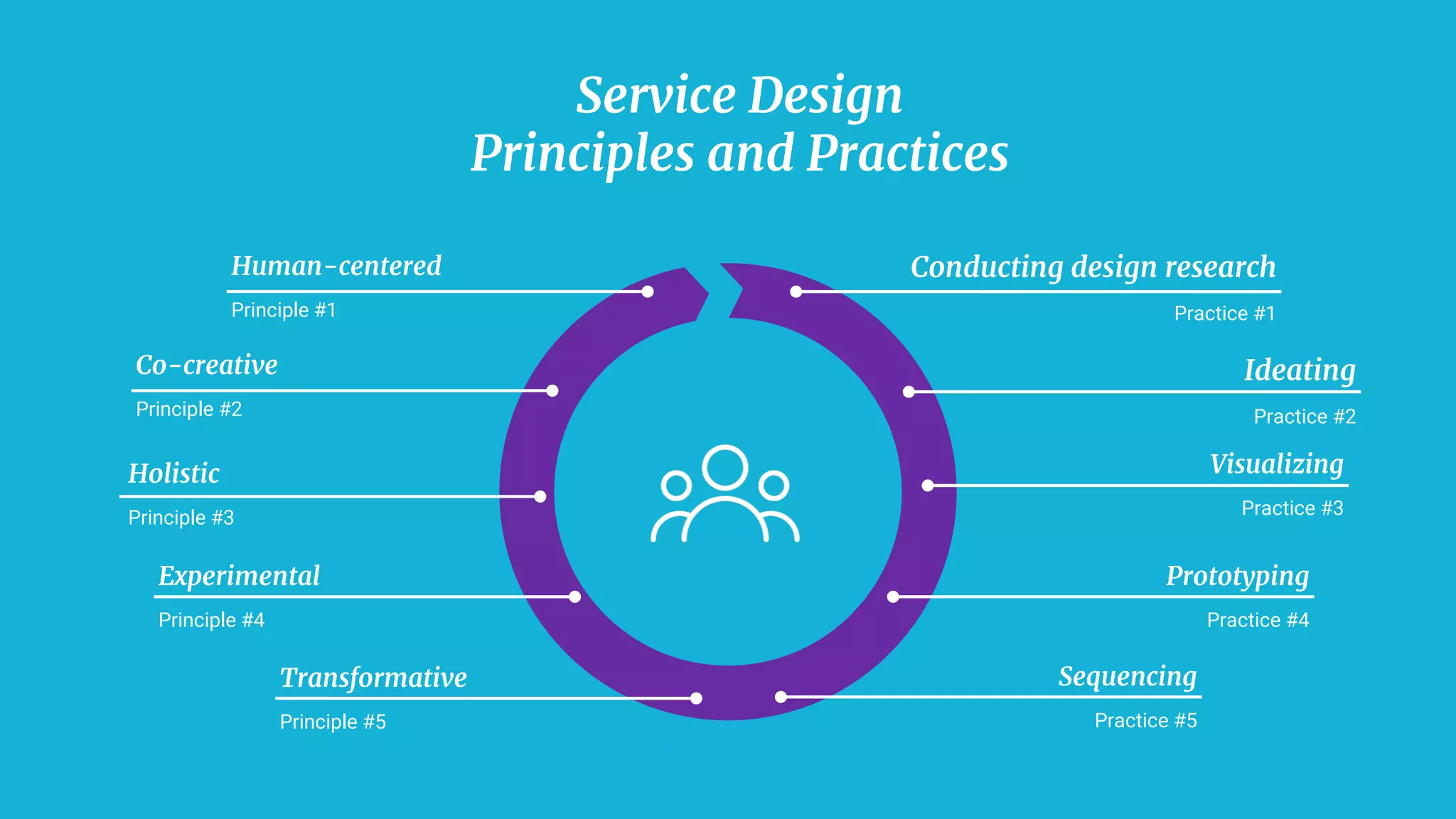
Visualizing
Practice #3
Conducting design research
Practice #1
Prototyping
Practice #4
Experimental
Principle #4
Human-centered
Principle #1
Co-creative
Principle #2
Holistic
Principle #3
Service Design
Principles and Practices
Ideating
Practice #2
Transformative
Principle #5
Sequencing
Practice #5
11
Part I
Awareness of service design
principles and practices
“You really bring the
imagination of the
business alive and they
can see how things could
be better. And that's not
just around the user
interface, that's definitely
around new tools or
removing tools,
sometimes about
changing business
processes, or changing the
way that information
flows between teams”
Project Sponsor, Financial Services
“It certainly changed the way people thought around servicing
customers versus servicing equipments”
Project Sponsor, Manufacturing
● It’s done through project work and/or training
● Your objective is not full implementation, aim for
small steps that can show short-term impact
12
Part I
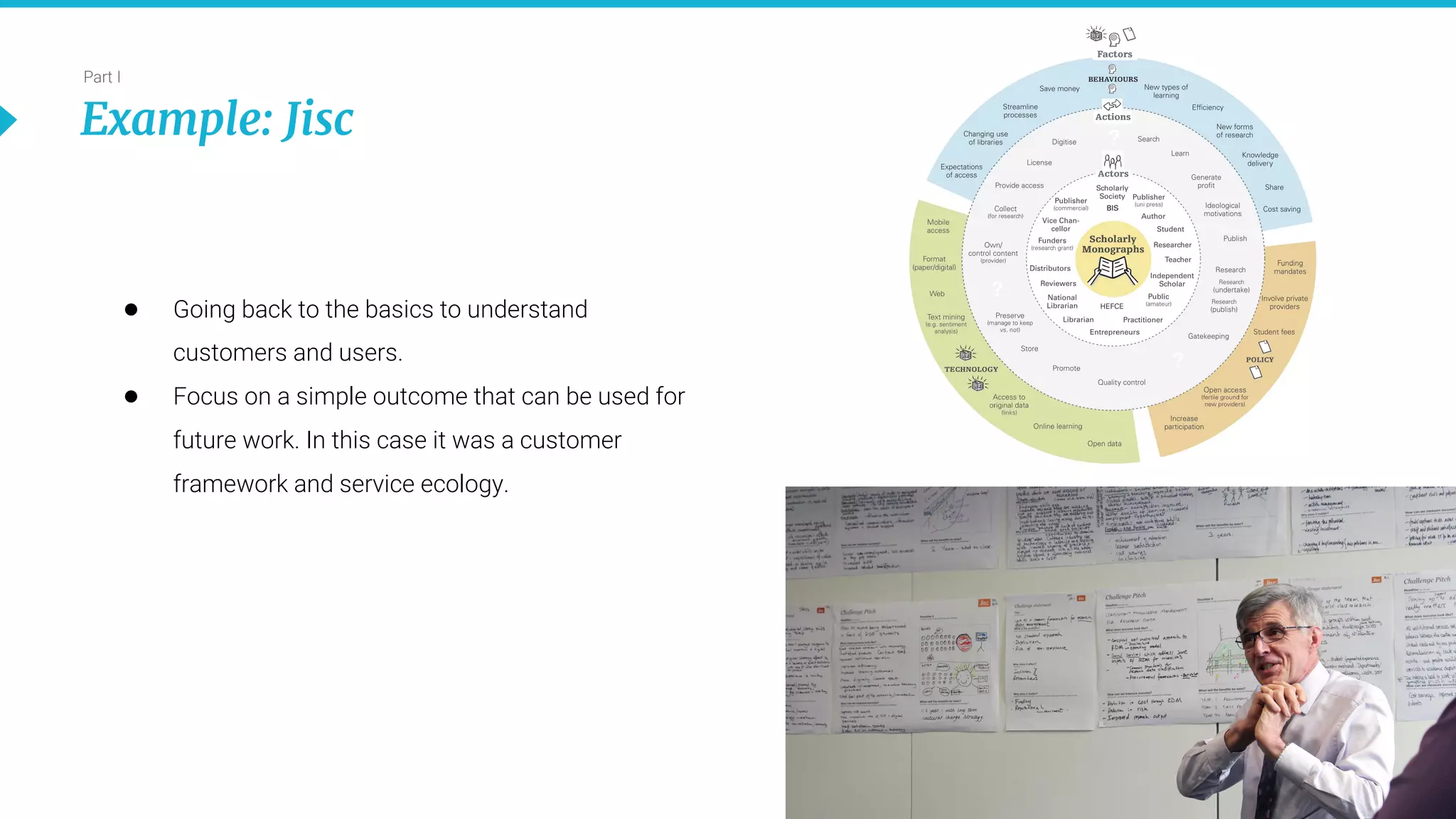
Example: Jisc
● Going back to the basics to understand
customers and users.
● Focus on a simple outcome that can be used for
future work. In this case it was a customer
framework and service ecology.
13
Part I
Dedicated resources “The engagement of key
stakeholders was a
determining factor, being
able to get people
involved and excited.
Then the cross-
functionality to be able to
bring the right people
from the different
functions. It cannot be
one-sided”
Project Sponsor, Engineering
● Start with a small core team, 3-4 people.
● Engage key stakeholders across functions. Co-
create and co-own.
● Familiarize, train and grow.
● Avoid evangelizing and over-exciting, it creates a
toxic environment.
14
Part I
Example: Kone
● The first customer is the organization. Listen to
your organization as you will listen to your
customers.
● Tangible outcomes open gates. Have
something concrete to show soon.
● Transform the business from within. Excite and
empower so that people will preach for you.
Business and IT can become design champions.
● Have a physical space, open for anybody to
observe and join in.
“Excuse me is this where
the magic happens?”
Senior Manager, Kone
15
Part I
Enabling structures
“When you're doing service design work, you're very rarely saying to one person, one team, ‘Can
you make this?’ Nearly all the time you find that what you're saying is, ‘We need to bring product
managers from a few different groups in the business together because we need to create this new
missing piece’ Or ‘You changing this piece requires bits of all the different IT systems to come
together in a new way and to experience a new interface’ And it's very difficult to get people
collaborating like that from different bits of the business because they don't have to work like that”
Project Sponsor, Financial Services
● Service culture
● Clear processes to work with service design
● Cross-department collaboration incentives
● Clear mandate – Leadership support
● Measurement systems to assess the
effectiveness of the services.
● Watch out for IT
16
Part I
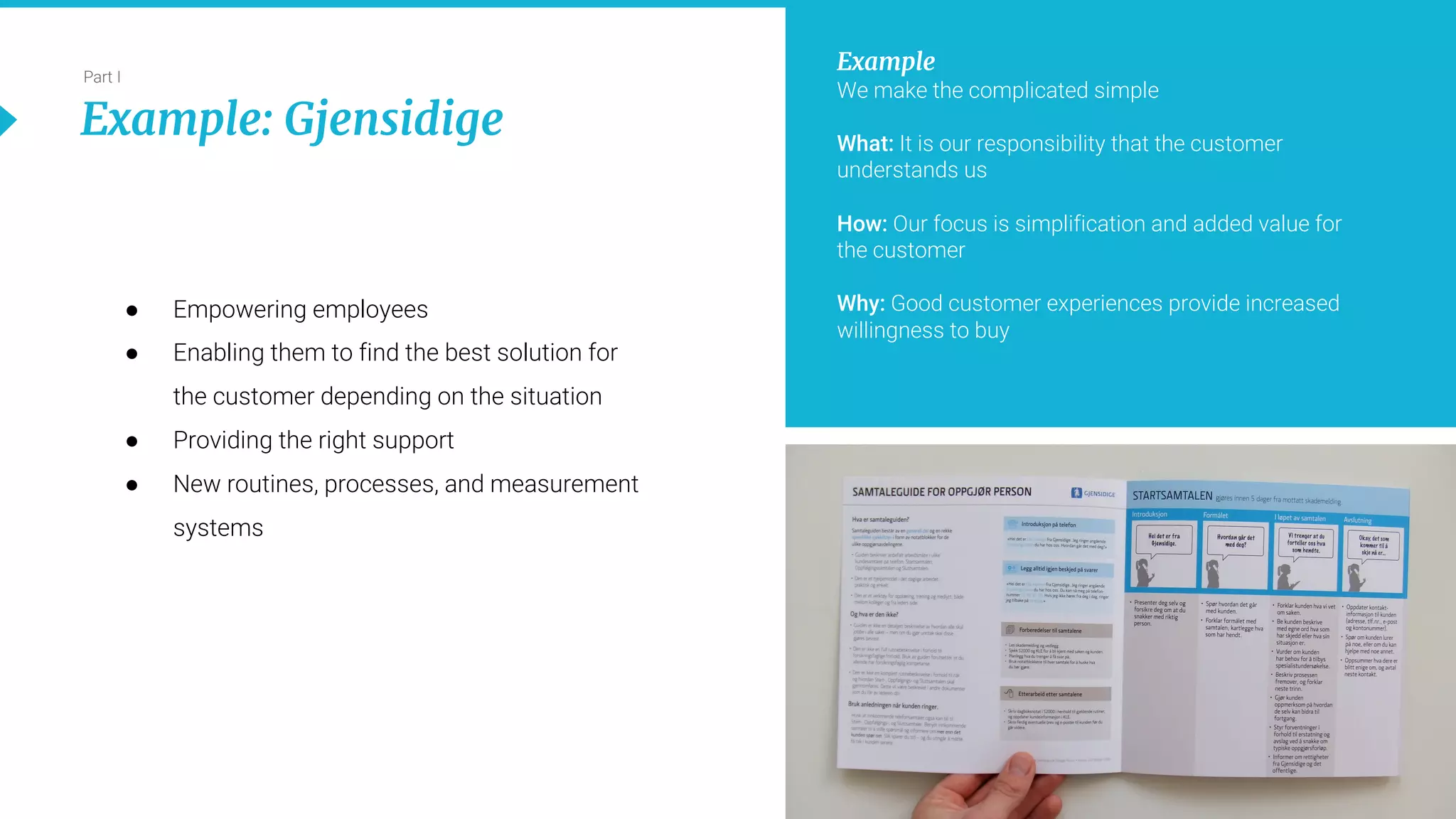
Example: Gjensidige
● Empowering employees
● Enabling them to find the best solution for
the customer depending on the situation
● Providing the right support
● New routines, processes, and measurement
systems
Example
We make the complicated simple
What: It is our responsibility that the customer
understands us
How: Our focus is simplification and added value for
the customer
Why: Good customer experiences provide increased
willingness to buy
17
Maturity
Model
Part II
18
Part II
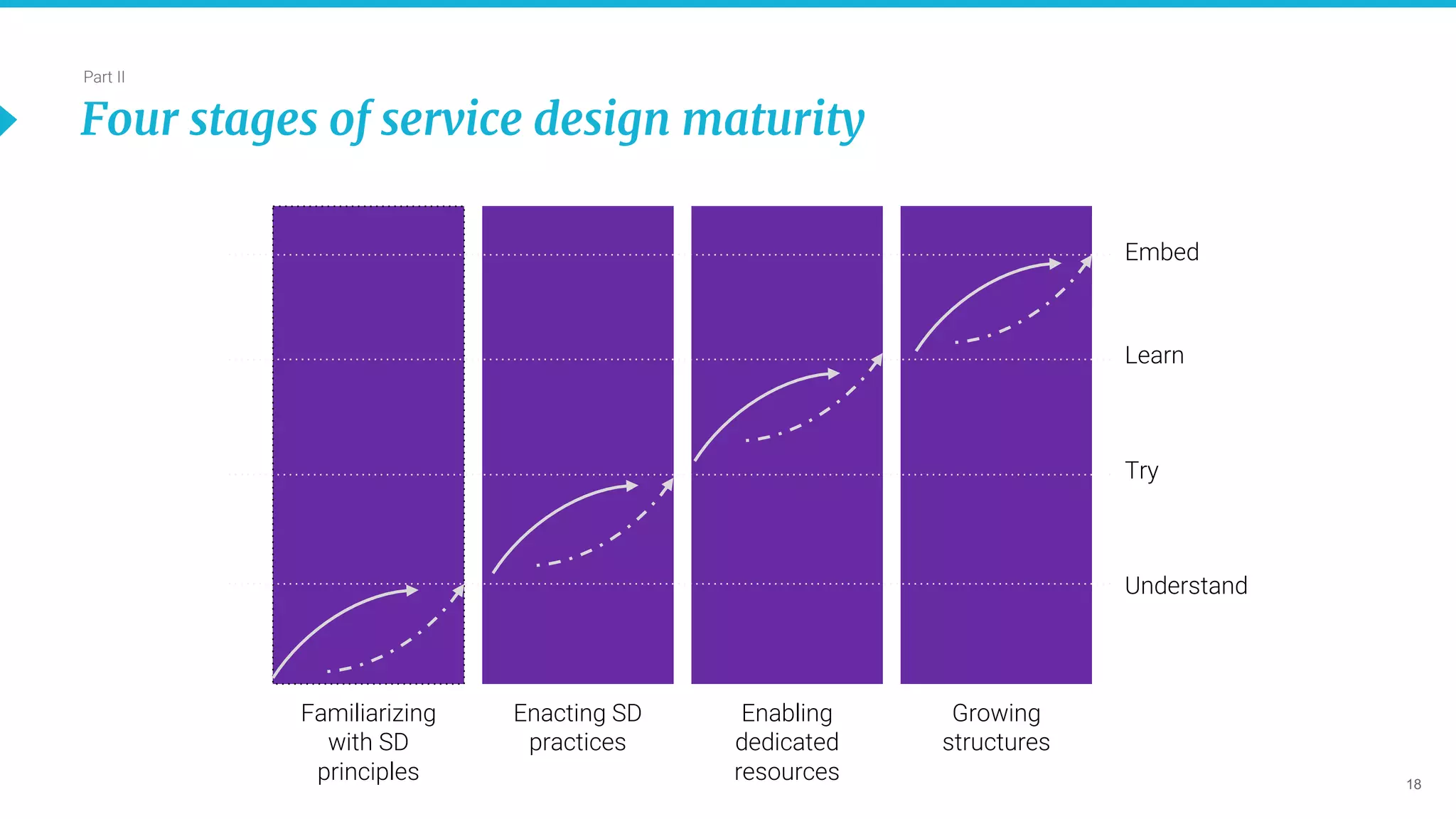
Four stages of service design maturity
Familiarizing
with SD
principles
Enacting SD
practices
Enabling
dedicated
resources
Growing
structures
Understand
Try
Learn
Embed
19
A multi layer approach
Part III
20
Part III
From macro to micro
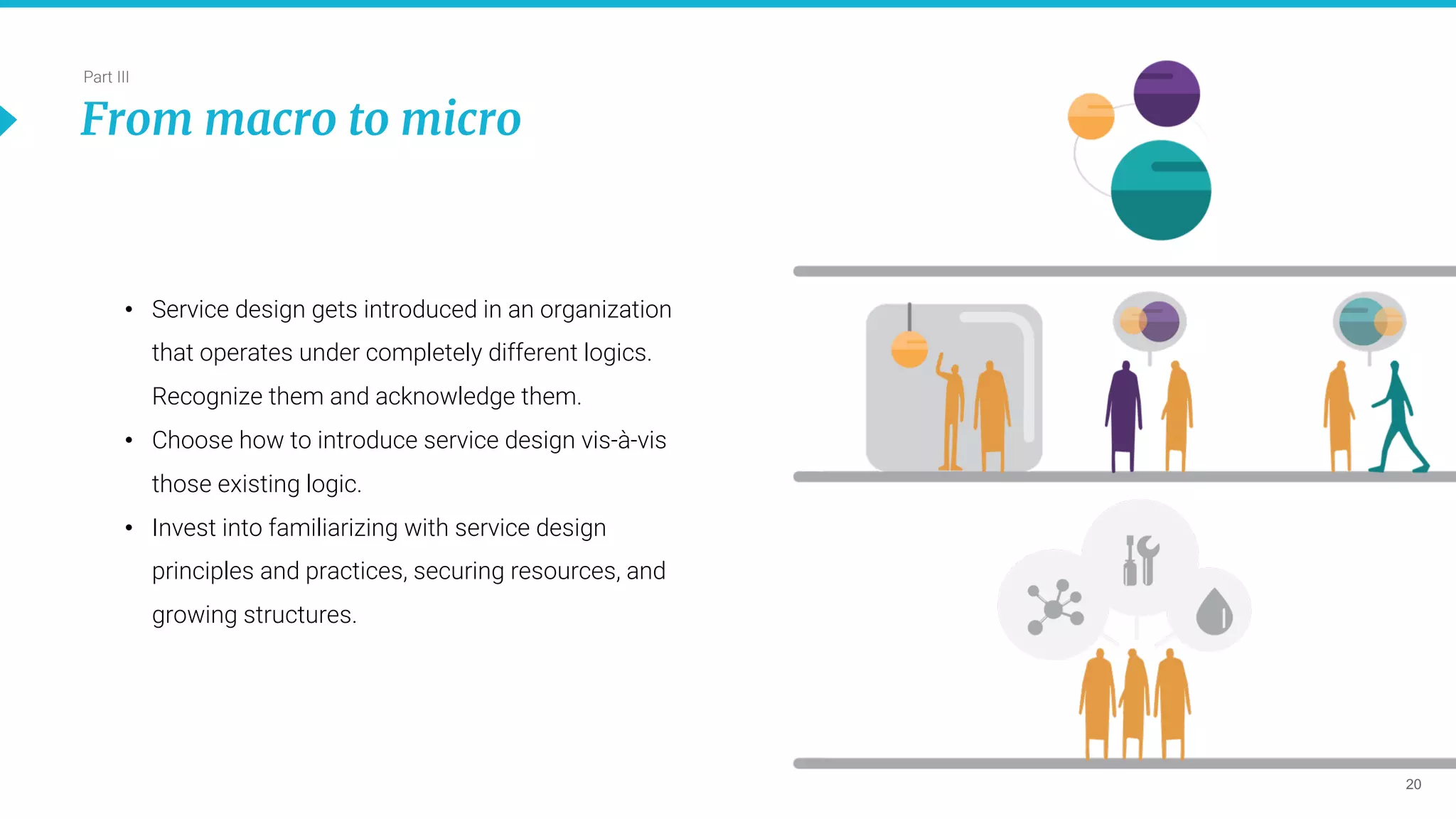
• Service design gets introduced in an organization
that operates under completely different logics.
Recognize them and acknowledge them.
• Choose how to introduce service design vis-à-vis
those existing logic.
• Invest into familiarizing with service design
principles and practices, securing resources, and
growing structures.
21
Part III
Example: Telenor
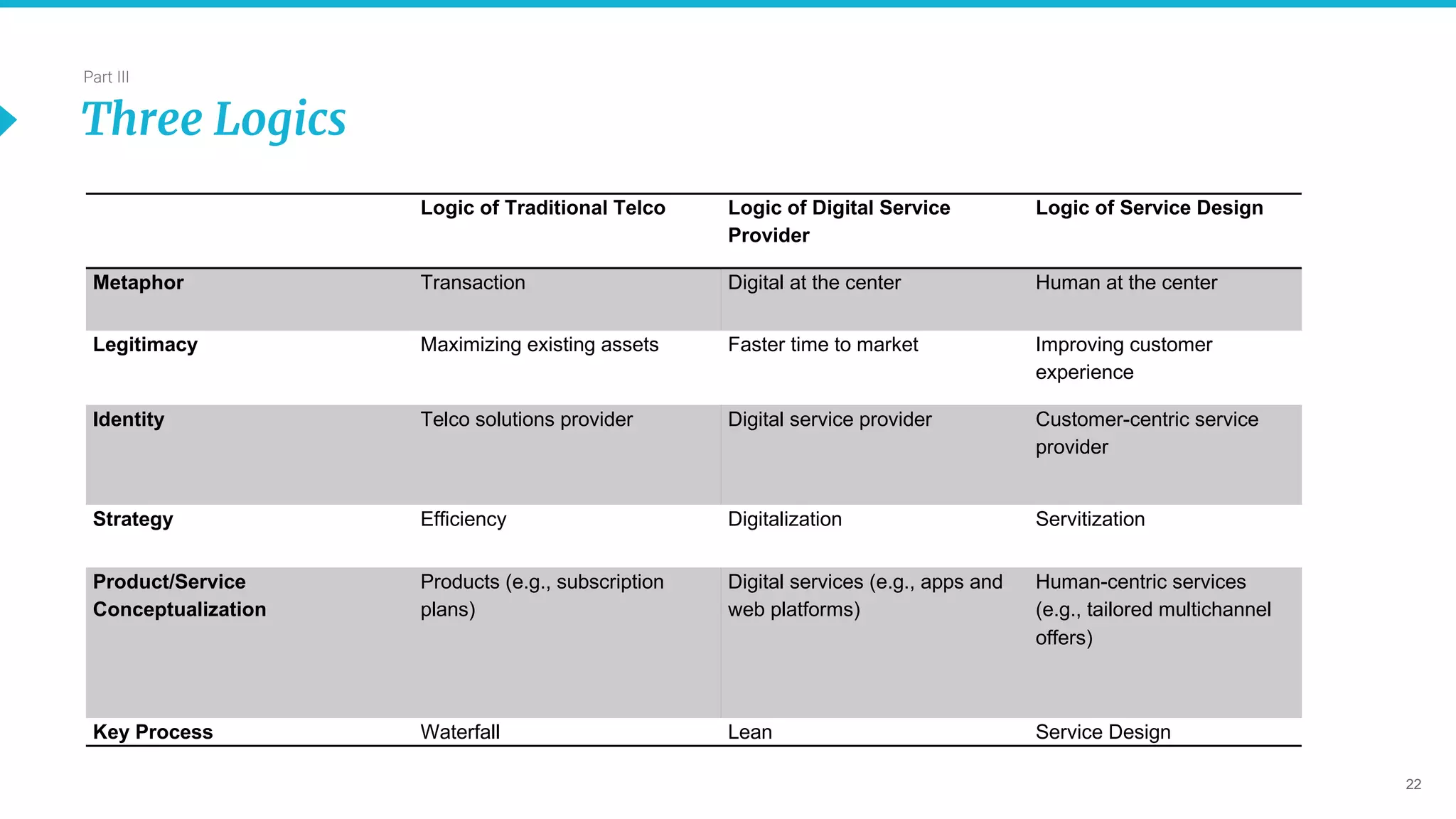
● Three logics at play: Telco, Digital, Customer
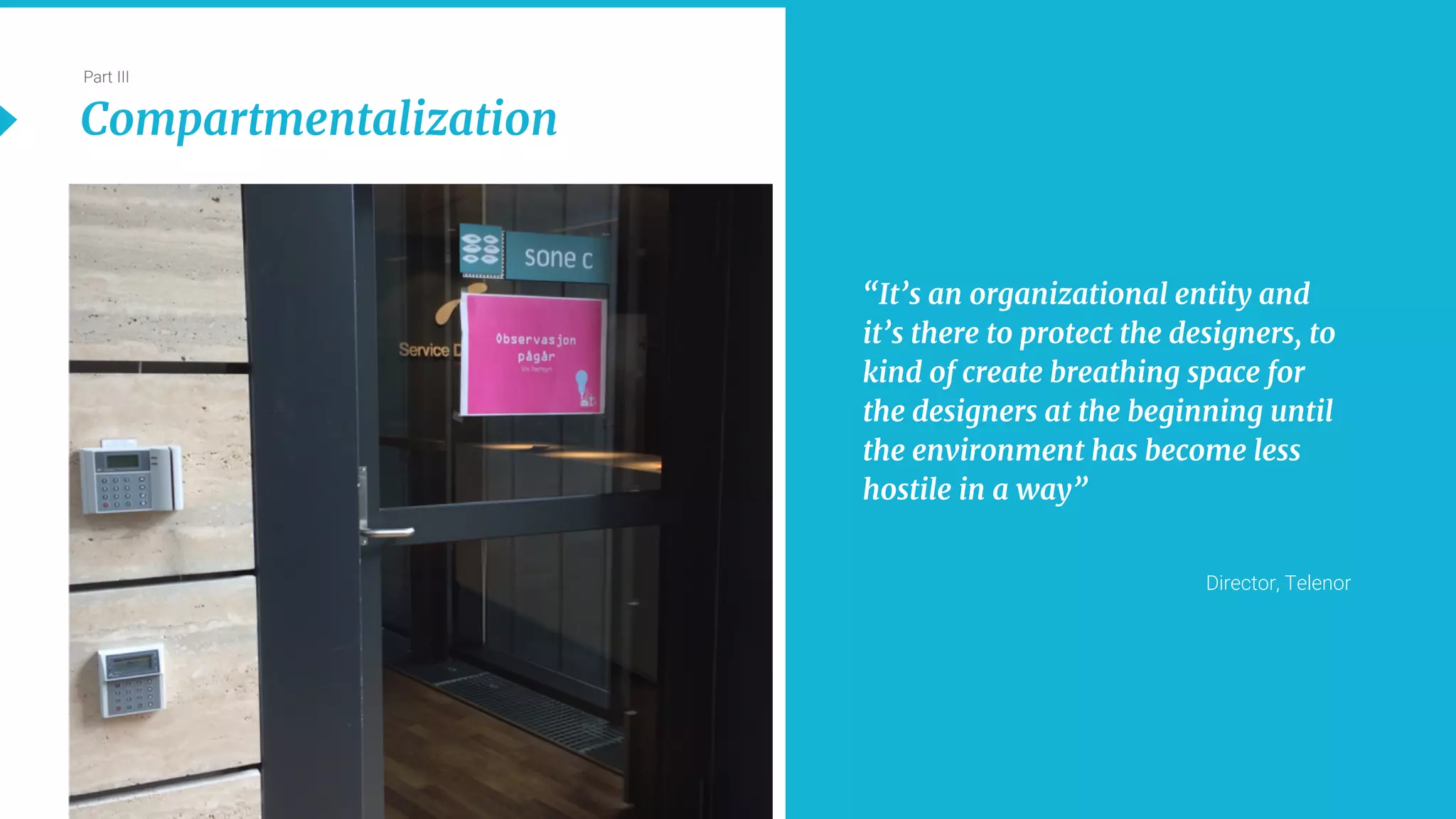
● Two strategies tested: Compartmentalization
and enrichment
● Three key activities:
1. Rolled out a Service Design Academy for two years
to familiarize actors with service design.
2. Established one pilot project to showcase value in
practice.
3. Establishing new processes and practices to work
with service design across functions
“It’s a huge
transformation; it’s a
whole mindset”
Senior Leader, Telenor
22
Part III
Three Logics
Logic of Traditional Telco Logic of Digital Service
Provider
Logic of Service Design
Metaphor Transaction Digital at the center Human at the center
Legitimacy Maximizing existing assets Faster time to market Improving customer
experience
Identity Telco solutions provider Digital service provider Customer-centric service
provider
Strategy Efficiency Digitalization Servitization
Product/Service
Conceptualization
Products (e.g., subscription
plans)
Digital services (e.g., apps and
web platforms)
Human-centric services
(e.g., tailored multichannel
offers)
Key Process Waterfall Lean Service Design
23
Part III
Compartmentalization
“It’s an organizational entity and
it’s there to protect the designers, to
kind of create breathing space for
the designers at the beginning until
the environment has become less
hostile in a way”
Director, Telenor
24
Summary
Part IV
25
Part IV
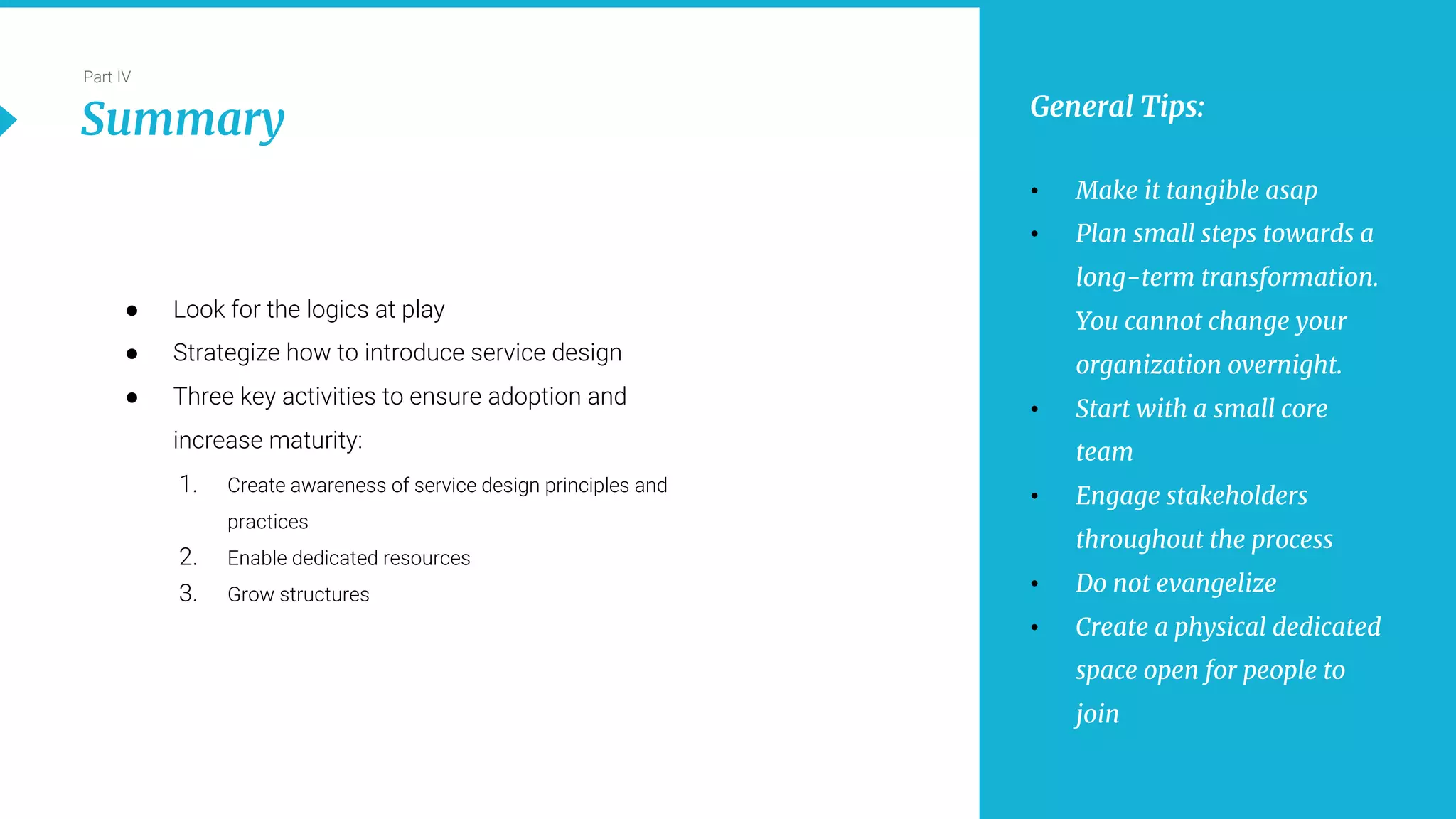
Summary
● Look for the logics at play
● Strategize how to introduce service design
● Three key activities to ensure adoption and
increase maturity:
1. Create awareness of service design principles and
practices
2. Enable dedicated resources
3. Grow structures
General Tips:
• Make it tangible asap
• Plan small steps towards a
long-term transformation.
You cannot change your
organization overnight.
• Start with a small core
team
• Engage stakeholders
throughout the process
• Do not evangelize
• Create a physical dedicated
space open for people to
join
26
Thank you
This presentation can be downloaded via:
bit.ly/doers18
Contact
Marzia Arico
Head of Insight, Livework Rotterdam
@marziaarico
marzia@liveworkstudio.com

Implementing service design in the organisation

  • 1.
    1 Liveworkstudio.com London OsloRotterdam Sao Paulo Livework Studio © 2018 Liveworkstudio.com London Oslo Rotterdam Sao Paulo Livework Studio © 2018 Implementing Service Design in the Organization DOERS. Conference Budapest 8 March 2018 Marzia Arico @marziaarico
  • 2.
    2 Introduction 18 years, 300clients, 21 sectors
  • 3.
  • 4.
  • 5.
    5 Introduction The transformative power ofservice design “Because organizations now operate in an environment of constant change, the challenge is not how to design a response to a current issue, but how to design a means of continually responding, adapting and innovating” (Burns et al., 2006” Burns, Cottam, Vanstone, & Winhall (2006, p.21) ● Service design has a transformative impact on organizations, providing the opportunity to generate lasting changes in organizations’ ability to change and innovate. ● Aiming at not only leaving behind a new solution, but the tools, skills, and organizational capacity for ongoing change.
  • 6.
    6 Introduction Three levels ofservice design impact on organizations Design of service interfaces and interactions Peripheral to the organization Implementation of new experiences Affecting organizational values, norms, processes and procedures Fostering change and innovation Organizational transformation Junginger and Sangiorgi (2009)
  • 7.
  • 8.
  • 9.
    9 Part I Three elementsfor service design adoption 1. Awareness of service design principles and practices 2. Dedicated resources 3. Enabling structures
  • 10.
    10 Visualizing Practice #3 Conducting designresearch Practice #1 Prototyping Practice #4 Experimental Principle #4 Human-centered Principle #1 Co-creative Principle #2 Holistic Principle #3 Service Design Principles and Practices Ideating Practice #2 Transformative Principle #5 Sequencing Practice #5
  • 11.
    11 Part I Awareness ofservice design principles and practices “You really bring the imagination of the business alive and they can see how things could be better. And that's not just around the user interface, that's definitely around new tools or removing tools, sometimes about changing business processes, or changing the way that information flows between teams” Project Sponsor, Financial Services “It certainly changed the way people thought around servicing customers versus servicing equipments” Project Sponsor, Manufacturing ● It’s done through project work and/or training ● Your objective is not full implementation, aim for small steps that can show short-term impact
  • 12.
    12 Part I Example: Jisc ●Going back to the basics to understand customers and users. ● Focus on a simple outcome that can be used for future work. In this case it was a customer framework and service ecology.
  • 13.
    13 Part I Dedicated resources“The engagement of key stakeholders was a determining factor, being able to get people involved and excited. Then the cross- functionality to be able to bring the right people from the different functions. It cannot be one-sided” Project Sponsor, Engineering ● Start with a small core team, 3-4 people. ● Engage key stakeholders across functions. Co- create and co-own. ● Familiarize, train and grow. ● Avoid evangelizing and over-exciting, it creates a toxic environment.
  • 14.
    14 Part I Example: Kone ●The first customer is the organization. Listen to your organization as you will listen to your customers. ● Tangible outcomes open gates. Have something concrete to show soon. ● Transform the business from within. Excite and empower so that people will preach for you. Business and IT can become design champions. ● Have a physical space, open for anybody to observe and join in. “Excuse me is this where the magic happens?” Senior Manager, Kone
  • 15.
    15 Part I Enabling structures “Whenyou're doing service design work, you're very rarely saying to one person, one team, ‘Can you make this?’ Nearly all the time you find that what you're saying is, ‘We need to bring product managers from a few different groups in the business together because we need to create this new missing piece’ Or ‘You changing this piece requires bits of all the different IT systems to come together in a new way and to experience a new interface’ And it's very difficult to get people collaborating like that from different bits of the business because they don't have to work like that” Project Sponsor, Financial Services ● Service culture ● Clear processes to work with service design ● Cross-department collaboration incentives ● Clear mandate – Leadership support ● Measurement systems to assess the effectiveness of the services. ● Watch out for IT
  • 16.
    16 Part I Example: Gjensidige ●Empowering employees ● Enabling them to find the best solution for the customer depending on the situation ● Providing the right support ● New routines, processes, and measurement systems Example We make the complicated simple What: It is our responsibility that the customer understands us How: Our focus is simplification and added value for the customer Why: Good customer experiences provide increased willingness to buy
  • 17.
  • 18.
    18 Part II Four stagesof service design maturity Familiarizing with SD principles Enacting SD practices Enabling dedicated resources Growing structures Understand Try Learn Embed
  • 19.
    19 A multi layerapproach Part III
  • 20.
    20 Part III From macroto micro • Service design gets introduced in an organization that operates under completely different logics. Recognize them and acknowledge them. • Choose how to introduce service design vis-à-vis those existing logic. • Invest into familiarizing with service design principles and practices, securing resources, and growing structures.
  • 21.
    21 Part III Example: Telenor ●Three logics at play: Telco, Digital, Customer ● Two strategies tested: Compartmentalization and enrichment ● Three key activities: 1. Rolled out a Service Design Academy for two years to familiarize actors with service design. 2. Established one pilot project to showcase value in practice. 3. Establishing new processes and practices to work with service design across functions “It’s a huge transformation; it’s a whole mindset” Senior Leader, Telenor
  • 22.
    22 Part III Three Logics Logicof Traditional Telco Logic of Digital Service Provider Logic of Service Design Metaphor Transaction Digital at the center Human at the center Legitimacy Maximizing existing assets Faster time to market Improving customer experience Identity Telco solutions provider Digital service provider Customer-centric service provider Strategy Efficiency Digitalization Servitization Product/Service Conceptualization Products (e.g., subscription plans) Digital services (e.g., apps and web platforms) Human-centric services (e.g., tailored multichannel offers) Key Process Waterfall Lean Service Design
  • 23.
    23 Part III Compartmentalization “It’s anorganizational entity and it’s there to protect the designers, to kind of create breathing space for the designers at the beginning until the environment has become less hostile in a way” Director, Telenor
  • 24.
  • 25.
    25 Part IV Summary ● Lookfor the logics at play ● Strategize how to introduce service design ● Three key activities to ensure adoption and increase maturity: 1. Create awareness of service design principles and practices 2. Enable dedicated resources 3. Grow structures General Tips: • Make it tangible asap • Plan small steps towards a long-term transformation. You cannot change your organization overnight. • Start with a small core team • Engage stakeholders throughout the process • Do not evangelize • Create a physical dedicated space open for people to join
  • 26.
    26 Thank you This presentationcan be downloaded via: bit.ly/doers18 Contact Marzia Arico Head of Insight, Livework Rotterdam @marziaarico marzia@liveworkstudio.com