IJSRD - International Journal for Scientific Research & Development| Vol. 1, Issue 4, 2013 | ISSN (online): 2321-0613
All rights reserved by www.ijsrd.com 998
Implementation of 8x8 MIMO OFDM systems for higher order modulation using
QOSTBC under different fading channels
Ms. Aarti Sharma1
Prof. Mukesh Tiwari2
Mr. Amol Kumbhare3
Mr. Manish Korde4
1, 2
Department of Electronics Engineering SSSIST, Sehore
3, 4
Department of Electronics Comm. Engineering MIST, Indore
Abstract—A general Quasi orthogonal space time block code
(QOSTBC) structure is proposed for multiple-input multiple-
output–orthogonal frequency division multiplexing (MIMO-
OFDM) systems for 8 X 8 antenna configuration. The signal
detection technology used in this work for MIMO-OFDM
system is Zero-Forcing Equalization (linear detection
technique). In this paper, analysis of high level of
modulations (i.e. M-QAM and M-PSK for different values of
M) on MIMO-OFDM system is presented. In this, AWGN,
Rayleigh and Rician channels have been used for analysis
purpose and their effect on BER and Spectral Efficiency for
high data rates have been presented. The proposed system
has better performance than the other systems in terms of
SNR improvement of 3-5 dB and spectral efficiency.
Keywords: QOSTBC (Quasi Orthogonal Space Time Block
Code), OFDM (Orthogonal Frequency Division
Multiplexing) , MIMO(Multiple-Input Multiple-Output)
I. INTRODUCTION
OFDM has become a popular technique for transmission
of signals over wireless channels [1]. OFDM has been
adopted in several wireless standards such as digital audio
broadcasting (DAB), digital video broadcasting (DVB-T),
the IEEE 802.11a [2] LAN standard and the IEEE 802.16a
[3] MAN standard. OFDM is also being pursued for
dedicated short-range communications (DSRC) for road
side to vehicle communications and as a potential
candidate for fourth- generation (4G) mobile wireless
systems.
The first aims to improve the power efficiency by
maximizing spatial diversity. Such techniques include delay
diversity, STBC [4], [5] and STTC [6]. The second class
uses a layered approach to increase capacity. One popular
example of such a system is V-BLAST suggested by
Foschini et al. [7] where full spatial diversity is usually
not achieved. Finally, the third type exploits the
knowledge of channel at the transmitter. It decomposes the
channel coefficient matrix using SVD and uses these
decomposed unitary matrices as pre- and post-filters at the
transmitter and the receiver to achieve near capacity [8].
II. MIMO-OFDM
Spatially multiplexed MIMO is known to boost the
throughput, on the other hand, when much higher
throughputs are aimed at, the multipath character of the
environment causes the MIMO channel to be frequency-
selective. OFDM can transform such a frequency-
selective MIMO channel into a set of parallel
frequency-flat MIMO channels and also increase the
frequency efficiency. Therefore, MIMO-OFDM [9]
technology has been researched as the infrastructure for
next generation wireless networks.
Therefore, MIMO-OFDM, produced by
employing multiple transmit and receive antennas in
an OFDM system has becoming a practical alternative to
single carrier and SISO transmission [10]. However,
channel estimation becomes computationally more
complex compared to the SISO systems due to the
increased number of channels to be estimated. This
complexity problem is further compounded when the
channel from the ith transmit antenna to the mth receive
antenna is frequency-selective. Using OFDM, information
symbols are transmitted over several parallel independent
sub-carriers using the computationally efficient IFFT/FFT
modulation /demodulation vectors. [11]
OFDM for MIMO channels (MIMO-OFDM) is
considered by Y. Li et.al [16] for wideband transmission
to mitigate inter symbol interference and enhance system
capacity. The MIMO- OFDM system uses two
independent space-time codes for two sets of two transmit
antennas. At the receiver, the independent space-time codes
are decoded using pre-whitening followed by ML decoding
based on successive interference cancellation. S. Moghe
et.al [17] introduced a new generation of IEEE 802.11n
wireless network standard. The objective is to obtain
numerical values for various Measures of networking
performance of IEEE 802.11n. The initial approach was to
investigate the abilities of IEEE 802.11n standard to model
a transmitter and receiver that communicated over a user
defined channel, Simulation of single OFDM symbol SISO
system. Y. Wu et.al [18] gives an idea about the theoretical
framework for the analysis of code diversity. It can be
applied to an arbitrary space–time code, but the value of
code diversity will depend on the particular choice of code.
It is also shown that it not only improves the diversity and
coding. A channel estimation method for STBC - OFDM
is investigated by F. Delestre et.al [20] for Mobile WiMax
systems. A new channel estimation approach is proposed
using the dedicated pilot subcarriers defined at constant
intervals by the WiMax standard. The estimation method
has low computation as only linear operations are needed
due to orthogonal pilot coding. The performances of the
proposed method h a v e b e e n demonstrated by extensive
computer simulations. For the OFDM system with two
transmit antennas and one to four receive antennas and
using QPSK modulation, the simulated results under
different Stanford University Interim (SUI) channels show
Implementation of 8x8 MIMO OFDM systems for higher order modulation using QOSTBC under different fading channels
(IJSRD/Vol. 1/Issue 4/2013/0044)
All rights reserved by www.ijsrd.com 999
that the proposed method has only a 4dB loss compared to
the ideal case where the channel is known at the receiver.
III. RESULTS
In this report behavior of the MIMO-OFDM system under
different environments is studied and the effects of
increasing the order of the modulation on the BER
performance of the system are presented. The system
discussed above has been designed using the QOSTBC code
structure for MIMO-OFDM system. Coherent Zero Forcing
equalization is used to decode the QOSTBC coded data
symbols at the receiver side. Results are shown in the form
of SNR vs. BER plot for different modulations and different
channels. Here different antenna configurations such as 1 X
1, 2 X 2, 4 X 4, 6 X 6 and proposed 8 X 8 are used to show
the advantage in term of SNR of using 8 X 8 antenna
configurations over the other configurations. The analysis
has been done for different wireless fading channels namely
AWGN, Rayleigh and Rician channel. Results have been
presented for different antenna configurations over different
fading channels using different modulation levels.
The performance of MIMO-OFDM system is analyzed
using two criterions namely
1) BER Analysis
2) Spectral Efficiency Analysis
A. BER Analysis of MIMO-OFDM system
In this section BER analysis of MIMO-OFDM system using
QOSTBC code structure is done for higher order
Modulations over different fading channels. First, the
analysis of MIMO-OFDM system using M-PSK is presented
over different fading channels and then same procedure is
done for M-QAM. The fading channels used for this
purpose are AWGN, Rayleigh and Rician channels.
B. M-PSK over different Fading channels
In this section the BER performance of MIMO-OFDM
system is analyzed using M-PSK over different fading
channels.
C. M-PSK over AWGN channel
(32-PSK) (128- PSK)
Fig. 6: M-PSK over AWGN channel
SNR vs. BER plots for M-PSK over AWGN channel for
MIMO-OFDM system employing different antenna
configurations have been presented in Figure 6. Here the
graph depicts that in MIMO-OFDM system as we goes on
increasing the no. of Transmitting and Receiving antennas,
the BER keeps on decreasing due to space diversity and the
proposed system provide better BER performance as
compared to the other antenna configurations.
(64-PSK) (256-PSK)
Fig. 7: SNR VS BER plots for M-PSK over AWGN channel
D. M-PSK over Rayleigh channel
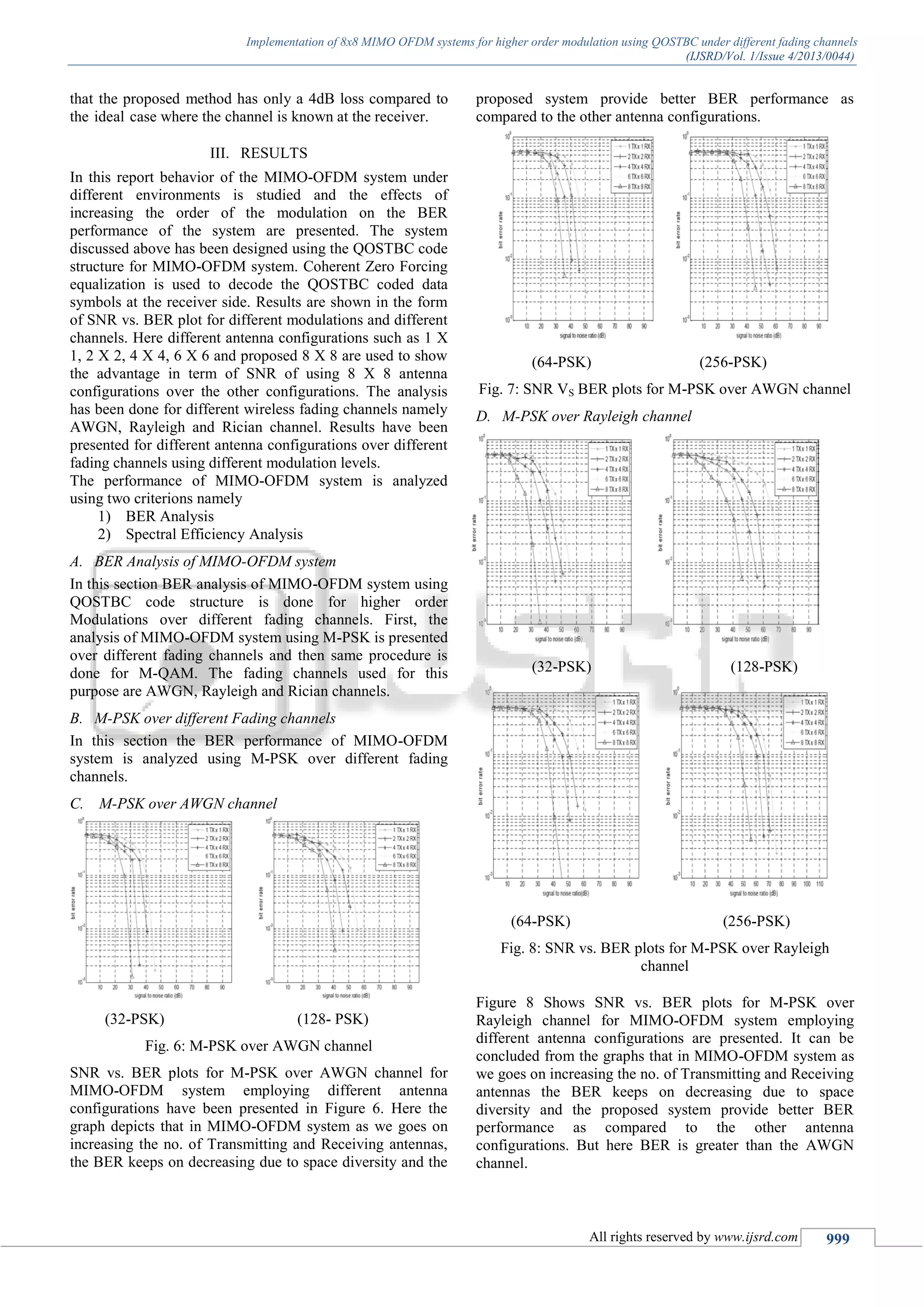
(32-PSK) (128-PSK)
(64-PSK) (256-PSK)
Fig. 8: SNR vs. BER plots for M-PSK over Rayleigh
channel
Figure 8 Shows SNR vs. BER plots for M-PSK over
Rayleigh channel for MIMO-OFDM system employing
different antenna configurations are presented. It can be
concluded from the graphs that in MIMO-OFDM system as
we goes on increasing the no. of Transmitting and Receiving
antennas the BER keeps on decreasing due to space
diversity and the proposed system provide better BER
performance as compared to the other antenna
configurations. But here BER is greater than the AWGN
channel.
Implementation of 8x8 MIMO OFDM systems for higher order modulation using QOSTBC under different fading channels
(IJSRD/Vol. 1/Issue 4/2013/0044)
All rights reserved by www.ijsrd.com 1000
E. 8 M-PSK over Rician channel
(32-PSK) (128-PSK)
(64-PSK) (256-PSK)
Fig. 9: SNR vs. BER plots for M-PSK over Rician channel
The performance in the form of SNR vs. BER plots for M-
PSK over Rician channel for MIMO OFDM system
employing different antenna configurations have been
presented in Figure 5.3.The graphs clearly point out the
dependency of the MIMO-OFDM system on the no. of
Transmitting and Receiving antennas. Here the BER keeps
on decreasing due to space diversity as we goes on
increasing the no. of Transmitting and Receiving antennas
and the proposed system provide better BER performance as
compared to the other antenna configurations.
IV. CONCLUSIONS
In the paper, an idea about the performance of the MIMO-
OFDM systems at higher modulation levels and for different
antenna configurations is presented. Performance of MIMO
OFDM system is analyzed under different fading channels.
MIMO-OFDM system can be implemented using higher
order modulations to achieve large data capacity. But there
is a problem of BER (bit error rate) which increases as the
order of the modulation increases. Because on increasing the
order of modulation the decision region
For the demodulator in the constellation diagram
also decreases, as a result of this the demodulator will
produce erroneous results at its output.
The proposed MIMO-OFDM system with 8 X 8
antenna configurations provides better SNR gain of 3-5 dB
due to increased space diversity as compared to the MIMO-
OFDM system with 6 X 6 antenna configurations at a BER
of 10-2. Results show that on increasing the no. of
transmitting antennas and receiving antennas there is an
improvement in the spectral efficiency. The BER will
decrease on increasing the no. of Transmitters or Receivers
due to space diversity. The space diversity can also be
increased by using more no. of transmitting and receiving
antennas i.e. 12 X 12, 16 X 16 etc.
REFERENCES
[1] L. J. Cimini, “Analysis and simulation of a digital
mobile channel using orthogonal frequency division
multiplexing”, IEEE Transaction on Communications,
Vol. 33, Issue 7, pp. 665–675, July 1985.
[2] Part 11: Wireless LAN Medium Access Control
(MAC) and Physical Layer (PHY) Specifications:
High-Speed Physical Layer in the 5 GHz Band, IEEE
Standard 802.11a-1999.
[3] Roger B. Marks, Ken Stanwood and Chang IEEE
Standard for Local and Metropolitan Area Networks
Part16: Air Interface for Fixed Broadband Wireless
Access Systems”, IEEE 802.16-2004, 1 October,
2004
[4] S. Alamouti, “A simple transmit diversity technique
for wireless communications”, IEEE Journal on
Selected Areas of Communication, Vol. 16, pp. 1451–
1458, Oct. 1998.
[5] V. Tarokh, H. Jafarkhani and A. R. Calderbank,
“Space–time block codes from orthogonal designs”,
IEEE Transactions on Information Theory, Vol. 45,
pp. 1456–1467, July 1999.
[6] G. Ganesan and P. Stoica. 2001. “Space-time block
codes: a maximum SNR approach”, IEEE
Transactions on Information Theory, Vol. 47, Issue 4,
May 2001, pp. 1650–1656.
[7] P. W. Wolniansky, G. J. Foschini, G. D. Golden and
R. A. Valenzuela, “V-Blast: An architecture for
realizing very high data rates over the rich-scattering
channel”, International Symposium on Signals,
Systems and Electronics, pp. 295–300, 1998.
[8] J. Ha, A. N. Mody, J. H. Sung, J. Barry, S. Mclaughlin
and G. L. Stuber, “LDPC coded OFDM with
Alamouti/SVD diversity technique,” IEEE Journal
on Wireless Personal Communication, Vol. 23, Issue
1, pp. 183–194, Oct. 2002.
[9] M. Jiang and L. Hanzo, “Multiuser MIMO-OFDM for
next generation wireless systems,” In Proceedings of
IEEE, Vol.95, Issue 7, pp.1430-1469, July 2007.
[10] C. C. Tu and B. Champagne, “Subspace Blind MIMO-
OFDM Channel Estimation with Short Averaging
Periods: PerformanceAnalysis,” IEEE
Conference on Wireless Communications and
Networking, pp. 24–29, April 2008.
[11] A. Tarighat and A. H. Sayed, “MIMO OFDM
receivers for systems with IQ imbalances,” IEEE
Transactions on Signal Processing, Vol. 53, Issue 9,
pp. 3583–3596, September 2005.
[12] R. Y. Mesleh, H. Haas, S. Sinanovic, C. W. Ahn and
S. Yun, "Spatial modulation”, IEEE Transaction on
Vehicular Technology, Vol. 57, Issue 4, pp. 2228-
2241, July 2008.
[13] P. S. Mundra , T. L. Singal and R. Kapur, “The Choice
of A DigitalModulation, Schemes in A Mobile Radio
System”, IEEE Vehicular Technology Conference,
Issue 5, pp 1- 4,1993.
Implementation of 8x8 MIMO OFDM systems for higher order modulation using QOSTBC under different fading channels
(IJSRD/Vol. 1/Issue 4/2013/0044)
All rights reserved by www.ijsrd.com 1001
[14] A. R. S. Bahai, B. R. Saltzberg, M. Ergen, Multi-
carrier Digital Communication Theory and
Applications of OFDM by Springer Science &
Business Media, 2004.
[15] B. P. Lathi, Modern Digital and Analog
Communication Systems by CBS College
Publishing, 1983
[16] A. Paulraj, R. Nabar, and D. Gore, Introduction to
Space–Time Wireless Communications, by Cambridge
University Press, Cambridge, UK, 2003.
[17] H. Sari, “Characteristics and Compensation of
Multipath Propagation in Broadband Wireless
Access System”, European Conference on
Propagation and Syetms, pp15-18 March 2005
[18] V. Erceg, K.V.S. Hari, M.S. Smith and D.S. Baum
“Channel Models for Fixed Wireless Applications”,
IEEE 802.16.3 Task Group Contributions, Febuary
2001
[19] M. N. Khan and S. Ghuari, “The WiMAX 802.16e
Physical Layer Model”, International Conference on
Wireless, Mobile and Multimedia Networks, pp 117-
120, 2007.
[20] S.P. Alex and L. M. A. Jalloul, “Performance
Evaluation of MIMO in IEEE802.16e/WiMAX”, IEEE
Journal of Selected Topics in Signal Processing, Vol.
2, No. 2, pp 181-190, April 2008.

Implementation of 8x8 MIMO OFDM systems for higher order modulation using QOSTBC under different fading channels

  • 1.
    IJSRD - InternationalJournal for Scientific Research & Development| Vol. 1, Issue 4, 2013 | ISSN (online): 2321-0613 All rights reserved by www.ijsrd.com 998 Implementation of 8x8 MIMO OFDM systems for higher order modulation using QOSTBC under different fading channels Ms. Aarti Sharma1 Prof. Mukesh Tiwari2 Mr. Amol Kumbhare3 Mr. Manish Korde4 1, 2 Department of Electronics Engineering SSSIST, Sehore 3, 4 Department of Electronics Comm. Engineering MIST, Indore Abstract—A general Quasi orthogonal space time block code (QOSTBC) structure is proposed for multiple-input multiple- output–orthogonal frequency division multiplexing (MIMO- OFDM) systems for 8 X 8 antenna configuration. The signal detection technology used in this work for MIMO-OFDM system is Zero-Forcing Equalization (linear detection technique). In this paper, analysis of high level of modulations (i.e. M-QAM and M-PSK for different values of M) on MIMO-OFDM system is presented. In this, AWGN, Rayleigh and Rician channels have been used for analysis purpose and their effect on BER and Spectral Efficiency for high data rates have been presented. The proposed system has better performance than the other systems in terms of SNR improvement of 3-5 dB and spectral efficiency. Keywords: QOSTBC (Quasi Orthogonal Space Time Block Code), OFDM (Orthogonal Frequency Division Multiplexing) , MIMO(Multiple-Input Multiple-Output) I. INTRODUCTION OFDM has become a popular technique for transmission of signals over wireless channels [1]. OFDM has been adopted in several wireless standards such as digital audio broadcasting (DAB), digital video broadcasting (DVB-T), the IEEE 802.11a [2] LAN standard and the IEEE 802.16a [3] MAN standard. OFDM is also being pursued for dedicated short-range communications (DSRC) for road side to vehicle communications and as a potential candidate for fourth- generation (4G) mobile wireless systems. The first aims to improve the power efficiency by maximizing spatial diversity. Such techniques include delay diversity, STBC [4], [5] and STTC [6]. The second class uses a layered approach to increase capacity. One popular example of such a system is V-BLAST suggested by Foschini et al. [7] where full spatial diversity is usually not achieved. Finally, the third type exploits the knowledge of channel at the transmitter. It decomposes the channel coefficient matrix using SVD and uses these decomposed unitary matrices as pre- and post-filters at the transmitter and the receiver to achieve near capacity [8]. II. MIMO-OFDM Spatially multiplexed MIMO is known to boost the throughput, on the other hand, when much higher throughputs are aimed at, the multipath character of the environment causes the MIMO channel to be frequency- selective. OFDM can transform such a frequency- selective MIMO channel into a set of parallel frequency-flat MIMO channels and also increase the frequency efficiency. Therefore, MIMO-OFDM [9] technology has been researched as the infrastructure for next generation wireless networks. Therefore, MIMO-OFDM, produced by employing multiple transmit and receive antennas in an OFDM system has becoming a practical alternative to single carrier and SISO transmission [10]. However, channel estimation becomes computationally more complex compared to the SISO systems due to the increased number of channels to be estimated. This complexity problem is further compounded when the channel from the ith transmit antenna to the mth receive antenna is frequency-selective. Using OFDM, information symbols are transmitted over several parallel independent sub-carriers using the computationally efficient IFFT/FFT modulation /demodulation vectors. [11] OFDM for MIMO channels (MIMO-OFDM) is considered by Y. Li et.al [16] for wideband transmission to mitigate inter symbol interference and enhance system capacity. The MIMO- OFDM system uses two independent space-time codes for two sets of two transmit antennas. At the receiver, the independent space-time codes are decoded using pre-whitening followed by ML decoding based on successive interference cancellation. S. Moghe et.al [17] introduced a new generation of IEEE 802.11n wireless network standard. The objective is to obtain numerical values for various Measures of networking performance of IEEE 802.11n. The initial approach was to investigate the abilities of IEEE 802.11n standard to model a transmitter and receiver that communicated over a user defined channel, Simulation of single OFDM symbol SISO system. Y. Wu et.al [18] gives an idea about the theoretical framework for the analysis of code diversity. It can be applied to an arbitrary space–time code, but the value of code diversity will depend on the particular choice of code. It is also shown that it not only improves the diversity and coding. A channel estimation method for STBC - OFDM is investigated by F. Delestre et.al [20] for Mobile WiMax systems. A new channel estimation approach is proposed using the dedicated pilot subcarriers defined at constant intervals by the WiMax standard. The estimation method has low computation as only linear operations are needed due to orthogonal pilot coding. The performances of the proposed method h a v e b e e n demonstrated by extensive computer simulations. For the OFDM system with two transmit antennas and one to four receive antennas and using QPSK modulation, the simulated results under different Stanford University Interim (SUI) channels show
  • 2.
    Implementation of 8x8MIMO OFDM systems for higher order modulation using QOSTBC under different fading channels (IJSRD/Vol. 1/Issue 4/2013/0044) All rights reserved by www.ijsrd.com 999 that the proposed method has only a 4dB loss compared to the ideal case where the channel is known at the receiver. III. RESULTS In this report behavior of the MIMO-OFDM system under different environments is studied and the effects of increasing the order of the modulation on the BER performance of the system are presented. The system discussed above has been designed using the QOSTBC code structure for MIMO-OFDM system. Coherent Zero Forcing equalization is used to decode the QOSTBC coded data symbols at the receiver side. Results are shown in the form of SNR vs. BER plot for different modulations and different channels. Here different antenna configurations such as 1 X 1, 2 X 2, 4 X 4, 6 X 6 and proposed 8 X 8 are used to show the advantage in term of SNR of using 8 X 8 antenna configurations over the other configurations. The analysis has been done for different wireless fading channels namely AWGN, Rayleigh and Rician channel. Results have been presented for different antenna configurations over different fading channels using different modulation levels. The performance of MIMO-OFDM system is analyzed using two criterions namely 1) BER Analysis 2) Spectral Efficiency Analysis A. BER Analysis of MIMO-OFDM system In this section BER analysis of MIMO-OFDM system using QOSTBC code structure is done for higher order Modulations over different fading channels. First, the analysis of MIMO-OFDM system using M-PSK is presented over different fading channels and then same procedure is done for M-QAM. The fading channels used for this purpose are AWGN, Rayleigh and Rician channels. B. M-PSK over different Fading channels In this section the BER performance of MIMO-OFDM system is analyzed using M-PSK over different fading channels. C. M-PSK over AWGN channel (32-PSK) (128- PSK) Fig. 6: M-PSK over AWGN channel SNR vs. BER plots for M-PSK over AWGN channel for MIMO-OFDM system employing different antenna configurations have been presented in Figure 6. Here the graph depicts that in MIMO-OFDM system as we goes on increasing the no. of Transmitting and Receiving antennas, the BER keeps on decreasing due to space diversity and the proposed system provide better BER performance as compared to the other antenna configurations. (64-PSK) (256-PSK) Fig. 7: SNR VS BER plots for M-PSK over AWGN channel D. M-PSK over Rayleigh channel (32-PSK) (128-PSK) (64-PSK) (256-PSK) Fig. 8: SNR vs. BER plots for M-PSK over Rayleigh channel Figure 8 Shows SNR vs. BER plots for M-PSK over Rayleigh channel for MIMO-OFDM system employing different antenna configurations are presented. It can be concluded from the graphs that in MIMO-OFDM system as we goes on increasing the no. of Transmitting and Receiving antennas the BER keeps on decreasing due to space diversity and the proposed system provide better BER performance as compared to the other antenna configurations. But here BER is greater than the AWGN channel.
  • 3.
    Implementation of 8x8MIMO OFDM systems for higher order modulation using QOSTBC under different fading channels (IJSRD/Vol. 1/Issue 4/2013/0044) All rights reserved by www.ijsrd.com 1000 E. 8 M-PSK over Rician channel (32-PSK) (128-PSK) (64-PSK) (256-PSK) Fig. 9: SNR vs. BER plots for M-PSK over Rician channel The performance in the form of SNR vs. BER plots for M- PSK over Rician channel for MIMO OFDM system employing different antenna configurations have been presented in Figure 5.3.The graphs clearly point out the dependency of the MIMO-OFDM system on the no. of Transmitting and Receiving antennas. Here the BER keeps on decreasing due to space diversity as we goes on increasing the no. of Transmitting and Receiving antennas and the proposed system provide better BER performance as compared to the other antenna configurations. IV. CONCLUSIONS In the paper, an idea about the performance of the MIMO- OFDM systems at higher modulation levels and for different antenna configurations is presented. Performance of MIMO OFDM system is analyzed under different fading channels. MIMO-OFDM system can be implemented using higher order modulations to achieve large data capacity. But there is a problem of BER (bit error rate) which increases as the order of the modulation increases. Because on increasing the order of modulation the decision region For the demodulator in the constellation diagram also decreases, as a result of this the demodulator will produce erroneous results at its output. The proposed MIMO-OFDM system with 8 X 8 antenna configurations provides better SNR gain of 3-5 dB due to increased space diversity as compared to the MIMO- OFDM system with 6 X 6 antenna configurations at a BER of 10-2. Results show that on increasing the no. of transmitting antennas and receiving antennas there is an improvement in the spectral efficiency. The BER will decrease on increasing the no. of Transmitters or Receivers due to space diversity. The space diversity can also be increased by using more no. of transmitting and receiving antennas i.e. 12 X 12, 16 X 16 etc. REFERENCES [1] L. J. Cimini, “Analysis and simulation of a digital mobile channel using orthogonal frequency division multiplexing”, IEEE Transaction on Communications, Vol. 33, Issue 7, pp. 665–675, July 1985. [2] Part 11: Wireless LAN Medium Access Control (MAC) and Physical Layer (PHY) Specifications: High-Speed Physical Layer in the 5 GHz Band, IEEE Standard 802.11a-1999. [3] Roger B. Marks, Ken Stanwood and Chang IEEE Standard for Local and Metropolitan Area Networks Part16: Air Interface for Fixed Broadband Wireless Access Systems”, IEEE 802.16-2004, 1 October, 2004 [4] S. Alamouti, “A simple transmit diversity technique for wireless communications”, IEEE Journal on Selected Areas of Communication, Vol. 16, pp. 1451– 1458, Oct. 1998. [5] V. Tarokh, H. Jafarkhani and A. R. Calderbank, “Space–time block codes from orthogonal designs”, IEEE Transactions on Information Theory, Vol. 45, pp. 1456–1467, July 1999. [6] G. Ganesan and P. Stoica. 2001. “Space-time block codes: a maximum SNR approach”, IEEE Transactions on Information Theory, Vol. 47, Issue 4, May 2001, pp. 1650–1656. [7] P. W. Wolniansky, G. J. Foschini, G. D. Golden and R. A. Valenzuela, “V-Blast: An architecture for realizing very high data rates over the rich-scattering channel”, International Symposium on Signals, Systems and Electronics, pp. 295–300, 1998. [8] J. Ha, A. N. Mody, J. H. Sung, J. Barry, S. Mclaughlin and G. L. Stuber, “LDPC coded OFDM with Alamouti/SVD diversity technique,” IEEE Journal on Wireless Personal Communication, Vol. 23, Issue 1, pp. 183–194, Oct. 2002. [9] M. Jiang and L. Hanzo, “Multiuser MIMO-OFDM for next generation wireless systems,” In Proceedings of IEEE, Vol.95, Issue 7, pp.1430-1469, July 2007. [10] C. C. Tu and B. Champagne, “Subspace Blind MIMO- OFDM Channel Estimation with Short Averaging Periods: PerformanceAnalysis,” IEEE Conference on Wireless Communications and Networking, pp. 24–29, April 2008. [11] A. Tarighat and A. H. Sayed, “MIMO OFDM receivers for systems with IQ imbalances,” IEEE Transactions on Signal Processing, Vol. 53, Issue 9, pp. 3583–3596, September 2005. [12] R. Y. Mesleh, H. Haas, S. Sinanovic, C. W. Ahn and S. Yun, "Spatial modulation”, IEEE Transaction on Vehicular Technology, Vol. 57, Issue 4, pp. 2228- 2241, July 2008. [13] P. S. Mundra , T. L. Singal and R. Kapur, “The Choice of A DigitalModulation, Schemes in A Mobile Radio System”, IEEE Vehicular Technology Conference, Issue 5, pp 1- 4,1993.
  • 4.
    Implementation of 8x8MIMO OFDM systems for higher order modulation using QOSTBC under different fading channels (IJSRD/Vol. 1/Issue 4/2013/0044) All rights reserved by www.ijsrd.com 1001 [14] A. R. S. Bahai, B. R. Saltzberg, M. Ergen, Multi- carrier Digital Communication Theory and Applications of OFDM by Springer Science & Business Media, 2004. [15] B. P. Lathi, Modern Digital and Analog Communication Systems by CBS College Publishing, 1983 [16] A. Paulraj, R. Nabar, and D. Gore, Introduction to Space–Time Wireless Communications, by Cambridge University Press, Cambridge, UK, 2003. [17] H. Sari, “Characteristics and Compensation of Multipath Propagation in Broadband Wireless Access System”, European Conference on Propagation and Syetms, pp15-18 March 2005 [18] V. Erceg, K.V.S. Hari, M.S. Smith and D.S. Baum “Channel Models for Fixed Wireless Applications”, IEEE 802.16.3 Task Group Contributions, Febuary 2001 [19] M. N. Khan and S. Ghuari, “The WiMAX 802.16e Physical Layer Model”, International Conference on Wireless, Mobile and Multimedia Networks, pp 117- 120, 2007. [20] S.P. Alex and L. M. A. Jalloul, “Performance Evaluation of MIMO in IEEE802.16e/WiMAX”, IEEE Journal of Selected Topics in Signal Processing, Vol. 2, No. 2, pp 181-190, April 2008.