Impact of Darwin on the
Development of
Geographical Concepts
KASTURI MUKHERJEE
ADAMAS UNIVERSITY
Charles Darwin
• Born on February 12, 1809 in England, Darwin
was a naturalist.
• He is renowned for his theory of evolution and
for a theory of its operation, known as
Darwinism.
• His evolutionary theories, propounded chiefly
in two works: (i) Origin of Species by Means of
Natural Selection (1859), and (ii) Descent of
Man, and Selection in Relation to Sex (1871).
• His theories greatly influenced the scientific
and religious tenor of his time
Impact on Geomorphology
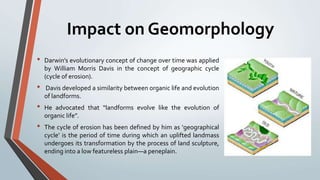
• Darwin’s evolutionary concept of change over time was applied
by William Morris Davis in the concept of geographic cycle
(cycle of erosion).
• Davis developed a similarity between organic life and evolution
of landforms.
• He advocated that “landforms evolve like the evolution of
organic life”.
• The cycle of erosion has been defined by him as ‘geographical
cycle’ is the period of time during which an uplifted landmass
undergoes its transformation by the process of land sculpture,
ending into a low featureless plain—a peneplain.
Impact on Geomorphology
• He stressed that “landscape is a function of structure, process and time (stage).” In
the evolution of landforms, Davis identified three stages, viz., (i) youth, (ii)
maturity, and (iii) old.
• Like organic life, each process gives rise to a distinctive landscape, so each stage
of the cycle of erosion is characterized by a distinctive landform.
• Thus, the evolution of landforms takes place in a sequential manner like that the
evolution of organic life.
• The pioneer model of Davis became the mother of all models pertaining to the
evolution of landforms.
• This model acquired a special position in the study of geomorphology.
• In fact, the entire geomorphic thought has been influenced by the concepts of
Davis which he developed on the Darwin’s theory of evolution of species.
Impact on Human Geography
• Darwin’s theory about the ‘origin of species’ and ‘descent of man’ gave
a new direction to the various sub-fields of human geography. The
doctrine that human activities are controlled by the environment
(environmental determinism) took a new turn.
• Ratzel was a strong follower of Darwin. He declared in his book
Anthropogeographic that “similar locations lead to similar mode of
life”.
• His American disciple Ellen Churchill Semple opened her book
Influences of Geographic Environment (1911) with the statement “man
is the product of the earth’s surface”.
• Huntington also asserted that “climate controls the progress and
development of human civilization”.
Impact on Human Geography
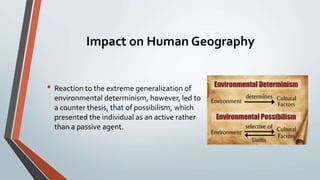
• Reaction to the extreme generalization of
environmental determinism, however, led to
a counter thesis, that of possibilism, which
presented the individual as an active rather
than a passive agent.
Impact on Cultural Landscape
• The term ‘cultural landscape’ was developed in American geography in 1925
by Carl Sauer with the publication of his article ‘The Morphology of
Landscape’.
• He developed this concept as an alternative to environmental determinism.
• While the environmental determinism sought to specify the causal
influences of the environment on humans, the landscape approach sought
to describe the interrelation between humans and the environment with
primary attention to the human impact on the environment.
Impact on Political Geography
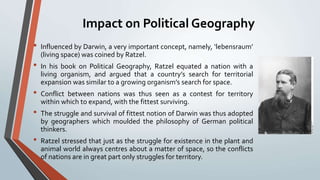
• Influenced by Darwin, a very important concept, namely, ‘lebensraum’
(living space) was coined by Ratzel.
• In his book on Political Geography, Ratzel equated a nation with a
living organism, and argued that a country’s search for territorial
expansion was similar to a growing organism’s search for space.
• Conflict between nations was thus seen as a contest for territory
within which to expand, with the fittest surviving.
• The struggle and survival of fittest notion of Darwin was thus adopted
by geographers which moulded the philosophy of German political
thinkers.
• Ratzel stressed that just as the struggle for existence in the plant and
animal world always centres about a matter of space, so the conflicts
of nations are in great part only struggles for territory.
Social Darwinism
• Social Darwinism is a loose set of ideologies that emerged in the late 1800s
in which Charles Darwin’s theory of evolution by natural selection was used
to justify certain political, social, or economic views.
• Social Darwinists believe in “survival of the fittest”—the idea that certain
people become powerful in society because they are innately better.
• Social Darwinism has been used to justify imperialism, racism, eugenics and
social inequality at various times over the past century and a half.

Impact_Darwin

  • 1.
    Impact of Darwinon the Development of Geographical Concepts KASTURI MUKHERJEE ADAMAS UNIVERSITY
  • 2.
    Charles Darwin • Bornon February 12, 1809 in England, Darwin was a naturalist. • He is renowned for his theory of evolution and for a theory of its operation, known as Darwinism. • His evolutionary theories, propounded chiefly in two works: (i) Origin of Species by Means of Natural Selection (1859), and (ii) Descent of Man, and Selection in Relation to Sex (1871). • His theories greatly influenced the scientific and religious tenor of his time
  • 3.
    Impact on Geomorphology •Darwin’s evolutionary concept of change over time was applied by William Morris Davis in the concept of geographic cycle (cycle of erosion). • Davis developed a similarity between organic life and evolution of landforms. • He advocated that “landforms evolve like the evolution of organic life”. • The cycle of erosion has been defined by him as ‘geographical cycle’ is the period of time during which an uplifted landmass undergoes its transformation by the process of land sculpture, ending into a low featureless plain—a peneplain.
  • 4.
    Impact on Geomorphology •He stressed that “landscape is a function of structure, process and time (stage).” In the evolution of landforms, Davis identified three stages, viz., (i) youth, (ii) maturity, and (iii) old. • Like organic life, each process gives rise to a distinctive landscape, so each stage of the cycle of erosion is characterized by a distinctive landform. • Thus, the evolution of landforms takes place in a sequential manner like that the evolution of organic life. • The pioneer model of Davis became the mother of all models pertaining to the evolution of landforms. • This model acquired a special position in the study of geomorphology. • In fact, the entire geomorphic thought has been influenced by the concepts of Davis which he developed on the Darwin’s theory of evolution of species.
  • 5.
    Impact on HumanGeography • Darwin’s theory about the ‘origin of species’ and ‘descent of man’ gave a new direction to the various sub-fields of human geography. The doctrine that human activities are controlled by the environment (environmental determinism) took a new turn. • Ratzel was a strong follower of Darwin. He declared in his book Anthropogeographic that “similar locations lead to similar mode of life”. • His American disciple Ellen Churchill Semple opened her book Influences of Geographic Environment (1911) with the statement “man is the product of the earth’s surface”. • Huntington also asserted that “climate controls the progress and development of human civilization”.
  • 6.
    Impact on HumanGeography • Reaction to the extreme generalization of environmental determinism, however, led to a counter thesis, that of possibilism, which presented the individual as an active rather than a passive agent.
  • 7.
    Impact on CulturalLandscape • The term ‘cultural landscape’ was developed in American geography in 1925 by Carl Sauer with the publication of his article ‘The Morphology of Landscape’. • He developed this concept as an alternative to environmental determinism. • While the environmental determinism sought to specify the causal influences of the environment on humans, the landscape approach sought to describe the interrelation between humans and the environment with primary attention to the human impact on the environment.
  • 8.
    Impact on PoliticalGeography • Influenced by Darwin, a very important concept, namely, ‘lebensraum’ (living space) was coined by Ratzel. • In his book on Political Geography, Ratzel equated a nation with a living organism, and argued that a country’s search for territorial expansion was similar to a growing organism’s search for space. • Conflict between nations was thus seen as a contest for territory within which to expand, with the fittest surviving. • The struggle and survival of fittest notion of Darwin was thus adopted by geographers which moulded the philosophy of German political thinkers. • Ratzel stressed that just as the struggle for existence in the plant and animal world always centres about a matter of space, so the conflicts of nations are in great part only struggles for territory.
  • 9.
    Social Darwinism • SocialDarwinism is a loose set of ideologies that emerged in the late 1800s in which Charles Darwin’s theory of evolution by natural selection was used to justify certain political, social, or economic views. • Social Darwinists believe in “survival of the fittest”—the idea that certain people become powerful in society because they are innately better. • Social Darwinism has been used to justify imperialism, racism, eugenics and social inequality at various times over the past century and a half.