IMPACT OF E- COMMERCE
WHAT IS E-COMMERCE?
 E - Commerce means Electronic Commerce.
 It Is the activity of buying and selling of products &
services online or over the Internet.
 We can say, E-Commerce is somehow transmitting
of funds or data over an electronic network ,
Internet.
 It allows people to do business with no barriers of
distance and time.
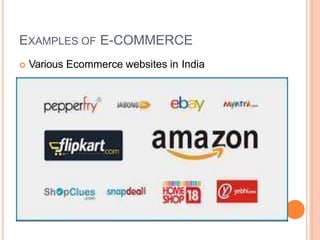
EXAMPLES OF E-COMMERCE
 Various Ecommerce websites in India
FEATURES OF E-COMMERCE
 The key points are:
1. Non Cash Payments
2. 24x7 Service Availability
3. Advertising / Marketing
4. Improved Sales
5. Support
6. Inventory Management
7. Communication Improvement
TYPES OF E-COMMERCE
1. Business –to-Business(B2B)
2. Business-to-Customer(B2C)
3. Customer-to-Customer(C2C)
4. Customer-to-Business(C2B)
5. Business-to-
Administration(B2A)
6. Customer-to-
Administration(C2A)
PROS & CONS OF E-COMMERCE
I.
III.
 Pros:
Faster Buying and
Selling of Products.
II. Low Operational costs
and better quality of
services.
Does not require much
physical space
IV. A bigger rangeof
Customer reach
V. Easy to start an manage
business
VI. Advertising done well on
the web can get even a
small firm’s
 Cons:
I. Lack of Human contact
II. Security Issues
III. No guarantee on product
quality
IV. Customer relation
problems
V. Designing and keeping
website up-to-date may
be very expensive for the
firm
VI. The company may have
to pay returns for the
goods when it is not as
per the need of customer.
GROWTH OF E-COMMERCE IN INDIA
 E-Commerce in India is still nascent, but it is
important for developing country like India.
 The opportunities of e-commerce players are many
rapid urbanization and also a rapid growth in use of
Internet by people over the India.
 E-Commerce is probably a great thing that has
happened to the Indian middle class and emerging
small businesses.
 factors contributing for the growth of Ecommerce
are:
1.niche markets in online trading
2. Unmatched FDI
3. Uniform GST
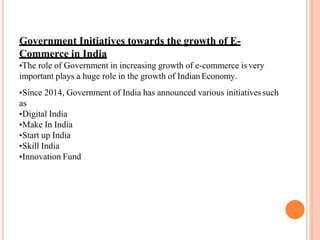
Government Initiatives towards the growth of E-
Commerce in India
•The role of Government in increasing growth of e-commerce is very
important plays a huge role in the growth of Indian Economy.
•Since 2014, Government of India has announced various initiativessuch
as
•Digital India
•Make In India
•Start up India
•Skill India
•Innovation Fund
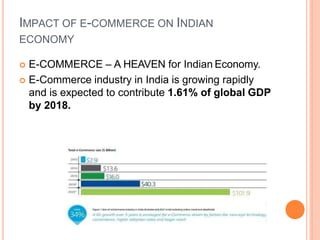
IMPACT OF E-COMMERCE ON INDIAN
ECONOMY
 E-COMMERCE – A HEAVEN for Indian Economy.
 E-Commerce industry in India is growing rapidly
and is expected to contribute 1.61% of global GDP
by 2018.
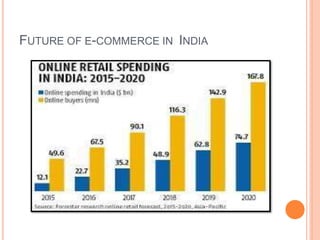
FUTURE OF E-COMMERCE IN INDIA
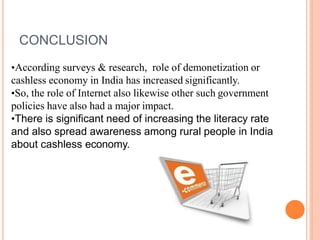
•According surveys & research, role of demonetization or
cashless economy in India has increased significantly.
•So, the role of Internet also likewise other such government
policies have also had a major impact.
•There is significant need of increasing the literacy rate
and also spread awareness among rural people in India
about cashless economy.
CONCLUSION

Impact of E-Commerce.pptx

  • 1.
    IMPACT OF E-COMMERCE
  • 2.
    WHAT IS E-COMMERCE? E - Commerce means Electronic Commerce.  It Is the activity of buying and selling of products & services online or over the Internet.  We can say, E-Commerce is somehow transmitting of funds or data over an electronic network , Internet.  It allows people to do business with no barriers of distance and time.
  • 3.
    EXAMPLES OF E-COMMERCE Various Ecommerce websites in India
  • 4.
    FEATURES OF E-COMMERCE The key points are: 1. Non Cash Payments 2. 24x7 Service Availability 3. Advertising / Marketing 4. Improved Sales 5. Support 6. Inventory Management 7. Communication Improvement
  • 5.
    TYPES OF E-COMMERCE 1.Business –to-Business(B2B) 2. Business-to-Customer(B2C) 3. Customer-to-Customer(C2C) 4. Customer-to-Business(C2B) 5. Business-to- Administration(B2A) 6. Customer-to- Administration(C2A)
  • 6.
    PROS & CONSOF E-COMMERCE I. III.  Pros: Faster Buying and Selling of Products. II. Low Operational costs and better quality of services. Does not require much physical space IV. A bigger rangeof Customer reach V. Easy to start an manage business VI. Advertising done well on the web can get even a small firm’s  Cons: I. Lack of Human contact II. Security Issues III. No guarantee on product quality IV. Customer relation problems V. Designing and keeping website up-to-date may be very expensive for the firm VI. The company may have to pay returns for the goods when it is not as per the need of customer.
  • 7.
    GROWTH OF E-COMMERCEIN INDIA  E-Commerce in India is still nascent, but it is important for developing country like India.  The opportunities of e-commerce players are many rapid urbanization and also a rapid growth in use of Internet by people over the India.  E-Commerce is probably a great thing that has happened to the Indian middle class and emerging small businesses.  factors contributing for the growth of Ecommerce are: 1.niche markets in online trading 2. Unmatched FDI 3. Uniform GST
  • 9.
    Government Initiatives towardsthe growth of E- Commerce in India •The role of Government in increasing growth of e-commerce is very important plays a huge role in the growth of Indian Economy. •Since 2014, Government of India has announced various initiativessuch as •Digital India •Make In India •Start up India •Skill India •Innovation Fund
  • 10.
    IMPACT OF E-COMMERCEON INDIAN ECONOMY  E-COMMERCE – A HEAVEN for Indian Economy.  E-Commerce industry in India is growing rapidly and is expected to contribute 1.61% of global GDP by 2018.
  • 13.
  • 14.
    •According surveys &research, role of demonetization or cashless economy in India has increased significantly. •So, the role of Internet also likewise other such government policies have also had a major impact. •There is significant need of increasing the literacy rate and also spread awareness among rural people in India about cashless economy. CONCLUSION