Imogene King
Theory of Goal
Attainment
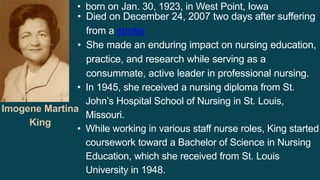
• born on Jan. 30, 1923, in West Point, Iowa
• Died on December 24, 2007 two days after suffering
from a stroke
• She made an enduring impact on nursing education,
practice, and research while serving as a
consummate, active leader in professional nursing.
• In 1945, she received a nursing diploma from St.
John’s Hospital School of Nursing in St. Louis,
Missouri.
• While working in various staff nurse roles, King started
coursework toward a Bachelor of Science in Nursing
Education, which she received from St. Louis
University in 1948.
Imogene Martina
King
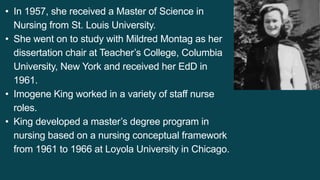
• In 1957, she received a Master of Science in
Nursing from St. Louis University.
• She went on to study with Mildred Montag as her
dissertation chair at Teacher’s College, Columbia
University, New York and received her EdD in
1961.
• Imogene King worked in a variety of staff nurse
roles.
• King developed a master’s degree program in
nursing based on a nursing conceptual framework
from 1961 to 1966 at Loyola University in Chicago.
Theory of Goal Attainment
• The Theory of Goal Attainment states that
“Nursing is a process of action, reaction, and
interaction whereby nurse and client share
information about their perception in the
nursing situation.”
• From the title itself, the model focuses on
the attainment of certain life goals.
The three key systems
• Personal system
• Interpersonal system
• Social system
Personal System
1.) PERCEPTION: self-awareness, your own representation of
reality and involves; input of the environment, the
transformation of energy, processing information, storing of
information, and export of information as behavior.
2.) SELF: composite of thoughts and feelings which constitute
a person’s awareness of his individual existence, his conception
of who and what he is.
3.) GROWTH AND DEVELOPMENT : can be defined as the
processes in people’s lives through which they move from a
potential for achievement to the actualization of self.
4.) BODY IMAGE: both one’s body and others’ reactions to
one’s appearance.
5.) TIME: duration between one event and another as
uniquely experienced by each human being; it is the relation
of one event to another event.
6.) SPACE: includes that space exists in all directions, is the
same everywhere, and is defined by the physical area known
as “territory” and by the behaviors of those occupying it.
7.) LEARNING: subconcept in the personal system but did
not further define it.
1.) INTERACTIONS: are defined as the observable behaviors
of two or more individuals in mutual presence.
2.) COMMUNICATION: a process whereby information is
given from one person to another either directly in a face-to-
face meeting or indirectly through telephone, television, or
the written word.
3.) TRANSACTION: a process of interactions in which
human beings communicate with the environment to
achieve goals that are valued… goal-directed human
behaviors.
Interpersonal Systems
4.) ROLE: person may be a giver at one time and a
taker at another time, with a relationship between
two or more individuals functioning in two or
more, learned, social, complex, and situational
roles.
5.)STRESS: dynamic state whereby a human being
interacts with the environment to maintain balance
for growth, development, and performance.
1.) POWER: capacity to use resources in organizations to
achieve goals.
2.) STATUS: the position of an individual in a group or a group
concerning other groups in an organization,
3.) DECISION MAKING: a dynamic and systematic process by
which goal-directed choice of perceived alternatives is made
and acted upon by individuals or groups to answer a question
and attain a goal.
4.) CONTROL: sub concept in the social system but did not
further define the concept.
Social Systems

Imogene-kingimpas for nursing student.pptx

  • 1.
    Imogene King Theory ofGoal Attainment
  • 2.
    • born onJan. 30, 1923, in West Point, Iowa • Died on December 24, 2007 two days after suffering from a stroke • She made an enduring impact on nursing education, practice, and research while serving as a consummate, active leader in professional nursing. • In 1945, she received a nursing diploma from St. John’s Hospital School of Nursing in St. Louis, Missouri. • While working in various staff nurse roles, King started coursework toward a Bachelor of Science in Nursing Education, which she received from St. Louis University in 1948. Imogene Martina King
  • 3.
    • In 1957,she received a Master of Science in Nursing from St. Louis University. • She went on to study with Mildred Montag as her dissertation chair at Teacher’s College, Columbia University, New York and received her EdD in 1961. • Imogene King worked in a variety of staff nurse roles. • King developed a master’s degree program in nursing based on a nursing conceptual framework from 1961 to 1966 at Loyola University in Chicago.
  • 4.
    Theory of GoalAttainment • The Theory of Goal Attainment states that “Nursing is a process of action, reaction, and interaction whereby nurse and client share information about their perception in the nursing situation.” • From the title itself, the model focuses on the attainment of certain life goals.
  • 5.
    The three keysystems • Personal system • Interpersonal system • Social system
  • 6.
    Personal System 1.) PERCEPTION:self-awareness, your own representation of reality and involves; input of the environment, the transformation of energy, processing information, storing of information, and export of information as behavior. 2.) SELF: composite of thoughts and feelings which constitute a person’s awareness of his individual existence, his conception of who and what he is. 3.) GROWTH AND DEVELOPMENT : can be defined as the processes in people’s lives through which they move from a potential for achievement to the actualization of self.
  • 7.
    4.) BODY IMAGE:both one’s body and others’ reactions to one’s appearance. 5.) TIME: duration between one event and another as uniquely experienced by each human being; it is the relation of one event to another event. 6.) SPACE: includes that space exists in all directions, is the same everywhere, and is defined by the physical area known as “territory” and by the behaviors of those occupying it. 7.) LEARNING: subconcept in the personal system but did not further define it.
  • 8.
    1.) INTERACTIONS: aredefined as the observable behaviors of two or more individuals in mutual presence. 2.) COMMUNICATION: a process whereby information is given from one person to another either directly in a face-to- face meeting or indirectly through telephone, television, or the written word. 3.) TRANSACTION: a process of interactions in which human beings communicate with the environment to achieve goals that are valued… goal-directed human behaviors. Interpersonal Systems
  • 9.
    4.) ROLE: personmay be a giver at one time and a taker at another time, with a relationship between two or more individuals functioning in two or more, learned, social, complex, and situational roles. 5.)STRESS: dynamic state whereby a human being interacts with the environment to maintain balance for growth, development, and performance.
  • 10.
    1.) POWER: capacityto use resources in organizations to achieve goals. 2.) STATUS: the position of an individual in a group or a group concerning other groups in an organization, 3.) DECISION MAKING: a dynamic and systematic process by which goal-directed choice of perceived alternatives is made and acted upon by individuals or groups to answer a question and attain a goal. 4.) CONTROL: sub concept in the social system but did not further define the concept. Social Systems