BY: 
MAIDELLE LUTHERINE JUNNE V. CABRERA 
SHEMYRA T. REALIZA 
PRINCESS KATE A. BUCAR
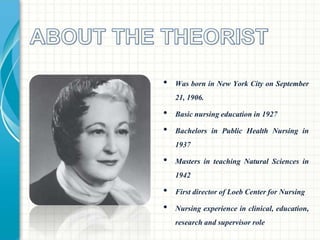
• Was born in New York City on September 
21, 1906. 
• Basic nursing education in 1927 
• Bachelors in Public Health Nursing in 
1937 
• Masters in teaching Natural Sciences in 
1942 
• First director of Loeb Center for Nursing 
• Nursing experience in clinical, education, 
research and supervisor role
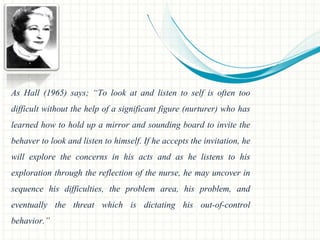
As Hall (1965) says; “To look at and listen to self is often too 
difficult without the help of a significant figure (nurturer) who has 
learned how to hold up a mirror and sounding board to invite the 
behaver to look and listen to himself. If he accepts the invitation, he 
will explore the concerns in his acts and as he listens to his 
exploration through the reflection of the nurse, he may uncover in 
sequence his difficulties, the problem area, his problem, and 
eventually the threat which is dictating his out-of-control 
behavior.”
(MAJOR CONCEPTS)
THE INDIVIDUAL HUMAN WHO IS 16 YEARS OF AGE OR 
OLDER AND PAST THE ACUTE STAGE OF A LONG-TERM ILLNESS IS 
THE FOCUS OF NURSING CARE IN HALL’S WORK. THE SOURCE OF 
ENERGY AND MOTIVATION FOR HEALING IS THE INDIVIDUAL CARE 
RECIPIENT, NOT THE HEALTH CARE PROVIDER. HALL EMPHASIZES 
THE IMPORTANCE OF THE INDIVIDUAL AS UNIQUE, CAPABLE OF 
GROWTH AND LEARNING, AND REQUIRING A TOTAL PERSON 
APPROACH.
CAN BE INFERRED TO BE A STATE OF SELF-AWARENESS WITH 
CONSCIOUS SELECTION OF BEHAVIORS THAT ARE OPTIMAL 
FOR THAT INDIVIDUAL. HALL STRESSES THE NEED TO HELP 
THE PERSON EXPLORE THE MEANING OF HIS OR HER 
BEHAVIOR TO IDENTIFY AND OVERCOME PROBLEMS THROUGH 
DEVELOPING SELF-IDENTITY AND MATURITY.
THE CONCEPT OF SOCIETY/ENVIRONMENT IS DEALT WITH IN RELATION 
TO THE INDIVIDUAL. HALL IS CREDITED WITH DEVELOPING THE CONCEPT OF 
LOEB CENTER BECAUSE SHE ASSUMED THAT THE HOSPITAL ENVIRONMENT 
DURING TREATMENT OF ACUTE ILLNESS CREATES A DIFFICULT PSYCHOLOGICAL 
EXPERIENCE FOR THE ILL INDIVIDUAL (BOWAR-FERRES, 1975). LOEB CENTER 
FOCUSES ON PROVIDING AN ENVIRONMENT THAT IS CONDUCIVE TO SELF-DEVELOPMENT. 
IN SUCH A SETTING, THE FOCUS OF THE ACTION OF THE 
NURSES IS THE INDIVIDUAL, SO THAT ANY ACTIONS TAKEN IN RELATION TO 
SOCIETY OR ENVIRONMENT ARE FOR THE PURPOSE OF ASSISTING THE 
INDIVIDUAL IN ATTAINING A PERSONAL GOAL.
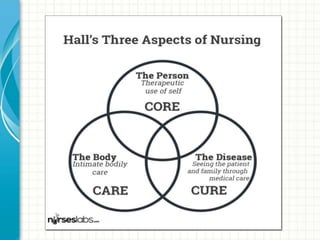
IS IDENTIFIED AS CONSISTING OF PARTICIPATION IN THE 
CARE, CORE, AND CURE ASPECTS OF PATIENT CARE.
The Care Circle 
It represents the nurturing component of 
nursing and is exclusive to nursing. 
Nurturing involves using the factors that 
make up the concept of mothering (care 
and comfort of the person) and provide 
for teaching-learning activities. 
The professional nurse provides bodily 
care for the patient and helps the patient 
complete such basic daily biological 
functions as eating, bathing, elimination, 
and dressing. When providing this care, 
the nurse’s goal is the comfort of the 
patient. 
Providing care for a patient at the basic 
needs level presents the nurse and 
patient with an opportunity for 
closeness. As closeness develops, the 
patient can share and explore feelings 
with the nurse. 
THE 
BODY 
(The Nursing Care)
The Core Circle 
It is based in the social sciences, 
involves the therapeutic use of self, 
and is shared with other members of 
the health team. The professional 
nurse, by developing an 
interpersonal relationship with the 
patient, is able to help the patient 
verbally express feelings regarding 
the disease process and its effects. 
Through such expression, the patient 
is able to gain self-identity and 
further develop maturity. 
The professional nurse, by the use of 
reflective technique (acting as a 
mirror to the patient), helps the 
patient look at and explore feelings 
regarding his or her current health 
status and related potential changes 
in lifestyle. 
THE 
PERSON 
GERIATRIC 
(Patient)
The Core Circle……… 
Motivations are discovered through the 
process of bringing into awareness the 
feelings being experienced. With this 
awareness, the patient is now able to 
make conscious decisions based on 
understood and accepted feelings and 
motivation.
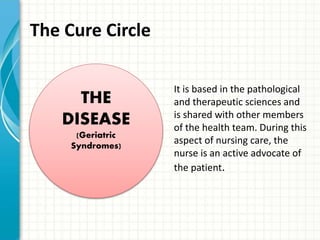
The Cure Circle 
It is based in the pathological 
and therapeutic sciences and 
is shared with other members 
of the health team. During this 
aspect of nursing care, the 
nurse is an active advocate of 
the patient. 
THE 
DISEASE 
(Geriatric 
Syndromes)
THE MOTIVATION AND ENERGY NECESSARY FOR HEALING EXIST WITHIN THE 
PATIENT, RATHER THAN IN THE HEALTH CARE TEAM. 
THE THREE ASPECTS OF NURSING SHOULD NOT BE VIEWED AS FUNCTIONING 
INDEPENDENTLY BUT AS INTERRELATED. 
THE THREE ASPECTS INTERACT, AND THE CIRCLES REPRESENTING THEM CHANGE 
SIZE, DEPENDING ON THE PATIENT’S TOTAL COURSE OF PROGRESS.
Hall imposed an age requirement for the application of her theory which is 16 years 
of age and above. This limits the theory since it cannot be disregarded that nurses are faced 
with pediatric clients every now and then. Even though Hall confined her concepts for that age 
bracket, the concepts of care, core and cure can still be applied to every age group but again, 
none was specified. 
The only tool of therapeutic communication Hall discussed is reflection. By 
inference, all other techniques of therapeutic communication are eliminated. Reflection is not 
always the most effective technique to be used. 
The concept of a patient aggregate such as having families and communities as the 
focus of nursing practice was not tackled. It is purely on the individual himself. Although, the 
role of the family or the community within the patient’s environment was modestly discussed. 
In the focus of nursing care in Hall’s concepts, the individual must pass an acute 
stage of illness for you to successfully apply her theory. Therefore, this theory relates only to 
those who are ill. This indicates that no nursing contact with healthy individuals, families, or 
communities, and it negates the concept of health maintenance and disease prevention.
“TO CARE IS TO 
NURSE AND TO NURSE 
IS TO GIVE YOURSELF 
WHEN YOU CARE. “
THANK YOU !! 
AND GOOD MORNING 
References: 
http://nursingtheories.weebly.com/lydia-e- 
hall.html 
http://rnspeak.com/fundamentals-of-nursing/ 
lydia-halls-nursing-theory-core-care- 
and-cure-model-for-geriatric-care/

LYDIA E. HALL

  • 1.
    BY: MAIDELLE LUTHERINEJUNNE V. CABRERA SHEMYRA T. REALIZA PRINCESS KATE A. BUCAR
  • 3.
    • Was bornin New York City on September 21, 1906. • Basic nursing education in 1927 • Bachelors in Public Health Nursing in 1937 • Masters in teaching Natural Sciences in 1942 • First director of Loeb Center for Nursing • Nursing experience in clinical, education, research and supervisor role
  • 4.
    As Hall (1965)says; “To look at and listen to self is often too difficult without the help of a significant figure (nurturer) who has learned how to hold up a mirror and sounding board to invite the behaver to look and listen to himself. If he accepts the invitation, he will explore the concerns in his acts and as he listens to his exploration through the reflection of the nurse, he may uncover in sequence his difficulties, the problem area, his problem, and eventually the threat which is dictating his out-of-control behavior.”
  • 5.
  • 6.
    THE INDIVIDUAL HUMANWHO IS 16 YEARS OF AGE OR OLDER AND PAST THE ACUTE STAGE OF A LONG-TERM ILLNESS IS THE FOCUS OF NURSING CARE IN HALL’S WORK. THE SOURCE OF ENERGY AND MOTIVATION FOR HEALING IS THE INDIVIDUAL CARE RECIPIENT, NOT THE HEALTH CARE PROVIDER. HALL EMPHASIZES THE IMPORTANCE OF THE INDIVIDUAL AS UNIQUE, CAPABLE OF GROWTH AND LEARNING, AND REQUIRING A TOTAL PERSON APPROACH.
  • 7.
    CAN BE INFERREDTO BE A STATE OF SELF-AWARENESS WITH CONSCIOUS SELECTION OF BEHAVIORS THAT ARE OPTIMAL FOR THAT INDIVIDUAL. HALL STRESSES THE NEED TO HELP THE PERSON EXPLORE THE MEANING OF HIS OR HER BEHAVIOR TO IDENTIFY AND OVERCOME PROBLEMS THROUGH DEVELOPING SELF-IDENTITY AND MATURITY.
  • 8.
    THE CONCEPT OFSOCIETY/ENVIRONMENT IS DEALT WITH IN RELATION TO THE INDIVIDUAL. HALL IS CREDITED WITH DEVELOPING THE CONCEPT OF LOEB CENTER BECAUSE SHE ASSUMED THAT THE HOSPITAL ENVIRONMENT DURING TREATMENT OF ACUTE ILLNESS CREATES A DIFFICULT PSYCHOLOGICAL EXPERIENCE FOR THE ILL INDIVIDUAL (BOWAR-FERRES, 1975). LOEB CENTER FOCUSES ON PROVIDING AN ENVIRONMENT THAT IS CONDUCIVE TO SELF-DEVELOPMENT. IN SUCH A SETTING, THE FOCUS OF THE ACTION OF THE NURSES IS THE INDIVIDUAL, SO THAT ANY ACTIONS TAKEN IN RELATION TO SOCIETY OR ENVIRONMENT ARE FOR THE PURPOSE OF ASSISTING THE INDIVIDUAL IN ATTAINING A PERSONAL GOAL.
  • 9.
    IS IDENTIFIED ASCONSISTING OF PARTICIPATION IN THE CARE, CORE, AND CURE ASPECTS OF PATIENT CARE.
  • 11.
    The Care Circle It represents the nurturing component of nursing and is exclusive to nursing. Nurturing involves using the factors that make up the concept of mothering (care and comfort of the person) and provide for teaching-learning activities. The professional nurse provides bodily care for the patient and helps the patient complete such basic daily biological functions as eating, bathing, elimination, and dressing. When providing this care, the nurse’s goal is the comfort of the patient. Providing care for a patient at the basic needs level presents the nurse and patient with an opportunity for closeness. As closeness develops, the patient can share and explore feelings with the nurse. THE BODY (The Nursing Care)
  • 12.
    The Core Circle It is based in the social sciences, involves the therapeutic use of self, and is shared with other members of the health team. The professional nurse, by developing an interpersonal relationship with the patient, is able to help the patient verbally express feelings regarding the disease process and its effects. Through such expression, the patient is able to gain self-identity and further develop maturity. The professional nurse, by the use of reflective technique (acting as a mirror to the patient), helps the patient look at and explore feelings regarding his or her current health status and related potential changes in lifestyle. THE PERSON GERIATRIC (Patient)
  • 13.
    The Core Circle……… Motivations are discovered through the process of bringing into awareness the feelings being experienced. With this awareness, the patient is now able to make conscious decisions based on understood and accepted feelings and motivation.
  • 14.
    The Cure Circle It is based in the pathological and therapeutic sciences and is shared with other members of the health team. During this aspect of nursing care, the nurse is an active advocate of the patient. THE DISEASE (Geriatric Syndromes)
  • 16.
    THE MOTIVATION ANDENERGY NECESSARY FOR HEALING EXIST WITHIN THE PATIENT, RATHER THAN IN THE HEALTH CARE TEAM. THE THREE ASPECTS OF NURSING SHOULD NOT BE VIEWED AS FUNCTIONING INDEPENDENTLY BUT AS INTERRELATED. THE THREE ASPECTS INTERACT, AND THE CIRCLES REPRESENTING THEM CHANGE SIZE, DEPENDING ON THE PATIENT’S TOTAL COURSE OF PROGRESS.
  • 17.
    Hall imposed anage requirement for the application of her theory which is 16 years of age and above. This limits the theory since it cannot be disregarded that nurses are faced with pediatric clients every now and then. Even though Hall confined her concepts for that age bracket, the concepts of care, core and cure can still be applied to every age group but again, none was specified. The only tool of therapeutic communication Hall discussed is reflection. By inference, all other techniques of therapeutic communication are eliminated. Reflection is not always the most effective technique to be used. The concept of a patient aggregate such as having families and communities as the focus of nursing practice was not tackled. It is purely on the individual himself. Although, the role of the family or the community within the patient’s environment was modestly discussed. In the focus of nursing care in Hall’s concepts, the individual must pass an acute stage of illness for you to successfully apply her theory. Therefore, this theory relates only to those who are ill. This indicates that no nursing contact with healthy individuals, families, or communities, and it negates the concept of health maintenance and disease prevention.
  • 18.
    “TO CARE ISTO NURSE AND TO NURSE IS TO GIVE YOURSELF WHEN YOU CARE. “
  • 19.
    THANK YOU !! AND GOOD MORNING References: http://nursingtheories.weebly.com/lydia-e- hall.html http://rnspeak.com/fundamentals-of-nursing/ lydia-halls-nursing-theory-core-care- and-cure-model-for-geriatric-care/

Editor's Notes

  • #2 This template can be used as a starter file for presenting training materials in a group setting. Sections Right-click on a slide to add sections. Sections can help to organize your slides or facilitate collaboration between multiple authors. Notes Use the Notes section for delivery notes or to provide additional details for the audience. View these notes in Presentation View during your presentation. Keep in mind the font size (important for accessibility, visibility, videotaping, and online production) Coordinated colors Pay particular attention to the graphs, charts, and text boxes. Consider that attendees will print in black and white or grayscale. Run a test print to make sure your colors work when printed in pure black and white and grayscale. Graphics, tables, and graphs Keep it simple: If possible, use consistent, non-distracting styles and colors. Label all graphs and tables.
  • #4 Give a brief overview of the presentation. Describe the major focus of the presentation and why it is important. Introduce each of the major topics. To provide a road map for the audience, you can repeat this Overview slide throughout the presentation, highlighting the particular topic you will discuss next.
  • #5 This is another option for an Overview slides using transitions.
  • #6 What will the audience be able to do after this training is complete? Briefly describe each objective how the audience will benefit from this presentation.
  • #7 Use a section header for each of the topics, so there is a clear transition to the audience.
  • #8 Use a section header for each of the topics, so there is a clear transition to the audience.
  • #9 Use a section header for each of the topics, so there is a clear transition to the audience.
  • #10 Use a section header for each of the topics, so there is a clear transition to the audience.
  • #11 Use a section header for each of the topics, so there is a clear transition to the audience.
  • #12 Microsoft Confidential
  • #13 Microsoft Confidential
  • #14 Microsoft Confidential
  • #15 Microsoft Confidential