T and B cell Receptors
(BCR and TCR)
By: Yemane Weldu (MSc., Assistant professor)
Learning objectives
• At the end of this section, the students will be able to:
– Define the BCR and TCR
– Describe the BCR and TCR complexes and the co-
receptors
– Explain the Accessory molecules of BCR and TCR
– Identify the basic differences b/n BCR and TCR
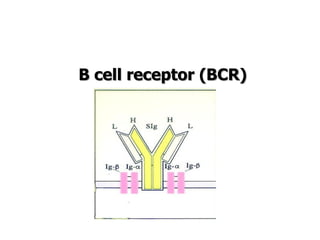
B cell receptor (BCR)
• The B cell produces both membrane bound and soluble
molecules.
• Usually, the membrane bound form is the BCR.
– are membrane immunoglobulins (mIg) expressed on
the B cell:
– Membrane molecules on B cells that can specially bind
to the antigens.
• are mIgM, and mIgD:
– Recognize and bind antigen specifically (with a
single antigenic specificity).
BCR complex
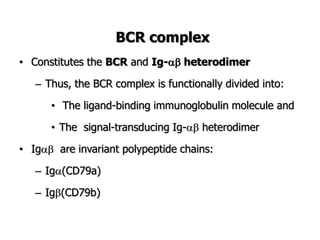
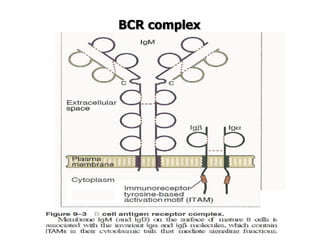
• Constitutes the BCR and Ig- heterodimer
– Thus, the BCR complex is functionally divided into:
• The ligand-binding immunoglobulin molecule and
• The signal-transducing Ig- heterodimer
• Ig are invariant polypeptide chains:
– Ig(CD79a)
– Ig(CD79b)
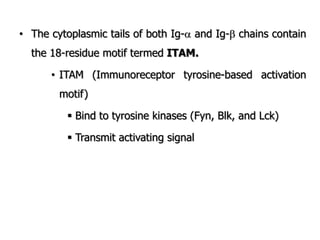
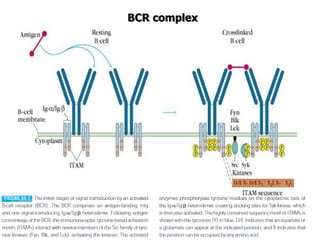
• The cytoplasmic tails of both Ig- and Ig- chains contain
the 18-residue motif termed ITAM.
• ITAM (Immunoreceptor tyrosine-based activation
motif)
 Bind to tyrosine kinases (Fyn, Blk, and Lck)
 Transmit activating signal
BCR complex
BCR complex
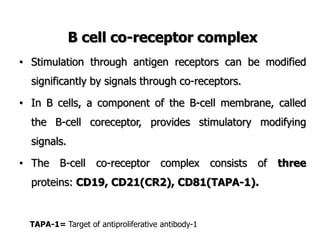
B cell co-receptor complex
• Stimulation through antigen receptors can be modified
significantly by signals through co-receptors.
• In B cells, a component of the B-cell membrane, called
the B-cell coreceptor, provides stimulatory modifying
signals.
• The B-cell co-receptor complex consists of three
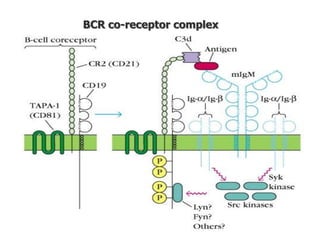
proteins: CD19, CD21(CR2), CD81(TAPA-1).
TAPA-1= Target of antiproliferative antibody-1
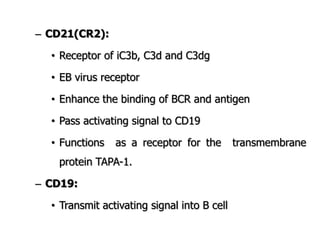
– CD21(CR2):
• Receptor of iC3b, C3d and C3dg
• EB virus receptor
• Enhance the binding of BCR and antigen
• Pass activating signal to CD19
• Functions as a receptor for the transmembrane
protein TAPA-1.
– CD19:
• Transmit activating signal into B cell
BCR co-receptor complex
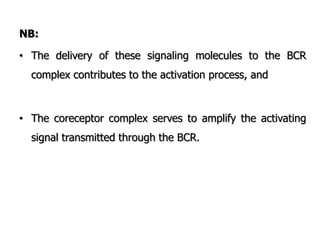
NB:
• The delivery of these signaling molecules to the BCR
complex contributes to the activation process, and
• The coreceptor complex serves to amplify the activating
signal transmitted through the BCR.
B cell Accessory molecules
• B cells also requires additional Accessory molecules to
provide an essential signal for the effective B-cell
activation. Examples:
1. CD40 (co-stimulatory receptor)
• CD40 on B cell binds to CD40L on activated T cell
• Transmit an important co-stimulatory signal to B cells
• Upregulate expression of B7 on B cells
• Participate in class switching of antibody
2. B7 (co-stimulatory receptor)
• Two types: B7-1 (CD80) and B7-2 (CD86)
• Expressed on B cells or other APC
– B7--- CD28  form the 2nd signal for activation
– B7---- CTLA-4
3. MHC molecules
• Class I, II molecules
4. Mitogen receptor
• LPS, SpA (slaphylococcal protein A), PWM (Poke
weed mitogen)
5. Cytokine receptors
• IL-4R, IL-5R, IL-6R ----
B cell sub-populations
• According to expression of CD5 or not, B-cells can be
divided into two subsets:
– B1 cell (CD5+)
– B2 cell (CD5-)
• B-2 B cells, are the major group of B cells in humans.
• B-1 B cells compose about 5% of the total B-cell
population.
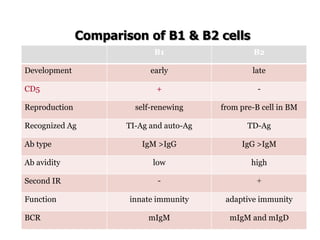
Comparison of B1 & B2 cells
B1 B2
Development early late
CD5 + -
Reproduction self-renewing from pre-B cell in BM
Recognized Ag TI-Ag and auto-Ag TD-Ag
Ab type IgM >IgG IgG >IgM
Ab avidity low high
Second IR - +
Function innate immunity adaptive immunity
BCR mIgM mIgM and mIgD
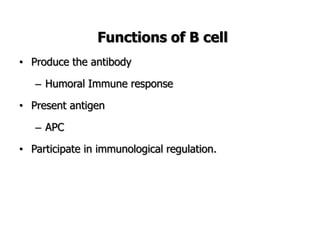
Functions of B cell
• Produce the antibody
– Humoral Immune response
• Present antigen
– APC
• Participate in immunological regulation.
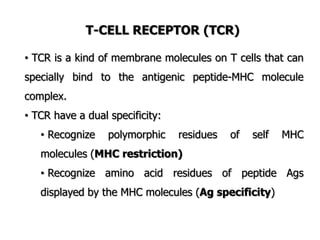
T-CELL RECEPTOR (TCR)
• TCR is a kind of membrane molecules on T cells that can
specially bind to the antigenic peptide-MHC molecule
complex.
• TCR have a dual specificity:
• Recognize polymorphic residues of self MHC
molecules (MHC restriction)
• Recognize amino acid residues of peptide Ags
displayed by the MHC molecules (Ag specificity)
Types of TCRs
• Two Types of TCRs depending on the trans-membrane
polypeptide chains.
– αβTCR: Account for Ag recognition by most T cells
(~ 95%).
– γδTCR: Minority (~5%
• :δ T-cell have different antigen-recognition properties
from the α:β TCR
:δ T-cell recognizes lipids and Phospholipids bound to
CD1 molecules.
NB:
• The function and what the γδ TCR recognizes??
– Aren‟t MHC restricted
– Recognize non peptide molecules
– May be “first responders”-
• Recognize antigens that are frequently encountered
at epithelial boundaries between the host and
external env‟t .
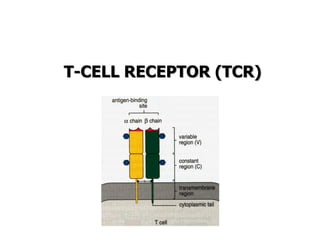
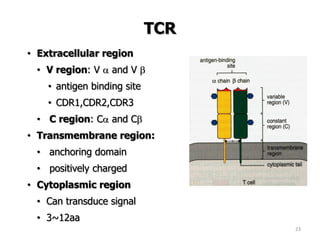
• Extracellular region
• V region: V  and V 
• antigen binding site
• CDR1,CDR2,CDR3
• C region: C and C
• Transmembrane region:
• anchoring domain
• positively charged
• Cytoplasmic region
• Can transduce signal
• 3~12aa
23
TCR
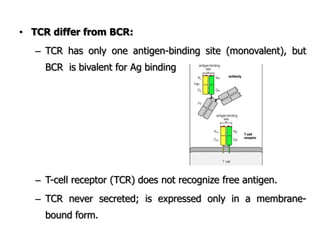
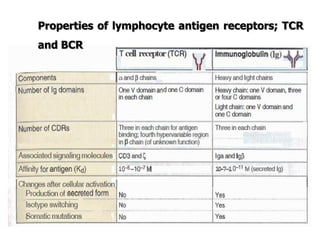
• TCR differ from BCR:
– TCR has only one antigen-binding site (monovalent), but
BCR is bivalent for Ag binding
– T-cell receptor (TCR) does not recognize free antigen.
– TCR never secreted; is expressed only in a membrane-
bound form.
Properties of lymphocyte antigen receptors; TCR
and BCR
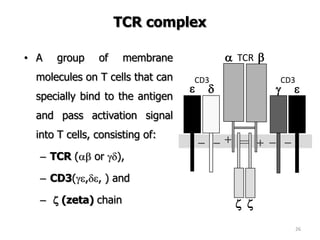
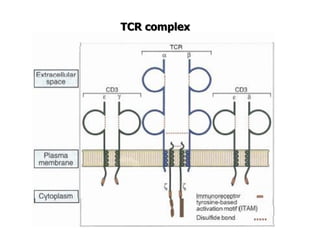
TCR complex
26
• A group of membrane
molecules on T cells that can
specially bind to the antigen
and pass activation signal
into T cells, consisting of:
– TCR ( or ),
– CD3(,, ) and
–  (zeta) chain
  

 TCR

 
CD3CD3
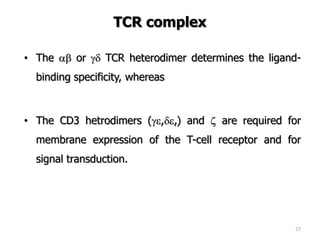
TCR complex
27
• The  or  TCR heterodimer determines the ligand-
binding specificity, whereas
• The CD3 hetrodimers (,,) and  are required for
membrane expression of the T-cell receptor and for
signal transduction.
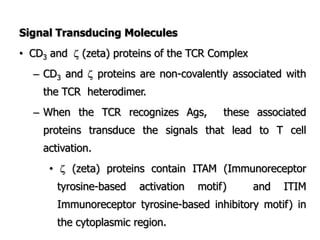
Signal Transducing Molecules
• CD3 and  (zeta) proteins of the TCR Complex
– CD3 and  proteins are non-covalently associated with
the TCR heterodimer.
– When the TCR recognizes Ags, these associated
proteins transduce the signals that lead to T cell
activation.
•  (zeta) proteins contain ITAM (Immunoreceptor
tyrosine-based activation motif) and ITIM
Immunoreceptor tyrosine-based inhibitory motif) in
the cytoplasmic region.
TCR complex
Accessory Molecules of T cells
• Although recognition of antigen-MHC complexes is
mediated solely by the TCR-CD3 complex, various other
membrane molecules play important accessory roles in
antigen recognition and T-cell activation .
– Some of these molecules strengthen the interaction
between T cells and antigen-presenting cells, some act
in signal transduction, and some do both.
• Accessory molecules specifically bind to other molecules
(ligands) present on the surfaces of other cells:
• APCs and vascular endothelial cells, and in the
extracellular matrix.
• The binding of accessory molecules with its specific
ligands are important to:
– Increase the strength of adhesion between T cells and
APCs.
– Homing and retention of T cells in tissues (binding to
endothelial cells)
• Expression of Accessory molecules and their ligands is
regulated by:
– Ag recognition and inflammatory response.
• Thus influence the T cell migration from blood to
sites of antigen in lymphoid organs and non-
lymphoid peripheral tissues.
Examples of Accessory Molecules of T cells
1. CD4 and CD8: Co-receptors
• CD4 and CD8 are trans-membrane glycoproteins.
• CD4 and CD8 are classified as co-receptors based on
their abilities to recognize the peptide-MHC complex and
their roles in signal transduction.
• Involved in MHC-restricted T Cell activation.
 Strengthen the binding of T cells to APCs
 Transduces signal.
• Expression of CD4 or CD8 determines the MHC restriction
of the T cells.
– CD4+ T cells
• CD4 T cells recognize antigen that is combined with
class II MHC molecules and function largely as
helper cells.
– CD8+T cells
• CD8 T cells recognize antigen that is combined with
class I MHC molecules and function largely as
cytotoxic cells (are CTLs).
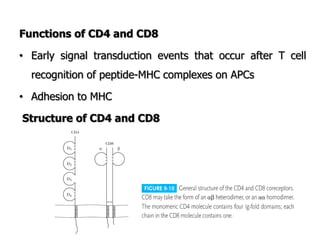
Functions of CD4 and CD8
• Early signal transduction events that occur after T cell
recognition of peptide-MHC complexes on APCs
• Adhesion to MHC
Structure of CD4 and CD8
2. CD28
• A membrane protein that transduces signals.
• Receptor for the co-stimulator B7 (molecules on APCs)
– Together with the signals delivered by the TCR it
activate naive T cells.
• Expressed on more than 90% of CD4+ T cells and on
50% of CD8+ T cells in humans.
3. CTLA-4 (CD152)
• A second receptor for B7 molecules
• Structurally homologous to CD28, but CTLA-4 is
expressed on recently activated CD4+ and CD8+ T cells
• Inhibit T cell activation by counteracting signals delivered
by CD28.
• Involved in terminating T cell responses.
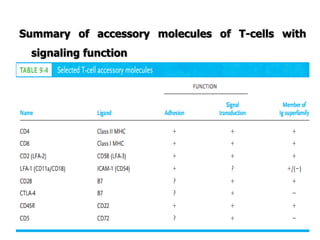
Summary of accessory molecules of T-cells with
signaling function
39
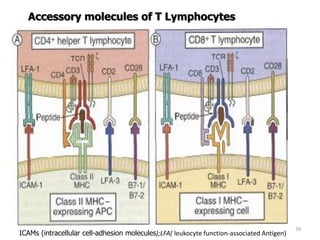
Accessory molecules of T Lymphocytes
ICAMs (intracellular cell-adhesion molecules);LFA( leukocyte function-associated Antigen)
Adhesion Molecules of T Cells
• Integrin, Selectin, CD44  are major adhesion molecules
of T Cells to local tissues.
• Adhesive interactions are important for:
 Stable conjugation of T cells and APCs
 T cell migration from blood into tissues
 Homing in specific tissue sites
• CD44: binds hyaluronate, and is responsible for:
 Retention of T cells in extravascular tissues at sites of
infection.
 Binding of activated and memory T cells to
endothelium at sites of inflammation and in mucosal
tissues.
• Intergrins: bind to extracellular molecules (collagen,
fibrinogen, fibronectin and vironectin.
– The T cell integrins LFA-1 and VLA-4 bind ICAMs and VCAM-
1, respectively on other cells
VCAM=vascular cell adhesion molecule; VLA=very late activation protein
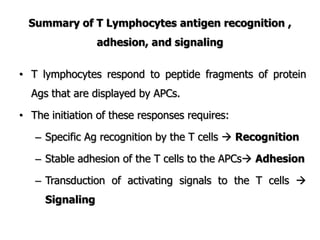
• T lymphocytes respond to peptide fragments of protein
Ags that are displayed by APCs.
• The initiation of these responses requires:
– Specific Ag recognition by the T cells  Recognition
– Stable adhesion of the T cells to the APCs Adhesion
– Transduction of activating signals to the T cells 
Signaling
Summary of T Lymphocytes antigen recognition ,
adhesion, and signaling
43
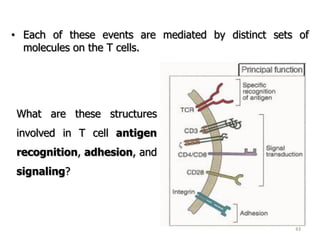
• Each of these events are mediated by distinct sets of
molecules on the T cells.
What are these structures
involved in T cell antigen
recognition, adhesion, and
signaling?
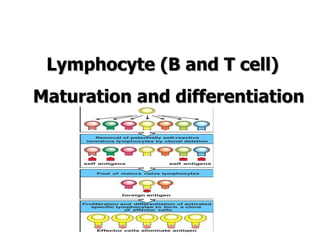
Lymphocyte (B and T cell)
Maturation and differentiation
Learning objectives
At the end of this topic the students will be able to:
• To list the stages of Lymphocyte maturation
• To identify the distinguishing features in each stage of the
lymphocyte maturation
• To describe the selection processes and check points of
the lymphocyte maturation
• To describe the formation of functional TCR and BCR
genes
Introduction
• Lymphocyte maturation is the process by which bone
marrow-derived lymphocyte progenitors are converted to
mature lymphocytes that populate peripheral lymphoid
tissues.
• Lymphocytes are the only cells in the body to express
highly diverse antigen receptors that recognize a wide
variety of foreign substances.
– The collection of antigen receptors, and therefore
specificities, expressed in B and T lymphocytes is
called the lymphocyte repertoire.
General Features of B & T Lymphocyte Maturation
• Lymphocyte maturation consists of sequential stages:
 Lineage commitment and proliferation
 Expression of
o Ag receptor genes
o Accessory and adhesion molecules
 Selection of the mature repertoires
• During each stages, cells undergo distinct cellular and
genetic changes.
Events during lymphocyte maturation
• Generation of diverse lymphocyte repertoire.
• Ag receptor genes produced by somatic recombination (in
BM for B cells & thymus for T cells).
– Joining of different gene segments.
• Ag receptors deliver signal to developing lymphocytes
required for survival, proliferation and maturation.
• Selective survival of lymphocytes with useful specificities.
– >107 different B & T lymphocyte clones.
Stage of T & B Lymphocyte maturation
• Pluripotent stem cell  Lymphoid progenitors T & B
precursors T, B, NK cells
i. Early B & T cell maturation
• Pro-B cell or Pro-T cell stage.
• T cell precursor migrates to thymus but B cells remain in bone
marrow to complete maturation.
• This stage is characterized by high mitotic activity
– Mediated by IL-7 produced by stromal cells (in BM &
Thymus)
• The high mitotic activity ensures large pool of cells to provide
a diverse gene repertoire of Ag specificity.
ii. Intermediate stage
• Pre-B cell or Pre-T cell stage.
 TCR/BCR genes are recombined
 Immature Ag receptor are formed pre-TCR/BCR
 Heavy chain (Ig)  in pre-B cells
• Pseudo light chain
 TCR β attached to invariant protein  in pre-T cells
• These receptors transduce signal for further maturation and
prevent programmed cell death
– Thus, the receptors provide intermediate check point to
ensure whether the first somatic recombination was
successful.
iii. Immature cells stage of Lymphocyte maturation
• Ag receptor expression is completed at this stage
 B cells: both Ig heavy and light chains are expressed
 T cells: both TCR  &  chains are expressed
• Expression of the completed receptors provide signal for
further cell survival, proliferation and maturation (next
check point)
– 90-95% die by apoptosis b/c failure in somatic
recombination in producing functional Ig or TCR genes.
Selection Processes that shape the immature B and T
cells:
• Many immature lymphocytes may express antigen
receptors that are of no use.
• After immature lymphocytes express antigen receptors, the
cells with useful receptors are preserved, and many
potentially harmful, self antigen-reactive cells are
eliminated.
• Thus, it could be by positive or negative selection.
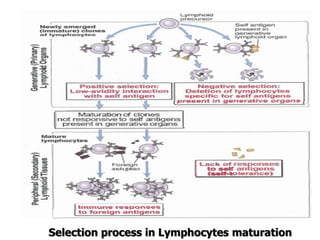
Positive selection
• Positive selection is the preservation of useful specificities.
• Best understood in T Lymphocyte (insures MHC
restriction)
• T cells whose receptors bind to self MHC molecule with low
or weak affinity with in the thymus are positively selected.
• Pre-B and immature B may be positively selected if:
– Weakly recognizes some self Ags
– Expresses functional Ag receptor
• Thus, positive selection serves to generate:
– Self-MHC restricted T cell repertoire and
– non-autoreactive T/B cell repertoire.
NB:
• Mature T cells whose precursors were positively selected
by self MHC molecules in the thymus are able to recognize
foreign peptide antigens displayed by the same self MHC
molecules on antigen-presenting cells in peripheral tissues.
Negative selection
• Is the process that eliminates developing lymphocytes.
• T cells are negatively selected if their TCR:
– Fail to recognize self MHC molecules or with very
strong affinity
– Strongly recognize self Ag presented by MHC
• Important to maintain tolerance!!!
• B cells are negatively selected if:
– Do not express BCR
– Strongly react with some self Ags
Iv. Late stage of maturation
• Mature B/ T cell stage
• At this stage, the lymphocytes acquire the ability to
respond to antigens and generate the effector
mechanisms that serve to eliminate antigens.
• B cells acquire the ability to secrete antibodies in
response to antigens and other signals.
• Distinct subsets of T cells with different functions antigen
receptors, they are subject to develop within the thymus
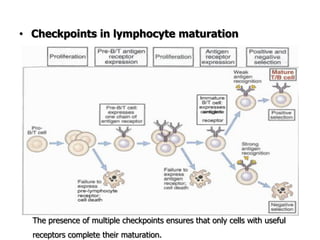
• Checkpoints in lymphocyte maturation
The presence of multiple checkpoints ensures that only cells with useful
receptors complete their maturation.
Selection process in Lymphocytes maturation
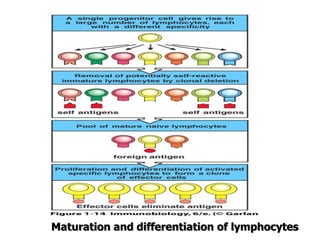
Maturation and differentiation of lymphocytes
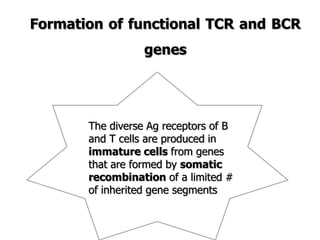
The diverse Ag receptors of B
and T cells are produced in
immature cells from genes
that are formed by somatic
recombination of a limited #
of inherited gene segments
Formation of functional TCR and BCR
genes
How limited genes give rise to diversities of TCR &
BCR?
 Analyses of the amino acid sequences of Ig molecules
showed that different Abs of same isotyes share identical
constant regions sequences
 But, differ considerably the variable regions
 Each antibody chain is actually encoded by at least two
genes
 Variable
 Constant
 The two genes become Joined at DNA/mRNA level to
give rise to functional Ig proteins.
• The genes encoding for BCR and TCR:
– Are formed by the somatic recombination of a
limited number of gene segments.
• Thus, antigen receptor gene recombination  diversified
TCR & BCR.
Organization of lg and TCR Gene Loci
• The germline organizations of Ig and TCR genetic loci are
characterized by spatial segregation of sequences.
– But, must be joined together to produce functional
genes coding for antigen receptor proteins.
 Three Separate gene loci of Ig and TCR:
lg Genetic Loci encode:
– lg heavy chain
– Ig  light chain
– Ig  light chain
TCR Genetic Loci encode:
– TCR  chain
– TCR  &  chains
– TCR  chain
NB: Each locus is on a different chromosome
• Each germline locus is made up of multiple copies of at
least three different types of gene segments, the V, C,
and joining (J) segments.
– All loci have V, J, and C segments
• But Ig heavy, TCR  and  loci have additional D
(diversity) segments
• J and D segments are located Between the V and C
genes in each locus.
– The D and J gene segments code for the carboxyl
terminal ends of the V regions, including the third
hypervariable (complementarity determining regions).
• Within each locus, the sets of each type of gene segment
are separated from one another by stretches of non-
coding DNA.
Somatic Recombination of Antigen Receptor
Genes
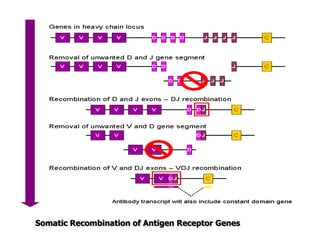
• The V region of Ig/TCR is encoded by the V and J gene
segments or by the V, J and D gene segments.
• Thus, Somatic recombination of Ig/TCR loci involves:
 Joining of D and J segments in the loci that contains D
segments
 Then, V segment is recombined to DJ segments in
these loci
 Or, direct V-to-J joining in the other loci which do not
contain D.
• The recombination is mediated by a recombinase enzyme
complex
– Includes lymphocyte-specific components RAG1 and
RAG2 (recombination-activating genes)
Note
• Germline genes cannot be transcribed into mRNA that
gives rise to antigen receptor proteins.
• Functional antigen receptor genes are created only in
developing B and T lymphocytes by rearrangements of
DNA that make the V, D, and J gene segments
contiguous.
• Thus, somatic recombination involves:
– Bringing together the appropriate gene segments,
– Introducing double-strand breaks at the ends of these
segments, and
– Ligating them to produce genes that can be
transcribed.
Somatic Recombination of Antigen Receptor Genes
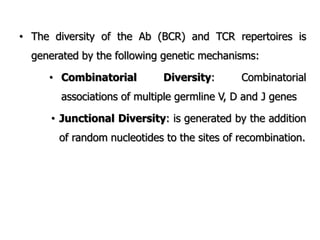
• The diversity of the Ab (BCR) and TCR repertoires is
generated by the following genetic mechanisms:
• Combinatorial Diversity: Combinatorial
associations of multiple germline V, D and J genes
• Junctional Diversity: is generated by the addition
of random nucleotides to the sites of recombination.
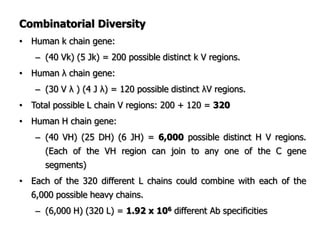
Combinatorial Diversity
• Human k chain gene:
– (40 Vk) (5 Jk) = 200 possible distinct k V regions.
• Human λ chain gene:
– (30 V λ ) (4 J λ) = 120 possible distinct λV regions.
• Total possible L chain V regions: 200 + 120 = 320
• Human H chain gene:
– (40 VH) (25 DH) (6 JH) = 6,000 possible distinct H V regions.
(Each of the VH region can join to any one of the C gene
segments)
• Each of the 320 different L chains could combine with each of the
6,000 possible heavy chains.
– (6,000 H) (320 L) = 1.92 x 10⁶ different Ab specificities
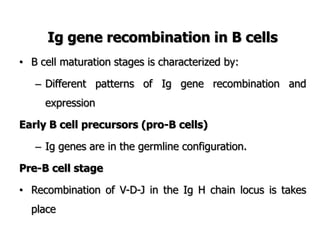
Ig gene recombination in B cells
• B cell maturation stages is characterized by:
– Different patterns of Ig gene recombination and
expression
Early B cell precursors (pro-B cells)
– Ig genes are in the germline configuration.
Pre-B cell stage
• Recombination of V-D-J in the Ig H chain locus is takes
place
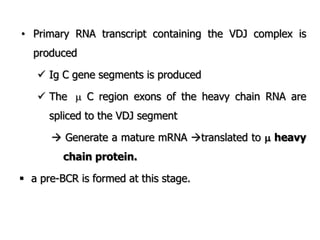
• Primary RNA transcript containing the VDJ complex is
produced
 Ig C gene segments is produced
 The  C region exons of the heavy chain RNA are
spliced to the VDJ segment
 Generate a mature mRNA translated to  heavy
chain protein.
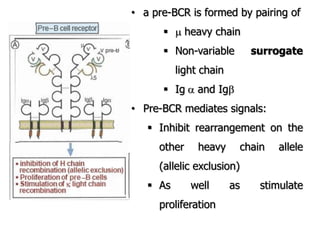
 a pre-BCR is formed at this stage.
• a pre-BCR is formed by pairing of
  heavy chain
 Non-variable surrogate
light chain
 Ig and Ig
• Pre-BCR mediates signals:
 Inhibit rearrangement on the
other heavy chain allele
(allelic exclusion)
 As well as stimulate
proliferation
Immature B cell stage
• V-J recombination's occur in the  or  loci, and light
chain proteins are expressed.
• Heavy and light chains are then assembled into intact
IgM molecules and expressed on the cell surface.
• Leave the bone marrow to populate peripheral lymphoid
tissues, where they complete their maturation.
Mature B cell stage
• At this stage membrane bounded IgM and IgD are
coexpressed.
  and  heavy chains are synthesized in the same B
cells
 Alternative splicing of primary heavy chain mRNA
transcripts to form the two heavy chains in one cell.
• Both classes of membrane Ig have the same V region and
hence the same antigen specificity.
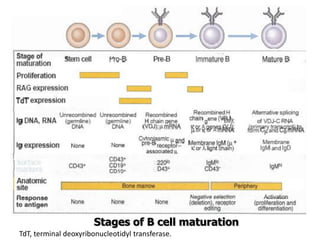
Stages of B cell maturation
TdT, terminal deoxyribonucleotidyl transferase.
TCR gene recombination in T cells
• T cell maturation also progresses in stages characterized
by:
– Expression of antigen receptor genes
– Expression of CD4 and CD8 co-receptor molecules
– Location in the thymus (cortex Vs medulla)
• Early T cell lineage immigrants to the thymus:
 Do not express TCRs or CD4/CD8 molecules
• Thymocytes (developing T cells)
 Initially populate the outer cortex
 Undergo proliferation
 Rearrangement of TCR genes
 Expression of TCR, CD3, CD4, and CD8 molecules.
 As the cells mature, they migrate from the cortex
to the medulla.
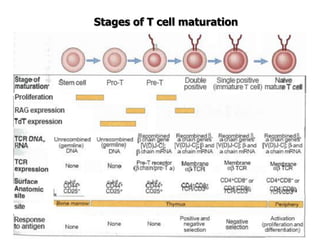
Stages of T Lymphocyte Maturation
 Pro-T cells: the least mature thymocytes
 CD4-CD8- (double negative)
 TCR genes are in the germ-line configuration.
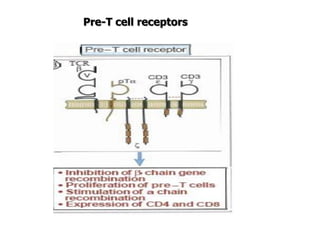
 Pre-T stage
 Thymocytes remain double negative, but V-D-J
recombination occurs in the TCR  chain locus
 Primary  chain transcripts are expressed and
processed to bring a C  segment adjacent to the VDJ
complex
  chain associates with the invariant pre-T
protein and with CD3 and  proteins to form a pre-
TCR
 Pre-TCR transduces signals that:
 Inhibit rearrangement on the other beta chain
allele (allelic exclusion)
 Promote CD4 and CD8 expression
 Further proliferation of immature thymocytes
Pre-T cell receptors
 CD4+CD8+ (double-positive, DP) stage
 V-J recombination's occur in the  locus
  chain polypeptides are produced
 TCR  gene expression in the double-positive stage
leads to the formation of the complete TCR.
 Low levels of TCRs are expressed
Second checking or selection process
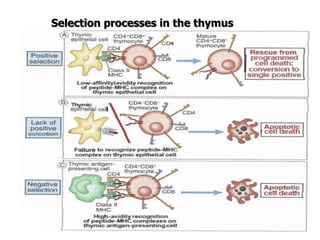
• Positive selection of CD4+CD8+ TCR  thymocytes
requires low avidity recognition of self peptide-MHC
complexes on thymic epithelial cells.
 Leads to a rescue of the cells from programmed death
• Negative selection: Double positive thymocytes
recognizing self Ags that are present at high
concentrations in the thymus with high avidity (auto-
reactive cells) are negatively selected
 Ensures Tolerance to many self antigens.
 Thus, selection process is important to:
 Allow the maturation of TCR expressing DP
thymocytes
 Shape the T cell repertoire toward :
o Self MHC restriction
o Self-tolerance
• Most of the cortical thymocytes do not survive these
selection processes
 95% die by apoptosis before reaching the medulla.
 Cell death is due to a combination of:
 Failure to express functional Ag receptors
 Failure to be positively selected
 Self antigen-induced negative selection
• The key factor determining the choice between positive
and negative selection is the strength of antigen
recognition
 Low-avidity recognition leading to positive selection
 High-avidity recognition inducing negative selection
Selection processes in the thymus
Selection process in the thymus
• Deletion of T cell clones reactive with self antigens in the
thymus (also called clonal deletion).
• Any thymic APC can induce negative selection,
including
 Bone marrow-derived Ms & DCs
 But thymic epithelial cells, are uniquely effective at
inducing positive selection
• Clonal selection is central principle of adaptive immunity
• Net result of these selection processes is that, mature T
cells that leaves the thymus is:
 Self MHC restricted
 Tolerant to self antigens
 Single -positive (CD4+ or CD8+ T cells) stage
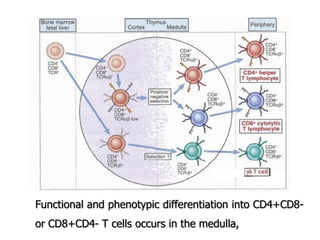
• As the surviving TCR  thymocytes mature:
 Move into the medulla
 Become either CD4+CD8- or CD8+CD4-(single
positive)
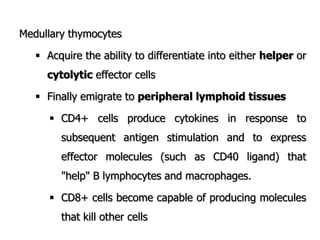
Medullary thymocytes
 Acquire the ability to differentiate into either helper or
cytolytic effector cells
 Finally emigrate to peripheral lymphoid tissues
 CD4+ cells produce cytokines in response to
subsequent antigen stimulation and to express
effector molecules (such as CD40 ligand) that
"help" B lymphocytes and macrophages.
 CD8+ cells become capable of producing molecules
that kill other cells
Functional and phenotypic differentiation into CD4+CD8-
or CD8+CD4- T cells occurs in the medulla,
Stages of T cell maturation
T and B cell Activation
Learning objectives
At the end of this topic the students will be able to:
• Describe T cell activation (Naïve Vs effector cells)
• Explain the Functional Responses of T Lymphocytes
• Describe B cell Activation (thymus dependent &
independent)
• Discuss Functional responses of B cells
• Explain class switching and affinity maturation
• Differentiate primary and secondary humoral immune
responses
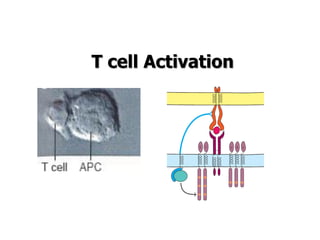
T cell Activation
T cell Activation
Activation of Naive T cells
• Protein Ags that enter through epithelia and into the
circulation are captured by "professional APCs” mainly
dendritic cells, and:
 Transported to lymph nodes and spleen
 Naive T cells continuously recirculate through lymph
nodes and spleen
 When a T cell of the correct specificity finds Ag, in the
form of peptide-MHC complexes, that T cell starts to
be activated.
• Ag-stimulated T cells proliferate and differentiate into
effector and memory cells, then some of which leave the
lymphoid organs and enter the circulation.
– i.e Naive T lymphocytes recognize antigens and are
activated in peripheral lymphoid organs, resulting in
the expansion of the antigen-specific lymphocyte pool
and the differentiation of these cells into effector and
memory lymphocytes
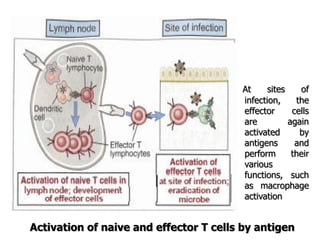
At sites of
infection, the
effector cells
are again
activated by
antigens and
perform their
various
functions, such
as macrophage
activation
Activation of naive and effector T cells by antigen
• Generally, activation of T cells requires:
– Recognition of Ags displayed by APCs (1o signal)
– Co-stimulators (“2o signals")
– Cytokines produced by the APCs and by the T cells
themselves.
 Proliferation and differentiation
– Adhesion molecules on the T cells, primarily the
integrins, stabilize the attachment of T cells to APCs
Naïve Vs effector T cell activation
• Naïve T cells
– Require activation by activated dendritic cells (DC)
• Naïve T cells requires DC for activation and can not be
activated by the other APCs.
– Because Activated DCs express:
• High levels of the MHC molecules
• High levels of the co-stimulators (provide 2nd signals to
naive T cells)
– Naïve T cells are dependent on co-stimulators to be
activated.
Role of Co-stimulators in T Cell Activation
• In addition to the antigen-induced signals (1o signal),
the proliferation and differentiation of T cells require
other signals (2o signal) provided by molecules on
APCs, called costimulators
– The best characterized co-stimulatory pathway in T cell
activation involves the T cell surface molecule CD28,
which binds the costimulatory molecules B7-1 (CD80)
and B7-2 (CD86) expressed on activated APCs
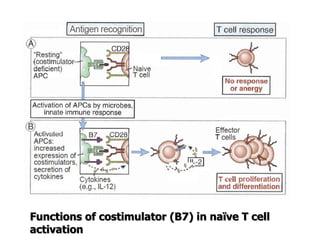
Functions of costimulator (B7) in naïve T cell
activation
• stimulates the expression of 67 molecules and the
• secretion of cytokines that activate T cells.
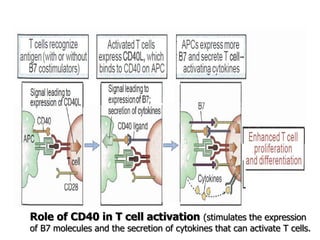
Role of CD40 in T cell activation (stimulates the expression
of B7 molecules and the secretion of cytokines that can activate T cells.
Activation of effector & memory T cells
• Activation of effector & memory T cells may not require
DC.
• Ms and B cells are more efficient activators for effector
and memory cells than of naive T cells
– Thus, Ms and B cells are important APCs in the
effector phase of T cell responses.
Effector cells
– Are less dependent on co-stimulators
– Require less Ag to be activated
– Effector and memory cells are able to react to Ags
displayed by APCs other than DCs in non-lymphoid
organs
– Majority effector and memory cells recognize Ags in:
 Lymphoid organs or peripheral non-lymphoid
tissues
 Then becomes activated to perform their
effector functions
– Effector T cells of the CD4+helper subset express
membrane molecules and secrete cytokines that
activate:
 Ms to kill phagocytized microbes
 B cells to differentiate into cells that secrete Abs
Humoral immunity
– Effector cells of the CD8+ subset [CD8+ cytolytic T
lymphocytes (CTLs)] kill infected cells and tumor cells.
 Cell mediated immunity
Memory T cells
• Are an expanded population of T cells specific for Ag
– after pathogens are cleared from primary infection
memory cells specific for the Ag stay for long time.
• Then Memory T cells can respond rapidly to subsequent
encounter with the same Ag and differentiate into effector
cells that can eliminate the antigen.
Functional Responses of T Lymphocytes
• The responses of T lymphocytes to antigen recognition
includes:
– Cytokine secretion
– Proliferation
– Differentiation
Cytokine secretion
– Is the earliest detectable response
– IL-2 is the principal cytokine produced by naive T cells
 Functions as a growth factor for the T cells
(autocrine manner)
Proliferation
– Primarily mediated by an autocrine growth pathway in
which the responding T cell secretes its own growth-
promoting cytokines (IL-2) and also expresses cell
surface receptors for these cytokines (IL-2R) .
• The principal autocrine growth factor for most T
cells is IL2.
• Therefore, the cells that recognize antigen bind the
IL-2 they secrete and thus proliferate in response
to this cytokine.
– Proliferation may be also by cytokines produced by
APCs and other non-lymphoid cells.
 e.g IL-15 for memory CD8+ T subsets growth
Importance of proliferation
– Frequency of naïve T cells specific to an Ag is
1:105/106,
– But after Ag exposure: 1 in 10 for CD8+; 1 in 100 to
1,000 for CD4+ cells.
Differentiation into Effector Cells
• Some of the progeny of the proliferating T cells
differentiate into effector cells that eliminate antigens and
may activate other immune cells:
– CD4+ effector cells
 To activate phagocytes and B lymphocytes
 Consists of two subsets: TH1 and TH2 produce
distinct sets of cytokines with different functions.
– CD8+ effector cells
 CTLs (ability to kill target cells that express
Peptide-MHC complex)
Differentiation into Memory Cells
• Some of the progeny of antigen-stimulated T cells
develop into long-lived, functionally quiescent memory
cells.
• The memory T cell population is responsible for enhanced
and accelerated secondary immune responses on
subsequent exposures to the same antigen.
• The survival of memory cells does not require antigen
recognition.
113
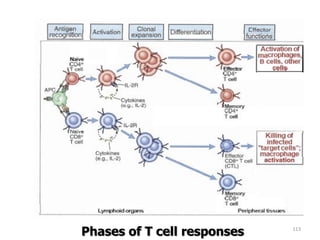
Phases of T cell responses
B cell Activation
B cell Activation
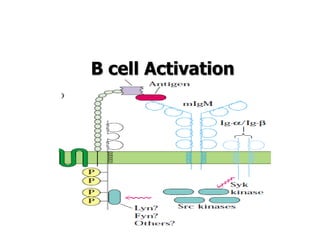
• Initiated by Ag binding to membrane bound Ig (BCR)
• BCR serves two key roles in B cell activation:
1) Ag-induced signals transduction w/c brings
biochemical reactions to initiate the process of
activation  Ti Ags
2) The receptor binds Ag, internalizes it into endosomal
vesicles  T-D Ags
 Presented on the B cell surface for recognition by
Th cells (APC function)
• B cell Activation and clonal expansion are driven by
encounter with specific foreign antigen,
• The antigen‟s nature influences which of the two B
activation routes is followed:
T -independent (TI) antigens:
– activate B cells without direct participation by TH cells.
– antibody production is weaker
– no memory cells are formed, and
– IgM is the predominant antibody secreted,
– reflects low level of class switching.
T-dependent (TD) antigens :
– Most antigens are T cell dependent
– In this, B cell activation requires direct contact with
TH cells.
– B cells stimulated by these antigens usually produce
IgM and IgG repsonses, with antibodies that are
found in the circulation for prolonged time periods.
– activation by this route typically results in Memory B
cells.
– Enhance class switching
Functional responses of B cells to protein antigen
recognition
• Activated B cells show increased expression of:
– Class II MHC molecules
– Chemokine (CCR7) receptors
– Co-stimulators, B7-2 (CD86) and B7-1 (CD80)
– Receptors for several T cell-derived cytokines (IL-4, IL-
5, IL-6, IL-2, …)
 Enables antigen-specific B cells to respond to T
helper cells.
• Thus, Ag-stimulated B cells are more efficient activators
of TH cells
• Then, helper T lymphocytes in turn stimulate B cell to
undergo the following functional Responses of B Cells:
– Clonal expansion
– Differentiation into plasma and memory B cells
– Affinity maturation
– Isotype switching
121
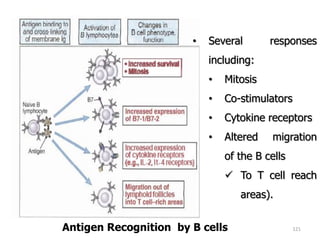
• Several responses
including:
• Mitosis
• Co-stimulators
• Cytokine receptors
• Altered migration
of the B cells
 To T cell reach
areas).
Antigen Recognition by B cells
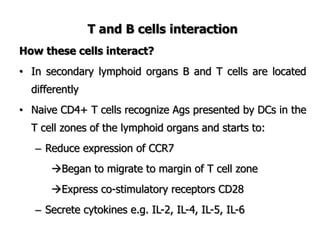
T and B cells interaction
How these cells interact?
• In secondary lymphoid organs B and T cells are located
differently
• Naive CD4+ T cells recognize Ags presented by DCs in the
T cell zones of the lymphoid organs and starts to:
– Reduce expression of CCR7
Began to migrate to margin of T cell zone
Express co-stimulatory receptors CD28
– Secrete cytokines e.g. IL-2, IL-4, IL-5, IL-6
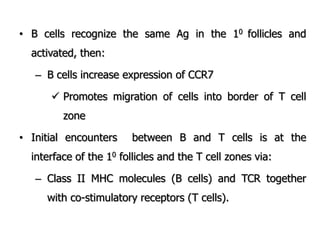
• B cells recognize the same Ag in the 10 follicles and
activated, then:
– B cells increase expression of CCR7
 Promotes migration of cells into border of T cell
zone
• Initial encounters between B and T cells is at the
interface of the 10 follicles and the T cell zones via:
– Class II MHC molecules (B cells) and TCR together
with co-stimulatory receptors (T cells).
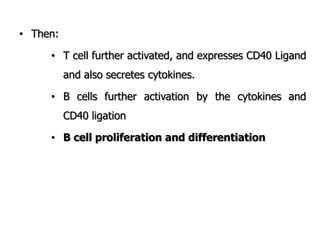
• Then:
• T cell further activated, and expresses CD40 Ligand
and also secretes cytokines.
• B cells further activation by the cytokines and
CD40 ligation
• B cell proliferation and differentiation
125
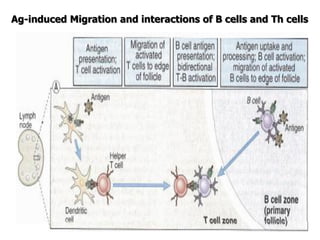
Ag-induced Migration and interactions of B cells and Th cells
126
 Interaction of CD40 (B cells) and CD40L (activated TH
cell)
 B cell receives competing signals from the T cell
o Express receptors for IL-2, IL-4, IL-5, IL-6
127
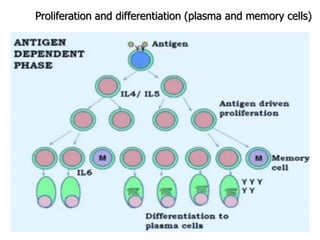
Proliferation and differentiation (plasma and memory cells)
Affinity Maturation
• B cell activation is takes place at cortex
 T-D and Ti Ags
• Activated B cells move to border of T cell zone
 Interact with activated TH cells at the interface
• Activated B cells enter to germinal center (dark region)
 Centroblast
• At dark zone, centeroblast will proliferate at a rapid rate
• During proliferation, AID (Activation Induced Deaminase)
induce point mutation on VDJ genes.
 Somatic hyper-mutation
• Increase Abs affinity (advantageous mutation)
• Decreasing Abs affinity (disadvantageous mutation)
• Then the hyper-mutated centroblast will move from dark
to light zone
 Centrocyte
• In the light zone, there are FDC and TH cells which
presents and activated by Ag then activates B cell in the
dark zone
• Centrocyte which had:
 Disadvantage mutation could not recognize the Ag
on FDC and destroyed by apoptosis
 Advantageous mutation will recognize the Ag
presented by FDC
 Thus, these cells will be differentiated in to effector
and memory cells
 Selection of cell with higher and higher affinity
to produce Abs  Affinity maturation
 i.e when Activated B cells produce antibodies
that bind to antigens with higher and higher
affinities; this process is called affinity
maturation.
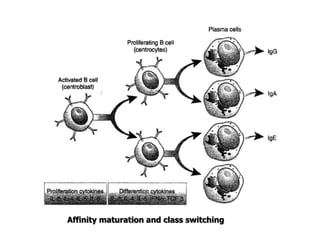
Undergo isotype class switching.
Affinity maturation and class switching
Isotype switching
• Is a change from one isotope of Ig to another isotope
• It needs cytokine, CD40 ligand, TH- cells
• Antibody class switching undergo to produce IgG, IgA or
IgE
– Generally, it is a biological mechanism that changes a
B cell's production of antibody from one class to
another
• IgM  IgG, IgA, IgE
• It involves
– Changing of constant region of the antibody‟s heavy
chain
– Variable region of the heavy chain stays the same.
• Occurs after mature B cell are activated via its BCR
– Immature B cells first produces IgM and then IgD
(BCR)
– Ag- stimulated B cell are activated and proliferated
• Activated B cells encounter specific signals (switch
inducing signal)
– CD40 and cytokine receptors (IL-4, IL-5 and IFN-γ)
 From helper T cells
– Undergo antibody class switching to produce IgG, IgA
or IgE
 IL-4  IgM to IgG4 and then to IgE
 IL-5  IgM to IgA
 IFN-γ  IgM to IgG1.
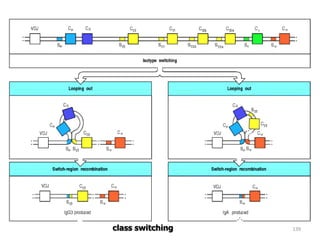
• Mechanism of class switching
– Class switch recombinase (comprises d/t enzymes)
– Steps
 Selection of target switch region (S-region) in the
Ig C-region
 Cleavage of Sµ-region and S-region by Activation
Induced Deaminase (AID)
 Repair and joining of broken DNA by Non-
Homologos Joining End repair (NHEJ)
137
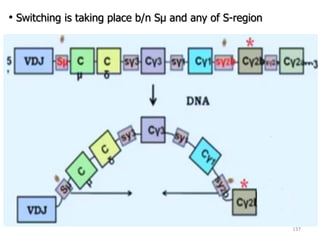
• Switching is taking place b/n Sµ and any of S-region
138
139class switching
Antibody responses to T-independent (Ti) antigens
• Thymus-independent (Ti) antigens
– Activate B cells in the absence of direct contact with
TH cells
– Do not generate strong immune response
 Low specificity, no memory cell generation,
no/limited isotype switching and affinity
maturation.
– E.g Non-protein Ags, such as polysaccharides, lipids,
nucleic acids.
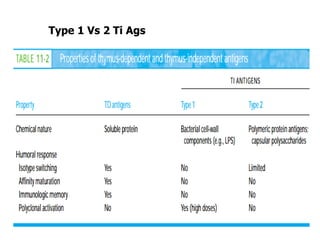
Divided into type 1 and 2
 Type 1: polyclonal B-cell activators (mitogens)
 i.e. activate B cells regardless of their antigenic
specificity
 Recognize by TLR, LPS
 Types 2: large polysaccharides
 Extensively crosslinking BCR
Type 1 Vs 2 Ti Ags
Humoral Immune response (HIR)
• HIR are initiated in peripheral lymphoid organs
– Spleen for blood-borne antigens
– Lymph nodes for antigens entering through the skin
and other epithelia
– Mucosal lymphoid tissues for some inhaled and
ingested antigens
• Plasma cells
– Resident mainly in the secondary lymphoid organs
and bone marrow
 Where as Abs enter the circulation and to site of
infection via blood, and mediate their protective
effects wherever antigens are present
 In BW: Some antibody-secreting cells migrate from
the peripheral lymphoid organs to the bone
marrow and give primary and immediate
protection on exposure to microbes.
• B cell activation consists of a series of responses that
lead to
 Proliferation: expansion of the clone of Ag-specific
cells
 Differentiation: generation of effector cells that
actively secrete antibodies and memory B cells
• Some activated B cells begin to produce Abs other than
IgM and IgD
 Heavy chain isotype (class) switching
• Activated B cells also produce Abs that bind to Ags with
higher and higher affinities
 Affinity maturation
• The type and amount of antibodies produced vary
according to the
 Type of antigen
 Involvement of T cells
 Previous history of Ag exposure
 Anatomic site
• Ab responses to protein Ags require Ag-specific CD4+ T
cell help
– T-dependent (T-D Ags)
• Ab responses to non-protein Ag, such as polysaccharides
and lipids and nucleic acid do not require Ag-specific
helper T lymphocytes
– T-independent (Ti Ags)
• Isotype switching and affinity maturation
– In T-dependent humoral immune responses to protein
Ags
 Stimulated by Th cell signals (CD40L and
cytokines)
– Heavy chain isotype switching and affinity maturation
also increase with repeated exposures to protein
Ags
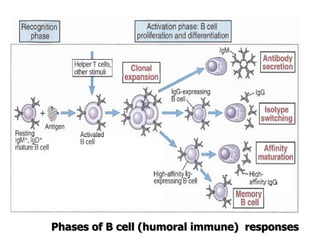
Phases of B cell (humoral immune) responses
Primary and Secondary responses
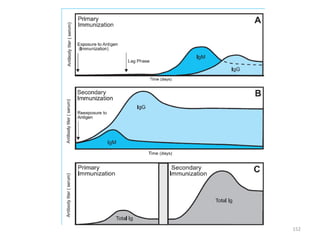
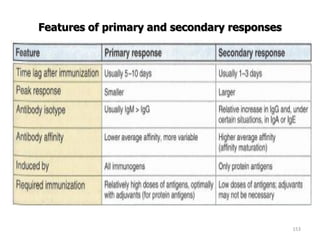
• Primary and secondary antibody responses to protein Ags
differ qualitatively and quantitatively.
– Primary: naïve B cell stimulation
– Secondary: memory B cells stimulation
151
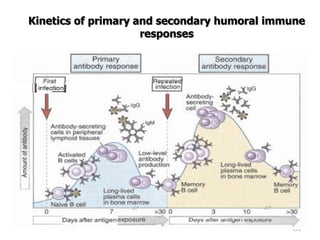
Kinetics of primary and secondary humoral immune
responses
152
153
Features of primary and secondary responses
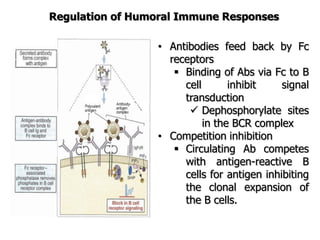
Regulation of Humoral Immune Responses
• Antibodies feed back by Fc
receptors
 Binding of Abs via Fc to B
cell inhibit signal
transduction
 Dephosphorylate sites
in the BCR complex
• Competition inhibition
 Circulating Ab competes
with antigen-reactive B
cells for antigen inhibiting
the clonal expansion of
the B cells.
Cytokines
By: Yemane Weldu (MSc., Assistant professor)
Cytokines
• What are cytokines?
– Are small immune regulatory proteins (~25 kDa)
– Released by various cells in the body, usually in
response to an activating stimulus.
– Intracellular messengers of the immune system
– Trigger signal transduction pathways
– Ultimately alter gene expression in the target cells
Mode of action of Cytokines
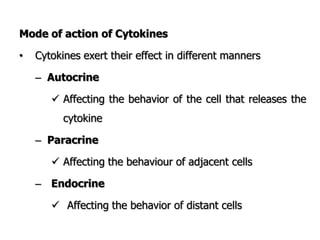
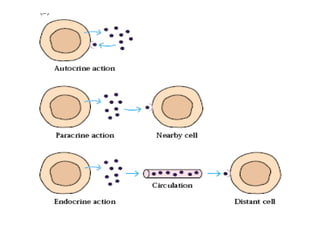
• Cytokines exert their effect in different manners
– Autocrine
 Affecting the behavior of the cell that releases the
cytokine
– Paracrine
 Affecting the behaviour of adjacent cells
– Endocrine
 Affecting the behavior of distant cells
• Cytokines are important to regulate the intensity and
duration of the immune response:
– Stimulate or inhibit: activation/proliferation/
differentiation of various cells, and
– Regulate the secretion of antibodies or other cytokines
• Influence activity of other cells:
– B cells, T cells, NK cells, Ms, granulocytes,
hematopoietic cells.
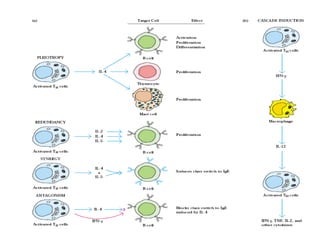
Functional properties of Cytokine
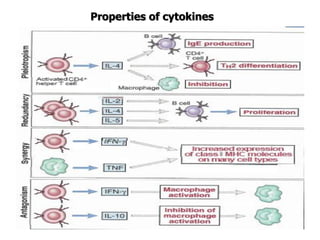
Cytokines can be said to have 5 attributes:
– Pleiotropy
– Redundancy
– Synergy
– Antagonism
– Cascade induction
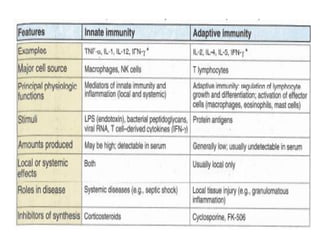
Properties of cytokines
Functional categories of cytokines
• Three main functional categories based on their principal
biological actions.
i. Cytokines that mediate & regulate innate immunity
– TNF, IL-1, IL-18, IL-12, type 1 IFNs, chemokines, etc
– Produced mainly by Ms, NK cells
 Bacterial and viral products such as LPS, dsRNA, are
the main inducers.
– Recruit, activate, and regulate specialized effector cells
• Mononuclear phagocytes, neutrophils, and
eosinophils, to eliminate antigens by stimulating the
early inflammatory reactions.
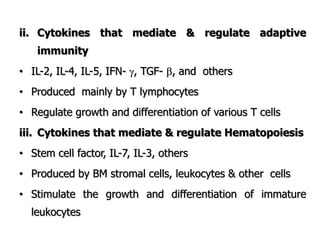
ii. Cytokines that mediate & regulate adaptive
immunity
• IL-2, IL-4, IL-5, IFN- , TGF- , and others
• Produced mainly by T lymphocytes
• Regulate growth and differentiation of various T cells
iii. Cytokines that mediate & regulate Hematopoiesis
• Stem cell factor, IL-7, IL-3, others
• Produced by BM stromal cells, leukocytes & other cells
• Stimulate the growth and differentiation of immature
leukocytes
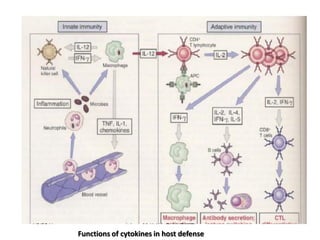
Functions of cytokines in host defense
167
168
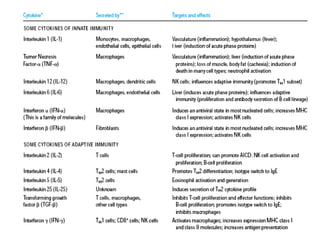
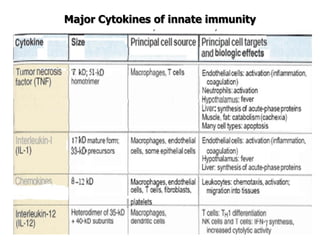
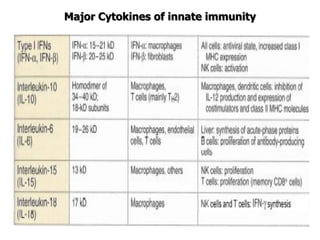
Major Cytokines of innate immunity
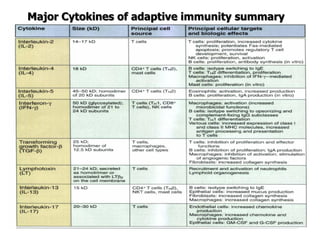
Major Cytokines of adaptive immunity summary
Chemokines
• Are chemo-attractant cytokines
– Released in infected tissue in the earliest phases of
infection.
– Secreted by leukocytes, endothelial cells, epithelial
cells, and fibroblasts
• Whose secretion is induced by IL-1 and TNF-α
during infection
– IL-8: First chemokine to be cloned and characterized
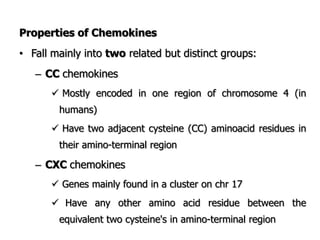
Properties of Chemokines
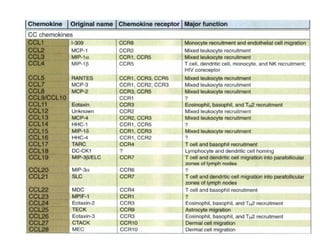
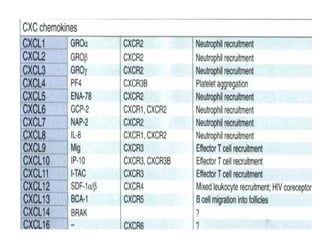
• Fall mainly into two related but distinct groups:
– CC chemokines
 Mostly encoded in one region of chromosome 4 (in
humans)
 Have two adjacent cysteine (CC) aminoacid residues in
their amino-terminal region
– CXC chemokines
 Genes mainly found in a cluster on chr 17
 Have any other amino acid residue between the
equivalent two cysteine's in amino-terminal region
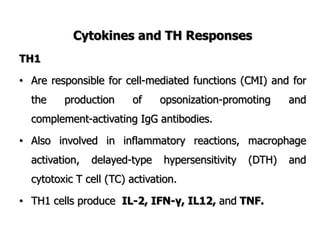
Cytokines and TH Responses
TH1
• Are responsible for cell-mediated functions (CMI) and for
the production of opsonization-promoting and
complement-activating IgG antibodies.
• Also involved in inflammatory reactions, macrophage
activation, delayed-type hypersensitivity (DTH) and
cytotoxic T cell (TC) activation.
• TH1 cells produce IL-2, IFN-γ, IL12, and TNF.
TH2
• Stimulates eosinophil activation and differentiation
• Provides help to B cells (HIR)
• Promotes the production of relatively large amounts of
IgM, IgE, and non-complement activating IgG isotypes
• Also supports allergic reactions
• TH2 cells produce IL-4, IL-5, IL-10 and IL-13
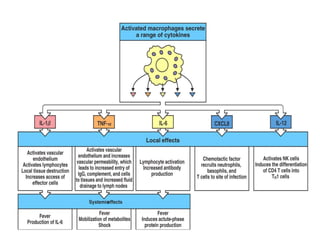
Cytokines secreted by Ms
• In response to bacterial products
 IL-1, IL- 6, IL-8, IL-12, and TNF-α
– TNF-α: elicited by LPS-bearing pathogens
Local inflammatory, systemic effects
– IL-8 (Chemokine)
 Helping to attract neutrophils to the site of
infection
 Also Local inflammatory response
– IL-1, IL-6, and TNF-α
 Critical role in inducing the acute-phase response
– IL-12
 Favors the differentiation of CD4 T cells into the
TH1
Potential applications and therapeutic uses of
cytokines/receptors
Applications
• Control of inflammation
• Cancer therapy
• Organ transplantation
• Infectious disease
• Allergy
Approaches
– Cytokine receptor blockade
– Cytokine analogs
– Cytokine-toxin conjugates
Difficulties
– Achieving desired concentration at a specified locality
through systemic administration is not feasible
– Continuous administration is needed (short half-life)
e.g. IL-2 has 7-10 minute half life
– Can cause unpredictable and undesirable side effects
 Potent biological response modifiers
Complement System
Complement system
• Is one of the major effector mechanisms of humoral
innate immunity.
• Composed of proteins and glycoproteins which are
synthesized by:
– Liver hepatocytes (mainly)
– Blood monocytes; tissue macrophages
– Epithelial cells of the GIT and GUT
• These components constitute 5% (by weight) of the
serum globulin fraction.
• Most circulate in the serum in functionally inactive forms
as proenzymes, or zymogens, which are inactive until
proteolytic cleavage, which removes an inhibitory
fragment and exposes the active site.
• The complement-reaction sequence starts with an
enzyme cascade.
• Complement Components are designated by:
– Numerals (C1-C9)
– Letter symbols (e.g. factor D, factor B, … )
– Trivial names (e.g. homologous restriction factor)
• Peptide fragments formed by activation of a component
are designated by small letters
– „a‟ for a smaller fragment, „b‟ for a larger fragment
(N.B. exception; C2a is larger)
– Larger fragments bind to the target near the site of
activation and smaller fragments diffuse to distant
sites of inflammation.
• The fragments interact with one another to form
functional complexes.
– The enzymatic activity are designated by a bar over
the number or symbol e.g. C4b2a, C3bBb
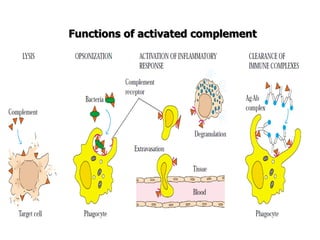
Functions of activated complement
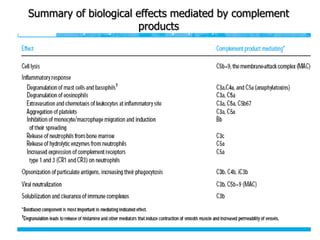
• Lysis of cells, bacteria and viruses by formation of MAC
(Membrane attack complex ))
• Opsonization
• Triggering specific cell functions
– Inflammation, and secretion of immune-regulatory
molecules
• Immune clearance of complexes
– Removes immune complexes from the circulation and
deposits them in the spleen and liver.
Functions of activated complement
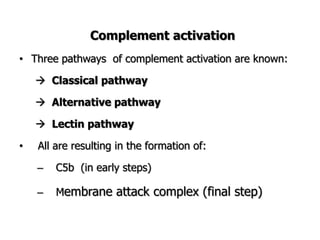
Complement activation
• Three pathways of complement activation are known:
 Classical pathway
 Alternative pathway
 Lectin pathway
• All are resulting in the formation of:
– C5b (in early steps)
– Membrane attack complex (final step)
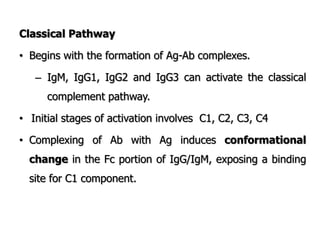
Classical Pathway
• Begins with the formation of Ag-Ab complexes.
– IgM, IgG1, IgG2 and IgG3 can activate the classical
complement pathway.
• Initial stages of activation involves C1, C2, C3, C4
• Complexing of Ab with Ag induces conformational
change in the Fc portion of IgG/IgM, exposing a binding
site for C1 component.
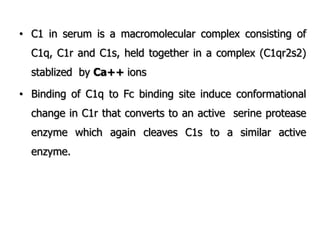
• C1 in serum is a macromolecular complex consisting of
C1q, C1r and C1s, held together in a complex (C1qr2s2)
stablized by Ca++ ions
• Binding of C1q to Fc binding site induce conformational
change in C1r that converts to an active serine protease
enzyme which again cleaves C1s to a similar active
enzyme.
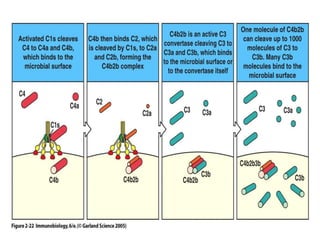
• C1s which has two substrates C4 and C2
– 1st, C4 activated by hydrolyzing in to C4a and C4b
– C4a diffuses and it is an anaphylatoxin (mediator of
inflammation)
– C4b binds to the target
• The C2 proenzyme binds to C4b
– It is cleaved by C1s releasing C2b which diffuses
away and
– C2a binds to the target for the formation of a C3
convertase (C4b2a)
 Converts C3 proenzyme into an active enzyme.
• Hydrolysis of C3 proenzyme by C3 convertase releases
C3b and C3a
• C3a diffuse, C3b binds to C4b2a to form a trimolecular
complex called C5 convertase (C4b2a3b) which can bind
to C5 altering its conformation and cleaving it into C5a
and C5b
• While C5a diffuses, C5b attaches to C6 and initiates
formation of the membrane-attack complex.
NB: Some of the C3b does not associate with C4b2a;
instead it diffuses away and coats immune complexes.
Alternative pathway
• This is an antibody-independent means to generate
bound C5b; is a component of the innate immune system
• The initiation involves four major serum proteins:
C3,Factor B, Factor D, and Properdin.
• The alternative pathway is initiated in most cases by cell-
surface constituents that are foreign to the host.
• Serum C3 is hydrolyzed to C3a and C3b spontaneously
(due to unstable thioester bond)
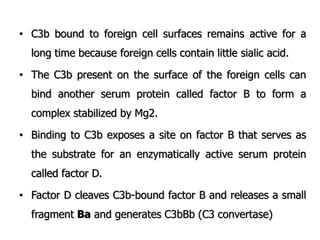
• C3b bound to foreign cell surfaces remains active for a
long time because foreign cells contain little sialic acid.
• The C3b present on the surface of the foreign cells can
bind another serum protein called factor B to form a
complex stabilized by Mg2.
• Binding to C3b exposes a site on factor B that serves as
the substrate for an enzymatically active serum protein
called factor D.
• Factor D cleaves C3b-bound factor B and releases a small
fragment Ba and generates C3bBb (C3 convertase)
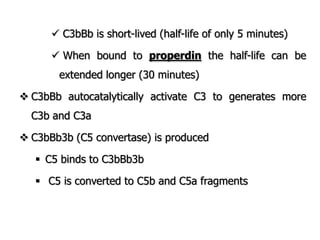
 C3bBb is short-lived (half-life of only 5 minutes)
 When bound to properdin the half-life can be
extended longer (30 minutes)
 C3bBb autocatalytically activate C3 to generates more
C3b and C3a
 C3bBb3b (C5 convertase) is produced
 C5 binds to C3bBb3b
 C5 is converted to C5b and C5a fragments
The Lectin Binding Pathway
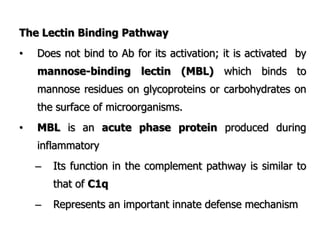
• Does not bind to Ab for its activation; it is activated by
mannose-binding lectin (MBL) which binds to
mannose residues on glycoproteins or carbohydrates on
the surface of microorganisms.
• MBL is an acute phase protein produced during
inflammatory
– Its function in the complement pathway is similar to
that of C1q
– Represents an important innate defense mechanism
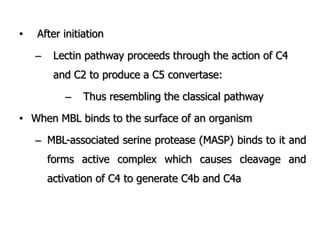
• After initiation
– Lectin pathway proceeds through the action of C4
and C2 to produce a C5 convertase:
– Thus resembling the classical pathway
• When MBL binds to the surface of an organism
– MBL-associated serine protease (MASP) binds to it and
forms active complex which causes cleavage and
activation of C4 to generate C4b and C4a
• Then C4b binds to C2 and generate C2b and C2a
• C2a is larger fragment and bind to C4b to form C4bC2a
NB:
• After C2 cleavage, have common pathway with classical
pathways
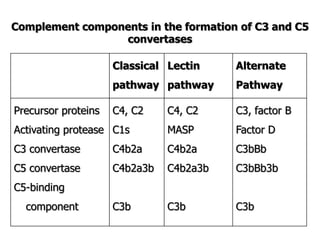
Complement components in the formation of C3 and C5
convertases
Classical
pathway
Lectin
pathway
Alternate
Pathway
Precursor proteins
Activating protease
C3 convertase
C5 convertase
C5-binding
component
C4, C2
C1s
C4b2a
C4b2a3b
C3b
C4, C2
MASP
C4b2a
C4b2a3b
C3b
C3, factor B
Factor D
C3bBb
C3bBb3b
C3b
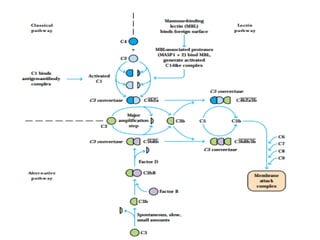
202
203
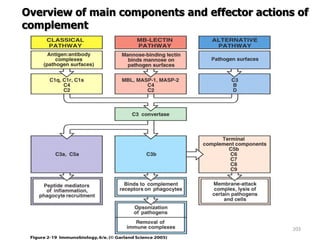
Overview of main components and effector actions of
complement
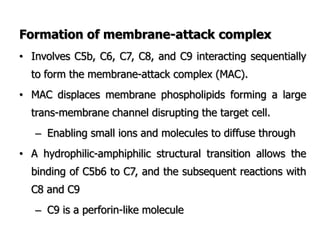
Formation of membrane-attack complex
• Involves C5b, C6, C7, C8, and C9 interacting sequentially
to form the membrane-attack complex (MAC).
• MAC displaces membrane phospholipids forming a large
trans-membrane channel disrupting the target cell.
– Enabling small ions and molecules to diffuse through
• A hydrophilic-amphiphilic structural transition allows the
binding of C5b6 to C7, and the subsequent reactions with
C8 and C9
– C9 is a perforin-like molecule
• The final step in the formation of MAC is binding and
polymerization of C9
– Finally cells are killed by an influx of water and loss of
electrolytes.
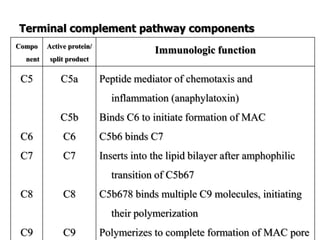
Terminal complement pathway components
Compo
nent
Active protein/
split product
Immunologic function
C5
C6
C7
C8
C9
C5a
C5b
C6
C7
C8
C9
Peptide mediator of chemotaxis and
inflammation (anaphylatoxin)
Binds C6 to initiate formation of MAC
C5b6 binds C7
Inserts into the lipid bilayer after amphophilic
transition of C5b67
C5b678 binds multiple C9 molecules, initiating
their polymerization
Polymerizes to complete formation of MAC pore
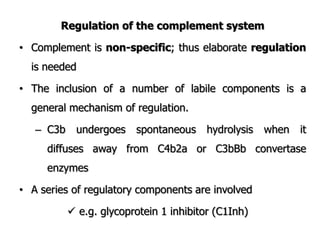
Regulation of the complement system
• Complement is non-specific; thus elaborate regulation
is needed
• The inclusion of a number of labile components is a
general mechanism of regulation.
– C3b undergoes spontaneous hydrolysis when it
diffuses away from C4b2a or C3bBb convertase
enzymes
• A series of regulatory components are involved
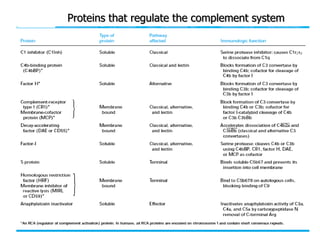
 e.g. glycoprotein 1 inhibitor (C1Inh)
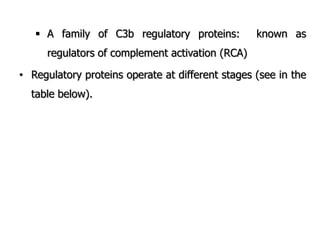
 A family of C3b regulatory proteins: known as
regulators of complement activation (RCA)
• Regulatory proteins operate at different stages (see in the
table below).
209
Proteins that regulate the complement system
210
Summary of biological effects mediated by complement
products

Immunology 1

  • 1.
    T and Bcell Receptors (BCR and TCR) By: Yemane Weldu (MSc., Assistant professor)
  • 2.
    Learning objectives • Atthe end of this section, the students will be able to: – Define the BCR and TCR – Describe the BCR and TCR complexes and the co- receptors – Explain the Accessory molecules of BCR and TCR – Identify the basic differences b/n BCR and TCR
  • 3.
  • 4.
    B cell receptor(BCR) • The B cell produces both membrane bound and soluble molecules. • Usually, the membrane bound form is the BCR. – are membrane immunoglobulins (mIg) expressed on the B cell: – Membrane molecules on B cells that can specially bind to the antigens. • are mIgM, and mIgD: – Recognize and bind antigen specifically (with a single antigenic specificity).
  • 5.
    BCR complex • Constitutesthe BCR and Ig- heterodimer – Thus, the BCR complex is functionally divided into: • The ligand-binding immunoglobulin molecule and • The signal-transducing Ig- heterodimer • Ig are invariant polypeptide chains: – Ig(CD79a) – Ig(CD79b)
  • 6.
    • The cytoplasmictails of both Ig- and Ig- chains contain the 18-residue motif termed ITAM. • ITAM (Immunoreceptor tyrosine-based activation motif)  Bind to tyrosine kinases (Fyn, Blk, and Lck)  Transmit activating signal
  • 7.
  • 8.
  • 9.
    B cell co-receptorcomplex • Stimulation through antigen receptors can be modified significantly by signals through co-receptors. • In B cells, a component of the B-cell membrane, called the B-cell coreceptor, provides stimulatory modifying signals. • The B-cell co-receptor complex consists of three proteins: CD19, CD21(CR2), CD81(TAPA-1). TAPA-1= Target of antiproliferative antibody-1
  • 10.
    – CD21(CR2): • Receptorof iC3b, C3d and C3dg • EB virus receptor • Enhance the binding of BCR and antigen • Pass activating signal to CD19 • Functions as a receptor for the transmembrane protein TAPA-1. – CD19: • Transmit activating signal into B cell
  • 11.
  • 12.
    NB: • The deliveryof these signaling molecules to the BCR complex contributes to the activation process, and • The coreceptor complex serves to amplify the activating signal transmitted through the BCR.
  • 13.
    B cell Accessorymolecules • B cells also requires additional Accessory molecules to provide an essential signal for the effective B-cell activation. Examples: 1. CD40 (co-stimulatory receptor) • CD40 on B cell binds to CD40L on activated T cell • Transmit an important co-stimulatory signal to B cells • Upregulate expression of B7 on B cells • Participate in class switching of antibody
  • 14.
    2. B7 (co-stimulatoryreceptor) • Two types: B7-1 (CD80) and B7-2 (CD86) • Expressed on B cells or other APC – B7--- CD28  form the 2nd signal for activation – B7---- CTLA-4
  • 15.
    3. MHC molecules •Class I, II molecules 4. Mitogen receptor • LPS, SpA (slaphylococcal protein A), PWM (Poke weed mitogen) 5. Cytokine receptors • IL-4R, IL-5R, IL-6R ----
  • 16.
    B cell sub-populations •According to expression of CD5 or not, B-cells can be divided into two subsets: – B1 cell (CD5+) – B2 cell (CD5-) • B-2 B cells, are the major group of B cells in humans. • B-1 B cells compose about 5% of the total B-cell population.
  • 17.
    Comparison of B1& B2 cells B1 B2 Development early late CD5 + - Reproduction self-renewing from pre-B cell in BM Recognized Ag TI-Ag and auto-Ag TD-Ag Ab type IgM >IgG IgG >IgM Ab avidity low high Second IR - + Function innate immunity adaptive immunity BCR mIgM mIgM and mIgD
  • 18.
    Functions of Bcell • Produce the antibody – Humoral Immune response • Present antigen – APC • Participate in immunological regulation.
  • 19.
  • 20.
    T-CELL RECEPTOR (TCR) •TCR is a kind of membrane molecules on T cells that can specially bind to the antigenic peptide-MHC molecule complex. • TCR have a dual specificity: • Recognize polymorphic residues of self MHC molecules (MHC restriction) • Recognize amino acid residues of peptide Ags displayed by the MHC molecules (Ag specificity)
  • 21.
    Types of TCRs •Two Types of TCRs depending on the trans-membrane polypeptide chains. – αβTCR: Account for Ag recognition by most T cells (~ 95%). – γδTCR: Minority (~5% • :δ T-cell have different antigen-recognition properties from the α:β TCR :δ T-cell recognizes lipids and Phospholipids bound to CD1 molecules.
  • 22.
    NB: • The functionand what the γδ TCR recognizes?? – Aren‟t MHC restricted – Recognize non peptide molecules – May be “first responders”- • Recognize antigens that are frequently encountered at epithelial boundaries between the host and external env‟t .
  • 23.
    • Extracellular region •V region: V  and V  • antigen binding site • CDR1,CDR2,CDR3 • C region: C and C • Transmembrane region: • anchoring domain • positively charged • Cytoplasmic region • Can transduce signal • 3~12aa 23 TCR
  • 24.
    • TCR differfrom BCR: – TCR has only one antigen-binding site (monovalent), but BCR is bivalent for Ag binding – T-cell receptor (TCR) does not recognize free antigen. – TCR never secreted; is expressed only in a membrane- bound form.
  • 25.
    Properties of lymphocyteantigen receptors; TCR and BCR
  • 26.
    TCR complex 26 • Agroup of membrane molecules on T cells that can specially bind to the antigen and pass activation signal into T cells, consisting of: – TCR ( or ), – CD3(,, ) and –  (zeta) chain      TCR    CD3CD3
  • 27.
    TCR complex 27 • The or  TCR heterodimer determines the ligand- binding specificity, whereas • The CD3 hetrodimers (,,) and  are required for membrane expression of the T-cell receptor and for signal transduction.
  • 28.
    Signal Transducing Molecules •CD3 and  (zeta) proteins of the TCR Complex – CD3 and  proteins are non-covalently associated with the TCR heterodimer. – When the TCR recognizes Ags, these associated proteins transduce the signals that lead to T cell activation. •  (zeta) proteins contain ITAM (Immunoreceptor tyrosine-based activation motif) and ITIM Immunoreceptor tyrosine-based inhibitory motif) in the cytoplasmic region.
  • 29.
  • 30.
    Accessory Molecules ofT cells • Although recognition of antigen-MHC complexes is mediated solely by the TCR-CD3 complex, various other membrane molecules play important accessory roles in antigen recognition and T-cell activation . – Some of these molecules strengthen the interaction between T cells and antigen-presenting cells, some act in signal transduction, and some do both.
  • 31.
    • Accessory moleculesspecifically bind to other molecules (ligands) present on the surfaces of other cells: • APCs and vascular endothelial cells, and in the extracellular matrix. • The binding of accessory molecules with its specific ligands are important to: – Increase the strength of adhesion between T cells and APCs. – Homing and retention of T cells in tissues (binding to endothelial cells)
  • 32.
    • Expression ofAccessory molecules and their ligands is regulated by: – Ag recognition and inflammatory response. • Thus influence the T cell migration from blood to sites of antigen in lymphoid organs and non- lymphoid peripheral tissues.
  • 33.
    Examples of AccessoryMolecules of T cells 1. CD4 and CD8: Co-receptors • CD4 and CD8 are trans-membrane glycoproteins. • CD4 and CD8 are classified as co-receptors based on their abilities to recognize the peptide-MHC complex and their roles in signal transduction. • Involved in MHC-restricted T Cell activation.  Strengthen the binding of T cells to APCs  Transduces signal.
  • 34.
    • Expression ofCD4 or CD8 determines the MHC restriction of the T cells. – CD4+ T cells • CD4 T cells recognize antigen that is combined with class II MHC molecules and function largely as helper cells. – CD8+T cells • CD8 T cells recognize antigen that is combined with class I MHC molecules and function largely as cytotoxic cells (are CTLs).
  • 35.
    Functions of CD4and CD8 • Early signal transduction events that occur after T cell recognition of peptide-MHC complexes on APCs • Adhesion to MHC Structure of CD4 and CD8
  • 36.
    2. CD28 • Amembrane protein that transduces signals. • Receptor for the co-stimulator B7 (molecules on APCs) – Together with the signals delivered by the TCR it activate naive T cells. • Expressed on more than 90% of CD4+ T cells and on 50% of CD8+ T cells in humans.
  • 37.
    3. CTLA-4 (CD152) •A second receptor for B7 molecules • Structurally homologous to CD28, but CTLA-4 is expressed on recently activated CD4+ and CD8+ T cells • Inhibit T cell activation by counteracting signals delivered by CD28. • Involved in terminating T cell responses.
  • 38.
    Summary of accessorymolecules of T-cells with signaling function
  • 39.
    39 Accessory molecules ofT Lymphocytes ICAMs (intracellular cell-adhesion molecules);LFA( leukocyte function-associated Antigen)
  • 40.
    Adhesion Molecules ofT Cells • Integrin, Selectin, CD44  are major adhesion molecules of T Cells to local tissues. • Adhesive interactions are important for:  Stable conjugation of T cells and APCs  T cell migration from blood into tissues  Homing in specific tissue sites
  • 41.
    • CD44: bindshyaluronate, and is responsible for:  Retention of T cells in extravascular tissues at sites of infection.  Binding of activated and memory T cells to endothelium at sites of inflammation and in mucosal tissues. • Intergrins: bind to extracellular molecules (collagen, fibrinogen, fibronectin and vironectin. – The T cell integrins LFA-1 and VLA-4 bind ICAMs and VCAM- 1, respectively on other cells VCAM=vascular cell adhesion molecule; VLA=very late activation protein
  • 42.
    • T lymphocytesrespond to peptide fragments of protein Ags that are displayed by APCs. • The initiation of these responses requires: – Specific Ag recognition by the T cells  Recognition – Stable adhesion of the T cells to the APCs Adhesion – Transduction of activating signals to the T cells  Signaling Summary of T Lymphocytes antigen recognition , adhesion, and signaling
  • 43.
    43 • Each ofthese events are mediated by distinct sets of molecules on the T cells. What are these structures involved in T cell antigen recognition, adhesion, and signaling?
  • 44.
    Lymphocyte (B andT cell) Maturation and differentiation
  • 45.
    Learning objectives At theend of this topic the students will be able to: • To list the stages of Lymphocyte maturation • To identify the distinguishing features in each stage of the lymphocyte maturation • To describe the selection processes and check points of the lymphocyte maturation • To describe the formation of functional TCR and BCR genes
  • 46.
    Introduction • Lymphocyte maturationis the process by which bone marrow-derived lymphocyte progenitors are converted to mature lymphocytes that populate peripheral lymphoid tissues. • Lymphocytes are the only cells in the body to express highly diverse antigen receptors that recognize a wide variety of foreign substances. – The collection of antigen receptors, and therefore specificities, expressed in B and T lymphocytes is called the lymphocyte repertoire.
  • 47.
    General Features ofB & T Lymphocyte Maturation • Lymphocyte maturation consists of sequential stages:  Lineage commitment and proliferation  Expression of o Ag receptor genes o Accessory and adhesion molecules  Selection of the mature repertoires • During each stages, cells undergo distinct cellular and genetic changes.
  • 48.
    Events during lymphocytematuration • Generation of diverse lymphocyte repertoire. • Ag receptor genes produced by somatic recombination (in BM for B cells & thymus for T cells). – Joining of different gene segments. • Ag receptors deliver signal to developing lymphocytes required for survival, proliferation and maturation. • Selective survival of lymphocytes with useful specificities. – >107 different B & T lymphocyte clones.
  • 49.
    Stage of T& B Lymphocyte maturation • Pluripotent stem cell  Lymphoid progenitors T & B precursors T, B, NK cells i. Early B & T cell maturation • Pro-B cell or Pro-T cell stage. • T cell precursor migrates to thymus but B cells remain in bone marrow to complete maturation. • This stage is characterized by high mitotic activity – Mediated by IL-7 produced by stromal cells (in BM & Thymus) • The high mitotic activity ensures large pool of cells to provide a diverse gene repertoire of Ag specificity.
  • 50.
    ii. Intermediate stage •Pre-B cell or Pre-T cell stage.  TCR/BCR genes are recombined  Immature Ag receptor are formed pre-TCR/BCR  Heavy chain (Ig)  in pre-B cells • Pseudo light chain  TCR β attached to invariant protein  in pre-T cells • These receptors transduce signal for further maturation and prevent programmed cell death – Thus, the receptors provide intermediate check point to ensure whether the first somatic recombination was successful.
  • 51.
    iii. Immature cellsstage of Lymphocyte maturation • Ag receptor expression is completed at this stage  B cells: both Ig heavy and light chains are expressed  T cells: both TCR  &  chains are expressed • Expression of the completed receptors provide signal for further cell survival, proliferation and maturation (next check point) – 90-95% die by apoptosis b/c failure in somatic recombination in producing functional Ig or TCR genes.
  • 52.
    Selection Processes thatshape the immature B and T cells: • Many immature lymphocytes may express antigen receptors that are of no use. • After immature lymphocytes express antigen receptors, the cells with useful receptors are preserved, and many potentially harmful, self antigen-reactive cells are eliminated. • Thus, it could be by positive or negative selection.
  • 53.
    Positive selection • Positiveselection is the preservation of useful specificities. • Best understood in T Lymphocyte (insures MHC restriction) • T cells whose receptors bind to self MHC molecule with low or weak affinity with in the thymus are positively selected. • Pre-B and immature B may be positively selected if: – Weakly recognizes some self Ags – Expresses functional Ag receptor
  • 54.
    • Thus, positiveselection serves to generate: – Self-MHC restricted T cell repertoire and – non-autoreactive T/B cell repertoire. NB: • Mature T cells whose precursors were positively selected by self MHC molecules in the thymus are able to recognize foreign peptide antigens displayed by the same self MHC molecules on antigen-presenting cells in peripheral tissues.
  • 55.
    Negative selection • Isthe process that eliminates developing lymphocytes. • T cells are negatively selected if their TCR: – Fail to recognize self MHC molecules or with very strong affinity – Strongly recognize self Ag presented by MHC • Important to maintain tolerance!!! • B cells are negatively selected if: – Do not express BCR – Strongly react with some self Ags
  • 56.
    Iv. Late stageof maturation • Mature B/ T cell stage • At this stage, the lymphocytes acquire the ability to respond to antigens and generate the effector mechanisms that serve to eliminate antigens. • B cells acquire the ability to secrete antibodies in response to antigens and other signals. • Distinct subsets of T cells with different functions antigen receptors, they are subject to develop within the thymus
  • 57.
    • Checkpoints inlymphocyte maturation The presence of multiple checkpoints ensures that only cells with useful receptors complete their maturation.
  • 58.
    Selection process inLymphocytes maturation
  • 59.
  • 60.
    The diverse Agreceptors of B and T cells are produced in immature cells from genes that are formed by somatic recombination of a limited # of inherited gene segments Formation of functional TCR and BCR genes
  • 61.
    How limited genesgive rise to diversities of TCR & BCR?  Analyses of the amino acid sequences of Ig molecules showed that different Abs of same isotyes share identical constant regions sequences  But, differ considerably the variable regions  Each antibody chain is actually encoded by at least two genes  Variable  Constant
  • 62.
     The twogenes become Joined at DNA/mRNA level to give rise to functional Ig proteins. • The genes encoding for BCR and TCR: – Are formed by the somatic recombination of a limited number of gene segments. • Thus, antigen receptor gene recombination  diversified TCR & BCR.
  • 63.
    Organization of lgand TCR Gene Loci • The germline organizations of Ig and TCR genetic loci are characterized by spatial segregation of sequences. – But, must be joined together to produce functional genes coding for antigen receptor proteins.  Three Separate gene loci of Ig and TCR: lg Genetic Loci encode: – lg heavy chain – Ig  light chain – Ig  light chain
  • 64.
    TCR Genetic Lociencode: – TCR  chain – TCR  &  chains – TCR  chain NB: Each locus is on a different chromosome • Each germline locus is made up of multiple copies of at least three different types of gene segments, the V, C, and joining (J) segments. – All loci have V, J, and C segments
  • 65.
    • But Igheavy, TCR  and  loci have additional D (diversity) segments • J and D segments are located Between the V and C genes in each locus. – The D and J gene segments code for the carboxyl terminal ends of the V regions, including the third hypervariable (complementarity determining regions). • Within each locus, the sets of each type of gene segment are separated from one another by stretches of non- coding DNA.
  • 66.
    Somatic Recombination ofAntigen Receptor Genes • The V region of Ig/TCR is encoded by the V and J gene segments or by the V, J and D gene segments. • Thus, Somatic recombination of Ig/TCR loci involves:  Joining of D and J segments in the loci that contains D segments  Then, V segment is recombined to DJ segments in these loci  Or, direct V-to-J joining in the other loci which do not contain D.
  • 67.
    • The recombinationis mediated by a recombinase enzyme complex – Includes lymphocyte-specific components RAG1 and RAG2 (recombination-activating genes) Note • Germline genes cannot be transcribed into mRNA that gives rise to antigen receptor proteins. • Functional antigen receptor genes are created only in developing B and T lymphocytes by rearrangements of DNA that make the V, D, and J gene segments contiguous.
  • 68.
    • Thus, somaticrecombination involves: – Bringing together the appropriate gene segments, – Introducing double-strand breaks at the ends of these segments, and – Ligating them to produce genes that can be transcribed.
  • 69.
    Somatic Recombination ofAntigen Receptor Genes
  • 70.
    • The diversityof the Ab (BCR) and TCR repertoires is generated by the following genetic mechanisms: • Combinatorial Diversity: Combinatorial associations of multiple germline V, D and J genes • Junctional Diversity: is generated by the addition of random nucleotides to the sites of recombination.
  • 71.
    Combinatorial Diversity • Humank chain gene: – (40 Vk) (5 Jk) = 200 possible distinct k V regions. • Human λ chain gene: – (30 V λ ) (4 J λ) = 120 possible distinct λV regions. • Total possible L chain V regions: 200 + 120 = 320 • Human H chain gene: – (40 VH) (25 DH) (6 JH) = 6,000 possible distinct H V regions. (Each of the VH region can join to any one of the C gene segments) • Each of the 320 different L chains could combine with each of the 6,000 possible heavy chains. – (6,000 H) (320 L) = 1.92 x 10⁶ different Ab specificities
  • 72.
    Ig gene recombinationin B cells • B cell maturation stages is characterized by: – Different patterns of Ig gene recombination and expression Early B cell precursors (pro-B cells) – Ig genes are in the germline configuration. Pre-B cell stage • Recombination of V-D-J in the Ig H chain locus is takes place
  • 73.
    • Primary RNAtranscript containing the VDJ complex is produced  Ig C gene segments is produced  The  C region exons of the heavy chain RNA are spliced to the VDJ segment  Generate a mature mRNA translated to  heavy chain protein.  a pre-BCR is formed at this stage.
  • 74.
    • a pre-BCRis formed by pairing of   heavy chain  Non-variable surrogate light chain  Ig and Ig • Pre-BCR mediates signals:  Inhibit rearrangement on the other heavy chain allele (allelic exclusion)  As well as stimulate proliferation
  • 75.
    Immature B cellstage • V-J recombination's occur in the  or  loci, and light chain proteins are expressed. • Heavy and light chains are then assembled into intact IgM molecules and expressed on the cell surface. • Leave the bone marrow to populate peripheral lymphoid tissues, where they complete their maturation.
  • 76.
    Mature B cellstage • At this stage membrane bounded IgM and IgD are coexpressed.   and  heavy chains are synthesized in the same B cells  Alternative splicing of primary heavy chain mRNA transcripts to form the two heavy chains in one cell. • Both classes of membrane Ig have the same V region and hence the same antigen specificity.
  • 77.
    Stages of Bcell maturation TdT, terminal deoxyribonucleotidyl transferase.
  • 78.
    TCR gene recombinationin T cells • T cell maturation also progresses in stages characterized by: – Expression of antigen receptor genes – Expression of CD4 and CD8 co-receptor molecules – Location in the thymus (cortex Vs medulla)
  • 79.
    • Early Tcell lineage immigrants to the thymus:  Do not express TCRs or CD4/CD8 molecules • Thymocytes (developing T cells)  Initially populate the outer cortex  Undergo proliferation  Rearrangement of TCR genes  Expression of TCR, CD3, CD4, and CD8 molecules.  As the cells mature, they migrate from the cortex to the medulla.
  • 80.
    Stages of TLymphocyte Maturation  Pro-T cells: the least mature thymocytes  CD4-CD8- (double negative)  TCR genes are in the germ-line configuration.  Pre-T stage  Thymocytes remain double negative, but V-D-J recombination occurs in the TCR  chain locus  Primary  chain transcripts are expressed and processed to bring a C  segment adjacent to the VDJ complex
  • 81.
      chainassociates with the invariant pre-T protein and with CD3 and  proteins to form a pre- TCR  Pre-TCR transduces signals that:  Inhibit rearrangement on the other beta chain allele (allelic exclusion)  Promote CD4 and CD8 expression  Further proliferation of immature thymocytes
  • 82.
  • 83.
     CD4+CD8+ (double-positive,DP) stage  V-J recombination's occur in the  locus   chain polypeptides are produced  TCR  gene expression in the double-positive stage leads to the formation of the complete TCR.  Low levels of TCRs are expressed
  • 84.
    Second checking orselection process • Positive selection of CD4+CD8+ TCR  thymocytes requires low avidity recognition of self peptide-MHC complexes on thymic epithelial cells.  Leads to a rescue of the cells from programmed death • Negative selection: Double positive thymocytes recognizing self Ags that are present at high concentrations in the thymus with high avidity (auto- reactive cells) are negatively selected  Ensures Tolerance to many self antigens.
  • 85.
     Thus, selectionprocess is important to:  Allow the maturation of TCR expressing DP thymocytes  Shape the T cell repertoire toward : o Self MHC restriction o Self-tolerance • Most of the cortical thymocytes do not survive these selection processes  95% die by apoptosis before reaching the medulla.
  • 86.
     Cell deathis due to a combination of:  Failure to express functional Ag receptors  Failure to be positively selected  Self antigen-induced negative selection • The key factor determining the choice between positive and negative selection is the strength of antigen recognition  Low-avidity recognition leading to positive selection  High-avidity recognition inducing negative selection
  • 87.
  • 88.
    Selection process inthe thymus • Deletion of T cell clones reactive with self antigens in the thymus (also called clonal deletion). • Any thymic APC can induce negative selection, including  Bone marrow-derived Ms & DCs  But thymic epithelial cells, are uniquely effective at inducing positive selection • Clonal selection is central principle of adaptive immunity
  • 89.
    • Net resultof these selection processes is that, mature T cells that leaves the thymus is:  Self MHC restricted  Tolerant to self antigens  Single -positive (CD4+ or CD8+ T cells) stage • As the surviving TCR  thymocytes mature:  Move into the medulla  Become either CD4+CD8- or CD8+CD4-(single positive)
  • 90.
    Medullary thymocytes  Acquirethe ability to differentiate into either helper or cytolytic effector cells  Finally emigrate to peripheral lymphoid tissues  CD4+ cells produce cytokines in response to subsequent antigen stimulation and to express effector molecules (such as CD40 ligand) that "help" B lymphocytes and macrophages.  CD8+ cells become capable of producing molecules that kill other cells
  • 91.
    Functional and phenotypicdifferentiation into CD4+CD8- or CD8+CD4- T cells occurs in the medulla,
  • 92.
    Stages of Tcell maturation
  • 93.
    T and Bcell Activation
  • 94.
    Learning objectives At theend of this topic the students will be able to: • Describe T cell activation (Naïve Vs effector cells) • Explain the Functional Responses of T Lymphocytes • Describe B cell Activation (thymus dependent & independent) • Discuss Functional responses of B cells • Explain class switching and affinity maturation • Differentiate primary and secondary humoral immune responses
  • 95.
  • 96.
    T cell Activation Activationof Naive T cells • Protein Ags that enter through epithelia and into the circulation are captured by "professional APCs” mainly dendritic cells, and:  Transported to lymph nodes and spleen  Naive T cells continuously recirculate through lymph nodes and spleen  When a T cell of the correct specificity finds Ag, in the form of peptide-MHC complexes, that T cell starts to be activated.
  • 97.
    • Ag-stimulated Tcells proliferate and differentiate into effector and memory cells, then some of which leave the lymphoid organs and enter the circulation. – i.e Naive T lymphocytes recognize antigens and are activated in peripheral lymphoid organs, resulting in the expansion of the antigen-specific lymphocyte pool and the differentiation of these cells into effector and memory lymphocytes
  • 98.
    At sites of infection,the effector cells are again activated by antigens and perform their various functions, such as macrophage activation Activation of naive and effector T cells by antigen
  • 99.
    • Generally, activationof T cells requires: – Recognition of Ags displayed by APCs (1o signal) – Co-stimulators (“2o signals") – Cytokines produced by the APCs and by the T cells themselves.  Proliferation and differentiation – Adhesion molecules on the T cells, primarily the integrins, stabilize the attachment of T cells to APCs
  • 100.
    Naïve Vs effectorT cell activation • Naïve T cells – Require activation by activated dendritic cells (DC) • Naïve T cells requires DC for activation and can not be activated by the other APCs. – Because Activated DCs express: • High levels of the MHC molecules • High levels of the co-stimulators (provide 2nd signals to naive T cells) – Naïve T cells are dependent on co-stimulators to be activated.
  • 101.
    Role of Co-stimulatorsin T Cell Activation • In addition to the antigen-induced signals (1o signal), the proliferation and differentiation of T cells require other signals (2o signal) provided by molecules on APCs, called costimulators – The best characterized co-stimulatory pathway in T cell activation involves the T cell surface molecule CD28, which binds the costimulatory molecules B7-1 (CD80) and B7-2 (CD86) expressed on activated APCs
  • 102.
    Functions of costimulator(B7) in naïve T cell activation
  • 103.
    • stimulates theexpression of 67 molecules and the • secretion of cytokines that activate T cells. Role of CD40 in T cell activation (stimulates the expression of B7 molecules and the secretion of cytokines that can activate T cells.
  • 104.
    Activation of effector& memory T cells • Activation of effector & memory T cells may not require DC. • Ms and B cells are more efficient activators for effector and memory cells than of naive T cells – Thus, Ms and B cells are important APCs in the effector phase of T cell responses.
  • 105.
    Effector cells – Areless dependent on co-stimulators – Require less Ag to be activated – Effector and memory cells are able to react to Ags displayed by APCs other than DCs in non-lymphoid organs – Majority effector and memory cells recognize Ags in:  Lymphoid organs or peripheral non-lymphoid tissues  Then becomes activated to perform their effector functions
  • 106.
    – Effector Tcells of the CD4+helper subset express membrane molecules and secrete cytokines that activate:  Ms to kill phagocytized microbes  B cells to differentiate into cells that secrete Abs Humoral immunity – Effector cells of the CD8+ subset [CD8+ cytolytic T lymphocytes (CTLs)] kill infected cells and tumor cells.  Cell mediated immunity
  • 107.
    Memory T cells •Are an expanded population of T cells specific for Ag – after pathogens are cleared from primary infection memory cells specific for the Ag stay for long time. • Then Memory T cells can respond rapidly to subsequent encounter with the same Ag and differentiate into effector cells that can eliminate the antigen.
  • 108.
    Functional Responses ofT Lymphocytes • The responses of T lymphocytes to antigen recognition includes: – Cytokine secretion – Proliferation – Differentiation Cytokine secretion – Is the earliest detectable response – IL-2 is the principal cytokine produced by naive T cells  Functions as a growth factor for the T cells (autocrine manner)
  • 109.
    Proliferation – Primarily mediatedby an autocrine growth pathway in which the responding T cell secretes its own growth- promoting cytokines (IL-2) and also expresses cell surface receptors for these cytokines (IL-2R) . • The principal autocrine growth factor for most T cells is IL2. • Therefore, the cells that recognize antigen bind the IL-2 they secrete and thus proliferate in response to this cytokine.
  • 110.
    – Proliferation maybe also by cytokines produced by APCs and other non-lymphoid cells.  e.g IL-15 for memory CD8+ T subsets growth Importance of proliferation – Frequency of naïve T cells specific to an Ag is 1:105/106, – But after Ag exposure: 1 in 10 for CD8+; 1 in 100 to 1,000 for CD4+ cells.
  • 111.
    Differentiation into EffectorCells • Some of the progeny of the proliferating T cells differentiate into effector cells that eliminate antigens and may activate other immune cells: – CD4+ effector cells  To activate phagocytes and B lymphocytes  Consists of two subsets: TH1 and TH2 produce distinct sets of cytokines with different functions. – CD8+ effector cells  CTLs (ability to kill target cells that express Peptide-MHC complex)
  • 112.
    Differentiation into MemoryCells • Some of the progeny of antigen-stimulated T cells develop into long-lived, functionally quiescent memory cells. • The memory T cell population is responsible for enhanced and accelerated secondary immune responses on subsequent exposures to the same antigen. • The survival of memory cells does not require antigen recognition.
  • 113.
    113 Phases of Tcell responses
  • 114.
  • 115.
    B cell Activation •Initiated by Ag binding to membrane bound Ig (BCR) • BCR serves two key roles in B cell activation: 1) Ag-induced signals transduction w/c brings biochemical reactions to initiate the process of activation  Ti Ags 2) The receptor binds Ag, internalizes it into endosomal vesicles  T-D Ags  Presented on the B cell surface for recognition by Th cells (APC function)
  • 116.
    • B cellActivation and clonal expansion are driven by encounter with specific foreign antigen, • The antigen‟s nature influences which of the two B activation routes is followed: T -independent (TI) antigens: – activate B cells without direct participation by TH cells. – antibody production is weaker – no memory cells are formed, and – IgM is the predominant antibody secreted, – reflects low level of class switching.
  • 117.
    T-dependent (TD) antigens: – Most antigens are T cell dependent – In this, B cell activation requires direct contact with TH cells. – B cells stimulated by these antigens usually produce IgM and IgG repsonses, with antibodies that are found in the circulation for prolonged time periods. – activation by this route typically results in Memory B cells. – Enhance class switching
  • 119.
    Functional responses ofB cells to protein antigen recognition • Activated B cells show increased expression of: – Class II MHC molecules – Chemokine (CCR7) receptors – Co-stimulators, B7-2 (CD86) and B7-1 (CD80) – Receptors for several T cell-derived cytokines (IL-4, IL- 5, IL-6, IL-2, …)  Enables antigen-specific B cells to respond to T helper cells.
  • 120.
    • Thus, Ag-stimulatedB cells are more efficient activators of TH cells • Then, helper T lymphocytes in turn stimulate B cell to undergo the following functional Responses of B Cells: – Clonal expansion – Differentiation into plasma and memory B cells – Affinity maturation – Isotype switching
  • 121.
    121 • Several responses including: •Mitosis • Co-stimulators • Cytokine receptors • Altered migration of the B cells  To T cell reach areas). Antigen Recognition by B cells
  • 122.
    T and Bcells interaction How these cells interact? • In secondary lymphoid organs B and T cells are located differently • Naive CD4+ T cells recognize Ags presented by DCs in the T cell zones of the lymphoid organs and starts to: – Reduce expression of CCR7 Began to migrate to margin of T cell zone Express co-stimulatory receptors CD28 – Secrete cytokines e.g. IL-2, IL-4, IL-5, IL-6
  • 123.
    • B cellsrecognize the same Ag in the 10 follicles and activated, then: – B cells increase expression of CCR7  Promotes migration of cells into border of T cell zone • Initial encounters between B and T cells is at the interface of the 10 follicles and the T cell zones via: – Class II MHC molecules (B cells) and TCR together with co-stimulatory receptors (T cells).
  • 124.
    • Then: • Tcell further activated, and expresses CD40 Ligand and also secretes cytokines. • B cells further activation by the cytokines and CD40 ligation • B cell proliferation and differentiation
  • 125.
    125 Ag-induced Migration andinteractions of B cells and Th cells
  • 126.
    126  Interaction ofCD40 (B cells) and CD40L (activated TH cell)  B cell receives competing signals from the T cell o Express receptors for IL-2, IL-4, IL-5, IL-6
  • 127.
    127 Proliferation and differentiation(plasma and memory cells)
  • 128.
    Affinity Maturation • Bcell activation is takes place at cortex  T-D and Ti Ags • Activated B cells move to border of T cell zone  Interact with activated TH cells at the interface • Activated B cells enter to germinal center (dark region)  Centroblast • At dark zone, centeroblast will proliferate at a rapid rate
  • 129.
    • During proliferation,AID (Activation Induced Deaminase) induce point mutation on VDJ genes.  Somatic hyper-mutation • Increase Abs affinity (advantageous mutation) • Decreasing Abs affinity (disadvantageous mutation) • Then the hyper-mutated centroblast will move from dark to light zone  Centrocyte
  • 130.
    • In thelight zone, there are FDC and TH cells which presents and activated by Ag then activates B cell in the dark zone • Centrocyte which had:  Disadvantage mutation could not recognize the Ag on FDC and destroyed by apoptosis  Advantageous mutation will recognize the Ag presented by FDC
  • 131.
     Thus, thesecells will be differentiated in to effector and memory cells  Selection of cell with higher and higher affinity to produce Abs  Affinity maturation  i.e when Activated B cells produce antibodies that bind to antigens with higher and higher affinities; this process is called affinity maturation. Undergo isotype class switching.
  • 132.
    Affinity maturation andclass switching
  • 133.
    Isotype switching • Isa change from one isotope of Ig to another isotope • It needs cytokine, CD40 ligand, TH- cells • Antibody class switching undergo to produce IgG, IgA or IgE – Generally, it is a biological mechanism that changes a B cell's production of antibody from one class to another • IgM  IgG, IgA, IgE
  • 134.
    • It involves –Changing of constant region of the antibody‟s heavy chain – Variable region of the heavy chain stays the same. • Occurs after mature B cell are activated via its BCR – Immature B cells first produces IgM and then IgD (BCR) – Ag- stimulated B cell are activated and proliferated
  • 135.
    • Activated Bcells encounter specific signals (switch inducing signal) – CD40 and cytokine receptors (IL-4, IL-5 and IFN-γ)  From helper T cells – Undergo antibody class switching to produce IgG, IgA or IgE  IL-4  IgM to IgG4 and then to IgE  IL-5  IgM to IgA  IFN-γ  IgM to IgG1.
  • 136.
    • Mechanism ofclass switching – Class switch recombinase (comprises d/t enzymes) – Steps  Selection of target switch region (S-region) in the Ig C-region  Cleavage of Sµ-region and S-region by Activation Induced Deaminase (AID)  Repair and joining of broken DNA by Non- Homologos Joining End repair (NHEJ)
  • 137.
    137 • Switching istaking place b/n Sµ and any of S-region
  • 138.
  • 139.
  • 140.
    Antibody responses toT-independent (Ti) antigens • Thymus-independent (Ti) antigens – Activate B cells in the absence of direct contact with TH cells – Do not generate strong immune response  Low specificity, no memory cell generation, no/limited isotype switching and affinity maturation. – E.g Non-protein Ags, such as polysaccharides, lipids, nucleic acids.
  • 141.
    Divided into type1 and 2  Type 1: polyclonal B-cell activators (mitogens)  i.e. activate B cells regardless of their antigenic specificity  Recognize by TLR, LPS  Types 2: large polysaccharides  Extensively crosslinking BCR
  • 142.
    Type 1 Vs2 Ti Ags
  • 143.
    Humoral Immune response(HIR) • HIR are initiated in peripheral lymphoid organs – Spleen for blood-borne antigens – Lymph nodes for antigens entering through the skin and other epithelia – Mucosal lymphoid tissues for some inhaled and ingested antigens
  • 144.
    • Plasma cells –Resident mainly in the secondary lymphoid organs and bone marrow  Where as Abs enter the circulation and to site of infection via blood, and mediate their protective effects wherever antigens are present  In BW: Some antibody-secreting cells migrate from the peripheral lymphoid organs to the bone marrow and give primary and immediate protection on exposure to microbes.
  • 145.
    • B cellactivation consists of a series of responses that lead to  Proliferation: expansion of the clone of Ag-specific cells  Differentiation: generation of effector cells that actively secrete antibodies and memory B cells • Some activated B cells begin to produce Abs other than IgM and IgD  Heavy chain isotype (class) switching
  • 146.
    • Activated Bcells also produce Abs that bind to Ags with higher and higher affinities  Affinity maturation • The type and amount of antibodies produced vary according to the  Type of antigen  Involvement of T cells  Previous history of Ag exposure  Anatomic site
  • 147.
    • Ab responsesto protein Ags require Ag-specific CD4+ T cell help – T-dependent (T-D Ags) • Ab responses to non-protein Ag, such as polysaccharides and lipids and nucleic acid do not require Ag-specific helper T lymphocytes – T-independent (Ti Ags)
  • 148.
    • Isotype switchingand affinity maturation – In T-dependent humoral immune responses to protein Ags  Stimulated by Th cell signals (CD40L and cytokines) – Heavy chain isotype switching and affinity maturation also increase with repeated exposures to protein Ags
  • 149.
    Phases of Bcell (humoral immune) responses
  • 150.
    Primary and Secondaryresponses • Primary and secondary antibody responses to protein Ags differ qualitatively and quantitatively. – Primary: naïve B cell stimulation – Secondary: memory B cells stimulation
  • 151.
    151 Kinetics of primaryand secondary humoral immune responses
  • 152.
  • 153.
    153 Features of primaryand secondary responses
  • 154.
    Regulation of HumoralImmune Responses • Antibodies feed back by Fc receptors  Binding of Abs via Fc to B cell inhibit signal transduction  Dephosphorylate sites in the BCR complex • Competition inhibition  Circulating Ab competes with antigen-reactive B cells for antigen inhibiting the clonal expansion of the B cells.
  • 155.
    Cytokines By: Yemane Weldu(MSc., Assistant professor)
  • 156.
    Cytokines • What arecytokines? – Are small immune regulatory proteins (~25 kDa) – Released by various cells in the body, usually in response to an activating stimulus. – Intracellular messengers of the immune system – Trigger signal transduction pathways – Ultimately alter gene expression in the target cells
  • 157.
    Mode of actionof Cytokines • Cytokines exert their effect in different manners – Autocrine  Affecting the behavior of the cell that releases the cytokine – Paracrine  Affecting the behaviour of adjacent cells – Endocrine  Affecting the behavior of distant cells
  • 159.
    • Cytokines areimportant to regulate the intensity and duration of the immune response: – Stimulate or inhibit: activation/proliferation/ differentiation of various cells, and – Regulate the secretion of antibodies or other cytokines • Influence activity of other cells: – B cells, T cells, NK cells, Ms, granulocytes, hematopoietic cells.
  • 160.
    Functional properties ofCytokine Cytokines can be said to have 5 attributes: – Pleiotropy – Redundancy – Synergy – Antagonism – Cascade induction
  • 162.
  • 163.
    Functional categories ofcytokines • Three main functional categories based on their principal biological actions. i. Cytokines that mediate & regulate innate immunity – TNF, IL-1, IL-18, IL-12, type 1 IFNs, chemokines, etc – Produced mainly by Ms, NK cells  Bacterial and viral products such as LPS, dsRNA, are the main inducers. – Recruit, activate, and regulate specialized effector cells • Mononuclear phagocytes, neutrophils, and eosinophils, to eliminate antigens by stimulating the early inflammatory reactions.
  • 164.
    ii. Cytokines thatmediate & regulate adaptive immunity • IL-2, IL-4, IL-5, IFN- , TGF- , and others • Produced mainly by T lymphocytes • Regulate growth and differentiation of various T cells iii. Cytokines that mediate & regulate Hematopoiesis • Stem cell factor, IL-7, IL-3, others • Produced by BM stromal cells, leukocytes & other cells • Stimulate the growth and differentiation of immature leukocytes
  • 166.
    Functions of cytokinesin host defense
  • 167.
  • 168.
    168 Major Cytokines ofinnate immunity
  • 169.
    Major Cytokines ofinnate immunity
  • 170.
    Major Cytokines ofadaptive immunity summary
  • 171.
    Chemokines • Are chemo-attractantcytokines – Released in infected tissue in the earliest phases of infection. – Secreted by leukocytes, endothelial cells, epithelial cells, and fibroblasts • Whose secretion is induced by IL-1 and TNF-α during infection – IL-8: First chemokine to be cloned and characterized
  • 172.
    Properties of Chemokines •Fall mainly into two related but distinct groups: – CC chemokines  Mostly encoded in one region of chromosome 4 (in humans)  Have two adjacent cysteine (CC) aminoacid residues in their amino-terminal region – CXC chemokines  Genes mainly found in a cluster on chr 17  Have any other amino acid residue between the equivalent two cysteine's in amino-terminal region
  • 175.
    Cytokines and THResponses TH1 • Are responsible for cell-mediated functions (CMI) and for the production of opsonization-promoting and complement-activating IgG antibodies. • Also involved in inflammatory reactions, macrophage activation, delayed-type hypersensitivity (DTH) and cytotoxic T cell (TC) activation. • TH1 cells produce IL-2, IFN-γ, IL12, and TNF.
  • 176.
    TH2 • Stimulates eosinophilactivation and differentiation • Provides help to B cells (HIR) • Promotes the production of relatively large amounts of IgM, IgE, and non-complement activating IgG isotypes • Also supports allergic reactions • TH2 cells produce IL-4, IL-5, IL-10 and IL-13
  • 177.
    Cytokines secreted byMs • In response to bacterial products  IL-1, IL- 6, IL-8, IL-12, and TNF-α – TNF-α: elicited by LPS-bearing pathogens Local inflammatory, systemic effects – IL-8 (Chemokine)  Helping to attract neutrophils to the site of infection  Also Local inflammatory response
  • 178.
    – IL-1, IL-6,and TNF-α  Critical role in inducing the acute-phase response – IL-12  Favors the differentiation of CD4 T cells into the TH1
  • 180.
    Potential applications andtherapeutic uses of cytokines/receptors Applications • Control of inflammation • Cancer therapy • Organ transplantation • Infectious disease • Allergy
  • 181.
    Approaches – Cytokine receptorblockade – Cytokine analogs – Cytokine-toxin conjugates
  • 182.
    Difficulties – Achieving desiredconcentration at a specified locality through systemic administration is not feasible – Continuous administration is needed (short half-life) e.g. IL-2 has 7-10 minute half life – Can cause unpredictable and undesirable side effects  Potent biological response modifiers
  • 183.
  • 184.
    Complement system • Isone of the major effector mechanisms of humoral innate immunity. • Composed of proteins and glycoproteins which are synthesized by: – Liver hepatocytes (mainly) – Blood monocytes; tissue macrophages – Epithelial cells of the GIT and GUT • These components constitute 5% (by weight) of the serum globulin fraction.
  • 185.
    • Most circulatein the serum in functionally inactive forms as proenzymes, or zymogens, which are inactive until proteolytic cleavage, which removes an inhibitory fragment and exposes the active site. • The complement-reaction sequence starts with an enzyme cascade. • Complement Components are designated by: – Numerals (C1-C9) – Letter symbols (e.g. factor D, factor B, … ) – Trivial names (e.g. homologous restriction factor)
  • 186.
    • Peptide fragmentsformed by activation of a component are designated by small letters – „a‟ for a smaller fragment, „b‟ for a larger fragment (N.B. exception; C2a is larger) – Larger fragments bind to the target near the site of activation and smaller fragments diffuse to distant sites of inflammation. • The fragments interact with one another to form functional complexes. – The enzymatic activity are designated by a bar over the number or symbol e.g. C4b2a, C3bBb
  • 187.
    Functions of activatedcomplement • Lysis of cells, bacteria and viruses by formation of MAC (Membrane attack complex )) • Opsonization • Triggering specific cell functions – Inflammation, and secretion of immune-regulatory molecules • Immune clearance of complexes – Removes immune complexes from the circulation and deposits them in the spleen and liver.
  • 188.
  • 189.
    Complement activation • Threepathways of complement activation are known:  Classical pathway  Alternative pathway  Lectin pathway • All are resulting in the formation of: – C5b (in early steps) – Membrane attack complex (final step)
  • 190.
    Classical Pathway • Beginswith the formation of Ag-Ab complexes. – IgM, IgG1, IgG2 and IgG3 can activate the classical complement pathway. • Initial stages of activation involves C1, C2, C3, C4 • Complexing of Ab with Ag induces conformational change in the Fc portion of IgG/IgM, exposing a binding site for C1 component.
  • 191.
    • C1 inserum is a macromolecular complex consisting of C1q, C1r and C1s, held together in a complex (C1qr2s2) stablized by Ca++ ions • Binding of C1q to Fc binding site induce conformational change in C1r that converts to an active serine protease enzyme which again cleaves C1s to a similar active enzyme.
  • 192.
    • C1s whichhas two substrates C4 and C2 – 1st, C4 activated by hydrolyzing in to C4a and C4b – C4a diffuses and it is an anaphylatoxin (mediator of inflammation) – C4b binds to the target • The C2 proenzyme binds to C4b – It is cleaved by C1s releasing C2b which diffuses away and – C2a binds to the target for the formation of a C3 convertase (C4b2a)  Converts C3 proenzyme into an active enzyme.
  • 193.
    • Hydrolysis ofC3 proenzyme by C3 convertase releases C3b and C3a • C3a diffuse, C3b binds to C4b2a to form a trimolecular complex called C5 convertase (C4b2a3b) which can bind to C5 altering its conformation and cleaving it into C5a and C5b • While C5a diffuses, C5b attaches to C6 and initiates formation of the membrane-attack complex. NB: Some of the C3b does not associate with C4b2a; instead it diffuses away and coats immune complexes.
  • 195.
    Alternative pathway • Thisis an antibody-independent means to generate bound C5b; is a component of the innate immune system • The initiation involves four major serum proteins: C3,Factor B, Factor D, and Properdin. • The alternative pathway is initiated in most cases by cell- surface constituents that are foreign to the host. • Serum C3 is hydrolyzed to C3a and C3b spontaneously (due to unstable thioester bond)
  • 196.
    • C3b boundto foreign cell surfaces remains active for a long time because foreign cells contain little sialic acid. • The C3b present on the surface of the foreign cells can bind another serum protein called factor B to form a complex stabilized by Mg2. • Binding to C3b exposes a site on factor B that serves as the substrate for an enzymatically active serum protein called factor D. • Factor D cleaves C3b-bound factor B and releases a small fragment Ba and generates C3bBb (C3 convertase)
  • 197.
     C3bBb isshort-lived (half-life of only 5 minutes)  When bound to properdin the half-life can be extended longer (30 minutes)  C3bBb autocatalytically activate C3 to generates more C3b and C3a  C3bBb3b (C5 convertase) is produced  C5 binds to C3bBb3b  C5 is converted to C5b and C5a fragments
  • 198.
    The Lectin BindingPathway • Does not bind to Ab for its activation; it is activated by mannose-binding lectin (MBL) which binds to mannose residues on glycoproteins or carbohydrates on the surface of microorganisms. • MBL is an acute phase protein produced during inflammatory – Its function in the complement pathway is similar to that of C1q – Represents an important innate defense mechanism
  • 199.
    • After initiation –Lectin pathway proceeds through the action of C4 and C2 to produce a C5 convertase: – Thus resembling the classical pathway • When MBL binds to the surface of an organism – MBL-associated serine protease (MASP) binds to it and forms active complex which causes cleavage and activation of C4 to generate C4b and C4a
  • 200.
    • Then C4bbinds to C2 and generate C2b and C2a • C2a is larger fragment and bind to C4b to form C4bC2a NB: • After C2 cleavage, have common pathway with classical pathways
  • 201.
    Complement components inthe formation of C3 and C5 convertases Classical pathway Lectin pathway Alternate Pathway Precursor proteins Activating protease C3 convertase C5 convertase C5-binding component C4, C2 C1s C4b2a C4b2a3b C3b C4, C2 MASP C4b2a C4b2a3b C3b C3, factor B Factor D C3bBb C3bBb3b C3b
  • 202.
  • 203.
    203 Overview of maincomponents and effector actions of complement
  • 204.
    Formation of membrane-attackcomplex • Involves C5b, C6, C7, C8, and C9 interacting sequentially to form the membrane-attack complex (MAC). • MAC displaces membrane phospholipids forming a large trans-membrane channel disrupting the target cell. – Enabling small ions and molecules to diffuse through • A hydrophilic-amphiphilic structural transition allows the binding of C5b6 to C7, and the subsequent reactions with C8 and C9 – C9 is a perforin-like molecule
  • 205.
    • The finalstep in the formation of MAC is binding and polymerization of C9 – Finally cells are killed by an influx of water and loss of electrolytes.
  • 206.
    Terminal complement pathwaycomponents Compo nent Active protein/ split product Immunologic function C5 C6 C7 C8 C9 C5a C5b C6 C7 C8 C9 Peptide mediator of chemotaxis and inflammation (anaphylatoxin) Binds C6 to initiate formation of MAC C5b6 binds C7 Inserts into the lipid bilayer after amphophilic transition of C5b67 C5b678 binds multiple C9 molecules, initiating their polymerization Polymerizes to complete formation of MAC pore
  • 207.
    Regulation of thecomplement system • Complement is non-specific; thus elaborate regulation is needed • The inclusion of a number of labile components is a general mechanism of regulation. – C3b undergoes spontaneous hydrolysis when it diffuses away from C4b2a or C3bBb convertase enzymes • A series of regulatory components are involved  e.g. glycoprotein 1 inhibitor (C1Inh)
  • 208.
     A familyof C3b regulatory proteins: known as regulators of complement activation (RCA) • Regulatory proteins operate at different stages (see in the table below).
  • 209.
    209 Proteins that regulatethe complement system
  • 210.
    210 Summary of biologicaleffects mediated by complement products