Immobilization of Enzyme
5/13/2020 1
By
KAUSHAL KUMAR SAHU
Assistant Professor (Ad Hoc)
Department of Biotechnology
Govt. Digvijay Autonomous P. G. College
Raj-Nandgaon ( C. G. )
Contents
• Introduction
• Advantage
• Methods of immbolization
• Properties of immoblized enzyme
• Application of immoblized enzyme
• Limitation
• Conclusion
5/13/2020 2
Introduction
• Immobilization of enzyme refers to the
technique of confining the enzymes(or cells )
in or an inert support for their stability or
reuse.
• By employing this technique enzymes are
made more effective and cost effective for
their industrial use.
• Enzymes are used to produce large
immoblized enzyme.
5/13/2020 3
Advantages of immoblization of
enzymes
• Stable and more efficient in functions.
• Can be reused again and again.
• Products are enzyme free.
• Ideal for multi enzyme reaction system.
• Control of enzyme function is easy.
• Suitable for industrial and medical use.
• Minimize effluent disposal problem.
5/13/2020 4
Methods for immbolization of enzyme
• The commonly employed technique used for
immobillization of enzyme:
1.Adsorption
2.Ionic bonding
3.Covalent bonding
4.Entrapment
5.Microencapsulation
6.Cross-linking
5/13/2020 5
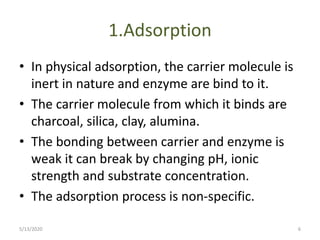
1.Adsorption
• In physical adsorption, the carrier molecule is
inert in nature and enzyme are bind to it.
• The carrier molecule from which it binds are
charcoal, silica, clay, alumina.
• The bonding between carrier and enzyme is
weak it can break by changing pH, ionic
strength and substrate concentration.
• The adsorption process is non-specific.
5/13/2020 6
5/13/2020 7
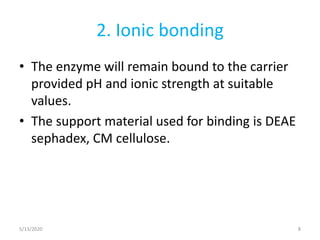
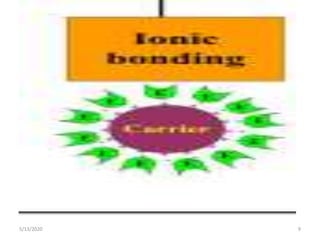
2. Ionic bonding
• The enzyme will remain bound to the carrier
provided pH and ionic strength at suitable
values.
• The support material used for binding is DEAE
sephadex, CM cellulose.
5/13/2020 8
5/13/2020 9
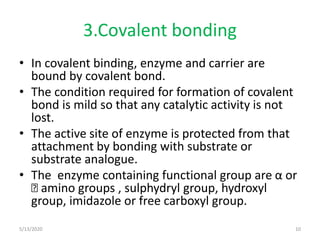
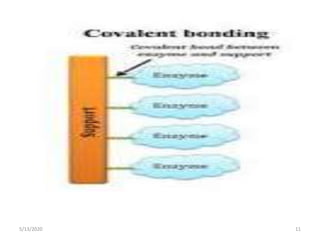
3.Covalent bonding
• In covalent binding, enzyme and carrier are
bound by covalent bond.
• The condition required for formation of covalent
bond is mild so that any catalytic activity is not
lost.
• The active site of enzyme is protected from that
attachment by bonding with substrate or
substrate analogue.
• The enzyme containing functional group are α or
Ꜫ amino groups , sulphydryl group, hydroxyl
group, imidazole or free carboxyl group.
5/13/2020 10
5/13/2020 11
Entrapment
• Enzyme immoblized by physical entrapment
inside a polymer or gel matrix.
• Size of gel matrix is such that it will hold enzyme
and allow the passage of substrate and product.
• Some deactivation may occur due to change in
pH, temperature or addition of solvent.
• Carrier molecule used for entrapping is
polyacrylamide gel, collagen, gelatin, starch,
cellulose, silicone, rubber.
5/13/2020 12
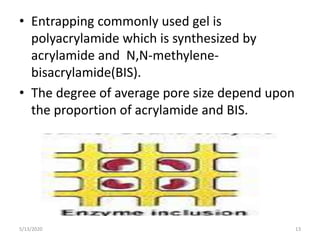
• Entrapping commonly used gel is
polyacrylamide which is synthesized by
acrylamide and N,N-methylene-
bisacrylamide(BIS).
• The degree of average pore size depend upon
the proportion of acrylamide and BIS.
5/13/2020 13
Microencapsulation
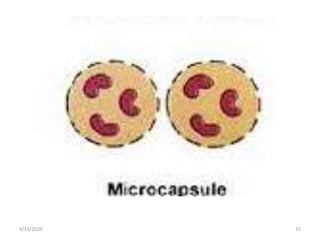
• Microencapsulation is a type of entrapment.
• It refers to the process of spherical particle
formation where a liquid or suspension is
enclosed in a semipermeable membrane.
• The membrane may be polymeric, lipodial,
lipoprotein based or non ionic in nature.
5/13/2020 14
5/13/2020 15
Cross linking
• The absence of a solid support is a
characterstic feature of immoblization of
enzymes by cross linking.
• The enzymes molecules are immoblized by
creating, cross links between them by
involvement of polyfunctional reagents.
• The reagent include glutaraldehyde,
diazobenzidine, hexamethylene, diisocynate
and isothiocynate.
5/13/2020 16
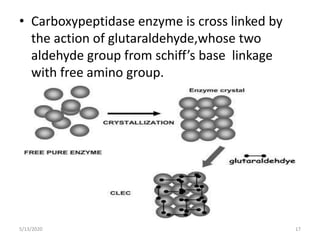
• Carboxypeptidase enzyme is cross linked by
the action of glutaraldehyde,whose two
aldehyde group from schiff’s base linkage
with free amino group.
5/13/2020 17
Properties of immoblized enzyme
• After immoblizing enzyme the properties of
enzyme is changed:
1. Reduction in specific activity:
• By denaturation- due to physical or chemical
interaction between enzyme and carrier.
• Conformational change-active site of enzyme
conformation change due to electrostatic
interaction or chemical interaction.
5/13/2020 18
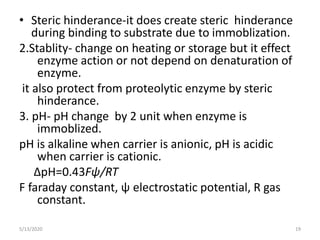
• Steric hinderance-it does create steric hinderance
during binding to substrate due to immoblization.
2.Stablity- change on heating or storage but it effect
enzyme action or not depend on denaturation of
enzyme.
it also protect from proteolytic enzyme by steric
hinderance.
3. pH- pH change by 2 unit when enzyme is
immoblized.
pH is alkaline when carrier is anionic, pH is acidic
when carrier is cationic.
∆pH=0.43Fψ/RT
F faraday constant, ψ electrostatic potential, R gas
constant.
5/13/2020 19
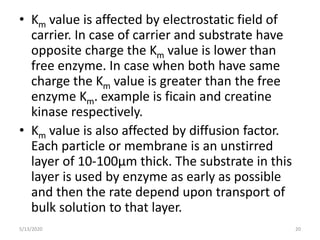
• Km value is affected by electrostatic field of
carrier. In case of carrier and substrate have
opposite charge the Km value is lower than
free enzyme. In case when both have same
charge the Km value is greater than the free
enzyme Km. example is ficain and creatine
kinase respectively.
• Km value is also affected by diffusion factor.
Each particle or membrane is an unstirred
layer of 10-100µm thick. The substrate in this
layer is used by enzyme as early as possible
and then the rate depend upon transport of
bulk solution to that layer.
5/13/2020 20
Application of immoblized enzyme
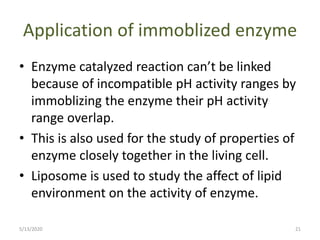
• Enzyme catalyzed reaction can’t be linked
because of incompatible pH activity ranges by
immoblizing the enzyme their pH activity
range overlap.
• This is also used for the study of properties of
enzyme closely together in the living cell.
• Liposome is used to study the affect of lipid
environment on the activity of enzyme.
5/13/2020 21
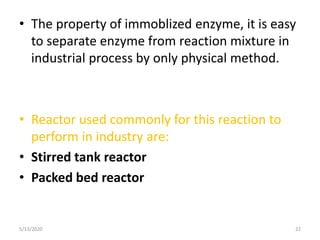
• The property of immoblized enzyme, it is easy
to separate enzyme from reaction mixture in
industrial process by only physical method.
• Reactor used commonly for this reaction to
perform in industry are:
• Stirred tank reactor
• Packed bed reactor
5/13/2020 22
Limitation
• The possibility of loss of biological activity of
an enzyme during immobilization or while it is
in use.
• Immobilization is an expensive affair often
requiring sophisticated equipments.
5/13/2020 23
Conclusion
• Immoblized enzyme are easily removed from a
reaction mixture, thereby stopping the
reaction and making the enzyme available to
be used again.
• In case of immoblized purification process
does not involved.
• Large amount of product is formed from this
procedure.
5/13/2020 24
Reference
• Enzymes-Trevor Palmer
• Biochemistry – U. Satyanarayan
• pubs.rsc.org
5/13/2020 25

Immoblization of enzymes

  • 1.
    Immobilization of Enzyme 5/13/20201 By KAUSHAL KUMAR SAHU Assistant Professor (Ad Hoc) Department of Biotechnology Govt. Digvijay Autonomous P. G. College Raj-Nandgaon ( C. G. )
  • 2.
    Contents • Introduction • Advantage •Methods of immbolization • Properties of immoblized enzyme • Application of immoblized enzyme • Limitation • Conclusion 5/13/2020 2
  • 3.
    Introduction • Immobilization ofenzyme refers to the technique of confining the enzymes(or cells ) in or an inert support for their stability or reuse. • By employing this technique enzymes are made more effective and cost effective for their industrial use. • Enzymes are used to produce large immoblized enzyme. 5/13/2020 3
  • 4.
    Advantages of immoblizationof enzymes • Stable and more efficient in functions. • Can be reused again and again. • Products are enzyme free. • Ideal for multi enzyme reaction system. • Control of enzyme function is easy. • Suitable for industrial and medical use. • Minimize effluent disposal problem. 5/13/2020 4
  • 5.
    Methods for immbolizationof enzyme • The commonly employed technique used for immobillization of enzyme: 1.Adsorption 2.Ionic bonding 3.Covalent bonding 4.Entrapment 5.Microencapsulation 6.Cross-linking 5/13/2020 5
  • 6.
    1.Adsorption • In physicaladsorption, the carrier molecule is inert in nature and enzyme are bind to it. • The carrier molecule from which it binds are charcoal, silica, clay, alumina. • The bonding between carrier and enzyme is weak it can break by changing pH, ionic strength and substrate concentration. • The adsorption process is non-specific. 5/13/2020 6
  • 7.
  • 8.
    2. Ionic bonding •The enzyme will remain bound to the carrier provided pH and ionic strength at suitable values. • The support material used for binding is DEAE sephadex, CM cellulose. 5/13/2020 8
  • 9.
  • 10.
    3.Covalent bonding • Incovalent binding, enzyme and carrier are bound by covalent bond. • The condition required for formation of covalent bond is mild so that any catalytic activity is not lost. • The active site of enzyme is protected from that attachment by bonding with substrate or substrate analogue. • The enzyme containing functional group are α or Ꜫ amino groups , sulphydryl group, hydroxyl group, imidazole or free carboxyl group. 5/13/2020 10
  • 11.
  • 12.
    Entrapment • Enzyme immoblizedby physical entrapment inside a polymer or gel matrix. • Size of gel matrix is such that it will hold enzyme and allow the passage of substrate and product. • Some deactivation may occur due to change in pH, temperature or addition of solvent. • Carrier molecule used for entrapping is polyacrylamide gel, collagen, gelatin, starch, cellulose, silicone, rubber. 5/13/2020 12
  • 13.
    • Entrapping commonlyused gel is polyacrylamide which is synthesized by acrylamide and N,N-methylene- bisacrylamide(BIS). • The degree of average pore size depend upon the proportion of acrylamide and BIS. 5/13/2020 13
  • 14.
    Microencapsulation • Microencapsulation isa type of entrapment. • It refers to the process of spherical particle formation where a liquid or suspension is enclosed in a semipermeable membrane. • The membrane may be polymeric, lipodial, lipoprotein based or non ionic in nature. 5/13/2020 14
  • 15.
  • 16.
    Cross linking • Theabsence of a solid support is a characterstic feature of immoblization of enzymes by cross linking. • The enzymes molecules are immoblized by creating, cross links between them by involvement of polyfunctional reagents. • The reagent include glutaraldehyde, diazobenzidine, hexamethylene, diisocynate and isothiocynate. 5/13/2020 16
  • 17.
    • Carboxypeptidase enzymeis cross linked by the action of glutaraldehyde,whose two aldehyde group from schiff’s base linkage with free amino group. 5/13/2020 17
  • 18.
    Properties of immoblizedenzyme • After immoblizing enzyme the properties of enzyme is changed: 1. Reduction in specific activity: • By denaturation- due to physical or chemical interaction between enzyme and carrier. • Conformational change-active site of enzyme conformation change due to electrostatic interaction or chemical interaction. 5/13/2020 18
  • 19.
    • Steric hinderance-itdoes create steric hinderance during binding to substrate due to immoblization. 2.Stablity- change on heating or storage but it effect enzyme action or not depend on denaturation of enzyme. it also protect from proteolytic enzyme by steric hinderance. 3. pH- pH change by 2 unit when enzyme is immoblized. pH is alkaline when carrier is anionic, pH is acidic when carrier is cationic. ∆pH=0.43Fψ/RT F faraday constant, ψ electrostatic potential, R gas constant. 5/13/2020 19
  • 20.
    • Km valueis affected by electrostatic field of carrier. In case of carrier and substrate have opposite charge the Km value is lower than free enzyme. In case when both have same charge the Km value is greater than the free enzyme Km. example is ficain and creatine kinase respectively. • Km value is also affected by diffusion factor. Each particle or membrane is an unstirred layer of 10-100µm thick. The substrate in this layer is used by enzyme as early as possible and then the rate depend upon transport of bulk solution to that layer. 5/13/2020 20
  • 21.
    Application of immoblizedenzyme • Enzyme catalyzed reaction can’t be linked because of incompatible pH activity ranges by immoblizing the enzyme their pH activity range overlap. • This is also used for the study of properties of enzyme closely together in the living cell. • Liposome is used to study the affect of lipid environment on the activity of enzyme. 5/13/2020 21
  • 22.
    • The propertyof immoblized enzyme, it is easy to separate enzyme from reaction mixture in industrial process by only physical method. • Reactor used commonly for this reaction to perform in industry are: • Stirred tank reactor • Packed bed reactor 5/13/2020 22
  • 23.
    Limitation • The possibilityof loss of biological activity of an enzyme during immobilization or while it is in use. • Immobilization is an expensive affair often requiring sophisticated equipments. 5/13/2020 23
  • 24.
    Conclusion • Immoblized enzymeare easily removed from a reaction mixture, thereby stopping the reaction and making the enzyme available to be used again. • In case of immoblized purification process does not involved. • Large amount of product is formed from this procedure. 5/13/2020 24
  • 25.
    Reference • Enzymes-Trevor Palmer •Biochemistry – U. Satyanarayan • pubs.rsc.org 5/13/2020 25