ENZYME IMMOBLIZATION
• INTRODUCTION
• Enzyme are large biological molecules responsible for the thousands of metabolic processes that
sustain life.
• Since enzyme are not stable and they can not be recovered for reuse.
• DEFINATION :
• “Immobilization of enzyme (or cells) refer to the technique of confining anchoring the enzyme
in on an inert support for their stability and function reuse”
PROPERTIES
• The material used for enzyme immobilization called carrier matrices .
• The ideal carrier matrix has the following properties are:
• Low costs
• Inert less
• Physical strength
• Regenerability after use
IMMOBILIZATION TECHNIQUES
• Immobilization techniques can be classified by basically two methods, the
chemical and the physical method. The former is covalent bond formation
dependent .
• The two Method consist of :
• Chemical method consist of Covalent binding, Cross linking
• Physical method consist of Adsorption, Entrapment:
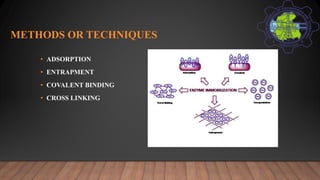
METHODS OR TECHNIQUES
• ADSORPTION
• ENTRAPMENT
• COVALENT BINDING
• CROSS LINKING
ADSORPTION
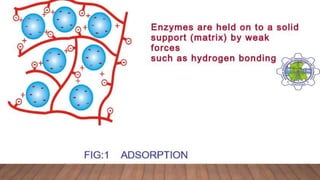
• Adsorption involves the physical binding of enzyme (or cells) on the surface of an inert support.
• The support material may be inorganic (e.g. alumina ,silica gel ,calcium) or organic ( starch,
carboxymethyl,cellulose ).
• Adsorption of enzyme molecules involves weak forces such as Vander Waals forces and
hydrogen bonds.
• Therefore ,the adsorbed enzyme can be easily removed by minor changes in pH, ionic strength
or Temperature.
ADVANTAGES & DISADVANTAGES
• Advantages
• 1.The procedure of immobilization is simple.
• 2. It is possible to separate and purify the enzymes while being immobilized.
• 3. The enzymes are not usually deactivated by adsorption.
• 4. The adsorption is a reversible process.
• Disadvantages
• 1. The bonding strength is weak.
• 2. The state of immobilization is very sensitive to solution pH, ionic strength, and temperature.
• 3. The amount of enzymes loaded on a unit amount of support is usually low.
ENTRAPMENT
• Enzymes can be entrapped within cross-linked polymers by forming a highly cross-linked network of polymer in
the presence of an enzyme.
• This method has a major advantage in the fact that there is no chemical modification of the enzyme, therefore, the
intrinsic properties of an enzyme are not altered.
• However, the enzyme may be deactivated during the gel formation. Enzyme leakage is also a problem. The most
commonly employed crosslinked polymer is the polyacrylamide gel system.
• This has been used to immobilize alcohol dehydrogenase, glucose oxidase, amino acid oxidase, hexokmase,
glucose isomerase, urease, and many other enzymes.
ENZYME CAN BE ENTRAPPED
BY SEVERAL WAYS :
• 1.Enzyme inclusion in gels.
• 2.Enzyme inclusion in fibers.
• 3.Enzyme inclusion in microcapsules
COVALENT BINDING
• Immobilization of the enzyme can be achieved by creation covalent bonds between the chemical
groups of enzyme and chemical groups of the support.
• The following are the common methods of covalent binding:
• 1.cyanogen bromide activation
• 2.Diazotation
• 3.Peptide bonds formation
• 4.Activation by Bi or polyfunctional regents
CROSS –LINKING
• The absence of a solid support is a characteristics feature of immobilization of enzymes by
cross-linking.
• The enzyme molecules are immobilized by creating cross-links between them , through the
involvement of poly-functional reagent.
• These reagent in fact react with the enzyme molecules and create brides which form the
backbone to hold enzyme molecules.
• Glutaraldehyde is the most extensively used cross-linking reagent
EFFECT OF IMMOBILIZATION ON ENZYME PROPERTIES
• Enzyme immobilization is frequently associated with alterations in enzyme properties
,particularly the kinetic properties of enzyme some are listed below:
• There is substantial decrease in the enzyme specificity . This may be due to conformational
changes that occur when the enzyme gets immobilized.
• The kinetic constants km and V max of an immobilization enzyme differ from that of the native
enzyme .This is because the conformational changes of the enzyme will affect the affinity
between enzyme and substrate.
• APPLICAION OF IMMOBILIZED ENZYMES AND
CELLS
• INDUSTRIAL USES
• ANALYTICAL
• THERAPEUTIC
Bio presentation

Bio presentation

  • 1.
    ENZYME IMMOBLIZATION • INTRODUCTION •Enzyme are large biological molecules responsible for the thousands of metabolic processes that sustain life. • Since enzyme are not stable and they can not be recovered for reuse. • DEFINATION : • “Immobilization of enzyme (or cells) refer to the technique of confining anchoring the enzyme in on an inert support for their stability and function reuse”
  • 2.
    PROPERTIES • The materialused for enzyme immobilization called carrier matrices . • The ideal carrier matrix has the following properties are: • Low costs • Inert less • Physical strength • Regenerability after use
  • 3.
    IMMOBILIZATION TECHNIQUES • Immobilizationtechniques can be classified by basically two methods, the chemical and the physical method. The former is covalent bond formation dependent . • The two Method consist of : • Chemical method consist of Covalent binding, Cross linking • Physical method consist of Adsorption, Entrapment:
  • 4.
    METHODS OR TECHNIQUES •ADSORPTION • ENTRAPMENT • COVALENT BINDING • CROSS LINKING
  • 5.
    ADSORPTION • Adsorption involvesthe physical binding of enzyme (or cells) on the surface of an inert support. • The support material may be inorganic (e.g. alumina ,silica gel ,calcium) or organic ( starch, carboxymethyl,cellulose ). • Adsorption of enzyme molecules involves weak forces such as Vander Waals forces and hydrogen bonds. • Therefore ,the adsorbed enzyme can be easily removed by minor changes in pH, ionic strength or Temperature.
  • 6.
    ADVANTAGES & DISADVANTAGES •Advantages • 1.The procedure of immobilization is simple. • 2. It is possible to separate and purify the enzymes while being immobilized. • 3. The enzymes are not usually deactivated by adsorption. • 4. The adsorption is a reversible process. • Disadvantages • 1. The bonding strength is weak. • 2. The state of immobilization is very sensitive to solution pH, ionic strength, and temperature. • 3. The amount of enzymes loaded on a unit amount of support is usually low.
  • 8.
    ENTRAPMENT • Enzymes canbe entrapped within cross-linked polymers by forming a highly cross-linked network of polymer in the presence of an enzyme. • This method has a major advantage in the fact that there is no chemical modification of the enzyme, therefore, the intrinsic properties of an enzyme are not altered. • However, the enzyme may be deactivated during the gel formation. Enzyme leakage is also a problem. The most commonly employed crosslinked polymer is the polyacrylamide gel system. • This has been used to immobilize alcohol dehydrogenase, glucose oxidase, amino acid oxidase, hexokmase, glucose isomerase, urease, and many other enzymes.
  • 9.
    ENZYME CAN BEENTRAPPED BY SEVERAL WAYS : • 1.Enzyme inclusion in gels. • 2.Enzyme inclusion in fibers. • 3.Enzyme inclusion in microcapsules
  • 10.
    COVALENT BINDING • Immobilizationof the enzyme can be achieved by creation covalent bonds between the chemical groups of enzyme and chemical groups of the support. • The following are the common methods of covalent binding: • 1.cyanogen bromide activation • 2.Diazotation • 3.Peptide bonds formation • 4.Activation by Bi or polyfunctional regents
  • 11.
    CROSS –LINKING • Theabsence of a solid support is a characteristics feature of immobilization of enzymes by cross-linking. • The enzyme molecules are immobilized by creating cross-links between them , through the involvement of poly-functional reagent. • These reagent in fact react with the enzyme molecules and create brides which form the backbone to hold enzyme molecules. • Glutaraldehyde is the most extensively used cross-linking reagent
  • 12.
    EFFECT OF IMMOBILIZATIONON ENZYME PROPERTIES • Enzyme immobilization is frequently associated with alterations in enzyme properties ,particularly the kinetic properties of enzyme some are listed below: • There is substantial decrease in the enzyme specificity . This may be due to conformational changes that occur when the enzyme gets immobilized. • The kinetic constants km and V max of an immobilization enzyme differ from that of the native enzyme .This is because the conformational changes of the enzyme will affect the affinity between enzyme and substrate.
  • 13.
    • APPLICAION OFIMMOBILIZED ENZYMES AND CELLS • INDUSTRIAL USES • ANALYTICAL • THERAPEUTIC