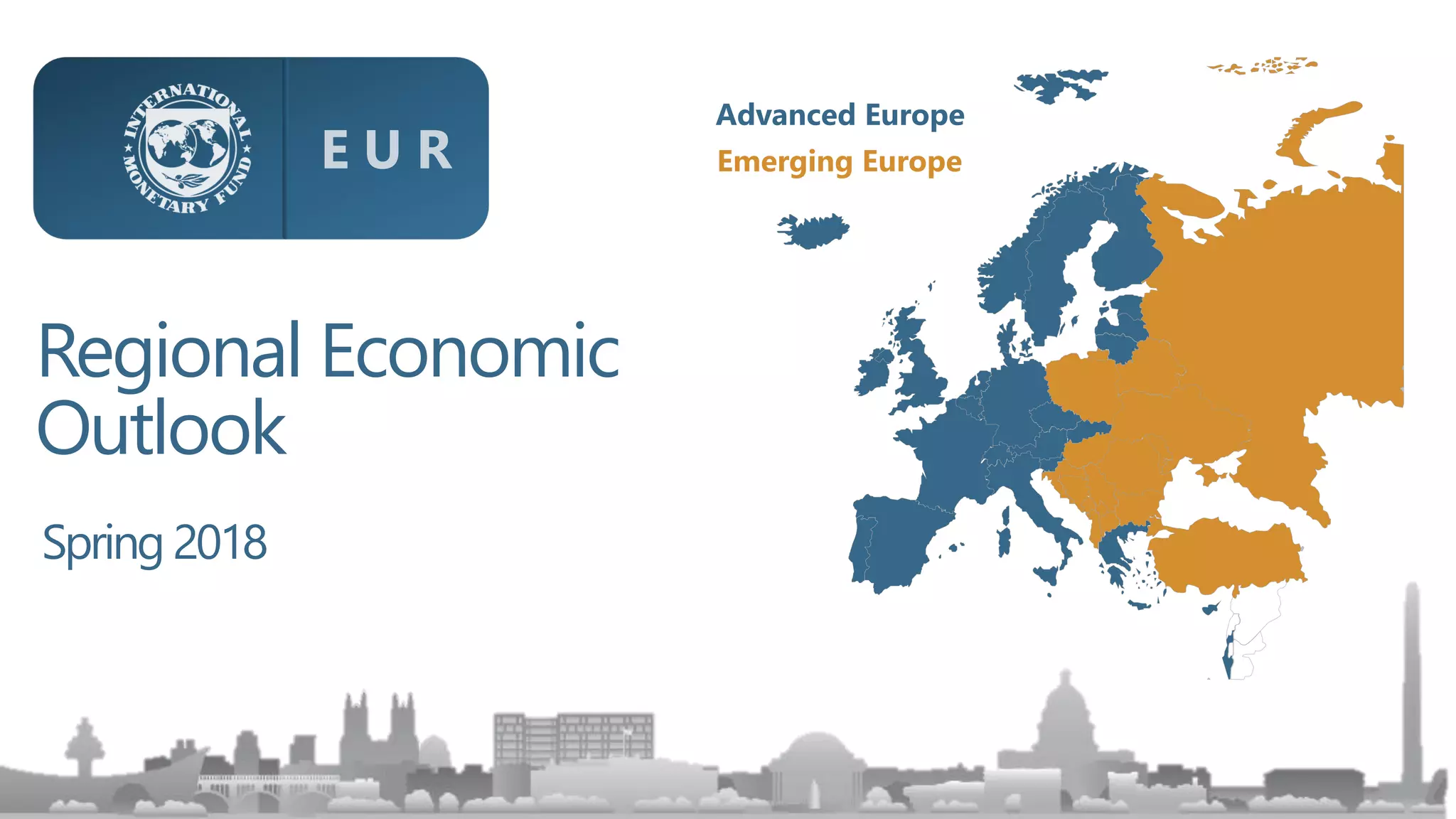
Emerging Europe
Advanced Europe
Regional Economic
Outlook
Spring 2018
E U R
Key Messages
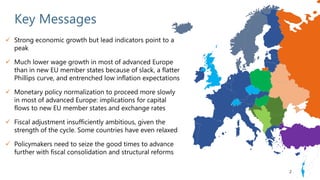
✓ Strong economic growth but lead indicators point to a
peak
✓ Much lower wage growth in most of advanced Europe
than in new EU member states because of slack, a flatter
Phillips curve, and entrenched low inflation expectations
✓ Monetary policy normalization to proceed more slowly
in most of advanced Europe: implications for capital
flows to new EU member states and exchange rates
✓ Fiscal adjustment insufficiently ambitious, given the
strength of the cycle. Some countries have even relaxed
✓ Policymakers need to seize the good times to advance
further with fiscal consolidation and structural reforms
2
Developments and Outlook
4
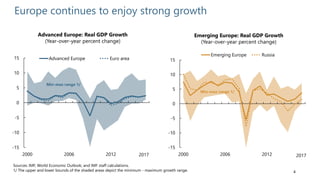
Europe continues to enjoy strong growth
Sources: IMF, World Economic Outlook; and IMF staff calculations.
1/ The upper and lower bounds of the shaded areas depict the minimum - maximum growth range.
Advanced Europe: Real GDP Growth
(Year-over-year percent change)
Emerging Europe: Real GDP Growth
(Year-over-year percent change)
-15
-10
-5
0
5
10
15
2000 2006 2012
Advanced Europe Euro area
2017
Min-max range 1/
-15
-10
-5
0
5
10
15
2000 2006 2012
Emerging Europe Russia
2017
Min-max range 1/
5
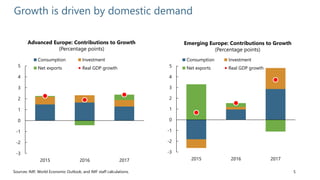
Growth is driven by domestic demand
Sources: IMF, World Economic Outlook; and IMF staff calculations.
Advanced Europe: Contributions to Growth
(Percentage points)
Emerging Europe: Contributions to Growth
(Percentage points)
-3
-2
-1
0
1
2
3
4
5
2015 2016 2017
Consumption Investment
Net exports Real GDP growth
-3
-2
-1
0
1
2
3
4
5
2015 2016 2017
Consumption Investment
Net exports Real GDP growth
6
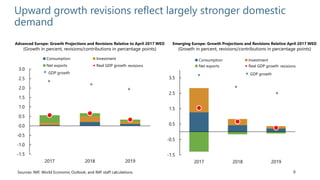
Upward growth revisions reflect largely stronger domestic
demand
Sources: IMF, World Economic Outlook; and IMF staff calculations.
Advanced Europe: Growth Projections and Revisions Relative to April 2017 WEO
(Growth in percent, revisions/contributions in percentage points)
Emerging Europe: Growth Projections and Revisions Relative April 2017 WEO
(Growth in percent, revisions/contributions in percentage points)
-1.5
-1.0
-0.5
0.0
0.5
1.0
1.5
2.0
2.5
3.0
2017 2018 2019
Consumption Investment
Net exports Real GDP growth revisions
GDP growth
-1.5
-0.5
0.5
1.5
2.5
3.5
2017 2018 2019
Consumption Investment
Net exports Real GDP growth
GDP growth
revisions
-40 -20 0 20 40 60
Euro area
United Kingdom
Switzerland
Czech Republic, Hungary, Poland,
Turkey, and South Africa
March-18
2017
7
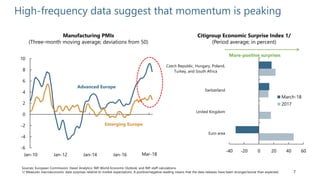
High-frequency data suggest that momentum is peaking
Manufacturing PMIs
(Three-month moving average; deviations from 50)
Sources: European Commission; Haver Analytics; IMF World Economic Outlook; and IMF staff calculations.
1/ Measures macroeconomic data surprises relative to market expectations. A positive/negative reading means that the data releases have been stronger/worse than expected.
Citigroup Economic Surprise Index 1/
(Period average; in percent)
More-positive surprises
-6
-4
-2
0
2
4
6
8
10
Jan-10 Jan-12 Jan-14 Jan-16 Jan-18
Advanced Europe
Emerging Europe
Mar-18
Risks
9
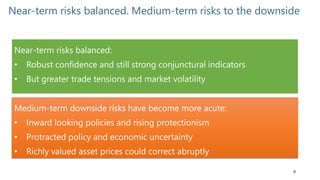
Near-term risks balanced. Medium-term risks to the downside
Medium-term downside risks have become more acute:
• Inward looking policies and rising protectionism
• Protracted policy and economic uncertainty
• Richly valued asset prices could correct abruptly
Near-term risks balanced:
• Robust confidence and still strong conjunctural indicators
• But greater trade tensions and market volatility
10
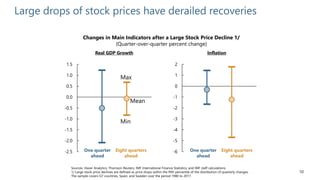
Large drops of stock prices have derailed recoveries
Changes in Main Indicators after a Large Stock Price Decline 1/
(Quarter-over-quarter percent change)
Sources: Haver Analytics; Thomson Reuters; IMF International Finance Statistics; and IMF staff calculations.
1/ Large stock price declines are defined as price drops within the fifth percentile of the distribution of quarterly changes.
The sample covers G7 countries, Spain, and Sweden over the period 1980 to 2017.
Real GDP Growth Inflation
-2.5
-2.0
-1.5
-1.0
-0.5
0.0
0.5
1.0
1.5
0 1 2 3
One quarter
ahead
Eight quarters
ahead
-6
-5
-4
-3
-2
-1
0
1
2
0 1 2 3
One quarter
ahead
Eight quarters
ahead
Max
Mean
Min
Cyclical Position and Inflation
12
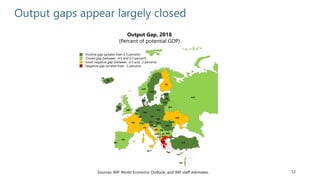
Output gaps appear largely closed
Output Gap, 2018
(Percent of potential GDP)
Sources: IMF World Economic Outlook; and IMF staff estimates.
13
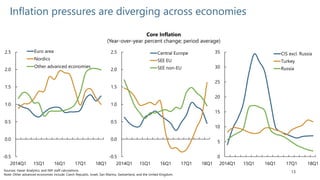
Inflation pressures are diverging across economies
Core Inflation
(Year-over-year percent change; period average)
Sources: Haver Analytics; and IMF staff calculations.
Note: Other advanced economies include: Czech Republic, Israel, San Marino, Switzerland, and the United Kingdom.
-0.5
0.0
0.5
1.0
1.5
2.0
2.5
2014Q1 15Q1 16Q1 17Q1 18Q1
Euro area
Nordics
Other advanced economies
-0.5
0.0
0.5
1.0
1.5
2.0
2.5
2014Q1 15Q1 16Q1 17Q1 18Q1
Central Europe
SEE EU
SEE non-EU
0
5
10
15
20
25
30
35
2014Q1 15Q1 16Q1 17Q1 18Q1
CIS excl. Russia
Turkey
Russia
Labor Markets and Wages
15
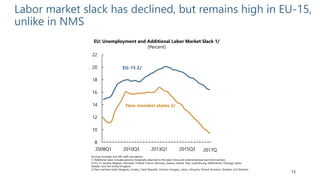
Labor market slack has declined, but remains high in EU-15,
unlike in NMS
Sources: Eurostat; and IMF staff calculations.
1/ Additional slack includes persons marginally attached to the labor force and underemployed part-time workers.
2/ EU-15: Austria, Belgium, Denmark, Finland, France, Germany, Greece, Ireland, Italy, Luxembourg, Netherlands, Portugal, Spain,
Sweden, and the United Kingdom
3/ New member states: Bulgaria, Croatia, Czech Republic, Estonia, Hungary, Latvia, Lithuania, Poland, Romania, Slovakia, and Slovenia.
EU: Unemployment and Additional Labor Market Slack 1/
(Percent)
8
10
12
14
16
18
20
22
2008Q1 2010Q3 2013Q1 2015Q3 2017Q
New member states 3/
EU-15 2/
16
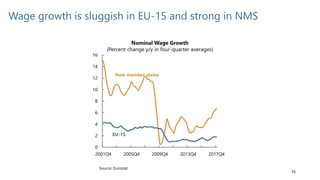
Wage growth is sluggish in EU-15 and strong in NMS
Source: Eurostat.
0
2
4
6
8
10
12
14
16
2001Q4 2005Q4 2009Q4 2013Q4 2017Q4
New member states
EU-15
Nominal Wage Growth
(Percent change y/y in four-quarter averages)
17
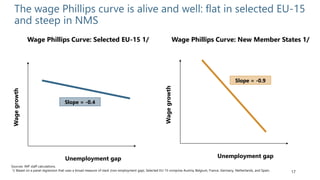
The wage Phillips curve is alive and well: flat in selected EU-15
and steep in NMS
Sources: IMF staff calculations.
1/ Based on a panel regression that uses a broad measure of slack (non-employment gap). Selected EU-15 comprise Austria, Belgium, France, Germany, Netherlands, and Spain.
Wage Phillips Curve: New Member States 1/Wage Phillips Curve: Selected EU-15 1/
Wagegrowth
Unemployment gap
Slope = -0.4
Wagegrowth
Unemployment gap
Slope = -0.9
External Current Accounts
19
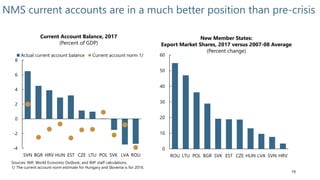
NMS current accounts are in a much better position than pre-crisis
Current Account Balance, 2017
(Percent of GDP)
Sources: IMF, World Economic Outlook; and IMF staff calculations.
1/ The current account norm estimate for Hungary and Slovenia is for 2016.
-4
-2
0
2
4
6
8
SVN BGR HRV HUN EST CZE LTU POL SVK LVA ROU
Actual current account balance Current account norm 1/
New Member States:
Export Market Shares, 2017 versus 2007-08 Average
(Percent change)
0
10
20
30
40
50
60
ROU LTU POL BGR SVK EST CZE HUN LVA SVN HRV
20
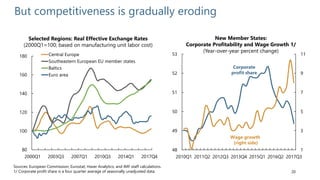
But competitiveness is gradually eroding
Sources: European Commission; Eurostat; Haver Analytics; and IMF staff calculations.
1/ Corporate profit share is a four quarter average of seasonally unadjusted data.
New Member States:
Corporate Profitability and Wage Growth 1/
(Year-over-year percent change)
1
3
5
7
9
11
48
49
50
51
52
53
2010Q1 2011Q2 2012Q3 2013Q4 2015Q1 2016Q2 2017Q3
Corporate
profit share
Wage growth
(right side)
Selected Regions: Real Effective Exchange Rates
(2000Q1=100; based on manufacturing unit labor cost)
80
100
120
140
160
180
2000Q1 2003Q3 2007Q1 2010Q3 2014Q1 2017Q4
Central Europe
Southeastern European EU member states
Baltics
Euro area
21
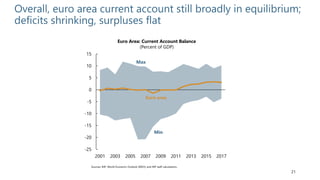
Overall, euro area current account still broadly in equilibrium;
deficits shrinking, surpluses flat
Sources: IMF, World Economic Outlook (WEO); and IMF staff calculations.
Euro Area: Current Account Balance
(Percent of GDP)
-25
-20
-15
-10
-5
0
5
10
15
2001 2003 2005 2007 2009 2011 2013 2015 2017
Max
Euro area
Min
Policies
23
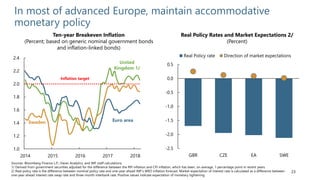
In most of advanced Europe, maintain accommodative
monetary policy
Sources: Bloomberg Finance L.P.; Haver Analytics; and IMF staff calculations.
1/ Derived from government securities adjusted for the difference between the RPI inflation and CPI inflation, which has been, on average, 1 percentage point in recent years.
2/ Real policy rate is the difference between nominal policy rate and one-year ahead IMF’s WEO inflation forecast. Market expectation of interest rate is calculated as a difference between
one-year-ahead interest rate swap rate and three-month interbank rate. Positive values indicate expectation of monetary tightening.
Ten-year Breakeven Inflation
(Percent; based on generic nominal government bonds
and inflation-linked bonds)
Real Policy Rates and Market Expectations 2/
(Percent)
-2.5
-2.0
-1.5
-1.0
-0.5
0.0
0.5
GBR CZE EA SWE
Real Policy rate Direction of market expectations 1/
1.0
1.2
1.4
1.6
1.8
2.0
2.2
2.4
2014 2015 2016 2017 2018
Inflation target
United
Kingdom 1/
Sweden Euro area
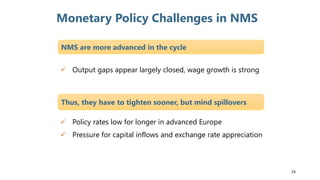
Monetary Policy Challenges in NMS
NMS are more advanced in the cycle
✓ Output gaps appear largely closed, wage growth is strong
Thus, they have to tighten sooner, but mind spillovers
✓ Policy rates low for longer in advanced Europe
✓ Pressure for capital inflows and exchange rate appreciation
24
25
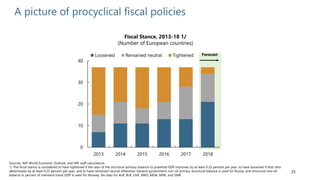
A picture of procyclical fiscal policies
Sources: IMF World Economic Outlook; and IMF staff calculations.
1/ The fiscal stance is considered to have tightened if the ratio of the structural primary balance to potential GDP improves by at least 0.25 percent per year, to have loosened if that ratio
deteriorates by at least 0.25 percent per year, and to have remained neutral otherwise. General government non-oil primary structural balance is used for Russia, and structural non-oil
balance in percent of mainland trend GDP is used for Norway. No data for ALB, BLR, UVK, MKD, MDA, MNE, and SMR.
Fiscal Stance, 2013-18 1/
(Number of European countries)
0
10
20
30
40
2013 2014 2015 2016 2017 2018
Loosened Remained neutral Tightened Forecast
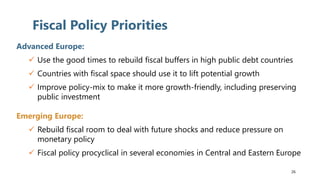
Fiscal Policy Priorities
Advanced Europe:
✓ Use the good times to rebuild fiscal buffers in high public debt countries
✓ Countries with fiscal space should use it to lift potential growth
✓ Improve policy-mix to make it more growth-friendly, including preserving
public investment
Emerging Europe:
✓ Rebuild fiscal room to deal with future shocks and reduce pressure on
monetary policy
✓ Fiscal policy procyclical in several economies in Central and Eastern Europe
26
27
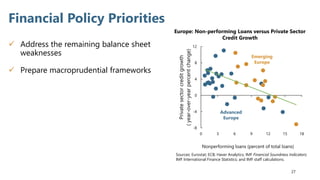
Financial Policy Priorities
✓ Address the remaining balance sheet
weaknesses
✓ Prepare macroprudential frameworks
Europe: Non-performing Loans versus Private Sector
Credit Growth
-8
-4
0
4
8
12
0 3 6 9 12 15 18
Privatesectorcreditgrowth
(year-over-yearpercentchange)
Nonperforming loans (percent of total loans)
Emerging
Europe
Advanced
Europe
Sources: Eurostat; ECB; Haver Analytics; IMF Financial Soundness Indicators;
IMF International Finance Statistics; and IMF staff calculations.
Structural Policy Priorities
Advanced Europe:
✓ Seize the moment to push forward with
labor and product market reforms
Emerging Europe:
✓ Strengthen institutions
✓ Improve public sector efficiency
✓ Improve the business environment
✓ Boost labor force participation
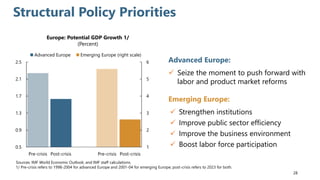
Europe: Potential GDP Growth 1/
(Percent)
28
Sources: IMF World Economic Outlook; and IMF staff calculations.
1/ Pre-crisis refers to 1998-2004 for advanced Europe and 2001-04 for emerging Europe; post-crisis refers to 2023 for both.
1
2
3
4
5
6
0.5
0.9
1.3
1.7
2.1
2.5
Pre-crisis Post-crisis Pre-crisis Post-crisis
Advanced Europe Emerging Europe (right scale)
29
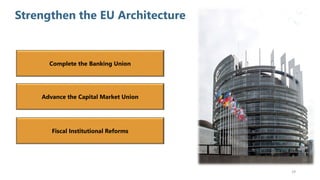
Strengthen the EU Architecture
Complete the Banking Union
Fiscal Institutional Reforms
Advance the Capital Market Union
Thank You

IMF Regional Economic Outlook Spring 2018

  • 1.
    Emerging Europe Advanced Europe RegionalEconomic Outlook Spring 2018 E U R
  • 2.
    Key Messages ✓ Strongeconomic growth but lead indicators point to a peak ✓ Much lower wage growth in most of advanced Europe than in new EU member states because of slack, a flatter Phillips curve, and entrenched low inflation expectations ✓ Monetary policy normalization to proceed more slowly in most of advanced Europe: implications for capital flows to new EU member states and exchange rates ✓ Fiscal adjustment insufficiently ambitious, given the strength of the cycle. Some countries have even relaxed ✓ Policymakers need to seize the good times to advance further with fiscal consolidation and structural reforms 2
  • 3.
  • 4.
    4 Europe continues toenjoy strong growth Sources: IMF, World Economic Outlook; and IMF staff calculations. 1/ The upper and lower bounds of the shaded areas depict the minimum - maximum growth range. Advanced Europe: Real GDP Growth (Year-over-year percent change) Emerging Europe: Real GDP Growth (Year-over-year percent change) -15 -10 -5 0 5 10 15 2000 2006 2012 Advanced Europe Euro area 2017 Min-max range 1/ -15 -10 -5 0 5 10 15 2000 2006 2012 Emerging Europe Russia 2017 Min-max range 1/
  • 5.
    5 Growth is drivenby domestic demand Sources: IMF, World Economic Outlook; and IMF staff calculations. Advanced Europe: Contributions to Growth (Percentage points) Emerging Europe: Contributions to Growth (Percentage points) -3 -2 -1 0 1 2 3 4 5 2015 2016 2017 Consumption Investment Net exports Real GDP growth -3 -2 -1 0 1 2 3 4 5 2015 2016 2017 Consumption Investment Net exports Real GDP growth
  • 6.
    6 Upward growth revisionsreflect largely stronger domestic demand Sources: IMF, World Economic Outlook; and IMF staff calculations. Advanced Europe: Growth Projections and Revisions Relative to April 2017 WEO (Growth in percent, revisions/contributions in percentage points) Emerging Europe: Growth Projections and Revisions Relative April 2017 WEO (Growth in percent, revisions/contributions in percentage points) -1.5 -1.0 -0.5 0.0 0.5 1.0 1.5 2.0 2.5 3.0 2017 2018 2019 Consumption Investment Net exports Real GDP growth revisions GDP growth -1.5 -0.5 0.5 1.5 2.5 3.5 2017 2018 2019 Consumption Investment Net exports Real GDP growth GDP growth revisions
  • 7.
    -40 -20 020 40 60 Euro area United Kingdom Switzerland Czech Republic, Hungary, Poland, Turkey, and South Africa March-18 2017 7 High-frequency data suggest that momentum is peaking Manufacturing PMIs (Three-month moving average; deviations from 50) Sources: European Commission; Haver Analytics; IMF World Economic Outlook; and IMF staff calculations. 1/ Measures macroeconomic data surprises relative to market expectations. A positive/negative reading means that the data releases have been stronger/worse than expected. Citigroup Economic Surprise Index 1/ (Period average; in percent) More-positive surprises -6 -4 -2 0 2 4 6 8 10 Jan-10 Jan-12 Jan-14 Jan-16 Jan-18 Advanced Europe Emerging Europe Mar-18
  • 8.
  • 9.
    9 Near-term risks balanced.Medium-term risks to the downside Medium-term downside risks have become more acute: • Inward looking policies and rising protectionism • Protracted policy and economic uncertainty • Richly valued asset prices could correct abruptly Near-term risks balanced: • Robust confidence and still strong conjunctural indicators • But greater trade tensions and market volatility
  • 10.
    10 Large drops ofstock prices have derailed recoveries Changes in Main Indicators after a Large Stock Price Decline 1/ (Quarter-over-quarter percent change) Sources: Haver Analytics; Thomson Reuters; IMF International Finance Statistics; and IMF staff calculations. 1/ Large stock price declines are defined as price drops within the fifth percentile of the distribution of quarterly changes. The sample covers G7 countries, Spain, and Sweden over the period 1980 to 2017. Real GDP Growth Inflation -2.5 -2.0 -1.5 -1.0 -0.5 0.0 0.5 1.0 1.5 0 1 2 3 One quarter ahead Eight quarters ahead -6 -5 -4 -3 -2 -1 0 1 2 0 1 2 3 One quarter ahead Eight quarters ahead Max Mean Min
  • 11.
  • 12.
    12 Output gaps appearlargely closed Output Gap, 2018 (Percent of potential GDP) Sources: IMF World Economic Outlook; and IMF staff estimates.
  • 13.
    13 Inflation pressures arediverging across economies Core Inflation (Year-over-year percent change; period average) Sources: Haver Analytics; and IMF staff calculations. Note: Other advanced economies include: Czech Republic, Israel, San Marino, Switzerland, and the United Kingdom. -0.5 0.0 0.5 1.0 1.5 2.0 2.5 2014Q1 15Q1 16Q1 17Q1 18Q1 Euro area Nordics Other advanced economies -0.5 0.0 0.5 1.0 1.5 2.0 2.5 2014Q1 15Q1 16Q1 17Q1 18Q1 Central Europe SEE EU SEE non-EU 0 5 10 15 20 25 30 35 2014Q1 15Q1 16Q1 17Q1 18Q1 CIS excl. Russia Turkey Russia
  • 14.
  • 15.
    15 Labor market slackhas declined, but remains high in EU-15, unlike in NMS Sources: Eurostat; and IMF staff calculations. 1/ Additional slack includes persons marginally attached to the labor force and underemployed part-time workers. 2/ EU-15: Austria, Belgium, Denmark, Finland, France, Germany, Greece, Ireland, Italy, Luxembourg, Netherlands, Portugal, Spain, Sweden, and the United Kingdom 3/ New member states: Bulgaria, Croatia, Czech Republic, Estonia, Hungary, Latvia, Lithuania, Poland, Romania, Slovakia, and Slovenia. EU: Unemployment and Additional Labor Market Slack 1/ (Percent) 8 10 12 14 16 18 20 22 2008Q1 2010Q3 2013Q1 2015Q3 2017Q New member states 3/ EU-15 2/
  • 16.
    16 Wage growth issluggish in EU-15 and strong in NMS Source: Eurostat. 0 2 4 6 8 10 12 14 16 2001Q4 2005Q4 2009Q4 2013Q4 2017Q4 New member states EU-15 Nominal Wage Growth (Percent change y/y in four-quarter averages)
  • 17.
    17 The wage Phillipscurve is alive and well: flat in selected EU-15 and steep in NMS Sources: IMF staff calculations. 1/ Based on a panel regression that uses a broad measure of slack (non-employment gap). Selected EU-15 comprise Austria, Belgium, France, Germany, Netherlands, and Spain. Wage Phillips Curve: New Member States 1/Wage Phillips Curve: Selected EU-15 1/ Wagegrowth Unemployment gap Slope = -0.4 Wagegrowth Unemployment gap Slope = -0.9
  • 18.
  • 19.
    19 NMS current accountsare in a much better position than pre-crisis Current Account Balance, 2017 (Percent of GDP) Sources: IMF, World Economic Outlook; and IMF staff calculations. 1/ The current account norm estimate for Hungary and Slovenia is for 2016. -4 -2 0 2 4 6 8 SVN BGR HRV HUN EST CZE LTU POL SVK LVA ROU Actual current account balance Current account norm 1/ New Member States: Export Market Shares, 2017 versus 2007-08 Average (Percent change) 0 10 20 30 40 50 60 ROU LTU POL BGR SVK EST CZE HUN LVA SVN HRV
  • 20.
    20 But competitiveness isgradually eroding Sources: European Commission; Eurostat; Haver Analytics; and IMF staff calculations. 1/ Corporate profit share is a four quarter average of seasonally unadjusted data. New Member States: Corporate Profitability and Wage Growth 1/ (Year-over-year percent change) 1 3 5 7 9 11 48 49 50 51 52 53 2010Q1 2011Q2 2012Q3 2013Q4 2015Q1 2016Q2 2017Q3 Corporate profit share Wage growth (right side) Selected Regions: Real Effective Exchange Rates (2000Q1=100; based on manufacturing unit labor cost) 80 100 120 140 160 180 2000Q1 2003Q3 2007Q1 2010Q3 2014Q1 2017Q4 Central Europe Southeastern European EU member states Baltics Euro area
  • 21.
    21 Overall, euro areacurrent account still broadly in equilibrium; deficits shrinking, surpluses flat Sources: IMF, World Economic Outlook (WEO); and IMF staff calculations. Euro Area: Current Account Balance (Percent of GDP) -25 -20 -15 -10 -5 0 5 10 15 2001 2003 2005 2007 2009 2011 2013 2015 2017 Max Euro area Min
  • 22.
  • 23.
    23 In most ofadvanced Europe, maintain accommodative monetary policy Sources: Bloomberg Finance L.P.; Haver Analytics; and IMF staff calculations. 1/ Derived from government securities adjusted for the difference between the RPI inflation and CPI inflation, which has been, on average, 1 percentage point in recent years. 2/ Real policy rate is the difference between nominal policy rate and one-year ahead IMF’s WEO inflation forecast. Market expectation of interest rate is calculated as a difference between one-year-ahead interest rate swap rate and three-month interbank rate. Positive values indicate expectation of monetary tightening. Ten-year Breakeven Inflation (Percent; based on generic nominal government bonds and inflation-linked bonds) Real Policy Rates and Market Expectations 2/ (Percent) -2.5 -2.0 -1.5 -1.0 -0.5 0.0 0.5 GBR CZE EA SWE Real Policy rate Direction of market expectations 1/ 1.0 1.2 1.4 1.6 1.8 2.0 2.2 2.4 2014 2015 2016 2017 2018 Inflation target United Kingdom 1/ Sweden Euro area
  • 24.
    Monetary Policy Challengesin NMS NMS are more advanced in the cycle ✓ Output gaps appear largely closed, wage growth is strong Thus, they have to tighten sooner, but mind spillovers ✓ Policy rates low for longer in advanced Europe ✓ Pressure for capital inflows and exchange rate appreciation 24
  • 25.
    25 A picture ofprocyclical fiscal policies Sources: IMF World Economic Outlook; and IMF staff calculations. 1/ The fiscal stance is considered to have tightened if the ratio of the structural primary balance to potential GDP improves by at least 0.25 percent per year, to have loosened if that ratio deteriorates by at least 0.25 percent per year, and to have remained neutral otherwise. General government non-oil primary structural balance is used for Russia, and structural non-oil balance in percent of mainland trend GDP is used for Norway. No data for ALB, BLR, UVK, MKD, MDA, MNE, and SMR. Fiscal Stance, 2013-18 1/ (Number of European countries) 0 10 20 30 40 2013 2014 2015 2016 2017 2018 Loosened Remained neutral Tightened Forecast
  • 26.
    Fiscal Policy Priorities AdvancedEurope: ✓ Use the good times to rebuild fiscal buffers in high public debt countries ✓ Countries with fiscal space should use it to lift potential growth ✓ Improve policy-mix to make it more growth-friendly, including preserving public investment Emerging Europe: ✓ Rebuild fiscal room to deal with future shocks and reduce pressure on monetary policy ✓ Fiscal policy procyclical in several economies in Central and Eastern Europe 26
  • 27.
    27 Financial Policy Priorities ✓Address the remaining balance sheet weaknesses ✓ Prepare macroprudential frameworks Europe: Non-performing Loans versus Private Sector Credit Growth -8 -4 0 4 8 12 0 3 6 9 12 15 18 Privatesectorcreditgrowth (year-over-yearpercentchange) Nonperforming loans (percent of total loans) Emerging Europe Advanced Europe Sources: Eurostat; ECB; Haver Analytics; IMF Financial Soundness Indicators; IMF International Finance Statistics; and IMF staff calculations.
  • 28.
    Structural Policy Priorities AdvancedEurope: ✓ Seize the moment to push forward with labor and product market reforms Emerging Europe: ✓ Strengthen institutions ✓ Improve public sector efficiency ✓ Improve the business environment ✓ Boost labor force participation Europe: Potential GDP Growth 1/ (Percent) 28 Sources: IMF World Economic Outlook; and IMF staff calculations. 1/ Pre-crisis refers to 1998-2004 for advanced Europe and 2001-04 for emerging Europe; post-crisis refers to 2023 for both. 1 2 3 4 5 6 0.5 0.9 1.3 1.7 2.1 2.5 Pre-crisis Post-crisis Pre-crisis Post-crisis Advanced Europe Emerging Europe (right scale)
  • 29.
    29 Strengthen the EUArchitecture Complete the Banking Union Fiscal Institutional Reforms Advance the Capital Market Union
  • 30.