European 
Economic 
Forecast 
ISSN 1725-3217 (online) 
ISSN 0379-0991 (print) 
EUROPEAN ECONOMY 7|2014 
Economic and 
Financial Affairs 
Autumn 2014
The European Economy series contains important reports and communications from the 
Commission to the Council and the Parliament on the economy and economic developments. 
Unless otherwise indicated the texts are published under the responsibility of the 
European Commission 
Directorate-General for Economic and Financial Affairs 
Unit Communication and interinstitutional relations 
B-1049 Brussels 
Belgium 
E-mail : ecfin-info@ec.europa.eu 
LEGAL NOTICE 
Neither the European Commission nor any person acting on its behalf may be held responsible for 
the use which may be made of the information contained in this publication, or for any errors which, 
despite careful preparation and checking, may appear. 
This paper exists in English only and can be downloaded from 
http://ec.europa.eu/economy_finance/publications/. 
More information on the European Union is available on http://europa.eu. 
KC-AR-14-007-EN-N (online) KC-AR-14-007-EN-C (print) 
ISBN 978-92-79-35350-5 (online) ISBN 978-92-79-36011-4 (print) 
doi:10.2765/76156 (online) doi:10.2765/77321 (print) 
© European Union, 2014 
Reproduction is authorised provided the source is acknowledged.
European Commission 
Directorate-General for Economic and Financial Affairs 
European Economic Forecast 
Autumn 2014 
EUROPEAN ECONOMY 7/2014
ABBREVIATIONS 
ii 
Countries and regions 
EU European Union 
EA euro area 
BE Belgium 
BG Bulgaria 
CZ Czech Republic 
DK Denmark 
DE Germany 
EE Estonia 
IE Ireland 
EL Greece 
ES Spain 
FR France 
HR Croatia 
IT Italy 
CY Cyprus 
LV Latvia 
LT Lithuania 
LU Luxembourg 
HU Hungary 
MT Malta 
NL The Netherlands 
AT Austria 
PL Poland 
PT Portugal 
RO Romania 
SI Slovenia 
SK Slovakia 
FI Finland 
SE Sweden 
UK United Kingdom 
JP Japan 
US United States of America 
BRICS Brazil, Russia, India, China and South Africa 
CEE Central and Eastern Europe 
CIS Commonwealth of Independent States 
EFTA European Free Trade Association 
MENA Middle East and North Africa 
ROW Rest of the World 
Economic variables and institutions 
BCS Business and Consumer Surveys 
CDS Credit Default Swaps 
EDP Excessive Deficit Procedure 
ESI Economic Sentiment Indicator 
Euribor European Interbank Offered Rate 
GDP Gross Domestic Product 
GNI Gross National Income 
HICP Harmonised Index of Consumer Prices 
Libor London Interbank Offered Rate
iii 
NAWRU Non-Accelerating Wage Rate of Unemployment 
PMI Purchasing Managers' Index 
REER Real Effective Exchange Rate 
SGP Stability and Growth Pact 
VAT Value-Added Tax 
CPB Centraal Planbureau, the Netherlands Bureau for Economic Policy Analysis 
ECB European Central Bank 
EIB European Investment Bank 
EFSF European Financial Stability Facility 
EMU Economic and Monetary Union 
ESM European Stability Mechanism 
FOMC Federal Open Market Committee, US 
Fed Federal Reserve, US 
IMF International Monetary Fund 
OBR Office for Budget Responsibility, UK 
OECD Organisation for Economic Cooperation and Development 
WTO World Trade Organisation 
Other abbreviations 
AQR Asset Quality Review 
BLS Bank Lending Survey 
CFCI Composite Financing Cost Indicator 
DSGE Dynamic stochastic general equilibrium [model] 
FDI Foreign Direct Investment 
FLS Funding for Lending Scheme, UK 
FY Financial year 
JPA Job Protection Plan, Hungary 
LFS Labour Force Survey 
LTRO Longer-Term Refinancing Operation 
MRO Main Refinancing Operations 
NFC Non-Financial Corporations 
OMT Outright Monetary Transactions 
SME Small and medium-sized enterprises 
SMP Securities Market Programme, ECB 
QUEST Quarterly Estimation and Simulation Tool, DG ECFIN's DSGE model 
Graphs/Tables/Units 
a.a. Annual average 
bbl Barrel 
bn Billion 
bps Basis points 
lhs Left hand scale 
pp. / pps. Percentage point / points 
pts Points 
Q Quarter 
q-o-q% Quarter-on-quarter percentage change 
rhs Right hand scale 
SAAR Seasonally-Adjusted Annual Rate 
tn Trillion 
y-o-y% Year-on-year percentage change
iv 
Currencies 
EUR Euro 
ECU European currency unit 
BGN Bulgarian lev 
CNY Chinese yuan, renminbi 
CZK Czech koruna 
DKK Danish krone 
GBP Pound sterling 
HUF Hungarian forint 
HRK Croatian kuna 
ISK Icelandic krona 
LTL Lithuanian litas 
MKD Macedonian denar 
NOK Norwegian krone 
PLN Polish zloty 
RON New Romanian leu 
RSD Serbian dinar 
SEK Swedish krona 
CHF Swiss franc 
JPY Japanese yen 
TRY Turkish lira 
USD US dollar
CONTENTS 
v 
Overview 1 
PART I: EA and EU outlook 6 
Slow recovery with very low inflation 7 
1. EU recovery to remain subdued for longer than expected 8 
2. The external environment 12 
3. Financial markets in Europe 15 
4. GDP and its components 18 
5. The current account 28 
6. Labour market conditions 30 
7. Inflation developments 33 
8. Public finances in the EU 36 
9. Risks 38 
PART II: Prospects by individual economy 56 
Member States 57 
1. Belgium: Headwinds to recovery 58 
2. Bulgaria: Subdued growth amid rising uncertainty 60 
3. The Czech Republic: The recovery is strengthening and 
broadening 62 
4. Denmark: Uneven recovery expected to strengthen 64 
5. Germany: Disappointing growth but improvement in sight 66 
6. Estonia: Recovery slowed by rising uncertainties 68 
7. Ireland: Ireland decouples as growth picks up sharply 70 
8. Greece: The economy finally rebounds 72 
9. Spain: GDP and employment growth expected to firm 74 
10. France: Weak growth, low inflation and a rising deficit 76 
11. Croatia: Still mired in recession with significant fiscal challenges 78 
12. Italy: Improving external demand to drive a tepid recovery 80 
13. Cyprus: Adjustment continues as the economy nears a trough 82 
14. Latvia: Economic growth buffeted by external turmoil 84 
15. Lithuania: Headwind from the east slows down economic growth 86 
16. Luxembourg: Sustained growth but slightly weaker public 
finances 88 
17. Hungary: Strong growth set to moderate 90 
18. Malta: Smooth sailing in choppy waters 92 
19. The Netherlands: Turning the corner? 94 
20. Austria: Going through another soft patch 96 
21. Poland: Economic activity hits a soft patch 98 
22. Portugal: As external demand falters, domestic demand takes 
over 100 
23. Romania: Investment plunge weighs on the economy in 2014 102 
24. Slovenia: Recovery gathers pace fuelled by exports and 
investment 104 
25. Slovakia: Domestic demand taking the lead 106 
26. Finland: Domestic factors restraining growth 108 
27. Sweden: Domestic resilience despite weak foreign demand 110
vi 
28. The United Kingdom: Robust growth and low inflation projected 
to continue 112 
Candidate Countries 114 
29. The former Yugoslav Republic of Macedonia: Broader-based 
acceleration of growth 115 
30. Iceland: Resilient growth, driven by tourism, investment and 
private consumption 117 
31. Montenegro: A delayed investment agenda 119 
32. Serbia: Fiscal hurdles 121 
33. Turkey: Geopolitical tensions a risk to growth 123 
34. Albania: Domestic demand to support gradual growth revival 125 
Other non-EU Countries 127 
35. The United States of America: Broad-based recovery gaining 
ground 128 
36. Japan: Lower growth ahead 130 
37. China: Gradual adjustment towards more balanced growth 132 
38. EFTA: Economic outlook less bright 134 
39. Russian Federation: Heading towards stagnation 136 
Statistical Annex 141 
LIST OF TABLES 
1. Overview - the autumn 2014 forecast 1 
I.1. International environment 13 
I.2. Composition of growth - EU 19 
I.3. Composition of growth - euro area 20 
I.4. Current account and cyclically adjusted current account 29 
I.5. Labour market outlook - euro area and EU 31 
I.6. Inflation outlook - euro area and EU 34 
I.7. General Government budgetary position - euro area and EU 36 
I.8. Euro-area debt dynamics 37 
LIST OF GRAPHS 
I.1. Real GDP, EU 7 
I.2. HICP, EU 7 
I.3. GDP growth forecasts 2012-14, euro area (EA) and US, 
forecast means 8 
I.4. Comparison of past and current recoveries - GDP, euro area 9 
I.5. Real GDP 9 
I.6. Post-crisis GDP growth, contributions, in the US, euro area 
and rest of the EU 10 
I.7. Unemployment rate, euro area, rest of the EU and US, 2007- 
14 11 
I.8. Potential and actual GDP growth, EU, 2003-16 12 
I.9. Growth in global GDP and Markit Global Composite PMI 13 
I.10. Central bank balance sheets, euro area, UK and US 16 
I.11. Benchmark 2-year government bond yields 16
vii 
I.12. Corporate bond spreads, 5-year maturity, euro area 16 
I.13. Economic and credit cycles for non-financial corporations, 
euro area 17 
I.14. Net changes in credit standards and credit demand for 
loans to non-financial corporations, euro area 17 
I.15. Real GDP, euro area 18 
I.16. Real GDP, rest of the EU 18 
I.17. Economic Sentiment Indicator and PMI Composite Output 
Index, EU 20 
I.18. Real GDP growth and its components, EU 21 
I.19. Real GDP growth, EU, contributions by Member States 23 
I.20. Cross-country differences in the output gap, largest Member 
States, 2010-16 23 
I.21. Gross fixed capital formation (euro area, US, and Japan) 23 
I.22. Investment and policy uncertainty, EU 24 
I.23. Equipment investment and capacity utilisation, EU 24 
I.24. Private consumption and consumer confidence, EU 26 
I.25. Inflation and households' major purchases, DG ECFIN 
surveys, euro area 26 
I.26. Global demand, EU exports and new export orders 27 
I.27. Employment growth and unemployment rate, EU 30 
I.28. Unemployment by age group, EU 30 
I.29. Unemployment, unemployed by duration, EU 31 
I.30. Beveridge curve, euro area and EU 31 
I.31. Employment expectations, DG ECFIN surveys, EU 32 
I.32. Inflation breakdown, EU 33 
I.33. Tax impact on HICP inflation rate, EU and euro area 34 
I.34. HICP, euro area 35 
I.35. Inflation dispersion of EU Member States - HICP inflation rates 35 
I.36. Budgetary developments, EU 36 
I.37. General government revenues and expenditure, EU 37 
I.38. Euro area GDP forecasts - Uncertainty linked to the balance 
of risks 39 
LIST OF BOXES 
I.1. Drivers and implications of the weakness of investment in the 
EU 40 
I.2. Private sector deleveraging: outlook and implications for the 
forecast 44 
I.3. The impact of unanticipated disinflation on debt 49 
I.4. The changeover to ESA 2010 in the current forecast 51 
I.5. Some technical elements behind the forecast 54
EDITORIAL 
ix 
After just a year of moderate growth, the momentum of the EU economy began to slow in spring 2014. In 
the second half of this year, GDP growth in the EU is set to be very modest, while in the euro area it will 
almost stagnate. Among the largest euro area Member States, we see growth increasing in Spain where 
unemployment remains very high, growth coming to a stop in Germany after a very strong first quarter, 
protracted stagnation in France, and contraction in Italy. Financial markets have adjusted sharply in recent 
weeks as the prospect of more modest growth, not just in Europe but globally, has ended a period of yield 
hunting and risk compression. 
The slowdown in Europe has occurred as the legacy of the global financial and economic crisis lingers on 
in the form of deleveraging pressures and incomplete internal and external adjustment. A weakness of 
potential growth that was already visible in low productivity gains in the pre-crisis years has been 
exacerbated by the contraction in capital formation and the increase of structural unemployment since 
2008. In the first half of 2014, a slowdown of GDP growth among the EU’s major trading partners and 
the rapidly deteriorating geopolitical situation, have affected the EU through slower-than-expected export 
growth and negative confidence effects. With the observed slowdown of activity, slack in the EU 
economy remains large and is weighing on inflation, which is also being dragged down by tumbling 
energy and food prices. 
Over the course of next year, however, growth should gradually rise before picking up further still in 
2016. The main causes of the current weakness are set to fade very gradually, as private debt is brought 
down, the repair of the banking sector progresses further with the help of the ECB’s comprehensive 
assessment, the transmission of ample monetary policy to the real economy improves, already-implemented 
structural reforms feed through, and geopolitical tensions diminish. But despite this 
moderate growth, unemployment will still be high at the end of the forecast horizon and the euro area is 
still projected to have spare capacity in 2016. 
The new European Commission under President Juncker is taking office amid economic headwinds. The 
dual challenge for economic policy consists in strengthening short-term economic dynamics and raising 
the economy’s growth potential for the medium term. Meeting these challenges requires articulated 
impulses from monetary and fiscal policies while at the same time addressing long-standing structural 
weaknesses. The ECB’s recent decisions should improve the supply of credit to the real economy. On the 
fiscal side, there is well-identified scope for a more growth-friendly orientation of given expenditure that 
could both improve growth in the short run and lift the medium-term growth potential. Moreover, fiscal 
space, where it exists, can and should be used to support demand, in particular by stimulating investment, 
which would also support growth in the longer term. The Commission will contribute to this effort by 
mobilising public funds at EU level to stimulate private investment in the real economy. Finally, the 
recent fall in business and consumer confidence and the volatility in financial markets also reflect lack of 
progress with the conception and implementation of structural reforms needed to improve the functioning 
of product markets and to boost job creation. What needs to be done has been identified, not least in the 
EU recommendations to Member States adopted last summer. Implementation and results is what counts 
now. 
Marco Buti 
Director General 
Economic and Financial Affairs
OVERVIEW 
1 
As the vast majority of EU economies returned to growth over the course of 
last year, expectations were raised that Europe’s economic recovery was 
becoming more broadly based and self-sustaining. In the first half of this 
year, however, GDP growth struggled to gather momentum, leaving the 
recovery not only subdued but also fragile. With confidence indicators 
declining since mid-year and now back to where they were at the end of 
2013, and hard data pointing to very weak activity for the rest of the year, it 
is becoming harder to see the dent in the recovery as the result of temporary 
factors only. 
GDP growth forecasts have therefore been revised down to reflect not only 
the materialisation of some of the risks identified in spring, but also a 
reassessment of the underlying dynamics of domestic demand, particularly 
investment, which has failed so far to emerge as a strong engine of growth. 
Annual GDP growth in the EU this year is now projected to be 1.3%, while 
growth in the euro area is expected to be 0.8%. 
Economic activity, however, should gradually strengthen over the course of 
2015 and accelerate further in 2016, as the legacies of the crisis fade away, 
structural reforms start to bear fruit, labour markets improve and more 
supportive policies and financing conditions are in place. Against this 
The recovery is 
struggling to gain 
momentum … 
Table 1: 
Overview - the autumn 2014 forecast 
Real GDP 
Inflation Unemployment rate 
2013 2014 2015 2016 2013 2014 2015 2016 2013 2014 2015 2016 
Belgium 0.3 0.9 0.9 1.1 1.2 0.6 0.9 1.3 8.4 8.5 8.4 8.2 
Germany 0.1 1.3 1.1 1.8 1.6 0.9 1.2 1.6 5.3 5.1 5.1 4.8 
Estonia 1.6 1.9 2.0 2.7 3.2 0.7 1.6 2.2 8.6 7.8 7.1 6.3 
Ireland 0.2 4.6 3.6 3.7 0.5 0.4 0.9 1.4 13.1 11.1 9.6 8.5 
Greece -3.3 0.6 2.9 3.7 -0.9 -1.0 0.3 1.1 27.5 26.8 25.0 22.0 
Spain -1.2 1.2 1.7 2.2 1.5 -0.1 0.5 1.2 26.1 24.8 23.5 22.2 
France 0.3 0.3 0.7 1.5 1.0 0.6 0.7 1.1 10.3 10.4 10.4 10.2 
Italy -1.9 -0.4 0.6 1.1 1.3 0.2 0.5 2.0 12.2 12.6 12.6 12.4 
Cyprus -5.4 -2.8 0.4 1.6 0.4 -0.2 0.7 1.2 15.9 16.2 15.8 14.8 
Latvia 4.2 2.6 2.9 3.6 0.0 0.8 1.8 2.5 11.9 11.0 10.2 9.2 
Lithuania 3.3 2.7 3.1 3.4 1.2 0.3 1.3 1.9 11.8 11.2 10.4 9.5 
Luxembourg 2.0 3.0 2.4 2.9 1.7 1.0 2.1 1.9 5.9 6.1 6.2 6.1 
Malta 2.5 3.0 2.9 2.7 1.0 0.7 1.5 2.0 6.4 6.1 6.1 6.2 
Netherlands -0.7 0.9 1.4 1.7 2.6 0.4 0.8 1.1 6.7 6.9 6.8 6.7 
Austria 0.2 0.7 1.2 1.5 2.1 1.5 1.7 1.8 4.9 5.3 5.4 5.0 
Portugal -1.4 0.9 1.3 1.7 0.4 0.0 0.6 0.9 16.4 14.5 13.6 12.8 
Slovenia -1.0 2.4 1.7 2.5 1.9 0.4 1.0 1.5 10.1 9.8 9.2 8.4 
Slovakia 1.4 2.4 2.5 3.3 1.5 -0.1 0.7 1.4 14.2 13.4 12.8 12.1 
Finland -1.2 -0.4 0.6 1.1 2.2 1.2 1.3 1.6 8.2 8.6 8.5 8.3 
Euro area -0.5 0.8 1.1 1.7 1.4 0.5 0.8 1.5 11.9 11.6 11.3 10.8 
Bulgaria 1.1 1.2 0.6 1.0 0.4 -1.4 0.4 1.0 13.0 12.0 11.4 11.0 
Czech Republic -0.7 2.5 2.7 2.7 1.4 0.5 1.4 1.8 7.0 6.3 6.2 6.1 
Denmark -0.1 0.8 1.7 2.0 0.5 0.4 1.1 1.7 7.0 6.7 6.6 6.4 
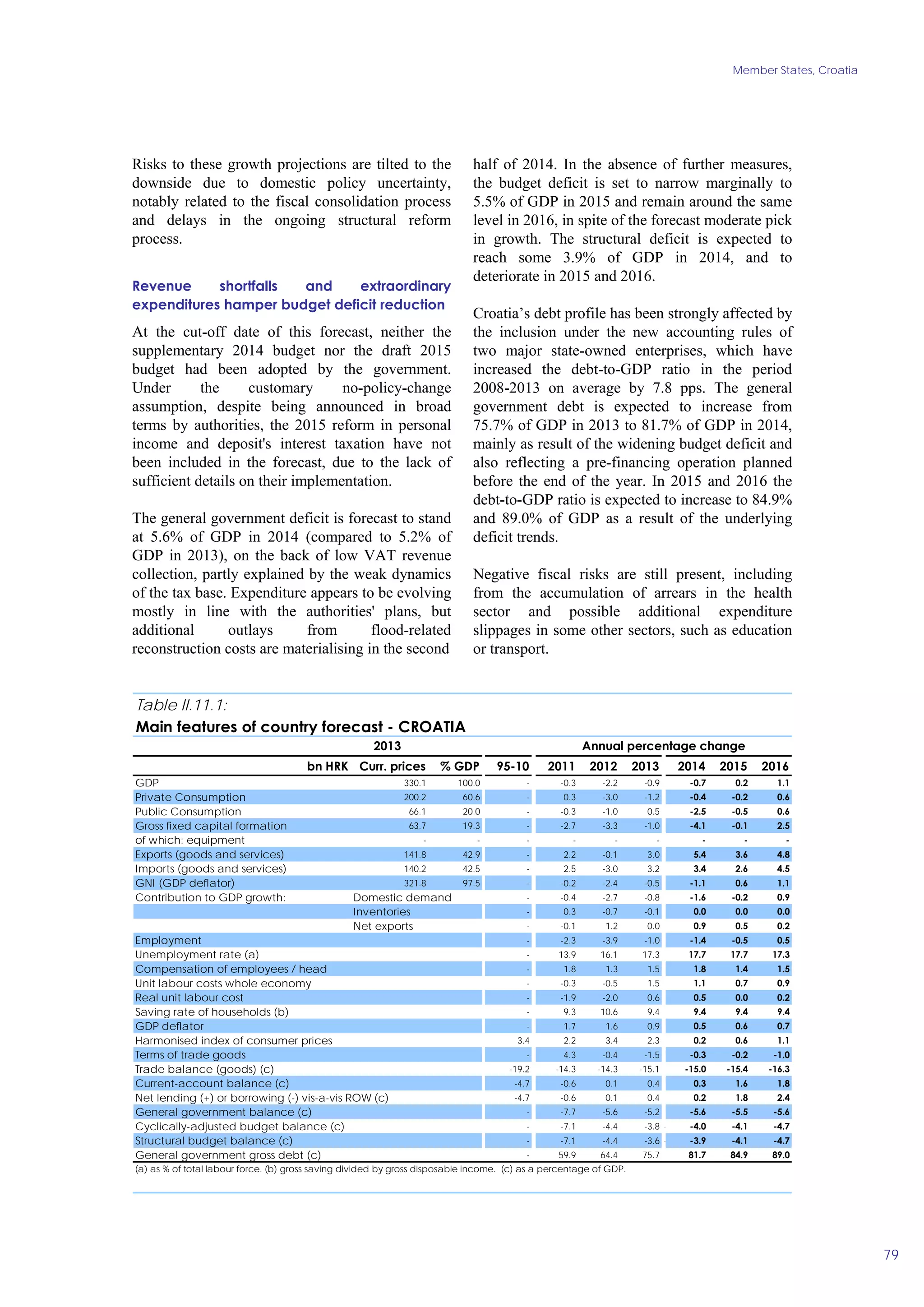
Croatia -0.9 -0.7 0.2 1.1 2.3 0.2 0.6 1.1 17.3 17.7 17.7 17.3 
Hungary 1.5 3.2 2.5 2.0 1.7 0.1 2.5 3.0 10.2 8.0 7.8 7.8 
Poland 1.7 3.0 2.8 3.3 0.8 0.2 1.1 1.9 10.3 9.5 9.3 8.8 
Romania 3.5 2.0 2.4 2.8 3.2 1.5 2.1 2.7 7.3 7.0 6.9 6.7 
Sweden 1.5 2.0 2.4 2.7 0.4 0.2 1.2 1.5 8.0 7.9 7.8 7.6 
United Kingdom 1.7 3.1 2.7 2.5 2.6 1.5 1.6 1.9 7.5 6.2 5.7 5.5 
EU 0.0 1.3 1.5 2.0 1.5 0.6 1.0 1.6 10.8 10.3 10.0 9.5 
USA 2.2 2.2 3.1 3.2 1.5 1.8 2.0 2.3 7.4 6.3 5.8 5.4 
Japan 1.5 1.1 1.0 1.0 0.4 2.8 1.6 1.4 4.0 3.8 3.8 3.8 
China 7.6 7.3 7.1 6.9 2.6 2.4 2.4 : : : : : 
World 3.1 3.3 3.8 4.1 : : : : : : : :
European Economic Forecast, Autumn 2014 
2 
background, growth in the EU is forecast to rise to 1.5% in 2015 and then 
increase modestly to 2.0% in 2016, while in the euro area, growth is forecast 
to reach 1.1% and then 1.7%. Domestic demand is expected to be the major 
driver of growth over the forecast horizon. To the extent that the 
strengthening of the economic recovery has been postponed, inflation has 
continued to decline, triggered also by falling energy and food prices. The 
forecast for inflation in the EU has been trimmed for this year and next. 
Global GDP growth in the first half of the year turned out considerably lower 
than expected, mainly due to weakness in some advanced and emerging 
economies but also to rising geopolitical tensions in Ukraine and the Middle 
East. 
A steady recovery is nonetheless expected in non-European advanced 
economies, as some of the factors that held back growth in the first half of 
2014 will probably prove temporary. Notably, in the US, strong momentum 
in the economy will be supported by lower fiscal drag and the continuation of 
accommodative monetary policies. The growth outlook for emerging market 
economies is supported by relative resilience in emerging Asia, although a 
gradual deceleration of activity is likely in China. Global growth this year is 
now expected at 3.3 %, increasing to 3.8 % in 2015 and 4.1 % in 2016. 
Mirroring the evolution of global growth, world trade weakened significantly 
earlier this year, revealing a steep contraction of trade flows in emerging 
markets. Despite a pick up since the summer, the forecast for trade growth 
has been revised down, reflecting also a reassessment of trade intensity to 
growth. World import growth is expected to reach 3.0 % in 2014, 4.6 % in 
2015 and 5.5 % in 2016. Brent oil prices have sharply decreased since the 
spring, triggered by weak demand in the OECD and China, ample supply 
and market confidence in OPEC’s capacity to balance any disruption 
stemming from geopolitical conflicts. The impact of lower commodity prices 
on inflation in the euro area, however, should be softened by the currency’s 
depreciation. 
The EU’s recovery appears particularly weak, not only in comparison to 
other advanced economies but to historical examples of post-financial crisis 
recoveries as well, even though these too were typically slow and fragile. 
Trend GDP growth, which was already relatively slow before the crisis as a 
result of low productivity gains, has fallen further due to low investment and 
high structural unemployment. In the euro area in particular, growth 
continues to be held back by deleveraging pressures, incomplete adjustment 
of macroeconomic imbalances as well as disappointment over the pace of 
structural and institutional reform. The legacy of the crisis is affecting 
Member States to different degrees but spillovers through trade and 
confidence are large. 
Among the largest Member States, growth in Germany has halted, but is 
expected to gradually pick up again on the back of a robust labour market and 
strengthening external demand, while corporate investment is projected to 
resume only hesitantly. The French economy is expected to register only 
very slow growth in 2015 amid a subdued pace of private consumption and 
still contracting investment. In Italy, GDP growth is projected to turn 
positive early next year, as growing external demand is set to drive a still 
fragile recovery. In Spain, GDP growth is projected to increase, supported in 
particular by rising employment and easier financing conditions. Growth in 
the Netherlands is expected to firm as private consumption picks up again on 
… while world trade 
slowed. 
The euro area is 
lagging behind …
Overview 
3 
the back of increasing employment and the gradually recovering housing 
market. Outside the euro area, the United Kingdom is set to register robust 
growth, as both investment and consumption expand at a fast pace. Growth in 
Poland has moderated on the back of weaker external demand, but private 
consumption is set to support a still healthy expansion. Most of the euro-area 
Member States that had or have adjustment programmes are now catching up. 
Growth in Ireland and Greece is expected to be substantially above the EU 
average next year, and close to it in Portugal. In Cyprus, a modest recovery 
is expected to begin in 2015. While faster growth in these countries has to be 
seen against the backdrop of the large output losses during the crisis, it 
nonetheless points to significant progress in the adjustment. Finally, in most 
of the Member States that joined the EU a decade or less ago, output is 
growing faster as the process of real convergence continues. 
Over the forecast horizon, domestic demand should increasingly benefit from 
the very accommodative stance of monetary policy, low financing costs, 
more favourable credit supply conditions, decreasing deleveraging needs, and 
the broadly neutral stance of fiscal policy in the EU. Private investment 
should gradually recover, benefitting also from progress with balance-sheet 
adjustments, improving demand prospects, and catching-up effects, though it 
will initially be held back by spare capacities, which remain ample. 
Equipment investment should accelerate mainly in 2016, spurred by 
accelerating output, while construction investment is set to recover steadily 
but more moderately. Rising real disposable incomes, low mortgage rates, 
and improved access to credit should support residential investment, although 
less so in countries where housing markets are still adjusting. 
Private consumption is set to expand moderately in 2015 and 2016, supported 
by low commodity prices and rising incomes, as the labour market gradually 
improves. Moreover, despite lower inflation, consumers are not expected to 
postpone major purchases but to spend most of the projected increase in their 
real disposable income. In some countries where deleveraging needs remain 
significant, households may continue to increase their savings. As in the 
spring, public consumption is expected to contribute marginally to growth. 
The expected acceleration of global trade and the depreciation of the euro 
should both support EU exports. However, the increased import intensity of 
EU exports will limit the benefit of depreciation on trade, while imports are 
also set to rise as domestic demand slowly firms. Net exports are thus likely 
to contribute only marginally to GDP growth over the forecast horizon. 
Monetary policy in the euro area has become more accommodative since 
mid-2014 and some Member States outside the euro area have also cut 
interest rates. Following the ECB’s decisions, short-term money-market rates 
have declined to close to (or below) zero and longer-term rates have shifted 
down even more than in the US. This is also a reflection of mixed economic 
data and of the slight decline in long-term inflation expectations. Bond 
spreads in vulnerable Member States have, overall, continued to tighten, and 
corporate bond yields have followed sovereign yields down. These benign 
developments are starting to translate into decreasing financial fragmentation 
and lower financing costs for firms. The bank credit cycle for non-financial 
corporates is expected to turn positive next year. This improvement should 
benefit SMEs along with ECB policies targeting improved monetary policy 
transmission. Meanwhile, corporations are expected to fund investments with 
internal resources to a greater extent than in past economic cycles, especially 
in countries where the level of non-performing loans and corporate 
… but positive factors 
should favour a self-sustaining 
recovery … 
…since net exports will 
contribute little to 
growth. 
Financial conditions 
are increasingly 
supportive …
European Economic Forecast, Autumn 2014 
4 
indebtedness are highest. Investor sentiment towards euro area banks has 
continued to strengthen amid further progress in bank balance sheet repair 
and an improved macro-financial environment. The recent correction in 
global and European financial markets reflects investors’ growing concerns 
about the economic outlook. Benign financial market conditions and 
investment in risky assets can quickly reverse. 
The deficit–to-GDP ratio in both the EU and the euro area are set to decrease 
further this year, albeit more slowly than in 2013, to respectively 3.0 % and 
2.6 %. Government deficits are forecast to continue falling over the next two 
years, helped by strengthening economic activity. The fiscal policy stance is 
expected to be close to neutral in 2014 and 2015, as the fiscal effort, 
measured in terms of changes to the structural balance, should be broadly nil 
in both years. The debt-to-GDP ratios of the EU and the euro area are 
expected to peak next year at 88.3 % and 94.8 % respectively (under the ESA 
2010 definition). 
Recovery of the labour market in the EU is progressing but remains subdued, 
in line with the weakness of economic activity. Differences across Member 
States remain sizable but have started narrowing, thanks to improvements in 
stressed countries. The current pace of economic activity does not allow for 
rapid and massive absorption of excess capacities. Employment growth in 
2014 is thus expected to be limited at 0.4 % in the euro area and 0.7 % in the 
EU; about the same as projected last spring. Supported by the economic 
recovery and the moderation shown in past wage increases, employment in 
2015 is set to increase by 0.5 % in the euro area and 0.6 % in the EU before 
its growth gaining speed in 2016 to 0.9 % and 0.8 % respectively. As a result, 
the unemployment rate should fall slowly to 9.5 % in the EU and 10.8 % in 
the euro area in 2016, which is still above pre-crisis levels. 
The disinflationary trend across EU Member States has continued this year, 
driven by lower commodity prices, especially for energy and food, the 
weaker-than-expected economic environment, and the euro’s earlier 
appreciation. The slack in the labour market and economic agents’ low 
expectations of future price developments have acted as a drag on wage 
developments, while producer prices have also been pulled down by spare 
capacities due to weak demand. Some Member States also experience very 
low, or negative, inflation rates as part of their inevitable adjustment process. 
In the near term, weak output and weak commodity prices should continue to 
dampen inflation over the rest of 2014. As economic activity gradually 
strengthens and wages rise, however, inflation should increase, also fuelled 
by the waning impact of low energy prices and slightly higher import prices 
due to the depreciation of the euro. HICP inflation in the euro area is now 
forecast to be 0.5 % this year, but to rise to 0.8 % in 2015 and 1.5 % in 2016. 
For the EU, inflation is seen at 0.6 % this year and then at 1.0 % in 2015 and 
1.6 % in 2016. 
Even though the risk of higher geopolitical tensions has materialised since 
spring, risks to the growth outlook remain tilted to the downside. In 
particular, increased tensions with Russia, or intensified conflicts in the 
MENA region could hurt growth. Also, widespread and abrupt corrections in 
financial markets could occur as the US attempts to normalise its monetary 
policy, or because of increased global risk aversion. Further disappointment 
about the pace of implementation of reforms in the EU would also hurt the 
growth outlook. 
… and the fiscal 
stance remains 
neutral. 
Labour markets are 
slowly improving … 
…and inflation is 
persistently low. 
External risks have 
increased
Overview 
5 
Risks to the growth and the inflation outlook are closely linked. Downside 
risks to inflation stem mainly from weaker-than-expected domestic demand, 
a prolonged period of falling energy and commodity prices, and a de-anchoring 
of inflation expectations. Lower-than-expected inflation could 
have potentially serious effects on economic activity by making relative price 
adjustments more challenging and deleveraging more difficult. The risk of 
outright deflation, in the sense of a broad-based and self-perpetuating fall in 
prices across the euro area, however, still appears low. By contrast, should 
the recovery be faster-than-expected or oil prices higher than assumed, HICP 
inflation in the EU could turn out higher than forecast. 
Upside risks to the growth outlook are fewer and include the possibility of 
stronger than expected increase in foreign demand, a faster-than-expected 
recovery of investment and employment. Sentiment and growth could also 
rebound more strongly.
PART I 
EA and EU outlook
SLOW RECOVERY WITH VERY LOW INFLATION 
7 
The EU economy is struggling to shake off its lethargy. Since the crisis struck, most Member States have 
been unable to generate or sustain strong economic momentum. While the recovery from such a deep 
crisis had been expected to be very subdued, the persistence of weak growth dynamics suggests that the 
EU's current predicament is particular. 
In the first half of this year, Europe's particular challenges, in tandem with increased geopolitical 
tensions and a loss of momentum in global output and trade growth, slowed economic activity more 
than expected. In the euro area the tentative recovery almost came to a halt in the second quarter. While 
some of this weakness can be chalked up to statistical repercussions of extraordinary weather-related 
gains in the first quarter, underlying momentum appears to have lost steam. Recent indicator readings 
suggest slow growth in the EU and quasi-stagnation in the euro area will continue in the second half of 
the year, which implies annual GDP growth of 1.3% in the EU and 0.8% in the euro area. This 
weakness is expected to extend into early 2015, after which positive factors, such as improving labour 
market conditions, rising disposable incomes, improved financing conditions, diminishing financial 
fragmentation and lower deleveraging needs, should lift growth for the year to 1.5% in the EU and 
1.1% in the euro area. Over time, a healthier banking sector, stronger growth in the rest of the world 
and the benefits of recently implemented structural reforms should raise the EU's growth rate in 2016 to 
2.0% and the euro area's to 1.7% (Graph I.1). 
Weak economic growth has so far limited the labour market's recovery. Job creation has been moderate 
and unemployment rates have fallen only slightly. Since economic growth is expected to gain momentum 
gradually, more meaningful labour market improvements should become visible towards the end of the 
forecast horizon. Falling energy and food prices, but also the substantial slack in the economy, have 
contributed to a further decrease in HICP inflation. Although economic growth looks set to remain weak 
over the coming quarters, the fading impact of the fall in energy prices, slightly higher import prices 
due to the depreciation of the euro, and upticks in wages should gradually raise inflation (Graph I.2). 
As a result this year's inflation rates of 0.6% in the EU and 0.5% in the euro area should mark a trough, 
with inflation expected to rise to 1.0% and 0.8%, respectively in 2015 and then 1.6% and 1.5% in 2016. 
Downside risks continue to outweigh upside risks to the growth outlook, but the composition of risks has 
changed with geopolitical risks having become more relevant. While some downside risks to the 
inflation outlook appear to be more acute than previously assessed, others have partly materialised and 
been incorporated into the central scenario so that overall, the risks to the inflation outlook remain 
balanced. 
105 
100 
95 
90 
85 
4 
3 
2 
1 
0 
-1 
-2 
-3 
Graph I.1: Real GDP, EU 
q-o-q% index, 2007=100 
2.1 0.0 
1.3 
1.5 
2.0 
07 08 09 10 11 12 13 14 15 16 
GDP growth rate (lhs) 
GDP (quarterly), index (rhs) 
GDP (annual), index (rhs) 
forecast 
3.1 0.5 
-4.4 
1.7 -0.4 
Figures above horizontal bars are annual growth rates. 
130 
125 
120 
115 
110 
105 
100 
95 
90 
85 
8 
7 
6 
5 
4 
3 
2 
1 
0 
07 08 09 10 11 12 13 14 15 16 
HICP inflation (annual rate) (lhs) 
HICP index (monthly) (rhs) 
HICP index (annual) (rhs) 
2.4 
3.7 
2.1 
3.1 
1.0 
2.6 
1.5 0.6 1.0 1.6 
forecast 
Graph I.2: HICP, EU 
% index, 2005=100
European Economic Forecast, Autumn 2014 
8 
1. EU RECOVERY TO REMAIN SUBDUED FOR 
LONGER THAN EXPECTED 
According to the autumn forecast, the recovery in 
the EU economy will continue, but remain 
subdued, with economic growth too low to make a 
substantial dent in unemployment. The source of 
low growth can be traced both to the global crisis 
and EU-specific factors. The recovery after the 
2008-09 recession was in many countries weaker 
than usual recoveries. But the current sluggishness 
in the EU is even more pronounced than most 
analysts had expected. This points to the role of 
EU and euro-area specific factors. Such factors 
include for instance the repair of the banking 
sector and deleveraging, incomplete reforms, and 
the sovereign debt crisis. Their impact becomes 
visible in a comparison of contributions to GDP 
growth in the US and the euro area during the 
recovery years. Factors weighing in the euro area 
on private investment (e.g. less favourable 
financing conditions, more elevated uncertainty) 
and consumption (e.g. weaker labour market, 
larger remaining household deleveraging 
pressures) are making the recovery more subdued, 
lowering actual and potential growth. With these 
factors gradually fading over the forecast horizon, 
growth prospects are set to improve. 
The recovery is remaining weak in the EU… 
In the first half of 2014, the recovery in the EU and 
the euro area has continued, but its pace was 
slower than most forecasters had expected in 
spring. To some extent the weakness can be 
attributed to the negative impact of increased 
geopolitical tensions. But more generally, the 
question arises as to whether the growth dynamics 
following the Great Recession of 2008-09 have 
been weaker than initially expected and how this 
affects the outlook for economic growth. One way 
of assessing whether recovery expectations were 
met, is looking at market forecasts and how they 
have evolved over time. An analysis of market 
forecasts for GDP growth in the US and the euro 
area in the last two years and this year shows that 
forecasts in the beginning had been on the high 
side and were then mostly revised down 
successively. For instance, the forecast of euro 
area GDP growth in 2012 started in January 2011 
at above 1½% and was then revised down to about 
-½% in December 2012 (see Graph I.3). As 
compared to forecasts for the last two years, the 
euro area forecast for 2014 has been relatively 
stable, showing only some small downward 
revisions in the last months. Taking all six forecast 
series together, there is evidence of an 
overestimation of growth dynamics in both 
constituencies. This invites a closer look at the 
sources of the protracted weakness of growth 
following the Great Recession, and the currently 
relatively weak growth momentum in the EU. 
3 
2 
1 
0 
Graph I.3: GDP growth forecasts 2012-14, euro area 
(EA) and US, forecast means 
…and continues to reflect the depth of the 
Great Recession… 
The expectation that recoveries following deep 
financial crises are more subdued than recoveries 
following normal recessions has accompanied 
economic analysis and forecasting almost since the 
start of the economic and financial crisis in the US 
economy in mid-2007.(1) Estimates about the 
duration of the recovery have been frequently 
updated. Recent estimates suggest that it would 
take about 6½ years (median) or eight years 
(mean) to return to the pre-crisis income level in 
the wake of a deep economic and financial crisis.(2) 
In fact, the recovery from the recession in 2008-09 
has been slower than any other recovery in the 
post-World War II period on both sides of the 
Atlantic. But in principle, the subdued pace of the 
recovery in the EU economy would still be 
compatible with results of empirical studies on 
post-crises recoveries. 
(1) See C. M. Reinhart and K. S. Rogoff, This Time is 
Different: Eight Centuries of Financial Folly, Princeton: 
Princeton University Press, 2009. Using a different 
definition of the recovery, Bordo and Haubrich claim that 
the hypothesis does not hold for the US (M.D. Bordo and J. 
G. Haubrich, Deep recessions, fast recoveries, and financial 
crises: evidence from the American record, NBER Working 
Paper no. 18194, June 2012). 
(2) See C. M. Reinhart and K. S. Rogoff, Recovery from 
financial crisis: evidence from 100 episodes, American 
Economic Review: Papers & Proceedings, May 2014, Vol. 
104, No. 5, pp. 50-55. 
-1 
Jan(t-1) May(t-1) Sep(t-1) Jan(t) May(t) Sep(t) 
2012 (US) 2013 (US) 2014 (US) 
2012 (EA) 2013 (EA) 2014 (EA) 
y-o-y% 
Source: Consensus Economics, own calculations
EA and EU outlook 
9 
However, doubts as to whether the depth of the 
recession could fully explain the subdued pace of 
the recovery in the EU economy emerged already 
in 2010 when it became obvious that the recovery 
was proceeding at different speeds across regions 
and countries.(3) Initially the differences were often 
attributed to different exposures to the crisis, 
different exposures to the immediate world trade 
collapse, and to different policy responses. The 
explanation of the EU's recovery pattern became 
more challenging after the start of the sovereign-debt 
crisis in 2011(4) led to the recession of 2011- 
13. This gave more prominence to feedback loops 
between sovereigns, the banking sector and 
households, which interacted with negative growth 
factors emanating from the 2008-09 crisis.(5) 
Following the end of the ‘double-dip’ recession in 
spring 2013, the recovery has again been very 
modest (Graph I.4).(6) Taking these episodes 
together, in the EU and in the euro area, the period 
of weak economic growth is now already in its 
seventh year. 
104 
103 
102 
101 
100 
Graph I.4: Comparison of past and current recoveries - GDP, 
Quarters 
index 
euro area 
…but also EU and euro-area specific factors… 
The longer the recovery in the EU remains weak, 
the less convincing becomes the argument that this 
is the typical pattern to be expected following a 
deep financial and monetary crisis like the one of 
2008-09. Obviously, one argument could be that 
(3) On the multi-speed recovery, see: European Economic 
Forecast – Spring 2011 ("European recovery maintains 
momentum amid new risks"), May 2011, pp. 7-9. 
(4) On feedback loops, see: European Economic Forecast – 
Autumn 2011 ("A recovery in distress"), pp. 11-15. 
(5) On post-crises recovery patterns, see: European Economic 
Forecast – Spring 2012 ("From recession towards a slow 
recovery"), pp. 11-14. 
(6) The weakness of the recovery has been interpreted as a 
continuation of the recession by the CEPR's Business 
Cycle Dating Committee (CEPR, Eurozone mired in 
recession pause, VoxEU online, 17 June 2014). 
the shock in the EU, in particular in the euro area, 
was much bigger than the average of shocks 
looked at in studies of previous crises. But 
countries outside the euro area, including some 
with large exposure to the economic and financial 
crisis, as for instance the US, are often perceived 
as having recovered faster and/or performing 
stronger (Chart I.5).(7) 
115 
110 
105 
100 
forecast 
index, 2007=100 
Graph I.5: Real GDP 
The comparison with non-EU economies raises the 
question to what extent ‘home-grown’ factors are 
contributing to the weakness of economic activity 
in the EU, and the euro area in particular. While 
some of these factors had already weighed on 
economic growth in the EU before the crisis, 
others have emerged only after the start of the 
global and economic crisis.(8) Such factors could 
include, for instance, a weaker-than-usual EU 
starting position, the EU's policy response to the 
crisis, the legacy of the euro area sovereign debt 
crisis (e.g. in terms of financial fragmentation as 
well as banking sector-sovereign links), still 
unfinished work to improve the EU's EMU 
architecture (including banking union), incomplete 
intra-EU adjustment processes, and the unfinished 
reform agenda in several Member States. 
(7) Already in 2013, GDP in the US exceeded the pre-crisis 
level of 2008 (5.9%), whereas in the EU (-1.1%) and the 
euro area (-2.2%) it was still lower. The same applies to 
investment in the US (-1.4%), in the EU (-13.8%) and in 
the euro area (-15.4%). According to Commission 
estimates, in 2013 the output gap in the US was 
substantially narrower than in the euro area; it was wider 
according to IMF (World Economic Outlook, October 2014 
database) and OECD (Economic Outlook, June 2014). 
(8) The factors weighing on economic growth in the EU and in 
Member States already before the Great Recession of 
2008-09 were in the centre of several growth comparisons 
between the EU and the US, see e.g. B. van Ark, M. 
O'Mahony and M. P. Timmer, The productivity gap 
between Europe and the United States: trends and causes, 
Journal of Economic Perspectives, Winter 2008, Vol. 22, 
No. 1, pp. 25-44. 
99 
0 1 2 3 4 5 
Past recoveries Current recovery 2009-11 
Note: Past recoveries included are those from the mid-1970s, early-1980s 
and early-1990s. 
95 
07 08 09 10 11 12 13 14 15 16 
US Euro area Rest of EU
European Economic Forecast, Autumn 2014 
10 
Obviously, the impact of these factors will differ 
substantially between countries and contribute 
thereby to macroeconomic differences within the 
EU (see Section 4). (9) At the aggregate level, the 
EU specific additional factors could tend to slow 
the pace of the recovery further and thus delay full 
recovery. (10) 
…explaining the ‘recovery gap’ of the EU 
economy… 
Comparing the recovery in the euro area and other 
countries or regions is a challenging exercise due 
to the manifold determinants that play a role, 
including different policy responses to the Great 
Recession and to developments thereafter.(11) A 
more direct approach of explaining differences in 
GDP growth since the trough of the 2008-09 
recession involves looking at GDP components, 
identifying differences and the potential causes. A 
closer look at the composition of post-crisis 
growth shows that GDP in the euro area was 
mainly driven by external demand (net exports) 
whereas the rest of the EU and the US had a major 
contribution from private consumption and, mainly 
in the case of the US, from total investment (Graph 
I.6). 
(9) In a similar way, the recovery has varied among US States. 
As compared to the trough in the second quarter of 2009, in 
the fourth quarter in 2013, real GDP was 22.0% higher in 
the five best performing States, but only 2.9% in the five 
worst performing States, which differs markedly from the 
averages in the US (10.1%) and in the seven largest US 
States (10.7%). 
(10) Reinhart and Rogoff (2014) point to historical evidence of 
crises with “twin or triplet crisis scenario” that could 
explain longer recovery periods (ibid, p. 52). Eichengreen 
claims that, the longer the crisis in the Eurozone drags on, 
the more it looks like the ‚Lost Decade‘ in Latin America 
in the 1980s” (B. Eichengreen, The Eurozone crisis: 
Phoenix Miracle of Lost Decade?, Journal of 
Macroeconomics, March 2014, 39-B, pp. 288-308). 
(11) It would go beyond the scope of this section to discuss 
policy effects in detail. Moreover, the jury seems to be still 
out for an assessment as to whether polices supported or 
hindered the recovery. For instance, Taylor concludes with 
respect to the pace of the US recovery “economic troubles 
in recent years have been associated with, and indeed 
caused by, a shift in economic policy” (J.B. Taylor, The 
role of policy in the Great Recession and the weak 
recovery, American Economic Review: Papers & 
Proceedings, May 2014, Vol. 104, No. 5, pp. 61-66). 
16 
14 
12 
10 
8 
6 
4 
2 
0 
Graph I.6: Post-crisis GDP growth, contributions, in the 
US, euro area and rest of the EU 
Growth during the current 
EU recovery (13q2-14q2) 
pps. 
Growth since the Great 
Recession (09q3-14q2) 
11.4 
3.5 
8.6 
2.9 
1.0 
Investment rebounded stronger in the US and the 
UK than in the euro area. This could reflect 
cyclical factors, mainly a more favourable 
economic outlook. However, the long-standing and 
broad-based increase in equity prices during the 
recovery years seems to suggest that investors 
have been rather optimistic about the future growth 
of corporate profits, which should be a positive 
factor for investment. But there are also structural 
features that played a role and remain in place over 
the forecast horizon. These include among others 
some aspects of funding conditions, the 
indebtedness of non-financial corporations, and 
uncertainty. Additional reasons for differences are 
related to developments in construction investment 
after the sharp fall in house prices and construction 
activity during the Great Recession.(12) 
Bank reliance versus market-based funding. One 
of the determinants of investment is the access to 
credit. Here the euro area with its heavy reliance 
on bank-financing felt a stronger impact of banks' 
ongoing balance sheet repair. Companies in the US 
and the UK used their options of market funding, 
whereas non-bank financing only increased 
gradually in the euro area. Banks in the euro area 
were affected by the sovereign debt crisis, which 
also had spill-overs from banks in stressed 
countries to banks in other countries. This weighed 
on bank behaviour in the euro area, contributed to 
funding constraints, and provided, apart from 
differences in the amount and composition of 
monetary accommodation, an explanation of the 
more subdued development of lending in the euro 
area. 
(12) For an in-depth analysis of non-residential construction 
investment, see Box I.2 in: European Economic Forecast – 
Winter 2013 ("Gradually overcoming headwinds"), 
February 2013, pp. 18-21. 
-2 
US EA RoEU US EA RoEU 
Priv consumption Gov. consumption 
Total investment Net exports 
Others 
3.2 
Figures on top of the bars indicate total GDP growth (in %).
EA and EU outlook 
11 
Corporate indebtedness and deleveraging. As 
regards balance-sheet adjustment of non-financial 
corporates, empirical analyses point to debt having 
been almost flat in the euro area since the Great 
Recession.(13) There is also evidence that US 
corporations have cut debt more than those in the 
euro area. This has been supported by positive 
profitability trends providing companies in the US 
with the internal funds necessary for adjustment of 
balance sheets.(14) Delayed deleveraging in Europe 
can be expected to weigh on investment activity 
and thus to explain partly the gap between the 
contributions to GDP growth in the euro area and 
in the US. 
Uncertainty. Economic policy uncertainty brought 
distortions to investment activity in the euro area 
during and in the wake of sovereign debt problems 
in 2011-12. Investors, but also households seemed 
to have postponed spending activity to ‘wait and 
see’ (see also Box 1). More recently, overall 
uncertainty about the economic situation has come 
to the fore. The longer the period of weak 
economic growth momentum lasts, the more 
current economic activity appears to be affected by 
the economic outlook.(15) 
Private consumption rebounded differently in the 
euro area, the rest of the EU and the US. While it 
ticked up only gradually in the euro area, the 
rebound was rather strong in the US and the rest of 
the EU, in particular in the UK. Looking at the 
determinants of household spending, one might 
think that households in the euro area received less 
fiscal stimulus, but this hypothesis is not supported 
by public finance data about consolidation efforts. 
Instead, responses to changes in the wealth-to-income 
ratio (e.g. deleveraging), and uncertainty 
about future incomes appear to have played a 
major role. 
Households’ uncertainty about future income. 
Periods of rising unemployment usually increase 
households’ income uncertainty, result in a more 
cautious attitude toward consumption expenditures 
and could motivate precautionary savings, which 
mitigate the decline of savings introduced by 
households that want to smooth their consumption 
(13) See L. Buttiglione, P. R. Lane, L. Reichlin and V. Reinhart, 
Deleveraging? What deleveraging?, Geneva Reports on the 
World Economy no. 16, CEPR: London, September 2014. 
(14) For a detailed analysis see P. Nikolov, Corporate balance 
sheet adjustment in the euro area and the United States, 
Quarterly Report on the Euro Area (European 
Commission), April 2014 Vol. 13, No. 1, pp. 40-46. 
(15) See also IMF, World Economic Outlook – October 2014. 
in times of lower incomes. In that respect, the 
larger and longer-lasting increase in the 
unemployment rate in the euro area as compared to 
the rest of the EU and the US (Graph I.7) could 
contribute to the explanation of relatively modest 
private consumption growth. Developments in the 
savings rate of households are compatible with this 
argument as the rate in the euro area fell in 2010, 
but remained thereafter almost unchanged in a 
very narrow range whereas the saving rate was 
always lower in the rest of the EU and in the US, 
where the decline continued since 2009 in all but 
one year. 
12 
10 
8 
6 
Graph I.7: Unemployment rate, euro area, rest of the 
EU and US, 2007-14 
% of the labour force 
Households' indebtedness and deleveraging. The 
collapse of house prices and other elements of the 
crisis had rendered household in many countries 
with a too high debt. Deleveraging included 
cutting consumption expenditures. Empirical 
analysis suggests that household deleveraging has 
progressed faster in the US and the UK than in the 
euro area countries. (16) This could explain why 
private consumption has already been rebounding 
stronger in the US and the UK as evident from the 
larger contribution of private consumption of post-crisis 
GDP growth (Graph I.6). 
At least, the indebtedness of private households is 
not only a cyclical but also a structural factor, 
which implies that changes will take some time 
and thus have a limited impact on the recovery 
over the forecast horizon (see also Box I.2). 
Government consumption has moderately 
increased between the end of the Great Recession 
in the second quarter of 2009 and the second 
quarter of this year in both the euro area and the 
rest of the EU, but fallen in the US. This 
(16) See IMF, Global Financial Stability Report – October 
2014, p. 8. 
4 
07 08 09 10 11 12 13 14 
Euro area Rest of EU US
European Economic Forecast, Autumn 2014 
12 
discrepancy is expected to hold if the forecast 
years are added, resulting in an overall increase in 
2010-16 in the euro area and in the rest of the EU, 
but still a decline in the US. Notwithstanding the 
endogeneity of government consumption as a GDP 
component, the comparison suggests that the 
timing, the composition and its impact 
(multipliers) have in the medium term been more 
important for the recovery performance than the 
sheer increase in government consumption. 
Foreign trade and contributions from net exports 
have mainly supported the euro area during the 
post-crisis years. While the higher degree of 
openness in the EU compared to the US makes its 
Member States more vulnerable to abrupt changes 
in world trade flows, the strong rebound in global 
trade in the wake of the Great Recession made this 
component the strongest growth driver. While this 
is clearly visible in the contributions of net exports 
to GDP growth during the whole period since 
2009, the observation does not hold for the current 
recovery that started in the second quarter of last 
year and only benefitted marginally from net 
exports (see Graph I.6). 
…that impacts negatively on medium-term 
growth prospects. 
As many of the factors behind the weak recovery 
in the EU economy are expected to diminish only 
very gradually, a continuation of protracted low 
growth is expected over the forecast horizon. Thus, 
despite its protracted nature the current weakness 
of demand should be largely temporary. The 
expected continuation of the subdued recovery 
includes a revival of gross fixed capital formation 
that helps raising potential GDP growth over the 
average growth rate observed since the start of the 
crisis in 2008, but below the average rate recorded 
before the crisis (Graph I.8).(17) 
(17) For an in-depth analysis of the impact of the crisis on 
potential output see the Box I.1 ("The impact of the crisis 
on potential output: Is the 2009 assessment still valid?") in: 
European Economic Forecast – Spring 2013 ("Adjustment 
continues"), May 2013, pp. 11-13. 
4 
3 
2 
1 
0 
-1 
-2 
-3 
-4 
Graph I.8: Potential and actual GDP growth, EU, 2003-16 
In other words, neither a lasting shortfall of 
domestic demand (or ‘secular stagnation’) (18), nor 
a very low expansion of potential output are 
elements of the central scenario of the forecast. 
2. THE EXTERNAL ENVIRONMENT 
The outlook for the rest of the world has diverged 
even more since the spring and is characterised by 
substantial heterogeneity across countries and 
regions. The forecast for world GDP growth in 
2014 has been marked down considerably 
reflecting carry-over effects from the sharp 
contraction of the US economy in the first quarter 
and of Japan's in the second quarter, coupled with 
rising geopolitical tensions in Ukraine and the 
Middle East, and a weakening of the growth 
momentum in some emerging economies, notably 
in Latin America. Over the forecast horizon, world 
GDP growth is expected to pick up moderately, 
thanks to a steady recovery in advanced economies 
(particularly the US), as some of the factors 
holding back growth in 2014 are likely to have 
been only temporary. An altogether stable growth 
outlook for emerging market economies is 
supported by the relative resilience of emerging 
Asia, partly due to continued policy support. 
Moreover, geopolitical tensions are assumed to 
gradually ease over the course of 2015. 
Global growth turned out considerably weaker 
than expected in the first half of 2014, mainly due 
to weakness in some advanced economies and 
rising geopolitical tensions (Graph I.9). The dip in 
world GDP growth in the first quarter to just 0.6% 
(18) See L. Summers, Reflections on the „New Secular 
Stagnation Hypothesis“, in C, Teulings and R. Baldwin, 
eds., Secular stagnations: Facts, causes, and cures, London: 
CEPR, 2014, pp. 27-38. 
-5 
03 05 07 09 11 13 15 
Actual GDP Potential GDP 
average (03-07) average (03-07) 
average (08-13) average (08-13) 
average (14-16) average (14-16) 
% 
forecast
EA and EU outlook 
13 
(Annual percentage change) Autumn 2014 Spring 2014 
forecast forecast 
( a ) 2011 2012 2013 2014 2015 2016 2014 2015 
USA 16.5 1.6 2.3 2.2 2.2 3.1 3.2 2.8 3.2 
Japan 4.6 -0.5 1.5 1.5 1.1 1.0 1.0 1.5 1.3 
Asia (excl.Japan) 32.9 7.4 6.2 6.1 6.1 6.3 6.4 6.0 6.1 
- China 15.8 9.4 7.8 7.6 7.3 7.1 6.9 7.2 7.0 
- India 6.6 7.9 4.9 4.7 5.8 6.4 6.9 4.7 5.4 
Latin America 8.7 4.5 3.0 2.7 1.4 2.4 3.2 2.9 3.4 
- Brazil 3.0 2.7 1.0 2.5 0.2 1.4 2.6 2.6 2.9 
MENA 7.0 1.0 4.5 1.6 2.4 4.1 4.6 3.1 3.7 
CIS 4.9 4.8 3.5 0.9 0.3 0.8 1.9 1.2 2.6 
- Russia 3.4 4.3 3.4 1.3 0.3 0.3 1.2 1.0 2.0 
Sub-Saharan Africa 3.1 4.3 4.4 4.9 5.2 5.8 5.9 5.3 5.5 
Candidate Countries 1.6 8.0 1.9 4.0 2.6 3.1 3.5 2.5 3.2 
World (incl.EU) 100.0 3.9 3.3 3.1 3.3 3.8 4.1 3.5 3.8 
World import growth 5.9 2.7 2.7 3.0 4.6 5.5 4.4 5.7 
Extra EU export market growth 6.5 3.5 3.3 3.2 5.0 5.6 5.2 5.9 
(a) Relative weights in %, based on GDP (at constant prices and PPS) in 2013. 
q-o-q (down from 0.8% at the end of 2013) largely 
reflected a sharp contraction in the US driven by 
bad weather and inventory adjustment. The 
subsequent bounce-back in the second quarter (to 
0.8% q-o-q) was dampened by a much sharper-than- 
expected decline in Japan, following the 
consumption tax hike in April. Growth in 
emerging economies as a whole remained 
remarkably steady in the first half of 2014. 
However, this apparent stability masks 
considerable divergence in performance, as the 
overall resilience in emerging Asia largely offset 
the negative impact of geopolitical tensions on 
growth in Russia and the rest of the CIS and a 
slowing growth momentum in parts of Latin 
America. 
Leading indicators suggest that global growth 
should start to firm. Business confidence has 
improved significantly in recent months, with the 
Global Composite PMI reaching in the third 
quarter of 2014 its highest average level since the 
second quarter of 2010. Global GDP is expected to 
continue to expand at solid rates over the 
remainder of the year, but the drag from the weak 
first half, coupled with some regional weaknesses, 
will pull down average growth rates for 2014 
relative to the spring forecast. Global output is 
now expected to expand by 3.3% in 2014 and to 
accelerate at rates of 3.8% in 2015 and 4.1% in 
2016. 
70 
65 
60 
55 
50 
45 
40 
35 
1.5 
1.0 
0.5 
0.0 
-0.5 
-1.0 
-1.5 
-2.0 
Graph I.9: Growth in global GDP and Markit Global 
Composite PMI 
pps. index 
07 08 09 10 11 12 13 14 
Emerging economies 
Advanced economies 
Global manufacturing and services PMI (rhs) 
Sources: Global Insight, Markit Group Limited 
Global trade growth remains subdued... 
World trade weakened significantly in early 2014. 
The volume of world imports fell by nearly 2% 
from January through May, reflecting a steep 
contraction in trade flows in emerging markets, the 
sharpest seen since 2009. The slump was most 
pronounced in emerging Asia, where Chinese 
import demand slowed down considerably. A 
similar pattern was observed in other emerging 
markets affected by the Russia-Ukraine crisis and 
the early-year financial turmoil following the 
sudden depreciation of the Argentine peso. Against 
this background, trade in advanced economies, and 
the EU in particular, held up relatively well, 
Table I.1: 
International environment 
Real GDP growth 
World merchandise trade volumes
European Economic Forecast, Autumn 2014 
14 
posting positive import growth in the first two 
quarters of 2014. 
While world trade volumes picked up again in 
June and July (latest available data), the forecast 
for trade growth is being revised down 
significantly. This partly reflects the statistical 
effect of the pronounced early-year weakness, but 
also a reassessment of the projected rebound in the 
trade intensity of growth due to a lower growth 
path envisaged for some emerging market 
economies, most notably China, and the ensuing 
weakness in the trade-intensive investment. World 
import growth is now expected to reach 3.0% in 
2014, 4.6% in 2015 and 5.5% in 2016. 
...with momentum in advanced economies 
remaining firm... 
Among advanced economies, the momentum in 
the US remains particularly strong. The economy 
rebounded briskly in the second quarter of 2014 
from the temporary weakness in the beginning of 
the year. Lower fiscal drag and accommodative 
monetary policy should underpin accelerating 
output. Private consumption is expected to firm 
thanks to an improving labour market and lower 
deleveraging pressures, while both business and 
residential investment are set to accelerate on the 
back of attractive financing conditions and 
improving confidence. 
In Japan, real GDP growth in the first quarter was 
broadly in line with the Spring Forecast, but GDP 
declined sharply in the second quarter following 
April's consumption tax increase (-1.8% q-o-q). 
The Japanese economy is now expected to grow by 
1.1% in 2014, with a further slight moderation in 
2015 and 2016 on the back of waning monetary 
stimulus, continued fiscal consolidation and only 
gradual structural reforms. 
...and heterogeneity among emerging 
economies increasing. 
Growth in emerging markets in 2014 is expected to 
slow marginally relative to 2013, reflecting a 
downward revision of around ¼ pp. compared to 
the Spring Forecast. However, the situation has 
become increasingly varied across regions and 
countries. Rising geopolitical tensions have been 
taking their toll on the growth outlook especially in 
Russia and the CIS, as well as MENA countries. 
Also the growth prospects for Latin America have 
worsened considerably, as the boom driven by 
high commodity prices and domestic demand is 
coming to an end. At the same time, the outlook 
for emerging Asia remains more resilient or has 
even improved for some countries reflecting the 
continuation of supportive macroeconomic policies 
or the prospect of more ambitious structural 
reforms. However, very weak import growth in the 
first half of 2014, also suggest that domestic 
demand in a number of emerging market 
economies remains sluggish. 
In Latin America, recent data from Brazil and 
Mexico have been weaker than expected, and the 
forecast for Brazil has been marked down 
significantly, although a gradual pick-up is 
expected over the forecast horizon. The outlook for 
China remains one of gradual slowing of economic 
growth, coupled with a gradual rebalancing of the 
economy away from its over-reliance on 
investment. Yet, recent weakness in high 
frequency indicators and the ongoing slowdown in 
the property market highlight the risks posed by 
China's domestic imbalances. 
While commodity prices continue 
moderating... 
Compared to the spring forecast the assumptions 
for Brent prices have been revised down to 102.6 
USD/bbl. in 2014, 91.0 USD/bbl. in 2015 and 92.8 
USD/bbl. in 2016. This implies lower oil prices 
over the forecast horizon compared to their 
average level in 2013. The revision is less 
important when expressed in euro because of the 
currency's depreciation vis-à-vis the US dollar. 
Brent prices have continued moderating since June 
2014, falling close to 85 USD/bbl. in October. This 
moderation of crude prices was supported by 
demand weakness in the OECD and China, ample 
supply on the back of rising output in the US, 
stable production by OPEC, and markets' 
confidence in the cartel's capacity to balance 
supply disruptions that could emerge as a result of 
the conflicts in Iraq, Libya and Ukraine. 
The projections for other commodity markets have 
been revised down since spring. Owing to an 
improved outlook for supply, main food prices, 
including cereals and soybeans, are expected to 
decline moderately in 2014-16. The prices of most 
metals have been on a declining trend in 2014 due 
to abundant supply and weak demand conditions. 
A modest recovery of metal prices is expected in 
2015-16 supported by increasing demand in both 
advanced and emerging countries.
EA and EU outlook 
15 
...risks to the global outlook remain elevated. 
Risks for the global outlook remain skewed to the 
downside. The recent escalation of geopolitical 
tensions in several parts of the world, and in 
particular in Eastern Ukraine, have become a key 
risk that could have larger-than-projected effects 
not only on world trade and energy prices but also 
on consumer and investor confidence. A sharper 
than expected increase in long-term interest rates 
in the US and greater financial market volatility as 
interest rates normalise in some advanced 
economies could lead to a more pronounced 
tightening of financing conditions. Despite their 
individual differences, emerging markets as a 
group remain exposed to global headwinds, in 
particular the tightening of financial conditions 
linked with rising interest rates in the US, weaker 
commodity prices, a sharper-than-expected 
slowdown in Chinese growth and political tensions 
in some regions. Significant concerns remain over 
the outlook for China, given high debt levels, the 
weakening property market, and the potential 
limits of policy led stimulus to prop up growth in 
the face of structural imbalances. 
3. FINANCIAL MARKETS IN EUROPE 
Expected divergence of monetary conditions 
across major economies... 
The monetary policies of major world economies 
are expansionary and interest rates are low, but 
since spring monetary policy divergence has 
increasingly become a topic. While in the US the 
Fed's tapering has continued with an announced 
end of asset purchases in October, very 
accommodative policies continue in Japan and 
monetary policy in the euro area has become even 
more accommodative. While markets expect 
central banks in the euro area and Japan to 
maintain very accommodative monetary policies 
for an extended period of time, central banks in the 
US and UK are expected to raise interest rates 
earlier, implying that market expectations about 
monetary policy trajectories have diverged further. 
In several other EU Member States, policy rate 
cuts have been observed since mid-2014 (e.g. 
Denmark, Hungary, Poland, Romania, and 
Sweden) and/or are expected by markets, in some 
cases as a ripple effect from measures taken in the 
euro area. 
...with more accommodative policy in the euro 
area... 
In the euro area, the ECB has taken a number of 
measures in recent months to provide additional 
monetary policy accommodation and further 
enhance the functioning of the monetary policy 
transmission mechanism, against a background of 
weakening growth momentum and the subdued 
outlook for inflation, which started to weigh on 
long-term inflation expectations. 
• The main elements of the first package, 
announced in June, were cuts in key policy 
interest rates (including, for the first time, 
negative interest rates on banks’ excess 
reserves) and the launch of a scheme of six 
Targeted Long-Term Refinancing Operations 
(TLTRO) with fixed rates and maturities of up 
to four years. The central bank also announced 
further liquidity-enhancing measures such as 
the extension of the fixed-rate-full-allotment 
procedure for standard refinancing operations 
at least until the end of 2016. 
• The second package, announced in September, 
comprised further cuts in key policy interest 
rates (by 10 basis points), bringing them to 
their effective lower bound, and the 
announcement of the Asset-Backed Securities 
Purchase Program (ABSPP) and the Covered 
Bond Purchase Program (CBPP3). 
Both packages aim to reinforce each other in 
activation of the main channels of transmission 
that are typically associated with unconventional 
monetary policies (i.e. direct pass-through effect, 
portfolio rebalancing channel, support of forward 
guidance). Together, these measures should have a 
sizeable impact on the Eurosystem's balance sheet, 
which has increased less than central bank balance 
sheets in the US and the UK. Moreover, prior to 
the new measures' impact, the size has recently 
declined on the back of repayments of three-year 
LTROs (see Graph I.10). Furthermore, the ECB 
has signalled its readiness to use additional 
unconventional instruments within its mandate 
should it become necessary to further address the 
risk of a long period of low inflation.
European Economic Forecast, Autumn 2014 
16 
550 
500 
450 
400 
350 
300 
250 
200 
150 
100 
Graph I.10: Central bank balance sheets, euro area, UK 
and US 
index, 5 Jan. 2007=100 
...financial market conditions in the euro area 
are continuing to ease 
Following the decisions of the ECB Governing 
Council, short-term money-market rates in the 
euro area declined to close to (or below) zero and 
longer-term rates shifted down as well. The 
downward trend in euro area government bond 
yields and spreads reflected not only the impact of 
monetary policy measures, but also mixed 
economic data and a decline in long-term inflation 
expectations. In particular, as of late June 
increased geopolitical uncertainties added further 
downward pressure on sovereign bond yields. 
Amid an episode of market jitters related to 
investors' worries about the global economic 
outlook, German 10-year Bund yields dropped to a 
low of 0.70% in mid-October, while the two-year 
Bund yields have been below zero since mid- 
August (see Graph I.11). 
2.0 
1.8 
1.6 
1.4 
1.2 
1.0 
0.8 
0.6 
0.4 
0.2 
0.0 
Short-term yields of some other Member States 
also went into negative territory. At the same time, 
spreads in periphery countries have on the whole 
continued to narrow despite recent market jitters in 
some countries, particularly Greece. In the US, 10- 
year sovereign yields also fell, amid more 
favourable macroeconomic data and the prospect 
of an end of bond purchases by the Federal 
Reserve, but markedly less than in the euro area. 
Corporate bond yields have fallen almost in 
parallel with sovereign yields (see Graph I.12). 
Meanwhile, issuance of lower-rated debt by 
European corporates has been buoyant, backed by 
strong investor demand. EU stock markets have 
had a more volatile journey, amid mounting 
geopolitical tensions and mixed economic data. 
Volatility in equity and lower-rated corporate debt 
markets has picked up recently, driven by 
economic growth concerns. 
280 
230 
180 
130 
80 
Graph I.12: Corporate bond spreads, 5-year maturity, euro area 
As banks prepared for the ECB's 
comprehensive assessment… 
Investor sentiment towards euro area banks has 
continued to strengthen amid further progress in 
bank balance sheet repair and an improved macro-financial 
environment. EU banks have increased 
their capital levels in recent years, thereby 
increasing their resilience to market conditions. So 
far in 2014, the build-up of capital buffers in 
anticipation of the ECB's comprehensive 
assessment and the EBA Stress Test has exceeded 
EUR 100 bn. Bank funding has improved further 
in the euro area with declining cross-country 
interest rate differentials in both market and 
deposit-based funding. This suggests receding 
market fragmentation. However, risks for the 
European banking sector persist as banks remain 
vulnerable to a potential asset-price reversal in 
global markets, particularly via their exposures to 
compressed bond market premia. 
50 
07 08 09 10 11 12 13 14 
Bank of England Federal Reserve ECB 
-0.2 
10 11 12 13 14 
UK US JP DE 
% 
Graph I.11: Benchmark 2-year government bond yields 
30 
10 11 12 13 14 
BBB A AA 
bps.
EA and EU outlook 
17 
…bank lending continued declining, albeit at 
a slower pace… 
The current slowdown in the contraction of bank 
lending to the private sector is compatible with the 
occurrence of a turning point in euro area loan 
dynamics in the second quarter of the year. The 
annual growth rate of loans to the private sector 
stood in August at -0.9% (adjusted for loan sales 
and securitisation), thus lower than in the 
preceding months (e.g. in April the rate stood 
at -1.6%). Meanwhile, market funding via net 
issuance of debt securities by non-financial 
corporations (NFCs) continued to be buoyant 
(increasing 8.0% y-o-y in August from 6.2% in 
April), almost offsetting the weakness in bank 
lending and bringing the overall growth rate of 
debt funding to non-financial corporates close to 
zero. These figures signal an ongoing transition 
towards market financing, mainly by larger 
corporations with access to bond markets. At the 
same time those corporations traditionally 
dependent on bank finance, mainly SMEs, 
continue to see falling lending volumes (Graph 
I.13). 
15 
10 
5 
0 
-5 
Graph I.13: Economic and credit cycles for non-financial 
corporations, euro area 
110 
90 
70 
50 
30 
10 
-10 
60 
40 
20 
0 
-20 
-40 
-60 
-80 
Graph I.14:Net changes in credit standards and credit 
demand for loans to non-financial corporations, euro area 
balance 
tightening ↑ ↓ easing 
balance 
decrease ↓ increase ↑ 
y-o-y% -50 
Narrowing interest rate differentials across euro-area 
countries suggest that supply constraints have 
somewhat receded in a number of countries. Still 
subdued demand for bank loans currently seems to 
play a more important role in the weakness of 
credit flows to NFCs. Corporations continue to 
resort extensively to internal funds for their 
investments as evidenced by still very high self-funding 
ratios, particularly in stressed Member 
States and in Germany. The relatively high rate of 
corporate savings suggests that the corporate sector 
as a whole may have sufficient internal funds to 
increase its low level of investment but that it 
refrains from doing so due for instance to the 
uncertainty of economic prospects. 
…whereas the latest ECB Bank Lending Survey 
suggests an improved outlook 
The July 2014 ECB Bank Lending Survey bodes 
well for the demand for bank loans as demand was 
reported to have risen for all types of loans. For 
NFCs financing needs related to fixed investment 
had a positive contribution to loan demand for the 
first time since the second quarter of 2011. For the 
third quarter of 2014, banks expected stronger 
demand, particularly coming from NFCs (see 
Graph I.14). On the supply side, the survey 
signalled a net easing of credit standards for 
enterprises for the first time since the second 
quarter of 2007, whereas banks continued to ease 
credit standards in net terms for loans to 
households. 
Historical trends show that the credit cycle for 
NFCs tend to lag the economic cycle by several 
quarters. Based on this relationship, the bank credit 
cycle for NFCs is expected to turn positive next 
year. This improvement should benefit SMEs on 
the back of ECB policies targeting improved 
monetary policy transmission and increased 
volumes of bank lending to SMEs. Market funding 
may continue to grow in importance but overall, 
external funding is expected to remain relatively 
weaker compared with the usual cyclical patterns. 
Corporations are expected to fund investments 
internally on a larger scale than in past economic 
cycles, especially in countries where corporate 
indebtedness is highest and most distressed. 
Risks to the assumption of benign financial market 
conditions underlying this forecast are mainly 
related to the current pricing of risky assets. 
Financial market valuations up to autumn appear 
to be based on the scenario of an increasing or at 
least constant momentum of the EU economic 
recovery, a continuation of fiscal, structural and 
-10 
05 06 07 08 09 10 11 12 13 14 
Bank lending to NFCs Total NFC debt funding 
Nominal GDP 
-30 
-100 
05 06 07 08 09 10 11 12 13 14 
Credit standards - past 3 months (lhs) 
Credit standards - next 3 months (lhs) 
Credit demand - past 3 months (rhs) 
Credit demand - next 3 months (rhs)
European Economic Forecast, Autumn 2014 
18 
bank reform, ample monetary conditions in the 
EU, a smooth transition towards less expansionary 
monetary policy in the US and the absence of new 
political risks. Thus, valuations are highly 
susceptible to news about the outlook for the EU 
economy. 
4. GDP AND ITS COMPONENTS 
Meagre GDP growth in the first half of 2014… 
The fragile recovery that had started in the EU and 
in the euro area (19) in the second quarter of last 
year continues, but it struggled to gather 
momentum in the first half of this year. While 
semi-annual growth in the EU remained almost 
unchanged at 0.7%, the euro area recorded a 
slightly increased pace of 0.5% (up from 0.4% in 
the second half of 2013), both below previous 
forecasts. This is a difference with the previous 
recovery that gained more growth momentum over 
time (applied to the equivalent period, semi-annual 
growth increased in the EU from 0.9% to 1.5% and 
in the euro area from 0.8% to 1.4%). 
After emerging from recession, most Member 
States have up to mid-2014 been unable to 
generate strong economic momentum. At the 
aggregate EU level, the current recovery has 
comprised five quarters of moderate expansion up 
to mid-2014, totalling GDP growth of 1.7%. 
Reflecting a only modest growth in several large 
Member States, the euro area only achieved total 
GDP growth of 1.1% in these five quarters. In both 
areas the rebound in the first five quarters of the 
recovery was weaker than the rebound of the 
recovery that started in the third quarter of 2009 
and lifted GDP in both the EU and the euro area by 
2.7%. The difference between both rebounds could 
be seen as evidence of factors hampering 
economic growth in the EU, which add to those 
already observed in the wake of the Great 
Recession between end-2007 and mid-2009. 
…with uneven distribution over quarters… 
The meagre economic growth in the first half of 
the year (see Graphs I.1, I.15, and I.16) was 
unevenly distributed across the first two quarters, 
reflecting the impact of temporary factors such as 
(19) Reflecting the upcoming entry of Lithuania in the euro area 
in January 2015, euro area aggregates include for the first 
time 19 countries (both for historical data and autumn 
forecast figures, but not spring forecast figures). Lithuania 
has a weight of about 0.3% in the euro-area aggregate. 
extremely mild winter weather in the first quarter 
(supporting construction activity, but weighing on 
energy production) and calendar effects (e.g. 
Easter holidays in the second quarter), which were 
not eliminated by seasonal and working-day 
adjustment. 
105 
100 
95 
90 
85 
3 
2 
1 
0 
-1 
-2 
-3 
Graph I.15: Real GDP, euro 
q-o-q% index, 2007=100 
3.1 0.5 
1.1 
1.7 
forecast 
-4.5 
1.6 -0.7 
2.0 -0.5 0.8 
07 08 09 10 11 12 13 14 15 16 
GDP growth rate (lhs) 
GDP (quarterly), index (rhs) 
GDP (annual), index (rhs) 
Figures above horizontal bars are annual growth rates. 
115 
110 
105 
100 
95 
90 
85 
6.5 
5.5 
4.5 
3.5 
2.5 
1.5 
0.5 
-0.5 
-1.5 
-2.5 
Graph I.16: Real GDP, rest of the EU 
q-o-q% index, 2007=100 
2.7 
2.7 
forecast 
3.2 0.6 
-4.0 
2.1 0.4 
2.3 
1.5 
2.7 
07 08 09 10 11 12 13 14 15 16 
GDP growth rate (lhs) 
GDP (quarterly), index (rhs) 
GDP (annual), index (rhs) 
Figures above horizontal bars are annual growth rates. 
In both the EU and the euro area GDP growth 
slowed by 0.2 pp. in the second quarter to 0.2% (q-o- 
q) and 0.1% respectively. While some Member 
States reported robust output expansion in the 
second quarter and others succeeded in further 
catching up, dismal performances from three of the 
largest economies were responsible for weak 
economic growth in the euro area as a whole. In 
the second quarter of this year, Germany's GDP 
contracted by 0.2% q-o-q after growing by 0.7% in 
the first quarter, pulled down by the unwinding of 
weather-related factors in the first quarter. Italy 
extended its period without positive growth rates, 
which had already started in the second quarter of 
2011 (-0.2%, following stagnation in the first 
quarter of this year). Activity in France meanwhile 
stagnated for a second consecutive quarter. 
Developments in these three countries contrasted 
in the second quarter with upturns in the UK
EA and EU outlook 
19 
(Real annual percentage change) 
Gross fixed capital formation 
Change in stocks as % of GDP 
Exports of goods and services 
Final demand 
GDP 
GNI 
p.m. GDP euro area 
Private consumption 
Public consumption 
Investment 
Inventories 
(0.9%), the Netherlands (0.7%), Poland (0.6%) and 
Spain (0.6%). Among smaller economies (see also 
Table 2 in the Statistical Annex), quarter-on-quarter 
growth rates varied between -0.9% 
(Romania) and 1.1% (Estonia). 
…and a limited contribution from domestic 
demand 
The breakdown of GDP shows that lacklustre 
economic growth in the EU has been mostly due to 
the sluggishness of domestic demand, in particular 
of gross fixed capital formation. Investment failed 
to accelerate and even declined in the second 
quarter, following four quarters of expansion. 
Private investment (business and households) has 
been persistently weak, held back by the need to 
deleverage in a context of low inflation and low 
demand expectations, whereas funding conditions 
have improved in a number of countries. By 
contrast, private consumption has continued to 
recover, in line with slightly improving disposable 
income on the back of higher (nominal) labour 
incomes and lower consumer price inflation. Net 
exports were slightly supportive to growth in the 
euro area but neutral in the EU. 
The GDP breakdown at the Member State level 
reveals substantial differences. In the first two 
quarters of this year, in terms of GDP growth rates 
and the main components there were no clear signs 
2009 2010 2011 2012 2013 2014 2015 2016 
that the recovery is becoming regionally more 
balanced. While some stressed countries saw 
domestic demand becoming the main driver of 
growth (e.g. Spain, Portugal, Ireland), others 
benefitted mainly from the contribution of net 
exports (e.g. Italy). Also across core countries, no 
common growth pattern was identifiable. While in 
France most GDP components, if at all, 
contributed only marginally, in Germany domestic 
demand expanded moderately amid high quarterly 
volatility. In the Netherlands, exports remained an 
important engine of growth as incidental factors 
dragged down domestic demand. 
Looking at the euro area as a whole, only moderate 
growth is expected over the forecast horizon, 
whereas in other EU Member States, economic 
growth is expected to be much stronger, reflecting 
the strong growth performance of the UK and 
Poland, but also the renewed catching-up process 
in some of the new Member States. 
Weak economic activity in the near term… 
The latest readings of survey indicators point to a 
loss of cyclical growth momentum in the second 
half of the year. After moving in a relatively 
narrow range of less than two points in the first six 
months of the year (following an increase by about 
15 points since autumn 2012), the Commission's 
Economic Sentiment Indicator (ESI) decreased in 
bn Euro Curr. prices % GDP 
7709.5 57.0 -1.5 0.8 0.3 -0.7 -0.1 1.1 1.4 1.6 
2838.8 21.0 2.2 0.7 -0.2 0.2 0.4 0.8 0.4 0.8 
2605.6 19.3 -12.1 0.1 2.1 -2.5 -1.6 2.0 2.9 4.5 
1.5 0.0 -0.8 0.3 0.7 0.1 0.0 0.1 0.1 0.1 
5801.2 42.9 -11.9 10.5 6.6 2.2 2.1 2.9 3.9 5.0 
18956.9 140.3 -6.4 4.0 2.5 -0.4 0.4 1.8 2.2 2.9 
5452.4 40.3 -11.7 9.7 4.3 -0.4 1.3 3.1 4.0 5.3 
13529.8 100.0 -4.4 2.1 1.7 -0.4 0.0 1.3 1.5 2.0 
13547.6 100.1 -4.1 2.4 1.8 -0.5 -0.1 1.1 1.5 1.9 
9939.4 68.6 -4.5 2.0 1.6 -0.7 -0.5 0.8 1.1 1.7 
-0.8 0.5 0.2 -0.4 -0.1 0.6 0.8 0.9 
0.4 0.2 0.0 0.0 0.1 0.2 0.1 0.2 
-2.7 0.0 0.4 -0.5 -0.3 0.4 0.6 0.9 
-1.2 1.0 0.3 -0.6 -0.1 0.1 0.0 0.0 
-4.7 3.7 2.6 0.9 0.9 1.2 1.7 2.2 
-8.9 5.4 3.4 -0.6 0.6 2.5 3.1 4.1 
-4.6 3.3 1.6 -0.2 0.5 1.2 1.6 2.2 
-0.1 0.4 0.9 1.1 0.4 0.0 0.1 0.0 
Table I.2: 
Contribution to change in GDP 
Private consumption 
Autumn 2014 
Net exports 
forecast 
Composition of growth - EU 
Public consumption 
Real percentage change 
Imports of goods and services 
Exports 
2013 
Final demand 
Imports (minus)
European Economic Forecast, Autumn 2014 
20 
(Real annual percentage change) 
Gross fixed capital formation 
Change in stocks as % of GDP 
Exports of goods and services 
Final demand 
GDP 
GNI 
p.m. GDP EU 
Private consumption 
Public consumption 
Investment 
Inventories 
the third quarter, ending a year of quarterly 
improvements, both in the EU and the euro area. 
In September, the ESI in the euro area was back to 
its the lowest level since November last year, 
standing marginally below its long-term average. 
For the EU, the ESI in September has also fallen to 
the lowest level since November, but remained 
clearly above its long-term average, mainly on 
account of high readings in the UK (Graph I.17). 
Among sectors covered by surveys only 
construction continued to display rising 
confidence, albeit still at relatively low levels. 
Confidence in manufacturing fell, which could be 
associated with the sluggishness of the global 
economy and the mounting geopolitical tensions 
over the summer. Production expectations in the 
manufacturing sector also fell in the three months 
to September both in the EU and the euro area, 
suggesting that production will most likely remain 
sluggish in the last quarter of this year. The 
services and retail sectors with their strong 
domestic focus appeared to be less affected by 
global developments, but also saw falling 
confidence. 
While overall readings remain above the no-change- 
threshold in both the EU and the euro area, 
declines in the Composite PMIs were observed in 
August and September (in the euro area to 52.3, 
2009 2010 2011 2012 2013 2014 2015 2016 
the lowest reading in the past nine months), 
signalling that output is lurching closer towards 
stagnation. In the manufacturing sector, the PMI 
eased quite substantially in the nine months to 
September (by 3.7 points) and at 50.3, now stands 
close to the level registered around mid-2013. In 
the services sector, the PMI points to an increase in 
economic momentum in the third quarter. While 
the slowdown in manufacturing was relatively 
broad-based across countries, the composite PMIs 
pointed to persistent heterogeneity. 
60 
50 
40 
30 
120 
110 
100 
90 
80 
70 
60 
Graph I.17: Economic Sentiment Indicator 
and PMI Composite Output Index, EU 
3-month moving average (ma) 3-month ma 
05 06 07 08 09 10 11 12 13 14 
Economic Sentiment Indicator (lhs) 
PMI Composite Output Index (rhs) 
Monthly hard data for the third quarter of the year 
also point to weak developments. In the EU and 
the euro area, industrial production in July and 
August was on average marginally lower than in 
bn Euro Curr. prices % GDP 
5566.6 56.0 -1.1 0.8 0.2 -1.3 -0.6 0.7 1.1 1.4 
2095.9 21.1 2.3 0.8 -0.2 -0.2 0.2 0.6 0.3 0.8 
1946.8 19.6 -11.4 -0.5 1.7 -3.2 -2.5 0.6 1.7 3.9 
-11.6 -0.1 -0.7 0.3 0.7 0.0 -0.1 0.0 -0.1 0.0 
4373.0 44.0 -12.7 11.1 6.6 2.5 2.1 3.1 3.9 5.0 
13970.7 140.6 -6.5 4.0 2.4 -0.8 0.0 1.5 1.9 2.8 
4043.4 40.7 -11.5 9.8 4.4 -1.0 1.2 3.2 3.9 5.5 
9939.4 100.0 -4.5 2.0 1.6 -0.7 -0.5 0.8 1.1 1.7 
9985.4 100.5 -4.1 2.2 1.7 -0.5 -0.6 0.6 1.1 1.7 
13529.8 123.2 -4.4 2.1 1.7 -0.4 0.0 1.3 1.5 2.0 
-0.6 0.5 0.1 -0.7 -0.4 0.4 0.6 0.8 
0.5 0.2 0.0 0.0 0.0 0.1 0.1 0.2 
-2.6 -0.1 0.4 -0.7 -0.5 0.1 0.3 0.8 
-1.2 0.9 0.3 -0.7 -0.1 0.1 -0.1 0.0 
-5.1 3.9 2.6 1.0 0.9 1.4 1.7 2.3 
-9.0 5.3 3.3 -1.1 0.0 2.1 2.7 4.0 
-4.5 3.3 1.7 -0.4 0.5 1.3 1.6 2.3 
-0.6 0.6 0.9 1.4 0.4 0.1 0.2 0.0 
Table I.3: 
Contribution to change in GDP 
Private consumption 
Autumn 2014 
Net exports 
forecast 
Composition of growth - euro area 
Public consumption 
Real percentage change 
Imports of goods and services 
Exports 
2013 
Final demand 
Imports (minus)
EA and EU outlook 
21 
the two preceding months and slightly lower than 
in each of the three quarters before. The lack of 
momentum is in line with the signals given by 
survey indicators and also points to already very 
modest economic activity in the third quarter. 
The quarterly patterns of GDP growth in the 
second half of the year are expected to be less 
erratic as the impact of previously distorting 
factors fades away and further holiday effects 
visible in monthly data (e.g. on economic activity 
in Germany) are offsetting each other within the 
third quarter. Thus the expected relative weakness 
of economic activity should be visible in both the 
third and the fourth quarter, resulting in a further 
slowing of growth in the second half of the year as 
compared to the first, in both the EU and the euro 
area. In the latter, this forecast implies near 
stagnation in the last two quarters of the year. 
Against this background, the forecast for annual 
GDP growth in 2014 is 0.8% in the euro area and 
1.3% in the EU. 
...followed by some uptick over the course of 
2015… 
The outlook for early 2015 is for a slow pace of 
economic growth, still reflecting the impact of 
heightened geopolitical concerns, the complex and 
protracted economic and institutional adjustments 
in the aftermath of the economic, financial and 
sovereign-debt crises, high unemployment and low 
capacity utilisation. 
Over time, the brakes that continue to hold back 
domestic demand are expected to release 
somewhat (Graph I.18). Demand should then 
increasingly benefit from the very accommodative 
monetary policy stance and low financing costs, 
more favourable and homogeneous credit supply 
conditions, and the broadly neutral fiscal stance. 
Private consumption is set to enjoy the support of 
low commodity prices and rising incomes, as the 
labour market gradually improves. Gross fixed 
capital formation should also benefit from a 
reduced need for balance-sheet adjustments and 
from catching-up effects following years of 
subdued activity, though it will initially still be 
held back by ample spare capacities. As regards 
exports, the expected acceleration of global trade 
together with the depreciation of the euro's 
effective exchange rate, should benefit EU 
products, pushing production and activity up to 
meet expected foreign demand. 
3.5 
2.5 
1.5 
0.5 
-0.5 
-1.5 
-2.5 
-3.5 
-4.5 
Graph I.18: Real GDP growth and its components, EU 
forecast 
Overall, in 2015, annual GDP growth in the EU is 
expected to increase to 1.5% and to 1.1% in the 
euro area. The annual growth forecasts include a 
positive working-day effect as several public 
holidays (e.g. May 1, August 15, and November 1) 
will fall over the weekend, thereby increasing the 
number of working days in most countries as 
compared to this year. 
…and more solid economic growth in 2016. 
Starting in 2015, the lagged impact of recent 
policy actions should begin to feed through to 
domestic demand. This includes the impact of 
monetary policy measures in the EU (e.g. the 
decisions mentioned in Section 3), the banking 
sector's follow-up to the comprehensive 
assessment, and the beneficial effect of structural 
reforms (20) undertaken in the recent past. 
In 2016, with further strengthening domestic and 
foreign demand and the continuation of very 
accommodative monetary policy associated with 
low financing costs, economic activity should gain 
momentum. Slightly improving labour market 
conditions, a broadly neutral fiscal stance under 
the no-policy-change assumption, and diminishing 
deleveraging needs for households and companies 
add to these positive factors even if, in several 
Member States, balance sheet repair and 
deleveraging will have to continue (see Box I.2). 
(20) J. Varga, W. Roeger and J. in ‘t Veld, Growth effects of 
structural reforms in Southern Europe: The case of Greece, 
Italy, Spain and Portugal, European Economy Economic 
Papers no. 511, December 2013. By contrast, Eggertsson, 
Ferrero and Raffo argue that structural reforms do not 
improve output during crisis, but may even entail near-term 
contractionary effects – a result that can be associated with 
the absence of physical capital in their DSGE model (G. 
Eggertsson, A. Ferrero, and A. Raffo, Can structural 
reforms help Europe?, Journal of Monetary Economics, 
January 2014, Vol. 61, pp. 2-22). 
-5.5 
07 08 09 10 11 12 13 14 15 16 
Private consumption Government consumption 
Investment Inventories 
Net exports GDP (y-o-y%) 
pps.
European Economic Forecast, Autumn 2014 
22 
Moreover, the lagged impact of already 
implemented measures, including structural 
reforms, will be felt more strongly towards the end 
of the forecast horizon. 
With these drivers of economic growth in place, 
the outlook for the EU economy for 2016 is rather 
favourable. Annual GDP growth is expected to 
increase to 2.0% in the EU and 1.7% in the euro 
area. Thus, over the whole forecast horizon, 
economic growth is projected to remain above 
potential. However, the strength of the cyclical 
recovery will not be sufficient to markedly narrow 
the output gap in the euro area, which will likely 
remain significantly negative at the end of the 
forecast horizon. 
Cross-country growth differences persist... 
A closer inspection of developments in economic 
activity at the level of the Member States shows 
that not only the EU has last year turned the corner 
from recession to a weak recovery, but also a vast 
majority of Member States. Last year this 
development had been hidden in the annual GDP 
growth rates due to the large carry-over from the 
beginning of the year, but in 2014 the upturn is 
visible as only four countries (Croatia, Cyprus, 
Finland, and Italy) will exhibit negative annual 
growth. 
In the first half of 2014, temporary factors added to 
the cross-country diversity. While several one-off 
factors pushed activities in some countries in the 
first quarter and pulled it down in the second, other 
were either not that much affected or even showed 
opposite profiles. Among these factors were 
holiday-related effects and weather effects that 
were not eliminated by seasonal and working-day 
adjustment. Especially the unwinding of these 
effects in the second quarter pushed German 
growth rates into negative territory (-0.2% q-o-q), 
whereas the opposite impact was observed in the 
Netherlands. There the lower energy production 
dampened economic activity in the first quarter, 
followed by a rebound of activity in the second 
quarter. 
...and are forecast to diminish only slowly. 
In the near term substantial differences in 
economic performance are expected to persist. The 
German economy is expected to stay close to 
stagnation in the third and fourth quarter; France is 
expected to start exhibiting moderate growth 
again, whereas economic activity in Spain should 
continue expanding albeit at a slower pace than in 
the second quarter. Italy’s economy is expected to 
fall back into technical recession in the third 
quarter and to continue shrinking in the fourth 
quarter. The other three large economies (the 
Netherlands, Poland and the UK) are expected to 
continue growing though at lower rates than in the 
second quarter. Among the smaller countries, only 
Croatia is expected to return to technical recession. 
Some of the formerly stressed countries (e.g. 
Ireland, Portugal, and Slovenia) are projected to 
succeed in proceeding with their recoveries and 
economic growth in some of the New Member 
States (e.g. Czech Republic, Hungary, Romania) is 
expected to exceed the EU average allowing them 
to catch up further. This diversity of development 
within the current year is mirrored in a broad range 
of annual growth rates, which spans between - 
2.8% (Cyprus) and 4.6% (Ireland). 
Looking ahead, the continuation of the subdued 
recovery in the EU economy should include all 
economies. In both 2015 and 2016, all Member 
States are forecast to enjoy a simultaneous 
expansion of economic activity for the first time in 
ten years. The relatively moderate start into the 
next year implies that the gains in terms of annual 
GDP growth will remain limited in most countries 
and some of the currently fast growing countries 
are even projected to suffer small setbacks in 2015 
(e.g. Ireland, Germany, Slovenia, Bulgaria, the 
UK). The brighter outlook for the EU economy in 
2016 is reflected in an acceleration of economic 
activity in all but four Member States (Malta, 
Czech Republic, Hungary, and the UK). 
Looking at total economic growth in years 2014- 
16, among the largest Member States Poland 
(9.4%), the UK (8.4%) and Spain (5.3%) are 
expected to outperform the EU average of 4.8%, 
whereas Germany (4.3%) and the Netherlands 
(4.0%) outperform the euro area average (3.7%), 
and France (2.6%) and Italy (1.4%) are trailing 
both averages. Among the smaller Member States, 
the strongest performance is expected in Ireland 
(12.4%), Lithuania (9.5%), Latvia (9.3%), Malta 
(8.9%), Luxembourg (8.5%), Slovakia (8.4%), the 
Czech Republic (8.2%), and Hungary (7.9%). 
Putting weights to the country forecasts allows 
assessing the contributions of Member States to 
GDP growth in the EU (Graph I.19). The analysis 
of country contributions during the three forecast 
years shows that contributions by the seven largest 
Member States should account for about three
EA and EU outlook 
23 
quarters of economic growth in the EU, which is 
also roughly their weight in GDP in the EU. The 
largest contributions are expected to come from 
the UK (1.4 pps.) and Germany (0.9 pp.). 
2.0 
1.6 
1.2 
0.8 
0.4 
0.0 
Graph I.19: Real GDP growth, EU, contributions by 
Member States 
pps. forecast 
0.0% 
1.3% 
1.5% 
2.0% 
Relating the growth performance to estimated 
developments in potential output allows assessing 
the cyclical situation (Graph I.20). Among the 
Member States the cyclical positions continue to 
differ a lot. The UK is the only of the seven largest 
Member States that is expected to fully close the 
output gap over the forecast horizon. Among the 
largest economies, Germany and Poland are 
expected to have relatively narrow output gaps, 
whereas a substantial output gap is estimated in 
Spain and Italy, where a steady narrowing is 
projected over the forecast horizon. Germany, 
France and Italy are expected to face a widening 
output gap this year. However, gaps that look 
narrow in a cross-country comparison can 
substantial for the individual country in historical 
perspective. 
Rebound in gross fixed capital formation 
gradually interrupted... 
Accelerating investment is indispensable for any 
economic recovery. The relative weakness of gross 
fixed capital formation (total investment) has been 
a key factor responsible for the recent period of 
subdued economic growth. The weakness reflects 
low demand growth, low levels of capacity 
utilisation, heightened economic and policy 
uncertainty, and, in some countries, corporate 
deleveraging and financing constraints. In 
historical perspective, the relatively weak rebound 
in gross fixed capital formation is visible in the 
investment-to-GDP ratio that was between 2010 
and 2013 in the EU (19.9%) and the euro area 
(20.2%) on average about 2 pps. lower than in the 
decade before the crisis (21.5% and 22.1% 
between 1998 and 2007, respectively). Obviously, 
a comparison of total investment in the year before 
the crisis (2007) and developments in subsequent 
years points to larger movements as the base year 
then includes the boom in construction investment 
in some Member States (see e.g. Graph I.21). 
2 
1 
0 
-1 
-2 
-3 
-4 
-5 
-6 
-7 
Graph I.20:Cross-country differences in the output gap, 
largest Member States, 2010-16 
% of potential GDP 
In the near term, a moderate rebound in total 
investment is expected that comprises modest 
growth in equipment and construction. This 
outlook is supported by survey results such as the 
still positive assessment of total and export order 
books in the EU and the euro area and by 
production expectations in the third quarter, which 
continue to exceed their long-term averages. In 
construction, gains in real disposable income and 
more favourable financing conditions should 
provide support for a resumption of growth. 
120 
115 
110 
105 
100 
95 
90 
85 
80 
Graph I.21: Gross fixed capital formation 
(euro area, US, and Japan) 
index, 2008Q1 = 100 forecast 
However, with capacity utilisation in 
manufacturing below the long-term average in 
both the EU and the euro area, according to the 
latest Commission surveys, total investment 
-0.4 
13 14 15 16 
DE FR ES IT NL UK PL RoEU 
-8 
DE ES FR IT NL PL UK 
2010 2011 2012 2013 2014 2015 2016 
75 
08 09 10 11 12 13 14 15 16 
Euro area US Japan
European Economic Forecast, Autumn 2014 
24 
growth should remain rather muted in the second 
half of the year. 
…and a further pick-up is expected towards 
the end of the forecast horizon... 
Looking further ahead, cyclical factors (e.g. 
demand prospects, capacity utilisation) should gain 
importance as drags from the legacy of the initial 
global crisis (e.g. corporate balance-sheet repair) 
and EU-specific factors (e.g. financial 
fragmentation and impaired monetary 
transmission, possible funding constraints in the 
run-up to banking union, policy uncertainty) 
gradually recede. Recent developments in the 
European Economic Policy Uncertainty Index give 
an example for this expected change in the role of 
determinants of gross fixed capital formation. The 
smoothened index (6-month average) has fallen in 
the past two years, but the investment-to-GDP 
ratio has yet failed to pick up in the EU (Graph 
I.22) raising doubts whether the previously 
observed relationship between policy uncertainty 
and investment still holds. (21) 
23 
22 
21 
20 
Graph I.22: Investment and policy uncertainty, EU 
% of GDP index 
Overall, with demand prospects improving, 
supported also by the external environment, 
investment is expected to pick up more 
meaningfully, with substantial differences across 
different types of investment. 
Equipment investment, which accounts overall for 
roughly 30% of total investment particularly 
affected by weak expectations of demand relative 
to existing capacity and to uncertainty surrounding 
(21) Doubts about causality had already been raised several 
times, among others by Bloom, one of the creators of the 
index (N. Bloom, Fluctuations in uncertainty, Journal of 
Economic Perspectives, Spring 2014, Vol. 28, No. 2, pp. 
153-176). 
the assessment of investment projects. Cost and 
availability of external finance have been 
additional impediments in some Member States. 
The projected gradual pick-up of demand, 
including from abroad, should raise incentives to 
carry out investment in 2015. Improvements in the 
external funding situation, and the continued 
availability of internal funding, which should keep 
growing as profits and margins increase along with 
the economy, should also support investment 
spending. On the negative side, the adverse impact 
of lower trend growth and further corporate 
balance sheet restructuring (corporate 
deleveraging) in some Member States will 
continue dampening investment. All in all, 
equipment investment in the euro area is set to 
grow 2.4% in 2014, 3.0% in 2015, and 5.9% in 
2016 when accelerating output should spur growth 
in investment (see Graph I.23). In the EU, growth 
rates are projected to be slightly higher at 
respectively 3.7%, 3.6% and 6.0% in the forecast 
years. 
86 
84 
82 
80 
78 
76 
74 
72 
70 
12 
8 
4 
0 
-4 
-8 
-12 
-16 
-20 
Graph I.23:Equipment investment and capacity utilisation, EU 
% % 
forecast 
Construction investment, which constitutes about 
half of total investment, is set to shrink in 2014 in 
the euro area and to expand only slightly in the EU 
as a result of booming residential investment in the 
UK. This is due to the slow start to the year but 
also the moderate outlook for the near term. 
Leading indicators such as building permits 
increased in the first half of 2014 in both the EU 
and the euro area offsetting declines observed in 
the second half of last year. However, permits 
stand at less than half the pre-crisis level and are 
still substantially lower than in 2010 (-14% in the 
EU, -23% in the euro area). Average construction 
output in July and August remained almost 
unchanged from the average in the first half of the 
year in the EU, but was 0.9% higher in the euro 
area, strongly driven by the expansion of 
100 
150 
200 
250 
19 
08 09 10 11 12 13 14 
Investment (lhs) 
Uncertainty (2008-11) (rhs, inverted) 
Uncertainty (2012-14) (rhs, inverted) 
Source: Eurostat and Baker, Bloom and Davis at www.PolicyUncertainty.com 
68 
-24 
07 08 09 10 11 12 13 14 15 16 
Equipment investment (y-o-y%, lhs) 
Equipment investment, annual growth, forecast (lhs) 
Capacity utilisation rate (rhs)
EA and EU outlook 
25 
construction output in Spain, which was up 24% 
(y-o-y) in the second quarter of this year. 
Construction confidence has increased steadily 
over recent months, with the most pronounced 
gains in Spain. Further out, increased real 
disposable income, low mortgage rates amid the 
full pass-through of lower financing costs and 
improved access to credit for private households 
should support residential investment. However, 
ongoing housing market adjustments continue to 
weigh on residential investment in some Member 
States (particularly France, Italy and to a lesser 
extent Spain). Non-residential construction should 
benefit from higher equipment investment and 
corporates getting easier access to funding. This 
should be reflected in a moderate expansion in 
2015 and some acceleration in 2016. 
Government investment, which accounts for about 
15% of total investment, fell in 2013 in both the 
EU and the euro area, driven by declines in six of 
the seven largest Member States (all except 
France). Given the need for continued 
consolidation in the EU, only relatively small 
increases that likely will be too small to offset the 
decline in 2013, are expected. Among the largest 
Member States, Germany, Poland and the UK are 
expected to record increases in 2015 and 2016, 
whereas steadily falling public fixed investment is 
projected in France and Italy. Reflecting 
developments during the forecast years, a further 
overall fall is expected for the euro area as a 
whole. This suggests limited support of public 
infrastructure investment for the transition to 
stronger growth. (22) In that regard, Commission 
plans (23) for additional infrastructure investment at 
the EU level would, if implemented, provide for an 
additional boost for total investment growth. 
...without reaching historical investment ratios. 
Overall, after declining for two years, total gross 
fixed capital formation in the euro area should 
expand over the forecast horizon by 0.6% in 2014, 
1.7% in 2015 and 3.9% in 2016 in the euro area, 
and, over the same period, by 2.0%, 2.9% and 
(22) According to IMF estimates, public investment shocks 
have statistically significant and long-lasting effects on 
output in advanced economies; see A. Abiad et al., Is it 
time for an infrastructure push? The macroeconomic 
effects of public investment, in: IMF World Economic 
Outlook – October 2014, chapter 3. 
(23) This includes the Juncker plan for raising investment (pp. 
3-4); See J.-C. Juncker, A New Start for Europe: My 
Agenda for Jobs, Growth, Fairness and Democratic 
Change, Political Guidelines for the next European 
Commission, Strasbourg, 15 July 2014. 
4.5% in the EU. Although significant, the expected 
expansion starts from a very low base and will 
likely prove insufficient to bring investment-to- 
GDP ratios in the EU and the euro area back to the 
pre-crisis level, which had been blown up by the 
construction boom. 
Private consumption, so far the only durable 
contributor to economic growth... 
As the largest component of GDP in the EU, 
private consumption is a crucial determinant of the 
vigour and sustainability of the economic 
recovery. Private consumption increased slightly in 
the first two quarters of 2014, thanks to increases 
in real disposable incomes and despite the negative 
impact of ongoing deleveraging, in some countries. 
Consecutive quarterly increases since spring last 
year have made private consumption the only GDP 
component that has continuously made positive 
contributions to economic growth throughout the 
current recovery (see Graph I.24). 
Until mid-2014, one of the key elements 
supporting the recovery in private consumption 
was the increase in consumer confidence. 
However, the near-term outlook for private 
consumption has become increasingly clouded by 
the deterioration of consumer confidence, which in 
September had fallen for four consecutive months 
(although it remained above its long-term average 
in the EU and the euro area). This mainly reflects a 
deteriorated assessment of the general economic 
situation expected for the next 12 months, which 
might be linked to increased geopolitical tensions, 
and increased unemployment fears, whereas 
intentions for households' major purchases have 
remained relatively stable in recent months. 
Meanwhile, the Commission's retail trade 
confidence indicator has fallen in the EU and the 
euro area over the last four and three months, 
respectively, with the sharpest drop this year 
observed in September. The Retail PMI has also 
fallen sharply recently, signalling a contraction of 
retail sales. 
Looking at the hard indicators available for the 
third quarter, private consumption should continue 
growing at a moderate pace. In the three months to 
August compared to the March to May period, the 
volume of retail trade increased 0.6 % in both the 
EU and the euro area (in the second quarter of 
2014, 0.6% q-o-q in the EU and 0.3% in the euro 
area). Euro-area passenger car registrations 
continued to post increases in the three months to
European Economic Forecast, Autumn 2014 
26 
September (up 4.1% from the corresponding three 
months in 2013), indicating that households' 
spending continued growing in the third quarter. 
5 
0 
-5 
-10 
-15 
-20 
-25 
-30 
3 
2 
1 
0 
-1 
-2 
Graph I.24: Private consumption and consumer 
confidence, EU 
y-o-y % balance 
forecast 
...should expand moderately in 2015-16 
supported by EU-wide factors... 
Further out, consumer spending is expected to 
increase gradually, closely in line with households' 
disposable incomes. Real disposable incomes are 
set to resume expanding in 2014 and maintain a 
steady momentum over 2015-16. Nominal income 
is expected to be underpinned by modest 
employment gains and nominal wage growth as 
well as a rising contribution from other personal 
income (profit-and property related income) and 
less fiscal pressure. Moreover, the moderate 
improvements in the labour-market situation are 
expected not only to increase the number of wage 
earners, but also to lower income uncertainty, 
which affects consumers’ decisions about buying 
durables like cars and furniture (and also real 
estate properties). 
Real income growth is also supported by low 
consumer price inflation (notably commodity 
prices). There is no evidence yet that low or, in 
some cases, negative, HICP inflation has had a 
negative impact on consumption expenditures.(24) 
(24) Based on the analysis inflation-output linkages in a panel 
of 17 countries spanning over more than 100 years, 
Atkeson and Kehoe conclude that “the data suggest that 
deflation is not closely related to depression”. For a more 
recent overview see Borio and Filardo (2014). Klodt and 
Hartmann (2014) present microeconomic evidence that 
deflation is not causing lower consumption spending. See 
Atkeson, A. and P. J. Kehoe, Deflation and depression: Is 
Empirical studies on the impact of low or negative 
inflation rates do not suggest that consumers will 
delay spending; some studies even find higher 
consumption, as consumers do not simply 
extrapolate price declines. Supportive evidence is 
also found in a comparison of developments in 
households' intentions to conduct major purchases 
and in consumer price inflation (see Graph I.25). 
Finally, further deleveraging needs in some 
Member States notwithstanding, households' net 
worth is expected to improve as debt gradually 
reduces and house prices rise. (25) 
5 
4 
3 
2 
1 
0 
Graph I.25: Inflation and households' major purchases, 
DG ECFIN surveys, euro area 
y-o-y% balance 
All in all, real private consumption in the euro area 
is expected to expand by 0.7% in 2014 and rise 
further to 1.1% and 1.4% in 2015 and 2016. In the 
EU, private consumption should grow by 1.1% in 
2014 before accelerating to 1.4% in 2015 and 1.6% 
in 2016. 
...but with cross-country differences due to 
idiosyncratic features. 
Developments in private consumption at the 
aggregate level continue to mask substantial 
differences between countries. High levels of 
there an empirical link?, NBER Working Paper no. 10268, 
January 2004; Borio, C. and A. J. Filardo, Back to the 
future? Assessing the deflation record, BIS Working Paper 
no. 152, March 2014. Klodt, H. and A. Hartmann, 
Deflation und Konsumstau: Mikroökonomische Evidenz, 
Kiel Working Paper no. 1935, July 2014. 
(25) The wealth effect of asset prices and the rebound in house 
prices in the euro area is however expected to remain 
negligible, which marks a substantial difference from 
recovery patterns outside the euro area, particularly in the 
UK and the US. See e.g. C. Kerdraini, How important is 
wealth for explaining household consumption over the 
recent crisis?, OECD Economics Department Working 
Paper no. 869, 2011. 
-35 
-3 
07 08 09 10 11 12 13 14 15 16 
Private consumption (lhs) 
Private consumption, forecast (annual data, lhs) 
Consumer confidence (rhs) 
-40 
-35 
-30 
-25 
-20 
-15 
-10 
-5 
0 
5 
-1 
05 06 07 08 09 10 11 12 13 14 
HICP inflation (lhs) 
Consumer major purchases (rhs, inverted)
EA and EU outlook 
27 
household debt in some economies, such as Spain, 
Portugal and the Netherlands, will prompt 
continued deleveraging in the household sector, 
further limiting the pace of spending growth. 
Among the largest Member States, household 
consumption is expected to continue growing 
strongly in the UK and Poland and to rise 
subsequently above pre-crisis growth rates in 
Germany. In Spain, the Netherlands and Italy, 
household spending should no longer shrink, but 
households are expected to remain cautious and to 
continue increasing their savings during 2015-16 
(on average) in line with still important 
deleveraging needs. 
Public consumption expected to grow slower 
than GDP 
Government consumption expanded strongly in the 
first two quarters of 2014, clearly exceeding GDP 
growth. In the EU, the growth rate fell from 0.5% 
q-o-q in the first quarter (0.7% in the euro area) to 
0.4% in the second quarter (0.2% in the euro area). 
As important consolidation needs remain in some 
large Member States this year, aggregate public 
consumption is expected to grow 0.6% in the euro 
area and 0.8% in the EU, less than GDP in both 
areas. In thirteen Member States lower growth 
rates are expected than last year. 
In 2015 and 2016, public consumption is expected 
to continue increasing modestly. Next year, the 
number of Member States with shrinking public 
consumption is expected to increase from seven 
(six in the euro area) to eight (seven), while ten 
(seven) Member States are expected to see higher 
growth than this year. In 2016, under the no-policy 
change assumption, public consumption should fall 
only in three economics (Greece, Spain, Cyprus), 
but, at the aggregate level, make the largest 
contribution to GDP growth since the recession in 
2008-09 (see also Section 8). However, the 
forecast for the acceleration in public consumption 
in 2016 is based on a no-policy-change 
assumption, according to which fiscal measures 
are only factored in if they have been adopted by 
national parliaments or are known in sufficient 
detail. 
Foreign trade volumes expected to rebound in 
the near term… 
In the first half of 2014, export volume (goods and 
services) growth slowed to 1.4% (from 2.1%) in 
the euro area and 1.3% (from 1.9%) in the EU as 
compared to the second half of 2013. This reflects 
the evolution of foreign demand including the soft 
patch in global trade, but partly also a lagged 
impact of the earlier appreciation of the euro. In 
parallel, import growth slowed to 1.4% (from 
2.3%) in the euro area and 1.2% (from 2.4%) in 
the EU, because of the weakness of investment and 
other domestic demand components. 
In the second half of the year, recent indicators 
signal a further, but modest, expansion of exports. 
The assessment of export order books in the 
Commission's manufacturing survey remained in 
the third quarter in the EU and in the euro area 
above its long-term average. Moreover, the July 
data for world trade developments indicated a 
rebound in merchandise exports of the euro area 
(Graph I.26). Similarly, the PMI component for 
new export orders in the manufacturing sector 
remained above the expansionary threshold but 
declined recently. Ongoing geopolitical 
uncertainties could have played a role in the recent 
deterioration in the assessment of order books. 
60 
55 
50 
45 
40 
35 
30 
6 
2 
-2 
-6 
-10 
% 
Graph I.26: Global demand, EU exports 
and new export orders 
3-month moving average 
forecast 
07 08 09 10 11 12 13 14 15 16 
Exports (q-o-q%, lhs) 
Exports forecast (annual data, y-o-y%, lhs) 
Output index (Global PMI composite, rhs) 
New export orders (PMI Manuf., EU, rhs) 
Tensions with Russia over the conflict in Ukraine 
have led to the imposition of financial and trade 
sanctions by the EU, the US and Japan and to 
countermeasures by Russia. The direct trade 
impact differs across Member States, but is limited 
for the EU as a whole. However, the uncertainties 
generated by the tensions appear to have had an 
impact on business and consumer confidence, and 
dampened domestic demand in 2014. It is assumed 
in this forecast that sanctions with limited duration 
will expire in 2015, and that the impact of the 
tensions will gradually ease thereafter. 
The recent depreciation of the euro tends to 
increase price competitiveness of euro area firms
European Economic Forecast, Autumn 2014 
28 
and should gradually also support exports. 
However, the increasing integration of EU 
Member States in international supply chains and, 
more generally, the increased import intensity of 
exports limit the impact of exchange rate changes 
on trade flows, in particular in Member States with 
a high degree of openness.(26) Moreover, the 
observed increase in the estimated foreign value-added 
in extra-EU exports (from 16½% in 2000 to 
about 21% in 2011) can be expected to imply a 
lower employment impact for a given trade 
volume and an unchanged domestic value-added in 
extra-EU imports (6.0% in 2000, 5.7% in 2011).(27) 
In 2014 as a whole, exports are set to grow 3.1% in 
the euro area and 2.9% in the EU. The short-term 
prospects for EU imports mirror modest growth in 
domestic demand and exports. With increasing 
growth momentum and stronger domestic demand, 
import volumes are set to grow in 2014 by about 
3% in the EU and the euro area 
…and to accelerate as world trade growth 
gains traction. 
Further ahead, EU exports are projected to gain 
more momentum, reflecting the gradually 
strengthening of external demand and some 
favourable impact from the recent fall in the 
external value of the euro. Moreover, past 
favourable cost-competitiveness developments in a 
number of countries should continue to support 
their export performances. Nevertheless, EU and 
euro area companies are expected to lose export 
market shares in 2015 and 2016. Among the 
largest economies the loss of market shares is most 
pronounced in Italy and the UK, whereas Spain 
and Germany are expected to gain market shares in 
each of the forecast years. Forecasts of export 
performance mainly reflect developments in 
competitive positions, but they also depend on the 
composition (e.g. exports of intermediates within 
global value chains) and the destination of trade, 
which may have shifted on the back of the 
(26) See for instance the study for Belgium by Amiti, Itskhoki 
and Konings and the literature surveyed by them. Estimates 
of the integration of all euro-area Member States into 
global supply chains are provided by Amador, Cappariello 
and Stehrer (2014). See M. Amiti, O. Itskhoki and J. 
Konings, Importers, exporters, and exchange rate 
disconnect, American Economic Review, July 2014, Vol. 
104, No. 7, pp. 1942-78; J. Amador, R. Cappariello and R. 
Stehrer, Global value chains: a view from the euro area, 
Banco de Portugal Working Paper no. 14/12, September 
2014. 
(27) For details, ibid p. 8. 
observed lower trade intensity of global growth 
(see Section 2). 
Overall, with global output accelerating in 2015 
and 2016, exports are expected to grow 3.9% and 
5.0% in both the EU and the euro area. Import 
volumes are expected to accelerate to 3.9% in 
2015 and 5.5% in 2016 in the euro area, and in the 
EU to 4.0% and 5.3% respectively. 
The contribution of net exports to GDP growth has 
been relatively small and volatile over recent 
quarters. With export and import volumes growing 
almost at the same speed over the forecast horizon, 
net exports should contribute only marginally to 
GDP growth over the forecast horizon. 
5. THE CURRENT ACCOUNT 
Current account balances have moved 
asymmetrically in the last years. While large 
current account surpluses have in some countries 
persisted, some vulnerable Member States have 
made progress in external rebalancing. Over the 
last three years they have seen their current 
account deficits shrink or even turn to surplus. As 
the impact of this adjustment has not been offset 
by adjustment in creditor economies, the current-account 
surpluses of the EU and the euro area 
reached new highs last year. Although part of the 
recent gains are likely to reverse once the recovery 
of domestic demand gains more traction, current 
account surpluses are expected to remain roughly 
stable over the forecast horizon. 
The widening of the current-account surplus in 
2013... 
Current account surpluses have been the norm in 
EU and the euro area since the end of the Great 
Recession. Last year, the surplus-to-GDP ratio 
increased to new highs in both areas, however, this 
was more the result of weak domestic demand, 
which resulted in lower imports and investment, 
rather than strong exports or saving. Vulnerable 
countries accounted for most of the increase in the 
surplus, with both export growth (e.g. via cost and 
non-cost competitiveness gains) and the import 
side (through a structural stagnation in demand) 
working in the same direction. (28) 
(28) See also Box I.3 ("The cyclical component of current-account 
balances") in: European Economic Forecast – 
Winter 2014 ("Recovery gaining ground"), February 2014,
EA and EU outlook 
29 
In the euro area, net debtor countries have 
particularly improved their current account 
balances since 2007, e.g. in Cyprus, Greece, 
Slovenia, Ireland, Spain and Portugal. The 
comparison of developments in overall current 
balances (see also Table 50 in the Statistical 
Annex) and cyclically-adjusted current account 
balances allows distinguishing structural and 
cyclical components of these improvements (see 
Table I.4). In Greece and Slovenia, more than half 
of the reduction in the current account balance 
between 2007 and 2013 is estimated to be 
attributable to cyclical factors. By contrast, 
according to estimates the bulk of rebalancing in 
the other vulnerable countries was associated with 
improvements in the cyclically-adjusted balances 
and can therefore be considered as non-cyclical, 
and be expected to be more durable. 
At the same time, little adjustment has been 
observed in creditor countries with persistent 
surpluses, e.g. in the Netherlands and Germany. 
Germany's current account surplus has even 
increased in cyclically-adjusted terms since 2007. 
During the global financial crisis and/or thereafter 
also countries outside the euro area that had high 
deficits before, recorded improved current-account 
balances, mainly on account of improvements in 
trade balances (e.g. Bulgaria, Romania, the three 
Baltic economies). (29) 
...is followed by stabilisation in 2014 on 
account of reversals in some countries. 
In 2014, the recovery appears to coincide with a 
slight deterioration in the current account balances 
of some of the vulnerable countries. Current 
accounts balances are expected to worsen in Spain 
and Greece. In the case of Spain, the deterioration 
is partly due to improving business cycle 
conditions leading to a strong rise in imports of 
goods, while exports decelerated somewhat. 
pp. 35-38, and ECB, To what extent has the current 
account adjustment in the stressed euro area countries been 
cyclical or structural?, ECB Monthly Bulletin, January 
2014, pp. 47-50 (Box 5), and T. Tressel et al., Adjustment 
in euro area deficit countries: progress, challenges, and 
policies, IMF Staff Discussion Note 14/7, July 2014, and 
IMF, World Economic Outlook – October 2014, pp. 125- 
126. 
(29) For an analysis see ECB, Current account adjustment in the 
EU Member States of Central and Eastern Europe, ECB 
Monthly Bulletin, February 2014, pp. 15-18 (Box 2). 
Table I.4: 
Current account and cyclically adjusted current account 
(% of GDP) 
Current account balance (bold) 
Cyclically djusted balances (italics) 
Δ 07-13 2013 2014 2015 2016 
Belgium -5.4 -1.5 -0.3 -0.5 -0.7 
-4.6 -1.0 0.4 0.1 -0.4 
Germany -0.1 6.9 7.1 7.1 6.7 
1.6 7.7 7.8 7.6 7.2 
Estonia 14.6 -0.9 -2.8 -3.1 -3.7 
8.2 3.4 1.2 0.1 -0.8 
Ireland 9.9 3.8 5.5 5.5 5.3 
7.3 3.1 7.5 7.9 7.0 
Greece 13.1 -2.7 -2.8 -2.5 -2.2 
5.8 -8.7 -7.2 -4.6 -1.9 
Spain 11.1 1.5 0.5 0.7 0.9 
8.4 -0.8 -1.2 -0.3 0.6 
France -0.9 -2.0 -1.9 -1.9 -2.2 
-1.1 -1.9 -2.2 -2.4 -2.7 
Italy 2.4 1.0 1.4 1.5 1.7 
1.7 0.0 0.4 0.8 1.3 
Cyprus 9.6 -1.3 -1.2 -0.6 0.0 
7.4 -2.0 -3.1 -2.1 -0.6 
Latvia 18.9 -2.2 -2.2 -2.3 -2.8 
13.2 -0.7 0.2 0.5 0.3 
Lithuania 16.2 1.6 0.8 -0.4 -1.4 
12.7 3.1 3.0 2.5 1.7 
Luxembourg -5.3 5.2 5.2 5.2 5.8 
-8.7 3.0 5.6 5.5 5.9 
Malta 7.0 3.1 2.5 2.5 3.9 
13.0 7.3 7.3 7.1 7.9 
Netherlands 1.1 8.5 7.8 7.7 7.7 
0.2 6.7 6.5 7.2 7.7 
Austria -1.0 2.3 2.4 2.7 2.8 
0.7 3.1 2.9 3.2 3.2 
Portugal 9.8 -0.3 -0.2 0.1 0.3 
8.4 -2.4 -1.6 -0.7 0.0 
Slovenia 8.8 4.8 6.2 6.1 5.9 
2.0 1.9 5.7 6.7 7.7 
Slovakia 6.3 0.8 0.5 0.2 0.3 
-2.3 -1.1 -1.5 -2.1 -2.1 
Finland -6.1 -2.0 -1.9 -1.7 -1.4 
-7.4 -2.9 -2.9 -2.3 -1.7 
Euro area 2.1 2.4 2.5 2.6 2.5 
Bulgaria 26.7 2.2 2.1 2.3 1.9 
28.2 5.1 4.8 3.7 1.8 
Czech Republic 2.5 -2.2 -1.3 -0.9 -0.4 
-1.8 -3.7 -1.6 0.0 1.1 
Denmark 5.5 6.9 6.2 6.1 6.2 
3.4 5.2 4.6 4.9 5.4 
Croatia 7.3 0.4 0.3 1.6 1.8 
4.1 -0.3 -0.5 1.0 1.5 
Hungary 11.4 4.2 4.3 4.3 4.3 
11.1 3.4 5.8 6.6 6.2 
Poland 5.1 -1.4 -2.0 -2.4 -2.8 
5.5 -0.8 -1.3 -1.9 -2.3 
Romania 12.7 -1.4 -1.2 -1.4 -1.5 
10.6 -1.1 -0.7 -0.7 -0.7 
Sweden -2.5 6.5 5.7 5.4 5.1 
-2.4 6.5 5.9 5.6 5.5 
United Kingdom -1.5 -4.2 -4.0 -3.7 -3.2 
-1.7 -4.7 -3.6 -3.1 -2.6 
EU28 1.9 1.4 1.4 1.5 1.5 
Source : European Commission estimates 
In Spain and Greece, this year’s deterioration in 
current account balances is expected to be 
temporary. Overall, export growth in the 
vulnerable countries is expected to lead the 
improvement in cyclically-adjusted current 
account balances. By contrast, current account 
balances are projected to remain broadly stable 
over the forecast horizon in the aforementioned 
creditor countries.
European Economic Forecast, Autumn 2014 
30 
Overall, the current-account balance of the EU and 
the euro area is forecast to be almost 1½% and 
2½% of GDP respectively in 2014. This represents 
a slowdown in the strengthening of the surplus 
compared to the past two years. The current 
account balance is then expected to remain broadly 
stable in 2015 and 2016 in the EU and in the euro 
area. 
6. LABOUR MARKET CONDITIONS 
Typically, after recessions, labour market 
improvements follow the rebound of economic 
activity after some time, which implies that the 
outlook for employment in the EU should be 
moderately positive. However, the strength of 
economic growth is expected to remain insufficient 
for a marked improvement. Thus, the number of 
unemployed is not expected to decline 
substantially over the forecast horizon. 
Labour market conditions are strengthening… 
The labour market recovery in the EU is 
progressing, but it remains subdued and the 
situation is very different across Member States. In 
recent quarters, labour market conditions in the EU 
and euro area have improved modestly in line with 
the weak economic recovery. 
10 
9 
8 
7 
6 
5 
4 
3 
2 
Graph I.27:Employment growth and unemployment rate, EU 0 
11 
10 
9 
8 
7 
1.0 
0.8 
0.6 
0.4 
0.2 
0.0 
-0.2 
-0.4 
-0.6 
% % of the labour force 
forecast 
In the second quarter, employment growth 
continued at a slightly higher pace than in 
preceding quarters (see Graph I.27). This lifted the 
annual rate of employment growth to 0.4% in the 
euro area and 0.7% in the EU. Meanwhile, 
unemployment rates continued to follow the 
moderate downward trend that they had started 
after stabilising towards the last quarter of last 
year. Compared to the peaks reached in the first 
half of 2013, unemployment in the EU and euro 
area fell by 0.8 pp in the EU and by 0.5 pp 
respectively in the year to August, but the average 
unemployment rate remains high compared to the 
history of the series. 
Youth unemployment remains at historically high 
levels, although it has recently slightly declined. 
The number of unemployed persons aged 15 to 24 
as a percentage of the labour force of the same age 
stood in August at 21.7% in the EU and 23.3% in 
the euro area, clearly exceeding pre-crisis levels. 
The number of young unemployed as a percentage 
of the population of the same age has steadily 
increased up to the end of last year and exceeds the 
corresponding rates of other age groups (Graph 
I.28). The aggregate indicators of youth 
unemployment hide a lot of diversity across 
countries. 
Graph I.28: Unemployment by age group, EU 
% of age group 
Another indication of poor labour-market 
functioning is the continued rise in the rate of 
long-term unemployment (Graph I.29). The 
number of persons with unemployment duration of 
more than 24 months has almost steadily increased 
since the beginning of the crisis in 2008 and not 
yet benefitted from the slight improvements that 
are visible for other unemployment durations. This 
increase in long-term unemployment risks 
lowering matching efficiency in the period 
ahead.(30) 
(30) For empirical evidence see A. Arpaia, A. Kiss and A. 
Turrini, Is unemployment structural or cyclical? Main 
features of job matching in the EU after the crisis, 
European Economy, Economic Papers no. 527, September 
2014. 
6 
-0.8 
07 08 09 10 11 12 13 14 15 16 
Employment (q-o-q%, lhs), forecast (y-o-y%, lhs) 
Unemployment rate (rhs), forecast (rhs) 
Forecast figures are annual data. 
1 
07 08 09 10 11 12 13 14 
15-24y 25-49y 50-64y 
65-74y 15-74y
EA and EU outlook 
31 
11000 
10000 
9000 
8000 
7000 
6000 
5000 
4000 
Graph I.29: Unemployment, unemployed by duration, 
EU 
The past decline in match efficiency is visible in 
the observed outward shift of the euro area's 
Beveridge curve (which shows the negative 
relationship between the unemployment rate and 
the vacancy rate), which reveals that there are 
more unemployed workers for a given level of 
vacancies (see Graph I.30). However, the shift also 
indicates that the number of laid off workers 
declined more than one would have expected 
based on its pre-crisis co-movements with the 
unemployment-to-vacancy ratio. The outward shift 
of the euro-area Beveridge curve masks inward 
shifts in some Member States such as Germany.(31) 
To some extent the lower match efficiency can be 
explained by sectoral adjustment processes, which 
had been triggered by the Great Recession and that 
implies that idle workers are seeking employment 
(31) See e.g. ECB, The impact of the economic crisis on euro 
area labour markets, ECB Monthly Bulletin, October 2014, 
pp. 49-68. For more information on seven other Member 
States see also B. Hobijn and A. Şahin, Beveridge curve 
shifts across countries since the Great Recession, IMF 
Economic Review, December 2013, Vol. 61, No. 4, pp. 
566-600. 
in sectors or locations different from those where 
jobs are available.(32) 
2.4 
2.2 
2.0 
1.8 
1.6 
1.4 
1.2 
Graph I.30: Beveridge curve, euro area and EU 
2014Q2 
Remarkably, in both the EU and the euro area, the 
unemployment rate reduction began already in the 
second quarter of the recovery that started in 2013, 
whereas in the 2009-11 recovery the decline 
started only in the fifth quarter. This response was 
relatively quick in comparison to the lagged 
responses observed in previous recoveries. 
Usually, working hours of underutilised employees 
are increased during the early phases of a recovery, 
followed by recruitments and increases in the 
headcount. But unemployment rates were (still) 
relatively high at the beginning of the recession of 
2011-13 and, with the exception of stressed 
countries, employment did not fall markedly any 
further. In particular downward adjustment of 
hours might have been so small that in the current 
recovery less time elapsed between the return of 
economic growth and headcount adjustment. 
(32) Similar arguments have been shown to hold for the US 
economy; see A. Şahin et al., Mismatch unemployment, 
American Economic Review, November 2014, Vol. 104, 
No. 11, pp. 3529-64. 
3000 
07 08 09 10 11 12 13 14 
less than 6 months 6-23 months 
24 months and more 
1.0 
6 8 10 12 
Job Vacancy Rate (% of total posts) 
Unemployment rate (%) 
Euro area EU 
2007Q1 
2009Q1 
2011Q1 
2011Q1 
2013Q1 
2013Q1 
2014Q2 
2007Q1 
(Annual percentage change) 
2013 2014 2015 2016 2014 2015 2013 2014 2015 2016 2014 2015 
Population of working age (15-64) 0.2 0.2 0.0 0.0 0.1 0.1 0.1 0.1 0.0 0.0 0.1 0.1 
Labour force -0.1 0.0 0.2 0.3 0.1 0.2 0.1 0.1 0.3 0.4 0.2 0.3 
Employment -0.8 0.4 0.5 0.9 0.4 0.7 -0.4 0.7 0.6 0.8 0.6 0.7 
Employment (change in million) -0.8 0.4 0.5 0.9 0.3 0.7 -0.4 0.7 0.6 0.8 0.5 0.7 
Unemployment (levels in millions) 19.3 18.8 18.3 17.5 18.9 18.2 26.3 25.1 24.4 23.4 25.7 24.8 
Unemployment rate (% of labour force) 11.9 11.6 11.3 10.8 11.8 11.4 10.8 10.3 10.0 9.5 10.5 10.1 
Labour productivity, whole economy 0.3 0.4 0.6 0.9 0.9 1.0 0.4 0.6 0.9 1.1 1.0 1.2 
Employment rate (a) 58.3 58.4 58.7 59.2 57.9 58.3 58.5 58.8 59.1 59.6 58.3 58.7 
(a) As a percentage of population of working age. Definition according to structural indicators. 
See also note 6 in the Statistical Annex 
forecast 
Spring 2014 
Table I.5: 
forecast 
Labour market outlook - euro area and EU 
Euro area EU 
Spring 2014
European Economic Forecast, Autumn 2014 
32 
…with timid near-term improvements… 
In the near term, survey data suggest a stabilisation 
in labour market conditions. After having been on 
a strong upward trend since the second quarter of 
2013, employment expectations in all sectors 
(industry, services and construction) have fallen 
since spring (Graph I.31). In the EU, hiring 
intentions currently stand above their long-term 
average in all sectors covered by the surveys, 
while in the euro area they remain below the long-term 
average in the services and construction 
sectors. As regards consumers' unemployment 
fears, they have been steadily increasing since May 
in both the EU and euro area. Both households and 
businesses seem to have become less optimistic 
since spring, possibly as a result of the sluggish 
recovery and the still uncertain outlook. 
Meanwhile, the employment component of the 
euro-area PMI has fallen since April and dipping 
below the no-change-threshold in July. 
20 
10 
0 
-10 
-20 
-30 
-40 
Graph I.31: Employment expectations, 
DG ECFIN surveys, EU 
level level 
The current pace of economic activity does not 
allow for a rapid and massive absorption of excess 
capacities. The expected slowdown of output 
growth in the second half of the year implies that 
improvements in the labour market are likely to 
remain limited. Moreover, inflation may be lower 
than anticipated by companies when agreeing on 
wage settlements, which could exert a negative 
impact on their willingness to employ. Overall, in 
2014, employment gains are expected to remain 
modest at 0.7% in the EU and at 0.4% in the euro 
area, while the unemployment rate is set to 
decrease to 10.3% in the EU and to 11.6% in the 
euro area (see Table I.5). 
…but more sizeable improvements expected 
in 2015-16… 
The recovery of economic activity is expected to 
have a more visible positive impact on 
employment in 2015 and even more so in 2016. 
Besides, reforms in the labour market and past 
moderate wage increases will also support job 
creation over the forecast horizon.(33) On the 
negative side, the still low levels of hours worked 
compared to the pre-crisis period, could act as a 
drag on the employment outlook. In 2015, 
employment is expected to grow 0.6% in the EU 
and 0.5% in the euro area, before accelerating to 
almost 1% in both areas in 2016. This uptick in 
employment growth follows the narrowing of the 
(negative) output gap in both areas and is thus 
broadly compatible with Okun’s law, which 
quantifies the relationship between changes in 
output and the change in the unemployment rate. 
The labour force is expected to grow moderately 
over the forecast horizon, mirroring the entrance of 
certain segments of the population in the labour 
force as a result of the improved situation in the 
labour market, as well as the impact of migration 
flows. The activity rate is also expected to increase 
slightly. Labour productivity (output per person 
employed) is expected to increase gradually over 
the forecast horizon, reflecting the economic 
recovery and the lagged response of employment 
to developments in activity. In 2016, it is set to 
reach respectively 1.1% and 0.9% in the EU and 
the euro area respectively. 
The unemployment rate in the EU and the euro 
area is expected to decline slowly over the forecast 
horizon, to 9.5% and 10.8% respectively in 2016. 
This remains, however, still above pre-crisis levels 
by 1.3 pps. in the EU and by 2.2 pps. in the euro 
area (compared to the period 2004-08). The overall 
slow decline in unemployment rates reflects 
cyclical factors such as the sluggishness of the 
recovery, but also the persistence of high structural 
unemployment. The latter is reflected in the rise of 
the NAWRU (Non Accelerating Wage Rate of 
Unemployment), which according to the 
Commission staff estimates has been steadily 
increasing since 2009 in both the EU and the euro 
area. It is expected to continue rising in the euro 
(33) After a time lag, reforms in the labour market tend to be 
followed by improved activity rates and lower 
unemployment, see A. Turrini et al., A decade of labour 
market reforms in the EU: Insights from the LABREF 
database, European Economy, Economic Papers no. 522, 
July 2014. 
0 
10 
20 
30 
40 
50 
60 
-50 70 
07 08 09 10 11 12 13 14 
Employment exp. in industry, next 3 months (lhs) 
Employment exp. in services, next 3 months (lhs) 
Consumers' unempl. exp., next 12 months (inverted, rhs)
EA and EU outlook 
33 
area over the forecast horizon, though more 
moderately than during the crisis period and to 
stabilise in the EU. 
…amid narrowing cross-country differences. 
Labour market conditions and performances 
continue to differ substantially across EU countries 
but these divergences seem to have begun 
narrowing this year. Unemployment rates in a 
number of Member States worst affected by the 
crises, such as Ireland, Portugal, Spain and Greece 
were considerably below their cyclical peaks in 
August. Unemployment in Ireland and Portugal 
was down 3.1 pps., while in Spain and Greece, 
unemployment was down 1.2 pps. and 1.1 pps. 
respectively. The reduction has been more limited 
in countries with the lower cyclical peaks such as 
Austria -0.3 pp. or Germany -0.5 pp.. Thus, 
unemployment in the euro area as a whole has 
fallen mainly because of declines in the most 
stressed countries. Looking ahead, labour market 
differences are expected to continue narrowing 
over the forecast horizon, although they will 
nonetheless remain large. Unemployment rates are 
expected to range from 4.8% in Germany to about 
22% in Greece and Spain in 2016. 
7. INFLATION DEVELOPMENTS 
The trend towards lower inflation across EU 
Member States has continued in autumn, guided by 
lower commodity prices and remaining economic 
slack. The outlook of a gradual pick-up in HICP 
inflation rests on a gradual narrowing of the output 
gap and a gradually easing of the dampening 
influence of external factors. 
A confluence of factors is keeping inflation 
very low... 
The EU economy’s disinflationary slide has 
continued in 2014. HICP inflation continued to fall 
in the first three quarters to 0.5% in the EU and 
0.4% in the euro area. The persistence of low 
inflation in Europe can be explained by a mix of 
global factors and the weak economic 
environment. The decline in global commodity 
prices, especially energy and food prices had a 
significant impact in driving headline inflation 
lower. The impact of lower commodity prices was 
magnified by the appreciation of the euro against 
the US dollar earlier this year. The depreciation 
since May did not neutralise the stronger fall in 
commodity prices over the summer. The remaining 
slack in the economy and weak domestic demand 
have kept underlying price pressures low, a fact 
also reflected in the prices of services and non-energy 
industrial goods. 
Core inflation (all items excluding energy and 
unprocessed food) was on a gradual decline from 
2012 up to the third quarter of 2014, but with only 
marginal changes in 2014 in both the EU (Graph 
I.32) and the euro area. The low level of core 
inflation basically reflects historically low services 
inflation due to weak demand and contained wage 
pressures but also steadily declining non-energy 
industrial goods inflation, which can be attributed 
to low input prices and declining import prices. In 
the third quarter of 2014, core inflation stood at 
1.0% in the EU and 0.8% in the euro area, with 
services inflation at 1.4% and 1.2% and inflation 
of non-energy industrial goods close to zero in 
both regions. 
5 
4 
3 
2 
1 
0 
-1 
% 
forecast 
Graph I.32: Inflation breakdown, EU 
07 08 09 10 11 12 13 14 15 16 
Energy and unprocessed food [pps.] 
Other components (core inflation) [pps.] 
HICP, all items 
Disaggregated HICP data show that the decline in 
food prices has increased in 2014 with food price 
inflation standing at -0.9% in the EU and -0.8% in 
the euro area in the third quarter. However, there is 
no clear evidence that the decline is mainly caused 
as a result of the Russian import ban on imports of 
food products from the EU. The Member States hit 
most directly by the ban are those with the highest 
weights of the products concerned in their HICP 
basket. A potential decrease in food prices is 
therefore likely to vary across countries and 
depends on the extent to which food exports can be 
diverted, although diverting them to other Member 
States would only matter for the regional 
distribution of the impact on HICP inflation.
European Economic Forecast, Autumn 2014 
34 
Table I.6: 
(Annual percentage change) 
2013 2014 2015 2016 2014 2015 2013 2014 2015 2016 2014 2015 
Private consumption deflator 1.1 0.6 1.0 1.5 0.9 1.3 1.3 0.7 1.1 1.6 1.1 1.5 
GDP deflator 1.3 0.9 1.1 1.6 1.2 1.3 1.4 1.0 1.3 1.7 1.3 1.5 
HICP 1.4 0.5 0.8 1.5 0.8 1.2 1.5 0.6 1.0 1.6 1.0 1.5 
Compensation per employee 1.8 1.5 1.6 1.7 1.6 1.9 1.9 1.7 1.9 2.1 1.8 2.2 
Unit labour costs 1.4 1.1 0.9 0.8 0.7 0.8 1.4 1.1 1.0 1.0 0.8 0.9 
Import prices of goods -2.0 -1.8 0.8 1.3 -1.0 0.8 -1.7 -1.3 0.8 1.2 -0.7 0.8 
Up to 0.2 pp. of the current rate of annual HICP 
inflation in the EU and in the euro area can be 
attributed to changes in taxes as a comparison 
unveils between headline inflation and Eurostat’s 
estimate of HICP inflation at constant tax rates 
(Graph I.33). As compared to estimates for 2012- 
13 the impact has been lower in the first half of 
2014. 
0.8 
0.6 
0.4 
0.2 
0.0 
Graph I.33: Tax impact on HICP inflation rate, 
EU and euro area 
...including low external and producer price 
pressures... 
Lower global commodity prices together with the 
appreciation of the euro drove external price 
pressures substantially down in 2013. Import 
prices (measured by the deflator of imports of 
goods) fell 1.7% in the EU and 2.0% in the euro 
area in 2013, but the decline of the euro and its 
assumed path will neutralise to an extent the 
impact of lower global commodity prices in 2014. 
Import prices are expected to fall in 2014 as a 
whole but to increase by more than ¾% in 2015 
and 1¼% in 2016, consistent with the assumption 
of a lower external value of the euro. 
Subdued price pressures are also evident at the 
producer level. Falling producer prices in 2014 
have reflected lower energy and non-energy 
commodity prices but also weak demand, which is 
also the reason for the relatively low rate of 
capacity utilisation in the manufacturing sector. In 
August, the annual rate of producer price inflation 
stood at -1.5% in the EU and -1.4% in the euro 
area, as prices for energy and intermediate goods 
are falling, while prices of durable consumer goods 
are increasing by around 1%, hinting at recovering 
prices in the final stages of the production chain. 
...on the back of slowly recovering labour 
costs. 
The slack in the labour market, as mainly seen in 
high unemployment, and, in some Member States, 
the need to regain competitiveness weaken wage 
pressures and the spending power of consumers, 
and thus do not encourage prices to rise. Growth in 
compensation per employee slowed in the EU to 
1.9% and in the euro area to 1.8% in 2013. In 
2014, the growth rate is expected to fall to 1.7% in 
the EU, and to 1.5% in the euro area thereby still 
exceeding labour productivity growth of 0.6% and 
0.4% respectively. As a result, unit labour costs 
should increase 1.1% in both regions and thus less 
than in the two previous years. Unit labour costs 
are expected to moderate slightly in 2015 and 2016 
as higher wage increases are neutralised by higher 
labour productivity growth (see Table I.6). 
The period of low inflation is expected to 
continue... 
Expectations of future price developments play a 
major role in the price-setting and wage-bargaining 
behaviour of economic agents and thus are crucial 
in explaining overall HICP inflation. Expectations 
may be influenced by the current low readings of 
headline inflation. Short- and medium-term 
inflation expectations have continued to decline in 
2014, signalling low but positive inflation 
developments in the years ahead. Inflation-linked 
-0.2 
10 11 12 13 14 
EU Euro area 
pps. 
The tax impact is the difference between annual HICP inflation 
and inflation at constant taxes (Source: Eurostat) 
forecast 
Inflation outlook - euro area and EU 
Euro area EU 
Spring 2014 
forecast 
Spring 2014
EA and EU outlook 
35 
swap rates at the one-year-forward-one-year-ahead 
horizon dropped below 1% in June and fell further 
to around 0.7% in mid-October. At the three years-forward- 
three-years-ahead horizon, in mid-October 
they would imply an average inflation rate of 1.3% 
(taken at face value). Consumers' inflation 
expectations in both the EU and the euro area have 
also continued to fall, reaching their lowest levels 
in almost four years, indicating low inflation in the 
short term. Long-term inflation expectations based 
on inflation-linked swap rates (five-year-forward 
five-year-ahead) fell to 1.8% in the first half of 
October, increasing concerns about a possible de-anchoring 
of inflation expectations. 
As regards the near term, the recent declines in 
survey indicators (retail sector's selling price 
expectations, consumers' price expectations) 
suggest low inflation rates for the rest of the year. 
The remaining slack in the economy, the assumed 
path of commodity prices, and also the delayed 
pass-through of declines in previous months will 
continue to dampen the inflation outlook for the 
remainder of 2014. While the weak recovery 
should limit price increases, the dampening 
influence of external factors is expected to 
gradually ease over the forecast horizon. 
In 2015, the assumed lower external value of the 
euro and, in 2016, a gradual increase in non-energy 
commodity prices should result in higher external 
price pressures with a pass-through to consumer 
prices. However, due to the subdued pace of the 
recovery in most Member States, a large amount of 
slack is expected to remain and changes in the 
relationship between economic slack and inflation, 
for instance as a result of structural reforms in 
labour or product markets, are expected to remain 
rather limited.(34) The expected smooth upward 
trend also reflects some kind of inflation 
persistence related to less frequent price 
adjustments by firms in a low-inflation 
environment. Overall, this should result in a 
moderate rise of inflation to 1.3% in the EU and 
1.1% in the euro area in the final quarter of 2015 
(see Graphs I.2 and I.34). 
(34) For a more detailed discussion see ECB, The Phillips curve 
relationship in the euro area, ECB Monthly Bulletin, July 
2014, pp. 99-114. 
130 
125 
120 
115 
110 
105 
100 
95 
90 
85 
8 
7 
6 
5 
4 
3 
2 
1 
0 
-1 
% index, 2005=100 
2.2 
3.4 
Graph I.34: HICP, euro area 
1.6 
2.7 
0.3 
2.5 
1.4 0.5 0.8 1.5 
forecast 
07 08 09 10 11 12 13 14 15 16 
HICP inflation (annual rate) (lhs) 
HICP index (monthly) (rhs) 
HICP index (annual) (rhs) 
In 2016, the stronger economic activity should 
result in higher wage growth feeding into higher 
pipeline pressures and finally into consumer 
prices. In particular it is also envisaged that 
services inflation will contribute more to headline 
inflation amid a more dynamic domestic 
environment. Nonetheless, headline inflation is 
projected to remain below 2% in both regions until 
the end of 2016. 
...with pronounced cross-country differences. 
The HICP aggregate hides inflation differentials 
across EU Member States. This year, HICP 
inflation rates in the Member States are expected 
to range from -1.4% in Bulgaria to 1.5% in 
Austria, Romania and the UK. The overall decline 
in inflation rates has already brought a narrowing 
of the gap between the highest and lowest inflation 
rates both in the EU (Graph I.35) and in the euro 
area. This trend is expected to continue over the 
forecast horizon. 
15 
10 
5 
0 
-5 
% 
Graph I.35:Inflation dispersion of EU Member States 
forecast 
- HICP inflation rates 
07 08 09 10 11 12 13 14 15 16 
Highest national HICP inflation rate (%) 
EU HICP inflation rate (%) 
Lowest national HICP inflation rate (%) 
In some Member States, quarterly inflation rates 
fell below zero in 2014. Such price adjustments
European Economic Forecast, Autumn 2014 
36 
Table I.7: 
General Government budgetary position - euro area and EU 
Spring 2014 
Euro area forecast 
should help restore international competitiveness 
vis-à-vis trading partners especially for those 
countries undergoing a deep economic adjustment. 
Low inflation can support GDP growth by 
increasing real disposable incomes, which can in 
turn boost consumption. However, too prolonged a 
period of low inflation also increases the real value 
of both private and public debt and can raise real 
interest rates. This makes deleveraging more 
difficult and may eventually impact negatively on 
investment and consumption especially in those 
countries with high debt ratios. Finally, very low 
inflation across the euro area could make the 
necessary relative price adjustment within the 
region more challenging for the vulnerable 
Member States. 
8. PUBLIC FINANCES IN THE EU 
Headline deficits continue to fall… 
Public finances are expected to continue improving 
over the forecast horizon, confirming the sizable 
consolidation efforts made since 2010 in both the 
EU and the euro area. The general government 
deficit is projected to decrease further in 2014, 
albeit at a more moderate pace than in 2013. The 
headline deficits are set to decline by 0.2 pp. and 
0.3 pp. in the EU and the euro area, to 3.0% and 
2.6% of GDP respectively. (35) As a result, 
(35) The upward revision of the EU general government 
headline deficit in 2014 from the spring forecast partly 
reflects the revised impact of the pension reform in Poland 
in 2014, stemming from the methodological transition from 
ESA 95 to ESA 2010. Whereas under ESA 95, the transfers 
of private pension funds' assets are treated as revenue, and 
therefore are deficit-decreasing – yielding an impact of 
9.2% of GDP in 2014, and 0.2% of GDP in 2015 –, under 
ESA 2010 they are deficit-neutral. As a result in 2014, the 
changeover from ESA 95 to ESA 2010 leads in this 
particular case to a downward revision of 0.3% of GDP in 
forecast 
EU 
Spring 2014 
benefiting from the consolidation measures 
undertaken by Member States, the EU headline 
deficit will be brought within the Treaty reference 
value of 3% of GDP for the first time since 2008. 
Headline deficits are forecast to continue declining 
over the next two years, supported by the expected 
gradual strengthening of economic activity. In 
2015, the headline deficit is thus projected to be 
reduced to 2.7% in the EU and 2.4% in the euro 
area. Under a no-policy-change assumption, 
general government deficits are projected to 
decline to 2.3% and 2.1% of GDP in the EU and 
the euro area in 2016 (Graph I.36). 
2 
1 
0 
-1 
-2 
-3 
-4 
-5 
-6 
-7 
Graph I.36: Budgetary developments, EU 
% of GDP pps. 
forecast 
the general government deficit in the EU. However, it is 
worth noting that under ESA 2010 the transfers of pension 
funds' assets are still projected to have a decreasing effect 
on the debt-to-GDP ratio in Poland. 
2 
1 
0 
-1 
-2 
-3 
-4 
-5 
-6 
-7 
09 10 11 12 13 14 15 16 
General goverment balance (lhs) 
Changes in structural balance (rhs) 
(% of GDP) 
2013 2014 2015 2016 2014 2015 2013 2014 2015 2016 2014 2015 
Total receipts (1) 46.5 46.7 46.7 46.4 46.7 46.5 45.3 45.2 45.0 44.8 45.8 45.2 
Total expenditure (2) 49.4 49.3 49.0 48.5 49.2 48.7 48.5 48.2 47.8 47.1 48.4 47.7 
Actual balance (3) = (1)-(2) -2.9 -2.6 -2.4 -2.1 -2.5 -2.3 -3.2 -3.0 -2.7 -2.3 -2.6 -2.5 
Interest expenditure (4) 2.8 2.7 2.7 2.6 2.9 2.9 2.7 2.6 2.5 2.5 2.7 2.7 
Primary balance (5) = (3)+(4) -0.1 0.1 0.3 0.5 0.4 0.6 -0.5 -0.5 -0.2 0.2 0.2 0.2 
Cyclically-adjusted budget balance -1.3 -1.1 -1.1 -1.4 -1.1 -1.3 -1.7 -1.8 -1.8 -1.8 -1.4 -1.8 
Cyclically-adjusted primary balance 1.5 1.6 1.5 1.3 1.8 1.6 1.0 0.8 0.8 0.7 1.4 1.0 
Structural budget balance -1.2 -1.1 -1.1 -1.3 -1.1 -1.2 -1.7 -1.8 -1.8 -1.8 -1.7 -1.7 
Change in structural budget balance 0.9 0.1 0.0 -0.2 0.1 -0.1 1.0 -0.1 0.0 0.0 0.1 0.0 
Gross debt 93.1 94.5 94.8 93.8 96.0 95.4 87.1 88.1 88.3 87.6 89.5 89.2 
The structural budget balance is the cyclically-adjusted budget balance net of one-off and other temporary measures estimated by 
the European Commission. Gross debt is non-consolidated (see Box I.4).
EA and EU outlook 
37 
…but structural deficits are projected to remain 
broadly unchanged in 2014 and 2015. 
Following the sizeable fiscal consolidation 
measures undertaken by most Member States 
between 2011 and 2013, the fiscal policy stance is 
expected to be broadly neutral in 2014. The 
structural deficit, i.e. the general government 
deficit corrected for cyclical factors, one-offs and 
other temporary measures, after having 
significantly declined in both areas in 2013 (by 
around 1 pp. of GDP) is set to remain broadly 
stable in the current year and in 2015. 
From revenue to expenditure-driven fiscal 
consolidation 
In the EU as whole, fiscal consolidation in 2014 is 
forecast to be essentially driven by a reduction in 
government expenditure, with the expenditure ratio 
expected reaching 48.2% (Graph I.37). A milder 
decrease in the expenditure-to-GDP ratio is 
expected in the euro area (to 49.3%). (36) 
For the euro area, projected improvement of the 
general government deficit in 2014 is – as in 
previous years – expected to come largely from 
higher indirect tax revenues, which stem from the 
expected acceleration of private consumption. As a 
result the revenue-to-GDP ratio in 2014 is forecast 
to increase slightly to 46.7%. By contrast, in the 
EU, the revenue-to-GDP ratio is projected to 
decrease in 2014 for the first time since 2010, 
reaching 45.2%. 
(36) It is worth noting that the transition from the ESA 95 to the 
ESA 2010 methodology will impact on public finances 
aggregates. This change is expected to lead overall to 
downward shifts in both the revenue-to-GDP and the 
expenditure-to-GDP ratios. 
52 
51 
50 
49 
48 
47 
46 
45 
44 
43 
42 
Graph I.37: General government revenues and 
forecast 
expenditure, EU 
% of GDP 
08 09 10 11 12 13 14 15 16 
Total revenues Total expenditure 
In 2015, the revenue-to-GDP ratio is projected to 
slightly decrease further in the EU and to stabilise 
in the euro area. While in both the EU and the euro 
area revenue from net social contributions is set to 
decrease, possibly linked to the implementation of 
tax wedge reforms, in the euro area this is expected 
to be compensated by a slight increase in revenue 
from taxes on income and wealth. Only at the end 
of the forecast horizon, is the ratio projected to 
decrease in both areas. Regarding government 
spending, the strengthening in economic activity is 
likely to induce a reduction in expenditure related 
to automatic stabilisers, alongside cost-containment 
in public wages and intermediate 
consumption in both the EU and the euro area as of 
2015. 
Public debt ratio reaching a peak in 2015 
The debt-to-GDP ratio is set to continue increasing 
in 2014, albeit at a slower pace compared to the 
previous years, reaching 88.1% and 94.5% in the 
EU and the euro area respectively (see the Table 
Table I.8: 
Euro-area debt dynamics 
average 
2004-09 2010 2011 2012 2013 2014 2015 2016 
Gross debt ratio1 (% of GDP) 69.2 83.8 86.4 90.8 93.1 94.5 94.8 93.8 
Change in the ratio 1.5 5.7 2.6 4.5 2.3 1.4 0.3 -1.0 
Contributions to the change in the ratio: 
1. Primary balance -0.3 3.4 1.2 0.6 0.1 -0.1 -0.3 -0.5 
2. “Snow-ball” effect2 0.8 -1.1 0.8 2.5 2.0 1.2 0.6 -0.4 
Of which: 
Interest expenditure 2.9 2.7 3.0 3.0 2.8 2.7 2.7 2.6 
Growth effect -0.9 -9.1 -1.3 0.6 0.4 -0.7 -1.0 -1.6 
Inflation effect -1.2 5.3 -0.9 -1.1 -1.2 -0.8 -1.0 -1.5 
3. Stock-flow adjustment 1.0 2.8 0.7 1.3 0.1 0.3 0.0 0.0 
1 End of period. 
2 The "snow-ball effect" captures the impact of interest expenditure on accumulated debt, as well as the impact of real GDP growth and 
inflation on the debt ratio (through the denominator). The stock-flow adjustment includes differences in cash and accrual accounting, 
accumulation of financial assets and valuation and other residual effects.
European Economic Forecast, Autumn 2014 
38 
I.8). The combined debt-reducing effects of 
nominal growth and the primary balance are 
projected to be stronger than in previous years. But 
they are expected to be more than compensated by 
the impact of stock-flow adjustments and interest 
payments. As a result, the general government 
debt-to-GDP ratio is set to remain on an upward 
path. In 2015, the debt-to-GDP ratio is forecast to 
peak at 88.3% and 94.8% in the EU and the euro 
area respectively, as the debt-decreasing effects 
from the expected continued increase in the 
primary balance, combined with a strengthening of 
economic growth, should be offset by interest 
expenditure. In 2016, the debt-to-GDP ratio should 
decline in both areas. 
9. RISKS 
The composition of risks to the growth outlook has 
changed with geopolitical risks having become 
more relevant, but downside risks continue to 
outweigh upside risks. While some downside risks 
to the inflation outlook appear to be more acute 
than previously assessed, others have partly 
materialised and entered the central scenario so 
that overall the risks appear to remain balanced. 
Risks to the growth outlook remain distinctly on 
the downside… 
Developments in the EU economy remain 
shadowed by major risks. Since spring, risks 
surrounding the growth outlook have shifted in 
nature. External risks have come to the fore, even 
more than already expected in spring. 
Downside risks relate to the external environment, 
financial markets, and progress with reforms in the 
EU economy. 
• The geo-political environment has worsened 
this year, although the effects appear contained 
so far. A new cycle of sanctions and counter-sanctions 
between the EU, the US and others 
and Russia could pose a larger roadblock to 
European growth prospects than currently 
envisaged in the forecast, including a more 
negative impact on domestic demand via 
deteriorating confidence in the EU. Sanctions 
could also remain effective for longer than 
currently assumed. Stronger negative effects on 
EU growth could also emerge from further 
intensified conflicts in the MENA region 
(including Iraq and Syria) and/or their impact 
on oil prices. 
• Delayed or only partial implementation of 
structural, fiscal and institutional reforms by 
Member States or the EU level would be 
detrimental for European growth and could 
increase heterogeneity across Member States. 
In particular, without further improvements in 
the labour market or a rising threat of 
unemployment, private consumption – the 
largest component of GDP in the EU – may be 
at a risk of stalling. 
• Concerns of a build-up of excessive leverage 
and under-pricing of credit risk have been 
highlighted by recent financial-market 
volatility. Widespread, abrupt and disorderly 
corrections in financial markets, either in 
response to the normalisation of monetary 
policy in the US or increased global risk 
aversion could reduce the outlook for global 
growth and delay the healing of financial 
frictions in the EU. 
• Economic growth could also be slowed by 
financial market tensions following the asset 
quality review and stress tests, or renewed 
concerns about the debt sustainability of a 
Member State. 
• Lower-than-expected inflation could have 
potentially serious knock-on implications on 
economic activity by making deleveraging 
more difficult and harming investment and 
private consumption. 
Moreover, over the medium term, against a 
background of already weak economic momentum, 
any further materialisation of downside risks could 
push the EU economy onto a lower trajectory of 
trend growth. 
Upside risks to the growth outlook feature less 
prominently than downside risks. They include 
positive shocks to EU exports originating from a 
stronger-than-expected acceleration of global 
output and/or global trade (e.g. due to a higher-than- 
assumed trade intensity of global growth) or a 
stronger-than-assumed depreciation of EU 
currencies (including the euro), a faster-than-expected 
revival of investment expansion, for 
instance in response to recent measures of 
monetary accommodation, stronger-than-expected 
improvements in access to credit in the wake of the
EA and EU outlook 
39 
ECB's comprehensive assessment of the largest 
EU banks, and a quicker-than-expected recovery in 
labour markets that supports disposable incomes 
and thereby domestic demand, for instance in 
response to successful structural reforms. 
Sentiment and growth could also rebound strongly 
if the conflict in Ukraine eases. 
Overall, risks to the growth outlook remains tilted 
to the downside. This is visualised in the fan chart 
(Graph I.38) that depicts the probabilities 
associated with various outcomes for euro-area 
economic growth over the forecast horizon. While 
the darkest area indicates the most likely 
development, the shaded areas represent the 
different probabilities of future economic growth 
within the growth ranges given on the y-axis. 
Since the balance of risks to economic growth is 
assessed as clearly tilted to the downside, the fan 
chart remains skewed towards the bottom. 
4 
3 
2 
1 
0 
-1 
-2 
-3 
-4 
% 
Graph I.38: Euro area GDP forecasts - 
Uncertainty linked to the balance of risks 
upper 90% upper 70% 
upper 40% lower 40% 
lower 70% lower 90% 
central scenario actual 
…whereas risks to the inflation outlook appear 
broadly balanced… 
Risks to the inflation outlook have changed since 
spring, but their balance is considered to be 
roughly even. By now some of the formerly 
mentioned downside risks have already partly 
materialised (e.g. a further decline in short-term 
inflation expectations) and thus entered the central 
scenario, whereas other risks have become more 
acute than previously assessed, mostly on account 
of the past decline in HICP inflation. 
Downside risks relate to the sluggishness of 
economic activity in the EU, global factors, and 
implications of the past disinflationary trend. 
Weaker-than-expected domestic demand remains a 
major downside risk to the inflation outlook. 
Weaker-than-forecast global growth could prolong 
the period of falling energy and commodity prices, 
which would reduce import prices. Downside risks 
are associated with a de-anchoring of inflation 
expectations that could trigger additional 
deflationary pressures, including the risk that 
disinflationary expectations take hold. These risks, 
if materialising, would result in lower inflation 
rates than included in the central scenario. 
The possibility of periods of lower-than-expected 
inflation has to be separated from the scenario of 
outright deflation. The risk of a long period of very 
low inflation remains in place, but the 
materialisation of outright deflation is rather 
unlikely. 
On the upside, a faster-than-expected recovery, or 
substantially higher oil prices, for instance 
originating from a stronger-than-expected rebound 
of global growth or continued unrest or military 
actions in oil-exporting countries, could push 
HICP inflation in the EU beyond the forecast 
levels. 
…but risks have become increasingly 
intertwined 
Risks to the growth and inflation outlook remain 
closely linked to each other. Lower economic 
growth would reduce inflation pressure, while 
lower inflation would have the potential of making 
deleveraging more difficult, which could weigh on 
investment and consumption decisions and thereby 
negatively on the growth and inflation outlook. 
-5 
06 07 08 09 10 11 12 13 14 15 16
European Economic Forecast, Autumn 2014 
40 
(Continued on the next page)
EA and EU outlook 
41 
Box (continued) 
(Continued on the next page)
European Economic Forecast, Autumn 2014 
42 
Box (continued) 
(Continued on the next page)
EA and EU outlook 
43 
Box (continued)
European Economic Forecast, Autumn 2014 
44 
(Continued on the next page)
EA and EU outlook 
45 
Box (continued) 
(Continued on the next page)
European Economic Forecast, Autumn 2014 
46 
Box (continued) 
(Continued on the next page)
EA and EU outlook 
47 
Box (continued) 
(Continued on the next page)
European Economic Forecast, Autumn 2014 
48 
Box (continued)
EA and EU outlook 
49 
(Continued on the next page)
European Economic Forecast, Autumn 2014 
50 
Box (continued)
EA and EU outlook 
51 
(Continued on the next page)
European Economic Forecast, Autumn 2014 
52 
Box (continued) 
(Continued on the next page)
EA and EU outlook 
53 
Box (continued)
European Economic Forecast, Autumn 2014 
54 
(Continued on the next page)
EA and EU outlook 
55 
Box (continued)
PART II 
Prospects by individual economy
Member States
1. BELGIUM 
Headwinds to recovery 
58 
Both the performance and the outlook of the Belgian economy have deteriorated in recent months. GDP 
growth is now forecast to remain below 1% in 2014 and 2015, with slightly higher growth in 2016. The 
main constraints to the outlook relate to domestic demand, in particular private and public 
consumption. Belgium’s fiscal deficit is forecast at around 2.8% of GDP in both 2015 and 2016. 
The pick-up in economic activity that started in the 
second half of last year, has stalled since spring. 
The weak growth seen in Q2-2014 is projected to 
have continued, with leading indicators such as 
industrial production providing scant evidence of 
more dynamic performance in the short-term. 
Annual growth is expected to arrive at 0.9% in 
both 2014 and 2015. At 1.1%, economic growth 
would be faintly higher in 2016. 
Household consumption to lose ground given 
modest income growth 
Spending by Belgian households is set to grow by 
1.2% in 2014. However, consumer spending is not 
expected to maintain this growth pace in coming 
years. The tightening of the fiscal stance entails a 
series of small measures that dampen the outlook 
for consumer spending in 2015. Income growth of 
around 1% in 2014-16 reflects, on the one hand, 
low inflation and, on the other hand, government 
measures to restrain nominal wage growth in order 
to regain cost competitiveness. Labour market 
dynamics are expected to improve only slowly 
over the forecast horizon amid subdued economic 
activity. The unemployment rate is projected to fall 
from a ten-year peak of 8.5% in 2014 to 8.2% in 
2016 as job creation in the private sector is largely 
absorbed by substantial reductions in public 
employment and the increase in the labour force. 
Investment held back by domestic and 
external demand pressures 
The robust projection for investment growth in 
2014 (+3.6%) is greatly influenced by large one-off 
purchases. While capacity utilisation has been 
approaching its historic average and financing 
conditions are favourable, the softening of domes-tic 
demand and the deteriorated export outlook are 
set to hold back new equipment investment in the 
near term. As a consequence, 2015 should see 
more modest growth, also because the improve-ment 
in construction activity is slow-moving. 
In the second half of this year, the economic 
slowdown in the euro area and in particular among 
major trading partners is anticipated to dampen 
external demand, while hesitant domestic activity 
restrains import growth. Exports, however, should 
accelerate as foreign demand strengthens over the 
forecast horizon. All in all, the contribution to 
overall activity from net trade is forecast to remain 
positive in 2014-15 and turn neutral in 2016. 
Weak inflation reflects low import prices and 
transitory tax effects 
Headline inflation has been on a downward 
trajectory, falling back to 0.4% in Q3-2014. 
Negative price developments for energy and, more 
recently, unprocessed food items, are the funda-mental 
drivers of this trend. As such, low inflation 
is mostly imported and core inflation remains well 
above 1%. The recent reduction of VAT on 
household electricity bills, adds to downward price 
dynamics for energy carriers, though this effect 
will fade over the course of 2015. At 0.9% in 2015 
and 1.3% in 2016, inflation is projected to remain 
moderate, in line with passive economic activity 
and stagnant wage growth. 
4 
3 
2 
1 
0 
-1 
-2 
-3 
Graph II.1.1: Belgium - Real GDP growth and contributions 
pps. 
forecast 
01 02 03 04 05 06 07 08 09 10 11 12 13 14 15 16 
Inventories Net exports 
Dom. demand, excl. invent. Real GDP (y-o-y%) 
Flat outlook for government balance 
The outlook for the 2014 general government 
deficit worsened substantially since the spring 
forecast, from 2.6% of GDP to 3.0%. Statistical 
reclassifications have had a negative impact of 
around 0.3 pp., while tax revenues have suffered 
from the economic slowdown. On the other hand,
Member States, Belgium 
59 
one-off measures, such as a tax amnesty, had a 
positive impact of 0.4 pp. As a result, the structural 
balance is projected to be broadly stable in 2014. 
In 2015, the headline deficit is expected to 
improve by 0.2 pp. of GDP. This projection 
includes almost 1% of GDP of new measures 
announced by the federal and the 
regional/community governments, mostly of a 
structural nature. Main measures include cuts in 
the wage bill and administrative expenditure of the 
federal and sub-federal governments, a lower 
growth norm for health care expenditure, tighter 
criteria for social benefits and a postponement of 
the previously announced reduction in social 
security contributions, which is offset by an 
increase in income tax deductions for workers. 
Lastly, the temporary suspension of wage 
indexation, both in the public as well as the private 
sector, has a slightly positive budgetary impact, 
with savings on the wage bill and social benefits 
more than offsetting the impact on tax revenues. 
Furthermore, the decline in interest rates 
contributes to the improvement by around 0.2 pp. 
of GDP. On the other hand, the government 
balance is negatively impacted by the evolution of 
one-off revenues (-0.2 pp. of GDP), a decline in 
dividend income and financial sector guarantee 
fees (-0.1 pp. of GDP), and dynamic upward trends 
in social spending (+0.3 pp. of GDP), in particular 
pension expenditure. The cyclical impact on the 
deficit remains broadly unchanged between 2014 
and 2015, while the structural balance improves by 
almost ½% of GDP. 
In 2016, under the usual no-policy-change 
assumption, the headline deficit remains stable at 
2.8% of GDP. The structural balance is not 
projected to improve further, despite the additional 
positive impact of sufficiently specified new 
measures of around 0.2% of GDP. 
General government debt has been substantially 
revised upwards since the spring 2014 forecast, 
mainly due to the reclassification of a number of 
corporations into the government sector. 
Furthermore, the debt ratio is forecast to rise from 
104.5% of GDP at the end of 2013 to almost 106% 
of GDP at the end of this year. Over the forecast 
horizon, the projected low nominal GDP growth is 
insufficient to offset the impact of further deficit 
accumulation and stock-flow adjustments on the 
debt ratio. As a consequence, it is expected to rise 
further to over 107% of GDP. 
Table II.1.1: 
Main features of country forecast - BELGIUM 
bn EUR Curr. prices % GDP 95-10 2011 2012 2013 2014 2015 2016 
395.3 100.0 2.0 1.6 0.1 0.3 0.9 0.9 1.1 
204.0 51.6 1.6 0.6 0.8 0.3 1.2 1.0 0.8 
96.5 24.4 1.7 0.8 1.4 1.1 0.9 -0.3 0.7 
88.0 22.3 2.5 4.0 0.0 -2.2 3.6 0.9 2.3 
27.4 6.9 2.7 2.6 -3.0 -5.8 9.2 0.5 3.3 
327.1 82.8 4.3 6.6 1.9 2.9 3.0 2.9 4.2 
321.8 81.4 4.2 7.2 1.9 1.8 2.9 2.8 4.2 
391.3 99.0 2.0 0.9 0.8 -2.5 1.8 0.9 1.2 
1.8 1.4 0.8 -0.1 1.7 0.7 1.1 
0.0 0.6 -0.7 -0.5 -0.8 0.0 0.0 
0.2 -0.3 0.1 0.8 0.1 0.2 0.0 
1.0 1.4 0.3 -0.3 0.2 0.4 0.6 
8.2 7.2 7.6 8.4 8.5 8.4 8.2 
2.4 3.0 3.4 2.6 0.6 0.5 0.3 
1.5 2.8 3.6 2.0 -0.1 0.0 -0.2 
-0.2 0.6 1.5 0.5 -0.8 -0.6 -1.3 
17.0 14.7 13.9 13.5 13.4 13.3 13.3 
1.7 2.2 2.1 1.5 0.8 0.6 1.1 
1.9 3.4 2.6 1.2 0.6 0.9 1.3 
-0.6 -1.8 0.2 0.4 0.4 -0.1 -0.1 
2.2 -1.5 -1.5 -0.7 -0.5 -0.5 -0.6 
3.7 0.3 0.6 -1.5 -0.3 -0.5 -0.7 
3.6 0.2 1.3 -1.5 -0.1 -0.5 -0.7 
-1.7 -3.9 -4.1 -2.9 -3.0 -2.8 -2.8 
-1.9 -3.8 -3.6 -2.1 - -2.3 -2.1 -2.3 
- -3.6 -3.1 -2.7 - -2.6 -2.2 -2.3 
106.2 102.1 104.0 104.5 105.8 107.3 107.8 
Gross fixed capital formation 
of which: equipment 
Imports (goods and services) 
GNI (GDP deflator) 
Contribution to GDP growth: 
Employment 
Unemployment rate (a) 
Compensation of employees / head 
Unit labour costs whole economy 
Real unit labour cost 
Saving rate of households (b) 
GDP deflator 
Terms of trade goods 
Current-account balance (c) 
General government balance (c) 
Cyclically-adjusted budget balance (c) 
Structural budget balance (c) 
General government gross debt (c) 
Domestic demand 
Harmonised index of consumer prices 
Inventories 
Net exports 
Public Consumption 
Trade balance (goods) (c) 
2013 Annual percentage change 
GDP 
Private Consumption 
Exports (goods and services) 
Net lending (+) or borrowing (-) vis-a-vis ROW (c) 
(a) Eurostat definition. (b) gross saving divided by gross disposable income. (c) as a percentage of GDP.
2. BULGARIA 
Subdued growth amid rising uncertainty 
60 
Real GDP growth is expected to remain muted, falling from 1.2% in 2014 to 0.6% in 2015 and 1% in 
2016 as domestic demand weakens. After a deflationary period in 2014, inflation is set to only slowly 
pick up to 1% by 2016. Following a sizeable fiscal deterioration in 2014, the general government deficit 
is projected to remain above 3% of GDP over the forecast horizon. 
Headwinds slowing growth 
Downside risks have materialised since the spring 
forecast. A less dynamic external environment is 
weighing on exports. In June, confidence in the 
domestic segment of the banking sector received a 
setback, when a bank run led to the fourth largest 
bank closing leaving no access to deposits for at 
least five months. Irregularities in banking 
practices have also surfaced. This forecast assumes 
an orderly unfolding of the banking situation, with 
domestic banks considerably tightening credit 
standards, thereby depressing investment by firms. 
Survey indicators already indicate a significant 
deceleration of activity over the rest of 2014, 
leading to an average GDP growth rate of 1.2% for 
the year as a whole. These headwinds are expected 
to continue, resulting in real GDP growth of 0.6% 
in 2015 and 1% in 2016. 
Consumption and investment outlook subdued 
Private consumption was supported in the first half 
of 2014 by the sharp increase in households’ real 
disposable income driven by high dynamics of 
public sector wages and pensions as well as 
deflation. Recent monthly consumer confidence 
and retail data, however, suggest that private 
consumption will lose momentum by 2015. 
Similarly, gross fixed capital formation is mainly 
driven by buoyant government investment 
spending on the back of accelerated absorption of 
EU funds in 2014. However, as the current 
programming period is coming to an end, EU 
funded investment is set to decline significantly in 
the coming years. In turn, private investment is 
seen to contract further in 2014-15, mirroring the 
on-going deleveraging process in the economy and 
low profit expectations amid increased uncertainty. 
Overall, investment is projected to decline in both 
2015 and 2016. 
Export growth to resume… 
Despite a slowdown in the first half of 2014, 
exports are set to resume growing at a moderate 
pace in 2015-16, sustained by the mild recovery in 
both the EU and non-EU trade partners. On the 
back of a further slowdown in domestic demand, 
the contribution of net trade to overall economic 
growth is projected to turn positive in 2015, while 
the current-account surplus is seen stable at about 
2% of GDP by 2016. 
…but labour market to remain frail. 
Manufacturing and construction continued to shed 
labour, but the overall labour market outcome in 
2014 is supported by temporary employment in the 
volatile agricultural sector. Slow economic growth 
is set to result in small declines in employment 
over 2014-15, followed by only modest gains in 
2016. Nevertheless, combined with a continued 
decline in the labour force due to negative 
demographic trends, this brings the unemployment 
rate from a peak of 13% in 2013 to 11% by 2016. 
14 
13 
12 
11 
10 
9 
8 
7 
6 
5 
8 
6 
4 
2 
0 
-2 
-4 
-6 
Graph II.2.1: Bulgaria - Real GDP growth, output gap 
and unemployment 
% of GDP % of labour force 
forecast 
07 08 09 10 11 12 13 14 15 16 
Output gap (lhs) GDP (y-o-y%) (lhs) 
Unemployment rate (rhs) 
Downside risks prevail 
Risks still appear tilted to the downside. On the 
domestic front, accelerating confidence 
deterioration in the banking sector and a more 
protracted period of disruptions to credit 
intermediation alongside tighter credit conditions 
pose considerable risks. A more prolonged 
weakness of business and consumer confidence 
together with the still fragile labour market could 
lead to a reduction of domestic demand further 
eroding confidence in the economy. On the
Member States, Bulgaria 
61 
external front, the country’s dependence on 
Russian gas imports could become a further 
burden to growth should supplies be disrupted. 
Strong deflation in 2014, turning to low inflation 
Bulgaria has been experiencing deflation since 
mid-2013, and prices this year are expected to 
decline by an average -1.4%. This has been caused 
by a coincidence of falling global energy prices, 
significant administrative cuts to electricity and 
healthcare prices, and declining food prices due to 
a good harvest. Also, core inflation has turned 
strongly negative, reflecting overall weak domestic 
demand. Some of these deflationary factors are 
temporary in nature and their base effects will fade 
over the second half of 2014. Moreover, the 
Bulgarian government has decided to increase 
electricity prices by 10% as of October 2014 and 
tobacco excise will be hiked in 2015. Aggregate 
HICP is forecast to pick up only modestly in 2015 
to 0.4% and 1% in 2016. 
Significant budgetary weakening in 2014, with 
no improvement in 2015-16 
The general government deficit is projected to 
deteriorate from 1.2% in 2013 to 3.6% of GDP in 
2014. This is significantly more than planned in 
the original 2014 budget. This projection includes 
the 2014 budget update proposal of the care-taker 
government made in September, which also 
reveals a significant expenditure increase. Also, 
VAT, excises and some non-tax revenues have 
underperformed over 2014. Under a no-policy-change 
assumption, the general government deficit 
is set to weaken further to 3.7% of GDP in 2015 
and to 3.8% in 2016, in line with the projected 
sluggish evolution in tax bases. The current 
projection does not include assumptions about 
measures in the upcoming 2015 budget. In 
structural terms, the deficit is estimated to 
deteriorate by over 2 pps. of GDP in 2014 and to 
stay broadly flat in 2015-16. The general 
government gross debt is forecast to increase 
rapidly from 18.3% of GDP in 2013 to about 25% 
in 2014, reflecting not only the financing of the 
current year’s fiscal deficit, but also the roll-over 
of a large bond maturing in January 2015 and the 
existing liquidity scheme for the stabilisation of 
the financial sector. The forecast does not include 
any potential further debt issuances to support the 
financial sector. The debt ratio is forecast to 
amount to slightly above 30% of GDP in 2016. 
Table II.2.1: 
Main features of country forecast - BULGARIA 
2013 Annual percentage change 
bn BGN Curr. prices % GDP 95-10 2011 2012 2013 2014 2015 2016 
80.3 100.0 2.2 2.0 0.5 1.1 1.2 0.6 1.0 
50.2 62.6 2.9 1.8 3.9 -2.3 1.1 0.6 1.3 
13.3 16.5 -0.2 1.8 -1.0 2.8 2.1 0.6 1.0 
17.1 21.3 12.0 -6.6 4.2 -0.1 1.7 -2.3 -2.8 
7.3 9.1 - 24.5 1.0 0.4 1.8 -2.4 4.5 
54.9 68.4 - 12.3 0.1 9.2 1.4 3.0 3.7 
55.4 69.0 - 8.5 4.5 4.9 1.7 2.0 2.9 
78.7 98.1 - 0.6 2.1 0.8 0.9 0.5 0.8 
3.9 -0.1 3.1 -1.1 1.4 0.0 0.4 
0.6 0.2 0.1 -0.5 0.0 0.0 0.0 
- 1.9 -2.8 2.6 -0.2 0.7 0.6 
- -2.2 -2.5 -0.4 -0.3 -0.2 0.3 
12.2 11.3 12.3 13.0 12.0 11.4 11.0 
- 6.8 7.7 8.8 2.0 1.6 3.2 
- 2.4 4.5 7.2 0.5 0.8 2.5 
- -4.3 2.9 8.0 0.9 0.4 1.9 
- - - - - - - 
32.2 7.0 1.6 -0.8 -0.4 0.4 0.6 
- 3.4 2.4 0.4 -1.4 0.4 1.0 
- 2.9 -3.5 -0.8 -0.6 -0.5 -1.0 
-11.2 -4.8 -9.9 -7.2 -7.6 -7.4 -7.7 
-4.8 1.5 -0.7 2.2 2.1 2.3 1.9 
-4.7 2.7 0.5 3.5 3.6 3.7 3.2 
-1.0 -2.0 -0.5 -1.2 -3.6 -3.7 -3.8 
- -2.0 -0.5 -1.3 - -3.6 -3.4 -3.3 
- -2.0 -0.5 -1.3 - -3.4 -3.4 -3.3 
- 15.7 18.0 18.3 25.3 26.8 30.2 
GDP 
Private Consumption 
Public Consumption 
Gross fixed capital formation 
of which: equipment 
Exports (goods and services) 
Imports (goods and services) 
GNI (GDP deflator) 
Contribution to GDP growth: 
Employment 
Unemployment rate (a) 
Compensation of employees / head 
Unit labour costs whole economy 
Real unit labour cost 
Saving rate of households (b) 
GDP deflator 
Harmonised index of consumer prices 
Terms of trade goods 
Trade balance (goods) (c) 
Current-account balance (c) 
Inventories 
Net lending (+) or borrowing (-) vis-a-vis ROW (c) 
General government balance (c) 
Cyclically-adjusted budget balance (c) 
Structural budget balance (c) 
General government gross debt (c) 
Domestic demand 
Net exports 
(a) Eurostat definition. (b) gross saving divided by gross disposable income. (c) as a percentage of GDP. 
Note : Contributions to GDP growth may not add up due to statistical discrepancies.
3. THE CZECH REPUBLIC 
The recovery is strengthening and broadening 
62 
Recent data suggest that the economic recovery in the Czech Republic is strengthening and broadening 
and growth is expected to pick up further next year. Investment and household consumption have been 
the most important sources of growth this year and domestic demand is projected to remain the main 
driver going forward. Net exports are also expected to contribute positively. The general government 
deficit is projected to remain below 3% of GDP. 
Strengthening broad-based recovery 
Following several quarters of contraction, the 
Czech economy started to recover during the 
second half of 2013. The recovery strengthened 
during the first half of this year, with all 
components of GDP (excluding inventories) 
contributing positively. Recent soft indicators and 
high-frequency data suggest that this broad-based 
recovery will continue in the third quarter, despite 
a slowdown in the country’s main trading partners 
and geopolitical tensions. Domestic demand has 
rebounded strongly in recent quarters and is 
expected to be the key driver of growth over the 
forecast horizon. Overall, real GDP is forecast to 
grow by 2.5% in 2014 and to strengthen slightly to 
2.7% in both 2015 and 2016. 
6 
3 
0 
-3 
Graph II.3.1: Czech Republic - Real GDP growth and 
pps. 
contributions 
forecast 
Household consumption rebounds 
After declining in 2012, household consumption 
started to recover in 2013 and continued expanding 
during the first half of 2014. Growth is expected to 
reach 1.7% in 2014. The main driver has been a 
strong rebound in real disposable income, which 
declined in 2013. Growth of household 
consumption is expected to strengthen further in 
2015 and 2016, reflecting an improvement in the 
labour market as well as an easing of the tax 
burden. 
Unemployment has been falling in recent months 
and is projected to reach 6.2% next year. 
Surge in investment activity 
Investment has recovered since mid-2013 
following generally weak readings since the onset 
of the financial crisis. The rebound of private 
investment has been driven by the improved 
domestic environment, a pickup in foreign 
industrial orders, and an improvement in 
construction activity. Public investment has also 
contributed positively, with the government 
increasing its use of available EU funds. Overall, 
gross fixed capital formation is expected to grow 
by 4.3% in 2014 and moderate somewhat over the 
forecast horizon, with EU-backed public 
investment falling off in 2016. 
Net exports make a positive contribution 
While the recovery in real GDP growth in 2014 is 
expected to be primarily driven by domestic 
demand, net exports also contribute positively. 
Strong growth in new orders from abroad, aided by 
last year’s intervention by the Czech National 
Bank to weaken the koruna, has helped support 
export growth over the course of the year and is 
projected to surpass 8%. The impact on net exports 
has been muted due to a strengthening of import 
growth, driven by improved domestic demand. Net 
exports are expected to make a positive 
contribution to real GDP growth over the forecast 
horizon, although a slowdown in main trading 
partners would pose a downside risk due to the 
high degree of openness of the economy. 
Inflation expected to increase 
The HICP inflation rate is expected to remain low 
throughout 2014, despite the maintenance of an 
exchange rate floor by the Czech National Bank 
and an extension of this policy to 2016. Low 
inflation this year is partly explained by a fall in 
regulated energy prices at the start of 2014. The 
impact of regulated prices and taxes is expected to 
be broadly neutral in 2015 and headline inflation 
should begin to rise due to increased domestic 
demand, rising nominal wages and the impact of 
-6 
09 10 11 12 13 14 15 16 
Inventories Net exports 
Dom. demand, excl. invent. Real GDP (y-o-y%)
Member States, The Czech Republic 
63 
the weaker exchange rate. Inflation is projected to 
be close to the central bank’s target of 2% in 2016. 
Fiscal loosening in 2014 and 2015 
The general government balance improved 
significantly to -1.3% of GDP in 2013 on the back 
of continued consolidation efforts. The structural 
balance turned positive for the first time in more 
than a decade. 
A slight deterioration of the general government 
deficit to 1.4% of GDP in 2014 is driven mainly by 
increasing government consumption and a rebound 
in public investment after several years of negative 
growth. Public consumption is expected to be 
boosted by a relatively strong increase in 
healthcare expenditure while public investment 
activity is set to be supported by higher absorption 
of EU funds. On the revenue side, indirect tax 
receipts will be positively affected mainly by a 
hike in excise duties on tobacco. The one-off sale 
of licences to mobile operators increased 
government revenues by 0.2% of GDP. Overall, 
the structural balance is projected to deteriorate by 
0.9 pp. to -0.7% of GDP in the context of a 
narrowing output gap. 
The forecast for 2015 implies loosening of fiscal 
policy, based on information from the draft budget. 
The general government deficit is expected to 
increase to 2.1% of GDP with the structural 
balance deteriorating by 1 pp. to -1.7% of GDP. 
Growth in government consumption should 
strengthen further on the back of the planned 
increase in public sector wages by 3.5% and an 
additional increase in healthcare expenditure. 
Other envisaged discretionary measures included 
in the forecast are also mostly deficit-increasing 
and include the introduction of a second reduced 
VAT rate of 10% for selected products, higher 
indexation of pensions and higher tax credits for 
families with children and for working pensioners. 
The forecast also includes military expenditure 
related to the lease of fighter jets amounting to 
0.2% of GDP. 
The fiscal stance is expected to turn broadly 
neutral in 2016, based on a no-policy-change 
assumption. The projected fall in the headline 
general government deficit to 1.7% of GDP is 
mainly due to improved economic environment. 
The debt-to-GDP ratio is expected to stabilise at 
around 45% by 2016. 
Table 2.1.1: 
Main features of country forecast - CZECH REPUBLIC 
bn CZK Curr. prices % GDP 95-10 2011 2012 2013 2014 2015 2016 
4086.3 100.0 2.9 2.0 -0.8 -0.7 2.5 2.7 2.7 
2026.5 49.6 2.9 0.2 -1.8 0.4 1.7 1.9 2.0 
802.0 19.6 1.5 -2.9 -1.0 2.3 2.1 2.4 1.7 
1019.1 24.9 3.8 1.1 -2.9 -4.4 4.6 4.5 3.4 
444.8 10.9 5.2 4.2 -6.1 -2.1 5.4 4.9 4.0 
3154.7 77.2 9.7 9.3 4.1 0.3 8.3 5.3 6.0 
2919.3 71.4 9.7 6.7 2.4 0.3 8.6 5.4 5.9 
3797.9 92.9 2.4 1.8 0.7 -1.5 2.4 2.7 2.7 
2.9 -0.2 -1.8 -0.5 2.4 2.6 2.2 
0.0 0.2 -0.2 -0.2 -0.1 -0.1 0.0 
0.0 1.9 1.3 0.0 0.3 0.2 0.5 
0.0 -0.3 0.4 0.4 0.4 0.3 0.3 
6.7 6.7 7.0 7.0 6.3 6.2 6.1 
7.3 2.8 1.4 -0.6 3.0 3.3 3.4 
4.2 0.6 2.6 0.5 0.8 0.9 1.0 
0.4 0.8 1.1 -1.2 -0.7 -0.5 -0.7 
11.7 11.1 11.3 9.7 10.0 10.2 10.2 
3.8 -0.2 1.4 1.7 1.6 1.4 1.8 
- 2.1 3.5 1.4 0.5 1.4 1.8 
0.2 -2.0 -0.6 1.4 1.1 0.1 0.3 
-4.0 1.9 3.1 4.0 5.0 5.2 5.6 
-4.0 -4.6 -2.2 -2.2 -1.3 -0.9 -0.4 
-3.6 -2.9 -1.2 0.0 0.9 1.5 1.8 
-4.3 -2.9 -4.0 -1.3 -1.4 -2.1 -1.7 
- -2.6 -3.2 0.0- -0.5 -1.7 -1.7 
- -2.6 -1.4 0.2- -0.7 -1.7 -1.7 
23.3 41.0 45.5 45.7 44.4 44.7 45.2 
Gross fixed capital formation 
of which: equipment 
Imports (goods and services) 
GNI (GDP deflator) 
Contribution to GDP growth: 
Employment 
Unemployment rate (a) 
Compensation of employees / head 
Unit labour costs whole economy 
Real unit labour cost 
Saving rate of households (b) 
GDP deflator 
Terms of trade goods 
Current-account balance (c) 
General government balance (c) 
Cyclically-adjusted budget balance (c) 
Structural budget balance (c) 
General government gross debt (c) 
Domestic demand 
Harmonised index of consumer prices 
Inventories 
Net exports 
Public Consumption 
Trade balance (goods) (c) 
2013 Annual percentage change 
GDP 
Private Consumption 
Exports (goods and services) 
Net lending (+) or borrowing (-) vis-a-vis ROW (c) 
(a) Eurostat definition. (b) gross saving divided by gross disposable income. (c) as a percentage of GDP.
4. DENMARK 
Uneven recovery expected to strengthen 
64 
Indicators are pointing to continued, albeit fragile and moderate, growth in the Danish economy. 
Unemployment has been steadily declining since the end of 2012, while the housing market has 
generally seen rising prices since late 2011. Together with an improvement in confidence and income 
growth, the conditions are, therefore, in place for a pick-up in private consumption, after a standstill in 
recent years. GDP is expected to grow by 0.8% in 2014, 1.7% in 2015, and 2.0% in 2016, while the 
general government deficit is projected to remain below 3% of GDP. 
Recovery expected to take hold 
GDP fell by 0.1% in 2013, as a result of weak 
domestic demand growth and a negative 
contribution from net exports. In the first half of 
2014, GDP has increased by 0.9% compared to the 
corresponding period one year before. 
In recent years, GDP growth has been negatively 
influenced by a trend decline in North Sea oil and 
gas production, which has reduced annual GDP 
growth by close to half a percentage point. This 
drag is unrelated to the current business cycle 
conditions and has a limited impact on the broader 
economy, for example due to the sector’s low 
share of total employment. When correcting for 
this downward pressure on GDP growth, a picture 
of a somewhat stronger recovery emerges. Based 
on the latest official projections, production in the 
North Sea is expected to decrease at a significantly 
slower pace from 2014 and the drag on GDP 
growth is, therefore, expected to abate. 
The economic conditions are in place for a pick-up 
in domestic demand, as household disposable 
income is supported by low interest rates, wage 
growth and improved labour market conditions. 
The conditions in the housing market have 
improved, but the recovery still appears to be 
fragile, with large regional differences and a low 
level of sales. House prices have generally 
increased over the last two years, adding support to 
households’ balance sheets and confidence. 
GDP growth is forecast to increase from 0.8% in 
2014 to 1.7% in 2015 and 2.0% in 2016. 
Compared to the spring forecast, GDP growth has 
been revised downwards both in 2014 and 2015. 
For 2014 this partly reflects the revision of the 
national accounts and the implementation of 
ESA2010, which has had an impact on historical 
data and on the carry-over to the current year, but 
also due to lower than expected growth in the 
beginning of this year. Also, the weakness of 
external demand foreseen in the second half of 
2014, in particular due to the slow recovery of the 
EU economy, has contributed to the revision for 
2014 and 2015. 
While domestic demand is expected to be the sole 
driver of growth in 2014, a small positive 
contribution from net exports is expected in 2015 
and 2016. 
6 
4 
2 
0 
-2 
-4 
-6 
-8 
Graph II.4.1: Denmark - Real GDP growth and its 
components 
pps. 
07 08 09 10 11 12 13 14 15 16 
Private consumption Government consumtion 
Investment Inventories 
Net exports GDP (y-o-y%) 
The labour market has performed well in 
recent years 
The labour market has performed better than 
expected during the weak recovery of the Danish 
economy. This can partly be explained by the 
mentioned before drag on the economy from the 
decline in production of oil and gas, which is 
camouflaging a somewhat stronger recovery in the 
private sector economy. 
Unemployment has been edging downwards since 
spring 2012, falling from 7.9% in May 2012 to 
6.7% in August 2014. This trend is expected to 
continue, with the average annual unemployment 
rate projected to reach 6.4% in 2016. Employment 
is expected to increase by 0.7% in 2014, 0.5% in 
2015 and 0.9% in 2016, reflecting the pick-up in 
economic activity.
Member States, Denmark 
65 
Risks are broadly balanced 
The risks to the macroeconomic outlook remain 
broadly balanced. As a small and open economy, 
Denmark is highly dependent on developments 
abroad, in particular in its neighbouring countries, 
such as Germany and Sweden. In addition, there 
are positive risks related to a possible release of 
pent-up demand in private consumption and in 
business investments. 
Stable fiscal outlook 
Overall, Denmark’s fiscal outlook is expected to 
remain stable. After reaching 0.7% of GDP in 
2013, the general government deficit is expected to 
be at 1% in 2014, again supported by revenues 
from a one-off measure related to capital pension 
taxation. 
Compared to 2014, the budget deficit is expected 
to deteriorate somewhat in 2015, and attain 2.3% 
of GDP. However, the estimated deficit in 2015 
has improved compared to the spring forecast as 
the capital pension measure, mentioned above, has 
recently been extended by one year (to the end of 
2015) and now pension assets in the so-called LD 
pension fund are also subject to favourable 
taxation in 2015. These measures are expected to 
boost the fiscal balance by ¾% of GDP. 
In 2016, when the economic recovery is 
anticipated to have broadened, the general 
government deficit is forecast to decrease to 2.0% 
of GDP. The estimate for 2016 is based on a no-policy- 
change assumption. 
The structural balance is expected to deteriorate 
from a surplus of 0.2% of GDP in 2013 to a deficit 
of 1.2% of GDP in 2015. The structural balance 
has been revised downward significantly in 2015 
compared to the spring forecast, mainly due to a 
revised estimate of the output gap, implying that 
the assessed negative impact on the headline 
deficit from the economy’s cyclical position is 
lower than in the spring forecast. 
The general government gross debt level is 
expected to remain stable and close to 45% of 
GDP over the forecast horizon. 
Table II.4.1: 
Main features of country forecast - DENMARK 
bn DKK Curr. prices % GDP 95-10 2011 2012 2013 2014 2015 2016 
1891.0 100.0 1.6 1.3 -0.8 -0.1 0.8 1.7 2.0 
923.1 48.8 1.5 0.3 0.2 0.1 0.7 1.7 1.9 
506.7 26.8 2.1 -1.6 0.0 0.1 1.2 0.6 0.5 
347.6 18.4 2.4 2.1 0.5 0.6 1.9 3.0 3.8 
102.5 5.4 1.9 -4.0 7.6 7.5 3.3 4.9 5.8 
1025.7 54.2 4.0 7.3 -0.1 1.2 1.1 3.7 4.4 
919.8 48.6 4.9 7.0 0.7 2.2 2.1 3.7 4.3 
1951.6 103.2 1.8 1.8 -0.4 0.5 0.6 1.5 2.1 
1.7 0.1 0.2 0.2 1.0 1.6 1.8 
0.0 0.6 -0.6 0.1 0.1 -0.1 0.0 
-0.1 0.6 -0.4 -0.4 -0.4 0.2 0.2 
0.4 -0.1 -0.3 0.1 0.7 0.5 0.9 
5.1 7.6 7.5 7.0 6.7 6.6 6.4 
3.6 1.4 1.4 1.1 1.6 2.0 2.2 
2.4 0.0 1.9 1.4 1.5 0.8 1.1 
0.2 -0.6 -0.5 -0.2 0.3 -0.5 -0.4 
5.7 7.4 6.3 6.1 6.4 8.2 7.7 
2.2 0.6 2.5 1.6 1.2 1.3 1.5 
2.0 2.7 2.4 0.5 0.4 1.1 1.7 
0.9 -1.3 0.7 1.7 0.3 -0.1 -0.5 
2.9 3.1 2.7 2.6 2.3 2.1 1.7 
2.9 5.7 5.8 6.9 6.2 6.1 6.2 
3.0 6.1 5.8 6.9 6.5 6.6 7.0 
0.7 -2.1 -3.9 -0.7 -1.0 -2.3 -2.0 
0.0 -0.6 -1.7 1.7 - 1.3 -0.5 -0.7 
- -0.6 -0.1 0.2- -0.2 -1.2 -0.7 
48.3 46.4 45.6 45.0 44.1 45.1 45.6 
Gross fixed capital formation 
of which: equipment 
Imports (goods and services) 
GNI (GDP deflator) 
Contribution to GDP growth: 
Employment 
Unemployment rate (a) 
Compensation of employees / head 
Unit labour costs whole economy 
Real unit labour cost 
Saving rate of households (b) 
GDP deflator 
Terms of trade goods 
Current-account balance (c) 
General government balance (c) 
Cyclically-adjusted budget balance (c) 
Structural budget balance (c) 
General government gross debt (c) 
Domestic demand 
Harmonised index of consumer prices 
Inventories 
Net exports 
Public Consumption 
Trade balance (goods) (c) 
2013 Annual percentage change 
GDP 
Private Consumption 
Exports (goods and services) 
Net lending (+) or borrowing (-) vis-a-vis ROW (c) 
(a) Eurostat definition. (b) gross saving divided by gross disposable income. (c) as a percentage of GDP.
5. GERMANY 
Disappointing growth but improvement in sight 
66 
Germany's economy is expected to broadly stagnate over the second half of this year but economic 
growth is set to resume gradually with the support of a robust labour market, favourable financing 
conditions, and improving external demand. A recovery in corporate investment has been interrupted 
and is expected to resume only hesitantly. The general government budget is forecast to remain broadly 
balanced and the gross debt-to-GDP ratio to decrease. 
Weak activity to be followed by gradually 
improving growth 
Real GDP declined by 0.2% (q-o-q, seasonally and 
working-day adjusted) in the second quarter of 
2014, after a strong rise of 0.7% in the previous 
quarter. The decline reflects some correction after 
the weather-related boost in construction in winter, 
a contraction of private equipment investment, and 
weak international trade. Domestic demand was 
the main contributor to growth in the first two 
quarters, while net external trade was a drag. 
Economic activity may remain weak until the first 
half of 2015. For Q3-2014, stagnation is expected 
as positive signs from the service sectors, notably 
from employment, retail sales and surveys, are 
being largely offset by adverse signals from 
production. The continued decline in industry 
orders and the strong worsening of firms' business 
expectations suggest further weakness. Real GDP 
is projected to grow by a moderate 1.3% in 2014. 
On the back of a robust labour market, favourable 
financing conditions and an improving external 
environment, growth is forecast to gradually regain 
momentum over the course of 2015. GDP is 
expected to increase by 1.1% in 2015 and by 1.8% 
in 2016, helped by more working days. 
Robust labour market and consumption 
Firms and employees are likely to use the scope of 
working time arrangements to mitigate the impact 
of weak activity on employment. The new general 
minimum wage should have a positive impact on 
labour income despite some negative employment 
effects. Solid private consumption growth is also 
supported by low interest rates, high net migration 
and accelerated real wage growth on the back of 
low inflation. This can also be seen in households’ 
high income expectations and propensity to buy. 
Investment upswing interrupted 
Private equipment investment declined in the 
second quarter this year, interrupting a recovery 
that had started in 2013. Geopolitical tensions and 
concerns about economic developments in 
important trading partners may have triggered a 
wait-and-see attitude among firms. The subdued 
near-term outlook for investment is underpinned 
by declining domestic capital goods orders and a 
marked negative output gap. However, as domestic 
and external demand pick up, geopolitical and 
other external uncertainty decreases and 
favourable financing conditions hold, corporate 
investment should resume its recovery in 2015, 
reflecting in particular pent up replacement 
investment and investment in new product lines. 
Housing investment is projected to moderate its 
rapid pace of expansion. 
6 
4 
2 
0 
-2 
-4 
-6 
6 
4 
2 
0 
-2 
-4 
-6 
Graph II.5.1: Germany - Real GDP growth and 
contributions, output gap 
% of pot. GDP 
forecast 
pps. 
05 06 07 08 09 10 11 12 13 14 15 16 
Output gap (rhs) Net exports 
Investment Priv. consumption 
Gov. consumption Inventories 
Real GDP (y-o-y%) 
Export growth curbed by external environment 
Export growth is expected to remain moderate. 
Firms' export expectations have deteriorated and 
small and medium-sized industrial orders from 
abroad have continued their quarterly decline. But 
export growth should rise in the medium-term, in 
line with increasing demand growth in trading 
partners. As investment picks up and private 
consumption grows, higher demand for imports 
will turn the impact of net exports on GDP growth 
negative and lead to a limited narrowing of the 
current account surplus.
Member States, Germany 
67 
Moderately rising inflation 
Declining commodity prices will continue to limit 
consumer price pressure in 2015, even though 
rising labour costs should support core inflation. 
Still, price pressures are expected to remain limited 
given the sizable output gap. Overall, consumer 
prices are forecast to rise by 0.9% in 2014, 1.2% in 
2015 and by 1.6% in 2016. 
Balanced budgets and a broadly neutral fiscal 
stance 
A general government budget surplus of 0.2% of 
GDP is projected for 2014 after a positive balance 
of 0.1% in 2013. Tax revenue growth should 
accelerate somewhat as economic growth recovers, 
despite a further increase in the minimum income 
tax allowance in 2014. In 2015, a rise in the long-term 
care contribution rate of 0.3 pp. will be 
largely offset by lower pension and health 
insurance contribution rates. 
In turn, higher pension increases, new benefits for 
certain groups of pensioners, extended long-term 
care services, wage increases in the public sector, a 
flood disaster recovery fund, a new childcare 
allowance, and additional spending on transport 
infrastructure, urban development, research, and 
international aid will contribute to a somewhat 
higher expenditure growth. 
Overall, based on the measures included in the 
draft budgetary plan for 2015 and a no-policy-change 
assumption for 2016, the general 
government budget is forecast to remain broadly 
balanced over the forecast horizon, resulting in a 
decreasing gross debt-to-GDP ratio. The on-going 
winding up of ‘bad banks’ could further reduce the 
debt stock. The structural balance is projected to 
remain broadly unchanged. 
85 
80 
75 
70 
65 
60 
55 
50 
5 
4 
3 
2 
1 
0 
-1 
-2 
-3 
-4 
-5 
Graph II.5.2: Germany - General government 
% of GDP 
% of GDP 
forecast 
budget balance and gross debt 
99 00 01 02 03 04 05 06 07 08 09 10 11 12 13 14 15 16 
Gross debt (rhs) Budget balance (lhs) 
Table II.5.1: 
Main features of country forecast - GERMANY 
bn EUR Curr. prices % GDP 95-10 2011 2012 2013 2014 2015 2016 
2809.5 100.0 1.3 3.6 0.4 0.1 1.3 1.1 1.8 
1571.5 55.9 0.9 2.3 0.7 0.8 1.0 1.3 1.8 
541.2 19.3 1.4 0.7 1.2 0.7 1.0 1.0 1.1 
554.0 19.7 0.5 7.2 -0.7 -0.7 2.9 2.0 3.9 
176.1 6.3 2.8 5.8 -2.9 -2.7 3.2 2.5 6.1 
1280.1 45.6 6.4 8.0 2.8 1.6 3.3 4.2 5.4 
1116.9 39.8 5.5 7.2 0.0 3.1 3.9 4.8 6.6 
2881.9 102.6 1.4 4.1 0.4 0.1 0.9 1.0 1.7 
0.9 2.8 0.5 0.4 1.3 1.3 2.0 
0.0 0.1 -1.4 0.2 0.0 -0.2 0.0 
0.4 0.7 1.3 -0.5 0.0 0.0 -0.2 
0.5 1.3 1.1 0.6 0.8 0.4 0.6 
8.9 5.9 5.5 5.3 5.1 5.1 4.8 
1.3 2.9 2.5 1.9 2.8 3.3 3.0 
0.5 0.6 3.3 2.4 2.3 2.5 1.8 
-0.3 -0.5 1.8 0.3 0.3 0.8 -0.1 
16.2 16.5 16.5 16.3 16.5 16.4 16.3 
0.9 1.1 1.5 2.1 1.9 1.8 1.9 
- 2.5 2.1 1.6 0.9 1.2 1.6 
0.0 -2.9 -0.5 1.9 1.8 0.4 -0.1 
5.2 6.0 7.2 7.4 7.4 7.5 7.3 
2.3 6.2 7.2 6.9 7.1 7.1 6.7 
2.3 6.1 7.3 7.0 7.1 7.1 6.8 
-2.8 -0.9 0.1 0.1 0.2 0.0 0.2 
-2.6 -1.5 -0.1 0.6 - 0.7 0.6 0.5 
- -1.3 0.0 0.6 - 0.7 0.6 0.5 
62.9 77.6 79.0 76.9 74.5 72.4 69.6 
Gross fixed capital formation 
of which: equipment 
Imports (goods and services) 
GNI (GDP deflator) 
Contribution to GDP growth: 
Employment 
Unemployment rate (a) 
Compensation of employees / head 
Unit labour costs whole economy 
Real unit labour cost 
Saving rate of households (b) 
GDP deflator 
Terms of trade goods 
Current-account balance (c) 
General government balance (c) 
Cyclically-adjusted budget balance (c) 
Structural budget balance (c) 
General government gross debt (c) 
Domestic demand 
Harmonised index of consumer prices 
Inventories 
Net exports 
Public Consumption 
Trade balance (goods) (c) 
2013 Annual percentage change 
GDP 
Private Consumption 
Exports (goods and services) 
Net lending (+) or borrowing (-) vis-a-vis ROW (c) 
(a) Eurostat definition. (b) gross saving divided by gross disposable income. (c) as a percentage of GDP.
6. ESTONIA 
Recovery slowed by rising uncertainties 
68 
Real GDP growth is expected to stabilise at around 2% in 2014 and 2015, affected by regional tensions, 
but to reach 2.7% in 2016 as external demand gradually recovers. Unemployment in Estonia continues 
to decline, as does the debt-to-GDP ratio, which is forecast to fall below 10%. 
External factors dampen outlook for 2014 and 
2015… 
As geopolitical uncertainties continue and external 
demand remains weak, GDP growth will be 
limited to 1.9% and 2.0% in 2014 and 2015 
respectively, but is expected to reach 2.7% in 2016 
as the global outlook improves. In the first half of 
2014 real GDP growth slowed to 1.4% from 1.6% 
in 2013. Domestic demand remained the main 
growth driver, while export growth almost stalled. 
Private consumption was led by strong wage 
income growth, higher pensions and decelerating 
consumer price inflation. Investment activity was 
supported by large public transport equipment 
purchases in Q1 and strong housing investment, 
which benefitted from marked construction price 
adjustment. Due to weak export performance, 
corporate investments are focused mostly on 
increasing efficiency. 
…as investment activity remains weak… 
Corporate investment is expected to suffer from 
remaining excess capacity and uncertainties related 
to the export outlook in 2014 and 2015, but the 
impact of these factors is expected to fade out in 
2016 and equipment investment to accelerate to 
8%. Housing investment is projected to pick up in 
coming quarters as suppressed real estate 
developments start recovering. Public investment 
is expected to gradually pick up only in 2015, after 
disbursements under the EU’s development fund 
programmes resume. 
…while wage growth still behind vigorous 
consumption. 
Consumption growth is forecast to remain 
vigorous, supported by strong real income growth, 
helped by income tax cuts and rising family 
benefits in 2015. After decreasing in 2014 along 
with output growth, nominal wage growth is 
expected to remain around 6% in 2016. Real wage 
growth is forecast to remain around 4%, due to the 
recovery in external demand from mid-2015, a 
10% increase in the minimum wage in 2015, and 
unemployment hovering around its natural rate. 
Household borrowing is projected to increase only 
moderately despite very low interest rates, as 
banks will remain cautious about the private 
sector’s relatively high level of indebtedness. 
Trade surplus continues shrinking 
Net exports contributed negatively to growth in the 
first half of 2014 reflecting persistently weak 
demand in Estonia’s main trading partners. The 
trend is expected to continue, with Estonia’s trade 
balance turning slightly negative in 2016 as 
domestic demand, especially investment, gathers 
pace. 
Downside risks to the forecast could stem from a 
further escalation of the Ukrainian crisis affecting 
both trade flows with neighbouring Russia and 
inflows of direct investment. 
30 
20 
10 
0 
-10 
-20 
-30 
-40 
Graph II.6.1: Estonia - Real GDP growth and 
contributions, export market growth 
forecast 
pps. 
06 07 08 09 10 11 12 13 14 15 16 
Dom. demand, excl. inv. Imports 
Exports Real GDP (y-o-y%) 
Export market gr.(y-o-y%) 
Unemployment further declines… 
Labour supply constraints are increasing, as 
Estonia’s working age population, particularly in 
its 19-35 age category, contracts due to very low 
birth rates and high emigration. This trend is 
expected to reduce the unemployment rate to 6.3% 
in 2016 down from 8.6% in 2013 and to exert 
upwards pressure on wages. Labour force 
participation remains high at close to 70%, and is 
not expected to change over the forecast horizon.
Member States, Estonia 
69 
…while inflation takes a pause. 
HICP inflation fell to 0.9% in the first half of 
2014, as global mineral and oil prices markedly 
declined and trade sanctions related to the crisis in 
Ukraine pulled domestic food prices downwards. 
At the same time, warm weather and easier access 
to cheaper regional energy networks lowered 
electricity prices. The projected decline in global 
commodity prices next year will be partly offset by 
a depreciating exchange rate against the US dollar. 
Moreover, further excise tax and administrative 
price increases and persistently high, although 
moderating, wage growth, are set to push inflation 
back to around 1.6% in 2015 and 2.2% in 2016. 
A widening budget deficit 
The general government balance is forecast to 
show a small deficit of 0.4% of GDP in 2014, 
benefitting from solid growth in the consumption 
and labour tax bases. Moreover, tax revenue 
collection has been positively affected by the 
closure of tax fraud schemes which more than 
offsets the postponement of the VAT enhancing 
measures by a couple of months to end-2014. 
In 2015, the deficit is projected to widen to 0.6% 
of GDP as a result of deficit-increasing measures 
included in the draft budget. The public wage bill 
is expected to grow by more than 5%. Additional 
social transfers are directed to households, as child 
benefits are roughly set to double and pensions are 
planned to increase by 5.9%. Moreover, across-the 
board tax relief for labour and capital enter into 
force in January 2015. These measures are 
expected to be partially compensated by additional 
dividend distribution from state-owned enterprises, 
further increases in indirect taxes and by cutting 
expenditure on non-priority areas, e.g. roads. 
Assuming no change in policy, the government 
deficit is forecast to remain broadly unchanged in 
2016. 
In structural terms, the fiscal position is forecast to 
improve by 0.4 pp. of GDP in 2014 and by another 
0.1 pp. of GDP in 2015. In 2016, on a no-policy-change 
assumption, it is expected to remain 
broadly unchanged. The debt-to-GDP ratio is 
expected to fall to 9.9% in 2014 and to remain 
below 10% thereafter, as nominal deficits of the 
central government should be financed from 
accumulated financial assets. 
Table II.6.1: 
Main features of country forecast - ESTONIA 
2013 Annual percentage change 
bn EUR Curr. prices % GDP 95-10 2011 2012 2013 2014 2015 2016 
18.7 100.0 4.5 8.3 4.7 1.6 1.9 2.0 2.7 
9.6 51.5 5.1 2.5 5.1 3.8 3.6 3.4 3.7 
3.6 19.1 2.3 1.7 3.3 2.8 1.2 1.6 1.3 
5.1 27.3 6.3 33.0 10.4 2.5 2.0 2.1 4.7 
2.2 12.0 - 42.2 34.1 5.3 3.8 3.2 8.0 
16.1 86.1 9.1 22.2 8.3 2.6 1.5 3.4 5.5 
16.0 85.2 9.4 26.8 12.2 3.1 2.3 4.1 6.5 
18.3 97.5 4.2 8.3 5.9 3.2 0.7 2.1 2.9 
5.4 8.6 5.9 3.2 2.6 2.6 3.5 
0.2 3.5 -1.3 -2.2 0.0 -0.1 0.1 
-1.0 -1.7 -2.9 -0.5 -0.7 -0.6 -0.8 
-1.4 6.5 1.6 1.2 -0.2 -0.3 -0.2 
10.2 12.3 10.0 8.6 7.8 7.1 6.3 
14.1 0.8 6.5 7.2 5.2 5.2 6.2 
7.7 -0.8 3.4 6.8 3.0 2.9 3.1 
-0.6 -3.7 0.7 2.2 1.3 0.5 0.3 
1.9 10.3 9.1 9.0 9.0 9.8 9.6 
8.4 3.0 2.7 4.5 1.6 2.4 2.9 
- 5.1 4.2 3.2 0.7 1.6 2.2 
0.3 -2.0 -1.8 0.8 0.1 0.1 0.1 
-15.5 -4.5 -7.4 -5.7 -5.5 -5.8 -6.2 
-8.4 -0.8 -3.3 -0.9 -2.8 -3.1 -3.7 
-7.4 3.3 0.2 1.8 -0.4 -0.7 -1.3 
- 1.0 -0.3 -0.5 -0.4 -0.6 -0.5 
- 1.3 -1.3 -1.3 - -1.0 -0.9 -0.8 
- -0.2 -0.4 -1.1 - -0.8 -0.7 -0.7 
- 6.0 9.7 10.1 9.9 9.6 9.5 
GDP 
Private Consumption 
Public Consumption 
Gross fixed capital formation 
of which: equipment 
Exports (goods and services) 
Imports (goods and services) 
GNI (GDP deflator) 
Contribution to GDP growth: 
Employment 
Unemployment rate (a) 
Compensation of employees / head 
Unit labour costs whole economy 
Real unit labour cost 
Saving rate of households (b) 
GDP deflator 
Harmonised index of consumer prices 
Terms of trade goods 
Trade balance (goods) (c) 
Current-account balance (c) 
Inventories 
Net lending (+) or borrowing (-) vis-a-vis ROW (c) 
General government balance (c) 
Cyclically-adjusted budget balance (c) 
Structural budget balance (c) 
General government gross debt (c) 
Domestic demand 
Net exports 
(a) Eurostat definition. (b) gross saving divided by gross disposable income. (c) as a percentage of GDP. 
Note : Contributions to GDP growth may not add up due to statistical discrepancies.
7. IRELAND 
Ireland decouples as growth picks up sharply 
70 
Ireland is decoupling from the euro area, as its recovery broadens and gathers firm momentum. This 
robust and faster-than-expected expansion should bolster government revenues and facilitate a 
reduction of the deficit. 
Broad momentum is now well established 
National accounts data for the second quarter of 
2014 took observers by surprise, displaying 
significant momentum across the board. Real GDP 
was up 5.8 % y-o-y in the first half, with the 
turning point for the Irish economy likely having 
occurred in the latter part of 2013. The recovery is 
being fuelled by strong goods exports, some of 
which likely resulted from temporary factors 
(export activities with a deferred impact on the 
import side) that will not be sustained. 
The latest national accounts data and high 
frequency indicators suggest that domestic demand 
is also gathering steam. Business and consumer 
confidence increased in 2014. Retail sales are on a 
firm upward trend and private consumption growth 
(year-on-year) turned positive for the first time 
since 2012 in the first quarter of 2014. Although 
starting from a very low base, gross fixed capital 
formation grew a sharp 11.3 % y-o-y in the first 
half of 2014, a clear sign of emerging business 
confidence, including among SMEs. 
Employment growth has persisted in 2014, with 
the fall in the standardised unemployment rate 
continuing apace from a peak of 15.1 % in 
February 2012 to 11.1 % in September 2014. 
Decoupling is set to continue 
The business cycle is decoupling from that of the 
euro-area, with Ireland benefiting from its strong 
trade links with the more dynamic UK and US 
markets. Net exports and the recovery in domestic 
demand are likely to fuel real GDP growth of 
4.6 % in 2014. Sustained growth is set to continue 
in 2015 and 2016 at around 3.6 %, with some 
stimulus provided by tax cuts and expenditure 
increasing measures in 2015. 
The unemployment rate should fall further but 
remain above 8 % over the forecast horizon, 
putting a lid on wage demands. Inflation is 
expected to increase moderately, deviating little 
from euro area levels. This should preserve recent 
competitiveness gains and support export growth. 
Imports should also rise with domestic demand 
and the current account surplus is expected to 
stabilise at around 5.5 % of GDP. 
15 
10 
5 
0 
-5 
-10 
-15 
-20 
Graph II.7.1: Ireland - Real GDP growth and 
pps. 
contributions 
forecast 
02 03 04 05 06 07 08 09 10 11 12 13 14 15 16 
Private consumption Government consumption 
Investment Exports 
Imports Real GDP (y-o-y%) 
Employment and wage growth should facilitate the 
household deleveraging process and foster private 
consumption growth, but high levels of 
indebtedness are likely to make the recovery of 
household spending gradual. In turn, gross fixed 
capital formation is expected to grow strongly after 
years of historically low levels of investment, 
including in construction, where supply now lags 
well below demand. Although gross credit to 
SMEs remains subdued, there is survey-based 
evidence that access to finance is improving, with 
new government initiatives being established. 
The risks to the forecast are balanced. On the 
upside, the construction sector could provide 
additional momentum if supply constraints are 
swiftly resolved, and the drag of deleveraging 
might ease faster than expected if consumer 
confidence remains high and the savings rate eases 
from its recent historic highs. On the downside, 
low growth in the euro area is the main risk to the 
medium-term sustainability of the recovery and 
decoupling may generate policy challenges. 
Buoyant tax revenues help deficit reduction 
In 2014, the general government deficit is forecast 
at 3.7 % of GDP, down from 5.7 % of GDP in
Member States, Ireland 
71 
2013, a significant improvement compared with 
the Commission services' 2014 spring forecast of 
4.8 % of GDP. The expected improvement reflects 
a combination of factors, notably the stronger-than- 
expected recovery, some windfall revenues 
beyond the growth surprise and expenditure 
restraint. 
Tax revenues increased by 7.4 % y-o-y in the first 
three quarters of 2014 and are expected to exceed 
the government’s yearly target by 0.6 % of GDP. 
Personal income tax and VAT have been more 
buoyant than suggested by the improved macro-economic 
outlook. Temporary effects (0.3% of 
GDP) known already at the time of the 
Commission services’ 2014 spring forecast, such 
as increased dividends and higher Central Bank 
income also contributed to the deficit outlook. In 
addition, since the last forecast, interest 
expenditure declined due to the favourable market 
environment by close to 0.2% of GDP, and 
primary expenditures have been in line with targets 
except in the health care sector, where overruns are 
once again significant (around 0.2 % of GDP). 
Finally, the transition to ESA 2010, including a 
higher GDP level, is estimated to improve the 
2014 budget balance by around 0.5 % of GDP. 
The improved position for 2014 is also expected to 
boost the outlook in 2015 and beyond. In spite of 
various tax cuts and expenditure increases in the 
2015 budget of around 0.5 % of GDP, the general 
government deficit is expected to improve further 
to 2.9 % of GDP next year on foot of the projected 
economic recovery coupled with a broadly stable 
level of total government expenditure. Under a no-policy- 
change assumption, the deficit is forecast at 
3.0 % of GDP in 2016. Risks around this 
projection mainly relate to the sustainability of 
recent macroeconomic developments. The 
structural deficit is forecast to decrease to 3.3 % of 
GDP in 2015 from 3.8 % of GDP in 2014 and is 
projected to remain stable in 2016. 
Gross public debt is projected to fall to 106 % of 
GDP in 2016, down from 123.3 % in 2013. This 
marked improvement largely reflects the 
accounting treatment of gross debt related to the 
Irish Banking Resolution Corporation (IBRC). 
With the transition from ESA 95 to ESA 2010, 
IBRC became part of general government. 
However, the liquidation of IBRC initiated in early 
2013 is projected to reverse the effect of its 
inclusion in the general government perimeter on 
the debt level. 
Table II.7.1: 
Main features of country forecast - IRELAND 
bn EUR Curr. prices % GDP 95-10 2011 2012 2013 2014 2015 2016 
174.8 100.0 5.1 2.8 -0.3 0.2 4.6 3.6 3.7 
78.7 45.0 4.6 -1.1 -1.4 -0.4 1.4 2.0 2.0 
30.6 17.5 4.0 -2.2 -1.3 0.0 1.5 -0.5 1.8 
26.5 15.2 4.7 -2.2 5.2 -2.8 9.3 12.3 9.5 
6.8 3.9 4.8 2.1 -2.5 1.8 11.5 13.0 8.5 
184.1 105.3 9.2 5.5 4.7 1.1 8.0 5.3 5.6 
147.7 84.5 8.3 -0.6 6.9 0.6 7.3 5.6 6.1 
148.7 85.1 4.4 -0.6 1.2 3.2 5.1 3.5 3.5 
4.0 -1.3 -0.1 -0.6 2.3 2.8 2.8 
0.0 0.7 -0.3 0.4 0.0 0.0 0.0 
1.7 5.7 -0.8 0.6 2.3 0.8 0.8 
2.7 -1.8 -0.6 2.4 2.0 2.2 2.2 
7.2 14.7 14.7 13.1 11.1 9.6 8.5 
4.4 1.2 0.8 2.0 -1.3 0.8 2.1 
1.9 -3.2 0.5 4.2 -3.8 -0.6 0.7 
-0.7 -4.1 -0.8 3.2 -4.3 -1.5 -0.7 
- 11.2 10.2 9.4 8.4 8.2 8.3 
2.7 0.9 1.3 1.0 0.5 0.9 1.4 
2.4 1.2 1.9 0.5 0.4 0.9 1.4 
0.0 -6.2 -0.7 0.5 -1.4 -0.1 -0.5 
21.2 25.3 24.5 20.7 21.0 19.8 18.6 
-1.3 0.1 0.9 3.8 5.5 5.5 5.3 
-0.8 0.2 0.9 3.8 6.3 6.0 5.7 
-2.4 -12.6 -8.0 -5.7 -3.7 -2.9 -3.0 
-2.7 -12.0 -7.1 -4.4 - -3.5 -3.2 -3.3 
- -8.0 -7.1 -4.8 - -3.8 -3.3 -3.3 
45.9 111.1 121.7 123.3 110.5 109.4 106.0 
Gross fixed capital formation 
of which: equipment 
Imports (goods and services) 
GNI (GDP deflator) 
Contribution to GDP growth: 
Employment 
Unemployment rate (a) 
Compensation of employees / head 
Unit labour costs whole economy 
Real unit labour cost 
Saving rate of households (b) 
GDP deflator 
Terms of trade goods 
Current-account balance (c) 
General government balance (c) 
Cyclically-adjusted budget balance (c) 
Structural budget balance (c) 
General government gross debt (c) 
Domestic demand 
Harmonised index of consumer prices 
Inventories 
Net exports 
Public Consumption 
Trade balance (goods) (c) 
2013 Annual percentage change 
GDP 
Private Consumption 
Exports (goods and services) 
Net lending (+) or borrowing (-) vis-a-vis ROW (c) 
(a) Eurostat definition. (b) gross saving divided by gross disposable income. (c) as a percentage of GDP.
8. GREECE 
The economy finally rebounds 
72 
After six years of recession, 2014 is expected to be the turning point for Greece. The country’s long-awaited 
recovery is driven by private consumption and net exports. Its magnitude also depends on the 
Returning to growth 
The Greek economy is expected to return to 
growth in 2014. Following a weaker than expected 
first half, GDP growth in seasonally-adjusted 
terms became positive in the second quarter this 
year, and a strong third quarter figure is expected. 
After strengthening throughout 2014, the 
Economic Sentiment Indicator and the Purchasing 
Managers’ Index began to weaken towards the end 
of the summer. The persistently tight credit 
conditions and slow absorption of EU and EIB 
funds continue to be a significant constraint on the 
recovery of investment. However, private 
consumption is expected to rebound fast and 
exports to continue performing strongly owing to 
the tourism and shipping sectors. Greece’s 
economy is projected to grow by 0.6% in real 
terms this year. 
The recovery is projected to gain strength next 
year. However, uncertainty over policy 
implementation looks set to continue weighing on 
investment decisions in the first half of 2015. 
Private consumption growth is supported by low 
inflation expectations, increases in disposable 
income and the use of precautionary savings held 
outside the banking system during the crisis. 
Exports are projected to surge in 2015, supported 
by the euro’s depreciation and gains in 
competitiveness and quality of the business 
environment. As a result, real GDP is forecast to 
pick up markedly to 2.9% in 2015. 
In 2016, real GDP is projected to continue 
expanding by 3.7%, as investment gains 
momentum and the economy begins to reap the 
benefits of ongoing structural reforms. 
Greece’s current-account deficit is projected to 
reach 2.8% of GDP in 2014 and then improve to 
(37) Note that updated forecasts will be released in the 
forthcoming Compliance Report on the 2nd Economic 
Adjustment Programme of Greece. These will be based on 
quarterly ESA 2010 for Greece which will be available for 
the first time in the course of November 2014. 
2.5% in 2015 and 2.2% in 2016, as exports pick up 
with the recovery and benefit from reforms. 
Unemployment is expected to drop to 26.8% in 
2014 reflecting the creation of new jobs and the 
effect of employment support programmes. A 
relatively strong fall in unemployment to 25.0% in 
2015 and 22.0% in 2016 can be expected thanks to 
the pick-up in investment, the continuation of 
employment programmes, and ongoing structural 
reforms bearing fruit. 
Consumer prices are expected to fall moderately 
by 1.0% in 2014, reflecting falling unit labour 
costs and the implementation of product market 
reforms, notably to remove distortions and 
increase competition in the retail, health and 
energy sectors. As the economic recovery gains 
pace, prices are expected to increase by 0.3% in 
2015 and 1.1% in 2016. 
5 
4 
3 
2 
1 
0 
-1 
-2 
6 
3 
0 
-3 
-6 
-9 
-12 
% 
Graph II.8.1: Greece - Real GDP growth and 
contributions, inflation 
forecast 
Uncertainty a major risk 
Greece’s GDP growth could turn out weaker than 
forecast if uncertainty on policy implementation 
has a stronger-than-projected effect on confidence 
and investment, or if geopolitical events have a 
bigger-than-expected impact in the region. On the 
upside, exports may exceed expectations and 
investors’ confidence could pick up owing, in 
particular to the successful processing of non-performing 
loans and to the positive results of the 
-15 
08 09 10 11 12 13 14 15 16 
Private consumption Public consumption 
Investment Net exports 
Inventories Real GDP (y-o-y%) 
Inflation (rhs) 
pps. 
effects that policy uncertainty may have on investment. (37)
Member States, Greece 
73 
Asset Quality Review and stress tests. Overall, the 
balance of risks points to the downside since 
uncertainty is significant for the next few months. 
The budgetary situation is improving 
The general government headline balance 
deteriorated to 12.2% of GDP in 2013, from 8.6% 
of GDP in 2012 mainly because of the temporary 
costs of bank recapitalisations which amounted to 
10.4% of GDP in 2013 and 2.9% in 2012. 
However, the underlying fiscal situation improved 
significantly last year. 
In 2014, the headline deficit is projected to fall to 
1.6% of GDP, given the one-off nature of banking 
support costs in 2013 and continued budgetary 
improvements such as a major income tax reform 
and expenditure consolidation. This forecast 
assumes that, as in recent years, the government 
exerts close controls on spending towards the end 
of the year to ensure that its 1.5% of GDP primary 
surplus target for 2014 is met. 
The projections for 2015 and 2016 assume that 
Greece will meet the 3.0% and 4.5% of GDP 
primary surplus targets of its programme as a 
result of the fiscal-structural reforms under 
Greece’s programme and the improved economic 
environment. Accordingly, Greece would record a 
headline general government surplus of 1.3% of 
GDP in 2016. The fiscal adjustment and the 
structural reforms during the past years have 
improved significantly the Greece structural fiscal 
balance and turned it into a sizeable surplus. 
18 
14 
10 
6 
2 
-2 
65 
60 
55 
50 
45 
40 
35 
30 
Graph II.8.2: Greece - General Government Revenue, 
Expenditure and Balance 
% of GDP % of GDP 
forecast 
08 09 10 11 12 13 14 15 16 
Total Revenue 
Total Expenditure 
General Government Deficit (rhs) 
The government’s debt-to-GDP ratio is expected to 
stabilise this year, before declining markedly in 
2015 and beyond, as the primary surplus continues 
to improve and economic growth continues. Minor 
bank recapitalisation needs following the stress 
tests are expected to result in lower borrowing 
from the EFSF reducing the debt ratio accordingly. 
Table II.8.1: 
Main features of country forecast - GREECE 
bn EUR Curr. prices % GDP 95-10 2011 2012 2013 2014 2015 2016 
182.4 100.0 2.4 -8.9 -6.6 -3.3 0.6 2.9 3.7 
129.9 71.2 2.6 -10.6 -7.8 -2.0 -0.6 1.6 2.2 
36.5 20.0 2.9 -6.6 -5.0 -6.5 -3.1 -2.9 -1.4 
20.5 11.2 2.4 -16.8 -28.7 -4.6 4.5 11.7 15.0 
7.9 4.4 7.3 -22.8 -29.2 -4.4 9.0 13.5 17.0 
55.1 30.2 5.7 0.0 1.2 2.1 5.3 5.4 4.9 
60.6 33.2 5.5 -9.0 -9.1 -1.6 0.4 2.1 3.4 
182.3 99.9 2.1 -9.0 -3.0 -4.2 -0.3 2.1 3.6 
2.9 -11.8 -11.0 -3.3 -0.6 1.9 3.2 
0.0 0.1 1.2 -1.1 -0.3 0.0 0.0 
-0.5 2.8 3.2 1.1 1.5 1.0 0.5 
0.8 -6.9 -7.8 -3.8 0.6 2.6 4.0 
10.1 17.9 24.5 27.5 26.8 25.0 22.0 
6.3 -2.3 -2.0 -7.1 -1.5 0.1 1.7 
4.6 -0.2 -3.3 -7.6 -1.5 -0.3 2.0 
0.6 -0.9 -3.4 -4.9 0.0 -0.7 0.9 
- - - - - - - 
4.0 0.8 0.1 -2.8 -1.5 0.5 1.1 
4.1 3.1 1.0 -0.9 -1.0 0.3 1.1 
-0.1 1.5 -0.2 1.6 -0.6 0.4 0.4 
-14.8 -12.6 -10.9 -10.6 -10.8 -10.1 -9.7 
-9.4 -10.5 -4.3 -2.7 -2.8 -2.5 -2.2 
-7.9 -8.6 -1.9 1.0 -1.1 -0.7 -0.5 
- -10.1 -8.6 -12.2 -1.6 -0.1 1.3 
- -5.1 -2.0 -5.6 - 3.6 3.0 1.8 
- -5.7 0.1 3.1 - 2.0 1.6 1.0 
- 171.3 156.9 174.9 175.5 168.8 157.8 
Gross fixed capital formation 
of which: equipment 
Imports (goods and services) 
GNI (GDP deflator) 
Contribution to GDP growth: 
Employment 
Unemployment rate (a) 
Compensation of employees / head 
Unit labour costs whole economy 
Real unit labour cost 
Saving rate of households (b) 
GDP deflator 
Terms of trade goods 
Current-account balance (c) 
General government balance (c) 
Cyclically-adjusted budget balance (c) 
Structural budget balance (c) 
General government gross debt (c) 
Domestic demand 
Harmonised index of consumer prices 
Inventories 
Net exports 
Public Consumption 
Trade balance (goods) (c) 
2013 Annual percentage change 
GDP 
Private Consumption 
Exports (goods and services) 
Net lending (+) or borrowing (-) vis-a-vis ROW (c) 
(a) Eurostat definition. (b) gross saving divided by gross disposable income. (c) as a percentage of GDP.
9. SPAIN 
GDP and employment growth expected to firm 
74 
After a temporary slowdown in the second half of 2014, GDP growth is projected to increase in 2015 
and 2016, supported in particular by rising employment and easier financing conditions. With domestic 
demand becoming the main driver of growth, the external surplus is expected to narrow significantly in 
2014 relative to 2013 and then to expand slightly in 2015 and 2016. Unit labour cost growth is expected 
to turn moderately positive, still allowing a further recovery in international competitiveness. 
Unemployment is expected to continue declining. Spain’s general government deficit is set to narrow in 
2014 and 2015. 
The economic recovery in Spain gained steam over 
the first half of 2014. Although a modest 
deceleration is expected for the second half of the 
year, the recovery is foreseen to regain momentum 
thereafter amidst improved confidence, a loosening 
of financing conditions and better labour market 
prospects. The correction of the external 
imbalance, however, is likely to slow down and 
high private and public debt levels imply that 
deleveraging pressures will continue to weigh on 
growth. 
Domestic demand drives growth 
GDP expanded by 0.6% q-o-q in the second 
quarter of 2014, after 0.4% in the first quarter. 
Economic activity is expected to decelerate 
somewhat during the second half of the year, 
leading to an average GDP growth rate of 1.2% for 
2014 as a whole. Growth is set to come mainly 
from domestic demand but the external sector 
should turn neutral, after having been a drag in the 
first two quarters. Net exports are seen 
contributing only slightly to growth in 2015 and 
2016. The GDP growth rate is projected at 1.7 % 
in 2015 and 2.2 % in 2016, under a no-policy-change 
assumption. 
Activity and confidence indicators suggest that 
private consumption is set to decelerate in the 
second half of 2014. It is however forecast to 
accelerate progressively thereafter, backed by 
positive employment growth and growing real 
gross disposable income, the latter also helped by 
very low or even negative inflation in the very 
short term. The household's saving rate, by 
contrast, is projected to decline due to lower 
precautionary savings and households' leverage 
ratios are set to fall further as GDP and disposable 
income expand. 
Overall positive demand prospects, easing 
financing conditions and the projected rebound in 
exports are expected to underpin investment in 
equipment, despite ongoing balance-sheet 
correction by NFCs. The adjustment in 
construction appears to be close to its inflection 
point and some modest pick-up is expected, in 
particular for residential investment. 
Following a sharp deceleration in the second half 
of 2013 and the first half of 2014, exports are set to 
gain momentum, backed by on-going 
improvements in price and non-price 
competitiveness and some recovery in Spain's 
main export markets. At the same time, imports are 
forecast to accelerate as final demand grows and as 
a result of the high import content of equipment 
investment and Spain's exports. The current 
account surplus is thus forecast to shrink to 0.5% 
of GDP in 2014 and to improve slightly thereafter. 
Net external lending is expected to fall in 2014 to 
1.0% of GDP, before rising to 1.5% of GDP by 
2016. 
7 
5 
3 
1 
-1 
-3 
-5 
-7 
-9 
Graph II.9.1: Spain - Contributions to growth 
pps. 
forecast 
06 07 08 09 10 11 12 13 14 15 16 
Net exports 
Domestic demand incl. inventories 
GDP (y-o-y%) 
Inflation is projected to remain negative in the near 
term, with average inflation over 2014 of -0.1%. In 
2015 and 2016 inflation is expected to turn 
positive again but to remain very moderate as the 
output gap will still be negative and energy prices 
are projected to fall.
Member States, Spain 
75 
Employment on the rise 
Having peaked at 26.9% in the first quarter of 
2013, the unemployment rate has since declined to 
24.5% in the second quarter of 2014. Employment 
creation accelerated in the first half of 2014, while 
the labour force continued to contract. These 
positive trends in employment are expected to 
intensify over the forecast horizon, helped by 
continued wage moderation and only modest 
increases in nominal unit labour costs. With the 
labour force contraction expected to fade 
progressively, unemployment is forecast to fall to 
22.2% in 2016. 
Downside risks to the growth forecast are not 
negligible. They are mainly related to the external 
sector, should in particular the recovery in the euro 
area be slower than expected. 
Recovery to aid ongoing deficit reductions 
Recent data indicates that fiscal consolidation is 
continuing in 2014, with the general government 
deficit in the first half of the year reaching 3.4% of 
GDP, 0.3 pp. lower than last year (net of bank 
recapitalisations). All in all, the deficit for the year 
as a whole is expected to narrow to around 5.6% of 
GDP, down from 6.3% of GDP in 2013, net of 
bank recapitalisations in both years. 
In 2015, an improvement in the economic outlook 
and ongoing savings resulting from previously 
enacted reforms are expected to more than offset 
the announced tax cuts and some relaxation of the 
public sector's hiring policy. Taking the 2015 
budget into account, the government deficit is 
expected to fall to around 4.6% of GDP. 
While interest and pension expenditures are 
forecast to continue rising, falling unemployment 
and the application of a new pension indexation 
formula should keep the growth of social transfers 
in check over the forecast horizon. The headline 
deficit is expected to narrow further to 3.9% of 
GDP in 2016, based on a no-policy-change 
assumption. 
Spain's structural deficit should remain basically 
flat at 2⅓% of GDP until 2015, before widening to 
2¾% in 2016. Still sizable budget deficits and low 
nominal GDP growth are expected to push the 
public debt ratio above 100% in 2015 and to 
102.1% in 2016. 
Table II.9.1: 
Main features of country forecast - SPAIN 
bn EUR Curr. prices % GDP 95-10 2011 2012 2013 2014 2015 2016 
1049.2 100.0 2.8 -0.6 -2.1 -1.2 1.2 1.7 2.2 
610.3 58.2 2.5 -2.0 -2.9 -2.3 2.0 2.0 2.2 
204.2 19.5 4.1 -0.3 -3.7 -2.9 0.4 -1.4 -0.4 
194.3 18.5 3.1 -5.4 -7.0 -5.1 1.1 4.2 5.0 
60.0 5.7 4.3 5.5 -3.9 2.2 8.8 7.1 8.3 
349.1 33.3 5.2 7.4 1.2 4.3 3.8 4.9 5.8 
324.4 30.9 5.8 -0.8 -6.3 -0.5 4.8 5.1 6.0 
1041.9 99.3 2.8 -0.9 -1.2 -1.1 0.8 1.9 2.4 
3.1 -2.6 -3.9 -3.0 1.4 1.6 2.1 
0.0 -0.1 -0.4 0.3 0.0 0.0 0.0 
-0.3 2.2 2.3 1.5 -0.2 0.0 0.0 
2.0 -2.6 -4.4 -3.3 0.7 1.1 1.5 
13.8 21.4 24.8 26.1 24.8 23.5 22.2 
3.5 0.9 -0.6 1.7 0.5 0.9 1.1 
2.7 -1.1 -3.0 -0.4 -0.1 0.3 0.4 
-0.3 -1.2 -3.2 -1.1 0.2 -0.8 -1.1 
11.2 11.7 9.0 11.2 10.4 10.5 10.7 
3.1 0.1 0.2 0.7 -0.3 1.0 1.5 
2.9 3.1 2.4 1.5 -0.1 0.5 1.2 
0.3 -3.5 -2.3 0.5 -0.9 0.7 0.8 
-5.2 -4.1 -2.4 -1.1 -0.6 -0.4 -0.2 
-4.5 -3.3 -0.4 1.5 0.5 0.7 0.9 
-3.7 -2.9 0.1 2.1 1.0 1.2 1.5 
-2.6 -9.4 -10.3 -6.8 -5.6 -4.6 -3.9 
-3.0 -6.5 -6.6 -2.8 - -2.4 -2.4 -2.8 
- -6.3 -3.6 -2.3 - -2.2 -2.3 -2.8 
52.5 69.2 84.4 92.1 98.1 101.2 102.1 
Gross fixed capital formation 
of which: equipment 
Imports (goods and services) 
GNI (GDP deflator) 
Contribution to GDP growth: 
Employment 
Unemployment rate (a) 
Compensation of employees / f.t.e. 
Unit labour costs whole economy 
Real unit labour cost 
Saving rate of households (b) 
GDP deflator 
Terms of trade goods 
Current-account balance (c) 
General government balance (c) 
Cyclically-adjusted budget balance (c) 
Structural budget balance (c) 
General government gross debt (c) 
Domestic demand 
Harmonised index of consumer prices 
Inventories 
Net exports 
Public Consumption 
Trade balance (goods) (c) 
2013 Annual percentage change 
GDP 
Private Consumption 
Exports (goods and services) 
Net lending (+) or borrowing (-) vis-a-vis ROW (c) 
(a) Eurostat definition. (b) gross saving divided by gross disposable income. (c) as a percentage of GDP.
10. FRANCE 
Weak growth, low inflation and a rising deficit 
76 
France's economic growth is forecast to remain low in 2014 and 2015 as a result of restrained domestic 
demand and a still subdued export performance, and to accelerate from 2016 as domestic demand gains 
momentum. Despite significant expenditure cuts, France’s general government deficit and its debt-to- 
GDP ratio are expected to continue rising. 
Growth set to remain weak 
France’s economy stagnated during the first half of 
2014, as investment fell, private consumption 
remained flat and exports grew weakly. Economic 
growth has been stagnating since mid-2011 and the 
latest short-term indicators do not suggest that a 
firm recovery is imminent. Investment is not 
expected to gain momentum before 2016, while 
international trade looks unlikely to provide a 
boost to activity over the forecast horizon. Thus, 
despite a slowdown in fiscal consolidation, only 
moderate GDP growth of 0.7 % and 1.5 % in 2015 
and 2016 is forecast, driven by an acceleration in 
private consumption. 
5 
4 
3 
2 
1 
0 
-1 
-2 
-3 
-4 
Graph II.10.1: France - Real GDP growth and 
contributions 
pps. 
Supportive consumers, reluctant entrepreneurs 
Private consumption, the traditional growth driver 
of the French economy, is expected to gradually 
pick up over the forecast horizon, as real wages 
grow, helped by a slight increase in employment, 
low inflation and tax cuts for low income 
households. However, as households are not 
expected to dip significantly into their savings, the 
contribution of private consumption to GDP 
growth would remain limited. 
Despite favourable credit conditions and the recent 
clarification of the government's economic 
strategy, business confidence will likely remain 
weak due to low production expectations. The tax 
credit for competitiveness and employment (CICE) 
and additional cuts in social security contributions 
planned under the Responsibility and Solidarity 
Pact will improve firm's profit margins, but the 
positive effect on investment will only materialise 
with a lag, from 2016 onwards. 
Little improvement in export performance 
Although exports are projected to accelerate from 
2015, reflecting the expected rebound in world 
demand and some positive impact of the recent 
euro depreciation, French firms are unlikely to 
benefit fully from these opportunities. Indeed, 
competitiveness-enhancing reforms undertaken so 
far are expected to only reduce the pace of losses 
in export market shares in the medium term, but 
not reverse them. As a result, net trade is expected 
to weigh on GDP growth in 2016, as the expected 
pick-up in domestic demand causes imports to rise. 
Weak labour market conditions, low inflation 
In spite of subdued growth, employment is 
expected to increase slightly, supported in the near 
term by subsidised job schemes, particularly in the 
public sector. Over the whole forecast period, job 
creation in the private sector should be 
increasingly sustained by the enhanced flexibility 
stemming from the 2013 labour market reform and 
the labour cost reductions of the CICE and the 
Responsibility and Solidarity Pact. However, these 
improvements in the labour market will not be 
sufficient to absorb the trend increase in the labour 
force, so unemployment will remain high. 
Falling energy prices and weak activity have offset 
the impact on prices of the VAT reshuffling 
introduced in January 2014. Inflation is only set to 
rise marginally over the forecast horizon, reaching 
1.1% in 2016 on the back of inflationary pressures 
generated by the recent euro depreciation and a 
gradual closure of the output gap. 
Risks tilted to the downside 
A further drop in economic confidence could 
postpone the expected pick-up in private 
consumption and in investment and act as a drag 
on France’s already fragile recovery. On the other 
-5 
05 06 07 08 09 10 11 12 13 14 15 16 
Domestic demand (excl. Inv.) Inventories 
Net exports GDP (y-o-y%) 
forecast
Member States, France 
77 
hand, a more forceful implementation of structural 
reforms could boost further activity. 
Government deficit to continue rising 
The general government deficit in 2013 stood at 
4.1% of GDP, 0.2 pp. below the level notified in 
spring. However, the headline deficit is expected 
to increase to 4.4% of GDP in 2014, compared to 
3.9% in the spring forecast, notably on the back of 
downward revisions in nominal growth. 
Current public revenue growth is expected to slow 
to 1.8% this year, despite significant measures 
including a reshuffling of VAT rates and a 
doubling of the exceptional corporate income tax 
paid by large companies. This is notably due to 
low inflation, which is set to weigh on tax bases 
and revenues. On the expenditure side, savings are 
expected from the continuation of a public sector 
wage freeze, the impact of pension reforms, and 
lower expenditure at the local level in line with the 
electoral cycle. These savings, however, are 
outweighed by the expansion of the CICE, which 
under ESA 2010 rules will cost the state 
EUR 10.8 billion (0.5% of GDP). Excluding the 
impact of tax credits, public expenditures are 
expected to increase by only 1.4%. 
The government balance is expected to continue 
deteriorating in 2015 to 4.5% of GDP. This is 
largely due to still modest GDP growth and to 
discretionary measures, such as a further increase 
in the cost of the CICE, measures to lower the cost 
of labour, and reductions in the personal income 
tax for low income households. The government 
has announced that expenditure savings of 
EUR 21 billion (1.0% of GDP) would be 
implemented in 2015. However, some of these 
measures, representing close to EUR 2 billion, 
remain insufficiently specified to be incorporated 
into the forecast. The additional package 
complementing the draft budget for 2015, 
announced late October, was also not included in 
the forecast due to a lack of details on the 
measures at the cut-off date. 
Overall, the structural balance is expected to 
improve in 2014, and to stabilise in 2015. Under a 
no-policy-change assumption, the deficit in 2016 is 
set to hit 4.7% of GDP as discretionary measures 
for that year remain mostly unspecified. 
The increase in the headline deficit and the low 
nominal GDP growth are expected to lead to a 
continuous increase in the government debt ratio to 
99.8% of GDP in 2016. 
Table II.10.1: 
Main features of country forecast - FRANCE 
bn EUR Curr. prices % GDP 95-10 2011 2012 2013 2014 2015 2016 
2113.7 100.0 1.8 2.1 0.3 0.3 0.3 0.7 1.5 
1169.9 55.3 2.1 0.5 -0.4 0.2 0.2 1.1 1.4 
509.9 24.1 1.4 1.0 1.7 2.0 1.4 0.9 1.3 
466.9 22.1 2.2 2.1 0.3 -1.0 -2.1 -1.2 3.5 
100.4 4.7 2.8 1.4 0.9 -1.4 -0.5 0.0 4.8 
597.8 28.3 4.3 6.9 1.1 2.2 2.3 3.9 5.3 
629.1 29.8 5.0 6.3 -1.3 1.7 2.7 3.4 5.9 
2150.4 101.7 1.9 2.3 -0.4 0.5 0.3 0.7 1.5 
1.9 1.0 0.3 0.4 -0.1 0.5 1.8 
0.0 1.1 -0.6 -0.2 0.5 0.1 0.0 
-0.1 0.0 0.7 0.1 -0.2 0.1 -0.2 
0.7 0.5 -0.1 -0.2 0.1 0.3 0.6 
9.7 9.2 9.8 10.3 10.4 10.4 10.2 
2.5 2.5 2.3 1.6 1.4 0.9 1.0 
1.5 0.9 1.8 1.1 1.2 0.4 0.1 
0.0 -0.1 0.6 0.3 0.5 -0.4 -1.2 
15.1 15.2 14.9 14.7 15.3 15.2 15.2 
1.5 0.9 1.2 0.8 0.7 0.8 1.3 
1.7 2.3 2.2 1.0 0.6 0.7 1.1 
-0.1 -2.8 -0.4 1.5 0.8 -0.1 0.1 
0.0 -2.9 -2.4 -1.9 -1.9 -1.9 -2.1 
0.5 -2.2 -2.5 -2.0 -1.9 -1.9 -2.2 
0.5 -2.2 -2.7 -2.0 -1.9 -1.7 -1.9 
-3.4 -5.1 -4.9 -4.1 -4.4 -4.5 -4.7 
-3.8 -4.9 -4.2 -3.1 - -3.1 -3.0 -3.5 
- -5.0 -4.3 -3.3 - -3.0 -2.9 -3.4 
64.1 85.0 89.2 92.2 95.5 98.1 99.8 
Gross fixed capital formation 
of which: equipment 
Imports (goods and services) 
GNI (GDP deflator) 
Contribution to GDP growth: 
Employment 
Unemployment rate (a) 
Compensation of employees / f.t.e. 
Unit labour costs whole economy 
Real unit labour cost 
Saving rate of households (b) 
GDP deflator 
Terms of trade goods 
Current-account balance (c) 
General government balance (c) 
Cyclically-adjusted budget balance (c) 
Structural budget balance (c) 
General government gross debt (c) 
Domestic demand 
Harmonised index of consumer prices 
Inventories 
Net exports 
Public Consumption 
Trade balance (goods) (c) 
2013 Annual percentage change 
GDP 
Private Consumption 
Exports (goods and services) 
Net lending (+) or borrowing (-) vis-a-vis ROW (c) 
(a) Eurostat definition. (b) gross saving divided by gross disposable income. (c) as a percentage of GDP.
11. CROATIA 
Still mired in recession with significant fiscal challenges 
78 
After six years in recession, Croatia is expected to have only marginally positive growth in 2015, thanks 
to a positive contribution of external demand, while a rebound in investment should spur growth in 
2016. After almost zero inflation this year, prices should increase again in 2015 and 2016. Growth risks 
remain predominantly negative as a result of uncertainty regarding the effectiveness of the ongoing 
structural reforms and the continuing need for fiscal consolidation and private sector deleveraging. 
2014 is set to be Croatia's sixth consecutive 
year of recession 
In 2014 real GDP is forecast to contract by 0.7%, 
and unemployment to rise from 17.3% to 17.7%. 
Against a background of large accumulated 
external and internal imbalances in a context of 
weak business environment and labour market 
performance, all components of internal demand 
are set to detract from growth. External demand is 
expected to make a positive contribution, on 
account of a strong rebound in export of goods and 
to a lesser extent services following EU accession. 
However, the repatriation of earnings and the 
payment of the contribution to the EU budget are 
expected to keep the current account surplus at 
only 0.3% of GDP. HICP inflation is set to fall 
from 2.3% in 2013 to 0.2% in 2014, as a result of 
weak internal demand and falling import prices. 
A pick-up in growth is only forecast for 2016 
Real GDP growth in 2015 is forecast to be just 
above zero. The contraction in internal demand is 
set to abate, while the positive contribution of 
external demand is forecast to decrease. In 2016, a 
rebound in investment is expected to push growth 
more firmly into positive territory. 
Compensation of employees (per head) is expected 
to decelerate to about 1.5% in both 2015 and 2016. 
The moderate rate of growth in compensation is 
driven by continuing employment losses in 2015 (- 
1%) and the fading effect of higher social security 
contribution introduced in early 2014. 
Employment growth is forecast to return to 
marginally positive in 2016. The unemployment 
rate is set to stagnate in 2015 at 17.7% as a decline 
in active population offsets lower employment, 
and to decline slightly to 17.3% in 2016 as the 
recovery becomes firmer. 
Household consumption is set to contract further in 
2015, reflecting the negative dynamics of 
households' disposable income, before recovering 
somewhat in 2016. Investment spending is also set 
to detract from growth in 2015, although a few 
delayed large-scale investment projects could start 
being implemented already in the second half of 
the year. Taking into account the necessary 
phasing-in, the bulk of the positive impact of EU 
structural and investments funds is expected to 
show up only in 2016. 
Croatia’s external sector is set to be the only driver 
of growth also in 2015. After the strong post-accession 
increase, exports of good are expected to 
rise at a lower but still robust pace 4.3%, while 
revenues from tourism are set to further rebound to 
3.0%. The progressive improvement of the 
external environment and the recovery of trade 
links with older trading partners (following the 
entry into force of bilateral trade agreements 
between the EU and some CEFTA countries) are 
expected to further boost the export of goods and 
services in 2016. Despite a pick-up in imports, in 
line with the dynamics of final demand, the 
progressive turnaround in the balance of transfers 
from and to the EU is set to consolidate the current 
account surplus over the forecast horizon. 
8 
6 
4 
2 
0 
-2 
-4 
-6 
-8 
-10 
-12 
-14 
Graph II.11.1: Croatia - Real GDP growth and 
pps. 
contributions 
forecast 
07 08 09 10 11 12 13 14 15 16 
Net exports Dom. demand, incl. invent. 
Real GDP (y-o-y%) 
HICP inflation is forecast to reach 0.6% in 2015, 
on the back of higher import prices and increasing 
service prices, and to reach slightly above 1% as 
consumption picks up.
Member States, Croatia 
79 
Risks to these growth projections are tilted to the 
downside due to domestic policy uncertainty, 
notably related to the fiscal consolidation process 
and delays in the ongoing structural reform 
process. 
Revenue shortfalls and extraordinary 
expenditures hamper budget deficit reduction 
At the cut-off date of this forecast, neither the 
supplementary 2014 budget nor the draft 2015 
budget had been adopted by the government. 
Under the customary no-policy-change 
assumption, despite being announced in broad 
terms by authorities, the 2015 reform in personal 
income and deposit's interest taxation have not 
been included in the forecast, due to the lack of 
sufficient details on their implementation. 
The general government deficit is forecast to stand 
at 5.6% of GDP in 2014 (compared to 5.2% of 
GDP in 2013), on the back of low VAT revenue 
collection, partly explained by the weak dynamics 
of the tax base. Expenditure appears to be evolving 
mostly in line with the authorities' plans, but 
additional outlays from flood-related 
reconstruction costs are materialising in the second 
half of 2014. In the absence of further measures, 
the budget deficit is set to narrow marginally to 
5.5% of GDP in 2015 and remain around the same 
level in 2016, in spite of the forecast moderate pick 
in growth. The structural deficit is expected to 
reach some 3.9% of GDP in 2014, and to 
deteriorate in 2015 and 2016. 
Croatia’s debt profile has been strongly affected by 
the inclusion under the new accounting rules of 
two major state-owned enterprises, which have 
increased the debt-to-GDP ratio in the period 
2008-2013 on average by 7.8 pps. The general 
government debt is expected to increase from 
75.7% of GDP in 2013 to 81.7% of GDP in 2014, 
mainly as result of the widening budget deficit and 
also reflecting a pre-financing operation planned 
before the end of the year. In 2015 and 2016 the 
debt-to-GDP ratio is expected to increase to 84.9% 
and 89.0% of GDP as a result of the underlying 
deficit trends. 
Negative fiscal risks are still present, including 
from the accumulation of arrears in the health 
sector and possible additional expenditure 
slippages in some other sectors, such as education 
or transport. 
Table II.11.1: 
Main features of country forecast - CROATIA 
bn HRK Curr. prices % GDP 95-10 2011 2012 2013 2014 2015 2016 
330.1 100.0 - -0.3 -2.2 -0.9 -0.7 0.2 1.1 
200.2 60.6 - 0.3 -3.0 -1.2 -0.4 -0.2 0.6 
66.1 20.0 - -0.3 -1.0 0.5 -2.5 -0.5 0.6 
63.7 19.3 - -2.7 -3.3 -1.0 -4.1 -0.1 2.5 
- - - - - - - - - 
141.8 42.9 - 2.2 -0.1 3.0 5.4 3.6 4.8 
140.2 42.5 - 2.5 -3.0 3.2 3.4 2.6 4.5 
321.8 97.5 - -0.2 -2.4 -0.5 -1.1 0.6 1.1 
- -0.4 -2.7 -0.8 -1.6 -0.2 0.9 
- 0.3 -0.7 -0.1 0.0 0.0 0.0 
- -0.1 1.2 0.0 0.9 0.5 0.2 
- -2.3 -3.9 -1.0 -1.4 -0.5 0.5 
- 13.9 16.1 17.3 17.7 17.7 17.3 
- 1.8 1.3 1.5 1.8 1.4 1.5 
- -0.3 -0.5 1.5 1.1 0.7 0.9 
- -1.9 -2.0 0.6 0.5 0.0 0.2 
- 9.3 10.6 9.4 9.4 9.4 9.4 
- 1.7 1.6 0.9 0.5 0.6 0.7 
3.4 2.2 3.4 2.3 0.2 0.6 1.1 
- 4.3 -0.4 -1.5 -0.3 -0.2 -1.0 
-19.2 -14.3 -14.3 -15.1 -15.0 -15.4 -16.3 
-4.7 -0.6 0.1 0.4 0.3 1.6 1.8 
-4.7 -0.6 0.1 0.4 0.2 1.8 2.4 
- -7.7 -5.6 -5.2 -5.6 -5.5 -5.6 
- -7.1 -4.4 -3.8 - -4.0 -4.1 -4.7 
- -7.1 -4.4 -3.6 - -3.9 -4.1 -4.7 
- 59.9 64.4 75.7 81.7 84.9 89.0 
Gross fixed capital formation 
of which: equipment 
Imports (goods and services) 
GNI (GDP deflator) 
Contribution to GDP growth: 
Employment 
Unemployment rate (a) 
Compensation of employees / head 
Unit labour costs whole economy 
Real unit labour cost 
Saving rate of households (b) 
GDP deflator 
Terms of trade goods 
Current-account balance (c) 
General government balance (c) 
Cyclically-adjusted budget balance (c) 
Structural budget balance (c) 
General government gross debt (c) 
Domestic demand 
Harmonised index of consumer prices 
Inventories 
Net exports 
Public Consumption 
Trade balance (goods) (c) 
2013 Annual percentage change 
GDP 
Private Consumption 
Exports (goods and services) 
Net lending (+) or borrowing (-) vis-a-vis ROW (c) 
(a) as % of total labour force. (b) gross saving divided by gross disposable income. (c) as a percentage of GDP.
12. ITALY 
Improving external demand to drive a tepid recovery 
80 
After a further contraction of economic output in 2014, accelerating external demand is expected to 
drive a fragile recovery in 2015. Inflation is set to remain low but slightly positive in 2015 fuelled by 
higher import prices. The government deficit is projected at 3% of GDP in 2014 and to decrease to 
2.7% in 2015, with a broadly unchanged structural position over the two years. 
Real GDP continues to contract in 2014 and 
recovers only mildly afterwards 
In the first half of 2014, real GDP continued to 
decline on a yearly basis. As global trade lost 
momentum, Italy's exports did not trigger the 
anticipated recovery in equipment investment. 
Moreover, constructions contracted further due to 
persistently tight financing conditions. By contrast, 
private consumption has been slowly recovering 
since mid-2013, also thanks to a halt in labour 
shedding. Still, the recent softening in confidence 
suggests that economic activity remains weak in 
the second half of the year. As a result, real GDP is 
forecast to decline by 0.4% in 2014. 
16 
12 
8 
4 
0 
-4 
-8 
4.0 
3.0 
2.0 
1.0 
0.0 
-1.0 
-2.0 
Graph II.12.1: Italy HICP inflation and components 
% % 
forecast 
The completion of the ECB's comprehensive 
assessment is expected to reduce uncertainty in 
financial markets and help restart the flow of credit 
to the economy in 2015. Still, the revival of both 
supply and demand of corporate credit will 
ultimately be driven by economic recovery 
expectations. This forecast expects a mild recovery 
to start in 2015 and strengthen in 2016, driven by 
improving external demand and a lower exchange 
rate. Higher exports are set to boost equipment 
investment while construction is expected to 
recover only at a later stage. Consumption is 
expected to benefit from the income support 
measures in the draft budget. As domestic demand 
recovers, imports are forecast to rise but at a 
slower pace than exports, letting the current-account 
surplus continue increasing. 
Downside risks to the real GDP forecast are related 
to further delays in the external demand revival. In 
addition, higher real interest rates would increase 
deleveraging pressures on the corporate and public 
sectors, in turn weighing on investment. On the 
positive side, growth prospects could benefit from 
a successful implementation of the reform process. 
Depressed activity is reflected in historically 
high levels of unemployment and low inflation 
A recovery in per capita hours worked is forecast 
to precede the uptake in headcount employment, 
given the recorded large decrease in hours worked 
in recent years. The anticipated mild headcount 
employment gains combined with slowly 
increasing labour force participation result in 
unemployment rates remaining at historically high 
levels, with possible hysteresis effects. Labour cost 
pressure is forecast to abate due to persistently 
high unemployment and low inflation 
expectations, but also thanks to the labour tax cuts 
included in the draft budget. This, together with 
some improvement in labour productivity, results 
in decelerating unit labour costs. Yearly HICP 
inflation turned negative in the third quarter of 
2014 driven by declining energy prices but also 
weak aggregate demand. Further low readings are 
expected in the final months of the year as oil 
prices continue falling. In 2015, higher import 
prices and some recovery in consumption are 
forecast to sustain the rise in prices. In 2016, the 
no-policy change forecast incorporates the hike in 
VAT rates that is enshrined in the draft budget law 
to safeguard the achievement of the fiscal targets. 
This measure may still be replaced by others of an 
equivalent budgetary impact. 
The government deficit at 3% of GDP in 2014 
The government deficit is forecast to increase to 
3% of GDP in 2014. A 0.1 pp. of GDP decline in 
interest expenditure resulting from lower yields 
only partially offsets the expected erosion of the 
-12 
-3.0 
99 00 01 02 03 04 05 06 07 08 09 10 11 12 13 14 15 16 
Energy HICP (rhs) Core HICP (lhs) HICP (lhs)
Member States, Italy 
81 
primary surplus. Primary expenditure is projected 
to increase in nominal terms by 1% year-on-year, 
also driven by support measures to low-wage 
employees, while the recognition of sizeable tax 
credits of banks related to past losses (Deferred 
Tax Assets) weighs on capital expenditure. 
Revenues are expected to increase marginally 
relative to 2013, thanks to higher intakes from 
VAT and property taxation that compensate for a 
fall in corporate income taxes. In 2015, after 
incorporating the draft budget and the additional 
measures announced on 27 October, the deficit is 
projected at 2.7% of GDP, again supported by 
declining interest expenditure. In nominal terms, 
primary expenditure is set to rise slightly. The 
planned expenditure savings affect both capital and 
current expenditure, but the latter is set to increase 
mainly driven by the confirmation of the income 
support measure and the extended coverage of 
unemployment benefits, while public wages 
remain frozen. Despite a further cut to the labour 
tax wedge, tax revenues are set to increase mainly 
due to a recovery in corporate income taxes and 
higher withholding taxes on financial income. In 
2016, under the no-policy change assumption, the 
deficit is forecast to narrow to 2.2% of GDP. The 
VAT hike is set to contribute to the expected rise 
in the primary balance. The structural balance is 
set to broadly stabilise in 2014 and 2015. 
7.0 
6.0 
5.0 
4.0 
3.0 
2.0 
1.0 
0.0 
140 
120 
100 
80 
60 
40 
20 
0 
Graph II.12.2: Italy - Public finances 
% of GDP % of GDP 
forecast 
03 04 05 06 07 08 09 10 11 12 13 14 15 16 
General government debt (lhs) 
General government deficit (rhs) 
The 2013 debt-to-GDP ratio has been revised 
downward by 4.7 pps., to 127.9%, due to the 
switch to ESA2010. The expected primary surplus 
is still insufficient to curb the growth of the debt 
ratio in 2014, due to flat nominal growth and the 
settlement of trade debt arrears. The debt ratio is 
set to peak in 2015, despite privatisation proceeds 
of 0.5% of GDP, and decline in 2016 thanks to the 
higher nominal growth and primary surplus. 
Table II.12.1: 
Main features of country forecast - ITALY 
bn EUR Curr. prices % GDP 95-10 2011 2012 2013 2014 2015 2016 
1618.9 100.0 1.0 0.6 -2.3 -1.9 -0.4 0.6 1.1 
979.4 60.5 1.2 0.0 -4.0 -2.8 0.2 0.4 0.0 
314.8 19.4 0.9 -1.8 -1.5 -0.7 -0.9 -0.3 0.9 
288.6 17.8 1.6 -1.9 -7.4 -5.4 -2.5 1.4 3.1 
93.8 5.8 2.4 0.2 -11.3 -4.8 -2.1 2.7 5.4 
462.3 28.6 2.6 5.2 2.0 0.6 1.5 3.4 4.2 
425.4 26.3 3.8 0.5 -8.0 -2.7 1.3 2.7 3.5 
1616.1 99.8 1.1 0.5 -2.2 -1.9 -0.3 0.6 1.1 
1.2 -0.8 -4.2 -2.9 -0.5 0.4 0.7 
0.0 0.2 -0.9 0.0 0.1 0.0 0.1 
-0.2 1.2 2.8 0.9 0.1 0.3 0.3 
0.4 0.1 -0.9 -1.7 -0.4 0.2 0.6 
9.0 8.4 10.7 12.2 12.6 12.6 12.4 
3.1 1.1 0.9 1.2 0.8 0.6 1.0 
2.5 0.7 2.3 1.4 0.8 0.2 0.5 
-0.1 -0.8 0.6 0.0 0.4 -0.3 -1.0 
15.1 10.6 10.4 11.7 11.8 12.3 12.6 
2.6 1.5 1.6 1.4 0.4 0.5 1.5 
2.5 2.9 3.3 1.3 0.2 0.5 2.0 
-0.3 -3.4 -1.4 2.0 2.2 -0.3 -0.1 
1.1 -1.1 1.0 2.3 2.8 3.0 3.2 
-0.3 -3.1 -0.5 1.0 1.5 1.5 1.8 
-0.2 -3.0 -0.2 1.0 1.6 1.7 1.9 
-3.6 -3.5 -3.0 -2.8 -3.0 -2.7 -2.2 
-3.8 -2.6 -1.5 -0.6 - -0.6 -0.9 -1.1 
- -3.3 -1.6 -0.8 - -0.9 -0.8 -1.0 
107.1 116.4 122.2 127.9 132.2 133.8 132.7 
Gross fixed capital formation 
of which: equipment 
Imports (goods and services) 
GNI (GDP deflator) 
Contribution to GDP growth: 
Employment 
Unemployment rate (a) 
Compensation of employees / f.t.e. 
Unit labour costs whole economy 
Real unit labour cost 
Saving rate of households (b) 
GDP deflator 
Terms of trade goods 
Current-account balance (c) 
General government balance (c) 
Cyclically-adjusted budget balance (c) 
Structural budget balance (c) 
General government gross debt (c) 
Domestic demand 
Harmonised index of consumer prices 
Inventories 
Net exports 
Public Consumption 
Trade balance (goods) (c) 
2013 Annual percentage change 
GDP 
Private Consumption 
Exports (goods and services) 
Net lending (+) or borrowing (-) vis-a-vis ROW (c) 
(a) Eurostat definition. (b) gross saving divided by gross disposable income. (c) as a percentage of GDP.
13. CYPRUS 
Adjustment continues as the economy nears a trough 
82 
The recession in Cyprus has been milder than anticipated this year and a modest economic recovery is 
expected to begin in 2015 and strengthen in 2016. Public finances are forecast to improve significantly, 
as a result of the government's efforts and the improvement in the economy. Reflecting weak domestic 
cost pressure, inflation will be close to zero in 2014, but should increase gradually. 
Recession continued in the first half of 2014, but 
milder than anticipated… 
Economic activity continued to decline in the first 
half of 2014, falling by 3.0% compared to the first 
half of last year. Although significant, the 
contraction has proved milder than anticipated in 
the Spring forecast, as all demand components 
exceeded expectations (except for public 
consumption). That said, increasingly high 
unemployment, wage cuts, and tight credit 
conditions continued to weigh on domestic 
demand. Import contraction decelerated in the first 
half of 2014 (partly related to large import of 
transport equipment) and net trade contributed 
negatively to growth. 
After a sharp decline at the beginning this year due 
to subdued domestic cost pressures and falling 
wages, HICP inflation returned to positive territory 
in the second half of the year, mainly due to 
increasing prices of goods and services consumed 
by tourists. The labour market is showing signs of 
stabilisation. Unemployment dropped below 16% 
in the first half of 2014, although this is partly 
because of a contraction of the labour force. 
…the contraction is expected to further 
moderate in the second half of 2014… 
Modest improvement in business and consumer 
confidence indicators and most available hard 
indicators, such as tourist arrivals and retail sales, 
suggest that the contraction in the second half of 
2014 will be smaller than in the first part of the 
year. While domestic demand is expected to 
decline further, a positive contribution to growth is 
expected from net trade. As a result, real GDP is 
forecast to contract by 2.8% for 2014 as a whole, 
substantially less than previously anticipated. 
Unemployment is expected to average 16.2% for 
2014 as a whole, following a further increase in the 
second half of 2014. Moderate inflation in the 
second half of 2014 should offset the sharp decline 
in the first half, leaving HICP inflation close to 
zero for 2014 as a whole. 
…leading to a modest recovery in 2015. 
In 2015 and 2016, the economy is expected to 
gradually regain momentum, mainly driven by net 
export. Private consumption will remain subdued, 
reflecting weak wage growth and deleveraging 
from indebted borrowers. While the restoration of 
a sound and well-capitalised banking sector should 
gradually remove impediments to growth and 
allow for a gradual easing of the tight credit 
conditions, recovery is initially expected to remain 
largely credit-less and led by less leveraged sectors 
such as professional business services, and sectors 
with more solid turnover, such as tourism. 
Supported by improved competitiveness and a 
gradual increase in global demand, export growth 
is expected to be relatively strong and to become 
the main driver of growth in 2015-2016. In line 
with the expected recovery, unemployment should 
gradually decline, while HICP inflation is forecast 
to increase modestly. 
15 
10 
5 
0 
-5 
-10 
-15 
12 
8 
4 
0 
-4 
-8 
-12 
Graph II.13.1: Cyprus - Real GDP growth and 
contributions, output gap 
% of pot. GDP 
forecast 
pps. 
05 06 07 08 09 10 11 12 13 14 15 16 
Output gap (rhs) Net exports 
Investment Priv. consumption 
Gov. consumption Inventories 
Real GDP (y-o-y%) 
Downside risks prevail 
Risks are tilted to the downside. On the domestic 
front, a more protracted period of tight credit 
conditions, as well as a deeper and more prolonged 
period of deleveraging, could weigh on domestic 
demand. On the external front, sanctions against 
Russia could hurt growth to a larger extent than 
expected, both through the depreciation of the
Member States, Cyprus 
83 
Russian rouble and through possible disruptions in 
the flow of tourists. 
Strong fiscal adjustment continues 
In 2014, the general government headline and 
primary balance are projected to improve sharply 
by about 2% of GDP, despite the on-going 
recession. Revenue is expected to increase 
compared to 2013, driven by consolidation 
measures particularly on social contributions and 
taxes on production and imports, high dividends 
from the Central Bank of Cyprus and improved tax 
collection. Together, these factors should more 
than offset the negative impact of slowing 
economic activity on the collection of taxes on 
income and wealth. Total expenditure is expected 
to remain on a decreasing path, despite an adverse 
impact due to called government guarantees. This 
largely reflects tight expenditure control, measures 
under Cyprus’ economic adjustment programme to 
reduce the public sector wage bill, and a 
moderation of early retirements in the public 
sector, which reduced the cost of lump-sum 
pension payments. 
The general government deficit is expected to 
stabilise in 2015 and to decrease significantly in 
2016, as better economic conditions should have a 
positive impact on revenues. Further consolidation 
efforts needed under the economic adjustment 
programme should support these developments. 
The projections include dividend income from the 
Central Bank of Cyprus (CBC) expected to amount 
to about 0.6% of GDP in both 2015 and 2016, to 
be distributed in line with the CBC's duties under 
the Treaties (on the European Union and the 
Functioning of the European Union) and the ESCB 
and ECB Statute. 
Cyprus' debt-to-GDP ratio is expected to peak in 
2015 at about 115% and to decline afterwards, 
supported by the economic recovery and the fiscal 
performance. Compared to the previous forecast, 
the debt-to-GDP ratio is positively affected by the 
upward revision of nominal GDP by about 10% 
due to the transition to ESA2010 and other 
statistical benchmark revisions. 
Table II.13.1: 
Main features of country forecast - CYPRUS 
mio EUR Curr. prices % GDP 95-10 2011 2012 2013 2014 2015 2016 
18118.9 100.0 3.7 0.3 -2.4 -5.4 -2.8 0.4 1.6 
12312.5 68.0 5.2 1.8 -0.7 -6.0 -1.2 -0.5 1.1 
3160.2 17.4 4.0 0.7 -2.7 -4.9 -4.7 -0.9 -2.5 
2432.0 13.4 2.3 -9.4 -20.7 -17.1 -11.1 -1.6 4.5 
784.9 4.3 1.5 -16.4 -26.1 -10.8 -1.5 2.5 4.4 
9209.9 50.8 2.4 4.2 -1.7 -5.0 0.3 2.0 2.6 
8759.7 48.3 3.1 -0.6 -4.6 -13.6 -0.5 -0.1 1.3 
17563.4 96.9 3.8 5.5 -6.3 -5.7 -2.4 0.0 1.5 
4.3 -1.0 -4.9 -7.9 -3.1 -0.7 0.9 
-0.2 -1.1 1.0 -2.0 0.0 0.0 0.0 
-0.4 2.3 1.6 4.5 0.4 1.1 0.8 
- 0.5 -4.2 -5.2 -1.8 0.2 1.3 
4.1 7.9 11.9 15.9 16.2 15.8 14.8 
- 2.5 -0.8 -6.0 -4.6 0.2 1.2 
- 2.7 -2.6 -5.9 -3.7 0.0 0.9 
- 0.7 -4.6 -4.6 -2.0 -0.8 -0.5 
11.2 11.5 7.2 3.7 2.9 1.8 2.3 
2.7 2.0 2.0 -1.4 -1.7 0.8 1.3 
- 3.5 3.1 0.4 -0.2 0.7 1.2 
- -1.5 -1.3 0.7 -0.9 -0.3 0.0 
-25.3 -23.2 -20.8 -17.7 -18.8 -18.6 -18.5 
-5.3 -3.0 -5.5 -1.3 -1.2 -0.6 0.0 
-5.2 -2.8 -5.4 0.0 -2.1 -1.2 -0.6 
-2.8 -5.8 -5.8 -4.9 -3.0 -3.0 -1.4 
- -5.9 -5.1 -2.3 0.2 -0.8 -0.5 
- -5.7 -5.5 -2.1 -0.8 -1.3 -1.0 
55.8 66.0 79.5 102.2 107.5 115.2 111.6 
Gross fixed capital formation 
of which: equipment 
Imports (goods and services) 
GNI (GDP deflator) 
Contribution to GDP growth: 
Employment 
Unemployment rate (a) 
Compensation of employees / head 
Unit labour costs whole economy 
Real unit labour cost 
Saving rate of households (b) 
GDP deflator 
Terms of trade of goods 
Current-account balance (c) 
General government balance (c) 
Cyclically-adjusted budget balance (c) 
Structural budget balance (c) 
General government gross debt (c) 
Domestic demand 
Harmonised index of consumer prices 
Inventories 
Net exports 
Public Consumption 
Trade balance (goods) (c) 
2013 Annual percentage change 
GDP 
Private Consumption 
Exports (goods and services) 
Net lending (+) or borrowing (-) vis-a-vis ROW (c) 
(a) Eurostat definition. (b) gross saving divided by gross disposable income. (c) as a percentage of GDP.
14. LATVIA 
Economic growth buffeted by external turmoil 
84 
Economic growth in Latvia this year is slowing down, as developments between Russia and Ukraine 
have hurt business and consumer confidence. Slower growth will weaken the country’s fiscal position 
somewhat in 2014, but growth is forecast to pick up again in 2015 and 2016, although the economy will 
remain highly sensitive to external risks. 
Growth outlook weakens 
Economic growth slowed to 2.5% y-o-y in the first 
half of 2014 from 4.2% in 2013 reflecting the 
negative fallout from the conflict between Russia 
and Ukraine that has offset an initial positive 
momentum from the euro adoption. Retail trade 
statistics point to some rebound in the third quarter 
of 2014 but the short-term growth outlook remains 
adversely affected by external risks and 
deteriorating business expectations. Growth is 
therefore projected to be relatively weak at 2.6% in 
2014 and 2.9% in 2015 as compared to 3.8% and 
4.1% in the spring forecast. In 2016, growth is 
forecast to reach 3.6%, as the negative impact of 
geopolitical tensions is expected to peter out. The 
growth pattern is, however, highly sensitive to 
external developments, where the risks are tilted to 
the downside. 
25 
20 
15 
10 
5 
0 
-5 
-10 
-15 
-20 
-25 
Graph II.14.1:Latvia - Real GDP growth and contributions 
pps. 
forecast 
Confidence effects curb demand 
Although the cycle of sanctions and 
countersanctions with Russia has so far had little 
direct impact on Latvian exporters, the indirect 
impact through business and consumer confidence 
has been substantial, effecting all demand 
components. On the supply side, construction was 
the main growth driver in the first half of 2014, 
while the industrial sector was in a standstill, due 
mainly to suspended production in some metal 
processing companies, including the country’s 
largest steelmaker Liepajas Metalurgs. Possible 
resumption of production at Liepajas Metalurgs 
towards the end of 2014 represents a positive risk 
to the growth forecast for 2015, although the 
impact would be mostly on export and import 
volumes and to a much lesser extent on value-added 
growth. 
Unemployment continues its decline 
Unemployment fell to an average of 11.3% in the 
first half of 2014 from 12.2% a year earlier. 
Employment grew only marginally for the same 
period amid further contraction in the labour force 
due to population ageing and emigration. The 
annual average unemployment rate is projected to 
drop steadily to around 9% in 2016 amid some 
increase in job creation. There are also signs of 
structural improvements on the labour market, as 
the share of long-term unemployed (one year or 
more) dropped to around 40% in the first half of 
2014 from just over 50% a year earlier. Wages 
increased by 7% over the same period, pushed by a 
12% hike in the minimum wage at the beginning 
of 2014, posing some risks to labour cost 
competitiveness in the context of an unstable 
external environment. 
Commodity markets contain inflation 
Low energy and food prices have kept consumer 
price inflation (HICP) below expectations so far 
this year, while services performed in line with the 
spring forecast. The Russian food embargo is 
expected to maintain some downward pressure on 
the Baltic market for a while. Nevertheless, 
Latvia’s inflation is forecast to rebound from 0.8% 
in 2014 to 1.8% in 2015 due to the forthcoming 
deregulation of household electricity prices at the 
beginning of 2015. A further upturn in consumer 
prices is forecast for 2016 when economic growth 
is expected to pick up. Non-tradable items, in 
particular services, are forecast to keep Latvia’s 
inflation above the EU average as incomes are also 
forecast to rise at a higher rate. 
-30 
05 06 07 08 09 10 11 12 13 14 15 16 
Dom. demand, ex. invent. Inventories 
Net exports Real GDP (y-o-y%)
Member States, Latvia 
85 
Public finances face headwinds 
The general government deficit is estimated at 
1.1% of GDP in 2014. Tax revenue was broadly as 
planned for the first three quarters of the year, but 
some softening is expected towards the end of this 
year. Overall expenditure is under control, while 
higher capital and social spending is offset by 
lower spending in other areas, including on interest 
expenditure. 
Following elections in October, the new 
government will present the budget for 2015 later 
than usual in the year and an updated Draft 
Budgetary Plan will be submitted to the 
Commission. Under a no-policy-change 
assumption, the general government deficit is 
projected at 1.2% of GDP in 2015 and declining to 
0.9% of GDP in 2016. The tax revenue to GDP 
ratio is set to decrease as the personal income tax 
rate will be reduced from 24% in 2014 to 23% in 
2015 and 22% in 2016. In addition, the share of 
social security contributions diverted to private 
pension funds will increase from 4% in 2014 to 
5% in 2015 and then to 6% in 2016. A decline in 
non-tax revenues is related to lower dividend 
payments from state-owned enterprises as a higher 
share of profits will be retained for business 
investment. On the expenditure side, pension 
indexation, increasing family benefits per child 
and electricity cost assistance to vulnerable 
households will all contribute to an increase in 
social benefits. Public sector wage increases are 
expected to match those in the private sector in 
view of the government's initiative to reduce the 
pay gap especially for skilled specialists. However, 
the increase in the public sector pay bill is 
expected to be restrained by more streamlined 
public services, also in view of the declining 
population. Latvia's structural deficit is forecast to 
deteriorate from 1% of GDP in 2013 to 1.5% in 
2014 and 1.6% in 2015, due to both the widening 
of the positive output gap and the weakening of the 
nominal fiscal position. 
The gross government debt level is projected to 
reach 40% of GDP by the end of 2014, including 
reserves accumulated for a large repayment of EU 
financial support due in 2015. Following this 
repayment, Latvia's debt should decline over the 
following years, helped by GDP growth which 
should outpace the government’s net borrowing. 
Table II.14.1: 
Main features of country forecast - LATVIA 
mio EUR Curr. prices % GDP 95-10 2011 2012 2013 2014 2015 2016 
23221.9 100.0 4.0 5.0 4.8 4.2 2.6 2.9 3.6 
14375.8 61.9 - 2.9 3.0 6.2 3.6 4.0 4.5 
3776.3 16.3 - 3.1 0.4 -4.2 1.2 1.0 1.0 
5401.1 23.3 - 24.2 14.5 -5.2 0.5 1.9 5.0 
1873.7 8.1 - 45.5 12.0 -16.9 - - - 
13799.9 59.4 - 12.0 9.8 1.5 1.5 3.3 4.8 
14536.4 62.6 - 22.0 5.4 0.3 1.4 3.5 5.4 
23138.6 99.6 4.1 3.7 4.2 4.5 2.4 2.7 3.5 
- 7.1 5.2 1.7 2.5 3.1 4.1 
- 3.5 -2.6 1.8 0.0 0.0 0.0 
- -5.6 2.3 0.7 0.1 -0.2 -0.5 
-1.5 1.5 1.4 2.3 0.3 0.5 1.1 
13.4 16.2 15.0 11.9 11.0 10.2 9.2 
11.2 3.7 6.1 9.4 6.2 4.6 5.0 
5.3 0.2 2.7 7.3 3.8 2.2 2.5 
-1.1 -5.8 -0.9 6.2 2.2 0.1 -0.1 
- - - - - - - 
6.5 6.4 3.6 1.1 1.6 2.2 2.6 
- 4.2 2.3 0.0 0.8 1.8 2.5 
- 5.8 -3.7 1.3 -0.2 0.0 0.0 
-17.2 -12.4 -12.0 -10.9 -10.5 -10.6 -10.9 
-8.5 -3.1 -3.5 -2.2 -2.2 -2.3 -2.8 
-7.7 -1.0 -0.5 0.2 0.3 0.1 -0.3 
-2.3 -3.4 -0.8 -0.9 -1.1 -1.2 -0.9 
- -1.1 -0.1 -1.0 -1.5 -1.6 -1.5 
- -1.1 -0.1 -1.0 -1.5 -1.6 -1.5 
16.2 42.7 40.9 38.2 40.3 36.3 35.1 
Gross fixed capital formation 
of which: equipment 
Imports (goods and services) 
GNI (GDP deflator) 
Contribution to GDP growth: 
Employment 
Unemployment rate (a) 
Compensation of employees / head 
Unit labour costs whole economy 
Real unit labour cost 
Saving rate of households (b) 
GDP deflator 
Terms of trade of goods 
Current-account balance (c) 
General government balance (c) 
Cyclically-adjusted budget balance (c) 
Structural budget balance (c) 
General government gross debt (c) 
Domestic demand 
Harmonised index of consumer prices 
Inventories 
Net exports 
Public Consumption 
Trade balance (goods) (c) 
2013 Annual percentage change 
GDP 
Private Consumption 
Exports (goods and services) 
Net lending (+) or borrowing (-) vis-a-vis ROW (c) 
(a) Eurostat definition. (b) gross saving divided by gross disposable income. (c) as a percentage of GDP.
15. LITHUANIA 
Headwind from the east slows down economic growth 
86 
Domestic demand is set to sustain robust growth in Lithuania, but Russian sanctions are expected to 
crimp exports and dampen consumer and investor sentiment, resulting in lower growth. Unemployment 
is forecast to decline, while inflation is set to remain low. 
Domestic demand boosted growth in 2014, but 
sanctions are set to have a negative impact 
In the first half of 2014, real GDP expanded by 
3.1% compared to the same period last year, driven 
by strong domestic demand. In particular, private 
consumption picked up on the back of growing 
employment and real wages, in turn having a 
positive impact on private investment. However, 
geopolitical tensions stemming from the Russia- 
Ukraine events have dampened consumer and 
business sentiment as well as exports. As a 
consequence, real GDP growth is set to decrease in 
the second half of the year, resulting in an overall 
growth rate of 2.7% in 2014 as a whole. 
13 
8 
3 
-2 
-7 
-12 
-17 
-22 
Graph II.15.1: Lithuania - Real GDP growth and 
contributions, output gap 
forecast 
pps. 
Growth path remains intact in 2015 and 2016, 
but downside risks remain 
Looking ahead, real GDP is forecast to grow by 
3.1% in 2015 and 3.4% in 2016. Although 
geopolitical uncertainty will likely to dampen 
private consumption and investment in early 2015, 
this effect is expected to peter out over the year. 
Private consumption is set to remain the main 
growth engine over the forecast horizon as wage 
growth and low inflation are expected to support 
household disposable income. Private investment 
is expected to pick up in the second half of 2015 as 
companies' capacity utilisation is well above its 
historical peak and credit conditions are expected 
to improve, while EU co-financed projects will 
support public investment over the forecast 
horizon. 
Net exports are expected to weigh on real GDP 
growth over the forecast horizon. In 2014, exports, 
already weak because of declines in the fertiliser 
and refined petroleum product industries, received 
a further setback due to sanctions imposed by 
Russia on agricultural products. In 2015 and 2016, 
however, exports are set to recover, but imports are 
forecast to accelerate as well due to robust 
domestic demand. The surplus of the current 
account is forecast to decline to 0.8% in 2014 
before turning into a deficit in 2015 and 
deteriorating further in 2016. 
The unemployment rate is set to continue 
declining, from 11.2% in 2014 to 9.5% in 2016. 
This improvement is forecast to support nominal 
wage and unit labour cost growth and sustain an 
increase in real disposable incomes over the 
forecast horizon. 
Risks to the growth forecast are tilted to the 
downside. An escalation of the Russia-Ukraine 
crisis and a further economic slowdown in the EU 
could have a particularly dampening effect on 
economic growth by hurting exports and business 
sentiment and leading to higher energy prices. 
Inflation surprised on the downside in 2014 but 
is set to pick up slightly in 2015 and 2016 
HICP 12-month average rate of inflation slowed to 
0.3% in September 2014, due to weak energy and 
food price developments. It is forecast to remain at 
this level until early 2015, when a slight pick-up is 
expected, also due to a small one-off effect from 
the euro changeover due to rounding effects and 
administrative costs at business level. Inflation in 
the service sector is likely to rise on the back of 
sustained wage growth, while energy and food 
inflation are set to remain subdued. Overall, HICP 
inflation is forecast to stand at 0.3% in 2014, 1.3% 
in 2015, and 1.9% in 2016. 
-27 
08 09 10 11 12 13 14 15 16 
Output gap Dom. demand, excl. invent. 
Net exports Inventories 
Real GDP (y-o-y%)
Member States, Lithuania 
87 
Credit growth remains feeble 
Private sector deposits have continued to grow 
robustly in 2014 but credit overall has remained 
flat despite a pick-up in mortgage lending and 
consumer credit. So far, most enterprises have 
been able to finance new investments with their 
own resources, while banks have focused on 
profitable and less risky projects. Towards the end 
of the forecast horizon, it is expected that credit 
demand will pick up and lending standards will 
ease as economic conditions become more 
favourable. 
Fiscal consolidation is advancing 
In 2014, the general government deficit is forecast 
to decrease to 1.2% of GDP, from 2.6% in 2013. 
Tax revenues look broadly in line with budget plan 
this year, while expenditure is set to be higher than 
expected in spring as a result of the law on pension 
compensation, which was enacted following a 
Constitutional Court ruling in 2012 and is expected 
to generate an increment in expenditure of 0.7% of 
GDP. At the same time, the deposit insurance fund 
has been reclassified as belonging to the general 
government sector under the ESA 2010 standards. 
This resulted in an upward revision of the general 
government deficit in 2013 due to payments to 
insured depositors following bankruptcies of credit 
institutions, while in 2014 the fund is set to 
contribute positively to the deficit, with an 
expected impact of 1.3% of GDP. 
In 2015, the general government deficit is forecast 
to reach 1.4% of GDP. Tax revenues are set to 
improve on the back of continued economic 
growth. Although parliament has not yet approved 
the 2015 budget, it can be expected that defence 
spending and social spending will increase by 0.3 
pp. and 0.2 pp. of GDP respectively. 
Under a no-policy-change assumption, the general 
government deficit is set to reach 0.8% of GDP in 
2016. 
The structural deficit is estimated to decrease from 
2.2% of GDP in 2013 to 1.8% in 2014. It is set fall 
further to 1.6% in 2015 and to 1.1% of GDP in 
2016. 
General government debt is expected to increase 
from 39.0% of GDP in 2013 to 41.3% in 2014 and 
41.6% in 2015, due to pre-financing bond 
redemptions, and fall back to 41.3% in 2016. 
Table II.15.1: 
Main features of country forecast - LITHUANIA 
bn EUR Curr. prices % GDP 95-10 2011 2012 2013 2014 2015 2016 
35.0 100.0 4.4 6.1 3.8 3.3 2.7 3.1 3.4 
22.0 62.8 - 4.6 3.6 4.2 3.9 4.0 4.3 
5.9 16.8 - 0.3 1.2 1.8 2.3 1.9 2.3 
6.4 18.2 6.9 19.4 -1.6 7.0 6.2 5.8 6.1 
2.1 6.1 - 38.1 -4.5 21.8 4.0 7.2 8.0 
29.4 84.1 - 14.9 12.2 9.4 -0.2 5.4 6.6 
29.0 82.8 - 14.2 6.6 9.0 1.2 6.5 7.7 
34.0 97.3 - 4.2 4.5 3.6 5.2 2.7 3.2 
- 6.3 2.2 4.2 3.9 3.9 4.3 
- -0.4 -2.4 -1.3 0.0 0.0 0.0 
- 0.2 4.0 0.4 -1.2 -0.8 -0.9 
-1.2 0.5 1.8 1.3 0.6 1.2 1.3 
11.0 15.4 13.4 11.8 11.2 10.4 9.5 
13.1 6.3 4.2 5.0 3.6 4.9 5.2 
7.0 0.7 2.2 3.0 1.5 3.0 3.1 
0.5 -4.2 -0.5 1.4 0.6 1.4 0.9 
2.6 4.2 0.9 - - - - 
6.4 5.2 2.7 1.6 0.8 1.6 2.1 
- 4.1 3.2 1.2 0.3 1.3 1.9 
- 0.1 -0.4 1.9 -0.2 -0.1 0.0 
-10.7 -6.6 -3.3 -2.6 -4.0 -4.8 -5.6 
-7.6 -3.7 -0.9 1.6 0.8 -0.4 -1.4 
-6.7 -0.5 2.1 4.5 4.4 2.0 0.7 
- -9.0 -3.2 -2.6 -1.2 -1.4 -0.8 
- -7.5 -2.7 -2.6 - -1.2 -1.5 -1.0 
- -3.8 -2.8 -2.2 - -1.8 -1.6 -1.1 
- 37.3 39.9 39.0 41.3 41.6 41.3 
Gross fixed capital formation 
of which: equipment 
Imports (goods and services) 
GNI (GDP deflator) 
Contribution to GDP growth: 
Employment 
Unemployment rate (a) 
Compensation of employees / head 
Unit labour costs whole economy 
Real unit labour cost 
Saving rate of households (b) 
GDP deflator 
Terms of trade goods 
Current-account balance (c) 
General government balance (c) 
Cyclically-adjusted budget balance (c) 
Structural budget balance (c) 
General government gross debt (c) 
Domestic demand 
Harmonised index of consumer prices 
Inventories 
Net exports 
Public Consumption 
Trade balance (goods) (c) 
2013 Annual percentage change 
GDP 
Private Consumption 
Exports (goods and services) 
Net lending (+) or borrowing (-) vis-a-vis ROW (c) 
(a) Eurostat definition. (b) gross saving divided by gross disposable income. (c) as a percentage of GDP.
16. LUXEMBOURG 
Sustained growth but slightly weaker public finances 
88 
Economic output in Luxembourg is projected to continue growing strongly this year but growth in the 
second half is expected to be lower, although job creation remains rather robust. Inflation is expected to 
rebound in 2015 because of a planned increase in VAT rates but public finances surplus turn into 
deficit, as windfall revenues that compensated for expenditure overruns in the past gradually fade away. 
Growth continues to increase 
Real GDP grew, in quarterly terms, by 1.7% and 
0.7% in the first two quarters of the year, 
respectively, adding to the economic recovery that 
had already started in the second quarter of last 
year. This positive outcome was driven by strong 
domestic demand, notably investment, as well as 
net exports. However, the worsening of overall 
economic sentiment since May points to a less 
favourable outlook for the second half of the year. 
Overall, GDP is expected to grow by 3% in 2014. 
Meanwhile, job creation accelerated to 2.2% in the 
first half of the year, compared to 1.7% in the same 
period of 2013, a high rate but still insufficient to 
bring down unemployment given the sustained 
upward trend of active labour population. 
6 
4 
2 
0 
-2 
-4 
-6 
pps. 
Graph II.16.1: Luxembourg - Real GDP growth and 
contributions 
forecast 
Due to the general economic slowdown and to 
necessary adjustments in the financial sector in 
response to new regulatory financial standards, 
output expansion is estimated to slow to 2.4% in 
2015, before accelerating again to 2.9% in 2016. 
On the supply side, the upswing of the 
construction and manufacturing sectors continued 
early in 2014, while the contribution to growth by 
the financial sector is expected to remain broadly 
stable. Luxembourg’s financial sector is changing 
direction, looking for new customers and markets. 
However, although expectations look promising in 
the medium term, recent regulatory changes may 
dent the sector’s growth potential in the short-term. 
On the demand side, investment growth is 
projected to recover in 2015 and 2016, although it 
will be spread unevenly among economic sectors. 
While public investment is expected to surge by 
more than 10% in 2015 due to the implementation 
of sizeable projects, private firms' investment is set 
to remain subdued, in view of low capacity 
utilisation and weak external demand. Meanwhile, 
protracted low interest rates should continue to 
support investments by households. 
Persistently weak inflation and good employment 
prospects should boost households’ purchasing 
power and underpin consumption in 2014, notably 
in the last quarter of the year in anticipation of a 2 
pps. increase in VAT rates starting in 2015. Private 
consumption should then grow by nearly 2% in 
2014 and 2015 and accelerate further in 2016 
along with the economic upturn. 
The contribution of net exports to growth is set to 
decline in 2015 on the back of subdued external 
demand and a rebound of imports, although it 
should remain positive. Conversely, in 2016, 
external trade is expected to gain ground as global 
economic conditions gradually improve. 
Challenging outlook for the financial sector 
A prolonged slowdown in the euro area represents 
a particularly relevant downside risk for 
Luxembourg’s economy. On the domestic side, the 
main challenge relates to the financial sector’s 
capacity to quickly and successfully adapt to 
changes in the regulatory environment. 
Lower inflation and solid job creation 
Receding energy and non-processed food prices 
along with a moderation in regulated prices have 
driven inflation down to 1.0% in 2014 from to 
1.7% in 2013. HICP is expected to bounce back to 
around 2.0% in 2015, partly in response to the 
VAT hike, and to then level out in 2016. 
-8 
01 02 03 04 05 06 07 08 09 10 11 12 13 14 15 16 
Private consumption Public consumption 
Investment Inventories 
Net exports Real GDP (y-o-y%)
Member States, Luxembourg 
89 
Job creation performed strongly in the first half of 
2014, although a more recent uptake in partial 
employment is indicative of less favourable 
business conditions. Labour market prospects are 
nevertheless set to remain positive and yearly 
employment growth to be about 2.1% over the 
forecast horizon on the back of a solid economic 
outlook. The unemployment rate is expected to 
only slightly decrease in 2016 to 6.1% after 
peaking at 6.2% in 2015, partly reflecting a slow 
but sustained increase in structural unemployment. 
Public finances weaken in 2015 
In 2014, the general government surplus is set to 
decline to 0.2% of GDP from 0.6% in 2013. In 
spite of consolidation measures, worth 0.4% of 
GDP, the increase in public spending is expected 
to outweigh revenue growth, as public investment 
has risen and VAT revenues have been less 
dynamic than initially projected. 
In 2015, public finances will be strongly marked 
by the VAT revenue shortfall, estimated at around 
1.5 % of GDP, due to the change in EU regulation 
on e-commerce. The consolidation measures 
included in the Draft Budget, amounting to slightly 
above 1% of GDP, are expected to only partially 
offset the fiscal loss. The headline balance is thus 
projected to turn into a deficit of 0.4% of GDP. On 
the revenue side, the above-mentioned 2 pps. hike 
in standard VAT rates, worth 0.5% of GDP, has 
been confirmed. Alongside, additional revenues 
(0.3% of GDP) will be raised through the 
introduction of a new education contribution levied 
on personal income. The rest of the consolidation 
package is focused on the expenditure side, with 
savings amounting to around 0.4% of GDP 
reflected in the forecast. Finally, the forecast 
includes stronger public investment. In 2016, 
under a no-policy-change assumption, the deficit is 
expected to widen to 0.6% of GDP. The shift to 
automatic exchange of information among EU tax 
authorities is expected to reduce revenues by 
around 0.1% of GDP for that year. 
The structural fiscal balance is estimated to narrow 
from a surplus of 1¼% of GDP in 2014 to a 
surplus of ½% of GDP in 2015 and to weaken 
further in 2016. The debt-to-GDP ratio is estimated 
to drop in 2014 to 23%, before surging to above 
25% in 2016, mainly reflecting the fact that the 
surplus in the social contribution sector cannot be 
used to finance the central government deficit 
position. 
Table II.16.1: 
Main features of country forecast - LUXEMBOURG 
mio EUR Curr. prices % GDP 95-10 2011 2012 2013 2014 2015 2016 
45288.1 100.0 3.7 2.6 -0.2 2.0 3.0 2.4 2.9 
14067.3 31.1 2.7 1.2 1.9 1.5 1.7 1.8 2.5 
7826.4 17.3 3.9 1.2 3.7 5.0 2.9 2.6 3.0 
7725.5 17.1 3.3 14.4 2.4 -4.5 -0.6 3.4 2.8 
3123.6 6.9 4.1 23.9 19.4 -7.1 -3.0 -2.0 4.1 
92080.4 203.3 6.5 5.0 2.9 5.6 2.4 4.0 4.9 
76137.6 168.1 6.7 6.9 3.8 5.8 1.7 4.4 5.2 
28763.1 63.5 2.6 3.0 -1.5 0.1 2.2 2.6 3.4 
2.4 3.0 1.6 0.5 0.9 1.6 1.7 
0.1 0.7 -1.5 0.0 0.0 0.0 0.0 
1.2 -1.1 -0.3 1.5 2.1 0.8 1.2 
3.4 2.9 2.4 2.0 2.3 2.1 2.2 
3.6 4.8 5.1 5.9 6.1 6.2 6.1 
2.9 2.1 1.5 3.6 1.9 3.0 3.0 
2.7 2.4 4.2 3.6 1.2 2.7 2.3 
0.3 -2.4 0.7 2.2 -0.6 0.1 -0.7 
- - - - - - - 
2.3 5.0 3.5 1.4 1.9 2.6 3.0 
- 3.7 2.9 1.7 1.0 2.1 1.9 
0.0 2.5 -1.3 -0.2 1.3 0.3 0.7 
-7.9 0.4 2.0 5.0 7.6 7.3 7.4 
9.7 6.5 5.7 5.2 5.2 5.2 5.8 
- 6.2 5.2 4.7 5.1 5.3 5.9 
2.2 0.3 0.1 0.6 0.2 -0.4 -0.6 
2.1 0.8 1.5 2.0 1.1 0.4 -0.1 
- 0.8 1.5 2.0 1.1 0.4 -0.1 
8.7 18.5 21.4 23.6 23.0 24.3 25.4 
Gross fixed capital formation 
of which: equipment 
Imports (goods and services) 
GNI (GDP deflator) 
Contribution to GDP growth: 
Employment 
Unemployment rate (a) 
Compensation of employees / head 
Unit labour costs whole economy 
Real unit labour cost 
Saving rate of households (b) 
GDP deflator 
Terms of trade of goods 
Current-account balance (c) 
General government balance (c) 
Cyclically-adjusted budget balance (c) 
Structural budget balance (c) 
General government gross debt (c) 
Domestic demand 
Harmonised index of consumer prices 
Inventories 
Net exports 
Public Consumption 
Trade balance (goods) (c) 
2013 Annual percentage change 
GDP 
Private Consumption 
Exports (goods and services) 
Net lending (+) or borrowing (-) vis-a-vis ROW (c) 
(a) Eurostat definition. (b) gross saving divided by gross disposable income. (c) as a percentage of GDP.
17. HUNGARY 
Strong growth set to moderate 
90 
Hungary’s GDP is set to grow robustly by around 3.2% this year but to slow to 2.5% in 2015 and 2% in 
2016. Unemployment is expected to stabilise below 8% and inflation to bounce back gradually to 3% 
over the forecast horizon, while the government deficit is projected to fall from nearly 3% of GDP this 
year to 2.5% in 2016. 
Better-than -expected GDP but weaker growth 
dynamics ahead 
In the first half of this year, Hungary’s GDP grew 
by 3.8% (y-o-y), beating expectations thanks to 
both domestic demand, which contributed 3.6 pps. 
to output growth and net exports, which 
contributed the rest. While household consumption 
grew by 2%, gross fixed capital formation 
surprised with an outstanding 16.8% increase. The 
surge in both public and private investment was 
partly supported by one-off factors, such as 
accelerated absorption of EU funds and the central 
bank’s Funding for Growth Scheme of subsidised 
loans to SMEs. 
High frequency data, from construction, retail sales 
and recently industrial production, point to a 
decrease in GDP growth in the second half of the 
year. For the year as a whole, however, GDP 
growth is forecast to remain strong at 3.2%. The 
slowdown in growth is projected to continue 
throughout the forecast horizon as the impact of 
the above-mentioned one-off boosts fade away and 
economic activity evolves more in line with 
fundamentals. GDP is set to expand by 2.5% in 
2015 and by 2% in 2016. Domestic demand is 
expected to remain the main driver of economic 
growth, but with a shift from investments to 
private consumption. New mortgage rules are 
expected to elevate real disposable incomes as 
banks will have to reimburse revenues that legally 
considered to have been unfairly collected. Export 
growth is forecast to decrease slightly due to lower 
demand from major trade partners. Meanwhile 
imports are expected to grow, fuelled by private 
consumption. 
Unemployment should continue falling while 
inflation gradually picks up 
In H1 2014, unemployment decreased to a low of 
8.2% and it is forecast to stabilise below 8%. 
Employment is expected to keep on growing and 
so will the activity rate. On top of private sector 
job creation, employment should also be supported 
from extensive public works. At the same time, 
wage dynamics in the private sector should remain 
moderate, but as inflation is low, real wages are 
projected to increase faster throughout the forecast 
horizon. 
Consumer prices in the first nine months of 2014 
remained broadly unchanged due to subdued 
imported inflation, low food prices, regulated 
energy price cuts and declining inflation 
expectations. As these effects diminish and the 
weaker exchange rate passes through to prices, 
inflation is expected to resume, reaching 2.5% in 
2015 and, as the output gap closes, 3% in 2016. 
More risks on the downside 
Given the country’s relatively high proportion of 
foreign currency-denominated debt, Hungary is 
exposed to possible monetary tightening by major 
central banks. This could result in higher risk 
premia and depreciate the Forint, which in turn 
would weaken the private sector’s balance sheet. 
With the persistence of subdued external inflation, 
the weakening of external demand could lead to 
lower growth and lower inflation. Moreover, 
Hungary could be severely affected if the Russia- 
Ukraine crisis deepens, through both the real 
economy and financial channels. A positive risk 
can arise if private consumption dynamics are 
more in line with the projected path of real 
disposable income growth (i.e. lower 
precautionary attitude in savings). Finally, growth 
could be higher if normal lending is restored faster 
than assumed as a confidence effect stemming 
from the current strong investment growth. 
Gradually improving public accounts 
The 2014 general government deficit is projected 
to reach the official target of -2.9% of GDP, from - 
2.4% in the previous year. While the switch to 
ESA2010 and other statistical revisions 
deteriorated the headline figure by 0.2% of GDP, 
the underlying budgetary position has improved 
since the spring forecast. This is due to the 
significantly better revenue outlook as well as to 
the expenditure freezes announced in July. These
Member States, Hungary 
91 
developments are just partly offset by expenditure 
slippages and the assumed financial corrections of 
EU funds. The forecast assumes a partial spending 
of the extraordinary reserve (some two-thirds out 
of the budgeted 0.3% of GDP). 
The 2015 deficit is expected to improve slightly to 
2.8% of GDP, which is based on a no-policy-change 
assumption as the draft budget was not 
released by the cut-off date of the forecast. The 
pick-up of private consumption growth, public 
wage restraints and declining public investment 
after the election year should all have a deficit 
lowering effect. However, this is anticipated to be 
largely offset by the drop-out of factors just 
temporarily containing the deficit in the previous 
year, most importantly the one-off receipts from 
the sale of telecom spectrum licenses. It is 
assumed that 0.2% of GDP out of the 
extraordinary reserve will be spent. 
In 2016, the deficit is projected to decrease to 
2.5% of GDP, assuming no-policy-change and also 
that the extraordinary reserve will not be used. 
With the economic slowdown, public spending 
increasing below the rate of nominal GDP will 
only marginally improve the deficit. Moreover, 
expenditures covered by EU funds are expected to 
fall by 1.8% of GDP, negatively affecting tax 
receipts. 
The risks appear overall balanced to the projected 
deficit path. On the positive side, the new system 
of on-line cash registers could generate higher 
revenues than currently estimated (0.3% of 
GDP).On the negative side, implementation risks 
are emerging for the planned public wage freezes 
in 2015 and beyond. Further uncertainties stem 
from the balance of local governments, as well as 
from the timing and magnitude of the potential 
financial corrections of EU funds. 
The structural balance is forecast to deteriorate 
considerably in 2014 to -2.7% of GDP, and then to 
broadly stabilise at this level. The debt-to-GDP 
ratio is forecast to decrease by 0.4 pps. in 2014 as 
the negative impact of the weakening exchange 
rate and the corporate takeovers are expected to be 
largely offset by additional stock-flow operations. 
In 2015, the further decline is contained by the 
need to provide domestic advance payments for 
the closing of EU co-financed projects. The ratio is 
to decline more rapidly in 2016. 
Table 2.1.1: 
Main features of country forecast - HUNGARY 
bn HUF Curr. prices % GDP 95-10 2011 2012 2013 2014 2015 2016 
29846.3 100.0 2.3 1.8 -1.5 1.5 3.2 2.5 2.0 
15725.2 52.7 - 0.8 -1.9 -0.1 2.1 2.6 2.0 
5937.8 19.9 0.6 0.0 -1.3 3.2 0.7 0.2 0.1 
5949.2 19.9 2.7 -2.2 -4.2 5.2 12.7 3.1 2.5 
2563.6 8.6 - 7.1 3.5 4.7 9.8 2.4 2.0 
26491.9 88.8 13.6 6.6 -1.5 5.9 6.5 6.0 5.9 
24225.5 81.2 11.6 4.5 -3.3 5.9 7.0 6.0 6.1 
28980.6 97.1 2.0 1.7 -0.9 3.0 3.3 2.3 2.0 
1.6 0.0 -2.1 1.6 3.8 2.1 1.6 
0.0 -0.2 -0.7 -0.5 -0.7 0.0 0.0 
0.7 2.0 1.4 0.4 0.1 0.5 0.3 
- 0.0 0.1 0.8 3.3 0.5 0.4 
7.8 10.9 10.9 10.2 8.0 7.8 7.8 
- 3.4 1.8 1.5 3.9 3.9 3.2 
- 1.6 3.5 0.8 4.0 1.9 1.6 
- -0.6 0.1 -2.1 2.3 -0.7 -1.4 
12.8 12.2 10.2 10.6 10.7 10.4 10.3 
9.3 2.2 3.4 3.0 1.7 2.5 3.0 
- 3.9 5.7 1.7 0.1 2.5 3.0 
- -1.6 -1.2 0.8 0.4 0.2 0.2 
-4.0 2.8 3.0 3.5 3.6 3.7 3.9 
-5.9 0.8 1.7 4.2 4.3 4.3 4.3 
-5.4 3.2 4.3 7.8 8.3 7.9 7.7 
-6.0 -5.5 -2.3 -2.4 -2.9 -2.8 -2.5 
- -4.4 -0.6 -1.2 - -2.5 -2.9 -2.6 
- -4.2 -1.3 -1.3 - -2.7 -2.8 -2.6 
65.0 81.0 78.5 77.3 76.9 76.4 75.2 
Gross fixed capital formation 
of which: equipment 
Exports (goods and services) 
Imports (goods and services) 
GNI (GDP deflator) 
Contribution to GDP growth: 
Employment 
Unemployment rate (a) 
Compensation of employees / head 
Unit labour costs whole economy 
Real unit labour cost 
Saving rate of households (b) 
GDP deflator 
Terms of trade goods 
Current-account balance (c) 
General government balance (c) 
Cyclically-adjusted budget balance (c) 
Structural budget balance (c) 
General government gross debt (c) 
Domestic demand 
Harmonised index of consumer prices 
Inventories 
Net exports 
Public Consumption 
Trade balance (goods) (c) 
2013 Annual percentage change 
GDP 
Private Consumption 
Net lending (+) or borrowing (-) vis-a-vis ROW (c) 
(a) Eurostat definition. (b) gross saving divided by gross disposable income. (c) as a percentage of GDP.
18. MALTA 
Smooth sailing in choppy waters 
92 
Economic activity in Malta continued to outperform the weak growth in the EU in the first half of 2014. 
A strong rebound in investment is projected to boost growth to 3% in 2014, before moderating 
somewhat over the forecast horizon. The budget deficit is projected to gradually decline over the 
forecast horizon, while the government debt is forecast to remain stable. 
Growth in first half of 2014 higher than 
anticipated… 
The Maltese economy continued expanding at a 
robust rate in the first half of 2014. Annual real 
GDP growth surprised positively and reached 
3.2%, up from 2.5% for 2013 as a whole. Growth 
was driven by buoyant domestic demand, 
particularly thanks to investment and public 
spending. Net exports also contributed positively 
as a drop in exports, driven by a further contraction 
in the electrical machinery industry, was more than 
offset by a decline in imports. 
…and is expected to remain strong over the 
forecast horizon. 
Overall, real GDP growth is projected to reach 3% 
in 2014 and moderate gradually to 2.9% in 2015 
and 2.7% in 2016. Large scale energy projects, 
including the construction of a power plant in 
2014-15 are expected to be a major driver of 
growth over the forecast horizon. Improving 
business sentiment and the absorption of EU funds, 
as projects funded under the 2007-13 financial 
framework are coming to an end, are expected to 
provide a further boost. Private investment in 
equipment and machinery is set to benefit from 
improving financing conditions, reflected in a 
gradual decline in interest rates, but bank credit 
standards for the construction sector are not 
expected to loosen notably. 
The strong investment profile is expected to 
impact Malta’s external trade figures over the 
forecast horizon due to the high import content of 
investment. Net exports are forecast to contribute 
negatively to growth in 2014, as the growth in 
imports is seen to pick up and outpace the 
relatively weak exports in the second half of the 
year. The expiration of the major energy-related 
projects in 2015 should result in a moderation of 
imports, while the upturn in global demand and 
especially the recovery of the electronics industry 
is projected to boost exports. 
Favourable labour market developments and 
growing disposable income, also related to the 
lowering of electricity tariffs in 2014, are forecast 
to spur private consumption over the forecast 
horizon. At the same time, after peaking in 2014, 
the contribution of public consumption to growth 
is projected to moderate. 
6 
3 
0 
-3 
-6 
6 
4 
2 
0 
-2 
-4 
-6 
pps. 
Graph II.18.1:Malta - Contributions to Real GDP 
growth and budget deficit 
% of GDP 
forecast 
06 07 08 09 10 11 12 13 14 15 16 
Changes in inventories / valuables 
Net exports 
Domestic demand 
Real GDP (y-o-y%) 
Budget deficit (rhs) 
Risks are mainly concentrated around the 
investment outlook. Slippages in the energy 
projects would shift the growth profile forward, 
while the improvement in investor sentiment and 
the foreign investment in the energy sector could 
provide a further boost in 2015-16. The 
depreciation of the euro could boost demand for 
Maltese exports from outside the EU. 
Price inflation is projected to pick-up 
HICP inflation was low in the first nine months of 
2014 because of the reduction in electricity tariffs 
for households in April and very moderate 
increases in food prices. Overall, HICP is 
projected to average 0.7% in 2014 as a whole 
before gradually picking up to 2% in 2016. This 
increase is expected to come mainly from a 
stabilisation in energy prices and a normalisation 
in food prices inflation. The expected lowering of 
electricity tariffs for industry in 2015 is projected 
to keep input costs contained and, in turn, services
Member States, Malta 
93 
inflation stable, thereby offsetting upward pressure 
from households’ growing disposable income. 
Deficit under control despite growing spending 
The general government deficit is expected to 
improve marginally in 2014 to 2.5% of GDP, from 
2.7% in the previous year. Current revenues are 
projected to increase thanks to the favourable 
macroeconomic outlook as well as to the revenue 
increasing measures included in the 2014 budget, 
namely increases in indirect taxation, a new 
programme to grant Maltese citizenship to foreign 
individuals and families and the introduction of a 
new tax regime for rental income. In addition, in 
July, a new scheme intended to enable taxpayers to 
adjust past irregular declarations of income was 
launched. Despite the restrictions on recruitment 
envisaged by the 2014 budget, employment in the 
public sector has increased due to the temporary 
nationalization of the transport system as well as 
higher recruitments mainly in the health and 
education sectors. Therefore current expenditure is 
expected to increase, also due to higher than 
expected subsidies to the transport sector as well as 
intermediate consumption. Net capital expenditure 
is expected to fall due to a lower capital injection 
into Air Malta, compared to the one in 2013. 
In 2015, under the no-policy-change assumption, 
as the 2015 budget was not presented before the 
cut-off date of the forecast, the deficit is expected 
to increase marginally to 2.6% of GDP, also due to 
a further capital injection into Air Malta, higher 
than the previous year one (0.5% of GDP). 
In 2016, using the no-policy-change assumption, 
the deficit is expected to decline to 2.0% of GDP, 
thanks to a favourable growth outlook and to the 
expiration of the public support for Air Malta. 
After having decreased by more than 1 pp. of GDP 
in 2013, the structural deficit is projected to 
stabilise in 2014 and to deteriorate marginally in 
2015. In 2016, the structural deficit is expected to 
improve by ½ pp. of GDP. 
The general government debt-to-GDP ratio 
increased to 69.8% in 2013, also on account of a 
debt-increasing stock-flow adjustment. Despite the 
expected repayment of some tax arrears from 
Enemalta (the public energy utility corporation), 
the debt ratio is projected to continue increasing in 
2014 thanks also to a higher cash buffer at the end 
of the year, before moderating somewhat by 2016. 
Table II.18.1: 
Main features of country forecast - MALTA 
mio EUR Curr. prices % GDP 95-10 2011 2012 2013 2014 2015 2016 
7510.1 100.0 3.1 2.2 2.0 2.5 3.0 2.9 2.7 
4237.1 56.4 - 2.5 0.5 1.7 2.0 2.4 2.6 
1487.6 19.8 - 2.9 6.2 0.5 5.7 0.3 3.8 
1314.1 17.5 - -17.1 -0.8 2.2 12.0 6.6 -6.5 
499.1 6.6 - -17.0 -13.6 7.1 - - - 
11614.3 154.7 - 1.8 6.3 -1.6 1.0 4.6 5.3 
11184.3 148.9 - -0.5 4.2 -1.7 2.0 4.5 4.2 
7170.1 95.5 2.7 2.9 0.8 2.7 3.2 3.1 2.9 
- -1.7 1.4 1.4 4.3 2.6 1.0 
- 0.4 -2.7 1.1 0.2 0.1 -0.1 
- 3.5 3.3 0.0 -1.5 0.3 1.8 
1.0 2.8 2.3 3.8 2.3 1.8 1.6 
6.6 6.4 6.3 6.4 6.1 6.1 6.2 
4.1 3.5 4.0 -0.4 3.4 2.5 2.5 
2.0 4.1 4.3 0.9 2.7 1.4 1.3 
-0.5 1.8 2.1 -1.1 1.4 -0.2 -0.7 
- - - - - - - 
2.5 2.2 2.1 2.1 1.3 1.6 2.0 
- 2.5 3.2 1.0 0.7 1.5 2.0 
- -0.5 -2.3 0.4 0.2 -0.2 0.0 
-17.0 -17.0 -14.6 -13.7 -15.2 -15.5 -14.3 
-6.2 -1.8 3.0 3.1 2.5 2.5 3.9 
-5.2 -0.7 4.8 4.9 4.3 4.3 5.8 
-5.2 -2.6 -3.7 -2.7 -2.5 -2.6 -2.0 
-5.2 -2.6 -3.5 -2.6 -2.5 -2.7 -2.2 
- -3.1 -3.8 -2.7 -2.7 -2.9 -2.4 
59.9 69.8 67.9 69.8 71.0 71.0 69.8 
Gross fixed capital formation 
of which: equipment 
Exports (goods and services) 
Imports (goods and services) 
GNI (GDP deflator) 
Contribution to GDP growth: 
Employment 
Unemployment rate (a) 
Compensation of employees / head 
Unit labour costs whole economy 
Real unit labour cost 
Saving rate of households (b) 
GDP deflator 
Terms of trade of goods 
Current-account balance (c) 
General government balance (c) 
Cyclically-adjusted budget balance (c) 
Structural budget balance (c) 
General government gross debt (c) 
Domestic demand 
Harmonised index of consumer prices 
Inventories 
Net exports 
Public Consumption 
Trade balance (goods) (c) 
2013 Annual percentage change 
GDP 
Private Consumption 
Net lending (+) or borrowing (-) vis-a-vis ROW (c) 
(a) Eurostat definition. (b) gross saving divided by gross disposable income. (c) as a percentage of GDP.
19. THE NETHERLANDS 
Turning the corner? 
94 
After some promising signs in the second half of 2013, the economic recovery of the Netherlands has 
wavered in 2014 and the outlook remains fragile. Nevertheless, real GDP growth this year is expected 
to reach 0.9% and rise to 1.4% in 2015, supported by positive developments in the housing and labour 
markets. The general government deficit is expected to continue declining. 
Volatile growth in the early stages of an upturn 
The second half of 2013 was a turning point for the 
Dutch economy. Soft indicators signalled a sharp 
improvement, which was confirmed particularly in 
the business sector, where investment grew 
significantly. At the same time, private 
consumption picked up, with housing market 
developments supporting the return to more sound 
domestic economic fundamentals. Growth swings 
in Q1 2014 appear to have been mainly the 
outcome of incidental factors, such as low gas 
consumption due to the relatively warm winter. 
The sizeable drop in investment at the beginning of 
2014 was related to a surge in company car 
purchases at the end of 2013, driven by the expiry 
of favourable tax arrangements. 
A shift to domestic demand supports the 
hesitant recovery 
Building on positive developments since the 
second half of 2013, domestic demand is expected 
to contribute modestly to economic growth this 
year and to take over as the main driver of growth 
in the years ahead. At the same time, the recent 
pause in the improvement of soft indicators seems 
to suggest a fragile and moderate pick-up over the 
short to medium term. 
After two consecutive years of significant 
contraction, private consumption is forecast to 
stabilise in 2014 and to pick up over 2015 and 
2016. Following several years of negative 
developments, real disposable income is expected 
to increase in 2014, supported by real wage 
increases (in particular for government employees 
as of 2015), lower taxes on labour, and lower 
pension and health care premia. In addition, a 
gradually recovering housing market, buttressed by 
measures targeted at wealth-constrained 
households reduces pressures on savings. 
Investment is expected to evolve in line with 
economic growth, accelerating industrial 
production, and a capacity utilisation ratio that 
although still below its long-term average, is 
rising. 
As domestic demand takes hold, imports should 
also rise. As a result, the contribution of net 
exports to growth will likely decline, as Dutch 
exports are expected to grow broadly in line with 
the recovery in world trade. 
Unemployment stabilises, inflation remains 
muted 
Since mid-2013, the unemployment rate has been 
relatively stable, hovering around 7%, although it 
did increase slightly in the first quarter of this year. 
In recent months, however, the unemployment rate 
has started to fall, more than anticipated, although 
this is partly due to a decline in the labour force. 
The unemployment rate is forecast to average at 
6.9% for 2014 and to gradually decline over the 
forecast horizon. The employment outlook remains 
weak in the short term, as labour markets tend to 
respond slowly to changes in the business cycle. 
8 
7 
6 
5 
4 
9200 
9000 
8800 
8600 
8400 
8200 
8000 
7800 
Graph II.19.1: The Netherlands - Labour market 
developments 
1000s of persons % 
forecast 
(annual average) 
10 11 12 13 14 15 16 
Labour force (lhs) Employment (lhs) 
Unemployment rate (rhs) 
HICP inflation is very low, hovering around 0.3%. 
In line with trends in import prices, moderate real 
wage gains and the very gradual pickup in 
domestic demand over the forecast horizon, 
inflation is expected to reach 0.4% this year and to 
record only modest increases thereafter to 0.8% in 
2015 and 1.1% in 2016. In the short run, the
Member States, The Netherlands 
95 
rebound in domestic demand is unlikely to raise 
inflationary pressures, given the scale of excess 
capacity. 
Downside risks persist 
The biggest risk to the macroeconomic scenario 
stems from the possibility that adverse global 
developments could spill over to the very open 
economy of the Netherlands, unsettling its home-grown 
recovery. If business confidence 
deteriorates, investment would suffer and the 
labour market’s recovery may be more drawn out, 
constraining gains in disposable income and thus 
in consumption. Moreover, the household debt 
overhang may continue to weigh on growth more 
heavily than assumed. 
Deficit set to decline further 
In 2014, the general government deficit is expected 
to rise slightly to 2.5% of GDP, from 2.3% in 
2013. Although one-off measures of around 0.6% 
of GDP improved the deficit in 2013, no such 
measures are planned in 2014. Non-gas 
government revenues are foreseen to increase in 
line with the improving economy, and structural 
savings of around 0.1% of GDP should be realised 
in the health care sector in 2014. Despite the 
declining fiscal consolidation efforts, the headline 
government deficit is expected to decrease further, 
to respectively 2.1% and 1.8% of GDP in 2015 and 
2016, on the back of improvement in economic 
activity. The forecast takes into account the 
measures detailed in the draft budget for 2015 as 
well as the measures announced in the multi-annual 
budget agreement (‘Regeerakkoord’). As 
domestic demand recovers, growth becomes more 
tax-rich; in addition, savings from the planned 
decentralisation of social security and long-term 
care are also expected. 
Following an improvement of 1.6% of GDP in 
2013, the structural balance is expected to 
marginally improve in 2014 and to deteriorate by 
0.3% of GDP in 2015. The gross government debt 
ratio is forecast to further increase in 2015, before 
declining again to 69.9% in 2016. Risks to the 
fiscal forecast largely mirror macroeconomic 
uncertainties but also stem from some of the fiscal 
measures in 2014 (notably the temporary tax 
reduction on accrued severance payments) and 
from the planned expenditure savings in 2015. 
Table II.19.1: 
Main features of country forecast - NETHERLANDS 
bn EUR Curr. prices % GDP 95-10 2011 2012 2013 2014 2015 2016 
642.9 100.0 2.3 1.7 -1.6 -0.7 0.9 1.4 1.7 
289.6 45.0 1.9 0.2 -1.4 -1.6 0.0 1.1 1.7 
169.3 26.3 3.0 -0.2 -1.6 -0.3 -0.5 0.1 0.1 
117.3 18.2 2.3 5.6 -6.0 -4.0 2.1 3.3 4.3 
34.4 5.4 3.4 17.0 -3.4 -3.0 1.2 3.6 4.1 
533.2 82.9 5.1 4.4 3.3 2.0 3.4 3.3 4.6 
466.8 72.6 5.4 3.5 2.8 0.8 3.0 3.4 5.2 
644.2 100.2 2.3 1.1 -0.4 -1.7 0.4 1.4 1.6 
2.2 1.1 -2.3 -1.5 0.3 1.1 1.6 
0.0 -0.4 0.1 -0.3 -0.1 0.0 0.0 
0.1 0.9 0.6 1.1 0.7 0.3 0.1 
1.1 0.6 -0.6 -1.4 -0.9 0.1 0.6 
4.3 4.4 5.3 6.7 6.9 6.8 6.7 
3.0 2.4 2.6 2.3 2.6 0.6 1.8 
1.9 1.3 3.6 1.6 0.7 -0.7 0.8 
-0.3 1.2 2.3 0.5 0.7 -1.9 -1.1 
14.5 13.3 13.5 14.7 15.9 15.6 15.7 
2.2 0.1 1.3 1.1 0.0 1.2 1.9 
2.0 2.5 2.8 2.6 0.4 0.8 1.1 
0.5 -1.7 -0.5 0.6 -0.4 0.2 0.8 
7.9 10.1 10.7 11.6 11.5 11.8 12.2 
6.0 7.1 8.8 8.5 7.8 7.7 7.7 
5.7 6.8 7.8 7.9 7.1 7.5 7.8 
-1.7 -4.3 -4.0 -2.3 -2.5 -2.1 -1.8 
-1.6 -3.8 -2.2 0.0 - -0.5 -0.8 -1.1 
- -3.8 -2.2 -0.6 - -0.5 -0.8 -1.1 
55.5 61.3 66.5 68.6 69.7 70.3 69.9 
Gross fixed capital formation 
of which: equipment 
Imports (goods and services) 
GNI (GDP deflator) 
Contribution to GDP growth: 
Employment 
Unemployment rate (a) 
Compensation of employees / f.t.e. 
Unit labour costs whole economy 
Real unit labour cost 
Saving rate of households (b) 
GDP deflator 
Terms of trade goods 
Current-account balance (c) 
General government balance (c) 
Cyclically-adjusted budget balance (c) 
Structural budget balance (c) 
General government gross debt (c) 
Domestic demand 
Harmonised index of consumer prices 
Inventories 
Net exports 
Public Consumption 
Trade balance (goods) (c) 
2013 Annual percentage change 
GDP 
Private Consumption 
Exports (goods and services) 
Net lending (+) or borrowing (-) vis-a-vis ROW (c) 
(a) Eurostat definition. (b) gross saving divided by gross disposable income. (c) as a percentage of GDP.
20. AUSTRIA 
Going through another soft patch 
96 
Economic growth in Austria failed to live up to expectations in the first half of the year, as exports 
weakened amid a less favourable external environment. Nevertheless, the domestic economy seems well 
prepared to support a reinvigoration of growth over 2015-16 when foreign demand picks up again. The 
government’s deficit looks set to decline in 2015 after widening substantially in 2014 due to financial 
sector repair. 
The recovery has paused again... 
The confidence rally of late 2013 stalled in the first 
half of 2014 and Austria’s recovery lost pace. The 
brisker growth momentum of the last two quarters 
of 2013 (0.4% and 0.3% respectively) halved on 
account of export growth, which though positive, 
was much weaker as a result of the deteriorating 
external environment. Domestic demand was 
buttressed by public consumption, while private 
consumption growth was anaemic and fixed capital 
formation remained, on the whole, stagnant. On 
the supply side, traditional activity drivers like 
manufacturing, construction and retail provided no 
or even a negative contribution to growth. 
...but still in good shape to resume. 
No strong acceleration of growth is expected in the 
third and fourth quarter of 2014 and thus GDP 
growth for the year is expected to be around 0.7%, 
mainly on account of strong carryover from last 
year. Business and consumer sentiment indicators 
for the third quarter indicate another soft patch 
extending over the remainder of this year and 
possibly the beginning of next one. 
Nevertheless, the economy should be well set for a 
recovery over the next two years. In 2015 and 
2016, GDP growth is forecast to strengthen to 
1.2% and 1.5% respectively, somewhat below 
earlier projections. Domestic demand is expected 
to benefit from a number of supporting factors and 
to contribute to the bulk of the increase in GDP. 
The low interest rate environment remains 
supportive of investment, although capacity 
utilisation rates indicate some degree of slack. In 
addition, companies’ assessments of capacity with 
respect to their order books has tended to decline, 
indicating ripening renewal needs after 2-3 years 
of lukewarm investment. Consequently, a rebound 
in equipment investment can be expected. Low 
interest rates should also favour housing demand, 
which, together with rising house prices in recent 
years, should revive construction activity over the 
coming years. 
Even if adversely affected by the developments in 
the first half of 2014, the evolution of foreign 
demand over the forecast horizon should be to the 
advantage of Austrian exporters, which are still 
benefiting from improving productivity and from 
their strong integration in international production 
chains. The improving outlook for exports should 
in turn help restart investment growth. With both 
exports and imports picking up, net exports will 
cede their key role for boosting growth but 
continue to contribute positively. 
A stable labour market 
Employment growth has accelerated to 1.1% year-on 
-year, despite sluggish economic activity in the 
first half of 2014, driven by job creation in 
services. While employment expectations of 
businesses indicate a forthcoming deceleration of 
this dynamic, with GDP growth firming up, 
employment growth should remain positive in 
2015 and another uptick is projected in 2016. 
Unemployment may, however, be slow to decline, 
as labour supply is likely to keep increasing on 
account of migration. 
Inflation positive and stable 
Consumer price inflation hovered around 1.5 in 
January-September 2014 reflecting a mild 
disinflationary impact from energy prices. The 
momentum in the remaining components, in 
particular hospitality and recreation services, has 
continued due to unabated demand in these sectors, 
thus steering clear of deflation. These trends are 
expected to remain in place over the forecast 
horizon, especially as demand strengthens. Thus 
inflation is likely to stay around or above 1.7% in 
2015 and 2016.
Member States, Austria 
97 
Government deficit to decrease in 2015 after 
substantial widening due to financial sector 
repair 
The general government headline deficit is 
expected to increase to 2.9% of GDP in 2014, 
mostly due to the impact of the establishment of an 
Asset Management Company (AMC) for Hypo 
Alpe Adria, which is currently estimated to amount 
to 1.2% of GDP in 2014. 
The deterioration in the macroeconomic outlook, 
coming from lower external demand and lower 
investment, is expected to have a limited impact on 
public finances in 2014. It will materialise mostly 
through an increase in social transfers, while 
revenue growth is forecast to show a much 
stronger dynamic than GDP growth, as revenue 
remains supported by resilient tax bases for both 
household taxation and indirect taxes. 
Austria's headline deficit is projected to decrease 
to 1.8% of GDP in 2015 and shrink further to 1.1% 
of GDP in 2016 under a no-policy change 
assumption, in light of the improving 
macroeconomic outlook. The reduction of the 
deficit in 2015 is partly due to the vanishing effect 
of the large one-off cost for financial sector repair 
that took place in 2014. Nevertheless, this effect is 
projected to be partially offset by further 
government intervention in the financial sector in 
2015. 
The structural balance is expected to improve 
marginally in each year of the forecast horizon, 
arriving at -0.7% of GDP in 2016, signalling a 
broadly neutral fiscal stance. 
The implementation of ESA 2010 led to an 
increase in the debt level, with this impact 
amounting to 6% of GDP in 2013. According to 
the new methodology, the current level of Austria's 
debt incorporates the balance sheets of several 
public and semi-private companies, such as the 
national railways operator, KA Finanz and many 
public hospitals, which were previously recorded 
outside the general government sector. In addition, 
the general government debt is forecast to increase 
substantially in 2014 due to the inclusion of the 
balance sheet of Hypo Alpe Adria's AMC. The 
overall effect of this operation accounts for 5.5% 
of GDP. The debt-to-GDP ratio is projected to 
gradually decrease to 84% of GDP in 2016. 
Table II.20.1: 
Main features of country forecast - AUSTRIA 
2013 Annual percentage change 
bn EUR Curr. prices % GDP 95-10 2011 2012 2013 2014 2015 2016 
322.6 100.0 2.0 3.1 0.9 0.2 0.7 1.2 1.5 
173.8 53.9 1.7 0.7 0.6 -0.1 0.4 0.6 0.8 
64.0 19.8 1.8 0.1 0.4 0.7 1.6 0.9 0.8 
71.6 22.2 0.8 6.8 0.5 -1.5 0.5 2.0 3.2 
23.1 7.2 1.2 9.8 -0.6 -1.5 -1.1 3.1 5.1 
172.5 53.5 5.5 6.6 1.3 1.4 2.2 3.2 4.7 
161.0 49.9 4.3 6.4 0.7 -0.3 2.4 2.9 4.8 
322.3 99.9 2.1 2.6 1.4 -0.8 0.8 1.3 1.5 
1.5 1.9 0.5 -0.3 0.7 0.9 1.3 
0.1 0.6 -0.2 -0.7 0.0 0.0 0.0 
0.5 0.3 0.3 0.9 0.0 0.3 0.2 
0.5 1.4 1.3 0.7 0.9 0.6 1.0 
4.3 4.2 4.3 4.9 5.3 5.4 5.0 
2.4 2.4 2.6 2.1 2.0 2.1 2.0 
0.9 0.8 3.1 2.6 2.2 1.5 1.5 
-0.5 -1.0 1.2 1.1 0.7 -0.1 -0.1 
15.9 13.3 14.4 12.8 13.0 13.6 14.1 
1.5 1.8 1.9 1.5 1.5 1.6 1.6 
1.6 3.6 2.6 2.1 1.5 1.7 1.8 
-0.2 -2.3 -0.8 0.2 0.1 -0.1 -0.1 
-0.9 -1.2 -1.0 -0.2 -0.1 0.0 -0.1 
0.6 2.1 2.6 2.3 2.4 2.7 2.8 
0.5 2.0 2.4 2.2 2.3 2.6 2.8 
-2.9 -2.6 -2.3 -1.5 -2.9 -1.8 -1.1 
-2.8 -2.7 -2.3 -1.1 - -2.3 -1.3 -0.7 
- -2.5 -1.8 -1.3 - -1.1 -1.0 -0.7 
68.1 82.1 81.7 81.2 87.0 86.1 84.0 
GDP 
Private Consumption 
Public Consumption 
Gross fixed capital formation 
of which: equipment 
Exports (goods and services) 
Imports (goods and services) 
GNI (GDP deflator) 
Contribution to GDP growth: 
Employment 
Unemployment rate (a) 
Compensation of employees / f.t.e. 
Unit labour costs whole economy 
Real unit labour cost 
Saving rate of households (b) 
GDP deflator 
Harmonised index of consumer prices 
Terms of trade goods 
Trade balance (goods) (c) 
Current-account balance (c) 
Inventories 
Net lending (+) or borrowing (-) vis-a-vis ROW (c) 
General government balance (c) 
Cyclically-adjusted budget balance (c) 
Structural budget balance (c) 
General government gross debt (c) 
Domestic demand 
Net exports 
(a) Eurostat definition. (b) gross saving divided by gross disposable income. (c) as a percentage of GDP. 
Note : Contributions to GDP growth may not add up due to statistical discrepancies.
21. POLAND 
Economic activity hits a soft patch 
98 
Economic growth in Poland is expected to moderate over the rest of the year, as weaker demand in the 
euro area and the situation in Ukraine dampen exports, before strengthening again in the outer year of 
the forecast horizon. Public finances are projected to improve gradually. 
A robust recovery in early 2014… 
In the first half of 2014 real GDP grew by 3.4% 
compared to the same period a year earlier, mainly 
on account of stronger domestic demand. In 
particular, private consumption gained momentum, 
as consumer confidence improved, employment 
increased and real wages rose. Stronger external 
demand and lower financing costs also fuelled a 
rebound in corporate investment which has been 
anaemic in recent years. 
…is projected to slow down temporarily in the 
second half of the year 
Polish exports are set to weaken in the remainder 
of 2014 amid tensions beyond Poland’s Eastern 
borders and, more importantly, due to weak 
external demand, especially in the euro area. As a 
result, private investment expenditure is projected 
to weaken too. However, the slowdown in export 
growth and investment is expected to be temporary 
as the negative impact on the Polish economy from 
the Ukraine/Russia conflict is assumed to peter out 
in 2015. Private consumption is set to remain 
resilient on the back of growing real wages and 
further improvements in the labour market 
situation. 
The ongoing recovery of credit growth, coupled 
with declining financing costs, is expected to 
provide additional support to private investment 
expenditure over the forecast horizon. Public 
investment is set to gather pace in 2015 as new 
projects financed by EU funds are being rolled out. 
Economic activity is expected to accelerate 
somewhat in 2016, in line with a broader recovery 
of external demand. Real GDP growth is forecast 
to average 3% in 2014, to ease marginally to 2.8% 
in 2015 before bouncing back up to 3.3% in 2016. 
The annual contribution of net exports to real GDP 
growth is forecast to remain negative as domestic 
demand for foreign goods and services accelerates 
more than exports. Against this backdrop, the 
current-account deficit is expected to increase to 
2.8% of GDP in 2016, up from 2% in 2014. 
Poland's labour market is expected to benefit from 
the solid pace of economic activity over the 
forecast horizon. The unemployment rate is set to 
decline from 9.5% in 2014 to 8.8% in 2016. This 
improvement is set to sustain nominal wage 
growth and, in turn, an increase in real disposable 
income. 
12 
10 
8 
6 
4 
2 
0 
-2 
-4 
8 
6 
4 
2 
0 
-2 
-4 
Graph II.21.1: Poland - Real GDP growth and contributions, 
% of GDP 
output gap 
forecast 
pps. 
08 09 10 11 12 13 14 15 16 
Output gap (rhs) Inventories 
Net exports Dom. demand, excl. invent. 
Real GDP (y-o-y%) 
The risks to the economic forecast are broadly 
balanced. On the upside, a stronger depreciation of 
the Polish Złoty in the wake of interest rate moves 
by the National Bank of Poland would further 
boost exports and support import substitution. On 
the downside, an escalation of the Ukraine/Russia 
crisis could weigh on economic activity by further 
hurting exports and business confidence and by 
increasing energy prices. 
Supply side factors curb inflation in the short 
run 
Very low external inflationary pressure coupled 
with the effect of a good domestic harvest on food 
prices are forecast to drive average HICP inflation 
down to 0.2% in 2014. Inflation is set to pick up 
moderately to 1.1% in 2015, on the back of the 
assumed recovery in energy prices and positive 
base effect of food prices. Resilient private 
consumption and growing employment are poised 
to contribute positively. A further increase of 
inflation to 1.9% is forecast in 2016, fuelled by 
higher import prices and a sustained improvement 
in domestic demand.
Member States, Poland 
99 
Public finances set to improve gradually 
Poland's general government deficit is projected to 
decrease to 3.4% of GDP in 2014, down from 4% 
of GDP in 2013, largely due to the projected 
expansion of aggregate economic activity and 
stronger-than-expected tax revenues. Moreover, 
the partial reversal of the previous systemic 
pension reform is set to increase social 
contributions retained by the general government. 
The expenditure side also contributes to the 
expected reduction of deficit in 2014, in particular 
due to limited growth of public investment and a 
partial freeze of public wages. Expenditure 
savings, however, will be partially offset by the 
costs of a legislated extension of maternity leave 
and other increases in social spending. 
The general government deficit is forecast to 
reduce further to 2.9% of GDP in 2015, as 
government revenues are expected to continue to 
improve on the back of the projected pace of 
economic growth. On the expenditure side, some 
new measures increasing social spending 
(including higher indexation of low-income 
pensions and a tax credit for families with 
children) will partially offset other expenditure 
savings, in particular the partial freeze of public 
wages. In 2016, under a no-policy change 
assumption, the general government deficit is 
projected to improve marginally compared to 
2015. Risks around this projection mainly relate to 
the macroeconomic outlook. The structural deficit 
is estimated to gradually improve over the forecast 
horizon, from 3.5% of GDP in 2013 to 2.5% of 
GDP in 2016. 
Thanks to a large transfer of pension fund assets 
linked to the partial reversal of the systemic 
pension reform, the general government debt-to- 
GDP ratio is set to fall from 55.7% in 2013 to 
49.1% in 2014. It is set to amount to 50.1% in 
2016. The projected debt figures are, however, 
subject to considerable uncertainty because of the 
potential impact of exchange rate fluctuations on 
the relatively high share of Poland’s sovereign 
debt denominated in foreign currencies. 
Table II.21.1: 
Main features of country forecast - POLAND 
bn PLN Curr. prices % GDP 95-10 2011 2012 2013 2014 2015 2016 
1662.1 100.0 4.5 4.8 1.8 1.7 3.0 2.8 3.3 
1012.0 60.9 4.4 2.9 0.9 1.0 2.5 2.7 3.0 
301.6 18.1 3.2 -2.3 0.2 2.1 2.1 2.6 2.8 
312.8 18.8 7.1 9.3 -1.5 0.9 7.7 5.7 6.3 
109.2 6.6 - 11.6 -3.9 5.0 9.2 6.5 7.8 
766.3 46.1 9.6 7.9 4.3 5.0 3.9 3.9 5.7 
735.0 44.2 10.4 5.5 -0.6 1.8 5.3 4.9 6.4 
1593.7 95.9 4.3 4.4 1.6 1.8 3.1 2.8 3.3 
4.8 3.2 0.3 1.2 3.4 3.2 3.6 
0.1 0.7 -0.6 -0.9 0.2 0.0 0.0 
-0.4 0.9 2.1 1.4 -0.6 -0.4 -0.3 
0.3 0.6 0.1 -0.1 1.0 0.2 0.4 
13.7 9.7 10.1 10.3 9.5 9.3 8.8 
9.9 5.1 3.5 2.7 3.0 3.8 4.2 
5.5 0.9 1.8 1.0 1.0 1.2 1.3 
-1.2 -2.2 -0.4 -0.2 0.8 0.2 -0.6 
10.7 2.1 4.8 3.7 2.8 3.5 4.0 
6.8 3.2 2.2 1.2 0.2 1.0 1.9 
- 3.9 3.7 0.8 0.2 1.1 1.9 
-0.7 -1.9 -1.4 1.8 0.0 -0.2 0.0 
-4.1 -3.5 -2.1 -0.3 -0.8 -1.2 -1.5 
-3.6 -5.0 -3.8 -1.4 -2.0 -2.4 -2.8 
-3.2 -3.3 -2.1 1.1 0.4 0.0 -0.6 
- -4.9 -3.7 -4.0 -3.4 -2.9 -2.8 
- -6.0 -4.0 -3.5 - -3.0 -2.4 -2.5 
- -6.0 -4.0 -3.5 - -2.9 -2.5 -2.5 
- 54.8 54.4 55.7 49.1 50.2 50.1 
Gross fixed capital formation 
of which: equipment 
Imports (goods and services) 
GNI (GDP deflator) 
Contribution to GDP growth: 
Employment 
Unemployment rate (a) 
Compensation of employees / head 
Unit labour costs whole economy 
Real unit labour cost 
Saving rate of households (b) 
GDP deflator 
Terms of trade goods 
Current-account balance (c) 
General government balance (c) 
Cyclically-adjusted budget balance (c) 
Structural budget balance (c) 
General government gross debt (c) 
Domestic demand 
Harmonised index of consumer prices 
Inventories 
Net exports 
Public Consumption 
Trade balance (goods) (c) 
2013 Annual percentage change 
GDP 
Private Consumption 
Exports (goods and services) 
Net lending (+) or borrowing (-) vis-a-vis ROW (c) 
(a) Eurostat definition. (b) gross saving divided by gross disposable income. (c) as a percentage of GDP.
22. PORTUGAL 
As external demand falters, domestic demand takes over 
100 
Portugal’s economic recovery is facing headwinds from slowing external demand. As a result, growth 
will increasingly come from private consumption. A return to a domestic demand-driven growth model 
could put the reduction of external imbalances at risk. 
A moderate recovery continues 
Portugal’s real GDP increased by 0.3% q-o-q in 
the second quarter of 2014, mainly driven by 
domestic demand and only partly offsetting the 
decline in the first quarter by 0.4% q-o-q which 
was due to one-off factors. Private consumption 
posted solid growth of 1.9% y-o-y in the first half 
of the year, in line with improved confidence and 
favourable employment developments. However, 
the strong private spending momentum is expected 
to wane over the forecast period amid continued 
deleveraging pressure on household balance sheets 
and more subdued disposable income growth. 
A resilient performance of machinery and 
equipment investment more than compensated for 
the weaker-than-expected construction activity in 
the first semester of 2014 and is expected to 
stabilise fixed investment in the second semester 
of this year. Gross fixes investment is projected to 
grow by around 2% in 2014, and it should benefit 
from stronger demand, low interest rates and the 
need to renew capital stocks in the outer years. 
Exports are losing momentum due to weakening 
external demand while robust private consumption 
is boosting imports, further weighing on the 
contribution of net exports to growth. The current 
account balance is projected to recover marginally 
this year, mainly due to tourism. In 2015 and 2016, 
however, the current account is expected to move 
to a small surplus on the back of a rebound of 
external demand. 
As a result, domestic demand is expected to 
become the main driver of growth while net 
exports are forecast to contribute negatively to 
economic growth in 2014 but gradually improve 
over the forecast period. Real GDP is projected to 
grow by 0.9% in 2014 and accelerate to 1.3% in 
2015 and 1.7% in 2016. 
Labour market has improved and inflationary 
pressures remain weak 
Portugal’s labour market continues to improve 
with employment growth of around 2% y-o-y in 
the first semester of 2014, and the unemployment 
rate falling to 14.0% in August 2014, down by 
2 pps. since last year. However, recent 
employment gains seem to some extent be related 
to successful active labour market policies and 
thereby overstate labour market dynamics. 
Therefore, total employment is forecast to expand 
by 1.6% in 2014 and by 0.8% in 2015 and 2016. 
Combined with a projected average annual decline 
of the labour force by 0.4%, the unemployment 
rate is set to decline from 14.5% in 2014 to 12.8 % 
in 2016. 
HICP was flat in September, but the increase in 
minimum wage as of October 2014 is set to 
contain deflationary risks. For 2014 as a whole, 
HICP is expected to remain flat, and to increase by 
0.6% in 2015 and 0.9% in 2016. 
12 
10 
8 
6 
4 
2 
0 
3 
2 
1 
0 
-1 
-2 
-3 
-4 
-5 
-6 
Graph II.22.1: Portugal - Private Consumption Recovery 
% y-o-y 
% 
forecast 
06 07 08 09 10 11 12 13 14 15 16 
Households real disposable income 
Private consumption 
Savings rate (rhs) 
Downside risks to the economic outlook 
Risks to the economic outlook remain tilted to the 
downside. Portugal’s export performance is still 
heavily dependent on the economic environment in 
Europe. The private sector is highly indebted and 
continued deleveraging pressure could further 
dampen economic growth. Sovereign bond yields 
are currently relatively low as a result of global 
monetary policies and a return of investor 
confidence. However, a reversal of global 
monetary policy trends, or a weakening of
Member States, Portugal 
101 
structural reform and fiscal consolidation efforts, 
could lead to a rise in risk premia. 
Fading consolidation effort 
The 2014 general government headline deficit is 
forecast at 4.9% of GDP, including costs of 
financing operations to state-owned enterprises 
and the write-off of non-performing loans of BPN 
Crédito. Budget execution is characterised by 
strong revenue collection, especially of indirect 
taxes and better-than-expected performance of 
social security on the back of the economic 
recovery, a more effective fight against tax fraud 
and easing tensions in the labour market. The 
second Supplementary Budget 2014 plans to use 
these revenues to replace the expenditure cuts 
overturned by the Constitutional Court in the 
summer as well as to cover some slippages in other 
expenditure lines. 
Based on the measures included in the 2015 draft 
budgetary plan, the budget deficit is forecast at 
3.3% of GDP next year, markedly higher than the 
2.7% of GDP planned by the Portuguese 
government. The improvement in the fiscal 
balance will be supported by further economic 
recovery as well as well as a consolidation package 
which is roughly equally split between revenue 
increases and expenditure savings and includes 
some small-scale one-off operations. At the same 
time, the budget allows for increases in most 
expenditure items, which partially offset the 
deficit-reducing impact of increasing revenues and 
of the consolidation measures. The higher deficit 
forecast compared with the plans of the Portuguese 
government is mainly due to more cautious 
assumptions about revenue collection next year. 
These projections are consistent with a cumulated 
improvement in the structural balance of about ½% 
of GDP over 2013 to 2015. 
Portugal’s government debt-to-GDP ratio stood at 
128.0% at the end of 2013 and is projected to start 
declining in the second half of this year as the 
economy recovers and the government makes use 
of accumulated cash reserves and other debt-reducing 
operations. 
Risks to the fiscal outlook are tilted to the 
downside and are related to the economic outlook, 
budgetary implementation risks and the possibility 
of another Constitutional Court ruling overturning 
some policies. In addition, the 2014 headline 
deficit could turn out significantly higher than 
expected should the costs of the resolution of 
Banco Espírito Santo (amounting to 2.8% of GDP) 
also be considered deficit-increasing by the 
statistical authorities. 
Main features of country forecast - PORTUGAL 
2013 Annual percentage change 
bn EUR Curr. prices % GDP 95-10 2011 2012 2013 2014 2015 2016 
171.2 100.0 1.9 -1.8 -3.3 -1.4 0.9 1.3 1.7 
110.7 64.7 2.1 -3.6 -5.2 -1.4 1.6 1.5 1.5 
32.4 19.0 2.3 -3.8 -4.3 -1.9 -0.4 -0.3 0.2 
25.9 15.1 1.7 -12.5 -15.0 -6.3 1.9 2.4 2.8 
7.5 4.4 3.7 -23.5 -12.3 6.9 13.0 7.0 6.5 
67.2 39.3 4.8 7.0 3.1 6.4 3.6 4.6 5.6 
65.5 38.3 4.8 -5.8 -6.6 3.6 4.5 4.7 5.0 
167.5 97.8 1.6 -0.4 -4.2 -0.6 0.9 1.3 1.7 
2.3 -5.7 -7.0 -2.3 1.2 1.3 1.4 
0.0 -0.4 0.1 -0.1 0.0 0.0 0.0 
-0.4 4.3 3.6 1.0 -0.3 0.0 0.3 
0.4 -1.9 -4.1 -2.9 1.6 0.8 0.8 
7.4 12.9 15.8 16.4 14.5 13.6 12.8 
4.4 -1.8 -2.1 3.5 -0.4 0.9 0.9 
2.9 -2.0 -2.9 1.9 0.3 0.4 0.0 
-0.2 -1.7 -2.5 -0.4 -0.8 -1.0 -1.5 
10.1 7.5 9.5 9.9 9.7 9.3 8.7 
3.1 -0.3 -0.4 2.3 1.1 1.4 1.5 
2.5 3.6 2.8 0.4 0.0 0.6 0.9 
0.0 -2.2 0.3 1.6 1.0 0.6 -0.1 
-10.6 -7.9 -4.9 -4.0 -4.1 -4.2 -4.1 
-8.8 -5.6 -2.6 -0.3 -0.2 0.1 0.3 
-7.1 -4.1 -0.6 1.3 1.4 1.7 1.9 
-5.1 -7.4 -5.5 -4.9 -4.9 -3.3 -2.8 
-5.4 -5.5 -2.4 -1.6 - -2.4 -1.6 -2.0 
- -5.4 -2.3 -1.9 - -1.3 -1.7 -2.0 
63.3 111.1 124.8 128.0 127.7 125.1 123.7 
Table II.22.1: 
GDP 
Private Consumption 
Public Consumption 
Gross fixed capital formation 
of which: equipment 
Exports (goods and services) 
GNI (GDP deflator) 
Imports (goods and services) 
Contribution to GDP growth: 
Employment 
Unemployment rate (a) 
Compensation of employees / head 
Unit labour costs whole economy 
Real unit labour cost 
Domestic demand 
Inventories 
Saving rate of households (b) 
GDP deflator 
Harmonised index of consumer prices 
Terms of trade goods 
Net exports 
Trade balance (goods) (c) 
Current-account balance (c) 
Net lending (+) or borrowing (-) vis-a-vis ROW (c) 
General government balance (c) 
Cyclically-adjusted budget balance (c) 
Structural budget balance (c) 
General government gross debt (c) 
(a) Eurostat definition. (b) gross saving divided by gross disposable income. (c) as a percentage of GDP.
23. ROMANIA 
Investment plunge weighs on the economy in 2014 
102 
Economic growth is expected to recover following a dent in 2014 induced by a drop in investment. 
Inflation should slowly pick up after a sharp decrease in 2014. The fiscal consolidation path is forecast 
to be reversed in 2015. 
Private consumption and exports support 
growth in 2014 
The pace of real GDP growth slowed down from 
3.5% in 2013 to 2.4% y-o-y in the first half of 
2014, largely due to a strong deceleration in the 
second quarter (1.2% y-o-y). Private consumption 
and net exports were the main drivers of growth 
while investments continued to contribute 
negatively (gross fixed capital formation dropped 
by 11.1% y-o-y in the first half of 2014). As a 
result, GDP growth in 2014 is projected at 2.0%. 
In the second half of 2014, improved confidence 
and higher real disposable income are expected to 
support consumption. Investment growth is 
projected to regain momentum, sustained by both 
private and public investments. 
Growth to rise over 2015-16 
Against a background of a subdued economic 
scenario in the euro area, growth in Romania is 
nevertheless forecast to gradually pick up and stay 
above potential at 2.4% in 2015 and 2.8% in 2016. 
Private consumption is projected to remain 
resilient, supported by increasing real disposable 
income on account of still dynamic growth of 
wages, low inflation and declining interest rates. 
Credit growth, which has been contracting for the 
last two years, is expected to marginally improve 
based on the recent recovery in local currency 
lending, eased credit conditions and an expected 
slowdown in the deleveraging process. The 
increase of investor confidence, together with a tax 
exemption for reinvested profits (as of July 2014) 
and a cut in social-security contributions (from 1 
October 2014) are likely to provide additional 
resources for businesses to boost investment. 
Exports of goods and services rose strongly in the 
first half of 2014, outpacing expectations with a 
yearly growth of 12.8% while imports were up by 
10.6%. The positive growth contribution of net 
exports is set to fade in H2 2014 and to turn 
negative over 2015-16 as import growth slightly 
outpaces export growth, due to stronger domestic 
demand. Exports are forecast to remain resilient 
despite subdued activity in the euro area. 
Sharply decelerating inflation in 2014 
Inflation remained subdued in the first half of 
2014, reaching a record low in June (HICP was 
0.9% y-o-y) but picked up marginally in recent 
months. The low inflation can largely be attributed 
to temporary supply-side shocks including the 
VAT cut for bread, an appreciation of the leu, and 
persisting subdued inflation in the euro area. 
Inflation is now expected to average 1.5% in 2014, 
lower than projected in spring, on account of the 
prospects for a good harvest, delays in gas price 
liberalisation, lower global energy prices, and 
lower inflation expectations. It is forecast to reach 
an annual average of 2.1% in 2015 and 2.7% in 
2016 due to the recovery in domestic demand, to 
the base effects from low food prices in 2014 and 
to the on-going convergence of prices towards the 
EU average. 
Broadly balanced macroeconomic risks 
Downside risks include faster-than-expected 
deleveraging by households and financial 
institutions and the impact of a further 
deterioration in geo-political tensions hurting 
confidence and the main trading partners' 
economic outlook. Upside risks comprise higher 
investment thanks to better-than-expected 
absorption of EU funds and stronger domestic 
demand induced by fiscal slippages in connection 
with this year's presidential elections. Risks to the 
inflation outlook are balanced over the forecast 
horizon. 
Labour market remains weak 
Labour market developments remained subdued in 
the first half of 2014. The number of employees 
was unchanged, while overall employment further 
decreased by 1% y-o-y due to a fall in the number 
of self-employed. For the full year, overall 
employment growth is expected to stay marginally 
below its 2013 level. In 2015 and 2016, 
employment is forecast to gradually recover, 
supported by stronger growth. Unemployment 
declined from 7.3% in December 2013 to 7% in 
July 2014, and it is expected to stabilise over the
Member States, Romania 
103 
forecast horizon. Growth in nominal compensation 
per employee, which stood at around 9% in 2013, 
is set to fall somewhat in 2014 and 2015. 
Budget deficit to increase in 2015 
In 2014, the deficit is projected to fall to 2.1% of 
GDP, from 2.2% of GDP in 2013. On the revenue 
side, an increase in excise duties on fuels and a 
broadening of the basis for property taxation 
counterbalanced subdued growth from VAT 
receipts and lower social-security contributions 
following a rate cut of 5 pps., which took effect on 
1 October 2014. On the expenditure side, EU funds 
absorption and domestic capital expenditure have 
been significantly below expectations, but should 
pick up in the last quarter of the year. 
For 2015, Romania's deficit is projected to 
increase to 2.8% of GDP under a no-policy-change 
assumption. No draft for the 2015 budget has been 
brought forward by the cut-off date of this 
forecast. The forecast includes the full-year impact 
of the cut in social-security contributions that 
should lead to net loss of revenue of around 0.8% 
of GDP over the course of 2015. A reduction in the 
rate of the property tax on special constructions by 
0.5 pp is expected to lead to a further loss in 
revenues of around 0.1% of GDP. According to the 
law, excise rates are expected to be reduced in 
2015. Expenditures should decline somewhat, also 
on account of slightly lower public investments. 
5 
4 
3 
2 
1 
0 
-1 
-2 
-3 
5 
4 
3 
2 
1 
0 
-1 
-2 
-3 
Graph II.23.1: Romania - Output gap and 
pps. 
contributions to real GDP growth 
% of pot. GDP 
forecast 
10 11 12 13 14 15 16 
Output gap (rhs) Investment 
Inventories Net exports 
Consumption Real GDP (y-o-y%) 
For 2016, the headline deficit is expected to 
decrease to 2.5% of GDP, as revenues improve in 
line with improving growth prospects, again under 
a no-policy-change assumption. In structural 
terms, the deficit is forecast to deteriorate from 
1¾% of GDP in 2014 to about 2½% of GDP in 
2015-16. Government debt should increase from 
37.9% of GDP in 2013 to 41.1% in 2015. 
Table II.23.1: 
Main features of country forecast - ROMANIA 
bn RON Curr. prices % GDP 95-10 2011 2012 2013 2014 2015 2016 
639.3 100.0 3.0 1.1 0.6 3.5 2.0 2.4 2.8 
397.1 62.1 5.5 0.8 1.2 0.9 3.8 2.3 2.4 
93.7 14.7 0.4 0.6 0.4 -1.6 4.5 1.6 2.0 
158.1 24.7 5.0 2.9 1.9 -4.9 -7.4 4.4 5.5 
53.6 8.4 5.9 19.6 -2.1 -3.8 -7.5 4.8 6.3 
265.0 41.4 8.0 11.9 1.0 21.5 8.9 5.1 6.0 
270.5 42.3 11.7 10.2 -1.5 8.2 6.8 5.5 6.5 
623.6 97.6 3.0 1.0 0.2 2.8 1.6 2.5 2.9 
5.3 1.4 1.8 -1.3 1.2 2.6 3.0 
-0.2 -0.2 -1.7 0.0 0.0 0.0 0.0 
-2.2 -0.1 1.0 4.5 0.8 -0.2 -0.2 
-1.8 -0.8 2.5 -1.2 -0.1 0.3 0.5 
6.5 7.4 7.0 7.3 7.0 6.9 6.7 
34.5 -4.1 0.8 9.2 5.5 4.9 5.6 
28.2 -5.8 2.7 4.2 3.4 2.7 3.2 
-1.0 -10.1 -2.2 0.6 0.2 0.1 0.6 
-2.9 -7.0 -11.7 -10.8 -11.9 -10.4 -10.1 
29.5 4.7 4.9 3.5 3.2 2.7 2.6 
- 5.8 3.4 3.2 1.5 2.1 2.7 
2.7 1.8 -3.4 -1.1 -0.5 -0.3 0.3 
-7.9 -6.7 -5.8 -2.6 -2.5 -2.8 -3.0 
-6.6 -4.7 -4.7 -1.4 -1.2 -1.4 -1.5 
-6.1 -4.2 -3.3 0.9 1.1 1.0 0.9 
-3.6 -5.5 -3.0 -2.2 -2.1 -2.8 -2.5 
- -4.7 -1.9 -1.7 - -1.7 -2.5 -2.4 
- -3.6 -2.5 -1.7 - -1.7 -2.5 -2.4 
18.1 34.2 37.3 37.9 39.4 40.4 41.1 
Gross fixed capital formation 
of which: equipment 
Imports (goods and services) 
GNI (GDP deflator) 
Contribution to GDP growth: 
Employment 
Unemployment rate (a) 
Compensation of employees / head 
Unit labour costs whole economy 
Real unit labour cost 
Saving rate of households (b) 
GDP deflator 
Terms of trade goods 
Current-account balance (c) 
General government balance (c) 
Cyclically-adjusted budget balance (c) 
Structural budget balance (c) 
General government gross debt (c) 
Domestic demand 
Harmonised index of consumer prices 
Inventories 
Net exports 
Public Consumption 
Trade balance (goods) (c) 
2013 Annual percentage change 
GDP 
Private Consumption 
Exports (goods and services) 
Net lending (+) or borrowing (-) vis-a-vis ROW (c) 
(a) Eurostat definition. (b) gross saving divided by gross disposable income. (c) as a percentage of GDP.
24. SLOVENIA 
Recovery gathers pace fuelled by exports and investment 
104 
The Slovenian economy exited recession in 2013, paving the way for an expected GDP growth of 2.4% 
in 2014 before moderating to 1.7% in 2015. Growth has become broad based, driven by net exports and 
exceptionally strong infrastructure investment. Bank recapitalisations continue to weigh on the general 
government budget in 2014 but this is expected to decline over the forecast horizon. Public debt is 
expected to peak at 82.9% of GDP in 2015 before embarking on a downward path. 
Quarterly growth gathering momentum 
After exiting recession in 2013, the Slovenian 
economy grew by 2.5% y-o-y in the first half of 
2014. Growth has become more broad-based, with 
improvements on both the external and domestic 
sides. Slovenia has been increasing its export 
market shares, particularly for goods, since 2013 
and net exports have remained the largest 
contributor to economic growth in the first half of 
this year. Investment was another significant 
contributor to growth, driven by EU-funded 
infrastructure projects, while investment in 
equipment fell further. For the first time since 
2010, household consumption has ceased declining 
and is now essentially flat. 
Solid growth ahead with some deceleration in 
2015 
Real GDP is forecast to grow by a robust 2.4% in 
2014 as a whole on the back of further 
improvements in exports and investment. Yet the 
growth rate is expected to decelerate to 1.7% in 
2015, mainly because of a slowdown in growth of 
EU-funded infrastructure investment. Capacity 
utilisation above its historical average and 
increased profitability are expected to boost private 
investment from the end of 2014 onwards and 
contribute to a renewed acceleration in GDP 
growth to 2.5% in 2016. 
The ongoing deleveraging process is expected to 
continue hampering domestic demand, but less 
strongly than in previous years. While credit to 
households is expected to resume modest growth, 
corporates will continue to deleverage, although at 
a much slower pace than in previous years. Import 
growth is projected to closely follow export 
dynamics due to the high import content of 
exports. However, as the recovery in domestic 
demand picks up towards the end of the forecast 
horizon, import growth is expected to gather pace. 
As a result, after increasing further this year, 
Slovenia’s current-account surplus is expected to 
decrease marginally over 2015 and 2016 also 
because of deteriorating terms of trade. 
4 
2 
0 
-2 
-4 
-6 
Graph II.24.1: Slovenia - Real GDP growth and contributions 
forecast 
pps. 
11 12 13 14 15 16 
Private consumption Gov. consumption 
GFCF - construction GFCF - equipment, others 
Change in inventories Net Exports 
Real GDP (y-o-y%) 
Downside risks to the growth outlook are lower 
growth in public investment expenditure than 
anticipated and the external environment. In 
particular, exports in 2015 and 2016 could suffer 
from weakening activity in some of Slovenia’s 
main export partners in the Balkans and 
Commonwealth of Independent States (CIS). 
Upside risks include a further depreciation of the 
euro, which would boost Slovenia’s exports. 
Stable labour market and low inflation 
Unemployment peaked at 10.2% in February 2014 
and is expected to continue declining over the 
forecast horizon. Private sector wages are expected 
to continue rising moderately but the continued 
containment of public sector wages in 2014 and 
2015 will help restrain overall wage dynamics. 
This, combined with a recovery in productivity this 
year, implies that overall unit labour costs are set 
to fall by 1.2% in 2014 and then remain stable, 
supporting external competitiveness.
Member States, Slovenia 
105 
Given the downward trend in prices for raw 
materials and energy, HICP inflation is forecast to 
decline to historically low levels in 2014 and to 
increase only marginally in 2015 and 2016, mainly 
on the back of slowly rising oil prices and the 
expected recovery of domestic demand. 
Fiscal deficit expected to decline 
The general government deficit increased to 14.6% 
of GDP in 2013, of which 10.1% of GDP was 
related to bank recapitalisations. The deficit is 
forecast at 4.4% of GDP in 2014, including 0.9% 
of GDP for financial support to Abanka and Banka 
Celje. Excluding bank recapitalisations, the key 
expenditure drivers are a significant increase in 
gross fixed capital formation, mainly EU funded 
projects and higher interest expenditure, as the 
benefits of lower interest rates have been more 
than offset by the large increase in debt. 
For 2015, the general government deficit is 
forecast to stand at 2.9% of GDP. The government 
has targeted significant expenditure savings, 
mainly through the reform of subsidies and the 
prolongation of measures to reduce the public 
sector pay bill. These measures have been reflected 
in the forecast. The deadline for the 
recapitalisation of Gorenjska Banka was extended 
until end-2014 and the state may have to provide 
capital if private sources cannot be found. In July 
2014, the European Court of Human Rights in 
Strasbourg ruled that Slovenia has to repay deposit 
holders of Ljubljanska Banka within one year of 
the ruling. The potential fiscal impact on the 
general government deficit of the two issues above 
is unclear and not incorporated in the forecast. 
In 2016, under a no-policy-change assumption the 
general government deficit is expected to decline 
further to 2.7% of GDP. This improvement is 
driven by the expected increase in tax receipts due 
to the improved economic environment. 
In structural terms, the fiscal position is forecast to 
deteriorate by 0.7 pp. in 2014 before improving by 
0.3 pp. in 2015. In 2016, the structural balance is 
expected to deteriorate by 0.6pp. General 
government debt is projected to peak in 2015 at 
82.9% before declining to below 81% in 2016 due 
to an expected reduction in precautionary cash 
balances and a modest primary surplus. 
Table II.24.1: 
Main features of country forecast - SLOVENIA 
bn EUR Curr. prices % GDP 95-10 2011 2012 2013 2014 2015 2016 
36.1 100.0 3.2 0.6 -2.6 -1.0 2.4 1.7 2.5 
19.6 54.1 3.2 -0.1 -3.0 -3.9 0.4 0.9 1.1 
7.4 20.4 3.0 -1.3 -1.5 -1.1 -2.3 -1.7 4.1 
7.1 19.7 4.0 -4.6 -8.9 1.9 4.6 2.7 3.3 
3.0 8.4 5.3 13.3 -11.9 17.9 -5.0 4.0 4.5 
27.0 74.7 6.4 7.0 0.3 2.6 5.1 4.5 5.3 
24.8 68.7 6.5 5.0 -3.9 1.4 3.0 3.5 5.1 
35.9 99.3 3.1 0.7 -2.5 -1.0 2.2 1.6 2.4 
3.3 -1.3 -3.7 -2.0 0.7 0.7 2.0 
0.1 0.6 -1.8 0.1 0.0 0.1 -0.1 
-0.1 1.4 2.9 1.0 1.7 1.0 0.5 
- -1.6 -0.8 -1.5 0.4 0.6 0.9 
6.4 8.2 8.9 10.1 9.8 9.2 8.4 
- 1.6 -1.2 1.9 0.8 1.3 1.9 
- -0.7 0.6 1.4 -1.2 0.2 0.4 
- -1.8 0.3 0.0 -1.2 -0.1 -0.4 
13.8 13.1 11.4 14.4 14.4 13.7 14.1 
6.3 1.2 0.3 1.4 0.0 0.3 0.8 
- 2.1 2.8 1.9 0.4 1.0 1.5 
0.0 -1.6 -1.2 1.0 -0.2 -0.9 -0.6 
-4.0 -1.8 0.2 1.2 3.2 3.9 4.1 
-2.0 0.9 3.0 4.8 6.2 6.1 5.9 
-2.1 0.9 3.1 4.8 6.9 6.8 6.7 
-3.0 -6.2 -3.7 -14.6 -4.4 -2.9 -2.7 
- -5.4 -1.8 -12.3 - -3.1 -2.2 -2.7 
- -4.5 -1.8 -1.8 - -2.5 -2.2 -2.8 
25.6 46.2 53.4 70.4 82.2 82.9 80.6 
Gross fixed capital formation 
of which: equipment 
Imports (goods and services) 
GNI (GDP deflator) 
Contribution to GDP growth: 
Employment 
Unemployment rate (a) 
Compensation of employees / head 
Unit labour costs whole economy 
Real unit labour cost 
Saving rate of households (b) 
GDP deflator 
Terms of trade goods 
Current-account balance (c) 
General government balance (c) 
Cyclically-adjusted budget balance (c) 
Structural budget balance (c) 
General government gross debt (c) 
Domestic demand 
Harmonised index of consumer prices 
Inventories 
Net exports 
Public Consumption 
Trade balance (goods) (c) 
2013 Annual percentage change 
GDP 
Private Consumption 
Exports (goods and services) 
Net lending (+) or borrowing (-) vis-a-vis ROW (c) 
(a) Eurostat definition. (b) gross saving divided by gross disposable income. (c) as a percentage of GDP.
25. SLOVAKIA 
Domestic demand taking the lead 
106 
After a slowdown in 2013, Slovakia's economy has gathered pace, driven by a recovery in consumption 
and investment. This strength in domestic demand should support real GDP growth, gradually 
decreasing unemployment. Inflation, which abated markedly in 2014, is expected to rise slowly over the 
forecast horizon. Following the significant achievements of recent years, fiscal consolidation is expected 
to resume in 2015 after a temporary expansion in 2014. 
Growth improves in 2014… 
After a slowdown in 2013 due to stagnating 
domestic demand and a deceleration of exports, 
Slovakia's economy picked up in the first half of 
2014 on the back of rising consumption and 
investment. Growth is projected to continue at a 
similar pace for the rest of the year, with real GDP 
expanding by 2.4% in 2014 as a whole. The 
growth rate is forecast to slightly increase to 2.5% 
in 2015 and to rise to 3.3% in 2016. Domestic 
demand has become the main contributor to 
growth in 2014 and is expected to keep driving the 
economy over the forecast horizon. Linked to 
increased economic activity, the labour market 
also registered a turnaround in recent quarters. 
10 
5 
0 
-5 
Graph II.25.1: Slovakia - Real GDP growth and 
pps. 
contributions 
forecast 
…driven by a recovery in domestic demand. 
After three consecutive years of decline, private 
consumption, which rebounded strongly in the first 
two quarters of 2014 thanks to growing real 
disposable income and an amelioration of 
consumer confidence, is expected to increase by 
2.8% over the year as a whole. Household 
consumption is projected to further increase in 
2015 and 2016, reflecting a gradual improvement 
in labour market conditions. 
Gross fixed capital formation grew strongly in the 
first half of 2014, mainly due to the expansion of 
equipment investment. In the second quarter of the 
year, however, investment in residential and non-residential 
construction also showed strong 
growth, suggesting a broader recovery is 
underway. Overall, gross fixed capital formation is 
projected to increase by 4.1% and further growth is 
expected in 2015 and 2016. In particular, 
investment in residential construction is likely to 
rise given improving business sentiment in the 
construction sector and increasing demand for 
housing loans. 
Exports, by contrast, dropped sharply in the second 
quarter of 2014, mainly because of slow GDP 
growth in Slovakia's main trading partners. 
Exports are still expected to increase for the year 
as a whole, albeit at a slower pace compared to 
previous years. In 2014, imports are projected to 
grow faster than exports due to the strong recovery 
in private consumption. In the following years, 
however, imports are projected to grow more in 
line with exports, reflecting the high import 
intensity of Slovakia's exports. 
Labour market shows signs of improvement 
While unemployment in Slovakia remains at 
elevated levels, the first half of 2014 saw a steady 
fall in the unemployment rate. Over the forecast 
horizon, labour market conditions are expected to 
improve gradually as the economy recovers. The 
unemployment rate is projected to be 13.4% in 
2014 and to then fall to 12.8% in 2015 and to 
12.1% in 2016. 
Inflation set to rise slowly 
Inflation dropped markedly in 2014, driven mainly 
by falling energy and industrial goods prices. 
Import prices have decreased continuously since 
the third quarter of 2013, exerting downward 
pressure on inflation. HICP inflation is forecast to 
be -0.1% this year and to slowly rise to 0.7% in 
2015 and to 1.4% in 2016. 
-10 
09 10 11 12 13 14 15 16 
Dom. demand, excl. invent. Net exports 
Inventories Real GDP (y-o-y%)
Member States, Slovakia 
107 
Fiscal improvement slows down despite strong 
growth in tax revenues 
The general government deficit for 2013 was 
revised downwards by 0.2 pps. to 2.6% of GDP. 
The fiscal balance in 2014 is expected to worsen to 
3% of GDP despite much stronger-than-budgeted 
growth in tax revenue, the freeze of state budget 
expenditures since May due to the activation of the 
first stage of the national debt brake and lower co-financing 
of investment financed through EU 
funds. Factors such as lower-than-budgeted 
revenue from dividends, higher health-care 
expenditure and higher spending of local 
governments and universities will increase the 
deficit. Uncertainties that could negatively affect 
the final deficit outcome stem principally from the 
statistical treatment of proceeds from the sale of 
mobile phone frequency licences and the 
application of financial corrections related to the 
projects financed with EU funds. 
The deficit is projected to decline to 2.6% of GDP 
in 2015, on the back of tax-rich growth as well as 
measures such as changes to depreciation rules, 
new legislation to limit transfer pricing practices 
and extending compulsory use of cash registers. 
The impact of these measures is, however, partly 
off-set by other deficit-increasing measures, such 
as the introduction of partial tax-deductibility of 
R&D expenditure, the reduction of the tax wedge 
for low-paid workers, and expected increases in 
teachers' salaries. Due to the revision of the 2013 
general government debt-to-GDP ratio, the second 
stage of the national debt brake (pertaining to 
2015) is no longer expected to apply and hence 
savings on government expenditure in the 2015-17 
draft budget are only partially taken into account in 
the forecast. Assuming no further changes in 
government policies, in 2016 the deficit is forecast 
to decline further to 2.3% of GDP on the back of 
an improving economic situation. 
After deteriorating in 2014, the structural balance 
is set to improve again in 2015 and 2016. 
Assuming substantial drawdowns of the cash 
reserves in 2014 and use of the expected 
privatisation proceeds for debt reduction in 2015, 
the general government debt is projected to be 
54.1% of GDP in 2014 and remain below 55% of 
GDP in the final two years of the forecast. 
Table II.25.1: 
Main features of country forecast - SLOVAKIA 
bn EUR Curr. prices % GDP 95-10 2011 2012 2013 2014 2015 2016 
73.6 100.0 4.5 2.7 1.6 1.4 2.4 2.5 3.3 
41.7 56.7 4.6 -0.7 -0.4 -0.7 2.8 2.3 3.1 
13.3 18.1 3.6 -2.1 -2.0 2.4 4.2 1.2 1.9 
15.0 20.4 3.4 12.7 -9.3 -2.7 4.1 2.5 4.3 
7.3 9.9 3.1 36.5 -12.3 -2.6 6.2 3.3 5.6 
68.4 93.0 8.1 12.0 9.3 5.2 4.6 4.4 5.6 
65.1 88.4 8.2 9.7 2.6 3.8 5.7 4.0 5.5 
72.1 98.0 4.4 3.1 1.5 1.5 2.4 2.4 3.4 
4.3 2.0 -2.9 -0.6 3.2 2.0 3.0 
0.5 -1.0 -1.3 0.5 0.0 0.0 0.0 
-0.2 1.7 5.8 1.4 -0.7 0.5 0.3 
- 1.8 0.1 -0.8 0.8 0.7 0.6 
14.8 13.7 14.0 14.2 13.4 12.8 12.1 
- 2.0 2.6 2.6 3.5 2.2 3.0 
- 1.1 1.0 0.3 1.9 0.4 0.3 
- -0.6 -0.2 -0.2 2.0 -0.1 -1.0 
9.1 8.5 7.2 8.5 6.9 7.0 7.0 
4.3 1.6 1.3 0.5 -0.1 0.5 1.3 
- 4.1 3.7 1.5 -0.1 0.7 1.4 
-0.6 -1.3 -1.2 -0.5 0.0 0.0 0.0 
-6.1 -0.6 3.1 4.3 3.3 3.7 4.1 
-6.0 -3.8 0.3 0.8 0.5 0.2 0.3 
-6.0 -2.2 1.8 2.3 1.2 0.5 0.5 
-5.6 -4.1 -4.2 -2.6 -3.0 -2.6 -2.3 
- -3.7 -3.3 -1.4 - -1.7 -1.3 -1.1 
- -4.1 -3.4 -1.4 - -2.1 -1.3 -1.1 
36.8 43.5 52.1 54.6 54.1 54.9 54.7 
Gross fixed capital formation 
of which: equipment 
Imports (goods and services) 
GNI (GDP deflator) 
Contribution to GDP growth: 
Employment 
Unemployment rate (a) 
Compensation of employees / head 
Unit labour costs whole economy 
Real unit labour cost 
Saving rate of households (b) 
GDP deflator 
Terms of trade goods 
Current-account balance (c) 
General government balance (c) 
Cyclically-adjusted budget balance (c) 
Structural budget balance (c) 
General government gross debt (c) 
Domestic demand 
Harmonised index of consumer prices 
Inventories 
Net exports 
Public Consumption 
Trade balance (goods) (c) 
2013 Annual percentage change 
GDP 
Private Consumption 
Exports (goods and services) 
Net lending (+) or borrowing (-) vis-a-vis ROW (c) 
(a) Eurostat definition. (b) gross saving divided by gross disposable income. (c) as a percentage of GDP.
26. FINLAND 
Domestic factors restraining growth 
108 
Economic activity in Finland is set to contract for the third year in a row this year and resume to only 
modest growth in 2015. Partly as a consequence, public finances remain under pressure. While the 
nominal deficit is projected to decline, the structural deficit will remain elevated. 
Economic recovery postponed 
Finland has been in recession since 2012 and real 
GDP is now expected to contract again this year by 
0.4% as negative risks related to geopolitical 
tensions have materialised and economic activity 
in the main trading partners is falling short of 
expectations. The Finnish economy is expected to 
gradually benefit from the tepid economic 
recovery in the EU and increasing activity in the 
rest of the world in 2015-16. Domestic demand, by 
contrast, will make only a weak contribution to 
growth, especially as households' real disposable 
income growth remains subdued. In addition, 
growth is expected to remain weak due to low 
investment, a declining working age population, 
and difficulties in translating high R&D 
expenditure and good fundamentals into profitable 
innovations. 
Economic growth disappointed in the first quarter 
this year, but economic activity increased in 
Finland in the second quarter. Recent data, 
including confidence indicators, point to continued 
weakness in the second half of 2014. The outlook 
appears particularly subdued in domestically 
oriented sectors like construction and private 
services. The outlook is less negative in 
manufacturing, but downsizing of forest and 
electronics industries and weak investment in new 
production capacity in recent years continue to act 
as a drag on growth of value added in 
manufacturing. 
Net exports to provide support 
For 2014, Finnish exports to the EU are forecast to 
increase broadly in line with the region’s mildly 
expanding economic activity, while exports to the 
rest of the world are expected to fall. The 
slowdown of the Russian economy has been 
weighing on exports since mid-2013, and the EU’s 
sanctions and the import ban of food by Russia are 
set to weigh further on Finnish exports. In 2015 
and 2016, exports are expected to recover, as 
investment and activity increase in the main export 
markets. Still, the loss of export market shares is 
expected to continue, as Finnish companies 
continue to struggle to launch and export 
innovative products. With slow domestic demand 
growth this year and next, imports are expected to 
grow less than exports, resulting in a positive 
contribution to growth from net exports. The trade 
balance of goods and services is expected to 
slowly improve over the forecast horizon. External 
developments continue to the most significant risks 
for the forecast. 
6 
4 
2 
0 
-2 
-4 
-6 
-8 
-10 
Graph II.26.1: Finland - Real GDP growth and 
pps. 
contributions 
forecast 
09 10 11 12 13 14 15 16 
HH consumption Gov. consumption 
Net exports Inventories 
GFCF Real GDP (y-o-y%) 
A weak domestic economy 
The labour market situation is gradually 
worsening. According to the labour force survey, 
the trend unemployment rate has increased from 
8.4% at the end of 2013 to 8.7% in September 
2014. However, the number of registered 
unemployed exceeds the survey based 
unemployment measure, confirming that there is a 
larger pool of jobless people who want to work but 
are not actively seeking a job or are not 
immediately available for work. The labour market 
is expected to recover in 2015-16, but with a lag 
with respect to economic activity due to skills 
mismatches and firms’ efforts to increase 
productivity. 
Domestic demand is estimated to decrease further 
in 2014, but to grow in 2015 and 2016. As wage 
growth is set to be moderate over the forecast 
horizon, developments in employment will be 
crucial for household income generation. Although
Member States, Finland 
109 
inflation has slowed down this year and is forecast 
to remain low, households' real disposable income 
is barely rising this year, and its growth is expected 
to accelerate only mildly next year as employment 
increases. Therefore, private consumption growth 
is set to remain muted in 2015 and 2016. 
Households are also expected to remain cautious in 
investing in new dwellings. Corporate investment 
is being held back by the weak economic outlook 
and low capacity utilisation rates. Overall, 
financing conditions have remained favourable but 
financial market indicators suggest that small 
companies are finding it more difficult than their 
larger peers. 
Fiscal situation worsening 
General government net borrowing is on a rising 
trend. The nominal public deficit in 2013 stood at 
2.4% of GDP, and is forecast to increase to 2.9% 
of GDP in 2014. 
In spring 2014, the government had agreed on 
structural reforms and additional fiscal 
consolidation measures for 2015 budget that were 
expected to bring down the deficit significantly. 
Over the summer, some of the measures were 
cancelled or postponed and growth prospects have 
deteriorated. In particular, the previously 
announced freeze of income tax brackets will be 
postponed until 2016, tax deductions have been 
offered to families with children, and sugar tax 
increases have been reduced. Taking these 
developments into account in the forecast, the 
2015 deficit is forecast to decline to 2.6% of GDP, 
a smaller improvement than estimated in spring. In 
2016, based on the no policy change assumption, 
the deficit should decline further to 2.3% of GDP. 
Over the forecast horizon, public consumption and 
investments are expected to increase very 
modestly. Public sector revenues from property 
income are forecast to grow slowly, weighing 
particularly on the revenues of pension funds. 
In 2014, the structural deficit is projected to reach 
about 1.1% of GDP, worsening by 0.4 pps. 
compared to 2013. The structural balance is not 
forecast to improve in 2015 and would further 
weaken in 2016. 
General government gross debt is expected to 
reach 59.8% of GDP in 2014 and 61.7% in 2015. 
The debt level is expected to increase further in 
2016 to 62.4% of GDP. 
Table II.26.1: 
Main features of country forecast - FINLAND 
2013 Annual percentage change 
bn EUR Curr. prices % GDP 95-10 2011 2012 2013 2014 2015 2016 
201.3 100.0 2.9 2.6 -1.5 -1.2 -0.4 0.6 1.1 
111.0 55.2 3.0 2.9 0.1 -0.7 -0.1 0.2 0.6 
50.2 24.9 1.8 -0.1 0.7 1.5 0.2 0.1 0.1 
42.6 21.2 3.8 4.1 -2.5 -4.8 -3.0 0.9 2.3 
9.9 4.9 2.9 11.5 10.6 -3.2 -5.2 1.5 4.0 
76.9 38.2 5.7 2.0 1.2 -1.7 0.2 1.9 3.2 
78.8 39.1 5.7 6.0 1.3 -2.5 -0.1 1.1 2.3 
201.9 100.3 3.3 1.7 -1.4 -1.4 -0.5 0.6 1.1 
2.7 2.4 -0.3 -1.1 -0.7 0.3 0.8 
0.0 1.5 -1.1 0.0 0.1 0.0 0.0 
0.4 -1.5 -0.1 0.3 0.1 0.3 0.3 
1.3 1.3 0.9 -1.5 -0.6 0.2 0.6 
9.8 7.8 7.7 8.2 8.6 8.5 8.3 
3.1 3.6 2.8 2.0 1.6 1.5 1.6 
1.5 2.3 5.2 1.7 1.4 1.1 1.1 
-0.1 -0.3 2.5 -0.6 0.1 -0.3 -0.6 
8.8 8.1 7.7 7.9 8.3 8.6 8.4 
1.7 2.6 2.6 2.4 1.4 1.4 1.7 
1.6 3.3 3.2 2.2 1.2 1.3 1.6 
-0.8 -2.1 -1.8 0.4 0.3 0.0 0.0 
6.7 -0.8 -0.4 -0.2 -0.1 0.1 0.3 
4.7 -1.5 -1.9 -2.0 -1.9 -1.7 -1.4 
4.8 -1.4 -1.8 -1.9 -1.9 -1.6 -1.4 
1.5 -1.0 -2.1 -2.4 -2.9 -2.6 -2.3 
1.5 -0.9 -1.1 -0.8 - -1.1 -1.1 -1.3 
- -0.8 -1.1 -0.7 - -1.1 -1.1 -1.3 
43.5 48.5 53.0 56.0 59.8 61.7 62.4 
GDP 
Private Consumption 
Public Consumption 
Gross fixed capital formation 
of which: equipment 
Exports (goods and services) 
Imports (goods and services) 
GNI (GDP deflator) 
Contribution to GDP growth: 
Employment 
Unemployment rate (a) 
Compensation of employees / head 
Unit labour costs whole economy 
Real unit labour cost 
Saving rate of households (b) 
GDP deflator 
Harmonised index of consumer prices 
Terms of trade goods 
Trade balance (goods) (c) 
Current-account balance (c) 
Inventories 
Net lending (+) or borrowing (-) vis-a-vis ROW (c) 
General government balance (c) 
Cyclically-adjusted budget balance (c) 
Structural budget balance (c) 
General government gross debt (c) 
Domestic demand 
Net exports 
(a) Eurostat definition. (b) gross saving divided by gross disposable income. (c) as a percentage of GDP. 
Note : Contributions to GDP growth may not add up due to statistical discrepancies.
27. SWEDEN 
Domestic resilience despite weak foreign demand 
110 
Sweden’s GDP is forecast to grow less strongly than previously expected because of weaker global 
demand, rising imports and weak manufacturing investment, but should still remain solid, thanks to 
strong consumption and construction. Downside risks are increasing and becoming more apparent. 
Gradual acceleration of growth ahead 
Economic growth is expected to accelerate from 
1.5% in 2013 to 2.0% 2014. This year's progress 
will likely be weaker than expected as 
deteriorating conditions abroad hinder exports and 
weigh on investment by businesses. By contrast, 
the domestic engines of growth, consumption and 
construction are performing strongly and are 
expected to sustain growth in the coming years. 
Economic sentiment indicators continue to stay at 
high levels but have recently levelled off, 
indicating a lack of additional impetus that could 
substantially boost economic growth in the short 
term. As external demand starts to gradually 
normalise and increase from next year, Sweden's 
GDP growth is expected to further accelerate to 
2.4% in 2015 and 2.7% in 2016. 
8 
6 
4 
2 
0 
-2 
-4 
Graph II.27.1: Sweden - Output gap and contributions to 
real GDP growth 
forecast 
Consumption growth remains strong 
Similarly to previous years, consumption will 
remain the main driver of growth. Household 
consumption is projected to remain strong over the 
forecast horizon due to low interest rates, steadily 
growing disposable incomes and strong 
employment growth. Government consumption is 
expected to grow at a higher pace than previously 
projected due to increased social spending (mainly 
related to migration and ageing). 
According to the most recent forecast of the 
Swedish Statistical Office (SCB), the population of 
Sweden will increase faster than previously 
foreseen mainly due to a large inflow of asylum 
seekers. Labour supply continues to increase 
swiftly due to demographics and government 
policies. Despite fairly strong employment growth 
deriving mainly from services and from the public 
sector, unemployment will remain sticky around 
8%, and will only gradually decline from 2016 
onwards, when population growth is projected to 
moderate. In the medium term, weak labour 
market integration of those without adequate skills 
could slow the decline in unemployment. 
Rebounding construction investment 
Despite declining manufacturing investment, 
overall gross fixed capital formation has been 
growing so far in 2014 thanks to high public 
investments and rebounding construction. Low 
capacity utilisation and fragile external 
developments will continue to mute manufacturing 
investments, while construction is projected to rise 
robustly on account of strong fundamentals 
(growing population, reinvigorated growth of 
house prices and significant housing shortage in 
major cities). 
Net exports will remain a drag 
Weak net exports have been the main drag on 
growth in the first half of 2014. While exports 
grew at a rate of 2.2%, import growth accelerated 
to 3.7% as robust consumption translated into 
strong imports of durable consumer goods. In 2015 
and 2016, the difference between export and 
import growth is likely to decline as external 
demand picks up. Nevertheless, net trade is 
expected to continue to detract from GDP growth 
in the coming years. 
More apparent negative risks 
Risks have been multiplying and have become 
more apparent primarily on the negative side. 
Domestically, an abrupt correction of high and 
rising house prices could dampen household 
consumption. Households could reduce their 
consumption spending if disposable income turns 
-6 
06 07 08 09 10 11 12 13 14 15 16 
Output gap (% of pot. GDP) Consump. (pr. + publ.) 
Investment Inventories 
Net exports Real GDP (y-o-y%) 
pps.
Member States, Sweden 
111 
out weaker. From the external side, the 
deteriorating economic outlook for the euro area 
countries and further escalation of the Ukrainian 
crisis could further negatively impact business 
confidence in Sweden and its main trading 
partners. 
Moderate increase of inflation 
Due to declining inflation expectations, the 
Riksbank cut its repo rate further than expected, 
from 0.75% to 0.25% in July 2014. This has also 
prompted a fall of the SEK against the main 
currencies. HICP inflation is expected to increase 
moderately next year from 0.2% in 2014 to 1.2% 
in 2015, helped by a weaker currency and tax 
increases, as well as expectations about higher 
mortgage interest rates. It is then expected to 
accelerate only slightly to 1.5% in 2016. 
Deteriorating public finances 
The general government deficit is forecast to 
deteriorate to 2.4% in 2014 from a deficit of 1.3% 
in 2013. This is due on the revenue side to weaker 
capital tax revenues and lower dividends from 
state owned companies in 2014. Expenditures 
related to sick leave and to migration increased 
more than expected notably due to a rise in asylum 
seekers. Furthermore, the transition to ESA2010 
has increased slightly the level of net borrowing 
this year. 
Following the general elections in September 
2014, the new government will present the budget 
for 2015 later than usual in the year. Under the 
customary no-policy-change assumption, stronger 
economic growth is projected to be sufficient to 
reduce the budget deficit to 1.8% in 2015 and to 
1.2% in 2016. 
As the 2014 budget was expansionary, using the 
fiscal space available to boost the economic 
recovery, the structural deficit will reach 1.5% of 
GDP in 2014 but is projected to decrease from 
2015. 
The level of general government debt in 2013 has 
decreased from 40.6% to 38.6% of GDP with the 
transition to ESA2010. General government debt is 
expected to peak in 2014 at a level of 40.3% of 
GDP, and to decrease from 2015 onwards as 
economic growth picks up. 
Table II.27.1: 
Main features of country forecast - SWEDEN 
bn SEK Curr. prices % GDP 95-10 2011 2012 2013 2014 2015 2016 
3776.0 100.0 2.7 2.7 -0.3 1.5 2.0 2.4 2.7 
1763.7 46.7 2.5 1.9 0.8 2.1 2.9 2.8 2.8 
989.8 26.2 0.9 0.8 1.1 1.6 1.4 1.4 1.2 
836.3 22.1 3.6 5.7 -0.2 -0.1 3.9 4.3 4.9 
281.2 7.4 4.9 12.4 2.8 2.2 -0.8 2.2 4.4 
1653.5 43.8 5.6 6.1 1.0 -0.5 2.2 3.9 4.7 
1467.7 38.9 5.0 7.3 0.5 -0.8 4.5 4.9 5.3 
3904.0 103.4 3.0 2.8 0.0 1.8 1.9 2.3 2.5 
2.2 2.3 0.6 1.3 2.6 2.7 2.8 
0.0 0.5 -1.1 0.1 0.2 0.0 -0.1 
0.5 -0.2 0.3 0.1 -0.8 -0.3 -0.1 
0.6 2.1 0.7 1.0 1.2 1.3 1.3 
7.4 7.8 8.0 8.0 7.9 7.8 7.6 
3.7 3.2 3.1 1.6 2.6 2.8 2.9 
1.6 2.6 4.1 1.1 1.8 1.7 1.6 
-0.1 1.4 3.0 0.2 0.5 -0.1 -0.4 
9.5 15.3 17.7 17.8 18.3 17.8 17.4 
1.8 1.2 1.1 1.0 1.3 1.8 2.0 
1.7 1.4 0.9 0.4 0.2 1.2 1.5 
-0.7 -1.3 0.2 0.6 -0.2 0.0 0.0 
7.0 3.4 3.7 3.7 2.9 2.5 2.3 
5.9 5.9 6.3 6.5 5.7 5.4 5.1 
5.7 5.7 6.2 6.3 5.4 5.1 4.8 
0.0 -0.1 -0.9 -1.3 -2.4 -1.8 -1.2 
0.3 0.0 0.0 -0.3 - -1.5 -1.1 -0.9 
- 0.0 0.0 -0.3 - -1.5 -1.1 -1.0 
51.9 36.1 36.4 38.6 40.3 40.1 39.4 
Gross fixed capital formation 
of which: equipment 
Imports (goods and services) 
GNI (GDP deflator) 
Contribution to GDP growth: 
Employment 
Unemployment rate (a) 
Compensation of employees / head 
Unit labour costs whole economy 
Real unit labour cost 
Saving rate of households (b) 
GDP deflator 
Terms of trade goods 
Current-account balance (c) 
General government balance (c) 
Cyclically-adjusted budget balance (c) 
Structural budget balance (c) 
General government gross debt (c) 
Domestic demand 
Harmonised index of consumer prices 
Inventories 
Net exports 
Public Consumption 
Trade balance (goods) (c) 
2013 Annual percentage change 
GDP 
Private Consumption 
Exports (goods and services) 
Net lending (+) or borrowing (-) vis-a-vis ROW (c) 
(a) Eurostat definition. (b) gross saving divided by gross disposable income. (c) as a percentage of GDP.
28. THE UNITED KINGDOM 
Robust growth and low inflation projected to continue 
112 
The strong growth enjoyed in the first half of 2014 is expected to continue, driven by private 
consumption and investment, although net exports are projected to detract from growth. Unemployment 
is expected to continue to fall while inflation is projected to remain below 2%. The budget deficit is 
forecast to decline to 3.4% of GDP by 2016 and the government debt to GDP ratio is expected to 
continue to edge up. 
Brisk growth in the first half of 2014 
Growth has been buoyant so far in 2014, at 0.7% 
and 0.9% in Q1 and Q2, respectively, taking 
growth from 1.7% in 2013 to 3.2% in the year to 
Q2 2014. Growth was driven by domestic demand 
with both household consumption and gross fixed 
capital formation contributing strongly. The 
notable contribution to growth of gross fixed 
capital formation indicates a continuation of the 
broadening of growth to the business sector. Net 
exports also contributed to growth. 
5 
4 
3 
2 
1 
0 
-1 
-2 
-3 
-4 
-5 
5 
4 
3 
2 
1 
0 
-1 
-2 
-3 
-4 
-5 
Graph II.28.1: The United Kindom - Output gap and 
pps. 
contributions to real GDP growth 
% of pot. GDP 
forecast 
Momentum expected to continue 
Indicators of activity published recently, for 
example, PMIs and other indicators of output by 
sector, suggest that growth will continue in the 
second half of 2014 at similar rates to those in the 
first half of the year. Momentum is expected to 
continue in 2015 and 2016 with growth projected 
at 2.7% and 2.5%, respectively. 
Private consumption to underpin growth 
Robust private consumption is expected to remain 
the main contributor to growth, supported by rising 
disposable income, positive consumer sentiment, 
and moderate household saving. Although 
compensation of employees per head is set to rise 
only modestly, further employment growth should 
continue to boost aggregate disposable income. 
However, continued subdued wages growth and/or 
a desire by households to increase savings further 
than projected are downward risks to this outlook. 
Private consumption is projected to increase by 
around 2% in each of the forecast years. 
Gross fixed capital formation to boost growth 
Growth in gross fixed capital formation is 
projected to pick up firmly from 3.2% in 2013 to 
between 7% and 10% per year between 2014 and 
2016. Robust growth in investment is supported by 
low borrowing costs, easing credit supply, strong 
demand, lower uncertainty and strong corporate 
balance sheets. Such factors are expected to 
continue over the forecast period as investment 
responds to the acceleration in demand. Investment 
in the construction sector is also expected to be 
strong, reflecting rises in the supply of new houses 
and improvements to the quality of existing homes. 
Net exports remain subdued 
Net exports are expected to be a headwind to 
growth. Although export growth is expected to 
increase, the appreciation of sterling since early 
2013, and the euro area’s continued relative 
weakness, may dampen export growth. Imports 
unexpectedly fell in H1 2014 but are expected to 
pick up in response to strong domestic demand. As 
a result, net exports are projected to detract from 
growth over the forecast horizon. 
Labour market resilience continues 
The labour market is set to continue to perform 
strongly as both labour supply and labour demand 
continue to rise while wages remain modest. The 
reduction in the unemployment rate, which is 
expected to fall to 6.2% in 2014, is expected to 
continue although at a slower pace. An increase in 
employee compensation is projected as the labour 
market tightens, while growth in unit labour costs 
remains low. Labour productivity is forecast to rise 
modestly but to remain below its peak in 2008. 
-6 
-6 
06 07 08 09 10 11 12 13 14 15 16 
Output gap (rhs) Consumption Net exports 
Inventories Investment Real GDP (y-o-y%)
Member States, The United Kingdom 
113 
Although less pronounced than in the spring 
forecast, the ‘puzzle’ of continued low 
productivity in the face of a strong upswing in 
GDP remains. 
Inflation below target 
Inflation has been low in 2014 so far, rising by 
1.2% in the year to September. Inflation is 
expected to remain subdued as a result of modest 
wage growth, the appreciation of sterling, falling 
energy prices and pressure on retailers’ margins, 
particularly in the supermarket sector. As a result, 
inflation is projected to rise only gently from 1.5% 
in 2014 to 1.9% in 2016 and remain below the 
Bank of England’s target of 2%. 
Consolidation proceeding 
Revisions as part of the implementation of ESA10 
affect the historical profile of the fiscal aggregates 
with the largest changes in the 2012-13 deficit 
relating to the treatment of the Royal Mail pension 
fund transfer, 3G and 4G spectrum receipts, and 
the inclusion of Network Rail inside the general 
government sector, along with methodological 
improvements from the UK statistical office. 
The government’s fiscal consolidation programme 
remains in place. However, tax receipts in 2014 
have been weaker than expected possibly due to 
low wage growth, increased employment in 
relatively lower paid jobs and self-employment, or 
potentially a timing issue relating to the reduction 
in the top rate of personal income tax in 2013. 
The general government deficit is forecast at 5.2% 
of GDP in 2014-15, falling to 4.2% of GDP in 
2015-16 and 3.2% of GDP in 2016-17. This is 
based on a no-policy change assumption and 
reflects tax revenues that are forecast to increase 
from their current levels and a continuation of 
public spending restraint. This implies a structural 
adjustment of 1.4% of GDP between 2014-15 and 
2016-17. The general government debt ratio has 
been revised downward; however, it is expected to 
continue to increase to 88.7% by 2016-17. 
Table II.28.2: 
General government projections on a financial-year basis 
ESA95 
Actual Forecast 
2012-13 2013-14 2014-15 2015-16 2016-17 
General government balance~ -7.6 -5.9 -5.2 -4.2 -3.2 
Structural budget balance -6.0 -5.0 -5.2 -4.6 -3.8 
General government gross debt 85.4 87.8 88.0 88.3 88.7 
~APF transfers included
Candidate Countries
29. THE FORMER YUGOSLAV REPUBLIC OF MACEDONIA 
Broader-based acceleration of growth 
115 
The economic recovery is progressing, driven by a further strengthening of domestic demand, in 
particular public and foreign direct investment, and a dynamic export activity. Private consumption is 
expected to remain resilient, bolstered by further gradual employment gains. Given limited efforts in 
fiscal consolidation, and large financing needs of public infrastructure projects, public debt is likely to 
increase further. 
Domestic demand strengthens in the first half… 
In the first half of 2014, real GDP increased by 
some 3.9% y-o-y, after (revised) 2.7% annual 
growth in 2013. Growth drivers shifted decisively 
from the external sector to domestic demand. After 
a disappointing performance in 2013, investment 
activity rebounded in the first quarter, spurred by 
public infrastructure expenditure and by the 
establishment of new foreign companies. 
However, it was almost flat in the second quarter, 
and construction activity, after a buoyant first 
quarter, stagnated, far from attaining the 32% 
annual growth rate of 2013. Manufacturing output, 
driven by the food and clothing industry, and by 
new investments in the motor vehicles industry, 
proved resilient, rising by 4.3% y-o-y in the first 
eight months. Net exports contributed negatively 
to growth, with import volumes, largely 
investment-related, rising by 8.1%, outbalancing 
the impressive 13.3% rise in exports. 
…and is set to become the main growth driver. 
Looking forward, domestic demand is likely to 
strengthen further, and become the sole contributor 
to the economy's growth. Household consumption 
is supported by the continued benign inflationary 
environment -lower prices for food and imported 
commodities contributed to the economy's drift 
into deflation in the first half of 2014. As of spring, 
price dynamics, and an increase in nominal wages, 
have been lifting real net wages. Rises in public 
wages and pensions, the expected acceleration in 
employment growth, the robust remittances from 
abroad, and further strong public capital spending 
will bolster private consumption and investment, 
aided by further strengthening credit growth. 
Structural challenges impede job creation 
The labour market situation remains tense, as 
structural problems, such as deficiencies in the 
education and training system, hamper the positive 
transmission of the cyclical upswing on 
employment. While the overall unemployment rate 
posted further marginal declines, driven by both, a 
reduction in the number of unemployed and an 
increase in the labour force, the rate for young 
workers rose further in the first half of 2014. 
Employment in manufacturing, which accounts for 
about one fifth of the total, remained robust in the 
first half of the year, bolstering job creation in 
industry which attained some 7% y-o-y. 
38 
36 
34 
32 
30 
28 
26 
24 
7 
6 
5 
4 
3 
2 
1 
0 
-1 
-2 
-3 
-4 
-5 
Graph II.29.1: The former Yugoslav Republic of 
y-o-y% 
Macedonia - Labour market 
% of labour force 
forecast 
08 09 10 11 12 13 14 15 16 
Unemployment rate (rhs) Employment growth 
Real GDP 
Over the forecast period, further employment gains 
are expected, stemming from the strong investment 
dynamics, and from the start, or extension of 
production by a number of foreign firms, with 
labour cost increasing only moderately. 
External imbalances remain contained… 
Supported by a narrowing merchandise trade 
deficit, and strong inflows of private transfers, the 
current account balance improved. In the four 
quarters to June, it stood at 1.5% of GDP, 
compared to 1.8%, on average, in 2013. Spurred 
by a 5mn Eurobond issue in July, foreign reserves 
have increased sharply. At the same time, this 
operation also raised the level of public sector 
external debt, by some 32% compared to the end 
of 2013, bringing overall gross external debt up by 
5pp to 68% of GDP. This will be slightly reversed 
in the coming years as the government redeems a 
previous Eurobond as well as IMF loans.
European Economic Forecast, Autumn 2014 
116 
…but imports will prove a drag on growth. 
Looking ahead, import growth is set to accelerate 
significantly in 2014, on account of investment-related 
needs stemming from public infrastructure 
projects and from new foreign direct investment. 
In the following two years, the dynamic export 
activity is expected to progressively outpace 
import growth, as new foreign companies start 
production, and the negative contribution of net 
exports to GDP growth would level off. 
Fiscal consolidation stands on shaky ground… 
Front-loaded, pre-election transfer and subsidy 
payments weighed heavily on public expenditure 
during the first half of 2014. Tax revenue remained 
below the level of the previous year. The 
government subsequently raised the general 
government deficit target by 4pp to 3.8% of GDP, 
complicating compliance with the medium-term 
fiscal strategy, which foresees expenditure-based 
consolidation to lower the deficit to 2.6% by 2016. 
In the absence of concrete consolidation measures, 
and given further projected rises in entitlement and 
public infrastructure spending, as well as uncertain 
revenue prospects, deficit reductions over the 
forecast horizon are likely to remain modest. 
…and debt levels are likely to increase further. 
Driven by the primary deficits, general 
government debt, which stood at 34% of GDP at 
the end of 2013, is projected to rise further by 
some 7pp over the horizon. This increase is likely 
to be outpaced by the rise of overall public debt, 
given the financing needs for public infrastructure 
projects which are largely operated by state-owned 
enterprises. While these investments are likely to 
raise growth potential, their financing via state-guaranteed 
loans entails fiscal risks due to the 
related rise in government contingent liabilities. 
45 
40 
35 
30 
25 
20 
15 
10 
3 
2 
1 
0 
-1 
-2 
-3 
-4 
-5 
Graph II.29.2: The former Yugoslav Republic of 
% of GDP 
Macedonia - Public finances 
% of GDP 
forecast 
06 07 08 09 10 11 12 13 14 15 16 
General government debt (rhs) General government deficit 
Table II.29.1: 
Main features of country forecast - THE FORMER YUGOSLAV REPUBLIC OF MACEDONIA 
bn MKD Curr. prices % GDP 95-10 2011 2012 2013 2014 2015 2016 
499.6 100.0 2.5 2.3 -0.5 2.7 3.3 3.4 3.6 
359.2 71.9 - 2.9 -3.0 3.6 3.0 2.6 2.4 
88.5 17.7 - 0.6 -1.4 -3.7 1.5 1.3 1.1 
117.4 23.5 - 12.4 20.0 -8.9 8.6 9.6 9.1 
- - - - - - - - - 
218.7 43.8 - 10.5 0.0 3.8 8.2 8.5 8.9 
309.3 61.9 - 10.4 4.0 -1.6 8.1 8.0 7.5 
486.9 97.5 - 2.0 -0.6 3.1 3.3 3.4 3.6 
- 4.6 1.6 -0.1 4.5 4.5 4.2 
- -0.5 1.0 0.0 0.2 0.2 0.2 
- -1.9 -3.0 2.8 -1.4 -1.3 -0.8 
- 1.1 0.8 4.3 1.9 2.1 2.3 
- 31.4 31.0 29.0 28.5 27.7 26.6 
- -3.9 2.0 1.2 2.0 2.5 3.0 
- -5.0 3.3 2.8 0.7 1.2 1.7 
- -8.3 1.3 -1.3 0.4 0.4 0.6 
- - - - - - - 
4.5 3.5 2.0 4.2 0.3 0.8 1.1 
3.2 3.9 3.3 2.8 0.7 1.2 1.7 
- 4.4 4.6 0.2 0.0 0.4 -0.1 
-16.6 -22.1 -22.4 -18.4 -19.1 -19.6 -19.8 
-6.0 -2.5 -3.0 -1.8 -3.3 -4.0 -4.1 
- - - - - - - 
- -2.6 -3.9 -4.1 -4.0 -3.8 -3.5 
- - - -- - - - 
- - - -- - - - 
- 28.4 28.6 34.0 40.2 41.7 43.5 
Gross fixed capital formation 
of which: equipment 
Imports (goods and services) 
GNI (GDP deflator) 
Contribution to GDP growth: 
Employment 
Unemployment rate (a) 
Compensation of employees / head 
Unit labour costs whole economy 
Real unit labour cost 
Saving rate of households (b) 
GDP deflator 
Terms of trade goods 
Current-account balance (c) 
General government balance (c) 
Cyclically-adjusted budget balance (c) 
Structural budget balance (c) 
General government gross debt (c) 
Domestic demand 
Consumer-price index 
Inventories 
Net exports 
Public Consumption 
Trade balance (goods) (c) 
2013 Annual percentage change 
GDP 
Private Consumption 
Exports (goods and services) 
Net lending (+) or borrowing (-) vis-a-vis ROW (c) 
(a) as % of total labour force. (b) gross saving divided by gross disposable income. (c) as a percentage of GDP.
30. ICELAND 
Resilient growth, driven by tourism, investment and private 
consumption 
117 
Economic activity is expected to increase by 2¼% in 2014 and to accelerate further to around 2¾% and 
2½% in 2015 and 2016, supported by tourism, private investment, strengthened disposable income, and 
pent up private consumption. However, strong domestic demand could lead to widening external 
imbalances, creating pressure on the exchange rate and domestic price stability. 
Resilient growth, in particular in the second 
quarter of 2014 
Year-on-year output growth was 0.4% in the first 
half of the year, reflecting a drop by 1.3% in the 
first quarter and an increase by 2.4% in the second 
quarter. The main reason for the weak performance 
in the first quarter had been high imports, driven 
by equipment investment and private consumption, 
but also a reduction in inventory. In the second 
quarter, private consumption and exports rose 
year-on-year by 4.2% and 3.4% respectively, while 
imports rose by 7.2%. Overall, private 
consumption and tourism have been the main 
drivers of growth. The former benefits from low 
inflation, supporting real wage growth and the 
government's household debt relief programme. 
The rather weak growth of commodity exports is 
more than offset by strong service exports, in 
particular tourism, registering record high inflows. 
The labour market situation continued to improve, 
with employment increasing by some 2%. 
However, job creation took mainly place in low-skilled 
and low wage sectors, partly reflecting the 
expansion of tourism. In June, the seasonally-not-adjusted 
unemployment rate had declined to 3.1%, 
compared to 4% a year before. 
In 2015-16, domestic demand will be the main 
driver of growth 
Key determinants for Iceland's growth 
performance in 2015-16 will be tourism, private 
investment as well as private consumption, 
benefitting from lower inflation and government 
measures to boost disposable income, such as the 
announced household debt relief programme, 
which is planned to be implemented over a 4 year 
period. Some long-planned private investment 
projects in the energy and maritime sectors and 
additional, largely tourism-related construction 
could further boost domestic demand. However, 
the existence of capital controls is likely to impede 
Iceland's attractiveness for incoming FDI. Total 
exports are projected to benefit from a flourishing 
tourism sector. However, higher imports due to 
stronger domestic demand will largely offset the 
positive effects of higher tourism revenues. 
15 
10 
5 
0 
- 5 
- 10 
- 15 
- 20 
- 25 
Graph II.30.1: Iceland - Real GDP growth and contributions 
pps. 
forecast 
07 08 09 10 11 12 13 14 15 16 
Dom. demand, excl. inventories Inventories 
Net exports Real GDP (y-o-y%) 
The labour market situation is likely to maintain 
its positive trend 
Thanks to strong growth and new employment 
opportunities in tourism and construction, labour 
market conditions are expected to improve further. 
Annual average unemployment thus could drop 
below 4½% by 2016. However, most new jobs are 
likely to be in lower wage segments. Addressing 
long-term unemployment will remain an important 
challenge. 
The recent moderate wage agreements, declining 
import prices, in particular lower oil prices and a 
strengthening exchange rate have helped to contain 
inflationary pressures, declining from 5.2% in 
2012 to 3.9% in 2013. In 2014, inflation is likely 
to be slightly below the Central Bank's target of 
2.5%. However, the strong growth could lead to a 
rise in inflation to around 3% by 2016. 
Strong domestic demand will lead to a 
widening of external imbalances 
As a result of stronger domestic demand, the 
surplus in trade in goods will turn into a deficit 
during the forecast period, while the services 
balance is expected to continue benefitting further
European Economic Forecast, Autumn 2014 
118 
from expanding tourism. Overall, the current 
account is likely to deteriorate over the forecast 
period, which could create pressure on the 
exchange rate and price stability. 
Reducing public debt remains a challenge 
The general government deficit dropped from 
3.7% of GDP in 2012 to 1.7% in 2013. During the 
first half of 2014, a one-off dividend payment of a 
state-owned bank and strong performance of direct 
taxes resulted in a general government surplus of 
1.2% of the estimated end-year GDP. For the 
whole year, the forecast expects a surplus of about 
1½% of GDP. The government's fiscal target for 
2015 of a balanced budget is well in line with the 
underlying economic growth projection. However, 
plans to lower direct taxes might result in a slight 
deterioration in the fiscal balance in 2016, towards 
–¼% of GDP. Substantial primary surpluses (of 
more than 4% of GDP) will help to reduce the 
general government debt-to-GDP ratio well below 
80% by 2016. Government plans to sell state assets 
in order to lower the public debt burden could lead 
to a faster than projected reduction in the debt 
ratio. 
-15 
-12 
-9 
-6 
-3 
0 
3 
6 
120 
100 
80 
60 
40 
20 
% of GDP 
Graph II.30.2: Iceland - Public finances 
% of GDP 
forecast 
0 9 
07 08 09 10 11 12 13 14 15 16 
General government debt (lhs) 
General government deficit (inverted, rhs) 
Maastricht criteria 
Uncertainties and risks stemming from the 2008 
crisis are not overcome yet 
Settling still existing claims towards banks in 
insolvency could lead to substantial current-account 
outflows. Lifting capital controls thus still 
remains a major challenge. Furthermore, higher 
imports as a result of strong domestic demand 
could create additional pressure on external 
accounts, the exchange rate and domestic price 
stability. 
Table II.30.1: 
Main features of country forecast - ICELAND 
bn ISK Curr. prices % GDP 95-10 2011 2012 2013 2014 2015 2016 
1873.0 100.0 3.3 2.1 1.1 3.5 2.3 2.8 2.5 
986.5 52.7 3.0 2.5 2.0 0.8 4.0 3.9 3.0 
455.7 24.3 2.7 0.2 -1.2 0.8 1.0 0.7 0.5 
282.7 15.1 1.3 11.6 4.3 -2.2 11.0 9.5 7.5 
- - - - - - - - - 
1043.7 55.7 4.8 3.4 3.9 6.9 3.5 4.0 4.7 
887.7 47.4 3.5 6.8 4.9 0.4 7.8 6.7 6.5 
1838.4 98.2 2.4 6.4 4.6 12.4 1.2 2.2 1.9 
3.1 3.0 1.4 0.3 4.0 3.8 3.0 
0.0 0.2 -0.1 -0.5 0.0 0.0 0.0 
0.3 -1.1 -0.2 3.7 -1.7 -1.0 -0.6 
1.2 0.0 1.1 3.3 1.9 1.5 1.2 
3.6 7.1 6.1 5.4 5.0 4.6 4.3 
- 8.2 5.6 5.2 4.1 4.4 4.6 
- 6.0 5.6 5.0 3.7 3.1 3.3 
- 3.2 2.4 2.9 1.9 0.4 0.4 
- - - - - - - 
4.9 2.7 3.1 2.1 1.8 2.8 2.9 
- 4.0 5.2 3.9 2.3 2.8 3.0 
-0.7 -5.5 -7.6 -4.5 0.4 0.2 0.4 
-3.6 1.3 0.0 0.4 -0.9 -2.3 -3.3 
-8.6 -5.2 -4.2 5.6 2.6 1.2 0.1 
- - - - - - - 
- -5.6 -3.7 -1.7 1.5 0.0 -0.3 
- - - -- - - - 
- - - -- - - - 
- 95.1 92.8 89.9 84.8 80.3 76.4 
Gross fixed capital formation 
of which: equipment 
Exports (goods and services) 
Imports (goods and services) 
GNI (GDP deflator) 
Contribution to GDP growth: 
Employment 
Unemployment rate (a) 
Compensation of employees / head 
Unit labour costs whole economy 
Real unit labour cost 
Saving rate of households (b) 
GDP deflator 
Terms of trade goods 
Current-account balance (c) 
General government balance (c) 
Cyclically-adjusted budget balance (c) 
Structural budget balance (c) 
General government gross debt (c) 
Domestic demand 
Consumer-price index 
Inventories 
Net exports 
Public Consumption 
Trade balance (goods) (c) 
2013 Annual percentage change 
GDP 
Private Consumption 
Net lending (+) or borrowing (-) vis-a-vis ROW (c) 
(a) as % of total labour force. (b) gross saving divided by gross disposable income. (c) as a percentage of GDP.
31. MONTENEGRO 
A delayed investment agenda 
119 
Growth decelerated markedly in the first half of 2014, reflecting a sharp decline of exports but also the 
adjournment of some key major investment projects. Driven by domestic demand, economic activity is 
expected to regain some strength as of 2015, while budget performance, already better than planned, 
would further improve. 
Growth deceleration after the recovery 
GDP growth slowed markedly from 1.5% y-o-y in 
the first quarter to 0.3% in the second. 
Construction, retail and real estate sectors 
contributed positively to GDP growth in the first 
half of the year. However, industrial production 
contracted sharply in the second quarter, reflecting 
to a large extent high base effect in utilities output. 
6 
3 
0 
-3 
Graph II.31.1:Montenegro - GDP growth and 
contributions 
forecast 
pps. 
Some growth of industrial production is expected 
in the last quarter of 2014 following the renovation 
of a steel factory and higher aluminium prices in 
US dollars, the restart of construction after the 
summer break as well as some growth in the 
number of tourism in the late season. Yet, all these 
factors might prove insufficient to offset the weak 
performance of economic activity recorded in the 
second quarter. As a result, annual average growth 
for 2014 is unlikely to reach more than 2%. For the 
outer years, an acceleration of growth is projected, 
driven by domestic demand. 
Credit constraints persist 
So far, credit activity remains constrained by tight 
credit conditions and high risk premia, stirred 
up -among others- by the high level of non-performing 
loans. A continuation of sluggish credit 
growth is foreseen in the coming years too. Yet, 
while deleveraging of domestic companies 
continues, households' credit growth remains in 
positive territory, providing some support to the 
recovery of private consumption. 
Adjourned investments to materialise later 
The 2014 forecast has been revised downwards 
following delays –by one year at least– in the 
construction of the highway, of the thermal plant 
and of some large tourist resorts. Some minor 
preparatory works on the highway could start soon, 
but not to gain momentum before mid-2015. The 
new power plants projects are on hold waiting the 
conclusion of a new partnership agreement 
between the majority owners of the electric power 
company. Two large tourism resorts (Lustica and 
Plavi Horizon) could resume their development in 
2015. The renovated steel mill is expected to 
restart by end of 2014 and to increase production 
gradually in the next two years, while the situation 
of the aluminium factory KAP remains uncertain, 
with some production likely to be maintained. 
Labour market dynamics are likely to improve 
The labour market is likely to benefit from the 
announced investment projects. However, it is still 
difficult to accurately assess the full impact from 
the increased labour demand. Demand would be 
met by a mix of foreign workers and local ones, 
including some unemployed workers registered in 
the employment agency. While weak labour 
market dynamics resulted in a decline of wages, 
some pay increases may be expected as a result of 
higher labour demand in 2015 and 2016, as well as 
growing pressure from public sector trade unions. 
Inflation will remain on the low side 
In the first eight months of 2014, the price level 
continued to be lower than a year before. 
Moreover, the annual review of electricity prices 
this summer had but a minor impact on consumer 
prices. However, a gradual recovery of domestic 
demand could bring inflation to some 2% by the 
end of 2016. 
-6 
10 11 12 13 14 15 16 
Inventories Net exports 
Dom. demand, excl. invent. GDP (y-o-y%)
European Economic Forecast, Autumn 2014 
120 
Risks to the external position 
In 2013, the current-account deficit narrowed 
markedly thanks to a decline in imports. However, 
exports are expected to decrease in 2014, partly 
due to a base-effect from electricity trade, partly as 
the expansionary dynamics of tourism revenues is 
likely to lose momentum. Over the forecast 
horizon, once the construction of the highway and 
other investments go into full swing, imports of 
construction material as well as related services are 
expected to rise, and net factor income to decline 
as the share of the foreign workforce grows. 
Consequently, the current-account deficit –largely 
financed by net FDI inflows and other investments 
like foreign loans– could widen again. 
Geopolitical risks could also impact both the 
external position and growth. So far, the tensions 
over the situation in Ukraine have had no 
significant impact on the economy. The number of 
Russian tourists increased further in 2014, while 
investment (particularly in real estate) remained 
stable. However, a prolongation could have 
important effects on the Montenegrin economy. 
Tightening fiscal policy 
In the first eight months of 2014, the central 
government budget deficit declined to 0.9% of 
GDP, down from 3.9% a year ago. The improved 
budget performance resulted from higher revenues 
in taxes and social security contributions, but also 
from considerably lower than planned capital 
spending due to the postponement of the highway 
construction. Furthermore, the disbursement of due 
state guarantees declined markedly to EUR 
10 million in the first eight months of 2014, 
compared to EUR 103 million in the same period 
in a year earlier. Budget performance is projected 
to further improve over the forecast horizon since 
the implementation of new fiscal rules as of the 
2015 budget should help to refrain fiscal slippages 
and the current "crisis" rates for VAT and personal 
income tax are assumed to remain in place. In June 
2014, the public debt reached 57.5% of GDP, and 
it could increase close to 60% of GDP –the new 
fiscal rules limit– by the end of 2016, when public 
borrowing for the construction of the highway 
gains momentum. However, a close to balanced 
budget should reduce additional borrowing needs 
for deficit financing. 
Table II.31.1: 
Main features of country forecast - MONTENEGRO 
mio EUR Curr. prices % GDP 95-10 2011 2012 2013 2014 2015 2016 
3327.1 100.0 - 3.0 -2.5 3.3 2.0 3.0 3.5 
2719.3 81.7 - 4.2 -3.2 1.1 1.1 1.6 2.1 
638.8 19.2 - -1.6 3.1 1.3 1.0 1.5 2.2 
630.7 19.0 - -10.3 -3.3 8.8 5.8 8.3 11.1 
- - - - - - - - - 
1371.2 41.2 - 14.1 -1.2 -1.3 -1.0 1.7 3.7 
2098.9 63.1 - 3.1 -0.5 -3.1 -0.7 1.5 4.6 
3444.9 103.5 - 3.7 -0.5 5.1 4.3 0.6 4.8 
- 0.9 -2.6 2.9 2.2 3.2 4.4 
- -0.8 1.2 -1.1 -0.3 0.0 0.5 
- 2.9 -0.2 1.6 0.1 -0.2 -1.3 
- -6.4 2.8 0.1 1.5 1.8 2.0 
- 19.7 19.6 19.5 19.3 18.6 17.0 
- -6.6 2.2 0.4 -1.2 0.7 3.4 
- - - - - - - 
- -16.1 7.9 -4.8 0.5 0.4 2.3 
- - - - - - - 
- - - - - - - 
- 3.1 4.1 2.2 -0.2 0.8 2.1 
- - - - - - - 
- -40.4 -44.1 -41.0 -41.0 -41.3 -43.0 
- -17.7 -18.7 -14.6 -14.2 -13.8 -14.0 
- - - - - - - 
- -5.4 -6.1 -4.6 -1.4 0.0 0.3 
- - - - - - - 
- - - - - - - 
- 45.9 54.0 58.1 58.9 58.6 59.4 
Gross fixed capital formation 
of which: equipment 
Imports (goods and services) 
GNI (GDP deflator) 
Contribution to GDP growth: 
Employment 
Unemployment rate (a) 
Compensation of employees / head 
Unit labour costs whole economy 
Real unit labour cost 
Saving rate of households (b) 
GDP deflator 
Terms of trade of goods 
Current-account balance (c) 
General government balance (c) 
Cyclically-adjusted budget balance (c) 
Structural budget balance (c) 
General government gross debt (c) 
Domestic demand 
Consumer-price index 
Inventories 
Net exports 
Public Consumption 
Trade balance (goods) (c) 
2013 Annual percentage change 
GDP 
Private Consumption 
Exports (goods and services) 
Net lending (+) or borrowing (-) vis-a-vis ROW (c) 
(a) as % of total labour force. (b) gross saving divided by gross disposable income. (c) as a percentage of GDP.
32. SERBIA 
Fiscal hurdles 
121 
Impacted by heavy floods, the economy is likely to have entered into another recession in 2014. It is 
expected to recover only slowly as exports, the main driver of growth, are losing steam and confidence 
is still hampered by uncertainty regarding the scope and pace of structural reforms and fiscal 
consolidation efforts. Rising government indebtedness is set to remain a major policy challenge. 
Floods have seriously undermined growth 
prospect in 2014, leading to another recession 
Impacted by heavy floods in the spring, the 
economy is likely to have entered into a recession. 
Real GDP fell by 1.1% y-o-y in the second quarter, 
following stagnation in the first. High-frequency 
indicators point at a continuing worsening of 
economic activity in the summer. Industrial 
activity, especially in sectors heavily damaged by 
the floods, as mining and energy, strongly 
deteriorated. Industrial production fell by an 
average of 11.8% y-o-y over the months of June- 
August. Manufacturing dropped as well, led by a 
steep decline in the production of motor vehicles. 
Exports performance worsened as well. After a 
very strong growth last year, exports deteriorated 
rapidly and even fell in euro terms in July and 
August. Although part of their drop was due to 
floods-related disruptions, a weaker than expected 
external environment has also sapped their 
strength. 
A protracted recovery 
The potential for strong export growth seems 
largely exhausted and the envisaged rebound in 
investments, which has failed to materialise this 
year, will most likely be slower and less vigorous 
than previously expected. Coupled with plans to 
reduce public spending and generally weak labour 
market prospects, the economic recovery is 
expected to be protracted. In addition, effects from 
the floods are likely to spill over in 2015, further 
undermining economic activity. 
The recently announced cuts in pensions and 
public sector wages would constrain both private 
and public consumption growth rates, which are 
foreseen to remain negative throughout the 
forecast horizon. A high level of non-performing 
loans, tight lending conditions and limited credit 
demand are likely to lead to a largely credit-less 
and slow pick-up in investment activity. On the 
upside, however, several big infrastructure projects 
in the transport and energy sectors have been 
announced that could support investment, should 
they materialise. 
Despite some improvements in labour market 
indicators in the first half of 2014, legal 
employment gains remained limited due to weak 
economic performance. The expected restructuring 
of state-owned enterprises and the continuation of 
a partial government employment freeze are likely 
to unwind some of the recent labour market 
improvements in the next two years and 
unemployment is set to remain very high. 
30 
25 
20 
15 
10 
5 
0 
6 
4 
2 
0 
-2 
-4 
-6 
-8 
-10 
y-o-y% 
Graph II.32.1: Serbia - Labour market 
forecast 
% of labour force 
10 11 12 13 14 15 16 
Unemployment rate (rhs) Employment growth (lhs) 
Real GDP growth (lhs) 
Uncertainty still prevailing 
The forecast scenario is subject to a number of 
uncertainties, among which the pace of 
implementation of the domestic reform agenda, 
including the completion of restructuring of 
state-owned enterprises and advancing the 
announced public administration reform, and fiscal 
consolidation efforts remain key. In addition, the 
unstable external environment represents a clear 
risk to the overall growth scenario and to exports 
and investments' performance, in particular. 
Inflation is expected to be more subdued and stable 
than in recent years as weak domestic demand is 
projected to remain a major disinflationary factor. 
However, inflation remains inherently volatile and 
inflationary pressures could easily re-emerge, 
depending on the outcome of fiscal consolidation
European Economic Forecast, Autumn 2014 
122 
efforts and the evolution of external imbalances 
which have continuously narrowed up to now. 
To consolidate or not... 
80 
70 
60 
50 
40 
30 
3 
2 
1 
0 
-1 
-2 
-3 
-4 
-5 
-6 
% of GDP 
Graph II.32.2: Serbia - Public finances 
forecast 
After years of partial consolidation efforts and 
high budget deficits, the growing government 
indebtedness is set to remain a key policy 
challenge, as debt is seen approaching 80% of 
GDP by the end of the forecast horizon (the ratio 
would have been even higher if not for the recently 
revised national account data, which lead to an 
increase of the 2013 nominal GDP by 8.2%). The 
expenditure reductions in the context of the 
announced 2014 budget rebalancing, which is 
likely to include limited pension and wage cuts, 
are expected to be insufficient to stabilise 
government debt and the budget deficit is 
projected to stay very high. The underlying budget 
deficit would be even higher, as significant 
expenditure, like those related to the servicing of 
called guarantees, is still recorded below the line. 
While there is still no clarity on the outline of the 
2015 budget and the medium-term fiscal strategy, 
expenditure pressures are foreseen to remain 
elevated due to growing interest payments but also 
due to short-term commitments related to the 
restructuring of state-owned enterprises, like 
severance payments, unemployment benefits and 
the assumption by the state of some of the 
companies' obligations. Completing the 
restructuring process by the end of 2015, as 
envisaged, improving the performance of large 
state-owned companies, and taking steps to reform 
the public administration are seen as key tests of 
authorities' commitment to improve the efficiency 
of the public sector and to reduce expenditure in a 
sustainable way, even if these reforms are expected 
to bring their full effect only in the medium-term. 
20 
-7 
10 11 12 13 14 15 16 
General government debt (rhs) 
General government balance (lhs) 
% of GDP 
Table II.32.1: 
Main features of country forecast - SERBIA 
bn RSD Curr. prices % GDP 95-10 2011 2012 2013 2014 2015 2016 
3876.4 100.0 - 1.4 -1.0 2.6 -1.0 0.0 1.1 
2918.8 75.3 - 0.9 -2.0 -0.6 -1.1 -1.9 -0.5 
688.6 17.8 - 0.9 1.9 -1.1 -1.5 -4.7 -0.9 
678.6 17.5 - 4.6 13.2 -10.6 0.9 3.9 5.2 
- - - - - - - - - 
1597.1 41.2 - 5.0 0.8 21.3 4.0 3.9 4.9 
2012.2 51.9 - 7.9 1.4 8.5 2.5 0.4 2.7 
3716.6 95.9 - 1.4 -2.4 1.9 -1.5 -0.8 0.6 
- 1.8 1.2 -2.9 -1.0 -1.6 0.3 
- 1.8 -1.9 2.2 -0.4 0.1 0.0 
- -2.1 -0.4 3.3 0.3 1.5 0.8 
- -6.0 -1.1 3.7 2.3 -1.5 -0.3 
- 23.0 23.9 22.1 20.2 21.6 22.0 
- - - - - - - 
- - - - - - - 
- - - - - - - 
- - - - - - - 
- 9.6 6.3 5.4 2.5 2.2 3.1 
- 11.1 7.3 7.8 2.2 3.5 4.4 
- 1.6 2.3 1.5 1.5 0.0 0.0 
- -15.8 -17.1 -11.6 -11.4 -10.4 -10.0 
- -8.3 -11.1 -5.6 -5.4 -4.8 -4.7 
- - - - - - - 
- -4.7 -6.1 -4.7 -5.8 -4.9 -4.8 
- - - -- - - - 
- - - -- - - - 
- 45.4 56.1 59.4 68.6 74.6 78.4 
Gross fixed capital formation 
of which: equipment 
Imports (goods and services) 
GNI (GDP deflator) 
Contribution to GDP growth: 
Employment 
Unemployment rate (a) 
Compensation of employees / head 
Unit labour costs whole economy 
Real unit labour cost 
Saving rate of households (b) 
GDP deflator 
Terms of trade goods 
Current-account balance (c) 
General government balance (c) 
Cyclically-adjusted budget balance (c) 
Structural budget balance (c) 
General government gross debt (c) 
Domestic demand 
Consumer-price index 
Inventories 
Net exports 
Public Consumption 
Trade balance (goods) (c) 
2013 Annual percentage change 
GDP 
Private Consumption 
Exports (goods and services) 
Net lending (+) or borrowing (-) vis-a-vis ROW (c) 
(a) Eurostat definition. (b) gross saving divided by gross disposable income. (c) as a percentage of GDP.
33. TURKEY 
Geopolitical tensions a risk to growth 
123 
After a strong first quarter, economic activity has decelerated sharply. Stagnating export markets and 
armed conflicts in neighbouring Syria and Iraq have put a damper on Turkey's economy while real 
appreciation has lowered its international competitiveness again. Underlying conditions suggest that 
growth will return to potential relatively slowly over the forecast period. Both inflation and the current 
account deficit will remain elevated although lower energy prices will lead to some correction. 
Slowdown in the second quarter of 2014 
The Turkish economy expanded at a surprisingly 
fast rate at the beginning of the year, but slowed 
down sharply in the second quarter. GDP 
contracted on a quarter-on-quarter basis and the 
year-on-year growth rate fell to 2.1% from 4.7% in 
the first quarter. Private domestic demand had 
already started to decline in the first quarter 
following the tightening of financial conditions 
and macro-prudential measures to rein in consumer 
borrowing. This was compounded by a 
retrenchment in public spending in the second 
quarter from a previous expansion. At the same 
time, exports turned from strong growth to mild 
contraction, reflecting some weakening of demand 
in major export markets and the civil war in Iraq. 
Imports, too, exerted a drag on GDP growth by 
shifting from decline in the first quarter to 
expansion in the second. Monthly data suggest that 
economic activity has remained sluggish in the 
third quarter. 
14 
12 
10 
0 2 4 6 8 
-2 
-4 
-6 
Graph II.33.1: Turkey- Real GDP growth and 
contributions 
forecast 
pps. 
Another switch in monetary policy 
When Turkey's financial markets and the lira were 
under strong downward pressure in January 2014, 
the central bank raised the overnight lending rate 
from 7.75% to 12% and hiked the one-week repo 
rate from 4.5% to 10%. It also declared that 
monetary policy would be kept tight until there 
was a significant improvement in the inflation 
outlook. In the spring, when the downward 
pressure on the currency subsided and the risk 
premium on Turkish assets fell, the central bank 
eased monetary policy again in spite of headline 
inflation rising above 9%. The one-week repo rate 
was cut by a combined 175 basis points between 
May and July and the overnight lending rate by 75 
basis points in August. Subsequently, real interest 
rates are close to zero. 
Rebalancing towards external demand proves 
short-lived 
The lira's depreciation had improved the 
international price competitiveness of Turkish 
goods and services up to January. Over the 
following eight months, however, the Turkish lira 
appreciated by 7.5% in real effective terms, 
reversing last winter's gains in international 
competitiveness and lowering the outlook for 
export growth. While the projected contribution 
from net exports to GDP growth will remain strong 
for the current year, it has been reduced 
significantly for 2015 compared to the spring 
forecast. 
On the domestic side, private consumption is 
projected to recover slowly, but gradually, from 
the contraction in the first half of 2014. Consumer 
loan growth has declined to a level well below its 
average of recent years, but should benefit from 
the recent easing of monetary policy. Although 
real wages continue to increase, employment 
growth has weakened since the spring and 
consumer confidence has declined. Business fixed 
investment has been very weak for some time 
although commercial loan growth has remained 
relatively robust. Considering the prospects for 
consumer and export demand, favourable 
financing conditions and a PMI reading just above 
50, it is projected that gross fixed capital formation 
will be on a moderate growth path over the 
forecast period. 
-8 
08 09 10 11 12 13 14 15 16 
Inventories Net exports 
Dom. demand, excl. invent. Real GDP (y-o-y%)
European Economic Forecast, Autumn 2014 
124 
Slowly rising growth coupled with slightly lower 
inflation 
In 2014, Turkey's economy is projected to grow 
2.8%, but this is almost exclusively because of the 
strong first quarter. Growth in the second half of 
the year is expected to be very modest. It is worth 
noting that annual growth is reduced significantly 
by inventory adjustments. In 2015, growth is 
expected to increase to 3.3% as domestic demand 
recovers gradually. This trend is expected to 
continue in 2016 with growth reaching potential. 
One downside risk to this forecast is the possibility 
of a renewed sell-off in Turkish financial assets as 
US monetary policy normalises. Another risk is the 
chaotic situation in neighbouring Iraq and Syria 
with a possible spill-over to Turkey itself. 
Employment growth is expected to run just below 
GDP growth, reflecting a reduced trend growth 
rate for labour productivity. Given the strong 
structural increase of the labour force, annual 
average unemployment is projected to rise above 
10% of the labour force aged 15-64 years. 
Headline inflation will fall from the current level 
of 9% as a consequence of lower energy prices. 
Inflation is, however, projected to remain above 
the central bank's 5%-target considering the 
current monetary policy stance and entrenched 
expectations that inflation will run above target. 
The external deficit is narrowing significantly in 
2014 which, to a large extent, is the result of a 
normalisation of Turkey's foreign trade in gold, 
particularly lower imports of non-monetary gold. 
Lower prices for imported oil and gas will reduce 
the deficit further in the following two years. 
Public finances remain stable 
The fiscal deficit of general government was held 
in check in 2013 by surging revenues which were 
partly the result of earlier changes to indirect 
taxation and the social security system. The 
forecast projects that the deficit will widen in 2014 
due to much slower revenue growth. Some 
narrowing of the deficit is expected over the next 
two years when economic activity and revenue 
growth pick up again. Regarding public debt, last 
year's lira depreciation increased the book value of 
foreign currency debt and halted a downward trend 
in the debt-to-GDP ratio. On the basis of the 
current projections for fiscal deficit and GDP, the 
debt ratio will resume the previous trend. 
Table II.33.1: 
Main features of country forecast - TURKEY 
bn TRY Curr. prices % GDP 95-10 2011 2012 2013 2014 2015 2016 
1565.2 100.0 4.2 8.8 2.1 4.1 2.8 3.3 3.7 
1109.4 70.9 4.2 7.7 -0.5 5.1 1.6 2.3 3.5 
235.6 15.1 4.6 4.7 6.1 6.2 4.9 4.6 5.0 
318.1 20.3 4.9 18.0 -2.7 4.2 -1.8 2.5 4.0 
- - - - - - - - - 
401.4 25.6 7.1 6.5 18.3 -0.3 5.3 4.7 5.0 
504.1 32.2 9.2 10.9 -0.5 9.0 -1.0 3.7 5.5 
1547.4 98.9 4.2 8.7 2.2 3.9 2.7 3.2 3.8 
4.7 14.2 -0.2 7.5 2.0 3.9 5.6 
0.2 -3.9 -1.5 -1.0 -0.7 -0.8 -1.6 
-0.5 -1.5 3.9 -2.5 1.5 0.1 -0.3 
0.8 6.6 3.1 2.8 4.0 3.0 3.2 
7.0 9.0 8.3 8.9 9.6 10.1 10.2 
35.7 -2.1 11.8 10.4 11.1 10.5 10.0 
31.3 -4.1 12.8 9.0 12.4 10.2 9.5 
-2.0 -11.6 5.5 2.7 4.6 2.5 2.5 
- - - - - - - 
34.2 8.6 6.9 6.1 7.5 7.5 6.9 
- 6.5 8.9 7.5 9.0 7.5 7.1 
-1.0 -2.9 -3.1 3.6 0.1 1.6 0.9 
-5.7 -11.3 -8.1 -9.4 -8.2 -7.4 -7.2 
-2.6 -9.7 -6.2 -7.9 -6.1 -5.3 -5.1 
- -9.7 -6.2 -7.9 -6.1 -5.3 -5.1 
- -1.2 -1.8 -1.8 -2.1 -2.0 -1.8 
- - - -- - - - 
- - - -- - - - 
- 39.9 36.2 36.3 35.3 34.2 33.2 
Gross fixed capital formation 
of which: equipment 
Imports (goods and services) 
GNI (GDP deflator) 
Contribution to GDP growth: 
Employment 
Unemployment rate (a) 
Compensation of employees / head 
Unit labour costs whole economy 
Real unit labour cost 
Saving rate of households (b) 
GDP deflator 
Terms of trade goods 
Current-account balance (c) 
General government balance (c) 
Cyclically-adjusted budget balance (c) 
Structural budget balance (c) 
General government gross debt (c) 
Domestic demand 
Consumer-price index 
Inventories 
Net exports 
Public Consumption 
Trade balance (goods) (c) 
2013 Annual percentage change 
GDP 
Private Consumption 
Exports (goods and services) 
Net lending (+) or borrowing (-) vis-a-vis ROW (c) 
(a) as % of total labour force. (b) gross saving divided by gross disposable income. (c) as a percentage of GDP.
34. ALBANIA 
Domestic demand to support gradual growth revival 
125 
The deceleration of growth seen over the last three years is expected to give way to a gradual 
strengthening of economic activity. A pick-up in bank lending, an ambitious public arrears clearance 
programme and planned large FDI projects are forecast to support investment. Private consumption is 
also expected to grow amid slightly declining unemployment. On the other hand, fiscal consolidation 
needs and an expected reacceleration of import growth mean that the government and external sectors 
are likely to be a drag on growth in the years to come. 
Net exports sustained modest growth in 2013 
GDP growth decelerated to an estimated 1.4% in 
2013, its slowest pace since 1997. The main driver 
of the slowdown was sluggish domestic demand, 
as both private consumption and investment were 
adversely affected by weak confidence and 
anaemic lending. Uncertainty, partly related to the 
high level of unpaid government obligations 
towards businesses, has been slow to dissipate, 
even if the repayment of arrears started in March 
this year. Net exports maintained their positive 
contribution in 2013 as a result of depressed 
imports and good export performance. 
Private domestic demand to take over as main 
growth engine 
In the first half of 2014, economic growth was still 
weak at 0.5% y-o-y, to a large extent reflecting a 
high base effect from the pre-election period last 
year, especially in the construction sector, but 
survey indicators point to a broader-based recovery 
of private domestic demand in the second quarter. 
6.0 
4.0 
2.0 
0.0 
-2.0 
Graph II.34.1: Albania - Real GDP growth and 
pps. 
contributions 
forecast 
This sets the stage for an expected gradual 
economic recovery alongside a rebalancing from 
net exports to private investment and consumption. 
GDP growth is forecast to speed up from 1.8% in 
2014 to 3.5% in 2016, and with the gradual closing 
of the output gap, inflation is expected to move 
closer towards the middle of the central bank's 
target range of 2%-4%. 
Growth in the short term should get support from a 
bold programme to tackle arrears, backed by the 
IMF and the World Bank. The front-loaded 
payment of accumulated government liabilities, 
worth as much as 5.3% of GDP, over three years is 
expected to lift growth by injecting liquidity into 
companies. Tackling this long-standing issue 
should also boost business confidence and thus 
contribute to a turnaround in private investment, 
which has been the biggest drag on growth in 
recent years. In addition, two large projects in the 
energy sector are expected to boost FDI inflows. 
Household spending is also forecast to pick up 
amid improving confidence, easing financial 
conditions and modest gains in employment. 
Bank lending on the mend 
The weak cyclical position of the economy and the 
resulting deceleration in inflation prompted Bank 
of Albania to embark on a series of cuts in the 
policy rate, which now stands at an historic low of 
2.5%. The transmission of this monetary policy 
stimulus to the economy, long constrained by high 
risk premia applied by banks and low levels of 
crediting, has recently gained some traction and 
contributed to an across-the-board improvement in 
lending. Improved credit terms were reflected in 
lower interest rates, while the stock of outstanding 
loans started to increase in annual terms in July 
(+0.5%) and in August (+2.2%), reversing the 
downtrend started in July 2013. 
On the other hand, the level of non-performing 
loans in the banking sector remains stubbornly 
high at more than 24%, despite regulatory efforts 
-4.0 
09 10 11 12 13 14 15 16 
Dom. demand, excl. invent. Net exports 
Inventories Real GDP (y-o-y%)
European Economic Forecast, Autumn 2014 
126 
to clean bank balance sheets. Still, the banking 
sector remains well-capitalised and liquid, and 
continued loose monetary policy is expected to 
support a further easing of financial conditions. 
Labour market and external imbalances to 
persist 
Despite a pick-up in growth, high unemployment 
in Albania is expected to decline only modestly. 
However, labour market statistics still suffer from 
shortcomings and might underestimate the true 
level of joblessness, making forecasts particularly 
challenging. 
Albania's large current account deficit reflects a 
narrow production base and weak competitiveness. 
Its recent reduction came as a result of both 
cyclically subdued imports as well as relatively 
good export performance. Potential for further 
increases in crude oil production as well as an 
expected pick-up in foreign sales of other 
traditional products, textiles and footwear, should 
help sustain high growth in merchandise exports. 
However, imports are likely to gather speed along 
with stronger investments, leading to a widening of 
the current account shortfall in the period until 
2016. FDI inflows should finance most of the 
deficit, averting balance-of-payment pressures. 
Fiscal consolidation on the agenda 
The economic slowdown as well as weaknesses in 
revenue collection, have taken their toll on the 
budget, which posted persistently large deficits in 
the past six years. After recognising government 
arrears, public debt relative to GDP now exceeds 
70%, a high level by regional standards. In order to 
lower refinancing risks and rebuild fiscal space, 
the government raised taxes in 2014 and stepped 
up efforts to improve collection, with noticeable 
results. Net of arrears clearance expenses (worth 
2.5% of GDP in 2014, 1.3% in 2015 and 1.2% in 
2016) the budget deficit is expected to fall 
considerably over the forecast horizon from its 
level in 2013, and the public debt-to-GDP ratio is 
forecast to peak in 2014. However, significant 
fiscal risks stem from an unreformed energy 
sector, where the government acts as financer of 
last resort, and from the obligation for the state to 
pay compensation to former property owners, 
unless the modalities for compensation are 
adjusted. 
Table II.34.1: 
Main features of country forecast - ALBANIA 
bn ALL Curr. prices % GDP 95-10 2011 2012 2013 2014 2015 2016 
1372.5 100.0 - 2.5 1.6 1.4 1.8 2.9 3.5 
1054.0 76.8 - 1.8 0.7 0.5 2.0 2.7 3.1 
147.4 10.7 - 0.7 0.5 0.4 -0.1 0.0 0.2 
347.9 25.3 - 5.9 -11.3 -0.1 3.9 6.6 8.4 
- - - - - - - - - 
472.4 34.4 - 7.4 -0.6 6.2 7.0 7.2 8.5 
706.4 51.5 - 6.1 -6.6 2.1 6.2 6.5 7.7 
1364.1 99.4 - - - - - - - 
- 3.1 -2.7 0.4 2.5 3.8 4.6 
- 0.3 0.8 0.0 0.0 0.0 0.0 
- -0.8 3.5 1.0 -0.8 -0.8 -1.1 
- -0.7 -10.6 -0.8 0.3 1.4 1.9 
- 10.9 14.3 15.2 17.5 16.3 15.5 
- - - - - - - 
- - - - - - - 
- - - - - - - 
- - - - - - - 
- 2.3 1.0 1.4 1.6 2.2 2.3 
- 3.4 2.0 1.9 1.9 2.5 2.6 
- - - - - - - 
- -24.2 -20.8 -17.4 -17.8 -18.4 -19.0 
- -13.2 -10.2 -10.5 -11.1 -11.8 -12.4 
- - - - - - - 
- -3.5 -3.3 -4.8 -5.3 -3.6 -2.7 
- - - -- - - - 
- - - -- - - - 
- 59.4 62.0 69.7 70.9 70.6 69.3 
Gross fixed capital formation 
of which: equipment 
Exports (goods and services) 
Imports (goods and services) 
GNI (GDP deflator) 
Contribution to GDP growth: 
Employment 
Unemployment rate (a) 
Compensation of employees / head 
Unit labour costs whole economy 
Real unit labour cost 
Saving rate of households (b) 
GDP deflator 
Terms of trade goods 
Current-account balance (c) 
General government balance (c) 
Cyclically-adjusted budget balance (c) 
Structural budget balance (c) 
General government gross debt (c) 
Domestic demand 
Harmonised index of consumer prices 
Inventories 
Net exports 
Public Consumption 
Trade balance (goods) (c) 
2013 Annual percentage change 
GDP 
Private Consumption 
Net lending (+) or borrowing (-) vis-a-vis ROW (c) 
(a) Eurostat definition. (b) gross saving divided by gross disposable income. (c) as a percentage of GDP.
Other non-EU Countries
35. THE UNITED STATES OF AMERICA 
Broad-based recovery gaining ground 
128 
After a weak start to the year, the US economy has rebounded strongly and looks set to enjoy a broad-based, 
self-sustaining recovery supported by a gradually waning fiscal drag, supportive monetary 
policy, a strengthening labour market, improved private balance sheets, and increasing business 
investment. Real GDP growth is expected to reach 2.2% in 2014 and then climb to 3.1% and 3.2% in 
2015 and 2016. 
Broad-based recovery proceeds despite 
early-year weakness 
Following a sharp, largely weather-related, 
contraction in the first quarter, the US economy 
rebounded briskly in the second quarter and a 
broad-based recovery is expected to continue in 
the second half of the year and then in 2015 and 
2016. Considerably lower fiscal drag and the 
continuation of accommodative monetary policies 
will boost activity over the forecast horizon. 
Private consumption is expected to firm thanks to 
an improving labour market and lower 
deleveraging pressures, while both business and 
residential investment are set to accelerate on the 
back of attractive financing conditions and 
improving confidence. 
After contracting by 0.5% q-o-q in the first quarter 
due to severe weather and heavy de-stocking, real 
GDP expanded by 1.1% in the second quarter, and 
the momentum remains strong in the second half 
of the year. However, the sharp first quarter 
contraction implies a marked downward revision 
to the projected annual real GDP growth in 2014 to 
2.2%, due to negative carryover effects. The 
outlook for 2015 remains largely unchanged with 
real GDP expected to grow by 3.1% and to 
strengthen marginally to 3.2% in 2016. 
Rebounding investment 
Business investment rebounded in the second 
quarter following the weak first quarter, and 
leading indicators (e.g. capital goods orders, PMIs) 
suggest solid expansion in the remainder of the 
year. Further ahead, business investment is 
expected to continue strengthening, boosted by the 
pent-up need to rebuild capital stocks amid firming 
domestic and foreign demand, still conducive 
financing conditions and record-high corporate 
profits. 
Construction investment equally firmed up after 
the weakness at the turn of the year, which 
reflected the impact of rising mortgage rates 
exacerbated by harsh weather conditions. 
Residential investment is expected to accelerate 
over the forecast horizon, driven by a 
normalisation of very subdued household 
formation rates in the recent past. But expansion 
rates are not likely to reach pre-crisis double-digit 
rates, largely due to the slowing of US population 
growth and a trend shift towards multi-family 
housing. Over the forecast horizon, residential 
investment will also be restrained by the gradual 
rise in mortgage rates and tighter-than-pre-crisis 
lending conditions. Consequently, the share of 
residential construction in GDP is expected to rise 
moderately, but remain well below its pre-crisis 
peak of 6.5% (in 2005) in the medium term. 
5 
4 
3 
2 
1 
0 
-1 
-2 
-3 
-4 
-5 
Graph II.35.1: US - Real GDP growth and contributions 
pps. forecast 
05 06 07 08 09 10 11 12 13 14 15 16 
Private consumption Public consumption 
Investment Net exports 
Inventories Real GDP (y-o-y%) 
Private consumption is expected to strengthen over 
the forecast horizon, as labour market and 
household balance sheets continue to improve 
thanks to falling indebtedness and rising equity 
and home prices. Government spending is 
expected to rebound gradually after a four year 
contraction, and to grow slightly from 2015 
onwards. Exports will gradually accelerate 
benefitting from the projected rebound in global 
trade in 2015 and 2016, while imports will rise in 
line with firming domestic demand. However, the 
gradually declining dependency on energy imports 
should prevent current account deficits from
Other non-EU Countries, The United States of America 
129 
widening above 3% of GDP, markedly lower than 
in the run-up to the crisis. 
Buoyant labour market gradually translates 
into price and wage pressures 
Buoyant job creation since early 2014, combined 
with the gradual decline in the participation rate, 
brought the unemployment rate down to below 
6%. Non-farm employment grew by an impressive 
227,000 on average in the first 9 months of 2014, 
the best 9-monthly result since 2006. These 
improvements, however, have occurred amid a 
steady decline in the participation rate, which hit a 
37-year low in September 2014, signalling that the 
cyclical inflow into the labour force remains too 
weak to offset the secular demographic trend. As 
the economy strengthens job creation is expected 
to remain strong, bringing the unemployment rate 
down to 5.4% in 2016, around the natural rate. In 
the latter part of the forecast horizon, a cyclical 
expansion of the labour force will prevent more 
decisive declines in the unemployment rate. 
Despite the recovery in the labour market, inflation 
remains well below the 2% target and wage growth 
has not shown any signs of acceleration over the 
last two years. However, both price and wage 
pressures are expected to pick up gradually as the 
negative output gap closes in 2015 and turns 
positive in 2016. Consumer prices and wages are 
expected to accelerate gradually to over 2% and 
3%, respectively, by the end of 2016. 
Activity will be supported by accommodative 
monetary policy and easing fiscal drag 
Gauging the amount of slack in the labour market 
remains the key challenge faced by the Federal 
Reserve. While the current asset purchase 
programme is expected to end by November, the 
Fed's forward guidance continues to assure that 
interest rates are likely to be kept at the current 
near-zero level for a "considerable time after the 
asset purchase program ends". Therefore, given the 
continued absence of major price/wage pressures 
and the cautious stance of the Fed, monetary 
policy is expected to remain supportive throughout 
the forecast horizon. 
Fiscal consolidation eased sharply in 2014 and will 
continue falling gradually over the course of the 
forecast horizon. Lower deficits will translate into 
gradually declining debt levels, which are expected 
to start falling from 2015 to reach 104.4% of GDP 
in 2016. 
Table II.35.1: 
Main features of country forecast - USA 
bn USD Curr. prices % GDP 95-10 2011 2012 2013 2014 2015 2016 
16768.1 100.0 2.5 1.6 2.3 2.2 2.2 3.1 3.2 
11484.3 68.5 2.9 2.3 1.8 2.4 2.3 2.7 3.0 
2547.6 15.2 1.8 -2.7 -0.6 -1.3 0.1 1.0 1.2 
3170.2 18.9 2.4 3.7 5.3 2.7 4.2 6.2 6.0 
1091.8 6.5 4.3 9.6 6.3 2.3 3.8 6.6 6.9 
2262.2 13.5 5.0 6.9 3.3 3.0 3.4 5.5 5.6 
2770.4 16.5 5.7 5.5 2.3 1.1 4.2 5.3 5.7 
16992.4 101.3 2.7 1.8 2.1 2.2 2.0 3.0 3.2 
2.8 1.8 2.1 1.9 2.4 3.2 3.4 
0.0 -0.1 0.1 0.1 0.0 0.0 0.0 
-0.2 0.0 0.0 0.2 -0.2 -0.1 -0.2 
0.6 1.0 1.8 1.9 2.4 2.5 2.6 
5.6 8.9 8.1 7.4 6.3 5.8 5.4 
3.6 2.6 2.2 0.7 1.6 2.7 3.3 
1.7 1.9 1.6 0.3 1.7 2.1 2.6 
-0.3 -0.1 -0.1 -1.2 0.2 0.1 0.3 
10.3 11.5 12.5 10.4 10.1 10.0 9.9 
2.0 2.1 1.8 1.5 1.5 2.1 2.3 
2.4 3.1 2.1 1.5 1.8 2.0 2.3 
-0.4 -1.1 -0.1 0.6 -0.3 -0.4 -0.4 
-4.2 -5.0 -4.8 -4.4 -4.5 -4.5 -4.6 
-3.6 -3.1 -3.0 -2.5 -2.6 -2.7 -2.8 
-3.6 -3.1 -2.9 -2.5 -2.6 -2.7 -2.8 
-4.3 -10.6 -8.9 -5.6 -4.9 -4.3 -3.9 
- - - - - - - - 
- - - - - - - - 
66.0 99.1 102.9 104.7 105.1 104.6 104.4 
Public Consumption 
Gross fixed capital formation 
of which: equipment 
Imports (goods and services) 
GNI (GDP deflator) 
Contribution to GDP growth: 
Employment 
Unemployment rate (a) 
Compensation of employees / f.t.e. 
Unit labour costs whole economy 
Real unit labour cost 
Saving rate of households (b) 
GDP deflator 
Consumer-price index 
Terms of trade goods 
Trade balance (goods) (c) 
Current-account balance (c) 
General government balance (c) 
Cyclically-adjusted budget balance (c) 
Structural budget balance (c) 
General government gross debt (c) 
Domestic demand 
Inventories 
Net exports 
(*) Employment data from the BLS household survey. 
2013 Annual percentage change 
GDP 
Private Consumption 
Exports (goods and services) 
Net lending (+) or borrowing (-) vis-a-vis ROW (c) 
(a) as % of total labour force. (b) gross saving divided by gross disposable income. (c) as a percentage of GDP.
36. JAPAN 
Lower growth ahead 
130 
Real GDP growth is set to slow in 2014 as a sharper-than-expected decline following April's 
consumption tax hike weighs on growth. In 2015 the growth rate is expected to decline marginally, and 
remain at the same level in 2016 on the back of ongoing fiscal consolidation, negative real wage growth 
weighing on private consumption, and waning monetary and fiscal stimulus. 
Near-term growth weaker than expected 
Economic growth stalled in the first half of the 
year as the post-consumption-tax-hike contraction 
in Q2 turned out sharper than expected. Weak 
private consumption and gross fixed capital 
formation dragged on growth, whilst the positive 
contribution from net exports was due to falling 
imports. A rebound is expected over the second 
half of 2014, but leading indicators point to a 
feeble growth momentum. Industrial production 
has been on a steady downward trend since Q1, 
suggesting that solid growth in the first quarter was 
mainly due to strong pre-tax-hike demand. 
Private consumption is squeezed by sluggish 
wage growth and ongoing fiscal 
consolidation… 
Real private consumption rebounded weakly from 
its post-tax-hike decline, and remains below last 
year's average. Labour market conditions appear 
tight on the surface, but underlying employment 
and wage dynamics do not support a strong 
rebound in private consumption. The 
unemployment rate (3.5% in August) reached its 
lowest level since 1997, largely because of 
workers – in particular women – leaving the labour 
force after strong demand in Q1 waned, whilst new 
jobs created are mainly part-time or temporary. 
Nominal wage growth remains sluggish overall 
and below CPI inflation on average, which is 
likely to dampen the rebound in private 
consumption in the second half of the year. Private 
consumption is expected to remain volatile in 2015 
in anticipation of the next consumption tax hike 
currently planned for October. But overall 
continued negative real wage growth is expected to 
keep downward pressure on household 
consumption. 
…but investment conditions remain largely 
favourable 
Gross fixed capital formation is expected to 
increase moderately throughout the forecast 
horizon. Public investment should level off in the 
near term, and gradually scale back to the pre- 
Abenomics level as fiscal consolidation 
progresses. With very low or even slightly 
negative real interest rates, investment conditions 
are very favourable, and should remain broadly so. 
Private non-residential (business) investment is 
expected to gradually respond to these continued 
loose financing conditions, as well as stronger 
corporate profits and the perspective of a more 
favourable tax environment ahead. However 
business investment growth will be dampened by 
persistent cash hoarding in the form of high 
corporate savings. Private residential investment 
should slowly recover from the post-consumption-tax- 
hike slump, but may remain volatile in view of 
further tax changes. 
Net exports contribute to growth 
Exports are expected to gradually respond to 
sustained currency weakness and a more 
favourable external environment, in particular 
strengthening US demand and resilient growth in 
Asia. Imports are likely to remain volatile in the 
near term due to the tax hike scheduled for 
October 2015, even though the gradual and partial 
reactivation of nuclear power capacity may at least 
to some extent ease fossil fuel imports. Overall net 
exports are expected to turn positive again and 
progressively increase. 
1 2 3 4 5 
-1 
-2 
-3 
-4 
-5 
-6 
-7 
Graph II.36.1: JP - Real GDP growth and contributions 
pps. forecast 
06 07 08 09 10 11 12 13 14 15 16 
Private consumption Public consumption 
Investment Net exports 
Inventories Real GDP (y-o-y%)
Other non-EU Countries, Japan 
131 
Inflation below target 
Whilst labour markets will remain tight, continued 
duality between regular and non-regular workers 
and corporate reticence to consistently raise basic 
salaries are set to maintain downward pressure on 
wages. Subdued nominal wage growth, mild 
inflationary dynamics and successive consumption 
tax hikes will entail negative real wage growth. 
CPI inflation has recently levelled off as cost-push 
pressures began to dissipate. Headline inflation 
(including the tax hike effect) stood at 3.3% y-o-y 
in August, whilst core inflation (excluding fresh 
food and energy) came in at 2.2% y-o-y. CPI 
inflation will plateau in the near-term as base 
effects from last year’s currency depreciation 
wane. Weak wage growth will not contribute to 
stronger domestic-driven inflation dynamics. CPI 
inflation (including the tax hike effect) is expected 
to remain slightly below 3% in 2014, and stay 
below 2% both in 2015 and in 2016. Monetary 
policy will remain broadly supportive and 
accommodative over the forecast period. 
Fiscal consolidation to progress further 
Based on the assumption that the October 2015 
consumption tax hike will go ahead, steady 
revenue growth is going to contribute to halving 
the primary deficit over the forecast horizon, and 
reducing the pace of growth of the debt-to-GDP 
ratio. Some uncertainty remains, however, 
concerning the October 2015 consumption tax hike 
and planned cuts in the corporate tax rate, 
representing a downside risk to the fiscal outlook. 
On the expenditure side, additional spending 
pressures may materialise over the forecast horizon 
in the form of public investment in preparation for 
the 2020 Olympics. 
Risks 
Risks are tilted to the downside and mainly 
domestic. Weaker than expected wage growth 
would dent private consumption and weaken 
reflationary efforts. Uncertainty surrounding fiscal 
consolidation and structural reform may compound 
subdued prospects for domestic growth and 
dampen corporate and investors’ sentiment despite 
favourable financing conditions. On the external 
side, exports remain vulnerable to a sharper-than-expected 
slowdown in China or lower-than-expected 
EU growth. 
Table II.36.1: 
Main features of country forecast - JAPAN 
bn JPY Curr. prices % GDP 95-10 2011 2012 2013 2014 2015 2016 
478075.5 100.0 0.9 -0.5 1.5 1.5 1.1 1.0 1.0 
292747.7 61.2 0.9 0.3 2.0 2.0 -0.3 0.5 0.4 
98397.9 20.6 2.1 1.2 1.7 2.0 0.5 0.3 0.4 
103750.8 21.7 -1.3 1.4 3.4 2.6 4.9 1.1 1.5 
- - 1.0 3.4 - - - - - 
77575.8 16.2 4.7 -0.4 -0.2 1.6 6.8 4.0 4.0 
90779.9 19.0 3.1 5.9 5.3 3.4 6.5 3.3 2.5 
495693.4 103.7 1.0 0.0 1.5 2.0 1.3 1.2 1.1 
0.6 0.7 2.3 2.2 0.9 0.6 0.7 
0.0 -0.2 0.1 -0.3 0.3 0.3 0.1 
0.3 -0.9 -0.9 -0.3 -0.1 0.0 0.2 
-0.3 -0.2 0.0 0.4 0.5 0.3 0.3 
4.4 4.6 4.3 4.0 3.8 3.8 3.8 
-0.7 0.6 -0.1 0.0 0.7 0.8 0.5 
-1.8 0.8 -1.6 -1.1 0.1 0.1 -0.1 
-0.7 2.7 -0.6 -0.5 -1.0 -0.8 -1.0 
11.5 9.0 7.8 6.2 5.5 4.3 3.5 
-1.0 -1.9 -0.9 -0.6 1.1 0.8 0.9 
-0.1 -0.3 0.0 0.4 2.8 1.6 1.4 
-2.7 -8.8 -1.9 -1.5 -0.5 0.5 0.4 
2.1 -0.3 -1.2 -1.9 -2.1 -2.0 -1.7 
3.0 2.0 1.0 0.8 0.6 0.8 1.2 
2.9 2.0 1.0 0.6 0.5 0.8 1.2 
-5.8 -8.8 -8.7 -8.8 -7.5 -6.4 -5.4 
- - - -- - - - 
- - - -- - - - 
159.3 229.8 237.3 244.0 246.1 248.0 248.8 
Gross fixed capital formation 
of which: equipment 
Imports (goods and services) 
GNI (GDP deflator) 
Contribution to GDP growth: 
Employment 
Unemployment rate (a) 
Compensation of employees / head 
Unit labour costs whole economy 
Real unit labour cost 
Saving rate of households (b) 
GDP deflator 
Terms of trade goods 
Current-account balance (c) 
General government balance (c) 
Cyclically-adjusted budget balance (c) 
Structural budget balance (c) 
General government gross debt (c) 
Domestic demand 
Consumer-price index 
Inventories 
Net exports 
Public Consumption 
Trade balance (goods) (c) 
2013 Annual percentage change 
GDP 
Private Consumption 
Exports (goods and services) 
Net lending (+) or borrowing (-) vis-a-vis ROW (c) 
(a) as % of total labour force. (b) gross saving divided by gross disposable income. (c) as a percentage of GDP.
37. CHINA 
Gradual adjustment towards more balanced growth 
132 
The first quarter of 2014 saw a clear weakening of growth and a sharp deterioration in the property 
sector, but the Chinese economy held up well into the second and third quarter, following a round of 
small scale stimulus measures, and a rebound in exports. Growth is expected to moderate over the 
forecast horizon as structural factors increasingly weigh on activity. However, uncertainty remains 
about the economy's underlying momentum, and a sharper short-term adjustment cannot be ruled out. 
Stimulus buttresses growth after faltering start to 
New Year 
China's economic growth decelerated in Q1-2014 
to 7.4% y-o-y. Although this was only a modest 
step down from the 7.7% recorded for 2013, the 
slowdown in Q1 was accompanied by a string of 
worsening high frequency indicators, a marked 
deterioration in the property sector and very weak 
export performance (-5% y-o-y). Following a 
series of small-scale stimulus measures which 
helped buttress investment spending, growth 
subsequently stabilised in Q2 before edging down 
a little further in Q3 to 7.3%, despite a strong 
rebound in exports from May onwards. 
Recent high frequency indicators also provide a 
mixed picture of the domestic economy. August 
registered the worst monthly report for industrial 
production since 2008, but retail sales have held up 
well in recent months. The property market 
continues to look fragile, with floor space 
completed and under construction both very weak, 
but some signs of bottoming out in starts for 
residential buildings. Survey indicators have been 
relatively stable, with PMIs moving in a fairly 
narrow range just above 50. Inflation remains low 
(below 3%) and relatively stable. 
The forecast for 2014 is for growth of 7.3%, 
moderating to 7.1% in 2015 and 6.9% in 2016. 
This forecast is predicated on a controlled 
slowdown in the real estate sector, together with a 
managed adjustment to lower trend growth, 
reflecting a degree of successful "rebalancing" of 
the Chinese economy. 
Fiscal and monetary policy are expected to 
remain accommodative 
Monetary policy turned more accommodative in 
early 2014, in response to the early year weakness 
in activity. Although official policy lending rates 
remain unchanged, interbank rates have now edged 
down to below 3%, around 1 pp. lower than the 
average seen through 2013. In February the 
People's Bank of China widened the RMB 
intervention band around the daily rate to 2%. 
Following a long period of gradual appreciation 
that saw a rise in the real effective exchange rate 
(REER) of almost 20% between January 2011 and 
January 2014, the currency reversed direction 
between January and August 2014, falling by 
around 5% in REER terms and 1-2% against the 
US dollar. Fiscal policy has also been loosened, 
with an acceleration of local government projects, 
though this activity remains outside the central 
government balance sheet and the scale of 
adjustment is hard to assess. 
Given the tepid first half of the year, it is expected 
that both monetary and fiscal policy will remain 
accommodative and that the Chinese government 
will continue to use targeted stimulus measures to 
keep growth within reach of the official target for 
2014 of 7.5%. 
125 
120 
115 
110 
105 
100 
95 
90 
85 
80 
75 
40 
30 
20 
10 
0 
-10 
y-o-y% 
Graph II.37.1: China - Foreign trade 
index, 2010=100 
11 12 13 14 
Exports 3-month moving average (lhs) 
Imports 3-month ma (lhs) 
Real effective exchange rate (rhs) 
Slower growth as investment adjusts 
Private consumption is expected to grow steadily, 
underpinned by continued growth in real wages 
and low inflation, which raises real household 
income from deposit holdings. Wealth effects from 
falling house prices are likely to be limited and 
localised. Investment remains the most dominant 
component of GDP at close to 50%, of which 
around 1/4 is directly related to the real estate
Other non-EU Countries, China 
133 
sector. Real estate investment slumped during late 
2013 and early 2014, and may have further to 
adjust. However, medium term fundamentals 
(urbanization, income growth) remain strong, and 
a loosening of controls on the property sector will 
dampen downward pressure in the short run. Other 
investment has also slowed, though less 
dramatically. Looking ahead to 2015 and 2016, 
we expect investment growth to continue to follow 
this pattern, continuing to moderate as falling 
returns exert a greater drag on China's economy, 
but underpinned by further policy stimulus should 
activity weaken significantly. 
After steady growth in both exports and imports in 
2012 and 2013, imports have virtually stagnated so 
far in 2014, most likely reflecting weakening 
investment activity and a related fall in commodity 
imports. Import growth is expected to remain 
subdued, though stronger on the service side, and 
with some possible bounce-back of imports for 
export-trade processing. The sharp pick-up in 
exports since May was driven mainly by rising 
demand from advanced economies, including the 
US and the EU. Given the weak outlook for the 
EU, this may be a difficult trend to sustain, 
suggesting that export growth could also slow in 
coming months. An offsetting factor could be 
faster growth of exports to the US, particularly 
given the halt in the rise of the RMB exchange rate 
versus the US dollar. The current account balance 
is expected to widen slightly over the forecast 
horizon, moving back towards 2.5% of GDP. 
Risks remain elevated 
The major risk factors are closely linked to China's 
domestic imbalances, particularly over-reliance on 
investment spending and the high weight of 
property related investment in GDP. The 
associated build-up of local government and 
corporate debt has been large by historical 
standards, with a significant proportion financed 
by the shadow banking system, and the quality of 
the underlying assets is variable. While a gradual 
rebalancing towards higher consumption and lower 
levels of (higher quality) investment is warranted, 
a sharper-than-expected slowdown in investment, 
or a significant worsening of outlook for the 
property market would not only have a direct 
impact on domestic demand, but could also place 
highly leveraged corporates and developers under 
pressure, with potential knock-on risks for the 
financial system. 
Table II.37.1: 
Main features of country forecast - CHINA 
2013 Annual percentage change 
bn CNY Curr. prices % GDP 95-10 2011 2012 2013 2014 2015 2016 
GDP 58667.3 100.0 9.9 9.3 7.7 7.8 7.3 7.1 6.9 
Consumption 21218.8 36.2 - - - - - - - 
Gross fixed capital formation 26907.5 45.9 - - - - - - - 
of which : equipment - - - - - - - - - 
Change in stocks as % of GDP - - - - - - - - - 
Exports (goods and services) 14579.4 24.9 17.0 10.3 7.0 8.7 4.1 6.0 7.0 
Final demand - - - - - - - - - 
Imports (goods and services) 13164.2 22.4 14.8 12.0 8.0 10.8 3.6 6.3 7.3 
GNI (GDP deflator) - - - - - - - - - 
Contribution to GDP growth : - - - - - - - 
- - - - - - - 
- - - - - - - 
- - - - - - - 
3.6 4.1 4.1 4.1 - - - 
- - - - - - - 
- - - - - - - 
Domestic demand 
Inventories 
Real unit labour costs - - - - - - - 
Saving rate of households - - - - - - - 
GDP deflator 3.9 7.8 2.0 1.7 3.0 3.0 3.0 
Private consumption deflator - - - - - - - 
Index of consumer prices (c) 3.0 5.4 2.6 2.6 - - - 
4.4 3.4 3.8 3.7 3.4 3.7 3.8 
Current-account balance (b) 4.0 1.9 2.6 1.9 2.5 2.8 2.8 
- - - - - - - 
- - - - - - - - 
- - - - - - - - 
Net exports 
Employment 
Unemployment (a) 
Compensation of employees/head 
Unit labour costs 
Merchandise trade balance (b) 
Net lending(+) or borrowing(-) vis-à-vis ROW (b) 
General government balance (b) 
General government gross debt (b) 
(a) urban unemployment, as % of labour force. (b) as a percentage of GDP. (c) national indicator.
38. EFTA 
Economic outlook less bright 
134 
The EFTA region's economic outlook is revised downwards. The Swiss economy did not grow in the 
second quarter which was contrary to expectations. The Norwegian economy did record solid growth 
but the outlook for the off-shore sector has deteriorated which will feed into domestic demand. 
Although the EFTA region is far from 
homogeneous, the EFTA economies showed a 
remarkable resilience with respect to the EU 
economy. Common factors are their high 
economic integration with the European Union, the 
key role of private consumption for economic 
growth, the importance of the EU as a supply of 
labour, easy monetary conditions in response to a 
safe haven effect and the ability to tap into new 
markets. 
Another important commonality is the uncertainty 
about the potential growth rate in these countries. 
Private consumption has been a driving force of 
economic growth supported by low unemployment 
and contained consumer price inflation. Still, 
prices have risen strongly in the housing market. 
The price level of actual individual consumption, 
which is much higher in both Switzerland and 
Norway than in the EU, has a bearing on 
immigration incentives. In Norway, the price level 
of consumption is twice the level in the three most 
important home counties of EU immigrants, and in 
Switzerland it is 50% above. Moreover, the 
reservation wage of foreign labour is linked to the 
purchasing power in the home country of rights 
acquired in the host country. 
Economic outlook for Norway 
Economic growth had a strong reading in the 
second quarter even if the off-shore economy did 
not grow. The strong reading was fully accounted 
for by the mainland economy that grew 1.2% 
quarter-on-quarter. Growth in the mainland 
economy was broad-based. The manufacturing 
sector posted strong growth and private 
consumption continued it solid expansion. Among 
the most positive signals in the second quarter was 
the growth of exports outside the petroleum sector. 
These exports of traditional goods grew by 3.5% 
quarter-on-quarter. 
Key to future developments will be the 
developments in the petroleum sector and the 
effects this will have on the broader economy. The 
uncertainty around this impact is exemplified by 
the spread between the most positive and negative 
forecasts in the market. An official survey 
indicated that investments are expected to peak 
this year. They are expected to decline by one fifth 
next year and it is not unlikely they will retreat 
further in the following years. Adding to this is the 
recent decline in oil prices that make investments 
less profitable and worsens Norway's terms of 
trade. 
4 
3 
2 
1 
0 
-1 
-2 
-3 
Graph II.38.1:Norway - Real GDP growth and 
contributions 
forecast 
12 13 14 15 16 
Stock building Foreign balance 
Dom.Demand GDP (y-o-y%) 
pps. 
If the planned reduction in investment materialises, 
domestic demand growth would come under 
pressure first through its effect on upstream 
companies in the supply chain for the petroleum 
sector. The question is then to which extent this 
will influence private consumption through 
confidence effects; possibly in combination with 
the effect tightened financial regulation has on 
house prices. The government has room to support 
the Norwegian economy under the existing budget 
rules. The budget surplus is foreseen to remain 
highly comfortable in the coming years while 
public debt as a percentage of GDP remains low 
compared to other European countries. 
Economic outlook for Switzerland 
GDP registered no growth in the second quarter 
contrary to expectations. The weakness was 
broadly spread in the domestic economy with net 
exports also contributing negatively. Domestic 
demand contributed only marginally which was 
still an improvement over the first quarter when
Other non-EU Countries, EFTA 
135 
domestic demand did not contribute at all to GDP 
growth. 
2.5 
2.0 
1.5 
1.0 
0.5 
0.0 
-0.5 
The expectations are that economic growth will 
pick up in the third and fourth quarter so that on 
annual basis GDP growth of 1.4% can be 
registered. Still, uncertainties remain as an 
important driver of growth is expected to be the 
export sector while the growth in export markets is 
becoming increasingly uncertain. Moreover, the 
referendum against mass immigration may limit 
Switzerland's possibility to profit from foreign 
labour, which has been an important contributing 
force to the Swiss economic success and resilience. 
Uncertainty about the openness of the Swiss 
economy could well impact the investment 
decisions of, in particular multinational, 
companies. Investment has already been a 
relatively weak driver of economic growth in the 
past years. 
Private consumption has been an important pillar 
of economic growth in the past years. It has been 
supported by high employment, high wages and a 
wealth effect coming from rising house prices. The 
deflation that Switzerland experienced over the 
past years has not hurt consumptive demand or 
economic growth but rather bolstered real wages. 
Inflation is expected to be moderately positive 
-1.0 over the forecast horizon. 
12 13 14 15 16 
Stock building Foreign balance 
Dom.Demand GDP (y-o-y%) 
pps. 
Graph II.38.2:Switzerland - Real GDP growth 
and contributions 
forecast 
Main features of country forecast - EFTA 
(Annual percentage change) 2012 2013 2014 2015 2016 2012 2013 2014 2015 2016 
2.9 0.6 2.0 2.2 2.3 1.0 2.0 1.4 2.0 1.9 
3.0 2.1 2.2 2.0 1.7 2.4 2.3 1.7 1.7 1.6 
1.8 1.8 1.9 1.8 2.5 3.2 3.0 2.6 2.3 2.4 
8.3 8.4 3.3 1.9 2.6 -0.4 1.8 1.1 1.5 1.1 
- - - - - 1.7 3.5 1.1 1.5 2.1 
1.1 -3.3 3.3 4.0 4.0 2.5 2.0 2.7 3.3 3.3 
2.3 2.9 4.4 3.8 4.0 3.1 1.8 2.3 3.3 3.1 
4.0 0.2 2.0 2.2 2.3 3.5 4.0 -0.5 2.0 1.9 
Private Consumption 
Gross fixed capital formation 
of which: equipment 
Exports (good and services) 
Imports (goods and services) 
GNI (GDP deflator) 
Contribution to GDP growth: Domestic demand 3.2 3.0 2.1 1.7 1.8 1.6 2.0 1.5 1.6 1.4 
Inventories -0.1 -0.2 -0.1 0.0 0.0 -0.6 -0.3 -0.5 0.0 0.0 
Net exports -0.2 -2.1 0.0 0.5 0.4 0.0 0.3 0.4 0.4 0.5 
2.2 1.2 1.7 0.8 0.9 1.5 1.3 1.0 1.2 0.4 
3.1 3.4 2.9 3.1 3.2 4.2 4.4 4.3 3.9 3.9 
4.1 4.2 2.4 2.2 2.3 1.0 0.4 1.0 1.0 1.2 
3.4 4.8 2.1 0.9 0.9 1.5 -0.3 0.6 0.3 -0.2 
0.6 1.9 0.0 -1.2 -1.3 1.4 -0.2 0.1 -0.9 -1.6 
15.0 16.6 17.1 17.2 17.8 21.5 20.8 20.5 20.4 20.0 
2.8 2.9 2.1 2.1 2.2 0.1 0.0 0.5 1.2 1.5 
0.4 2.0 2.1 1.9 1.9 -0.7 0.1 0.7 1.3 1.6 
2.2 -0.5 0.5 0.0 0.0 -0.4 -0.1 0.0 -0.1 -0.1 
13.8 11.6 11.9 12.0 12.1 2.6 2.5 2.8 2.9 3.0 
14.3 11.1 11.2 11.4 11.4 11.5 13.5 11.7 11.9 12.1 
14.3 11.0 11.2 11.3 11.4 12.6 15.0 11.5 11.7 12.0 
13.9 10.9 10.6 10.0 9.1 0.3 0.1 0.7 0.8 0.5 
- - - - - - - - - - 
- - - - - - - - - - 
29.4 29.7 27.8 26.6 26.2 35.1 35.2 33.9 32.1 30.5 
Table II.38.1: 
Unemployment rate (a) 
Compensation of employee/head 
Real unit labour cost 
Saving rate of households (b) 
GDP deflator 
Harmonized index of consumer prices 
Trade balance (goods) (c) 
Current account balance (c) 
Net lending (+) or borrowing (-) vis-a-vis ROW 
General government balance (c) 
Cyclically adjusted budget balance (c) 
Structural budget balance (c) 
General government gross debt (c) 
Switzerland 
Public Consumption 
Employment 
Norway 
GDP 
Unit labour cost whole economy 
Terms of trade goods 
(a) as % of total labour force. (b) gross saving divided by gross disposable income. (c) as a percentage of GDP.
39. RUSSIAN FEDERATION 
Heading towards stagnation 
136 
Geo-political tensions over the situation in Ukraine, including sanctions, have exacerbated existing 
structural bottlenecks linked to an exhausted growth model largely centred on the export of natural 
resources. This is taking a heavy toll on the growth outlook: Russia is expected to move to near-stagnation 
both in 2014 and 2015 before gradually recovering in 2016. This reflects a slump in 
investment and decelerating consumption, while inflationary pressures remain significant. 
Sharp slowdown amidst geopolitical tensions… 
Economic growth in Russia had been on a 
declining trend for some time as the growth model 
based on the export of natural resources ran out of 
steam, diversification of the economy made only 
little progress and investment stalled. These trends 
are exacerbated by the fall-out from geopolitical 
tensions, including sanctions, which disrupt trade 
and financial flows, undermine confidence and 
take a heavy toll on investment and consumption. 
Real GDP is expected to sharply slow down to 
near-stagnation in 2014 as the geo-political 
tensions over Ukraine have intensified in the 
course of the year, culminating in economic 
sanctions against Russia imposed by the EU, the 
US and a number of other countries. Economic 
activity showed some resilience in the first half of 
the year, helped by exports. However, rising 
geopolitical tensions and the related political and 
economic uncertainty already triggered a sharp 
contraction of investment and a deceleration of 
private consumption in the second quarter, on the 
back of rising capital outflows and rising 
borrowing costs. 
Geopolitical tensions are set to drag down growth 
well into 2015. A gradual recovery of the Russian 
economy may be expected only in 2016, albeit still 
below the growth rates observed in previous years, 
as structural bottlenecks are increasingly weighing 
on potential output growth. 
…reflecting a slump in investment and 
decelerating consumption 
After a small rebound in the second half of 2013, a 
major slump in investment is expected for 2014 
(and has already started to materialise in the first 
half of the year), followed by a smaller contraction 
in 2015. This reflects a largely deteriorated 
investment climate in connection with rising 
uncertainty over the duration of geo-political 
tensions, major capital outflows and rising 
financing costs for Russian banks and 
corporations. This is further aggravated by the 
effect of recent sanctions, which effectively 
prevent access to Western capital markets for some 
main Russian companies (in the banking, defence 
and oil sectors). 
Private consumption growth, which has been a 
major growth driver in recent years, is also 
expected to slow down in 2014 and to remain 
subdued in 2015, before picking up moderately in 
2016. This is due to increasing pressures on real 
disposable incomes, as households face higher 
debt servicing costs, rising inflation levels and a 
slowdown of wage growth. 
Exports are expected to decelerate in 2014 and to 
pick up moderately in 2015 and 2016 in line with 
the anticipated recovery in main export markets 
and provided that geopolitical tensions ease in the 
course of 2015. A sharp slump of imports is 
expected for 2014, on the back of slower domestic 
demand, a weaker exchange rate and the Russian 
ban on certain food imports. Exports are overall 
more resilient than imports since sales of Russian 
oil and gas have been largely unaffected by the 
geopolitical tensions.
Other non-EU Countries, Russian Federation 
137 
Still tight labour market 
A moderate contraction in employment is expected 
mainly due to a continuing decline in working age 
population. Employment losses triggered by the 
current growth slowdown are set to remain limited 
given a very tight labour market and attempts to 
shift towards import substitution. However, 
unemployment is set to increase moderately in 
2015 and 2016, reflecting the sharp slowdown in 
output growth. 
High inflation and rouble depreciation 
Geopolitical tensions in the course of 2014 led to 
substantial rouble depreciation to record lows. 
Inflation also picked-up sharply and is expected to 
reach 7.5% on average in 2014, mainly as a result 
of rouble depreciation and restrictions on food 
imports. The Central Bank of Russia (CBR) has 
tightened monetary policy substantially by raising 
its key rate in three steps throughout 2014 from 
5.5% to 8% and carried out large scale foreign 
exchange intervention in the first half of the year, 
in an attempt to soften the impact of capital 
outflows and to halt the rouble depreciation. 
Inflation is set to remain elevated in 2015, in 
connection with protracted geopolitical tensions 
and structural bottlenecks on the supply side, and 
to subside only gradually to 6% in 2016. 
A weakening fiscal outlook 
The general government balance is set to slightly 
improve in 2014 as the depreciating rouble will 
boost oil-related revenues amidst relatively strong 
oil price in the first half of the year. The fiscal 
balance is expected to deteriorate in 2015 and 2016 
due to weaker revenue growth linked with lower 
oil price levels and a slowing pace of rouble 
depreciation, while overall expenditure growth will 
remain elevated. 
Risks to the outlook 
Major downside risks to the outlook are related to 
persistent geopolitical tensions over Ukraine. 
Moreover, since the Russian economy remains 
highly dependent on oil-related income, a stronger 
decrease in oil or gas prices could further add to 
the pressures. 
Table II.39.1: 
Main features of country forecast - RUSSIA 
bn RUB Curr. prices % GDP 95-10 2011 2012 2013 2014 2015 2016 
66755.3 100.0 - 4.3 3.4 1.3 0.3 0.3 1.2 
34675.2 51.9 - 6.7 7.9 4.7 1.4 1.2 2.0 
13047.5 19.5 - 1.4 4.6 0.5 0.0 0.5 1.0 
13764.2 20.6 - 9.2 6.7 -0.2 -7.2 -3.5 0.0 
- - - - - - - - - 
18936.7 28.4 - 0.3 1.4 4.2 0.4 1.5 2.0 
15014.1 22.5 - 20.3 8.8 3.7 -6.0 1.0 3.0 
64204.1 96.2 - 4.3 3.2 0.9 0.8 0.1 1.4 
- 5.6 6.0 2.4 -0.8 0.1 1.3 
- 2.8 -1.0 -1.4 -0.4 0.0 0.0 
- -4.2 -1.5 0.4 1.5 0.2 -0.1 
- 1.3 0.4 0.6 0.1 -0.4 -0.4 
- 6.6 5.6 5.5 5.4 5.6 5.7 
- - - - - - - 
- - - - - - - 
- - - - - - - 
- - - - - - - 
- 15.9 7.5 5.9 7.1 6.5 6.1 
- 8.4 5.1 6.8 7.5 7.0 6.0 
- 22.0 3.0 -6.7 -1.8 -1.9 -1.0 
12.0 10.4 9.7 8.7 9.8 9.2 8.6 
7.4 4.9 3.5 1.6 3.2 2.5 2.1 
6.9 4.9 3.3 1.6 3.1 2.5 2.1 
- 3.8 2.0 0.2 0.6 0.2 0.1 
- - - - - - - - 
- - - - - - - - 
- 11.6 12.7 13.9 15.9 16.8 17.0 
Gross fixed capital formation 
of which: equipment 
Imports (goods and services) 
GNI (GDP deflator) 
Contribution to GDP growth: 
Employment 
Unemployment rate (a) 
Compensation of employees / head 
Unit labour costs whole economy 
Real unit labour cost 
Saving rate of households (b) 
GDP deflator 
Terms of trade goods 
Current-account balance (c) 
General government balance (c) 
Cyclically-adjusted budget balance (c) 
Structural budget balance (c) 
General government gross debt (c) 
Domestic demand 
Consumer-price index 
Inventories 
Net exports 
Public Consumption 
Trade balance (goods) (c) 
2013 Annual percentage change 
GDP 
Private Consumption 
Exports (goods and services) 
Net lending (+) or borrowing (-) vis-a-vis ROW (c) 
(a) as % of total labour force. (b) gross saving divided by gross disposable income. (c) as a percentage of GDP.
ACKNOWLEDGEMENTS 
139 
This report was prepared in the Directorate-General for Economic and Financial Affairs under the 
direction of Marco Buti – Director-General, Servaas Deroose – Deputy Director-General, and Elena 
Flores – Director "Policy strategy and co-ordination". 
Executive responsibilities were attached to Björn Döhring – Head of Unit "Economic situation, forecasts, 
business and consumer surveys", Evelyne Hespel – Head of Sector "Macro-economic forecasts and short-term 
economic developments", and the forecast coordinators – Reuben Borg, Suzanne Casaux and Laura 
González Cabanillas. 
The Overview was prepared by Evelyne Hespel. Chapter 1 on "Slow recovery with very low inflation" 
was prepared by Oliver Dieckmann under the responsibility of Björn Döhring. This chapter benefited 
from contributions by Paolo Biraschi, Joao Capella Ramos, Reuben Borg, Chris Bosma, Suzanne Casaux, 
Salvador Ferrandis Vallterra, Laura González Cabanillas, Marco Iezzi, Christina Jordan, Joao Liborio, 
Bjorn Roelstraete, Lauri Vilmi, Rupert Willis, Przemysław Woźniak and Alexandru Zeana. Boxes were 
contributed by Katia Berti, Christina Jordan, Chris Bosma, Ingo Kuhnert, Christoph Maier, Ismael Valdés 
Fernández, Peter Pontuch, Rafal Raciborski, Etienne Sail, Karim Triki and Lauri Vilmi. 
The sections on "Member States" were prepared under the supervision of Declan Costello, Matthias Mors 
and István Pál Székely, Directors for the "Economies of the Member States". These sections benefited 
from contributions by Frode Aasen, Ana Agúndez, García Olfa Alouini, Hanna Aspegren, Wojciech 
Balcerowicz, Davide Balestra, Antonino Barbera Mazzola, Francisco Barros Castro, Barbara Bernardi, 
Piotr Bogumił, Nicolae Dragos Biea, Peghe Braila, Raphaël Cancé, Leonor Coutinho, Iván Csaba, Ben 
Deboeck, Francisco de Castro, Marek Dobrovolný, Quentin Dupriez, Gatis Eglitis, Raffaele Fargnoli, 
Miroslav Florián, Norbert Gaál, Olivia Galgau, Julien Genet, Svetoslava Georgieva, Michael Grams, 
Oskar Grevesmühl, Valeska Gronert, Renata Hrůzová, Duy Huynh-Olesen, László Jankovics, Alexandra 
Janovskaia, Csanád Sándor Kiss, Bozhil Kostov, Robert Kraemer, Radoslav Krastev, Cvetan Kyulanov, 
Violeta Klyviene, Baudouin Lamine, Jessica Larsson, Julia Lendvai, Joanna Leszczuk, Martin Löeffler, 
Erki Lohmuste, Dimitri Lorenzani, Mart Maiväli, Janis Malzubris, Anton Mangov, Dan Matei, Fabrizio 
Melcarne, Olivia Mollen, Alexander Molzahn, Alan Monks, Daniel Monteiro, Marie Mulvihill, Hans 
Naudts, Christos Paschalides, Presiyan Petkov, Nicolas Philiponnet, Samuli Pietiläinen, Dominik 
Pripužić, Diana Radu, Vito Ernesto Reitano, David Marco Riquelme, Stijn Rocher, Ralph Schmitt-Nilson, 
Giedrius Sidlauskas, Peeter Soidla, Vladimír Solanič, Matija Šušković, Peter Symons, Alina Tănasă- 
Troaşe, Ingrid Toming, Roberta Torre, Tsvetan Tsalinski, Windy Vandevyvere, Henk Van Noten, Rafał 
Wielądek and Andreas Zenthöfer. Coordination and editorial support was provided by Barbara 
Kauffmann, Head of Unit "Coordination of country-specific policy surveillance", Judit Antal, Kai 
Behrens, Paolo Biraschi, Joao Capella Ramos, Tiziana Fabris, Jörn Griesse, Paz Guzman Caso de los 
Cobos and Joao Liborio. 
The sections on "Candidate Countries" and "Other non-EU countries" were prepared under the 
supervision of Peter Bekx, Director of the "International economic and financial relations, global 
governance". These sections, and forecasts for all other non-EU economies, benefited from contributions 
by Concha Artola, Eglė Bajorinienė, Chiara Barbaglio, Bernhard Böhm, Judita Cuculić Župa, Hans 
Feddersen, Matteo Fumerio, Matteo Governatori, Clara Galliani, Sarah Jurreit, Plamen Kaloyanchev, 
Willem Kooi, Helena Marrez, Safwan Naser, Roxanne Rua, Antonio Sanchez Pareja, Barbara Stearns- 
Blasing, András Tari, Irene Vlachaki, Rupert Willis, Przemysław Woźniak and Norbert Wunner. 
Support on the communication and publication of this report by Peter Koh, Sarka Novotna, Nicolas 
Carpentiers, Yasmina Quertinmont, Anca Scortariu, Andrea Pascal, Robert Gangl, is gratefully 
acknowledged. IT support was provided by Youssef Tiani and Rudy Druine.
140 
Follow-up calculations were performed by Karel Havik, Laura Fernández Vilaseca, Kieran Mc Morrow, 
Rafał Raciborski, Werner Röger, Anna-Elisabeth Thum, Valerie Vandermeulen and Stefan Zeugner. 
Forecast assumptions were prepared by Lucian Briciu, Roberta Friz, Clara Galliani, Dalia Grigonyte, 
Gerda Symens, André Verbanck and Przemysław Woźniak. Statistical support for the production of the 
forecast tables was provided by Antoine Avdoulos, Noël Doyle, Salvador Ferrandis and Bjorn 
Roelstraete. Further statistical and layout assistance was provided by Yves Bouquiaux, Paolo Covelli, 
Andrzej Erdmann, Laszlo Elod Fejer, Georgios Gavanas, Julien Genet, Michel Gerday, Susanne 
Hoffmann, Jan Kattevilder, Johann Korner, Oscar Gomez Lacalle, Anders Lindqvist, Simona Pojar, 
Daniela Porubská, Ulrike Stierle-von Schuetz, Jacek Szelożyński and Tomasz Zdrodowski. 
Valuable comments and suggestions by Christopher Allen, Laura Bardone, Moreno Bertoldi, Gerrit 
Bethuyne, Reuben Borg, Suzanne Casaux, Nathalie Darnaut, Oliver Dieckmann, Marie Donnay, Patrick 
D'Souza, Luis Fau Sebastian, Jakob Wegener Friis, Carole Garnier, Gabriele Giudice, Laura González 
Cabanillas, Peter Grasmann, Heinz Jansen, Marco Iezzi, Barbara Kauffmann, Bettina Kromen, Joost 
Kuhlmann, Stefan Kuhnert, Paul Kutos, Martin Larch, Géraldine Mahieu, Balázs Párkányi, Elena 
Reitano, Uwe Stamm, Michael Stierle, Massimo Suardi, Michael Thiel, Christian Weise, Peter Weiss, 
Norbert Wunner and Javier Yaniz Igal are gratefully acknowledged. 
Secretarial support for the finalisation of this report was provided by María Dolores Burgueño 
Domínguez and Károly Csiszár. 
Comments on the report would be gratefully received and should be sent to: 
Directorate-General for Economic and Financial Affairs 
Unit A4: Economic situation, forecasts, business and consumer surveys 
European Commission 
B-1049 Brussels 
E-mail: ecfin-forecasts@ec.europa.eu
Statistical Annex 
European Economic Forecast – Autumn 2014
Contents 
142 
Output : GDP and its components 
1. Gross domestic product 144 
2. Profiles (q-o-q) of quarterly GDP 144 
3. Profiles (y-o-y) of quarterly GDP 145 
4. GDP per capita 145 
5. Final domestic demand 146 
6. Final demand 146 
7. Private consumption expenditure 147 
8. Government consumption expenditure 147 
9. Total investment 148 
10. Investment in construction 148 
11. Investment in equipment 149 
12. Public investment 149 
13. Potential GDP 150 
14. Output gap relative to potential GDP 150 
Prices 
15. Deflator of GDP 151 
16. Deflator of private consumption 151 
17. Harmonised consumer prices index 152 
18. Harmonised consumer prices quarterly profiles 152 
19. Deflator of exports of goods 153 
20. Deflator of imports of goods 153 
21. Terms of trade of goods 154 
Wages, population and labour market 
22. Total population 154 
23. Total employment 155 
24. Unemployment rate 155 
25. Compensation of employees per head 156 
26. Real compensation of employees per head 156 
27. Labour productivity 157 
28. Unit labour costs, whole economy 157 
29. Real unit labour costs 158 
Exchange rates 
30. Nominal bilateral exchange rates 158 
31. Nominal effective exchange rates 159 
32. Relative unit labour costs 159 
33. Real effective exchange rates 160
Statistical Annex 
143 
General Government 
34. Total expenditure 160 
35. Total revenue 161 
36. Net lending (+) or net borrowing (-) 161 
37. Interest expenditure 162 
38. Primary balance 162 
39. Cyclically-adjusted net lending (+) or net borrowing (-) 163 
40. Cyclically-adjusted primary balance 163 
41. Structural budget balance 164 
42. Gross debt 164 
Saving 
43. Gross national saving 165 
44. Gross saving of the private sector 165 
45. Saving rate of households 166 
46. Gross saving of general government 166 
Trade and international payments 
47. Exports of goods and services 167 
48. Imports of goods and services 167 
49. Merchandise trade balance (% of GDP) 168 
50. Current-account balance (% of GDP) 168 
51. Net lending (+) or net borrowing (-) 169 
52. Current-account balance (bn EUR) 169 
53. Export markets (goods and services) 170 
54. Export performance (goods and services) 170 
World economy 
55. World GDP 171 
56. World exports of goods and services 172 
57. Export shares (goods) in EU trade 172 
58. World imports of goods and services 173 
59. Import shares (goods) in EU trade 173 
60. World merchandise trade balances (bn USD) 174 
61. World current-account balances (bn USD) 174 
62. Primary commodity prices 174
European Economic Forecast, Autumn 2014 
144 
Table 1: 
5-year 
Autumn 2014 
1995-99 2000-04 2005-09 2010 2011 2012 2013 2014 2015 2016 2014 2015 
2.7 2.1 1.2 2.5 1.6 0.1 0.3 0.9 0.9 1.1 1.4 1.6 
1.7 1.0 0.6 4.1 3.6 0.4 0.1 1.3 1.1 1.8 1.8 2.0 
5.7 7.2 1.0 2.5 8.3 4.7 1.6 1.9 2.0 2.7 1.9 3.0 
9.7 5.6 1.3 -0.3 2.8 -0.3 0.2 4.6 3.6 3.7 1.7 3.0 
3.3 4.5 1.0 -5.4 -8.9 -6.6 -3.3 0.6 2.9 3.7 0.6 2.9 
3.6 3.7 1.8 0.0 -0.6 -2.1 -1.2 1.2 1.7 2.2 1.1 2.1 
2.6 2.1 0.7 2.0 2.1 0.3 0.3 0.3 0.7 1.5 1.0 1.5 
1.8 1.5 -0.5 1.7 0.6 -2.3 -1.9 -0.4 0.6 1.1 0.6 1.2 
4.7 3.9 2.9 1.4 0.3 -2.4 -5.4 -2.8 0.4 1.6 -4.8 0.9 
3.7 7.4 2.3 -2.9 5.0 4.8 4.2 2.6 2.9 3.6 3.8 4.1 
4.6 6.9 2.4 1.6 6.1 3.8 3.3 2.7 3.1 3.4 3.3 3.7 
4.7 3.9 2.0 5.1 2.6 -0.2 2.0 3.0 2.4 2.9 2.6 2.7 
4.5 2.6 2.1 3.5 2.2 2.0 2.5 3.0 2.9 2.7 2.3 2.3 
3.8 1.6 1.8 1.1 1.7 -1.6 -0.7 0.9 1.4 1.7 1.2 1.4 
2.9 2.0 1.3 1.9 3.1 0.9 0.2 0.7 1.2 1.5 1.6 1.8 
3.8 1.5 0.4 1.9 -1.8 -3.3 -1.4 0.9 1.3 1.7 1.2 1.5 
4.3 3.6 2.3 1.2 0.6 -2.6 -1.0 2.4 1.7 2.5 0.8 1.4 
4.5 4.0 5.0 4.8 2.7 1.6 1.4 2.4 2.5 3.3 2.2 3.1 
4.8 3.2 0.8 3.0 2.6 -1.5 -1.2 -0.4 0.6 1.1 0.2 1.0 
2.5 1.9 0.7 2.0 1.6 -0.7 -0.5 0.8 1.1 1.7 1.2 1.7 
-2.0 5.2 3.9 0.7 2.0 0.5 1.1 1.2 0.6 1.0 1.7 2.0 
2.2 3.5 3.2 2.3 2.0 -0.8 -0.7 2.5 2.7 2.7 2.0 2.4 
2.9 1.6 0.2 1.6 1.3 -0.8 -0.1 0.8 1.7 2.0 1.5 1.9 
: 4.4 1.6 -1.7 -0.3 -2.2 -0.9 -0.7 0.2 1.1 -0.6 0.7 
2.5 4.2 0.5 0.8 1.8 -1.5 1.5 3.2 2.5 2.0 2.3 2.1 
6.0 3.1 4.7 3.7 4.8 1.8 1.7 3.0 2.8 3.3 3.2 3.4 
0.7 5.4 3.9 -0.8 1.1 0.6 3.5 2.0 2.4 2.8 2.5 2.6 
3.4 3.0 1.0 6.0 2.7 -0.3 1.5 2.0 2.4 2.7 2.8 3.0 
3.6 3.1 0.7 1.9 1.6 0.7 1.7 3.1 2.7 2.5 2.7 2.5 
: 2.3 0.9 2.1 1.7 -0.4 0.0 1.3 1.5 2.0 1.6 2.0 
4.1 2.7 0.9 2.5 1.6 2.3 2.2 2.2 3.1 3.2 2.8 3.2 
0.8 1.4 -0.3 4.7 -0.5 1.5 1.5 1.1 1.0 1.0 1.5 1.3 
Belgium 
Germany 
Estonia 
Ireland 
Greece 
Spain 
France 
Italy 
Lithuania 
Luxembourg 
Netherlands 
Slovenia 
Slovakia 
Euro area 
Finland 
forecast 
Portugal 
averages 
Cyprus 
Austria 
Bulgaria 
Czech Republic 
Denmark 
Hungary 
Poland 
Romania 
Sweden 
United Kingdom 
EU 
Gross domestic product, volume (percentage change on preceding year, 1995-2016) 
Malta 
22.10.2014 
USA 
forecast 
Latvia 
Croatia 
Spring 2014 
Japan 
Table 2: 22.10.2014 
2014/1 2014/2 2014/3 2014/4 2015/1 2015/2 2015/3 2015/4 2016/1 2016/2 2016/3 2016/4 
0.4 0.1 0.1 0.1 0.2 0.2 0.2 0.3 0.3 0.3 0.3 0.3 
0.7 -0.2 0.0 0.1 0.2 0.3 0.4 0.4 0.4 0.5 0.5 0.5 
0.3 1.1 0.1 0.2 0.5 0.5 1.0 0.6 0.6 0.6 0.7 0.7 
: : : : : : : : : : : : 
: : : : : : : : : : : : 
0.4 0.6 0.4 0.3 0.4 0.5 0.5 0.5 0.5 0.6 0.6 0.6 
0.0 0.0 0.1 0.2 0.2 0.2 0.3 0.3 0.4 0.4 0.5 0.5 
0.0 -0.2 -0.1 -0.1 0.2 0.2 0.3 0.3 0.3 0.4 0.3 0.4 
: : : : : : : : : : : : 
0.4 0.9 0.5 0.5 0.7 0.7 0.8 0.8 0.9 1.0 1.1 1.1 
0.7 0.8 0.1 0.0 0.2 1.1 1.4 1.3 0.7 0.7 0.7 0.7 
1.7 0.7 0.1 0.3 0.6 0.9 0.7 0.8 0.8 0.8 0.8 0.8 
: : : : : : : : : : : : 
-0.3 0.7 0.3 0.3 0.3 0.3 0.4 0.4 0.4 0.5 0.5 0.5 
0.1 0.2 0.1 0.2 0.3 0.3 0.4 0.4 0.4 0.4 0.4 0.4 
-0.4 0.3 0.2 0.7 0.1 0.3 0.3 0.5 0.4 0.4 0.5 0.5 
0.0 1.0 0.6 0.4 0.3 0.4 0.4 0.6 0.7 0.7 0.7 0.7 
0.7 0.6 0.6 0.7 0.6 0.6 0.6 0.8 0.8 0.9 1.0 0.9 
-0.3 0.2 -0.3 0.1 0.3 0.3 0.3 0.2 0.3 0.3 0.3 0.3 
0.3 0.1 0.0 0.1 0.3 0.3 0.4 0.4 0.4 0.5 0.4 0.5 
0.3 0.5 0.2 0.1 0.1 0.1 0.0 0.1 0.2 0.3 0.3 0.4 
0.6 0.3 0.5 0.8 0.7 0.7 0.6 0.9 0.5 0.6 0.7 0.8 
0.1 0.2 0.2 0.4 0.4 0.5 0.5 0.5 0.5 0.5 0.5 0.5 
0.2 -0.3 -0.1 -0.1 0.1 0.2 0.3 0.3 0.3 0.3 0.3 0.4 
1.1 0.8 0.5 0.6 0.6 0.6 0.6 0.6 0.5 0.5 0.5 0.5 
1.1 0.6 0.4 0.4 0.7 0.8 0.9 0.9 0.8 0.7 0.8 0.8 
-0.1 -0.9 1.0 1.6 0.3 0.4 0.4 0.4 0.8 0.9 0.9 0.9 
0.1 0.7 0.2 0.4 0.6 0.7 0.7 0.6 0.6 0.6 0.7 0.8 
0.7 0.9 0.8 0.6 0.6 0.6 0.6 0.6 0.6 0.6 0.6 0.6 
0.4 0.2 0.2 0.3 0.4 0.4 0.4 0.5 0.5 0.5 0.5 0.5 
-0.5 1.1 0.8 0.7 0.7 0.7 0.7 0.7 0.8 0.8 0.8 0.9 
1.5 -1.8 1.0 0.8 0.3 0.1 0.3 -0.8 0.7 0.4 0.4 0.5 
Belgium 
Germany 
Estonia 
Ireland 
Greece 
Spain 
France 
Italy 
Cyprus 
Latvia 
Lithuania 
Luxembourg 
Malta 
Netherlands 
Austria 
Portugal 
Slovenia 
Slovakia 
Finland 
Euro area 
Bulgaria 
Czech Republic 
Denmark 
Croatia 
Hungary 
Poland 
Romania 
Sweden 
EU 
USA 
Profiles (qoq) of quarterly GDP, volume (percentage change from previous quarter, 2014-16) 
United Kingdom 
Japan
Statistical Annex 
145 
Table 3: 22.10.2014 
2014/1 2014/2 2014/3 2014/4 2015/1 2015/2 2015/3 2015/4 2016/1 2016/2 2016/3 2016/4 
1.2 1.0 0.9 0.7 0.5 0.6 0.7 0.8 1.0 1.1 1.2 1.2 
2.2 1.3 0.9 0.6 0.2 0.7 1.1 1.4 1.6 1.7 1.8 1.8 
0.6 2.9 2.5 1.7 2.0 1.3 2.3 2.6 2.7 2.8 2.5 2.6 
: : : : : : : : : : : : 
: : : : : : : : : : : : 
0.5 1.2 1.5 1.6 1.7 1.6 1.7 1.9 2.1 2.2 2.3 2.4 
0.8 0.1 0.3 0.2 0.4 0.6 0.8 1.0 1.2 1.4 1.6 1.8 
-0.3 -0.3 -0.3 -0.3 -0.1 0.3 0.7 1.1 1.1 1.2 1.3 1.4 
: : : : : : : : : : : : 
2.3 3.3 2.6 2.3 2.7 2.5 2.8 3.1 3.3 3.5 3.8 4.0 
3.7 3.5 2.4 1.6 1.1 1.4 2.7 4.0 4.6 4.2 3.5 2.8 
3.9 3.2 2.6 2.7 1.6 1.9 2.6 3.1 3.3 3.2 3.2 3.3 
: : : : : : : : : : : : 
0.1 1.1 1.3 1.0 1.6 1.2 1.3 1.4 1.5 1.7 1.8 1.9 
0.8 0.9 0.7 0.6 0.8 1.0 1.3 1.4 1.5 1.5 1.5 1.6 
1.0 0.9 1.1 0.8 1.4 1.3 1.4 1.2 1.5 1.6 1.8 1.9 
1.9 2.8 2.8 2.0 2.2 1.6 1.5 1.6 2.1 2.4 2.7 2.8 
2.2 2.4 2.5 2.6 2.4 2.4 2.4 2.6 2.8 3.1 3.5 3.7 
-0.2 -0.1 -0.8 -0.4 0.2 0.3 0.9 1.1 1.1 1.0 1.0 1.1 
1.1 0.8 0.7 0.5 0.6 0.8 1.1 1.4 1.5 1.7 1.7 1.8 
1.2 1.6 1.3 1.1 1.0 0.6 0.4 0.4 0.4 0.6 0.8 1.1 
2.6 2.5 2.6 2.3 2.3 2.7 2.9 2.9 2.8 2.7 2.7 2.6 
0.6 1.1 0.6 1.0 1.3 1.6 1.8 1.9 2.0 2.0 2.0 2.0 
-0.4 -1.0 -0.8 -0.3 -0.4 0.1 0.4 0.8 1.0 1.1 1.2 1.3 
3.3 3.7 3.1 3.0 2.5 2.3 2.4 2.4 2.3 2.2 2.1 2.0 
3.5 3.3 2.8 2.5 2.2 2.4 3.0 3.5 3.5 3.4 3.3 3.2 
3.7 1.5 1.1 1.6 2.0 3.4 2.8 1.5 2.1 2.5 3.1 3.5 
1.7 2.6 2.3 1.4 1.9 1.9 2.5 2.7 2.7 2.6 2.6 2.8 
2.9 3.2 3.1 3.1 3.0 2.7 2.4 2.4 2.4 2.4 2.4 2.4 
1.5 1.3 1.2 1.1 1.1 1.3 1.5 1.7 1.8 1.9 2.0 2.0 
1.9 2.6 2.2 2.1 3.4 3.0 2.9 3.0 3.1 3.2 3.3 3.4 
2.7 0.0 0.5 1.4 0.3 2.2 1.5 -0.1 0.3 0.7 0.8 2.1 
Belgium 
Germany 
Estonia 
Ireland 
Greece 
Spain 
France 
Italy 
Cyprus 
Latvia 
Lithuania 
Luxembourg 
Malta 
Netherlands 
Austria 
Portugal 
Slovenia 
Slovakia 
Finland 
Euro area 
Bulgaria 
Czech Republic 
Denmark 
Croatia 
Hungary 
Poland 
Romania 
Sweden 
EU 
USA 
Profile (yoy) of quarterly GDP, volume (percentage change from corresponding quarter in previous year, 2014-16) 
United Kingdom 
Japan 
Table 4: 
5-year 
Autumn 2014 
1995-99 2000-04 2005-09 2010 2011 2012 2013 2014 2015 2016 2014 2015 
2.5 1.7 0.4 1.6 0.8 -0.6 -0.2 0.4 0.3 0.6 0.9 1.0 
1.5 0.9 0.7 4.2 3.6 0.2 -0.1 0.9 0.9 1.8 1.6 1.9 
6.7 7.6 1.5 2.7 8.6 5.0 2.0 2.3 2.4 3.1 2.3 3.4 
8.6 3.9 -0.9 -0.7 2.4 -0.6 -0.1 4.2 2.9 2.8 0.9 1.5 
2.7 4.2 0.8 -5.2 -8.6 -6.3 -3.1 0.6 2.9 3.7 0.6 2.9 
3.2 2.3 0.3 -0.3 -0.7 -2.2 -0.7 1.5 2.0 2.5 1.4 2.3 
2.2 1.4 0.1 1.5 1.6 -0.1 -0.2 -0.2 0.2 1.1 0.5 1.0 
1.8 1.2 -1.0 1.3 0.2 -2.7 -2.4 -1.5 0.3 0.8 0.2 0.9 
3.2 2.7 0.8 -1.2 -2.3 -3.9 -5.1 -3.1 0.0 1.2 -5.8 -0.1 
4.8 8.6 3.5 -0.8 7.0 6.1 5.3 3.4 3.6 4.2 4.6 4.9 
5.4 7.9 3.7 3.8 8.5 5.2 4.3 3.5 3.6 3.8 4.1 3.9 
3.4 2.7 0.4 3.2 0.3 -2.4 -0.6 0.7 0.4 0.9 0.8 0.9 
3.8 1.9 1.5 3.0 1.8 1.2 1.8 2.2 2.2 2.0 1.8 1.7 
3.3 1.0 1.5 0.5 1.2 -1.9 -1.0 0.6 1.1 1.3 0.9 1.1 
2.7 1.5 0.9 1.6 2.7 0.4 -0.4 0.0 0.9 1.2 1.3 1.5 
3.3 0.9 0.2 1.9 -1.7 -2.9 -0.8 1.6 1.8 2.2 1.2 1.5 
4.3 3.5 1.8 0.9 0.4 -2.8 -1.1 2.2 1.5 2.3 0.6 1.2 
4.3 4.0 4.8 4.6 3.3 1.4 1.3 2.3 2.5 3.3 1.9 2.7 
4.5 2.9 0.4 2.5 2.1 -1.9 -1.7 -0.9 0.1 0.7 -0.3 0.6 
2.2 1.5 0.3 1.8 1.4 -1.0 -0.6 0.4 0.9 1.6 1.0 1.5 
-1.5 6.4 4.4 1.3 4.6 1.1 1.6 1.9 1.3 1.7 2.4 2.7 
2.3 3.7 2.7 2.0 2.2 -0.9 -0.7 2.5 2.6 2.7 2.0 2.3 
2.4 1.3 -0.2 1.2 0.9 -1.2 -0.5 0.3 1.3 1.7 1.2 1.6 
: 5.4 1.7 -1.5 0.0 -1.9 -0.6 -0.5 0.4 1.3 -0.5 0.9 
2.7 4.5 0.7 1.0 2.1 -1.0 1.8 3.3 2.7 2.1 2.4 2.3 
5.9 3.2 4.7 2.7 4.7 1.7 1.8 3.1 2.9 3.4 3.3 3.5 
0.9 6.4 5.0 -0.2 1.6 0.9 3.8 2.2 2.7 3.0 2.7 2.9 
3.3 2.7 0.3 5.1 1.9 -1.0 0.6 1.0 1.3 1.6 1.9 2.2 
3.3 2.7 0.1 1.1 0.9 -0.9 1.1 2.4 1.8 1.6 2.0 1.8 
: 2.0 0.5 1.8 1.5 -0.8 -0.1 0.9 1.3 1.7 1.3 1.7 
2.8 1.7 0.0 1.7 0.9 1.6 1.5 1.5 2.4 2.5 2.1 2.5 
0.5 1.2 -0.3 4.2 -0.3 1.7 1.7 1.3 1.2 1.2 1.6 1.4 
Belgium 
Germany 
Estonia 
Ireland 
Greece 
Spain 
France 
Italy 
Lithuania 
Luxembourg 
Netherlands 
Slovenia 
Slovakia 
Euro area 
Finland 
forecast 
Portugal 
averages 
Cyprus 
Austria 
Bulgaria 
Czech Republic 
Denmark 
Hungary 
Poland 
Romania 
Sweden 
United Kingdom 
EU 
Gross domestic product per capita (percentage change on preceding year, 1995-2016) 
Malta 
22.10.2014 
USA 
forecast 
Latvia 
Croatia 
Spring 2014 
Japan
European Economic Forecast, Autumn 2014 
146 
Table 5: 
5-year 
Autumn 2014 
1995-99 2000-04 2005-09 2010 2011 2012 2013 2014 2015 2016 2014 2015 
2.3 1.6 1.6 2.1 2.0 0.0 -0.6 0.8 0.7 1.1 1.3 1.9 
1.7 0.0 0.5 3.0 3.0 -0.9 0.7 1.4 1.1 2.1 1.8 2.2 
6.2 9.5 -0.2 0.5 13.0 4.6 1.0 2.7 2.6 3.6 2.7 3.2 
8.5 5.5 1.1 -4.4 -0.7 -0.6 -0.3 3.0 3.6 3.7 1.7 1.5 
4.1 4.5 1.3 -7.2 -10.7 -9.2 -4.3 -0.6 1.9 3.2 -0.9 1.9 
4.1 4.2 1.5 -0.5 -2.7 -4.2 -2.7 1.5 1.7 2.2 0.4 1.6 
2.4 2.3 1.1 2.0 2.0 -0.3 0.2 0.5 0.6 1.8 1.0 1.7 
2.2 1.6 -0.3 1.9 -0.6 -5.0 -2.9 -0.5 0.4 0.8 0.3 1.3 
4.0 4.8 3.7 2.4 -2.0 -3.8 -9.7 -3.2 -0.8 0.9 -6.8 0.1 
: 8.2 0.4 -3.1 10.5 2.4 3.4 2.5 3.0 4.0 3.9 4.9 
: 7.7 1.2 1.8 5.8 -0.2 2.9 4.0 3.9 4.3 4.0 4.3 
5.1 2.6 1.3 6.5 5.6 0.2 0.7 1.4 2.4 2.7 1.9 2.6 
: 2.2 2.3 4.7 -1.3 -1.5 2.6 4.6 2.7 1.0 3.2 1.9 
4.5 1.2 1.7 0.1 0.8 -2.4 -2.0 0.2 1.2 1.8 1.0 0.7 
2.3 1.3 1.2 0.9 2.6 0.3 -1.0 0.7 1.0 1.4 1.1 1.5 
4.8 1.1 0.3 1.9 -5.7 -6.6 -2.3 1.2 1.3 1.4 0.6 0.8 
6.1 3.0 1.6 -0.9 -0.8 -5.6 -2.1 0.7 0.8 2.1 0.5 1.0 
6.1 3.8 3.8 4.3 1.0 -4.1 0.0 3.3 2.1 3.1 1.7 2.5 
4.7 2.8 1.0 3.2 4.0 -1.4 -1.1 -0.5 0.3 0.8 -0.6 0.8 
: 1.7 0.8 1.5 0.8 -2.2 -0.9 0.7 1.0 1.8 1.0 1.7 
1.2 7.6 4.5 -4.4 0.1 3.3 -1.5 1.4 0.0 0.4 2.2 1.9 
2.9 3.8 2.2 1.8 0.0 -2.2 -0.7 2.4 2.7 2.4 1.0 2.0 
2.9 1.9 0.6 1.2 0.7 -0.4 0.3 1.2 1.6 1.9 1.3 1.7 
: 5.1 1.7 -4.6 -0.2 -3.3 -0.9 -1.6 -0.3 0.9 -1.3 0.0 
1.9 4.5 -1.4 -0.5 -0.2 -3.0 1.2 3.4 2.2 1.8 2.5 2.2 
7.5 2.3 4.7 4.2 3.8 -0.4 0.2 3.7 3.3 3.6 3.3 3.6 
2.4 5.8 6.4 -0.8 1.1 0.1 -1.3 1.2 2.6 3.0 2.2 3.1 
2.7 2.1 1.4 6.0 3.0 -0.6 1.5 2.9 2.8 2.8 3.1 3.1 
4.2 3.6 0.3 2.7 0.3 1.4 1.9 3.1 2.8 2.5 2.5 2.4 
: 2.1 0.9 1.7 0.8 -1.5 -0.3 1.3 1.5 2.0 1.4 1.9 
4.5 3.1 0.4 2.9 1.6 2.2 1.9 2.4 3.1 3.3 2.6 3.5 
0.7 1.0 -0.5 2.9 0.4 2.3 1.8 0.9 0.6 0.6 1.4 0.9 
Belgium 
Germany 
Estonia 
Ireland 
Greece 
Spain 
France 
Italy 
Lithuania 
Luxembourg 
Netherlands 
Slovenia 
Slovakia 
Euro area 
Finland 
forecast 
Portugal 
averages 
Cyprus 
Austria 
Bulgaria 
Czech Republic 
Denmark 
Hungary 
Poland 
Romania 
Sweden 
United Kingdom 
EU 
Domestic demand, volume (percentage change on preceding year, 1995-2016) 
Malta 
22.10.2014 
USA 
forecast 
Latvia 
Croatia 
Spring 2014 
Japan 
Table 6: 
5-year 
Autumn 2014 
1995-99 2000-04 2005-09 2010 2011 2012 2013 2014 2015 2016 2014 2015 
3.7 2.9 1.5 5.4 4.0 0.9 1.0 1.8 1.7 2.5 2.1 3.2 
2.8 1.8 1.1 6.3 4.6 0.3 1.0 2.0 2.1 3.2 2.9 3.4 
7.5 10.7 1.2 9.7 17.1 6.3 1.7 2.1 3.0 4.5 2.9 4.1 
12.7 6.9 1.8 0.9 2.6 2.3 0.5 5.9 4.6 4.8 2.4 2.8 
5.0 4.7 1.1 -5.5 -8.9 -7.2 -2.9 0.7 2.7 3.6 0.2 2.6 
5.2 4.3 1.3 1.3 -0.7 -3.0 -1.1 2.0 2.5 3.1 1.7 3.0 
3.4 2.7 0.9 3.4 3.0 0.0 0.6 0.9 1.3 2.6 1.5 2.5 
2.6 1.9 -0.5 3.7 0.6 -3.5 -2.1 0.0 1.1 1.6 1.0 2.0 
4.8 3.5 2.4 2.5 -0.1 -3.1 -8.1 -2.0 0.2 1.5 -5.5 0.7 
: 8.5 1.8 1.8 11.0 5.0 2.7 2.1 3.1 4.3 3.8 5.1 
: 9.1 3.0 7.6 9.4 5.0 5.8 2.1 4.6 5.3 5.1 5.4 
7.2 5.3 2.9 7.7 5.1 2.2 4.4 2.2 3.6 4.4 2.9 4.1 
: 1.5 6.6 6.0 0.6 3.4 -0.1 2.3 3.8 3.6 2.9 4.0 
5.7 2.5 2.0 3.7 2.4 0.2 -0.1 1.8 2.2 3.2 2.1 2.9 
3.6 2.9 1.3 4.7 4.0 0.7 -0.2 1.3 1.8 2.6 2.4 3.2 
5.3 1.8 0.6 3.4 -2.9 -4.2 0.0 1.9 2.2 2.7 2.0 2.3 
5.9 4.8 2.8 3.1 2.3 -3.2 0.0 2.6 2.5 3.6 2.1 3.0 
5.2 7.0 4.9 8.9 5.8 2.1 2.5 4.0 3.2 4.3 3.7 4.5 
6.1 3.6 1.3 4.0 3.4 -0.7 -1.3 -0.4 0.8 1.5 0.4 1.9 
: 2.7 1.0 4.0 2.4 -0.8 0.0 1.5 1.9 2.8 2.0 2.8 
: 6.6 4.7 1.8 4.4 2.0 2.6 1.4 1.2 1.8 3.3 3.8 
4.6 6.5 4.1 6.8 3.8 0.5 -0.3 5.1 3.9 4.1 2.9 4.0 
3.6 2.7 1.4 1.4 3.0 -0.3 0.6 1.2 2.3 2.8 1.9 2.5 
: 6.3 1.2 -1.9 0.5 -2.4 0.3 0.5 0.9 2.2 -0.2 1.2 
: 7.5 2.5 4.7 3.0 -2.3 3.5 4.9 4.1 3.8 4.1 4.2 
8.2 3.8 5.3 6.6 5.0 1.0 1.7 3.7 3.5 4.3 3.6 4.4 
2.1 7.9 5.8 2.5 3.6 0.4 4.7 3.4 3.3 3.9 3.5 3.9 
4.5 3.2 1.3 7.9 4.0 -0.1 0.8 2.7 3.1 3.4 3.3 3.9 
4.6 3.7 0.7 3.4 1.5 1.3 1.6 2.3 2.9 2.9 2.5 2.6 
: 3.0 1.2 4.0 2.5 -0.4 0.4 1.8 2.2 2.9 2.2 2.9 
4.8 3.0 0.7 3.8 2.1 2.3 2.1 2.5 3.4 3.6 2.9 3.8 
1.0 1.7 -0.5 5.4 0.3 2.0 1.8 1.7 1.1 1.1 1.8 1.5 
Belgium 
Germany 
Estonia 
Ireland 
Greece 
Spain 
France 
Italy 
Lithuania 
Luxembourg 
Netherlands 
Slovenia 
Slovakia 
Euro area 
Finland 
forecast 
Portugal 
averages 
Cyprus 
Austria 
Bulgaria 
Czech Republic 
Denmark 
Hungary 
Poland 
Romania 
Sweden 
United Kingdom 
EU 
Final demand, volume (percentage change on preceding year, 1995-2016) 
Malta 
22.10.2014 
USA 
forecast 
Latvia 
Croatia 
Spring 2014 
Japan
Statistical Annex 
147 
Table 7: 
5-year 
Autumn 2014 
1995-99 2000-04 2005-09 2010 2011 2012 2013 2014 2015 2016 2014 2015 
2.0 1.3 1.3 2.8 0.6 0.8 0.3 1.2 1.0 0.8 1.6 1.9 
1.6 0.8 0.5 0.6 2.3 0.7 0.8 1.0 1.3 1.8 1.5 1.8 
7.0 8.1 1.6 -1.6 2.5 5.1 3.8 3.6 3.4 3.7 4.5 3.8 
6.9 5.0 2.7 0.4 -1.1 -1.4 -0.4 1.4 2.0 2.0 0.4 0.8 
3.5 3.9 2.6 -7.1 -10.6 -7.8 -2.0 -0.6 1.6 2.2 -1.8 1.6 
3.3 3.5 1.3 0.3 -2.0 -2.9 -2.3 2.0 2.0 2.2 1.3 1.6 
2.4 2.4 1.6 1.8 0.5 -0.4 0.2 0.2 1.1 1.4 0.6 1.2 
2.3 1.0 0.2 1.2 0.0 -4.0 -2.8 0.2 0.4 0.0 0.4 0.8 
7.5 5.0 3.8 1.3 1.8 -0.7 -6.0 -1.2 -0.5 1.1 -6.3 0.7 
: 6.3 2.6 3.1 2.9 3.0 6.2 3.6 4.0 4.5 4.8 5.1 
: 8.0 3.3 -3.4 4.6 3.6 4.2 3.9 4.0 4.3 3.9 4.3 
3.6 2.7 2.1 2.0 1.2 1.9 1.5 1.7 1.8 2.5 2.4 2.5 
: 3.0 1.6 -0.2 2.5 0.5 1.7 2.0 2.4 2.6 2.2 2.3 
4.5 1.5 0.3 -0.1 0.2 -1.4 -1.6 0.0 1.1 1.7 -0.2 0.9 
1.9 1.8 1.3 1.5 0.7 0.6 -0.1 0.4 0.6 0.8 0.7 1.0 
3.7 1.6 0.9 2.4 -3.6 -5.2 -1.4 1.6 1.5 1.5 0.7 0.8 
4.9 2.4 2.6 1.0 -0.1 -3.0 -3.9 0.4 0.9 1.1 0.2 1.1 
5.7 4.2 4.9 0.1 -0.7 -0.4 -0.7 2.8 2.3 3.1 1.3 2.3 
4.1 3.1 2.0 3.1 2.9 0.1 -0.7 -0.1 0.2 0.6 -0.1 0.3 
: 1.7 1.0 0.8 0.2 -1.3 -0.6 0.7 1.1 1.4 0.8 1.3 
-1.5 6.6 4.4 0.5 1.8 3.9 -2.3 1.1 0.6 1.3 1.3 1.7 
3.4 3.1 2.7 1.0 0.2 -1.8 0.4 1.7 1.9 2.0 0.7 1.9 
1.9 1.6 1.1 0.8 0.3 0.2 0.1 0.7 1.7 1.9 1.3 1.7 
: 4.6 1.4 -1.5 0.3 -3.0 -1.2 -0.4 -0.2 0.6 -1.3 0.0 
: 5.1 -0.6 -2.8 0.8 -1.9 -0.1 2.1 2.6 2.0 1.4 1.6 
6.1 2.9 4.6 2.7 2.9 0.9 1.0 2.5 2.7 3.0 2.3 2.8 
3.1 8.1 6.4 0.9 0.8 1.2 0.9 3.8 2.3 2.4 2.0 3.0 
2.6 2.7 2.0 3.9 1.9 0.8 2.1 2.9 2.8 2.8 2.9 2.8 
4.2 4.1 0.8 0.4 0.1 1.1 1.6 2.2 2.0 1.9 2.1 2.2 
: 2.3 1.1 0.8 0.3 -0.7 -0.1 1.1 1.4 1.6 1.2 1.6 
4.2 3.4 1.4 1.9 2.3 1.8 2.4 2.3 2.7 3.0 2.6 2.9 
1.0 1.0 0.4 2.8 0.3 2.0 2.0 -0.3 0.5 0.4 0.6 0.7 
Belgium 
Germany 
Estonia 
Ireland 
Greece 
Spain 
France 
Italy 
Lithuania 
Luxembourg 
Netherlands 
Slovenia 
Slovakia 
Euro area 
Finland 
forecast 
Portugal 
averages 
Cyprus 
Austria 
Bulgaria 
Czech Republic 
Denmark 
Hungary 
Poland 
Romania 
Sweden 
United Kingdom 
EU 
Private consumption expenditure, volume (percentage change on preceding year, 1995-2016) 
Malta 
22.10.2014 
USA 
forecast 
Latvia 
Croatia 
Spring 2014 
Japan 
Table 8: 
5-year 
Autumn 2014 
1995-99 2000-04 2005-09 2010 2011 2012 2013 2014 2015 2016 2014 2015 
1.6 2.0 1.6 1.2 0.8 1.4 1.1 0.9 -0.3 0.7 1.0 0.7 
1.8 0.6 1.9 1.3 0.7 1.2 0.7 1.0 1.0 1.1 1.6 1.2 
2.0 2.2 3.2 -0.4 1.7 3.3 2.8 1.2 1.6 1.3 1.2 1.2 
5.1 5.9 3.0 -4.8 -2.2 -1.3 0.0 1.5 -0.5 1.8 -0.7 -0.1 
3.0 4.5 2.8 -4.3 -6.6 -5.0 -6.5 -3.1 -2.9 -1.4 -1.8 -2.0 
2.7 4.7 5.4 1.5 -0.3 -3.7 -2.9 0.4 -1.4 -0.4 -0.8 -0.7 
0.8 1.8 1.6 1.3 1.0 1.7 2.0 1.4 0.9 1.3 1.3 0.7 
0.1 2.2 0.4 0.6 -1.8 -1.5 -0.7 -0.9 -0.3 0.9 -0.7 0.9 
5.1 3.1 5.0 -1.4 0.7 -2.7 -4.9 -4.7 -0.9 -2.5 -1.5 -2.7 
: 2.7 0.7 -8.1 3.1 0.4 -4.2 1.2 1.0 1.0 2.0 2.0 
: 2.2 1.2 -3.5 0.3 1.2 1.8 2.3 1.9 2.3 1.6 1.7 
4.8 4.7 2.5 3.1 1.2 3.7 5.0 2.9 2.6 3.0 2.7 2.9 
: 2.4 2.5 1.6 2.9 6.2 0.5 5.7 0.3 3.8 2.4 0.8 
1.7 3.0 4.6 1.1 -0.2 -1.6 -0.3 -0.5 0.1 0.1 0.6 -0.6 
2.6 0.6 2.6 0.5 0.1 0.4 0.7 1.6 0.9 0.8 0.9 0.8 
3.6 3.0 1.2 -1.3 -3.8 -4.3 -1.9 -0.4 -0.3 0.2 -1.6 -1.5 
3.5 3.0 3.0 0.1 -1.3 -1.5 -1.1 -2.3 -1.7 4.1 0.1 0.3 
2.9 3.3 5.2 1.7 -2.1 -2.0 2.4 4.2 1.2 1.9 2.4 1.5 
2.4 1.7 1.5 -0.1 -0.1 0.7 1.5 0.2 0.1 0.1 0.4 0.5 
: 1.9 2.2 0.8 -0.2 -0.2 0.2 0.6 0.3 0.8 0.7 0.5 
-5.4 5.2 -0.5 2.0 1.8 -1.0 2.8 2.1 0.6 1.0 1.5 2.3 
0.5 3.0 1.1 0.4 -2.9 -1.0 2.3 2.1 2.4 1.7 1.5 1.3 
2.4 1.7 2.2 1.3 -1.6 0.0 0.1 1.2 0.6 0.5 1.2 0.8 
: 0.7 3.2 -1.6 -0.3 -1.0 0.5 -2.5 -0.5 0.6 -2.9 -2.7 
-1.9 3.5 0.4 -0.6 0.0 -1.3 3.2 0.7 0.2 0.1 1.1 2.0 
2.9 2.7 4.2 3.3 -2.3 0.2 2.1 2.1 2.6 2.8 3.1 2.6 
2.4 -1.9 1.8 -5.0 0.6 0.4 -1.6 4.5 1.6 2.0 1.8 1.6 
1.0 0.4 1.2 1.3 0.8 1.1 1.6 1.4 1.4 1.2 1.2 1.1 
1.7 3.7 1.8 0.0 0.0 2.3 0.7 1.1 0.4 0.4 0.5 0.2 
: 2.2 2.1 0.7 -0.2 0.2 0.4 0.8 0.4 0.8 0.7 0.6 
1.4 2.5 1.9 0.1 -2.7 -0.6 -1.3 0.1 1.0 1.2 -0.2 1.1 
2.6 2.9 0.8 1.9 1.2 1.7 2.0 0.5 0.3 0.4 1.6 0.9 
Belgium 
Germany 
Estonia 
Ireland 
Greece 
Spain 
France 
Italy 
Lithuania 
Luxembourg 
Netherlands 
Slovenia 
Slovakia 
Euro area 
Finland 
forecast 
Portugal 
averages 
Cyprus 
Austria 
Bulgaria 
Czech Republic 
Denmark 
Hungary 
Poland 
Romania 
Sweden 
United Kingdom 
EU 
Government consumption expenditure, volume (percentage change on preceding year, 1995-2016) 
Malta 
22.10.2014 
USA 
forecast 
Latvia 
Croatia 
Spring 2014 
Japan
European Economic Forecast, Autumn 2014 
148 
Table 9: 
5-year 
Autumn 2014 
1995-99 2000-04 2005-09 2010 2011 2012 2013 2014 2015 2016 2014 2015 
3.5 2.3 2.2 -0.1 4.0 0.0 -2.2 3.6 0.9 2.3 1.6 3.2 
1.7 -1.5 0.4 4.9 7.2 -0.7 -0.7 2.9 2.0 3.9 4.5 4.5 
9.6 15.1 -3.0 -2.6 33.0 10.4 2.5 2.0 2.1 4.7 0.9 3.7 
15.1 6.5 -1.9 -17.6 -2.2 5.2 -2.8 9.3 12.3 9.5 12.0 6.5 
8.7 4.7 -0.5 -20.9 -16.8 -28.7 -4.6 4.5 11.7 15.0 5.3 11.7 
7.4 5.2 -1.3 -5.5 -5.4 -7.0 -5.1 1.1 4.2 5.0 -1.4 4.2 
3.4 2.7 0.6 2.1 2.1 0.3 -1.0 -2.1 -1.2 3.5 1.3 4.5 
3.8 3.1 -1.4 -0.5 -1.9 -7.4 -5.4 -2.5 1.4 3.1 1.6 4.0 
-0.8 3.8 5.5 -5.1 -9.4 -20.7 -17.1 -11.1 -1.6 4.5 -18.1 1.3 
: 15.0 0.6 -20.0 24.2 14.5 -5.2 0.5 1.9 5.0 3.2 6.8 
14.7 8.6 -0.8 1.4 19.4 -1.6 7.0 6.2 5.8 6.1 6.5 6.9 
8.1 2.0 0.7 -0.2 14.4 2.4 -4.5 -0.6 3.4 2.8 0.3 2.7 
: 3.7 0.2 26.4 -17.1 -0.8 2.2 12.0 6.6 -6.5 10.5 3.0 
7.4 -0.9 2.3 -5.6 5.6 -6.0 -4.0 2.1 3.3 4.3 4.9 2.9 
1.9 1.2 -0.1 -2.4 6.8 0.5 -1.5 0.5 2.0 3.2 2.2 3.4 
8.2 -1.2 -1.0 -0.9 -12.5 -15.0 -6.3 1.9 2.4 2.8 3.3 3.8 
11.6 3.2 1.3 -13.7 -4.6 -8.9 1.9 4.6 2.7 3.3 2.7 1.4 
5.9 0.9 2.7 7.2 12.7 -9.3 -2.7 4.1 2.5 4.3 2.3 3.5 
9.7 2.4 0.2 1.1 4.1 -2.5 -4.8 -3.0 0.9 2.3 -3.3 2.6 
: 1.6 0.0 -0.5 1.7 -3.2 -2.5 0.6 1.7 3.9 2.3 4.2 
19.1 14.1 10.3 -18.3 -6.6 4.2 -0.1 1.7 -2.3 -2.8 5.5 2.5 
4.3 4.3 3.4 1.3 1.1 -2.9 -4.4 4.6 4.5 3.4 2.3 2.6 
6.4 2.2 0.1 -4.0 2.1 0.5 0.6 1.9 3.0 3.8 2.4 3.0 
: 8.8 2.8 -15.2 -2.7 -3.3 -1.0 -4.1 -0.1 2.5 0.0 3.0 
5.6 4.8 0.2 -9.5 -2.2 -4.2 5.2 12.7 3.1 2.5 7.0 4.3 
15.6 -1.3 9.3 -0.4 9.3 -1.5 0.9 7.7 5.7 6.3 4.8 7.3 
0.2 6.0 10.7 -3.0 2.9 1.9 -4.9 -7.4 4.4 5.5 2.7 4.3 
5.9 2.9 1.6 6.0 5.7 -0.2 -0.1 3.9 4.3 4.9 5.5 6.5 
6.0 2.2 -2.1 5.9 2.3 0.7 3.2 9.1 8.4 7.3 6.6 7.1 
: 1.8 0.1 0.1 2.1 -2.5 -1.6 2.0 2.9 4.5 3.1 4.7 
7.5 2.7 -2.5 1.1 3.7 5.3 2.7 4.2 6.2 6.0 4.9 7.5 
-0.5 -1.2 -2.5 -0.2 1.4 3.4 2.6 4.9 1.1 1.5 3.8 1.6 
Belgium 
Germany 
Estonia 
Ireland 
Greece 
Spain 
France 
Italy 
Lithuania 
Luxembourg 
Netherlands 
Slovenia 
Slovakia 
Euro area 
Finland 
forecast 
Portugal 
averages 
Cyprus 
Austria 
Bulgaria 
Czech Republic 
Denmark 
Hungary 
Poland 
Romania 
Sweden 
United Kingdom 
EU 
Total investment, volume (percentage change on preceding year, 1995-2016) 
Malta 
22.10.2014 
USA 
forecast 
Latvia 
Croatia 
Spring 2014 
Japan 
Table 10: 
5-year 
Autumn 2014 
1995-99 2000-04 2005-09 2010 2011 2012 2013 2014 2015 2016 2014 2015 
1.2 0.7 1.4 5.9 6.7 1.2 -0.7 1.2 1.3 2.1 0.6 2.1 
-1.1 -4.0 -0.7 3.2 8.4 0.6 -0.1 3.1 1.6 2.6 4.7 3.2 
: 14.3 -2.0 -8.8 29.5 -2.3 0.2 0.2 1.4 2.0 -1.6 1.9 
14.3 6.6 -6.0 -29.5 -15.1 -1.3 14.1 6.7 11.3 11.0 12.0 7.1 
5.3 3.9 -3.9 -22.4 -13.8 -29.6 -16.1 1.2 10.3 12.9 2.4 10.5 
4.7 6.2 -1.7 -9.9 -10.8 -9.7 -9.6 -3.8 1.8 2.4 -6.9 1.2 
1.3 3.0 0.5 -0.5 1.8 -1.2 -1.7 -4.5 -2.3 0.9 -0.5 1.6 
1.4 4.2 -2.0 -3.6 -3.7 -6.6 -6.8 -3.7 -0.2 1.3 -1.7 2.5 
: 6.4 4.4 -9.2 -8.9 -18.3 -27.0 -18.8 -4.8 1.2 -13.8 1.5 
: 18.3 3.7 -30.2 14.1 20.0 -1.1 : : : : : 
: 5.0 0.9 -7.2 14.3 -4.1 8.6 7.7 4.9 5.0 5.0 5.0 
5.6 3.6 2.8 -8.9 10.4 -5.3 -1.8 1.7 7.8 2.0 2.3 2.4 
: : -2.9 9.4 -23.1 8.1 -5.5 : : : : : 
3.6 -0.5 2.1 -10.8 1.6 -9.0 -6.5 2.9 3.3 4.4 2.3 2.2 
0.1 0.2 -1.7 -4.1 2.6 1.2 -2.2 1.7 1.4 2.3 2.1 2.3 
7.4 -1.5 -3.6 -3.8 -10.3 -18.7 -14.1 -3.8 -0.3 0.4 0.4 1.4 
9.4 1.7 1.6 -21.2 -17.3 -7.0 -10.3 15.6 0.7 3.1 2.7 1.2 
: -1.1 6.2 -8.0 4.7 -7.8 -0.4 3.9 4.2 3.5 4.1 3.4 
8.4 2.9 -0.6 7.0 5.1 -6.2 -3.5 -2.1 0.8 2.0 -2.0 2.5 
: : -0.8 -3.6 0.1 -3.9 -3.5 -0.9 0.7 2.3 0.6 2.4 
: 12.2 17.7 -21.6 -22.2 -5.8 -1.0 1.7 -2.2 -9.0 4.2 2.1 
: 2.2 1.9 -0.3 -3.8 -4.1 -4.1 3.4 4.0 2.5 1.6 1.7 
5.7 2.4 -2.4 -8.7 8.1 -5.2 -3.8 1.8 0.9 1.7 5.0 0.5 
: : : : : : : : : : : : 
: 5.8 -1.7 -13.6 -7.9 -7.7 1.9 13.8 3.7 2.5 7.9 4.2 
: -1.6 8.8 2.2 7.8 -1.0 -3.6 6.8 5.2 5.2 4.2 6.1 
-0.9 8.1 10.6 7.4 -4.3 15.2 -3.1 -7.2 4.3 5.1 2.9 4.2 
0.1 5.7 1.3 3.5 1.1 -0.3 -2.0 9.5 6.4 5.2 7.2 4.7 
5.3 1.7 -2.3 4.1 3.3 -0.4 1.2 6.9 9.2 7.7 7.3 7.4 
1.9 1.5 -0.6 -2.5 0.6 -3.1 -2.8 0.7 2.4 3.3 1.9 3.3 
4.4 2.2 -6.6 -7.4 -1.6 7.7 3.1 4.5 5.9 5.3 4.1 7.6 
-3.4 -3.5 -4.5 -3.1 -0.1 : : : : : : : 
Belgium 
Germany 
Estonia 
Ireland 
Greece 
Spain 
France 
Italy 
Lithuania 
Luxembourg 
Netherlands 
Slovenia 
Slovakia 
Euro area 
Finland 
forecast 
Portugal 
averages 
Cyprus 
Austria 
Bulgaria 
Czech Republic 
Denmark 
Hungary 
Poland 
Romania 
Sweden 
United Kingdom 
EU 
Investment in construction, volume (percentage change on preceding year, 1995-2016) 
Malta 
22.10.2014 
USA 
forecast 
Latvia 
Croatia 
Spring 2014 
Japan
Statistical Annex 
149 
Table 11: 
5-year 
Autumn 2014 
1995-99 2000-04 2005-09 2010 2011 2012 2013 2014 2015 2016 2014 2015 
6.3 2.6 1.7 -8.9 2.6 -3.0 -5.8 9.2 0.5 3.3 3.1 4.9 
5.7 0.6 0.7 9.4 5.8 -2.9 -2.7 3.2 2.5 6.1 4.2 6.6 
: 16.0 -7.2 8.2 42.2 34.1 5.3 3.8 3.2 8.0 4.0 6.0 
16.8 1.3 0.6 -11.8 2.1 -2.5 1.8 11.5 13.0 8.5 12.0 5.1 
20.0 4.8 5.2 -23.6 -22.8 -29.2 -4.4 9.0 13.5 17.0 8.8 13.0 
12.1 2.0 -1.1 5.0 5.5 -3.9 2.2 8.8 7.1 8.3 6.5 8.2 
6.9 1.9 -1.0 7.2 1.4 0.9 -1.4 -0.5 0.0 4.8 3.8 7.1 
6.0 2.2 -1.7 6.2 0.2 -11.3 -4.8 -2.1 2.7 5.4 5.9 5.7 
-1.3 -1.4 7.2 2.6 -16.4 -26.1 -10.8 -1.5 2.5 4.4 -14.0 3.0 
: 12.9 -6.7 1.1 45.5 12.0 -16.9 : : : : : 
: 13.4 -8.1 22.2 38.1 -4.5 21.8 4.0 7.2 8.0 9.0 9.8 
12.3 0.0 -1.8 16.6 23.9 19.4 -7.1 -3.0 -2.0 4.1 -2.5 3.5 
: : 2.1 54.1 -17.0 -13.6 7.1 : : : : : 
11.9 -2.6 2.4 -1.3 17.0 -3.4 -3.0 1.2 3.6 4.1 8.2 4.1 
3.1 1.0 0.3 -2.5 9.8 -0.6 -1.5 -1.1 3.1 5.1 2.4 5.3 
11.4 -1.9 1.8 4.4 -23.5 -12.3 6.9 13.0 7.0 6.5 9.0 7.0 
14.4 5.7 -0.8 -8.1 13.3 -11.9 17.9 -5.0 4.0 4.5 2.6 1.6 
6.2 2.4 -0.8 12.3 36.5 -12.3 -2.6 6.2 3.3 5.6 1.5 4.4 
10.3 0.9 1.1 -12.7 11.5 10.6 -3.2 -5.2 1.5 4.0 -6.3 3.0 
: : 0.0 4.0 3.9 -4.3 -2.2 2.4 3.0 5.9 4.7 6.4 
: 16.2 1.0 -11.2 24.5 1.0 0.4 1.8 -2.4 4.5 6.0 3.0 
5.0 6.0 4.1 6.9 4.2 -6.1 -2.1 5.4 4.9 4.0 2.9 3.4 
5.5 1.5 0.7 -7.4 -4.0 7.6 7.5 3.3 4.9 5.8 -0.1 5.5 
: : : : : : : : : : : : 
: 4.1 -0.2 -4.0 7.1 3.5 4.7 9.8 2.4 2.0 7.0 4.7 
: -1.9 9.7 -3.3 11.6 -3.9 5.0 9.2 6.5 7.8 7.2 9.1 
4.5 6.8 12.9 -21.1 19.6 -2.1 -3.8 -7.5 4.8 6.3 2.5 4.5 
10.6 1.2 2.0 10.8 12.4 2.8 2.2 -0.8 2.2 4.4 3.9 8.1 
7.0 2.1 -4.0 12.0 -1.0 2.8 3.7 14.2 6.9 7.0 7.9 8.2 
7.5 1.5 0.1 3.9 4.2 -3.1 -0.9 3.7 3.6 6.0 4.9 6.5 
10.2 2.3 -1.0 12.8 9.6 6.3 2.3 3.8 6.6 6.9 6.1 7.3 
2.4 1.0 -0.8 2.6 3.4 : : : : : : : 
Belgium 
Germany 
Estonia 
Ireland 
Greece 
Spain 
France 
Italy 
Lithuania 
Luxembourg 
Netherlands 
Slovenia 
Slovakia 
Euro area 
Finland 
forecast 
Portugal 
averages 
Cyprus 
Austria 
Bulgaria 
Czech Republic 
Denmark 
Hungary 
Poland 
Romania 
Sweden 
United Kingdom 
EU 
Investment in equipment, volume (percentage change on preceding year, 1995-2016) 
Malta 
22.10.2014 
USA 
forecast 
Latvia 
Croatia 
Spring 2014 
Japan 
Table 12: 
5-year 
Autumn 2014 
1995-99 2000-04 2005-09 2010 2011 2012 2013 2014 2015 2016 2014 2015 
2.2 2.1 2.0 2.2 2.3 2.3 2.2 2.1 2.2 2.2 1.6 1.6 
2.4 2.2 2.0 2.3 2.3 2.3 2.2 2.3 2.4 2.4 1.6 1.6 
: : : 4.8 5.0 6.3 5.5 5.1 4.9 4.8 4.0 3.9 
2.7 3.8 4.2 3.4 2.4 1.9 1.7 1.5 1.3 1.3 1.6 1.5 
: : : 3.2 2.4 2.4 2.7 3.3 3.2 3.3 2.6 2.5 
3.8 3.9 4.6 4.7 3.7 2.4 2.1 2.1 2.1 2.1 1.3 1.3 
3.9 3.9 4.0 4.1 4.0 4.0 4.0 4.0 3.8 3.6 3.0 2.9 
2.8 2.8 3.1 2.9 2.8 2.5 2.4 2.2 2.0 2.1 1.6 1.5 
4.2 4.1 3.3 4.2 3.7 2.6 2.0 2.1 2.1 2.1 2.3 2.3 
2.0 2.4 4.8 : 4.6 5.0 4.8 4.0 3.8 3.6 3.3 3.7 3.4 
: : 4.6 : 5.0 4.7 3.9 3.7 3.6 3.6 3.5 3.4 3.3 
4.0 4.4 4.0 4.6 4.1 3.9 3.5 3.5 3.9 3.8 3.1 3.2 
3.9 3.9 3.4 2.2 2.8 3.2 2.8 3.1 3.3 3.3 2.7 2.7 
3.7 4.0 4.0 4.1 4.0 3.7 3.6 3.8 3.7 3.5 3.3 3.2 
3.2 2.5 3.1 3.2 3.0 2.9 2.9 3.0 3.0 3.0 1.0 1.0 
5.0 4.6 3.7 5.3 3.5 2.5 2.2 2.5 2.4 2.5 1.8 1.7 
3.9 3.8 4.5 4.9 4.1 3.9 4.3 5.1 5.5 4.9 4.2 3.9 
4.6 3.5 3.5 3.5 3.7 3.0 3.0 3.2 2.9 2.6 1.9 1.8 
4.0 3.7 3.6 3.7 3.8 4.0 4.2 4.2 4.2 4.2 2.9 2.8 
: : : 3.4 3.1 2.9 2.8 2.8 2.7 2.7 2.0 2.0 
2.1 3.6 4.8 4.8 3.5 3.5 4.1 5.2 5.0 4.2 4.4 4.4 
4.5 4.7 5.0 4.7 4.1 3.9 3.4 3.6 4.1 3.6 3.2 3.6 
2.9 2.8 3.0 3.3 3.3 3.8 3.5 3.6 3.4 3.4 2.3 2.1 
: : 5.7 3.3 3.5 3.5 3.3 3.4 3.5 3.5 2.5 2.8 
2.5 4.0 4.0 3.7 3.4 3.7 4.4 4.5 4.0 2.9 4.4 3.8 
: : : 5.6 5.9 4.7 4.1 3.9 4.0 3.9 3.8 3.9 
2.8 3.1 5.4 5.7 5.5 4.8 4.6 4.5 4.4 4.3 4.3 4.4 
4.6 4.1 4.2 4.5 4.4 4.6 4.5 4.6 4.7 4.7 3.4 3.3 
2.0 2.1 2.6 3.2 3.0 2.9 2.7 2.7 2.7 2.7 2.0 2.0 
: : : 3.5 3.3 3.0 2.9 3.0 2.9 2.9 2.2 2.2 
3.7 3.7 3.9 4.1 3.9 3.6 3.3 3.4 3.3 3.3 3.6 3.5 
5.8 4.6 3.3 3.3 3.1 3.2 3.5 3.6 3.3 3.1 3.7 3.3 
Belgium 
Germany 
Estonia 
Ireland 
Greece 
Spain 
France 
Italy 
Lithuania 
Luxembourg 
Netherlands 
Slovenia 
Slovakia 
Euro area 
Finland 
forecast 
Portugal 
averages 
Cyprus 
Austria 
Bulgaria 
Czech Republic 
Denmark 
Hungary 
Poland 
Romania 
Sweden 
United Kingdom 
EU 
Public investment (as a percentage of GDP, 1995-2016) 
Malta 
22.10.2014 
USA 
forecast 
Latvia 
Croatia 
Spring 2014 
Japan
European Economic Forecast, Autumn 2014 
150 
Table 13: 
5-year 
Autumn 2014 
1995-99 2000-04 2005-09 2010 2011 2012 2013 2014 2015 2016 2014 2015 
2.3 2.1 1.7 1.2 1.3 0.9 0.7 0.7 0.8 0.9 0.8 1.0 
1.6 1.4 1.1 0.8 1.1 1.1 1.2 1.3 1.3 1.3 1.5 1.5 
: 5.5 3.8 -0.4 1.3 1.6 2.1 2.5 2.7 2.7 2.5 2.8 
8.5 6.2 2.2 -0.7 -0.2 0.2 0.9 2.2 2.8 3.7 1.3 2.0 
3.1 4.3 1.5 -1.8 -2.7 -3.1 -3.1 -2.7 -2.2 -1.8 -3.0 -2.8 
2.6 3.5 2.9 1.1 0.5 -0.4 -0.7 -0.4 -0.3 0.0 -0.3 -0.1 
1.9 1.9 1.6 1.1 1.1 1.0 1.0 0.9 0.9 1.0 1.0 1.1 
1.6 1.4 0.5 -0.3 -0.1 -1.1 -0.4 -0.1 -0.5 -0.2 -0.2 0.1 
: 3.6 3.0 1.5 0.8 -0.8 -1.7 -1.7 -1.4 -1.0 -2.3 -1.8 
: 6.6 5.3 : -2.0 -0.9 0.4 1.6 2.1 2.6 3.2 2.3 2.9 
: 6.0 5.0 : -0.1 0.7 1.1 2.3 2.5 3.0 3.3 3.1 3.7 
4.3 4.6 3.2 1.2 1.8 2.1 1.8 1.9 2.2 2.3 1.3 1.3 
: 2.8 2.2 2.5 1.8 2.2 2.4 2.7 2.7 2.4 1.8 1.8 
3.3 2.4 1.7 0.7 0.7 0.3 0.2 0.4 0.4 0.6 0.4 0.5 
2.4 2.3 1.8 0.9 0.9 1.0 0.9 1.1 1.0 1.2 1.3 1.5 
3.1 2.3 1.0 0.5 -0.1 -0.7 -1.0 -0.6 -0.3 -0.1 -0.5 -0.3 
: 3.4 3.2 0.5 0.0 -0.3 -0.2 0.3 0.6 0.8 0.0 0.5 
: 3.8 5.2 3.7 3.8 2.9 2.4 2.5 2.6 2.8 2.4 2.5 
3.4 3.5 1.8 0.2 0.2 0.0 -0.1 -0.2 0.2 0.1 0.0 0.4 
: 2.1 1.5 0.6 0.7 0.3 0.4 0.6 0.6 0.7 0.6 0.8 
: : 4.6 0.3 0.3 0.4 0.7 1.5 1.6 1.6 2.0 2.3 
: 2.8 3.8 1.6 1.5 0.5 0.5 1.4 1.5 1.8 1.1 1.3 
2.4 1.8 1.3 0.5 0.5 0.4 0.2 0.6 0.8 1.1 0.9 1.2 
: : 2.0 -1.2 -0.5 -0.8 -0.5 -0.3 -0.2 0.0 0.3 0.6 
: 3.6 2.0 -0.1 0.0 0.0 0.5 1.3 1.6 1.8 0.9 1.1 
: 4.0 3.7 4.1 4.2 3.4 3.0 2.9 2.9 3.0 3.2 3.4 
: : 4.8 1.1 1.3 1.4 1.9 1.7 1.9 2.1 2.1 2.2 
2.6 3.1 2.1 1.5 1.4 1.3 1.7 1.8 2.0 2.0 2.2 2.3 
3.4 3.2 1.8 0.8 0.9 0.8 1.0 1.4 1.8 2.0 1.1 1.4 
: : 1.7 0.8 0.8 0.5 0.6 0.8 0.9 1.1 0.9 1.0 
3.7 2.8 1.7 1.0 1.2 1.6 1.9 2.3 2.6 2.8 2.3 2.6 
: : : : : : : : : : : : 
Belgium 
Germany 
Estonia 
Ireland 
Greece 
Spain 
France 
Italy 
Lithuania 
Luxembourg 
Netherlands 
Slovenia 
Slovakia 
Euro area 
Finland 
forecast 
Portugal 
averages 
Cyprus 
Austria 
Bulgaria 
Czech Republic 
Denmark 
Hungary 
Poland 
Romania 
Sweden 
United Kingdom 
EU 
Potential GDP, volume (percentage change on preceding year, 1995-2016) 
Malta 
22.10.2014 
USA 
forecast 
Latvia 
Croatia 
Spring 2014 
Japan 
Table 14: 
5-year 
Autumn 2014 
1995-99 2000-04 2005-09 2010 2011 2012 2013 2014 2015 2016 2014 2015 
-0.1 0.6 1.0 -0.5 -0.1 -0.9 -1.3 -1.1 -1.1 -0.9 -1.1 -0.5 
-0.3 0.0 -0.6 -1.3 1.1 0.3 -0.7 -0.8 -1.0 -0.6 -0.7 -0.3 
-5.5 1.8 5.3 -7.0 -0.6 2.4 1.9 1.4 0.6 0.7 0.7 0.8 
1.2 1.5 1.0 -4.1 -1.3 -1.8 -2.6 -0.2 0.5 0.5 -1.0 0.0 
0.5 0.3 2.0 -4.2 -10.3 -13.6 -13.8 -10.9 -6.2 -1.0 -9.3 -4.0 
-1.1 2.7 1.2 -4.4 -5.4 -7.0 -7.5 -6.0 -4.1 -2.0 -6.7 -4.7 
-1.2 2.1 1.4 -1.3 -0.4 -1.0 -1.7 -2.3 -2.5 -1.9 -2.8 -2.4 
0.1 1.1 0.3 -2.2 -1.6 -2.7 -4.2 -4.5 -3.4 -2.1 -3.6 -2.5 
: 1.0 3.2 0.9 0.3 -1.3 -5.0 -6.1 -4.3 -1.8 -6.6 -4.1 
: 0.0 3.9 : -11.4 -6.2 -2.1 0.4 1.0 1.2 1.6 1.4 2.6 
: -1.7 2.9 : -8.5 -3.6 -1.0 0.0 0.2 0.3 0.4 -0.5 -0.4 
-0.7 2.1 0.1 -1.9 -1.1 -3.3 -3.1 -2.1 -1.9 -1.3 -1.6 -0.3 
-0.7 0.1 0.6 -0.6 -0.1 -0.4 -0.2 0.1 0.3 0.6 0.2 0.7 
-0.2 -0.3 0.2 -1.7 -0.8 -2.7 -3.5 -3.0 -2.1 -1.1 -2.6 -1.8 
-0.2 0.0 0.1 -2.0 0.1 0.0 -0.7 -1.1 -0.9 -0.7 -0.8 -0.4 
2.1 1.8 -0.7 -1.9 -3.6 -6.1 -6.4 -5.0 -3.4 -1.6 -4.0 -2.3 
: 0.6 3.3 -2.3 -1.7 -4.0 -4.8 -2.7 -1.6 0.1 -2.4 -1.5 
: -2.3 4.0 -0.1 -1.1 -2.3 -3.2 -3.3 -3.4 -2.9 -3.6 -3.1 
-0.6 0.6 1.0 -2.6 -0.3 -1.7 -2.8 -3.1 -2.7 -1.7 -2.6 -1.9 
: 1.0 0.5 -2.0 -1.1 -2.1 -3.0 -2.8 -2.3 -1.3 -2.7 -1.8 
: : 2.0 -1.9 -0.2 -0.1 0.2 -0.1 -1.1 -1.6 -1.4 -1.7 
: 0.2 3.3 -1.0 -0.5 -1.9 -3.1 -2.0 -0.9 0.1 -2.4 -1.3 
1.3 1.4 1.5 -3.3 -2.5 -3.6 -4.0 -3.8 -3.0 -2.1 -4.3 -3.6 
: : 3.5 -1.4 -1.2 -2.6 -3.0 -3.4 -3.0 -2.0 -3.8 -3.7 
: 0.9 1.6 -3.9 -2.1 -3.5 -2.5 -0.7 0.2 0.3 -2.1 -1.0 
1.4 -2.7 1.2 1.5 2.1 0.4 -0.9 -0.8 -0.9 -0.7 -1.2 -1.2 
: : 4.5 -2.0 -2.3 -3.1 -1.5 -1.3 -0.8 -0.1 -1.2 -0.8 
-1.2 0.0 0.2 -1.3 -0.1 -1.6 -1.8 -1.6 -1.2 -0.5 -1.4 -0.7 
0.7 0.4 0.0 -3.6 -2.9 -3.1 -2.4 -0.8 0.1 0.6 -1.0 0.0 
: : 0.6 -2.2 -1.3 -2.2 -2.8 -2.4 -1.8 -1.0 -2.4 -1.5 
-0.1 0.1 0.4 -1.8 -1.4 -0.7 -0.4 -0.5 0.0 0.3 -0.4 0.2 
: : : : : : : : : : : : 
Belgium 
Germany 
Estonia 
Ireland 
Greece 
Spain 
France 
Italy 
Lithuania 
Luxembourg 
Netherlands 
Slovenia 
Slovakia 
Euro area 
Finland 
forecast 
Portugal 
averages 
Cyprus 
Austria 
Bulgaria 
Czech Republic 
Denmark 
Hungary 
Poland 
Romania 
Sweden 
United Kingdom 
EU 
Output gap relative to potential GDP ¹ (deviation of actual output from potential output as % of potential GDP, 1995-2016) 
Malta 
22.10.2014 
USA 
forecast 
Latvia 
Croatia 
Spring 2014 
Japan 
¹ When comparing output gaps between the successive forecasts it has to be taken into account that the overall revisions to the forecast may have led to changes in the estimates for potential output.
Statistical Annex 
151 
Table 15: 
5-year 
Autumn 2014 
1995-99 2000-04 2005-09 2010 2011 2012 2013 2014 2015 2016 2014 2015 
0.9 2.0 2.1 2.0 2.2 2.1 1.5 0.8 0.6 1.1 1.4 1.4 
0.7 0.9 1.0 0.7 1.1 1.5 2.1 1.9 1.8 1.9 1.6 1.6 
15.1 5.0 6.7 1.5 3.0 2.7 4.5 1.6 2.4 2.9 2.8 3.5 
3.8 5.1 0.3 -1.6 0.9 1.3 1.0 0.5 0.9 1.4 1.1 0.9 
6.5 2.9 3.2 0.8 0.8 0.1 -2.8 -1.5 0.5 1.1 -0.7 0.4 
3.2 3.9 2.8 0.2 0.1 0.2 0.7 -0.3 1.0 1.5 0.3 0.7 
0.9 1.8 1.8 1.1 0.9 1.2 0.8 0.7 0.8 1.3 1.3 1.2 
3.2 2.8 2.1 0.3 1.5 1.6 1.4 0.4 0.5 1.5 0.9 1.3 
1.9 3.2 3.0 2.1 2.0 2.0 -1.4 -1.7 0.8 1.3 0.6 1.5 
7.8 4.6 8.7 -1.0 6.4 3.6 1.1 1.6 2.2 2.6 1.7 2.7 
14.5 0.5 5.6 2.3 5.2 2.7 1.6 0.8 1.6 2.1 1.6 2.3 
1.6 1.7 3.4 3.7 5.0 3.5 1.4 1.9 2.6 3.0 2.8 0.8 
2.2 2.4 2.7 3.8 2.2 2.1 2.1 1.3 1.6 2.0 2.0 2.5 
2.1 3.1 1.7 1.2 0.1 1.3 1.1 0.0 1.2 1.9 1.2 1.1 
0.9 1.5 2.1 0.9 1.8 1.9 1.5 1.5 1.6 1.6 1.9 1.7 
3.8 3.4 2.5 0.6 -0.3 -0.4 2.3 1.1 1.4 1.5 0.7 0.9 
11.2 6.1 3.1 -1.1 1.2 0.3 1.4 0.0 0.3 0.8 0.9 1.3 
6.3 5.9 1.6 0.5 1.6 1.3 0.5 -0.1 0.5 1.3 0.5 0.9 
2.0 1.3 1.9 0.4 2.6 2.6 2.4 1.4 1.4 1.7 1.6 1.4 
1.8 2.1 1.8 0.7 1.1 1.3 1.3 0.9 1.1 1.6 1.2 1.3 
116.8 4.7 7.4 1.2 7.0 1.6 -0.8 -0.4 0.4 0.6 0.9 1.6 
8.1 2.8 1.8 -1.5 -0.2 1.4 1.7 1.6 1.4 1.8 1.3 1.7 
1.6 2.3 2.4 3.2 0.6 2.5 1.6 1.2 1.3 1.5 1.4 1.5 
: 4.0 4.0 0.8 1.7 1.6 0.9 0.5 0.6 0.7 0.8 1.2 
17.9 7.9 4.0 2.1 2.2 3.4 3.0 1.7 2.5 3.0 2.2 2.6 
15.1 3.6 3.2 1.8 3.2 2.2 1.2 0.2 1.0 1.9 1.0 1.5 
59.0 28.1 11.1 5.4 4.7 4.9 3.5 3.2 2.7 2.6 2.8 2.8 
1.6 1.6 2.2 1.0 1.2 1.1 1.0 1.3 1.8 2.0 1.2 1.8 
1.6 2.2 2.6 3.2 2.1 1.7 1.7 1.9 1.7 1.8 1.8 2.2 
: 2.3 2.1 1.2 1.3 1.5 1.4 1.0 1.3 1.7 1.3 1.5 
1.6 2.2 2.3 1.2 2.1 1.8 1.5 1.5 2.1 2.3 1.6 1.8 
-0.4 -1.4 -1.0 -2.2 -1.9 -0.9 -0.6 1.1 0.8 0.9 1.7 1.2 
Belgium 
Germany 
Estonia 
Ireland 
Greece 
Spain 
France 
Italy 
Lithuania 
Luxembourg 
Netherlands 
Slovenia 
Slovakia 
Euro area 
Finland 
forecast 
Portugal 
averages 
Cyprus 
Austria 
Bulgaria 
Czech Republic 
Denmark 
Hungary 
Poland 
Romania 
Sweden 
United Kingdom 
EU 
Deflator of gross domestic product (percentage change on preceding year, 1995-2016) 
Malta 
22.10.2014 
USA 
forecast 
Latvia 
Croatia 
Spring 2014 
Japan 
Table 16: 
5-year 
Autumn 2014 
1995-99 2000-04 2005-09 2010 2011 2012 2013 2014 2015 2016 2014 2015 
1.1 2.0 2.3 1.7 3.1 2.2 1.2 0.5 0.8 1.2 0.7 1.2 
0.9 1.3 1.1 2.0 1.9 1.5 1.2 1.0 1.4 1.6 1.2 1.4 
13.7 3.9 5.2 3.5 5.2 3.4 3.1 1.1 1.6 2.2 1.5 3.0 
3.1 4.0 0.2 -2.2 1.7 0.5 1.7 0.9 1.2 1.3 1.4 0.9 
5.9 2.9 2.9 3.7 2.4 0.7 -1.6 -1.0 0.3 1.1 -0.8 0.3 
2.8 3.4 2.6 2.0 2.7 2.4 0.9 -0.1 0.5 1.2 0.2 0.8 
0.6 1.8 1.5 1.1 1.8 1.4 0.7 0.6 0.9 1.3 1.1 1.3 
3.2 2.8 1.9 1.4 2.9 2.8 1.2 0.4 0.5 2.0 0.7 1.2 
1.2 2.5 3.0 2.4 3.0 3.0 -0.1 -1.0 0.6 1.1 0.6 1.5 
: 4.6 8.0 -2.7 6.0 3.4 0.4 0.8 1.8 2.5 1.2 2.5 
: -0.3 5.6 1.3 4.1 3.1 1.0 0.3 1.3 1.9 1.0 1.8 
1.8 2.2 2.1 1.0 2.5 1.9 0.3 1.7 1.9 1.9 1.7 1.9 
: 2.0 2.5 2.1 2.4 2.4 1.2 0.7 1.5 2.0 1.2 1.9 
1.9 2.7 1.4 0.9 2.1 1.4 1.9 0.8 1.3 1.5 1.3 1.5 
1.1 1.8 1.9 1.7 3.3 2.4 2.2 1.6 1.7 1.8 1.6 1.7 
3.2 3.4 2.3 1.8 1.7 1.4 0.7 0.8 0.9 0.9 0.4 1.1 
11.0 6.1 3.0 1.4 1.7 1.4 0.6 0.7 1.1 1.1 0.3 1.2 
6.7 6.1 2.9 1.0 3.9 3.4 1.3 -0.5 0.5 1.0 0.4 1.5 
1.3 1.7 1.9 1.4 3.2 3.0 2.6 1.2 1.3 1.6 1.4 1.3 
: 2.2 1.7 1.6 2.3 1.9 1.1 0.6 1.0 1.5 0.9 1.3 
115.8 3.5 4.9 2.4 4.5 3.6 -2.1 -1.5 0.2 0.9 0.0 1.5 
7.4 2.3 2.3 0.5 1.6 2.5 1.0 0.6 1.4 1.8 1.0 1.8 
1.8 1.9 2.0 2.5 2.7 2.5 1.1 1.2 1.5 1.8 1.7 1.7 
: 3.3 3.7 1.5 2.4 3.2 1.9 0.2 0.6 1.1 1.0 1.4 
: 7.3 4.6 3.7 3.7 6.2 2.5 0.1 2.5 3.0 1.0 2.8 
15.2 4.2 2.6 2.6 4.8 3.2 0.8 0.2 1.1 1.9 1.1 1.9 
58.6 23.8 6.1 7.2 4.2 4.7 4.6 1.6 2.7 2.7 2.9 3.2 
1.4 1.4 1.8 1.5 1.7 0.5 0.8 0.4 1.5 1.8 0.6 1.6 
2.2 1.2 2.7 4.4 3.4 2.1 1.9 1.3 1.4 1.8 1.9 2.0 
: 2.2 2.0 2.1 2.6 2.0 1.3 0.7 1.1 1.6 1.1 1.5 
1.6 2.0 2.2 1.7 2.5 1.8 1.2 1.5 2.1 2.4 1.6 1.9 
0.0 -1.0 -0.8 -1.7 -0.8 -0.8 -0.3 1.6 1.3 1.0 2.5 1.5 
Belgium 
Germany 
Estonia 
Ireland 
Greece 
Spain 
France 
Italy 
Lithuania 
Luxembourg 
Netherlands 
Slovenia 
Slovakia 
Euro area 
Finland 
forecast 
Portugal 
averages 
Cyprus 
Austria 
Bulgaria 
Czech Republic 
Denmark 
Hungary 
Poland 
Romania 
Sweden 
United Kingdom 
EU 
Price deflator of private consumption (percentage change on preceding year, 1995-2016) 
Malta 
22.10.2014 
USA 
forecast 
Latvia 
Croatia 
Spring 2014 
Japan
European Economic Forecast, Autumn 2014 
152 
Harmonised index of consumer prices (national index if not available), (percentage change on preceding year, 1995-2016) 
Table 17: 22.10.2014 
5-year 
1995-99 2000-04 2005-09 2010 2011 2012 2013 2014 2015 2016 2014 2015 
1.3 2.0 2.2 2.3 3.4 2.6 1.2 0.6 0.9 1.3 0.9 1.3 
: 1.5 1.8 1.2 2.5 2.1 1.6 0.9 1.2 1.6 1.1 1.4 
: 3.5 5.2 2.7 5.1 4.2 3.2 0.7 1.6 2.2 1.5 3.0 
2.2 4.1 1.8 -1.6 1.2 1.9 0.5 0.4 0.9 1.4 0.6 1.1 
5.8 3.4 3.1 4.7 3.1 1.0 -0.9 -1.0 0.3 1.1 -0.8 0.3 
2.8 3.2 2.7 2.0 3.1 2.4 1.5 -0.1 0.5 1.2 0.1 0.8 
1.3 2.0 1.7 1.7 2.3 2.2 1.0 0.6 0.7 1.1 1.0 1.1 
3.0 2.5 2.1 1.6 2.9 3.3 1.3 0.2 0.5 2.0 0.7 1.2 
: 3.1 2.2 2.6 3.5 3.1 0.4 -0.2 0.7 1.2 0.4 1.4 
: 3.2 8.4 -1.2 4.2 2.3 0.0 0.8 1.8 2.5 1.2 2.5 
: 0.6 5.5 1.2 4.1 3.2 1.2 0.3 1.3 1.9 1.0 1.8 
: 2.8 2.7 2.8 3.7 2.9 1.7 1.0 2.1 1.9 1.4 2.4 
: 2.6 2.5 2.0 2.5 3.2 1.0 0.7 1.5 2.0 1.2 1.9 
1.7 3.0 1.6 0.9 2.5 2.8 2.6 0.4 0.8 1.1 0.7 0.9 
1.2 1.8 1.9 1.7 3.6 2.6 2.1 1.5 1.7 1.8 1.6 1.7 
2.6 3.3 1.9 1.4 3.6 2.8 0.4 0.0 0.6 0.9 0.4 1.1 
: 6.9 3.0 2.1 2.1 2.8 1.9 0.4 1.0 1.5 0.7 1.2 
: 7.8 2.8 0.7 4.1 3.7 1.5 -0.1 0.7 1.4 0.4 1.6 
1.1 1.8 1.8 1.7 3.3 3.2 2.2 1.2 1.3 1.6 1.4 1.4 
: 2.3 2.1 1.6 2.7 2.5 1.4 0.5 0.8 1.5 0.8 1.2 
: 6.4 7.1 3.0 3.4 2.4 0.4 -1.4 0.4 1.0 -0.8 1.2 
: 2.5 2.7 1.2 2.1 3.5 1.4 0.5 1.4 1.8 0.8 1.8 
1.9 2.1 2.0 2.2 2.7 2.4 0.5 0.4 1.1 1.7 1.0 1.6 
4.3 3.2 3.4 1.1 2.2 3.4 2.3 0.2 0.6 1.1 0.8 1.2 
: 7.1 5.1 4.7 3.9 5.7 1.7 0.1 2.5 3.0 1.0 2.8 
: 4.3 2.8 2.7 3.9 3.7 0.8 0.2 1.1 1.9 1.1 1.9 
: 26.0 6.8 6.1 5.8 3.4 3.2 1.5 2.1 2.7 2.5 3.3 
1.4 1.9 1.9 1.9 1.4 0.9 0.4 0.2 1.2 1.5 0.5 1.5 
2.0 1.2 2.5 3.3 4.5 2.8 2.6 1.5 1.6 1.9 1.9 2.0 
: 2.7 2.3 2.1 3.1 2.6 1.5 0.6 1.0 1.6 1.0 1.5 
: 2.5 2.6 1.6 3.1 2.1 1.5 1.8 2.0 2.3 1.7 1.9 
0.4 -0.5 0.0 -0.7 -0.3 0.0 0.4 2.8 1.6 1.4 2.5 1.6 
Belgium 
Germany 
Spain 
France 
Italy 
Latvia 
Luxembourg 
Malta 
Netherlands 
Austria 
Slovenia 
Slovakia 
Finland 
forecast 
Portugal 
averages 
Cyprus 
Spring 2014 
Ireland 
Autumn 2014 
Greece 
forecast 
Estonia 
Lithuania 
Euro area 
Bulgaria 
Czech Republic 
Denmark 
Croatia 
Hungary 
Poland 
Romania 
Sweden 
United Kingdom 
EU 
USA 
Japan 
Table 18: 22.10.2014 
2014/1 2014/2 2014/3 2014/4 2015/1 2015/2 2015/3 2015/4 2016/1 2016/2 2016/3 2016/4 
1.0 0.8 0.4 0.3 0.6 0.8 0.9 1.1 1.3 1.3 1.3 1.3 
1.0 0.9 0.8 0.7 1.0 1.1 1.2 1.4 1.5 1.6 1.7 1.7 
1.1 0.6 0.0 0.9 1.5 1.4 1.6 1.8 2.0 2.2 2.3 2.5 
0.2 0.4 0.5 0.7 0.8 1.0 0.9 1.0 1.0 1.2 1.5 1.8 
-1.3 -1.7 -0.7 0.0 0.1 0.2 0.3 0.3 0.7 1.0 1.2 1.4 
0.0 0.2 -0.4 -0.2 -0.1 0.4 0.5 1.0 1.1 1.2 1.3 1.3 
0.9 0.8 0.5 0.5 0.6 0.7 0.7 0.8 1.1 1.1 1.1 1.1 
0.5 0.4 -0.1 -0.1 0.0 0.4 0.8 0.9 2.0 2.1 2.0 1.9 
-1.2 -0.1 0.6 0.1 0.4 0.6 0.9 1.0 1.1 1.1 1.3 1.5 
0.4 0.8 0.9 0.9 1.5 1.6 1.9 2.0 2.2 2.4 2.6 2.7 
0.3 0.2 0.2 0.4 0.8 1.1 1.5 1.8 1.9 1.8 1.9 1.9 
1.0 1.2 0.7 1.2 1.8 1.9 2.2 2.4 2.6 2.0 1.8 1.2 
1.3 0.5 0.7 0.5 0.8 1.5 1.8 1.9 2.0 1.9 1.9 2.1 
0.4 0.4 0.3 0.5 0.7 0.7 1.2 0.8 0.9 1.0 1.0 1.3 
1.5 1.6 1.5 1.5 1.5 1.6 1.7 1.8 1.8 1.8 1.7 1.7 
-0.1 -0.2 -0.3 0.5 0.5 0.6 0.7 0.8 0.9 0.9 0.9 0.9 
0.6 0.8 0.1 0.2 0.8 0.9 1.2 1.2 1.3 1.4 1.5 1.7 
-0.1 -0.1 -0.1 0.1 0.4 0.6 0.9 1.1 1.2 1.4 1.5 1.5 
1.6 1.1 1.2 1.1 1.0 1.4 1.4 1.5 1.5 1.6 1.6 1.6 
0.6 0.6 0.4 0.4 0.6 0.7 0.9 1.1 1.4 1.5 1.5 1.5 
-1.8 -1.6 -1.2 -0.9 -0.2 0.3 0.5 0.8 0.9 1.0 1.1 1.1 
0.3 0.2 0.7 0.7 1.1 1.3 1.5 1.6 1.7 1.8 1.9 1.9 
0.4 0.4 0.3 0.3 0.4 1.0 1.4 1.7 1.8 1.7 1.6 1.6 
0.1 0.3 0.3 0.2 0.4 0.5 0.7 0.6 0.9 1.1 1.1 1.2 
0.4 -0.1 0.1 0.2 1.5 2.6 2.7 3.2 3.2 3.0 3.0 2.8 
0.6 0.3 -0.1 0.0 0.3 1.0 1.4 1.7 1.7 1.7 2.1 2.2 
1.3 1.3 1.5 2.0 1.3 1.7 2.5 2.6 2.6 2.7 2.8 2.8 
0.0 0.3 0.2 0.3 0.9 1.1 1.3 1.4 1.4 1.5 1.6 1.6 
1.8 1.7 1.5 1.2 1.4 1.5 1.5 1.8 1.8 1.9 2.0 2.1 
0.8 0.7 0.5 0.5 0.7 0.9 1.1 1.3 1.5 1.6 1.6 1.7 
1.4 2.1 1.8 2.0 2.0 1.8 2.1 2.3 2.3 2.3 2.3 2.3 
1.5 3.6 3.2 2.7 2.9 0.6 0.6 2.1 2.0 1.8 1.6 0.2 
Belgium 
Germany 
Estonia 
Ireland 
Greece 
Spain 
France 
Italy 
Cyprus 
Latvia 
Lithuania 
Luxembourg 
Malta 
Netherlands 
Austria 
Portugal 
Slovenia 
Slovakia 
Finland 
Euro area 
Bulgaria 
Czech Republic 
Denmark 
Croatia 
Hungary 
Poland 
Romania 
Sweden 
EU 
USA 
Harmonised index of consumer prices (national index if not available), (percentage change on preceding year, 2014-16) 
United Kingdom 
Japan
Statistical Annex 
153 
Table 19: 
5-year 
Autumn 2014 
1995-99 2000-04 2005-09 2010 2011 2012 2013 2014 2015 2016 2014 2015 
-0.1 0.9 1.3 4.9 4.8 1.6 -0.6 -0.4 0.6 1.3 0.1 1.0 
-0.1 0.2 0.1 2.4 3.1 1.5 -0.6 -0.5 0.9 1.6 -0.3 0.8 
7.5 2.6 3.3 4.7 3.9 0.6 -0.1 -1.3 1.2 1.4 0.4 1.4 
1.5 -0.7 -0.9 1.1 -0.9 4.7 -1.3 -1.0 0.4 0.5 0.5 1.1 
3.8 2.8 1.8 7.9 9.0 4.7 -2.0 -1.5 0.4 0.3 -0.5 0.1 
1.9 1.4 1.6 2.5 5.1 2.0 -1.9 -1.8 1.5 1.5 -0.8 0.8 
0.0 -0.6 0.8 2.1 3.7 1.6 -0.6 -1.4 0.9 1.4 -0.1 0.6 
2.0 1.6 1.4 2.5 4.2 1.9 -0.3 -0.1 1.4 1.2 -0.2 0.9 
: 2.2 3.4 1.6 1.4 0.6 2.1 -1.4 1.0 1.5 0.4 0.8 
: 5.1 6.0 8.7 12.1 3.8 1.8 -1.8 1.0 1.5 0.5 1.3 
: 1.6 4.7 14.1 14.9 4.6 -2.1 -2.5 1.7 1.8 -2.5 1.8 
-0.4 2.0 3.7 6.5 7.1 1.3 0.4 0.9 1.8 1.9 1.5 1.2 
: 1.8 0.9 9.0 10.0 -3.9 -4.7 -1.1 2.3 1.4 -0.3 1.3 
0.3 0.3 0.9 6.5 6.2 2.9 -0.9 -2.1 1.1 1.5 -0.9 0.5 
0.3 0.5 1.1 3.3 3.9 0.8 -1.0 -0.6 1.1 1.1 0.0 1.1 
0.8 0.8 0.8 4.5 5.8 1.7 -0.8 -0.6 2.0 1.0 -0.4 0.8 
5.9 5.4 1.3 2.2 4.5 1.0 -0.8 -1.1 0.8 0.8 0.2 1.1 
2.6 5.1 0.1 3.0 4.0 1.3 -1.8 -4.0 -2.0 0.0 -1.4 1.0 
-0.9 -1.1 -1.4 4.8 5.1 0.7 -1.6 -1.3 0.8 1.5 -2.7 1.0 
: 0.5 0.7 3.3 4.1 1.9 -0.8 -1.0 1.0 1.4 -0.4 0.8 
: -2.5 8.9 11.0 12.1 0.2 -3.6 -2.1 0.1 0.3 -1.9 1.5 
4.1 0.0 -1.8 -1.2 0.8 3.4 1.4 3.2 0.6 0.6 3.5 1.1 
0.4 1.5 2.2 5.4 4.9 3.1 -0.5 0.3 1.3 1.3 0.2 0.9 
: 4.4 2.4 2.5 11.0 2.5 -1.8 -0.8 1.0 1.0 0.5 1.0 
: 0.9 0.8 1.6 3.3 3.0 0.2 0.8 0.3 0.3 2.2 0.6 
9.7 4.5 2.6 0.4 7.4 4.3 0.2 -1.0 1.0 2.0 -1.0 1.0 
61.5 22.3 6.0 7.1 7.9 3.8 -3.2 -2.0 0.5 1.6 -0.5 0.9 
-0.5 -0.4 2.6 -1.0 -1.6 -1.7 -3.4 3.4 2.4 1.2 0.3 0.7 
-1.5 0.2 3.2 5.9 6.9 -0.5 1.0 0.2 1.2 1.5 1.0 1.2 
: 0.6 1.1 3.2 4.3 1.7 -0.7 -0.6 1.0 1.4 -0.1 0.8 
-1.8 1.2 1.6 5.0 7.6 0.4 -0.5 0.1 0.4 0.6 -0.1 0.6 
-1.1 -1.9 -1.7 -1.8 -2.1 -2.1 9.3 4.5 3.6 2.4 1.0 1.0 
Belgium 
Germany 
Estonia 
Ireland 
Greece 
Spain 
France 
Italy 
Lithuania 
Luxembourg 
Netherlands 
Slovenia 
Slovakia 
Euro area 
Finland 
forecast 
Portugal 
averages 
Cyprus 
Austria 
Bulgaria 
Czech Republic 
Denmark 
Hungary 
Poland 
Romania 
Sweden 
United Kingdom 
EU 
Price deflator of exports of goods in national currency (percentage change on preceding year, 1995-2016) 
Malta 
22.10.2014 
USA 
forecast 
Latvia 
Croatia 
Spring 2014 
Japan 
Table 20: 
5-year 
Autumn 2014 
1995-99 2000-04 2005-09 2010 2011 2012 2013 2014 2015 2016 2014 2015 
0.6 1.6 1.3 7.3 6.7 1.4 -1.0 -0.8 0.7 1.4 -0.4 1.1 
-0.8 0.4 -0.1 5.4 6.1 2.0 -2.5 -2.3 0.6 1.7 -1.1 0.9 
9.5 0.5 2.3 6.3 6.0 2.4 -0.9 -1.4 1.1 1.3 0.2 1.3 
-0.1 -0.9 0.1 4.8 5.6 5.5 -1.8 0.4 0.5 1.0 0.3 0.8 
3.4 3.1 2.7 6.0 7.4 4.9 -3.6 -0.9 0.0 -0.1 -0.3 -0.1 
1.1 1.4 0.9 4.9 8.9 4.4 -2.3 -0.9 0.8 0.7 -1.4 0.9 
-0.1 -0.3 0.5 4.4 6.7 2.0 -2.1 -2.2 1.0 1.4 -0.2 0.5 
1.2 2.3 1.7 6.9 7.9 3.3 -2.3 -2.3 1.7 1.3 -1.5 1.0 
: 2.0 2.7 2.2 2.9 1.9 1.4 -0.5 1.3 1.6 0.8 1.3 
: 5.8 5.9 7.5 6.0 7.8 0.5 -1.6 1.0 1.5 0.5 1.3 
: -1.5 4.8 12.0 14.8 5.0 -3.9 -2.3 1.8 1.8 -2.5 1.8 
1.0 2.4 2.0 5.1 4.5 2.6 0.7 -0.4 1.5 1.2 0.4 1.0 
: 1.5 0.5 3.4 10.5 -1.7 -5.0 -1.3 2.5 1.3 -0.3 1.1 
-0.8 -0.3 0.9 7.9 8.1 3.4 -1.5 -1.6 0.9 0.6 -1.3 0.6 
0.9 0.1 1.2 5.5 6.4 1.7 -1.2 -0.7 1.2 1.2 -0.5 1.1 
0.6 1.2 0.4 5.2 8.2 1.4 -2.3 -1.6 1.4 1.1 -2.0 0.2 
4.7 5.5 1.3 7.4 6.2 2.2 -1.7 -0.9 1.7 1.4 -0.9 1.1 
3.7 4.8 1.2 3.6 5.3 2.5 -1.4 -4.0 -2.0 0.0 -1.6 1.5 
-1.3 -0.3 0.5 7.5 7.4 2.5 -2.0 -1.6 0.8 1.5 -2.9 1.1 
: 0.8 0.8 5.9 7.0 2.6 -2.0 -1.8 0.8 1.3 -1.0 0.8 
: 2.8 5.1 8.5 9.0 3.8 -2.8 -1.5 0.6 1.3 -2.2 1.6 
2.7 -0.6 -1.1 1.4 2.9 4.0 0.0 2.1 0.5 0.3 3.2 1.0 
-0.4 0.7 0.8 5.5 6.3 2.4 -2.2 0.0 1.4 1.8 0.2 1.5 
: 2.4 1.9 1.4 6.3 2.9 -0.3 -0.5 1.3 2.0 0.5 1.5 
: 1.7 1.6 1.7 5.0 4.3 -0.6 0.4 0.1 0.1 1.9 0.3 
12.2 5.2 1.6 1.8 9.5 5.8 -1.6 -1.0 1.2 2.0 -1.0 1.8 
58.2 20.5 1.0 5.7 6.0 7.5 -2.1 -1.5 0.8 1.3 0.2 0.9 
0.1 1.0 2.5 0.3 -0.3 -1.9 -4.0 3.6 2.4 1.2 0.2 0.6 
-1.8 -0.4 3.9 4.4 8.3 -0.5 0.3 -1.0 0.0 1.0 0.2 0.4 
: 0.8 1.3 5.2 6.9 2.3 -1.7 -1.3 0.8 1.2 -0.7 0.8 
-2.0 1.7 2.4 6.7 8.8 0.6 -1.1 0.4 0.8 1.0 0.1 0.9 
0.1 0.5 1.9 5.7 7.3 -0.2 11.0 5.0 3.1 2.0 2.8 1.0 
Belgium 
Germany 
Estonia 
Ireland 
Greece 
Spain 
France 
Italy 
Lithuania 
Luxembourg 
Netherlands 
Slovenia 
Slovakia 
Euro area 
Finland 
forecast 
Portugal 
averages 
Cyprus 
Austria 
Bulgaria 
Czech Republic 
Denmark 
Hungary 
Poland 
Romania 
Sweden 
United Kingdom 
EU 
Price deflator of imports of goods in national currency (percentage change on preceding year, 1995-2016) 
Malta 
22.10.2014 
USA 
forecast 
Latvia 
Croatia 
Spring 2014 
Japan
European Economic Forecast, Autumn 2014 
154 
Table 21: 
5-year 
Autumn 2014 
1995-99 2000-04 2005-09 2010 2011 2012 2013 2014 2015 2016 2014 2015 
-0.7 -0.7 0.1 -2.2 -1.8 0.2 0.4 0.4 -0.1 -0.1 0.5 -0.2 
0.7 -0.2 0.2 -2.8 -2.9 -0.5 1.9 1.8 0.4 -0.1 0.8 0.0 
-1.9 2.1 1.0 -1.5 -2.0 -1.8 0.8 0.1 0.1 0.1 0.2 0.1 
1.6 0.2 -1.0 -3.6 -6.2 -0.7 0.5 -1.4 -0.1 -0.5 0.2 0.3 
0.4 -0.3 -0.9 1.8 1.5 -0.2 1.6 -0.6 0.4 0.4 -0.2 0.2 
0.8 0.0 0.7 -2.3 -3.5 -2.3 0.5 -0.9 0.7 0.8 0.6 -0.1 
0.1 -0.3 0.3 -2.3 -2.8 -0.4 1.5 0.8 -0.1 0.1 0.1 0.1 
0.8 -0.7 -0.3 -4.1 -3.4 -1.4 2.0 2.2 -0.3 -0.1 1.3 -0.1 
: 0.2 0.7 -0.5 -1.5 -1.3 0.7 -0.9 -0.3 0.0 -0.4 -0.5 
: -0.7 0.1 1.1 5.8 -3.7 1.3 -0.2 0.0 0.0 0.0 0.0 
: 3.1 -0.1 1.9 0.1 -0.4 1.9 -0.2 -0.1 0.0 0.0 0.0 
-1.4 -0.4 1.7 1.4 2.5 -1.3 -0.2 1.3 0.3 0.7 1.1 0.2 
: 0.3 0.4 5.5 -0.5 -2.3 0.4 0.2 -0.2 0.0 0.0 0.2 
1.0 0.7 0.0 -1.3 -1.7 -0.5 0.6 -0.4 0.2 0.8 0.4 -0.2 
-0.6 0.4 -0.1 -2.1 -2.3 -0.8 0.2 0.1 -0.1 -0.1 0.5 0.0 
0.2 -0.4 0.4 -0.6 -2.2 0.3 1.6 1.0 0.6 -0.1 1.6 0.5 
1.2 -0.2 0.0 -4.8 -1.6 -1.2 1.0 -0.2 -0.9 -0.6 1.1 0.0 
-1.1 0.3 -1.1 -0.6 -1.3 -1.2 -0.5 0.0 0.0 0.0 0.2 -0.5 
0.4 -0.8 -1.8 -2.5 -2.1 -1.8 0.4 0.3 0.0 0.0 0.2 -0.1 
: -0.2 -0.1 -2.4 -2.7 -0.7 1.3 0.8 0.1 0.1 0.7 0.0 
: -5.2 3.7 2.3 2.9 -3.5 -0.8 -0.6 -0.5 -1.0 0.3 -0.1 
1.3 0.6 -0.7 -2.6 -2.0 -0.6 1.4 1.1 0.1 0.3 0.3 0.1 
0.8 0.7 1.4 -0.1 -1.3 0.7 1.7 0.3 -0.1 -0.5 0.0 -0.6 
: 1.9 0.5 1.0 4.3 -0.4 -1.5 -0.3 -0.2 -1.0 0.0 -0.5 
: -0.8 -0.7 -0.1 -1.6 -1.2 0.8 0.4 0.2 0.2 0.3 0.3 
-2.2 -0.6 1.0 -1.4 -1.9 -1.4 1.8 0.0 -0.2 0.0 0.0 -0.8 
2.1 1.5 5.0 1.3 1.8 -3.4 -1.1 -0.5 -0.3 0.3 -0.8 0.0 
-0.6 -1.4 0.1 -1.3 -1.3 0.2 0.6 -0.2 0.0 0.0 0.1 0.1 
0.3 0.6 -0.7 1.5 -1.4 0.0 0.7 1.3 1.3 0.5 0.8 0.8 
: -0.2 0.0 -1.9 -2.4 -0.8 1.2 0.5 0.2 0.1 0.5 0.1 
0.2 -0.4 -0.8 -1.6 -1.1 -0.1 0.6 -0.3 -0.4 -0.4 -0.2 -0.4 
-1.3 -2.4 -3.6 -7.0 -8.8 -1.9 -1.5 -0.5 0.5 0.4 -1.8 0.0 
Belgium 
Germany 
Estonia 
Ireland 
Greece 
Spain 
France 
Italy 
Lithuania 
Luxembourg 
Netherlands 
Slovenia 
Slovakia 
Euro area 
Finland 
forecast 
Portugal 
averages 
Cyprus 
Austria 
Bulgaria 
Czech Republic 
Denmark 
Hungary 
Poland 
Romania 
Sweden 
United Kingdom 
EU 
Terms of trade of goods (percentage change on preceding year, 1995-2016) 
Malta 
22.10.2014 
USA 
forecast 
Latvia 
Croatia 
Spring 2014 
Japan 
Table 22: 
5-year 
Autumn 2014 
1995-99 2000-04 2005-09 2010 2011 2012 2013 2014 2015 2016 2014 2015 
0.2 0.4 0.7 0.9 0.9 0.7 0.5 0.5 0.5 0.5 0.5 0.5 
0.2 0.1 -0.2 -0.1 0.0 0.2 0.2 0.3 0.2 0.1 0.3 0.1 
-1.0 -0.4 -0.5 -0.2 -0.3 -0.3 -0.4 -0.4 -0.4 -0.4 -0.4 -0.4 
1.0 1.6 2.2 0.5 0.4 0.3 0.3 0.4 0.7 0.9 0.8 1.5 
0.6 0.3 0.2 -0.3 -0.3 -0.3 -0.3 0.0 0.0 0.0 0.0 0.0 
0.3 1.3 1.5 0.3 0.1 0.1 -0.5 -0.2 -0.2 -0.2 -0.2 -0.2 
0.4 0.7 0.6 0.5 0.5 0.5 0.4 0.5 0.5 0.5 0.5 0.5 
0.0 0.3 0.6 0.4 0.4 0.5 0.5 1.1 0.3 0.3 0.4 0.3 
1.4 1.2 2.1 2.6 2.6 1.5 -0.2 0.4 0.4 0.4 1.0 1.0 
-1.1 -1.1 -1.1 : -2.1 -1.8 -1.2 -1.0 -0.8 -0.7 -0.6 -0.8 -0.7 
-0.7 -0.8 -1.3 : -2.1 -2.2 -1.3 -1.0 -0.7 -0.4 -0.4 -0.7 -0.1 
1.3 1.2 1.7 1.9 2.3 2.3 2.6 2.3 2.0 2.0 1.8 1.8 
0.7 0.7 0.6 0.5 0.4 0.8 0.7 0.8 0.7 0.7 0.5 0.6 
0.6 0.6 0.3 0.5 0.5 0.4 0.3 0.3 0.3 0.3 0.3 0.3 
0.1 0.4 0.4 0.2 0.3 0.5 0.6 0.7 0.3 0.3 0.3 0.3 
0.4 0.5 0.2 0.0 -0.1 -0.4 -0.5 -0.6 -0.5 -0.5 0.0 0.0 
-0.1 0.1 0.4 0.4 0.2 0.2 0.1 0.2 0.2 0.2 0.2 0.2 
0.2 0.0 0.1 0.2 -0.6 0.2 0.1 0.1 0.0 0.0 0.3 0.3 
0.3 0.2 0.4 0.5 0.5 0.5 0.5 0.5 0.5 0.5 0.5 0.5 
0.2 0.5 0.5 0.2 0.2 0.3 0.2 0.4 0.2 0.2 0.3 0.2 
-0.6 -1.1 -0.5 -0.7 -2.5 -0.6 -0.5 -0.7 -0.7 -0.7 -0.7 -0.7 
-0.1 -0.1 0.6 0.2 -0.2 0.1 0.0 0.1 0.1 0.0 0.1 0.2 
0.4 0.3 0.4 0.4 0.4 0.4 0.4 0.4 0.4 0.3 0.4 0.3 
-0.6 -0.9 0.0 -0.2 -0.3 -0.3 -0.3 -0.2 -0.2 -0.2 -0.2 -0.2 
-0.2 -0.3 -0.2 -0.2 -0.3 -0.5 -0.3 -0.1 -0.1 -0.1 -0.1 -0.1 
0.0 0.0 0.0 1.0 0.0 0.0 -0.1 -0.1 -0.1 -0.1 -0.1 -0.1 
-0.2 -0.9 -1.0 -0.6 -0.5 -0.3 -0.2 -0.2 -0.3 -0.2 -0.2 -0.3 
0.2 0.3 0.7 0.9 0.8 0.7 0.9 1.0 1.1 1.0 0.9 0.9 
0.3 0.4 0.6 0.8 0.8 1.5 0.6 0.7 0.8 0.8 0.7 0.7 
0.2 0.3 0.4 0.3 0.2 0.4 0.2 0.3 0.2 0.2 0.2 0.2 
1.2 1.0 0.9 0.8 0.7 0.7 0.7 0.7 0.7 0.7 0.7 0.7 
0.3 0.2 0.0 0.4 -0.2 -0.2 -0.2 -0.2 -0.2 -0.2 -0.1 -0.1 
Belgium 
Germany 
Estonia 
Ireland 
Greece 
Spain 
France 
Italy 
Lithuania 
Luxembourg 
Netherlands 
Slovenia 
Slovakia 
Euro area 
Finland 
forecast 
Portugal 
averages 
Cyprus 
Austria 
Bulgaria 
Czech Republic 
Denmark 
Hungary 
Poland 
Romania 
Sweden 
United Kingdom 
EU 
Total population (percentage change on preceding year, 1995-2016) 
Malta 
22.10.2014 
USA 
forecast 
Latvia 
Croatia 
Spring 2014 
Japan
Statistical Annex 
155 
Table 23: 
5-year 
Autumn 2014 
1995-99 2000-04 2005-09 2010 2011 2012 2013 2014 2015 2016 2014 2015 
1.1 0.8 1.2 0.7 1.4 0.3 -0.3 0.2 0.4 0.6 0.3 0.8 
0.6 0.2 0.8 0.3 1.3 1.1 0.6 0.8 0.4 0.6 0.6 0.3 
-3.0 0.2 -0.6 -4.9 6.5 1.6 1.2 -0.2 -0.3 -0.2 0.2 0.3 
5.6 2.9 1.1 -4.1 -1.8 -0.6 2.4 2.0 2.2 2.2 2.4 2.3 
0.9 1.4 1.0 -2.7 -6.9 -7.8 -3.8 0.6 2.6 4.0 0.6 2.6 
3.1 3.3 0.9 -2.6 -2.6 -4.4 -3.3 0.7 1.1 1.5 0.4 1.2 
1.0 1.1 0.5 -0.2 0.5 -0.1 -0.2 0.1 0.3 0.6 0.3 0.8 
0.4 1.1 -0.1 -0.8 0.1 -0.9 -1.7 -0.4 0.2 0.6 0.1 0.4 
: 2.7 2.1 -0.2 0.5 -4.2 -5.2 -1.8 0.2 1.3 -4.4 0.8 
-2.0 0.8 -2.0 : -6.7 1.5 1.4 2.3 0.3 0.5 1.1 1.6 1.7 
-0.7 -0.7 -1.3 : -5.3 0.5 1.8 1.3 0.6 1.2 1.3 1.4 1.3 
3.5 3.7 3.4 1.8 2.9 2.4 2.0 2.3 2.1 2.2 2.0 2.1 
1.1 0.2 1.5 1.7 2.8 2.3 3.8 2.3 1.8 1.6 2.1 2.1 
2.5 0.2 1.2 -0.6 0.6 -0.6 -1.4 -0.9 0.1 0.6 -0.6 0.6 
0.5 0.4 0.7 0.6 1.4 1.3 0.7 0.9 0.6 1.0 0.8 0.9 
1.6 0.5 -0.5 -1.4 -1.9 -4.1 -2.9 1.6 0.8 0.8 0.9 0.8 
: 0.7 1.0 -2.2 -1.6 -0.8 -1.5 0.4 0.6 0.9 0.0 0.3 
: -0.1 1.4 -1.5 1.8 0.1 -0.8 0.8 0.7 0.6 0.5 0.6 
2.2 1.1 1.1 -0.7 1.3 0.9 -1.5 -0.6 0.2 0.6 -0.2 0.3 
: 1.0 0.6 -0.8 0.0 -0.7 -0.8 0.4 0.5 0.9 0.4 0.7 
: 0.5 2.0 -3.9 -2.2 -2.5 -0.4 -0.3 -0.2 0.3 0.3 0.4 
-0.7 -0.3 1.1 -1.0 -0.3 0.4 0.4 0.4 0.3 0.3 0.2 0.4 
1.0 0.0 0.8 -2.3 -0.1 -0.3 0.1 0.7 0.5 0.9 0.5 0.5 
: 1.2 1.5 -5.1 -2.3 -3.9 -1.0 -1.4 -0.5 0.5 -2.5 -1.0 
: 0.0 -0.7 0.2 0.0 0.1 0.8 3.3 0.5 0.4 0.7 0.6 
0.2 -1.4 2.8 -2.7 0.6 0.1 -0.1 1.0 0.2 0.4 0.5 0.6 
-2.4 -2.7 -0.5 -0.3 -0.8 2.5 -1.2 -0.1 0.3 0.5 0.4 0.7 
0.7 0.7 0.5 1.0 2.1 0.7 1.0 1.2 1.3 1.3 1.2 1.1 
1.3 0.9 0.3 0.2 0.5 1.2 1.3 2.1 1.3 1.1 1.6 1.0 
: 0.6 0.7 -0.8 0.1 -0.2 -0.4 0.7 0.6 0.8 0.6 0.7 
2.1 0.4 -0.2 -1.2 1.0 1.8 1.9 2.4 2.5 2.6 1.8 1.6 
-0.3 -0.4 -0.1 -0.4 -0.2 0.0 0.4 0.5 0.3 0.3 0.5 0.3 
Belgium 
Germany 
Estonia 
Ireland 
Greece 
Spain 
France 
Italy 
Lithuania 
Luxembourg 
Netherlands 
Slovenia 
Slovakia 
Euro area 
Finland 
forecast 
Portugal 
averages 
Cyprus 
Austria 
Bulgaria 
Czech Republic 
Denmark 
Hungary 
Poland 
Romania 
Sweden 
United Kingdom 
EU 
Total employment (percentage change on preceding year, 1995-2016) 
Malta 
22.10.2014 
USA 
forecast 
Latvia 
Croatia 
Spring 2014 
Japan 
Table 24: 
5-year 
Autumn 2014 
1995-99 2000-04 2005-09 2010 2011 2012 2013 2014 2015 2016 2014 2015 
9.2 7.5 7.8 8.3 7.2 7.6 8.4 8.5 8.4 8.2 8.5 8.2 
9.0 9.0 9.1 7.1 5.9 5.5 5.3 5.1 5.1 4.8 5.1 5.1 
9.9 11.8 7.5 16.7 12.3 10.0 8.6 7.8 7.1 6.3 8.1 7.5 
9.4 4.3 6.4 13.9 14.7 14.7 13.1 11.1 9.6 8.5 11.4 10.2 
10.3 10.5 9.0 12.7 17.9 24.5 27.5 26.8 25.0 22.0 26.0 24.0 
17.8 11.3 11.0 19.9 21.4 24.8 26.1 24.8 23.5 22.2 25.5 24.0 
12.0 8.9 8.4 9.3 9.2 9.8 10.3 10.4 10.4 10.2 10.4 10.2 
11.2 8.8 7.0 8.4 8.4 10.7 12.2 12.6 12.6 12.4 12.8 12.5 
3.2 4.2 4.6 6.3 7.9 11.9 15.9 16.2 15.8 14.8 19.2 18.4 
16.5 12.7 9.7 : 19.5 16.2 15.0 11.9 11.0 10.2 9.2 10.7 9.6 
9.8 14.2 7.6 : 17.8 15.4 13.4 11.8 11.2 10.4 9.5 10.6 9.7 
2.7 3.1 4.7 4.6 4.8 5.1 5.9 6.1 6.2 6.1 5.7 5.5 
5.9 7.3 6.6 6.9 6.4 6.3 6.4 6.1 6.1 6.2 6.5 6.5 
5.4 3.6 4.0 4.5 4.4 5.3 6.7 6.9 6.8 6.7 7.4 7.3 
4.2 4.1 4.6 4.4 4.2 4.3 4.9 5.3 5.4 5.0 4.8 4.7 
6.3 5.9 9.0 12.0 12.9 15.8 16.4 14.5 13.6 12.8 15.4 14.8 
7.1 6.4 5.5 7.3 8.2 8.9 10.1 9.8 9.2 8.4 10.1 9.8 
13.2 18.7 12.6 14.5 13.7 14.0 14.2 13.4 12.8 12.1 13.6 12.9 
12.9 9.2 7.5 8.4 7.8 7.7 8.2 8.6 8.5 8.3 8.5 8.4 
: 8.8 8.4 10.1 10.1 11.3 11.9 11.6 11.3 10.8 11.8 11.4 
13.3 16.0 7.7 10.3 11.3 12.3 13.0 12.0 11.4 11.0 12.8 12.5 
5.7 8.1 6.3 7.3 6.7 7.0 7.0 6.3 6.2 6.1 6.7 6.6 
5.7 4.9 4.4 7.5 7.6 7.5 7.0 6.7 6.6 6.4 6.8 6.6 
: 15.0 10.6 12.3 13.9 16.1 17.3 17.7 17.7 17.3 18.0 18.0 
8.9 5.9 8.0 11.2 10.9 10.9 10.2 8.0 7.8 7.8 9.0 8.9 
12.0 18.7 11.3 9.7 9.7 10.1 10.3 9.5 9.3 8.8 9.9 9.5 
5.4 7.1 6.7 7.3 7.4 7.0 7.3 7.0 6.9 6.7 7.2 7.1 
8.6 6.3 7.1 8.6 7.8 8.0 8.0 7.9 7.8 7.6 7.6 7.2 
7.0 5.0 5.7 7.8 8.0 7.9 7.5 6.2 5.7 5.5 6.6 6.3 
: 9.0 8.1 9.6 9.6 10.4 10.8 10.3 10.0 9.5 10.5 10.1 
4.9 5.2 5.9 9.6 8.9 8.1 7.4 6.3 5.8 5.4 6.4 5.9 
3.7 5.0 4.3 5.1 4.6 4.3 4.0 3.8 3.8 3.8 3.8 3.8 
Belgium 
Germany 
Estonia 
Ireland 
Greece 
Spain 
France 
Italy 
Lithuania 
Luxembourg 
Netherlands 
Slovenia 
Slovakia 
Euro area 
Finland 
forecast 
Portugal 
averages 
Cyprus 
Austria 
Bulgaria 
Czech Republic 
Denmark 
Hungary 
Poland 
Romania 
Sweden 
United Kingdom 
EU 
Unemployment rate ¹ (number of unemployed as a percentage of total labour force, 1995-2016) 
Malta 
22.10.2014 
USA 
forecast 
Latvia 
Croatia 
Spring 2014 
Japan 
¹ Series following Eurostat definition, based on the Labour Force Survey.
European Economic Forecast, Autumn 2014 
156 
Table 25: 
5-year 
Autumn 2014 
1995-99 2000-04 2005-09 2010 2011 2012 2013 2014 2015 2016 2014 2015 
2.1 2.7 2.8 1.3 3.0 3.4 2.6 0.6 0.5 0.3 0.6 2.2 
1.4 1.2 0.9 2.6 2.9 2.5 1.9 2.8 3.3 3.0 2.9 3.3 
22.1 11.8 11.3 2.5 0.8 6.5 7.2 5.2 5.2 6.2 6.0 6.7 
4.3 6.5 4.0 -3.8 1.2 0.8 2.0 -1.3 0.8 2.1 0.4 0.5 
10.0 6.1 4.6 -2.6 -2.3 -2.0 -7.1 -1.5 0.1 1.7 -2.7 0.0 
2.8 3.4 4.7 1.1 0.9 -0.6 1.7 0.5 0.9 1.1 0.2 0.3 
2.0 2.8 2.6 3.1 2.5 2.3 1.6 1.4 0.9 1.0 1.2 1.3 
3.3 3.3 2.8 2.7 1.1 0.9 1.2 0.8 0.6 1.0 1.1 1.3 
: 4.9 2.8 2.6 2.5 -0.8 -6.0 -4.6 0.2 1.2 -3.0 0.9 
12.2 7.9 17.4 -5.5 3.7 6.1 9.4 6.2 4.6 5.0 4.1 4.6 
26.5 6.4 10.2 -0.1 6.3 4.2 5.0 3.6 4.9 5.2 3.3 4.6 
2.1 3.6 3.2 2.1 2.1 1.5 3.6 1.9 3.0 3.0 2.0 2.7 
4.6 4.9 3.3 2.0 3.5 4.0 -0.4 3.4 2.5 2.5 1.9 2.1 
2.7 4.2 2.7 0.6 2.4 2.6 2.3 2.6 0.6 1.8 2.3 1.7 
2.4 2.1 2.9 1.1 2.4 2.6 2.1 2.0 2.1 2.0 2.0 2.0 
6.6 4.0 3.0 2.1 -1.8 -2.1 3.5 -0.4 0.9 0.9 -0.9 1.0 
: 9.1 5.3 4.0 1.6 -1.2 1.9 0.8 1.3 1.9 1.0 1.6 
: 8.7 7.0 5.5 2.0 2.6 2.6 3.5 2.2 3.0 2.4 2.7 
3.3 3.0 3.3 2.2 3.6 2.8 2.0 1.6 1.5 1.6 1.5 1.6 
: 2.6 2.6 2.2 2.2 1.9 1.8 1.5 1.6 1.7 1.6 1.9 
: 7.9 10.6 9.9 6.8 7.7 8.8 2.0 1.6 3.2 3.6 3.3 
11.1 7.9 3.9 3.3 2.8 1.4 -0.6 3.0 3.3 3.4 2.1 2.4 
3.8 3.6 3.5 3.2 1.4 1.4 1.1 1.6 2.0 2.2 1.8 2.0 
: 5.7 4.5 1.9 1.8 1.3 1.5 1.8 1.4 1.5 2.5 2.0 
: 12.8 4.7 0.3 3.4 1.8 1.5 3.9 3.9 3.2 3.6 3.4 
21.6 5.3 4.1 8.2 5.1 3.5 2.7 3.0 3.8 4.2 3.5 4.4 
63.3 34.9 16.8 1.9 -4.1 0.8 9.2 5.5 4.9 5.6 5.4 4.5 
3.4 4.4 3.6 2.2 3.2 3.1 1.6 2.6 2.8 2.9 2.7 3.0 
4.6 4.7 3.6 3.5 0.8 1.8 2.0 1.6 2.3 2.7 2.1 2.8 
: 3.5 2.8 2.7 2.0 1.8 1.9 1.7 1.9 2.1 1.8 2.2 
3.7 4.1 3.1 3.4 2.6 2.2 0.7 1.6 2.7 3.3 2.3 2.9 
0.3 -1.2 -1.3 0.4 0.6 -0.1 0.0 0.7 0.8 0.5 1.1 0.8 
Belgium 
Germany 
Estonia 
Ireland 
Greece 
Spain 
France 
Italy 
Lithuania 
Luxembourg 
Netherlands 
Slovenia 
Slovakia 
Euro area 
Finland 
forecast 
Portugal 
averages 
Cyprus 
Austria 
Bulgaria 
Czech Republic 
Denmark 
Hungary 
Poland 
Romania 
Sweden 
United Kingdom 
EU 
Compensation of employees per head (percentage change on preceding year, 1995-2016) 
Malta 
22.10.2014 
USA 
forecast 
Latvia 
Croatia 
Spring 2014 
Japan 
Table 26: 
Real compensation of employees per head ¹ (percentage change on preceding year, 1995-2016) 
5-year 
Autumn 2014 
1995-99 2000-04 2005-09 2010 2011 2012 2013 2014 2015 2016 2014 2015 
1.0 0.6 0.5 -0.4 -0.1 1.2 1.4 0.1 -0.4 -0.9 -0.2 1.0 
0.6 -0.1 -0.2 0.5 1.0 1.0 0.6 1.7 1.9 1.4 1.7 1.8 
7.4 7.5 5.8 -1.0 -4.1 3.0 4.0 4.1 3.6 3.9 4.4 3.6 
1.2 2.4 3.7 -1.7 -0.5 0.3 0.3 -2.2 -0.4 0.8 -0.9 -0.4 
3.8 3.2 1.6 -6.1 -4.6 -2.7 -5.6 -0.5 -0.2 0.6 -1.9 -0.3 
-0.1 0.0 2.1 -0.9 -1.8 -2.9 0.7 0.6 0.4 -0.1 0.0 -0.5 
1.4 1.0 1.1 2.0 0.7 0.9 1.0 0.8 -0.1 -0.3 0.2 0.0 
0.1 0.4 0.8 1.2 -1.7 -1.9 0.0 0.4 0.0 -1.0 0.4 0.1 
: 2.4 -0.2 0.1 -0.5 -3.7 -5.9 -3.7 -0.4 0.0 -3.6 -0.6 
: 3.2 8.8 -2.8 -2.2 2.7 9.0 5.3 2.8 2.5 2.8 2.1 
: 6.8 4.3 -1.4 2.1 1.1 4.0 3.3 3.6 3.2 2.3 2.7 
0.4 1.4 1.1 1.1 -0.4 -0.4 3.3 0.2 1.0 1.1 0.3 0.7 
: 2.8 0.8 -0.1 1.1 1.5 -1.5 2.7 0.9 0.5 0.6 0.1 
0.7 1.4 1.2 -0.3 0.3 1.2 0.3 1.7 -0.7 0.3 1.0 0.2 
1.3 0.4 1.0 -0.7 -0.9 0.2 -0.1 0.4 0.4 0.3 0.4 0.3 
3.3 0.6 0.7 0.3 -3.5 -3.5 2.8 -1.2 0.0 0.1 -1.2 -0.1 
: 2.9 2.2 2.6 -0.1 -2.6 1.3 0.1 0.2 0.8 0.7 0.4 
: 2.4 3.9 4.4 -1.8 -0.8 1.2 4.0 1.7 2.0 2.0 1.2 
2.0 1.2 1.4 0.8 0.4 -0.2 -0.5 0.3 0.2 0.0 0.1 0.3 
: 0.4 0.8 0.6 -0.2 0.0 0.7 0.9 0.6 0.2 0.7 0.6 
: 4.2 5.4 7.3 2.2 4.0 11.1 3.5 1.4 2.3 3.6 1.7 
3.5 5.4 1.5 2.8 1.2 -1.1 -1.6 2.3 1.9 1.6 1.1 0.6 
2.0 1.6 1.5 0.7 -1.2 -1.1 0.1 0.4 0.5 0.4 0.1 0.3 
: 2.3 0.7 0.4 -0.5 -1.9 -0.4 1.6 0.8 0.4 1.5 0.6 
: 5.1 0.1 -3.3 -0.3 -4.2 -1.0 3.8 1.4 0.2 2.5 0.6 
5.6 1.1 1.5 5.5 0.3 0.2 1.9 2.8 2.7 2.2 2.4 2.5 
3.0 8.9 10.1 -5.0 -7.9 -3.7 4.4 3.8 2.1 2.8 2.4 1.2 
1.9 3.0 1.7 0.7 1.5 2.5 0.9 2.2 1.2 1.0 2.1 1.4 
2.4 3.5 0.9 -0.9 -2.5 -0.2 0.1 0.3 0.9 0.8 0.2 0.8 
: 1.3 0.8 0.6 -0.6 -0.2 0.6 0.9 0.8 0.5 0.7 0.7 
2.1 2.0 0.9 1.7 0.1 0.3 -0.5 0.1 0.6 0.9 0.7 1.0 
0.3 -0.3 -0.5 2.1 1.4 0.7 0.3 -0.9 -0.5 -0.4 -1.4 -0.7 
Belgium 
Germany 
Estonia 
Ireland 
Greece 
Spain 
France 
Italy 
Lithuania 
Luxembourg 
Malta 
Netherlands 
Slovenia 
Slovakia 
Euro area 
Finland 
forecast 
Portugal 
averages 
Cyprus 
Austria 
Bulgaria 
Czech Republic 
Denmark 
Hungary 
Poland 
Romania 
Sweden 
United Kingdom 
EU 
Note: See note 6 on concepts and sources where countries using full time equivalents are listed. 
22.10.2014 
USA 
forecast 
Latvia 
Croatia 
Spring 2014 
Japan 
¹ Deflated by the price deflator of private consumption
Statistical Annex 
157 
Table 27: 
5-year 
Autumn 2014 
1995-99 2000-04 2005-09 2010 2011 2012 2013 2014 2015 2016 2014 2015 
1.5 1.2 0.0 1.8 0.2 -0.2 0.6 0.7 0.5 0.5 1.1 0.8 
1.0 0.9 -0.2 3.8 2.2 -0.7 -0.5 0.5 0.7 1.2 1.3 1.6 
8.9 7.0 1.8 7.8 1.6 3.0 0.4 2.2 2.3 3.0 1.7 2.7 
3.8 2.7 0.3 3.9 4.6 0.3 -2.1 2.6 1.4 1.4 -0.6 0.7 
2.4 3.1 0.1 -2.8 -2.1 1.4 0.5 0.0 0.3 -0.3 0.0 0.3 
0.5 0.4 0.9 2.7 2.0 2.4 2.1 0.6 0.6 0.7 0.7 0.8 
1.5 1.0 0.2 2.2 1.6 0.5 0.5 0.2 0.4 0.9 0.7 0.7 
1.4 0.4 -0.4 2.6 0.5 -1.4 -0.2 0.0 0.4 0.5 0.4 0.8 
: 1.2 0.9 1.6 -0.2 1.8 -0.1 -0.9 0.2 0.3 -0.4 0.1 
6.0 6.6 4.7 4.1 3.4 3.3 1.9 2.3 2.3 2.5 2.1 2.4 
5.3 7.7 3.8 7.3 5.6 2.0 1.9 2.1 1.9 2.1 1.9 2.5 
1.2 0.3 -1.3 3.3 -0.3 -2.5 0.0 0.7 0.3 0.7 0.6 0.6 
3.4 2.4 0.5 1.8 -0.5 -0.3 -1.3 0.7 1.1 1.1 0.1 0.2 
1.3 1.4 0.6 1.7 1.0 -1.0 0.7 1.8 1.3 1.0 1.8 0.8 
2.3 1.6 0.6 1.3 1.6 -0.4 -0.5 -0.2 0.6 0.5 0.9 1.0 
2.2 0.9 0.9 3.4 0.1 0.8 1.6 -0.7 0.5 0.9 0.3 0.7 
: 2.9 1.2 3.5 2.3 -1.8 0.5 2.0 1.1 1.5 0.8 1.1 
: 4.1 3.5 6.4 0.9 1.6 2.2 1.6 1.8 2.7 1.7 2.5 
2.5 2.0 -0.3 3.7 1.3 -2.3 0.3 0.1 0.4 0.6 0.4 0.7 
: 0.9 0.2 2.8 1.6 0.0 0.3 0.4 0.6 0.9 0.9 1.0 
: 4.7 1.9 4.7 4.3 3.1 1.5 1.5 0.8 0.7 1.4 1.6 
2.9 3.8 2.1 3.4 2.2 -1.2 -1.1 2.1 2.4 2.4 1.8 2.0 
1.9 1.6 -0.6 4.0 1.4 -0.5 -0.3 0.1 1.2 1.1 1.1 1.3 
: 3.2 0.2 3.6 2.1 1.8 0.1 0.7 0.7 0.6 1.9 1.7 
: 4.3 1.2 0.6 1.8 -1.6 0.7 -0.1 2.0 1.6 1.6 1.5 
5.8 4.6 1.8 6.5 4.2 1.6 1.7 2.0 2.6 2.9 2.7 2.8 
3.1 8.4 4.4 -0.5 1.9 -1.8 4.8 2.0 2.1 2.3 2.1 1.9 
2.8 2.3 0.4 5.0 0.5 -1.0 0.5 0.8 1.1 1.3 1.6 1.9 
2.3 2.2 0.4 1.7 1.1 -0.6 0.4 0.9 1.4 1.4 1.1 1.5 
: 1.7 0.2 2.9 1.6 -0.2 0.4 0.6 0.9 1.1 1.0 1.2 
1.9 2.3 1.2 3.8 0.6 0.5 0.4 -0.2 0.6 0.6 1.0 1.6 
1.1 1.8 -0.2 5.1 -0.3 1.4 1.1 0.6 0.7 0.7 1.0 1.0 
Belgium 
Germany 
Estonia 
Ireland 
Greece 
Spain 
France 
Italy 
Lithuania 
Luxembourg 
Netherlands 
Slovenia 
Slovakia 
Euro area 
Finland 
forecast 
Portugal 
averages 
Cyprus 
Austria 
Bulgaria 
Czech Republic 
Denmark 
Hungary 
Poland 
Romania 
Sweden 
United Kingdom 
EU 
Labour productivity (real GDP per occupied person) (percentage change on preceding year, 1995-2016) 
Malta 
22.10.2014 
USA 
forecast 
Latvia 
Croatia 
Spring 2014 
Japan 
Table 28: 
Unit labour costs, whole economy ¹ (percentage change on preceding year, 1995-2016) 
5-year 
Autumn 2014 
1995-99 2000-04 2005-09 2010 2011 2012 2013 2014 2015 2016 2014 2015 
0.6 1.4 2.8 -0.5 2.8 3.6 2.0 -0.1 0.0 -0.2 -0.6 1.4 
0.4 0.4 1.1 -1.2 0.6 3.3 2.4 2.3 2.5 1.8 1.6 1.6 
12.1 4.4 9.3 -4.9 -0.8 3.4 6.8 3.0 2.9 3.1 4.2 3.9 
0.4 3.8 3.6 -7.4 -3.2 0.5 4.2 -3.8 -0.6 0.7 1.1 -0.2 
7.4 3.0 4.5 0.3 -0.2 -3.3 -7.6 -1.5 -0.3 2.0 -2.7 -0.3 
2.3 3.0 3.7 -1.6 -1.1 -3.0 -0.4 -0.1 0.3 0.4 -0.5 -0.5 
0.5 1.8 2.4 0.9 0.9 1.8 1.1 1.2 0.4 0.1 0.5 0.6 
1.8 2.9 3.1 0.1 0.7 2.3 1.4 0.8 0.2 0.5 0.7 0.6 
: 3.7 1.9 1.0 2.7 -2.6 -5.9 -3.7 0.0 0.9 -2.6 0.8 
5.8 1.3 12.2 -9.1 0.2 2.7 7.3 3.8 2.2 2.5 1.9 2.1 
20.2 -1.2 6.1 -6.9 0.7 2.2 3.0 1.5 3.0 3.1 1.4 2.0 
1.0 3.3 4.6 -1.1 2.4 4.2 3.6 1.2 2.7 2.3 1.4 2.1 
1.2 2.4 2.7 0.2 4.1 4.3 0.9 2.7 1.4 1.3 1.7 1.9 
1.4 2.7 2.1 -1.1 1.3 3.6 1.6 0.7 -0.7 0.8 0.5 1.0 
0.0 0.6 2.3 -0.2 0.8 3.1 2.6 2.2 1.5 1.5 1.1 1.1 
4.3 3.1 2.1 -1.2 -2.0 -2.9 1.9 0.3 0.4 0.0 -1.1 0.3 
: 6.1 4.0 0.5 -0.7 0.6 1.4 -1.2 0.2 0.4 0.2 0.5 
: 4.4 3.3 -0.9 1.1 1.0 0.3 1.9 0.4 0.3 0.7 0.2 
0.7 0.9 3.6 -1.4 2.3 5.2 1.7 1.4 1.1 1.1 1.1 0.9 
: 1.8 2.5 -0.6 0.5 1.8 1.4 1.1 0.9 0.8 0.7 0.8 
: 3.0 8.5 5.0 2.4 4.5 7.2 0.5 0.8 2.5 2.2 1.6 
8.0 3.9 1.7 0.0 0.6 2.6 0.5 0.8 0.9 1.0 0.3 0.4 
1.9 2.0 4.1 -0.8 0.0 1.9 1.4 1.5 0.8 1.1 0.7 0.7 
: 2.5 4.3 -1.6 -0.3 -0.5 1.5 1.1 0.7 0.9 0.6 0.3 
: 8.2 3.5 -0.3 1.6 3.5 0.8 4.0 1.9 1.6 1.9 1.9 
14.9 0.7 2.2 1.6 0.9 1.8 1.0 1.0 1.2 1.3 0.8 1.6 
58.3 24.4 11.9 2.4 -5.8 2.7 4.2 3.4 2.7 3.2 3.3 2.5 
0.6 2.0 3.1 -2.6 2.6 4.1 1.1 1.8 1.7 1.6 1.2 1.1 
2.2 2.5 3.2 1.8 -0.3 2.4 1.5 0.6 0.9 1.2 1.0 1.3 
: 2.1 2.7 -0.2 0.4 2.0 1.4 1.1 1.0 1.0 0.8 0.9 
1.8 1.8 1.9 -0.3 1.9 1.6 0.3 1.7 2.1 2.6 1.3 1.2 
-0.8 -3.0 -1.0 -4.5 0.8 -1.6 -1.1 0.1 0.1 -0.1 0.1 -0.1 
Belgium 
Germany 
Estonia 
Ireland 
Greece 
Spain 
France 
Italy 
Lithuania 
Luxembourg 
Malta 
Netherlands 
Slovenia 
Slovakia 
Euro area 
Finland 
forecast 
Portugal 
averages 
Cyprus 
Austria 
Bulgaria 
Czech Republic 
Denmark 
Hungary 
Poland 
Romania 
Sweden 
United Kingdom 
EU 
Note: See note 6 on concepts and sources where countries using full time equivalents are listed. 
22.10.2014 
USA 
forecast 
Latvia 
Croatia 
Spring 2014 
Japan 
¹ Compensation of employees per head divided by labour productivity per head, defined as GDP in volume divided by total employment.
European Economic Forecast, Autumn 2014 
158 
Table 29: 
Real unit labour costs ¹ (percentage change on preceding year, 1995-2016) 
5-year 
Autumn 2014 
1995-99 2000-04 2005-09 2010 2011 2012 2013 2014 2015 2016 2014 2015 
-0.3 -0.6 0.7 -2.5 0.6 1.5 0.5 -0.8 -0.6 -1.3 -2.0 0.1 
-0.3 -0.5 0.1 -1.9 -0.5 1.8 0.3 0.3 0.8 -0.1 0.0 0.0 
-2.6 -0.6 2.5 -6.4 -3.7 0.7 2.2 1.3 0.5 0.3 1.4 0.4 
-3.2 -1.2 3.3 -5.9 -4.1 -0.8 3.2 -4.3 -1.5 -0.7 -0.1 -1.1 
0.9 0.1 1.3 -0.5 -0.9 -3.4 -4.9 0.0 -0.7 0.9 -2.0 -0.7 
-0.9 -0.8 0.9 -1.8 -1.2 -3.2 -1.1 0.2 -0.8 -1.1 -0.8 -1.3 
-0.4 0.0 0.6 -0.2 -0.1 0.6 0.3 0.5 -0.4 -1.2 -0.7 -0.6 
-1.4 0.1 1.0 -0.2 -0.8 0.6 0.0 0.4 -0.3 -1.0 -0.2 -0.7 
: 0.5 -1.1 -1.1 0.7 -4.6 -4.6 -2.0 -0.8 -0.5 -3.1 -0.8 
-1.8 -3.2 3.2 -8.2 -5.8 -0.9 6.2 2.2 0.1 -0.1 0.2 -0.6 
4.9 -1.7 0.5 -9.0 -4.2 -0.5 1.4 0.6 1.4 0.9 -0.2 -0.2 
-0.7 1.6 1.1 -4.7 -2.4 0.7 2.2 -0.6 0.1 -0.7 -1.3 1.3 
-1.1 0.1 0.0 -3.5 1.8 2.1 -1.1 1.4 -0.2 -0.7 -0.2 -0.6 
-0.7 -0.3 0.4 -2.2 1.2 2.3 0.5 0.7 -1.9 -1.1 -0.6 -0.1 
-0.9 -0.9 0.2 -1.1 -1.0 1.2 1.1 0.7 -0.1 -0.1 -0.7 -0.6 
0.5 -0.4 -0.4 -1.9 -1.7 -2.5 -0.4 -0.8 -1.0 -1.5 -1.8 -0.6 
: 0.0 0.8 1.6 -1.8 0.3 0.0 -1.2 -0.1 -0.4 -0.7 -0.8 
: -1.4 1.7 -1.4 -0.6 -0.2 -0.2 2.0 -0.1 -1.0 0.2 -0.7 
-1.3 -0.4 1.6 -1.8 -0.3 2.5 -0.6 0.1 -0.3 -0.6 -0.5 -0.5 
: -0.4 0.5 -1.3 -0.5 0.6 0.1 0.3 -0.2 -0.7 -0.4 -0.4 
: -1.6 1.1 3.7 -4.3 2.9 8.0 0.9 0.4 1.9 1.2 0.1 
-0.1 1.0 0.0 1.4 0.8 1.1 -1.2 -0.7 -0.5 -0.7 -1.1 -1.3 
0.2 -0.3 1.6 -4.0 -0.6 -0.5 -0.2 0.3 -0.5 -0.4 -0.7 -0.8 
: -1.4 0.3 -2.4 -1.9 -2.0 0.6 0.5 0.0 0.2 -0.2 -0.8 
: 0.2 -0.5 -2.4 -0.6 0.1 -2.1 2.3 -0.7 -1.4 -0.3 -0.7 
-0.2 -2.8 -0.9 -0.2 -2.2 -0.4 -0.2 0.8 0.2 -0.6 -0.2 0.1 
-0.4 -2.9 0.7 -2.9 -10.1 -2.2 0.6 0.2 0.1 0.6 0.5 -0.3 
-1.0 0.5 0.9 -3.6 1.4 3.0 0.2 0.5 -0.1 -0.4 -0.1 -0.6 
0.6 0.2 0.6 -1.4 -2.4 0.7 -0.2 -1.2 -0.8 -0.5 -0.8 -0.9 
: -0.6 0.4 -1.3 -1.0 0.5 0.0 0.1 -0.3 -0.7 -0.5 -0.5 
0.2 -0.4 -0.4 -1.5 -0.1 -0.1 -1.2 0.2 0.1 0.3 -0.3 -0.6 
-0.4 -1.6 0.0 -2.4 2.7 -0.6 -0.5 -1.0 -0.8 -1.0 -1.6 -1.3 
Belgium 
Germany 
Estonia 
Ireland 
Greece 
Spain 
France 
Italy 
Lithuania 
Luxembourg 
Malta 
Netherlands 
Slovenia 
Slovakia 
Euro area 
Finland 
forecast 
Portugal 
averages 
Cyprus 
Austria 
Bulgaria 
Czech Republic 
Denmark 
Hungary 
Poland 
Romania 
Sweden 
United Kingdom 
EU 
Note: See note 6 on concepts and sources where countries using full time equivalents are listed. 
22.10.2014 
USA 
forecast 
Latvia 
Croatia 
Spring 2014 
Japan 
¹ Nominal unit labour costs divided by GDP price deflator. 
Table 30: 
5-year 
Autumn 2014 
1995-99 2000-04 2005-09 2010 2011 2012 2013 2014 2015 2016 2014 2015 
: : : : : : : : : : : : 
: : : : : : : : : : : : 
15.4730 15.6466 15.6466 15.6466 : : : : : : : : 
: : : : : : : : : : : : 
314.8770 : : : : : : : : : : : 
: : : : : : : : : : : : 
: : : : : : : : : : : : 
: : : : : : : : : : : : 
0.5848 0.5782 : : : : : : : : : : 
0.6669 0.6012 0.7002 0.7087 0.7063 0.6973 0.7015 : : : : : 
4.7191 3.5285 3.4528 3.4528 3.4528 3.4528 3.4528 3.4528 : : 3.4528 3.4528 
: : : : : : : : : : : : 
0.4435 0.4140 : : : : : : : : : : 
: : : : : : : : : : : : 
: : : : : : : : : : : : 
: : : : : : : : : : : : 
177.6130 224.7013 : : : : : : : : : : 
39.9129 42.0214 : : : : : : : : : : 
: : : : : : : : : : : : 
: : : : : : : : : : : : 
1.2279 1.9504 1.9558 1.9558 1.9558 1.9558 1.9558 1.9558 1.9558 1.9558 1.9558 1.9558 
35.6033 32.8417 27.4541 25.2840 24.5898 25.1491 25.9797 27.5048 27.5067 27.5067 27.4402 27.4394 
7.4212 7.4414 7.4528 7.4473 7.4506 7.4437 7.4579 7.4553 7.4444 7.4444 7.4651 7.4659 
7.0843 7.5206 7.3254 7.2891 7.4390 7.5217 7.5786 7.6312 7.6520 7.6520 7.6354 7.6306 
212.6594 252.9736 259.1018 275.4805 279.3726 289.2494 296.8730 308.3969 307.2140 307.2140 306.9278 306.5974 
3.6904 4.0928 3.9085 3.9947 4.1206 4.1847 4.1975 4.1809 4.1983 4.1983 4.1789 4.1772 
0.8205 3.1051 3.6809 4.2122 4.2391 4.4593 4.4190 4.4379 4.4113 4.4113 4.4739 4.4648 
8.8443 9.0220 9.6042 9.5373 9.0298 8.7041 8.6515 9.0648 9.1368 9.1368 8.9816 9.0227 
0.7340 0.6462 0.7474 0.8578 0.8679 0.8109 0.8493 0.8062 0.7903 0.7903 0.8268 0.8264 
: : : : : : : : : : : : 
1.1797 1.0280 1.3471 1.3257 1.3920 1.2848 1.3281 1.3324 1.2678 1.2678 1.3773 1.3797 
133.1808 118.3271 145.3816 116.2386 110.9586 102.4919 129.6627 138.6830 136.2900 136.2900 141.2268 141.3486 
Belgium 
Germany 
Estonia 
Ireland 
Greece 
Spain 
France 
Italy 
Lithuania 
Luxembourg 
Netherlands 
Slovenia 
Slovakia 
Euro area 
Finland 
forecast 
Portugal 
averages 
Cyprus 
Austria 
Bulgaria 
Czech Republic 
Denmark 
Hungary 
Poland 
Romania 
Sweden 
United Kingdom 
EU 
Nominal bilateral exchange rates against Ecu/euro (1995-2016) 
Malta 
22.10.2014 
USA 
forecast 
Latvia 
Croatia 
Spring 2014 
Japan
Statistical Annex 
159 
Table 31: 
5-year 
Autumn 2014 
1995-99 2000-04 2005-09 2010 2011 2012 2013 2014 2015 2016 2014 2015 
0.0 0.9 0.9 -2.4 0.3 -2.0 2.3 0.6 -0.8 0.0 1.3 0.0 
0.8 1.2 0.9 -3.6 0.1 -2.3 3.1 1.0 -1.0 0.0 1.9 0.0 
0.9 0.6 1.0 -3.0 -0.4 -1.5 1.4 1.4 -0.3 0.0 1.6 0.0 
-0.2 1.3 1.5 -3.5 0.8 -3.6 3.1 0.2 -1.7 0.0 1.5 0.0 
1.4 1.3 0.9 -2.4 1.0 -1.4 2.1 1.2 -0.7 0.0 1.8 -0.1 
-0.2 1.1 0.9 -2.4 0.4 -1.8 2.1 0.6 -0.8 0.0 1.3 0.0 
0.7 1.1 1.0 -3.1 0.2 -2.4 3.0 0.9 -1.0 0.0 1.7 0.0 
1.1 1.4 0.9 -3.2 0.4 -2.1 2.8 1.0 -1.0 0.0 1.8 0.0 
7.5 1.4 1.1 -2.5 0.2 -2.0 2.5 0.5 -0.8 0.0 1.2 0.0 
2.7 -0.8 -0.5 -2.9 0.4 0.1 1.0 0.8 -0.4 0.0 1.1 0.0 
5.0 5.6 0.7 -2.6 0.4 -1.4 1.7 0.8 -0.5 0.0 1.3 0.0 
0.1 0.5 0.7 -2.0 0.0 -1.5 1.6 0.2 -0.6 0.0 0.7 0.0 
0.8 1.1 1.0 -3.6 0.3 -2.1 2.6 0.4 -0.8 0.0 1.1 0.0 
0.1 0.8 0.9 -2.4 0.2 -1.7 2.0 0.5 -0.7 0.0 1.1 0.0 
1.1 0.8 0.5 -2.5 -0.1 -1.3 2.0 0.8 -0.6 0.0 1.3 0.0 
-0.2 0.6 0.7 -1.8 0.3 -1.5 1.5 0.4 -0.7 0.0 0.9 0.0 
-3.4 -3.4 0.3 -1.7 0.4 -0.6 1.3 0.8 -0.4 0.0 1.1 0.0 
-0.8 2.4 6.3 -2.2 0.2 -0.4 1.3 0.8 -0.3 0.0 1.1 0.0 
1.4 1.2 1.0 -3.9 -0.1 -2.7 3.1 1.5 -1.0 0.0 2.3 0.0 
1.6 2.4 2.1 -6.7 0.5 -4.4 6.1 2.0 -1.9 0.0 : : 
-46.8 3.3 0.9 -2.2 1.3 -0.7 2.1 1.6 -0.6 0.0 2.1 -0.1 
0.3 3.6 4.3 2.6 3.1 -3.2 -1.9 -5.2 -0.4 0.0 -4.6 0.0 
0.7 0.9 1.1 -4.0 -0.4 -2.5 2.5 1.3 -0.7 0.0 1.9 0.0 
0.4 1.2 0.9 -1.2 -1.6 -2.2 0.9 0.2 -0.8 0.0 0.6 0.0 
-11.5 0.9 -1.6 -0.2 -1.0 -4.5 -0.9 -3.0 -0.1 0.0 -2.1 0.1 
-7.6 -0.8 1.5 6.2 -2.8 -2.7 1.3 1.1 -0.9 0.0 1.6 0.0 
-32.3 -15.2 -0.2 -1.3 0.4 -5.9 2.8 0.9 0.1 0.0 0.5 0.1 
1.3 0.5 -2.1 7.4 5.9 1.1 3.6 -3.6 -1.7 0.0 -1.9 -0.5 
4.1 0.7 -4.8 0.3 -0.9 4.4 -1.8 6.8 0.9 0.0 5.0 0.0 
2.7 3.6 0.8 -7.5 1.0 -5.3 8.4 4.5 -2.6 0.0 : : 
4.5 -1.4 -1.2 -3.1 -5.3 4.0 3.2 3.2 3.5 0.0 1.3 -0.2 
-0.4 -0.4 2.2 6.1 5.9 3.2 -18.5 -5.5 -0.6 0.0 -5.6 -0.1 
Belgium 
Germany 
Estonia 
Ireland 
Greece 
Spain 
France 
Italy 
Lithuania 
Luxembourg 
Netherlands 
Slovenia 
Slovakia 
Euro area 
Finland 
forecast 
Portugal 
averages 
Cyprus 
Austria 
Bulgaria 
Czech Republic 
Denmark 
Hungary 
Poland 
Romania 
Sweden 
United Kingdom 
EU 
Nominal effective exchange rates to rest of a group ¹ of industrialised countries (percentage change on preceding year, 1995-2016) 
Malta 
22.10.2014 
USA 
forecast 
Latvia 
Croatia 
Spring 2014 
Japan 
¹ 37 countries: EU, TR, CH, NO, US, CA, JP, AU, MX and NZ. 
Table 32: 
Relative unit labour costs, to rest of a group¹ of industrialized countries (nat. curr) (percentage change over preceding year, 1995-2016) 
5-year 
Autumn 2014 
1995-99 2000-04 2005-09 2010 2011 2012 2013 2014 2015 2016 2014 2015 
: -0.5 0.4 -0.2 2.0 1.3 0.6 -1.5 -1.2 : -1.6 0.3 
: -1.9 -1.6 -0.9 -0.2 1.3 1.1 1.0 1.5 : 0.7 0.5 
: 2.7 5.8 -3.5 -2.0 0.3 4.6 1.2 1.3 : 2.9 2.5 
: 1.9 1.2 -7.2 -4.3 -1.5 3.1 -5.0 -1.8 : 0.1 -1.3 
: -0.2 1.4 0.1 -0.7 -5.7 -9.2 -3.1 -1.8 : -3.9 -1.7 
: 0.7 1.2 -1.5 -1.7 -4.9 -1.9 -1.5 -0.9 : -1.4 -1.7 
: -0.2 -0.1 1.5 0.2 -0.2 -0.2 -0.2 -0.9 : -0.5 -0.6 
: 0.7 0.6 0.4 0.0 0.3 0.1 -0.7 -1.3 : -0.4 -0.7 
: 1.0 -1.1 1.0 2.2 -3.7 -5.5 -4.5 -1.0 : -2.9 -0.2 
: -0.5 8.7 -7.8 -0.7 0.0 5.2 2.1 0.6 : 0.6 0.6 
: -3.2 2.7 -5.8 -0.1 -0.5 0.9 -0.3 1.5 : 0.1 0.6 
: 1.5 2.0 -0.8 1.6 1.7 2.0 -0.1 1.5 : 0.4 0.9 
: 0.9 0.6 0.5 3.4 2.4 -0.1 1.6 0.3 : 0.9 0.8 
: 1.0 -0.3 -0.7 0.6 1.3 0.1 -0.7 -2.0 : -0.5 -0.3 
: -1.4 -0.1 0.3 0.1 0.7 1.1 0.7 0.0 : 0.0 -0.2 
: 1.0 -0.6 -0.7 -2.4 -4.1 0.8 -0.9 -0.6 : -1.9 -0.5 
: 4.0 1.3 0.9 -1.3 -1.8 -0.4 -2.8 -1.2 : -0.9 -0.7 
: 2.4 0.9 -0.7 0.5 -1.5 -1.3 0.2 -1.0 : -0.4 -1.0 
: -1.0 0.9 -0.8 1.2 2.8 0.2 -0.1 -0.4 : -0.1 -0.4 
: -0.8 -0.5 -0.9 -0.1 0.2 0.5 -0.7 -0.8 : : : 
: -1.1 5.1 4.9 2.5 1.9 5.6 -1.5 -1.0 : 0.8 0.1 
: 2.1 -0.6 0.4 -0.2 0.1 -1.2 -0.8 -0.5 : -0.9 -0.9 
: 0.3 1.5 -0.3 -1.2 -0.5 -0.1 0.0 -0.5 : -0.5 -0.6 
: 0.1 1.6 -1.4 -0.9 -2.9 -0.1 -0.4 -0.6 : -0.5 -0.9 
: 6.1 0.8 0.0 1.2 1.0 -1.0 2.4 0.4 : 0.7 0.6 
: -1.2 -0.4 2.1 0.3 -0.8 -0.8 -0.7 -0.2 : -0.4 0.3 
: 20.7 8.7 2.4 -6.3 -0.2 2.2 1.4 1.1 : 1.9 1.0 
: 0.1 0.3 -2.4 1.4 1.7 -0.6 0.4 0.4 : -0.1 -0.3 
: 0.6 0.8 2.5 -1.3 0.4 0.2 -0.6 -0.3 : -0.1 0.2 
: -0.4 0.3 -0.3 -0.6 0.2 0.5 -1.2 -1.3 : : : 
: -0.2 -0.5 0.2 0.6 -0.2 -1.2 0.2 0.7 : -0.2 -0.3 
: -4.9 -3.4 -4.7 -0.6 -3.6 -2.2 -1.4 -1.6 : -1.2 -1.5 
Belgium 
Germany 
Estonia 
Ireland 
Greece 
Spain 
France 
Italy 
Lithuania 
Luxembourg 
Malta 
Netherlands 
Slovenia 
Slovakia 
Euro area 
Finland 
forecast 
Portugal 
averages 
Cyprus 
Austria 
Bulgaria 
Czech Republic 
Denmark 
Hungary 
Poland 
Romania 
Sweden 
United Kingdom 
EU 
Note: See note 6 on concepts and sources where countries using full time equivalents are listed. 
22.10.2014 
USA 
forecast 
Latvia 
Croatia 
Spring 2014 
Japan 
¹ 37 countries: EU, TR, CH, NO, US, CA, JP, AU, MX and NZ.
European Economic Forecast, Autumn 2014 
160 
Table 33: 
Real effective exchange rate : ulc relative to rest of a group ¹ of industrialised countries (USD) (% change on preceding year, 1995-2016) 
5-year 
Autumn 2014 
1995-99 2000-04 2005-09 2010 2011 2012 2013 2014 2015 2016 2014 2015 
: 0.4 1.2 -2.6 2.3 -0.7 2.9 -0.9 -2.1 : -0.3 0.3 
: -0.7 -0.7 -4.5 -0.1 -1.1 4.3 2.0 0.5 : 2.6 0.5 
: 3.3 6.8 -6.4 -2.5 -1.2 6.1 2.5 1.0 : 4.5 2.5 
: 3.3 2.8 -10.5 -3.5 -5.1 6.3 -4.8 -3.5 : 1.6 -1.3 
: 1.1 2.3 -2.3 0.4 -7.0 -7.2 -2.0 -2.6 : -2.2 -1.8 
: 1.8 2.1 -3.9 -1.3 -6.6 0.1 -0.8 -1.7 : -0.2 -1.7 
: 0.8 0.8 -1.6 0.4 -2.5 2.8 0.7 -1.9 : 1.2 -0.6 
: 2.2 1.4 -2.8 0.4 -1.9 2.9 0.3 -2.2 : 1.4 -0.7 
: 2.4 0.0 -1.5 2.4 -5.6 -3.1 -4.0 -1.8 : -1.8 -0.2 
: -1.3 8.2 -10.5 -0.2 0.1 6.3 2.9 0.2 : 1.7 0.6 
: 2.2 3.4 -8.3 0.3 -1.9 2.5 0.5 0.9 : 1.4 0.6 
: 2.0 2.8 -2.8 1.7 0.2 3.6 0.1 0.9 : 1.2 0.9 
: 2.0 1.6 -3.1 3.7 0.2 2.5 2.0 -0.5 : 2.0 0.8 
: 1.8 0.6 -3.1 0.8 -0.4 2.1 -0.2 -2.7 : 0.6 -0.3 
: -0.6 0.4 -2.2 0.0 -0.6 3.1 1.5 -0.6 : 1.3 -0.2 
: 1.7 0.1 -2.5 -2.1 -5.5 2.4 -0.5 -1.3 : -0.9 -0.5 
: 0.5 1.6 -0.8 -0.9 -2.3 1.0 -2.0 -1.5 : 0.2 -0.7 
: 4.8 7.3 -2.9 0.7 -1.9 -0.1 1.1 -1.3 : 0.7 -1.0 
: 0.2 2.0 -4.7 1.1 0.0 3.4 1.4 -1.3 : 2.2 -0.4 
: 1.6 1.6 -7.5 0.4 -4.2 6.6 1.3 -2.7 : : : 
: 2.2 6.0 2.6 3.9 1.2 7.8 0.1 -1.5 : 3.0 0.0 
: 5.8 3.7 3.0 2.9 -3.1 -3.1 -5.9 -1.0 : -5.4 -0.9 
: 1.2 2.6 -4.3 -1.6 -3.0 2.4 1.3 -1.2 : 1.4 -0.6 
: 1.3 2.5 -2.6 -2.5 -5.0 0.8 -0.3 -1.5 : 0.1 -0.8 
: 7.1 -0.8 -0.2 0.2 -3.5 -1.9 -0.8 0.2 : -1.4 0.7 
: -2.0 1.1 8.4 -2.6 -3.5 0.5 0.5 -1.1 : 1.2 0.3 
: 2.4 8.5 1.1 -5.9 -6.0 5.1 2.3 1.2 : 2.5 1.2 
: 0.6 -1.8 4.8 7.5 2.8 3.0 -3.2 -1.4 : -1.9 -0.8 
: 1.3 -4.0 2.8 -2.2 4.9 -1.6 6.1 0.5 : 4.9 0.2 
: 3.2 1.1 -7.8 0.5 -5.1 8.9 3.3 -3.8 : : : 
: -1.6 -1.7 -2.9 -4.8 3.8 2.0 3.4 4.2 : 1.2 -0.5 
: -5.3 -1.2 1.1 5.2 -0.5 -20.2 -6.8 -2.2 : -6.8 -1.6 
Belgium 
Germany 
Estonia 
Ireland 
Greece 
Spain 
France 
Italy 
Lithuania 
Luxembourg 
Malta 
Netherlands 
Slovenia 
Slovakia 
Euro area 
Finland 
forecast 
Portugal 
averages 
Cyprus 
Austria 
Bulgaria 
Czech Republic 
Denmark 
Hungary 
Poland 
Romania 
Sweden 
United Kingdom 
EU 
Note: See note 6 on concepts and sources where countries using full time equivalents are listed. 
22.10.2014 
USA 
forecast 
Latvia 
Croatia 
Spring 2014 
Japan 
¹ 37 countries: EU, TR, CH, NO, US, CA, JP, AU, MX and NZ. 
Table 34: 
5-year 
Autumn 2014 
1995-99 2000-04 2005-09 2010 2011 2012 2013 2014 2015 2016 2014 2015 
51.0 49.0 49.8 52.3 53.2 54.8 54.4 53.8 53.4 53.3 53.9 54.2 
49.3 46.6 44.9 47.2 44.6 44.2 44.3 44.3 44.6 44.3 44.6 44.5 
: : : 40.4 38.0 39.7 38.9 38.9 39.5 39.4 38.5 38.2 
37.1 32.7 38.6 66.1 46.1 42.2 40.5 38.7 36.8 36.3 40.5 39.4 
: : : 52.1 53.7 53.8 59.2 48.5 45.9 43.5 47.4 45.5 
42.0 38.6 40.5 45.6 45.4 47.3 44.3 43.9 43.1 42.1 43.8 43.0 
53.4 52.0 53.5 56.4 55.9 56.7 57.1 57.9 58.1 57.8 56.8 56.1 
49.7 46.8 48.1 49.9 49.1 50.4 50.5 50.8 50.4 49.7 50.3 49.8 
33.1 37.2 39.6 42.5 42.8 42.1 41.4 42.1 41.5 39.9 47.1 46.1 
37.2 35.1 36.9 : 44.2 38.9 36.6 35.7 35.4 34.9 34.0 35.3 34.3 
: : 37.3 : 42.3 42.5 36.1 35.5 35.8 34.8 34.2 34.2 33.3 
38.9 39.8 40.9 43.9 42.3 43.4 43.8 44.0 44.0 43.7 43.1 44.0 
41.1 42.1 42.0 41.0 40.9 42.7 42.5 43.5 44.2 43.3 44.1 43.8 
46.9 43.5 44.2 48.2 47.0 47.5 46.8 47.3 46.8 46.2 49.8 49.5 
53.2 51.3 50.8 52.8 50.9 51.0 50.9 52.8 51.9 51.3 52.4 50.9 
42.7 44.4 46.4 51.8 50.0 48.5 50.1 49.5 47.7 47.1 47.1 45.6 
46.2 46.0 44.7 49.2 49.8 48.1 59.7 49.6 47.4 46.6 49.5 47.4 
48.5 43.6 38.8 42.0 40.6 40.2 41.0 40.9 40.5 39.2 38.0 37.5 
56.0 48.5 49.5 54.8 54.4 56.3 57.8 58.9 58.9 58.7 58.6 58.3 
: : : 50.4 49.0 49.4 49.4 49.3 49.0 48.5 49.2 48.7 
37.7 39.2 37.6 37.4 34.7 35.2 38.3 40.9 41.2 41.1 39.4 39.5 
43.4 43.6 41.3 43.0 42.5 43.8 42.0 41.7 42.4 41.7 42.5 42.6 
56.5 53.1 51.6 57.1 56.9 58.8 56.7 57.0 56.1 54.8 56.8 55.8 
: : 45.2 46.8 48.2 46.9 47.0 48.1 48.5 48.7 46.8 46.6 
51.1 48.8 50.3 49.7 49.9 48.7 49.7 50.2 49.2 46.4 50.2 49.3 
: : : 45.9 43.9 42.9 42.2 41.6 41.5 41.1 41.3 41.2 
35.2 35.2 37.3 39.6 39.2 36.4 35.1 35.2 35.1 35.1 34.8 34.7 
59.6 53.6 51.4 52.0 51.4 52.6 53.2 52.9 52.5 52.1 52.2 51.3 
39.5 40.0 44.7 48.3 46.5 46.7 45.3 43.9 42.8 41.8 45.6 44.3 
: : : 49.9 48.5 48.9 48.5 48.2 47.8 47.1 48.4 47.7 
35.5 35.5 38.3 42.6 41.5 40.1 38.7 38.7 38.5 38.2 38.3 38.3 
37.4 37.9 37.4 40.7 41.9 42.0 42.6 42.5 42.0 41.6 42.3 41.7 
Belgium 
Germany 
Estonia 
Ireland 
Greece 
Spain 
France 
Italy 
Lithuania 
Luxembourg 
Netherlands 
Slovenia 
Slovakia 
Euro area 
Finland 
forecast 
Portugal 
averages 
Cyprus 
Austria 
Bulgaria 
Czech Republic 
Denmark 
Hungary 
Poland 
Romania 
Sweden 
United Kingdom 
EU 
Total expenditure, general government (as a percentage of GDP, 1995-2016) 
Malta 
22.10.2014 
USA 
forecast 
Latvia 
Croatia 
Spring 2014 
Japan
Statistical Annex 
161 
Table 35: 
5-year 
Autumn 2014 
1995-99 2000-04 2005-09 2010 2011 2012 2013 2014 2015 2016 2014 2015 
48.6 48.6 48.0 48.4 49.3 50.7 51.5 50.9 50.7 50.5 51.4 51.4 
45.4 43.8 43.4 43.1 43.7 44.3 44.5 44.6 44.7 44.5 44.6 44.3 
: : : 40.6 39.1 39.5 38.4 38.4 38.9 38.9 38.0 37.5 
37.7 34.1 35.4 33.6 33.5 34.2 34.8 35.0 33.9 33.3 35.7 35.2 
: : : 41.0 43.6 45.2 47.0 46.9 45.9 44.8 45.8 44.5 
37.9 38.1 38.5 36.2 36.0 37.0 37.5 38.3 38.4 38.3 38.1 36.9 
50.0 49.4 49.8 49.6 50.8 51.8 53.0 53.5 53.5 53.1 52.9 52.7 
45.4 43.8 44.6 45.6 45.6 47.4 47.7 47.8 47.7 47.5 47.7 47.6 
29.9 33.6 38.6 37.7 37.0 36.3 36.5 39.1 38.5 38.4 41.3 40.0 
36.4 33.2 34.0 : 36.0 35.5 35.8 34.8 34.3 33.7 33.1 34.3 33.2 
: : 34.4 : 35.4 33.5 33.0 32.8 34.6 33.4 33.4 32.0 31.7 
41.8 42.5 42.6 43.3 42.6 43.5 44.5 44.1 43.5 43.0 42.9 42.6 
34.3 36.0 39.0 37.7 38.3 39.0 39.8 41.0 41.6 41.3 41.6 41.3 
44.5 42.5 43.1 43.2 42.7 43.5 44.5 44.8 44.6 44.5 47.0 47.7 
49.5 49.2 48.2 48.3 48.2 48.7 49.5 49.9 50.0 50.2 49.6 49.4 
38.5 40.0 41.0 40.6 42.6 43.0 45.2 44.6 44.4 44.3 43.1 43.2 
42.8 43.1 42.6 43.6 43.6 44.4 45.2 45.2 44.5 44.0 45.2 44.4 
42.2 37.3 35.1 34.5 36.4 36.0 38.4 38.0 37.9 36.9 35.0 34.7 
54.6 52.6 52.1 52.1 53.3 54.2 55.4 56.0 56.3 56.4 56.3 57.0 
: : : 44.3 44.8 45.8 46.5 46.7 46.7 46.4 46.7 46.5 
34.6 39.3 37.9 34.1 32.6 34.7 37.1 37.3 37.5 37.3 37.5 37.7 
38.0 38.7 38.5 38.6 39.6 39.8 40.7 40.3 40.3 40.0 40.6 40.2 
55.1 54.1 54.7 54.3 54.8 54.9 55.9 55.9 53.7 52.8 55.6 53.2 
: : 41.6 40.8 40.6 41.3 41.8 42.5 43.0 43.1 43.0 43.5 
44.9 42.9 44.2 45.2 44.4 46.4 47.3 47.3 46.4 43.9 47.3 46.5 
: : : 38.2 39.0 39.1 38.2 38.2 38.6 38.3 47.0 38.3 
31.7 32.6 33.2 33.0 33.7 33.4 32.8 33.1 32.3 32.6 32.6 32.8 
57.6 54.0 53.1 52.0 51.4 51.7 51.9 50.5 50.7 50.8 50.5 50.5 
37.2 38.5 39.6 38.6 38.9 38.4 39.5 38.5 38.3 38.3 40.5 40.2 
: : : 43.5 44.0 44.6 45.3 45.2 45.0 44.8 45.8 45.2 
33.6 32.2 32.2 30.6 30.9 31.2 33.1 33.8 34.3 34.3 33.0 33.6 
31.3 30.9 33.6 32.4 33.1 33.3 33.8 35.0 35.6 36.2 34.9 35.5 
Belgium 
Germany 
Estonia 
Ireland 
Greece 
Spain 
France 
Italy 
Lithuania 
Luxembourg 
Netherlands 
Slovenia 
Slovakia 
Euro area 
Finland 
forecast 
Portugal 
averages 
Cyprus 
Austria 
Bulgaria 
Czech Republic 
Denmark 
Hungary 
Poland 
Romania 
Sweden 
United Kingdom 
EU 
Total revenue, general government (as a percentage of GDP, 1995-2016) 
Malta 
22.10.2014 
USA 
forecast 
Latvia 
Croatia 
Spring 2014 
Japan 
Table 36: 
5-year 
Autumn 2014 
1995-99 2000-04 2005-09 2010 2011 2012 2013 2014 2015 2016 2014 2015 
-2.4 -0.4 -1.8 -4.0 -3.9 -4.1 -2.9 -3.0 -2.8 -2.8 -2.6 -2.8 
-3.9 -2.7 -1.5 -4.1 -0.9 0.1 0.1 0.2 0.0 0.2 0.0 -0.1 
: : : 0.2 1.0 -0.3 -0.5 -0.4 -0.6 -0.5 -0.5 -0.6 
0.7 1.4 -3.3 -32.4 -12.6 -8.0 -5.7 -3.7 -2.9 -3.0 -4.8 -4.2 
: : : -11.1 -10.1 -8.6 -12.2 -1.6 -0.1 1.3 -1.6 -1.0 
-4.1 -0.5 -2.0 -9.4 -9.4 -10.3 -6.8 -5.6 -4.6 -3.9 -5.6 -6.1 
-3.3 -2.6 -3.7 -6.8 -5.1 -4.9 -4.1 -4.4 -4.5 -4.7 -3.9 -3.4 
-4.3 -3.0 -3.4 -4.2 -3.5 -3.0 -2.8 -3.0 -2.7 -2.2 -2.6 -2.2 
-3.3 -3.6 -1.0 -4.8 -5.8 -5.8 -4.9 -3.0 -3.0 -1.4 -5.8 -6.1 
-0.8 -1.9 -2.9 : -8.2 -3.4 -0.8 -0.9 -1.1 -1.2 -0.9 -1.0 -1.1 
: : -2.9 : -6.9 -9.0 -3.2 -2.6 -1.2 -1.4 -0.8 -2.1 -1.6 
2.8 2.7 1.7 -0.6 0.3 0.1 0.6 0.2 -0.4 -0.6 -0.2 -1.4 
-6.8 -6.1 -3.0 -3.3 -2.6 -3.7 -2.7 -2.5 -2.6 -2.0 -2.5 -2.5 
-2.4 -1.1 -1.0 -5.0 -4.3 -4.0 -2.3 -2.5 -2.1 -1.8 -2.8 -1.8 
-3.6 -2.1 -2.6 -4.5 -2.6 -2.3 -1.5 -2.9 -1.8 -1.1 -2.8 -1.5 
-4.2 -4.4 -5.4 -11.2 -7.4 -5.5 -4.9 -4.9 -3.3 -2.8 -4.0 -2.5 
-3.4 -3.0 -2.2 -5.7 -6.2 -3.7 -14.6 -4.4 -2.9 -2.7 -4.3 -3.1 
-6.4 -6.3 -3.7 -7.5 -4.1 -4.2 -2.6 -3.0 -2.6 -2.3 -2.9 -2.8 
-1.4 4.1 2.7 -2.6 -1.0 -2.1 -2.4 -2.9 -2.6 -2.3 -2.3 -1.3 
: : : -6.1 -4.1 -3.6 -2.9 -2.6 -2.4 -2.1 -2.5 -2.3 
-3.1 0.2 0.3 -3.2 -2.0 -0.5 -1.2 -3.6 -3.7 -3.8 -1.9 -1.8 
-5.4 -4.8 -2.7 -4.4 -2.9 -4.0 -1.3 -1.4 -2.1 -1.7 -1.9 -2.4 
-1.4 1.0 3.1 -2.7 -2.1 -3.9 -0.7 -1.0 -2.3 -2.0 -1.2 -2.7 
: : -3.6 -6.0 -7.7 -5.6 -5.2 -5.6 -5.5 -5.6 -3.8 -3.1 
-6.2 -5.9 -6.1 -4.5 -5.5 -2.3 -2.4 -2.9 -2.8 -2.5 -2.9 -2.8 
: : : -7.6 -4.9 -3.7 -4.0 -3.4 -2.9 -2.8 5.7 -2.9 
-3.5 -2.6 -4.1 -6.6 -5.5 -3.0 -2.2 -2.1 -2.8 -2.5 -2.2 -1.9 
-2.0 0.4 1.7 0.0 -0.1 -0.9 -1.3 -2.4 -1.8 -1.2 -1.8 -0.8 
-2.2 -1.5 -5.1 -9.6 -7.6 -8.3 -5.8 -5.4 -4.4 -3.4 -5.1 -4.1 
: : : -6.4 -4.5 -4.2 -3.2 -3.0 -2.7 -2.3 -2.6 -2.5 
-1.8 -3.3 -6.1 -12.0 -10.6 -8.9 -5.6 -4.9 -4.3 -3.9 -5.4 -4.7 
-6.1 -7.0 -3.8 -8.3 -8.8 -8.7 -8.8 -7.5 -6.4 -5.4 -7.4 -6.2 
Belgium 
Germany 
Estonia 
Ireland 
Greece 
Spain 
France 
Italy 
Lithuania 
Luxembourg 
Netherlands 
Slovenia 
Slovakia 
Euro area 
Finland 
forecast 
Portugal 
averages 
Cyprus 
Austria 
Bulgaria 
Czech Republic 
Denmark 
Hungary 
Poland 
Romania 
Sweden 
United Kingdom 
EU 
Net lending (+) or net borrowing (-), general government (as a percentage of GDP, 1995-2016) 
Malta 
22.10.2014 
USA 
forecast 
Latvia 
Croatia 
Spring 2014 
Japan
European Economic Forecast, Autumn 2014 
162 
Table 37: 
5-year 
Autumn 2014 
1995-99 2000-04 2005-09 2010 2011 2012 2013 2014 2015 2016 2014 2015 
7.7 5.7 3.9 3.4 3.4 3.4 3.2 3.1 2.9 2.9 3.0 3.0 
3.3 3.0 2.7 2.5 2.5 2.3 2.0 1.9 1.8 1.7 2.0 1.8 
: : : 0.1 0.1 0.2 0.1 0.1 0.1 0.2 0.1 0.1 
3.8 1.4 1.3 3.0 3.4 4.1 4.4 4.1 3.8 3.8 4.7 4.9 
: : : 5.9 7.3 5.0 4.0 4.3 4.2 4.0 4.5 5.1 
4.4 2.6 1.6 1.9 2.4 2.9 3.3 3.3 3.4 3.4 3.5 3.6 
3.2 2.8 2.6 2.4 2.6 2.5 2.3 2.2 2.3 2.4 2.4 2.4 
9.1 5.4 4.6 4.3 4.7 5.2 4.8 4.7 4.5 4.6 5.2 5.2 
2.4 3.1 2.8 2.1 2.2 2.9 3.1 3.1 3.2 3.1 4.0 4.0 
0.9 0.8 0.7 : 1.7 1.8 1.7 1.5 1.4 1.4 1.2 1.6 1.3 
: : 0.8 : 1.8 1.8 2.0 1.8 1.8 1.7 1.6 1.6 1.5 
0.5 0.3 0.3 0.4 0.4 0.4 0.4 0.4 0.4 0.4 0.5 0.6 
2.6 3.8 3.5 3.1 3.2 3.0 2.9 2.8 2.8 2.7 3.0 2.9 
4.5 2.7 2.0 1.8 1.8 1.7 1.5 1.5 1.4 1.4 1.7 1.7 
3.7 3.4 3.1 2.9 2.8 2.7 2.6 2.5 2.5 2.5 2.6 2.6 
4.1 2.8 2.9 2.9 4.3 4.9 5.0 5.0 5.0 4.9 4.3 4.4 
2.2 2.1 1.3 1.6 1.9 2.0 2.5 3.3 3.2 3.0 3.0 2.9 
2.6 3.2 1.4 1.3 1.5 1.8 1.9 1.8 1.7 1.7 1.9 1.9 
3.7 2.2 1.5 1.3 1.4 1.4 1.3 1.3 1.3 1.3 1.0 1.0 
: : : 2.7 3.0 3.0 2.8 2.7 2.7 2.6 2.9 2.9 
9.1 2.9 1.1 0.7 0.7 0.8 0.8 0.8 0.9 1.0 0.8 0.8 
1.0 1.0 1.1 1.3 1.3 1.4 1.4 1.3 1.3 1.3 1.4 1.3 
5.0 3.1 1.8 1.9 2.0 1.8 1.7 1.6 1.5 1.5 1.4 1.3 
: : 1.7 2.4 2.9 3.3 3.4 3.8 4.0 4.1 3.4 3.6 
8.0 4.5 4.1 4.1 4.2 4.6 4.6 4.1 3.9 3.9 3.8 3.8 
: : : 2.5 2.5 2.7 2.5 2.1 2.1 2.0 2.1 2.2 
3.3 2.6 1.0 1.5 1.6 1.7 1.7 1.7 1.8 1.8 1.8 1.8 
4.7 2.5 1.6 1.0 1.1 0.9 0.8 0.8 0.8 1.0 0.7 0.6 
3.2 2.1 2.1 2.9 3.2 2.9 2.9 2.7 2.6 2.6 2.9 2.9 
: : : 2.7 2.9 2.9 2.7 2.6 2.5 2.5 2.7 2.7 
4.9 3.5 3.5 3.7 3.9 3.8 3.6 3.9 4.0 4.0 3.8 4.0 
3.3 2.4 1.9 2.0 2.1 2.1 2.1 2.1 2.0 2.0 2.1 2.0 
Belgium 
Germany 
Estonia 
Ireland 
Greece 
Spain 
France 
Italy 
Lithuania 
Luxembourg 
Netherlands 
Slovenia 
Slovakia 
Euro area 
Finland 
forecast 
Portugal 
averages 
Cyprus 
Austria 
Bulgaria 
Czech Republic 
Denmark 
Hungary 
Poland 
Romania 
Sweden 
United Kingdom 
EU 
Interest expenditure, general government (as a percentage of GDP, 1995-2016) 
Malta 
22.10.2014 
USA 
forecast 
Latvia 
Croatia 
Spring 2014 
Japan 
Table 38: 
5-year 
Autumn 2014 
1995-99 2000-04 2005-09 2010 2011 2012 2013 2014 2015 2016 2014 2015 
5.3 5.3 2.1 -0.6 -0.5 -0.7 0.3 0.1 0.1 0.1 0.5 0.2 
-0.6 0.2 1.2 -1.6 1.6 2.4 2.2 2.1 1.8 1.9 2.0 1.7 
: : : 0.3 1.2 -0.1 -0.3 -0.3 -0.5 -0.3 -0.4 -0.5 
4.5 2.9 -2.0 -29.4 -9.2 -3.9 -1.3 0.4 0.9 0.8 -0.1 0.6 
: : : -5.2 -2.9 -3.6 -8.2 2.7 4.1 5.4 2.8 4.1 
0.3 2.1 -0.4 -7.5 -7.0 -7.4 -3.5 -2.3 -1.2 -0.5 -2.1 -2.6 
-0.1 0.2 -1.1 -4.4 -2.5 -2.3 -1.9 -2.3 -2.2 -2.3 -1.5 -1.0 
4.8 2.5 1.2 0.0 1.2 2.2 2.0 1.7 1.8 2.4 2.6 2.9 
-0.9 -0.5 1.8 -2.7 -3.6 -2.9 -1.8 0.1 0.2 1.7 -1.8 -2.1 
0.0 -1.1 -2.2 : -6.5 -1.6 0.9 0.6 0.3 0.2 0.3 0.6 0.2 
: : -2.1 : -5.1 -7.1 -1.2 -0.9 0.7 0.3 0.8 -0.6 -0.1 
3.3 3.0 2.0 -0.2 0.7 0.5 1.1 0.5 -0.1 -0.2 0.3 -0.9 
-4.3 -2.3 0.5 -0.2 0.5 -0.7 0.2 0.4 0.2 0.8 0.4 0.4 
2.1 1.6 1.0 -3.3 -2.6 -2.3 -0.8 -1.0 -0.7 -0.4 -1.0 -0.2 
0.1 1.3 0.5 -1.6 0.1 0.4 1.1 -0.4 0.7 1.4 -0.3 1.0 
-0.2 -1.6 -2.6 -8.2 -3.0 -0.6 0.1 0.1 1.6 2.0 0.3 1.9 
-1.2 -0.9 -0.9 -4.1 -4.3 -1.7 -12.0 -1.1 0.3 0.4 -1.3 -0.1 
-3.8 -3.1 -2.3 -6.2 -2.6 -2.4 -0.7 -1.1 -0.9 -0.6 -1.1 -0.9 
2.2 6.3 4.1 -1.3 0.4 -0.7 -1.2 -1.6 -1.4 -1.0 -1.3 -0.4 
1.0 1.2 0.3 -3.4 -1.2 -0.6 -0.1 0.1 0.3 0.5 0.4 0.6 
6.0 3.0 1.4 -2.5 -1.3 0.3 -0.5 -2.8 -2.8 -2.8 -1.1 -1.0 
-4.4 -3.9 -1.6 -3.1 -1.5 -2.5 0.0 -0.1 -0.8 -0.4 -0.5 -1.1 
3.7 4.1 4.8 -0.8 -0.1 -2.1 1.0 0.5 -0.8 -0.5 0.2 -1.3 
: : -1.9 -3.7 -4.8 -2.4 -1.8 -1.8 -1.5 -1.6 -0.4 0.4 
1.8 -1.4 -2.0 -0.4 -1.3 2.3 2.2 1.2 1.1 1.4 0.9 1.0 
: : : -5.1 -2.4 -1.1 -1.5 -1.3 -0.8 -0.8 7.8 -0.7 
-0.2 0.0 -3.1 -5.1 -3.9 -1.2 -0.5 -0.4 -1.0 -0.7 -0.5 -0.2 
2.7 3.0 3.3 1.0 1.0 0.0 -0.5 -1.6 -1.0 -0.3 -1.1 -0.2 
1.0 0.6 -3.0 -6.7 -4.4 -5.4 -2.9 -2.7 -1.8 -0.9 -2.2 -1.2 
1.1 1.1 -0.1 -3.7 -1.6 -1.4 -0.5 -0.5 -0.2 0.2 0.2 0.2 
3.0 0.2 -2.6 -8.3 -6.7 -5.1 -2.0 -1.0 -0.3 0.1 -1.5 -0.7 
-2.8 -4.6 -1.9 -6.3 -6.7 -6.6 -6.7 -5.4 -4.3 -3.4 -5.4 -4.1 
Belgium 
Germany 
Estonia 
Ireland 
Greece 
Spain 
France 
Italy 
Lithuania 
Luxembourg 
Netherlands 
Slovenia 
Slovakia 
Euro area 
Finland 
forecast 
Portugal 
averages 
Cyprus 
Austria 
Bulgaria 
Czech Republic 
Denmark 
Hungary 
Poland 
Romania 
Sweden 
United Kingdom 
EU 
Primary balance, general government ¹ (as a percentage of GDP, 1995-2016) 
Malta 
22.10.2014 
USA 
forecast 
Latvia 
Croatia 
Spring 2014 
Japan 
¹ Net lending/borrowing excluding interest expenditure.
Statistical Annex 
163 
Table 39: 22.10.2014 
5-year 
averages 
1995-99 2000-04 2005-09 2010 2011 2012 2013 2014 2015 2016 2014 2015 
-2.4 -0.7 -2.4 -3.7 -3.8 -3.6 -2.1 -2.3 -2.1 -2.3 -2.0 -2.5 
-3.8 -2.7 -1.2 -3.3 -1.5 -0.1 0.6 0.7 0.6 0.5 0.4 0.0 
: : : 3.3 1.3 -1.3 -1.3 -1.0 -0.9 -0.8 -0.7 -0.9 
0.0 0.6 -3.8 -30.2 -12.0 -7.1 -4.4 -3.5 -3.2 -3.3 -4.3 -4.2 
: : : -9.0 -5.1 -2.0 -5.6 3.6 3.0 1.8 2.8 0.9 
-3.5 -1.9 -2.7 -7.0 -6.5 -6.6 -2.8 -2.4 -2.4 -2.8 -2.4 -3.9 
-2.6 -3.9 -4.5 -6.0 -4.9 -4.2 -3.1 -3.1 -3.0 -3.5 -2.4 -2.1 
-4.4 -3.5 -3.6 -3.1 -2.6 -1.5 -0.6 -0.6 -0.9 -1.1 -0.7 -0.9 
: -4.2 -2.6 -5.2 -5.9 -5.1 -2.3 0.2 -0.8 -0.5 -2.9 -4.3 
: -1.9 -4.4 -3.9 -1.1 -0.1 -1.0 -1.5 -1.6 -1.5 -1.4 -1.9 
: : -4.1 -3.4 -7.5 -2.7 -2.6 -1.2 -1.5 -1.0 -2.0 -1.5 
3.2 1.8 1.6 0.2 0.8 1.5 2.0 1.1 0.4 -0.1 0.6 -1.3 
-6.5 -6.2 -3.3 -3.0 -2.6 -3.5 -2.6 -2.5 -2.7 -2.2 -2.6 -2.7 
-2.3 -0.9 -1.2 -3.9 -3.8 -2.2 0.0 -0.5 -0.8 -1.1 -1.3 -0.8 
-3.5 -2.1 -2.7 -3.3 -2.7 -2.3 -1.1 -2.3 -1.3 -0.7 -2.4 -1.3 
-5.3 -5.3 -5.1 -10.2 -5.5 -2.4 -1.6 -2.4 -1.6 -2.0 -2.2 -1.4 
: -3.2 -3.7 -4.6 -5.4 -1.8 -12.3 -3.1 -2.2 -2.7 -3.2 -2.4 
: -5.4 -5.3 -7.5 -3.7 -3.3 -1.4 -1.7 -1.3 -1.1 -1.7 -1.8 
-1.0 3.7 2.1 -1.1 -0.9 -1.1 -0.8 -1.1 -1.1 -1.3 -0.9 -0.3 
: : : -5.0 -3.6 -2.5 -1.3 -1.1 -1.1 -1.4 -1.1 -1.3 
: : -0.3 -2.7 -2.0 -0.5 -1.3 -3.6 -3.4 -3.3 -1.5 -1.2 
: -4.9 -4.2 -4.0 -2.6 -3.2 0.0 -0.5 -1.7 -1.7 -0.9 -1.9 
-2.2 0.2 2.1 -0.7 -0.6 -1.7 1.7 1.3 -0.5 -0.7 1.4 -0.5 
: : -5.3 -5.4 -7.1 -4.4 -3.8 -4.0 -4.1 -4.7 -2.2 -1.6 
: -6.4 -6.9 -2.6 -4.4 -0.6 -1.2 -2.5 -2.9 -2.6 -1.9 -2.3 
: : : -8.4 -6.0 -4.0 -3.5 -3.0 -2.4 -2.5 6.2 -2.4 
: : -5.7 -6.0 -4.7 -1.9 -1.7 -1.7 -2.5 -2.4 -1.8 -1.7 
-1.3 0.4 1.6 0.7 0.0 0.0 -0.3 -1.5 -1.1 -0.9 -0.9 -0.4 
-2.6 -1.7 -5.0 -7.5 -5.8 -6.5 -4.4 -5.0 -4.5 -3.7 -4.6 -4.1 
: : : -5.2 -3.8 -3.1 -1.7 -1.8 -1.8 -1.8 -1.4 -1.8 
Belgium 
Germany 
Estonia 
Ireland 
Greece 
Spain 
France 
Cyclically-adjusted net lending (+) or net borrowing (-), general government¹ (as a percentage of GDP, 1995-2016) 
Italy 
Cyprus 
Latvia 
Lithuania 
Malta 
Netherlands 
Austria 
Portugal 
Slovenia 
Slovakia 
Finland 
Euro area 
Bulgaria 
Czech Republic 
Denmark 
Croatia 
Hungary 
forecast forecast 
Luxembourg 
Poland 
Romania 
Sweden 
EU 
Autumn 2014 Spring 2014 
United Kingdom 
¹ Cyclically-adjusted variables for Croatia are based on provisional values for fiscal semi-elasticities and subject to further revisions 
Table 40: 22.10.2014 
5-year 
averages 
1995-99 2000-04 2005-09 2010 2011 2012 2013 2014 2015 2016 2014 2015 
5.4 4.9 1.5 -0.3 -0.5 -0.1 1.1 0.8 0.8 0.6 1.1 0.5 
-0.4 0.2 1.5 -0.9 1.0 2.2 2.6 2.5 2.4 2.2 2.4 1.8 
: : : 3.4 1.4 -1.2 -1.2 -0.9 -0.7 -0.6 -0.6 -0.7 
3.8 2.1 -2.5 -27.2 -8.5 -2.9 0.0 0.5 0.6 0.5 0.4 0.6 
: : : -3.2 2.1 3.0 -1.6 8.0 7.1 5.9 7.2 6.0 
0.9 0.7 -1.0 -5.1 -4.1 -3.6 0.5 0.9 1.0 0.5 1.1 -0.3 
0.7 -1.1 -1.9 -3.6 -2.3 -1.7 -0.8 -0.9 -0.8 -1.2 0.0 0.3 
4.8 1.9 1.0 1.2 2.0 3.6 4.3 4.1 3.6 3.5 4.6 4.3 
: -1.1 0.1 -3.2 -3.7 -2.2 0.8 3.2 2.5 2.6 1.1 -0.3 
: -1.1 -3.7 -2.2 0.8 1.6 0.4 0.0 -0.3 -0.3 0.2 -0.6 
: : -3.3 -1.6 -5.6 -0.8 -0.8 0.6 0.2 0.6 -0.4 0.1 
3.6 2.0 1.9 0.6 1.2 2.0 2.4 1.5 0.8 0.3 1.1 -0.7 
-4.0 -2.4 0.2 0.1 0.6 -0.5 0.3 0.3 0.0 0.5 0.4 0.2 
2.2 1.8 0.9 -2.2 -2.0 -0.6 1.5 1.0 0.6 0.3 0.4 0.9 
0.2 1.3 0.5 -0.4 0.1 0.5 1.5 0.2 1.2 1.8 0.1 1.2 
-1.2 -2.5 -2.2 -7.3 -1.2 2.5 3.4 2.6 3.3 2.9 2.2 3.0 
: -1.1 -2.4 -2.9 -3.5 0.2 -9.8 0.2 1.0 0.3 -0.2 0.6 
: -2.2 -3.9 -6.1 -2.1 -1.5 0.5 0.2 0.4 0.5 0.1 0.1 
2.6 5.9 3.6 0.2 0.5 0.3 0.5 0.2 0.2 0.0 0.1 0.6 
1.3 0.7 0.0 -2.3 -0.6 0.5 1.5 1.6 1.5 1.3 1.8 1.6 
: : 0.8 -1.9 -1.2 0.3 -0.5 -2.7 -2.5 -2.3 -0.7 -0.4 
: -3.9 -3.1 -2.7 -1.3 -1.7 1.4 0.8 -0.4 -0.4 0.4 -0.6 
2.8 3.3 3.9 1.2 1.4 0.2 3.4 2.9 1.1 0.8 2.8 0.9 
: : -3.5 -3.0 -4.2 -1.2 -0.4 -0.2 -0.1 -0.6 1.1 2.0 
: -1.9 -2.8 1.5 -0.3 4.0 3.4 1.6 1.1 1.2 1.8 1.5 
: : : -5.9 -3.4 -1.3 -1.1 -0.9 -0.3 -0.4 8.3 -0.2 
: : -4.7 -4.5 -3.1 -0.2 0.0 0.1 -0.7 -0.6 -0.1 0.1 
3.4 3.0 3.1 1.8 1.1 0.9 0.6 -0.7 -0.3 0.0 -0.3 0.3 
0.6 0.4 -2.9 -4.6 -2.7 -3.6 -1.5 -2.3 -1.9 -1.2 -1.7 -1.3 
1.2 0.7 -0.4 -2.5 -0.9 -0.2 1.0 0.8 0.8 0.7 1.4 1.0 
Belgium 
Germany 
Estonia 
Ireland 
Greece 
Spain 
France 
Cyclically-adjusted primary balance, general government¹ (as a percentage of GDP, 1995-2016) 
Italy 
Cyprus 
Latvia 
Lithuania 
Malta 
Netherlands 
Austria 
Portugal 
Slovenia 
Slovakia 
Finland 
Euro area 
Bulgaria 
Czech Republic 
Denmark 
Croatia 
Hungary 
forecast forecast 
Luxembourg 
Poland 
Romania 
Sweden 
EU 
Autumn 2014 Spring 2014 
United Kingdom 
¹ Cyclically-adjusted variables for Croatia are based on provisional values for fiscal semi-elasticities and subject to further revisions
European Economic Forecast, Autumn 2014 
164 
Table 41: 22.10.2014 
5-year 
averages 
1995-99 2000-04 2005-09 2010 2011 2012 2013 2014 2015 2016 2014 2015 
: : : -3.7 -3.6 -3.1 -2.7 -2.6 -2.2 -2.3 -2.3 -2.5 
: : -1.2 -2.1 -1.3 0.0 0.6 0.7 0.6 0.5 0.5 0.0 
: : : 0.3 -0.2 -0.4 -1.1 -0.8 -0.7 -0.7 -0.5 -0.7 
: : -3.4 -8.8 -8.0 -7.1 -4.8 -3.8 -3.3 -3.3 -4.5 -4.2 
: : : -9.5 -5.7 0.1 3.1 2.0 1.6 1.0 1.0 -0.4 
: : -2.7 -7.0 -6.3 -3.6 -2.3 -2.2 -2.3 -2.8 -2.4 -3.4 
: : : -5.8 -5.0 -4.3 -3.3 -3.0 -2.9 -3.4 -2.3 -2.0 
: : -3.8 -3.3 -3.3 -1.6 -0.8 -0.9 -0.8 -1.0 -0.8 -0.7 
: : -2.6 -5.2 -5.7 -5.5 -2.1 -0.8 -1.3 -1.0 -4.0 -4.3 
: : -4.2 -2.2 -1.1 -0.1 -1.0 -1.5 -1.6 -1.5 -1.4 -1.9 
: : -3.8 -3.4 -3.8 -2.8 -2.2 -1.8 -1.6 -1.1 -1.9 -1.3 
: : : 0.2 0.8 1.5 2.0 1.1 0.4 -0.1 0.6 -1.3 
: : -3.9 -4.3 -3.1 -3.8 -2.7 -2.7 -2.9 -2.4 -2.8 -2.9 
: : -1.2 -3.8 -3.8 -2.2 -0.6 -0.5 -0.8 -1.1 -1.3 -0.8 
: : -2.5 -3.1 -2.5 -1.8 -1.3 -1.1 -1.0 -0.7 -1.2 -1.1 
: : -5.0 -7.5 -5.4 -2.3 -1.9 -1.3 -1.7 -2.0 -2.2 -1.4 
: : -3.7 -4.6 -4.5 -1.8 -1.8 -2.5 -2.2 -2.8 -2.5 -2.4 
: : -5.2 -7.3 -4.1 -3.4 -1.4 -2.1 -1.3 -1.1 -2.2 -1.8 
: : 2.1 -1.1 -0.8 -1.1 -0.7 -1.1 -1.1 -1.3 -0.9 -0.3 
: : : -4.3 -3.6 -2.1 -1.2 -1.1 -1.1 -1.3 -1.1 -1.2 
: : -0.3 -2.5 -2.0 -0.5 -1.3 -3.4 -3.4 -3.3 -1.5 -1.2 
: : -3.9 -4.1 -2.6 -1.4 0.2 -0.7 -1.7 -1.7 -1.1 -1.9 
: : 2.1 -0.7 -0.6 -0.1 0.2 -0.2 -1.2 -0.7 -0.2 -0.5 
: : : -5.4 -7.1 -4.4 -3.6 -3.9 -4.1 -4.7 -3.1 -2.3 
: : -6.7 -3.3 -4.2 -1.3 -1.3 -2.7 -2.8 -2.6 -2.2 -2.3 
: : : -8.4 -6.0 -4.0 -3.5 -2.9 -2.5 -2.5 -2.8 -2.4 
: : -5.5 -6.0 -3.6 -2.5 -1.7 -1.7 -2.5 -2.4 -1.8 -1.7 
: : 1.6 0.7 0.0 0.0 -0.3 -1.5 -1.1 -1.0 -0.9 -0.4 
: : -4.9 -7.4 -5.8 -6.5 -4.4 -5.0 -4.5 -3.7 -4.6 -4.1 
: : : -4.6 -3.8 -2.7 -1.7 -1.8 -1.8 -1.8 -1.7 -1.7 
Belgium 
Germany 
Estonia 
Ireland 
Greece 
Spain 
France 
Structural budget balance, general government¹ (as a percentage of GDP, 1995-2016) 
Italy 
Cyprus 
Latvia 
Lithuania 
Malta 
Netherlands 
Austria 
Portugal 
Slovenia 
Slovakia 
Finland 
Euro area 
Bulgaria 
Czech Republic 
Denmark 
Croatia 
Hungary 
forecast forecast 
Luxembourg 
Poland 
Romania 
Sweden 
EU 
Autumn 2014 Spring 2014 
United Kingdom 
¹ Cyclically-adjusted variables for Croatia are based on provisional values for fiscal semi-elasticities and subject to further revisions 
Gross debt, general government¹ (as a percentage of GDP, 1995-2016) 
Table 42: 22.10.2014 
5-year 
Autumn 2014 Spring 2014 
forecast forecast 
averages 
1995-99 2000-04 2005-09 2010 2011 2012 2013 2014 2015 2016 2014 2015 
123.4 103.9 92.8 99.6 102.1 104.0 104.5 105.8 107.3 107.8 101.7 101.5 
58.0 60.6 66.8 80.3 77.6 79.0 76.9 74.5 72.4 69.6 76.0 73.6 
: : : 6.5 6.0 9.7 10.1 9.9 9.6 9.5 9.8 9.6 
61.8 31.8 35.7 87.4 111.1 121.7 123.3 110.5 109.4 106.0 121.0 120.4 
: : : 146.0 171.3 156.9 174.9 175.5 168.8 157.8 177.2 172.4 
63.0 51.3 41.8 60.1 69.2 84.4 92.1 98.1 101.2 102.1 100.2 103.8 
59.3 61.1 68.4 81.5 85.0 89.2 92.2 95.5 98.1 99.8 95.6 96.6 
113.5 102.4 103.8 115.3 116.4 122.2 127.9 132.2 133.8 132.7 135.2 133.9 
52.1 60.1 55.2 56.5 66.0 79.5 102.2 107.5 115.2 111.6 122.2 126.4 
11.8 13.5 17.0 46.8 42.7 40.9 38.2 40.3 36.3 35.1 39.5 33.4 
: 21.8 19.5 36.3 37.3 39.9 39.0 41.3 41.6 41.3 41.8 41.4 
7.3 6.4 10.1 19.6 18.5 21.4 23.6 23.0 24.3 25.4 23.4 25.5 
46.6 66.1 65.5 67.6 69.8 67.9 69.8 71.0 71.0 69.8 72.5 71.1 
66.5 49.6 49.7 59.0 61.3 66.5 68.6 69.7 70.3 69.9 73.8 73.4 
65.8 65.8 69.7 82.4 82.1 81.7 81.2 87.0 86.1 84.0 80.3 79.2 
55.2 56.1 72.1 96.2 111.1 124.8 128.0 127.7 125.1 123.7 126.7 124.8 
21.7 26.5 26.2 37.9 46.2 53.4 70.4 82.2 82.9 80.6 80.4 81.3 
33.2 44.5 31.7 41.1 43.5 52.1 54.6 54.1 54.9 54.7 56.3 57.8 
50.7 41.8 37.3 47.1 48.5 53.0 56.0 59.8 61.7 62.4 59.9 61.2 
: : : 83.8 86.4 90.8 93.1 94.5 94.8 93.8 96.0 95.4 
: 53.0 18.5 15.9 15.7 18.0 18.3 25.3 26.8 30.2 23.1 22.7 
13.3 24.5 29.3 38.2 41.0 45.5 45.7 44.4 44.7 45.2 44.4 45.8 
63.8 48.1 34.0 42.9 46.4 45.6 45.0 44.1 45.1 45.6 43.5 44.9 
: : 37.9 52.8 59.9 64.4 75.7 81.7 84.9 89.0 69.0 69.2 
67.7 55.8 68.3 80.9 81.0 78.5 77.3 76.9 76.4 75.2 80.3 79.5 
: : : 53.6 54.8 54.4 55.7 49.1 50.2 50.1 49.2 50.0 
14.1 22.6 15.4 29.9 34.2 37.3 37.9 39.4 40.4 41.1 39.9 40.1 
67.3 50.0 41.3 36.7 36.1 36.4 38.6 40.3 40.1 39.4 41.6 40.4 
45.8 37.7 49.0 76.4 81.9 85.8 87.2 89.0 89.5 89.9 91.8 92.7 
: : : 78.4 81.3 85.0 87.1 88.1 88.3 87.6 89.5 89.2 
Belgium 
Germany 
Estonia 
Ireland 
Greece 
Spain 
France 
Italy 
Cyprus 
Latvia 
Lithuania 
Luxembourg 
Malta 
Netherlands 
Austria 
Portugal 
Slovenia 
Slovakia 
Finland 
Euro area 
Bulgaria 
Czech Republic 
Denmark 
Croatia 
Hungary 
Poland 
Romania 
Sweden 
United Kingdom 
EU 
¹Data for the EU and the euro area are published on a non-consolidated basis, e.g. without correction for intergovernmental loans. Eurostat in its news release 158/2014 of 21 October 2014 published consolidated figures.
Statistical Annex 
165 
Table 43: 
5-year 
Autumn 2014 
1995-99 2000-04 2005-09 2010 2011 2012 2013 2014 2015 2016 2014 2015 
26.5 26.9 26.5 25.5 24.5 24.1 21.2 22.1 22.1 22.3 20.0 19.9 
22.3 22.1 25.5 25.4 26.8 26.4 25.9 26.2 26.1 26.3 24.2 24.4 
20.9 23.1 23.8 23.3 26.2 26.9 27.6 24.8 24.5 24.3 24.7 24.6 
23.6 23.3 21.0 16.4 16.0 17.6 20.5 23.1 24.6 25.6 19.1 21.2 
19.7 16.1 9.6 4.9 5.3 9.7 9.1 8.9 10.3 11.9 11.6 12.4 
21.9 23.0 21.4 19.7 18.7 19.8 20.4 19.4 20.1 20.7 19.0 19.5 
22.2 22.8 22.0 20.2 21.0 20.2 20.0 20.0 19.8 19.9 18.1 18.6 
21.5 20.6 19.5 17.1 17.4 18.1 18.8 18.9 19.2 20.0 19.0 19.4 
21.3 17.8 14.7 14.1 16.0 10.9 10.8 9.9 10.4 11.5 8.9 9.5 
13.2 19.9 21.7 : 21.5 21.2 22.5 22.8 22.2 21.6 21.1 21.3 20.7 
12.8 14.4 16.4 : 17.9 18.2 18.3 20.7 20.8 20.2 19.9 18.6 18.9 
30.5 31.1 27.6 24.8 25.6 23.5 21.7 21.1 21.2 21.6 24.3 23.1 
18.1 15.5 14.3 17.2 18.4 20.1 21.2 21.4 22.2 22.0 16.5 17.2 
28.4 27.5 27.8 27.9 27.6 28.2 26.8 26.3 26.7 27.1 25.0 25.7 
24.2 25.4 26.7 25.5 26.2 26.6 25.0 25.0 25.5 26.0 24.8 25.6 
20.3 16.9 12.1 10.7 13.0 14.0 15.2 15.4 16.1 17.0 16.8 17.7 
24.3 25.3 26.8 22.3 22.6 22.0 24.3 26.3 26.7 26.7 23.3 23.5 
26.7 22.6 21.1 19.4 21.3 21.3 21.5 21.7 21.5 21.8 20.7 21.1 
25.7 29.7 27.4 23.1 22.0 20.3 18.8 18.4 18.8 19.3 17.1 17.8 
22.7 22.6 22.7 21.3 21.9 22.1 21.9 22.0 22.2 22.6 20.8 21.2 
18.8 16.1 15.3 21.9 22.9 21.5 23.7 23.4 22.8 21.5 22.8 22.2 
28.6 26.2 25.8 22.0 22.4 24.1 22.8 23.9 24.6 25.1 21.7 21.9 
23.1 25.1 25.9 24.1 25.0 24.6 25.6 25.3 25.5 25.9 24.2 24.3 
15.9 21.1 22.5 20.5 20.0 19.4 19.3 18.5 19.8 20.3 20.2 20.7 
21.1 18.8 17.9 20.9 21.2 20.9 24.0 24.6 24.6 25.4 21.1 21.4 
20.2 17.2 17.4 16.1 17.2 16.8 17.7 18.2 18.3 18.5 17.6 17.8 
14.7 18.1 18.7 22.0 23.1 22.3 22.8 21.6 21.9 22.3 22.0 21.9 
24.9 27.8 31.0 29.4 29.7 28.9 28.7 28.6 28.5 28.6 25.1 25.5 
17.1 17.0 15.2 13.7 14.7 12.8 12.6 13.8 15.0 16.3 10.6 11.7 
21.9 21.7 21.7 20.4 21.1 20.8 20.7 20.9 21.2 21.7 19.4 19.8 
20.2 18.6 16.8 15.1 15.7 17.5 18.1 17.2 17.6 18.0 17.6 18.0 
29.4 26.2 25.9 23.5 22.2 21.8 21.7 22.5 22.9 23.4 22.2 22.7 
Belgium 
Germany 
Estonia 
Ireland 
Greece 
Spain 
France 
Italy 
Lithuania 
Luxembourg 
Netherlands 
Slovenia 
Slovakia 
Euro area 
Finland 
forecast 
Portugal 
averages 
Cyprus 
Austria 
Bulgaria 
Czech Republic 
Denmark 
Hungary 
Poland 
Romania 
Sweden 
United Kingdom 
EU 
Gross national saving (as a percentage of GDP, 1995-2016) 
Malta 
22.10.2014 
USA 
forecast 
Latvia 
Croatia 
Spring 2014 
Japan 
Table 44: 
5-year 
Autumn 2014 
1995-99 2000-04 2005-09 2010 2011 2012 2013 2014 2015 2016 2014 2015 
26.0 24.7 25.3 26.7 25.1 24.5 21.2 22.5 22.1 22.4 21.2 21.0 
21.7 22.1 24.1 25.4 24.7 23.5 23.1 23.2 23.3 23.3 22.3 22.5 
: : : 20.2 22.2 21.9 23.3 20.8 20.8 20.6 21.9 22.0 
20.5 18.3 19.7 23.4 21.9 23.0 24.5 25.4 26.2 27.1 22.9 23.9 
: : : 13.2 13.6 13.9 9.2 8.5 8.3 8.3 11.8 11.8 
21.2 18.8 18.0 23.4 23.2 23.4 24.5 22.7 22.5 22.5 22.7 23.7 
20.7 21.0 20.9 21.9 21.2 20.1 19.3 19.6 19.7 20.3 18.4 18.7 
22.2 20.0 18.6 17.5 17.7 17.5 18.6 18.8 19.1 19.4 19.1 19.2 
20.0 17.1 11.7 13.4 17.2 12.9 12.3 9.5 10.5 10.1 12.0 12.8 
11.3 17.3 19.1 : 21.6 18.6 18.0 18.8 19.0 18.9 18.4 19.9 19.5 
: : 15.3 : 22.0 20.5 19.4 20.6 21.2 19.7 18.5 18.6 18.3 
22.9 23.3 20.6 19.7 20.2 18.5 16.7 16.5 16.9 17.5 20.4 20.4 
21.5 17.4 15.3 18.8 19.3 21.6 21.8 22.1 22.6 22.4 17.6 17.9 
26.3 24.6 25.0 28.3 27.8 28.2 25.7 24.2 24.6 25.2 23.9 24.1 
23.1 23.1 25.1 25.7 25.0 24.9 23.2 23.1 23.2 23.3 23.3 23.7 
19.9 17.3 14.2 15.9 17.1 18.0 17.9 17.7 17.6 18.0 19.8 19.1 
21.1 23.3 23.8 22.7 23.3 21.5 24.4 25.0 24.5 24.9 23.4 23.4 
24.2 22.3 20.6 23.4 22.2 22.8 21.7 21.3 20.6 20.9 21.8 21.8 
22.2 21.9 21.2 22.0 19.2 18.5 17.3 17.3 17.4 17.5 17.0 16.8 
: : : 22.7 22.2 21.7 21.3 21.2 21.3 21.5 20.7 21.0 
19.6 12.1 10.4 21.5 22.4 19.6 22.7 24.1 23.8 22.9 22.2 21.5 
24.0 23.2 22.6 21.9 21.2 22.3 20.7 22.1 23.0 23.4 20.7 21.3 
21.3 21.4 19.9 23.3 23.3 23.0 22.7 22.7 24.3 24.6 23.2 25.1 
: : 19.1 20.8 21.6 21.0 20.1 19.6 20.7 21.3 20.9 20.3 
21.6 18.5 19.3 22.3 22.7 20.1 23.4 24.0 24.0 24.6 21.8 22.0 
: : : 18.8 17.6 16.8 18.4 18.5 18.0 18.2 18.2 18.0 
14.6 16.2 16.7 22.7 21.3 20.3 19.9 18.8 19.9 20.2 19.5 19.1 
22.3 23.2 25.0 24.9 25.3 25.5 25.7 26.2 25.4 25.0 23.2 22.9 
16.8 15.9 16.6 19.3 18.8 17.2 15.3 16.2 16.5 16.6 13.5 13.5 
: : : 22.1 21.7 21.0 20.5 20.5 20.6 20.8 19.7 19.9 
18.6 18.3 18.7 22.6 22.1 22.6 20.4 18.7 18.6 18.7 19.5 19.3 
27.3 27.5 27.0 28.9 27.5 26.7 26.2 25.6 25.2 25.0 25.2 24.8 
Belgium 
Germany 
Estonia 
Ireland 
Greece 
Spain 
France 
Italy 
Lithuania 
Luxembourg 
Netherlands 
Slovenia 
Slovakia 
Euro area 
Finland 
forecast 
Portugal 
averages 
Cyprus 
Austria 
Bulgaria 
Czech Republic 
Denmark 
Hungary 
Poland 
Romania 
Sweden 
United Kingdom 
EU 
Gross saving, private sector (as a percentage of GDP, 1995-2016) 
Malta 
22.10.2014 
USA 
forecast 
Latvia 
Croatia 
Spring 2014 
Japan
European Economic Forecast, Autumn 2014 
166 
Table 45: 
5-year 
Autumn 2014 
1995-99 2000-04 2005-09 2010 2011 2012 2013 2014 2015 2016 2014 2015 
18.0 16.7 16.6 16.1 14.7 13.9 13.5 13.4 13.3 13.3 13.7 13.8 
16.1 15.8 16.6 16.8 16.5 16.5 16.3 16.5 16.4 16.3 16.2 16.1 
3.7 0.2 0.1 9.9 10.3 9.1 9.0 9.0 9.8 9.6 6.0 5.8 
: : 10.7 13.2 11.2 10.2 9.4 8.4 8.2 8.3 10.2 9.8 
: : : : : : : : : : : : 
13.0 10.3 10.0 13.4 11.7 9.0 11.2 10.4 10.5 10.7 10.4 10.5 
15.1 15.2 14.8 15.5 15.2 14.9 14.7 15.3 15.2 15.2 15.0 14.9 
17.9 14.3 13.9 10.9 10.6 10.4 11.7 11.8 12.3 12.6 13.8 13.8 
10.7 11.4 10.7 15.4 11.5 7.2 3.7 2.9 1.8 2.3 13.3 12.8 
: : :: : : : : : : : : : 
2.8 3.6 0.4 : 8.2 4.2 0.9 : : : : : : 
: : : : : : : : : : : : 
: : : : : : : : : : : : 
16.6 14.0 13.1 12.9 13.3 13.5 14.7 15.9 15.6 15.7 13.2 14.9 
16.9 14.6 16.4 14.7 13.3 14.4 12.8 13.0 13.6 14.1 12.8 13.4 
11.6 10.5 8.3 9.2 7.5 9.5 9.9 9.7 9.3 8.7 11.6 12.0 
11.6 13.9 15.9 13.4 13.1 11.4 14.4 14.4 13.7 14.1 14.0 13.6 
12.2 8.3 6.6 9.6 8.5 7.2 8.5 6.9 7.0 7.0 7.3 7.3 
9.2 9.3 7.8 9.8 8.1 7.7 7.9 8.3 8.6 8.4 9.0 8.9 
: 14.1 14.2 13.8 13.2 13.0 13.1 13.2 13.3 13.3 13.3 13.4 
: : : : : : : : : : : : 
11.9 11.0 12.1 12.5 11.1 11.3 9.7 10.0 10.2 10.2 8.8 8.6 
4.5 6.6 5.3 9.1 7.4 6.3 6.1 6.4 8.2 7.7 6.0 6.8 
: : : : : : : : : : : : 
17.2 10.6 10.8 11.6 12.2 10.2 10.6 10.7 10.4 10.3 7.9 7.7 
14.5 11.0 7.1 8.2 2.1 4.8 3.7 2.8 3.5 4.0 6.2 5.4 
2.6 -3.1 -8.0 -3.8 -7.0 -11.7 -10.8 -11.9 -10.4 -10.1 -9.7 -11.3 
6.2 9.2 12.1 13.6 15.3 17.7 17.8 18.3 17.8 17.4 15.1 14.7 
9.9 9.5 7.1 11.0 8.6 8.0 6.4 7.2 7.6 7.9 5.1 5.0 
: 11.8 11.4 11.9 11.3 11.2 10.9 11.1 11.2 11.2 11.2 11.1 
10.7 10.0 10.0 11.2 11.5 12.5 10.4 10.1 10.0 9.9 9.2 8.9 
16.0 10.7 8.3 8.7 9.0 7.8 6.2 5.5 4.3 3.5 5.3 4.5 
Belgium 
Germany 
Estonia 
Ireland 
Greece 
Spain 
France 
Italy 
Lithuania 
Luxembourg 
Netherlands 
Slovenia 
Slovakia 
Euro area 
Finland 
forecast 
Portugal 
averages 
Cyprus 
Austria 
Bulgaria 
Czech Republic 
Denmark 
Hungary 
Poland 
Romania 
Sweden 
United Kingdom 
EU 
Saving rate of households (1995-2016) 
Malta 
22.10.2014 
USA 
forecast 
Latvia 
Croatia 
Spring 2014 
Japan 
Table 46: 
5-year 
Autumn 2014 
1995-99 2000-04 2005-09 2010 2011 2012 2013 2014 2015 2016 2014 2015 
0.5 2.2 1.2 -1.2 -0.6 -0.3 0.0 -0.5 0.0 -0.1 -1.2 -1.2 
0.6 0.1 1.4 0.0 2.1 2.9 2.8 3.0 2.8 3.0 1.9 1.8 
: : : 3.1 4.0 4.9 4.3 4.0 3.7 3.7 2.8 2.7 
3.1 4.9 1.3 -6.9 -5.9 -5.4 -4.1 -2.3 -1.6 -1.5 -3.8 -2.7 
: : : -8.3 -8.3 -4.2 -0.1 0.4 1.9 3.6 -0.2 0.7 
0.7 4.2 3.4 -3.7 -4.6 -3.7 -4.0 -3.3 -2.4 -1.7 -3.7 -4.2 
1.5 1.7 1.1 -1.7 -0.3 0.1 0.7 0.4 0.1 -0.4 -0.3 -0.1 
-0.7 0.6 0.9 -0.5 -0.4 0.6 0.1 0.1 0.1 0.5 -0.1 0.3 
1.4 0.8 2.9 0.7 -1.2 -2.0 -1.5 0.4 0.0 1.4 -3.0 -3.3 
1.9 2.7 2.6 : -0.1 2.6 4.5 3.9 3.1 2.8 2.7 1.4 1.2 
: : 1.1 : -4.1 -2.3 -1.1 0.1 -0.4 0.6 1.4 0.0 0.6 
7.7 7.7 7.0 5.1 5.5 5.0 5.0 4.6 4.3 4.1 3.9 2.7 
-3.4 -1.9 -1.0 -1.6 -0.9 -1.4 -0.6 -0.7 -0.4 -0.4 -1.1 -0.7 
2.0 2.9 2.8 -0.3 -0.2 0.0 1.1 2.1 2.0 2.0 1.2 1.6 
1.1 2.3 1.6 -0.2 1.3 1.7 1.8 1.9 2.3 2.7 1.5 1.8 
0.4 -0.4 -2.1 -5.2 -4.1 -4.0 -2.8 -2.3 -1.6 -1.0 -3.0 -1.4 
3.2 1.9 3.0 -0.4 -0.7 0.5 -0.1 1.3 2.1 1.8 -0.1 0.2 
2.5 0.3 0.4 -4.0 -0.9 -1.5 -0.2 0.3 0.9 0.9 -1.0 -0.7 
3.5 7.7 6.2 1.0 2.8 1.8 1.6 1.2 1.4 1.8 0.1 1.0 
: : : -1.3 -0.3 0.4 0.6 0.8 0.9 1.0 0.0 0.2 
-0.8 4.1 4.9 0.4 0.5 1.9 1.0 -0.7 -1.0 -1.4 0.6 0.8 
4.6 3.0 3.2 0.1 1.2 1.9 2.1 1.9 1.6 1.7 1.0 0.7 
1.8 3.7 6.0 0.8 1.7 1.6 2.9 2.7 1.1 1.3 1.1 -0.7 
: : 3.4 -0.3 -1.6 -1.6 -0.8 -1.1 -1.0 -1.0 -0.7 0.4 
-0.4 0.3 -1.4 -1.4 -1.4 0.9 0.6 0.6 0.6 0.8 -0.6 -0.6 
: : : -2.6 -0.3 0.0 -0.7 -0.2 0.2 0.4 -0.6 -0.2 
0.1 1.9 1.9 -0.7 1.8 2.0 2.8 2.7 2.0 2.1 2.5 2.8 
2.6 4.5 5.9 4.5 4.4 3.5 3.0 2.4 3.0 3.6 1.9 2.6 
0.3 1.2 -1.4 -5.5 -4.1 -4.5 -2.8 -2.4 -1.4 -0.4 -2.9 -1.9 
: : : -1.7 -0.6 -0.2 0.2 0.3 0.5 0.9 -0.3 0.0 
1.5 0.3 -1.9 -7.5 -6.4 -5.2 -2.3 -1.5 -0.9 -0.6 -1.9 -1.3 
2.1 -1.2 -1.2 -5.4 -5.3 -4.9 -4.5 -3.1 -2.4 -1.7 -3.0 -2.1 
Belgium 
Germany 
Estonia 
Ireland 
Greece 
Spain 
France 
Italy 
Lithuania 
Luxembourg 
Netherlands 
Slovenia 
Slovakia 
Euro area 
Finland 
forecast 
Portugal 
averages 
Cyprus 
Austria 
Bulgaria 
Czech Republic 
Denmark 
Hungary 
Poland 
Romania 
Sweden 
United Kingdom 
EU 
Gross saving, general government (as a percentage of GDP, 1995-2016) 
Malta 
22.10.2014 
USA 
forecast 
Latvia 
Croatia 
Spring 2014 
Japan
Statistical Annex 
167 
Table 47: 
5-year 
Autumn 2014 
1995-99 2000-04 2005-09 2010 2011 2012 2013 2014 2015 2016 2014 2015 
5.7 4.7 1.4 10.0 6.6 1.9 2.9 3.0 2.9 4.2 3.0 4.7 
7.5 7.3 2.7 14.5 8.0 2.8 1.6 3.3 4.2 5.4 5.0 5.6 
8.8 12.5 3.5 24.0 22.2 8.3 2.6 1.5 3.4 5.5 3.1 5.0 
17.7 8.3 2.7 6.2 5.5 4.7 1.1 8.0 5.3 5.6 2.8 3.7 
11.4 6.0 0.3 4.6 0.0 1.2 2.1 5.3 5.4 4.9 4.1 5.2 
10.0 4.6 0.4 9.4 7.4 1.2 4.3 3.8 4.9 5.8 5.5 6.7 
7.8 4.2 0.0 9.0 6.9 1.1 2.2 2.3 3.9 5.3 3.1 5.3 
4.1 3.2 -1.2 11.8 5.2 2.0 0.6 1.5 3.4 4.2 3.3 4.3 
5.9 1.5 -0.2 2.6 4.2 -1.7 -5.0 0.3 2.0 2.6 -2.7 1.8 
: 9.2 6.1 13.4 12.0 9.8 1.5 1.5 3.3 4.8 3.6 5.6 
: 12.2 6.7 18.9 14.9 12.2 9.4 -0.2 5.4 6.6 6.3 6.6 
8.6 6.8 3.7 8.2 5.0 2.9 5.6 2.4 4.0 4.9 3.3 4.7 
: 1.0 10.1 6.9 1.8 6.3 -1.6 1.0 4.6 5.3 2.7 6.0 
7.6 4.4 2.5 8.9 4.4 3.3 2.0 3.4 3.3 4.6 3.3 5.0 
7.4 6.4 1.3 12.8 6.6 1.3 1.4 2.2 3.2 4.7 4.4 5.9 
7.6 4.3 1.6 9.5 7.0 3.1 6.4 3.6 4.6 5.6 5.7 5.7 
5.0 8.7 4.6 10.1 7.0 0.3 2.6 5.1 4.5 5.3 3.9 5.4 
4.0 12.7 6.3 15.7 12.0 9.3 5.2 4.6 4.4 5.6 5.6 6.4 
9.7 5.5 1.8 6.2 2.0 1.2 -1.7 0.2 1.9 3.2 2.7 4.5 
: 5.5 1.5 11.1 6.6 2.5 2.1 3.1 3.9 5.0 4.0 5.3 
: 3.9 4.9 17.2 12.3 0.1 9.2 1.4 3.0 3.7 4.9 6.5 
8.6 12.4 7.1 14.8 9.3 4.1 0.3 8.3 5.3 6.0 5.0 6.2 
5.4 4.3 2.8 1.9 7.3 -0.1 1.2 1.1 3.7 4.4 3.1 4.0 
: 9.9 -0.2 6.2 2.2 -0.1 3.0 5.4 3.6 4.8 2.6 3.7 
20.9 12.5 8.2 11.3 6.6 -1.5 5.9 6.5 6.0 5.9 5.7 6.1 
11.5 9.8 7.0 12.9 7.9 4.3 5.0 3.9 3.9 5.7 4.4 6.0 
5.0 14.7 3.3 15.2 11.9 1.0 21.5 8.9 5.1 6.0 6.5 5.6 
9.0 5.6 1.1 11.9 6.1 1.0 -0.5 2.2 3.9 4.7 3.7 5.4 
6.0 4.3 2.1 6.2 5.6 0.7 0.5 -0.6 3.3 4.3 2.6 3.2 
: 5.6 1.9 10.5 6.6 2.2 2.1 2.9 3.9 5.0 4.0 5.1 
7.4 2.3 4.1 11.9 6.9 3.3 3.0 3.4 5.5 5.6 5.0 5.6 
3.9 7.1 -0.5 24.4 -0.4 -0.2 1.6 6.8 4.0 4.0 4.0 4.9 
Belgium 
Germany 
Estonia 
Ireland 
Greece 
Spain 
France 
Italy 
Lithuania 
Luxembourg 
Netherlands 
Slovenia 
Slovakia 
Euro area 
Finland 
forecast 
Portugal 
averages 
Cyprus 
Austria 
Bulgaria 
Czech Republic 
Denmark 
Hungary 
Poland 
Romania 
Sweden 
United Kingdom 
EU 
Exports of goods and services, volume (percentage change on preceding year, 1995-2016) 
Malta 
22.10.2014 
USA 
forecast 
Latvia 
Croatia 
Spring 2014 
Japan 
Table 48: 
5-year 
Autumn 2014 
1995-99 2000-04 2005-09 2010 2011 2012 2013 2014 2015 2016 2014 2015 
5.3 4.2 2.0 9.6 7.2 1.9 1.8 2.9 2.8 4.2 2.7 5.1 
7.7 4.5 2.9 12.9 7.2 0.0 3.1 3.9 4.8 6.6 5.4 6.5 
9.5 16.5 0.7 21.0 26.8 12.2 3.1 2.3 4.1 6.5 3.9 5.3 
17.0 7.5 2.1 3.0 -0.6 6.9 0.6 7.3 5.6 6.1 3.1 2.6 
12.1 5.7 1.4 -5.5 -9.0 -9.1 -1.6 0.4 2.1 3.4 -1.2 2.2 
11.8 6.5 -0.6 6.9 -0.8 -6.3 -0.5 4.8 5.1 6.0 3.4 5.8 
7.3 5.2 1.7 8.9 6.3 -1.3 1.7 2.7 3.4 5.9 3.1 5.8 
6.3 3.8 -0.4 12.4 0.5 -8.0 -2.7 1.3 2.7 3.5 2.7 4.8 
5.0 2.8 1.4 4.5 -0.6 -4.6 -13.6 -0.5 -0.1 1.3 -7.2 0.2 
: 10.5 0.3 12.4 22.0 5.4 0.3 1.4 3.5 5.4 3.9 6.8 
: 12.9 4.2 18.7 14.2 6.6 9.0 1.2 6.5 7.7 7.1 7.4 
9.7 6.5 3.6 9.6 6.9 3.8 5.8 1.7 4.4 5.2 3.2 5.1 
: 1.0 10.2 7.6 -0.5 4.2 -1.7 2.0 4.5 4.2 3.6 5.7 
9.2 4.1 2.5 8.3 3.5 2.8 0.8 3.0 3.4 5.2 3.4 4.8 
5.4 5.4 0.9 11.3 6.4 0.7 -0.3 2.4 2.9 4.8 3.7 5.7 
9.9 2.7 1.3 7.8 -5.8 -6.6 3.6 4.5 4.7 5.0 4.1 4.2 
8.7 7.2 3.5 6.6 5.0 -3.9 1.4 3.0 3.5 5.1 3.9 5.3 
6.6 12.0 4.8 14.7 9.7 2.6 3.8 5.7 4.0 5.5 5.4 6.1 
8.0 6.5 2.7 6.5 6.0 1.3 -2.5 -0.1 1.1 2.3 1.6 4.0 
: 4.9 1.7 9.8 4.4 -1.0 1.2 3.2 3.9 5.5 3.8 5.5 
: 9.5 6.0 4.1 8.5 4.5 4.9 1.7 2.0 2.9 5.5 6.4 
10.0 12.8 5.4 14.9 6.7 2.4 0.3 8.6 5.4 5.9 4.0 6.0 
5.9 5.6 4.1 0.9 7.0 0.7 2.2 2.1 3.7 4.3 2.8 3.8 
: 10.7 0.0 -2.5 2.5 -3.0 3.2 3.4 2.6 4.5 1.3 2.3 
17.7 12.7 5.1 10.1 4.5 -3.3 5.9 7.0 6.0 6.1 6.2 6.5 
18.3 5.9 6.9 14.0 5.5 -0.6 1.8 5.3 4.9 6.4 4.5 6.5 
8.3 19.1 7.8 12.6 10.2 -1.5 8.2 6.8 5.5 6.5 5.9 6.8 
7.8 3.7 2.1 12.8 7.3 0.5 -0.8 4.5 4.9 5.3 4.7 5.9 
8.2 5.9 0.6 8.7 1.0 3.1 0.5 -0.3 3.7 4.3 2.0 2.8 
: 5.4 1.9 9.7 4.3 -0.4 1.3 3.1 4.0 5.3 3.7 5.2 
10.6 5.8 -0.5 12.7 5.5 2.3 1.1 4.2 5.3 5.7 3.5 6.0 
4.4 4.7 -1.2 11.1 5.9 5.3 3.4 6.5 3.3 2.5 4.3 2.8 
Belgium 
Germany 
Estonia 
Ireland 
Greece 
Spain 
France 
Italy 
Lithuania 
Luxembourg 
Netherlands 
Slovenia 
Slovakia 
Euro area 
Finland 
forecast 
Portugal 
averages 
Cyprus 
Austria 
Bulgaria 
Czech Republic 
Denmark 
Hungary 
Poland 
Romania 
Sweden 
United Kingdom 
EU 
Imports of goods and services, volume (percentage change on preceding year, 1995-2016) 
Malta 
22.10.2014 
USA 
forecast 
Latvia 
Croatia 
Spring 2014 
Japan
European Economic Forecast, Autumn 2014 
168 
Merchandise trade balance¹ (fob-fob, as a percentage of GDP, 1995-2016) 
Table 49: 22.10.2014 
5-year 
1995-99 2000-04 2005-09 2010 2011 2012 2013 2014 2015 2016 2014 2015 
: 3.5 1.1 -0.6 -1.5 -1.5 -0.7 -0.5 -0.5 -0.6 -1.0 -1.6 
: 5.3 6.9 6.3 6.0 7.2 7.4 7.4 7.5 7.3 7.0 6.9 
: -17.1 -13.0 -2.3 -4.5 -7.4 -5.7 -5.5 -5.8 -6.2 -5.3 -5.3 
: 24.5 17.9 26.0 25.3 24.5 20.7 21.0 19.8 18.6 18.1 17.9 
: : : -13.4 -12.6 -10.9 -10.6 -10.8 -10.1 -9.7 -9.5 -8.9 
-3.2 -5.5 -7.1 -4.5 -4.1 -2.4 -1.1 -0.6 -0.4 -0.2 -0.6 -0.6 
: 0.3 -1.5 -2.0 -2.9 -2.4 -1.9 -1.9 -1.9 -2.1 -2.8 -3.0 
: 0.8 -0.2 -1.4 -1.1 1.0 2.3 2.8 3.0 3.2 3.0 3.0 
: -24.9 -26.7 -25.7 -23.2 -20.8 -17.7 -18.8 -18.6 -18.5 -16.5 -16.3 
: -18.6 -18.9 -8.5 -12.4 -12.0 -10.9 -10.5 -10.6 -10.9 -9.1 -9.7 
: : -11.5 -5.9 -6.6 -3.3 -2.6 -4.0 -4.8 -5.6 -3.5 -4.2 
: -9.1 -4.9 -0.2 0.4 2.0 5.0 7.6 7.3 7.4 -11.8 -12.1 
: -13.3 -18.2 -18.3 -17.0 -14.6 -13.7 -15.2 -15.5 -14.3 -14.3 -14.5 
: 8.0 9.3 9.5 10.1 10.7 11.6 11.5 11.8 12.2 8.7 8.8 
: -0.3 0.1 -0.5 -1.2 -1.0 -0.2 -0.1 0.0 -0.1 -0.4 -0.5 
: -11.0 -11.3 -10.6 -7.9 -4.9 -4.0 -4.1 -4.2 -4.1 -2.7 -2.3 
: -3.6 -3.5 -1.8 -1.8 0.2 1.2 3.2 3.9 4.1 1.6 1.8 
: -7.5 -3.3 -0.5 -0.6 3.1 4.3 3.3 3.7 4.1 6.4 6.5 
: 8.3 3.9 1.2 -0.8 -0.4 -0.2 -0.1 0.1 0.3 0.7 0.9 
: 2.0 1.0 1.0 0.9 2.0 2.7 2.9 3.0 3.0 2.4 2.3 
: 2.1 1.1 1.0 0.9 2.1 2.7 2.9 3.1 3.0 2.4 2.3 
: -17.0 -22.3 -7.6 -4.8 -9.9 -7.2 -7.6 -7.4 -7.7 -6.0 -6.2 
: -6.2 0.7 1.1 1.9 3.1 4.0 5.0 5.2 5.6 5.9 6.3 
: 3.8 1.4 3.3 3.1 2.7 2.6 2.3 2.1 1.7 2.6 2.3 
: -20.1 -20.6 -13.2 -14.3 -14.3 -15.1 -15.0 -15.4 -16.3 -14.4 -14.3 
: -6.1 -0.8 2.6 2.8 3.0 3.5 3.6 3.7 3.9 4.1 4.0 
: -4.2 -3.8 -3.0 -3.5 -2.1 -0.3 -0.8 -1.2 -1.5 1.1 0.7 
: -6.8 -11.6 -7.1 -6.7 -5.8 -2.6 -2.5 -2.8 -3.0 -2.5 -3.0 
: 7.5 6.2 4.3 3.4 3.7 3.7 2.9 2.5 2.3 1.9 1.8 
: -4.1 -5.8 -6.3 -6.0 -6.6 -6.4 -6.2 -6.1 -6.0 -6.3 -5.9 
: 0.8 -0.3 -0.2 -0.2 0.5 1.2 1.2 1.2 1.2 0.9 0.9 
: -0.5 -1.3 -1.1 -1.1 -0.5 0.2 0.2 0.3 0.3 0.4 0.3 
: -4.7 -5.5 -4.5 -5.0 -4.8 -4.4 -4.5 -4.5 -4.6 -4.1 -4.2 
2.5 2.3 1.6 1.7 -0.3 -1.2 -1.9 -2.1 -2.0 -1.7 -2.3 -2.1 
Belgium 
Germany 
Estonia 
Ireland 
Spain 
Italy 
Lithuania 
Luxembourg 
Malta 
Netherlands 
Austria 
Slovenia 
Slovakia 
Finland 
forecast 
Portugal 
Euro area 
Euro area, adjusted² 
Bulgaria 
Czech Republic 
Denmark 
Croatia 
Hungary 
Romania 
Sweden 
United Kingdom 
EU 
EU, adjusted¹ 
US² 
averages 
Cyprus 
Poland 
Spring 2014 
France 
¹ See note 7 on concepts and sources. 
² See note 8 on concepts and sources. 
Autumn 2014 
Greece 
forecast 
Latvia 
Japan 
Current-account balance¹ (as a percentage of GDP, 1995-2016) 
Table 50: 22.10.2014 
5-year 
1995-99 2000-04 2005-09 2010 2011 2012 2013 2014 2015 2016 2014 2015 
4.3 4.7 2.4 2.4 0.3 0.6 -1.5 -0.3 -0.5 -0.7 0.3 -0.3 
-0.9 1.2 5.9 5.9 6.2 7.2 6.9 7.1 7.1 6.7 7.3 7.0 
-8.5 -9.6 -9.1 2.0 -0.8 -3.3 -0.9 -2.8 -3.1 -3.7 -2.7 -2.8 
1.8 -0.9 -4.9 -0.1 0.1 0.9 3.8 5.5 5.5 5.3 7.4 8.9 
-4.4 -9.6 -13.6 -12.0 -10.5 -4.3 -2.7 -2.8 -2.5 -2.2 -2.3 -2.2 
-1.3 -4.3 -8.0 -3.9 -3.3 -0.4 1.5 0.5 0.7 0.9 1.4 1.5 
2.0 1.1 -1.0 -1.7 -2.2 -2.5 -2.0 -1.9 -1.9 -2.2 -1.8 -2.0 
2.0 -0.4 -1.7 -3.5 -3.1 -0.5 1.0 1.5 1.5 1.8 1.5 1.5 
-2.7 -3.2 -9.3 -9.1 -3.0 -5.5 -1.3 -1.2 -0.6 0.0 0.0 0.4 
-7.2 -8.5 -12.0 2.1 -3.1 -3.5 -2.2 -2.2 -2.3 -2.8 -1.3 -2.0 
-10.0 -6.0 -8.4 -0.2 -3.7 -0.9 1.6 0.8 -0.4 -1.4 -0.8 -1.5 
9.8 10.2 9.1 7.7 6.5 5.7 5.2 5.2 5.2 5.8 6.4 5.0 
-7.3 -4.3 -6.9 -6.4 -1.8 3.0 3.1 2.5 2.5 3.9 0.3 1.0 
5.5 5.8 6.3 7.5 7.1 8.8 8.5 7.8 7.7 7.7 8.2 8.6 
-2.3 0.8 2.8 3.1 2.1 2.6 2.3 2.4 2.7 2.8 3.4 3.8 
-6.2 -9.2 -10.7 -10.4 -5.6 -2.6 -0.3 -0.2 0.1 0.3 1.0 1.4 
-2.0 -1.8 -2.7 0.2 0.9 3.0 4.8 6.2 6.1 5.9 6.0 6.2 
-5.9 -6.0 -6.4 -4.7 -3.8 0.3 0.8 0.5 0.2 0.3 2.4 2.4 
4.8 6.9 3.2 1.4 -1.5 -1.9 -2.0 -1.9 -1.7 -1.4 -0.4 -0.2 
0.7 0.3 0.1 0.4 0.5 1.9 2.4 2.5 2.6 2.5 2.9 2.9 
0.7 0.3 0.1 0.4 0.5 1.9 2.4 2.5 2.6 2.5 2.9 2.9 
7.0 -5.0 -17.0 -1.3 1.5 -0.7 2.2 2.1 2.3 1.9 1.0 0.2 
-3.7 -4.2 -4.0 -5.2 -4.6 -2.2 -2.2 -1.3 -0.9 -0.4 -0.4 -0.2 
1.8 3.4 2.9 5.7 5.7 5.8 6.9 6.2 6.1 6.2 6.9 6.8 
-5.1 -3.6 -6.3 -0.8 -0.6 0.1 0.4 0.3 1.6 1.8 1.5 1.6 
-5.0 -7.6 -6.1 0.3 0.8 1.7 4.2 4.3 4.3 4.3 3.0 2.7 
-2.4 -3.4 -4.7 -4.9 -5.0 -3.8 -1.4 -2.0 -2.4 -2.8 -1.7 -2.3 
-5.9 -4.2 -9.9 -4.8 -4.7 -4.7 -1.4 -1.2 -1.4 -1.5 -1.2 -1.6 
4.1 5.7 7.9 6.5 5.9 6.3 6.5 5.7 5.4 5.1 6.1 6.0 
-0.9 -2.0 -2.6 -2.6 -1.7 -3.7 -4.2 -4.0 -3.7 -3.2 -3.8 -3.3 
0.4 -0.1 -0.4 0.0 0.2 1.0 1.4 1.4 1.5 1.5 1.8 1.8 
: -0.6 -1.2 -0.5 -0.3 0.5 1.1 1.1 1.1 1.1 1.5 1.5 
-1.9 -4.3 -4.7 -3.0 -3.1 -3.0 -2.5 -2.6 -2.7 -2.8 -2.2 -2.4 
2.3 2.9 3.7 3.7 2.0 1.0 0.8 0.6 0.8 1.2 0.7 1.2 
Belgium 
Germany 
Estonia 
Ireland 
Spain 
Italy 
Lithuania 
Luxembourg 
Malta 
Netherlands 
Austria 
Slovenia 
Slovakia 
Finland 
forecast 
Portugal 
Euro area 
Euro area, adjusted² 
Bulgaria 
Czech Republic 
Denmark 
Croatia 
Hungary 
Romania 
Sweden 
United Kingdom 
EU 
EU, adjusted¹ 
US² 
averages 
Cyprus 
Poland 
Spring 2014 
France 
¹ See note 7 on concepts and sources. 
² See note 8 on concepts and sources. 
Autumn 2014 
Greece 
forecast 
Latvia 
Japan
Statistical Annex 
169 
Net lending (+) or net borrowing (-) of the nation¹ (as a percentage of GDP, 1995-2016) 
Table 51: 22.10.2014 
5-year 
1995-99 2000-04 2005-09 2010 2011 2012 2013 2014 2015 2016 2014 2015 
4.2 4.6 2.2 2.3 0.2 1.3 -1.5 -0.1 -0.5 -0.7 0.4 -0.3 
-1.0 1.2 5.9 5.9 6.1 7.3 7.0 7.1 7.1 6.8 7.3 7.0 
-7.9 -9.1 -7.9 5.5 3.3 0.2 1.8 -0.4 -0.7 -1.3 -0.3 -0.4 
2.8 -0.4 -4.8 0.0 0.2 0.9 3.8 6.3 6.0 5.7 6.8 7.4 
-3.0 -8.2 -11.9 -10.3 -8.6 -1.9 1.0 -1.1 -0.7 -0.5 -0.5 -0.4 
-0.3 -3.5 -7.5 -3.4 -2.9 0.1 2.1 1.0 1.2 1.5 2.0 2.1 
2.1 1.0 -1.0 -1.7 -2.2 -2.7 -2.0 -1.9 -1.7 -1.9 -1.9 -1.9 
2.1 -0.3 -1.7 -3.4 -3.0 -0.2 1.0 1.6 1.7 1.9 1.5 1.5 
-2.7 -2.9 -9.2 -8.9 -2.8 -5.4 0.0 -2.1 -1.2 -0.6 0.9 1.3 
-7.1 -8.0 -10.4 4.0 -1.0 -0.5 0.2 0.3 0.1 -0.3 1.2 0.5 
-10.1 -5.7 -6.3 3.6 -0.5 2.1 4.5 4.4 2.0 0.7 1.0 0.3 
: : 9.1 7.3 6.2 5.2 4.7 5.1 5.3 5.9 6.2 5.0 
-6.6 -3.9 -5.2 -4.5 -0.7 4.8 4.9 4.3 4.3 5.8 2.0 2.7 
5.2 5.8 5.9 7.3 6.8 7.8 7.9 7.1 7.5 7.8 7.5 8.2 
-2.4 0.6 2.7 2.9 2.0 2.4 2.2 2.3 2.6 2.8 3.4 3.8 
-3.9 -7.5 -9.5 -9.1 -4.1 -0.6 1.3 1.4 1.7 1.9 2.7 3.1 
-2.0 -2.1 -2.8 0.4 0.9 3.1 4.8 6.9 6.8 6.7 6.9 7.0 
-6.1 -6.4 -5.9 -3.1 -2.2 1.8 2.3 1.2 0.5 0.5 3.4 3.3 
4.8 6.9 3.3 1.5 -1.4 -1.8 -1.9 -1.9 -1.6 -1.4 -0.3 -0.1 
: : 0.2 0.6 0.6 2.0 2.6 2.7 2.8 2.7 3.0 3.0 
: : 0.2 0.6 0.6 2.0 2.6 2.7 2.8 2.8 3.0 3.0 
6.6 -4.8 -16.6 -0.6 2.7 0.5 3.5 3.6 3.7 3.2 2.4 1.6 
-3.7 -3.9 -3.3 -3.2 -2.9 -1.2 0.0 0.9 1.5 1.8 2.4 3.1 
2.0 3.4 3.0 5.8 6.1 5.8 6.9 6.5 6.6 7.0 7.0 7.1 
-5.1 -3.6 -6.3 -0.8 -0.6 0.1 0.4 0.2 1.8 2.4 1.5 1.6 
-5.0 -7.4 -5.1 2.1 3.2 4.3 7.8 8.3 7.9 7.7 6.1 5.7 
-2.3 -3.3 -3.9 -3.3 -3.3 -2.1 1.1 0.4 0.0 -0.6 0.8 -0.1 
-5.6 -3.8 -9.4 -4.6 -4.2 -3.3 0.9 1.1 1.0 0.9 0.9 0.4 
3.5 5.6 7.7 6.3 5.7 6.2 6.3 5.4 5.1 4.8 5.7 5.9 
-0.8 -2.0 -2.5 -2.5 -1.6 -3.7 -4.2 -4.0 -3.7 -3.3 -3.5 -3.0 
: : -0.3 0.2 0.4 1.2 1.7 1.7 1.8 1.8 2.1 2.1 
: : -1.0 -0.3 -0.1 0.7 1.3 1.3 1.4 1.4 1.7 1.7 
-1.9 -4.2 -4.7 -3.0 -3.1 -2.9 -2.5 -2.6 -2.7 -2.8 -2.2 -2.4 
2.1 2.8 3.6 3.6 2.0 1.0 0.6 0.5 0.8 1.2 0.6 1.1 
Belgium 
Germany 
Estonia 
Ireland 
Spain 
Italy 
Lithuania 
Luxembourg 
Malta 
Netherlands 
Austria 
Slovenia 
Slovakia 
Finland 
forecast 
Portugal 
Euro area 
Euro area, adjusted² 
Bulgaria 
Czech Republic 
Denmark 
Croatia 
Hungary 
Romania 
Sweden 
United Kingdom 
EU 
EU, adjusted¹ 
US² 
averages 
Cyprus 
Poland 
Spring 2014 
France 
¹ See note 7 on concepts and sources. 
² See note 8 on concepts and sources. 
Autumn 2014 
Greece 
forecast 
Latvia 
Japan 
Table 52: 22.10.2014 
2007 2008 2009 2010 2011 2012 2013 2014 2015 2016 2014 2015 
13.5 3.3 1.6 8.7 1.2 2.4 -5.8 -1.4 -2.0 -2.9 1.1 -1.1 
176.5 149.1 148.1 151.2 166.7 198.5 194.1 205.6 211.5 208.2 208.0 206.6 
-2.5 -1.5 0.5 0.3 -0.1 -0.6 -0.2 -0.5 -0.6 -0.8 -0.5 -0.6 
-12.1 -11.9 -6.5 -0.1 0.1 1.5 6.6 10.1 10.5 10.6 12.4 15.5 
-36.7 -39.5 -31.3 -27.2 -21.9 -8.3 -4.9 -5.1 -4.7 -4.3 -4.1 -4.1 
-104.2 -102.9 -46.5 -42.0 -35.0 -4.5 15.4 5.1 7.7 10.7 14.3 15.7 
-20.7 -27.6 -31.2 -34.9 -46.0 -52.5 -41.9 -40.8 -40.4 -48.7 -38.4 -42.3 
-22.8 -45.6 -29.9 -55.4 -50.1 -7.8 16.1 23.8 25.3 29.5 24.3 24.1 
-1.9 -2.4 -1.9 -1.7 -0.6 -1.1 -0.2 -0.2 -0.1 0.0 0.0 0.1 
-4.8 -3.1 1.5 0.4 -0.6 -0.8 -0.5 -0.5 -0.6 -0.8 -0.3 -0.5 
-4.3 -4.2 0.6 -0.1 -1.1 -0.3 0.5 0.3 -0.2 -0.6 -0.3 -0.6 
3.8 2.0 2.6 3.0 2.8 2.5 2.4 2.5 2.6 3.1 3.1 2.5 
-0.2 -0.3 -0.5 -0.4 -0.1 0.2 0.2 0.2 0.2 0.3 0.0 0.1 
44.5 28.7 34.4 47.2 45.4 56.2 54.4 50.3 51.5 53.3 50.5 54.1 
9.2 12.0 5.9 9.1 6.5 8.1 7.4 7.8 9.2 9.9 11.1 12.9 
-17.6 -22.5 -17.7 -18.7 -9.9 -4.5 -0.4 -0.3 0.2 0.5 1.7 2.4 
-1.4 -2.0 -0.1 0.1 0.3 1.1 1.7 2.3 2.3 2.3 2.2 2.3 
-3.1 -4.4 -2.1 -3.2 -2.7 0.2 0.6 0.4 0.2 0.2 1.8 1.9 
7.5 5.1 3.6 2.7 -2.9 -3.8 -4.1 -3.9 -3.4 -3.1 -0.9 -0.4 
22.7 -67.5 31.3 38.8 52.1 186.6 241.3 255.6 269.1 267.7 286.2 289.1 
27.0 -63.3 30.7 38.9 53.3 186.9 240.8 255.3 269.3 268.3 286.2 289.1 
-7.8 -8.3 -3.1 -0.5 0.6 -0.3 0.9 0.9 1.0 0.8 0.4 0.1 
-6.5 -8.0 -5.7 -8.1 -7.6 -3.5 -3.5 -2.0 -1.5 -0.7 -0.6 -0.3 
3.3 6.4 7.6 13.8 14.1 14.5 17.4 16.0 16.4 17.3 17.6 18.0 
-3.0 -4.1 -2.1 -0.4 -0.3 0.1 0.2 0.1 0.7 0.8 0.7 0.7 
-7.3 -7.4 -0.8 0.3 0.8 1.7 4.2 4.4 4.6 4.9 3.0 2.8 
-20.3 -23.8 -12.2 -17.5 -19.0 -14.8 -5.6 -8.0 -10.3 -12.4 -6.9 -9.7 
-17.6 -16.6 -5.5 -6.1 -6.3 -6.3 -2.0 -1.9 -2.3 -2.5 -1.7 -2.4 
32.1 30.1 20.8 23.9 23.9 26.8 28.3 24.7 23.8 23.9 25.7 26.3 
-59.4 -70.9 -46.5 -47.3 -31.1 -76.4 -85.2 -88.6 -87.7 -80.0 -76.5 -70.0 
-63.9 -170.0 -16.2 -3.0 27.3 128.4 196.1 201.2 213.8 219.8 247.5 254.1 
-134.0 -276.7 -82.5 -66.8 -34.8 72.5 142.6 147.7 160.3 166.2 195.9 202.5 
-523.6 -466.5 -270.5 -337.9 -345.2 -375.3 -317.9 -338.5 -386.3 -425.4 -279.7 -321.7 
154.6 109.3 105.4 153.9 86.1 47.1 27.7 19.8 29.7 43.3 23.0 41.4 
Belgium 
Germany 
Ireland 
Greece 
Spain 
France 
Italy 
Cyprus 
Latvia 
Lithuania 
Luxembourg 
Netherlands 
Portugal 
Slovenia 
Slovakia 
Euro area 
Bulgaria 
Czech Republic 
Denmark 
Croatia 
Hungary 
Poland 
United Kingdom 
EU, adjusted¹ 
US² 
Japan 
¹ See note 7 on concepts and sources. 
² See note 8 on concepts and sources. 
forecast 
Austria 
Sweden 
Current-account balance¹ (in billions of euro, 2007-16) 
Malta 
Autumn 2014 
EU 
forecast 
Estonia 
Euro area, adjusted² 
Romania 
Spring 2014 
Finland
European Economic Forecast, Autumn 2014 
170 
Table 53: 
22.10.2014 
2007 2008 2009 2010 2011 2012 2013 2014 2015 2016 2014 2015 
5.3 2.1 -10.6 10.3 5.0 1.1 1.3 2.9 4.1 5.5 3.9 5.5 
6.8 2.2 -11.7 10.5 5.2 1.2 1.7 2.8 4.1 5.2 3.4 5.4 
9.3 1.8 -17.7 9.6 7.4 1.5 1.2 1.4 3.5 4.7 4.4 5.8 
4.1 1.2 -11.5 10.7 4.6 1.3 1.9 2.7 4.3 5.3 4.1 5.5 
5.7 1.7 -12.4 10.4 4.9 1.1 2.1 1.9 4.1 5.2 3.8 5.4 
5.0 1.9 -10.6 9.8 4.2 0.5 1.9 2.4 4.0 5.3 3.6 5.5 
5.9 1.8 -11.1 10.3 4.9 1.0 1.9 3.0 4.4 5.4 3.6 5.2 
6.6 2.7 -11.0 9.9 5.4 1.6 2.1 2.9 4.3 5.5 3.4 5.3 
6.7 2.2 -13.6 8.1 7.4 1.3 3.5 1.4 4.2 5.3 3.8 5.2 
8.9 3.8 -17.0 12.5 10.4 3.9 2.7 1.3 4.1 5.5 4.1 5.4 
11.1 2.5 -16.6 11.2 9.8 3.5 1.6 0.7 3.6 5.0 3.5 5.3 
4.9 1.6 -11.2 10.1 4.2 0.4 1.6 2.4 4.0 5.3 4.1 5.5 
5.2 1.8 -11.7 10.3 4.4 0.8 2.2 2.4 4.4 5.5 3.7 6.2 
5.5 2.3 -11.2 10.4 5.2 0.9 1.5 3.3 4.2 5.4 4.0 5.6 
6.8 2.8 -11.5 11.3 5.9 1.1 1.7 3.0 4.3 5.6 3.3 5.6 
5.5 0.9 -12.6 9.7 3.9 -0.3 1.8 3.2 4.2 5.3 3.1 4.9 
7.3 2.7 -13.1 9.8 5.5 0.4 1.0 2.9 3.8 5.2 4.3 5.7 
8.3 3.2 -12.3 11.7 6.2 0.8 1.3 4.1 4.4 5.6 3.8 5.3 
8.7 3.6 -12.2 11.9 7.7 2.7 2.2 2.4 4.2 5.3 4.0 5.5 
6.1 2.2 -11.3 10.4 5.1 1.1 1.7 2.9 4.2 5.3 4.3 5.8 
8.5 2.4 -12.8 9.4 5.6 0.0 1.6 2.4 4.2 5.4 3.9 5.6 
7.0 3.2 -12.3 11.2 5.9 1.3 1.5 3.4 4.2 5.6 3.9 5.5 
6.4 2.4 -11.4 11.4 5.4 1.5 1.7 3.3 4.4 5.4 3.8 5.5 
6.9 1.5 -12.7 10.4 5.3 -0.4 1.4 2.4 4.0 5.2 3.9 5.4 
7.8 3.5 -12.5 11.0 6.1 1.3 1.4 3.4 4.2 5.6 4.3 5.8 
8.0 3.5 -12.4 11.4 6.2 1.7 1.4 2.8 4.1 5.4 3.6 5.2 
7.0 1.7 -12.4 10.2 5.4 0.7 1.5 2.6 4.0 5.3 4.1 5.7 
5.9 2.3 -11.9 9.7 5.0 1.7 2.0 2.7 4.0 5.0 4.0 5.4 
6.2 1.6 -11.1 10.5 5.0 1.4 1.9 3.4 4.5 5.5 4.5 5.4 
6.2 2.2 -11.5 10.5 5.2 1.2 1.7 2.9 4.2 5.4 5.1 6.3 
7.2 3.5 -11.2 13.1 6.6 3.3 3.3 3.0 4.4 5.3 3.9 5.4 
7.7 3.7 -9.0 14.8 7.0 3.4 3.3 3.2 5.2 6.0 3.9 5.4 
Belgium 
forecast 
Germany 
Ireland 
Greece 
Spain 
France 
Italy 
Cyprus 
Latvia 
Luxembourg 
Malta 
Netherlands 
Austria 
Portugal 
Slovenia 
Slovakia 
Euro area (b) 
Czech Republic 
Denmark 
Croatia 
Hungary 
Poland 
United Kingdom 
Spring 2014 
Finland 
Romania 
Export markets (a) (percentage change on preceding year, 2007-16) 
Lithuania 
Sweden 
Autumn 2014 
forecast 
Estonia 
Bulgaria 
EU (b) 
USA 
Japan 
(a) Imports of goods and services to the various markets (incl. EU-markets) weighted according to their share in country's exports of goods and services. 
(b) Intra- and extra-EU trade. 
Table 54: 
22.10.2014 
2007 2008 2009 2010 2011 2012 2013 2014 2015 2016 2014 2015 
0.3 -0.5 1.2 -0.3 1.5 0.8 1.6 0.1 -1.2 -1.3 -0.9 -0.8 
2.4 -0.3 -2.9 3.7 2.7 1.6 -0.1 0.5 0.1 0.2 1.1 0.1 
3.0 -0.9 -3.2 13.2 13.8 6.7 1.3 0.1 -0.1 0.8 -0.5 -0.5 
4.5 -2.1 8.5 -4.1 0.8 3.3 -0.8 5.2 1.0 0.3 -0.8 -1.4 
4.6 1.8 -6.9 -5.2 -4.7 0.0 0.0 3.4 1.2 -0.3 0.6 -0.1 
3.1 -2.7 -0.5 -0.3 3.1 0.6 2.3 1.3 0.9 0.5 1.7 1.4 
-2.9 -1.4 -0.2 -1.2 1.9 0.1 0.2 -0.7 -0.5 -0.1 -1.0 0.0 
-0.4 -5.6 -7.9 1.7 -0.2 0.4 -1.5 -1.4 -0.9 -1.2 -0.8 -1.1 
-1.3 -3.8 7.3 -5.1 -3.0 -3.0 -8.2 -1.1 -2.1 -2.5 -6.2 -4.1 
4.5 -1.4 5.0 0.8 1.5 5.6 -1.2 0.3 -0.8 -0.7 -0.4 0.0 
-7.1 10.6 4.6 7.0 4.6 8.4 7.7 -0.9 1.8 1.5 2.9 1.0 
2.6 5.6 -1.7 -1.8 0.7 2.5 3.9 0.0 0.0 -0.4 0.2 -0.2 
5.4 17.3 12.8 -3.1 -2.5 5.5 -3.7 -1.4 0.2 -0.2 -1.0 0.7 
1.5 -0.8 3.6 -1.4 -0.8 2.4 0.5 0.1 -0.8 -0.7 -0.7 -0.4 
0.5 -0.5 -4.0 1.4 0.6 0.2 -0.3 -0.8 -1.0 -0.8 0.1 0.1 
1.7 -1.2 2.7 -0.2 3.0 3.3 4.6 0.4 0.4 0.3 1.7 0.2 
5.9 1.4 -4.0 0.3 1.4 -0.1 1.6 2.1 0.6 0.1 0.0 0.0 
5.8 -0.2 -5.4 3.6 5.5 8.4 3.8 0.5 0.0 0.0 1.3 0.6 
0.3 2.9 -9.0 -5.1 -5.3 -1.5 -3.9 -2.2 -2.2 -2.0 -1.3 -1.1 
1.1 -1.2 -1.6 0.6 1.4 1.4 0.3 0.2 -0.3 -0.3 0.1 -0.1 
10.3 0.1 1.2 7.1 6.4 0.1 7.5 -1.0 -1.1 -1.6 1.4 1.1 
3.8 1.0 2.8 3.3 3.2 2.7 -1.2 4.8 1.0 0.4 0.6 0.4 
-2.7 0.8 2.2 -8.5 1.8 -1.6 -0.4 -2.1 -0.7 -1.0 -1.0 -1.4 
-3.2 -0.7 -1.6 -3.8 -2.9 0.3 1.6 3.0 -0.3 -0.4 -0.9 -1.6 
7.7 3.3 1.2 0.3 0.4 -2.8 4.4 3.0 1.7 0.3 1.4 0.3 
2.0 3.4 7.0 1.3 1.6 2.6 3.5 1.1 -0.2 0.3 0.5 0.4 
0.8 -4.8 8.1 4.6 6.2 0.3 19.6 6.1 1.0 0.7 2.6 0.2 
-1.3 -0.3 -2.9 2.0 1.0 -0.7 -2.4 -0.4 -0.1 -0.3 0.1 0.3 
-7.9 0.0 3.2 -3.9 0.6 -0.7 -1.4 -3.9 -1.1 -1.1 -1.4 -2.1 
0.0 -0.7 -0.4 0.0 1.4 1.0 0.4 0.0 -0.3 -0.3 0.0 -0.3 
1.9 2.2 2.7 -1.1 0.2 0.0 -0.2 0.4 1.0 0.3 0.5 0.2 
0.9 -2.2 -16.7 8.3 -6.9 -3.5 -1.6 3.5 -1.1 -1.8 -1.0 -1.3 
Belgium 
forecast 
Germany 
Ireland 
Greece 
Spain 
France 
Italy 
Cyprus 
Latvia 
Luxembourg 
Malta 
Netherlands 
Austria 
Portugal 
Slovenia 
Slovakia 
Euro area (b) 
Czech Republic 
Denmark 
Croatia 
Hungary 
Poland 
United Kingdom 
Spring 2014 
Finland 
Romania 
Export performance (a) (percentage change on preceding year, 2007-16) 
Lithuania 
Sweden 
Autumn 2014 
forecast 
Estonia 
Bulgaria 
EU (b) 
USA 
Japan 
(a) Index for exports of goods and services divided by an index for growth of markets. 
(b) Intra- and extra-EU trade.
Statistical Annex 
171 
World GDP, volume (percentage change on preceding year, 2009-16) 
Table 55: 22.10.2014 
Spring 2014 
( a ) 2009 2010 2011 2012 2013 2014 2015 2016 2014 2015 
17.2 -4.4 2.1 1.7 -0.4 0.0 1.3 1.5 2.0 1.6 2.0 
12.3 -4.5 2.0 1.6 -0.7 -0.5 0.8 1.1 1.7 1.2 1.7 
0.4 -2.6 2.5 1.6 0.1 0.3 0.9 0.9 1.1 1.4 1.6 
0.1 -5.0 0.7 2.0 0.5 1.1 1.2 0.6 1.0 1.7 2.0 
0.3 -4.8 2.3 2.0 -0.8 -0.7 2.5 2.7 2.7 2.0 2.4 
0.2 -5.1 1.6 1.3 -0.8 -0.1 0.8 1.7 2.0 1.5 1.9 
3.4 -5.6 4.1 3.6 0.4 0.1 1.3 1.1 1.8 1.8 2.0 
0.0 -14.7 2.5 8.3 4.7 1.6 1.9 2.0 2.7 1.9 3.0 
0.2 -6.4 -0.3 2.8 -0.3 0.2 4.6 3.6 3.7 1.7 3.0 
0.3 -4.4 -5.4 -8.9 -6.6 -3.3 0.6 2.9 3.7 0.6 2.9 
1.5 -3.6 0.0 -0.6 -2.1 -1.2 1.2 1.7 2.2 1.1 2.1 
2.5 -2.9 2.0 2.1 0.3 0.3 0.3 0.7 1.5 1.0 1.5 
0.1 -7.4 -1.7 -0.3 -2.2 -0.9 -0.7 0.2 1.1 -0.6 0.7 
2.0 -5.5 1.7 0.6 -2.3 -1.9 -0.4 0.6 1.1 0.6 1.2 
0.0 -2.0 1.4 0.3 -2.4 -5.4 -2.8 0.4 1.6 -4.8 0.9 
0.0 -14.2 -2.9 5.0 4.8 4.2 2.6 2.9 3.6 3.8 4.1 
0.1 -14.8 1.6 6.1 3.8 3.3 2.7 3.1 3.4 3.3 3.7 
0.0 -5.3 5.1 2.6 -0.2 2.0 3.0 2.4 2.9 2.6 2.7 
0.2 -6.6 0.8 1.8 -1.5 1.5 3.2 2.5 2.0 2.3 2.1 
0.0 -2.5 3.5 2.2 2.0 2.5 3.0 2.9 2.7 2.3 2.3 
0.8 -3.3 1.1 1.7 -1.6 -0.7 0.9 1.4 1.7 1.2 1.4 
0.4 -3.8 1.9 3.1 0.9 0.2 0.7 1.2 1.5 1.6 1.8 
0.9 2.6 3.7 4.8 1.8 1.7 3.0 2.8 3.3 3.2 3.4 
0.3 -3.0 1.9 -1.8 -3.3 -1.4 0.9 1.3 1.7 1.2 1.5 
0.4 -7.1 -0.8 1.1 0.6 3.5 2.0 2.4 2.8 2.5 2.6 
0.1 -7.8 1.2 0.6 -2.6 -1.0 2.4 1.7 2.5 0.8 1.4 
0.1 -5.3 4.8 2.7 1.6 1.4 2.4 2.5 3.3 2.2 3.1 
0.2 -8.3 3.0 2.6 -1.5 -1.2 -0.4 0.6 1.1 0.2 1.0 
0.4 -5.2 6.0 2.7 -0.3 1.5 2.0 2.4 2.7 2.8 3.0 
2.3 -4.3 1.9 1.6 0.7 1.7 3.1 2.7 2.5 2.7 2.5 
1.6 -4.5 8.2 8.0 1.9 4.0 2.6 3.1 3.5 2.5 3.2 
1.4 -4.8 9.2 8.8 2.1 4.1 2.8 3.3 3.7 2.6 3.3 
0.0 -0.9 2.9 2.3 -0.5 2.7 3.3 3.4 3.6 3.0 3.2 
0.0 -5.1 -2.9 2.1 1.1 3.5 2.3 2.8 2.5 2.8 3.2 
0.0 -5.7 2.5 3.0 -2.5 3.3 2.0 3.0 3.5 2.9 3.6 
0.1 -3.1 0.6 1.4 -1.0 2.6 -1.0 0.0 1.1 1.1 1.9 
0.0 3.4 3.7 2.5 1.6 1.4 1.8 2.9 3.5 : : 
0.1 0.3 2.5 2.4 -0.2 1.5 2.2 3.4 : 2.2 3.4 
16.5 -2.8 2.5 1.6 2.3 2.2 2.2 3.1 3.2 2.8 3.2 
4.6 -5.5 4.7 -0.5 1.5 1.5 1.1 1.0 1.0 1.5 1.3 
1.5 -2.8 3.2 2.4 1.8 2.0 2.3 2.5 2.6 2.3 2.5 
0.3 -1.6 0.5 1.3 2.9 0.6 2.0 2.2 2.3 2.4 2.4 
0.4 -1.9 3.0 1.8 1.0 2.0 1.4 2.0 1.9 2.1 1.9 
1.0 2.0 2.2 3.6 2.6 2.4 2.8 2.8 3.0 2.8 3.0 
0.1 0.8 1.2 1.3 3.6 2.7 3.5 2.8 2.8 3.1 2.8 
43.2 -3.7 2.7 1.7 1.1 1.3 1.8 2.2 2.5 2.2 2.5 
4.9 -6.5 5.0 4.8 3.5 0.9 0.3 0.8 1.9 1.2 2.6 
3.4 -7.8 4.5 4.3 3.4 1.3 0.3 0.3 1.2 1.0 2.0 
1.4 -2.9 6.1 6.1 3.5 0.0 0.3 2.0 3.5 1.6 4.1 
7.0 1.7 5.4 1.0 4.5 1.6 2.4 4.1 4.6 3.1 3.7 
32.9 5.5 9.7 7.4 6.2 6.1 6.1 6.3 6.4 6.0 6.1 
15.8 9.5 10.6 9.4 7.8 7.6 7.3 7.1 6.9 7.2 7.0 
6.6 5.0 11.0 7.9 4.9 4.7 5.8 6.4 6.9 4.7 5.4 
0.4 -2.5 6.8 4.8 1.5 2.9 3.0 3.3 3.5 3.3 3.4 
1.7 0.3 6.3 3.7 2.0 3.0 3.7 3.8 3.9 3.7 3.8 
2.3 4.6 6.2 6.5 6.2 5.8 5.4 5.7 6.0 5.8 6.0 
8.7 -1.3 6.0 4.5 3.0 2.7 1.4 2.4 3.2 2.9 3.4 
3.0 -0.3 7.5 2.7 1.0 2.5 0.2 1.4 2.6 2.6 2.9 
2.0 -4.7 5.2 3.9 4.0 1.0 2.4 3.7 3.9 2.9 3.8 
3.1 4.0 6.6 4.3 4.4 4.9 5.2 5.8 5.9 5.3 5.5 
56.8 2.5 7.9 5.7 5.1 4.5 4.4 5.0 5.3 4.7 5.1 
100.0 -0.5 5.5 3.9 3.3 3.1 3.3 3.8 4.1 3.5 3.8 
82.8 0.5 6.3 4.4 4.2 3.8 3.7 4.3 4.5 3.9 4.2 
87.7 0.2 6.0 4.2 3.9 3.6 3.6 4.2 4.4 3.8 4.1 
EU 
Euro area 
Bulgaria 
Czech Republic 
Denmark 
Germany 
Estonia 
Ireland 
Greece 
Spain 
France 
Croatia 
Italy 
Latvia 
Lithuania 
Luxembourg 
Hungary 
Malta 
Netherlands 
Austria 
Poland 
Portugal 
Romania 
Slovenia 
Finland 
Sweden 
United Kingdom 
- Turkey 
- The former Yugoslav Republic of 
Macedonia 
- Iceland 
- Montenegro 
- Serbia 
- Albania 
Potential Candidates 
USA 
Japan 
Canada 
Switzerland 
Australia 
Advanced economies 
CIS 
- Russia 
MENA 
- Asia 
- China 
- India 
- Hong Kong 
- Korea 
Latin America 
- Brazil 
forecast 
Cyprus 
Slovakia 
- Other CIS 
Sub-Saharan Africa 
Emerging and developing economies 
World 
World excluding EU 
World excluding euro area 
(a) Relative weights in %, based on GDP (at constant prices and PPS) in 2013. 
forecast 
Belgium 
Norway 
Indonesia 
Autumn 2014 
Candidate Countries 
New Zealand 
- Mexico
European Economic Forecast, Autumn 2014 
172 
Table 56: 22.10.2014 
( a ) 2009 2010 2011 2012 2013 2014 2015 2016 2014 2015 
34.1 -11.9 10.5 6.6 2.2 2.1 2.9 3.9 5.0 4.0 5.1 
25.7 -12.7 11.1 6.6 2.5 2.1 3.1 3.9 5.0 4.0 5.3 
1.1 -5.0 4.9 6.4 15.5 1.5 5.2 4.7 5.1 7.1 8.5 
0.9 -5.1 3.4 6.5 18.3 -0.3 5.3 4.7 5.0 7.4 9.0 
0.0 -15.8 23.6 10.5 0.0 3.8 8.2 8.5 8.9 6.8 7.6 
0.0 8.3 1.8 3.4 3.9 6.9 3.5 4.0 4.7 5.0 5.5 
0.0 -22.4 7.5 14.1 -1.2 -1.3 -1.0 1.7 3.7 3.0 5.4 
0.1 -6.9 15.0 5.0 0.8 21.3 4.0 3.9 4.9 5.3 4.9 
0.0 3.4 16.8 7.4 -0.6 6.2 7.0 7.2 8.5 : : 
10.0 -8.8 11.9 6.9 3.3 3.0 3.4 5.5 5.6 5.0 5.6 
3.5 -24.2 24.4 -0.4 -0.2 1.6 6.8 4.0 4.0 4.0 4.9 
2.4 -13.6 5.8 5.0 2.5 1.7 4.6 5.2 5.6 4.0 5.4 
0.9 -4.2 0.4 -0.7 1.1 -3.3 3.3 4.0 4.0 3.9 5.7 
1.5 -7.7 7.7 3.8 2.5 2.0 2.7 3.3 3.3 4.2 3.8 
1.4 2.2 5.6 -0.2 5.8 6.6 4.6 5.5 5.5 6.2 5.7 
0.2 1.9 3.8 2.2 2.5 0.8 2.0 2.5 3.0 3.5 3.0 
55.1 -11.7 11.0 5.7 2.5 2.2 3.4 4.3 5.0 4.3 5.2 
3.9 -16.0 10.1 7.9 1.4 2.5 -0.6 1.1 2.6 2.5 4.2 
2.6 -4.7 7.0 0.3 1.4 4.2 0.4 1.5 2.0 3.2 4.3 
1.3 -36.9 16.4 23.9 1.6 -0.9 -2.6 0.4 3.7 1.1 3.9 
7.2 -4.9 4.2 3.0 7.7 1.1 0.3 4.7 5.6 5.0 5.3 
26.2 -7.8 19.6 8.8 4.4 5.8 4.0 6.1 6.7 6.1 6.7 
10.7 -10.2 27.7 10.3 7.0 8.7 4.1 6.0 7.0 6.0 7.0 
2.0 -6.9 12.6 12.8 7.6 4.2 5.0 7.2 8.0 5.3 6.4 
2.5 -10.0 16.8 3.9 1.9 6.5 6.3 7.9 8.1 7.9 8.1 
3.2 -0.3 12.7 15.1 5.1 4.3 4.1 5.2 5.5 5.5 5.8 
0.9 8.5 2.8 5.9 3.0 2.6 1.1 5.1 5.2 7.8 9.2 
5.6 -9.4 8.5 5.8 1.7 2.0 2.2 4.0 5.3 5.0 5.9 
1.2 -10.8 9.5 2.9 -0.3 3.1 2.3 3.7 6.2 5.6 5.8 
1.8 -13.5 21.6 7.5 3.5 1.2 5.2 5.9 6.5 6.9 7.9 
2.0 -32.5 17.7 13.9 -10.0 -7.2 3.1 4.3 3.8 5.6 5.4 
44.9 -9.6 14.8 7.7 3.7 3.7 2.8 5.1 5.9 5.5 6.2 
100.0 -10.8 12.5 6.5 3.1 2.9 3.1 4.7 5.4 4.8 5.6 
65.9 -10.2 13.8 6.5 3.5 3.3 3.2 5.0 5.6 5.2 5.9 
74.3 -10.1 13.2 6.5 3.3 3.1 3.1 4.9 5.6 5.1 5.8 
EU (b) 
Euro area (b) 
- Turkey 
- The former Yugoslav Republic of 
Macedonia 
- Montenegro 
- Serbia 
- Albania 
USA 
Japan 
Canada 
Switzerland 
New Zealand 
Advanced economies 
CIS 
- Russia 
- Other CIS 
- China 
- India 
- Hong Kong 
- Korea 
Indonesia 
Latin America 
- Mexico 
Sub-Saharan Africa 
Emerging and developing economies 
World 
World excluding EU 
World excluding euro area 
(a) Relative weights in %, based on exports of goods and services (at current prices and current exchange rates) in 2013. 
(b) Intra- and extra-EU trade. 
forecast 
Candidate Countries 
MENA 
- Brazil 
World exports of goods and services, volume (percentage change on preceding year, 2009-16) 
Norway 
- Asia 
forecast 
Australia 
Autumn 2014 Spring 2014 
- Iceland 
22.10.2014 
Table 57: Export shares in EU trade (goods only - 2013) 
EU Euro Area 
Candidate 
Countries USA Japan 
Other 
Advanced 
Economies China Rest of Asia CIS MENA 
Latin 
America 
Sub- 
Saharan 
Africa 
EU 64.3 47.9 2.1 6.2 1.2 5.8 3.3 4.6 3.5 4.6 2.7 1.7 
Euro area 64.3 47.4 2.0 6.2 1.3 5.3 3.6 4.5 3.3 4.8 3.0 1.8 
Belgium 74.0 60.6 1.2 4.6 0.8 2.8 2.0 5.0 1.6 3.9 1.8 2.3 
Bulgaria 61.9 46.7 13.2 1.6 0.3 1.6 3.1 3.3 6.0 7.2 0.5 1.3 
Czech Republic 81.5 64.1 1.9 2.3 0.5 2.7 1.4 1.6 5.0 1.8 0.8 0.5 
Denmark 65.4 39.3 1.3 6.4 1.9 8.7 3.2 4.5 2.5 2.7 2.6 0.8 
Germany 59.1 38.6 2.2 7.4 1.5 6.8 6.1 5.0 4.1 3.6 3.1 1.2 
Estonia 73.6 48.4 1.8 2.4 0.7 5.2 1.1 2.0 10.9 1.1 0.8 0.5 
Ireland 56.9 37.7 0.7 21.4 2.3 8.4 2.4 2.6 1.0 1.8 1.7 0.8 
Greece 50.4 34.6 19.4 3.2 0.4 1.7 1.5 3.0 3.3 14.9 1.3 1.0 
Spain 65.2 52.6 2.3 3.8 1.1 3.8 1.9 2.7 2.1 8.0 6.9 2.1 
France 59.3 46.9 1.6 6.9 1.8 5.0 3.7 6.4 2.5 6.8 3.2 2.8 
Croatia 68.9 58.2 10.2 3.7 0.6 3.0 0.9 1.0 4.8 5.1 0.7 1.2 
Italy 53.5 40.1 3.5 7.3 1.7 7.3 3.0 5.4 4.0 8.8 4.0 1.5 
Cyprus 51.1 32.4 0.3 1.7 0.5 1.3 1.4 23.2 3.7 14.6 0.9 1.4 
Latvia 69.3 49.2 1.5 1.5 0.5 3.3 0.8 1.8 16.6 3.7 0.4 0.5 
Lithuania 61.7 41.5 0.7 4.3 0.3 3.5 0.4 1.2 24.4 2.8 0.3 0.4 
Luxembourg 82.7 73.0 1.6 2.9 0.4 4.1 1.3 2.0 1.6 2.0 0.9 0.7 
Hungary 78.3 56.5 3.0 2.9 0.6 1.9 1.9 1.5 5.7 2.3 1.3 0.7 
Malta 44.1 34.8 1.4 3.4 4.2 2.2 9.2 21.6 1.6 9.6 1.4 1.2 
Netherlands 79.0 62.3 1.0 3.2 0.7 2.9 1.6 3.3 1.8 2.9 1.9 1.9 
Austria 71.4 54.4 1.6 5.1 0.9 6.3 2.5 3.1 4.0 2.5 1.9 0.6 
Poland 77.3 55.0 2.2 2.2 0.4 3.0 1.1 1.5 9.0 1.6 1.0 0.6 
Portugal 69.3 59.6 1.0 4.5 0.5 2.5 1.9 1.4 1.1 4.5 3.6 9.9 
Romania 68.8 51.0 6.8 2.2 0.6 1.7 1.4 2.3 7.2 6.6 1.4 0.9 
Slovenia 77.0 55.1 5.1 1.7 0.2 2.3 0.8 1.5 6.9 3.5 0.6 0.4 
Slovakia 84.5 46.1 2.2 1.5 0.2 2.4 2.4 0.5 4.7 0.9 0.4 0.2 
Finland 55.9 33.5 1.6 6.2 1.8 6.8 5.0 5.5 9.6 3.3 3.2 1.1 
Sweden 60.9 42.3 1.5 5.5 1.3 12.1 3.7 4.4 2.6 4.0 2.7 1.3 
United Kingdom 50.5 44.7 1.6 10.3 1.3 12.1 3.1 8.4 2.0 6.1 2.2 2.3
Statistical Annex 
173 
Table 58: 22.10.2014 
( a ) 2009 2010 2011 2012 2013 2014 2015 2016 2014 2015 
32.8 -11.7 9.7 4.3 -0.4 1.3 3.1 4.0 5.3 3.7 5.2 
24.3 -11.5 9.8 4.4 -1.0 1.2 3.2 3.9 5.5 3.8 5.5 
1.4 -14.8 17.3 10.3 -0.2 8.2 -0.2 3.7 5.4 1.2 3.5 
1.2 -14.3 20.7 10.9 -0.5 9.0 -1.0 3.7 5.5 0.7 3.3 
0.0 -14.3 9.5 10.4 4.0 -1.6 8.1 8.0 7.5 7.4 6.8 
0.0 -22.4 4.3 6.8 4.9 0.4 7.8 6.7 6.5 6.6 7.2 
0.0 -30.2 -3.1 3.1 -0.5 -3.1 -0.7 1.5 4.6 2.7 4.5 
0.1 -19.6 4.4 7.9 1.4 8.5 2.5 0.4 2.7 2.4 3.6 
0.0 3.4 0.6 6.1 -6.6 2.1 6.2 6.5 7.7 : : 
12.5 -13.7 12.7 5.5 2.3 1.1 4.2 5.3 5.7 3.5 6.0 
4.2 -15.7 11.1 5.9 5.3 3.4 6.5 3.3 2.5 4.3 2.8 
2.6 -12.7 10.1 5.6 2.1 2.1 2.8 3.3 3.7 3.6 4.2 
0.7 -12.5 9.0 3.8 2.3 2.9 4.4 3.8 4.0 2.8 5.0 
1.2 -5.2 8.4 4.2 3.1 1.8 2.3 3.3 3.1 3.7 3.4 
1.4 -8.9 15.2 10.9 6.4 -2.0 1.4 3.1 3.7 2.4 4.0 
0.2 -14.5 10.9 7.0 2.7 6.0 3.0 3.4 3.4 5.5 4.0 
57.1 -12.3 10.7 5.0 1.0 1.6 3.4 4.1 5.0 3.6 5.1 
3.4 -27.8 17.9 18.3 6.9 1.9 -6.0 1.4 3.4 1.5 5.4 
2.1 -30.4 25.8 20.3 8.8 3.7 -6.0 1.0 3.0 3.3 5.5 
1.2 -23.9 6.7 15.3 3.7 -1.0 -5.9 2.1 3.9 -1.5 5.2 
5.3 -5.0 4.3 -0.4 7.0 4.0 3.0 6.5 7.1 5.4 5.6 
26.1 -5.4 18.9 6.1 5.9 5.3 3.2 5.8 6.6 6.0 7.0 
10.3 4.9 20.4 12.0 8.2 10.8 3.6 6.3 7.3 6.3 7.3 
2.5 -0.6 15.4 -20.7 11.4 -4.3 -1.0 3.1 5.4 2.9 6.4 
2.7 -9.0 17.4 4.6 2.9 6.9 6.4 7.8 7.9 7.8 7.9 
2.9 -6.8 17.3 14.3 2.4 1.6 4.6 4.8 5.5 4.8 5.7 
1.0 -10.4 18.5 15.7 15.7 0.1 -2.2 3.3 4.0 5.7 7.4 
6.0 -16.1 22.0 11.3 3.3 3.3 2.0 3.5 4.8 5.8 6.7 
1.5 -17.5 38.2 8.9 -2.3 8.6 -0.4 1.6 3.3 7.0 7.4 
1.9 -16.6 20.3 8.2 4.4 1.8 6.0 7.2 7.8 6.7 8.7 
2.2 -18.4 6.6 13.5 -7.7 -2.6 5.0 4.6 4.6 5.9 6.2 
42.9 -9.6 16.5 7.3 5.1 4.2 2.4 5.2 6.1 5.5 6.6 
100.0 -11.4 12.8 5.9 2.7 2.7 3.0 4.6 5.5 4.4 5.7 
67.2 -11.1 14.8 6.8 4.3 3.4 2.9 4.9 5.6 4.8 6.0 
75.7 -11.3 14.1 6.4 3.9 3.1 2.9 4.8 5.5 4.6 5.8 
EU (b) 
Euro area (b) 
- Turkey 
- The former Yugoslav Republic of 
Macedonia 
- Montenegro 
- Serbia 
- Albania 
USA 
Japan 
Canada 
Switzerland 
New Zealand 
Advanced economies 
CIS 
- Russia 
- Other CIS 
- China 
- India 
- Hong Kong 
- Korea 
Indonesia 
Latin America 
- Mexico 
Sub-Saharan Africa 
Emerging and developing economies 
World 
World excluding EU 
World excluding euro area 
(a) Relative weights in %, based on imports of goods and services (at current prices and current exchange rates) in 2013. 
(b) Intra- and extra-EU trade. 
forecast 
Candidate Countries 
MENA 
- Brazil 
World imports of goods and services, volume (percentage change on preceding year, 2009-16) 
Norway 
- Asia 
forecast 
Australia 
Autumn 2014 Spring 2014 
- Iceland 
22.10.2014 
Table 59: Import shares in EU trade (goods only - 2013) 
EU Euro Area 
Candidate 
Countries USA Japan 
Other 
Advanced 
Economies China Rest of Asia CIS MENA 
Latin 
America 
Sub- 
Saharan 
Africa 
EU 63.9 49.6 1.4 4.2 1.2 5.0 6.1 4.7 5.9 3.5 2.2 1.8 
Euro area 63.4 48.7 1.4 4.3 1.3 4.6 5.9 4.7 6.1 4.1 2.5 1.9 
Belgium 67.8 57.2 0.9 7.3 1.7 3.9 3.8 5.3 2.6 3.2 2.1 1.4 
Bulgaria 63.4 45.0 8.1 0.9 0.2 1.6 3.3 1.9 17.1 1.1 1.7 0.6 
Czech Republic 78.4 61.8 0.9 1.4 1.0 1.8 5.4 4.0 6.6 0.3 0.2 0.2 
Denmark 72.4 48.7 1.3 2.2 0.4 8.2 6.0 4.0 1.7 1.2 1.6 1.1 
Germany 66.8 47.0 1.5 3.9 1.6 6.5 6.2 4.6 4.7 1.5 1.6 1.1 
Estonia 75.0 53.9 0.7 1.1 0.8 1.6 4.6 2.2 13.2 0.2 0.2 0.3 
Ireland 72.5 28.2 0.5 9.6 1.5 4.5 3.8 3.7 0.5 0.9 1.9 0.5 
Greece 49.1 38.3 3.4 1.1 0.3 1.9 5.0 4.7 17.4 15.4 1.5 0.4 
Spain 57.0 47.5 1.5 3.1 0.7 2.8 5.7 4.2 3.6 9.8 7.2 4.6 
France 69.8 58.8 1.1 4.4 0.9 4.3 4.4 3.8 3.0 5.1 1.3 1.9 
Croatia 69.2 54.8 3.8 1.7 0.4 1.7 6.7 2.3 10.9 1.1 1.7 0.4 
Italy 57.1 46.2 2.3 3.2 0.7 4.1 6.1 4.5 9.6 7.8 2.5 2.1 
Cyprus 60.7 49.6 0.4 1.0 1.7 1.5 6.3 5.0 11.7 11.1 0.4 0.1 
Latvia 61.0 45.5 0.6 1.3 0.1 1.4 3.9 2.0 28.7 0.3 0.6 0.0 
Lithuania 59.4 40.1 1.1 1.8 0.1 1.5 3.7 1.2 30.0 0.4 0.7 0.1 
Luxembourg 80.6 76.8 0.2 7.5 0.6 1.3 6.5 1.6 0.1 0.2 1.5 0.0 
Hungary 73.6 56.7 1.2 1.5 1.2 0.9 6.4 4.0 9.4 0.5 1.1 0.1 
Malta 42.2 33.3 4.5 3.1 1.1 2.7 11.8 11.9 18.3 3.8 0.2 0.5 
Netherlands 46.1 34.4 0.9 6.6 2.2 5.1 10.8 7.1 9.6 4.0 4.7 2.8 
Austria 80.5 66.6 1.1 2.0 0.5 5.1 2.3 2.9 3.1 1.3 0.3 0.9 
Poland 72.4 58.5 1.1 1.6 0.7 2.0 5.8 3.4 11.7 0.3 0.7 0.3 
Portugal 72.1 65.5 0.8 1.2 0.4 1.8 2.8 2.4 3.3 4.2 2.5 8.4 
Romania 76.4 54.0 4.5 1.1 0.4 1.4 3.8 2.1 8.1 0.9 1.0 0.2 
Slovenia 74.5 57.8 5.1 1.4 0.4 1.8 5.1 6.1 1.6 1.8 2.0 0.3 
Slovakia 77.0 42.6 1.0 0.4 0.5 0.8 4.0 6.3 9.8 0.2 0.1 0.0 
Finland 64.3 38.3 0.4 2.6 0.5 3.3 5.1 2.8 18.2 0.4 1.7 0.8 
Sweden 72.0 51.5 0.9 2.7 0.9 8.4 4.8 3.4 3.9 0.5 1.3 1.3 
United Kingdom 55.8 48.2 1.5 6.5 1.6 9.4 8.3 6.4 2.5 3.3 2.2 2.6
European Economic Forecast, Autumn 2014 
174 
World merchandise trade balances (fob-fob, in billions of US dollar, 2008-16) 
Table 60: 22.10.2014 
2008 2009 2010 2011 2012 2013 2014 2015 2016 2014 2015 
-165.6 6.6 -28.9 -37.9 91.7 211.2 223.8 226.1 225.7 168.6 166.8 
-344.6 -133.8 -178.5 -210.8 -78.4 28.9 40.8 52.0 51.7 67.9 66.0 
79.9 140.4 122.5 121.4 259.0 359.6 : 390.7 397.3 406.7 319.1 319.9 
86.3 142.1 124.7 124.3 260.4 360.8 392.6 399.6 409.6 319.1 319.9 
-73.1 -38.6 -68.8 -101.9 -76.9 -88.6 -76.6 -73.5 -79.6 -75.8 -66.9 
-850.4 -525.2 -670.3 -778.0 -777.7 -737.3 -778.5 -825.6 -887.4 -719.5 -779.6 
38.9 43.2 91.0 -20.3 -72.9 -92.6 -98.7 -93.2 -81.8 -111.1 -101.6 
78.9 45.7 50.0 68.1 69.2 59.5 59.9 60.2 63.3 61.2 69.1 
11.0 12.5 12.7 16.3 16.5 16.6 18.7 19.2 20.8 25.8 28.2 
-919.8 -460.0 -600.2 -817.1 -763.5 -619.2 -643.6 -669.7 -705.7 -650.4 -676.7 
213.5 103.7 162.6 228.4 220.8 209.7 218.0 189.7 180.0 175.2 175.7 
178.2 111.0 151.9 198.6 194.1 183.0 191.2 175.2 174.4 146.2 149.8 
526.7 293.4 388.5 900.3 616.2 591.4 512.8 435.3 458.2 151.5 133.3 
224.9 243.6 182.3 76.0 68.5 169.8 298.1 395.8 431.0 204.8 240.6 
297.0 197.6 182.1 156.3 231.2 259.9 357.2 428.7 483.7 359.7 419.8 
41.2 50.5 50.2 73.2 44.9 22.5 13.9 4.8 -2.3 20.1 7.3 
66.5 22.2 57.6 73.0 46.6 45.1 28.8 15.1 1.9 24.7 10.8 
1072.8 713.5 841.3 1350.8 996.9 1038.4 1071.7 1040.8 1068.8 576.4 567.7 
152.9 253.5 241.1 533.7 233.5 419.2 428.0 371.0 363.1 -74.0 -109.0 
EU 
EU, adjusted¹ 
Euro area 
Euro area, adjusted¹ 
Candidate Countries 
USA 
Japan 
Norway 
Switzerland 
Advanced economies 
CIS 
- Russia 
Asia 
- China 
Latin America 
Sub-Saharan Africa 
Autumn 2014 Spring 2014 
MENA 
Emerging and developing economies 
forecast forecast 
World 
¹ See note 8 on concepts and sources. 
World current-account balances (in billions of US dollar, 2008-16) 
Table 61: 22.10.2014 
2008 2009 2010 2011 2012 2013 2014 2015 2016 2014 2015 
-250.0 -22.6 -4.0 38.0 165.0 260.4 268.1 271.1 278.6 340.9 350.5 
-406.9 -115.0 -88.6 -48.4 93.1 189.3 196.8 203.2 210.7 269.9 279.4 
-99.3 43.6 51.5 72.5 239.7 320.5 : 340.5 341.2 339.4 394.2 398.9 
-93.2 42.8 51.6 74.1 240.1 319.8 340.1 341.4 340.1 394.2 398.9 
-57.9 -20.2 -51.9 -82.3 -55.9 -68.7 -52.7 -49.4 -52.7 -51.4 -38.4 
-686.1 -377.3 -447.9 -480.5 -482.2 -422.2 -451.0 -489.7 -539.3 -385.3 -443.8 
160.7 147.0 204.0 119.8 60.5 36.8 26.4 37.7 54.9 31.7 57.1 
73.0 44.6 50.2 66.5 71.7 56.8 56.7 57.0 59.7 60.6 68.2 
12.9 58.5 83.9 62.5 72.6 87.9 79.1 78.8 83.4 111.8 121.7 
-806.2 -262.1 -269.6 -371.2 -301.7 -157.5 -158.1 -172.3 -183.2 11.5 25.2 
103.6 37.8 68.4 96.1 60.1 24.5 88.2 61.0 47.2 47.1 37.0 
102.3 48.7 71.0 93.7 69.4 33.8 62.0 48.0 43.3 18.5 11.1 
347.5 92.9 195.8 416.1 457.1 422.0 298.2 192.7 180.2 101.3 86.2 
518.3 419.6 372.1 254.9 274.6 309.4 460.4 541.6 566.9 386.8 411.1 
420.6 243.3 237.8 136.1 215.4 182.8 267.1 322.1 357.5 290.1 334.6 
-35.4 -28.3 -60.7 -78.0 -104.5 -146.9 -99.2 -111.8 -121.3 -131.1 -148.0 
-9.2 -33.7 -4.7 -9.3 -34.4 -34.9 26.8 21.0 21.7 -34.7 -42.3 
924.8 488.3 570.8 679.8 652.9 574.0 774.4 704.4 694.7 369.3 344.1 
118.6 226.2 301.2 308.6 351.3 416.5 616.3 532.2 511.5 380.8 369.3 
EU 
EU, adjusted¹ 
Euro area 
Euro area, adjusted¹ 
Candidate Countries 
USA 
Japan 
Norway 
Switzerland 
Advanced economies 
CIS 
- Russia 
Asia 
- China 
Latin America 
Sub-Saharan Africa 
Autumn 2014 Spring 2014 
MENA 
Emerging and developing economies 
forecast forecast 
World 
¹ See note 8 on concepts and sources. 
Table 62: 
Primary commodity prices (in US dollar, percentage change on preceding year, 2008-16) 
2008 2009 2010 2011 2012 2013 2014 2015 2016 2014 2015 
21.6 -11.1 11.5 17.5 -2.7 1.9 -2.2 -3.9 -0.3 -1.1 -0.7 
8.8 -23.6 39.8 19.1 -14.3 -4.8 -4.1 1.1 1.9 -2.9 2.3 
7.7 -20.2 29.5 25.9 -11.8 -4.6 3.1 -2.4 0.5 1.8 -0.3 
3.0 -10.3 6.2 9.0 -5.8 1.2 3.5 -1.0 0.8 1.0 0.8 
9.5 -25.7 46.6 15.2 -15.8 -4.9 -8.9 3.7 2.9 -6.0 4.3 
38.1 -36.7 26.3 38.0 1.3 -2.9 -5.3 -9.5 1.9 -1.3 -3.9 
36.2 -36.9 28.8 38.3 0.8 -2.7 -5.7 -11.2 1.9 -1.1 -4.3 
14.1 -18.0 26.2 18.5 -9.4 -1.8 -3.2 -1.3 0.9 -2.0 0.9 
33.9 -34.0 26.3 34.5 -0.4 -2.7 -5.0 -8.3 1.7 -1.4 -3.2 
98.6 62.3 80.2 110.9 111.8 108.8 102.6 91.0 92.8 107.6 102.9 
67.1 44.6 60.5 79.7 87.0 81.9 76.9 71.6 73.0 78.2 74.7 
STIC 
Classification 
Food 
Basic materials 
- of which: 
Agricultures non-food 
Wood and pulp 
Minerals and metals 
Fuel products 
- of which: 
Primary Commodities 
- Total excluding fuels 
Brent (euro) 
Crude petroleum - price per barrel 
Autumn 2014 Spring 2014 
- Total including fuels 
forecast forecast 
- of which: 
Crude petroleum 
Brent (usd)
Statistical Annex 
175 
1. 
2. 
3. 9. 
4. 
5. 
6. 
7. 
8. 
Geographical zones are defined as follows : 
EA19 (BE, DE, EE, IE, EL, ES, FR, IT, CY, LV, LT, LU, MT, NL, AT, 
PT, SI, SK and FI) 
EU28 (EA19, BG, CZ, DK, HR, HU, PL, RO, SE and UK). 
Candidate countries : 
Turkey, the former Yugoslav Republic of Macedonia, 
Iceland, Montenegro, Serbia, and Albania. 
Advanced economies : 
EU, candidate countries, USA, Japan, Canada, Norway, 
Switzerland, Australia and New Zealand. 
MENA (Middle East and Northern Africa) : 
Source: National Accounts (ESA2010). Discrepancies with balance 
of payments statistics may arise due to methodological 
differences and revision schedules. Latin America : 
EU and euro-area data are aggregated using exchange rates. 
World GDP is aggregated using Purchasing Power Standards 
(PPS). In the tables on world trade and international payments, 
All countries in that region. 
Sub-Saharan Africa : 
The directorate general for economic and financial affairs (DG 
ECFIN) produces, under its own responsibility, short-term fully-fledged 
economic forecasts in Winter, Spring and Autumn.These 
forecasts cover the principal macroeconomic aggregates for 
the Member States, the candidate countries,the European Union 
as a whole, the euro area and the international environment. 
aggregation is carried out on the basis of current exchange 
rates. Tables 49 - 52, 60 and 61 show also EU and euro-area 
"adjusted" balances. Theoretically, balances of EU and euro area 
vis-à-vis third countries should be identical to the sum of the 
balances of the individual countries in the EU or the euro area. 
However, intra-EU or intra-euro-area balances are non-zero 
because of reporting errors. The creation of the internal market in 
1993 reduced border controls and formalities, and accordingly 
the scope and precision of intra-EU trade coverage. Typically, 
intra-EU imports are underestimated compared to intra-EU 
exports, leading to an overestimation of the surplus. For the past 
the "adjusted" balances are Eurostat estimates for EU and ECB 
estimates for the euro area. For the future, they are ECFIN's 
forecasts based on the extrapolation of the discrepancies 
observed in 2013. 
Potential candidates : 
All countries in that region except Japan and the Asian 
MENA countries. 
Data for 2014, 2015 and 2016 are forecasts. The source for all 
tables is the European Commission, unless otherwise stated. 
Historical data for the Member States are based on the European 
System of Accounting (ESA 2010). Most Member States have now 
introduced chain-linking in their national accounts to measure 
the development of economic aggregates in volume terms.For 
the USA and Japan the definitions are as in the SNA. 
Asia : 
Tables 5 and 6 on domestic demand and final demand 
respectively, present data including inventories. 
In Tables 17 and 18, the data are based on the national index for 
USA and Japan, and for EU Member States and aggregates prior 
to 1996. 
All countries in that region except the African MENA 
countries. 
The potential output gap is calculated with reference to potential 
output as estimated via a production function, where the 
increase in the capital stock and the difference between actual 
unemployment and the NAWRU play a key role. 
European Union : 
Employment data used in tables 23-29 and 32-33 are based on 
full-time-equivalents (FTEs), where available. Currently, Spain, 
France, Italy, the Netherlands and Austria report FTE data. In the 
absence of FTE data, employment is based on numbers of 
persons. In the calculation of EU and euro-area aggregates, 
priority is given to FTE data, as this is regarded as more 
representative of diverse patterns of working time. 
Bosnia-Herzegovina and Kosovo. 
Note on concepts and sources 
Euro area : 
Algeria, Bahrain, Egypt, Iran, Iraq, Israel, Jordan, Kuwait, 
Lebanon, Libya, Morocco, Oman, Qatar, Saudi Arabia, 
Syria, Tunisia, and the United Arab Emirates.
EUROPEAN ECONOMY SERIES 
Previous titles in the European Economy series can be accessed and downloaded free of charge 
from the following address: 
http://ec.europa.eu/economy_finance/publications/european_economy/index_en.htm 
Alternatively, hard copies may be ordered via the “Print-on-demand” service offered by the EU 
Bookshop: 
http://bookshop.europa.eu.
HOW TO OBTAIN EU PUBLICATIONS 
Free publications: 
• one copy: 
via EU Bookshop (http://bookshop.europa.eu); 
• more than one copy or posters/maps: 
from the European Union’s representations (http://ec.europa.eu/represent_en.htm); 
from the delegations in non-EU countries (http://eeas.europa.eu/delegations/index_en.htm); 
by contacting the Europe Direct service (http://europa.eu/europedirect/index_en.htm) or 
calling 00 800 6 7 8 9 10 11 (freephone number from anywhere in the EU) (*). 
(*) The information given is free, as are most calls (though some operators, phone boxes or hotels may charge you). 
Priced publications: 
• via EU Bookshop (http://bookshop.europa.eu). 
Priced subscriptions: 
• via one of the sales agents of the Publications Office of the European Union 
(http://publications.europa.eu/others/agents/index_en.htm).
KC-AR-14-007-EN-N

European commission's autumn forecast 2014

  • 1.
    European Economic Forecast ISSN 1725-3217 (online) ISSN 0379-0991 (print) EUROPEAN ECONOMY 7|2014 Economic and Financial Affairs Autumn 2014
  • 2.
    The European Economyseries contains important reports and communications from the Commission to the Council and the Parliament on the economy and economic developments. Unless otherwise indicated the texts are published under the responsibility of the European Commission Directorate-General for Economic and Financial Affairs Unit Communication and interinstitutional relations B-1049 Brussels Belgium E-mail : ecfin-info@ec.europa.eu LEGAL NOTICE Neither the European Commission nor any person acting on its behalf may be held responsible for the use which may be made of the information contained in this publication, or for any errors which, despite careful preparation and checking, may appear. This paper exists in English only and can be downloaded from http://ec.europa.eu/economy_finance/publications/. More information on the European Union is available on http://europa.eu. KC-AR-14-007-EN-N (online) KC-AR-14-007-EN-C (print) ISBN 978-92-79-35350-5 (online) ISBN 978-92-79-36011-4 (print) doi:10.2765/76156 (online) doi:10.2765/77321 (print) © European Union, 2014 Reproduction is authorised provided the source is acknowledged.
  • 3.
    European Commission Directorate-Generalfor Economic and Financial Affairs European Economic Forecast Autumn 2014 EUROPEAN ECONOMY 7/2014
  • 4.
    ABBREVIATIONS ii Countriesand regions EU European Union EA euro area BE Belgium BG Bulgaria CZ Czech Republic DK Denmark DE Germany EE Estonia IE Ireland EL Greece ES Spain FR France HR Croatia IT Italy CY Cyprus LV Latvia LT Lithuania LU Luxembourg HU Hungary MT Malta NL The Netherlands AT Austria PL Poland PT Portugal RO Romania SI Slovenia SK Slovakia FI Finland SE Sweden UK United Kingdom JP Japan US United States of America BRICS Brazil, Russia, India, China and South Africa CEE Central and Eastern Europe CIS Commonwealth of Independent States EFTA European Free Trade Association MENA Middle East and North Africa ROW Rest of the World Economic variables and institutions BCS Business and Consumer Surveys CDS Credit Default Swaps EDP Excessive Deficit Procedure ESI Economic Sentiment Indicator Euribor European Interbank Offered Rate GDP Gross Domestic Product GNI Gross National Income HICP Harmonised Index of Consumer Prices Libor London Interbank Offered Rate
  • 5.
    iii NAWRU Non-AcceleratingWage Rate of Unemployment PMI Purchasing Managers' Index REER Real Effective Exchange Rate SGP Stability and Growth Pact VAT Value-Added Tax CPB Centraal Planbureau, the Netherlands Bureau for Economic Policy Analysis ECB European Central Bank EIB European Investment Bank EFSF European Financial Stability Facility EMU Economic and Monetary Union ESM European Stability Mechanism FOMC Federal Open Market Committee, US Fed Federal Reserve, US IMF International Monetary Fund OBR Office for Budget Responsibility, UK OECD Organisation for Economic Cooperation and Development WTO World Trade Organisation Other abbreviations AQR Asset Quality Review BLS Bank Lending Survey CFCI Composite Financing Cost Indicator DSGE Dynamic stochastic general equilibrium [model] FDI Foreign Direct Investment FLS Funding for Lending Scheme, UK FY Financial year JPA Job Protection Plan, Hungary LFS Labour Force Survey LTRO Longer-Term Refinancing Operation MRO Main Refinancing Operations NFC Non-Financial Corporations OMT Outright Monetary Transactions SME Small and medium-sized enterprises SMP Securities Market Programme, ECB QUEST Quarterly Estimation and Simulation Tool, DG ECFIN's DSGE model Graphs/Tables/Units a.a. Annual average bbl Barrel bn Billion bps Basis points lhs Left hand scale pp. / pps. Percentage point / points pts Points Q Quarter q-o-q% Quarter-on-quarter percentage change rhs Right hand scale SAAR Seasonally-Adjusted Annual Rate tn Trillion y-o-y% Year-on-year percentage change
  • 6.
    iv Currencies EUREuro ECU European currency unit BGN Bulgarian lev CNY Chinese yuan, renminbi CZK Czech koruna DKK Danish krone GBP Pound sterling HUF Hungarian forint HRK Croatian kuna ISK Icelandic krona LTL Lithuanian litas MKD Macedonian denar NOK Norwegian krone PLN Polish zloty RON New Romanian leu RSD Serbian dinar SEK Swedish krona CHF Swiss franc JPY Japanese yen TRY Turkish lira USD US dollar
  • 7.
    CONTENTS v Overview1 PART I: EA and EU outlook 6 Slow recovery with very low inflation 7 1. EU recovery to remain subdued for longer than expected 8 2. The external environment 12 3. Financial markets in Europe 15 4. GDP and its components 18 5. The current account 28 6. Labour market conditions 30 7. Inflation developments 33 8. Public finances in the EU 36 9. Risks 38 PART II: Prospects by individual economy 56 Member States 57 1. Belgium: Headwinds to recovery 58 2. Bulgaria: Subdued growth amid rising uncertainty 60 3. The Czech Republic: The recovery is strengthening and broadening 62 4. Denmark: Uneven recovery expected to strengthen 64 5. Germany: Disappointing growth but improvement in sight 66 6. Estonia: Recovery slowed by rising uncertainties 68 7. Ireland: Ireland decouples as growth picks up sharply 70 8. Greece: The economy finally rebounds 72 9. Spain: GDP and employment growth expected to firm 74 10. France: Weak growth, low inflation and a rising deficit 76 11. Croatia: Still mired in recession with significant fiscal challenges 78 12. Italy: Improving external demand to drive a tepid recovery 80 13. Cyprus: Adjustment continues as the economy nears a trough 82 14. Latvia: Economic growth buffeted by external turmoil 84 15. Lithuania: Headwind from the east slows down economic growth 86 16. Luxembourg: Sustained growth but slightly weaker public finances 88 17. Hungary: Strong growth set to moderate 90 18. Malta: Smooth sailing in choppy waters 92 19. The Netherlands: Turning the corner? 94 20. Austria: Going through another soft patch 96 21. Poland: Economic activity hits a soft patch 98 22. Portugal: As external demand falters, domestic demand takes over 100 23. Romania: Investment plunge weighs on the economy in 2014 102 24. Slovenia: Recovery gathers pace fuelled by exports and investment 104 25. Slovakia: Domestic demand taking the lead 106 26. Finland: Domestic factors restraining growth 108 27. Sweden: Domestic resilience despite weak foreign demand 110
  • 8.
    vi 28. TheUnited Kingdom: Robust growth and low inflation projected to continue 112 Candidate Countries 114 29. The former Yugoslav Republic of Macedonia: Broader-based acceleration of growth 115 30. Iceland: Resilient growth, driven by tourism, investment and private consumption 117 31. Montenegro: A delayed investment agenda 119 32. Serbia: Fiscal hurdles 121 33. Turkey: Geopolitical tensions a risk to growth 123 34. Albania: Domestic demand to support gradual growth revival 125 Other non-EU Countries 127 35. The United States of America: Broad-based recovery gaining ground 128 36. Japan: Lower growth ahead 130 37. China: Gradual adjustment towards more balanced growth 132 38. EFTA: Economic outlook less bright 134 39. Russian Federation: Heading towards stagnation 136 Statistical Annex 141 LIST OF TABLES 1. Overview - the autumn 2014 forecast 1 I.1. International environment 13 I.2. Composition of growth - EU 19 I.3. Composition of growth - euro area 20 I.4. Current account and cyclically adjusted current account 29 I.5. Labour market outlook - euro area and EU 31 I.6. Inflation outlook - euro area and EU 34 I.7. General Government budgetary position - euro area and EU 36 I.8. Euro-area debt dynamics 37 LIST OF GRAPHS I.1. Real GDP, EU 7 I.2. HICP, EU 7 I.3. GDP growth forecasts 2012-14, euro area (EA) and US, forecast means 8 I.4. Comparison of past and current recoveries - GDP, euro area 9 I.5. Real GDP 9 I.6. Post-crisis GDP growth, contributions, in the US, euro area and rest of the EU 10 I.7. Unemployment rate, euro area, rest of the EU and US, 2007- 14 11 I.8. Potential and actual GDP growth, EU, 2003-16 12 I.9. Growth in global GDP and Markit Global Composite PMI 13 I.10. Central bank balance sheets, euro area, UK and US 16 I.11. Benchmark 2-year government bond yields 16
  • 9.
    vii I.12. Corporatebond spreads, 5-year maturity, euro area 16 I.13. Economic and credit cycles for non-financial corporations, euro area 17 I.14. Net changes in credit standards and credit demand for loans to non-financial corporations, euro area 17 I.15. Real GDP, euro area 18 I.16. Real GDP, rest of the EU 18 I.17. Economic Sentiment Indicator and PMI Composite Output Index, EU 20 I.18. Real GDP growth and its components, EU 21 I.19. Real GDP growth, EU, contributions by Member States 23 I.20. Cross-country differences in the output gap, largest Member States, 2010-16 23 I.21. Gross fixed capital formation (euro area, US, and Japan) 23 I.22. Investment and policy uncertainty, EU 24 I.23. Equipment investment and capacity utilisation, EU 24 I.24. Private consumption and consumer confidence, EU 26 I.25. Inflation and households' major purchases, DG ECFIN surveys, euro area 26 I.26. Global demand, EU exports and new export orders 27 I.27. Employment growth and unemployment rate, EU 30 I.28. Unemployment by age group, EU 30 I.29. Unemployment, unemployed by duration, EU 31 I.30. Beveridge curve, euro area and EU 31 I.31. Employment expectations, DG ECFIN surveys, EU 32 I.32. Inflation breakdown, EU 33 I.33. Tax impact on HICP inflation rate, EU and euro area 34 I.34. HICP, euro area 35 I.35. Inflation dispersion of EU Member States - HICP inflation rates 35 I.36. Budgetary developments, EU 36 I.37. General government revenues and expenditure, EU 37 I.38. Euro area GDP forecasts - Uncertainty linked to the balance of risks 39 LIST OF BOXES I.1. Drivers and implications of the weakness of investment in the EU 40 I.2. Private sector deleveraging: outlook and implications for the forecast 44 I.3. The impact of unanticipated disinflation on debt 49 I.4. The changeover to ESA 2010 in the current forecast 51 I.5. Some technical elements behind the forecast 54
  • 11.
    EDITORIAL ix Afterjust a year of moderate growth, the momentum of the EU economy began to slow in spring 2014. In the second half of this year, GDP growth in the EU is set to be very modest, while in the euro area it will almost stagnate. Among the largest euro area Member States, we see growth increasing in Spain where unemployment remains very high, growth coming to a stop in Germany after a very strong first quarter, protracted stagnation in France, and contraction in Italy. Financial markets have adjusted sharply in recent weeks as the prospect of more modest growth, not just in Europe but globally, has ended a period of yield hunting and risk compression. The slowdown in Europe has occurred as the legacy of the global financial and economic crisis lingers on in the form of deleveraging pressures and incomplete internal and external adjustment. A weakness of potential growth that was already visible in low productivity gains in the pre-crisis years has been exacerbated by the contraction in capital formation and the increase of structural unemployment since 2008. In the first half of 2014, a slowdown of GDP growth among the EU’s major trading partners and the rapidly deteriorating geopolitical situation, have affected the EU through slower-than-expected export growth and negative confidence effects. With the observed slowdown of activity, slack in the EU economy remains large and is weighing on inflation, which is also being dragged down by tumbling energy and food prices. Over the course of next year, however, growth should gradually rise before picking up further still in 2016. The main causes of the current weakness are set to fade very gradually, as private debt is brought down, the repair of the banking sector progresses further with the help of the ECB’s comprehensive assessment, the transmission of ample monetary policy to the real economy improves, already-implemented structural reforms feed through, and geopolitical tensions diminish. But despite this moderate growth, unemployment will still be high at the end of the forecast horizon and the euro area is still projected to have spare capacity in 2016. The new European Commission under President Juncker is taking office amid economic headwinds. The dual challenge for economic policy consists in strengthening short-term economic dynamics and raising the economy’s growth potential for the medium term. Meeting these challenges requires articulated impulses from monetary and fiscal policies while at the same time addressing long-standing structural weaknesses. The ECB’s recent decisions should improve the supply of credit to the real economy. On the fiscal side, there is well-identified scope for a more growth-friendly orientation of given expenditure that could both improve growth in the short run and lift the medium-term growth potential. Moreover, fiscal space, where it exists, can and should be used to support demand, in particular by stimulating investment, which would also support growth in the longer term. The Commission will contribute to this effort by mobilising public funds at EU level to stimulate private investment in the real economy. Finally, the recent fall in business and consumer confidence and the volatility in financial markets also reflect lack of progress with the conception and implementation of structural reforms needed to improve the functioning of product markets and to boost job creation. What needs to be done has been identified, not least in the EU recommendations to Member States adopted last summer. Implementation and results is what counts now. Marco Buti Director General Economic and Financial Affairs
  • 13.
    OVERVIEW 1 Asthe vast majority of EU economies returned to growth over the course of last year, expectations were raised that Europe’s economic recovery was becoming more broadly based and self-sustaining. In the first half of this year, however, GDP growth struggled to gather momentum, leaving the recovery not only subdued but also fragile. With confidence indicators declining since mid-year and now back to where they were at the end of 2013, and hard data pointing to very weak activity for the rest of the year, it is becoming harder to see the dent in the recovery as the result of temporary factors only. GDP growth forecasts have therefore been revised down to reflect not only the materialisation of some of the risks identified in spring, but also a reassessment of the underlying dynamics of domestic demand, particularly investment, which has failed so far to emerge as a strong engine of growth. Annual GDP growth in the EU this year is now projected to be 1.3%, while growth in the euro area is expected to be 0.8%. Economic activity, however, should gradually strengthen over the course of 2015 and accelerate further in 2016, as the legacies of the crisis fade away, structural reforms start to bear fruit, labour markets improve and more supportive policies and financing conditions are in place. Against this The recovery is struggling to gain momentum … Table 1: Overview - the autumn 2014 forecast Real GDP Inflation Unemployment rate 2013 2014 2015 2016 2013 2014 2015 2016 2013 2014 2015 2016 Belgium 0.3 0.9 0.9 1.1 1.2 0.6 0.9 1.3 8.4 8.5 8.4 8.2 Germany 0.1 1.3 1.1 1.8 1.6 0.9 1.2 1.6 5.3 5.1 5.1 4.8 Estonia 1.6 1.9 2.0 2.7 3.2 0.7 1.6 2.2 8.6 7.8 7.1 6.3 Ireland 0.2 4.6 3.6 3.7 0.5 0.4 0.9 1.4 13.1 11.1 9.6 8.5 Greece -3.3 0.6 2.9 3.7 -0.9 -1.0 0.3 1.1 27.5 26.8 25.0 22.0 Spain -1.2 1.2 1.7 2.2 1.5 -0.1 0.5 1.2 26.1 24.8 23.5 22.2 France 0.3 0.3 0.7 1.5 1.0 0.6 0.7 1.1 10.3 10.4 10.4 10.2 Italy -1.9 -0.4 0.6 1.1 1.3 0.2 0.5 2.0 12.2 12.6 12.6 12.4 Cyprus -5.4 -2.8 0.4 1.6 0.4 -0.2 0.7 1.2 15.9 16.2 15.8 14.8 Latvia 4.2 2.6 2.9 3.6 0.0 0.8 1.8 2.5 11.9 11.0 10.2 9.2 Lithuania 3.3 2.7 3.1 3.4 1.2 0.3 1.3 1.9 11.8 11.2 10.4 9.5 Luxembourg 2.0 3.0 2.4 2.9 1.7 1.0 2.1 1.9 5.9 6.1 6.2 6.1 Malta 2.5 3.0 2.9 2.7 1.0 0.7 1.5 2.0 6.4 6.1 6.1 6.2 Netherlands -0.7 0.9 1.4 1.7 2.6 0.4 0.8 1.1 6.7 6.9 6.8 6.7 Austria 0.2 0.7 1.2 1.5 2.1 1.5 1.7 1.8 4.9 5.3 5.4 5.0 Portugal -1.4 0.9 1.3 1.7 0.4 0.0 0.6 0.9 16.4 14.5 13.6 12.8 Slovenia -1.0 2.4 1.7 2.5 1.9 0.4 1.0 1.5 10.1 9.8 9.2 8.4 Slovakia 1.4 2.4 2.5 3.3 1.5 -0.1 0.7 1.4 14.2 13.4 12.8 12.1 Finland -1.2 -0.4 0.6 1.1 2.2 1.2 1.3 1.6 8.2 8.6 8.5 8.3 Euro area -0.5 0.8 1.1 1.7 1.4 0.5 0.8 1.5 11.9 11.6 11.3 10.8 Bulgaria 1.1 1.2 0.6 1.0 0.4 -1.4 0.4 1.0 13.0 12.0 11.4 11.0 Czech Republic -0.7 2.5 2.7 2.7 1.4 0.5 1.4 1.8 7.0 6.3 6.2 6.1 Denmark -0.1 0.8 1.7 2.0 0.5 0.4 1.1 1.7 7.0 6.7 6.6 6.4 Croatia -0.9 -0.7 0.2 1.1 2.3 0.2 0.6 1.1 17.3 17.7 17.7 17.3 Hungary 1.5 3.2 2.5 2.0 1.7 0.1 2.5 3.0 10.2 8.0 7.8 7.8 Poland 1.7 3.0 2.8 3.3 0.8 0.2 1.1 1.9 10.3 9.5 9.3 8.8 Romania 3.5 2.0 2.4 2.8 3.2 1.5 2.1 2.7 7.3 7.0 6.9 6.7 Sweden 1.5 2.0 2.4 2.7 0.4 0.2 1.2 1.5 8.0 7.9 7.8 7.6 United Kingdom 1.7 3.1 2.7 2.5 2.6 1.5 1.6 1.9 7.5 6.2 5.7 5.5 EU 0.0 1.3 1.5 2.0 1.5 0.6 1.0 1.6 10.8 10.3 10.0 9.5 USA 2.2 2.2 3.1 3.2 1.5 1.8 2.0 2.3 7.4 6.3 5.8 5.4 Japan 1.5 1.1 1.0 1.0 0.4 2.8 1.6 1.4 4.0 3.8 3.8 3.8 China 7.6 7.3 7.1 6.9 2.6 2.4 2.4 : : : : : World 3.1 3.3 3.8 4.1 : : : : : : : :
  • 14.
    European Economic Forecast,Autumn 2014 2 background, growth in the EU is forecast to rise to 1.5% in 2015 and then increase modestly to 2.0% in 2016, while in the euro area, growth is forecast to reach 1.1% and then 1.7%. Domestic demand is expected to be the major driver of growth over the forecast horizon. To the extent that the strengthening of the economic recovery has been postponed, inflation has continued to decline, triggered also by falling energy and food prices. The forecast for inflation in the EU has been trimmed for this year and next. Global GDP growth in the first half of the year turned out considerably lower than expected, mainly due to weakness in some advanced and emerging economies but also to rising geopolitical tensions in Ukraine and the Middle East. A steady recovery is nonetheless expected in non-European advanced economies, as some of the factors that held back growth in the first half of 2014 will probably prove temporary. Notably, in the US, strong momentum in the economy will be supported by lower fiscal drag and the continuation of accommodative monetary policies. The growth outlook for emerging market economies is supported by relative resilience in emerging Asia, although a gradual deceleration of activity is likely in China. Global growth this year is now expected at 3.3 %, increasing to 3.8 % in 2015 and 4.1 % in 2016. Mirroring the evolution of global growth, world trade weakened significantly earlier this year, revealing a steep contraction of trade flows in emerging markets. Despite a pick up since the summer, the forecast for trade growth has been revised down, reflecting also a reassessment of trade intensity to growth. World import growth is expected to reach 3.0 % in 2014, 4.6 % in 2015 and 5.5 % in 2016. Brent oil prices have sharply decreased since the spring, triggered by weak demand in the OECD and China, ample supply and market confidence in OPEC’s capacity to balance any disruption stemming from geopolitical conflicts. The impact of lower commodity prices on inflation in the euro area, however, should be softened by the currency’s depreciation. The EU’s recovery appears particularly weak, not only in comparison to other advanced economies but to historical examples of post-financial crisis recoveries as well, even though these too were typically slow and fragile. Trend GDP growth, which was already relatively slow before the crisis as a result of low productivity gains, has fallen further due to low investment and high structural unemployment. In the euro area in particular, growth continues to be held back by deleveraging pressures, incomplete adjustment of macroeconomic imbalances as well as disappointment over the pace of structural and institutional reform. The legacy of the crisis is affecting Member States to different degrees but spillovers through trade and confidence are large. Among the largest Member States, growth in Germany has halted, but is expected to gradually pick up again on the back of a robust labour market and strengthening external demand, while corporate investment is projected to resume only hesitantly. The French economy is expected to register only very slow growth in 2015 amid a subdued pace of private consumption and still contracting investment. In Italy, GDP growth is projected to turn positive early next year, as growing external demand is set to drive a still fragile recovery. In Spain, GDP growth is projected to increase, supported in particular by rising employment and easier financing conditions. Growth in the Netherlands is expected to firm as private consumption picks up again on … while world trade slowed. The euro area is lagging behind …
  • 15.
    Overview 3 theback of increasing employment and the gradually recovering housing market. Outside the euro area, the United Kingdom is set to register robust growth, as both investment and consumption expand at a fast pace. Growth in Poland has moderated on the back of weaker external demand, but private consumption is set to support a still healthy expansion. Most of the euro-area Member States that had or have adjustment programmes are now catching up. Growth in Ireland and Greece is expected to be substantially above the EU average next year, and close to it in Portugal. In Cyprus, a modest recovery is expected to begin in 2015. While faster growth in these countries has to be seen against the backdrop of the large output losses during the crisis, it nonetheless points to significant progress in the adjustment. Finally, in most of the Member States that joined the EU a decade or less ago, output is growing faster as the process of real convergence continues. Over the forecast horizon, domestic demand should increasingly benefit from the very accommodative stance of monetary policy, low financing costs, more favourable credit supply conditions, decreasing deleveraging needs, and the broadly neutral stance of fiscal policy in the EU. Private investment should gradually recover, benefitting also from progress with balance-sheet adjustments, improving demand prospects, and catching-up effects, though it will initially be held back by spare capacities, which remain ample. Equipment investment should accelerate mainly in 2016, spurred by accelerating output, while construction investment is set to recover steadily but more moderately. Rising real disposable incomes, low mortgage rates, and improved access to credit should support residential investment, although less so in countries where housing markets are still adjusting. Private consumption is set to expand moderately in 2015 and 2016, supported by low commodity prices and rising incomes, as the labour market gradually improves. Moreover, despite lower inflation, consumers are not expected to postpone major purchases but to spend most of the projected increase in their real disposable income. In some countries where deleveraging needs remain significant, households may continue to increase their savings. As in the spring, public consumption is expected to contribute marginally to growth. The expected acceleration of global trade and the depreciation of the euro should both support EU exports. However, the increased import intensity of EU exports will limit the benefit of depreciation on trade, while imports are also set to rise as domestic demand slowly firms. Net exports are thus likely to contribute only marginally to GDP growth over the forecast horizon. Monetary policy in the euro area has become more accommodative since mid-2014 and some Member States outside the euro area have also cut interest rates. Following the ECB’s decisions, short-term money-market rates have declined to close to (or below) zero and longer-term rates have shifted down even more than in the US. This is also a reflection of mixed economic data and of the slight decline in long-term inflation expectations. Bond spreads in vulnerable Member States have, overall, continued to tighten, and corporate bond yields have followed sovereign yields down. These benign developments are starting to translate into decreasing financial fragmentation and lower financing costs for firms. The bank credit cycle for non-financial corporates is expected to turn positive next year. This improvement should benefit SMEs along with ECB policies targeting improved monetary policy transmission. Meanwhile, corporations are expected to fund investments with internal resources to a greater extent than in past economic cycles, especially in countries where the level of non-performing loans and corporate … but positive factors should favour a self-sustaining recovery … …since net exports will contribute little to growth. Financial conditions are increasingly supportive …
  • 16.
    European Economic Forecast,Autumn 2014 4 indebtedness are highest. Investor sentiment towards euro area banks has continued to strengthen amid further progress in bank balance sheet repair and an improved macro-financial environment. The recent correction in global and European financial markets reflects investors’ growing concerns about the economic outlook. Benign financial market conditions and investment in risky assets can quickly reverse. The deficit–to-GDP ratio in both the EU and the euro area are set to decrease further this year, albeit more slowly than in 2013, to respectively 3.0 % and 2.6 %. Government deficits are forecast to continue falling over the next two years, helped by strengthening economic activity. The fiscal policy stance is expected to be close to neutral in 2014 and 2015, as the fiscal effort, measured in terms of changes to the structural balance, should be broadly nil in both years. The debt-to-GDP ratios of the EU and the euro area are expected to peak next year at 88.3 % and 94.8 % respectively (under the ESA 2010 definition). Recovery of the labour market in the EU is progressing but remains subdued, in line with the weakness of economic activity. Differences across Member States remain sizable but have started narrowing, thanks to improvements in stressed countries. The current pace of economic activity does not allow for rapid and massive absorption of excess capacities. Employment growth in 2014 is thus expected to be limited at 0.4 % in the euro area and 0.7 % in the EU; about the same as projected last spring. Supported by the economic recovery and the moderation shown in past wage increases, employment in 2015 is set to increase by 0.5 % in the euro area and 0.6 % in the EU before its growth gaining speed in 2016 to 0.9 % and 0.8 % respectively. As a result, the unemployment rate should fall slowly to 9.5 % in the EU and 10.8 % in the euro area in 2016, which is still above pre-crisis levels. The disinflationary trend across EU Member States has continued this year, driven by lower commodity prices, especially for energy and food, the weaker-than-expected economic environment, and the euro’s earlier appreciation. The slack in the labour market and economic agents’ low expectations of future price developments have acted as a drag on wage developments, while producer prices have also been pulled down by spare capacities due to weak demand. Some Member States also experience very low, or negative, inflation rates as part of their inevitable adjustment process. In the near term, weak output and weak commodity prices should continue to dampen inflation over the rest of 2014. As economic activity gradually strengthens and wages rise, however, inflation should increase, also fuelled by the waning impact of low energy prices and slightly higher import prices due to the depreciation of the euro. HICP inflation in the euro area is now forecast to be 0.5 % this year, but to rise to 0.8 % in 2015 and 1.5 % in 2016. For the EU, inflation is seen at 0.6 % this year and then at 1.0 % in 2015 and 1.6 % in 2016. Even though the risk of higher geopolitical tensions has materialised since spring, risks to the growth outlook remain tilted to the downside. In particular, increased tensions with Russia, or intensified conflicts in the MENA region could hurt growth. Also, widespread and abrupt corrections in financial markets could occur as the US attempts to normalise its monetary policy, or because of increased global risk aversion. Further disappointment about the pace of implementation of reforms in the EU would also hurt the growth outlook. … and the fiscal stance remains neutral. Labour markets are slowly improving … …and inflation is persistently low. External risks have increased
  • 17.
    Overview 5 Risksto the growth and the inflation outlook are closely linked. Downside risks to inflation stem mainly from weaker-than-expected domestic demand, a prolonged period of falling energy and commodity prices, and a de-anchoring of inflation expectations. Lower-than-expected inflation could have potentially serious effects on economic activity by making relative price adjustments more challenging and deleveraging more difficult. The risk of outright deflation, in the sense of a broad-based and self-perpetuating fall in prices across the euro area, however, still appears low. By contrast, should the recovery be faster-than-expected or oil prices higher than assumed, HICP inflation in the EU could turn out higher than forecast. Upside risks to the growth outlook are fewer and include the possibility of stronger than expected increase in foreign demand, a faster-than-expected recovery of investment and employment. Sentiment and growth could also rebound more strongly.
  • 18.
    PART I EAand EU outlook
  • 19.
    SLOW RECOVERY WITHVERY LOW INFLATION 7 The EU economy is struggling to shake off its lethargy. Since the crisis struck, most Member States have been unable to generate or sustain strong economic momentum. While the recovery from such a deep crisis had been expected to be very subdued, the persistence of weak growth dynamics suggests that the EU's current predicament is particular. In the first half of this year, Europe's particular challenges, in tandem with increased geopolitical tensions and a loss of momentum in global output and trade growth, slowed economic activity more than expected. In the euro area the tentative recovery almost came to a halt in the second quarter. While some of this weakness can be chalked up to statistical repercussions of extraordinary weather-related gains in the first quarter, underlying momentum appears to have lost steam. Recent indicator readings suggest slow growth in the EU and quasi-stagnation in the euro area will continue in the second half of the year, which implies annual GDP growth of 1.3% in the EU and 0.8% in the euro area. This weakness is expected to extend into early 2015, after which positive factors, such as improving labour market conditions, rising disposable incomes, improved financing conditions, diminishing financial fragmentation and lower deleveraging needs, should lift growth for the year to 1.5% in the EU and 1.1% in the euro area. Over time, a healthier banking sector, stronger growth in the rest of the world and the benefits of recently implemented structural reforms should raise the EU's growth rate in 2016 to 2.0% and the euro area's to 1.7% (Graph I.1). Weak economic growth has so far limited the labour market's recovery. Job creation has been moderate and unemployment rates have fallen only slightly. Since economic growth is expected to gain momentum gradually, more meaningful labour market improvements should become visible towards the end of the forecast horizon. Falling energy and food prices, but also the substantial slack in the economy, have contributed to a further decrease in HICP inflation. Although economic growth looks set to remain weak over the coming quarters, the fading impact of the fall in energy prices, slightly higher import prices due to the depreciation of the euro, and upticks in wages should gradually raise inflation (Graph I.2). As a result this year's inflation rates of 0.6% in the EU and 0.5% in the euro area should mark a trough, with inflation expected to rise to 1.0% and 0.8%, respectively in 2015 and then 1.6% and 1.5% in 2016. Downside risks continue to outweigh upside risks to the growth outlook, but the composition of risks has changed with geopolitical risks having become more relevant. While some downside risks to the inflation outlook appear to be more acute than previously assessed, others have partly materialised and been incorporated into the central scenario so that overall, the risks to the inflation outlook remain balanced. 105 100 95 90 85 4 3 2 1 0 -1 -2 -3 Graph I.1: Real GDP, EU q-o-q% index, 2007=100 2.1 0.0 1.3 1.5 2.0 07 08 09 10 11 12 13 14 15 16 GDP growth rate (lhs) GDP (quarterly), index (rhs) GDP (annual), index (rhs) forecast 3.1 0.5 -4.4 1.7 -0.4 Figures above horizontal bars are annual growth rates. 130 125 120 115 110 105 100 95 90 85 8 7 6 5 4 3 2 1 0 07 08 09 10 11 12 13 14 15 16 HICP inflation (annual rate) (lhs) HICP index (monthly) (rhs) HICP index (annual) (rhs) 2.4 3.7 2.1 3.1 1.0 2.6 1.5 0.6 1.0 1.6 forecast Graph I.2: HICP, EU % index, 2005=100
  • 20.
    European Economic Forecast,Autumn 2014 8 1. EU RECOVERY TO REMAIN SUBDUED FOR LONGER THAN EXPECTED According to the autumn forecast, the recovery in the EU economy will continue, but remain subdued, with economic growth too low to make a substantial dent in unemployment. The source of low growth can be traced both to the global crisis and EU-specific factors. The recovery after the 2008-09 recession was in many countries weaker than usual recoveries. But the current sluggishness in the EU is even more pronounced than most analysts had expected. This points to the role of EU and euro-area specific factors. Such factors include for instance the repair of the banking sector and deleveraging, incomplete reforms, and the sovereign debt crisis. Their impact becomes visible in a comparison of contributions to GDP growth in the US and the euro area during the recovery years. Factors weighing in the euro area on private investment (e.g. less favourable financing conditions, more elevated uncertainty) and consumption (e.g. weaker labour market, larger remaining household deleveraging pressures) are making the recovery more subdued, lowering actual and potential growth. With these factors gradually fading over the forecast horizon, growth prospects are set to improve. The recovery is remaining weak in the EU… In the first half of 2014, the recovery in the EU and the euro area has continued, but its pace was slower than most forecasters had expected in spring. To some extent the weakness can be attributed to the negative impact of increased geopolitical tensions. But more generally, the question arises as to whether the growth dynamics following the Great Recession of 2008-09 have been weaker than initially expected and how this affects the outlook for economic growth. One way of assessing whether recovery expectations were met, is looking at market forecasts and how they have evolved over time. An analysis of market forecasts for GDP growth in the US and the euro area in the last two years and this year shows that forecasts in the beginning had been on the high side and were then mostly revised down successively. For instance, the forecast of euro area GDP growth in 2012 started in January 2011 at above 1½% and was then revised down to about -½% in December 2012 (see Graph I.3). As compared to forecasts for the last two years, the euro area forecast for 2014 has been relatively stable, showing only some small downward revisions in the last months. Taking all six forecast series together, there is evidence of an overestimation of growth dynamics in both constituencies. This invites a closer look at the sources of the protracted weakness of growth following the Great Recession, and the currently relatively weak growth momentum in the EU. 3 2 1 0 Graph I.3: GDP growth forecasts 2012-14, euro area (EA) and US, forecast means …and continues to reflect the depth of the Great Recession… The expectation that recoveries following deep financial crises are more subdued than recoveries following normal recessions has accompanied economic analysis and forecasting almost since the start of the economic and financial crisis in the US economy in mid-2007.(1) Estimates about the duration of the recovery have been frequently updated. Recent estimates suggest that it would take about 6½ years (median) or eight years (mean) to return to the pre-crisis income level in the wake of a deep economic and financial crisis.(2) In fact, the recovery from the recession in 2008-09 has been slower than any other recovery in the post-World War II period on both sides of the Atlantic. But in principle, the subdued pace of the recovery in the EU economy would still be compatible with results of empirical studies on post-crises recoveries. (1) See C. M. Reinhart and K. S. Rogoff, This Time is Different: Eight Centuries of Financial Folly, Princeton: Princeton University Press, 2009. Using a different definition of the recovery, Bordo and Haubrich claim that the hypothesis does not hold for the US (M.D. Bordo and J. G. Haubrich, Deep recessions, fast recoveries, and financial crises: evidence from the American record, NBER Working Paper no. 18194, June 2012). (2) See C. M. Reinhart and K. S. Rogoff, Recovery from financial crisis: evidence from 100 episodes, American Economic Review: Papers & Proceedings, May 2014, Vol. 104, No. 5, pp. 50-55. -1 Jan(t-1) May(t-1) Sep(t-1) Jan(t) May(t) Sep(t) 2012 (US) 2013 (US) 2014 (US) 2012 (EA) 2013 (EA) 2014 (EA) y-o-y% Source: Consensus Economics, own calculations
  • 21.
    EA and EUoutlook 9 However, doubts as to whether the depth of the recession could fully explain the subdued pace of the recovery in the EU economy emerged already in 2010 when it became obvious that the recovery was proceeding at different speeds across regions and countries.(3) Initially the differences were often attributed to different exposures to the crisis, different exposures to the immediate world trade collapse, and to different policy responses. The explanation of the EU's recovery pattern became more challenging after the start of the sovereign-debt crisis in 2011(4) led to the recession of 2011- 13. This gave more prominence to feedback loops between sovereigns, the banking sector and households, which interacted with negative growth factors emanating from the 2008-09 crisis.(5) Following the end of the ‘double-dip’ recession in spring 2013, the recovery has again been very modest (Graph I.4).(6) Taking these episodes together, in the EU and in the euro area, the period of weak economic growth is now already in its seventh year. 104 103 102 101 100 Graph I.4: Comparison of past and current recoveries - GDP, Quarters index euro area …but also EU and euro-area specific factors… The longer the recovery in the EU remains weak, the less convincing becomes the argument that this is the typical pattern to be expected following a deep financial and monetary crisis like the one of 2008-09. Obviously, one argument could be that (3) On the multi-speed recovery, see: European Economic Forecast – Spring 2011 ("European recovery maintains momentum amid new risks"), May 2011, pp. 7-9. (4) On feedback loops, see: European Economic Forecast – Autumn 2011 ("A recovery in distress"), pp. 11-15. (5) On post-crises recovery patterns, see: European Economic Forecast – Spring 2012 ("From recession towards a slow recovery"), pp. 11-14. (6) The weakness of the recovery has been interpreted as a continuation of the recession by the CEPR's Business Cycle Dating Committee (CEPR, Eurozone mired in recession pause, VoxEU online, 17 June 2014). the shock in the EU, in particular in the euro area, was much bigger than the average of shocks looked at in studies of previous crises. But countries outside the euro area, including some with large exposure to the economic and financial crisis, as for instance the US, are often perceived as having recovered faster and/or performing stronger (Chart I.5).(7) 115 110 105 100 forecast index, 2007=100 Graph I.5: Real GDP The comparison with non-EU economies raises the question to what extent ‘home-grown’ factors are contributing to the weakness of economic activity in the EU, and the euro area in particular. While some of these factors had already weighed on economic growth in the EU before the crisis, others have emerged only after the start of the global and economic crisis.(8) Such factors could include, for instance, a weaker-than-usual EU starting position, the EU's policy response to the crisis, the legacy of the euro area sovereign debt crisis (e.g. in terms of financial fragmentation as well as banking sector-sovereign links), still unfinished work to improve the EU's EMU architecture (including banking union), incomplete intra-EU adjustment processes, and the unfinished reform agenda in several Member States. (7) Already in 2013, GDP in the US exceeded the pre-crisis level of 2008 (5.9%), whereas in the EU (-1.1%) and the euro area (-2.2%) it was still lower. The same applies to investment in the US (-1.4%), in the EU (-13.8%) and in the euro area (-15.4%). According to Commission estimates, in 2013 the output gap in the US was substantially narrower than in the euro area; it was wider according to IMF (World Economic Outlook, October 2014 database) and OECD (Economic Outlook, June 2014). (8) The factors weighing on economic growth in the EU and in Member States already before the Great Recession of 2008-09 were in the centre of several growth comparisons between the EU and the US, see e.g. B. van Ark, M. O'Mahony and M. P. Timmer, The productivity gap between Europe and the United States: trends and causes, Journal of Economic Perspectives, Winter 2008, Vol. 22, No. 1, pp. 25-44. 99 0 1 2 3 4 5 Past recoveries Current recovery 2009-11 Note: Past recoveries included are those from the mid-1970s, early-1980s and early-1990s. 95 07 08 09 10 11 12 13 14 15 16 US Euro area Rest of EU
  • 22.
    European Economic Forecast,Autumn 2014 10 Obviously, the impact of these factors will differ substantially between countries and contribute thereby to macroeconomic differences within the EU (see Section 4). (9) At the aggregate level, the EU specific additional factors could tend to slow the pace of the recovery further and thus delay full recovery. (10) …explaining the ‘recovery gap’ of the EU economy… Comparing the recovery in the euro area and other countries or regions is a challenging exercise due to the manifold determinants that play a role, including different policy responses to the Great Recession and to developments thereafter.(11) A more direct approach of explaining differences in GDP growth since the trough of the 2008-09 recession involves looking at GDP components, identifying differences and the potential causes. A closer look at the composition of post-crisis growth shows that GDP in the euro area was mainly driven by external demand (net exports) whereas the rest of the EU and the US had a major contribution from private consumption and, mainly in the case of the US, from total investment (Graph I.6). (9) In a similar way, the recovery has varied among US States. As compared to the trough in the second quarter of 2009, in the fourth quarter in 2013, real GDP was 22.0% higher in the five best performing States, but only 2.9% in the five worst performing States, which differs markedly from the averages in the US (10.1%) and in the seven largest US States (10.7%). (10) Reinhart and Rogoff (2014) point to historical evidence of crises with “twin or triplet crisis scenario” that could explain longer recovery periods (ibid, p. 52). Eichengreen claims that, the longer the crisis in the Eurozone drags on, the more it looks like the ‚Lost Decade‘ in Latin America in the 1980s” (B. Eichengreen, The Eurozone crisis: Phoenix Miracle of Lost Decade?, Journal of Macroeconomics, March 2014, 39-B, pp. 288-308). (11) It would go beyond the scope of this section to discuss policy effects in detail. Moreover, the jury seems to be still out for an assessment as to whether polices supported or hindered the recovery. For instance, Taylor concludes with respect to the pace of the US recovery “economic troubles in recent years have been associated with, and indeed caused by, a shift in economic policy” (J.B. Taylor, The role of policy in the Great Recession and the weak recovery, American Economic Review: Papers & Proceedings, May 2014, Vol. 104, No. 5, pp. 61-66). 16 14 12 10 8 6 4 2 0 Graph I.6: Post-crisis GDP growth, contributions, in the US, euro area and rest of the EU Growth during the current EU recovery (13q2-14q2) pps. Growth since the Great Recession (09q3-14q2) 11.4 3.5 8.6 2.9 1.0 Investment rebounded stronger in the US and the UK than in the euro area. This could reflect cyclical factors, mainly a more favourable economic outlook. However, the long-standing and broad-based increase in equity prices during the recovery years seems to suggest that investors have been rather optimistic about the future growth of corporate profits, which should be a positive factor for investment. But there are also structural features that played a role and remain in place over the forecast horizon. These include among others some aspects of funding conditions, the indebtedness of non-financial corporations, and uncertainty. Additional reasons for differences are related to developments in construction investment after the sharp fall in house prices and construction activity during the Great Recession.(12) Bank reliance versus market-based funding. One of the determinants of investment is the access to credit. Here the euro area with its heavy reliance on bank-financing felt a stronger impact of banks' ongoing balance sheet repair. Companies in the US and the UK used their options of market funding, whereas non-bank financing only increased gradually in the euro area. Banks in the euro area were affected by the sovereign debt crisis, which also had spill-overs from banks in stressed countries to banks in other countries. This weighed on bank behaviour in the euro area, contributed to funding constraints, and provided, apart from differences in the amount and composition of monetary accommodation, an explanation of the more subdued development of lending in the euro area. (12) For an in-depth analysis of non-residential construction investment, see Box I.2 in: European Economic Forecast – Winter 2013 ("Gradually overcoming headwinds"), February 2013, pp. 18-21. -2 US EA RoEU US EA RoEU Priv consumption Gov. consumption Total investment Net exports Others 3.2 Figures on top of the bars indicate total GDP growth (in %).
  • 23.
    EA and EUoutlook 11 Corporate indebtedness and deleveraging. As regards balance-sheet adjustment of non-financial corporates, empirical analyses point to debt having been almost flat in the euro area since the Great Recession.(13) There is also evidence that US corporations have cut debt more than those in the euro area. This has been supported by positive profitability trends providing companies in the US with the internal funds necessary for adjustment of balance sheets.(14) Delayed deleveraging in Europe can be expected to weigh on investment activity and thus to explain partly the gap between the contributions to GDP growth in the euro area and in the US. Uncertainty. Economic policy uncertainty brought distortions to investment activity in the euro area during and in the wake of sovereign debt problems in 2011-12. Investors, but also households seemed to have postponed spending activity to ‘wait and see’ (see also Box 1). More recently, overall uncertainty about the economic situation has come to the fore. The longer the period of weak economic growth momentum lasts, the more current economic activity appears to be affected by the economic outlook.(15) Private consumption rebounded differently in the euro area, the rest of the EU and the US. While it ticked up only gradually in the euro area, the rebound was rather strong in the US and the rest of the EU, in particular in the UK. Looking at the determinants of household spending, one might think that households in the euro area received less fiscal stimulus, but this hypothesis is not supported by public finance data about consolidation efforts. Instead, responses to changes in the wealth-to-income ratio (e.g. deleveraging), and uncertainty about future incomes appear to have played a major role. Households’ uncertainty about future income. Periods of rising unemployment usually increase households’ income uncertainty, result in a more cautious attitude toward consumption expenditures and could motivate precautionary savings, which mitigate the decline of savings introduced by households that want to smooth their consumption (13) See L. Buttiglione, P. R. Lane, L. Reichlin and V. Reinhart, Deleveraging? What deleveraging?, Geneva Reports on the World Economy no. 16, CEPR: London, September 2014. (14) For a detailed analysis see P. Nikolov, Corporate balance sheet adjustment in the euro area and the United States, Quarterly Report on the Euro Area (European Commission), April 2014 Vol. 13, No. 1, pp. 40-46. (15) See also IMF, World Economic Outlook – October 2014. in times of lower incomes. In that respect, the larger and longer-lasting increase in the unemployment rate in the euro area as compared to the rest of the EU and the US (Graph I.7) could contribute to the explanation of relatively modest private consumption growth. Developments in the savings rate of households are compatible with this argument as the rate in the euro area fell in 2010, but remained thereafter almost unchanged in a very narrow range whereas the saving rate was always lower in the rest of the EU and in the US, where the decline continued since 2009 in all but one year. 12 10 8 6 Graph I.7: Unemployment rate, euro area, rest of the EU and US, 2007-14 % of the labour force Households' indebtedness and deleveraging. The collapse of house prices and other elements of the crisis had rendered household in many countries with a too high debt. Deleveraging included cutting consumption expenditures. Empirical analysis suggests that household deleveraging has progressed faster in the US and the UK than in the euro area countries. (16) This could explain why private consumption has already been rebounding stronger in the US and the UK as evident from the larger contribution of private consumption of post-crisis GDP growth (Graph I.6). At least, the indebtedness of private households is not only a cyclical but also a structural factor, which implies that changes will take some time and thus have a limited impact on the recovery over the forecast horizon (see also Box I.2). Government consumption has moderately increased between the end of the Great Recession in the second quarter of 2009 and the second quarter of this year in both the euro area and the rest of the EU, but fallen in the US. This (16) See IMF, Global Financial Stability Report – October 2014, p. 8. 4 07 08 09 10 11 12 13 14 Euro area Rest of EU US
  • 24.
    European Economic Forecast,Autumn 2014 12 discrepancy is expected to hold if the forecast years are added, resulting in an overall increase in 2010-16 in the euro area and in the rest of the EU, but still a decline in the US. Notwithstanding the endogeneity of government consumption as a GDP component, the comparison suggests that the timing, the composition and its impact (multipliers) have in the medium term been more important for the recovery performance than the sheer increase in government consumption. Foreign trade and contributions from net exports have mainly supported the euro area during the post-crisis years. While the higher degree of openness in the EU compared to the US makes its Member States more vulnerable to abrupt changes in world trade flows, the strong rebound in global trade in the wake of the Great Recession made this component the strongest growth driver. While this is clearly visible in the contributions of net exports to GDP growth during the whole period since 2009, the observation does not hold for the current recovery that started in the second quarter of last year and only benefitted marginally from net exports (see Graph I.6). …that impacts negatively on medium-term growth prospects. As many of the factors behind the weak recovery in the EU economy are expected to diminish only very gradually, a continuation of protracted low growth is expected over the forecast horizon. Thus, despite its protracted nature the current weakness of demand should be largely temporary. The expected continuation of the subdued recovery includes a revival of gross fixed capital formation that helps raising potential GDP growth over the average growth rate observed since the start of the crisis in 2008, but below the average rate recorded before the crisis (Graph I.8).(17) (17) For an in-depth analysis of the impact of the crisis on potential output see the Box I.1 ("The impact of the crisis on potential output: Is the 2009 assessment still valid?") in: European Economic Forecast – Spring 2013 ("Adjustment continues"), May 2013, pp. 11-13. 4 3 2 1 0 -1 -2 -3 -4 Graph I.8: Potential and actual GDP growth, EU, 2003-16 In other words, neither a lasting shortfall of domestic demand (or ‘secular stagnation’) (18), nor a very low expansion of potential output are elements of the central scenario of the forecast. 2. THE EXTERNAL ENVIRONMENT The outlook for the rest of the world has diverged even more since the spring and is characterised by substantial heterogeneity across countries and regions. The forecast for world GDP growth in 2014 has been marked down considerably reflecting carry-over effects from the sharp contraction of the US economy in the first quarter and of Japan's in the second quarter, coupled with rising geopolitical tensions in Ukraine and the Middle East, and a weakening of the growth momentum in some emerging economies, notably in Latin America. Over the forecast horizon, world GDP growth is expected to pick up moderately, thanks to a steady recovery in advanced economies (particularly the US), as some of the factors holding back growth in 2014 are likely to have been only temporary. An altogether stable growth outlook for emerging market economies is supported by the relative resilience of emerging Asia, partly due to continued policy support. Moreover, geopolitical tensions are assumed to gradually ease over the course of 2015. Global growth turned out considerably weaker than expected in the first half of 2014, mainly due to weakness in some advanced economies and rising geopolitical tensions (Graph I.9). The dip in world GDP growth in the first quarter to just 0.6% (18) See L. Summers, Reflections on the „New Secular Stagnation Hypothesis“, in C, Teulings and R. Baldwin, eds., Secular stagnations: Facts, causes, and cures, London: CEPR, 2014, pp. 27-38. -5 03 05 07 09 11 13 15 Actual GDP Potential GDP average (03-07) average (03-07) average (08-13) average (08-13) average (14-16) average (14-16) % forecast
  • 25.
    EA and EUoutlook 13 (Annual percentage change) Autumn 2014 Spring 2014 forecast forecast ( a ) 2011 2012 2013 2014 2015 2016 2014 2015 USA 16.5 1.6 2.3 2.2 2.2 3.1 3.2 2.8 3.2 Japan 4.6 -0.5 1.5 1.5 1.1 1.0 1.0 1.5 1.3 Asia (excl.Japan) 32.9 7.4 6.2 6.1 6.1 6.3 6.4 6.0 6.1 - China 15.8 9.4 7.8 7.6 7.3 7.1 6.9 7.2 7.0 - India 6.6 7.9 4.9 4.7 5.8 6.4 6.9 4.7 5.4 Latin America 8.7 4.5 3.0 2.7 1.4 2.4 3.2 2.9 3.4 - Brazil 3.0 2.7 1.0 2.5 0.2 1.4 2.6 2.6 2.9 MENA 7.0 1.0 4.5 1.6 2.4 4.1 4.6 3.1 3.7 CIS 4.9 4.8 3.5 0.9 0.3 0.8 1.9 1.2 2.6 - Russia 3.4 4.3 3.4 1.3 0.3 0.3 1.2 1.0 2.0 Sub-Saharan Africa 3.1 4.3 4.4 4.9 5.2 5.8 5.9 5.3 5.5 Candidate Countries 1.6 8.0 1.9 4.0 2.6 3.1 3.5 2.5 3.2 World (incl.EU) 100.0 3.9 3.3 3.1 3.3 3.8 4.1 3.5 3.8 World import growth 5.9 2.7 2.7 3.0 4.6 5.5 4.4 5.7 Extra EU export market growth 6.5 3.5 3.3 3.2 5.0 5.6 5.2 5.9 (a) Relative weights in %, based on GDP (at constant prices and PPS) in 2013. q-o-q (down from 0.8% at the end of 2013) largely reflected a sharp contraction in the US driven by bad weather and inventory adjustment. The subsequent bounce-back in the second quarter (to 0.8% q-o-q) was dampened by a much sharper-than- expected decline in Japan, following the consumption tax hike in April. Growth in emerging economies as a whole remained remarkably steady in the first half of 2014. However, this apparent stability masks considerable divergence in performance, as the overall resilience in emerging Asia largely offset the negative impact of geopolitical tensions on growth in Russia and the rest of the CIS and a slowing growth momentum in parts of Latin America. Leading indicators suggest that global growth should start to firm. Business confidence has improved significantly in recent months, with the Global Composite PMI reaching in the third quarter of 2014 its highest average level since the second quarter of 2010. Global GDP is expected to continue to expand at solid rates over the remainder of the year, but the drag from the weak first half, coupled with some regional weaknesses, will pull down average growth rates for 2014 relative to the spring forecast. Global output is now expected to expand by 3.3% in 2014 and to accelerate at rates of 3.8% in 2015 and 4.1% in 2016. 70 65 60 55 50 45 40 35 1.5 1.0 0.5 0.0 -0.5 -1.0 -1.5 -2.0 Graph I.9: Growth in global GDP and Markit Global Composite PMI pps. index 07 08 09 10 11 12 13 14 Emerging economies Advanced economies Global manufacturing and services PMI (rhs) Sources: Global Insight, Markit Group Limited Global trade growth remains subdued... World trade weakened significantly in early 2014. The volume of world imports fell by nearly 2% from January through May, reflecting a steep contraction in trade flows in emerging markets, the sharpest seen since 2009. The slump was most pronounced in emerging Asia, where Chinese import demand slowed down considerably. A similar pattern was observed in other emerging markets affected by the Russia-Ukraine crisis and the early-year financial turmoil following the sudden depreciation of the Argentine peso. Against this background, trade in advanced economies, and the EU in particular, held up relatively well, Table I.1: International environment Real GDP growth World merchandise trade volumes
  • 26.
    European Economic Forecast,Autumn 2014 14 posting positive import growth in the first two quarters of 2014. While world trade volumes picked up again in June and July (latest available data), the forecast for trade growth is being revised down significantly. This partly reflects the statistical effect of the pronounced early-year weakness, but also a reassessment of the projected rebound in the trade intensity of growth due to a lower growth path envisaged for some emerging market economies, most notably China, and the ensuing weakness in the trade-intensive investment. World import growth is now expected to reach 3.0% in 2014, 4.6% in 2015 and 5.5% in 2016. ...with momentum in advanced economies remaining firm... Among advanced economies, the momentum in the US remains particularly strong. The economy rebounded briskly in the second quarter of 2014 from the temporary weakness in the beginning of the year. Lower fiscal drag and accommodative monetary policy should underpin accelerating output. Private consumption is expected to firm thanks to an improving labour market and lower deleveraging pressures, while both business and residential investment are set to accelerate on the back of attractive financing conditions and improving confidence. In Japan, real GDP growth in the first quarter was broadly in line with the Spring Forecast, but GDP declined sharply in the second quarter following April's consumption tax increase (-1.8% q-o-q). The Japanese economy is now expected to grow by 1.1% in 2014, with a further slight moderation in 2015 and 2016 on the back of waning monetary stimulus, continued fiscal consolidation and only gradual structural reforms. ...and heterogeneity among emerging economies increasing. Growth in emerging markets in 2014 is expected to slow marginally relative to 2013, reflecting a downward revision of around ¼ pp. compared to the Spring Forecast. However, the situation has become increasingly varied across regions and countries. Rising geopolitical tensions have been taking their toll on the growth outlook especially in Russia and the CIS, as well as MENA countries. Also the growth prospects for Latin America have worsened considerably, as the boom driven by high commodity prices and domestic demand is coming to an end. At the same time, the outlook for emerging Asia remains more resilient or has even improved for some countries reflecting the continuation of supportive macroeconomic policies or the prospect of more ambitious structural reforms. However, very weak import growth in the first half of 2014, also suggest that domestic demand in a number of emerging market economies remains sluggish. In Latin America, recent data from Brazil and Mexico have been weaker than expected, and the forecast for Brazil has been marked down significantly, although a gradual pick-up is expected over the forecast horizon. The outlook for China remains one of gradual slowing of economic growth, coupled with a gradual rebalancing of the economy away from its over-reliance on investment. Yet, recent weakness in high frequency indicators and the ongoing slowdown in the property market highlight the risks posed by China's domestic imbalances. While commodity prices continue moderating... Compared to the spring forecast the assumptions for Brent prices have been revised down to 102.6 USD/bbl. in 2014, 91.0 USD/bbl. in 2015 and 92.8 USD/bbl. in 2016. This implies lower oil prices over the forecast horizon compared to their average level in 2013. The revision is less important when expressed in euro because of the currency's depreciation vis-à-vis the US dollar. Brent prices have continued moderating since June 2014, falling close to 85 USD/bbl. in October. This moderation of crude prices was supported by demand weakness in the OECD and China, ample supply on the back of rising output in the US, stable production by OPEC, and markets' confidence in the cartel's capacity to balance supply disruptions that could emerge as a result of the conflicts in Iraq, Libya and Ukraine. The projections for other commodity markets have been revised down since spring. Owing to an improved outlook for supply, main food prices, including cereals and soybeans, are expected to decline moderately in 2014-16. The prices of most metals have been on a declining trend in 2014 due to abundant supply and weak demand conditions. A modest recovery of metal prices is expected in 2015-16 supported by increasing demand in both advanced and emerging countries.
  • 27.
    EA and EUoutlook 15 ...risks to the global outlook remain elevated. Risks for the global outlook remain skewed to the downside. The recent escalation of geopolitical tensions in several parts of the world, and in particular in Eastern Ukraine, have become a key risk that could have larger-than-projected effects not only on world trade and energy prices but also on consumer and investor confidence. A sharper than expected increase in long-term interest rates in the US and greater financial market volatility as interest rates normalise in some advanced economies could lead to a more pronounced tightening of financing conditions. Despite their individual differences, emerging markets as a group remain exposed to global headwinds, in particular the tightening of financial conditions linked with rising interest rates in the US, weaker commodity prices, a sharper-than-expected slowdown in Chinese growth and political tensions in some regions. Significant concerns remain over the outlook for China, given high debt levels, the weakening property market, and the potential limits of policy led stimulus to prop up growth in the face of structural imbalances. 3. FINANCIAL MARKETS IN EUROPE Expected divergence of monetary conditions across major economies... The monetary policies of major world economies are expansionary and interest rates are low, but since spring monetary policy divergence has increasingly become a topic. While in the US the Fed's tapering has continued with an announced end of asset purchases in October, very accommodative policies continue in Japan and monetary policy in the euro area has become even more accommodative. While markets expect central banks in the euro area and Japan to maintain very accommodative monetary policies for an extended period of time, central banks in the US and UK are expected to raise interest rates earlier, implying that market expectations about monetary policy trajectories have diverged further. In several other EU Member States, policy rate cuts have been observed since mid-2014 (e.g. Denmark, Hungary, Poland, Romania, and Sweden) and/or are expected by markets, in some cases as a ripple effect from measures taken in the euro area. ...with more accommodative policy in the euro area... In the euro area, the ECB has taken a number of measures in recent months to provide additional monetary policy accommodation and further enhance the functioning of the monetary policy transmission mechanism, against a background of weakening growth momentum and the subdued outlook for inflation, which started to weigh on long-term inflation expectations. • The main elements of the first package, announced in June, were cuts in key policy interest rates (including, for the first time, negative interest rates on banks’ excess reserves) and the launch of a scheme of six Targeted Long-Term Refinancing Operations (TLTRO) with fixed rates and maturities of up to four years. The central bank also announced further liquidity-enhancing measures such as the extension of the fixed-rate-full-allotment procedure for standard refinancing operations at least until the end of 2016. • The second package, announced in September, comprised further cuts in key policy interest rates (by 10 basis points), bringing them to their effective lower bound, and the announcement of the Asset-Backed Securities Purchase Program (ABSPP) and the Covered Bond Purchase Program (CBPP3). Both packages aim to reinforce each other in activation of the main channels of transmission that are typically associated with unconventional monetary policies (i.e. direct pass-through effect, portfolio rebalancing channel, support of forward guidance). Together, these measures should have a sizeable impact on the Eurosystem's balance sheet, which has increased less than central bank balance sheets in the US and the UK. Moreover, prior to the new measures' impact, the size has recently declined on the back of repayments of three-year LTROs (see Graph I.10). Furthermore, the ECB has signalled its readiness to use additional unconventional instruments within its mandate should it become necessary to further address the risk of a long period of low inflation.
  • 28.
    European Economic Forecast,Autumn 2014 16 550 500 450 400 350 300 250 200 150 100 Graph I.10: Central bank balance sheets, euro area, UK and US index, 5 Jan. 2007=100 ...financial market conditions in the euro area are continuing to ease Following the decisions of the ECB Governing Council, short-term money-market rates in the euro area declined to close to (or below) zero and longer-term rates shifted down as well. The downward trend in euro area government bond yields and spreads reflected not only the impact of monetary policy measures, but also mixed economic data and a decline in long-term inflation expectations. In particular, as of late June increased geopolitical uncertainties added further downward pressure on sovereign bond yields. Amid an episode of market jitters related to investors' worries about the global economic outlook, German 10-year Bund yields dropped to a low of 0.70% in mid-October, while the two-year Bund yields have been below zero since mid- August (see Graph I.11). 2.0 1.8 1.6 1.4 1.2 1.0 0.8 0.6 0.4 0.2 0.0 Short-term yields of some other Member States also went into negative territory. At the same time, spreads in periphery countries have on the whole continued to narrow despite recent market jitters in some countries, particularly Greece. In the US, 10- year sovereign yields also fell, amid more favourable macroeconomic data and the prospect of an end of bond purchases by the Federal Reserve, but markedly less than in the euro area. Corporate bond yields have fallen almost in parallel with sovereign yields (see Graph I.12). Meanwhile, issuance of lower-rated debt by European corporates has been buoyant, backed by strong investor demand. EU stock markets have had a more volatile journey, amid mounting geopolitical tensions and mixed economic data. Volatility in equity and lower-rated corporate debt markets has picked up recently, driven by economic growth concerns. 280 230 180 130 80 Graph I.12: Corporate bond spreads, 5-year maturity, euro area As banks prepared for the ECB's comprehensive assessment… Investor sentiment towards euro area banks has continued to strengthen amid further progress in bank balance sheet repair and an improved macro-financial environment. EU banks have increased their capital levels in recent years, thereby increasing their resilience to market conditions. So far in 2014, the build-up of capital buffers in anticipation of the ECB's comprehensive assessment and the EBA Stress Test has exceeded EUR 100 bn. Bank funding has improved further in the euro area with declining cross-country interest rate differentials in both market and deposit-based funding. This suggests receding market fragmentation. However, risks for the European banking sector persist as banks remain vulnerable to a potential asset-price reversal in global markets, particularly via their exposures to compressed bond market premia. 50 07 08 09 10 11 12 13 14 Bank of England Federal Reserve ECB -0.2 10 11 12 13 14 UK US JP DE % Graph I.11: Benchmark 2-year government bond yields 30 10 11 12 13 14 BBB A AA bps.
  • 29.
    EA and EUoutlook 17 …bank lending continued declining, albeit at a slower pace… The current slowdown in the contraction of bank lending to the private sector is compatible with the occurrence of a turning point in euro area loan dynamics in the second quarter of the year. The annual growth rate of loans to the private sector stood in August at -0.9% (adjusted for loan sales and securitisation), thus lower than in the preceding months (e.g. in April the rate stood at -1.6%). Meanwhile, market funding via net issuance of debt securities by non-financial corporations (NFCs) continued to be buoyant (increasing 8.0% y-o-y in August from 6.2% in April), almost offsetting the weakness in bank lending and bringing the overall growth rate of debt funding to non-financial corporates close to zero. These figures signal an ongoing transition towards market financing, mainly by larger corporations with access to bond markets. At the same time those corporations traditionally dependent on bank finance, mainly SMEs, continue to see falling lending volumes (Graph I.13). 15 10 5 0 -5 Graph I.13: Economic and credit cycles for non-financial corporations, euro area 110 90 70 50 30 10 -10 60 40 20 0 -20 -40 -60 -80 Graph I.14:Net changes in credit standards and credit demand for loans to non-financial corporations, euro area balance tightening ↑ ↓ easing balance decrease ↓ increase ↑ y-o-y% -50 Narrowing interest rate differentials across euro-area countries suggest that supply constraints have somewhat receded in a number of countries. Still subdued demand for bank loans currently seems to play a more important role in the weakness of credit flows to NFCs. Corporations continue to resort extensively to internal funds for their investments as evidenced by still very high self-funding ratios, particularly in stressed Member States and in Germany. The relatively high rate of corporate savings suggests that the corporate sector as a whole may have sufficient internal funds to increase its low level of investment but that it refrains from doing so due for instance to the uncertainty of economic prospects. …whereas the latest ECB Bank Lending Survey suggests an improved outlook The July 2014 ECB Bank Lending Survey bodes well for the demand for bank loans as demand was reported to have risen for all types of loans. For NFCs financing needs related to fixed investment had a positive contribution to loan demand for the first time since the second quarter of 2011. For the third quarter of 2014, banks expected stronger demand, particularly coming from NFCs (see Graph I.14). On the supply side, the survey signalled a net easing of credit standards for enterprises for the first time since the second quarter of 2007, whereas banks continued to ease credit standards in net terms for loans to households. Historical trends show that the credit cycle for NFCs tend to lag the economic cycle by several quarters. Based on this relationship, the bank credit cycle for NFCs is expected to turn positive next year. This improvement should benefit SMEs on the back of ECB policies targeting improved monetary policy transmission and increased volumes of bank lending to SMEs. Market funding may continue to grow in importance but overall, external funding is expected to remain relatively weaker compared with the usual cyclical patterns. Corporations are expected to fund investments internally on a larger scale than in past economic cycles, especially in countries where corporate indebtedness is highest and most distressed. Risks to the assumption of benign financial market conditions underlying this forecast are mainly related to the current pricing of risky assets. Financial market valuations up to autumn appear to be based on the scenario of an increasing or at least constant momentum of the EU economic recovery, a continuation of fiscal, structural and -10 05 06 07 08 09 10 11 12 13 14 Bank lending to NFCs Total NFC debt funding Nominal GDP -30 -100 05 06 07 08 09 10 11 12 13 14 Credit standards - past 3 months (lhs) Credit standards - next 3 months (lhs) Credit demand - past 3 months (rhs) Credit demand - next 3 months (rhs)
  • 30.
    European Economic Forecast,Autumn 2014 18 bank reform, ample monetary conditions in the EU, a smooth transition towards less expansionary monetary policy in the US and the absence of new political risks. Thus, valuations are highly susceptible to news about the outlook for the EU economy. 4. GDP AND ITS COMPONENTS Meagre GDP growth in the first half of 2014… The fragile recovery that had started in the EU and in the euro area (19) in the second quarter of last year continues, but it struggled to gather momentum in the first half of this year. While semi-annual growth in the EU remained almost unchanged at 0.7%, the euro area recorded a slightly increased pace of 0.5% (up from 0.4% in the second half of 2013), both below previous forecasts. This is a difference with the previous recovery that gained more growth momentum over time (applied to the equivalent period, semi-annual growth increased in the EU from 0.9% to 1.5% and in the euro area from 0.8% to 1.4%). After emerging from recession, most Member States have up to mid-2014 been unable to generate strong economic momentum. At the aggregate EU level, the current recovery has comprised five quarters of moderate expansion up to mid-2014, totalling GDP growth of 1.7%. Reflecting a only modest growth in several large Member States, the euro area only achieved total GDP growth of 1.1% in these five quarters. In both areas the rebound in the first five quarters of the recovery was weaker than the rebound of the recovery that started in the third quarter of 2009 and lifted GDP in both the EU and the euro area by 2.7%. The difference between both rebounds could be seen as evidence of factors hampering economic growth in the EU, which add to those already observed in the wake of the Great Recession between end-2007 and mid-2009. …with uneven distribution over quarters… The meagre economic growth in the first half of the year (see Graphs I.1, I.15, and I.16) was unevenly distributed across the first two quarters, reflecting the impact of temporary factors such as (19) Reflecting the upcoming entry of Lithuania in the euro area in January 2015, euro area aggregates include for the first time 19 countries (both for historical data and autumn forecast figures, but not spring forecast figures). Lithuania has a weight of about 0.3% in the euro-area aggregate. extremely mild winter weather in the first quarter (supporting construction activity, but weighing on energy production) and calendar effects (e.g. Easter holidays in the second quarter), which were not eliminated by seasonal and working-day adjustment. 105 100 95 90 85 3 2 1 0 -1 -2 -3 Graph I.15: Real GDP, euro q-o-q% index, 2007=100 3.1 0.5 1.1 1.7 forecast -4.5 1.6 -0.7 2.0 -0.5 0.8 07 08 09 10 11 12 13 14 15 16 GDP growth rate (lhs) GDP (quarterly), index (rhs) GDP (annual), index (rhs) Figures above horizontal bars are annual growth rates. 115 110 105 100 95 90 85 6.5 5.5 4.5 3.5 2.5 1.5 0.5 -0.5 -1.5 -2.5 Graph I.16: Real GDP, rest of the EU q-o-q% index, 2007=100 2.7 2.7 forecast 3.2 0.6 -4.0 2.1 0.4 2.3 1.5 2.7 07 08 09 10 11 12 13 14 15 16 GDP growth rate (lhs) GDP (quarterly), index (rhs) GDP (annual), index (rhs) Figures above horizontal bars are annual growth rates. In both the EU and the euro area GDP growth slowed by 0.2 pp. in the second quarter to 0.2% (q-o- q) and 0.1% respectively. While some Member States reported robust output expansion in the second quarter and others succeeded in further catching up, dismal performances from three of the largest economies were responsible for weak economic growth in the euro area as a whole. In the second quarter of this year, Germany's GDP contracted by 0.2% q-o-q after growing by 0.7% in the first quarter, pulled down by the unwinding of weather-related factors in the first quarter. Italy extended its period without positive growth rates, which had already started in the second quarter of 2011 (-0.2%, following stagnation in the first quarter of this year). Activity in France meanwhile stagnated for a second consecutive quarter. Developments in these three countries contrasted in the second quarter with upturns in the UK
  • 31.
    EA and EUoutlook 19 (Real annual percentage change) Gross fixed capital formation Change in stocks as % of GDP Exports of goods and services Final demand GDP GNI p.m. GDP euro area Private consumption Public consumption Investment Inventories (0.9%), the Netherlands (0.7%), Poland (0.6%) and Spain (0.6%). Among smaller economies (see also Table 2 in the Statistical Annex), quarter-on-quarter growth rates varied between -0.9% (Romania) and 1.1% (Estonia). …and a limited contribution from domestic demand The breakdown of GDP shows that lacklustre economic growth in the EU has been mostly due to the sluggishness of domestic demand, in particular of gross fixed capital formation. Investment failed to accelerate and even declined in the second quarter, following four quarters of expansion. Private investment (business and households) has been persistently weak, held back by the need to deleverage in a context of low inflation and low demand expectations, whereas funding conditions have improved in a number of countries. By contrast, private consumption has continued to recover, in line with slightly improving disposable income on the back of higher (nominal) labour incomes and lower consumer price inflation. Net exports were slightly supportive to growth in the euro area but neutral in the EU. The GDP breakdown at the Member State level reveals substantial differences. In the first two quarters of this year, in terms of GDP growth rates and the main components there were no clear signs 2009 2010 2011 2012 2013 2014 2015 2016 that the recovery is becoming regionally more balanced. While some stressed countries saw domestic demand becoming the main driver of growth (e.g. Spain, Portugal, Ireland), others benefitted mainly from the contribution of net exports (e.g. Italy). Also across core countries, no common growth pattern was identifiable. While in France most GDP components, if at all, contributed only marginally, in Germany domestic demand expanded moderately amid high quarterly volatility. In the Netherlands, exports remained an important engine of growth as incidental factors dragged down domestic demand. Looking at the euro area as a whole, only moderate growth is expected over the forecast horizon, whereas in other EU Member States, economic growth is expected to be much stronger, reflecting the strong growth performance of the UK and Poland, but also the renewed catching-up process in some of the new Member States. Weak economic activity in the near term… The latest readings of survey indicators point to a loss of cyclical growth momentum in the second half of the year. After moving in a relatively narrow range of less than two points in the first six months of the year (following an increase by about 15 points since autumn 2012), the Commission's Economic Sentiment Indicator (ESI) decreased in bn Euro Curr. prices % GDP 7709.5 57.0 -1.5 0.8 0.3 -0.7 -0.1 1.1 1.4 1.6 2838.8 21.0 2.2 0.7 -0.2 0.2 0.4 0.8 0.4 0.8 2605.6 19.3 -12.1 0.1 2.1 -2.5 -1.6 2.0 2.9 4.5 1.5 0.0 -0.8 0.3 0.7 0.1 0.0 0.1 0.1 0.1 5801.2 42.9 -11.9 10.5 6.6 2.2 2.1 2.9 3.9 5.0 18956.9 140.3 -6.4 4.0 2.5 -0.4 0.4 1.8 2.2 2.9 5452.4 40.3 -11.7 9.7 4.3 -0.4 1.3 3.1 4.0 5.3 13529.8 100.0 -4.4 2.1 1.7 -0.4 0.0 1.3 1.5 2.0 13547.6 100.1 -4.1 2.4 1.8 -0.5 -0.1 1.1 1.5 1.9 9939.4 68.6 -4.5 2.0 1.6 -0.7 -0.5 0.8 1.1 1.7 -0.8 0.5 0.2 -0.4 -0.1 0.6 0.8 0.9 0.4 0.2 0.0 0.0 0.1 0.2 0.1 0.2 -2.7 0.0 0.4 -0.5 -0.3 0.4 0.6 0.9 -1.2 1.0 0.3 -0.6 -0.1 0.1 0.0 0.0 -4.7 3.7 2.6 0.9 0.9 1.2 1.7 2.2 -8.9 5.4 3.4 -0.6 0.6 2.5 3.1 4.1 -4.6 3.3 1.6 -0.2 0.5 1.2 1.6 2.2 -0.1 0.4 0.9 1.1 0.4 0.0 0.1 0.0 Table I.2: Contribution to change in GDP Private consumption Autumn 2014 Net exports forecast Composition of growth - EU Public consumption Real percentage change Imports of goods and services Exports 2013 Final demand Imports (minus)
  • 32.
    European Economic Forecast,Autumn 2014 20 (Real annual percentage change) Gross fixed capital formation Change in stocks as % of GDP Exports of goods and services Final demand GDP GNI p.m. GDP EU Private consumption Public consumption Investment Inventories the third quarter, ending a year of quarterly improvements, both in the EU and the euro area. In September, the ESI in the euro area was back to its the lowest level since November last year, standing marginally below its long-term average. For the EU, the ESI in September has also fallen to the lowest level since November, but remained clearly above its long-term average, mainly on account of high readings in the UK (Graph I.17). Among sectors covered by surveys only construction continued to display rising confidence, albeit still at relatively low levels. Confidence in manufacturing fell, which could be associated with the sluggishness of the global economy and the mounting geopolitical tensions over the summer. Production expectations in the manufacturing sector also fell in the three months to September both in the EU and the euro area, suggesting that production will most likely remain sluggish in the last quarter of this year. The services and retail sectors with their strong domestic focus appeared to be less affected by global developments, but also saw falling confidence. While overall readings remain above the no-change- threshold in both the EU and the euro area, declines in the Composite PMIs were observed in August and September (in the euro area to 52.3, 2009 2010 2011 2012 2013 2014 2015 2016 the lowest reading in the past nine months), signalling that output is lurching closer towards stagnation. In the manufacturing sector, the PMI eased quite substantially in the nine months to September (by 3.7 points) and at 50.3, now stands close to the level registered around mid-2013. In the services sector, the PMI points to an increase in economic momentum in the third quarter. While the slowdown in manufacturing was relatively broad-based across countries, the composite PMIs pointed to persistent heterogeneity. 60 50 40 30 120 110 100 90 80 70 60 Graph I.17: Economic Sentiment Indicator and PMI Composite Output Index, EU 3-month moving average (ma) 3-month ma 05 06 07 08 09 10 11 12 13 14 Economic Sentiment Indicator (lhs) PMI Composite Output Index (rhs) Monthly hard data for the third quarter of the year also point to weak developments. In the EU and the euro area, industrial production in July and August was on average marginally lower than in bn Euro Curr. prices % GDP 5566.6 56.0 -1.1 0.8 0.2 -1.3 -0.6 0.7 1.1 1.4 2095.9 21.1 2.3 0.8 -0.2 -0.2 0.2 0.6 0.3 0.8 1946.8 19.6 -11.4 -0.5 1.7 -3.2 -2.5 0.6 1.7 3.9 -11.6 -0.1 -0.7 0.3 0.7 0.0 -0.1 0.0 -0.1 0.0 4373.0 44.0 -12.7 11.1 6.6 2.5 2.1 3.1 3.9 5.0 13970.7 140.6 -6.5 4.0 2.4 -0.8 0.0 1.5 1.9 2.8 4043.4 40.7 -11.5 9.8 4.4 -1.0 1.2 3.2 3.9 5.5 9939.4 100.0 -4.5 2.0 1.6 -0.7 -0.5 0.8 1.1 1.7 9985.4 100.5 -4.1 2.2 1.7 -0.5 -0.6 0.6 1.1 1.7 13529.8 123.2 -4.4 2.1 1.7 -0.4 0.0 1.3 1.5 2.0 -0.6 0.5 0.1 -0.7 -0.4 0.4 0.6 0.8 0.5 0.2 0.0 0.0 0.0 0.1 0.1 0.2 -2.6 -0.1 0.4 -0.7 -0.5 0.1 0.3 0.8 -1.2 0.9 0.3 -0.7 -0.1 0.1 -0.1 0.0 -5.1 3.9 2.6 1.0 0.9 1.4 1.7 2.3 -9.0 5.3 3.3 -1.1 0.0 2.1 2.7 4.0 -4.5 3.3 1.7 -0.4 0.5 1.3 1.6 2.3 -0.6 0.6 0.9 1.4 0.4 0.1 0.2 0.0 Table I.3: Contribution to change in GDP Private consumption Autumn 2014 Net exports forecast Composition of growth - euro area Public consumption Real percentage change Imports of goods and services Exports 2013 Final demand Imports (minus)
  • 33.
    EA and EUoutlook 21 the two preceding months and slightly lower than in each of the three quarters before. The lack of momentum is in line with the signals given by survey indicators and also points to already very modest economic activity in the third quarter. The quarterly patterns of GDP growth in the second half of the year are expected to be less erratic as the impact of previously distorting factors fades away and further holiday effects visible in monthly data (e.g. on economic activity in Germany) are offsetting each other within the third quarter. Thus the expected relative weakness of economic activity should be visible in both the third and the fourth quarter, resulting in a further slowing of growth in the second half of the year as compared to the first, in both the EU and the euro area. In the latter, this forecast implies near stagnation in the last two quarters of the year. Against this background, the forecast for annual GDP growth in 2014 is 0.8% in the euro area and 1.3% in the EU. ...followed by some uptick over the course of 2015… The outlook for early 2015 is for a slow pace of economic growth, still reflecting the impact of heightened geopolitical concerns, the complex and protracted economic and institutional adjustments in the aftermath of the economic, financial and sovereign-debt crises, high unemployment and low capacity utilisation. Over time, the brakes that continue to hold back domestic demand are expected to release somewhat (Graph I.18). Demand should then increasingly benefit from the very accommodative monetary policy stance and low financing costs, more favourable and homogeneous credit supply conditions, and the broadly neutral fiscal stance. Private consumption is set to enjoy the support of low commodity prices and rising incomes, as the labour market gradually improves. Gross fixed capital formation should also benefit from a reduced need for balance-sheet adjustments and from catching-up effects following years of subdued activity, though it will initially still be held back by ample spare capacities. As regards exports, the expected acceleration of global trade together with the depreciation of the euro's effective exchange rate, should benefit EU products, pushing production and activity up to meet expected foreign demand. 3.5 2.5 1.5 0.5 -0.5 -1.5 -2.5 -3.5 -4.5 Graph I.18: Real GDP growth and its components, EU forecast Overall, in 2015, annual GDP growth in the EU is expected to increase to 1.5% and to 1.1% in the euro area. The annual growth forecasts include a positive working-day effect as several public holidays (e.g. May 1, August 15, and November 1) will fall over the weekend, thereby increasing the number of working days in most countries as compared to this year. …and more solid economic growth in 2016. Starting in 2015, the lagged impact of recent policy actions should begin to feed through to domestic demand. This includes the impact of monetary policy measures in the EU (e.g. the decisions mentioned in Section 3), the banking sector's follow-up to the comprehensive assessment, and the beneficial effect of structural reforms (20) undertaken in the recent past. In 2016, with further strengthening domestic and foreign demand and the continuation of very accommodative monetary policy associated with low financing costs, economic activity should gain momentum. Slightly improving labour market conditions, a broadly neutral fiscal stance under the no-policy-change assumption, and diminishing deleveraging needs for households and companies add to these positive factors even if, in several Member States, balance sheet repair and deleveraging will have to continue (see Box I.2). (20) J. Varga, W. Roeger and J. in ‘t Veld, Growth effects of structural reforms in Southern Europe: The case of Greece, Italy, Spain and Portugal, European Economy Economic Papers no. 511, December 2013. By contrast, Eggertsson, Ferrero and Raffo argue that structural reforms do not improve output during crisis, but may even entail near-term contractionary effects – a result that can be associated with the absence of physical capital in their DSGE model (G. Eggertsson, A. Ferrero, and A. Raffo, Can structural reforms help Europe?, Journal of Monetary Economics, January 2014, Vol. 61, pp. 2-22). -5.5 07 08 09 10 11 12 13 14 15 16 Private consumption Government consumption Investment Inventories Net exports GDP (y-o-y%) pps.
  • 34.
    European Economic Forecast,Autumn 2014 22 Moreover, the lagged impact of already implemented measures, including structural reforms, will be felt more strongly towards the end of the forecast horizon. With these drivers of economic growth in place, the outlook for the EU economy for 2016 is rather favourable. Annual GDP growth is expected to increase to 2.0% in the EU and 1.7% in the euro area. Thus, over the whole forecast horizon, economic growth is projected to remain above potential. However, the strength of the cyclical recovery will not be sufficient to markedly narrow the output gap in the euro area, which will likely remain significantly negative at the end of the forecast horizon. Cross-country growth differences persist... A closer inspection of developments in economic activity at the level of the Member States shows that not only the EU has last year turned the corner from recession to a weak recovery, but also a vast majority of Member States. Last year this development had been hidden in the annual GDP growth rates due to the large carry-over from the beginning of the year, but in 2014 the upturn is visible as only four countries (Croatia, Cyprus, Finland, and Italy) will exhibit negative annual growth. In the first half of 2014, temporary factors added to the cross-country diversity. While several one-off factors pushed activities in some countries in the first quarter and pulled it down in the second, other were either not that much affected or even showed opposite profiles. Among these factors were holiday-related effects and weather effects that were not eliminated by seasonal and working-day adjustment. Especially the unwinding of these effects in the second quarter pushed German growth rates into negative territory (-0.2% q-o-q), whereas the opposite impact was observed in the Netherlands. There the lower energy production dampened economic activity in the first quarter, followed by a rebound of activity in the second quarter. ...and are forecast to diminish only slowly. In the near term substantial differences in economic performance are expected to persist. The German economy is expected to stay close to stagnation in the third and fourth quarter; France is expected to start exhibiting moderate growth again, whereas economic activity in Spain should continue expanding albeit at a slower pace than in the second quarter. Italy’s economy is expected to fall back into technical recession in the third quarter and to continue shrinking in the fourth quarter. The other three large economies (the Netherlands, Poland and the UK) are expected to continue growing though at lower rates than in the second quarter. Among the smaller countries, only Croatia is expected to return to technical recession. Some of the formerly stressed countries (e.g. Ireland, Portugal, and Slovenia) are projected to succeed in proceeding with their recoveries and economic growth in some of the New Member States (e.g. Czech Republic, Hungary, Romania) is expected to exceed the EU average allowing them to catch up further. This diversity of development within the current year is mirrored in a broad range of annual growth rates, which spans between - 2.8% (Cyprus) and 4.6% (Ireland). Looking ahead, the continuation of the subdued recovery in the EU economy should include all economies. In both 2015 and 2016, all Member States are forecast to enjoy a simultaneous expansion of economic activity for the first time in ten years. The relatively moderate start into the next year implies that the gains in terms of annual GDP growth will remain limited in most countries and some of the currently fast growing countries are even projected to suffer small setbacks in 2015 (e.g. Ireland, Germany, Slovenia, Bulgaria, the UK). The brighter outlook for the EU economy in 2016 is reflected in an acceleration of economic activity in all but four Member States (Malta, Czech Republic, Hungary, and the UK). Looking at total economic growth in years 2014- 16, among the largest Member States Poland (9.4%), the UK (8.4%) and Spain (5.3%) are expected to outperform the EU average of 4.8%, whereas Germany (4.3%) and the Netherlands (4.0%) outperform the euro area average (3.7%), and France (2.6%) and Italy (1.4%) are trailing both averages. Among the smaller Member States, the strongest performance is expected in Ireland (12.4%), Lithuania (9.5%), Latvia (9.3%), Malta (8.9%), Luxembourg (8.5%), Slovakia (8.4%), the Czech Republic (8.2%), and Hungary (7.9%). Putting weights to the country forecasts allows assessing the contributions of Member States to GDP growth in the EU (Graph I.19). The analysis of country contributions during the three forecast years shows that contributions by the seven largest Member States should account for about three
  • 35.
    EA and EUoutlook 23 quarters of economic growth in the EU, which is also roughly their weight in GDP in the EU. The largest contributions are expected to come from the UK (1.4 pps.) and Germany (0.9 pp.). 2.0 1.6 1.2 0.8 0.4 0.0 Graph I.19: Real GDP growth, EU, contributions by Member States pps. forecast 0.0% 1.3% 1.5% 2.0% Relating the growth performance to estimated developments in potential output allows assessing the cyclical situation (Graph I.20). Among the Member States the cyclical positions continue to differ a lot. The UK is the only of the seven largest Member States that is expected to fully close the output gap over the forecast horizon. Among the largest economies, Germany and Poland are expected to have relatively narrow output gaps, whereas a substantial output gap is estimated in Spain and Italy, where a steady narrowing is projected over the forecast horizon. Germany, France and Italy are expected to face a widening output gap this year. However, gaps that look narrow in a cross-country comparison can substantial for the individual country in historical perspective. Rebound in gross fixed capital formation gradually interrupted... Accelerating investment is indispensable for any economic recovery. The relative weakness of gross fixed capital formation (total investment) has been a key factor responsible for the recent period of subdued economic growth. The weakness reflects low demand growth, low levels of capacity utilisation, heightened economic and policy uncertainty, and, in some countries, corporate deleveraging and financing constraints. In historical perspective, the relatively weak rebound in gross fixed capital formation is visible in the investment-to-GDP ratio that was between 2010 and 2013 in the EU (19.9%) and the euro area (20.2%) on average about 2 pps. lower than in the decade before the crisis (21.5% and 22.1% between 1998 and 2007, respectively). Obviously, a comparison of total investment in the year before the crisis (2007) and developments in subsequent years points to larger movements as the base year then includes the boom in construction investment in some Member States (see e.g. Graph I.21). 2 1 0 -1 -2 -3 -4 -5 -6 -7 Graph I.20:Cross-country differences in the output gap, largest Member States, 2010-16 % of potential GDP In the near term, a moderate rebound in total investment is expected that comprises modest growth in equipment and construction. This outlook is supported by survey results such as the still positive assessment of total and export order books in the EU and the euro area and by production expectations in the third quarter, which continue to exceed their long-term averages. In construction, gains in real disposable income and more favourable financing conditions should provide support for a resumption of growth. 120 115 110 105 100 95 90 85 80 Graph I.21: Gross fixed capital formation (euro area, US, and Japan) index, 2008Q1 = 100 forecast However, with capacity utilisation in manufacturing below the long-term average in both the EU and the euro area, according to the latest Commission surveys, total investment -0.4 13 14 15 16 DE FR ES IT NL UK PL RoEU -8 DE ES FR IT NL PL UK 2010 2011 2012 2013 2014 2015 2016 75 08 09 10 11 12 13 14 15 16 Euro area US Japan
  • 36.
    European Economic Forecast,Autumn 2014 24 growth should remain rather muted in the second half of the year. …and a further pick-up is expected towards the end of the forecast horizon... Looking further ahead, cyclical factors (e.g. demand prospects, capacity utilisation) should gain importance as drags from the legacy of the initial global crisis (e.g. corporate balance-sheet repair) and EU-specific factors (e.g. financial fragmentation and impaired monetary transmission, possible funding constraints in the run-up to banking union, policy uncertainty) gradually recede. Recent developments in the European Economic Policy Uncertainty Index give an example for this expected change in the role of determinants of gross fixed capital formation. The smoothened index (6-month average) has fallen in the past two years, but the investment-to-GDP ratio has yet failed to pick up in the EU (Graph I.22) raising doubts whether the previously observed relationship between policy uncertainty and investment still holds. (21) 23 22 21 20 Graph I.22: Investment and policy uncertainty, EU % of GDP index Overall, with demand prospects improving, supported also by the external environment, investment is expected to pick up more meaningfully, with substantial differences across different types of investment. Equipment investment, which accounts overall for roughly 30% of total investment particularly affected by weak expectations of demand relative to existing capacity and to uncertainty surrounding (21) Doubts about causality had already been raised several times, among others by Bloom, one of the creators of the index (N. Bloom, Fluctuations in uncertainty, Journal of Economic Perspectives, Spring 2014, Vol. 28, No. 2, pp. 153-176). the assessment of investment projects. Cost and availability of external finance have been additional impediments in some Member States. The projected gradual pick-up of demand, including from abroad, should raise incentives to carry out investment in 2015. Improvements in the external funding situation, and the continued availability of internal funding, which should keep growing as profits and margins increase along with the economy, should also support investment spending. On the negative side, the adverse impact of lower trend growth and further corporate balance sheet restructuring (corporate deleveraging) in some Member States will continue dampening investment. All in all, equipment investment in the euro area is set to grow 2.4% in 2014, 3.0% in 2015, and 5.9% in 2016 when accelerating output should spur growth in investment (see Graph I.23). In the EU, growth rates are projected to be slightly higher at respectively 3.7%, 3.6% and 6.0% in the forecast years. 86 84 82 80 78 76 74 72 70 12 8 4 0 -4 -8 -12 -16 -20 Graph I.23:Equipment investment and capacity utilisation, EU % % forecast Construction investment, which constitutes about half of total investment, is set to shrink in 2014 in the euro area and to expand only slightly in the EU as a result of booming residential investment in the UK. This is due to the slow start to the year but also the moderate outlook for the near term. Leading indicators such as building permits increased in the first half of 2014 in both the EU and the euro area offsetting declines observed in the second half of last year. However, permits stand at less than half the pre-crisis level and are still substantially lower than in 2010 (-14% in the EU, -23% in the euro area). Average construction output in July and August remained almost unchanged from the average in the first half of the year in the EU, but was 0.9% higher in the euro area, strongly driven by the expansion of 100 150 200 250 19 08 09 10 11 12 13 14 Investment (lhs) Uncertainty (2008-11) (rhs, inverted) Uncertainty (2012-14) (rhs, inverted) Source: Eurostat and Baker, Bloom and Davis at www.PolicyUncertainty.com 68 -24 07 08 09 10 11 12 13 14 15 16 Equipment investment (y-o-y%, lhs) Equipment investment, annual growth, forecast (lhs) Capacity utilisation rate (rhs)
  • 37.
    EA and EUoutlook 25 construction output in Spain, which was up 24% (y-o-y) in the second quarter of this year. Construction confidence has increased steadily over recent months, with the most pronounced gains in Spain. Further out, increased real disposable income, low mortgage rates amid the full pass-through of lower financing costs and improved access to credit for private households should support residential investment. However, ongoing housing market adjustments continue to weigh on residential investment in some Member States (particularly France, Italy and to a lesser extent Spain). Non-residential construction should benefit from higher equipment investment and corporates getting easier access to funding. This should be reflected in a moderate expansion in 2015 and some acceleration in 2016. Government investment, which accounts for about 15% of total investment, fell in 2013 in both the EU and the euro area, driven by declines in six of the seven largest Member States (all except France). Given the need for continued consolidation in the EU, only relatively small increases that likely will be too small to offset the decline in 2013, are expected. Among the largest Member States, Germany, Poland and the UK are expected to record increases in 2015 and 2016, whereas steadily falling public fixed investment is projected in France and Italy. Reflecting developments during the forecast years, a further overall fall is expected for the euro area as a whole. This suggests limited support of public infrastructure investment for the transition to stronger growth. (22) In that regard, Commission plans (23) for additional infrastructure investment at the EU level would, if implemented, provide for an additional boost for total investment growth. ...without reaching historical investment ratios. Overall, after declining for two years, total gross fixed capital formation in the euro area should expand over the forecast horizon by 0.6% in 2014, 1.7% in 2015 and 3.9% in 2016 in the euro area, and, over the same period, by 2.0%, 2.9% and (22) According to IMF estimates, public investment shocks have statistically significant and long-lasting effects on output in advanced economies; see A. Abiad et al., Is it time for an infrastructure push? The macroeconomic effects of public investment, in: IMF World Economic Outlook – October 2014, chapter 3. (23) This includes the Juncker plan for raising investment (pp. 3-4); See J.-C. Juncker, A New Start for Europe: My Agenda for Jobs, Growth, Fairness and Democratic Change, Political Guidelines for the next European Commission, Strasbourg, 15 July 2014. 4.5% in the EU. Although significant, the expected expansion starts from a very low base and will likely prove insufficient to bring investment-to- GDP ratios in the EU and the euro area back to the pre-crisis level, which had been blown up by the construction boom. Private consumption, so far the only durable contributor to economic growth... As the largest component of GDP in the EU, private consumption is a crucial determinant of the vigour and sustainability of the economic recovery. Private consumption increased slightly in the first two quarters of 2014, thanks to increases in real disposable incomes and despite the negative impact of ongoing deleveraging, in some countries. Consecutive quarterly increases since spring last year have made private consumption the only GDP component that has continuously made positive contributions to economic growth throughout the current recovery (see Graph I.24). Until mid-2014, one of the key elements supporting the recovery in private consumption was the increase in consumer confidence. However, the near-term outlook for private consumption has become increasingly clouded by the deterioration of consumer confidence, which in September had fallen for four consecutive months (although it remained above its long-term average in the EU and the euro area). This mainly reflects a deteriorated assessment of the general economic situation expected for the next 12 months, which might be linked to increased geopolitical tensions, and increased unemployment fears, whereas intentions for households' major purchases have remained relatively stable in recent months. Meanwhile, the Commission's retail trade confidence indicator has fallen in the EU and the euro area over the last four and three months, respectively, with the sharpest drop this year observed in September. The Retail PMI has also fallen sharply recently, signalling a contraction of retail sales. Looking at the hard indicators available for the third quarter, private consumption should continue growing at a moderate pace. In the three months to August compared to the March to May period, the volume of retail trade increased 0.6 % in both the EU and the euro area (in the second quarter of 2014, 0.6% q-o-q in the EU and 0.3% in the euro area). Euro-area passenger car registrations continued to post increases in the three months to
  • 38.
    European Economic Forecast,Autumn 2014 26 September (up 4.1% from the corresponding three months in 2013), indicating that households' spending continued growing in the third quarter. 5 0 -5 -10 -15 -20 -25 -30 3 2 1 0 -1 -2 Graph I.24: Private consumption and consumer confidence, EU y-o-y % balance forecast ...should expand moderately in 2015-16 supported by EU-wide factors... Further out, consumer spending is expected to increase gradually, closely in line with households' disposable incomes. Real disposable incomes are set to resume expanding in 2014 and maintain a steady momentum over 2015-16. Nominal income is expected to be underpinned by modest employment gains and nominal wage growth as well as a rising contribution from other personal income (profit-and property related income) and less fiscal pressure. Moreover, the moderate improvements in the labour-market situation are expected not only to increase the number of wage earners, but also to lower income uncertainty, which affects consumers’ decisions about buying durables like cars and furniture (and also real estate properties). Real income growth is also supported by low consumer price inflation (notably commodity prices). There is no evidence yet that low or, in some cases, negative, HICP inflation has had a negative impact on consumption expenditures.(24) (24) Based on the analysis inflation-output linkages in a panel of 17 countries spanning over more than 100 years, Atkeson and Kehoe conclude that “the data suggest that deflation is not closely related to depression”. For a more recent overview see Borio and Filardo (2014). Klodt and Hartmann (2014) present microeconomic evidence that deflation is not causing lower consumption spending. See Atkeson, A. and P. J. Kehoe, Deflation and depression: Is Empirical studies on the impact of low or negative inflation rates do not suggest that consumers will delay spending; some studies even find higher consumption, as consumers do not simply extrapolate price declines. Supportive evidence is also found in a comparison of developments in households' intentions to conduct major purchases and in consumer price inflation (see Graph I.25). Finally, further deleveraging needs in some Member States notwithstanding, households' net worth is expected to improve as debt gradually reduces and house prices rise. (25) 5 4 3 2 1 0 Graph I.25: Inflation and households' major purchases, DG ECFIN surveys, euro area y-o-y% balance All in all, real private consumption in the euro area is expected to expand by 0.7% in 2014 and rise further to 1.1% and 1.4% in 2015 and 2016. In the EU, private consumption should grow by 1.1% in 2014 before accelerating to 1.4% in 2015 and 1.6% in 2016. ...but with cross-country differences due to idiosyncratic features. Developments in private consumption at the aggregate level continue to mask substantial differences between countries. High levels of there an empirical link?, NBER Working Paper no. 10268, January 2004; Borio, C. and A. J. Filardo, Back to the future? Assessing the deflation record, BIS Working Paper no. 152, March 2014. Klodt, H. and A. Hartmann, Deflation und Konsumstau: Mikroökonomische Evidenz, Kiel Working Paper no. 1935, July 2014. (25) The wealth effect of asset prices and the rebound in house prices in the euro area is however expected to remain negligible, which marks a substantial difference from recovery patterns outside the euro area, particularly in the UK and the US. See e.g. C. Kerdraini, How important is wealth for explaining household consumption over the recent crisis?, OECD Economics Department Working Paper no. 869, 2011. -35 -3 07 08 09 10 11 12 13 14 15 16 Private consumption (lhs) Private consumption, forecast (annual data, lhs) Consumer confidence (rhs) -40 -35 -30 -25 -20 -15 -10 -5 0 5 -1 05 06 07 08 09 10 11 12 13 14 HICP inflation (lhs) Consumer major purchases (rhs, inverted)
  • 39.
    EA and EUoutlook 27 household debt in some economies, such as Spain, Portugal and the Netherlands, will prompt continued deleveraging in the household sector, further limiting the pace of spending growth. Among the largest Member States, household consumption is expected to continue growing strongly in the UK and Poland and to rise subsequently above pre-crisis growth rates in Germany. In Spain, the Netherlands and Italy, household spending should no longer shrink, but households are expected to remain cautious and to continue increasing their savings during 2015-16 (on average) in line with still important deleveraging needs. Public consumption expected to grow slower than GDP Government consumption expanded strongly in the first two quarters of 2014, clearly exceeding GDP growth. In the EU, the growth rate fell from 0.5% q-o-q in the first quarter (0.7% in the euro area) to 0.4% in the second quarter (0.2% in the euro area). As important consolidation needs remain in some large Member States this year, aggregate public consumption is expected to grow 0.6% in the euro area and 0.8% in the EU, less than GDP in both areas. In thirteen Member States lower growth rates are expected than last year. In 2015 and 2016, public consumption is expected to continue increasing modestly. Next year, the number of Member States with shrinking public consumption is expected to increase from seven (six in the euro area) to eight (seven), while ten (seven) Member States are expected to see higher growth than this year. In 2016, under the no-policy change assumption, public consumption should fall only in three economics (Greece, Spain, Cyprus), but, at the aggregate level, make the largest contribution to GDP growth since the recession in 2008-09 (see also Section 8). However, the forecast for the acceleration in public consumption in 2016 is based on a no-policy-change assumption, according to which fiscal measures are only factored in if they have been adopted by national parliaments or are known in sufficient detail. Foreign trade volumes expected to rebound in the near term… In the first half of 2014, export volume (goods and services) growth slowed to 1.4% (from 2.1%) in the euro area and 1.3% (from 1.9%) in the EU as compared to the second half of 2013. This reflects the evolution of foreign demand including the soft patch in global trade, but partly also a lagged impact of the earlier appreciation of the euro. In parallel, import growth slowed to 1.4% (from 2.3%) in the euro area and 1.2% (from 2.4%) in the EU, because of the weakness of investment and other domestic demand components. In the second half of the year, recent indicators signal a further, but modest, expansion of exports. The assessment of export order books in the Commission's manufacturing survey remained in the third quarter in the EU and in the euro area above its long-term average. Moreover, the July data for world trade developments indicated a rebound in merchandise exports of the euro area (Graph I.26). Similarly, the PMI component for new export orders in the manufacturing sector remained above the expansionary threshold but declined recently. Ongoing geopolitical uncertainties could have played a role in the recent deterioration in the assessment of order books. 60 55 50 45 40 35 30 6 2 -2 -6 -10 % Graph I.26: Global demand, EU exports and new export orders 3-month moving average forecast 07 08 09 10 11 12 13 14 15 16 Exports (q-o-q%, lhs) Exports forecast (annual data, y-o-y%, lhs) Output index (Global PMI composite, rhs) New export orders (PMI Manuf., EU, rhs) Tensions with Russia over the conflict in Ukraine have led to the imposition of financial and trade sanctions by the EU, the US and Japan and to countermeasures by Russia. The direct trade impact differs across Member States, but is limited for the EU as a whole. However, the uncertainties generated by the tensions appear to have had an impact on business and consumer confidence, and dampened domestic demand in 2014. It is assumed in this forecast that sanctions with limited duration will expire in 2015, and that the impact of the tensions will gradually ease thereafter. The recent depreciation of the euro tends to increase price competitiveness of euro area firms
  • 40.
    European Economic Forecast,Autumn 2014 28 and should gradually also support exports. However, the increasing integration of EU Member States in international supply chains and, more generally, the increased import intensity of exports limit the impact of exchange rate changes on trade flows, in particular in Member States with a high degree of openness.(26) Moreover, the observed increase in the estimated foreign value-added in extra-EU exports (from 16½% in 2000 to about 21% in 2011) can be expected to imply a lower employment impact for a given trade volume and an unchanged domestic value-added in extra-EU imports (6.0% in 2000, 5.7% in 2011).(27) In 2014 as a whole, exports are set to grow 3.1% in the euro area and 2.9% in the EU. The short-term prospects for EU imports mirror modest growth in domestic demand and exports. With increasing growth momentum and stronger domestic demand, import volumes are set to grow in 2014 by about 3% in the EU and the euro area …and to accelerate as world trade growth gains traction. Further ahead, EU exports are projected to gain more momentum, reflecting the gradually strengthening of external demand and some favourable impact from the recent fall in the external value of the euro. Moreover, past favourable cost-competitiveness developments in a number of countries should continue to support their export performances. Nevertheless, EU and euro area companies are expected to lose export market shares in 2015 and 2016. Among the largest economies the loss of market shares is most pronounced in Italy and the UK, whereas Spain and Germany are expected to gain market shares in each of the forecast years. Forecasts of export performance mainly reflect developments in competitive positions, but they also depend on the composition (e.g. exports of intermediates within global value chains) and the destination of trade, which may have shifted on the back of the (26) See for instance the study for Belgium by Amiti, Itskhoki and Konings and the literature surveyed by them. Estimates of the integration of all euro-area Member States into global supply chains are provided by Amador, Cappariello and Stehrer (2014). See M. Amiti, O. Itskhoki and J. Konings, Importers, exporters, and exchange rate disconnect, American Economic Review, July 2014, Vol. 104, No. 7, pp. 1942-78; J. Amador, R. Cappariello and R. Stehrer, Global value chains: a view from the euro area, Banco de Portugal Working Paper no. 14/12, September 2014. (27) For details, ibid p. 8. observed lower trade intensity of global growth (see Section 2). Overall, with global output accelerating in 2015 and 2016, exports are expected to grow 3.9% and 5.0% in both the EU and the euro area. Import volumes are expected to accelerate to 3.9% in 2015 and 5.5% in 2016 in the euro area, and in the EU to 4.0% and 5.3% respectively. The contribution of net exports to GDP growth has been relatively small and volatile over recent quarters. With export and import volumes growing almost at the same speed over the forecast horizon, net exports should contribute only marginally to GDP growth over the forecast horizon. 5. THE CURRENT ACCOUNT Current account balances have moved asymmetrically in the last years. While large current account surpluses have in some countries persisted, some vulnerable Member States have made progress in external rebalancing. Over the last three years they have seen their current account deficits shrink or even turn to surplus. As the impact of this adjustment has not been offset by adjustment in creditor economies, the current-account surpluses of the EU and the euro area reached new highs last year. Although part of the recent gains are likely to reverse once the recovery of domestic demand gains more traction, current account surpluses are expected to remain roughly stable over the forecast horizon. The widening of the current-account surplus in 2013... Current account surpluses have been the norm in EU and the euro area since the end of the Great Recession. Last year, the surplus-to-GDP ratio increased to new highs in both areas, however, this was more the result of weak domestic demand, which resulted in lower imports and investment, rather than strong exports or saving. Vulnerable countries accounted for most of the increase in the surplus, with both export growth (e.g. via cost and non-cost competitiveness gains) and the import side (through a structural stagnation in demand) working in the same direction. (28) (28) See also Box I.3 ("The cyclical component of current-account balances") in: European Economic Forecast – Winter 2014 ("Recovery gaining ground"), February 2014,
  • 41.
    EA and EUoutlook 29 In the euro area, net debtor countries have particularly improved their current account balances since 2007, e.g. in Cyprus, Greece, Slovenia, Ireland, Spain and Portugal. The comparison of developments in overall current balances (see also Table 50 in the Statistical Annex) and cyclically-adjusted current account balances allows distinguishing structural and cyclical components of these improvements (see Table I.4). In Greece and Slovenia, more than half of the reduction in the current account balance between 2007 and 2013 is estimated to be attributable to cyclical factors. By contrast, according to estimates the bulk of rebalancing in the other vulnerable countries was associated with improvements in the cyclically-adjusted balances and can therefore be considered as non-cyclical, and be expected to be more durable. At the same time, little adjustment has been observed in creditor countries with persistent surpluses, e.g. in the Netherlands and Germany. Germany's current account surplus has even increased in cyclically-adjusted terms since 2007. During the global financial crisis and/or thereafter also countries outside the euro area that had high deficits before, recorded improved current-account balances, mainly on account of improvements in trade balances (e.g. Bulgaria, Romania, the three Baltic economies). (29) ...is followed by stabilisation in 2014 on account of reversals in some countries. In 2014, the recovery appears to coincide with a slight deterioration in the current account balances of some of the vulnerable countries. Current accounts balances are expected to worsen in Spain and Greece. In the case of Spain, the deterioration is partly due to improving business cycle conditions leading to a strong rise in imports of goods, while exports decelerated somewhat. pp. 35-38, and ECB, To what extent has the current account adjustment in the stressed euro area countries been cyclical or structural?, ECB Monthly Bulletin, January 2014, pp. 47-50 (Box 5), and T. Tressel et al., Adjustment in euro area deficit countries: progress, challenges, and policies, IMF Staff Discussion Note 14/7, July 2014, and IMF, World Economic Outlook – October 2014, pp. 125- 126. (29) For an analysis see ECB, Current account adjustment in the EU Member States of Central and Eastern Europe, ECB Monthly Bulletin, February 2014, pp. 15-18 (Box 2). Table I.4: Current account and cyclically adjusted current account (% of GDP) Current account balance (bold) Cyclically djusted balances (italics) Δ 07-13 2013 2014 2015 2016 Belgium -5.4 -1.5 -0.3 -0.5 -0.7 -4.6 -1.0 0.4 0.1 -0.4 Germany -0.1 6.9 7.1 7.1 6.7 1.6 7.7 7.8 7.6 7.2 Estonia 14.6 -0.9 -2.8 -3.1 -3.7 8.2 3.4 1.2 0.1 -0.8 Ireland 9.9 3.8 5.5 5.5 5.3 7.3 3.1 7.5 7.9 7.0 Greece 13.1 -2.7 -2.8 -2.5 -2.2 5.8 -8.7 -7.2 -4.6 -1.9 Spain 11.1 1.5 0.5 0.7 0.9 8.4 -0.8 -1.2 -0.3 0.6 France -0.9 -2.0 -1.9 -1.9 -2.2 -1.1 -1.9 -2.2 -2.4 -2.7 Italy 2.4 1.0 1.4 1.5 1.7 1.7 0.0 0.4 0.8 1.3 Cyprus 9.6 -1.3 -1.2 -0.6 0.0 7.4 -2.0 -3.1 -2.1 -0.6 Latvia 18.9 -2.2 -2.2 -2.3 -2.8 13.2 -0.7 0.2 0.5 0.3 Lithuania 16.2 1.6 0.8 -0.4 -1.4 12.7 3.1 3.0 2.5 1.7 Luxembourg -5.3 5.2 5.2 5.2 5.8 -8.7 3.0 5.6 5.5 5.9 Malta 7.0 3.1 2.5 2.5 3.9 13.0 7.3 7.3 7.1 7.9 Netherlands 1.1 8.5 7.8 7.7 7.7 0.2 6.7 6.5 7.2 7.7 Austria -1.0 2.3 2.4 2.7 2.8 0.7 3.1 2.9 3.2 3.2 Portugal 9.8 -0.3 -0.2 0.1 0.3 8.4 -2.4 -1.6 -0.7 0.0 Slovenia 8.8 4.8 6.2 6.1 5.9 2.0 1.9 5.7 6.7 7.7 Slovakia 6.3 0.8 0.5 0.2 0.3 -2.3 -1.1 -1.5 -2.1 -2.1 Finland -6.1 -2.0 -1.9 -1.7 -1.4 -7.4 -2.9 -2.9 -2.3 -1.7 Euro area 2.1 2.4 2.5 2.6 2.5 Bulgaria 26.7 2.2 2.1 2.3 1.9 28.2 5.1 4.8 3.7 1.8 Czech Republic 2.5 -2.2 -1.3 -0.9 -0.4 -1.8 -3.7 -1.6 0.0 1.1 Denmark 5.5 6.9 6.2 6.1 6.2 3.4 5.2 4.6 4.9 5.4 Croatia 7.3 0.4 0.3 1.6 1.8 4.1 -0.3 -0.5 1.0 1.5 Hungary 11.4 4.2 4.3 4.3 4.3 11.1 3.4 5.8 6.6 6.2 Poland 5.1 -1.4 -2.0 -2.4 -2.8 5.5 -0.8 -1.3 -1.9 -2.3 Romania 12.7 -1.4 -1.2 -1.4 -1.5 10.6 -1.1 -0.7 -0.7 -0.7 Sweden -2.5 6.5 5.7 5.4 5.1 -2.4 6.5 5.9 5.6 5.5 United Kingdom -1.5 -4.2 -4.0 -3.7 -3.2 -1.7 -4.7 -3.6 -3.1 -2.6 EU28 1.9 1.4 1.4 1.5 1.5 Source : European Commission estimates In Spain and Greece, this year’s deterioration in current account balances is expected to be temporary. Overall, export growth in the vulnerable countries is expected to lead the improvement in cyclically-adjusted current account balances. By contrast, current account balances are projected to remain broadly stable over the forecast horizon in the aforementioned creditor countries.
  • 42.
    European Economic Forecast,Autumn 2014 30 Overall, the current-account balance of the EU and the euro area is forecast to be almost 1½% and 2½% of GDP respectively in 2014. This represents a slowdown in the strengthening of the surplus compared to the past two years. The current account balance is then expected to remain broadly stable in 2015 and 2016 in the EU and in the euro area. 6. LABOUR MARKET CONDITIONS Typically, after recessions, labour market improvements follow the rebound of economic activity after some time, which implies that the outlook for employment in the EU should be moderately positive. However, the strength of economic growth is expected to remain insufficient for a marked improvement. Thus, the number of unemployed is not expected to decline substantially over the forecast horizon. Labour market conditions are strengthening… The labour market recovery in the EU is progressing, but it remains subdued and the situation is very different across Member States. In recent quarters, labour market conditions in the EU and euro area have improved modestly in line with the weak economic recovery. 10 9 8 7 6 5 4 3 2 Graph I.27:Employment growth and unemployment rate, EU 0 11 10 9 8 7 1.0 0.8 0.6 0.4 0.2 0.0 -0.2 -0.4 -0.6 % % of the labour force forecast In the second quarter, employment growth continued at a slightly higher pace than in preceding quarters (see Graph I.27). This lifted the annual rate of employment growth to 0.4% in the euro area and 0.7% in the EU. Meanwhile, unemployment rates continued to follow the moderate downward trend that they had started after stabilising towards the last quarter of last year. Compared to the peaks reached in the first half of 2013, unemployment in the EU and euro area fell by 0.8 pp in the EU and by 0.5 pp respectively in the year to August, but the average unemployment rate remains high compared to the history of the series. Youth unemployment remains at historically high levels, although it has recently slightly declined. The number of unemployed persons aged 15 to 24 as a percentage of the labour force of the same age stood in August at 21.7% in the EU and 23.3% in the euro area, clearly exceeding pre-crisis levels. The number of young unemployed as a percentage of the population of the same age has steadily increased up to the end of last year and exceeds the corresponding rates of other age groups (Graph I.28). The aggregate indicators of youth unemployment hide a lot of diversity across countries. Graph I.28: Unemployment by age group, EU % of age group Another indication of poor labour-market functioning is the continued rise in the rate of long-term unemployment (Graph I.29). The number of persons with unemployment duration of more than 24 months has almost steadily increased since the beginning of the crisis in 2008 and not yet benefitted from the slight improvements that are visible for other unemployment durations. This increase in long-term unemployment risks lowering matching efficiency in the period ahead.(30) (30) For empirical evidence see A. Arpaia, A. Kiss and A. Turrini, Is unemployment structural or cyclical? Main features of job matching in the EU after the crisis, European Economy, Economic Papers no. 527, September 2014. 6 -0.8 07 08 09 10 11 12 13 14 15 16 Employment (q-o-q%, lhs), forecast (y-o-y%, lhs) Unemployment rate (rhs), forecast (rhs) Forecast figures are annual data. 1 07 08 09 10 11 12 13 14 15-24y 25-49y 50-64y 65-74y 15-74y
  • 43.
    EA and EUoutlook 31 11000 10000 9000 8000 7000 6000 5000 4000 Graph I.29: Unemployment, unemployed by duration, EU The past decline in match efficiency is visible in the observed outward shift of the euro area's Beveridge curve (which shows the negative relationship between the unemployment rate and the vacancy rate), which reveals that there are more unemployed workers for a given level of vacancies (see Graph I.30). However, the shift also indicates that the number of laid off workers declined more than one would have expected based on its pre-crisis co-movements with the unemployment-to-vacancy ratio. The outward shift of the euro-area Beveridge curve masks inward shifts in some Member States such as Germany.(31) To some extent the lower match efficiency can be explained by sectoral adjustment processes, which had been triggered by the Great Recession and that implies that idle workers are seeking employment (31) See e.g. ECB, The impact of the economic crisis on euro area labour markets, ECB Monthly Bulletin, October 2014, pp. 49-68. For more information on seven other Member States see also B. Hobijn and A. Şahin, Beveridge curve shifts across countries since the Great Recession, IMF Economic Review, December 2013, Vol. 61, No. 4, pp. 566-600. in sectors or locations different from those where jobs are available.(32) 2.4 2.2 2.0 1.8 1.6 1.4 1.2 Graph I.30: Beveridge curve, euro area and EU 2014Q2 Remarkably, in both the EU and the euro area, the unemployment rate reduction began already in the second quarter of the recovery that started in 2013, whereas in the 2009-11 recovery the decline started only in the fifth quarter. This response was relatively quick in comparison to the lagged responses observed in previous recoveries. Usually, working hours of underutilised employees are increased during the early phases of a recovery, followed by recruitments and increases in the headcount. But unemployment rates were (still) relatively high at the beginning of the recession of 2011-13 and, with the exception of stressed countries, employment did not fall markedly any further. In particular downward adjustment of hours might have been so small that in the current recovery less time elapsed between the return of economic growth and headcount adjustment. (32) Similar arguments have been shown to hold for the US economy; see A. Şahin et al., Mismatch unemployment, American Economic Review, November 2014, Vol. 104, No. 11, pp. 3529-64. 3000 07 08 09 10 11 12 13 14 less than 6 months 6-23 months 24 months and more 1.0 6 8 10 12 Job Vacancy Rate (% of total posts) Unemployment rate (%) Euro area EU 2007Q1 2009Q1 2011Q1 2011Q1 2013Q1 2013Q1 2014Q2 2007Q1 (Annual percentage change) 2013 2014 2015 2016 2014 2015 2013 2014 2015 2016 2014 2015 Population of working age (15-64) 0.2 0.2 0.0 0.0 0.1 0.1 0.1 0.1 0.0 0.0 0.1 0.1 Labour force -0.1 0.0 0.2 0.3 0.1 0.2 0.1 0.1 0.3 0.4 0.2 0.3 Employment -0.8 0.4 0.5 0.9 0.4 0.7 -0.4 0.7 0.6 0.8 0.6 0.7 Employment (change in million) -0.8 0.4 0.5 0.9 0.3 0.7 -0.4 0.7 0.6 0.8 0.5 0.7 Unemployment (levels in millions) 19.3 18.8 18.3 17.5 18.9 18.2 26.3 25.1 24.4 23.4 25.7 24.8 Unemployment rate (% of labour force) 11.9 11.6 11.3 10.8 11.8 11.4 10.8 10.3 10.0 9.5 10.5 10.1 Labour productivity, whole economy 0.3 0.4 0.6 0.9 0.9 1.0 0.4 0.6 0.9 1.1 1.0 1.2 Employment rate (a) 58.3 58.4 58.7 59.2 57.9 58.3 58.5 58.8 59.1 59.6 58.3 58.7 (a) As a percentage of population of working age. Definition according to structural indicators. See also note 6 in the Statistical Annex forecast Spring 2014 Table I.5: forecast Labour market outlook - euro area and EU Euro area EU Spring 2014
  • 44.
    European Economic Forecast,Autumn 2014 32 …with timid near-term improvements… In the near term, survey data suggest a stabilisation in labour market conditions. After having been on a strong upward trend since the second quarter of 2013, employment expectations in all sectors (industry, services and construction) have fallen since spring (Graph I.31). In the EU, hiring intentions currently stand above their long-term average in all sectors covered by the surveys, while in the euro area they remain below the long-term average in the services and construction sectors. As regards consumers' unemployment fears, they have been steadily increasing since May in both the EU and euro area. Both households and businesses seem to have become less optimistic since spring, possibly as a result of the sluggish recovery and the still uncertain outlook. Meanwhile, the employment component of the euro-area PMI has fallen since April and dipping below the no-change-threshold in July. 20 10 0 -10 -20 -30 -40 Graph I.31: Employment expectations, DG ECFIN surveys, EU level level The current pace of economic activity does not allow for a rapid and massive absorption of excess capacities. The expected slowdown of output growth in the second half of the year implies that improvements in the labour market are likely to remain limited. Moreover, inflation may be lower than anticipated by companies when agreeing on wage settlements, which could exert a negative impact on their willingness to employ. Overall, in 2014, employment gains are expected to remain modest at 0.7% in the EU and at 0.4% in the euro area, while the unemployment rate is set to decrease to 10.3% in the EU and to 11.6% in the euro area (see Table I.5). …but more sizeable improvements expected in 2015-16… The recovery of economic activity is expected to have a more visible positive impact on employment in 2015 and even more so in 2016. Besides, reforms in the labour market and past moderate wage increases will also support job creation over the forecast horizon.(33) On the negative side, the still low levels of hours worked compared to the pre-crisis period, could act as a drag on the employment outlook. In 2015, employment is expected to grow 0.6% in the EU and 0.5% in the euro area, before accelerating to almost 1% in both areas in 2016. This uptick in employment growth follows the narrowing of the (negative) output gap in both areas and is thus broadly compatible with Okun’s law, which quantifies the relationship between changes in output and the change in the unemployment rate. The labour force is expected to grow moderately over the forecast horizon, mirroring the entrance of certain segments of the population in the labour force as a result of the improved situation in the labour market, as well as the impact of migration flows. The activity rate is also expected to increase slightly. Labour productivity (output per person employed) is expected to increase gradually over the forecast horizon, reflecting the economic recovery and the lagged response of employment to developments in activity. In 2016, it is set to reach respectively 1.1% and 0.9% in the EU and the euro area respectively. The unemployment rate in the EU and the euro area is expected to decline slowly over the forecast horizon, to 9.5% and 10.8% respectively in 2016. This remains, however, still above pre-crisis levels by 1.3 pps. in the EU and by 2.2 pps. in the euro area (compared to the period 2004-08). The overall slow decline in unemployment rates reflects cyclical factors such as the sluggishness of the recovery, but also the persistence of high structural unemployment. The latter is reflected in the rise of the NAWRU (Non Accelerating Wage Rate of Unemployment), which according to the Commission staff estimates has been steadily increasing since 2009 in both the EU and the euro area. It is expected to continue rising in the euro (33) After a time lag, reforms in the labour market tend to be followed by improved activity rates and lower unemployment, see A. Turrini et al., A decade of labour market reforms in the EU: Insights from the LABREF database, European Economy, Economic Papers no. 522, July 2014. 0 10 20 30 40 50 60 -50 70 07 08 09 10 11 12 13 14 Employment exp. in industry, next 3 months (lhs) Employment exp. in services, next 3 months (lhs) Consumers' unempl. exp., next 12 months (inverted, rhs)
  • 45.
    EA and EUoutlook 33 area over the forecast horizon, though more moderately than during the crisis period and to stabilise in the EU. …amid narrowing cross-country differences. Labour market conditions and performances continue to differ substantially across EU countries but these divergences seem to have begun narrowing this year. Unemployment rates in a number of Member States worst affected by the crises, such as Ireland, Portugal, Spain and Greece were considerably below their cyclical peaks in August. Unemployment in Ireland and Portugal was down 3.1 pps., while in Spain and Greece, unemployment was down 1.2 pps. and 1.1 pps. respectively. The reduction has been more limited in countries with the lower cyclical peaks such as Austria -0.3 pp. or Germany -0.5 pp.. Thus, unemployment in the euro area as a whole has fallen mainly because of declines in the most stressed countries. Looking ahead, labour market differences are expected to continue narrowing over the forecast horizon, although they will nonetheless remain large. Unemployment rates are expected to range from 4.8% in Germany to about 22% in Greece and Spain in 2016. 7. INFLATION DEVELOPMENTS The trend towards lower inflation across EU Member States has continued in autumn, guided by lower commodity prices and remaining economic slack. The outlook of a gradual pick-up in HICP inflation rests on a gradual narrowing of the output gap and a gradually easing of the dampening influence of external factors. A confluence of factors is keeping inflation very low... The EU economy’s disinflationary slide has continued in 2014. HICP inflation continued to fall in the first three quarters to 0.5% in the EU and 0.4% in the euro area. The persistence of low inflation in Europe can be explained by a mix of global factors and the weak economic environment. The decline in global commodity prices, especially energy and food prices had a significant impact in driving headline inflation lower. The impact of lower commodity prices was magnified by the appreciation of the euro against the US dollar earlier this year. The depreciation since May did not neutralise the stronger fall in commodity prices over the summer. The remaining slack in the economy and weak domestic demand have kept underlying price pressures low, a fact also reflected in the prices of services and non-energy industrial goods. Core inflation (all items excluding energy and unprocessed food) was on a gradual decline from 2012 up to the third quarter of 2014, but with only marginal changes in 2014 in both the EU (Graph I.32) and the euro area. The low level of core inflation basically reflects historically low services inflation due to weak demand and contained wage pressures but also steadily declining non-energy industrial goods inflation, which can be attributed to low input prices and declining import prices. In the third quarter of 2014, core inflation stood at 1.0% in the EU and 0.8% in the euro area, with services inflation at 1.4% and 1.2% and inflation of non-energy industrial goods close to zero in both regions. 5 4 3 2 1 0 -1 % forecast Graph I.32: Inflation breakdown, EU 07 08 09 10 11 12 13 14 15 16 Energy and unprocessed food [pps.] Other components (core inflation) [pps.] HICP, all items Disaggregated HICP data show that the decline in food prices has increased in 2014 with food price inflation standing at -0.9% in the EU and -0.8% in the euro area in the third quarter. However, there is no clear evidence that the decline is mainly caused as a result of the Russian import ban on imports of food products from the EU. The Member States hit most directly by the ban are those with the highest weights of the products concerned in their HICP basket. A potential decrease in food prices is therefore likely to vary across countries and depends on the extent to which food exports can be diverted, although diverting them to other Member States would only matter for the regional distribution of the impact on HICP inflation.
  • 46.
    European Economic Forecast,Autumn 2014 34 Table I.6: (Annual percentage change) 2013 2014 2015 2016 2014 2015 2013 2014 2015 2016 2014 2015 Private consumption deflator 1.1 0.6 1.0 1.5 0.9 1.3 1.3 0.7 1.1 1.6 1.1 1.5 GDP deflator 1.3 0.9 1.1 1.6 1.2 1.3 1.4 1.0 1.3 1.7 1.3 1.5 HICP 1.4 0.5 0.8 1.5 0.8 1.2 1.5 0.6 1.0 1.6 1.0 1.5 Compensation per employee 1.8 1.5 1.6 1.7 1.6 1.9 1.9 1.7 1.9 2.1 1.8 2.2 Unit labour costs 1.4 1.1 0.9 0.8 0.7 0.8 1.4 1.1 1.0 1.0 0.8 0.9 Import prices of goods -2.0 -1.8 0.8 1.3 -1.0 0.8 -1.7 -1.3 0.8 1.2 -0.7 0.8 Up to 0.2 pp. of the current rate of annual HICP inflation in the EU and in the euro area can be attributed to changes in taxes as a comparison unveils between headline inflation and Eurostat’s estimate of HICP inflation at constant tax rates (Graph I.33). As compared to estimates for 2012- 13 the impact has been lower in the first half of 2014. 0.8 0.6 0.4 0.2 0.0 Graph I.33: Tax impact on HICP inflation rate, EU and euro area ...including low external and producer price pressures... Lower global commodity prices together with the appreciation of the euro drove external price pressures substantially down in 2013. Import prices (measured by the deflator of imports of goods) fell 1.7% in the EU and 2.0% in the euro area in 2013, but the decline of the euro and its assumed path will neutralise to an extent the impact of lower global commodity prices in 2014. Import prices are expected to fall in 2014 as a whole but to increase by more than ¾% in 2015 and 1¼% in 2016, consistent with the assumption of a lower external value of the euro. Subdued price pressures are also evident at the producer level. Falling producer prices in 2014 have reflected lower energy and non-energy commodity prices but also weak demand, which is also the reason for the relatively low rate of capacity utilisation in the manufacturing sector. In August, the annual rate of producer price inflation stood at -1.5% in the EU and -1.4% in the euro area, as prices for energy and intermediate goods are falling, while prices of durable consumer goods are increasing by around 1%, hinting at recovering prices in the final stages of the production chain. ...on the back of slowly recovering labour costs. The slack in the labour market, as mainly seen in high unemployment, and, in some Member States, the need to regain competitiveness weaken wage pressures and the spending power of consumers, and thus do not encourage prices to rise. Growth in compensation per employee slowed in the EU to 1.9% and in the euro area to 1.8% in 2013. In 2014, the growth rate is expected to fall to 1.7% in the EU, and to 1.5% in the euro area thereby still exceeding labour productivity growth of 0.6% and 0.4% respectively. As a result, unit labour costs should increase 1.1% in both regions and thus less than in the two previous years. Unit labour costs are expected to moderate slightly in 2015 and 2016 as higher wage increases are neutralised by higher labour productivity growth (see Table I.6). The period of low inflation is expected to continue... Expectations of future price developments play a major role in the price-setting and wage-bargaining behaviour of economic agents and thus are crucial in explaining overall HICP inflation. Expectations may be influenced by the current low readings of headline inflation. Short- and medium-term inflation expectations have continued to decline in 2014, signalling low but positive inflation developments in the years ahead. Inflation-linked -0.2 10 11 12 13 14 EU Euro area pps. The tax impact is the difference between annual HICP inflation and inflation at constant taxes (Source: Eurostat) forecast Inflation outlook - euro area and EU Euro area EU Spring 2014 forecast Spring 2014
  • 47.
    EA and EUoutlook 35 swap rates at the one-year-forward-one-year-ahead horizon dropped below 1% in June and fell further to around 0.7% in mid-October. At the three years-forward- three-years-ahead horizon, in mid-October they would imply an average inflation rate of 1.3% (taken at face value). Consumers' inflation expectations in both the EU and the euro area have also continued to fall, reaching their lowest levels in almost four years, indicating low inflation in the short term. Long-term inflation expectations based on inflation-linked swap rates (five-year-forward five-year-ahead) fell to 1.8% in the first half of October, increasing concerns about a possible de-anchoring of inflation expectations. As regards the near term, the recent declines in survey indicators (retail sector's selling price expectations, consumers' price expectations) suggest low inflation rates for the rest of the year. The remaining slack in the economy, the assumed path of commodity prices, and also the delayed pass-through of declines in previous months will continue to dampen the inflation outlook for the remainder of 2014. While the weak recovery should limit price increases, the dampening influence of external factors is expected to gradually ease over the forecast horizon. In 2015, the assumed lower external value of the euro and, in 2016, a gradual increase in non-energy commodity prices should result in higher external price pressures with a pass-through to consumer prices. However, due to the subdued pace of the recovery in most Member States, a large amount of slack is expected to remain and changes in the relationship between economic slack and inflation, for instance as a result of structural reforms in labour or product markets, are expected to remain rather limited.(34) The expected smooth upward trend also reflects some kind of inflation persistence related to less frequent price adjustments by firms in a low-inflation environment. Overall, this should result in a moderate rise of inflation to 1.3% in the EU and 1.1% in the euro area in the final quarter of 2015 (see Graphs I.2 and I.34). (34) For a more detailed discussion see ECB, The Phillips curve relationship in the euro area, ECB Monthly Bulletin, July 2014, pp. 99-114. 130 125 120 115 110 105 100 95 90 85 8 7 6 5 4 3 2 1 0 -1 % index, 2005=100 2.2 3.4 Graph I.34: HICP, euro area 1.6 2.7 0.3 2.5 1.4 0.5 0.8 1.5 forecast 07 08 09 10 11 12 13 14 15 16 HICP inflation (annual rate) (lhs) HICP index (monthly) (rhs) HICP index (annual) (rhs) In 2016, the stronger economic activity should result in higher wage growth feeding into higher pipeline pressures and finally into consumer prices. In particular it is also envisaged that services inflation will contribute more to headline inflation amid a more dynamic domestic environment. Nonetheless, headline inflation is projected to remain below 2% in both regions until the end of 2016. ...with pronounced cross-country differences. The HICP aggregate hides inflation differentials across EU Member States. This year, HICP inflation rates in the Member States are expected to range from -1.4% in Bulgaria to 1.5% in Austria, Romania and the UK. The overall decline in inflation rates has already brought a narrowing of the gap between the highest and lowest inflation rates both in the EU (Graph I.35) and in the euro area. This trend is expected to continue over the forecast horizon. 15 10 5 0 -5 % Graph I.35:Inflation dispersion of EU Member States forecast - HICP inflation rates 07 08 09 10 11 12 13 14 15 16 Highest national HICP inflation rate (%) EU HICP inflation rate (%) Lowest national HICP inflation rate (%) In some Member States, quarterly inflation rates fell below zero in 2014. Such price adjustments
  • 48.
    European Economic Forecast,Autumn 2014 36 Table I.7: General Government budgetary position - euro area and EU Spring 2014 Euro area forecast should help restore international competitiveness vis-à-vis trading partners especially for those countries undergoing a deep economic adjustment. Low inflation can support GDP growth by increasing real disposable incomes, which can in turn boost consumption. However, too prolonged a period of low inflation also increases the real value of both private and public debt and can raise real interest rates. This makes deleveraging more difficult and may eventually impact negatively on investment and consumption especially in those countries with high debt ratios. Finally, very low inflation across the euro area could make the necessary relative price adjustment within the region more challenging for the vulnerable Member States. 8. PUBLIC FINANCES IN THE EU Headline deficits continue to fall… Public finances are expected to continue improving over the forecast horizon, confirming the sizable consolidation efforts made since 2010 in both the EU and the euro area. The general government deficit is projected to decrease further in 2014, albeit at a more moderate pace than in 2013. The headline deficits are set to decline by 0.2 pp. and 0.3 pp. in the EU and the euro area, to 3.0% and 2.6% of GDP respectively. (35) As a result, (35) The upward revision of the EU general government headline deficit in 2014 from the spring forecast partly reflects the revised impact of the pension reform in Poland in 2014, stemming from the methodological transition from ESA 95 to ESA 2010. Whereas under ESA 95, the transfers of private pension funds' assets are treated as revenue, and therefore are deficit-decreasing – yielding an impact of 9.2% of GDP in 2014, and 0.2% of GDP in 2015 –, under ESA 2010 they are deficit-neutral. As a result in 2014, the changeover from ESA 95 to ESA 2010 leads in this particular case to a downward revision of 0.3% of GDP in forecast EU Spring 2014 benefiting from the consolidation measures undertaken by Member States, the EU headline deficit will be brought within the Treaty reference value of 3% of GDP for the first time since 2008. Headline deficits are forecast to continue declining over the next two years, supported by the expected gradual strengthening of economic activity. In 2015, the headline deficit is thus projected to be reduced to 2.7% in the EU and 2.4% in the euro area. Under a no-policy-change assumption, general government deficits are projected to decline to 2.3% and 2.1% of GDP in the EU and the euro area in 2016 (Graph I.36). 2 1 0 -1 -2 -3 -4 -5 -6 -7 Graph I.36: Budgetary developments, EU % of GDP pps. forecast the general government deficit in the EU. However, it is worth noting that under ESA 2010 the transfers of pension funds' assets are still projected to have a decreasing effect on the debt-to-GDP ratio in Poland. 2 1 0 -1 -2 -3 -4 -5 -6 -7 09 10 11 12 13 14 15 16 General goverment balance (lhs) Changes in structural balance (rhs) (% of GDP) 2013 2014 2015 2016 2014 2015 2013 2014 2015 2016 2014 2015 Total receipts (1) 46.5 46.7 46.7 46.4 46.7 46.5 45.3 45.2 45.0 44.8 45.8 45.2 Total expenditure (2) 49.4 49.3 49.0 48.5 49.2 48.7 48.5 48.2 47.8 47.1 48.4 47.7 Actual balance (3) = (1)-(2) -2.9 -2.6 -2.4 -2.1 -2.5 -2.3 -3.2 -3.0 -2.7 -2.3 -2.6 -2.5 Interest expenditure (4) 2.8 2.7 2.7 2.6 2.9 2.9 2.7 2.6 2.5 2.5 2.7 2.7 Primary balance (5) = (3)+(4) -0.1 0.1 0.3 0.5 0.4 0.6 -0.5 -0.5 -0.2 0.2 0.2 0.2 Cyclically-adjusted budget balance -1.3 -1.1 -1.1 -1.4 -1.1 -1.3 -1.7 -1.8 -1.8 -1.8 -1.4 -1.8 Cyclically-adjusted primary balance 1.5 1.6 1.5 1.3 1.8 1.6 1.0 0.8 0.8 0.7 1.4 1.0 Structural budget balance -1.2 -1.1 -1.1 -1.3 -1.1 -1.2 -1.7 -1.8 -1.8 -1.8 -1.7 -1.7 Change in structural budget balance 0.9 0.1 0.0 -0.2 0.1 -0.1 1.0 -0.1 0.0 0.0 0.1 0.0 Gross debt 93.1 94.5 94.8 93.8 96.0 95.4 87.1 88.1 88.3 87.6 89.5 89.2 The structural budget balance is the cyclically-adjusted budget balance net of one-off and other temporary measures estimated by the European Commission. Gross debt is non-consolidated (see Box I.4).
  • 49.
    EA and EUoutlook 37 …but structural deficits are projected to remain broadly unchanged in 2014 and 2015. Following the sizeable fiscal consolidation measures undertaken by most Member States between 2011 and 2013, the fiscal policy stance is expected to be broadly neutral in 2014. The structural deficit, i.e. the general government deficit corrected for cyclical factors, one-offs and other temporary measures, after having significantly declined in both areas in 2013 (by around 1 pp. of GDP) is set to remain broadly stable in the current year and in 2015. From revenue to expenditure-driven fiscal consolidation In the EU as whole, fiscal consolidation in 2014 is forecast to be essentially driven by a reduction in government expenditure, with the expenditure ratio expected reaching 48.2% (Graph I.37). A milder decrease in the expenditure-to-GDP ratio is expected in the euro area (to 49.3%). (36) For the euro area, projected improvement of the general government deficit in 2014 is – as in previous years – expected to come largely from higher indirect tax revenues, which stem from the expected acceleration of private consumption. As a result the revenue-to-GDP ratio in 2014 is forecast to increase slightly to 46.7%. By contrast, in the EU, the revenue-to-GDP ratio is projected to decrease in 2014 for the first time since 2010, reaching 45.2%. (36) It is worth noting that the transition from the ESA 95 to the ESA 2010 methodology will impact on public finances aggregates. This change is expected to lead overall to downward shifts in both the revenue-to-GDP and the expenditure-to-GDP ratios. 52 51 50 49 48 47 46 45 44 43 42 Graph I.37: General government revenues and forecast expenditure, EU % of GDP 08 09 10 11 12 13 14 15 16 Total revenues Total expenditure In 2015, the revenue-to-GDP ratio is projected to slightly decrease further in the EU and to stabilise in the euro area. While in both the EU and the euro area revenue from net social contributions is set to decrease, possibly linked to the implementation of tax wedge reforms, in the euro area this is expected to be compensated by a slight increase in revenue from taxes on income and wealth. Only at the end of the forecast horizon, is the ratio projected to decrease in both areas. Regarding government spending, the strengthening in economic activity is likely to induce a reduction in expenditure related to automatic stabilisers, alongside cost-containment in public wages and intermediate consumption in both the EU and the euro area as of 2015. Public debt ratio reaching a peak in 2015 The debt-to-GDP ratio is set to continue increasing in 2014, albeit at a slower pace compared to the previous years, reaching 88.1% and 94.5% in the EU and the euro area respectively (see the Table Table I.8: Euro-area debt dynamics average 2004-09 2010 2011 2012 2013 2014 2015 2016 Gross debt ratio1 (% of GDP) 69.2 83.8 86.4 90.8 93.1 94.5 94.8 93.8 Change in the ratio 1.5 5.7 2.6 4.5 2.3 1.4 0.3 -1.0 Contributions to the change in the ratio: 1. Primary balance -0.3 3.4 1.2 0.6 0.1 -0.1 -0.3 -0.5 2. “Snow-ball” effect2 0.8 -1.1 0.8 2.5 2.0 1.2 0.6 -0.4 Of which: Interest expenditure 2.9 2.7 3.0 3.0 2.8 2.7 2.7 2.6 Growth effect -0.9 -9.1 -1.3 0.6 0.4 -0.7 -1.0 -1.6 Inflation effect -1.2 5.3 -0.9 -1.1 -1.2 -0.8 -1.0 -1.5 3. Stock-flow adjustment 1.0 2.8 0.7 1.3 0.1 0.3 0.0 0.0 1 End of period. 2 The "snow-ball effect" captures the impact of interest expenditure on accumulated debt, as well as the impact of real GDP growth and inflation on the debt ratio (through the denominator). The stock-flow adjustment includes differences in cash and accrual accounting, accumulation of financial assets and valuation and other residual effects.
  • 50.
    European Economic Forecast,Autumn 2014 38 I.8). The combined debt-reducing effects of nominal growth and the primary balance are projected to be stronger than in previous years. But they are expected to be more than compensated by the impact of stock-flow adjustments and interest payments. As a result, the general government debt-to-GDP ratio is set to remain on an upward path. In 2015, the debt-to-GDP ratio is forecast to peak at 88.3% and 94.8% in the EU and the euro area respectively, as the debt-decreasing effects from the expected continued increase in the primary balance, combined with a strengthening of economic growth, should be offset by interest expenditure. In 2016, the debt-to-GDP ratio should decline in both areas. 9. RISKS The composition of risks to the growth outlook has changed with geopolitical risks having become more relevant, but downside risks continue to outweigh upside risks. While some downside risks to the inflation outlook appear to be more acute than previously assessed, others have partly materialised and entered the central scenario so that overall the risks appear to remain balanced. Risks to the growth outlook remain distinctly on the downside… Developments in the EU economy remain shadowed by major risks. Since spring, risks surrounding the growth outlook have shifted in nature. External risks have come to the fore, even more than already expected in spring. Downside risks relate to the external environment, financial markets, and progress with reforms in the EU economy. • The geo-political environment has worsened this year, although the effects appear contained so far. A new cycle of sanctions and counter-sanctions between the EU, the US and others and Russia could pose a larger roadblock to European growth prospects than currently envisaged in the forecast, including a more negative impact on domestic demand via deteriorating confidence in the EU. Sanctions could also remain effective for longer than currently assumed. Stronger negative effects on EU growth could also emerge from further intensified conflicts in the MENA region (including Iraq and Syria) and/or their impact on oil prices. • Delayed or only partial implementation of structural, fiscal and institutional reforms by Member States or the EU level would be detrimental for European growth and could increase heterogeneity across Member States. In particular, without further improvements in the labour market or a rising threat of unemployment, private consumption – the largest component of GDP in the EU – may be at a risk of stalling. • Concerns of a build-up of excessive leverage and under-pricing of credit risk have been highlighted by recent financial-market volatility. Widespread, abrupt and disorderly corrections in financial markets, either in response to the normalisation of monetary policy in the US or increased global risk aversion could reduce the outlook for global growth and delay the healing of financial frictions in the EU. • Economic growth could also be slowed by financial market tensions following the asset quality review and stress tests, or renewed concerns about the debt sustainability of a Member State. • Lower-than-expected inflation could have potentially serious knock-on implications on economic activity by making deleveraging more difficult and harming investment and private consumption. Moreover, over the medium term, against a background of already weak economic momentum, any further materialisation of downside risks could push the EU economy onto a lower trajectory of trend growth. Upside risks to the growth outlook feature less prominently than downside risks. They include positive shocks to EU exports originating from a stronger-than-expected acceleration of global output and/or global trade (e.g. due to a higher-than- assumed trade intensity of global growth) or a stronger-than-assumed depreciation of EU currencies (including the euro), a faster-than-expected revival of investment expansion, for instance in response to recent measures of monetary accommodation, stronger-than-expected improvements in access to credit in the wake of the
  • 51.
    EA and EUoutlook 39 ECB's comprehensive assessment of the largest EU banks, and a quicker-than-expected recovery in labour markets that supports disposable incomes and thereby domestic demand, for instance in response to successful structural reforms. Sentiment and growth could also rebound strongly if the conflict in Ukraine eases. Overall, risks to the growth outlook remains tilted to the downside. This is visualised in the fan chart (Graph I.38) that depicts the probabilities associated with various outcomes for euro-area economic growth over the forecast horizon. While the darkest area indicates the most likely development, the shaded areas represent the different probabilities of future economic growth within the growth ranges given on the y-axis. Since the balance of risks to economic growth is assessed as clearly tilted to the downside, the fan chart remains skewed towards the bottom. 4 3 2 1 0 -1 -2 -3 -4 % Graph I.38: Euro area GDP forecasts - Uncertainty linked to the balance of risks upper 90% upper 70% upper 40% lower 40% lower 70% lower 90% central scenario actual …whereas risks to the inflation outlook appear broadly balanced… Risks to the inflation outlook have changed since spring, but their balance is considered to be roughly even. By now some of the formerly mentioned downside risks have already partly materialised (e.g. a further decline in short-term inflation expectations) and thus entered the central scenario, whereas other risks have become more acute than previously assessed, mostly on account of the past decline in HICP inflation. Downside risks relate to the sluggishness of economic activity in the EU, global factors, and implications of the past disinflationary trend. Weaker-than-expected domestic demand remains a major downside risk to the inflation outlook. Weaker-than-forecast global growth could prolong the period of falling energy and commodity prices, which would reduce import prices. Downside risks are associated with a de-anchoring of inflation expectations that could trigger additional deflationary pressures, including the risk that disinflationary expectations take hold. These risks, if materialising, would result in lower inflation rates than included in the central scenario. The possibility of periods of lower-than-expected inflation has to be separated from the scenario of outright deflation. The risk of a long period of very low inflation remains in place, but the materialisation of outright deflation is rather unlikely. On the upside, a faster-than-expected recovery, or substantially higher oil prices, for instance originating from a stronger-than-expected rebound of global growth or continued unrest or military actions in oil-exporting countries, could push HICP inflation in the EU beyond the forecast levels. …but risks have become increasingly intertwined Risks to the growth and inflation outlook remain closely linked to each other. Lower economic growth would reduce inflation pressure, while lower inflation would have the potential of making deleveraging more difficult, which could weigh on investment and consumption decisions and thereby negatively on the growth and inflation outlook. -5 06 07 08 09 10 11 12 13 14 15 16
  • 52.
    European Economic Forecast,Autumn 2014 40 (Continued on the next page)
  • 53.
    EA and EUoutlook 41 Box (continued) (Continued on the next page)
  • 54.
    European Economic Forecast,Autumn 2014 42 Box (continued) (Continued on the next page)
  • 55.
    EA and EUoutlook 43 Box (continued)
  • 56.
    European Economic Forecast,Autumn 2014 44 (Continued on the next page)
  • 57.
    EA and EUoutlook 45 Box (continued) (Continued on the next page)
  • 58.
    European Economic Forecast,Autumn 2014 46 Box (continued) (Continued on the next page)
  • 59.
    EA and EUoutlook 47 Box (continued) (Continued on the next page)
  • 60.
    European Economic Forecast,Autumn 2014 48 Box (continued)
  • 61.
    EA and EUoutlook 49 (Continued on the next page)
  • 62.
    European Economic Forecast,Autumn 2014 50 Box (continued)
  • 63.
    EA and EUoutlook 51 (Continued on the next page)
  • 64.
    European Economic Forecast,Autumn 2014 52 Box (continued) (Continued on the next page)
  • 65.
    EA and EUoutlook 53 Box (continued)
  • 66.
    European Economic Forecast,Autumn 2014 54 (Continued on the next page)
  • 67.
    EA and EUoutlook 55 Box (continued)
  • 68.
    PART II Prospectsby individual economy
  • 69.
  • 70.
    1. BELGIUM Headwindsto recovery 58 Both the performance and the outlook of the Belgian economy have deteriorated in recent months. GDP growth is now forecast to remain below 1% in 2014 and 2015, with slightly higher growth in 2016. The main constraints to the outlook relate to domestic demand, in particular private and public consumption. Belgium’s fiscal deficit is forecast at around 2.8% of GDP in both 2015 and 2016. The pick-up in economic activity that started in the second half of last year, has stalled since spring. The weak growth seen in Q2-2014 is projected to have continued, with leading indicators such as industrial production providing scant evidence of more dynamic performance in the short-term. Annual growth is expected to arrive at 0.9% in both 2014 and 2015. At 1.1%, economic growth would be faintly higher in 2016. Household consumption to lose ground given modest income growth Spending by Belgian households is set to grow by 1.2% in 2014. However, consumer spending is not expected to maintain this growth pace in coming years. The tightening of the fiscal stance entails a series of small measures that dampen the outlook for consumer spending in 2015. Income growth of around 1% in 2014-16 reflects, on the one hand, low inflation and, on the other hand, government measures to restrain nominal wage growth in order to regain cost competitiveness. Labour market dynamics are expected to improve only slowly over the forecast horizon amid subdued economic activity. The unemployment rate is projected to fall from a ten-year peak of 8.5% in 2014 to 8.2% in 2016 as job creation in the private sector is largely absorbed by substantial reductions in public employment and the increase in the labour force. Investment held back by domestic and external demand pressures The robust projection for investment growth in 2014 (+3.6%) is greatly influenced by large one-off purchases. While capacity utilisation has been approaching its historic average and financing conditions are favourable, the softening of domes-tic demand and the deteriorated export outlook are set to hold back new equipment investment in the near term. As a consequence, 2015 should see more modest growth, also because the improve-ment in construction activity is slow-moving. In the second half of this year, the economic slowdown in the euro area and in particular among major trading partners is anticipated to dampen external demand, while hesitant domestic activity restrains import growth. Exports, however, should accelerate as foreign demand strengthens over the forecast horizon. All in all, the contribution to overall activity from net trade is forecast to remain positive in 2014-15 and turn neutral in 2016. Weak inflation reflects low import prices and transitory tax effects Headline inflation has been on a downward trajectory, falling back to 0.4% in Q3-2014. Negative price developments for energy and, more recently, unprocessed food items, are the funda-mental drivers of this trend. As such, low inflation is mostly imported and core inflation remains well above 1%. The recent reduction of VAT on household electricity bills, adds to downward price dynamics for energy carriers, though this effect will fade over the course of 2015. At 0.9% in 2015 and 1.3% in 2016, inflation is projected to remain moderate, in line with passive economic activity and stagnant wage growth. 4 3 2 1 0 -1 -2 -3 Graph II.1.1: Belgium - Real GDP growth and contributions pps. forecast 01 02 03 04 05 06 07 08 09 10 11 12 13 14 15 16 Inventories Net exports Dom. demand, excl. invent. Real GDP (y-o-y%) Flat outlook for government balance The outlook for the 2014 general government deficit worsened substantially since the spring forecast, from 2.6% of GDP to 3.0%. Statistical reclassifications have had a negative impact of around 0.3 pp., while tax revenues have suffered from the economic slowdown. On the other hand,
  • 71.
    Member States, Belgium 59 one-off measures, such as a tax amnesty, had a positive impact of 0.4 pp. As a result, the structural balance is projected to be broadly stable in 2014. In 2015, the headline deficit is expected to improve by 0.2 pp. of GDP. This projection includes almost 1% of GDP of new measures announced by the federal and the regional/community governments, mostly of a structural nature. Main measures include cuts in the wage bill and administrative expenditure of the federal and sub-federal governments, a lower growth norm for health care expenditure, tighter criteria for social benefits and a postponement of the previously announced reduction in social security contributions, which is offset by an increase in income tax deductions for workers. Lastly, the temporary suspension of wage indexation, both in the public as well as the private sector, has a slightly positive budgetary impact, with savings on the wage bill and social benefits more than offsetting the impact on tax revenues. Furthermore, the decline in interest rates contributes to the improvement by around 0.2 pp. of GDP. On the other hand, the government balance is negatively impacted by the evolution of one-off revenues (-0.2 pp. of GDP), a decline in dividend income and financial sector guarantee fees (-0.1 pp. of GDP), and dynamic upward trends in social spending (+0.3 pp. of GDP), in particular pension expenditure. The cyclical impact on the deficit remains broadly unchanged between 2014 and 2015, while the structural balance improves by almost ½% of GDP. In 2016, under the usual no-policy-change assumption, the headline deficit remains stable at 2.8% of GDP. The structural balance is not projected to improve further, despite the additional positive impact of sufficiently specified new measures of around 0.2% of GDP. General government debt has been substantially revised upwards since the spring 2014 forecast, mainly due to the reclassification of a number of corporations into the government sector. Furthermore, the debt ratio is forecast to rise from 104.5% of GDP at the end of 2013 to almost 106% of GDP at the end of this year. Over the forecast horizon, the projected low nominal GDP growth is insufficient to offset the impact of further deficit accumulation and stock-flow adjustments on the debt ratio. As a consequence, it is expected to rise further to over 107% of GDP. Table II.1.1: Main features of country forecast - BELGIUM bn EUR Curr. prices % GDP 95-10 2011 2012 2013 2014 2015 2016 395.3 100.0 2.0 1.6 0.1 0.3 0.9 0.9 1.1 204.0 51.6 1.6 0.6 0.8 0.3 1.2 1.0 0.8 96.5 24.4 1.7 0.8 1.4 1.1 0.9 -0.3 0.7 88.0 22.3 2.5 4.0 0.0 -2.2 3.6 0.9 2.3 27.4 6.9 2.7 2.6 -3.0 -5.8 9.2 0.5 3.3 327.1 82.8 4.3 6.6 1.9 2.9 3.0 2.9 4.2 321.8 81.4 4.2 7.2 1.9 1.8 2.9 2.8 4.2 391.3 99.0 2.0 0.9 0.8 -2.5 1.8 0.9 1.2 1.8 1.4 0.8 -0.1 1.7 0.7 1.1 0.0 0.6 -0.7 -0.5 -0.8 0.0 0.0 0.2 -0.3 0.1 0.8 0.1 0.2 0.0 1.0 1.4 0.3 -0.3 0.2 0.4 0.6 8.2 7.2 7.6 8.4 8.5 8.4 8.2 2.4 3.0 3.4 2.6 0.6 0.5 0.3 1.5 2.8 3.6 2.0 -0.1 0.0 -0.2 -0.2 0.6 1.5 0.5 -0.8 -0.6 -1.3 17.0 14.7 13.9 13.5 13.4 13.3 13.3 1.7 2.2 2.1 1.5 0.8 0.6 1.1 1.9 3.4 2.6 1.2 0.6 0.9 1.3 -0.6 -1.8 0.2 0.4 0.4 -0.1 -0.1 2.2 -1.5 -1.5 -0.7 -0.5 -0.5 -0.6 3.7 0.3 0.6 -1.5 -0.3 -0.5 -0.7 3.6 0.2 1.3 -1.5 -0.1 -0.5 -0.7 -1.7 -3.9 -4.1 -2.9 -3.0 -2.8 -2.8 -1.9 -3.8 -3.6 -2.1 - -2.3 -2.1 -2.3 - -3.6 -3.1 -2.7 - -2.6 -2.2 -2.3 106.2 102.1 104.0 104.5 105.8 107.3 107.8 Gross fixed capital formation of which: equipment Imports (goods and services) GNI (GDP deflator) Contribution to GDP growth: Employment Unemployment rate (a) Compensation of employees / head Unit labour costs whole economy Real unit labour cost Saving rate of households (b) GDP deflator Terms of trade goods Current-account balance (c) General government balance (c) Cyclically-adjusted budget balance (c) Structural budget balance (c) General government gross debt (c) Domestic demand Harmonised index of consumer prices Inventories Net exports Public Consumption Trade balance (goods) (c) 2013 Annual percentage change GDP Private Consumption Exports (goods and services) Net lending (+) or borrowing (-) vis-a-vis ROW (c) (a) Eurostat definition. (b) gross saving divided by gross disposable income. (c) as a percentage of GDP.
  • 72.
    2. BULGARIA Subduedgrowth amid rising uncertainty 60 Real GDP growth is expected to remain muted, falling from 1.2% in 2014 to 0.6% in 2015 and 1% in 2016 as domestic demand weakens. After a deflationary period in 2014, inflation is set to only slowly pick up to 1% by 2016. Following a sizeable fiscal deterioration in 2014, the general government deficit is projected to remain above 3% of GDP over the forecast horizon. Headwinds slowing growth Downside risks have materialised since the spring forecast. A less dynamic external environment is weighing on exports. In June, confidence in the domestic segment of the banking sector received a setback, when a bank run led to the fourth largest bank closing leaving no access to deposits for at least five months. Irregularities in banking practices have also surfaced. This forecast assumes an orderly unfolding of the banking situation, with domestic banks considerably tightening credit standards, thereby depressing investment by firms. Survey indicators already indicate a significant deceleration of activity over the rest of 2014, leading to an average GDP growth rate of 1.2% for the year as a whole. These headwinds are expected to continue, resulting in real GDP growth of 0.6% in 2015 and 1% in 2016. Consumption and investment outlook subdued Private consumption was supported in the first half of 2014 by the sharp increase in households’ real disposable income driven by high dynamics of public sector wages and pensions as well as deflation. Recent monthly consumer confidence and retail data, however, suggest that private consumption will lose momentum by 2015. Similarly, gross fixed capital formation is mainly driven by buoyant government investment spending on the back of accelerated absorption of EU funds in 2014. However, as the current programming period is coming to an end, EU funded investment is set to decline significantly in the coming years. In turn, private investment is seen to contract further in 2014-15, mirroring the on-going deleveraging process in the economy and low profit expectations amid increased uncertainty. Overall, investment is projected to decline in both 2015 and 2016. Export growth to resume… Despite a slowdown in the first half of 2014, exports are set to resume growing at a moderate pace in 2015-16, sustained by the mild recovery in both the EU and non-EU trade partners. On the back of a further slowdown in domestic demand, the contribution of net trade to overall economic growth is projected to turn positive in 2015, while the current-account surplus is seen stable at about 2% of GDP by 2016. …but labour market to remain frail. Manufacturing and construction continued to shed labour, but the overall labour market outcome in 2014 is supported by temporary employment in the volatile agricultural sector. Slow economic growth is set to result in small declines in employment over 2014-15, followed by only modest gains in 2016. Nevertheless, combined with a continued decline in the labour force due to negative demographic trends, this brings the unemployment rate from a peak of 13% in 2013 to 11% by 2016. 14 13 12 11 10 9 8 7 6 5 8 6 4 2 0 -2 -4 -6 Graph II.2.1: Bulgaria - Real GDP growth, output gap and unemployment % of GDP % of labour force forecast 07 08 09 10 11 12 13 14 15 16 Output gap (lhs) GDP (y-o-y%) (lhs) Unemployment rate (rhs) Downside risks prevail Risks still appear tilted to the downside. On the domestic front, accelerating confidence deterioration in the banking sector and a more protracted period of disruptions to credit intermediation alongside tighter credit conditions pose considerable risks. A more prolonged weakness of business and consumer confidence together with the still fragile labour market could lead to a reduction of domestic demand further eroding confidence in the economy. On the
  • 73.
    Member States, Bulgaria 61 external front, the country’s dependence on Russian gas imports could become a further burden to growth should supplies be disrupted. Strong deflation in 2014, turning to low inflation Bulgaria has been experiencing deflation since mid-2013, and prices this year are expected to decline by an average -1.4%. This has been caused by a coincidence of falling global energy prices, significant administrative cuts to electricity and healthcare prices, and declining food prices due to a good harvest. Also, core inflation has turned strongly negative, reflecting overall weak domestic demand. Some of these deflationary factors are temporary in nature and their base effects will fade over the second half of 2014. Moreover, the Bulgarian government has decided to increase electricity prices by 10% as of October 2014 and tobacco excise will be hiked in 2015. Aggregate HICP is forecast to pick up only modestly in 2015 to 0.4% and 1% in 2016. Significant budgetary weakening in 2014, with no improvement in 2015-16 The general government deficit is projected to deteriorate from 1.2% in 2013 to 3.6% of GDP in 2014. This is significantly more than planned in the original 2014 budget. This projection includes the 2014 budget update proposal of the care-taker government made in September, which also reveals a significant expenditure increase. Also, VAT, excises and some non-tax revenues have underperformed over 2014. Under a no-policy-change assumption, the general government deficit is set to weaken further to 3.7% of GDP in 2015 and to 3.8% in 2016, in line with the projected sluggish evolution in tax bases. The current projection does not include assumptions about measures in the upcoming 2015 budget. In structural terms, the deficit is estimated to deteriorate by over 2 pps. of GDP in 2014 and to stay broadly flat in 2015-16. The general government gross debt is forecast to increase rapidly from 18.3% of GDP in 2013 to about 25% in 2014, reflecting not only the financing of the current year’s fiscal deficit, but also the roll-over of a large bond maturing in January 2015 and the existing liquidity scheme for the stabilisation of the financial sector. The forecast does not include any potential further debt issuances to support the financial sector. The debt ratio is forecast to amount to slightly above 30% of GDP in 2016. Table II.2.1: Main features of country forecast - BULGARIA 2013 Annual percentage change bn BGN Curr. prices % GDP 95-10 2011 2012 2013 2014 2015 2016 80.3 100.0 2.2 2.0 0.5 1.1 1.2 0.6 1.0 50.2 62.6 2.9 1.8 3.9 -2.3 1.1 0.6 1.3 13.3 16.5 -0.2 1.8 -1.0 2.8 2.1 0.6 1.0 17.1 21.3 12.0 -6.6 4.2 -0.1 1.7 -2.3 -2.8 7.3 9.1 - 24.5 1.0 0.4 1.8 -2.4 4.5 54.9 68.4 - 12.3 0.1 9.2 1.4 3.0 3.7 55.4 69.0 - 8.5 4.5 4.9 1.7 2.0 2.9 78.7 98.1 - 0.6 2.1 0.8 0.9 0.5 0.8 3.9 -0.1 3.1 -1.1 1.4 0.0 0.4 0.6 0.2 0.1 -0.5 0.0 0.0 0.0 - 1.9 -2.8 2.6 -0.2 0.7 0.6 - -2.2 -2.5 -0.4 -0.3 -0.2 0.3 12.2 11.3 12.3 13.0 12.0 11.4 11.0 - 6.8 7.7 8.8 2.0 1.6 3.2 - 2.4 4.5 7.2 0.5 0.8 2.5 - -4.3 2.9 8.0 0.9 0.4 1.9 - - - - - - - 32.2 7.0 1.6 -0.8 -0.4 0.4 0.6 - 3.4 2.4 0.4 -1.4 0.4 1.0 - 2.9 -3.5 -0.8 -0.6 -0.5 -1.0 -11.2 -4.8 -9.9 -7.2 -7.6 -7.4 -7.7 -4.8 1.5 -0.7 2.2 2.1 2.3 1.9 -4.7 2.7 0.5 3.5 3.6 3.7 3.2 -1.0 -2.0 -0.5 -1.2 -3.6 -3.7 -3.8 - -2.0 -0.5 -1.3 - -3.6 -3.4 -3.3 - -2.0 -0.5 -1.3 - -3.4 -3.4 -3.3 - 15.7 18.0 18.3 25.3 26.8 30.2 GDP Private Consumption Public Consumption Gross fixed capital formation of which: equipment Exports (goods and services) Imports (goods and services) GNI (GDP deflator) Contribution to GDP growth: Employment Unemployment rate (a) Compensation of employees / head Unit labour costs whole economy Real unit labour cost Saving rate of households (b) GDP deflator Harmonised index of consumer prices Terms of trade goods Trade balance (goods) (c) Current-account balance (c) Inventories Net lending (+) or borrowing (-) vis-a-vis ROW (c) General government balance (c) Cyclically-adjusted budget balance (c) Structural budget balance (c) General government gross debt (c) Domestic demand Net exports (a) Eurostat definition. (b) gross saving divided by gross disposable income. (c) as a percentage of GDP. Note : Contributions to GDP growth may not add up due to statistical discrepancies.
  • 74.
    3. THE CZECHREPUBLIC The recovery is strengthening and broadening 62 Recent data suggest that the economic recovery in the Czech Republic is strengthening and broadening and growth is expected to pick up further next year. Investment and household consumption have been the most important sources of growth this year and domestic demand is projected to remain the main driver going forward. Net exports are also expected to contribute positively. The general government deficit is projected to remain below 3% of GDP. Strengthening broad-based recovery Following several quarters of contraction, the Czech economy started to recover during the second half of 2013. The recovery strengthened during the first half of this year, with all components of GDP (excluding inventories) contributing positively. Recent soft indicators and high-frequency data suggest that this broad-based recovery will continue in the third quarter, despite a slowdown in the country’s main trading partners and geopolitical tensions. Domestic demand has rebounded strongly in recent quarters and is expected to be the key driver of growth over the forecast horizon. Overall, real GDP is forecast to grow by 2.5% in 2014 and to strengthen slightly to 2.7% in both 2015 and 2016. 6 3 0 -3 Graph II.3.1: Czech Republic - Real GDP growth and pps. contributions forecast Household consumption rebounds After declining in 2012, household consumption started to recover in 2013 and continued expanding during the first half of 2014. Growth is expected to reach 1.7% in 2014. The main driver has been a strong rebound in real disposable income, which declined in 2013. Growth of household consumption is expected to strengthen further in 2015 and 2016, reflecting an improvement in the labour market as well as an easing of the tax burden. Unemployment has been falling in recent months and is projected to reach 6.2% next year. Surge in investment activity Investment has recovered since mid-2013 following generally weak readings since the onset of the financial crisis. The rebound of private investment has been driven by the improved domestic environment, a pickup in foreign industrial orders, and an improvement in construction activity. Public investment has also contributed positively, with the government increasing its use of available EU funds. Overall, gross fixed capital formation is expected to grow by 4.3% in 2014 and moderate somewhat over the forecast horizon, with EU-backed public investment falling off in 2016. Net exports make a positive contribution While the recovery in real GDP growth in 2014 is expected to be primarily driven by domestic demand, net exports also contribute positively. Strong growth in new orders from abroad, aided by last year’s intervention by the Czech National Bank to weaken the koruna, has helped support export growth over the course of the year and is projected to surpass 8%. The impact on net exports has been muted due to a strengthening of import growth, driven by improved domestic demand. Net exports are expected to make a positive contribution to real GDP growth over the forecast horizon, although a slowdown in main trading partners would pose a downside risk due to the high degree of openness of the economy. Inflation expected to increase The HICP inflation rate is expected to remain low throughout 2014, despite the maintenance of an exchange rate floor by the Czech National Bank and an extension of this policy to 2016. Low inflation this year is partly explained by a fall in regulated energy prices at the start of 2014. The impact of regulated prices and taxes is expected to be broadly neutral in 2015 and headline inflation should begin to rise due to increased domestic demand, rising nominal wages and the impact of -6 09 10 11 12 13 14 15 16 Inventories Net exports Dom. demand, excl. invent. Real GDP (y-o-y%)
  • 75.
    Member States, TheCzech Republic 63 the weaker exchange rate. Inflation is projected to be close to the central bank’s target of 2% in 2016. Fiscal loosening in 2014 and 2015 The general government balance improved significantly to -1.3% of GDP in 2013 on the back of continued consolidation efforts. The structural balance turned positive for the first time in more than a decade. A slight deterioration of the general government deficit to 1.4% of GDP in 2014 is driven mainly by increasing government consumption and a rebound in public investment after several years of negative growth. Public consumption is expected to be boosted by a relatively strong increase in healthcare expenditure while public investment activity is set to be supported by higher absorption of EU funds. On the revenue side, indirect tax receipts will be positively affected mainly by a hike in excise duties on tobacco. The one-off sale of licences to mobile operators increased government revenues by 0.2% of GDP. Overall, the structural balance is projected to deteriorate by 0.9 pp. to -0.7% of GDP in the context of a narrowing output gap. The forecast for 2015 implies loosening of fiscal policy, based on information from the draft budget. The general government deficit is expected to increase to 2.1% of GDP with the structural balance deteriorating by 1 pp. to -1.7% of GDP. Growth in government consumption should strengthen further on the back of the planned increase in public sector wages by 3.5% and an additional increase in healthcare expenditure. Other envisaged discretionary measures included in the forecast are also mostly deficit-increasing and include the introduction of a second reduced VAT rate of 10% for selected products, higher indexation of pensions and higher tax credits for families with children and for working pensioners. The forecast also includes military expenditure related to the lease of fighter jets amounting to 0.2% of GDP. The fiscal stance is expected to turn broadly neutral in 2016, based on a no-policy-change assumption. The projected fall in the headline general government deficit to 1.7% of GDP is mainly due to improved economic environment. The debt-to-GDP ratio is expected to stabilise at around 45% by 2016. Table 2.1.1: Main features of country forecast - CZECH REPUBLIC bn CZK Curr. prices % GDP 95-10 2011 2012 2013 2014 2015 2016 4086.3 100.0 2.9 2.0 -0.8 -0.7 2.5 2.7 2.7 2026.5 49.6 2.9 0.2 -1.8 0.4 1.7 1.9 2.0 802.0 19.6 1.5 -2.9 -1.0 2.3 2.1 2.4 1.7 1019.1 24.9 3.8 1.1 -2.9 -4.4 4.6 4.5 3.4 444.8 10.9 5.2 4.2 -6.1 -2.1 5.4 4.9 4.0 3154.7 77.2 9.7 9.3 4.1 0.3 8.3 5.3 6.0 2919.3 71.4 9.7 6.7 2.4 0.3 8.6 5.4 5.9 3797.9 92.9 2.4 1.8 0.7 -1.5 2.4 2.7 2.7 2.9 -0.2 -1.8 -0.5 2.4 2.6 2.2 0.0 0.2 -0.2 -0.2 -0.1 -0.1 0.0 0.0 1.9 1.3 0.0 0.3 0.2 0.5 0.0 -0.3 0.4 0.4 0.4 0.3 0.3 6.7 6.7 7.0 7.0 6.3 6.2 6.1 7.3 2.8 1.4 -0.6 3.0 3.3 3.4 4.2 0.6 2.6 0.5 0.8 0.9 1.0 0.4 0.8 1.1 -1.2 -0.7 -0.5 -0.7 11.7 11.1 11.3 9.7 10.0 10.2 10.2 3.8 -0.2 1.4 1.7 1.6 1.4 1.8 - 2.1 3.5 1.4 0.5 1.4 1.8 0.2 -2.0 -0.6 1.4 1.1 0.1 0.3 -4.0 1.9 3.1 4.0 5.0 5.2 5.6 -4.0 -4.6 -2.2 -2.2 -1.3 -0.9 -0.4 -3.6 -2.9 -1.2 0.0 0.9 1.5 1.8 -4.3 -2.9 -4.0 -1.3 -1.4 -2.1 -1.7 - -2.6 -3.2 0.0- -0.5 -1.7 -1.7 - -2.6 -1.4 0.2- -0.7 -1.7 -1.7 23.3 41.0 45.5 45.7 44.4 44.7 45.2 Gross fixed capital formation of which: equipment Imports (goods and services) GNI (GDP deflator) Contribution to GDP growth: Employment Unemployment rate (a) Compensation of employees / head Unit labour costs whole economy Real unit labour cost Saving rate of households (b) GDP deflator Terms of trade goods Current-account balance (c) General government balance (c) Cyclically-adjusted budget balance (c) Structural budget balance (c) General government gross debt (c) Domestic demand Harmonised index of consumer prices Inventories Net exports Public Consumption Trade balance (goods) (c) 2013 Annual percentage change GDP Private Consumption Exports (goods and services) Net lending (+) or borrowing (-) vis-a-vis ROW (c) (a) Eurostat definition. (b) gross saving divided by gross disposable income. (c) as a percentage of GDP.
  • 76.
    4. DENMARK Unevenrecovery expected to strengthen 64 Indicators are pointing to continued, albeit fragile and moderate, growth in the Danish economy. Unemployment has been steadily declining since the end of 2012, while the housing market has generally seen rising prices since late 2011. Together with an improvement in confidence and income growth, the conditions are, therefore, in place for a pick-up in private consumption, after a standstill in recent years. GDP is expected to grow by 0.8% in 2014, 1.7% in 2015, and 2.0% in 2016, while the general government deficit is projected to remain below 3% of GDP. Recovery expected to take hold GDP fell by 0.1% in 2013, as a result of weak domestic demand growth and a negative contribution from net exports. In the first half of 2014, GDP has increased by 0.9% compared to the corresponding period one year before. In recent years, GDP growth has been negatively influenced by a trend decline in North Sea oil and gas production, which has reduced annual GDP growth by close to half a percentage point. This drag is unrelated to the current business cycle conditions and has a limited impact on the broader economy, for example due to the sector’s low share of total employment. When correcting for this downward pressure on GDP growth, a picture of a somewhat stronger recovery emerges. Based on the latest official projections, production in the North Sea is expected to decrease at a significantly slower pace from 2014 and the drag on GDP growth is, therefore, expected to abate. The economic conditions are in place for a pick-up in domestic demand, as household disposable income is supported by low interest rates, wage growth and improved labour market conditions. The conditions in the housing market have improved, but the recovery still appears to be fragile, with large regional differences and a low level of sales. House prices have generally increased over the last two years, adding support to households’ balance sheets and confidence. GDP growth is forecast to increase from 0.8% in 2014 to 1.7% in 2015 and 2.0% in 2016. Compared to the spring forecast, GDP growth has been revised downwards both in 2014 and 2015. For 2014 this partly reflects the revision of the national accounts and the implementation of ESA2010, which has had an impact on historical data and on the carry-over to the current year, but also due to lower than expected growth in the beginning of this year. Also, the weakness of external demand foreseen in the second half of 2014, in particular due to the slow recovery of the EU economy, has contributed to the revision for 2014 and 2015. While domestic demand is expected to be the sole driver of growth in 2014, a small positive contribution from net exports is expected in 2015 and 2016. 6 4 2 0 -2 -4 -6 -8 Graph II.4.1: Denmark - Real GDP growth and its components pps. 07 08 09 10 11 12 13 14 15 16 Private consumption Government consumtion Investment Inventories Net exports GDP (y-o-y%) The labour market has performed well in recent years The labour market has performed better than expected during the weak recovery of the Danish economy. This can partly be explained by the mentioned before drag on the economy from the decline in production of oil and gas, which is camouflaging a somewhat stronger recovery in the private sector economy. Unemployment has been edging downwards since spring 2012, falling from 7.9% in May 2012 to 6.7% in August 2014. This trend is expected to continue, with the average annual unemployment rate projected to reach 6.4% in 2016. Employment is expected to increase by 0.7% in 2014, 0.5% in 2015 and 0.9% in 2016, reflecting the pick-up in economic activity.
  • 77.
    Member States, Denmark 65 Risks are broadly balanced The risks to the macroeconomic outlook remain broadly balanced. As a small and open economy, Denmark is highly dependent on developments abroad, in particular in its neighbouring countries, such as Germany and Sweden. In addition, there are positive risks related to a possible release of pent-up demand in private consumption and in business investments. Stable fiscal outlook Overall, Denmark’s fiscal outlook is expected to remain stable. After reaching 0.7% of GDP in 2013, the general government deficit is expected to be at 1% in 2014, again supported by revenues from a one-off measure related to capital pension taxation. Compared to 2014, the budget deficit is expected to deteriorate somewhat in 2015, and attain 2.3% of GDP. However, the estimated deficit in 2015 has improved compared to the spring forecast as the capital pension measure, mentioned above, has recently been extended by one year (to the end of 2015) and now pension assets in the so-called LD pension fund are also subject to favourable taxation in 2015. These measures are expected to boost the fiscal balance by ¾% of GDP. In 2016, when the economic recovery is anticipated to have broadened, the general government deficit is forecast to decrease to 2.0% of GDP. The estimate for 2016 is based on a no-policy- change assumption. The structural balance is expected to deteriorate from a surplus of 0.2% of GDP in 2013 to a deficit of 1.2% of GDP in 2015. The structural balance has been revised downward significantly in 2015 compared to the spring forecast, mainly due to a revised estimate of the output gap, implying that the assessed negative impact on the headline deficit from the economy’s cyclical position is lower than in the spring forecast. The general government gross debt level is expected to remain stable and close to 45% of GDP over the forecast horizon. Table II.4.1: Main features of country forecast - DENMARK bn DKK Curr. prices % GDP 95-10 2011 2012 2013 2014 2015 2016 1891.0 100.0 1.6 1.3 -0.8 -0.1 0.8 1.7 2.0 923.1 48.8 1.5 0.3 0.2 0.1 0.7 1.7 1.9 506.7 26.8 2.1 -1.6 0.0 0.1 1.2 0.6 0.5 347.6 18.4 2.4 2.1 0.5 0.6 1.9 3.0 3.8 102.5 5.4 1.9 -4.0 7.6 7.5 3.3 4.9 5.8 1025.7 54.2 4.0 7.3 -0.1 1.2 1.1 3.7 4.4 919.8 48.6 4.9 7.0 0.7 2.2 2.1 3.7 4.3 1951.6 103.2 1.8 1.8 -0.4 0.5 0.6 1.5 2.1 1.7 0.1 0.2 0.2 1.0 1.6 1.8 0.0 0.6 -0.6 0.1 0.1 -0.1 0.0 -0.1 0.6 -0.4 -0.4 -0.4 0.2 0.2 0.4 -0.1 -0.3 0.1 0.7 0.5 0.9 5.1 7.6 7.5 7.0 6.7 6.6 6.4 3.6 1.4 1.4 1.1 1.6 2.0 2.2 2.4 0.0 1.9 1.4 1.5 0.8 1.1 0.2 -0.6 -0.5 -0.2 0.3 -0.5 -0.4 5.7 7.4 6.3 6.1 6.4 8.2 7.7 2.2 0.6 2.5 1.6 1.2 1.3 1.5 2.0 2.7 2.4 0.5 0.4 1.1 1.7 0.9 -1.3 0.7 1.7 0.3 -0.1 -0.5 2.9 3.1 2.7 2.6 2.3 2.1 1.7 2.9 5.7 5.8 6.9 6.2 6.1 6.2 3.0 6.1 5.8 6.9 6.5 6.6 7.0 0.7 -2.1 -3.9 -0.7 -1.0 -2.3 -2.0 0.0 -0.6 -1.7 1.7 - 1.3 -0.5 -0.7 - -0.6 -0.1 0.2- -0.2 -1.2 -0.7 48.3 46.4 45.6 45.0 44.1 45.1 45.6 Gross fixed capital formation of which: equipment Imports (goods and services) GNI (GDP deflator) Contribution to GDP growth: Employment Unemployment rate (a) Compensation of employees / head Unit labour costs whole economy Real unit labour cost Saving rate of households (b) GDP deflator Terms of trade goods Current-account balance (c) General government balance (c) Cyclically-adjusted budget balance (c) Structural budget balance (c) General government gross debt (c) Domestic demand Harmonised index of consumer prices Inventories Net exports Public Consumption Trade balance (goods) (c) 2013 Annual percentage change GDP Private Consumption Exports (goods and services) Net lending (+) or borrowing (-) vis-a-vis ROW (c) (a) Eurostat definition. (b) gross saving divided by gross disposable income. (c) as a percentage of GDP.
  • 78.
    5. GERMANY Disappointinggrowth but improvement in sight 66 Germany's economy is expected to broadly stagnate over the second half of this year but economic growth is set to resume gradually with the support of a robust labour market, favourable financing conditions, and improving external demand. A recovery in corporate investment has been interrupted and is expected to resume only hesitantly. The general government budget is forecast to remain broadly balanced and the gross debt-to-GDP ratio to decrease. Weak activity to be followed by gradually improving growth Real GDP declined by 0.2% (q-o-q, seasonally and working-day adjusted) in the second quarter of 2014, after a strong rise of 0.7% in the previous quarter. The decline reflects some correction after the weather-related boost in construction in winter, a contraction of private equipment investment, and weak international trade. Domestic demand was the main contributor to growth in the first two quarters, while net external trade was a drag. Economic activity may remain weak until the first half of 2015. For Q3-2014, stagnation is expected as positive signs from the service sectors, notably from employment, retail sales and surveys, are being largely offset by adverse signals from production. The continued decline in industry orders and the strong worsening of firms' business expectations suggest further weakness. Real GDP is projected to grow by a moderate 1.3% in 2014. On the back of a robust labour market, favourable financing conditions and an improving external environment, growth is forecast to gradually regain momentum over the course of 2015. GDP is expected to increase by 1.1% in 2015 and by 1.8% in 2016, helped by more working days. Robust labour market and consumption Firms and employees are likely to use the scope of working time arrangements to mitigate the impact of weak activity on employment. The new general minimum wage should have a positive impact on labour income despite some negative employment effects. Solid private consumption growth is also supported by low interest rates, high net migration and accelerated real wage growth on the back of low inflation. This can also be seen in households’ high income expectations and propensity to buy. Investment upswing interrupted Private equipment investment declined in the second quarter this year, interrupting a recovery that had started in 2013. Geopolitical tensions and concerns about economic developments in important trading partners may have triggered a wait-and-see attitude among firms. The subdued near-term outlook for investment is underpinned by declining domestic capital goods orders and a marked negative output gap. However, as domestic and external demand pick up, geopolitical and other external uncertainty decreases and favourable financing conditions hold, corporate investment should resume its recovery in 2015, reflecting in particular pent up replacement investment and investment in new product lines. Housing investment is projected to moderate its rapid pace of expansion. 6 4 2 0 -2 -4 -6 6 4 2 0 -2 -4 -6 Graph II.5.1: Germany - Real GDP growth and contributions, output gap % of pot. GDP forecast pps. 05 06 07 08 09 10 11 12 13 14 15 16 Output gap (rhs) Net exports Investment Priv. consumption Gov. consumption Inventories Real GDP (y-o-y%) Export growth curbed by external environment Export growth is expected to remain moderate. Firms' export expectations have deteriorated and small and medium-sized industrial orders from abroad have continued their quarterly decline. But export growth should rise in the medium-term, in line with increasing demand growth in trading partners. As investment picks up and private consumption grows, higher demand for imports will turn the impact of net exports on GDP growth negative and lead to a limited narrowing of the current account surplus.
  • 79.
    Member States, Germany 67 Moderately rising inflation Declining commodity prices will continue to limit consumer price pressure in 2015, even though rising labour costs should support core inflation. Still, price pressures are expected to remain limited given the sizable output gap. Overall, consumer prices are forecast to rise by 0.9% in 2014, 1.2% in 2015 and by 1.6% in 2016. Balanced budgets and a broadly neutral fiscal stance A general government budget surplus of 0.2% of GDP is projected for 2014 after a positive balance of 0.1% in 2013. Tax revenue growth should accelerate somewhat as economic growth recovers, despite a further increase in the minimum income tax allowance in 2014. In 2015, a rise in the long-term care contribution rate of 0.3 pp. will be largely offset by lower pension and health insurance contribution rates. In turn, higher pension increases, new benefits for certain groups of pensioners, extended long-term care services, wage increases in the public sector, a flood disaster recovery fund, a new childcare allowance, and additional spending on transport infrastructure, urban development, research, and international aid will contribute to a somewhat higher expenditure growth. Overall, based on the measures included in the draft budgetary plan for 2015 and a no-policy-change assumption for 2016, the general government budget is forecast to remain broadly balanced over the forecast horizon, resulting in a decreasing gross debt-to-GDP ratio. The on-going winding up of ‘bad banks’ could further reduce the debt stock. The structural balance is projected to remain broadly unchanged. 85 80 75 70 65 60 55 50 5 4 3 2 1 0 -1 -2 -3 -4 -5 Graph II.5.2: Germany - General government % of GDP % of GDP forecast budget balance and gross debt 99 00 01 02 03 04 05 06 07 08 09 10 11 12 13 14 15 16 Gross debt (rhs) Budget balance (lhs) Table II.5.1: Main features of country forecast - GERMANY bn EUR Curr. prices % GDP 95-10 2011 2012 2013 2014 2015 2016 2809.5 100.0 1.3 3.6 0.4 0.1 1.3 1.1 1.8 1571.5 55.9 0.9 2.3 0.7 0.8 1.0 1.3 1.8 541.2 19.3 1.4 0.7 1.2 0.7 1.0 1.0 1.1 554.0 19.7 0.5 7.2 -0.7 -0.7 2.9 2.0 3.9 176.1 6.3 2.8 5.8 -2.9 -2.7 3.2 2.5 6.1 1280.1 45.6 6.4 8.0 2.8 1.6 3.3 4.2 5.4 1116.9 39.8 5.5 7.2 0.0 3.1 3.9 4.8 6.6 2881.9 102.6 1.4 4.1 0.4 0.1 0.9 1.0 1.7 0.9 2.8 0.5 0.4 1.3 1.3 2.0 0.0 0.1 -1.4 0.2 0.0 -0.2 0.0 0.4 0.7 1.3 -0.5 0.0 0.0 -0.2 0.5 1.3 1.1 0.6 0.8 0.4 0.6 8.9 5.9 5.5 5.3 5.1 5.1 4.8 1.3 2.9 2.5 1.9 2.8 3.3 3.0 0.5 0.6 3.3 2.4 2.3 2.5 1.8 -0.3 -0.5 1.8 0.3 0.3 0.8 -0.1 16.2 16.5 16.5 16.3 16.5 16.4 16.3 0.9 1.1 1.5 2.1 1.9 1.8 1.9 - 2.5 2.1 1.6 0.9 1.2 1.6 0.0 -2.9 -0.5 1.9 1.8 0.4 -0.1 5.2 6.0 7.2 7.4 7.4 7.5 7.3 2.3 6.2 7.2 6.9 7.1 7.1 6.7 2.3 6.1 7.3 7.0 7.1 7.1 6.8 -2.8 -0.9 0.1 0.1 0.2 0.0 0.2 -2.6 -1.5 -0.1 0.6 - 0.7 0.6 0.5 - -1.3 0.0 0.6 - 0.7 0.6 0.5 62.9 77.6 79.0 76.9 74.5 72.4 69.6 Gross fixed capital formation of which: equipment Imports (goods and services) GNI (GDP deflator) Contribution to GDP growth: Employment Unemployment rate (a) Compensation of employees / head Unit labour costs whole economy Real unit labour cost Saving rate of households (b) GDP deflator Terms of trade goods Current-account balance (c) General government balance (c) Cyclically-adjusted budget balance (c) Structural budget balance (c) General government gross debt (c) Domestic demand Harmonised index of consumer prices Inventories Net exports Public Consumption Trade balance (goods) (c) 2013 Annual percentage change GDP Private Consumption Exports (goods and services) Net lending (+) or borrowing (-) vis-a-vis ROW (c) (a) Eurostat definition. (b) gross saving divided by gross disposable income. (c) as a percentage of GDP.
  • 80.
    6. ESTONIA Recoveryslowed by rising uncertainties 68 Real GDP growth is expected to stabilise at around 2% in 2014 and 2015, affected by regional tensions, but to reach 2.7% in 2016 as external demand gradually recovers. Unemployment in Estonia continues to decline, as does the debt-to-GDP ratio, which is forecast to fall below 10%. External factors dampen outlook for 2014 and 2015… As geopolitical uncertainties continue and external demand remains weak, GDP growth will be limited to 1.9% and 2.0% in 2014 and 2015 respectively, but is expected to reach 2.7% in 2016 as the global outlook improves. In the first half of 2014 real GDP growth slowed to 1.4% from 1.6% in 2013. Domestic demand remained the main growth driver, while export growth almost stalled. Private consumption was led by strong wage income growth, higher pensions and decelerating consumer price inflation. Investment activity was supported by large public transport equipment purchases in Q1 and strong housing investment, which benefitted from marked construction price adjustment. Due to weak export performance, corporate investments are focused mostly on increasing efficiency. …as investment activity remains weak… Corporate investment is expected to suffer from remaining excess capacity and uncertainties related to the export outlook in 2014 and 2015, but the impact of these factors is expected to fade out in 2016 and equipment investment to accelerate to 8%. Housing investment is projected to pick up in coming quarters as suppressed real estate developments start recovering. Public investment is expected to gradually pick up only in 2015, after disbursements under the EU’s development fund programmes resume. …while wage growth still behind vigorous consumption. Consumption growth is forecast to remain vigorous, supported by strong real income growth, helped by income tax cuts and rising family benefits in 2015. After decreasing in 2014 along with output growth, nominal wage growth is expected to remain around 6% in 2016. Real wage growth is forecast to remain around 4%, due to the recovery in external demand from mid-2015, a 10% increase in the minimum wage in 2015, and unemployment hovering around its natural rate. Household borrowing is projected to increase only moderately despite very low interest rates, as banks will remain cautious about the private sector’s relatively high level of indebtedness. Trade surplus continues shrinking Net exports contributed negatively to growth in the first half of 2014 reflecting persistently weak demand in Estonia’s main trading partners. The trend is expected to continue, with Estonia’s trade balance turning slightly negative in 2016 as domestic demand, especially investment, gathers pace. Downside risks to the forecast could stem from a further escalation of the Ukrainian crisis affecting both trade flows with neighbouring Russia and inflows of direct investment. 30 20 10 0 -10 -20 -30 -40 Graph II.6.1: Estonia - Real GDP growth and contributions, export market growth forecast pps. 06 07 08 09 10 11 12 13 14 15 16 Dom. demand, excl. inv. Imports Exports Real GDP (y-o-y%) Export market gr.(y-o-y%) Unemployment further declines… Labour supply constraints are increasing, as Estonia’s working age population, particularly in its 19-35 age category, contracts due to very low birth rates and high emigration. This trend is expected to reduce the unemployment rate to 6.3% in 2016 down from 8.6% in 2013 and to exert upwards pressure on wages. Labour force participation remains high at close to 70%, and is not expected to change over the forecast horizon.
  • 81.
    Member States, Estonia 69 …while inflation takes a pause. HICP inflation fell to 0.9% in the first half of 2014, as global mineral and oil prices markedly declined and trade sanctions related to the crisis in Ukraine pulled domestic food prices downwards. At the same time, warm weather and easier access to cheaper regional energy networks lowered electricity prices. The projected decline in global commodity prices next year will be partly offset by a depreciating exchange rate against the US dollar. Moreover, further excise tax and administrative price increases and persistently high, although moderating, wage growth, are set to push inflation back to around 1.6% in 2015 and 2.2% in 2016. A widening budget deficit The general government balance is forecast to show a small deficit of 0.4% of GDP in 2014, benefitting from solid growth in the consumption and labour tax bases. Moreover, tax revenue collection has been positively affected by the closure of tax fraud schemes which more than offsets the postponement of the VAT enhancing measures by a couple of months to end-2014. In 2015, the deficit is projected to widen to 0.6% of GDP as a result of deficit-increasing measures included in the draft budget. The public wage bill is expected to grow by more than 5%. Additional social transfers are directed to households, as child benefits are roughly set to double and pensions are planned to increase by 5.9%. Moreover, across-the board tax relief for labour and capital enter into force in January 2015. These measures are expected to be partially compensated by additional dividend distribution from state-owned enterprises, further increases in indirect taxes and by cutting expenditure on non-priority areas, e.g. roads. Assuming no change in policy, the government deficit is forecast to remain broadly unchanged in 2016. In structural terms, the fiscal position is forecast to improve by 0.4 pp. of GDP in 2014 and by another 0.1 pp. of GDP in 2015. In 2016, on a no-policy-change assumption, it is expected to remain broadly unchanged. The debt-to-GDP ratio is expected to fall to 9.9% in 2014 and to remain below 10% thereafter, as nominal deficits of the central government should be financed from accumulated financial assets. Table II.6.1: Main features of country forecast - ESTONIA 2013 Annual percentage change bn EUR Curr. prices % GDP 95-10 2011 2012 2013 2014 2015 2016 18.7 100.0 4.5 8.3 4.7 1.6 1.9 2.0 2.7 9.6 51.5 5.1 2.5 5.1 3.8 3.6 3.4 3.7 3.6 19.1 2.3 1.7 3.3 2.8 1.2 1.6 1.3 5.1 27.3 6.3 33.0 10.4 2.5 2.0 2.1 4.7 2.2 12.0 - 42.2 34.1 5.3 3.8 3.2 8.0 16.1 86.1 9.1 22.2 8.3 2.6 1.5 3.4 5.5 16.0 85.2 9.4 26.8 12.2 3.1 2.3 4.1 6.5 18.3 97.5 4.2 8.3 5.9 3.2 0.7 2.1 2.9 5.4 8.6 5.9 3.2 2.6 2.6 3.5 0.2 3.5 -1.3 -2.2 0.0 -0.1 0.1 -1.0 -1.7 -2.9 -0.5 -0.7 -0.6 -0.8 -1.4 6.5 1.6 1.2 -0.2 -0.3 -0.2 10.2 12.3 10.0 8.6 7.8 7.1 6.3 14.1 0.8 6.5 7.2 5.2 5.2 6.2 7.7 -0.8 3.4 6.8 3.0 2.9 3.1 -0.6 -3.7 0.7 2.2 1.3 0.5 0.3 1.9 10.3 9.1 9.0 9.0 9.8 9.6 8.4 3.0 2.7 4.5 1.6 2.4 2.9 - 5.1 4.2 3.2 0.7 1.6 2.2 0.3 -2.0 -1.8 0.8 0.1 0.1 0.1 -15.5 -4.5 -7.4 -5.7 -5.5 -5.8 -6.2 -8.4 -0.8 -3.3 -0.9 -2.8 -3.1 -3.7 -7.4 3.3 0.2 1.8 -0.4 -0.7 -1.3 - 1.0 -0.3 -0.5 -0.4 -0.6 -0.5 - 1.3 -1.3 -1.3 - -1.0 -0.9 -0.8 - -0.2 -0.4 -1.1 - -0.8 -0.7 -0.7 - 6.0 9.7 10.1 9.9 9.6 9.5 GDP Private Consumption Public Consumption Gross fixed capital formation of which: equipment Exports (goods and services) Imports (goods and services) GNI (GDP deflator) Contribution to GDP growth: Employment Unemployment rate (a) Compensation of employees / head Unit labour costs whole economy Real unit labour cost Saving rate of households (b) GDP deflator Harmonised index of consumer prices Terms of trade goods Trade balance (goods) (c) Current-account balance (c) Inventories Net lending (+) or borrowing (-) vis-a-vis ROW (c) General government balance (c) Cyclically-adjusted budget balance (c) Structural budget balance (c) General government gross debt (c) Domestic demand Net exports (a) Eurostat definition. (b) gross saving divided by gross disposable income. (c) as a percentage of GDP. Note : Contributions to GDP growth may not add up due to statistical discrepancies.
  • 82.
    7. IRELAND Irelanddecouples as growth picks up sharply 70 Ireland is decoupling from the euro area, as its recovery broadens and gathers firm momentum. This robust and faster-than-expected expansion should bolster government revenues and facilitate a reduction of the deficit. Broad momentum is now well established National accounts data for the second quarter of 2014 took observers by surprise, displaying significant momentum across the board. Real GDP was up 5.8 % y-o-y in the first half, with the turning point for the Irish economy likely having occurred in the latter part of 2013. The recovery is being fuelled by strong goods exports, some of which likely resulted from temporary factors (export activities with a deferred impact on the import side) that will not be sustained. The latest national accounts data and high frequency indicators suggest that domestic demand is also gathering steam. Business and consumer confidence increased in 2014. Retail sales are on a firm upward trend and private consumption growth (year-on-year) turned positive for the first time since 2012 in the first quarter of 2014. Although starting from a very low base, gross fixed capital formation grew a sharp 11.3 % y-o-y in the first half of 2014, a clear sign of emerging business confidence, including among SMEs. Employment growth has persisted in 2014, with the fall in the standardised unemployment rate continuing apace from a peak of 15.1 % in February 2012 to 11.1 % in September 2014. Decoupling is set to continue The business cycle is decoupling from that of the euro-area, with Ireland benefiting from its strong trade links with the more dynamic UK and US markets. Net exports and the recovery in domestic demand are likely to fuel real GDP growth of 4.6 % in 2014. Sustained growth is set to continue in 2015 and 2016 at around 3.6 %, with some stimulus provided by tax cuts and expenditure increasing measures in 2015. The unemployment rate should fall further but remain above 8 % over the forecast horizon, putting a lid on wage demands. Inflation is expected to increase moderately, deviating little from euro area levels. This should preserve recent competitiveness gains and support export growth. Imports should also rise with domestic demand and the current account surplus is expected to stabilise at around 5.5 % of GDP. 15 10 5 0 -5 -10 -15 -20 Graph II.7.1: Ireland - Real GDP growth and pps. contributions forecast 02 03 04 05 06 07 08 09 10 11 12 13 14 15 16 Private consumption Government consumption Investment Exports Imports Real GDP (y-o-y%) Employment and wage growth should facilitate the household deleveraging process and foster private consumption growth, but high levels of indebtedness are likely to make the recovery of household spending gradual. In turn, gross fixed capital formation is expected to grow strongly after years of historically low levels of investment, including in construction, where supply now lags well below demand. Although gross credit to SMEs remains subdued, there is survey-based evidence that access to finance is improving, with new government initiatives being established. The risks to the forecast are balanced. On the upside, the construction sector could provide additional momentum if supply constraints are swiftly resolved, and the drag of deleveraging might ease faster than expected if consumer confidence remains high and the savings rate eases from its recent historic highs. On the downside, low growth in the euro area is the main risk to the medium-term sustainability of the recovery and decoupling may generate policy challenges. Buoyant tax revenues help deficit reduction In 2014, the general government deficit is forecast at 3.7 % of GDP, down from 5.7 % of GDP in
  • 83.
    Member States, Ireland 71 2013, a significant improvement compared with the Commission services' 2014 spring forecast of 4.8 % of GDP. The expected improvement reflects a combination of factors, notably the stronger-than- expected recovery, some windfall revenues beyond the growth surprise and expenditure restraint. Tax revenues increased by 7.4 % y-o-y in the first three quarters of 2014 and are expected to exceed the government’s yearly target by 0.6 % of GDP. Personal income tax and VAT have been more buoyant than suggested by the improved macro-economic outlook. Temporary effects (0.3% of GDP) known already at the time of the Commission services’ 2014 spring forecast, such as increased dividends and higher Central Bank income also contributed to the deficit outlook. In addition, since the last forecast, interest expenditure declined due to the favourable market environment by close to 0.2% of GDP, and primary expenditures have been in line with targets except in the health care sector, where overruns are once again significant (around 0.2 % of GDP). Finally, the transition to ESA 2010, including a higher GDP level, is estimated to improve the 2014 budget balance by around 0.5 % of GDP. The improved position for 2014 is also expected to boost the outlook in 2015 and beyond. In spite of various tax cuts and expenditure increases in the 2015 budget of around 0.5 % of GDP, the general government deficit is expected to improve further to 2.9 % of GDP next year on foot of the projected economic recovery coupled with a broadly stable level of total government expenditure. Under a no-policy- change assumption, the deficit is forecast at 3.0 % of GDP in 2016. Risks around this projection mainly relate to the sustainability of recent macroeconomic developments. The structural deficit is forecast to decrease to 3.3 % of GDP in 2015 from 3.8 % of GDP in 2014 and is projected to remain stable in 2016. Gross public debt is projected to fall to 106 % of GDP in 2016, down from 123.3 % in 2013. This marked improvement largely reflects the accounting treatment of gross debt related to the Irish Banking Resolution Corporation (IBRC). With the transition from ESA 95 to ESA 2010, IBRC became part of general government. However, the liquidation of IBRC initiated in early 2013 is projected to reverse the effect of its inclusion in the general government perimeter on the debt level. Table II.7.1: Main features of country forecast - IRELAND bn EUR Curr. prices % GDP 95-10 2011 2012 2013 2014 2015 2016 174.8 100.0 5.1 2.8 -0.3 0.2 4.6 3.6 3.7 78.7 45.0 4.6 -1.1 -1.4 -0.4 1.4 2.0 2.0 30.6 17.5 4.0 -2.2 -1.3 0.0 1.5 -0.5 1.8 26.5 15.2 4.7 -2.2 5.2 -2.8 9.3 12.3 9.5 6.8 3.9 4.8 2.1 -2.5 1.8 11.5 13.0 8.5 184.1 105.3 9.2 5.5 4.7 1.1 8.0 5.3 5.6 147.7 84.5 8.3 -0.6 6.9 0.6 7.3 5.6 6.1 148.7 85.1 4.4 -0.6 1.2 3.2 5.1 3.5 3.5 4.0 -1.3 -0.1 -0.6 2.3 2.8 2.8 0.0 0.7 -0.3 0.4 0.0 0.0 0.0 1.7 5.7 -0.8 0.6 2.3 0.8 0.8 2.7 -1.8 -0.6 2.4 2.0 2.2 2.2 7.2 14.7 14.7 13.1 11.1 9.6 8.5 4.4 1.2 0.8 2.0 -1.3 0.8 2.1 1.9 -3.2 0.5 4.2 -3.8 -0.6 0.7 -0.7 -4.1 -0.8 3.2 -4.3 -1.5 -0.7 - 11.2 10.2 9.4 8.4 8.2 8.3 2.7 0.9 1.3 1.0 0.5 0.9 1.4 2.4 1.2 1.9 0.5 0.4 0.9 1.4 0.0 -6.2 -0.7 0.5 -1.4 -0.1 -0.5 21.2 25.3 24.5 20.7 21.0 19.8 18.6 -1.3 0.1 0.9 3.8 5.5 5.5 5.3 -0.8 0.2 0.9 3.8 6.3 6.0 5.7 -2.4 -12.6 -8.0 -5.7 -3.7 -2.9 -3.0 -2.7 -12.0 -7.1 -4.4 - -3.5 -3.2 -3.3 - -8.0 -7.1 -4.8 - -3.8 -3.3 -3.3 45.9 111.1 121.7 123.3 110.5 109.4 106.0 Gross fixed capital formation of which: equipment Imports (goods and services) GNI (GDP deflator) Contribution to GDP growth: Employment Unemployment rate (a) Compensation of employees / head Unit labour costs whole economy Real unit labour cost Saving rate of households (b) GDP deflator Terms of trade goods Current-account balance (c) General government balance (c) Cyclically-adjusted budget balance (c) Structural budget balance (c) General government gross debt (c) Domestic demand Harmonised index of consumer prices Inventories Net exports Public Consumption Trade balance (goods) (c) 2013 Annual percentage change GDP Private Consumption Exports (goods and services) Net lending (+) or borrowing (-) vis-a-vis ROW (c) (a) Eurostat definition. (b) gross saving divided by gross disposable income. (c) as a percentage of GDP.
  • 84.
    8. GREECE Theeconomy finally rebounds 72 After six years of recession, 2014 is expected to be the turning point for Greece. The country’s long-awaited recovery is driven by private consumption and net exports. Its magnitude also depends on the Returning to growth The Greek economy is expected to return to growth in 2014. Following a weaker than expected first half, GDP growth in seasonally-adjusted terms became positive in the second quarter this year, and a strong third quarter figure is expected. After strengthening throughout 2014, the Economic Sentiment Indicator and the Purchasing Managers’ Index began to weaken towards the end of the summer. The persistently tight credit conditions and slow absorption of EU and EIB funds continue to be a significant constraint on the recovery of investment. However, private consumption is expected to rebound fast and exports to continue performing strongly owing to the tourism and shipping sectors. Greece’s economy is projected to grow by 0.6% in real terms this year. The recovery is projected to gain strength next year. However, uncertainty over policy implementation looks set to continue weighing on investment decisions in the first half of 2015. Private consumption growth is supported by low inflation expectations, increases in disposable income and the use of precautionary savings held outside the banking system during the crisis. Exports are projected to surge in 2015, supported by the euro’s depreciation and gains in competitiveness and quality of the business environment. As a result, real GDP is forecast to pick up markedly to 2.9% in 2015. In 2016, real GDP is projected to continue expanding by 3.7%, as investment gains momentum and the economy begins to reap the benefits of ongoing structural reforms. Greece’s current-account deficit is projected to reach 2.8% of GDP in 2014 and then improve to (37) Note that updated forecasts will be released in the forthcoming Compliance Report on the 2nd Economic Adjustment Programme of Greece. These will be based on quarterly ESA 2010 for Greece which will be available for the first time in the course of November 2014. 2.5% in 2015 and 2.2% in 2016, as exports pick up with the recovery and benefit from reforms. Unemployment is expected to drop to 26.8% in 2014 reflecting the creation of new jobs and the effect of employment support programmes. A relatively strong fall in unemployment to 25.0% in 2015 and 22.0% in 2016 can be expected thanks to the pick-up in investment, the continuation of employment programmes, and ongoing structural reforms bearing fruit. Consumer prices are expected to fall moderately by 1.0% in 2014, reflecting falling unit labour costs and the implementation of product market reforms, notably to remove distortions and increase competition in the retail, health and energy sectors. As the economic recovery gains pace, prices are expected to increase by 0.3% in 2015 and 1.1% in 2016. 5 4 3 2 1 0 -1 -2 6 3 0 -3 -6 -9 -12 % Graph II.8.1: Greece - Real GDP growth and contributions, inflation forecast Uncertainty a major risk Greece’s GDP growth could turn out weaker than forecast if uncertainty on policy implementation has a stronger-than-projected effect on confidence and investment, or if geopolitical events have a bigger-than-expected impact in the region. On the upside, exports may exceed expectations and investors’ confidence could pick up owing, in particular to the successful processing of non-performing loans and to the positive results of the -15 08 09 10 11 12 13 14 15 16 Private consumption Public consumption Investment Net exports Inventories Real GDP (y-o-y%) Inflation (rhs) pps. effects that policy uncertainty may have on investment. (37)
  • 85.
    Member States, Greece 73 Asset Quality Review and stress tests. Overall, the balance of risks points to the downside since uncertainty is significant for the next few months. The budgetary situation is improving The general government headline balance deteriorated to 12.2% of GDP in 2013, from 8.6% of GDP in 2012 mainly because of the temporary costs of bank recapitalisations which amounted to 10.4% of GDP in 2013 and 2.9% in 2012. However, the underlying fiscal situation improved significantly last year. In 2014, the headline deficit is projected to fall to 1.6% of GDP, given the one-off nature of banking support costs in 2013 and continued budgetary improvements such as a major income tax reform and expenditure consolidation. This forecast assumes that, as in recent years, the government exerts close controls on spending towards the end of the year to ensure that its 1.5% of GDP primary surplus target for 2014 is met. The projections for 2015 and 2016 assume that Greece will meet the 3.0% and 4.5% of GDP primary surplus targets of its programme as a result of the fiscal-structural reforms under Greece’s programme and the improved economic environment. Accordingly, Greece would record a headline general government surplus of 1.3% of GDP in 2016. The fiscal adjustment and the structural reforms during the past years have improved significantly the Greece structural fiscal balance and turned it into a sizeable surplus. 18 14 10 6 2 -2 65 60 55 50 45 40 35 30 Graph II.8.2: Greece - General Government Revenue, Expenditure and Balance % of GDP % of GDP forecast 08 09 10 11 12 13 14 15 16 Total Revenue Total Expenditure General Government Deficit (rhs) The government’s debt-to-GDP ratio is expected to stabilise this year, before declining markedly in 2015 and beyond, as the primary surplus continues to improve and economic growth continues. Minor bank recapitalisation needs following the stress tests are expected to result in lower borrowing from the EFSF reducing the debt ratio accordingly. Table II.8.1: Main features of country forecast - GREECE bn EUR Curr. prices % GDP 95-10 2011 2012 2013 2014 2015 2016 182.4 100.0 2.4 -8.9 -6.6 -3.3 0.6 2.9 3.7 129.9 71.2 2.6 -10.6 -7.8 -2.0 -0.6 1.6 2.2 36.5 20.0 2.9 -6.6 -5.0 -6.5 -3.1 -2.9 -1.4 20.5 11.2 2.4 -16.8 -28.7 -4.6 4.5 11.7 15.0 7.9 4.4 7.3 -22.8 -29.2 -4.4 9.0 13.5 17.0 55.1 30.2 5.7 0.0 1.2 2.1 5.3 5.4 4.9 60.6 33.2 5.5 -9.0 -9.1 -1.6 0.4 2.1 3.4 182.3 99.9 2.1 -9.0 -3.0 -4.2 -0.3 2.1 3.6 2.9 -11.8 -11.0 -3.3 -0.6 1.9 3.2 0.0 0.1 1.2 -1.1 -0.3 0.0 0.0 -0.5 2.8 3.2 1.1 1.5 1.0 0.5 0.8 -6.9 -7.8 -3.8 0.6 2.6 4.0 10.1 17.9 24.5 27.5 26.8 25.0 22.0 6.3 -2.3 -2.0 -7.1 -1.5 0.1 1.7 4.6 -0.2 -3.3 -7.6 -1.5 -0.3 2.0 0.6 -0.9 -3.4 -4.9 0.0 -0.7 0.9 - - - - - - - 4.0 0.8 0.1 -2.8 -1.5 0.5 1.1 4.1 3.1 1.0 -0.9 -1.0 0.3 1.1 -0.1 1.5 -0.2 1.6 -0.6 0.4 0.4 -14.8 -12.6 -10.9 -10.6 -10.8 -10.1 -9.7 -9.4 -10.5 -4.3 -2.7 -2.8 -2.5 -2.2 -7.9 -8.6 -1.9 1.0 -1.1 -0.7 -0.5 - -10.1 -8.6 -12.2 -1.6 -0.1 1.3 - -5.1 -2.0 -5.6 - 3.6 3.0 1.8 - -5.7 0.1 3.1 - 2.0 1.6 1.0 - 171.3 156.9 174.9 175.5 168.8 157.8 Gross fixed capital formation of which: equipment Imports (goods and services) GNI (GDP deflator) Contribution to GDP growth: Employment Unemployment rate (a) Compensation of employees / head Unit labour costs whole economy Real unit labour cost Saving rate of households (b) GDP deflator Terms of trade goods Current-account balance (c) General government balance (c) Cyclically-adjusted budget balance (c) Structural budget balance (c) General government gross debt (c) Domestic demand Harmonised index of consumer prices Inventories Net exports Public Consumption Trade balance (goods) (c) 2013 Annual percentage change GDP Private Consumption Exports (goods and services) Net lending (+) or borrowing (-) vis-a-vis ROW (c) (a) Eurostat definition. (b) gross saving divided by gross disposable income. (c) as a percentage of GDP.
  • 86.
    9. SPAIN GDPand employment growth expected to firm 74 After a temporary slowdown in the second half of 2014, GDP growth is projected to increase in 2015 and 2016, supported in particular by rising employment and easier financing conditions. With domestic demand becoming the main driver of growth, the external surplus is expected to narrow significantly in 2014 relative to 2013 and then to expand slightly in 2015 and 2016. Unit labour cost growth is expected to turn moderately positive, still allowing a further recovery in international competitiveness. Unemployment is expected to continue declining. Spain’s general government deficit is set to narrow in 2014 and 2015. The economic recovery in Spain gained steam over the first half of 2014. Although a modest deceleration is expected for the second half of the year, the recovery is foreseen to regain momentum thereafter amidst improved confidence, a loosening of financing conditions and better labour market prospects. The correction of the external imbalance, however, is likely to slow down and high private and public debt levels imply that deleveraging pressures will continue to weigh on growth. Domestic demand drives growth GDP expanded by 0.6% q-o-q in the second quarter of 2014, after 0.4% in the first quarter. Economic activity is expected to decelerate somewhat during the second half of the year, leading to an average GDP growth rate of 1.2% for 2014 as a whole. Growth is set to come mainly from domestic demand but the external sector should turn neutral, after having been a drag in the first two quarters. Net exports are seen contributing only slightly to growth in 2015 and 2016. The GDP growth rate is projected at 1.7 % in 2015 and 2.2 % in 2016, under a no-policy-change assumption. Activity and confidence indicators suggest that private consumption is set to decelerate in the second half of 2014. It is however forecast to accelerate progressively thereafter, backed by positive employment growth and growing real gross disposable income, the latter also helped by very low or even negative inflation in the very short term. The household's saving rate, by contrast, is projected to decline due to lower precautionary savings and households' leverage ratios are set to fall further as GDP and disposable income expand. Overall positive demand prospects, easing financing conditions and the projected rebound in exports are expected to underpin investment in equipment, despite ongoing balance-sheet correction by NFCs. The adjustment in construction appears to be close to its inflection point and some modest pick-up is expected, in particular for residential investment. Following a sharp deceleration in the second half of 2013 and the first half of 2014, exports are set to gain momentum, backed by on-going improvements in price and non-price competitiveness and some recovery in Spain's main export markets. At the same time, imports are forecast to accelerate as final demand grows and as a result of the high import content of equipment investment and Spain's exports. The current account surplus is thus forecast to shrink to 0.5% of GDP in 2014 and to improve slightly thereafter. Net external lending is expected to fall in 2014 to 1.0% of GDP, before rising to 1.5% of GDP by 2016. 7 5 3 1 -1 -3 -5 -7 -9 Graph II.9.1: Spain - Contributions to growth pps. forecast 06 07 08 09 10 11 12 13 14 15 16 Net exports Domestic demand incl. inventories GDP (y-o-y%) Inflation is projected to remain negative in the near term, with average inflation over 2014 of -0.1%. In 2015 and 2016 inflation is expected to turn positive again but to remain very moderate as the output gap will still be negative and energy prices are projected to fall.
  • 87.
    Member States, Spain 75 Employment on the rise Having peaked at 26.9% in the first quarter of 2013, the unemployment rate has since declined to 24.5% in the second quarter of 2014. Employment creation accelerated in the first half of 2014, while the labour force continued to contract. These positive trends in employment are expected to intensify over the forecast horizon, helped by continued wage moderation and only modest increases in nominal unit labour costs. With the labour force contraction expected to fade progressively, unemployment is forecast to fall to 22.2% in 2016. Downside risks to the growth forecast are not negligible. They are mainly related to the external sector, should in particular the recovery in the euro area be slower than expected. Recovery to aid ongoing deficit reductions Recent data indicates that fiscal consolidation is continuing in 2014, with the general government deficit in the first half of the year reaching 3.4% of GDP, 0.3 pp. lower than last year (net of bank recapitalisations). All in all, the deficit for the year as a whole is expected to narrow to around 5.6% of GDP, down from 6.3% of GDP in 2013, net of bank recapitalisations in both years. In 2015, an improvement in the economic outlook and ongoing savings resulting from previously enacted reforms are expected to more than offset the announced tax cuts and some relaxation of the public sector's hiring policy. Taking the 2015 budget into account, the government deficit is expected to fall to around 4.6% of GDP. While interest and pension expenditures are forecast to continue rising, falling unemployment and the application of a new pension indexation formula should keep the growth of social transfers in check over the forecast horizon. The headline deficit is expected to narrow further to 3.9% of GDP in 2016, based on a no-policy-change assumption. Spain's structural deficit should remain basically flat at 2⅓% of GDP until 2015, before widening to 2¾% in 2016. Still sizable budget deficits and low nominal GDP growth are expected to push the public debt ratio above 100% in 2015 and to 102.1% in 2016. Table II.9.1: Main features of country forecast - SPAIN bn EUR Curr. prices % GDP 95-10 2011 2012 2013 2014 2015 2016 1049.2 100.0 2.8 -0.6 -2.1 -1.2 1.2 1.7 2.2 610.3 58.2 2.5 -2.0 -2.9 -2.3 2.0 2.0 2.2 204.2 19.5 4.1 -0.3 -3.7 -2.9 0.4 -1.4 -0.4 194.3 18.5 3.1 -5.4 -7.0 -5.1 1.1 4.2 5.0 60.0 5.7 4.3 5.5 -3.9 2.2 8.8 7.1 8.3 349.1 33.3 5.2 7.4 1.2 4.3 3.8 4.9 5.8 324.4 30.9 5.8 -0.8 -6.3 -0.5 4.8 5.1 6.0 1041.9 99.3 2.8 -0.9 -1.2 -1.1 0.8 1.9 2.4 3.1 -2.6 -3.9 -3.0 1.4 1.6 2.1 0.0 -0.1 -0.4 0.3 0.0 0.0 0.0 -0.3 2.2 2.3 1.5 -0.2 0.0 0.0 2.0 -2.6 -4.4 -3.3 0.7 1.1 1.5 13.8 21.4 24.8 26.1 24.8 23.5 22.2 3.5 0.9 -0.6 1.7 0.5 0.9 1.1 2.7 -1.1 -3.0 -0.4 -0.1 0.3 0.4 -0.3 -1.2 -3.2 -1.1 0.2 -0.8 -1.1 11.2 11.7 9.0 11.2 10.4 10.5 10.7 3.1 0.1 0.2 0.7 -0.3 1.0 1.5 2.9 3.1 2.4 1.5 -0.1 0.5 1.2 0.3 -3.5 -2.3 0.5 -0.9 0.7 0.8 -5.2 -4.1 -2.4 -1.1 -0.6 -0.4 -0.2 -4.5 -3.3 -0.4 1.5 0.5 0.7 0.9 -3.7 -2.9 0.1 2.1 1.0 1.2 1.5 -2.6 -9.4 -10.3 -6.8 -5.6 -4.6 -3.9 -3.0 -6.5 -6.6 -2.8 - -2.4 -2.4 -2.8 - -6.3 -3.6 -2.3 - -2.2 -2.3 -2.8 52.5 69.2 84.4 92.1 98.1 101.2 102.1 Gross fixed capital formation of which: equipment Imports (goods and services) GNI (GDP deflator) Contribution to GDP growth: Employment Unemployment rate (a) Compensation of employees / f.t.e. Unit labour costs whole economy Real unit labour cost Saving rate of households (b) GDP deflator Terms of trade goods Current-account balance (c) General government balance (c) Cyclically-adjusted budget balance (c) Structural budget balance (c) General government gross debt (c) Domestic demand Harmonised index of consumer prices Inventories Net exports Public Consumption Trade balance (goods) (c) 2013 Annual percentage change GDP Private Consumption Exports (goods and services) Net lending (+) or borrowing (-) vis-a-vis ROW (c) (a) Eurostat definition. (b) gross saving divided by gross disposable income. (c) as a percentage of GDP.
  • 88.
    10. FRANCE Weakgrowth, low inflation and a rising deficit 76 France's economic growth is forecast to remain low in 2014 and 2015 as a result of restrained domestic demand and a still subdued export performance, and to accelerate from 2016 as domestic demand gains momentum. Despite significant expenditure cuts, France’s general government deficit and its debt-to- GDP ratio are expected to continue rising. Growth set to remain weak France’s economy stagnated during the first half of 2014, as investment fell, private consumption remained flat and exports grew weakly. Economic growth has been stagnating since mid-2011 and the latest short-term indicators do not suggest that a firm recovery is imminent. Investment is not expected to gain momentum before 2016, while international trade looks unlikely to provide a boost to activity over the forecast horizon. Thus, despite a slowdown in fiscal consolidation, only moderate GDP growth of 0.7 % and 1.5 % in 2015 and 2016 is forecast, driven by an acceleration in private consumption. 5 4 3 2 1 0 -1 -2 -3 -4 Graph II.10.1: France - Real GDP growth and contributions pps. Supportive consumers, reluctant entrepreneurs Private consumption, the traditional growth driver of the French economy, is expected to gradually pick up over the forecast horizon, as real wages grow, helped by a slight increase in employment, low inflation and tax cuts for low income households. However, as households are not expected to dip significantly into their savings, the contribution of private consumption to GDP growth would remain limited. Despite favourable credit conditions and the recent clarification of the government's economic strategy, business confidence will likely remain weak due to low production expectations. The tax credit for competitiveness and employment (CICE) and additional cuts in social security contributions planned under the Responsibility and Solidarity Pact will improve firm's profit margins, but the positive effect on investment will only materialise with a lag, from 2016 onwards. Little improvement in export performance Although exports are projected to accelerate from 2015, reflecting the expected rebound in world demand and some positive impact of the recent euro depreciation, French firms are unlikely to benefit fully from these opportunities. Indeed, competitiveness-enhancing reforms undertaken so far are expected to only reduce the pace of losses in export market shares in the medium term, but not reverse them. As a result, net trade is expected to weigh on GDP growth in 2016, as the expected pick-up in domestic demand causes imports to rise. Weak labour market conditions, low inflation In spite of subdued growth, employment is expected to increase slightly, supported in the near term by subsidised job schemes, particularly in the public sector. Over the whole forecast period, job creation in the private sector should be increasingly sustained by the enhanced flexibility stemming from the 2013 labour market reform and the labour cost reductions of the CICE and the Responsibility and Solidarity Pact. However, these improvements in the labour market will not be sufficient to absorb the trend increase in the labour force, so unemployment will remain high. Falling energy prices and weak activity have offset the impact on prices of the VAT reshuffling introduced in January 2014. Inflation is only set to rise marginally over the forecast horizon, reaching 1.1% in 2016 on the back of inflationary pressures generated by the recent euro depreciation and a gradual closure of the output gap. Risks tilted to the downside A further drop in economic confidence could postpone the expected pick-up in private consumption and in investment and act as a drag on France’s already fragile recovery. On the other -5 05 06 07 08 09 10 11 12 13 14 15 16 Domestic demand (excl. Inv.) Inventories Net exports GDP (y-o-y%) forecast
  • 89.
    Member States, France 77 hand, a more forceful implementation of structural reforms could boost further activity. Government deficit to continue rising The general government deficit in 2013 stood at 4.1% of GDP, 0.2 pp. below the level notified in spring. However, the headline deficit is expected to increase to 4.4% of GDP in 2014, compared to 3.9% in the spring forecast, notably on the back of downward revisions in nominal growth. Current public revenue growth is expected to slow to 1.8% this year, despite significant measures including a reshuffling of VAT rates and a doubling of the exceptional corporate income tax paid by large companies. This is notably due to low inflation, which is set to weigh on tax bases and revenues. On the expenditure side, savings are expected from the continuation of a public sector wage freeze, the impact of pension reforms, and lower expenditure at the local level in line with the electoral cycle. These savings, however, are outweighed by the expansion of the CICE, which under ESA 2010 rules will cost the state EUR 10.8 billion (0.5% of GDP). Excluding the impact of tax credits, public expenditures are expected to increase by only 1.4%. The government balance is expected to continue deteriorating in 2015 to 4.5% of GDP. This is largely due to still modest GDP growth and to discretionary measures, such as a further increase in the cost of the CICE, measures to lower the cost of labour, and reductions in the personal income tax for low income households. The government has announced that expenditure savings of EUR 21 billion (1.0% of GDP) would be implemented in 2015. However, some of these measures, representing close to EUR 2 billion, remain insufficiently specified to be incorporated into the forecast. The additional package complementing the draft budget for 2015, announced late October, was also not included in the forecast due to a lack of details on the measures at the cut-off date. Overall, the structural balance is expected to improve in 2014, and to stabilise in 2015. Under a no-policy-change assumption, the deficit in 2016 is set to hit 4.7% of GDP as discretionary measures for that year remain mostly unspecified. The increase in the headline deficit and the low nominal GDP growth are expected to lead to a continuous increase in the government debt ratio to 99.8% of GDP in 2016. Table II.10.1: Main features of country forecast - FRANCE bn EUR Curr. prices % GDP 95-10 2011 2012 2013 2014 2015 2016 2113.7 100.0 1.8 2.1 0.3 0.3 0.3 0.7 1.5 1169.9 55.3 2.1 0.5 -0.4 0.2 0.2 1.1 1.4 509.9 24.1 1.4 1.0 1.7 2.0 1.4 0.9 1.3 466.9 22.1 2.2 2.1 0.3 -1.0 -2.1 -1.2 3.5 100.4 4.7 2.8 1.4 0.9 -1.4 -0.5 0.0 4.8 597.8 28.3 4.3 6.9 1.1 2.2 2.3 3.9 5.3 629.1 29.8 5.0 6.3 -1.3 1.7 2.7 3.4 5.9 2150.4 101.7 1.9 2.3 -0.4 0.5 0.3 0.7 1.5 1.9 1.0 0.3 0.4 -0.1 0.5 1.8 0.0 1.1 -0.6 -0.2 0.5 0.1 0.0 -0.1 0.0 0.7 0.1 -0.2 0.1 -0.2 0.7 0.5 -0.1 -0.2 0.1 0.3 0.6 9.7 9.2 9.8 10.3 10.4 10.4 10.2 2.5 2.5 2.3 1.6 1.4 0.9 1.0 1.5 0.9 1.8 1.1 1.2 0.4 0.1 0.0 -0.1 0.6 0.3 0.5 -0.4 -1.2 15.1 15.2 14.9 14.7 15.3 15.2 15.2 1.5 0.9 1.2 0.8 0.7 0.8 1.3 1.7 2.3 2.2 1.0 0.6 0.7 1.1 -0.1 -2.8 -0.4 1.5 0.8 -0.1 0.1 0.0 -2.9 -2.4 -1.9 -1.9 -1.9 -2.1 0.5 -2.2 -2.5 -2.0 -1.9 -1.9 -2.2 0.5 -2.2 -2.7 -2.0 -1.9 -1.7 -1.9 -3.4 -5.1 -4.9 -4.1 -4.4 -4.5 -4.7 -3.8 -4.9 -4.2 -3.1 - -3.1 -3.0 -3.5 - -5.0 -4.3 -3.3 - -3.0 -2.9 -3.4 64.1 85.0 89.2 92.2 95.5 98.1 99.8 Gross fixed capital formation of which: equipment Imports (goods and services) GNI (GDP deflator) Contribution to GDP growth: Employment Unemployment rate (a) Compensation of employees / f.t.e. Unit labour costs whole economy Real unit labour cost Saving rate of households (b) GDP deflator Terms of trade goods Current-account balance (c) General government balance (c) Cyclically-adjusted budget balance (c) Structural budget balance (c) General government gross debt (c) Domestic demand Harmonised index of consumer prices Inventories Net exports Public Consumption Trade balance (goods) (c) 2013 Annual percentage change GDP Private Consumption Exports (goods and services) Net lending (+) or borrowing (-) vis-a-vis ROW (c) (a) Eurostat definition. (b) gross saving divided by gross disposable income. (c) as a percentage of GDP.
  • 90.
    11. CROATIA Stillmired in recession with significant fiscal challenges 78 After six years in recession, Croatia is expected to have only marginally positive growth in 2015, thanks to a positive contribution of external demand, while a rebound in investment should spur growth in 2016. After almost zero inflation this year, prices should increase again in 2015 and 2016. Growth risks remain predominantly negative as a result of uncertainty regarding the effectiveness of the ongoing structural reforms and the continuing need for fiscal consolidation and private sector deleveraging. 2014 is set to be Croatia's sixth consecutive year of recession In 2014 real GDP is forecast to contract by 0.7%, and unemployment to rise from 17.3% to 17.7%. Against a background of large accumulated external and internal imbalances in a context of weak business environment and labour market performance, all components of internal demand are set to detract from growth. External demand is expected to make a positive contribution, on account of a strong rebound in export of goods and to a lesser extent services following EU accession. However, the repatriation of earnings and the payment of the contribution to the EU budget are expected to keep the current account surplus at only 0.3% of GDP. HICP inflation is set to fall from 2.3% in 2013 to 0.2% in 2014, as a result of weak internal demand and falling import prices. A pick-up in growth is only forecast for 2016 Real GDP growth in 2015 is forecast to be just above zero. The contraction in internal demand is set to abate, while the positive contribution of external demand is forecast to decrease. In 2016, a rebound in investment is expected to push growth more firmly into positive territory. Compensation of employees (per head) is expected to decelerate to about 1.5% in both 2015 and 2016. The moderate rate of growth in compensation is driven by continuing employment losses in 2015 (- 1%) and the fading effect of higher social security contribution introduced in early 2014. Employment growth is forecast to return to marginally positive in 2016. The unemployment rate is set to stagnate in 2015 at 17.7% as a decline in active population offsets lower employment, and to decline slightly to 17.3% in 2016 as the recovery becomes firmer. Household consumption is set to contract further in 2015, reflecting the negative dynamics of households' disposable income, before recovering somewhat in 2016. Investment spending is also set to detract from growth in 2015, although a few delayed large-scale investment projects could start being implemented already in the second half of the year. Taking into account the necessary phasing-in, the bulk of the positive impact of EU structural and investments funds is expected to show up only in 2016. Croatia’s external sector is set to be the only driver of growth also in 2015. After the strong post-accession increase, exports of good are expected to rise at a lower but still robust pace 4.3%, while revenues from tourism are set to further rebound to 3.0%. The progressive improvement of the external environment and the recovery of trade links with older trading partners (following the entry into force of bilateral trade agreements between the EU and some CEFTA countries) are expected to further boost the export of goods and services in 2016. Despite a pick-up in imports, in line with the dynamics of final demand, the progressive turnaround in the balance of transfers from and to the EU is set to consolidate the current account surplus over the forecast horizon. 8 6 4 2 0 -2 -4 -6 -8 -10 -12 -14 Graph II.11.1: Croatia - Real GDP growth and pps. contributions forecast 07 08 09 10 11 12 13 14 15 16 Net exports Dom. demand, incl. invent. Real GDP (y-o-y%) HICP inflation is forecast to reach 0.6% in 2015, on the back of higher import prices and increasing service prices, and to reach slightly above 1% as consumption picks up.
  • 91.
    Member States, Croatia 79 Risks to these growth projections are tilted to the downside due to domestic policy uncertainty, notably related to the fiscal consolidation process and delays in the ongoing structural reform process. Revenue shortfalls and extraordinary expenditures hamper budget deficit reduction At the cut-off date of this forecast, neither the supplementary 2014 budget nor the draft 2015 budget had been adopted by the government. Under the customary no-policy-change assumption, despite being announced in broad terms by authorities, the 2015 reform in personal income and deposit's interest taxation have not been included in the forecast, due to the lack of sufficient details on their implementation. The general government deficit is forecast to stand at 5.6% of GDP in 2014 (compared to 5.2% of GDP in 2013), on the back of low VAT revenue collection, partly explained by the weak dynamics of the tax base. Expenditure appears to be evolving mostly in line with the authorities' plans, but additional outlays from flood-related reconstruction costs are materialising in the second half of 2014. In the absence of further measures, the budget deficit is set to narrow marginally to 5.5% of GDP in 2015 and remain around the same level in 2016, in spite of the forecast moderate pick in growth. The structural deficit is expected to reach some 3.9% of GDP in 2014, and to deteriorate in 2015 and 2016. Croatia’s debt profile has been strongly affected by the inclusion under the new accounting rules of two major state-owned enterprises, which have increased the debt-to-GDP ratio in the period 2008-2013 on average by 7.8 pps. The general government debt is expected to increase from 75.7% of GDP in 2013 to 81.7% of GDP in 2014, mainly as result of the widening budget deficit and also reflecting a pre-financing operation planned before the end of the year. In 2015 and 2016 the debt-to-GDP ratio is expected to increase to 84.9% and 89.0% of GDP as a result of the underlying deficit trends. Negative fiscal risks are still present, including from the accumulation of arrears in the health sector and possible additional expenditure slippages in some other sectors, such as education or transport. Table II.11.1: Main features of country forecast - CROATIA bn HRK Curr. prices % GDP 95-10 2011 2012 2013 2014 2015 2016 330.1 100.0 - -0.3 -2.2 -0.9 -0.7 0.2 1.1 200.2 60.6 - 0.3 -3.0 -1.2 -0.4 -0.2 0.6 66.1 20.0 - -0.3 -1.0 0.5 -2.5 -0.5 0.6 63.7 19.3 - -2.7 -3.3 -1.0 -4.1 -0.1 2.5 - - - - - - - - - 141.8 42.9 - 2.2 -0.1 3.0 5.4 3.6 4.8 140.2 42.5 - 2.5 -3.0 3.2 3.4 2.6 4.5 321.8 97.5 - -0.2 -2.4 -0.5 -1.1 0.6 1.1 - -0.4 -2.7 -0.8 -1.6 -0.2 0.9 - 0.3 -0.7 -0.1 0.0 0.0 0.0 - -0.1 1.2 0.0 0.9 0.5 0.2 - -2.3 -3.9 -1.0 -1.4 -0.5 0.5 - 13.9 16.1 17.3 17.7 17.7 17.3 - 1.8 1.3 1.5 1.8 1.4 1.5 - -0.3 -0.5 1.5 1.1 0.7 0.9 - -1.9 -2.0 0.6 0.5 0.0 0.2 - 9.3 10.6 9.4 9.4 9.4 9.4 - 1.7 1.6 0.9 0.5 0.6 0.7 3.4 2.2 3.4 2.3 0.2 0.6 1.1 - 4.3 -0.4 -1.5 -0.3 -0.2 -1.0 -19.2 -14.3 -14.3 -15.1 -15.0 -15.4 -16.3 -4.7 -0.6 0.1 0.4 0.3 1.6 1.8 -4.7 -0.6 0.1 0.4 0.2 1.8 2.4 - -7.7 -5.6 -5.2 -5.6 -5.5 -5.6 - -7.1 -4.4 -3.8 - -4.0 -4.1 -4.7 - -7.1 -4.4 -3.6 - -3.9 -4.1 -4.7 - 59.9 64.4 75.7 81.7 84.9 89.0 Gross fixed capital formation of which: equipment Imports (goods and services) GNI (GDP deflator) Contribution to GDP growth: Employment Unemployment rate (a) Compensation of employees / head Unit labour costs whole economy Real unit labour cost Saving rate of households (b) GDP deflator Terms of trade goods Current-account balance (c) General government balance (c) Cyclically-adjusted budget balance (c) Structural budget balance (c) General government gross debt (c) Domestic demand Harmonised index of consumer prices Inventories Net exports Public Consumption Trade balance (goods) (c) 2013 Annual percentage change GDP Private Consumption Exports (goods and services) Net lending (+) or borrowing (-) vis-a-vis ROW (c) (a) as % of total labour force. (b) gross saving divided by gross disposable income. (c) as a percentage of GDP.
  • 92.
    12. ITALY Improvingexternal demand to drive a tepid recovery 80 After a further contraction of economic output in 2014, accelerating external demand is expected to drive a fragile recovery in 2015. Inflation is set to remain low but slightly positive in 2015 fuelled by higher import prices. The government deficit is projected at 3% of GDP in 2014 and to decrease to 2.7% in 2015, with a broadly unchanged structural position over the two years. Real GDP continues to contract in 2014 and recovers only mildly afterwards In the first half of 2014, real GDP continued to decline on a yearly basis. As global trade lost momentum, Italy's exports did not trigger the anticipated recovery in equipment investment. Moreover, constructions contracted further due to persistently tight financing conditions. By contrast, private consumption has been slowly recovering since mid-2013, also thanks to a halt in labour shedding. Still, the recent softening in confidence suggests that economic activity remains weak in the second half of the year. As a result, real GDP is forecast to decline by 0.4% in 2014. 16 12 8 4 0 -4 -8 4.0 3.0 2.0 1.0 0.0 -1.0 -2.0 Graph II.12.1: Italy HICP inflation and components % % forecast The completion of the ECB's comprehensive assessment is expected to reduce uncertainty in financial markets and help restart the flow of credit to the economy in 2015. Still, the revival of both supply and demand of corporate credit will ultimately be driven by economic recovery expectations. This forecast expects a mild recovery to start in 2015 and strengthen in 2016, driven by improving external demand and a lower exchange rate. Higher exports are set to boost equipment investment while construction is expected to recover only at a later stage. Consumption is expected to benefit from the income support measures in the draft budget. As domestic demand recovers, imports are forecast to rise but at a slower pace than exports, letting the current-account surplus continue increasing. Downside risks to the real GDP forecast are related to further delays in the external demand revival. In addition, higher real interest rates would increase deleveraging pressures on the corporate and public sectors, in turn weighing on investment. On the positive side, growth prospects could benefit from a successful implementation of the reform process. Depressed activity is reflected in historically high levels of unemployment and low inflation A recovery in per capita hours worked is forecast to precede the uptake in headcount employment, given the recorded large decrease in hours worked in recent years. The anticipated mild headcount employment gains combined with slowly increasing labour force participation result in unemployment rates remaining at historically high levels, with possible hysteresis effects. Labour cost pressure is forecast to abate due to persistently high unemployment and low inflation expectations, but also thanks to the labour tax cuts included in the draft budget. This, together with some improvement in labour productivity, results in decelerating unit labour costs. Yearly HICP inflation turned negative in the third quarter of 2014 driven by declining energy prices but also weak aggregate demand. Further low readings are expected in the final months of the year as oil prices continue falling. In 2015, higher import prices and some recovery in consumption are forecast to sustain the rise in prices. In 2016, the no-policy change forecast incorporates the hike in VAT rates that is enshrined in the draft budget law to safeguard the achievement of the fiscal targets. This measure may still be replaced by others of an equivalent budgetary impact. The government deficit at 3% of GDP in 2014 The government deficit is forecast to increase to 3% of GDP in 2014. A 0.1 pp. of GDP decline in interest expenditure resulting from lower yields only partially offsets the expected erosion of the -12 -3.0 99 00 01 02 03 04 05 06 07 08 09 10 11 12 13 14 15 16 Energy HICP (rhs) Core HICP (lhs) HICP (lhs)
  • 93.
    Member States, Italy 81 primary surplus. Primary expenditure is projected to increase in nominal terms by 1% year-on-year, also driven by support measures to low-wage employees, while the recognition of sizeable tax credits of banks related to past losses (Deferred Tax Assets) weighs on capital expenditure. Revenues are expected to increase marginally relative to 2013, thanks to higher intakes from VAT and property taxation that compensate for a fall in corporate income taxes. In 2015, after incorporating the draft budget and the additional measures announced on 27 October, the deficit is projected at 2.7% of GDP, again supported by declining interest expenditure. In nominal terms, primary expenditure is set to rise slightly. The planned expenditure savings affect both capital and current expenditure, but the latter is set to increase mainly driven by the confirmation of the income support measure and the extended coverage of unemployment benefits, while public wages remain frozen. Despite a further cut to the labour tax wedge, tax revenues are set to increase mainly due to a recovery in corporate income taxes and higher withholding taxes on financial income. In 2016, under the no-policy change assumption, the deficit is forecast to narrow to 2.2% of GDP. The VAT hike is set to contribute to the expected rise in the primary balance. The structural balance is set to broadly stabilise in 2014 and 2015. 7.0 6.0 5.0 4.0 3.0 2.0 1.0 0.0 140 120 100 80 60 40 20 0 Graph II.12.2: Italy - Public finances % of GDP % of GDP forecast 03 04 05 06 07 08 09 10 11 12 13 14 15 16 General government debt (lhs) General government deficit (rhs) The 2013 debt-to-GDP ratio has been revised downward by 4.7 pps., to 127.9%, due to the switch to ESA2010. The expected primary surplus is still insufficient to curb the growth of the debt ratio in 2014, due to flat nominal growth and the settlement of trade debt arrears. The debt ratio is set to peak in 2015, despite privatisation proceeds of 0.5% of GDP, and decline in 2016 thanks to the higher nominal growth and primary surplus. Table II.12.1: Main features of country forecast - ITALY bn EUR Curr. prices % GDP 95-10 2011 2012 2013 2014 2015 2016 1618.9 100.0 1.0 0.6 -2.3 -1.9 -0.4 0.6 1.1 979.4 60.5 1.2 0.0 -4.0 -2.8 0.2 0.4 0.0 314.8 19.4 0.9 -1.8 -1.5 -0.7 -0.9 -0.3 0.9 288.6 17.8 1.6 -1.9 -7.4 -5.4 -2.5 1.4 3.1 93.8 5.8 2.4 0.2 -11.3 -4.8 -2.1 2.7 5.4 462.3 28.6 2.6 5.2 2.0 0.6 1.5 3.4 4.2 425.4 26.3 3.8 0.5 -8.0 -2.7 1.3 2.7 3.5 1616.1 99.8 1.1 0.5 -2.2 -1.9 -0.3 0.6 1.1 1.2 -0.8 -4.2 -2.9 -0.5 0.4 0.7 0.0 0.2 -0.9 0.0 0.1 0.0 0.1 -0.2 1.2 2.8 0.9 0.1 0.3 0.3 0.4 0.1 -0.9 -1.7 -0.4 0.2 0.6 9.0 8.4 10.7 12.2 12.6 12.6 12.4 3.1 1.1 0.9 1.2 0.8 0.6 1.0 2.5 0.7 2.3 1.4 0.8 0.2 0.5 -0.1 -0.8 0.6 0.0 0.4 -0.3 -1.0 15.1 10.6 10.4 11.7 11.8 12.3 12.6 2.6 1.5 1.6 1.4 0.4 0.5 1.5 2.5 2.9 3.3 1.3 0.2 0.5 2.0 -0.3 -3.4 -1.4 2.0 2.2 -0.3 -0.1 1.1 -1.1 1.0 2.3 2.8 3.0 3.2 -0.3 -3.1 -0.5 1.0 1.5 1.5 1.8 -0.2 -3.0 -0.2 1.0 1.6 1.7 1.9 -3.6 -3.5 -3.0 -2.8 -3.0 -2.7 -2.2 -3.8 -2.6 -1.5 -0.6 - -0.6 -0.9 -1.1 - -3.3 -1.6 -0.8 - -0.9 -0.8 -1.0 107.1 116.4 122.2 127.9 132.2 133.8 132.7 Gross fixed capital formation of which: equipment Imports (goods and services) GNI (GDP deflator) Contribution to GDP growth: Employment Unemployment rate (a) Compensation of employees / f.t.e. Unit labour costs whole economy Real unit labour cost Saving rate of households (b) GDP deflator Terms of trade goods Current-account balance (c) General government balance (c) Cyclically-adjusted budget balance (c) Structural budget balance (c) General government gross debt (c) Domestic demand Harmonised index of consumer prices Inventories Net exports Public Consumption Trade balance (goods) (c) 2013 Annual percentage change GDP Private Consumption Exports (goods and services) Net lending (+) or borrowing (-) vis-a-vis ROW (c) (a) Eurostat definition. (b) gross saving divided by gross disposable income. (c) as a percentage of GDP.
  • 94.
    13. CYPRUS Adjustmentcontinues as the economy nears a trough 82 The recession in Cyprus has been milder than anticipated this year and a modest economic recovery is expected to begin in 2015 and strengthen in 2016. Public finances are forecast to improve significantly, as a result of the government's efforts and the improvement in the economy. Reflecting weak domestic cost pressure, inflation will be close to zero in 2014, but should increase gradually. Recession continued in the first half of 2014, but milder than anticipated… Economic activity continued to decline in the first half of 2014, falling by 3.0% compared to the first half of last year. Although significant, the contraction has proved milder than anticipated in the Spring forecast, as all demand components exceeded expectations (except for public consumption). That said, increasingly high unemployment, wage cuts, and tight credit conditions continued to weigh on domestic demand. Import contraction decelerated in the first half of 2014 (partly related to large import of transport equipment) and net trade contributed negatively to growth. After a sharp decline at the beginning this year due to subdued domestic cost pressures and falling wages, HICP inflation returned to positive territory in the second half of the year, mainly due to increasing prices of goods and services consumed by tourists. The labour market is showing signs of stabilisation. Unemployment dropped below 16% in the first half of 2014, although this is partly because of a contraction of the labour force. …the contraction is expected to further moderate in the second half of 2014… Modest improvement in business and consumer confidence indicators and most available hard indicators, such as tourist arrivals and retail sales, suggest that the contraction in the second half of 2014 will be smaller than in the first part of the year. While domestic demand is expected to decline further, a positive contribution to growth is expected from net trade. As a result, real GDP is forecast to contract by 2.8% for 2014 as a whole, substantially less than previously anticipated. Unemployment is expected to average 16.2% for 2014 as a whole, following a further increase in the second half of 2014. Moderate inflation in the second half of 2014 should offset the sharp decline in the first half, leaving HICP inflation close to zero for 2014 as a whole. …leading to a modest recovery in 2015. In 2015 and 2016, the economy is expected to gradually regain momentum, mainly driven by net export. Private consumption will remain subdued, reflecting weak wage growth and deleveraging from indebted borrowers. While the restoration of a sound and well-capitalised banking sector should gradually remove impediments to growth and allow for a gradual easing of the tight credit conditions, recovery is initially expected to remain largely credit-less and led by less leveraged sectors such as professional business services, and sectors with more solid turnover, such as tourism. Supported by improved competitiveness and a gradual increase in global demand, export growth is expected to be relatively strong and to become the main driver of growth in 2015-2016. In line with the expected recovery, unemployment should gradually decline, while HICP inflation is forecast to increase modestly. 15 10 5 0 -5 -10 -15 12 8 4 0 -4 -8 -12 Graph II.13.1: Cyprus - Real GDP growth and contributions, output gap % of pot. GDP forecast pps. 05 06 07 08 09 10 11 12 13 14 15 16 Output gap (rhs) Net exports Investment Priv. consumption Gov. consumption Inventories Real GDP (y-o-y%) Downside risks prevail Risks are tilted to the downside. On the domestic front, a more protracted period of tight credit conditions, as well as a deeper and more prolonged period of deleveraging, could weigh on domestic demand. On the external front, sanctions against Russia could hurt growth to a larger extent than expected, both through the depreciation of the
  • 95.
    Member States, Cyprus 83 Russian rouble and through possible disruptions in the flow of tourists. Strong fiscal adjustment continues In 2014, the general government headline and primary balance are projected to improve sharply by about 2% of GDP, despite the on-going recession. Revenue is expected to increase compared to 2013, driven by consolidation measures particularly on social contributions and taxes on production and imports, high dividends from the Central Bank of Cyprus and improved tax collection. Together, these factors should more than offset the negative impact of slowing economic activity on the collection of taxes on income and wealth. Total expenditure is expected to remain on a decreasing path, despite an adverse impact due to called government guarantees. This largely reflects tight expenditure control, measures under Cyprus’ economic adjustment programme to reduce the public sector wage bill, and a moderation of early retirements in the public sector, which reduced the cost of lump-sum pension payments. The general government deficit is expected to stabilise in 2015 and to decrease significantly in 2016, as better economic conditions should have a positive impact on revenues. Further consolidation efforts needed under the economic adjustment programme should support these developments. The projections include dividend income from the Central Bank of Cyprus (CBC) expected to amount to about 0.6% of GDP in both 2015 and 2016, to be distributed in line with the CBC's duties under the Treaties (on the European Union and the Functioning of the European Union) and the ESCB and ECB Statute. Cyprus' debt-to-GDP ratio is expected to peak in 2015 at about 115% and to decline afterwards, supported by the economic recovery and the fiscal performance. Compared to the previous forecast, the debt-to-GDP ratio is positively affected by the upward revision of nominal GDP by about 10% due to the transition to ESA2010 and other statistical benchmark revisions. Table II.13.1: Main features of country forecast - CYPRUS mio EUR Curr. prices % GDP 95-10 2011 2012 2013 2014 2015 2016 18118.9 100.0 3.7 0.3 -2.4 -5.4 -2.8 0.4 1.6 12312.5 68.0 5.2 1.8 -0.7 -6.0 -1.2 -0.5 1.1 3160.2 17.4 4.0 0.7 -2.7 -4.9 -4.7 -0.9 -2.5 2432.0 13.4 2.3 -9.4 -20.7 -17.1 -11.1 -1.6 4.5 784.9 4.3 1.5 -16.4 -26.1 -10.8 -1.5 2.5 4.4 9209.9 50.8 2.4 4.2 -1.7 -5.0 0.3 2.0 2.6 8759.7 48.3 3.1 -0.6 -4.6 -13.6 -0.5 -0.1 1.3 17563.4 96.9 3.8 5.5 -6.3 -5.7 -2.4 0.0 1.5 4.3 -1.0 -4.9 -7.9 -3.1 -0.7 0.9 -0.2 -1.1 1.0 -2.0 0.0 0.0 0.0 -0.4 2.3 1.6 4.5 0.4 1.1 0.8 - 0.5 -4.2 -5.2 -1.8 0.2 1.3 4.1 7.9 11.9 15.9 16.2 15.8 14.8 - 2.5 -0.8 -6.0 -4.6 0.2 1.2 - 2.7 -2.6 -5.9 -3.7 0.0 0.9 - 0.7 -4.6 -4.6 -2.0 -0.8 -0.5 11.2 11.5 7.2 3.7 2.9 1.8 2.3 2.7 2.0 2.0 -1.4 -1.7 0.8 1.3 - 3.5 3.1 0.4 -0.2 0.7 1.2 - -1.5 -1.3 0.7 -0.9 -0.3 0.0 -25.3 -23.2 -20.8 -17.7 -18.8 -18.6 -18.5 -5.3 -3.0 -5.5 -1.3 -1.2 -0.6 0.0 -5.2 -2.8 -5.4 0.0 -2.1 -1.2 -0.6 -2.8 -5.8 -5.8 -4.9 -3.0 -3.0 -1.4 - -5.9 -5.1 -2.3 0.2 -0.8 -0.5 - -5.7 -5.5 -2.1 -0.8 -1.3 -1.0 55.8 66.0 79.5 102.2 107.5 115.2 111.6 Gross fixed capital formation of which: equipment Imports (goods and services) GNI (GDP deflator) Contribution to GDP growth: Employment Unemployment rate (a) Compensation of employees / head Unit labour costs whole economy Real unit labour cost Saving rate of households (b) GDP deflator Terms of trade of goods Current-account balance (c) General government balance (c) Cyclically-adjusted budget balance (c) Structural budget balance (c) General government gross debt (c) Domestic demand Harmonised index of consumer prices Inventories Net exports Public Consumption Trade balance (goods) (c) 2013 Annual percentage change GDP Private Consumption Exports (goods and services) Net lending (+) or borrowing (-) vis-a-vis ROW (c) (a) Eurostat definition. (b) gross saving divided by gross disposable income. (c) as a percentage of GDP.
  • 96.
    14. LATVIA Economicgrowth buffeted by external turmoil 84 Economic growth in Latvia this year is slowing down, as developments between Russia and Ukraine have hurt business and consumer confidence. Slower growth will weaken the country’s fiscal position somewhat in 2014, but growth is forecast to pick up again in 2015 and 2016, although the economy will remain highly sensitive to external risks. Growth outlook weakens Economic growth slowed to 2.5% y-o-y in the first half of 2014 from 4.2% in 2013 reflecting the negative fallout from the conflict between Russia and Ukraine that has offset an initial positive momentum from the euro adoption. Retail trade statistics point to some rebound in the third quarter of 2014 but the short-term growth outlook remains adversely affected by external risks and deteriorating business expectations. Growth is therefore projected to be relatively weak at 2.6% in 2014 and 2.9% in 2015 as compared to 3.8% and 4.1% in the spring forecast. In 2016, growth is forecast to reach 3.6%, as the negative impact of geopolitical tensions is expected to peter out. The growth pattern is, however, highly sensitive to external developments, where the risks are tilted to the downside. 25 20 15 10 5 0 -5 -10 -15 -20 -25 Graph II.14.1:Latvia - Real GDP growth and contributions pps. forecast Confidence effects curb demand Although the cycle of sanctions and countersanctions with Russia has so far had little direct impact on Latvian exporters, the indirect impact through business and consumer confidence has been substantial, effecting all demand components. On the supply side, construction was the main growth driver in the first half of 2014, while the industrial sector was in a standstill, due mainly to suspended production in some metal processing companies, including the country’s largest steelmaker Liepajas Metalurgs. Possible resumption of production at Liepajas Metalurgs towards the end of 2014 represents a positive risk to the growth forecast for 2015, although the impact would be mostly on export and import volumes and to a much lesser extent on value-added growth. Unemployment continues its decline Unemployment fell to an average of 11.3% in the first half of 2014 from 12.2% a year earlier. Employment grew only marginally for the same period amid further contraction in the labour force due to population ageing and emigration. The annual average unemployment rate is projected to drop steadily to around 9% in 2016 amid some increase in job creation. There are also signs of structural improvements on the labour market, as the share of long-term unemployed (one year or more) dropped to around 40% in the first half of 2014 from just over 50% a year earlier. Wages increased by 7% over the same period, pushed by a 12% hike in the minimum wage at the beginning of 2014, posing some risks to labour cost competitiveness in the context of an unstable external environment. Commodity markets contain inflation Low energy and food prices have kept consumer price inflation (HICP) below expectations so far this year, while services performed in line with the spring forecast. The Russian food embargo is expected to maintain some downward pressure on the Baltic market for a while. Nevertheless, Latvia’s inflation is forecast to rebound from 0.8% in 2014 to 1.8% in 2015 due to the forthcoming deregulation of household electricity prices at the beginning of 2015. A further upturn in consumer prices is forecast for 2016 when economic growth is expected to pick up. Non-tradable items, in particular services, are forecast to keep Latvia’s inflation above the EU average as incomes are also forecast to rise at a higher rate. -30 05 06 07 08 09 10 11 12 13 14 15 16 Dom. demand, ex. invent. Inventories Net exports Real GDP (y-o-y%)
  • 97.
    Member States, Latvia 85 Public finances face headwinds The general government deficit is estimated at 1.1% of GDP in 2014. Tax revenue was broadly as planned for the first three quarters of the year, but some softening is expected towards the end of this year. Overall expenditure is under control, while higher capital and social spending is offset by lower spending in other areas, including on interest expenditure. Following elections in October, the new government will present the budget for 2015 later than usual in the year and an updated Draft Budgetary Plan will be submitted to the Commission. Under a no-policy-change assumption, the general government deficit is projected at 1.2% of GDP in 2015 and declining to 0.9% of GDP in 2016. The tax revenue to GDP ratio is set to decrease as the personal income tax rate will be reduced from 24% in 2014 to 23% in 2015 and 22% in 2016. In addition, the share of social security contributions diverted to private pension funds will increase from 4% in 2014 to 5% in 2015 and then to 6% in 2016. A decline in non-tax revenues is related to lower dividend payments from state-owned enterprises as a higher share of profits will be retained for business investment. On the expenditure side, pension indexation, increasing family benefits per child and electricity cost assistance to vulnerable households will all contribute to an increase in social benefits. Public sector wage increases are expected to match those in the private sector in view of the government's initiative to reduce the pay gap especially for skilled specialists. However, the increase in the public sector pay bill is expected to be restrained by more streamlined public services, also in view of the declining population. Latvia's structural deficit is forecast to deteriorate from 1% of GDP in 2013 to 1.5% in 2014 and 1.6% in 2015, due to both the widening of the positive output gap and the weakening of the nominal fiscal position. The gross government debt level is projected to reach 40% of GDP by the end of 2014, including reserves accumulated for a large repayment of EU financial support due in 2015. Following this repayment, Latvia's debt should decline over the following years, helped by GDP growth which should outpace the government’s net borrowing. Table II.14.1: Main features of country forecast - LATVIA mio EUR Curr. prices % GDP 95-10 2011 2012 2013 2014 2015 2016 23221.9 100.0 4.0 5.0 4.8 4.2 2.6 2.9 3.6 14375.8 61.9 - 2.9 3.0 6.2 3.6 4.0 4.5 3776.3 16.3 - 3.1 0.4 -4.2 1.2 1.0 1.0 5401.1 23.3 - 24.2 14.5 -5.2 0.5 1.9 5.0 1873.7 8.1 - 45.5 12.0 -16.9 - - - 13799.9 59.4 - 12.0 9.8 1.5 1.5 3.3 4.8 14536.4 62.6 - 22.0 5.4 0.3 1.4 3.5 5.4 23138.6 99.6 4.1 3.7 4.2 4.5 2.4 2.7 3.5 - 7.1 5.2 1.7 2.5 3.1 4.1 - 3.5 -2.6 1.8 0.0 0.0 0.0 - -5.6 2.3 0.7 0.1 -0.2 -0.5 -1.5 1.5 1.4 2.3 0.3 0.5 1.1 13.4 16.2 15.0 11.9 11.0 10.2 9.2 11.2 3.7 6.1 9.4 6.2 4.6 5.0 5.3 0.2 2.7 7.3 3.8 2.2 2.5 -1.1 -5.8 -0.9 6.2 2.2 0.1 -0.1 - - - - - - - 6.5 6.4 3.6 1.1 1.6 2.2 2.6 - 4.2 2.3 0.0 0.8 1.8 2.5 - 5.8 -3.7 1.3 -0.2 0.0 0.0 -17.2 -12.4 -12.0 -10.9 -10.5 -10.6 -10.9 -8.5 -3.1 -3.5 -2.2 -2.2 -2.3 -2.8 -7.7 -1.0 -0.5 0.2 0.3 0.1 -0.3 -2.3 -3.4 -0.8 -0.9 -1.1 -1.2 -0.9 - -1.1 -0.1 -1.0 -1.5 -1.6 -1.5 - -1.1 -0.1 -1.0 -1.5 -1.6 -1.5 16.2 42.7 40.9 38.2 40.3 36.3 35.1 Gross fixed capital formation of which: equipment Imports (goods and services) GNI (GDP deflator) Contribution to GDP growth: Employment Unemployment rate (a) Compensation of employees / head Unit labour costs whole economy Real unit labour cost Saving rate of households (b) GDP deflator Terms of trade of goods Current-account balance (c) General government balance (c) Cyclically-adjusted budget balance (c) Structural budget balance (c) General government gross debt (c) Domestic demand Harmonised index of consumer prices Inventories Net exports Public Consumption Trade balance (goods) (c) 2013 Annual percentage change GDP Private Consumption Exports (goods and services) Net lending (+) or borrowing (-) vis-a-vis ROW (c) (a) Eurostat definition. (b) gross saving divided by gross disposable income. (c) as a percentage of GDP.
  • 98.
    15. LITHUANIA Headwindfrom the east slows down economic growth 86 Domestic demand is set to sustain robust growth in Lithuania, but Russian sanctions are expected to crimp exports and dampen consumer and investor sentiment, resulting in lower growth. Unemployment is forecast to decline, while inflation is set to remain low. Domestic demand boosted growth in 2014, but sanctions are set to have a negative impact In the first half of 2014, real GDP expanded by 3.1% compared to the same period last year, driven by strong domestic demand. In particular, private consumption picked up on the back of growing employment and real wages, in turn having a positive impact on private investment. However, geopolitical tensions stemming from the Russia- Ukraine events have dampened consumer and business sentiment as well as exports. As a consequence, real GDP growth is set to decrease in the second half of the year, resulting in an overall growth rate of 2.7% in 2014 as a whole. 13 8 3 -2 -7 -12 -17 -22 Graph II.15.1: Lithuania - Real GDP growth and contributions, output gap forecast pps. Growth path remains intact in 2015 and 2016, but downside risks remain Looking ahead, real GDP is forecast to grow by 3.1% in 2015 and 3.4% in 2016. Although geopolitical uncertainty will likely to dampen private consumption and investment in early 2015, this effect is expected to peter out over the year. Private consumption is set to remain the main growth engine over the forecast horizon as wage growth and low inflation are expected to support household disposable income. Private investment is expected to pick up in the second half of 2015 as companies' capacity utilisation is well above its historical peak and credit conditions are expected to improve, while EU co-financed projects will support public investment over the forecast horizon. Net exports are expected to weigh on real GDP growth over the forecast horizon. In 2014, exports, already weak because of declines in the fertiliser and refined petroleum product industries, received a further setback due to sanctions imposed by Russia on agricultural products. In 2015 and 2016, however, exports are set to recover, but imports are forecast to accelerate as well due to robust domestic demand. The surplus of the current account is forecast to decline to 0.8% in 2014 before turning into a deficit in 2015 and deteriorating further in 2016. The unemployment rate is set to continue declining, from 11.2% in 2014 to 9.5% in 2016. This improvement is forecast to support nominal wage and unit labour cost growth and sustain an increase in real disposable incomes over the forecast horizon. Risks to the growth forecast are tilted to the downside. An escalation of the Russia-Ukraine crisis and a further economic slowdown in the EU could have a particularly dampening effect on economic growth by hurting exports and business sentiment and leading to higher energy prices. Inflation surprised on the downside in 2014 but is set to pick up slightly in 2015 and 2016 HICP 12-month average rate of inflation slowed to 0.3% in September 2014, due to weak energy and food price developments. It is forecast to remain at this level until early 2015, when a slight pick-up is expected, also due to a small one-off effect from the euro changeover due to rounding effects and administrative costs at business level. Inflation in the service sector is likely to rise on the back of sustained wage growth, while energy and food inflation are set to remain subdued. Overall, HICP inflation is forecast to stand at 0.3% in 2014, 1.3% in 2015, and 1.9% in 2016. -27 08 09 10 11 12 13 14 15 16 Output gap Dom. demand, excl. invent. Net exports Inventories Real GDP (y-o-y%)
  • 99.
    Member States, Lithuania 87 Credit growth remains feeble Private sector deposits have continued to grow robustly in 2014 but credit overall has remained flat despite a pick-up in mortgage lending and consumer credit. So far, most enterprises have been able to finance new investments with their own resources, while banks have focused on profitable and less risky projects. Towards the end of the forecast horizon, it is expected that credit demand will pick up and lending standards will ease as economic conditions become more favourable. Fiscal consolidation is advancing In 2014, the general government deficit is forecast to decrease to 1.2% of GDP, from 2.6% in 2013. Tax revenues look broadly in line with budget plan this year, while expenditure is set to be higher than expected in spring as a result of the law on pension compensation, which was enacted following a Constitutional Court ruling in 2012 and is expected to generate an increment in expenditure of 0.7% of GDP. At the same time, the deposit insurance fund has been reclassified as belonging to the general government sector under the ESA 2010 standards. This resulted in an upward revision of the general government deficit in 2013 due to payments to insured depositors following bankruptcies of credit institutions, while in 2014 the fund is set to contribute positively to the deficit, with an expected impact of 1.3% of GDP. In 2015, the general government deficit is forecast to reach 1.4% of GDP. Tax revenues are set to improve on the back of continued economic growth. Although parliament has not yet approved the 2015 budget, it can be expected that defence spending and social spending will increase by 0.3 pp. and 0.2 pp. of GDP respectively. Under a no-policy-change assumption, the general government deficit is set to reach 0.8% of GDP in 2016. The structural deficit is estimated to decrease from 2.2% of GDP in 2013 to 1.8% in 2014. It is set fall further to 1.6% in 2015 and to 1.1% of GDP in 2016. General government debt is expected to increase from 39.0% of GDP in 2013 to 41.3% in 2014 and 41.6% in 2015, due to pre-financing bond redemptions, and fall back to 41.3% in 2016. Table II.15.1: Main features of country forecast - LITHUANIA bn EUR Curr. prices % GDP 95-10 2011 2012 2013 2014 2015 2016 35.0 100.0 4.4 6.1 3.8 3.3 2.7 3.1 3.4 22.0 62.8 - 4.6 3.6 4.2 3.9 4.0 4.3 5.9 16.8 - 0.3 1.2 1.8 2.3 1.9 2.3 6.4 18.2 6.9 19.4 -1.6 7.0 6.2 5.8 6.1 2.1 6.1 - 38.1 -4.5 21.8 4.0 7.2 8.0 29.4 84.1 - 14.9 12.2 9.4 -0.2 5.4 6.6 29.0 82.8 - 14.2 6.6 9.0 1.2 6.5 7.7 34.0 97.3 - 4.2 4.5 3.6 5.2 2.7 3.2 - 6.3 2.2 4.2 3.9 3.9 4.3 - -0.4 -2.4 -1.3 0.0 0.0 0.0 - 0.2 4.0 0.4 -1.2 -0.8 -0.9 -1.2 0.5 1.8 1.3 0.6 1.2 1.3 11.0 15.4 13.4 11.8 11.2 10.4 9.5 13.1 6.3 4.2 5.0 3.6 4.9 5.2 7.0 0.7 2.2 3.0 1.5 3.0 3.1 0.5 -4.2 -0.5 1.4 0.6 1.4 0.9 2.6 4.2 0.9 - - - - 6.4 5.2 2.7 1.6 0.8 1.6 2.1 - 4.1 3.2 1.2 0.3 1.3 1.9 - 0.1 -0.4 1.9 -0.2 -0.1 0.0 -10.7 -6.6 -3.3 -2.6 -4.0 -4.8 -5.6 -7.6 -3.7 -0.9 1.6 0.8 -0.4 -1.4 -6.7 -0.5 2.1 4.5 4.4 2.0 0.7 - -9.0 -3.2 -2.6 -1.2 -1.4 -0.8 - -7.5 -2.7 -2.6 - -1.2 -1.5 -1.0 - -3.8 -2.8 -2.2 - -1.8 -1.6 -1.1 - 37.3 39.9 39.0 41.3 41.6 41.3 Gross fixed capital formation of which: equipment Imports (goods and services) GNI (GDP deflator) Contribution to GDP growth: Employment Unemployment rate (a) Compensation of employees / head Unit labour costs whole economy Real unit labour cost Saving rate of households (b) GDP deflator Terms of trade goods Current-account balance (c) General government balance (c) Cyclically-adjusted budget balance (c) Structural budget balance (c) General government gross debt (c) Domestic demand Harmonised index of consumer prices Inventories Net exports Public Consumption Trade balance (goods) (c) 2013 Annual percentage change GDP Private Consumption Exports (goods and services) Net lending (+) or borrowing (-) vis-a-vis ROW (c) (a) Eurostat definition. (b) gross saving divided by gross disposable income. (c) as a percentage of GDP.
  • 100.
    16. LUXEMBOURG Sustainedgrowth but slightly weaker public finances 88 Economic output in Luxembourg is projected to continue growing strongly this year but growth in the second half is expected to be lower, although job creation remains rather robust. Inflation is expected to rebound in 2015 because of a planned increase in VAT rates but public finances surplus turn into deficit, as windfall revenues that compensated for expenditure overruns in the past gradually fade away. Growth continues to increase Real GDP grew, in quarterly terms, by 1.7% and 0.7% in the first two quarters of the year, respectively, adding to the economic recovery that had already started in the second quarter of last year. This positive outcome was driven by strong domestic demand, notably investment, as well as net exports. However, the worsening of overall economic sentiment since May points to a less favourable outlook for the second half of the year. Overall, GDP is expected to grow by 3% in 2014. Meanwhile, job creation accelerated to 2.2% in the first half of the year, compared to 1.7% in the same period of 2013, a high rate but still insufficient to bring down unemployment given the sustained upward trend of active labour population. 6 4 2 0 -2 -4 -6 pps. Graph II.16.1: Luxembourg - Real GDP growth and contributions forecast Due to the general economic slowdown and to necessary adjustments in the financial sector in response to new regulatory financial standards, output expansion is estimated to slow to 2.4% in 2015, before accelerating again to 2.9% in 2016. On the supply side, the upswing of the construction and manufacturing sectors continued early in 2014, while the contribution to growth by the financial sector is expected to remain broadly stable. Luxembourg’s financial sector is changing direction, looking for new customers and markets. However, although expectations look promising in the medium term, recent regulatory changes may dent the sector’s growth potential in the short-term. On the demand side, investment growth is projected to recover in 2015 and 2016, although it will be spread unevenly among economic sectors. While public investment is expected to surge by more than 10% in 2015 due to the implementation of sizeable projects, private firms' investment is set to remain subdued, in view of low capacity utilisation and weak external demand. Meanwhile, protracted low interest rates should continue to support investments by households. Persistently weak inflation and good employment prospects should boost households’ purchasing power and underpin consumption in 2014, notably in the last quarter of the year in anticipation of a 2 pps. increase in VAT rates starting in 2015. Private consumption should then grow by nearly 2% in 2014 and 2015 and accelerate further in 2016 along with the economic upturn. The contribution of net exports to growth is set to decline in 2015 on the back of subdued external demand and a rebound of imports, although it should remain positive. Conversely, in 2016, external trade is expected to gain ground as global economic conditions gradually improve. Challenging outlook for the financial sector A prolonged slowdown in the euro area represents a particularly relevant downside risk for Luxembourg’s economy. On the domestic side, the main challenge relates to the financial sector’s capacity to quickly and successfully adapt to changes in the regulatory environment. Lower inflation and solid job creation Receding energy and non-processed food prices along with a moderation in regulated prices have driven inflation down to 1.0% in 2014 from to 1.7% in 2013. HICP is expected to bounce back to around 2.0% in 2015, partly in response to the VAT hike, and to then level out in 2016. -8 01 02 03 04 05 06 07 08 09 10 11 12 13 14 15 16 Private consumption Public consumption Investment Inventories Net exports Real GDP (y-o-y%)
  • 101.
    Member States, Luxembourg 89 Job creation performed strongly in the first half of 2014, although a more recent uptake in partial employment is indicative of less favourable business conditions. Labour market prospects are nevertheless set to remain positive and yearly employment growth to be about 2.1% over the forecast horizon on the back of a solid economic outlook. The unemployment rate is expected to only slightly decrease in 2016 to 6.1% after peaking at 6.2% in 2015, partly reflecting a slow but sustained increase in structural unemployment. Public finances weaken in 2015 In 2014, the general government surplus is set to decline to 0.2% of GDP from 0.6% in 2013. In spite of consolidation measures, worth 0.4% of GDP, the increase in public spending is expected to outweigh revenue growth, as public investment has risen and VAT revenues have been less dynamic than initially projected. In 2015, public finances will be strongly marked by the VAT revenue shortfall, estimated at around 1.5 % of GDP, due to the change in EU regulation on e-commerce. The consolidation measures included in the Draft Budget, amounting to slightly above 1% of GDP, are expected to only partially offset the fiscal loss. The headline balance is thus projected to turn into a deficit of 0.4% of GDP. On the revenue side, the above-mentioned 2 pps. hike in standard VAT rates, worth 0.5% of GDP, has been confirmed. Alongside, additional revenues (0.3% of GDP) will be raised through the introduction of a new education contribution levied on personal income. The rest of the consolidation package is focused on the expenditure side, with savings amounting to around 0.4% of GDP reflected in the forecast. Finally, the forecast includes stronger public investment. In 2016, under a no-policy-change assumption, the deficit is expected to widen to 0.6% of GDP. The shift to automatic exchange of information among EU tax authorities is expected to reduce revenues by around 0.1% of GDP for that year. The structural fiscal balance is estimated to narrow from a surplus of 1¼% of GDP in 2014 to a surplus of ½% of GDP in 2015 and to weaken further in 2016. The debt-to-GDP ratio is estimated to drop in 2014 to 23%, before surging to above 25% in 2016, mainly reflecting the fact that the surplus in the social contribution sector cannot be used to finance the central government deficit position. Table II.16.1: Main features of country forecast - LUXEMBOURG mio EUR Curr. prices % GDP 95-10 2011 2012 2013 2014 2015 2016 45288.1 100.0 3.7 2.6 -0.2 2.0 3.0 2.4 2.9 14067.3 31.1 2.7 1.2 1.9 1.5 1.7 1.8 2.5 7826.4 17.3 3.9 1.2 3.7 5.0 2.9 2.6 3.0 7725.5 17.1 3.3 14.4 2.4 -4.5 -0.6 3.4 2.8 3123.6 6.9 4.1 23.9 19.4 -7.1 -3.0 -2.0 4.1 92080.4 203.3 6.5 5.0 2.9 5.6 2.4 4.0 4.9 76137.6 168.1 6.7 6.9 3.8 5.8 1.7 4.4 5.2 28763.1 63.5 2.6 3.0 -1.5 0.1 2.2 2.6 3.4 2.4 3.0 1.6 0.5 0.9 1.6 1.7 0.1 0.7 -1.5 0.0 0.0 0.0 0.0 1.2 -1.1 -0.3 1.5 2.1 0.8 1.2 3.4 2.9 2.4 2.0 2.3 2.1 2.2 3.6 4.8 5.1 5.9 6.1 6.2 6.1 2.9 2.1 1.5 3.6 1.9 3.0 3.0 2.7 2.4 4.2 3.6 1.2 2.7 2.3 0.3 -2.4 0.7 2.2 -0.6 0.1 -0.7 - - - - - - - 2.3 5.0 3.5 1.4 1.9 2.6 3.0 - 3.7 2.9 1.7 1.0 2.1 1.9 0.0 2.5 -1.3 -0.2 1.3 0.3 0.7 -7.9 0.4 2.0 5.0 7.6 7.3 7.4 9.7 6.5 5.7 5.2 5.2 5.2 5.8 - 6.2 5.2 4.7 5.1 5.3 5.9 2.2 0.3 0.1 0.6 0.2 -0.4 -0.6 2.1 0.8 1.5 2.0 1.1 0.4 -0.1 - 0.8 1.5 2.0 1.1 0.4 -0.1 8.7 18.5 21.4 23.6 23.0 24.3 25.4 Gross fixed capital formation of which: equipment Imports (goods and services) GNI (GDP deflator) Contribution to GDP growth: Employment Unemployment rate (a) Compensation of employees / head Unit labour costs whole economy Real unit labour cost Saving rate of households (b) GDP deflator Terms of trade of goods Current-account balance (c) General government balance (c) Cyclically-adjusted budget balance (c) Structural budget balance (c) General government gross debt (c) Domestic demand Harmonised index of consumer prices Inventories Net exports Public Consumption Trade balance (goods) (c) 2013 Annual percentage change GDP Private Consumption Exports (goods and services) Net lending (+) or borrowing (-) vis-a-vis ROW (c) (a) Eurostat definition. (b) gross saving divided by gross disposable income. (c) as a percentage of GDP.
  • 102.
    17. HUNGARY Stronggrowth set to moderate 90 Hungary’s GDP is set to grow robustly by around 3.2% this year but to slow to 2.5% in 2015 and 2% in 2016. Unemployment is expected to stabilise below 8% and inflation to bounce back gradually to 3% over the forecast horizon, while the government deficit is projected to fall from nearly 3% of GDP this year to 2.5% in 2016. Better-than -expected GDP but weaker growth dynamics ahead In the first half of this year, Hungary’s GDP grew by 3.8% (y-o-y), beating expectations thanks to both domestic demand, which contributed 3.6 pps. to output growth and net exports, which contributed the rest. While household consumption grew by 2%, gross fixed capital formation surprised with an outstanding 16.8% increase. The surge in both public and private investment was partly supported by one-off factors, such as accelerated absorption of EU funds and the central bank’s Funding for Growth Scheme of subsidised loans to SMEs. High frequency data, from construction, retail sales and recently industrial production, point to a decrease in GDP growth in the second half of the year. For the year as a whole, however, GDP growth is forecast to remain strong at 3.2%. The slowdown in growth is projected to continue throughout the forecast horizon as the impact of the above-mentioned one-off boosts fade away and economic activity evolves more in line with fundamentals. GDP is set to expand by 2.5% in 2015 and by 2% in 2016. Domestic demand is expected to remain the main driver of economic growth, but with a shift from investments to private consumption. New mortgage rules are expected to elevate real disposable incomes as banks will have to reimburse revenues that legally considered to have been unfairly collected. Export growth is forecast to decrease slightly due to lower demand from major trade partners. Meanwhile imports are expected to grow, fuelled by private consumption. Unemployment should continue falling while inflation gradually picks up In H1 2014, unemployment decreased to a low of 8.2% and it is forecast to stabilise below 8%. Employment is expected to keep on growing and so will the activity rate. On top of private sector job creation, employment should also be supported from extensive public works. At the same time, wage dynamics in the private sector should remain moderate, but as inflation is low, real wages are projected to increase faster throughout the forecast horizon. Consumer prices in the first nine months of 2014 remained broadly unchanged due to subdued imported inflation, low food prices, regulated energy price cuts and declining inflation expectations. As these effects diminish and the weaker exchange rate passes through to prices, inflation is expected to resume, reaching 2.5% in 2015 and, as the output gap closes, 3% in 2016. More risks on the downside Given the country’s relatively high proportion of foreign currency-denominated debt, Hungary is exposed to possible monetary tightening by major central banks. This could result in higher risk premia and depreciate the Forint, which in turn would weaken the private sector’s balance sheet. With the persistence of subdued external inflation, the weakening of external demand could lead to lower growth and lower inflation. Moreover, Hungary could be severely affected if the Russia- Ukraine crisis deepens, through both the real economy and financial channels. A positive risk can arise if private consumption dynamics are more in line with the projected path of real disposable income growth (i.e. lower precautionary attitude in savings). Finally, growth could be higher if normal lending is restored faster than assumed as a confidence effect stemming from the current strong investment growth. Gradually improving public accounts The 2014 general government deficit is projected to reach the official target of -2.9% of GDP, from - 2.4% in the previous year. While the switch to ESA2010 and other statistical revisions deteriorated the headline figure by 0.2% of GDP, the underlying budgetary position has improved since the spring forecast. This is due to the significantly better revenue outlook as well as to the expenditure freezes announced in July. These
  • 103.
    Member States, Hungary 91 developments are just partly offset by expenditure slippages and the assumed financial corrections of EU funds. The forecast assumes a partial spending of the extraordinary reserve (some two-thirds out of the budgeted 0.3% of GDP). The 2015 deficit is expected to improve slightly to 2.8% of GDP, which is based on a no-policy-change assumption as the draft budget was not released by the cut-off date of the forecast. The pick-up of private consumption growth, public wage restraints and declining public investment after the election year should all have a deficit lowering effect. However, this is anticipated to be largely offset by the drop-out of factors just temporarily containing the deficit in the previous year, most importantly the one-off receipts from the sale of telecom spectrum licenses. It is assumed that 0.2% of GDP out of the extraordinary reserve will be spent. In 2016, the deficit is projected to decrease to 2.5% of GDP, assuming no-policy-change and also that the extraordinary reserve will not be used. With the economic slowdown, public spending increasing below the rate of nominal GDP will only marginally improve the deficit. Moreover, expenditures covered by EU funds are expected to fall by 1.8% of GDP, negatively affecting tax receipts. The risks appear overall balanced to the projected deficit path. On the positive side, the new system of on-line cash registers could generate higher revenues than currently estimated (0.3% of GDP).On the negative side, implementation risks are emerging for the planned public wage freezes in 2015 and beyond. Further uncertainties stem from the balance of local governments, as well as from the timing and magnitude of the potential financial corrections of EU funds. The structural balance is forecast to deteriorate considerably in 2014 to -2.7% of GDP, and then to broadly stabilise at this level. The debt-to-GDP ratio is forecast to decrease by 0.4 pps. in 2014 as the negative impact of the weakening exchange rate and the corporate takeovers are expected to be largely offset by additional stock-flow operations. In 2015, the further decline is contained by the need to provide domestic advance payments for the closing of EU co-financed projects. The ratio is to decline more rapidly in 2016. Table 2.1.1: Main features of country forecast - HUNGARY bn HUF Curr. prices % GDP 95-10 2011 2012 2013 2014 2015 2016 29846.3 100.0 2.3 1.8 -1.5 1.5 3.2 2.5 2.0 15725.2 52.7 - 0.8 -1.9 -0.1 2.1 2.6 2.0 5937.8 19.9 0.6 0.0 -1.3 3.2 0.7 0.2 0.1 5949.2 19.9 2.7 -2.2 -4.2 5.2 12.7 3.1 2.5 2563.6 8.6 - 7.1 3.5 4.7 9.8 2.4 2.0 26491.9 88.8 13.6 6.6 -1.5 5.9 6.5 6.0 5.9 24225.5 81.2 11.6 4.5 -3.3 5.9 7.0 6.0 6.1 28980.6 97.1 2.0 1.7 -0.9 3.0 3.3 2.3 2.0 1.6 0.0 -2.1 1.6 3.8 2.1 1.6 0.0 -0.2 -0.7 -0.5 -0.7 0.0 0.0 0.7 2.0 1.4 0.4 0.1 0.5 0.3 - 0.0 0.1 0.8 3.3 0.5 0.4 7.8 10.9 10.9 10.2 8.0 7.8 7.8 - 3.4 1.8 1.5 3.9 3.9 3.2 - 1.6 3.5 0.8 4.0 1.9 1.6 - -0.6 0.1 -2.1 2.3 -0.7 -1.4 12.8 12.2 10.2 10.6 10.7 10.4 10.3 9.3 2.2 3.4 3.0 1.7 2.5 3.0 - 3.9 5.7 1.7 0.1 2.5 3.0 - -1.6 -1.2 0.8 0.4 0.2 0.2 -4.0 2.8 3.0 3.5 3.6 3.7 3.9 -5.9 0.8 1.7 4.2 4.3 4.3 4.3 -5.4 3.2 4.3 7.8 8.3 7.9 7.7 -6.0 -5.5 -2.3 -2.4 -2.9 -2.8 -2.5 - -4.4 -0.6 -1.2 - -2.5 -2.9 -2.6 - -4.2 -1.3 -1.3 - -2.7 -2.8 -2.6 65.0 81.0 78.5 77.3 76.9 76.4 75.2 Gross fixed capital formation of which: equipment Exports (goods and services) Imports (goods and services) GNI (GDP deflator) Contribution to GDP growth: Employment Unemployment rate (a) Compensation of employees / head Unit labour costs whole economy Real unit labour cost Saving rate of households (b) GDP deflator Terms of trade goods Current-account balance (c) General government balance (c) Cyclically-adjusted budget balance (c) Structural budget balance (c) General government gross debt (c) Domestic demand Harmonised index of consumer prices Inventories Net exports Public Consumption Trade balance (goods) (c) 2013 Annual percentage change GDP Private Consumption Net lending (+) or borrowing (-) vis-a-vis ROW (c) (a) Eurostat definition. (b) gross saving divided by gross disposable income. (c) as a percentage of GDP.
  • 104.
    18. MALTA Smoothsailing in choppy waters 92 Economic activity in Malta continued to outperform the weak growth in the EU in the first half of 2014. A strong rebound in investment is projected to boost growth to 3% in 2014, before moderating somewhat over the forecast horizon. The budget deficit is projected to gradually decline over the forecast horizon, while the government debt is forecast to remain stable. Growth in first half of 2014 higher than anticipated… The Maltese economy continued expanding at a robust rate in the first half of 2014. Annual real GDP growth surprised positively and reached 3.2%, up from 2.5% for 2013 as a whole. Growth was driven by buoyant domestic demand, particularly thanks to investment and public spending. Net exports also contributed positively as a drop in exports, driven by a further contraction in the electrical machinery industry, was more than offset by a decline in imports. …and is expected to remain strong over the forecast horizon. Overall, real GDP growth is projected to reach 3% in 2014 and moderate gradually to 2.9% in 2015 and 2.7% in 2016. Large scale energy projects, including the construction of a power plant in 2014-15 are expected to be a major driver of growth over the forecast horizon. Improving business sentiment and the absorption of EU funds, as projects funded under the 2007-13 financial framework are coming to an end, are expected to provide a further boost. Private investment in equipment and machinery is set to benefit from improving financing conditions, reflected in a gradual decline in interest rates, but bank credit standards for the construction sector are not expected to loosen notably. The strong investment profile is expected to impact Malta’s external trade figures over the forecast horizon due to the high import content of investment. Net exports are forecast to contribute negatively to growth in 2014, as the growth in imports is seen to pick up and outpace the relatively weak exports in the second half of the year. The expiration of the major energy-related projects in 2015 should result in a moderation of imports, while the upturn in global demand and especially the recovery of the electronics industry is projected to boost exports. Favourable labour market developments and growing disposable income, also related to the lowering of electricity tariffs in 2014, are forecast to spur private consumption over the forecast horizon. At the same time, after peaking in 2014, the contribution of public consumption to growth is projected to moderate. 6 3 0 -3 -6 6 4 2 0 -2 -4 -6 pps. Graph II.18.1:Malta - Contributions to Real GDP growth and budget deficit % of GDP forecast 06 07 08 09 10 11 12 13 14 15 16 Changes in inventories / valuables Net exports Domestic demand Real GDP (y-o-y%) Budget deficit (rhs) Risks are mainly concentrated around the investment outlook. Slippages in the energy projects would shift the growth profile forward, while the improvement in investor sentiment and the foreign investment in the energy sector could provide a further boost in 2015-16. The depreciation of the euro could boost demand for Maltese exports from outside the EU. Price inflation is projected to pick-up HICP inflation was low in the first nine months of 2014 because of the reduction in electricity tariffs for households in April and very moderate increases in food prices. Overall, HICP is projected to average 0.7% in 2014 as a whole before gradually picking up to 2% in 2016. This increase is expected to come mainly from a stabilisation in energy prices and a normalisation in food prices inflation. The expected lowering of electricity tariffs for industry in 2015 is projected to keep input costs contained and, in turn, services
  • 105.
    Member States, Malta 93 inflation stable, thereby offsetting upward pressure from households’ growing disposable income. Deficit under control despite growing spending The general government deficit is expected to improve marginally in 2014 to 2.5% of GDP, from 2.7% in the previous year. Current revenues are projected to increase thanks to the favourable macroeconomic outlook as well as to the revenue increasing measures included in the 2014 budget, namely increases in indirect taxation, a new programme to grant Maltese citizenship to foreign individuals and families and the introduction of a new tax regime for rental income. In addition, in July, a new scheme intended to enable taxpayers to adjust past irregular declarations of income was launched. Despite the restrictions on recruitment envisaged by the 2014 budget, employment in the public sector has increased due to the temporary nationalization of the transport system as well as higher recruitments mainly in the health and education sectors. Therefore current expenditure is expected to increase, also due to higher than expected subsidies to the transport sector as well as intermediate consumption. Net capital expenditure is expected to fall due to a lower capital injection into Air Malta, compared to the one in 2013. In 2015, under the no-policy-change assumption, as the 2015 budget was not presented before the cut-off date of the forecast, the deficit is expected to increase marginally to 2.6% of GDP, also due to a further capital injection into Air Malta, higher than the previous year one (0.5% of GDP). In 2016, using the no-policy-change assumption, the deficit is expected to decline to 2.0% of GDP, thanks to a favourable growth outlook and to the expiration of the public support for Air Malta. After having decreased by more than 1 pp. of GDP in 2013, the structural deficit is projected to stabilise in 2014 and to deteriorate marginally in 2015. In 2016, the structural deficit is expected to improve by ½ pp. of GDP. The general government debt-to-GDP ratio increased to 69.8% in 2013, also on account of a debt-increasing stock-flow adjustment. Despite the expected repayment of some tax arrears from Enemalta (the public energy utility corporation), the debt ratio is projected to continue increasing in 2014 thanks also to a higher cash buffer at the end of the year, before moderating somewhat by 2016. Table II.18.1: Main features of country forecast - MALTA mio EUR Curr. prices % GDP 95-10 2011 2012 2013 2014 2015 2016 7510.1 100.0 3.1 2.2 2.0 2.5 3.0 2.9 2.7 4237.1 56.4 - 2.5 0.5 1.7 2.0 2.4 2.6 1487.6 19.8 - 2.9 6.2 0.5 5.7 0.3 3.8 1314.1 17.5 - -17.1 -0.8 2.2 12.0 6.6 -6.5 499.1 6.6 - -17.0 -13.6 7.1 - - - 11614.3 154.7 - 1.8 6.3 -1.6 1.0 4.6 5.3 11184.3 148.9 - -0.5 4.2 -1.7 2.0 4.5 4.2 7170.1 95.5 2.7 2.9 0.8 2.7 3.2 3.1 2.9 - -1.7 1.4 1.4 4.3 2.6 1.0 - 0.4 -2.7 1.1 0.2 0.1 -0.1 - 3.5 3.3 0.0 -1.5 0.3 1.8 1.0 2.8 2.3 3.8 2.3 1.8 1.6 6.6 6.4 6.3 6.4 6.1 6.1 6.2 4.1 3.5 4.0 -0.4 3.4 2.5 2.5 2.0 4.1 4.3 0.9 2.7 1.4 1.3 -0.5 1.8 2.1 -1.1 1.4 -0.2 -0.7 - - - - - - - 2.5 2.2 2.1 2.1 1.3 1.6 2.0 - 2.5 3.2 1.0 0.7 1.5 2.0 - -0.5 -2.3 0.4 0.2 -0.2 0.0 -17.0 -17.0 -14.6 -13.7 -15.2 -15.5 -14.3 -6.2 -1.8 3.0 3.1 2.5 2.5 3.9 -5.2 -0.7 4.8 4.9 4.3 4.3 5.8 -5.2 -2.6 -3.7 -2.7 -2.5 -2.6 -2.0 -5.2 -2.6 -3.5 -2.6 -2.5 -2.7 -2.2 - -3.1 -3.8 -2.7 -2.7 -2.9 -2.4 59.9 69.8 67.9 69.8 71.0 71.0 69.8 Gross fixed capital formation of which: equipment Exports (goods and services) Imports (goods and services) GNI (GDP deflator) Contribution to GDP growth: Employment Unemployment rate (a) Compensation of employees / head Unit labour costs whole economy Real unit labour cost Saving rate of households (b) GDP deflator Terms of trade of goods Current-account balance (c) General government balance (c) Cyclically-adjusted budget balance (c) Structural budget balance (c) General government gross debt (c) Domestic demand Harmonised index of consumer prices Inventories Net exports Public Consumption Trade balance (goods) (c) 2013 Annual percentage change GDP Private Consumption Net lending (+) or borrowing (-) vis-a-vis ROW (c) (a) Eurostat definition. (b) gross saving divided by gross disposable income. (c) as a percentage of GDP.
  • 106.
    19. THE NETHERLANDS Turning the corner? 94 After some promising signs in the second half of 2013, the economic recovery of the Netherlands has wavered in 2014 and the outlook remains fragile. Nevertheless, real GDP growth this year is expected to reach 0.9% and rise to 1.4% in 2015, supported by positive developments in the housing and labour markets. The general government deficit is expected to continue declining. Volatile growth in the early stages of an upturn The second half of 2013 was a turning point for the Dutch economy. Soft indicators signalled a sharp improvement, which was confirmed particularly in the business sector, where investment grew significantly. At the same time, private consumption picked up, with housing market developments supporting the return to more sound domestic economic fundamentals. Growth swings in Q1 2014 appear to have been mainly the outcome of incidental factors, such as low gas consumption due to the relatively warm winter. The sizeable drop in investment at the beginning of 2014 was related to a surge in company car purchases at the end of 2013, driven by the expiry of favourable tax arrangements. A shift to domestic demand supports the hesitant recovery Building on positive developments since the second half of 2013, domestic demand is expected to contribute modestly to economic growth this year and to take over as the main driver of growth in the years ahead. At the same time, the recent pause in the improvement of soft indicators seems to suggest a fragile and moderate pick-up over the short to medium term. After two consecutive years of significant contraction, private consumption is forecast to stabilise in 2014 and to pick up over 2015 and 2016. Following several years of negative developments, real disposable income is expected to increase in 2014, supported by real wage increases (in particular for government employees as of 2015), lower taxes on labour, and lower pension and health care premia. In addition, a gradually recovering housing market, buttressed by measures targeted at wealth-constrained households reduces pressures on savings. Investment is expected to evolve in line with economic growth, accelerating industrial production, and a capacity utilisation ratio that although still below its long-term average, is rising. As domestic demand takes hold, imports should also rise. As a result, the contribution of net exports to growth will likely decline, as Dutch exports are expected to grow broadly in line with the recovery in world trade. Unemployment stabilises, inflation remains muted Since mid-2013, the unemployment rate has been relatively stable, hovering around 7%, although it did increase slightly in the first quarter of this year. In recent months, however, the unemployment rate has started to fall, more than anticipated, although this is partly due to a decline in the labour force. The unemployment rate is forecast to average at 6.9% for 2014 and to gradually decline over the forecast horizon. The employment outlook remains weak in the short term, as labour markets tend to respond slowly to changes in the business cycle. 8 7 6 5 4 9200 9000 8800 8600 8400 8200 8000 7800 Graph II.19.1: The Netherlands - Labour market developments 1000s of persons % forecast (annual average) 10 11 12 13 14 15 16 Labour force (lhs) Employment (lhs) Unemployment rate (rhs) HICP inflation is very low, hovering around 0.3%. In line with trends in import prices, moderate real wage gains and the very gradual pickup in domestic demand over the forecast horizon, inflation is expected to reach 0.4% this year and to record only modest increases thereafter to 0.8% in 2015 and 1.1% in 2016. In the short run, the
  • 107.
    Member States, TheNetherlands 95 rebound in domestic demand is unlikely to raise inflationary pressures, given the scale of excess capacity. Downside risks persist The biggest risk to the macroeconomic scenario stems from the possibility that adverse global developments could spill over to the very open economy of the Netherlands, unsettling its home-grown recovery. If business confidence deteriorates, investment would suffer and the labour market’s recovery may be more drawn out, constraining gains in disposable income and thus in consumption. Moreover, the household debt overhang may continue to weigh on growth more heavily than assumed. Deficit set to decline further In 2014, the general government deficit is expected to rise slightly to 2.5% of GDP, from 2.3% in 2013. Although one-off measures of around 0.6% of GDP improved the deficit in 2013, no such measures are planned in 2014. Non-gas government revenues are foreseen to increase in line with the improving economy, and structural savings of around 0.1% of GDP should be realised in the health care sector in 2014. Despite the declining fiscal consolidation efforts, the headline government deficit is expected to decrease further, to respectively 2.1% and 1.8% of GDP in 2015 and 2016, on the back of improvement in economic activity. The forecast takes into account the measures detailed in the draft budget for 2015 as well as the measures announced in the multi-annual budget agreement (‘Regeerakkoord’). As domestic demand recovers, growth becomes more tax-rich; in addition, savings from the planned decentralisation of social security and long-term care are also expected. Following an improvement of 1.6% of GDP in 2013, the structural balance is expected to marginally improve in 2014 and to deteriorate by 0.3% of GDP in 2015. The gross government debt ratio is forecast to further increase in 2015, before declining again to 69.9% in 2016. Risks to the fiscal forecast largely mirror macroeconomic uncertainties but also stem from some of the fiscal measures in 2014 (notably the temporary tax reduction on accrued severance payments) and from the planned expenditure savings in 2015. Table II.19.1: Main features of country forecast - NETHERLANDS bn EUR Curr. prices % GDP 95-10 2011 2012 2013 2014 2015 2016 642.9 100.0 2.3 1.7 -1.6 -0.7 0.9 1.4 1.7 289.6 45.0 1.9 0.2 -1.4 -1.6 0.0 1.1 1.7 169.3 26.3 3.0 -0.2 -1.6 -0.3 -0.5 0.1 0.1 117.3 18.2 2.3 5.6 -6.0 -4.0 2.1 3.3 4.3 34.4 5.4 3.4 17.0 -3.4 -3.0 1.2 3.6 4.1 533.2 82.9 5.1 4.4 3.3 2.0 3.4 3.3 4.6 466.8 72.6 5.4 3.5 2.8 0.8 3.0 3.4 5.2 644.2 100.2 2.3 1.1 -0.4 -1.7 0.4 1.4 1.6 2.2 1.1 -2.3 -1.5 0.3 1.1 1.6 0.0 -0.4 0.1 -0.3 -0.1 0.0 0.0 0.1 0.9 0.6 1.1 0.7 0.3 0.1 1.1 0.6 -0.6 -1.4 -0.9 0.1 0.6 4.3 4.4 5.3 6.7 6.9 6.8 6.7 3.0 2.4 2.6 2.3 2.6 0.6 1.8 1.9 1.3 3.6 1.6 0.7 -0.7 0.8 -0.3 1.2 2.3 0.5 0.7 -1.9 -1.1 14.5 13.3 13.5 14.7 15.9 15.6 15.7 2.2 0.1 1.3 1.1 0.0 1.2 1.9 2.0 2.5 2.8 2.6 0.4 0.8 1.1 0.5 -1.7 -0.5 0.6 -0.4 0.2 0.8 7.9 10.1 10.7 11.6 11.5 11.8 12.2 6.0 7.1 8.8 8.5 7.8 7.7 7.7 5.7 6.8 7.8 7.9 7.1 7.5 7.8 -1.7 -4.3 -4.0 -2.3 -2.5 -2.1 -1.8 -1.6 -3.8 -2.2 0.0 - -0.5 -0.8 -1.1 - -3.8 -2.2 -0.6 - -0.5 -0.8 -1.1 55.5 61.3 66.5 68.6 69.7 70.3 69.9 Gross fixed capital formation of which: equipment Imports (goods and services) GNI (GDP deflator) Contribution to GDP growth: Employment Unemployment rate (a) Compensation of employees / f.t.e. Unit labour costs whole economy Real unit labour cost Saving rate of households (b) GDP deflator Terms of trade goods Current-account balance (c) General government balance (c) Cyclically-adjusted budget balance (c) Structural budget balance (c) General government gross debt (c) Domestic demand Harmonised index of consumer prices Inventories Net exports Public Consumption Trade balance (goods) (c) 2013 Annual percentage change GDP Private Consumption Exports (goods and services) Net lending (+) or borrowing (-) vis-a-vis ROW (c) (a) Eurostat definition. (b) gross saving divided by gross disposable income. (c) as a percentage of GDP.
  • 108.
    20. AUSTRIA Goingthrough another soft patch 96 Economic growth in Austria failed to live up to expectations in the first half of the year, as exports weakened amid a less favourable external environment. Nevertheless, the domestic economy seems well prepared to support a reinvigoration of growth over 2015-16 when foreign demand picks up again. The government’s deficit looks set to decline in 2015 after widening substantially in 2014 due to financial sector repair. The recovery has paused again... The confidence rally of late 2013 stalled in the first half of 2014 and Austria’s recovery lost pace. The brisker growth momentum of the last two quarters of 2013 (0.4% and 0.3% respectively) halved on account of export growth, which though positive, was much weaker as a result of the deteriorating external environment. Domestic demand was buttressed by public consumption, while private consumption growth was anaemic and fixed capital formation remained, on the whole, stagnant. On the supply side, traditional activity drivers like manufacturing, construction and retail provided no or even a negative contribution to growth. ...but still in good shape to resume. No strong acceleration of growth is expected in the third and fourth quarter of 2014 and thus GDP growth for the year is expected to be around 0.7%, mainly on account of strong carryover from last year. Business and consumer sentiment indicators for the third quarter indicate another soft patch extending over the remainder of this year and possibly the beginning of next one. Nevertheless, the economy should be well set for a recovery over the next two years. In 2015 and 2016, GDP growth is forecast to strengthen to 1.2% and 1.5% respectively, somewhat below earlier projections. Domestic demand is expected to benefit from a number of supporting factors and to contribute to the bulk of the increase in GDP. The low interest rate environment remains supportive of investment, although capacity utilisation rates indicate some degree of slack. In addition, companies’ assessments of capacity with respect to their order books has tended to decline, indicating ripening renewal needs after 2-3 years of lukewarm investment. Consequently, a rebound in equipment investment can be expected. Low interest rates should also favour housing demand, which, together with rising house prices in recent years, should revive construction activity over the coming years. Even if adversely affected by the developments in the first half of 2014, the evolution of foreign demand over the forecast horizon should be to the advantage of Austrian exporters, which are still benefiting from improving productivity and from their strong integration in international production chains. The improving outlook for exports should in turn help restart investment growth. With both exports and imports picking up, net exports will cede their key role for boosting growth but continue to contribute positively. A stable labour market Employment growth has accelerated to 1.1% year-on -year, despite sluggish economic activity in the first half of 2014, driven by job creation in services. While employment expectations of businesses indicate a forthcoming deceleration of this dynamic, with GDP growth firming up, employment growth should remain positive in 2015 and another uptick is projected in 2016. Unemployment may, however, be slow to decline, as labour supply is likely to keep increasing on account of migration. Inflation positive and stable Consumer price inflation hovered around 1.5 in January-September 2014 reflecting a mild disinflationary impact from energy prices. The momentum in the remaining components, in particular hospitality and recreation services, has continued due to unabated demand in these sectors, thus steering clear of deflation. These trends are expected to remain in place over the forecast horizon, especially as demand strengthens. Thus inflation is likely to stay around or above 1.7% in 2015 and 2016.
  • 109.
    Member States, Austria 97 Government deficit to decrease in 2015 after substantial widening due to financial sector repair The general government headline deficit is expected to increase to 2.9% of GDP in 2014, mostly due to the impact of the establishment of an Asset Management Company (AMC) for Hypo Alpe Adria, which is currently estimated to amount to 1.2% of GDP in 2014. The deterioration in the macroeconomic outlook, coming from lower external demand and lower investment, is expected to have a limited impact on public finances in 2014. It will materialise mostly through an increase in social transfers, while revenue growth is forecast to show a much stronger dynamic than GDP growth, as revenue remains supported by resilient tax bases for both household taxation and indirect taxes. Austria's headline deficit is projected to decrease to 1.8% of GDP in 2015 and shrink further to 1.1% of GDP in 2016 under a no-policy change assumption, in light of the improving macroeconomic outlook. The reduction of the deficit in 2015 is partly due to the vanishing effect of the large one-off cost for financial sector repair that took place in 2014. Nevertheless, this effect is projected to be partially offset by further government intervention in the financial sector in 2015. The structural balance is expected to improve marginally in each year of the forecast horizon, arriving at -0.7% of GDP in 2016, signalling a broadly neutral fiscal stance. The implementation of ESA 2010 led to an increase in the debt level, with this impact amounting to 6% of GDP in 2013. According to the new methodology, the current level of Austria's debt incorporates the balance sheets of several public and semi-private companies, such as the national railways operator, KA Finanz and many public hospitals, which were previously recorded outside the general government sector. In addition, the general government debt is forecast to increase substantially in 2014 due to the inclusion of the balance sheet of Hypo Alpe Adria's AMC. The overall effect of this operation accounts for 5.5% of GDP. The debt-to-GDP ratio is projected to gradually decrease to 84% of GDP in 2016. Table II.20.1: Main features of country forecast - AUSTRIA 2013 Annual percentage change bn EUR Curr. prices % GDP 95-10 2011 2012 2013 2014 2015 2016 322.6 100.0 2.0 3.1 0.9 0.2 0.7 1.2 1.5 173.8 53.9 1.7 0.7 0.6 -0.1 0.4 0.6 0.8 64.0 19.8 1.8 0.1 0.4 0.7 1.6 0.9 0.8 71.6 22.2 0.8 6.8 0.5 -1.5 0.5 2.0 3.2 23.1 7.2 1.2 9.8 -0.6 -1.5 -1.1 3.1 5.1 172.5 53.5 5.5 6.6 1.3 1.4 2.2 3.2 4.7 161.0 49.9 4.3 6.4 0.7 -0.3 2.4 2.9 4.8 322.3 99.9 2.1 2.6 1.4 -0.8 0.8 1.3 1.5 1.5 1.9 0.5 -0.3 0.7 0.9 1.3 0.1 0.6 -0.2 -0.7 0.0 0.0 0.0 0.5 0.3 0.3 0.9 0.0 0.3 0.2 0.5 1.4 1.3 0.7 0.9 0.6 1.0 4.3 4.2 4.3 4.9 5.3 5.4 5.0 2.4 2.4 2.6 2.1 2.0 2.1 2.0 0.9 0.8 3.1 2.6 2.2 1.5 1.5 -0.5 -1.0 1.2 1.1 0.7 -0.1 -0.1 15.9 13.3 14.4 12.8 13.0 13.6 14.1 1.5 1.8 1.9 1.5 1.5 1.6 1.6 1.6 3.6 2.6 2.1 1.5 1.7 1.8 -0.2 -2.3 -0.8 0.2 0.1 -0.1 -0.1 -0.9 -1.2 -1.0 -0.2 -0.1 0.0 -0.1 0.6 2.1 2.6 2.3 2.4 2.7 2.8 0.5 2.0 2.4 2.2 2.3 2.6 2.8 -2.9 -2.6 -2.3 -1.5 -2.9 -1.8 -1.1 -2.8 -2.7 -2.3 -1.1 - -2.3 -1.3 -0.7 - -2.5 -1.8 -1.3 - -1.1 -1.0 -0.7 68.1 82.1 81.7 81.2 87.0 86.1 84.0 GDP Private Consumption Public Consumption Gross fixed capital formation of which: equipment Exports (goods and services) Imports (goods and services) GNI (GDP deflator) Contribution to GDP growth: Employment Unemployment rate (a) Compensation of employees / f.t.e. Unit labour costs whole economy Real unit labour cost Saving rate of households (b) GDP deflator Harmonised index of consumer prices Terms of trade goods Trade balance (goods) (c) Current-account balance (c) Inventories Net lending (+) or borrowing (-) vis-a-vis ROW (c) General government balance (c) Cyclically-adjusted budget balance (c) Structural budget balance (c) General government gross debt (c) Domestic demand Net exports (a) Eurostat definition. (b) gross saving divided by gross disposable income. (c) as a percentage of GDP. Note : Contributions to GDP growth may not add up due to statistical discrepancies.
  • 110.
    21. POLAND Economicactivity hits a soft patch 98 Economic growth in Poland is expected to moderate over the rest of the year, as weaker demand in the euro area and the situation in Ukraine dampen exports, before strengthening again in the outer year of the forecast horizon. Public finances are projected to improve gradually. A robust recovery in early 2014… In the first half of 2014 real GDP grew by 3.4% compared to the same period a year earlier, mainly on account of stronger domestic demand. In particular, private consumption gained momentum, as consumer confidence improved, employment increased and real wages rose. Stronger external demand and lower financing costs also fuelled a rebound in corporate investment which has been anaemic in recent years. …is projected to slow down temporarily in the second half of the year Polish exports are set to weaken in the remainder of 2014 amid tensions beyond Poland’s Eastern borders and, more importantly, due to weak external demand, especially in the euro area. As a result, private investment expenditure is projected to weaken too. However, the slowdown in export growth and investment is expected to be temporary as the negative impact on the Polish economy from the Ukraine/Russia conflict is assumed to peter out in 2015. Private consumption is set to remain resilient on the back of growing real wages and further improvements in the labour market situation. The ongoing recovery of credit growth, coupled with declining financing costs, is expected to provide additional support to private investment expenditure over the forecast horizon. Public investment is set to gather pace in 2015 as new projects financed by EU funds are being rolled out. Economic activity is expected to accelerate somewhat in 2016, in line with a broader recovery of external demand. Real GDP growth is forecast to average 3% in 2014, to ease marginally to 2.8% in 2015 before bouncing back up to 3.3% in 2016. The annual contribution of net exports to real GDP growth is forecast to remain negative as domestic demand for foreign goods and services accelerates more than exports. Against this backdrop, the current-account deficit is expected to increase to 2.8% of GDP in 2016, up from 2% in 2014. Poland's labour market is expected to benefit from the solid pace of economic activity over the forecast horizon. The unemployment rate is set to decline from 9.5% in 2014 to 8.8% in 2016. This improvement is set to sustain nominal wage growth and, in turn, an increase in real disposable income. 12 10 8 6 4 2 0 -2 -4 8 6 4 2 0 -2 -4 Graph II.21.1: Poland - Real GDP growth and contributions, % of GDP output gap forecast pps. 08 09 10 11 12 13 14 15 16 Output gap (rhs) Inventories Net exports Dom. demand, excl. invent. Real GDP (y-o-y%) The risks to the economic forecast are broadly balanced. On the upside, a stronger depreciation of the Polish Złoty in the wake of interest rate moves by the National Bank of Poland would further boost exports and support import substitution. On the downside, an escalation of the Ukraine/Russia crisis could weigh on economic activity by further hurting exports and business confidence and by increasing energy prices. Supply side factors curb inflation in the short run Very low external inflationary pressure coupled with the effect of a good domestic harvest on food prices are forecast to drive average HICP inflation down to 0.2% in 2014. Inflation is set to pick up moderately to 1.1% in 2015, on the back of the assumed recovery in energy prices and positive base effect of food prices. Resilient private consumption and growing employment are poised to contribute positively. A further increase of inflation to 1.9% is forecast in 2016, fuelled by higher import prices and a sustained improvement in domestic demand.
  • 111.
    Member States, Poland 99 Public finances set to improve gradually Poland's general government deficit is projected to decrease to 3.4% of GDP in 2014, down from 4% of GDP in 2013, largely due to the projected expansion of aggregate economic activity and stronger-than-expected tax revenues. Moreover, the partial reversal of the previous systemic pension reform is set to increase social contributions retained by the general government. The expenditure side also contributes to the expected reduction of deficit in 2014, in particular due to limited growth of public investment and a partial freeze of public wages. Expenditure savings, however, will be partially offset by the costs of a legislated extension of maternity leave and other increases in social spending. The general government deficit is forecast to reduce further to 2.9% of GDP in 2015, as government revenues are expected to continue to improve on the back of the projected pace of economic growth. On the expenditure side, some new measures increasing social spending (including higher indexation of low-income pensions and a tax credit for families with children) will partially offset other expenditure savings, in particular the partial freeze of public wages. In 2016, under a no-policy change assumption, the general government deficit is projected to improve marginally compared to 2015. Risks around this projection mainly relate to the macroeconomic outlook. The structural deficit is estimated to gradually improve over the forecast horizon, from 3.5% of GDP in 2013 to 2.5% of GDP in 2016. Thanks to a large transfer of pension fund assets linked to the partial reversal of the systemic pension reform, the general government debt-to- GDP ratio is set to fall from 55.7% in 2013 to 49.1% in 2014. It is set to amount to 50.1% in 2016. The projected debt figures are, however, subject to considerable uncertainty because of the potential impact of exchange rate fluctuations on the relatively high share of Poland’s sovereign debt denominated in foreign currencies. Table II.21.1: Main features of country forecast - POLAND bn PLN Curr. prices % GDP 95-10 2011 2012 2013 2014 2015 2016 1662.1 100.0 4.5 4.8 1.8 1.7 3.0 2.8 3.3 1012.0 60.9 4.4 2.9 0.9 1.0 2.5 2.7 3.0 301.6 18.1 3.2 -2.3 0.2 2.1 2.1 2.6 2.8 312.8 18.8 7.1 9.3 -1.5 0.9 7.7 5.7 6.3 109.2 6.6 - 11.6 -3.9 5.0 9.2 6.5 7.8 766.3 46.1 9.6 7.9 4.3 5.0 3.9 3.9 5.7 735.0 44.2 10.4 5.5 -0.6 1.8 5.3 4.9 6.4 1593.7 95.9 4.3 4.4 1.6 1.8 3.1 2.8 3.3 4.8 3.2 0.3 1.2 3.4 3.2 3.6 0.1 0.7 -0.6 -0.9 0.2 0.0 0.0 -0.4 0.9 2.1 1.4 -0.6 -0.4 -0.3 0.3 0.6 0.1 -0.1 1.0 0.2 0.4 13.7 9.7 10.1 10.3 9.5 9.3 8.8 9.9 5.1 3.5 2.7 3.0 3.8 4.2 5.5 0.9 1.8 1.0 1.0 1.2 1.3 -1.2 -2.2 -0.4 -0.2 0.8 0.2 -0.6 10.7 2.1 4.8 3.7 2.8 3.5 4.0 6.8 3.2 2.2 1.2 0.2 1.0 1.9 - 3.9 3.7 0.8 0.2 1.1 1.9 -0.7 -1.9 -1.4 1.8 0.0 -0.2 0.0 -4.1 -3.5 -2.1 -0.3 -0.8 -1.2 -1.5 -3.6 -5.0 -3.8 -1.4 -2.0 -2.4 -2.8 -3.2 -3.3 -2.1 1.1 0.4 0.0 -0.6 - -4.9 -3.7 -4.0 -3.4 -2.9 -2.8 - -6.0 -4.0 -3.5 - -3.0 -2.4 -2.5 - -6.0 -4.0 -3.5 - -2.9 -2.5 -2.5 - 54.8 54.4 55.7 49.1 50.2 50.1 Gross fixed capital formation of which: equipment Imports (goods and services) GNI (GDP deflator) Contribution to GDP growth: Employment Unemployment rate (a) Compensation of employees / head Unit labour costs whole economy Real unit labour cost Saving rate of households (b) GDP deflator Terms of trade goods Current-account balance (c) General government balance (c) Cyclically-adjusted budget balance (c) Structural budget balance (c) General government gross debt (c) Domestic demand Harmonised index of consumer prices Inventories Net exports Public Consumption Trade balance (goods) (c) 2013 Annual percentage change GDP Private Consumption Exports (goods and services) Net lending (+) or borrowing (-) vis-a-vis ROW (c) (a) Eurostat definition. (b) gross saving divided by gross disposable income. (c) as a percentage of GDP.
  • 112.
    22. PORTUGAL Asexternal demand falters, domestic demand takes over 100 Portugal’s economic recovery is facing headwinds from slowing external demand. As a result, growth will increasingly come from private consumption. A return to a domestic demand-driven growth model could put the reduction of external imbalances at risk. A moderate recovery continues Portugal’s real GDP increased by 0.3% q-o-q in the second quarter of 2014, mainly driven by domestic demand and only partly offsetting the decline in the first quarter by 0.4% q-o-q which was due to one-off factors. Private consumption posted solid growth of 1.9% y-o-y in the first half of the year, in line with improved confidence and favourable employment developments. However, the strong private spending momentum is expected to wane over the forecast period amid continued deleveraging pressure on household balance sheets and more subdued disposable income growth. A resilient performance of machinery and equipment investment more than compensated for the weaker-than-expected construction activity in the first semester of 2014 and is expected to stabilise fixed investment in the second semester of this year. Gross fixes investment is projected to grow by around 2% in 2014, and it should benefit from stronger demand, low interest rates and the need to renew capital stocks in the outer years. Exports are losing momentum due to weakening external demand while robust private consumption is boosting imports, further weighing on the contribution of net exports to growth. The current account balance is projected to recover marginally this year, mainly due to tourism. In 2015 and 2016, however, the current account is expected to move to a small surplus on the back of a rebound of external demand. As a result, domestic demand is expected to become the main driver of growth while net exports are forecast to contribute negatively to economic growth in 2014 but gradually improve over the forecast period. Real GDP is projected to grow by 0.9% in 2014 and accelerate to 1.3% in 2015 and 1.7% in 2016. Labour market has improved and inflationary pressures remain weak Portugal’s labour market continues to improve with employment growth of around 2% y-o-y in the first semester of 2014, and the unemployment rate falling to 14.0% in August 2014, down by 2 pps. since last year. However, recent employment gains seem to some extent be related to successful active labour market policies and thereby overstate labour market dynamics. Therefore, total employment is forecast to expand by 1.6% in 2014 and by 0.8% in 2015 and 2016. Combined with a projected average annual decline of the labour force by 0.4%, the unemployment rate is set to decline from 14.5% in 2014 to 12.8 % in 2016. HICP was flat in September, but the increase in minimum wage as of October 2014 is set to contain deflationary risks. For 2014 as a whole, HICP is expected to remain flat, and to increase by 0.6% in 2015 and 0.9% in 2016. 12 10 8 6 4 2 0 3 2 1 0 -1 -2 -3 -4 -5 -6 Graph II.22.1: Portugal - Private Consumption Recovery % y-o-y % forecast 06 07 08 09 10 11 12 13 14 15 16 Households real disposable income Private consumption Savings rate (rhs) Downside risks to the economic outlook Risks to the economic outlook remain tilted to the downside. Portugal’s export performance is still heavily dependent on the economic environment in Europe. The private sector is highly indebted and continued deleveraging pressure could further dampen economic growth. Sovereign bond yields are currently relatively low as a result of global monetary policies and a return of investor confidence. However, a reversal of global monetary policy trends, or a weakening of
  • 113.
    Member States, Portugal 101 structural reform and fiscal consolidation efforts, could lead to a rise in risk premia. Fading consolidation effort The 2014 general government headline deficit is forecast at 4.9% of GDP, including costs of financing operations to state-owned enterprises and the write-off of non-performing loans of BPN Crédito. Budget execution is characterised by strong revenue collection, especially of indirect taxes and better-than-expected performance of social security on the back of the economic recovery, a more effective fight against tax fraud and easing tensions in the labour market. The second Supplementary Budget 2014 plans to use these revenues to replace the expenditure cuts overturned by the Constitutional Court in the summer as well as to cover some slippages in other expenditure lines. Based on the measures included in the 2015 draft budgetary plan, the budget deficit is forecast at 3.3% of GDP next year, markedly higher than the 2.7% of GDP planned by the Portuguese government. The improvement in the fiscal balance will be supported by further economic recovery as well as well as a consolidation package which is roughly equally split between revenue increases and expenditure savings and includes some small-scale one-off operations. At the same time, the budget allows for increases in most expenditure items, which partially offset the deficit-reducing impact of increasing revenues and of the consolidation measures. The higher deficit forecast compared with the plans of the Portuguese government is mainly due to more cautious assumptions about revenue collection next year. These projections are consistent with a cumulated improvement in the structural balance of about ½% of GDP over 2013 to 2015. Portugal’s government debt-to-GDP ratio stood at 128.0% at the end of 2013 and is projected to start declining in the second half of this year as the economy recovers and the government makes use of accumulated cash reserves and other debt-reducing operations. Risks to the fiscal outlook are tilted to the downside and are related to the economic outlook, budgetary implementation risks and the possibility of another Constitutional Court ruling overturning some policies. In addition, the 2014 headline deficit could turn out significantly higher than expected should the costs of the resolution of Banco Espírito Santo (amounting to 2.8% of GDP) also be considered deficit-increasing by the statistical authorities. Main features of country forecast - PORTUGAL 2013 Annual percentage change bn EUR Curr. prices % GDP 95-10 2011 2012 2013 2014 2015 2016 171.2 100.0 1.9 -1.8 -3.3 -1.4 0.9 1.3 1.7 110.7 64.7 2.1 -3.6 -5.2 -1.4 1.6 1.5 1.5 32.4 19.0 2.3 -3.8 -4.3 -1.9 -0.4 -0.3 0.2 25.9 15.1 1.7 -12.5 -15.0 -6.3 1.9 2.4 2.8 7.5 4.4 3.7 -23.5 -12.3 6.9 13.0 7.0 6.5 67.2 39.3 4.8 7.0 3.1 6.4 3.6 4.6 5.6 65.5 38.3 4.8 -5.8 -6.6 3.6 4.5 4.7 5.0 167.5 97.8 1.6 -0.4 -4.2 -0.6 0.9 1.3 1.7 2.3 -5.7 -7.0 -2.3 1.2 1.3 1.4 0.0 -0.4 0.1 -0.1 0.0 0.0 0.0 -0.4 4.3 3.6 1.0 -0.3 0.0 0.3 0.4 -1.9 -4.1 -2.9 1.6 0.8 0.8 7.4 12.9 15.8 16.4 14.5 13.6 12.8 4.4 -1.8 -2.1 3.5 -0.4 0.9 0.9 2.9 -2.0 -2.9 1.9 0.3 0.4 0.0 -0.2 -1.7 -2.5 -0.4 -0.8 -1.0 -1.5 10.1 7.5 9.5 9.9 9.7 9.3 8.7 3.1 -0.3 -0.4 2.3 1.1 1.4 1.5 2.5 3.6 2.8 0.4 0.0 0.6 0.9 0.0 -2.2 0.3 1.6 1.0 0.6 -0.1 -10.6 -7.9 -4.9 -4.0 -4.1 -4.2 -4.1 -8.8 -5.6 -2.6 -0.3 -0.2 0.1 0.3 -7.1 -4.1 -0.6 1.3 1.4 1.7 1.9 -5.1 -7.4 -5.5 -4.9 -4.9 -3.3 -2.8 -5.4 -5.5 -2.4 -1.6 - -2.4 -1.6 -2.0 - -5.4 -2.3 -1.9 - -1.3 -1.7 -2.0 63.3 111.1 124.8 128.0 127.7 125.1 123.7 Table II.22.1: GDP Private Consumption Public Consumption Gross fixed capital formation of which: equipment Exports (goods and services) GNI (GDP deflator) Imports (goods and services) Contribution to GDP growth: Employment Unemployment rate (a) Compensation of employees / head Unit labour costs whole economy Real unit labour cost Domestic demand Inventories Saving rate of households (b) GDP deflator Harmonised index of consumer prices Terms of trade goods Net exports Trade balance (goods) (c) Current-account balance (c) Net lending (+) or borrowing (-) vis-a-vis ROW (c) General government balance (c) Cyclically-adjusted budget balance (c) Structural budget balance (c) General government gross debt (c) (a) Eurostat definition. (b) gross saving divided by gross disposable income. (c) as a percentage of GDP.
  • 114.
    23. ROMANIA Investmentplunge weighs on the economy in 2014 102 Economic growth is expected to recover following a dent in 2014 induced by a drop in investment. Inflation should slowly pick up after a sharp decrease in 2014. The fiscal consolidation path is forecast to be reversed in 2015. Private consumption and exports support growth in 2014 The pace of real GDP growth slowed down from 3.5% in 2013 to 2.4% y-o-y in the first half of 2014, largely due to a strong deceleration in the second quarter (1.2% y-o-y). Private consumption and net exports were the main drivers of growth while investments continued to contribute negatively (gross fixed capital formation dropped by 11.1% y-o-y in the first half of 2014). As a result, GDP growth in 2014 is projected at 2.0%. In the second half of 2014, improved confidence and higher real disposable income are expected to support consumption. Investment growth is projected to regain momentum, sustained by both private and public investments. Growth to rise over 2015-16 Against a background of a subdued economic scenario in the euro area, growth in Romania is nevertheless forecast to gradually pick up and stay above potential at 2.4% in 2015 and 2.8% in 2016. Private consumption is projected to remain resilient, supported by increasing real disposable income on account of still dynamic growth of wages, low inflation and declining interest rates. Credit growth, which has been contracting for the last two years, is expected to marginally improve based on the recent recovery in local currency lending, eased credit conditions and an expected slowdown in the deleveraging process. The increase of investor confidence, together with a tax exemption for reinvested profits (as of July 2014) and a cut in social-security contributions (from 1 October 2014) are likely to provide additional resources for businesses to boost investment. Exports of goods and services rose strongly in the first half of 2014, outpacing expectations with a yearly growth of 12.8% while imports were up by 10.6%. The positive growth contribution of net exports is set to fade in H2 2014 and to turn negative over 2015-16 as import growth slightly outpaces export growth, due to stronger domestic demand. Exports are forecast to remain resilient despite subdued activity in the euro area. Sharply decelerating inflation in 2014 Inflation remained subdued in the first half of 2014, reaching a record low in June (HICP was 0.9% y-o-y) but picked up marginally in recent months. The low inflation can largely be attributed to temporary supply-side shocks including the VAT cut for bread, an appreciation of the leu, and persisting subdued inflation in the euro area. Inflation is now expected to average 1.5% in 2014, lower than projected in spring, on account of the prospects for a good harvest, delays in gas price liberalisation, lower global energy prices, and lower inflation expectations. It is forecast to reach an annual average of 2.1% in 2015 and 2.7% in 2016 due to the recovery in domestic demand, to the base effects from low food prices in 2014 and to the on-going convergence of prices towards the EU average. Broadly balanced macroeconomic risks Downside risks include faster-than-expected deleveraging by households and financial institutions and the impact of a further deterioration in geo-political tensions hurting confidence and the main trading partners' economic outlook. Upside risks comprise higher investment thanks to better-than-expected absorption of EU funds and stronger domestic demand induced by fiscal slippages in connection with this year's presidential elections. Risks to the inflation outlook are balanced over the forecast horizon. Labour market remains weak Labour market developments remained subdued in the first half of 2014. The number of employees was unchanged, while overall employment further decreased by 1% y-o-y due to a fall in the number of self-employed. For the full year, overall employment growth is expected to stay marginally below its 2013 level. In 2015 and 2016, employment is forecast to gradually recover, supported by stronger growth. Unemployment declined from 7.3% in December 2013 to 7% in July 2014, and it is expected to stabilise over the
  • 115.
    Member States, Romania 103 forecast horizon. Growth in nominal compensation per employee, which stood at around 9% in 2013, is set to fall somewhat in 2014 and 2015. Budget deficit to increase in 2015 In 2014, the deficit is projected to fall to 2.1% of GDP, from 2.2% of GDP in 2013. On the revenue side, an increase in excise duties on fuels and a broadening of the basis for property taxation counterbalanced subdued growth from VAT receipts and lower social-security contributions following a rate cut of 5 pps., which took effect on 1 October 2014. On the expenditure side, EU funds absorption and domestic capital expenditure have been significantly below expectations, but should pick up in the last quarter of the year. For 2015, Romania's deficit is projected to increase to 2.8% of GDP under a no-policy-change assumption. No draft for the 2015 budget has been brought forward by the cut-off date of this forecast. The forecast includes the full-year impact of the cut in social-security contributions that should lead to net loss of revenue of around 0.8% of GDP over the course of 2015. A reduction in the rate of the property tax on special constructions by 0.5 pp is expected to lead to a further loss in revenues of around 0.1% of GDP. According to the law, excise rates are expected to be reduced in 2015. Expenditures should decline somewhat, also on account of slightly lower public investments. 5 4 3 2 1 0 -1 -2 -3 5 4 3 2 1 0 -1 -2 -3 Graph II.23.1: Romania - Output gap and pps. contributions to real GDP growth % of pot. GDP forecast 10 11 12 13 14 15 16 Output gap (rhs) Investment Inventories Net exports Consumption Real GDP (y-o-y%) For 2016, the headline deficit is expected to decrease to 2.5% of GDP, as revenues improve in line with improving growth prospects, again under a no-policy-change assumption. In structural terms, the deficit is forecast to deteriorate from 1¾% of GDP in 2014 to about 2½% of GDP in 2015-16. Government debt should increase from 37.9% of GDP in 2013 to 41.1% in 2015. Table II.23.1: Main features of country forecast - ROMANIA bn RON Curr. prices % GDP 95-10 2011 2012 2013 2014 2015 2016 639.3 100.0 3.0 1.1 0.6 3.5 2.0 2.4 2.8 397.1 62.1 5.5 0.8 1.2 0.9 3.8 2.3 2.4 93.7 14.7 0.4 0.6 0.4 -1.6 4.5 1.6 2.0 158.1 24.7 5.0 2.9 1.9 -4.9 -7.4 4.4 5.5 53.6 8.4 5.9 19.6 -2.1 -3.8 -7.5 4.8 6.3 265.0 41.4 8.0 11.9 1.0 21.5 8.9 5.1 6.0 270.5 42.3 11.7 10.2 -1.5 8.2 6.8 5.5 6.5 623.6 97.6 3.0 1.0 0.2 2.8 1.6 2.5 2.9 5.3 1.4 1.8 -1.3 1.2 2.6 3.0 -0.2 -0.2 -1.7 0.0 0.0 0.0 0.0 -2.2 -0.1 1.0 4.5 0.8 -0.2 -0.2 -1.8 -0.8 2.5 -1.2 -0.1 0.3 0.5 6.5 7.4 7.0 7.3 7.0 6.9 6.7 34.5 -4.1 0.8 9.2 5.5 4.9 5.6 28.2 -5.8 2.7 4.2 3.4 2.7 3.2 -1.0 -10.1 -2.2 0.6 0.2 0.1 0.6 -2.9 -7.0 -11.7 -10.8 -11.9 -10.4 -10.1 29.5 4.7 4.9 3.5 3.2 2.7 2.6 - 5.8 3.4 3.2 1.5 2.1 2.7 2.7 1.8 -3.4 -1.1 -0.5 -0.3 0.3 -7.9 -6.7 -5.8 -2.6 -2.5 -2.8 -3.0 -6.6 -4.7 -4.7 -1.4 -1.2 -1.4 -1.5 -6.1 -4.2 -3.3 0.9 1.1 1.0 0.9 -3.6 -5.5 -3.0 -2.2 -2.1 -2.8 -2.5 - -4.7 -1.9 -1.7 - -1.7 -2.5 -2.4 - -3.6 -2.5 -1.7 - -1.7 -2.5 -2.4 18.1 34.2 37.3 37.9 39.4 40.4 41.1 Gross fixed capital formation of which: equipment Imports (goods and services) GNI (GDP deflator) Contribution to GDP growth: Employment Unemployment rate (a) Compensation of employees / head Unit labour costs whole economy Real unit labour cost Saving rate of households (b) GDP deflator Terms of trade goods Current-account balance (c) General government balance (c) Cyclically-adjusted budget balance (c) Structural budget balance (c) General government gross debt (c) Domestic demand Harmonised index of consumer prices Inventories Net exports Public Consumption Trade balance (goods) (c) 2013 Annual percentage change GDP Private Consumption Exports (goods and services) Net lending (+) or borrowing (-) vis-a-vis ROW (c) (a) Eurostat definition. (b) gross saving divided by gross disposable income. (c) as a percentage of GDP.
  • 116.
    24. SLOVENIA Recoverygathers pace fuelled by exports and investment 104 The Slovenian economy exited recession in 2013, paving the way for an expected GDP growth of 2.4% in 2014 before moderating to 1.7% in 2015. Growth has become broad based, driven by net exports and exceptionally strong infrastructure investment. Bank recapitalisations continue to weigh on the general government budget in 2014 but this is expected to decline over the forecast horizon. Public debt is expected to peak at 82.9% of GDP in 2015 before embarking on a downward path. Quarterly growth gathering momentum After exiting recession in 2013, the Slovenian economy grew by 2.5% y-o-y in the first half of 2014. Growth has become more broad-based, with improvements on both the external and domestic sides. Slovenia has been increasing its export market shares, particularly for goods, since 2013 and net exports have remained the largest contributor to economic growth in the first half of this year. Investment was another significant contributor to growth, driven by EU-funded infrastructure projects, while investment in equipment fell further. For the first time since 2010, household consumption has ceased declining and is now essentially flat. Solid growth ahead with some deceleration in 2015 Real GDP is forecast to grow by a robust 2.4% in 2014 as a whole on the back of further improvements in exports and investment. Yet the growth rate is expected to decelerate to 1.7% in 2015, mainly because of a slowdown in growth of EU-funded infrastructure investment. Capacity utilisation above its historical average and increased profitability are expected to boost private investment from the end of 2014 onwards and contribute to a renewed acceleration in GDP growth to 2.5% in 2016. The ongoing deleveraging process is expected to continue hampering domestic demand, but less strongly than in previous years. While credit to households is expected to resume modest growth, corporates will continue to deleverage, although at a much slower pace than in previous years. Import growth is projected to closely follow export dynamics due to the high import content of exports. However, as the recovery in domestic demand picks up towards the end of the forecast horizon, import growth is expected to gather pace. As a result, after increasing further this year, Slovenia’s current-account surplus is expected to decrease marginally over 2015 and 2016 also because of deteriorating terms of trade. 4 2 0 -2 -4 -6 Graph II.24.1: Slovenia - Real GDP growth and contributions forecast pps. 11 12 13 14 15 16 Private consumption Gov. consumption GFCF - construction GFCF - equipment, others Change in inventories Net Exports Real GDP (y-o-y%) Downside risks to the growth outlook are lower growth in public investment expenditure than anticipated and the external environment. In particular, exports in 2015 and 2016 could suffer from weakening activity in some of Slovenia’s main export partners in the Balkans and Commonwealth of Independent States (CIS). Upside risks include a further depreciation of the euro, which would boost Slovenia’s exports. Stable labour market and low inflation Unemployment peaked at 10.2% in February 2014 and is expected to continue declining over the forecast horizon. Private sector wages are expected to continue rising moderately but the continued containment of public sector wages in 2014 and 2015 will help restrain overall wage dynamics. This, combined with a recovery in productivity this year, implies that overall unit labour costs are set to fall by 1.2% in 2014 and then remain stable, supporting external competitiveness.
  • 117.
    Member States, Slovenia 105 Given the downward trend in prices for raw materials and energy, HICP inflation is forecast to decline to historically low levels in 2014 and to increase only marginally in 2015 and 2016, mainly on the back of slowly rising oil prices and the expected recovery of domestic demand. Fiscal deficit expected to decline The general government deficit increased to 14.6% of GDP in 2013, of which 10.1% of GDP was related to bank recapitalisations. The deficit is forecast at 4.4% of GDP in 2014, including 0.9% of GDP for financial support to Abanka and Banka Celje. Excluding bank recapitalisations, the key expenditure drivers are a significant increase in gross fixed capital formation, mainly EU funded projects and higher interest expenditure, as the benefits of lower interest rates have been more than offset by the large increase in debt. For 2015, the general government deficit is forecast to stand at 2.9% of GDP. The government has targeted significant expenditure savings, mainly through the reform of subsidies and the prolongation of measures to reduce the public sector pay bill. These measures have been reflected in the forecast. The deadline for the recapitalisation of Gorenjska Banka was extended until end-2014 and the state may have to provide capital if private sources cannot be found. In July 2014, the European Court of Human Rights in Strasbourg ruled that Slovenia has to repay deposit holders of Ljubljanska Banka within one year of the ruling. The potential fiscal impact on the general government deficit of the two issues above is unclear and not incorporated in the forecast. In 2016, under a no-policy-change assumption the general government deficit is expected to decline further to 2.7% of GDP. This improvement is driven by the expected increase in tax receipts due to the improved economic environment. In structural terms, the fiscal position is forecast to deteriorate by 0.7 pp. in 2014 before improving by 0.3 pp. in 2015. In 2016, the structural balance is expected to deteriorate by 0.6pp. General government debt is projected to peak in 2015 at 82.9% before declining to below 81% in 2016 due to an expected reduction in precautionary cash balances and a modest primary surplus. Table II.24.1: Main features of country forecast - SLOVENIA bn EUR Curr. prices % GDP 95-10 2011 2012 2013 2014 2015 2016 36.1 100.0 3.2 0.6 -2.6 -1.0 2.4 1.7 2.5 19.6 54.1 3.2 -0.1 -3.0 -3.9 0.4 0.9 1.1 7.4 20.4 3.0 -1.3 -1.5 -1.1 -2.3 -1.7 4.1 7.1 19.7 4.0 -4.6 -8.9 1.9 4.6 2.7 3.3 3.0 8.4 5.3 13.3 -11.9 17.9 -5.0 4.0 4.5 27.0 74.7 6.4 7.0 0.3 2.6 5.1 4.5 5.3 24.8 68.7 6.5 5.0 -3.9 1.4 3.0 3.5 5.1 35.9 99.3 3.1 0.7 -2.5 -1.0 2.2 1.6 2.4 3.3 -1.3 -3.7 -2.0 0.7 0.7 2.0 0.1 0.6 -1.8 0.1 0.0 0.1 -0.1 -0.1 1.4 2.9 1.0 1.7 1.0 0.5 - -1.6 -0.8 -1.5 0.4 0.6 0.9 6.4 8.2 8.9 10.1 9.8 9.2 8.4 - 1.6 -1.2 1.9 0.8 1.3 1.9 - -0.7 0.6 1.4 -1.2 0.2 0.4 - -1.8 0.3 0.0 -1.2 -0.1 -0.4 13.8 13.1 11.4 14.4 14.4 13.7 14.1 6.3 1.2 0.3 1.4 0.0 0.3 0.8 - 2.1 2.8 1.9 0.4 1.0 1.5 0.0 -1.6 -1.2 1.0 -0.2 -0.9 -0.6 -4.0 -1.8 0.2 1.2 3.2 3.9 4.1 -2.0 0.9 3.0 4.8 6.2 6.1 5.9 -2.1 0.9 3.1 4.8 6.9 6.8 6.7 -3.0 -6.2 -3.7 -14.6 -4.4 -2.9 -2.7 - -5.4 -1.8 -12.3 - -3.1 -2.2 -2.7 - -4.5 -1.8 -1.8 - -2.5 -2.2 -2.8 25.6 46.2 53.4 70.4 82.2 82.9 80.6 Gross fixed capital formation of which: equipment Imports (goods and services) GNI (GDP deflator) Contribution to GDP growth: Employment Unemployment rate (a) Compensation of employees / head Unit labour costs whole economy Real unit labour cost Saving rate of households (b) GDP deflator Terms of trade goods Current-account balance (c) General government balance (c) Cyclically-adjusted budget balance (c) Structural budget balance (c) General government gross debt (c) Domestic demand Harmonised index of consumer prices Inventories Net exports Public Consumption Trade balance (goods) (c) 2013 Annual percentage change GDP Private Consumption Exports (goods and services) Net lending (+) or borrowing (-) vis-a-vis ROW (c) (a) Eurostat definition. (b) gross saving divided by gross disposable income. (c) as a percentage of GDP.
  • 118.
    25. SLOVAKIA Domesticdemand taking the lead 106 After a slowdown in 2013, Slovakia's economy has gathered pace, driven by a recovery in consumption and investment. This strength in domestic demand should support real GDP growth, gradually decreasing unemployment. Inflation, which abated markedly in 2014, is expected to rise slowly over the forecast horizon. Following the significant achievements of recent years, fiscal consolidation is expected to resume in 2015 after a temporary expansion in 2014. Growth improves in 2014… After a slowdown in 2013 due to stagnating domestic demand and a deceleration of exports, Slovakia's economy picked up in the first half of 2014 on the back of rising consumption and investment. Growth is projected to continue at a similar pace for the rest of the year, with real GDP expanding by 2.4% in 2014 as a whole. The growth rate is forecast to slightly increase to 2.5% in 2015 and to rise to 3.3% in 2016. Domestic demand has become the main contributor to growth in 2014 and is expected to keep driving the economy over the forecast horizon. Linked to increased economic activity, the labour market also registered a turnaround in recent quarters. 10 5 0 -5 Graph II.25.1: Slovakia - Real GDP growth and pps. contributions forecast …driven by a recovery in domestic demand. After three consecutive years of decline, private consumption, which rebounded strongly in the first two quarters of 2014 thanks to growing real disposable income and an amelioration of consumer confidence, is expected to increase by 2.8% over the year as a whole. Household consumption is projected to further increase in 2015 and 2016, reflecting a gradual improvement in labour market conditions. Gross fixed capital formation grew strongly in the first half of 2014, mainly due to the expansion of equipment investment. In the second quarter of the year, however, investment in residential and non-residential construction also showed strong growth, suggesting a broader recovery is underway. Overall, gross fixed capital formation is projected to increase by 4.1% and further growth is expected in 2015 and 2016. In particular, investment in residential construction is likely to rise given improving business sentiment in the construction sector and increasing demand for housing loans. Exports, by contrast, dropped sharply in the second quarter of 2014, mainly because of slow GDP growth in Slovakia's main trading partners. Exports are still expected to increase for the year as a whole, albeit at a slower pace compared to previous years. In 2014, imports are projected to grow faster than exports due to the strong recovery in private consumption. In the following years, however, imports are projected to grow more in line with exports, reflecting the high import intensity of Slovakia's exports. Labour market shows signs of improvement While unemployment in Slovakia remains at elevated levels, the first half of 2014 saw a steady fall in the unemployment rate. Over the forecast horizon, labour market conditions are expected to improve gradually as the economy recovers. The unemployment rate is projected to be 13.4% in 2014 and to then fall to 12.8% in 2015 and to 12.1% in 2016. Inflation set to rise slowly Inflation dropped markedly in 2014, driven mainly by falling energy and industrial goods prices. Import prices have decreased continuously since the third quarter of 2013, exerting downward pressure on inflation. HICP inflation is forecast to be -0.1% this year and to slowly rise to 0.7% in 2015 and to 1.4% in 2016. -10 09 10 11 12 13 14 15 16 Dom. demand, excl. invent. Net exports Inventories Real GDP (y-o-y%)
  • 119.
    Member States, Slovakia 107 Fiscal improvement slows down despite strong growth in tax revenues The general government deficit for 2013 was revised downwards by 0.2 pps. to 2.6% of GDP. The fiscal balance in 2014 is expected to worsen to 3% of GDP despite much stronger-than-budgeted growth in tax revenue, the freeze of state budget expenditures since May due to the activation of the first stage of the national debt brake and lower co-financing of investment financed through EU funds. Factors such as lower-than-budgeted revenue from dividends, higher health-care expenditure and higher spending of local governments and universities will increase the deficit. Uncertainties that could negatively affect the final deficit outcome stem principally from the statistical treatment of proceeds from the sale of mobile phone frequency licences and the application of financial corrections related to the projects financed with EU funds. The deficit is projected to decline to 2.6% of GDP in 2015, on the back of tax-rich growth as well as measures such as changes to depreciation rules, new legislation to limit transfer pricing practices and extending compulsory use of cash registers. The impact of these measures is, however, partly off-set by other deficit-increasing measures, such as the introduction of partial tax-deductibility of R&D expenditure, the reduction of the tax wedge for low-paid workers, and expected increases in teachers' salaries. Due to the revision of the 2013 general government debt-to-GDP ratio, the second stage of the national debt brake (pertaining to 2015) is no longer expected to apply and hence savings on government expenditure in the 2015-17 draft budget are only partially taken into account in the forecast. Assuming no further changes in government policies, in 2016 the deficit is forecast to decline further to 2.3% of GDP on the back of an improving economic situation. After deteriorating in 2014, the structural balance is set to improve again in 2015 and 2016. Assuming substantial drawdowns of the cash reserves in 2014 and use of the expected privatisation proceeds for debt reduction in 2015, the general government debt is projected to be 54.1% of GDP in 2014 and remain below 55% of GDP in the final two years of the forecast. Table II.25.1: Main features of country forecast - SLOVAKIA bn EUR Curr. prices % GDP 95-10 2011 2012 2013 2014 2015 2016 73.6 100.0 4.5 2.7 1.6 1.4 2.4 2.5 3.3 41.7 56.7 4.6 -0.7 -0.4 -0.7 2.8 2.3 3.1 13.3 18.1 3.6 -2.1 -2.0 2.4 4.2 1.2 1.9 15.0 20.4 3.4 12.7 -9.3 -2.7 4.1 2.5 4.3 7.3 9.9 3.1 36.5 -12.3 -2.6 6.2 3.3 5.6 68.4 93.0 8.1 12.0 9.3 5.2 4.6 4.4 5.6 65.1 88.4 8.2 9.7 2.6 3.8 5.7 4.0 5.5 72.1 98.0 4.4 3.1 1.5 1.5 2.4 2.4 3.4 4.3 2.0 -2.9 -0.6 3.2 2.0 3.0 0.5 -1.0 -1.3 0.5 0.0 0.0 0.0 -0.2 1.7 5.8 1.4 -0.7 0.5 0.3 - 1.8 0.1 -0.8 0.8 0.7 0.6 14.8 13.7 14.0 14.2 13.4 12.8 12.1 - 2.0 2.6 2.6 3.5 2.2 3.0 - 1.1 1.0 0.3 1.9 0.4 0.3 - -0.6 -0.2 -0.2 2.0 -0.1 -1.0 9.1 8.5 7.2 8.5 6.9 7.0 7.0 4.3 1.6 1.3 0.5 -0.1 0.5 1.3 - 4.1 3.7 1.5 -0.1 0.7 1.4 -0.6 -1.3 -1.2 -0.5 0.0 0.0 0.0 -6.1 -0.6 3.1 4.3 3.3 3.7 4.1 -6.0 -3.8 0.3 0.8 0.5 0.2 0.3 -6.0 -2.2 1.8 2.3 1.2 0.5 0.5 -5.6 -4.1 -4.2 -2.6 -3.0 -2.6 -2.3 - -3.7 -3.3 -1.4 - -1.7 -1.3 -1.1 - -4.1 -3.4 -1.4 - -2.1 -1.3 -1.1 36.8 43.5 52.1 54.6 54.1 54.9 54.7 Gross fixed capital formation of which: equipment Imports (goods and services) GNI (GDP deflator) Contribution to GDP growth: Employment Unemployment rate (a) Compensation of employees / head Unit labour costs whole economy Real unit labour cost Saving rate of households (b) GDP deflator Terms of trade goods Current-account balance (c) General government balance (c) Cyclically-adjusted budget balance (c) Structural budget balance (c) General government gross debt (c) Domestic demand Harmonised index of consumer prices Inventories Net exports Public Consumption Trade balance (goods) (c) 2013 Annual percentage change GDP Private Consumption Exports (goods and services) Net lending (+) or borrowing (-) vis-a-vis ROW (c) (a) Eurostat definition. (b) gross saving divided by gross disposable income. (c) as a percentage of GDP.
  • 120.
    26. FINLAND Domesticfactors restraining growth 108 Economic activity in Finland is set to contract for the third year in a row this year and resume to only modest growth in 2015. Partly as a consequence, public finances remain under pressure. While the nominal deficit is projected to decline, the structural deficit will remain elevated. Economic recovery postponed Finland has been in recession since 2012 and real GDP is now expected to contract again this year by 0.4% as negative risks related to geopolitical tensions have materialised and economic activity in the main trading partners is falling short of expectations. The Finnish economy is expected to gradually benefit from the tepid economic recovery in the EU and increasing activity in the rest of the world in 2015-16. Domestic demand, by contrast, will make only a weak contribution to growth, especially as households' real disposable income growth remains subdued. In addition, growth is expected to remain weak due to low investment, a declining working age population, and difficulties in translating high R&D expenditure and good fundamentals into profitable innovations. Economic growth disappointed in the first quarter this year, but economic activity increased in Finland in the second quarter. Recent data, including confidence indicators, point to continued weakness in the second half of 2014. The outlook appears particularly subdued in domestically oriented sectors like construction and private services. The outlook is less negative in manufacturing, but downsizing of forest and electronics industries and weak investment in new production capacity in recent years continue to act as a drag on growth of value added in manufacturing. Net exports to provide support For 2014, Finnish exports to the EU are forecast to increase broadly in line with the region’s mildly expanding economic activity, while exports to the rest of the world are expected to fall. The slowdown of the Russian economy has been weighing on exports since mid-2013, and the EU’s sanctions and the import ban of food by Russia are set to weigh further on Finnish exports. In 2015 and 2016, exports are expected to recover, as investment and activity increase in the main export markets. Still, the loss of export market shares is expected to continue, as Finnish companies continue to struggle to launch and export innovative products. With slow domestic demand growth this year and next, imports are expected to grow less than exports, resulting in a positive contribution to growth from net exports. The trade balance of goods and services is expected to slowly improve over the forecast horizon. External developments continue to the most significant risks for the forecast. 6 4 2 0 -2 -4 -6 -8 -10 Graph II.26.1: Finland - Real GDP growth and pps. contributions forecast 09 10 11 12 13 14 15 16 HH consumption Gov. consumption Net exports Inventories GFCF Real GDP (y-o-y%) A weak domestic economy The labour market situation is gradually worsening. According to the labour force survey, the trend unemployment rate has increased from 8.4% at the end of 2013 to 8.7% in September 2014. However, the number of registered unemployed exceeds the survey based unemployment measure, confirming that there is a larger pool of jobless people who want to work but are not actively seeking a job or are not immediately available for work. The labour market is expected to recover in 2015-16, but with a lag with respect to economic activity due to skills mismatches and firms’ efforts to increase productivity. Domestic demand is estimated to decrease further in 2014, but to grow in 2015 and 2016. As wage growth is set to be moderate over the forecast horizon, developments in employment will be crucial for household income generation. Although
  • 121.
    Member States, Finland 109 inflation has slowed down this year and is forecast to remain low, households' real disposable income is barely rising this year, and its growth is expected to accelerate only mildly next year as employment increases. Therefore, private consumption growth is set to remain muted in 2015 and 2016. Households are also expected to remain cautious in investing in new dwellings. Corporate investment is being held back by the weak economic outlook and low capacity utilisation rates. Overall, financing conditions have remained favourable but financial market indicators suggest that small companies are finding it more difficult than their larger peers. Fiscal situation worsening General government net borrowing is on a rising trend. The nominal public deficit in 2013 stood at 2.4% of GDP, and is forecast to increase to 2.9% of GDP in 2014. In spring 2014, the government had agreed on structural reforms and additional fiscal consolidation measures for 2015 budget that were expected to bring down the deficit significantly. Over the summer, some of the measures were cancelled or postponed and growth prospects have deteriorated. In particular, the previously announced freeze of income tax brackets will be postponed until 2016, tax deductions have been offered to families with children, and sugar tax increases have been reduced. Taking these developments into account in the forecast, the 2015 deficit is forecast to decline to 2.6% of GDP, a smaller improvement than estimated in spring. In 2016, based on the no policy change assumption, the deficit should decline further to 2.3% of GDP. Over the forecast horizon, public consumption and investments are expected to increase very modestly. Public sector revenues from property income are forecast to grow slowly, weighing particularly on the revenues of pension funds. In 2014, the structural deficit is projected to reach about 1.1% of GDP, worsening by 0.4 pps. compared to 2013. The structural balance is not forecast to improve in 2015 and would further weaken in 2016. General government gross debt is expected to reach 59.8% of GDP in 2014 and 61.7% in 2015. The debt level is expected to increase further in 2016 to 62.4% of GDP. Table II.26.1: Main features of country forecast - FINLAND 2013 Annual percentage change bn EUR Curr. prices % GDP 95-10 2011 2012 2013 2014 2015 2016 201.3 100.0 2.9 2.6 -1.5 -1.2 -0.4 0.6 1.1 111.0 55.2 3.0 2.9 0.1 -0.7 -0.1 0.2 0.6 50.2 24.9 1.8 -0.1 0.7 1.5 0.2 0.1 0.1 42.6 21.2 3.8 4.1 -2.5 -4.8 -3.0 0.9 2.3 9.9 4.9 2.9 11.5 10.6 -3.2 -5.2 1.5 4.0 76.9 38.2 5.7 2.0 1.2 -1.7 0.2 1.9 3.2 78.8 39.1 5.7 6.0 1.3 -2.5 -0.1 1.1 2.3 201.9 100.3 3.3 1.7 -1.4 -1.4 -0.5 0.6 1.1 2.7 2.4 -0.3 -1.1 -0.7 0.3 0.8 0.0 1.5 -1.1 0.0 0.1 0.0 0.0 0.4 -1.5 -0.1 0.3 0.1 0.3 0.3 1.3 1.3 0.9 -1.5 -0.6 0.2 0.6 9.8 7.8 7.7 8.2 8.6 8.5 8.3 3.1 3.6 2.8 2.0 1.6 1.5 1.6 1.5 2.3 5.2 1.7 1.4 1.1 1.1 -0.1 -0.3 2.5 -0.6 0.1 -0.3 -0.6 8.8 8.1 7.7 7.9 8.3 8.6 8.4 1.7 2.6 2.6 2.4 1.4 1.4 1.7 1.6 3.3 3.2 2.2 1.2 1.3 1.6 -0.8 -2.1 -1.8 0.4 0.3 0.0 0.0 6.7 -0.8 -0.4 -0.2 -0.1 0.1 0.3 4.7 -1.5 -1.9 -2.0 -1.9 -1.7 -1.4 4.8 -1.4 -1.8 -1.9 -1.9 -1.6 -1.4 1.5 -1.0 -2.1 -2.4 -2.9 -2.6 -2.3 1.5 -0.9 -1.1 -0.8 - -1.1 -1.1 -1.3 - -0.8 -1.1 -0.7 - -1.1 -1.1 -1.3 43.5 48.5 53.0 56.0 59.8 61.7 62.4 GDP Private Consumption Public Consumption Gross fixed capital formation of which: equipment Exports (goods and services) Imports (goods and services) GNI (GDP deflator) Contribution to GDP growth: Employment Unemployment rate (a) Compensation of employees / head Unit labour costs whole economy Real unit labour cost Saving rate of households (b) GDP deflator Harmonised index of consumer prices Terms of trade goods Trade balance (goods) (c) Current-account balance (c) Inventories Net lending (+) or borrowing (-) vis-a-vis ROW (c) General government balance (c) Cyclically-adjusted budget balance (c) Structural budget balance (c) General government gross debt (c) Domestic demand Net exports (a) Eurostat definition. (b) gross saving divided by gross disposable income. (c) as a percentage of GDP. Note : Contributions to GDP growth may not add up due to statistical discrepancies.
  • 122.
    27. SWEDEN Domesticresilience despite weak foreign demand 110 Sweden’s GDP is forecast to grow less strongly than previously expected because of weaker global demand, rising imports and weak manufacturing investment, but should still remain solid, thanks to strong consumption and construction. Downside risks are increasing and becoming more apparent. Gradual acceleration of growth ahead Economic growth is expected to accelerate from 1.5% in 2013 to 2.0% 2014. This year's progress will likely be weaker than expected as deteriorating conditions abroad hinder exports and weigh on investment by businesses. By contrast, the domestic engines of growth, consumption and construction are performing strongly and are expected to sustain growth in the coming years. Economic sentiment indicators continue to stay at high levels but have recently levelled off, indicating a lack of additional impetus that could substantially boost economic growth in the short term. As external demand starts to gradually normalise and increase from next year, Sweden's GDP growth is expected to further accelerate to 2.4% in 2015 and 2.7% in 2016. 8 6 4 2 0 -2 -4 Graph II.27.1: Sweden - Output gap and contributions to real GDP growth forecast Consumption growth remains strong Similarly to previous years, consumption will remain the main driver of growth. Household consumption is projected to remain strong over the forecast horizon due to low interest rates, steadily growing disposable incomes and strong employment growth. Government consumption is expected to grow at a higher pace than previously projected due to increased social spending (mainly related to migration and ageing). According to the most recent forecast of the Swedish Statistical Office (SCB), the population of Sweden will increase faster than previously foreseen mainly due to a large inflow of asylum seekers. Labour supply continues to increase swiftly due to demographics and government policies. Despite fairly strong employment growth deriving mainly from services and from the public sector, unemployment will remain sticky around 8%, and will only gradually decline from 2016 onwards, when population growth is projected to moderate. In the medium term, weak labour market integration of those without adequate skills could slow the decline in unemployment. Rebounding construction investment Despite declining manufacturing investment, overall gross fixed capital formation has been growing so far in 2014 thanks to high public investments and rebounding construction. Low capacity utilisation and fragile external developments will continue to mute manufacturing investments, while construction is projected to rise robustly on account of strong fundamentals (growing population, reinvigorated growth of house prices and significant housing shortage in major cities). Net exports will remain a drag Weak net exports have been the main drag on growth in the first half of 2014. While exports grew at a rate of 2.2%, import growth accelerated to 3.7% as robust consumption translated into strong imports of durable consumer goods. In 2015 and 2016, the difference between export and import growth is likely to decline as external demand picks up. Nevertheless, net trade is expected to continue to detract from GDP growth in the coming years. More apparent negative risks Risks have been multiplying and have become more apparent primarily on the negative side. Domestically, an abrupt correction of high and rising house prices could dampen household consumption. Households could reduce their consumption spending if disposable income turns -6 06 07 08 09 10 11 12 13 14 15 16 Output gap (% of pot. GDP) Consump. (pr. + publ.) Investment Inventories Net exports Real GDP (y-o-y%) pps.
  • 123.
    Member States, Sweden 111 out weaker. From the external side, the deteriorating economic outlook for the euro area countries and further escalation of the Ukrainian crisis could further negatively impact business confidence in Sweden and its main trading partners. Moderate increase of inflation Due to declining inflation expectations, the Riksbank cut its repo rate further than expected, from 0.75% to 0.25% in July 2014. This has also prompted a fall of the SEK against the main currencies. HICP inflation is expected to increase moderately next year from 0.2% in 2014 to 1.2% in 2015, helped by a weaker currency and tax increases, as well as expectations about higher mortgage interest rates. It is then expected to accelerate only slightly to 1.5% in 2016. Deteriorating public finances The general government deficit is forecast to deteriorate to 2.4% in 2014 from a deficit of 1.3% in 2013. This is due on the revenue side to weaker capital tax revenues and lower dividends from state owned companies in 2014. Expenditures related to sick leave and to migration increased more than expected notably due to a rise in asylum seekers. Furthermore, the transition to ESA2010 has increased slightly the level of net borrowing this year. Following the general elections in September 2014, the new government will present the budget for 2015 later than usual in the year. Under the customary no-policy-change assumption, stronger economic growth is projected to be sufficient to reduce the budget deficit to 1.8% in 2015 and to 1.2% in 2016. As the 2014 budget was expansionary, using the fiscal space available to boost the economic recovery, the structural deficit will reach 1.5% of GDP in 2014 but is projected to decrease from 2015. The level of general government debt in 2013 has decreased from 40.6% to 38.6% of GDP with the transition to ESA2010. General government debt is expected to peak in 2014 at a level of 40.3% of GDP, and to decrease from 2015 onwards as economic growth picks up. Table II.27.1: Main features of country forecast - SWEDEN bn SEK Curr. prices % GDP 95-10 2011 2012 2013 2014 2015 2016 3776.0 100.0 2.7 2.7 -0.3 1.5 2.0 2.4 2.7 1763.7 46.7 2.5 1.9 0.8 2.1 2.9 2.8 2.8 989.8 26.2 0.9 0.8 1.1 1.6 1.4 1.4 1.2 836.3 22.1 3.6 5.7 -0.2 -0.1 3.9 4.3 4.9 281.2 7.4 4.9 12.4 2.8 2.2 -0.8 2.2 4.4 1653.5 43.8 5.6 6.1 1.0 -0.5 2.2 3.9 4.7 1467.7 38.9 5.0 7.3 0.5 -0.8 4.5 4.9 5.3 3904.0 103.4 3.0 2.8 0.0 1.8 1.9 2.3 2.5 2.2 2.3 0.6 1.3 2.6 2.7 2.8 0.0 0.5 -1.1 0.1 0.2 0.0 -0.1 0.5 -0.2 0.3 0.1 -0.8 -0.3 -0.1 0.6 2.1 0.7 1.0 1.2 1.3 1.3 7.4 7.8 8.0 8.0 7.9 7.8 7.6 3.7 3.2 3.1 1.6 2.6 2.8 2.9 1.6 2.6 4.1 1.1 1.8 1.7 1.6 -0.1 1.4 3.0 0.2 0.5 -0.1 -0.4 9.5 15.3 17.7 17.8 18.3 17.8 17.4 1.8 1.2 1.1 1.0 1.3 1.8 2.0 1.7 1.4 0.9 0.4 0.2 1.2 1.5 -0.7 -1.3 0.2 0.6 -0.2 0.0 0.0 7.0 3.4 3.7 3.7 2.9 2.5 2.3 5.9 5.9 6.3 6.5 5.7 5.4 5.1 5.7 5.7 6.2 6.3 5.4 5.1 4.8 0.0 -0.1 -0.9 -1.3 -2.4 -1.8 -1.2 0.3 0.0 0.0 -0.3 - -1.5 -1.1 -0.9 - 0.0 0.0 -0.3 - -1.5 -1.1 -1.0 51.9 36.1 36.4 38.6 40.3 40.1 39.4 Gross fixed capital formation of which: equipment Imports (goods and services) GNI (GDP deflator) Contribution to GDP growth: Employment Unemployment rate (a) Compensation of employees / head Unit labour costs whole economy Real unit labour cost Saving rate of households (b) GDP deflator Terms of trade goods Current-account balance (c) General government balance (c) Cyclically-adjusted budget balance (c) Structural budget balance (c) General government gross debt (c) Domestic demand Harmonised index of consumer prices Inventories Net exports Public Consumption Trade balance (goods) (c) 2013 Annual percentage change GDP Private Consumption Exports (goods and services) Net lending (+) or borrowing (-) vis-a-vis ROW (c) (a) Eurostat definition. (b) gross saving divided by gross disposable income. (c) as a percentage of GDP.
  • 124.
    28. THE UNITEDKINGDOM Robust growth and low inflation projected to continue 112 The strong growth enjoyed in the first half of 2014 is expected to continue, driven by private consumption and investment, although net exports are projected to detract from growth. Unemployment is expected to continue to fall while inflation is projected to remain below 2%. The budget deficit is forecast to decline to 3.4% of GDP by 2016 and the government debt to GDP ratio is expected to continue to edge up. Brisk growth in the first half of 2014 Growth has been buoyant so far in 2014, at 0.7% and 0.9% in Q1 and Q2, respectively, taking growth from 1.7% in 2013 to 3.2% in the year to Q2 2014. Growth was driven by domestic demand with both household consumption and gross fixed capital formation contributing strongly. The notable contribution to growth of gross fixed capital formation indicates a continuation of the broadening of growth to the business sector. Net exports also contributed to growth. 5 4 3 2 1 0 -1 -2 -3 -4 -5 5 4 3 2 1 0 -1 -2 -3 -4 -5 Graph II.28.1: The United Kindom - Output gap and pps. contributions to real GDP growth % of pot. GDP forecast Momentum expected to continue Indicators of activity published recently, for example, PMIs and other indicators of output by sector, suggest that growth will continue in the second half of 2014 at similar rates to those in the first half of the year. Momentum is expected to continue in 2015 and 2016 with growth projected at 2.7% and 2.5%, respectively. Private consumption to underpin growth Robust private consumption is expected to remain the main contributor to growth, supported by rising disposable income, positive consumer sentiment, and moderate household saving. Although compensation of employees per head is set to rise only modestly, further employment growth should continue to boost aggregate disposable income. However, continued subdued wages growth and/or a desire by households to increase savings further than projected are downward risks to this outlook. Private consumption is projected to increase by around 2% in each of the forecast years. Gross fixed capital formation to boost growth Growth in gross fixed capital formation is projected to pick up firmly from 3.2% in 2013 to between 7% and 10% per year between 2014 and 2016. Robust growth in investment is supported by low borrowing costs, easing credit supply, strong demand, lower uncertainty and strong corporate balance sheets. Such factors are expected to continue over the forecast period as investment responds to the acceleration in demand. Investment in the construction sector is also expected to be strong, reflecting rises in the supply of new houses and improvements to the quality of existing homes. Net exports remain subdued Net exports are expected to be a headwind to growth. Although export growth is expected to increase, the appreciation of sterling since early 2013, and the euro area’s continued relative weakness, may dampen export growth. Imports unexpectedly fell in H1 2014 but are expected to pick up in response to strong domestic demand. As a result, net exports are projected to detract from growth over the forecast horizon. Labour market resilience continues The labour market is set to continue to perform strongly as both labour supply and labour demand continue to rise while wages remain modest. The reduction in the unemployment rate, which is expected to fall to 6.2% in 2014, is expected to continue although at a slower pace. An increase in employee compensation is projected as the labour market tightens, while growth in unit labour costs remains low. Labour productivity is forecast to rise modestly but to remain below its peak in 2008. -6 -6 06 07 08 09 10 11 12 13 14 15 16 Output gap (rhs) Consumption Net exports Inventories Investment Real GDP (y-o-y%)
  • 125.
    Member States, TheUnited Kingdom 113 Although less pronounced than in the spring forecast, the ‘puzzle’ of continued low productivity in the face of a strong upswing in GDP remains. Inflation below target Inflation has been low in 2014 so far, rising by 1.2% in the year to September. Inflation is expected to remain subdued as a result of modest wage growth, the appreciation of sterling, falling energy prices and pressure on retailers’ margins, particularly in the supermarket sector. As a result, inflation is projected to rise only gently from 1.5% in 2014 to 1.9% in 2016 and remain below the Bank of England’s target of 2%. Consolidation proceeding Revisions as part of the implementation of ESA10 affect the historical profile of the fiscal aggregates with the largest changes in the 2012-13 deficit relating to the treatment of the Royal Mail pension fund transfer, 3G and 4G spectrum receipts, and the inclusion of Network Rail inside the general government sector, along with methodological improvements from the UK statistical office. The government’s fiscal consolidation programme remains in place. However, tax receipts in 2014 have been weaker than expected possibly due to low wage growth, increased employment in relatively lower paid jobs and self-employment, or potentially a timing issue relating to the reduction in the top rate of personal income tax in 2013. The general government deficit is forecast at 5.2% of GDP in 2014-15, falling to 4.2% of GDP in 2015-16 and 3.2% of GDP in 2016-17. This is based on a no-policy change assumption and reflects tax revenues that are forecast to increase from their current levels and a continuation of public spending restraint. This implies a structural adjustment of 1.4% of GDP between 2014-15 and 2016-17. The general government debt ratio has been revised downward; however, it is expected to continue to increase to 88.7% by 2016-17. Table II.28.2: General government projections on a financial-year basis ESA95 Actual Forecast 2012-13 2013-14 2014-15 2015-16 2016-17 General government balance~ -7.6 -5.9 -5.2 -4.2 -3.2 Structural budget balance -6.0 -5.0 -5.2 -4.6 -3.8 General government gross debt 85.4 87.8 88.0 88.3 88.7 ~APF transfers included
  • 126.
  • 127.
    29. THE FORMERYUGOSLAV REPUBLIC OF MACEDONIA Broader-based acceleration of growth 115 The economic recovery is progressing, driven by a further strengthening of domestic demand, in particular public and foreign direct investment, and a dynamic export activity. Private consumption is expected to remain resilient, bolstered by further gradual employment gains. Given limited efforts in fiscal consolidation, and large financing needs of public infrastructure projects, public debt is likely to increase further. Domestic demand strengthens in the first half… In the first half of 2014, real GDP increased by some 3.9% y-o-y, after (revised) 2.7% annual growth in 2013. Growth drivers shifted decisively from the external sector to domestic demand. After a disappointing performance in 2013, investment activity rebounded in the first quarter, spurred by public infrastructure expenditure and by the establishment of new foreign companies. However, it was almost flat in the second quarter, and construction activity, after a buoyant first quarter, stagnated, far from attaining the 32% annual growth rate of 2013. Manufacturing output, driven by the food and clothing industry, and by new investments in the motor vehicles industry, proved resilient, rising by 4.3% y-o-y in the first eight months. Net exports contributed negatively to growth, with import volumes, largely investment-related, rising by 8.1%, outbalancing the impressive 13.3% rise in exports. …and is set to become the main growth driver. Looking forward, domestic demand is likely to strengthen further, and become the sole contributor to the economy's growth. Household consumption is supported by the continued benign inflationary environment -lower prices for food and imported commodities contributed to the economy's drift into deflation in the first half of 2014. As of spring, price dynamics, and an increase in nominal wages, have been lifting real net wages. Rises in public wages and pensions, the expected acceleration in employment growth, the robust remittances from abroad, and further strong public capital spending will bolster private consumption and investment, aided by further strengthening credit growth. Structural challenges impede job creation The labour market situation remains tense, as structural problems, such as deficiencies in the education and training system, hamper the positive transmission of the cyclical upswing on employment. While the overall unemployment rate posted further marginal declines, driven by both, a reduction in the number of unemployed and an increase in the labour force, the rate for young workers rose further in the first half of 2014. Employment in manufacturing, which accounts for about one fifth of the total, remained robust in the first half of the year, bolstering job creation in industry which attained some 7% y-o-y. 38 36 34 32 30 28 26 24 7 6 5 4 3 2 1 0 -1 -2 -3 -4 -5 Graph II.29.1: The former Yugoslav Republic of y-o-y% Macedonia - Labour market % of labour force forecast 08 09 10 11 12 13 14 15 16 Unemployment rate (rhs) Employment growth Real GDP Over the forecast period, further employment gains are expected, stemming from the strong investment dynamics, and from the start, or extension of production by a number of foreign firms, with labour cost increasing only moderately. External imbalances remain contained… Supported by a narrowing merchandise trade deficit, and strong inflows of private transfers, the current account balance improved. In the four quarters to June, it stood at 1.5% of GDP, compared to 1.8%, on average, in 2013. Spurred by a 5mn Eurobond issue in July, foreign reserves have increased sharply. At the same time, this operation also raised the level of public sector external debt, by some 32% compared to the end of 2013, bringing overall gross external debt up by 5pp to 68% of GDP. This will be slightly reversed in the coming years as the government redeems a previous Eurobond as well as IMF loans.
  • 128.
    European Economic Forecast,Autumn 2014 116 …but imports will prove a drag on growth. Looking ahead, import growth is set to accelerate significantly in 2014, on account of investment-related needs stemming from public infrastructure projects and from new foreign direct investment. In the following two years, the dynamic export activity is expected to progressively outpace import growth, as new foreign companies start production, and the negative contribution of net exports to GDP growth would level off. Fiscal consolidation stands on shaky ground… Front-loaded, pre-election transfer and subsidy payments weighed heavily on public expenditure during the first half of 2014. Tax revenue remained below the level of the previous year. The government subsequently raised the general government deficit target by 4pp to 3.8% of GDP, complicating compliance with the medium-term fiscal strategy, which foresees expenditure-based consolidation to lower the deficit to 2.6% by 2016. In the absence of concrete consolidation measures, and given further projected rises in entitlement and public infrastructure spending, as well as uncertain revenue prospects, deficit reductions over the forecast horizon are likely to remain modest. …and debt levels are likely to increase further. Driven by the primary deficits, general government debt, which stood at 34% of GDP at the end of 2013, is projected to rise further by some 7pp over the horizon. This increase is likely to be outpaced by the rise of overall public debt, given the financing needs for public infrastructure projects which are largely operated by state-owned enterprises. While these investments are likely to raise growth potential, their financing via state-guaranteed loans entails fiscal risks due to the related rise in government contingent liabilities. 45 40 35 30 25 20 15 10 3 2 1 0 -1 -2 -3 -4 -5 Graph II.29.2: The former Yugoslav Republic of % of GDP Macedonia - Public finances % of GDP forecast 06 07 08 09 10 11 12 13 14 15 16 General government debt (rhs) General government deficit Table II.29.1: Main features of country forecast - THE FORMER YUGOSLAV REPUBLIC OF MACEDONIA bn MKD Curr. prices % GDP 95-10 2011 2012 2013 2014 2015 2016 499.6 100.0 2.5 2.3 -0.5 2.7 3.3 3.4 3.6 359.2 71.9 - 2.9 -3.0 3.6 3.0 2.6 2.4 88.5 17.7 - 0.6 -1.4 -3.7 1.5 1.3 1.1 117.4 23.5 - 12.4 20.0 -8.9 8.6 9.6 9.1 - - - - - - - - - 218.7 43.8 - 10.5 0.0 3.8 8.2 8.5 8.9 309.3 61.9 - 10.4 4.0 -1.6 8.1 8.0 7.5 486.9 97.5 - 2.0 -0.6 3.1 3.3 3.4 3.6 - 4.6 1.6 -0.1 4.5 4.5 4.2 - -0.5 1.0 0.0 0.2 0.2 0.2 - -1.9 -3.0 2.8 -1.4 -1.3 -0.8 - 1.1 0.8 4.3 1.9 2.1 2.3 - 31.4 31.0 29.0 28.5 27.7 26.6 - -3.9 2.0 1.2 2.0 2.5 3.0 - -5.0 3.3 2.8 0.7 1.2 1.7 - -8.3 1.3 -1.3 0.4 0.4 0.6 - - - - - - - 4.5 3.5 2.0 4.2 0.3 0.8 1.1 3.2 3.9 3.3 2.8 0.7 1.2 1.7 - 4.4 4.6 0.2 0.0 0.4 -0.1 -16.6 -22.1 -22.4 -18.4 -19.1 -19.6 -19.8 -6.0 -2.5 -3.0 -1.8 -3.3 -4.0 -4.1 - - - - - - - - -2.6 -3.9 -4.1 -4.0 -3.8 -3.5 - - - -- - - - - - - -- - - - - 28.4 28.6 34.0 40.2 41.7 43.5 Gross fixed capital formation of which: equipment Imports (goods and services) GNI (GDP deflator) Contribution to GDP growth: Employment Unemployment rate (a) Compensation of employees / head Unit labour costs whole economy Real unit labour cost Saving rate of households (b) GDP deflator Terms of trade goods Current-account balance (c) General government balance (c) Cyclically-adjusted budget balance (c) Structural budget balance (c) General government gross debt (c) Domestic demand Consumer-price index Inventories Net exports Public Consumption Trade balance (goods) (c) 2013 Annual percentage change GDP Private Consumption Exports (goods and services) Net lending (+) or borrowing (-) vis-a-vis ROW (c) (a) as % of total labour force. (b) gross saving divided by gross disposable income. (c) as a percentage of GDP.
  • 129.
    30. ICELAND Resilientgrowth, driven by tourism, investment and private consumption 117 Economic activity is expected to increase by 2¼% in 2014 and to accelerate further to around 2¾% and 2½% in 2015 and 2016, supported by tourism, private investment, strengthened disposable income, and pent up private consumption. However, strong domestic demand could lead to widening external imbalances, creating pressure on the exchange rate and domestic price stability. Resilient growth, in particular in the second quarter of 2014 Year-on-year output growth was 0.4% in the first half of the year, reflecting a drop by 1.3% in the first quarter and an increase by 2.4% in the second quarter. The main reason for the weak performance in the first quarter had been high imports, driven by equipment investment and private consumption, but also a reduction in inventory. In the second quarter, private consumption and exports rose year-on-year by 4.2% and 3.4% respectively, while imports rose by 7.2%. Overall, private consumption and tourism have been the main drivers of growth. The former benefits from low inflation, supporting real wage growth and the government's household debt relief programme. The rather weak growth of commodity exports is more than offset by strong service exports, in particular tourism, registering record high inflows. The labour market situation continued to improve, with employment increasing by some 2%. However, job creation took mainly place in low-skilled and low wage sectors, partly reflecting the expansion of tourism. In June, the seasonally-not-adjusted unemployment rate had declined to 3.1%, compared to 4% a year before. In 2015-16, domestic demand will be the main driver of growth Key determinants for Iceland's growth performance in 2015-16 will be tourism, private investment as well as private consumption, benefitting from lower inflation and government measures to boost disposable income, such as the announced household debt relief programme, which is planned to be implemented over a 4 year period. Some long-planned private investment projects in the energy and maritime sectors and additional, largely tourism-related construction could further boost domestic demand. However, the existence of capital controls is likely to impede Iceland's attractiveness for incoming FDI. Total exports are projected to benefit from a flourishing tourism sector. However, higher imports due to stronger domestic demand will largely offset the positive effects of higher tourism revenues. 15 10 5 0 - 5 - 10 - 15 - 20 - 25 Graph II.30.1: Iceland - Real GDP growth and contributions pps. forecast 07 08 09 10 11 12 13 14 15 16 Dom. demand, excl. inventories Inventories Net exports Real GDP (y-o-y%) The labour market situation is likely to maintain its positive trend Thanks to strong growth and new employment opportunities in tourism and construction, labour market conditions are expected to improve further. Annual average unemployment thus could drop below 4½% by 2016. However, most new jobs are likely to be in lower wage segments. Addressing long-term unemployment will remain an important challenge. The recent moderate wage agreements, declining import prices, in particular lower oil prices and a strengthening exchange rate have helped to contain inflationary pressures, declining from 5.2% in 2012 to 3.9% in 2013. In 2014, inflation is likely to be slightly below the Central Bank's target of 2.5%. However, the strong growth could lead to a rise in inflation to around 3% by 2016. Strong domestic demand will lead to a widening of external imbalances As a result of stronger domestic demand, the surplus in trade in goods will turn into a deficit during the forecast period, while the services balance is expected to continue benefitting further
  • 130.
    European Economic Forecast,Autumn 2014 118 from expanding tourism. Overall, the current account is likely to deteriorate over the forecast period, which could create pressure on the exchange rate and price stability. Reducing public debt remains a challenge The general government deficit dropped from 3.7% of GDP in 2012 to 1.7% in 2013. During the first half of 2014, a one-off dividend payment of a state-owned bank and strong performance of direct taxes resulted in a general government surplus of 1.2% of the estimated end-year GDP. For the whole year, the forecast expects a surplus of about 1½% of GDP. The government's fiscal target for 2015 of a balanced budget is well in line with the underlying economic growth projection. However, plans to lower direct taxes might result in a slight deterioration in the fiscal balance in 2016, towards –¼% of GDP. Substantial primary surpluses (of more than 4% of GDP) will help to reduce the general government debt-to-GDP ratio well below 80% by 2016. Government plans to sell state assets in order to lower the public debt burden could lead to a faster than projected reduction in the debt ratio. -15 -12 -9 -6 -3 0 3 6 120 100 80 60 40 20 % of GDP Graph II.30.2: Iceland - Public finances % of GDP forecast 0 9 07 08 09 10 11 12 13 14 15 16 General government debt (lhs) General government deficit (inverted, rhs) Maastricht criteria Uncertainties and risks stemming from the 2008 crisis are not overcome yet Settling still existing claims towards banks in insolvency could lead to substantial current-account outflows. Lifting capital controls thus still remains a major challenge. Furthermore, higher imports as a result of strong domestic demand could create additional pressure on external accounts, the exchange rate and domestic price stability. Table II.30.1: Main features of country forecast - ICELAND bn ISK Curr. prices % GDP 95-10 2011 2012 2013 2014 2015 2016 1873.0 100.0 3.3 2.1 1.1 3.5 2.3 2.8 2.5 986.5 52.7 3.0 2.5 2.0 0.8 4.0 3.9 3.0 455.7 24.3 2.7 0.2 -1.2 0.8 1.0 0.7 0.5 282.7 15.1 1.3 11.6 4.3 -2.2 11.0 9.5 7.5 - - - - - - - - - 1043.7 55.7 4.8 3.4 3.9 6.9 3.5 4.0 4.7 887.7 47.4 3.5 6.8 4.9 0.4 7.8 6.7 6.5 1838.4 98.2 2.4 6.4 4.6 12.4 1.2 2.2 1.9 3.1 3.0 1.4 0.3 4.0 3.8 3.0 0.0 0.2 -0.1 -0.5 0.0 0.0 0.0 0.3 -1.1 -0.2 3.7 -1.7 -1.0 -0.6 1.2 0.0 1.1 3.3 1.9 1.5 1.2 3.6 7.1 6.1 5.4 5.0 4.6 4.3 - 8.2 5.6 5.2 4.1 4.4 4.6 - 6.0 5.6 5.0 3.7 3.1 3.3 - 3.2 2.4 2.9 1.9 0.4 0.4 - - - - - - - 4.9 2.7 3.1 2.1 1.8 2.8 2.9 - 4.0 5.2 3.9 2.3 2.8 3.0 -0.7 -5.5 -7.6 -4.5 0.4 0.2 0.4 -3.6 1.3 0.0 0.4 -0.9 -2.3 -3.3 -8.6 -5.2 -4.2 5.6 2.6 1.2 0.1 - - - - - - - - -5.6 -3.7 -1.7 1.5 0.0 -0.3 - - - -- - - - - - - -- - - - - 95.1 92.8 89.9 84.8 80.3 76.4 Gross fixed capital formation of which: equipment Exports (goods and services) Imports (goods and services) GNI (GDP deflator) Contribution to GDP growth: Employment Unemployment rate (a) Compensation of employees / head Unit labour costs whole economy Real unit labour cost Saving rate of households (b) GDP deflator Terms of trade goods Current-account balance (c) General government balance (c) Cyclically-adjusted budget balance (c) Structural budget balance (c) General government gross debt (c) Domestic demand Consumer-price index Inventories Net exports Public Consumption Trade balance (goods) (c) 2013 Annual percentage change GDP Private Consumption Net lending (+) or borrowing (-) vis-a-vis ROW (c) (a) as % of total labour force. (b) gross saving divided by gross disposable income. (c) as a percentage of GDP.
  • 131.
    31. MONTENEGRO Adelayed investment agenda 119 Growth decelerated markedly in the first half of 2014, reflecting a sharp decline of exports but also the adjournment of some key major investment projects. Driven by domestic demand, economic activity is expected to regain some strength as of 2015, while budget performance, already better than planned, would further improve. Growth deceleration after the recovery GDP growth slowed markedly from 1.5% y-o-y in the first quarter to 0.3% in the second. Construction, retail and real estate sectors contributed positively to GDP growth in the first half of the year. However, industrial production contracted sharply in the second quarter, reflecting to a large extent high base effect in utilities output. 6 3 0 -3 Graph II.31.1:Montenegro - GDP growth and contributions forecast pps. Some growth of industrial production is expected in the last quarter of 2014 following the renovation of a steel factory and higher aluminium prices in US dollars, the restart of construction after the summer break as well as some growth in the number of tourism in the late season. Yet, all these factors might prove insufficient to offset the weak performance of economic activity recorded in the second quarter. As a result, annual average growth for 2014 is unlikely to reach more than 2%. For the outer years, an acceleration of growth is projected, driven by domestic demand. Credit constraints persist So far, credit activity remains constrained by tight credit conditions and high risk premia, stirred up -among others- by the high level of non-performing loans. A continuation of sluggish credit growth is foreseen in the coming years too. Yet, while deleveraging of domestic companies continues, households' credit growth remains in positive territory, providing some support to the recovery of private consumption. Adjourned investments to materialise later The 2014 forecast has been revised downwards following delays –by one year at least– in the construction of the highway, of the thermal plant and of some large tourist resorts. Some minor preparatory works on the highway could start soon, but not to gain momentum before mid-2015. The new power plants projects are on hold waiting the conclusion of a new partnership agreement between the majority owners of the electric power company. Two large tourism resorts (Lustica and Plavi Horizon) could resume their development in 2015. The renovated steel mill is expected to restart by end of 2014 and to increase production gradually in the next two years, while the situation of the aluminium factory KAP remains uncertain, with some production likely to be maintained. Labour market dynamics are likely to improve The labour market is likely to benefit from the announced investment projects. However, it is still difficult to accurately assess the full impact from the increased labour demand. Demand would be met by a mix of foreign workers and local ones, including some unemployed workers registered in the employment agency. While weak labour market dynamics resulted in a decline of wages, some pay increases may be expected as a result of higher labour demand in 2015 and 2016, as well as growing pressure from public sector trade unions. Inflation will remain on the low side In the first eight months of 2014, the price level continued to be lower than a year before. Moreover, the annual review of electricity prices this summer had but a minor impact on consumer prices. However, a gradual recovery of domestic demand could bring inflation to some 2% by the end of 2016. -6 10 11 12 13 14 15 16 Inventories Net exports Dom. demand, excl. invent. GDP (y-o-y%)
  • 132.
    European Economic Forecast,Autumn 2014 120 Risks to the external position In 2013, the current-account deficit narrowed markedly thanks to a decline in imports. However, exports are expected to decrease in 2014, partly due to a base-effect from electricity trade, partly as the expansionary dynamics of tourism revenues is likely to lose momentum. Over the forecast horizon, once the construction of the highway and other investments go into full swing, imports of construction material as well as related services are expected to rise, and net factor income to decline as the share of the foreign workforce grows. Consequently, the current-account deficit –largely financed by net FDI inflows and other investments like foreign loans– could widen again. Geopolitical risks could also impact both the external position and growth. So far, the tensions over the situation in Ukraine have had no significant impact on the economy. The number of Russian tourists increased further in 2014, while investment (particularly in real estate) remained stable. However, a prolongation could have important effects on the Montenegrin economy. Tightening fiscal policy In the first eight months of 2014, the central government budget deficit declined to 0.9% of GDP, down from 3.9% a year ago. The improved budget performance resulted from higher revenues in taxes and social security contributions, but also from considerably lower than planned capital spending due to the postponement of the highway construction. Furthermore, the disbursement of due state guarantees declined markedly to EUR 10 million in the first eight months of 2014, compared to EUR 103 million in the same period in a year earlier. Budget performance is projected to further improve over the forecast horizon since the implementation of new fiscal rules as of the 2015 budget should help to refrain fiscal slippages and the current "crisis" rates for VAT and personal income tax are assumed to remain in place. In June 2014, the public debt reached 57.5% of GDP, and it could increase close to 60% of GDP –the new fiscal rules limit– by the end of 2016, when public borrowing for the construction of the highway gains momentum. However, a close to balanced budget should reduce additional borrowing needs for deficit financing. Table II.31.1: Main features of country forecast - MONTENEGRO mio EUR Curr. prices % GDP 95-10 2011 2012 2013 2014 2015 2016 3327.1 100.0 - 3.0 -2.5 3.3 2.0 3.0 3.5 2719.3 81.7 - 4.2 -3.2 1.1 1.1 1.6 2.1 638.8 19.2 - -1.6 3.1 1.3 1.0 1.5 2.2 630.7 19.0 - -10.3 -3.3 8.8 5.8 8.3 11.1 - - - - - - - - - 1371.2 41.2 - 14.1 -1.2 -1.3 -1.0 1.7 3.7 2098.9 63.1 - 3.1 -0.5 -3.1 -0.7 1.5 4.6 3444.9 103.5 - 3.7 -0.5 5.1 4.3 0.6 4.8 - 0.9 -2.6 2.9 2.2 3.2 4.4 - -0.8 1.2 -1.1 -0.3 0.0 0.5 - 2.9 -0.2 1.6 0.1 -0.2 -1.3 - -6.4 2.8 0.1 1.5 1.8 2.0 - 19.7 19.6 19.5 19.3 18.6 17.0 - -6.6 2.2 0.4 -1.2 0.7 3.4 - - - - - - - - -16.1 7.9 -4.8 0.5 0.4 2.3 - - - - - - - - - - - - - - - 3.1 4.1 2.2 -0.2 0.8 2.1 - - - - - - - - -40.4 -44.1 -41.0 -41.0 -41.3 -43.0 - -17.7 -18.7 -14.6 -14.2 -13.8 -14.0 - - - - - - - - -5.4 -6.1 -4.6 -1.4 0.0 0.3 - - - - - - - - - - - - - - - 45.9 54.0 58.1 58.9 58.6 59.4 Gross fixed capital formation of which: equipment Imports (goods and services) GNI (GDP deflator) Contribution to GDP growth: Employment Unemployment rate (a) Compensation of employees / head Unit labour costs whole economy Real unit labour cost Saving rate of households (b) GDP deflator Terms of trade of goods Current-account balance (c) General government balance (c) Cyclically-adjusted budget balance (c) Structural budget balance (c) General government gross debt (c) Domestic demand Consumer-price index Inventories Net exports Public Consumption Trade balance (goods) (c) 2013 Annual percentage change GDP Private Consumption Exports (goods and services) Net lending (+) or borrowing (-) vis-a-vis ROW (c) (a) as % of total labour force. (b) gross saving divided by gross disposable income. (c) as a percentage of GDP.
  • 133.
    32. SERBIA Fiscalhurdles 121 Impacted by heavy floods, the economy is likely to have entered into another recession in 2014. It is expected to recover only slowly as exports, the main driver of growth, are losing steam and confidence is still hampered by uncertainty regarding the scope and pace of structural reforms and fiscal consolidation efforts. Rising government indebtedness is set to remain a major policy challenge. Floods have seriously undermined growth prospect in 2014, leading to another recession Impacted by heavy floods in the spring, the economy is likely to have entered into a recession. Real GDP fell by 1.1% y-o-y in the second quarter, following stagnation in the first. High-frequency indicators point at a continuing worsening of economic activity in the summer. Industrial activity, especially in sectors heavily damaged by the floods, as mining and energy, strongly deteriorated. Industrial production fell by an average of 11.8% y-o-y over the months of June- August. Manufacturing dropped as well, led by a steep decline in the production of motor vehicles. Exports performance worsened as well. After a very strong growth last year, exports deteriorated rapidly and even fell in euro terms in July and August. Although part of their drop was due to floods-related disruptions, a weaker than expected external environment has also sapped their strength. A protracted recovery The potential for strong export growth seems largely exhausted and the envisaged rebound in investments, which has failed to materialise this year, will most likely be slower and less vigorous than previously expected. Coupled with plans to reduce public spending and generally weak labour market prospects, the economic recovery is expected to be protracted. In addition, effects from the floods are likely to spill over in 2015, further undermining economic activity. The recently announced cuts in pensions and public sector wages would constrain both private and public consumption growth rates, which are foreseen to remain negative throughout the forecast horizon. A high level of non-performing loans, tight lending conditions and limited credit demand are likely to lead to a largely credit-less and slow pick-up in investment activity. On the upside, however, several big infrastructure projects in the transport and energy sectors have been announced that could support investment, should they materialise. Despite some improvements in labour market indicators in the first half of 2014, legal employment gains remained limited due to weak economic performance. The expected restructuring of state-owned enterprises and the continuation of a partial government employment freeze are likely to unwind some of the recent labour market improvements in the next two years and unemployment is set to remain very high. 30 25 20 15 10 5 0 6 4 2 0 -2 -4 -6 -8 -10 y-o-y% Graph II.32.1: Serbia - Labour market forecast % of labour force 10 11 12 13 14 15 16 Unemployment rate (rhs) Employment growth (lhs) Real GDP growth (lhs) Uncertainty still prevailing The forecast scenario is subject to a number of uncertainties, among which the pace of implementation of the domestic reform agenda, including the completion of restructuring of state-owned enterprises and advancing the announced public administration reform, and fiscal consolidation efforts remain key. In addition, the unstable external environment represents a clear risk to the overall growth scenario and to exports and investments' performance, in particular. Inflation is expected to be more subdued and stable than in recent years as weak domestic demand is projected to remain a major disinflationary factor. However, inflation remains inherently volatile and inflationary pressures could easily re-emerge, depending on the outcome of fiscal consolidation
  • 134.
    European Economic Forecast,Autumn 2014 122 efforts and the evolution of external imbalances which have continuously narrowed up to now. To consolidate or not... 80 70 60 50 40 30 3 2 1 0 -1 -2 -3 -4 -5 -6 % of GDP Graph II.32.2: Serbia - Public finances forecast After years of partial consolidation efforts and high budget deficits, the growing government indebtedness is set to remain a key policy challenge, as debt is seen approaching 80% of GDP by the end of the forecast horizon (the ratio would have been even higher if not for the recently revised national account data, which lead to an increase of the 2013 nominal GDP by 8.2%). The expenditure reductions in the context of the announced 2014 budget rebalancing, which is likely to include limited pension and wage cuts, are expected to be insufficient to stabilise government debt and the budget deficit is projected to stay very high. The underlying budget deficit would be even higher, as significant expenditure, like those related to the servicing of called guarantees, is still recorded below the line. While there is still no clarity on the outline of the 2015 budget and the medium-term fiscal strategy, expenditure pressures are foreseen to remain elevated due to growing interest payments but also due to short-term commitments related to the restructuring of state-owned enterprises, like severance payments, unemployment benefits and the assumption by the state of some of the companies' obligations. Completing the restructuring process by the end of 2015, as envisaged, improving the performance of large state-owned companies, and taking steps to reform the public administration are seen as key tests of authorities' commitment to improve the efficiency of the public sector and to reduce expenditure in a sustainable way, even if these reforms are expected to bring their full effect only in the medium-term. 20 -7 10 11 12 13 14 15 16 General government debt (rhs) General government balance (lhs) % of GDP Table II.32.1: Main features of country forecast - SERBIA bn RSD Curr. prices % GDP 95-10 2011 2012 2013 2014 2015 2016 3876.4 100.0 - 1.4 -1.0 2.6 -1.0 0.0 1.1 2918.8 75.3 - 0.9 -2.0 -0.6 -1.1 -1.9 -0.5 688.6 17.8 - 0.9 1.9 -1.1 -1.5 -4.7 -0.9 678.6 17.5 - 4.6 13.2 -10.6 0.9 3.9 5.2 - - - - - - - - - 1597.1 41.2 - 5.0 0.8 21.3 4.0 3.9 4.9 2012.2 51.9 - 7.9 1.4 8.5 2.5 0.4 2.7 3716.6 95.9 - 1.4 -2.4 1.9 -1.5 -0.8 0.6 - 1.8 1.2 -2.9 -1.0 -1.6 0.3 - 1.8 -1.9 2.2 -0.4 0.1 0.0 - -2.1 -0.4 3.3 0.3 1.5 0.8 - -6.0 -1.1 3.7 2.3 -1.5 -0.3 - 23.0 23.9 22.1 20.2 21.6 22.0 - - - - - - - - - - - - - - - - - - - - - - - - - - - - - 9.6 6.3 5.4 2.5 2.2 3.1 - 11.1 7.3 7.8 2.2 3.5 4.4 - 1.6 2.3 1.5 1.5 0.0 0.0 - -15.8 -17.1 -11.6 -11.4 -10.4 -10.0 - -8.3 -11.1 -5.6 -5.4 -4.8 -4.7 - - - - - - - - -4.7 -6.1 -4.7 -5.8 -4.9 -4.8 - - - -- - - - - - - -- - - - - 45.4 56.1 59.4 68.6 74.6 78.4 Gross fixed capital formation of which: equipment Imports (goods and services) GNI (GDP deflator) Contribution to GDP growth: Employment Unemployment rate (a) Compensation of employees / head Unit labour costs whole economy Real unit labour cost Saving rate of households (b) GDP deflator Terms of trade goods Current-account balance (c) General government balance (c) Cyclically-adjusted budget balance (c) Structural budget balance (c) General government gross debt (c) Domestic demand Consumer-price index Inventories Net exports Public Consumption Trade balance (goods) (c) 2013 Annual percentage change GDP Private Consumption Exports (goods and services) Net lending (+) or borrowing (-) vis-a-vis ROW (c) (a) Eurostat definition. (b) gross saving divided by gross disposable income. (c) as a percentage of GDP.
  • 135.
    33. TURKEY Geopoliticaltensions a risk to growth 123 After a strong first quarter, economic activity has decelerated sharply. Stagnating export markets and armed conflicts in neighbouring Syria and Iraq have put a damper on Turkey's economy while real appreciation has lowered its international competitiveness again. Underlying conditions suggest that growth will return to potential relatively slowly over the forecast period. Both inflation and the current account deficit will remain elevated although lower energy prices will lead to some correction. Slowdown in the second quarter of 2014 The Turkish economy expanded at a surprisingly fast rate at the beginning of the year, but slowed down sharply in the second quarter. GDP contracted on a quarter-on-quarter basis and the year-on-year growth rate fell to 2.1% from 4.7% in the first quarter. Private domestic demand had already started to decline in the first quarter following the tightening of financial conditions and macro-prudential measures to rein in consumer borrowing. This was compounded by a retrenchment in public spending in the second quarter from a previous expansion. At the same time, exports turned from strong growth to mild contraction, reflecting some weakening of demand in major export markets and the civil war in Iraq. Imports, too, exerted a drag on GDP growth by shifting from decline in the first quarter to expansion in the second. Monthly data suggest that economic activity has remained sluggish in the third quarter. 14 12 10 0 2 4 6 8 -2 -4 -6 Graph II.33.1: Turkey- Real GDP growth and contributions forecast pps. Another switch in monetary policy When Turkey's financial markets and the lira were under strong downward pressure in January 2014, the central bank raised the overnight lending rate from 7.75% to 12% and hiked the one-week repo rate from 4.5% to 10%. It also declared that monetary policy would be kept tight until there was a significant improvement in the inflation outlook. In the spring, when the downward pressure on the currency subsided and the risk premium on Turkish assets fell, the central bank eased monetary policy again in spite of headline inflation rising above 9%. The one-week repo rate was cut by a combined 175 basis points between May and July and the overnight lending rate by 75 basis points in August. Subsequently, real interest rates are close to zero. Rebalancing towards external demand proves short-lived The lira's depreciation had improved the international price competitiveness of Turkish goods and services up to January. Over the following eight months, however, the Turkish lira appreciated by 7.5% in real effective terms, reversing last winter's gains in international competitiveness and lowering the outlook for export growth. While the projected contribution from net exports to GDP growth will remain strong for the current year, it has been reduced significantly for 2015 compared to the spring forecast. On the domestic side, private consumption is projected to recover slowly, but gradually, from the contraction in the first half of 2014. Consumer loan growth has declined to a level well below its average of recent years, but should benefit from the recent easing of monetary policy. Although real wages continue to increase, employment growth has weakened since the spring and consumer confidence has declined. Business fixed investment has been very weak for some time although commercial loan growth has remained relatively robust. Considering the prospects for consumer and export demand, favourable financing conditions and a PMI reading just above 50, it is projected that gross fixed capital formation will be on a moderate growth path over the forecast period. -8 08 09 10 11 12 13 14 15 16 Inventories Net exports Dom. demand, excl. invent. Real GDP (y-o-y%)
  • 136.
    European Economic Forecast,Autumn 2014 124 Slowly rising growth coupled with slightly lower inflation In 2014, Turkey's economy is projected to grow 2.8%, but this is almost exclusively because of the strong first quarter. Growth in the second half of the year is expected to be very modest. It is worth noting that annual growth is reduced significantly by inventory adjustments. In 2015, growth is expected to increase to 3.3% as domestic demand recovers gradually. This trend is expected to continue in 2016 with growth reaching potential. One downside risk to this forecast is the possibility of a renewed sell-off in Turkish financial assets as US monetary policy normalises. Another risk is the chaotic situation in neighbouring Iraq and Syria with a possible spill-over to Turkey itself. Employment growth is expected to run just below GDP growth, reflecting a reduced trend growth rate for labour productivity. Given the strong structural increase of the labour force, annual average unemployment is projected to rise above 10% of the labour force aged 15-64 years. Headline inflation will fall from the current level of 9% as a consequence of lower energy prices. Inflation is, however, projected to remain above the central bank's 5%-target considering the current monetary policy stance and entrenched expectations that inflation will run above target. The external deficit is narrowing significantly in 2014 which, to a large extent, is the result of a normalisation of Turkey's foreign trade in gold, particularly lower imports of non-monetary gold. Lower prices for imported oil and gas will reduce the deficit further in the following two years. Public finances remain stable The fiscal deficit of general government was held in check in 2013 by surging revenues which were partly the result of earlier changes to indirect taxation and the social security system. The forecast projects that the deficit will widen in 2014 due to much slower revenue growth. Some narrowing of the deficit is expected over the next two years when economic activity and revenue growth pick up again. Regarding public debt, last year's lira depreciation increased the book value of foreign currency debt and halted a downward trend in the debt-to-GDP ratio. On the basis of the current projections for fiscal deficit and GDP, the debt ratio will resume the previous trend. Table II.33.1: Main features of country forecast - TURKEY bn TRY Curr. prices % GDP 95-10 2011 2012 2013 2014 2015 2016 1565.2 100.0 4.2 8.8 2.1 4.1 2.8 3.3 3.7 1109.4 70.9 4.2 7.7 -0.5 5.1 1.6 2.3 3.5 235.6 15.1 4.6 4.7 6.1 6.2 4.9 4.6 5.0 318.1 20.3 4.9 18.0 -2.7 4.2 -1.8 2.5 4.0 - - - - - - - - - 401.4 25.6 7.1 6.5 18.3 -0.3 5.3 4.7 5.0 504.1 32.2 9.2 10.9 -0.5 9.0 -1.0 3.7 5.5 1547.4 98.9 4.2 8.7 2.2 3.9 2.7 3.2 3.8 4.7 14.2 -0.2 7.5 2.0 3.9 5.6 0.2 -3.9 -1.5 -1.0 -0.7 -0.8 -1.6 -0.5 -1.5 3.9 -2.5 1.5 0.1 -0.3 0.8 6.6 3.1 2.8 4.0 3.0 3.2 7.0 9.0 8.3 8.9 9.6 10.1 10.2 35.7 -2.1 11.8 10.4 11.1 10.5 10.0 31.3 -4.1 12.8 9.0 12.4 10.2 9.5 -2.0 -11.6 5.5 2.7 4.6 2.5 2.5 - - - - - - - 34.2 8.6 6.9 6.1 7.5 7.5 6.9 - 6.5 8.9 7.5 9.0 7.5 7.1 -1.0 -2.9 -3.1 3.6 0.1 1.6 0.9 -5.7 -11.3 -8.1 -9.4 -8.2 -7.4 -7.2 -2.6 -9.7 -6.2 -7.9 -6.1 -5.3 -5.1 - -9.7 -6.2 -7.9 -6.1 -5.3 -5.1 - -1.2 -1.8 -1.8 -2.1 -2.0 -1.8 - - - -- - - - - - - -- - - - - 39.9 36.2 36.3 35.3 34.2 33.2 Gross fixed capital formation of which: equipment Imports (goods and services) GNI (GDP deflator) Contribution to GDP growth: Employment Unemployment rate (a) Compensation of employees / head Unit labour costs whole economy Real unit labour cost Saving rate of households (b) GDP deflator Terms of trade goods Current-account balance (c) General government balance (c) Cyclically-adjusted budget balance (c) Structural budget balance (c) General government gross debt (c) Domestic demand Consumer-price index Inventories Net exports Public Consumption Trade balance (goods) (c) 2013 Annual percentage change GDP Private Consumption Exports (goods and services) Net lending (+) or borrowing (-) vis-a-vis ROW (c) (a) as % of total labour force. (b) gross saving divided by gross disposable income. (c) as a percentage of GDP.
  • 137.
    34. ALBANIA Domesticdemand to support gradual growth revival 125 The deceleration of growth seen over the last three years is expected to give way to a gradual strengthening of economic activity. A pick-up in bank lending, an ambitious public arrears clearance programme and planned large FDI projects are forecast to support investment. Private consumption is also expected to grow amid slightly declining unemployment. On the other hand, fiscal consolidation needs and an expected reacceleration of import growth mean that the government and external sectors are likely to be a drag on growth in the years to come. Net exports sustained modest growth in 2013 GDP growth decelerated to an estimated 1.4% in 2013, its slowest pace since 1997. The main driver of the slowdown was sluggish domestic demand, as both private consumption and investment were adversely affected by weak confidence and anaemic lending. Uncertainty, partly related to the high level of unpaid government obligations towards businesses, has been slow to dissipate, even if the repayment of arrears started in March this year. Net exports maintained their positive contribution in 2013 as a result of depressed imports and good export performance. Private domestic demand to take over as main growth engine In the first half of 2014, economic growth was still weak at 0.5% y-o-y, to a large extent reflecting a high base effect from the pre-election period last year, especially in the construction sector, but survey indicators point to a broader-based recovery of private domestic demand in the second quarter. 6.0 4.0 2.0 0.0 -2.0 Graph II.34.1: Albania - Real GDP growth and pps. contributions forecast This sets the stage for an expected gradual economic recovery alongside a rebalancing from net exports to private investment and consumption. GDP growth is forecast to speed up from 1.8% in 2014 to 3.5% in 2016, and with the gradual closing of the output gap, inflation is expected to move closer towards the middle of the central bank's target range of 2%-4%. Growth in the short term should get support from a bold programme to tackle arrears, backed by the IMF and the World Bank. The front-loaded payment of accumulated government liabilities, worth as much as 5.3% of GDP, over three years is expected to lift growth by injecting liquidity into companies. Tackling this long-standing issue should also boost business confidence and thus contribute to a turnaround in private investment, which has been the biggest drag on growth in recent years. In addition, two large projects in the energy sector are expected to boost FDI inflows. Household spending is also forecast to pick up amid improving confidence, easing financial conditions and modest gains in employment. Bank lending on the mend The weak cyclical position of the economy and the resulting deceleration in inflation prompted Bank of Albania to embark on a series of cuts in the policy rate, which now stands at an historic low of 2.5%. The transmission of this monetary policy stimulus to the economy, long constrained by high risk premia applied by banks and low levels of crediting, has recently gained some traction and contributed to an across-the-board improvement in lending. Improved credit terms were reflected in lower interest rates, while the stock of outstanding loans started to increase in annual terms in July (+0.5%) and in August (+2.2%), reversing the downtrend started in July 2013. On the other hand, the level of non-performing loans in the banking sector remains stubbornly high at more than 24%, despite regulatory efforts -4.0 09 10 11 12 13 14 15 16 Dom. demand, excl. invent. Net exports Inventories Real GDP (y-o-y%)
  • 138.
    European Economic Forecast,Autumn 2014 126 to clean bank balance sheets. Still, the banking sector remains well-capitalised and liquid, and continued loose monetary policy is expected to support a further easing of financial conditions. Labour market and external imbalances to persist Despite a pick-up in growth, high unemployment in Albania is expected to decline only modestly. However, labour market statistics still suffer from shortcomings and might underestimate the true level of joblessness, making forecasts particularly challenging. Albania's large current account deficit reflects a narrow production base and weak competitiveness. Its recent reduction came as a result of both cyclically subdued imports as well as relatively good export performance. Potential for further increases in crude oil production as well as an expected pick-up in foreign sales of other traditional products, textiles and footwear, should help sustain high growth in merchandise exports. However, imports are likely to gather speed along with stronger investments, leading to a widening of the current account shortfall in the period until 2016. FDI inflows should finance most of the deficit, averting balance-of-payment pressures. Fiscal consolidation on the agenda The economic slowdown as well as weaknesses in revenue collection, have taken their toll on the budget, which posted persistently large deficits in the past six years. After recognising government arrears, public debt relative to GDP now exceeds 70%, a high level by regional standards. In order to lower refinancing risks and rebuild fiscal space, the government raised taxes in 2014 and stepped up efforts to improve collection, with noticeable results. Net of arrears clearance expenses (worth 2.5% of GDP in 2014, 1.3% in 2015 and 1.2% in 2016) the budget deficit is expected to fall considerably over the forecast horizon from its level in 2013, and the public debt-to-GDP ratio is forecast to peak in 2014. However, significant fiscal risks stem from an unreformed energy sector, where the government acts as financer of last resort, and from the obligation for the state to pay compensation to former property owners, unless the modalities for compensation are adjusted. Table II.34.1: Main features of country forecast - ALBANIA bn ALL Curr. prices % GDP 95-10 2011 2012 2013 2014 2015 2016 1372.5 100.0 - 2.5 1.6 1.4 1.8 2.9 3.5 1054.0 76.8 - 1.8 0.7 0.5 2.0 2.7 3.1 147.4 10.7 - 0.7 0.5 0.4 -0.1 0.0 0.2 347.9 25.3 - 5.9 -11.3 -0.1 3.9 6.6 8.4 - - - - - - - - - 472.4 34.4 - 7.4 -0.6 6.2 7.0 7.2 8.5 706.4 51.5 - 6.1 -6.6 2.1 6.2 6.5 7.7 1364.1 99.4 - - - - - - - - 3.1 -2.7 0.4 2.5 3.8 4.6 - 0.3 0.8 0.0 0.0 0.0 0.0 - -0.8 3.5 1.0 -0.8 -0.8 -1.1 - -0.7 -10.6 -0.8 0.3 1.4 1.9 - 10.9 14.3 15.2 17.5 16.3 15.5 - - - - - - - - - - - - - - - - - - - - - - - - - - - - - 2.3 1.0 1.4 1.6 2.2 2.3 - 3.4 2.0 1.9 1.9 2.5 2.6 - - - - - - - - -24.2 -20.8 -17.4 -17.8 -18.4 -19.0 - -13.2 -10.2 -10.5 -11.1 -11.8 -12.4 - - - - - - - - -3.5 -3.3 -4.8 -5.3 -3.6 -2.7 - - - -- - - - - - - -- - - - - 59.4 62.0 69.7 70.9 70.6 69.3 Gross fixed capital formation of which: equipment Exports (goods and services) Imports (goods and services) GNI (GDP deflator) Contribution to GDP growth: Employment Unemployment rate (a) Compensation of employees / head Unit labour costs whole economy Real unit labour cost Saving rate of households (b) GDP deflator Terms of trade goods Current-account balance (c) General government balance (c) Cyclically-adjusted budget balance (c) Structural budget balance (c) General government gross debt (c) Domestic demand Harmonised index of consumer prices Inventories Net exports Public Consumption Trade balance (goods) (c) 2013 Annual percentage change GDP Private Consumption Net lending (+) or borrowing (-) vis-a-vis ROW (c) (a) Eurostat definition. (b) gross saving divided by gross disposable income. (c) as a percentage of GDP.
  • 139.
  • 140.
    35. THE UNITEDSTATES OF AMERICA Broad-based recovery gaining ground 128 After a weak start to the year, the US economy has rebounded strongly and looks set to enjoy a broad-based, self-sustaining recovery supported by a gradually waning fiscal drag, supportive monetary policy, a strengthening labour market, improved private balance sheets, and increasing business investment. Real GDP growth is expected to reach 2.2% in 2014 and then climb to 3.1% and 3.2% in 2015 and 2016. Broad-based recovery proceeds despite early-year weakness Following a sharp, largely weather-related, contraction in the first quarter, the US economy rebounded briskly in the second quarter and a broad-based recovery is expected to continue in the second half of the year and then in 2015 and 2016. Considerably lower fiscal drag and the continuation of accommodative monetary policies will boost activity over the forecast horizon. Private consumption is expected to firm thanks to an improving labour market and lower deleveraging pressures, while both business and residential investment are set to accelerate on the back of attractive financing conditions and improving confidence. After contracting by 0.5% q-o-q in the first quarter due to severe weather and heavy de-stocking, real GDP expanded by 1.1% in the second quarter, and the momentum remains strong in the second half of the year. However, the sharp first quarter contraction implies a marked downward revision to the projected annual real GDP growth in 2014 to 2.2%, due to negative carryover effects. The outlook for 2015 remains largely unchanged with real GDP expected to grow by 3.1% and to strengthen marginally to 3.2% in 2016. Rebounding investment Business investment rebounded in the second quarter following the weak first quarter, and leading indicators (e.g. capital goods orders, PMIs) suggest solid expansion in the remainder of the year. Further ahead, business investment is expected to continue strengthening, boosted by the pent-up need to rebuild capital stocks amid firming domestic and foreign demand, still conducive financing conditions and record-high corporate profits. Construction investment equally firmed up after the weakness at the turn of the year, which reflected the impact of rising mortgage rates exacerbated by harsh weather conditions. Residential investment is expected to accelerate over the forecast horizon, driven by a normalisation of very subdued household formation rates in the recent past. But expansion rates are not likely to reach pre-crisis double-digit rates, largely due to the slowing of US population growth and a trend shift towards multi-family housing. Over the forecast horizon, residential investment will also be restrained by the gradual rise in mortgage rates and tighter-than-pre-crisis lending conditions. Consequently, the share of residential construction in GDP is expected to rise moderately, but remain well below its pre-crisis peak of 6.5% (in 2005) in the medium term. 5 4 3 2 1 0 -1 -2 -3 -4 -5 Graph II.35.1: US - Real GDP growth and contributions pps. forecast 05 06 07 08 09 10 11 12 13 14 15 16 Private consumption Public consumption Investment Net exports Inventories Real GDP (y-o-y%) Private consumption is expected to strengthen over the forecast horizon, as labour market and household balance sheets continue to improve thanks to falling indebtedness and rising equity and home prices. Government spending is expected to rebound gradually after a four year contraction, and to grow slightly from 2015 onwards. Exports will gradually accelerate benefitting from the projected rebound in global trade in 2015 and 2016, while imports will rise in line with firming domestic demand. However, the gradually declining dependency on energy imports should prevent current account deficits from
  • 141.
    Other non-EU Countries,The United States of America 129 widening above 3% of GDP, markedly lower than in the run-up to the crisis. Buoyant labour market gradually translates into price and wage pressures Buoyant job creation since early 2014, combined with the gradual decline in the participation rate, brought the unemployment rate down to below 6%. Non-farm employment grew by an impressive 227,000 on average in the first 9 months of 2014, the best 9-monthly result since 2006. These improvements, however, have occurred amid a steady decline in the participation rate, which hit a 37-year low in September 2014, signalling that the cyclical inflow into the labour force remains too weak to offset the secular demographic trend. As the economy strengthens job creation is expected to remain strong, bringing the unemployment rate down to 5.4% in 2016, around the natural rate. In the latter part of the forecast horizon, a cyclical expansion of the labour force will prevent more decisive declines in the unemployment rate. Despite the recovery in the labour market, inflation remains well below the 2% target and wage growth has not shown any signs of acceleration over the last two years. However, both price and wage pressures are expected to pick up gradually as the negative output gap closes in 2015 and turns positive in 2016. Consumer prices and wages are expected to accelerate gradually to over 2% and 3%, respectively, by the end of 2016. Activity will be supported by accommodative monetary policy and easing fiscal drag Gauging the amount of slack in the labour market remains the key challenge faced by the Federal Reserve. While the current asset purchase programme is expected to end by November, the Fed's forward guidance continues to assure that interest rates are likely to be kept at the current near-zero level for a "considerable time after the asset purchase program ends". Therefore, given the continued absence of major price/wage pressures and the cautious stance of the Fed, monetary policy is expected to remain supportive throughout the forecast horizon. Fiscal consolidation eased sharply in 2014 and will continue falling gradually over the course of the forecast horizon. Lower deficits will translate into gradually declining debt levels, which are expected to start falling from 2015 to reach 104.4% of GDP in 2016. Table II.35.1: Main features of country forecast - USA bn USD Curr. prices % GDP 95-10 2011 2012 2013 2014 2015 2016 16768.1 100.0 2.5 1.6 2.3 2.2 2.2 3.1 3.2 11484.3 68.5 2.9 2.3 1.8 2.4 2.3 2.7 3.0 2547.6 15.2 1.8 -2.7 -0.6 -1.3 0.1 1.0 1.2 3170.2 18.9 2.4 3.7 5.3 2.7 4.2 6.2 6.0 1091.8 6.5 4.3 9.6 6.3 2.3 3.8 6.6 6.9 2262.2 13.5 5.0 6.9 3.3 3.0 3.4 5.5 5.6 2770.4 16.5 5.7 5.5 2.3 1.1 4.2 5.3 5.7 16992.4 101.3 2.7 1.8 2.1 2.2 2.0 3.0 3.2 2.8 1.8 2.1 1.9 2.4 3.2 3.4 0.0 -0.1 0.1 0.1 0.0 0.0 0.0 -0.2 0.0 0.0 0.2 -0.2 -0.1 -0.2 0.6 1.0 1.8 1.9 2.4 2.5 2.6 5.6 8.9 8.1 7.4 6.3 5.8 5.4 3.6 2.6 2.2 0.7 1.6 2.7 3.3 1.7 1.9 1.6 0.3 1.7 2.1 2.6 -0.3 -0.1 -0.1 -1.2 0.2 0.1 0.3 10.3 11.5 12.5 10.4 10.1 10.0 9.9 2.0 2.1 1.8 1.5 1.5 2.1 2.3 2.4 3.1 2.1 1.5 1.8 2.0 2.3 -0.4 -1.1 -0.1 0.6 -0.3 -0.4 -0.4 -4.2 -5.0 -4.8 -4.4 -4.5 -4.5 -4.6 -3.6 -3.1 -3.0 -2.5 -2.6 -2.7 -2.8 -3.6 -3.1 -2.9 -2.5 -2.6 -2.7 -2.8 -4.3 -10.6 -8.9 -5.6 -4.9 -4.3 -3.9 - - - - - - - - - - - - - - - - 66.0 99.1 102.9 104.7 105.1 104.6 104.4 Public Consumption Gross fixed capital formation of which: equipment Imports (goods and services) GNI (GDP deflator) Contribution to GDP growth: Employment Unemployment rate (a) Compensation of employees / f.t.e. Unit labour costs whole economy Real unit labour cost Saving rate of households (b) GDP deflator Consumer-price index Terms of trade goods Trade balance (goods) (c) Current-account balance (c) General government balance (c) Cyclically-adjusted budget balance (c) Structural budget balance (c) General government gross debt (c) Domestic demand Inventories Net exports (*) Employment data from the BLS household survey. 2013 Annual percentage change GDP Private Consumption Exports (goods and services) Net lending (+) or borrowing (-) vis-a-vis ROW (c) (a) as % of total labour force. (b) gross saving divided by gross disposable income. (c) as a percentage of GDP.
  • 142.
    36. JAPAN Lowergrowth ahead 130 Real GDP growth is set to slow in 2014 as a sharper-than-expected decline following April's consumption tax hike weighs on growth. In 2015 the growth rate is expected to decline marginally, and remain at the same level in 2016 on the back of ongoing fiscal consolidation, negative real wage growth weighing on private consumption, and waning monetary and fiscal stimulus. Near-term growth weaker than expected Economic growth stalled in the first half of the year as the post-consumption-tax-hike contraction in Q2 turned out sharper than expected. Weak private consumption and gross fixed capital formation dragged on growth, whilst the positive contribution from net exports was due to falling imports. A rebound is expected over the second half of 2014, but leading indicators point to a feeble growth momentum. Industrial production has been on a steady downward trend since Q1, suggesting that solid growth in the first quarter was mainly due to strong pre-tax-hike demand. Private consumption is squeezed by sluggish wage growth and ongoing fiscal consolidation… Real private consumption rebounded weakly from its post-tax-hike decline, and remains below last year's average. Labour market conditions appear tight on the surface, but underlying employment and wage dynamics do not support a strong rebound in private consumption. The unemployment rate (3.5% in August) reached its lowest level since 1997, largely because of workers – in particular women – leaving the labour force after strong demand in Q1 waned, whilst new jobs created are mainly part-time or temporary. Nominal wage growth remains sluggish overall and below CPI inflation on average, which is likely to dampen the rebound in private consumption in the second half of the year. Private consumption is expected to remain volatile in 2015 in anticipation of the next consumption tax hike currently planned for October. But overall continued negative real wage growth is expected to keep downward pressure on household consumption. …but investment conditions remain largely favourable Gross fixed capital formation is expected to increase moderately throughout the forecast horizon. Public investment should level off in the near term, and gradually scale back to the pre- Abenomics level as fiscal consolidation progresses. With very low or even slightly negative real interest rates, investment conditions are very favourable, and should remain broadly so. Private non-residential (business) investment is expected to gradually respond to these continued loose financing conditions, as well as stronger corporate profits and the perspective of a more favourable tax environment ahead. However business investment growth will be dampened by persistent cash hoarding in the form of high corporate savings. Private residential investment should slowly recover from the post-consumption-tax- hike slump, but may remain volatile in view of further tax changes. Net exports contribute to growth Exports are expected to gradually respond to sustained currency weakness and a more favourable external environment, in particular strengthening US demand and resilient growth in Asia. Imports are likely to remain volatile in the near term due to the tax hike scheduled for October 2015, even though the gradual and partial reactivation of nuclear power capacity may at least to some extent ease fossil fuel imports. Overall net exports are expected to turn positive again and progressively increase. 1 2 3 4 5 -1 -2 -3 -4 -5 -6 -7 Graph II.36.1: JP - Real GDP growth and contributions pps. forecast 06 07 08 09 10 11 12 13 14 15 16 Private consumption Public consumption Investment Net exports Inventories Real GDP (y-o-y%)
  • 143.
    Other non-EU Countries,Japan 131 Inflation below target Whilst labour markets will remain tight, continued duality between regular and non-regular workers and corporate reticence to consistently raise basic salaries are set to maintain downward pressure on wages. Subdued nominal wage growth, mild inflationary dynamics and successive consumption tax hikes will entail negative real wage growth. CPI inflation has recently levelled off as cost-push pressures began to dissipate. Headline inflation (including the tax hike effect) stood at 3.3% y-o-y in August, whilst core inflation (excluding fresh food and energy) came in at 2.2% y-o-y. CPI inflation will plateau in the near-term as base effects from last year’s currency depreciation wane. Weak wage growth will not contribute to stronger domestic-driven inflation dynamics. CPI inflation (including the tax hike effect) is expected to remain slightly below 3% in 2014, and stay below 2% both in 2015 and in 2016. Monetary policy will remain broadly supportive and accommodative over the forecast period. Fiscal consolidation to progress further Based on the assumption that the October 2015 consumption tax hike will go ahead, steady revenue growth is going to contribute to halving the primary deficit over the forecast horizon, and reducing the pace of growth of the debt-to-GDP ratio. Some uncertainty remains, however, concerning the October 2015 consumption tax hike and planned cuts in the corporate tax rate, representing a downside risk to the fiscal outlook. On the expenditure side, additional spending pressures may materialise over the forecast horizon in the form of public investment in preparation for the 2020 Olympics. Risks Risks are tilted to the downside and mainly domestic. Weaker than expected wage growth would dent private consumption and weaken reflationary efforts. Uncertainty surrounding fiscal consolidation and structural reform may compound subdued prospects for domestic growth and dampen corporate and investors’ sentiment despite favourable financing conditions. On the external side, exports remain vulnerable to a sharper-than-expected slowdown in China or lower-than-expected EU growth. Table II.36.1: Main features of country forecast - JAPAN bn JPY Curr. prices % GDP 95-10 2011 2012 2013 2014 2015 2016 478075.5 100.0 0.9 -0.5 1.5 1.5 1.1 1.0 1.0 292747.7 61.2 0.9 0.3 2.0 2.0 -0.3 0.5 0.4 98397.9 20.6 2.1 1.2 1.7 2.0 0.5 0.3 0.4 103750.8 21.7 -1.3 1.4 3.4 2.6 4.9 1.1 1.5 - - 1.0 3.4 - - - - - 77575.8 16.2 4.7 -0.4 -0.2 1.6 6.8 4.0 4.0 90779.9 19.0 3.1 5.9 5.3 3.4 6.5 3.3 2.5 495693.4 103.7 1.0 0.0 1.5 2.0 1.3 1.2 1.1 0.6 0.7 2.3 2.2 0.9 0.6 0.7 0.0 -0.2 0.1 -0.3 0.3 0.3 0.1 0.3 -0.9 -0.9 -0.3 -0.1 0.0 0.2 -0.3 -0.2 0.0 0.4 0.5 0.3 0.3 4.4 4.6 4.3 4.0 3.8 3.8 3.8 -0.7 0.6 -0.1 0.0 0.7 0.8 0.5 -1.8 0.8 -1.6 -1.1 0.1 0.1 -0.1 -0.7 2.7 -0.6 -0.5 -1.0 -0.8 -1.0 11.5 9.0 7.8 6.2 5.5 4.3 3.5 -1.0 -1.9 -0.9 -0.6 1.1 0.8 0.9 -0.1 -0.3 0.0 0.4 2.8 1.6 1.4 -2.7 -8.8 -1.9 -1.5 -0.5 0.5 0.4 2.1 -0.3 -1.2 -1.9 -2.1 -2.0 -1.7 3.0 2.0 1.0 0.8 0.6 0.8 1.2 2.9 2.0 1.0 0.6 0.5 0.8 1.2 -5.8 -8.8 -8.7 -8.8 -7.5 -6.4 -5.4 - - - -- - - - - - - -- - - - 159.3 229.8 237.3 244.0 246.1 248.0 248.8 Gross fixed capital formation of which: equipment Imports (goods and services) GNI (GDP deflator) Contribution to GDP growth: Employment Unemployment rate (a) Compensation of employees / head Unit labour costs whole economy Real unit labour cost Saving rate of households (b) GDP deflator Terms of trade goods Current-account balance (c) General government balance (c) Cyclically-adjusted budget balance (c) Structural budget balance (c) General government gross debt (c) Domestic demand Consumer-price index Inventories Net exports Public Consumption Trade balance (goods) (c) 2013 Annual percentage change GDP Private Consumption Exports (goods and services) Net lending (+) or borrowing (-) vis-a-vis ROW (c) (a) as % of total labour force. (b) gross saving divided by gross disposable income. (c) as a percentage of GDP.
  • 144.
    37. CHINA Gradualadjustment towards more balanced growth 132 The first quarter of 2014 saw a clear weakening of growth and a sharp deterioration in the property sector, but the Chinese economy held up well into the second and third quarter, following a round of small scale stimulus measures, and a rebound in exports. Growth is expected to moderate over the forecast horizon as structural factors increasingly weigh on activity. However, uncertainty remains about the economy's underlying momentum, and a sharper short-term adjustment cannot be ruled out. Stimulus buttresses growth after faltering start to New Year China's economic growth decelerated in Q1-2014 to 7.4% y-o-y. Although this was only a modest step down from the 7.7% recorded for 2013, the slowdown in Q1 was accompanied by a string of worsening high frequency indicators, a marked deterioration in the property sector and very weak export performance (-5% y-o-y). Following a series of small-scale stimulus measures which helped buttress investment spending, growth subsequently stabilised in Q2 before edging down a little further in Q3 to 7.3%, despite a strong rebound in exports from May onwards. Recent high frequency indicators also provide a mixed picture of the domestic economy. August registered the worst monthly report for industrial production since 2008, but retail sales have held up well in recent months. The property market continues to look fragile, with floor space completed and under construction both very weak, but some signs of bottoming out in starts for residential buildings. Survey indicators have been relatively stable, with PMIs moving in a fairly narrow range just above 50. Inflation remains low (below 3%) and relatively stable. The forecast for 2014 is for growth of 7.3%, moderating to 7.1% in 2015 and 6.9% in 2016. This forecast is predicated on a controlled slowdown in the real estate sector, together with a managed adjustment to lower trend growth, reflecting a degree of successful "rebalancing" of the Chinese economy. Fiscal and monetary policy are expected to remain accommodative Monetary policy turned more accommodative in early 2014, in response to the early year weakness in activity. Although official policy lending rates remain unchanged, interbank rates have now edged down to below 3%, around 1 pp. lower than the average seen through 2013. In February the People's Bank of China widened the RMB intervention band around the daily rate to 2%. Following a long period of gradual appreciation that saw a rise in the real effective exchange rate (REER) of almost 20% between January 2011 and January 2014, the currency reversed direction between January and August 2014, falling by around 5% in REER terms and 1-2% against the US dollar. Fiscal policy has also been loosened, with an acceleration of local government projects, though this activity remains outside the central government balance sheet and the scale of adjustment is hard to assess. Given the tepid first half of the year, it is expected that both monetary and fiscal policy will remain accommodative and that the Chinese government will continue to use targeted stimulus measures to keep growth within reach of the official target for 2014 of 7.5%. 125 120 115 110 105 100 95 90 85 80 75 40 30 20 10 0 -10 y-o-y% Graph II.37.1: China - Foreign trade index, 2010=100 11 12 13 14 Exports 3-month moving average (lhs) Imports 3-month ma (lhs) Real effective exchange rate (rhs) Slower growth as investment adjusts Private consumption is expected to grow steadily, underpinned by continued growth in real wages and low inflation, which raises real household income from deposit holdings. Wealth effects from falling house prices are likely to be limited and localised. Investment remains the most dominant component of GDP at close to 50%, of which around 1/4 is directly related to the real estate
  • 145.
    Other non-EU Countries,China 133 sector. Real estate investment slumped during late 2013 and early 2014, and may have further to adjust. However, medium term fundamentals (urbanization, income growth) remain strong, and a loosening of controls on the property sector will dampen downward pressure in the short run. Other investment has also slowed, though less dramatically. Looking ahead to 2015 and 2016, we expect investment growth to continue to follow this pattern, continuing to moderate as falling returns exert a greater drag on China's economy, but underpinned by further policy stimulus should activity weaken significantly. After steady growth in both exports and imports in 2012 and 2013, imports have virtually stagnated so far in 2014, most likely reflecting weakening investment activity and a related fall in commodity imports. Import growth is expected to remain subdued, though stronger on the service side, and with some possible bounce-back of imports for export-trade processing. The sharp pick-up in exports since May was driven mainly by rising demand from advanced economies, including the US and the EU. Given the weak outlook for the EU, this may be a difficult trend to sustain, suggesting that export growth could also slow in coming months. An offsetting factor could be faster growth of exports to the US, particularly given the halt in the rise of the RMB exchange rate versus the US dollar. The current account balance is expected to widen slightly over the forecast horizon, moving back towards 2.5% of GDP. Risks remain elevated The major risk factors are closely linked to China's domestic imbalances, particularly over-reliance on investment spending and the high weight of property related investment in GDP. The associated build-up of local government and corporate debt has been large by historical standards, with a significant proportion financed by the shadow banking system, and the quality of the underlying assets is variable. While a gradual rebalancing towards higher consumption and lower levels of (higher quality) investment is warranted, a sharper-than-expected slowdown in investment, or a significant worsening of outlook for the property market would not only have a direct impact on domestic demand, but could also place highly leveraged corporates and developers under pressure, with potential knock-on risks for the financial system. Table II.37.1: Main features of country forecast - CHINA 2013 Annual percentage change bn CNY Curr. prices % GDP 95-10 2011 2012 2013 2014 2015 2016 GDP 58667.3 100.0 9.9 9.3 7.7 7.8 7.3 7.1 6.9 Consumption 21218.8 36.2 - - - - - - - Gross fixed capital formation 26907.5 45.9 - - - - - - - of which : equipment - - - - - - - - - Change in stocks as % of GDP - - - - - - - - - Exports (goods and services) 14579.4 24.9 17.0 10.3 7.0 8.7 4.1 6.0 7.0 Final demand - - - - - - - - - Imports (goods and services) 13164.2 22.4 14.8 12.0 8.0 10.8 3.6 6.3 7.3 GNI (GDP deflator) - - - - - - - - - Contribution to GDP growth : - - - - - - - - - - - - - - - - - - - - - - - - - - - - 3.6 4.1 4.1 4.1 - - - - - - - - - - - - - - - - - Domestic demand Inventories Real unit labour costs - - - - - - - Saving rate of households - - - - - - - GDP deflator 3.9 7.8 2.0 1.7 3.0 3.0 3.0 Private consumption deflator - - - - - - - Index of consumer prices (c) 3.0 5.4 2.6 2.6 - - - 4.4 3.4 3.8 3.7 3.4 3.7 3.8 Current-account balance (b) 4.0 1.9 2.6 1.9 2.5 2.8 2.8 - - - - - - - - - - - - - - - - - - - - - - - Net exports Employment Unemployment (a) Compensation of employees/head Unit labour costs Merchandise trade balance (b) Net lending(+) or borrowing(-) vis-à-vis ROW (b) General government balance (b) General government gross debt (b) (a) urban unemployment, as % of labour force. (b) as a percentage of GDP. (c) national indicator.
  • 146.
    38. EFTA Economicoutlook less bright 134 The EFTA region's economic outlook is revised downwards. The Swiss economy did not grow in the second quarter which was contrary to expectations. The Norwegian economy did record solid growth but the outlook for the off-shore sector has deteriorated which will feed into domestic demand. Although the EFTA region is far from homogeneous, the EFTA economies showed a remarkable resilience with respect to the EU economy. Common factors are their high economic integration with the European Union, the key role of private consumption for economic growth, the importance of the EU as a supply of labour, easy monetary conditions in response to a safe haven effect and the ability to tap into new markets. Another important commonality is the uncertainty about the potential growth rate in these countries. Private consumption has been a driving force of economic growth supported by low unemployment and contained consumer price inflation. Still, prices have risen strongly in the housing market. The price level of actual individual consumption, which is much higher in both Switzerland and Norway than in the EU, has a bearing on immigration incentives. In Norway, the price level of consumption is twice the level in the three most important home counties of EU immigrants, and in Switzerland it is 50% above. Moreover, the reservation wage of foreign labour is linked to the purchasing power in the home country of rights acquired in the host country. Economic outlook for Norway Economic growth had a strong reading in the second quarter even if the off-shore economy did not grow. The strong reading was fully accounted for by the mainland economy that grew 1.2% quarter-on-quarter. Growth in the mainland economy was broad-based. The manufacturing sector posted strong growth and private consumption continued it solid expansion. Among the most positive signals in the second quarter was the growth of exports outside the petroleum sector. These exports of traditional goods grew by 3.5% quarter-on-quarter. Key to future developments will be the developments in the petroleum sector and the effects this will have on the broader economy. The uncertainty around this impact is exemplified by the spread between the most positive and negative forecasts in the market. An official survey indicated that investments are expected to peak this year. They are expected to decline by one fifth next year and it is not unlikely they will retreat further in the following years. Adding to this is the recent decline in oil prices that make investments less profitable and worsens Norway's terms of trade. 4 3 2 1 0 -1 -2 -3 Graph II.38.1:Norway - Real GDP growth and contributions forecast 12 13 14 15 16 Stock building Foreign balance Dom.Demand GDP (y-o-y%) pps. If the planned reduction in investment materialises, domestic demand growth would come under pressure first through its effect on upstream companies in the supply chain for the petroleum sector. The question is then to which extent this will influence private consumption through confidence effects; possibly in combination with the effect tightened financial regulation has on house prices. The government has room to support the Norwegian economy under the existing budget rules. The budget surplus is foreseen to remain highly comfortable in the coming years while public debt as a percentage of GDP remains low compared to other European countries. Economic outlook for Switzerland GDP registered no growth in the second quarter contrary to expectations. The weakness was broadly spread in the domestic economy with net exports also contributing negatively. Domestic demand contributed only marginally which was still an improvement over the first quarter when
  • 147.
    Other non-EU Countries,EFTA 135 domestic demand did not contribute at all to GDP growth. 2.5 2.0 1.5 1.0 0.5 0.0 -0.5 The expectations are that economic growth will pick up in the third and fourth quarter so that on annual basis GDP growth of 1.4% can be registered. Still, uncertainties remain as an important driver of growth is expected to be the export sector while the growth in export markets is becoming increasingly uncertain. Moreover, the referendum against mass immigration may limit Switzerland's possibility to profit from foreign labour, which has been an important contributing force to the Swiss economic success and resilience. Uncertainty about the openness of the Swiss economy could well impact the investment decisions of, in particular multinational, companies. Investment has already been a relatively weak driver of economic growth in the past years. Private consumption has been an important pillar of economic growth in the past years. It has been supported by high employment, high wages and a wealth effect coming from rising house prices. The deflation that Switzerland experienced over the past years has not hurt consumptive demand or economic growth but rather bolstered real wages. Inflation is expected to be moderately positive -1.0 over the forecast horizon. 12 13 14 15 16 Stock building Foreign balance Dom.Demand GDP (y-o-y%) pps. Graph II.38.2:Switzerland - Real GDP growth and contributions forecast Main features of country forecast - EFTA (Annual percentage change) 2012 2013 2014 2015 2016 2012 2013 2014 2015 2016 2.9 0.6 2.0 2.2 2.3 1.0 2.0 1.4 2.0 1.9 3.0 2.1 2.2 2.0 1.7 2.4 2.3 1.7 1.7 1.6 1.8 1.8 1.9 1.8 2.5 3.2 3.0 2.6 2.3 2.4 8.3 8.4 3.3 1.9 2.6 -0.4 1.8 1.1 1.5 1.1 - - - - - 1.7 3.5 1.1 1.5 2.1 1.1 -3.3 3.3 4.0 4.0 2.5 2.0 2.7 3.3 3.3 2.3 2.9 4.4 3.8 4.0 3.1 1.8 2.3 3.3 3.1 4.0 0.2 2.0 2.2 2.3 3.5 4.0 -0.5 2.0 1.9 Private Consumption Gross fixed capital formation of which: equipment Exports (good and services) Imports (goods and services) GNI (GDP deflator) Contribution to GDP growth: Domestic demand 3.2 3.0 2.1 1.7 1.8 1.6 2.0 1.5 1.6 1.4 Inventories -0.1 -0.2 -0.1 0.0 0.0 -0.6 -0.3 -0.5 0.0 0.0 Net exports -0.2 -2.1 0.0 0.5 0.4 0.0 0.3 0.4 0.4 0.5 2.2 1.2 1.7 0.8 0.9 1.5 1.3 1.0 1.2 0.4 3.1 3.4 2.9 3.1 3.2 4.2 4.4 4.3 3.9 3.9 4.1 4.2 2.4 2.2 2.3 1.0 0.4 1.0 1.0 1.2 3.4 4.8 2.1 0.9 0.9 1.5 -0.3 0.6 0.3 -0.2 0.6 1.9 0.0 -1.2 -1.3 1.4 -0.2 0.1 -0.9 -1.6 15.0 16.6 17.1 17.2 17.8 21.5 20.8 20.5 20.4 20.0 2.8 2.9 2.1 2.1 2.2 0.1 0.0 0.5 1.2 1.5 0.4 2.0 2.1 1.9 1.9 -0.7 0.1 0.7 1.3 1.6 2.2 -0.5 0.5 0.0 0.0 -0.4 -0.1 0.0 -0.1 -0.1 13.8 11.6 11.9 12.0 12.1 2.6 2.5 2.8 2.9 3.0 14.3 11.1 11.2 11.4 11.4 11.5 13.5 11.7 11.9 12.1 14.3 11.0 11.2 11.3 11.4 12.6 15.0 11.5 11.7 12.0 13.9 10.9 10.6 10.0 9.1 0.3 0.1 0.7 0.8 0.5 - - - - - - - - - - - - - - - - - - - - 29.4 29.7 27.8 26.6 26.2 35.1 35.2 33.9 32.1 30.5 Table II.38.1: Unemployment rate (a) Compensation of employee/head Real unit labour cost Saving rate of households (b) GDP deflator Harmonized index of consumer prices Trade balance (goods) (c) Current account balance (c) Net lending (+) or borrowing (-) vis-a-vis ROW General government balance (c) Cyclically adjusted budget balance (c) Structural budget balance (c) General government gross debt (c) Switzerland Public Consumption Employment Norway GDP Unit labour cost whole economy Terms of trade goods (a) as % of total labour force. (b) gross saving divided by gross disposable income. (c) as a percentage of GDP.
  • 148.
    39. RUSSIAN FEDERATION Heading towards stagnation 136 Geo-political tensions over the situation in Ukraine, including sanctions, have exacerbated existing structural bottlenecks linked to an exhausted growth model largely centred on the export of natural resources. This is taking a heavy toll on the growth outlook: Russia is expected to move to near-stagnation both in 2014 and 2015 before gradually recovering in 2016. This reflects a slump in investment and decelerating consumption, while inflationary pressures remain significant. Sharp slowdown amidst geopolitical tensions… Economic growth in Russia had been on a declining trend for some time as the growth model based on the export of natural resources ran out of steam, diversification of the economy made only little progress and investment stalled. These trends are exacerbated by the fall-out from geopolitical tensions, including sanctions, which disrupt trade and financial flows, undermine confidence and take a heavy toll on investment and consumption. Real GDP is expected to sharply slow down to near-stagnation in 2014 as the geo-political tensions over Ukraine have intensified in the course of the year, culminating in economic sanctions against Russia imposed by the EU, the US and a number of other countries. Economic activity showed some resilience in the first half of the year, helped by exports. However, rising geopolitical tensions and the related political and economic uncertainty already triggered a sharp contraction of investment and a deceleration of private consumption in the second quarter, on the back of rising capital outflows and rising borrowing costs. Geopolitical tensions are set to drag down growth well into 2015. A gradual recovery of the Russian economy may be expected only in 2016, albeit still below the growth rates observed in previous years, as structural bottlenecks are increasingly weighing on potential output growth. …reflecting a slump in investment and decelerating consumption After a small rebound in the second half of 2013, a major slump in investment is expected for 2014 (and has already started to materialise in the first half of the year), followed by a smaller contraction in 2015. This reflects a largely deteriorated investment climate in connection with rising uncertainty over the duration of geo-political tensions, major capital outflows and rising financing costs for Russian banks and corporations. This is further aggravated by the effect of recent sanctions, which effectively prevent access to Western capital markets for some main Russian companies (in the banking, defence and oil sectors). Private consumption growth, which has been a major growth driver in recent years, is also expected to slow down in 2014 and to remain subdued in 2015, before picking up moderately in 2016. This is due to increasing pressures on real disposable incomes, as households face higher debt servicing costs, rising inflation levels and a slowdown of wage growth. Exports are expected to decelerate in 2014 and to pick up moderately in 2015 and 2016 in line with the anticipated recovery in main export markets and provided that geopolitical tensions ease in the course of 2015. A sharp slump of imports is expected for 2014, on the back of slower domestic demand, a weaker exchange rate and the Russian ban on certain food imports. Exports are overall more resilient than imports since sales of Russian oil and gas have been largely unaffected by the geopolitical tensions.
  • 149.
    Other non-EU Countries,Russian Federation 137 Still tight labour market A moderate contraction in employment is expected mainly due to a continuing decline in working age population. Employment losses triggered by the current growth slowdown are set to remain limited given a very tight labour market and attempts to shift towards import substitution. However, unemployment is set to increase moderately in 2015 and 2016, reflecting the sharp slowdown in output growth. High inflation and rouble depreciation Geopolitical tensions in the course of 2014 led to substantial rouble depreciation to record lows. Inflation also picked-up sharply and is expected to reach 7.5% on average in 2014, mainly as a result of rouble depreciation and restrictions on food imports. The Central Bank of Russia (CBR) has tightened monetary policy substantially by raising its key rate in three steps throughout 2014 from 5.5% to 8% and carried out large scale foreign exchange intervention in the first half of the year, in an attempt to soften the impact of capital outflows and to halt the rouble depreciation. Inflation is set to remain elevated in 2015, in connection with protracted geopolitical tensions and structural bottlenecks on the supply side, and to subside only gradually to 6% in 2016. A weakening fiscal outlook The general government balance is set to slightly improve in 2014 as the depreciating rouble will boost oil-related revenues amidst relatively strong oil price in the first half of the year. The fiscal balance is expected to deteriorate in 2015 and 2016 due to weaker revenue growth linked with lower oil price levels and a slowing pace of rouble depreciation, while overall expenditure growth will remain elevated. Risks to the outlook Major downside risks to the outlook are related to persistent geopolitical tensions over Ukraine. Moreover, since the Russian economy remains highly dependent on oil-related income, a stronger decrease in oil or gas prices could further add to the pressures. Table II.39.1: Main features of country forecast - RUSSIA bn RUB Curr. prices % GDP 95-10 2011 2012 2013 2014 2015 2016 66755.3 100.0 - 4.3 3.4 1.3 0.3 0.3 1.2 34675.2 51.9 - 6.7 7.9 4.7 1.4 1.2 2.0 13047.5 19.5 - 1.4 4.6 0.5 0.0 0.5 1.0 13764.2 20.6 - 9.2 6.7 -0.2 -7.2 -3.5 0.0 - - - - - - - - - 18936.7 28.4 - 0.3 1.4 4.2 0.4 1.5 2.0 15014.1 22.5 - 20.3 8.8 3.7 -6.0 1.0 3.0 64204.1 96.2 - 4.3 3.2 0.9 0.8 0.1 1.4 - 5.6 6.0 2.4 -0.8 0.1 1.3 - 2.8 -1.0 -1.4 -0.4 0.0 0.0 - -4.2 -1.5 0.4 1.5 0.2 -0.1 - 1.3 0.4 0.6 0.1 -0.4 -0.4 - 6.6 5.6 5.5 5.4 5.6 5.7 - - - - - - - - - - - - - - - - - - - - - - - - - - - - - 15.9 7.5 5.9 7.1 6.5 6.1 - 8.4 5.1 6.8 7.5 7.0 6.0 - 22.0 3.0 -6.7 -1.8 -1.9 -1.0 12.0 10.4 9.7 8.7 9.8 9.2 8.6 7.4 4.9 3.5 1.6 3.2 2.5 2.1 6.9 4.9 3.3 1.6 3.1 2.5 2.1 - 3.8 2.0 0.2 0.6 0.2 0.1 - - - - - - - - - - - - - - - - - 11.6 12.7 13.9 15.9 16.8 17.0 Gross fixed capital formation of which: equipment Imports (goods and services) GNI (GDP deflator) Contribution to GDP growth: Employment Unemployment rate (a) Compensation of employees / head Unit labour costs whole economy Real unit labour cost Saving rate of households (b) GDP deflator Terms of trade goods Current-account balance (c) General government balance (c) Cyclically-adjusted budget balance (c) Structural budget balance (c) General government gross debt (c) Domestic demand Consumer-price index Inventories Net exports Public Consumption Trade balance (goods) (c) 2013 Annual percentage change GDP Private Consumption Exports (goods and services) Net lending (+) or borrowing (-) vis-a-vis ROW (c) (a) as % of total labour force. (b) gross saving divided by gross disposable income. (c) as a percentage of GDP.
  • 151.
    ACKNOWLEDGEMENTS 139 Thisreport was prepared in the Directorate-General for Economic and Financial Affairs under the direction of Marco Buti – Director-General, Servaas Deroose – Deputy Director-General, and Elena Flores – Director "Policy strategy and co-ordination". Executive responsibilities were attached to Björn Döhring – Head of Unit "Economic situation, forecasts, business and consumer surveys", Evelyne Hespel – Head of Sector "Macro-economic forecasts and short-term economic developments", and the forecast coordinators – Reuben Borg, Suzanne Casaux and Laura González Cabanillas. The Overview was prepared by Evelyne Hespel. Chapter 1 on "Slow recovery with very low inflation" was prepared by Oliver Dieckmann under the responsibility of Björn Döhring. This chapter benefited from contributions by Paolo Biraschi, Joao Capella Ramos, Reuben Borg, Chris Bosma, Suzanne Casaux, Salvador Ferrandis Vallterra, Laura González Cabanillas, Marco Iezzi, Christina Jordan, Joao Liborio, Bjorn Roelstraete, Lauri Vilmi, Rupert Willis, Przemysław Woźniak and Alexandru Zeana. Boxes were contributed by Katia Berti, Christina Jordan, Chris Bosma, Ingo Kuhnert, Christoph Maier, Ismael Valdés Fernández, Peter Pontuch, Rafal Raciborski, Etienne Sail, Karim Triki and Lauri Vilmi. The sections on "Member States" were prepared under the supervision of Declan Costello, Matthias Mors and István Pál Székely, Directors for the "Economies of the Member States". These sections benefited from contributions by Frode Aasen, Ana Agúndez, García Olfa Alouini, Hanna Aspegren, Wojciech Balcerowicz, Davide Balestra, Antonino Barbera Mazzola, Francisco Barros Castro, Barbara Bernardi, Piotr Bogumił, Nicolae Dragos Biea, Peghe Braila, Raphaël Cancé, Leonor Coutinho, Iván Csaba, Ben Deboeck, Francisco de Castro, Marek Dobrovolný, Quentin Dupriez, Gatis Eglitis, Raffaele Fargnoli, Miroslav Florián, Norbert Gaál, Olivia Galgau, Julien Genet, Svetoslava Georgieva, Michael Grams, Oskar Grevesmühl, Valeska Gronert, Renata Hrůzová, Duy Huynh-Olesen, László Jankovics, Alexandra Janovskaia, Csanád Sándor Kiss, Bozhil Kostov, Robert Kraemer, Radoslav Krastev, Cvetan Kyulanov, Violeta Klyviene, Baudouin Lamine, Jessica Larsson, Julia Lendvai, Joanna Leszczuk, Martin Löeffler, Erki Lohmuste, Dimitri Lorenzani, Mart Maiväli, Janis Malzubris, Anton Mangov, Dan Matei, Fabrizio Melcarne, Olivia Mollen, Alexander Molzahn, Alan Monks, Daniel Monteiro, Marie Mulvihill, Hans Naudts, Christos Paschalides, Presiyan Petkov, Nicolas Philiponnet, Samuli Pietiläinen, Dominik Pripužić, Diana Radu, Vito Ernesto Reitano, David Marco Riquelme, Stijn Rocher, Ralph Schmitt-Nilson, Giedrius Sidlauskas, Peeter Soidla, Vladimír Solanič, Matija Šušković, Peter Symons, Alina Tănasă- Troaşe, Ingrid Toming, Roberta Torre, Tsvetan Tsalinski, Windy Vandevyvere, Henk Van Noten, Rafał Wielądek and Andreas Zenthöfer. Coordination and editorial support was provided by Barbara Kauffmann, Head of Unit "Coordination of country-specific policy surveillance", Judit Antal, Kai Behrens, Paolo Biraschi, Joao Capella Ramos, Tiziana Fabris, Jörn Griesse, Paz Guzman Caso de los Cobos and Joao Liborio. The sections on "Candidate Countries" and "Other non-EU countries" were prepared under the supervision of Peter Bekx, Director of the "International economic and financial relations, global governance". These sections, and forecasts for all other non-EU economies, benefited from contributions by Concha Artola, Eglė Bajorinienė, Chiara Barbaglio, Bernhard Böhm, Judita Cuculić Župa, Hans Feddersen, Matteo Fumerio, Matteo Governatori, Clara Galliani, Sarah Jurreit, Plamen Kaloyanchev, Willem Kooi, Helena Marrez, Safwan Naser, Roxanne Rua, Antonio Sanchez Pareja, Barbara Stearns- Blasing, András Tari, Irene Vlachaki, Rupert Willis, Przemysław Woźniak and Norbert Wunner. Support on the communication and publication of this report by Peter Koh, Sarka Novotna, Nicolas Carpentiers, Yasmina Quertinmont, Anca Scortariu, Andrea Pascal, Robert Gangl, is gratefully acknowledged. IT support was provided by Youssef Tiani and Rudy Druine.
  • 152.
    140 Follow-up calculationswere performed by Karel Havik, Laura Fernández Vilaseca, Kieran Mc Morrow, Rafał Raciborski, Werner Röger, Anna-Elisabeth Thum, Valerie Vandermeulen and Stefan Zeugner. Forecast assumptions were prepared by Lucian Briciu, Roberta Friz, Clara Galliani, Dalia Grigonyte, Gerda Symens, André Verbanck and Przemysław Woźniak. Statistical support for the production of the forecast tables was provided by Antoine Avdoulos, Noël Doyle, Salvador Ferrandis and Bjorn Roelstraete. Further statistical and layout assistance was provided by Yves Bouquiaux, Paolo Covelli, Andrzej Erdmann, Laszlo Elod Fejer, Georgios Gavanas, Julien Genet, Michel Gerday, Susanne Hoffmann, Jan Kattevilder, Johann Korner, Oscar Gomez Lacalle, Anders Lindqvist, Simona Pojar, Daniela Porubská, Ulrike Stierle-von Schuetz, Jacek Szelożyński and Tomasz Zdrodowski. Valuable comments and suggestions by Christopher Allen, Laura Bardone, Moreno Bertoldi, Gerrit Bethuyne, Reuben Borg, Suzanne Casaux, Nathalie Darnaut, Oliver Dieckmann, Marie Donnay, Patrick D'Souza, Luis Fau Sebastian, Jakob Wegener Friis, Carole Garnier, Gabriele Giudice, Laura González Cabanillas, Peter Grasmann, Heinz Jansen, Marco Iezzi, Barbara Kauffmann, Bettina Kromen, Joost Kuhlmann, Stefan Kuhnert, Paul Kutos, Martin Larch, Géraldine Mahieu, Balázs Párkányi, Elena Reitano, Uwe Stamm, Michael Stierle, Massimo Suardi, Michael Thiel, Christian Weise, Peter Weiss, Norbert Wunner and Javier Yaniz Igal are gratefully acknowledged. Secretarial support for the finalisation of this report was provided by María Dolores Burgueño Domínguez and Károly Csiszár. Comments on the report would be gratefully received and should be sent to: Directorate-General for Economic and Financial Affairs Unit A4: Economic situation, forecasts, business and consumer surveys European Commission B-1049 Brussels E-mail: ecfin-forecasts@ec.europa.eu
  • 153.
    Statistical Annex EuropeanEconomic Forecast – Autumn 2014
  • 154.
    Contents 142 Output: GDP and its components 1. Gross domestic product 144 2. Profiles (q-o-q) of quarterly GDP 144 3. Profiles (y-o-y) of quarterly GDP 145 4. GDP per capita 145 5. Final domestic demand 146 6. Final demand 146 7. Private consumption expenditure 147 8. Government consumption expenditure 147 9. Total investment 148 10. Investment in construction 148 11. Investment in equipment 149 12. Public investment 149 13. Potential GDP 150 14. Output gap relative to potential GDP 150 Prices 15. Deflator of GDP 151 16. Deflator of private consumption 151 17. Harmonised consumer prices index 152 18. Harmonised consumer prices quarterly profiles 152 19. Deflator of exports of goods 153 20. Deflator of imports of goods 153 21. Terms of trade of goods 154 Wages, population and labour market 22. Total population 154 23. Total employment 155 24. Unemployment rate 155 25. Compensation of employees per head 156 26. Real compensation of employees per head 156 27. Labour productivity 157 28. Unit labour costs, whole economy 157 29. Real unit labour costs 158 Exchange rates 30. Nominal bilateral exchange rates 158 31. Nominal effective exchange rates 159 32. Relative unit labour costs 159 33. Real effective exchange rates 160
  • 155.
    Statistical Annex 143 General Government 34. Total expenditure 160 35. Total revenue 161 36. Net lending (+) or net borrowing (-) 161 37. Interest expenditure 162 38. Primary balance 162 39. Cyclically-adjusted net lending (+) or net borrowing (-) 163 40. Cyclically-adjusted primary balance 163 41. Structural budget balance 164 42. Gross debt 164 Saving 43. Gross national saving 165 44. Gross saving of the private sector 165 45. Saving rate of households 166 46. Gross saving of general government 166 Trade and international payments 47. Exports of goods and services 167 48. Imports of goods and services 167 49. Merchandise trade balance (% of GDP) 168 50. Current-account balance (% of GDP) 168 51. Net lending (+) or net borrowing (-) 169 52. Current-account balance (bn EUR) 169 53. Export markets (goods and services) 170 54. Export performance (goods and services) 170 World economy 55. World GDP 171 56. World exports of goods and services 172 57. Export shares (goods) in EU trade 172 58. World imports of goods and services 173 59. Import shares (goods) in EU trade 173 60. World merchandise trade balances (bn USD) 174 61. World current-account balances (bn USD) 174 62. Primary commodity prices 174
  • 156.
    European Economic Forecast,Autumn 2014 144 Table 1: 5-year Autumn 2014 1995-99 2000-04 2005-09 2010 2011 2012 2013 2014 2015 2016 2014 2015 2.7 2.1 1.2 2.5 1.6 0.1 0.3 0.9 0.9 1.1 1.4 1.6 1.7 1.0 0.6 4.1 3.6 0.4 0.1 1.3 1.1 1.8 1.8 2.0 5.7 7.2 1.0 2.5 8.3 4.7 1.6 1.9 2.0 2.7 1.9 3.0 9.7 5.6 1.3 -0.3 2.8 -0.3 0.2 4.6 3.6 3.7 1.7 3.0 3.3 4.5 1.0 -5.4 -8.9 -6.6 -3.3 0.6 2.9 3.7 0.6 2.9 3.6 3.7 1.8 0.0 -0.6 -2.1 -1.2 1.2 1.7 2.2 1.1 2.1 2.6 2.1 0.7 2.0 2.1 0.3 0.3 0.3 0.7 1.5 1.0 1.5 1.8 1.5 -0.5 1.7 0.6 -2.3 -1.9 -0.4 0.6 1.1 0.6 1.2 4.7 3.9 2.9 1.4 0.3 -2.4 -5.4 -2.8 0.4 1.6 -4.8 0.9 3.7 7.4 2.3 -2.9 5.0 4.8 4.2 2.6 2.9 3.6 3.8 4.1 4.6 6.9 2.4 1.6 6.1 3.8 3.3 2.7 3.1 3.4 3.3 3.7 4.7 3.9 2.0 5.1 2.6 -0.2 2.0 3.0 2.4 2.9 2.6 2.7 4.5 2.6 2.1 3.5 2.2 2.0 2.5 3.0 2.9 2.7 2.3 2.3 3.8 1.6 1.8 1.1 1.7 -1.6 -0.7 0.9 1.4 1.7 1.2 1.4 2.9 2.0 1.3 1.9 3.1 0.9 0.2 0.7 1.2 1.5 1.6 1.8 3.8 1.5 0.4 1.9 -1.8 -3.3 -1.4 0.9 1.3 1.7 1.2 1.5 4.3 3.6 2.3 1.2 0.6 -2.6 -1.0 2.4 1.7 2.5 0.8 1.4 4.5 4.0 5.0 4.8 2.7 1.6 1.4 2.4 2.5 3.3 2.2 3.1 4.8 3.2 0.8 3.0 2.6 -1.5 -1.2 -0.4 0.6 1.1 0.2 1.0 2.5 1.9 0.7 2.0 1.6 -0.7 -0.5 0.8 1.1 1.7 1.2 1.7 -2.0 5.2 3.9 0.7 2.0 0.5 1.1 1.2 0.6 1.0 1.7 2.0 2.2 3.5 3.2 2.3 2.0 -0.8 -0.7 2.5 2.7 2.7 2.0 2.4 2.9 1.6 0.2 1.6 1.3 -0.8 -0.1 0.8 1.7 2.0 1.5 1.9 : 4.4 1.6 -1.7 -0.3 -2.2 -0.9 -0.7 0.2 1.1 -0.6 0.7 2.5 4.2 0.5 0.8 1.8 -1.5 1.5 3.2 2.5 2.0 2.3 2.1 6.0 3.1 4.7 3.7 4.8 1.8 1.7 3.0 2.8 3.3 3.2 3.4 0.7 5.4 3.9 -0.8 1.1 0.6 3.5 2.0 2.4 2.8 2.5 2.6 3.4 3.0 1.0 6.0 2.7 -0.3 1.5 2.0 2.4 2.7 2.8 3.0 3.6 3.1 0.7 1.9 1.6 0.7 1.7 3.1 2.7 2.5 2.7 2.5 : 2.3 0.9 2.1 1.7 -0.4 0.0 1.3 1.5 2.0 1.6 2.0 4.1 2.7 0.9 2.5 1.6 2.3 2.2 2.2 3.1 3.2 2.8 3.2 0.8 1.4 -0.3 4.7 -0.5 1.5 1.5 1.1 1.0 1.0 1.5 1.3 Belgium Germany Estonia Ireland Greece Spain France Italy Lithuania Luxembourg Netherlands Slovenia Slovakia Euro area Finland forecast Portugal averages Cyprus Austria Bulgaria Czech Republic Denmark Hungary Poland Romania Sweden United Kingdom EU Gross domestic product, volume (percentage change on preceding year, 1995-2016) Malta 22.10.2014 USA forecast Latvia Croatia Spring 2014 Japan Table 2: 22.10.2014 2014/1 2014/2 2014/3 2014/4 2015/1 2015/2 2015/3 2015/4 2016/1 2016/2 2016/3 2016/4 0.4 0.1 0.1 0.1 0.2 0.2 0.2 0.3 0.3 0.3 0.3 0.3 0.7 -0.2 0.0 0.1 0.2 0.3 0.4 0.4 0.4 0.5 0.5 0.5 0.3 1.1 0.1 0.2 0.5 0.5 1.0 0.6 0.6 0.6 0.7 0.7 : : : : : : : : : : : : : : : : : : : : : : : : 0.4 0.6 0.4 0.3 0.4 0.5 0.5 0.5 0.5 0.6 0.6 0.6 0.0 0.0 0.1 0.2 0.2 0.2 0.3 0.3 0.4 0.4 0.5 0.5 0.0 -0.2 -0.1 -0.1 0.2 0.2 0.3 0.3 0.3 0.4 0.3 0.4 : : : : : : : : : : : : 0.4 0.9 0.5 0.5 0.7 0.7 0.8 0.8 0.9 1.0 1.1 1.1 0.7 0.8 0.1 0.0 0.2 1.1 1.4 1.3 0.7 0.7 0.7 0.7 1.7 0.7 0.1 0.3 0.6 0.9 0.7 0.8 0.8 0.8 0.8 0.8 : : : : : : : : : : : : -0.3 0.7 0.3 0.3 0.3 0.3 0.4 0.4 0.4 0.5 0.5 0.5 0.1 0.2 0.1 0.2 0.3 0.3 0.4 0.4 0.4 0.4 0.4 0.4 -0.4 0.3 0.2 0.7 0.1 0.3 0.3 0.5 0.4 0.4 0.5 0.5 0.0 1.0 0.6 0.4 0.3 0.4 0.4 0.6 0.7 0.7 0.7 0.7 0.7 0.6 0.6 0.7 0.6 0.6 0.6 0.8 0.8 0.9 1.0 0.9 -0.3 0.2 -0.3 0.1 0.3 0.3 0.3 0.2 0.3 0.3 0.3 0.3 0.3 0.1 0.0 0.1 0.3 0.3 0.4 0.4 0.4 0.5 0.4 0.5 0.3 0.5 0.2 0.1 0.1 0.1 0.0 0.1 0.2 0.3 0.3 0.4 0.6 0.3 0.5 0.8 0.7 0.7 0.6 0.9 0.5 0.6 0.7 0.8 0.1 0.2 0.2 0.4 0.4 0.5 0.5 0.5 0.5 0.5 0.5 0.5 0.2 -0.3 -0.1 -0.1 0.1 0.2 0.3 0.3 0.3 0.3 0.3 0.4 1.1 0.8 0.5 0.6 0.6 0.6 0.6 0.6 0.5 0.5 0.5 0.5 1.1 0.6 0.4 0.4 0.7 0.8 0.9 0.9 0.8 0.7 0.8 0.8 -0.1 -0.9 1.0 1.6 0.3 0.4 0.4 0.4 0.8 0.9 0.9 0.9 0.1 0.7 0.2 0.4 0.6 0.7 0.7 0.6 0.6 0.6 0.7 0.8 0.7 0.9 0.8 0.6 0.6 0.6 0.6 0.6 0.6 0.6 0.6 0.6 0.4 0.2 0.2 0.3 0.4 0.4 0.4 0.5 0.5 0.5 0.5 0.5 -0.5 1.1 0.8 0.7 0.7 0.7 0.7 0.7 0.8 0.8 0.8 0.9 1.5 -1.8 1.0 0.8 0.3 0.1 0.3 -0.8 0.7 0.4 0.4 0.5 Belgium Germany Estonia Ireland Greece Spain France Italy Cyprus Latvia Lithuania Luxembourg Malta Netherlands Austria Portugal Slovenia Slovakia Finland Euro area Bulgaria Czech Republic Denmark Croatia Hungary Poland Romania Sweden EU USA Profiles (qoq) of quarterly GDP, volume (percentage change from previous quarter, 2014-16) United Kingdom Japan
  • 157.
    Statistical Annex 145 Table 3: 22.10.2014 2014/1 2014/2 2014/3 2014/4 2015/1 2015/2 2015/3 2015/4 2016/1 2016/2 2016/3 2016/4 1.2 1.0 0.9 0.7 0.5 0.6 0.7 0.8 1.0 1.1 1.2 1.2 2.2 1.3 0.9 0.6 0.2 0.7 1.1 1.4 1.6 1.7 1.8 1.8 0.6 2.9 2.5 1.7 2.0 1.3 2.3 2.6 2.7 2.8 2.5 2.6 : : : : : : : : : : : : : : : : : : : : : : : : 0.5 1.2 1.5 1.6 1.7 1.6 1.7 1.9 2.1 2.2 2.3 2.4 0.8 0.1 0.3 0.2 0.4 0.6 0.8 1.0 1.2 1.4 1.6 1.8 -0.3 -0.3 -0.3 -0.3 -0.1 0.3 0.7 1.1 1.1 1.2 1.3 1.4 : : : : : : : : : : : : 2.3 3.3 2.6 2.3 2.7 2.5 2.8 3.1 3.3 3.5 3.8 4.0 3.7 3.5 2.4 1.6 1.1 1.4 2.7 4.0 4.6 4.2 3.5 2.8 3.9 3.2 2.6 2.7 1.6 1.9 2.6 3.1 3.3 3.2 3.2 3.3 : : : : : : : : : : : : 0.1 1.1 1.3 1.0 1.6 1.2 1.3 1.4 1.5 1.7 1.8 1.9 0.8 0.9 0.7 0.6 0.8 1.0 1.3 1.4 1.5 1.5 1.5 1.6 1.0 0.9 1.1 0.8 1.4 1.3 1.4 1.2 1.5 1.6 1.8 1.9 1.9 2.8 2.8 2.0 2.2 1.6 1.5 1.6 2.1 2.4 2.7 2.8 2.2 2.4 2.5 2.6 2.4 2.4 2.4 2.6 2.8 3.1 3.5 3.7 -0.2 -0.1 -0.8 -0.4 0.2 0.3 0.9 1.1 1.1 1.0 1.0 1.1 1.1 0.8 0.7 0.5 0.6 0.8 1.1 1.4 1.5 1.7 1.7 1.8 1.2 1.6 1.3 1.1 1.0 0.6 0.4 0.4 0.4 0.6 0.8 1.1 2.6 2.5 2.6 2.3 2.3 2.7 2.9 2.9 2.8 2.7 2.7 2.6 0.6 1.1 0.6 1.0 1.3 1.6 1.8 1.9 2.0 2.0 2.0 2.0 -0.4 -1.0 -0.8 -0.3 -0.4 0.1 0.4 0.8 1.0 1.1 1.2 1.3 3.3 3.7 3.1 3.0 2.5 2.3 2.4 2.4 2.3 2.2 2.1 2.0 3.5 3.3 2.8 2.5 2.2 2.4 3.0 3.5 3.5 3.4 3.3 3.2 3.7 1.5 1.1 1.6 2.0 3.4 2.8 1.5 2.1 2.5 3.1 3.5 1.7 2.6 2.3 1.4 1.9 1.9 2.5 2.7 2.7 2.6 2.6 2.8 2.9 3.2 3.1 3.1 3.0 2.7 2.4 2.4 2.4 2.4 2.4 2.4 1.5 1.3 1.2 1.1 1.1 1.3 1.5 1.7 1.8 1.9 2.0 2.0 1.9 2.6 2.2 2.1 3.4 3.0 2.9 3.0 3.1 3.2 3.3 3.4 2.7 0.0 0.5 1.4 0.3 2.2 1.5 -0.1 0.3 0.7 0.8 2.1 Belgium Germany Estonia Ireland Greece Spain France Italy Cyprus Latvia Lithuania Luxembourg Malta Netherlands Austria Portugal Slovenia Slovakia Finland Euro area Bulgaria Czech Republic Denmark Croatia Hungary Poland Romania Sweden EU USA Profile (yoy) of quarterly GDP, volume (percentage change from corresponding quarter in previous year, 2014-16) United Kingdom Japan Table 4: 5-year Autumn 2014 1995-99 2000-04 2005-09 2010 2011 2012 2013 2014 2015 2016 2014 2015 2.5 1.7 0.4 1.6 0.8 -0.6 -0.2 0.4 0.3 0.6 0.9 1.0 1.5 0.9 0.7 4.2 3.6 0.2 -0.1 0.9 0.9 1.8 1.6 1.9 6.7 7.6 1.5 2.7 8.6 5.0 2.0 2.3 2.4 3.1 2.3 3.4 8.6 3.9 -0.9 -0.7 2.4 -0.6 -0.1 4.2 2.9 2.8 0.9 1.5 2.7 4.2 0.8 -5.2 -8.6 -6.3 -3.1 0.6 2.9 3.7 0.6 2.9 3.2 2.3 0.3 -0.3 -0.7 -2.2 -0.7 1.5 2.0 2.5 1.4 2.3 2.2 1.4 0.1 1.5 1.6 -0.1 -0.2 -0.2 0.2 1.1 0.5 1.0 1.8 1.2 -1.0 1.3 0.2 -2.7 -2.4 -1.5 0.3 0.8 0.2 0.9 3.2 2.7 0.8 -1.2 -2.3 -3.9 -5.1 -3.1 0.0 1.2 -5.8 -0.1 4.8 8.6 3.5 -0.8 7.0 6.1 5.3 3.4 3.6 4.2 4.6 4.9 5.4 7.9 3.7 3.8 8.5 5.2 4.3 3.5 3.6 3.8 4.1 3.9 3.4 2.7 0.4 3.2 0.3 -2.4 -0.6 0.7 0.4 0.9 0.8 0.9 3.8 1.9 1.5 3.0 1.8 1.2 1.8 2.2 2.2 2.0 1.8 1.7 3.3 1.0 1.5 0.5 1.2 -1.9 -1.0 0.6 1.1 1.3 0.9 1.1 2.7 1.5 0.9 1.6 2.7 0.4 -0.4 0.0 0.9 1.2 1.3 1.5 3.3 0.9 0.2 1.9 -1.7 -2.9 -0.8 1.6 1.8 2.2 1.2 1.5 4.3 3.5 1.8 0.9 0.4 -2.8 -1.1 2.2 1.5 2.3 0.6 1.2 4.3 4.0 4.8 4.6 3.3 1.4 1.3 2.3 2.5 3.3 1.9 2.7 4.5 2.9 0.4 2.5 2.1 -1.9 -1.7 -0.9 0.1 0.7 -0.3 0.6 2.2 1.5 0.3 1.8 1.4 -1.0 -0.6 0.4 0.9 1.6 1.0 1.5 -1.5 6.4 4.4 1.3 4.6 1.1 1.6 1.9 1.3 1.7 2.4 2.7 2.3 3.7 2.7 2.0 2.2 -0.9 -0.7 2.5 2.6 2.7 2.0 2.3 2.4 1.3 -0.2 1.2 0.9 -1.2 -0.5 0.3 1.3 1.7 1.2 1.6 : 5.4 1.7 -1.5 0.0 -1.9 -0.6 -0.5 0.4 1.3 -0.5 0.9 2.7 4.5 0.7 1.0 2.1 -1.0 1.8 3.3 2.7 2.1 2.4 2.3 5.9 3.2 4.7 2.7 4.7 1.7 1.8 3.1 2.9 3.4 3.3 3.5 0.9 6.4 5.0 -0.2 1.6 0.9 3.8 2.2 2.7 3.0 2.7 2.9 3.3 2.7 0.3 5.1 1.9 -1.0 0.6 1.0 1.3 1.6 1.9 2.2 3.3 2.7 0.1 1.1 0.9 -0.9 1.1 2.4 1.8 1.6 2.0 1.8 : 2.0 0.5 1.8 1.5 -0.8 -0.1 0.9 1.3 1.7 1.3 1.7 2.8 1.7 0.0 1.7 0.9 1.6 1.5 1.5 2.4 2.5 2.1 2.5 0.5 1.2 -0.3 4.2 -0.3 1.7 1.7 1.3 1.2 1.2 1.6 1.4 Belgium Germany Estonia Ireland Greece Spain France Italy Lithuania Luxembourg Netherlands Slovenia Slovakia Euro area Finland forecast Portugal averages Cyprus Austria Bulgaria Czech Republic Denmark Hungary Poland Romania Sweden United Kingdom EU Gross domestic product per capita (percentage change on preceding year, 1995-2016) Malta 22.10.2014 USA forecast Latvia Croatia Spring 2014 Japan
  • 158.
    European Economic Forecast,Autumn 2014 146 Table 5: 5-year Autumn 2014 1995-99 2000-04 2005-09 2010 2011 2012 2013 2014 2015 2016 2014 2015 2.3 1.6 1.6 2.1 2.0 0.0 -0.6 0.8 0.7 1.1 1.3 1.9 1.7 0.0 0.5 3.0 3.0 -0.9 0.7 1.4 1.1 2.1 1.8 2.2 6.2 9.5 -0.2 0.5 13.0 4.6 1.0 2.7 2.6 3.6 2.7 3.2 8.5 5.5 1.1 -4.4 -0.7 -0.6 -0.3 3.0 3.6 3.7 1.7 1.5 4.1 4.5 1.3 -7.2 -10.7 -9.2 -4.3 -0.6 1.9 3.2 -0.9 1.9 4.1 4.2 1.5 -0.5 -2.7 -4.2 -2.7 1.5 1.7 2.2 0.4 1.6 2.4 2.3 1.1 2.0 2.0 -0.3 0.2 0.5 0.6 1.8 1.0 1.7 2.2 1.6 -0.3 1.9 -0.6 -5.0 -2.9 -0.5 0.4 0.8 0.3 1.3 4.0 4.8 3.7 2.4 -2.0 -3.8 -9.7 -3.2 -0.8 0.9 -6.8 0.1 : 8.2 0.4 -3.1 10.5 2.4 3.4 2.5 3.0 4.0 3.9 4.9 : 7.7 1.2 1.8 5.8 -0.2 2.9 4.0 3.9 4.3 4.0 4.3 5.1 2.6 1.3 6.5 5.6 0.2 0.7 1.4 2.4 2.7 1.9 2.6 : 2.2 2.3 4.7 -1.3 -1.5 2.6 4.6 2.7 1.0 3.2 1.9 4.5 1.2 1.7 0.1 0.8 -2.4 -2.0 0.2 1.2 1.8 1.0 0.7 2.3 1.3 1.2 0.9 2.6 0.3 -1.0 0.7 1.0 1.4 1.1 1.5 4.8 1.1 0.3 1.9 -5.7 -6.6 -2.3 1.2 1.3 1.4 0.6 0.8 6.1 3.0 1.6 -0.9 -0.8 -5.6 -2.1 0.7 0.8 2.1 0.5 1.0 6.1 3.8 3.8 4.3 1.0 -4.1 0.0 3.3 2.1 3.1 1.7 2.5 4.7 2.8 1.0 3.2 4.0 -1.4 -1.1 -0.5 0.3 0.8 -0.6 0.8 : 1.7 0.8 1.5 0.8 -2.2 -0.9 0.7 1.0 1.8 1.0 1.7 1.2 7.6 4.5 -4.4 0.1 3.3 -1.5 1.4 0.0 0.4 2.2 1.9 2.9 3.8 2.2 1.8 0.0 -2.2 -0.7 2.4 2.7 2.4 1.0 2.0 2.9 1.9 0.6 1.2 0.7 -0.4 0.3 1.2 1.6 1.9 1.3 1.7 : 5.1 1.7 -4.6 -0.2 -3.3 -0.9 -1.6 -0.3 0.9 -1.3 0.0 1.9 4.5 -1.4 -0.5 -0.2 -3.0 1.2 3.4 2.2 1.8 2.5 2.2 7.5 2.3 4.7 4.2 3.8 -0.4 0.2 3.7 3.3 3.6 3.3 3.6 2.4 5.8 6.4 -0.8 1.1 0.1 -1.3 1.2 2.6 3.0 2.2 3.1 2.7 2.1 1.4 6.0 3.0 -0.6 1.5 2.9 2.8 2.8 3.1 3.1 4.2 3.6 0.3 2.7 0.3 1.4 1.9 3.1 2.8 2.5 2.5 2.4 : 2.1 0.9 1.7 0.8 -1.5 -0.3 1.3 1.5 2.0 1.4 1.9 4.5 3.1 0.4 2.9 1.6 2.2 1.9 2.4 3.1 3.3 2.6 3.5 0.7 1.0 -0.5 2.9 0.4 2.3 1.8 0.9 0.6 0.6 1.4 0.9 Belgium Germany Estonia Ireland Greece Spain France Italy Lithuania Luxembourg Netherlands Slovenia Slovakia Euro area Finland forecast Portugal averages Cyprus Austria Bulgaria Czech Republic Denmark Hungary Poland Romania Sweden United Kingdom EU Domestic demand, volume (percentage change on preceding year, 1995-2016) Malta 22.10.2014 USA forecast Latvia Croatia Spring 2014 Japan Table 6: 5-year Autumn 2014 1995-99 2000-04 2005-09 2010 2011 2012 2013 2014 2015 2016 2014 2015 3.7 2.9 1.5 5.4 4.0 0.9 1.0 1.8 1.7 2.5 2.1 3.2 2.8 1.8 1.1 6.3 4.6 0.3 1.0 2.0 2.1 3.2 2.9 3.4 7.5 10.7 1.2 9.7 17.1 6.3 1.7 2.1 3.0 4.5 2.9 4.1 12.7 6.9 1.8 0.9 2.6 2.3 0.5 5.9 4.6 4.8 2.4 2.8 5.0 4.7 1.1 -5.5 -8.9 -7.2 -2.9 0.7 2.7 3.6 0.2 2.6 5.2 4.3 1.3 1.3 -0.7 -3.0 -1.1 2.0 2.5 3.1 1.7 3.0 3.4 2.7 0.9 3.4 3.0 0.0 0.6 0.9 1.3 2.6 1.5 2.5 2.6 1.9 -0.5 3.7 0.6 -3.5 -2.1 0.0 1.1 1.6 1.0 2.0 4.8 3.5 2.4 2.5 -0.1 -3.1 -8.1 -2.0 0.2 1.5 -5.5 0.7 : 8.5 1.8 1.8 11.0 5.0 2.7 2.1 3.1 4.3 3.8 5.1 : 9.1 3.0 7.6 9.4 5.0 5.8 2.1 4.6 5.3 5.1 5.4 7.2 5.3 2.9 7.7 5.1 2.2 4.4 2.2 3.6 4.4 2.9 4.1 : 1.5 6.6 6.0 0.6 3.4 -0.1 2.3 3.8 3.6 2.9 4.0 5.7 2.5 2.0 3.7 2.4 0.2 -0.1 1.8 2.2 3.2 2.1 2.9 3.6 2.9 1.3 4.7 4.0 0.7 -0.2 1.3 1.8 2.6 2.4 3.2 5.3 1.8 0.6 3.4 -2.9 -4.2 0.0 1.9 2.2 2.7 2.0 2.3 5.9 4.8 2.8 3.1 2.3 -3.2 0.0 2.6 2.5 3.6 2.1 3.0 5.2 7.0 4.9 8.9 5.8 2.1 2.5 4.0 3.2 4.3 3.7 4.5 6.1 3.6 1.3 4.0 3.4 -0.7 -1.3 -0.4 0.8 1.5 0.4 1.9 : 2.7 1.0 4.0 2.4 -0.8 0.0 1.5 1.9 2.8 2.0 2.8 : 6.6 4.7 1.8 4.4 2.0 2.6 1.4 1.2 1.8 3.3 3.8 4.6 6.5 4.1 6.8 3.8 0.5 -0.3 5.1 3.9 4.1 2.9 4.0 3.6 2.7 1.4 1.4 3.0 -0.3 0.6 1.2 2.3 2.8 1.9 2.5 : 6.3 1.2 -1.9 0.5 -2.4 0.3 0.5 0.9 2.2 -0.2 1.2 : 7.5 2.5 4.7 3.0 -2.3 3.5 4.9 4.1 3.8 4.1 4.2 8.2 3.8 5.3 6.6 5.0 1.0 1.7 3.7 3.5 4.3 3.6 4.4 2.1 7.9 5.8 2.5 3.6 0.4 4.7 3.4 3.3 3.9 3.5 3.9 4.5 3.2 1.3 7.9 4.0 -0.1 0.8 2.7 3.1 3.4 3.3 3.9 4.6 3.7 0.7 3.4 1.5 1.3 1.6 2.3 2.9 2.9 2.5 2.6 : 3.0 1.2 4.0 2.5 -0.4 0.4 1.8 2.2 2.9 2.2 2.9 4.8 3.0 0.7 3.8 2.1 2.3 2.1 2.5 3.4 3.6 2.9 3.8 1.0 1.7 -0.5 5.4 0.3 2.0 1.8 1.7 1.1 1.1 1.8 1.5 Belgium Germany Estonia Ireland Greece Spain France Italy Lithuania Luxembourg Netherlands Slovenia Slovakia Euro area Finland forecast Portugal averages Cyprus Austria Bulgaria Czech Republic Denmark Hungary Poland Romania Sweden United Kingdom EU Final demand, volume (percentage change on preceding year, 1995-2016) Malta 22.10.2014 USA forecast Latvia Croatia Spring 2014 Japan
  • 159.
    Statistical Annex 147 Table 7: 5-year Autumn 2014 1995-99 2000-04 2005-09 2010 2011 2012 2013 2014 2015 2016 2014 2015 2.0 1.3 1.3 2.8 0.6 0.8 0.3 1.2 1.0 0.8 1.6 1.9 1.6 0.8 0.5 0.6 2.3 0.7 0.8 1.0 1.3 1.8 1.5 1.8 7.0 8.1 1.6 -1.6 2.5 5.1 3.8 3.6 3.4 3.7 4.5 3.8 6.9 5.0 2.7 0.4 -1.1 -1.4 -0.4 1.4 2.0 2.0 0.4 0.8 3.5 3.9 2.6 -7.1 -10.6 -7.8 -2.0 -0.6 1.6 2.2 -1.8 1.6 3.3 3.5 1.3 0.3 -2.0 -2.9 -2.3 2.0 2.0 2.2 1.3 1.6 2.4 2.4 1.6 1.8 0.5 -0.4 0.2 0.2 1.1 1.4 0.6 1.2 2.3 1.0 0.2 1.2 0.0 -4.0 -2.8 0.2 0.4 0.0 0.4 0.8 7.5 5.0 3.8 1.3 1.8 -0.7 -6.0 -1.2 -0.5 1.1 -6.3 0.7 : 6.3 2.6 3.1 2.9 3.0 6.2 3.6 4.0 4.5 4.8 5.1 : 8.0 3.3 -3.4 4.6 3.6 4.2 3.9 4.0 4.3 3.9 4.3 3.6 2.7 2.1 2.0 1.2 1.9 1.5 1.7 1.8 2.5 2.4 2.5 : 3.0 1.6 -0.2 2.5 0.5 1.7 2.0 2.4 2.6 2.2 2.3 4.5 1.5 0.3 -0.1 0.2 -1.4 -1.6 0.0 1.1 1.7 -0.2 0.9 1.9 1.8 1.3 1.5 0.7 0.6 -0.1 0.4 0.6 0.8 0.7 1.0 3.7 1.6 0.9 2.4 -3.6 -5.2 -1.4 1.6 1.5 1.5 0.7 0.8 4.9 2.4 2.6 1.0 -0.1 -3.0 -3.9 0.4 0.9 1.1 0.2 1.1 5.7 4.2 4.9 0.1 -0.7 -0.4 -0.7 2.8 2.3 3.1 1.3 2.3 4.1 3.1 2.0 3.1 2.9 0.1 -0.7 -0.1 0.2 0.6 -0.1 0.3 : 1.7 1.0 0.8 0.2 -1.3 -0.6 0.7 1.1 1.4 0.8 1.3 -1.5 6.6 4.4 0.5 1.8 3.9 -2.3 1.1 0.6 1.3 1.3 1.7 3.4 3.1 2.7 1.0 0.2 -1.8 0.4 1.7 1.9 2.0 0.7 1.9 1.9 1.6 1.1 0.8 0.3 0.2 0.1 0.7 1.7 1.9 1.3 1.7 : 4.6 1.4 -1.5 0.3 -3.0 -1.2 -0.4 -0.2 0.6 -1.3 0.0 : 5.1 -0.6 -2.8 0.8 -1.9 -0.1 2.1 2.6 2.0 1.4 1.6 6.1 2.9 4.6 2.7 2.9 0.9 1.0 2.5 2.7 3.0 2.3 2.8 3.1 8.1 6.4 0.9 0.8 1.2 0.9 3.8 2.3 2.4 2.0 3.0 2.6 2.7 2.0 3.9 1.9 0.8 2.1 2.9 2.8 2.8 2.9 2.8 4.2 4.1 0.8 0.4 0.1 1.1 1.6 2.2 2.0 1.9 2.1 2.2 : 2.3 1.1 0.8 0.3 -0.7 -0.1 1.1 1.4 1.6 1.2 1.6 4.2 3.4 1.4 1.9 2.3 1.8 2.4 2.3 2.7 3.0 2.6 2.9 1.0 1.0 0.4 2.8 0.3 2.0 2.0 -0.3 0.5 0.4 0.6 0.7 Belgium Germany Estonia Ireland Greece Spain France Italy Lithuania Luxembourg Netherlands Slovenia Slovakia Euro area Finland forecast Portugal averages Cyprus Austria Bulgaria Czech Republic Denmark Hungary Poland Romania Sweden United Kingdom EU Private consumption expenditure, volume (percentage change on preceding year, 1995-2016) Malta 22.10.2014 USA forecast Latvia Croatia Spring 2014 Japan Table 8: 5-year Autumn 2014 1995-99 2000-04 2005-09 2010 2011 2012 2013 2014 2015 2016 2014 2015 1.6 2.0 1.6 1.2 0.8 1.4 1.1 0.9 -0.3 0.7 1.0 0.7 1.8 0.6 1.9 1.3 0.7 1.2 0.7 1.0 1.0 1.1 1.6 1.2 2.0 2.2 3.2 -0.4 1.7 3.3 2.8 1.2 1.6 1.3 1.2 1.2 5.1 5.9 3.0 -4.8 -2.2 -1.3 0.0 1.5 -0.5 1.8 -0.7 -0.1 3.0 4.5 2.8 -4.3 -6.6 -5.0 -6.5 -3.1 -2.9 -1.4 -1.8 -2.0 2.7 4.7 5.4 1.5 -0.3 -3.7 -2.9 0.4 -1.4 -0.4 -0.8 -0.7 0.8 1.8 1.6 1.3 1.0 1.7 2.0 1.4 0.9 1.3 1.3 0.7 0.1 2.2 0.4 0.6 -1.8 -1.5 -0.7 -0.9 -0.3 0.9 -0.7 0.9 5.1 3.1 5.0 -1.4 0.7 -2.7 -4.9 -4.7 -0.9 -2.5 -1.5 -2.7 : 2.7 0.7 -8.1 3.1 0.4 -4.2 1.2 1.0 1.0 2.0 2.0 : 2.2 1.2 -3.5 0.3 1.2 1.8 2.3 1.9 2.3 1.6 1.7 4.8 4.7 2.5 3.1 1.2 3.7 5.0 2.9 2.6 3.0 2.7 2.9 : 2.4 2.5 1.6 2.9 6.2 0.5 5.7 0.3 3.8 2.4 0.8 1.7 3.0 4.6 1.1 -0.2 -1.6 -0.3 -0.5 0.1 0.1 0.6 -0.6 2.6 0.6 2.6 0.5 0.1 0.4 0.7 1.6 0.9 0.8 0.9 0.8 3.6 3.0 1.2 -1.3 -3.8 -4.3 -1.9 -0.4 -0.3 0.2 -1.6 -1.5 3.5 3.0 3.0 0.1 -1.3 -1.5 -1.1 -2.3 -1.7 4.1 0.1 0.3 2.9 3.3 5.2 1.7 -2.1 -2.0 2.4 4.2 1.2 1.9 2.4 1.5 2.4 1.7 1.5 -0.1 -0.1 0.7 1.5 0.2 0.1 0.1 0.4 0.5 : 1.9 2.2 0.8 -0.2 -0.2 0.2 0.6 0.3 0.8 0.7 0.5 -5.4 5.2 -0.5 2.0 1.8 -1.0 2.8 2.1 0.6 1.0 1.5 2.3 0.5 3.0 1.1 0.4 -2.9 -1.0 2.3 2.1 2.4 1.7 1.5 1.3 2.4 1.7 2.2 1.3 -1.6 0.0 0.1 1.2 0.6 0.5 1.2 0.8 : 0.7 3.2 -1.6 -0.3 -1.0 0.5 -2.5 -0.5 0.6 -2.9 -2.7 -1.9 3.5 0.4 -0.6 0.0 -1.3 3.2 0.7 0.2 0.1 1.1 2.0 2.9 2.7 4.2 3.3 -2.3 0.2 2.1 2.1 2.6 2.8 3.1 2.6 2.4 -1.9 1.8 -5.0 0.6 0.4 -1.6 4.5 1.6 2.0 1.8 1.6 1.0 0.4 1.2 1.3 0.8 1.1 1.6 1.4 1.4 1.2 1.2 1.1 1.7 3.7 1.8 0.0 0.0 2.3 0.7 1.1 0.4 0.4 0.5 0.2 : 2.2 2.1 0.7 -0.2 0.2 0.4 0.8 0.4 0.8 0.7 0.6 1.4 2.5 1.9 0.1 -2.7 -0.6 -1.3 0.1 1.0 1.2 -0.2 1.1 2.6 2.9 0.8 1.9 1.2 1.7 2.0 0.5 0.3 0.4 1.6 0.9 Belgium Germany Estonia Ireland Greece Spain France Italy Lithuania Luxembourg Netherlands Slovenia Slovakia Euro area Finland forecast Portugal averages Cyprus Austria Bulgaria Czech Republic Denmark Hungary Poland Romania Sweden United Kingdom EU Government consumption expenditure, volume (percentage change on preceding year, 1995-2016) Malta 22.10.2014 USA forecast Latvia Croatia Spring 2014 Japan
  • 160.
    European Economic Forecast,Autumn 2014 148 Table 9: 5-year Autumn 2014 1995-99 2000-04 2005-09 2010 2011 2012 2013 2014 2015 2016 2014 2015 3.5 2.3 2.2 -0.1 4.0 0.0 -2.2 3.6 0.9 2.3 1.6 3.2 1.7 -1.5 0.4 4.9 7.2 -0.7 -0.7 2.9 2.0 3.9 4.5 4.5 9.6 15.1 -3.0 -2.6 33.0 10.4 2.5 2.0 2.1 4.7 0.9 3.7 15.1 6.5 -1.9 -17.6 -2.2 5.2 -2.8 9.3 12.3 9.5 12.0 6.5 8.7 4.7 -0.5 -20.9 -16.8 -28.7 -4.6 4.5 11.7 15.0 5.3 11.7 7.4 5.2 -1.3 -5.5 -5.4 -7.0 -5.1 1.1 4.2 5.0 -1.4 4.2 3.4 2.7 0.6 2.1 2.1 0.3 -1.0 -2.1 -1.2 3.5 1.3 4.5 3.8 3.1 -1.4 -0.5 -1.9 -7.4 -5.4 -2.5 1.4 3.1 1.6 4.0 -0.8 3.8 5.5 -5.1 -9.4 -20.7 -17.1 -11.1 -1.6 4.5 -18.1 1.3 : 15.0 0.6 -20.0 24.2 14.5 -5.2 0.5 1.9 5.0 3.2 6.8 14.7 8.6 -0.8 1.4 19.4 -1.6 7.0 6.2 5.8 6.1 6.5 6.9 8.1 2.0 0.7 -0.2 14.4 2.4 -4.5 -0.6 3.4 2.8 0.3 2.7 : 3.7 0.2 26.4 -17.1 -0.8 2.2 12.0 6.6 -6.5 10.5 3.0 7.4 -0.9 2.3 -5.6 5.6 -6.0 -4.0 2.1 3.3 4.3 4.9 2.9 1.9 1.2 -0.1 -2.4 6.8 0.5 -1.5 0.5 2.0 3.2 2.2 3.4 8.2 -1.2 -1.0 -0.9 -12.5 -15.0 -6.3 1.9 2.4 2.8 3.3 3.8 11.6 3.2 1.3 -13.7 -4.6 -8.9 1.9 4.6 2.7 3.3 2.7 1.4 5.9 0.9 2.7 7.2 12.7 -9.3 -2.7 4.1 2.5 4.3 2.3 3.5 9.7 2.4 0.2 1.1 4.1 -2.5 -4.8 -3.0 0.9 2.3 -3.3 2.6 : 1.6 0.0 -0.5 1.7 -3.2 -2.5 0.6 1.7 3.9 2.3 4.2 19.1 14.1 10.3 -18.3 -6.6 4.2 -0.1 1.7 -2.3 -2.8 5.5 2.5 4.3 4.3 3.4 1.3 1.1 -2.9 -4.4 4.6 4.5 3.4 2.3 2.6 6.4 2.2 0.1 -4.0 2.1 0.5 0.6 1.9 3.0 3.8 2.4 3.0 : 8.8 2.8 -15.2 -2.7 -3.3 -1.0 -4.1 -0.1 2.5 0.0 3.0 5.6 4.8 0.2 -9.5 -2.2 -4.2 5.2 12.7 3.1 2.5 7.0 4.3 15.6 -1.3 9.3 -0.4 9.3 -1.5 0.9 7.7 5.7 6.3 4.8 7.3 0.2 6.0 10.7 -3.0 2.9 1.9 -4.9 -7.4 4.4 5.5 2.7 4.3 5.9 2.9 1.6 6.0 5.7 -0.2 -0.1 3.9 4.3 4.9 5.5 6.5 6.0 2.2 -2.1 5.9 2.3 0.7 3.2 9.1 8.4 7.3 6.6 7.1 : 1.8 0.1 0.1 2.1 -2.5 -1.6 2.0 2.9 4.5 3.1 4.7 7.5 2.7 -2.5 1.1 3.7 5.3 2.7 4.2 6.2 6.0 4.9 7.5 -0.5 -1.2 -2.5 -0.2 1.4 3.4 2.6 4.9 1.1 1.5 3.8 1.6 Belgium Germany Estonia Ireland Greece Spain France Italy Lithuania Luxembourg Netherlands Slovenia Slovakia Euro area Finland forecast Portugal averages Cyprus Austria Bulgaria Czech Republic Denmark Hungary Poland Romania Sweden United Kingdom EU Total investment, volume (percentage change on preceding year, 1995-2016) Malta 22.10.2014 USA forecast Latvia Croatia Spring 2014 Japan Table 10: 5-year Autumn 2014 1995-99 2000-04 2005-09 2010 2011 2012 2013 2014 2015 2016 2014 2015 1.2 0.7 1.4 5.9 6.7 1.2 -0.7 1.2 1.3 2.1 0.6 2.1 -1.1 -4.0 -0.7 3.2 8.4 0.6 -0.1 3.1 1.6 2.6 4.7 3.2 : 14.3 -2.0 -8.8 29.5 -2.3 0.2 0.2 1.4 2.0 -1.6 1.9 14.3 6.6 -6.0 -29.5 -15.1 -1.3 14.1 6.7 11.3 11.0 12.0 7.1 5.3 3.9 -3.9 -22.4 -13.8 -29.6 -16.1 1.2 10.3 12.9 2.4 10.5 4.7 6.2 -1.7 -9.9 -10.8 -9.7 -9.6 -3.8 1.8 2.4 -6.9 1.2 1.3 3.0 0.5 -0.5 1.8 -1.2 -1.7 -4.5 -2.3 0.9 -0.5 1.6 1.4 4.2 -2.0 -3.6 -3.7 -6.6 -6.8 -3.7 -0.2 1.3 -1.7 2.5 : 6.4 4.4 -9.2 -8.9 -18.3 -27.0 -18.8 -4.8 1.2 -13.8 1.5 : 18.3 3.7 -30.2 14.1 20.0 -1.1 : : : : : : 5.0 0.9 -7.2 14.3 -4.1 8.6 7.7 4.9 5.0 5.0 5.0 5.6 3.6 2.8 -8.9 10.4 -5.3 -1.8 1.7 7.8 2.0 2.3 2.4 : : -2.9 9.4 -23.1 8.1 -5.5 : : : : : 3.6 -0.5 2.1 -10.8 1.6 -9.0 -6.5 2.9 3.3 4.4 2.3 2.2 0.1 0.2 -1.7 -4.1 2.6 1.2 -2.2 1.7 1.4 2.3 2.1 2.3 7.4 -1.5 -3.6 -3.8 -10.3 -18.7 -14.1 -3.8 -0.3 0.4 0.4 1.4 9.4 1.7 1.6 -21.2 -17.3 -7.0 -10.3 15.6 0.7 3.1 2.7 1.2 : -1.1 6.2 -8.0 4.7 -7.8 -0.4 3.9 4.2 3.5 4.1 3.4 8.4 2.9 -0.6 7.0 5.1 -6.2 -3.5 -2.1 0.8 2.0 -2.0 2.5 : : -0.8 -3.6 0.1 -3.9 -3.5 -0.9 0.7 2.3 0.6 2.4 : 12.2 17.7 -21.6 -22.2 -5.8 -1.0 1.7 -2.2 -9.0 4.2 2.1 : 2.2 1.9 -0.3 -3.8 -4.1 -4.1 3.4 4.0 2.5 1.6 1.7 5.7 2.4 -2.4 -8.7 8.1 -5.2 -3.8 1.8 0.9 1.7 5.0 0.5 : : : : : : : : : : : : : 5.8 -1.7 -13.6 -7.9 -7.7 1.9 13.8 3.7 2.5 7.9 4.2 : -1.6 8.8 2.2 7.8 -1.0 -3.6 6.8 5.2 5.2 4.2 6.1 -0.9 8.1 10.6 7.4 -4.3 15.2 -3.1 -7.2 4.3 5.1 2.9 4.2 0.1 5.7 1.3 3.5 1.1 -0.3 -2.0 9.5 6.4 5.2 7.2 4.7 5.3 1.7 -2.3 4.1 3.3 -0.4 1.2 6.9 9.2 7.7 7.3 7.4 1.9 1.5 -0.6 -2.5 0.6 -3.1 -2.8 0.7 2.4 3.3 1.9 3.3 4.4 2.2 -6.6 -7.4 -1.6 7.7 3.1 4.5 5.9 5.3 4.1 7.6 -3.4 -3.5 -4.5 -3.1 -0.1 : : : : : : : Belgium Germany Estonia Ireland Greece Spain France Italy Lithuania Luxembourg Netherlands Slovenia Slovakia Euro area Finland forecast Portugal averages Cyprus Austria Bulgaria Czech Republic Denmark Hungary Poland Romania Sweden United Kingdom EU Investment in construction, volume (percentage change on preceding year, 1995-2016) Malta 22.10.2014 USA forecast Latvia Croatia Spring 2014 Japan
  • 161.
    Statistical Annex 149 Table 11: 5-year Autumn 2014 1995-99 2000-04 2005-09 2010 2011 2012 2013 2014 2015 2016 2014 2015 6.3 2.6 1.7 -8.9 2.6 -3.0 -5.8 9.2 0.5 3.3 3.1 4.9 5.7 0.6 0.7 9.4 5.8 -2.9 -2.7 3.2 2.5 6.1 4.2 6.6 : 16.0 -7.2 8.2 42.2 34.1 5.3 3.8 3.2 8.0 4.0 6.0 16.8 1.3 0.6 -11.8 2.1 -2.5 1.8 11.5 13.0 8.5 12.0 5.1 20.0 4.8 5.2 -23.6 -22.8 -29.2 -4.4 9.0 13.5 17.0 8.8 13.0 12.1 2.0 -1.1 5.0 5.5 -3.9 2.2 8.8 7.1 8.3 6.5 8.2 6.9 1.9 -1.0 7.2 1.4 0.9 -1.4 -0.5 0.0 4.8 3.8 7.1 6.0 2.2 -1.7 6.2 0.2 -11.3 -4.8 -2.1 2.7 5.4 5.9 5.7 -1.3 -1.4 7.2 2.6 -16.4 -26.1 -10.8 -1.5 2.5 4.4 -14.0 3.0 : 12.9 -6.7 1.1 45.5 12.0 -16.9 : : : : : : 13.4 -8.1 22.2 38.1 -4.5 21.8 4.0 7.2 8.0 9.0 9.8 12.3 0.0 -1.8 16.6 23.9 19.4 -7.1 -3.0 -2.0 4.1 -2.5 3.5 : : 2.1 54.1 -17.0 -13.6 7.1 : : : : : 11.9 -2.6 2.4 -1.3 17.0 -3.4 -3.0 1.2 3.6 4.1 8.2 4.1 3.1 1.0 0.3 -2.5 9.8 -0.6 -1.5 -1.1 3.1 5.1 2.4 5.3 11.4 -1.9 1.8 4.4 -23.5 -12.3 6.9 13.0 7.0 6.5 9.0 7.0 14.4 5.7 -0.8 -8.1 13.3 -11.9 17.9 -5.0 4.0 4.5 2.6 1.6 6.2 2.4 -0.8 12.3 36.5 -12.3 -2.6 6.2 3.3 5.6 1.5 4.4 10.3 0.9 1.1 -12.7 11.5 10.6 -3.2 -5.2 1.5 4.0 -6.3 3.0 : : 0.0 4.0 3.9 -4.3 -2.2 2.4 3.0 5.9 4.7 6.4 : 16.2 1.0 -11.2 24.5 1.0 0.4 1.8 -2.4 4.5 6.0 3.0 5.0 6.0 4.1 6.9 4.2 -6.1 -2.1 5.4 4.9 4.0 2.9 3.4 5.5 1.5 0.7 -7.4 -4.0 7.6 7.5 3.3 4.9 5.8 -0.1 5.5 : : : : : : : : : : : : : 4.1 -0.2 -4.0 7.1 3.5 4.7 9.8 2.4 2.0 7.0 4.7 : -1.9 9.7 -3.3 11.6 -3.9 5.0 9.2 6.5 7.8 7.2 9.1 4.5 6.8 12.9 -21.1 19.6 -2.1 -3.8 -7.5 4.8 6.3 2.5 4.5 10.6 1.2 2.0 10.8 12.4 2.8 2.2 -0.8 2.2 4.4 3.9 8.1 7.0 2.1 -4.0 12.0 -1.0 2.8 3.7 14.2 6.9 7.0 7.9 8.2 7.5 1.5 0.1 3.9 4.2 -3.1 -0.9 3.7 3.6 6.0 4.9 6.5 10.2 2.3 -1.0 12.8 9.6 6.3 2.3 3.8 6.6 6.9 6.1 7.3 2.4 1.0 -0.8 2.6 3.4 : : : : : : : Belgium Germany Estonia Ireland Greece Spain France Italy Lithuania Luxembourg Netherlands Slovenia Slovakia Euro area Finland forecast Portugal averages Cyprus Austria Bulgaria Czech Republic Denmark Hungary Poland Romania Sweden United Kingdom EU Investment in equipment, volume (percentage change on preceding year, 1995-2016) Malta 22.10.2014 USA forecast Latvia Croatia Spring 2014 Japan Table 12: 5-year Autumn 2014 1995-99 2000-04 2005-09 2010 2011 2012 2013 2014 2015 2016 2014 2015 2.2 2.1 2.0 2.2 2.3 2.3 2.2 2.1 2.2 2.2 1.6 1.6 2.4 2.2 2.0 2.3 2.3 2.3 2.2 2.3 2.4 2.4 1.6 1.6 : : : 4.8 5.0 6.3 5.5 5.1 4.9 4.8 4.0 3.9 2.7 3.8 4.2 3.4 2.4 1.9 1.7 1.5 1.3 1.3 1.6 1.5 : : : 3.2 2.4 2.4 2.7 3.3 3.2 3.3 2.6 2.5 3.8 3.9 4.6 4.7 3.7 2.4 2.1 2.1 2.1 2.1 1.3 1.3 3.9 3.9 4.0 4.1 4.0 4.0 4.0 4.0 3.8 3.6 3.0 2.9 2.8 2.8 3.1 2.9 2.8 2.5 2.4 2.2 2.0 2.1 1.6 1.5 4.2 4.1 3.3 4.2 3.7 2.6 2.0 2.1 2.1 2.1 2.3 2.3 2.0 2.4 4.8 : 4.6 5.0 4.8 4.0 3.8 3.6 3.3 3.7 3.4 : : 4.6 : 5.0 4.7 3.9 3.7 3.6 3.6 3.5 3.4 3.3 4.0 4.4 4.0 4.6 4.1 3.9 3.5 3.5 3.9 3.8 3.1 3.2 3.9 3.9 3.4 2.2 2.8 3.2 2.8 3.1 3.3 3.3 2.7 2.7 3.7 4.0 4.0 4.1 4.0 3.7 3.6 3.8 3.7 3.5 3.3 3.2 3.2 2.5 3.1 3.2 3.0 2.9 2.9 3.0 3.0 3.0 1.0 1.0 5.0 4.6 3.7 5.3 3.5 2.5 2.2 2.5 2.4 2.5 1.8 1.7 3.9 3.8 4.5 4.9 4.1 3.9 4.3 5.1 5.5 4.9 4.2 3.9 4.6 3.5 3.5 3.5 3.7 3.0 3.0 3.2 2.9 2.6 1.9 1.8 4.0 3.7 3.6 3.7 3.8 4.0 4.2 4.2 4.2 4.2 2.9 2.8 : : : 3.4 3.1 2.9 2.8 2.8 2.7 2.7 2.0 2.0 2.1 3.6 4.8 4.8 3.5 3.5 4.1 5.2 5.0 4.2 4.4 4.4 4.5 4.7 5.0 4.7 4.1 3.9 3.4 3.6 4.1 3.6 3.2 3.6 2.9 2.8 3.0 3.3 3.3 3.8 3.5 3.6 3.4 3.4 2.3 2.1 : : 5.7 3.3 3.5 3.5 3.3 3.4 3.5 3.5 2.5 2.8 2.5 4.0 4.0 3.7 3.4 3.7 4.4 4.5 4.0 2.9 4.4 3.8 : : : 5.6 5.9 4.7 4.1 3.9 4.0 3.9 3.8 3.9 2.8 3.1 5.4 5.7 5.5 4.8 4.6 4.5 4.4 4.3 4.3 4.4 4.6 4.1 4.2 4.5 4.4 4.6 4.5 4.6 4.7 4.7 3.4 3.3 2.0 2.1 2.6 3.2 3.0 2.9 2.7 2.7 2.7 2.7 2.0 2.0 : : : 3.5 3.3 3.0 2.9 3.0 2.9 2.9 2.2 2.2 3.7 3.7 3.9 4.1 3.9 3.6 3.3 3.4 3.3 3.3 3.6 3.5 5.8 4.6 3.3 3.3 3.1 3.2 3.5 3.6 3.3 3.1 3.7 3.3 Belgium Germany Estonia Ireland Greece Spain France Italy Lithuania Luxembourg Netherlands Slovenia Slovakia Euro area Finland forecast Portugal averages Cyprus Austria Bulgaria Czech Republic Denmark Hungary Poland Romania Sweden United Kingdom EU Public investment (as a percentage of GDP, 1995-2016) Malta 22.10.2014 USA forecast Latvia Croatia Spring 2014 Japan
  • 162.
    European Economic Forecast,Autumn 2014 150 Table 13: 5-year Autumn 2014 1995-99 2000-04 2005-09 2010 2011 2012 2013 2014 2015 2016 2014 2015 2.3 2.1 1.7 1.2 1.3 0.9 0.7 0.7 0.8 0.9 0.8 1.0 1.6 1.4 1.1 0.8 1.1 1.1 1.2 1.3 1.3 1.3 1.5 1.5 : 5.5 3.8 -0.4 1.3 1.6 2.1 2.5 2.7 2.7 2.5 2.8 8.5 6.2 2.2 -0.7 -0.2 0.2 0.9 2.2 2.8 3.7 1.3 2.0 3.1 4.3 1.5 -1.8 -2.7 -3.1 -3.1 -2.7 -2.2 -1.8 -3.0 -2.8 2.6 3.5 2.9 1.1 0.5 -0.4 -0.7 -0.4 -0.3 0.0 -0.3 -0.1 1.9 1.9 1.6 1.1 1.1 1.0 1.0 0.9 0.9 1.0 1.0 1.1 1.6 1.4 0.5 -0.3 -0.1 -1.1 -0.4 -0.1 -0.5 -0.2 -0.2 0.1 : 3.6 3.0 1.5 0.8 -0.8 -1.7 -1.7 -1.4 -1.0 -2.3 -1.8 : 6.6 5.3 : -2.0 -0.9 0.4 1.6 2.1 2.6 3.2 2.3 2.9 : 6.0 5.0 : -0.1 0.7 1.1 2.3 2.5 3.0 3.3 3.1 3.7 4.3 4.6 3.2 1.2 1.8 2.1 1.8 1.9 2.2 2.3 1.3 1.3 : 2.8 2.2 2.5 1.8 2.2 2.4 2.7 2.7 2.4 1.8 1.8 3.3 2.4 1.7 0.7 0.7 0.3 0.2 0.4 0.4 0.6 0.4 0.5 2.4 2.3 1.8 0.9 0.9 1.0 0.9 1.1 1.0 1.2 1.3 1.5 3.1 2.3 1.0 0.5 -0.1 -0.7 -1.0 -0.6 -0.3 -0.1 -0.5 -0.3 : 3.4 3.2 0.5 0.0 -0.3 -0.2 0.3 0.6 0.8 0.0 0.5 : 3.8 5.2 3.7 3.8 2.9 2.4 2.5 2.6 2.8 2.4 2.5 3.4 3.5 1.8 0.2 0.2 0.0 -0.1 -0.2 0.2 0.1 0.0 0.4 : 2.1 1.5 0.6 0.7 0.3 0.4 0.6 0.6 0.7 0.6 0.8 : : 4.6 0.3 0.3 0.4 0.7 1.5 1.6 1.6 2.0 2.3 : 2.8 3.8 1.6 1.5 0.5 0.5 1.4 1.5 1.8 1.1 1.3 2.4 1.8 1.3 0.5 0.5 0.4 0.2 0.6 0.8 1.1 0.9 1.2 : : 2.0 -1.2 -0.5 -0.8 -0.5 -0.3 -0.2 0.0 0.3 0.6 : 3.6 2.0 -0.1 0.0 0.0 0.5 1.3 1.6 1.8 0.9 1.1 : 4.0 3.7 4.1 4.2 3.4 3.0 2.9 2.9 3.0 3.2 3.4 : : 4.8 1.1 1.3 1.4 1.9 1.7 1.9 2.1 2.1 2.2 2.6 3.1 2.1 1.5 1.4 1.3 1.7 1.8 2.0 2.0 2.2 2.3 3.4 3.2 1.8 0.8 0.9 0.8 1.0 1.4 1.8 2.0 1.1 1.4 : : 1.7 0.8 0.8 0.5 0.6 0.8 0.9 1.1 0.9 1.0 3.7 2.8 1.7 1.0 1.2 1.6 1.9 2.3 2.6 2.8 2.3 2.6 : : : : : : : : : : : : Belgium Germany Estonia Ireland Greece Spain France Italy Lithuania Luxembourg Netherlands Slovenia Slovakia Euro area Finland forecast Portugal averages Cyprus Austria Bulgaria Czech Republic Denmark Hungary Poland Romania Sweden United Kingdom EU Potential GDP, volume (percentage change on preceding year, 1995-2016) Malta 22.10.2014 USA forecast Latvia Croatia Spring 2014 Japan Table 14: 5-year Autumn 2014 1995-99 2000-04 2005-09 2010 2011 2012 2013 2014 2015 2016 2014 2015 -0.1 0.6 1.0 -0.5 -0.1 -0.9 -1.3 -1.1 -1.1 -0.9 -1.1 -0.5 -0.3 0.0 -0.6 -1.3 1.1 0.3 -0.7 -0.8 -1.0 -0.6 -0.7 -0.3 -5.5 1.8 5.3 -7.0 -0.6 2.4 1.9 1.4 0.6 0.7 0.7 0.8 1.2 1.5 1.0 -4.1 -1.3 -1.8 -2.6 -0.2 0.5 0.5 -1.0 0.0 0.5 0.3 2.0 -4.2 -10.3 -13.6 -13.8 -10.9 -6.2 -1.0 -9.3 -4.0 -1.1 2.7 1.2 -4.4 -5.4 -7.0 -7.5 -6.0 -4.1 -2.0 -6.7 -4.7 -1.2 2.1 1.4 -1.3 -0.4 -1.0 -1.7 -2.3 -2.5 -1.9 -2.8 -2.4 0.1 1.1 0.3 -2.2 -1.6 -2.7 -4.2 -4.5 -3.4 -2.1 -3.6 -2.5 : 1.0 3.2 0.9 0.3 -1.3 -5.0 -6.1 -4.3 -1.8 -6.6 -4.1 : 0.0 3.9 : -11.4 -6.2 -2.1 0.4 1.0 1.2 1.6 1.4 2.6 : -1.7 2.9 : -8.5 -3.6 -1.0 0.0 0.2 0.3 0.4 -0.5 -0.4 -0.7 2.1 0.1 -1.9 -1.1 -3.3 -3.1 -2.1 -1.9 -1.3 -1.6 -0.3 -0.7 0.1 0.6 -0.6 -0.1 -0.4 -0.2 0.1 0.3 0.6 0.2 0.7 -0.2 -0.3 0.2 -1.7 -0.8 -2.7 -3.5 -3.0 -2.1 -1.1 -2.6 -1.8 -0.2 0.0 0.1 -2.0 0.1 0.0 -0.7 -1.1 -0.9 -0.7 -0.8 -0.4 2.1 1.8 -0.7 -1.9 -3.6 -6.1 -6.4 -5.0 -3.4 -1.6 -4.0 -2.3 : 0.6 3.3 -2.3 -1.7 -4.0 -4.8 -2.7 -1.6 0.1 -2.4 -1.5 : -2.3 4.0 -0.1 -1.1 -2.3 -3.2 -3.3 -3.4 -2.9 -3.6 -3.1 -0.6 0.6 1.0 -2.6 -0.3 -1.7 -2.8 -3.1 -2.7 -1.7 -2.6 -1.9 : 1.0 0.5 -2.0 -1.1 -2.1 -3.0 -2.8 -2.3 -1.3 -2.7 -1.8 : : 2.0 -1.9 -0.2 -0.1 0.2 -0.1 -1.1 -1.6 -1.4 -1.7 : 0.2 3.3 -1.0 -0.5 -1.9 -3.1 -2.0 -0.9 0.1 -2.4 -1.3 1.3 1.4 1.5 -3.3 -2.5 -3.6 -4.0 -3.8 -3.0 -2.1 -4.3 -3.6 : : 3.5 -1.4 -1.2 -2.6 -3.0 -3.4 -3.0 -2.0 -3.8 -3.7 : 0.9 1.6 -3.9 -2.1 -3.5 -2.5 -0.7 0.2 0.3 -2.1 -1.0 1.4 -2.7 1.2 1.5 2.1 0.4 -0.9 -0.8 -0.9 -0.7 -1.2 -1.2 : : 4.5 -2.0 -2.3 -3.1 -1.5 -1.3 -0.8 -0.1 -1.2 -0.8 -1.2 0.0 0.2 -1.3 -0.1 -1.6 -1.8 -1.6 -1.2 -0.5 -1.4 -0.7 0.7 0.4 0.0 -3.6 -2.9 -3.1 -2.4 -0.8 0.1 0.6 -1.0 0.0 : : 0.6 -2.2 -1.3 -2.2 -2.8 -2.4 -1.8 -1.0 -2.4 -1.5 -0.1 0.1 0.4 -1.8 -1.4 -0.7 -0.4 -0.5 0.0 0.3 -0.4 0.2 : : : : : : : : : : : : Belgium Germany Estonia Ireland Greece Spain France Italy Lithuania Luxembourg Netherlands Slovenia Slovakia Euro area Finland forecast Portugal averages Cyprus Austria Bulgaria Czech Republic Denmark Hungary Poland Romania Sweden United Kingdom EU Output gap relative to potential GDP ¹ (deviation of actual output from potential output as % of potential GDP, 1995-2016) Malta 22.10.2014 USA forecast Latvia Croatia Spring 2014 Japan ¹ When comparing output gaps between the successive forecasts it has to be taken into account that the overall revisions to the forecast may have led to changes in the estimates for potential output.
  • 163.
    Statistical Annex 151 Table 15: 5-year Autumn 2014 1995-99 2000-04 2005-09 2010 2011 2012 2013 2014 2015 2016 2014 2015 0.9 2.0 2.1 2.0 2.2 2.1 1.5 0.8 0.6 1.1 1.4 1.4 0.7 0.9 1.0 0.7 1.1 1.5 2.1 1.9 1.8 1.9 1.6 1.6 15.1 5.0 6.7 1.5 3.0 2.7 4.5 1.6 2.4 2.9 2.8 3.5 3.8 5.1 0.3 -1.6 0.9 1.3 1.0 0.5 0.9 1.4 1.1 0.9 6.5 2.9 3.2 0.8 0.8 0.1 -2.8 -1.5 0.5 1.1 -0.7 0.4 3.2 3.9 2.8 0.2 0.1 0.2 0.7 -0.3 1.0 1.5 0.3 0.7 0.9 1.8 1.8 1.1 0.9 1.2 0.8 0.7 0.8 1.3 1.3 1.2 3.2 2.8 2.1 0.3 1.5 1.6 1.4 0.4 0.5 1.5 0.9 1.3 1.9 3.2 3.0 2.1 2.0 2.0 -1.4 -1.7 0.8 1.3 0.6 1.5 7.8 4.6 8.7 -1.0 6.4 3.6 1.1 1.6 2.2 2.6 1.7 2.7 14.5 0.5 5.6 2.3 5.2 2.7 1.6 0.8 1.6 2.1 1.6 2.3 1.6 1.7 3.4 3.7 5.0 3.5 1.4 1.9 2.6 3.0 2.8 0.8 2.2 2.4 2.7 3.8 2.2 2.1 2.1 1.3 1.6 2.0 2.0 2.5 2.1 3.1 1.7 1.2 0.1 1.3 1.1 0.0 1.2 1.9 1.2 1.1 0.9 1.5 2.1 0.9 1.8 1.9 1.5 1.5 1.6 1.6 1.9 1.7 3.8 3.4 2.5 0.6 -0.3 -0.4 2.3 1.1 1.4 1.5 0.7 0.9 11.2 6.1 3.1 -1.1 1.2 0.3 1.4 0.0 0.3 0.8 0.9 1.3 6.3 5.9 1.6 0.5 1.6 1.3 0.5 -0.1 0.5 1.3 0.5 0.9 2.0 1.3 1.9 0.4 2.6 2.6 2.4 1.4 1.4 1.7 1.6 1.4 1.8 2.1 1.8 0.7 1.1 1.3 1.3 0.9 1.1 1.6 1.2 1.3 116.8 4.7 7.4 1.2 7.0 1.6 -0.8 -0.4 0.4 0.6 0.9 1.6 8.1 2.8 1.8 -1.5 -0.2 1.4 1.7 1.6 1.4 1.8 1.3 1.7 1.6 2.3 2.4 3.2 0.6 2.5 1.6 1.2 1.3 1.5 1.4 1.5 : 4.0 4.0 0.8 1.7 1.6 0.9 0.5 0.6 0.7 0.8 1.2 17.9 7.9 4.0 2.1 2.2 3.4 3.0 1.7 2.5 3.0 2.2 2.6 15.1 3.6 3.2 1.8 3.2 2.2 1.2 0.2 1.0 1.9 1.0 1.5 59.0 28.1 11.1 5.4 4.7 4.9 3.5 3.2 2.7 2.6 2.8 2.8 1.6 1.6 2.2 1.0 1.2 1.1 1.0 1.3 1.8 2.0 1.2 1.8 1.6 2.2 2.6 3.2 2.1 1.7 1.7 1.9 1.7 1.8 1.8 2.2 : 2.3 2.1 1.2 1.3 1.5 1.4 1.0 1.3 1.7 1.3 1.5 1.6 2.2 2.3 1.2 2.1 1.8 1.5 1.5 2.1 2.3 1.6 1.8 -0.4 -1.4 -1.0 -2.2 -1.9 -0.9 -0.6 1.1 0.8 0.9 1.7 1.2 Belgium Germany Estonia Ireland Greece Spain France Italy Lithuania Luxembourg Netherlands Slovenia Slovakia Euro area Finland forecast Portugal averages Cyprus Austria Bulgaria Czech Republic Denmark Hungary Poland Romania Sweden United Kingdom EU Deflator of gross domestic product (percentage change on preceding year, 1995-2016) Malta 22.10.2014 USA forecast Latvia Croatia Spring 2014 Japan Table 16: 5-year Autumn 2014 1995-99 2000-04 2005-09 2010 2011 2012 2013 2014 2015 2016 2014 2015 1.1 2.0 2.3 1.7 3.1 2.2 1.2 0.5 0.8 1.2 0.7 1.2 0.9 1.3 1.1 2.0 1.9 1.5 1.2 1.0 1.4 1.6 1.2 1.4 13.7 3.9 5.2 3.5 5.2 3.4 3.1 1.1 1.6 2.2 1.5 3.0 3.1 4.0 0.2 -2.2 1.7 0.5 1.7 0.9 1.2 1.3 1.4 0.9 5.9 2.9 2.9 3.7 2.4 0.7 -1.6 -1.0 0.3 1.1 -0.8 0.3 2.8 3.4 2.6 2.0 2.7 2.4 0.9 -0.1 0.5 1.2 0.2 0.8 0.6 1.8 1.5 1.1 1.8 1.4 0.7 0.6 0.9 1.3 1.1 1.3 3.2 2.8 1.9 1.4 2.9 2.8 1.2 0.4 0.5 2.0 0.7 1.2 1.2 2.5 3.0 2.4 3.0 3.0 -0.1 -1.0 0.6 1.1 0.6 1.5 : 4.6 8.0 -2.7 6.0 3.4 0.4 0.8 1.8 2.5 1.2 2.5 : -0.3 5.6 1.3 4.1 3.1 1.0 0.3 1.3 1.9 1.0 1.8 1.8 2.2 2.1 1.0 2.5 1.9 0.3 1.7 1.9 1.9 1.7 1.9 : 2.0 2.5 2.1 2.4 2.4 1.2 0.7 1.5 2.0 1.2 1.9 1.9 2.7 1.4 0.9 2.1 1.4 1.9 0.8 1.3 1.5 1.3 1.5 1.1 1.8 1.9 1.7 3.3 2.4 2.2 1.6 1.7 1.8 1.6 1.7 3.2 3.4 2.3 1.8 1.7 1.4 0.7 0.8 0.9 0.9 0.4 1.1 11.0 6.1 3.0 1.4 1.7 1.4 0.6 0.7 1.1 1.1 0.3 1.2 6.7 6.1 2.9 1.0 3.9 3.4 1.3 -0.5 0.5 1.0 0.4 1.5 1.3 1.7 1.9 1.4 3.2 3.0 2.6 1.2 1.3 1.6 1.4 1.3 : 2.2 1.7 1.6 2.3 1.9 1.1 0.6 1.0 1.5 0.9 1.3 115.8 3.5 4.9 2.4 4.5 3.6 -2.1 -1.5 0.2 0.9 0.0 1.5 7.4 2.3 2.3 0.5 1.6 2.5 1.0 0.6 1.4 1.8 1.0 1.8 1.8 1.9 2.0 2.5 2.7 2.5 1.1 1.2 1.5 1.8 1.7 1.7 : 3.3 3.7 1.5 2.4 3.2 1.9 0.2 0.6 1.1 1.0 1.4 : 7.3 4.6 3.7 3.7 6.2 2.5 0.1 2.5 3.0 1.0 2.8 15.2 4.2 2.6 2.6 4.8 3.2 0.8 0.2 1.1 1.9 1.1 1.9 58.6 23.8 6.1 7.2 4.2 4.7 4.6 1.6 2.7 2.7 2.9 3.2 1.4 1.4 1.8 1.5 1.7 0.5 0.8 0.4 1.5 1.8 0.6 1.6 2.2 1.2 2.7 4.4 3.4 2.1 1.9 1.3 1.4 1.8 1.9 2.0 : 2.2 2.0 2.1 2.6 2.0 1.3 0.7 1.1 1.6 1.1 1.5 1.6 2.0 2.2 1.7 2.5 1.8 1.2 1.5 2.1 2.4 1.6 1.9 0.0 -1.0 -0.8 -1.7 -0.8 -0.8 -0.3 1.6 1.3 1.0 2.5 1.5 Belgium Germany Estonia Ireland Greece Spain France Italy Lithuania Luxembourg Netherlands Slovenia Slovakia Euro area Finland forecast Portugal averages Cyprus Austria Bulgaria Czech Republic Denmark Hungary Poland Romania Sweden United Kingdom EU Price deflator of private consumption (percentage change on preceding year, 1995-2016) Malta 22.10.2014 USA forecast Latvia Croatia Spring 2014 Japan
  • 164.
    European Economic Forecast,Autumn 2014 152 Harmonised index of consumer prices (national index if not available), (percentage change on preceding year, 1995-2016) Table 17: 22.10.2014 5-year 1995-99 2000-04 2005-09 2010 2011 2012 2013 2014 2015 2016 2014 2015 1.3 2.0 2.2 2.3 3.4 2.6 1.2 0.6 0.9 1.3 0.9 1.3 : 1.5 1.8 1.2 2.5 2.1 1.6 0.9 1.2 1.6 1.1 1.4 : 3.5 5.2 2.7 5.1 4.2 3.2 0.7 1.6 2.2 1.5 3.0 2.2 4.1 1.8 -1.6 1.2 1.9 0.5 0.4 0.9 1.4 0.6 1.1 5.8 3.4 3.1 4.7 3.1 1.0 -0.9 -1.0 0.3 1.1 -0.8 0.3 2.8 3.2 2.7 2.0 3.1 2.4 1.5 -0.1 0.5 1.2 0.1 0.8 1.3 2.0 1.7 1.7 2.3 2.2 1.0 0.6 0.7 1.1 1.0 1.1 3.0 2.5 2.1 1.6 2.9 3.3 1.3 0.2 0.5 2.0 0.7 1.2 : 3.1 2.2 2.6 3.5 3.1 0.4 -0.2 0.7 1.2 0.4 1.4 : 3.2 8.4 -1.2 4.2 2.3 0.0 0.8 1.8 2.5 1.2 2.5 : 0.6 5.5 1.2 4.1 3.2 1.2 0.3 1.3 1.9 1.0 1.8 : 2.8 2.7 2.8 3.7 2.9 1.7 1.0 2.1 1.9 1.4 2.4 : 2.6 2.5 2.0 2.5 3.2 1.0 0.7 1.5 2.0 1.2 1.9 1.7 3.0 1.6 0.9 2.5 2.8 2.6 0.4 0.8 1.1 0.7 0.9 1.2 1.8 1.9 1.7 3.6 2.6 2.1 1.5 1.7 1.8 1.6 1.7 2.6 3.3 1.9 1.4 3.6 2.8 0.4 0.0 0.6 0.9 0.4 1.1 : 6.9 3.0 2.1 2.1 2.8 1.9 0.4 1.0 1.5 0.7 1.2 : 7.8 2.8 0.7 4.1 3.7 1.5 -0.1 0.7 1.4 0.4 1.6 1.1 1.8 1.8 1.7 3.3 3.2 2.2 1.2 1.3 1.6 1.4 1.4 : 2.3 2.1 1.6 2.7 2.5 1.4 0.5 0.8 1.5 0.8 1.2 : 6.4 7.1 3.0 3.4 2.4 0.4 -1.4 0.4 1.0 -0.8 1.2 : 2.5 2.7 1.2 2.1 3.5 1.4 0.5 1.4 1.8 0.8 1.8 1.9 2.1 2.0 2.2 2.7 2.4 0.5 0.4 1.1 1.7 1.0 1.6 4.3 3.2 3.4 1.1 2.2 3.4 2.3 0.2 0.6 1.1 0.8 1.2 : 7.1 5.1 4.7 3.9 5.7 1.7 0.1 2.5 3.0 1.0 2.8 : 4.3 2.8 2.7 3.9 3.7 0.8 0.2 1.1 1.9 1.1 1.9 : 26.0 6.8 6.1 5.8 3.4 3.2 1.5 2.1 2.7 2.5 3.3 1.4 1.9 1.9 1.9 1.4 0.9 0.4 0.2 1.2 1.5 0.5 1.5 2.0 1.2 2.5 3.3 4.5 2.8 2.6 1.5 1.6 1.9 1.9 2.0 : 2.7 2.3 2.1 3.1 2.6 1.5 0.6 1.0 1.6 1.0 1.5 : 2.5 2.6 1.6 3.1 2.1 1.5 1.8 2.0 2.3 1.7 1.9 0.4 -0.5 0.0 -0.7 -0.3 0.0 0.4 2.8 1.6 1.4 2.5 1.6 Belgium Germany Spain France Italy Latvia Luxembourg Malta Netherlands Austria Slovenia Slovakia Finland forecast Portugal averages Cyprus Spring 2014 Ireland Autumn 2014 Greece forecast Estonia Lithuania Euro area Bulgaria Czech Republic Denmark Croatia Hungary Poland Romania Sweden United Kingdom EU USA Japan Table 18: 22.10.2014 2014/1 2014/2 2014/3 2014/4 2015/1 2015/2 2015/3 2015/4 2016/1 2016/2 2016/3 2016/4 1.0 0.8 0.4 0.3 0.6 0.8 0.9 1.1 1.3 1.3 1.3 1.3 1.0 0.9 0.8 0.7 1.0 1.1 1.2 1.4 1.5 1.6 1.7 1.7 1.1 0.6 0.0 0.9 1.5 1.4 1.6 1.8 2.0 2.2 2.3 2.5 0.2 0.4 0.5 0.7 0.8 1.0 0.9 1.0 1.0 1.2 1.5 1.8 -1.3 -1.7 -0.7 0.0 0.1 0.2 0.3 0.3 0.7 1.0 1.2 1.4 0.0 0.2 -0.4 -0.2 -0.1 0.4 0.5 1.0 1.1 1.2 1.3 1.3 0.9 0.8 0.5 0.5 0.6 0.7 0.7 0.8 1.1 1.1 1.1 1.1 0.5 0.4 -0.1 -0.1 0.0 0.4 0.8 0.9 2.0 2.1 2.0 1.9 -1.2 -0.1 0.6 0.1 0.4 0.6 0.9 1.0 1.1 1.1 1.3 1.5 0.4 0.8 0.9 0.9 1.5 1.6 1.9 2.0 2.2 2.4 2.6 2.7 0.3 0.2 0.2 0.4 0.8 1.1 1.5 1.8 1.9 1.8 1.9 1.9 1.0 1.2 0.7 1.2 1.8 1.9 2.2 2.4 2.6 2.0 1.8 1.2 1.3 0.5 0.7 0.5 0.8 1.5 1.8 1.9 2.0 1.9 1.9 2.1 0.4 0.4 0.3 0.5 0.7 0.7 1.2 0.8 0.9 1.0 1.0 1.3 1.5 1.6 1.5 1.5 1.5 1.6 1.7 1.8 1.8 1.8 1.7 1.7 -0.1 -0.2 -0.3 0.5 0.5 0.6 0.7 0.8 0.9 0.9 0.9 0.9 0.6 0.8 0.1 0.2 0.8 0.9 1.2 1.2 1.3 1.4 1.5 1.7 -0.1 -0.1 -0.1 0.1 0.4 0.6 0.9 1.1 1.2 1.4 1.5 1.5 1.6 1.1 1.2 1.1 1.0 1.4 1.4 1.5 1.5 1.6 1.6 1.6 0.6 0.6 0.4 0.4 0.6 0.7 0.9 1.1 1.4 1.5 1.5 1.5 -1.8 -1.6 -1.2 -0.9 -0.2 0.3 0.5 0.8 0.9 1.0 1.1 1.1 0.3 0.2 0.7 0.7 1.1 1.3 1.5 1.6 1.7 1.8 1.9 1.9 0.4 0.4 0.3 0.3 0.4 1.0 1.4 1.7 1.8 1.7 1.6 1.6 0.1 0.3 0.3 0.2 0.4 0.5 0.7 0.6 0.9 1.1 1.1 1.2 0.4 -0.1 0.1 0.2 1.5 2.6 2.7 3.2 3.2 3.0 3.0 2.8 0.6 0.3 -0.1 0.0 0.3 1.0 1.4 1.7 1.7 1.7 2.1 2.2 1.3 1.3 1.5 2.0 1.3 1.7 2.5 2.6 2.6 2.7 2.8 2.8 0.0 0.3 0.2 0.3 0.9 1.1 1.3 1.4 1.4 1.5 1.6 1.6 1.8 1.7 1.5 1.2 1.4 1.5 1.5 1.8 1.8 1.9 2.0 2.1 0.8 0.7 0.5 0.5 0.7 0.9 1.1 1.3 1.5 1.6 1.6 1.7 1.4 2.1 1.8 2.0 2.0 1.8 2.1 2.3 2.3 2.3 2.3 2.3 1.5 3.6 3.2 2.7 2.9 0.6 0.6 2.1 2.0 1.8 1.6 0.2 Belgium Germany Estonia Ireland Greece Spain France Italy Cyprus Latvia Lithuania Luxembourg Malta Netherlands Austria Portugal Slovenia Slovakia Finland Euro area Bulgaria Czech Republic Denmark Croatia Hungary Poland Romania Sweden EU USA Harmonised index of consumer prices (national index if not available), (percentage change on preceding year, 2014-16) United Kingdom Japan
  • 165.
    Statistical Annex 153 Table 19: 5-year Autumn 2014 1995-99 2000-04 2005-09 2010 2011 2012 2013 2014 2015 2016 2014 2015 -0.1 0.9 1.3 4.9 4.8 1.6 -0.6 -0.4 0.6 1.3 0.1 1.0 -0.1 0.2 0.1 2.4 3.1 1.5 -0.6 -0.5 0.9 1.6 -0.3 0.8 7.5 2.6 3.3 4.7 3.9 0.6 -0.1 -1.3 1.2 1.4 0.4 1.4 1.5 -0.7 -0.9 1.1 -0.9 4.7 -1.3 -1.0 0.4 0.5 0.5 1.1 3.8 2.8 1.8 7.9 9.0 4.7 -2.0 -1.5 0.4 0.3 -0.5 0.1 1.9 1.4 1.6 2.5 5.1 2.0 -1.9 -1.8 1.5 1.5 -0.8 0.8 0.0 -0.6 0.8 2.1 3.7 1.6 -0.6 -1.4 0.9 1.4 -0.1 0.6 2.0 1.6 1.4 2.5 4.2 1.9 -0.3 -0.1 1.4 1.2 -0.2 0.9 : 2.2 3.4 1.6 1.4 0.6 2.1 -1.4 1.0 1.5 0.4 0.8 : 5.1 6.0 8.7 12.1 3.8 1.8 -1.8 1.0 1.5 0.5 1.3 : 1.6 4.7 14.1 14.9 4.6 -2.1 -2.5 1.7 1.8 -2.5 1.8 -0.4 2.0 3.7 6.5 7.1 1.3 0.4 0.9 1.8 1.9 1.5 1.2 : 1.8 0.9 9.0 10.0 -3.9 -4.7 -1.1 2.3 1.4 -0.3 1.3 0.3 0.3 0.9 6.5 6.2 2.9 -0.9 -2.1 1.1 1.5 -0.9 0.5 0.3 0.5 1.1 3.3 3.9 0.8 -1.0 -0.6 1.1 1.1 0.0 1.1 0.8 0.8 0.8 4.5 5.8 1.7 -0.8 -0.6 2.0 1.0 -0.4 0.8 5.9 5.4 1.3 2.2 4.5 1.0 -0.8 -1.1 0.8 0.8 0.2 1.1 2.6 5.1 0.1 3.0 4.0 1.3 -1.8 -4.0 -2.0 0.0 -1.4 1.0 -0.9 -1.1 -1.4 4.8 5.1 0.7 -1.6 -1.3 0.8 1.5 -2.7 1.0 : 0.5 0.7 3.3 4.1 1.9 -0.8 -1.0 1.0 1.4 -0.4 0.8 : -2.5 8.9 11.0 12.1 0.2 -3.6 -2.1 0.1 0.3 -1.9 1.5 4.1 0.0 -1.8 -1.2 0.8 3.4 1.4 3.2 0.6 0.6 3.5 1.1 0.4 1.5 2.2 5.4 4.9 3.1 -0.5 0.3 1.3 1.3 0.2 0.9 : 4.4 2.4 2.5 11.0 2.5 -1.8 -0.8 1.0 1.0 0.5 1.0 : 0.9 0.8 1.6 3.3 3.0 0.2 0.8 0.3 0.3 2.2 0.6 9.7 4.5 2.6 0.4 7.4 4.3 0.2 -1.0 1.0 2.0 -1.0 1.0 61.5 22.3 6.0 7.1 7.9 3.8 -3.2 -2.0 0.5 1.6 -0.5 0.9 -0.5 -0.4 2.6 -1.0 -1.6 -1.7 -3.4 3.4 2.4 1.2 0.3 0.7 -1.5 0.2 3.2 5.9 6.9 -0.5 1.0 0.2 1.2 1.5 1.0 1.2 : 0.6 1.1 3.2 4.3 1.7 -0.7 -0.6 1.0 1.4 -0.1 0.8 -1.8 1.2 1.6 5.0 7.6 0.4 -0.5 0.1 0.4 0.6 -0.1 0.6 -1.1 -1.9 -1.7 -1.8 -2.1 -2.1 9.3 4.5 3.6 2.4 1.0 1.0 Belgium Germany Estonia Ireland Greece Spain France Italy Lithuania Luxembourg Netherlands Slovenia Slovakia Euro area Finland forecast Portugal averages Cyprus Austria Bulgaria Czech Republic Denmark Hungary Poland Romania Sweden United Kingdom EU Price deflator of exports of goods in national currency (percentage change on preceding year, 1995-2016) Malta 22.10.2014 USA forecast Latvia Croatia Spring 2014 Japan Table 20: 5-year Autumn 2014 1995-99 2000-04 2005-09 2010 2011 2012 2013 2014 2015 2016 2014 2015 0.6 1.6 1.3 7.3 6.7 1.4 -1.0 -0.8 0.7 1.4 -0.4 1.1 -0.8 0.4 -0.1 5.4 6.1 2.0 -2.5 -2.3 0.6 1.7 -1.1 0.9 9.5 0.5 2.3 6.3 6.0 2.4 -0.9 -1.4 1.1 1.3 0.2 1.3 -0.1 -0.9 0.1 4.8 5.6 5.5 -1.8 0.4 0.5 1.0 0.3 0.8 3.4 3.1 2.7 6.0 7.4 4.9 -3.6 -0.9 0.0 -0.1 -0.3 -0.1 1.1 1.4 0.9 4.9 8.9 4.4 -2.3 -0.9 0.8 0.7 -1.4 0.9 -0.1 -0.3 0.5 4.4 6.7 2.0 -2.1 -2.2 1.0 1.4 -0.2 0.5 1.2 2.3 1.7 6.9 7.9 3.3 -2.3 -2.3 1.7 1.3 -1.5 1.0 : 2.0 2.7 2.2 2.9 1.9 1.4 -0.5 1.3 1.6 0.8 1.3 : 5.8 5.9 7.5 6.0 7.8 0.5 -1.6 1.0 1.5 0.5 1.3 : -1.5 4.8 12.0 14.8 5.0 -3.9 -2.3 1.8 1.8 -2.5 1.8 1.0 2.4 2.0 5.1 4.5 2.6 0.7 -0.4 1.5 1.2 0.4 1.0 : 1.5 0.5 3.4 10.5 -1.7 -5.0 -1.3 2.5 1.3 -0.3 1.1 -0.8 -0.3 0.9 7.9 8.1 3.4 -1.5 -1.6 0.9 0.6 -1.3 0.6 0.9 0.1 1.2 5.5 6.4 1.7 -1.2 -0.7 1.2 1.2 -0.5 1.1 0.6 1.2 0.4 5.2 8.2 1.4 -2.3 -1.6 1.4 1.1 -2.0 0.2 4.7 5.5 1.3 7.4 6.2 2.2 -1.7 -0.9 1.7 1.4 -0.9 1.1 3.7 4.8 1.2 3.6 5.3 2.5 -1.4 -4.0 -2.0 0.0 -1.6 1.5 -1.3 -0.3 0.5 7.5 7.4 2.5 -2.0 -1.6 0.8 1.5 -2.9 1.1 : 0.8 0.8 5.9 7.0 2.6 -2.0 -1.8 0.8 1.3 -1.0 0.8 : 2.8 5.1 8.5 9.0 3.8 -2.8 -1.5 0.6 1.3 -2.2 1.6 2.7 -0.6 -1.1 1.4 2.9 4.0 0.0 2.1 0.5 0.3 3.2 1.0 -0.4 0.7 0.8 5.5 6.3 2.4 -2.2 0.0 1.4 1.8 0.2 1.5 : 2.4 1.9 1.4 6.3 2.9 -0.3 -0.5 1.3 2.0 0.5 1.5 : 1.7 1.6 1.7 5.0 4.3 -0.6 0.4 0.1 0.1 1.9 0.3 12.2 5.2 1.6 1.8 9.5 5.8 -1.6 -1.0 1.2 2.0 -1.0 1.8 58.2 20.5 1.0 5.7 6.0 7.5 -2.1 -1.5 0.8 1.3 0.2 0.9 0.1 1.0 2.5 0.3 -0.3 -1.9 -4.0 3.6 2.4 1.2 0.2 0.6 -1.8 -0.4 3.9 4.4 8.3 -0.5 0.3 -1.0 0.0 1.0 0.2 0.4 : 0.8 1.3 5.2 6.9 2.3 -1.7 -1.3 0.8 1.2 -0.7 0.8 -2.0 1.7 2.4 6.7 8.8 0.6 -1.1 0.4 0.8 1.0 0.1 0.9 0.1 0.5 1.9 5.7 7.3 -0.2 11.0 5.0 3.1 2.0 2.8 1.0 Belgium Germany Estonia Ireland Greece Spain France Italy Lithuania Luxembourg Netherlands Slovenia Slovakia Euro area Finland forecast Portugal averages Cyprus Austria Bulgaria Czech Republic Denmark Hungary Poland Romania Sweden United Kingdom EU Price deflator of imports of goods in national currency (percentage change on preceding year, 1995-2016) Malta 22.10.2014 USA forecast Latvia Croatia Spring 2014 Japan
  • 166.
    European Economic Forecast,Autumn 2014 154 Table 21: 5-year Autumn 2014 1995-99 2000-04 2005-09 2010 2011 2012 2013 2014 2015 2016 2014 2015 -0.7 -0.7 0.1 -2.2 -1.8 0.2 0.4 0.4 -0.1 -0.1 0.5 -0.2 0.7 -0.2 0.2 -2.8 -2.9 -0.5 1.9 1.8 0.4 -0.1 0.8 0.0 -1.9 2.1 1.0 -1.5 -2.0 -1.8 0.8 0.1 0.1 0.1 0.2 0.1 1.6 0.2 -1.0 -3.6 -6.2 -0.7 0.5 -1.4 -0.1 -0.5 0.2 0.3 0.4 -0.3 -0.9 1.8 1.5 -0.2 1.6 -0.6 0.4 0.4 -0.2 0.2 0.8 0.0 0.7 -2.3 -3.5 -2.3 0.5 -0.9 0.7 0.8 0.6 -0.1 0.1 -0.3 0.3 -2.3 -2.8 -0.4 1.5 0.8 -0.1 0.1 0.1 0.1 0.8 -0.7 -0.3 -4.1 -3.4 -1.4 2.0 2.2 -0.3 -0.1 1.3 -0.1 : 0.2 0.7 -0.5 -1.5 -1.3 0.7 -0.9 -0.3 0.0 -0.4 -0.5 : -0.7 0.1 1.1 5.8 -3.7 1.3 -0.2 0.0 0.0 0.0 0.0 : 3.1 -0.1 1.9 0.1 -0.4 1.9 -0.2 -0.1 0.0 0.0 0.0 -1.4 -0.4 1.7 1.4 2.5 -1.3 -0.2 1.3 0.3 0.7 1.1 0.2 : 0.3 0.4 5.5 -0.5 -2.3 0.4 0.2 -0.2 0.0 0.0 0.2 1.0 0.7 0.0 -1.3 -1.7 -0.5 0.6 -0.4 0.2 0.8 0.4 -0.2 -0.6 0.4 -0.1 -2.1 -2.3 -0.8 0.2 0.1 -0.1 -0.1 0.5 0.0 0.2 -0.4 0.4 -0.6 -2.2 0.3 1.6 1.0 0.6 -0.1 1.6 0.5 1.2 -0.2 0.0 -4.8 -1.6 -1.2 1.0 -0.2 -0.9 -0.6 1.1 0.0 -1.1 0.3 -1.1 -0.6 -1.3 -1.2 -0.5 0.0 0.0 0.0 0.2 -0.5 0.4 -0.8 -1.8 -2.5 -2.1 -1.8 0.4 0.3 0.0 0.0 0.2 -0.1 : -0.2 -0.1 -2.4 -2.7 -0.7 1.3 0.8 0.1 0.1 0.7 0.0 : -5.2 3.7 2.3 2.9 -3.5 -0.8 -0.6 -0.5 -1.0 0.3 -0.1 1.3 0.6 -0.7 -2.6 -2.0 -0.6 1.4 1.1 0.1 0.3 0.3 0.1 0.8 0.7 1.4 -0.1 -1.3 0.7 1.7 0.3 -0.1 -0.5 0.0 -0.6 : 1.9 0.5 1.0 4.3 -0.4 -1.5 -0.3 -0.2 -1.0 0.0 -0.5 : -0.8 -0.7 -0.1 -1.6 -1.2 0.8 0.4 0.2 0.2 0.3 0.3 -2.2 -0.6 1.0 -1.4 -1.9 -1.4 1.8 0.0 -0.2 0.0 0.0 -0.8 2.1 1.5 5.0 1.3 1.8 -3.4 -1.1 -0.5 -0.3 0.3 -0.8 0.0 -0.6 -1.4 0.1 -1.3 -1.3 0.2 0.6 -0.2 0.0 0.0 0.1 0.1 0.3 0.6 -0.7 1.5 -1.4 0.0 0.7 1.3 1.3 0.5 0.8 0.8 : -0.2 0.0 -1.9 -2.4 -0.8 1.2 0.5 0.2 0.1 0.5 0.1 0.2 -0.4 -0.8 -1.6 -1.1 -0.1 0.6 -0.3 -0.4 -0.4 -0.2 -0.4 -1.3 -2.4 -3.6 -7.0 -8.8 -1.9 -1.5 -0.5 0.5 0.4 -1.8 0.0 Belgium Germany Estonia Ireland Greece Spain France Italy Lithuania Luxembourg Netherlands Slovenia Slovakia Euro area Finland forecast Portugal averages Cyprus Austria Bulgaria Czech Republic Denmark Hungary Poland Romania Sweden United Kingdom EU Terms of trade of goods (percentage change on preceding year, 1995-2016) Malta 22.10.2014 USA forecast Latvia Croatia Spring 2014 Japan Table 22: 5-year Autumn 2014 1995-99 2000-04 2005-09 2010 2011 2012 2013 2014 2015 2016 2014 2015 0.2 0.4 0.7 0.9 0.9 0.7 0.5 0.5 0.5 0.5 0.5 0.5 0.2 0.1 -0.2 -0.1 0.0 0.2 0.2 0.3 0.2 0.1 0.3 0.1 -1.0 -0.4 -0.5 -0.2 -0.3 -0.3 -0.4 -0.4 -0.4 -0.4 -0.4 -0.4 1.0 1.6 2.2 0.5 0.4 0.3 0.3 0.4 0.7 0.9 0.8 1.5 0.6 0.3 0.2 -0.3 -0.3 -0.3 -0.3 0.0 0.0 0.0 0.0 0.0 0.3 1.3 1.5 0.3 0.1 0.1 -0.5 -0.2 -0.2 -0.2 -0.2 -0.2 0.4 0.7 0.6 0.5 0.5 0.5 0.4 0.5 0.5 0.5 0.5 0.5 0.0 0.3 0.6 0.4 0.4 0.5 0.5 1.1 0.3 0.3 0.4 0.3 1.4 1.2 2.1 2.6 2.6 1.5 -0.2 0.4 0.4 0.4 1.0 1.0 -1.1 -1.1 -1.1 : -2.1 -1.8 -1.2 -1.0 -0.8 -0.7 -0.6 -0.8 -0.7 -0.7 -0.8 -1.3 : -2.1 -2.2 -1.3 -1.0 -0.7 -0.4 -0.4 -0.7 -0.1 1.3 1.2 1.7 1.9 2.3 2.3 2.6 2.3 2.0 2.0 1.8 1.8 0.7 0.7 0.6 0.5 0.4 0.8 0.7 0.8 0.7 0.7 0.5 0.6 0.6 0.6 0.3 0.5 0.5 0.4 0.3 0.3 0.3 0.3 0.3 0.3 0.1 0.4 0.4 0.2 0.3 0.5 0.6 0.7 0.3 0.3 0.3 0.3 0.4 0.5 0.2 0.0 -0.1 -0.4 -0.5 -0.6 -0.5 -0.5 0.0 0.0 -0.1 0.1 0.4 0.4 0.2 0.2 0.1 0.2 0.2 0.2 0.2 0.2 0.2 0.0 0.1 0.2 -0.6 0.2 0.1 0.1 0.0 0.0 0.3 0.3 0.3 0.2 0.4 0.5 0.5 0.5 0.5 0.5 0.5 0.5 0.5 0.5 0.2 0.5 0.5 0.2 0.2 0.3 0.2 0.4 0.2 0.2 0.3 0.2 -0.6 -1.1 -0.5 -0.7 -2.5 -0.6 -0.5 -0.7 -0.7 -0.7 -0.7 -0.7 -0.1 -0.1 0.6 0.2 -0.2 0.1 0.0 0.1 0.1 0.0 0.1 0.2 0.4 0.3 0.4 0.4 0.4 0.4 0.4 0.4 0.4 0.3 0.4 0.3 -0.6 -0.9 0.0 -0.2 -0.3 -0.3 -0.3 -0.2 -0.2 -0.2 -0.2 -0.2 -0.2 -0.3 -0.2 -0.2 -0.3 -0.5 -0.3 -0.1 -0.1 -0.1 -0.1 -0.1 0.0 0.0 0.0 1.0 0.0 0.0 -0.1 -0.1 -0.1 -0.1 -0.1 -0.1 -0.2 -0.9 -1.0 -0.6 -0.5 -0.3 -0.2 -0.2 -0.3 -0.2 -0.2 -0.3 0.2 0.3 0.7 0.9 0.8 0.7 0.9 1.0 1.1 1.0 0.9 0.9 0.3 0.4 0.6 0.8 0.8 1.5 0.6 0.7 0.8 0.8 0.7 0.7 0.2 0.3 0.4 0.3 0.2 0.4 0.2 0.3 0.2 0.2 0.2 0.2 1.2 1.0 0.9 0.8 0.7 0.7 0.7 0.7 0.7 0.7 0.7 0.7 0.3 0.2 0.0 0.4 -0.2 -0.2 -0.2 -0.2 -0.2 -0.2 -0.1 -0.1 Belgium Germany Estonia Ireland Greece Spain France Italy Lithuania Luxembourg Netherlands Slovenia Slovakia Euro area Finland forecast Portugal averages Cyprus Austria Bulgaria Czech Republic Denmark Hungary Poland Romania Sweden United Kingdom EU Total population (percentage change on preceding year, 1995-2016) Malta 22.10.2014 USA forecast Latvia Croatia Spring 2014 Japan
  • 167.
    Statistical Annex 155 Table 23: 5-year Autumn 2014 1995-99 2000-04 2005-09 2010 2011 2012 2013 2014 2015 2016 2014 2015 1.1 0.8 1.2 0.7 1.4 0.3 -0.3 0.2 0.4 0.6 0.3 0.8 0.6 0.2 0.8 0.3 1.3 1.1 0.6 0.8 0.4 0.6 0.6 0.3 -3.0 0.2 -0.6 -4.9 6.5 1.6 1.2 -0.2 -0.3 -0.2 0.2 0.3 5.6 2.9 1.1 -4.1 -1.8 -0.6 2.4 2.0 2.2 2.2 2.4 2.3 0.9 1.4 1.0 -2.7 -6.9 -7.8 -3.8 0.6 2.6 4.0 0.6 2.6 3.1 3.3 0.9 -2.6 -2.6 -4.4 -3.3 0.7 1.1 1.5 0.4 1.2 1.0 1.1 0.5 -0.2 0.5 -0.1 -0.2 0.1 0.3 0.6 0.3 0.8 0.4 1.1 -0.1 -0.8 0.1 -0.9 -1.7 -0.4 0.2 0.6 0.1 0.4 : 2.7 2.1 -0.2 0.5 -4.2 -5.2 -1.8 0.2 1.3 -4.4 0.8 -2.0 0.8 -2.0 : -6.7 1.5 1.4 2.3 0.3 0.5 1.1 1.6 1.7 -0.7 -0.7 -1.3 : -5.3 0.5 1.8 1.3 0.6 1.2 1.3 1.4 1.3 3.5 3.7 3.4 1.8 2.9 2.4 2.0 2.3 2.1 2.2 2.0 2.1 1.1 0.2 1.5 1.7 2.8 2.3 3.8 2.3 1.8 1.6 2.1 2.1 2.5 0.2 1.2 -0.6 0.6 -0.6 -1.4 -0.9 0.1 0.6 -0.6 0.6 0.5 0.4 0.7 0.6 1.4 1.3 0.7 0.9 0.6 1.0 0.8 0.9 1.6 0.5 -0.5 -1.4 -1.9 -4.1 -2.9 1.6 0.8 0.8 0.9 0.8 : 0.7 1.0 -2.2 -1.6 -0.8 -1.5 0.4 0.6 0.9 0.0 0.3 : -0.1 1.4 -1.5 1.8 0.1 -0.8 0.8 0.7 0.6 0.5 0.6 2.2 1.1 1.1 -0.7 1.3 0.9 -1.5 -0.6 0.2 0.6 -0.2 0.3 : 1.0 0.6 -0.8 0.0 -0.7 -0.8 0.4 0.5 0.9 0.4 0.7 : 0.5 2.0 -3.9 -2.2 -2.5 -0.4 -0.3 -0.2 0.3 0.3 0.4 -0.7 -0.3 1.1 -1.0 -0.3 0.4 0.4 0.4 0.3 0.3 0.2 0.4 1.0 0.0 0.8 -2.3 -0.1 -0.3 0.1 0.7 0.5 0.9 0.5 0.5 : 1.2 1.5 -5.1 -2.3 -3.9 -1.0 -1.4 -0.5 0.5 -2.5 -1.0 : 0.0 -0.7 0.2 0.0 0.1 0.8 3.3 0.5 0.4 0.7 0.6 0.2 -1.4 2.8 -2.7 0.6 0.1 -0.1 1.0 0.2 0.4 0.5 0.6 -2.4 -2.7 -0.5 -0.3 -0.8 2.5 -1.2 -0.1 0.3 0.5 0.4 0.7 0.7 0.7 0.5 1.0 2.1 0.7 1.0 1.2 1.3 1.3 1.2 1.1 1.3 0.9 0.3 0.2 0.5 1.2 1.3 2.1 1.3 1.1 1.6 1.0 : 0.6 0.7 -0.8 0.1 -0.2 -0.4 0.7 0.6 0.8 0.6 0.7 2.1 0.4 -0.2 -1.2 1.0 1.8 1.9 2.4 2.5 2.6 1.8 1.6 -0.3 -0.4 -0.1 -0.4 -0.2 0.0 0.4 0.5 0.3 0.3 0.5 0.3 Belgium Germany Estonia Ireland Greece Spain France Italy Lithuania Luxembourg Netherlands Slovenia Slovakia Euro area Finland forecast Portugal averages Cyprus Austria Bulgaria Czech Republic Denmark Hungary Poland Romania Sweden United Kingdom EU Total employment (percentage change on preceding year, 1995-2016) Malta 22.10.2014 USA forecast Latvia Croatia Spring 2014 Japan Table 24: 5-year Autumn 2014 1995-99 2000-04 2005-09 2010 2011 2012 2013 2014 2015 2016 2014 2015 9.2 7.5 7.8 8.3 7.2 7.6 8.4 8.5 8.4 8.2 8.5 8.2 9.0 9.0 9.1 7.1 5.9 5.5 5.3 5.1 5.1 4.8 5.1 5.1 9.9 11.8 7.5 16.7 12.3 10.0 8.6 7.8 7.1 6.3 8.1 7.5 9.4 4.3 6.4 13.9 14.7 14.7 13.1 11.1 9.6 8.5 11.4 10.2 10.3 10.5 9.0 12.7 17.9 24.5 27.5 26.8 25.0 22.0 26.0 24.0 17.8 11.3 11.0 19.9 21.4 24.8 26.1 24.8 23.5 22.2 25.5 24.0 12.0 8.9 8.4 9.3 9.2 9.8 10.3 10.4 10.4 10.2 10.4 10.2 11.2 8.8 7.0 8.4 8.4 10.7 12.2 12.6 12.6 12.4 12.8 12.5 3.2 4.2 4.6 6.3 7.9 11.9 15.9 16.2 15.8 14.8 19.2 18.4 16.5 12.7 9.7 : 19.5 16.2 15.0 11.9 11.0 10.2 9.2 10.7 9.6 9.8 14.2 7.6 : 17.8 15.4 13.4 11.8 11.2 10.4 9.5 10.6 9.7 2.7 3.1 4.7 4.6 4.8 5.1 5.9 6.1 6.2 6.1 5.7 5.5 5.9 7.3 6.6 6.9 6.4 6.3 6.4 6.1 6.1 6.2 6.5 6.5 5.4 3.6 4.0 4.5 4.4 5.3 6.7 6.9 6.8 6.7 7.4 7.3 4.2 4.1 4.6 4.4 4.2 4.3 4.9 5.3 5.4 5.0 4.8 4.7 6.3 5.9 9.0 12.0 12.9 15.8 16.4 14.5 13.6 12.8 15.4 14.8 7.1 6.4 5.5 7.3 8.2 8.9 10.1 9.8 9.2 8.4 10.1 9.8 13.2 18.7 12.6 14.5 13.7 14.0 14.2 13.4 12.8 12.1 13.6 12.9 12.9 9.2 7.5 8.4 7.8 7.7 8.2 8.6 8.5 8.3 8.5 8.4 : 8.8 8.4 10.1 10.1 11.3 11.9 11.6 11.3 10.8 11.8 11.4 13.3 16.0 7.7 10.3 11.3 12.3 13.0 12.0 11.4 11.0 12.8 12.5 5.7 8.1 6.3 7.3 6.7 7.0 7.0 6.3 6.2 6.1 6.7 6.6 5.7 4.9 4.4 7.5 7.6 7.5 7.0 6.7 6.6 6.4 6.8 6.6 : 15.0 10.6 12.3 13.9 16.1 17.3 17.7 17.7 17.3 18.0 18.0 8.9 5.9 8.0 11.2 10.9 10.9 10.2 8.0 7.8 7.8 9.0 8.9 12.0 18.7 11.3 9.7 9.7 10.1 10.3 9.5 9.3 8.8 9.9 9.5 5.4 7.1 6.7 7.3 7.4 7.0 7.3 7.0 6.9 6.7 7.2 7.1 8.6 6.3 7.1 8.6 7.8 8.0 8.0 7.9 7.8 7.6 7.6 7.2 7.0 5.0 5.7 7.8 8.0 7.9 7.5 6.2 5.7 5.5 6.6 6.3 : 9.0 8.1 9.6 9.6 10.4 10.8 10.3 10.0 9.5 10.5 10.1 4.9 5.2 5.9 9.6 8.9 8.1 7.4 6.3 5.8 5.4 6.4 5.9 3.7 5.0 4.3 5.1 4.6 4.3 4.0 3.8 3.8 3.8 3.8 3.8 Belgium Germany Estonia Ireland Greece Spain France Italy Lithuania Luxembourg Netherlands Slovenia Slovakia Euro area Finland forecast Portugal averages Cyprus Austria Bulgaria Czech Republic Denmark Hungary Poland Romania Sweden United Kingdom EU Unemployment rate ¹ (number of unemployed as a percentage of total labour force, 1995-2016) Malta 22.10.2014 USA forecast Latvia Croatia Spring 2014 Japan ¹ Series following Eurostat definition, based on the Labour Force Survey.
  • 168.
    European Economic Forecast,Autumn 2014 156 Table 25: 5-year Autumn 2014 1995-99 2000-04 2005-09 2010 2011 2012 2013 2014 2015 2016 2014 2015 2.1 2.7 2.8 1.3 3.0 3.4 2.6 0.6 0.5 0.3 0.6 2.2 1.4 1.2 0.9 2.6 2.9 2.5 1.9 2.8 3.3 3.0 2.9 3.3 22.1 11.8 11.3 2.5 0.8 6.5 7.2 5.2 5.2 6.2 6.0 6.7 4.3 6.5 4.0 -3.8 1.2 0.8 2.0 -1.3 0.8 2.1 0.4 0.5 10.0 6.1 4.6 -2.6 -2.3 -2.0 -7.1 -1.5 0.1 1.7 -2.7 0.0 2.8 3.4 4.7 1.1 0.9 -0.6 1.7 0.5 0.9 1.1 0.2 0.3 2.0 2.8 2.6 3.1 2.5 2.3 1.6 1.4 0.9 1.0 1.2 1.3 3.3 3.3 2.8 2.7 1.1 0.9 1.2 0.8 0.6 1.0 1.1 1.3 : 4.9 2.8 2.6 2.5 -0.8 -6.0 -4.6 0.2 1.2 -3.0 0.9 12.2 7.9 17.4 -5.5 3.7 6.1 9.4 6.2 4.6 5.0 4.1 4.6 26.5 6.4 10.2 -0.1 6.3 4.2 5.0 3.6 4.9 5.2 3.3 4.6 2.1 3.6 3.2 2.1 2.1 1.5 3.6 1.9 3.0 3.0 2.0 2.7 4.6 4.9 3.3 2.0 3.5 4.0 -0.4 3.4 2.5 2.5 1.9 2.1 2.7 4.2 2.7 0.6 2.4 2.6 2.3 2.6 0.6 1.8 2.3 1.7 2.4 2.1 2.9 1.1 2.4 2.6 2.1 2.0 2.1 2.0 2.0 2.0 6.6 4.0 3.0 2.1 -1.8 -2.1 3.5 -0.4 0.9 0.9 -0.9 1.0 : 9.1 5.3 4.0 1.6 -1.2 1.9 0.8 1.3 1.9 1.0 1.6 : 8.7 7.0 5.5 2.0 2.6 2.6 3.5 2.2 3.0 2.4 2.7 3.3 3.0 3.3 2.2 3.6 2.8 2.0 1.6 1.5 1.6 1.5 1.6 : 2.6 2.6 2.2 2.2 1.9 1.8 1.5 1.6 1.7 1.6 1.9 : 7.9 10.6 9.9 6.8 7.7 8.8 2.0 1.6 3.2 3.6 3.3 11.1 7.9 3.9 3.3 2.8 1.4 -0.6 3.0 3.3 3.4 2.1 2.4 3.8 3.6 3.5 3.2 1.4 1.4 1.1 1.6 2.0 2.2 1.8 2.0 : 5.7 4.5 1.9 1.8 1.3 1.5 1.8 1.4 1.5 2.5 2.0 : 12.8 4.7 0.3 3.4 1.8 1.5 3.9 3.9 3.2 3.6 3.4 21.6 5.3 4.1 8.2 5.1 3.5 2.7 3.0 3.8 4.2 3.5 4.4 63.3 34.9 16.8 1.9 -4.1 0.8 9.2 5.5 4.9 5.6 5.4 4.5 3.4 4.4 3.6 2.2 3.2 3.1 1.6 2.6 2.8 2.9 2.7 3.0 4.6 4.7 3.6 3.5 0.8 1.8 2.0 1.6 2.3 2.7 2.1 2.8 : 3.5 2.8 2.7 2.0 1.8 1.9 1.7 1.9 2.1 1.8 2.2 3.7 4.1 3.1 3.4 2.6 2.2 0.7 1.6 2.7 3.3 2.3 2.9 0.3 -1.2 -1.3 0.4 0.6 -0.1 0.0 0.7 0.8 0.5 1.1 0.8 Belgium Germany Estonia Ireland Greece Spain France Italy Lithuania Luxembourg Netherlands Slovenia Slovakia Euro area Finland forecast Portugal averages Cyprus Austria Bulgaria Czech Republic Denmark Hungary Poland Romania Sweden United Kingdom EU Compensation of employees per head (percentage change on preceding year, 1995-2016) Malta 22.10.2014 USA forecast Latvia Croatia Spring 2014 Japan Table 26: Real compensation of employees per head ¹ (percentage change on preceding year, 1995-2016) 5-year Autumn 2014 1995-99 2000-04 2005-09 2010 2011 2012 2013 2014 2015 2016 2014 2015 1.0 0.6 0.5 -0.4 -0.1 1.2 1.4 0.1 -0.4 -0.9 -0.2 1.0 0.6 -0.1 -0.2 0.5 1.0 1.0 0.6 1.7 1.9 1.4 1.7 1.8 7.4 7.5 5.8 -1.0 -4.1 3.0 4.0 4.1 3.6 3.9 4.4 3.6 1.2 2.4 3.7 -1.7 -0.5 0.3 0.3 -2.2 -0.4 0.8 -0.9 -0.4 3.8 3.2 1.6 -6.1 -4.6 -2.7 -5.6 -0.5 -0.2 0.6 -1.9 -0.3 -0.1 0.0 2.1 -0.9 -1.8 -2.9 0.7 0.6 0.4 -0.1 0.0 -0.5 1.4 1.0 1.1 2.0 0.7 0.9 1.0 0.8 -0.1 -0.3 0.2 0.0 0.1 0.4 0.8 1.2 -1.7 -1.9 0.0 0.4 0.0 -1.0 0.4 0.1 : 2.4 -0.2 0.1 -0.5 -3.7 -5.9 -3.7 -0.4 0.0 -3.6 -0.6 : 3.2 8.8 -2.8 -2.2 2.7 9.0 5.3 2.8 2.5 2.8 2.1 : 6.8 4.3 -1.4 2.1 1.1 4.0 3.3 3.6 3.2 2.3 2.7 0.4 1.4 1.1 1.1 -0.4 -0.4 3.3 0.2 1.0 1.1 0.3 0.7 : 2.8 0.8 -0.1 1.1 1.5 -1.5 2.7 0.9 0.5 0.6 0.1 0.7 1.4 1.2 -0.3 0.3 1.2 0.3 1.7 -0.7 0.3 1.0 0.2 1.3 0.4 1.0 -0.7 -0.9 0.2 -0.1 0.4 0.4 0.3 0.4 0.3 3.3 0.6 0.7 0.3 -3.5 -3.5 2.8 -1.2 0.0 0.1 -1.2 -0.1 : 2.9 2.2 2.6 -0.1 -2.6 1.3 0.1 0.2 0.8 0.7 0.4 : 2.4 3.9 4.4 -1.8 -0.8 1.2 4.0 1.7 2.0 2.0 1.2 2.0 1.2 1.4 0.8 0.4 -0.2 -0.5 0.3 0.2 0.0 0.1 0.3 : 0.4 0.8 0.6 -0.2 0.0 0.7 0.9 0.6 0.2 0.7 0.6 : 4.2 5.4 7.3 2.2 4.0 11.1 3.5 1.4 2.3 3.6 1.7 3.5 5.4 1.5 2.8 1.2 -1.1 -1.6 2.3 1.9 1.6 1.1 0.6 2.0 1.6 1.5 0.7 -1.2 -1.1 0.1 0.4 0.5 0.4 0.1 0.3 : 2.3 0.7 0.4 -0.5 -1.9 -0.4 1.6 0.8 0.4 1.5 0.6 : 5.1 0.1 -3.3 -0.3 -4.2 -1.0 3.8 1.4 0.2 2.5 0.6 5.6 1.1 1.5 5.5 0.3 0.2 1.9 2.8 2.7 2.2 2.4 2.5 3.0 8.9 10.1 -5.0 -7.9 -3.7 4.4 3.8 2.1 2.8 2.4 1.2 1.9 3.0 1.7 0.7 1.5 2.5 0.9 2.2 1.2 1.0 2.1 1.4 2.4 3.5 0.9 -0.9 -2.5 -0.2 0.1 0.3 0.9 0.8 0.2 0.8 : 1.3 0.8 0.6 -0.6 -0.2 0.6 0.9 0.8 0.5 0.7 0.7 2.1 2.0 0.9 1.7 0.1 0.3 -0.5 0.1 0.6 0.9 0.7 1.0 0.3 -0.3 -0.5 2.1 1.4 0.7 0.3 -0.9 -0.5 -0.4 -1.4 -0.7 Belgium Germany Estonia Ireland Greece Spain France Italy Lithuania Luxembourg Malta Netherlands Slovenia Slovakia Euro area Finland forecast Portugal averages Cyprus Austria Bulgaria Czech Republic Denmark Hungary Poland Romania Sweden United Kingdom EU Note: See note 6 on concepts and sources where countries using full time equivalents are listed. 22.10.2014 USA forecast Latvia Croatia Spring 2014 Japan ¹ Deflated by the price deflator of private consumption
  • 169.
    Statistical Annex 157 Table 27: 5-year Autumn 2014 1995-99 2000-04 2005-09 2010 2011 2012 2013 2014 2015 2016 2014 2015 1.5 1.2 0.0 1.8 0.2 -0.2 0.6 0.7 0.5 0.5 1.1 0.8 1.0 0.9 -0.2 3.8 2.2 -0.7 -0.5 0.5 0.7 1.2 1.3 1.6 8.9 7.0 1.8 7.8 1.6 3.0 0.4 2.2 2.3 3.0 1.7 2.7 3.8 2.7 0.3 3.9 4.6 0.3 -2.1 2.6 1.4 1.4 -0.6 0.7 2.4 3.1 0.1 -2.8 -2.1 1.4 0.5 0.0 0.3 -0.3 0.0 0.3 0.5 0.4 0.9 2.7 2.0 2.4 2.1 0.6 0.6 0.7 0.7 0.8 1.5 1.0 0.2 2.2 1.6 0.5 0.5 0.2 0.4 0.9 0.7 0.7 1.4 0.4 -0.4 2.6 0.5 -1.4 -0.2 0.0 0.4 0.5 0.4 0.8 : 1.2 0.9 1.6 -0.2 1.8 -0.1 -0.9 0.2 0.3 -0.4 0.1 6.0 6.6 4.7 4.1 3.4 3.3 1.9 2.3 2.3 2.5 2.1 2.4 5.3 7.7 3.8 7.3 5.6 2.0 1.9 2.1 1.9 2.1 1.9 2.5 1.2 0.3 -1.3 3.3 -0.3 -2.5 0.0 0.7 0.3 0.7 0.6 0.6 3.4 2.4 0.5 1.8 -0.5 -0.3 -1.3 0.7 1.1 1.1 0.1 0.2 1.3 1.4 0.6 1.7 1.0 -1.0 0.7 1.8 1.3 1.0 1.8 0.8 2.3 1.6 0.6 1.3 1.6 -0.4 -0.5 -0.2 0.6 0.5 0.9 1.0 2.2 0.9 0.9 3.4 0.1 0.8 1.6 -0.7 0.5 0.9 0.3 0.7 : 2.9 1.2 3.5 2.3 -1.8 0.5 2.0 1.1 1.5 0.8 1.1 : 4.1 3.5 6.4 0.9 1.6 2.2 1.6 1.8 2.7 1.7 2.5 2.5 2.0 -0.3 3.7 1.3 -2.3 0.3 0.1 0.4 0.6 0.4 0.7 : 0.9 0.2 2.8 1.6 0.0 0.3 0.4 0.6 0.9 0.9 1.0 : 4.7 1.9 4.7 4.3 3.1 1.5 1.5 0.8 0.7 1.4 1.6 2.9 3.8 2.1 3.4 2.2 -1.2 -1.1 2.1 2.4 2.4 1.8 2.0 1.9 1.6 -0.6 4.0 1.4 -0.5 -0.3 0.1 1.2 1.1 1.1 1.3 : 3.2 0.2 3.6 2.1 1.8 0.1 0.7 0.7 0.6 1.9 1.7 : 4.3 1.2 0.6 1.8 -1.6 0.7 -0.1 2.0 1.6 1.6 1.5 5.8 4.6 1.8 6.5 4.2 1.6 1.7 2.0 2.6 2.9 2.7 2.8 3.1 8.4 4.4 -0.5 1.9 -1.8 4.8 2.0 2.1 2.3 2.1 1.9 2.8 2.3 0.4 5.0 0.5 -1.0 0.5 0.8 1.1 1.3 1.6 1.9 2.3 2.2 0.4 1.7 1.1 -0.6 0.4 0.9 1.4 1.4 1.1 1.5 : 1.7 0.2 2.9 1.6 -0.2 0.4 0.6 0.9 1.1 1.0 1.2 1.9 2.3 1.2 3.8 0.6 0.5 0.4 -0.2 0.6 0.6 1.0 1.6 1.1 1.8 -0.2 5.1 -0.3 1.4 1.1 0.6 0.7 0.7 1.0 1.0 Belgium Germany Estonia Ireland Greece Spain France Italy Lithuania Luxembourg Netherlands Slovenia Slovakia Euro area Finland forecast Portugal averages Cyprus Austria Bulgaria Czech Republic Denmark Hungary Poland Romania Sweden United Kingdom EU Labour productivity (real GDP per occupied person) (percentage change on preceding year, 1995-2016) Malta 22.10.2014 USA forecast Latvia Croatia Spring 2014 Japan Table 28: Unit labour costs, whole economy ¹ (percentage change on preceding year, 1995-2016) 5-year Autumn 2014 1995-99 2000-04 2005-09 2010 2011 2012 2013 2014 2015 2016 2014 2015 0.6 1.4 2.8 -0.5 2.8 3.6 2.0 -0.1 0.0 -0.2 -0.6 1.4 0.4 0.4 1.1 -1.2 0.6 3.3 2.4 2.3 2.5 1.8 1.6 1.6 12.1 4.4 9.3 -4.9 -0.8 3.4 6.8 3.0 2.9 3.1 4.2 3.9 0.4 3.8 3.6 -7.4 -3.2 0.5 4.2 -3.8 -0.6 0.7 1.1 -0.2 7.4 3.0 4.5 0.3 -0.2 -3.3 -7.6 -1.5 -0.3 2.0 -2.7 -0.3 2.3 3.0 3.7 -1.6 -1.1 -3.0 -0.4 -0.1 0.3 0.4 -0.5 -0.5 0.5 1.8 2.4 0.9 0.9 1.8 1.1 1.2 0.4 0.1 0.5 0.6 1.8 2.9 3.1 0.1 0.7 2.3 1.4 0.8 0.2 0.5 0.7 0.6 : 3.7 1.9 1.0 2.7 -2.6 -5.9 -3.7 0.0 0.9 -2.6 0.8 5.8 1.3 12.2 -9.1 0.2 2.7 7.3 3.8 2.2 2.5 1.9 2.1 20.2 -1.2 6.1 -6.9 0.7 2.2 3.0 1.5 3.0 3.1 1.4 2.0 1.0 3.3 4.6 -1.1 2.4 4.2 3.6 1.2 2.7 2.3 1.4 2.1 1.2 2.4 2.7 0.2 4.1 4.3 0.9 2.7 1.4 1.3 1.7 1.9 1.4 2.7 2.1 -1.1 1.3 3.6 1.6 0.7 -0.7 0.8 0.5 1.0 0.0 0.6 2.3 -0.2 0.8 3.1 2.6 2.2 1.5 1.5 1.1 1.1 4.3 3.1 2.1 -1.2 -2.0 -2.9 1.9 0.3 0.4 0.0 -1.1 0.3 : 6.1 4.0 0.5 -0.7 0.6 1.4 -1.2 0.2 0.4 0.2 0.5 : 4.4 3.3 -0.9 1.1 1.0 0.3 1.9 0.4 0.3 0.7 0.2 0.7 0.9 3.6 -1.4 2.3 5.2 1.7 1.4 1.1 1.1 1.1 0.9 : 1.8 2.5 -0.6 0.5 1.8 1.4 1.1 0.9 0.8 0.7 0.8 : 3.0 8.5 5.0 2.4 4.5 7.2 0.5 0.8 2.5 2.2 1.6 8.0 3.9 1.7 0.0 0.6 2.6 0.5 0.8 0.9 1.0 0.3 0.4 1.9 2.0 4.1 -0.8 0.0 1.9 1.4 1.5 0.8 1.1 0.7 0.7 : 2.5 4.3 -1.6 -0.3 -0.5 1.5 1.1 0.7 0.9 0.6 0.3 : 8.2 3.5 -0.3 1.6 3.5 0.8 4.0 1.9 1.6 1.9 1.9 14.9 0.7 2.2 1.6 0.9 1.8 1.0 1.0 1.2 1.3 0.8 1.6 58.3 24.4 11.9 2.4 -5.8 2.7 4.2 3.4 2.7 3.2 3.3 2.5 0.6 2.0 3.1 -2.6 2.6 4.1 1.1 1.8 1.7 1.6 1.2 1.1 2.2 2.5 3.2 1.8 -0.3 2.4 1.5 0.6 0.9 1.2 1.0 1.3 : 2.1 2.7 -0.2 0.4 2.0 1.4 1.1 1.0 1.0 0.8 0.9 1.8 1.8 1.9 -0.3 1.9 1.6 0.3 1.7 2.1 2.6 1.3 1.2 -0.8 -3.0 -1.0 -4.5 0.8 -1.6 -1.1 0.1 0.1 -0.1 0.1 -0.1 Belgium Germany Estonia Ireland Greece Spain France Italy Lithuania Luxembourg Malta Netherlands Slovenia Slovakia Euro area Finland forecast Portugal averages Cyprus Austria Bulgaria Czech Republic Denmark Hungary Poland Romania Sweden United Kingdom EU Note: See note 6 on concepts and sources where countries using full time equivalents are listed. 22.10.2014 USA forecast Latvia Croatia Spring 2014 Japan ¹ Compensation of employees per head divided by labour productivity per head, defined as GDP in volume divided by total employment.
  • 170.
    European Economic Forecast,Autumn 2014 158 Table 29: Real unit labour costs ¹ (percentage change on preceding year, 1995-2016) 5-year Autumn 2014 1995-99 2000-04 2005-09 2010 2011 2012 2013 2014 2015 2016 2014 2015 -0.3 -0.6 0.7 -2.5 0.6 1.5 0.5 -0.8 -0.6 -1.3 -2.0 0.1 -0.3 -0.5 0.1 -1.9 -0.5 1.8 0.3 0.3 0.8 -0.1 0.0 0.0 -2.6 -0.6 2.5 -6.4 -3.7 0.7 2.2 1.3 0.5 0.3 1.4 0.4 -3.2 -1.2 3.3 -5.9 -4.1 -0.8 3.2 -4.3 -1.5 -0.7 -0.1 -1.1 0.9 0.1 1.3 -0.5 -0.9 -3.4 -4.9 0.0 -0.7 0.9 -2.0 -0.7 -0.9 -0.8 0.9 -1.8 -1.2 -3.2 -1.1 0.2 -0.8 -1.1 -0.8 -1.3 -0.4 0.0 0.6 -0.2 -0.1 0.6 0.3 0.5 -0.4 -1.2 -0.7 -0.6 -1.4 0.1 1.0 -0.2 -0.8 0.6 0.0 0.4 -0.3 -1.0 -0.2 -0.7 : 0.5 -1.1 -1.1 0.7 -4.6 -4.6 -2.0 -0.8 -0.5 -3.1 -0.8 -1.8 -3.2 3.2 -8.2 -5.8 -0.9 6.2 2.2 0.1 -0.1 0.2 -0.6 4.9 -1.7 0.5 -9.0 -4.2 -0.5 1.4 0.6 1.4 0.9 -0.2 -0.2 -0.7 1.6 1.1 -4.7 -2.4 0.7 2.2 -0.6 0.1 -0.7 -1.3 1.3 -1.1 0.1 0.0 -3.5 1.8 2.1 -1.1 1.4 -0.2 -0.7 -0.2 -0.6 -0.7 -0.3 0.4 -2.2 1.2 2.3 0.5 0.7 -1.9 -1.1 -0.6 -0.1 -0.9 -0.9 0.2 -1.1 -1.0 1.2 1.1 0.7 -0.1 -0.1 -0.7 -0.6 0.5 -0.4 -0.4 -1.9 -1.7 -2.5 -0.4 -0.8 -1.0 -1.5 -1.8 -0.6 : 0.0 0.8 1.6 -1.8 0.3 0.0 -1.2 -0.1 -0.4 -0.7 -0.8 : -1.4 1.7 -1.4 -0.6 -0.2 -0.2 2.0 -0.1 -1.0 0.2 -0.7 -1.3 -0.4 1.6 -1.8 -0.3 2.5 -0.6 0.1 -0.3 -0.6 -0.5 -0.5 : -0.4 0.5 -1.3 -0.5 0.6 0.1 0.3 -0.2 -0.7 -0.4 -0.4 : -1.6 1.1 3.7 -4.3 2.9 8.0 0.9 0.4 1.9 1.2 0.1 -0.1 1.0 0.0 1.4 0.8 1.1 -1.2 -0.7 -0.5 -0.7 -1.1 -1.3 0.2 -0.3 1.6 -4.0 -0.6 -0.5 -0.2 0.3 -0.5 -0.4 -0.7 -0.8 : -1.4 0.3 -2.4 -1.9 -2.0 0.6 0.5 0.0 0.2 -0.2 -0.8 : 0.2 -0.5 -2.4 -0.6 0.1 -2.1 2.3 -0.7 -1.4 -0.3 -0.7 -0.2 -2.8 -0.9 -0.2 -2.2 -0.4 -0.2 0.8 0.2 -0.6 -0.2 0.1 -0.4 -2.9 0.7 -2.9 -10.1 -2.2 0.6 0.2 0.1 0.6 0.5 -0.3 -1.0 0.5 0.9 -3.6 1.4 3.0 0.2 0.5 -0.1 -0.4 -0.1 -0.6 0.6 0.2 0.6 -1.4 -2.4 0.7 -0.2 -1.2 -0.8 -0.5 -0.8 -0.9 : -0.6 0.4 -1.3 -1.0 0.5 0.0 0.1 -0.3 -0.7 -0.5 -0.5 0.2 -0.4 -0.4 -1.5 -0.1 -0.1 -1.2 0.2 0.1 0.3 -0.3 -0.6 -0.4 -1.6 0.0 -2.4 2.7 -0.6 -0.5 -1.0 -0.8 -1.0 -1.6 -1.3 Belgium Germany Estonia Ireland Greece Spain France Italy Lithuania Luxembourg Malta Netherlands Slovenia Slovakia Euro area Finland forecast Portugal averages Cyprus Austria Bulgaria Czech Republic Denmark Hungary Poland Romania Sweden United Kingdom EU Note: See note 6 on concepts and sources where countries using full time equivalents are listed. 22.10.2014 USA forecast Latvia Croatia Spring 2014 Japan ¹ Nominal unit labour costs divided by GDP price deflator. Table 30: 5-year Autumn 2014 1995-99 2000-04 2005-09 2010 2011 2012 2013 2014 2015 2016 2014 2015 : : : : : : : : : : : : : : : : : : : : : : : : 15.4730 15.6466 15.6466 15.6466 : : : : : : : : : : : : : : : : : : : : 314.8770 : : : : : : : : : : : : : : : : : : : : : : : : : : : : : : : : : : : : : : : : : : : : : : : 0.5848 0.5782 : : : : : : : : : : 0.6669 0.6012 0.7002 0.7087 0.7063 0.6973 0.7015 : : : : : 4.7191 3.5285 3.4528 3.4528 3.4528 3.4528 3.4528 3.4528 : : 3.4528 3.4528 : : : : : : : : : : : : 0.4435 0.4140 : : : : : : : : : : : : : : : : : : : : : : : : : : : : : : : : : : : : : : : : : : : : : : 177.6130 224.7013 : : : : : : : : : : 39.9129 42.0214 : : : : : : : : : : : : : : : : : : : : : : : : : : : : : : : : : : 1.2279 1.9504 1.9558 1.9558 1.9558 1.9558 1.9558 1.9558 1.9558 1.9558 1.9558 1.9558 35.6033 32.8417 27.4541 25.2840 24.5898 25.1491 25.9797 27.5048 27.5067 27.5067 27.4402 27.4394 7.4212 7.4414 7.4528 7.4473 7.4506 7.4437 7.4579 7.4553 7.4444 7.4444 7.4651 7.4659 7.0843 7.5206 7.3254 7.2891 7.4390 7.5217 7.5786 7.6312 7.6520 7.6520 7.6354 7.6306 212.6594 252.9736 259.1018 275.4805 279.3726 289.2494 296.8730 308.3969 307.2140 307.2140 306.9278 306.5974 3.6904 4.0928 3.9085 3.9947 4.1206 4.1847 4.1975 4.1809 4.1983 4.1983 4.1789 4.1772 0.8205 3.1051 3.6809 4.2122 4.2391 4.4593 4.4190 4.4379 4.4113 4.4113 4.4739 4.4648 8.8443 9.0220 9.6042 9.5373 9.0298 8.7041 8.6515 9.0648 9.1368 9.1368 8.9816 9.0227 0.7340 0.6462 0.7474 0.8578 0.8679 0.8109 0.8493 0.8062 0.7903 0.7903 0.8268 0.8264 : : : : : : : : : : : : 1.1797 1.0280 1.3471 1.3257 1.3920 1.2848 1.3281 1.3324 1.2678 1.2678 1.3773 1.3797 133.1808 118.3271 145.3816 116.2386 110.9586 102.4919 129.6627 138.6830 136.2900 136.2900 141.2268 141.3486 Belgium Germany Estonia Ireland Greece Spain France Italy Lithuania Luxembourg Netherlands Slovenia Slovakia Euro area Finland forecast Portugal averages Cyprus Austria Bulgaria Czech Republic Denmark Hungary Poland Romania Sweden United Kingdom EU Nominal bilateral exchange rates against Ecu/euro (1995-2016) Malta 22.10.2014 USA forecast Latvia Croatia Spring 2014 Japan
  • 171.
    Statistical Annex 159 Table 31: 5-year Autumn 2014 1995-99 2000-04 2005-09 2010 2011 2012 2013 2014 2015 2016 2014 2015 0.0 0.9 0.9 -2.4 0.3 -2.0 2.3 0.6 -0.8 0.0 1.3 0.0 0.8 1.2 0.9 -3.6 0.1 -2.3 3.1 1.0 -1.0 0.0 1.9 0.0 0.9 0.6 1.0 -3.0 -0.4 -1.5 1.4 1.4 -0.3 0.0 1.6 0.0 -0.2 1.3 1.5 -3.5 0.8 -3.6 3.1 0.2 -1.7 0.0 1.5 0.0 1.4 1.3 0.9 -2.4 1.0 -1.4 2.1 1.2 -0.7 0.0 1.8 -0.1 -0.2 1.1 0.9 -2.4 0.4 -1.8 2.1 0.6 -0.8 0.0 1.3 0.0 0.7 1.1 1.0 -3.1 0.2 -2.4 3.0 0.9 -1.0 0.0 1.7 0.0 1.1 1.4 0.9 -3.2 0.4 -2.1 2.8 1.0 -1.0 0.0 1.8 0.0 7.5 1.4 1.1 -2.5 0.2 -2.0 2.5 0.5 -0.8 0.0 1.2 0.0 2.7 -0.8 -0.5 -2.9 0.4 0.1 1.0 0.8 -0.4 0.0 1.1 0.0 5.0 5.6 0.7 -2.6 0.4 -1.4 1.7 0.8 -0.5 0.0 1.3 0.0 0.1 0.5 0.7 -2.0 0.0 -1.5 1.6 0.2 -0.6 0.0 0.7 0.0 0.8 1.1 1.0 -3.6 0.3 -2.1 2.6 0.4 -0.8 0.0 1.1 0.0 0.1 0.8 0.9 -2.4 0.2 -1.7 2.0 0.5 -0.7 0.0 1.1 0.0 1.1 0.8 0.5 -2.5 -0.1 -1.3 2.0 0.8 -0.6 0.0 1.3 0.0 -0.2 0.6 0.7 -1.8 0.3 -1.5 1.5 0.4 -0.7 0.0 0.9 0.0 -3.4 -3.4 0.3 -1.7 0.4 -0.6 1.3 0.8 -0.4 0.0 1.1 0.0 -0.8 2.4 6.3 -2.2 0.2 -0.4 1.3 0.8 -0.3 0.0 1.1 0.0 1.4 1.2 1.0 -3.9 -0.1 -2.7 3.1 1.5 -1.0 0.0 2.3 0.0 1.6 2.4 2.1 -6.7 0.5 -4.4 6.1 2.0 -1.9 0.0 : : -46.8 3.3 0.9 -2.2 1.3 -0.7 2.1 1.6 -0.6 0.0 2.1 -0.1 0.3 3.6 4.3 2.6 3.1 -3.2 -1.9 -5.2 -0.4 0.0 -4.6 0.0 0.7 0.9 1.1 -4.0 -0.4 -2.5 2.5 1.3 -0.7 0.0 1.9 0.0 0.4 1.2 0.9 -1.2 -1.6 -2.2 0.9 0.2 -0.8 0.0 0.6 0.0 -11.5 0.9 -1.6 -0.2 -1.0 -4.5 -0.9 -3.0 -0.1 0.0 -2.1 0.1 -7.6 -0.8 1.5 6.2 -2.8 -2.7 1.3 1.1 -0.9 0.0 1.6 0.0 -32.3 -15.2 -0.2 -1.3 0.4 -5.9 2.8 0.9 0.1 0.0 0.5 0.1 1.3 0.5 -2.1 7.4 5.9 1.1 3.6 -3.6 -1.7 0.0 -1.9 -0.5 4.1 0.7 -4.8 0.3 -0.9 4.4 -1.8 6.8 0.9 0.0 5.0 0.0 2.7 3.6 0.8 -7.5 1.0 -5.3 8.4 4.5 -2.6 0.0 : : 4.5 -1.4 -1.2 -3.1 -5.3 4.0 3.2 3.2 3.5 0.0 1.3 -0.2 -0.4 -0.4 2.2 6.1 5.9 3.2 -18.5 -5.5 -0.6 0.0 -5.6 -0.1 Belgium Germany Estonia Ireland Greece Spain France Italy Lithuania Luxembourg Netherlands Slovenia Slovakia Euro area Finland forecast Portugal averages Cyprus Austria Bulgaria Czech Republic Denmark Hungary Poland Romania Sweden United Kingdom EU Nominal effective exchange rates to rest of a group ¹ of industrialised countries (percentage change on preceding year, 1995-2016) Malta 22.10.2014 USA forecast Latvia Croatia Spring 2014 Japan ¹ 37 countries: EU, TR, CH, NO, US, CA, JP, AU, MX and NZ. Table 32: Relative unit labour costs, to rest of a group¹ of industrialized countries (nat. curr) (percentage change over preceding year, 1995-2016) 5-year Autumn 2014 1995-99 2000-04 2005-09 2010 2011 2012 2013 2014 2015 2016 2014 2015 : -0.5 0.4 -0.2 2.0 1.3 0.6 -1.5 -1.2 : -1.6 0.3 : -1.9 -1.6 -0.9 -0.2 1.3 1.1 1.0 1.5 : 0.7 0.5 : 2.7 5.8 -3.5 -2.0 0.3 4.6 1.2 1.3 : 2.9 2.5 : 1.9 1.2 -7.2 -4.3 -1.5 3.1 -5.0 -1.8 : 0.1 -1.3 : -0.2 1.4 0.1 -0.7 -5.7 -9.2 -3.1 -1.8 : -3.9 -1.7 : 0.7 1.2 -1.5 -1.7 -4.9 -1.9 -1.5 -0.9 : -1.4 -1.7 : -0.2 -0.1 1.5 0.2 -0.2 -0.2 -0.2 -0.9 : -0.5 -0.6 : 0.7 0.6 0.4 0.0 0.3 0.1 -0.7 -1.3 : -0.4 -0.7 : 1.0 -1.1 1.0 2.2 -3.7 -5.5 -4.5 -1.0 : -2.9 -0.2 : -0.5 8.7 -7.8 -0.7 0.0 5.2 2.1 0.6 : 0.6 0.6 : -3.2 2.7 -5.8 -0.1 -0.5 0.9 -0.3 1.5 : 0.1 0.6 : 1.5 2.0 -0.8 1.6 1.7 2.0 -0.1 1.5 : 0.4 0.9 : 0.9 0.6 0.5 3.4 2.4 -0.1 1.6 0.3 : 0.9 0.8 : 1.0 -0.3 -0.7 0.6 1.3 0.1 -0.7 -2.0 : -0.5 -0.3 : -1.4 -0.1 0.3 0.1 0.7 1.1 0.7 0.0 : 0.0 -0.2 : 1.0 -0.6 -0.7 -2.4 -4.1 0.8 -0.9 -0.6 : -1.9 -0.5 : 4.0 1.3 0.9 -1.3 -1.8 -0.4 -2.8 -1.2 : -0.9 -0.7 : 2.4 0.9 -0.7 0.5 -1.5 -1.3 0.2 -1.0 : -0.4 -1.0 : -1.0 0.9 -0.8 1.2 2.8 0.2 -0.1 -0.4 : -0.1 -0.4 : -0.8 -0.5 -0.9 -0.1 0.2 0.5 -0.7 -0.8 : : : : -1.1 5.1 4.9 2.5 1.9 5.6 -1.5 -1.0 : 0.8 0.1 : 2.1 -0.6 0.4 -0.2 0.1 -1.2 -0.8 -0.5 : -0.9 -0.9 : 0.3 1.5 -0.3 -1.2 -0.5 -0.1 0.0 -0.5 : -0.5 -0.6 : 0.1 1.6 -1.4 -0.9 -2.9 -0.1 -0.4 -0.6 : -0.5 -0.9 : 6.1 0.8 0.0 1.2 1.0 -1.0 2.4 0.4 : 0.7 0.6 : -1.2 -0.4 2.1 0.3 -0.8 -0.8 -0.7 -0.2 : -0.4 0.3 : 20.7 8.7 2.4 -6.3 -0.2 2.2 1.4 1.1 : 1.9 1.0 : 0.1 0.3 -2.4 1.4 1.7 -0.6 0.4 0.4 : -0.1 -0.3 : 0.6 0.8 2.5 -1.3 0.4 0.2 -0.6 -0.3 : -0.1 0.2 : -0.4 0.3 -0.3 -0.6 0.2 0.5 -1.2 -1.3 : : : : -0.2 -0.5 0.2 0.6 -0.2 -1.2 0.2 0.7 : -0.2 -0.3 : -4.9 -3.4 -4.7 -0.6 -3.6 -2.2 -1.4 -1.6 : -1.2 -1.5 Belgium Germany Estonia Ireland Greece Spain France Italy Lithuania Luxembourg Malta Netherlands Slovenia Slovakia Euro area Finland forecast Portugal averages Cyprus Austria Bulgaria Czech Republic Denmark Hungary Poland Romania Sweden United Kingdom EU Note: See note 6 on concepts and sources where countries using full time equivalents are listed. 22.10.2014 USA forecast Latvia Croatia Spring 2014 Japan ¹ 37 countries: EU, TR, CH, NO, US, CA, JP, AU, MX and NZ.
  • 172.
    European Economic Forecast,Autumn 2014 160 Table 33: Real effective exchange rate : ulc relative to rest of a group ¹ of industrialised countries (USD) (% change on preceding year, 1995-2016) 5-year Autumn 2014 1995-99 2000-04 2005-09 2010 2011 2012 2013 2014 2015 2016 2014 2015 : 0.4 1.2 -2.6 2.3 -0.7 2.9 -0.9 -2.1 : -0.3 0.3 : -0.7 -0.7 -4.5 -0.1 -1.1 4.3 2.0 0.5 : 2.6 0.5 : 3.3 6.8 -6.4 -2.5 -1.2 6.1 2.5 1.0 : 4.5 2.5 : 3.3 2.8 -10.5 -3.5 -5.1 6.3 -4.8 -3.5 : 1.6 -1.3 : 1.1 2.3 -2.3 0.4 -7.0 -7.2 -2.0 -2.6 : -2.2 -1.8 : 1.8 2.1 -3.9 -1.3 -6.6 0.1 -0.8 -1.7 : -0.2 -1.7 : 0.8 0.8 -1.6 0.4 -2.5 2.8 0.7 -1.9 : 1.2 -0.6 : 2.2 1.4 -2.8 0.4 -1.9 2.9 0.3 -2.2 : 1.4 -0.7 : 2.4 0.0 -1.5 2.4 -5.6 -3.1 -4.0 -1.8 : -1.8 -0.2 : -1.3 8.2 -10.5 -0.2 0.1 6.3 2.9 0.2 : 1.7 0.6 : 2.2 3.4 -8.3 0.3 -1.9 2.5 0.5 0.9 : 1.4 0.6 : 2.0 2.8 -2.8 1.7 0.2 3.6 0.1 0.9 : 1.2 0.9 : 2.0 1.6 -3.1 3.7 0.2 2.5 2.0 -0.5 : 2.0 0.8 : 1.8 0.6 -3.1 0.8 -0.4 2.1 -0.2 -2.7 : 0.6 -0.3 : -0.6 0.4 -2.2 0.0 -0.6 3.1 1.5 -0.6 : 1.3 -0.2 : 1.7 0.1 -2.5 -2.1 -5.5 2.4 -0.5 -1.3 : -0.9 -0.5 : 0.5 1.6 -0.8 -0.9 -2.3 1.0 -2.0 -1.5 : 0.2 -0.7 : 4.8 7.3 -2.9 0.7 -1.9 -0.1 1.1 -1.3 : 0.7 -1.0 : 0.2 2.0 -4.7 1.1 0.0 3.4 1.4 -1.3 : 2.2 -0.4 : 1.6 1.6 -7.5 0.4 -4.2 6.6 1.3 -2.7 : : : : 2.2 6.0 2.6 3.9 1.2 7.8 0.1 -1.5 : 3.0 0.0 : 5.8 3.7 3.0 2.9 -3.1 -3.1 -5.9 -1.0 : -5.4 -0.9 : 1.2 2.6 -4.3 -1.6 -3.0 2.4 1.3 -1.2 : 1.4 -0.6 : 1.3 2.5 -2.6 -2.5 -5.0 0.8 -0.3 -1.5 : 0.1 -0.8 : 7.1 -0.8 -0.2 0.2 -3.5 -1.9 -0.8 0.2 : -1.4 0.7 : -2.0 1.1 8.4 -2.6 -3.5 0.5 0.5 -1.1 : 1.2 0.3 : 2.4 8.5 1.1 -5.9 -6.0 5.1 2.3 1.2 : 2.5 1.2 : 0.6 -1.8 4.8 7.5 2.8 3.0 -3.2 -1.4 : -1.9 -0.8 : 1.3 -4.0 2.8 -2.2 4.9 -1.6 6.1 0.5 : 4.9 0.2 : 3.2 1.1 -7.8 0.5 -5.1 8.9 3.3 -3.8 : : : : -1.6 -1.7 -2.9 -4.8 3.8 2.0 3.4 4.2 : 1.2 -0.5 : -5.3 -1.2 1.1 5.2 -0.5 -20.2 -6.8 -2.2 : -6.8 -1.6 Belgium Germany Estonia Ireland Greece Spain France Italy Lithuania Luxembourg Malta Netherlands Slovenia Slovakia Euro area Finland forecast Portugal averages Cyprus Austria Bulgaria Czech Republic Denmark Hungary Poland Romania Sweden United Kingdom EU Note: See note 6 on concepts and sources where countries using full time equivalents are listed. 22.10.2014 USA forecast Latvia Croatia Spring 2014 Japan ¹ 37 countries: EU, TR, CH, NO, US, CA, JP, AU, MX and NZ. Table 34: 5-year Autumn 2014 1995-99 2000-04 2005-09 2010 2011 2012 2013 2014 2015 2016 2014 2015 51.0 49.0 49.8 52.3 53.2 54.8 54.4 53.8 53.4 53.3 53.9 54.2 49.3 46.6 44.9 47.2 44.6 44.2 44.3 44.3 44.6 44.3 44.6 44.5 : : : 40.4 38.0 39.7 38.9 38.9 39.5 39.4 38.5 38.2 37.1 32.7 38.6 66.1 46.1 42.2 40.5 38.7 36.8 36.3 40.5 39.4 : : : 52.1 53.7 53.8 59.2 48.5 45.9 43.5 47.4 45.5 42.0 38.6 40.5 45.6 45.4 47.3 44.3 43.9 43.1 42.1 43.8 43.0 53.4 52.0 53.5 56.4 55.9 56.7 57.1 57.9 58.1 57.8 56.8 56.1 49.7 46.8 48.1 49.9 49.1 50.4 50.5 50.8 50.4 49.7 50.3 49.8 33.1 37.2 39.6 42.5 42.8 42.1 41.4 42.1 41.5 39.9 47.1 46.1 37.2 35.1 36.9 : 44.2 38.9 36.6 35.7 35.4 34.9 34.0 35.3 34.3 : : 37.3 : 42.3 42.5 36.1 35.5 35.8 34.8 34.2 34.2 33.3 38.9 39.8 40.9 43.9 42.3 43.4 43.8 44.0 44.0 43.7 43.1 44.0 41.1 42.1 42.0 41.0 40.9 42.7 42.5 43.5 44.2 43.3 44.1 43.8 46.9 43.5 44.2 48.2 47.0 47.5 46.8 47.3 46.8 46.2 49.8 49.5 53.2 51.3 50.8 52.8 50.9 51.0 50.9 52.8 51.9 51.3 52.4 50.9 42.7 44.4 46.4 51.8 50.0 48.5 50.1 49.5 47.7 47.1 47.1 45.6 46.2 46.0 44.7 49.2 49.8 48.1 59.7 49.6 47.4 46.6 49.5 47.4 48.5 43.6 38.8 42.0 40.6 40.2 41.0 40.9 40.5 39.2 38.0 37.5 56.0 48.5 49.5 54.8 54.4 56.3 57.8 58.9 58.9 58.7 58.6 58.3 : : : 50.4 49.0 49.4 49.4 49.3 49.0 48.5 49.2 48.7 37.7 39.2 37.6 37.4 34.7 35.2 38.3 40.9 41.2 41.1 39.4 39.5 43.4 43.6 41.3 43.0 42.5 43.8 42.0 41.7 42.4 41.7 42.5 42.6 56.5 53.1 51.6 57.1 56.9 58.8 56.7 57.0 56.1 54.8 56.8 55.8 : : 45.2 46.8 48.2 46.9 47.0 48.1 48.5 48.7 46.8 46.6 51.1 48.8 50.3 49.7 49.9 48.7 49.7 50.2 49.2 46.4 50.2 49.3 : : : 45.9 43.9 42.9 42.2 41.6 41.5 41.1 41.3 41.2 35.2 35.2 37.3 39.6 39.2 36.4 35.1 35.2 35.1 35.1 34.8 34.7 59.6 53.6 51.4 52.0 51.4 52.6 53.2 52.9 52.5 52.1 52.2 51.3 39.5 40.0 44.7 48.3 46.5 46.7 45.3 43.9 42.8 41.8 45.6 44.3 : : : 49.9 48.5 48.9 48.5 48.2 47.8 47.1 48.4 47.7 35.5 35.5 38.3 42.6 41.5 40.1 38.7 38.7 38.5 38.2 38.3 38.3 37.4 37.9 37.4 40.7 41.9 42.0 42.6 42.5 42.0 41.6 42.3 41.7 Belgium Germany Estonia Ireland Greece Spain France Italy Lithuania Luxembourg Netherlands Slovenia Slovakia Euro area Finland forecast Portugal averages Cyprus Austria Bulgaria Czech Republic Denmark Hungary Poland Romania Sweden United Kingdom EU Total expenditure, general government (as a percentage of GDP, 1995-2016) Malta 22.10.2014 USA forecast Latvia Croatia Spring 2014 Japan
  • 173.
    Statistical Annex 161 Table 35: 5-year Autumn 2014 1995-99 2000-04 2005-09 2010 2011 2012 2013 2014 2015 2016 2014 2015 48.6 48.6 48.0 48.4 49.3 50.7 51.5 50.9 50.7 50.5 51.4 51.4 45.4 43.8 43.4 43.1 43.7 44.3 44.5 44.6 44.7 44.5 44.6 44.3 : : : 40.6 39.1 39.5 38.4 38.4 38.9 38.9 38.0 37.5 37.7 34.1 35.4 33.6 33.5 34.2 34.8 35.0 33.9 33.3 35.7 35.2 : : : 41.0 43.6 45.2 47.0 46.9 45.9 44.8 45.8 44.5 37.9 38.1 38.5 36.2 36.0 37.0 37.5 38.3 38.4 38.3 38.1 36.9 50.0 49.4 49.8 49.6 50.8 51.8 53.0 53.5 53.5 53.1 52.9 52.7 45.4 43.8 44.6 45.6 45.6 47.4 47.7 47.8 47.7 47.5 47.7 47.6 29.9 33.6 38.6 37.7 37.0 36.3 36.5 39.1 38.5 38.4 41.3 40.0 36.4 33.2 34.0 : 36.0 35.5 35.8 34.8 34.3 33.7 33.1 34.3 33.2 : : 34.4 : 35.4 33.5 33.0 32.8 34.6 33.4 33.4 32.0 31.7 41.8 42.5 42.6 43.3 42.6 43.5 44.5 44.1 43.5 43.0 42.9 42.6 34.3 36.0 39.0 37.7 38.3 39.0 39.8 41.0 41.6 41.3 41.6 41.3 44.5 42.5 43.1 43.2 42.7 43.5 44.5 44.8 44.6 44.5 47.0 47.7 49.5 49.2 48.2 48.3 48.2 48.7 49.5 49.9 50.0 50.2 49.6 49.4 38.5 40.0 41.0 40.6 42.6 43.0 45.2 44.6 44.4 44.3 43.1 43.2 42.8 43.1 42.6 43.6 43.6 44.4 45.2 45.2 44.5 44.0 45.2 44.4 42.2 37.3 35.1 34.5 36.4 36.0 38.4 38.0 37.9 36.9 35.0 34.7 54.6 52.6 52.1 52.1 53.3 54.2 55.4 56.0 56.3 56.4 56.3 57.0 : : : 44.3 44.8 45.8 46.5 46.7 46.7 46.4 46.7 46.5 34.6 39.3 37.9 34.1 32.6 34.7 37.1 37.3 37.5 37.3 37.5 37.7 38.0 38.7 38.5 38.6 39.6 39.8 40.7 40.3 40.3 40.0 40.6 40.2 55.1 54.1 54.7 54.3 54.8 54.9 55.9 55.9 53.7 52.8 55.6 53.2 : : 41.6 40.8 40.6 41.3 41.8 42.5 43.0 43.1 43.0 43.5 44.9 42.9 44.2 45.2 44.4 46.4 47.3 47.3 46.4 43.9 47.3 46.5 : : : 38.2 39.0 39.1 38.2 38.2 38.6 38.3 47.0 38.3 31.7 32.6 33.2 33.0 33.7 33.4 32.8 33.1 32.3 32.6 32.6 32.8 57.6 54.0 53.1 52.0 51.4 51.7 51.9 50.5 50.7 50.8 50.5 50.5 37.2 38.5 39.6 38.6 38.9 38.4 39.5 38.5 38.3 38.3 40.5 40.2 : : : 43.5 44.0 44.6 45.3 45.2 45.0 44.8 45.8 45.2 33.6 32.2 32.2 30.6 30.9 31.2 33.1 33.8 34.3 34.3 33.0 33.6 31.3 30.9 33.6 32.4 33.1 33.3 33.8 35.0 35.6 36.2 34.9 35.5 Belgium Germany Estonia Ireland Greece Spain France Italy Lithuania Luxembourg Netherlands Slovenia Slovakia Euro area Finland forecast Portugal averages Cyprus Austria Bulgaria Czech Republic Denmark Hungary Poland Romania Sweden United Kingdom EU Total revenue, general government (as a percentage of GDP, 1995-2016) Malta 22.10.2014 USA forecast Latvia Croatia Spring 2014 Japan Table 36: 5-year Autumn 2014 1995-99 2000-04 2005-09 2010 2011 2012 2013 2014 2015 2016 2014 2015 -2.4 -0.4 -1.8 -4.0 -3.9 -4.1 -2.9 -3.0 -2.8 -2.8 -2.6 -2.8 -3.9 -2.7 -1.5 -4.1 -0.9 0.1 0.1 0.2 0.0 0.2 0.0 -0.1 : : : 0.2 1.0 -0.3 -0.5 -0.4 -0.6 -0.5 -0.5 -0.6 0.7 1.4 -3.3 -32.4 -12.6 -8.0 -5.7 -3.7 -2.9 -3.0 -4.8 -4.2 : : : -11.1 -10.1 -8.6 -12.2 -1.6 -0.1 1.3 -1.6 -1.0 -4.1 -0.5 -2.0 -9.4 -9.4 -10.3 -6.8 -5.6 -4.6 -3.9 -5.6 -6.1 -3.3 -2.6 -3.7 -6.8 -5.1 -4.9 -4.1 -4.4 -4.5 -4.7 -3.9 -3.4 -4.3 -3.0 -3.4 -4.2 -3.5 -3.0 -2.8 -3.0 -2.7 -2.2 -2.6 -2.2 -3.3 -3.6 -1.0 -4.8 -5.8 -5.8 -4.9 -3.0 -3.0 -1.4 -5.8 -6.1 -0.8 -1.9 -2.9 : -8.2 -3.4 -0.8 -0.9 -1.1 -1.2 -0.9 -1.0 -1.1 : : -2.9 : -6.9 -9.0 -3.2 -2.6 -1.2 -1.4 -0.8 -2.1 -1.6 2.8 2.7 1.7 -0.6 0.3 0.1 0.6 0.2 -0.4 -0.6 -0.2 -1.4 -6.8 -6.1 -3.0 -3.3 -2.6 -3.7 -2.7 -2.5 -2.6 -2.0 -2.5 -2.5 -2.4 -1.1 -1.0 -5.0 -4.3 -4.0 -2.3 -2.5 -2.1 -1.8 -2.8 -1.8 -3.6 -2.1 -2.6 -4.5 -2.6 -2.3 -1.5 -2.9 -1.8 -1.1 -2.8 -1.5 -4.2 -4.4 -5.4 -11.2 -7.4 -5.5 -4.9 -4.9 -3.3 -2.8 -4.0 -2.5 -3.4 -3.0 -2.2 -5.7 -6.2 -3.7 -14.6 -4.4 -2.9 -2.7 -4.3 -3.1 -6.4 -6.3 -3.7 -7.5 -4.1 -4.2 -2.6 -3.0 -2.6 -2.3 -2.9 -2.8 -1.4 4.1 2.7 -2.6 -1.0 -2.1 -2.4 -2.9 -2.6 -2.3 -2.3 -1.3 : : : -6.1 -4.1 -3.6 -2.9 -2.6 -2.4 -2.1 -2.5 -2.3 -3.1 0.2 0.3 -3.2 -2.0 -0.5 -1.2 -3.6 -3.7 -3.8 -1.9 -1.8 -5.4 -4.8 -2.7 -4.4 -2.9 -4.0 -1.3 -1.4 -2.1 -1.7 -1.9 -2.4 -1.4 1.0 3.1 -2.7 -2.1 -3.9 -0.7 -1.0 -2.3 -2.0 -1.2 -2.7 : : -3.6 -6.0 -7.7 -5.6 -5.2 -5.6 -5.5 -5.6 -3.8 -3.1 -6.2 -5.9 -6.1 -4.5 -5.5 -2.3 -2.4 -2.9 -2.8 -2.5 -2.9 -2.8 : : : -7.6 -4.9 -3.7 -4.0 -3.4 -2.9 -2.8 5.7 -2.9 -3.5 -2.6 -4.1 -6.6 -5.5 -3.0 -2.2 -2.1 -2.8 -2.5 -2.2 -1.9 -2.0 0.4 1.7 0.0 -0.1 -0.9 -1.3 -2.4 -1.8 -1.2 -1.8 -0.8 -2.2 -1.5 -5.1 -9.6 -7.6 -8.3 -5.8 -5.4 -4.4 -3.4 -5.1 -4.1 : : : -6.4 -4.5 -4.2 -3.2 -3.0 -2.7 -2.3 -2.6 -2.5 -1.8 -3.3 -6.1 -12.0 -10.6 -8.9 -5.6 -4.9 -4.3 -3.9 -5.4 -4.7 -6.1 -7.0 -3.8 -8.3 -8.8 -8.7 -8.8 -7.5 -6.4 -5.4 -7.4 -6.2 Belgium Germany Estonia Ireland Greece Spain France Italy Lithuania Luxembourg Netherlands Slovenia Slovakia Euro area Finland forecast Portugal averages Cyprus Austria Bulgaria Czech Republic Denmark Hungary Poland Romania Sweden United Kingdom EU Net lending (+) or net borrowing (-), general government (as a percentage of GDP, 1995-2016) Malta 22.10.2014 USA forecast Latvia Croatia Spring 2014 Japan
  • 174.
    European Economic Forecast,Autumn 2014 162 Table 37: 5-year Autumn 2014 1995-99 2000-04 2005-09 2010 2011 2012 2013 2014 2015 2016 2014 2015 7.7 5.7 3.9 3.4 3.4 3.4 3.2 3.1 2.9 2.9 3.0 3.0 3.3 3.0 2.7 2.5 2.5 2.3 2.0 1.9 1.8 1.7 2.0 1.8 : : : 0.1 0.1 0.2 0.1 0.1 0.1 0.2 0.1 0.1 3.8 1.4 1.3 3.0 3.4 4.1 4.4 4.1 3.8 3.8 4.7 4.9 : : : 5.9 7.3 5.0 4.0 4.3 4.2 4.0 4.5 5.1 4.4 2.6 1.6 1.9 2.4 2.9 3.3 3.3 3.4 3.4 3.5 3.6 3.2 2.8 2.6 2.4 2.6 2.5 2.3 2.2 2.3 2.4 2.4 2.4 9.1 5.4 4.6 4.3 4.7 5.2 4.8 4.7 4.5 4.6 5.2 5.2 2.4 3.1 2.8 2.1 2.2 2.9 3.1 3.1 3.2 3.1 4.0 4.0 0.9 0.8 0.7 : 1.7 1.8 1.7 1.5 1.4 1.4 1.2 1.6 1.3 : : 0.8 : 1.8 1.8 2.0 1.8 1.8 1.7 1.6 1.6 1.5 0.5 0.3 0.3 0.4 0.4 0.4 0.4 0.4 0.4 0.4 0.5 0.6 2.6 3.8 3.5 3.1 3.2 3.0 2.9 2.8 2.8 2.7 3.0 2.9 4.5 2.7 2.0 1.8 1.8 1.7 1.5 1.5 1.4 1.4 1.7 1.7 3.7 3.4 3.1 2.9 2.8 2.7 2.6 2.5 2.5 2.5 2.6 2.6 4.1 2.8 2.9 2.9 4.3 4.9 5.0 5.0 5.0 4.9 4.3 4.4 2.2 2.1 1.3 1.6 1.9 2.0 2.5 3.3 3.2 3.0 3.0 2.9 2.6 3.2 1.4 1.3 1.5 1.8 1.9 1.8 1.7 1.7 1.9 1.9 3.7 2.2 1.5 1.3 1.4 1.4 1.3 1.3 1.3 1.3 1.0 1.0 : : : 2.7 3.0 3.0 2.8 2.7 2.7 2.6 2.9 2.9 9.1 2.9 1.1 0.7 0.7 0.8 0.8 0.8 0.9 1.0 0.8 0.8 1.0 1.0 1.1 1.3 1.3 1.4 1.4 1.3 1.3 1.3 1.4 1.3 5.0 3.1 1.8 1.9 2.0 1.8 1.7 1.6 1.5 1.5 1.4 1.3 : : 1.7 2.4 2.9 3.3 3.4 3.8 4.0 4.1 3.4 3.6 8.0 4.5 4.1 4.1 4.2 4.6 4.6 4.1 3.9 3.9 3.8 3.8 : : : 2.5 2.5 2.7 2.5 2.1 2.1 2.0 2.1 2.2 3.3 2.6 1.0 1.5 1.6 1.7 1.7 1.7 1.8 1.8 1.8 1.8 4.7 2.5 1.6 1.0 1.1 0.9 0.8 0.8 0.8 1.0 0.7 0.6 3.2 2.1 2.1 2.9 3.2 2.9 2.9 2.7 2.6 2.6 2.9 2.9 : : : 2.7 2.9 2.9 2.7 2.6 2.5 2.5 2.7 2.7 4.9 3.5 3.5 3.7 3.9 3.8 3.6 3.9 4.0 4.0 3.8 4.0 3.3 2.4 1.9 2.0 2.1 2.1 2.1 2.1 2.0 2.0 2.1 2.0 Belgium Germany Estonia Ireland Greece Spain France Italy Lithuania Luxembourg Netherlands Slovenia Slovakia Euro area Finland forecast Portugal averages Cyprus Austria Bulgaria Czech Republic Denmark Hungary Poland Romania Sweden United Kingdom EU Interest expenditure, general government (as a percentage of GDP, 1995-2016) Malta 22.10.2014 USA forecast Latvia Croatia Spring 2014 Japan Table 38: 5-year Autumn 2014 1995-99 2000-04 2005-09 2010 2011 2012 2013 2014 2015 2016 2014 2015 5.3 5.3 2.1 -0.6 -0.5 -0.7 0.3 0.1 0.1 0.1 0.5 0.2 -0.6 0.2 1.2 -1.6 1.6 2.4 2.2 2.1 1.8 1.9 2.0 1.7 : : : 0.3 1.2 -0.1 -0.3 -0.3 -0.5 -0.3 -0.4 -0.5 4.5 2.9 -2.0 -29.4 -9.2 -3.9 -1.3 0.4 0.9 0.8 -0.1 0.6 : : : -5.2 -2.9 -3.6 -8.2 2.7 4.1 5.4 2.8 4.1 0.3 2.1 -0.4 -7.5 -7.0 -7.4 -3.5 -2.3 -1.2 -0.5 -2.1 -2.6 -0.1 0.2 -1.1 -4.4 -2.5 -2.3 -1.9 -2.3 -2.2 -2.3 -1.5 -1.0 4.8 2.5 1.2 0.0 1.2 2.2 2.0 1.7 1.8 2.4 2.6 2.9 -0.9 -0.5 1.8 -2.7 -3.6 -2.9 -1.8 0.1 0.2 1.7 -1.8 -2.1 0.0 -1.1 -2.2 : -6.5 -1.6 0.9 0.6 0.3 0.2 0.3 0.6 0.2 : : -2.1 : -5.1 -7.1 -1.2 -0.9 0.7 0.3 0.8 -0.6 -0.1 3.3 3.0 2.0 -0.2 0.7 0.5 1.1 0.5 -0.1 -0.2 0.3 -0.9 -4.3 -2.3 0.5 -0.2 0.5 -0.7 0.2 0.4 0.2 0.8 0.4 0.4 2.1 1.6 1.0 -3.3 -2.6 -2.3 -0.8 -1.0 -0.7 -0.4 -1.0 -0.2 0.1 1.3 0.5 -1.6 0.1 0.4 1.1 -0.4 0.7 1.4 -0.3 1.0 -0.2 -1.6 -2.6 -8.2 -3.0 -0.6 0.1 0.1 1.6 2.0 0.3 1.9 -1.2 -0.9 -0.9 -4.1 -4.3 -1.7 -12.0 -1.1 0.3 0.4 -1.3 -0.1 -3.8 -3.1 -2.3 -6.2 -2.6 -2.4 -0.7 -1.1 -0.9 -0.6 -1.1 -0.9 2.2 6.3 4.1 -1.3 0.4 -0.7 -1.2 -1.6 -1.4 -1.0 -1.3 -0.4 1.0 1.2 0.3 -3.4 -1.2 -0.6 -0.1 0.1 0.3 0.5 0.4 0.6 6.0 3.0 1.4 -2.5 -1.3 0.3 -0.5 -2.8 -2.8 -2.8 -1.1 -1.0 -4.4 -3.9 -1.6 -3.1 -1.5 -2.5 0.0 -0.1 -0.8 -0.4 -0.5 -1.1 3.7 4.1 4.8 -0.8 -0.1 -2.1 1.0 0.5 -0.8 -0.5 0.2 -1.3 : : -1.9 -3.7 -4.8 -2.4 -1.8 -1.8 -1.5 -1.6 -0.4 0.4 1.8 -1.4 -2.0 -0.4 -1.3 2.3 2.2 1.2 1.1 1.4 0.9 1.0 : : : -5.1 -2.4 -1.1 -1.5 -1.3 -0.8 -0.8 7.8 -0.7 -0.2 0.0 -3.1 -5.1 -3.9 -1.2 -0.5 -0.4 -1.0 -0.7 -0.5 -0.2 2.7 3.0 3.3 1.0 1.0 0.0 -0.5 -1.6 -1.0 -0.3 -1.1 -0.2 1.0 0.6 -3.0 -6.7 -4.4 -5.4 -2.9 -2.7 -1.8 -0.9 -2.2 -1.2 1.1 1.1 -0.1 -3.7 -1.6 -1.4 -0.5 -0.5 -0.2 0.2 0.2 0.2 3.0 0.2 -2.6 -8.3 -6.7 -5.1 -2.0 -1.0 -0.3 0.1 -1.5 -0.7 -2.8 -4.6 -1.9 -6.3 -6.7 -6.6 -6.7 -5.4 -4.3 -3.4 -5.4 -4.1 Belgium Germany Estonia Ireland Greece Spain France Italy Lithuania Luxembourg Netherlands Slovenia Slovakia Euro area Finland forecast Portugal averages Cyprus Austria Bulgaria Czech Republic Denmark Hungary Poland Romania Sweden United Kingdom EU Primary balance, general government ¹ (as a percentage of GDP, 1995-2016) Malta 22.10.2014 USA forecast Latvia Croatia Spring 2014 Japan ¹ Net lending/borrowing excluding interest expenditure.
  • 175.
    Statistical Annex 163 Table 39: 22.10.2014 5-year averages 1995-99 2000-04 2005-09 2010 2011 2012 2013 2014 2015 2016 2014 2015 -2.4 -0.7 -2.4 -3.7 -3.8 -3.6 -2.1 -2.3 -2.1 -2.3 -2.0 -2.5 -3.8 -2.7 -1.2 -3.3 -1.5 -0.1 0.6 0.7 0.6 0.5 0.4 0.0 : : : 3.3 1.3 -1.3 -1.3 -1.0 -0.9 -0.8 -0.7 -0.9 0.0 0.6 -3.8 -30.2 -12.0 -7.1 -4.4 -3.5 -3.2 -3.3 -4.3 -4.2 : : : -9.0 -5.1 -2.0 -5.6 3.6 3.0 1.8 2.8 0.9 -3.5 -1.9 -2.7 -7.0 -6.5 -6.6 -2.8 -2.4 -2.4 -2.8 -2.4 -3.9 -2.6 -3.9 -4.5 -6.0 -4.9 -4.2 -3.1 -3.1 -3.0 -3.5 -2.4 -2.1 -4.4 -3.5 -3.6 -3.1 -2.6 -1.5 -0.6 -0.6 -0.9 -1.1 -0.7 -0.9 : -4.2 -2.6 -5.2 -5.9 -5.1 -2.3 0.2 -0.8 -0.5 -2.9 -4.3 : -1.9 -4.4 -3.9 -1.1 -0.1 -1.0 -1.5 -1.6 -1.5 -1.4 -1.9 : : -4.1 -3.4 -7.5 -2.7 -2.6 -1.2 -1.5 -1.0 -2.0 -1.5 3.2 1.8 1.6 0.2 0.8 1.5 2.0 1.1 0.4 -0.1 0.6 -1.3 -6.5 -6.2 -3.3 -3.0 -2.6 -3.5 -2.6 -2.5 -2.7 -2.2 -2.6 -2.7 -2.3 -0.9 -1.2 -3.9 -3.8 -2.2 0.0 -0.5 -0.8 -1.1 -1.3 -0.8 -3.5 -2.1 -2.7 -3.3 -2.7 -2.3 -1.1 -2.3 -1.3 -0.7 -2.4 -1.3 -5.3 -5.3 -5.1 -10.2 -5.5 -2.4 -1.6 -2.4 -1.6 -2.0 -2.2 -1.4 : -3.2 -3.7 -4.6 -5.4 -1.8 -12.3 -3.1 -2.2 -2.7 -3.2 -2.4 : -5.4 -5.3 -7.5 -3.7 -3.3 -1.4 -1.7 -1.3 -1.1 -1.7 -1.8 -1.0 3.7 2.1 -1.1 -0.9 -1.1 -0.8 -1.1 -1.1 -1.3 -0.9 -0.3 : : : -5.0 -3.6 -2.5 -1.3 -1.1 -1.1 -1.4 -1.1 -1.3 : : -0.3 -2.7 -2.0 -0.5 -1.3 -3.6 -3.4 -3.3 -1.5 -1.2 : -4.9 -4.2 -4.0 -2.6 -3.2 0.0 -0.5 -1.7 -1.7 -0.9 -1.9 -2.2 0.2 2.1 -0.7 -0.6 -1.7 1.7 1.3 -0.5 -0.7 1.4 -0.5 : : -5.3 -5.4 -7.1 -4.4 -3.8 -4.0 -4.1 -4.7 -2.2 -1.6 : -6.4 -6.9 -2.6 -4.4 -0.6 -1.2 -2.5 -2.9 -2.6 -1.9 -2.3 : : : -8.4 -6.0 -4.0 -3.5 -3.0 -2.4 -2.5 6.2 -2.4 : : -5.7 -6.0 -4.7 -1.9 -1.7 -1.7 -2.5 -2.4 -1.8 -1.7 -1.3 0.4 1.6 0.7 0.0 0.0 -0.3 -1.5 -1.1 -0.9 -0.9 -0.4 -2.6 -1.7 -5.0 -7.5 -5.8 -6.5 -4.4 -5.0 -4.5 -3.7 -4.6 -4.1 : : : -5.2 -3.8 -3.1 -1.7 -1.8 -1.8 -1.8 -1.4 -1.8 Belgium Germany Estonia Ireland Greece Spain France Cyclically-adjusted net lending (+) or net borrowing (-), general government¹ (as a percentage of GDP, 1995-2016) Italy Cyprus Latvia Lithuania Malta Netherlands Austria Portugal Slovenia Slovakia Finland Euro area Bulgaria Czech Republic Denmark Croatia Hungary forecast forecast Luxembourg Poland Romania Sweden EU Autumn 2014 Spring 2014 United Kingdom ¹ Cyclically-adjusted variables for Croatia are based on provisional values for fiscal semi-elasticities and subject to further revisions Table 40: 22.10.2014 5-year averages 1995-99 2000-04 2005-09 2010 2011 2012 2013 2014 2015 2016 2014 2015 5.4 4.9 1.5 -0.3 -0.5 -0.1 1.1 0.8 0.8 0.6 1.1 0.5 -0.4 0.2 1.5 -0.9 1.0 2.2 2.6 2.5 2.4 2.2 2.4 1.8 : : : 3.4 1.4 -1.2 -1.2 -0.9 -0.7 -0.6 -0.6 -0.7 3.8 2.1 -2.5 -27.2 -8.5 -2.9 0.0 0.5 0.6 0.5 0.4 0.6 : : : -3.2 2.1 3.0 -1.6 8.0 7.1 5.9 7.2 6.0 0.9 0.7 -1.0 -5.1 -4.1 -3.6 0.5 0.9 1.0 0.5 1.1 -0.3 0.7 -1.1 -1.9 -3.6 -2.3 -1.7 -0.8 -0.9 -0.8 -1.2 0.0 0.3 4.8 1.9 1.0 1.2 2.0 3.6 4.3 4.1 3.6 3.5 4.6 4.3 : -1.1 0.1 -3.2 -3.7 -2.2 0.8 3.2 2.5 2.6 1.1 -0.3 : -1.1 -3.7 -2.2 0.8 1.6 0.4 0.0 -0.3 -0.3 0.2 -0.6 : : -3.3 -1.6 -5.6 -0.8 -0.8 0.6 0.2 0.6 -0.4 0.1 3.6 2.0 1.9 0.6 1.2 2.0 2.4 1.5 0.8 0.3 1.1 -0.7 -4.0 -2.4 0.2 0.1 0.6 -0.5 0.3 0.3 0.0 0.5 0.4 0.2 2.2 1.8 0.9 -2.2 -2.0 -0.6 1.5 1.0 0.6 0.3 0.4 0.9 0.2 1.3 0.5 -0.4 0.1 0.5 1.5 0.2 1.2 1.8 0.1 1.2 -1.2 -2.5 -2.2 -7.3 -1.2 2.5 3.4 2.6 3.3 2.9 2.2 3.0 : -1.1 -2.4 -2.9 -3.5 0.2 -9.8 0.2 1.0 0.3 -0.2 0.6 : -2.2 -3.9 -6.1 -2.1 -1.5 0.5 0.2 0.4 0.5 0.1 0.1 2.6 5.9 3.6 0.2 0.5 0.3 0.5 0.2 0.2 0.0 0.1 0.6 1.3 0.7 0.0 -2.3 -0.6 0.5 1.5 1.6 1.5 1.3 1.8 1.6 : : 0.8 -1.9 -1.2 0.3 -0.5 -2.7 -2.5 -2.3 -0.7 -0.4 : -3.9 -3.1 -2.7 -1.3 -1.7 1.4 0.8 -0.4 -0.4 0.4 -0.6 2.8 3.3 3.9 1.2 1.4 0.2 3.4 2.9 1.1 0.8 2.8 0.9 : : -3.5 -3.0 -4.2 -1.2 -0.4 -0.2 -0.1 -0.6 1.1 2.0 : -1.9 -2.8 1.5 -0.3 4.0 3.4 1.6 1.1 1.2 1.8 1.5 : : : -5.9 -3.4 -1.3 -1.1 -0.9 -0.3 -0.4 8.3 -0.2 : : -4.7 -4.5 -3.1 -0.2 0.0 0.1 -0.7 -0.6 -0.1 0.1 3.4 3.0 3.1 1.8 1.1 0.9 0.6 -0.7 -0.3 0.0 -0.3 0.3 0.6 0.4 -2.9 -4.6 -2.7 -3.6 -1.5 -2.3 -1.9 -1.2 -1.7 -1.3 1.2 0.7 -0.4 -2.5 -0.9 -0.2 1.0 0.8 0.8 0.7 1.4 1.0 Belgium Germany Estonia Ireland Greece Spain France Cyclically-adjusted primary balance, general government¹ (as a percentage of GDP, 1995-2016) Italy Cyprus Latvia Lithuania Malta Netherlands Austria Portugal Slovenia Slovakia Finland Euro area Bulgaria Czech Republic Denmark Croatia Hungary forecast forecast Luxembourg Poland Romania Sweden EU Autumn 2014 Spring 2014 United Kingdom ¹ Cyclically-adjusted variables for Croatia are based on provisional values for fiscal semi-elasticities and subject to further revisions
  • 176.
    European Economic Forecast,Autumn 2014 164 Table 41: 22.10.2014 5-year averages 1995-99 2000-04 2005-09 2010 2011 2012 2013 2014 2015 2016 2014 2015 : : : -3.7 -3.6 -3.1 -2.7 -2.6 -2.2 -2.3 -2.3 -2.5 : : -1.2 -2.1 -1.3 0.0 0.6 0.7 0.6 0.5 0.5 0.0 : : : 0.3 -0.2 -0.4 -1.1 -0.8 -0.7 -0.7 -0.5 -0.7 : : -3.4 -8.8 -8.0 -7.1 -4.8 -3.8 -3.3 -3.3 -4.5 -4.2 : : : -9.5 -5.7 0.1 3.1 2.0 1.6 1.0 1.0 -0.4 : : -2.7 -7.0 -6.3 -3.6 -2.3 -2.2 -2.3 -2.8 -2.4 -3.4 : : : -5.8 -5.0 -4.3 -3.3 -3.0 -2.9 -3.4 -2.3 -2.0 : : -3.8 -3.3 -3.3 -1.6 -0.8 -0.9 -0.8 -1.0 -0.8 -0.7 : : -2.6 -5.2 -5.7 -5.5 -2.1 -0.8 -1.3 -1.0 -4.0 -4.3 : : -4.2 -2.2 -1.1 -0.1 -1.0 -1.5 -1.6 -1.5 -1.4 -1.9 : : -3.8 -3.4 -3.8 -2.8 -2.2 -1.8 -1.6 -1.1 -1.9 -1.3 : : : 0.2 0.8 1.5 2.0 1.1 0.4 -0.1 0.6 -1.3 : : -3.9 -4.3 -3.1 -3.8 -2.7 -2.7 -2.9 -2.4 -2.8 -2.9 : : -1.2 -3.8 -3.8 -2.2 -0.6 -0.5 -0.8 -1.1 -1.3 -0.8 : : -2.5 -3.1 -2.5 -1.8 -1.3 -1.1 -1.0 -0.7 -1.2 -1.1 : : -5.0 -7.5 -5.4 -2.3 -1.9 -1.3 -1.7 -2.0 -2.2 -1.4 : : -3.7 -4.6 -4.5 -1.8 -1.8 -2.5 -2.2 -2.8 -2.5 -2.4 : : -5.2 -7.3 -4.1 -3.4 -1.4 -2.1 -1.3 -1.1 -2.2 -1.8 : : 2.1 -1.1 -0.8 -1.1 -0.7 -1.1 -1.1 -1.3 -0.9 -0.3 : : : -4.3 -3.6 -2.1 -1.2 -1.1 -1.1 -1.3 -1.1 -1.2 : : -0.3 -2.5 -2.0 -0.5 -1.3 -3.4 -3.4 -3.3 -1.5 -1.2 : : -3.9 -4.1 -2.6 -1.4 0.2 -0.7 -1.7 -1.7 -1.1 -1.9 : : 2.1 -0.7 -0.6 -0.1 0.2 -0.2 -1.2 -0.7 -0.2 -0.5 : : : -5.4 -7.1 -4.4 -3.6 -3.9 -4.1 -4.7 -3.1 -2.3 : : -6.7 -3.3 -4.2 -1.3 -1.3 -2.7 -2.8 -2.6 -2.2 -2.3 : : : -8.4 -6.0 -4.0 -3.5 -2.9 -2.5 -2.5 -2.8 -2.4 : : -5.5 -6.0 -3.6 -2.5 -1.7 -1.7 -2.5 -2.4 -1.8 -1.7 : : 1.6 0.7 0.0 0.0 -0.3 -1.5 -1.1 -1.0 -0.9 -0.4 : : -4.9 -7.4 -5.8 -6.5 -4.4 -5.0 -4.5 -3.7 -4.6 -4.1 : : : -4.6 -3.8 -2.7 -1.7 -1.8 -1.8 -1.8 -1.7 -1.7 Belgium Germany Estonia Ireland Greece Spain France Structural budget balance, general government¹ (as a percentage of GDP, 1995-2016) Italy Cyprus Latvia Lithuania Malta Netherlands Austria Portugal Slovenia Slovakia Finland Euro area Bulgaria Czech Republic Denmark Croatia Hungary forecast forecast Luxembourg Poland Romania Sweden EU Autumn 2014 Spring 2014 United Kingdom ¹ Cyclically-adjusted variables for Croatia are based on provisional values for fiscal semi-elasticities and subject to further revisions Gross debt, general government¹ (as a percentage of GDP, 1995-2016) Table 42: 22.10.2014 5-year Autumn 2014 Spring 2014 forecast forecast averages 1995-99 2000-04 2005-09 2010 2011 2012 2013 2014 2015 2016 2014 2015 123.4 103.9 92.8 99.6 102.1 104.0 104.5 105.8 107.3 107.8 101.7 101.5 58.0 60.6 66.8 80.3 77.6 79.0 76.9 74.5 72.4 69.6 76.0 73.6 : : : 6.5 6.0 9.7 10.1 9.9 9.6 9.5 9.8 9.6 61.8 31.8 35.7 87.4 111.1 121.7 123.3 110.5 109.4 106.0 121.0 120.4 : : : 146.0 171.3 156.9 174.9 175.5 168.8 157.8 177.2 172.4 63.0 51.3 41.8 60.1 69.2 84.4 92.1 98.1 101.2 102.1 100.2 103.8 59.3 61.1 68.4 81.5 85.0 89.2 92.2 95.5 98.1 99.8 95.6 96.6 113.5 102.4 103.8 115.3 116.4 122.2 127.9 132.2 133.8 132.7 135.2 133.9 52.1 60.1 55.2 56.5 66.0 79.5 102.2 107.5 115.2 111.6 122.2 126.4 11.8 13.5 17.0 46.8 42.7 40.9 38.2 40.3 36.3 35.1 39.5 33.4 : 21.8 19.5 36.3 37.3 39.9 39.0 41.3 41.6 41.3 41.8 41.4 7.3 6.4 10.1 19.6 18.5 21.4 23.6 23.0 24.3 25.4 23.4 25.5 46.6 66.1 65.5 67.6 69.8 67.9 69.8 71.0 71.0 69.8 72.5 71.1 66.5 49.6 49.7 59.0 61.3 66.5 68.6 69.7 70.3 69.9 73.8 73.4 65.8 65.8 69.7 82.4 82.1 81.7 81.2 87.0 86.1 84.0 80.3 79.2 55.2 56.1 72.1 96.2 111.1 124.8 128.0 127.7 125.1 123.7 126.7 124.8 21.7 26.5 26.2 37.9 46.2 53.4 70.4 82.2 82.9 80.6 80.4 81.3 33.2 44.5 31.7 41.1 43.5 52.1 54.6 54.1 54.9 54.7 56.3 57.8 50.7 41.8 37.3 47.1 48.5 53.0 56.0 59.8 61.7 62.4 59.9 61.2 : : : 83.8 86.4 90.8 93.1 94.5 94.8 93.8 96.0 95.4 : 53.0 18.5 15.9 15.7 18.0 18.3 25.3 26.8 30.2 23.1 22.7 13.3 24.5 29.3 38.2 41.0 45.5 45.7 44.4 44.7 45.2 44.4 45.8 63.8 48.1 34.0 42.9 46.4 45.6 45.0 44.1 45.1 45.6 43.5 44.9 : : 37.9 52.8 59.9 64.4 75.7 81.7 84.9 89.0 69.0 69.2 67.7 55.8 68.3 80.9 81.0 78.5 77.3 76.9 76.4 75.2 80.3 79.5 : : : 53.6 54.8 54.4 55.7 49.1 50.2 50.1 49.2 50.0 14.1 22.6 15.4 29.9 34.2 37.3 37.9 39.4 40.4 41.1 39.9 40.1 67.3 50.0 41.3 36.7 36.1 36.4 38.6 40.3 40.1 39.4 41.6 40.4 45.8 37.7 49.0 76.4 81.9 85.8 87.2 89.0 89.5 89.9 91.8 92.7 : : : 78.4 81.3 85.0 87.1 88.1 88.3 87.6 89.5 89.2 Belgium Germany Estonia Ireland Greece Spain France Italy Cyprus Latvia Lithuania Luxembourg Malta Netherlands Austria Portugal Slovenia Slovakia Finland Euro area Bulgaria Czech Republic Denmark Croatia Hungary Poland Romania Sweden United Kingdom EU ¹Data for the EU and the euro area are published on a non-consolidated basis, e.g. without correction for intergovernmental loans. Eurostat in its news release 158/2014 of 21 October 2014 published consolidated figures.
  • 177.
    Statistical Annex 165 Table 43: 5-year Autumn 2014 1995-99 2000-04 2005-09 2010 2011 2012 2013 2014 2015 2016 2014 2015 26.5 26.9 26.5 25.5 24.5 24.1 21.2 22.1 22.1 22.3 20.0 19.9 22.3 22.1 25.5 25.4 26.8 26.4 25.9 26.2 26.1 26.3 24.2 24.4 20.9 23.1 23.8 23.3 26.2 26.9 27.6 24.8 24.5 24.3 24.7 24.6 23.6 23.3 21.0 16.4 16.0 17.6 20.5 23.1 24.6 25.6 19.1 21.2 19.7 16.1 9.6 4.9 5.3 9.7 9.1 8.9 10.3 11.9 11.6 12.4 21.9 23.0 21.4 19.7 18.7 19.8 20.4 19.4 20.1 20.7 19.0 19.5 22.2 22.8 22.0 20.2 21.0 20.2 20.0 20.0 19.8 19.9 18.1 18.6 21.5 20.6 19.5 17.1 17.4 18.1 18.8 18.9 19.2 20.0 19.0 19.4 21.3 17.8 14.7 14.1 16.0 10.9 10.8 9.9 10.4 11.5 8.9 9.5 13.2 19.9 21.7 : 21.5 21.2 22.5 22.8 22.2 21.6 21.1 21.3 20.7 12.8 14.4 16.4 : 17.9 18.2 18.3 20.7 20.8 20.2 19.9 18.6 18.9 30.5 31.1 27.6 24.8 25.6 23.5 21.7 21.1 21.2 21.6 24.3 23.1 18.1 15.5 14.3 17.2 18.4 20.1 21.2 21.4 22.2 22.0 16.5 17.2 28.4 27.5 27.8 27.9 27.6 28.2 26.8 26.3 26.7 27.1 25.0 25.7 24.2 25.4 26.7 25.5 26.2 26.6 25.0 25.0 25.5 26.0 24.8 25.6 20.3 16.9 12.1 10.7 13.0 14.0 15.2 15.4 16.1 17.0 16.8 17.7 24.3 25.3 26.8 22.3 22.6 22.0 24.3 26.3 26.7 26.7 23.3 23.5 26.7 22.6 21.1 19.4 21.3 21.3 21.5 21.7 21.5 21.8 20.7 21.1 25.7 29.7 27.4 23.1 22.0 20.3 18.8 18.4 18.8 19.3 17.1 17.8 22.7 22.6 22.7 21.3 21.9 22.1 21.9 22.0 22.2 22.6 20.8 21.2 18.8 16.1 15.3 21.9 22.9 21.5 23.7 23.4 22.8 21.5 22.8 22.2 28.6 26.2 25.8 22.0 22.4 24.1 22.8 23.9 24.6 25.1 21.7 21.9 23.1 25.1 25.9 24.1 25.0 24.6 25.6 25.3 25.5 25.9 24.2 24.3 15.9 21.1 22.5 20.5 20.0 19.4 19.3 18.5 19.8 20.3 20.2 20.7 21.1 18.8 17.9 20.9 21.2 20.9 24.0 24.6 24.6 25.4 21.1 21.4 20.2 17.2 17.4 16.1 17.2 16.8 17.7 18.2 18.3 18.5 17.6 17.8 14.7 18.1 18.7 22.0 23.1 22.3 22.8 21.6 21.9 22.3 22.0 21.9 24.9 27.8 31.0 29.4 29.7 28.9 28.7 28.6 28.5 28.6 25.1 25.5 17.1 17.0 15.2 13.7 14.7 12.8 12.6 13.8 15.0 16.3 10.6 11.7 21.9 21.7 21.7 20.4 21.1 20.8 20.7 20.9 21.2 21.7 19.4 19.8 20.2 18.6 16.8 15.1 15.7 17.5 18.1 17.2 17.6 18.0 17.6 18.0 29.4 26.2 25.9 23.5 22.2 21.8 21.7 22.5 22.9 23.4 22.2 22.7 Belgium Germany Estonia Ireland Greece Spain France Italy Lithuania Luxembourg Netherlands Slovenia Slovakia Euro area Finland forecast Portugal averages Cyprus Austria Bulgaria Czech Republic Denmark Hungary Poland Romania Sweden United Kingdom EU Gross national saving (as a percentage of GDP, 1995-2016) Malta 22.10.2014 USA forecast Latvia Croatia Spring 2014 Japan Table 44: 5-year Autumn 2014 1995-99 2000-04 2005-09 2010 2011 2012 2013 2014 2015 2016 2014 2015 26.0 24.7 25.3 26.7 25.1 24.5 21.2 22.5 22.1 22.4 21.2 21.0 21.7 22.1 24.1 25.4 24.7 23.5 23.1 23.2 23.3 23.3 22.3 22.5 : : : 20.2 22.2 21.9 23.3 20.8 20.8 20.6 21.9 22.0 20.5 18.3 19.7 23.4 21.9 23.0 24.5 25.4 26.2 27.1 22.9 23.9 : : : 13.2 13.6 13.9 9.2 8.5 8.3 8.3 11.8 11.8 21.2 18.8 18.0 23.4 23.2 23.4 24.5 22.7 22.5 22.5 22.7 23.7 20.7 21.0 20.9 21.9 21.2 20.1 19.3 19.6 19.7 20.3 18.4 18.7 22.2 20.0 18.6 17.5 17.7 17.5 18.6 18.8 19.1 19.4 19.1 19.2 20.0 17.1 11.7 13.4 17.2 12.9 12.3 9.5 10.5 10.1 12.0 12.8 11.3 17.3 19.1 : 21.6 18.6 18.0 18.8 19.0 18.9 18.4 19.9 19.5 : : 15.3 : 22.0 20.5 19.4 20.6 21.2 19.7 18.5 18.6 18.3 22.9 23.3 20.6 19.7 20.2 18.5 16.7 16.5 16.9 17.5 20.4 20.4 21.5 17.4 15.3 18.8 19.3 21.6 21.8 22.1 22.6 22.4 17.6 17.9 26.3 24.6 25.0 28.3 27.8 28.2 25.7 24.2 24.6 25.2 23.9 24.1 23.1 23.1 25.1 25.7 25.0 24.9 23.2 23.1 23.2 23.3 23.3 23.7 19.9 17.3 14.2 15.9 17.1 18.0 17.9 17.7 17.6 18.0 19.8 19.1 21.1 23.3 23.8 22.7 23.3 21.5 24.4 25.0 24.5 24.9 23.4 23.4 24.2 22.3 20.6 23.4 22.2 22.8 21.7 21.3 20.6 20.9 21.8 21.8 22.2 21.9 21.2 22.0 19.2 18.5 17.3 17.3 17.4 17.5 17.0 16.8 : : : 22.7 22.2 21.7 21.3 21.2 21.3 21.5 20.7 21.0 19.6 12.1 10.4 21.5 22.4 19.6 22.7 24.1 23.8 22.9 22.2 21.5 24.0 23.2 22.6 21.9 21.2 22.3 20.7 22.1 23.0 23.4 20.7 21.3 21.3 21.4 19.9 23.3 23.3 23.0 22.7 22.7 24.3 24.6 23.2 25.1 : : 19.1 20.8 21.6 21.0 20.1 19.6 20.7 21.3 20.9 20.3 21.6 18.5 19.3 22.3 22.7 20.1 23.4 24.0 24.0 24.6 21.8 22.0 : : : 18.8 17.6 16.8 18.4 18.5 18.0 18.2 18.2 18.0 14.6 16.2 16.7 22.7 21.3 20.3 19.9 18.8 19.9 20.2 19.5 19.1 22.3 23.2 25.0 24.9 25.3 25.5 25.7 26.2 25.4 25.0 23.2 22.9 16.8 15.9 16.6 19.3 18.8 17.2 15.3 16.2 16.5 16.6 13.5 13.5 : : : 22.1 21.7 21.0 20.5 20.5 20.6 20.8 19.7 19.9 18.6 18.3 18.7 22.6 22.1 22.6 20.4 18.7 18.6 18.7 19.5 19.3 27.3 27.5 27.0 28.9 27.5 26.7 26.2 25.6 25.2 25.0 25.2 24.8 Belgium Germany Estonia Ireland Greece Spain France Italy Lithuania Luxembourg Netherlands Slovenia Slovakia Euro area Finland forecast Portugal averages Cyprus Austria Bulgaria Czech Republic Denmark Hungary Poland Romania Sweden United Kingdom EU Gross saving, private sector (as a percentage of GDP, 1995-2016) Malta 22.10.2014 USA forecast Latvia Croatia Spring 2014 Japan
  • 178.
    European Economic Forecast,Autumn 2014 166 Table 45: 5-year Autumn 2014 1995-99 2000-04 2005-09 2010 2011 2012 2013 2014 2015 2016 2014 2015 18.0 16.7 16.6 16.1 14.7 13.9 13.5 13.4 13.3 13.3 13.7 13.8 16.1 15.8 16.6 16.8 16.5 16.5 16.3 16.5 16.4 16.3 16.2 16.1 3.7 0.2 0.1 9.9 10.3 9.1 9.0 9.0 9.8 9.6 6.0 5.8 : : 10.7 13.2 11.2 10.2 9.4 8.4 8.2 8.3 10.2 9.8 : : : : : : : : : : : : 13.0 10.3 10.0 13.4 11.7 9.0 11.2 10.4 10.5 10.7 10.4 10.5 15.1 15.2 14.8 15.5 15.2 14.9 14.7 15.3 15.2 15.2 15.0 14.9 17.9 14.3 13.9 10.9 10.6 10.4 11.7 11.8 12.3 12.6 13.8 13.8 10.7 11.4 10.7 15.4 11.5 7.2 3.7 2.9 1.8 2.3 13.3 12.8 : : :: : : : : : : : : : 2.8 3.6 0.4 : 8.2 4.2 0.9 : : : : : : : : : : : : : : : : : : : : : : : : : : : : : : 16.6 14.0 13.1 12.9 13.3 13.5 14.7 15.9 15.6 15.7 13.2 14.9 16.9 14.6 16.4 14.7 13.3 14.4 12.8 13.0 13.6 14.1 12.8 13.4 11.6 10.5 8.3 9.2 7.5 9.5 9.9 9.7 9.3 8.7 11.6 12.0 11.6 13.9 15.9 13.4 13.1 11.4 14.4 14.4 13.7 14.1 14.0 13.6 12.2 8.3 6.6 9.6 8.5 7.2 8.5 6.9 7.0 7.0 7.3 7.3 9.2 9.3 7.8 9.8 8.1 7.7 7.9 8.3 8.6 8.4 9.0 8.9 : 14.1 14.2 13.8 13.2 13.0 13.1 13.2 13.3 13.3 13.3 13.4 : : : : : : : : : : : : 11.9 11.0 12.1 12.5 11.1 11.3 9.7 10.0 10.2 10.2 8.8 8.6 4.5 6.6 5.3 9.1 7.4 6.3 6.1 6.4 8.2 7.7 6.0 6.8 : : : : : : : : : : : : 17.2 10.6 10.8 11.6 12.2 10.2 10.6 10.7 10.4 10.3 7.9 7.7 14.5 11.0 7.1 8.2 2.1 4.8 3.7 2.8 3.5 4.0 6.2 5.4 2.6 -3.1 -8.0 -3.8 -7.0 -11.7 -10.8 -11.9 -10.4 -10.1 -9.7 -11.3 6.2 9.2 12.1 13.6 15.3 17.7 17.8 18.3 17.8 17.4 15.1 14.7 9.9 9.5 7.1 11.0 8.6 8.0 6.4 7.2 7.6 7.9 5.1 5.0 : 11.8 11.4 11.9 11.3 11.2 10.9 11.1 11.2 11.2 11.2 11.1 10.7 10.0 10.0 11.2 11.5 12.5 10.4 10.1 10.0 9.9 9.2 8.9 16.0 10.7 8.3 8.7 9.0 7.8 6.2 5.5 4.3 3.5 5.3 4.5 Belgium Germany Estonia Ireland Greece Spain France Italy Lithuania Luxembourg Netherlands Slovenia Slovakia Euro area Finland forecast Portugal averages Cyprus Austria Bulgaria Czech Republic Denmark Hungary Poland Romania Sweden United Kingdom EU Saving rate of households (1995-2016) Malta 22.10.2014 USA forecast Latvia Croatia Spring 2014 Japan Table 46: 5-year Autumn 2014 1995-99 2000-04 2005-09 2010 2011 2012 2013 2014 2015 2016 2014 2015 0.5 2.2 1.2 -1.2 -0.6 -0.3 0.0 -0.5 0.0 -0.1 -1.2 -1.2 0.6 0.1 1.4 0.0 2.1 2.9 2.8 3.0 2.8 3.0 1.9 1.8 : : : 3.1 4.0 4.9 4.3 4.0 3.7 3.7 2.8 2.7 3.1 4.9 1.3 -6.9 -5.9 -5.4 -4.1 -2.3 -1.6 -1.5 -3.8 -2.7 : : : -8.3 -8.3 -4.2 -0.1 0.4 1.9 3.6 -0.2 0.7 0.7 4.2 3.4 -3.7 -4.6 -3.7 -4.0 -3.3 -2.4 -1.7 -3.7 -4.2 1.5 1.7 1.1 -1.7 -0.3 0.1 0.7 0.4 0.1 -0.4 -0.3 -0.1 -0.7 0.6 0.9 -0.5 -0.4 0.6 0.1 0.1 0.1 0.5 -0.1 0.3 1.4 0.8 2.9 0.7 -1.2 -2.0 -1.5 0.4 0.0 1.4 -3.0 -3.3 1.9 2.7 2.6 : -0.1 2.6 4.5 3.9 3.1 2.8 2.7 1.4 1.2 : : 1.1 : -4.1 -2.3 -1.1 0.1 -0.4 0.6 1.4 0.0 0.6 7.7 7.7 7.0 5.1 5.5 5.0 5.0 4.6 4.3 4.1 3.9 2.7 -3.4 -1.9 -1.0 -1.6 -0.9 -1.4 -0.6 -0.7 -0.4 -0.4 -1.1 -0.7 2.0 2.9 2.8 -0.3 -0.2 0.0 1.1 2.1 2.0 2.0 1.2 1.6 1.1 2.3 1.6 -0.2 1.3 1.7 1.8 1.9 2.3 2.7 1.5 1.8 0.4 -0.4 -2.1 -5.2 -4.1 -4.0 -2.8 -2.3 -1.6 -1.0 -3.0 -1.4 3.2 1.9 3.0 -0.4 -0.7 0.5 -0.1 1.3 2.1 1.8 -0.1 0.2 2.5 0.3 0.4 -4.0 -0.9 -1.5 -0.2 0.3 0.9 0.9 -1.0 -0.7 3.5 7.7 6.2 1.0 2.8 1.8 1.6 1.2 1.4 1.8 0.1 1.0 : : : -1.3 -0.3 0.4 0.6 0.8 0.9 1.0 0.0 0.2 -0.8 4.1 4.9 0.4 0.5 1.9 1.0 -0.7 -1.0 -1.4 0.6 0.8 4.6 3.0 3.2 0.1 1.2 1.9 2.1 1.9 1.6 1.7 1.0 0.7 1.8 3.7 6.0 0.8 1.7 1.6 2.9 2.7 1.1 1.3 1.1 -0.7 : : 3.4 -0.3 -1.6 -1.6 -0.8 -1.1 -1.0 -1.0 -0.7 0.4 -0.4 0.3 -1.4 -1.4 -1.4 0.9 0.6 0.6 0.6 0.8 -0.6 -0.6 : : : -2.6 -0.3 0.0 -0.7 -0.2 0.2 0.4 -0.6 -0.2 0.1 1.9 1.9 -0.7 1.8 2.0 2.8 2.7 2.0 2.1 2.5 2.8 2.6 4.5 5.9 4.5 4.4 3.5 3.0 2.4 3.0 3.6 1.9 2.6 0.3 1.2 -1.4 -5.5 -4.1 -4.5 -2.8 -2.4 -1.4 -0.4 -2.9 -1.9 : : : -1.7 -0.6 -0.2 0.2 0.3 0.5 0.9 -0.3 0.0 1.5 0.3 -1.9 -7.5 -6.4 -5.2 -2.3 -1.5 -0.9 -0.6 -1.9 -1.3 2.1 -1.2 -1.2 -5.4 -5.3 -4.9 -4.5 -3.1 -2.4 -1.7 -3.0 -2.1 Belgium Germany Estonia Ireland Greece Spain France Italy Lithuania Luxembourg Netherlands Slovenia Slovakia Euro area Finland forecast Portugal averages Cyprus Austria Bulgaria Czech Republic Denmark Hungary Poland Romania Sweden United Kingdom EU Gross saving, general government (as a percentage of GDP, 1995-2016) Malta 22.10.2014 USA forecast Latvia Croatia Spring 2014 Japan
  • 179.
    Statistical Annex 167 Table 47: 5-year Autumn 2014 1995-99 2000-04 2005-09 2010 2011 2012 2013 2014 2015 2016 2014 2015 5.7 4.7 1.4 10.0 6.6 1.9 2.9 3.0 2.9 4.2 3.0 4.7 7.5 7.3 2.7 14.5 8.0 2.8 1.6 3.3 4.2 5.4 5.0 5.6 8.8 12.5 3.5 24.0 22.2 8.3 2.6 1.5 3.4 5.5 3.1 5.0 17.7 8.3 2.7 6.2 5.5 4.7 1.1 8.0 5.3 5.6 2.8 3.7 11.4 6.0 0.3 4.6 0.0 1.2 2.1 5.3 5.4 4.9 4.1 5.2 10.0 4.6 0.4 9.4 7.4 1.2 4.3 3.8 4.9 5.8 5.5 6.7 7.8 4.2 0.0 9.0 6.9 1.1 2.2 2.3 3.9 5.3 3.1 5.3 4.1 3.2 -1.2 11.8 5.2 2.0 0.6 1.5 3.4 4.2 3.3 4.3 5.9 1.5 -0.2 2.6 4.2 -1.7 -5.0 0.3 2.0 2.6 -2.7 1.8 : 9.2 6.1 13.4 12.0 9.8 1.5 1.5 3.3 4.8 3.6 5.6 : 12.2 6.7 18.9 14.9 12.2 9.4 -0.2 5.4 6.6 6.3 6.6 8.6 6.8 3.7 8.2 5.0 2.9 5.6 2.4 4.0 4.9 3.3 4.7 : 1.0 10.1 6.9 1.8 6.3 -1.6 1.0 4.6 5.3 2.7 6.0 7.6 4.4 2.5 8.9 4.4 3.3 2.0 3.4 3.3 4.6 3.3 5.0 7.4 6.4 1.3 12.8 6.6 1.3 1.4 2.2 3.2 4.7 4.4 5.9 7.6 4.3 1.6 9.5 7.0 3.1 6.4 3.6 4.6 5.6 5.7 5.7 5.0 8.7 4.6 10.1 7.0 0.3 2.6 5.1 4.5 5.3 3.9 5.4 4.0 12.7 6.3 15.7 12.0 9.3 5.2 4.6 4.4 5.6 5.6 6.4 9.7 5.5 1.8 6.2 2.0 1.2 -1.7 0.2 1.9 3.2 2.7 4.5 : 5.5 1.5 11.1 6.6 2.5 2.1 3.1 3.9 5.0 4.0 5.3 : 3.9 4.9 17.2 12.3 0.1 9.2 1.4 3.0 3.7 4.9 6.5 8.6 12.4 7.1 14.8 9.3 4.1 0.3 8.3 5.3 6.0 5.0 6.2 5.4 4.3 2.8 1.9 7.3 -0.1 1.2 1.1 3.7 4.4 3.1 4.0 : 9.9 -0.2 6.2 2.2 -0.1 3.0 5.4 3.6 4.8 2.6 3.7 20.9 12.5 8.2 11.3 6.6 -1.5 5.9 6.5 6.0 5.9 5.7 6.1 11.5 9.8 7.0 12.9 7.9 4.3 5.0 3.9 3.9 5.7 4.4 6.0 5.0 14.7 3.3 15.2 11.9 1.0 21.5 8.9 5.1 6.0 6.5 5.6 9.0 5.6 1.1 11.9 6.1 1.0 -0.5 2.2 3.9 4.7 3.7 5.4 6.0 4.3 2.1 6.2 5.6 0.7 0.5 -0.6 3.3 4.3 2.6 3.2 : 5.6 1.9 10.5 6.6 2.2 2.1 2.9 3.9 5.0 4.0 5.1 7.4 2.3 4.1 11.9 6.9 3.3 3.0 3.4 5.5 5.6 5.0 5.6 3.9 7.1 -0.5 24.4 -0.4 -0.2 1.6 6.8 4.0 4.0 4.0 4.9 Belgium Germany Estonia Ireland Greece Spain France Italy Lithuania Luxembourg Netherlands Slovenia Slovakia Euro area Finland forecast Portugal averages Cyprus Austria Bulgaria Czech Republic Denmark Hungary Poland Romania Sweden United Kingdom EU Exports of goods and services, volume (percentage change on preceding year, 1995-2016) Malta 22.10.2014 USA forecast Latvia Croatia Spring 2014 Japan Table 48: 5-year Autumn 2014 1995-99 2000-04 2005-09 2010 2011 2012 2013 2014 2015 2016 2014 2015 5.3 4.2 2.0 9.6 7.2 1.9 1.8 2.9 2.8 4.2 2.7 5.1 7.7 4.5 2.9 12.9 7.2 0.0 3.1 3.9 4.8 6.6 5.4 6.5 9.5 16.5 0.7 21.0 26.8 12.2 3.1 2.3 4.1 6.5 3.9 5.3 17.0 7.5 2.1 3.0 -0.6 6.9 0.6 7.3 5.6 6.1 3.1 2.6 12.1 5.7 1.4 -5.5 -9.0 -9.1 -1.6 0.4 2.1 3.4 -1.2 2.2 11.8 6.5 -0.6 6.9 -0.8 -6.3 -0.5 4.8 5.1 6.0 3.4 5.8 7.3 5.2 1.7 8.9 6.3 -1.3 1.7 2.7 3.4 5.9 3.1 5.8 6.3 3.8 -0.4 12.4 0.5 -8.0 -2.7 1.3 2.7 3.5 2.7 4.8 5.0 2.8 1.4 4.5 -0.6 -4.6 -13.6 -0.5 -0.1 1.3 -7.2 0.2 : 10.5 0.3 12.4 22.0 5.4 0.3 1.4 3.5 5.4 3.9 6.8 : 12.9 4.2 18.7 14.2 6.6 9.0 1.2 6.5 7.7 7.1 7.4 9.7 6.5 3.6 9.6 6.9 3.8 5.8 1.7 4.4 5.2 3.2 5.1 : 1.0 10.2 7.6 -0.5 4.2 -1.7 2.0 4.5 4.2 3.6 5.7 9.2 4.1 2.5 8.3 3.5 2.8 0.8 3.0 3.4 5.2 3.4 4.8 5.4 5.4 0.9 11.3 6.4 0.7 -0.3 2.4 2.9 4.8 3.7 5.7 9.9 2.7 1.3 7.8 -5.8 -6.6 3.6 4.5 4.7 5.0 4.1 4.2 8.7 7.2 3.5 6.6 5.0 -3.9 1.4 3.0 3.5 5.1 3.9 5.3 6.6 12.0 4.8 14.7 9.7 2.6 3.8 5.7 4.0 5.5 5.4 6.1 8.0 6.5 2.7 6.5 6.0 1.3 -2.5 -0.1 1.1 2.3 1.6 4.0 : 4.9 1.7 9.8 4.4 -1.0 1.2 3.2 3.9 5.5 3.8 5.5 : 9.5 6.0 4.1 8.5 4.5 4.9 1.7 2.0 2.9 5.5 6.4 10.0 12.8 5.4 14.9 6.7 2.4 0.3 8.6 5.4 5.9 4.0 6.0 5.9 5.6 4.1 0.9 7.0 0.7 2.2 2.1 3.7 4.3 2.8 3.8 : 10.7 0.0 -2.5 2.5 -3.0 3.2 3.4 2.6 4.5 1.3 2.3 17.7 12.7 5.1 10.1 4.5 -3.3 5.9 7.0 6.0 6.1 6.2 6.5 18.3 5.9 6.9 14.0 5.5 -0.6 1.8 5.3 4.9 6.4 4.5 6.5 8.3 19.1 7.8 12.6 10.2 -1.5 8.2 6.8 5.5 6.5 5.9 6.8 7.8 3.7 2.1 12.8 7.3 0.5 -0.8 4.5 4.9 5.3 4.7 5.9 8.2 5.9 0.6 8.7 1.0 3.1 0.5 -0.3 3.7 4.3 2.0 2.8 : 5.4 1.9 9.7 4.3 -0.4 1.3 3.1 4.0 5.3 3.7 5.2 10.6 5.8 -0.5 12.7 5.5 2.3 1.1 4.2 5.3 5.7 3.5 6.0 4.4 4.7 -1.2 11.1 5.9 5.3 3.4 6.5 3.3 2.5 4.3 2.8 Belgium Germany Estonia Ireland Greece Spain France Italy Lithuania Luxembourg Netherlands Slovenia Slovakia Euro area Finland forecast Portugal averages Cyprus Austria Bulgaria Czech Republic Denmark Hungary Poland Romania Sweden United Kingdom EU Imports of goods and services, volume (percentage change on preceding year, 1995-2016) Malta 22.10.2014 USA forecast Latvia Croatia Spring 2014 Japan
  • 180.
    European Economic Forecast,Autumn 2014 168 Merchandise trade balance¹ (fob-fob, as a percentage of GDP, 1995-2016) Table 49: 22.10.2014 5-year 1995-99 2000-04 2005-09 2010 2011 2012 2013 2014 2015 2016 2014 2015 : 3.5 1.1 -0.6 -1.5 -1.5 -0.7 -0.5 -0.5 -0.6 -1.0 -1.6 : 5.3 6.9 6.3 6.0 7.2 7.4 7.4 7.5 7.3 7.0 6.9 : -17.1 -13.0 -2.3 -4.5 -7.4 -5.7 -5.5 -5.8 -6.2 -5.3 -5.3 : 24.5 17.9 26.0 25.3 24.5 20.7 21.0 19.8 18.6 18.1 17.9 : : : -13.4 -12.6 -10.9 -10.6 -10.8 -10.1 -9.7 -9.5 -8.9 -3.2 -5.5 -7.1 -4.5 -4.1 -2.4 -1.1 -0.6 -0.4 -0.2 -0.6 -0.6 : 0.3 -1.5 -2.0 -2.9 -2.4 -1.9 -1.9 -1.9 -2.1 -2.8 -3.0 : 0.8 -0.2 -1.4 -1.1 1.0 2.3 2.8 3.0 3.2 3.0 3.0 : -24.9 -26.7 -25.7 -23.2 -20.8 -17.7 -18.8 -18.6 -18.5 -16.5 -16.3 : -18.6 -18.9 -8.5 -12.4 -12.0 -10.9 -10.5 -10.6 -10.9 -9.1 -9.7 : : -11.5 -5.9 -6.6 -3.3 -2.6 -4.0 -4.8 -5.6 -3.5 -4.2 : -9.1 -4.9 -0.2 0.4 2.0 5.0 7.6 7.3 7.4 -11.8 -12.1 : -13.3 -18.2 -18.3 -17.0 -14.6 -13.7 -15.2 -15.5 -14.3 -14.3 -14.5 : 8.0 9.3 9.5 10.1 10.7 11.6 11.5 11.8 12.2 8.7 8.8 : -0.3 0.1 -0.5 -1.2 -1.0 -0.2 -0.1 0.0 -0.1 -0.4 -0.5 : -11.0 -11.3 -10.6 -7.9 -4.9 -4.0 -4.1 -4.2 -4.1 -2.7 -2.3 : -3.6 -3.5 -1.8 -1.8 0.2 1.2 3.2 3.9 4.1 1.6 1.8 : -7.5 -3.3 -0.5 -0.6 3.1 4.3 3.3 3.7 4.1 6.4 6.5 : 8.3 3.9 1.2 -0.8 -0.4 -0.2 -0.1 0.1 0.3 0.7 0.9 : 2.0 1.0 1.0 0.9 2.0 2.7 2.9 3.0 3.0 2.4 2.3 : 2.1 1.1 1.0 0.9 2.1 2.7 2.9 3.1 3.0 2.4 2.3 : -17.0 -22.3 -7.6 -4.8 -9.9 -7.2 -7.6 -7.4 -7.7 -6.0 -6.2 : -6.2 0.7 1.1 1.9 3.1 4.0 5.0 5.2 5.6 5.9 6.3 : 3.8 1.4 3.3 3.1 2.7 2.6 2.3 2.1 1.7 2.6 2.3 : -20.1 -20.6 -13.2 -14.3 -14.3 -15.1 -15.0 -15.4 -16.3 -14.4 -14.3 : -6.1 -0.8 2.6 2.8 3.0 3.5 3.6 3.7 3.9 4.1 4.0 : -4.2 -3.8 -3.0 -3.5 -2.1 -0.3 -0.8 -1.2 -1.5 1.1 0.7 : -6.8 -11.6 -7.1 -6.7 -5.8 -2.6 -2.5 -2.8 -3.0 -2.5 -3.0 : 7.5 6.2 4.3 3.4 3.7 3.7 2.9 2.5 2.3 1.9 1.8 : -4.1 -5.8 -6.3 -6.0 -6.6 -6.4 -6.2 -6.1 -6.0 -6.3 -5.9 : 0.8 -0.3 -0.2 -0.2 0.5 1.2 1.2 1.2 1.2 0.9 0.9 : -0.5 -1.3 -1.1 -1.1 -0.5 0.2 0.2 0.3 0.3 0.4 0.3 : -4.7 -5.5 -4.5 -5.0 -4.8 -4.4 -4.5 -4.5 -4.6 -4.1 -4.2 2.5 2.3 1.6 1.7 -0.3 -1.2 -1.9 -2.1 -2.0 -1.7 -2.3 -2.1 Belgium Germany Estonia Ireland Spain Italy Lithuania Luxembourg Malta Netherlands Austria Slovenia Slovakia Finland forecast Portugal Euro area Euro area, adjusted² Bulgaria Czech Republic Denmark Croatia Hungary Romania Sweden United Kingdom EU EU, adjusted¹ US² averages Cyprus Poland Spring 2014 France ¹ See note 7 on concepts and sources. ² See note 8 on concepts and sources. Autumn 2014 Greece forecast Latvia Japan Current-account balance¹ (as a percentage of GDP, 1995-2016) Table 50: 22.10.2014 5-year 1995-99 2000-04 2005-09 2010 2011 2012 2013 2014 2015 2016 2014 2015 4.3 4.7 2.4 2.4 0.3 0.6 -1.5 -0.3 -0.5 -0.7 0.3 -0.3 -0.9 1.2 5.9 5.9 6.2 7.2 6.9 7.1 7.1 6.7 7.3 7.0 -8.5 -9.6 -9.1 2.0 -0.8 -3.3 -0.9 -2.8 -3.1 -3.7 -2.7 -2.8 1.8 -0.9 -4.9 -0.1 0.1 0.9 3.8 5.5 5.5 5.3 7.4 8.9 -4.4 -9.6 -13.6 -12.0 -10.5 -4.3 -2.7 -2.8 -2.5 -2.2 -2.3 -2.2 -1.3 -4.3 -8.0 -3.9 -3.3 -0.4 1.5 0.5 0.7 0.9 1.4 1.5 2.0 1.1 -1.0 -1.7 -2.2 -2.5 -2.0 -1.9 -1.9 -2.2 -1.8 -2.0 2.0 -0.4 -1.7 -3.5 -3.1 -0.5 1.0 1.5 1.5 1.8 1.5 1.5 -2.7 -3.2 -9.3 -9.1 -3.0 -5.5 -1.3 -1.2 -0.6 0.0 0.0 0.4 -7.2 -8.5 -12.0 2.1 -3.1 -3.5 -2.2 -2.2 -2.3 -2.8 -1.3 -2.0 -10.0 -6.0 -8.4 -0.2 -3.7 -0.9 1.6 0.8 -0.4 -1.4 -0.8 -1.5 9.8 10.2 9.1 7.7 6.5 5.7 5.2 5.2 5.2 5.8 6.4 5.0 -7.3 -4.3 -6.9 -6.4 -1.8 3.0 3.1 2.5 2.5 3.9 0.3 1.0 5.5 5.8 6.3 7.5 7.1 8.8 8.5 7.8 7.7 7.7 8.2 8.6 -2.3 0.8 2.8 3.1 2.1 2.6 2.3 2.4 2.7 2.8 3.4 3.8 -6.2 -9.2 -10.7 -10.4 -5.6 -2.6 -0.3 -0.2 0.1 0.3 1.0 1.4 -2.0 -1.8 -2.7 0.2 0.9 3.0 4.8 6.2 6.1 5.9 6.0 6.2 -5.9 -6.0 -6.4 -4.7 -3.8 0.3 0.8 0.5 0.2 0.3 2.4 2.4 4.8 6.9 3.2 1.4 -1.5 -1.9 -2.0 -1.9 -1.7 -1.4 -0.4 -0.2 0.7 0.3 0.1 0.4 0.5 1.9 2.4 2.5 2.6 2.5 2.9 2.9 0.7 0.3 0.1 0.4 0.5 1.9 2.4 2.5 2.6 2.5 2.9 2.9 7.0 -5.0 -17.0 -1.3 1.5 -0.7 2.2 2.1 2.3 1.9 1.0 0.2 -3.7 -4.2 -4.0 -5.2 -4.6 -2.2 -2.2 -1.3 -0.9 -0.4 -0.4 -0.2 1.8 3.4 2.9 5.7 5.7 5.8 6.9 6.2 6.1 6.2 6.9 6.8 -5.1 -3.6 -6.3 -0.8 -0.6 0.1 0.4 0.3 1.6 1.8 1.5 1.6 -5.0 -7.6 -6.1 0.3 0.8 1.7 4.2 4.3 4.3 4.3 3.0 2.7 -2.4 -3.4 -4.7 -4.9 -5.0 -3.8 -1.4 -2.0 -2.4 -2.8 -1.7 -2.3 -5.9 -4.2 -9.9 -4.8 -4.7 -4.7 -1.4 -1.2 -1.4 -1.5 -1.2 -1.6 4.1 5.7 7.9 6.5 5.9 6.3 6.5 5.7 5.4 5.1 6.1 6.0 -0.9 -2.0 -2.6 -2.6 -1.7 -3.7 -4.2 -4.0 -3.7 -3.2 -3.8 -3.3 0.4 -0.1 -0.4 0.0 0.2 1.0 1.4 1.4 1.5 1.5 1.8 1.8 : -0.6 -1.2 -0.5 -0.3 0.5 1.1 1.1 1.1 1.1 1.5 1.5 -1.9 -4.3 -4.7 -3.0 -3.1 -3.0 -2.5 -2.6 -2.7 -2.8 -2.2 -2.4 2.3 2.9 3.7 3.7 2.0 1.0 0.8 0.6 0.8 1.2 0.7 1.2 Belgium Germany Estonia Ireland Spain Italy Lithuania Luxembourg Malta Netherlands Austria Slovenia Slovakia Finland forecast Portugal Euro area Euro area, adjusted² Bulgaria Czech Republic Denmark Croatia Hungary Romania Sweden United Kingdom EU EU, adjusted¹ US² averages Cyprus Poland Spring 2014 France ¹ See note 7 on concepts and sources. ² See note 8 on concepts and sources. Autumn 2014 Greece forecast Latvia Japan
  • 181.
    Statistical Annex 169 Net lending (+) or net borrowing (-) of the nation¹ (as a percentage of GDP, 1995-2016) Table 51: 22.10.2014 5-year 1995-99 2000-04 2005-09 2010 2011 2012 2013 2014 2015 2016 2014 2015 4.2 4.6 2.2 2.3 0.2 1.3 -1.5 -0.1 -0.5 -0.7 0.4 -0.3 -1.0 1.2 5.9 5.9 6.1 7.3 7.0 7.1 7.1 6.8 7.3 7.0 -7.9 -9.1 -7.9 5.5 3.3 0.2 1.8 -0.4 -0.7 -1.3 -0.3 -0.4 2.8 -0.4 -4.8 0.0 0.2 0.9 3.8 6.3 6.0 5.7 6.8 7.4 -3.0 -8.2 -11.9 -10.3 -8.6 -1.9 1.0 -1.1 -0.7 -0.5 -0.5 -0.4 -0.3 -3.5 -7.5 -3.4 -2.9 0.1 2.1 1.0 1.2 1.5 2.0 2.1 2.1 1.0 -1.0 -1.7 -2.2 -2.7 -2.0 -1.9 -1.7 -1.9 -1.9 -1.9 2.1 -0.3 -1.7 -3.4 -3.0 -0.2 1.0 1.6 1.7 1.9 1.5 1.5 -2.7 -2.9 -9.2 -8.9 -2.8 -5.4 0.0 -2.1 -1.2 -0.6 0.9 1.3 -7.1 -8.0 -10.4 4.0 -1.0 -0.5 0.2 0.3 0.1 -0.3 1.2 0.5 -10.1 -5.7 -6.3 3.6 -0.5 2.1 4.5 4.4 2.0 0.7 1.0 0.3 : : 9.1 7.3 6.2 5.2 4.7 5.1 5.3 5.9 6.2 5.0 -6.6 -3.9 -5.2 -4.5 -0.7 4.8 4.9 4.3 4.3 5.8 2.0 2.7 5.2 5.8 5.9 7.3 6.8 7.8 7.9 7.1 7.5 7.8 7.5 8.2 -2.4 0.6 2.7 2.9 2.0 2.4 2.2 2.3 2.6 2.8 3.4 3.8 -3.9 -7.5 -9.5 -9.1 -4.1 -0.6 1.3 1.4 1.7 1.9 2.7 3.1 -2.0 -2.1 -2.8 0.4 0.9 3.1 4.8 6.9 6.8 6.7 6.9 7.0 -6.1 -6.4 -5.9 -3.1 -2.2 1.8 2.3 1.2 0.5 0.5 3.4 3.3 4.8 6.9 3.3 1.5 -1.4 -1.8 -1.9 -1.9 -1.6 -1.4 -0.3 -0.1 : : 0.2 0.6 0.6 2.0 2.6 2.7 2.8 2.7 3.0 3.0 : : 0.2 0.6 0.6 2.0 2.6 2.7 2.8 2.8 3.0 3.0 6.6 -4.8 -16.6 -0.6 2.7 0.5 3.5 3.6 3.7 3.2 2.4 1.6 -3.7 -3.9 -3.3 -3.2 -2.9 -1.2 0.0 0.9 1.5 1.8 2.4 3.1 2.0 3.4 3.0 5.8 6.1 5.8 6.9 6.5 6.6 7.0 7.0 7.1 -5.1 -3.6 -6.3 -0.8 -0.6 0.1 0.4 0.2 1.8 2.4 1.5 1.6 -5.0 -7.4 -5.1 2.1 3.2 4.3 7.8 8.3 7.9 7.7 6.1 5.7 -2.3 -3.3 -3.9 -3.3 -3.3 -2.1 1.1 0.4 0.0 -0.6 0.8 -0.1 -5.6 -3.8 -9.4 -4.6 -4.2 -3.3 0.9 1.1 1.0 0.9 0.9 0.4 3.5 5.6 7.7 6.3 5.7 6.2 6.3 5.4 5.1 4.8 5.7 5.9 -0.8 -2.0 -2.5 -2.5 -1.6 -3.7 -4.2 -4.0 -3.7 -3.3 -3.5 -3.0 : : -0.3 0.2 0.4 1.2 1.7 1.7 1.8 1.8 2.1 2.1 : : -1.0 -0.3 -0.1 0.7 1.3 1.3 1.4 1.4 1.7 1.7 -1.9 -4.2 -4.7 -3.0 -3.1 -2.9 -2.5 -2.6 -2.7 -2.8 -2.2 -2.4 2.1 2.8 3.6 3.6 2.0 1.0 0.6 0.5 0.8 1.2 0.6 1.1 Belgium Germany Estonia Ireland Spain Italy Lithuania Luxembourg Malta Netherlands Austria Slovenia Slovakia Finland forecast Portugal Euro area Euro area, adjusted² Bulgaria Czech Republic Denmark Croatia Hungary Romania Sweden United Kingdom EU EU, adjusted¹ US² averages Cyprus Poland Spring 2014 France ¹ See note 7 on concepts and sources. ² See note 8 on concepts and sources. Autumn 2014 Greece forecast Latvia Japan Table 52: 22.10.2014 2007 2008 2009 2010 2011 2012 2013 2014 2015 2016 2014 2015 13.5 3.3 1.6 8.7 1.2 2.4 -5.8 -1.4 -2.0 -2.9 1.1 -1.1 176.5 149.1 148.1 151.2 166.7 198.5 194.1 205.6 211.5 208.2 208.0 206.6 -2.5 -1.5 0.5 0.3 -0.1 -0.6 -0.2 -0.5 -0.6 -0.8 -0.5 -0.6 -12.1 -11.9 -6.5 -0.1 0.1 1.5 6.6 10.1 10.5 10.6 12.4 15.5 -36.7 -39.5 -31.3 -27.2 -21.9 -8.3 -4.9 -5.1 -4.7 -4.3 -4.1 -4.1 -104.2 -102.9 -46.5 -42.0 -35.0 -4.5 15.4 5.1 7.7 10.7 14.3 15.7 -20.7 -27.6 -31.2 -34.9 -46.0 -52.5 -41.9 -40.8 -40.4 -48.7 -38.4 -42.3 -22.8 -45.6 -29.9 -55.4 -50.1 -7.8 16.1 23.8 25.3 29.5 24.3 24.1 -1.9 -2.4 -1.9 -1.7 -0.6 -1.1 -0.2 -0.2 -0.1 0.0 0.0 0.1 -4.8 -3.1 1.5 0.4 -0.6 -0.8 -0.5 -0.5 -0.6 -0.8 -0.3 -0.5 -4.3 -4.2 0.6 -0.1 -1.1 -0.3 0.5 0.3 -0.2 -0.6 -0.3 -0.6 3.8 2.0 2.6 3.0 2.8 2.5 2.4 2.5 2.6 3.1 3.1 2.5 -0.2 -0.3 -0.5 -0.4 -0.1 0.2 0.2 0.2 0.2 0.3 0.0 0.1 44.5 28.7 34.4 47.2 45.4 56.2 54.4 50.3 51.5 53.3 50.5 54.1 9.2 12.0 5.9 9.1 6.5 8.1 7.4 7.8 9.2 9.9 11.1 12.9 -17.6 -22.5 -17.7 -18.7 -9.9 -4.5 -0.4 -0.3 0.2 0.5 1.7 2.4 -1.4 -2.0 -0.1 0.1 0.3 1.1 1.7 2.3 2.3 2.3 2.2 2.3 -3.1 -4.4 -2.1 -3.2 -2.7 0.2 0.6 0.4 0.2 0.2 1.8 1.9 7.5 5.1 3.6 2.7 -2.9 -3.8 -4.1 -3.9 -3.4 -3.1 -0.9 -0.4 22.7 -67.5 31.3 38.8 52.1 186.6 241.3 255.6 269.1 267.7 286.2 289.1 27.0 -63.3 30.7 38.9 53.3 186.9 240.8 255.3 269.3 268.3 286.2 289.1 -7.8 -8.3 -3.1 -0.5 0.6 -0.3 0.9 0.9 1.0 0.8 0.4 0.1 -6.5 -8.0 -5.7 -8.1 -7.6 -3.5 -3.5 -2.0 -1.5 -0.7 -0.6 -0.3 3.3 6.4 7.6 13.8 14.1 14.5 17.4 16.0 16.4 17.3 17.6 18.0 -3.0 -4.1 -2.1 -0.4 -0.3 0.1 0.2 0.1 0.7 0.8 0.7 0.7 -7.3 -7.4 -0.8 0.3 0.8 1.7 4.2 4.4 4.6 4.9 3.0 2.8 -20.3 -23.8 -12.2 -17.5 -19.0 -14.8 -5.6 -8.0 -10.3 -12.4 -6.9 -9.7 -17.6 -16.6 -5.5 -6.1 -6.3 -6.3 -2.0 -1.9 -2.3 -2.5 -1.7 -2.4 32.1 30.1 20.8 23.9 23.9 26.8 28.3 24.7 23.8 23.9 25.7 26.3 -59.4 -70.9 -46.5 -47.3 -31.1 -76.4 -85.2 -88.6 -87.7 -80.0 -76.5 -70.0 -63.9 -170.0 -16.2 -3.0 27.3 128.4 196.1 201.2 213.8 219.8 247.5 254.1 -134.0 -276.7 -82.5 -66.8 -34.8 72.5 142.6 147.7 160.3 166.2 195.9 202.5 -523.6 -466.5 -270.5 -337.9 -345.2 -375.3 -317.9 -338.5 -386.3 -425.4 -279.7 -321.7 154.6 109.3 105.4 153.9 86.1 47.1 27.7 19.8 29.7 43.3 23.0 41.4 Belgium Germany Ireland Greece Spain France Italy Cyprus Latvia Lithuania Luxembourg Netherlands Portugal Slovenia Slovakia Euro area Bulgaria Czech Republic Denmark Croatia Hungary Poland United Kingdom EU, adjusted¹ US² Japan ¹ See note 7 on concepts and sources. ² See note 8 on concepts and sources. forecast Austria Sweden Current-account balance¹ (in billions of euro, 2007-16) Malta Autumn 2014 EU forecast Estonia Euro area, adjusted² Romania Spring 2014 Finland
  • 182.
    European Economic Forecast,Autumn 2014 170 Table 53: 22.10.2014 2007 2008 2009 2010 2011 2012 2013 2014 2015 2016 2014 2015 5.3 2.1 -10.6 10.3 5.0 1.1 1.3 2.9 4.1 5.5 3.9 5.5 6.8 2.2 -11.7 10.5 5.2 1.2 1.7 2.8 4.1 5.2 3.4 5.4 9.3 1.8 -17.7 9.6 7.4 1.5 1.2 1.4 3.5 4.7 4.4 5.8 4.1 1.2 -11.5 10.7 4.6 1.3 1.9 2.7 4.3 5.3 4.1 5.5 5.7 1.7 -12.4 10.4 4.9 1.1 2.1 1.9 4.1 5.2 3.8 5.4 5.0 1.9 -10.6 9.8 4.2 0.5 1.9 2.4 4.0 5.3 3.6 5.5 5.9 1.8 -11.1 10.3 4.9 1.0 1.9 3.0 4.4 5.4 3.6 5.2 6.6 2.7 -11.0 9.9 5.4 1.6 2.1 2.9 4.3 5.5 3.4 5.3 6.7 2.2 -13.6 8.1 7.4 1.3 3.5 1.4 4.2 5.3 3.8 5.2 8.9 3.8 -17.0 12.5 10.4 3.9 2.7 1.3 4.1 5.5 4.1 5.4 11.1 2.5 -16.6 11.2 9.8 3.5 1.6 0.7 3.6 5.0 3.5 5.3 4.9 1.6 -11.2 10.1 4.2 0.4 1.6 2.4 4.0 5.3 4.1 5.5 5.2 1.8 -11.7 10.3 4.4 0.8 2.2 2.4 4.4 5.5 3.7 6.2 5.5 2.3 -11.2 10.4 5.2 0.9 1.5 3.3 4.2 5.4 4.0 5.6 6.8 2.8 -11.5 11.3 5.9 1.1 1.7 3.0 4.3 5.6 3.3 5.6 5.5 0.9 -12.6 9.7 3.9 -0.3 1.8 3.2 4.2 5.3 3.1 4.9 7.3 2.7 -13.1 9.8 5.5 0.4 1.0 2.9 3.8 5.2 4.3 5.7 8.3 3.2 -12.3 11.7 6.2 0.8 1.3 4.1 4.4 5.6 3.8 5.3 8.7 3.6 -12.2 11.9 7.7 2.7 2.2 2.4 4.2 5.3 4.0 5.5 6.1 2.2 -11.3 10.4 5.1 1.1 1.7 2.9 4.2 5.3 4.3 5.8 8.5 2.4 -12.8 9.4 5.6 0.0 1.6 2.4 4.2 5.4 3.9 5.6 7.0 3.2 -12.3 11.2 5.9 1.3 1.5 3.4 4.2 5.6 3.9 5.5 6.4 2.4 -11.4 11.4 5.4 1.5 1.7 3.3 4.4 5.4 3.8 5.5 6.9 1.5 -12.7 10.4 5.3 -0.4 1.4 2.4 4.0 5.2 3.9 5.4 7.8 3.5 -12.5 11.0 6.1 1.3 1.4 3.4 4.2 5.6 4.3 5.8 8.0 3.5 -12.4 11.4 6.2 1.7 1.4 2.8 4.1 5.4 3.6 5.2 7.0 1.7 -12.4 10.2 5.4 0.7 1.5 2.6 4.0 5.3 4.1 5.7 5.9 2.3 -11.9 9.7 5.0 1.7 2.0 2.7 4.0 5.0 4.0 5.4 6.2 1.6 -11.1 10.5 5.0 1.4 1.9 3.4 4.5 5.5 4.5 5.4 6.2 2.2 -11.5 10.5 5.2 1.2 1.7 2.9 4.2 5.4 5.1 6.3 7.2 3.5 -11.2 13.1 6.6 3.3 3.3 3.0 4.4 5.3 3.9 5.4 7.7 3.7 -9.0 14.8 7.0 3.4 3.3 3.2 5.2 6.0 3.9 5.4 Belgium forecast Germany Ireland Greece Spain France Italy Cyprus Latvia Luxembourg Malta Netherlands Austria Portugal Slovenia Slovakia Euro area (b) Czech Republic Denmark Croatia Hungary Poland United Kingdom Spring 2014 Finland Romania Export markets (a) (percentage change on preceding year, 2007-16) Lithuania Sweden Autumn 2014 forecast Estonia Bulgaria EU (b) USA Japan (a) Imports of goods and services to the various markets (incl. EU-markets) weighted according to their share in country's exports of goods and services. (b) Intra- and extra-EU trade. Table 54: 22.10.2014 2007 2008 2009 2010 2011 2012 2013 2014 2015 2016 2014 2015 0.3 -0.5 1.2 -0.3 1.5 0.8 1.6 0.1 -1.2 -1.3 -0.9 -0.8 2.4 -0.3 -2.9 3.7 2.7 1.6 -0.1 0.5 0.1 0.2 1.1 0.1 3.0 -0.9 -3.2 13.2 13.8 6.7 1.3 0.1 -0.1 0.8 -0.5 -0.5 4.5 -2.1 8.5 -4.1 0.8 3.3 -0.8 5.2 1.0 0.3 -0.8 -1.4 4.6 1.8 -6.9 -5.2 -4.7 0.0 0.0 3.4 1.2 -0.3 0.6 -0.1 3.1 -2.7 -0.5 -0.3 3.1 0.6 2.3 1.3 0.9 0.5 1.7 1.4 -2.9 -1.4 -0.2 -1.2 1.9 0.1 0.2 -0.7 -0.5 -0.1 -1.0 0.0 -0.4 -5.6 -7.9 1.7 -0.2 0.4 -1.5 -1.4 -0.9 -1.2 -0.8 -1.1 -1.3 -3.8 7.3 -5.1 -3.0 -3.0 -8.2 -1.1 -2.1 -2.5 -6.2 -4.1 4.5 -1.4 5.0 0.8 1.5 5.6 -1.2 0.3 -0.8 -0.7 -0.4 0.0 -7.1 10.6 4.6 7.0 4.6 8.4 7.7 -0.9 1.8 1.5 2.9 1.0 2.6 5.6 -1.7 -1.8 0.7 2.5 3.9 0.0 0.0 -0.4 0.2 -0.2 5.4 17.3 12.8 -3.1 -2.5 5.5 -3.7 -1.4 0.2 -0.2 -1.0 0.7 1.5 -0.8 3.6 -1.4 -0.8 2.4 0.5 0.1 -0.8 -0.7 -0.7 -0.4 0.5 -0.5 -4.0 1.4 0.6 0.2 -0.3 -0.8 -1.0 -0.8 0.1 0.1 1.7 -1.2 2.7 -0.2 3.0 3.3 4.6 0.4 0.4 0.3 1.7 0.2 5.9 1.4 -4.0 0.3 1.4 -0.1 1.6 2.1 0.6 0.1 0.0 0.0 5.8 -0.2 -5.4 3.6 5.5 8.4 3.8 0.5 0.0 0.0 1.3 0.6 0.3 2.9 -9.0 -5.1 -5.3 -1.5 -3.9 -2.2 -2.2 -2.0 -1.3 -1.1 1.1 -1.2 -1.6 0.6 1.4 1.4 0.3 0.2 -0.3 -0.3 0.1 -0.1 10.3 0.1 1.2 7.1 6.4 0.1 7.5 -1.0 -1.1 -1.6 1.4 1.1 3.8 1.0 2.8 3.3 3.2 2.7 -1.2 4.8 1.0 0.4 0.6 0.4 -2.7 0.8 2.2 -8.5 1.8 -1.6 -0.4 -2.1 -0.7 -1.0 -1.0 -1.4 -3.2 -0.7 -1.6 -3.8 -2.9 0.3 1.6 3.0 -0.3 -0.4 -0.9 -1.6 7.7 3.3 1.2 0.3 0.4 -2.8 4.4 3.0 1.7 0.3 1.4 0.3 2.0 3.4 7.0 1.3 1.6 2.6 3.5 1.1 -0.2 0.3 0.5 0.4 0.8 -4.8 8.1 4.6 6.2 0.3 19.6 6.1 1.0 0.7 2.6 0.2 -1.3 -0.3 -2.9 2.0 1.0 -0.7 -2.4 -0.4 -0.1 -0.3 0.1 0.3 -7.9 0.0 3.2 -3.9 0.6 -0.7 -1.4 -3.9 -1.1 -1.1 -1.4 -2.1 0.0 -0.7 -0.4 0.0 1.4 1.0 0.4 0.0 -0.3 -0.3 0.0 -0.3 1.9 2.2 2.7 -1.1 0.2 0.0 -0.2 0.4 1.0 0.3 0.5 0.2 0.9 -2.2 -16.7 8.3 -6.9 -3.5 -1.6 3.5 -1.1 -1.8 -1.0 -1.3 Belgium forecast Germany Ireland Greece Spain France Italy Cyprus Latvia Luxembourg Malta Netherlands Austria Portugal Slovenia Slovakia Euro area (b) Czech Republic Denmark Croatia Hungary Poland United Kingdom Spring 2014 Finland Romania Export performance (a) (percentage change on preceding year, 2007-16) Lithuania Sweden Autumn 2014 forecast Estonia Bulgaria EU (b) USA Japan (a) Index for exports of goods and services divided by an index for growth of markets. (b) Intra- and extra-EU trade.
  • 183.
    Statistical Annex 171 World GDP, volume (percentage change on preceding year, 2009-16) Table 55: 22.10.2014 Spring 2014 ( a ) 2009 2010 2011 2012 2013 2014 2015 2016 2014 2015 17.2 -4.4 2.1 1.7 -0.4 0.0 1.3 1.5 2.0 1.6 2.0 12.3 -4.5 2.0 1.6 -0.7 -0.5 0.8 1.1 1.7 1.2 1.7 0.4 -2.6 2.5 1.6 0.1 0.3 0.9 0.9 1.1 1.4 1.6 0.1 -5.0 0.7 2.0 0.5 1.1 1.2 0.6 1.0 1.7 2.0 0.3 -4.8 2.3 2.0 -0.8 -0.7 2.5 2.7 2.7 2.0 2.4 0.2 -5.1 1.6 1.3 -0.8 -0.1 0.8 1.7 2.0 1.5 1.9 3.4 -5.6 4.1 3.6 0.4 0.1 1.3 1.1 1.8 1.8 2.0 0.0 -14.7 2.5 8.3 4.7 1.6 1.9 2.0 2.7 1.9 3.0 0.2 -6.4 -0.3 2.8 -0.3 0.2 4.6 3.6 3.7 1.7 3.0 0.3 -4.4 -5.4 -8.9 -6.6 -3.3 0.6 2.9 3.7 0.6 2.9 1.5 -3.6 0.0 -0.6 -2.1 -1.2 1.2 1.7 2.2 1.1 2.1 2.5 -2.9 2.0 2.1 0.3 0.3 0.3 0.7 1.5 1.0 1.5 0.1 -7.4 -1.7 -0.3 -2.2 -0.9 -0.7 0.2 1.1 -0.6 0.7 2.0 -5.5 1.7 0.6 -2.3 -1.9 -0.4 0.6 1.1 0.6 1.2 0.0 -2.0 1.4 0.3 -2.4 -5.4 -2.8 0.4 1.6 -4.8 0.9 0.0 -14.2 -2.9 5.0 4.8 4.2 2.6 2.9 3.6 3.8 4.1 0.1 -14.8 1.6 6.1 3.8 3.3 2.7 3.1 3.4 3.3 3.7 0.0 -5.3 5.1 2.6 -0.2 2.0 3.0 2.4 2.9 2.6 2.7 0.2 -6.6 0.8 1.8 -1.5 1.5 3.2 2.5 2.0 2.3 2.1 0.0 -2.5 3.5 2.2 2.0 2.5 3.0 2.9 2.7 2.3 2.3 0.8 -3.3 1.1 1.7 -1.6 -0.7 0.9 1.4 1.7 1.2 1.4 0.4 -3.8 1.9 3.1 0.9 0.2 0.7 1.2 1.5 1.6 1.8 0.9 2.6 3.7 4.8 1.8 1.7 3.0 2.8 3.3 3.2 3.4 0.3 -3.0 1.9 -1.8 -3.3 -1.4 0.9 1.3 1.7 1.2 1.5 0.4 -7.1 -0.8 1.1 0.6 3.5 2.0 2.4 2.8 2.5 2.6 0.1 -7.8 1.2 0.6 -2.6 -1.0 2.4 1.7 2.5 0.8 1.4 0.1 -5.3 4.8 2.7 1.6 1.4 2.4 2.5 3.3 2.2 3.1 0.2 -8.3 3.0 2.6 -1.5 -1.2 -0.4 0.6 1.1 0.2 1.0 0.4 -5.2 6.0 2.7 -0.3 1.5 2.0 2.4 2.7 2.8 3.0 2.3 -4.3 1.9 1.6 0.7 1.7 3.1 2.7 2.5 2.7 2.5 1.6 -4.5 8.2 8.0 1.9 4.0 2.6 3.1 3.5 2.5 3.2 1.4 -4.8 9.2 8.8 2.1 4.1 2.8 3.3 3.7 2.6 3.3 0.0 -0.9 2.9 2.3 -0.5 2.7 3.3 3.4 3.6 3.0 3.2 0.0 -5.1 -2.9 2.1 1.1 3.5 2.3 2.8 2.5 2.8 3.2 0.0 -5.7 2.5 3.0 -2.5 3.3 2.0 3.0 3.5 2.9 3.6 0.1 -3.1 0.6 1.4 -1.0 2.6 -1.0 0.0 1.1 1.1 1.9 0.0 3.4 3.7 2.5 1.6 1.4 1.8 2.9 3.5 : : 0.1 0.3 2.5 2.4 -0.2 1.5 2.2 3.4 : 2.2 3.4 16.5 -2.8 2.5 1.6 2.3 2.2 2.2 3.1 3.2 2.8 3.2 4.6 -5.5 4.7 -0.5 1.5 1.5 1.1 1.0 1.0 1.5 1.3 1.5 -2.8 3.2 2.4 1.8 2.0 2.3 2.5 2.6 2.3 2.5 0.3 -1.6 0.5 1.3 2.9 0.6 2.0 2.2 2.3 2.4 2.4 0.4 -1.9 3.0 1.8 1.0 2.0 1.4 2.0 1.9 2.1 1.9 1.0 2.0 2.2 3.6 2.6 2.4 2.8 2.8 3.0 2.8 3.0 0.1 0.8 1.2 1.3 3.6 2.7 3.5 2.8 2.8 3.1 2.8 43.2 -3.7 2.7 1.7 1.1 1.3 1.8 2.2 2.5 2.2 2.5 4.9 -6.5 5.0 4.8 3.5 0.9 0.3 0.8 1.9 1.2 2.6 3.4 -7.8 4.5 4.3 3.4 1.3 0.3 0.3 1.2 1.0 2.0 1.4 -2.9 6.1 6.1 3.5 0.0 0.3 2.0 3.5 1.6 4.1 7.0 1.7 5.4 1.0 4.5 1.6 2.4 4.1 4.6 3.1 3.7 32.9 5.5 9.7 7.4 6.2 6.1 6.1 6.3 6.4 6.0 6.1 15.8 9.5 10.6 9.4 7.8 7.6 7.3 7.1 6.9 7.2 7.0 6.6 5.0 11.0 7.9 4.9 4.7 5.8 6.4 6.9 4.7 5.4 0.4 -2.5 6.8 4.8 1.5 2.9 3.0 3.3 3.5 3.3 3.4 1.7 0.3 6.3 3.7 2.0 3.0 3.7 3.8 3.9 3.7 3.8 2.3 4.6 6.2 6.5 6.2 5.8 5.4 5.7 6.0 5.8 6.0 8.7 -1.3 6.0 4.5 3.0 2.7 1.4 2.4 3.2 2.9 3.4 3.0 -0.3 7.5 2.7 1.0 2.5 0.2 1.4 2.6 2.6 2.9 2.0 -4.7 5.2 3.9 4.0 1.0 2.4 3.7 3.9 2.9 3.8 3.1 4.0 6.6 4.3 4.4 4.9 5.2 5.8 5.9 5.3 5.5 56.8 2.5 7.9 5.7 5.1 4.5 4.4 5.0 5.3 4.7 5.1 100.0 -0.5 5.5 3.9 3.3 3.1 3.3 3.8 4.1 3.5 3.8 82.8 0.5 6.3 4.4 4.2 3.8 3.7 4.3 4.5 3.9 4.2 87.7 0.2 6.0 4.2 3.9 3.6 3.6 4.2 4.4 3.8 4.1 EU Euro area Bulgaria Czech Republic Denmark Germany Estonia Ireland Greece Spain France Croatia Italy Latvia Lithuania Luxembourg Hungary Malta Netherlands Austria Poland Portugal Romania Slovenia Finland Sweden United Kingdom - Turkey - The former Yugoslav Republic of Macedonia - Iceland - Montenegro - Serbia - Albania Potential Candidates USA Japan Canada Switzerland Australia Advanced economies CIS - Russia MENA - Asia - China - India - Hong Kong - Korea Latin America - Brazil forecast Cyprus Slovakia - Other CIS Sub-Saharan Africa Emerging and developing economies World World excluding EU World excluding euro area (a) Relative weights in %, based on GDP (at constant prices and PPS) in 2013. forecast Belgium Norway Indonesia Autumn 2014 Candidate Countries New Zealand - Mexico
  • 184.
    European Economic Forecast,Autumn 2014 172 Table 56: 22.10.2014 ( a ) 2009 2010 2011 2012 2013 2014 2015 2016 2014 2015 34.1 -11.9 10.5 6.6 2.2 2.1 2.9 3.9 5.0 4.0 5.1 25.7 -12.7 11.1 6.6 2.5 2.1 3.1 3.9 5.0 4.0 5.3 1.1 -5.0 4.9 6.4 15.5 1.5 5.2 4.7 5.1 7.1 8.5 0.9 -5.1 3.4 6.5 18.3 -0.3 5.3 4.7 5.0 7.4 9.0 0.0 -15.8 23.6 10.5 0.0 3.8 8.2 8.5 8.9 6.8 7.6 0.0 8.3 1.8 3.4 3.9 6.9 3.5 4.0 4.7 5.0 5.5 0.0 -22.4 7.5 14.1 -1.2 -1.3 -1.0 1.7 3.7 3.0 5.4 0.1 -6.9 15.0 5.0 0.8 21.3 4.0 3.9 4.9 5.3 4.9 0.0 3.4 16.8 7.4 -0.6 6.2 7.0 7.2 8.5 : : 10.0 -8.8 11.9 6.9 3.3 3.0 3.4 5.5 5.6 5.0 5.6 3.5 -24.2 24.4 -0.4 -0.2 1.6 6.8 4.0 4.0 4.0 4.9 2.4 -13.6 5.8 5.0 2.5 1.7 4.6 5.2 5.6 4.0 5.4 0.9 -4.2 0.4 -0.7 1.1 -3.3 3.3 4.0 4.0 3.9 5.7 1.5 -7.7 7.7 3.8 2.5 2.0 2.7 3.3 3.3 4.2 3.8 1.4 2.2 5.6 -0.2 5.8 6.6 4.6 5.5 5.5 6.2 5.7 0.2 1.9 3.8 2.2 2.5 0.8 2.0 2.5 3.0 3.5 3.0 55.1 -11.7 11.0 5.7 2.5 2.2 3.4 4.3 5.0 4.3 5.2 3.9 -16.0 10.1 7.9 1.4 2.5 -0.6 1.1 2.6 2.5 4.2 2.6 -4.7 7.0 0.3 1.4 4.2 0.4 1.5 2.0 3.2 4.3 1.3 -36.9 16.4 23.9 1.6 -0.9 -2.6 0.4 3.7 1.1 3.9 7.2 -4.9 4.2 3.0 7.7 1.1 0.3 4.7 5.6 5.0 5.3 26.2 -7.8 19.6 8.8 4.4 5.8 4.0 6.1 6.7 6.1 6.7 10.7 -10.2 27.7 10.3 7.0 8.7 4.1 6.0 7.0 6.0 7.0 2.0 -6.9 12.6 12.8 7.6 4.2 5.0 7.2 8.0 5.3 6.4 2.5 -10.0 16.8 3.9 1.9 6.5 6.3 7.9 8.1 7.9 8.1 3.2 -0.3 12.7 15.1 5.1 4.3 4.1 5.2 5.5 5.5 5.8 0.9 8.5 2.8 5.9 3.0 2.6 1.1 5.1 5.2 7.8 9.2 5.6 -9.4 8.5 5.8 1.7 2.0 2.2 4.0 5.3 5.0 5.9 1.2 -10.8 9.5 2.9 -0.3 3.1 2.3 3.7 6.2 5.6 5.8 1.8 -13.5 21.6 7.5 3.5 1.2 5.2 5.9 6.5 6.9 7.9 2.0 -32.5 17.7 13.9 -10.0 -7.2 3.1 4.3 3.8 5.6 5.4 44.9 -9.6 14.8 7.7 3.7 3.7 2.8 5.1 5.9 5.5 6.2 100.0 -10.8 12.5 6.5 3.1 2.9 3.1 4.7 5.4 4.8 5.6 65.9 -10.2 13.8 6.5 3.5 3.3 3.2 5.0 5.6 5.2 5.9 74.3 -10.1 13.2 6.5 3.3 3.1 3.1 4.9 5.6 5.1 5.8 EU (b) Euro area (b) - Turkey - The former Yugoslav Republic of Macedonia - Montenegro - Serbia - Albania USA Japan Canada Switzerland New Zealand Advanced economies CIS - Russia - Other CIS - China - India - Hong Kong - Korea Indonesia Latin America - Mexico Sub-Saharan Africa Emerging and developing economies World World excluding EU World excluding euro area (a) Relative weights in %, based on exports of goods and services (at current prices and current exchange rates) in 2013. (b) Intra- and extra-EU trade. forecast Candidate Countries MENA - Brazil World exports of goods and services, volume (percentage change on preceding year, 2009-16) Norway - Asia forecast Australia Autumn 2014 Spring 2014 - Iceland 22.10.2014 Table 57: Export shares in EU trade (goods only - 2013) EU Euro Area Candidate Countries USA Japan Other Advanced Economies China Rest of Asia CIS MENA Latin America Sub- Saharan Africa EU 64.3 47.9 2.1 6.2 1.2 5.8 3.3 4.6 3.5 4.6 2.7 1.7 Euro area 64.3 47.4 2.0 6.2 1.3 5.3 3.6 4.5 3.3 4.8 3.0 1.8 Belgium 74.0 60.6 1.2 4.6 0.8 2.8 2.0 5.0 1.6 3.9 1.8 2.3 Bulgaria 61.9 46.7 13.2 1.6 0.3 1.6 3.1 3.3 6.0 7.2 0.5 1.3 Czech Republic 81.5 64.1 1.9 2.3 0.5 2.7 1.4 1.6 5.0 1.8 0.8 0.5 Denmark 65.4 39.3 1.3 6.4 1.9 8.7 3.2 4.5 2.5 2.7 2.6 0.8 Germany 59.1 38.6 2.2 7.4 1.5 6.8 6.1 5.0 4.1 3.6 3.1 1.2 Estonia 73.6 48.4 1.8 2.4 0.7 5.2 1.1 2.0 10.9 1.1 0.8 0.5 Ireland 56.9 37.7 0.7 21.4 2.3 8.4 2.4 2.6 1.0 1.8 1.7 0.8 Greece 50.4 34.6 19.4 3.2 0.4 1.7 1.5 3.0 3.3 14.9 1.3 1.0 Spain 65.2 52.6 2.3 3.8 1.1 3.8 1.9 2.7 2.1 8.0 6.9 2.1 France 59.3 46.9 1.6 6.9 1.8 5.0 3.7 6.4 2.5 6.8 3.2 2.8 Croatia 68.9 58.2 10.2 3.7 0.6 3.0 0.9 1.0 4.8 5.1 0.7 1.2 Italy 53.5 40.1 3.5 7.3 1.7 7.3 3.0 5.4 4.0 8.8 4.0 1.5 Cyprus 51.1 32.4 0.3 1.7 0.5 1.3 1.4 23.2 3.7 14.6 0.9 1.4 Latvia 69.3 49.2 1.5 1.5 0.5 3.3 0.8 1.8 16.6 3.7 0.4 0.5 Lithuania 61.7 41.5 0.7 4.3 0.3 3.5 0.4 1.2 24.4 2.8 0.3 0.4 Luxembourg 82.7 73.0 1.6 2.9 0.4 4.1 1.3 2.0 1.6 2.0 0.9 0.7 Hungary 78.3 56.5 3.0 2.9 0.6 1.9 1.9 1.5 5.7 2.3 1.3 0.7 Malta 44.1 34.8 1.4 3.4 4.2 2.2 9.2 21.6 1.6 9.6 1.4 1.2 Netherlands 79.0 62.3 1.0 3.2 0.7 2.9 1.6 3.3 1.8 2.9 1.9 1.9 Austria 71.4 54.4 1.6 5.1 0.9 6.3 2.5 3.1 4.0 2.5 1.9 0.6 Poland 77.3 55.0 2.2 2.2 0.4 3.0 1.1 1.5 9.0 1.6 1.0 0.6 Portugal 69.3 59.6 1.0 4.5 0.5 2.5 1.9 1.4 1.1 4.5 3.6 9.9 Romania 68.8 51.0 6.8 2.2 0.6 1.7 1.4 2.3 7.2 6.6 1.4 0.9 Slovenia 77.0 55.1 5.1 1.7 0.2 2.3 0.8 1.5 6.9 3.5 0.6 0.4 Slovakia 84.5 46.1 2.2 1.5 0.2 2.4 2.4 0.5 4.7 0.9 0.4 0.2 Finland 55.9 33.5 1.6 6.2 1.8 6.8 5.0 5.5 9.6 3.3 3.2 1.1 Sweden 60.9 42.3 1.5 5.5 1.3 12.1 3.7 4.4 2.6 4.0 2.7 1.3 United Kingdom 50.5 44.7 1.6 10.3 1.3 12.1 3.1 8.4 2.0 6.1 2.2 2.3
  • 185.
    Statistical Annex 173 Table 58: 22.10.2014 ( a ) 2009 2010 2011 2012 2013 2014 2015 2016 2014 2015 32.8 -11.7 9.7 4.3 -0.4 1.3 3.1 4.0 5.3 3.7 5.2 24.3 -11.5 9.8 4.4 -1.0 1.2 3.2 3.9 5.5 3.8 5.5 1.4 -14.8 17.3 10.3 -0.2 8.2 -0.2 3.7 5.4 1.2 3.5 1.2 -14.3 20.7 10.9 -0.5 9.0 -1.0 3.7 5.5 0.7 3.3 0.0 -14.3 9.5 10.4 4.0 -1.6 8.1 8.0 7.5 7.4 6.8 0.0 -22.4 4.3 6.8 4.9 0.4 7.8 6.7 6.5 6.6 7.2 0.0 -30.2 -3.1 3.1 -0.5 -3.1 -0.7 1.5 4.6 2.7 4.5 0.1 -19.6 4.4 7.9 1.4 8.5 2.5 0.4 2.7 2.4 3.6 0.0 3.4 0.6 6.1 -6.6 2.1 6.2 6.5 7.7 : : 12.5 -13.7 12.7 5.5 2.3 1.1 4.2 5.3 5.7 3.5 6.0 4.2 -15.7 11.1 5.9 5.3 3.4 6.5 3.3 2.5 4.3 2.8 2.6 -12.7 10.1 5.6 2.1 2.1 2.8 3.3 3.7 3.6 4.2 0.7 -12.5 9.0 3.8 2.3 2.9 4.4 3.8 4.0 2.8 5.0 1.2 -5.2 8.4 4.2 3.1 1.8 2.3 3.3 3.1 3.7 3.4 1.4 -8.9 15.2 10.9 6.4 -2.0 1.4 3.1 3.7 2.4 4.0 0.2 -14.5 10.9 7.0 2.7 6.0 3.0 3.4 3.4 5.5 4.0 57.1 -12.3 10.7 5.0 1.0 1.6 3.4 4.1 5.0 3.6 5.1 3.4 -27.8 17.9 18.3 6.9 1.9 -6.0 1.4 3.4 1.5 5.4 2.1 -30.4 25.8 20.3 8.8 3.7 -6.0 1.0 3.0 3.3 5.5 1.2 -23.9 6.7 15.3 3.7 -1.0 -5.9 2.1 3.9 -1.5 5.2 5.3 -5.0 4.3 -0.4 7.0 4.0 3.0 6.5 7.1 5.4 5.6 26.1 -5.4 18.9 6.1 5.9 5.3 3.2 5.8 6.6 6.0 7.0 10.3 4.9 20.4 12.0 8.2 10.8 3.6 6.3 7.3 6.3 7.3 2.5 -0.6 15.4 -20.7 11.4 -4.3 -1.0 3.1 5.4 2.9 6.4 2.7 -9.0 17.4 4.6 2.9 6.9 6.4 7.8 7.9 7.8 7.9 2.9 -6.8 17.3 14.3 2.4 1.6 4.6 4.8 5.5 4.8 5.7 1.0 -10.4 18.5 15.7 15.7 0.1 -2.2 3.3 4.0 5.7 7.4 6.0 -16.1 22.0 11.3 3.3 3.3 2.0 3.5 4.8 5.8 6.7 1.5 -17.5 38.2 8.9 -2.3 8.6 -0.4 1.6 3.3 7.0 7.4 1.9 -16.6 20.3 8.2 4.4 1.8 6.0 7.2 7.8 6.7 8.7 2.2 -18.4 6.6 13.5 -7.7 -2.6 5.0 4.6 4.6 5.9 6.2 42.9 -9.6 16.5 7.3 5.1 4.2 2.4 5.2 6.1 5.5 6.6 100.0 -11.4 12.8 5.9 2.7 2.7 3.0 4.6 5.5 4.4 5.7 67.2 -11.1 14.8 6.8 4.3 3.4 2.9 4.9 5.6 4.8 6.0 75.7 -11.3 14.1 6.4 3.9 3.1 2.9 4.8 5.5 4.6 5.8 EU (b) Euro area (b) - Turkey - The former Yugoslav Republic of Macedonia - Montenegro - Serbia - Albania USA Japan Canada Switzerland New Zealand Advanced economies CIS - Russia - Other CIS - China - India - Hong Kong - Korea Indonesia Latin America - Mexico Sub-Saharan Africa Emerging and developing economies World World excluding EU World excluding euro area (a) Relative weights in %, based on imports of goods and services (at current prices and current exchange rates) in 2013. (b) Intra- and extra-EU trade. forecast Candidate Countries MENA - Brazil World imports of goods and services, volume (percentage change on preceding year, 2009-16) Norway - Asia forecast Australia Autumn 2014 Spring 2014 - Iceland 22.10.2014 Table 59: Import shares in EU trade (goods only - 2013) EU Euro Area Candidate Countries USA Japan Other Advanced Economies China Rest of Asia CIS MENA Latin America Sub- Saharan Africa EU 63.9 49.6 1.4 4.2 1.2 5.0 6.1 4.7 5.9 3.5 2.2 1.8 Euro area 63.4 48.7 1.4 4.3 1.3 4.6 5.9 4.7 6.1 4.1 2.5 1.9 Belgium 67.8 57.2 0.9 7.3 1.7 3.9 3.8 5.3 2.6 3.2 2.1 1.4 Bulgaria 63.4 45.0 8.1 0.9 0.2 1.6 3.3 1.9 17.1 1.1 1.7 0.6 Czech Republic 78.4 61.8 0.9 1.4 1.0 1.8 5.4 4.0 6.6 0.3 0.2 0.2 Denmark 72.4 48.7 1.3 2.2 0.4 8.2 6.0 4.0 1.7 1.2 1.6 1.1 Germany 66.8 47.0 1.5 3.9 1.6 6.5 6.2 4.6 4.7 1.5 1.6 1.1 Estonia 75.0 53.9 0.7 1.1 0.8 1.6 4.6 2.2 13.2 0.2 0.2 0.3 Ireland 72.5 28.2 0.5 9.6 1.5 4.5 3.8 3.7 0.5 0.9 1.9 0.5 Greece 49.1 38.3 3.4 1.1 0.3 1.9 5.0 4.7 17.4 15.4 1.5 0.4 Spain 57.0 47.5 1.5 3.1 0.7 2.8 5.7 4.2 3.6 9.8 7.2 4.6 France 69.8 58.8 1.1 4.4 0.9 4.3 4.4 3.8 3.0 5.1 1.3 1.9 Croatia 69.2 54.8 3.8 1.7 0.4 1.7 6.7 2.3 10.9 1.1 1.7 0.4 Italy 57.1 46.2 2.3 3.2 0.7 4.1 6.1 4.5 9.6 7.8 2.5 2.1 Cyprus 60.7 49.6 0.4 1.0 1.7 1.5 6.3 5.0 11.7 11.1 0.4 0.1 Latvia 61.0 45.5 0.6 1.3 0.1 1.4 3.9 2.0 28.7 0.3 0.6 0.0 Lithuania 59.4 40.1 1.1 1.8 0.1 1.5 3.7 1.2 30.0 0.4 0.7 0.1 Luxembourg 80.6 76.8 0.2 7.5 0.6 1.3 6.5 1.6 0.1 0.2 1.5 0.0 Hungary 73.6 56.7 1.2 1.5 1.2 0.9 6.4 4.0 9.4 0.5 1.1 0.1 Malta 42.2 33.3 4.5 3.1 1.1 2.7 11.8 11.9 18.3 3.8 0.2 0.5 Netherlands 46.1 34.4 0.9 6.6 2.2 5.1 10.8 7.1 9.6 4.0 4.7 2.8 Austria 80.5 66.6 1.1 2.0 0.5 5.1 2.3 2.9 3.1 1.3 0.3 0.9 Poland 72.4 58.5 1.1 1.6 0.7 2.0 5.8 3.4 11.7 0.3 0.7 0.3 Portugal 72.1 65.5 0.8 1.2 0.4 1.8 2.8 2.4 3.3 4.2 2.5 8.4 Romania 76.4 54.0 4.5 1.1 0.4 1.4 3.8 2.1 8.1 0.9 1.0 0.2 Slovenia 74.5 57.8 5.1 1.4 0.4 1.8 5.1 6.1 1.6 1.8 2.0 0.3 Slovakia 77.0 42.6 1.0 0.4 0.5 0.8 4.0 6.3 9.8 0.2 0.1 0.0 Finland 64.3 38.3 0.4 2.6 0.5 3.3 5.1 2.8 18.2 0.4 1.7 0.8 Sweden 72.0 51.5 0.9 2.7 0.9 8.4 4.8 3.4 3.9 0.5 1.3 1.3 United Kingdom 55.8 48.2 1.5 6.5 1.6 9.4 8.3 6.4 2.5 3.3 2.2 2.6
  • 186.
    European Economic Forecast,Autumn 2014 174 World merchandise trade balances (fob-fob, in billions of US dollar, 2008-16) Table 60: 22.10.2014 2008 2009 2010 2011 2012 2013 2014 2015 2016 2014 2015 -165.6 6.6 -28.9 -37.9 91.7 211.2 223.8 226.1 225.7 168.6 166.8 -344.6 -133.8 -178.5 -210.8 -78.4 28.9 40.8 52.0 51.7 67.9 66.0 79.9 140.4 122.5 121.4 259.0 359.6 : 390.7 397.3 406.7 319.1 319.9 86.3 142.1 124.7 124.3 260.4 360.8 392.6 399.6 409.6 319.1 319.9 -73.1 -38.6 -68.8 -101.9 -76.9 -88.6 -76.6 -73.5 -79.6 -75.8 -66.9 -850.4 -525.2 -670.3 -778.0 -777.7 -737.3 -778.5 -825.6 -887.4 -719.5 -779.6 38.9 43.2 91.0 -20.3 -72.9 -92.6 -98.7 -93.2 -81.8 -111.1 -101.6 78.9 45.7 50.0 68.1 69.2 59.5 59.9 60.2 63.3 61.2 69.1 11.0 12.5 12.7 16.3 16.5 16.6 18.7 19.2 20.8 25.8 28.2 -919.8 -460.0 -600.2 -817.1 -763.5 -619.2 -643.6 -669.7 -705.7 -650.4 -676.7 213.5 103.7 162.6 228.4 220.8 209.7 218.0 189.7 180.0 175.2 175.7 178.2 111.0 151.9 198.6 194.1 183.0 191.2 175.2 174.4 146.2 149.8 526.7 293.4 388.5 900.3 616.2 591.4 512.8 435.3 458.2 151.5 133.3 224.9 243.6 182.3 76.0 68.5 169.8 298.1 395.8 431.0 204.8 240.6 297.0 197.6 182.1 156.3 231.2 259.9 357.2 428.7 483.7 359.7 419.8 41.2 50.5 50.2 73.2 44.9 22.5 13.9 4.8 -2.3 20.1 7.3 66.5 22.2 57.6 73.0 46.6 45.1 28.8 15.1 1.9 24.7 10.8 1072.8 713.5 841.3 1350.8 996.9 1038.4 1071.7 1040.8 1068.8 576.4 567.7 152.9 253.5 241.1 533.7 233.5 419.2 428.0 371.0 363.1 -74.0 -109.0 EU EU, adjusted¹ Euro area Euro area, adjusted¹ Candidate Countries USA Japan Norway Switzerland Advanced economies CIS - Russia Asia - China Latin America Sub-Saharan Africa Autumn 2014 Spring 2014 MENA Emerging and developing economies forecast forecast World ¹ See note 8 on concepts and sources. World current-account balances (in billions of US dollar, 2008-16) Table 61: 22.10.2014 2008 2009 2010 2011 2012 2013 2014 2015 2016 2014 2015 -250.0 -22.6 -4.0 38.0 165.0 260.4 268.1 271.1 278.6 340.9 350.5 -406.9 -115.0 -88.6 -48.4 93.1 189.3 196.8 203.2 210.7 269.9 279.4 -99.3 43.6 51.5 72.5 239.7 320.5 : 340.5 341.2 339.4 394.2 398.9 -93.2 42.8 51.6 74.1 240.1 319.8 340.1 341.4 340.1 394.2 398.9 -57.9 -20.2 -51.9 -82.3 -55.9 -68.7 -52.7 -49.4 -52.7 -51.4 -38.4 -686.1 -377.3 -447.9 -480.5 -482.2 -422.2 -451.0 -489.7 -539.3 -385.3 -443.8 160.7 147.0 204.0 119.8 60.5 36.8 26.4 37.7 54.9 31.7 57.1 73.0 44.6 50.2 66.5 71.7 56.8 56.7 57.0 59.7 60.6 68.2 12.9 58.5 83.9 62.5 72.6 87.9 79.1 78.8 83.4 111.8 121.7 -806.2 -262.1 -269.6 -371.2 -301.7 -157.5 -158.1 -172.3 -183.2 11.5 25.2 103.6 37.8 68.4 96.1 60.1 24.5 88.2 61.0 47.2 47.1 37.0 102.3 48.7 71.0 93.7 69.4 33.8 62.0 48.0 43.3 18.5 11.1 347.5 92.9 195.8 416.1 457.1 422.0 298.2 192.7 180.2 101.3 86.2 518.3 419.6 372.1 254.9 274.6 309.4 460.4 541.6 566.9 386.8 411.1 420.6 243.3 237.8 136.1 215.4 182.8 267.1 322.1 357.5 290.1 334.6 -35.4 -28.3 -60.7 -78.0 -104.5 -146.9 -99.2 -111.8 -121.3 -131.1 -148.0 -9.2 -33.7 -4.7 -9.3 -34.4 -34.9 26.8 21.0 21.7 -34.7 -42.3 924.8 488.3 570.8 679.8 652.9 574.0 774.4 704.4 694.7 369.3 344.1 118.6 226.2 301.2 308.6 351.3 416.5 616.3 532.2 511.5 380.8 369.3 EU EU, adjusted¹ Euro area Euro area, adjusted¹ Candidate Countries USA Japan Norway Switzerland Advanced economies CIS - Russia Asia - China Latin America Sub-Saharan Africa Autumn 2014 Spring 2014 MENA Emerging and developing economies forecast forecast World ¹ See note 8 on concepts and sources. Table 62: Primary commodity prices (in US dollar, percentage change on preceding year, 2008-16) 2008 2009 2010 2011 2012 2013 2014 2015 2016 2014 2015 21.6 -11.1 11.5 17.5 -2.7 1.9 -2.2 -3.9 -0.3 -1.1 -0.7 8.8 -23.6 39.8 19.1 -14.3 -4.8 -4.1 1.1 1.9 -2.9 2.3 7.7 -20.2 29.5 25.9 -11.8 -4.6 3.1 -2.4 0.5 1.8 -0.3 3.0 -10.3 6.2 9.0 -5.8 1.2 3.5 -1.0 0.8 1.0 0.8 9.5 -25.7 46.6 15.2 -15.8 -4.9 -8.9 3.7 2.9 -6.0 4.3 38.1 -36.7 26.3 38.0 1.3 -2.9 -5.3 -9.5 1.9 -1.3 -3.9 36.2 -36.9 28.8 38.3 0.8 -2.7 -5.7 -11.2 1.9 -1.1 -4.3 14.1 -18.0 26.2 18.5 -9.4 -1.8 -3.2 -1.3 0.9 -2.0 0.9 33.9 -34.0 26.3 34.5 -0.4 -2.7 -5.0 -8.3 1.7 -1.4 -3.2 98.6 62.3 80.2 110.9 111.8 108.8 102.6 91.0 92.8 107.6 102.9 67.1 44.6 60.5 79.7 87.0 81.9 76.9 71.6 73.0 78.2 74.7 STIC Classification Food Basic materials - of which: Agricultures non-food Wood and pulp Minerals and metals Fuel products - of which: Primary Commodities - Total excluding fuels Brent (euro) Crude petroleum - price per barrel Autumn 2014 Spring 2014 - Total including fuels forecast forecast - of which: Crude petroleum Brent (usd)
  • 187.
    Statistical Annex 175 1. 2. 3. 9. 4. 5. 6. 7. 8. Geographical zones are defined as follows : EA19 (BE, DE, EE, IE, EL, ES, FR, IT, CY, LV, LT, LU, MT, NL, AT, PT, SI, SK and FI) EU28 (EA19, BG, CZ, DK, HR, HU, PL, RO, SE and UK). Candidate countries : Turkey, the former Yugoslav Republic of Macedonia, Iceland, Montenegro, Serbia, and Albania. Advanced economies : EU, candidate countries, USA, Japan, Canada, Norway, Switzerland, Australia and New Zealand. MENA (Middle East and Northern Africa) : Source: National Accounts (ESA2010). Discrepancies with balance of payments statistics may arise due to methodological differences and revision schedules. Latin America : EU and euro-area data are aggregated using exchange rates. World GDP is aggregated using Purchasing Power Standards (PPS). In the tables on world trade and international payments, All countries in that region. Sub-Saharan Africa : The directorate general for economic and financial affairs (DG ECFIN) produces, under its own responsibility, short-term fully-fledged economic forecasts in Winter, Spring and Autumn.These forecasts cover the principal macroeconomic aggregates for the Member States, the candidate countries,the European Union as a whole, the euro area and the international environment. aggregation is carried out on the basis of current exchange rates. Tables 49 - 52, 60 and 61 show also EU and euro-area "adjusted" balances. Theoretically, balances of EU and euro area vis-à-vis third countries should be identical to the sum of the balances of the individual countries in the EU or the euro area. However, intra-EU or intra-euro-area balances are non-zero because of reporting errors. The creation of the internal market in 1993 reduced border controls and formalities, and accordingly the scope and precision of intra-EU trade coverage. Typically, intra-EU imports are underestimated compared to intra-EU exports, leading to an overestimation of the surplus. For the past the "adjusted" balances are Eurostat estimates for EU and ECB estimates for the euro area. For the future, they are ECFIN's forecasts based on the extrapolation of the discrepancies observed in 2013. Potential candidates : All countries in that region except Japan and the Asian MENA countries. Data for 2014, 2015 and 2016 are forecasts. The source for all tables is the European Commission, unless otherwise stated. Historical data for the Member States are based on the European System of Accounting (ESA 2010). Most Member States have now introduced chain-linking in their national accounts to measure the development of economic aggregates in volume terms.For the USA and Japan the definitions are as in the SNA. Asia : Tables 5 and 6 on domestic demand and final demand respectively, present data including inventories. In Tables 17 and 18, the data are based on the national index for USA and Japan, and for EU Member States and aggregates prior to 1996. All countries in that region except the African MENA countries. The potential output gap is calculated with reference to potential output as estimated via a production function, where the increase in the capital stock and the difference between actual unemployment and the NAWRU play a key role. European Union : Employment data used in tables 23-29 and 32-33 are based on full-time-equivalents (FTEs), where available. Currently, Spain, France, Italy, the Netherlands and Austria report FTE data. In the absence of FTE data, employment is based on numbers of persons. In the calculation of EU and euro-area aggregates, priority is given to FTE data, as this is regarded as more representative of diverse patterns of working time. Bosnia-Herzegovina and Kosovo. Note on concepts and sources Euro area : Algeria, Bahrain, Egypt, Iran, Iraq, Israel, Jordan, Kuwait, Lebanon, Libya, Morocco, Oman, Qatar, Saudi Arabia, Syria, Tunisia, and the United Arab Emirates.
  • 189.
    EUROPEAN ECONOMY SERIES Previous titles in the European Economy series can be accessed and downloaded free of charge from the following address: http://ec.europa.eu/economy_finance/publications/european_economy/index_en.htm Alternatively, hard copies may be ordered via the “Print-on-demand” service offered by the EU Bookshop: http://bookshop.europa.eu.
  • 191.
    HOW TO OBTAINEU PUBLICATIONS Free publications: • one copy: via EU Bookshop (http://bookshop.europa.eu); • more than one copy or posters/maps: from the European Union’s representations (http://ec.europa.eu/represent_en.htm); from the delegations in non-EU countries (http://eeas.europa.eu/delegations/index_en.htm); by contacting the Europe Direct service (http://europa.eu/europedirect/index_en.htm) or calling 00 800 6 7 8 9 10 11 (freephone number from anywhere in the EU) (*). (*) The information given is free, as are most calls (though some operators, phone boxes or hotels may charge you). Priced publications: • via EU Bookshop (http://bookshop.europa.eu). Priced subscriptions: • via one of the sales agents of the Publications Office of the European Union (http://publications.europa.eu/others/agents/index_en.htm).
  • 192.