


Where Next for the World Economy? Strategies, Risks and Scenarios for the Recovery (2011-2015) Justin Patrie, Head of Country Risk & Financial Markets Business Monitor International
Outline Global Outlook Europe: 3-Speed Eurozone Takes Shape USA: An Imbalanced Recovery Asia: Growth To Moderate CEEMEA Strategy MENA: Implications of the ‘Arab Spring’ CEE: From Crisis To Growth Africa: Commodities, Consumers and Investment Key Conclusions & Appendix Tables
Global Outlook: World On The Mend The global recovery will  mature  further through 2011/2012, underpinning stability in credit markets Companies have cash, the labour market will improve further and banks are willing to lend. This bodes well for investments and a slow but steady improvement in credit growth. That said, rising commodity prices, Europe’s debt profile, slowdowns in Asia, interest rate hikes, political instability and weak US household consumption all contribute to a substantial risk profile This will not be a repeat of 2003-2007. Credit dynamics and investor risk appetite will not replicate the pre-crisis period. Divergence will be a key global theme. Performance in Europe will be divided between the core and periphery; US growth will be uneven, led by business investment; key emerging markets are in the process of structural shifts
This can be your title page I. Global Outlook
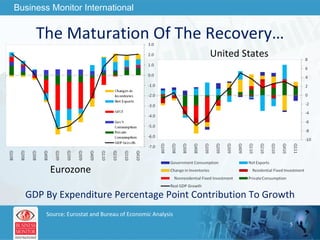
The Maturation Of The Recovery… Eurozone Source: Eurostat and Bureau of Economic Analysis  United States GDP By Expenditure Percentage Point Contribution To Growth
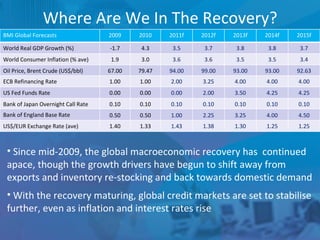
This can be your title page Where Are We In The Recovery? Since mid-2009, the global macroeconomic recovery has  continued apace, though the growth drivers have begun to shift away from exports and inventory re-stocking and back towards domestic demand With the recovery maturing, global credit markets are set to stabilise further, even as inflation and interest rates rise BMI Global Forecasts 2009 2010 2011f 2012f 2013f 2014f 2015f World Real GDP Growth (%) -1.7 4.3 3.5 3.7 3.8 3.8 3.7 World Consumer Inflation (% ave) 1.9 3.0 3.6 3.6 3.5 3.5 3.4 Oil Price, Brent Crude (US$/bbl) 67.00 79.47 94.00 99.00 93.00 93.00 92.63 ECB Refinancing Rate 1.00 1.00 2.00 3.25 4.00 4.00 4.00 US Fed Funds Rate 0.00 0.00 0.00 2.00 3.50 4.25 4.25 Bank of Japan Overnight Call Rate 0.10 0.10 0.10 0.10 0.10 0.10 0.10 Bank of England Base Rate 0.50 0.50 1.00 2.25 3.25 4.00 4.50 US$/EUR Exchange Rate (ave) 1.40 1.33 1.43 1.38 1.30 1.25 1.25
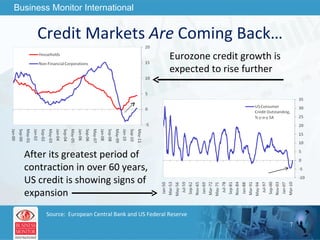
Credit Markets  Are  Coming Back… Eurozone credit growth is expected to rise further After its greatest period of contraction in over 60 years, US credit is showing signs of  expansion Source:  European Central Bank and US Federal Reserve
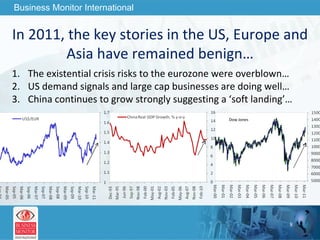
In 2011, the key stories in the US, Europe and Asia have remained benign… The existential crisis risks to the eurozone were overblown… US demand signals and large cap businesses are doing well… China continues to grow strongly suggesting a ‘soft landing’… Dow Jones
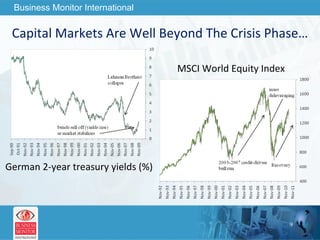
Capital Markets Are Well Beyond The Crisis Phase… German 2-year treasury yields (%) MSCI World Equity Index
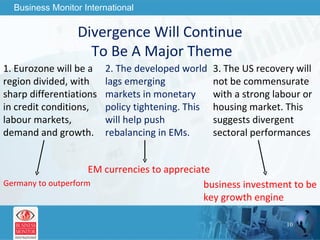
Divergence Will Continue To Be A Major Theme 2. The developed world lags emerging markets in monetary policy tightening. This will help push rebalancing in EMs. 3. The US recovery will not be commensurate with a strong labour or housing market. This suggests divergent sectoral performances 1. Eurozone will be a region divided, with sharp differentiations in credit conditions, labour markets, demand and growth. Germany to outperform EM currencies to appreciate business investment to be key growth engine
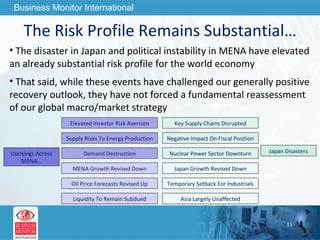
The Risk Profile Remains Substantial… The disaster in Japan and political instability in MENA have elevated an already substantial risk profile for the world economy That said, while these events have challenged our generally positive recovery outlook, they have not forced a fundamental reassessment of our global macro/market strategy Uprisings Across MENA… Elevated Investor Risk Aversion Supply Risks To Energy Production Demand Destruction MENA Growth Revised Down Oil Price Forecasts Revised Up Liquidity To Remain Subdued Japan Disasters Key Supply Chains Disrupted Negative Impact On Fiscal Position Nuclear Power Sector Downturn Japan Growth Revised Down Temporary Setback For Industrials Asia Largely Unaffected
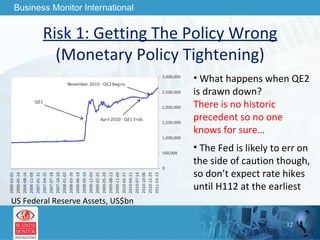
Risk 1: Getting The Policy Wrong  (Monetary Policy Tightening) What happens when QE2 is drawn down?  There is no historic precedent so no one knows for sure… The Fed is likely to err on the side of caution though, so don’t expect rate hikes until H112 at the earliest US Federal Reserve Assets, US$bn
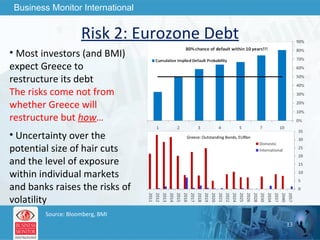
Risk 2: Eurozone Debt Most investors (and BMI) expect Greece to restructure its debt The risks come not from whether Greece will restructure but  how … Uncertainty over the potential size of hair cuts and the level of exposure within individual markets and banks raises the risks of volatility Source: Bloomberg, BMI Greece: Outstanding Bonds, EURbn
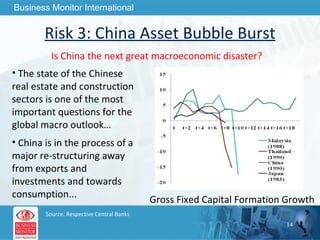
Risk 3: China Asset Bubble Burst Is China the next great macroeconomic disaster? The state of the Chinese real estate and construction sectors is one of the most important questions for the global macro outlook… China is in the process of a major re-structuring away from exports and investments and towards consumption... Gross Fixed Capital Formation Growth Source: Respective Central Banks
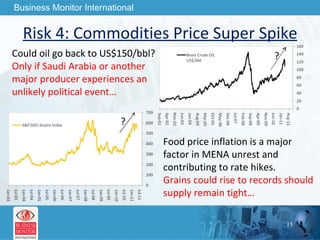
Risk 4: Commodities Price Super Spike Could oil go back to US$150/bbl?  Only if Saudi Arabia or another major producer experiences an unlikely political event… Food price inflation is a major factor in MENA unrest and contributing to rate hikes. Grains could rise to records should supply remain tight…   ? ?
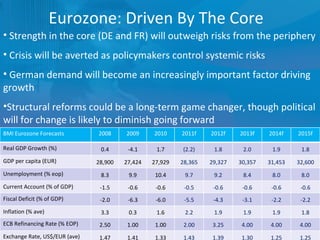
This can be your title page Eurozone: Driven By The Core  Strength in the core (DE and FR) will outweigh risks from the periphery  Crisis will be averted as policymakers control systemic risks German demand will become an increasingly important factor driving growth Structural reforms could be a long-term game changer, though political will for change is likely to diminish going forward BMI Eurozone Forecasts 2008 2009 2010 2011f 2012f 2013f 2014f 2015f Real GDP Growth (%) 0.4 -4.1 1.7 (2.2) 1.8 2.0 1.9 1.8 GDP per capita (EUR) 28,900 27,424 27,929 28,365 29,327 30,357 31,453 32,600 Unemployment (% eop) 8.3 9.9 10.4 9.7 9.2 8.4 8.0 8.0 Current Account (% of GDP) -1.5 -0.6 -0.6 -0.5 -0.6 -0.6 -0.6 -0.6 Fiscal Deficit (% of GDP) -2.0 -6.3 -6.0 -5.5 -4.3 -3.1 -2.2 -2.2 Inflation (% ave) 3.3 0.3 1.6 2.2 1.9 1.9 1.9 1.8 ECB Refinancing Rate (% EOP) 2.50 1.00 1.00 2.00 3.25 4.00 4.00 4.00 Exchange Rate, US$/EUR (ave) 1.47 1.41 1.33 1.43 1.39 1.30 1.25 1.25
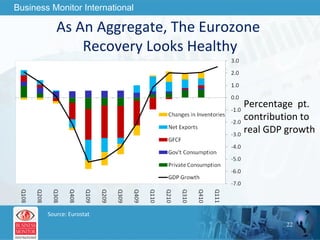
The Risk Dynamics Have Shifted Significantly Since 2010… An aggressive policy response has calmed investors and re-established stability to capital markets. The expectations that a eurozone break up is possible have fallen dramatically. Robust German (and to an extent French) growth has confirmed that the core will be resilient to the debt crises in Greece, Ireland and Portugal.  As an aggregate, the eurozone looks healthy . Spain and Italy are  not  crisis states, diminishing the usefulness of the ‘PIIGS’ moniker
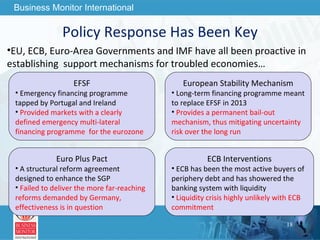
EU, ECB, Euro-Area Governments and IMF have all been proactive in establishing  support mechanisms for troubled economies… Policy Response Has Been Key EFSF Emergency financing programme tapped by Portugal and Ireland Provided markets with a clearly defined emergency multi-lateral financing programme  for the eurozone European Stability Mechanism Long-term financing programme meant to replace EFSF in 2013 Provides a permanent bail-out mechanism, thus mitigating uncertainty risk over the long run Euro Plus Pact A structural reform agreement designed to enhance the SGP Failed to deliver the more far-reaching reforms demanded by Germany, effectiveness is in question ECB Interventions ECB has been the most active buyers of periphery debt and has showered the banking system with liquidity Liquidity crisis highly unlikely with ECB commitment
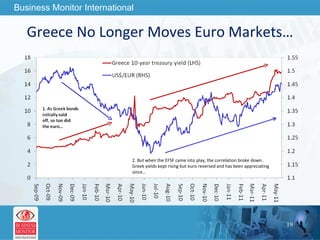
2. But when the EFSF came into play, the correlation broke down . Greek yields kept rising but euro reversed and has been appreciating since… Greece No Longer Moves Euro Markets…
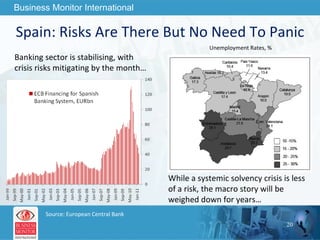
Spain: Risks Are There But No Need To Panic Source: European Central Bank Banking sector is stabilising, with crisis risks mitigating by the month… While a systemic solvency crisis is less of a risk, the macro story will be weighed down for years… Unemployment Rates, %
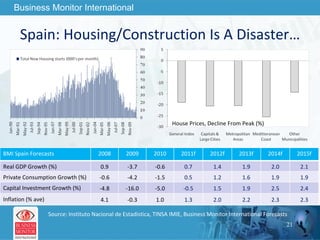
Spain: Housing/Construction Is A Disaster… Source: Instituto Nacional de Estadistica, TINSA IMIE, Business Monitor International Forecasts House Prices, Decline From Peak (%) BMI Spain Forecasts 2008 2009 2010 2011f 2012f 2013f 2014f 2015f Real GDP Growth (%) 0.9 -3.7 -0.6 0.7 1.4 1.9 2.0 2.1 Private Consumption Growth (%) -0.6 -4.2 -1.5 0.5 1.2 1.6 1.9 1.9 Capital Investment Growth (%) -4.8 -16.0 -5.0 -0.5 1.5 1.9 2.5 2.4 Inflation (% ave) 4.1 -0.3 1.0 1.3 2.0 2.2 2.3 2.3
As An Aggregate, The Eurozone  Recovery Looks Healthy Source: Eurostat Percentage  pt. contribution to real GDP growth
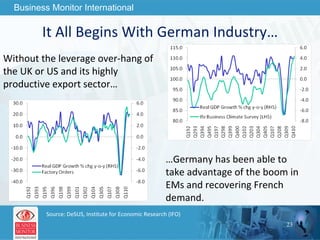
It All Begins With German Industry… Without the leverage over-hang of the UK or US and its highly productive export sector… … Germany has been able to take advantage of the boom in EMs and recovering French demand.  Source: DeSUS, Institute for Economic Research (IFO)
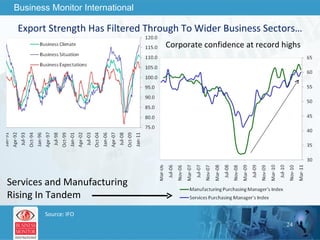
Export Strength Has Filtered Through To Wider Business Sectors… Source: IFO Services and Manufacturing Rising In Tandem Corporate confidence at record highs
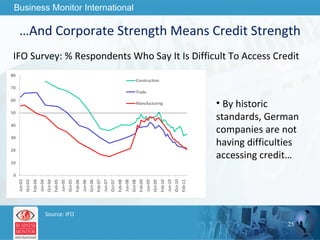
… And Corporate Strength Means Credit Strength IFO Survey: % Respondents Who Say It Is Difficult To Access Credit By historic standards, German companies are not having difficulties accessing credit… Source: IFO
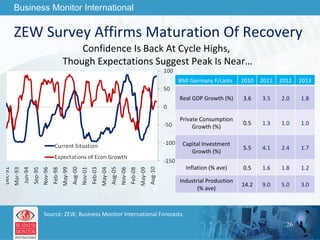
ZEW Survey Affirms Maturation Of Recovery  Confidence Is Back At Cycle Highs,  Though Expectations Suggest Peak Is Near… Source: ZEW, Business Monitor International Forecasts BMI Germany F/casts 2010 2011 2012 2013 Real GDP Growth (%) 3.6 3.5 2.0 1.8 Private Consumption Growth (%) 0.5 1.3 1.0 1.0 Capital Investment Growth (%) 5.5 4.1 2.4 1.7 Inflation (% ave) 0.5 1.6 1.8 1.2 Industrial Production (% ave) 14.2 9.0 5.0 3.0
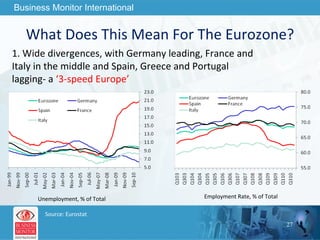
What Does This Mean For The Eurozone? 1. Wide divergences, with Germany leading, France and Italy in the middle and Spain, Greece and Portugal lagging- a  ‘3-speed Europe’ Unemployment, % of Total Source: Eurostat Employment Rate, % of Total
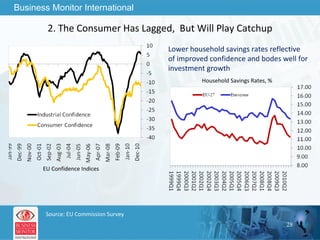
2. The Consumer Has Lagged,  But Will Play Catchup Source: EU Commission Survey Household Savings Rates, % EU Confidence Indices Lower household savings rates reflective of improved confidence and bodes well for investment growth
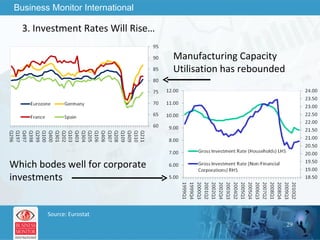
3. Investment Rates Will Rise… Manufacturing Capacity Utilisation has rebounded Which bodes well for corporate investments Source: Eurostat
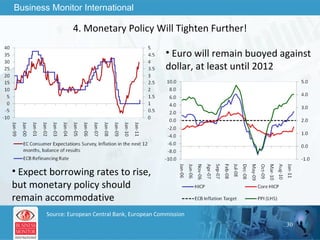
4. Monetary Policy Will Tighten Further! Source: European Central Bank, European Commission Euro will remain buoyed against dollar, at least until 2012 Expect borrowing rates to rise, but monetary policy should remain accommodative
Western Europe:  What A ‘3-Speed’ Eurozone Means For Strategy  On the whole, European capital markets will remain stable, contributing to the broader global recovery. Germany, the Nordic States and Central Europe will continue to lead in growth and demand terms. While the peripheral economies of Portugal, Greece, Ireland and Spain will continue to post weak growth over the medium term, they will benefit from core strength.  The euro will not collapse, equities should rise further and bond yields will go up.
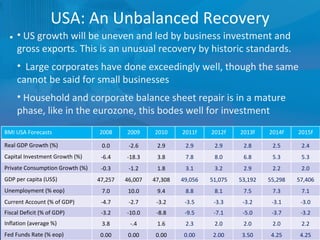
This can be your title page USA: An Unbalanced Recovery US growth will be uneven and led by business investment and gross exports. This is an unusual recovery by historic standards. Large corporates have done exceedingly well, though the same cannot be said for small businesses Household and corporate balance sheet repair is in a mature phase, like in the eurozone, this bodes well for investment BMI USA Forecasts 2008 2009 2010 2011f 2012f 2013f 2014f 2015f Real GDP Growth (%) 0.0 -2.6 2.9 2.9 2.9 2.8 2.5 2.4 Capital Investment Growth (%) -6.4 -18.3 3.8 7.8 8.0 6.8 5.3 5.3 Private Consumption Growth (%) -0.3 -1.2 1.8 3.1 3.2 2.9 2.2 2.0 GDP per capita (US$) 47,257 46,007 47,308 49,056 51,075 53,192 55,298 57,406 Unemployment (% eop) 7.0 10.0 9.4 8.8 8.1 7.5 7.3 7.1 Current Account (% of GDP) -4.7 -2.7 -3.2 -3.5 -3.3 -3.2 -3.1 -3.0 Fiscal Deficit (% of GDP) -3.2 -10.0 -8.8 -9.5 -7.1 -5.0 -3.7 -3.2 Inflation (average %) 3.8 -.4 1.6 2.3 2.0 2.0 2.0 2.2 Fed Funds Rate (% eop) 0.00 0.00 0.00 0.00 2.00 3.50 4.25 4.25
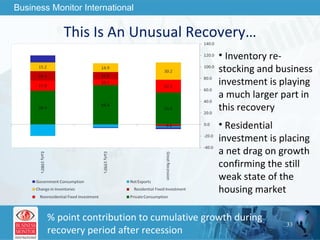
This Is An Unusual Recovery… Inventory re-stocking and business investment is playing a much larger part in this recovery Residential investment is placing a net drag on growth confirming the still weak state of the housing market % point contribution to cumulative growth during recovery period after recession
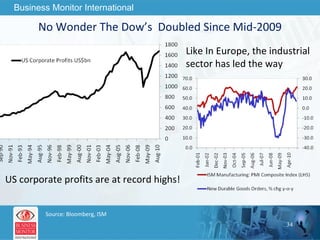
No Wonder The Dow’s  Doubled Since Mid-2009 US corporate profits are at record highs! Like In Europe, the industrial sector has led the way Source: Bloomberg, ISM
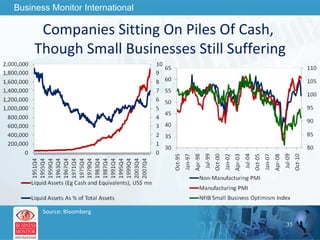
Companies Sitting On Piles Of Cash,  Though Small Businesses Still Suffering Source: Bloomberg
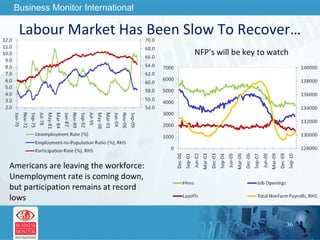
Labour Market Has Been Slow To Recover… Americans are leaving the workforce: Unemployment rate is coming down, but participation remains at record lows NFP’s will be key to watch
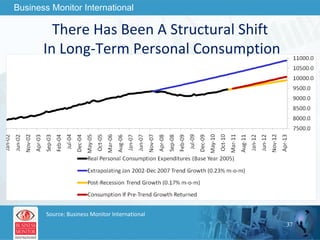
There Has Been A Structural Shift In Long-Term Personal Consumption Source: Business Monitor International
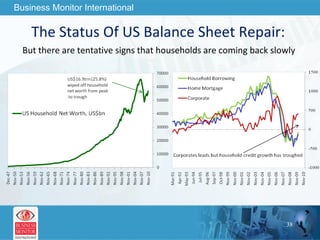
The Status Of US Balance Sheet Repair:  But there are tentative signs that households are coming back slowly
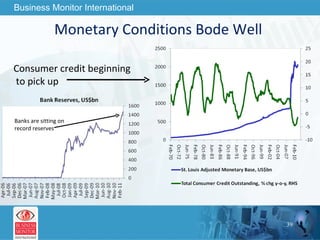
Monetary Conditions Bode Well  Banks are sitting on record reserves Consumer credit beginning to pick up
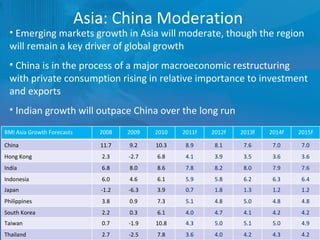
This can be your title page Asia: China Moderation  Emerging markets growth in Asia will moderate, though the region will remain a key driver of global growth China is in the process of a major macroeconomic restructuring with private consumption rising in relative importance to investment and exports Indian growth will outpace China over the long run BMI Asia Growth Forecasts 2008 2009 2010 2011f 2012f 2013f 2014f 2015f China 11.7 9.2 10.3 8.9 8.1 7.6 7.0 7.0 Hong Kong 2.3 -2.7 6.8 4.1 3.9 3.5 3.6 3.6 India 6.8 8.0 8.6 7.8 8.2 8.0 7.9 7.6 Indonesia 6.0 4.6 6.1 5.9 5.8 6.2 6.3 6.4 Japan -1.2 -6.3 3.9 0.7 1.8 1.3 1.2 1.2 Philippines 3.8 0.9 7.3 5.1 4.8 5.0 4.8 4.8 South Korea 2.2 0.3 6.1 4.0 4.7 4.1 4.2 4.2 Taiwan 0.7 -1.9 10.8 4.3 5.0 5.1 5.0 4.9 Thailand 2.7 -2.5 7.8 3.6 4.0 4.2 4.3 4.2
This can be your title page II. CEEMEA Strategy
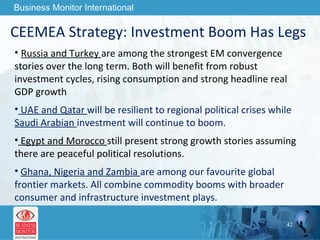
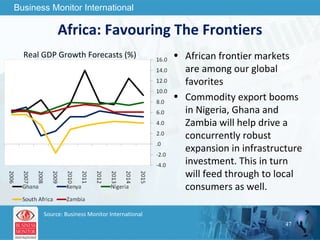
CEEMEA Strategy: Investment Boom Has Legs  Russia and Turkey  are among the strongest EM convergence stories over the long term. Both will benefit from robust investment cycles, rising consumption and strong headline real GDP growth UAE and Qatar  will be resilient to regional political crises while  Saudi Arabian  investment will continue to boom.  Egypt and Morocco  still present strong growth stories assuming there are peaceful political resolutions. Ghana, Nigeria and Zambia  are among our favourite global frontier markets. All combine commodity booms with broader consumer and infrastructure investment plays.
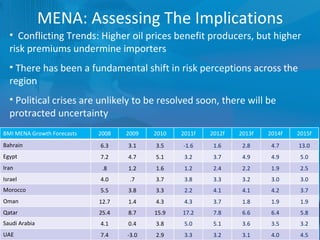
This can be your title page MENA: Assessing The Implications Conflicting Trends: Higher oil prices benefit producers, but higher risk premiums undermine importers There has been a fundamental shift in risk perceptions across the region Political crises are unlikely to be resolved soon, there will be protracted uncertainty BMI MENA Growth Forecasts 2008 2009 2010 2011f 2012f 2013f 2014f 2015f Bahrain 6.3 3.1 3.5 -1.6 1.6 2.8 4.7 13.0 Egypt 7.2 4.7 5.1 3.2 3.7 4.9 4.9 5.0 Iran .8 1.2 1.6 1.2 2.4 2.2 1.9 2.5 Israel 4.0 .7 3.7 3.8 3.3 3.2 3.0 3.0 Morocco 5.5 3.8 3.3 2.2 4.1 4.1 4.2 3.7 Oman 12.7 1.4 4.3 4.3 3.7 1.8 1.9 1.9 Qatar 25.4 8.7 15.9 17.2 7.8 6.6 6.4 5.8 Saudi Arabia 4.1 0.4 3.8 5.0 5.1 3.6 3.5 3.2 UAE 7.4 -3.0 2.9 3.3 3.2 3.1 4.0 4.5
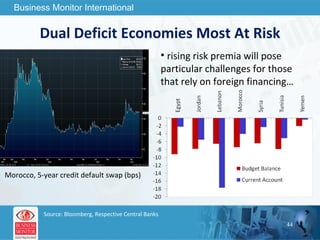
Dual Deficit Economies Most At Risk Morocco, 5-year credit default swap (bps) rising risk premia will pose particular challenges for those that rely on foreign financing… Source: Bloomberg, Respective Central Banks
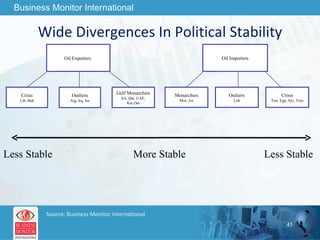
Oil Exporters  Oil Importers Crisis Lib, Bah Outliers Alg, Irq, Irn Gulf Monarchies SA, Qat, UAE, Kw,Om Monarchies Mor, Jor Outliers Leb Crisis Tun, Egp, Syr, Yem More Stable Less Stable Less Stable Wide Divergences In Political Stability Source: Business Monitor International
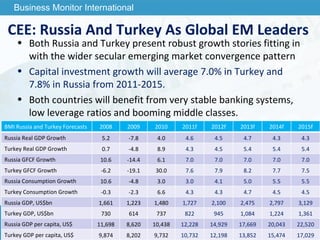
CEE: Russia And Turkey As Global EM Leaders  Both Russia and Turkey present robust growth stories fitting in with the wider secular emerging market convergence pattern Capital investment growth will average 7.0% in Turkey and 7.8% in Russia from 2011-2015. Both countries will benefit from very stable banking systems, low leverage ratios and booming middle classes.  BMI Russia and Turkey Forecasts 2008 2009 2010 2011f 2012f 2013f 2014f 2015f Russia Real GDP Growth 5.2 -7.8 4.0 4.6 4.5 4.7 4.3 4.3 Turkey Real GDP Growth 0.7 -4.8 8.9 4.3 4.5 5.4 5.4 5.4 Russia GFCF Growth 10.6 -14.4 6.1 7.0 7.0 7.0 7.0 7.0 Turkey GFCF Growth -6.2 -19.1 30.0 7.6 7.9 8.2 7.7 7.5 Russia Consumption Growth 10.6 -4.8 3.0 3.0 4.1 5.0 5.5 5.5 Turkey Consumption Growth -0.3 -2.3 6.6 4.3 4.3 4.7 4.5 4.5 Russia GDP, US$bn 1,661 1,223 1,480 1,727 2,100 2,475 2,797 3,129 Turkey GDP, US$bn 730 614 737 822 945 1,084 1,224 1,361 Russia GDP per capita, US$ 11,698 8,620 10,438 12,228 14,929 17,669 20,043 22,520 Turkey GDP per capita, US$ 9,874 8,202 9,732 10,732 12,198 13,852 15,474 17,029
Africa: Favouring The Frontiers African frontier markets are among our global favorites Commodity export booms in Nigeria, Ghana and Zambia will help drive a concurrently robust expansion in infrastructure investment. This in turn will feed through to local consumers as well. Real GDP Growth Forecasts (%) Source: Business Monitor International
This can be your title page III. Conclusion & Appendix
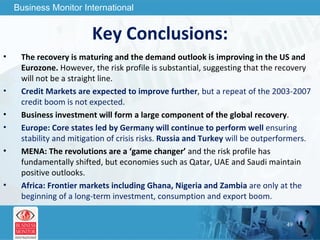
Key Conclusions: The recovery is maturing and the demand outlook is improving in the US and Eurozone.  However, the risk profile is substantial, suggesting that the recovery will not be a straight line. Credit Markets are expected to improve further , but a repeat of the 2003-2007 credit boom is not expected. Business investment will form a large component of the global recovery . Europe: Core states led by Germany will continue to perform well  ensuring stability and mitigation of crisis risks.  Russia and Turkey  will be outperformers. MENA: The revolutions are a ‘game changer’  and the risk profile has fundamentally shifted, but economies such as Qatar, UAE and Saudi maintain positive outlooks. Africa: Frontier markets including Ghana, Nigeria and Zambia  are only at the beginning of a long-term investment, consumption and export boom.
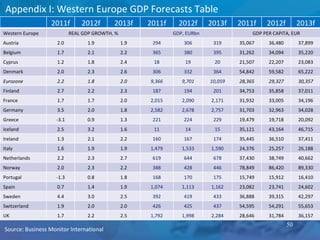
This can be your title page Appendix I: Western Europe GDP Forecasts Table Source: Business Monitor International 2011f 2012f 2013f 2011f 2012f 2013f 2011f 2012f 2013f Western Europe REAL GDP GROWTH, % GDP, EURbn GDP PER CAPITA, EUR Austria 2.0 1.9 1.9 294 306 319 35,067 36,480 37,899 Belgium 1.7 2.1 2.2 365 380 395 31,262 34,094 35,220 Cyprus 1.2 1.8 2.4 18 19 20 21,507 22,207 23,083 Denmark 2.0 2.3 2.6 306 332 364 54,842 59,582 65,222 Eurozone 2.2 1.8 2.0 9,366 9,701 10,059 28,365 29,327 30,357 Finland 2.7 2.2 2.3 187 194 201 34,753 35,858 37,011 France 1.7 1.7 2.0 2,015 2,090 2,171 31,932 33,005 34,196 Germany 3.5 2.0 1.8 2,582 2,678 2,757 31,703 32,963 34,028 Greece -3.1 0.9 1.3 221 224 229 19,479 19,718 20,092 Iceland 2.5 3.2 1.6 11 14 15 35,121 43,164 46,715 Ireland 1.3 2.1 2.2 160 167 174 35,445 36,510 37,411 Italy 1.6 1.9 1.9 1,479 1,533 1,590 24,376 25,257 26,188 Netherlands 2.2 2.3 2.7 619 644 678 37,430 38,749 40,662 Norway 2.0 2.3 2.2 388 428 446 78,849 86,420 89,330 Portugal -1.3 0.8 1.8 168 170 175 15,749 15,912 16,410 Spain 0.7 1.4 1.9 1,074 1,113 1,162 23,082 23,741 24,602 Sweden 4.4 3.0 2.5 392 419 433 36,888 39,315 42,297 Switzerland 1.9 2.0 2.0 426 425 437 54,595 54,291 55,653 UK 1.7 2.2 2.5 1,792 1,998 2,284 28,646 31,784 36,157
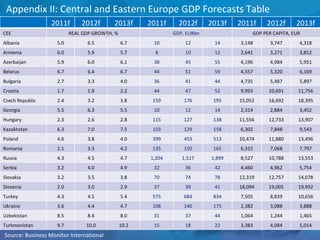
This can be your title page Appendix II: Central and Eastern Europe GDP Forecasts Table Source: Business Monitor International 2011f 2012f 2013f 2011f 2012f 2013f 2011f 2012f 2013f CEE REAL GDP GROWTH, % GDP, EURbn GDP PER CAPITA, EUR Albania 5.0 6.5 6.7 10 12 14 3,148 3,747 4,318 Armenia 6.0 5.9 5.7 8 10 12 2,641 3,271 3,812 Azerbaijan 5.9 6.0 6.1 38 45 55 4,196 4,984 5,951 Belarus 6.7 6.4 6.7 44 51 59 4,557 5,320 6,169 Bulgaria 2.7 3.3 4.0 36 41 44 4,735 5,487 5,897 Croatia 1.7 1.9 2.2 44 47 52 9,993 10,691 11,756 Czech Republic 2.4 3.2 3.8 159 176 195 15,052 16,692 18,395 Georgia 5.5 6.3 5.5 10 12 14 2,314 2,884 3,452 Hungary 2.3 2.6 2.8 115 127 138 11,556 12,733 13,907 Kazakhstan 6.3 7.0 7.5 103 129 158 6,302 7,848 9,543 Poland 4.6 3.8 4.0 399 453 513 10,474 11,880 13,496 Romania 2.1 3.3 4.2 135 150 165 6,315 7,068 7,797 Russia 4.3 4.5 4.7 1,204 1,517 1,899 8,527 10,788 13,553 Serbia 3.2 4.0 4.9 32 36 42 4,460 4,962 5,754 Slovakia 3.2 3.5 3.8 70 74 78 12,319 12,757 14,078 Slovenia 2.0 3.0 2.9 37 39 41 18,094 19,005 19,992 Turkey 4.3 4.5 5.4 575 684 834 7,505 8,839 10,656 Ukraine 3.6 4.4 4.7 108 140 175 2,382 3,088 3,888 Uzbekistan 8.5 8.4 8.0 31 37 44 1,064 1,244 1,465 Turkmenistan 9.7 10.0 10.2 15 18 22 3,383 4,084 5,014
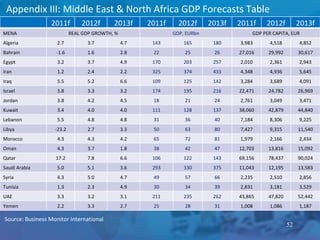
This can be your title page Appendix III: Middle East & North Africa GDP Forecasts Table Source: Business Monitor International 2011f 2012f 2013f 2011f 2012f 2013f 2011f 2012f 2013f MENA REAL GDP GROWTH, % GDP, EURbn GDP PER CAPITA, EUR Algeria 2.7 3.7 4.7 143 165 180 3,983 4,518 4,852 Bahrain -1.6 1.6 2.8 22 25 26 27,016 29,992 30,617 Egypt 3.2 3.7 4.9 170 203 257 2,010 2,361 2,943 Iran 1.2 2.4 2.2 325 374 433 4,348 4,936 5,645 Iraq 5.5 5.2 6.6 109 125 142 3,284 3,689 4,091 Israel 3.8 3.3 3.2 174 195 216 22,471 24,782 26,969 Jordan 3.8 4.2 4.5 18 21 24 2,761 3,049 3,471 Kuwait 3.4 4.0 4.0 111 128 137 38,060 42,879 44,840 Lebanon 5.5 4.8 4.8 31 36 40 7,184 8,306 9,225 Libya -23.2 2.7 3.3 50 63 80 7,427 9,315 11,540 Morocco 4.3 4.3 4.2 65 72 81 1,979 2,166 2,434 Oman 4.3 3.7 1.8 38 42 47 12,703 13,816 15,092 Qatar 17.2 7.8 6.6 106 122 143 69,156 78,437 90,024 Saudi Arabia 5.0 5.1 3.6 293 330 375 11,043 12,195 13,583 Syria 4.3 5.0 4.7 49 57 66 2,235 2,510 2,856 Tunisia 1.3 2.3 4.9 30 34 39 2,831 3,181 3,529 UAE 3.3 3.2 3.1 211 235 262 43,865 47,820 52,442 Yemen 2.2 3.3 2.7 25 28 31 1,008 1,086 1,187
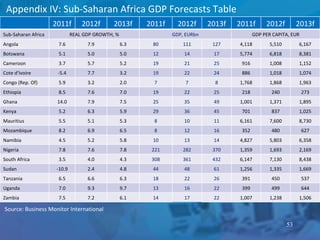
This can be your title page Appendix IV: Sub-Saharan Africa GDP Forecasts Table Source: Business Monitor International 2011f 2012f 2013f 2011f 2012f 2013f 2011f 2012f 2013f Sub-Saharan Africa REAL GDP GROWTH, % GDP, EURbn GDP PER CAPITA, EUR Angola 7.6 7.9 6.3 80 111 127 4,118 5,510 6,167 Botswana 5.1 5.0 5.0 12 14 17 5,774 6,818 8,381 Cameroon 3.7 5.7 5.2 19 21 25 916 1,008 1,152 Cote d’Ivoire -5.4 7.7 3.2 19 22 24 886 1,018 1,074 Congo (Rep. Of) 5.9 3.2 2.0 7 7 8 1,768 1,868 1,963 Ethiopia 8.5 7.6 7.0 19 22 25 218 240 273 Ghana 14.0 7.9 7.5 25 35 49 1,001 1,371 1,895 Kenya 5.2 6.3 5.9 29 36 45 701 837 1,025 Mauritius 5.5 5.1 5.3 8 10 11 6,161 7,600 8,730 Mozambique 8.2 6.9 6.5 8 12 16 352 480 627 Namibia 4.5 5.2 5.8 10 13 14 4,827 5,803 6,358 Nigeria 7.8 7.6 7.8 221 282 370 1,359 1,693 2,169 South Africa 3.5 4.0 4.3 308 361 432 6,147 7,130 8,438 Sudan -10.9 2.4 4.8 44 48 61 1,256 1,335 1,669 Tanzania 6.5 6.6 6.3 18 22 26 391 450 537 Uganda 7.0 9.3 9.7 13 16 22 399 499 644 Zambia 7.5 7.2 6.1 14 17 22 1,007 1,238 1,506
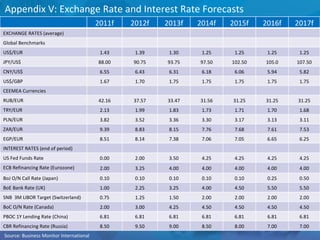
This can be your title page Appendix V: Exchange Rate and Interest Rate Forecasts Source: Business Monitor International 2011f 2012f 2013f 2014f 2015f 2016f 2017f EXCHANGE RATES (average) Global Benchmarks  US$/EUR 1.43 1.39 1.30 1.25 1.25 1.25 1.25 JPY/US$ 88.00 90.75 93.75 97.50 102.50 105.0 107.50 CNY/US$ 6.55 6.43 6.31 6.18 6.06 5.94 5.82 US$/GBP 1.67 1.70 1.75 1.75 1.75 1.75 1.75 CEEMEA Currencies RUB/EUR 42.16 37.57 33.47 31.56 31.25 31.25 31.25 TRY/EUR 2.13 1.99 1.83 1.73 1.71 1.70 1.68 PLN/EUR 3.82 3.52 3.36 3.30 3.17 3.13 3.11 ZAR/EUR 9.39 8.83 8.15 7.76 7.68 7.61 7.53 EGP/EUR 8.51 8.14 7.38 7.06 7.05 6.65 6.25 INTEREST RATES (end of period) US Fed Funds Rate 0.00 2.00 3.50 4.25 4.25 4.25 4.25 ECB Refinancing Rate (Eurozone) 2.00 3.25 4.00 4.00 4.00 4.00 4.00 BoJ O/N Call Rate (Japan) 0.10 0.10 0.10 0.10 0.10 0.25 0.50 BoE Bank Rate (UK) 1.00 2.25 3.25 4.00 4.50 5.50 5.50 SNB  3M LIBOR Target (Switzerland) 0.75 1.25 1.50 2.00 2.00 2.00 2.00 BoC O/N Rate (Canada) 2.00 3.00 4.25 4.50 4.50 4.50 4.50 PBOC 1Y Lending Rate (China) 6.81 6.81 6.81 6.81 6.81 6.81 6.81 CBR Refinancing Rate (Russia) 8.50 9.50 9.00 8.50 8.00 7.00 7.00
Business Monitor International Business Monitor International  is a leading provider of global country risk, industry and financial markets analysis, strategy, data and forecasts For over 25 years,  BMI   has served clients spanning over  140 countries , including   more than 400 of the Global Fortune 500 companies Our corporate mission is  to  integrate Country Risk/Financial Markets analysis  with  Industry/Company Research  to best inform strategic decision-making for multinational companies, financial institutions, multilaterals and government BMI  is an independent company with offices in  London ,  New York, Singapore ,   and  Tshanwe (South Africa)
This can be your title page Thank You Business Monitor International [email_address]

Where Next For The World Economy

  • 1.
    Where Next forthe World Economy? Strategies, Risks and Scenarios for the Recovery (2011-2015) Justin Patrie, Head of Country Risk & Financial Markets Business Monitor International
  • 2.
    Outline Global OutlookEurope: 3-Speed Eurozone Takes Shape USA: An Imbalanced Recovery Asia: Growth To Moderate CEEMEA Strategy MENA: Implications of the ‘Arab Spring’ CEE: From Crisis To Growth Africa: Commodities, Consumers and Investment Key Conclusions & Appendix Tables
  • 3.
    Global Outlook: WorldOn The Mend The global recovery will mature further through 2011/2012, underpinning stability in credit markets Companies have cash, the labour market will improve further and banks are willing to lend. This bodes well for investments and a slow but steady improvement in credit growth. That said, rising commodity prices, Europe’s debt profile, slowdowns in Asia, interest rate hikes, political instability and weak US household consumption all contribute to a substantial risk profile This will not be a repeat of 2003-2007. Credit dynamics and investor risk appetite will not replicate the pre-crisis period. Divergence will be a key global theme. Performance in Europe will be divided between the core and periphery; US growth will be uneven, led by business investment; key emerging markets are in the process of structural shifts
  • 4.
    This can beyour title page I. Global Outlook
  • 5.
    The Maturation OfThe Recovery… Eurozone Source: Eurostat and Bureau of Economic Analysis United States GDP By Expenditure Percentage Point Contribution To Growth
  • 6.
    This can beyour title page Where Are We In The Recovery? Since mid-2009, the global macroeconomic recovery has continued apace, though the growth drivers have begun to shift away from exports and inventory re-stocking and back towards domestic demand With the recovery maturing, global credit markets are set to stabilise further, even as inflation and interest rates rise BMI Global Forecasts 2009 2010 2011f 2012f 2013f 2014f 2015f World Real GDP Growth (%) -1.7 4.3 3.5 3.7 3.8 3.8 3.7 World Consumer Inflation (% ave) 1.9 3.0 3.6 3.6 3.5 3.5 3.4 Oil Price, Brent Crude (US$/bbl) 67.00 79.47 94.00 99.00 93.00 93.00 92.63 ECB Refinancing Rate 1.00 1.00 2.00 3.25 4.00 4.00 4.00 US Fed Funds Rate 0.00 0.00 0.00 2.00 3.50 4.25 4.25 Bank of Japan Overnight Call Rate 0.10 0.10 0.10 0.10 0.10 0.10 0.10 Bank of England Base Rate 0.50 0.50 1.00 2.25 3.25 4.00 4.50 US$/EUR Exchange Rate (ave) 1.40 1.33 1.43 1.38 1.30 1.25 1.25
  • 7.
    Credit Markets Are Coming Back… Eurozone credit growth is expected to rise further After its greatest period of contraction in over 60 years, US credit is showing signs of expansion Source: European Central Bank and US Federal Reserve
  • 8.
    In 2011, thekey stories in the US, Europe and Asia have remained benign… The existential crisis risks to the eurozone were overblown… US demand signals and large cap businesses are doing well… China continues to grow strongly suggesting a ‘soft landing’… Dow Jones
  • 9.
    Capital Markets AreWell Beyond The Crisis Phase… German 2-year treasury yields (%) MSCI World Equity Index
  • 10.
    Divergence Will ContinueTo Be A Major Theme 2. The developed world lags emerging markets in monetary policy tightening. This will help push rebalancing in EMs. 3. The US recovery will not be commensurate with a strong labour or housing market. This suggests divergent sectoral performances 1. Eurozone will be a region divided, with sharp differentiations in credit conditions, labour markets, demand and growth. Germany to outperform EM currencies to appreciate business investment to be key growth engine
  • 11.
    The Risk ProfileRemains Substantial… The disaster in Japan and political instability in MENA have elevated an already substantial risk profile for the world economy That said, while these events have challenged our generally positive recovery outlook, they have not forced a fundamental reassessment of our global macro/market strategy Uprisings Across MENA… Elevated Investor Risk Aversion Supply Risks To Energy Production Demand Destruction MENA Growth Revised Down Oil Price Forecasts Revised Up Liquidity To Remain Subdued Japan Disasters Key Supply Chains Disrupted Negative Impact On Fiscal Position Nuclear Power Sector Downturn Japan Growth Revised Down Temporary Setback For Industrials Asia Largely Unaffected
  • 12.
    Risk 1: GettingThe Policy Wrong (Monetary Policy Tightening) What happens when QE2 is drawn down? There is no historic precedent so no one knows for sure… The Fed is likely to err on the side of caution though, so don’t expect rate hikes until H112 at the earliest US Federal Reserve Assets, US$bn
  • 13.
    Risk 2: EurozoneDebt Most investors (and BMI) expect Greece to restructure its debt The risks come not from whether Greece will restructure but how … Uncertainty over the potential size of hair cuts and the level of exposure within individual markets and banks raises the risks of volatility Source: Bloomberg, BMI Greece: Outstanding Bonds, EURbn
  • 14.
    Risk 3: ChinaAsset Bubble Burst Is China the next great macroeconomic disaster? The state of the Chinese real estate and construction sectors is one of the most important questions for the global macro outlook… China is in the process of a major re-structuring away from exports and investments and towards consumption... Gross Fixed Capital Formation Growth Source: Respective Central Banks
  • 15.
    Risk 4: CommoditiesPrice Super Spike Could oil go back to US$150/bbl? Only if Saudi Arabia or another major producer experiences an unlikely political event… Food price inflation is a major factor in MENA unrest and contributing to rate hikes. Grains could rise to records should supply remain tight… ? ?
  • 16.
    This can beyour title page Eurozone: Driven By The Core Strength in the core (DE and FR) will outweigh risks from the periphery Crisis will be averted as policymakers control systemic risks German demand will become an increasingly important factor driving growth Structural reforms could be a long-term game changer, though political will for change is likely to diminish going forward BMI Eurozone Forecasts 2008 2009 2010 2011f 2012f 2013f 2014f 2015f Real GDP Growth (%) 0.4 -4.1 1.7 (2.2) 1.8 2.0 1.9 1.8 GDP per capita (EUR) 28,900 27,424 27,929 28,365 29,327 30,357 31,453 32,600 Unemployment (% eop) 8.3 9.9 10.4 9.7 9.2 8.4 8.0 8.0 Current Account (% of GDP) -1.5 -0.6 -0.6 -0.5 -0.6 -0.6 -0.6 -0.6 Fiscal Deficit (% of GDP) -2.0 -6.3 -6.0 -5.5 -4.3 -3.1 -2.2 -2.2 Inflation (% ave) 3.3 0.3 1.6 2.2 1.9 1.9 1.9 1.8 ECB Refinancing Rate (% EOP) 2.50 1.00 1.00 2.00 3.25 4.00 4.00 4.00 Exchange Rate, US$/EUR (ave) 1.47 1.41 1.33 1.43 1.39 1.30 1.25 1.25
  • 17.
    The Risk DynamicsHave Shifted Significantly Since 2010… An aggressive policy response has calmed investors and re-established stability to capital markets. The expectations that a eurozone break up is possible have fallen dramatically. Robust German (and to an extent French) growth has confirmed that the core will be resilient to the debt crises in Greece, Ireland and Portugal. As an aggregate, the eurozone looks healthy . Spain and Italy are not crisis states, diminishing the usefulness of the ‘PIIGS’ moniker
  • 18.
    EU, ECB, Euro-AreaGovernments and IMF have all been proactive in establishing support mechanisms for troubled economies… Policy Response Has Been Key EFSF Emergency financing programme tapped by Portugal and Ireland Provided markets with a clearly defined emergency multi-lateral financing programme for the eurozone European Stability Mechanism Long-term financing programme meant to replace EFSF in 2013 Provides a permanent bail-out mechanism, thus mitigating uncertainty risk over the long run Euro Plus Pact A structural reform agreement designed to enhance the SGP Failed to deliver the more far-reaching reforms demanded by Germany, effectiveness is in question ECB Interventions ECB has been the most active buyers of periphery debt and has showered the banking system with liquidity Liquidity crisis highly unlikely with ECB commitment
  • 19.
    2. But whenthe EFSF came into play, the correlation broke down . Greek yields kept rising but euro reversed and has been appreciating since… Greece No Longer Moves Euro Markets…
  • 20.
    Spain: Risks AreThere But No Need To Panic Source: European Central Bank Banking sector is stabilising, with crisis risks mitigating by the month… While a systemic solvency crisis is less of a risk, the macro story will be weighed down for years… Unemployment Rates, %
  • 21.
    Spain: Housing/Construction IsA Disaster… Source: Instituto Nacional de Estadistica, TINSA IMIE, Business Monitor International Forecasts House Prices, Decline From Peak (%) BMI Spain Forecasts 2008 2009 2010 2011f 2012f 2013f 2014f 2015f Real GDP Growth (%) 0.9 -3.7 -0.6 0.7 1.4 1.9 2.0 2.1 Private Consumption Growth (%) -0.6 -4.2 -1.5 0.5 1.2 1.6 1.9 1.9 Capital Investment Growth (%) -4.8 -16.0 -5.0 -0.5 1.5 1.9 2.5 2.4 Inflation (% ave) 4.1 -0.3 1.0 1.3 2.0 2.2 2.3 2.3
  • 22.
    As An Aggregate,The Eurozone Recovery Looks Healthy Source: Eurostat Percentage pt. contribution to real GDP growth
  • 23.
    It All BeginsWith German Industry… Without the leverage over-hang of the UK or US and its highly productive export sector… … Germany has been able to take advantage of the boom in EMs and recovering French demand. Source: DeSUS, Institute for Economic Research (IFO)
  • 24.
    Export Strength HasFiltered Through To Wider Business Sectors… Source: IFO Services and Manufacturing Rising In Tandem Corporate confidence at record highs
  • 25.
    … And CorporateStrength Means Credit Strength IFO Survey: % Respondents Who Say It Is Difficult To Access Credit By historic standards, German companies are not having difficulties accessing credit… Source: IFO
  • 26.
    ZEW Survey AffirmsMaturation Of Recovery Confidence Is Back At Cycle Highs, Though Expectations Suggest Peak Is Near… Source: ZEW, Business Monitor International Forecasts BMI Germany F/casts 2010 2011 2012 2013 Real GDP Growth (%) 3.6 3.5 2.0 1.8 Private Consumption Growth (%) 0.5 1.3 1.0 1.0 Capital Investment Growth (%) 5.5 4.1 2.4 1.7 Inflation (% ave) 0.5 1.6 1.8 1.2 Industrial Production (% ave) 14.2 9.0 5.0 3.0
  • 27.
    What Does ThisMean For The Eurozone? 1. Wide divergences, with Germany leading, France and Italy in the middle and Spain, Greece and Portugal lagging- a ‘3-speed Europe’ Unemployment, % of Total Source: Eurostat Employment Rate, % of Total
  • 28.
    2. The ConsumerHas Lagged, But Will Play Catchup Source: EU Commission Survey Household Savings Rates, % EU Confidence Indices Lower household savings rates reflective of improved confidence and bodes well for investment growth
  • 29.
    3. Investment RatesWill Rise… Manufacturing Capacity Utilisation has rebounded Which bodes well for corporate investments Source: Eurostat
  • 30.
    4. Monetary PolicyWill Tighten Further! Source: European Central Bank, European Commission Euro will remain buoyed against dollar, at least until 2012 Expect borrowing rates to rise, but monetary policy should remain accommodative
  • 31.
    Western Europe: What A ‘3-Speed’ Eurozone Means For Strategy On the whole, European capital markets will remain stable, contributing to the broader global recovery. Germany, the Nordic States and Central Europe will continue to lead in growth and demand terms. While the peripheral economies of Portugal, Greece, Ireland and Spain will continue to post weak growth over the medium term, they will benefit from core strength. The euro will not collapse, equities should rise further and bond yields will go up.
  • 32.
    This can beyour title page USA: An Unbalanced Recovery US growth will be uneven and led by business investment and gross exports. This is an unusual recovery by historic standards. Large corporates have done exceedingly well, though the same cannot be said for small businesses Household and corporate balance sheet repair is in a mature phase, like in the eurozone, this bodes well for investment BMI USA Forecasts 2008 2009 2010 2011f 2012f 2013f 2014f 2015f Real GDP Growth (%) 0.0 -2.6 2.9 2.9 2.9 2.8 2.5 2.4 Capital Investment Growth (%) -6.4 -18.3 3.8 7.8 8.0 6.8 5.3 5.3 Private Consumption Growth (%) -0.3 -1.2 1.8 3.1 3.2 2.9 2.2 2.0 GDP per capita (US$) 47,257 46,007 47,308 49,056 51,075 53,192 55,298 57,406 Unemployment (% eop) 7.0 10.0 9.4 8.8 8.1 7.5 7.3 7.1 Current Account (% of GDP) -4.7 -2.7 -3.2 -3.5 -3.3 -3.2 -3.1 -3.0 Fiscal Deficit (% of GDP) -3.2 -10.0 -8.8 -9.5 -7.1 -5.0 -3.7 -3.2 Inflation (average %) 3.8 -.4 1.6 2.3 2.0 2.0 2.0 2.2 Fed Funds Rate (% eop) 0.00 0.00 0.00 0.00 2.00 3.50 4.25 4.25
  • 33.
    This Is AnUnusual Recovery… Inventory re-stocking and business investment is playing a much larger part in this recovery Residential investment is placing a net drag on growth confirming the still weak state of the housing market % point contribution to cumulative growth during recovery period after recession
  • 34.
    No Wonder TheDow’s Doubled Since Mid-2009 US corporate profits are at record highs! Like In Europe, the industrial sector has led the way Source: Bloomberg, ISM
  • 35.
    Companies Sitting OnPiles Of Cash, Though Small Businesses Still Suffering Source: Bloomberg
  • 36.
    Labour Market HasBeen Slow To Recover… Americans are leaving the workforce: Unemployment rate is coming down, but participation remains at record lows NFP’s will be key to watch
  • 37.
    There Has BeenA Structural Shift In Long-Term Personal Consumption Source: Business Monitor International
  • 38.
    The Status OfUS Balance Sheet Repair: But there are tentative signs that households are coming back slowly
  • 39.
    Monetary Conditions BodeWell Banks are sitting on record reserves Consumer credit beginning to pick up
  • 40.
    This can beyour title page Asia: China Moderation Emerging markets growth in Asia will moderate, though the region will remain a key driver of global growth China is in the process of a major macroeconomic restructuring with private consumption rising in relative importance to investment and exports Indian growth will outpace China over the long run BMI Asia Growth Forecasts 2008 2009 2010 2011f 2012f 2013f 2014f 2015f China 11.7 9.2 10.3 8.9 8.1 7.6 7.0 7.0 Hong Kong 2.3 -2.7 6.8 4.1 3.9 3.5 3.6 3.6 India 6.8 8.0 8.6 7.8 8.2 8.0 7.9 7.6 Indonesia 6.0 4.6 6.1 5.9 5.8 6.2 6.3 6.4 Japan -1.2 -6.3 3.9 0.7 1.8 1.3 1.2 1.2 Philippines 3.8 0.9 7.3 5.1 4.8 5.0 4.8 4.8 South Korea 2.2 0.3 6.1 4.0 4.7 4.1 4.2 4.2 Taiwan 0.7 -1.9 10.8 4.3 5.0 5.1 5.0 4.9 Thailand 2.7 -2.5 7.8 3.6 4.0 4.2 4.3 4.2
  • 41.
    This can beyour title page II. CEEMEA Strategy
  • 42.
    CEEMEA Strategy: InvestmentBoom Has Legs Russia and Turkey are among the strongest EM convergence stories over the long term. Both will benefit from robust investment cycles, rising consumption and strong headline real GDP growth UAE and Qatar will be resilient to regional political crises while Saudi Arabian investment will continue to boom. Egypt and Morocco still present strong growth stories assuming there are peaceful political resolutions. Ghana, Nigeria and Zambia are among our favourite global frontier markets. All combine commodity booms with broader consumer and infrastructure investment plays.
  • 43.
    This can beyour title page MENA: Assessing The Implications Conflicting Trends: Higher oil prices benefit producers, but higher risk premiums undermine importers There has been a fundamental shift in risk perceptions across the region Political crises are unlikely to be resolved soon, there will be protracted uncertainty BMI MENA Growth Forecasts 2008 2009 2010 2011f 2012f 2013f 2014f 2015f Bahrain 6.3 3.1 3.5 -1.6 1.6 2.8 4.7 13.0 Egypt 7.2 4.7 5.1 3.2 3.7 4.9 4.9 5.0 Iran .8 1.2 1.6 1.2 2.4 2.2 1.9 2.5 Israel 4.0 .7 3.7 3.8 3.3 3.2 3.0 3.0 Morocco 5.5 3.8 3.3 2.2 4.1 4.1 4.2 3.7 Oman 12.7 1.4 4.3 4.3 3.7 1.8 1.9 1.9 Qatar 25.4 8.7 15.9 17.2 7.8 6.6 6.4 5.8 Saudi Arabia 4.1 0.4 3.8 5.0 5.1 3.6 3.5 3.2 UAE 7.4 -3.0 2.9 3.3 3.2 3.1 4.0 4.5
  • 44.
    Dual Deficit EconomiesMost At Risk Morocco, 5-year credit default swap (bps) rising risk premia will pose particular challenges for those that rely on foreign financing… Source: Bloomberg, Respective Central Banks
  • 45.
    Oil Exporters Oil Importers Crisis Lib, Bah Outliers Alg, Irq, Irn Gulf Monarchies SA, Qat, UAE, Kw,Om Monarchies Mor, Jor Outliers Leb Crisis Tun, Egp, Syr, Yem More Stable Less Stable Less Stable Wide Divergences In Political Stability Source: Business Monitor International
  • 46.
    CEE: Russia AndTurkey As Global EM Leaders Both Russia and Turkey present robust growth stories fitting in with the wider secular emerging market convergence pattern Capital investment growth will average 7.0% in Turkey and 7.8% in Russia from 2011-2015. Both countries will benefit from very stable banking systems, low leverage ratios and booming middle classes. BMI Russia and Turkey Forecasts 2008 2009 2010 2011f 2012f 2013f 2014f 2015f Russia Real GDP Growth 5.2 -7.8 4.0 4.6 4.5 4.7 4.3 4.3 Turkey Real GDP Growth 0.7 -4.8 8.9 4.3 4.5 5.4 5.4 5.4 Russia GFCF Growth 10.6 -14.4 6.1 7.0 7.0 7.0 7.0 7.0 Turkey GFCF Growth -6.2 -19.1 30.0 7.6 7.9 8.2 7.7 7.5 Russia Consumption Growth 10.6 -4.8 3.0 3.0 4.1 5.0 5.5 5.5 Turkey Consumption Growth -0.3 -2.3 6.6 4.3 4.3 4.7 4.5 4.5 Russia GDP, US$bn 1,661 1,223 1,480 1,727 2,100 2,475 2,797 3,129 Turkey GDP, US$bn 730 614 737 822 945 1,084 1,224 1,361 Russia GDP per capita, US$ 11,698 8,620 10,438 12,228 14,929 17,669 20,043 22,520 Turkey GDP per capita, US$ 9,874 8,202 9,732 10,732 12,198 13,852 15,474 17,029
  • 47.
    Africa: Favouring TheFrontiers African frontier markets are among our global favorites Commodity export booms in Nigeria, Ghana and Zambia will help drive a concurrently robust expansion in infrastructure investment. This in turn will feed through to local consumers as well. Real GDP Growth Forecasts (%) Source: Business Monitor International
  • 48.
    This can beyour title page III. Conclusion & Appendix
  • 49.
    Key Conclusions: Therecovery is maturing and the demand outlook is improving in the US and Eurozone. However, the risk profile is substantial, suggesting that the recovery will not be a straight line. Credit Markets are expected to improve further , but a repeat of the 2003-2007 credit boom is not expected. Business investment will form a large component of the global recovery . Europe: Core states led by Germany will continue to perform well ensuring stability and mitigation of crisis risks. Russia and Turkey will be outperformers. MENA: The revolutions are a ‘game changer’ and the risk profile has fundamentally shifted, but economies such as Qatar, UAE and Saudi maintain positive outlooks. Africa: Frontier markets including Ghana, Nigeria and Zambia are only at the beginning of a long-term investment, consumption and export boom.
  • 50.
    This can beyour title page Appendix I: Western Europe GDP Forecasts Table Source: Business Monitor International 2011f 2012f 2013f 2011f 2012f 2013f 2011f 2012f 2013f Western Europe REAL GDP GROWTH, % GDP, EURbn GDP PER CAPITA, EUR Austria 2.0 1.9 1.9 294 306 319 35,067 36,480 37,899 Belgium 1.7 2.1 2.2 365 380 395 31,262 34,094 35,220 Cyprus 1.2 1.8 2.4 18 19 20 21,507 22,207 23,083 Denmark 2.0 2.3 2.6 306 332 364 54,842 59,582 65,222 Eurozone 2.2 1.8 2.0 9,366 9,701 10,059 28,365 29,327 30,357 Finland 2.7 2.2 2.3 187 194 201 34,753 35,858 37,011 France 1.7 1.7 2.0 2,015 2,090 2,171 31,932 33,005 34,196 Germany 3.5 2.0 1.8 2,582 2,678 2,757 31,703 32,963 34,028 Greece -3.1 0.9 1.3 221 224 229 19,479 19,718 20,092 Iceland 2.5 3.2 1.6 11 14 15 35,121 43,164 46,715 Ireland 1.3 2.1 2.2 160 167 174 35,445 36,510 37,411 Italy 1.6 1.9 1.9 1,479 1,533 1,590 24,376 25,257 26,188 Netherlands 2.2 2.3 2.7 619 644 678 37,430 38,749 40,662 Norway 2.0 2.3 2.2 388 428 446 78,849 86,420 89,330 Portugal -1.3 0.8 1.8 168 170 175 15,749 15,912 16,410 Spain 0.7 1.4 1.9 1,074 1,113 1,162 23,082 23,741 24,602 Sweden 4.4 3.0 2.5 392 419 433 36,888 39,315 42,297 Switzerland 1.9 2.0 2.0 426 425 437 54,595 54,291 55,653 UK 1.7 2.2 2.5 1,792 1,998 2,284 28,646 31,784 36,157
  • 51.
    This can beyour title page Appendix II: Central and Eastern Europe GDP Forecasts Table Source: Business Monitor International 2011f 2012f 2013f 2011f 2012f 2013f 2011f 2012f 2013f CEE REAL GDP GROWTH, % GDP, EURbn GDP PER CAPITA, EUR Albania 5.0 6.5 6.7 10 12 14 3,148 3,747 4,318 Armenia 6.0 5.9 5.7 8 10 12 2,641 3,271 3,812 Azerbaijan 5.9 6.0 6.1 38 45 55 4,196 4,984 5,951 Belarus 6.7 6.4 6.7 44 51 59 4,557 5,320 6,169 Bulgaria 2.7 3.3 4.0 36 41 44 4,735 5,487 5,897 Croatia 1.7 1.9 2.2 44 47 52 9,993 10,691 11,756 Czech Republic 2.4 3.2 3.8 159 176 195 15,052 16,692 18,395 Georgia 5.5 6.3 5.5 10 12 14 2,314 2,884 3,452 Hungary 2.3 2.6 2.8 115 127 138 11,556 12,733 13,907 Kazakhstan 6.3 7.0 7.5 103 129 158 6,302 7,848 9,543 Poland 4.6 3.8 4.0 399 453 513 10,474 11,880 13,496 Romania 2.1 3.3 4.2 135 150 165 6,315 7,068 7,797 Russia 4.3 4.5 4.7 1,204 1,517 1,899 8,527 10,788 13,553 Serbia 3.2 4.0 4.9 32 36 42 4,460 4,962 5,754 Slovakia 3.2 3.5 3.8 70 74 78 12,319 12,757 14,078 Slovenia 2.0 3.0 2.9 37 39 41 18,094 19,005 19,992 Turkey 4.3 4.5 5.4 575 684 834 7,505 8,839 10,656 Ukraine 3.6 4.4 4.7 108 140 175 2,382 3,088 3,888 Uzbekistan 8.5 8.4 8.0 31 37 44 1,064 1,244 1,465 Turkmenistan 9.7 10.0 10.2 15 18 22 3,383 4,084 5,014
  • 52.
    This can beyour title page Appendix III: Middle East & North Africa GDP Forecasts Table Source: Business Monitor International 2011f 2012f 2013f 2011f 2012f 2013f 2011f 2012f 2013f MENA REAL GDP GROWTH, % GDP, EURbn GDP PER CAPITA, EUR Algeria 2.7 3.7 4.7 143 165 180 3,983 4,518 4,852 Bahrain -1.6 1.6 2.8 22 25 26 27,016 29,992 30,617 Egypt 3.2 3.7 4.9 170 203 257 2,010 2,361 2,943 Iran 1.2 2.4 2.2 325 374 433 4,348 4,936 5,645 Iraq 5.5 5.2 6.6 109 125 142 3,284 3,689 4,091 Israel 3.8 3.3 3.2 174 195 216 22,471 24,782 26,969 Jordan 3.8 4.2 4.5 18 21 24 2,761 3,049 3,471 Kuwait 3.4 4.0 4.0 111 128 137 38,060 42,879 44,840 Lebanon 5.5 4.8 4.8 31 36 40 7,184 8,306 9,225 Libya -23.2 2.7 3.3 50 63 80 7,427 9,315 11,540 Morocco 4.3 4.3 4.2 65 72 81 1,979 2,166 2,434 Oman 4.3 3.7 1.8 38 42 47 12,703 13,816 15,092 Qatar 17.2 7.8 6.6 106 122 143 69,156 78,437 90,024 Saudi Arabia 5.0 5.1 3.6 293 330 375 11,043 12,195 13,583 Syria 4.3 5.0 4.7 49 57 66 2,235 2,510 2,856 Tunisia 1.3 2.3 4.9 30 34 39 2,831 3,181 3,529 UAE 3.3 3.2 3.1 211 235 262 43,865 47,820 52,442 Yemen 2.2 3.3 2.7 25 28 31 1,008 1,086 1,187
  • 53.
    This can beyour title page Appendix IV: Sub-Saharan Africa GDP Forecasts Table Source: Business Monitor International 2011f 2012f 2013f 2011f 2012f 2013f 2011f 2012f 2013f Sub-Saharan Africa REAL GDP GROWTH, % GDP, EURbn GDP PER CAPITA, EUR Angola 7.6 7.9 6.3 80 111 127 4,118 5,510 6,167 Botswana 5.1 5.0 5.0 12 14 17 5,774 6,818 8,381 Cameroon 3.7 5.7 5.2 19 21 25 916 1,008 1,152 Cote d’Ivoire -5.4 7.7 3.2 19 22 24 886 1,018 1,074 Congo (Rep. Of) 5.9 3.2 2.0 7 7 8 1,768 1,868 1,963 Ethiopia 8.5 7.6 7.0 19 22 25 218 240 273 Ghana 14.0 7.9 7.5 25 35 49 1,001 1,371 1,895 Kenya 5.2 6.3 5.9 29 36 45 701 837 1,025 Mauritius 5.5 5.1 5.3 8 10 11 6,161 7,600 8,730 Mozambique 8.2 6.9 6.5 8 12 16 352 480 627 Namibia 4.5 5.2 5.8 10 13 14 4,827 5,803 6,358 Nigeria 7.8 7.6 7.8 221 282 370 1,359 1,693 2,169 South Africa 3.5 4.0 4.3 308 361 432 6,147 7,130 8,438 Sudan -10.9 2.4 4.8 44 48 61 1,256 1,335 1,669 Tanzania 6.5 6.6 6.3 18 22 26 391 450 537 Uganda 7.0 9.3 9.7 13 16 22 399 499 644 Zambia 7.5 7.2 6.1 14 17 22 1,007 1,238 1,506
  • 54.
    This can beyour title page Appendix V: Exchange Rate and Interest Rate Forecasts Source: Business Monitor International 2011f 2012f 2013f 2014f 2015f 2016f 2017f EXCHANGE RATES (average) Global Benchmarks US$/EUR 1.43 1.39 1.30 1.25 1.25 1.25 1.25 JPY/US$ 88.00 90.75 93.75 97.50 102.50 105.0 107.50 CNY/US$ 6.55 6.43 6.31 6.18 6.06 5.94 5.82 US$/GBP 1.67 1.70 1.75 1.75 1.75 1.75 1.75 CEEMEA Currencies RUB/EUR 42.16 37.57 33.47 31.56 31.25 31.25 31.25 TRY/EUR 2.13 1.99 1.83 1.73 1.71 1.70 1.68 PLN/EUR 3.82 3.52 3.36 3.30 3.17 3.13 3.11 ZAR/EUR 9.39 8.83 8.15 7.76 7.68 7.61 7.53 EGP/EUR 8.51 8.14 7.38 7.06 7.05 6.65 6.25 INTEREST RATES (end of period) US Fed Funds Rate 0.00 2.00 3.50 4.25 4.25 4.25 4.25 ECB Refinancing Rate (Eurozone) 2.00 3.25 4.00 4.00 4.00 4.00 4.00 BoJ O/N Call Rate (Japan) 0.10 0.10 0.10 0.10 0.10 0.25 0.50 BoE Bank Rate (UK) 1.00 2.25 3.25 4.00 4.50 5.50 5.50 SNB 3M LIBOR Target (Switzerland) 0.75 1.25 1.50 2.00 2.00 2.00 2.00 BoC O/N Rate (Canada) 2.00 3.00 4.25 4.50 4.50 4.50 4.50 PBOC 1Y Lending Rate (China) 6.81 6.81 6.81 6.81 6.81 6.81 6.81 CBR Refinancing Rate (Russia) 8.50 9.50 9.00 8.50 8.00 7.00 7.00
  • 55.
    Business Monitor InternationalBusiness Monitor International is a leading provider of global country risk, industry and financial markets analysis, strategy, data and forecasts For over 25 years, BMI has served clients spanning over 140 countries , including more than 400 of the Global Fortune 500 companies Our corporate mission is to integrate Country Risk/Financial Markets analysis with Industry/Company Research to best inform strategic decision-making for multinational companies, financial institutions, multilaterals and government BMI is an independent company with offices in London , New York, Singapore , and Tshanwe (South Africa)
  • 56.
    This can beyour title page Thank You Business Monitor International [email_address]