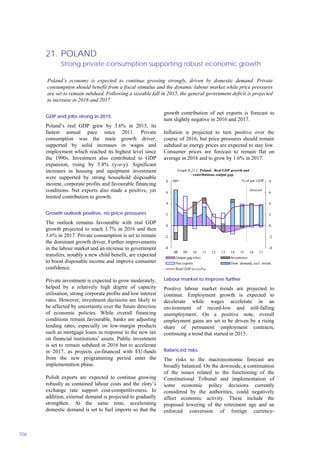
Economic and
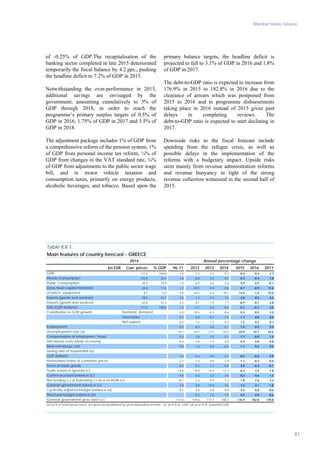
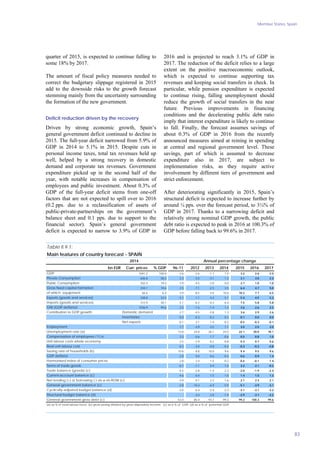
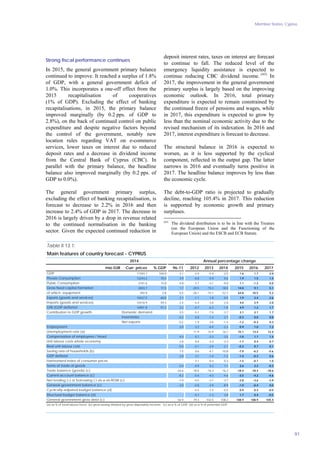
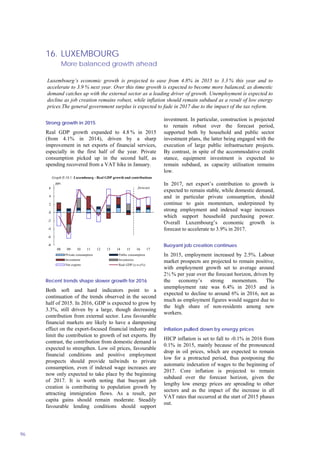
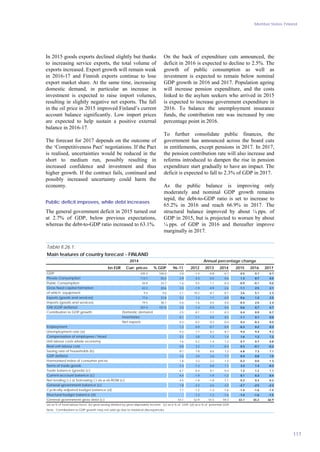
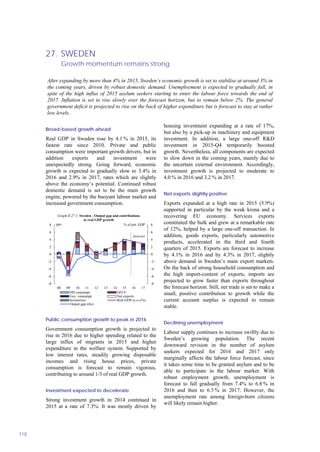
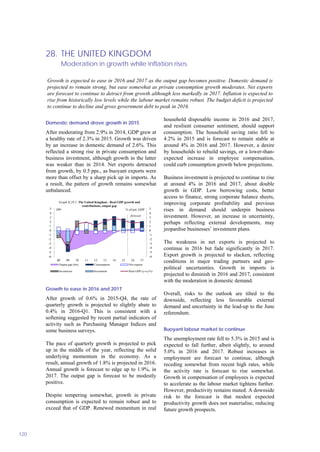
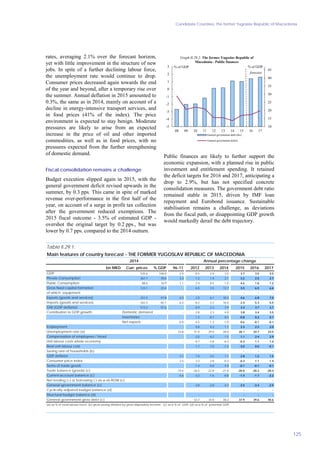
Financial Affairs
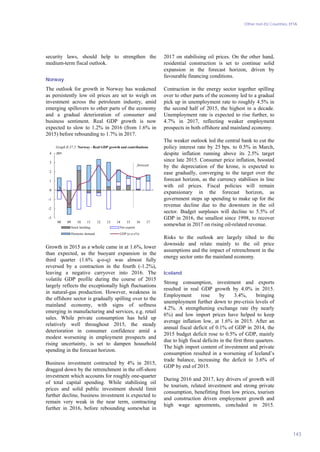
Spring 2016
ISSN 2443-8014 (online)
European
Economic
Forecast
INSTITUTIONAL PAPER 025 | MAY 2016
EUROPEAN ECONOMY
European Economy Institutional Papers are important reports and communications from the
European Commission to the Council of the European Union and the European Parliament on the
economy and economic developments.
LEGAL NOTICE
Neither the European Commission nor any person acting on its behalf may be held responsible for
the use which may be made of the information contained in this publication, or for any errors which,
despite careful preparation and checking, may appear.
This paper exists in English only and can be downloaded from
http://ec.europa.eu/economy_finance/publications/.
Europe Direct is a service to help you find answers
to your questions about the European Union.
Freephone number (*):
00 800 6 7 8 9 10 11
(*) The information given is free, as are most calls (though some operators, phone boxes or hotels may charge you).
More information on the European Union is available on http://europa.eu.
Luxembourg: Publications Office of the European Union, 2016
KC-BC-16-025-EN-N (online) KC-BC-16-025-EN-C (print)
ISBN 978-92-79-54325-8 (online) ISBN 978-92-79-54324-1 (print)
doi:10.2765/24248 (online) doi:10.2765/345429 (print)
© European Union, 2016
Reproduction is authorised provided the source is acknowledged.
European Commission
Directorate-General for Economic and Financial Affairs
European Economic Forecast
Spring 2016
EUROPEAN ECONOMY Institutional Paper 025
ABBREVIATIONS
ii
Countries and regions
EU European Union
EA euro area
BE Belgium
BG Bulgaria
CZ Czech Republic
DK Denmark
DE Germany
EE Estonia
IE Ireland
EL Greece
ES Spain
FR France
HR Croatia
IT Italy
CY Cyprus
LV Latvia
LT Lithuania
LU Luxembourg
HU Hungary
MT Malta
NL The Netherlands
AT Austria
PL Poland
PT Portugal
RO Romania
SI Slovenia
SK Slovakia
FI Finland
SE Sweden
UK United Kingdom
JP Japan
US United States of America
CIS Commonwealth of Independent States
EFTA European Free Trade Association
MENA Middle East and North Africa
ROW Rest of the World
Economic variables and institutions
CPI Consumer price index
ESI Economic Sentiment Indicator
GDP Gross Domestic Product
GNI Gross National Income
HICP Harmonised Index of Consumer Prices
NPL Non-performing loan
PMI Purchasing Managers' Index
VAT Value-Added Tax
ECB European Central Bank
Fed Federal Reserve, US
IMF International Monetary Fund
iii
OECD Organisation for Economic Cooperation and Development
OPEC Organisation of the Petroleum Exporting Countries
Other abbreviations
APP Asset purchase programme
FDI Foreign Direct Investment
FY Fiscal year
NFC Non-Financial Corporations
SAFE Survey on the Access to Finance of Enterprises
SME Small and medium-sized enterprises
Graphs/Tables/Units
bbl Barrel
bn Billion
bp. /bps. Basis point / points
lhs Left hand scale
mn Million
pp. / pps. Percentage point / points
pt. / pts. Point / points
Q Quarter
q-o-q% Quarter-on-quarter percentage change
rhs Right hand scale
tn Trillion
y-o-y% Year-on-year percentage change
Currencies
EUR Euro
ECU European currency unit
BGN Bulgarian lev
CNY Chinese yuan, renminbi
CZK Czech koruna
DKK Danish krone
GBP Pound sterling
HUF Hungarian forint
HRK Croatian kuna
ISK Icelandic krona
MKD Macedonian denar
NOK Norwegian krone
PLN Polish zloty
RON New Romanian leu
RSD Serbian dinar
SEK Swedish krona
CHF Swiss franc
JPY Japanese yen
RMB Renmimbi
TRY Turkish lira
USD US dollar
CONTENTS
v
Overview 1
PART I: EA and EU outlook 7
Staying the course amid high risks 9
1. Putting the forecast into perspective: distributional factors and
the euro area outlook 10
2. The external environment 16
3. Financial markets 21
4. GDP and its components 25
5. The current account 35
6. The labour market 36
7. Inflation 40
8. Public finances 44
9. Risks 47
PART II: Prospects by individual economy 63
Member States 65
1. Belgium: Temporary factors impede recovery 66
2. Bulgaria: Moderate growth ahead 68
3. The Czech Republic: Return to a sustainable growth path 70
4. Denmark: Domestic demand drives ongoing recovery 72
5. Germany: Solid growth continues, driven by consumption 74
6. Estonia: Steady in the face of external shocks 76
7. Ireland: High growth continues, supporting public finances 78
8. Greece: Growth to return in the second half of the year 80
9. Spain: Growth to ease but remain robust 82
10. France: Moving slowly towards a more self-sustained recovery 84
11. Croatia: Domestic demand becomes the main driver of
moderate growth 86
12. Italy: Moderate growth to continue 88
13. Cyprus: Labour market conditions improve as real GDP growth
picks up 90
14. Latvia: Growth shifts further towards domestic demand 92
15. Lithuania: Growth balances as exports recover 94
16. Luxembourg: More balanced growth ahead 96
17. Hungary: Private consumption is to drive growth 98
18. Malta: Strong investment and household consumption 100
19. The Netherlands: Domestic demand drives growth as the cycle
matures 102
20. Austria: Growth to pick up as exports rise despite fragile global
outlook 104
21. Poland: Strong private consumption supporting robust economic
growth 106
22. Portugal: Slow recovery continues amidst significant downside
risks 108
23. Romania: Fiscal expansion fuels domestic demand as financial
risks increase 110
vi
24. Slovenia: Private consumption to drive growth, while public
investment eases 112
25. Slovakia: Domestic demand drives the recovery 114
26. Finland: Gradual recovery taking hold 116
27. Sweden: Growth momentum remains strong 118
28. The United Kingdom: Moderation in growth while inflation rises 120
Candidate Countries 123
29. The former Yugoslav Republic of Macedonia: Risks to domestic
demand-led growth are increasing 124
30. Montenegro: Volatile growth amid public finance concerns 126
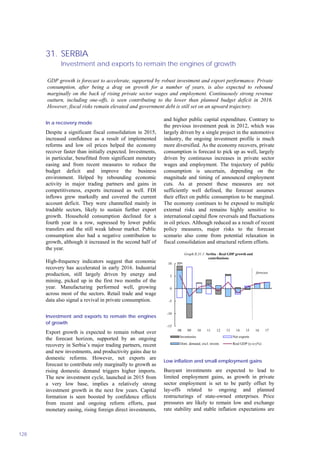
31. Serbia: Investment and exports to remain the engines of growth 128
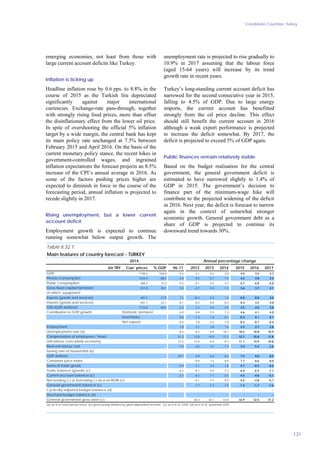
32. Turkey: Domestic demand remains the driver of growth 130
33. Albania: Strengthening domestic demand, weak price dynamics 132
Other non-EU Countries 135
34. The United States of America: Weaker growth amid a maturing
cycle 136
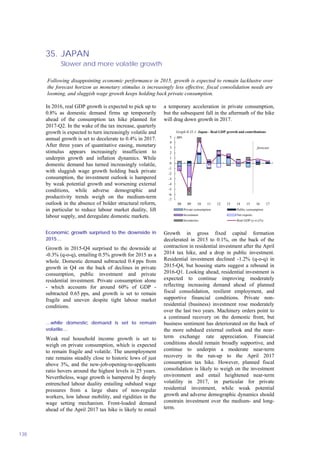
35. Japan: Slower and more volatile growth 138
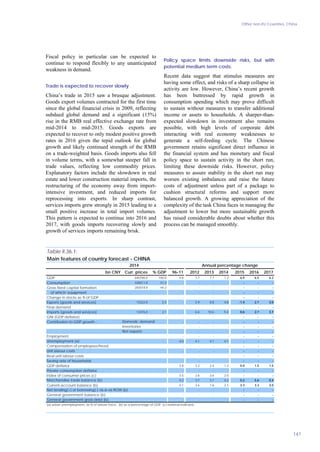
36. China: Growth remains solid, but underlying tensions persist 140
37. EFTA: Rough sailing for small open economies 142
38. Russian Federation: A protracted recession and a long path to
recovery 145
Statistical Annex 149
LIST OF TABLES
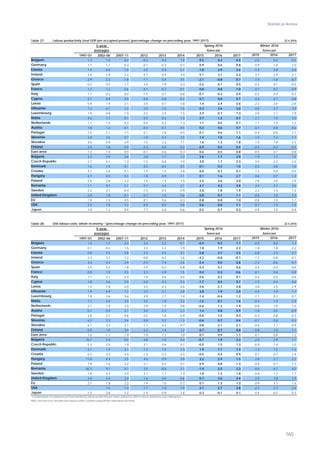
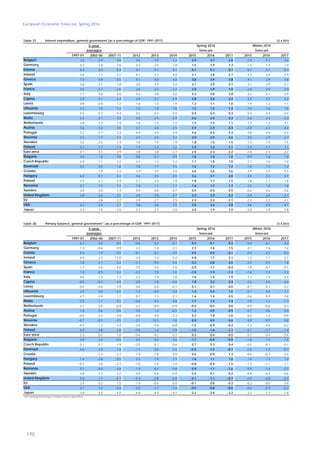
1. Overview - the spring 2016 forecast 1
I.1. International environment 17
I.2. Composition of growth - euro area 26
I.3. Composition of growth - EU 27
I.4. Labour market outlook - euro area and EU 37
I.5. Inflation outlook - euro area and EU 40
I.6. General Government budgetary position - euro area and EU 44
I.7. Euro-area debt dynamics 47
LIST OF GRAPHS
I.1. Real GDP, euro area 9
I.2. HICP, euro area 9
I.3. Share of the top decile income in the total income, Europe
and the US, 1950-2010 10
I.4. Labour incomes, euro area and Member States, 1995, 2007,
2013 11
I.5. Non-labour incomes, euro area and Member States, 1995,
2007, 2013 11
I.6. Real GDP growth versus real disposable income growth,
euro area 12
I.7. Households real disposable income and private
consumption, euro area 12
vii
I.8. Gini coefficient, incomes with and without transfers, area
and Member States, 2013 12
I.9. Median net income in selected income groups, euro area,
2005-2014 13
I.10. Median net income and educational attainment, euro
area, 2005-2014 13
I.11. Income and wealth distribution, euro area, shares of
quintiles in total, 2010 14
I.12. Global GDP growth outside the EU 16
I.13. Sources of rebound in global non-EU GDP growth 16
I.14. Global GDP and global Composite PMI 17
I.15. Volume of goods imports 19
I.16. World imports of goods and services outside the EU 19
I.17. Sources of rebound in global non-EU import growth 19
I.18. Brent oil spot prices, USD and euro 20
I.19. Stock market developments 21
I.20. Euro exchange rate since March 2014, NEER-37, USD, GBP 22
I.21. 5-year maturity corporate bond spreads, euro area 23
I.22. 10-year maturity sovereign bond spreads to the German
bund, selected countries 23
I.23. EU broad stock market vs. bank sub-index 23
I.24. Business volumes responsiveness to interest rates, NFC loans
(< 1 mn EUR), February 2015 - February 2016 24
I.25. Cost of corporate funding, euro area 24
I.26. Real GDP growth and its components, euro area 25
I.27. Oil price assumptions (USD/bbl), SF14 - SF16 27
I.28. Interest rate assumptions, euro area, short-term, SF14 - SF16 27
I.29. Exchange rate assumptions (USD/EUR), SF14 - SF16 28
I.30. Economic Sentiment Indicator and PMI Composite Output
Index, EU 29
I.31. Industrial new orders and industrial production, euro area 29
I.32. Loans to households and non-financial corporations, euro
area 29
I.33. Real GDP, EU 30
I.34. Private consumption and consumer confidence, euro area 30
I.35. Retail trade volumes and retail confidence, euro area 31
I.36. Real gross disposable income and its components, euro
area 31
I.37. Equipment investment and capacity utilisation, euro area 32
I.38. Dwellings investment and building permits, euro area 33
I.39. Global demand, euro-area exports and new export orders 34
I.40. Oil and non-oil balance for Extra-EU trade 35
I.41. Decomposition of the change in the current account
balance relative to GDP, euro area 36
I.42. Current-account balances, euro area and Member States 36
I.43. Employment, GDP, total hours worked, euro area 37
I.44. Okun`s coefficient, euro area and Member States 38
I.45. Unemployment by age group, euro area 38
I.46. Unemployment by duration, euro area 38
I.47. Beveridge curve, euro area and EU 39
I.48. Employment expectations, DG ECFIN surveys, euro area 39
I.49. Inflation breakdown, euro area 41
I.50. Oil prices, industrial producer prices in euro area and China 42
viii
I.51. Inflation expectations derived from implied forward inflation-
linked swap rates 43
I.52. Inflation dispersion of EU Member States - HICP inflation rates 44
I.53. Budgetary developments, euro area 44
I.54. Breakdown of the change in the general government deficit
in the euro area, 2015-17 45
I.55. Fiscal stance in 2016 – structural balance vs. output gap,
euro area and Member States 45
I.56. Fiscal stance in 2016 – structural balance vs. government
debt ratio, euro area and Member States 46
I.57. General government revenue and expenditure, euro area 46
I.58. General government gross capital formation, euro area and
Member States 46
I.59. Euro area GDP forecast - Uncertainty linked to the balance
of risks 48
LIST OF BOXES
I.1. Main drivers of growth in 2016 – discerning the underlying
shocks 49
I.2. Growth differences between the US and the euro area 51
I.3. Estimating a hypothetical scenario of generalised border
controls in the Schengen area 54
I.4. Secular Stagnation 58
I.5. Some technical elements behind the forecast 61
FOREWORD
ix
The European economy continues to expand modestly. Low oil prices, the relatively low exchange rate of
the euro, very ample monetary policy and slightly supportive fiscal policy will continue to underpin
growth this year. However, the lift from cheap oil is set to gradually wane and the lagged boost from the
euro’s depreciation will soon have run its course. As a result, the pace of private consumption growth, the
main motor of growth so far, is projected to slow down somewhat next year, even though employment
gains and a modest acceleration in wage growth should partly compensate for the fading of these
tailwinds. Support next year will mainly come from monetary policy, which the ECB has committed to
keep expansionary for an extended period of time, while the fiscal stance is projected to turn neutral. At
the same time, the conditions are in place for private investment to pick up over the forecast horizon, and
the Investment Plan for Europe will move from project identification to implementation. In sum, the
economy is forecast to continue growing on the back of slightly re-balanced domestic demand but growth
is not expected to accelerate significantly.
Sluggish core inflation reflects the slack still present in the economy. Real GDP in the euro area has now
risen above its pre-crisis peak of eight years ago but it has taken much longer to reach this milestone than
in other advanced economies. The level of investment remains depressed and unemployment far too high.
This investment shortfall, structural unemployment and the slow trend growth of productivity have
reduced potential output growth. Moreover, a debt overhang persists in some sectors, while the financial
industry is adjusting to a more demanding regulatory environment and needs to address low profitability
as well as in some Member States high levels of non-performing loans. Shifting to a higher growth path
cannot rely as often in the past on the external side. Net exports will continue to subtract from growth in
Europe this year, even if acute concerns about the global economy have abated somewhat.
The uncertainty surrounding the forecast is extraordinarily high considering that we are in an expansion
phase. The economic risks to the baseline of slow but steady growth are mostly to the downside. On top
of these more or less familiar and quantifiable risks, political uncertainty outside the remit of economics
but with potentially sizeable economic ramifications is large. Lifting this uncertainty could clear the way
for faster investment than forecast. There are heightened geopolitical tensions in Europe's immediate
neighbourhood and farther afield. And there is serious uncertainty within Europe. Although it stems from
various domains and circumstances, much of it relates to the same broad theme, namely the capacity and
the continued willingness to find and implement common solutions to common challenges.
In this context of modest growth amid high risks, economic policy has two functions to fulfil. First, it
needs to support the ongoing, but still fragile economic expansion and reinvigorate potential growth
through the three-pronged strategy of monetary policy, fiscal policy and structural reforms endorsed by
the G20. At present, this task is mainly being carried out by monetary policy. Fiscal policy levers, by
contrast, are not being used to the necessary extent. Some countries could take better advantage of their
fiscal space to increase investment, and all countries should still do more to make their tax and spending
policies fair and more growth friendly. Macroeconomic policies should thus be rebalanced and
complemented by accelerated structural reforms to bolster potential growth in the medium term. Their
short-term positive growth impact can in fact be maximised through measures that increase demand. The
second function at the current juncture is preventive: policy makers need to stand ready to react swiftly
and decisively to the potential materialisation of multiple, large and inter-related downside risks. This
necessity was re-affirmed at the global level by G20 Finance Ministers and Central Bank Governors in
April and preparedness on the part of the EU, as well as its Member States, will be crucial.
Marco Buti
Director General
Economic and Financial Affairs
OVERVIEW: STAYING THE COURSE AMID HIGH RISKS
The euro area economy continues to grow modestly
1
For more than a year, the European economy has been benefitting from an
exceptional combination of favourable factors. Low oil prices, a low euro
exchange rate, supportive monetary policy measures and increased public
expenditure associated with the inflow of asylum seekers in some Member
States, have provided generous support to the economy. In recent months,
however, the boost from these factors has been partly offset by external
headwinds stemming from the downturn in emerging economies and, more
recently, from a slowdown in major advanced economies. As a result,
economic growth has remained moderate.
The strength of some of the positive factors supporting the euro area is likely
to fade over the forecast horizon. On the one hand, although the renewed
drop in oil prices early this year should still sustain the purchasing power of
households, the expected rebound in inflation will eventually slow the
expansion of real disposable incomes. Additionally, the benefits of the euro’s
earlier depreciation, which take time to feed through, will start to wane, while
its appreciation since the start of this year is likely to compound the slowing
impact of the external environment on the euro area. On the other hand,
additional measures taken by the ECB in March have improved access to
credit and reduced funding costs, further improving the conditions for an
acceleration of investment. Fiscal policy is expected to be slightly supportive
to growth this year. Meanwhile, high levels of public and private debt will
continue to weigh on growth, along with other legacies from the crisis, such
An ongoing but fragile
economic
expansion…
…amid fading
tailwinds and growing
headwinds…
rate
2015 2016 2017 2015 2016 2017 2015 2016 2017 2015 2016 2017 2015 2016 2017
Belgium 1.4 1.2 1.6 0.6 1.7 1.6 8.5 8.2 7.7 1.3 1.8 1.9 -2.6 -2.8 -2.3
Germany 1.7 1.6 1.6 0.1 0.3 1.5 4.6 4.6 4.7 8.8 8.5 8.3 0.7 0.2 0.1
Estonia 1.1 1.9 2.4 0.1 0.8 2.9 6.2 6.5 7.7 2.0 0.9 1.6 0.4 -0.1 -0.2
Ireland 7.8 4.9 3.7 0.0 0.3 1.3 9.4 8.2 7.5 4.4 4.6 4.6 -2.3 -1.1 -0.6
Greece -0.2 -0.3 2.7 -1.1 -0.3 0.6 24.9 24.7 23.6 -0.2 0.6 1.3 -7.2 -3.1 -1.8
Spain 3.2 2.6 2.5 -0.6 -0.1 1.4 22.1 20.0 18.1 1.4 1.5 1.3 -5.1 -3.9 -3.1
France 1.2 1.3 1.7 0.1 0.1 1.0 10.4 10.2 10.1 -1.5 -1.1 -1.0 -3.5 -3.4 -3.2
Italy 0.8 1.1 1.3 0.1 0.2 1.4 11.9 11.4 11.2 2.2 2.4 2.3 -2.6 -2.4 -1.9
Cyprus 1.6 1.7 2.0 -1.5 -0.7 1.0 15.1 13.4 12.4 -3.5 -4.2 -4.6 -1.0 -0.4 0.0
Latvia 2.7 2.8 3.1 0.2 0.2 2.0 9.9 9.6 9.3 -1.2 -2.6 -2.4 -1.3 -1.0 -1.0
Lithuania 1.6 2.8 3.1 -0.7 0.6 1.8 9.1 7.8 6.4 -1.5 0.0 0.1 -0.2 -1.1 -0.4
Luxembourg 4.8 3.3 3.9 0.1 -0.1 1.8 6.4 6.2 6.2 5.5 5.3 4.8 1.2 1.0 0.1
Malta 6.3 4.1 3.5 1.2 1.4 2.2 5.4 5.1 5.1 9.9 5.6 4.4 -1.5 -0.9 -0.8
Netherlands 2.0 1.7 2.0 0.2 0.4 1.3 6.9 6.4 6.1 9.2 8.9 8.2 -1.8 -1.7 -1.2
Austria 0.9 1.5 1.6 0.8 0.9 1.7 5.7 5.9 6.1 3.1 3.1 3.3 -1.2 -1.5 -1.4
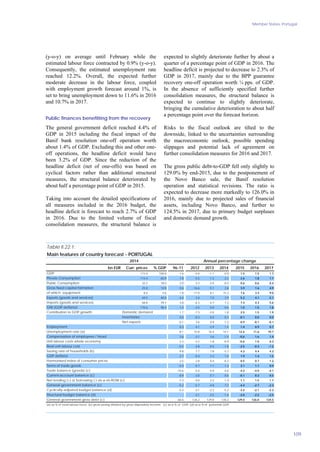
Portugal 1.5 1.5 1.7 0.5 0.7 1.2 12.6 11.6 10.7 -0.1 0.3 0.5 -4.4 -2.7 -2.3
Slovenia 2.9 1.7 2.3 -0.8 -0.2 1.6 9.0 8.6 8.1 7.0 7.0 6.9 -2.9 -2.4 -2.1
Slovakia 3.6 3.2 3.3 -0.3 -0.1 1.5 11.5 10.5 9.5 0.8 -0.6 -1.1 -3.0 -2.4 -1.6
Finland 0.5 0.7 0.7 -0.2 0.0 1.3 9.4 9.4 9.3 0.1 0.3 0.4 -2.7 -2.5 -2.3
Euro area 1.7 1.6 1.8 0.0 0.2 1.4 10.9 10.3 9.9 3.6 3.7 3.6 -2.1 -1.9 -1.6
Bulgaria 3.0 2.0 2.4 -1.1 -0.7 0.9 9.2 8.6 8.0 1.9 2.3 2.7 -2.1 -2.0 -1.6
Czech Republic 4.2 2.1 2.6 0.3 0.5 1.4 5.1 4.5 4.4 -2.0 -1.5 -1.3 -0.4 -0.7 -0.6
Denmark 1.2 1.2 1.9 0.2 0.3 1.5 6.2 6.0 5.7 7.0 6.3 6.2 -2.1 -2.5 -1.9
Croatia 1.6 1.8 2.1 -0.3 -0.6 0.7 16.3 15.5 14.7 5.1 4.4 4.0 -3.2 -2.7 -2.3
Hungary 2.9 2.5 2.8 0.1 0.4 2.3 6.8 6.4 6.1 4.9 5.0 4.5 -2.0 -2.0 -2.0
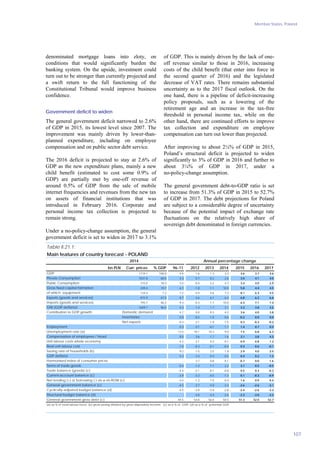
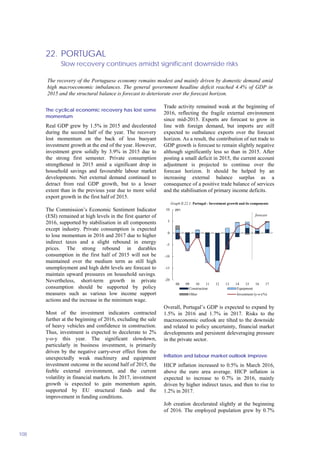
Poland 3.6 3.7 3.6 -0.7 0.0 1.6 7.5 6.8 6.3 0.1 -0.3 -0.9 -2.6 -2.6 -3.1
Romania 3.8 4.2 3.7 -0.4 -0.6 2.5 6.8 6.8 6.7 -0.9 -2.1 -2.8 -0.7 -2.8 -3.4
Sweden 4.1 3.4 2.9 0.7 0.9 1.2 7.4 6.8 6.3 4.9 5.8 5.7 0.0 -0.4 -0.7
United Kingdom 2.3 1.8 1.9 0.0 0.8 1.6 5.3 5.0 4.9 -5.2 -4.9 -4.4 -4.4 -3.4 -2.4
EU 2.0 1.8 1.9 0.0 0.3 1.5 9.4 8.9 8.5 2.0 2.2 2.1 -2.4 -2.1 -1.8
USA 2.4 2.3 2.2 0.1 1.2 2.2 5.3 4.8 4.5 -3.3 -2.8 -3.1 -4.0 -4.4 -4.4
Japan 0.5 0.8 0.4 0.8 0.0 1.5 3.4 3.4 3.3 3.3 3.9 4.1 -5.2 -4.5 -4.2
China 6.9 6.5 6.2 : : : : : : : : : : : :
World 3.0 3.1 3.4 : : : : : : : : : : : :
Current account
Table 1:
Budget balanceInflationReal GDP
Overview - the spring 2016 forecast
Unemployment
European Economic Forecast, Spring 2016
2
as high structural unemployment and high levels of policy uncertainty.
Overall, euro area GDP is forecast to grow at modest rates, rather than gather
momentum, over the 2015-2017 period, as it is projected at 1.6% in 2016 and
1.8% in 2017 after 1.7% in 2015.
The outlook for global GDP growth has weakened further in recent months.
Growth outside the EU is expected to have fallen to 3.2% in 2015, its slowest
pace since 2009, and is now forecast to pick up only modestly to 3.3% in
2016 and 3.7% in 2017. Reflecting increased external headwinds from the
slowdown in emerging markets, growth in advanced economies lost
momentum at the end of last year and is expected to remain at 2% this year
and next. In the US, weak external demand is likely to continue to weigh on
activity while domestic demand should continue to support it. But the
maturing cycle limits the scope for growth to pick up further. In Japan,
sluggish wage growth is likely to remain a drag on private consumption while
the investment outlook suffers from weak potential growth. Domestic
demand is also expected to be increasingly volatile ahead of planned fiscal
consolidation measures.
Growth in emerging markets slowed down last year to its weakest annual
pace since 2009. It is expected to pick up only marginally in 2016 before
stabilising commodity prices, a gradual easing of the deeper-than-expected
recessions in Brazil and Russia, and some progress in adjustments in other
emerging markets support a mild rebound next year. But this outlook is
fragile and subject to a high degree of uncertainty. In particular, the
challenges surrounding an orderly rebalancing and gradual slowing of the
Chinese economy remain pressing and entail considerable risks, even though
pressures on the exchange rate and capital outflows have recently abated.
World imports of goods and services excluding the EU are estimated to have
grown by a meagre 0.5% in 2015, dragged down by sharp contractions in
Russia and Brazil and the marked deceleration of import growth in China.
Non-EU trade is expected to firm over the forecast horizon as a result of a
progressive normalisation in Chinese imports, the assumed stabilisation of
commodity prices at low levels and the expected pick-up in emerging market
growth. Slowing demand for imports in the US, which is largely triggered by
the weakness of its own exports, should, however, also limit non-EU trade
growth to 2.1% this year, while an increase to 3.4% is expected next year.
Growth in European export markets should continue to outpace GDP growth
outside the euro area in general, but should be less robust than expected at the
beginning of the year.
In early 2016, financial markets recorded losses as investors shunned risk
amid intensified concerns about a further global slowdown and worries that
macroeconomic policies would be lacking space to react to it. These concerns
have recently abated with inter alia the slight rebound in oil prices, but
volatility remains elevated. The EU’s financial sector continues to
underperform the broad market reflecting concerns about banks’ profitability
prospects amid the low interest rate environment and the persistence of high
levels of non-performing loans in some countries. Expectations of divergence
between the monetary policies of major central banks receded somewhat
since the beginning of the year. On the one side, the ECB and the central
banks of Sweden, Hungary and Japan have, for instance, further eased their
monetary policies, while on the other side, expectations of monetary policy
tightening by the US Fed and the Bank of England have been pushed back.
The euro has appreciated as a result.
…as global growth
has been slowing…
…and trade flows
remain weak…
…while financial
markets somewhat
stabilise…
Overview
3
The accommodative policy stance of the ECB has led to very favourable
monetary and credit conditions in the euro area. Net bank lending flows to
households and non-financial corporations have remained positive over the
recent months, supported by lower interest rates, which improve the
attractiveness of bank lending relative to market funding. Bank lending rates
have also come down significantly in vulnerable Member States, suggesting
that the transmission of monetary policy to the real economy has improved
and that financial fragmentation across Member States has receded.
With net exports turning negative, GDP growth was entirely driven by
domestic demand in 2015. This pattern is expected to continue this year and
next although the composition of domestic demand is expected to show some
rebalancing, as private consumption moderates and investment gathers speed.
Private consumption should continue to benefit in 2016 and 2017 from
improving labour market conditions, moderate rises in wages and higher non-
labour incomes. The very low inflation foreseen this year should also support
stronger increases in real gross disposable incomes. Private consumption
should then pick up slightly, as households are expected to spend much of
this oil-price windfall rather than increase their savings significantly. The
pace of private consumption growth, however, should slow down next year
as the expected rebound in inflation shaves off a larger portion of the growth
in nominal incomes.
Government consumption is also set to lose some momentum next year after
having gathered further pace this year mainly as refugee-related spending in
some Member States is set to continue increasing.
Investment strongly accelerated at the end of last year, but most available
data suggest that this rebound was mainly driven by temporary factors.
Investment is expected to moderate in the near term as it is held back by
expectations of weak global demand and still considerable uncertainty of
economic and non-economic nature. Nevertheless, the conditions for
investment to pick up further down the line have recently improved, as
borrowing conditions have eased, capacity utilisation is above its long-term
average, corporate deleveraging pressure is fading, and global demand is
expected to gradually strengthen. Construction investment, meanwhile,
should benefit from sustained growth in households' real disposable incomes,
very low mortgage rates and progress in the adjustment in the housing sector.
In some countries, the demand for housing should also rise due to the need to
host refugees. The Investment Plan for Europe is also expected to yield
increasing tangible results on public and private investment as a growing
number of projects should move to the implementation phase.
The deterioration in external demand turned net trade into a drag on growth
last year despite the resilience of intra euro area exports and the positive
impact of the euro’s past depreciation on euro area exporters' price
competitiveness. Export growth is expected to slow down markedly this year
reflecting both the slow growth of euro area external export markets and the
euro’s recent appreciation. But with real unit labour costs still declining, euro
area exporters are well-positioned to benefit from the expected rebound in
global economic activity next year. Imports, with the support of resilient
domestic demand, are expected to follow the same pattern. As a result, net
exports are projected to have a negative impact on GDP growth in 2016 that
should turn neutral in 2017.
…and funding
conditions remain
favourable.
Domestic demand
should drive growth…
…although private
consumption should
lose momentum…
…as should public
consumption…
…while conditions are
favourable for a pick-
up of investment…
…and net trade
should be a drag on
growth this year.
European Economic Forecast, Spring 2016
4
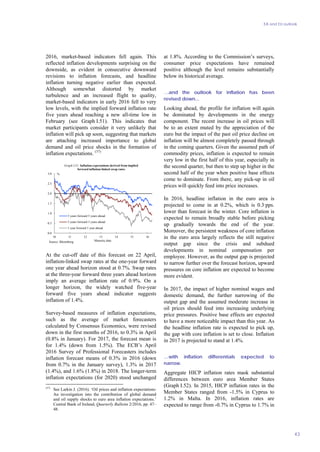
Oil prices fell again at the start of 2016, dragging inflation below zero. It is
expected to remain negative in the near term as a result of base effects.
External price pressure is also weak due to the slight appreciation of the euro
and overcapacities in several emerging market economies that are holding
back global producer prices. At the same time, core inflation has so far failed
to show an upward trend, as moderate economic growth and subdued wage
developments have kept a lid on domestic price dynamics. Inflation in the
euro area is therefore set to remain very low for longer than previously
forecast and the projection for inflation in 2016 has been revised downward
to 0.2%. With the assumption of gradually increasing energy prices, inflation
is expected to step up in the second half of this year when positive base
effects start to kick in. The further narrowing of the output gap and higher
domestic demand should eventually add upward pressure on domestic prices.
In 2017 inflation is expected to reach 1.4%.
Labour market conditions are set to continue their moderate pace of
improvement, driven by the lagged response to improved cyclical conditions
and contained wage growth. In some Member States, labour market reforms
implemented in recent years and fiscal policy measures are also supporting a
rise in net job creation. Overall, employment is set to continue to grow at
about 1% this year and next. The labour force is also expected to increase,
mainly on the back of higher participation rates and, in some Member States,
net migration flows. The unemployment rate in the euro area is projected to
fall from 10.9% in 2015 to 9.9% next year. Although labour market
disparities are set to remain for some time, unemployment is expected to fall
in almost all euro area countries over the forecast horizon, particularly in
those that have implemented labour market reforms (e.g. Spain, Cyprus,
Ireland and Portugal).
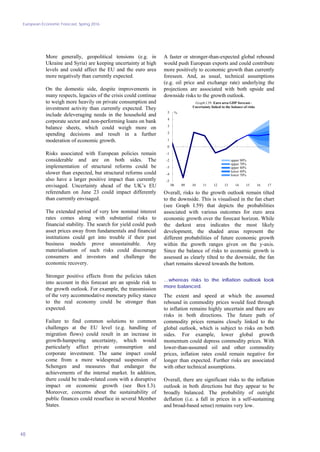
The general government deficit is expected to continue declining this year
and next underpinned by the ongoing economic expansion, the improvement
in labour markets and, to a lesser extent, the drop in interest expenditures.
Discretionary tax cuts to lower the tax burden on labour in some Member
States and additional government expenditures related to the inflow of
asylum seekers in some countries explain the slightly slower decline in the
headline deficit this year. The general government deficit in the euro area is
expected to decrease from 2.1% of GDP to 1.9% in 2016, and to decrease
further to 1.6% next year under a no-policy-change assumption. The fiscal
stance is expected to be slightly expansionary in the euro area this year but to
turn neutral in 2017. The debt-to-GDP ratio is forecast to continue declining
gradually over the forecast horizon, although less than earlier expected due to
the slower pace of nominal GDP. It should reach 91.1% in the euro area in
2017.
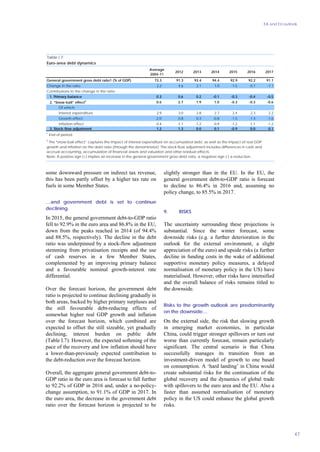
The uncertainty surrounding these projections is substantial and the European
economic outlook is exposed to considerable downside risks. On the external
side, the risk that slowing growth in emerging market economies, particularly
China, could trigger stronger spillovers or turn out worse than currently
forecast remains particularly significant for growth in Europe and the world.
Uncertainty linked to geopolitical tensions remains high and could affect
European economies more negatively than currently expected. Abrupt moves
in oil prices or financial turmoil could also dampen European growth.
On the domestic side, risks associated with European policies remain
considerable, as for instance the pace of implementation of structural reforms
Inflation remains
driven by energy
prices…
…labour markets
continue to improve…
…and the fiscal
stance should be
slightly expansionary
this year.
Downside risks are
considerable
Overview
5
and the uncertainty ahead of the UK’s EU referendum. (1)
A failure to find
common solutions at the EU level to common challenges of economic and
non-economic nature could also affect private consumption and further delay
the expected rebound of investment. On the upside, the positive impact from
structural reforms could turn out greater than estimated and the transmission
of very accommodative monetary policies to the real economy could prove to
be stronger than expected.
(1)
See also IMF (2016) World Economic Outlook, April and Kierzenkowski et al (2016) The Economic Consequences of Brexit:
A Taxing Decision, OECD Economic Policy Paper 16.
PART I
EA and EU outlook
STAYING THE COURSE AMID HIGH RISKS
The euro area economy continues to grow modestly
9
85
90
95
100
105
-3
-2
-1
0
1
2
3
08 09 10 11 12 13 14 15 16 17
GDP growth rate (lhs)
GDP (quarterly), index (rhs)
GDP (annual), index (rhs)
Graph I.1: Real GDP, euro area
forecast
q-o-q% index, 2007=100
0.5
-4.5
2.0 -0.9 -0.3
Figures above horizontal bars are annual growth rates.
1.6 0.9
1.7
1.6
1.8
85
90
95
100
105
-2
-1
0
1
2
3
4
5
6
7
8
08 09 10 11 12 13 14 15 16 17
HICP inflation (annual rate) (lhs)
HICP index (monthly) (rhs)
HICP index (annual) (rhs)
3.3 0.3
2.7
2.5
1.6
1.3 0.4 0.0 0.2
1.4
forecast
Graph I.2: HICP, euro area
% index, 2015=100
Figures above horizontal bars are annual growth rates.
The euro area economy grew by 1.7% in 2015, expanding at its highest rate since 2010. Thanks to
supportive policies and exceptional factors, such as very low oil prices, the euro area’s GDP surpassed
it pre-crisis peak earlier this year. In 2016 and 2017, the economy should continue to expand at roughly
the same rate – staying the course, but not accelerating. Low oil prices, low funding costs, lagged
effects from the depreciation of the euro, a slightly expansionary fiscal stance, and structural reforms
are expected to continue supporting activity but with diminishing strength. At the same time, modest
global growth, weak global trade, and increased uncertainty look set to weigh more heavily on activity
than previously expected.
As a result, the main impetus for economic growth over the forecast horizon is expected to come from
domestic demand. Private consumption is set to benefit from higher real disposable incomes due to a
delayed rebound in consumer prices and improvements in the labour market. The conditions for a pick-
up in investment have recently improved, as funding conditions have become more favourable and
capacity utilisation rates remain above their long-term average. Government consumption is expected
to continue contributing to growth but this will depend in part on the number of asylum seekers that
arrive. Hit by external headwinds and a slowdown in exports greater than in imports, net trade will
detract slightly more this year. Overall, real GDP growth in the euro area is projected to be roughly
stable, falling slightly from 1.7% (2.0% in the EU) last year to 1.6% (1.8%) this year before increasing
marginally to 1.8% (1.9%) next year. Labour markets are set to continue improving at a moderate pace.
Inflation remains very low. With the oil price falling again in early 2016 and the slight appreciation of
the euro since then, external price pressures have weakened. Domestic wage and price dynamics,
meanwhile, remain contained by the moderate growth momentum. Thus, the near-term outlook for
inflation has fallen and positive base effects are expected to kick in somewhat later than previously
forecast. Recent monetary policy decisions should support the return to higher inflation rates in the euro
area but only very slowly. Overall, inflation in the euro area is set to rebound later than previously
thought, moving up from last year’s rate of 0.0% to 0.2% in 2016 and 1.4% in 2017.
The uncertainty surrounding these projections is substantial. Growth is exposed to considerable, mainly
negative, external and domestic risks. The most important risks relate to the strength of global growth,
the expected rebound in emerging markets and the ability of China to manage its transition and to avoid
a ‘hard landing’. Abrupt moves in oil prices or financial turmoil could also dampen European growth.
Risks also relate to the stability of financial markets, overall uncertainty of economic and non-economic
nature, and the success of designing and implementing common solutions to common challenges.
European Economic Forecast, Spring 2016
10
1. PUTTING THE FORECAST INTO
PERSPECTIVE: DISTRIBUTIONAL FACTORS
AND THE EURO AREA OUTLOOK
Sparked by empirical studies showing that
economic inequality has risen substantially in
recent years, economic analyses have presented
various channels through which this affects the
economy. Rising income inequality has been
blamed for substantial output growth losses in
advanced economies. (2)
It has also been cited as
one of the reasons for the subdued pace of the
recovery in recent years because of its negative
effects on demand, (3)
and as driver in secular
stagnation theories and explanations of the euro
area’s prolonged slump because of its effects on
the saving-investment ratio. (4)
Income inequality
has also been named as one of the causes of the
economic and financial crisis in 2007-09. (5)
Globalisation, skills-biased technological change
but also macro-economic and structural policies
have been blamed for the increase in economic
inequality, (6)
which has been observed over a long
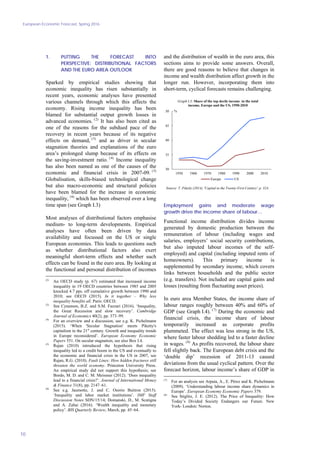
time span (see Graph I.3)
Most analyses of distributional factors emphasise
medium- to long-term developments. Empirical
analyses have often been driven by data
availability and focussed on the US or single
European economies. This leads to questions such
as whether distributional factors also exert
meaningful short-term effects and whether such
effects can be found in the euro area. By looking at
the functional and personal distribution of incomes
(2)
An OECD study (p. 67) estimated that increased income
inequality in 19 OECD countries between 1985 and 2005
knocked 4.7 pps. off cumulative growth between 1990 and
2010; see OECD (2015). In it together – Why less
inequality benefits all. Paris: OECD.
(3)
See Cynamon, B.Z. and S.M. Fazzari (2016). ‘Inequality,
the Great Recession and slow recovery’. Cambridge
Journal of Economics 40(2), pp. 373–99.
(4)
For an overview and a discussion, see e.g. K. Pichelmann
(2015). ‘When 'Secular Stagnation' meets Piketty's
capitalism in the 21st
century. Growth and inequality trends
in Europe reconsidered’. European Economy Economic
Papers 551. On secular stagnation, see also Box I.4.
(5)
Rajan (2010) introduced the hypothesis that rising
inequality led to a credit boom in the US and eventually to
the economic and financial crisis in the US in 2007, see
Rajan, R.G. (2010). Fault Lines: How hidden fractures still
threaten the world economy. Princeton University Press.
An empirical study did not support this hypothesis; see
Bordo, M. D. and C. M. Meissner (2012). ‘Does inequality
lead to a financial crisis?’. Journal of International Money
& Finance 31(8), pp. 2147–61.
(6)
See e.g. Jaumotte, J. and C. Osorio Buitron (2015).
‘Inequality and labor market institutions’. IMF Staff
Discussion Notes SDN/15/14; Domanski, D., M. Scatigna
and A. Zabai (2016). ‘Wealth inequality and monetary
policy’. BIS Quarterly Review, March, pp. 45–64.
and the distribution of wealth in the euro area, this
sections aims to provide some answers. Overall,
there are good reasons to believe that changes in
income and wealth distribution affect growth in the
longer run. However, incorporating them into
short-term, cyclical forecasts remains challenging.
30
35
40
45
50
1950 1960 1970 1980 1990 2000 2010
Europe US
Graph I.3: Share of the top decile income in the total
income, Europe and the US, 1950-2010
Source: T. Piketty (2014). 'Capital in the Twenty-First Century'. p. 324.
%
Employment gains and moderate wage
growth drive the income share of labour…
Functional income distribution divides income
generated by domestic production between the
remuneration of labour (including wages and
salaries, employers’ social security contributions,
but also imputed labour incomes of the self-
employed) and capital (including imputed rents of
homeowners). This primary income is
supplemented by secondary income, which covers
links between households and the public sector
(e.g. transfers). Not included are capital gains and
losses (resulting from fluctuating asset prices).
In euro area Member States, the income share of
labour ranges roughly between 40% and 60% of
GDP (see Graph I.4). (7)
During the economic and
financial crisis, the income share of labour
temporarily increased as corporate profits
plummeted. The effect was less strong in the US,
where faster labour shedding led to a faster decline
in wages. (8)
As profits recovered, the labour share
fell slightly back. The European debt crisis and the
‘double dip’ recession of 2011-13 caused
deviations from the usual cyclical pattern. Over the
forecast horizon, labour income’s share of GDP in
(7)
For an analysis see Arpaia, A., E. Pérez and K. Pichelmann
(2009). ‘Understanding labour income share dynamics in
Europe’. European Economy Economic Papers 379.
(8)
See Stiglitz, J. E. (2012). The Price of Inequality: How
Today’s Divided Society Endangers our Future. New
York- London: Norton.
EA and EU outlook
11
the euro area is expected to remain roughly stable.
The same is projected for the adjusted wage share
(about 58%), which relates the compensation to the
GDP per employee.
25
30
35
40
45
50
55
60
EL
LT
LU
IT
SK
LV
CY
PT
ES
EA
FI
NL
FR
BE
AT
EE
DE
SI
MT
IE
Graph I.4: Labour incomes, euro area and Member
States, 1995, 2007, 2013
1995 2007 2013
% of GDP
Over a longer period, technological change can
lower labour’s income share, for instance by
raising the capital-labour share (‘capital
deepening’). Shifts from labour-intensive to more
capital-intensive sectors tend to reduce the income
share of labour. Changes in labour market policies
and institutional settings (e.g. a lower influence of
trade unions, employment protection, minimum
wage legislation, the increase in part-time work)
can also affect the income share of labour.
Regulatory reforms to strengthen product market
competition, the privatisation of public enterprises
and a relatively strong expansion of the financial
sector (‘financial deepening’) could also affect
income shares.
…whereas non-labour incomes are closely
linked to housing and corporate profits.
In the euro area, non-labour incomes represent
about one third of household disposable income
(see Graph I.5). Since household capital income
includes incomes from housing services, i.e. actual
rents and imputed rents in the case of owner-
occupied housing, the share tends to be higher in
countries with a large share of homeownership
(e.g. France and Italy). (9)
A parallel decline in
households' labour and capital incomes could
(9)
The housing component has been shown to drive capital
incomes, see Rognlie, M. (2015). ‘Deciphering the fall and
rise in the net capital share: Accumulation or scarcity?’.
Brookings Papers on Economic Activity, Spring, pp. 1–69.
The ratio of housing capital and housing income has also
figured prominently in Piketty's analysis, see Piketty, T.
(2013). Capital in the Twenty-First Century. Cambridge,
Mass.: Harvard University Press.
suggest that the corporate sector has retained a
higher share of primary incomes. This would be in
line with the observed increase in corporate
savings, most notably during the deleveraging
process in Europe. (10)
0
5
10
15
20
25
30
35
40
45
50
LU
EE
IE
NL
SI
FI
LV
CY
FR
BE
AT
ES
EA
LT
PT
DE
SK
IT
EL
Graph I.5: Non-labour incomes, euro area and Member
States, 1995, 2007, 2013
1995 2007 2013
% of GDP
Developments in labour and non-labour incomes
describe pre-tax variables, which limits the validity
of conclusions in an environment that is
characterised by substantial redistribution
mechanisms. During the economic and financial
crisis, increased social transfers (e.g.
unemployment benefits) and lower taxes raised the
importance of secondary incomes for households.
In national accounts, the transfers paid and
received and the taxes on income enter the
calculation of household disposable income.
Empirical studies find that income redistribution
by governments is not a major long-term driver of
household disposable incomes, (11)
but it is an
important factor in short-term analysis.
Recently, private consumption has closely
followed households' disposable incomes
According to economic theory, households
accumulate and deplete their wealth to keep their
planned consumption spending roughly steady.
Thus, aggregate consumption should be roughly
proportional to the sum of current wealth and
expected future non-property income.
In the short term, changes in household disposable
income, deflated by the private consumption
deflator, are associated with GDP, deflated with
(10)
See Karabarbounis, L. and B. Neiman (2014). ‘The global
decline of the labour share’. Quarterly Journal of
Economics 129(1), pp. 61–103.
(11)
See OECD (2016). Economic policy reforms 2016. Paris:
OECD, p.105.
European Economic Forecast, Spring 2016
12
the GDP deflator, via various channels with
causality in both directions (Graph I.6).
98
100
102
104
106
108
110
05 06 07 08 09 10 11 12 13 14 15
Graph I.6: Real GDP growth versus real disposable
income growth, euro area
Real GDP Real gross disposable income
index, 2005Q1=100
As regards the causality from incomes to GDP, a
lower wage share can be expected to have a
negative impact on private consumption because
the propensity to consume associated with labour
income tends to be higher than that of non-labour
income. As the profit share increases accordingly,
the impact on investment should be positive. The
impact on net trade should also be positive. Lower
private consumption depresses imports of goods
and services, whereas a lower wage share
corresponds with a fall in unit labour costs that
raises, all other things being equal, the price
competitiveness of exporters. The overall impact
on GDP will depend on the characteristics of the
economy looked at.
-2.5
-2.0
-1.5
-1.0
-0.5
0.0
0.5
1.0
1.5
2.0
2.5
07 08 09 10 11 12 13 14 15
Graph I.7: Households real disposable income and
private consumption, euro area
Real disposable income Private consumption
y-o-y %
Concerning the impact of changes in disposable
incomes on private consumption, subcomponents
such as labour income, non-labour income and
secondary income are likely to differ in terms of
marginal propensity to consume. Nonetheless,
recent developments in the euro area point to a co-
movement in real disposable incomes and private
consumption (see Graph I.7).
The personal distribution of incomes has
become more unequal in the euro area...
To capture the impact of distributional factors on
macroeconomic variables, it is important to extend
the analysis to the personal distribution of
incomes, which sheds light on the inequality
within wages. Empirical analyses of market
incomes in advanced economies point to
substantial increases at the top of the income
distribution and a falling income share at the
bottom of the distribution. This is also true in the
euro area, where the income share of the top
quintile of incomes has increased in recent years
and the bottom quintile has declined.
0.0
0.1
0.2
0.3
0.4
0.5
0.6
0.7
EL
DE
PT
IE
LT
EA
LV
FR
LU
IT
ES
EE
BE
AT
FI
CY
NL
SI
MT
SK
Graph I.8: Gini coefficient, incomes with and without
transfers, area and Member States, 2013
Disposable income before transfers (e.g. pensions)
Disposable income before transfers but incl. pensions
Disposable income
The rise in income inequality been confirmed by
several empirical studies. (12)
Some of the largest
euro area economies are among the most unequal
advanced countries in terms of the Gini coefficient,
which is a measure of the statistical dispersion of
incomes. A Gini coefficient of zero implies full
equality while a coefficient of one shows complete
inequality. However, the inequality of disposable
incomes before transfer (market incomes) is
cushioned by transfers and therefore the inequality
of disposable incomes is more limited (see
Graph I.8). A substantial role in the more equal
distribution of disposable incomes stems from the
inclusion of pensions, in other words, differences
between pre-transfer and post-transfer incomes can
only be partly attributed to contemporaneous fiscal
policy.
(12)
See OECD (2015). In it together – Why less inequality
benefits all. Paris: OECD.
EA and EU outlook
13
Until the economic and financial crisis, the
development of median net incomes of those
earning above and below 40% or 60% of the
overall median net income has moved in parallel,
but since 2010 some divergence has been
observed. Median incomes have been falling in the
group with incomes below 40% of the area’s
median income (see Graph I.9).
95
100
105
110
115
120
125
05 06 07 08 09 10 11 12 13 14
Below 40% of median income
Below 60% of median income
Total
index, 2005=100
Graph I.9: Median net income in selected income
groups, euro area, 2005-2014
What are the main drivers of income inequality
and changes therein? A number of factors have
been related to changes in income inequality.(13)
Among them are elements of globalisation
(cheaper transport, improved automation,
improved and cheaper communication
technologies), which has pushed labour-saving
technologies and offshoring on manufacturers and
raised the skill premium, i.e. incomes for workers
with higher educational attainment grew faster (see
Graph I.10). New information technology has
raised productivity over the years and raised the
demand for skilled labour over low and unskilled
labour, which widened the gap between high and
low household incomes. (14)
Moves from
productive activities to rent-seeking, as well as
market structure (e.g. monopoly power) have also
been identified as drivers of income inequality. (15)
Changes in labour market institutions (e.g. less
bargaining power of trade unions, wider spread
between minimum and median wage) can pose
challenges particularly for low-skill workers and
(13)
See Atkinson, A.B. (2015). Inequality. What can be done?.
Cambridge, Mass.: Harvard University Press.
(14)
The OECD identified technological advances as the main
contributor to rising income inequality in the OECD,
predominantly through the wage channel. See OECD
(2011). ‘Inequality between the employed and the non-
employed’. In Divided We Stand: Why Inequality Keeps
Rising, Chapter 3, pp. 143-63. Paris: OECD.
(15)
See e.g. Stiglitz, J.S. (2015). ‘The origins of inequality, and
policies to contain it’. National Tax Journal 68(2), pp. 425-
48.
contribute to the explanation of increasing (pre-
tax) inequality. (16)
While rising employment is
usually expected to reduce income inequality as
the number of people earning a salary increases,
the gradual decline of standard full-time jobs could
endanger this effect. In addition, ‘financialisation’,
i.e. the rapid growth of the financial sector, favours
high-skilled workers (‘college premia’).
Differences across advanced economies suggest
that common (international) factors can only partly
explain changes in inequality, whereas country-
specific factors remain important.
100
105
110
115
120
05 06 07 08 09 10 11 12 13 14
Less than primary, primary and lower secondary education (18-64 y.)
Upper secondary and post-secondary non-tertiary education (18-64 y.)
Tertiary education (18-64 y.)
index, 2005=100
Graph I.10: Median net income and educational
attainment, euro area, 2005-2014
…seen as impacting negatively on the pace of
economic growth…
While early work on the nexus of income
inequality and economic growth has focussed on
how economic growth would raise inequality in
the early stages of economic development and
reduce it later, (17)
most recent contributions have
focussed on the opposite direction, asking how
rising inequality could dampen growth.
Changes in income inequality affect growth via a
number of channels. Households on the losing side
of rising inequality may have a stronger preference
for redistribution (endogenous fiscal policy
argument), which could impact negatively on the
profitability of investment projects and impact
negatively on investment. (18)
Households with
lower incomes could also respond by lowering
investment in their human capital (less education
(16)
See e.g. Jaumotte, F. and C. Osorio Buitron (2015).
‘Inequality and labor market institutions’. IMF Staff
Discussion Note SDN/15/14.
(17)
Kuznets, S. (1955). ‘Economic growth and income
inequality’. American Economic Review 45(1), pp. 1–28.
(18)
See e.g. Alesina, A. and R. Perotti (1996). ‘Income
distribution, political instability, and investment’.
European Economic Review 40(6), pp. 1203–28.
European Economic Forecast, Spring 2016
14
and training); financial market imperfections could
make such a development more severe (human
capital accumulation argument). (19)
An increased
number of low-income households could become a
drag on domestic demand, hampering the adoption
of advanced technology. (20)
By contrast, increased
inequality could strengthen incentives to strive
harder to earn high incomes, for instance by taking
more risks and working harder.
The difficulties in assessing the impact of
increased inequality can be illustrated by the
propensity to consume. Low-income households
usually have a higher marginal consumption
propensity (up to subsistence level, they would not
be able to save). This implies that a less equal
distribution of a given income could raise the total
marginal propensity to consume. (21)
But increasing
income inequality resulting entirely from increased
incomes of high-income households would lower
the total marginal propensity to consume. Thus, a
key question in the analysis of the impact of
distributional factors is to what extent an increase
in per-capita GDP ‘trickles down’ to real
disposable incomes across the distribution.
Apart from the standard redistribution schemes
that mitigate market income inequality, (22)
discretionary measures during the crisis also had a
potential to affect the personal income distribution.
However, the impact of fiscal stimulus on income
distribution is difficult to quantify as output effects
are benefitting all households, whereas some
discretionary measures could have exerted a quite
progressive (cutting taxes and boosting transfers to
low-income households) or regressive (cutting
income taxes across the board) impact.
…but with limited importance for the whole
economy in the short term.
A question of particular relevance for the role of
distributional factors in a short-term forecasting
set-up is the time dimension of the inequality-
growth nexus. Responses to changes in income
(19)
See e.g. Galor, O. and J. Zeira (1993). ‘Income distribution
and macroeconomics’. Review of Economic Studies 60(1),
pp. 35–52.
(20)
See e.g. Murphy, K.M., A. Shleifer and R. Vishny (1989).
‘Income distribution, market size, and industrialisation’.
Quarterly Journal of Economics 106(3), pp. 537–64.
(21)
For the US, such link has been found; see Blinder, A.
(1975).‘Distribution effects and the aggregate consumption
function’. Journal of Political Economy 83(3), pp. 447–75.
(22)
See e.g. Bach, S., M. Grabka and E. Tomasch (2015). ‘Tax
and transfer system: considerable redistribution mainly via
social insurance’. DIW Economic Bulletin 5(8), pp. 11–16.
distribution can be expected to be larger for
permanent rather than transitory shocks, but in the
short term, households face uncertainty concerning
the nature of a shock. This complicates
assessments of the impact of changes in inequality
in the context of a short-term forecast, as the
impact of higher inequality may differ in the short
and longer term. (23)
The personal distribution of wealth is more
unequal than that of incomes…
Economic theory suggests that private
consumption is driven by total (permanent)
income, which is the present value of expected
lifetime resources. This suggests looking not only
at current incomes but also at the wealth of
households, which includes physical wealth
(financial assets and housing wealth) but also
human wealth (i.e. current labour income and the
discounted value of expected future labour
income). Capturing all these components is a
difficult task due to a lack of adequate data.
-10
0
10
20
30
40
50
60
70
Lowest
quintile
Second
quintile
Third
quintile
Fourth
quintile
Top quintile
Graph I.11: Income and wealth distribution, euro area,
shares of quintiles in total, 2010
Share of total income Share of total net wealth
%
Source: ECB
In the euro area, the Eurosystem’s Household
Finance and Consumption Survey (24)
focussed on
financial wealth in one year (2010). The mean net
financial wealth of households, defined as the
difference between total assets and liabilities,
stood on average at EUR 230,800. The difference
from the median figure (EUR 109,200) suggests
that the distribution of wealth in the euro area is
(23)
For an empirical study finding a positive short run but
negative long run and total effect of higher inequality, see
Halter, D., M. Oechslin and J. Zweimüller (2014).
‘Inequality and growth: the neglected time dimension’.
Journal of Economic Growth 19(1), pp. 81–104.
(24)
See Eurosystem Household Finance and Consumption
Network (2013). ‘Results from the first wave’. ECB
Statistics Paper Series 2.
EA and EU outlook
15
more uneven than the distribution of income (see
Graph I.11).
The more unequal wealth distribution can be
associated with the observation that only a small
share of households owns financial wealth.
Inequality is also attributable to the long-term
accumulation of wealth, which implies that many
older people tend to have substantially more
wealth than younger people. Moreover, the
possibility of negative financial wealth widens the
span of wealth positions. (25)
In particular, in the
wake of the crisis, debt overhangs and
deleveraging have become important features in
wealth analysis. A special role in that regard is
attributed to housing wealth, which for many
households is the dominant financial asset, subject
to house prices changes. The role of housing
wealth is also key to explaining the substantial
difference in wealth distribution across euro area
economies.
In the short run, variations of wealth reflect mostly
the valuation of financial assets and house prices.
Monetary policy, which affects asset prices
through the interest rate, the availability of credit
or directly through asset purchases may thus affect
wealth inequality in the short term. (26)
However,
the focus on the impact on asset prices and asset
owners risks overlooking the overall impact of
monetary policy, which, for instance by affecting
output and employment, also matters income and
wealth across the whole distribution.(27)
…with wealth effects on economic growth
mainly originating from financial wealth.
A permanent increase in wealth raises the expected
lifetime income and should thereby lift
consumption. This increase could stem from
additional possessions but also from valuation
effects, e.g. due to higher asset prices. Empirical
studies have confirmed a positive impact of
changes in wealth on private consumption in the
euro area, highlighting the strong impact found for
financial wealth, whereas changes in housing
(25)
Another implication is that Gini coefficients of net worth
are no longer bounded to one.
(26)
Bernanke, B. (2015). ‘Monetary policy and inequality’.
Ben Bernanke’s Blog at Brookings, June 1, 2015. The
impact of asset purchases is often assessed as being small,
see e.g. R. O'Farrell, Ł. Rawdanowicz and K.-I. Inaba
(2016). ‘Monetary policy and inequality’. OECD
Economics Department Working Papers 1281.
(27)
See e.g. Bernroth, K., P. König and B. Beckers (2016).
‘ECB asset purchases may affect wealth distribution’. DIW
Economic Bulletin 6(7), pp. 75–81.
wealth have small of even insignificant effects. (28)
By contrast, in the UK housing wealth has strong
effects, to some extent related to mechanisms of
mortgage equity withdrawal. (29)
The aggregate wealth effects on economic growth
depend also on the distribution of wealth.
Following a shock to their wealth, the propensity
to consume is expected to be higher for less
wealthy households than for more wealthy ones.
Empirical studies for the euro area, have recently
confirmed this presumption. (30)
Distributional factors are affecting the outlook,
but more over the medium term
Near-term economic forecasts regularly cover
wage negotiations, increases in compensation,
changes in the labour force and changes in
employment as drivers of the main aggregates such
as consumption and investment as well as
inflation. Distributional factors have been found to
play a substantial role in explaining the
development of these key macroeconomic
variables. Implications of higher economic
inequality can in particular be associated with
differences in the spending habits of different
income groups. However, in practice the
assessment of the short-term impact is complicated
by the fact that many different influences generally
overlap. For instance, the wealth distribution and
wealth effects on spending behaviour need to be
taken into account. Moreover, the focus of most of
the empirical studies of these linkages on the
medium to long run puts severe limits on the use of
distributional characteristics in short-term analysis.
Even though, ‘widening inequality is a very long-
term trend, one that has been decades in the
making’ (Bernanke), near-term forecasts should
not be short-sighted to such developments. At the
current juncture, understanding shifts in income
distribution may for instance help to assess the
impact of swings in house and financial asset
prices on consumption and savings.
(28)
See e.g. Sousa, R.M. (2009). ‘Wealth effects on
consumption. Evidence from the euro area effects’. ECB
Working Paper Series 1050.
(29)
See e.g. Barrell, R., M. Costatini and I. Meco (2015).
‘Housing wealth, financial wealth, and consumption: New
evidence for Italy and the UK’. International Review of
Financial Analysis 42, pp. 316–23.
(30)
Carroll, C.D., Slacalek, J. and K. Tokuoka (2014) ‘The
distribution of wealth and the MPC: implications of new
European data’. American Economic Review Papers and
Proceedings 104(5), pp. 107–11.
European Economic Forecast, Spring 2016
16
2. THE EXTERNAL ENVIRONMENT
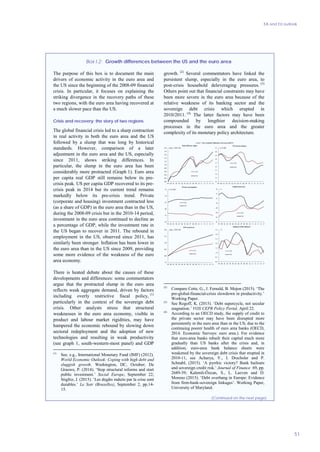
The global economic outlook weakened further in
recent months amid heightened financial market
volatility and falling equity and commodity prices.
Prospects for many emerging markets remain
fragile with the downturn across these economies
now looking likely to continue for longer than
expected in the winter due to renewed commodity
price declines, tightening financial conditions and
a host of homegrown vulnerabilities. At the same
time, growth in a number of advanced economies,
including the US and Japan, disappointed towards
the end of last year, raising concerns about the
strength of their recoveries and further clouding
the global outlook. Principal risks to this outlook
relate to developments in China and their potential
spillovers to the rest of the world, the prospective
pace and impact of US monetary policy
normalisation, developments in commodity prices,
and ongoing geopolitical tensions and conflicts in
many parts of the world.
Further weakening of the global growth
outlook…
Following a period of gradual slowdown among
emerging markets which began in 2011, global
economic growth (excluding the EU) likely fell to
3.2% in 2015, its slowest pace since 2009 (Graph
I.3), and is expected to recover only modestly in
2016 (3.3%) and 2017 (3.7%).
4.4
3.9 3.7
3.2 3.3
3.7
-1
0
1
2
3
4
5
12 13 14 15 16 17
pps.
Graph I.12: Global GDP growth outside the EU
MENA, Sub-Saharan Africa and other EME
Russia and Brasil
Emerging Asia (ex. China)
China
Advanced economies (ex. EU)
World excl. EU (y-o-y%)
forecast
Over the forecast horizon, the projected pick-up in
global growth (excluding the EU) largely reflects
expectations of a very modest recovery in
emerging markets supported by stabilising
commodity prices, the progressive easing of
recessions in Brazil and Russia, and a gradual
pick-up in global trade flows (see Graph I.13).
Overall, the global outlook has deteriorated in
recent months as growth expectations in advanced
economies (US, Japan) have been downgraded,
while recessions in Brazil and Russia have been
deeper-than-expected, and the rebound in most
other emerging economies has disappointed.
0.1
0.4
-0.1
0.0
0.1
0.2
0.3
0.4
0.5
2016 2017
pps.
MENA, Sub-Saharan Africa and other EME
Russia and Brasil
Emerging Asia (ex. China)
China
Advanced economies (ex. EU)
World excl. EU (y-o-y%)
Graph I.13: Sources of rebound in global non-EU GDP
growth
The projected firming of global economic growth
projected depends on a number of crucial
assumptions, including (i) the stabilisation of
commodity prices, limited second-round effects
from the past declines and some rebound in
activity in commodity exporting countries, (ii) the
continuation of an orderly rebalancing and gradual
slowing of the Chinese economy, accompanied by
a progressive pick-up in Chinese import demand,
(iii) the absence of major financial market
upheavals related to the normalisation of US
monetary policy and (iv) resilient recovery in
advanced economies.
Recent data confirm the weakening momentum of
the global economy in late 2015 and early 2016.
Global GDP growth eased to around 0.7% q-o-q in
the fourth quarter of 2015, (31)
from 0.8% in the
second and third quarters. This reflects a
combination of factors, including a stabilisation in
emerging market growth to just over 1% (q-o-q),
and a pronounced slowdown among advanced
economies. Quarter-on-quarter growth in the last
quarter of 2015 fell to just 0.3% in advanced
economies, markedly less than earlier in the year
and a two-year low. Forward looking indicators
point to a modest pick-up in activity in March, as
PMIs (Purchasing Managers’ Indices) in both
advanced and emerging markets moved up from
their February lows, with those in emerging
(31)
Preliminary estimate based on around 84% of world GDP.
EA and EU outlook
17
markets rebounding above 50 for the first time in a
year (Graph I.14).
30
35
40
45
50
55
60
65
-2.0
-1.5
-1.0
-0.5
0.0
0.5
1.0
1.5
06 07 08 09 10 11 12 13 14 15 16
q-o-q%
Graph I.14: Global GDP and global Composite PMI
Growth contribution from emerging markets
Growth contribution from advanced economies
Composite PMI - emerging markets (rhs)
Composite PMI - advances economies (rhs)
Source: OECD, IMF, EUROSTAT, and national statistical institutes
for GDP, JPMorgan/Markit for PMI.
index > 50 = expansion
…as the recovery in advanced economies is
losing momentum…
Real GDP growth disappointed towards the end of
2015 in a number of advanced economies, notably
the US and Japan. In the US, growth was dragged
down by the sharp slump in the energy sector due
to the sustained fall in oil prices, weak net exports,
reflecting sluggish demand in the rest of the world,
an appreciating US dollar, and an adjustment in
inventories. While the contraction in the energy
sector is likely to level off as oil prices stabilise,
weak external demand and the inventory cycle will
likely continue to weigh on growth for some time.
Domestic demand remains robust, thanks to low
oil prices, solid employment growth and rising
wages, all of which are supporting private
consumption and residential investment. This
should continue to sustain the US recovery over
the forecast horizon, even though the sharp fall in
unemployment rates and the closure of the output
gap are clear signs of a maturing cycle and limited
scope for further accelerating growth.
In Japan, the pronounced weakness in domestic
demand towards the end of the year largely reflects
lacklustre private consumption as nominal wage
growth and real household incomes have so far
failed to pick up consistently. Although monetary
policy remains accommodative, real GDP growth
is not expected to increase markedly over the
forecast horizon, as planned fiscal consolidation
measures will add some volatility to the profile of
private consumption and investment.
All in all, economic growth in advanced
economies (including the EU) is now expected to
remain stable at annual rates of 2.0% over the
forecast horizon. This is lower than previously
forecast and largely reflects stronger external
headwinds, most notably from the slowdown in
emerging markets.
( a ) 2012 2013 2014 2015 2016 2017 2015 2016 2017
USA 15.9 2.2 1.5 2.4 2.4 2.3 2.2 2.5 2.7 2.6
Japan 4.4 1.7 1.4 0.0 0.5 0.8 0.4 0.7 1.1 0.5
Asia (excl.Japan) 34.1 7.0 6.5 6.2 5.9 5.8 5.7 5.9 5.8 5.8
- China 16.6 9.6 8.0 7.3 6.9 6.5 6.2 6.9 6.5 6.2
- India 6.8 4.9 6.9 7.1 7.3 7.4 7.4 7.2 7.4 7.5
Latin America 8.6 3.1 2.9 1.2 -0.1 -0.4 1.4 -0.6 0.1 1.6
- Brazil 3.0 1.8 2.7 0.1 -3.8 -3.7 0.3 -3.8 -3.0 0.3
MENA 6.8 3.5 1.7 2.7 2.8 2.9 3.4 2.7 3.0 3.5
CIS 4.7 3.4 2.1 0.9 -2.9 -1.1 1.1 -3.1 -0.3 1.2
- Russia 3.3 3.4 1.3 0.6 -3.7 -1.9 0.5 -3.7 -1.2 0.3
Sub-Saharan Africa 3.2 4.4 5.0 5.0 3.3 3.3 3.9 4.2 4.0 4.2
Candidate Countries 1.5 1.8 4.0 2.7 3.8 3.4 3.6 3.0 3.3 3.6
World (incl.EU) 100.0 3.5 3.2 3.3 3.0 3.1 3.4 3.0 3.3 3.5
World trade 2.6 3.1 3.3 2.4 2.7 3.8 2.6 3.5 4.2
Extra EU export market growth 2.7 3.8 2.8 1.0 1.9 3.1 1.6 2.9 3.6
(a) Relative weights in %, based on GDP (at constant prices and PPS) in 2014.
forecast
Table I.1:
International environment
Real GDP growth
Spring 2016
World merchandise trade volumes
(Annual percentage change)
forecast
Winter 2016
European Economic Forecast, Spring 2016
18
…the downturn in emerging markets is easing
only gradually…
Growth in emerging markets fell to 3.8% in 2015,
their weakest annual rate since 2009. Little
improvement is expected in 2016 but a mild
rebound to 4.4% in 2017 is forecast as the
recessions under way in Brazil and Russia ease and
other emerging markets make progress in cyclical
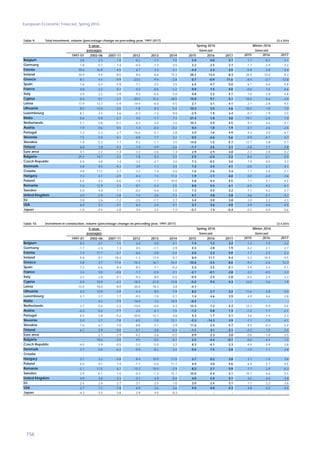
and structural adjustments.
Several factors are weighing heavily on the
outlook for emerging market economies. These
include the slowdown and rebalancing in China
and the associated weakening of global trade
flows, low commodity prices and a host of
domestic and geopolitical vulnerabilities. Another
factor is the tightening of financial conditions,
most recently reflected in the rise of sovereign and
corporate yields, falling equity prices, and net
capital outflows from several emerging market
economies. (32)
While prospects vary across countries, the outlook
remains fragile and is subject to increased
uncertainty. Over the forecast horizon, some of the
biggest emerging markets are expected to continue
facing deep adjustment crises. These include
Russia and Brazil, where recessions are projected
to extend into 2016 before marginal growth
resumes in 2017. Most countries in the Middle
East and North Africa, Sub-Saharan Africa and
emerging Asia are set to face a difficult
macroeconomic and financial environment in
2016. Commodity prices have fallen sharply and
financial conditions have tightened amid rising
financial volatility and capital outflows. This in
turn raises concerns about financial stability,
particularly where there are high levels of foreign-
currency denominated debt. Moreover,
deleveraging in the private sector and fiscal
contraction are likely to weigh on economic
growth and further depress confidence.
…and the rebalancing in China continues to
weigh on growth.
In China, the gradual slowdown in growth
observed so far is expected to continue as the
economy shifts from investment- to consumption-
led growth. This transition has substantial
implications for the structure of Chinese trade and
(32)
See European Commission (DG ECFIN) (2016). ‘Putting
the spring forecast into perspective: Global factors and the
euro area’. In European Economic Forecast – Winter 2016.
Institutional Paper 20, Section I.1, pp. 10–16.
is expected to continue weighing both on global
trade flows and commodity prices. Recent data
releases and policy announcements, including
short-term stimulus measures and the renewed
commitment to market-oriented reform, support
the view that the ongoing transition process
remains under control. Buoyant growth in a
number of sectors (services, consumption) seems
to be sufficiently strong to compensate for
recessionary developments elsewhere, and the
Chinese authorities remain committed to provide
short-term stimulus if needed. Nevertheless, the
challenges associated with the necessary correction
of major imbalances (overcapacity in heavy
industries, over-indebtedness) remain pressing and
entail considerable risks of a sharper and more
disruptive slowdown. An extended period of
capital outflows and exchange rate pressures
reflects major uncertainty associated with China’s
adjustment process, even though some of these
pressures have recently abated. Hence, downside
risks to the outlook dominate and largely relate to
the capacity of the authorities to steer the transition
process successfully, finding the right balance
between measures to stabilise near-term growth
while maintaining financial stability and advancing
with necessary structural reforms.
Global trade to remain sluggish
Following a sharp contraction early last year and a
mid-year rebound, global trade flows remain
depressed (see Graph I.15), largely reflecting
weaker demand from China, Russia, Brazil and
other commodity exporting economies. (33)
Last
year's 3% contraction in Chinese goods import
volumes was the first on record. However, for the
year as a whole, world goods imports were up by
1.5% in volume terms, as the decline in emerging
markets (-1.4%) was more than offset by solid
growth in advanced economies’ imports (3.6%).
During 2015 and early 2016, Chinese trade flows
were consistent with the ongoing rebalancing away
from manufacturing (as reflected in the weak
imports of commodities, capital and investment
goods), towards services, whose imports have seen
annual growth rates of close to 20%.
(33)
See IMF (2016). ‘Dissecting the Global Trade Slowdown’.
In World Economic Outlook (IMF), Box 1.1, pp. 54–56.
Washington, DC, April.
EA and EU outlook
19
60
80
100
120
05 06 07 08 09 10 11 12 13 14 15 16
Graph I.15: Volume of goods imports
Advanced economies Emerging economies
World World excl. EU
index, 2010=100
Source: CPB
Outside China, trade weakened most for
commodity exporters (both advanced and
emerging) (34)
and for the countries most exposed
to China. But trade developments also
disappointed in major advanced economies,
including the United States, where the US dollar’s
steady appreciation weighed heavily on trade flows
during the second half of 2015. A sharp terms-of-
trade adjustment, triggered by the collapse in
commodity prices, has depressed export values and
import demand across much of the CIS, Latin
America, MENA and Sub-Saharan Africa. In some
cases, this is exacerbated by home-grown
vulnerabilities and regional conflicts, capital
outflows and currency depreciation, and
compounded further by the sharp drop in demand
from China.
Globally (excluding the EU), the growth rate for
imports of goods and services likely bottomed out
at an estimated 0.5% in 2015, their lowest level
since 2009 (Graph I.16). Russia and Brazil jointly
subtracted as much as 0.8 pps. from growth while
China’s contribution was just a fraction of what
has been in previous years. Excluding the EU,
world import growth is expected to firm to 2.1%
and 3.4% in 2016 and 2017, mainly driven by the
assumed stabilisation of commodity prices, the
gradual recoveries expected in Brazil and Russia,
and some normalisation of trade flows in China
accompanied by the ensuing pick-up in emerging
Asia (see Graph I.17). In 2016, however, slowing
import demand in the US is expected to be a major
factor offsetting these improvements.
(34)
See IMF (2015). ‘Where Are Commodity Exporters
Headed? Output Growth in the Aftermath of the
Commodity Boom’. In World Economic Outlook (IMF),
Chapter 2, pp. 65-104. Washington, DC, October.
4.3
3.7
2.7
0.5
2.1
3.4
-2
-1
0
1
2
3
4
5
12 13 14 15 16 17
pps.
Other emerging economies
Russia and Brazil
Emerging Asia excl. China
China
Other advanced
USA
World excl. EU (y-o-y%)
forecast
Graph I.16: World imports of goods and services outside the EU
Despite the projected rebound, trade flows are set
to remain relatively weak over the forecast
horizon, including as a share of global output, and
especially when compared to pre-crisis trends.
This largely reflects the lower trade intensity
assumed to prevail in emerging markets, where
trade and its responsiveness to growth has been
slowing for a number of years, partly due to the
maturation of global value chains, structural
changes in China and the slower pace of trade
liberalisation. (35)
1.6
1.3
-0.5
0.0
0.5
1.0
1.5
2.0
2016 2017
pps.
Other emerging economies
Russia and Brazil
Emerging Asia excl. China
China
Other advanced
USA
World excl. EU (y-o-y%)
Graph I.17: Sources of rebound in global non-EU import growth
These trends come on top of largely cyclical drags
on world trade related to the weakness in
intensely-trading economies (e.g. EU), or the
weakness in trade-intensive investment.
(35)
For a discussion see European Commission (DG ECFIN)
(2015). ‘Understanding the weakness in global trade’.
European Economic Forecast – Winter 2015. European
Economy 1/2015, Box I.1, pp. 46–49.
European Economic Forecast, Spring 2016
20
Commodity prices are set to stabilise at a low
level
One implication of the deteriorated global outlook
has been the marked broad-based decline in
commodity prices to very low levels. As regards
oil prices, the related demand aspects have added
to the impact of burgeoning supply that had
initially been identified as the dominating factor
behind the decline since mid-2014. (36)
After hitting a new cycle low of 28 USD/bbl. in
January 2016, Brent oil prices recovered to over
USD 40/bbl. in March-April amid increased
volatility. The recovery of Brent spot prices was
supported by a slight tightening of supply based on
lower OPEC and non-OPEC output. Output losses
in some OPEC members were only partly offset by
rising Iranian production. While pumping near
record volumes, Russia and Saudi Arabia kept the
output stable during February-March as foreseen in
their agreement with Qatar and Venezuela to
freeze their oil production at January levels.
Further attempts to reach a global deal on curbing
oil production failed at a meeting in Qatar in April,
but its negative impact on prices was outweighed
by supply outages in Kuwait, Nigeria and
Venezuela. Non-OPEC supplies, including the US,
have been declining since December. However, the
IEA does not expect a strong recovery of oil
prices, as the supply surplus is set to diminish only
gradually throughout 2016. High levels of stocks
and concerns over economic growth in emerging
markets are likely to keep a cap on price pressures.
Oil prices are assumed to rebound moderately over
the forecast horizon (see Graph I.18). Due to the
decline observed until January, the average annual
oil price is assumed to fall further this year (from
53.4 USD/bbl. in 2015 to 41.1) before rising next
year (to 45.9). This implies an upward revision of
the technical assumptions with respect to the
winter forecast. In euro terms, the oil price
assumption has been revised up by 10.5% in 2016
and 3.4% in 2017 as compared to the winter
forecast. Uncertainty surrounding these
assumptions remains high.
The prices of other commodities also fell sharply
in 2015 and are likely to fall further in 2016, albeit
at a slower pace. Despite a sharp rally of some
metal prices in February and March, the near-term
(36)
Recent ECB estimates confirmed that the initial decline can
mostly be explained by supply increases. See ECB (2016).
‘Current oil price trends’. ECB Economic Bulletin, Issue 2,
Box 2, pp. 38–39.
outlook for most industrial commodities remains
bleak. Ample supply and the projected weakening
demand outlook from emerging economies suggest
a further decline in metal prices in 2016. In 2017,
diminishing oversupply and the pass-through from
recovering energy prices provide arguments in
favour of some price stabilisation.
20
40
60
80
100
120
12 13 14 15 16 17
Graph I.18: Brent oil spot prices, USD and euro
USD/bbl
EUR/bbl
price per bbl
Source: ICE
assumption
Food prices are expected to continue their
downward trend in 2016 due to sufficient
production, comfortable levels of stocks for most
commodities and low energy costs. In particular,
large harvests in the US and in the southern
hemisphere have improved the supply outlook for
wheat, maize and soya beans. This outlook is
subject to the risk of adverse weather conditions
associated with El Niño.
Risks to the global outlook remain tilted to the
downside and have increased
The balance of risks to the global outlook remains
tilted to the downside and has deteriorated further
in recent months. Developments in China remain
at the forefront of concerns. The impact of
volatility in Chinese financial markets on the
domestic economy looks limited, although the
recent spillovers from developments in Chinese
equity and foreign exchange market to global
financial markets expose the potential strength of
this transmission channel. Given the size of the
Chinese economy and its key role in many
commodity markets, ongoing structural shifts in
the real economy could generate further
uncertainty. In particular, any signs that GDP
growth may be slowing more than expected or of a
prolonged weakness in Chinese import demand
could have major negative consequences for
EA and EU outlook
21
commodity prices, world trade, and investor
confidence. (37)
There remain significant risks associated with the
prospective pace of US monetary policy
normalisation. Combined with uncertainties
surrounding developments in China, monetary
policy measures in the US could have a more
negative impact on emerging market economies
than envisaged in the central scenario, particularly
in those countries with high levels of foreign
currency-denominated corporate debt. Lower
economic growth in emerging market economies
would not only endanger the expected rebound in
global activity and world trade, it could also affect
the stability of financial markets. Yet, the weaker
outlook for the US may lead to a slower pace of
monetary policy normalisation than previously
expected, and would thus mitigate some of the
concerns over monetary policy divergence. This
could reduce some of the risks associated with
rising interest rates in the US. Nevertheless,
concerns about the strength of the US recovery
could also feed into renewed market uncertainty
about the future course of policy action and trigger
more volatile market reactions.
Additional downside risks are related to
commodity price assumptions where, for instance,
a further slump in prices could aggravate the
downturn in emerging markets in general and
commodity exporting regions in particular.
Stronger-than-expected second round effects from
the fall in commodity prices seen so far could
result in a more severe tightening of the fiscal
stance and lower domestic demand, which would
accentuate the downturn and limit the scope for a
rebound in 2016 and 2017.
Finally, geopolitical risks remain high, particularly
with respect to the conflicts in the Middle East,
parts of Northern Africa and Ukraine.
(37)
The impact of a Chinese import shock in 2016-17 could be
substantial as recent estimates suggest; see Kireyev, A. and
A. Leonidov (2016). ‘China’s Imports Slowdown:
Spillovers, Spillins, and Spillbacks.’ IMF Working Paper
WP/16/51.
3. FINANCIAL MARKETS
In early 2016, volatility in financial markets rose
as investors became more risk averse in response
to increased concerns about a global slowdown.
Stock markets across the world were affected (see
Graph I.19). More recently, these concerns were
reduced by some positive data releases,
rebounding oil prices, and expectations of
additional monetary policy easing in Europe and
delayed normalisation in the US. However,
volatility is still elevated. Overall, these
developments highlighted the reliance of the
economic recovery on monetary policies and the
key role of financial markets.
85
95
105
115
125
135
Jan 15 Jul 15 Jan 16
US S&P 500 (lhs)
Eurostoxx 600
Stoxx Asia Pacific 600 (lhs)
Index, Jan 2015=100
Graph I.19: Stock market developments
New monetary easing measures in the euro
area…
In March, the ECB announced monetary policy
measures, supplementing those taken last year (e.g.
at the January and December meetings) to further
ease funding conditions for banks and companies
while also stimulating bank lending to businesses.
In addition to lowering its key policy interest rates
further, the asset purchase programme was
extended and new tools were introduced. Rate cuts
affected the ECB’s main refinancing operations
(MRO, -5 bps. to 0%), the deposit facility (-10 bps.
to -0.4%), and the marginal lending facility
(-5 bps. to 0.25%). Monthly purchases under the
asset purchase programme (APP) were increased
from €60 billion to €80 billion and the list of assets
eligible for regular purchases was extended to
include investment grade euro-denominated bonds
issued by non-bank corporations established in the
euro area. In addition, the ECB announced a new
series of four targeted longer-term refinancing
European Economic Forecast, Spring 2016
22
operations (TLTROs), each with a maturity of four
years. The TLTROs allow banks to borrow at zero
rates and to obtain a rebate of 40 bps. if they meet
a lending benchmark by January 2018.
These measures are expected to ease monetary
conditions through several channels. The lower
negative policy rate and the new bank liquidity-
support measures are expected to improve the
transmission of monetary policy to the real
economy through both banks and financial
markets. The increased amount of monthly
purchases and the inclusion of non-bank corporate
bonds in the list of assets eligible for purchases
under the APP should ease financing conditions
for the non-financial sector directly and possibly
also indirectly, through portfolio effects, thus
complementing the transmission through the
banking sector.
…but less global monetary policy divergence
than previously expected…
Monetary policy outside the euro area has recently
either eased further or been characterised by
delayed tightening. It has therefore diverged less
than expected in the winter.
Further easing was observed in several EU
Member States outside the euro area and in Japan.
Sweden’s Riksbank lowered the repo rate, its main
policy rate, deeper into negative territory (-10 bps.
to -0.50%) in February and decided in mid-April to
continue purchasing a further SEK 45 billion of
government bonds during the second half of 2016.
The Hungarian central bank also lowered its policy
rates in March to new historically low levels. In
January, the Bank of Japan eased further by
introducing for the first time a negative policy rate
(-0.10%) amid increasing risks that low oil prices
and uncertainty in emerging and commodity-
exporting countries could delay Japan’s escape
from a ‘deflationary mind-set.’
Expectations of monetary policy tightening
(normalisation) were recently pushed back in the
US and in the UK. At its January and March
meetings, the US Federal Reserve’s FOMC
announced that it would proceed cautiously in
adjusting monetary policy, emphasising the risks
that foreign economic and financial development
since the turn of the year would restrain US
economic activity. At its April meeting, the Bank
of England’s Monetary Policy Committee left its
monetary policy stance unchanged but said that it
considered a rate hike to be more likely than not
over the committee’s forecast horizon.
…contributing to the strengthening of the euro.
Market participants’ reassessment of the relative
monetary policy trajectories of the ECB and the
US Federal Reserve have been felt on foreign
exchange markets. After fluctuating in early 2016,
the euro recently has trended higher against the US
dollar, but depreciated against the yen. In nominal
effective terms, the euro has strengthened on the
back of continued weakness in the currencies of
most emerging and commodity-exporting countries
(see Graph I.20). Another factor has been a slide in
the pound sterling that market participants have
attributed to uncertainty ahead of the UK
referendum on EU membership in June.
75
80
85
90
95
100
105
Mar 14 Nov 14 Jul 15 Mar 16
Graph I.20: Euro exchange rate since March 2014,
NEER-37, USD, GBP
USD/EUR GBP/EUR NEER-37
March 2014 = 100
Market conditions continue to support the
economic recovery…
The initial financial market losses in early 2016
were broad-based, affecting different market
segments. For instance, the general risk aversion
and renewed concerns over the sovereign-banking
sector nexus created upward pressure on bond
spreads in the periphery. Corporate bond spreads
increased substantially (Graph I.21), while EU
stock markets fell sharply. The financial sector
underperformed the broader market significantly
amid growing concerns about the profitability
prospects of banks in low or negative interest rate
environments.
EA and EU outlook
23
20
40
60
80
100
120
140
Jan 15 Jul 15 Jan 16
BBB A AA
bps.
Graph I.21: 5-year maturity corporate bond spreads, euro area
Since mid-February, however, markets have turned
on speculation about further monetary policy
measures, and later, on a somewhat less negative
assessment of the economic outlook for emerging
markets. Sovereign bond spreads tightened again
in the euro area (Graph I.22). Nevertheless, in
some lower-rated countries spreads remained
higher than before.
0
50
100
150
200
250
300
350
400
Jan 15 Jul 15 Jan 16
ES IT PT
bps.
Graph I.22: 10-year maturity sovereign bond spreads
to the German bund, selected countries
In equity markets, volatility has receded somewhat
in recent weeks compared to the first weeks of the
year. But banking shares have not fully caught up
with other market segments (see Graph I.23). This
reflects structural factors such as the persistence of
high levels of non-performing loans, but also an
adjustment process towards regulatory
requirements such as the ‘bailing in’ of creditors,
stipulated in the Bank Recovery and Resolution
Directive (BRRD).
60
70
80
90
100
110
120
130
Jan 15 Jul 15 Jan 16
Banks Eurostoxx 600
Index, Jan 2015 = 100
Graph I.23: EU broad stock market vs. bank sub-index
…bank lending shows robust expansion,
supported by declining lending rates…
The very accommodative policy stance of the ECB
has resulted in very favourable monetary and
credit conditions for borrowers in the euro area.
Both narrow and broad money supply has been
growing at high rates and the recovery in bank
credit flows to the real economy is spreading
across euro area countries, albeit from relatively
low levels. Since mid-March and up to mid-April,
the three-month Euribor declined further while the
three-month Euribor-OIS spread, a measure of
interbank market stress, narrowed.
Net bank lending flows to households and non-
financial corporations (NFCs) has remained
positive over the last few months. The annual
growth rate of loans to the private sector recovered
further into positive territory along with the
economic cycle. Survey-based signs are consistent
with these developments in lending. The ECB’s
latest Bank Lending Survey (April 2016) indicates
improving loan supply conditions for businesses
and increasing loan demand across all loan
categories. (38)
However, credit standards on loans
to households for house purchases tightened. The
ECB’s Survey on Access to Finance of Enterprises
(SAFE) suggests further loosening of funding
constraints to SMEs.
As banks have been passing on their favourable
funding conditions, bank lending has been
supported by lower interest rates for NFCs and
households. This suggests that the transmission of
monetary policy through the euro area banking
system has improved. An important development
(38)
See ECB (2016). The euro area bank lending survey. First
quarter of 2016. April.
European Economic Forecast, Spring 2016
24
for the economic outlook is that there were
pronounced declines in bank lending rates across
vulnerable Member States and this includes rates
for smaller loans, typically taken by SMEs. Hence,
discrepancies in lending rates between vulnerable
and other euro area countries have narrowed
further while the interest rate spread between large
and small loans, which had significantly widened
during the financial crisis, has also narrowed for
most countries over the last year.
The take-up of loans in response to falling interest
rates has been more heterogeneous. For SMEs, the
latest data indicate that the biggest rise in lending
volumes have not occurred where interest rates
have fallen most (see Graph I.24). For instance,
small loan volumes have risen only modestly in
Italy and Portugal where the decline in interest
rates has been large. This suggests that other non-
price supply side factors, such as high levels of
non-performing loans (NPL) (39)
and/or weak
demand remain important in some countries. This
points to the risk of subdued bank-based credit
intermediation in these countries.
DE
IE
EA
ES
FR
IT
NL AT
PT
FIBE
-1.2
-1.0
-0.8
-0.6
-0.4
-0.2
0.0
0.2
0.4
0.6
-10 0 10 20 30 40
Annualchangeininterestratesonnewbusinessloans
Change in new business volumes
Graph I.24: Business volumes responsiveness to interest rates,
NFC loans (< 1 mn EUR), February 2015 - February 2016
pps.
y-o-y%
Compared to a year ago, the attractiveness of bank
lending rates has improved relative to market
funding sources (see Graph I.25). Market funding
costs for bond and equity issuance have also been
more volatile over the last couple of months. After
widening over most of 2015, corporate bond
spreads narrowed sharply in March this year after
the ECBs decision to include investment-grade
non-bank corporate bonds into its range of
purchasable securities. Bond spreads and equity-
(39)
According to a recent IMF estimate, the amount of NPL
held by banks in the euro area stood in mid-2015 at EUR
900 bill, which is almost 10% of GDP. See IMF (2016).
Global Financial Stability Report. Washington, DC, April,
p.33.
earning yields remain higher than a year ago but
bank lending rates have progressively declined.
0
2
4
6
8
10
12
14
16
07 08 09 10 11 12 13 14 15 16
Corporate bonds (5 yrs)
Bank loans (over 5 yrs)
Eurostoxx 50 - earning yield
Graph I.25: Cost of corporate funding, euro area
%
Euro area banks continued to repair their balance
sheets but remained challenged by low profitability
in an operating environment of low interest rates
and low nominal economic growth. In fact, by
lowering the borrowing costs for the real economy,
unconventional monetary policy appears to have
compressed banks’ net interest margins. The
impact on bank profitability, however, is difficult
to estimate, because it depends on the ability of
banks to pass on costs through the re-pricing of
loans, deposits and other liabilities. (40)
…while market funding increased…
Heightened market volatility and risk-aversion
translated into negative net issuance of corporate
bonds in December 2015 and January 2016. The
narrowing of corporate bond spreads in the wake
of the ECB decisions in March created an
opportunity to increase issuance. Several
companies used it, suggesting that corporates are
responsiveness to price signals in the bond
markets. Meanwhile, equity issuance, while
starting from low levels two years ago, has been
more resilient over the last couple of months
despite deteriorating conditions.
…and the outlook is for a further pick-up of
external funding.
Looking forward, the cycle of external corporate
funding is expected to pick up further, thanks to
both bank lending and market funding. Currently,
the momentum is on the bank lending side thanks
(40)
See IMF (2016). ‘Impact of low and negative rates on
banks’. In IMF Global Financial Stability Report, Box 1.3,
pp. 44–46. Washington, DC, April.
EA and EU outlook
25
to the relative improvement of price conditions for
bank lending compared with market funding from
a year ago.
All in all, the stance of monetary policy suggests
easy financing conditions over the forecast
horizon. To what extent firms will use bank credit
or market financing will depend on the prevailing
price conditions for the various funding
instruments. The latest ECB decisions provide
support to both bank lending (via the new
TLTROs) and market funding (via an extended list
of assets eligible for the APP). Market interest rate
expectations, which are reflected in the
assumptions underlying this forecast, remain low.
As the economic recovery progresses, the use of
internal funds is expected to gradually decline.
Nevertheless, corporates’ net funding position may
remain positive as the deleveraging process in the
euro area corporate sector continues.
4. GDP AND ITS COMPONENTS
For more than a year, the euro area has been
benefitting from a combination of favourable
factors such as low oil prices, a depreciating euro,
additional supportive monetary policy measures,
and an increase in public expenditure. In the last
six months, however, headwinds stemming from
the deterioration in the external environment and
in particular from emerging markets have come to
the fore, partially offsetting the positive impact of
these tailwinds. As a result, the economic recovery
in the euro area has remained moderate.
The strength of the tailwinds will be decisive for
the continuation of the economic upswing. While
some of them are expected to continue supporting
the recovery in the short term, the effect of some
of these factors is expected to diminish over the
forecast horizon. Since the winter forecast, oil
prices have risen slightly and the euro has
appreciated somewhat. Over the same time,
however, monetary policy has become even more
accommodative and the fiscal stance has been
slightly expansionary.
GDP growth gained momentum last year…
According to the latest national accounts data,
economic growth continued last year at a moderate
pace. In the fourth quarter, GDP expanded 0.3%
(q-o-q) in the euro area (0.4% in the EU). This was
slightly lower than projected in winter and left
economic output still slightly below the pre-crisis
peak. For the whole year 2015, GDP rose by 1.7%
in the euro area (2.0% in the EU), its fastest rate
since 2010. This comes after several years of very
subdued and fragile growth, (41)
in line with the
typical features of recoveries after deep economic
and financial crisis (the Reinhart-Rogoff case) and
certain euro area and EU-specific factors. (42)
The main driver of GDP growth in 2015 was
domestic demand, which rose on the back of rising
private consumption (see Graph I.26). With a
strong increase in household real gross disposable
income and some improvements in the labour
market, private consumption rose significantly.
Investment, by contrast, was rather subdued
despite an unexpected acceleration at the end of
the year. Lower growth momentum in the external
environment, high uncertainty and corporate
deleveraging restrained investment decisions. Net
trade detracted slightly from GDP growth, mainly
reflecting the slowdown in emerging market
economies.
-6
-5
-4
-3
-2
-1
0
1
2
3
08 09 10 11 12 13 14 15 16 17
Private consumption Government consumption
Investment Inventories
Net exports GDP (y-o-y%)
forecast
pps.
Graph I.26: Real GDP growth and its components, euro area
...supported by exceptional circumstances.
Since mid-2014, economic growth in Europe has
benefitted from a combination of favourable
factors successively kicking in. Since June 2014,
growth has enjoyed the support of sharply falling
oil prices and the announcement of quantitative
easing, which along with the launch of the large-
(41)
For a detailed analysis of the ongoing recovery see,
Ruscher, E. and B. Vašíček (2015). ‘The euro area
recovery in perspective’. Quarterly Report on the Euro
Area (European Commission – DG ECFIN) 14(3), pp. 6–
18.
(42)
See European Commission (DG ECFIN) (2014). ‘EU
recovery to remain subdued for longer than expected’. In
European Economic Forecast – Autumn 2014, European
Economy 7/2014, Section I.1, pp. 8–12.
European Economic Forecast, Spring 2016
26
scale Investment Plan for Europe helped to
brighten the outlook. (43)
In spring 2015, optimism
about growth further rose as the beneficial impact
of the ECB’s expanded APP on funding costs and
access to credit became visible. (44)
In autumn
2015, the boost to euro area growth was regarded
as strong enough to offset the initial impact of
weaker global trade momentum and a deteriorating
external environment, in particular as additional
refugee-related expenditures provided additional
growth stimulus in some countries. (45)
However,
headwinds became stronger, partially offsetting the
positive impact from an extension of the period
with tailwinds, so that in the winter the outlook
had slightly worsened and the downside risks to
the outlook had markedly increased. (46)
(43)
See the analysis in European Commission (DG ECFIN)
(2015). ‘Putting the winter forecast into perspective: lower
oil prices and the EU economy’. In European Economic
Forecast – Winter 2015, European Economy 1/2015,
Section I.1, pp. 10–17.
(44)
See European Commission (DG ECFIN) (2015). ‘Putting
the spring forecast into perspective: The ECB’s
quantitative easing and the euro area economy’. In
European Economic Forecast – Spring 2015, European
Economy 2/2015, Section I.1, pp. 10–15.
(45)
See European Commission (DF ECFIN) (2015). European
Economic Forecast – Autumn 2015. Institutional Paper 11,
Section I.1 and Box I.1.
(46)
See European Commission (DG ECFIN) (2016). ‘Putting
the spring forecast into perspective: Global factors and the
euro area’. In European Economic Forecast – Winter 2016,
Institutional Paper 20, Section I.1, pp. 10–16.
The balance of tailwinds, headwinds and crisis
legacy factors remains favourable...
A new balance of tailwinds and headwinds is
expected to develop over the forecast horizon.
Overall, the previously identified tailwinds are
expected to provide some further support to
economic growth, but this support is expected to
fade, while the headwinds identified in the winter
forecast remain in place or become stronger.
Oil prices appear to have stabilised somewhat.
After hitting a 12-year low in January, they have
slightly rebounded. As a result, oil price
assumptions have been revised up, but oil prices
remain at rather low levels. The renewed oil price
drop in January is set to delay the rebound in
inflation rates, extending the boost to household
purchasing power and corporate profitability.
Concerns that the weakening earlier in the year
could have been a harbinger of a further slowing in
the world economy have recently receded in line
with the release of more positive data. The positive
overall effect of declining oil prices on global
economic activity may be smaller than previously
expected, (47)
but for the EU and the euro area, oil
prices remain growth-supportive. The development
(47)
The need to keep into consideration the low-interest rate
environment had been stressed early on. It has recently
been iterated, e.g. by e.g. Obstfeld, M., R. Arezki and G.
M. Milesi-Ferretti (2016). ‘Oil prices and the global
economy: It’s complicated’. VoxEU Column, 13 April.
2010 2011 2012 2013 2014 2015 2016 2017
bn Euro Curr. prices % GDP
5631.0 55.7 0.8 0.0 -1.2 -0.6 0.8 1.7 1.8 1.5
2128.4 21.1 0.8 -0.1 -0.2 0.2 0.8 1.3 1.4 1.2
1984.5 19.6 -0.3 1.6 -3.3 -2.6 1.3 2.9 2.9 3.8
-8.8 -0.1 0.3 0.8 -0.2 -0.1 -0.1 -0.1 0.0 -0.1
4521.2 44.7 11.3 6.5 2.6 2.1 4.1 5.2 3.5 4.7
14256.4 141.1 4.0 2.3 -0.9 0.2 1.9 2.9 2.5 2.8
4147.7 41.0 10.0 4.3 -1.0 1.3 4.5 6.0 4.6 5.3
10106.4 100.0 2.1 1.6 -0.9 -0.3 0.9 1.7 1.6 1.8
10175.6 100.7 2.3 1.7 -0.8 -0.3 1.0 1.5 1.6 1.8
13957.8 138.1 2.1 1.8 -0.5 0.2 1.4 2.0 1.8 1.9
0.4 0.0 -0.7 -0.4 0.5 0.9 1.0 0.8
0.2 0.0 -0.1 0.0 0.2 0.3 0.3 0.2
-0.1 0.3 -0.7 -0.5 0.3 0.6 0.6 0.8
0.9 0.4 -0.9 0.2 0.0 0.0 0.1 0.0
4.0 2.5 1.1 0.9 1.8 2.3 1.6 2.2
5.4 3.2 -1.3 0.2 2.7 4.1 3.5 4.0
-3.3 -1.6 0.4 -0.5 -1.8 -2.4 -1.9 -2.2
0.6 0.9 1.5 0.4 0.0 -0.1 -0.3 0.0
(Real annual percentage change)
2014
Final demand
GDP
Public consumption
Change in stocks as % of GDP
Imports (minus)
GNI
Investment
Exports of goods and services
Table I.2:
Contribution to change in GDP
Private consumption
Spring 2016
Net exports
p.m. GDP EU
Final demand
Inventories
forecast
Composition of growth - euro area
Public consumption
Real percentage change
Imports of goods and services
Exports
Private consumption
Gross fixed capital formation
EA and EU outlook
27
of oil price assumptions suggests that this support
will remain in place for some time (see
Graph I.27).
20
30
40
50
60
70
80
90
100
110
120
13 14 15 16 17
Graph I.27: Oil price assumptions (USD/bbl),
SF14 - SF16
USD/bbl
Autumn
2015
Winter
2016
Autumn
2014
Spring
2014
Winter
2015
Spring
2015
Spring 2016
Monetary and financing conditions remain
favourable for borrowers. The ECB’s very
accommodative monetary policy has improved
access to credit and lowered funding costs, with
the latter also reflected in the development of
interest rate assumptions (see Graph I.28).
-0.4
-0.3
-0.2
-0.1
0.0
0.1
0.2
0.3
0.4
13 14 15 16 17
Graph I.28: Interest rate assumptions, euro area,
short-term, SF14 - SF16
%
Autumn 2015
Winter 2016
Autumn 2014
Spring 2014
Spring 2015
Winter 2015
Spring 2016
The euro remains at a relatively low level
compared to previous years, which is also evident
from developments in the exchange rate
assumptions (see Graph I.29). However, support
from a lower euro exchange rate can mainly be
expected from some lagged effects as the euro has
recently appreciated slightly. As a result of capital
outflows from emerging markets, their currencies
have depreciated, and the outlook for a less
asynchronous monetary policy in different regions
of the world also supported the strength of the
euro. Nevertheless, the relatively weak euro should
continue exerting a positive, though decreasing
impact on exports and economic growth.
2010 2011 2012 2013 2014 2015 2016 2017
bn Euro Curr. prices % GDP
7931.1 56.8 0.7 0.2 -0.6 -0.1 1.2 2.0 2.1 1.8
2918.1 20.9 0.7 -0.1 0.1 0.3 1.2 1.4 1.5 1.2
2710.8 19.4 0.1 1.9 -2.5 -1.7 2.7 3.4 3.0 3.8
14.2 0.1 0.3 0.7 -0.1 0.1 0.1 0.0 0.1 0.0
6016.4 43.1 10.7 6.6 2.3 2.2 4.0 5.3 3.5 4.6
19590.6 140.4 4.0 2.4 -0.4 0.6 2.3 3.1 2.6 2.9
5630.7 40.3 9.8 4.2 -0.3 1.6 4.7 5.9 4.7 5.1
13957.8 100.0 2.1 1.8 -0.5 0.2 1.4 2.0 1.8 1.9
13971.5 100.1 2.4 1.8 -0.6 0.1 1.3 1.8 1.8 2.0
10106.4 72.4 2.1 1.6 -0.9 -0.3 0.9 1.7 1.6 1.8
0.4 0.1 -0.3 0.0 0.7 1.1 1.2 1.0
0.2 0.0 0.0 0.1 0.2 0.3 0.3 0.2
0.0 0.4 -0.5 -0.3 0.5 0.7 0.6 0.8
1.1 0.4 -0.8 0.2 0.0 0.0 0.1 0.0
3.7 2.5 1.0 0.9 1.7 2.3 1.6 2.0
5.4 3.3 -0.6 0.9 3.2 4.3 3.7 4.0
-3.3 -1.6 0.1 -0.6 -1.9 -2.4 -1.9 -2.1
0.4 1.0 1.1 0.3 -0.1 -0.1 -0.3 0.0
Gross fixed capital formation
(Real annual percentage change)
2014
Final demand
GDP
Public consumption
Change in stocks as % of GDP
Imports (minus)
GNI
Investment
Exports of goods and services
Table I.3:
Contribution to change in GDP
Private consumption
Spring 2016
Net exports
p.m. GDP euro area
Final demand
Inventories
forecast
Composition of growth - EU
Public consumption
Real percentage change
Imports of goods and services
Exports
Private consumption
European Economic Forecast, Spring 2016
28
Fiscal policy is expected to remain growth
supportive this year. Refugee-related expenditures
have increased strongly in the past quarters in
some Member States and this is projected to
continue even without additional large inflows of
asylum seekers.
1.00
1.05
1.10
1.15
1.20
1.25
1.30
1.35
1.40
13 14 15 16 17
Graph I.29: Exchange rate assumptions (USD/EUR),
SF14 - SF16
USD/EUR
Autumn 2015
Winter 2016
Autumn 2014
Spring 2014
Winter 2015
Spring 2015
Spring 2016
In some Member States, reforms, including labour
market reforms, should continue to bear fruit in the
form of continued employment gains.
...despite being dampened by several growth
impediments.
Legacies from the crisis are also expected to
continue weighing on growth. They include high
public debt, which limits the options for fiscal
policy responses; high household debt, which
weighs on domestic demand; and high non-
financial corporate debt, which induces
deleveraging in the private sector with adverse
knock-on effects on economic activity. Moreover,
high unemployment in some euro area Member
States hampers human capital accumulation while
low investment delays capital accumulation. As a
result, the crisis legacies continue to weaken
potential output growth (cf. Box I.4).
Since mid-2015, a number of external and
domestic headwinds have come to the fore. They
already put a lid on economic growth last year and
are expected to continue weighing on growth over
the forecast horizon.
External headwinds are stemming from the
slowdown in emerging market economies and also
more recently from some advanced economies.
Their impact on GDP growth is mainly evident in
euro area and EU export growth and uncertainty
related to recent bouts of financial market turmoil.
The further deterioration in the global outlook
implies a negative impact from these headwinds on
GDP growth. The expected rebound outside the
EU should, however, lower their impact towards
the end of the forecast horizon. In particular,
investment should benefit from the expected global
recovery.
Domestic headwinds have also come to the fore.
The unprecedented increase in the inflow of
asylum seekers last year has put a strain on some
Member States. Some of them have unilaterally re-
introduced temporary border controls within the
Schengen zone, which could affect negatively
foreign trade (e.g. distortion of cross-border
transport, waiting time for commuters). (48)
The
impact on economic activity at the aggregate level
is set to depend on the extent of such measures, but
also on whether joint EU decisions are reached,
and the impact this has on confidence.
The impact on confidence of increased security
concerns is set to weigh on the growth outlook
particularly in some Member States. In some cases
e.g. France and Belgium, this adds to the economic
impact of terrorist attacks and increased security-
related spending.
Mixed signals for the near-term outlook...
The increased uncertainty, reflected in the high
volatility of financial markets, the recent
appreciation of the euro and the slowdown in
emerging and advanced economies, is expected to
have weighed on economic growth early this year.
Recent data give conflicting indications about the
path of GDP growth in the first quarter.
On the one hand, survey data suggest weaker real
GDP growth momentum in the first quarter of
2016. Both the Commission’s Economic Sentiment
Indicator (ESI) and the composite output
Purchasing Managers’ Index (PMI) fell in the first
quarter of 2016 from multi-year highs in the
previous quarter (see Graph I.30). The declines
confirmed that the manufacturing sector has taken
a hit from slow growth in the external
environment, mainly in the first two months as the
March readings signalled some stabilisation in
both the euro area and the EU. Confidence in the
services sector also fell but its reading was the
third highest since the recession in 2008-09 in both
the euro area and the EU. In the first quarter,
(48)
For an analysis of the impact of more far reaching changes
to the rules of the Schengen agreement, see Box I.3.
EA and EU outlook
29
sentiment in the construction continued rising to a
new post-recession high in the EU and came in at
the second highest level since the recession in the
euro area. Overall, both the Commission's
indicators and PMIs remained at high levels,
consistent with a continuation of the expansion in
activity in the near term.
30
40
50
60
60
70
80
90
100
110
120
06 07 08 09 10 11 12 13 14 15 16
Economic Sentiment Indicator (lhs)
PMI Composite Output Index (rhs)
3-month moving average (ma) 3-month ma
Graph I.30: Economic Sentiment Indicator
and PMI Composite Output Index, EU
Source: EC, Markit Group Limited
On the other hand, hard data suggest slightly
higher growth than in the previous quarter. In
January and February, industrial production in the
euro area was on average 1.1% higher than the
average in the last quarter of 2015 (see
Graph I.31). The 3m-o-3m growth rate of new
industrial orders rose in January to 1.0% in the
euro area. In parallel, retail sales, a high-frequency
indicator of private consumption, in January and
February 2016 stood on average 0.8% above the
average recorded in the last quarter of 2015. The
strong increase in the growth rate of loans to
households for purposes other than house
purchases supports expectations of continued
domestic demand expansion (Graph I.32).
85
90
95
100
105
110
115
120
70
80
90
100
110
120
130
06 07 08 09 10 11 12 13 14 15 16
Industrial new orders (lhs) Industrial production (rhs)
Graph I.31: Industrial new orders
and industrial production, euro area
index, 2010=100 index, 2010=100
Putting the pieces together, the signals are for a
near-term continuation of the expansion, the
signals are mixed as regards its pace of the near-
term expansion. As survey indicators measure
more the breadth than the depth of developments,
it is difficult to quantify the impact of the decline
in sentiment indicators and its distribution over
time. As regards the first quarter of 2016, the
projected rate of real GDP growth in the euro area
(0.5% q-o-q) is sufficient to lift output for the first
time above the pre-crisis peak of 2008.
-4
-3
-2
-1
0
1
2
3
12 13 14 15 16
Loans to NFCs
Loans to households for house purchasing
Loans to households (w/o house pruchasing)
y-o-y%
Graph I.32: Loans to households and non-financial corporations,
euro area
…and moderating growth projected in 2016
and 2017.
Overall, the euro area outlook for 2016 and 2017
has worsened somewhat since the winter, mainly
due to the intensified headwinds related to the
weakening of global growth. As inflation picks up,
the positive boost to real incomes from low
inflation, which provided strong support to
domestic demand last year, will also wane. While
these two factors conspire to slow economic
growth, other factors are paving the way for an
acceleration. These include ongoing improvements
in the labour market that will have a positive effect
on incomes, the slightly expansionary aggregate
fiscal stance, and the projected rebound in global
activity. As a result of the balance of these forces,
growth in the euro area is no longer projected to
gain pace over the forecast horizon. Rather, it is
expected to remain broadly stable at rates which
are low by historical standards, leaving the euro
area vulnerable to global shocks.
After having grown by 1.7% in 2015 (2.0% in the
EU, see Graph I.33), the euro area’s real GDP is
expected to grow by 1.6% in 2016 (1.8% in the
EU) and by 1.8% in 2017 (1.9%). This implies that
the economic recovery remains considerably
European Economic Forecast, Spring 2016
30
weaker than in previous upturns. (49)
Potential
growth is expected to remain weak, reflecting the
aforementioned crisis legacies, but also slow total
factor productivity growth and demographic
factors. It is set to be at about 1% over 2016 and
2017. The negative output gap is therefore
expected to narrow over the forecast horizon.
85
90
95
100
105
110
-3
-2
-1
0
1
2
3
4
08 09 10 11 12 13 14 15 16 17
GDP growth rate (lhs)
GDP (quarterly), index (rhs)
GDP (annual), index (rhs)
forecast
q-o-q% index, 2007=100
0.5
-4.4
2.1
-0.5 0.2
Figures above horizontal bars are annual growth rates.
1.8
1.4
2.0
1.8
1.9
Graph I.33: Real GDP, EU
Private consumption remains a key support for
growth…
Private consumption, which has been the main
contributor to GDP growth in the last two years,
moderated somewhat towards the end of last year.
In 2015, the income growth generated by the
ongoing improvement in the labour market along
with very low inflation pushed real gross
disposable incomes and provided the basis for the
strongest annual post-crisis expansion of private
consumption. A rebound in house prices and rising
asset prices supported household wealth, whereas
the growth in non-labour incomes was far more
modest. The slowing expansion in the fourth
quarter of last year reflected the impact of
relatively mild weather conditions on expenditures
for seasonal clothing and energy, a small uptick in
household savings, but also temporary factors such
as the Paris terrorist attacks in November.
…despite several short-term drags…
The drags that were behind the moderation
towards the end of last year are expected to prove
short-lived so that private consumption should
continue to remain the backbone of economic
growth. Nevertheless, drags to growth may still be
(49)
See Ruscher, E. and B. Vašíček (2015). ‘The euro area
recovery in perspective’, Quarterly Report on the Euro
Area (European Commission – DG ECFIN) 14(3), pp. 6–
18.
at work in the short term. Evidence can be seen in
the conflicting signals received in the first months
of this year.
On the downside, survey indicators have mostly
come in below the high levels of last year. The
Commission’s monthly Consumer Confidence
indicator decreased three times in the first quarter,
before picking up slightly in April according to the
flash estimate. Although the outcome in the first
quarter fell, the reading remained well above the
long-term average (see Graph I.34). In the first
quarter, consumers were more pessimistic about
the future general economic situation. Meanwhile
their views on future unemployment, which had
soared in the last quarter of 2015 in several
Member States due to the influx of asylum seekers,
broadly stabilised (and declined in the EU).
Consumers also appeared more confident about
making major purchases. In line with consumer
confidence, the Commission’s retail confidence
index fell in the first quarter, although it too
remained at high levels. In contrast, the PMI for
retail sales in the euro area remained broadly stable
in the first quarter compared to the previous
quarter.
-35
-30
-25
-20
-15
-10
-5
0
5
-3
-2
-1
0
1
2
3
4
5
08 09 10 11 12 13 14 15 16 17
balancey-o-y %
Private consumption (lhs)
Private consumption, forecast (annual data, lhs)
Consumer confidence (rhs)
forecast
Graph I.34: Private consumption and consumer confidence,
euro area
On the upside, retail sales continued increasing in
the first two months of the year (on average 0.8%
higher than in the preceding quarter), following the
upward trajectory begun three years ago (see
Graph I.35). During these two months, new
passenger car registrations rose by 10.7% from the
corresponding months last year, supporting a
strengthening in private consumption growth.
EA and EU outlook
31
-25
-20
-15
-10
-5
0
5
10
-4
-3
-2
-1
0
1
2
3
4
06 07 08 09 10 11 12 13 14 15 16
Retail trade volume, 3 mma (lhs)
Retail confidence (rhs)
y-o-y% balance
Graph I.35: Retail trade volumes and retail confidence,
euro area
In line with these developments, the annual growth
rate of loans to households continued to increase in
February to an annual rate of 1.6%, the highest rate
since October 2011. This mainly reflects the
growth of loans for house purchases (2.3% in
February), which account for more than 70% of
loans to households.
…based on continued real income growth.
Looking further ahead, private consumption should
continue to benefit from further improvements in
labour market conditions and wages, which are
expected to be not depressed by persistently low
levels of headline inflation (second round effects
in wage bargaining). These developments should
accelerate nominal disposable income growth.
Additionally, non-labour incomes (e.g. interest on
savings, dividend payments and rental income) are
also set to rise over the forecast horizon. Overall,
the growth in gross disposable income in the euro
area is expected to accelerate to 2.5% in 2016
(from 2.0% in 2015) and 2.7% in 2017. This
should lead to a strong increase in real gross
disposable income in 2016 when inflation is
expected to be very low and a slightly smaller
increase in 2017 when consumer price inflation
rebounds. This slowing expansion of real
disposable incomes (Graph I.36) will have a
limiting effect on the private consumption growth.
Evidence from the euro area suggests that
increases in financial and housing wealth will only
partially compensate for slower real labour income
growth. However, after several years of
deleveraging, household balance sheets should
become less of a drag on spending. Very low
interest rates and easier access to credit also imply
increased opportunities for re-negotiating loans
and lowering deleveraging needs.
-1.0
-0.5
0.0
0.5
1.0
1.5
08 09 10 11 12 13 14 15 16 17
Net taxes
Non-labour income
Labour income
Real disposable income (q-o-q%)
pps.
Graph I.36: Real gross disposable income and
its components, euro area
forecast
Forecast numbers are de-annualised annual figures.
Household saving rates changed little last year
despite the rise in purchasing power but rates are
expected to pick up slightly this year before
slightly receding next year. The very low level of
interest rates is expected to spur higher savings by
households whose private pension plans and life
insurance schemes are negatively affected.
However, households overall are expected to
continue spending more or less in line with their
income rather than saving their windfall from oil
prices. This also reflects the unwinding of some
pent-up consumption demand after years of
subdued growth and high uncertainty.
Overall, for the remainder of this year and beyond,
the further expansion of disposable incomes should
support private consumption with some
moderation next year, mainly due to the higher
inflation. The growth rate is then expected to
moderate from 1.8% in 2016 in the euro area
(2.1% in the EU) to 1.5% in 2017 (1.8%). Private
consumption will therefore no longer outperform
overall economic growth next year.
Public consumption contributing to economic
growth
In 2015, public consumption is expected to have
risen by 1.3% in the euro area (1.4% in the EU),
twice the rate expected this time last year in the
2015 spring forecast. Exceptional developments
largely explain this outcome. Public security
measures, spending on military operations in Syria
and Iraq, and refugee-related expenditures have
strongly driven up public consumption in some
countries. In the last quarter of 2015, government
consumption grew 0.6% q-o-q. Overall, in 2015,
government consumption is expected to have
decreased in only three euro area Member States
European Economic Forecast, Spring 2016
32
(Ireland, Italy and Finland) and remained stable in
Greece.
Public consumption growth is projected to
continue rising in 2016 before decreasing again in
2017. The acceleration in 2016 mostly reflects
developments in Germany, Italy and the
Netherlands. Government consumption in the euro
area is expected to grow by 1.4% (1.5% in the EU)
and 1.2% (1.2%) in 2016 and 2017 respectively. In
2017, it is expected to continue contracting only in
Greece. The forecast for 2017, however, is
particularly dependent on the no-policy change
assumption, according to which consolidation
measures are only factored into the forecast if they
have been adopted and presented to national
parliaments or are known in sufficient detail.
Investment growth rebounded at the end of
last year…
Investment in the euro area surprised on the upside
in the last quarter of 2015, growing at its second
highest rate since mid-2011 (1.3% q-o-q) and
making a larger contribution to economic growth
than any other component. Both equipment and
construction investment played a role in this
acceleration, which was broad-based across
Member States. In assessing the sustainability of
the recent rebound, it is useful to look at main
contributors. In Germany, both equipment and
construction investment rebounded strongly. The
pick-up in equipment investment, however, was
driven by a very strong increase (about one quarter
of a percent of GDP) in public investment,
whereas private equipment investment declined
again slightly. In the Netherlands, the strong pick-
up was linked to buoyant sales of new cars and the
strong housing market. These observations suggest
a substantial role of temporary factors in the recent
acceleration of euro area investment.
The strong growth in the final quarter lifted the
annual rate for 2015 to its highest level since the
crisis, although the gap with pre-crisis levels
remained wide. Drivers were both equipment
investment and, for the first time since 2007,
construction investment. Developments across the
euro area remain very heterogeneous, with
construction investment still falling in half of the
Member States in 2015.
…but is expected to moderate in the near
term…
The short-term outlook is complicated by mixed
signals from survey indicators and hard data.
On the downside, the Commission’s surveys
suggest that investors have become less optimistic.
Confidence in the euro area was slightly lower in
all business sectors (industry, services, retail and
construction) in the first quarter of 2016 compared
to the previous quarter. In the construction sector,
confidence even fell again below its long-term
average. Similarly, both the manufacturing and
services PMIs decreased in the first quarter.
On the upside, the first hard data for the first
quarter of 2016 bode well for both equipment and
construction investment. As regards equipment
investment, the average monthly production of
capital goods increased in January and February by
1.9% from the average in the fourth quarter of last
year (0.9% in the EU). The expansion of industrial
new orders for capital goods increased in January
in the euro area. The rate of capacity utilisation in
the first quarter continued to rise and exceeded its
long-term average (see Graph I.37).
68
70
72
74
76
78
80
82
84
86
88
-30
-26
-22
-18
-14
-10
-6
-2
2
6
10
08 09 10 11 12 13 14 15 16 17
%%
Equipment investment (y-o-y%, lhs)
Equipment investment, annual growth, forecast (lhs)
Capacity utilisation rate (rhs)
forecast
Graph I.37: Equipment investment and capacity utilisation,
euro area
Hard data on construction continue to be
supportive of positive growth in construction
investment in the near term. The sector’s output
has in February increased by 1.4% (3m-o-3m) in
the euro area. Construction investment should also
benefit from the increase in the number of building
permits in the fourth quarter of 2015 (Graph I.38).
In line with this, the growth in loans for house
purchases, which in February was still rising in the
euro area, augurs well for the construction outlook.
However, flat house prices in the fourth quarter of
2015 as compared to the preceding quarter are
EA and EU outlook
33
somewhat at odds with the positive signals for
construction investment.
-50
-40
-30
-20
-10
0
10
20
-16
-12
-8
-4
0
4
8
08 09 10 11 12 13 14 15 16 17
Graph I.38: Dwellings investment and building
permits, euro area
Dwellings investment (lhs)
Construction investment, forecast (annual data, lhs)
Building permits (rhs)
y-o-y%y-o-y%
forecast
Looking beyond the short term, the factors for
higher investment growth appear to be in place
(e.g. favourable funding conditions, moderately
strengthening demand, above-average capacity
utilisation, and modernisation needs). The
favourable funding conditions for non-financial
corporations include lower bank lending costs and
less tight bank lending standards, improved
conditions for (non-bank) market funding, and also
a strengthened position for internal financing due
to increased savings and retained earnings.
However, low funding costs per se cannot be
expected to impact strongly on corporate
investment decisions. (50)
Moreover, in real terms,
the decline in funding costs has been more limited.
However, the pace of investment growth in the
near term is expected to remain modest due to a
number of factors weighing on investment
decisions. One of these factors is the lower growth
momentum outside the EU, which is expected to
reduce export growth and hence equipment
investment. Also, high uncertainty will continue to
play a role in discouraging investment. Other
limiting factors include the moderate growth of
aggregate demand in the euro area, which impacts
negatively on the size of accelerator effects, and
relatively low long-term growth expectations (see
also Box I.4). These have become more important
for investment decisions as very low discount rates
make the distant future almost as important as the
(50)
Several studies, including a survey conducted by the ECB,
had found evidence that at the current juncture funding
costs are of minor importance for investment decisions;
ECB (2015). ‘What is behind the low investment in the
euro area? Responses from a survey of large euro area
firms’. ECB Economic Bulletin, Issue 8, Box 2, pp. 35–37.
near future. Meagre expectations for demand and
potential growth limit the impact of very
favourable financing conditions and easier access
to funding. Moreover, high corporate and
household indebtedness will continue to weigh on
investment in some Member States.
…before it increases over the forecast horizon.
Further ahead, investment should accelerate more
significantly as corporate deleveraging needs
become less of a constraint and global growth
gradually rebounds. After several years of subdued
investment, the need to modernise the capital stock
should become more pressing. The Investment
Plan for Europe is also expected to exert a positive
impact on both public and private investment in
2016 and even more so in 2017 as a growing
number of projects moves to the implementation
phase.
In addition to the factors described above,
construction investment should benefit from
sustained growth in household real disposable
income and very low mortgage rates. Moreover,
the adjustment in the housing sector seems to be
slowly coming to an end, as suggested by
developments in residential property prices
throughout 2015. Heterogeneity across euro area
Member States however remains large. Among the
largest countries, house prices continued to decline
in 2015 in Italy and France while they increased
markedly in Germany, Spain and the Netherlands.
Construction investment should also benefit from
increased demand for housing for hosting refugees.
Nevertheless, the high level of household debt in
some euro area Member States will continue to
limit construction investment.
All in all, total investment in the euro area is
expected to rise by 2.9% in 2016 (3.0% in the EU)
before accelerating in both areas 3.8% in 2017.
Net trade was a drag on growth in 2015…
The key feature for assessing the growth impact of
foreign trade is the widening divide between trade
within the EU and the euro area on the one hand,
and trade with partners outside on the other hand.
The two performed rather differently last year and
this trend looks set to continue. The divide shows
up in the discrepancy between relatively strong
total export growth in the euro area and the EU and
more moderate growth elsewhere.
European Economic Forecast, Spring 2016
34
On the export side, the slowing economic growth
in the EU's external environment and the weakness
of global trade have become a drag on exports of
goods and services. The fall in commodity prices
has undermined demand growth in commodity
exporting countries and China’s transition (see
Section I.2) has lowered the demand for
investment goods. This has made the further
expansion of exports heavily dependent on the
growth momentum of intra-area exports in both the
euro area and the EU.
In the fourth quarter of last year, the overall
growth of euro area exports remained at the rather
subdued pace to which it had fallen in the third
quarter. The slowdown was more pronounced for
goods, which even declined in the third and fourth
quarters, whereas services continued growing. As
regards goods exports, trade statistics indicate that
the increase in intra-euro area exports in nominal
terms was not strong enough to compensate for the
decline in extra-euro area exports.
On the import side, strengthening domestic
demand remained the key driving factor behind the
almost unabated expansion in the import of goods
and services in the third and fourth quarters. Taken
together, these developments resulted in net trade
making a negative contribution to GDP growth in
both quarters.
Overall, the expansion in the export and import of
goods and services in 2015 was mainly driven by
strong growth in the first half of the year, when the
weak euro helped the euro area and the EU to
weather the slowdown in global trade with
remarkable resilience. Nevertheless, the
contribution of net trade to GDP growth turned
negative, for the first time since 2009.
…and is expected to continue detracting in
2016 and 2017.
The persistence of external headwinds does not
bode well for the future contribution of net exports
to GDP growth. As regards exports, this view is
supported by the assessment of order books in the
Commission’s manufacturing survey, which
showed a deterioration in the first quarter of this
year for both the euro area and the EU. The decline
in the export-oriented manufacturing PMI in the
first quarter of the year is compatible with this
development. Moreover, while some lagged effects
from the euro’s past depreciation should continue
and thereby provide some support to euro area
exports, the recent appreciation of the euro is
expected to dampen this effect over time. As a
result, the impact of price competitiveness on
exports is expected to turn negative.
With the expected gradual strengthening in foreign
demand, euro area exports should slightly
accelerate over the course of this year (see
Graph I.39), as the demand impact turns positive.
With real unit labour costs expected to continue
declining over the forecast horizon, European
companies should gradually benefit from the
rebound in global economic activity. It has to be
noted, however, that import growth from emerging
markets is expected to accelerate over the forecast
horizon, but to remain low in a historical
perspective. Moreover, import growth from
advanced economies, such as the US and Japan is
even expected to slow down significantly in 2016
before gaining momentum in 2017. All in all, euro
area export growth is set to slow in 2016 before
increasing in 2017. Import volumes are expected to
follow a similar pattern, given the high import
content of many export goods.
30
35
40
45
50
55
60
65
70
-12
-8
-4
0
4
8
12
08 09 10 11 12 13 14 15 16 17
%
Exports (q-o-q%, lhs)
Exports forecast (annual data, y-o-y%, lhs)
Output index (Global PMI composite, rhs)
New export orders (PMI Manuf., euro area, rhs)
3-month moving average
forecast
Graph I.39: Global demand, euro-area exports
and new export orders
Source: EC, Markit Group Limited
Overall, both exports and imports are expected to
show a decelerating profile this year before
accelerating next year. The contribution of net
trade to economic growth in both the euro area and
the EU is expected to fall in 2016 (to -0.3 pps.)
before becoming neutral in 2017.
EA and EU outlook
35
5. THE CURRENT ACCOUNT
Last year, the adjusted current account surplus of
the euro area continued to rise. Key drivers were
the sharp decline in commodity prices, gains in
price competitiveness due to the lower external
value of the euro, and the relatively low
momentum of domestic demand. As commodity
prices are expected to rebound only modestly and
the external value of the euro is expected to show
little change over the forecast horizon, the adjusted
current account balance is projected to broadly
stabilise.
Lower commodity prices and improved price
competitiveness pushed surpluses gradually
higher in 2015…
In 2015 the euro area’s trade surplus was strongly
boosted by the effects of lower commodity prices,
most notably oil, which were only partly offset by
the lower external value of the euro. This is
evident from the euro area’s oil balance (see
Graph I.40). (51)
The short-term impact of lower
commodity prices was most notable in nominal
imports, while the potentially dampening impact
on (nominal) exports to commodity-exporting
countries, due to their revenue shortfall, was
difficult to identify as it was overlapped by other
factors (e.g. weak global trade momentum). The
direct impact of lower oil prices on nominal
imports has been somewhat offset by the impact on
economic growth in the euro area, which came
along with strengthening domestic demand that
induced additional imports.
Slowing economic growth in emerging market
economies and the relatively weak momentum of
global trade impacted negatively on the expansion
of euro area’s merchandise exports, particularly
since mid-2015. The impact of the slowdown in
the growth of export volumes was exacerbated by
the depreciation of the euro, which lowered export
values of non-euro-denominated goods and
services.
(51)
See ECB (2016). ‘The impact of the oil price decline on the
current account surplus in the euro area’. ECB Economic
Bulletin, Issue 2, Box 5, pp. 49–50. For a similar analysis
for the largest contributor to the surplus, Germany, see
Deutsche Bundesbank (2016). ‘The impact of the steep fall
in oil prices and the euro depreciation on the expansion of
Germany’s current account surplus in 2014 and 2015’..
Monthly Report 68(3), pp. 39–41.
-100
-80
-60
-40
-20
0
20
40
60
80
100
120
13 14 15
bn €
Graph I.40: Oil and non-oil balance for Extra-EU trade
Non-oil balance
Petroleum, petroleum products and related materials
Total - All products
Customs basis trade balance data differ from those presented
elsewhere in the forecast document.
The euro area’s adjusted merchandise trade surplus
increased from 2.4% of GDP in 2014 to 3.1% in
2015, whereas the adjusted current account surplus
increased from 2.5% of GDP to 3.2%. The
increase in both trade and adjusted current account
surpluses resulted mainly from the improved price
competitiveness stemming from low commodity
prices, decreasing relative unit labour costs and the
depreciation of the real effective exchange rate. As
a result, the euro area’s export performance
(Table 54 in the Statistical Annex) improved in
2015.
…with appreciating currency and rebounding
commodity prices becoming mitigating
factors…
The euro area’s growing trade balance surplus is
expected to peak in 2016 and recede in 2017.
Export and import prices in the euro area are
expected to be influenced mainly by the slight
gradual increase of commodity prices and the
modest appreciation of the euro. Moreover, the
growth of unit labour costs is expected to
accelerate over the forecast horizon. This all is
expected to result in a gradual slowdown of the
growth of terms of trade. Despite the worsened
situation in the external environment and higher
uncertainty, export market growth (3.8% in 2016)
is expected to remain stronger than GDP growth
outside the euro area (3.3%). In other words, the
geographical composition of exports appears
beneficial. Moreover, domestic demand is
projected to remain rather subdued. Overall, the
euro area’s adjusted trade surplus is expected to
increase slightly to 3.2% of GDP in 2016 and to
remain stable in 2017. The adjusted current
account surplus (see Graph I.41) is expected to
reach 3.3% and 3.2% of GDP in the euro area in
2016 and 2017 respectively.
European Economic Forecast, Spring 2016
36
-6
-4
-2
0
2
4
6
8
08 09 10 11 12 13 14 15 16 17
Graph I.41: Decomposition of the change in the current
account balance relative to GDP, euro area
Exports Imports (inverted)
Income (primary + secondary) Current account (total)
pps.
forecast
…while cross-country diversity is expected to
remain.
The adjusted current account surplus in the euro
area is projected to remain broadly stable over the
forecast horizon. However, it conceals an
asymmetric adjustment among Member States (see
Graph I.42). Several vulnerable Member States
have been successful in rebalancing their current
accounts by turning large deficits into growing
surpluses. The current accounts of some of these
countries are expected to continue improving or
stabilising over the forecast horizon (e.g. Italy,
Hungary and Bulgaria). On the other hand, the
current accounts of some other countries (e.g.
Poland, Slovakia, and Romania) are projected to
slip back into deficit after a short period of
rebalancing in 2014 and 2015. An increasing
deficit over the whole forecast horizon is expected
in Poland, Romania and Slovakia. Lithuania
registered a deficit in 2015, but is expected to
return to a balance account over the forecast
horizon.
-4
-3
-2
-1
0
1
2
3
4
-12
-8
-4
0
4
8
12
LU
NL
FI
BE
DE
AT
FR
EA
IT
IE
SI
MT
ES
SK
LT
CY
PT
EL
EE
LV
% of GDP
Graph I.42: Current-account balances,
euro area and Member States
Current-account balance, average 1998-2008
Current-account balance, 2015
Expected change avg. 2016-17 versus 2015 (rhs)
% of GDP
By contrast, the large current account surpluses in
some countries are expected to widen even further
as a result of low commodity prices and the
weaker euro. In Germany the total current account
surplus expanded to 8.8% of GDP in 2015. At
9.2% of GDP, the current account of the
Netherlands, contributed substantially to the
overall surplus of the euro area. Over the forecast
horizon, the surpluses of these two countries are
expected to recede but to remain at very high
levels.
6. THE LABOUR MARKET
Labour market conditions continue to improve as
the recovery progresses, but significant slack
persists. The low pace of economic growth limits
employment growth over the forecast horizon.
Nevertheless, cyclical factors and, in some
countries, policy efforts to support job creation
should underpin a fall in unemployment, although
differences between countries will remain. As the
inflow of asylum seekers gradually increases the
labour force in the EU there may be some upward
pressure on unemployment in the Member States
most affected (e.g. Germany, Sweden, and
Austria).
Labour markets continued to improve in 2015…
Net job creation in the euro area continued to
increase last year supported by the ongoing
economic recovery, modest wage growth and
labour market reforms. At about 1.1% in both the
euro area and the EU, the rate of employment
growth in 2015 was at its highest since the crisis.
The sharp rise in the number of employees (1.2%
in the euro area, 1.5% in the EU) more than offset
the decline in the number of self-employed persons
in the euro area (-0.3%) and the EU (-1.3%). Still,
headcount employment remained about three
million persons below its 2008 level. Total hours
worked have not yet recovered from the sharp fall
during the crisis, partly also due to the increased
use of part-time workers, notably in the services
sector (see Graph I.43).
Last year, employment rose in the majority of
Member States, including countries such as Spain,
Portugal and Greece where unemployment remains
high. Recently implemented labour market reforms
and policy measures to support net job creation
have contributed to the higher employment
intensity of economic growth.
EA and EU outlook
37
As regards the jobs that are being created, the
share of temporary employment to total
employment has been increasing in the euro area in
recent years, with the highest shares marked in
Spain, Portugal and the Netherlands (over 20%).
This is consistent with the still moderate pace of
the recovery and labour shedding often being
based on temporary employment to smoothen
cyclical fluctuations. The rise in temporary
employment is somewhat steeper among young
people. At the same time, low-skilled employment
in the euro area continued to decrease last year
while high-skilled employment increased.
85
90
95
100
105
06 07 08 09 10 11 12 13 14 15
Total hours worked Employment Real GDP
index, 2008-Q1=100
Graph I.43: Employment, GDP, total hours worked, euro area
...and unemployment continues to decline,
partly underpinned by cyclical factors.
Unemployment rates continued to decline
gradually over the course of last year and during
the first months of this year, while activity rates
were buoyant amid still increasing participation
rates, mainly of women and older workers (added-
worker effect). Unemployment in the euro area fell
to 10.3% in February (8.9% in the EU), its lowest
level since August 2011 (May 2009).
The decline in the unemployment rate also reflects
the lagged effects of the strengthening economic
recovery and narrowing output gap, in line with
Okun’s law. Estimates for the euro area confirm
the negative relation between changes in output
growth and unemployment (see Graph I.44) (52)
with the former explaining about 40% of the latter
and about half of the changes in the youth
unemployment rate. (53)
These estimates imply that
an increase in output growth by 1 pp. lowers the
total unemployment rate by 0.2 pps. and the youth
unemployment rate by about 0.7 pps.
At the country level there is a wide variation in the
responsiveness of unemployment rates to the
business cycle. Estimates of Okun’s coefficient
range from slightly less than -0.20 for Austria to
about -0.70 for Spain, where cyclical factors were
extremely important in lowering the
unemployment rate. (54)
The sharp post-crisis rise
in youth unemployment in some countries (e.g.
Spain, Cyprus, Ireland and Greece) can be largely
(52)
Using annual data for 1980-2015 (1992-2015 for youth
unemployment), panel estimates of Okun’s law are based
on the regression of the form
, where Δu
is the change in the (youth) unemployment rate, Δy is
output growth, gi is a dummy for country i, α1+α2i is a
country-specific intercept and α3i is the Okun’s coefficient
for country i. Estimates of the intercept are not reported.
However, higher values of the intercept suggest that more
growth is needed to lower unemployment rates. Intercept
estimates are higher for Spain, Ireland, Cyprus, Estonia and
Slovakia (but also for Latvia and Lithuania in youth
unemployment regressions).
(53)
Based on the R-squared statistic. See also Banerji, A., H.
Lin, and S. Saksonovs (2015). ‘Youth unemployment in
advanced Europe: Okun’s law and beyond’. IMF Working
Paper WP/15/5 and Anderton R., T. Aranki, B.Bonthuis
and V. Jarvis (2014). ‘Disaggregating Okun’s Law.
Decomposing the impact of the expenditure components of
GDP on euro area unemployment’. ECB Working Paper
Series 1747.
(54)
This suggests that a one percentage point increase in output
growth decreases the overall unemployment rate by
0.2 pps. and 0.7 pps. in Austria and Spain respectively. See
also, Ball, L., D. Leigh and P. Loungani (2013). ‘Okun’s
Law: Fit at fifty?’. NBER Working Paper Series 18668.
(Annual percentage change)
2014 2015 2016 2017 2015 2016 2017 2014 2015 2016 2017 2015 2016 2017
Population of working age (15-64) 0.0 0.1 0.3 0.2 0.2 0.3 0.2 0.0 0.1 0.3 0.2 0.2 0.3 0.2
Labour force 0.1 0.2 0.4 0.5 0.3 0.5 0.6 0.3 0.2 0.4 0.5 0.3 0.5 0.6
Employment 0.6 1.1 1.1 1.0 1.1 1.0 1.0 1.0 1.1 1.0 0.9 1.1 1.0 0.9
Employment (change in million) 0.9 1.5 1.6 1.5 1.5 1.5 1.5 2.2 2.5 2.2 2.0 2.5 2.2 2.1
Unemployment (levels in millions) 18.6 17.4 16.6 16.0 17.6 17.0 16.5 24.8 22.9 21.7 20.9 23.0 22.1 21.5
Unemployment rate (% of labour force) 11.6 10.9 10.3 9.9 11.0 10.5 10.2 10.2 9.4 8.9 8.5 9.5 9.0 8.7
Labour productivity, whole economy 0.3 0.6 0.5 0.8 0.5 0.7 0.8 0.3 0.8 0.8 1.0 0.8 1.0 1.1
Employment rate (a) 59.0 59.5 60.0 60.4 59.1 59.6 60.0 59.2 59.7 60.2 60.6 59.4 59.8 60.2
(a) As a percentage of population of working age. Definition according to structural indicators.
See also note 6 in the Statistical Annex
Table I.4:
Winter 2016 forecastSpring 2016 forecast
Labour market outlook - euro area and EU
Euro area
Spring 2016 forecast
EU
Winter 2016 forecast
European Economic Forecast, Spring 2016
38
explained by a higher sensitivity to cyclical
conditions, as reflected in a higher Okun’s
coefficient. This is partly due to lower
participation rates in the cohorts of young people
but also idiosyncratic labour market features, such
as a high rate of temporary contracts often used to
adjust employment in response to output
fluctuations.
-1.8
-1.6
-1.4
-1.2
-1.0
-0.8
-0.6
-0.4
-0.2
0.0
-0.8
-0.7
-0.6
-0.5
-0.4
-0.3
-0.2
-0.1
0
BE DE EE IE EL ES FR IT CY LV LT LU MT NL AT PT SI SK FI EA
Graph I.44: Okun`s coefficient, euro area and Member
States
Unemployment Youth unemployment (rhs)
Source: European Commission. Note: coefficient estimates for unemployment for
MT and youth unemployment for LU are not statistically significant.
In 2015 and early 2016, youth unemployment
continued to fall at a faster rate than overall
unemployment, but the share of young people
affected by unemployment remains high compared
to other cohorts (Graph I.45). Persistently high
rates of youth unemployment can lead to skill
attrition and scarring effects but also to emigration
of skilled labour with greater risk of lower
potential output and higher structural
unemployment in the domestic economy.
0
2
4
6
8
10
07 08 09 10 11 12 13 14 15
Graph I.45: Unemployment by age group, euro area
15-24y 25-49y 50-64y
65-74y 15-74y
% of age group
The ongoing recovery in labour markets is also
only gradually driving down long-term
unemployment (Graph I.46). The proportion of
people unemployed for 24 months or more remains
high. The persistence of long-term unemployment
is set to continue weighing on the efficiency of
labour market matching in Europe and increase the
risk that high levels of unemployment could
become entrenched.
2,000
3,000
4,000
5,000
6,000
7,000
8,000
07 08 09 10 11 12 13 14 15
less than 6 months 6-23 months 24 months and more
Graph I.46: Unemployment by duration, euro area
thousands
Developments in matching efficiency and
structural unemployment as depicted in the
Beveridge curve for the euro area (which shows
the unemployment rate at a given level of labour
demand i.e. the job vacancy rate) continue to point
to structural mismatches in labour markets (see
Graph I.47). For a given level of job vacancies, the
unemployment rate in the euro area was still higher
in 2015 than it was before the crisis. However, the
inward shift of the curve during the recovery
points to a small decrease in structural
unemployment. This moderate improvement can
be partly explained by the slower pace of job
destruction in some countries as well as the higher
job-finding rates and the declining share of long-
term unemployment. Still, structural
unemployment in the euro area remains high, also
reflecting skill mismatches, notably among low-
skilled workers. (55)
(55)
ECB (2015). ‘Comparisons and contrasts of the impact of
the crisis on euro area labour markets’. ECB Occasional
Paper Series 159.
EA and EU outlook
39
0.8
1.0
1.2
1.4
1.6
1.8
2.0
2.2
2.4
6 8 10 12
JobVacancyRate(%oftotalposts)
Unemployment rate (%)
Graph I.47: Beveridge curve, euro area and EU
Euro area EU
2007Q1
2009Q1
2011Q1
2011Q1
2013Q1
2013Q1
2015Q4
2015Q4
2007Q1
Employment should continue growing in the
near term...
Labour market conditions should continue to
improve over the forecast horizon. The lagged
response to improved cyclical conditions and to
policy measures undertaken in some Member
States are expected to support job creation.
However, this year’s moderation in the pace of
economic growth and the relatively slow recovery
of hours worked back to pre-crisis levels will
weigh on the absorption of excess capacities in the
labour market and hold back stronger
improvements in the near term. Moreover, the
ongoing tightening of the labour market in some
large Member States points to a weakening in the
pace of job creation.
Survey data point to a slowdown in net job
creation in the first quarter of 2016 and signal slow
employment growth for the second quarter.
Following a significant downward revision in early
2016, employment expectations in industry
remained broadly unchanged in the euro area in
March (Graph I.48), whereas employment
expectations in services plummeted in February
and March. The employment component of the
euro area’s Composite PMI increased in March at
the slowest pace since September 2015, indicating
a slowdown in job creation in the manufacturing
and services sectors. By contrast, employment
expectations in retail trade in the euro area
continued to rise moderately in March. Overall, the
hiring intentions of firms remain above their long-
term averages in all sectors. Consumers’
unemployment expectations rose further in the first
quarter of 2016, possibly which due to heightened
uncertainty about the economic outlook.
-10
0
10
20
30
40
50
60
70-50
-40
-30
-20
-10
0
10
20
30
05 06 07 08 09 10 11 12 13 14 15 16
Employment exp. in industry, next 3 months (lhs)
Employment exp. in services, next 3 months (lhs)
Consumers' unempl. exp., next 12 months (inverted, rhs)
Graph I.48: Employment expectations,
DG ECFIN surveys, euro area
level level
Overall, employment is set to continue growing by
about 1.0% this year and next in both the euro area
and the EU supported by the moderate economic
recovery, contained wage growth, and a somewhat
higher pace of capital accumulation. Labour
market reforms implemented in recent years and
policy measures, mostly on the fiscal side to
support job creation, should contribute to higher
labour demand and underpin employment growth
over the forecast period.
…and the decline in unemployment is set to
gather some pace…
Labour force developments should continue to
determine unemployment dynamics over the
forecast horizon. The labour force is expected to
increase in 2016 and 2017, mainly on the back of
higher participation rates and net migration flows.
The gradual integration of refugees into the labour
market should eventually increase the labour force
in the countries most affected. However, recent
policy measures are expected to reduce the
numbers of asylum seekers arriving in most
Member States, notably in Germany and Austria.
Upward pressures on unemployment should
therefore remain limited.
The activity rate is set to pick up modestly this
year and next in both the euro area and the EU,
mainly driven by declines of the working age
population in some countries (e.g. Baltic countries,
Poland). In the euro area as a whole, the
population of working age is projected to grow
only modestly over the forecast horizon, which
could reflect unfavourable demographics and an
ageing population. A slowdown in the growth of
the working age population implies a higher tax
burden to finance the retirement and healthcare
costs of a growing elderly population. This could
European Economic Forecast, Spring 2016
40
increase disincentives to work and weigh on the
growth outlook.
Labour productivity growth (output per person
employed) is expected to broadly stabilise this year
in both areas and increase only modestly in 2017
as the recovery regains some momentum and in
line with the pro-cyclicality of labour productivity.
It is set to reach 0.8% in the euro area in 2017
(1.0% in the EU).
Unemployment rates in both the euro area and the
EU are set to decline slightly faster than previously
expected amid resilient employment growth,
slightly weaker labour force dynamics and policy
efforts to boost net job creation. In the euro area,
declines of 0.6 pps. in 2016 (0.5 pps. in the EU)
and 0.4 pps. in both areas in 2017 are projected,
which implies an annual rate of 9.9% (8.5%) next
year. However, the moderate pace of the recovery
and the high level of structural unemployment
limit the decline in the unemployment rate. Over
the forecast horizon, the Non-Accelerating Wage
Rate of Unemployment (NAWRU) is expected to
broadly stabilise in the euro area and to decline
somewhat in the EU.
…but labour market disparities should recede
only slowly.
The improvement in labour market conditions at
the aggregate level masks considerable
heterogeneity among Member States. Labour
market disparities across countries are set to recede
only gradually over the forecast horizon. This
reflects differences in the initial conditions prior to
the crisis but also differences in the adjustment
mechanisms, such as in labour market institutions,
put in place in individual Member States to
weather the shocks.
Changes in institutional factors, such as the
minimum wage setting, will have a different
impact across Member States. In some countries,
such as Germany, the minimum wage should have
only a moderate impact on the employment
outlook. Minimum wage developments in other
countries (e.g. Estonia and Latvia) are expected to
have an impact on wage growth and labour
demand over the forecast horizon. At the same
time, other factors, such as the pass-through of
monetary policy and real interest rates, could affect
capital accumulation and the unemployment gap.
The contribution of intra-EU labour mobility to
smooth fluctuations in regional labour markets is
expected to remain low. Overall, unemployment is
projected to fall in almost all euro area countries
this year and next, especially those that have
implemented labour market reforms (e.g. Spain,
Cyprus, Ireland and Portugal).
7. INFLATION
Inflation was sluggish in 2015 and early 2016,
mainly driven by energy price developments. With
energy prices expected to continue exerting a
strongly negative effect in the second quarter,
inflation is set to remain very low for longer than
previously forecast.
Inflation dipped below zero again…
HICP inflation in the euro area averaged 0.0% in
the first quarter of 2016, down from 0.2% in the
fourth quarter. In January, headline HICP
recovered to 0.3% as positive base effects in
several inflation components - due to the ‘atypical’
month-on-month movements in the price index
twelve months earlier - pushed it higher despite the
continued fall in oil prices. However, in February
and again in March the base effects in the energy
component turned strongly negative which resulted
in headline inflation of -0.2% and 0.0%,
respectively. This was due to the continued steep
fall in energy prices early this year when compared
to the levels of the same period last year when
energy prices were actually picking-up. At the
same time, unprocessed food inflation - which also
tends to be very volatile – declined in the first
(Annual percentage change)
2014 2015 2016 2017 2015 2016 2017 2014 2015 2016 2017 2015 2016 2017
Private consumption deflator 0.5 0.2 0.4 1.3 0.2 0.7 1.6 0.7 0.2 0.5 1.4 0.2 0.7 1.6
GDP deflator 0.9 1.3 1.2 1.3 1.2 1.2 1.5 1.1 1.1 1.3 1.5 1.1 1.2 1.6
HICP 0.4 0.0 0.2 1.4 0.0 0.5 1.5 0.5 0.0 0.3 1.5 0.0 0.5 1.6
Compensation per employee 1.3 1.2 1.5 1.9 1.2 1.5 2.1 1.0 1.4 2.0 2.4 1.6 2.0 2.4
Unit labour costs 1.0 0.7 0.9 1.1 0.7 0.8 1.2 0.7 0.7 1.3 1.3 0.9 1.1 1.4
Import prices of goods -2.6 -3.6 -2.7 1.1 -3.3 -0.8 1.7 -2.5 -3.7 -2.1 1.1 -3.2 -0.7 1.5
Table I.5:
Winter 2016 forecastSpring 2016 forecast
Inflation outlook - euro area and EU
Euro area
Spring 2016 forecast
EU
Winter 2016 forecast
EA and EU outlook
41
quarter compared to the fourth quarter of last year
but remained in positive territory.
On the other hand, core inflation (excluding energy
and unprocessed food) in the euro area averaged
0.9% in the first quarter, unchanged compared to
the fourth quarter (Graph I.49). Core inflation has
slightly increased since the first quarter of 2015
when it averaged 0.6%. However, it has hovered
around 0.9% since mid-2015 with no discernible
trend. Over the same period, there was an upward
trend, especially in the first half of 2015, in non-
energy industrial goods inflation which benefitted
from the low euro. At the same time, the services
component, which is a good measure of domestic
demand and wage pressures, remained rather
stable at slightly above 1%.
-2
-1
0
1
2
3
4
5
08 09 10 11 12 13 14 15 16 17
y-o-y %
Energy and unprocessed food (pps.)
Other components (core inflation) (pps.)
HICP, all items
forecast
Graph I.49: Inflation breakdown, euro area
…and the gap between headline and core
inflation has widened.
Core inflation has exceeded headline inflation
since the fourth quarter of 2013 with the gap
between both measures having grown over time.
This should continue in the short run, given the
strong negative base effects in energy inflation
expected in the second quarter. Whether low and
temporarily even negative headline inflation rates
could narrow this gap by pulling core inflation
lower has been at the centre of the discussion of
‘second round’ effects.
Although the core inflation index excludes by
definition the direct effects of energy inflation,
some immediate and indirect effects of the energy
price component are rather obvious. For instance,
lower energy prices affect energy-intensive goods
like transport that are part of core inflation. But
empirical evidence suggests that the factors
determining the relationship between headline and
core inflation are more complex.
Due to the inclusion of energy and unprocessed
food prices, a sharp decline (increase) in headline
inflation usually triggers only a moderate trend
decline (increase) in core inflation, which
necessarily implies periods of widening gaps
between both measures followed by a narrowing
gap once swings in headline inflation diminish.
While the two variables move similarly, core
inflation lags headline inflation. (56)
This is because
oil price or weather shocks, for example, are
quickly passed-through to energy or food prices
but the impact of these on services is less
immediately evident.
The gap between the two measures fluctuates and
the negative gap now visible is not as big as it was
during the crisis in 2009 when headline inflation
quickly turned negative. What is different this
time, however, is that the downward trend in
headline inflation has been more prolonged, which
raises the risk that consumers, producers and social
partners get used to a lower inflation rate and
revise their inflation expectations over a longer
time horizon. This could in fact lead to another
notable fall in core inflation and potentially
destabilising second-round effects.
Global factors also weighing on inflation…
Global factors have been the driving force behind
recent inflation developments and are expected to
remain so in the near term. External price
pressures continued to weaken in the first months
of 2016 (Graph I.50). This mirrors the sharp fall in
energy prices during the same period which has
had an impact across global supply chains. In
tandem, a major factor holding down global
producer prices is the overcapacity in several
emerging market economies, particularly China.
There, the fast build-up of debt amid weakening
growth could put further pressure on indebted
companies to off-load their inventories at cheaper
prices, resulting in downward price pressures on
traded goods.
The latest data (for February) show that industrial
import prices fell at an annual rate of 6.3% in the
euro area, which was a stronger decline than in the
(56)
The ECB found the lag between headline and core
measures to have become shorter in recent years. ECB
(2016). ‘The relationship between HICP inflation and
HICP inflation excluding energy and food.’ ECB Economic
Bulletin, Issue 2, Box 7, pp. 54–56.
European Economic Forecast, Spring 2016
42
fourth quarter of last year. This deterioration may
also be partially affected by the recent appreciation
of the euro. This decline in industrial import prices
is also contributing to subdued producer price
developments in the euro area, which fell at an
annual rate of 3.0% in January and then at a more
pronounced rate of 4.2% in February.
-80
-60
-40
-20
0
20
40
60
80
100
-10
-5
0
5
10
15
06 07 08 09 10 11 12 13 14 15 16
Euro area China Oil price (USD/bbl.) (rhs)
Graph I.50: Oil prices, industrial producer prices
in euro area and China
y-o-y% y-o-y%
The recent uptick in energy prices and the
assumption of gradually increasing energy prices
may help to stabilise both import and producer
prices once the impact of base effects runs its
course towards the end of the year. Yet the strong
falls in imported and domestic industrial prices are
expected to partially pass-through and exert further
downward pressure on retail prices in 2016.
After having fallen again last year, the euro area
import deflator is expected to fall further this year,
before turning positive in 2017. Since import
prices are deducted when calculating the GDP
deflator – a broad indicator of domestically-
generated inflationary pressures – the negative
growth rate of the import deflator increases
mechanically the GDP deflator. The GDP deflator
last year therefore was substantially above the
change in the harmonised consumer price index.
The same is expected for this year, but the turn in
the import price deflator next year should
contribute to the narrowing of the changes in the
GDP deflator and consumer prices.
…and nominal wage growth remains
subdued…
On the domestic side, inflationary pressures are
also low because wage growth remains subdued in
the euro area. Wages and salaries per hour grew at
an annual rate of 1.5% in both the third and fourth
quarters of 2015, which is below the 2.1%
registered in the first half of the year. These
average rates, however, mask a wide difference in
wage growth across euro area Member States. The
growth rate of nominal compensation per
employee fell short of growth in hourly wages, and
in the euro area it marked the lowest in the past
decade. Again, this hides specific developments
depending also on the composition of the work
force and the type of jobs newly created. Growth
in nominal compensation per employee is then
projected to increase slightly in 2016 and more
markedly in 2017 when the output gap closes
further.
…but the increase in real wage growth is
robust.
As expected growth in nominal incomes exceeds
inflation, the real wage rate and the purchasing
power of households are set to move up. In fact,
the growth rate of real compensation per employee
increased further to 1.1% in 2015, substantially up
from 0.5% in 2013 and 0.8% in 2014. As inflation
is expected to remain very low again in 2016 and
the nominal compensation per employee only
increases slightly, the real compensation growth
per employee is expected to remain broadly stable
in 2016. This could imply some pent-up demand
that will eventually add upward pressure on
domestic prices.
At the same time, when analysing the gap between
wage growth and inflation developments one ought
to consider several differences across Member
States. Downward wage rigidities in vulnerable
countries seem to have softened, leading to a
dampening, if not negative effect on wage growth
given the presence of large, well-established
unemployment gaps. On the other hand, in those
countries where the unemployment rate has
declined substantially, like Germany and several
small euro area countries, inflation has not
increased more strongly despite the recent robust
growth in nominal wages.
Inflation expectations have fallen…
Market-based measures of inflation expectations
have fallen further since the winter forecast
providing evidence of a close link with the sharp
drop in oil prices and recent inflation
developments. Early last year, a recovery in
inflation expectations had been observed following
the ECB’s decisions on non-standard monetary
policy measures, but later in the year and in early
EA and EU outlook
43
2016, market-based indicators fell again. This
reflected inflation developments surprising on the
downside, as evident in consecutive downward
revisions to inflation forecasts, and headline
inflation turning negative earlier than expected.
Although somewhat distorted by market
turbulence and an increased flight to quality,
market-based indicators in early 2016 fell to very
low levels, with the implied forward inflation rate
five years ahead reaching a new all-time low in
February (see Graph I.51). This indicates that
market participants consider it very unlikely that
inflation will pick up soon, suggesting that markets
are attaching increased importance to global
demand and oil price shocks in the formation of
inflation expectations. (57)
0.0
0.5
1.0
1.5
2.0
2.5
3.0
10 11 12 13 14 15 16
%
Maturity date
Graph I.51: Inflation expectations derived from implied
forward inflation-linked swap rates
5 years forward 5 years ahead
3 years forward 3 years ahead
1 year forward 1 year ahead
Source: Bloomberg
At the cut-off date of this forecast on 22 April,
inflation-linked swap rates at the one-year forward
one year ahead horizon stood at 0.7%. Swap rates
at the three-year forward three years ahead horizon
imply an average inflation rate of 0.9%. On a
longer horizon, the widely watched five-year
forward five years ahead indicator suggests
inflation of 1.4%.
Survey-based measures of inflation expectations,
such as the average of market forecasters
calculated by Consensus Economics, were revised
down in the first months of 2016, to 0.3% in April
(0.8% in January). For 2017, the forecast mean is
for 1.4% (down from 1.5%). The ECB’s April
2016 Survey of Professional Forecasters includes
inflation forecast means of 0.3% in 2016 (down
from 0.7% in the January survey), 1.3% in 2017
(1.4%), and 1.6% (1.8%) in 2018. The longer-term
inflation expectations (for 2020) stood unchanged
(57)
See Larkin J. (2016). ‘Oil prices and inflation expectations:
An investigation into the contribution of global demand
and oil supply shocks to euro area inflation expectations.’
Central Bank of Ireland, Quarterly Bulletin 2/2016, pp. 47–
48.
at 1.8%. According to the Commission’s surveys,
consumer price expectations have remained
positive although the level remains substantially
below its historical average.
…and the outlook for inflation has been
revised down...
Looking ahead, the profile for inflation will again
be dominated by developments in the energy
component. The recent increase in oil prices will
be to an extent muted by the appreciation of the
euro but the impact of the past oil price decline on
inflation will be almost completely passed through
in the coming quarters. Given the assumed path of
commodity prices, inflation is expected to remain
very low in the first half of this year, especially in
the second quarter, but then to step up higher in the
second half of the year when positive base effects
come to dominate. From there, any pick-up in oil
prices will quickly feed into price increases.
In 2016, headline inflation in the euro area is
projected to come in at 0.2%, which is 0.3 pps.
lower than forecast in the winter. Core inflation is
expected to remain broadly stable before picking
up gradually towards the end of the year.
Moreover, the persistent weakness of core inflation
in the euro area largely reflects the still negative
output gap since the crisis and subdued
developments in nominal compensation per
employee. However, as the output gap is projected
to narrow further over the forecast horizon, upward
pressures on core inflation are expected to become
more evident.
In 2017, the impact of higher nominal wages and
domestic demand, the further narrowing of the
output gap and the assumed moderate increase in
oil prices should feed into increasing underlying
price pressures. Positive base effects are expected
to have a more noticeable impact than this year. As
the headline inflation rate is expected to pick up,
the gap with core inflation is set to close. Inflation
in 2017 is projected to stand at 1.4%.
…with inflation differentials expected to
narrow.
Aggregate HICP inflation rates mask substantial
differences between euro area Member States
(Graph I.52). In 2015, HICP inflation rates in the
Member States ranged from -1.5% in Cyprus to
1.2% in Malta. In 2016, inflation rates are
expected to range from -0.7% in Cyprus to 1.7% in
European Economic Forecast, Spring 2016
44
Belgium; and in 2017, from 0.6% in Greece to
2.9% in Estonia. The variation in inflation reflects
several factors including differences in GDP
growth, wage growth pressures, convergence in
price levels, and the different impact of exchange
rate and commodity price movements, which in
turn depend on the composition of consumption
and industrial structures. Another factor behind
recent inflation differences is the adjustment of
relative prices within the euro area, where in
several stressed countries, external re-balancing
has required increases in price competitiveness.
-5
0
5
10
15
20
07 08 09 10 11 12 13 14 15 16
Highest national HICP inflation rate
EU HICP inflation rate
Lowest national HICP inflation rate
y-o-y%
forecast
Graph I.52: Inflation dispersion of EU Member States
- HICP inflation rates
8. PUBLIC FINANCES
The general government deficit-to-GDP and gross
debt-to-GDP ratios continued declining in the euro
area in 2015, on the back of economic growth and
historically-low interest rates. Over the forecast
horizon, both government deficit and debt ratios
are projected to remain on a downward path. The
fiscal stance in the euro area should be slightly
expansionary in 2016, but once again, the picture
varies considerably across Member States.
Reductions in the government deficit expected
to continue at a more gradual pace…
In 2015, the aggregate general government deficit
fell to 2.1% of GDP in the euro area (2.4% in the
EU), down from 2.6% in 2014 (3.0% in the EU).
Over the forecast horizon, it is expected to
continue declining in both areas, albeit at a slightly
lower pace (Graph I.53), in 2016 reaching 1.9%
(2.1% in the EU) and next year, under a no-policy-
change assumption, 1.6% (1.8% in the EU).
-7
-6
-5
-4
-3
-2
-1
0
1
2
-7
-6
-5
-4
-3
-2
-1
0
1
2
11 12 13 14 15 16 17
General goverment balance (lhs)
Change in the structural balance (rhs)
forecast
% of GDP pps. of pot. GDP
Graph I.53: Budgetary developments, euro area
The projected reduction in the government deficit
is underpinned by the ongoing economic recovery
and, to a lesser extent, the decline in interest
expenditure. The latter reflects depressed long-
term interest rates as a result of negative policy
rates, moderate GDP growth expectations and
extended quantitative easing. As central banks
increasingly purchase longer-maturity sovereign
bonds, issuance at longer maturities has increased,
which locks in lower interest rate expenditure for
longer.
The combination of cyclical developments and
lower interest expenditure is projected to
contribute 0.3% and 0.1% of GDP respectively to
(% of GDP)
2014 2015 2016 2017 2015 2016 2017 2014 2015 2016 2017 2015 2016 2017
Total receipts (1) 46.8 46.6 46.1 46.0 46.6 46.3 46.2 45.2 45.0 44.8 44.7 45.0 44.8 44.7
Total expenditure (2) 49.3 48.6 48.0 47.6 48.7 48.2 47.8 48.2 47.4 46.9 46.5 47.5 46.9 46.4
Actual balance (3) = (1)-(2) -2.6 -2.1 -1.9 -1.6 -2.2 -1.9 -1.6 -3.0 -2.4 -2.1 -1.8 -2.5 -2.2 -1.8
Interest expenditure (4) 2.7 2.4 2.3 2.2 2.4 2.3 2.2 2.5 2.3 2.2 2.1 2.3 2.2 2.1
Primary balance (5) = (3)+(4) 0.1 0.3 0.4 0.5 0.2 0.4 0.6 -0.4 -0.1 0.0 0.3 -0.2 0.0 0.4
Cyclically-adjusted budget balance -1.2 -1.2 -1.3 -1.4 -1.2 -1.3 -1.4 -1.8 -1.7 -1.7 -1.6 -1.8 -1.7 -1.7
Cyclically-adjusted primary balance 1.4 1.3 1.0 0.8 1.2 1.0 0.8 0.7 0.6 0.5 0.4 0.5 0.5 0.5
Structural budget balance -1.0 -1.0 -1.3 -1.4 -1.1 -1.3 -1.4 -1.7 -1.6 -1.7 -1.7 -1.8 -1.7 -1.7
Change in structural budget balance 0.4 0.0 -0.3 -0.1 -0.1 -0.2 -0.1 0.1 0.1 -0.1 0.1 0.0 0.0 0.1
Gross debt 94.4 92.9 92.2 91.1 93.5 92.7 91.3 88.5 86.8 86.4 85.5 87.2 86.9 85.7
Table I.6:
Winter 2016 forecastSpring 2016 forecast
General Government budgetary position - euro area and EU
The structural budget balance is the cyclically-adjusted budget balance net of one-off and other temporary measures estimated
by the European Commission
Euro area
Spring 2016 forecast
EU
Winter 2016 forecast
EA and EU outlook
45
the year-on-year reduction of the aggregate euro
area government deficit in both 2016 and 2017
(Graph I.54). (58)
Given the slight acceleration of
the euro area economy in 2017, the deficit-
reducing contribution from the business cycle is
forecast to slightly increase to 0.4% of GDP next
year, while the positive effect of lower interest
expenditure is expected to remain stable. In some
Member States, the unwinding of one-off
budgetary factors, namely associated with financial
sector support, will also contribute lowering the
government deficit in 2016.
1.0
1.5
2.0
15 16 17
General government deficit
Change in the cyclical component
Change in one-off measures
Change in the primary structural balance
Change in interest expenditure
% of GDP
Graph I.54: Breakdown of the change in the general government
deficit in the euro area, 2015-17
…but without further improvements in the
structural balance.
In 2016, the general government deficit-reducing
effects, mainly stemming from the business cycle,
are expected to be partly offset by deficit-
increasing policy measures. As a result, the
structural balance is expected to take a break from
its improvement trend. In fact, the fiscal policy
stance as measured by the change in the structural
balance, i.e. the general government budget
balance corrected for cyclical factors, one-offs and
other temporary measures, was broadly neutral in
both areas last year. In 2016, a slightly
expansionary fiscal stance is foreseen in the euro
area as a whole, while the structural balance is
expected to remain broadly unchanged in the EU.
Looking ahead into 2017, under a no-policy-
change assumption, the structural balance is
projected to remain roughly stable in both the euro
area and the EU.
(58)
For an explanation of the EU methodology for adjusting
the budget balance for the business cycle, see Mourre, G.,
C. Astarita and S. Princen (2014). ‘Adjusting the budget
balance for the business cycle: the EU methodology’.
European Commission, European Economy Economic
Papers 536.
The projected slight deterioration in the structural
balance in the euro area in 2016 is set to be driven
by expansionary fiscal policies somewhat
dampened by lower interest expenditure. In
particular, the primary structural deficit in the euro
area is set to widen by 0.5% of GDP in 2016, as a
result of fiscal policy measures, notably tax cuts
and additional government expenditure related to
the inflow of asylum seekers in some countries.
Under a no-policy-change assumption, the primary
structural deficit is expected to increase further by
0.2% of GDP in 2017. At the same time, the
reduction in interest expenditure in both years is
expected to somewhat offset these impacts on the
structural balance (Graph I.53).
While the fiscal stance in the euro area as a whole
is expected to become more growth-supportive to
the economic recovery in the short term, it is set to
remain counter-cyclical in the majority of Member
States. In particular, among countries with output
gaps projected to remain in negative territory in
2016, an expansionary fiscal stance is expected in
twelve countries, while fiscal tightening is
projected in the remaining two. In turn, among
those euro area Member States where real GDP is
expected to be above potential in 2016, an
accommodative fiscal stance is expected in one
country, while some fiscal restraint is envisaged in
the other four (see Graph I.55).
BEDE
EE
IE
EL
ES FR
IT
CY
LV
LT
LU
MT
NLAT
PT
SI
SK
FI
EA
-7
-6
-5
-4
-3
-2
-1
0
1
2
-1.5 -1.2 -0.9 -0.6 -0.3 0 0.3 0.6 0.9
Outputgap(%ofpot.GDP)
Change in structural balance (pps. of pot. GDP)
Graph I.55: Fiscal stance in 2016 – structural balance
vs. output gap, euro area and Member States
The dispersion of Member States in terms of
expected change in the structural balance shows
that the projected fiscal effort is not always related
to the level of the debt-to-GDP ratio at the country
level (see Graph I.56).
European Economic Forecast, Spring 2016
46
BE
DE
EE
IE
EL
ES
FR
IT
CY
LVLT
LU
MTNL
AT
PT
SI
SK
FI
EA
0
30
60
90
120
150
180
210
-1.5 -1.2 -0.9 -0.6 -0.3 0 0.3 0.6 0.9
Grossdebt(%ofGDP)
Graph I.56: Fiscal stance in 2016 – structural balance
vs. government debt ratio, euro area and Member States
Change in structural balance (pps. of pot. GDP)
Expenditure-driven deficit reduction…
The reduction in the aggregate general government
deficit-to-GDP ratio over the forecast horizon is
expected to come from a lower government
expenditure ratio in both the euro area and the EU.
This mainly stems from lower interest expenditure
and the operation of automatic stabilisers, such as
a fall in unemployment benefit spending, as the
economic recovery progresses and labour market
conditions continue to improve (Graph I.57). This
is likely to be only partly offset by the budgetary
impact of the inflow of asylum seekers, which is
concentrated in a few countries. (59)
Based on the
information provided by Member States, the
overall impact is expected to amount to between
0.1% and 0.3% of GDP in 2016 in the majority of
the concerned countries, which is the same amount
as in 2015.
43
44
45
46
47
48
49
50
51
52
08 09 10 11 12 13 14 15 16 17
Total revenue Total expenditure
forecast
Graph I.57: General government revenue and expenditure,
euro area
% of GDP
(59)
Recent estimates by the IMF put the budgetary impact for
2016 at 0.31 % of GDP in Austria, 0.35% in Germany and
1.0% in Sweden; see IMF (2016). ‘The fiscal response to
the refugee influx in Europe.’ In IMF Fiscal Monitor, Box
1.2, p. 24.Washington, WC, April.
The expenditure-to-GDP ratio in the euro area is
expected to decline over the forecast horizon from
48.6% in 2015 to 47.6% in 2017. The decline
forecast mostly reflects the decreasing weight (as a
percentage of GDP) of social transfers, as well as
lower interest expenditure, wage bill moderation in
the public sector and the phasing-out of one-off
factors, including financial sector support
measures in some Member States. Moreover, the
public investment-to-GDP ratio for the euro area
as a whole is set to remain unchanged over the
forecast horizon and thus to stand below the pre-
crisis average. (60)
However, public investment in
nominal terms is projected to pick up notably in
2017 in some Member States as the new
programming period of EU funding takes off
(Graph I.58).
CY
IE
IT
PT
DE ES
BE
EA
ATNL
EL
FR
MT
LT
LU FI LV
EE
SK
SI
1
2
3
4
5
6
1 2 3 4 5 6
Graph I.58: General government gross capital formation,
euro area and Member States
% of GDP
% of GDP
2015
2017
45°
The reduction in the government expenditure-to-
GDP ratio is coupled with a decline in the
government revenue-to-GDP ratio, mainly
resulting from fiscal policy measures targeted at
lowering the tax burden on labour in some
Member States. These fiscal policy measures could
underpin the recovery in the short term and
contribute to a gradual rebalancing towards a more
growth-friendly composition of public finances.
Overall, the revenue-to-GDP ratio in the euro area
is set to gradually decrease from its peak of 46.8%
in 2014 to 46.0% in 2017, under a no-policy-
change assumption. The decrease forecast reflects
a reduced weight (as a percentage of GDP) of
income taxes and social contributions, stemming
from the above-mentioned fiscal policy measures.
At the same time, while lower oil prices have put
(60)
For an analysis of recent developments in public
investment see also, ECB (2016). ‘Public investment in
Europe’. ECB Economic Bulletin, Issue 2, Article 2, pp.
75–88.
EA and EU outlook
47
some downward pressure on indirect tax revenue,
this has been partly offset by a higher tax rate on
fuels in some Member States.
…and government debt is set to continue
declining.
In 2015, the general government debt-to-GDP ratio
fell to 92.9% in the euro area and 86.8% in the EU,
down from the peaks reached in 2014 (of 94.4%
and 88.5%, respectively). The decline in the debt
ratio was underpinned by a stock-flow adjustment
stemming from privatisation receipts and the use
of cash reserves in a few Member States,
complemented by an improving primary balance
and a favourable nominal growth-interest rate
differential.
Over the forecast horizon, the government debt
ratio is projected to continue declining gradually in
both areas, backed by higher primary surpluses and
the still favourable debt-reducing effects of
somewhat higher real GDP growth and inflation
over the forecast horizon, which combined are
expected to offset the still sizeable, yet gradually
declining, interest burden on public debt
(Table I.7). However, the expected softening of the
pace of the recovery and low inflation should have
a lower-than-previously expected contribution to
the debt-reduction over the forecast horizon.
Overall, the aggregate general government debt-to-
GDP ratio in the euro area is forecast to fall further
to 92.2% of GDP in 2016 and, under a no-policy-
change assumption, to 91.1% of GDP in 2017. In
the euro area, the decrease in the government debt
ratio over the forecast horizon is projected to be
slightly stronger than in the EU. In the EU, the
general government debt-to-GDP ratio is forecast
to decline to 86.4% in 2016 and, assuming no
policy change, to 85.5% in 2017.
9. RISKS
The uncertainty surrounding these projections is
substantial. Since the winter forecast, some
downside risks (e.g. a further deterioration in the
outlook for the external environment, a slight
appreciation of the euro) and upside risks (a further
decline in funding costs in the wake of additional
supportive monetary policy measures, a delayed
normalisation of monetary policy in the US) have
materialised. However, other risks have intensified
and the overall balance of risks remains titled to
the downside.
Risks to the growth outlook are predominantly
on the downside…
On the external side, the risk that slowing growth
in emerging market economies, in particular
China, could trigger stronger spillovers or turn out
worse than currently forecast, remain particularly
significant. The central scenario is that China
successfully manages its transition from an
investment-driven model of growth to one based
on consumption. A ‘hard landing’ in China would
create substantial risks for the continuation of the
global recovery and the dynamics of global trade
with spillovers to the euro area and the EU. Also a
faster than assumed normalisation of monetary
policy in the US could enhance the global growth
risks.
Table I.7:
Euro-area debt dynamics
Average
2004-11
2012 2013 2014 2015 2016 2017
General government gross debt ratio1 (% of GDP) 73.3 91.3 93.4 94.4 92.9 92.2 91.1
Change in the ratio 2.2 4.6 2.1 1.0 -1.5 -0.7 -1.1
Contributions to the change in the ratio:
1. Primary balance 0.3 0.6 0.2 -0.1 -0.3 -0.4 -0.5
2. “Snow-ball” effect2
0.6 2.7 1.9 1.0 -0.3 -0.3 -0.6
Of which:
Interest expenditure 2.9 3.0 2.8 2.7 2.4 2.3 2.2
Growth effect -2.0 0.8 0.3 -0.8 -1.5 -1.4 -1.6
Inflation effect -0.4 -1.1 -1.2 -0.9 -1.2 -1.1 -1.2
3. Stock-flow adjustment 1.2 1.3 0.0 0.1 -0.9 0.0 0.1
1
End of period.
2
The “snow-ball effect” captures the impact of interest expenditure on accumulated debt, as well as the impact of real GDP
growth and inflation on the debt ratio (through the denominator). The stock-flow adjustment includes differences in cash and
accrual accounting, accumulation of financial assets and valuation and other residual effects.
Note: A positive sign (+) implies an increase in the general government gross debt ratio, a negative sign (-) a reduction.
European Economic Forecast, Spring 2016
48
More generally, geopolitical tensions (e.g. in
Ukraine and Syria) are keeping uncertainty at high
levels and could affect the EU and the euro area
more negatively than currently expected.
On the domestic side, despite improvements in
many respects, legacies of the crisis could continue
to weigh more heavily on private consumption and
investment activity than currently expected. They
include deleveraging needs in the household and
corporate sector and non-performing loans on bank
balance sheets, which could weigh more on
spending decisions and result in a further
moderation of economic growth.
Risks associated with European policies remain
considerable and are on both sides. The
implementation of structural reforms could be
slower than expected, but structural reforms could
also have a larger positive impact than currently
envisaged. Uncertainty ahead of the UK’s EU
referendum on June 23 could impact differently
than currently envisaged.
The extended period of very low nominal interest
rates comes along with substantial risks to
financial stability. The search for yield could push
asset prices away from fundamentals and financial
institutions could get into trouble if their past
business models prove unsustainable. Any
materialisation of such risks could discourage
consumers and investors and challenge the
economic recovery.
Stronger positive effects from the policies taken
into account in this forecast are an upside risk to
the growth outlook. For example, the transmission
of the very accommodative monetary policy stance
to the real economy could be stronger than
expected.
Failure to find common solutions to common
challenges at the EU level (e.g. handling of
migration flows) could result in an increase in
growth-hampering uncertainty, which would
particularly affect private consumption and
corporate investment. The same impact could
come from a more widespread suspension of
Schengen and measures that endanger the
achievements of the internal market. In addition,
there could be trade-related costs with a disruptive
impact on economic growth (see Box I.3).
Moreover, concerns about the sustainability of
public finances could resurface in several Member
States.
A faster or stronger-than-expected global rebound
would push European exports and could contribute
more positively to economic growth than currently
foreseen. And, as usual, technical assumptions
(e.g. oil price and exchange rate) underlying the
projections are associated with both upside and
downside risks to the growth outlook.
-5
-4
-3
-2
-1
0
1
2
3
4
5
08 09 10 11 12 13 14 15 16 17
%
upper 90%
upper 70%
upper 40%
lower 40%
lower 70%
Graph I.59: Euro area GDP forecast -
Uncertainty linked to the balance of risks
Overall, risks to the growth outlook remain tilted
to the downside. This is visualised in the fan chart
(see Graph I.59) that depicts the probabilities
associated with various outcomes for euro area
economic growth over the forecast horizon. While
the darkest area indicates the most likely
development, the shaded areas represent the
different probabilities of future economic growth
within the growth ranges given on the y-axis.
Since the balance of risks to economic growth is
assessed as clearly tilted to the downside, the fan
chart remains skewed towards the bottom.
…whereas risks to the inflation outlook look
more balanced.
The extent and speed at which the assumed
rebound in commodity prices would feed through
to inflation remains highly uncertain and there are
risks in both directions. The future path of
commodity prices remains closely linked to the
global outlook, which is subject to risks on both
sides. For example, lower global growth
momentum could depress commodity prices. With
lower-than-assumed oil and other commodity
prices, inflation rates could remain negative for
longer than expected. Further risks are associated
with other technical assumptions.
Overall, there are significant risks to the inflation
outlook in both directions but they appear to be
broadly balanced. The probability of outright
deflation (i.e. a fall in prices in a self-sustaining
and broad-based sense) remains very low.
EA and EU outlook
49
(Continued on the next page)
Box I.1: Main drivers of growth in 2016 – discerning the underlying shocks
This box uses a newly-developed and estimated
multi-region macro model (1)
to provide a model-
based quantification of the main drivers of GDP
growth in the euro area (EA) in 2016. The
estimated model is fitted with historical data from
1999-Q1 to 2015-Q3 and extended with forecast
data from the European Commission’s forecast for
the main macroeconomic aggregates. The new
model enables us to decompose deviations of real
GDP growth from the long-run trend into the
underlying shocks that drive the short- and
medium-term dynamics. Hence, the shock
decompositions in this box takes the European
Commission’s forecast as an input to recover the
factors that can explain the forecast in a model-
consistent way. In other words, the analysis shows,
which exogenous factors (‘shocks’) provide a
model-consistent interpretation of the forecast.
The advantage of using an estimated structural
macroeconomic model to understand underlying
economic dynamics is that such models use all the
information in the dataset. Notably, the size of
shocks to the model economy (e.g., financial,
savings, and productivity shocks) is selected in
such a way that these shocks fit not only the
movement of GDP, but also the dynamics of other
variables (including investment, consumption, the
exchange rate, and employment) and the
correlations between them (e.g., the correlation
between GDP and inflation, or the correlation
between employment and wages).
It should be noted, however, that the impact of
various factors implied by the model-based shock
decompositions is not necessarily identical with the
impact that the same factors have in the European
Commission’s forecast. The driving factors
recovered in the model-based analysis are
conditioned on the theoretical structure of the
model and its parameter values, where the latter
have been obtained by estimating the model with
Bayesian techniques over the sample period
(1999-Q1 to 2015-Q3).
Furthermore, not all shocks in the shock
decompositions are directly interpretable in the
sense of recovering their fundamental ‘causes’
within a model of tractable size. Changes in
financial risk premia and financing costs that affect
interest-sensitive domestic demand, notably
(1)
These results are based on the Global Multi Country
(GM) model currently developed by DG ECFIN and
the Joint Research Centre of the European
Commission.
investment, and the exchange rate, for example, can
emanate from various sources, including regulatory
policies or non-standard monetary policy measures
(QE). In such cases, the simplified structure of the
multi-region macro model and most other DSGE
models does not identify the specific ‘events’
behind the shock.
Table 1 shows the principal drivers of real GDP
growth in the euro area in 2016 as projected in the
European Commission’s spring forecast, based on a
consolidated shock decomposition produced with
the estimated multi-region model. The trend
component (1.4%) shows the attainable long-run
growth rate if the euro area economy were to grow
with the average growth rates of total factor
productivity (TFP) and the population of working
age as observed over the period 1999 to 2015. Real
GDP growth is forecast to exceed trend growth by
0.2 pps. in 2016 due to a number of positive shocks
that outweigh negative factors.
According to the decomposition in Table 1 there
are positive and negative factors on the supply side
and the demand side. Overall, the contribution of
supply factors to the positive deviation of GDP
growth from trend is positive.
There is a sizeable negative contribution (-0.2 pps.)
from TFP, however, which suggests that TFP
growth remains subdued and below the long-run
trend.
Labour and goods market adjustment makes a
positive contribution (0.1 pps.). A disaggregate
view, however, reveals that wage and price
developments point in opposite direction. Falling
2016
Long-run trend 1.4
Supply:
TFP -0.2
Labour & goods market adjustment 0.1
Oil 0.3
Demand:
Domestic:
Consumption 0.2
Investment -0.1
Fiscal spending 0.0
Foreign:
World demand and int. trade -0.2
Exchange rate 0.2
Others -0.3
Real GDP growth (from forecast) 1.6
Table 1:
Shock decomposition from an estimated model
European Economic Forecast, Spring 2016
50
Box (continued)
real unit labour costs in the forecast indicate
moderate wage growth in the euro area, with wages
growing less strongly than labour productivity. The
model interprets the combination of low wage
growth and declining unemployment as structural
adjustment of wages in the euro area labour market,
i.e. as a positive labour supply shock that
strengthens employment and economic activity.
The positive supply side contribution from the
labour market is partly offset by rising price mark-
ups on the producer side. The increase in the price
mark-up is inferred by the model from the
observation that the GDP deflator rises more
strongly than nominal unit labour costs in the
forecast.
Falling oil prices were an important stimulus to
euro area GDP growth in 2015, as lower oil prices
reduce costs for firms and boost household
disposable income. The shock decomposition
suggests that oil prices should continue to make a
sizeable positive contribution (0.3 pps.) to growth
in 2016. This is due to the fact that, despite the
gradual and moderate rebound for 2016 in the
external assumptions of the forecast, the average oil
price in 2016 remains below the annual average in
2015. In addition, the large fall in oil prices in 2015
still has positive effects in 2016 due to sluggish
adjustment of demand and goods prices in the
model.
On the demand side, a distinction can be made
between domestic and foreign factors. Among the
factors on the side of domestic demand, the shock
decomposition points to a positive contribution of
private consumption behaviour (0.2 pps.) to real
GDP growth. According to the forecast,
consumption is strong despite lagging wage
growth, which in the model points to a reduction in
the savings rate, i.e. a change in consumption
behaviour for given income and levels of short-
term interest rates. The decline in the savings rate
that is behind stronger consumption in the model
suggests that household deleveraging has weakened
in the euro area. On a cautious note, the
sustainability of consumption growth without wage
growth at a similar pace, i.e. of consumption
growth based on lower savings, seems questionable
in the longer term.
Investment growth in 2016 is still held back by
high estimated investment risk premia (financing
costs, access to finance) in the model, and the
investment share in GDP remains below its long-
term mean. The decomposition attributes -0.1 pps.
of GDP growth to a shift in investment demand that
is associated with elevated risk premia (financing
costs).
Fiscal spending shocks (government consumption
and investment) appear neutral in the GDP growth
decomposition. It should be stressed, however, that
the component in Table 1 measures the impact of
deviations in fiscal policy from estimated patterns
of fiscal behaviour over the sample period. These
deviations are not identical to changes in the
primary government balance.
Regarding the foreign factors, weakening foreign
demand and weaker international trade are
estimated to contribute negatively (-0.2 pps.) to
euro area GDP growth in 2016. However, this
negative impact is offset by a positive contribution
(0.2 pps.) of shocks to the exchange rate.
The positive contribution of the exchange rate is a
lagged consequence of the euro’s effective
depreciation in 2015 in light of the estimated
sluggish adjustment of prices and export and
import demand in the model. Therefore, the
positive contribution of past depreciation should be
expected to soften and even reverse with a renewed
strengthening of the euro. Furthermore, it should be
stressed that the positive contribution only refers to
financial shocks (foreign exchange risk premia)
that affect exchange rates in the model. Further
factors that also affect exchange rate dynamics,
such as differences in monetary policies across
regions as captured by the model’s Taylor rule, are
not included in the estimated contribution of
0.2 pps. The positive contribution may, however,
partly reflect the portfolio balance effect of non-
conventional monetary policy (QE) in the euro
area.
EA and EU outlook
51
Box I.2: Growth differences between the US and the euro area
The purpose of this box is to document the main
drivers of economic activity in the euro area and
the US since the beginning of the 2008-09 financial
crisis. In particular, it focuses on explaining the
striking divergence in the recovery paths of these
two regions, with the euro area having recovered at
a much slower pace than the US.
Crisis and recovery: the story of two regions
The global financial crisis led to a sharp contraction
in real activity in both the euro area and the US
followed by a slump that was long by historical
standards. However, comparison of a later
adjustment in the euro area and the US, especially
since 2011, shows striking differences. In
particular, the slump in the euro area has been
considerably more protracted (Graph 1). Euro area
per capita real GDP still remains below its pre-
crisis peak. US per capita GDP recovered to its pre-
crisis peak in 2014 but its current trend remains
markedly below its pre-crisis trend. Private
(corporate and housing) investment contracted less
(as a share of GDP) in the euro area than in the US,
during the 2008-09 crisis but in the 2010-14 period,
investment in the euro area continued to decline as
a percentage of GDP, while the investment rate in
the US began to recover in 2011. The rebound in
employment in the US, observed since 2011, has
similarly been stronger. Inflation has been lower in
the euro area than in the US since 2009, providing
some more evidence of the weakness of the euro
area economy.
There is heated debate about the causes of these
developments and differences: some commentators
argue that the protracted slump in the euro area
reflects weak aggregate demand, driven by factors
including overly restrictive fiscal policy, (1)
particularly in the context of the sovereign debt
crisis. Other analysts stress that structural
weaknesses in the euro area economy, visible in
product and labour market rigidities, may have
hampered the economic rebound by slowing down
sectoral redeployment and the adoption of new
technologies and resulting in weak productivity
(see graph 1, south-western-most panel) and GDP
(1)
See, e.g., International Monetary Fund (IMF) (2012).
World Economic Outlook: Coping with high debt and
sluggish growth. Washington, DC, October; De
Grauwe, P. (2014). ‘Stop structural reforms and start
public investment.’ Social Europe, September 22;
Stiglitz, J. (2015). ‘Les dégâts induits par la crise sont
durables.’ Le Soir (Bruxelles), September 2, pp.14-
15.
growth. (2)
Several commentators have linked the
persistent slump, especially in the euro area, to
post-crisis household deleveraging pressures. (3)
Others point out that financial constraints may have
been more severe in the euro area because of the
relative weakness of its banking sector and the
sovereign debt crisis which erupted in
2010/2011. (4)
The latter factors may have been
compounded by lengthier decision-making
processes in the euro area and the greater
complexity of its monetary policy architecture.
(2)
Compare Cette, G., J. Fernald, B. Mojon (2015). ‘The
pre-global-financial-crisis slowdown in productivity.’
Working Paper.
(3)
See Rogoff, K. (2015). ‘Debt supercycle, not secular
stagnation.’ VOX CEPR Policy Portal, April 22.
(4)
According to an OECD study, the supply of credit to
the private sector may have been disrupted more
persistently in the euro area than in the US, due to the
continuing poorer health of euro area banks (OECD,
2014. Economic Surveys: euro area.). For evidence
that euro-area banks rebuilt their capital much more
gradually than US banks after the crisis and, in
addition, euro-area bank balance sheets were
weakened by the sovereign debt crisis that erupted in
2010-11, see Acharya, V., I. Drechsler and P.
Schnabl, (2015). ‘A pyrrhic victory? Bank bailouts
and sovereign credit risk.’ Journal of Finance 69, pp.
2689-39; Kalemli-Özcan, S., L. Laeven and D.
Moreno (2015). ‘Debt overhang in Europe: Evidence
from firm-bank-sovereign linkages’. Working Paper,
University of Maryland.
12
13
14
15
16
17
18
19
20
21
99 00 01 02 03 04 05 06 07 08 09 10 11 12 13 14 15
Private investment
EA
US
% of GDP
100
102
104
106
108
110
112
114
116
118
120
99 00 01 02 03 04 05 06 07 08 09 10 11 12 13 14 15
Real GDP per capita
EA
US
index, 1999=100
62
64
66
68
70
72
74
76
99 00 01 02 03 04 05 06 07 08 09 10 11 12 13 14 15
Employment rate
EA
US
%
50
55
60
65
70
75
99 00 01 02 03 04 05 06 07 08 09 10 11 12 13 14 15
Private consumption
EA
US
% of GDP
95
100
105
110
115
120
99 00 01 02 03 04 05 06 07 08 09 10 11 12 13 14 15
TFP trend level
EA
US
index, 1999=100
0.0
0.5
1.0
1.5
2.0
2.5
3.0
3.5
99 00 01 02 03 04 05 06 07 08 09 10 11 12 13 14 15
Inflation (GDP deflator)
EA
US
%
Graph 1: Key economic indicators, euro area and US
(Continued on the next page)
European Economic Forecast, Spring 2016
52
Box (continued)
A recent paper by Kollmann et al. (2016) (5)
attempts to clarify the relative importance of these
factors in explaining the differences between the
US and the euro area using an estimated dynamic
stochastic general equilibrium (DSGE) model. The
use of an estimated model allows the authors to
analyse the shocks that have driven the euro area
and US economies and infer which shocks and
transmission mechanisms mattered most and when.
To quantify the role of different shocks as drivers
of economic growth in the period 2000-15, the
estimated contributions of these shocks to the
historical time series of the annual growth rate of
real GDP are plotted in the Graph 2 (euro area) and
3 (US). The graphs plot historical series from
which the sample averages have been subtracted.
The coloured parts of the bars show the
contribution of different types of shocks to plotted
series: structural shocks (productivity (TFP), wage,
and price mark-up shocks), fiscal shocks, saving
shocks and investment risk-premium shocks. The
grey parts of the bars capture other shocks, which
are not in the focus of this box (monetary policy
shocks, trade shocks, oil shocks etc.). Bars above
the horizontal axis represent positive shock
contributions, while bars below the horizontal axis
show negative contributions.
Main drivers of the crisis and the subsequent
(slow) recovery
The historical shock decompositions in Graphs 2
and 3 suggest that in the euro area (and also in the
US), the pre-crisis boom was largely driven by an
excessive loosening of credit conditions, which
helped fuel stock market and housing bubbles in
both regions. In the model, such loosening on the
credit market, not driven by the fundamentals, is
captured by negative shocks to investment risk
premia that is, to the spread between the risk-free
rate and the required return on investment. As can
be seen on the graphs, beginning in 2008, risk
premia increased abruptly, provoking tightening of
credit conditions and a collapse of the bubbles.
This finding lends strong support to the hypothesis
that financial frictions were the single most
important factor behind the crisis. However, the
financial turmoil was accompanied by several
additional adverse shocks. Overall, the model's
estimates suggest that the slowdown in the euro
area’s growth in 2009 was largely due to: (i) an
increase in the investment risk premium; (ii) a
(5)
See Kollmann, R., B. Pataracchia, R. Raciborski, M.
Ratto, W. Roeger and L. Vogel (2016). ‘The post-
crisis slump in the euro area and the US: Evidence
from an estimated three-region DSGE model.’ CEPR
Discussion Papers Series DP11121.
decline in TFP growth that represents a permanent
level shift coupled with other structural frictions
related to price and wage mark-up movements; (iii)
to a comparably lesser degree, an increase in saving
presumably due to household deleveraging. (6)
The
temporary recovery in 2010 is explained in our
model mainly by a short-lived fall in risk premia
across the euro area. However, in 2011 and even
more so in 2012, the euro area was hit by a further
rise in the investment risk premium, which had an
adverse effect on investment and GDP. We
interpret this second rise in the investment risk
premium as a consequence of the sovereign debt
crisis that weakened euro area bank balance sheets,
reducing the supply of credit to the corporate sector
and to households, thus lowering corporate
investment and housing investment. (7)
The recovery phase after 2013 has been
characterized by flattening of risk premia and
(likely temporary) abatement of household
deleveraging pressures. However, productivity and
structural factors are slowing down the full
recovery.
Investment risk premia shocks appear as important
an explanation for the 2008-09 output contraction
in the US as they do in the euro area. The
additional factors were household deleveraging
(mostly at the beginning of the crisis) and structural
factors (in particular, price mark-ups increased
during the first phase of the crisis in the US).
Importantly, the adverse investment risk premium
(6)
The stagnant, but not falling, consumption-to-GDP
ratio in the euro area, visible on graph 1, provides an
intuitive illustration for the thesis that household
deleveraging is not an important factor behind the
slow recovery in this region.
(7)
Importantly, the estimated risk premia turn out
strongly correlated with several indicators of
financial distress, ibidem.
-8
-6
-4
-2
0
2
4
07 08 09 10 11 12 13 14 15
Graph 2: Historical shock decomposition, euro area
Investment risk premium Household savings shock
Fiscal expenditure Others
Structural frictions GDP growth rate (y-o-y%)
pps.
(Continued on the next page)
EA and EU outlook
53
Box (continued)
shock was much more short-lived in the US
compared to the euro area. Since 2010, US growth
has also been sustained by stronger consumption
growth and healthier structural factors (the negative
impact from rising mark-ups has abated, while
productivity growth has been relatively strong).
Fiscal shocks
Graphs 2 and 3 also show the contribution of fiscal
shocks to GDP growth during the crisis. These
contributions were calculated taking into account
the fact that monetary policy was constrained by
the zero lower bound during much of this period,
with the effect that the fiscal multipliers used in the
calculations are higher than in ‘normal’ times. (8)
As can be seen on the graphs, fiscal policy shocks
in both regions had a stimulating impact during the
first phase of the Great Recession. In particular in
2008, fiscal policy added about 0.6 pps. to GDP
growth in the euro area (and a further 0.4 pps. in
2009) and as much as 0.9 pps. and 1.1 pps. in 2008
and 2009 in the US, due to a large fiscal stimulus
package. However, starting from 2010 in the euro
area and 2011 in the US, there was a turnaround in
fiscal policy, as governments started the painful
process of fiscal consolidation. In the euro area,
consolidation measures subtracted 0.8 pps. from
(8)
The calculation of the fiscal shock contribution,
taking into account the occurrence of the ZLB
phenomenon during the period, is explained in Ratto,
M. (2016). ‘Latent variables and shocks contribution
in DSGE models with occasionally binding
constraints.’, mimeo.
GDP growth in 2011, and still about 0.2 pps. in
2013. In the US, the negative impact on GDP
growth was even stronger (1.1 pps. in 2011 and
0.5 pps. in 2013). (9)
Interestingly, the period of
massive fiscal consolidation in the euro area seems
to have ended around the year 2014, while
contributions from fiscal policy have so far
remained negative in the US.
Overall, fiscal ‘austerity’ has not been the main
factor behind the slow recovery in the euro area or
the US. However, fiscal policy has had an effect on
the speed at which the US and euro area economies
have developed in recent years, first by stimulating
the economy, then by putting a brake on the speed
of the recovery, an effect that was particularly
strong in 2011.
Conclusion
This box documents the main drivers behind the
eruption of the last financial and economic crisis
and a latter slow recovery, with the emphasis on the
factors that led to a much slower recovery in the
euro area, compared to the US. At the current
juncture, the US is profiting from buoyant
sentiment among consumers, translating into
stronger private consumption growth than in the
euro area. However, two other factors contribute
more significantly to the slow recovery in the euro
area. One is related to its structural problems, as
gauged, in particular, by very slow growth of total
factor productivity. The other is related to financial
frictions, which seem to be abating much more
slowly in the euro area than in the US. This
provides more evidence for the view that cleaning
up bank balance sheets and generally improving the
performance of capital markets is one of the most
important challenges facing the euro area. It also
suggests that larger and more integrated capital
markets as well as more timely and concerted
policy responses (not only along this dimension)
might have helped to smoothen the recovery.
(9)
The larger negative contributions of fiscal policy to
growth in the second phase of the crisis in the US are
consistent with the fact that the US fiscal multipliers
tend to be larger.
-6
-4
-2
0
2
4
07 08 09 10 11 12 13 14 15
Graph 3: Historical shock decomposition, US
Investment risk premium Household savings shock
Fiscal expenditure Others
Structural frictions GDP growth rate (y-o-y%)
pps.
European Economic Forecast, Spring 2016
54
Box I.3: Estimating a hypothetical scenario of generalised border controls
in the Schengen area
The Schengen agreement is one of the major
achievements of European integration. The creation
of an internal area without borders where people
and goods can circulate freely has brought
important benefits to European citizens and
businesses alike. Yet, in recent months, the system
has been challenged by the largest inflow of asylum
seekers since the Second World War. In reaction,
several Member States have unilaterally resorted to
reintroducing temporary internal border controls,
within the framework of the Schengen Borders
Code. Another reason for the temporary
reintroduction of border controls were security
concerns in the wake of the terrorist attacks in
Paris. Currently, reintroduced controls are a short-
term measure, limited to a small number of
countries, and targeted to specific sections of the
border. Their economic effect should therefore be
limited. On 4 March, the Commission has proposed
a roadmap for restoring a fully functioning
Schengen system by the end of the year. However,
a hypothetical more systematic and permanent
reintroduction of border controls would represent a
novel scenario and could turn out to be not only
politically but also economically costly. The aim of
this box is to provide a first estimate of the
potential economic costs of such a scenario, while
bearing in mind that political costs may well be
very high too.
Estimating the cost of border controls
Estimating the cost of reversing Schengen is not a
simple task. The scope of any analysis is bound to
be significantly restricted by data availability and
methodological limitations, therefore any
assessment can only be an approximation at this
stage. The approach proposed in this box is based
on the combination of ‘value of time’ calculations
for direct costs - where a standardised cost
coefficient is applied to the delays caused by
permanently re-established border controls – and
simulations of the impact on trade flows for
indirect costs.
Due to the sensitivity of the results to the
assumptions (e.g. length of the delays, parameters
used, model specifications, etc.), a range of results,
rather than a point estimate, is presented. The lower
bound represents the minimum cost, whereas the
upper bound reflects the impact of lengthier and
more systematic border controls, leading to longer
delays.
The direct cost of border controls
The systematic reintroduction of border controls
could bring significant additional costs to the
European transport sector, notably to land
transport, because of potential disruptions of traffic
caused by congestion and delays. (1)
In 2014, the
road haulage sector performed at least 57 million
cross-border transport operations in the EU. As the
average international trip within the EU involves
more than one border crossing, controls would
entail non-negligible additional waiting times.
According to estimates reported by the transport
industry (2)
, delay costs amount to about EUR 55
per hour. An alternative coefficient used in the
literature on the economics of transport (Quinet,
2013) (3)
points to similar magnitudes and breaks
down the cost in EUR 37 per hour per lorry and
€0.6 per hour per tonne of merchandise.
Considering a delay of 30 minutes to two hours for
both estimates, the resulting costs for road freight
transport would range from a lower bound of
EUR 1.7 billion up to a maximum of EUR
7.5 billion per year. (4)
The reintroduction of border controls would also
severely affect the mobility of international
passengers, including 1.7 million cross-border
commuters living in the Schengen area. It is
roughly estimated that at least 1 billion passenger
trips are performed within the Schengen area each
year, (5)
of which 50 million trips by ferries,
70 million by rail, 85 million by bus and around
(1)
Rail and maritime transport might be affected more in
terms of passengers than freight and costs occurring
to these modes are therefore analysed only for the
first sector.
(2)
‘Will EU border controls really threaten the euro?’,
BBC news, 8 December 2015.
(3)
Quinet E. (2013). ‘L’évaluation socioéconomique des
investissements publics.’ France Stratégie,
September 18.
(4)
Assuming a delay of one hour, the costs for road
freight hauliers would vary between EUR 3.4 and
EUR 3.7 billion per year, using the first and second
parameters respectively. The higher value also takes
into account intra-EU cross-border checks for
merchandise trade ultimately exported outside the
Schengen area.
(5)
Calculation based on estimates based on Eurostat
data on maritime and rail transport, on the number of
cross-border commuters and their expected daily
mobility, and tourist trips abroad by means of
transport.
(Continued on the next page)
EA and EU outlook
55
Box (continued)
850 million by private cars. (6)
To estimate the costs
for cross-border passengers, the value of time
coefficients are taken from the FORGE model for
both professional passengers (including cross-
border commuters) and personal trips. (7)
Assuming
a delay of between 7.5 and 30 minutes for each trip,
the calculation returns a perceived costs for
passengers at large ranging from EUR 1.3 to
EUR 5.2 billion per year.
Finally, re-establishing border controls would also
entail additional administrative and fiscal costs.
These are assessed through the combination of two
different approaches. First, the EU standard cost
model for the reduction of regulatory burden is
used (European Commission, 2004). (8)
Considering
EUR 18.5 per hour of labour costs, it is assumed
that checking travel documents would take between
1.5 and six minutes per passenger for all modes of
transport considered, while for each lorry between
four and 16 minutes would be needed to perform
the document check and a cargo inspection. The
estimated administrative burden for the public
administrations would range between EUR
600 million and EUR 2.2 billion per year. As a
second approach, the estimates of custom
administration costs existing before the entry into
force of the Single European Act (1 January 1993)
are used as a reference and updated. (9)
In the
context of this exercise, we only take the part
relative to administrative expenditure for the public
sector into account (human and material resources
needed to perform controls) and not the
administrative costs related to fulfilling custom
formalities (e.g. questionnaires, declarations, proofs
of conformity, etc.), which represented by far the
largest administrative burden and were mostly
borne by businesses. Public administrative costs
were found to range between 0.1% and 0.2% of the
total value of intra-community trade. Since the
latter reached the value of EUR 2.9 trillion in 2014,
(6)
Although it cannot be excluded that the aviation
sector would face additional costs, it is not
considered in this calculation because control systems
are already in place in airports.
(7)
FORGE is the road capacity and cost model used by
the UK department of transport. For professional
passengers, a mode-specific monetisation is used,
while for personal trips, EUR 7.89 per hour is used
(overall resulting on an average value of time of
EUR 10.40). This refers to the perceived cost related
to loss of leisure time and not to traditional economic
costs as used in National Accounts.
(8)
European Commission (2004). ‘The standard cost
model: A framework for defining and quantifying
administrative burdens for businesses.’ International
working group on Administrative Burden. Brussels,
August.
(9)
A detailed estimate of these costs was presented in
the Cecchini report (European Commission, 1988).
the cost of reintroducing border controls in terms of
staff and material can be assumed to amount up to
EUR 5.8 billion. Combining both approaches to
define our lowest and highest estimate, the
resulting costs range from EUR 600 million to
EUR 5.8 billion per year.
Indirect costs of reversing Schengen
The estimates of costs presented above are static or
direct in the sense that they do not take into account
behavioural changes. Effectively terminating the
Schengen agreement among Member States entails
risks whose economic impact may go well beyond
a value of time approach measuring the direct costs
of reinstituting border controls. The reintroduction
of controls within Schengen, could, for example,
reduce how much people decide to travel within the
area, lead to the reorganisation of production
chains, or lower the volume of trade etc.
To the extent that the abolition of Schengen could
result in the unpicking of the EU’s common visa
policy, the tourism industry could be strongly
affected, particularly by a drop in tourists from
outside the EU. (10)
In addition, frequent congestion
and systematic delays at frontiers could require a
re-organisation of just-in-time-logistics or the
return to more expensive warehouse solutions,
which would impact supply and delivery chains
scattered across Europe and imply higher capital
costs. This could particularly be the case in
manufacturing industries like the automotive
sector, which are characterised by the presence of
strong backward linkages with production in
neighbouring countries supplying intermediate
inputs.
(10)
Within the EU, domestic tourism (especially day
trips) would be impacted by restrictions to Schengen.
Further costs in terms of lower turnover in the
tourism industry may be considerably high for some
countries of first arrival if the closure of borders
impacts negatively on the capacity to manage alone
massive inflows of asylum seekers. More broadly,
recent studies on visa facilitation suggest that tourism
from third countries towards the European Union
may be significantly impacted if border controls are
associated with a fragmentation of the EU’s common
visa policy. Tourism Economics (2012) calculated
that the EU-Schengen area had the potential to
generate additional income of between EUR 11-60
billion – depending on different scenarios - in
international tourism receipts (exports) by 2015 if the
flexibility in the visa rules were fully exploited.
European Commission (2013) has also estimated that,
by tackling the main issues with the current visa
regime and practices, trips to the Schengen can be
expected to increase between 30% and 60%.
(Continued on the next page)
European Economic Forecast, Spring 2016
56
Box (continued)
The recent work by Assilloux and Le Hir (2016) (11)
shows a significant positive impact of the Schengen
agreement on bilateral trade since its
implementation, suggesting that a widespread and
permanent reintroduction of border controls would
also have large indirect costs and decrease trade
between Schengen countries by 10% to 20% in the
long run. This impact is assumed to be equivalent
to a tax of 3% on the value of traded goods and
services. According to simulations performed using
the MIRAGE model, (12)
the GDP of the Schengen
area would be 0.8% lower (more than EUR
100 billion) in 2025 compared to the baseline
scenario. Another econometric analysis carried out
by Felbermayr et al (2016) suggests that Schengen
has boosted trade by 4.2% on average (modelled
with an equivalent drop in tariff by 0.7 percentage
points for each border crossed) and GDP for the the
EU would fall by 0.31% if identity checks were to
be reinstated at all internal borders. (13)
Similar
simulations for Germany and the EU have been
performed by Böhmer et al. (2016), (14)
where the
impact of an increase in import prices of 1% to 3%
are simulated in the VIEW macroeconomic
model. (15)
The range was chosen to define a
conservative and pessimistic scenario and in view
of past research on the single market (Harrison,
Rutherford and Tarr, 1994) (16)
quantifying the
magnitude of so-called ‘border costs’ in the middle
(11)
Aussilloux, V. and B. Le Hir (2016). ‘The economic
cost of Rolling Back Schengen.’ Analytical Note 39,
Paris: France Stratégie.
(12)
Decreux, Y. and H. Valin (2007). ‘MIRAGE,
Updated Version of the Model for Trade Policy
Analysis with a Focus on Agriculture and
Dynamics.’, CEPII Working Paper 2007-15.
(13)
Felbermayr, G., J. Gröschl and T. Steinwachs (2016).
‘The Trade Effects of Border Controls: Evidence
from the European Schengen Agreement.’ Ifo
Working Paper 213 (Ifo Institute – Center for
Economic Studies).
(14)
Böhmer, M., J. Limbers, A. Pivac, H. Weinelt (2016).
‘Departure from the Schengen Agreement:
Macroeconomic impacts on Germany and the
countries of the European Union.’ Global Economic
Dynamics Study, Bertelsmann Stiftung, Gütersloh.
(15)
Prognos AG (2013). ‘Das Prognos
Weltwirtschaftsmodell VIEW. ’ Prognos Welt Report
2013, http://www.prognos.com/publikationen/weltre
port/modell-view.
(16)
Harrison, G., T. Rutherford and D. Tarr (1994).
‘Product standards, imperfect competition, and
completion of the market in the European Union.’
The World Bank Policy Research Working Paper
1293, Washington DC: World Bank.
of this range (around 1.7%), on average, for the
European Community. (17)
The estimations of equivalent tariffs to model the
trade effects of Schengen are subject to
considerable econometric uncertainty and the
higher bound of the range used in the
aforementioned literature partly overlaps with past
studies of the trade effect of the single market too.
However, for purely illustrative purposes,
simulations using the Commission’s QUEST model
indicate that an import price increase of 1% to 3%
would generate a fall in intra-community trade
leading to a negative impact on cumulative GDP of
around 0.2%-0.5% for the euro area by 2025 (EUR
20-55 billion), compared to a baseline scenario.
Whatever the uncertainty surrounding the indirect
estimates, there is also a risk that the reversal of
Schengen could fuel a deeper confidence crisis. In
a worst case scenario, not only trade flows would
be more severely affected, but also foreign direct
investment and investment decisions (which are
much more reactive to uncertainty). If this were to
happen then the economic impact could be far
greater.
Conclusions
The recent increase in the number of asylum
seekers entering the EU has prompted some
Member States to unilaterally re-introduce controls
along their borders with other Member States.
Although border controls have so far been
introduced only temporarily by some Member
States on certain crossings, the estimates presented
in this box suggest that the direct costs in a
(17)
Harrison, Rutherford and Tarr (1994) analysis of the
impact of the single market differentiates between
border costs and standardisation costs. According to
the authors, border costs represent the costs of
undertaking trade, such as transporting over
international boundaries and administrative costs
(e.g. shipping, handling and warehousing for customs
purposes). Standardisation costs on the supply side
are instead due to differences in technical
specifications and regulations across national
boundaries. The overall impact of the single market
(border and standardisation costs) was assumed to be
2.5%. A simulation of a shock above this threshold is
therefore very likely to include impacts that go
beyond Schengen and include the benefits of the
Single Market too.
(Continued on the next page)
EA and EU outlook
57
Box (continued)
hypothetical scenario of a permanent and more
systematic reintroduction of border checks would
be significant for EU cross-border workers and
travellers, road freight transport and public
administration and would range from less than
EUR 5 to EUR 18 billion per year.
The abovementioned estimates correspond purely
to the quantification of static costs based on a
‘value of time’ approach and do not factor in
possible behavioural changes, substitution effects
or indirect impacts on trade, tourism or mobility at
large.
A small number of studies have tried to go beyond
direct costs and have produced estimates which
also include indirect effects, using either new
econometric analyses or estimates from trade
literature. Necessarily constrained by data and
methodological limitations, these studies point to a
possible equivalent impact on import prices of 1%
to 3%, with the upper range likely to capture part of
the benefit of the single market too. (18)
(18)
For illustrative purposes, the macroeconomic impact
of a shock of this magnitude with the QUEST model
would bring to a cumulative GDP loss of around
0.2%-0.5% for the euro area by 2025
(EUR 20-55 billion), compared to a baseline
scenario.
Beyond the proposed quantification of the potential
costs of reinstituting border controls, the ‘free
movement of people’ is perceived by EU citizens
as one of the most important achievements of the
EU. (19)
The introduction of permanent border
controls risks undermining the EU’s reputation for
being able to effectively respond to common
challenges which could have broader negative
consequences for consumer and investor
confidence.
(19)
European Commission (2015). Standard
Eurobarometer 83. Available on line at:
http://ec.europa.eu/public_opinion/archives/eb/eb83/e
b83_first_en.pdf
0 1 2 3 4 5 6 7 8
Cross-border workers and
travellers
Road freight transport
Administrative costs
Directcosts
€ billion
Graph 1: Estimates of direct costs of border
control
Higher end Lower end
European Economic Forecast, Spring 2016
58
Box I.4: Secular Stagnation
Introduction
The economic recovery in Europe has so far failed
to gather much momentum and has been weaker
than previous recoveries. Inflation continues to
remain very low, driven mainly by low oil prices,
despite the ECB’s accommodative policy. Despite
high public indebtedness, long-term interest rates
remain rather low which suggests that markets may
well anticipate a low inflation, low interest rate
environment to remain in place for some time. All
this has led several policy institutions to warn that
Europe could be vulnerable to stagnation if it were
to suffer further adverse shocks in the coming
years.
This box presents model simulations to assess the
effects of the prevalent adverse demand and supply
forces that have been blamed for stunting growth
and inflation since the crisis (2009-2014).
The secular stagnation debate
Since the popularisation of the term by Summers in
his 2013 speech at the IMF Economic Forum (1)
, a
single definition of ‘secular stagnation’ has yet to
be agreed. Most however, would agree it
corresponds to a protracted period of low growth,
low inflation and low interest rates. The standard
secular stagnation hypothesis in advanced
economies consists of adverse developments along
two dimensions: a shortage of demand and/or
supply.
The demand-side thesis (2)
argues that the
combination of chronic excess savings and reduced
investment tends to push the equilibrium real
interest rate into negative territory, leading to
lacklustre demand and subdued growth. Summers
(2015) (3)
places this argument in the low inflation
environment that both the US and the euro area are
currently experiencing; with nominal interest rates
constrained at the zero-lower bound, real interest
rates cannot fall further to increase investment to a
level that is compatible with full employment.
According to Summers the ‘savings glut’ has been
brought about due to an expected ageing of the
population, combined with risk aversion, readily
(1)
Summers, L.H. (2013). ‘Secular stagnation.’ Speech
at the 14th
Annual IMF Research Conference.
Washington DC, November 14.
(2)
Hansen, A. (1939). ‘Economic Progress and
Declining Population Growth.’ American Economic
Review 29 (1), pp. 1–15.
(3)
Summers, L.H (2015). ‘Demand side secular
stagnation.’ American Economic Review: Papers and
Proceedings 105 (5), pp. 60-65.
available cheap capital and rising income
inequality. (4)
These elements, in particular the
expected deterioration of demographics, are of
particular relevance for Europe. As seen in the
European Commission’s 2015 Ageing Report (5)
,
both the working-age population and the number of
employed persons has been falling at a faster rate
since the 2008 crisis. Although migration flows and
the participation rates of female and older workers
are expected to increase, these will be offset by the
ageing of the European population, which is
expected to accelerate rapidly from 2025 onwards.
The supply-side arguments put forward to explain
secular stagnation emphasise the significance of
reduced potential growth. Potential growth in the
euro area has declined substantially from an
average of 2% in the pre-crisis period to
approximately 0.5% between 2009 and 2014 (6)
.
Gordon (2015) (7)
suggests that lower potential
growth is partly driven by a deceleration in the rate
of technological progress over time, as well as four
‘structural headwinds’. Two of these headwinds,
the expected ageing of the population and the rise
in income inequality, are also relevant for the
demand-side interpretation of secular stagnation.
The other two are a decline in average educational
attainment levels and unsustainable public finances
caused by high public debt levels.
DG ECFIN’s output gap calculations for the euro
area show that total factor productivity (TFP)
growth since 2008 has been significantly lower
than it was before the crisis. By 2025, the level of
TFP is expected to be roughly 10% below its pre-
2008 level. For the US, Gordon (2015) projects that
the reduction in TFP growth will contribute to
reducing the average 2% US per capita growth rate
of the 1891-2007 period by 0.6 pps. in the future.
Additionally, the four headwinds together are
(4)
See, also Pichelmann, K. (2015). ‘When ‘secular
stagnation’ meets Piketty’s capitalism in the 21st
century. Growth and inequality trends in Europe
reconsidered.’ European Commission (DG ECFIN),
European Economy Economic Papers 551.
(5)
European Commission (DG ECFIN) (2015). The
2015 ageing report: Economic and budgetary
projections for the 28 EU Member States (2013 –
2060). European Economy 3/2015.
(6)
See Roeger, W. (2013). ‘ECFIN’s medium term
projections: the risk of ‘secular stagnation’.’
Quarterly Report on the Euro Area (European
Commission –DG ECFIN) 13 (4), pp. 23-29.
(7)
Gordon, R. (2015). ‘Secular stagnation: a supply-side
view.’ American Economic Review: Papers and
Proceedings 105 (5), pp. 54-59.
(Continued on the next page)
EA and EU outlook
59
Box (continued)
projected to deduct another 1.2 pps. from the US
per capita growth rate over time.
The third line in the debate with regards to the
causes of secular stagnation relates to the ‘debt
supercycle’ hypothesis. Rogoff (2015) (8)
argues
that despite the effective real interest rate profile in
the economy being high because of both demand
(post-crisis higher inherent riskiness) and supply
(financial regulation) forces, it has incentivised
low-risk borrowers, such as pension funds, banks
and insurance companies, and governments to hold
disproportionately more safe assets. This has
generated strong deleveraging pressures and has
resulted in weak growth in the US, UK and Europe.
A model-based assessment using QUEST
Using the Commission’s QUEST model, this
section presents results of simulations to investigate
the impact of the prevalent adverse demand and
supply forces in pushing the euro area economy
towards a period of low growth and low inflation
since the crisis (2009-14), and subsequently leading
it towards a phase of recovery in the medium-term.
The model used is a two-region dynamic general
equilibrium model for the euro area economy and
the rest of the world. (9)
The simulations begin in
2009, at the start of the financial crisis and the
model is calibrated to closely reflect the current
economic environment, which is characterised by
constraints on monetary policy.
The developments assessed, which cause a shortage
of demand and supply and are able to generate an
environment of protracted low growth are the
following: private sector deleveraging, which
reduces private debt by 10 pps. of GDP over a 10-
year period (10)
; fiscal deleveraging, which comes in
the form of reductions in government consumption
and investment; a temporary slowdown in the
growth rate of TFP of around 10%
(8)
Rogoff, K. (2015). ‘Debt supercycle, not secular
stagnation.’ VOX CEPR Policy Portal, April 22.
(9)
For a description of the model and its calibration see:
Priftis, R., W. Roeger, and J. In’t Veld (2015). ‘The
slow recovery in the Euro Area.’ DG ECFIN, mimeo.
(10)
The reduction of household debt (as a % of GDP)
following a deleveraging episode is consistent with
the calculations in: Cuerpo, C., I. Drumond,
J. Lendvai, P. Pontuch, and R. Raciborski (2013).
‘Indebtedness, deleveraging dynamics and
macroeconomic adjustment.’ European Economy
Economic Papers 477.
over 15 years (which is consistent with DG
ECFIN’s output gap calculations and gradually
recovers in the medium-term); temporary increases
in corporate and housing investment risk consistent
with the patterns observed during the 2008
financial and 2012 sovereign debt crises; and
demographic projections, including a 67% rise in
the dependency ratio by 2060. (11)
Graph 1 shows the results of the model
simulations. (12)
Each subplot presents the
aggregate effect of all shocks combined on GDP,
inflation, and investment (as a % of GDP) and
contrasts their responses to actual data
available. (13)
As can be seen, the persistent adverse
supply and demand shocks can largely explain the
decline of the inflation rate, investment and GDP in
the period 2009-2014. However, as these shocks
gradually fade away, the model predicts that GDP
will gain some strength and inflation will
accelerate, consistent with the short-term forecast.
In the short-run, the model mainly produces
demand-side effects that lead to a decline in GDP
and inflation through a reduction in expected per-
capita income. The expected fall in future per-
capita income leads to a front-loaded increase in
household savings, and a fall in consumption and
the real interest rate. Overall, this implies that GDP
will decline in the short run. However, as these
adverse developments fade away in the medium-
term, GDP gains strength and inflation accelerates.
While the growth rate of GDP is seen to recover to
pre-crisis rates, at the same time, the downward
level shift of TFP, as well as the risk premium
increase, restrain GDP and investment levels from
fully recovering to their pre-crisis trends.
(11)
For a complementary analysis of the effects of ageing
on GDP growth, inflation and interest rates see:
Priftis, R. (2016). ‘The effects of a slowdown in total-
factor productivity growth and ageing on inflation
and interest rates.’ Quarterly Report on the Euro
Area (European Commission –DG ECFIN) 15 (1),
pp. 19-24.
(12)
Results for GDP and the GDP deflator are deviations
from a no-shock baseline, in %. Results for
investment are deviations from the baseline in
percentage points.
(13)
For years 2016 and 2017 the values reported are
obtained from the European Commission’s 2016
Winter Forecast. For investment, the forecast is
consistent with DG ECFIN’s medium-term
projections, which predicts that investment will
progress to approximately 21% by 2020. The
pre-crisis trend illustrated in the subplot for GDP is
adjusted for the slowdown of the total population.
(Continued on the next page)
European Economic Forecast, Spring 2016
60
Box (continued)
One notable result is that the model is able to
capture the stylised fact observed in the data that
the downturn in Europe was largely driven by a
reduction in investment rather than consumption.
The weak recovery of investment lends support to a
‘financial frictions’ interpretation of the ‘long
slump’, suggesting that increases in spreads can be
attributed to the sizeable risk premia on investment.
It is also in conflict with the classical secular
stagnation hypothesis, which describes a downturn
due to a fall in consumption driven by ageing,
deleveraging, and increasing inequality.
It is important to note that in the simulation
exercise both the decline in TFP growth and the
rise of investment risk are not permanent
developments. Both phenomena are seen as
persistent but, nevertheless transitory features of
the financial and sovereign debt crisis. In
particular, improving lending conditions in Europe
expected to facilitate investment in productivity-
enhancing innovations and leads to a turnaround of
TFP growth. These assumptions on the recovery of
TFP growth in the medium-term are key in limiting
the economic downturn observed in 2009-2014,
and hence assist the economy into entering a phase
of higher, though still subdued, GDP growth
following 2014. However, with the recovery still
weak, any additional adverse developments could
be enough to tip the economy into a more
prolonged period of slow growth. (14)
The analysis presented has interesting policy
implications. To counter the risks of stagnation, a
number of demand- and supply-side policies would
be needed to address each adverse development. In
particular, a number of supply-side reforms, such
as facilitating sectoral adjustments, better
qualifications, education and training would be
warranted to address the productivity growth
slowdown. Regarding the still on-going
deleveraging process in Europe, which puts
downward pressure on demand, measures such as
the recently-launched Investment Plan for Europe
will also be crucial to counter the risk of weak
investment. In addition, the current period of low
interest rates favours public investment for
countries with fiscal space. Additional supply-side
measures to combat financial frictions in the
banking sector and further support investment,
apart from the creation of the ESM, would be a
movement towards a European banking union that
improves cross-country integration and risk
sharing. Finally, the effects of demographic ageing
could be offset by an increase in the retirement age.
(14)
See also, Lin, H. (2016). ‘Risks of stagnation in the
euro area.’ IMF Working Paper WP/16/9.
18
19
20
21
22
23
24
08 10 12 14 16 18 20
Investment
Model Actual data incl. WF16
% of GDP
0.0
0.5
1.0
1.5
2.0
2.5
08 10 12 14 16 18 20
GDP deflator
Model Actual data incl. WF16
y-o-y%
-10
-5
0
5
10
15
08 10 12 14 16 18 20
GDP
Model Actual data incl. WF16 Pre-crisis trend
y-o-y%
Graph 1: Aggregate effect of all shocks combined on GDP,
inflation, and investment
EA and EU outlook
61
Box I.5: Some technical elements behind the forecast
The cut-off date for taking new information into
account in this European Economic Forecast was
22 April. The forecast incorporates validated public
finance data as published in Eurostat’s News
Release 76/2016 of 21 April 2016.
External assumptions
This forecast is based on a set of external
assumptions, reflecting market expectations at the
time of the forecast. To shield the assumptions
from possible volatility during any given trading
day, averages from a 10-day reference period
(between 5 and 18 April) were used for exchange
and interest rates, and for oil prices.
Exchange and interest rates
The technical assumption regarding exchange rates
was standardised using fixed nominal exchange
rates for all currencies. This technical assumption
leads to an implied average USD/EUR rate of 1.13
in 2016, and 2017. The average JPY/EUR is 124.44
in 2016 and 123.60 in 2017.
Interest-rate assumptions are market-based. Short-
term interest rates for the euro area are derived
from futures contracts. Long-term interest rates for
the euro area, as well as short- and long-term
interest rates for other Member States are
calculated using implicit forward swap rates,
corrected for the current spread between the
interest rate and swap rate. In cases where no
market instrument is available, the fixed spread
vis-à-vis the euro area interest rate is taken for both
short- and long-term rates. As a result, short-term
interest rates are assumed to be -0.2% in 2016 and
-0.3 in 2017 in the euro area. Long-term euro area
interest rates are assumed to be 0.2% in 2016, and
0.3% in 2017.
Commodity prices
Commodity price assumptions are also, as far as
possible, based on market conditions. According to
futures markets, prices for Brent oil are projected to
be on average 41.07 USD/bbl in 2016 and
45.95 USD/bbl in 2017. This would correspond to
an oil price of 36.47 EUR/bbl in 2016 and
40.53 EUR/bbl in 2017.
Budgetary data and forecasts
Data up to 2015 are based on data notified by
Member States to the European Commission before
1 April and validated by Eurostat on 21 April 2016.
Eurostat is expressing a reservation on the quality
of the data reported by Belgium in relation to the
sector classification of hospitals. Eurostat considers
that, in line with ESA 2010, government controlled
hospitals in Belgium should be classified inside
government. This is currently not the case. A future
reclassification will most likely result in a limited
increase in government debt.
Eurostat is expressing a reservation on the quality
of the data reported by France in relation to two
issues. First, the sector classification of the French
Deposit Guarantee and Resolution Funds (Fonds de
garantie des Dépôts et de Résolution - FGDR) in
2015 which will most likely result in a limited
increase in government debt and a limited decrease
in government deficit. Second, the recording of
settlement costs related to the restructuring of
complex debt instruments undertaken by local
government which will most likely result in a
limited increase in government deficit for the year
2015.
Eurostat is expressing a reservation on the quality
of the data reported by Hungary in relation to the
sector classification of Eximbank (Hungarian
Export-Import Bank Plc). Eximbank needs to be
reclassified inside the general government sector
which will result in an increase in government debt.
Eurostat, in cooperation with these national
statistical authorities, will clarify the issues and
assess the impacts during the coming months.
Eurostat is withdrawing the reservation on the
quality of the data for Austria expressed in
Eurostat's News Release of 21 October 2015.
Eurostat made no amendments to the data reported
by Member States.
The public finance forecast is made under the ‘no-
policy-change’ assumption, which extrapolates past
revenue and expenditure trends and relationships in
a way that is consistent with past policy
orientations. This may also include the adoption of
a limited number of working assumptions,
especially to deal with possible structural breaks.
(Continued on the next page)
European Economic Forecast, Spring 2016
62
Box (continued)
EU and euro area aggregates for general
government debt in the forecast years 2016-17 are
published on a non-consolidated basis (i.e. not
corrected for intergovernmental loans, including
those made through the European Financial
Stability Facility). To ensure consistency in the
time series, historical data are also published on the
same basis. For 2015, this implies an aggregate
debt-to-GDP ratio which is somewhat higher than
the consolidated general government debt ratio
published by Eurostat in its news release 76/2016
of 21 April 2016 (by 2.2 pps. in the euro area EA19
and by 1.6 pps. in the EU).
ESA 2010
The current forecast is based on the ESA 2010
system of national accounts for all Member States,
the EU and the euro area aggregates.
Calendar effects on GDP growth and output
gaps
The number of working days may differ from one
year to another. The Commission’s annual GDP
forecasts are not adjusted for the number of
working days, but quarterly forecasts are.
However, the working-day effect in the EU and the
euro area is estimated to be limited over the
forecast horizon, implying that adjusted and
unadjusted annual growth rates differ only
marginally (by up to ±0.1 pps.). The calculation of
potential growth and the output gap does not adjust
for working days. Since the working-day effect is
considered as temporary, it should not affect the
cyclically-adjusted balances.
PART II
Prospects by individual economy
Member States
1. BELGIUM
Temporary factors impede recovery
66
The short-term economic forecast for Belgium has
been trimmed since the winter forecast due to both
the weakened external environment and the March
terrorist attacks. The growth of Belgian export
markets is projected to weaken from 4.6% in 2015
to 4.2% in 2016, before picking up to 4.7% in
2017. The March attacks are expected to have a
transitory impact on the Belgian economy. The
main channel through which the events are likely
to affect economic activity is the hospitality
industry given a slump in tourist arrivals.
Indirectly, an apparent weakening of consumer
sentiment could suggest a further softening of the
already slow-moving business cycle.
-3
-2
-1
0
1
2
3
4
08 09 10 11 12 13 14 15 16 17
pps.
Inventories Net exports
Dom. demand, excl. invent. Real GDP (y-o-y%)
forecast
Graph II.1.1: Belgium - Real GDP growth and contributions
Resumption of wage growth and mending
labour market uphold private consumption
Following last year’s wage stagnation, employees
will see remuneration increase again this year. This
renewed wage growth, as well as some income tax
cuts in 2016 help compensate for the effect of the
current spike in inflation on purchasing power.
Overall, household consumption is expected to
grow by 1% in 2016 and by 1.3% in 2017.
The brightening outlook for private consumption
over the forecast horizon is underpinned by the
performance of the labour market. Job creation has
proceeded steadily in recent quarters. In line with
what leading indicators such as interim labour and
temporary unemployment suggest, this trend is
expected to continue as the economy strengthens
and the reduction of labour costs weighs in. This
should support a fall in the unemployment rate
from 8.5% last year to 7.7% in 2017.
Steady improvement of competitiveness
trickles through to corporate investment
Total investment growth is expected to be flat this
year due to a negative base effect from exceptional
transactions in 2014-2015 related to patents and
ships. It should, however, grow by about 3% in
2017, driven by equipment investment and public
investment (see below).
In spite of the pick-up in wage growth, aggregate
competitiveness gains of Belgian companies are
set to continue with reductions in social security
contributions curbing total labour cost growth.
This improved competitiveness is reflected in
fairly robust financial fundamentals. Combined
with a further softening of financing conditions,
this puts companies in a good position to take
advantage of the expected expansion of export
markets in coming years, underpinning job
creation and equipment investment. A floundering
recovery in the euro area, Belgium’s main trading
partner, is therefore a central risk to the outlook.
Inflation seen rising to 1.7%
Inflation stood at 1.5% in 2016-Q1, compared with
0.0% in the euro area. A substantial part of this gap
is explained by government measures, such as
increases in indirect taxation and prices for public
services. However, items such as food products
and private services have also shown notable
differences in price developments. Inflation is
forecast at 1.7% in 2016, compared with 0.6% in
2015, and is expected to remain broadly at that
level in 2017.
Public finances give a mixed picture
The general government deficit declined to 2.6%
of GDP in 2015. The decline in market interest
rates, the non-indexation of public wages and
Economic growth is expected to slow down to 1.2% in 2016 due to the weaker external environment and
the short-term impact of the March terrorist attacks. More robust domestic demand should lift growth to
1.6% next year, with a continued recovery in the labour market. The reduction of the fiscal deficit moves
slowly and public debt is projected to decline as of 2017.
Member States, Belgium
67
social benefits, as well as sizeable consolidation
measures curbed current expenditure. Capital
expenditure, including investment, decreased by
0.6 pps. of GDP after some large one-off
expenditures in 2014. At the revenue side, tax
revenues fell as a consequence of low wage growth
and tax cuts on labour, while non-tax revenues
dropped because of lower revenues from dividends
and financial sector guarantee fees. All in all,
Belgium’s structural balance is estimated to have
improved by around ¼ pps. of GDP in 2015.
In 2016, the headline deficit is projected to rise to
2.8% of GDP and the primary balance is also
expected to slip into deficit, for the first time since
2012. This projection includes a package of 0.15%
of GDP of consolidation measures announced in
April 2016. The revenue-to-GDP ratio is expected
to decline due to the drop in one-off revenues and
cuts in personal income taxation and social
contributions, which are not fully offset by hikes in
other taxes. While past consolidation measures and
reforms have curbed public spending dynamics,
primary expenditure is boosted by the automatic
indexation of public wages and social benefits
expected to occur in summer 2016, as well as
(partly temporary) additional expenditure related
to asylum-seekers and security measures, of
respectively 0.2% and 0.1% of GDP. A settlement
of Belgium’s EU contribution and a transfer to the
EU single resolution fund have a one-off negative
impact of 0.15% of GDP on the government
balance. On the other hand, interest expenditure is
expected to decline further (-0.2 pps. of GDP). The
recovery of around 0.2% of GDP of illegally
granted corporate income tax advantages under the
excess profit scheme has not been included
because its timing is not yet fully known. All in all,
the structural balance is expected to improve by
around ¼ pps. of GDP in 2016.
Under a no-policy-change assumption, the deficit
should decline to 2.3% of GDP in 2017 thanks to
the disappearance of the above-mentioned
temporary expenditure increases, more favourable
cyclical conditions and a further decline in interest
expenditure. Large regional construction plans and
the investment cycle of local governments are set
to boost public investment in 2017.
The reimbursement of a loan (0.7% of GDP) by
KBC bank, which had been granted in the context
of past bank rescue operations, prevented a further
increase in the public debt ratio in 2015. While
rising again in 2016, public debt should head back
down in 2017 when projected nominal GDP
growth strengthens.
bn EUR Curr. prices % GDP 96-11 2012 2013 2014 2015 2016 2017
400.6 100.0 2.0 0.2 0.0 1.3 1.4 1.2 1.6
207.1 51.7 1.5 0.6 0.9 0.4 1.3 1.0 1.3
97.8 24.4 1.6 1.5 -0.1 0.6 0.3 0.6 0.0
93.3 23.3 2.3 0.2 -1.7 7.0 2.0 0.0 3.1
31.7 7.9 2.3 -4.7 -0.1 10.4 1.9 2.2 2.9
336.4 84.0 4.5 1.8 1.6 5.4 3.4 4.1 5.1
332.8 83.1 4.3 1.4 0.8 5.9 3.8 3.6 5.0
406.7 101.5 1.9 1.6 -0.8 1.4 1.3 1.1 1.5
1.6 0.7 0.0 1.9 1.2 0.7 1.4
0.1 -0.9 -0.7 -0.2 0.5 0.1 0.0
0.2 0.3 0.7 -0.4 -0.3 0.4 0.2
1.0 0.4 -0.4 0.3 0.8 0.8 1.1
8.1 7.6 8.4 8.5 8.5 8.2 7.7
2.6 3.2 2.6 0.9 0.1 0.7 1.5
1.5 3.4 2.2 -0.1 -0.4 0.3 1.1
-0.1 1.4 0.8 -0.7 -1.3 -1.1 -0.3
16.1 13.5 12.3 12.6 12.3 12.5 12.0
1.7 2.0 1.3 0.7 0.9 1.5 1.4
2.0 2.6 1.2 0.5 0.6 1.7 1.6
-0.7 0.2 0.4 0.4 2.1 0.4 -0.2
1.9 -1.3 -0.7 -0.5 1.1 1.4 1.1
3.7 1.4 1.0 0.8 1.3 1.8 1.9
3.6 2.1 0.9 0.6 1.1 1.5 1.7
-1.6 -4.2 -3.0 -3.1 -2.6 -2.8 -2.3
-1.9 -3.8 -2.2 -2.5 - -2.2 -2.4 -2.0
- -3.5 -2.8 -2.8 - -2.6 -2.3 -2.1
104.3 104.1 105.2 106.5 106.0 106.4 105.6
GNI (GDP deflator)
Structural budget balance (d)
Saving rate of households (b)
Main features of country forecast - BELGIUM
Unemployment rate (a)
Gross fixed capital formation
Current-account balance (c)
Contribution to GDP growth:
General government gross debt (c)
GDP deflator
Compensation of employees / head
of which: equipment
Domestic demand
Harmonised index of consumer prices
Table II.1.1:
Net exports
Public Consumption
Trade balance (goods) (c)
Employment
Annual percentage change2014
GDP
Private Consumption
Exports (goods and services)
Net lending (+) or borrowing (-) vis-a-vis ROW (c)
(a) as % of total labour force. (b) gross saving divided by gross disposable income. (c) as a % of GDP. (d) as a % of potential GDP.
Cyclically-adjusted budget balance (d)
Real unit labour cost
Imports (goods and services)
General government balance (c)
Unit labour costs whole economy
Inventories
Terms of trade goods
2. BULGARIA
Moderate growth ahead
68
Increasing role of domestic demand in
economic growth
Growth in 2015 was stronger than in 2014 mainly
because of higher net exports, but domestic
demand is expected to increase and replace net
exports as the main growth driver in 2017. Private
consumption growth is expected to strengthen
from 0.8% in 2015 to 2.0% in 2016 and to 1.7% in
2017. Amidst favourable financing conditions and
the rise of capacity utilisation in the manufacturing
sector above its historic average, the slowdown of
the implementation of projects co-financed by the
EU is still set to supress investment in 2016-17. In
general, risk aversion, an unsupportive business
environment and restrained foreign capital inflows
are also expected to weigh on investment growth.
Net exports to contribute positively to growth
over the forecast horizon
Exports are projected to grow faster than imports
over the forecast horizon, supported by higher
demand from the EU, resulting in positive
contributions of net exports to growth. Exporting
industries are also expected to continue benefitting
from the weaker euro, to which the national
currency is pegged, given that a substantial portion
of Bulgarian exports go to non-euro area countries.
However, the contribution of net exports to growth
is projected to decline, as the recovery in domestic
demand gathers pace in 2017.
Overall, risks to the growth outlook appear
balanced. On the positive side, stronger
employment growth and slower weakening of
exports could fuel stronger-than-forecast private
consumption and investment. Also, some
economic sectors could receive stronger-than-
projected support from low interest rates and oil
prices. Geopolitical uncertainties and weak import
demand of the main trading partners could,
however, pose a downside risk to exports and
output growth, given the high degree of openness
of the economy.
5
6
7
8
9
10
11
12
13
14
-6
-4
-2
0
2
4
6
8
08 09 10 11 12 13 14 15 16 17
Graph II.2.1: Bulgaria - Real GDP growth, output gap
and unemployment
Output gap (lhs)
GDP (y-o-y%) (lhs)
Unemployment rate (rhs)
forecast
% of pot. GDP % of labour force
Labour market conditions to improve, inflation
to turn positive in the first quarter of 2017
Employment growth is projected to marginally
increase from 0.3% in 2016 to 0.5% in 2017,
supported mainly by the recovery in domestic
demand. Together with the expected decrease in
the labour force due to population aging and
emigration, this is likely to further reduce the
unemployment rate to 8.6% in 2016 and 8.0% in
2017.
Inflation is expected to rise gradually as the impact
of declining commodity prices slowly tapers off,
although it is forecast to remain negative
throughout the first three quarters of 2016. At the
same time, the weak euro and the tight labour
market conditions should exert some upward
pressure on prices. Inflation looks set to turn
positive in the fourth quarter of 2016 but will
remain low at 0.9% for 2017 given the expected
negative output gap.
Improving public finances
The general government deficit decreased to 2.1%
of GDP in 2015, according to the notified data.
Compared to the original budget deficit target of
2.8% of GDP in 2015, the better outcome reflects
Real GDP grew 3% in 2015, driven mainly by exports and falling oil prices. It is expected to drop to
2.0% in 2016, as some boost factors, such as the absorption of EU funds weaken. GDP growth is set to
recover to 2.4% in 2017 as strengthening domestic demand more than offsets fading net exports.
Inflation is projected to be negative in 2016 but to be positive in 2017. The general government deficit is
set to gradually decrease.
Member States, Bulgaria
69
mainly higher tax-revenues of around 1.5% of
GDP, mostly attributable to improved tax
compliance. Those additional revenues more than
offset various expenditure slippages, such as the
incomplete implementation of the planned
reduction of the public wage bill and the higher
purchase of goods and services. Higher-than-
anticipated absorption of EU-funds financed
significantly higher expenditures, in particular
public investments, slightly increasing the deficit.
The headline deficit is forecast to decrease to 2.0%
of GDP in 2016 and to 1.6% of GDP in 2017. In
general, tax revenues are expected to increase in
light of economic growth and labour market
developments, assuming only slight further
increase in tax compliance. The expected
significant improvement in 2017 reflects already
substantiated measures on the revenue side, such
as an increase in excise duties and social security
contributions as well as technical assumptions
about a limited rise in expenditures. The impact of
the likely temporary fall in the absorption of
EU-funds on public investment in 2016 is expected
to be partly offset by higher investments from
domestic resources. In 2017, public investments
are set to be unchanged compared with 2016.
Regarding fiscal risks, a positive surprise could
come from further improvements in tax
compliance. Also, savings on the expenditure side
may be may be more pronounced, in particular in
2017. At the same time, any further support for the
financial sector could have a deficit-increasing
effect.
Structural balance is projected to improve by
½ pps. of GDP over the forecast horizon in light of
consolidation measures. Given the still-sizeable
budget deficit and the limited growth of the
economy, the public-debt-to-GDP ratio is forecast
to increase from 27.0% in 2014 to 28.7% by 2017.
bn BGN Curr. prices % GDP 96-11 2012 2013 2014 2015 2016 2017
83.6 100.0 3.0 0.2 1.3 1.5 3.0 2.0 2.4
52.6 63.0 3.3 3.3 -1.4 2.7 0.8 2.0 1.7
13.8 16.5 0.6 -0.5 2.2 0.1 0.3 1.2 1.3
17.7 21.1 6.9 1.8 0.3 3.4 2.5 -2.4 2.2
7.4 8.8 - -5.5 1.2 13.9 2.5 -0.3 4.7
54.4 65.1 4.1 0.8 9.2 -0.1 7.6 4.6 5.0
55.2 66.0 6.3 4.5 4.9 1.5 4.4 3.1 4.1
83.7 100.1 2.8 2.0 1.6 3.5 -0.3 1.6 2.2
3.9 2.4 -0.5 2.5 1.0 0.9 1.7
0.4 0.2 -0.8 0.2 -0.1 0.0 0.0
-1.2 -2.3 2.6 -1.1 2.1 1.0 0.7
0.0 -2.5 -0.4 0.4 0.4 0.3 0.5
11.5 12.3 13.0 11.4 9.2 8.6 8.0
31.4 7.7 8.8 5.6 1.8 3.6 4.3
27.6 4.8 7.0 4.4 -0.7 1.9 2.3
-0.2 3.2 7.8 3.9 -1.1 1.8 1.1
- - - - - - -
28.0 1.6 -0.7 0.4 0.3 0.1 1.2
- 2.4 0.4 -1.6 -1.1 -0.7 0.9
0.2 -3.5 -0.8 0.7 1.1 0.5 -0.1
-12.0 -9.7 -7.0 -6.5 -4.4 -3.3 -3.1
-6.5 -1.3 1.5 2.8 1.9 2.3 2.7
-6.2 0.0 2.8 4.2 3.1 3.5 3.8
-0.7 -0.3 -0.4 -5.4 -2.1 -2.0 -1.6
-1.0 -0.1 -0.3 -5.2 - -2.0 -1.8 -1.4
- -0.1 -0.3 -2.0 - -1.9 -1.8 -1.4
- 16.8 17.1 27.0 26.7 28.1 28.7
Note : Contributions to GDP growth may not add up due to statistical discrepancies.
GNI (GDP deflator)
Structural budget balance (d)
Saving rate of households (b)
Main features of country forecast - BULGARIA
Unemployment rate (a)
Gross fixed capital formation
Current-account balance (c)
Contribution to GDP growth:
General government gross debt (c)
GDP deflator
Compensation of employees / head
of which: equipment
Domestic demand
Harmonised index of consumer prices
Table II.2.1:
Net exports
Public Consumption
Trade balance (goods) (c)
Employment
Annual percentage change2014
GDP
Private Consumption
Exports (goods and services)
Net lending (+) or borrowing (-) vis-a-vis ROW (c)
(a) as % of total labour force. (b) gross saving divided by gross disposable income. (c) as a % of GDP. (d) as a % of potential GDP.
Cyclically-adjusted budget balance (d)
Real unit labour cost
Imports (goods and services)
General government balance (c)
Unit labour costs whole economy
Inventories
Terms of trade goods
3. THE CZECH REPUBLIC
Return to a sustainable growth path
70
Growth driven by consumption
The economy of the Czech Republic is forecast to
grow by 2.1% in 2016. This represents a slowdown
from 2015, when real GDP growth rose to 4.2%
due to an exceptional boost from EU co-financed
investment activity. Growth in 2016 will mainly be
driven by domestic consumption, which is
expected to contribute 1.9 pps. to the headline
growth rate. Household consumption is expected
to rise by 2.8% in real terms, the same rate as in
2015, amid accelerating wage growth, rising
employment and low inflation. Public consumption
is also expected to grow strongly. By contrast,
investment activity is projected to detract from real
GDP growth in 2016 due to the sharp fall in public
investment following last year’s exceptionally high
growth. While the growth rate of private
investment is expected to remain positive, overall
investment is projected to fall by 0.5% in real
terms. In 2017, all domestic demand components
are expected to contribute positively to real GDP
growth of 2.6%. The magnitude of the reduction in
public investment could be larger than expected
and poses a downside risk to the forecast in 2016,
while uncertainties surrounding external
environment developments pose a downside risk
over the entire forecast horizon, particularly given
the highly open nature of the Czech economy.
Trade balance to increase
The trade balance fell to 4.7% of GDP in 2015, as
imports grew faster than exports, reflecting the
high import-intensity of consumption and
investment in the Czech Republic. The projected
fall in investment activity in 2016 is expected to
contribute to weaker import growth and to a rising
trade balance. In line with this slowdown in import
growth, net exports are expected to contribute
positively to real GDP growth in 2016 for the first
time in two years. While a positive contribution is
also projected for 2017, it will likely be lower than
in 2016 given the projected acceleration in
investment.
-6
-4
-2
0
2
4
6
08 09 10 11 12 13 14 15 16 17
pps.
Net exports Dom. demand, excl. invent.
Inventories Real GDP (y-o-y%)
forecast
Graph II.3.1: Czech Republic - Real GDP growth and contributions
Increasingly tight labour market
The unemployment rate fell to 5.1% in 2015 and is
projected to fall to 4.5% in 2016 and 4.4% in 2017.
While employment growth is expected to remain
positive, the scope for further growth is
diminishing and is projected to slow to 0.3% in
2017 as the working age population decreases.
Tight labour market conditions over the forecast
horizon are expected to accelerate wage growth.
Falling import prices contribute to low inflation
Import prices are forecast to decline by 1.9% in
2016, reflecting an expected year-on-year fall in
most commodity prices in Czech koruna terms
despite a levelling off in the second half of the
year. Import prices have put downward pressure on
domestic consumer prices, with inflation slowing
to 0.3% in 2015 and expected to accelerate to only
0.5% in 2016. Regulated prices are forecast to
contribute negatively to inflation in 2016, with the
domestic price of gas expected to fall particularly
steeply. At the same time, inflationary pressures
from non-regulated prices are expected to increase,
reflecting higher demand pressures amid growing
employment and accelerating wage growth. While
inflation is expected to start rising in 2017, it is not
forecast to reach the Czech National Bank’s target
of 2% over the forecast horizon.
Economic growth in the Czech Republic is expected to fall to 2.1% in 2016, after having risen to 4.2%
in 2015 as a result of an exceptional boost from public investment. While investment is expected to fall
in 2016, household and government consumption will continue to contribute positively to growth. In
2017, all domestic demand components are expected to contribute positively to a real growth rate of
2.6%. The headline government deficit is forecast to remain well below 1% over the forecast horizon.
Member States, The Czech Republic
71
Headline deficit to remain below 1%
The general government deficit fell to 0.4% of
GDP in 2015 from 1.9% in 2014. This
significantly better-than-expected outcome was
due to several temporary factors including an
exceptionally high absorption rate of EU funds,
which boosted GDP growth. On the revenue side,
corporate taxes and taxes on production grew
strongly. Revenues of the Deposit Insurance Fund
were boosted by one-off contributions from
previously-financed projects. Expenditures were
driven by co-financing of public investment, which
rose significantly as the previous programming
period of EU funding came to an end, even though
some planned local government investments were
delayed. The structural deficit decreased to 0.4%
of GDP in 2015, down from 0.8% in 2014.
The small deterioration of the projected headline
deficit to 0.7% of GDP in 2016 is the result of
fading one-off factors and a stabilisation of tax
revenues in line with lower projected
macroeconomic growth. Revenues are expected to
be supported by higher excise duty on tobacco and
the introduction of the VAT control statement. The
growth rate of direct taxes is expected to pick up
slightly for personal income taxes, due to increased
wages, but to decline for corporate taxes because
of slower growth in economic activity.
Expenditures are projected to be affected by
buoyant government consumption, with a strong
contribution from the wage bill and intermediate
consumption. Pensions are also forecast to rise due
to an exceptional lump sum payment to pensioners
intended to compensate for the low increase
currently set by the indexation scheme. Partially
counteracting this will be the significant decrease
in overall investment spending, although national
investment is likely to pick up compared to last
year. Additionally, interest expenditure is expected
to continue decreasing moderately due to
favourable financial market borrowing conditions.
In 2017, the headline deficit is forecast to decline
slightly due to the expected improvement in
macroeconomic conditions. Recently approved
legislation on the electronic evidence of sales,
designed to combat tax evasion, is expected to
bring in somewhat higher tax revenues in 2017. On
the back of a widening positive output gap, the
structural deficit is expected to deteriorate in the
forecast horizon, rising close to 1% of GDP in
2017. The debt-to-GDP ratio is forecast to increase
slightly to 41.3% in 2016 and decline to 40.9% of
GDP in 2017.
bn CZK Curr. prices % GDP 96-11 2012 2013 2014 2015 2016 2017
4260.9 100.0 2.7 -0.9 -0.5 2.0 4.2 2.1 2.6
2070.5 48.6 2.7 -1.5 0.7 1.5 2.8 2.8 2.7
828.2 19.4 1.3 -1.8 2.3 1.8 2.8 3.0 1.9
1065.5 25.0 2.6 -3.2 -2.7 2.0 7.3 -0.5 3.0
480.5 11.3 4.9 -6.1 -0.2 3.8 7.9 3.0 4.0
3571.4 83.8 9.1 4.3 0.0 8.9 7.0 5.7 5.4
3285.1 77.1 8.7 2.7 0.1 9.8 7.9 5.8 5.7
3926.6 92.2 2.2 0.5 -0.3 0.0 4.4 2.4 2.9
2.4 -1.9 0.1 1.6 3.7 1.8 2.4
0.0 -0.2 -0.6 0.6 0.7 0.0 0.0
0.3 1.3 0.0 -0.2 -0.2 0.3 0.2
-0.1 0.4 0.3 0.6 1.2 0.4 0.3
6.8 7.0 7.0 6.1 5.1 4.5 4.4
6.6 1.7 -0.3 1.5 2.4 3.2 3.6
3.8 3.1 0.6 0.1 -0.5 1.5 1.3
0.5 1.7 -0.8 -2.3 -1.3 0.4 0.0
11.6 11.3 10.8 10.9 10.3 10.4 10.4
3.3 1.4 1.4 2.5 0.7 1.0 1.3
3.6 3.5 1.4 0.4 0.3 0.5 1.4
0.0 -0.6 1.5 2.1 0.4 0.6 0.1
-3.4 3.1 4.1 5.4 4.7 5.1 5.2
-4.1 -2.2 -1.1 -2.0 -2.0 -1.5 -1.3
-3.6 -1.1 1.1 -0.2 1.1 0.3 0.5
-3.7 -3.9 -1.3 -1.9 -0.4 -0.7 -0.6
- -3.2 -0.1 -1.0 - -0.4 -0.8 -0.9
- -1.5 0.0 -0.8 - -0.4 -0.7 -0.9
25.0 44.7 45.1 42.7 41.1 41.3 40.9
GNI (GDP deflator)
Structural budget balance (d)
Saving rate of households (b)
Main features of country forecast - CZECH REPUBLIC
Unemployment rate (a)
Gross fixed capital formation
Current-account balance (c)
Contribution to GDP growth:
General government gross debt (c)
GDP deflator
Compensation of employees / head
of which: equipment
Domestic demand
Harmonised index of consumer prices
Table II.3.1:
Net exports
Public Consumption
Trade balance (goods) (c)
Employment
Annual percentage change2014
GDP
Private Consumption
Exports (goods and services)
Net lending (+) or borrowing (-) vis-a-vis ROW (c)
(a) as % of total labour force. (b) gross saving divided by gross disposable income. (c) as a % of GDP. (d) as a % of potential GDP.
Cyclically-adjusted budget balance (d)
Real unit labour cost
Imports (goods and services)
General government balance (c)
Unit labour costs whole economy
Inventories
Terms of trade goods
4. DENMARK
Domestic demand drives ongoing recovery
72
GDP growth has slowed down
Denmark’s real GDP grew by 1.2% in 2015. After
relatively high growth at the beginning of the year,
the economy lost steam in the second half.
Following a drop in GDP of 0.6% (q-o-q) in the
third quarter, GDP recovered by a mere 0.1%
(q-o-q) in the last quarter of the year. On an annual
basis, growth in 2015 was driven by domestic
demand, while the growth contribution from net
exports was close to neutral, with both exports and
imports registering declines.
Domestic demand remains the main engine of
economic growth
The moderate recovery of the Danish economy is
expected to continue with GDP forecast to grow by
1.2% in 2016 and by 1.9% in 2017. Steadily
expanding private consumption is expected to be
the main driver of real GDP growth.
Private consumption expanded at a rate of 2.1% in
2015, supported by growth in real disposable
income due to increases in both employment and
wages, as well as low inflation. The recovery of
house prices over the last three years has had a
positive effect on households’ asset positions,
reducing the need for continued consolidation. The
decline in consumer confidence from a high level
over the last year has mainly been related to less
optimism regarding future developments, rather
than a change in the assessment of the current
situation. Growth in private consumption is
expected to remain dynamic expanding at around
2% both in 2016 and 2017.
Business investment is projected to pick-up in the
next years on the back of recovering external
demand and increasing capacity utilisation. In
view of the high saving rate in the corporate sector,
there is a potential for an even stronger growth in
business investments. Public investment is
expected to continue declining in the coming years
after reaching a historically high level in 2014.
Foreign trade developments were weak in 2015,
mainly due to a decline in service exports and
imports. The slowdown in world trade has led to a
fall in sea freight, which is a large component in
Danish services export. However, the weak
performance of exports in 2015 is not a reflection
of weak wage competitiveness, as wage growth in
Denmark has been below that of peer countries for
several years. Exports are expected to pick-up over
2016 and 2017, growing by 1.5% and 4.2%
respectively, supported by higher growth in Danish
export markets.
-8
-6
-4
-2
0
2
4
6
08 09 10 11 12 13 14 15 16 17
Graph II.4.1: Denmark - Real GDP growth and its
components
Private consumption Government consumption
Investment Inventories
Net exports GDP (y-o-y%)
forecast
pps.
Buoyant labour market
The relatively weak growth of GDP contrasts with
the continued strength of the labour market.
Employment grew by 1.1% in 2015, driven by
private sector employment. Unemployment has
been declining gradually since spring 2012 and fell
to 6.2% in 2015. The good performance of the
labour market is expected to continue over the
forecast horizon. Employment is expected to grow
by around 1% in both years, but the unemployment
rate is forecast to only gradually decline to 5.7% in
2017 due to the expanding labour force.
The recovery of the Danish economy has slowed down amid robust domestic demand, but weak export
performance. Employment is projected to continue growing strongly, but unemployment is expected to
fall only gradually because of the rising labour force. The general government deficit is expected to
further widen to 2.5% in 2016 before improving in 2017.
Member States, Denmark
73
Gradually rising inflation
Consumer prices (HICP) dropped by 0.3% on an
annual basis in March 2016. Inflation has been
dragged down by the fall of energy prices, which
in March were 5.7% lower than in the same month
a year before. Core inflation, which excludes
energy and unprocessed foods, stood at 0.3% in
March. HICP inflation is expected to increase by
0.3% in 2016 before rising to 1.5% in 2017.
Risks are broadly balanced
Macroeconomic risks to the forecast appear
broadly balanced. Negative risks relate to a
potentially more pronounced slowdown in
emerging markets and commodity-producing
countries. Danish exporters would be primarily
affected due to their position in global value
chains. On the other hand, stronger than expected
private consumption and investments remain a
positive risk, as both household and corporate
savings have remained high despite the fact that
interest rates are very low.
Fiscal deficit deteriorates in 2016
The general government balance posted a deficit of
2.1% of GDP in 2015. The deterioration compared
to 2014 was mainly due to lower one-off revenues
from the pension taxation measure and lower
revenues from the pension yield tax. The drop in
oil prices also had a negative impact on public
revenues. This year, the fiscal deficit is
expected to deteriorate further to 2.5 % of GDP, as
the before-mentioned one-off revenues come to a
halt.
Nevertheless, the structural balance is expected to
improve from a deficit of around 1¾% of GDP in
2015 to deficits of about 1.0% of GDP in 2016 and
2017. The volatile profile of the structural balance
in Denmark is to some extent due to large and
volatile revenue items, such as revenues from oil
and gas production and from the pension yield tax.
The general government gross debt level is
expected to decrease from 40.2% of GDP in 2015
to 39.1% of GDP in 2017.
bn DKK Curr. prices % GDP 96-11 2012 2013 2014 2015 2016 2017
1942.6 100.0 1.4 -0.1 -0.2 1.3 1.2 1.2 1.9
926.5 47.7 1.4 0.4 -0.1 0.5 2.1 2.0 2.1
511.7 26.3 1.9 0.0 -0.7 0.2 0.6 1.0 0.0
370.7 19.1 1.8 3.9 1.1 3.4 1.2 2.4 4.1
111.9 5.8 0.8 15.5 5.1 5.3 0.5 3.6 5.6
1037.0 53.4 4.3 0.6 0.9 3.1 -1.0 1.5 4.2
919.2 47.3 4.9 1.8 1.1 3.3 -1.4 3.2 4.4
2010.5 103.5 1.6 0.1 0.7 1.5 0.2 1.4 1.9
1.5 0.9 0.0 0.9 1.4 1.7 1.8
0.0 -0.4 -0.1 0.3 -0.3 0.2 0.0
0.0 -0.6 -0.1 0.1 0.1 -0.7 0.1
0.4 -0.6 0.1 0.8 1.1 0.9 0.9
5.2 7.5 7.0 6.6 6.2 6.0 5.7
3.5 1.7 1.2 1.8 1.9 2.0 2.3
2.4 1.2 1.5 1.3 1.9 1.7 1.3
0.2 -1.5 0.2 0.6 0.8 0.6 -0.5
5.7 7.5 7.9 4.4 13.8 13.9 13.3
2.2 2.8 1.4 0.8 1.0 1.0 1.8
2.0 2.4 0.5 0.4 0.2 0.3 1.5
0.8 0.4 1.7 0.5 1.4 0.9 0.1
2.8 2.7 2.7 2.2 3.0 2.5 2.3
3.2 5.7 7.1 7.7 7.0 6.3 6.2
3.2 5.7 7.1 7.7 7.0 5.7 5.8
0.8 -3.5 -1.1 1.5 -2.1 -2.5 -1.9
0.2 -1.6 1.2 3.4 - -0.4 -0.9 -0.9
- -0.1 -0.3 0.2 - -1.8 -1.0 -0.9
- 45.2 44.7 44.8 40.2 38.7 39.1
GNI (GDP deflator)
Structural budget balance (d)
Saving rate of households (b)
Main features of country forecast - DENMARK
Unemployment rate (a)
Gross fixed capital formation
Current-account balance (c)
Contribution to GDP growth:
General government gross debt (c)
GDP deflator
Compensation of employees / head
of which: equipment
Domestic demand
Harmonised index of consumer prices
Table II.4.1:
Net exports
Public Consumption
Trade balance (goods) (c)
Employment
Annual percentage change2014
GDP
Private Consumption
Exports (goods and services)
Net lending (+) or borrowing (-) vis-a-vis ROW (c)
(a) as % of total labour force. (b) gross saving divided by gross disposable income. (c) as a % of GDP. (d) as a % of potential GDP.
Cyclically-adjusted budget balance (d)
Real unit labour cost
Imports (goods and services)
General government balance (c)
Unit labour costs whole economy
Inventories
Terms of trade goods
5. GERMANY
Solid growth continues, driven by consumption
74
Strong start into 2016 followed by deceleration
Real GDP expanded moderately by 0.3% (q-o-q),
seasonally and working-day adjusted) in the fourth
quarter of 2015, thus keeping the pace seen in the
previous quarter. On average, real GDP expanded
by 1.7% in 2015. Annual growth was mostly
driven by private and public consumption with
only a moderate increase in investment. Net
external trade made a small positive contribution
to growth.
Available indicators suggest that economic activity
accelerated somewhat in 2016-Q1 but is likely to
slow down again in 2016-Q2. Industrial production
expanded markedly at the beginning of the year.
The level of survey indicators relating to the
current situation remained favourable, including
for construction, which also benefitted from
relatively mild weather, and for the services sector,
which already drove the expansion in 2015-Q4. By
contrast, confidence in the outlook for business has
deteriorated, pointing to a coming deceleration.
Less optimistic export expectations reflect the
recent weakening in the external environment.
Industrial orders also softened again after their
recovery in 2015-Q4, albeit partly due to volatile
large orders. At the same time, some payback for
the boost from mild weather is expected in
2016-Q2. Nevertheless, the robust labour market,
favourable financing conditions, low energy prices
and additional public spending on the unusually
large number of asylum seekers is set to contribute
to domestic demand-driven growth over the
forecast horizon. Overall, real GDP is expected to
increase by 1.6% in 2016 and 2017. Risks to the
outlook include a further weakening in the external
environment while uncertainty surrounding the
strong inflow of asylum seekers and its economic
impact remains high.
Consumption continues to underpin growth
Employment expanded markedly in the first
quarter and further robust increases are expected.
Nevertheless, given that the integration of asylum
seekers into the labour market is likely to be
gradual, a slight rise in unemployment is expected
by 2017. Real wages and household purchasing
power should again be boosted by low inflation in
2016. Nominal wage growth is expected to
accelerate again in 2017 after easing slightly in
2016. Overall, private consumption is projected to
continue to grow markedly, also reflecting high
employment, high net immigration, and low
interest rates. Public consumption continues to be
boosted by spending on asylum seekers.
-5
-4
-3
-2
-1
0
1
2
3
4
5
-8
-6
-4
-2
0
2
4
6
8
08 09 10 11 12 13 14 15 16 17
Graph II.5.1: Germany - Real GDP growth and
contributions, output gap
Output gap (rhs) Net exports
Investment Priv. consumption
Gov. consumption Inventories
Real GDP (y-o-y%)
% of pot. GDP
forecast
pps.
Moderate recovery in business investment
Investment growth accelerated markedly in
2015-Q4. This was partly due to public investment
in machinery and equipment, which includes
defence investment. Private equipment investment
remained weak, partly reflecting sluggish external
demand. A moderate recovery in corporate
investment, however, is expected, amid slowly
rising capacity utilisation and gradually
strengthening external demand over the next
quarters. Housing investment growth is set to
moderate only gradually, also due to the additional
boost from very high net immigration.
Current account surplus to remain high
Exports declined in 2015-Q4 and dynamics only
strengthened gradually in 2016-Q1. Moreover, the
external environment is weaker than previously
Economic growth continues to be fuelled mainly by consumption, underpinned by solid fundamentals
and further boosted by temporary factors including low energy prices. Public spending on asylum
seekers implies a lower budget balance for the general government which will support growth. The
current account surplus is expected to remain very high.
Member States, Germany
75
assumed. Together, this suggests only moderate
export growth in 2016 followed by some
acceleration in 2017. Buoyant domestic demand
means that imports should expand more
dynamically. External trade is therefore expected
to exert a substantial drag on growth this year and
detract slightly again in 2017. However, the
current account surplus is set to remain very high,
reflecting further oil price-related improvements in
the terms of trade and still-low investment.
Inflation to pick up only slowly
The dampening effect of oil prices is set to last
until late this year, so headline HICP inflation is
projected to pick up only slightly in 2016 (0.3%)
before accelerating to 1.5% in 2017. Core inflation
(excluding energy and unprocessed food) remains
more dynamic and is set to reaccelerate amid
buoyant domestic demand in spite of some
spillover effects from low energy prices.
Budget surpluses set to decrease
Total revenue is expected to increase over the
forecast horizon, although revenue growth in 2016
will be somewhat constrained by increases in the
minimum personal income tax allowance and in
child allowances. Current expenditure growth is
set to accelerate in 2016, due to strong increases in
pension payments as well as higher government
consumption and spending on cash benefits. Public
investment is set to grow as a result of additional
funds earmarked for infrastructure investment and
social housing.
50
55
60
65
70
75
80
85
-5
-4
-3
-2
-1
0
1
2
3
4
5
08 09 10 11 12 13 14 15 16 17
% of GDP
Gross debt (rhs) Budget balance (lhs)
forecast
% of GDP
Graph II.5.2: Germany - General government
budget balance and gross debt
Overall, the headline balance, though decreasing,
is expected to remain positive over the forecast
horizon. The structural surplus is projected to
decrease by around ½% of GDP in 2016 and to
stabilise in 2017. The gross debt-to-GDP ratio is
set to fall from 71.2% in 2015 to 66.3% in 2017.
bn EUR Curr. prices % GDP 96-11 2012 2013 2014 2015 2016 2017
2915.7 100.0 1.4 0.4 0.3 1.6 1.7 1.6 1.6
1592.2 54.6 0.9 1.0 0.6 0.9 1.9 2.0 1.4
564.0 19.3 1.3 1.3 0.8 1.7 2.4 2.9 2.2
585.1 20.1 1.0 -0.4 -1.3 3.5 2.2 2.5 2.7
189.8 6.5 3.0 -2.6 -2.3 4.5 4.8 1.8 3.8
1333.2 45.7 6.5 2.8 1.6 4.0 5.4 2.3 4.8
1136.8 39.0 5.5 -0.3 3.1 3.7 5.8 4.4 6.1
2982.4 102.3 1.6 0.3 0.1 1.7 1.6 1.6 1.6
1.0 0.7 0.2 1.5 2.0 2.1 1.8
0.0 -1.6 0.6 -0.3 -0.5 0.1 0.0
0.5 1.4 -0.5 0.4 0.2 -0.6 -0.2
0.6 1.2 0.6 0.9 0.8 1.1 0.8
8.7 5.4 5.2 5.0 4.6 4.6 4.7
1.2 2.5 1.8 2.6 2.7 2.5 3.0
0.4 3.3 2.2 1.9 1.8 1.9 2.2
-0.4 1.8 0.1 0.2 -0.2 0.1 0.5
16.2 16.4 16.4 16.8 17.0 17.0 16.9
0.8 1.5 2.1 1.7 2.1 1.8 1.7
1.5 2.1 1.6 0.8 0.1 0.3 1.5
-0.2 -0.4 1.9 1.8 3.3 2.2 0.2
5.4 7.3 7.5 7.9 8.8 8.7 8.5
2.7 7.2 6.7 7.8 8.8 8.5 8.3
2.7 7.2 6.7 7.8 8.7 8.5 8.2
-2.4 -0.1 -0.1 0.3 0.7 0.2 0.1
-2.2 -0.5 0.1 0.4 - 0.9 0.5 0.5
- -0.4 0.1 0.7 - 0.8 0.4 0.4
64.5 79.6 77.2 74.7 71.2 68.6 66.3
Net lending (+) or borrowing (-) vis-a-vis ROW (c)
(a) as % of total labour force. (b) gross saving divided by gross disposable income. (c) as a % of GDP. (d) as a % of potential GDP.
Cyclically-adjusted budget balance (d)
Real unit labour cost
Imports (goods and services)
General government balance (c)
Unit labour costs whole economy
Inventories
Terms of trade goods
Table II.5.1:
Net exports
Public Consumption
Trade balance (goods) (c)
Employment
Annual percentage change2014
GDP
Private Consumption
Exports (goods and services)
GNI (GDP deflator)
Structural budget balance (d)
Saving rate of households (b)
Main features of country forecast - GERMANY
Unemployment rate (a)
Gross fixed capital formation
Current-account balance (c)
Contribution to GDP growth:
General government gross debt (c)
GDP deflator
Compensation of employees / head
of which: equipment
Domestic demand
Harmonised index of consumer prices
6. ESTONIA
Steady in the face of external shocks
76
Growth in 2015 was moderate
Real GDP growth in Estonia fell to 1.1% in 2015,
from 2.9% in 2014. The fall reflects negative base
effects in the electronics sector, sharply reduced
demand from neighbouring Russia, and low
international oil prices, which affect Estonia’s
shale oil sector. Private consumption boomed,
supported by strong wage increases, income tax
cuts and the absence of consumer price inflation.
At the same time, business investment activity fell
considerably due to weak external demand and the
completion of major energy sector investment
projects. After building up in 2014, inventories
contracted significantly. Net exports made a
positive contribution to growth in 2015, as low
investment reduced import demand.
The impact of external shocks is set to wane
Estonia’s income level should soon start catching
up again with the EU average as its real GDP is
forecast to growth by 1.9% this year and by 2.4%
in 2017. While the global outlook remains rather
uncertain, regional demand is expected to grow,
raising Estonia’s capacity utilisation to a point
where businesses will need to invest. The large
contribution of private consumption to growth will
likely diminish in 2016 and 2017 as consumer
price inflation picks up. Domestic demand,
however, is projected to remain the main growth
driver over the forecast horizon.
Lending to enterprises resumes
Bank lending to enterprises has gathered pace in
recent months. This should underpin the gradual
recovery in enterprise investment this year and
next year, as factors holding back demand are
fading. Public investment should start growing
again in 2017 once disbursements of EU funding
under the new programming period resume.
Household investment is set to accelerate,
supported by rising incomes and favourable
financing terms.
Growth in exports and imports turns positive
Exports are expected to grow again in 2016 and
even more so in 2017, as the negative base effect
in the electronics sector disappears and the
negative impact of the Russian crisis fades out.
Service exports in particular are set to ensure a
positive external balance of goods and services
throughout the forecast period. Imports are set to
show positive growth as well, as domestic demand
picks up.
-40
-30
-20
-10
0
10
20
30
08 09 10 11 12 13 14 15 16 17
Graph II.6.1: Estonia - Real GDP growth and
contributions, export market growth
Dom. demand, excl. inv. Imports
Exports Real GDP (y-o-y%)
Export market gr. (y-o-y%)
forecast
pps.
Risks to the forecast appear quite balanced.
Negative risks relate to a possible delay in the
recovery of neighbouring Russia and Finland. On
the upside, higher demand from other EU Member
States could boost growth more than currently
projected.
Waiting for the work ability reform
Estonia’s working age population is projected to
shrink over the forecast horizon, mainly as a result
of its low birth rate in recent decades. This is
expected to have a dampening effect on the
unemployment rate, which will likely be more than
offset by labour shedding following last year’s
lacklustre economic activity. At the same time, the
work ability reform will enter into force in mid-
2016, enticing incapacity-for-work pensioners
Following a slowdown in growth to 1.1% in 2015, Estonia’s economy is expected to regain pace with
growth of 1.9% in 2016 and 2.4% in 2017 as the impact of negative external shocks fades.
Unemployment is set to increase, as businesses react with a lag to 2015’s weak economic activity and
reforms induce work-incapacity pensioners to re-enter the labour market. The fiscal position is
projected to turn slightly below balance in 2016-2017, with public debt below 10% of GDP.
Member States, Estonia
77
back to the labour market. As a result, participation
in the labour force, which is already high, is
expected to rise above 70%. Overall, the
unemployment rate is forecast to increase from
6.2% in 2015 to 7.7% in 2017. As a result of the
expected increase in labour supply together with
Estonia’s public sector wage moderation at the
central government level, nominal wage growth is
forecast to stabilize at below 6%. With higher
expected inflation, the gap between real wage
growth and real productivity growth is likely to
close by end-2017.
Inflation is expected to rise swiftly
HICP was almost zero in 2015 but is forecast to
start rising again in 2016 and then to surge to about
2.9% in 2017. The increase is set to be driven by
higher excise tax rates, strong wage growth,
sizeable annual minimum wage increases, and a
gradual pick up in commodity prices.
Favourable fiscal position despite lacklustre
GDP growth
The government’s headline surplus reached 0.4%
of GDP in 2015. Although expenditure growth was
rapid, it was matched by strong revenue growth,
boosted by buoyant household consumption and
one-time revenue windfalls from corporate income
tax. Overall, tax revenue has remained strong in
the first months of 2016, indicating that favourable
conditions for public finances persist. The forecast
period 2016-17 will be impacted by several tax
changes: significantly higher excise taxes on fuels,
tobacco and alcohol; decreased labour taxes; and
reduced resource taxes to support oil shale
companies. On the expenditure side, measures
have been taken to contain government personnel
costs while social spending will be increased
according to the government’s programme. These
measures are expected to have a slightly negative
net effect on the fiscal balance in 2016 and 2017.
Limited deficits of 0.1% and 0.2% of GDP are
projected in 2016 and 2017, especially as the
windfall revenue from corporate income tax will
not accrue again. In structural terms, this should
lead to a balanced fiscal position in 2016 and a
slightly below balance position in 2017. Some
negative risks to the projection could arise from
low energy prices, which might further impact
energy producers and related government revenue.
Also, the significant increase in excise taxes could
prompt a stronger-than-expected decline in retail
sales. Estonia’s public debt is expected to remain
below 10% of GDP in 2016-17.
bn EUR Curr. prices % GDP 96-11 2012 2013 2014 2015 2016 2017
20.0 100.0 4.4 5.2 1.6 2.9 1.1 1.9 2.4
10.2 50.9 5.0 4.4 3.8 3.5 5.0 3.3 2.6
3.8 19.2 1.4 3.6 1.5 3.0 2.1 1.7 1.7
5.0 25.2 8.0 6.7 3.2 -3.1 -4.4 2.3 3.5
2.1 10.6 8.4 31.2 8.3 -5.9 -12.4 1.3 3.3
16.7 83.9 8.2 6.2 4.7 1.8 -1.1 1.8 3.6
16.1 80.5 8.7 11.7 4.5 1.4 -1.8 2.8 3.9
19.5 97.5 4.1 6.3 3.5 2.6 1.5 1.3 2.5
5.7 4.7 3.0 1.5 1.8 2.6 2.6
0.1 2.9 -1.1 2.5 -2.5 0.0 0.0
-1.0 -4.1 0.2 0.4 0.5 -0.7 -0.1
-0.5 1.6 1.2 0.8 2.9 -0.9 -0.2
10.4 10.0 8.6 7.4 6.2 6.5 7.7
11.5 6.9 5.8 5.9 3.9 5.6 5.2
6.2 3.3 5.5 3.7 5.8 2.7 2.5
-0.8 0.6 1.5 1.7 4.3 0.9 -0.3
4.5 7.1 8.9 8.2 11.6 12.2 13.0
7.1 2.7 4.0 2.0 1.4 1.7 2.8
5.7 4.2 3.2 0.5 0.1 0.8 2.9
0.7 -1.7 0.6 0.0 0.1 0.2 0.2
-14.9 -6.6 -4.7 -5.0 -4.1 -4.6 -4.8
-8.1 -2.4 0.2 1.1 2.0 0.9 1.6
-6.8 0.9 2.9 2.1 4.0 2.1 3.1
0.4 -0.3 -0.2 0.8 0.4 -0.1 -0.2
-0.1 -1.2 -0.8 0.0 - 0.3 -0.1 -0.2
- -0.2 -0.6 0.1 - 0.6 0.0 -0.2
5.6 9.5 9.9 10.4 9.7 9.6 9.3
Note : Contributions to GDP growth may not add up due to statistical discrepancies.
GNI (GDP deflator)
Structural budget balance (d)
Saving rate of households (b)
Main features of country forecast - ESTONIA
Unemployment rate (a)
Gross fixed capital formation
Current-account balance (c)
Contribution to GDP growth:
General government gross debt (c)
GDP deflator
Compensation of employees / head
of which: equipment
Domestic demand
Harmonised index of consumer prices
Table II.6.1:
Net exports
Public Consumption
Trade balance (goods) (c)
Employment
Annual percentage change2014
GDP
Private Consumption
Exports (goods and services)
Net lending (+) or borrowing (-) vis-a-vis ROW (c)
(a) as % of total labour force. (b) gross saving divided by gross disposable income. (c) as a % of GDP. (d) as a % of potential GDP.
Cyclically-adjusted budget balance (d)
Real unit labour cost
Imports (goods and services)
General government balance (c)
Unit labour costs whole economy
Inventories
Terms of trade goods
7. IRELAND
High growth continues, supporting public finances
78
GDP growth surged again in the last quarter of
2015, while employment growth moderated
In 2015, Ireland’s real GDP grew by 7.8%, much
higher than the euro area average. Growth
accelerated further in 2015-Q4, reaching 9.3% in
annual terms. At the same time, employment grew
by 2.6% over the year, leading to a decline in the
unemployment rate to 9.4% in 2015. However,
employment growth decelerated in 2015-Q4,
despite the surge in GDP, and labour market
participation did not pick up either. Leading
indicators point to resilient economic activity in
the first months of 2016 while the unemployment
rate fell to 8.6% in March.
Headline investment and imports need to be
interpreted with some caution
GDP growth in 2015 was driven by domestic
demand. Private consumption grew by 3.5%, due
to the improving situation in employment and
rising wages, very low consumer price inflation
and the release of pent-up demand for durable
goods after the recession. Total investment grew
by a record 28.2%, in part due to large transfers
(imports) of patents by some multinational
companies to their Irish affiliates. Excluding those
patents and aircraft leases, underlying investment
was still strong, growing at an estimated annual
rate of 20%, thanks to core machinery and
equipment and construction. Exports grew by close
to 14% in 2015, which contrasts with a neutral
contribution of the external sector to GDP growth
over the year. However, this effect was also due to
the large imports of patents by multinationals.
GDP growth and job creation to moderate
Broad-based economic growth is expected to
continue over the forecast horizon, with both
domestic demand components and the external
sector contributing to the consolidation of the
ongoing economic expansion. In 2016, real GDP is
forecast to grow nearly 5% before moderating to
3.7% a year later. At the same time, the ongoing
moderation in employment growth is expected to
continue, with unemployment decreasing at a
slower pace than in earlier phases of the recovery,
reaching 7.5% at the end of the forecast horizon.
The labour force is expected to expand moderately,
due to positive demographic effects.
Wages are expected to continue to recover,
helping consumer price inflation
The recovery in wages is expected to continue as
the labour market tightens, though wage growth is
not expected to match the productivity gains of the
past few years. Rising wages should help inflation
turn positive again in 2016 and recover further
thereafter. Domestic price increases, mainly in
services and rents, are expected to contrast again
with price falls for goods, which are heavily
affected by energy prices. House price increases
are expected to moderate while government
measures to boost supply kick-in.
-20
-15
-10
-5
0
5
10
15
20
25
08 09 10 11 12 13 14 15 16 17
pps.
Graph II.7.1: Ireland - Real GDP growth and
contributions
Private consumption Government consumption
Investment Exports
Imports Real GDP (y-o-y%)
forecast
Risks to this forecast are tilted to the downside,
mainly due to external factors, to which Ireland is
particularly exposed as an open economy, such as
a deceleration in demand from trading partners.
Conversely, investment in construction could turn
out higher than expected, boosting job creation and
overall domestic demand further.
High nominal GDP growth in 2015 helped the
deficit shrink more than expected
In 2015, the general government deficit fell
sharply to 2.3% of GDP from 3.8% in 2014. Net of
The Irish economy appears resilient to the recent deceleration in world output. GDP growth is forecast
to remain strong but to settle to more sustainable rates in 2016 and 2017, supporting improvements in
the fiscal position over the forecast horizon. Nevertheless, the still high levels of public and private debt,
and the uncertainty surrounding external economic and policy developments invite some caution.
Member States, Ireland
79
a one-off transaction, related to the restructuring of
a state-owned bank’s capital base, the deficit
would have dropped further to 1.3% of GDP. (61)
Compared with the winter forecast, this better-
than-expected net deficit turnout stems from
several reasons: i) nominal GDP growth was
higher than expected; ii) about one fifth of the
extra-budget approved in October 2015 was not
ultimately spent; iii) the emergence of an
unexpected surplus at local-authority level.
The improvement in the deficit compared to 2014
reflects the exceptional rebound of the Irish
economy. Tax revenues increased by 9.3% (y-o-y),
fuelled by an unprecedented surge in corporate tax
receipts, which were up by 50% for the year.
Despite increases in public wages and intermediate
consumption, current primary expenditure’s share
in GDP fell by 3 pps. to 28.7%. Public investment,
already at a historical low, decreased by 0.3 pps. to
1.8% of GDP. Due to low market interest rates and
the early repayment of IMF loans, debt interest
costs were about 10% lower than in 2014.
(61)
Given the accounting treatment of the conversion of part of
the government’s preference shares in Allied Irish Banks
into ordinary stock, in preparation for their planned sale.
The improved fiscal position in 2015 is forecast
to carry-over into 2016 and beyond
Despite further tax cuts and expenditure increases
of about EUR 1.5 billion (0.7% of GDP) in the
2016 budget, the general government deficit is
expected to drop further this year to 1.1% of GDP
on the back of strong economic growth. Cash
returns for the first quarter have been positive.
Based on a no-policy-change assumption, the
deficit is expected to narrow to 0.6% of GDP in
2017. Risks to this fiscal forecast are on the
downside, mainly reflecting policy uncertainty and
risks to the global economic outlook.
The structural deficit is expected to improve over
the forecast horizon reaching around 2% and 1%
of GDP in 2016 and 2017 respectively, down from
about 2¾% of GDP in 2014. Government debt is
projected to continue falling. In 2015, it dropped
by 13.7 pps. of GDP to 93.8% of GDP, down from
107.5% in 2014 largely due to the surge in nominal
GDP, the sales of state assets and sizeable primary
surpluses in a low interest environment. By 2017,
government debt is projected to fall to 86.6% of
GDP, contingent on still robust GDP growth and
the realisation of primary budget surpluses of more
than 2% of GDP both in 2016 and 2017.
bn EUR Curr. prices % GDP 96-11 2012 2013 2014 2015 2016 2017
189.0 100.0 5.1 0.2 1.4 5.2 7.8 4.9 3.7
83.8 44.3 4.4 -1.0 0.1 2.1 3.5 2.7 2.0
32.4 17.2 3.8 -1.2 0.0 4.0 -0.1 1.3 2.0
36.5 19.3 4.3 8.6 -6.6 14.3 28.2 13.4 8.3
14.2 7.5 6.7 10.3 -8.1 27.2 -8.3 8.0 11.0
215.0 113.7 8.7 2.1 2.5 12.1 13.8 6.9 6.6
180.3 95.4 8.0 2.9 0.0 14.7 16.4 7.7 7.4
163.9 86.7 4.4 0.6 4.6 6.9 5.6 4.9 4.0
3.7 0.8 -1.2 4.1 7.1 4.3 3.1
0.0 -0.3 0.2 0.5 0.6 0.0 0.0
1.6 -0.2 2.7 0.1 0.1 0.6 0.6
2.3 -0.6 2.4 1.7 2.6 1.7 1.4
7.3 14.7 13.1 11.3 9.4 8.2 7.5
4.1 0.0 -0.7 1.8 0.6 2.2 2.1
1.3 -0.8 0.2 -1.6 -4.2 -0.8 -0.1
-0.9 -1.1 -1.0 -1.7 -9.0 -2.6 -1.3
- 8.3 6.1 5.0 9.5 9.0 8.4
2.2 0.4 1.2 0.1 5.3 1.8 1.2
2.3 1.9 0.5 0.3 0.0 0.3 1.3
0.2 -6.4 0.3 -1.3 5.2 0.3 -0.1
21.5 21.5 19.5 22.4 30.1 30.7 31.7
-1.1 -1.5 3.1 3.6 4.4 4.6 4.6
-0.7 -1.5 3.2 3.7 4.5 4.7 4.8
-3.0 -8.0 -5.7 -3.8 -2.3 -1.1 -0.6
-3.4 -6.2 -3.6 -2.8 - -3.2 -2.0 -1.0
- -6.2 -4.0 -2.7 - -2.2 -2.0 -1.0
47.6 120.1 120.0 107.5 93.8 89.1 86.6
GNI (GDP deflator)
Structural budget balance (d)
Saving rate of households (b)
Main features of country forecast - IRELAND
Unemployment rate (a)
Gross fixed capital formation
Current-account balance (c)
Contribution to GDP growth:
General government gross debt (c)
GDP deflator
Compensation of employees / head
of which: equipment
Domestic demand
Harmonised index of consumer prices
Table II.7.1:
Net exports
Public Consumption
Trade balance (goods) (c)
Employment
Annual percentage change2014
GDP
Private Consumption
Exports (goods and services)
Net lending (+) or borrowing (-) vis-a-vis ROW (c)
(a) as % of total labour force. (b) gross saving divided by gross disposable income. (c) as a % of GDP. (d) as a % of potential GDP.
Cyclically-adjusted budget balance (d)
Real unit labour cost
Imports (goods and services)
General government balance (c)
Unit labour costs whole economy
Inventories
Terms of trade goods
8. GREECE
Growth to return in the second half of the year
80
Economy more resilient than expected in 2015
Real GDP in 2015 turned out to be slightly
negative, at -0.2% that is over 1 pp. better than
expected after the imposition of capital controls in
July 2015. Economic activity was backed by the
surprising resilience of private consumption,
positive net exports and by an acceleration of
public investment at the end of the year.
Growth to return in the second half of 2016
Greece’s real GDP is forecast to contract by 0.3%
in 2016, slightly less than expected in the winter
forecast, as the adverse trends in the second half of
2015 turned out more moderate than projected.
Domestic demand is projected to mainly drive the
contraction. While fiscal consolidation should
continue to weigh on household disposable
income, the fall in public and private consumption
is expected to be partly offset by a positive
contribution of net exports backed by another good
year for tourism and positive trends in the export
of goods. Investment is projected to slightly
decrease as a result of inert credit conditions.
Subsiding uncertainties following the conclusion
of the first review of the ESM programme should
support the gradual relaxation of capital controls
and fuel investment. The economy is expected to
start growing again in the second half of 2016 and
should gather strength in 2017 as domestic demand
accelerates with the help of EU structural funds,
and of liquidity injected via the clearance of
government arrears.
Greece’s current account deficit has been
improving since 2011 and it is expected to turn
positive in 2016, as past and ongoing structural
reforms improve external competitiveness.
Unemployment fell in 2015 and is projected to
continue declining over the forecast horizon, amid
marked declines in wage growth and significant
reforms over recent years, the gradual recovery of
the economy, and employment schemes promoting
labour participation. HICP deflation continued in
2015 and prices are projected to fall further in
2016 - albeit at a moderate pace - as the impact of
lower oil prices and weak demand are expected to
outweigh the inflationary impact of a VAT hike.
HICP inflation is projected to turn positive in
2017.
Uncertainties around the forecast remain large.
The projected recovery is contingent on the timely
conclusion of the first review of the ESM
programme, as well as positive financial market
and trade developments. Upside risks could come
from a faster-than-expected pick-up in business
and consumer confidence. The downside risks are
related to a failure to fully deliver on the reform
programme, a higher-than-expected negative
impact of the refugee crisis on trade and tourism,
as well as the slowdown in global trade.
-2
-1
0
1
2
3
4
5
6
-15
-12
-9
-6
-3
0
3
6
08 09 10 11 12 13 14 15 16 17
%
Private consumption Public consumption
Investment Net exports
Inventories Real GDP (y-o-y%)
Inflation (rhs)
forecast
pps.
Graph II.8.1: Greece - Real GDP growth and contributions,
inflation
Robust consolidation package to ensure
public finances reach medium-term targets
The resilience of the economy, the fiscal
consolidation in the second half of 2015 and
certain large positive one-off factors helped Greece
achieve - according to the programme
definition (62)
- a primary surplus of 0.7% of GDP
in 2015, overachieving the primary balance target
(62)
Excludes the one-off cost of bank recapitalisation, SMP
and ANFA revenues and part of the privatisation proceed
totalling 4.2 % of GDP in 2015.
The Greek economy demonstrated a remarkable resilience in 2015, reflecting inelastic private
consumption and a positive contribution of net exports. Growth is expected to resume in the second half
of 2016 and to pick up in 2017 thanks to the return of confidence and the impact of structural reforms.
Following stronger than expected public finances in 2015 and the additional fiscal package currently
finalised by the Authorities, the general government balance is expected to improve further.
Member States, Greece
81
of -0.25% of GDP.The recapitalisation of the
banking sector completed in late 2015 deteriorated
temporarily the fiscal balance by 4.2 pps., pushing
the headline deficit to 7.2% of GDP in 2015.
Notwithstanding the over-performance in 2015,
additional savings are envisaged by the
government, amounting cumulatively to 3% of
GDP through 2018, in order to reach the
programme’s primary surplus targets of 0.5% of
GDP in 2016, 1.75% of GDP in 2017 and 3.5% of
GDP in 2018.
The adjustment package includes 1% of GDP from
a comprehensive reform of the pension system, 1%
of GDP from personal income tax reform, ¼% of
GDP from changes in the VAT standard rate, ¾%
of GDP from adjustments to the public sector wage
bill, and in motor vehicle taxation and
consumption taxes, primarily on energy products,
alcoholic beverages, and tobacco. Based upon the
primary balance targets, the headline deficit is
projected to fall to 3.1% of GDP in 2016 and 1.8%
of GDP in 2017.
The debt-to-GDP ratio is expected to increase from
176.9% in 2015 to 182.8% in 2016 due to the
clearance of arrears which was postponed from
2015 to 2016 and to programme disbursements
taking place in 2016 instead of 2015 given past
delays in completing reviews. The
debt-to-GDP ratio is expected to start declining in
2017.
Downside risks to the fiscal forecast include
spending from the refugee crisis, as well as
possible delays in the implementation of the
reforms with a budgetary impact. Upside risks
stem mainly from revenue administration reforms
and revenue buoyancy in light of the strong
revenue collection witnessed in the second half of
2015.
bn EUR Curr. prices % GDP 96-11 2012 2013 2014 2015 2016 2017
177.6 100.0 1.6 -7.3 -3.2 0.7 -0.2 -0.3 2.7
125.0 70.4 1.8 -8.0 -2.3 0.5 0.3 -0.4 1.8
35.4 19.9 1.9 -6.0 -6.5 -2.6 0.0 -0.5 -0.1
20.6 11.6 1.1 -23.5 -9.4 -2.8 0.7 -0.9 11.6
8.7 4.9 4.9 -36.5 -0.6 18.7 13.0 1.0 15.0
58.0 32.7 5.5 1.2 2.2 7.5 -3.8 0.5 4.2
62.6 35.2 4.3 -9.1 -1.9 7.7 -6.9 -0.1 3.8
177.5 100.0 1.3 -4.1 -4.0 0.8 0.1 -0.1 3.0
2.0 -10.5 -4.3 -0.6 0.3 -0.5 2.5
-0.1 0.0 -0.1 1.5 -1.7 0.0 0.0
-0.2 3.2 1.2 -0.3 1.2 0.2 0.1
0.3 -6.3 -3.6 0.1 1.9 0.5 2.0
10.7 24.5 27.5 26.5 24.9 24.7 23.6
5.3 -3.0 -7.0 -2.1 -1.7 -0.8 1.5
4.0 -2.0 -7.4 -2.6 0.4 0.0 0.8
0.5 -1.6 -5.0 -0.4 1.1 0.2 0.0
- - - - - - -
3.4 -0.4 -2.5 -2.2 -0.6 -0.2 0.8
3.7 1.0 -0.9 -1.4 -1.1 -0.3 0.6
-0.2 -0.2 1.7 0.9 2.0 -0.4 -0.1
-14.8 -10.9 -10.5 -11.7 -8.3 -7.6 -7.8
-9.6 -4.2 -2.2 -3.0 -0.2 0.6 1.3
-8.1 -2.4 0.4 -1.2 1.8 2.6 3.2
-7.8 -8.8 -13.0 -3.6 -7.2 -3.1 -1.8
-8.1 -2.6 -6.9 0.9 - -3.5 0.0 -0.6
- -0.3 1.6 1.0 - 0.5 0.0 -0.6
111.6 159.6 177.7 180.1 176.9 182.8 178.8
GNI (GDP deflator)
Structural budget balance (d)
Saving rate of households (b)
Main features of country forecast - GREECE
Unemployment rate (a)
Gross fixed capital formation
Current-account balance (c)
Contribution to GDP growth:
General government gross debt (c)
GDP deflator
Compensation of employees / head
of which: equipment
Domestic demand
Harmonised index of consumer prices
Table II.8.1:
Net exports
Public Consumption
Trade balance (goods) (c)
Employment
Annual percentage change2014
GDP
Private Consumption
Exports (goods and services)
Net lending (+) or borrowing (-) vis-a-vis ROW (c)
(a) as % of total labour force. (b) gross saving divided by gross disposable income. (c) as a % of GDP. (d) as a % of potential GDP.
Cyclically-adjusted budget balance (d)
Real unit labour cost
Imports (goods and services)
General government balance (c)
Unit labour costs whole economy
Inventories
Terms of trade goods
9. SPAIN
Growth to ease but remain robust
82
Robust expansion set to continue
Economic growth remained robust in the fourth
quarter of 2015 at 0.8% quarter-on-quarter, which
led the economy to expand by 3.2% in the year as
a whole, driven by domestic demand. GDP growth
in the first quarter of 2016 was likely slightly
slower at around 0.7%. Growth appears to be
losing some momentum as reflected by the
Economic Sentiment Indicator (ESI) but it is set to
maintain a robust pace over the forecast horizon on
the back of positive labour market developments,
improved access to credit for firms and
households, and low oil prices. The drag on
domestic demand from private sector deleveraging
is expected to fade out. Accordingly, Spain’s
economy is forecast to grow by 2.6% and 2.5% in
2016 and 2017, respectively.
Although private consumption is expected to
decelerate throughout 2016, it is set to remain the
main growth driver over the forecast horizon,
supported by low inflation and steadily improving
labour market conditions. The increase in gross
disposable income is expected to allow households
to increase their savings rate in 2016 and 2017,
albeit only slightly.
Although displaying a decelerating profile over the
year, equipment investment is also forecast to
maintain healthy growth rates over the forecast
horizon, underpinned by positive demand
prospects, supportive financing conditions and a
projected rebound in exports in 2017. Construction
investment is forecast to lose momentum in 2016
but to accelerate in 2017. The expected
deceleration in 2016 would be explained by non-
residential construction, especially public
investment. Residential investment looks set to
gather strength steadily.
Export growth is expected to slow down in 2016,
especially for goods, due to the projected
weakening of Spain’s main export markets. While
imports are forecast to decelerate in line with final
demand, they are expected to continue to outpace
exports. As a result, net exports are set to prove
negative for growth in 2016, before turning
broadly neutral in 2017. The current account
surplus is forecast to widen slightly further to 1.5%
of GDP in 2016 and to narrow thereafter, to 1.3%
of GDP in 2017, due to the deterioration of the
terms of trade. Net external lending is expected to
remain above 2% of GDP throughout the forecast
horizon.
70
75
80
85
90
95
100
105
110
115
120
-2.0
-1.5
-1.0
-0.5
0.0
0.5
1.0
1.5
2.0
07 08 09 10 11 12 13 14 15 16
balanceq-o-q%
Graph II.9.1: Spain - GDP growth and Economic
Sentiment Indicator (ESI)
Real GDP (lhs) ESI (rhs)
The fall in oil and energy prices are expected to
keep dominating inflation developments in the
short term. Hence, headline inflation is forecast at
−0.1% in 2016, whereas core inflation is expected
to remain positive though moderate over the
forecast horizon, due to low external price
pressures and remaining slack in the economy. In
2017, headline inflation is forecast to return to
positive territory.
Employment growth keeps moderating
Job creation decelerated moderately in the first
quarter of 2016. While this trend is expected to
continue over the forecast period, employment is
still projected to record high growth rates, above
2% over the forecast horizon. Despite expected
moderate wage dynamics, unit labour costs are
forecast to increase on the back of low productivity
increases. In turn, the unemployment rate, which
amounted to 20.9% of the labour force in the last
Economic growth is set to continue easing but to remain robust, underpinned by sustained job creation
and declining unemployment, improved financing conditions and low oil prices. Inflation is expected to
remain negative in the short term due to falling energy prices. The general government deficit is
expected to narrow, mainly thanks to the economic recovery.
Member States, Spain
83
quarter of 2015, is expected to continue falling to
some 18% by 2017.
The amount of fiscal policy measures needed to
correct the budgetary slippage registered in 2015
add to the downside risks to the growth forecast
stemming mainly from the uncertainty surrounding
the formation of the new government.
Deficit reduction driven by the recovery
Driven by strong economic growth, Spain’s
general government deficit continued to decline in
2015. The full-year deficit narrowed from 5.9% of
GDP in 2014 to 5.1% in 2015. Despite cuts in
personal income taxes, total tax revenues held up
well, helped by a strong recovery in domestic
demand and corporate tax revenues. Government
expenditure picked up in the second half of the
year, with notable increases in compensation of
employees and public investment. About 0.3% of
GDP of the full-year deficit stems from one-off
factors that are not expected to spill over to 2016
(0.2 pps. due to a reclassification of assets of
public-private-partnerships on the government’s
balance sheet and 0.1 pps. due to support to the
financial sector). Spain’s general government
deficit is expected to narrow to 3.9% of GDP in
2016 and is projected to reach 3.1% of GDP in
2017. The reduction of the deficit relies to a large
extent on the positive macroeconomic outlook,
which is expected to continue supporting tax
revenues and keeping social transfers in check. In
particular, while pension expenditure is expected
to continue rising, falling unemployment should
reduce the growth of social transfers in the near
future. Previous improvements in financing
conditions and the decelerating public debt ratio
imply that interest expenditure is likely to continue
to fall. Finally, the forecast assumes savings of
about 0.3% of GDP in 2016 from the recently
announced measures aimed at reining in spending
at central and regional government level. These
savings, part of which is assumed to decrease
expenditure also in 2017, are subject to
implementation risks, as they require active
involvement by different tiers of government and
strict enforcement.
After deteriorating significantly in 2015, Spain’s
structural deficit is expected to increase further by
around ¼ pps. over the forecast period, to 3¼% of
GDP in 2017. Thanks to a narrowing deficit and
relatively strong nominal GDP growth, the public
debt ratio is expected to peak in 2016 at 100.3% of
GDP before falling back to 99.6% in 2017.
bn EUR Curr. prices % GDP 96-11 2012 2013 2014 2015 2016 2017
1041.2 100.0 2.6 -2.6 -1.7 1.4 3.2 2.6 2.5
606.8 58.3 2.3 -3.5 -3.1 1.2 3.1 3.0 2.3
202.4 19.4 3.9 -4.5 -2.8 0.0 2.7 1.0 1.0
204.1 19.6 2.5 -7.1 -2.5 3.5 6.4 4.7 5.0
66.6 6.4 3.9 -8.5 4.0 10.6 10.2 7.7 6.5
338.8 32.5 5.1 1.1 4.3 5.1 5.4 4.5 5.2
312.9 30.1 5.1 -6.2 -0.3 6.4 7.5 5.8 5.8
1036.9 99.6 2.5 -1.6 -1.4 1.4 3.6 2.6 2.5
2.7 -4.5 -2.8 1.3 3.6 2.9 2.6
0.0 -0.3 -0.2 0.2 0.1 0.0 0.0
-0.1 2.1 1.4 -0.2 -0.5 -0.3 -0.1
1.7 -4.9 -3.5 1.1 3.0 2.5 2.0
13.8 24.8 26.1 24.5 22.1 20.0 18.1
3.3 -0.6 1.7 -0.6 0.5 0.8 1.0
2.5 -2.9 -0.2 -0.8 0.3 0.7 0.6
-0.3 -3.0 -0.8 -0.4 -0.3 -0.2 -0.8
10.6 8.8 10.0 9.6 9.4 9.5 9.6
2.8 0.0 0.6 -0.4 0.6 0.9 1.4
2.8 2.4 1.5 -0.2 -0.6 -0.1 1.4
-0.1 -1.1 0.9 -1.0 3.2 2.1 -0.2
-5.5 -2.8 -1.4 -2.2 -2.0 -1.9 -2.4
-4.6 -0.4 1.5 1.0 1.4 1.5 1.3
-3.9 0.1 2.2 1.6 2.1 2.3 2.1
-2.8 -10.4 -6.9 -5.9 -5.1 -3.9 -3.1
-3.0 -6.4 -2.4 -2.3 - -3.1 -3.1 -3.2
- -3.4 -2.0 -1.9 - -2.9 -3.1 -3.2
53.0 85.4 93.7 99.3 99.2 100.3 99.6
GNI (GDP deflator)
Structural budget balance (d)
Saving rate of households (b)
Main features of country forecast - SPAIN
Unemployment rate (a)
Gross fixed capital formation
Current-account balance (c)
Contribution to GDP growth:
General government gross debt (c)
GDP deflator
Compensation of employees / f.t.e.
of which: equipment
Domestic demand
Harmonised index of consumer prices
Table II.9.1:
Net exports
Public Consumption
Trade balance (goods) (c)
Employment
Annual percentage change2014
GDP
Private Consumption
Exports (goods and services)
Net lending (+) or borrowing (-) vis-a-vis ROW (c)
(a) as % of total labour force. (b) gross saving divided by gross disposable income. (c) as a % of GDP. (d) as a % of potential GDP.
Cyclically-adjusted budget balance (d)
Real unit labour cost
Imports (goods and services)
General government balance (c)
Unit labour costs whole economy
Inventories
Terms of trade goods
10. FRANCE
Moving slowly towards a more self-sustained recovery
84
After three years of weak activity, GDP increased
by 1.2% in 2015, supported by favourable external
factors. Growth was primarily driven by private
consumption, benefitting from low oil prices.
However, the contraction in the construction sector
weighed on GDP growth for the fourth consecutive
year, offsetting the positive contribution from
equipment investment. Despite the depreciation of
the euro and relatively strong export growth, net
exports contributed negatively to growth in 2015.
-4
-3
-2
-1
0
1
2
3
08 09 10 11 12 13 14 15 16 17
Private consumption Government consumption
Investment Net exports
Inventories Real GDP (y-o-y%)
pps.
forecast
Graph II.10.1: France - Real GDP growth and contributions
Resilient private consumption and recovering
investment support a pick-up in growth
Real GDP growth is expected to pick up in 2016 to
1.3% and then rise further in 2017 to 1.7%, driven
by domestic demand. Although the fiscal impulse
is expected to become less restrictive over the
forecast horizon, growth is projected to be held
back by the deterioration in the external
environment in 2016. At the same time, the
support from inventories is expected to fade, as
inventories as a share of GDP at the end of 2015
reached their highest level in almost 40 years.
Private consumption is expected to accelerate
slightly in 2016. After a temporary decline in the
fourth quarter of 2015, in part due to the mild
temperatures and to the November terrorist attacks,
household consumption is expected to have
markedly rebounded in the first quarter of 2016.
More fundamentally, private consumption is set to
remain resilient, on the back of dynamic household
purchasing power, which is still supported by low
oil prices and recovering labour income.
Investment is forecast to gradually pick up.
Equipment investment is accelerating, in a context
of improving profit margins and low interest rates,
while construction investment is expected to
recover, as suggested by the improvement in
building permits and housing starts. The recovery
in investment is key in the transition towards a
more self-sustained growth path.
Despite the past depreciation of the euro, net
exports are expected to remain a drag on growth in
2016, as imports remain dynamic and exports are
expected to fall short of their exceptional
performance of 2015.
Risks remain skewed to the downside, as
inventories could contribute more negatively to
growth than expected in the coming quarters and
because the expected recovery in investment relies
on further improvement in business confidence,
which still has to materialise.
Unemployment set to decline while inflation
gradually recovers
The moderate pace of GDP growth is likely to
induce limited job creation over the forecast
horizon and the labour force is projected to
continue growing dynamically. The ‘emergency
plan for employment’ announced in January is
expected to temporarily shift a part of the labour
force into training, translating into a decrease in
the unemployment rate to 10.2% in 2016. A further
slight growth-driven decline of the unemployment
rate is projected for 2017.
Amid continuously low energy and commodity
prices, inflation is expected to further decline in
the second quarter before recovering slowly.
Inflation is thus expected to average 0.1% over
2016, before increasing to 1.0% in 2017 as the
output gap is forecast to close and gradually
increasing energy prices and wages exert upward
pressure on inflation.
France’s economic activity is forecast to continue accelerating, as a dynamic household purchasing
power is expected to sustain private consumption and investment is projected to pick up gradually.
However, net exports are set to remain a drag on growth in 2016. The government’s headline deficit is
expected to decrease slightly, but the general government debt will continue to rise.
Member States, France
85
The gradual reduction of the deficit continues
In 2015, the headline deficit reached 3.5% of GDP,
0.5 pps. below the level of 2014. This better-than-
expected outcome is due to a reduction in the
deficit of the State and social security and to an
improvement in the financial situation of local
governments. Local investment contracted due to
the electoral cycle and local operating expenditures
slowed down. The debt interest charge was also
substantially lower in 2015.
In 2016, the headline deficit is set to decrease by
only 0.1 pps. to 3.4% of GDP, as the impact of the
higher nominal growth and the better-than-
expected deficit outturn in 2015 is largely offset by
the additional measures announced since the 2016
budget and by the negative impact of low inflation
on government finances. The 2016 stability
programme specifies the consolidation measures
and additional savings planned to finance the
‘emergency plan for employment’, the measures
for farmers and the wage increases for civil
servants. Finally, the forecast for 2016 does not
include the planned savings from the forthcoming
reform of the unemployment insurance scheme as
negotiations between social partners are still
ongoing. After improving by around ⅓ pps. of
GDP in 2015, the structural balance is expected to
remain unchanged in 2016.
The headline deficit in 2017 is set to decrease to
3.2% of GDP under the no-policy-change
assumption. Revenue growth is expected to
accelerate to 2.3% with the impact of stronger
economic growth being partly offset by the further
roll-out of the Responsibility and Solidarity Pact.
The government has announced that a total of
EUR 24.8 bn expenditure savings would be
implemented in 2017. Based on the information
available at the cut-off date, the forecast
incorporates EUR 12.4 bn of these savings. This
amount does not take into account the additional
measures announced to compensate the impact of
lower inflation and the new spending initiatives
decided in the course of 2016, as well as the
planned savings from the reform of the
unemployment insurance scheme, as these
measures are not yet sufficiently specified. The
structural balance is expected to deteriorate by
⅓ pps. of GDP.
The general government debt-to-GDP ratio is
expected to further increase to 97.0% by 2017.
Downside risks relate to a stronger-than-expected
impact of low inflation on the deficit.
bn EUR Curr. prices % GDP 96-11 2012 2013 2014 2015 2016 2017
2132.4 100.0 1.8 0.2 0.7 0.2 1.2 1.3 1.7
1183.3 55.5 2.0 -0.2 0.4 0.6 1.4 1.5 1.4
515.9 24.2 1.5 1.6 1.7 1.5 1.5 1.1 0.7
462.5 21.7 2.3 0.2 -0.6 -1.2 0.0 1.5 4.0
100.8 4.7 2.6 2.1 -1.5 1.2 2.5 4.8 6.2
611.8 28.7 4.2 2.5 1.7 2.4 6.0 4.1 4.8
651.1 30.5 4.9 0.7 1.7 3.8 6.4 4.8 4.7
2174.5 102.0 1.9 -0.7 0.8 0.6 1.1 1.3 1.7
1.9 0.3 0.5 0.5 1.2 1.4 1.8
0.0 -0.6 0.2 0.2 0.2 0.2 -0.1
-0.1 0.5 0.0 -0.5 -0.2 -0.3 0.0
0.7 0.1 0.0 0.3 0.4 0.5 0.7
9.0 9.8 10.3 10.3 10.4 10.2 10.1
2.5 2.4 1.6 1.4 1.2 1.1 1.5
1.5 2.3 0.9 1.5 0.4 0.3 0.6
0.0 1.1 0.2 0.9 -0.9 -0.7 -0.4
15.0 14.7 14.3 14.8 14.8 14.9 14.8
1.5 1.2 0.8 0.6 1.2 1.0 1.0
1.7 2.2 1.0 0.6 0.1 0.1 1.0
-0.3 -0.3 1.3 1.8 4.5 2.8 0.3
-0.3 -2.5 -1.8 -1.5 -0.7 -0.4 -0.3
0.4 -2.9 -2.6 -2.3 -1.5 -1.1 -1.0
0.4 -3.1 -2.6 -2.3 -1.2 -0.5 -0.5
-3.4 -4.8 -4.0 -4.0 -3.5 -3.4 -3.2
-3.8 -4.1 -3.2 -2.7 - -2.4 -2.5 -2.7
- -4.1 -3.4 -2.7 - -2.4 -2.4 -2.7
66.2 89.6 92.4 95.4 95.8 96.4 97.0
GNI (GDP deflator)
Structural budget balance (d)
Saving rate of households (b)
Main features of country forecast - FRANCE
Unemployment rate (a)
Gross fixed capital formation
Current-account balance (c)
Contribution to GDP growth:
General government gross debt (c)
GDP deflator
Compensation of employees / f.t.e.
of which: equipment
Domestic demand
Harmonised index of consumer prices
Table II.10.1:
Net exports
Public Consumption
Trade balance (goods) (c)
Employment
Annual percentage change2014
GDP
Private Consumption
Exports (goods and services)
Net lending (+) or borrowing (-) vis-a-vis ROW (c)
(a) as % of total labour force. (b) gross saving divided by gross disposable income. (c) as a % of GDP. (d) as a % of potential GDP.
Cyclically-adjusted budget balance (d)
Real unit labour cost
Imports (goods and services)
General government balance (c)
Unit labour costs whole economy
Inventories
Terms of trade goods
11. CROATIA
Domestic demand becomes the main driver of moderate growth
86
Growth to resume at a slow pace following the
disappointing fourth quarter of 2015
Croatia’s real GDP expanded by 1.6% in 2015, the
first year of positive growth since 2008. The
negative reading of real GDP growth in 2015-Q4,
at -0.5% (q-o-q), weakened the momentum for
growth into 2016. However, high frequency
indicators suggest that economic activity picked up
again in the early months of 2016.
Looking ahead, GDP growth is set to reach 1.8%
in 2016 and slightly accelerate in 2017, driven by
domestic demand. Tailwinds stemming from low
energy prices and a recovering labour market
underpin a robust growth in household disposable
income. However, with a depressed real estate
market and falling prices, deleveraging pressures
are not expected to ease substantially in the short
term, leading to an overall modest increase in
consumption. Investment is set to gather pace,
driven by a rebound in public investment. Private
investment is set to grow only mildly, under the
impact of deleveraging.
The current account surplus is expected to
decrease slightly but remain high
The outlook for the external environment
deteriorated markedly in the first months of 2016.
As a result, growth of exports of goods is expected
to decelerate, with market share gains for Croatian
exporters to the EU set to progressively stabilise.
After a record year for the tourism sector in 2015,
service exports are set to register a more modest
increase in 2016 and 2017. Imports of goods and
services are projected to slightly outpace exports in
both years, implying a neutral contribution to
growth. Stronger import growth is set to be
partially offset by improving terms of trade in
2016.
The balance of primary incomes is projected to
deteriorate in 2016, as the profits of foreign-owned
banks recover from the effects of the conversion of
Swiss franc-denominated loans. By contrast, the
balance of secondary incomes is forecast to
improve on account of a further rise in the use of
EU investment funding. On the whole, the current
account balance is set to decrease to 4.4% of GDP
in 2016 and further decline in 2017.
-14
-12
-10
-8
-6
-4
-2
0
2
4
6
08 09 10 11 12 13 14 15 16 17
pps.
Graph II.11.1: Croatia - Real GDP growth and
contributions
Net exports Dom. demand, incl. invent.
Real GDP (y-o-y%)
forecast
Unemployment is set to further fall – and so are
prices
Modest employment growth is set to bring a
reduction in the unemployment rate of about
0.8 pps. in both 2016 and 2017. Nominal
compensation of employees is expected to resume
growing above productivity, leading to a small
increase in unit labour costs.
The decision of the authorities to reduce gas tariffs
as of April 2016 adds to the deflationary pressures
from commodity prices. HICP inflation is expected
to fall by about 0.6% in 2016 and to return to
positive territory in 2017. In such a low inflation
environment, wage growth is expected to remain
subdued.
Risks to this forecast are skewed to the downside,
and are related to the still high debt burden in both
the public and private sectors and uncertainty
regarding the progress in the reform agenda.
The pace of the recovery decelerated in the last quarter of 2015 as the positive impact of a record
tourism season faded away and public investment contracted more than expected. In 2016, the economy
is set to grow by 1.8% and accelerate to 2.1% in 2017. As the fall in energy prices is transmitted to
retail, the price level is projected to decline by 0.6% in 2016 before rebounding in 2017. The deficit fell
by more than expected in 2015 and is forecast to improve further this year and next.
Member States, Croatia
87
The general government deficit dropped in
2015 and is set to continue improving mildly
The general government deficit decreased to 3.2%
of GDP in 2015, down from 5.5% of GDP in 2014.
The main driver of the sizeable improvement was a
22% drop in public investment. This, together with
a further reduction in public subsidies and the
wage bill, resulted in a slight decrease in general
government expenditure in nominal terms.
Revenue grew by a solid 4.4%, mainly on account
of strong growth in indirect taxes. On the back of
these developments, the primary balance turned to
a surplus of 0.4% of GDP in 2015.
In 2016, the general government deficit is
projected to improve further to 2.7% of GDP.
Revenues are set to be positively affected by the
reduction of a corporate tax allowance for
reinvested earnings, the residual impact of the
hikes in excise taxes in 2015 and the announced
increase in the supplementary health insurance
premium. These measures are expected to partly
offset the 0.3% of GDP fallout of the corporate
income tax due to the impact of the conversion of
CHF loans on profits in the banking sector. The
budget outlines moderate restraints for most
spending categories. Under a no-policy-change
assumption, the general government deficit is
projected to decrease to 2.3% of GDP in 2017.
The deficit projection for 2016 is subject to
considerable risks. These are related, in particular,
to the ongoing renegotiation of collective wage
agreements in the public sector, the continued
uncertainty about the impact of the CHF loan
conversion legislation and a possible stronger
rebound of investment activity in public
corporations classified in the general government
sector, following the sharp adjustment in 2015.
In 2015 the structural balance is estimated to have
improved by nearly 2 pps. of GDP to about -1¾%
but is expected to deteriorate in 2016 and 2017.
The debt-to-GDP ratio increased moderately in
2015 to 86.7%, as the authorities were able to
finance part of their borrowing needs from
accumulated deposits. At the same time, public
debt was revised upwards by around 1.4% of GDP
due to the recording of the assets related to a
concession contract for the construction of
motorways on the government balance sheet.
Supported by the strengthening primary surplus,
public debt is expected to peak at 87.6% of GDP in
2016 and to decline slightly in 2017.
bn HRK Curr. prices % GDP 96-11 2012 2013 2014 2015 2016 2017
328.4 100.0 2.6 -2.2 -1.1 -0.4 1.6 1.8 2.1
196.8 59.9 2.3 -3.0 -1.8 -0.7 1.2 1.7 2.0
65.1 19.8 1.5 -1.0 0.3 -1.9 0.6 0.9 1.9
62.6 19.1 5.6 -3.3 1.4 -3.6 1.6 2.6 3.4
- - - - - - - - -
152.0 46.3 5.0 -0.1 3.1 7.3 9.2 5.7 4.2
145.3 44.2 4.6 -3.0 3.1 4.3 8.6 5.8 4.7
319.8 97.4 2.4 -2.0 0.2 -1.7 3.7 -0.6 1.7
3.0 -2.7 -0.7 -1.5 1.2 1.7 2.2
0.0 -0.7 -0.3 -0.2 0.0 0.0 0.0
-0.3 1.2 0.0 1.3 0.5 0.1 -0.1
- -3.7 -2.6 2.6 1.7 1.0 1.4
- 16.0 17.3 17.3 16.3 15.5 14.7
- 0.2 -0.7 -5.2 -0.5 1.1 1.6
- -1.3 -2.2 -2.4 -0.5 0.4 0.9
- -2.8 -3.0 -2.4 -0.6 0.0 -0.1
- 12.1 10.5 11.8 12.3 12.0 11.4
4.1 1.6 0.8 0.0 0.1 0.3 1.0
3.3 3.4 2.3 0.2 -0.3 -0.6 0.7
1.4 -0.4 -1.6 -0.7 -1.0 0.3 -0.4
-19.1 -14.3 -15.1 -14.7 -15.0 -15.3 -15.7
-4.6 0.5 1.6 1.1 5.1 4.4 4.0
-4.6 0.6 1.6 1.1 5.5 5.0 4.7
- -5.3 -5.3 -5.5 -3.2 -2.7 -2.3
- -4.0 -3.6 -3.6 - -1.8 -1.9 -2.1
- -4.0 -3.3 -3.5 - -1.7 -1.9 -2.1
- 70.7 82.2 86.5 86.7 87.6 87.3
GNI (GDP deflator)
Structural budget balance (d)
Saving rate of households (b)
Main features of country forecast - CROATIA
Unemployment rate (a)
Gross fixed capital formation
Current-account balance (c)
Contribution to GDP growth:
General government gross debt (c)
GDP deflator
Compensation of employees / head
of which: equipment
Domestic demand
Harmonised index of consumer prices
Table II.11.1:
Net exports
Public Consumption
Trade balance (goods) (c)
Employment
Annual percentage change2014
GDP
Private Consumption
Exports (goods and services)
Net lending (+) or borrowing (-) vis-a-vis ROW (c)
(a) as % of total labour force. (b) gross saving divided by gross disposable income. (c) as a % of GDP. (d) as a % of potential GDP.
Cyclically-adjusted budget balance (d)
Real unit labour cost
Imports (goods and services)
General government balance (c)
Unit labour costs whole economy
Inventories
Terms of trade goods
12. ITALY
Moderate growth to continue
88
The cyclical recovery is set to continue
In 2015, real GDP in Italy grew by 0.8%, halting
the economic slump that followed the sovereign
debt crisis. The recovery was supported by positive
external factors including a weaker euro and lower
oil prices. Yet, over the course of 2015, the pace of
growth declined and resulted in a lower-than-
expected carry-over for 2016. This, together with a
further slowdown in global trade, mainly explains
the downward revision of GDP growth for 2016 to
1.1% compared to 1.4% in the winter forecast. In
particular, exports are expected to grow at a slower
pace, while domestic demand becomes the main
driver of growth. Low inflation, increasing
employment and tax cuts are set to support real
household disposable income and thus private
consumption. The recovery in construction is
supported by the Investment Plan for Europe (e.g.
EUR 1.4 bn EFSI financing eight projects already
approved by March 2016, triggering investment
for EUR 4.8 bn). New equipment investment is set
to pick-up as demand strengthens, spare capacity
wanes and profit margins increase. Sound non-
financial corporations are in a position to self-
finance investments as they have been net lenders
in the economy since 2012 and their deleveraging
needs have diminished. Although non-performing
loans still burden bank balance sheets, credit
conditions are set to continue improving in 2016.
In fact, the stock of credit to households and
manufacturing firms has been increasing since
mid-2015. Economic expansion is set to continue
in 2017 at 1.3%, thanks to more dynamic external
demand and investment. The current account
surplus is set to remain above 2% of GDP over the
forecast horizon. A further slowdown in global
demand and persistent uncertainty holding back
new investment are the main downside risks.
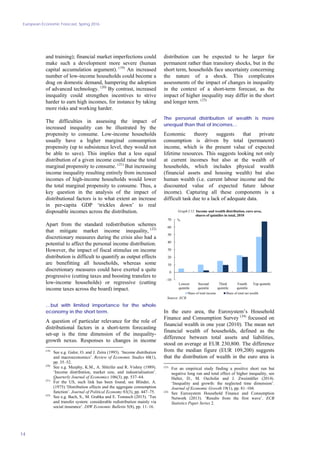
Employment increases
A three-year social contribution exemption for new
permanent hires supported the increase in
headcount employment in 2015. The 2016
Stability Law extends this scheme to new
permanent hires made in 2016 but with a less
generous social contribution reduction. As the
recovery gathers strength, employment is projected
to continue increasing in 2016 and 2017 but more
in terms of working hours than in terms of
headcount. The unemployment rate is set to
decline only gradually in 2016 and 2017, also
because previously discouraged workers are
expected to eventually reintegrate into the labour
force. Upward pressure on labour costs is projected
to remain limited also thanks to cuts to the labour
tax wedge. Moreover, increases in real wages
realised over recent years on the back of lower-
than-expected inflation are supposed to be taken
into account in future bargaining rounds. Moderate
wage dynamics and improving labour productivity
imply broadly flat nominal unit labour costs and
some recovery in competitiveness.
86
88
90
92
94
96
98
100
102
07 08 09 10 11 12 13 14 15 16 17
Real wage and salaries of all employees
Other real income of housholds
Real private consumption
Graph II.12.1: Italy - Real household incomes and private consumption
forecast
index, 2007=100
Inflation remains low
In 2015, HICP inflation was 0.1%, since the fall in
imported energy prices offset the moderately
positive core inflation (0.7%). HICP inflation is
expected at 0.2% in 2016, as oil prices remain low,
and to accelerate to 1.4% in 2017. This is also due
to a partial incorporation of the VAT hike
legislated by the 2016 Stability Law to achieve the
2017 budgetary targets (see below). A similar
pattern is anticipated for core inflation (0.5% in
2016 and 1.2% in 2017), driven by very limited
wage pressures and some recovery in profit
margins, which were squeezed during the crisis.
The recovery of the Italian economy is projected to continue in 2016 and 2017 as domestic demand
growth picks up. Employment is forecast to keep on growing and inflation to remain subdued also due to
limited labour cost pressures. In 2016, the government budget balance is projected to decline slightly
and the debt-to-GDP ratio to remain stable before starting to decrease in 2017.
Member States, Italy
89
A supportive fiscal stance
In 2015, the government deficit fell to 2.6% of
GDP, down from 3.0% in 2014. Current primary
expenditure stabilised in nominal terms. Public
investment bottomed out after five years of
contraction, while one-off outlays affected capital
transfer dynamics markedly. On the revenue side,
the improving economic outlook translated into
positive developments for personal and corporate
income tax revenues. VAT revenues benefited
from discretionary measures to increase tax
compliance, while the tax wedge on labour
declined. The structural balance marginally
improved in 2015. In 2016, the supportive nature
of the 2016 Stability Law explains the fact that the
headline deficit declines marginally (to 2.4% of
GDP) despite a drop in interest expenditure and
improving cyclical conditions. As a result, the
structural balance is expected to worsen by more
than ½ pps. of GDP in 2016. Current primary
expenditure is expected to increase by around
1.5% (y-o-y) in nominal terms, as compensation of
public employees is anticipated to increase for the
first time since 2010 due to new hiring in
education and higher wages in the security sector.
Moreover, additional social benefits also due to
new measures to fight poverty are set to affect
current transfers, while past reforms curb the
increase in pension expenditure to around 1%
year-on-year. Public investment is set to slightly
rise again, while capital transfers decline sharply
due to lower one-offs. Outlays related to the
migrant influx are estimated by the government at
around 0.2% of GDP in 2016, 0.04 pps. higher
than in 2015. On the revenue side, current taxes
are forecast to increase much less than nominal
GDP growth, mainly due to further cuts to the
labour tax wedge and the abolition of property
taxation on primary residences. This is partially
compensated by higher one-off capital taxes
related to the so-called ‘voluntary disclosure’ of
assets held abroad. Based on a no-policy-change
assumption, the headline deficit is projected to
decline to 1.9% of GDP in 2017, implying a
neutral fiscal stance. The forecast for 2017
includes around half of the 0.9% of GDP VAT
hike legislated at end-2015. The government
committed to repeal it; however this repeal is
conditional upon the identification in the next
Stability Law of the compensatory measures
needed to achieve the planned 1.8% of GDP deficit
target (from a trend of 1.4% that includes the full
VAT hike). After the peak reached in 2015, the
debt-to-GDP ratio is set to stabilise in 2016 and to
start decreasing in 2017 thanks to higher nominal
growth and primary surplus.
bn EUR Curr. prices % GDP 96-11 2012 2013 2014 2015 2016 2017
1611.9 100.0 0.9 -2.8 -1.7 -0.3 0.8 1.1 1.3
989.5 61.4 1.1 -3.9 -2.5 0.6 0.9 1.5 1.1
312.6 19.4 1.0 -1.4 -0.3 -1.0 -0.7 0.6 0.7
267.5 16.6 1.1 -9.3 -6.6 -3.4 0.8 3.2 4.1
86.9 5.4 1.7 -13.6 -8.2 -2.7 3.5 4.1 5.8
476.2 29.5 2.2 2.3 0.6 3.1 4.3 2.4 4.0
429.3 26.6 3.2 -8.1 -2.3 3.2 6.0 3.8 4.7
1610.5 99.9 0.9 -2.7 -1.8 -0.2 0.7 1.1 1.3
1.0 -4.5 -2.8 -0.4 0.5 1.5 1.5
0.0 -1.2 0.2 0.0 0.5 -0.1 -0.1
-0.2 2.9 0.8 0.1 -0.3 -0.3 0.0
0.4 -1.4 -2.4 0.3 0.8 0.9 0.9
8.8 10.7 12.1 12.7 11.9 11.4 11.2
2.9 0.4 1.3 -0.1 0.5 0.3 0.5
2.4 1.9 0.6 0.6 0.6 0.2 0.1
0.1 0.5 -0.6 -0.2 -0.2 -0.6 -1.1
14.5 9.4 11.0 10.5 10.4 10.7 10.7
2.4 1.4 1.2 0.8 0.8 0.8 1.2
2.3 3.3 1.2 0.2 0.1 0.2 1.4
-0.4 -1.4 1.8 3.2 4.6 2.8 -0.1
0.8 1.0 2.2 3.0 3.3 3.5 3.4
-0.6 -0.4 0.9 1.8 2.2 2.4 2.3
-0.5 -0.2 0.9 2.1 2.4 2.5 2.4
-3.4 -2.9 -2.9 -3.0 -2.6 -2.4 -1.9
-3.5 -1.1 -0.6 -0.9 - -1.1 -1.6 -1.7
- -1.2 -0.9 -1.1 - -1.0 -1.7 -1.7
107.1 123.3 129.0 132.5 132.7 132.7 131.8
GNI (GDP deflator)
Structural budget balance (d)
Saving rate of households (b)
Main features of country forecast - ITALY
Unemployment rate (a)
Gross fixed capital formation
Current-account balance (c)
Contribution to GDP growth:
General government gross debt (c)
GDP deflator
Compensation of employees / f.t.e.
of which: equipment
Domestic demand
Harmonised index of consumer prices
Table II.12.1:
Net exports
Public Consumption
Trade balance (goods) (c)
Employment
Annual percentage change2014
GDP
Private Consumption
Exports (goods and services)
Net lending (+) or borrowing (-) vis-a-vis ROW (c)
(a) as % of total labour force. (b) gross saving divided by gross disposable income. (c) as a % of GDP. (d) as a % of potential GDP.
Cyclically-adjusted budget balance (d)
Real unit labour cost
Imports (goods and services)
General government balance (c)
Unit labour costs whole economy
Inventories
Terms of trade goods
13. CYPRUS
Labour market conditions improve as real GDP growth picks up
90
Resuming growth and improving labour market
Cyprus’ economy emerged from recession in 2015,
with real GDP growth reaching 1.6%. In 2015,
nominal spending by households stabilised but
declining consumer prices allowed households to
consume more in real terms, providing a
significant boost to real GDP growth. Investment,
particularly in transport equipment, increased
rapidly in 2015, mainly reflecting an elevated
number of ship-registrations, which, however, was
completely offset by an associated increase in
imports of ships. The weaker euro, combined with
ongoing structural reforms in the tourism sector,
provided significant support to service exports.
Labour market conditions improved but continued
slack in the economy and declining energy prices
kept HICP inflation in negative territory in 2015.
Real GDP growth is forecast to gradually pick
up
Real GDP growth is forecast to remain broadly
unchanged in 2016 before picking up to 2.0% in
2017. The support from declining consumer prices
and the weaker euro is expected to abate. Debt
servicing is expected to increase, due to a higher
pace of restructuring of bad loans. This should
help reduce non-performing loans but weigh on
private consumption. Investment should benefit
from the recent stabilisation of the housing market
and a further normalisation of credit intermediation
to businesses. Investment activity should
nevertheless remain constrained by the high
deleveraging needs of the economy. Furthermore,
following the large ship-registrations in 2015,
investment growth is expected to slow down in
2016.
Despite headwinds from the external environment,
export growth is forecast to strengthen further. The
strong growth in the tourism sector observed in
2015 has extended into the first part of 2016,
benefitting from geopolitical tensions in
neighbouring countries. Bookings from British
tourists appear strong despite the depreciation of
the pound. In 2017, growth should gain further
strength.
-15
-10
-5
0
5
10
15
-12
-8
-4
0
4
8
12
08 09 10 11 12 13 14 15 16 17
Graph II.13.1: Cyprus - Real GDP growth and
contributions, output gap
Output gap (rhs) Net exports
Investment Priv. consumption
Gov. consumption Inventories
Real GDP (y-o-y%)
% of pot. GDP
forecast
pps.
Labour market conditions in Cyprus are forecast to
improve further. Wage growth is expected to
remain moderate, as suggested by the recent
collective agreement for the hotel industry. Oil
prices continue to remain low and are forecast to
weigh further on energy prices in 2016, due to base
effects. Excluding the more volatile components
such as energy and unprocessed food, consumer
prices are forecast to decline marginally in 2016.
As the downward pressure from energy prices
abates and demand picks up, HICP inflation is
forecast to return to positive territory in 2017.
Risks remain broadly balanced
On the upside, declining consumer prices could
support consumption and exports more than
expected. On the downside, the continued
weakening of external demand and developments
in the pound sterling may weigh more on export
growth than envisaged. The modest improvements
in labour market conditions and the slow pace of
reducing non-performing loans in the banking
sector may lead to a prolonged period of tight
credit conditions, which would dampen the
recovery.
Growth has resumed in Cyprus and is expected to slowly gain strength with labour market conditions
improving in parallel. The economy continues to benefit from low energy prices. Service exports, in
particular tourism, appear resilient to the challenging external environment. The general government
balance is also expected to improve, supporting debt reduction.
Member States, Cyprus
91
Strong fiscal performance continues
In 2015, the general government primary balance
continued to improve. It reached a surplus of 1.8%
of GDP, with a general government deficit of
1.0%. This incorporates a one-off effect from the
2015 recapitalisation of cooperatives
(1% of GDP). Excluding the effect of banking
recapitalisations, in 2015, the primary balance
improved marginally (by 0.2 pps. of GDP to
2.8%), on the back of continued control on public
expenditure and despite negative factors beyond
the control of the government, notably new
location rules regarding VAT on e-commerce
services, lower taxes on interest due to reduced
deposit rates and a decrease in dividend income
from the Central Bank of Cyprus (CBC). In
parallel with the primary balance, the headline
balance also improved marginally (by 0.2 pps. of
GDP to 0.0%).
The general government primary surplus,
excluding the effect of banking recapitalisation, is
forecast to decrease to 2.2% in 2016 and then
increase to 2.4% of GDP in 2017. The decrease in
2016 is largely driven by a drop in revenue related
to the continued normalisation in the banking
sector. Given the expected continued reduction in
deposit interest rates, taxes on interest are forecast
to continue to fall. The reduced level of the
emergency liquidity assistance is expected to
continue reducing CBC dividend income. (63)
In
2017, the improvement in the general government
primary surplus is largely based on the improving
economic outlook. In 2016, total primary
expenditure is expected to remain constrained by
the continued freeze of pensions and wages, while
in 2017, this expenditure is expected to grow by
less than the nominal economic activity due to the
revised mechanism of its indexation. In 2016 and
2017, interest expenditure is forecast to decrease.
The structural balance in 2016 is expected to
worsen, as it is less supported by the cyclical
component, reflected in the output gap. The latter
narrows in 2016 and eventually turns positive in
2017. The headline balance improves by less than
the economic cycle.
The debt-to-GDP ratio is projected to gradually
decline, reaching 105.4% in 2017. This reduction
is supported by economic growth and primary
surpluses.
(63)
The dividend distribution is to be in line with the Treaties
(on the European Union and the Functioning of the
European Union) and the ESCB and ECB Statute.
mio EUR Curr. prices % GDP 96-11 2012 2013 2014 2015 2016 2017
17393.7 100.0 3.1 -2.4 -5.9 -2.5 1.6 1.7 2.0
12244.2 70.4 3.9 -0.8 -5.9 0.6 1.9 1.5 1.4
2741.6 15.8 4.8 -3.7 -4.1 -9.0 1.1 -1.2 0.0
2003.7 11.5 1.7 -20.5 -15.2 -18.0 14.0 9.1 5.1
492.9 2.8 0.5 -26.1 -15.1 -32.7 64.8 10.5 5.2
10437.5 60.0 2.1 -1.1 1.8 -0.5 1.9 2.4 2.6
10316.9 59.3 2.4 -4.4 -3.0 2.0 4.0 2.9 2.0
16901.8 97.2 3.2 -5.7 -6.3 -1.8 4.9 1.2 1.7
3.5 -5.1 -7.0 -3.7 3.1 2.1 1.7
-0.2 0.8 -1.4 2.7 -0.3 0.0 0.0
-0.2 1.9 2.6 -1.4 -1.2 -0.3 0.3
2.0 -3.2 -6.0 -2.3 0.9 1.0 1.3
- 11.9 15.9 16.1 15.1 13.4 12.4
4.0 0.7 -3.3 -3.5 -1.0 1.1 1.4
2.8 0.0 -3.3 -3.3 -1.7 0.4 0.7
0.0 -2.1 -2.0 -2.1 -0.3 0.7 0.1
7.5 0.6 -4.1 -10.8 -7.9 -6.2 -5.6
2.8 2.1 -1.4 -1.2 -1.4 -0.3 0.6
- 3.1 0.4 -0.3 -1.5 -0.7 1.0
0.0 -0.9 0.2 7.1 2.6 2.2 -0.3
-24.6 -18.0 -16.3 -16.2 -18.4 -18.4 -18.6
-8.2 -5.6 -4.5 -4.6 -3.5 -4.2 -4.6
-7.9 -5.5 -3.1 -3.7 -2.8 -3.6 -3.9
-3.0 -5.8 -4.9 -8.9 -1.0 -0.4 0.0
- -4.5 -1.5 -5.5 0.9 0.3 -0.5
- -4.7 -1.3 3.0 1.7 0.4 -0.5
56.9 79.3 102.5 108.2 108.9 108.9 105.4
GNI (GDP deflator)
Structural budget balance (d)
Saving rate of households (b)
Main features of country forecast - CYPRUS
Unemployment rate (a)
Gross fixed capital formation
Current-account balance (c)
Contribution to GDP growth:
General government gross debt (c)
GDP deflator
Compensation of employees / head
of which: equipment
Domestic demand
Harmonised index of consumer prices
Table II.13.1:
Net exports
Public Consumption
Trade balance (goods) (c)
Employment
Annual percentage change2014
GDP
Private Consumption
Exports (goods and services)
Net lending (+) or borrowing (-) vis-a-vis ROW (c)
(a) as % of total labour force. (b) gross saving divided by gross disposable income. (c) as a % of GDP. (d) as a % of potential GDP.
Cyclically-adjusted budget balance (d)
Real unit labour cost
Imports (goods and services)
General government balance (c)
Unit labour costs whole economy
Inventories
Terms of trade of goods
14. LATVIA
Growth shifts further towards domestic demand
92
Growth to pick up slowly
Economic growth improved to 2.7% in 2015 from
2.4% in 2014, supported by strong domestic
demand. Although the latest short-term indicators
point to setbacks in some business sectors, further
improvements in consumption and investment are
expected to push up growth to 2.8% in 2016 and
3.1% in 2017. The short-term outlook is also
supported by a slight improvement in economic
sentiment. The risks to the forecast appear broadly
balanced as the uncertain external environment and
the reported slowdown in the use of EU funds are
offset by a more positive outlook for Latvia’s
major trading partners in the EU, a fading negative
impact from the Russian trade embargo, and
a further pickup in bank lending.
-30
-25
-20
-15
-10
-5
0
5
10
15
08 09 10 11 12 13 14 15 16 17
pps.
Dom. demand, excl. inv. Inventories
Net exports Real GDP (y-o-y%)
forecast
Graph II.14.1:Latvia - Real GDP growth and contributions
Income, energy prices boost demand
On the demand side of the economy, private
consumption is supported by high income growth
and low energy prices. Investments are to some
extent restrained by the slower-than-expected use
of EU funds but on the other hand bank funding is
picking up after a very strong rebound in new
loans in the second half of 2015. Nevertheless, a
more significant acceleration in investment is
projected for 2017 when EU-funded projects are
set to regain momentum. Among business sectors,
the outlook in construction and transit cargo
services has deteriorated over the past months
while continuous improvement in tourism and a
recent upturn in energy utilities are set to make a
positive contribution to growth.
External balance set to deteriorate
Imports are projected to rise faster than exports
over the forecast horizon as domestic demand is
expected to grow faster than demand from trading
partners. However, the negative balance of trade in
goods and services is set to increase only
marginally in relation to GDP. In 2016,
the nominal balance should also benefit from
cheap energy imports. Nevertheless, the
announced plans for repatriating banking sector
profits are expected to widen significantly the
current-account deficit in 2016. The deficit is then
expected to correct downwards in 2017 in the
absence of one-offs but still deteriorating in
relation to 2015.
Oil price dwarfs income pressure on inflation
Headline inflation (HICP) is projected to remain at
0.2% in 2016 as low energy prices are fully
offsetting the counteracting income effects. Core
inflation, though still indirectly affected by energy
prices, is forecast at around 1% in 2016. The
appreciation of the euro in the first months of 2016
is also contributing to the very low rate of
inflation. With the assumed rebound in oil prices,
both headline and core inflation rates are expected
to increase to about 2% in 2017.
Job creation expected to slow down
The unemployment rate dropped from 10.8% in
2014 to 9.9% in 2015. However, it is forecast to
decline less rapidly than previously envisaged to
9.6% in 2016 and 9.3% in 2017, as job creation is
facing serious structural restraints. In addition to
the decline in the working-age population, some
sectors are reporting increasing shortages of skilled
workers. On the other hand, the government is
Economic growth is expected to pick up marginally in 2016 and slightly faster in 2017 driven by strong
domestic demand. The labour market is expected to improve accordingly but the potential for further job
creation faces structural restraints. The fiscal situation remains sound, although headline figures are
affected by temporary factors.
Member States, Latvia
93
committed to expanding active labour market
policies aimed at reducing structural deficiencies.
Wage growth is expected to slow down marginally
in 2016 linked to a much weaker minimum wage
adjustment than in previous years. Consequently,
the growth in unit labour costs is forecast to
weaken in 2016.
Stable fiscal outlook
The general government deficit stood at 1.3% of
GDP in 2015. The strong central government cash
returns for 2015 were supplemented by a positive
surprise from local governments and by positive
cash-accrual adjustments. However, the previously
unaccounted public-private partnership project of
the State Revenue Service building was recorded
in 2015 leading to a one time increase in the deficit
of 0.3% of GDP.
In 2016, the government deficit is projected to
improve to 1.0 % of GDP. (64)
Tax revenue growth
is underpinned by the pick-up in the private
consumption and the strong wage growth, as well
as a range of revenue-increasing measures in 2016
(64)
The 2016 deficit estimate excludes any possible deficit-
increasing effect of the capital injection in the national
airline Air Baltic, to be decided by the statistical
authorities.
and 2017. The updated government plans
demonstrate slightly higher growth in social
benefits and purchases of goods and services,
while capital expenditure is projected to be lower,
due to delays in new EU-funded projects.
For 2017, revenue is projected to benefit from the
higher GDP growth, as well as the introduction of
the minimum social contribution and measures
improving tax collection. On the expenditure side,
capital expenditure is projected to accelerate once
the implementation phase for EU-funded projects
begins. A strong growth in current spending on
wages, social transfers and public purchases is
projected to continue, based on a no-policy change
assumption.
The structural deficit is forecast to remain at
around 1½% of GDP over 2016 and 2017.
The general government debt declined to 36% of
GDP at the end of 2015. While operational cash
balances are expected to stay low, the authorities
plan to pre-finance a large bond redemption in
early 2017, as a safeguard against external
uncertainty. Therefore, Latvia’s public debt-to-
GDP ratio is projected to increase to 39.8% at the
end of 2016 before declining to 35.6% in 2017.
mio EUR Curr. prices % GDP 96-11 2012 2013 2014 2015 2016 2017
23580.9 100.0 4.4 4.0 3.0 2.4 2.7 2.8 3.1
14430.4 61.2 4.0 3.2 5.1 2.3 3.3 3.8 3.9
4151.8 17.6 1.3 0.3 1.6 4.9 3.1 3.2 2.5
5393.6 22.9 9.6 14.4 -6.0 0.5 2.7 3.1 4.1
2062.6 8.7 10.8 12.0 -5.4 -4.5 8.8 - -
14031.7 59.5 8.1 9.8 1.1 3.1 1.4 1.2 2.8
14561.7 61.8 7.9 5.4 -0.2 0.8 1.8 2.5 3.8
23541.0 99.8 4.3 3.3 3.5 2.4 2.6 2.1 3.7
5.4 5.2 1.8 2.4 3.1 3.6 3.8
0.2 -3.5 0.4 -1.4 0.0 0.0 0.0
-1.1 2.3 0.8 1.4 -0.3 -0.8 -0.7
-0.5 1.4 2.3 -1.4 1.4 0.3 0.5
12.9 15.0 11.9 10.8 9.9 9.6 9.3
10.6 6.1 5.0 8.5 7.0 5.2 5.5
5.4 3.5 4.3 4.6 5.6 2.7 2.8
-0.5 0.0 3.0 3.3 4.9 1.7 0.6
- - - - - - -
6.0 3.6 1.3 1.2 0.6 1.0 2.2
- 2.3 0.0 0.7 0.2 0.2 2.0
-0.5 -3.7 1.3 -0.8 2.4 0.8 -0.1
-17.1 -12.1 -11.2 -9.6 -8.7 -8.8 -9.3
-8.5 -3.5 -2.1 -2.0 -1.2 -2.6 -2.4
-7.6 -0.5 0.4 1.2 1.6 0.0 0.1
-2.4 -0.8 -0.9 -1.6 -1.3 -1.0 -1.0
- -0.1 -1.0 -2.0 -1.9 -1.7 -1.6
- -0.1 -1.0 -1.7 -1.9 -1.6 -1.6
18.0 41.4 39.1 40.8 36.4 39.8 35.6
GNI (GDP deflator)
Structural budget balance (d)
Saving rate of households (b)
Main features of country forecast - LATVIA
Unemployment rate (a)
Gross fixed capital formation
Current-account balance (c)
Contribution to GDP growth:
General government gross debt (c)
GDP deflator
Compensation of employees / head
of which: equipment
Domestic demand
Harmonised index of consumer prices
Table II.14.1:
Net exports
Public Consumption
Trade balance (goods) (c)
Employment
Annual percentage change2014
GDP
Private Consumption
Exports (goods and services)
Net lending (+) or borrowing (-) vis-a-vis ROW (c)
(a) as % of total labour force. (b) gross saving divided by gross disposable income. (c) as a % of GDP. (d) as a % of potential GDP.
Cyclically-adjusted budget balance (d)
Real unit labour cost
Imports (goods and services)
General government balance (c)
Unit labour costs whole economy
Inventories
Terms of trade of goods
15. LITHUANIA
Growth balances as exports recover
94
2015 ends on a positive note
Real GDP growth in Lithuania accelerated to 1.9%
(y-o-y) in the fourth quarter of 2015 to reach 1.6%
annually. While domestic demand exceeded initial
expectations considerably, plummeting demand
from outside the EU caused exports to disappoint.
A surge in EU fund disbursements fuelled rapid
investment growth in 2015. At the same time,
increasing competition for labour ensured robust
wage growth, while falling energy and food prices
further supported real disposable incomes.
-12
-10
-8
-6
-4
-2
0
2
4
6
-30
-25
-20
-15
-10
-5
0
5
10
15
08 09 10 11 12 13 14 15 16 17
Graph II.15.1: Lithuania - Real GDP growth and
contributions, output gap
Output gap (rhs) Inventories
Net exports Dom. demand, excl. invent.
Real GDP (y-o-y%)
forecast
pps. % of pot. GDP
Private consumption and exports to carry
growth in 2016
GDP growth is forecast to accelerate from 1.6% in
2015 to 2.8% in 2016, driven by solid private
consumption and recovering exports. A further
pick-up in exports and recovery in investment are
expected to lift real GDP growth to 3.1% in 2017.
Supported by strong wage growth, private
consumption is expected to remain the main
growth driver. Over the forecast horizon this will
weaken due to slowing employment growth and
recovering inflation. Following the strong showing
in 2015, investment growth is bound to slow down
due to lower disbursements from EU funds. This
will be partially be counterbalanced by strong
growth in residential construction driven by an
upswing in mortgage loans.
Strong import demand from the main EU trading
partners is forecast to drive export growth in 2016,
while the drag from the continuing recession in
Russia and other CIS countries is foreseen to be
milder than in 2015. Export growth is forecast to
accelerate even further in 2017 as demand growth
from non-EU markets is projected to pick up. Due
to the temporary slowdown in investment, import
growth is expected to slow down in 2016 and
recover in 2017.
The unemployment rate is forecast to decline
further in 2016 and 2017; however, the effect of a
declining labour force is set to overtake job growth
as the main driver behind this process. A tight
labour market is set to ensure solid wage growth
over the forecast horizon.
Risks to the forecast are tilted to the downside and
stem from declining global trade and a prolonged
recession in Russia which could dampen export
growth.
Wage growth is set to drive an increase in HICP
inflation in 2016 and 2017
Following deflation in 2015, positive inflation is
expected to return in 2016 primarily driven by
increasing service prices. A moderate fall in
energy prices and subdued price pressures from
external forces are expected to keep inflation in
check. An expected increase in energy prices is
bound to accelerate inflation significantly in 2017.
Fiscal targets likely to be exceeded
The general government deficit declined from
0.7% of GDP in 2014 to 0.2% in 2015 – 1 pp. of
GDP below the initial budget target. Accelerating
growth in tax-rich domestic consumption and
wages led to tax revenues above the government’s
plan, although nominal GDP growth was lower
than expected. In addition, one-off factors had a
GDP growth is forecast to accelerate to around 3% in 2016 and 2017 on the back of strong private
consumption and recovering exports. Investment growth is expected to slow down in 2016 as the new
cycle of EU-funded projects still gathers pace. Tightening labour market conditions and accelerating
wage growth are expected to drive inflation in 2016, while external price pressures remain weak. The
improvement in public finances is set to stall in 2016.
Member States, Lithuania
95
positive impact on the 2015 deficit as the 0.6 pps.
of GDP surplus coming from the deposit insurance
fund exceeded the one-off compensation of public
wage cuts that had been ruled unlawful by the
constitutional court.
For 2016, the general government’s deficit is
forecast to increase by 0.9 pps. of GDP to 1.1% of
GDP. The deficit is set to widen due to an increase
in non-taxable income allowance, pensions, and
public wages. Higher spending is expected to be
partially offset by revenue growth, supported by
strong domestic demand, buoyant wage growth
and modest tax increases.
Under a no-policy-change assumption, the general
government deficit is forecast to fall to 0.4% of
GDP in 2017, mainly on the back of robust
economic growth and a limited increase in
expenditure.
Risks to the public finance forecast are tilted to the
upside due to the expected robust growth of the tax
base, but only if expenditure discipline is
maintained during the 2016 electoral cycle.
Lithuania’s structural deficit is expected to have
decreased to about ½% of GDP in 2015 and is
forecast to increase to about 1¼% of GDP in 2016
due to the additional expenditure measures, before
decreasing to below 1% of GDP in 2017.
General government debt has increased from
40.7% of GDP in 2014 to 42.7% in 2015, due to
the pre-financing of bond redemptions and higher-
than-usual pre-financing of EU-funded
expenditures. In 2016, debt is forecast to fall to
41.1% of GDP, while in 2017 it is expected to
increase again to 42.9% due to the end of year pre-
financing of forthcoming bond redemptions.
bn EUR Curr. prices % GDP 96-11 2012 2013 2014 2015 2016 2017
36.4 100.0 4.6 3.8 3.5 3.0 1.6 2.8 3.1
22.9 62.8 4.9 3.6 4.3 4.1 4.9 4.3 3.9
6.2 16.9 1.2 1.3 1.0 1.3 2.0 1.4 1.9
6.9 18.9 7.4 -1.8 8.3 5.4 10.3 2.5 4.6
2.3 6.2 10.6 2.1 12.5 3.0 12.8 1.3 7.0
29.6 81.2 10.3 12.2 9.6 3.0 1.2 3.1 3.8
28.9 79.3 10.5 6.6 9.3 2.9 7.0 4.0 4.7
36.0 98.8 4.3 4.5 4.0 4.5 -1.1 4.5 3.5
5.3 2.1 4.3 3.8 5.4 3.5 3.8
0.4 -2.3 -1.1 -0.9 0.9 0.0 0.0
-0.9 4.0 0.3 0.2 -4.6 -0.7 -0.7
-1.0 1.8 1.3 2.0 1.3 0.2 0.1
11.5 13.4 11.8 10.7 9.1 7.8 6.4
9.9 4.2 5.4 3.8 4.1 4.6 5.1
4.1 2.2 3.1 2.8 3.8 1.9 2.0
-0.3 -0.5 1.8 1.6 3.4 0.2 0.1
3.9 1.6 1.8 0.1 -2.2 0.9 0.8
4.3 2.7 1.3 1.2 0.4 1.7 1.9
4.7 3.2 1.2 0.2 -0.7 0.6 1.8
1.3 -0.9 0.0 0.6 3.1 0.5 -0.3
-10.9 -3.3 -2.6 -2.6 -5.0 -5.2 -6.1
-7.3 -0.9 1.4 3.9 -1.5 0.0 0.1
-6.2 1.9 4.5 6.6 1.4 2.4 2.7
-3.8 -3.1 -2.6 -0.7 -0.2 -1.1 -0.4
- -2.5 -2.6 -1.1 - -0.3 -1.3 -0.8
- -2.6 -2.2 -1.5 - -0.4 -1.2 -0.8
21.5 39.8 38.8 40.7 42.7 41.1 42.9
GNI (GDP deflator)
Structural budget balance (d)
Saving rate of households (b)
Main features of country forecast - LITHUANIA
Unemployment rate (a)
Gross fixed capital formation
Current-account balance (c)
Contribution to GDP growth:
General government gross debt (c)
GDP deflator
Compensation of employees / head
of which: equipment
Domestic demand
Harmonised index of consumer prices
Table II.15.1:
Net exports
Public Consumption
Trade balance (goods) (c)
Employment
Annual percentage change2014
GDP
Private Consumption
Exports (goods and services)
Net lending (+) or borrowing (-) vis-a-vis ROW (c)
(a) as % of total labour force. (b) gross saving divided by gross disposable income. (c) as a % of GDP. (d) as a % of potential GDP.
Cyclically-adjusted budget balance (d)
Real unit labour cost
Imports (goods and services)
General government balance (c)
Unit labour costs whole economy
Inventories
Terms of trade goods
16. LUXEMBOURG
More balanced growth ahead
96
Strong growth in 2015
Real GDP growth expanded to 4.8 % in 2015
(from 4.1% in 2014), driven by a sharp
improvement in net exports of financial services,
especially in the first half of the year. Private
consumption picked up in the second half, as
spending recovered from a VAT hike in January.
-8
-6
-4
-2
0
2
4
6
08 09 10 11 12 13 14 15 16 17
pps.
Private consumption Public consumption
Investment Inventories
Net exports Real GDP (y-o-y%)
forecast
Graph II.16.1: Luxembourg - Real GDP growth and contributions
Recent trends shape slower growth for 2016
Both soft and hard indicators point to a
continuation of the trends observed in the second
half of 2015. In 2016, GDP is expected to grow by
3.3%, still driven by a large, though decreasing
contribution from external sector. Less favourable
financial markets are likely to have a dampening
effect on the export-focused financial industry and
limit the contribution to growth of net exports. By
contrast, the contribution from domestic demand is
expected to strengthen. Low oil prices, favourable
financial conditions and positive employment
prospects should provide tailwinds to private
consumption, even if indexed wage increases are
now only expected to take place by the beginning
of 2017. It is worth noting that buoyant job
creation is contributing to population growth by
attracting immigration flows. As a result, per
capita gains should remain moderate. Steadily
favourable lending conditions should support
investment. In particular, construction is projected
to remain robust over the forecast period,
supported both by household and public sector
investment plans, the latter being engaged with the
execution of large public infrastructure projects.
By contrast, in spite of the accommodative credit
stance, equipment investment is expected to
remain subdued, as capacity utilisation remains
low.
In 2017, net export’s contribution to growth is
expected to remain stable, while domestic demand,
and in particular private consumption, should
continue to gain momentum, underpinned by
strong employment and indexed wage increases
which support household purchasing power.
Overall Luxembourg’s economic growth is
forecast to accelerate to 3.9% in 2017.
Buoyant job creation continues
In 2015, employment increased by 2.5%. Labour
market prospects are projected to remain positive,
with employment growth set to average around
2½ % per year over the forecast horizon, driven by
the economy’s strong momentum. The
unemployment rate was 6.4% in 2015 and is
expected to decline to around 6% in 2016, not as
much as employment figures would suggest due to
the high share of non-residents among new
workers.
Inflation pulled down by energy prices
HICP inflation is set to fall to -0.1% in 2016 from
0.1% in 2015, mainly because of the pronounced
drop in oil prices, which are expected to remain
low for a protracted period, thus postponing the
automatic indexation of wages to the beginning of
2017. Core inflation is projected to remain
subdued over the forecast horizon, given the
lengthy low energy prices are spreading to other
sectors and as the impact of the increase in all
VAT rates that occurred at the start of 2015 phases
out.
Luxembourg’s economic growth is projected to ease from 4.8% in 2015 to 3.3 % this year and to
accelerate to 3.9 % next year. Over this time growth is expected to become more balanced, as domestic
demand catches up with the external sector as a leading driver of growth. Unemployment is expected to
decline as job creation remains robust, while inflation should remain subdued as a result of low energy
prices.The general government surplus is expected to fade in 2017 due to the impact of the tax reform.
Member States, Luxembourg
97
The budget surplus is expected to fade out
In 2015, the general government surplus surprised
on the up side and came in at 1.2% of GDP.
Expenditure was lower than expected, in particular
for intermediate consumption, public wages and
some local government investment projects were
deferred. On the revenue side, the yield from taxes
on households and corporate income was higher
than anticipated and the loss due to the change in
the e-VAT regulation turned out to be lower than
expected. By contrast, the yield from government
measures to counter the expected loss in e-VAT
revenues came in as planned. These included a
2 pps. increase of all VAT rates, the introduction
of a temporary budgetary levy and the saving
measures in the ‘Pact pour l’Avenir’.
In 2016, the low inflation environment together
with the incremental effect of measures already
adopted in the 2015 budget should help to contain
expenditure and counterbalance the impact on the
government budget of the projected downward
revision of the macroeconomic scenario. All in all,
the surplus for this year is estimated at 1.0 % of
GDP.
The general government surplus, however, is
expected to fall to just 0.1% of GDP in 2017, due
to the impact of the recently announced taxation
reform that should take effect in that year. Both
households and corporations are expected to
benefit from the reform, with the former
benefitting more. In addition to repealing the
temporary budgetary levy introduced in 2015, tax
brackets will be revised to become less
progressive, while two new tax brackets for high
revenues will be introduced. In addition, tax
credits related to house acquisition will be
increased. Moreover, the corporate income tax rate
will be reduced to 19% from 21% and a more
favourable tax treatment for small entreprises will
be introduced. All in all, the taxation reform is
estimated to shave off revenues by around 0.8% of
GDP.
The large structural surplus is then expected to
narrow by about 1½ pps. of GDP between 2015
and 2017, but to still remain in positive territory.
The debt-to-GDP ratio decreased to 21.4% of GDP
in 2015. In spite of a regular primary surplus, it is
set to increase to 22.8 % of GDP over the forecast
horizon, as the social security sector’s surplus
cannot be used to finance the deficit of the central
government.
mio EUR Curr. prices % GDP 96-11 2012 2013 2014 2015 2016 2017
48897.5 100.0 3.8 -0.8 4.3 4.1 4.8 3.3 3.9
15263.9 31.2 2.8 2.7 0.9 3.7 0.1 2.2 2.8
8345.0 17.1 3.7 3.6 3.9 4.5 2.7 2.4 2.6
9092.7 18.6 5.0 -0.3 -7.2 9.9 -2.9 1.9 3.4
3629.9 7.4 6.5 23.6 -14.7 18.3 -8.7 -1.6 3.2
99393.0 203.3 6.6 0.2 6.9 6.8 7.0 4.3 4.9
83555.9 170.9 7.1 1.5 5.7 8.0 6.5 4.1 4.8
32726.6 66.9 2.5 -0.9 -1.7 5.9 3.2 1.2 1.4
2.7 1.4 -0.5 3.7 0.0 1.4 1.8
0.1 -0.4 0.9 0.1 1.7 0.0 0.0
1.0 -1.9 4.0 0.3 3.2 1.9 2.1
3.4 2.4 1.8 2.5 2.5 2.6 2.5
3.7 5.1 5.9 6.0 6.4 6.2 6.2
3.0 1.6 3.6 2.9 0.8 0.3 2.6
2.7 4.9 1.1 1.4 -1.4 -0.4 1.2
0.2 0.8 -1.2 0.4 -3.0 -1.3 -0.7
- - - - - - -
2.4 4.1 2.4 1.0 1.6 0.9 1.9
2.4 2.9 1.7 0.7 0.1 -0.1 1.8
0.1 0.1 0.1 0.6 3.5 0.0 0.2
-7.9 -3.6 -0.7 -0.6 0.0 0.4 1.0
9.2 6.1 5.7 5.5 5.5 5.3 4.8
- 5.2 4.0 3.5 4.4 5.8 5.3
2.1 0.3 0.8 1.7 1.2 1.0 0.1
1.9 2.7 2.4 3.0 1.7 1.4 0.3
- 2.7 2.4 2.8 1.7 1.4 0.3
9.8 22.0 23.3 22.9 21.4 22.5 22.8
GNI (GDP deflator)
Structural budget balance (d)
Saving rate of households (b)
Main features of country forecast - LUXEMBOURG
Unemployment rate (a)
Gross fixed capital formation
Current-account balance (c)
Contribution to GDP growth:
General government gross debt (c)
GDP deflator
Compensation of employees / head
of which: equipment
Domestic demand
Harmonised index of consumer prices
Table II.16.1:
Net exports
Public Consumption
Trade balance (goods) (c)
Employment
Annual percentage change2014
GDP
Private Consumption
Exports (goods and services)
Net lending (+) or borrowing (-) vis-a-vis ROW (c)
(a) as % of total labour force. (b) gross saving divided by gross disposable income. (c) as a % of GDP. (d) as a % of potential GDP.
Cyclically-adjusted budget balance (d)
Real unit labour cost
Imports (goods and services)
General government balance (c)
Unit labour costs whole economy
Inventories
Terms of trade of goods
17. HUNGARY
Private consumption is to drive growth
98
Households’ consumption boosts domestic
demand
In 2015, real GDP grew by 2.9% after growing by
3.7% in 2014. In domestic demand, households
final consumption posted a slightly higher than 3%
real grow, while gross fixed capital formation only
grew by 1.9% compared to 2014’s 11.2%. Exports
grew more than imports so the net export
contribution eventually was 1.2 pps.
Economic growth is forecast at 2.5% in 2016. This
deceleration is mainly due to the decrease in EU
fund absorption and in external demand. This
deceleration should be partially offset by steady
growth in private consumption. Real disposable
income and household spending should benefit
from a boost from a 1.0 pp. cut in the flat personal
income tax rate (from 16% to 15%) and the effect
of an earlier measure to convert foreign currency-
denominated loans into Hungarian florins. Housing
investment from households is expected to
increase as well. However, corporate and public
investment should be negatively affected by the
slowdown in EU fund absorption. As a result
overall investment growth will be negative in
2016.
In 2017, real GDP is forecast to grow by 2.8%,
mostly driven by robust private consumption and
the implementation of measures in 2016. First, the
reduction of the bank levy from 1 January 2016
and further from 1 January 2017 and new central
bank actions to provide subsidised lending to
SMEs (the so called Growth Supporting
Programme) should create a friendlier lending
environment. In addition, the reduction of the VAT
on newly built homes to 5% since 1 January 2016
and the new housing scheme is projected to
provide an impulse to the housing market and is
expected to take full effect in 2017. Overall,
investment growth is expected to turn positive. Net
exports are forecast to contribute positively to
growth, but to a lesser extent than in 2016, driving
the current account to remain high. Throughout the
forecast horizon, household’s precautionary
savings are set to decrease.
Unemployment continues to fall while inflation
picks up
The unemployment rate reached an all-time low of
6.8% in 2015 and is expected to further decrease to
around 6% by the end of the forecast horizon, as
activity continues to expand. Employment is set to
continue growing, driven by higher job creation in
the private sector and the government’s public
works scheme.
Consumer prices remained broadly stable in 2015.
HICP inflation is expected to accelerate
moderately to 0.4% in 2016. Lower-than-expected
oil prices, subdued imported inflation and low
inflationary expectations imply that the central
bank’s 3% inflation target is not likely to be
reached over the forecast horizon.
Risks are tilted to the upside
As the agricultural sector posted a negative
contribution in 2015 even a better-than-average
harvest is a positive risk to 2016. The slow phasing
out of the Funding for Growth Scheme and the full
implementation of announced policy commitments
towards the financial sector could further improve
lending conditions and boost growth. The
accelerated absorption of EU funds could drive
investments beyond the baseline.
The headline deficit stabilizes at 2% of GDP
despite a significantly increased fiscal room
The 2015 general government deficit reached 2.0%
of GDP, down from 2.3% in the previous year and
0.4 pps. below the official target. The
improvement is mainly the result of strong revenue
dynamics and a fall in interest payments. These
developments were partly offset by additional
spending, in particular on co-financing EU-funded
projects and debt consolidation payments for state-
owned companies.
In 2016, the deficit is projected to stay at 2.0% of
GDP. The budgetary breathing space is set to
Hungary’s economy grew by 2.9% in 2015 and real GDP growth is expected to slow down to 2.5% in
2016 before rebounding in 2017. Unemployment is set to decrease further and inflation to pick up
gradually. Following an improvement in 2015, the government deficit is expected to stabilize at 2% of
GDP.
Member States, Hungary
99
increase considerably due to positive base effects,
savings in the domestic co-financing of declining
EU-funded projects and steadily decreasing
interest outlays and social payments. In addition,
the forecast counts on sizeable one-off receipts
from agricultural land sales and a large revenue
windfall expected to be paid under a corporate
income tax credit arrangement in 2016 and 2017.
However, these favourable effects are projected to
be absorbed by substantial tax cuts and
expenditure-increasing measures, including a new
housing scheme, additional infrastructure
investments and spending on state education.
Based on a no-policy-change assumption, the
government deficit is forecast to remain at 2.0 % of
GDP in 2017. The new draft budget was not
released by the cut-off date of the forecast. Further
projected savings from declining pension
expenditure and interest costs are estimated to be
counterbalanced by the effect of the already
adopted deficit-increasing measures, increases in
domestic spending on EU co-financed projects and
the phasing out of one-off revenues from
agricultural land sales.
Overall, budgetary risks are tilted towards a lower
deficit, in particular in 2016. Public investment
may turn out to be lower than the planned elevated
level due to implementation risks. By contrast, the
open-ended nature of the new housing scheme is a
source of budgetary uncertainty.
While the headline deficit remains stable, the
structural budget balance is expected to deteriorate
sharply to around -3.0% of GDP in 2016 and then
to reverse to around -2.5% in 2017. This reflects
the cyclical upturn of the economy and a one-off
effect in 2016. Hungary’s debt-to-GDP ratio
decreased by 0.9 pps. to 75.3% in 2015. The debt
ratio is expected to decline further to 73.0% by the
end of 2017, even though delays in the receipt of
EU funds are assumed are to have a debt-
increasing effect throughout the forecast horizon.
bn HUF Curr. prices % GDP 96-11 2012 2013 2014 2015 2016 2017
32179.7 100.0 2.3 -1.7 1.9 3.7 2.9 2.5 2.8
16191.0 50.3 2.0 -2.2 0.3 1.8 3.0 3.2 3.0
6502.2 20.2 1.0 -1.5 2.4 2.9 0.6 2.9 0.5
6971.3 21.7 2.9 -4.4 7.3 11.2 1.9 -1.7 4.0
2900.0 9.0 5.0 3.5 3.1 17.0 -4.0 0.0 4.0
28721.7 89.3 11.3 -1.8 6.4 7.6 8.4 6.2 6.4
26383.3 82.0 10.5 -3.5 6.3 8.5 7.8 6.0 6.6
30756.8 95.6 2.2 -1.1 3.4 2.0 4.7 1.8 3.1
2.1 -2.3 2.1 3.8 2.1 1.8 2.4
-0.2 -0.6 -0.7 0.0 -0.3 0.0 0.0
0.4 1.3 0.5 -0.2 1.2 0.7 0.4
0.0 0.1 0.9 4.8 2.8 0.9 0.1
7.9 11.0 10.2 7.7 6.8 6.4 6.1
9.5 2.1 1.8 0.9 3.3 4.6 4.3
7.0 4.0 0.9 2.0 3.2 2.9 1.5
-0.7 0.5 -2.2 -1.2 1.4 0.5 -0.9
10.9 8.2 9.3 10.2 11.8 9.1 7.5
7.9 3.5 3.1 3.2 1.8 2.4 2.5
8.4 5.7 1.7 0.0 0.1 0.4 2.3
-0.7 -1.2 0.5 1.0 0.8 0.4 0.0
-3.4 2.9 3.4 2.5 3.9 4.4 4.3
-5.6 1.6 3.9 2.2 4.9 5.0 4.5
-5.0 4.1 7.5 6.0 9.1 7.7 7.7
-5.8 -2.3 -2.6 -2.3 -2.0 -2.0 -2.0
- -0.7 -1.4 -1.9 - -2.1 -2.2 -2.5
- -1.4 -1.5 -2.2 - -2.0 -2.9 -2.5
64.6 78.3 76.8 76.2 75.3 74.3 73.0
GNI (GDP deflator)
Structural budget balance (d)
Saving rate of households (b)
Main features of country forecast - HUNGARY
Unemployment rate (a)
Gross fixed capital formation
Current-account balance (c)
Contribution to GDP growth:
General government gross debt (c)
GDP deflator
Compensation of employees / head
of which: equipment
Domestic demand
Harmonised index of consumer prices
Table II.17.1:
Net exports
Public Consumption
Trade balance (goods) (c)
Employment
Annual percentage change2014
GDP
Private Consumption
Exports (goods and services)
Net lending (+) or borrowing (-) vis-a-vis ROW (c)
(a) as % of total labour force. (b) gross saving divided by gross disposable income. (c) as a % of GDP. (d) as a % of potential GDP.
Cyclically-adjusted budget balance (d)
Real unit labour cost
Imports (goods and services)
General government balance (c)
Unit labour costs whole economy
Inventories
Terms of trade goods
18. MALTA
Strong investment and household consumption
100
Strong domestic demand drove growth in 2015
Real GDP growth in 2015 came in at 6.3%,
significantly above expectations. The main driver
was investment, particularly in machinery and
equipment related to large-scale energy sector
projects. Public investment was buoyant, reflecting
the completion of projects financed under the
2007-13 programming period for EU funding.
After a long period of subdued activity, residential
construction rebounded. Household consumption
also grew strongly reflecting a decline in the
saving rate, as lower electricity tariffs, falling
unemployment and a rise in wage growth impacted
positively on consumer confidence. Strong
domestic demand resulted in a decline in the trade
surplus. Nevertheless, the current account balance
increased strongly due to favourable developments
in the primary income account.
-6
-4
-2
0
2
4
6
8
08 09 10 11 12 13 14 15 16 17
pps.
Changes in inventories / valuables
Net exports
Domestic demand
Real GDP (y-o-y%)
forecast
Graph II.18.1: Malta - Contributions to real GDP growth
Some moderation expected in 2016 and 2017
Following the peak in 2015, real GDP growth is
projected to slow to 4.1% in 2016. Deceleration is
set to come mainly on the back of investment,
which is seen stabilising from a high base in 2015.
The large energy projects that flattered investment
in 2015 are expected to reach completion, while
the expansion in residential construction is
expected to moderate. Household consumption is
also projected to decelerate somewhat but to
remain robust reflecting strong employment
growth and rising real wages. These developments
will be partially offset by stronger net exports,
reflecting weaker demand for imports as well as a
pick-up in demand from trading partners.
Real GDP growth is projected to moderate to 3.5%
in 2017. Household consumption is forecast to
decelerate further reflecting normalisation of the
saving rate, while job creation and real wages are
forecast to continue to rise at robust rates.
Government consumption is projected to increase
strongly, thus also contributing significantly to
growth. Investment is projected to expand
moderately on the back of several additional large
projects in healthcare and education.
Growth could be stronger if the reduction in the
household saving rate, supported by expected
gains in disposable income and population growth,
carries over for the rest of the forecast horizon.
Downside risks are mainly linked to slippages in
the investment schedule for the big projects.
HICP inflation accelerates on services, energy
HICP inflation is projected to pick up from 1.2%
in 2015 to 1.4% in 2016 and further to 2.2% in
2017. Acceleration is expected to come mainly
from a gradual recovery in energy prices,
following the electricity tariff cuts in previous
years. Services prices are forecast to pick up more
strongly in 2017, thus also contributing to overall
price inflation. Core inflation is projected to
outpace the euro area average and to come in at
1.7% and 2.2% in 2016 and 2017, respectively.
Budget deficit decreases despite rising current
expenditure
In 2015, the general government deficit decreased
further to 1.5% of GDP, from 2.0% of GDP in
2014, supported by the improvement in nominal
GDP. Current revenue growth benefitted from high
employment growth and consumer demand, as
After a stronger-than-expected 2015, growth is projected to moderate somewhat but to remain robust in
2016 and 2017. Investment is forecast to stabilise at a relatively high level while strong labour market
fundamentals should underpin a healthy increase in household consumption. The favourable
macroeconomic environment sets perfect conditions for fiscal consolidation and reduction of the
general government debt.
Member States, Malta
101
well as the proceeds from Malta’s citizenship
programme (0.6% of GDP). Despite the
moderation in the growth rate for social transfers
and a decrease in interest expenditure, current
expenditure increased by 5.8% year-on-year in
nominal terms. Public investment was boosted by
the finalisation of EU-funded projects, and
subsidies to investment increased on the back of a
further capital injection into Air Malta (0.5% of
GDP).
In 2016, the deficit is forecast to further decrease
to 0.9% of GDP. The positive outlook for the
labour market and consumer demand is expected
to boost current revenue growth. Current revenue
is expected to increase in 2016 as a result of a rise
in excise duties and higher proceeds from the
citizenship programme. These are forecast to be
only partly offset by the lowering in income tax for
low-income earners and the phasing out of the eco
contribution. Current expenditure is expected to
continue growing due to measures introduced with
the 2016 budget, including an upward adjustment
of the minimum contributory pension and the
partial funding of the cost of home care for the
elderly. Public investment is expected to decrease
thanks to the phasing out of the capital injection to
the national airline, while the sharp decline in the
absorption of EU funds due to the beginning of a
new programming period should be partially
compensated for by a higher reliance on national
funds. In 2017, under a no-policy-change
assumption, the deficit is expected to decline
further to 0.8% of GDP thanks to favourable
nominal GDP growth.
The structural deficit ratio is estimated to have
deteriorated marginally in 2015. It is projected to
improve by ¾ pps. of GDP in 2016 and by ½ pps.
of GDP in 2017.
From 63.9% of GDP in 2015, the general
government debt is projected to decrease further to
60.9% of GDP in 2016 and to reach 58.3% by
2017.
mio EUR Curr. prices % GDP 96-11 2012 2013 2014 2015 2016 2017
8084.1 100.0 2.8 2.8 4.1 3.7 6.3 4.1 3.5
4366.6 54.0 2.7 -0.2 2.3 2.4 4.9 4.4 3.5
1605.7 19.9 2.0 6.4 0.2 7.2 4.8 4.4 7.2
1450.3 17.9 0.6 3.5 -1.7 7.3 21.4 1.0 3.0
518.5 6.4 - -12.6 3.2 -0.7 57.2 - -
11969.2 148.1 4.8 6.9 0.4 0.1 2.4 3.4 4.0
11346.9 140.4 4.1 5.3 -0.8 -0.2 3.0 3.0 4.5
7848.5 97.1 2.6 1.6 3.6 5.8 6.7 4.0 3.6
2.2 1.7 1.1 3.9 7.4 3.4 3.9
0.0 -1.5 1.1 -0.6 -0.4 0.0 0.0
0.7 2.6 1.8 0.3 -0.7 0.8 -0.5
1.0 2.5 3.7 5.1 3.5 2.9 2.7
6.7 6.3 6.4 5.8 5.4 5.1 5.1
3.8 3.6 1.4 0.9 1.5 1.9 2.3
1.9 3.2 1.0 2.2 -1.2 0.7 1.6
-0.4 1.2 -0.8 0.3 -3.5 -1.5 -0.9
- - - - - - -
2.4 2.0 1.8 1.9 2.3 2.3 2.5
- 3.2 1.0 0.8 1.2 1.4 2.2
0.3 -1.9 2.6 1.7 1.4 -0.2 0.2
-16.7 -14.2 -13.0 -12.8 -16.0 -15.3 -15.6
-5.2 1.3 3.6 3.4 9.9 5.6 4.4
-4.2 3.2 5.3 5.1 11.6 7.3 6.0
-5.1 -3.5 -2.6 -2.0 -1.5 -0.9 -0.8
-5.1 -3.0 -2.4 -1.9 -2.1 -1.5 -1.1
- -3.3 -2.5 -2.2 -2.3 -1.6 -1.2
62.1 67.5 68.6 67.1 63.9 60.9 58.3
GNI (GDP deflator)
Structural budget balance (d)
Saving rate of households (b)
Main features of country forecast - MALTA
Unemployment rate (a)
Gross fixed capital formation
Current-account balance (c)
Contribution to GDP growth:
General government gross debt (c)
GDP deflator
Compensation of employees / head
of which: equipment
Domestic demand
Harmonised index of consumer prices
Table II.18.1:
Net exports
Public Consumption
Trade balance (goods) (c)
Employment
Annual percentage change2014
GDP
Private Consumption
Exports (goods and services)
Net lending (+) or borrowing (-) vis-a-vis ROW (c)
(a) as % of total labour force. (b) gross saving divided by gross disposable income. (c) as a % of GDP. (d) as a % of potential GDP.
Cyclically-adjusted budget balance (d)
Real unit labour cost
Imports (goods and services)
General government balance (c)
Unit labour costs whole economy
Inventories
Terms of trade of goods
19. THE NETHERLANDS
Domestic demand drives growth as the cycle matures
102
A revival of domestic demand in 2015
The Dutch economic recovery is well underway. In
2015, economic growth accelerated to 2.0% of
GDP, following 1.0% in 2014. Domestic demand
was particularly buoyant. Excluding changes in
inventories, domestic demand contributed 2.6 pps.
to the growth of GDP, compared to 0.7 pps. in
2014 and consistently negative growth rates since
the start of the crisis. The economic outlook for the
Netherlands in 2016 and 2017 is expected to
remain bright, with real GDP forecast to increase
by 1.7% and 2.0% respectively, leading to a
neutral output gap in 2017. Household
consumption is being fuelled by a relatively sharp
increase in real gross disposable income. This is
the result of a robust labour market, increasing
wage growth and a substantial stimulus via lower
labour taxes. Very low inflation, a consequence of
low energy prices, has been providing additional
support to purchasing power. Nevertheless,
uncertainties surrounding the outlook for
consumption growth have increased, as the decline
in the average pension funds’ coverage ratio is
expected to lead to higher compulsory and
precautionary savings and consumer confidence
has been on a downward trend in recent months.
Overall, the household saving rate is expected to
further increase to 14.7% in 2016, before slightly
declining to 14.3% in 2017.
In 2015, investment activity has seen a marked
increase from its very low levels in previous years.
In particular a strong recovery in the housing
market has led to sizeable residential investment
growth (27% y-o-y), while investment in
equipment has also shown strong growth figures.
The recovery in investment growth is expected to
continue in view of increasing capacity utilisation,
sustained demand and positive lending conditions.
Nevertheless, growth rates are likely to decline to
more sustainable figures.
Net exports are expected to detract from growth
throughout the forecast horizon as domestic
demand pushes up imports and the slowdown in
world trade negatively affects exports. The surplus
on the current account is expected to decline to
8.9% in 2016 and 8.2% in 2017, down from levels
above 10% in recent years.
-4
-3
-2
-1
0
1
2
-6
-4
-2
0
2
4
08 09 10 11 12 13 14 15 16 17
pps.
Graph II.19.1: The Netherlands - Real GDP growth
and contributions
Output gap (rhs) Net exports
Inventories HH consumpt.
Gov. consumpt. GFCF
Real GDP (y-o-y%)
forecast
% of pot. GDP
Robust labour market performance
Employment growth in the Netherlands by around
1% in 2015, showing a robust recovery after three
consecutive years of decline. As in the current
state of the economic cycle productivity is
expected to pick up as well, the growth of labour
demand is expected to be lower than the growth
rate of domestic production. Public sector
employment, circa 10% of total employment, is
expected to stabilise in 2016 and 2017, after
having been in decline for five years in a row.
Despite the relatively robust growth in
employment, the unemployment rate is forecast to
remain above 6%. This is the consequence of
continued growth in the labour force, resulting
from a relatively sharp rise of the effective
retirement age leading to increased participation
rates of older cohorts and from positive cohort
effects in female labour participation. Also,
cyclical labour supply is expected to grow as the
economic recovery encourages more workers to
join the labour force.
In 2016 and 2017, the economy of the Netherlands is expected to grow by 1.7% and 2.0% respectively,
following strong growth of domestic demand on the back of a robust labour market conditions, low
prices and fiscal stimulus measures. A sizeable tax stimulus is expected to temporarily slow the
reduction of the general government deficit in 2016, before it further improves in 2017. Risks to the
outlook originate from increased global economic uncertainties and the low coverage ratio of pension
funds, which may fuel precautionary savings and hamper consumption growth.
Member States, The Netherlands
103
Wage growth to pick up, prices subdued
Wage growth has picked up since early 2015. This
was initially due to new labour agreements in the
public sector, but private sector wage growth also
reached 1.7% in the first quarter of 2016. After a
number of years of negative real wage growth, real
incomes are on the rise again; due in large part to
very weak price developments. HICP inflation has
remained subdued at 0.2% in 2015, after 0.3% in
2014. In the first quarter of 2016, HICP inflation
came out at 0.4%, but negative base effects are
likely to lead to lower inflation in the next
quarters. In 2017 inflation is expected to increase
again as energy prices are set to stabilise, and all
other main components of HICP inflation are
forecast to be in positive territory. In particular,
healthy wage growth is likely to lead to higher
services price inflation. The projected closing of
the output gap further adds pressure on prices,
while the relatively stable rate of core inflation
does not indicate strong second round effects from
low energy prices. The GDP deflator is forecast to
come out markedly higher than HICP inflation in
2016, driven by higher prices of private and public
consumption, and as a consequence of import
prices falling faster than export prices.
Further decline in headline deficit
As a result of the continued economic recovery,
the budgetary situation of the Netherlands is
projected to improve over the forecast horizon.
The deficit in 2015 declined to 1.8% of GDP, from
2.4% in 2014. The labour market recovery and the
robust growth of domestic demand are expected to
continue to lead to strong endogenous growth of
the tax base and lower unemployment expenditure.
In 2016, the positive trend is dampened by tax cuts
worth EUR 5 billion (0.7% of GDP) and by lower
natural gas revenues, resulting in a projected
deficit of 1.7%. As the tax stimulus is expected to
raise domestic demand and economic growth
continues, the deficit is projected to fall to 1.2% in
2017. The structural budget balance is forecast to
deteriorate by around ½ pps.of GDP in 2016,
before improving by around ¼ pps. in 2017. The
debt-to-GDP ratio, which declined to 65.1% in
2015, is projected to further decrease to 64.9% in
2016 and 63.9% in 2017. Risks to the fiscal
outlook stem from larger-than-budgeted migration
expenditures. Risks on the revenue side of the
budget may arise from higher precautionary
savings, following increased uncertainty about
future pensions, reducing growth of the tax base.
bn EUR Curr. prices % GDP 96-11 2012 2013 2014 2015 2016 2017
662.8 100.0 2.3 -1.1 -0.5 1.0 2.0 1.7 2.0
296.1 44.7 1.8 -1.2 -1.4 0.0 1.5 1.6 1.9
171.2 25.8 2.8 -1.3 0.1 0.3 0.3 0.8 0.9
120.4 18.2 2.1 -6.3 -4.4 3.5 10.3 5.9 4.5
34.1 5.1 3.4 -5.0 -4.0 0.9 13.5 6.9 5.1
549.4 82.9 4.9 3.8 2.1 4.0 5.3 4.5 4.4
473.8 71.5 5.1 2.7 0.9 4.0 6.4 6.2 5.3
671.1 101.3 2.3 -0.8 -0.6 0.3 0.7 1.7 2.0
2.0 -2.1 -1.4 0.7 2.6 2.1 2.0
0.0 0.0 -0.2 -0.1 -0.5 0.3 0.1
0.2 1.1 1.1 0.5 -0.2 -0.7 -0.1
1.0 -0.6 -0.8 -0.3 0.9 1.1 1.2
4.9 5.8 7.3 7.4 6.9 6.4 6.1
3.1 2.5 1.8 2.2 0.4 1.8 2.6
1.9 2.9 1.5 0.8 -0.6 1.2 1.9
-0.1 1.5 0.1 0.0 -1.0 0.1 0.7
13.2 13.8 14.2 14.8 13.6 14.7 14.3
2.0 1.4 1.4 0.8 0.4 1.1 1.1
2.1 2.8 2.6 0.3 0.2 0.4 1.3
0.2 -0.2 0.7 0.9 1.3 2.0 -0.4
8.4 11.0 11.8 12.0 11.5 11.2 10.9
6.6 10.2 11.0 10.6 9.2 8.9 8.2
6.3 9.2 10.7 10.7 4.2 7.8 7.0
-1.4 -3.9 -2.4 -2.4 -1.8 -1.7 -1.2
-1.3 -2.3 -0.4 -0.7 - -0.9 -1.2 -1.2
- -2.3 -1.0 -0.6 - -0.9 -1.5 -1.2
54.5 66.4 67.9 68.2 65.1 64.9 63.9
GNI (GDP deflator)
Structural budget balance (d)
Saving rate of households (b)
Main features of country forecast - NETHERLANDS
Unemployment rate (a)
Gross fixed capital formation
Current-account balance (c)
Contribution to GDP growth:
General government gross debt (c)
GDP deflator
Compensation of employees / f.t.e.
of which: equipment
Domestic demand
Harmonised index of consumer prices
Table II.19.1:
Net exports
Public Consumption
Trade balance (goods) (c)
Employment
Annual percentage change2014
GDP
Private Consumption
Exports (goods and services)
Net lending (+) or borrowing (-) vis-a-vis ROW (c)
(a) as % of total labour force. (b) gross saving divided by gross disposable income. (c) as a % of GDP. (d) as a % of potential GDP.
Cyclically-adjusted budget balance (d)
Real unit labour cost
Imports (goods and services)
General government balance (c)
Unit labour costs whole economy
Inventories
Terms of trade goods
20. AUSTRIA
Growth to pick up as exports rise despite fragile global outlook
104
Stable economic growth
Growth continued to accelerate in 2015 with real
GDP increasing by 0.9%. Private and public
consumption in particular contributed to growth in
the fourth quarter, reflecting the additional
spending on refugees. Investment activity saw
strong growth in the second and third quarters but
declined slightly towards the end with the
slowdown in the world economy. This slowdown
also impacted exports and imports which both
declined in the last quarter. However, for the year
as a whole, exports and imports increased at an
equal rate, resulting in only small net contribution
to growth.
Slowly accelerating economic activity ahead
Growth is expected to further accelerate in the
early quarters of 2016, although business and
consumer sentiment indicators turned more
pessimistic in recent months. GDP growth for the
year is projected at 1.5%, ending a four-year
period of sluggish growth. This acceleration is
seen coming mainly from stronger private
consumption, as income tax reforms will increase
the net disposable income of households. Private
consumption should also be supported by
government spending on refugees, which also
strengthens public consumption.
In 2017 GDP growth is forecast to develop
robustly, increasing to 1.6% on the back of rising
domestic demand. Spending on refugees will
continue to add to private and public consumption.
Investment is also projected to contribute
positively. Machinery and equipment investment
in particular is projected to strengthen in the next
few years due to the positive outlook for Austrian
exporters. Construction investment is also
expected to rebound, as the increasing population,
including the inflow of refugees, creates demand
for housing.
The outlook for Austrian exporters on the whole is
positive. Given that most of Austria’s trade is with
the EU, Austria may be less affected by slowing
dynamics in overseas and emerging markets.
Positive trends like the increased importance of the
US market for Austrian exports could compensate
for declining exports to other regions. Net exports
are expected to positively contribute to GDP
growth over the next two years, leading to an
increasing current account balance by 2017.
Growing labour force and unemployment
The inflow of asylum-seekers, which recorded
unprecedented levels in the second half of 2015, is
expected to continue in the coming months at
much lower levels. The number of arrivals is
expected to fall following the measures taken by
Austria since the beginning of the year to control
the number of asylum-seekers. The rise in the
population could contribute to a rising labour force
in the future. Labour supply is also likely to be
supported by reforms encouraging greater
participation by women and a higher effective
retirement age. This increase in labour supply
cannot be fully absorbed by the Austrian economy
over the forecast horizon, so unemployment is
expected to increase gradually from 5.7% in 2015
to 5.9% and 6.1% in 2016 and 2017 respectively.
Inflation low but above the euro area average
The dampening effect of the oil price on overall
consumer price levels is expected to prevail during
the first quarters of this year and then to fade over
the course of 2016, leading to rising inflation in
2017. HICP inflation is projected to remain close
to 2015 levels, at 0.9%, before almost doubling to
1.7% in 2017. Inflation in Austria remains well
above the euro area average as prices in tourism
and other service sectors have been increasing
steadily. This stability in price developments is
also reflected in core inflation, which is expected
to remain broadly at the level reached in 2015
(1.7%) over the next two years.
Austria’s economic growth is expected to further accelerate in 2016 and 2017 in spite of slow world
growth and deteriorating business and consumer sentiment. Investment activity is projected to benefit
from the favourable outlook for Austrian foreign trade. The continuing inflow of refugees supports
private and public consumption as well as over time labour supply. Public finances developed positively
in 2015. The government deficit is expected to increase in 2016 and slightly decrease in 2017, while
public debt should continuously decline.
Member States, Austria
105
Public accounts surprise positively but several
risks remain
After spiking in 2014 because of costs related to
the establishment of HETA (the wind-down
vehicle for the impaired assets of the former bank
Hypo Alpe Adria), the general government deficit
declined to 1.2% of GDP in 2015. The better-than-
expected outcome in 2015 was mainly due to
revenue windfalls, unexpected savings in pensions
and low interest expenditure. These favourable
developments more than offset additional costs
related to HETA, which amounted to 0.6% of GDP
in 2015, and the rise in social expenditure mainly
due to migration inflows.
The general government deficit is expected to
increase to 1.5% of GDP in 2016 and to slightly
decline in 2017. Costs related to the restructuring
of nationalised banks are expected to decrease
further in both years. The precautionary provision
budgeted by the government for 2016 amounts to
EUR 700 million, while no additional costs are
expected in 2017. Social transfers are projected to
rise in 2016, also in light of the slight increase in
unemployment and the expected expenditure for
refugees.
On the revenue side, the improving
macroeconomic outlook has a positive impact on
revenue collection, but the implementation of the
tax reform this year is expected to weigh on public
finances in both 2016 and 2017. The actual
budgetary impact of the tax reform remains
uncertain, as does the effective expenditure related
to migration inflows. Downside risks also include
the eventual contingency of the 2015 revenue
windfall, which may have been partly caused by a
temporary effect from the anticipation of the 2016
tax reform. In addition, this budgetary forecast
assumes that no further costs will stem from the
resolution of HETA.
After turning positive in 2015, the structural
balance is expected to decline to about -1% of
GDP in 2016 and to about -1¼% of GDP in 2017.
Government debt is expected to have peaked in
2015 at 86.2% of GDP following the inclusion
under government’s accounts of additional
impaired assets from financial defeasance
structures. Also thanks to the divestment of part of
these impaired assets, the debt is expected to
decline to 84.9% of GDP in 2016 and 83.0% of
GDP in 2017.
bn EUR Curr. prices % GDP 96-11 2012 2013 2014 2015 2016 2017
329.3 100.0 2.1 0.8 0.3 0.4 0.9 1.5 1.6
177.3 53.9 1.7 0.6 0.1 0.0 0.4 1.5 1.4
65.6 19.9 1.7 0.2 0.6 0.8 1.0 0.9 0.7
73.6 22.4 1.2 1.3 -0.3 -0.2 0.4 1.8 1.9
24.1 7.3 1.8 0.7 -0.1 1.3 2.8 3.1 2.8
175.3 53.2 5.5 1.7 0.8 2.1 1.7 2.6 3.6
163.0 49.5 4.4 1.1 0.0 1.3 1.7 2.7 3.2
327.2 99.4 2.1 0.5 0.5 -0.6 0.9 1.4 1.6
1.5 0.6 0.1 0.1 0.5 1.4 1.3
0.0 -0.4 -0.5 -0.3 -0.3 0.0 0.0
0.5 0.3 0.4 0.5 0.1 0.1 0.3
0.9 1.1 0.5 0.9 0.6 0.9 0.9
4.7 4.9 5.4 5.6 5.7 5.9 6.1
2.0 2.7 2.2 1.7 1.6 1.4 1.6
0.9 3.0 2.3 2.3 1.4 0.8 0.9
-0.5 1.0 0.8 0.6 -0.1 -0.5 -0.8
15.5 14.5 12.9 13.3 13.3 14.2 13.5
1.5 2.0 1.5 1.6 1.5 1.3 1.7
1.8 2.6 2.1 1.5 0.8 0.9 1.7
-0.4 -0.7 -0.1 0.9 2.0 0.2 -0.2
-0.8 -1.0 -0.3 0.5 1.0 0.9 1.0
0.9 1.7 2.1 2.1 3.1 3.1 3.3
0.8 1.5 2.0 2.0 3.0 3.1 3.3
-2.7 -2.2 -1.3 -2.7 -1.2 -1.5 -1.4
-2.6 -2.2 -1.0 -2.2 - -0.6 -1.1 -1.2
- -1.8 -1.2 -0.7 - 0.0 -0.9 -1.2
68.9 81.6 80.8 84.3 86.2 84.9 83.0
Note : Contributions to GDP growth may not add up due to statistical discrepancies.
GNI (GDP deflator)
Structural budget balance (d)
Saving rate of households (b)
Main features of country forecast - AUSTRIA
Unemployment rate (a)
Gross fixed capital formation
Current-account balance (c)
Contribution to GDP growth:
General government gross debt (c)
GDP deflator
Compensation of employees / f.t.e.
of which: equipment
Domestic demand
Harmonised index of consumer prices
Table II.20.1:
Net exports
Public Consumption
Trade balance (goods) (c)
Employment
Annual percentage change2014
GDP
Private Consumption
Exports (goods and services)
Net lending (+) or borrowing (-) vis-a-vis ROW (c)
(a) as % of total labour force. (b) gross saving divided by gross disposable income. (c) as a % of GDP. (d) as a % of potential GDP.
Cyclically-adjusted budget balance (d)
Real unit labour cost
Imports (goods and services)
General government balance (c)
Unit labour costs whole economy
Inventories
Terms of trade goods
21. POLAND
Strong private consumption supporting robust economic growth
106
GDP and jobs strong in 2015
Poland’s real GDP grew by 3.6% in 2015, its
fastest annual pace since 2011. Private
consumption was the main growth driver,
supported by solid increases in wages and
employment which reached its highest level since
the 1990s. Investment also contributed to GDP
expansion, rising by 5.8% (y-o-y). Significant
increases in housing and equipment investment
were supported by strong household disposable
income, corporate profits and favourable financing
conditions. Net exports also made a positive, yet
limited contribution to growth.
Growth outlook positive, no price pressures
The outlook remains favourable with real GDP
growth projected to reach 3.7% in 2016 and then
3.6% in 2017. Private consumption is set to remain
the dominant growth driver. Further improvements
in the labour market and an increase in government
transfers, notably a new child benefit, are expected
to boost disposable income and improve consumer
confidence.
Private investment is expected to grow moderately,
helped by a relatively high degree of capacity
utilisation, strong corporate profits and low interest
rates. However, investment decisions are likely to
be affected by uncertainty over the future direction
of economic policies. While overall financing
conditions remain favourable, banks are adjusting
lending rates, especially on low-margin products
such as mortgage loans in response to the new tax
on financial institutions’ assets. Public investment
is set to remain subdued in 2016 but to accelerate
in 2017, as projects co-financed with EU-funds
from the new programming period enter the
implementation phase.
Polish exports are expected to continue growing
robustly as contained labour costs and the zloty’s
exchange rate support cost-competitiveness. In
addition, external demand is projected to gradually
strengthen. At the same time, accelerating
domestic demand is set to fuel imports so that the
growth contribution of net exports is forecast to
turn slightly negative in 2016 and 2017.
Inflation is projected to turn positive over the
course of 2016, but price pressures should remain
subdued as energy prices are expected to stay low.
Consumer prices are forecast to remain flat on
average in 2016 and to grow by 1.6% in 2017.
-4
-2
0
2
4
6
8
-4
-2
0
2
4
6
8
08 09 10 11 12 13 14 15 16 17
Graph II.21.1: Poland - Real GDP growth and
contributions, output gap
Output gap (rhs) Inventories
Net exports Dom. demand, excl. invent.
Real GDP (y-o-y%)
forecast
pps. % of pot. GDP
Labour market to improve further
Positive labour market trends are projected to
continue. Employment growth is expected to
decelerate while wages accelerate in an
environment of record-low and still-falling
unemployment. On a positive note, overall
employment gains are set to be driven by a rising
share of permanent employment contracts,
continuing a trend that started in 2015.
Balanced risks
The risks to the macroeconomic forecast are
broadly balanced. On the downside, a continuation
of the issues related to the functioning of the
Constitutional Tribunal and implementation of
some economic policy decisions currently
considered by the authorities, could negatively
affect economic activity. These include the
proposed lowering of the retirement age and an
enforced conversion of foreign currency-
Poland’s economy is expected to continue growing strongly, driven by domestic demand. Private
consumption should benefit from a fiscal stimulus and the dynamic labour market while price pressures
are set to remain subdued. Following a sizeable fall in 2015, the general government deficit is projected
to increase in 2016 and 2017.
Member States, Poland
107
denominated mortgage loans into zloty, on
conditions that would significantly burden the
banking system. On the upside, investment could
turn out to be stronger than currently projected and
a swift return to the full functioning of the
Constitutional Tribunal would improve business
confidence.
Government deficit to widen
The general government deficit narrowed to 2.6%
of GDP in 2015, its lowest level since 2007. The
improvement was mainly driven by lower-than-
planned expenditure, including on employee
compensation and on public sector debt service.
The 2016 deficit is projected to stay at 2.6% of
GDP as the new expenditure plans, mainly a new
child benefit (estimated to cost some 0.9% of
GDP) are partially met by one-off revenue of
around 0.5% of GDP from the sale of mobile
internet frequencies and revenues from the new tax
on assets of financial institutions that was
introduced in February 2016. Corporate and
personal income tax collection is projected to
remain strong.
Under a no-policy-change assumption, the general
government deficit is set to widen in 2017 to 3.1%
of GDP. This is mainly driven by the lack of one-
off revenue similar to those in 2016, increasing
costs of the child benefit (that enter into force in
the second quarter of 2016) and the legislated
decrease of VAT rates. There remains substantial
uncertainty as to the 2017 fiscal outlook. On the
one hand, there is a pipeline of deficit-increasing
policy proposals, such as a lowering of the
retirement age and an increase in the tax-free
threshold in personal income tax, while on the
other hand, there are continued efforts to improve
tax collection and expenditure on employee
compensation can turn out lower than projected.
After improving to about 2¼% of GDP in 2015,
Poland’s structural deficit is projected to widen
significantly to 3% of GDP in 2016 and further to
about 3¼% of GDP in 2017, under a
no-policy-change assumption.
The general government debt-to-GDP ratio is set
to increase from 51.3% of GDP in 2015 to 52.7%
of GDP in 2017. The debt projections for Poland
are subject to a considerable degree of uncertainty
because of the potential impact of exchange rate
fluctuations on the relatively high share of
sovereign debt denominated in foreign currencies.
bn PLN Curr. prices % GDP 96-11 2012 2013 2014 2015 2016 2017
1719.1 100.0 4.4 1.6 1.3 3.3 3.6 3.7 3.6
1031.8 60.0 4.3 0.7 0.2 2.6 3.0 4.1 4.0
315.0 18.3 3.4 -0.4 2.2 4.7 3.4 4.0 2.9
339.4 19.7 6.7 -1.8 -1.1 10.0 5.8 4.4 4.5
124.4 7.2 7.2 -4.4 4.6 7.2 8.1 6.3 4.5
815.9 47.5 8.7 4.6 6.1 6.4 6.8 6.2 6.6
793.7 46.2 9.3 -0.3 1.7 10.0 6.3 7.1 7.4
1659.1 96.5 4.3 1.4 1.7 3.1 3.3 3.8 3.5
4.7 0.0 0.3 4.2 3.6 4.0 3.8
0.0 -0.5 -1.0 0.6 -0.2 0.0 0.0
-0.3 2.1 1.9 -1.5 0.3 -0.3 -0.2
0.3 0.1 -0.1 1.7 1.4 0.7 0.5
13.5 10.1 10.3 9.0 7.5 6.8 6.3
8.5 3.6 1.7 1.6 3.1 3.8 4.3
4.2 2.1 0.3 0.1 0.9 0.8 1.3
-1.0 -0.3 -0.1 -0.4 0.4 0.6 -0.1
9.2 1.5 2.5 1.9 2.9 4.0 2.5
5.3 2.4 0.4 0.5 0.4 0.2 1.3
- 3.7 0.8 0.1 -0.7 0.0 1.6
-0.4 -1.3 1.7 2.2 3.1 0.5 -0.5
-4.4 -2.1 -0.1 -0.8 0.5 0.3 -0.3
-3.9 -3.3 -0.5 -1.3 0.1 -0.3 -0.9
-3.4 -1.2 1.5 0.4 1.6 0.9 0.4
-4.5 -3.7 -4.0 -3.3 -2.6 -2.6 -3.1
-4.5 -3.9 -3.4 -2.8 - -2.4 -2.6 -3.3
- -4.0 -3.4 -2.6 - -2.3 -3.0 -3.3
44.5 54.0 56.0 50.5 51.3 52.0 52.7
GNI (GDP deflator)
Structural budget balance (d)
Saving rate of households (b)
Main features of country forecast - POLAND
Unemployment rate (a)
Gross fixed capital formation
Current-account balance (c)
Contribution to GDP growth:
General government gross debt (c)
GDP deflator
Compensation of employees / head
of which: equipment
Domestic demand
Harmonised index of consumer prices
Table II.21.1:
Net exports
Public Consumption
Trade balance (goods) (c)
Employment
Annual percentage change2014
GDP
Private Consumption
Exports (goods and services)
Net lending (+) or borrowing (-) vis-a-vis ROW (c)
(a) as % of total labour force. (b) gross saving divided by gross disposable income. (c) as a % of GDP. (d) as a % of potential GDP.
Cyclically-adjusted budget balance (d)
Real unit labour cost
Imports (goods and services)
General government balance (c)
Unit labour costs whole economy
Inventories
Terms of trade goods
22. PORTUGAL
Slow recovery continues amidst significant downside risks
108
The cyclical economic recovery has lost some
momentum
Real GDP grew by 1.5% in 2015 and decelerated
during the second half of the year. The recovery
lost momentum on the back of less buoyant
investment growth at the end of the year. However,
investment grew solidly by 3.9% in 2015 due to
the strong first semester. Private consumption
strengthened in 2015 amid a significant drop in
household savings and favourable labour market
developments. Net external demand continued to
detract from real GDP growth, but to a lesser
extent than in the previous year due to more solid
export growth in the first half of 2015.
The Commission’s Economic Sentiment Indicator
(ESI) remained at high levels in the first quarter of
2016, supported by stabilisation in all components
except industry. Private consumption is expected
to lose momentum in 2016 and 2017 due to higher
indirect taxes and a slight rebound in energy
prices. The strong rebound in durables
consumption in the first half of 2015 will not be
maintained over the medium term as still high
unemployment and high debt levels are forecast to
maintain upward pressures on household savings.
Nevertheless, short-term growth in private
consumption should be supported by policy
measures such as various low income support
actions and the increase in the minimum wage.
Most of the investment indicators contracted
further at the beginning of 2016, excluding the sale
of heavy vehicles and confidence in construction.
Thus, investment is expected to decelerate to 2%
y-o-y this year. The significant slowdown,
particularly in business investment, is primarily
driven by the negative carry-over effect from the
unexpectedly weak machinery and equipment
investment outcome in the second half of 2015, the
feeble external environment, and the current
volatility in financial markets. In 2017, investment
growth is expected to gain momentum again,
supported by EU structural funds and the
improvement in funding conditions.
Trade activity remained weak at the beginning of
2016, reflecting the fragile external environment
since mid-2015. Exports are forecast to grow in
line with foreign demand, but imports are still
expected to outbalance exports over the forecast
horizon. As a result, the contribution of net trade to
GDP growth is forecast to remain slightly negative
although significantly less so than in 2015. After
posting a small deficit in 2015, the current account
adjustment is projected to continue over the
forecast horizon. It should be helped by an
increasing external balance surplus as a
consequence of a positive trade balance of services
and the stabilisation of primary income deficits.
-20
-15
-10
-5
0
5
10
08 09 10 11 12 13 14 15 16 17
pps.
Construction Equipment
Other Investment (y-o-y%)
forecast
Graph II.22.1: Portugal - Investment growth and its components
Overall, Portugal’s GDP is expected to expand by
1.5% in 2016 and 1.7% in 2017. Risks to the
macroeconomic outlook are tilted to the downside
and related to policy uncertainty, financial market
developments and persistent deleveraging pressure
in the private sector.
Inflation and labour market outlook improve
HICP inflation increased to 0.5% in March 2016,
above the euro area average. HICP inflation is
expected to increase to 0.7% in 2016, mainly
driven by higher indirect taxes, and then to rise to
1.2% in 2017.
Job creation decelerated slightly at the beginning
of 2016. The employed population grew by 0.7%
The recovery of the Portuguese economy remains modest and mainly driven by domestic demand amid
high macroeconomic imbalances. The general government headline deficit reached 4.4% of GDP in
2015 and the structural balance is forecast to deteriorate over the forecast horizon.
Member States, Portugal
109
(y-o-y) on average until February while the
estimated labour force contracted by 0.9% (y-o-y).
Consequently, the estimated unemployment rate
reached 12.2%. Overall, the expected further
moderate decrease in the labour force, coupled
with employment growth forecast around 1%, is
set to bring unemployment down to 11.6% in 2016
and 10.7% in 2017.
Public finances benefitting from the recovery
The general government deficit reached 4.4% of
GDP in 2015 including the fiscal impact of the
Banif bank resolution one-off operation worth
about 1.4% of GDP. Excluding this and other one-
off operations, the headline deficit would have
been 3.2% of GDP. Since the reduction of the
headline deficit (net of one-offs) was based on
cyclical factors rather than additional structural
measures, the structural balance deteriorated by
about half a percentage point of GDP in 2015.
Taking into account the detailed specifications of
all measures included in the 2016 budget, the
headline deficit is forecast to reach 2.7% of GDP
in 2016. Due to the limited volume of fiscal
consolidation measures, the structural balance is
expected to slightly deteriorate further by about a
quarter of a percentage point of GDP in 2016. The
headline deficit is projected to decrease to 2.3% of
GDP in 2017, mainly due to the BPP guarantee
recovery one-off operation worth ¼ pps. of GDP.
In the absence of sufficiently specified further
consolidation measures, the structural balance is
expected to continue to slightly deteriorate,
bringing the cumulative deterioration to about half
a percentage point over the forecast horizon.
Risks to the fiscal outlook are tilted to the
downside, linked to the uncertainties surrounding
the macroeconomic outlook, possible spending
slippages and potential lack of agreement on
further consolidation measures for 2016 and 2017.
The gross public debt-to-GDP fell only slightly to
129.0% by end-2015, due to the postponement of
the Novo Banco sale, the Banif resolution
operation and statistical revisions. The ratio is
expected to decrease more markedly to 126.0% in
2016, mainly due to projected sales of financial
assets, including Novo Banco, and further to
124.5% in 2017, due to primary budget surpluses
and domestic demand growth.
bn EUR Curr. prices % GDP 96-11 2012 2013 2014 2015 2016 2017
173.4 100.0 1.6 -4.0 -1.1 0.9 1.5 1.5 1.7
114.4 65.9 1.8 -5.5 -1.2 2.2 2.6 1.8 1.7
32.2 18.5 2.0 -3.3 -2.0 -0.5 0.6 0.6 0.4
25.8 14.9 0.6 -16.6 -5.1 2.8 3.9 1.6 4.9
8.0 4.6 1.8 -17.0 8.1 15.3 7.6 3.3 9.0
69.5 40.0 4.4 3.4 7.0 3.9 5.2 4.1 5.1
68.8 39.7 3.8 -6.3 4.7 7.2 7.4 4.3 5.6
170.6 98.4 1.4 -4.5 0.0 0.6 1.0 1.5 1.8
1.7 -7.3 -2.0 1.8 2.5 1.5 1.9
0.0 -0.3 0.0 0.3 -0.1 0.0 0.0
-0.1 3.6 0.9 -1.2 -0.9 -0.1 -0.1
0.3 -4.1 -2.9 1.4 1.4 0.9 0.7
8.1 15.8 16.4 14.1 12.6 11.6 10.7
3.6 -3.1 3.6 -1.4 -0.6 1.6 1.4
2.3 -3.2 1.8 -0.9 -0.6 1.0 0.3
-0.4 -2.8 -0.5 -1.8 -2.5 -0.3 -1.2
9.8 7.7 7.8 5.7 4.2 4.4 4.3
2.7 -0.4 2.3 1.0 1.9 1.4 1.5
2.5 2.8 0.4 -0.2 0.5 0.7 1.2
-0.3 0.7 1.7 1.3 3.1 1.1 0.9
-10.6 -5.0 -4.0 -4.6 -4.2 -4.0 -4.1
-8.9 -2.0 0.7 0.0 -0.1 0.3 0.5
-7.3 0.0 2.3 1.4 1.1 1.5 1.7
-5.2 -5.7 -4.8 -7.2 -4.4 -2.7 -2.3
-5.3 -3.1 -2.2 -5.2 - -3.2 -2.1 -2.3
- -3.1 -2.5 -1.4 - -2.0 -2.2 -2.5
66.6 126.2 129.0 130.2 129.0 126.0 124.5
GNI (GDP deflator)
Structural budget balance (d)
Saving rate of households (b)
Main features of country forecast - PORTUGAL
Unemployment rate (a)
Gross fixed capital formation
Current-account balance (c)
Contribution to GDP growth:
General government gross debt (c)
GDP deflator
Compensation of employees / head
of which: equipment
Domestic demand
Harmonised index of consumer prices
Table II.22.1:
Net exports
Public Consumption
Trade balance (goods) (c)
Employment
Annual percentage change2014
GDP
Private Consumption
Exports (goods and services)
Net lending (+) or borrowing (-) vis-a-vis ROW (c)
(a) as % of total labour force. (b) gross saving divided by gross disposable income. (c) as a % of GDP. (d) as a % of potential GDP.
Cyclically-adjusted budget balance (d)
Real unit labour cost
Imports (goods and services)
General government balance (c)
Unit labour costs whole economy
Inventories
Terms of trade goods
23. ROMANIA
Fiscal expansion fuels domestic demand as financial risks increase
110
Strong growth ahead
The Romanian economy grew by 3.8% in 2015.
Surging domestic demand drove the expansion,
while strong imports led to a significantly negative
growth contribution of net exports (-1.5 pps.). A
fiscal stimulus amounting to almost 2% of GDP is
expected to further boost domestic demand in
2016. Accordingly, GDP growth is forecast to
accelerate to 4.2%. Economic growth is then
projected to ease somewhat to 3.7% in 2017,
supported by an additional fiscal stimulus, albeit of
a lower magnitude than the one in 2016.
-25
-20
-15
-10
-5
0
5
10
15
20
25
08 09 10 11 12 13 14 15 16 17
pps.
Graph II.23.1: Romania- Real GDP growth and
contributions
HH consumpt. Gov. consumpt.
Net exports Inventories
GFCF Real GDP (y-o-y%)
forecast
The 4 pps. cut of the standard VAT rate from
January 2016 along with accelerating wage growth
and a 19% increase of the minimum wage from
May 2016 are expected to raise household
disposable income and push private consumption
to a post-crisis peak in 2016. The recent rebound
of credit to households on the back of record low
real interest rates has been supportive of this trend,
but future credit developments are surrounded by
increasing uncertainty. Investment picked up in
2015 (8.8% y-o-y) and is likely to continue
growing, but at a slower pace in 2016 with the end
of the 2007-2013 financing period for EU funding.
Stronger implementation under the 2014-20 EU
financing period and the abolition of the
construction tax from January 2017 are set to
support investment growth in 2017.
The current-account deficit widened in 2015 due to
(i) lower export growth on account of a slowdown
in external demand and (ii) an increase in imports
as the growth rate of domestic demand almost
doubled compared with 2014. The trend is
expected to be sustained over the forecast horizon,
as domestic demand continues to grow.
Inflation to turn positive from mid-2016
Inflation reached a historical low in March (-2.4%
y-o-y) after the reduction of the standard VAT
rate. Inflation is expected to stay negative until
mid-2016, when the base effect of the food VAT
cut from June 2015 will wear out and the output
gap is projected to close. The surge in domestic
demand combined with accelerating wage growth
and the increase of the minimum wage from May
2016 is likely to add to the upward pressures on
prices, but the impact of the VAT cut is expected
to curb inflation to -0.6% on annual average. The
annual average inflation rate is forecast to increase
to 2.5% in 2017 despite the additional 1 pp. cut of
the standard VAT rate envisaged for January 2017.
Wage dynamics may erode competitiveness
Overall employment growth is set to remain
broadly flat with modest improvements in labour
force participation and job creation in the context
of continued rigidities in the labour market. The
unemployment rate is expected to decline very
slightly from 6.8% in 2015 to 6.7% in 2017.
Enacted increases of both public sector wages and
of the minimum wage are likely to weigh on
competitiveness and temper job creation and, with
the closing of the output gap, unit labour costs are
expected to trend upward over the forecast
horizon.
Risks are tilted to the downside
On the domestic side, downside risks to the
macroeconomic outlook have increased
significantly due to the uncertainty caused by the
adoption of a debt discharge law by Parliament on
Real GDP growth is set to remain above potential over the forecast horizon, driven by robust domestic
demand. Inflation is expected to return to positive territory from mid-2016 while the labour market stays
overall stable. The general government deficit is projected to substantially increase in 2016 and 2017
on the back of tax cuts and expenditure increases.
Member States, Romania
111
13 April. This law could have a substantial
negative impact on investor confidence and credit
outlook over the forecast horizon and beyond. The
external environment is surrounded by uncertainty.
General government deficit set to increase
In 2015, the general government deficit improved
to 0.7% of GDP, from 0.9% of GDP in 2014,
thanks to a robust growth of tax revenues. Strong
economic growth and enhanced tax compliance
more than offset enacted tax cuts, such as the cut
in the VAT rate for food products as of June 2015
and in the special constructions tax.
Despite robust economic growth, the headline
deficit is set to rise significantly within the forecast
horizon on the back of further tax cuts and
expenditure increases.
In 2016, the headline deficit is expected to increase
to 2.8% of GDP. The standard VAT rate has been
decreased by 4 pps., the tax on dividends has been
cut, and new exemptions in Personal Income Tax
have been introduced. On the expenditure side,
public wages were considerably increased. In
contrast, public investment is projected to drop due
to a slow take-up of big projects in the 2014-20
programming period of EU funding.
The headline deficit is projected to further
deteriorate to 3.4% of GDP in 2017 on a no-
policy-change assumption. An additional cut in the
standard VAT rate by one percentage point, the
abolition of the extra excise duty on fuel and of the
special construction tax are expected to have a
negative impact on revenues.
The structural deficit is forecast to increase
strongly from just above ½% of GDP in 2015 to
about 3½% in 2017 as a consequence of the fiscal
easing. Despite strong GDP growth, Romania’s
debt-to-GDP ratio is thus projected to rise from
38.4% of GDP in 2015 to 40.1% of GDP in 2017.
The main downward risk to the fiscal outlook
stems from additional expansionary legislative
initiatives in the run-up to the local and
parliamentary elections in 2016, including public
sector wage policy.
bn RON Curr. prices % GDP 96-11 2012 2013 2014 2015 2016 2017
667.6 100.0 2.7 0.6 3.5 3.0 3.8 4.2 3.7
408.2 61.2 4.9 1.2 0.7 3.8 6.1 6.9 5.0
92.9 13.9 0.1 0.4 -4.6 0.3 1.6 6.3 2.4
161.4 24.2 5.7 0.1 -5.4 2.5 8.8 5.5 6.1
67.1 10.1 6.8 -2.7 4.8 -2.0 9.0 7.4 6.2
275.2 41.2 9.0 1.0 19.7 8.6 5.5 4.5 4.8
277.2 41.5 11.6 -1.8 8.8 8.9 9.1 9.8 7.6
662.1 99.2 2.7 0.2 3.0 4.1 2.8 4.2 4.1
5.0 0.9 -1.7 3.0 6.1 6.4 5.0
-0.2 -1.4 1.6 0.2 -0.8 0.0 0.0
-2.0 1.1 3.6 -0.2 -1.5 -2.2 -1.3
-1.5 -4.8 -0.9 0.8 -0.9 0.0 -0.1
7.0 6.8 7.1 6.8 6.8 6.8 6.7
30.6 9.4 3.8 5.3 3.2 6.9 6.2
25.2 3.5 -0.6 3.1 -1.4 2.5 2.3
-1.6 -1.2 -3.9 1.4 -4.2 0.5 -0.1
-3.7 -14.6 13.3 -14.6 -15.4 -12.8 -11.3
27.4 4.7 3.4 1.7 2.9 2.0 2.4
25.9 3.4 3.2 1.4 -0.4 -0.6 2.5
3.3 -3.4 0.4 0.9 2.5 2.4 0.4
-8.0 -5.8 -5.5 -4.2 -4.8 -5.9 -7.0
-6.6 -4.3 -0.6 0.2 -0.9 -2.1 -2.8
-6.3 -2.9 1.5 2.8 1.5 0.1 -0.7
-3.8 -3.7 -2.1 -0.9 -0.7 -2.8 -3.4
-4.0 -2.0 -1.1 -0.2 - -0.4 -2.8 -3.4
- -2.6 -1.1 -0.2 - -0.6 -2.8 -3.4
19.9 37.4 38.0 39.8 38.4 38.7 40.1
GNI (GDP deflator)
Structural budget balance (d)
Saving rate of households (b)
Main features of country forecast - ROMANIA
Unemployment rate (a)
Gross fixed capital formation
Current-account balance (c)
Contribution to GDP growth:
General government gross debt (c)
GDP deflator
Compensation of employees / head
of which: equipment
Domestic demand
Harmonised index of consumer prices
Table II.23.1:
Net exports
Public Consumption
Trade balance (goods) (c)
Employment
Annual percentage change2014
GDP
Private Consumption
Exports (goods and services)
Net lending (+) or borrowing (-) vis-a-vis ROW (c)
(a) as % of total labour force. (b) gross saving divided by gross disposable income. (c) as a % of GDP. (d) as a % of potential GDP.
Cyclically-adjusted budget balance (d)
Real unit labour cost
Imports (goods and services)
General government balance (c)
Unit labour costs whole economy
Inventories
Terms of trade goods
24. SLOVENIA
Private consumption to drive growth, while public investment eases
112
Strong growth aided by tailwinds
Slovenia’s economy maintained strong growth in
2015, with real GDP rising 2.9% after 3.0% in
2014. Tailwinds, including lower energy prices
and a surge in EU investment funding, coupled
with rising employment helped the economy to
sustain considerable momentum. Strong exports
and recovered private consumption carried the
economy in 2015, with additional support from
inventories. Public investment was even slightly
higher than it was in 2014, while private
investment showed some signs of recovery.
-16
-14
-12
-10
-8
-6
-4
-2
0
2
4
6
8
-12
-10
-8
-6
-4
-2
0
2
4
6
08 09 10 11 12 13 14 15 16 17
Output gap (rhs) Private consumption
Gov. consumption GFCF - construction
GFCF - equipment, others Change in inventories
Net Exports Real GDP (y-o-y%)
forecast
pps.
Graph II.24.1: Slovenia - Real GDP growth and contributions,
output gap
% of pot. GDP
Private consumption to become the main
driver of growth
GDP growth is forecast to moderate to 1.7% in
2016, mainly due to lower public investment
reverting to the historical average after two years
of exceptionally high investment at the end of the
drawdown period of EU funding. Despite growing
private investment, the drop in public investment
will lead to a contraction in total investment in
2016. Private consumption, boosted by increasing
employment, rising wages and a mild housing
market recovery, is forecast to remain the main
driver of growth in both 2016 and 2017. Exports
are expected to continue to contribute substantially
to growth but with a decreasing net effect over the
forecast horizon, as rising private consumption
fuels imports.
GDP growth is forecast to accelerate to 2.3% in
2017, led by private consumption, the recovery of
total investment and a further increase in public
consumption.
Slovenia’s economy achieved a record large
current account surplus in 2015, aided by
favourable terms of trade and continued
deleveraging. This surplus is expected to remain
large as long as deleveraging continues.
Further labour market improvement and a
protracted period of low prices
The labour market improved strongly in 2015 and
this trend is expected to continue albeit at a slower
pace. Strong demand for labour in the private
sector, particularly among manufacturers, is
expected to be the main factor reducing the
unemployment.
Falling energy prices pushed inflation into
negative territory in 2015. With oil prices likely to
remain on average below 2015 levels, the annual
rate of inflation looks set to remain negative in
2016. However, prices are expected to start rising
again in the fourth quarter of 2016 and inflation
should accelerate in 2017 as oil prices recover and
wages increase.
Risks to the growth forecast are mainly external
and to the downside. Exports to Slovenia’s main
trading partners could be indirectly affected by the
slowdown in emerging markets. Also,
implementation of EU-funded projects in 2016
could be delayed. On the positive side, quicker-
than-expected stabilisation in Russia and Ukraine
could boost demand for Slovenia’s exporters.
Considerable improvement in the government
balance in 2015
In 2015, the general government deficit fell
considerably to 2.9% of GDP from 5% in 2014.
Slovenia’s economic growth is expected to benefit from an improving labour market and favourable
financing conditions. As the contribution of net exports is forecast to decline gradually, the main driver
of growth in both 2016 and 2017 is expected to be private consumption. Both the general government
deficit and debt levels are projected to gradually decline due to favourable macroeconomic conditions.
Member States, Slovenia
113
This reduction was driven by the non-recurrence of
temporary measures. Higher tax revenues due to
the improved economic environment and
temporary surpluses recorded by local authorities
and several government funds were offset by a
much higher than expected impact from the
activities of the Bank Asset Management
Company (BAMC) which contributed 1% of GDP
to the deficit. In 2016, a large decline in public
investment is anticipated following the ending of
the drawdown period of EU funding for 2007-13
which should offset expenditure pressures from the
wage bill. The impact of the BAMC activities is
expected to decline resulting in a projected
government deficit of 2.4% of GDP in 2016.
Following a large influx of migrants in the final
quarter of 2015, the number entering Slovenia has
moderated in recent weeks and the authorities
expect this to continue throughout 2016. The net
effect of migrant related expenditure in 2016 is
estimated at 0.1% of GDP.
In 2017, under a no-policy-change assumption
Slovenia’s deficit is expected to decline further to
2.1% of GDP mainly due to buoyant tax receipts.
Overall risks to public finances over the forecast
horizon are tilted to the downside as uncertainty
remains regarding the expenditure linked to
migration, as no net impact has been included for
2017. Furthermore, the ongoing work out of non-
performing loans poses risks to the government
deficit through the activities of the BAMC and the
possibility of an adverse impact from the
resolution in the first quarter of 2016 of two
financial institutions currently in wind down.
The structural balance remained broadly
unchanged in 2015. It is expected to improve
slightly in 2016, due to an improvement in the
nominal deficit before deteriorating by about
½ pps. of GDP in 2017, under a no-policy-change
assumption.
The debt-to-GDP ratio continued to increase in
2015 and is expected to have peaked at 83.2%.
This increase was driven by the continued
accumulation of cash buffers due to favourable
market conditions. Debt is expected to fall to
80.2% and 78.0% of GDP in 2016 and 2017
respectively, helped by the economic recovery and
a reduction in precautionary cash buffers.
bn EUR Curr. prices % GDP 96-11 2012 2013 2014 2015 2016 2017
37.3 100.0 3.0 -2.7 -1.1 3.0 2.9 1.7 2.3
19.9 53.3 2.6 -2.5 -4.1 0.7 1.7 2.3 2.5
7.1 19.1 2.8 -2.3 -1.5 -0.1 0.7 2.7 2.3
7.3 19.6 2.7 -8.8 1.7 3.2 0.5 -2.6 5.6
2.8 7.4 5.0 -12.2 12.6 -4.5 8.3 8.4 9.1
28.5 76.5 6.7 0.6 3.1 5.8 5.2 3.9 4.9
25.6 68.7 6.1 -3.7 1.7 4.0 4.4 3.7 5.8
37.2 99.8 2.9 -2.6 -0.9 3.5 2.2 1.2 2.3
2.7 -3.7 -2.3 1.0 1.2 1.2 2.7
0.0 -2.0 0.2 0.5 0.8 0.0 -0.2
0.3 3.0 1.1 1.6 0.9 0.5 -0.1
0.2 -0.9 -1.4 0.6 1.4 0.7 0.7
6.5 8.9 10.1 9.7 9.0 8.6 8.1
7.5 -1.0 0.6 1.1 0.8 1.7 2.0
4.5 0.8 0.2 -1.3 -0.6 0.7 0.4
-0.4 0.6 -0.6 -2.1 -1.1 -0.5 -1.6
13.7 10.9 13.4 14.1 14.0 14.5 12.9
5.0 0.3 0.8 0.8 0.4 1.1 2.1
5.3 2.8 1.9 0.4 -0.8 -0.2 1.6
-0.3 -1.3 0.8 1.1 1.2 0.7 0.4
-3.8 0.1 1.1 3.3 4.2 4.6 4.5
-2.0 2.1 3.9 6.5 7.0 7.0 6.9
-2.0 2.6 4.5 7.0 8.2 7.5 7.6
-2.8 -4.1 -15.0 -5.0 -2.9 -2.4 -2.1
- -2.1 -12.6 -3.8 - -2.7 -2.6 -2.9
- -2.0 -2.1 -2.6 - -2.7 -2.5 -2.9
27.4 53.9 71.0 81.0 83.2 80.2 78.0
GNI (GDP deflator)
Structural budget balance (d)
Saving rate of households (b)
Main features of country forecast - SLOVENIA
Unemployment rate (a)
Gross fixed capital formation
Current-account balance (c)
Contribution to GDP growth:
General government gross debt (c)
GDP deflator
Compensation of employees / head
of which: equipment
Domestic demand
Harmonised index of consumer prices
Table II.24.1:
Net exports
Public Consumption
Trade balance (goods) (c)
Employment
Annual percentage change2014
GDP
Private Consumption
Exports (goods and services)
Net lending (+) or borrowing (-) vis-a-vis ROW (c)
(a) as % of total labour force. (b) gross saving divided by gross disposable income. (c) as a % of GDP. (d) as a % of potential GDP.
Cyclically-adjusted budget balance (d)
Real unit labour cost
Imports (goods and services)
General government balance (c)
Unit labour costs whole economy
Inventories
Terms of trade goods
25. SLOVAKIA
Domestic demand drives the recovery
114
Recovery continues on a sustainable path
Slovakia’s real GDP grew by 3.6% in 2015 on the
back of a surge in investment activity and robust
private consumption. Booming investment
reflected heavy use of EU funds, as the possibility
to draw on funds available under the 2007-13
programming period came to an end. Investment
accounted for 2.9 percentage points of total output
growth in 2015, the highest such contribution since
2005. Slovakia’s economic expansion is set to
continue, with real GDP growth exceeding 3% in
both 2016 and 2017 on the back of robust domestic
demand. With large investments in the automotive
industry scheduled over 2016 to 2018, foreign
direct investment looks primed to drive overall
investment growth. Public investment spending,
however, is set to decline in 2016, as the
drawdown on EU funds returns to more normal
levels. The output gap is expected to continue
closing over the forecast horizon.
-8
-6
-4
-2
0
2
4
6
8
08 09 10 11 12 13 14 15 16 17
pps.
Dom. demand, excl. invent. Net exports
Inventories Real GDP (y-o-y%)
forecast
Graph II.25.1: Slovakia - Real GDP growth and contributions
Household demand takes the lead
Strengthening household spending is forecast to
become the main driver of growth in 2016 and
thereafter, gaining support from steady increases in
employment and solid real wage growth. At the
same time, the easing of credit conditions,
reflecting the ECB’s accommodative monetary
policy stance, contributes to ongoing increases in
household credit. Low energy prices continue to
benefit real disposable incomes, including via
windfall gains such as refunds paid by the
government to households on recent gas bills.
These factors are likely to support household
spending in the coming quarters. Overall,
household consumption growth is expected to
reach 3.6% in 2016 and to slow only marginally in
the next year.
Imports driven by investment dynamics
The high level of public investment in 2015 drove
an increase in imports which outweighed the
growth in exports. As a result net exports detracted
from growth in 2015. The trade balance is forecast
to turn positive in 2016, reflecting a deceleration in
imports on the back of the slowdown in overall
investment growth. In 2017, imports are forecast to
accelerate, as the announced investment in the
automotive sector is expected to peak.
Labour market recovery continues
Employment gains were strong throughout 2015,
and labour market conditions are expected to
further improve in line with the robust economic
expansion. Unemployment fell to 11.5% in 2015
and is expected to continue receding over the
coming years, falling below 10% in 2017. The
increasing number of foreign workers also reflects
the ongoing recovery of the labour market. The
long-term unemployment rate fell in 2015,
although it remains elevated. Nominal wage
growth increased in 2015 and is set to rise to over
3% in 2016 and thereafter, providing a significant
stimulus to household purchasing power in a low-
inflation environment.
Inflation remains subdued
Consumer prices declined by 0.3% in 2015 as a
result of the sharp fall in energy prices.
Deflationary pressures are expected to dissipate
gradually, in line with the pickup in household
demand and solid nominal wage growth. Overall
inflation is set to remain close to zero in 2016,
The economic recovery is expected to continue in 2016, driven mainly by accelerating household
spending. The unemployment rate is forecast to gradually decline throughout 2016 and to fall below
10% in 2017. Inflation is expected to turn positive in early 2017. Tax-rich growth is projected to
continue supporting consolidation plans.
Member States, Slovakia
115
with the decline in energy and food prices being
offset by a recovery in the prices of services.
Overall inflation is likely to recover in 2017, also
due to the low base of the preceding year.
Strong growth of tax revenues supports
consolidation plans
The general government deficit deteriorated in
2015 to 3.0% of GDP. This was in part due to the
accelerated drawdown of EU funds in the context
of the expiring programming period, which lead to
increases in co-financed spending. Furthermore,
financial corrections related to EU funds and
higher-than-planned spending by the local and
central governments (including on health care) also
contributed to the worsening of the fiscal position
of the general government. On the other hand,
growth in tax revenues was strong in 2015.
In 2016, the headline deficit is projected to decline
to 2.4% of GDP. Reflecting favourable economic
conditions and past efforts to fight tax fraud,
robust tax revenues are expected to continue
supporting the government’s consolidation plans.
Savings from a programme to reduce spending on
pharmaceuticals look likely to disappoint, so that
healthcare expenditure growth is projected to be
little changed from recent years. The forecast
assumes that, as in 2015, the local governments
continue to run lower surpluses than assumed by
the government. In conjunction with welfare-
oriented measures such as the reimbursement of
gas bills to households due to lower gas prices, this
limits the pace of deficit reduction.
For 2017, the government announced a reduction
of the corporate income tax rate by 1 pp. to 21%.
The resulting revenue loss is expected to be
broadly compensated by prolonging a special levy
on companies operating in regulated industries.
Assuming no other changes in government
policies, tax-rich growth should contribute to a
decline in the deficit to 1.6% of GDP in 2017. A
risk to the forecast in that year stems from the
measures that might be agreed by coalition
partners of the newly-elected government after the
publication of this forecast.
After a deterioration in 2015, the structural deficit
is likely to progressively decline in the following
years. The public debt-to-GDP ratio is projected to
ease slightly over the forecast horizon to some
53% in 2017.
bn EUR Curr. prices % GDP 96-11 2012 2013 2014 2015 2016 2017
75.6 100.0 4.3 1.5 1.4 2.5 3.6 3.2 3.3
42.7 56.6 4.2 -0.4 -0.8 2.3 2.4 3.6 3.2
14.2 18.8 3.4 -2.6 2.2 5.9 3.4 0.9 2.6
15.8 20.9 4.1 -9.2 -1.1 3.5 14.0 1.5 5.7
7.7 10.2 5.6 -10.9 -9.4 17.0 17.3 0.8 5.7
69.4 91.9 8.6 9.3 6.2 3.6 7.0 4.3 5.9
66.6 88.2 8.1 2.5 5.1 4.3 8.2 3.5 6.5
73.1 96.8 4.1 3.1 1.8 1.0 4.4 3.3 3.3
4.2 -2.9 -0.3 3.1 4.9 2.6 3.6
0.1 -1.3 0.6 -0.2 -0.2 -0.2 0.0
0.1 5.7 1.2 -0.4 -0.8 0.8 -0.3
0.3 0.1 -0.8 1.4 2.0 1.8 1.5
14.8 14.0 14.2 13.2 11.5 10.5 9.5
8.2 2.6 2.6 1.8 2.4 3.5 3.9
4.0 1.1 0.3 0.7 0.8 2.1 2.1
0.2 -0.2 -0.2 0.9 1.0 2.1 0.8
9.0 7.1 8.3 9.3 10.3 10.5 10.3
3.8 1.3 0.5 -0.2 -0.3 0.0 1.3
5.3 3.7 1.5 -0.1 -0.3 -0.1 1.5
-0.8 -1.3 -0.5 0.0 -0.4 -0.1 -0.2
-6.0 3.1 3.7 3.4 2.3 3.2 2.7
-6.5 0.2 0.7 -0.8 0.8 -0.6 -1.1
-6.4 1.7 2.2 0.2 1.1 -0.9 -1.1
-5.6 -4.3 -2.7 -2.7 -3.0 -2.4 -1.6
- -3.6 -1.7 -2.0 - -2.6 -2.2 -1.5
- -3.7 -1.7 -2.0 - -2.3 -2.1 -1.5
38.1 52.4 55.0 53.9 52.9 53.4 52.7
GNI (GDP deflator)
Structural budget balance (d)
Saving rate of households (b)
Main features of country forecast - SLOVAKIA
Unemployment rate (a)
Gross fixed capital formation
Current-account balance (c)
Contribution to GDP growth:
General government gross debt (c)
GDP deflator
Compensation of employees / head
of which: equipment
Domestic demand
Harmonised index of consumer prices
Table II.25.1:
Net exports
Public Consumption
Trade balance (goods) (c)
Employment
Annual percentage change2014
GDP
Private Consumption
Exports (goods and services)
Net lending (+) or borrowing (-) vis-a-vis ROW (c)
(a) as % of total labour force. (b) gross saving divided by gross disposable income. (c) as a % of GDP. (d) as a % of potential GDP.
Cyclically-adjusted budget balance (d)
Real unit labour cost
Imports (goods and services)
General government balance (c)
Unit labour costs whole economy
Inventories
Terms of trade goods
26. FINLAND
Gradual recovery taking hold
116
From a downturn to a gradual recovery
Preliminary data for 2015 suggest that Finland’s
economy has come out of the recession which
began in 2012. Domestic demand rose on the back
of higher private consumption, which increased by
1.4% last year compared with 2014. This
improvement was largely thanks to falling energy
prices which boosted real disposable incomes.
Investment declined in 2015 compared with 2014
but a turnaround was registered in the course of
2015. As real exports increased slightly while
imports decreased, net foreign trade rose over all.
On average inflation ran slightly below zero in
2015. Despite increased economic activity,
employment continued to decrease but less than in
2014. The unemployment rate rose to 9.4%.
Real GDP is forecast to grow by 0.7% this year
and next. Over the forecast horizon, domestic
demand should continue to support growth, while
growth in exports is expected to remain sluggish
and imports are expected to increase due to higher
investment. On the production side of the economy
construction has turned to growth and is expected
to drive growth alongside services. Despite some
improvement in confidence indicators of
manufacturing industries, no significant
improvement in production is expected this year.
Consumption growth to decelerate in 2016
The rise in economic activity is expected to
increase job creation but companies remain
cautious about hiring new staff to secure positive
labour productivity growth. As a result, the
unemployment rate is expected to fall only
gradually in 2016 and 2017. Nominal wages are
expected to rise by about 1.2% in 2016 according
to the wage deal sealed in 2015. As it will be
known only in June 2016 whether the
‘Competitiveness Pact’ to improve Finland’s
cost-competitiveness will be implemented or not,
this forecast assumes that the increase in nominal
wages in 2017 will be similar to previous years’
pace. Other components of the ‘Competitiveness
Pact’ such as increases in annual working time are
not included in the forecast either. Despite the
growth of real income, private consumption
growth this year is expected to decelerate from
2015 reflecting the end of a widely used
opportunity offered by the banks to halt mortgage
repayments for maximum of one year launched in
early 2015. Towards the end of forecast horizon
accelerating inflation is expected to limit the
increases in real income and consumption.
-10
-8
-6
-4
-2
0
2
4
6
08 09 10 11 12 13 14 15 16 17
pps.
Private consumption Gov. consumption
Net exports Inventories
GFCF Real GDP (y-o-y%)
forecast
Graph II.26.1: Finland - Real GDP growth and contributions
Investment growth offset by net-exports
Investment growth is expected to turn positive in
2016. Confidence in construction sector has
improved as companies have received an
increasing amount of new orders. A rise in the
number of building permits granted also suggests a
positive outlook over the forecast horizon. Also
equipment investment is expected to increase in
2016, mainly on the back of large investment
projects such as a new pulp mill in central Finland.
Investment growth is expected to slow down in
2017 as some large projects are completed and
because generally incentives to invest in new
production capacity still remain fragile.
Finland’s economy returned to growth in 2015, with real GDP expanding by 0.5% after three years of
recession. As export growth remains subdued, GDP growth will depend on domestic demand in 2016
and 2017. Fiscal consolidation and weak household income growth will constrain consumption but
investment is expected to pick up this year. The general government deficit fell below 3% of GDP in
2015 and is expected to improve further, although the debt-to-GDP ratio looks set to rise.
Member States, Finland
117
In 2015 goods exports declined slightly but thanks
to increasing service exports, the total volume of
exports increased. Export growth will remain weak
in 2016-17 and Finnish exports continue to lose
export market share. At the same time, increasing
domestic demand, in particular an increase in
investment is expected to raise import volumes,
resulting in slightly negative net exports. The fall
in the oil price in 2015 improved Finland’s current
account balance significantly. Low import prices
are expected to help sustain a positive external
balance in 2016-17.
The forecast for 2017 depends on the outcome of
the ‘Competitiveness Pact’ negotiations. If the Pact
is realised, uncertainties would be reduced in the
short to medium run, possibly resulting in
increased confidence and investment and thus
higher growth. If the contract fails, continued and
possibly increased uncertainty could harm the
economy.
Public deficit improves, while debt increases
The general government deficit in 2015 turned out
at 2.7% of GDP, below previous expectations,
whereas the debt-to-GDP ratio increased to 63.1%.
On the back of expenditure cuts announced, the
deficit in 2016 is expected to decline to 2.5%. The
growth of public consumption as well as
investment is expected to remain below nominal
GDP growth in 2016 and 2017. Population ageing
will increase pension expenditure, and the costs
linked to the asylum seekers who arrived in 2015
is expected to increase government expenditure in
2016. To balance the unemployment insurance
funds, the contribution rate was increased by one
percentage point in 2016.
To further consolidate public finances, the
government has announced across the board cuts
in entitlements, except pensions in 2017. In 2017,
the pension contribution rate will also increase and
reforms introduced to dampen the rise in pension
expenditure start gradually to have an impact. The
deficit is expected to fall to 2.3% of GDP in 2017.
As the public balance is improving only
moderately and nominal GDP growth remains
tepid, the debt-to-GDP ratio is set to increase to
65.2% in 2016 and reach 66.9% in 2017. The
structural balance improved by about ¼ pps. of
GDP in 2015, but is projected to worsen by about
¼ pps. of GDP in 2016 and thereafter improve
marginally in 2017.
bn EUR Curr. prices % GDP 96-11 2012 2013 2014 2015 2016 2017
205.3 100.0 2.8 -1.4 -0.8 -0.7 0.5 0.7 0.7
113.7 55.4 2.9 0.3 -0.5 0.6 1.4 0.7 0.5
50.8 24.7 1.6 0.5 1.1 -0.3 -0.9 -0.1 0.0
42.2 20.6 3.3 -1.9 -4.9 -2.6 -1.1 2.5 2.1
9.4 4.6 2.1 10.2 -8.7 -0.1 2.6 5.1 2.3
77.6 37.8 5.2 1.2 1.1 -0.9 0.6 1.2 2.5
79.5 38.7 5.6 1.6 0.5 0.0 -0.4 2.0 2.4
207.4 101.0 3.0 -1.4 -0.9 0.0 0.6 0.7 0.7
2.5 -0.1 -1.1 -0.3 0.4 0.9 0.7
0.1 -1.1 0.0 0.5 -1.1 0.1 0.0
0.3 -0.2 0.3 -0.4 0.4 -0.3 0.0
1.3 0.9 -0.7 -0.9 -0.3 0.2 0.3
9.3 7.7 8.2 8.7 9.4 9.4 9.3
3.1 2.8 1.3 1.4 1.6 1.2 1.2
1.6 5.2 1.4 1.2 0.7 0.7 0.8
0.0 2.2 -1.1 -0.4 0.3 -0.1 -0.2
8.7 7.8 8.6 7.2 6.8 7.3 7.1
1.6 3.0 2.6 1.7 0.4 0.8 1.0
1.8 3.2 2.2 1.2 -0.2 0.0 1.3
-1.3 -1.3 0.8 1.1 3.3 1.4 -0.3
6.1 -0.4 0.1 0.4 1.2 1.2 1.1
4.4 -1.9 -1.9 -1.2 0.1 0.3 0.4
4.5 -1.8 -1.8 -1.1 0.2 0.3 0.2
1.8 -2.2 -2.6 -3.2 -2.7 -2.5 -2.3
1.7 -1.2 -1.3 -1.6 - -1.4 -1.6 -1.5
- -1.2 -1.2 -1.6 - -1.4 -1.6 -1.5
43.1 52.9 55.5 59.3 63.1 65.2 66.9
Note : Contributions to GDP growth may not add up due to statistical discrepancies.
GNI (GDP deflator)
Structural budget balance (d)
Saving rate of households (b)
Main features of country forecast - FINLAND
Unemployment rate (a)
Gross fixed capital formation
Current-account balance (c)
Contribution to GDP growth:
General government gross debt (c)
GDP deflator
Compensation of employees / head
of which: equipment
Domestic demand
Harmonised index of consumer prices
Table II.26.1:
Net exports
Public Consumption
Trade balance (goods) (c)
Employment
Annual percentage change2014
GDP
Private Consumption
Exports (goods and services)
Net lending (+) or borrowing (-) vis-a-vis ROW (c)
(a) as % of total labour force. (b) gross saving divided by gross disposable income. (c) as a % of GDP. (d) as a % of potential GDP.
Cyclically-adjusted budget balance (d)
Real unit labour cost
Imports (goods and services)
General government balance (c)
Unit labour costs whole economy
Inventories
Terms of trade goods
27. SWEDEN
Growth momentum remains strong
118
Broad-based growth ahead
Real GDP in Sweden rose by 4.1 % in 2015, its
fastest rate since 2010. Private and public
consumption were important growth drivers, but in
addition exports and investment were
unexpectedly strong. Going forward, economic
growth is expected to gradually slow to 3.4% in
2016 and 2.9% in 2017, rates which are slightly
above the economy’s potential. Continued robust
domestic demand is set to be the main growth
engine, powered by the buoyant labour market and
increased government consumption.
-8
-6
-4
-2
0
2
4
6
8
-8
-6
-4
-2
0
2
4
6
8
08 09 10 11 12 13 14 15 16 17
pps.
Graph II.27.1: Sweden - Output gap and contributions
to real GDP growth
HH consumpt. GFCF
Gov. consumpt. Net exports
Inventories Real GDP (y-o-y%)
Output gap (rhs)
forecast
% of pot. GDP
Public consumption growth to peak in 2016
Government consumption growth is projected to
rise in 2016 due to higher spending related to the
large influx of migrants in 2015 and higher
expenditure in the welfare system. Supported by
low interest rates, steadily growing disposable
incomes and rising house prices, private
consumption is forecast to remain vigorous,
contributing to around 1/3 of real GDP growth.
Investment expected to decelerate
Strong investment growth in 2014 continued in
2015 at a rate of 7.3%. It was mostly driven by
housing investment expanding at a rate of 17%,
but also by a pick-up in machinery and equipment
investment. In addition, a large one-off R&D
investment in 2015-Q4 temporarily boosted
growth. Nevertheless, all components are expected
to slow down in the coming years, mainly due to
the uncertain external environment. Accordingly,
investment growth is projected to moderate to
4.0 % in 2016 and 3.2 % in 2017.
Net exports slightly positive
Exports expanded at a high rate in 2015 (5.9%)
supported in particular by the weak krona and a
recovering EU economy. Services exports
constituted the bulk and grew at a remarkable rate
of 12%, helped by a large one-off transaction. In
addition, goods exports, particularly automotive
products, accelerated in the third and fourth
quarters of 2015. Exports are forecast to increase
by 4.1% in 2016 and by 4.3% in 2017, slightly
above demand in Sweden’s main export markets.
On the back of strong household consumption and
the high import-content of exports, imports are
projected to grow faster than exports throughout
the forecast horizon. Still, net trade is set to make a
small, positive contribution to growth while the
current account surplus is expected to remain
stable.
Declining unemployment
Labour supply continues to increase swiftly due to
Sweden’s growing population. The recent
downward revision in the number of asylum
seekers expected for 2016 and 2017 only
marginally affects the labour force forecast, since
it takes some time to be granted asylum and to be
able to participate in the labour market. With
robust employment growth, unemployment is
forecast to fall gradually from 7.4% to 6.8 % in
2016 and then to 6.3 % in 2017. However, the
unemployment rate among foreign-born citizens
will likely remain higher.
After expanding by more than 4% in 2015, Sweden’s economic growth is set to stabilise at around 3% in
the coming years, driven by robust domestic demand. Unemployment is expected to gradually fall, in
spite of the high influx of 2015 asylum seekers starting to enter the labour force towards the end of
2017. Inflation is set to rise slowly over the forecast horizon, but to remain below 2%. The general
government deficit is projected to rise on the back of higher expenditure but is forecast to stay at rather
low levels.
Member States, Sweden
119
Inflation subdued, but slowly rising
Despite further monetary easing and strong
domestic demand, inflation remains subdued. The
recent fall in oil prices and the very modest
increase in rent prices, which was the outcome of
annual negotiations, are expected to prolong the
period of low inflation until 2017. While some
sectors have challenged the agreed benchmark,
wage increases should be relatively modest,
overall in line with the 2.2% one-year agreement
with industry. HICP is projected to average just
0.9 % in 2016, and to reach 1.2 % in 2017.
Risks broadly balanced
Positive risks to the forecast are related to
household consumption, which could grow at a
higher pace on the back of stronger-than-expected
employment growth and higher real disposable
income. A positive impetus to the economy could
come in the medium term if migrants are
successfully integrated into the labour market. On
the downside, a correction in house prices could
dampen business confidence, household
consumption and construction investment.
Resilient public finances in spite of increasing
expenditure
Public finances improved significantly in 2015 and
the general government achieved a balanced
budget. Strong economic growth and tax increases
(social fees for young people, energy and fuel
taxes and some excise duties) resulted in growing
revenues. In addition, a temporary high corporate
tax payment in 2015-Q4 significantly improved the
budget balance. Further tax increases in 2016
relate predominantly to labour taxes (by 8.6% due
to the combined effect of a sharp increase in the
tax bases and tax hikes) and to local government
taxes. Under a no-policy-change assumption the
deficit is projected to widen to 0.4% and 0.7% of
GDP in 2016 and 2017 respectively, on the back of
large expenditure growth due to the reception and
integration of asylum seekers, as well as sickness
leave benefits. The structural deficit is projected to
worsen, but it is set to stay below the medium-term
budgetary objective of 1.0% of GDP over the
forecast horizon. The debt-to-GDP ratio is set to
decrease from 43.4% in 2015 to 40.1% of GDP in
2017. The arrival of more asylum seekers than
expected could lead to further increases in
government expenditure.
bn SEK Curr. prices % GDP 96-11 2012 2013 2014 2015 2016 2017
3918.2 100.0 2.6 -0.3 1.2 2.3 4.1 3.4 2.9
1811.9 46.2 2.6 0.8 1.9 2.2 2.6 2.8 2.9
1031.2 26.3 0.9 1.1 1.3 1.3 2.5 4.5 3.0
922.0 23.5 3.5 -0.2 0.6 7.5 7.3 4.0 3.2
280.6 7.2 4.7 2.8 0.1 -0.1 5.4 3.5 3.2
1743.7 44.5 5.3 1.0 -0.8 3.5 5.9 4.1 4.3
1600.5 40.8 5.0 0.5 -0.1 6.3 5.4 4.3 4.6
4006.3 102.2 2.9 0.0 0.7 1.8 4.2 3.4 2.9
2.2 0.6 1.3 3.1 3.6 3.4 2.8
0.0 -1.1 0.2 0.1 0.1 -0.1 0.0
0.4 0.3 -0.3 -0.9 0.4 0.1 0.1
0.7 0.7 1.0 1.4 1.5 1.6 1.6
7.4 8.0 8.0 7.9 7.4 6.8 6.3
3.8 3.1 1.9 2.2 3.6 3.1 3.2
1.8 4.1 1.7 1.3 1.0 1.3 1.8
0.2 3.0 0.6 -0.3 -0.8 -1.3 0.0
9.9 17.9 17.6 17.6 18.4 17.8 17.5
1.6 1.1 1.1 1.6 1.9 2.7 1.8
1.6 0.9 0.4 0.2 0.7 0.9 1.2
-0.8 0.2 0.5 1.0 1.9 3.3 0.1
6.8 3.7 3.2 2.9 2.9 3.5 3.4
6.1 6.5 5.5 4.2 4.9 5.8 5.7
5.9 6.3 5.2 4.1 4.7 5.6 5.5
0.5 -0.9 -1.4 -1.6 0.0 -0.4 -0.7
0.7 0.2 0.0 -0.3 - 0.3 -0.5 -0.9
- 0.2 0.0 -0.3 - 0.3 -0.5 -0.9
49.8 37.2 39.8 44.8 43.4 41.3 40.1
GNI (GDP deflator)
Structural budget balance (d)
Saving rate of households (b)
Main features of country forecast - SWEDEN
Unemployment rate (a)
Gross fixed capital formation
Current-account balance (c)
Contribution to GDP growth:
General government gross debt (c)
GDP deflator
Compensation of employees / head
of which: equipment
Domestic demand
Harmonised index of consumer prices
Table II.27.1:
Net exports
Public Consumption
Trade balance (goods) (c)
Employment
Annual percentage change2014
GDP
Private Consumption
Exports (goods and services)
Net lending (+) or borrowing (-) vis-a-vis ROW (c)
(a) as % of total labour force. (b) gross saving divided by gross disposable income. (c) as a % of GDP. (d) as a % of potential GDP.
Cyclically-adjusted budget balance (d)
Real unit labour cost
Imports (goods and services)
General government balance (c)
Unit labour costs whole economy
Inventories
Terms of trade goods
28. THE UNITED KINGDOM
Moderation in growth while inflation rises
120
Domestic demand drove growth in 2015
After moderating from 2.9% in 2014, GDP grew at
a healthy rate of 2.3% in 2015. Growth was driven
by an increase in domestic demand of 2.6%. This
reflected a strong rise in private consumption and
business investment, although growth in the latter
was weaker than in 2014. Net exports detracted
from growth, by 0.5 pps., as buoyant exports were
more than offset by a sharp pick up in imports. As
a result, the pattern of growth remains somewhat
unbalanced.
-6
-5
-4
-3
-2
-1
0
1
2
3
4
5
-6
-5
-4
-3
-2
-1
0
1
2
3
4
5
08 09 10 11 12 13 14 15 16 17
pps.
Graph II.28.1: The United Kingdom - Real GDP growth and
contributions, output gap
Output gap (rhs) Consumption Net exports
Inventories Investment Real GDP (y-o-y%)
forecast
% of pot. GDP
Growth to ease in 2016 and 2017
After growth of 0.6% in 2015-Q4, the rate of
quarterly growth is projected to slightly abate to
0.4% in 2016-Q1. This is consistent with a
softening suggested by recent partial indicators of
activity such as Purchasing Manager Indices and
some business surveys.
The pace of quarterly growth is projected to pick
up in the middle of the year, reflecting the solid
underlying momentum in the economy. As a
result, annual growth of 1.8% is projected in 2016.
Annual growth is forecast to edge up to 1.9%, in
2017. The output gap is forecast to be modestly
positive.
Despite tempering somewhat, growth in private
consumption is expected to remain robust and to
exceed that of GDP. Renewed momentum in real
household disposable income in 2016 and 2017,
and resilient consumer sentiment, should support
consumption. The household saving ratio fell to
4.2% in 2015 and is forecast to remain stable at
around 4% in 2016 and 2017. However, a desire
by households to rebuild savings, or a lower-than-
expected increase in employee compensation,
could curb consumption growth below projections.
Business investment is projected to continue to rise
at around 4% in 2016 and 2017, about double
growth in GDP. Low borrowing costs, better
access to finance, strong corporate balance sheets,
improving corporate profitability and previous
rises in demand should underpin business
investment. However, an increase in uncertainty,
perhaps reflecting external developments, may
jeopardise businesses’ investment plans.
The weakness in net exports is projected to
continue in 2016 but fade significantly in 2017.
Export growth is projected to slacken, reflecting
conditions in major trading partners and geo-
political uncertainties. Growth in imports is
projected to diminish in 2016 and 2017, consistent
with the moderation in domestic demand.
Overall, risks to the outlook are tilted to the
downside, reflecting less favourable external
demand and uncertainty in the lead-up to the June
referendum.
Buoyant labour market to continue
The unemployment rate fell to 5.3% in 2015 and is
expected to fall further, albeit slightly, to around
5.0% in 2016 and 2017. Robust increases in
employment are forecast to continue, although
receding somewhat from recent high rates, while
the activity rate is forecast to rise somewhat.
Growth in compensation of employees is expected
to accelerate as the labour market tightens further.
However, productivity remains muted. A downside
risk to the forecast is that modest expected
productivity growth does not materialise, reducing
future growth prospects.
Growth is expected to ease in 2016 and 2017 as the output gap becomes positive. Domestic demand is
projected to remain strong, but ease somewhat as private consumption growth moderates. Net exports
are forecast to continue to detract from growth although less markedly in 2017. Inflation is expected to
rise from historically low levels while the labour market remains robust. The budget deficit is projected
to continue to decline and gross government debt to peak in 2016.
Member States, The United Kingdom
121
Inflation to accelerate in 2016 and 2017
The price level remained unchanged in 2015 but
inflation is projected to rise to 0.8% in 2016 and
1.6% in 2017. Nevertheless, inflation is expected
to remain subdued and below the Bank of
England’s target (of 2%). The waning of the
impact of previous falls in energy prices on the
price level should bolster inflation in 2016 and
2017. However, in other sectors, price pressures
remain low. For example, the compression of
retailers’ margins in the supermarket sector should
continue to dampen price increases. Further falls in
world energy prices pose a downside risk to
inflation, although the impact depends on the
extent to which they are passed through to
reductions in retail fuel and energy prices.
Budget deficit continues to decline and gross
debt peaks
The general government deficit is forecast to have
fallen to 4.0% of GDP in 2015-2016 and the
structural deficit is projected to have fallen by
more than ½ pps. of GDP. The improvement is
driven by lower expenditure as a share of GDP. In
2016-17 the deficit is expected to further decline to
2.9% of GDP and the structural balance to improve
by around 1 pp. of GDP. The government debt
ratio is expected to peak in 2015-16 at 88.0% of
GDP and decrease slightly in 2016-17
and 2017-18.
The 2016 budget, delivered in March, sets out
plans for a slightly slower pace of fiscal
consolidation over the next two years than
previously planned. The net impact of the budget
is expected to be small in 2016-2017, while in
2017-18 it is expected to increase the deficit by
almost 1 pp. of GDP. On the revenue side, this
includes the deferral by two years of a measure
that brought forward tax payments by large firms.
On the expenditure side, the largest measure
involved the movement forward of some public
investment spending from 2019-20 to 2017-18.
Table II.28.1:
General government projections on a financial-year basis
ESA10
2013-14 2014-15 2015-16 2016-17 2017-18
General government balance~ -5.9 -5.0 -4.0 -2.9 -2.2
Structural budget balance -5.0 -4.7 -4.1 -3.2 -2.5
General government gross debt 86.6 87.4 88.0 87.9 87.7
~APF transfers included
Actual Forecast
bn GBP Curr. prices % GDP 96-11 2012 2013 2014 2015 2016 2017
1817.2 100.0 2.1 1.2 2.2 2.9 2.3 1.8 1.9
1175.2 64.7 2.6 1.8 1.9 2.5 2.7 2.4 2.1
358.5 19.7 2.0 1.8 0.5 2.5 1.5 0.2 0.6
305.7 16.8 1.2 1.5 2.6 7.3 4.1 3.8 3.8
67.9 3.7 1.7 3.0 -2.8 8.3 7.2 7.0 5.8
513.4 28.3 4.0 0.7 1.2 1.2 5.1 2.5 2.8
547.8 30.1 4.7 2.9 2.8 2.4 6.3 4.0 3.0
1784.3 98.2 2.2 0.0 1.1 2.0 2.3 2.0 2.2
2.3 1.8 1.7 3.3 2.7 2.3 2.1
-0.1 0.5 0.9 0.0 0.0 0.1 -0.1
-0.2 -0.7 -0.5 -0.4 -0.5 -0.5 -0.1
0.8 1.1 1.2 2.3 1.5 1.0 0.9
6.0 7.9 7.6 6.1 5.3 5.0 4.9
4.0 1.7 1.4 -0.1 1.5 3.3 3.5
2.7 1.6 0.4 -0.6 0.7 2.6 2.4
0.2 0.0 -1.5 -2.4 0.5 0.9 0.3
9.0 8.7 6.3 5.4 4.2 4.2 3.9
2.5 1.6 2.0 1.8 0.3 1.7 2.1
2.1 2.8 2.6 1.5 0.0 0.8 1.6
0.2 -0.3 1.0 0.2 -1.8 1.5 1.0
-4.4 -6.4 -6.6 -6.8 -6.7 -6.9 -6.8
-1.9 -3.3 -4.5 -5.1 -5.2 -4.9 -4.4
-1.9 -3.3 -4.5 -5.1 -5.2 -5.0 -4.5
-3.5 -8.3 -5.6 -5.6 -4.4 -3.4 -2.4
-3.4 -6.4 -4.4 -5.3 - -4.5 -3.6 -2.7
- -6.4 -4.5 -5.2 - -4.5 -3.6 -2.7
48.2 85.3 86.2 88.2 89.2 89.7 89.1
GNI (GDP deflator)
Structural budget balance (d)
Saving rate of households (b)
Main features of country forecast - UNITED KINGDOM
Unemployment rate (a)
Gross fixed capital formation
Current-account balance (c)
Contribution to GDP growth:
General government gross debt (c)
GDP deflator
Compensation of employees / head
of which: equipment
Domestic demand
Harmonised index of consumer prices
Table II.28.2:
Net exports
Public Consumption
Trade balance (goods) (c)
Employment
Annual percentage change2014
GDP
Private Consumption
Exports (goods and services)
Net lending (+) or borrowing (-) vis-a-vis ROW (c)
(a) as % of total labour force. (b) gross saving divided by gross disposable income. (c) as a % of GDP. (d) as a % of potential GDP.
Cyclically-adjusted budget balance (d)
Real unit labour cost
Imports (goods and services)
General government balance (c)
Unit labour costs whole economy
Inventories
Terms of trade goods
Candidate Countries
29. THE FORMER YUGOSLAV REPUBLIC OF MACEDONIA
Risks to domestic demand-led growth are increasing
124
GDP growth accelerates in 2015 on better
balanced grounds
Carried by solid increases in household
consumption, a surge in government spending, and
a positive contribution from net exports, output
growth accelerated to an estimated 3.7% (y-o-y) in
2015, after 3.5% in 2014, according to the State
Statistical Office. While industrial production,
including manufacturing, disappointed, the
construction sector continued its robust
performance, supported by demand from the
government’s public works agenda. Still, gross
capital formation remained flat.
10
15
20
25
30
35
-2
-1
0
1
2
3
4
5
6
7
08 09 10 11 12 13 14 15 16 17
y-o-y%
Graph II.29.1: The former Yugoslav Republic of
Macedonia - Labour market
Unemployment rate (rhs)
Employment growth
Real GDP
forecast
% of labour force
Domestic demand as sole future growth driver
is subject to important downside risks
The expansion is expected to continue at a slower
pace and on a narrower base. Domestic demand is
likely to be the sole source of growth, with private
consumption providing the biggest contribution in
both years, as it benefits from positive wage and
employment trends, a benign price environment,
and further increases in social transfers and
pensions. Yet, consumer spending may be stunted
by a slowdown in credit growth to households, in
response to central bank prudential measures to
curb the increase in consumer loans. Moreover, the
growth of net real wages, which have been rising
for 20 months in a row, was more subdued
recently, as nominal wages increased more slowly.
Their dynamic might weaken further on account of
the projected increase in inflation. Private
investment spending is expected to pick up on the
back of strengthening investor confidence, as the
political crisis would abate. Government
investment expenditure is likely to increase
slightly as a share of GDP in 2016, and to remain
at about that level in 2017. Investment prospects
are, however, subject to important downside risks
stemming from delayed implementation of public
infrastructure projects, and from a continuation of
political uncertainty.
Renewed surge in imports likely to turn net
exports into a drag on growth
Short-term external vulnerabilities remained
contained in 2015. Weathering a difficult external
environment, net exports contributed positively to
GDP growth. The trade balance improved on
account of slower import growth, supported by
lower oil prices, and strong export growth. The
current account deficit widened, as the primary
balance worsened, but at 1.4% of GDP it remained
moderate. Going forward, external balances are
projected to deteriorate somewhat, with a negative
contribution from net exports to growth in both
forecast years. Stronger export growth is likely to
be overcompensated by an imports surge, as a
large share of inputs for production by foreign
companies, accounting for two thirds of the
economy’s exports, and for public infrastructure
works comes from abroad. In spite of a further
increase in the services surplus, the current account
deficit would widen, as the goods trade balance
deteriorates and transfer inflows drop.
Employment growth continues, and inflation is
set to remain low
Employment growth accelerated in 2015 with job
creation increasing by 2.3%, in annual terms – a
large share of it taking place in the FDI
manufacturing sector and as a result of
government-subsidized employment schemes.
Employment growth is likely to continue at solid
The economic expansion picked up pace in 2015, supported by household spending, exports, and a
sizeable public stimulus. Fiscal discipline disappointed again, even though the government managed to
reduce the deficit markedly. The outlook remains optimistic, with domestic demand becoming the sole
growth driver over the forecast horizon, but downside risks have increased.
Candidate Countries, The former Yugoslav Republic of Macedonia
125
rates, averaging 2.1% over the forecast horizon,
yet with little improvement in the structure of new
jobs. In spite of a further declining labour force,
the unemployment rate would continue to drop.
Consumer prices decreased again towards the end
of the year and beyond, after a temporary rise over
the summer. Annual deflation in 2015 amounted to
0.3%, the same as in 2014, mainly on account of a
decline in energy-intensive transport services, and
in food prices (41% of the index). The price
environment is expected to stay benign. Moderate
pressures are likely to arise from an expected
increase in the price of oil and other imported
commodities, as well as in food prices, with no
pressures expected from the further strengthening
of domestic demand.
Fiscal consolidation remains a challenge
Budget execution slipped again in 2015, with the
general government deficit revised upwards in the
summer, by 0.3 pps. This came in spite of marked
revenue over-performance in the first half of the
year, on account of a surge in profit tax collection
after the government reduced exemptions. The
2015 fiscal outcome - 3.5% of estimated GDP -
overshot the original target by 0.2 pps., but was
lower by 0.7 pps. compared to the 2014 outturn.
10
15
20
25
30
35
40
45
-5
-4
-3
-2
-1
0
1
2
3
08 09 10 11 12 13 14 15 16 17
% of GDP
Graph II.29.2: The former Yugoslav Republic of
Macedonia - Public finances
General government debt (rhs)
General government deficit
forecast
% of GDP
Public finances are likely to further support the
economic expansion, with a planned rise in public
investment and entitlement spending. It retained
the deficit targets for 2016 and 2017, anticipating a
drop to 2.9%, but has not specified concrete
consolidation measures. The government debt ratio
remained stable in 2015, driven by IMF loan
repayment and Eurobond issuance. Sustainable
stabilisation remains a challenge, as deviations
from the fiscal path, or disappointing GDP growth
would markedly derail the debt trajectory.
bn MKD Curr. prices % GDP 96-11 2012 2013 2014 2015 2016 2017
525.6 100.0 2.9 -0.5 2.9 3.5 3.7 3.5 3.5
367.7 70.0 3.3 1.2 1.9 2.1 3.2 2.5 2.7
88.6 16.9 1.1 2.4 0.5 1.0 4.6 1.6 1.2
123.1 23.4 - 6.5 3.5 13.7 3.5 6.5 6.6
- - - - - - - - -
251.5 47.8 6.3 2.0 6.1 18.2 4.6 6.8 7.0
342.3 65.1 6.3 8.2 2.2 16.0 2.4 5.3 5.5
513.2 97.6 - -0.9 2.3 3.9 3.4 3.7 3.7
- 2.8 2.3 4.9 3.8 3.4 3.5
- 1.2 -0.7 0.5 -0.8 0.2 0.1
-0.9 -4.5 1.3 -1.9 0.6 -0.1 -0.1
- 0.8 4.3 1.7 2.3 2.2 2.0
33.8 31.0 29.0 28.0 26.1 24.7 23.5
- -2.0 -4.2 1.5 1.1 2.4 2.9
- -0.7 -2.8 -0.3 -0.3 1.1 1.4
- -1.7 -7.0 -1.4 -3.0 0.0 -0.1
- - - - - - -
3.1 1.0 4.5 1.1 2.8 1.2 1.5
2.5 3.3 2.8 -0.3 -0.3 1.1 1.4
- -1.4 -0.8 4.9 -0.1 -0.1 -0.1
-19.4 -26.5 -22.8 -21.8 -20.0 -20.2 -20.4
-5.6 -3.2 -1.6 -0.8 -1.4 -1.7 -2.2
- - - - - - -
- -3.8 -3.8 -4.2 -3.5 -3.4 -2.9
- - - - - - - -
- - - - - - - -
- 33.7 34.0 38.2 37.9 39.6 40.6
GNI (GDP deflator)
Structural budget balance (d)
Saving rate of households (b)
Main features of country forecast - THE FORMER YUGOSLAV REPUBLIC OF MACEDONIA
Unemployment rate (a)
Gross fixed capital formation
Current-account balance (c)
Contribution to GDP growth:
General government gross debt (c)
GDP deflator
Compensation of employees / head
of which: equipment
Domestic demand
Consumer-price index
Table II.29.1:
Net exports
Public Consumption
Trade balance (goods) (c)
Employment
Annual percentage change2014
GDP
Private Consumption
Exports (goods and services)
Net lending (+) or borrowing (-) vis-a-vis ROW (c)
(a) as % of total labour force. (b) gross saving divided by gross disposable income. (c) as a % of GDP. (d) as a % of potential GDP.
Cyclically-adjusted budget balance (d)
Real unit labour cost
Imports (goods and services)
General government balance (c)
Unit labour costs whole economy
Inventories
Terms of trade goods
30. MONTENEGRO
Volatile growth amid public finance concerns
126
Growth performance was more volatile than
expected
After recording a strong expansion in the first three
quarters of 2015 the economy slowed down
significantly in the last three months, due to a
sharp contraction in government consumption and
gross fixed capital formation as major public
works were delayed. On the other hand, private
consumption gained further strength in the last
quarter, partially offset by a weaker contribution of
net exports resulting from strong growth of
imports.
-5
-4
-3
-2
-1
0
1
2
3
4
5
6
11 12 13 14 15 16 17
Graph II.30.1: Montenegro - GDP growth and
contributions
Dom. demand, excl. invent. Net exports
Inventories GDP (y-o-y%)
forecast
pps.
Underlying assumptions remain unchanged
but growth path is reviewed downwards
The medium-term growth continues to rely on
large infrastructure and FDI projects already in the
pipeline. However, given the weaker performance
observed in the last quarter of 2015, the pace of
implementation in gross fixed capital formation
has been reviewed downwards compared to the
winter forecast.
Real GDP growth is projected to remain relatively
robust at slightly below 4% in 2016 and 2017. The
recovery of private consumption is to be boosted
by recent increases in pensions, public sector
wages and social transfers. A contribution is
expected from a modest revival of bank lending to
households too. However, although higher
economic growth is expected to improve banks’
profitability and ease lending conditions, a weak
asset quality in combination with low provisioning
is likely to constrain overall credit growth over the
forecast horizon.
Investment-driven imports would increase the
external deficit
The current account deficit remains significant
albeit some gradual reduction has been recorded
over the last years. In 2015, the strong services
account surplus (above 20% of GDP) helped
reducing the external deficit in spite of some
further deterioration of the trade deficit. However,
it appears difficult for services performance alone
to further improve and offset - also in 2016 and
2017 - an investment-driven deterioration of the
trade deficit, especially when considering the
narrow export base of the country.
An environment of moderate inflation
Inflation trends fell markedly in the first months of
2016 reflecting the combination of low commodity
prices and the still weak private consumption. As a
result the inflation forecast for 2016 and 2017 has
been slightly revised downward.
The impact of the economic recovery on the
labour market is low
Despite some further improvement, labour market
dynamics remains hindered by rigidities, skills
mismatch and demand side constraints. The overall
situation is expected to offer a similar trend in the
coming years.
After several years of weak or negative growth,
wages are set to increase in 2016 following the
adoption of the Law on public sector employees.
As a result, public sector wages could increase by
average 5% in 2016. However, the wage increase
in the private sector could be more moderate given
Tourism and capital-intensive projects continue to be the main drivers of growth, albeit their
contribution appears more volatile than previously expected. The growth potential is hampered by the
sluggish recovery of bank lending. Budget deficits remain high due to a surge in public investment and
social security transfers, raising concerns about fiscal sustainability. External imbalances have
narrowed but the trend is set to reverse in view of a projected increase in investment-driven imports.
Candidate Countries, Montenegro
127
the still large unemployment rate. In 2017, wages
would increase less than in 2016 due to the
absence of elections and of fiscal space.
A substantial deterioration in public finances
Highway related expenditures and borrowing
started taking their toll in 2015, swelling general
government deficit and debt. Thus, at the end of
2015, the general government deficit surged above
8% of GDP, half of it accounting for expenditure
on one highway section, and additional 2% of
GDP on unplanned repayment of arrears of local
governments. Political uncertainty emerges in the
electoral year 2016 as a risk for the sustainability
of public finances and the implementation of the
structural reforms agenda. So far, the situation has
already further deteriorated in early 2016 due to a
series of increases in pensions, social benefits and
public sector wages partially related to the
electoral cycle.
Under a no policy change assumption, the forecast
projects a narrowing of fiscal deficits in 2016 and
2017 due to the growth effect and the contention of
expenditure on real terms, while public debt would
further increase driven by the loan-financed
highway, despite further contraction of domestic
public debt.
0
20
40
60
14 15 16 17
Graph II.30.2: Public debt stock
Domestic debt Debt refinancing
External debt (w/o highway) Highway debt (cumulative)
% of GDP
forecast
Considering the very high gross financing needs,
maintaining access to capital markets appears as
the key challenge. Another important risk is the
uncertainty related to the political situation and the
possible agreement between government and
opposition to share government responsibilities
before elections, which could delay the reforms
necessary to stabilize public finances.
mio EUR Curr. prices % GDP 96-11 2012 2013 2014 2015 2016 2017
3457.9 100.0 - -2.7 3.5 1.8 3.2 3.6 3.9
2774.8 80.2 - -3.9 1.6 2.9 0.7 1.9 2.1
669.9 19.4 - 3.0 1.3 1.4 2.9 4.9 2.9
657.1 19.0 - -2.4 10.7 -2.5 10.5 12.0 5.0
- - - - - - - - -
1388.1 40.1 - -0.3 -1.3 -0.7 10.2 0.9 3.2
2074.2 60.0 - 0.6 -3.1 1.6 7.9 3.4 2.9
- - - - - - - - -
- -3.0 3.7 2.1 3.2 4.9 3.3
- 0.9 -1.7 1.0 0.6 0.4 1.0
- -0.6 1.5 -1.3 -0.6 -1.7 -0.5
- 2.2 1.1 3.1 2.0 1.8 2.1
- 19.8 19.5 18.6 17.8 17.1 16.6
- 0.9 -2.0 2.1 0.5 3.0 1.7
- - - - - - -
- 5.8 -6.2 2.4 -1.4 -0.4 -2.0
- - - - - - -
- - - - - - -
- 4.3 1.8 -0.5 1.4 1.5 2.0
- - - - - - -
- -43.7 -39.5 -39.8 -40.7 -40.7 -40.5
- -18.5 -14.5 -15.2 -13.4 -13.8 -14.7
- - - - - - -
- -6.0 -5.2 -2.8 -8.5 -6.2 -6.1
- - - - - - -
- - - - - - -
- 53.4 57.5 54.8 62.8 70.7 74.4
GNI (GDP deflator)
Structural budget balance (d)
Saving rate of households (b)
Main features of country forecast - MONTENEGRO
Unemployment rate (a)
Gross fixed capital formation
Current-account balance (c)
Contribution to GDP growth:
General government gross debt (c)
GDP deflator
Compensation of employees / head
of which: equipment
Domestic demand
Consumer-price index
Table II.30.1:
Net exports
Public Consumption
Trade balance (goods) (c)
Employment
Annual percentage change2014
GDP
Private Consumption
Exports (goods and services)
Net lending (+) or borrowing (-) vis-a-vis ROW (c)
(a) as % of total labour force. (b) gross saving divided by gross disposable income. (c) as a % of GDP. (d) as a % of potential GDP.
Cyclically-adjusted budget balance (d)
Real unit labour cost
Imports (goods and services)
General government balance (c)
Unit labour costs whole economy
Inventories
Terms of trade of goods
31. SERBIA
Investment and exports to remain the engines of growth
128
In a recovery mode
Despite a significant fiscal consolidation in 2015,
increased confidence as a result of implemented
reforms and low oil prices helped the economy
recover faster than initially expected. Investments,
in particular, benefitted from significant monetary
easing and from recent measures to reduce the
budget deficit and improve the business
environment. Helped by rebounding economic
activity in major trading partners and gains in
competitiveness, exports increased as well. FDI
inflows grew markedly and covered the current
account deficit. They were channelled mainly in
tradable sectors, likely to sustain further export
growth. Household consumption declined for a
fourth year in a row, supressed by lower public
transfers and the still weak labour market. Public
consumption also had a negative contribution to
growth, although it increased in the second half of
the year.
High-frequency indicators suggest that economic
recovery has accelerated in early 2016. Industrial
production, still largely driven by energy and
mining, picked up in the first two months of the
year. Manufacturing performed well, growing
across most of the sectors. Retail trade and wage
data also signal a revival in private consumption.
Investment and exports to remain the engines
of growth
Export growth is expected to remain robust over
the forecast horizon, supported by an ongoing
recovery in Serbia’s major trading partners, recent
and new investments, and productivity gains due to
domestic reforms. However, net exports are
forecast to contribute only marginally to growth as
rising domestic demand triggers higher imports.
The new investment cycle, launched in 2015 from
a very low base, implies a relatively strong
investment growth in the next few years. Capital
formation is seen boosted by confidence effects
from recent and ongoing reform efforts, past
monetary easing, rising foreign direct investments,
and higher public capital expenditure. Contrary to
the previous investment peak in 2012, which was
largely driven by a single project in the automotive
industry, the ongoing investment profile is much
more diversified. As the economy recovers, private
consumption is forecast to pick up as well, largely
driven by continuous increases in private sector
wages and employment. The trajectory of public
consumption is uncertain, depending on the
magnitude and timing of announced employment
cuts. As at present these measures are not
sufficiently well defined, the forecast assumes
their effect on public consumption to be marginal.
The economy continues to be exposed to multiple
external risks and remains highly sensitive to
international capital flow reversals and fluctuations
in oil prices. Although reduced as a result of recent
policy measures, major risks to the forecast
scenario also come from potential relaxation in
fiscal consolidation and structural reform efforts.
-15
-10
-5
0
5
10
08 09 10 11 12 13 14 15 16 17
Graph II.31.1: Serbia - Real GDP growth and
contributions
Inventories Net exports
Dom. demand, excl. invent. Real GDP (y-o-y%)
forecast
pps.
Low inflation and small employment gains
Buoyant investments are expected to lead to
limited employment gains, as growth in private
sector employment is set to be partly offset by
lay-offs related to ongoing and planned
restructurings of state-owned enterprises. Price
pressures are likely to remain low and exchange
rate stability and stable inflation expectations are
GDP growth is forecast to accelerate, supported by robust investment and export performance. Private
consumption, after being a drag on growth for a number of years, is also expected to rebound
marginally on the back of rising private sector wages and employment. Continuously strong revenue
outturn, including one-offs, is seen contributing to the lower than planned budget deficit in 2016.
However, fiscal risks remain elevated and government debt is still set on an upward trajectory.
Candidate Countries, Serbia
129
envisaged to continue anchoring price dynamics.
However, inflation is forecast to gradually increase
and enter the central bank tolerance band, pushed
up by rising domestic demand, adjustments in
administered prices and as disinflationary effects
from the international environment start to wane.
20
30
40
50
60
70
80
90
-7
-6
-5
-4
-3
-2
-1
0
08 09 10 11 12 13 14 15 16 17
% of GDP
Graph II.31.2: Serbia - Public finances
General government debt (rhs)
General government balance (lhs)
forecast
% of GDP
Strong revenue growth to support further
budget deficit reduction
The strong revenue performance continued in the
first months of 2016, also due to significant and
unbudgeted one-off revenue from a concession for
the use of several telecommunication frequencies.
Over-performing revenue are expected to lead to a
better than planned budget deficit this year.
However, the budget deficit is forecast to decline
only slightly in 2017.
Mandatory expenditure are set to continue falling,
although rising interest payments, higher capital
expenditure, and pension and wage indexations
adopted at the end of 2015 are likely to offset
them. With the exception of increases in excise
duties on oil products and the full impact of the
excise duty on electricity, introduced in August
2015, major tax rates are planned to remain
unchanged.
The fiscal scenario faces a number of uncertainties.
As the public administration reform and the
restructuring of state-owned enterprises remain the
two pillars for a sustainable reduction of fiscal
imbalances, further delays in their implementation
are a key risk. Reversing the trend of growing
government debt would, therefore, require a
steadfast implementation of reform intentions and
a careful evaluation before underwriting new
expenditure commitments.
bn RSD Curr. prices % GDP 96-11 2012 2013 2014 2015 2016 2017
3908.5 100.0 - -1.0 2.6 -1.8 0.7 2.0 2.5
2955.8 75.6 - -2.0 -0.6 -1.3 -0.6 0.5 1.5
692.9 17.7 - 1.9 -1.1 -0.6 -1.2 0.5 0.0
652.0 16.7 - 13.2 -12.0 -3.6 8.3 7.5 7.5
- - - - - - - - -
1695.3 43.4 - 0.8 21.3 5.7 7.8 6.9 6.3
2119.3 54.2 - 1.4 5.0 5.6 5.5 5.3 5.2
3751.1 96.0 - -0.4 1.8 -1.7 -0.5 1.8 2.4
- 1.2 -3.2 -1.7 0.7 1.8 2.5
- -1.9 0.6 0.5 -0.4 0.0 0.0
- -0.4 5.2 -0.6 0.4 0.2 0.0
- -1.1 3.7 10.1 0.6 0.2 0.3
- 23.9 22.1 19.4 17.9 17.0 16.2
- - - - - - -
- - - - - - -
- - - - - - -
- - - - - - -
- 6.3 5.4 2.7 0.9 2.0 2.7
- 7.3 7.8 2.1 1.4 1.6 2.8
- 2.3 -2.3 0.4 2.2 1.0 0.0
- -17.1 -11.6 -12.3 -11.4 -10.8 -10.8
- -11.6 -6.1 -6.0 -4.8 -4.3 -4.3
- - - - - - -
- -6.8 -5.3 -6.6 -3.8 -3.1 -2.9
- - - - - - - -
- - - - - - - -
- 56.1 59.4 70.4 75.9 78.6 79.9
GNI (GDP deflator)
Structural budget balance (d)
Saving rate of households (b)
Main features of country forecast - SERBIA
Unemployment rate (a)
Gross fixed capital formation
Current-account balance (c)
Contribution to GDP growth:
General government gross debt (c)
GDP deflator
Compensation of employees / head
of which: equipment
Domestic demand
Consumer-price index
Table II.31.1:
Net exports
Public Consumption
Trade balance (goods) (c)
Employment
Annual percentage change2014
GDP
Private Consumption
Exports (goods and services)
Net lending (+) or borrowing (-) vis-a-vis ROW (c)
(a) as % of total labour force. (b) gross saving divided by gross disposable income. (c) as a % of GDP. (d) as a % of potential GDP.
Cyclically-adjusted budget balance (d)
Real unit labour cost
Imports (goods and services)
General government balance (c)
Unit labour costs whole economy
Inventories
Terms of trade goods
32. TURKEY
Domestic demand remains the driver of growth
130
Domestic demand has strengthened
The Turkish economy expanded at a surprisingly
strong rate of 4.0% in 2015. There was a
pronounced shift towards domestic-demand driven
growth with consumer spending increasing by
4.5%, supported by the lower oil price and easy
financial conditions. Private investment mustered
2.7% growth after having been close to stagnation
for two years. In contrast to 2014, net exports
exerted a drag on growth as exports contracted
while imports expanded. For the first quarter of
2016, the data suggest that final demand expanded
at a moderate pace.
Exports are underperforming
The forecast projects that the external sector will
continue to subtract from output growth in 2016
and 2017 in spite of the lira’s real effective
depreciation in 2015. Import growth is projected to
outpace export growth, but both remaining at
relatively low rates. In the short term, exports are
expected to be held back by (1) Russian sanctions
on Turkish exports since the beginning of 2016,
(2) a disproportionally high impact from the lower
oil price on export demand since oil-producing
countries are important markets for Turkish
exports, (3) the conflicts in Syria and Iraq, and (4)
an unstable domestic security situation reducing
foreign tourism significantly. On the positive side,
the repeal of international sanctions on Iran is
expected to support Turkish exports slightly.
On the domestic demand side, consumer spending
is projected to increase at an average annual rate of
3.6% over the next two years, i.e. roughly the same
as the average for the past three years. It will still
be supported by the purchasing power provided by
the lower oil price and, in addition, by the
30%-hike of the minimum wage on 1 January
2016. Restraint on consumer spending will come
from indirect taxes hikes, the unstable security
situation, and significantly less tourism. Business
investment is projected to continue growing at a
moderate rate, supported by a pent-up need for
replacement investment. While household
borrowing appears to have been curbed by macro-
prudential measures, non-financial corporations
increasingly seem to take advantage of the easy
financial conditions.
-8
-6
-4
-2
0
2
4
6
8
10
12
14
08 09 10 11 12 13 14 15 16 17
Graph II.32.1: Turkey - Real GDP growth and
contributions
Inventories Net exports
Dom. demand, excl. invent. Real GDP (y-o-y%)
forecast
pps.
Returning to potential growth
In 2016, net exports are forecast to exert a heavier
drag on GDP growth than last year, lowering GDP
growth to 3.5%. Next year, the support to
consumer spending from lower oil price is
expected to have vanished, but a normalisation of
the export performance should provide sufficient
counterweight to allow GDP growth to strengthen
to 3.7%.
This growth forecast is associated with significant
risks. On the upside, accelerating wages and
stronger household borrowing may provide a
sharper-than-projected boost to consumer
spending. On the downside, there is a risk that the
security situation might worsen, domestically and
in the near abroad. But the largest risk may be that
capital outflows will require a sharp policy
adjustment and result in domestic demand
suppression. In 2015, there was a sharp turn
towards outflow of portfolio capital, partly because
global investor sentiment shifted away from
Economic activity is set to expand at a moderate pace based on the low oil price, an accommodative
monetary policy, and hikes in government-controlled wages. Net exports will subtract from growth,
partly due to Russian sanctions and the unstable security situation domestically and in the near abroad.
Inflation is set to remain in high single digits in the context of pass-through from last year’s
depreciation and domestic inflationary pressures. The current account benefits from the low oil price
while the public debt ratio continues to decline.
Candidate Countries, Turkey
131
emerging economies, not least from those with
large current account deficits like Turkey.
Inflation is ticking up
Headline inflation rose by 0.6 pps. to 8.8% in the
course of 2015 as the Turkish lira depreciated
significantly against major international
currencies. Exchange-rate pass-through, together
with strongly rising food prices, more than offset
the disinflationary effect from the lower oil price.
In spite of overshooting the official 5% inflation
target by a wide margin, the central bank has kept
its main policy rate unchanged at 7.5% between
February 2015 and April 2016. On the basis of the
current monetary policy stance, the recent hikes in
government-controlled wages, and ingrained
inflation expectations the forecast projects an 8.5%
increase of the CPI’s annual average in 2016. As
some of the factors pushing prices higher are
expected to diminish in force in the course of the
forecasting period, annual inflation is projected to
recede slightly in 2017.
Rising unemployment, but a lower current
account deficit
Employment growth is expected to continue
running somewhat below output growth. The
unemployment rate is projected to rise gradually to
10.9% in 2017 assuming that the labour force
(aged 15-64 years) will increase by its trend
growth rate in recent years.
Turkey’s long-standing current account deficit has
narrowed for the second consecutive year in 2015,
falling to 4.5% of GDP. Due to large energy
imports, the current account has benefitted
strongly from the oil price decline. This effect
should still benefit the current account in 2016
although a weak export performance is projected
to increase the deficit somewhat. By 2017, the
deficit is projected to exceed 5% of GDP again.
Public finances remain relatively stable
Based on the budget realisation for the central
government, the general government deficit is
estimated to have narrowed slightly to 1.4% of
GDP in 2015. The government’s decision to
finance part of the minimum-wage hike will
contribute to the projected widening of the deficit
in 2016. Next year, the deficit is forecast to narrow
again in the context of somewhat stronger
economic growth. General government debt as a
share of GDP is projected to continue its
downward trend towards 30%.
bn TRY Curr. prices % GDP 96-11 2012 2013 2014 2015 2016 2017
1748.2 100.0 4.2 2.1 4.2 3.0 4.0 3.5 3.7
1204.4 68.9 4.4 -0.5 5.1 1.4 4.5 3.8 3.4
268.2 15.3 4.5 6.1 6.5 4.7 6.7 6.0 6.0
351.8 20.1 5.5 -2.7 4.4 -1.3 3.6 3.7 4.1
- - - - - - - - -
487.5 27.9 7.1 18.3 -0.3 7.4 -0.8 0.8 3.0
561.7 32.1 8.1 -0.5 9.0 -0.3 0.3 3.5 4.0
1723.8 98.6 4.3 2.2 4.0 2.9 3.5 4.0 3.8
4.9 -0.4 5.3 1.2 4.6 4.1 4.0
0.0 -1.4 1.4 0.1 -0.4 0.1 0.1
-0.5 3.9 -2.5 1.8 -0.3 -0.7 -0.4
1.0 3.1 2.8 1.6 2.5 2.7 2.8
8.5 8.3 8.9 10.1 10.5 10.8 10.9
31.3 12.8 10.9 11.2 12.7 15.8 11.8
27.2 13.8 9.4 9.7 11.1 14.9 10.8
-1.8 6.5 3.1 1.3 3.4 5.4 2.6
- - - - - - -
29.7 6.9 6.2 8.3 7.5 9.0 8.0
- 8.9 7.5 8.9 7.7 8.6 8.0
-0.9 -3.1 3.4 1.0 5.7 -0.5 -0.5
-6.2 -8.1 -9.5 -7.7 -6.4 -6.9 -7.1
-3.1 -6.1 -7.7 -5.5 -4.5 -4.8 -5.1
- -6.1 -7.7 -5.5 -4.5 -4.8 -5.1
- -1.7 -1.3 -1.5 -1.4 -1.7 -1.6
- - - - - - - -
- - - - - - - -
- 36.2 36.1 33.5 32.9 32.0 31.2
GNI (GDP deflator)
Structural budget balance (d)
Saving rate of households (b)
Main features of country forecast - TURKEY
Unemployment rate (a)
Gross fixed capital formation
Current-account balance (c)
Contribution to GDP growth:
General government gross debt (c)
GDP deflator
Compensation of employees / head
of which: equipment
Domestic demand
Consumer-price index
Table II.32.1:
Net exports
Public Consumption
Trade balance (goods) (c)
Employment
Annual percentage change2014
GDP
Private Consumption
Exports (goods and services)
Net lending (+) or borrowing (-) vis-a-vis ROW (c)
(a) as % of total labour force. (b) gross saving divided by gross disposable income. (c) as a % of GDP. (d) as a % of potential GDP.
Cyclically-adjusted budget balance (d)
Real unit labour cost
Imports (goods and services)
General government balance (c)
Unit labour costs whole economy
Inventories
Terms of trade goods
33. ALBANIA
Strengthening domestic demand, weak price dynamics
132
Growth decelerates at the end of 2015
Supported by improving sentiment and
employment growth, private consumption
continued to recover in the fourth quarter of 2015.
At the same time, investment decelerated markedly
from the double-digit growth recorded in the
previous two quarters. Continued fiscal
consolidation meant that the drag on growth from
public consumption intensified in the same period.
Trade dynamics remained weak, with an overall
positive contribution from net exports. Overall,
GDP growth in the fourth quarter slowed to 2.2%
year-on-year from 3% in each of the previous two
quarters, whereas flash estimates put growth in
2015 as a whole at 2.6%.
Private domestic demand set to continue lifting
growth
Economic growth is expected to strengthen
gradually thanks to rising private investment and
consumption. Investment should be supported by
some large FDI-financed projects which are
forecast to outweigh the oil price-driven reduction
in gross fixed capital formation in the extractive
sector. Household consumption is projected to rise
gradually on the back of gains in employment and
disposable income, as well as easing precautionary
saving behaviour. Foreign trade, on the other hand,
is expected to have a negative growth contribution
in the medium term as rising domestic demand
drives up imports. Lifted by progressively reviving
foreign demand, exports are also projected to
recover gradually, even if continued low prices for
oil, one of Albania’s main export commodities,
will weigh on the output and foreign sales of the
extractive sector.
Inflationary pressures remain weak
Households’ purchasing power has been supported
by weak price dynamics. At only 0.6% in the first
quarter of 2016, annual price inflation surprised on
the downside due to low imported inflation,
subdued food prices, and base effects. With its 3%
target in danger of being missed for an extended
period, the central bank reacted in early April by
cutting its policy rate by 25 bps. to 1.5%.
One important reason why the record-low policy
rate has not so far translated into strong credit
growth is the high share of non-performing loans
(NPLs), which makes banks risk averse and credit
standards tight, especially for businesses.
Mandatory NPL write-offs by banks have caused
the NPL ratio to decline to 17.7% in the fourth
quarter from 22.8% a year earlier, and credit
standards eased in the same period for both
households and corporates. Further gradual
improvement in financial conditions is expected,
supported by ample banking-sector liquidity and
less domestic borrowing by the government.
However, a material improvement in private credit
is conditional on the pace at which the authorities’
plan to address the root causes of high NPLs is
implemented.
-4
-2
0
2
4
6
09 10 11 12 13 14 15 16 17
pps.
Graph II.33.1: Albania - Real GDP growth and
contributions
Dom. demand, excl. invent. Net exports
Inventories Real GDP (y-o-y%)
forecast
Risks to the macroeconomic forecast are tilted to
the downside. The extractive industry, which has
been an important growth driver in recent years,
might suffer a deeper-than-expected contraction if
oil prices stay low for long. Agriculture and
electricity production remain subject to weather-
induced volatility. The improvement in Albania’s
external environment remains fragile and may turn
The economic upturn is projected to continue, supported by strong investment and recovering private
consumption. Inflation remains weaker than expected, which suggests that monetary policy will remain
loose. However, the pass-through of monetary easing to the economy is still hampered by high, albeit
declining, non-performing loans. Fiscal consolidation is forecast to continue and put a small dent in the
public debt ratio already this year. Weak trade dynamics are expected to improve gradually.
Candidate Countries, Albania
133
out weaker than expected, negatively affecting
trade and remittances.
Ambitious plans for fiscal tightening,
challenges in implementation
To address debt-related vulnerabilities, the
authorities plan to improve the headline deficit by
an annual average of 1.1 pps. in 2016-18. The bulk
of the adjustment is anticipated to come initially
from raising the revenue-to-GDP ratio by 1.0 pp.
in 2016, based mainly on ensuring better tax
compliance. Revenue data for the first two months
of 2016 are encouraging, but sustained efforts in
terms of addressing the informal economy and
enlarging the tax base will be needed to achieve
targets. In 2017-18, spending restraint is expected
to drive fiscal consolidation, but this commitment
may be tested in the run-up to Parliamentary
elections in 2017. Overall, fiscal performance is
expected to improve and, barring negative
surprises affecting nominal GDP, the exchange
rate, or the materialisation of fiscal risks such as
contingent liabilities, the public debt ratio (which
includes state guarantees) is projected to start
declining in 2016.
20
30
40
50
60
70
80
90
-8
-7
-6
-5
-4
-3
-2
-1
0
08 09 10 11 12 13 14 15 16 17
% of GDP
Graph II.33.2: Albania - Public finances
General government debt (rhs)
General government balance (lhs)
forecast
% of GDP
bn ALL Curr. prices % GDP 96-11 2012 2013 2014 2015 2016 2017
1400.5 100.0 - 1.4 1.1 2.0 2.6 3.2 3.5
1107.6 79.1 - 0.1 1.4 2.7 -0.2 2.1 2.5
159.8 11.4 - 0.1 2.9 7.9 -2.8 0.7 1.0
342.9 24.5 - -7.9 -2.1 -3.9 11.3 9.6 8.8
- - - - - - - - -
393.7 28.1 - -0.6 7.9 -17.5 0.0 3.8 4.6
658.5 47.0 - -6.6 5.0 -8.2 -5.8 4.8 5.1
1383.8 98.8 - 0.9 2.1 0.6 2.4 3.5 3.5
- -2.2 0.8 1.9 2.3 4.3 4.6
- 0.1 0.2 1.9 -2.4 0.0 0.0
- 3.5 0.0 -1.8 2.7 -1.1 -1.0
0.1 -2.7 -9.7 1.6 1.9 2.2 2.6
- 13.8 16.4 17.9 17.6 17.1 16.3
- - - - - - -
- - - - - - -
- - - - - - -
- - - - - - -
- 1.0 0.2 1.6 0.4 1.2 2.2
- 2.0 1.9 1.6 1.9 1.5 2.4
- 0.9 2.0 1.5 -3.2 -1.6 -0.4
- -20.9 -17.9 -22.1 -22.2 -23.2 -23.7
- -10.2 -10.5 -12.9 -11.2 -12.1 -12.5
- - - - - - -
- -3.4 -5.0 -5.1 -4.0 -2.3 -1.6
- - - - - - - -
- - - - - - - -
- 62.1 70.4 71.8 72.3 71.5 69.3
GNI (GDP deflator)
Structural budget balance (d)
Saving rate of households (b)
Main features of country forecast - ALBANIA
Unemployment rate (a)
Gross fixed capital formation
Current-account balance (c)
Contribution to GDP growth:
General government gross debt (c)
GDP deflator
Compensation of employees / head
of which: equipment
Domestic demand
Harmonised index of consumer prices
Table II.33.1:
Net exports
Public Consumption
Trade balance (goods) (c)
Employment
Annual percentage change2014
GDP
Private Consumption
Exports (goods and services)
Net lending (+) or borrowing (-) vis-a-vis ROW (c)
(a) as % of total labour force. (b) gross saving divided by gross disposable income. (c) as a % of GDP. (d) as a % of potential GDP.
Cyclically-adjusted budget balance (d)
Real unit labour cost
Imports (goods and services)
General government balance (c)
Unit labour costs whole economy
Inventories
Terms of trade goods
Other non-EU Countries
34. THE UNITED STATES OF AMERICA
Weaker growth amid a maturing cycle
136
Real GDP growth slowed to 0.3% (q-o-q) in
2015-Q4 (from 0.5% in 2015-Q3) as the steadily
appreciating dollar combined with weak external
demand weighed on net exports. In addition,
inventories contracted sharply and falling oil prices
triggered a renewed retrenchment in the energy
sector. Most of these headwinds have become
more pronounced since the winter forecast, leading
to downward revisions for both forecast years.
However, key drivers of domestic demand, namely
private consumption and residential investment,
remain robust and should keep recovery on track.
Low energy prices and a buoyant labour market
are expected to support consumption and
residential construction going forward, in the
favourable environment of mildly expansionary
fiscal policy and continued accommodative
monetary policy.
Consumption and housing remain supportive
Private consumption grew by over 3% in 2015, the
strongest in 10 years, and despite the recent
weakness, is set to remain strong in both forecast
years. Households will continue benefitting from
low energy prices, robust job growth accompanied
by progressively accelerating wages, and
supportive policy environment. Consumption will
also be supported by the much-improved
household balance sheets (65)
, rising home prices
and net wealth that is near all-time highs. An
additional fillip to spending may come from the
projected slight moderation of the savings rate.
Residential construction posted strong gains in
2015, remaining one of the bright spots of the
recovery and expected to advance further during
the forecast horizon. Following a sustained decline
over the past 10 years, the home ownership rate
remains near its recent lows. Yet, key conditions
for a continued unfolding of pent-up demand for
housing are in place, including healthy household
balance sheets, good employment prospects, rising
(65)
Mortgage debt was down by 30% of GDP in end-2015, vs.
the peak in end-2007, and back to pre-boom levels (2002).
home prices, low mortgage rates and a steady
increase in household formation.
-5
-4
-3
-2
-1
0
1
2
3
4
5
08 09 10 11 12 13 14 15 16 17
Graph II.34.1: US - Real GDP growth and contributions
Private consumption Public consumption
Investment Net exports
Inventories Real GDP (y-o-y%)
forecast
pps.
External headwinds have intensified
The drags created by external factors grew towards
the end of 2015, as the strong dollar and weak
demand among key trading partners weighed on
net exports, subtracting as much as 0.7 pps. from
growth in 2015. While appreciation has eased
somewhat since mid-January, the dollar is assumed
to remain strong over the forecast horizon. Given
the persistently fragile outlook for global trade and
the lagged effects of past appreciation, net exports
will continue to act as a major drag on growth,
subtracting roughly 0.4 pps. from growth in both
forecast years 2016 and 2017.
Weaker outlook for investment
The sustained fall in oil prices since mid-2014
prompted massive cutbacks in capital expenditure
and employment in the energy sector, even though
output proved quite resilient so far. Non-energy
investment also lost momentum towards the end of
the year, resulting in a contraction in total business
investment in 2015-Q4, the first in more than 3
years. While some of the drags related to mining
and manufacturing are expected to be transitory,
the outlook for capital spending weakened across
Stronger external headwinds, retrenchment in the energy sector and the sharper inventory adjustment
weakened the momentum of the US economy and led to the downward revision of the forecast. Growth is
now expected to slow progressively to roughly 2¼% in both 2016 and 2017 amid a maturing cycle and
closing output gap. Strong labour market, buoyant consumption and residential investment are expected
to remain key growth drivers, supported by the still favourable policy environment
Other non-EU Countries, The United States of America
137
the board. This reflects the maturing US business
cycle, sluggish productivity, falling corporate
profits, weaker external demand as well as tighter
financing conditions in some segments of the
market (e.g. high-yield bonds).
Continued labour market buoyancy
Strong momentum in the labour market extended
into early 2016. Solid job gains (averaging more
than 200,000 a month) and the unemployment rate
falling to below 5%, roughly its natural rate, have
led to a progressive tightening of labour market
conditions, with greater evidence of firming wage
and price pressures. Importantly, improved
conditions have also triggered the first meaningful
up-tick in the labour force participation in more
than a decade, providing further evidence that
labour market slack has largely been absorbed.
Further improvements are anticipated in the near
term, though their pace is set to ease gradually, as
the cycle matures and growth moderates.
Nominal wages have been firming modestly since
late 2015 and are expected to accelerate further in
the forecast horizon, in line with the progressively
tightening labour market. Likewise, consumer
inflation has been on a steady upward trend since
late 2015, with the core index averaging 2.2%
(y-o-y) in 2016-Q1. Both core and headline
inflation are set to increase gradually in the
forecast horizon, as the output gap turns positive
and the drag from energy prices wanes.
The future path of normalisation is uncertain
Together with the buoyant labour market, firming
price pressures underpinned the Federal Reserve’s
December decision to raise rates for the first time
since 2006. In the meantime, early-year turbulence
in financial markets and stronger external
headwinds led the Fed to downgrade its outlook
for the US economy, and leave the rates
unchanged during two subsequent meetings (in
January and March). While markets expect two
more increases this year, the Fed continues to link
future interest rate decisions to “the economic
outlook as informed by incoming data”.
Risks to the US outlook remain tilted to the
downside. They relate largely to a higher-than-
expected drag on growth from appreciation and
weak external demand; a more severe contraction
in the energy sector in case of weaker recovery in
oil prices; and potential negative impact of
monetary normalisation, both direct via tightening
of domestic financial conditions, and indirect,
through spillovers from the weaker global outlook.
bn USD Curr. prices % GDP 96-11 2012 2013 2014 2015 2016 2017
17348.1 100.0 2.5 2.2 1.5 2.4 2.4 2.3 2.2
11865.9 68.4 2.9 1.5 1.7 2.7 3.1 2.9 2.4
2556.3 14.7 1.6 -0.9 -2.5 -0.5 0.4 1.7 1.8
3378.7 19.5 2.3 6.3 2.4 4.1 3.7 3.6 4.0
1180.3 6.8 4.5 8.8 2.2 5.0 2.5 3.1 3.7
2341.9 13.5 4.7 3.4 2.8 3.4 1.1 1.0 3.5
2871.9 16.6 5.4 2.2 1.1 3.8 5.0 3.7 5.1
17611.2 101.5 2.6 2.1 1.5 2.4 2.1 2.2 2.1
2.7 2.0 1.2 2.6 2.9 2.9 2.7
0.0 0.1 0.1 0.0 0.2 -0.2 -0.1
-0.2 0.1 0.2 -0.2 -0.7 -0.4 -0.3
0.7 1.8 1.0 1.6 1.7 2.3 1.1
5.8 8.1 7.4 6.2 5.3 4.8 4.5
3.5 2.2 1.5 2.8 2.8 2.7 3.9
1.7 1.7 1.0 1.9 2.1 2.7 2.8
-0.3 -0.1 -0.7 0.3 1.1 1.1 0.5
10.3 12.9 10.3 10.4 9.9 9.8 9.5
2.0 1.8 1.6 1.6 1.0 1.5 2.3
2.5 2.1 1.5 1.6 0.1 1.2 2.2
-0.4 -0.2 0.6 -0.2 2.4 0.4 -0.6
-4.4 -4.8 -4.4 -4.4 -4.3 -4.3 -4.6
-3.7 -2.9 -2.4 -2.3 -3.3 -2.8 -3.1
-3.7 -2.9 -2.4 -2.3 -3.3 -2.8 -3.1
-4.7 -8.8 -5.3 -4.9 -4.0 -4.4 -4.4
- - - - - - - -
- - - - - - - -
67.9 102.5 104.8 104.8 105.9 107.5 107.5
(*) Employment data from the BLS household survey.
GNI (GDP deflator)
Structural budget balance (d)
Saving rate of households (b)
Main features of country forecast - USA
Unemployment rate (a)
Gross fixed capital formation
Current-account balance (c)
Contribution to GDP growth:
General government gross debt (c)
GDP deflator
Compensation of employees / f.t.e.
of which: equipment
Domestic demand
Consumer-price index
Table II.34.1:
Net exports
Public Consumption
Trade balance (goods) (c)
Employment
Annual percentage change2014
GDP
Private Consumption
Exports (goods and services)
Net lending (+) or borrowing (-) vis-a-vis ROW (c)
(a) as % of total labour force. (b) gross saving divided by gross disposable income. (c) as a % of GDP. (d) as a % of potential GDP.
Cyclically-adjusted budget balance (d)
Real unit labour cost
Imports (goods and services)
General government balance (c)
Unit labour costs whole economy
Inventories
Terms of trade goods
35. JAPAN
Slower and more volatile growth
138
In 2016, real GDP growth is expected to pick up to
0.8% as domestic demand firms up temporarily
ahead of the consumption tax hike planned for
2017-Q2. In the wake of the tax increase, quarterly
growth is expected to turn increasingly volatile and
annual growth is set to decelerate to 0.4% in 2017.
After three years of quantitative easing, monetary
stimulus appears increasingly insufficient to
underpin growth and inflation dynamics. While
domestic demand has turned increasingly volatile,
with sluggish wage growth holding back private
consumption, the investment outlook is hampered
by weak potential growth and worsening external
conditions, while adverse demographic and
productivity trends weigh on the medium-term
outlook in the absence of bolder structural reform,
in particular to reduce labour market duality, lift
labour supply, and deregulate domestic markets.
Economic growth surprised to the downside in
2015…
Growth in 2015-Q4 surprised to the downside at
-0.3% (q-o-q), entailing 0.5% growth for 2015 as a
whole. Domestic demand subtracted 0.4 pps from
growth in Q4 on the back of declines in private
consumption, public investment and private
residential investment. Private consumption alone
- which accounts for around 60% of GDP -
subtracted 0.65 pps, and growth is set to remain
fragile and uneven despite tight labour market
conditions.
…while domestic demand is set to remain
volatile…
Weak real household income growth is set to
weigh on private consumption, which is expected
to remain fragile and volatile. The unemployment
rate remains steadily close to historic lows of just
above 3%, and the new-job-opening-to-applicants
ratio hovers around the highest levels in 25 years.
Nevertheless, wage growth is hampered by deeply
entrenched labour duality entailing subdued wage
pressures from a large share of non-regular
workers, low labour mobility, and rigidities in the
wage setting mechanism. Front-loaded demand
ahead of the April 2017 tax hike is likely to entail
a temporary acceleration in private consumption,
but the subsequent fall in the aftermath of the hike
will drag down growth in 2017.
-7
-6
-5
-4
-3
-2
-1
0
1
2
3
4
5
08 09 10 11 12 13 14 15 16 17
Private consumption Public consumption
Investment Net exports
Inventories Real GDP (y-o-y%)
forecast
pps.
Graph II.35.1: Japan - Real GDP growth and contributions
Growth in gross fixed capital formation
decelerated in 2015 to 0.1%, on the back of the
contraction in residential investment after the April
2014 tax hike, and a drop in public investment.
Residential investment declined -1.2% (q-o-q) in
2015-Q4, but housing starts suggest a rebound in
2016-Q1. Looking ahead, residential investment is
expected to continue improving moderately
reflecting increasing demand ahead of planned
fiscal consolidation, resilient employment, and
supportive financial conditions. Private non-
residential (business) investment rose moderately
over the last two years. Machinery orders point to
a continued recovery on the domestic front, but
business sentiment has deteriorated on the back of
the more subdued external outlook and the near-
term exchange rate appreciation. Financial
conditions should remain broadly supportive, and
continue to underpin a moderate near-term
recovery in the run-up to the April 2017
consumption tax hike. However, planned fiscal
consolidation is likely to weigh on the investment
environment and entail heightened near-term
volatility in 2017, in particular for private
residential investment, while weak potential
growth and adverse demographic dynamics should
constrain investment over the medium- and long-
term.
Following disappointing economic performance in 2015, growth is expected to remain lacklustre over
the forecast horizon as monetary stimulus is increasingly less effective, fiscal consolidation needs are
looming, and sluggish wage growth keeps holding back private consumption.
Other non-EU Countries, Japan
139
…and the external outlook has turned bleaker.
Exports declined by -0.8% (q-o-q) in 2015-Q4.
The real effective exchange rate appreciated by
6.6% since end-2015, denting exporters’
confidence, while the external outlook has turned
more negative reflecting somewhat weaker growth
prospects for advanced economies and continued
weakness in emerging and oil-exporting
economies. While exports are expected to grow at
a more moderate pace, net exports are set to
provide a positive contribution as fragile domestic
demand should entail weaker import growth.
Fiscal consolidation is expected to go ahead
as planned…
The budget deficit should decrease gradually in
line with the tax hike and overall moderate
expenditure growth. The April 2017 consumption
tax hike is expected to go ahead as planned, but
might be called into question in view of the weak
growth outturn in 2015-Q4 and the
uncertain outlook. While the tax increase is
necessary to achieve the medium-term target of a
primary balance by FY 2020, this remains
contingent on sustained output and revenue
growth.
…and monetary policy is set to remain
accommodative.
Headline CPI inflation remains subdued (0.3%
y-o-y in January), and well below the 2% target,
reflecting lower energy prices, the waning impact
from past currency depreciation, and weak wage
growth. Monetary policy turned even more
accommodative at end-January with the
introduction of a negative interest rate of -0.1%
applied to deposits at the Bank of Japan. While the
monetary stance is expected to stay supportive
throughout the forecast horizon, the inflation
outlook remains subdued on the back of volatile
and weak domestic demand as well as near-term
exchange rate appreciation.
Downside risks have heightened on both the
domestic and external front
Weakening business and consumer sentiment and
subdued wage growth may weigh on domestic
demand more heavily than anticipated. At the same
time weaker-than-expected external demand, in
particular from the Asian region, may negatively
affect business conditions, with negative
repercussions on profits and domestic wage
dynamics.
bn JPY Curr. prices % GDP 96-11 2012 2013 2014 2015 2016 2017
486938.8 100.0 0.7 1.7 1.4 0.0 0.5 0.8 0.4
295392.0 60.7 0.8 2.3 1.7 -0.9 -1.3 -0.3 0.0
100448.2 20.6 1.9 1.7 1.9 0.1 1.1 1.2 1.0
107128.3 22.0 -1.3 3.4 2.5 1.3 -0.1 1.4 -0.4
46391.4 9.5 0.6 3.5 0.3 3.5 - - -
86400.3 17.7 4.4 -0.2 1.2 8.3 2.7 2.0 3.0
101542.0 20.9 2.8 5.3 3.1 7.2 0.2 0.6 2.0
506628.6 104.0 0.9 1.8 1.9 0.3 1.0 1.0 0.4
0.5 2.4 1.9 -0.3 -0.6 0.3 0.1
0.0 0.2 -0.2 0.2 0.6 0.2 0.1
0.3 -0.9 -0.3 0.0 0.4 0.2 0.2
-0.3 0.0 0.6 0.6 0.3 0.1 0.1
4.5 4.3 4.0 3.6 3.4 3.4 3.3
-0.8 -0.2 0.0 1.1 0.5 0.6 0.4
-1.8 -1.9 -0.8 1.8 0.3 -0.1 0.1
-0.6 -0.9 -0.2 0.1 -1.6 -0.3 -1.0
10.9 7.7 6.5 6.1 8.4 9.4 8.8
-1.1 -0.9 -0.6 1.7 2.0 0.2 1.1
-0.1 0.0 0.4 2.7 0.8 0.0 1.5
-3.1 -1.9 -2.2 -1.1 8.5 1.0 -0.3
1.9 -1.2 -2.2 -2.5 -0.8 -0.4 -0.3
3.0 1.1 0.7 0.5 3.3 3.9 4.1
2.9 1.0 0.5 0.5 3.3 3.8 4.0
-6.1 -8.7 -8.5 -6.2 -5.2 -4.5 -4.2
- - - - - - - -
- - - - - - - -
167.7 236.6 243.1 246.2 245.4 247.5 248.1
GNI (GDP deflator)
Structural budget balance (d)
Saving rate of households (b)
Main features of country forecast - JAPAN
Unemployment rate (a)
Gross fixed capital formation
Current-account balance (c)
Contribution to GDP growth:
General government gross debt (c)
GDP deflator
Compensation of employees / head
of which: equipment
Domestic demand
Consumer-price index
Table II.35.1:
Net exports
Public Consumption
Trade balance (goods) (c)
Employment
Annual percentage change2014
GDP
Private Consumption
Exports (goods and services)
Net lending (+) or borrowing (-) vis-a-vis ROW (c)
(a) as % of total labour force. (b) gross saving divided by gross disposable income. (c) as a % of GDP. (d) as a % of potential GDP.
Cyclically-adjusted budget balance (d)
Real unit labour cost
Imports (goods and services)
General government balance (c)
Unit labour costs whole economy
Inventories
Terms of trade goods
36. CHINA
Growth remains solid, but underlying tensions persist
140
China’s real GDP grew by 6.7% in 2016-Q1,
following growth of 6.9% in 2015. Growth is
projected at 6.5% in 2016 and 6.2% in 2017, which
is unchanged from the winter forecast. This is a
largely benign scenario predicated on continued
economic rebalancing, and no sharp correction or
“hard landing”. Some high frequency indicators
suggest that recent policy stimulus is taking effect
and a sharp collapse in activity appears unlikely in
the short term. Volatility in stock markets and
foreign exchange markets has also moderated.
China retains capacity to provide additional short-
term stimulus to meet the official target growth of
6.5 to 7.0%, agreed at the March National People’s
Congress, should activity weaken unexpectedly.
There are risks however that short term growth
may be bought at the cost of worsening
imbalances, unless macroeconomic support is
accompanied by structural reform measures.
Steady growth and rebalancing in 2015
In 2015 China’s economy grew at a steady pace, at
close to 6.9% in each quarter, despite a sharp
downturn in fixed asset investment and a
protracted recession in the real estate sector.
Growth in industrial value added slowed to 6% in
2015, the slowest pace in over 25 years. Fixed
asset investment grew by 12% in nominal terms,
sharply down on previous years, with an even
bigger fall in real estate investment. China’s goods
trade also saw a retrenchment, with an unexpected
fall in export volumes and almost flat growth in
imports. By contrast, growth in domestic retail
sales was above 10% in real terms. Robust service
sector imports and elevated service sector PMIs
also confirmed a picture of restructuring in the
composition of demand. In terms of composition
of growth, consumption contributed 4.6 pps of
growth in 2015, capital formation contributed
2.5 pps., while net exports accounted for -0.2 pps.
In short, China’s headline growth in 2015 was
relatively stable, with signs of economic
rebalancing away from investment and towards
more consumption-driven growth.
-5
0
5
10
15
08 09 10 11 12 13 14 15
pps.
Graph II.36.1: China - Real GDP growth and
contributions
Investment Consumption
Net exports Real GDP (y-o-y%)
Recent data gives more mixed signals
Early 2016 saw a marked upturn in a number of
high frequency indicators that had been on a
downward trend. Real estate investment growth
rates picked up notably and there was a sharp
improvement in real estate land and floor space
sales, as well as an upturn in manufacturing PMIs.
Overall fixed asset investment and industrial
production however showed further modest
declines. While positive for short term growth,
signs of recovery in real estate may be an
indication that stimulus measures are boosting
sectors where structural adjustment is needed.
Credit growth also saw a sharp spurt in early 2016
and continues to outpace nominal GDP growth,
adding to the build-up of already high debt levels.
Macroeconomic policies are likely to remain
flexible and accommodative. Monetary easing in
2015 consisted of cuts in policy interest rates and
reserve ratios and targeted liquidity injections in
specific sectors. The interbank rate has
subsequently been kept stable at just above 2%,
while CPI inflation has picked up from around
1.6% in mid-2015 to close to 2.3% in March 2016,
marginally reducing real interest rates. Fiscal
policy has also been loosened, with a widening of
the central government fiscal deficit target in 2016.
Economic growth is expected to continue to slow gradually provided China continues to rebalance away
from investment-driven growth towards higher consumption and service sector growth. Macroeconomic
policy is expected to support this transition if appropriately targeted, but will have to tread a path
between two different risks. On the one hand, high corporate debt levels pose a threat should overall
activity weaken too sharply. On the other, stimulus that sustains past patterns of unbalanced growth
would risk making future structural adjustment more challenging.
Other non-EU Countries, China
141
Fiscal policy in particular can be expected to
continue to respond flexibly to any unanticipated
weakness in demand.
Trade is expected to recover slowly
China’s trade in 2015 saw a brusque adjustment.
Goods export volumes contracted for the first time
since the global financial crisis in 2009, reflecting
subdued global demand and a significant (15%)
rise in the RMB real effective exchange rate from
mid-2014 to mid-2015. Goods exports are
expected to recover to only modest positive growth
rates in 2016 given the tepid outlook for global
growth and likely continued strength of the RMB
on a trade-weighted basis. Goods imports also fell
in volume terms, with a somewhat steeper fall in
trade values, reflecting low commodity prices.
Explanatory factors include the slowdown in real
estate and lower construction material imports, the
restructuring of the economy away from import-
intensive investment, and reduced imports for
reprocessing into exports. In sharp contrast,
services imports grew strongly in 2015 leading to a
small positive increase in total import volumes.
This pattern is expected to continue into 2016 and
2017, with goods imports recovering slowly and
growth of services imports remaining brisk.
Policy space limits downside risks, but with
potential medium term costs.
Recent data suggest that stimulus measures are
having some effect, and risks of a sharp collapse in
activity are low. However, China’s recent growth
has been buttressed by rapid growth in
consumption spending which may prove difficult
to sustain without measures to transfer additional
income or assets to households. A sharper-than-
expected slowdown in investment also remains
possible, with high levels of corporate debt
interacting with real economy weaknesses to
generate a self-feeding cycle. The Chinese
government retains significant direct influence in
the financial system and has monetary and fiscal
policy space to sustain activity in the short run,
limiting these downside risks. However, policy
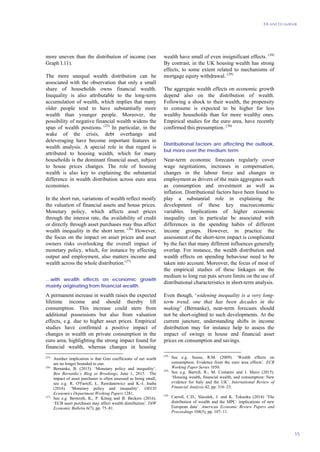
measures to assure stability in the short run may
worsen existing imbalances and raise the future
costs of adjustment unless part of a package to
cushion structural reforms and support more
balanced growth. A growing appreciation of the
complexity of the task China faces in managing the
adjustment to lower but more sustainable growth
has raised considerable doubts about whether this
process can be managed smoothly.
bn CNY Curr. prices % GDP 96-11 2012 2013 2014 2015 2016 2017
GDP 640796.0 100.0 9.8 7.7 7.7 7.3 6.9 6.5 6.2
Consumption 328311.0 51.2 - - - - - - -
Gross fixed capital formation 283018.0 44.2 - - - - - - -
of which: equipment - - - - - - -
Change in stocks as % of GDP - - - - - - -
Exports (goods and services) 15222.0 2.4 - 5.9 8.8 4.8 -1.4 2.1 3.0
Final demand - - - - - - -
Imports (goods and services) 13476.0 2.1 - 6.6 10.6 5.4 0.6 2.7 3.7
GNI (GDP deflator) - - - - - - - - -
Contribution to GDP growth : - - - - - - -
- - - - - - -
- - - - - - -
- - - - - - -
4.0 4.1 4.1 4.1 - - -
- - - - - - -
- - - - - - -
Real unit labour costs - - - - - - -
Saving rate of households - - - - - - -
GDP deflator 3.8 3.2 2.4 1.2 0.0 1.5 1.5
Private consumption deflator - - - - - - -
Index of consumer prices (c) 3.5 2.6 2.6 2.0 - - -
4.2 3.7 3.7 4.2 5.2 5.6 5.4
Current-account balance (b) 4.1 2.6 1.6 2.1 3.3 3.3 3.0
- - - - - - -
- - - - - - -
- - - - - - -
Domestic demand
Inventories
Table II.36.1:
Main features of country forecast - CHINA
2014 Annual percentage change
Merchandise trade balance (b)
(a) urban unemployment, as % of labour force. (b) as a percentage of GDP. (c) national indicator.
Net lending(+) or borrowing(-) vis-à-vis ROW (b)
General government balance (b)
General government gross debt (b)
Net exports
Employment
Unemployment (a)
Compensation of employees/head
Unit labour costs
37. EFTA
Rough sailing for small open economies
142
Switzerland
The strength of the Swiss franc, following the
decision by the Swiss National Bank to abandon
the exchange rate ceiling of Swiss franc with the
euro in January 2015 keeps weighing on the
growth outlook for Switzerland. After
strengthening by almost 20% against the euro in
January, the Swiss franc stabilised and depreciated
slightly towards the end of 2015.
Real GDP grew at a moderate 0.9% (y-o-y) in
2015, supported by a stronger-than-expected
expansion in the last quarter (0.4% q-o-q). The
main driving force in 2015-Q4 was a greater value
added in manufacturing, while the performance of
other business activities remained weak. The
contribution of net exports of goods, excluding
valuables, was declining in the second half of
2015. The impact of strong currency differed
across sectors with chemical and pharmaceutical
exports holding relatively well while other
categories (watches, precision tools, jewellery)
either stagnating or declining. Growth of gross-
fixed investment declined in light of squeezed
profit margins and low capacity utilisation, while
investment growth in construction remained
roughly stable. The contribution of private and
public consumption to GDP growth was positive
throughout the year.
The growth outlook remains subdued due to the
weak external environment and slowly diminishing
effects from the lagged currency appreciation.
Subject to the downside risks stemming from low
inflation and moderate growth in neighbouring
countries, real GDP projections for 2016 and 2017
are set at 1.2% and 1.5%, respectively. Further
downside risk relates to the slowdown in emerging
economies and volatility in financial markets
which could result in renewed capital inflows into
Switzerland.
Public and private consumption are expected to
continue to sustain growth over the forecast
horizon in Switzerland, through real gains in
household disposable income from low inflation.
Exports of goods and services are likely to show
only limited growth due to a gradual improvement
of the competitive position. After destocking in
2015, the contribution of stocks to GDP growth
should recover in 2016-17. Following a significant
fall of the number of employed persons in the first
half of 2015, the total employment in 2016 is
likely to stay below an annual average of the
previous year. In view of this slow improvement,
the unemployment rate is expected to start
declining only from 2017 onwards.
-6
-4
-2
0
2
4
6
08 09 10 11 12 13 14 15 16 17
Stock building Foreign balance
Domestic demand GDP (y-o-y%)
pps.
Graph II.37.1: Switzerland - Real GDP growth and contributions
forecast
Throughout 2015, Switzerland experienced
declining consumer prices. The strength of the
Swiss franc and the slump in oil prices implied a
negative contribution of import prices to the
annual CPI rate. Moreover, prices for services also
fell significantly in 2015, reflecting the subdued
domestic demand and wage inflation. Due to
moderate recovery of GDP growth and low
international commodity prices the negative trend
in Swiss consumer prices is likely to continue in
2016, while an increase in the range of 0.2-0.7 is
expected in 2017.
Currency appreciation put pressure on government
finance through lower revenues from income and
profit taxes. Public consumption rose by
preliminary 1.7% in 2015, but it is expected to
decelerate in 2016. Planned fiscal consolidation,
including reforms of labour market and social
Each of the three EFTA countries faces substantial economic challenges: in Switzerland, the economy
has to cope with a strengthened currency and subdued investment. Norway has to face lower oil-related
revenues and deteriorating consumer confidence, while Iceland experiences a boom in tourism and
related construction and uncertainties stemming from plans to lift capital controls.
Other non-EU Countries, EFTA
143
security laws, should help to strengthen the
medium-term fiscal outlook.
Norway
The outlook for growth in Norway has weakened
as persistently low oil prices are set to weigh on
investment across the petroleum industry, amid
emerging spillovers to other parts of the economy
and a gradual deterioration of consumer and
business sentiment. Real GDP growth is now
expected to slow to 1.2% in 2016 (from 1.6% in
2015) before rebounding to 1.7% in 2017.
-3
-2
-1
0
1
2
3
4
08 09 10 11 12 13 14 15 16 17
Stock building Net exports
Domestic demand GDP (y-o-y%)
pps.
Graph II.37.2: Norway - Real GDP growth and contributions
forecast
Growth in 2015 as a whole came in at 1.6%, lower
than expected, as the buoyant expansion in the
third quarter (1.6% q-o-q) was almost fully
reversed by a contraction in the fourth (-1.2%),
leaving a negative carryover into 2016. The
volatile GDP profile during the course of 2015
largely reflects the exceptionally high fluctuations
in natural-gas production. However, weakness in
the offshore sector is gradually spilling over to the
mainland economy, with signs of softness
emerging in manufacturing and services, e.g. retail
sales. While private consumption has held up
relatively well throughout 2015, the steady
deterioration in consumer confidence amid a
modest worsening in employment prospects and
rising uncertainty, is set to dampen household
spending in the forecast horizon.
Business investment contracted by 4% in 2015,
dragged down by the retrenchment in the off-shore
investment which accounts for roughly one-quarter
of total capital spending. While stabilising oil
prices and solid public investment should limit
further decline, business investment is expected to
remain very weak in the near term, contracting
further in 2016, before rebounding somewhat in
2017 on stabilising oil prices. On the other hand,
residential construction is set to continue solid
expansion in the forecast horizon, driven by
favourable financing conditions.
Contraction in the energy sector together spilling
over to other parts of the economy led to a gradual
pick up in unemployment rate to roughly 4.5% in
the second half of 2015, the highest in a decade.
Unemployment rate is expected to rise further, to
4.7% in 2017, reflecting weaker employment
prospects in both offshore and mainland economy.
The weaker outlook led the central bank to cut the
policy interest rate by 25 bps. to 0.5% in March,
despite inflation running above its 2.5% target
since late 2015. Consumer price inflation, boosted
by the depreciation of the krone, is expected to
ease gradually, converging to the target over the
forecast horizon, as the currency stabilises in line
with oil prices. Fiscal policies will remain
expansionary in the forecast horizon, as
government steps up spending to make up for the
revenue decline due to the downturn in the oil
sector. Budget surpluses will decline to 5.5% of
GDP in 2016, the smallest since 1998, to recover
somewhat in 2017 on rising oil-related revenue.
Risks to the outlook are largely tilted to the
downside and relate mainly to the oil price
assumptions and the impact of retrenchment in the
energy sector onto the mainland economy.
Iceland
Strong consumption, investment and exports
resulted in real GDP growth by 4.0% in 2015.
Employment rose by 3.4%, bringing
unemployment further down to pre-crisis levels of
4.2%. A strengthening exchange rate (by nearly
6%) and low import prices have helped to keep
average inflation low, at 1.6% in 2015. After an
annual fiscal deficit of 0.1% of GDP in 2014, the
2015 budget deficit rose to 0.5% of GDP, mainly
due to high fiscal deficits in the first three quarters.
The high import content of investment and private
consumption resulted in a worsening of Iceland’s
trade balance, increasing the deficit to 3.6% of
GDP by end of 2015.
During 2016 and 2017, key drivers of growth will
be tourism, related investment and strong private
consumption, benefitting from low prices, tourism
and construction driven employment growth and
high wage agreements, concluded in 2015.
European Economic Forecast, Spring 2016
144
Investment is expected to remain strong reflecting
tourism-related construction, capital renewal in the
fishing and tourism industry and silicon-related
investment projects. These supporting effects are
expected to peter out over the forecast horizon.
Exports are projected to benefit from a flourishing
tourism sector. Stronger domestic demand will
lead to a widening of the trade deficit, while the
services balance will continue to benefit from
strong tourism. Overall, the current account
balance is forecast to deteriorate in 2016-17.
-20
-15
-10
-5
0
5
10
15
08 09 10 11 12 13 14 15 16 17
Stock building Foreign balance
Domestic demand GDP (y-o-y%)
pps.
Graph II.37.3: Iceland - Real GDP growth and contributions
forecast
Inflation is likely to rise, reflecting lagged effects
from high wage agreements of 2015, but also due
to strong demand from tourism. The high wage
agreements might dampen employment growth in
the coming years, but will also increase labour
supply. This will have to increasingly come from
abroad, as domestic employment rates are already
high. As a result, the unemployment rate will drop
at a rather moderate rate.
The government’s fiscal target for 2016 of largely
balanced accounts is in line with the current
growth outlook. Exceptional one-off revenues
related to the planned lifting of capital controls
could lead to substantial revenues in 2016. If those
funds are used primarily for lowering the debt
burden, the debt ratio could drop well below 60%
of GDP by end 2017.
The government intends to proceed in the coming
months with the announced capital account
liberalisation. This would have a positive effect on
the country’s medium-term outlook, but could lead
to sudden swings in capital flows, potentially
destabilising the currency, domestic prices and
international price competitiveness.
Table II.37.1:
2014 2015 2016 2017 2014 2015 2016 2017 2014 2015 2016 2017
1.8 4.0 3.5 3.3 2.2 1.6 1.2 1.7 1.9 0.9 1.2 1.5
3.1 4.8 4.5 4.0 1.7 2.0 0.9 1.2 - 1.3 1.1 1.1 1.4
1.8 1.1 1.1 1.0 2.9 1.8 2.3 2.3 1.3 1.7 1.4 1.4
15.4 18.6 12.0 9.0 0.0 -4.0 -2.7 1.1 2.1 1.4 1.1 1.4
- - - - -3.1 -3.1 -0.5 0.6 0.4 1.3 1.7 1.9
3.1 8.1 6.1 4.8 2.2 2.3 2.6 3.7 -6.9 3.2 3.1 3.2
9.8 13.3 9.5 7.0 1.5 0.6 0.6 2.8 -8.1 2.9 3.4 3.4
1.2 4.0 4.0 3.4 2.2 1.6 1.2 1.7 1.9 0.9 1.2 1.5
4.4 5.9 4.8 4.2 1.3 0.3 0.3 1.3 1.3 1.1 1.0 1.2
Inventories 0.4 0.0 0.0 0.0 0.5 0.6 0.1 -0.1 0.6 -0.8 0.0 0.0
Net exports -3.0 -2.0 -1.3 -0.9 0.4 0.7 0.8 0.5 -0.1 0.6 0.2 0.2
1.6 3.8 2.8 2.5 1.1 0.5 0.3 0.7 - 1.8 1.5 -1.4 0.8
5.0 4.2 4.0 3.8 3.4 4.2 4.4 4.7 4.5 4.6 5.2 5.0
5.6 8.0 4.6 3.8 3.4 2.9 2.8 2.6 -0.1 -2.9 0.2 0.8
5.3 7.8 3.9 3.0 2.3 1.8 1.9 1.5 -0.2 -2.2 -2.4 0.2
1.3 5.5 1.6 0.1 1.8 3.9 -0.2 -0.8 0.5 -1.0 -1.7 0.0
: : : : 16.1 16.4 16.0 16.1 25.3 25.0 24.5 24.6
4.0 2.2 2.2 2.9 0.5 -2.0 2.0 2.4 -0.7 -1.3 -0.7 0.2
1.0 0.3 1.8 2.7 1.9 2.0 3.0 2.5 0.0 -0.8 -0.6 0.2
4.1 2.7 0.3 0.0 -7.7 -14.6 -2.9 0.0 0.2 1.8 -0.4 -0.3
-0.5 -3.6 -5.0 -5.8 10.0 6.6 6.4 6.5 7.7 9.2 9.1 9.0
3.4 1.8 0.9 0.0 8.7 5.0 5.0 5.3 11.5 11.7 11.7 11.8
3.3 1.8 0.8 -0.1 8.7 5.0 5.0 5.3 10.9 11.1 11.0 11.1
-0.1 -0.5 0.5 0.5 8.7 5.7 6.1 5.2 -0.2 -0.3 -0.4 0.0
81.4 69.1 57.0 53.0 26.6 27.6 30.6 34.2 - 36.5 36.9 37.1 36.5
Exports (good and services)
(a) as % of total labour force. (b) gross saving divided by gross disposable income. (c) as a % of GDP.
Saving rate of households (b)
Unemployment rate (a)
Gross fixed capital formation
Current account balance (c)
Contribution to GDP growth: Domestic demand
GDP deflator
Compensation of employee/head
of which: equipment
Net lending (+) or borrowing (-) vis-a-vis ROW
Harmonised index of consumer prices
Terms of trade goods
Private Consumption
Main features of country forecast - EFTA
General government gross debt (c)
Real unit labour cost
Imports (goods and services)
Switzerland
Public Consumption
NorwayIceland
Trade balance (goods) (c)
Employment
GNI (GDP deflator)
(Annual percentage change)
GDP
General government balance (c)
Unit labour cost whole economy
38. RUSSIAN FEDERATION
A protracted recession and a long path to recovery
145
Recession and delayed recovery
Russia’s economy slid into recession in 2015 as
the collapse in oil prices and economic sanctions
have exacerbated pre-existing structural
weaknesses, mainly the excessive reliance on the
oil and gas sector.
-15
-10
-5
0
5
10
08 09 10 11 12 13 14 15 16 17
Graph II.38.1: Russia - Real GDP growth and contributions
Private consumpt. Gov. consumpt.
GFCF Net exports
Inventories Real GDP (y-o-y%)
forecast
pps.
Real GDP contracted by 3.7% due to a sharp
decline in private consumption and investment on
the back of elevated borrowing costs, weak
economic confidence and high inflation.
Latest releases of quarterly figures point to a
protracted recession and a further delay in the
recovery, as the fall in GDP decelerated only
slightly in the second half of 2015 (-3.7% and
-3.8% y-o-y in 2015-Q3 and 2015-Q4,
respectively, after a peak of -4.5% in 2015-Q2)
reflecting a continued contraction in investment,
industrial production and retail sales. High
frequency data for the first months of 2016 point to
only modest improvement in retail sales and
industrial production whereas investment remains
in firmly negative territory. The near-term outlook
remains centred on a protracted stagnation due to
low oil price for long, sanctions, weak business
sentiment, very slow recovery in household
income after the large squeeze of 2015 and no
acceleration of structural reforms ahead of
elections. GDP is expected to fall by 1.9% in 2016
and to grow very modestly in 2017 (by 0.5%) due
to gradually subsiding geo-political tensions, a
slight rebound in oil price and the central bank
resuming a monetary easing cycle.
Consumption and investment should keep
declining in 2016
Investment fell sharply in 2015, with the decline
accelerating again towards the end of the year.
Weak economic confidence, reflecting constrained
access to Western capital markets amid sanctions,
subdued bank lending and lacklustre demand are
set to continue weighing on investment in 2016,
leading to a further contraction.
Private consumption fell even more than
investment, reflecting a slump in real wages amid
high inflation and no or reduced indexation of
public wages, pensions and social transfers, as well
as reduced bank lending to consumers. As
disposable income is expected to recover only very
gradually, given reduced room for wage increases
and severe fiscal consolidation pressures, private
consumption is forecast to decline in 2016 and
remain close to stagnation in 2017.
Exports increased slightly in 2015, as oil
production/export reached record levels and the
rouble depreciation provided a boost to some non-
fuel sectors, such as agriculture, metals and
chemicals. Albeit remaining in positive territory,
exports are projected to be on a decreasing trend as
the gain in external competitiveness will be more
than offset by sluggish investment, lack of
structural reforms and approximately flat oil
production amid a coordinated strategy to control
supply among key oil producers. Imports collapsed
in 2015 on the back of the large fall in domestic
demand, the sharp depreciation of the rouble and
the embargo on Western food imports. They are
expected to contract further in 2016 – albeit at a
much smaller pace – and to grow only marginally
in 2017, reflecting a very weak growth recovery.
A somewhat deteriorating labour market
Although the labour market is expected to remain
relatively resilient, adjusting mainly through
Russia is in a protracted recession due to the combined effect of the fall in oil prices, sanctions and
structural bottlenecks. The path towards recovery is set to be extremely slow and gradual amid a
difficult adjustment process to low oil price for longer and the prolongation of sanctions. Hence the
economy is expected to contract further in 2016, before very weak growth resumes in 2017.
European Economic Forecast, Spring 2016
146
wages, employment is expected to contract slightly
over the forecast horizon, as corporates will be
increasingly unable to cut costs without laying off
workers. As a result, unemployment should also
gradually increase, exceeding 6% as of 2016.
Inflation on a downward trend
After reaching new record lows in January 2016,
reflecting a renewed decline in the oil price, the
rouble recovered somewhat, while remaining at
around half of its value in mid-2014 against the
USD. Inflation decreased quite rapidly since the
end of 2015 and reached 7.3% in March (from a
peak of nearly 17% one year earlier) as a result of
low domestic demand, reduced exchange rate pass-
through due to lower imports and declining global
food prices. Limited price pressures are expected
to resume later in 2016 amid increased fuel excise
duties, with average annual inflation remaining at
7.5% before falling to 5.4% in 2017 (i.e. closer to
the Bank of Russia’s medium-term target of 4%).
However, the central bank remains wary of
inflation risks stemming from a slow reduction of
inflation expectations, oil price volatility and
uncertainty over budgetary prospects. Hence, it has
refrained from introducing interest rate cuts since
August 2015, although pressures for monetary
easing are likely to mount as inflation declines
further.
Fiscal position to deteriorate further
The fiscal deficit has sharply widened in 2015 due
to lower revenues linked to the slump in oil prices
and was to a large extent financed by tapping the
Reserve Fund. It is set to increase further in 2016,
as budget plans were based on overly optimistic
assumptions about growth and oil price. Also,
additional fiscal consolidation measures remain
unspecified and are unlikely to be significant amid
an election year. Hence, Russia is at serious risk of
fully depleting the Reserve Fund by the end of the
forecast horizon, which should trigger efforts to
achieve a modest deficit reduction in 2017.
Risks to the outlook
Downside risks to the outlook are related to the
possible prolongation of sanctions throughout
2017, which would worsen economic confidence
and further delay investment recovery. A renewed
volatility of oil prices, putting further pressure on
the fiscal and financial sector, via additional
revenue shortfall and rouble depreciation,
respectively, could also weigh on the outlook.
bn RUB Curr. prices % GDP 96-11 2012 2013 2014 2015 2016 2017
71406.4 100.0 3.8 3.4 1.3 0.6 -3.7 -1.9 0.5
38319.1 53.7 5.6 7.7 4.9 1.2 -10.0 -4.2 0.2
13932.3 19.5 1.4 2.6 1.1 -0.1 -1.8 -1.6 -0.5
14124.2 19.8 4.4 7.0 0.7 -2.1 -7.6 -4.6 0.3
- - - - - - - - -
21437.3 30.0 5.4 1.1 4.6 -0.1 3.1 2.5 2.0
16331.4 22.9 8.9 8.7 3.8 -7.9 -25.6 -3.2 0.8
68857.4 96.4 3.6 3.2 0.9 0.9 -3.4 -1.8 0.7
4.0 5.7 2.8 0.2 -7.2 -3.5 0.1
0.2 -0.7 -1.9 -1.2 -2.8 0.0 0.0
-0.5 -1.6 0.5 1.8 6.8 1.5 0.5
- 1.0 -0.2 0.3 -0.7 -0.7 -0.6
- 5.5 5.5 5.1 5.6 6.1 6.4
- - - - - - -
- - - - - - -
- - - - - - -
- - - - - - -
21.2 7.4 5.0 7.2 5.7 5.2 5.7
- 5.1 6.8 7.8 15.5 7.5 5.4
5.1 2.7 -6.6 -4.0 -25.9 -9.8 -1.0
12.3 9.7 8.8 10.1 10.7 9.9 9.7
7.5 3.4 1.6 3.2 5.3 5.1 5.0
6.7 3.1 1.6 3.1 5.3 5.0 5.0
- 2.5 1.4 0.8 -1.6 -2.5 -1.3
- - - - - - - -
- - - - - - - -
- 12.7 14.0 17.5 19.5 22.6 23.7
GNI (GDP deflator)
Structural budget balance (d)
Saving rate of households (b)
Main features of country forecast - RUSSIA
Unemployment rate (a)
Gross fixed capital formation
Current-account balance (c)
Contribution to GDP growth:
General government gross debt (c)
GDP deflator
Compensation of employees / head
of which: equipment
Domestic demand
Consumer-price index
Table II.38.1:
Net exports
Public Consumption
Trade balance (goods) (c)
Employment
Annual percentage change2014
GDP
Private Consumption
Exports (goods and services)
Net lending (+) or borrowing (-) vis-a-vis ROW (c)
(a) as % of total labour force. (b) gross saving divided by gross disposable income. (c) as a % of GDP. (d) as a % of potential GDP.
Cyclically-adjusted budget balance (d)
Real unit labour cost
Imports (goods and services)
General government balance (c)
Unit labour costs whole economy
Inventories
Terms of trade goods
ACKNOWLEDGEMENTS
147
This report was prepared in the Directorate-General for Economic and Financial Affairs under the
direction of Marco Buti – Director-General, Servaas Deroose – Deputy Director-General, and José
Eduardo Leandro – Director “Policy, strategy, coordination and communication”. It has benefitted from
the close collaboration with Directorate-General for Financial Stability, Financial Services and Capital
Markets Union.
Executive responsibilities were attached to Björn Döhring – Head of Unit “Economic situation, forecasts,
business and consumer surveys”, Evelyne Hespel – Head of Sector “Macro-economic forecasts and short-
term economic developments”, and the forecast coordinators – Reuben Borg and Laura González
Cabanillas.
The Overview was prepared by Evelyne Hespel. Chapter 1 on “Staying the course amid high risks” was
prepared by Oliver Dieckmann under the responsibility of Björn Döhring. This chapter benefited from
contributions by Božena Bobková, Reuben Borg, Chris Bosma, Lucian Briciu, João Capella Ramos,
Suzanne Casaux, Salvador Ferrandis Vallterra, Alan Gilligan, Laura González Cabanillas, Dalia
Grigonyte, Per Yann Le Floc’h, Bjorn Roelstraete, Anastasia Theofilakou, Rupert Willis, Przemysław
Woźniak and Alexandru Zeana. Boxes were contributed by Paolo Bolsi, Pasquale D'Apice, Fillipo
Ferroni, Marta Petrucci, Romanos Priftis, Rafal Raciborski, Beatriz Velazquez, Marco Ratto, Lukas
Vogel and Martin Zeitler.
The sections on “Member States” were prepared under the supervision of Daniel Daco, Carlos Martínez
Mongay and István Pál Székely, Directors for the “Economies of the Member States”. These sections
benefited from contributions by Frode Aasen, Emiel Afman, Hanna Aspegren, Wojciech Balcerowicz,
Antonino Barbera Mazzola, Francisco Barros Castro, Barbara Bernardi, Stefan Bohner, Peghe Braila,
Julien Castiaux, Guillaume Cléaud, Leonor Coutinho, Iván Csaba, Juliana Dahl, Stylianos Dendrinos,
Felipe De la Mota, Živilė Didžiokaitė, Ben Deboeck, Francisco de Castro Fernández, Mirzha de Manuel
Aramendía, Lauri Esala, Raffaele Fargnoli, Miroslav Florián, Norbert Gaál, Olivia Galgau, Luis García
Lombardero, Oscar Gómez Lacalle, Malgorzata Goralczyk, Michael Grams, Oskar Grevesmühl, Valeska
Gronert, Zoltán Gyenes, Julien Hartley, Michal Havlát, David Havrlant, Nora Hesse, Duy Huynh-Olesen,
Isabelle Justo, Tobias Ketterer, Csanád Sándor Kiss, Violeta Klyviene, Juho Kostiainen, Robert Kraemer,
Radoslav Krastev, Bettina Kromen, Robert Kuenzel, Cvetan Kyulanov, Baudouin Lamine, Milan Lisický,
Martin Loeffler, Dimitri Lorenzani, Mart Maiväli, Janis Malzubris, Dorin Emil Mantescu, Fabrizio
Melcarne, Vasiliki Michou, Alexander Molzahn, Allen Monks, Daniel Monteiro, Marie Mulvihill, Hans
Naudts, Alberto Noriega Guerra, Kristian Orsini, Wojciech Paczynski, Mona Papadakou, Christos
Paschalides, Presiyan Petkov, Ventsislav Petrov, Samuli Pietiläinen, Dino Pinelli, Aurélien Poissonnier,
Dominik Pripužić, Diana Radu, Vito Ernesto Reitano, David Marco Riquelme, Francesco Rossi-
Salvemini, Stefano Santacroce, Giedrius Sidlauskas, Sara Simões, Peeter Soidla, Vladimír Solanič, Nora
Straehle, Matija Šušković, Peter Symons, Roberta Torre, Tsvetan Tsalinski, Ismael Valdés Fernández,
Henk Van Noten, Hauke Vierke, Kai-Young Weissschaedel, Rafał Wielądek and Ingars Zustrups.
Coordination and editorial support on the country-specific sections on public finances was provided by
João Capella Ramos, under the supervision of Jakob Wegener Friis, Head of Unit "Policy, planning and
coordination".
The sections on “Candidate Countries” and “Other non-EU countries” were prepared under the
supervision of Elena Flores, Director of the “International economic and financial relations, global
governance”. These sections, and forecasts for all other non-EU economies, benefited from contributions
by Gintautas Baranauskas, Bernhard Böhm, Samuel Borralho, Antonella Colavita, Judita Cuculić Župa,
Felipe De La Mota, Stylianos Dendrinos, Hans Feddersen, Matteo Fumerio, Malgorzata Galar, Alan
Gilligan, Matteo Governatori, Dalia Grigonyte, Renata Hrůzová, Sarah Jurreit, Plamen Kaloyanchev,
Safwan Naser, Roxanne Rua, Antonio Sanchez Pareja, Barbara Stearns-Blasing, András Tari, Benjamin
Trunk, Rupert Willis, Przemysław Woźniak and Norbert Wunner.
148
Support in editing the report by Peter Koh, and for its communication and publication by Johannes
Bahrke, Nicolas Carpentiers, Sarka Novotna, Bjorn Pius, Enrico Portelli and Philip Tod is gratefully
acknowledged. IT support was provided by Rudy Druine.
Follow-up calculations were performed by Laura Fernández Vilaseca, Karel Havik, Vitor Martins, Kieran
Mc Morrow, Rafał Raciborski, Werner Röger, Anna-Elisabeth Thum, Valerie Vandermeulen and Stefan
Zeugner. Forecast assumptions were prepared by Lucian Briciu, Roberta Friz, Dalia Grigonyte, Gerda
Symens, André Verbanck and Przemysław Woźniak. Statistical support for the production of the forecast
tables was provided by Antoine Avdoulos, Noël Doyle, Salvador Ferrandis Vallterra and Bjorn
Roelstraete. Further statistical and layout assistance was provided by Yves Bouquiaux, Paloma Cortés
Payá, Paolo Covelli, Lazaros Dimitriadis, Andrzej Erdmann, Michel Gerday, Susanne Hoffmann, Jan
Kattevilder, Johann Korner, Oscar Gomez Lacalle, Anders Lindqvist, Simona Pojar, Marc Puig,
Francisco Maya Sepulveda, Ulrike Stierle-von Schuetz, Jacek Szelożyński, Ingrid Toming and Tomasz
Zdrodowski.
Valuable comments and suggestions by Laura Bardone, Gerrit Bethuyne, Božena Bobková, Reuben Borg,
Suzanne Casaux, Paolo Casini, Nathalie Darnaut, Oliver Dieckmann, Marie Donnay, Patrick D’Souza,
Luis Fau Sebastian, Jakob Wegener Friis, Carole Garnier, Gabriele Giudice, Laura González Cabanillas,
Peter Grasmann, Heinz Jansen, Stefan Kuhnert, Paul Kutos, Martin Larch, Julia Lendvai, Per Yann Le
Floc’h, Pim Lescrauwaet, Maarten Masselink, Josefina Monteagudo, Magda Morgese Borys, Karl
Pichelmann, Elena Reitano, Eric Ruscher, Uwe Stamm, Michael Stierle, Anastasia Theofilakou, Michael
Thiel, Charlotte Van Hooydonk, Christian Weise, Sam Whittaker, Florian Woehlbier, Norbert Wunner
and Javier Yaniz Igal are gratefully acknowledged.
Secretarial support for the finalisation of this report was provided by Károly Csiszár and Els Varblane.
Comments on the report would be gratefully received and should be sent to:
Directorate-General for Economic and Financial Affairs
Unit A3: Economic situation, forecasts, business and consumer surveys
European Commission
B-1049 Brussels
E-mail: ecfin-forecasts@ec.europa.eu
Statistical Annex
European Economic Forecast – Spring 2016
Contents
150
Output : GDP and its components
1. Gross domestic product 152
2. Profiles (q-o-q) of quarterly GDP 152
3. Profiles (y-o-y) of quarterly GDP 153
4. GDP per capita 153
5. Final domestic demand 154
6. Final demand 154
7. Private consumption expenditure 155
8. Government consumption expenditure 155
9. Total investment 156
10. Investment in construction 156
11. Investment in equipment 157
12. Public investment 157
13. Potential GDP 158
14. Output gap relative to potential GDP 158
Prices
15. Deflator of GDP 159
16. Deflator of private consumption 159
17. Harmonised consumer prices index 160
18. Harmonised consumer prices quarterly profiles 160
19. Deflator of exports of goods 161
20. Deflator of imports of goods 161
21. Terms of trade of goods 162
Wages, population and labour market
22. Total population 162
23. Total employment 163
24. Unemployment rate 163
25. Compensation of employees per head 164
26. Real compensation of employees per head 164
27. Labour productivity 165
28. Unit labour costs, whole economy 165
29. Real unit labour costs 166
Exchange rates
30. Nominal bilateral exchange rates 166
31. Nominal effective exchange rates 167
32. Relative unit labour costs 167
33. Real effective exchange rates 168
Statistical Annex
151
General Government
34. Total expenditure 168
35. Total revenue 169
36. Net lending (+) or net borrowing (-) 169
37. Interest expenditure 170
38. Primary balance 170
39. Cyclically-adjusted net lending (+) or net borrowing (-) 171
40. Cyclically-adjusted primary balance 171
41. Structural budget balance 172
42. Gross debt 172
Saving
43. Gross national saving 173
44. Gross saving of the private sector 173
45. Saving rate of households 174
46. Gross saving of general government 174
Trade and international payments
47. Exports of goods and services 175
48. Imports of goods and services 175
49. Merchandise trade balance (% of GDP) 176
50. Current-account balance (% of GDP) 176
51. Net lending (+) or net borrowing (-) 177
52. Current-account balance (bn EUR) 177
53. Export markets (goods and services) 178
54. Export performance (goods and services) 178
World economy
55. World GDP 179
56. World exports of goods and services 180
57. Export shares (goods) in EU trade 180
58. World imports of goods and services 181
59. Import shares (goods) in EU trade 181
60. World merchandise trade balances (bn USD) 182
61. World current-account balances (bn USD) 182
62. Primary commodity prices 182
European Economic Forecast, Spring 2016
152
Table 1: 22.4.2016
5-year
1997-01 2002-06 2007-11 2012 2013 2014 2015 2016 2017 2015 2016 2017
2.7 2.2 1.3 0.2 0.0 1.3 1.4 1.2 1.6 1.3 1.3 1.7
2.1 1.0 1.2 0.4 0.3 1.6 1.7 1.6 1.6 1.7 1.8 1.8
6.3 7.9 -0.9 5.2 1.6 2.9 1.1 1.9 2.4 0.9 2.1 2.3
9.4 5.4 0.1 0.2 1.4 5.2 7.8 4.9 3.7 6.9 4.5 3.5
3.9 4.2 -3.3 -7.3 -3.2 0.7 -0.2 -0.3 2.7 0.0 -0.7 2.7
4.4 3.4 0.0 -2.6 -1.7 1.4 3.2 2.6 2.5 3.2 2.8 2.5
3.0 1.7 0.7 0.2 0.7 0.2 1.2 1.3 1.7 1.1 1.3 1.7
2.1 1.0 -0.6 -2.8 -1.7 -0.3 0.8 1.1 1.3 0.8 1.4 1.3
4.3 3.8 1.6 -2.4 -5.9 -2.5 1.6 1.7 2.0 1.4 1.5 2.0
6.0 9.3 -1.5 4.0 3.0 2.4 2.7 2.8 3.1 2.7 3.1 3.2
Lithuania 4.9 7.8 0.9 3.8 3.5 3.0 1.6 2.8 3.1 1.6 2.9 3.4
6.3 3.5 2.0 -0.8 4.3 4.1 4.8 3.3 3.9 4.7 3.8 4.4
3.9 2.3 2.0 2.8 4.1 3.7 6.3 4.1 3.5 4.9 3.9 3.4
4.0 1.6 0.9 -1.1 -0.5 1.0 2.0 1.7 2.0 2.0 2.1 2.3
2.8 2.1 1.2 0.8 0.3 0.4 0.9 1.5 1.6 0.7 1.7 1.6
3.8 0.8 -0.1 -4.0 -1.1 0.9 1.5 1.5 1.7 1.5 1.6 1.8
4.2 4.1 0.7 -2.7 -1.1 3.0 2.9 1.7 2.3 2.5 1.8 2.3
2.9 6.0 3.6 1.5 1.4 2.5 3.6 3.2 3.3 3.5 3.2 3.4
4.9 2.9 0.5 -1.4 -0.8 -0.7 0.5 0.7 0.7 0.0 0.5 0.9
2.9 1.8 0.5 -0.9 -0.3 0.9 1.7 1.6 1.8 1.6 1.7 1.9
0.9 6.3 2.1 0.2 1.3 1.5 3.0 2.0 2.4 2.2 1.5 2.0
1.5 4.7 1.5 -0.9 -0.5 2.0 4.2 2.1 2.6 4.5 2.3 2.7
2.6 1.9 -0.5 -0.1 -0.2 1.3 1.2 1.2 1.9 1.2 1.7 1.9
2.9 4.8 -0.5 -2.2 -1.1 -0.4 1.6 1.8 2.1 1.8 2.1 2.1
3.8 4.3 -0.6 -1.7 1.9 3.7 2.9 2.5 2.8 2.7 2.1 2.5
4.3 4.1 4.5 1.6 1.3 3.3 3.6 3.7 3.6 3.5 3.5 3.5
0.1 6.2 1.5 0.6 3.5 3.0 3.8 4.2 3.7 3.6 4.2 3.7
3.6 3.3 1.2 -0.3 1.2 2.3 4.1 3.4 2.9 3.6 3.2 2.9
3.2 2.8 0.3 1.2 2.2 2.9 2.3 1.8 1.9 2.3 2.1 2.1
3.0 2.1 0.6 -0.5 0.2 1.4 2.0 1.8 1.9 1.9 1.9 2.0
3.7 2.9 0.6 2.2 1.5 2.4 2.4 2.3 2.2 2.5 2.7 2.6
0.4 1.5 -0.1 1.7 1.4 0.0 0.5 0.8 0.4 0.7 1.1 0.5
Slovenia
Malta
Spring 2016
USA
Latvia
Croatia
Estonia
Bulgaria
Netherlands
Japan
Sweden
France
Hungary
Winter 2016
United Kingdom
Italy
Poland
Greece
Czech Republic
Slovakia
Austria
Euro area
Gross domestic product, volume (percentage change on preceding year, 1997-2017)
Finland
Portugal
Luxembourg
EU
averages
Cyprus
forecast
Romania
Spain
Denmark
Germany
Ireland
Belgium
forecast
Table 2: 22.4.2016
2015/1 2015/2 2015/3 2015/4 2016/1 2016/2 2016/3 2016/4 2017/1 2017/2 2017/3 2017/4
0.3 0.5 0.2 0.3 0.3 0.2 0.3 0.4 0.4 0.4 0.5 0.5
0.4 0.4 0.3 0.3 0.5 0.3 0.4 0.4 0.4 0.4 0.4 0.4
-0.7 0.5 0.1 0.9 0.5 0.6 0.7 0.7 0.5 0.6 0.6 0.7
: : : : : : : : : : : :
: : : : : : : : : : : :
0.9 1.0 0.8 0.8 0.7 0.5 0.3 0.5 0.6 0.7 0.8 0.8
0.6 0.0 0.4 0.3 0.4 0.3 0.4 0.5 0.5 0.4 0.4 0.3
0.4 0.3 0.2 0.1 0.3 0.3 0.4 0.4 0.3 0.3 0.3 0.3
: : : : : : : : : : : :
0.5 1.2 0.9 -0.3 0.9 0.7 0.8 0.8 0.8 0.8 0.9 0.9
Lithuania 0.3 0.6 0.5 0.5 0.7 0.7 0.7 0.8 0.7 0.8 0.8 0.8
-1.2 1.8 1.2 1.1 0.2 0.8 0.8 0.9 1.0 1.0 1.0 1.1
: : : : : : : : : : : :
0.6 0.2 0.2 0.3 0.4 0.6 0.7 0.7 0.5 0.3 0.3 0.3
0.7 0.3 0.0 0.2 0.4 0.5 0.5 0.4 0.4 0.4 0.3 0.3
0.5 0.4 0.1 0.2 0.2 0.6 0.6 0.6 0.4 0.3 0.3 0.3
0.7 0.8 0.4 0.6 0.3 0.3 0.4 0.4 0.6 0.8 0.7 0.6
0.9 1.0 1.0 1.0 0.4 0.9 0.7 0.8 0.8 0.9 0.9 0.9
0.4 0.5 -0.2 0.2 0.2 0.2 0.2 0.2 0.2 0.2 0.2 0.2
0.6 0.4 0.3 0.3 0.5 0.4 0.4 0.5 0.5 0.4 0.4 0.4
0.9 0.6 0.7 0.7 0.6 0.4 0.2 0.2 0.5 0.7 0.9 0.9
2.4 1.0 0.7 0.0 0.5 0.7 0.6 0.6 0.6 0.7 0.6 0.7
0.6 0.4 -0.6 0.1 0.5 0.5 0.5 0.5 0.5 0.5 0.4 0.4
0.3 0.9 1.4 -0.5 0.8 0.3 0.3 0.3 0.6 0.6 0.6 0.6
0.8 0.5 0.6 1.0 0.3 0.6 0.7 0.8 0.7 0.6 0.7 0.7
1.0 0.6 0.9 1.1 0.6 1.1 1.8 1.1 0.8 0.6 0.6 0.6
1.3 -0.2 1.5 1.1 1.2 0.6 1.4 0.9 1.0 0.9 0.8 0.8
0.9 1.2 1.0 1.3 0.6 0.6 0.6 0.8 0.7 0.7 0.7 0.8
0.5 0.6 0.4 0.6 0.4 0.6 0.6 0.4 0.3 0.3 0.3 0.3
0.6 0.5 0.4 0.4 0.5 0.5 0.5 0.5 0.5 0.4 0.4 0.4
0.2 1.0 0.5 0.3 0.2 0.9 0.9 0.7 0.4 0.4 0.4 0.5
1.1 -0.4 0.3 -0.3 0.3 0.5 0.4 0.4 1.1 -2.0 0.1 0.3Japan
Profiles (qoq) of quarterly GDP, volume (percentage change from previous quarter, 2015-17)
United Kingdom
Euro area
Germany
Hungary
Portugal
France
Greece
Denmark
Finland
Latvia
Belgium
Sweden
Croatia
Austria
Spain
Estonia
EU
Bulgaria
Luxembourg
Italy
Poland
Slovenia
Malta
Ireland
USA
Czech Republic
Cyprus
Romania
Slovakia
Netherlands
Statistical Annex
153
Table 3: 22.4.2016
2015/1 2015/2 2015/3 2015/4 2016/1 2016/2 2016/3 2016/4 2017/1 2017/2 2017/3 2017/4
1.3 1.5 1.3 1.4 1.3 1.1 1.2 1.2 1.3 1.5 1.7 1.8
1.1 1.6 1.7 1.3 1.4 1.4 1.6 1.7 1.7 1.8 1.8 1.8
1.4 1.4 1.1 0.8 2.0 2.1 2.7 2.4 2.4 2.4 2.4 2.3
: : : : : : : : : : : :
: : : : : : : : : : : :
2.7 3.2 3.4 3.5 3.3 2.8 2.3 2.0 2.0 2.3 2.7 3.0
1.0 1.1 1.2 1.4 1.1 1.3 1.3 1.5 1.6 1.7 1.7 1.5
0.2 0.6 0.8 1.0 0.9 1.0 1.2 1.5 1.5 1.5 1.4 1.3
: : : : : : : : : : : :
1.9 2.8 3.3 2.3 2.7 2.2 2.2 3.3 3.2 3.3 3.3 3.4
Lithuania 1.2 1.4 1.7 1.9 2.3 2.4 2.6 3.0 3.0 3.1 3.1 3.1
4.9 6.0 5.7 3.0 4.4 3.3 2.9 2.7 3.5 3.7 4.0 4.2
: : : : : : : : : : : :
2.6 2.2 1.9 1.2 1.0 1.4 1.9 2.4 2.5 2.2 1.8 1.4
0.3 0.9 0.9 1.2 0.9 1.1 1.7 2.0 1.9 1.8 1.5 1.4
1.7 1.5 1.4 1.3 0.9 1.2 1.7 2.0 2.2 1.9 1.6 1.3
3.0 2.6 2.2 2.6 2.2 1.6 1.6 1.4 1.7 2.2 2.5 2.7
3.1 3.5 3.8 4.0 3.5 3.4 3.1 2.9 3.3 3.2 3.4 3.5
0.1 0.8 0.4 0.9 0.7 0.4 0.9 0.8 0.7 0.7 0.7 0.7
1.3 1.6 1.6 1.6 1.6 1.5 1.6 1.8 1.8 1.8 1.8 1.8
2.6 2.6 2.9 3.0 2.7 2.5 2.0 1.4 1.4 1.6 2.2 3.0
3.9 4.5 4.6 4.0 2.2 1.9 1.8 2.5 2.6 2.6 2.6 2.6
1.6 2.0 0.7 0.5 0.4 0.5 1.6 2.1 2.1 2.0 1.9 1.8
0.2 1.5 2.7 2.0 2.5 1.9 0.8 1.7 1.5 1.9 2.2 2.6
3.3 2.7 2.6 3.0 2.5 2.5 2.6 2.4 2.9 2.9 2.8 2.8
3.7 3.4 3.6 3.7 3.3 3.8 4.7 4.7 4.8 4.3 3.1 2.6
4.0 3.7 3.6 3.8 3.7 4.5 4.3 4.1 3.9 4.2 3.6 3.5
3.0 3.6 4.2 4.5 4.2 3.5 3.2 2.6 2.7 2.8 2.9 2.9
2.6 2.4 2.2 2.1 2.1 2.1 2.3 2.1 2.0 1.7 1.4 1.3
1.7 1.9 1.9 1.8 1.8 1.8 1.9 2.0 2.0 2.0 1.9 1.8
2.9 2.7 2.1 2.0 2.0 2.0 2.4 2.7 2.9 2.4 2.0 1.7
-1.0 0.7 1.7 0.8 0.0 0.8 0.9 1.6 2.4 -0.1 -0.3 -0.5Japan
Profile (yoy) of quarterly GDP, volume (percentage change from corresponding quarter in previous year, 2015-17)
United Kingdom
Euro area
Germany
Hungary
Portugal
France
Greece
Denmark
Finland
Latvia
Belgium
Sweden
Croatia
Austria
Spain
Estonia
EU
Bulgaria
Luxembourg
Italy
Poland
Slovenia
Malta
Ireland
USA
Czech Republic
Cyprus
Romania
Slovakia
Netherlands
Table 4: 22.4.2016
5-year
1997-01 2002-06 2007-11 2012 2013 2014 2015 2016 2017 2015 2016 2017
2.5 1.6 0.4 -0.5 -0.4 0.9 0.9 0.6 0.8 0.7 0.7 1.3
2.1 1.0 1.5 0.2 0.0 1.2 1.0 0.7 1.3 1.0 1.1 1.5
6.8 8.5 -0.5 5.5 2.0 3.3 1.3 2.3 2.8 1.2 2.4 2.7
8.0 3.3 -1.3 -0.1 1.2 4.9 7.2 3.8 2.7 6.2 3.4 2.6
3.4 3.9 -3.4 -6.8 -2.5 1.3 0.1 -0.3 2.7 0.0 -0.7 2.7
3.9 1.7 -1.0 -2.7 -1.3 1.6 3.3 2.7 2.7 3.3 2.9 2.6
2.5 1.0 0.2 -0.3 0.2 -0.3 0.7 0.9 1.2 0.6 0.8 1.2
2.1 0.5 -1.1 -3.3 -2.2 -0.6 0.9 1.1 1.0 0.6 1.1 1.1
3.1 2.4 -0.9 -3.9 -5.7 -1.4 2.5 2.0 1.8 0.9 1.1 1.5
7.0 10.4 0.0 5.3 4.1 3.3 3.6 3.5 3.6 3.5 3.8 3.7
Lithuania 5.7 9.1 2.5 5.2 4.6 4.0 2.6 4.0 4.3 2.6 3.8 4.1
4.9 2.1 0.1 -3.1 1.7 1.6 2.9 0.9 1.5 2.2 1.4 2.0
3.2 1.7 1.5 2.1 3.1 2.7 5.4 3.3 2.7 3.9 3.2 2.8
3.4 1.2 0.5 -1.4 -0.8 0.6 1.6 1.1 1.3 1.5 1.7 1.9
2.6 1.6 0.9 0.3 -0.3 -0.4 0.0 0.7 1.1 -0.2 1.0 1.1
3.2 0.5 -0.1 -3.6 -0.6 1.5 1.9 2.0 2.2 2.0 2.1 2.3
4.1 4.0 0.3 -2.9 -1.2 2.9 2.8 1.5 2.2 2.3 1.7 2.1
2.8 6.0 3.6 1.4 1.3 2.4 3.5 3.2 3.3 3.4 3.2 3.4
4.6 2.6 0.1 -1.9 -1.2 -1.1 0.2 0.3 0.3 -0.4 0.2 0.6
2.6 1.2 0.1 -1.1 -0.5 0.7 1.4 1.2 1.5 1.3 1.4 1.6
1.9 7.0 3.0 0.8 1.8 2.1 3.5 2.6 3.0 2.9 2.2 2.7
1.7 4.6 1.0 -1.0 -0.5 1.8 4.0 1.9 2.4 4.3 2.1 2.5
2.2 1.6 -1.0 -0.4 -0.6 0.7 0.5 0.7 1.5 0.7 1.3 1.5
4.3 4.7 -0.4 -1.9 -0.8 0.2 2.1 2.0 2.3 2.0 2.3 2.3
4.0 4.5 -0.4 -1.2 2.2 4.0 3.2 2.7 3.0 2.9 2.3 2.7
4.3 4.2 4.3 1.5 1.3 3.3 3.7 3.8 3.6 3.6 3.5 3.5
0.2 7.4 2.6 1.1 3.9 3.3 4.0 4.3 3.9 3.8 4.4 3.9
3.5 2.8 0.4 -1.0 0.4 1.3 3.0 2.1 1.4 2.4 1.4 0.8
2.9 2.2 -0.5 0.5 1.5 2.1 1.5 0.9 1.1 1.5 1.2 1.3
2.8 1.8 0.2 -0.7 0.0 1.1 1.7 1.4 1.6 1.6 1.6 1.7
2.6 1.9 -0.3 1.5 0.7 1.7 1.6 1.4 1.4 1.7 1.9 1.8
0.2 1.4 -0.1 2.0 1.5 0.1 0.6 1.0 0.6 0.9 1.3 0.7
Slovenia
Malta
Spring 2016
USA
Latvia
Croatia
Estonia
Bulgaria
Netherlands
Japan
Sweden
France
Hungary
Winter 2016
United Kingdom
Italy
Poland
Greece
Czech Republic
Slovakia
Austria
Euro area
Gross domestic product per capita (percentage change on preceding year, 1997-2017)
Finland
Portugal
Luxembourg
EU
averages
Cyprus
forecast
Romania
Spain
Denmark
Germany
Ireland
Belgium
forecast
European Economic Forecast, Spring 2016
154
Table 5: 22.4.2016
5-year
1997-01 2002-06 2007-11 2012 2013 2014 2015 2016 2017 2015 2016 2017
2.3 1.7 1.5 -0.2 -0.7 1.7 1.7 0.8 1.4 1.7 0.6 1.4
1.7 0.1 1.1 -1.0 0.8 1.3 1.6 2.5 1.9 1.6 2.2 2.2
6.7 10.8 -3.0 8.0 2.0 4.1 -0.7 2.7 2.6 0.0 2.7 3.3
8.4 6.2 -2.5 0.6 -1.1 5.7 9.3 5.4 3.9 8.4 5.0 3.9
4.2 4.4 -4.1 -9.9 -4.2 0.9 -1.4 -0.5 2.5 -0.7 -1.1 2.3
4.8 4.5 -1.2 -4.7 -3.1 1.6 3.8 3.0 2.6 3.7 3.1 2.5
3.0 2.0 1.0 -0.3 0.7 0.6 1.4 1.6 1.7 1.1 1.4 1.8
2.6 1.2 -0.6 -5.7 -2.6 -0.4 1.1 1.4 1.4 1.0 1.9 1.4
3.5 5.3 1.6 -4.1 -8.4 -1.0 2.8 2.0 1.6 1.6 1.7 1.5
6.0 11.3 -3.3 1.6 2.1 0.9 3.0 3.5 3.7 3.0 3.3 3.7
Lithuania 5.3 9.4 -0.6 -0.2 3.2 2.9 6.4 3.5 3.8 5.7 3.6 4.3
5.4 2.8 2.6 1.5 0.5 5.6 2.4 2.2 2.9 1.0 2.6 2.5
1.8 3.1 1.1 0.2 2.3 3.6 7.6 3.6 4.2 6.6 2.3 3.0
4.2 1.2 0.7 -2.3 -1.8 0.6 2.5 2.6 2.3 2.2 2.9 2.5
1.9 1.6 1.1 0.3 -0.4 -0.2 0.2 1.4 1.4 0.4 1.6 1.5
4.6 0.6 -0.9 -7.3 -2.0 2.2 2.4 1.5 1.9 2.1 1.8 2.0
4.2 3.7 0.0 -5.8 -2.2 1.6 2.1 1.3 2.8 1.6 1.6 2.4
2.6 4.9 2.1 -4.2 0.3 3.1 4.9 2.4 3.7 4.6 3.1 3.5
4.0 2.9 1.2 -1.2 -1.1 0.2 -0.7 0.9 0.7 -0.2 0.5 0.9
2.9 1.7 0.2 -2.4 -0.7 0.9 1.8 2.0 1.9 1.7 2.0 2.0
5.8 8.7 0.0 2.5 -1.3 2.7 0.9 0.9 1.7 0.6 0.6 1.4
1.3 3.8 0.9 -2.3 -0.5 2.3 4.7 1.9 2.6 5.2 2.2 2.7
2.3 2.9 -0.7 0.5 -0.2 1.3 1.1 2.0 1.9 1.1 2.0 1.9
2.7 6.2 -1.4 -3.3 -1.1 -1.7 1.2 1.7 2.2 1.6 1.9 2.0
4.2 4.1 -2.3 -3.1 1.5 4.2 1.9 2.0 2.7 1.2 1.3 2.3
4.4 4.0 4.5 -0.5 -0.7 4.9 3.4 4.1 3.9 3.2 3.9 3.8
1.5 9.1 1.9 -0.5 -0.1 3.1 5.3 6.4 4.9 4.7 5.7 4.7
3.0 2.5 1.8 -0.6 1.6 3.4 3.8 3.5 3.0 3.4 3.3 2.9
3.9 3.0 -0.3 2.3 2.6 3.2 2.6 2.3 2.0 2.7 2.5 2.2
3.0 2.1 0.3 -1.5 -0.1 1.5 2.1 2.2 2.1 2.0 2.2 2.1
4.3 3.2 0.1 2.1 1.2 2.5 3.0 2.9 2.6 2.9 3.1 2.9
0.2 0.8 -0.2 2.6 1.7 0.0 0.0 0.3 0.1 -0.2 0.8 0.3
Slovenia
Malta
Spring 2016
USA
Latvia
Croatia
Estonia
Bulgaria
Netherlands
Japan
Sweden
France
Hungary
Winter 2016
United Kingdom
Italy
Poland
Greece
Czech Republic
Slovakia
Austria
Euro area
Domestic demand, volume (percentage change on preceding year, 1997-2017)
Finland
Portugal
Luxembourg
EU
averages
Cyprus
forecast
Romania
Spain
Denmark
Germany
Ireland
Belgium
forecast
Table 6: 22.4.2016
5-year
1997-01 2002-06 2007-11 2012 2013 2014 2015 2016 2017 2015 2016 2017
3.8 2.8 2.1 0.7 0.4 3.4 2.5 2.3 3.1 2.2 2.3 3.2
3.2 2.0 1.8 0.2 1.1 2.2 2.9 2.4 2.8 2.8 2.7 3.1
6.9 11.1 1.0 7.2 3.3 3.0 -0.9 2.3 3.1 -0.7 1.9 3.5
12.5 5.9 0.4 1.5 0.9 9.4 11.9 6.3 5.6 11.3 6.1 5.5
5.6 4.2 -3.5 -7.7 -2.9 2.4 -2.0 -0.3 2.9 -0.5 -0.4 2.7
5.7 4.2 -0.5 -3.4 -1.4 2.5 4.2 3.4 3.3 4.3 3.8 3.4
4.1 2.2 1.1 0.3 0.9 1.0 2.4 2.2 2.4 2.1 2.1 2.7
2.9 1.5 -0.5 -4.0 -1.9 0.4 1.9 1.7 2.0 1.8 2.2 2.1
3.6 3.3 1.6 -3.1 -4.9 -0.8 2.5 2.2 2.0 2.4 2.2 1.9
6.2 11.1 -0.9 4.5 1.7 1.7 2.4 2.7 3.4 2.6 3.1 3.5
Lithuania 6.2 10.6 2.1 5.0 6.1 3.0 4.0 3.3 3.8 3.7 3.4 4.3
8.8 5.5 2.9 0.6 5.2 6.5 5.9 3.8 4.5 5.9 3.3 4.3
2.7 4.1 4.8 4.4 1.1 1.4 4.4 3.5 4.1 4.2 3.6 4.1
5.6 2.6 1.5 0.5 0.1 2.3 3.8 3.6 3.3 3.4 3.6 3.5
3.9 2.9 1.5 0.8 0.0 0.6 0.8 1.9 2.2 1.2 2.3 2.2
4.9 1.4 -0.2 -4.7 0.5 2.7 3.2 2.3 2.8 2.9 2.5 3.0
5.4 5.9 1.2 -3.1 0.1 3.4 3.5 2.5 3.7 2.9 2.9 3.7
4.0 9.3 3.3 2.0 3.2 3.3 5.9 3.3 4.8 5.5 3.8 4.6
5.8 3.7 0.9 -0.5 -0.4 -0.1 -0.4 1.0 1.2 -0.3 0.8 1.4
4.1 2.6 0.8 -0.9 0.2 1.9 2.9 2.5 2.8 2.8 2.7 3.0
1.5 9.3 2.2 1.9 2.7 1.5 3.5 2.4 3.1 2.6 2.2 2.8
3.6 7.4 2.8 0.5 -0.3 5.3 5.8 3.7 3.9 6.1 4.0 4.2
3.7 3.5 -0.1 0.5 0.2 1.9 0.3 1.8 2.7 0.5 2.6 2.7
3.8 6.3 -1.1 -2.4 0.2 1.0 3.8 3.1 2.9 3.7 2.9 3.1
8.4 7.2 1.2 -2.5 3.9 5.8 5.1 4.1 4.6 4.8 3.8 4.4
5.4 5.3 5.0 1.0 1.4 5.4 4.5 4.8 4.8 4.1 4.4 4.7
3.4 9.7 2.6 -0.1 5.1 4.7 5.3 5.8 4.8 5.0 5.7 5.0
4.6 3.7 1.7 -0.1 0.8 3.4 4.5 3.7 3.4 3.8 3.5 3.4
4.1 3.6 -0.2 1.9 2.3 2.7 3.1 2.3 2.2 3.1 2.6 2.6
4.2 3.0 0.8 -0.4 0.6 2.3 3.1 2.6 2.9 2.9 2.8 3.0
4.3 3.3 0.5 2.2 1.4 2.6 2.8 2.7 2.7 2.7 3.0 3.0
0.5 1.7 -0.1 2.2 1.6 1.1 0.4 0.6 0.6 0.3 1.2 0.7
Slovenia
Malta
Spring 2016
USA
Latvia
Croatia
Estonia
Bulgaria
Netherlands
Japan
Sweden
France
Hungary
Winter 2016
United Kingdom
Italy
Poland
Greece
Czech Republic
Slovakia
Austria
Euro area
Final demand, volume (percentage change on preceding year, 1997-2017)
Finland
Portugal
Luxembourg
EU
averages
Cyprus
forecast
Romania
Spain
Denmark
Germany
Ireland
Belgium
forecast
Statistical Annex
155
Table 7: 22.4.2016
5-year
1997-01 2002-06 2007-11 2012 2013 2014 2015 2016 2017 2015 2016 2017
2.0 1.0 1.4 0.6 0.9 0.4 1.3 1.0 1.3 1.4 0.9 1.2
1.7 0.4 0.5 1.0 0.6 0.9 1.9 2.0 1.4 1.9 2.0 1.7
6.4 9.6 -2.2 4.4 3.8 3.5 5.0 3.3 2.6 4.8 3.2 3.0
7.8 4.8 0.1 -1.0 0.1 2.1 3.5 2.7 2.0 3.3 2.5 2.0
3.7 3.8 -2.2 -8.0 -2.3 0.5 0.3 -0.4 1.8 0.5 -0.7 1.8
4.1 3.4 -0.6 -3.5 -3.1 1.2 3.1 3.0 2.3 3.1 3.4 2.3
2.9 2.1 1.1 -0.2 0.4 0.6 1.4 1.5 1.4 1.4 1.3 1.3
2.4 0.9 -0.1 -3.9 -2.5 0.6 0.9 1.5 1.1 0.9 1.5 0.6
4.6 4.3 2.8 -0.8 -5.9 0.6 1.9 1.5 1.4 1.8 1.6 1.4
3.4 10.7 -2.1 3.2 5.1 2.3 3.3 3.8 3.9 3.4 3.8 3.9
Lithuania 5.3 9.8 -0.5 3.6 4.3 4.1 4.9 4.3 3.9 5.2 4.9 3.8
4.1 2.4 1.7 2.7 0.9 3.7 0.1 2.2 2.8 -0.1 2.9 2.0
4.0 2.2 1.0 -0.2 2.3 2.4 4.9 4.4 3.5 4.0 3.4 2.6
4.3 0.4 0.2 -1.2 -1.4 0.0 1.5 1.6 1.9 1.6 2.2 2.2
2.0 1.8 1.0 0.6 0.1 0.0 0.4 1.5 1.4 0.2 1.5 1.4
3.6 1.3 0.0 -5.5 -1.2 2.2 2.6 1.8 1.7 2.6 1.9 1.8
3.1 2.5 2.2 -2.5 -4.1 0.7 1.7 2.3 2.5 1.3 2.3 2.3
4.2 5.1 2.5 -0.4 -0.8 2.3 2.4 3.6 3.2 2.3 3.4 3.0
3.3 3.6 1.8 0.3 -0.5 0.6 1.4 0.7 0.5 1.3 0.6 0.6
2.6 1.5 0.3 -1.2 -0.6 0.8 1.7 1.8 1.5 1.7 1.8 1.5
0.2 7.5 2.4 3.3 -1.4 2.7 0.8 2.0 1.7 0.7 1.4 1.7
1.9 3.6 1.5 -1.5 0.7 1.5 2.8 2.8 2.7 2.9 2.8 2.7
1.2 2.8 -0.1 0.4 -0.1 0.5 2.1 2.0 2.1 2.2 2.0 2.1
2.9 4.6 -0.3 -3.0 -1.8 -0.7 1.2 1.7 2.0 1.0 1.8 1.9
4.3 4.5 -1.8 -2.2 0.3 1.8 3.0 3.2 3.0 3.0 3.2 2.5
4.5 3.4 4.3 0.7 0.2 2.6 3.0 4.1 4.0 3.0 4.0 3.9
1.5 10.6 2.3 1.2 0.7 3.8 6.1 6.9 5.0 4.8 6.9 4.5
3.2 2.6 2.0 0.8 1.9 2.2 2.6 2.8 2.9 2.4 2.6 2.8
4.6 3.2 -0.2 1.8 1.9 2.5 2.7 2.4 2.1 2.8 2.6 2.3
3.0 2.1 0.4 -0.6 -0.1 1.2 2.0 2.1 1.8 2.0 2.2 1.8
4.4 3.2 0.9 1.5 1.7 2.7 3.1 2.9 2.4 3.1 3.0 2.6
0.7 1.1 0.5 2.3 1.7 -0.9 -1.3 -0.3 0.0 -0.8 0.8 -0.1
Slovenia
Malta
Spring 2016
USA
Latvia
Croatia
Estonia
Bulgaria
Netherlands
Japan
Sweden
France
Hungary
Winter 2016
United Kingdom
Italy
Poland
Greece
Czech Republic
Slovakia
Austria
Euro area
Private consumption expenditure, volume (percentage change on preceding year, 1997-2017)
Finland
Portugal
Luxembourg
EU
averages
Cyprus
forecast
Romania
Spain
Denmark
Germany
Ireland
Belgium
forecast
Table 8: 22.4.2016
5-year
1997-01 2002-06 2007-11 2012 2013 2014 2015 2016 2017 2015 2016 2017
1.8 1.5 1.6 1.5 -0.1 0.6 0.3 0.6 0.0 0.1 0.6 0.3
1.2 0.5 2.0 1.3 0.8 1.7 2.4 2.9 2.2 2.8 3.1 2.5
0.1 3.7 1.7 3.6 1.5 3.0 2.1 1.7 1.7 1.8 1.7 1.9
7.6 4.2 -0.3 -1.2 0.0 4.0 -0.1 1.3 2.0 2.4 2.0 2.3
2.2 4.1 -1.3 -6.0 -6.5 -2.6 0.0 -0.5 -0.1 -0.2 -1.0 -0.9
3.6 5.1 3.5 -4.5 -2.8 0.0 2.7 1.0 1.0 2.2 0.6 0.6
1.0 1.7 1.5 1.6 1.7 1.5 1.5 1.1 0.7 1.1 0.7 0.6
2.1 0.7 0.1 -1.4 -0.3 -1.0 -0.7 0.6 0.7 0.2 0.1 1.0
5.6 5.5 2.8 -3.7 -4.1 -9.0 1.1 -1.2 0.0 -2.4 -0.9 0.2
3.5 4.1 -2.2 0.3 1.6 4.9 3.1 3.2 2.5 2.7 2.4 2.0
Lithuania 1.3 3.0 -0.5 1.3 1.0 1.3 2.0 1.4 1.9 2.3 1.4 2.0
4.9 3.3 2.4 3.6 3.9 4.5 2.7 2.4 2.6 3.3 2.9 2.6
0.0 1.8 2.9 6.4 0.2 7.2 4.8 4.4 7.2 2.5 4.9 6.3
3.3 3.5 2.4 -1.3 0.1 0.3 0.3 0.8 0.9 0.1 0.9 1.0
1.8 1.8 1.5 0.2 0.6 0.8 1.0 0.9 0.7 0.9 0.8 0.7
4.1 1.9 -0.3 -3.3 -2.0 -0.5 0.6 0.6 0.4 0.3 0.4 0.4
3.8 2.9 1.6 -2.3 -1.5 -0.1 0.7 2.7 2.3 0.9 1.8 1.0
2.0 4.1 2.6 -2.6 2.2 5.9 3.4 0.9 2.6 3.7 1.4 2.3
2.1 1.7 0.8 0.5 1.1 -0.3 -0.9 -0.1 0.0 0.0 0.1 -0.1
1.8 1.8 1.5 -0.2 0.2 0.8 1.3 1.4 1.2 1.4 1.3 1.2
6.6 4.0 -1.8 -0.5 2.2 0.1 0.3 1.2 1.3 0.3 1.2 1.3
1.3 2.7 0.4 -1.8 2.3 1.8 2.8 3.0 1.9 3.5 3.3 1.9
2.3 1.5 1.5 0.0 -0.7 0.2 0.6 1.0 0.0 1.1 0.8 0.0
0.3 3.9 1.2 -1.0 0.3 -1.9 0.6 0.9 1.9 0.6 1.1 1.7
1.1 3.4 -0.5 -1.5 2.4 2.9 0.6 2.9 0.5 0.3 0.2 0.5
4.0 3.7 2.6 -0.4 2.2 4.7 3.4 4.0 2.9 3.1 3.4 2.7
0.7 -1.0 1.2 0.4 -4.6 0.3 1.6 6.3 2.4 1.4 3.5 3.1
0.9 0.9 1.2 1.1 1.3 1.3 2.5 4.5 3.0 2.0 3.6 2.5
2.3 3.2 0.9 1.8 0.5 2.5 1.5 0.2 0.6 1.7 0.4 -0.2
1.9 2.0 1.4 0.1 0.3 1.2 1.4 1.5 1.2 1.5 1.3 1.1
2.3 1.8 1.0 -0.9 -2.5 -0.5 0.4 1.7 1.8 0.4 1.7 2.1
2.9 1.4 1.3 1.7 1.9 0.1 1.1 1.2 1.0 1.1 0.9 0.9
Slovenia
Malta
Spring 2016
USA
Latvia
Croatia
Estonia
Bulgaria
Netherlands
Japan
Sweden
France
Hungary
Winter 2016
United Kingdom
Italy
Poland
Greece
Czech Republic
Slovakia
Austria
Euro area
Government consumption expenditure, volume (percentage change on preceding year, 1997-2017)
Finland
Portugal
Luxembourg
EU
averages
Cyprus
forecast
Romania
Spain
Denmark
Germany
Ireland
Belgium
forecast
European Economic Forecast, Spring 2016
156
Table 9: 22.4.2016
5-year
1997-01 2002-06 2007-11 2012 2013 2014 2015 2016 2017 2015 2016 2017
3.8 2.3 1.0 0.2 -1.7 7.0 2.0 0.0 3.1 1.7 -0.2 3.1
1.8 0.1 1.4 -0.4 -1.3 3.5 2.2 2.5 2.7 1.7 2.4 3.2
10.6 16.9 -4.5 6.7 3.2 -3.1 -4.4 2.3 3.5 -5.8 2.8 5.4
10.9 9.4 -8.5 8.6 -6.6 14.3 28.2 13.4 8.3 26.0 12.0 8.3
8.1 4.4 -9.9 -23.5 -9.4 -2.8 0.7 -0.9 11.6 -8.4 -3.7 12.8
7.6 6.3 -5.9 -7.1 -2.5 3.5 6.4 4.7 5.0 6.1 4.6 4.8
4.8 2.2 0.2 0.2 -0.6 -1.2 0.0 1.5 4.0 -0.6 1.6 4.6
3.9 2.2 -2.9 -9.3 -6.6 -3.4 0.8 3.2 4.1 1.0 3.8 4.8
0.3 9.1 -2.7 -20.5 -15.2 -18.0 14.0 9.1 5.1 10.5 5.6 4.0
17.9 13.7 -5.9 14.4 -6.0 0.5 2.7 3.1 4.1 2.1 2.8 4.5
Lithuania 8.5 14.4 -2.6 -1.8 8.3 5.4 10.3 2.5 4.6 10.3 1.0 7.0
8.1 2.4 4.6 -0.3 -7.2 9.9 -2.9 1.9 3.4 0.7 1.9 3.5
0.6 5.8 -2.7 3.5 -1.7 7.3 21.4 1.0 3.0 19.1 -2.6 1.0
5.1 0.8 -0.1 -6.3 -4.4 3.5 10.3 5.9 4.5 9.1 4.6 4.7
1.9 0.6 0.5 1.3 -0.3 -0.2 0.4 1.8 1.9 0.7 2.6 2.5
7.3 -2.3 -3.7 -16.6 -5.1 2.8 3.9 1.6 4.9 4.3 3.0 4.7
7.5 5.0 -5.1 -8.8 1.7 3.2 0.5 -2.6 5.6 0.9 -0.7 4.7
1.4 5.2 1.7 -9.2 -1.1 3.5 14.0 1.5 5.7 12.7 3.8 5.7
6.8 1.8 0.3 -1.9 -4.9 -2.6 -1.1 2.5 2.1 -2.8 1.1 2.8
4.1 2.2 -1.3 -3.3 -2.6 1.3 2.9 2.9 3.8 2.3 2.8 4.2
29.3 14.7 -2.2 1.8 0.3 3.4 2.5 -2.4 2.2 0.4 -2.1 0.5
0.9 4.0 1.4 -3.2 -2.7 2.0 7.3 -0.5 3.0 7.9 0.0 3.3
4.8 4.5 -4.3 3.9 1.1 3.4 1.2 2.4 4.1 0.0 2.7 4.1
4.9 11.2 -3.7 -3.3 1.4 -3.6 1.6 2.6 3.4 1.7 2.6 2.7
7.3 4.1 -2.9 -4.4 7.3 11.2 1.9 -1.7 4.0 0.0 -2.0 3.6
6.4 4.5 6.6 -1.8 -1.1 10.0 5.8 4.4 4.5 7.1 4.1 4.5
1.6 12.9 2.4 0.1 -5.4 2.5 8.8 5.5 6.1 6.5 4.2 6.1
5.0 4.0 1.1 -0.2 0.6 7.5 7.3 4.0 3.2 7.1 4.2 3.7
2.0 2.9 -1.8 1.5 2.6 7.3 4.1 3.8 3.8 4.6 5.1 4.7
3.8 2.6 -1.2 -2.5 -1.7 2.7 3.4 3.0 3.8 3.0 3.2 4.3
6.0 3.1 -3.1 6.3 2.4 4.1 3.7 3.6 4.0 3.9 4.4 4.5
-1.9 -0.4 -2.8 3.4 2.5 1.3 -0.1 1.4 -0.4 0.2 0.9 0.6
Slovenia
Malta
Spring 2016
USA
Latvia
Croatia
Estonia
Bulgaria
Netherlands
Japan
Sweden
France
Hungary
Winter 2016
United Kingdom
Italy
Poland
Greece
Czech Republic
Slovakia
Austria
Euro area
Total investment, volume (percentage change on preceding year, 1997-2017)
Finland
Portugal
Luxembourg
EU
averages
Cyprus
forecast
Romania
Spain
Denmark
Germany
Ireland
Belgium
forecast
Table 10: 22.4.2016
5-year
1997-01 2002-06 2007-11 2012 2013 2014 2015 2016 2017 2015 2016 2017
0.2 2.7 1.5 3.4 -4.0 4.1 1.4 1.2 3.2 1.2 1.0 3.2
-1.7 -2.3 1.3 0.5 -1.1 2.9 0.3 2.8 1.9 0.2 2.1 2.7
7.4 17.7 -5.7 -6.6 -2.8 -2.4 2.0 3.3 4.0 1.7 2.3 5.2
9.8 8.1 -18.4 -1.3 12.4 9.7 8.9 11.7 9.4 5.2 10.4 9.5
4.8 3.7 -11.6 -16.3 -16.1 -16.4 -10.6 -3.5 8.0 -9.2 -2.6 12.3
7.2 6.6 -8.4 -8.3 -7.1 -0.2 5.3 3.5 5.1 5.4 3.4 5.1
3.4 3.0 -0.8 -1.7 -0.9 -3.1 -2.1 -0.1 2.8 -3.2 -0.5 3.3
2.5 2.8 -4.1 -9.3 -8.0 -5.0 -0.5 2.4 2.8 -0.4 2.4 3.3
0.4 10.9 -4.3 -18.3 -21.0 -12.8 -5.2 9.5 4.3 12.0 3.6 1.9
13.0 18.0 -8.0 20.0 -10.3 3.8 -4.1 : : : : :
Lithuania 4.2 13.9 -3.9 -4.4 8.0 7.9 8.2 2.7 3.2 11.6 3.8 5.0
5.7 3.7 1.7 -9.5 -1.0 5.1 1.4 4.6 3.9 4.9 4.6 3.8
: 4.2 -7.9 16.9 -7.2 16.9 -0.4 : : : : :
3.7 0.4 -2.2 -10.6 -6.6 4.3 12.3 7.2 4.3 12.3 5.0 4.6
-0.3 0.2 -1.7 2.2 -2.1 -1.0 -1.2 0.8 1.3 -1.2 1.7 2.1
6.5 -3.8 -5.2 -20.0 -12.1 -3.0 4.3 1.7 3.1 3.6 1.4 2.3
5.0 2.7 -7.8 -6.5 -7.8 12.1 -5.3 -14.3 3.9 -1.1 -7.0 4.1
1.6 6.7 -3.0 -8.8 4.1 -3.9 11.6 2.4 5.7 9.5 -0.3 5.4
6.7 2.9 0.5 -5.1 -3.8 -3.3 -1.1 3.1 2.1 -2.2 1.5 3.5
: 2.1 -2.9 -4.2 -3.6 -0.5 0.9 2.3 3.0 0.6 1.8 3.5
: 18.6 -2.0 9.5 -0.5 -4.1 2.5 -4.4 -0.1 0.6 -4.4 -1.5
-4.0 3.9 -0.5 -3.2 -5.0 2.2 8.3 -4.1 2.3 9.9 -3.9 3.8
2.7 5.0 -6.2 -0.9 -0.2 2.4 0.6 1.5 2.6 -1.0 1.7 2.6
: : : : : : : : : : : :
3.7 3.2 -5.8 -8.4 10.9 11.0 3.7 0.2 3.8 3.7 -1.4 3.6
6.0 4.1 7.4 -1.1 -5.0 11.7 4.9 3.0 4.6 6.4 3.7 4.5
-2.1 11.5 4.7 15.2 -15.0 -2.9 8.3 2.7 5.9 7.7 2.9 6.3
2.9 6.1 -1.0 -0.3 -1.3 15.1 10.0 4.4 3.1 10.7 4.6 3.5
4.9 2.8 -3.3 0.1 4.9 8.4 4.0 3.4 3.1 3.5 4.0 3.8
2.4 2.4 -2.7 -3.1 -2.5 1.6 2.0 2.4 3.1 1.7 2.2 3.6
3.7 1.1 -7.8 6.9 2.6 3.6 4.5 4.0 4.3 4.8 4.5 4.5
-4.3 -3.5 -3.8 2.9 4.5 -0.3 : : : : : :
Slovenia
Malta
Spring 2016
USA
Latvia
Croatia
Estonia
Bulgaria
Netherlands
Japan
Sweden
France
Hungary
Winter 2016
United Kingdom
Italy
Poland
Greece
Czech Republic
Slovakia
Austria
Euro area
Investment in construction, volume (percentage change on preceding year, 1997-2017)
Finland
Portugal
Luxembourg
EU
averages
Cyprus
forecast
Romania
Spain
Denmark
Germany
Ireland
Belgium
forecast
Statistical Annex
157
Table 11: 22.4.2016
5-year
1997-01 2002-06 2007-11 2012 2013 2014 2015 2016 2017 2015 2016 2017
7.1 1.3 -1.1 -4.7 -0.1 10.4 1.9 2.2 2.9 1.7 2.0 3.1
6.0 2.7 0.6 -2.6 -2.3 4.5 4.8 1.8 3.8 3.6 2.6 4.5
14.4 16.1 -5.0 31.2 8.3 -5.9 -12.4 1.3 3.3 -15.9 3.8 6.2
9.1 13.2 -2.3 10.3 -8.1 27.2 -8.3 8.0 11.0 -17.0 14.0 11.0
15.9 5.3 -8.4 -36.5 -0.6 18.7 13.0 1.0 15.0 -5.0 -3.0 14.0
8.7 5.2 -3.0 -8.5 4.0 10.6 10.2 7.7 6.5 9.7 8.0 5.9
7.4 0.5 0.1 2.1 -1.5 1.2 2.5 4.8 6.2 1.3 3.9 6.4
5.3 2.1 -2.1 -13.6 -8.2 -2.7 3.5 4.1 5.8 4.0 5.8 7.1
0.2 5.7 -1.8 -26.1 -15.1 -32.7 64.8 10.5 5.2 8.0 6.6 5.2
22.7 10.3 -4.9 12.0 -5.4 -4.5 8.8 : : : : :
Lithuania 13.7 15.8 -3.4 2.1 12.5 3.0 12.8 1.3 7.0 8.0 -5.0 11.2
9.4 2.2 10.1 23.6 -14.7 18.3 -8.7 -1.6 3.2 -5.0 -2.0 3.5
: 7.9 -1.2 -12.6 3.2 -0.7 57.2 : : : : :
5.8 0.4 2.7 -5.0 -4.0 0.9 13.5 6.9 5.1 9.4 5.7 5.2
2.7 -0.2 1.4 0.7 -0.1 1.3 2.8 3.1 2.8 2.9 3.7 3.2
9.4 -0.4 -4.4 -17.0 8.1 15.3 7.6 3.3 9.0 9.3 7.6 10.3
11.0 8.6 -4.5 -12.2 12.6 -4.5 8.3 8.4 9.1 3.1 6.0 6.3
3.2 4.3 6.2 -10.9 -9.4 17.0 17.3 0.8 5.7 17.2 7.0 6.7
4.8 -0.6 0.6 10.2 -8.7 -0.1 2.6 5.1 2.3 -2.5 1.6 2.7
: 2.4 -0.6 -4.9 -2.5 4.1 5.1 3.9 5.3 3.6 4.3 5.7
: 12.8 -3.7 -5.5 1.2 13.9 2.5 -0.3 4.7 0.2 1.0 2.1
5.3 4.3 3.2 -6.1 -0.2 3.8 7.9 3.0 4.0 7.8 3.3 3.5
5.6 4.3 -6.3 15.5 5.1 5.3 0.5 3.6 5.6 1.1 3.9 5.6
: : : : : : : : : : : :
11.0 4.9 -1.2 3.5 3.1 17.0 -4.0 0.0 4.0 -4.0 -3.0 3.6
7.0 5.3 5.7 -4.4 4.6 7.2 8.1 6.3 4.5 8.2 4.8 4.3
5.9 15.5 -0.4 -2.7 4.8 -2.0 9.0 7.4 6.2 6.0 6.0 6.1
5.3 4.8 2.6 2.8 0.1 -0.1 5.4 3.5 3.2 3.8 3.5 3.6
1.4 3.1 -1.7 3.0 -2.8 8.3 7.2 7.0 5.8 9.8 9.3 6.5
5.8 3.0 -0.5 -3.5 -1.8 4.5 5.3 4.3 5.2 4.4 4.8 5.6
7.8 5.0 -0.1 8.8 2.2 5.0 2.5 3.1 3.7 2.7 4.3 4.6
-0.5 2.7 -2.2 3.5 0.3 3.5 : : : : : :
Slovenia
Malta
Spring 2016
USA
Latvia
Croatia
Estonia
Bulgaria
Netherlands
Japan
Sweden
France
Hungary
Winter 2016
United Kingdom
Italy
Poland
Greece
Czech Republic
Slovakia
Austria
Euro area
Investment in equipment, volume (percentage change on preceding year, 1997-2017)
Finland
Portugal
Luxembourg
EU
averages
Cyprus
forecast
Romania
Spain
Denmark
Germany
Ireland
Belgium
forecast
Table 12: 22.4.2016
5-year
1997-01 2002-06 2007-11 2012 2013 2014 2015 2016 2017 2015 2016 2017
2.3 2.1 2.2 2.5 2.4 2.4 2.3 2.3 2.4 2.4 2.4 2.5
2.3 2.0 2.2 2.3 2.2 2.2 2.2 2.2 2.3 2.1 2.1 2.2
4.8 5.1 5.6 6.2 5.5 5.0 5.3 5.2 5.2 4.8 5.0 5.0
3.2 3.7 3.8 2.0 1.8 2.1 1.8 1.8 1.8 2.0 2.0 2.0
5.1 5.3 4.5 2.5 3.4 3.7 3.8 3.9 4.2 3.5 3.4 3.5
3.7 4.1 4.5 2.5 2.2 2.1 2.5 2.3 2.3 2.3 2.1 2.1
3.8 3.9 4.0 4.1 4.0 3.7 3.4 3.4 3.3 3.5 3.5 3.4
2.8 2.9 3.0 2.6 2.4 2.3 2.3 2.3 2.2 2.3 2.2 2.2
3.5 3.6 3.6 2.6 2.0 1.8 1.9 1.8 1.8 1.8 1.9 1.9
1.8 3.3 5.1 4.8 4.4 4.4 4.4 3.7 4.3 4.4 4.1 4.5
Lithuania 2.4 3.5 5.0 4.0 3.7 3.5 3.6 3.5 3.5 3.8 3.6 3.6
4.2 4.6 4.2 4.1 3.5 3.5 3.8 4.2 4.1 3.7 3.9 4.0
4.0 4.2 2.7 3.1 2.9 3.7 4.6 2.9 3.0 3.8 2.5 2.6
3.7 4.0 4.1 3.7 3.6 3.5 3.5 3.3 3.3 3.4 3.2 3.2
2.7 2.6 3.1 2.9 3.0 3.0 3.0 3.0 2.9 2.9 2.9 2.9
5.0 4.2 4.0 2.5 2.2 2.0 2.2 1.9 2.0 2.1 2.0 2.2
3.8 3.9 4.7 4.1 4.4 5.1 5.1 3.3 3.6 5.2 3.8 3.7
4.5 3.5 3.5 3.3 3.2 3.8 6.2 3.2 3.0 5.6 2.9 2.9
3.9 3.7 3.7 4.0 4.2 4.1 4.0 4.1 4.1 3.9 3.9 3.9
3.1 3.2 3.3 2.9 2.8 2.7 2.7 2.7 2.7 2.7 2.6 2.6
3.4 3.6 4.8 3.4 4.1 5.2 6.2 5.0 4.9 5.8 5.3 5.0
4.1 5.1 4.9 4.2 3.7 4.2 5.2 3.8 3.9 5.4 4.2 4.2
2.8 2.8 3.2 3.8 3.7 3.9 3.8 3.6 3.6 3.9 3.5 3.5
: 6.1 5.0 3.5 3.7 3.7 2.8 3.1 3.3 3.7 3.9 4.0
3.5 4.4 3.6 3.7 4.4 5.5 6.7 5.5 5.3 5.7 4.4 4.2
2.9 3.2 5.2 4.7 4.1 4.5 4.4 4.3 4.5 4.4 4.4 4.6
2.4 3.5 6.0 4.8 4.5 4.3 5.1 3.8 4.1 4.8 4.0 3.6
4.2 4.2 4.4 4.6 4.5 4.5 4.3 4.4 4.4 4.4 4.4 4.4
1.9 2.2 3.1 2.8 2.6 2.7 2.7 2.6 2.6 2.8 2.8 2.8
: 3.1 3.4 3.1 3.0 2.9 2.9 2.8 2.8 2.9 2.8 2.8
3.6 3.8 4.0 3.6 3.3 3.2 3.4 3.4 3.4 3.4 3.4 3.4
5.4 3.9 3.2 3.1 3.5 3.5 3.4 3.3 3.2 3.4 3.2 3.3
Slovenia
Malta
Spring 2016
USA
Latvia
Croatia
Estonia
Bulgaria
Netherlands
Japan
Sweden
France
Hungary
Winter 2016
United Kingdom
Italy
Poland
Greece
Czech Republic
Slovakia
Austria
Euro area
Public investment (as a percentage of GDP, 1997-2017)
Finland
Portugal
Luxembourg
EU
averages
Cyprus
forecast
Romania
Spain
Denmark
Germany
Ireland
Belgium
forecast
European Economic Forecast, Spring 2016
158
Table 13: 22.4.2016
5-year
1997-01 2002-06 2007-11 2012 2013 2014 2015 2016 2017 2015 2016 2017
2.4 2.0 1.5 1.0 0.8 1.0 1.1 1.2 1.4 1.2 1.3 1.2
1.6 1.3 1.0 0.8 1.4 1.5 1.7 1.9 1.6 1.7 1.8 1.7
4.2 5.8 1.6 1.8 2.3 2.5 2.5 2.4 2.1 2.5 2.5 2.1
8.8 5.2 1.2 1.3 1.9 3.1 4.0 4.8 4.8 3.9 4.6 4.7
3.8 3.4 -0.6 -3.5 -3.4 -2.9 -2.1 -1.9 -1.4 -2.2 -2.0 -1.5
3.1 3.5 1.8 -0.6 -0.8 -0.3 0.0 0.4 0.7 0.0 0.5 0.7
2.0 1.8 1.3 0.9 0.9 0.9 0.8 1.0 1.1 0.9 1.1 1.2
1.7 1.1 0.1 -1.1 -0.8 -0.7 -0.3 -0.2 0.1 -0.2 0.0 0.1
: 3.4 2.4 -0.2 -1.9 -2.6 -1.3 -0.6 -0.3 -1.3 -0.9 -0.5
: 7.1 1.3 0.3 0.8 1.5 2.2 2.7 3.2 2.3 2.8 3.3
Lithuania : 5.9 2.8 1.3 1.9 2.1 2.5 2.4 2.5 2.4 2.5 2.8
4.8 4.1 2.6 2.6 2.3 3.3 2.9 3.2 3.2 3.2 3.3 3.4
3.5 2.3 2.3 2.8 3.2 3.7 4.4 4.3 4.2 4.2 3.9 3.7
3.5 1.9 1.2 0.3 0.1 0.4 0.8 1.0 1.2 0.9 1.0 1.2
2.6 2.2 1.2 1.0 1.0 0.7 0.9 1.2 1.3 1.1 1.3 1.2
3.3 1.4 0.2 -1.2 -1.0 -0.5 -0.1 0.3 0.6 -0.1 0.3 0.7
: 3.4 1.9 -0.2 -0.3 0.4 0.7 0.7 1.1 0.6 0.7 1.0
: 4.7 4.3 2.5 2.0 1.9 2.7 2.8 3.0 2.6 2.8 3.0
3.9 2.9 0.9 0.0 -0.1 -0.1 0.0 0.0 0.4 -0.1 -0.1 0.3
: 1.9 1.0 0.2 0.4 0.5 0.8 1.0 1.1 0.9 1.0 1.1
2.4 5.9 2.5 0.4 1.0 1.9 2.5 2.3 2.3 2.1 2.0 2.0
1.5 3.9 2.5 0.4 0.6 1.4 1.9 1.9 2.0 2.1 2.0 2.2
2.4 1.5 0.9 0.4 0.5 0.6 0.8 0.9 1.0 0.8 1.0 1.2
: 3.4 0.5 -0.6 -0.1 0.0 0.5 0.5 0.6 0.5 0.4 0.5
: 3.3 0.6 0.1 1.0 1.9 2.1 2.1 2.2 2.0 2.0 2.2
5.1 3.5 4.0 3.5 2.9 3.0 3.1 3.2 3.2 3.1 3.1 3.2
1.5 4.5 3.6 1.7 1.7 1.9 2.7 3.1 3.4 2.6 3.0 3.4
3.0 2.8 1.7 1.4 1.7 2.0 2.4 2.8 2.7 2.4 2.7 2.8
3.1 2.6 1.3 1.0 1.1 1.3 1.5 1.6 1.7 1.7 1.8 1.8
: 2.1 1.2 0.5 0.6 0.8 1.1 1.3 1.4 1.2 1.3 1.4
3.6 2.4 1.2 1.4 1.5 1.8 2.0 2.1 2.3 2.1 2.3 2.5
: : : : : : : : : : : :
Slovenia
Malta
Spring 2016
USA
Latvia
Croatia
Estonia
Bulgaria
Netherlands
Japan
Sweden
France
Hungary
Winter 2016
United Kingdom
Italy
Poland
Greece
Czech Republic
Slovakia
Austria
Euro area
Potential GDP, volume (percentage change on preceding year, 1997-2017)
Finland
Portugal
Luxembourg
EU
averages
Cyprus
forecast
Romania
Spain
Denmark
Germany
Ireland
Belgium
forecast
Table 14: 22.4.2016
5-year
1997-01 2002-06 2007-11 2012 2013 2014 2015 2016 2017 2015 2016 2017
0.7 0.4 0.6 -0.6 -1.4 -1.0 -0.7 -0.7 -0.5 -0.8 -0.8 -0.4
0.5 -1.1 -0.4 0.8 -0.3 -0.2 -0.3 -0.6 -0.6 -0.4 -0.4 -0.3
-1.7 5.3 0.8 2.1 1.4 1.8 0.3 -0.2 0.2 0.2 -0.2 0.0
2.4 1.4 -0.8 -3.4 -3.9 -1.9 1.6 1.7 0.6 1.6 1.5 0.3
0.7 1.8 -0.2 -12.9 -12.7 -9.5 -7.7 -6.3 -2.4 -8.1 -6.9 -2.8
1.2 2.5 -1.7 -7.5 -8.3 -6.7 -3.7 -1.5 0.3 -4.1 -1.9 -0.2
0.7 1.7 0.0 -1.2 -1.4 -2.1 -1.8 -1.5 -0.9 -1.7 -1.5 -1.0
0.9 0.8 -0.9 -3.4 -4.3 -3.9 -2.9 -1.6 -0.4 -2.9 -1.5 -0.3
: 1.9 2.5 -2.5 -6.5 -6.4 -3.6 -1.4 0.9 -4.3 -1.9 0.5
-0.5 3.0 -2.9 -1.8 0.4 1.2 1.7 1.8 1.7 1.5 1.8 1.8
Lithuania -0.5 1.7 -1.5 -1.6 0.0 1.0 0.1 0.5 1.1 0.4 0.8 1.4
2.2 0.6 -0.9 -5.5 -3.7 -2.9 -1.1 -1.0 -0.3 -1.3 -0.9 0.1
0.2 0.4 -0.2 -1.2 -0.4 -0.3 1.5 1.3 0.6 1.0 1.0 0.6
1.1 -1.4 -0.4 -2.5 -3.1 -2.5 -1.4 -0.7 0.0 -1.5 -0.5 0.5
0.5 -0.5 0.1 0.1 -0.6 -0.9 -1.0 -0.7 -0.3 -1.2 -0.8 -0.4
2.4 -0.7 -0.9 -5.0 -5.1 -3.8 -2.3 -1.1 0.0 -2.3 -1.1 0.0
: 1.5 1.3 -4.3 -5.0 -2.5 -0.4 0.6 1.8 -0.4 0.7 1.9
-0.2 -0.8 2.2 -1.9 -2.4 -1.8 -0.9 -0.6 -0.3 -1.1 -0.7 -0.3
1.4 0.1 0.1 -1.6 -2.3 -2.8 -2.3 -1.6 -1.2 -2.5 -1.8 -1.2
: 0.4 -0.5 -2.2 -2.8 -2.5 -1.7 -1.1 -0.5 -1.8 -1.1 -0.4
1.3 0.9 0.9 -0.6 -0.3 -0.7 -0.3 -0.6 -0.5 -0.2 -0.7 -0.8
-1.1 1.5 1.3 -1.6 -2.8 -2.2 0.0 0.2 0.7 0.0 0.4 0.8
2.1 1.7 -1.0 -3.0 -3.7 -3.1 -2.8 -2.5 -1.6 -2.9 -2.2 -1.5
: 1.3 2.1 -2.8 -3.7 -4.0 -2.9 -1.7 -0.3 -3.0 -1.4 0.2
-0.9 2.2 -0.8 -3.3 -2.4 -0.7 0.1 0.5 1.0 0.2 0.3 0.6
0.7 -2.8 2.2 0.4 -1.2 -1.0 -0.5 0.0 0.4 -0.5 -0.1 0.2
-3.5 3.2 0.7 -4.9 -3.1 -2.1 -1.1 0.0 0.3 -1.1 0.0 0.4
-0.1 0.1 -0.5 -1.9 -2.4 -2.1 -0.5 0.2 0.4 -0.6 0.0 0.0
0.6 0.9 -1.9 -3.1 -2.0 -0.6 0.2 0.3 0.5 0.0 0.3 0.7
: 0.5 -0.6 -2.3 -2.7 -2.2 -1.3 -0.8 -0.2 -1.4 -0.8 -0.2
0.6 0.3 -1.0 -0.6 -0.7 0.0 0.3 0.5 0.4 0.1 0.4 0.6
: : : : : : : : : : : :
Slovenia
Malta
Spring 2016
USA
Latvia
Croatia
Estonia
Bulgaria
Netherlands
Japan
Sweden
France
Hungary
Winter 2016
¹ When comparing output gaps between the spring and the winter forecast it has to be taken into account that the overall revisions to the forecast may have led to changes in the estimates for potential output.
United Kingdom
Italy
Poland
Greece
Czech Republic
Slovakia
Austria
Euro area
Output gap relative to potential GDP ¹ (deviation of actual output from potential output as % of potential GDP, 1997-2017)
Finland
Portugal
Luxembourg
EU
averages
Cyprus
forecast
Romania
Spain
Denmark
Germany
Ireland
Belgium
forecast
Statistical Annex
159
Table 15: 22.4.2016
5-year
1997-01 2002-06 2007-11 2012 2013 2014 2015 2016 2017 2015 2016 2017
1.5 2.0 1.8 2.0 1.3 0.7 0.9 1.5 1.4 1.2 1.5 1.6
0.4 0.9 1.2 1.5 2.1 1.7 2.1 1.8 1.7 2.1 1.5 1.8
7.1 5.8 5.2 2.7 4.0 2.0 1.4 1.7 2.8 1.2 2.1 2.7
5.3 3.2 -1.3 0.4 1.2 0.1 5.3 1.8 1.2 2.1 1.9 1.3
4.1 3.1 2.4 -0.4 -2.5 -2.2 -0.6 -0.2 0.8 -1.1 0.0 0.7
3.0 4.0 1.2 0.0 0.6 -0.4 0.6 0.9 1.4 0.8 1.0 1.3
1.1 1.9 1.4 1.2 0.8 0.6 1.2 1.0 1.0 1.0 1.0 1.0
2.3 2.6 1.7 1.4 1.2 0.8 0.8 0.8 1.2 0.5 0.8 1.6
2.9 3.0 2.6 2.1 -1.4 -1.2 -1.4 -0.3 0.6 -1.1 0.4 0.8
3.6 8.0 5.0 3.6 1.3 1.2 0.6 1.0 2.2 1.0 1.2 2.3
Lithuania 2.8 3.1 4.4 2.7 1.3 1.2 0.4 1.7 1.9 0.1 0.1 3.6
0.8 3.6 2.8 4.1 2.4 1.0 1.6 0.9 1.9 3.6 1.2 2.1
2.0 2.4 2.9 2.0 1.8 1.9 2.3 2.3 2.5 2.4 2.5 2.6
2.8 2.3 1.2 1.4 1.4 0.8 0.4 1.1 1.1 0.6 1.2 1.6
1.0 1.7 1.8 2.0 1.5 1.6 1.5 1.3 1.7 1.9 1.2 1.7
3.7 3.3 1.2 -0.4 2.3 1.0 1.9 1.4 1.5 1.7 1.5 1.3
7.3 4.0 2.4 0.3 0.8 0.8 0.4 1.1 2.1 0.1 1.0 1.3
6.3 4.1 1.0 1.3 0.5 -0.2 -0.3 0.0 1.3 -0.3 0.6 1.5
2.2 0.7 2.1 3.0 2.6 1.7 0.4 0.8 1.0 1.2 0.9 1.7
1.6 2.1 1.4 1.2 1.3 0.9 1.3 1.2 1.3 1.2 1.2 1.5
75.0 5.0 6.2 1.6 -0.7 0.4 0.3 0.1 1.2 1.1 1.5 1.5
5.5 1.7 1.3 1.4 1.4 2.5 0.7 1.0 1.3 0.9 1.0 1.3
2.1 2.2 2.2 2.8 1.4 0.8 1.0 1.0 1.8 0.9 1.3 1.8
5.5 3.7 3.0 1.6 0.8 0.0 0.1 0.3 1.0 0.4 1.2 1.2
12.5 4.9 3.7 3.5 3.1 3.2 1.8 2.4 2.5 2.3 2.4 2.8
8.0 2.3 3.4 2.4 0.4 0.5 0.4 0.2 1.3 0.3 0.9 1.4
59.4 16.7 8.6 4.7 3.4 1.7 2.9 2.0 2.4 1.8 1.9 2.5
1.5 1.3 2.1 1.1 1.1 1.6 1.9 2.7 1.8 1.9 1.7 1.8
1.7 2.8 2.6 1.6 2.0 1.8 0.3 1.7 2.1 0.6 1.1 1.9
2.3 2.3 1.8 1.4 1.4 1.1 1.1 1.3 1.5 1.1 1.2 1.6
1.8 2.5 1.7 1.8 1.6 1.6 1.0 1.5 2.3 1.0 1.7 2.2
-0.6 -1.4 -1.3 -0.9 -0.6 1.7 2.0 0.2 1.1 1.6 0.9 1.6
Slovenia
Malta
Spring 2016
USA
Latvia
Croatia
Estonia
Bulgaria
Netherlands
Japan
Sweden
France
Hungary
Winter 2016
United Kingdom
Italy
Poland
Greece
Czech Republic
Slovakia
Austria
Euro area
Deflator of gross domestic product (percentage change on preceding year, 1997-2017)
Finland
Portugal
Luxembourg
EU
averages
Cyprus
forecast
Romania
Spain
Denmark
Germany
Ireland
Belgium
forecast
Table 16: 22.4.2016
5-year
1997-01 2002-06 2007-11 2012 2013 2014 2015 2016 2017 2015 2016 2017
1.7 2.2 2.1 2.0 1.1 0.6 0.5 1.4 1.4 0.4 1.4 1.6
0.9 1.3 1.4 1.6 1.2 0.9 0.6 0.8 1.4 0.6 1.0 1.7
6.1 4.1 4.9 3.4 3.0 0.8 -0.1 0.6 2.5 0.2 1.3 2.4
3.7 2.9 -0.6 0.6 1.6 1.7 0.6 1.5 1.5 1.6 1.5 1.5
3.7 2.8 3.0 0.4 -2.0 -2.7 -1.3 -0.3 0.6 -1.0 0.5 0.8
2.8 3.3 2.1 2.4 1.0 0.3 -0.5 -0.1 1.4 -0.6 0.2 1.5
1.0 1.7 1.3 1.4 0.8 0.0 0.0 0.1 1.0 0.1 0.6 1.3
2.4 2.6 1.9 2.7 1.2 0.2 0.1 0.2 1.4 0.1 0.3 1.8
2.3 2.6 2.8 3.0 -0.1 -1.3 -1.9 -0.7 1.0 -1.9 0.3 1.3
4.1 7.4 4.8 3.3 0.2 0.8 0.4 0.3 2.1 0.3 0.5 2.1
Lithuania 2.8 1.0 5.3 3.1 1.0 0.1 -0.9 0.6 1.8 -0.7 -0.1 2.1
2.3 2.2 1.7 1.7 1.3 0.7 0.2 0.4 2.1 0.1 0.4 2.1
2.4 2.3 2.3 2.5 1.2 0.1 1.1 1.4 2.2 1.0 1.7 2.1
2.5 2.2 1.3 1.5 2.3 1.3 0.3 0.7 1.3 0.3 1.3 1.7
1.3 1.8 2.0 2.4 2.1 2.0 1.0 0.9 1.8 0.8 0.9 1.8
3.1 3.4 1.5 1.8 0.8 0.6 0.7 0.7 1.2 0.5 0.7 1.0
7.3 4.0 2.7 1.4 0.8 0.0 -1.1 -0.2 1.6 -0.8 -0.3 1.1
6.8 4.9 2.4 3.4 1.3 -0.1 -0.1 0.0 1.5 -0.3 0.3 1.7
2.2 1.1 2.3 2.8 2.5 1.6 0.2 0.3 1.0 0.3 0.4 1.4
1.7 2.1 1.6 1.9 1.1 0.5 0.2 0.4 1.3 0.2 0.7 1.6
73.3 3.3 4.5 3.6 -2.5 -0.1 -0.8 -0.7 0.9 -0.5 0.8 1.0
5.3 1.5 2.1 2.2 0.9 0.5 0.1 0.5 1.4 0.2 0.4 1.4
2.1 1.6 2.2 2.4 0.8 0.8 0.6 0.7 1.7 0.6 1.1 1.7
5.0 2.7 3.1 3.2 1.9 -0.4 -0.5 -0.5 0.7 0.0 0.4 1.5
12.3 4.5 4.7 6.3 2.1 1.0 0.1 0.8 2.3 0.5 2.0 2.5
8.9 2.1 3.4 3.4 0.4 -0.3 -1.2 0.0 1.6 -0.7 0.6 1.7
55.6 12.0 6.0 4.5 2.6 1.2 1.2 0.2 1.8 1.6 -0.2 2.1
1.3 1.2 2.0 0.5 0.7 0.7 1.0 1.1 1.3 1.3 1.5 1.7
1.3 1.9 3.4 1.8 2.3 1.6 0.2 1.0 1.8 0.2 0.8 1.8
2.4 2.1 2.1 2.0 1.3 0.7 0.2 0.5 1.4 0.2 0.7 1.6
1.7 2.3 1.9 1.9 1.4 1.4 0.3 1.2 2.3 0.3 1.2 2.2
-0.3 -0.8 -1.1 -0.9 -0.2 2.0 0.2 0.2 1.1 0.3 0.6 1.5
Slovenia
Malta
Spring 2016
USA
Latvia
Croatia
Estonia
Bulgaria
Netherlands
Japan
Sweden
France
Hungary
Winter 2016
United Kingdom
Italy
Poland
Greece
Czech Republic
Slovakia
Austria
Euro area
Price deflator of private consumption (percentage change on preceding year, 1997-2017)
Finland
Portugal
Luxembourg
EU
averages
Cyprus
forecast
Romania
Spain
Denmark
Germany
Ireland
Belgium
forecast
European Economic Forecast, Spring 2016
160
Table 17: 22.4.2016
5-year
1997-01 2002-06 2007-11 2012 2013 2014 2015 2016 2017 2015 2016 2017
1.7 2.0 2.4 2.6 1.2 0.5 0.6 1.7 1.6 0.6 1.4 1.7
1.2 1.6 1.8 2.1 1.6 0.8 0.1 0.3 1.5 0.1 0.5 1.5
6.1 3.3 5.1 4.2 3.2 0.5 0.1 0.8 2.9 0.1 1.0 2.5
3.0 3.2 0.8 1.9 0.5 0.3 0.0 0.3 1.3 0.0 0.6 1.4
3.7 3.4 3.3 1.0 -0.9 -1.4 -1.1 -0.3 0.6 -1.1 0.5 0.8
2.4 3.3 2.4 2.4 1.5 -0.2 -0.6 -0.1 1.4 -0.6 0.1 1.5
1.2 2.1 1.8 2.2 1.0 0.6 0.1 0.1 1.0 0.1 0.6 1.3
2.1 2.4 2.2 3.3 1.2 0.2 0.1 0.2 1.4 0.1 0.3 1.8
2.7 2.6 2.6 3.1 0.4 -0.3 -1.5 -0.7 1.0 -1.6 0.2 1.3
3.9 4.9 6.3 2.3 0.0 0.7 0.2 0.2 2.0 0.2 0.4 2.0
Lithuania 4.0 1.4 5.3 3.2 1.2 0.2 -0.7 0.6 1.8 -0.7 -0.1 2.1
1.9 2.9 2.7 2.9 1.7 0.7 0.1 -0.1 1.8 0.1 0.4 2.4
3.1 2.5 2.4 3.2 1.0 0.8 1.2 1.4 2.2 1.2 1.7 2.1
2.6 2.1 1.6 2.8 2.6 0.3 0.2 0.4 1.3 0.2 0.9 1.5
1.3 1.7 2.2 2.6 2.1 1.5 0.8 0.9 1.7 0.8 0.9 1.8
2.7 2.9 1.8 2.8 0.4 -0.2 0.5 0.7 1.2 0.5 0.7 1.1
8.0 4.4 2.9 2.8 1.9 0.4 -0.8 -0.2 1.6 -0.8 -0.3 1.1
8.5 5.3 2.3 3.7 1.5 -0.1 -0.3 -0.1 1.5 -0.3 0.3 1.7
1.9 1.1 2.4 3.2 2.2 1.2 -0.2 0.0 1.3 -0.2 0.1 1.5
1.7 2.2 2.0 2.5 1.3 0.4 0.0 0.2 1.4 0.0 0.5 1.5
: 5.6 5.7 2.4 0.4 -1.6 -1.1 -0.7 0.9 -1.1 -0.1 0.9
5.6 1.5 2.6 3.5 1.4 0.4 0.3 0.5 1.4 0.3 0.4 1.4
2.1 1.8 2.2 2.4 0.5 0.4 0.2 0.3 1.5 0.2 0.9 1.7
4.3 2.7 2.8 3.4 2.3 0.2 -0.3 -0.6 0.7 -0.3 0.3 1.6
12.3 4.8 5.3 5.7 1.7 0.0 0.1 0.4 2.3 0.1 1.7 2.5
9.9 1.9 3.5 3.7 0.8 0.1 -0.7 0.0 1.6 -0.7 0.6 1.7
68.0 13.1 6.1 3.4 3.2 1.4 -0.4 -0.6 2.5 -0.4 -0.2 2.5
1.5 1.5 2.0 0.9 0.4 0.2 0.7 0.9 1.2 0.7 1.1 1.4
1.3 1.7 3.2 2.8 2.6 1.5 0.0 0.8 1.6 0.0 0.8 1.6
4.3 2.3 2.4 2.6 1.5 0.5 0.0 0.3 1.5 0.0 0.5 1.6
: 2.6 2.2 2.1 1.5 1.6 0.1 1.2 2.2 0.1 1.2 2.2
0.1 -0.2 -0.2 0.0 0.4 2.7 0.8 0.0 1.5 0.8 0.8 1.8
Slovenia
Malta
Spring 2016
USA
Latvia
Croatia
Estonia
Bulgaria
Netherlands
Japan
Sweden
France
Hungary
Winter 2016
United Kingdom
Italy
Poland
Greece
Czech Republic
Slovakia
Austria
Euro area
Harmonised index of consumer prices (national index if not available), (percentage change on preceding year, 1997-2017)
Finland
Portugal
Luxembourg
EU
averages
Cyprus
forecast
Romania
Spain
Denmark
Germany
Ireland
Belgium
forecast
Table 18: 22.4.2016
2015/1 2015/2 2015/3 2015/4 2016/1 2016/2 2016/3 2016/4 2017/1 2017/2 2017/3 2017/4
-0.4 0.7 0.8 1.3 1.5 1.7 1.7 1.6 1.7 1.5 1.6 1.6
-0.1 0.4 0.0 0.2 0.1 -0.1 0.3 0.8 1.6 1.5 1.5 1.5
-0.3 0.4 0.0 0.1 0.3 0.3 0.9 1.6 3.3 2.8 2.8 2.9
-0.3 0.1 0.1 0.0 -0.2 -0.2 0.4 1.1 1.1 1.2 1.3 1.4
-2.2 -1.4 -0.8 0.1 -0.2 1.2 0.5 0.8 1.1 0.9 0.8 0.9
-1.1 -0.3 -0.6 -0.5 -0.8 -0.4 0.0 0.8 1.7 1.3 1.4 1.3
-0.2 0.3 0.1 0.2 0.0 -0.2 0.0 0.4 0.9 1.0 1.1 1.1
-0.1 0.1 0.3 0.2 0.0 -0.3 0.3 0.6 1.6 1.4 1.4 1.4
-1.0 -1.9 -2.1 -1.3 -1.8 -1.0 -0.4 0.2 0.9 0.8 1.1 1.1
0.1 0.8 -0.1 0.1 -0.5 -0.2 0.4 0.9 1.7 1.9 2.2 2.3
Lithuania -1.3 -0.3 -0.7 -0.4 0.7 0.1 0.7 1.1 1.5 1.7 2.0 2.1
-0.5 0.3 0.0 0.4 -0.2 -0.7 -0.1 0.6 1.7 1.6 1.8 1.9
0.6 1.3 1.4 1.4 0.9 1.4 1.6 1.9 2.4 2.4 2.2 1.9
-0.5 0.4 0.5 0.4 0.4 0.0 0.2 1.0 1.4 1.2 1.2 1.3
0.6 1.0 0.9 0.7 1.0 0.5 1.0 1.4 1.9 1.6 1.6 1.7
0.0 0.7 0.8 0.5 0.4 0.4 0.7 1.0 1.0 1.3 1.3 1.3
-0.5 -0.8 -0.8 -0.9 -0.9 -0.8 -0.4 1.0 2.1 1.5 1.6 1.3
-0.5 -0.1 -0.3 -0.5 -0.5 -0.5 0.0 0.6 1.2 1.4 1.6 1.7
-0.1 0.0 -0.3 -0.3 0.0 -0.2 -0.1 0.3 0.9 1.3 1.5 1.6
-0.3 0.2 0.1 0.2 0.0 -0.1 0.3 0.7 1.4 1.3 1.4 1.4
-1.7 -0.6 -0.9 -1.0 -1.1 -1.1 -0.6 0.1 0.6 0.7 0.8 1.2
0.0 0.7 0.3 0.0 0.5 0.2 0.5 0.9 1.2 1.4 1.5 1.6
0.0 0.4 0.4 0.2 0.1 0.1 0.3 0.6 1.3 1.5 1.5 1.7
-0.3 0.0 -0.3 -0.4 -0.5 -0.6 -0.9 -0.2 1.1 0.6 0.5 0.6
-0.9 0.4 0.2 0.6 0.4 0.2 0.6 0.2 1.9 2.1 2.7 2.3
-1.2 -0.7 -0.5 -0.5 -0.3 -0.4 -0.2 0.7 1.5 1.6 1.6 1.7
0.5 0.4 -1.5 -1.0 -2.0 -1.7 0.6 0.9 1.9 2.4 2.6 3.0
0.6 0.6 0.8 0.8 1.1 0.7 0.9 1.1 1.3 1.2 1.1 1.2
0.1 0.0 0.0 0.1 0.3 0.4 1.0 1.4 1.5 1.6 1.6 1.8
-0.3 0.1 0.0 0.1 0.0 0.0 0.4 0.9 1.4 1.4 1.4 1.5
-0.1 0.0 0.1 0.4 1.1 1.0 1.2 1.5 2.2 2.2 2.2 2.2
2.3 0.5 0.2 0.3 0.4 -0.3 -0.2 0.2 0.4 1.9 1.9 1.8Japan
Harmonised index of consumer prices (national index if not available), (percentage change on preceding year, 2015-17)
United Kingdom
Euro area
Germany
Hungary
Portugal
France
Greece
Denmark
Finland
Latvia
Belgium
Sweden
Croatia
Austria
Spain
Estonia
EU
Bulgaria
Luxembourg
Italy
Poland
Slovenia
Malta
Ireland
USA
Czech Republic
Cyprus
Romania
Slovakia
Netherlands
Statistical Annex
161
Table 19: 22.4.2016
5-year
1997-01 2002-06 2007-11 2012 2013 2014 2015 2016 2017 2015 2016 2017
1.2 1.1 1.5 1.6 -0.6 -1.5 -3.0 0.0 1.4 -2.6 0.3 1.3
0.4 -0.1 0.8 1.5 -0.6 -0.5 0.8 -0.4 1.2 0.7 0.0 1.4
3.9 2.1 3.6 0.6 -0.1 -1.8 -1.9 -0.5 1.9 -2.1 -0.4 1.9
3.3 -2.5 -0.9 4.2 -1.4 -1.2 8.4 1.6 0.9 1.8 1.6 0.9
3.1 2.0 3.6 4.7 -2.0 -3.1 -8.6 -8.0 2.9 -12.0 2.0 1.5
2.0 1.5 1.7 2.5 -1.6 -2.6 0.4 0.6 1.1 0.7 0.8 1.3
0.0 -0.1 1.2 1.5 -0.5 -1.4 0.2 -1.0 0.1 0.2 0.5 1.1
1.8 1.1 1.9 1.9 -0.6 -0.4 -0.4 -0.3 1.5 -0.2 0.4 1.7
2.5 2.5 2.4 0.6 2.1 1.3 0.1 0.0 1.1 -1.2 0.5 2.6
-0.2 8.9 6.1 3.8 1.8 -1.4 0.2 0.2 1.5 0.0 -0.1 1.5
Lithuania 0.8 2.9 5.0 3.6 -1.9 -3.2 -5.4 -0.2 1.5 -5.5 -0.2 2.0
1.0 2.3 3.6 2.7 -0.5 -1.4 -1.3 -0.2 1.1 -1.7 -0.1 1.1
2.4 1.5 3.1 -4.0 -3.0 -4.1 1.4 -4.2 1.2 2.0 -3.3 2.0
0.9 0.7 2.0 3.0 -0.8 -2.2 -3.9 -4.2 1.3 -3.1 -1.4 1.4
0.4 1.0 1.4 0.9 -1.0 -0.8 0.4 -0.6 0.5 0.5 -0.3 0.9
1.8 0.9 1.5 1.7 -1.6 -1.4 -1.9 -1.5 1.4 -0.5 -0.5 1.1
5.3 2.7 1.5 0.7 -1.2 -0.4 -0.5 -0.5 1.6 0.1 -0.1 1.1
4.1 1.8 0.5 0.8 -2.2 -3.8 -1.5 -0.7 0.8 -1.9 -0.7 0.8
-1.6 -0.6 -0.1 0.7 -1.8 -1.4 -1.6 -0.5 3.2 -1.4 -0.6 1.8
0.9 0.4 1.3 1.9 -0.8 -1.2 -0.3 -0.8 1.1 -0.4 0.1 1.3
62.5 7.2 6.5 0.2 -3.6 -2.2 -2.7 -2.5 1.5 -1.0 -0.6 2.0
2.5 -1.6 -1.0 3.2 1.6 4.0 -1.5 -1.8 1.4 -1.4 -1.5 1.2
1.2 1.8 2.4 3.0 -0.4 -0.2 1.1 1.5 2.0 0.2 1.5 2.0
7.0 2.2 3.8 2.5 -2.0 -1.7 -2.4 -0.5 0.0 -2.2 -0.1 0.0
8.6 -0.3 0.7 3.0 -0.1 1.0 -0.3 -0.1 0.3 -0.9 0.0 1.0
6.8 3.8 4.3 4.4 0.5 0.0 1.8 0.5 1.5 1.0 1.5 1.5
50.8 9.8 8.0 3.8 -5.8 -0.9 0.2 -1.1 1.6 0.8 0.5 1.5
0.0 0.0 0.9 -1.7 -3.2 2.1 1.2 0.3 1.3 3.9 -2.1 1.3
-2.3 0.8 5.0 -0.4 1.2 -4.1 -8.8 2.0 2.0 -5.0 0.0 1.5
1.2 0.5 1.7 1.8 -0.7 -1.1 -0.9 -0.5 1.2 -0.6 0.0 1.4
-1.2 2.4 2.7 0.4 -0.5 -0.7 -6.8 -4.0 0.0 -6.7 -1.3 0.5
-1.9 -0.4 -3.5 -2.1 9.6 2.6 0.4 0.9 1.1 1.6 1.9 2.4
Slovenia
Malta
Spring 2016
USA
Latvia
Croatia
Estonia
Bulgaria
Netherlands
Japan
Sweden
France
Hungary
Winter 2016
United Kingdom
Italy
Poland
Greece
Czech Republic
Slovakia
Austria
Euro area
Price deflator of exports of goods in national currency (percentage change on preceding year, 1997-2017)
Finland
Portugal
Luxembourg
EU
averages
Cyprus
forecast
Romania
Spain
Denmark
Germany
Ireland
Belgium
forecast
Table 20: 22.4.2016
5-year
1997-01 2002-06 2007-11 2012 2013 2014 2015 2016 2017 2015 2016 2017
2.1 1.5 2.3 1.4 -1.0 -1.9 -5.0 -0.4 1.6 -5.0 0.2 1.6
1.0 -0.1 1.0 1.9 -2.5 -2.3 -2.5 -2.5 1.1 -2.5 -1.0 1.4
2.7 0.3 3.6 2.4 -0.7 -1.8 -2.0 -0.7 1.7 -1.9 -0.6 1.7
1.5 -2.4 0.3 11.4 -1.7 0.1 3.0 1.3 1.0 1.4 1.3 1.0
3.7 2.2 3.9 4.9 -3.6 -4.0 -10.4 -7.6 3.0 -7.5 3.5 2.0
2.2 0.9 2.6 3.6 -2.6 -1.6 -2.7 -1.5 1.3 -2.9 -0.9 1.7
0.2 0.2 1.4 1.9 -1.8 -3.2 -4.1 -3.7 -0.2 -3.8 0.1 2.5
1.9 2.3 2.3 3.3 -2.3 -3.5 -4.8 -3.0 1.5 -3.8 -1.7 1.7
2.3 2.4 2.2 1.5 1.9 -5.5 -2.4 -2.2 1.4 -2.8 -1.5 1.8
2.3 8.5 4.3 7.8 0.5 -0.5 -2.1 -0.6 1.6 -1.0 -0.6 1.6
Lithuania -1.5 1.7 5.1 4.6 -1.9 -3.8 -8.3 -0.7 1.8 -8.6 -0.7 2.5
2.5 1.1 2.5 2.7 -0.6 -2.0 -4.6 -0.2 0.9 -2.5 -0.4 0.8
2.6 1.5 1.7 -2.1 -5.5 -5.7 -0.1 -4.0 1.0 1.1 -3.0 2.0
0.1 0.2 2.6 3.2 -1.6 -3.1 -5.2 -6.1 1.7 -4.6 -1.6 1.7
0.6 1.1 2.2 1.7 -0.9 -1.7 -1.5 -0.8 0.7 -1.7 -0.5 1.0
1.7 1.0 1.6 1.0 -3.2 -2.7 -4.9 -2.6 0.5 -4.0 -2.2 0.3
5.4 3.2 2.3 2.0 -2.0 -1.5 -1.7 -1.2 1.2 -0.4 -0.4 1.4
4.1 2.1 1.8 2.2 -1.7 -3.8 -1.1 -0.6 1.0 -1.8 -0.9 1.0
-1.0 1.9 1.0 2.0 -2.6 -2.5 -4.7 -1.9 3.5 -4.0 -1.3 1.5
1.2 0.7 1.8 2.6 -2.0 -2.6 -3.6 -2.7 1.1 -3.3 -0.8 1.7
64.1 4.2 4.3 3.8 -2.8 -2.9 -3.7 -3.0 1.6 -2.5 -1.8 1.7
2.2 -1.3 -0.4 3.8 0.0 1.9 -1.9 -2.4 1.3 -1.7 -2.1 1.1
0.6 0.7 2.1 2.7 -2.1 -0.7 -0.3 0.6 1.9 -0.6 0.6 1.9
5.1 0.8 2.5 2.9 -0.4 -1.0 -1.4 -0.7 0.4 -1.1 -0.8 1.6
9.1 0.5 1.1 4.3 -0.6 0.1 -1.1 -0.5 0.3 -1.9 -0.5 1.0
7.7 3.5 4.1 5.8 -1.2 -2.2 -1.3 0.0 2.0 -1.0 1.2 2.0
44.9 6.6 4.4 7.5 -6.2 -1.8 -2.3 -3.4 1.2 -0.4 -0.5 1.0
1.5 1.3 0.7 -1.9 -3.7 1.1 -0.7 -2.9 1.2 3.5 -2.3 1.3
-2.3 0.4 5.1 -0.1 0.2 -4.3 -7.1 0.5 1.0 -6.0 -0.8 1.0
1.4 0.8 2.3 2.4 -1.8 -2.5 -3.7 -2.1 1.1 -3.2 -0.7 1.5
-1.6 3.4 3.3 0.6 -1.1 -0.5 -8.9 -4.3 0.6 -8.7 -2.5 1.1
-1.1 4.7 -0.1 -0.2 12.1 3.8 -7.5 -0.1 1.4 -4.5 -1.5 2.0
Slovenia
Malta
Spring 2016
USA
Latvia
Croatia
Estonia
Bulgaria
Netherlands
Japan
Sweden
France
Hungary
Winter 2016
United Kingdom
Italy
Poland
Greece
Czech Republic
Slovakia
Austria
Euro area
Price deflator of imports of goods in national currency (percentage change on preceding year, 1997-2017)
Finland
Portugal
Luxembourg
EU
averages
Cyprus
forecast
Romania
Spain
Denmark
Germany
Ireland
Belgium
forecast
European Economic Forecast, Spring 2016
162
Table 21: 22.4.2016
5-year
1997-01 2002-06 2007-11 2012 2013 2014 2015 2016 2017 2015 2016 2017
-0.8 -0.4 -0.8 0.2 0.4 0.4 2.1 0.4 -0.2 2.5 0.1 -0.3
-0.6 0.0 -0.2 -0.4 1.9 1.8 3.3 2.2 0.2 3.3 1.0 0.0
1.1 1.9 0.0 -1.7 0.6 0.0 0.1 0.2 0.2 -0.2 0.2 0.2
1.7 -0.1 -1.1 -6.4 0.3 -1.3 5.2 0.3 -0.1 0.4 0.3 -0.1
-0.6 -0.2 -0.2 -0.2 1.7 0.9 2.0 -0.4 -0.1 -4.9 -1.4 -0.5
-0.2 0.5 -0.9 -1.1 0.9 -1.0 3.2 2.1 -0.2 3.7 1.7 -0.4
-0.3 -0.3 -0.2 -0.3 1.3 1.8 4.5 2.8 0.3 4.2 0.5 -1.4
-0.1 -1.2 -0.4 -1.4 1.8 3.2 4.6 2.8 -0.1 3.7 2.2 0.0
0.2 0.1 0.2 -0.9 0.2 7.1 2.6 2.2 -0.3 1.7 2.1 0.8
-2.4 0.4 1.7 -3.7 1.3 -0.8 2.4 0.8 -0.1 1.0 0.5 -0.1
Lithuania 2.3 1.3 -0.1 -0.9 0.0 0.6 3.1 0.5 -0.3 3.4 0.5 -0.5
-1.5 1.2 1.1 0.1 0.1 0.6 3.5 0.0 0.2 0.8 0.3 0.3
-0.2 0.0 1.3 -1.9 2.6 1.7 1.4 -0.2 0.2 0.9 -0.3 0.0
0.7 0.4 -0.6 -0.2 0.7 0.9 1.3 2.0 -0.4 1.5 0.2 -0.3
-0.2 0.0 -0.7 -0.7 -0.1 0.9 2.0 0.2 -0.2 2.2 0.2 -0.1
0.2 -0.1 -0.1 0.7 1.7 1.3 3.1 1.1 0.9 3.6 1.7 0.8
-0.1 -0.4 -0.7 -1.3 0.8 1.1 1.2 0.7 0.4 0.5 0.3 -0.3
0.0 -0.3 -1.2 -1.3 -0.5 0.0 -0.4 -0.1 -0.2 -0.1 0.2 -0.2
-0.6 -2.4 -1.0 -1.3 0.8 1.1 3.3 1.4 -0.3 2.7 0.7 0.3
-0.2 -0.3 -0.5 -0.6 1.3 1.4 3.3 1.9 0.0 3.0 0.8 -0.3
-1.0 2.9 2.1 -3.5 -0.8 0.7 1.1 0.5 -0.1 1.5 1.2 0.3
0.3 -0.3 -0.6 -0.6 1.5 2.1 0.4 0.6 0.1 0.3 0.6 0.1
0.6 1.2 0.3 0.4 1.7 0.5 1.4 0.9 0.1 0.8 0.9 0.1
1.7 1.3 1.3 -0.4 -1.6 -0.7 -1.0 0.3 -0.4 -1.1 0.7 -1.6
-0.4 -0.9 -0.4 -1.2 0.5 1.0 0.8 0.4 0.0 1.0 0.5 0.0
-0.8 0.3 0.2 -1.3 1.7 2.2 3.1 0.5 -0.5 2.0 0.3 -0.5
4.0 3.0 3.5 -3.4 0.4 0.9 2.5 2.4 0.4 1.2 1.0 0.5
-1.5 -1.3 0.2 0.2 0.5 1.0 1.9 3.3 0.1 0.4 0.2 0.0
0.0 0.4 -0.1 -0.3 1.0 0.2 -1.8 1.5 1.0 1.1 0.8 0.5
-0.3 -0.2 -0.3 -0.8 1.3 1.1 2.4 2.0 0.1 2.2 0.9 -0.2
0.4 -1.0 -0.6 -0.2 0.6 -0.2 2.4 0.4 -0.6 2.2 1.3 -0.5
-0.8 -4.9 -3.4 -1.9 -2.2 -1.1 8.5 1.0 -0.3 6.4 3.5 0.4
Slovenia
Malta
Spring 2016
USA
Latvia
Croatia
Estonia
Bulgaria
Netherlands
Japan
Sweden
France
Hungary
Winter 2016
United Kingdom
Italy
Poland
Greece
Czech Republic
Slovakia
Austria
Euro area
Terms of trade of goods (percentage change on preceding year, 1997-2017)
Finland
Portugal
Luxembourg
EU
averages
Cyprus
forecast
Romania
Spain
Denmark
Germany
Ireland
Belgium
forecast
Table 22: 22.4.2016
5-year
1997-01 2002-06 2007-11 2012 2013 2014 2015 2016 2017 2015 2016 2017
0.2 0.5 0.8 0.7 0.5 0.5 0.5 0.6 0.7 0.7 0.6 0.4
0.0 -0.1 -0.2 0.2 0.3 0.4 0.7 0.9 0.3 0.7 0.7 0.3
-0.5 -0.6 -0.3 -0.3 -0.4 -0.3 -0.2 -0.4 -0.4 -0.3 -0.4 -0.4
1.3 2.0 1.4 0.3 0.3 0.3 0.6 1.0 0.9 0.6 1.0 0.9
0.5 0.3 0.2 -0.5 -0.7 -0.7 -0.3 0.0 0.0 0.0 0.0 0.0
0.4 1.7 1.1 0.1 -0.4 -0.3 -0.1 -0.1 -0.1 -0.1 -0.1 -0.1
0.5 0.7 0.5 0.5 0.4 0.4 0.5 0.5 0.5 0.5 0.5 0.5
0.0 0.5 0.6 0.5 0.5 0.2 -0.1 0.0 0.3 0.2 0.3 0.3
1.2 1.4 2.5 1.5 -0.2 -1.1 -0.9 -0.3 0.2 0.5 0.5 0.4
-1.0 -1.0 -1.5 -1.2 -1.0 -0.9 -0.8 -0.7 -0.5 -0.8 -0.7 -0.5
Lithuania -0.7 -1.2 -1.5 -1.3 -1.0 -1.0 -1.0 -1.2 -1.1 -0.9 -0.8 -0.7
1.3 1.4 1.9 2.3 2.6 2.4 1.9 2.4 2.3 2.5 2.4 2.3
0.7 0.6 0.5 0.8 0.9 1.0 0.9 0.8 0.7 0.9 0.7 0.5
0.7 0.4 0.4 0.4 0.3 0.4 0.4 0.6 0.6 0.5 0.4 0.4
0.2 0.6 0.3 0.5 0.6 0.8 0.9 0.8 0.5 1.0 0.7 0.5
0.6 0.3 0.1 -0.4 -0.5 -0.5 -0.5 -0.5 -0.5 -0.5 -0.5 -0.5
0.0 0.2 0.4 0.2 0.1 0.1 0.1 0.1 0.2 0.2 0.2 0.2
0.0 0.0 0.0 0.2 0.1 0.1 0.1 0.0 0.0 0.0 0.0 0.0
0.2 0.3 0.5 0.5 0.5 0.4 0.3 0.4 0.4 0.4 0.4 0.4
0.3 0.5 0.4 0.3 0.2 0.2 0.3 0.4 0.3 0.3 0.4 0.3
-1.0 -0.6 -0.9 -0.6 -0.5 -0.5 -0.5 -0.6 -0.6 -0.7 -0.7 -0.7
-0.2 0.1 0.4 0.1 0.0 0.1 0.2 0.2 0.2 0.2 0.2 0.2
0.4 0.3 0.5 0.4 0.4 0.5 0.7 0.5 0.4 0.6 0.4 0.5
-1.3 0.1 -0.1 -0.3 -0.3 -0.6 -0.5 -0.2 -0.2 -0.2 -0.2 -0.2
-0.2 -0.2 -0.2 -0.5 -0.3 -0.3 -0.3 -0.1 -0.2 -0.2 -0.2 -0.1
0.0 -0.1 0.2 0.0 -0.1 0.0 -0.1 0.0 0.0 0.0 0.0 0.0
-0.2 -1.1 -1.0 -0.4 -0.4 -0.4 -0.2 -0.1 -0.2 -0.2 -0.2 -0.2
0.1 0.4 0.8 0.7 0.9 1.0 1.1 1.3 1.5 1.2 1.8 2.1
0.3 0.6 0.8 0.7 0.6 0.8 0.8 0.8 0.8 0.8 0.9 0.8
0.2 0.4 0.3 0.2 0.2 0.2 0.3 0.4 0.3 0.3 0.4 0.3
1.1 0.9 0.9 0.7 0.7 0.7 0.8 0.8 0.9 0.7 0.8 0.8
0.2 0.1 0.0 -0.2 -0.2 -0.2 -0.1 -0.2 -0.2 -0.2 -0.2 -0.2
Slovenia
Malta
Spring 2016
USA
Latvia
Croatia
Estonia
Bulgaria
Netherlands
Japan
Sweden
France
Hungary
Winter 2016
United Kingdom
Italy
Poland
Greece
Czech Republic
Slovakia
Austria
Euro area
Total population (percentage change on preceding year, 1997-2017)
Finland
Portugal
Luxembourg
EU
averages
Cyprus
forecast
Romania
Spain
Denmark
Germany
Ireland
Belgium
forecast
Statistical Annex
163
Table 23: 22.4.2016
5-year
1997-01 2002-06 2007-11 2012 2013 2014 2015 2016 2017 2015 2016 2017
1.4 0.7 1.1 0.4 -0.4 0.3 0.8 0.8 1.1 0.9 0.9 1.2
1.0 -0.1 1.0 1.2 0.6 0.9 0.8 1.1 0.8 0.8 0.8 0.8
-1.0 1.8 -1.7 1.6 1.2 0.8 2.9 -0.9 -0.2 2.3 -0.7 -0.1
5.6 3.3 -2.0 -0.6 2.4 1.7 2.6 1.7 1.4 2.3 1.6 1.4
0.9 1.8 -1.5 -6.3 -3.6 0.1 1.9 0.5 2.0 1.4 0.9 2.0
4.2 3.1 -1.6 -4.9 -3.5 1.1 3.0 2.5 2.0 3.0 2.6 2.0
1.8 0.6 0.2 0.1 0.0 0.3 0.4 0.5 0.7 0.3 0.6 0.8
1.0 0.8 -0.6 -1.4 -2.4 0.3 0.8 0.9 0.9 1.1 1.1 1.0
1.6 3.0 1.6 -3.2 -6.0 -2.3 0.9 1.0 1.3 0.8 0.9 1.2
0.1 1.8 -3.3 1.4 2.3 -1.4 1.4 0.3 0.5 0.5 0.5 0.6
Lithuania -2.1 1.0 -2.4 1.8 1.3 2.0 1.3 0.2 0.1 0.9 0.2 0.1
4.8 2.7 3.0 2.4 1.8 2.5 2.5 2.6 2.5 2.6 2.7 2.5
0.3 0.6 1.9 2.5 3.7 5.1 3.5 2.9 2.7 2.1 2.4 2.4
2.3 0.1 0.7 -0.6 -0.8 -0.3 0.9 1.1 1.2 0.9 1.0 1.0
1.0 0.8 1.1 1.1 0.5 0.9 0.6 0.9 0.9 0.7 0.9 1.0
2.2 -0.3 -1.1 -4.1 -2.9 1.4 1.4 0.9 0.7 1.1 0.8 0.7
0.3 0.5 0.1 -0.9 -1.4 0.6 1.4 0.7 0.7 0.9 0.6 0.6
-1.1 0.9 0.7 0.1 -0.8 1.4 2.0 1.8 1.5 1.9 1.4 1.1
2.3 1.0 0.5 0.9 -0.7 -0.9 -0.3 0.2 0.3 -0.4 0.3 0.5
1.6 0.8 0.0 -0.8 -0.8 0.6 1.1 1.1 1.0 1.1 1.0 1.0
-2.3 2.4 -0.5 -2.5 -0.4 0.4 0.4 0.3 0.5 0.3 0.4 0.5
-1.1 0.6 0.2 0.4 0.3 0.6 1.2 0.4 0.3 1.1 0.2 0.2
1.0 0.4 -0.4 -0.6 0.1 0.8 1.1 0.9 0.9 1.0 0.9 0.9
-0.9 2.1 -0.6 -3.7 -2.6 2.6 1.7 1.0 1.4 0.6 1.3 1.5
1.1 -0.2 -0.9 0.1 0.9 4.8 2.8 0.9 0.1 2.1 1.4 1.2
-1.0 0.5 1.3 0.1 -0.1 1.7 1.4 0.7 0.5 1.0 0.5 0.5
-1.0 -2.5 -0.5 -4.8 -0.9 0.8 -0.9 0.0 -0.1 0.2 0.1 0.1
1.4 0.1 0.8 0.7 1.0 1.4 1.5 1.6 1.6 1.4 1.7 1.7
1.2 1.0 0.2 1.1 1.2 2.3 1.5 1.0 0.9 1.7 1.1 0.9
1.0 0.6 0.0 -0.6 -0.4 1.0 1.1 1.0 0.9 1.1 1.0 0.9
1.5 1.1 -0.6 1.8 1.0 1.6 1.7 2.3 1.1 1.7 1.3 1.3
-0.6 0.1 -0.4 0.0 0.6 0.6 0.3 0.1 0.1 0.3 0.1 0.1
Slovenia
Malta
Spring 2016
USA
Latvia
Croatia
Estonia
Bulgaria
Netherlands
Japan
Sweden
France
Hungary
Winter 2016
United Kingdom
Italy
Poland
Greece
Czech Republic
Slovakia
Austria
Euro area
Total employment (percentage change on preceding year, 1997-2017)
Finland
Portugal
Luxembourg
EU
averages
Cyprus
forecast
Romania
Spain
Denmark
Germany
Ireland
Belgium
forecast
Table 24: 22.4.2016
5-year
1997-01 2002-06 2007-11 2012 2013 2014 2015 2016 2017 2015 2016 2017
8.1 8.2 7.6 7.6 8.4 8.5 8.5 8.2 7.7 8.3 8.0 7.4
8.7 10.0 7.3 5.4 5.2 5.0 4.6 4.6 4.7 4.8 4.9 5.2
11.5 9.1 10.5 10.0 8.6 7.4 6.2 6.5 7.7 6.3 6.3 7.5
6.3 4.5 10.3 14.7 13.1 11.3 9.4 8.2 7.5 9.4 8.5 7.8
11.0 9.9 11.3 24.5 27.5 26.5 24.9 24.7 23.6 25.1 24.0 22.8
14.2 10.3 15.7 24.8 26.1 24.5 22.1 20.0 18.1 22.3 20.4 18.9
9.5 8.6 8.6 9.8 10.3 10.3 10.4 10.2 10.1 10.5 10.5 10.3
10.5 7.9 7.5 10.7 12.1 12.7 11.9 11.4 11.2 11.9 11.4 11.3
4.9 4.4 5.4 11.9 15.9 16.1 15.1 13.4 12.4 15.5 14.5 13.2
14.3 10.6 13.4 15.0 11.9 10.8 9.9 9.6 9.3 9.9 9.2 8.6
Lithuania 13.6 10.2 11.4 13.4 11.8 10.7 9.1 7.8 6.4 9.0 8.0 7.2
2.4 4.1 4.7 5.1 5.9 6.0 6.4 6.2 6.2 6.1 6.0 6.0
6.7 7.2 6.5 6.3 6.4 5.8 5.4 5.1 5.1 5.4 5.4 5.4
4.5 5.0 4.5 5.8 7.3 7.4 6.9 6.4 6.1 6.9 6.6 6.4
4.3 5.1 4.7 4.9 5.4 5.6 5.7 5.9 6.1 6.0 6.2 6.4
5.9 7.8 10.7 15.8 16.4 14.1 12.6 11.6 10.7 12.6 11.7 10.8
6.9 6.4 6.1 8.9 10.1 9.7 9.0 8.6 8.1 9.1 8.8 8.4
15.8 17.0 12.2 14.0 14.2 13.2 11.5 10.5 9.5 11.5 10.3 9.3
10.6 8.6 7.5 7.7 8.2 8.7 9.4 9.4 9.3 9.5 9.4 9.3
: 8.9 9.0 11.4 12.0 11.6 10.9 10.3 9.9 11.0 10.5 10.2
14.2 12.6 8.2 12.3 13.0 11.4 9.2 8.6 8.0 10.1 9.4 8.8
7.4 7.7 6.1 7.0 7.0 6.1 5.1 4.5 4.4 5.1 4.8 4.7
4.8 4.8 5.7 7.5 7.0 6.6 6.2 6.0 5.7 6.0 5.8 5.6
: 13.6 10.6 16.0 17.3 17.3 16.3 15.5 14.7 16.2 15.1 13.8
7.3 6.4 9.5 11.0 10.2 7.7 6.8 6.4 6.1 6.7 6.0 5.2
13.8 18.1 8.8 10.1 10.3 9.0 7.5 6.8 6.3 7.5 7.0 6.5
6.9 7.7 6.5 6.8 7.1 6.8 6.8 6.8 6.7 6.7 6.6 6.5
7.2 7.0 7.4 8.0 8.0 7.9 7.4 6.8 6.3 7.4 6.9 6.7
5.8 5.0 6.9 7.9 7.6 6.1 5.3 5.0 4.9 5.2 5.0 4.9
: 8.9 8.5 10.5 10.9 10.2 9.4 8.9 8.5 9.5 9.0 8.7
4.5 5.4 7.6 8.1 7.4 6.2 5.3 4.8 4.5 5.3 4.8 4.7
4.4 4.8 4.5 4.3 4.0 3.6 3.4 3.4 3.3 3.4 3.3 3.3
Slovenia
Malta
Spring 2016
USA
Latvia
Croatia
Estonia
Bulgaria
Netherlands
Japan
Sweden
France
Hungary
Winter 2016
¹ Series following Eurostat definition, based on the Labour Force Survey.
United Kingdom
Italy
Poland
Greece
Czech Republic
Slovakia
Austria
Euro area
Unemployment rate ¹ (number of unemployed as a percentage of total labour force, 1997-2017)
Finland
Portugal
Luxembourg
EU
averages
Cyprus
forecast
Romania
Spain
Denmark
Germany
Ireland
Belgium
forecast
European Economic Forecast, Spring 2016
164
Table 25: 22.4.2016
5-year
1997-01 2002-06 2007-11 2012 2013 2014 2015 2016 2017 2015 2016 2017
2.7 2.6 2.5 3.2 2.6 0.9 0.1 0.7 1.5 0.5 0.4 1.8
1.2 0.8 1.7 2.5 1.8 2.6 2.7 2.5 3.0 2.7 2.8 3.2
12.7 11.8 6.9 6.9 5.8 5.9 3.9 5.6 5.2 5.3 5.1 5.1
6.0 5.3 1.0 0.0 -0.7 1.8 0.6 2.2 2.1 3.2 2.1 2.2
7.3 6.8 1.1 -3.0 -7.0 -2.1 -1.7 -0.8 1.5 -3.7 -2.2 0.9
2.6 3.6 3.5 -0.6 1.7 -0.6 0.5 0.8 1.0 0.6 0.5 1.0
2.0 3.1 2.5 2.4 1.6 1.4 1.2 1.1 1.5 0.8 1.3 1.7
2.2 3.3 2.4 0.4 1.3 -0.1 0.5 0.3 0.5 0.4 0.4 1.0
4.5 4.5 3.0 0.7 -3.3 -3.5 -1.0 1.1 1.4 -0.8 1.1 1.4
7.5 15.7 6.2 6.1 5.0 8.5 7.0 5.2 5.5 6.1 5.2 5.5
Lithuania 9.2 12.0 4.6 4.2 5.4 3.8 4.1 4.6 5.1 5.1 4.7 5.0
3.2 3.5 2.5 1.6 3.6 2.9 0.8 0.3 2.6 0.9 1.4 2.6
4.7 3.7 3.2 3.6 1.4 0.9 1.5 1.9 2.3 3.1 3.4 3.4
3.9 3.0 2.6 2.5 1.8 2.2 0.4 1.8 2.6 0.3 2.1 2.3
1.9 2.2 2.2 2.7 2.2 1.7 1.6 1.4 1.6 1.9 1.3 1.6
5.4 3.3 1.7 -3.1 3.6 -1.4 -0.6 1.6 1.4 0.1 1.6 1.4
10.2 7.0 4.1 -1.0 0.6 1.1 0.8 1.7 2.0 0.8 2.0 2.0
10.4 8.3 5.0 2.6 2.6 1.8 2.4 3.5 3.9 2.1 3.0 3.1
3.4 2.9 3.1 2.8 1.3 1.4 1.6 1.2 1.2 1.2 1.3 1.5
2.2 2.5 2.5 1.8 1.7 1.3 1.2 1.5 1.9 1.2 1.5 2.1
82.5 6.4 10.8 7.7 8.8 5.6 1.8 3.6 4.3 3.9 4.0 2.5
8.2 6.6 3.1 1.7 -0.3 1.5 2.4 3.2 3.6 2.4 3.6 3.6
3.7 3.5 3.0 1.7 1.2 1.8 1.9 2.0 2.3 1.5 2.1 2.3
10.8 5.9 3.5 0.2 -0.7 -5.2 -0.5 1.1 1.6 1.4 1.5 2.0
14.8 9.1 2.8 2.1 1.8 0.9 3.3 4.6 4.3 3.5 3.5 3.5
13.8 2.0 6.5 3.6 1.7 1.6 3.1 3.8 4.3 3.2 3.6 4.3
67.2 19.7 7.9 9.4 3.8 5.3 3.2 6.9 6.2 3.4 10.4 7.7
3.8 3.5 3.4 3.1 1.9 2.2 3.6 3.1 3.2 2.8 2.7 2.9
5.4 4.3 2.5 1.7 1.4 -0.1 1.5 3.3 3.5 2.6 2.8 3.2
3.9 2.9 2.6 2.0 1.6 1.0 1.4 2.0 2.4 1.6 2.0 2.4
: 3.3 2.5 2.2 1.5 2.8 2.8 2.7 3.9 2.8 3.7 3.7
-0.5 -1.4 -0.8 -0.2 0.0 1.1 0.5 0.6 0.4 0.8 1.2 0.6
Slovenia
Malta
Spring 2016
USA
Latvia
Croatia
Estonia
Bulgaria
Netherlands
Japan
Sweden
France
Hungary
Winter 2016
United Kingdom
Italy
Poland
Greece
Czech Republic
Slovakia
Austria
Euro area
Compensation of employees per head (percentage change on preceding year, 1997-2017)
Finland
Portugal
Luxembourg
EU
averages
Cyprus
forecast
Romania
Spain
Denmark
Germany
Ireland
Belgium
forecast
Table 26: 22.4.2016
5-year
1997-01 2002-06 2007-11 2012 2013 2014 2015 2016 2017 2015 2016 2017
1.0 0.4 0.5 1.2 1.5 0.4 -0.3 -0.7 0.1 0.0 -1.0 0.2
0.3 -0.5 0.4 0.9 0.6 1.7 2.1 1.7 1.6 2.1 1.7 1.5
6.2 7.5 1.8 3.4 2.7 5.0 4.0 5.0 2.6 5.1 3.8 2.7
2.1 2.3 1.6 -0.7 -2.3 0.0 0.0 0.7 0.6 1.6 0.6 0.7
3.6 3.9 -1.8 -3.5 -5.1 0.6 -0.4 -0.5 0.9 -2.7 -2.7 0.1
-0.2 0.3 1.4 -2.9 0.7 -0.8 1.1 0.9 -0.4 1.2 0.4 -0.5
1.0 1.3 1.3 0.9 0.8 1.4 1.2 1.0 0.5 0.8 0.7 0.4
-0.2 0.7 0.6 -2.2 0.1 -0.3 0.4 0.2 -0.9 0.3 0.0 -0.8
2.1 1.8 0.2 -2.2 -3.2 -2.2 1.0 1.8 0.4 1.1 0.8 0.1
3.2 7.7 1.3 2.7 4.8 7.6 6.6 4.9 3.3 5.8 4.6 3.3
Lithuania 6.2 10.9 -0.6 1.1 4.3 3.7 5.0 3.9 3.2 5.8 4.7 2.8
0.9 1.2 0.8 -0.1 2.3 2.3 0.6 -0.1 0.5 0.8 1.0 0.5
2.3 1.3 0.9 1.1 0.2 0.8 0.4 0.4 0.1 2.1 1.7 1.3
1.3 0.8 1.3 1.0 -0.4 0.8 0.1 1.1 1.3 -0.1 0.8 0.6
0.6 0.4 0.2 0.3 0.1 -0.3 0.6 0.5 -0.2 1.1 0.4 -0.2
2.2 -0.1 0.2 -4.9 2.8 -2.0 -1.2 0.9 0.2 -0.4 0.8 0.3
2.7 2.9 1.4 -2.3 -0.2 1.1 1.9 2.0 0.4 1.6 2.3 0.9
3.4 3.3 2.6 -0.8 1.2 1.9 2.5 3.5 2.4 2.4 2.7 1.4
1.3 1.8 0.7 0.0 -1.1 -0.2 1.4 0.9 0.2 0.9 0.9 0.1
0.5 0.4 0.8 -0.1 0.5 0.8 1.1 1.0 0.6 1.0 0.8 0.5
5.3 3.0 6.0 4.0 11.6 5.7 2.6 4.3 3.4 4.4 3.2 1.5
2.8 5.1 1.0 -0.5 -1.1 1.0 2.3 2.7 2.1 2.2 3.2 2.1
1.6 1.8 0.9 -0.6 0.4 1.0 1.3 1.3 0.6 0.9 0.9 0.6
5.5 3.1 0.4 -2.9 -2.6 -4.8 0.0 1.6 0.9 1.4 1.1 0.5
2.2 4.4 -1.8 -3.9 -0.3 -0.2 3.2 3.7 2.0 3.0 1.4 1.0
4.5 -0.2 3.0 0.2 1.3 1.9 4.4 3.9 2.7 3.9 3.0 2.5
7.5 6.9 1.8 4.7 1.1 4.1 2.1 6.6 4.3 1.7 10.6 5.6
2.5 2.2 1.4 2.5 1.2 1.4 2.6 2.0 1.8 1.4 1.2 1.1
4.1 2.3 -0.8 -0.1 -0.9 -1.7 1.3 2.3 1.6 2.4 2.0 1.4
1.5 0.8 0.5 0.0 0.3 0.3 1.2 1.4 0.9 1.3 1.2 0.8
: 1.0 0.6 0.3 0.1 1.3 2.5 1.5 1.6 2.5 2.4 1.5
-0.3 -0.5 0.3 0.7 0.2 -0.8 0.3 0.4 -0.7 0.5 0.6 -0.9
Note: See note 6 on concepts and sources where countries using full time equivalents are listed.
Slovenia
Malta
Spring 2016
USA
Latvia
Croatia
Estonia
Bulgaria
Netherlands
Japan
Sweden
France
Hungary
Winter 2016
¹ Deflated by the price deflator of private consumption.
United Kingdom
Italy
Poland
Greece
Czech Republic
Slovakia
Austria
Euro area
Real compensation of employees per head ¹ (percentage change on preceding year, 1997-2017)
Finland
Portugal
Luxembourg
EU
averages
Cyprus
forecast
Romania
Spain
Denmark
Germany
Ireland
Belgium
forecast
Statistical Annex
165
Table 27: 22.4.2016
5-year
1997-01 2002-06 2007-11 2012 2013 2014 2015 2016 2017 2015 2016 2017
1.3 1.5 0.2 -0.2 0.4 1.0 0.5 0.4 0.4 0.4 0.4 0.5
1.1 1.1 0.3 -0.7 -0.3 0.7 0.9 0.6 0.8 0.9 1.0 1.0
7.4 6.0 1.0 3.5 0.3 2.1 -1.8 2.9 2.6 -1.4 2.8 2.4
3.6 2.0 2.2 0.7 -0.9 3.4 5.1 3.1 2.2 4.5 2.9 2.1
2.9 2.3 -1.8 -1.1 0.4 0.5 -2.1 -0.8 0.7 -1.4 -1.6 0.7
0.2 0.3 1.7 2.4 1.9 0.3 0.2 0.1 0.5 0.2 0.1 0.5
1.2 1.2 0.6 0.1 0.7 -0.1 0.8 0.8 1.0 0.7 0.7 0.9
1.1 0.2 0.0 -1.5 0.7 -0.6 -0.1 0.2 0.4 -0.2 0.4 0.3
2.7 0.8 0.0 0.8 0.0 -0.2 0.7 0.8 0.7 0.6 0.7 0.8
5.9 7.4 2.1 2.5 0.7 3.8 1.4 2.4 2.6 2.2 2.6 2.6
Lithuania 7.2 6.7 3.4 2.0 2.2 1.0 0.3 2.6 3.0 0.6 2.7 3.3
1.4 0.8 -1.0 -3.2 2.5 1.5 2.3 0.7 1.3 2.0 1.1 1.9
3.6 1.7 0.1 0.3 0.3 -1.3 2.7 1.2 0.7 2.7 1.5 1.0
1.7 1.5 0.2 -0.4 0.3 1.3 1.1 0.5 0.7 1.1 1.0 1.2
1.8 1.3 0.1 -0.3 -0.1 -0.5 0.2 0.6 0.7 0.1 0.8 0.6
1.5 1.1 1.1 0.1 1.8 -0.5 0.1 0.6 1.1 0.4 0.8 1.1
3.8 3.6 0.7 -1.8 0.3 2.5 1.4 1.0 1.6 1.5 1.3 1.7
4.0 5.0 2.9 1.5 2.2 1.1 1.6 1.3 1.8 1.5 1.8 2.3
2.5 1.8 0.0 -2.3 0.0 0.2 0.9 0.5 0.4 0.4 0.2 0.4
1.3 1.0 0.5 -0.1 0.6 0.3 0.6 0.5 0.8 0.5 0.7 0.8
3.3 3.9 2.6 2.8 1.7 1.2 2.6 1.7 2.0 1.9 1.1 1.5
2.7 4.1 1.3 -1.3 -0.8 1.4 3.0 1.7 2.3 3.4 2.2 2.5
1.6 1.5 -0.1 0.5 -0.4 0.5 0.1 0.3 1.0 0.3 0.8 1.0
4.2 2.6 0.1 1.5 1.5 -2.8 0.0 0.7 0.7 1.2 0.8 0.5
2.7 4.5 0.3 -1.8 0.9 -1.1 0.1 1.6 2.7 0.6 0.7 1.3
5.4 3.6 3.2 1.4 1.3 1.5 2.2 3.0 3.0 2.6 3.0 2.9
1.1 9.1 2.1 5.7 4.4 2.1 4.7 4.2 3.8 3.4 4.1 3.6
2.2 3.1 0.4 -1.0 0.3 0.9 2.6 1.8 1.4 2.2 1.5 1.2
2.0 1.8 0.1 0.1 1.0 0.6 0.8 0.7 1.1 0.6 1.0 1.3
1.9 1.5 0.5 0.1 0.6 0.3 0.8 0.8 1.0 0.8 1.0 1.1
2.2 1.8 1.2 0.4 0.5 0.8 0.6 0.0 1.1 0.7 1.3 1.3
1.0 1.3 0.4 1.7 0.8 -0.6 0.2 0.7 0.3 0.4 1.0 0.4
Slovenia
Malta
Spring 2016
USA
Latvia
Croatia
Estonia
Bulgaria
Netherlands
Japan
Sweden
France
Hungary
Winter 2016
United Kingdom
Italy
Poland
Greece
Czech Republic
Slovakia
Austria
Euro area
Labour productivity (real GDP per occupied person) (percentage change on preceding year, 1997-2017)
Finland
Portugal
Luxembourg
EU
averages
Cyprus
forecast
Romania
Spain
Denmark
Germany
Ireland
Belgium
forecast
Table 28: 22.4.2016
5-year
1997-01 2002-06 2007-11 2012 2013 2014 2015 2016 2017 2015 2016 2017
1.4 1.1 2.4 3.4 2.2 -0.1 -0.4 0.3 1.1 0.0 0.0 1.3
0.1 -0.2 1.5 3.3 2.2 1.9 1.8 1.9 2.2 1.8 1.8 2.2
5.0 5.5 5.8 3.3 5.5 3.7 5.8 2.7 2.5 6.8 2.3 2.7
2.3 3.2 -1.2 -0.8 0.2 -1.6 -4.2 -0.8 -0.1 -1.2 -0.8 0.1
4.3 4.4 2.9 -2.0 -7.4 -2.6 0.4 0.0 0.8 -2.3 -0.6 0.1
2.4 3.2 1.8 -2.9 -0.2 -0.8 0.3 0.7 0.6 0.4 0.4 0.6
0.8 1.9 2.0 2.3 0.9 1.5 0.4 0.3 0.6 0.1 0.6 0.8
1.1 3.1 2.4 1.9 0.6 0.6 0.6 0.2 0.1 0.6 0.0 0.6
1.8 3.6 2.9 0.0 -3.3 -3.3 -1.7 0.4 0.7 -1.5 0.4 0.6
1.5 7.8 4.0 3.5 4.3 4.6 5.6 2.7 2.8 3.8 2.5 2.9
Lithuania 1.9 4.9 1.2 2.2 3.1 2.8 3.8 1.9 2.0 4.4 1.9 1.7
1.8 2.6 3.6 4.9 1.1 1.4 -1.4 -0.4 1.2 -1.1 0.3 0.7
1.1 2.0 3.0 3.2 1.0 2.2 -1.2 0.7 1.6 0.4 1.9 2.4
2.1 1.5 2.4 2.9 1.5 0.8 -0.6 1.2 1.9 -0.8 1.0 1.0
0.1 0.9 2.1 3.0 2.3 2.3 1.4 0.8 0.9 1.8 0.5 0.9
3.8 2.2 0.6 -3.2 1.8 -0.9 -0.6 1.0 0.3 -0.3 0.8 0.3
6.2 3.3 3.4 0.8 0.2 -1.3 -0.6 0.7 0.4 -0.7 0.8 0.3
6.1 3.2 2.1 1.1 0.3 0.7 0.8 2.1 2.1 0.6 1.1 0.9
0.9 1.0 3.0 5.2 1.4 1.2 0.7 0.7 0.8 0.8 1.0 1.1
1.0 1.7 1.9 1.9 1.1 1.0 0.7 0.9 1.1 0.7 0.8 1.2
76.7 2.4 8.0 4.8 7.0 4.4 -0.7 1.9 2.3 2.0 2.9 1.1
5.3 2.5 1.9 3.1 0.6 0.1 -0.5 1.5 1.3 -0.9 1.4 1.0
2.1 1.9 3.1 1.2 1.5 1.3 1.9 1.7 1.3 1.3 1.2 1.3
6.3 3.2 3.4 -1.3 -2.2 -2.4 -0.5 0.4 0.9 0.1 0.7 1.4
11.8 4.4 2.5 4.0 0.9 2.0 3.2 2.9 1.5 2.8 2.7 2.2
7.9 -1.6 3.2 2.1 0.3 0.1 0.9 0.8 1.3 0.6 0.7 1.3
65.3 9.7 5.7 3.5 -0.6 3.1 -1.4 2.5 2.3 0.0 6.1 4.0
1.6 0.3 3.0 4.1 1.7 1.3 1.0 1.3 1.8 0.6 1.2 1.7
3.4 2.4 2.4 1.6 0.4 -0.6 0.7 2.6 2.4 2.0 1.8 1.9
2.1 1.8 2.2 1.9 1.0 0.7 0.7 1.3 1.3 0.9 1.1 1.4
: 1.5 1.3 1.7 1.0 1.9 2.1 2.7 2.8 2.1 2.3 2.4
-1.5 -2.6 -1.2 -1.9 -0.8 1.8 0.3 -0.1 0.1 0.4 0.2 0.2
Note: See note 6 on concepts and sources where countries using full time equivalents are listed.
Slovenia
Malta
Spring 2016
USA
Latvia
Croatia
Estonia
Bulgaria
Netherlands
Japan
Sweden
France
Hungary
Winter 2016
¹ Compensation of employees per head divided by labour productivity per head, defined as GDP in volume divided by total employment.
United Kingdom
Italy
Poland
Greece
Czech Republic
Slovakia
Austria
Euro area
Unit labour costs, whole economy ¹ (percentage change on preceding year, 1997-2017)
Finland
Portugal
Luxembourg
EU
averages
Cyprus
forecast
Romania
Spain
Denmark
Germany
Ireland
Belgium
forecast
European Economic Forecast, Spring 2016
166
Table 29: 22.4.2016
5-year
1997-01 2002-06 2007-11 2012 2013 2014 2015 2016 2017 2015 2016 2017
-0.1 -0.9 0.6 1.4 0.8 -0.7 -1.3 -1.1 -0.3 -1.2 -1.4 -0.3
-0.3 -1.1 0.2 1.8 0.1 0.2 -0.2 0.1 0.5 -0.3 0.3 0.5
-2.0 -0.3 0.6 0.6 1.5 1.7 4.3 0.9 -0.3 5.5 0.2 0.0
-2.8 0.1 0.1 -1.1 -1.0 -1.7 -9.0 -2.6 -1.3 -3.2 -2.6 -1.2
0.2 1.2 0.5 -1.6 -5.0 -0.4 1.1 0.2 0.0 -1.2 -0.7 -0.6
-0.6 -0.7 0.6 -3.0 -0.8 -0.4 -0.3 -0.2 -0.8 -0.3 -0.6 -0.7
-0.3 0.0 0.6 1.1 0.2 0.9 -0.9 -0.7 -0.4 -0.9 -0.4 -0.2
-1.2 0.5 0.7 0.5 -0.6 -0.2 -0.2 -0.6 -1.1 0.1 -0.8 -0.9
-1.1 0.6 0.4 -2.1 -2.0 -2.1 -0.3 0.7 0.1 -0.4 0.0 -0.2
-2.0 -0.2 -1.0 0.0 3.0 3.3 4.9 1.7 0.6 2.8 1.3 0.5
Lithuania -0.9 1.8 -3.1 -0.5 1.8 1.6 3.4 0.2 0.1 4.3 1.8 -1.8
0.9 -0.9 0.8 0.8 -1.2 0.4 -3.0 -1.3 -0.7 -4.6 -1.0 -1.4
-0.9 -0.5 0.1 1.2 -0.8 0.3 -3.5 -1.5 -0.9 -2.0 -0.6 -0.2
-0.6 -0.9 1.2 1.5 0.1 0.0 -1.0 0.1 0.7 -1.4 -0.2 -0.6
-1.0 -0.8 0.3 1.0 0.8 0.6 -0.1 -0.5 -0.8 -0.1 -0.7 -0.8
0.1 -1.1 -0.6 -2.8 -0.5 -1.8 -2.5 -0.3 -1.2 -1.9 -0.7 -1.0
-1.0 -0.7 1.0 0.6 -0.6 -2.1 -1.1 -0.5 -1.6 -0.8 -0.2 -0.9
-0.2 -0.9 1.1 -0.2 -0.2 0.9 1.0 2.1 0.8 0.9 0.5 -0.7
-1.3 0.3 0.9 2.2 -1.1 -0.4 0.3 -0.1 -0.2 -0.4 0.1 -0.6
-0.7 -0.5 0.5 0.7 -0.2 0.1 -0.6 -0.3 -0.2 -0.5 -0.3 -0.2
0.9 -2.5 1.7 3.2 7.8 3.9 -1.1 1.8 1.1 0.9 1.3 -0.4
-0.2 0.7 0.6 1.7 -0.8 -2.3 -1.3 0.4 0.0 -1.8 0.4 -0.3
0.0 -0.2 0.9 -1.5 0.2 0.6 0.8 0.6 -0.5 0.4 0.0 -0.5
0.7 -0.5 0.4 -2.8 -3.0 -2.4 -0.6 0.0 -0.1 -0.2 -0.5 0.3
-0.6 -0.5 -1.2 0.5 -2.2 -1.2 1.4 0.5 -0.9 0.5 0.3 -0.6
0.0 -3.8 -0.2 -0.3 -0.1 -0.4 0.4 0.6 -0.1 0.3 -0.2 -0.1
3.7 -6.0 -2.6 -1.2 -3.9 1.4 -4.2 0.5 -0.1 -1.8 4.1 1.5
0.1 -0.9 0.8 3.0 0.6 -0.3 -0.8 -1.3 0.0 -1.3 -0.5 -0.1
1.7 -0.3 -0.2 0.0 -1.5 -2.4 0.5 0.9 0.3 1.4 0.7 0.0
-0.3 -0.8 0.3 0.4 -0.5 -0.4 -0.5 -0.2 -0.2 -0.3 -0.2 -0.2
: -1.0 -0.4 -0.1 -0.7 0.3 1.1 1.1 0.5 1.0 0.6 0.1
-0.8 -1.3 0.2 -0.9 -0.2 0.1 -1.6 -0.3 -1.0 -1.2 -0.7 -1.3
Note: See note 6 on concepts and sources where countries using full time equivalents are listed.
Slovenia
Malta
Spring 2016
USA
Latvia
Croatia
Estonia
Bulgaria
Netherlands
Japan
Sweden
France
Hungary
Winter 2016
¹ Nominal unit labour costs divided by GDP price deflator.
United Kingdom
Italy
Poland
Greece
Czech Republic
Slovakia
Austria
Euro area
Real unit labour costs ¹ (percentage change on preceding year, 1997-2017)
Finland
Portugal
Luxembourg
EU
averages
Cyprus
forecast
Romania
Spain
Denmark
Germany
Ireland
Belgium
forecast
Table 30:
5-year
1997-01 2002-06 2007-11 2012 2013 2014 2015 2016 2017 2015 2016 2017
: : : : : : : : : : : :
: : : : : : : : : : : :
15.6802 15.6466 : : : : : : : : : :
: : : : : : : : : : : :
: : : : : : : : : : : :
: : : : : : : : : : : :
: : : : : : : : : : : :
: : : : : : : : : : : :
0.5781 0.5788 : : : : : : : : : :
0.6129 0.6559 0.7047 0.6973 0.7015 : : : : : : :
Lithuania 4.1124 3.4541 3.4528 3.4528 3.4528 3.4528 : : : : : :
: : : : : : : : : : : :
0.4211 0.4244 : : : : : : : : : :
: : : : : : : : : : : :
: : : : : : : : : : : :
: : : : : : : : : : : :
197.1999 235.6156 : : : : : : : : : :
41.5357 40.0076 : : : : : : : : : :
: : : : : : : : : : : :
: : : : : : : : : : : :
1.9454 1.9526 1.9558 1.9558 1.9558 1.9558 1.9558 1.9558 1.9558 1.9558 1.9558 1.9558
35.7063 30.5328 25.8041 25.1491 25.9797 27.5359 27.2792 27.0308 27.0279 27.2792 27.0242 27.0242
7.4649 7.4424 7.4502 7.4437 7.4579 7.4548 7.4587 7.4465 7.4420 7.4587 7.4612 7.4612
7.3627 7.4408 7.3259 7.5217 7.5786 7.6344 7.6137 7.5250 7.4958 7.6137 7.6536 7.6537
244.3260 252.1100 267.6088 289.2494 296.8730 308.7061 309.9956 311.7262 311.6200 309.9956 315.7556 315.7570
3.9079 4.1405 3.9477 4.1847 4.1975 4.1843 4.1841 4.3037 4.2847 4.1841 4.3660 4.3663
1.6073 3.6159 3.9418 4.4593 4.4190 4.4437 4.4454 4.4752 4.4698 4.4454 4.5308 4.5308
8.8150 9.1892 9.6103 8.7041 8.6515 9.0985 9.3535 9.2521 9.2283 9.3535 9.2734 9.2738
0.6518 0.6730 0.8195 0.8109 0.8493 0.8061 0.7258 0.7933 0.8006 0.7258 0.7486 0.7487
: : : : : : : : : : : :
1.0280 1.1641 1.3907 1.2848 1.3281 1.3285 1.1095 1.1260 1.1336 1.1095 1.0846 1.0846
122.5931 133.2686 134.2481 102.4919 129.6627 140.3061 134.3140 124.4438 123.5960 134.3 127.9 127.9Japan
United Kingdom
Hungary
Portugal
Luxembourg
Romania
Denmark
Netherlands
USA
Czech Republic
Estonia
EU
Bulgaria
Italy
Poland
Slovenia
Sweden
Finland
Latvia
Croatia
Austria
Spain
Euro area
France
22.4.2016
Slovakia
Cyprus
forecast
Spring 2016
Nominal bilateral exchange rates against Ecu/euro (1997-2017)
Malta
Ireland
Winter 2016
Belgium
averages forecast
Germany
Greece
Statistical Annex
167
Table 31: 22.4.2016
5-year
1997-01 2002-06 2007-11 2012 2013 2014 2015 2016 2017 2015 2016 2017
-1.1 1.4 0.4 -1.9 2.4 0.7 -3.1 1.1 0.1 -3.1 0.5 0.0
-1.0 1.8 0.2 -2.3 3.2 1.1 -3.8 1.2 0.1 -3.8 0.6 0.0
-0.4 1.0 0.3 -1.7 1.5 1.5 -1.1 0.8 0.0 -1.1 0.6 0.0
-1.8 2.3 0.9 -3.6 3.1 0.1 -5.9 1.9 0.2 -5.9 0.4 0.0
0.3 1.7 0.7 -1.7 3.1 2.1 -2.3 1.5 0.0 -2.3 1.2 0.0
-1.1 1.4 0.5 -1.9 2.3 0.8 -2.9 1.2 0.1 -2.9 0.6 0.0
-1.0 1.7 0.3 -2.4 3.1 1.0 -3.6 1.0 0.1 -3.6 0.4 0.0
0.1 1.8 0.3 -2.1 2.9 1.1 -3.6 1.1 0.1 -3.6 0.6 0.0
4.9 1.6 0.4 -2.1 2.8 0.5 -3.5 1.5 0.1 -3.5 0.6 0.0
4.4 -3.4 0.1 0.1 1.1 1.0 -1.3 1.0 0.0 -1.3 0.9 0.0
Lithuania 8.4 2.1 0.4 -1.3 1.8 0.8 -1.7 1.2 0.0 -1.7 0.9 0.0
-1.0 0.8 0.4 -1.5 1.8 0.7 -2.2 1.1 0.0 -2.2 0.6 0.0
0.4 1.3 0.2 -2.1 2.6 0.8 -2.7 1.4 0.1 -2.7 0.7 0.0
-1.0 1.1 0.5 -1.8 2.0 0.5 -2.7 1.1 0.1 -2.7 0.5 0.0
-0.2 1.0 0.1 -1.3 2.0 0.9 -2.5 0.7 0.0 -2.5 0.5 0.0
-1.1 1.0 0.4 -1.5 1.7 0.4 -2.6 1.0 0.1 -2.6 0.4 0.0
-4.0 -1.2 0.3 -0.6 1.4 0.8 -1.4 0.6 0.0 -1.4 0.5 0.0
-1.3 3.5 4.6 -0.4 1.2 0.8 -1.3 0.9 0.0 -1.3 0.7 0.0
-1.0 1.7 0.2 -2.6 3.1 1.6 -3.0 0.9 0.0 -3.0 0.5 0.0
-1.7 3.5 0.8 -4.4 5.9 2.1 -6.8 2.3 0.1 -6.8 1.2 0.0
-32.2 1.7 0.8 -0.7 2.2 1.8 -1.5 1.2 0.0 -1.5 1.1 0.0
0.9 4.5 3.2 -3.2 -1.8 -5.2 -0.9 1.9 0.0 -0.9 1.7 0.0
-0.9 1.4 0.3 -2.6 2.6 1.5 -2.8 1.4 0.1 -2.8 0.7 0.0
-0.8 1.3 -0.1 -2.2 1.0 0.2 -1.7 1.9 0.4 -1.7 0.0 0.0
-4.7 0.2 -0.8 -4.4 -1.1 -3.1 -2.1 0.2 0.0 -2.1 -1.2 0.0
-1.1 -0.5 -0.9 -2.8 1.4 1.1 -1.7 -1.9 0.5 -1.7 -3.7 0.0
-30.1 -4.7 -3.1 -5.9 2.8 0.7 -1.7 0.3 0.1 -1.7 -1.1 0.0
-2.5 1.8 0.8 1.2 3.6 -3.8 -5.3 2.7 0.3 -5.3 2.1 0.0
4.8 0.2 -4.8 4.5 -1.7 6.9 7.1 -8.1 -0.9 7.1 -2.9 0.0
-0.9 5.2 -0.9 -5.2 8.0 4.6 -7.4 0.3 -0.1 -7.4 0.4 0.0
5.0 -3.9 -2.4 4.1 2.8 3.8 17.1 1.0 -0.9 17.1 5.5 0.0
1.5 -2.5 6.4 3.3 -18.4 -6.6 -3.2 10.0 0.9 -3.2 5.7 0.0
Slovenia
Malta
Spring 2016
USA
Latvia
Croatia
Estonia
Bulgaria
Netherlands
Japan
Sweden
France
Hungary
Winter 2016
¹ 37 countries: EU, TR, CH, NO, US, CA, JP, AU, MX and NZ.
United Kingdom
Italy
Poland
Greece
Czech Republic
Slovakia
Austria
Euro area
Nominal effective exchange rates to rest of a group ¹ of industrialised countries (percentage change on preceding year, 1997-2017)
Finland
Portugal
Luxembourg
EU
averages
Cyprus
forecast
Romania
Spain
Denmark
Germany
Ireland
Belgium
forecast
Table 32: 22.4.2016
5-year
1997-01 2002-06 2007-11 2012 2013 2014 2015 2016 2017 2015 2016 2017
-0.7 -0.4 0.4 1.2 1.0 -1.3 -1.4 -1.2 -0.6 -1.0 -1.3 -0.3
-3.0 -2.0 -0.7 1.3 1.1 0.8 0.9 0.5 0.7 0.9 0.6 0.8
2.0 3.7 3.2 0.3 3.7 2.1 4.2 1.0 0.7 5.4 0.9 1.0
0.1 1.8 -3.0 -2.6 -0.9 -2.6 -5.2 -2.4 -1.9 -2.2 -2.1 -1.5
-1.4 2.2 0.4 -4.6 -9.0 -4.5 -1.4 -2.7 -1.7 -4.3 -3.2 -2.3
-0.2 1.5 -0.2 -4.9 -1.5 -2.0 -0.7 -0.8 -1.0 -0.6 -1.0 -1.0
-1.8 0.4 0.0 0.4 -0.2 0.4 -0.7 -1.3 -1.1 -1.0 -0.8 -0.8
-2.0 1.5 0.4 -0.1 -0.6 -0.8 -0.6 -1.5 -1.7 -0.5 -1.6 -1.1
-6.5 1.5 0.6 -1.1 -2.7 -3.7 -2.6 -1.1 -0.9 -2.0 -0.8 -0.8
-1.7 6.0 1.6 0.8 2.6 3.0 4.0 0.9 0.9 2.2 1.0 1.1
Lithuania -2.1 3.0 -1.3 -0.5 1.4 1.3 2.2 0.1 0.2 2.9 0.3 -0.1
-0.1 1.1 1.4 2.4 -0.2 0.1 -2.4 -1.9 -0.5 -2.1 -1.1 -0.9
-0.8 0.7 1.4 1.5 -0.2 1.0 -2.3 -1.1 -0.2 -0.9 0.3 0.7
0.1 0.1 0.4 0.7 0.2 -0.4 -1.7 -0.3 0.2 -1.9 -0.3 -0.6
-2.5 -0.5 0.1 0.7 1.0 1.0 0.3 -0.7 -0.8 0.7 -0.9 -0.8
1.8 0.4 -1.3 -4.4 0.8 -1.7 -1.5 -0.3 -1.1 -1.2 -0.4 -1.1
3.4 1.7 1.1 -1.5 -1.0 -2.5 -1.7 -0.8 -1.2 -1.8 -0.6 -1.3
2.8 1.8 -0.1 -1.5 -1.0 -0.5 -0.3 0.6 0.5 -0.5 -0.3 -0.8
-1.7 -0.4 0.9 2.8 0.0 -0.2 -0.5 -0.9 -1.0 -0.4 -0.3 -0.5
-3.9 -0.2 -0.3 0.3 0.3 -0.4 -0.8 -1.1 -0.9 -0.8 -1.1 -0.7
64.9 -0.3 5.4 2.1 5.9 2.6 -2.3 -0.5 0.1 0.4 0.6 -1.2
2.6 1.3 -0.2 0.6 -0.8 -1.2 -1.7 -0.1 -0.4 -2.1 0.0 -0.6
0.0 0.7 0.8 -1.1 0.1 0.1 0.8 0.1 -0.4 0.3 0.0 -0.2
3.2 1.4 1.1 -3.7 -3.5 -3.8 -1.7 -1.2 -0.7 -1.1 -0.7 -0.2
8.5 3.0 0.3 1.5 -0.5 0.6 2.2 1.3 -0.2 1.7 1.1 0.4
5.4 -3.1 1.1 -0.5 -1.1 -1.3 -0.3 -0.9 -0.5 -0.6 -0.9 -0.4
58.3 7.4 3.3 0.7 -2.1 1.5 -2.8 0.5 0.4 -1.5 4.2 2.1
-1.0 -1.2 0.6 1.8 0.1 0.0 -0.1 -0.3 0.1 -0.4 0.1 0.3
1.1 1.0 0.6 -0.3 -0.8 -1.9 -0.2 1.2 0.8 1.1 0.6 0.4
-3.1 0.2 0.3 0.2 -0.3 -1.5 -1.5 -1.4 -1.1 -1.1 -1.4 -1.0
-0.5 0.0 -0.7 0.1 -0.2 0.8 1.4 1.7 1.6 1.2 1.5 1.2
-3.9 -4.3 -3.1 -3.8 -2.0 0.5 -0.7 -1.8 -1.8 -0.6 -1.4 -1.5
Note: See note 6 on concepts and sources where countries using full time equivalents are listed.
Slovenia
Malta
Spring 2016
USA
Latvia
Croatia
Estonia
Bulgaria
Netherlands
Japan
Sweden
France
Hungary
Winter 2016
¹ 37 countries: EU, TR, CH, NO, US, CA, JP, AU, MX and NZ.
United Kingdom
Italy
Poland
Greece
Czech Republic
Slovakia
Austria
Euro area
Relative unit labour costs, to rest of a group¹ of industrialised countries (nat. curr) (percentage change over preceding year, 1997-2017)
Finland
Portugal
Luxembourg
EU
averages
Cyprus
forecast
Romania
Spain
Denmark
Germany
Ireland
Belgium
forecast
European Economic Forecast, Spring 2016
168
Table 33: 22.4.2016
5-year
1997-01 2002-06 2007-11 2012 2013 2014 2015 2016 2017 2015 2016 2017
-1.8 1.0 0.8 -0.7 3.4 -0.7 -4.4 -0.1 -0.5 -4.0 -0.9 -0.3
-4.0 -0.2 -0.4 -1.0 4.3 1.9 -2.9 1.8 0.7 -3.0 1.2 0.8
1.6 4.7 3.5 -1.4 5.3 3.7 3.1 1.8 0.7 4.2 1.5 1.0
-1.7 4.2 -2.1 -6.2 2.2 -2.5 -10.8 -0.5 -1.7 -8.0 -1.7 -1.5
-1.1 4.0 1.0 -6.2 -6.3 -2.5 -3.6 -1.2 -1.6 -6.5 -2.1 -2.3
-1.3 2.9 0.3 -6.6 0.8 -1.3 -3.6 0.4 -0.9 -3.5 -0.4 -1.0
-2.7 2.0 0.4 -1.9 2.9 1.4 -4.3 -0.3 -1.1 -4.6 -0.4 -0.8
-1.9 3.4 0.7 -2.3 2.3 0.3 -4.2 -0.4 -1.6 -4.1 -1.0 -1.1
-1.9 3.1 1.0 -3.2 0.0 -3.2 -6.0 0.4 -0.8 -5.4 -0.2 -0.8
2.6 2.3 1.6 0.9 3.7 4.0 2.7 1.9 0.9 0.9 1.8 1.1
Lithuania 6.1 5.2 -0.9 -1.8 3.2 2.1 0.4 1.2 0.2 1.1 1.2 -0.1
-1.1 2.0 1.8 0.9 1.6 0.8 -4.6 -0.9 -0.4 -4.3 -0.5 -0.9
-0.4 2.1 1.6 -0.6 2.5 1.8 -5.0 0.3 -0.1 -3.6 1.1 0.7
-0.9 1.2 0.9 -1.1 2.2 0.2 -4.3 0.9 0.3 -4.6 0.3 -0.6
-2.7 0.5 0.2 -0.6 3.0 1.9 -2.2 0.0 -0.8 -1.7 -0.5 -0.7
0.6 1.4 -0.9 -5.8 2.5 -1.3 -4.0 0.6 -1.1 -3.7 0.0 -1.1
-0.8 0.5 1.4 -2.1 0.4 -1.7 -3.1 -0.2 -1.2 -3.2 0.0 -1.3
1.4 5.4 4.5 -1.8 0.2 0.2 -1.6 1.4 0.5 -1.8 0.4 -0.8
-2.8 1.3 1.0 0.1 3.1 1.4 -3.4 0.0 -1.0 -3.3 0.2 -0.5
-5.5 3.3 0.5 -4.1 6.2 1.6 -7.6 1.1 -0.7 -7.5 0.1 -0.7
11.8 1.4 6.3 1.4 8.3 4.5 -3.8 0.7 0.1 -1.1 1.7 -1.2
3.5 5.8 2.9 -2.6 -2.6 -6.3 -2.6 1.8 -0.4 -3.0 1.6 -0.6
-0.9 2.1 1.1 -3.6 2.7 1.6 -2.1 1.5 -0.3 -2.6 0.7 -0.2
2.4 2.7 1.1 -5.8 -2.6 -3.5 -3.4 0.6 -0.3 -2.8 -0.8 -0.2
3.4 3.3 -0.5 -3.0 -1.6 -2.5 0.0 1.5 -0.2 -0.4 -0.2 0.4
4.3 -3.6 0.2 -3.2 0.2 -0.2 -2.1 -2.8 0.0 -2.3 -4.5 -0.4
10.6 2.4 0.1 -5.2 0.7 2.2 -4.4 0.9 0.6 -3.2 3.0 2.1
-3.5 0.6 1.4 3.0 3.7 -3.8 -5.4 2.4 0.4 -5.7 2.2 0.3
5.9 1.2 -4.3 4.1 -2.5 4.8 6.9 -7.1 -0.1 8.3 -2.3 0.4
-3.9 5.4 -0.6 -5.0 7.8 3.0 -8.8 -1.1 -1.2 -8.4 -1.0 -1.0
4.6 -3.9 -3.0 4.2 2.6 4.6 18.8 2.7 0.7 18.5 7.1 1.2
-2.5 -6.6 3.1 -0.7 -20.0 -6.2 -3.9 8.0 -0.9 -3.8 4.2 -1.5
Note: See note 6 on concepts and sources where countries using full time equivalents are listed.
Slovenia
Malta
Spring 2016
USA
Latvia
Croatia
Estonia
Bulgaria
Netherlands
Japan
Sweden
France
Hungary
Winter 2016
¹ 37 countries: EU, TR, CH, NO, US, CA, JP, AU, MX and NZ.
United Kingdom
Italy
Poland
Greece
Czech Republic
Slovakia
Austria
Euro area
Real effective exchange rate : ulc relative to rest of a group ¹ of industrialised countries (USD) (% change on preceding year, 1997-2017)
Finland
Portugal
Luxembourg
EU
averages
Cyprus
forecast
Romania
Spain
Denmark
Germany
Ireland
Belgium
forecast
Table 34: 22.4.2016
5-year
1997-01 2002-06 2007-11 2012 2013 2014 2015 2016 2017 2015 2016 2017
50.0 49.8 52.1 55.8 55.6 55.1 53.9 53.7 53.0 54.1 53.7 53.1
47.0 46.5 45.2 44.5 44.5 44.3 43.9 44.3 44.5 43.9 44.3 44.6
37.7 34.6 39.6 39.1 38.3 38.0 39.5 40.3 40.2 39.7 40.1 40.3
33.7 33.3 47.2 41.8 39.7 38.6 35.1 32.4 31.5 35.9 34.1 33.2
45.5 46.1 51.7 55.3 62.1 50.7 55.3 50.7 49.6 53.2 49.7 48.2
40.0 38.4 43.5 48.0 45.1 44.5 43.3 42.1 41.3 43.3 42.1 41.2
52.1 52.6 54.9 56.8 57.0 57.3 56.8 56.2 55.9 57.1 56.7 56.3
47.7 47.1 49.0 50.8 51.0 51.2 50.5 49.7 48.6 50.7 49.9 49.0
34.4 38.9 40.7 41.9 41.4 48.7 40.1 38.7 38.2 40.3 38.8 38.1
37.2 34.8 39.8 37.2 37.0 37.5 37.2 36.8 37.3 36.5 36.2 36.1
Lithuania 41.8 34.2 40.6 36.1 35.6 34.8 35.1 35.2 34.5 35.6 36.0 34.7
39.7 42.9 42.5 44.6 43.2 42.4 41.5 41.5 40.9 41.6 41.4 40.5
41.4 42.7 41.5 42.4 42.0 43.2 43.3 40.5 40.2 42.8 40.4 40.0
43.6 43.5 45.9 47.1 46.4 46.2 44.9 44.3 43.7 45.0 44.3 43.4
51.4 51.3 51.3 51.1 50.8 52.6 51.7 51.4 50.7 51.8 51.4 50.8
42.9 45.4 48.4 48.5 49.9 51.7 48.3 46.6 45.8 48.2 46.6 46.2
45.6 45.2 46.7 48.6 60.3 49.9 48.0 45.7 45.2 47.8 46.4 45.4
47.7 40.2 39.8 40.5 41.3 41.9 45.6 41.3 40.2 43.7 40.0 40.0
51.0 49.0 51.8 56.2 57.5 58.1 58.3 58.3 58.1 58.3 58.3 57.9
47.3 46.7 48.4 49.7 49.6 49.3 48.6 48.0 47.6 48.7 48.2 47.8
37.3 37.3 36.9 34.7 37.6 42.1 40.2 38.9 38.7 39.7 39.1 38.4
41.4 43.5 42.0 44.7 42.8 42.8 42.6 41.4 41.3 42.7 41.5 41.2
54.3 52.2 54.2 58.3 56.5 56.0 55.7 54.8 53.5 55.5 54.0 52.8
: 46.5 46.7 47.0 47.8 48.1 46.9 46.8 46.6 47.5 47.3 47.0
48.7 50.0 49.8 48.6 49.6 49.8 50.7 48.4 48.1 49.9 46.5 45.9
44.4 44.8 44.4 42.6 42.4 42.2 41.5 41.7 42.2 41.9 42.0 42.6
36.7 33.9 39.3 37.1 35.2 34.3 35.5 34.6 34.9 35.7 35.5 34.9
55.9 53.1 51.0 51.7 52.4 51.7 50.4 50.1 50.4 50.8 51.0 51.1
38.3 41.8 46.9 46.8 45.0 43.9 43.2 42.6 42.0 43.2 42.3 41.4
: 46.0 48.1 49.0 48.6 48.2 47.4 46.9 46.5 47.5 46.9 46.5
34.5 36.3 40.8 40.0 38.7 38.0 37.7 38.0 38.1 37.8 38.4 38.7
38.4 37.0 39.4 41.8 42.4 42.0 41.4 41.5 41.6 41.4 41.0 41.1
Slovenia
Malta
Spring 2016
USA
Latvia
Croatia
Estonia
Bulgaria
Netherlands
Japan
Sweden
France
Hungary
Winter 2016
United Kingdom
Italy
Poland
Greece
Czech Republic
Slovakia
Austria
Euro area
Total expenditure, general government (as a percentage of GDP, 1997-2017)
Finland
Portugal
Luxembourg
EU
averages
Cyprus
forecast
Romania
Spain
Denmark
Germany
Ireland
Belgium
forecast
Statistical Annex
169
Table 35: 22.4.2016
5-year
1997-01 2002-06 2007-11 2012 2013 2014 2015 2016 2017 2015 2016 2017
49.3 49.0 49.2 51.6 52.6 52.0 51.3 50.9 50.7 51.2 50.9 50.8
45.1 43.1 43.5 44.4 44.4 44.6 44.6 44.5 44.6 44.5 44.4 44.6
37.4 36.4 39.4 38.8 38.1 38.7 40.0 40.1 40.0 39.9 40.3 40.4
36.0 34.4 34.1 33.8 34.0 34.8 32.8 31.3 30.8 34.1 32.8 32.5
40.0 39.2 41.0 46.4 49.1 47.0 48.1 47.6 47.8 45.6 46.3 46.1
38.1 38.9 37.0 37.5 38.2 38.6 38.2 38.2 38.3 38.5 38.5 38.6
50.1 49.4 49.9 52.0 52.9 53.4 53.2 52.8 52.6 53.5 53.3 53.1
45.2 43.6 45.5 47.8 48.1 48.2 47.9 47.2 46.7 48.1 47.4 47.4
31.1 35.5 38.3 36.1 36.5 39.8 39.0 38.3 38.1 39.2 39.0 38.5
35.8 33.6 34.7 36.4 36.1 35.9 35.9 35.8 36.4 35.2 35.1 35.2
Lithuania 36.9 33.2 34.8 33.0 32.9 34.1 34.9 34.2 34.1 34.7 34.8 34.3
44.0 43.5 43.9 44.8 44.0 44.1 42.8 42.5 41.0 41.8 41.9 41.0
34.5 37.9 38.4 38.9 39.4 41.2 41.9 39.6 39.4 41.2 39.3 39.0
43.5 42.1 43.0 43.2 44.0 43.9 43.0 42.6 42.6 42.8 42.5 41.9
49.3 48.7 48.3 48.9 49.5 49.9 50.6 49.9 49.4 50.2 49.7 49.2
39.1 40.5 41.3 42.9 45.1 44.5 43.9 44.0 43.5 44.0 43.2 42.6
42.6 43.3 42.8 44.5 45.2 44.9 45.1 43.4 43.2 44.8 44.0 43.5
40.2 36.3 35.1 36.2 38.6 39.2 42.7 38.9 38.6 41.0 37.9 38.3
53.7 52.0 52.4 54.0 54.9 54.9 55.5 55.8 55.9 55.1 55.5 55.4
45.5 44.2 44.5 46.1 46.6 46.8 46.6 46.1 46.0 46.6 46.3 46.2
37.8 37.9 35.6 34.4 37.2 36.6 38.2 37.0 37.2 37.3 36.8 36.4
37.3 39.4 38.9 40.7 41.6 40.8 42.2 40.7 40.7 41.1 40.3 40.3
54.7 54.6 54.3 54.8 55.5 57.4 53.6 52.3 51.6 53.4 51.4 50.9
: 42.4 41.7 41.7 42.5 42.6 43.7 44.1 44.4 43.4 43.4 43.9
43.6 42.1 45.1 46.3 47.0 47.5 48.7 46.4 46.1 47.8 44.5 44.0
40.7 40.1 39.4 38.9 38.4 38.9 38.9 39.1 39.1 38.9 39.1 39.2
32.7 32.4 33.3 33.4 33.1 33.5 34.8 31.8 31.5 34.6 32.6 31.0
56.9 53.4 51.9 50.7 51.0 50.2 50.4 49.8 49.7 49.8 50.0 49.9
38.3 38.7 39.7 38.5 39.3 38.3 38.8 39.2 39.6 38.8 39.2 39.3
: 43.5 43.9 44.8 45.4 45.2 45.0 44.8 44.7 45.0 44.8 44.7
34.0 31.7 31.7 31.2 33.4 33.1 33.6 33.5 33.7 33.6 34.0 34.3
31.4 31.5 33.4 33.1 34.0 35.9 36.2 37.0 37.5 36.3 36.8 37.5
Slovenia
Malta
Spring 2016
USA
Latvia
Croatia
Estonia
Bulgaria
Netherlands
Japan
Sweden
France
Hungary
Winter 2016
United Kingdom
Italy
Poland
Greece
Czech Republic
Slovakia
Austria
Euro area
Total revenue, general government (as a percentage of GDP, 1997-2017)
Finland
Portugal
Luxembourg
EU
averages
Cyprus
forecast
Romania
Spain
Denmark
Germany
Ireland
Belgium
forecast
Table 36: 22.4.2016
5-year
1997-01 2002-06 2007-11 2012 2013 2014 2015 2016 2017 2015 2016 2017
-0.7 -0.8 -2.9 -4.2 -3.0 -3.1 -2.6 -2.8 -2.3 -2.9 -2.8 -2.4
-1.9 -3.4 -1.7 -0.1 -0.1 0.3 0.7 0.2 0.1 0.5 0.1 0.0
-0.4 1.7 -0.2 -0.3 -0.2 0.8 0.4 -0.1 -0.2 0.3 0.2 0.1
2.3 1.2 -13.1 -8.0 -5.7 -3.8 -2.3 -1.1 -0.6 -1.8 -1.3 -0.8
-5.5 -7.0 -10.7 -8.8 -13.0 -3.6 -7.2 -3.1 -1.8 -7.6 -3.4 -2.1
-2.0 0.5 -6.5 -10.4 -6.9 -5.9 -5.1 -3.9 -3.1 -4.8 -3.6 -2.6
-2.1 -3.2 -5.0 -4.8 -4.0 -4.0 -3.5 -3.4 -3.2 -3.7 -3.4 -3.2
-2.5 -3.6 -3.4 -2.9 -2.9 -3.0 -2.6 -2.4 -1.9 -2.6 -2.5 -1.5
-3.4 -3.4 -2.4 -5.8 -4.9 -8.9 -1.0 -0.4 0.0 -1.0 0.1 0.4
-1.4 -1.2 -5.1 -0.8 -0.9 -1.6 -1.3 -1.0 -1.0 -1.3 -1.0 -1.0
Lithuania -4.9 -1.0 -5.8 -3.1 -2.6 -0.7 -0.2 -1.1 -0.4 -0.9 -1.2 -0.4
4.3 0.7 1.3 0.3 0.8 1.7 1.2 1.0 0.1 0.2 0.5 0.5
-6.9 -4.8 -3.1 -3.5 -2.6 -2.0 -1.5 -0.9 -0.8 -1.6 -1.1 -1.0
-0.1 -1.4 -2.9 -3.9 -2.4 -2.4 -1.8 -1.7 -1.2 -2.2 -1.8 -1.5
-2.1 -2.6 -3.0 -2.2 -1.3 -2.7 -1.2 -1.5 -1.4 -1.6 -1.7 -1.7
-3.8 -4.9 -7.0 -5.7 -4.8 -7.2 -4.4 -2.7 -2.3 -4.2 -3.4 -3.5
-3.0 -1.9 -3.9 -4.1 -15.0 -5.0 -2.9 -2.4 -2.1 -2.9 -2.4 -1.9
-7.4 -3.9 -4.7 -4.3 -2.7 -2.7 -3.0 -2.4 -1.6 -2.7 -2.1 -1.7
2.8 3.0 0.6 -2.2 -2.6 -3.2 -2.7 -2.5 -2.3 -3.2 -2.8 -2.5
-1.9 -2.6 -3.9 -3.7 -3.0 -2.6 -2.1 -1.9 -1.6 -2.2 -1.9 -1.6
0.5 0.6 -1.3 -0.3 -0.4 -5.4 -2.1 -2.0 -1.6 -2.5 -2.3 -2.0
-4.1 -4.2 -3.1 -3.9 -1.3 -1.9 -0.4 -0.7 -0.6 -1.6 -1.1 -1.0
0.5 2.4 0.1 -3.5 -1.1 1.5 -2.1 -2.5 -1.9 -2.0 -2.7 -1.9
: -4.1 -5.0 -5.3 -5.3 -5.5 -3.2 -2.7 -2.3 -4.2 -3.9 -3.2
-5.1 -7.9 -4.7 -2.3 -2.6 -2.3 -2.0 -2.0 -2.0 -2.1 -2.0 -1.9
-3.7 -4.7 -5.0 -3.7 -4.0 -3.3 -2.6 -2.6 -3.1 -3.0 -2.8 -3.4
-4.0 -1.5 -6.0 -3.7 -2.1 -0.9 -0.7 -2.8 -3.4 -1.1 -3.0 -3.8
1.0 0.3 0.9 -0.9 -1.4 -1.6 0.0 -0.4 -0.7 -1.0 -1.1 -1.2
0.0 -3.1 -7.2 -8.3 -5.6 -5.6 -4.4 -3.4 -2.4 -4.4 -3.1 -2.1
: -2.6 -4.2 -4.3 -3.3 -3.0 -2.4 -2.1 -1.8 -2.5 -2.2 -1.8
-0.5 -4.6 -9.2 -8.8 -5.3 -4.9 -4.0 -4.4 -4.4 -4.2 -4.3 -4.4
-7.0 -5.5 -6.0 -8.7 -8.5 -6.2 -5.2 -4.5 -4.2 -5.1 -4.2 -3.6
Slovenia
Malta
Spring 2016
USA
Latvia
Croatia
Estonia
Bulgaria
Netherlands
Japan
Sweden
France
Hungary
Winter 2016
United Kingdom
Italy
Poland
Greece
Czech Republic
Slovakia
Austria
Euro area
Net lending (+) or net borrowing (-), general government (as a percentage of GDP, 1997-2017)
Finland
Portugal
Luxembourg
EU
averages
Cyprus
forecast
Romania
Spain
Denmark
Germany
Ireland
Belgium
forecast
European Economic Forecast, Spring 2016
170
Table 37: 22.4.2016
5-year
1997-01 2002-06 2007-11 2012 2013 2014 2015 2016 2017 2015 2016 2017
7.0 4.9 3.8 3.6 3.4 3.2 2.9 2.7 2.6 2.9 2.7 2.6
3.2 2.8 2.6 2.3 2.0 1.8 1.6 1.4 1.3 1.5 1.4 1.4
0.4 0.2 0.2 0.1 0.1 0.1 0.1 0.1 0.1 0.1 0.1 0.1
2.6 1.1 2.1 4.1 4.3 4.0 3.1 2.8 2.7 3.3 3.0 2.9
7.3 4.9 5.5 5.1 4.0 4.0 3.8 3.9 3.8 4.1 3.9 3.8
3.6 2.1 1.8 3.0 3.4 3.4 3.1 2.9 2.7 3.1 2.9 2.7
3.0 2.7 2.6 2.6 2.3 2.2 2.0 1.9 1.9 2.0 2.0 2.0
7.1 4.8 4.6 5.2 4.8 4.6 4.2 4.0 3.8 4.2 4.1 3.9
2.9 3.1 2.4 2.9 3.1 2.9 2.8 2.6 2.4 3.3 2.5 2.2
0.8 0.6 1.2 1.6 1.5 1.4 1.3 1.1 1.0 1.4 1.2 1.1
Lithuania 1.3 1.0 1.2 2.0 1.8 1.6 1.5 1.5 1.4 1.6 1.6 1.5
0.4 0.3 0.4 0.5 0.4 0.4 0.4 0.4 0.3 0.4 0.4 0.4
3.4 3.7 3.3 3.0 2.9 2.9 2.6 2.4 2.3 2.6 2.4 2.3
3.8 2.3 1.9 1.6 1.5 1.4 1.2 1.2 1.1 1.3 1.2 1.1
3.6 3.2 3.0 2.7 2.6 2.5 2.4 2.3 2.3 2.3 2.2 2.2
3.2 2.7 3.3 4.9 4.9 4.9 4.6 4.5 4.3 4.8 4.6 4.4
2.3 1.7 1.4 2.0 2.6 3.2 3.0 2.8 2.6 3.0 2.9 2.7
3.2 2.2 1.4 1.8 1.9 1.9 1.8 1.5 1.5 1.5 1.5 1.5
3.1 1.7 1.4 1.4 1.3 1.2 1.2 1.2 1.1 1.2 1.1 1.1
4.1 3.1 2.9 3.0 2.8 2.7 2.4 2.3 2.2 2.4 2.3 2.2
4.4 1.8 0.8 0.8 0.7 0.9 1.0 1.0 1.0 0.9 1.0 1.0
0.9 1.1 1.2 1.4 1.3 1.3 1.1 1.0 1.0 1.1 1.0 1.0
4.2 2.4 1.8 1.8 1.7 1.5 1.6 1.2 1.2 1.6 1.2 1.2
: 1.9 2.4 3.4 3.5 3.5 3.6 3.6 3.6 3.5 3.5 3.5
6.4 4.1 4.2 4.6 4.5 4.0 3.6 3.1 3.0 3.5 3.3 3.1
3.5 2.7 2.4 2.7 2.5 1.9 1.8 1.7 1.5 1.8 1.7 1.6
4.1 1.5 1.2 1.8 1.7 1.7 1.6 1.7 1.7 1.6 1.6 1.6
3.8 2.0 1.3 0.9 0.8 0.7 0.5 0.5 0.5 0.6 0.6 0.6
2.8 2.0 2.5 2.9 2.9 2.7 2.3 2.3 2.2 2.4 2.4 2.3
: 2.8 2.7 2.9 2.7 2.5 2.3 2.2 2.1 2.3 2.2 2.1
4.2 3.4 3.7 3.8 3.6 3.5 3.5 3.6 3.8 3.6 4.0 4.1
3.2 1.9 2.0 2.1 2.1 2.0 2.0 1.9 1.9 2.0 1.9 1.8
Slovenia
Malta
Spring 2016
USA
Latvia
Croatia
Estonia
Bulgaria
Netherlands
Japan
Sweden
France
Hungary
Winter 2016
United Kingdom
Italy
Poland
Greece
Czech Republic
Slovakia
Austria
Euro area
Interest expenditure, general government (as a percentage of GDP, 1997-2017)
Finland
Portugal
Luxembourg
EU
averages
Cyprus
forecast
Romania
Spain
Denmark
Germany
Ireland
Belgium
forecast
Table 38: 22.4.2016
5-year
1997-01 2002-06 2007-11 2012 2013 2014 2015 2016 2017 2015 2016 2017
6.3 4.0 0.9 -0.6 0.3 0.1 0.3 -0.1 0.3 0.0 -0.1 0.2
1.3 -0.6 0.9 2.2 1.8 2.1 2.3 1.6 1.5 2.1 1.6 1.4
0.0 1.9 0.0 -0.1 -0.1 0.9 0.5 0.0 -0.1 0.4 0.2 0.2
4.9 2.3 -11.0 -3.9 -1.4 0.2 0.8 1.7 2.1 1.5 1.7 2.1
1.8 -2.1 -5.2 -3.7 -9.0 0.4 -3.4 0.8 2.0 -3.5 0.5 1.8
1.7 2.6 -4.6 -7.5 -3.5 -2.5 -2.0 -1.1 -0.4 -1.8 -0.7 0.1
1.0 -0.5 -2.4 -2.2 -1.8 -1.8 -1.5 -1.5 -1.3 -1.6 -1.4 -1.2
4.6 1.2 1.2 2.2 1.9 1.6 1.6 1.6 1.9 1.7 1.5 2.3
-0.5 -0.3 0.0 -2.9 -1.8 -6.0 1.8 2.2 2.4 2.2 2.6 2.6
-0.6 -0.6 -3.9 0.8 0.6 -0.1 0.1 0.1 0.0 0.1 0.1 0.2
Lithuania -3.5 0.0 -4.5 -1.2 -0.9 0.9 1.3 0.4 1.0 0.7 0.4 1.1
4.7 0.9 1.7 0.7 1.2 2.1 1.6 1.4 0.5 0.6 0.9 0.8
-3.5 -1.1 0.2 -0.6 0.3 0.8 1.1 1.5 1.4 1.0 1.3 1.3
3.7 0.9 -0.9 -2.2 -0.9 -0.9 -0.6 -0.5 0.0 -0.9 -0.6 -0.3
1.5 0.6 0.0 0.5 1.3 -0.2 1.2 0.9 0.9 0.7 0.6 0.5
-0.6 -2.2 -3.8 -0.8 0.0 -2.3 0.2 1.8 2.0 0.5 1.2 0.9
-0.7 -0.2 -2.5 -2.1 -12.5 -1.8 0.0 0.5 0.6 0.0 0.5 0.8
-4.2 -1.7 -3.4 -2.5 -0.8 -0.8 -1.2 -0.9 -0.2 -1.2 -0.6 -0.2
5.9 4.8 2.0 -0.8 -1.4 -1.9 -1.5 -1.4 -1.1 -2.1 -1.7 -1.4
2.3 0.5 -1.0 -0.6 -0.2 0.1 0.3 0.4 0.5 0.2 0.4 0.6
4.9 2.4 -0.5 0.5 0.3 -4.6 -1.1 -0.9 -0.5 -1.6 -1.3 -1.0
-3.1 -3.1 -1.9 -2.5 0.1 -0.6 0.7 0.3 0.4 -0.5 -0.1 0.1
4.6 4.8 1.9 -1.7 0.6 3.0 -0.5 -1.2 -0.7 -0.5 -1.5 -0.7
: -2.3 -2.7 -1.9 -1.8 -2.0 0.4 0.9 1.3 -0.6 -0.3 0.4
1.4 -3.8 -0.5 2.3 1.9 1.7 1.6 1.1 1.0 1.4 1.3 1.2
-0.2 -2.0 -2.7 -1.0 -1.5 -1.4 -0.8 -0.9 -1.5 -1.3 -1.1 -1.7
0.1 0.0 -4.8 -1.9 -0.4 0.8 0.9 -1.1 -1.6 0.5 -1.4 -2.2
4.8 2.3 2.2 0.0 -0.6 -0.9 0.5 0.1 -0.2 -0.4 -0.4 -0.6
2.8 -1.1 -4.7 -5.4 -2.8 -2.9 -2.1 -1.1 -0.1 -2.0 -0.8 0.2
2.4 0.2 -1.5 -1.4 -0.6 -0.4 -0.1 0.0 0.3 -0.2 0.0 0.4
3.7 -1.2 -5.5 -5.0 -1.7 -1.4 -0.5 -0.8 -0.6 -0.6 -0.3 -0.2
-3.8 -3.5 -4.0 -6.6 -6.4 -4.1 -3.2 -2.6 -2.3 -3.2 -2.3 -1.8
Slovenia
Malta
Spring 2016
USA
Latvia
Croatia
Estonia
Bulgaria
Netherlands
Japan
Sweden
France
Hungary
Winter 2016
¹ Net lending/borrowing excluding interest expenditure.
United Kingdom
Italy
Poland
Greece
Czech Republic
Slovakia
Austria
Euro area
Primary balance, general government ¹ (as a percentage of GDP, 1997-2017)
Finland
Portugal
Luxembourg
EU
averages
Cyprus
forecast
Romania
Spain
Denmark
Germany
Ireland
Belgium
forecast
Statistical Annex
171
Table 39:
5-year
1997-01 2002-06 2007-11 2012 2013 2014 2015 2016 2017 2015 2016 2017
-1.1 -1.1 -3.3 -3.8 -2.2 -2.5 -2.2 -2.4 -2.0 -2.4 -2.3 -2.1
-2.2 -2.8 -1.5 -0.5 0.1 0.4 0.9 0.5 0.5 0.8 0.4 0.2
0.4 -0.6 -0.5 -1.2 -0.8 0.0 0.3 -0.1 -0.2 0.2 0.2 0.1
1.0 0.4 -12.6 -6.2 -3.6 -2.8 -3.2 -2.0 -1.0 -2.6 -2.0 -0.9
-5.9 -7.8 -10.6 -2.6 -6.9 0.9 -3.5 0.0 -0.6 -3.7 -0.1 -0.7
-2.6 -0.8 -5.5 -6.4 -2.4 -2.3 -3.1 -3.1 -3.2 -2.6 -2.6 -2.5
-2.5 -4.2 -5.0 -4.1 -3.2 -2.7 -2.4 -2.5 -2.7 -2.6 -2.5 -2.6
-3.0 -4.0 -3.0 -1.1 -0.6 -0.9 -1.1 -1.6 -1.7 -1.0 -1.7 -1.4
: -4.4 -3.7 -4.5 -1.5 -5.5 0.9 0.3 -0.5 1.2 1.1 0.2
-1.2 -2.3 -4.0 -0.1 -1.0 -2.0 -1.9 -1.7 -1.6 -1.9 -1.7 -1.6
Lithuania -4.7 -1.7 -5.2 -2.5 -2.6 -1.1 -0.3 -1.3 -0.8 -1.1 -1.5 -1.0
3.3 0.4 1.7 2.7 2.4 3.0 1.7 1.4 0.3 0.8 0.9 0.4
-7.0 -5.0 -3.0 -3.0 -2.4 -1.9 -2.1 -1.5 -1.1 -2.0 -1.5 -1.3
-0.8 -0.5 -2.6 -2.3 -0.4 -0.7 -0.9 -1.2 -1.2 -1.2 -1.5 -1.8
-2.4 -2.3 -3.1 -2.2 -1.0 -2.2 -0.6 -1.1 -1.2 -0.9 -1.2 -1.4
-5.0 -4.5 -6.6 : -3.1 -2.2 -5.2 -3.2 -2.1 -2.3 -3.1 -2.8 -3.5
: -2.6 -4.6 -2.1 -12.6 -3.8 -2.7 -2.6 -2.9 -2.7 -2.7 -2.8
-7.4 -3.6 -5.6 -3.6 -1.7 -2.0 -2.6 -2.2 -1.5 -2.3 -1.8 -1.6
2.0 3.0 0.6 -1.2 -1.3 -1.6 -1.4 -1.6 -1.5 -1.8 -1.8 -1.8
-2.3 -2.8 -3.6 -2.5 -1.5 -1.2 -1.2 -1.3 -1.4 -1.2 -1.3 -1.4
0.1 0.3 -1.6 -0.1 -0.3 -5.2 -2.0 -1.8 -1.4 -2.4 -2.1 -1.7
-3.6 -4.8 -3.6 -3.2 -0.1 -1.0 -0.4 -0.8 -0.9 -1.6 -1.3 -1.3
-0.8 1.3 0.7 -1.6 1.2 3.4 -0.4 -0.9 -0.9 -0.3 -1.3 -1.0
: -4.7 -6.0 -4.0 -3.6 -3.6 -1.8 -1.9 -2.1 -2.7 -3.2 -3.3
-4.6 -9.0 -4.3 -0.7 -1.4 -1.9 -2.1 -2.2 -2.5 -2.2 -2.1 -2.2
-4.1 -3.2 -6.2 -3.9 -3.4 -2.8 -2.4 -2.6 -3.3 -2.8 -2.8 -3.4
-2.8 -2.6 -6.2 -2.0 -1.1 -0.2 -0.4 -2.8 -3.4 -0.7 -3.0 -4.0
1.0 0.2 1.2 0.2 0.0 -0.3 0.3 -0.5 -0.9 -0.7 -1.0 -1.2
-0.3 -3.6 -6.1 -6.4 -4.4 -5.3 -4.5 -3.6 -2.7 -4.4 -3.3 -2.5
: -2.9 -3.9 -3.1 -1.9 -1.8 -1.7 -1.7 -1.6 -1.8 -1.7 -1.7
22.4.2016Cyclically-adjusted net lending (+) or net borrowing (-), general government¹ (as a percentage of potential GDP, 1997-2017)
Sweden
Finland
Latvia
Belgium
Spring 2016
Romania
Denmark
Netherlands
Greece
Winter 2016
averages
Croatia
Austria
Spain
forecast
Germany
Euro area
Estonia
Ireland
forecast
France
Hungary
Portugal
Luxembourg
EU
Bulgaria
Italy
Poland
Slovenia
Malta
Czech Republic
Slovakia
Cyprus
¹ Cyclically-adjusted variables for Croatia are based on provisional values for fiscal semi-elasticities and subject to further revisions
United Kingdom
Table 40:
5-year
1997-01 2002-06 2007-11 2012 2013 2014 2015 2016 2017 2015 2016 2017
5.9 3.8 0.5 -0.2 1.2 0.7 0.7 0.3 0.6 0.5 0.4 0.4
1.0 0.0 1.1 1.8 2.0 2.2 2.5 1.9 1.8 2.3 1.8 1.5
0.8 -0.4 -0.3 -1.0 -0.7 0.1 0.4 0.0 -0.2 0.3 0.3 0.2
3.6 1.5 -10.5 -2.1 0.6 1.2 0.0 0.8 1.8 0.7 1.0 2.0
1.5 -3.0 -5.1 2.5 -2.9 5.0 0.3 3.9 3.2 0.4 3.8 3.1
1.0 1.2 -3.7 -3.5 0.9 1.1 0.0 -0.2 -0.5 0.4 0.3 0.2
0.5 -1.5 -2.4 -1.5 -0.9 -0.5 -0.4 -0.6 -0.8 -0.6 -0.5 -0.6
4.1 0.8 1.6 4.0 4.2 3.7 3.1 2.4 2.1 3.2 2.4 2.5
: -1.3 -1.3 -1.6 1.6 -2.7 3.7 2.9 1.9 4.5 3.6 2.4
-0.4 -1.7 -2.9 1.5 0.4 -0.6 -0.6 -0.6 -0.6 -0.5 -0.6 -0.5
Lithuania -3.4 -0.7 -3.9 -0.5 -0.9 0.5 1.3 0.2 0.6 0.6 0.0 0.5
3.7 0.7 2.1 3.2 2.9 3.4 2.1 1.8 0.6 1.2 1.3 0.8
-3.6 -1.3 0.3 0.0 0.4 1.0 0.4 0.9 1.2 0.5 0.9 1.0
2.9 1.8 -0.7 -0.6 1.1 0.7 0.3 -0.1 -0.1 0.1 -0.2 -0.7
1.2 0.9 -0.1 0.5 1.6 0.3 1.8 1.3 1.1 1.4 1.1 0.8
-1.9 -1.9 -3.3 : 1.7 2.6 -0.3 1.3 2.4 2.0 1.7 1.8 0.9
: -0.9 -3.1 0.0 -10.1 -0.6 0.2 0.2 -0.3 0.2 0.1 -0.1
-4.1 -1.4 -4.2 -1.8 0.1 -0.1 -0.8 -0.7 0.0 -0.8 -0.3 -0.1
5.1 4.7 1.9 0.2 0.0 -0.3 -0.2 -0.5 -0.4 -0.6 -0.6 -0.7
1.8 0.2 -0.8 0.5 1.3 1.4 1.3 1.0 0.8 1.2 1.0 0.8
4.5 2.1 -0.7 0.7 0.4 -4.4 -1.0 -0.7 -0.4 -1.5 -1.1 -0.7
-2.7 -3.8 -2.4 -1.8 1.3 0.3 0.7 0.2 0.1 -0.5 -0.2 -0.3
3.3 3.7 2.5 0.2 2.9 4.9 1.2 0.3 0.3 1.3 -0.1 0.2
: -2.9 -3.7 -0.6 0.0 -0.1 1.7 1.7 1.4 0.8 0.3 0.3
1.8 -4.9 -0.1 3.9 3.1 2.1 1.5 0.9 0.5 1.3 1.1 0.9
-0.6 -0.6 -3.8 -1.2 -0.9 -0.8 -0.6 -0.9 -1.7 -1.0 -1.1 -1.8
1.3 -1.1 -5.0 -0.3 0.7 1.5 1.3 -1.1 -1.7 0.9 -1.4 -2.3
4.8 2.3 2.5 1.1 0.8 0.4 0.8 0.0 -0.4 -0.1 -0.4 -0.6
2.5 -1.7 -3.6 -3.5 -1.6 -2.6 -2.2 -1.3 -0.5 -2.0 -0.9 -0.2
2.0 -0.1 -1.2 -0.2 0.8 0.7 0.6 0.5 0.4 0.5 0.5 0.5
22.4.2016Cyclically-adjusted primary balance, general government¹ (as a percentage of potential GDP, 1997-2017)
Sweden
Finland
Latvia
Belgium
Spring 2016
Romania
Denmark
Netherlands
Greece
Winter 2016
averages
Croatia
Austria
Spain
forecast
Germany
Euro area
Estonia
Ireland
forecast
France
Hungary
Portugal
Luxembourg
EU
Bulgaria
Italy
Poland
Slovenia
Malta
Czech Republic
Slovakia
Cyprus
¹ Cyclically-adjusted variables for Croatia are based on provisional values for fiscal semi-elasticities and subject to further revisions
United Kingdom
European Economic Forecast, Spring 2016
172
Table 41:
5-year
1997-01 2002-06 2007-11 2012 2013 2014 2015 2016 2017 2015 2016 2017
: : : -3.5 -2.8 -2.8 -2.6 -2.3 -2.1 -2.7 -2.4 -2.2
: : : -0.4 0.1 0.7 0.8 0.4 0.4 0.8 0.3 0.0
: : : -0.2 -0.6 0.1 0.6 0.0 -0.2 0.5 0.3 0.1
: : : -6.2 -4.0 -2.7 -2.2 -2.0 -1.0 -2.6 -1.9 -0.9
: : : -0.3 1.6 1.0 0.5 0.0 -0.6 -0.6 -0.1 -0.7
: : : -3.4 -2.0 -1.9 -2.9 -3.1 -3.2 -2.5 -2.6 -2.5
: : : -4.1 -3.4 -2.7 -2.4 -2.4 -2.7 -2.7 -2.3 -2.5
-3.8 : -3.3 -1.2 -0.9 -1.1 -1.0 -1.7 -1.7 -1.0 -1.7 -1.4
: : : -4.7 -1.3 3.0 1.7 0.4 -0.5 0.4 0.7 -0.1
: : : -0.1 -1.0 -1.7 -1.9 -1.6 -1.6 -1.9 -1.7 -1.6
Lithuania : : : -2.6 -2.2 -1.5 -0.4 -1.2 -0.8 -1.1 -1.5 -1.0
: : : 2.7 2.4 2.8 1.7 1.4 0.3 0.8 0.9 0.4
: : : -3.3 -2.5 -2.2 -2.3 -1.6 -1.2 -2.2 -1.6 -1.3
: : : -2.3 -1.0 -0.6 -0.9 -1.5 -1.2 -1.2 -1.7 -1.8
: : : -1.8 -1.2 -0.7 0.0 -0.9 -1.2 -0.3 -1.0 -1.4
: : -6.0 : -3.1 -2.5 -1.4 -2.0 -2.2 -2.5 -1.9 -2.9 -3.5
: : : -2.0 -2.1 -2.6 -2.7 -2.5 -2.9 -2.6 -2.5 -2.8
: : : -3.7 -1.7 -2.0 -2.3 -2.1 -1.5 -2.1 -1.8 -1.6
: : : -1.2 -1.2 -1.6 -1.4 -1.6 -1.5 -1.8 -1.8 -1.8
: : : -2.1 -1.4 -1.0 -1.0 -1.3 -1.4 -1.1 -1.3 -1.4
: : : -0.1 -0.3 -2.0 -1.9 -1.8 -1.4 -2.3 -2.8 -1.7
: : : -1.5 0.0 -0.8 -0.4 -0.7 -0.9 -1.5 -1.2 -1.3
: : 0.7 -0.1 -0.3 0.2 -1.8 -1.0 -0.9 -1.7 -1.4 -1.0
: : : -4.0 -3.3 -3.5 -1.7 -1.9 -2.1 -2.7 -3.2 -3.3
: : : -1.4 -1.5 -2.2 -2.0 -2.9 -2.5 -2.2 -2.5 -2.2
: : : -4.0 -3.4 -2.6 -2.3 -3.0 -3.3 -2.7 -3.2 -3.4
: : : -2.6 -1.1 -0.2 -0.6 -2.8 -3.4 -1.0 -3.0 -4.0
: : : 0.2 0.0 -0.3 0.3 -0.5 -0.9 -0.7 -1.0 -1.2
: : : -6.4 -4.5 -5.2 -4.5 -3.6 -2.7 -4.4 -3.3 -2.5
: : : -2.7 -1.8 -1.7 -1.6 -1.7 -1.7 -1.8 -1.7 -1.7
22.4.2016Structural budget balance, general government¹ (as a percentage of potential GDP, 1997-2017)
Sweden
Finland
Latvia
Belgium
Spring 2016
Romania
Denmark
Netherlands
Greece
Winter 2016
averages
Croatia
Austria
Spain
forecast
Germany
Euro area
Estonia
Ireland
forecast
France
Hungary
Portugal
Luxembourg
EU
Bulgaria
Italy
Poland
Slovenia
Malta
Czech Republic
Slovakia
Cyprus
¹ Cyclically-adjusted variables for Croatia are based on provisional values for fiscal semi-elasticities and subject to further revisions
United Kingdom
Table 42:
5-year
1997-01 2002-06 2007-11 2012 2013 2014 2015 2016 2017 2015 2016 2017
114.4 97.6 96.2 104.1 105.2 106.5 106.0 106.4 105.6 106.1 106.6 105.6
58.9 64.0 72.0 79.6 77.2 74.7 71.2 68.6 66.3 71.6 69.2 66.8
5.9 5.1 5.5 9.5 9.9 10.4 9.7 9.6 9.3 10.1 9.8 9.4
45.8 27.7 64.8 120.1 120.0 107.5 93.8 89.1 86.6 98.4 93.9 91.5
101.4 104.0 131.5 159.6 177.7 180.1 176.9 182.8 178.8 179.0 185.0 181.8
60.0 45.1 51.4 85.4 93.7 99.3 99.2 100.3 99.6 100.7 101.2 100.1
59.8 64.3 75.7 89.6 92.4 95.4 95.8 96.4 97.0 96.2 96.8 97.1
108.8 101.4 109.3 123.3 129.0 132.5 132.7 132.7 131.8 132.8 132.4 130.6
55.0 62.1 55.0 79.3 102.5 108.2 108.9 108.9 105.4 108.4 99.9 95.0
11.6 12.6 30.8 41.4 39.1 40.8 36.4 39.8 35.6 36.7 39.9 37.7
Lithuania 20.2 19.2 26.6 39.8 38.8 40.7 42.7 41.1 42.9 42.7 40.6 42.3
6.9 7.3 15.6 22.0 23.3 22.9 21.4 22.5 22.8 21.3 22.7 22.0
57.2 67.8 66.1 67.5 68.6 67.1 63.9 60.9 58.3 64.0 61.2 58.7
57.2 48.1 54.8 66.4 67.9 68.2 65.1 64.9 63.9 66.8 66.2 65.1
65.1 66.4 75.5 81.6 80.8 84.3 86.2 84.9 83.0 85.9 85.1 84.0
52.4 62.7 86.3 : 126.2 129.0 130.2 129.0 126.0 124.5 129.1 128.5 127.2
24.1 26.6 32.7 53.9 71.0 81.0 83.2 80.2 78.0 83.5 79.8 79.5
42.4 38.0 35.6 52.4 55.0 53.9 52.9 53.4 52.7 52.3 51.9 51.2
45.3 40.8 40.8 52.9 55.5 59.3 63.1 65.2 66.9 62.7 65.0 66.2
69.9 67.9 76.5 91.3 93.4 94.4 92.9 92.2 91.1 93.5 92.7 91.3
75.7 35.6 14.7 16.8 17.1 27.0 26.7 28.1 28.7 28.2 29.7 30.7
16.2 27.7 33.7 44.7 45.1 42.7 41.1 41.3 40.9 40.9 40.7 40.1
: 41.7 38.1 45.2 44.7 44.8 40.2 38.7 39.1 39.9 38.3 38.8
: 39.0 49.9 70.7 82.2 86.5 86.7 87.6 87.3 86.0 87.0 87.4
57.8 59.3 75.3 78.3 76.8 76.2 75.3 74.3 73.0 75.8 74.3 72.4
38.7 45.5 49.7 54.0 56.0 50.5 51.3 52.0 52.7 51.4 52.5 53.5
20.3 18.5 22.6 37.4 38.0 39.8 38.4 38.7 40.1 39.0 40.5 42.6
59.7 47.6 38.0 37.2 39.8 44.8 43.4 41.3 40.1 44.0 43.1 42.3
41.5 39.5 63.9 85.3 86.2 88.2 89.2 89.7 89.1 88.6 89.1 88.2
: 60.7 70.4 85.2 87.3 88.5 86.8 86.4 85.5 87.2 86.9 85.7
22.4.2016Gross debt, general government (as a percentage of GDP, 1997-2017)
Sweden
Finland
Latvia
Belgium
Spring 2016
Romania
Denmark
Netherlands
Greece
Winter 2016
averages
Croatia
Austria
Spain
forecast
Germany
Euro area
Estonia
Ireland
forecast
France
Hungary
Portugal
Luxembourg
EU
Bulgaria
Italy
Poland
Slovenia
Malta
Czech Republic
Slovakia
Cyprus
United Kingdom
Statistical Annex
173
Table 43: 22.4.2016
5-year
1997-01 2002-06 2007-11 2012 2013 2014 2015 2016 2017 2015 2016 2017
27.1 27.0 25.7 24.6 23.1 23.8 24.1 24.3 24.7 24.4 24.6 25.4
22.2 23.1 26.1 26.4 26.0 27.1 27.6 27.6 27.5 27.6 27.5 27.3
22.2 22.9 23.9 27.7 28.0 27.6 25.9 24.9 25.8 25.2 25.1 24.3
24.5 25.0 18.0 18.1 21.5 23.8 27.5 29.4 30.6 27.1 28.7 29.3
18.1 14.9 7.3 8.6 9.2 9.3 9.7 10.4 12.0 9.2 9.5 11.1
22.4 23.0 20.1 19.8 20.6 20.8 22.1 22.8 23.2 22.1 22.5 23.0
23.3 22.2 21.3 19.7 19.7 19.9 20.7 21.2 21.6 20.4 20.7 21.1
21.0 20.5 18.3 17.4 17.8 18.2 19.0 19.3 19.7 18.7 19.3 19.9
19.5 11.5 10.6 10.3 8.6 8.6 11.9 12.1 12.2 9.9 10.3 10.3
16.5 20.7 23.3 22.6 22.0 21.5 20.8 19.5 19.7 21.0 20.7 20.6
Lithuania 13.3 16.1 16.6 18.3 20.6 22.2 17.1 18.5 19.0 16.3 16.3 18.4
31.6 31.1 27.4 26.1 24.0 24.8 23.3 22.9 22.2 23.1 23.0 22.1
16.5 14.6 17.5 19.5 21.8 21.8 30.9 26.2 25.0 25.6 26.2 26.4
28.5 28.3 28.7 29.4 29.1 28.8 28.3 29.0 28.8 29.2 29.6 29.6
24.4 26.0 26.7 25.7 25.5 24.6 25.2 25.3 25.4 25.6 25.9 26.2
19.3 15.0 11.7 13.7 15.4 15.1 15.1 15.4 16.0 15.7 16.1 16.4
24.8 26.2 24.4 20.9 23.2 26.3 27.2 26.4 26.7 26.9 26.8 27.1
25.5 21.0 20.3 21.2 21.7 20.2 23.4 21.5 21.6 22.9 20.5 21.0
28.8 28.5 25.1 20.6 19.5 19.6 19.5 20.0 20.5 19.5 19.9 20.6
22.9 22.8 22.3 22.0 22.0 22.5 23.2 23.6 23.9 23.2 23.5 23.8
18.6 15.8 15.8 20.8 22.9 22.5 23.2 22.9 23.3 23.4 22.8 23.0
27.6 25.7 24.1 24.1 23.6 23.3 24.6 24.5 24.7 24.4 24.3 24.4
24.1 25.9 25.0 25.3 26.6 27.6 26.5 26.2 26.5 26.4 26.8 27.2
17.9 22.2 21.2 19.8 20.7 19.3 23.4 22.9 22.9 22.9 21.8 22.1
21.1 17.6 19.4 21.1 24.6 24.4 26.9 26.2 25.9 26.0 25.9 26.6
20.0 16.4 17.5 17.7 18.5 19.1 20.6 20.3 19.9 20.1 19.8 19.2
14.3 17.3 21.7 22.6 24.9 25.4 24.7 23.4 23.2 24.6 23.2 22.9
26.3 28.8 30.7 29.1 28.0 28.0 29.4 30.0 29.9 29.9 30.0 30.0
18.3 16.9 14.3 13.0 12.4 12.4 12.6 13.1 13.7 12.5 13.2 13.9
22.2 21.8 21.2 20.8 20.8 21.1 21.6 22.1 22.3 21.5 21.9 22.2
20.3 17.4 14.9 17.0 17.4 18.0 17.7 17.5 17.2 17.0 17.3 17.5
28.2 26.0 24.5 21.9 21.9 22.4 25.3 25.9 25.9 24.6 25.2 25.6
Slovenia
Malta
Spring 2016
USA
Latvia
Croatia
Estonia
Bulgaria
Netherlands
Japan
Sweden
France
Hungary
Winter 2016
United Kingdom
Italy
Poland
Greece
Czech Republic
Slovakia
Austria
Euro area
Gross national saving (as a percentage of GDP, 1997-2017)
Finland
Portugal
Luxembourg
EU
averages
Cyprus
forecast
Romania
Spain
Denmark
Germany
Ireland
Belgium
forecast
Table 44: 22.4.2016
5-year
1997-01 2002-06 2007-11 2012 2013 2014 2015 2016 2017 2015 2016 2017
24.8 24.9 25.6 24.8 23.0 23.8 24.2 24.5 24.5 24.4 24.6 24.8
21.2 23.3 24.5 23.5 23.2 23.8 24.2 24.7 24.7 24.4 24.6 24.7
17.5 16.3 19.2 22.8 23.6 22.0 21.0 20.3 21.2 19.9 19.9 19.3
19.1 20.5 21.4 23.5 25.5 25.3 26.7 28.4 29.3 26.6 27.7 27.9
18.9 16.7 14.3 13.0 9.5 10.6 10.0 10.2 10.3 11.5 10.6 10.6
19.8 17.7 21.0 23.4 24.6 24.3 24.8 24.4 24.0 24.6 24.1 23.5
20.8 21.0 21.3 19.6 18.8 19.2 20.1 20.7 20.9 19.8 20.1 20.3
20.0 20.0 17.9 16.8 17.7 17.9 17.8 18.7 18.5 18.1 18.8 18.7
18.9 11.2 8.5 12.4 10.2 5.6 9.2 9.7 9.4 7.8 7.1 6.8
15.0 18.0 23.7 20.0 19.8 19.7 19.1 17.9 17.6 19.1 18.6 18.1
Lithuania 11.9 13.7 17.9 19.3 20.5 20.9 14.9 16.4 16.6 13.5 13.9 15.4
22.7 24.6 20.8 20.7 18.7 18.9 17.7 17.1 17.4 18.4 17.8 16.9
19.8 16.0 18.5 20.9 22.3 21.6 29.8 24.6 23.8 24.8 25.0 25.5
25.0 25.9 27.3 29.3 28.1 27.6 26.8 26.8 26.1 27.7 27.4 27.2
22.3 24.1 25.4 23.8 23.4 22.2 22.3 23.1 23.4 23.1 23.9 24.3
18.5 16.3 14.9 17.8 18.2 17.1 16.2 16.6 16.9 17.0 18.0 18.1
22.7 23.5 23.2 21.0 23.4 25.7 25.4 25.8 25.6 25.9 26.2 25.9
24.3 20.3 21.4 22.6 21.8 19.9 20.3 20.3 20.1 19.5 19.6 19.7
22.0 21.9 20.9 18.8 18.1 18.7 18.2 18.6 18.7 18.8 18.9 19.2
21.1 21.5 21.9 21.5 21.4 21.6 21.9 22.4 22.4 22.1 22.3 22.3
14.4 11.5 12.8 18.7 21.1 21.7 22.7 20.7 21.0 22.0 20.6 21.1
24.0 22.3 22.2 21.9 21.2 21.2 21.4 21.6 21.6 21.6 20.9 20.8
20.8 20.9 21.5 23.4 23.6 21.8 24.4 24.8 24.7 24.4 25.7 25.5
: 18.7 19.5 21.2 21.4 20.1 23.5 22.4 21.8 22.3 21.1 20.5
20.1 19.5 20.1 20.2 23.9 22.8 23.5 23.2 22.5 23.1 23.4 23.9
20.3 17.4 17.5 17.7 19.2 18.8 19.6 19.8 19.4 19.6 19.4 19.0
14.8 13.8 21.2 21.4 23.0 23.3 21.8 22.7 23.3 21.1 22.0 22.7
21.2 24.4 25.5 25.6 25.0 25.0 25.1 26.0 26.1 26.4 26.5 26.6
16.0 17.0 17.5 17.4 15.1 15.0 13.9 13.5 13.1 13.6 13.0 12.7
: 20.6 21.2 20.9 20.6 20.6 20.6 21.0 21.0 20.7 20.8 20.8
17.5 18.3 19.7 22.1 19.4 19.7 18.5 18.5 18.3 17.9 18.3 18.4
27.2 27.4 27.7 26.9 26.0 24.7 26.8 26.9 26.7 26.1 26.0 25.7
Slovenia
Malta
Spring 2016
USA
Latvia
Croatia
Estonia
Bulgaria
Netherlands
Japan
Sweden
France
Hungary
Winter 2016
United Kingdom
Italy
Poland
Greece
Czech Republic
Slovakia
Austria
Euro area
Gross saving, private sector (as a percentage of GDP, 1997-2017)
Finland
Portugal
Luxembourg
EU
averages
Cyprus
forecast
Romania
Spain
Denmark
Germany
Ireland
Belgium
forecast
European Economic Forecast, Spring 2016
174
Table 45: 22.4.2016
5-year
1997-01 2002-06 2007-11 2012 2013 2014 2015 2016 2017 2015 2016 2017
16.6 15.6 15.7 13.5 12.3 12.6 12.3 12.5 12.0 12.3 12.3 12.2
15.7 16.1 16.8 16.4 16.4 16.8 17.0 17.0 16.9 17.0 17.1 17.1
6.5 -3.0 8.1 7.1 8.9 8.2 11.6 12.2 13.0 10.7 10.7 9.9
: 7.1 9.8 8.3 6.1 5.0 9.5 9.0 8.4 4.4 4.7 4.4
: : : : : : : : : : : :
11.2 10.0 9.7 8.8 10.0 9.6 9.4 9.5 9.6 9.5 9.6 9.7
15.0 15.1 15.2 14.7 14.3 14.8 14.8 14.9 14.8 14.8 14.8 14.7
15.0 14.7 12.6 9.4 11.0 10.5 10.4 10.7 10.7 11.0 11.6 11.9
7.9 8.1 6.9 0.6 -4.1 -10.8 -7.9 -6.2 -5.6 -11.3 -11.8 -11.6
: : : : : : : : : : : :
Lithuania 4.8 5.0 2.9 1.6 1.8 0.1 -2.2 0.9 0.8 : : :
: : : : : : : : : : : :
: : : : : : : : : : : :
13.8 12.8 12.5 13.8 14.2 14.8 13.6 14.7 14.3 14.8 15.1 14.1
15.6 15.0 15.6 14.5 12.9 13.3 13.3 14.2 13.5 14.2 15.2 14.9
11.1 9.6 8.2 7.7 7.8 5.7 4.2 4.4 4.3 4.3 4.9 4.7
12.7 14.6 14.4 10.9 13.4 14.1 14.0 14.5 12.9 14.7 15.3 14.5
11.5 6.9 7.7 7.1 8.3 9.3 10.3 10.5 10.3 9.2 9.2 9.1
9.2 8.4 8.5 7.8 8.6 7.2 6.8 7.3 7.1 6.8 7.1 7.0
: 14.1 13.4 12.4 12.7 12.7 12.8 13.1 12.9 13.0 13.2 13.1
: : : : : : : : : : : :
11.4 11.1 12.1 11.3 10.8 10.9 10.3 10.4 10.4 10.8 10.7 10.5
3.8 6.5 6.8 7.5 7.9 4.4 13.8 13.9 13.3 9.8 11.8 10.5
: : : : : : : : : : : :
13.5 9.3 8.6 8.2 9.3 10.2 11.8 9.1 7.5 10.2 8.9 8.1
14.4 7.8 4.0 1.5 2.5 1.9 2.9 4.0 2.5 2.4 2.8 1.6
0.4 -9.6 -5.5 -14.6 13.3 -14.6 -15.4 -12.8 -11.3 -11.7 -9.1 -7.2
6.3 9.4 14.4 17.9 17.6 17.6 18.4 17.8 17.5 18.0 17.9 17.9
10.4 8.1 8.7 8.7 6.3 5.4 4.2 4.2 3.9 6.5 6.8 6.9
: 11.8 11.4 11.0 11.0 10.3 10.2 10.4 10.2 10.8 11.1 11.0
10.1 9.8 10.9 12.9 10.3 10.4 9.9 9.8 9.5 10.1 10.4 10.1
14.2 9.1 8.5 7.7 6.5 6.1 8.4 9.4 8.8 7.8 7.9 7.4
Slovenia
Malta
Spring 2016
USA
Latvia
Croatia
Estonia
Bulgaria
Netherlands
Japan
Sweden
France
Hungary
Winter 2016
United Kingdom
Italy
Poland
Greece
Czech Republic
Slovakia
Austria
Euro area
Saving rate of households (1997-2017)
Finland
Portugal
Luxembourg
EU
averages
Cyprus
forecast
Romania
Spain
Denmark
Germany
Ireland
Belgium
forecast
Table 46: 22.4.2016
5-year
1997-01 2002-06 2007-11 2012 2013 2014 2015 2016 2017 2015 2016 2017
2.3 2.1 0.1 -0.2 0.1 0.0 0.0 -0.3 0.2 0.0 0.0 0.6
1.0 -0.2 1.7 2.9 2.8 3.2 3.4 2.9 2.8 3.2 2.8 2.6
4.7 6.6 4.6 4.9 4.5 5.6 5.0 4.6 4.6 5.4 5.2 5.0
5.4 4.5 -3.4 -5.5 -4.0 -1.5 0.9 1.0 1.4 0.5 1.0 1.4
-0.8 -1.8 -7.0 -4.5 -0.3 -1.3 -0.4 0.2 1.8 -2.2 -1.1 0.4
2.6 5.3 -0.8 -3.7 -4.0 -3.5 -2.7 -1.6 -0.8 -2.5 -1.5 -0.5
2.5 1.2 0.0 0.1 0.8 0.7 0.6 0.5 0.6 0.6 0.6 0.8
1.0 0.4 0.5 0.7 0.1 0.3 1.2 0.6 1.2 0.6 0.4 1.3
0.6 0.4 2.2 -2.0 -1.5 3.0 2.7 2.4 2.8 2.2 3.3 3.5
1.5 2.7 -0.4 2.6 2.2 1.8 1.6 1.6 2.1 1.9 2.1 2.5
Lithuania 1.4 2.4 -1.3 -1.0 0.0 1.3 2.2 2.1 2.4 2.7 2.4 3.0
8.9 6.5 6.6 5.3 5.3 5.9 5.6 5.8 4.8 4.7 5.2 5.2
-3.2 -1.4 -1.0 -1.4 -0.4 0.2 1.1 1.6 1.2 0.8 1.2 0.9
3.5 2.4 1.4 0.1 1.0 1.2 1.5 2.2 2.7 1.5 2.2 2.4
2.1 1.9 1.2 1.9 2.1 2.4 2.9 2.2 2.1 2.5 2.0 1.8
0.9 -1.3 -3.2 -4.2 -2.8 -2.0 -1.1 -1.2 -0.9 -1.3 -1.9 -1.6
2.1 2.7 1.2 -0.1 -0.2 0.6 1.8 0.7 1.1 1.0 0.6 1.1
1.2 0.7 -1.0 -1.4 -0.1 0.2 3.1 1.2 1.5 3.4 0.9 1.3
6.8 6.6 4.3 1.8 1.4 0.9 1.2 1.5 1.8 0.7 1.1 1.4
1.9 1.3 0.4 0.4 0.6 0.9 1.3 1.2 1.5 1.1 1.1 1.4
4.2 4.4 3.0 2.0 1.8 0.8 0.4 2.2 2.2 1.4 2.1 2.0
3.7 3.4 1.9 2.2 2.4 2.1 3.3 2.8 3.1 2.8 3.3 3.6
3.4 5.0 3.5 1.9 3.0 5.8 2.1 1.4 1.8 2.0 1.1 1.7
: 3.5 1.6 -1.4 -0.7 -0.8 0.0 0.5 1.1 0.6 0.8 1.6
1.0 -1.9 -0.7 0.9 0.7 1.6 3.4 3.0 3.3 2.9 2.5 2.7
-0.3 -1.0 -0.1 0.0 -0.7 0.2 1.0 0.5 0.5 0.5 0.4 0.2
-0.5 3.5 0.5 1.1 2.0 2.1 2.9 0.8 0.0 3.5 1.3 0.2
5.1 4.5 5.3 3.5 3.0 3.0 4.3 4.0 3.8 3.5 3.4 3.3
2.3 -0.1 -3.2 -4.4 -2.7 -2.6 -1.3 -0.4 0.6 -1.1 0.2 1.2
: 1.2 0.1 -0.2 0.3 0.5 1.0 1.0 1.4 0.8 1.1 1.4
2.8 -0.9 -4.8 -5.1 -2.0 -1.7 -0.8 -1.1 -1.1 -0.9 -0.9 -0.9
1.0 -1.4 -3.2 -5.0 -4.1 -2.3 -1.6 -1.1 -0.8 -1.5 -0.9 -0.1
Slovenia
Malta
Spring 2016
USA
Latvia
Croatia
Estonia
Bulgaria
Netherlands
Japan
Sweden
France
Hungary
Winter 2016
United Kingdom
Italy
Poland
Greece
Czech Republic
Slovakia
Austria
Euro area
Gross saving, general government (as a percentage of GDP, 1997-2017)
Finland
Portugal
Luxembourg
EU
averages
Cyprus
forecast
Romania
Spain
Denmark
Germany
Ireland
Belgium
forecast
Statistical Annex
175
Table 47: 22.4.2016
5-year
1997-01 2002-06 2007-11 2012 2013 2014 2015 2016 2017 2015 2016 2017
6.2 4.3 2.8 1.8 1.6 5.4 3.4 4.1 5.1 2.8 4.3 5.3
8.9 7.2 3.4 2.8 1.6 4.0 5.4 2.3 4.8 5.4 3.8 4.8
7.1 11.8 6.9 6.2 4.7 1.8 -1.1 1.8 3.6 -1.5 0.9 3.8
16.9 5.5 3.3 2.1 2.5 12.1 13.8 6.9 6.6 13.4 6.9 6.7
14.4 3.5 -0.4 1.2 2.2 7.5 -3.8 0.5 4.2 0.0 1.9 3.9
8.9 3.1 2.3 1.1 4.3 5.1 5.4 4.5 5.2 6.0 6.1 5.8
8.3 3.0 1.3 2.5 1.7 2.4 6.0 4.1 4.8 5.7 4.6 5.7
4.2 2.6 -0.2 2.3 0.6 3.1 4.3 2.4 4.0 4.3 3.1 4.4
3.8 0.0 1.7 -1.1 1.8 -0.5 1.9 2.4 2.6 3.6 3.2 2.6
6.6 10.5 5.2 9.8 1.1 3.1 1.4 1.2 2.8 1.8 2.7 3.2
Lithuania 8.1 13.2 6.9 12.2 9.6 3.0 1.2 3.1 3.8 1.2 3.1 4.3
10.9 6.8 3.0 0.2 6.9 6.8 7.0 4.3 4.9 7.5 3.5 4.9
4.3 4.9 7.6 6.9 0.4 0.1 2.4 3.4 4.0 2.7 4.5 4.8
7.8 4.7 2.5 3.8 2.1 4.0 5.3 4.5 4.4 4.6 4.3 4.7
8.9 5.4 2.4 1.7 0.8 2.1 1.7 2.6 3.6 2.6 3.5 3.6
5.9 4.7 2.4 3.4 7.0 3.9 5.2 4.1 5.1 4.9 4.3 5.3
8.2 9.8 3.1 0.6 3.1 5.8 5.2 3.9 4.9 4.5 4.4 5.1
7.0 16.3 5.0 9.3 6.2 3.6 7.0 4.3 5.9 6.4 4.6 5.7
10.2 5.6 0.1 1.2 1.1 -0.9 0.6 1.2 2.5 -0.7 1.5 2.8
8.1 5.0 2.3 2.6 2.1 4.1 5.2 3.5 4.7 5.1 4.2 5.0
-9.4 11.1 7.2 0.8 9.2 -0.1 7.6 4.6 5.0 5.7 4.4 4.8
9.3 14.0 5.6 4.3 0.0 8.9 7.0 5.7 5.4 7.2 6.0 5.8
7.1 4.7 1.1 0.6 0.9 3.1 -1.0 1.5 4.2 -0.4 3.7 4.2
7.1 6.3 -0.6 -0.1 3.1 7.3 9.2 5.7 4.2 8.1 5.0 5.3
16.7 12.3 5.5 -1.8 6.4 7.6 8.4 6.2 6.4 8.5 6.2 6.4
9.7 9.7 6.1 4.6 6.1 6.4 6.8 6.2 6.6 5.8 5.4 6.3
11.1 11.6 5.0 1.0 19.7 8.6 5.5 4.5 4.8 5.7 5.8 6.0
8.4 6.2 1.6 1.0 -0.8 3.5 5.9 4.1 4.3 4.6 4.1 4.5
5.1 6.1 0.4 0.7 1.2 1.2 5.1 2.5 2.8 4.6 3.1 4.2
7.8 5.5 2.3 2.3 2.2 4.0 5.3 3.5 4.6 5.1 4.2 5.0
3.7 4.9 4.7 3.4 2.8 3.4 1.1 1.0 3.5 1.3 2.6 3.6
2.9 9.5 0.8 -0.2 1.2 8.3 2.7 2.0 3.0 3.3 3.2 3.4
Slovenia
Malta
Spring 2016
USA
Latvia
Croatia
Estonia
Bulgaria
Netherlands
Japan
Sweden
France
Hungary
Winter 2016
United Kingdom
Italy
Poland
Greece
Czech Republic
Slovakia
Austria
Euro area
Exports of goods and services, volume (percentage change on preceding year, 1997-2017)
Finland
Portugal
Luxembourg
EU
averages
Cyprus
forecast
Romania
Spain
Denmark
Germany
Ireland
Belgium
forecast
Table 48: 22.4.2016
5-year
1997-01 2002-06 2007-11 2012 2013 2014 2015 2016 2017 2015 2016 2017
5.7 3.9 3.2 1.4 0.8 5.9 3.8 3.6 5.0 3.3 3.6 5.1
7.7 5.5 3.5 -0.3 3.1 3.7 5.8 4.4 6.1 5.7 5.2 6.3
7.9 16.1 2.6 11.7 4.5 1.4 -1.8 2.8 3.9 -2.6 1.8 5.3
16.6 6.5 0.6 2.9 0.0 14.7 16.4 7.7 7.4 16.0 7.7 7.5
12.2 4.4 -4.0 -9.1 -1.9 7.7 -6.9 -0.1 3.8 -1.9 0.6 2.7
10.7 6.9 -2.4 -6.2 -0.3 6.4 7.5 5.8 5.8 7.9 7.4 6.2
8.8 4.2 2.3 0.7 1.7 3.8 6.4 4.8 4.7 5.7 4.9 5.8
7.1 3.5 0.0 -8.1 -2.3 3.2 6.0 3.8 4.7 5.3 4.9 4.9
2.6 2.5 1.7 -4.4 -3.0 2.0 4.0 2.9 2.0 4.0 3.4 1.9
6.6 14.6 -0.4 5.4 -0.2 0.8 1.8 2.5 3.8 2.4 3.1 4.0
Lithuania 8.4 15.9 3.9 6.6 9.3 2.9 7.0 4.0 4.7 6.3 4.1 5.5
11.2 7.0 3.5 1.5 5.7 8.0 6.5 4.1 4.8 6.6 3.0 4.3
2.2 5.6 6.8 5.3 -0.8 -0.2 3.0 3.0 4.5 3.7 3.5 4.7
8.5 4.4 2.4 2.7 0.9 4.0 6.4 6.2 5.3 5.3 5.7 5.3
6.5 4.6 2.2 1.1 0.0 1.3 1.7 2.7 3.2 2.1 3.5 3.5
8.1 3.3 -0.2 -6.3 4.7 7.2 7.4 4.3 5.6 6.5 4.9 6.0
8.0 9.1 2.0 -3.7 1.7 4.0 4.4 3.7 5.8 3.5 4.4 5.6
5.9 13.9 3.0 2.5 5.1 4.3 8.2 3.5 6.5 7.8 4.5 5.8
8.1 6.8 1.7 1.6 0.5 0.0 -0.4 2.0 2.4 -1.3 1.5 2.8
8.3 5.1 1.8 -1.0 1.3 4.5 6.0 4.6 5.3 5.7 5.0 5.6
2.9 15.4 2.7 4.5 4.9 1.5 4.4 3.1 4.1 3.2 3.2 4.1
8.3 12.5 4.9 2.7 0.1 9.8 7.9 5.8 5.7 8.2 6.1 6.0
7.0 7.4 0.9 1.8 1.1 3.3 -1.4 3.2 4.4 -1.0 4.5 4.4
5.9 9.6 -2.6 -3.0 3.1 4.3 8.6 5.8 4.7 7.9 4.6 5.3
17.6 11.7 3.4 -3.5 6.3 8.5 7.8 6.0 6.6 7.3 5.8 6.6
9.7 8.9 6.0 -0.3 1.7 10.0 6.3 7.1 7.4 5.2 6.4 7.2
13.1 17.8 4.9 -1.8 8.8 8.9 9.1 9.8 7.6 8.3 9.2 8.1
7.6 4.8 3.0 0.5 -0.1 6.3 5.4 4.3 4.6 4.2 4.3 4.8
8.0 6.3 -0.8 2.9 2.8 2.4 6.3 4.0 3.0 5.7 4.5 4.2
8.3 5.7 1.7 -0.3 1.6 4.7 5.9 4.7 5.1 5.6 5.1 5.5
8.9 6.4 0.5 2.2 1.1 3.8 5.0 3.7 5.1 5.1 4.8 4.8
1.7 4.2 0.4 5.3 3.1 7.2 0.2 0.6 2.0 0.6 3.0 2.6
Slovenia
Malta
Spring 2016
USA
Latvia
Croatia
Estonia
Bulgaria
Netherlands
Japan
Sweden
France
Hungary
Winter 2016
United Kingdom
Italy
Poland
Greece
Czech Republic
Slovakia
Austria
Euro area
Imports of goods and services, volume (percentage change on preceding year, 1997-2017)
Finland
Portugal
Luxembourg
EU
averages
Cyprus
forecast
Romania
Spain
Denmark
Germany
Ireland
Belgium
forecast
European Economic Forecast, Spring 2016
176
Table 49: 22.4.2016
5-year
1997-01 2002-06 2007-11 2012 2013 2014 2015 2016 2017 2015 2016 2017
2.4 3.5 -0.2 -1.3 -0.7 -0.5 1.1 1.4 1.1 1.2 1.3 1.0
3.6 6.5 6.7 7.3 7.5 7.9 8.8 8.7 8.5 8.8 8.9 8.6
-18.6 -17.0 -7.7 -6.6 -4.7 -5.0 -4.1 -4.6 -4.8 -4.2 -4.4 -5.2
: 21.1 20.7 21.5 19.5 22.4 30.1 30.7 31.7 28.1 28.8 29.7
: : -15.5 -10.9 -10.5 -11.7 -8.3 -7.6 -7.8 -11.4 -12.0 -12.0
-4.7 -6.6 -5.8 -2.8 -1.4 -2.2 -2.0 -1.9 -2.4 -1.9 -2.0 -2.5
1.2 -0.2 -2.1 -2.5 -1.8 -1.5 -0.7 -0.4 -0.3 -0.6 -0.6 -1.0
1.9 0.3 -0.5 1.0 2.2 3.0 3.3 3.5 3.4 3.3 3.3 3.3
-24.8 -24.3 -24.7 -18.0 -16.3 -16.2 -18.4 -18.4 -18.6 -18.0 -18.1 -18.1
-16.3 -20.9 -14.1 -12.1 -11.2 -9.6 -8.7 -8.8 -9.3 -9.3 -9.0 -9.4
Lithuania : : -9.1 -3.3 -2.6 -2.6 -5.0 -5.2 -6.1 -4.3 -4.9 -6.3
: -8.6 -3.0 -3.6 -0.7 -0.6 0.0 0.4 1.0 -1.1 -1.5 -1.4
-17.0 -14.0 -18.0 -14.2 -13.0 -12.8 -16.0 -15.3 -15.6 -15.5 -14.2 -13.5
7.0 9.1 9.5 11.0 11.8 12.0 11.5 11.2 10.9 11.8 11.1 10.8
-1.8 0.3 -0.3 -1.0 -0.3 0.5 1.0 0.9 1.0 1.4 1.4 1.5
-11.3 -10.5 -10.5 -5.0 -4.0 -4.6 -4.2 -4.0 -4.1 -4.0 -3.6 -3.8
-5.2 -3.0 -2.9 0.1 1.1 3.3 4.2 4.6 4.5 3.7 3.8 3.4
-9.7 -6.2 -1.1 3.1 3.7 3.4 2.3 3.2 2.7 2.3 2.4 1.8
9.4 6.1 2.1 -0.4 0.1 0.4 1.2 1.2 1.1 1.2 1.3 1.5
1.8 1.9 0.9 2.0 2.7 3.1 3.9 4.0 3.9 3.9 3.9 3.7
: 0.7 0.4 1.3 2.1 2.4 3.1 3.2 3.2 3.3 3.3 3.1
-5.9 -20.6 -14.4 -9.7 -7.0 -6.5 -4.4 -3.3 -3.1 -4.1 -2.8 -2.4
-7.7 -2.4 1.0 3.1 4.1 5.4 4.7 5.1 5.2 5.0 5.4 5.5
3.3 3.1 1.9 2.7 2.7 2.2 3.0 2.5 2.3 2.8 2.6 2.5
: -21.5 -17.7 -14.3 -15.1 -14.7 -15.0 -15.3 -15.7 -15.0 -14.2 -14.9
-7.2 -3.9 1.3 2.9 3.4 2.5 3.9 4.4 4.3 4.0 4.7 4.7
-6.4 -2.9 -4.1 -2.1 -0.1 -0.8 0.5 0.3 -0.3 0.3 0.1 -0.4
-5.6 -8.7 -10.1 -5.8 -5.5 -4.2 -4.8 -5.9 -7.0 -4.8 -5.7 -6.5
7.9 7.3 4.8 3.7 3.2 2.9 2.9 3.5 3.4 3.0 3.0 2.9
-2.8 -4.9 -6.0 -6.4 -6.6 -6.8 -6.7 -6.9 -6.8 -6.4 -6.6 -6.6
0.9 0.6 -0.3 0.5 1.1 1.2 1.7 1.9 1.8 1.8 1.8 1.6
: -0.6 -1.1 -0.3 0.3 0.3 0.7 0.9 0.8 0.9 0.9 0.7
-3.4 -5.4 -4.9 -4.8 -4.4 -4.4 -4.3 -4.3 -4.6 -4.3 -4.3 -4.6
2.4 2.3 1.1 -1.2 -2.2 -2.5 -0.8 -0.4 -0.3 -1.1 -0.5 -0.3
Slovenia
Japan
Malta
Spring 2016
EU
Latvia
Denmark
Estonia
Euro area, adjusted²
² See note 8 on concepts and sources.
forecast
Austria
Sweden
Italy
Hungary
Greece
Ireland
Bulgaria
Slovakia
Belgium
¹ See note 7 on concepts and sources.
Netherlands
EU, adjusted²
Romania
France
Merchandise trade balance¹ (fob-fob, as a percentage of GDP, 1997-2017)
Finland
Portugal
USA
Luxembourg
United Kingdom
averages
Cyprus
forecast
Poland
Spain
Czech Republic
Germany
Winter 2016
Croatia
Euro area
Table 50: 22.4.2016
5-year
1997-01 2002-06 2007-11 2012 2013 2014 2015 2016 2017 2015 2016 2017
4.4 4.6 2.0 1.4 1.0 0.8 1.3 1.8 1.9 1.6 2.1 2.5
-0.9 3.6 6.0 7.2 6.7 7.8 8.8 8.5 8.3 8.8 8.6 8.3
-8.0 -12.5 -3.7 -2.4 0.2 1.1 2.0 0.9 1.6 1.9 1.6 0.3
0.9 -1.5 -3.6 -1.5 3.1 3.6 4.4 4.6 4.6 3.6 3.7 3.1
-6.6 -10.3 -13.1 -4.2 -2.2 -3.0 -0.2 0.6 1.3 -1.8 -1.4 -0.9
-2.6 -6.0 -6.1 -0.4 1.5 1.0 1.4 1.5 1.3 1.5 1.4 1.3
2.2 0.3 -1.6 -2.9 -2.6 -2.3 -1.5 -1.1 -1.0 -1.4 -1.5 -2.0
1.0 -0.9 -2.6 -0.4 0.9 1.8 2.2 2.4 2.3 2.2 2.1 2.1
-1.9 -11.0 -13.2 -5.6 -4.5 -4.6 -3.5 -4.2 -4.6 -4.8 -4.9 -5.3
-8.1 -12.5 -5.4 -3.5 -2.1 -2.0 -1.2 -2.6 -2.4 -1.9 -2.0 -2.2
Lithuania -8.5 -7.3 -6.0 -0.9 1.4 3.9 -1.5 0.0 0.1 -1.1 0.2 0.0
9.5 9.8 7.6 6.1 5.7 5.5 5.5 5.3 4.8 4.8 4.9 4.2
-6.1 -4.7 -3.7 1.3 3.6 3.4 9.9 5.6 4.4 4.3 5.9 6.5
5.3 7.2 7.3 10.2 11.0 10.6 9.2 8.9 8.2 10.4 9.9 9.4
-1.5 2.0 2.9 1.7 2.1 2.1 3.1 3.1 3.3 3.3 3.5 3.6
-8.8 -9.2 -9.7 -2.0 0.7 0.0 -0.1 0.3 0.5 0.7 1.1 1.1
-2.5 -1.6 -2.2 2.1 3.9 6.5 7.0 7.0 6.9 6.9 7.2 6.9
-6.4 -7.5 -5.2 0.2 0.7 -0.8 0.8 -0.6 -1.1 0.3 -2.2 -2.2
6.4 5.2 1.8 -1.9 -1.9 -1.2 0.1 0.3 0.4 0.0 0.4 0.7
0.4 0.5 0.2 1.9 2.5 3.0 3.6 3.7 3.6 3.7 3.6 3.4
: 0.2 0.0 1.3 2.2 2.5 3.2 3.3 3.2 3.1 3.0 2.8
1.1 -9.4 -12.9 -1.3 1.5 2.8 1.9 2.3 2.7 1.9 2.2 2.8
-3.4 -3.9 -4.6 -2.2 -1.1 -2.0 -2.0 -1.5 -1.3 -2.4 -2.0 -1.9
2.2 3.6 3.8 5.7 7.1 7.7 7.0 6.3 6.2 7.1 7.3 7.2
-4.3 -5.6 -4.5 0.5 1.6 1.1 5.1 4.4 4.0 4.2 3.1 3.2
-6.4 -8.2 -2.8 1.6 3.9 2.2 4.9 5.0 4.5 5.0 5.6 6.3
-3.9 -3.3 -5.2 -3.3 -0.5 -1.3 0.1 -0.3 -0.9 -0.2 -0.7 -1.4
-5.4 -6.8 -7.6 -4.3 -0.6 0.2 -0.9 -2.1 -2.8 -1.0 -2.1 -2.9
4.6 6.8 7.4 6.5 5.5 4.2 4.9 5.8 5.7 5.4 5.3 5.3
-1.5 -1.8 -2.7 -3.3 -4.5 -5.1 -5.2 -4.9 -4.4 -5.0 -4.7 -4.3
0.0 0.1 -0.3 1.0 1.5 1.6 2.0 2.2 2.1 2.1 2.1 2.0
: -0.6 -0.9 0.6 1.1 0.9 1.1 1.3 1.3 1.3 1.4 1.3
-2.9 -5.0 -3.7 -2.9 -2.4 -2.3 -3.3 -2.8 -3.1 -3.3 -3.1 -3.2
2.5 3.5 3.4 1.1 0.7 0.5 3.3 3.9 4.1 2.7 3.4 3.7
Slovenia
Japan
Malta
Spring 2016
EU
Latvia
Denmark
Estonia
Euro area, adjusted²
² See note 8 on concepts and sources.
forecast
Austria
Sweden
Italy
Hungary
Greece
Ireland
Bulgaria
Slovakia
Belgium
¹ See note 7 on concepts and sources.
Netherlands
EU, adjusted²
Romania
France
Current-account balance¹ (as a percentage of GDP, 1997-2017)
Finland
Portugal
USA
Luxembourg
United Kingdom
averages
Cyprus
forecast
Poland
Spain
Czech Republic
Germany
Winter 2016
Croatia
Euro area
Statistical Annex
177
Table 51: 22.4.2016
5-year
1997-01 2002-06 2007-11 2012 2013 2014 2015 2016 2017 2015 2016 2017
4.3 4.6 1.8 2.1 0.9 0.6 1.1 1.5 1.7 1.5 2.0 2.4
-0.9 3.6 6.0 7.2 6.7 7.8 8.7 8.5 8.2 8.8 8.6 8.3
-7.6 -11.5 -1.0 0.9 2.9 2.1 4.0 2.1 3.1 2.7 2.7 1.5
1.8 -1.3 -3.5 -1.5 3.2 3.7 4.5 4.7 4.8 3.7 3.7 3.1
-4.9 -8.8 -11.4 -2.4 0.4 -1.2 1.8 2.6 3.2 0.1 0.6 1.0
-1.7 -5.1 -5.6 0.1 2.2 1.6 2.1 2.3 2.1 2.0 1.8 1.7
2.2 0.2 -1.6 -3.1 -2.6 -2.3 -1.2 -0.5 -0.5 -1.1 -1.0 -1.5
1.2 -0.8 -2.5 -0.2 0.9 2.1 2.4 2.5 2.4 2.4 2.3 2.2
-1.8 -10.3 -12.9 -5.5 -3.1 -3.7 -2.8 -3.6 -3.9 -4.1 -4.2 -4.7
-7.8 -11.7 -3.4 -0.5 0.4 1.2 1.6 0.0 0.1 1.2 0.9 0.5
Lithuania -8.5 -6.5 -3.0 1.9 4.5 6.6 1.4 2.4 2.7 1.2 2.5 2.5
: 9.8 6.9 5.2 4.0 3.5 4.4 5.8 5.3 4.9 5.1 4.5
-5.7 -3.2 -2.5 3.2 5.3 5.1 11.6 7.3 6.0 6.1 7.6 8.1
5.1 7.2 6.8 9.2 10.7 10.7 4.2 7.8 7.0 10.3 9.4 8.9
-1.7 1.9 2.8 1.5 2.0 2.0 3.0 3.1 3.3 3.1 3.4 3.6
-6.9 -7.5 -8.5 0.0 2.3 1.4 1.1 1.5 1.7 2.1 2.4 2.4
-2.5 -1.9 -1.7 2.6 4.5 7.0 8.2 7.5 7.6 8.3 8.1 7.7
-6.5 -7.9 -4.1 1.7 2.2 0.2 1.1 -0.9 -1.1 -0.2 -2.3 -2.3
6.5 5.3 1.9 -1.8 -1.8 -1.1 0.2 0.3 0.2 0.1 0.4 0.8
: 0.7 0.3 2.0 2.6 3.2 3.5 3.9 3.8 3.9 3.9 3.6
: 0.3 0.1 1.4 2.3 2.7 3.0 3.5 3.4 3.3 3.3 3.0
1.1 -8.9 -12.5 0.0 2.8 4.2 3.1 3.5 3.8 3.2 3.4 3.9
-3.3 -3.7 -3.2 -1.1 1.1 -0.2 1.1 0.3 0.5 0.1 -0.7 -0.7
2.3 3.7 3.8 5.7 7.1 7.7 7.0 5.7 5.8 7.2 7.3 7.2
-4.3 -5.6 -4.4 0.6 1.6 1.1 5.5 5.0 4.7 4.1 3.6 3.8
-6.3 -7.9 -1.2 4.1 7.5 6.0 9.1 7.7 7.7 8.2 7.9 8.2
-3.9 -3.0 -3.9 -1.2 1.5 0.4 1.6 0.9 0.4 1.4 0.5 0.0
-5.2 -6.4 -7.2 -2.9 1.5 2.8 1.5 0.1 -0.7 1.4 0.1 -0.8
4.3 6.7 7.3 6.3 5.2 4.1 4.7 5.6 5.5 5.3 5.2 5.1
-1.5 -1.9 -2.7 -3.3 -4.5 -5.1 -5.2 -5.0 -4.5 -5.1 -4.9 -4.5
: 0.2 -0.2 1.2 1.7 1.8 2.0 2.4 2.4 2.3 2.3 2.2
: -0.5 -0.8 0.8 1.3 1.2 1.1 1.5 1.5 1.6 1.6 1.5
-2.8 -5.0 -3.7 -2.9 -2.4 -2.3 -3.3 -2.8 -3.1 -3.3 -3.1 -3.2
2.3 3.4 3.3 1.0 0.5 0.5 3.3 3.8 4.0 2.7 3.4 3.7
Slovenia
Japan
Malta
Spring 2016
EU
Latvia
Denmark
Estonia
Euro area, adjusted²
² See note 8 on concepts and sources.
forecast
Austria
Sweden
Italy
Hungary
Greece
Ireland
Bulgaria
Slovakia
Belgium
¹ See note 7 on concepts and sources.
Netherlands
EU, adjusted²
Romania
France
Net lending (+) or net borrowing (-) of the nation¹ (as a percentage of GDP, 1997-2017)
Finland
Portugal
USA
Luxembourg
United Kingdom
averages
Cyprus
forecast
Poland
Spain
Czech Republic
Germany
Winter 2016
Croatia
Euro area
Table 52:
2009 2010 2011 2012 2013 2014 2015 2016 2017 2015 2016 2017
3.4 13.0 0.4 5.5 3.9 3.2 5.5 7.6 8.3 6.5 8.9 11.0
144.6 148.2 167.3 197.8 187.8 226.2 265.2 265.7 267.5 266.8 269.6 268.9
0.4 0.3 0.2 -0.4 0.0 0.2 0.4 0.2 0.4 0.4 0.3 0.1
-7.0 -1.3 -2.0 -2.7 5.6 6.8 9.5 10.5 11.1 7.5 8.1 7.1
-29.7 -25.6 -21.3 -8.1 -4.0 -5.2 -0.3 1.1 2.3 -3.2 -2.4 -1.6
-46.5 -42.0 -35.3 -4.6 15.2 10.3 15.1 17.3 15.6 16.6 16.2 15.4
-31.2 -34.9 -46.0 -61.2 -56.0 -49.0 -32.4 -24.8 -24.1 -30.8 -33.2 -45.9
-30.5 -55.8 -50.4 -6.9 14.1 29.7 35.8 39.4 38.6 36.5 35.2 35.4
-1.4 -2.0 -0.8 -1.1 -0.8 -0.8 -0.6 -0.7 -0.8 -0.8 -0.9 -1.0
1.5 0.4 -0.6 -0.8 -0.5 -0.5 -0.3 -0.7 -0.7 -0.5 -0.5 -0.6
Lithuania 0.6 -0.1 -1.2 -0.3 0.5 1.4 -0.6 0.0 0.1 -0.4 0.1 0.0
2.7 2.7 2.6 2.6 2.6 2.7 2.9 2.9 2.8 2.5 2.7 2.5
-0.4 -0.3 -0.2 0.1 0.3 0.3 0.9 0.5 0.4 0.4 0.5 0.6
38.5 48.3 56.9 65.6 71.8 70.6 62.3 62.4 58.9 70.8 69.6 68.7
5.9 9.3 5.8 5.3 6.8 7.0 10.4 10.9 11.7 11.0 12.1 13.0
-17.7 -18.5 -9.6 -3.4 1.3 0.0 -0.1 0.6 1.0 1.3 1.9 2.1
-0.3 -0.2 0.0 0.8 1.4 2.4 2.7 2.8 2.9 2.6 2.8 2.8
-2.2 -3.2 -3.9 0.2 0.5 -0.6 0.6 -0.5 -0.9 0.2 -1.8 -1.8
3.7 2.7 -2.9 -3.8 -3.8 -2.4 0.3 0.7 0.9 0.0 0.9 1.6
34.3 40.9 59.0 184.6 246.7 302.2 377.3 395.8 396.1 387.5 390.3 378.1
17.3 36.1 39.9 128.5 215.2 251.3 329.5 348.1 348.3 323.0 325.8 313.7
-4.3 -0.8 0.1 -0.5 0.6 1.2 0.8 1.0 1.3 0.9 1.0 1.3
-5.7 -8.1 -7.4 -3.5 -1.8 -3.1 -3.3 -2.6 -2.3 -4.0 -3.5 -3.5
7.6 13.8 14.1 14.4 18.2 20.1 18.6 17.1 17.5 18.8 19.9 20.4
-2.2 -0.4 -0.3 0.2 0.7 0.5 2.3 2.0 1.9 1.9 1.4 1.5
-0.8 0.3 0.8 1.6 4.0 2.3 5.3 5.6 5.4 5.5 6.3 7.4
-10.4 -17.5 -18.1 -12.8 -2.0 -5.3 0.5 -1.4 -4.3 -0.7 -2.9 -6.2
-4.9 -5.7 -5.8 -5.7 -0.9 0.2 -1.5 -3.6 -5.0 -1.6 -3.5 -5.0
20.8 24.6 24.5 27.4 23.9 18.0 21.9 27.9 28.8 24.0 25.0 25.9
-50.7 -50.7 -31.6 -67.5 -91.7 -114.7 -132.6 -118.2 -109.2 -128.9 -122.5 -116.5
-16.3 -3.7 35.3 138.2 197.8 221.4 289.3 323.8 330.1 303.3 311.4 303.4
-77.6 -57.4 -32.9 80.7 149.1 129.6 161.6 196.1 202.4 196.4 204.5 196.6
-273.8 -336.3 -345.9 -364.4 -298.0 -301.9 -538.7 -457.8 -540.5 -534.0 -538.2 -585.3
105.4 156.4 88.5 49.2 24.9 18.9 122.8 157.8 167.7 100.5 136.1 152.1Japan
Slovenia
Malta
EU
EU, adjusted²
Estonia
Euro area, adjusted²
forecast
Netherlands
Euro area
22.4.2016
Spring 2016
Belgium
Austria
¹ See note 7 on concepts and sources.
Sweden
Italy
Hungary
Greece
Finland
Portugal
USA
Luxembourg
Current-account balance¹ (in billions of euro, 2009-17)
Romania
France
² See note 8 on concepts and sources.
Winter 2016
United Kingdom
Cyprus
Poland
Spain
Czech Republic
forecast
Germany
Croatia
Ireland
Bulgaria
Slovakia
Latvia
Denmark
European Economic Forecast, Spring 2016
178
Table 53:
2009 2010 2011 2012 2013 2014 2015 2016 2017 2015 2016 2017
-10.6 10.3 5.0 1.1 1.3 3.8 4.6 4.2 4.7 4.4 4.5 5.1
-11.7 10.5 5.2 1.2 1.7 3.1 3.1 3.7 4.4 3.0 4.1 4.7
-17.7 9.6 7.4 1.5 1.2 1.4 0.2 2.6 3.7 0.2 3.1 4.1
-11.5 10.7 4.6 1.3 1.9 3.2 3.8 3.9 4.4 3.7 4.5 4.7
-12.4 10.4 4.9 1.1 2.1 2.8 2.5 3.6 4.3 2.6 4.2 4.6
-10.6 9.8 4.2 0.5 1.9 3.3 4.0 3.7 4.5 3.7 4.1 4.9
-11.1 10.3 4.9 1.0 1.9 3.8 3.8 3.7 4.6 3.7 4.3 4.8
-11.0 9.9 5.4 1.6 2.1 3.0 3.2 3.6 4.5 3.2 4.1 4.8
-13.6 8.1 7.4 1.3 3.5 0.8 -6.3 1.8 3.3 -4.2 2.9 3.8
-17.0 12.5 10.4 3.9 2.7 1.6 -0.5 2.8 4.1 -0.1 3.4 4.6
Lithuania -16.6 11.2 9.8 3.5 1.6 0.6 -2.3 2.2 4.1 -1.2 3.4 4.5
-11.2 10.1 4.2 0.4 1.6 5.3 5.8 4.3 4.8 5.4 4.8 5.1
-11.7 10.3 4.4 0.8 2.2 6.1 3.7 3.4 4.0 3.6 3.9 4.3
-11.2 10.4 5.2 0.9 1.5 4.2 4.6 3.9 4.9 4.4 4.4 5.2
-11.5 11.3 5.9 1.1 1.7 3.3 4.1 4.0 5.1 3.9 4.6 5.3
-12.6 9.7 3.9 -0.3 1.8 4.1 4.7 4.1 4.8 4.6 4.8 5.1
-13.1 9.8 5.5 0.4 1.0 3.3 3.6 3.9 4.9 3.7 4.4 5.2
-12.3 11.7 6.2 0.8 1.3 4.7 4.5 4.5 5.3 4.5 4.9 5.6
-12.2 11.9 7.7 2.7 2.2 2.7 0.4 3.0 4.2 0.8 3.7 4.5
-11.3 10.4 5.1 1.1 1.7 3.5 3.6 3.8 4.6 3.5 4.3 4.9
-12.8 9.4 5.6 0.0 1.6 3.4 1.7 3.6 4.7 2.4 4.2 4.9
-12.3 11.2 5.9 1.3 1.5 3.5 3.8 3.9 5.3 3.9 4.5 5.4
-11.4 11.4 5.4 1.5 1.7 4.0 3.7 3.7 4.5 3.6 4.4 4.8
-12.7 10.4 5.3 -0.4 1.4 3.2 3.6 3.8 4.7 3.3 4.5 4.9
-12.5 11.0 6.1 1.3 1.4 3.7 4.0 4.1 5.2 4.1 4.7 5.4
-12.4 11.4 6.2 1.7 1.4 3.0 3.2 3.6 4.9 3.4 4.4 5.2
-12.4 10.2 5.4 0.7 1.5 3.2 3.5 3.7 4.8 3.6 4.3 5.0
-11.9 9.7 5.0 1.7 2.0 3.1 2.6 3.3 4.2 2.5 3.9 4.6
-11.1 10.5 5.0 1.4 1.9 3.5 3.5 3.7 4.6 3.5 4.3 4.8
-11.5 10.5 5.2 1.2 1.7 3.5 3.6 3.8 4.6 3.5 4.3 4.9
-11.2 13.1 6.6 3.3 3.3 3.4 2.2 2.4 3.5 2.0 2.8 3.7
-9.0 14.8 7.0 3.4 3.3 3.3 1.5 2.6 3.6 1.5 3.1 4.0
(b) Intra- and extra-EU trade.
Japan
Sweden
France
Hungary
Czech Republic
Slovakia
EU (b)
(a) Imports of goods and services to the various markets (incl. EU-markets) weighted according to their share in country's exports of goods and services.
Denmark
Euro area (b)
Slovenia
Malta
USA
Latvia
Croatia
22.4.2016
United Kingdom
Italy
Poland
Export markets (a) (percentage change on preceding year, 2009-17)
Greece
Finland
Portugal
Luxembourg
Winter 2016
Cyprus
Romania
Estonia
Bulgaria
forecastforecast
Germany
Spring 2016
Belgium
Austria
Netherlands
Ireland
Spain
Table 54:
2009 2010 2011 2012 2013 2014 2015 2016 2017 2015 2016 2017
1.3 0.0 1.6 0.7 0.3 1.5 -1.2 -0.1 0.3 -1.5 -0.2 0.2
-2.9 3.7 2.9 1.5 -0.1 0.9 2.2 -1.4 0.4 2.3 -0.3 0.2
-3.2 13.2 15.6 4.7 3.5 0.4 -1.3 -0.8 -0.1 -1.7 -2.1 -0.2
11.8 -3.9 -2.4 0.8 0.5 8.6 9.7 2.9 2.1 9.4 2.3 1.9
-7.0 -5.0 -4.6 0.0 0.0 4.5 -6.2 -3.0 -0.1 -2.5 -2.2 -0.6
-0.5 -0.3 3.1 0.5 2.4 1.7 1.4 0.8 0.7 2.2 1.9 0.9
-0.2 -1.2 1.9 1.6 -0.3 -1.4 2.1 0.4 0.2 1.9 0.3 0.9
-7.9 1.7 -0.2 0.8 -1.4 0.1 1.1 -1.2 -0.5 1.0 -0.9 -0.4
10.8 -3.5 -3.0 -2.4 -1.7 -1.2 8.7 0.7 -0.7 8.2 0.3 -1.2
5.0 0.8 1.5 5.6 -1.6 1.5 1.9 -1.6 -1.3 1.9 -0.7 -1.3
Lithuania 4.6 7.0 4.6 8.4 7.9 2.4 3.5 0.9 -0.3 2.5 -0.2 -0.2
-0.9 -1.6 1.2 -0.2 5.2 1.4 1.2 0.0 0.1 2.0 -1.2 -0.3
12.8 -3.1 -2.1 6.1 -1.7 -5.7 -1.3 0.0 0.1 -0.8 0.5 0.5
2.6 0.1 -0.8 2.9 0.6 -0.1 0.7 0.6 -0.5 0.1 -0.1 -0.5
-4.0 2.3 0.1 0.6 -0.9 -1.2 -2.3 -1.3 -1.5 -1.3 -1.0 -1.7
2.7 -0.2 3.0 3.7 5.1 -0.2 0.4 0.0 0.3 0.1 -0.5 0.2
-4.0 0.3 1.3 0.2 2.0 2.4 1.5 0.0 -0.1 0.7 0.0 -0.1
-5.1 3.6 5.5 8.4 4.8 -1.0 2.4 -0.2 0.6 1.8 -0.3 0.1
-9.0 -5.1 -5.3 -1.4 -1.1 -3.5 0.1 -1.7 -1.6 -1.5 -2.1 -1.6
-1.5 0.8 1.3 1.5 0.4 0.6 1.5 -0.3 0.2 1.5 -0.1 0.1
1.2 7.1 5.6 0.8 7.5 -3.4 5.8 0.9 0.3 3.2 0.2 -0.1
2.8 3.3 3.2 2.9 -1.4 5.2 3.1 1.8 0.1 3.1 1.4 0.4
2.2 -8.5 1.8 -0.9 -0.8 -1.0 -4.5 -2.1 -0.4 -3.8 -0.6 -0.7
-1.6 -3.8 -2.9 0.3 1.7 4.0 5.4 1.8 -0.5 4.6 0.5 0.4
1.2 0.3 0.4 -3.1 4.9 3.8 4.2 2.0 1.2 4.3 1.5 1.0
7.0 1.3 1.6 2.9 4.6 3.3 3.5 2.5 1.6 2.4 1.0 1.1
8.1 4.6 6.2 0.3 17.9 5.2 1.9 0.8 0.0 2.0 1.4 0.9
-2.9 2.0 1.0 -0.7 -2.7 0.3 3.3 0.8 0.1 2.1 0.2 -0.1
2.6 -4.3 0.8 -0.6 -0.7 -2.3 1.5 -1.2 -1.7 1.0 -1.2 -0.6
-0.5 0.2 1.3 1.1 0.5 0.6 1.6 -0.2 0.0 1.5 -0.1 0.1
2.7 -1.1 0.2 0.1 -0.5 0.0 -1.1 -1.3 0.0 -0.7 -0.2 -0.1
-16.7 8.7 -6.9 -3.5 -2.0 4.9 1.2 -0.6 -0.6 1.8 0.0 -0.5
(b) Intra- and extra-EU trade.
Japan
Sweden
France
Hungary
Czech Republic
Slovakia
EU (b)
(a) Index for exports of goods and services divided by an index for growth of markets.
Denmark
Euro area (b)
Slovenia
Malta
USA
Latvia
Croatia
22.4.2016
United Kingdom
Italy
Poland
Export performance (a) (percentage change on preceding year, 2009-17)
Greece
Finland
Portugal
Luxembourg
Winter 2016
Cyprus
Romania
Estonia
Bulgaria
forecastforecast
Germany
Spring 2016
Belgium
Austria
Netherlands
Ireland
Spain
Statistical Annex
179
Table 55:
( a ) 2011 2012 2013 2014 2015 2016 2017 2015 2016 2017
17.1 1.8 -0.5 0.2 1.4 2.0 1.8 1.9 1.9 1.9 2.0
12.1 1.6 -0.9 -0.3 0.9 1.7 1.6 1.8 1.6 1.7 1.9
0.4 1.8 0.2 0.0 1.3 1.4 1.2 1.6 1.3 1.3 1.7
0.1 1.6 0.2 1.3 1.5 3.0 2.0 2.4 2.2 1.5 2.0
0.3 2.0 -0.9 -0.5 2.0 4.2 2.1 2.6 4.5 2.3 2.7
0.2 1.2 -0.1 -0.2 1.3 1.2 1.2 1.9 1.2 1.7 1.9
3.4 3.7 0.4 0.3 1.6 1.7 1.6 1.6 1.7 1.8 1.8
0.0 7.6 5.2 1.6 2.9 1.1 1.9 2.4 0.9 2.1 2.3
0.2 2.6 0.2 1.4 5.2 7.8 4.9 3.7 6.9 4.5 3.5
0.3 -9.1 -7.3 -3.2 0.7 -0.2 -0.3 2.7 0.0 -0.7 2.7
1.4 -1.0 -2.6 -1.7 1.4 3.2 2.6 2.5 3.2 2.8 2.5
2.4 2.1 0.2 0.7 0.2 1.2 1.3 1.7 1.1 1.3 1.7
0.1 -0.3 -2.2 -1.1 -0.4 1.6 1.8 2.1 1.8 2.1 2.1
2.0 0.6 -2.8 -1.7 -0.3 0.8 1.1 1.3 0.8 1.4 1.3
0.0 0.4 -2.4 -5.9 -2.5 1.6 1.7 2.0 1.4 1.5 2.0
0.0 6.2 4.0 3.0 2.4 2.7 2.8 3.1 2.7 3.1 3.2
0.1 6.0 3.8 3.5 3.0 1.6 2.8 3.1 1.6 2.9 3.4
0.0 2.6 -0.8 4.3 4.1 4.8 3.3 3.9 4.7 3.8 4.4
0.2 1.8 -1.7 1.9 3.7 2.9 2.5 2.8 2.7 2.1 2.5
0.0 1.9 2.8 4.1 3.7 6.3 4.1 3.5 4.9 3.9 3.4
0.7 1.7 -1.1 -0.5 1.0 2.0 1.7 2.0 2.0 2.1 2.3
0.4 2.8 0.8 0.3 0.4 0.9 1.5 1.6 0.7 1.7 1.6
0.9 5.0 1.6 1.3 3.3 3.6 3.7 3.6 3.5 3.5 3.5
0.3 -1.8 -4.0 -1.1 0.9 1.5 1.5 1.7 1.5 1.6 1.8
0.4 1.1 0.6 3.5 3.0 3.8 4.2 3.7 3.6 4.2 3.7
0.1 0.6 -2.7 -1.1 3.0 2.9 1.7 2.3 2.5 1.8 2.3
0.1 2.8 1.5 1.4 2.5 3.6 3.2 3.3 3.5 3.2 3.4
0.2 2.6 -1.4 -0.8 -0.7 0.5 0.7 0.7 0.0 0.5 0.9
0.4 2.7 -0.3 1.2 2.3 4.1 3.4 2.9 3.6 3.2 2.9
2.4 2.0 1.2 2.2 2.9 2.3 1.8 1.9 2.3 2.1 2.1
1.5 8.0 1.8 4.0 2.7 3.8 3.4 3.6 3.0 3.3 3.6
1.4 8.8 2.1 4.2 3.0 4.0 3.5 3.7 3.1 3.4 3.6
0.0 2.3 -0.5 2.9 3.5 3.7 3.5 3.5 3.3 3.3 3.5
0.0 3.2 -2.7 3.5 1.8 3.2 3.6 3.9 3.9 4.0 4.1
0.1 1.4 -1.0 2.6 -1.8 0.7 2.0 2.5 0.8 1.6 2.5
0.0 2.5 1.4 1.1 2.0 2.6 3.2 3.5 2.7 3.2 3.5
0.1 2.6 0.6 2.2 0.5 2.9 3.2 3.4 2.9 3.2 3.5
15.9 1.6 2.2 1.5 2.4 2.4 2.3 2.2 2.5 2.7 2.6
4.4 -0.5 1.7 1.4 0.0 0.5 0.8 0.4 0.7 1.1 0.5
1.5 3.1 1.7 2.2 2.5 1.2 1.7 2.1 1.1 1.6 2.0
0.3 1.0 2.7 1.0 2.2 1.6 1.2 1.7 2.1 1.5 2.2
0.4 1.8 1.1 1.8 1.9 0.9 1.2 1.5 0.9 1.3 1.4
0.0 2.0 1.2 3.9 1.8 4.0 3.5 3.3 4.1 3.3 2.3
1.0 2.7 3.5 2.0 2.6 2.5 2.5 2.8 2.2 2.5 2.8
0.1 1.8 2.8 1.7 3.0 2.3 2.3 2.4 2.2 2.3 2.5
42.4 1.7 1.0 1.1 1.8 2.0 2.0 2.0 2.0 2.2 2.2
4.7 4.8 3.4 2.1 0.9 -2.9 -1.1 1.1 -3.1 -0.3 1.2
3.3 4.3 3.4 1.3 0.6 -3.7 -1.9 0.5 -3.7 -1.2 0.3
1.4 6.0 3.5 4.1 1.6 -1.0 0.7 2.4 -1.9 1.6 3.0
6.8 2.9 3.5 1.7 2.7 2.8 2.9 3.4 2.7 3.0 3.5
34.1 7.7 7.0 6.5 6.2 5.9 5.8 5.7 5.9 5.8 5.8
16.6 10.3 9.6 8.0 7.3 6.9 6.5 6.2 6.9 6.5 6.2
6.8 7.9 4.9 6.9 7.1 7.3 7.4 7.4 7.2 7.4 7.5
0.4 4.8 1.7 3.1 2.6 2.4 1.9 2.2 2.3 2.2 2.2
1.6 3.7 2.3 2.9 3.3 2.6 2.6 2.8 2.5 2.7 2.8
2.5 6.2 6.0 5.6 5.0 4.8 4.9 5.0 4.7 4.9 5.0
8.6 4.9 3.1 2.9 1.2 -0.1 -0.4 1.4 -0.6 0.1 1.6
3.0 3.9 1.8 2.7 0.1 -3.8 -3.7 0.3 -3.8 -3.0 0.3
2.0 3.9 4.0 1.4 2.2 2.5 2.2 2.4 2.5 2.4 2.5
3.2 4.5 4.4 5.0 5.0 3.3 3.3 3.9 4.2 4.0 4.2
57.6 6.2 5.5 4.9 4.5 3.8 3.9 4.4 3.7 4.1 4.5
100.0 4.1 3.5 3.2 3.3 3.0 3.1 3.4 3.0 3.3 3.5
82.9 4.7 4.4 3.9 3.7 3.2 3.3 3.7 3.2 3.6 3.8
87.9 4.6 4.2 3.7 3.7 3.2 3.3 3.6 3.2 3.5 3.8
Belgium
Switzerland
Netherlands
- Indonesia
- The former Yugoslav Republic of Macedonia
- Serbia
Lithuania
Croatia
- China
Candidate Countries
Greece
New Zealand
Portugal
Norway
Malta
- Korea
- India
- Other CIS
- Turkey
(a) Relative weights in %, based on GDP (at constant prices and PPS) in 2014.
World excluding EU
World
- Mexico
USA
- Montenegro
World GDP, volume (percentage change on preceding year, 2011-17)
Spain
Finland
Emerging and developing economies
Germany
Advanced economies
Romania
Winter 2016
Australia
Slovakia
Denmark
Poland
forecast
Euro area
forecast
Italy
World excluding euro area
Bulgaria
Sub-Saharan Africa
Iceland
Japan
Austria
Luxembourg
- Brazil
Latvia
France
Asia
United Kingdom
Ireland
- Russia
22.4.2016
Spring 2016
EU
Latin America
- Albania
Cyprus
MENA
Sweden
Estonia
CIS
Slovenia
Czech Republic
Canada
Hungary
- Hong Kong
Potential Candidates
European Economic Forecast, Spring 2016
180
Table 56:
( a ) 2011 2012 2013 2014 2015 2016 2017 2015 2016 2017
34.1 6.6 2.3 2.2 4.0 5.3 3.5 4.6 5.1 4.2 5.0
25.5 6.5 2.6 2.1 4.1 5.2 3.5 4.7 5.1 4.2 5.0
1.1 6.6 16.0 1.4 7.0 0.0 1.4 3.4 0.0 1.6 3.8
1.0 6.5 18.3 -0.3 7.4 -0.8 0.8 3.0 -0.9 1.2 3.5
0.0 16.1 2.0 6.1 18.2 4.6 6.8 7.0 5.3 5.5 6.5
0.0 14.6 -0.3 -1.3 -0.7 10.2 0.9 3.2 8.6 2.1 4.6
0.1 5.0 0.8 21.3 5.7 7.8 6.9 6.3 8.0 4.7 5.3
0.0 7.4 -0.6 7.9 -17.5 0.0 3.8 4.6 -0.4 4.3 5.0
10.9 6.9 3.4 2.8 3.4 1.1 1.0 3.5 1.3 2.6 3.6
3.6 -0.4 -0.2 1.2 8.3 2.7 2.0 3.0 3.3 3.2 3.4
2.7 4.8 2.6 2.8 5.3 3.0 3.3 3.6 3.1 4.0 3.9
0.7 -0.8 1.4 -1.7 2.2 2.3 2.6 3.7 3.8 3.5 4.9
2.0 4.9 1.1 15.2 -6.9 3.2 3.1 3.2 1.0 2.5 2.6
0.0 3.4 3.6 6.7 3.1 8.1 6.1 4.8 7.5 5.2 4.7
1.2 0.1 5.8 5.9 6.7 6.1 5.6 5.6 5.5 5.5 5.7
0.3 2.6 1.9 0.8 3.0 4.1 2.1 2.4 3.6 2.3 2.6
56.5 5.7 2.6 2.8 3.9 4.0 2.9 4.2 3.9 3.7 4.5
2.7 4.4 2.8 0.6 -1.0 -2.1 -0.3 2.7 -5.8 1.0 3.7
1.8 0.3 1.1 4.6 -0.1 3.1 2.5 2.0 -3.7 0.8 2.2
0.9 12.5 6.1 -6.8 -2.8 -12.3 -5.9 4.1 -9.9 1.5 6.2
5.9 -5.0 -0.1 1.5 -0.1 2.5 2.6 3.4 2.4 2.8 3.5
27.7 10.3 3.5 5.8 3.9 -0.8 1.9 2.7 1.5 3.0 3.6
11.7 14.6 5.9 8.8 4.8 -1.4 2.1 3.0 3.0 3.5 4.0
2.1 10.5 1.1 4.4 4.4 -3.2 3.0 4.2 -2.2 3.8 4.9
2.8 3.9 1.9 6.2 0.9 -0.6 1.1 1.5 0.1 2.2 3.0
3.3 15.1 5.1 4.3 2.8 0.5 2.3 2.7 1.1 3.1 3.5
0.8 7.5 0.7 1.3 0.7 -1.0 2.6 4.0 0.3 3.0 4.4
5.7 6.1 2.6 1.3 1.6 4.7 2.3 2.9 4.0 2.5 3.1
1.2 5.0 0.1 2.3 -1.0 6.3 -0.5 1.9 7.0 -0.3 1.9
2.1 8.2 5.8 2.3 7.0 9.3 4.3 3.7 8.7 4.9 4.3
1.6 -2.1 -0.8 3.5 -0.7 2.9 2.8 3.5 3.0 2.9 3.4
43.5 6.2 2.5 3.9 2.3 0.4 1.9 2.9 1.4 2.8 3.6
100.0 5.9 2.5 3.3 3.2 2.5 2.5 3.6 2.8 3.3 4.1
65.9 5.5 2.7 3.8 2.8 1.0 1.9 3.1 1.6 2.9 3.6
74.5 5.7 2.5 3.7 2.9 1.5 2.2 3.2 2.0 3.0 3.8
(b) Intra- and extra-EU trade.
Sub-Saharan Africa
(a) Relative weights in %, based on exports of goods and services (at current prices and current exchange rates) in 2014
World excluding euro area
forecast
Iceland
World
- Mexico
- Other CIS
Emerging and developing economies
World excluding EU
Switzerland
World exports of goods and services, volume (percentage change on preceding year, 2011-17)
- The former Yugoslav Republic of Macedonia
Canada
Latin America
- Serbia
- Hong Kong
- Turkey
Asia
CIS
- China
forecast
Euro area (b)
Japan
- India
MENA
22.4.2016
Spring 2016
EU (b)
Australia
- Brazil
- Albania
- Korea
Advanced economies
- Russia
New Zealand
Norway
Winter 2016
Candidate Countries
USA
- Indonesia
- Montenegro
22.4.2016
EU Euro Area
Candidate
Countries USA Japan
Other
Advanced
Economies China Rest of Asia CIS MENA
Latin
America
Sub-
Saharan
Africa
EU 65.2 48.3 2.0 6.2 1.2 5.4 3.4 4.6 3.1 4.7 2.6 1.7
Euro area 65.1 47.8 1.9 6.3 1.3 4.8 3.6 4.5 2.9 4.8 2.9 1.8
Belgium 74.4 60.8 1.2 4.7 0.8 2.6 2.0 5.0 1.4 3.9 1.7 2.3
Bulgaria 62.8 47.3 13.0 1.6 0.3 1.5 3.1 3.3 5.2 7.3 0.5 1.3
Czech Republic 82.4 64.5 1.9 2.3 0.5 2.5 1.4 1.6 4.3 1.8 0.7 0.5
Denmark 66.1 39.5 0.9 6.4 1.9 8.7 3.2 4.5 2.2 2.7 2.5 0.8
Germany 60.0 38.9 2.1 7.5 1.5 6.2 6.1 5.1 3.6 3.7 3.0 1.2
Estonia 74.6 48.8 1.6 2.5 0.7 5.3 1.1 2.0 9.7 1.1 0.8 0.5
Ireland 57.5 38.1 0.6 21.7 2.4 7.5 2.4 2.6 0.9 1.9 1.6 0.8
Greece 50.9 34.9 19.2 3.3 0.4 1.6 1.5 3.0 2.9 15.1 1.2 1.0
Spain 65.9 53.1 2.2 3.8 1.2 3.5 1.9 2.7 1.8 8.2 6.6 2.1
France 60.1 47.5 1.5 6.9 1.8 4.6 3.7 6.3 2.2 6.9 3.1 2.8
Croatia 69.5 58.3 10.3 3.7 0.6 2.8 0.9 0.9 4.2 5.1 0.7 1.2
Italy 54.5 40.6 3.4 7.4 1.8 6.7 3.0 5.4 3.5 8.9 3.9 1.5
Cyprus 51.8 32.8 0.2 1.7 0.5 1.2 1.4 23.1 3.2 14.6 0.8 1.3
Latvia 70.8 49.9 1.3 1.6 0.5 3.4 0.8 1.9 14.9 3.8 0.4 0.5
Lithuania 63.8 42.5 0.6 4.5 0.3 3.6 0.4 1.2 22.0 2.9 0.3 0.4
Luxembourg 83.3 73.3 1.5 2.9 0.4 3.7 1.3 2.0 1.4 2.0 0.9 0.7
Hungary 79.1 56.8 2.9 2.9 0.6 1.7 1.9 1.5 5.0 2.3 1.3 0.7
Malta 44.4 35.0 1.2 3.4 4.3 2.3 9.2 21.5 1.4 9.7 1.4 1.2
Netherlands 79.5 62.5 0.9 3.2 0.7 2.7 1.6 3.2 1.5 2.9 1.8 1.9
Austria 72.6 54.9 1.5 5.1 1.0 5.6 2.5 3.1 3.5 2.5 1.9 0.6
Poland 78.6 55.6 2.1 2.2 0.4 2.8 1.1 1.5 7.9 1.6 1.0 0.6
Portugal 69.8 60.1 1.0 4.5 0.5 2.3 1.8 1.4 0.9 4.6 3.5 9.8
Romania 69.8 51.5 6.6 2.2 0.7 1.6 1.5 2.3 6.3 6.7 1.4 0.9
Slovenia 77.9 55.3 5.2 1.7 0.2 2.1 0.8 1.5 6.1 3.5 0.6 0.4
Slovakia 85.6 45.7 2.1 1.5 0.2 2.1 2.4 0.5 4.1 0.9 0.4 0.2
Finland 56.9 34.0 1.5 6.3 1.9 6.6 5.1 5.6 8.5 3.4 3.1 1.2
Sweden 61.4 42.6 1.3 5.6 1.3 11.9 3.7 4.4 2.3 4.1 2.7 1.3
United Kingdom 51.6 45.7 1.5 10.5 1.3 11.0 3.1 8.4 1.8 6.3 2.2 2.3
Table 57: Export shares in EU trade (goods only - 2014)
Statistical Annex
181
Table 58:
( a ) 2011 2012 2013 2014 2015 2016 2017 2015 2016 2017
32.2 4.2 -0.3 1.6 4.7 5.9 4.7 5.1 5.6 5.1 5.5
23.5 4.3 -1.0 1.3 4.5 6.0 4.6 5.3 5.7 5.0 5.6
1.3 10.3 -0.3 8.4 0.4 0.7 3.7 4.2 1.7 3.4 4.3
1.1 10.9 -0.5 9.0 -0.3 0.3 3.5 4.0 1.4 3.3 4.2
0.0 8.0 8.2 2.2 16.0 2.4 5.3 5.5 1.7 2.6 5.5
0.0 0.3 0.6 -3.1 1.6 7.9 3.4 2.9 4.7 3.2 4.5
0.1 7.9 1.4 5.0 5.6 5.5 5.3 5.2 6.1 4.1 4.8
0.0 6.1 -6.6 5.0 -8.2 -5.8 4.8 5.1 -3.6 5.3 5.2
13.7 5.5 2.2 1.1 3.8 5.0 3.7 5.1 5.1 4.8 4.8
3.8 5.9 5.3 3.1 7.2 0.2 0.6 2.0 0.6 3.0 2.6
2.9 5.6 3.6 1.5 1.8 0.2 0.7 2.1 0.4 0.7 2.0
0.6 4.0 3.1 4.9 1.5 0.6 0.6 2.8 0.8 2.7 4.0
1.6 9.2 -2.6 13.4 -8.1 2.9 3.4 3.4 1.5 2.7 3.0
0.0 6.8 4.6 0.2 9.8 13.3 9.5 7.0 10.7 8.0 6.7
1.4 11.1 6.2 -1.8 -1.6 1.0 0.4 1.9 -0.8 0.6 2.1
0.3 7.0 2.8 6.2 7.9 3.6 2.2 2.3 3.9 2.3 2.4
57.9 5.1 0.9 2.1 3.8 4.7 3.8 4.6 4.4 4.4 4.7
2.3 18.6 9.4 2.0 -8.2 -21.6 -4.8 1.2 -16.4 0.2 2.3
1.3 20.3 8.7 3.8 -7.9 -25.6 -3.2 0.8 -20.0 -0.3 1.9
1.0 16.0 10.4 -0.8 -8.7 -15.1 -6.9 1.7 -10.5 0.8 2.8
6.4 -0.1 7.5 4.2 6.2 4.0 3.4 3.8 4.0 3.7 3.9
25.2 10.8 4.3 5.1 3.9 0.1 2.4 3.2 0.3 2.9 3.9
9.9 17.7 6.6 10.6 5.4 0.6 2.7 3.7 0.5 3.1 4.6
2.2 8.8 1.6 -4.0 6.7 -3.1 2.8 4.5 -2.0 3.2 4.8
2.9 4.6 2.9 6.6 1.0 -0.8 1.4 1.7 -0.4 2.3 2.4
2.7 14.3 2.4 1.7 2.1 3.1 2.8 3.1 2.3 3.0 3.3
0.9 15.4 15.4 0.1 -1.1 -3.0 1.8 2.9 -2.1 2.6 3.6
6.2 11.8 4.5 3.0 0.4 -1.0 -0.2 2.8 -1.7 0.0 2.7
1.3 10.5 0.2 7.2 -1.0 -14.2 -6.6 2.5 -13.1 -3.5 1.8
2.2 8.1 5.5 2.6 6.0 5.4 2.9 3.4 5.3 3.2 3.7
2.0 8.8 7.1 2.6 4.0 4.0 3.4 4.0 4.2 3.5 4.1
42.1 9.9 5.3 4.3 2.7 -0.9 1.8 3.2 -0.5 2.5 3.6
100.0 7.0 2.7 3.0 3.4 2.3 2.9 4.0 2.4 3.6 4.3
67.8 8.5 4.3 3.7 2.7 0.5 2.1 3.4 0.8 2.9 3.7
76.5 7.9 3.9 3.5 3.0 1.1 2.4 3.6 1.3 3.1 3.9
- India
Candidate Countries
MENA
World excluding euro area
Latin America
- Mexico
- Indonesia
- China
- Other CIS
Emerging and developing economies
World excluding EU
Advanced economies
Switzerland
Sub-Saharan Africa
forecast
Iceland
World imports of goods and services, volume (percentage change on preceding year, 2011-17)
- The former Yugoslav Republic of Macedonia
Canada
- Serbia
22.4.2016
Spring 2016 Winter 2016
USA
- Montenegro
forecast
Euro area (b)
Japan
(b) Intra- and extra-EU trade.
- Hong Kong
- Turkey
Asia
CIS
EU (b)
Australia
- Brazil
- Albania
- Korea
- Russia
World
New Zealand
Norway
(a) Relative weights in %, based on imports of goods and services (at current prices and current exchange rates) in 2014.
22.4.2016
EU Euro Area
Candidate
Countries USA Japan
Other
Advanced
Economies China Rest of Asia CIS MENA
Latin
America
Sub-
Saharan
Africa
EU 64.0 49.6 1.3 4.2 1.2 5.0 6.1 4.7 5.9 3.5 2.2 1.8
Euro area 63.3 48.6 1.3 4.3 1.3 4.7 5.9 4.7 6.1 4.1 2.5 1.9
Belgium 67.8 57.2 0.8 7.3 1.7 3.9 3.8 5.3 2.6 3.2 2.1 1.4
Bulgaria 63.4 45.0 8.1 0.9 0.2 1.6 3.3 1.9 17.1 1.1 1.7 0.6
Czech Republic 78.4 61.8 0.9 1.4 1.0 1.8 5.4 4.0 6.6 0.3 0.2 0.2
Denmark 72.4 48.7 1.1 2.2 0.4 8.4 6.0 4.0 1.7 1.2 1.6 1.1
Germany 66.8 47.0 1.5 3.9 1.6 6.5 6.2 4.6 4.7 1.5 1.6 1.1
Estonia 75.0 53.9 0.7 1.1 0.8 1.6 4.6 2.2 13.2 0.2 0.2 0.3
Ireland 72.5 28.2 0.5 9.6 1.5 4.6 3.8 3.7 0.5 0.9 1.9 0.5
Greece 49.1 38.3 3.3 1.1 0.3 1.9 5.0 4.7 17.4 15.4 1.5 0.4
Spain 57.0 47.5 1.5 3.1 0.7 2.8 5.7 4.2 3.6 9.8 7.2 4.6
France 69.8 58.8 1.0 4.4 0.9 4.3 4.4 3.8 3.0 5.1 1.3 1.9
Croatia 69.2 54.8 3.8 1.7 0.4 1.7 6.7 2.3 10.9 1.1 1.7 0.4
Italy 57.1 46.2 2.3 3.2 0.7 4.2 6.1 4.5 9.6 7.8 2.5 2.1
Cyprus 60.7 49.6 0.4 1.0 1.7 1.5 6.3 5.0 11.7 11.1 0.4 0.1
Latvia 61.0 45.5 0.5 1.3 0.1 1.5 3.9 2.0 28.7 0.3 0.6 0.0
Lithuania 59.4 40.1 0.9 1.8 0.1 1.6 3.7 1.2 30.0 0.4 0.7 0.1
Luxembourg 80.6 76.8 0.2 7.5 0.6 1.3 6.5 1.6 0.1 0.2 1.5 0.0
Hungary 73.6 56.7 1.2 1.5 1.2 1.0 6.4 4.0 9.4 0.5 1.1 0.1
Malta 42.2 33.3 4.5 3.1 1.1 2.7 11.8 11.9 18.3 3.8 0.2 0.5
Netherlands 46.1 34.4 0.6 6.6 2.2 5.4 10.8 7.1 9.6 4.0 4.7 2.8
Austria 80.5 66.6 1.1 2.0 0.5 5.1 2.3 2.9 3.1 1.3 0.3 0.9
Poland 72.4 58.5 1.0 1.6 0.7 2.1 5.8 3.4 11.7 0.3 0.7 0.3
Portugal 72.1 65.5 0.7 1.2 0.4 1.8 2.8 2.4 3.3 4.2 2.5 8.4
Romania 76.4 54.0 4.5 1.1 0.4 1.4 3.8 2.1 8.1 0.9 1.0 0.2
Slovenia 74.5 57.8 5.1 1.4 0.4 1.8 5.1 6.1 1.6 1.8 2.0 0.3
Slovakia 77.0 42.6 1.0 0.4 0.5 0.8 4.0 6.3 9.8 0.2 0.1 0.0
Finland 64.3 38.3 0.4 2.6 0.5 3.3 5.1 2.8 18.2 0.4 1.7 0.8
Sweden 72.0 51.5 0.8 2.7 0.9 8.4 4.8 3.4 3.9 0.5 1.3 1.3
United Kingdom 55.8 48.2 1.4 6.5 1.6 9.5 8.3 6.4 2.5 3.3 2.2 2.6
Table 59: Import shares in EU trade (goods only - 2014)
European Economic Forecast, Spring 2016
182
Table 60:
2010 2011 2012 2013 2014 2015 2016 2017 2015 2016 2017
-28.9 -37.1 90.4 196.3 225.8 281.8 321.4 317.1 285.7 287.6 264.6
-151.0 -166.4 -48.3 57.0 62.5 112.5 149.5 144.1 143.8 148.8 125.9
122.5 117.3 253.5 359.2 414.5 452.6 487.8 493.2 447.9 451.8 439.7
52.9 50.5 161.2 279.7 328.9 356.8 390.6 395.3 378.0 383.4 371.4
-69.2 -102.7 -77.5 -89.6 -73.9 -56.4 -63.9 -73.2 -58.5 -55.2 -60.2
-670.3 -778.0 -778.7 -739.0 -767.5 -771.7 -807.4 -900.2 -773.1 -810.2 -899.2
91.0 -20.3 -72.9 -109.3 -117.3 -33.7 -19.3 -14.6 -43.9 -22.2 -14.0
49.3 66.8 69.0 60.9 50.0 25.5 24.7 26.6 35.2 34.7 37.4
34.2 29.5 40.2 53.7 54.0 61.2 60.1 61.2 49.6 48.0 47.9
-589.5 -816.1 -750.7 -628.3 -623.1 -534.2 -530.8 -631.6 -543.2 -564.2 -666.9
175.1 241.8 224.1 200.5 221.5 117.4 88.6 97.1 119.5 79.2 85.7
151.9 198.6 193.5 183.0 188.4 126.5 108.0 114.6 133.3 110.0 112.3
352.1 587.0 594.6 583.3 474.4 106.8 19.7 55.9 95.6 -68.9 -14.7
244.7 141.9 148.1 276.4 397.3 659.1 731.0 731.1 802.5 943.2 954.3
246.4 228.7 311.6 359.0 435.0 569.4 633.2 669.1 698.0 806.8 837.9
48.2 68.3 38.3 9.0 -0.9 -15.9 -8.6 -35.1 26.7 33.2 -17.6
80.4 94.9 73.6 69.2 31.1 -28.0 -43.9 -43.6 -26.2 -46.3 -44.7
900.5 1134.0 1078.8 1138.5 1123.5 839.4 786.9 805.4 1018.0 940.5 963.0
311.1 317.8 328.0 510.1 500.4 305.2 256.1 173.9 474.8 376.3 296.1
¹ See note 8 on concepts and sources.
CIS
Japan
Latin America
Winter 2016
Sub-Saharan Africa
MENA
Asia
Candidate Countries
World
Advanced economies
EU
Emerging and developing economies
- China
USA
EU, adjusted¹
22.4.2016
- Russia
Euro area
forecast
Norway
forecast
World merchandise trade balances (fob-fob, in billions of US dollar, 2010-17)
Euro area, adjusted¹
Switzerland
Spring 2016
Table 61:
2010 2011 2012 2013 2014 2015 2016 2017 2015 2016 2017
-5.0 49.1 177.6 262.7 294.1 321.0 364.6 374.1 336.5 337.7 329.1
-76.1 -45.8 103.7 198.0 172.1 179.4 220.8 229.4 217.9 221.8 213.2
54.2 82.1 237.2 327.7 401.5 418.6 445.7 449.0 429.9 423.3 410.1
47.8 55.6 165.1 285.8 333.9 365.6 392.0 394.9 358.4 353.4 340.2
-49.7 -82.0 -54.9 -68.2 -48.8 -35.9 -41.1 -48.5 -38.3 -36.4 -42.5
-445.9 -481.5 -468.2 -395.8 -401.1 -597.7 -515.5 -612.7 -592.5 -583.7 -634.7
207.4 123.2 63.2 33.1 25.0 136.3 177.7 190.1 111.5 147.6 164.9
46.8 61.6 63.4 53.5 43.6 19.6 19.5 21.7 27.8 27.9 30.9
88.3 56.9 72.9 81.9 81.0 78.0 77.3 80.1 74.1 73.0 74.8
-263.7 -370.5 -279.7 -143.6 -93.2 -211.2 -36.9 -120.4 -204.3 -150.3 -194.0
72.7 104.3 63.6 17.8 57.1 48.7 37.3 46.5 44.2 33.0 40.7
71.0 93.7 67.7 33.8 58.8 63.1 54.9 59.8 63.0 52.8 54.0
184.0 421.8 433.4 356.3 212.2 -85.6 -172.3 -153.8 -111.4 -186.8 -147.9
370.9 250.6 271.0 279.5 468.0 651.9 679.0 646.0 723.2 801.3 783.9
237.8 136.1 215.4 148.2 277.4 359.4 376.3 369.6 426.7 474.6 460.1
-95.9 -112.3 -135.3 -155.2 -182.8 -182.5 -162.6 -165.5 -141.0 -126.5 -153.9
-3.5 -1.7 -22.3 -33.5 -63.8 -81.8 -84.2 -80.1 -77.6 -75.6 -72.4
528.2 662.8 610.6 464.9 490.5 350.7 297.2 293.1 437.4 445.5 450.4
264.5 292.2 330.8 321.3 397.3 139.5 260.4 172.7 233.1 295.2 256.4
¹ See note 8 on concepts and sources.
CIS
Japan
Latin America
Winter 2016
Sub-Saharan Africa
MENA
Asia
Candidate Countries
World
Advanced economies
EU
Emerging and developing economies
- China
USA
EU, adjusted¹
22.4.2016
- Russia
Euro area
forecast
Norway
forecast
World current-account balances (in billions of US dollar, 2010-17)
Euro area, adjusted¹
Switzerland
Spring 2016
Table 62: 22.4.2016
2010 2011 2012 2013 2014 2015 2016 2017 2015 2016 2017
9.8 13.1 0.2 3.2 -3.7 -15.7 -4.7 -0.9 -15.7 -3.7 0.0
40.1 22.0 -15.9 -4.8 -4.7 -18.7 -6.7 1.7 -18.7 -6.1 0.2
31.1 32.5 -15.9 -4.7 3.8 -14.3 -2.9 3.3 -14.2 -3.3 0.1
6.2 9.0 -5.8 1.2 2.6 -3.7 0.3 0.7 -3.4 0.0 -0.1
46.6 15.2 -15.8 -4.9 -11.1 -22.5 -10.3 0.0 -22.5 -8.7 0.3
26.3 38.0 1.3 -2.9 -7.9 -45.0 -22.8 10.4 -44.8 -30.0 15.8
28.8 38.3 0.8 -2.7 -8.3 -46.5 -23.1 11.9 -46.5 -33.0 18.6
26.2 18.5 -9.7 -1.4 -4.3 -17.4 -5.8 0.5 -17.3 -5.0 0.1
26.3 34.5 -0.4 -2.7 -7.4 -41.0 -19.2 8.0 -40.7 -24.8 11.7
80.2 110.9 111.8 108.8 99.7 53.4 41.1 45.9 53.4 35.8 42.5
60.5 79.7 87.0 81.9 75.1 48.1 36.5 40.5 48.1 33.0 39.2
Primary commodity prices (in US dollar, percentage change on preceding year, 2010-2017)
- Total including fuels
Crude petroleum
Agricultures non-food
Food
Spring 2016
Brent (euro)
Winter 2016
- of which:
STIC
Classification
Fuel products
forecast
Primary Commodities
Minerals and metals
- of which:
Brent (usd)
Wood and pulp
Basic materials
forecast
Crude petroleum - price per barrel
- Total excluding fuels
- of which:
Statistical Annex
183
1.
2.
3. 9.
4.
5.
6.
7.
8.
Employment data used in tables 23-29 and 32-33 are based on full-time-
equivalents (FTEs), where available. Currently, Spain, France, Italy, and
the Netherlands report FTE data. In the absence of FTE data, employment
is based on numbers of persons. In the calculation of EU and euro-area
aggregates, priority is given to FTE data, as this is regarded as more
representative of diverse patterns of working time.
Bosnia-Herzegovina and Kosovo.
Note on concepts and sources
Euro area :
Algeria, Tunisia, Morocco, Libya, Egypt, Israel, Jordan, Lebanon,
Syria, Iraq, Iran, Yemen, Saudi Arabia, Bahrain, Oman, United
Arab Emirates, Kuwait, and Qatar.
EU, candidate countries, USA, Japan, Canada, Norway,
Switzerland, Iceland, Australia, and New Zealand.
EU28 (EA19, BG, CZ, DK, HR, HU, PL, RO, SE, and UK).
All countries in that region except the African MENA countries.
Turkey, the former Yugoslav Republic of Macedoni
Montenegro, Serbia, and Albania.
Source: National Accounts (ESA 2010). Discrepancies with balance of
payments statistics may arise due to methodological differences and
revision schedules. Latin America :
EU and euro-area data are aggregated using exchange rates. World
GDP is aggregated using Purchasing Power Standards (PPS). In the tables
on world trade and international payments,
All countries in that region.
The potential output gap is calculated with reference to potential output
as estimated via a production function, where the increase in the capital
stock and the difference between actual unemployment and the
NAWRU play a key role.
European Union :
Asia :
MENA (Middle East and Northern Africa) :
Advanced economies :
In Tables 17 and 18, the data are based on the national index for USA
and Japan, and for EU Member States and aggregates prior to 1996.
Tables 5 and 6 on domestic demand and final demand respectively,
present data including inventories.
All countries in that region except Japan and the Asian MENA
countries.
EA19 (BE, DE, EE, IE, EL, ES, FR, IT, CY, LV, LT, LU, MT, NL, AT, PT, SI,
SK, and FI)
Sub-Saharan Africa :
The directorate general for economic and financial affairs (DG ECFIN)
produces, under its own responsibility, short-term fully-fledged economic
forecasts in Winter, Spring and Autumn. These forecasts cover the
principal macroeconomic aggregates for the Member States, the
candidate countries, the European Union as a whole, the euro area and
the international environment.
the aggregation is carried out on the basis of current exchange rates.
Tables 49 - 52, 60 and 61 show also EU and euro-area "adjusted"
balances. Theoretically, balances of EU and euro area vis-à-vis third
countries should be identical to the sum of the balances of the individual
countries in the EU or the euro area. However, intra-EU or intra-euro-area
balances are non-zero because of reporting errors. The creation of the
internal market in 1993 reduced border controls and formalities, and
accordingly the scope and precision of intra-EU trade coverage.
Typically, intra-EU imports are underestimated compared to intra-EU
exports, leading toerestimation of the surplus. For the past the "adjusted"
balances are Eurostat estimates for EU and ECB estimates for the euro
area. For the future, they are ECFIN's forecasts based on the
extrapolation of the discrepancies observed in 2015.
Potential candidates :
Candidate countries :
Geographical zones are defined as follows :
Data for 2015, 2016, and 2017 are forecasts. The source for all tables is the
European Commission, unless otherwise stated. Historical data for the
Member States are based on the European System of Accounts (ESA
2010). US national accounts are based on SNA 2008, whilst the Japanese
accounts use SNA 1993.
EUROPEAN ECONOMY INSTITUTIONAL SERIES
European Economy Institutional series can be accessed and downloaded free of charge from the
following address:
http://ec.europa.eu/economy_finance/publications/eeip/index_en.htm
Titles published before July 2015 can be accessed and downloaded free of charge from:
• http://ec.europa.eu/economy_finance/publications/european_economy/index_en.htm
(the main reports, e.g. Economic Forecasts)
• http://ec.europa.eu/economy_finance/publications/occasional_paper/index_en.htm
(the Occasional Papers)
• http://ec.europa.eu/economy_finance/publications/qr_euro_area/index_en.htm
(the Quarterly Reports on the Euro Area)
Alternatively, hard copies may be ordered via the “Print-on-demand” service offered by the EU
Bookshop: http://bookshop.europa.eu.
HOW TO OBTAIN EU PUBLICATIONS
Free publications:
• one copy:
via EU Bookshop (http://bookshop.europa.eu);
• more than one copy or posters/maps:
- from the European Union’s representations (http://ec.europa.eu/represent_en.htm);
- from the delegations in non-EU countries (http://eeas.europa.eu/delegations/index_en.htm);
- by contacting the Europe Direct service (http://europa.eu/europedirect/index_en.htm) or
calling 00 800 6 7 8 9 10 11 (freephone number from anywhere in the EU) (*).
(*) The information given is free, as are most calls (though some operators, phone boxes or hotels may charge you).
Priced publications:
• via EU Bookshop (http://bookshop.europa.eu).
ISBN 978-92-79-54325-8
KC-BC-16-025-EN-N

Ue economic forecast spring 2016

  • 1.
    Economic and Financial Affairs Spring2016 ISSN 2443-8014 (online) European Economic Forecast INSTITUTIONAL PAPER 025 | MAY 2016 EUROPEAN ECONOMY
  • 2.
    European Economy InstitutionalPapers are important reports and communications from the European Commission to the Council of the European Union and the European Parliament on the economy and economic developments. LEGAL NOTICE Neither the European Commission nor any person acting on its behalf may be held responsible for the use which may be made of the information contained in this publication, or for any errors which, despite careful preparation and checking, may appear. This paper exists in English only and can be downloaded from http://ec.europa.eu/economy_finance/publications/. Europe Direct is a service to help you find answers to your questions about the European Union. Freephone number (*): 00 800 6 7 8 9 10 11 (*) The information given is free, as are most calls (though some operators, phone boxes or hotels may charge you). More information on the European Union is available on http://europa.eu. Luxembourg: Publications Office of the European Union, 2016 KC-BC-16-025-EN-N (online) KC-BC-16-025-EN-C (print) ISBN 978-92-79-54325-8 (online) ISBN 978-92-79-54324-1 (print) doi:10.2765/24248 (online) doi:10.2765/345429 (print) © European Union, 2016 Reproduction is authorised provided the source is acknowledged.
  • 3.
    European Commission Directorate-General forEconomic and Financial Affairs European Economic Forecast Spring 2016 EUROPEAN ECONOMY Institutional Paper 025
  • 4.
    ABBREVIATIONS ii Countries and regions EUEuropean Union EA euro area BE Belgium BG Bulgaria CZ Czech Republic DK Denmark DE Germany EE Estonia IE Ireland EL Greece ES Spain FR France HR Croatia IT Italy CY Cyprus LV Latvia LT Lithuania LU Luxembourg HU Hungary MT Malta NL The Netherlands AT Austria PL Poland PT Portugal RO Romania SI Slovenia SK Slovakia FI Finland SE Sweden UK United Kingdom JP Japan US United States of America CIS Commonwealth of Independent States EFTA European Free Trade Association MENA Middle East and North Africa ROW Rest of the World Economic variables and institutions CPI Consumer price index ESI Economic Sentiment Indicator GDP Gross Domestic Product GNI Gross National Income HICP Harmonised Index of Consumer Prices NPL Non-performing loan PMI Purchasing Managers' Index VAT Value-Added Tax ECB European Central Bank Fed Federal Reserve, US IMF International Monetary Fund
  • 5.
    iii OECD Organisation forEconomic Cooperation and Development OPEC Organisation of the Petroleum Exporting Countries Other abbreviations APP Asset purchase programme FDI Foreign Direct Investment FY Fiscal year NFC Non-Financial Corporations SAFE Survey on the Access to Finance of Enterprises SME Small and medium-sized enterprises Graphs/Tables/Units bbl Barrel bn Billion bp. /bps. Basis point / points lhs Left hand scale mn Million pp. / pps. Percentage point / points pt. / pts. Point / points Q Quarter q-o-q% Quarter-on-quarter percentage change rhs Right hand scale tn Trillion y-o-y% Year-on-year percentage change Currencies EUR Euro ECU European currency unit BGN Bulgarian lev CNY Chinese yuan, renminbi CZK Czech koruna DKK Danish krone GBP Pound sterling HUF Hungarian forint HRK Croatian kuna ISK Icelandic krona MKD Macedonian denar NOK Norwegian krone PLN Polish zloty RON New Romanian leu RSD Serbian dinar SEK Swedish krona CHF Swiss franc JPY Japanese yen RMB Renmimbi TRY Turkish lira USD US dollar
  • 7.
    CONTENTS v Overview 1 PART I:EA and EU outlook 7 Staying the course amid high risks 9 1. Putting the forecast into perspective: distributional factors and the euro area outlook 10 2. The external environment 16 3. Financial markets 21 4. GDP and its components 25 5. The current account 35 6. The labour market 36 7. Inflation 40 8. Public finances 44 9. Risks 47 PART II: Prospects by individual economy 63 Member States 65 1. Belgium: Temporary factors impede recovery 66 2. Bulgaria: Moderate growth ahead 68 3. The Czech Republic: Return to a sustainable growth path 70 4. Denmark: Domestic demand drives ongoing recovery 72 5. Germany: Solid growth continues, driven by consumption 74 6. Estonia: Steady in the face of external shocks 76 7. Ireland: High growth continues, supporting public finances 78 8. Greece: Growth to return in the second half of the year 80 9. Spain: Growth to ease but remain robust 82 10. France: Moving slowly towards a more self-sustained recovery 84 11. Croatia: Domestic demand becomes the main driver of moderate growth 86 12. Italy: Moderate growth to continue 88 13. Cyprus: Labour market conditions improve as real GDP growth picks up 90 14. Latvia: Growth shifts further towards domestic demand 92 15. Lithuania: Growth balances as exports recover 94 16. Luxembourg: More balanced growth ahead 96 17. Hungary: Private consumption is to drive growth 98 18. Malta: Strong investment and household consumption 100 19. The Netherlands: Domestic demand drives growth as the cycle matures 102 20. Austria: Growth to pick up as exports rise despite fragile global outlook 104 21. Poland: Strong private consumption supporting robust economic growth 106 22. Portugal: Slow recovery continues amidst significant downside risks 108 23. Romania: Fiscal expansion fuels domestic demand as financial risks increase 110
  • 8.
    vi 24. Slovenia: Privateconsumption to drive growth, while public investment eases 112 25. Slovakia: Domestic demand drives the recovery 114 26. Finland: Gradual recovery taking hold 116 27. Sweden: Growth momentum remains strong 118 28. The United Kingdom: Moderation in growth while inflation rises 120 Candidate Countries 123 29. The former Yugoslav Republic of Macedonia: Risks to domestic demand-led growth are increasing 124 30. Montenegro: Volatile growth amid public finance concerns 126 31. Serbia: Investment and exports to remain the engines of growth 128 32. Turkey: Domestic demand remains the driver of growth 130 33. Albania: Strengthening domestic demand, weak price dynamics 132 Other non-EU Countries 135 34. The United States of America: Weaker growth amid a maturing cycle 136 35. Japan: Slower and more volatile growth 138 36. China: Growth remains solid, but underlying tensions persist 140 37. EFTA: Rough sailing for small open economies 142 38. Russian Federation: A protracted recession and a long path to recovery 145 Statistical Annex 149 LIST OF TABLES 1. Overview - the spring 2016 forecast 1 I.1. International environment 17 I.2. Composition of growth - euro area 26 I.3. Composition of growth - EU 27 I.4. Labour market outlook - euro area and EU 37 I.5. Inflation outlook - euro area and EU 40 I.6. General Government budgetary position - euro area and EU 44 I.7. Euro-area debt dynamics 47 LIST OF GRAPHS I.1. Real GDP, euro area 9 I.2. HICP, euro area 9 I.3. Share of the top decile income in the total income, Europe and the US, 1950-2010 10 I.4. Labour incomes, euro area and Member States, 1995, 2007, 2013 11 I.5. Non-labour incomes, euro area and Member States, 1995, 2007, 2013 11 I.6. Real GDP growth versus real disposable income growth, euro area 12 I.7. Households real disposable income and private consumption, euro area 12
  • 9.
    vii I.8. Gini coefficient,incomes with and without transfers, area and Member States, 2013 12 I.9. Median net income in selected income groups, euro area, 2005-2014 13 I.10. Median net income and educational attainment, euro area, 2005-2014 13 I.11. Income and wealth distribution, euro area, shares of quintiles in total, 2010 14 I.12. Global GDP growth outside the EU 16 I.13. Sources of rebound in global non-EU GDP growth 16 I.14. Global GDP and global Composite PMI 17 I.15. Volume of goods imports 19 I.16. World imports of goods and services outside the EU 19 I.17. Sources of rebound in global non-EU import growth 19 I.18. Brent oil spot prices, USD and euro 20 I.19. Stock market developments 21 I.20. Euro exchange rate since March 2014, NEER-37, USD, GBP 22 I.21. 5-year maturity corporate bond spreads, euro area 23 I.22. 10-year maturity sovereign bond spreads to the German bund, selected countries 23 I.23. EU broad stock market vs. bank sub-index 23 I.24. Business volumes responsiveness to interest rates, NFC loans (< 1 mn EUR), February 2015 - February 2016 24 I.25. Cost of corporate funding, euro area 24 I.26. Real GDP growth and its components, euro area 25 I.27. Oil price assumptions (USD/bbl), SF14 - SF16 27 I.28. Interest rate assumptions, euro area, short-term, SF14 - SF16 27 I.29. Exchange rate assumptions (USD/EUR), SF14 - SF16 28 I.30. Economic Sentiment Indicator and PMI Composite Output Index, EU 29 I.31. Industrial new orders and industrial production, euro area 29 I.32. Loans to households and non-financial corporations, euro area 29 I.33. Real GDP, EU 30 I.34. Private consumption and consumer confidence, euro area 30 I.35. Retail trade volumes and retail confidence, euro area 31 I.36. Real gross disposable income and its components, euro area 31 I.37. Equipment investment and capacity utilisation, euro area 32 I.38. Dwellings investment and building permits, euro area 33 I.39. Global demand, euro-area exports and new export orders 34 I.40. Oil and non-oil balance for Extra-EU trade 35 I.41. Decomposition of the change in the current account balance relative to GDP, euro area 36 I.42. Current-account balances, euro area and Member States 36 I.43. Employment, GDP, total hours worked, euro area 37 I.44. Okun`s coefficient, euro area and Member States 38 I.45. Unemployment by age group, euro area 38 I.46. Unemployment by duration, euro area 38 I.47. Beveridge curve, euro area and EU 39 I.48. Employment expectations, DG ECFIN surveys, euro area 39 I.49. Inflation breakdown, euro area 41 I.50. Oil prices, industrial producer prices in euro area and China 42
  • 10.
    viii I.51. Inflation expectationsderived from implied forward inflation- linked swap rates 43 I.52. Inflation dispersion of EU Member States - HICP inflation rates 44 I.53. Budgetary developments, euro area 44 I.54. Breakdown of the change in the general government deficit in the euro area, 2015-17 45 I.55. Fiscal stance in 2016 – structural balance vs. output gap, euro area and Member States 45 I.56. Fiscal stance in 2016 – structural balance vs. government debt ratio, euro area and Member States 46 I.57. General government revenue and expenditure, euro area 46 I.58. General government gross capital formation, euro area and Member States 46 I.59. Euro area GDP forecast - Uncertainty linked to the balance of risks 48 LIST OF BOXES I.1. Main drivers of growth in 2016 – discerning the underlying shocks 49 I.2. Growth differences between the US and the euro area 51 I.3. Estimating a hypothetical scenario of generalised border controls in the Schengen area 54 I.4. Secular Stagnation 58 I.5. Some technical elements behind the forecast 61
  • 11.
    FOREWORD ix The European economycontinues to expand modestly. Low oil prices, the relatively low exchange rate of the euro, very ample monetary policy and slightly supportive fiscal policy will continue to underpin growth this year. However, the lift from cheap oil is set to gradually wane and the lagged boost from the euro’s depreciation will soon have run its course. As a result, the pace of private consumption growth, the main motor of growth so far, is projected to slow down somewhat next year, even though employment gains and a modest acceleration in wage growth should partly compensate for the fading of these tailwinds. Support next year will mainly come from monetary policy, which the ECB has committed to keep expansionary for an extended period of time, while the fiscal stance is projected to turn neutral. At the same time, the conditions are in place for private investment to pick up over the forecast horizon, and the Investment Plan for Europe will move from project identification to implementation. In sum, the economy is forecast to continue growing on the back of slightly re-balanced domestic demand but growth is not expected to accelerate significantly. Sluggish core inflation reflects the slack still present in the economy. Real GDP in the euro area has now risen above its pre-crisis peak of eight years ago but it has taken much longer to reach this milestone than in other advanced economies. The level of investment remains depressed and unemployment far too high. This investment shortfall, structural unemployment and the slow trend growth of productivity have reduced potential output growth. Moreover, a debt overhang persists in some sectors, while the financial industry is adjusting to a more demanding regulatory environment and needs to address low profitability as well as in some Member States high levels of non-performing loans. Shifting to a higher growth path cannot rely as often in the past on the external side. Net exports will continue to subtract from growth in Europe this year, even if acute concerns about the global economy have abated somewhat. The uncertainty surrounding the forecast is extraordinarily high considering that we are in an expansion phase. The economic risks to the baseline of slow but steady growth are mostly to the downside. On top of these more or less familiar and quantifiable risks, political uncertainty outside the remit of economics but with potentially sizeable economic ramifications is large. Lifting this uncertainty could clear the way for faster investment than forecast. There are heightened geopolitical tensions in Europe's immediate neighbourhood and farther afield. And there is serious uncertainty within Europe. Although it stems from various domains and circumstances, much of it relates to the same broad theme, namely the capacity and the continued willingness to find and implement common solutions to common challenges. In this context of modest growth amid high risks, economic policy has two functions to fulfil. First, it needs to support the ongoing, but still fragile economic expansion and reinvigorate potential growth through the three-pronged strategy of monetary policy, fiscal policy and structural reforms endorsed by the G20. At present, this task is mainly being carried out by monetary policy. Fiscal policy levers, by contrast, are not being used to the necessary extent. Some countries could take better advantage of their fiscal space to increase investment, and all countries should still do more to make their tax and spending policies fair and more growth friendly. Macroeconomic policies should thus be rebalanced and complemented by accelerated structural reforms to bolster potential growth in the medium term. Their short-term positive growth impact can in fact be maximised through measures that increase demand. The second function at the current juncture is preventive: policy makers need to stand ready to react swiftly and decisively to the potential materialisation of multiple, large and inter-related downside risks. This necessity was re-affirmed at the global level by G20 Finance Ministers and Central Bank Governors in April and preparedness on the part of the EU, as well as its Member States, will be crucial. Marco Buti Director General Economic and Financial Affairs
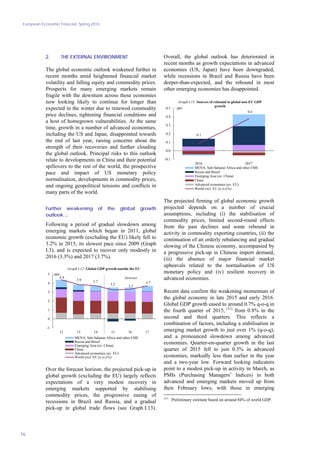
  • 13.
    OVERVIEW: STAYING THECOURSE AMID HIGH RISKS The euro area economy continues to grow modestly 1 For more than a year, the European economy has been benefitting from an exceptional combination of favourable factors. Low oil prices, a low euro exchange rate, supportive monetary policy measures and increased public expenditure associated with the inflow of asylum seekers in some Member States, have provided generous support to the economy. In recent months, however, the boost from these factors has been partly offset by external headwinds stemming from the downturn in emerging economies and, more recently, from a slowdown in major advanced economies. As a result, economic growth has remained moderate. The strength of some of the positive factors supporting the euro area is likely to fade over the forecast horizon. On the one hand, although the renewed drop in oil prices early this year should still sustain the purchasing power of households, the expected rebound in inflation will eventually slow the expansion of real disposable incomes. Additionally, the benefits of the euro’s earlier depreciation, which take time to feed through, will start to wane, while its appreciation since the start of this year is likely to compound the slowing impact of the external environment on the euro area. On the other hand, additional measures taken by the ECB in March have improved access to credit and reduced funding costs, further improving the conditions for an acceleration of investment. Fiscal policy is expected to be slightly supportive to growth this year. Meanwhile, high levels of public and private debt will continue to weigh on growth, along with other legacies from the crisis, such An ongoing but fragile economic expansion… …amid fading tailwinds and growing headwinds… rate 2015 2016 2017 2015 2016 2017 2015 2016 2017 2015 2016 2017 2015 2016 2017 Belgium 1.4 1.2 1.6 0.6 1.7 1.6 8.5 8.2 7.7 1.3 1.8 1.9 -2.6 -2.8 -2.3 Germany 1.7 1.6 1.6 0.1 0.3 1.5 4.6 4.6 4.7 8.8 8.5 8.3 0.7 0.2 0.1 Estonia 1.1 1.9 2.4 0.1 0.8 2.9 6.2 6.5 7.7 2.0 0.9 1.6 0.4 -0.1 -0.2 Ireland 7.8 4.9 3.7 0.0 0.3 1.3 9.4 8.2 7.5 4.4 4.6 4.6 -2.3 -1.1 -0.6 Greece -0.2 -0.3 2.7 -1.1 -0.3 0.6 24.9 24.7 23.6 -0.2 0.6 1.3 -7.2 -3.1 -1.8 Spain 3.2 2.6 2.5 -0.6 -0.1 1.4 22.1 20.0 18.1 1.4 1.5 1.3 -5.1 -3.9 -3.1 France 1.2 1.3 1.7 0.1 0.1 1.0 10.4 10.2 10.1 -1.5 -1.1 -1.0 -3.5 -3.4 -3.2 Italy 0.8 1.1 1.3 0.1 0.2 1.4 11.9 11.4 11.2 2.2 2.4 2.3 -2.6 -2.4 -1.9 Cyprus 1.6 1.7 2.0 -1.5 -0.7 1.0 15.1 13.4 12.4 -3.5 -4.2 -4.6 -1.0 -0.4 0.0 Latvia 2.7 2.8 3.1 0.2 0.2 2.0 9.9 9.6 9.3 -1.2 -2.6 -2.4 -1.3 -1.0 -1.0 Lithuania 1.6 2.8 3.1 -0.7 0.6 1.8 9.1 7.8 6.4 -1.5 0.0 0.1 -0.2 -1.1 -0.4 Luxembourg 4.8 3.3 3.9 0.1 -0.1 1.8 6.4 6.2 6.2 5.5 5.3 4.8 1.2 1.0 0.1 Malta 6.3 4.1 3.5 1.2 1.4 2.2 5.4 5.1 5.1 9.9 5.6 4.4 -1.5 -0.9 -0.8 Netherlands 2.0 1.7 2.0 0.2 0.4 1.3 6.9 6.4 6.1 9.2 8.9 8.2 -1.8 -1.7 -1.2 Austria 0.9 1.5 1.6 0.8 0.9 1.7 5.7 5.9 6.1 3.1 3.1 3.3 -1.2 -1.5 -1.4 Portugal 1.5 1.5 1.7 0.5 0.7 1.2 12.6 11.6 10.7 -0.1 0.3 0.5 -4.4 -2.7 -2.3 Slovenia 2.9 1.7 2.3 -0.8 -0.2 1.6 9.0 8.6 8.1 7.0 7.0 6.9 -2.9 -2.4 -2.1 Slovakia 3.6 3.2 3.3 -0.3 -0.1 1.5 11.5 10.5 9.5 0.8 -0.6 -1.1 -3.0 -2.4 -1.6 Finland 0.5 0.7 0.7 -0.2 0.0 1.3 9.4 9.4 9.3 0.1 0.3 0.4 -2.7 -2.5 -2.3 Euro area 1.7 1.6 1.8 0.0 0.2 1.4 10.9 10.3 9.9 3.6 3.7 3.6 -2.1 -1.9 -1.6 Bulgaria 3.0 2.0 2.4 -1.1 -0.7 0.9 9.2 8.6 8.0 1.9 2.3 2.7 -2.1 -2.0 -1.6 Czech Republic 4.2 2.1 2.6 0.3 0.5 1.4 5.1 4.5 4.4 -2.0 -1.5 -1.3 -0.4 -0.7 -0.6 Denmark 1.2 1.2 1.9 0.2 0.3 1.5 6.2 6.0 5.7 7.0 6.3 6.2 -2.1 -2.5 -1.9 Croatia 1.6 1.8 2.1 -0.3 -0.6 0.7 16.3 15.5 14.7 5.1 4.4 4.0 -3.2 -2.7 -2.3 Hungary 2.9 2.5 2.8 0.1 0.4 2.3 6.8 6.4 6.1 4.9 5.0 4.5 -2.0 -2.0 -2.0 Poland 3.6 3.7 3.6 -0.7 0.0 1.6 7.5 6.8 6.3 0.1 -0.3 -0.9 -2.6 -2.6 -3.1 Romania 3.8 4.2 3.7 -0.4 -0.6 2.5 6.8 6.8 6.7 -0.9 -2.1 -2.8 -0.7 -2.8 -3.4 Sweden 4.1 3.4 2.9 0.7 0.9 1.2 7.4 6.8 6.3 4.9 5.8 5.7 0.0 -0.4 -0.7 United Kingdom 2.3 1.8 1.9 0.0 0.8 1.6 5.3 5.0 4.9 -5.2 -4.9 -4.4 -4.4 -3.4 -2.4 EU 2.0 1.8 1.9 0.0 0.3 1.5 9.4 8.9 8.5 2.0 2.2 2.1 -2.4 -2.1 -1.8 USA 2.4 2.3 2.2 0.1 1.2 2.2 5.3 4.8 4.5 -3.3 -2.8 -3.1 -4.0 -4.4 -4.4 Japan 0.5 0.8 0.4 0.8 0.0 1.5 3.4 3.4 3.3 3.3 3.9 4.1 -5.2 -4.5 -4.2 China 6.9 6.5 6.2 : : : : : : : : : : : : World 3.0 3.1 3.4 : : : : : : : : : : : : Current account Table 1: Budget balanceInflationReal GDP Overview - the spring 2016 forecast Unemployment
  • 14.
    European Economic Forecast,Spring 2016 2 as high structural unemployment and high levels of policy uncertainty. Overall, euro area GDP is forecast to grow at modest rates, rather than gather momentum, over the 2015-2017 period, as it is projected at 1.6% in 2016 and 1.8% in 2017 after 1.7% in 2015. The outlook for global GDP growth has weakened further in recent months. Growth outside the EU is expected to have fallen to 3.2% in 2015, its slowest pace since 2009, and is now forecast to pick up only modestly to 3.3% in 2016 and 3.7% in 2017. Reflecting increased external headwinds from the slowdown in emerging markets, growth in advanced economies lost momentum at the end of last year and is expected to remain at 2% this year and next. In the US, weak external demand is likely to continue to weigh on activity while domestic demand should continue to support it. But the maturing cycle limits the scope for growth to pick up further. In Japan, sluggish wage growth is likely to remain a drag on private consumption while the investment outlook suffers from weak potential growth. Domestic demand is also expected to be increasingly volatile ahead of planned fiscal consolidation measures. Growth in emerging markets slowed down last year to its weakest annual pace since 2009. It is expected to pick up only marginally in 2016 before stabilising commodity prices, a gradual easing of the deeper-than-expected recessions in Brazil and Russia, and some progress in adjustments in other emerging markets support a mild rebound next year. But this outlook is fragile and subject to a high degree of uncertainty. In particular, the challenges surrounding an orderly rebalancing and gradual slowing of the Chinese economy remain pressing and entail considerable risks, even though pressures on the exchange rate and capital outflows have recently abated. World imports of goods and services excluding the EU are estimated to have grown by a meagre 0.5% in 2015, dragged down by sharp contractions in Russia and Brazil and the marked deceleration of import growth in China. Non-EU trade is expected to firm over the forecast horizon as a result of a progressive normalisation in Chinese imports, the assumed stabilisation of commodity prices at low levels and the expected pick-up in emerging market growth. Slowing demand for imports in the US, which is largely triggered by the weakness of its own exports, should, however, also limit non-EU trade growth to 2.1% this year, while an increase to 3.4% is expected next year. Growth in European export markets should continue to outpace GDP growth outside the euro area in general, but should be less robust than expected at the beginning of the year. In early 2016, financial markets recorded losses as investors shunned risk amid intensified concerns about a further global slowdown and worries that macroeconomic policies would be lacking space to react to it. These concerns have recently abated with inter alia the slight rebound in oil prices, but volatility remains elevated. The EU’s financial sector continues to underperform the broad market reflecting concerns about banks’ profitability prospects amid the low interest rate environment and the persistence of high levels of non-performing loans in some countries. Expectations of divergence between the monetary policies of major central banks receded somewhat since the beginning of the year. On the one side, the ECB and the central banks of Sweden, Hungary and Japan have, for instance, further eased their monetary policies, while on the other side, expectations of monetary policy tightening by the US Fed and the Bank of England have been pushed back. The euro has appreciated as a result. …as global growth has been slowing… …and trade flows remain weak… …while financial markets somewhat stabilise…
  • 15.
    Overview 3 The accommodative policystance of the ECB has led to very favourable monetary and credit conditions in the euro area. Net bank lending flows to households and non-financial corporations have remained positive over the recent months, supported by lower interest rates, which improve the attractiveness of bank lending relative to market funding. Bank lending rates have also come down significantly in vulnerable Member States, suggesting that the transmission of monetary policy to the real economy has improved and that financial fragmentation across Member States has receded. With net exports turning negative, GDP growth was entirely driven by domestic demand in 2015. This pattern is expected to continue this year and next although the composition of domestic demand is expected to show some rebalancing, as private consumption moderates and investment gathers speed. Private consumption should continue to benefit in 2016 and 2017 from improving labour market conditions, moderate rises in wages and higher non- labour incomes. The very low inflation foreseen this year should also support stronger increases in real gross disposable incomes. Private consumption should then pick up slightly, as households are expected to spend much of this oil-price windfall rather than increase their savings significantly. The pace of private consumption growth, however, should slow down next year as the expected rebound in inflation shaves off a larger portion of the growth in nominal incomes. Government consumption is also set to lose some momentum next year after having gathered further pace this year mainly as refugee-related spending in some Member States is set to continue increasing. Investment strongly accelerated at the end of last year, but most available data suggest that this rebound was mainly driven by temporary factors. Investment is expected to moderate in the near term as it is held back by expectations of weak global demand and still considerable uncertainty of economic and non-economic nature. Nevertheless, the conditions for investment to pick up further down the line have recently improved, as borrowing conditions have eased, capacity utilisation is above its long-term average, corporate deleveraging pressure is fading, and global demand is expected to gradually strengthen. Construction investment, meanwhile, should benefit from sustained growth in households' real disposable incomes, very low mortgage rates and progress in the adjustment in the housing sector. In some countries, the demand for housing should also rise due to the need to host refugees. The Investment Plan for Europe is also expected to yield increasing tangible results on public and private investment as a growing number of projects should move to the implementation phase. The deterioration in external demand turned net trade into a drag on growth last year despite the resilience of intra euro area exports and the positive impact of the euro’s past depreciation on euro area exporters' price competitiveness. Export growth is expected to slow down markedly this year reflecting both the slow growth of euro area external export markets and the euro’s recent appreciation. But with real unit labour costs still declining, euro area exporters are well-positioned to benefit from the expected rebound in global economic activity next year. Imports, with the support of resilient domestic demand, are expected to follow the same pattern. As a result, net exports are projected to have a negative impact on GDP growth in 2016 that should turn neutral in 2017. …and funding conditions remain favourable. Domestic demand should drive growth… …although private consumption should lose momentum… …as should public consumption… …while conditions are favourable for a pick- up of investment… …and net trade should be a drag on growth this year.
  • 16.
    European Economic Forecast,Spring 2016 4 Oil prices fell again at the start of 2016, dragging inflation below zero. It is expected to remain negative in the near term as a result of base effects. External price pressure is also weak due to the slight appreciation of the euro and overcapacities in several emerging market economies that are holding back global producer prices. At the same time, core inflation has so far failed to show an upward trend, as moderate economic growth and subdued wage developments have kept a lid on domestic price dynamics. Inflation in the euro area is therefore set to remain very low for longer than previously forecast and the projection for inflation in 2016 has been revised downward to 0.2%. With the assumption of gradually increasing energy prices, inflation is expected to step up in the second half of this year when positive base effects start to kick in. The further narrowing of the output gap and higher domestic demand should eventually add upward pressure on domestic prices. In 2017 inflation is expected to reach 1.4%. Labour market conditions are set to continue their moderate pace of improvement, driven by the lagged response to improved cyclical conditions and contained wage growth. In some Member States, labour market reforms implemented in recent years and fiscal policy measures are also supporting a rise in net job creation. Overall, employment is set to continue to grow at about 1% this year and next. The labour force is also expected to increase, mainly on the back of higher participation rates and, in some Member States, net migration flows. The unemployment rate in the euro area is projected to fall from 10.9% in 2015 to 9.9% next year. Although labour market disparities are set to remain for some time, unemployment is expected to fall in almost all euro area countries over the forecast horizon, particularly in those that have implemented labour market reforms (e.g. Spain, Cyprus, Ireland and Portugal). The general government deficit is expected to continue declining this year and next underpinned by the ongoing economic expansion, the improvement in labour markets and, to a lesser extent, the drop in interest expenditures. Discretionary tax cuts to lower the tax burden on labour in some Member States and additional government expenditures related to the inflow of asylum seekers in some countries explain the slightly slower decline in the headline deficit this year. The general government deficit in the euro area is expected to decrease from 2.1% of GDP to 1.9% in 2016, and to decrease further to 1.6% next year under a no-policy-change assumption. The fiscal stance is expected to be slightly expansionary in the euro area this year but to turn neutral in 2017. The debt-to-GDP ratio is forecast to continue declining gradually over the forecast horizon, although less than earlier expected due to the slower pace of nominal GDP. It should reach 91.1% in the euro area in 2017. The uncertainty surrounding these projections is substantial and the European economic outlook is exposed to considerable downside risks. On the external side, the risk that slowing growth in emerging market economies, particularly China, could trigger stronger spillovers or turn out worse than currently forecast remains particularly significant for growth in Europe and the world. Uncertainty linked to geopolitical tensions remains high and could affect European economies more negatively than currently expected. Abrupt moves in oil prices or financial turmoil could also dampen European growth. On the domestic side, risks associated with European policies remain considerable, as for instance the pace of implementation of structural reforms Inflation remains driven by energy prices… …labour markets continue to improve… …and the fiscal stance should be slightly expansionary this year. Downside risks are considerable
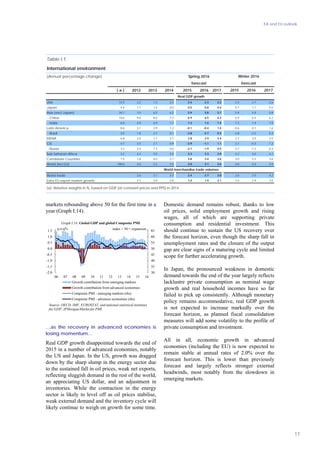
  • 17.
    Overview 5 and the uncertaintyahead of the UK’s EU referendum. (1) A failure to find common solutions at the EU level to common challenges of economic and non-economic nature could also affect private consumption and further delay the expected rebound of investment. On the upside, the positive impact from structural reforms could turn out greater than estimated and the transmission of very accommodative monetary policies to the real economy could prove to be stronger than expected. (1) See also IMF (2016) World Economic Outlook, April and Kierzenkowski et al (2016) The Economic Consequences of Brexit: A Taxing Decision, OECD Economic Policy Paper 16.
  • 19.
    PART I EA andEU outlook
  • 21.
    STAYING THE COURSEAMID HIGH RISKS The euro area economy continues to grow modestly 9 85 90 95 100 105 -3 -2 -1 0 1 2 3 08 09 10 11 12 13 14 15 16 17 GDP growth rate (lhs) GDP (quarterly), index (rhs) GDP (annual), index (rhs) Graph I.1: Real GDP, euro area forecast q-o-q% index, 2007=100 0.5 -4.5 2.0 -0.9 -0.3 Figures above horizontal bars are annual growth rates. 1.6 0.9 1.7 1.6 1.8 85 90 95 100 105 -2 -1 0 1 2 3 4 5 6 7 8 08 09 10 11 12 13 14 15 16 17 HICP inflation (annual rate) (lhs) HICP index (monthly) (rhs) HICP index (annual) (rhs) 3.3 0.3 2.7 2.5 1.6 1.3 0.4 0.0 0.2 1.4 forecast Graph I.2: HICP, euro area % index, 2015=100 Figures above horizontal bars are annual growth rates. The euro area economy grew by 1.7% in 2015, expanding at its highest rate since 2010. Thanks to supportive policies and exceptional factors, such as very low oil prices, the euro area’s GDP surpassed it pre-crisis peak earlier this year. In 2016 and 2017, the economy should continue to expand at roughly the same rate – staying the course, but not accelerating. Low oil prices, low funding costs, lagged effects from the depreciation of the euro, a slightly expansionary fiscal stance, and structural reforms are expected to continue supporting activity but with diminishing strength. At the same time, modest global growth, weak global trade, and increased uncertainty look set to weigh more heavily on activity than previously expected. As a result, the main impetus for economic growth over the forecast horizon is expected to come from domestic demand. Private consumption is set to benefit from higher real disposable incomes due to a delayed rebound in consumer prices and improvements in the labour market. The conditions for a pick- up in investment have recently improved, as funding conditions have become more favourable and capacity utilisation rates remain above their long-term average. Government consumption is expected to continue contributing to growth but this will depend in part on the number of asylum seekers that arrive. Hit by external headwinds and a slowdown in exports greater than in imports, net trade will detract slightly more this year. Overall, real GDP growth in the euro area is projected to be roughly stable, falling slightly from 1.7% (2.0% in the EU) last year to 1.6% (1.8%) this year before increasing marginally to 1.8% (1.9%) next year. Labour markets are set to continue improving at a moderate pace. Inflation remains very low. With the oil price falling again in early 2016 and the slight appreciation of the euro since then, external price pressures have weakened. Domestic wage and price dynamics, meanwhile, remain contained by the moderate growth momentum. Thus, the near-term outlook for inflation has fallen and positive base effects are expected to kick in somewhat later than previously forecast. Recent monetary policy decisions should support the return to higher inflation rates in the euro area but only very slowly. Overall, inflation in the euro area is set to rebound later than previously thought, moving up from last year’s rate of 0.0% to 0.2% in 2016 and 1.4% in 2017. The uncertainty surrounding these projections is substantial. Growth is exposed to considerable, mainly negative, external and domestic risks. The most important risks relate to the strength of global growth, the expected rebound in emerging markets and the ability of China to manage its transition and to avoid a ‘hard landing’. Abrupt moves in oil prices or financial turmoil could also dampen European growth. Risks also relate to the stability of financial markets, overall uncertainty of economic and non-economic nature, and the success of designing and implementing common solutions to common challenges.
  • 22.
    European Economic Forecast,Spring 2016 10 1. PUTTING THE FORECAST INTO PERSPECTIVE: DISTRIBUTIONAL FACTORS AND THE EURO AREA OUTLOOK Sparked by empirical studies showing that economic inequality has risen substantially in recent years, economic analyses have presented various channels through which this affects the economy. Rising income inequality has been blamed for substantial output growth losses in advanced economies. (2) It has also been cited as one of the reasons for the subdued pace of the recovery in recent years because of its negative effects on demand, (3) and as driver in secular stagnation theories and explanations of the euro area’s prolonged slump because of its effects on the saving-investment ratio. (4) Income inequality has also been named as one of the causes of the economic and financial crisis in 2007-09. (5) Globalisation, skills-biased technological change but also macro-economic and structural policies have been blamed for the increase in economic inequality, (6) which has been observed over a long time span (see Graph I.3) Most analyses of distributional factors emphasise medium- to long-term developments. Empirical analyses have often been driven by data availability and focussed on the US or single European economies. This leads to questions such as whether distributional factors also exert meaningful short-term effects and whether such effects can be found in the euro area. By looking at the functional and personal distribution of incomes (2) An OECD study (p. 67) estimated that increased income inequality in 19 OECD countries between 1985 and 2005 knocked 4.7 pps. off cumulative growth between 1990 and 2010; see OECD (2015). In it together – Why less inequality benefits all. Paris: OECD. (3) See Cynamon, B.Z. and S.M. Fazzari (2016). ‘Inequality, the Great Recession and slow recovery’. Cambridge Journal of Economics 40(2), pp. 373–99. (4) For an overview and a discussion, see e.g. K. Pichelmann (2015). ‘When 'Secular Stagnation' meets Piketty's capitalism in the 21st century. Growth and inequality trends in Europe reconsidered’. European Economy Economic Papers 551. On secular stagnation, see also Box I.4. (5) Rajan (2010) introduced the hypothesis that rising inequality led to a credit boom in the US and eventually to the economic and financial crisis in the US in 2007, see Rajan, R.G. (2010). Fault Lines: How hidden fractures still threaten the world economy. Princeton University Press. An empirical study did not support this hypothesis; see Bordo, M. D. and C. M. Meissner (2012). ‘Does inequality lead to a financial crisis?’. Journal of International Money & Finance 31(8), pp. 2147–61. (6) See e.g. Jaumotte, J. and C. Osorio Buitron (2015). ‘Inequality and labor market institutions’. IMF Staff Discussion Notes SDN/15/14; Domanski, D., M. Scatigna and A. Zabai (2016). ‘Wealth inequality and monetary policy’. BIS Quarterly Review, March, pp. 45–64. and the distribution of wealth in the euro area, this sections aims to provide some answers. Overall, there are good reasons to believe that changes in income and wealth distribution affect growth in the longer run. However, incorporating them into short-term, cyclical forecasts remains challenging. 30 35 40 45 50 1950 1960 1970 1980 1990 2000 2010 Europe US Graph I.3: Share of the top decile income in the total income, Europe and the US, 1950-2010 Source: T. Piketty (2014). 'Capital in the Twenty-First Century'. p. 324. % Employment gains and moderate wage growth drive the income share of labour… Functional income distribution divides income generated by domestic production between the remuneration of labour (including wages and salaries, employers’ social security contributions, but also imputed labour incomes of the self- employed) and capital (including imputed rents of homeowners). This primary income is supplemented by secondary income, which covers links between households and the public sector (e.g. transfers). Not included are capital gains and losses (resulting from fluctuating asset prices). In euro area Member States, the income share of labour ranges roughly between 40% and 60% of GDP (see Graph I.4). (7) During the economic and financial crisis, the income share of labour temporarily increased as corporate profits plummeted. The effect was less strong in the US, where faster labour shedding led to a faster decline in wages. (8) As profits recovered, the labour share fell slightly back. The European debt crisis and the ‘double dip’ recession of 2011-13 caused deviations from the usual cyclical pattern. Over the forecast horizon, labour income’s share of GDP in (7) For an analysis see Arpaia, A., E. Pérez and K. Pichelmann (2009). ‘Understanding labour income share dynamics in Europe’. European Economy Economic Papers 379. (8) See Stiglitz, J. E. (2012). The Price of Inequality: How Today’s Divided Society Endangers our Future. New York- London: Norton.
  • 23.
    EA and EUoutlook 11 the euro area is expected to remain roughly stable. The same is projected for the adjusted wage share (about 58%), which relates the compensation to the GDP per employee. 25 30 35 40 45 50 55 60 EL LT LU IT SK LV CY PT ES EA FI NL FR BE AT EE DE SI MT IE Graph I.4: Labour incomes, euro area and Member States, 1995, 2007, 2013 1995 2007 2013 % of GDP Over a longer period, technological change can lower labour’s income share, for instance by raising the capital-labour share (‘capital deepening’). Shifts from labour-intensive to more capital-intensive sectors tend to reduce the income share of labour. Changes in labour market policies and institutional settings (e.g. a lower influence of trade unions, employment protection, minimum wage legislation, the increase in part-time work) can also affect the income share of labour. Regulatory reforms to strengthen product market competition, the privatisation of public enterprises and a relatively strong expansion of the financial sector (‘financial deepening’) could also affect income shares. …whereas non-labour incomes are closely linked to housing and corporate profits. In the euro area, non-labour incomes represent about one third of household disposable income (see Graph I.5). Since household capital income includes incomes from housing services, i.e. actual rents and imputed rents in the case of owner- occupied housing, the share tends to be higher in countries with a large share of homeownership (e.g. France and Italy). (9) A parallel decline in households' labour and capital incomes could (9) The housing component has been shown to drive capital incomes, see Rognlie, M. (2015). ‘Deciphering the fall and rise in the net capital share: Accumulation or scarcity?’. Brookings Papers on Economic Activity, Spring, pp. 1–69. The ratio of housing capital and housing income has also figured prominently in Piketty's analysis, see Piketty, T. (2013). Capital in the Twenty-First Century. Cambridge, Mass.: Harvard University Press. suggest that the corporate sector has retained a higher share of primary incomes. This would be in line with the observed increase in corporate savings, most notably during the deleveraging process in Europe. (10) 0 5 10 15 20 25 30 35 40 45 50 LU EE IE NL SI FI LV CY FR BE AT ES EA LT PT DE SK IT EL Graph I.5: Non-labour incomes, euro area and Member States, 1995, 2007, 2013 1995 2007 2013 % of GDP Developments in labour and non-labour incomes describe pre-tax variables, which limits the validity of conclusions in an environment that is characterised by substantial redistribution mechanisms. During the economic and financial crisis, increased social transfers (e.g. unemployment benefits) and lower taxes raised the importance of secondary incomes for households. In national accounts, the transfers paid and received and the taxes on income enter the calculation of household disposable income. Empirical studies find that income redistribution by governments is not a major long-term driver of household disposable incomes, (11) but it is an important factor in short-term analysis. Recently, private consumption has closely followed households' disposable incomes According to economic theory, households accumulate and deplete their wealth to keep their planned consumption spending roughly steady. Thus, aggregate consumption should be roughly proportional to the sum of current wealth and expected future non-property income. In the short term, changes in household disposable income, deflated by the private consumption deflator, are associated with GDP, deflated with (10) See Karabarbounis, L. and B. Neiman (2014). ‘The global decline of the labour share’. Quarterly Journal of Economics 129(1), pp. 61–103. (11) See OECD (2016). Economic policy reforms 2016. Paris: OECD, p.105.
  • 24.
    European Economic Forecast,Spring 2016 12 the GDP deflator, via various channels with causality in both directions (Graph I.6). 98 100 102 104 106 108 110 05 06 07 08 09 10 11 12 13 14 15 Graph I.6: Real GDP growth versus real disposable income growth, euro area Real GDP Real gross disposable income index, 2005Q1=100 As regards the causality from incomes to GDP, a lower wage share can be expected to have a negative impact on private consumption because the propensity to consume associated with labour income tends to be higher than that of non-labour income. As the profit share increases accordingly, the impact on investment should be positive. The impact on net trade should also be positive. Lower private consumption depresses imports of goods and services, whereas a lower wage share corresponds with a fall in unit labour costs that raises, all other things being equal, the price competitiveness of exporters. The overall impact on GDP will depend on the characteristics of the economy looked at. -2.5 -2.0 -1.5 -1.0 -0.5 0.0 0.5 1.0 1.5 2.0 2.5 07 08 09 10 11 12 13 14 15 Graph I.7: Households real disposable income and private consumption, euro area Real disposable income Private consumption y-o-y % Concerning the impact of changes in disposable incomes on private consumption, subcomponents such as labour income, non-labour income and secondary income are likely to differ in terms of marginal propensity to consume. Nonetheless, recent developments in the euro area point to a co- movement in real disposable incomes and private consumption (see Graph I.7). The personal distribution of incomes has become more unequal in the euro area... To capture the impact of distributional factors on macroeconomic variables, it is important to extend the analysis to the personal distribution of incomes, which sheds light on the inequality within wages. Empirical analyses of market incomes in advanced economies point to substantial increases at the top of the income distribution and a falling income share at the bottom of the distribution. This is also true in the euro area, where the income share of the top quintile of incomes has increased in recent years and the bottom quintile has declined. 0.0 0.1 0.2 0.3 0.4 0.5 0.6 0.7 EL DE PT IE LT EA LV FR LU IT ES EE BE AT FI CY NL SI MT SK Graph I.8: Gini coefficient, incomes with and without transfers, area and Member States, 2013 Disposable income before transfers (e.g. pensions) Disposable income before transfers but incl. pensions Disposable income The rise in income inequality been confirmed by several empirical studies. (12) Some of the largest euro area economies are among the most unequal advanced countries in terms of the Gini coefficient, which is a measure of the statistical dispersion of incomes. A Gini coefficient of zero implies full equality while a coefficient of one shows complete inequality. However, the inequality of disposable incomes before transfer (market incomes) is cushioned by transfers and therefore the inequality of disposable incomes is more limited (see Graph I.8). A substantial role in the more equal distribution of disposable incomes stems from the inclusion of pensions, in other words, differences between pre-transfer and post-transfer incomes can only be partly attributed to contemporaneous fiscal policy. (12) See OECD (2015). In it together – Why less inequality benefits all. Paris: OECD.
  • 25.
    EA and EUoutlook 13 Until the economic and financial crisis, the development of median net incomes of those earning above and below 40% or 60% of the overall median net income has moved in parallel, but since 2010 some divergence has been observed. Median incomes have been falling in the group with incomes below 40% of the area’s median income (see Graph I.9). 95 100 105 110 115 120 125 05 06 07 08 09 10 11 12 13 14 Below 40% of median income Below 60% of median income Total index, 2005=100 Graph I.9: Median net income in selected income groups, euro area, 2005-2014 What are the main drivers of income inequality and changes therein? A number of factors have been related to changes in income inequality.(13) Among them are elements of globalisation (cheaper transport, improved automation, improved and cheaper communication technologies), which has pushed labour-saving technologies and offshoring on manufacturers and raised the skill premium, i.e. incomes for workers with higher educational attainment grew faster (see Graph I.10). New information technology has raised productivity over the years and raised the demand for skilled labour over low and unskilled labour, which widened the gap between high and low household incomes. (14) Moves from productive activities to rent-seeking, as well as market structure (e.g. monopoly power) have also been identified as drivers of income inequality. (15) Changes in labour market institutions (e.g. less bargaining power of trade unions, wider spread between minimum and median wage) can pose challenges particularly for low-skill workers and (13) See Atkinson, A.B. (2015). Inequality. What can be done?. Cambridge, Mass.: Harvard University Press. (14) The OECD identified technological advances as the main contributor to rising income inequality in the OECD, predominantly through the wage channel. See OECD (2011). ‘Inequality between the employed and the non- employed’. In Divided We Stand: Why Inequality Keeps Rising, Chapter 3, pp. 143-63. Paris: OECD. (15) See e.g. Stiglitz, J.S. (2015). ‘The origins of inequality, and policies to contain it’. National Tax Journal 68(2), pp. 425- 48. contribute to the explanation of increasing (pre- tax) inequality. (16) While rising employment is usually expected to reduce income inequality as the number of people earning a salary increases, the gradual decline of standard full-time jobs could endanger this effect. In addition, ‘financialisation’, i.e. the rapid growth of the financial sector, favours high-skilled workers (‘college premia’). Differences across advanced economies suggest that common (international) factors can only partly explain changes in inequality, whereas country- specific factors remain important. 100 105 110 115 120 05 06 07 08 09 10 11 12 13 14 Less than primary, primary and lower secondary education (18-64 y.) Upper secondary and post-secondary non-tertiary education (18-64 y.) Tertiary education (18-64 y.) index, 2005=100 Graph I.10: Median net income and educational attainment, euro area, 2005-2014 …seen as impacting negatively on the pace of economic growth… While early work on the nexus of income inequality and economic growth has focussed on how economic growth would raise inequality in the early stages of economic development and reduce it later, (17) most recent contributions have focussed on the opposite direction, asking how rising inequality could dampen growth. Changes in income inequality affect growth via a number of channels. Households on the losing side of rising inequality may have a stronger preference for redistribution (endogenous fiscal policy argument), which could impact negatively on the profitability of investment projects and impact negatively on investment. (18) Households with lower incomes could also respond by lowering investment in their human capital (less education (16) See e.g. Jaumotte, F. and C. Osorio Buitron (2015). ‘Inequality and labor market institutions’. IMF Staff Discussion Note SDN/15/14. (17) Kuznets, S. (1955). ‘Economic growth and income inequality’. American Economic Review 45(1), pp. 1–28. (18) See e.g. Alesina, A. and R. Perotti (1996). ‘Income distribution, political instability, and investment’. European Economic Review 40(6), pp. 1203–28.
  • 26.
    European Economic Forecast,Spring 2016 14 and training); financial market imperfections could make such a development more severe (human capital accumulation argument). (19) An increased number of low-income households could become a drag on domestic demand, hampering the adoption of advanced technology. (20) By contrast, increased inequality could strengthen incentives to strive harder to earn high incomes, for instance by taking more risks and working harder. The difficulties in assessing the impact of increased inequality can be illustrated by the propensity to consume. Low-income households usually have a higher marginal consumption propensity (up to subsistence level, they would not be able to save). This implies that a less equal distribution of a given income could raise the total marginal propensity to consume. (21) But increasing income inequality resulting entirely from increased incomes of high-income households would lower the total marginal propensity to consume. Thus, a key question in the analysis of the impact of distributional factors is to what extent an increase in per-capita GDP ‘trickles down’ to real disposable incomes across the distribution. Apart from the standard redistribution schemes that mitigate market income inequality, (22) discretionary measures during the crisis also had a potential to affect the personal income distribution. However, the impact of fiscal stimulus on income distribution is difficult to quantify as output effects are benefitting all households, whereas some discretionary measures could have exerted a quite progressive (cutting taxes and boosting transfers to low-income households) or regressive (cutting income taxes across the board) impact. …but with limited importance for the whole economy in the short term. A question of particular relevance for the role of distributional factors in a short-term forecasting set-up is the time dimension of the inequality- growth nexus. Responses to changes in income (19) See e.g. Galor, O. and J. Zeira (1993). ‘Income distribution and macroeconomics’. Review of Economic Studies 60(1), pp. 35–52. (20) See e.g. Murphy, K.M., A. Shleifer and R. Vishny (1989). ‘Income distribution, market size, and industrialisation’. Quarterly Journal of Economics 106(3), pp. 537–64. (21) For the US, such link has been found; see Blinder, A. (1975).‘Distribution effects and the aggregate consumption function’. Journal of Political Economy 83(3), pp. 447–75. (22) See e.g. Bach, S., M. Grabka and E. Tomasch (2015). ‘Tax and transfer system: considerable redistribution mainly via social insurance’. DIW Economic Bulletin 5(8), pp. 11–16. distribution can be expected to be larger for permanent rather than transitory shocks, but in the short term, households face uncertainty concerning the nature of a shock. This complicates assessments of the impact of changes in inequality in the context of a short-term forecast, as the impact of higher inequality may differ in the short and longer term. (23) The personal distribution of wealth is more unequal than that of incomes… Economic theory suggests that private consumption is driven by total (permanent) income, which is the present value of expected lifetime resources. This suggests looking not only at current incomes but also at the wealth of households, which includes physical wealth (financial assets and housing wealth) but also human wealth (i.e. current labour income and the discounted value of expected future labour income). Capturing all these components is a difficult task due to a lack of adequate data. -10 0 10 20 30 40 50 60 70 Lowest quintile Second quintile Third quintile Fourth quintile Top quintile Graph I.11: Income and wealth distribution, euro area, shares of quintiles in total, 2010 Share of total income Share of total net wealth % Source: ECB In the euro area, the Eurosystem’s Household Finance and Consumption Survey (24) focussed on financial wealth in one year (2010). The mean net financial wealth of households, defined as the difference between total assets and liabilities, stood on average at EUR 230,800. The difference from the median figure (EUR 109,200) suggests that the distribution of wealth in the euro area is (23) For an empirical study finding a positive short run but negative long run and total effect of higher inequality, see Halter, D., M. Oechslin and J. Zweimüller (2014). ‘Inequality and growth: the neglected time dimension’. Journal of Economic Growth 19(1), pp. 81–104. (24) See Eurosystem Household Finance and Consumption Network (2013). ‘Results from the first wave’. ECB Statistics Paper Series 2.
  • 27.
    EA and EUoutlook 15 more uneven than the distribution of income (see Graph I.11). The more unequal wealth distribution can be associated with the observation that only a small share of households owns financial wealth. Inequality is also attributable to the long-term accumulation of wealth, which implies that many older people tend to have substantially more wealth than younger people. Moreover, the possibility of negative financial wealth widens the span of wealth positions. (25) In particular, in the wake of the crisis, debt overhangs and deleveraging have become important features in wealth analysis. A special role in that regard is attributed to housing wealth, which for many households is the dominant financial asset, subject to house prices changes. The role of housing wealth is also key to explaining the substantial difference in wealth distribution across euro area economies. In the short run, variations of wealth reflect mostly the valuation of financial assets and house prices. Monetary policy, which affects asset prices through the interest rate, the availability of credit or directly through asset purchases may thus affect wealth inequality in the short term. (26) However, the focus on the impact on asset prices and asset owners risks overlooking the overall impact of monetary policy, which, for instance by affecting output and employment, also matters income and wealth across the whole distribution.(27) …with wealth effects on economic growth mainly originating from financial wealth. A permanent increase in wealth raises the expected lifetime income and should thereby lift consumption. This increase could stem from additional possessions but also from valuation effects, e.g. due to higher asset prices. Empirical studies have confirmed a positive impact of changes in wealth on private consumption in the euro area, highlighting the strong impact found for financial wealth, whereas changes in housing (25) Another implication is that Gini coefficients of net worth are no longer bounded to one. (26) Bernanke, B. (2015). ‘Monetary policy and inequality’. Ben Bernanke’s Blog at Brookings, June 1, 2015. The impact of asset purchases is often assessed as being small, see e.g. R. O'Farrell, Ł. Rawdanowicz and K.-I. Inaba (2016). ‘Monetary policy and inequality’. OECD Economics Department Working Papers 1281. (27) See e.g. Bernroth, K., P. König and B. Beckers (2016). ‘ECB asset purchases may affect wealth distribution’. DIW Economic Bulletin 6(7), pp. 75–81. wealth have small of even insignificant effects. (28) By contrast, in the UK housing wealth has strong effects, to some extent related to mechanisms of mortgage equity withdrawal. (29) The aggregate wealth effects on economic growth depend also on the distribution of wealth. Following a shock to their wealth, the propensity to consume is expected to be higher for less wealthy households than for more wealthy ones. Empirical studies for the euro area, have recently confirmed this presumption. (30) Distributional factors are affecting the outlook, but more over the medium term Near-term economic forecasts regularly cover wage negotiations, increases in compensation, changes in the labour force and changes in employment as drivers of the main aggregates such as consumption and investment as well as inflation. Distributional factors have been found to play a substantial role in explaining the development of these key macroeconomic variables. Implications of higher economic inequality can in particular be associated with differences in the spending habits of different income groups. However, in practice the assessment of the short-term impact is complicated by the fact that many different influences generally overlap. For instance, the wealth distribution and wealth effects on spending behaviour need to be taken into account. Moreover, the focus of most of the empirical studies of these linkages on the medium to long run puts severe limits on the use of distributional characteristics in short-term analysis. Even though, ‘widening inequality is a very long- term trend, one that has been decades in the making’ (Bernanke), near-term forecasts should not be short-sighted to such developments. At the current juncture, understanding shifts in income distribution may for instance help to assess the impact of swings in house and financial asset prices on consumption and savings. (28) See e.g. Sousa, R.M. (2009). ‘Wealth effects on consumption. Evidence from the euro area effects’. ECB Working Paper Series 1050. (29) See e.g. Barrell, R., M. Costatini and I. Meco (2015). ‘Housing wealth, financial wealth, and consumption: New evidence for Italy and the UK’. International Review of Financial Analysis 42, pp. 316–23. (30) Carroll, C.D., Slacalek, J. and K. Tokuoka (2014) ‘The distribution of wealth and the MPC: implications of new European data’. American Economic Review Papers and Proceedings 104(5), pp. 107–11.
  • 28.
    European Economic Forecast,Spring 2016 16 2. THE EXTERNAL ENVIRONMENT The global economic outlook weakened further in recent months amid heightened financial market volatility and falling equity and commodity prices. Prospects for many emerging markets remain fragile with the downturn across these economies now looking likely to continue for longer than expected in the winter due to renewed commodity price declines, tightening financial conditions and a host of homegrown vulnerabilities. At the same time, growth in a number of advanced economies, including the US and Japan, disappointed towards the end of last year, raising concerns about the strength of their recoveries and further clouding the global outlook. Principal risks to this outlook relate to developments in China and their potential spillovers to the rest of the world, the prospective pace and impact of US monetary policy normalisation, developments in commodity prices, and ongoing geopolitical tensions and conflicts in many parts of the world. Further weakening of the global growth outlook… Following a period of gradual slowdown among emerging markets which began in 2011, global economic growth (excluding the EU) likely fell to 3.2% in 2015, its slowest pace since 2009 (Graph I.3), and is expected to recover only modestly in 2016 (3.3%) and 2017 (3.7%). 4.4 3.9 3.7 3.2 3.3 3.7 -1 0 1 2 3 4 5 12 13 14 15 16 17 pps. Graph I.12: Global GDP growth outside the EU MENA, Sub-Saharan Africa and other EME Russia and Brasil Emerging Asia (ex. China) China Advanced economies (ex. EU) World excl. EU (y-o-y%) forecast Over the forecast horizon, the projected pick-up in global growth (excluding the EU) largely reflects expectations of a very modest recovery in emerging markets supported by stabilising commodity prices, the progressive easing of recessions in Brazil and Russia, and a gradual pick-up in global trade flows (see Graph I.13). Overall, the global outlook has deteriorated in recent months as growth expectations in advanced economies (US, Japan) have been downgraded, while recessions in Brazil and Russia have been deeper-than-expected, and the rebound in most other emerging economies has disappointed. 0.1 0.4 -0.1 0.0 0.1 0.2 0.3 0.4 0.5 2016 2017 pps. MENA, Sub-Saharan Africa and other EME Russia and Brasil Emerging Asia (ex. China) China Advanced economies (ex. EU) World excl. EU (y-o-y%) Graph I.13: Sources of rebound in global non-EU GDP growth The projected firming of global economic growth projected depends on a number of crucial assumptions, including (i) the stabilisation of commodity prices, limited second-round effects from the past declines and some rebound in activity in commodity exporting countries, (ii) the continuation of an orderly rebalancing and gradual slowing of the Chinese economy, accompanied by a progressive pick-up in Chinese import demand, (iii) the absence of major financial market upheavals related to the normalisation of US monetary policy and (iv) resilient recovery in advanced economies. Recent data confirm the weakening momentum of the global economy in late 2015 and early 2016. Global GDP growth eased to around 0.7% q-o-q in the fourth quarter of 2015, (31) from 0.8% in the second and third quarters. This reflects a combination of factors, including a stabilisation in emerging market growth to just over 1% (q-o-q), and a pronounced slowdown among advanced economies. Quarter-on-quarter growth in the last quarter of 2015 fell to just 0.3% in advanced economies, markedly less than earlier in the year and a two-year low. Forward looking indicators point to a modest pick-up in activity in March, as PMIs (Purchasing Managers’ Indices) in both advanced and emerging markets moved up from their February lows, with those in emerging (31) Preliminary estimate based on around 84% of world GDP.
  • 29.
    EA and EUoutlook 17 markets rebounding above 50 for the first time in a year (Graph I.14). 30 35 40 45 50 55 60 65 -2.0 -1.5 -1.0 -0.5 0.0 0.5 1.0 1.5 06 07 08 09 10 11 12 13 14 15 16 q-o-q% Graph I.14: Global GDP and global Composite PMI Growth contribution from emerging markets Growth contribution from advanced economies Composite PMI - emerging markets (rhs) Composite PMI - advances economies (rhs) Source: OECD, IMF, EUROSTAT, and national statistical institutes for GDP, JPMorgan/Markit for PMI. index > 50 = expansion …as the recovery in advanced economies is losing momentum… Real GDP growth disappointed towards the end of 2015 in a number of advanced economies, notably the US and Japan. In the US, growth was dragged down by the sharp slump in the energy sector due to the sustained fall in oil prices, weak net exports, reflecting sluggish demand in the rest of the world, an appreciating US dollar, and an adjustment in inventories. While the contraction in the energy sector is likely to level off as oil prices stabilise, weak external demand and the inventory cycle will likely continue to weigh on growth for some time. Domestic demand remains robust, thanks to low oil prices, solid employment growth and rising wages, all of which are supporting private consumption and residential investment. This should continue to sustain the US recovery over the forecast horizon, even though the sharp fall in unemployment rates and the closure of the output gap are clear signs of a maturing cycle and limited scope for further accelerating growth. In Japan, the pronounced weakness in domestic demand towards the end of the year largely reflects lacklustre private consumption as nominal wage growth and real household incomes have so far failed to pick up consistently. Although monetary policy remains accommodative, real GDP growth is not expected to increase markedly over the forecast horizon, as planned fiscal consolidation measures will add some volatility to the profile of private consumption and investment. All in all, economic growth in advanced economies (including the EU) is now expected to remain stable at annual rates of 2.0% over the forecast horizon. This is lower than previously forecast and largely reflects stronger external headwinds, most notably from the slowdown in emerging markets. ( a ) 2012 2013 2014 2015 2016 2017 2015 2016 2017 USA 15.9 2.2 1.5 2.4 2.4 2.3 2.2 2.5 2.7 2.6 Japan 4.4 1.7 1.4 0.0 0.5 0.8 0.4 0.7 1.1 0.5 Asia (excl.Japan) 34.1 7.0 6.5 6.2 5.9 5.8 5.7 5.9 5.8 5.8 - China 16.6 9.6 8.0 7.3 6.9 6.5 6.2 6.9 6.5 6.2 - India 6.8 4.9 6.9 7.1 7.3 7.4 7.4 7.2 7.4 7.5 Latin America 8.6 3.1 2.9 1.2 -0.1 -0.4 1.4 -0.6 0.1 1.6 - Brazil 3.0 1.8 2.7 0.1 -3.8 -3.7 0.3 -3.8 -3.0 0.3 MENA 6.8 3.5 1.7 2.7 2.8 2.9 3.4 2.7 3.0 3.5 CIS 4.7 3.4 2.1 0.9 -2.9 -1.1 1.1 -3.1 -0.3 1.2 - Russia 3.3 3.4 1.3 0.6 -3.7 -1.9 0.5 -3.7 -1.2 0.3 Sub-Saharan Africa 3.2 4.4 5.0 5.0 3.3 3.3 3.9 4.2 4.0 4.2 Candidate Countries 1.5 1.8 4.0 2.7 3.8 3.4 3.6 3.0 3.3 3.6 World (incl.EU) 100.0 3.5 3.2 3.3 3.0 3.1 3.4 3.0 3.3 3.5 World trade 2.6 3.1 3.3 2.4 2.7 3.8 2.6 3.5 4.2 Extra EU export market growth 2.7 3.8 2.8 1.0 1.9 3.1 1.6 2.9 3.6 (a) Relative weights in %, based on GDP (at constant prices and PPS) in 2014. forecast Table I.1: International environment Real GDP growth Spring 2016 World merchandise trade volumes (Annual percentage change) forecast Winter 2016
  • 30.
    European Economic Forecast,Spring 2016 18 …the downturn in emerging markets is easing only gradually… Growth in emerging markets fell to 3.8% in 2015, their weakest annual rate since 2009. Little improvement is expected in 2016 but a mild rebound to 4.4% in 2017 is forecast as the recessions under way in Brazil and Russia ease and other emerging markets make progress in cyclical and structural adjustments. Several factors are weighing heavily on the outlook for emerging market economies. These include the slowdown and rebalancing in China and the associated weakening of global trade flows, low commodity prices and a host of domestic and geopolitical vulnerabilities. Another factor is the tightening of financial conditions, most recently reflected in the rise of sovereign and corporate yields, falling equity prices, and net capital outflows from several emerging market economies. (32) While prospects vary across countries, the outlook remains fragile and is subject to increased uncertainty. Over the forecast horizon, some of the biggest emerging markets are expected to continue facing deep adjustment crises. These include Russia and Brazil, where recessions are projected to extend into 2016 before marginal growth resumes in 2017. Most countries in the Middle East and North Africa, Sub-Saharan Africa and emerging Asia are set to face a difficult macroeconomic and financial environment in 2016. Commodity prices have fallen sharply and financial conditions have tightened amid rising financial volatility and capital outflows. This in turn raises concerns about financial stability, particularly where there are high levels of foreign- currency denominated debt. Moreover, deleveraging in the private sector and fiscal contraction are likely to weigh on economic growth and further depress confidence. …and the rebalancing in China continues to weigh on growth. In China, the gradual slowdown in growth observed so far is expected to continue as the economy shifts from investment- to consumption- led growth. This transition has substantial implications for the structure of Chinese trade and (32) See European Commission (DG ECFIN) (2016). ‘Putting the spring forecast into perspective: Global factors and the euro area’. In European Economic Forecast – Winter 2016. Institutional Paper 20, Section I.1, pp. 10–16. is expected to continue weighing both on global trade flows and commodity prices. Recent data releases and policy announcements, including short-term stimulus measures and the renewed commitment to market-oriented reform, support the view that the ongoing transition process remains under control. Buoyant growth in a number of sectors (services, consumption) seems to be sufficiently strong to compensate for recessionary developments elsewhere, and the Chinese authorities remain committed to provide short-term stimulus if needed. Nevertheless, the challenges associated with the necessary correction of major imbalances (overcapacity in heavy industries, over-indebtedness) remain pressing and entail considerable risks of a sharper and more disruptive slowdown. An extended period of capital outflows and exchange rate pressures reflects major uncertainty associated with China’s adjustment process, even though some of these pressures have recently abated. Hence, downside risks to the outlook dominate and largely relate to the capacity of the authorities to steer the transition process successfully, finding the right balance between measures to stabilise near-term growth while maintaining financial stability and advancing with necessary structural reforms. Global trade to remain sluggish Following a sharp contraction early last year and a mid-year rebound, global trade flows remain depressed (see Graph I.15), largely reflecting weaker demand from China, Russia, Brazil and other commodity exporting economies. (33) Last year's 3% contraction in Chinese goods import volumes was the first on record. However, for the year as a whole, world goods imports were up by 1.5% in volume terms, as the decline in emerging markets (-1.4%) was more than offset by solid growth in advanced economies’ imports (3.6%). During 2015 and early 2016, Chinese trade flows were consistent with the ongoing rebalancing away from manufacturing (as reflected in the weak imports of commodities, capital and investment goods), towards services, whose imports have seen annual growth rates of close to 20%. (33) See IMF (2016). ‘Dissecting the Global Trade Slowdown’. In World Economic Outlook (IMF), Box 1.1, pp. 54–56. Washington, DC, April.
  • 31.
    EA and EUoutlook 19 60 80 100 120 05 06 07 08 09 10 11 12 13 14 15 16 Graph I.15: Volume of goods imports Advanced economies Emerging economies World World excl. EU index, 2010=100 Source: CPB Outside China, trade weakened most for commodity exporters (both advanced and emerging) (34) and for the countries most exposed to China. But trade developments also disappointed in major advanced economies, including the United States, where the US dollar’s steady appreciation weighed heavily on trade flows during the second half of 2015. A sharp terms-of- trade adjustment, triggered by the collapse in commodity prices, has depressed export values and import demand across much of the CIS, Latin America, MENA and Sub-Saharan Africa. In some cases, this is exacerbated by home-grown vulnerabilities and regional conflicts, capital outflows and currency depreciation, and compounded further by the sharp drop in demand from China. Globally (excluding the EU), the growth rate for imports of goods and services likely bottomed out at an estimated 0.5% in 2015, their lowest level since 2009 (Graph I.16). Russia and Brazil jointly subtracted as much as 0.8 pps. from growth while China’s contribution was just a fraction of what has been in previous years. Excluding the EU, world import growth is expected to firm to 2.1% and 3.4% in 2016 and 2017, mainly driven by the assumed stabilisation of commodity prices, the gradual recoveries expected in Brazil and Russia, and some normalisation of trade flows in China accompanied by the ensuing pick-up in emerging Asia (see Graph I.17). In 2016, however, slowing import demand in the US is expected to be a major factor offsetting these improvements. (34) See IMF (2015). ‘Where Are Commodity Exporters Headed? Output Growth in the Aftermath of the Commodity Boom’. In World Economic Outlook (IMF), Chapter 2, pp. 65-104. Washington, DC, October. 4.3 3.7 2.7 0.5 2.1 3.4 -2 -1 0 1 2 3 4 5 12 13 14 15 16 17 pps. Other emerging economies Russia and Brazil Emerging Asia excl. China China Other advanced USA World excl. EU (y-o-y%) forecast Graph I.16: World imports of goods and services outside the EU Despite the projected rebound, trade flows are set to remain relatively weak over the forecast horizon, including as a share of global output, and especially when compared to pre-crisis trends. This largely reflects the lower trade intensity assumed to prevail in emerging markets, where trade and its responsiveness to growth has been slowing for a number of years, partly due to the maturation of global value chains, structural changes in China and the slower pace of trade liberalisation. (35) 1.6 1.3 -0.5 0.0 0.5 1.0 1.5 2.0 2016 2017 pps. Other emerging economies Russia and Brazil Emerging Asia excl. China China Other advanced USA World excl. EU (y-o-y%) Graph I.17: Sources of rebound in global non-EU import growth These trends come on top of largely cyclical drags on world trade related to the weakness in intensely-trading economies (e.g. EU), or the weakness in trade-intensive investment. (35) For a discussion see European Commission (DG ECFIN) (2015). ‘Understanding the weakness in global trade’. European Economic Forecast – Winter 2015. European Economy 1/2015, Box I.1, pp. 46–49.
  • 32.
    European Economic Forecast,Spring 2016 20 Commodity prices are set to stabilise at a low level One implication of the deteriorated global outlook has been the marked broad-based decline in commodity prices to very low levels. As regards oil prices, the related demand aspects have added to the impact of burgeoning supply that had initially been identified as the dominating factor behind the decline since mid-2014. (36) After hitting a new cycle low of 28 USD/bbl. in January 2016, Brent oil prices recovered to over USD 40/bbl. in March-April amid increased volatility. The recovery of Brent spot prices was supported by a slight tightening of supply based on lower OPEC and non-OPEC output. Output losses in some OPEC members were only partly offset by rising Iranian production. While pumping near record volumes, Russia and Saudi Arabia kept the output stable during February-March as foreseen in their agreement with Qatar and Venezuela to freeze their oil production at January levels. Further attempts to reach a global deal on curbing oil production failed at a meeting in Qatar in April, but its negative impact on prices was outweighed by supply outages in Kuwait, Nigeria and Venezuela. Non-OPEC supplies, including the US, have been declining since December. However, the IEA does not expect a strong recovery of oil prices, as the supply surplus is set to diminish only gradually throughout 2016. High levels of stocks and concerns over economic growth in emerging markets are likely to keep a cap on price pressures. Oil prices are assumed to rebound moderately over the forecast horizon (see Graph I.18). Due to the decline observed until January, the average annual oil price is assumed to fall further this year (from 53.4 USD/bbl. in 2015 to 41.1) before rising next year (to 45.9). This implies an upward revision of the technical assumptions with respect to the winter forecast. In euro terms, the oil price assumption has been revised up by 10.5% in 2016 and 3.4% in 2017 as compared to the winter forecast. Uncertainty surrounding these assumptions remains high. The prices of other commodities also fell sharply in 2015 and are likely to fall further in 2016, albeit at a slower pace. Despite a sharp rally of some metal prices in February and March, the near-term (36) Recent ECB estimates confirmed that the initial decline can mostly be explained by supply increases. See ECB (2016). ‘Current oil price trends’. ECB Economic Bulletin, Issue 2, Box 2, pp. 38–39. outlook for most industrial commodities remains bleak. Ample supply and the projected weakening demand outlook from emerging economies suggest a further decline in metal prices in 2016. In 2017, diminishing oversupply and the pass-through from recovering energy prices provide arguments in favour of some price stabilisation. 20 40 60 80 100 120 12 13 14 15 16 17 Graph I.18: Brent oil spot prices, USD and euro USD/bbl EUR/bbl price per bbl Source: ICE assumption Food prices are expected to continue their downward trend in 2016 due to sufficient production, comfortable levels of stocks for most commodities and low energy costs. In particular, large harvests in the US and in the southern hemisphere have improved the supply outlook for wheat, maize and soya beans. This outlook is subject to the risk of adverse weather conditions associated with El Niño. Risks to the global outlook remain tilted to the downside and have increased The balance of risks to the global outlook remains tilted to the downside and has deteriorated further in recent months. Developments in China remain at the forefront of concerns. The impact of volatility in Chinese financial markets on the domestic economy looks limited, although the recent spillovers from developments in Chinese equity and foreign exchange market to global financial markets expose the potential strength of this transmission channel. Given the size of the Chinese economy and its key role in many commodity markets, ongoing structural shifts in the real economy could generate further uncertainty. In particular, any signs that GDP growth may be slowing more than expected or of a prolonged weakness in Chinese import demand could have major negative consequences for
  • 33.
    EA and EUoutlook 21 commodity prices, world trade, and investor confidence. (37) There remain significant risks associated with the prospective pace of US monetary policy normalisation. Combined with uncertainties surrounding developments in China, monetary policy measures in the US could have a more negative impact on emerging market economies than envisaged in the central scenario, particularly in those countries with high levels of foreign currency-denominated corporate debt. Lower economic growth in emerging market economies would not only endanger the expected rebound in global activity and world trade, it could also affect the stability of financial markets. Yet, the weaker outlook for the US may lead to a slower pace of monetary policy normalisation than previously expected, and would thus mitigate some of the concerns over monetary policy divergence. This could reduce some of the risks associated with rising interest rates in the US. Nevertheless, concerns about the strength of the US recovery could also feed into renewed market uncertainty about the future course of policy action and trigger more volatile market reactions. Additional downside risks are related to commodity price assumptions where, for instance, a further slump in prices could aggravate the downturn in emerging markets in general and commodity exporting regions in particular. Stronger-than-expected second round effects from the fall in commodity prices seen so far could result in a more severe tightening of the fiscal stance and lower domestic demand, which would accentuate the downturn and limit the scope for a rebound in 2016 and 2017. Finally, geopolitical risks remain high, particularly with respect to the conflicts in the Middle East, parts of Northern Africa and Ukraine. (37) The impact of a Chinese import shock in 2016-17 could be substantial as recent estimates suggest; see Kireyev, A. and A. Leonidov (2016). ‘China’s Imports Slowdown: Spillovers, Spillins, and Spillbacks.’ IMF Working Paper WP/16/51. 3. FINANCIAL MARKETS In early 2016, volatility in financial markets rose as investors became more risk averse in response to increased concerns about a global slowdown. Stock markets across the world were affected (see Graph I.19). More recently, these concerns were reduced by some positive data releases, rebounding oil prices, and expectations of additional monetary policy easing in Europe and delayed normalisation in the US. However, volatility is still elevated. Overall, these developments highlighted the reliance of the economic recovery on monetary policies and the key role of financial markets. 85 95 105 115 125 135 Jan 15 Jul 15 Jan 16 US S&P 500 (lhs) Eurostoxx 600 Stoxx Asia Pacific 600 (lhs) Index, Jan 2015=100 Graph I.19: Stock market developments New monetary easing measures in the euro area… In March, the ECB announced monetary policy measures, supplementing those taken last year (e.g. at the January and December meetings) to further ease funding conditions for banks and companies while also stimulating bank lending to businesses. In addition to lowering its key policy interest rates further, the asset purchase programme was extended and new tools were introduced. Rate cuts affected the ECB’s main refinancing operations (MRO, -5 bps. to 0%), the deposit facility (-10 bps. to -0.4%), and the marginal lending facility (-5 bps. to 0.25%). Monthly purchases under the asset purchase programme (APP) were increased from €60 billion to €80 billion and the list of assets eligible for regular purchases was extended to include investment grade euro-denominated bonds issued by non-bank corporations established in the euro area. In addition, the ECB announced a new series of four targeted longer-term refinancing
  • 34.
    European Economic Forecast,Spring 2016 22 operations (TLTROs), each with a maturity of four years. The TLTROs allow banks to borrow at zero rates and to obtain a rebate of 40 bps. if they meet a lending benchmark by January 2018. These measures are expected to ease monetary conditions through several channels. The lower negative policy rate and the new bank liquidity- support measures are expected to improve the transmission of monetary policy to the real economy through both banks and financial markets. The increased amount of monthly purchases and the inclusion of non-bank corporate bonds in the list of assets eligible for purchases under the APP should ease financing conditions for the non-financial sector directly and possibly also indirectly, through portfolio effects, thus complementing the transmission through the banking sector. …but less global monetary policy divergence than previously expected… Monetary policy outside the euro area has recently either eased further or been characterised by delayed tightening. It has therefore diverged less than expected in the winter. Further easing was observed in several EU Member States outside the euro area and in Japan. Sweden’s Riksbank lowered the repo rate, its main policy rate, deeper into negative territory (-10 bps. to -0.50%) in February and decided in mid-April to continue purchasing a further SEK 45 billion of government bonds during the second half of 2016. The Hungarian central bank also lowered its policy rates in March to new historically low levels. In January, the Bank of Japan eased further by introducing for the first time a negative policy rate (-0.10%) amid increasing risks that low oil prices and uncertainty in emerging and commodity- exporting countries could delay Japan’s escape from a ‘deflationary mind-set.’ Expectations of monetary policy tightening (normalisation) were recently pushed back in the US and in the UK. At its January and March meetings, the US Federal Reserve’s FOMC announced that it would proceed cautiously in adjusting monetary policy, emphasising the risks that foreign economic and financial development since the turn of the year would restrain US economic activity. At its April meeting, the Bank of England’s Monetary Policy Committee left its monetary policy stance unchanged but said that it considered a rate hike to be more likely than not over the committee’s forecast horizon. …contributing to the strengthening of the euro. Market participants’ reassessment of the relative monetary policy trajectories of the ECB and the US Federal Reserve have been felt on foreign exchange markets. After fluctuating in early 2016, the euro recently has trended higher against the US dollar, but depreciated against the yen. In nominal effective terms, the euro has strengthened on the back of continued weakness in the currencies of most emerging and commodity-exporting countries (see Graph I.20). Another factor has been a slide in the pound sterling that market participants have attributed to uncertainty ahead of the UK referendum on EU membership in June. 75 80 85 90 95 100 105 Mar 14 Nov 14 Jul 15 Mar 16 Graph I.20: Euro exchange rate since March 2014, NEER-37, USD, GBP USD/EUR GBP/EUR NEER-37 March 2014 = 100 Market conditions continue to support the economic recovery… The initial financial market losses in early 2016 were broad-based, affecting different market segments. For instance, the general risk aversion and renewed concerns over the sovereign-banking sector nexus created upward pressure on bond spreads in the periphery. Corporate bond spreads increased substantially (Graph I.21), while EU stock markets fell sharply. The financial sector underperformed the broader market significantly amid growing concerns about the profitability prospects of banks in low or negative interest rate environments.
  • 35.
    EA and EUoutlook 23 20 40 60 80 100 120 140 Jan 15 Jul 15 Jan 16 BBB A AA bps. Graph I.21: 5-year maturity corporate bond spreads, euro area Since mid-February, however, markets have turned on speculation about further monetary policy measures, and later, on a somewhat less negative assessment of the economic outlook for emerging markets. Sovereign bond spreads tightened again in the euro area (Graph I.22). Nevertheless, in some lower-rated countries spreads remained higher than before. 0 50 100 150 200 250 300 350 400 Jan 15 Jul 15 Jan 16 ES IT PT bps. Graph I.22: 10-year maturity sovereign bond spreads to the German bund, selected countries In equity markets, volatility has receded somewhat in recent weeks compared to the first weeks of the year. But banking shares have not fully caught up with other market segments (see Graph I.23). This reflects structural factors such as the persistence of high levels of non-performing loans, but also an adjustment process towards regulatory requirements such as the ‘bailing in’ of creditors, stipulated in the Bank Recovery and Resolution Directive (BRRD). 60 70 80 90 100 110 120 130 Jan 15 Jul 15 Jan 16 Banks Eurostoxx 600 Index, Jan 2015 = 100 Graph I.23: EU broad stock market vs. bank sub-index …bank lending shows robust expansion, supported by declining lending rates… The very accommodative policy stance of the ECB has resulted in very favourable monetary and credit conditions for borrowers in the euro area. Both narrow and broad money supply has been growing at high rates and the recovery in bank credit flows to the real economy is spreading across euro area countries, albeit from relatively low levels. Since mid-March and up to mid-April, the three-month Euribor declined further while the three-month Euribor-OIS spread, a measure of interbank market stress, narrowed. Net bank lending flows to households and non- financial corporations (NFCs) has remained positive over the last few months. The annual growth rate of loans to the private sector recovered further into positive territory along with the economic cycle. Survey-based signs are consistent with these developments in lending. The ECB’s latest Bank Lending Survey (April 2016) indicates improving loan supply conditions for businesses and increasing loan demand across all loan categories. (38) However, credit standards on loans to households for house purchases tightened. The ECB’s Survey on Access to Finance of Enterprises (SAFE) suggests further loosening of funding constraints to SMEs. As banks have been passing on their favourable funding conditions, bank lending has been supported by lower interest rates for NFCs and households. This suggests that the transmission of monetary policy through the euro area banking system has improved. An important development (38) See ECB (2016). The euro area bank lending survey. First quarter of 2016. April.
  • 36.
    European Economic Forecast,Spring 2016 24 for the economic outlook is that there were pronounced declines in bank lending rates across vulnerable Member States and this includes rates for smaller loans, typically taken by SMEs. Hence, discrepancies in lending rates between vulnerable and other euro area countries have narrowed further while the interest rate spread between large and small loans, which had significantly widened during the financial crisis, has also narrowed for most countries over the last year. The take-up of loans in response to falling interest rates has been more heterogeneous. For SMEs, the latest data indicate that the biggest rise in lending volumes have not occurred where interest rates have fallen most (see Graph I.24). For instance, small loan volumes have risen only modestly in Italy and Portugal where the decline in interest rates has been large. This suggests that other non- price supply side factors, such as high levels of non-performing loans (NPL) (39) and/or weak demand remain important in some countries. This points to the risk of subdued bank-based credit intermediation in these countries. DE IE EA ES FR IT NL AT PT FIBE -1.2 -1.0 -0.8 -0.6 -0.4 -0.2 0.0 0.2 0.4 0.6 -10 0 10 20 30 40 Annualchangeininterestratesonnewbusinessloans Change in new business volumes Graph I.24: Business volumes responsiveness to interest rates, NFC loans (< 1 mn EUR), February 2015 - February 2016 pps. y-o-y% Compared to a year ago, the attractiveness of bank lending rates has improved relative to market funding sources (see Graph I.25). Market funding costs for bond and equity issuance have also been more volatile over the last couple of months. After widening over most of 2015, corporate bond spreads narrowed sharply in March this year after the ECBs decision to include investment-grade non-bank corporate bonds into its range of purchasable securities. Bond spreads and equity- (39) According to a recent IMF estimate, the amount of NPL held by banks in the euro area stood in mid-2015 at EUR 900 bill, which is almost 10% of GDP. See IMF (2016). Global Financial Stability Report. Washington, DC, April, p.33. earning yields remain higher than a year ago but bank lending rates have progressively declined. 0 2 4 6 8 10 12 14 16 07 08 09 10 11 12 13 14 15 16 Corporate bonds (5 yrs) Bank loans (over 5 yrs) Eurostoxx 50 - earning yield Graph I.25: Cost of corporate funding, euro area % Euro area banks continued to repair their balance sheets but remained challenged by low profitability in an operating environment of low interest rates and low nominal economic growth. In fact, by lowering the borrowing costs for the real economy, unconventional monetary policy appears to have compressed banks’ net interest margins. The impact on bank profitability, however, is difficult to estimate, because it depends on the ability of banks to pass on costs through the re-pricing of loans, deposits and other liabilities. (40) …while market funding increased… Heightened market volatility and risk-aversion translated into negative net issuance of corporate bonds in December 2015 and January 2016. The narrowing of corporate bond spreads in the wake of the ECB decisions in March created an opportunity to increase issuance. Several companies used it, suggesting that corporates are responsiveness to price signals in the bond markets. Meanwhile, equity issuance, while starting from low levels two years ago, has been more resilient over the last couple of months despite deteriorating conditions. …and the outlook is for a further pick-up of external funding. Looking forward, the cycle of external corporate funding is expected to pick up further, thanks to both bank lending and market funding. Currently, the momentum is on the bank lending side thanks (40) See IMF (2016). ‘Impact of low and negative rates on banks’. In IMF Global Financial Stability Report, Box 1.3, pp. 44–46. Washington, DC, April.
  • 37.
    EA and EUoutlook 25 to the relative improvement of price conditions for bank lending compared with market funding from a year ago. All in all, the stance of monetary policy suggests easy financing conditions over the forecast horizon. To what extent firms will use bank credit or market financing will depend on the prevailing price conditions for the various funding instruments. The latest ECB decisions provide support to both bank lending (via the new TLTROs) and market funding (via an extended list of assets eligible for the APP). Market interest rate expectations, which are reflected in the assumptions underlying this forecast, remain low. As the economic recovery progresses, the use of internal funds is expected to gradually decline. Nevertheless, corporates’ net funding position may remain positive as the deleveraging process in the euro area corporate sector continues. 4. GDP AND ITS COMPONENTS For more than a year, the euro area has been benefitting from a combination of favourable factors such as low oil prices, a depreciating euro, additional supportive monetary policy measures, and an increase in public expenditure. In the last six months, however, headwinds stemming from the deterioration in the external environment and in particular from emerging markets have come to the fore, partially offsetting the positive impact of these tailwinds. As a result, the economic recovery in the euro area has remained moderate. The strength of the tailwinds will be decisive for the continuation of the economic upswing. While some of them are expected to continue supporting the recovery in the short term, the effect of some of these factors is expected to diminish over the forecast horizon. Since the winter forecast, oil prices have risen slightly and the euro has appreciated somewhat. Over the same time, however, monetary policy has become even more accommodative and the fiscal stance has been slightly expansionary. GDP growth gained momentum last year… According to the latest national accounts data, economic growth continued last year at a moderate pace. In the fourth quarter, GDP expanded 0.3% (q-o-q) in the euro area (0.4% in the EU). This was slightly lower than projected in winter and left economic output still slightly below the pre-crisis peak. For the whole year 2015, GDP rose by 1.7% in the euro area (2.0% in the EU), its fastest rate since 2010. This comes after several years of very subdued and fragile growth, (41) in line with the typical features of recoveries after deep economic and financial crisis (the Reinhart-Rogoff case) and certain euro area and EU-specific factors. (42) The main driver of GDP growth in 2015 was domestic demand, which rose on the back of rising private consumption (see Graph I.26). With a strong increase in household real gross disposable income and some improvements in the labour market, private consumption rose significantly. Investment, by contrast, was rather subdued despite an unexpected acceleration at the end of the year. Lower growth momentum in the external environment, high uncertainty and corporate deleveraging restrained investment decisions. Net trade detracted slightly from GDP growth, mainly reflecting the slowdown in emerging market economies. -6 -5 -4 -3 -2 -1 0 1 2 3 08 09 10 11 12 13 14 15 16 17 Private consumption Government consumption Investment Inventories Net exports GDP (y-o-y%) forecast pps. Graph I.26: Real GDP growth and its components, euro area ...supported by exceptional circumstances. Since mid-2014, economic growth in Europe has benefitted from a combination of favourable factors successively kicking in. Since June 2014, growth has enjoyed the support of sharply falling oil prices and the announcement of quantitative easing, which along with the launch of the large- (41) For a detailed analysis of the ongoing recovery see, Ruscher, E. and B. Vašíček (2015). ‘The euro area recovery in perspective’. Quarterly Report on the Euro Area (European Commission – DG ECFIN) 14(3), pp. 6– 18. (42) See European Commission (DG ECFIN) (2014). ‘EU recovery to remain subdued for longer than expected’. In European Economic Forecast – Autumn 2014, European Economy 7/2014, Section I.1, pp. 8–12.
  • 38.
    European Economic Forecast,Spring 2016 26 scale Investment Plan for Europe helped to brighten the outlook. (43) In spring 2015, optimism about growth further rose as the beneficial impact of the ECB’s expanded APP on funding costs and access to credit became visible. (44) In autumn 2015, the boost to euro area growth was regarded as strong enough to offset the initial impact of weaker global trade momentum and a deteriorating external environment, in particular as additional refugee-related expenditures provided additional growth stimulus in some countries. (45) However, headwinds became stronger, partially offsetting the positive impact from an extension of the period with tailwinds, so that in the winter the outlook had slightly worsened and the downside risks to the outlook had markedly increased. (46) (43) See the analysis in European Commission (DG ECFIN) (2015). ‘Putting the winter forecast into perspective: lower oil prices and the EU economy’. In European Economic Forecast – Winter 2015, European Economy 1/2015, Section I.1, pp. 10–17. (44) See European Commission (DG ECFIN) (2015). ‘Putting the spring forecast into perspective: The ECB’s quantitative easing and the euro area economy’. In European Economic Forecast – Spring 2015, European Economy 2/2015, Section I.1, pp. 10–15. (45) See European Commission (DF ECFIN) (2015). European Economic Forecast – Autumn 2015. Institutional Paper 11, Section I.1 and Box I.1. (46) See European Commission (DG ECFIN) (2016). ‘Putting the spring forecast into perspective: Global factors and the euro area’. In European Economic Forecast – Winter 2016, Institutional Paper 20, Section I.1, pp. 10–16. The balance of tailwinds, headwinds and crisis legacy factors remains favourable... A new balance of tailwinds and headwinds is expected to develop over the forecast horizon. Overall, the previously identified tailwinds are expected to provide some further support to economic growth, but this support is expected to fade, while the headwinds identified in the winter forecast remain in place or become stronger. Oil prices appear to have stabilised somewhat. After hitting a 12-year low in January, they have slightly rebounded. As a result, oil price assumptions have been revised up, but oil prices remain at rather low levels. The renewed oil price drop in January is set to delay the rebound in inflation rates, extending the boost to household purchasing power and corporate profitability. Concerns that the weakening earlier in the year could have been a harbinger of a further slowing in the world economy have recently receded in line with the release of more positive data. The positive overall effect of declining oil prices on global economic activity may be smaller than previously expected, (47) but for the EU and the euro area, oil prices remain growth-supportive. The development (47) The need to keep into consideration the low-interest rate environment had been stressed early on. It has recently been iterated, e.g. by e.g. Obstfeld, M., R. Arezki and G. M. Milesi-Ferretti (2016). ‘Oil prices and the global economy: It’s complicated’. VoxEU Column, 13 April. 2010 2011 2012 2013 2014 2015 2016 2017 bn Euro Curr. prices % GDP 5631.0 55.7 0.8 0.0 -1.2 -0.6 0.8 1.7 1.8 1.5 2128.4 21.1 0.8 -0.1 -0.2 0.2 0.8 1.3 1.4 1.2 1984.5 19.6 -0.3 1.6 -3.3 -2.6 1.3 2.9 2.9 3.8 -8.8 -0.1 0.3 0.8 -0.2 -0.1 -0.1 -0.1 0.0 -0.1 4521.2 44.7 11.3 6.5 2.6 2.1 4.1 5.2 3.5 4.7 14256.4 141.1 4.0 2.3 -0.9 0.2 1.9 2.9 2.5 2.8 4147.7 41.0 10.0 4.3 -1.0 1.3 4.5 6.0 4.6 5.3 10106.4 100.0 2.1 1.6 -0.9 -0.3 0.9 1.7 1.6 1.8 10175.6 100.7 2.3 1.7 -0.8 -0.3 1.0 1.5 1.6 1.8 13957.8 138.1 2.1 1.8 -0.5 0.2 1.4 2.0 1.8 1.9 0.4 0.0 -0.7 -0.4 0.5 0.9 1.0 0.8 0.2 0.0 -0.1 0.0 0.2 0.3 0.3 0.2 -0.1 0.3 -0.7 -0.5 0.3 0.6 0.6 0.8 0.9 0.4 -0.9 0.2 0.0 0.0 0.1 0.0 4.0 2.5 1.1 0.9 1.8 2.3 1.6 2.2 5.4 3.2 -1.3 0.2 2.7 4.1 3.5 4.0 -3.3 -1.6 0.4 -0.5 -1.8 -2.4 -1.9 -2.2 0.6 0.9 1.5 0.4 0.0 -0.1 -0.3 0.0 (Real annual percentage change) 2014 Final demand GDP Public consumption Change in stocks as % of GDP Imports (minus) GNI Investment Exports of goods and services Table I.2: Contribution to change in GDP Private consumption Spring 2016 Net exports p.m. GDP EU Final demand Inventories forecast Composition of growth - euro area Public consumption Real percentage change Imports of goods and services Exports Private consumption Gross fixed capital formation
  • 39.
    EA and EUoutlook 27 of oil price assumptions suggests that this support will remain in place for some time (see Graph I.27). 20 30 40 50 60 70 80 90 100 110 120 13 14 15 16 17 Graph I.27: Oil price assumptions (USD/bbl), SF14 - SF16 USD/bbl Autumn 2015 Winter 2016 Autumn 2014 Spring 2014 Winter 2015 Spring 2015 Spring 2016 Monetary and financing conditions remain favourable for borrowers. The ECB’s very accommodative monetary policy has improved access to credit and lowered funding costs, with the latter also reflected in the development of interest rate assumptions (see Graph I.28). -0.4 -0.3 -0.2 -0.1 0.0 0.1 0.2 0.3 0.4 13 14 15 16 17 Graph I.28: Interest rate assumptions, euro area, short-term, SF14 - SF16 % Autumn 2015 Winter 2016 Autumn 2014 Spring 2014 Spring 2015 Winter 2015 Spring 2016 The euro remains at a relatively low level compared to previous years, which is also evident from developments in the exchange rate assumptions (see Graph I.29). However, support from a lower euro exchange rate can mainly be expected from some lagged effects as the euro has recently appreciated slightly. As a result of capital outflows from emerging markets, their currencies have depreciated, and the outlook for a less asynchronous monetary policy in different regions of the world also supported the strength of the euro. Nevertheless, the relatively weak euro should continue exerting a positive, though decreasing impact on exports and economic growth. 2010 2011 2012 2013 2014 2015 2016 2017 bn Euro Curr. prices % GDP 7931.1 56.8 0.7 0.2 -0.6 -0.1 1.2 2.0 2.1 1.8 2918.1 20.9 0.7 -0.1 0.1 0.3 1.2 1.4 1.5 1.2 2710.8 19.4 0.1 1.9 -2.5 -1.7 2.7 3.4 3.0 3.8 14.2 0.1 0.3 0.7 -0.1 0.1 0.1 0.0 0.1 0.0 6016.4 43.1 10.7 6.6 2.3 2.2 4.0 5.3 3.5 4.6 19590.6 140.4 4.0 2.4 -0.4 0.6 2.3 3.1 2.6 2.9 5630.7 40.3 9.8 4.2 -0.3 1.6 4.7 5.9 4.7 5.1 13957.8 100.0 2.1 1.8 -0.5 0.2 1.4 2.0 1.8 1.9 13971.5 100.1 2.4 1.8 -0.6 0.1 1.3 1.8 1.8 2.0 10106.4 72.4 2.1 1.6 -0.9 -0.3 0.9 1.7 1.6 1.8 0.4 0.1 -0.3 0.0 0.7 1.1 1.2 1.0 0.2 0.0 0.0 0.1 0.2 0.3 0.3 0.2 0.0 0.4 -0.5 -0.3 0.5 0.7 0.6 0.8 1.1 0.4 -0.8 0.2 0.0 0.0 0.1 0.0 3.7 2.5 1.0 0.9 1.7 2.3 1.6 2.0 5.4 3.3 -0.6 0.9 3.2 4.3 3.7 4.0 -3.3 -1.6 0.1 -0.6 -1.9 -2.4 -1.9 -2.1 0.4 1.0 1.1 0.3 -0.1 -0.1 -0.3 0.0 Gross fixed capital formation (Real annual percentage change) 2014 Final demand GDP Public consumption Change in stocks as % of GDP Imports (minus) GNI Investment Exports of goods and services Table I.3: Contribution to change in GDP Private consumption Spring 2016 Net exports p.m. GDP euro area Final demand Inventories forecast Composition of growth - EU Public consumption Real percentage change Imports of goods and services Exports Private consumption
  • 40.
    European Economic Forecast,Spring 2016 28 Fiscal policy is expected to remain growth supportive this year. Refugee-related expenditures have increased strongly in the past quarters in some Member States and this is projected to continue even without additional large inflows of asylum seekers. 1.00 1.05 1.10 1.15 1.20 1.25 1.30 1.35 1.40 13 14 15 16 17 Graph I.29: Exchange rate assumptions (USD/EUR), SF14 - SF16 USD/EUR Autumn 2015 Winter 2016 Autumn 2014 Spring 2014 Winter 2015 Spring 2015 Spring 2016 In some Member States, reforms, including labour market reforms, should continue to bear fruit in the form of continued employment gains. ...despite being dampened by several growth impediments. Legacies from the crisis are also expected to continue weighing on growth. They include high public debt, which limits the options for fiscal policy responses; high household debt, which weighs on domestic demand; and high non- financial corporate debt, which induces deleveraging in the private sector with adverse knock-on effects on economic activity. Moreover, high unemployment in some euro area Member States hampers human capital accumulation while low investment delays capital accumulation. As a result, the crisis legacies continue to weaken potential output growth (cf. Box I.4). Since mid-2015, a number of external and domestic headwinds have come to the fore. They already put a lid on economic growth last year and are expected to continue weighing on growth over the forecast horizon. External headwinds are stemming from the slowdown in emerging market economies and also more recently from some advanced economies. Their impact on GDP growth is mainly evident in euro area and EU export growth and uncertainty related to recent bouts of financial market turmoil. The further deterioration in the global outlook implies a negative impact from these headwinds on GDP growth. The expected rebound outside the EU should, however, lower their impact towards the end of the forecast horizon. In particular, investment should benefit from the expected global recovery. Domestic headwinds have also come to the fore. The unprecedented increase in the inflow of asylum seekers last year has put a strain on some Member States. Some of them have unilaterally re- introduced temporary border controls within the Schengen zone, which could affect negatively foreign trade (e.g. distortion of cross-border transport, waiting time for commuters). (48) The impact on economic activity at the aggregate level is set to depend on the extent of such measures, but also on whether joint EU decisions are reached, and the impact this has on confidence. The impact on confidence of increased security concerns is set to weigh on the growth outlook particularly in some Member States. In some cases e.g. France and Belgium, this adds to the economic impact of terrorist attacks and increased security- related spending. Mixed signals for the near-term outlook... The increased uncertainty, reflected in the high volatility of financial markets, the recent appreciation of the euro and the slowdown in emerging and advanced economies, is expected to have weighed on economic growth early this year. Recent data give conflicting indications about the path of GDP growth in the first quarter. On the one hand, survey data suggest weaker real GDP growth momentum in the first quarter of 2016. Both the Commission’s Economic Sentiment Indicator (ESI) and the composite output Purchasing Managers’ Index (PMI) fell in the first quarter of 2016 from multi-year highs in the previous quarter (see Graph I.30). The declines confirmed that the manufacturing sector has taken a hit from slow growth in the external environment, mainly in the first two months as the March readings signalled some stabilisation in both the euro area and the EU. Confidence in the services sector also fell but its reading was the third highest since the recession in 2008-09 in both the euro area and the EU. In the first quarter, (48) For an analysis of the impact of more far reaching changes to the rules of the Schengen agreement, see Box I.3.
  • 41.
    EA and EUoutlook 29 sentiment in the construction continued rising to a new post-recession high in the EU and came in at the second highest level since the recession in the euro area. Overall, both the Commission's indicators and PMIs remained at high levels, consistent with a continuation of the expansion in activity in the near term. 30 40 50 60 60 70 80 90 100 110 120 06 07 08 09 10 11 12 13 14 15 16 Economic Sentiment Indicator (lhs) PMI Composite Output Index (rhs) 3-month moving average (ma) 3-month ma Graph I.30: Economic Sentiment Indicator and PMI Composite Output Index, EU Source: EC, Markit Group Limited On the other hand, hard data suggest slightly higher growth than in the previous quarter. In January and February, industrial production in the euro area was on average 1.1% higher than the average in the last quarter of 2015 (see Graph I.31). The 3m-o-3m growth rate of new industrial orders rose in January to 1.0% in the euro area. In parallel, retail sales, a high-frequency indicator of private consumption, in January and February 2016 stood on average 0.8% above the average recorded in the last quarter of 2015. The strong increase in the growth rate of loans to households for purposes other than house purchases supports expectations of continued domestic demand expansion (Graph I.32). 85 90 95 100 105 110 115 120 70 80 90 100 110 120 130 06 07 08 09 10 11 12 13 14 15 16 Industrial new orders (lhs) Industrial production (rhs) Graph I.31: Industrial new orders and industrial production, euro area index, 2010=100 index, 2010=100 Putting the pieces together, the signals are for a near-term continuation of the expansion, the signals are mixed as regards its pace of the near- term expansion. As survey indicators measure more the breadth than the depth of developments, it is difficult to quantify the impact of the decline in sentiment indicators and its distribution over time. As regards the first quarter of 2016, the projected rate of real GDP growth in the euro area (0.5% q-o-q) is sufficient to lift output for the first time above the pre-crisis peak of 2008. -4 -3 -2 -1 0 1 2 3 12 13 14 15 16 Loans to NFCs Loans to households for house purchasing Loans to households (w/o house pruchasing) y-o-y% Graph I.32: Loans to households and non-financial corporations, euro area …and moderating growth projected in 2016 and 2017. Overall, the euro area outlook for 2016 and 2017 has worsened somewhat since the winter, mainly due to the intensified headwinds related to the weakening of global growth. As inflation picks up, the positive boost to real incomes from low inflation, which provided strong support to domestic demand last year, will also wane. While these two factors conspire to slow economic growth, other factors are paving the way for an acceleration. These include ongoing improvements in the labour market that will have a positive effect on incomes, the slightly expansionary aggregate fiscal stance, and the projected rebound in global activity. As a result of the balance of these forces, growth in the euro area is no longer projected to gain pace over the forecast horizon. Rather, it is expected to remain broadly stable at rates which are low by historical standards, leaving the euro area vulnerable to global shocks. After having grown by 1.7% in 2015 (2.0% in the EU, see Graph I.33), the euro area’s real GDP is expected to grow by 1.6% in 2016 (1.8% in the EU) and by 1.8% in 2017 (1.9%). This implies that the economic recovery remains considerably
  • 42.
    European Economic Forecast,Spring 2016 30 weaker than in previous upturns. (49) Potential growth is expected to remain weak, reflecting the aforementioned crisis legacies, but also slow total factor productivity growth and demographic factors. It is set to be at about 1% over 2016 and 2017. The negative output gap is therefore expected to narrow over the forecast horizon. 85 90 95 100 105 110 -3 -2 -1 0 1 2 3 4 08 09 10 11 12 13 14 15 16 17 GDP growth rate (lhs) GDP (quarterly), index (rhs) GDP (annual), index (rhs) forecast q-o-q% index, 2007=100 0.5 -4.4 2.1 -0.5 0.2 Figures above horizontal bars are annual growth rates. 1.8 1.4 2.0 1.8 1.9 Graph I.33: Real GDP, EU Private consumption remains a key support for growth… Private consumption, which has been the main contributor to GDP growth in the last two years, moderated somewhat towards the end of last year. In 2015, the income growth generated by the ongoing improvement in the labour market along with very low inflation pushed real gross disposable incomes and provided the basis for the strongest annual post-crisis expansion of private consumption. A rebound in house prices and rising asset prices supported household wealth, whereas the growth in non-labour incomes was far more modest. The slowing expansion in the fourth quarter of last year reflected the impact of relatively mild weather conditions on expenditures for seasonal clothing and energy, a small uptick in household savings, but also temporary factors such as the Paris terrorist attacks in November. …despite several short-term drags… The drags that were behind the moderation towards the end of last year are expected to prove short-lived so that private consumption should continue to remain the backbone of economic growth. Nevertheless, drags to growth may still be (49) See Ruscher, E. and B. Vašíček (2015). ‘The euro area recovery in perspective’, Quarterly Report on the Euro Area (European Commission – DG ECFIN) 14(3), pp. 6– 18. at work in the short term. Evidence can be seen in the conflicting signals received in the first months of this year. On the downside, survey indicators have mostly come in below the high levels of last year. The Commission’s monthly Consumer Confidence indicator decreased three times in the first quarter, before picking up slightly in April according to the flash estimate. Although the outcome in the first quarter fell, the reading remained well above the long-term average (see Graph I.34). In the first quarter, consumers were more pessimistic about the future general economic situation. Meanwhile their views on future unemployment, which had soared in the last quarter of 2015 in several Member States due to the influx of asylum seekers, broadly stabilised (and declined in the EU). Consumers also appeared more confident about making major purchases. In line with consumer confidence, the Commission’s retail confidence index fell in the first quarter, although it too remained at high levels. In contrast, the PMI for retail sales in the euro area remained broadly stable in the first quarter compared to the previous quarter. -35 -30 -25 -20 -15 -10 -5 0 5 -3 -2 -1 0 1 2 3 4 5 08 09 10 11 12 13 14 15 16 17 balancey-o-y % Private consumption (lhs) Private consumption, forecast (annual data, lhs) Consumer confidence (rhs) forecast Graph I.34: Private consumption and consumer confidence, euro area On the upside, retail sales continued increasing in the first two months of the year (on average 0.8% higher than in the preceding quarter), following the upward trajectory begun three years ago (see Graph I.35). During these two months, new passenger car registrations rose by 10.7% from the corresponding months last year, supporting a strengthening in private consumption growth.
  • 43.
    EA and EUoutlook 31 -25 -20 -15 -10 -5 0 5 10 -4 -3 -2 -1 0 1 2 3 4 06 07 08 09 10 11 12 13 14 15 16 Retail trade volume, 3 mma (lhs) Retail confidence (rhs) y-o-y% balance Graph I.35: Retail trade volumes and retail confidence, euro area In line with these developments, the annual growth rate of loans to households continued to increase in February to an annual rate of 1.6%, the highest rate since October 2011. This mainly reflects the growth of loans for house purchases (2.3% in February), which account for more than 70% of loans to households. …based on continued real income growth. Looking further ahead, private consumption should continue to benefit from further improvements in labour market conditions and wages, which are expected to be not depressed by persistently low levels of headline inflation (second round effects in wage bargaining). These developments should accelerate nominal disposable income growth. Additionally, non-labour incomes (e.g. interest on savings, dividend payments and rental income) are also set to rise over the forecast horizon. Overall, the growth in gross disposable income in the euro area is expected to accelerate to 2.5% in 2016 (from 2.0% in 2015) and 2.7% in 2017. This should lead to a strong increase in real gross disposable income in 2016 when inflation is expected to be very low and a slightly smaller increase in 2017 when consumer price inflation rebounds. This slowing expansion of real disposable incomes (Graph I.36) will have a limiting effect on the private consumption growth. Evidence from the euro area suggests that increases in financial and housing wealth will only partially compensate for slower real labour income growth. However, after several years of deleveraging, household balance sheets should become less of a drag on spending. Very low interest rates and easier access to credit also imply increased opportunities for re-negotiating loans and lowering deleveraging needs. -1.0 -0.5 0.0 0.5 1.0 1.5 08 09 10 11 12 13 14 15 16 17 Net taxes Non-labour income Labour income Real disposable income (q-o-q%) pps. Graph I.36: Real gross disposable income and its components, euro area forecast Forecast numbers are de-annualised annual figures. Household saving rates changed little last year despite the rise in purchasing power but rates are expected to pick up slightly this year before slightly receding next year. The very low level of interest rates is expected to spur higher savings by households whose private pension plans and life insurance schemes are negatively affected. However, households overall are expected to continue spending more or less in line with their income rather than saving their windfall from oil prices. This also reflects the unwinding of some pent-up consumption demand after years of subdued growth and high uncertainty. Overall, for the remainder of this year and beyond, the further expansion of disposable incomes should support private consumption with some moderation next year, mainly due to the higher inflation. The growth rate is then expected to moderate from 1.8% in 2016 in the euro area (2.1% in the EU) to 1.5% in 2017 (1.8%). Private consumption will therefore no longer outperform overall economic growth next year. Public consumption contributing to economic growth In 2015, public consumption is expected to have risen by 1.3% in the euro area (1.4% in the EU), twice the rate expected this time last year in the 2015 spring forecast. Exceptional developments largely explain this outcome. Public security measures, spending on military operations in Syria and Iraq, and refugee-related expenditures have strongly driven up public consumption in some countries. In the last quarter of 2015, government consumption grew 0.6% q-o-q. Overall, in 2015, government consumption is expected to have decreased in only three euro area Member States
  • 44.
    European Economic Forecast,Spring 2016 32 (Ireland, Italy and Finland) and remained stable in Greece. Public consumption growth is projected to continue rising in 2016 before decreasing again in 2017. The acceleration in 2016 mostly reflects developments in Germany, Italy and the Netherlands. Government consumption in the euro area is expected to grow by 1.4% (1.5% in the EU) and 1.2% (1.2%) in 2016 and 2017 respectively. In 2017, it is expected to continue contracting only in Greece. The forecast for 2017, however, is particularly dependent on the no-policy change assumption, according to which consolidation measures are only factored into the forecast if they have been adopted and presented to national parliaments or are known in sufficient detail. Investment growth rebounded at the end of last year… Investment in the euro area surprised on the upside in the last quarter of 2015, growing at its second highest rate since mid-2011 (1.3% q-o-q) and making a larger contribution to economic growth than any other component. Both equipment and construction investment played a role in this acceleration, which was broad-based across Member States. In assessing the sustainability of the recent rebound, it is useful to look at main contributors. In Germany, both equipment and construction investment rebounded strongly. The pick-up in equipment investment, however, was driven by a very strong increase (about one quarter of a percent of GDP) in public investment, whereas private equipment investment declined again slightly. In the Netherlands, the strong pick- up was linked to buoyant sales of new cars and the strong housing market. These observations suggest a substantial role of temporary factors in the recent acceleration of euro area investment. The strong growth in the final quarter lifted the annual rate for 2015 to its highest level since the crisis, although the gap with pre-crisis levels remained wide. Drivers were both equipment investment and, for the first time since 2007, construction investment. Developments across the euro area remain very heterogeneous, with construction investment still falling in half of the Member States in 2015. …but is expected to moderate in the near term… The short-term outlook is complicated by mixed signals from survey indicators and hard data. On the downside, the Commission’s surveys suggest that investors have become less optimistic. Confidence in the euro area was slightly lower in all business sectors (industry, services, retail and construction) in the first quarter of 2016 compared to the previous quarter. In the construction sector, confidence even fell again below its long-term average. Similarly, both the manufacturing and services PMIs decreased in the first quarter. On the upside, the first hard data for the first quarter of 2016 bode well for both equipment and construction investment. As regards equipment investment, the average monthly production of capital goods increased in January and February by 1.9% from the average in the fourth quarter of last year (0.9% in the EU). The expansion of industrial new orders for capital goods increased in January in the euro area. The rate of capacity utilisation in the first quarter continued to rise and exceeded its long-term average (see Graph I.37). 68 70 72 74 76 78 80 82 84 86 88 -30 -26 -22 -18 -14 -10 -6 -2 2 6 10 08 09 10 11 12 13 14 15 16 17 %% Equipment investment (y-o-y%, lhs) Equipment investment, annual growth, forecast (lhs) Capacity utilisation rate (rhs) forecast Graph I.37: Equipment investment and capacity utilisation, euro area Hard data on construction continue to be supportive of positive growth in construction investment in the near term. The sector’s output has in February increased by 1.4% (3m-o-3m) in the euro area. Construction investment should also benefit from the increase in the number of building permits in the fourth quarter of 2015 (Graph I.38). In line with this, the growth in loans for house purchases, which in February was still rising in the euro area, augurs well for the construction outlook. However, flat house prices in the fourth quarter of 2015 as compared to the preceding quarter are
  • 45.
    EA and EUoutlook 33 somewhat at odds with the positive signals for construction investment. -50 -40 -30 -20 -10 0 10 20 -16 -12 -8 -4 0 4 8 08 09 10 11 12 13 14 15 16 17 Graph I.38: Dwellings investment and building permits, euro area Dwellings investment (lhs) Construction investment, forecast (annual data, lhs) Building permits (rhs) y-o-y%y-o-y% forecast Looking beyond the short term, the factors for higher investment growth appear to be in place (e.g. favourable funding conditions, moderately strengthening demand, above-average capacity utilisation, and modernisation needs). The favourable funding conditions for non-financial corporations include lower bank lending costs and less tight bank lending standards, improved conditions for (non-bank) market funding, and also a strengthened position for internal financing due to increased savings and retained earnings. However, low funding costs per se cannot be expected to impact strongly on corporate investment decisions. (50) Moreover, in real terms, the decline in funding costs has been more limited. However, the pace of investment growth in the near term is expected to remain modest due to a number of factors weighing on investment decisions. One of these factors is the lower growth momentum outside the EU, which is expected to reduce export growth and hence equipment investment. Also, high uncertainty will continue to play a role in discouraging investment. Other limiting factors include the moderate growth of aggregate demand in the euro area, which impacts negatively on the size of accelerator effects, and relatively low long-term growth expectations (see also Box I.4). These have become more important for investment decisions as very low discount rates make the distant future almost as important as the (50) Several studies, including a survey conducted by the ECB, had found evidence that at the current juncture funding costs are of minor importance for investment decisions; ECB (2015). ‘What is behind the low investment in the euro area? Responses from a survey of large euro area firms’. ECB Economic Bulletin, Issue 8, Box 2, pp. 35–37. near future. Meagre expectations for demand and potential growth limit the impact of very favourable financing conditions and easier access to funding. Moreover, high corporate and household indebtedness will continue to weigh on investment in some Member States. …before it increases over the forecast horizon. Further ahead, investment should accelerate more significantly as corporate deleveraging needs become less of a constraint and global growth gradually rebounds. After several years of subdued investment, the need to modernise the capital stock should become more pressing. The Investment Plan for Europe is also expected to exert a positive impact on both public and private investment in 2016 and even more so in 2017 as a growing number of projects moves to the implementation phase. In addition to the factors described above, construction investment should benefit from sustained growth in household real disposable income and very low mortgage rates. Moreover, the adjustment in the housing sector seems to be slowly coming to an end, as suggested by developments in residential property prices throughout 2015. Heterogeneity across euro area Member States however remains large. Among the largest countries, house prices continued to decline in 2015 in Italy and France while they increased markedly in Germany, Spain and the Netherlands. Construction investment should also benefit from increased demand for housing for hosting refugees. Nevertheless, the high level of household debt in some euro area Member States will continue to limit construction investment. All in all, total investment in the euro area is expected to rise by 2.9% in 2016 (3.0% in the EU) before accelerating in both areas 3.8% in 2017. Net trade was a drag on growth in 2015… The key feature for assessing the growth impact of foreign trade is the widening divide between trade within the EU and the euro area on the one hand, and trade with partners outside on the other hand. The two performed rather differently last year and this trend looks set to continue. The divide shows up in the discrepancy between relatively strong total export growth in the euro area and the EU and more moderate growth elsewhere.
  • 46.
    European Economic Forecast,Spring 2016 34 On the export side, the slowing economic growth in the EU's external environment and the weakness of global trade have become a drag on exports of goods and services. The fall in commodity prices has undermined demand growth in commodity exporting countries and China’s transition (see Section I.2) has lowered the demand for investment goods. This has made the further expansion of exports heavily dependent on the growth momentum of intra-area exports in both the euro area and the EU. In the fourth quarter of last year, the overall growth of euro area exports remained at the rather subdued pace to which it had fallen in the third quarter. The slowdown was more pronounced for goods, which even declined in the third and fourth quarters, whereas services continued growing. As regards goods exports, trade statistics indicate that the increase in intra-euro area exports in nominal terms was not strong enough to compensate for the decline in extra-euro area exports. On the import side, strengthening domestic demand remained the key driving factor behind the almost unabated expansion in the import of goods and services in the third and fourth quarters. Taken together, these developments resulted in net trade making a negative contribution to GDP growth in both quarters. Overall, the expansion in the export and import of goods and services in 2015 was mainly driven by strong growth in the first half of the year, when the weak euro helped the euro area and the EU to weather the slowdown in global trade with remarkable resilience. Nevertheless, the contribution of net trade to GDP growth turned negative, for the first time since 2009. …and is expected to continue detracting in 2016 and 2017. The persistence of external headwinds does not bode well for the future contribution of net exports to GDP growth. As regards exports, this view is supported by the assessment of order books in the Commission’s manufacturing survey, which showed a deterioration in the first quarter of this year for both the euro area and the EU. The decline in the export-oriented manufacturing PMI in the first quarter of the year is compatible with this development. Moreover, while some lagged effects from the euro’s past depreciation should continue and thereby provide some support to euro area exports, the recent appreciation of the euro is expected to dampen this effect over time. As a result, the impact of price competitiveness on exports is expected to turn negative. With the expected gradual strengthening in foreign demand, euro area exports should slightly accelerate over the course of this year (see Graph I.39), as the demand impact turns positive. With real unit labour costs expected to continue declining over the forecast horizon, European companies should gradually benefit from the rebound in global economic activity. It has to be noted, however, that import growth from emerging markets is expected to accelerate over the forecast horizon, but to remain low in a historical perspective. Moreover, import growth from advanced economies, such as the US and Japan is even expected to slow down significantly in 2016 before gaining momentum in 2017. All in all, euro area export growth is set to slow in 2016 before increasing in 2017. Import volumes are expected to follow a similar pattern, given the high import content of many export goods. 30 35 40 45 50 55 60 65 70 -12 -8 -4 0 4 8 12 08 09 10 11 12 13 14 15 16 17 % Exports (q-o-q%, lhs) Exports forecast (annual data, y-o-y%, lhs) Output index (Global PMI composite, rhs) New export orders (PMI Manuf., euro area, rhs) 3-month moving average forecast Graph I.39: Global demand, euro-area exports and new export orders Source: EC, Markit Group Limited Overall, both exports and imports are expected to show a decelerating profile this year before accelerating next year. The contribution of net trade to economic growth in both the euro area and the EU is expected to fall in 2016 (to -0.3 pps.) before becoming neutral in 2017.
  • 47.
    EA and EUoutlook 35 5. THE CURRENT ACCOUNT Last year, the adjusted current account surplus of the euro area continued to rise. Key drivers were the sharp decline in commodity prices, gains in price competitiveness due to the lower external value of the euro, and the relatively low momentum of domestic demand. As commodity prices are expected to rebound only modestly and the external value of the euro is expected to show little change over the forecast horizon, the adjusted current account balance is projected to broadly stabilise. Lower commodity prices and improved price competitiveness pushed surpluses gradually higher in 2015… In 2015 the euro area’s trade surplus was strongly boosted by the effects of lower commodity prices, most notably oil, which were only partly offset by the lower external value of the euro. This is evident from the euro area’s oil balance (see Graph I.40). (51) The short-term impact of lower commodity prices was most notable in nominal imports, while the potentially dampening impact on (nominal) exports to commodity-exporting countries, due to their revenue shortfall, was difficult to identify as it was overlapped by other factors (e.g. weak global trade momentum). The direct impact of lower oil prices on nominal imports has been somewhat offset by the impact on economic growth in the euro area, which came along with strengthening domestic demand that induced additional imports. Slowing economic growth in emerging market economies and the relatively weak momentum of global trade impacted negatively on the expansion of euro area’s merchandise exports, particularly since mid-2015. The impact of the slowdown in the growth of export volumes was exacerbated by the depreciation of the euro, which lowered export values of non-euro-denominated goods and services. (51) See ECB (2016). ‘The impact of the oil price decline on the current account surplus in the euro area’. ECB Economic Bulletin, Issue 2, Box 5, pp. 49–50. For a similar analysis for the largest contributor to the surplus, Germany, see Deutsche Bundesbank (2016). ‘The impact of the steep fall in oil prices and the euro depreciation on the expansion of Germany’s current account surplus in 2014 and 2015’.. Monthly Report 68(3), pp. 39–41. -100 -80 -60 -40 -20 0 20 40 60 80 100 120 13 14 15 bn € Graph I.40: Oil and non-oil balance for Extra-EU trade Non-oil balance Petroleum, petroleum products and related materials Total - All products Customs basis trade balance data differ from those presented elsewhere in the forecast document. The euro area’s adjusted merchandise trade surplus increased from 2.4% of GDP in 2014 to 3.1% in 2015, whereas the adjusted current account surplus increased from 2.5% of GDP to 3.2%. The increase in both trade and adjusted current account surpluses resulted mainly from the improved price competitiveness stemming from low commodity prices, decreasing relative unit labour costs and the depreciation of the real effective exchange rate. As a result, the euro area’s export performance (Table 54 in the Statistical Annex) improved in 2015. …with appreciating currency and rebounding commodity prices becoming mitigating factors… The euro area’s growing trade balance surplus is expected to peak in 2016 and recede in 2017. Export and import prices in the euro area are expected to be influenced mainly by the slight gradual increase of commodity prices and the modest appreciation of the euro. Moreover, the growth of unit labour costs is expected to accelerate over the forecast horizon. This all is expected to result in a gradual slowdown of the growth of terms of trade. Despite the worsened situation in the external environment and higher uncertainty, export market growth (3.8% in 2016) is expected to remain stronger than GDP growth outside the euro area (3.3%). In other words, the geographical composition of exports appears beneficial. Moreover, domestic demand is projected to remain rather subdued. Overall, the euro area’s adjusted trade surplus is expected to increase slightly to 3.2% of GDP in 2016 and to remain stable in 2017. The adjusted current account surplus (see Graph I.41) is expected to reach 3.3% and 3.2% of GDP in the euro area in 2016 and 2017 respectively.
  • 48.
    European Economic Forecast,Spring 2016 36 -6 -4 -2 0 2 4 6 8 08 09 10 11 12 13 14 15 16 17 Graph I.41: Decomposition of the change in the current account balance relative to GDP, euro area Exports Imports (inverted) Income (primary + secondary) Current account (total) pps. forecast …while cross-country diversity is expected to remain. The adjusted current account surplus in the euro area is projected to remain broadly stable over the forecast horizon. However, it conceals an asymmetric adjustment among Member States (see Graph I.42). Several vulnerable Member States have been successful in rebalancing their current accounts by turning large deficits into growing surpluses. The current accounts of some of these countries are expected to continue improving or stabilising over the forecast horizon (e.g. Italy, Hungary and Bulgaria). On the other hand, the current accounts of some other countries (e.g. Poland, Slovakia, and Romania) are projected to slip back into deficit after a short period of rebalancing in 2014 and 2015. An increasing deficit over the whole forecast horizon is expected in Poland, Romania and Slovakia. Lithuania registered a deficit in 2015, but is expected to return to a balance account over the forecast horizon. -4 -3 -2 -1 0 1 2 3 4 -12 -8 -4 0 4 8 12 LU NL FI BE DE AT FR EA IT IE SI MT ES SK LT CY PT EL EE LV % of GDP Graph I.42: Current-account balances, euro area and Member States Current-account balance, average 1998-2008 Current-account balance, 2015 Expected change avg. 2016-17 versus 2015 (rhs) % of GDP By contrast, the large current account surpluses in some countries are expected to widen even further as a result of low commodity prices and the weaker euro. In Germany the total current account surplus expanded to 8.8% of GDP in 2015. At 9.2% of GDP, the current account of the Netherlands, contributed substantially to the overall surplus of the euro area. Over the forecast horizon, the surpluses of these two countries are expected to recede but to remain at very high levels. 6. THE LABOUR MARKET Labour market conditions continue to improve as the recovery progresses, but significant slack persists. The low pace of economic growth limits employment growth over the forecast horizon. Nevertheless, cyclical factors and, in some countries, policy efforts to support job creation should underpin a fall in unemployment, although differences between countries will remain. As the inflow of asylum seekers gradually increases the labour force in the EU there may be some upward pressure on unemployment in the Member States most affected (e.g. Germany, Sweden, and Austria). Labour markets continued to improve in 2015… Net job creation in the euro area continued to increase last year supported by the ongoing economic recovery, modest wage growth and labour market reforms. At about 1.1% in both the euro area and the EU, the rate of employment growth in 2015 was at its highest since the crisis. The sharp rise in the number of employees (1.2% in the euro area, 1.5% in the EU) more than offset the decline in the number of self-employed persons in the euro area (-0.3%) and the EU (-1.3%). Still, headcount employment remained about three million persons below its 2008 level. Total hours worked have not yet recovered from the sharp fall during the crisis, partly also due to the increased use of part-time workers, notably in the services sector (see Graph I.43). Last year, employment rose in the majority of Member States, including countries such as Spain, Portugal and Greece where unemployment remains high. Recently implemented labour market reforms and policy measures to support net job creation have contributed to the higher employment intensity of economic growth.
  • 49.
    EA and EUoutlook 37 As regards the jobs that are being created, the share of temporary employment to total employment has been increasing in the euro area in recent years, with the highest shares marked in Spain, Portugal and the Netherlands (over 20%). This is consistent with the still moderate pace of the recovery and labour shedding often being based on temporary employment to smoothen cyclical fluctuations. The rise in temporary employment is somewhat steeper among young people. At the same time, low-skilled employment in the euro area continued to decrease last year while high-skilled employment increased. 85 90 95 100 105 06 07 08 09 10 11 12 13 14 15 Total hours worked Employment Real GDP index, 2008-Q1=100 Graph I.43: Employment, GDP, total hours worked, euro area ...and unemployment continues to decline, partly underpinned by cyclical factors. Unemployment rates continued to decline gradually over the course of last year and during the first months of this year, while activity rates were buoyant amid still increasing participation rates, mainly of women and older workers (added- worker effect). Unemployment in the euro area fell to 10.3% in February (8.9% in the EU), its lowest level since August 2011 (May 2009). The decline in the unemployment rate also reflects the lagged effects of the strengthening economic recovery and narrowing output gap, in line with Okun’s law. Estimates for the euro area confirm the negative relation between changes in output growth and unemployment (see Graph I.44) (52) with the former explaining about 40% of the latter and about half of the changes in the youth unemployment rate. (53) These estimates imply that an increase in output growth by 1 pp. lowers the total unemployment rate by 0.2 pps. and the youth unemployment rate by about 0.7 pps. At the country level there is a wide variation in the responsiveness of unemployment rates to the business cycle. Estimates of Okun’s coefficient range from slightly less than -0.20 for Austria to about -0.70 for Spain, where cyclical factors were extremely important in lowering the unemployment rate. (54) The sharp post-crisis rise in youth unemployment in some countries (e.g. Spain, Cyprus, Ireland and Greece) can be largely (52) Using annual data for 1980-2015 (1992-2015 for youth unemployment), panel estimates of Okun’s law are based on the regression of the form , where Δu is the change in the (youth) unemployment rate, Δy is output growth, gi is a dummy for country i, α1+α2i is a country-specific intercept and α3i is the Okun’s coefficient for country i. Estimates of the intercept are not reported. However, higher values of the intercept suggest that more growth is needed to lower unemployment rates. Intercept estimates are higher for Spain, Ireland, Cyprus, Estonia and Slovakia (but also for Latvia and Lithuania in youth unemployment regressions). (53) Based on the R-squared statistic. See also Banerji, A., H. Lin, and S. Saksonovs (2015). ‘Youth unemployment in advanced Europe: Okun’s law and beyond’. IMF Working Paper WP/15/5 and Anderton R., T. Aranki, B.Bonthuis and V. Jarvis (2014). ‘Disaggregating Okun’s Law. Decomposing the impact of the expenditure components of GDP on euro area unemployment’. ECB Working Paper Series 1747. (54) This suggests that a one percentage point increase in output growth decreases the overall unemployment rate by 0.2 pps. and 0.7 pps. in Austria and Spain respectively. See also, Ball, L., D. Leigh and P. Loungani (2013). ‘Okun’s Law: Fit at fifty?’. NBER Working Paper Series 18668. (Annual percentage change) 2014 2015 2016 2017 2015 2016 2017 2014 2015 2016 2017 2015 2016 2017 Population of working age (15-64) 0.0 0.1 0.3 0.2 0.2 0.3 0.2 0.0 0.1 0.3 0.2 0.2 0.3 0.2 Labour force 0.1 0.2 0.4 0.5 0.3 0.5 0.6 0.3 0.2 0.4 0.5 0.3 0.5 0.6 Employment 0.6 1.1 1.1 1.0 1.1 1.0 1.0 1.0 1.1 1.0 0.9 1.1 1.0 0.9 Employment (change in million) 0.9 1.5 1.6 1.5 1.5 1.5 1.5 2.2 2.5 2.2 2.0 2.5 2.2 2.1 Unemployment (levels in millions) 18.6 17.4 16.6 16.0 17.6 17.0 16.5 24.8 22.9 21.7 20.9 23.0 22.1 21.5 Unemployment rate (% of labour force) 11.6 10.9 10.3 9.9 11.0 10.5 10.2 10.2 9.4 8.9 8.5 9.5 9.0 8.7 Labour productivity, whole economy 0.3 0.6 0.5 0.8 0.5 0.7 0.8 0.3 0.8 0.8 1.0 0.8 1.0 1.1 Employment rate (a) 59.0 59.5 60.0 60.4 59.1 59.6 60.0 59.2 59.7 60.2 60.6 59.4 59.8 60.2 (a) As a percentage of population of working age. Definition according to structural indicators. See also note 6 in the Statistical Annex Table I.4: Winter 2016 forecastSpring 2016 forecast Labour market outlook - euro area and EU Euro area Spring 2016 forecast EU Winter 2016 forecast
  • 50.
    European Economic Forecast,Spring 2016 38 explained by a higher sensitivity to cyclical conditions, as reflected in a higher Okun’s coefficient. This is partly due to lower participation rates in the cohorts of young people but also idiosyncratic labour market features, such as a high rate of temporary contracts often used to adjust employment in response to output fluctuations. -1.8 -1.6 -1.4 -1.2 -1.0 -0.8 -0.6 -0.4 -0.2 0.0 -0.8 -0.7 -0.6 -0.5 -0.4 -0.3 -0.2 -0.1 0 BE DE EE IE EL ES FR IT CY LV LT LU MT NL AT PT SI SK FI EA Graph I.44: Okun`s coefficient, euro area and Member States Unemployment Youth unemployment (rhs) Source: European Commission. Note: coefficient estimates for unemployment for MT and youth unemployment for LU are not statistically significant. In 2015 and early 2016, youth unemployment continued to fall at a faster rate than overall unemployment, but the share of young people affected by unemployment remains high compared to other cohorts (Graph I.45). Persistently high rates of youth unemployment can lead to skill attrition and scarring effects but also to emigration of skilled labour with greater risk of lower potential output and higher structural unemployment in the domestic economy. 0 2 4 6 8 10 07 08 09 10 11 12 13 14 15 Graph I.45: Unemployment by age group, euro area 15-24y 25-49y 50-64y 65-74y 15-74y % of age group The ongoing recovery in labour markets is also only gradually driving down long-term unemployment (Graph I.46). The proportion of people unemployed for 24 months or more remains high. The persistence of long-term unemployment is set to continue weighing on the efficiency of labour market matching in Europe and increase the risk that high levels of unemployment could become entrenched. 2,000 3,000 4,000 5,000 6,000 7,000 8,000 07 08 09 10 11 12 13 14 15 less than 6 months 6-23 months 24 months and more Graph I.46: Unemployment by duration, euro area thousands Developments in matching efficiency and structural unemployment as depicted in the Beveridge curve for the euro area (which shows the unemployment rate at a given level of labour demand i.e. the job vacancy rate) continue to point to structural mismatches in labour markets (see Graph I.47). For a given level of job vacancies, the unemployment rate in the euro area was still higher in 2015 than it was before the crisis. However, the inward shift of the curve during the recovery points to a small decrease in structural unemployment. This moderate improvement can be partly explained by the slower pace of job destruction in some countries as well as the higher job-finding rates and the declining share of long- term unemployment. Still, structural unemployment in the euro area remains high, also reflecting skill mismatches, notably among low- skilled workers. (55) (55) ECB (2015). ‘Comparisons and contrasts of the impact of the crisis on euro area labour markets’. ECB Occasional Paper Series 159.
  • 51.
    EA and EUoutlook 39 0.8 1.0 1.2 1.4 1.6 1.8 2.0 2.2 2.4 6 8 10 12 JobVacancyRate(%oftotalposts) Unemployment rate (%) Graph I.47: Beveridge curve, euro area and EU Euro area EU 2007Q1 2009Q1 2011Q1 2011Q1 2013Q1 2013Q1 2015Q4 2015Q4 2007Q1 Employment should continue growing in the near term... Labour market conditions should continue to improve over the forecast horizon. The lagged response to improved cyclical conditions and to policy measures undertaken in some Member States are expected to support job creation. However, this year’s moderation in the pace of economic growth and the relatively slow recovery of hours worked back to pre-crisis levels will weigh on the absorption of excess capacities in the labour market and hold back stronger improvements in the near term. Moreover, the ongoing tightening of the labour market in some large Member States points to a weakening in the pace of job creation. Survey data point to a slowdown in net job creation in the first quarter of 2016 and signal slow employment growth for the second quarter. Following a significant downward revision in early 2016, employment expectations in industry remained broadly unchanged in the euro area in March (Graph I.48), whereas employment expectations in services plummeted in February and March. The employment component of the euro area’s Composite PMI increased in March at the slowest pace since September 2015, indicating a slowdown in job creation in the manufacturing and services sectors. By contrast, employment expectations in retail trade in the euro area continued to rise moderately in March. Overall, the hiring intentions of firms remain above their long- term averages in all sectors. Consumers’ unemployment expectations rose further in the first quarter of 2016, possibly which due to heightened uncertainty about the economic outlook. -10 0 10 20 30 40 50 60 70-50 -40 -30 -20 -10 0 10 20 30 05 06 07 08 09 10 11 12 13 14 15 16 Employment exp. in industry, next 3 months (lhs) Employment exp. in services, next 3 months (lhs) Consumers' unempl. exp., next 12 months (inverted, rhs) Graph I.48: Employment expectations, DG ECFIN surveys, euro area level level Overall, employment is set to continue growing by about 1.0% this year and next in both the euro area and the EU supported by the moderate economic recovery, contained wage growth, and a somewhat higher pace of capital accumulation. Labour market reforms implemented in recent years and policy measures, mostly on the fiscal side to support job creation, should contribute to higher labour demand and underpin employment growth over the forecast period. …and the decline in unemployment is set to gather some pace… Labour force developments should continue to determine unemployment dynamics over the forecast horizon. The labour force is expected to increase in 2016 and 2017, mainly on the back of higher participation rates and net migration flows. The gradual integration of refugees into the labour market should eventually increase the labour force in the countries most affected. However, recent policy measures are expected to reduce the numbers of asylum seekers arriving in most Member States, notably in Germany and Austria. Upward pressures on unemployment should therefore remain limited. The activity rate is set to pick up modestly this year and next in both the euro area and the EU, mainly driven by declines of the working age population in some countries (e.g. Baltic countries, Poland). In the euro area as a whole, the population of working age is projected to grow only modestly over the forecast horizon, which could reflect unfavourable demographics and an ageing population. A slowdown in the growth of the working age population implies a higher tax burden to finance the retirement and healthcare costs of a growing elderly population. This could
  • 52.
    European Economic Forecast,Spring 2016 40 increase disincentives to work and weigh on the growth outlook. Labour productivity growth (output per person employed) is expected to broadly stabilise this year in both areas and increase only modestly in 2017 as the recovery regains some momentum and in line with the pro-cyclicality of labour productivity. It is set to reach 0.8% in the euro area in 2017 (1.0% in the EU). Unemployment rates in both the euro area and the EU are set to decline slightly faster than previously expected amid resilient employment growth, slightly weaker labour force dynamics and policy efforts to boost net job creation. In the euro area, declines of 0.6 pps. in 2016 (0.5 pps. in the EU) and 0.4 pps. in both areas in 2017 are projected, which implies an annual rate of 9.9% (8.5%) next year. However, the moderate pace of the recovery and the high level of structural unemployment limit the decline in the unemployment rate. Over the forecast horizon, the Non-Accelerating Wage Rate of Unemployment (NAWRU) is expected to broadly stabilise in the euro area and to decline somewhat in the EU. …but labour market disparities should recede only slowly. The improvement in labour market conditions at the aggregate level masks considerable heterogeneity among Member States. Labour market disparities across countries are set to recede only gradually over the forecast horizon. This reflects differences in the initial conditions prior to the crisis but also differences in the adjustment mechanisms, such as in labour market institutions, put in place in individual Member States to weather the shocks. Changes in institutional factors, such as the minimum wage setting, will have a different impact across Member States. In some countries, such as Germany, the minimum wage should have only a moderate impact on the employment outlook. Minimum wage developments in other countries (e.g. Estonia and Latvia) are expected to have an impact on wage growth and labour demand over the forecast horizon. At the same time, other factors, such as the pass-through of monetary policy and real interest rates, could affect capital accumulation and the unemployment gap. The contribution of intra-EU labour mobility to smooth fluctuations in regional labour markets is expected to remain low. Overall, unemployment is projected to fall in almost all euro area countries this year and next, especially those that have implemented labour market reforms (e.g. Spain, Cyprus, Ireland and Portugal). 7. INFLATION Inflation was sluggish in 2015 and early 2016, mainly driven by energy price developments. With energy prices expected to continue exerting a strongly negative effect in the second quarter, inflation is set to remain very low for longer than previously forecast. Inflation dipped below zero again… HICP inflation in the euro area averaged 0.0% in the first quarter of 2016, down from 0.2% in the fourth quarter. In January, headline HICP recovered to 0.3% as positive base effects in several inflation components - due to the ‘atypical’ month-on-month movements in the price index twelve months earlier - pushed it higher despite the continued fall in oil prices. However, in February and again in March the base effects in the energy component turned strongly negative which resulted in headline inflation of -0.2% and 0.0%, respectively. This was due to the continued steep fall in energy prices early this year when compared to the levels of the same period last year when energy prices were actually picking-up. At the same time, unprocessed food inflation - which also tends to be very volatile – declined in the first (Annual percentage change) 2014 2015 2016 2017 2015 2016 2017 2014 2015 2016 2017 2015 2016 2017 Private consumption deflator 0.5 0.2 0.4 1.3 0.2 0.7 1.6 0.7 0.2 0.5 1.4 0.2 0.7 1.6 GDP deflator 0.9 1.3 1.2 1.3 1.2 1.2 1.5 1.1 1.1 1.3 1.5 1.1 1.2 1.6 HICP 0.4 0.0 0.2 1.4 0.0 0.5 1.5 0.5 0.0 0.3 1.5 0.0 0.5 1.6 Compensation per employee 1.3 1.2 1.5 1.9 1.2 1.5 2.1 1.0 1.4 2.0 2.4 1.6 2.0 2.4 Unit labour costs 1.0 0.7 0.9 1.1 0.7 0.8 1.2 0.7 0.7 1.3 1.3 0.9 1.1 1.4 Import prices of goods -2.6 -3.6 -2.7 1.1 -3.3 -0.8 1.7 -2.5 -3.7 -2.1 1.1 -3.2 -0.7 1.5 Table I.5: Winter 2016 forecastSpring 2016 forecast Inflation outlook - euro area and EU Euro area Spring 2016 forecast EU Winter 2016 forecast
  • 53.
    EA and EUoutlook 41 quarter compared to the fourth quarter of last year but remained in positive territory. On the other hand, core inflation (excluding energy and unprocessed food) in the euro area averaged 0.9% in the first quarter, unchanged compared to the fourth quarter (Graph I.49). Core inflation has slightly increased since the first quarter of 2015 when it averaged 0.6%. However, it has hovered around 0.9% since mid-2015 with no discernible trend. Over the same period, there was an upward trend, especially in the first half of 2015, in non- energy industrial goods inflation which benefitted from the low euro. At the same time, the services component, which is a good measure of domestic demand and wage pressures, remained rather stable at slightly above 1%. -2 -1 0 1 2 3 4 5 08 09 10 11 12 13 14 15 16 17 y-o-y % Energy and unprocessed food (pps.) Other components (core inflation) (pps.) HICP, all items forecast Graph I.49: Inflation breakdown, euro area …and the gap between headline and core inflation has widened. Core inflation has exceeded headline inflation since the fourth quarter of 2013 with the gap between both measures having grown over time. This should continue in the short run, given the strong negative base effects in energy inflation expected in the second quarter. Whether low and temporarily even negative headline inflation rates could narrow this gap by pulling core inflation lower has been at the centre of the discussion of ‘second round’ effects. Although the core inflation index excludes by definition the direct effects of energy inflation, some immediate and indirect effects of the energy price component are rather obvious. For instance, lower energy prices affect energy-intensive goods like transport that are part of core inflation. But empirical evidence suggests that the factors determining the relationship between headline and core inflation are more complex. Due to the inclusion of energy and unprocessed food prices, a sharp decline (increase) in headline inflation usually triggers only a moderate trend decline (increase) in core inflation, which necessarily implies periods of widening gaps between both measures followed by a narrowing gap once swings in headline inflation diminish. While the two variables move similarly, core inflation lags headline inflation. (56) This is because oil price or weather shocks, for example, are quickly passed-through to energy or food prices but the impact of these on services is less immediately evident. The gap between the two measures fluctuates and the negative gap now visible is not as big as it was during the crisis in 2009 when headline inflation quickly turned negative. What is different this time, however, is that the downward trend in headline inflation has been more prolonged, which raises the risk that consumers, producers and social partners get used to a lower inflation rate and revise their inflation expectations over a longer time horizon. This could in fact lead to another notable fall in core inflation and potentially destabilising second-round effects. Global factors also weighing on inflation… Global factors have been the driving force behind recent inflation developments and are expected to remain so in the near term. External price pressures continued to weaken in the first months of 2016 (Graph I.50). This mirrors the sharp fall in energy prices during the same period which has had an impact across global supply chains. In tandem, a major factor holding down global producer prices is the overcapacity in several emerging market economies, particularly China. There, the fast build-up of debt amid weakening growth could put further pressure on indebted companies to off-load their inventories at cheaper prices, resulting in downward price pressures on traded goods. The latest data (for February) show that industrial import prices fell at an annual rate of 6.3% in the euro area, which was a stronger decline than in the (56) The ECB found the lag between headline and core measures to have become shorter in recent years. ECB (2016). ‘The relationship between HICP inflation and HICP inflation excluding energy and food.’ ECB Economic Bulletin, Issue 2, Box 7, pp. 54–56.
  • 54.
    European Economic Forecast,Spring 2016 42 fourth quarter of last year. This deterioration may also be partially affected by the recent appreciation of the euro. This decline in industrial import prices is also contributing to subdued producer price developments in the euro area, which fell at an annual rate of 3.0% in January and then at a more pronounced rate of 4.2% in February. -80 -60 -40 -20 0 20 40 60 80 100 -10 -5 0 5 10 15 06 07 08 09 10 11 12 13 14 15 16 Euro area China Oil price (USD/bbl.) (rhs) Graph I.50: Oil prices, industrial producer prices in euro area and China y-o-y% y-o-y% The recent uptick in energy prices and the assumption of gradually increasing energy prices may help to stabilise both import and producer prices once the impact of base effects runs its course towards the end of the year. Yet the strong falls in imported and domestic industrial prices are expected to partially pass-through and exert further downward pressure on retail prices in 2016. After having fallen again last year, the euro area import deflator is expected to fall further this year, before turning positive in 2017. Since import prices are deducted when calculating the GDP deflator – a broad indicator of domestically- generated inflationary pressures – the negative growth rate of the import deflator increases mechanically the GDP deflator. The GDP deflator last year therefore was substantially above the change in the harmonised consumer price index. The same is expected for this year, but the turn in the import price deflator next year should contribute to the narrowing of the changes in the GDP deflator and consumer prices. …and nominal wage growth remains subdued… On the domestic side, inflationary pressures are also low because wage growth remains subdued in the euro area. Wages and salaries per hour grew at an annual rate of 1.5% in both the third and fourth quarters of 2015, which is below the 2.1% registered in the first half of the year. These average rates, however, mask a wide difference in wage growth across euro area Member States. The growth rate of nominal compensation per employee fell short of growth in hourly wages, and in the euro area it marked the lowest in the past decade. Again, this hides specific developments depending also on the composition of the work force and the type of jobs newly created. Growth in nominal compensation per employee is then projected to increase slightly in 2016 and more markedly in 2017 when the output gap closes further. …but the increase in real wage growth is robust. As expected growth in nominal incomes exceeds inflation, the real wage rate and the purchasing power of households are set to move up. In fact, the growth rate of real compensation per employee increased further to 1.1% in 2015, substantially up from 0.5% in 2013 and 0.8% in 2014. As inflation is expected to remain very low again in 2016 and the nominal compensation per employee only increases slightly, the real compensation growth per employee is expected to remain broadly stable in 2016. This could imply some pent-up demand that will eventually add upward pressure on domestic prices. At the same time, when analysing the gap between wage growth and inflation developments one ought to consider several differences across Member States. Downward wage rigidities in vulnerable countries seem to have softened, leading to a dampening, if not negative effect on wage growth given the presence of large, well-established unemployment gaps. On the other hand, in those countries where the unemployment rate has declined substantially, like Germany and several small euro area countries, inflation has not increased more strongly despite the recent robust growth in nominal wages. Inflation expectations have fallen… Market-based measures of inflation expectations have fallen further since the winter forecast providing evidence of a close link with the sharp drop in oil prices and recent inflation developments. Early last year, a recovery in inflation expectations had been observed following the ECB’s decisions on non-standard monetary policy measures, but later in the year and in early
  • 55.
    EA and EUoutlook 43 2016, market-based indicators fell again. This reflected inflation developments surprising on the downside, as evident in consecutive downward revisions to inflation forecasts, and headline inflation turning negative earlier than expected. Although somewhat distorted by market turbulence and an increased flight to quality, market-based indicators in early 2016 fell to very low levels, with the implied forward inflation rate five years ahead reaching a new all-time low in February (see Graph I.51). This indicates that market participants consider it very unlikely that inflation will pick up soon, suggesting that markets are attaching increased importance to global demand and oil price shocks in the formation of inflation expectations. (57) 0.0 0.5 1.0 1.5 2.0 2.5 3.0 10 11 12 13 14 15 16 % Maturity date Graph I.51: Inflation expectations derived from implied forward inflation-linked swap rates 5 years forward 5 years ahead 3 years forward 3 years ahead 1 year forward 1 year ahead Source: Bloomberg At the cut-off date of this forecast on 22 April, inflation-linked swap rates at the one-year forward one year ahead horizon stood at 0.7%. Swap rates at the three-year forward three years ahead horizon imply an average inflation rate of 0.9%. On a longer horizon, the widely watched five-year forward five years ahead indicator suggests inflation of 1.4%. Survey-based measures of inflation expectations, such as the average of market forecasters calculated by Consensus Economics, were revised down in the first months of 2016, to 0.3% in April (0.8% in January). For 2017, the forecast mean is for 1.4% (down from 1.5%). The ECB’s April 2016 Survey of Professional Forecasters includes inflation forecast means of 0.3% in 2016 (down from 0.7% in the January survey), 1.3% in 2017 (1.4%), and 1.6% (1.8%) in 2018. The longer-term inflation expectations (for 2020) stood unchanged (57) See Larkin J. (2016). ‘Oil prices and inflation expectations: An investigation into the contribution of global demand and oil supply shocks to euro area inflation expectations.’ Central Bank of Ireland, Quarterly Bulletin 2/2016, pp. 47– 48. at 1.8%. According to the Commission’s surveys, consumer price expectations have remained positive although the level remains substantially below its historical average. …and the outlook for inflation has been revised down... Looking ahead, the profile for inflation will again be dominated by developments in the energy component. The recent increase in oil prices will be to an extent muted by the appreciation of the euro but the impact of the past oil price decline on inflation will be almost completely passed through in the coming quarters. Given the assumed path of commodity prices, inflation is expected to remain very low in the first half of this year, especially in the second quarter, but then to step up higher in the second half of the year when positive base effects come to dominate. From there, any pick-up in oil prices will quickly feed into price increases. In 2016, headline inflation in the euro area is projected to come in at 0.2%, which is 0.3 pps. lower than forecast in the winter. Core inflation is expected to remain broadly stable before picking up gradually towards the end of the year. Moreover, the persistent weakness of core inflation in the euro area largely reflects the still negative output gap since the crisis and subdued developments in nominal compensation per employee. However, as the output gap is projected to narrow further over the forecast horizon, upward pressures on core inflation are expected to become more evident. In 2017, the impact of higher nominal wages and domestic demand, the further narrowing of the output gap and the assumed moderate increase in oil prices should feed into increasing underlying price pressures. Positive base effects are expected to have a more noticeable impact than this year. As the headline inflation rate is expected to pick up, the gap with core inflation is set to close. Inflation in 2017 is projected to stand at 1.4%. …with inflation differentials expected to narrow. Aggregate HICP inflation rates mask substantial differences between euro area Member States (Graph I.52). In 2015, HICP inflation rates in the Member States ranged from -1.5% in Cyprus to 1.2% in Malta. In 2016, inflation rates are expected to range from -0.7% in Cyprus to 1.7% in
  • 56.
    European Economic Forecast,Spring 2016 44 Belgium; and in 2017, from 0.6% in Greece to 2.9% in Estonia. The variation in inflation reflects several factors including differences in GDP growth, wage growth pressures, convergence in price levels, and the different impact of exchange rate and commodity price movements, which in turn depend on the composition of consumption and industrial structures. Another factor behind recent inflation differences is the adjustment of relative prices within the euro area, where in several stressed countries, external re-balancing has required increases in price competitiveness. -5 0 5 10 15 20 07 08 09 10 11 12 13 14 15 16 Highest national HICP inflation rate EU HICP inflation rate Lowest national HICP inflation rate y-o-y% forecast Graph I.52: Inflation dispersion of EU Member States - HICP inflation rates 8. PUBLIC FINANCES The general government deficit-to-GDP and gross debt-to-GDP ratios continued declining in the euro area in 2015, on the back of economic growth and historically-low interest rates. Over the forecast horizon, both government deficit and debt ratios are projected to remain on a downward path. The fiscal stance in the euro area should be slightly expansionary in 2016, but once again, the picture varies considerably across Member States. Reductions in the government deficit expected to continue at a more gradual pace… In 2015, the aggregate general government deficit fell to 2.1% of GDP in the euro area (2.4% in the EU), down from 2.6% in 2014 (3.0% in the EU). Over the forecast horizon, it is expected to continue declining in both areas, albeit at a slightly lower pace (Graph I.53), in 2016 reaching 1.9% (2.1% in the EU) and next year, under a no-policy- change assumption, 1.6% (1.8% in the EU). -7 -6 -5 -4 -3 -2 -1 0 1 2 -7 -6 -5 -4 -3 -2 -1 0 1 2 11 12 13 14 15 16 17 General goverment balance (lhs) Change in the structural balance (rhs) forecast % of GDP pps. of pot. GDP Graph I.53: Budgetary developments, euro area The projected reduction in the government deficit is underpinned by the ongoing economic recovery and, to a lesser extent, the decline in interest expenditure. The latter reflects depressed long- term interest rates as a result of negative policy rates, moderate GDP growth expectations and extended quantitative easing. As central banks increasingly purchase longer-maturity sovereign bonds, issuance at longer maturities has increased, which locks in lower interest rate expenditure for longer. The combination of cyclical developments and lower interest expenditure is projected to contribute 0.3% and 0.1% of GDP respectively to (% of GDP) 2014 2015 2016 2017 2015 2016 2017 2014 2015 2016 2017 2015 2016 2017 Total receipts (1) 46.8 46.6 46.1 46.0 46.6 46.3 46.2 45.2 45.0 44.8 44.7 45.0 44.8 44.7 Total expenditure (2) 49.3 48.6 48.0 47.6 48.7 48.2 47.8 48.2 47.4 46.9 46.5 47.5 46.9 46.4 Actual balance (3) = (1)-(2) -2.6 -2.1 -1.9 -1.6 -2.2 -1.9 -1.6 -3.0 -2.4 -2.1 -1.8 -2.5 -2.2 -1.8 Interest expenditure (4) 2.7 2.4 2.3 2.2 2.4 2.3 2.2 2.5 2.3 2.2 2.1 2.3 2.2 2.1 Primary balance (5) = (3)+(4) 0.1 0.3 0.4 0.5 0.2 0.4 0.6 -0.4 -0.1 0.0 0.3 -0.2 0.0 0.4 Cyclically-adjusted budget balance -1.2 -1.2 -1.3 -1.4 -1.2 -1.3 -1.4 -1.8 -1.7 -1.7 -1.6 -1.8 -1.7 -1.7 Cyclically-adjusted primary balance 1.4 1.3 1.0 0.8 1.2 1.0 0.8 0.7 0.6 0.5 0.4 0.5 0.5 0.5 Structural budget balance -1.0 -1.0 -1.3 -1.4 -1.1 -1.3 -1.4 -1.7 -1.6 -1.7 -1.7 -1.8 -1.7 -1.7 Change in structural budget balance 0.4 0.0 -0.3 -0.1 -0.1 -0.2 -0.1 0.1 0.1 -0.1 0.1 0.0 0.0 0.1 Gross debt 94.4 92.9 92.2 91.1 93.5 92.7 91.3 88.5 86.8 86.4 85.5 87.2 86.9 85.7 Table I.6: Winter 2016 forecastSpring 2016 forecast General Government budgetary position - euro area and EU The structural budget balance is the cyclically-adjusted budget balance net of one-off and other temporary measures estimated by the European Commission Euro area Spring 2016 forecast EU Winter 2016 forecast
  • 57.
    EA and EUoutlook 45 the year-on-year reduction of the aggregate euro area government deficit in both 2016 and 2017 (Graph I.54). (58) Given the slight acceleration of the euro area economy in 2017, the deficit- reducing contribution from the business cycle is forecast to slightly increase to 0.4% of GDP next year, while the positive effect of lower interest expenditure is expected to remain stable. In some Member States, the unwinding of one-off budgetary factors, namely associated with financial sector support, will also contribute lowering the government deficit in 2016. 1.0 1.5 2.0 15 16 17 General government deficit Change in the cyclical component Change in one-off measures Change in the primary structural balance Change in interest expenditure % of GDP Graph I.54: Breakdown of the change in the general government deficit in the euro area, 2015-17 …but without further improvements in the structural balance. In 2016, the general government deficit-reducing effects, mainly stemming from the business cycle, are expected to be partly offset by deficit- increasing policy measures. As a result, the structural balance is expected to take a break from its improvement trend. In fact, the fiscal policy stance as measured by the change in the structural balance, i.e. the general government budget balance corrected for cyclical factors, one-offs and other temporary measures, was broadly neutral in both areas last year. In 2016, a slightly expansionary fiscal stance is foreseen in the euro area as a whole, while the structural balance is expected to remain broadly unchanged in the EU. Looking ahead into 2017, under a no-policy- change assumption, the structural balance is projected to remain roughly stable in both the euro area and the EU. (58) For an explanation of the EU methodology for adjusting the budget balance for the business cycle, see Mourre, G., C. Astarita and S. Princen (2014). ‘Adjusting the budget balance for the business cycle: the EU methodology’. European Commission, European Economy Economic Papers 536. The projected slight deterioration in the structural balance in the euro area in 2016 is set to be driven by expansionary fiscal policies somewhat dampened by lower interest expenditure. In particular, the primary structural deficit in the euro area is set to widen by 0.5% of GDP in 2016, as a result of fiscal policy measures, notably tax cuts and additional government expenditure related to the inflow of asylum seekers in some countries. Under a no-policy-change assumption, the primary structural deficit is expected to increase further by 0.2% of GDP in 2017. At the same time, the reduction in interest expenditure in both years is expected to somewhat offset these impacts on the structural balance (Graph I.53). While the fiscal stance in the euro area as a whole is expected to become more growth-supportive to the economic recovery in the short term, it is set to remain counter-cyclical in the majority of Member States. In particular, among countries with output gaps projected to remain in negative territory in 2016, an expansionary fiscal stance is expected in twelve countries, while fiscal tightening is projected in the remaining two. In turn, among those euro area Member States where real GDP is expected to be above potential in 2016, an accommodative fiscal stance is expected in one country, while some fiscal restraint is envisaged in the other four (see Graph I.55). BEDE EE IE EL ES FR IT CY LV LT LU MT NLAT PT SI SK FI EA -7 -6 -5 -4 -3 -2 -1 0 1 2 -1.5 -1.2 -0.9 -0.6 -0.3 0 0.3 0.6 0.9 Outputgap(%ofpot.GDP) Change in structural balance (pps. of pot. GDP) Graph I.55: Fiscal stance in 2016 – structural balance vs. output gap, euro area and Member States The dispersion of Member States in terms of expected change in the structural balance shows that the projected fiscal effort is not always related to the level of the debt-to-GDP ratio at the country level (see Graph I.56).
  • 58.
    European Economic Forecast,Spring 2016 46 BE DE EE IE EL ES FR IT CY LVLT LU MTNL AT PT SI SK FI EA 0 30 60 90 120 150 180 210 -1.5 -1.2 -0.9 -0.6 -0.3 0 0.3 0.6 0.9 Grossdebt(%ofGDP) Graph I.56: Fiscal stance in 2016 – structural balance vs. government debt ratio, euro area and Member States Change in structural balance (pps. of pot. GDP) Expenditure-driven deficit reduction… The reduction in the aggregate general government deficit-to-GDP ratio over the forecast horizon is expected to come from a lower government expenditure ratio in both the euro area and the EU. This mainly stems from lower interest expenditure and the operation of automatic stabilisers, such as a fall in unemployment benefit spending, as the economic recovery progresses and labour market conditions continue to improve (Graph I.57). This is likely to be only partly offset by the budgetary impact of the inflow of asylum seekers, which is concentrated in a few countries. (59) Based on the information provided by Member States, the overall impact is expected to amount to between 0.1% and 0.3% of GDP in 2016 in the majority of the concerned countries, which is the same amount as in 2015. 43 44 45 46 47 48 49 50 51 52 08 09 10 11 12 13 14 15 16 17 Total revenue Total expenditure forecast Graph I.57: General government revenue and expenditure, euro area % of GDP (59) Recent estimates by the IMF put the budgetary impact for 2016 at 0.31 % of GDP in Austria, 0.35% in Germany and 1.0% in Sweden; see IMF (2016). ‘The fiscal response to the refugee influx in Europe.’ In IMF Fiscal Monitor, Box 1.2, p. 24.Washington, WC, April. The expenditure-to-GDP ratio in the euro area is expected to decline over the forecast horizon from 48.6% in 2015 to 47.6% in 2017. The decline forecast mostly reflects the decreasing weight (as a percentage of GDP) of social transfers, as well as lower interest expenditure, wage bill moderation in the public sector and the phasing-out of one-off factors, including financial sector support measures in some Member States. Moreover, the public investment-to-GDP ratio for the euro area as a whole is set to remain unchanged over the forecast horizon and thus to stand below the pre- crisis average. (60) However, public investment in nominal terms is projected to pick up notably in 2017 in some Member States as the new programming period of EU funding takes off (Graph I.58). CY IE IT PT DE ES BE EA ATNL EL FR MT LT LU FI LV EE SK SI 1 2 3 4 5 6 1 2 3 4 5 6 Graph I.58: General government gross capital formation, euro area and Member States % of GDP % of GDP 2015 2017 45° The reduction in the government expenditure-to- GDP ratio is coupled with a decline in the government revenue-to-GDP ratio, mainly resulting from fiscal policy measures targeted at lowering the tax burden on labour in some Member States. These fiscal policy measures could underpin the recovery in the short term and contribute to a gradual rebalancing towards a more growth-friendly composition of public finances. Overall, the revenue-to-GDP ratio in the euro area is set to gradually decrease from its peak of 46.8% in 2014 to 46.0% in 2017, under a no-policy- change assumption. The decrease forecast reflects a reduced weight (as a percentage of GDP) of income taxes and social contributions, stemming from the above-mentioned fiscal policy measures. At the same time, while lower oil prices have put (60) For an analysis of recent developments in public investment see also, ECB (2016). ‘Public investment in Europe’. ECB Economic Bulletin, Issue 2, Article 2, pp. 75–88.
  • 59.
    EA and EUoutlook 47 some downward pressure on indirect tax revenue, this has been partly offset by a higher tax rate on fuels in some Member States. …and government debt is set to continue declining. In 2015, the general government debt-to-GDP ratio fell to 92.9% in the euro area and 86.8% in the EU, down from the peaks reached in 2014 (of 94.4% and 88.5%, respectively). The decline in the debt ratio was underpinned by a stock-flow adjustment stemming from privatisation receipts and the use of cash reserves in a few Member States, complemented by an improving primary balance and a favourable nominal growth-interest rate differential. Over the forecast horizon, the government debt ratio is projected to continue declining gradually in both areas, backed by higher primary surpluses and the still favourable debt-reducing effects of somewhat higher real GDP growth and inflation over the forecast horizon, which combined are expected to offset the still sizeable, yet gradually declining, interest burden on public debt (Table I.7). However, the expected softening of the pace of the recovery and low inflation should have a lower-than-previously expected contribution to the debt-reduction over the forecast horizon. Overall, the aggregate general government debt-to- GDP ratio in the euro area is forecast to fall further to 92.2% of GDP in 2016 and, under a no-policy- change assumption, to 91.1% of GDP in 2017. In the euro area, the decrease in the government debt ratio over the forecast horizon is projected to be slightly stronger than in the EU. In the EU, the general government debt-to-GDP ratio is forecast to decline to 86.4% in 2016 and, assuming no policy change, to 85.5% in 2017. 9. RISKS The uncertainty surrounding these projections is substantial. Since the winter forecast, some downside risks (e.g. a further deterioration in the outlook for the external environment, a slight appreciation of the euro) and upside risks (a further decline in funding costs in the wake of additional supportive monetary policy measures, a delayed normalisation of monetary policy in the US) have materialised. However, other risks have intensified and the overall balance of risks remains titled to the downside. Risks to the growth outlook are predominantly on the downside… On the external side, the risk that slowing growth in emerging market economies, in particular China, could trigger stronger spillovers or turn out worse than currently forecast, remain particularly significant. The central scenario is that China successfully manages its transition from an investment-driven model of growth to one based on consumption. A ‘hard landing’ in China would create substantial risks for the continuation of the global recovery and the dynamics of global trade with spillovers to the euro area and the EU. Also a faster than assumed normalisation of monetary policy in the US could enhance the global growth risks. Table I.7: Euro-area debt dynamics Average 2004-11 2012 2013 2014 2015 2016 2017 General government gross debt ratio1 (% of GDP) 73.3 91.3 93.4 94.4 92.9 92.2 91.1 Change in the ratio 2.2 4.6 2.1 1.0 -1.5 -0.7 -1.1 Contributions to the change in the ratio: 1. Primary balance 0.3 0.6 0.2 -0.1 -0.3 -0.4 -0.5 2. “Snow-ball” effect2 0.6 2.7 1.9 1.0 -0.3 -0.3 -0.6 Of which: Interest expenditure 2.9 3.0 2.8 2.7 2.4 2.3 2.2 Growth effect -2.0 0.8 0.3 -0.8 -1.5 -1.4 -1.6 Inflation effect -0.4 -1.1 -1.2 -0.9 -1.2 -1.1 -1.2 3. Stock-flow adjustment 1.2 1.3 0.0 0.1 -0.9 0.0 0.1 1 End of period. 2 The “snow-ball effect” captures the impact of interest expenditure on accumulated debt, as well as the impact of real GDP growth and inflation on the debt ratio (through the denominator). The stock-flow adjustment includes differences in cash and accrual accounting, accumulation of financial assets and valuation and other residual effects. Note: A positive sign (+) implies an increase in the general government gross debt ratio, a negative sign (-) a reduction.
  • 60.
    European Economic Forecast,Spring 2016 48 More generally, geopolitical tensions (e.g. in Ukraine and Syria) are keeping uncertainty at high levels and could affect the EU and the euro area more negatively than currently expected. On the domestic side, despite improvements in many respects, legacies of the crisis could continue to weigh more heavily on private consumption and investment activity than currently expected. They include deleveraging needs in the household and corporate sector and non-performing loans on bank balance sheets, which could weigh more on spending decisions and result in a further moderation of economic growth. Risks associated with European policies remain considerable and are on both sides. The implementation of structural reforms could be slower than expected, but structural reforms could also have a larger positive impact than currently envisaged. Uncertainty ahead of the UK’s EU referendum on June 23 could impact differently than currently envisaged. The extended period of very low nominal interest rates comes along with substantial risks to financial stability. The search for yield could push asset prices away from fundamentals and financial institutions could get into trouble if their past business models prove unsustainable. Any materialisation of such risks could discourage consumers and investors and challenge the economic recovery. Stronger positive effects from the policies taken into account in this forecast are an upside risk to the growth outlook. For example, the transmission of the very accommodative monetary policy stance to the real economy could be stronger than expected. Failure to find common solutions to common challenges at the EU level (e.g. handling of migration flows) could result in an increase in growth-hampering uncertainty, which would particularly affect private consumption and corporate investment. The same impact could come from a more widespread suspension of Schengen and measures that endanger the achievements of the internal market. In addition, there could be trade-related costs with a disruptive impact on economic growth (see Box I.3). Moreover, concerns about the sustainability of public finances could resurface in several Member States. A faster or stronger-than-expected global rebound would push European exports and could contribute more positively to economic growth than currently foreseen. And, as usual, technical assumptions (e.g. oil price and exchange rate) underlying the projections are associated with both upside and downside risks to the growth outlook. -5 -4 -3 -2 -1 0 1 2 3 4 5 08 09 10 11 12 13 14 15 16 17 % upper 90% upper 70% upper 40% lower 40% lower 70% Graph I.59: Euro area GDP forecast - Uncertainty linked to the balance of risks Overall, risks to the growth outlook remain tilted to the downside. This is visualised in the fan chart (see Graph I.59) that depicts the probabilities associated with various outcomes for euro area economic growth over the forecast horizon. While the darkest area indicates the most likely development, the shaded areas represent the different probabilities of future economic growth within the growth ranges given on the y-axis. Since the balance of risks to economic growth is assessed as clearly tilted to the downside, the fan chart remains skewed towards the bottom. …whereas risks to the inflation outlook look more balanced. The extent and speed at which the assumed rebound in commodity prices would feed through to inflation remains highly uncertain and there are risks in both directions. The future path of commodity prices remains closely linked to the global outlook, which is subject to risks on both sides. For example, lower global growth momentum could depress commodity prices. With lower-than-assumed oil and other commodity prices, inflation rates could remain negative for longer than expected. Further risks are associated with other technical assumptions. Overall, there are significant risks to the inflation outlook in both directions but they appear to be broadly balanced. The probability of outright deflation (i.e. a fall in prices in a self-sustaining and broad-based sense) remains very low.
  • 61.
    EA and EUoutlook 49 (Continued on the next page) Box I.1: Main drivers of growth in 2016 – discerning the underlying shocks This box uses a newly-developed and estimated multi-region macro model (1) to provide a model- based quantification of the main drivers of GDP growth in the euro area (EA) in 2016. The estimated model is fitted with historical data from 1999-Q1 to 2015-Q3 and extended with forecast data from the European Commission’s forecast for the main macroeconomic aggregates. The new model enables us to decompose deviations of real GDP growth from the long-run trend into the underlying shocks that drive the short- and medium-term dynamics. Hence, the shock decompositions in this box takes the European Commission’s forecast as an input to recover the factors that can explain the forecast in a model- consistent way. In other words, the analysis shows, which exogenous factors (‘shocks’) provide a model-consistent interpretation of the forecast. The advantage of using an estimated structural macroeconomic model to understand underlying economic dynamics is that such models use all the information in the dataset. Notably, the size of shocks to the model economy (e.g., financial, savings, and productivity shocks) is selected in such a way that these shocks fit not only the movement of GDP, but also the dynamics of other variables (including investment, consumption, the exchange rate, and employment) and the correlations between them (e.g., the correlation between GDP and inflation, or the correlation between employment and wages). It should be noted, however, that the impact of various factors implied by the model-based shock decompositions is not necessarily identical with the impact that the same factors have in the European Commission’s forecast. The driving factors recovered in the model-based analysis are conditioned on the theoretical structure of the model and its parameter values, where the latter have been obtained by estimating the model with Bayesian techniques over the sample period (1999-Q1 to 2015-Q3). Furthermore, not all shocks in the shock decompositions are directly interpretable in the sense of recovering their fundamental ‘causes’ within a model of tractable size. Changes in financial risk premia and financing costs that affect interest-sensitive domestic demand, notably (1) These results are based on the Global Multi Country (GM) model currently developed by DG ECFIN and the Joint Research Centre of the European Commission. investment, and the exchange rate, for example, can emanate from various sources, including regulatory policies or non-standard monetary policy measures (QE). In such cases, the simplified structure of the multi-region macro model and most other DSGE models does not identify the specific ‘events’ behind the shock. Table 1 shows the principal drivers of real GDP growth in the euro area in 2016 as projected in the European Commission’s spring forecast, based on a consolidated shock decomposition produced with the estimated multi-region model. The trend component (1.4%) shows the attainable long-run growth rate if the euro area economy were to grow with the average growth rates of total factor productivity (TFP) and the population of working age as observed over the period 1999 to 2015. Real GDP growth is forecast to exceed trend growth by 0.2 pps. in 2016 due to a number of positive shocks that outweigh negative factors. According to the decomposition in Table 1 there are positive and negative factors on the supply side and the demand side. Overall, the contribution of supply factors to the positive deviation of GDP growth from trend is positive. There is a sizeable negative contribution (-0.2 pps.) from TFP, however, which suggests that TFP growth remains subdued and below the long-run trend. Labour and goods market adjustment makes a positive contribution (0.1 pps.). A disaggregate view, however, reveals that wage and price developments point in opposite direction. Falling 2016 Long-run trend 1.4 Supply: TFP -0.2 Labour & goods market adjustment 0.1 Oil 0.3 Demand: Domestic: Consumption 0.2 Investment -0.1 Fiscal spending 0.0 Foreign: World demand and int. trade -0.2 Exchange rate 0.2 Others -0.3 Real GDP growth (from forecast) 1.6 Table 1: Shock decomposition from an estimated model
  • 62.
    European Economic Forecast,Spring 2016 50 Box (continued) real unit labour costs in the forecast indicate moderate wage growth in the euro area, with wages growing less strongly than labour productivity. The model interprets the combination of low wage growth and declining unemployment as structural adjustment of wages in the euro area labour market, i.e. as a positive labour supply shock that strengthens employment and economic activity. The positive supply side contribution from the labour market is partly offset by rising price mark- ups on the producer side. The increase in the price mark-up is inferred by the model from the observation that the GDP deflator rises more strongly than nominal unit labour costs in the forecast. Falling oil prices were an important stimulus to euro area GDP growth in 2015, as lower oil prices reduce costs for firms and boost household disposable income. The shock decomposition suggests that oil prices should continue to make a sizeable positive contribution (0.3 pps.) to growth in 2016. This is due to the fact that, despite the gradual and moderate rebound for 2016 in the external assumptions of the forecast, the average oil price in 2016 remains below the annual average in 2015. In addition, the large fall in oil prices in 2015 still has positive effects in 2016 due to sluggish adjustment of demand and goods prices in the model. On the demand side, a distinction can be made between domestic and foreign factors. Among the factors on the side of domestic demand, the shock decomposition points to a positive contribution of private consumption behaviour (0.2 pps.) to real GDP growth. According to the forecast, consumption is strong despite lagging wage growth, which in the model points to a reduction in the savings rate, i.e. a change in consumption behaviour for given income and levels of short- term interest rates. The decline in the savings rate that is behind stronger consumption in the model suggests that household deleveraging has weakened in the euro area. On a cautious note, the sustainability of consumption growth without wage growth at a similar pace, i.e. of consumption growth based on lower savings, seems questionable in the longer term. Investment growth in 2016 is still held back by high estimated investment risk premia (financing costs, access to finance) in the model, and the investment share in GDP remains below its long- term mean. The decomposition attributes -0.1 pps. of GDP growth to a shift in investment demand that is associated with elevated risk premia (financing costs). Fiscal spending shocks (government consumption and investment) appear neutral in the GDP growth decomposition. It should be stressed, however, that the component in Table 1 measures the impact of deviations in fiscal policy from estimated patterns of fiscal behaviour over the sample period. These deviations are not identical to changes in the primary government balance. Regarding the foreign factors, weakening foreign demand and weaker international trade are estimated to contribute negatively (-0.2 pps.) to euro area GDP growth in 2016. However, this negative impact is offset by a positive contribution (0.2 pps.) of shocks to the exchange rate. The positive contribution of the exchange rate is a lagged consequence of the euro’s effective depreciation in 2015 in light of the estimated sluggish adjustment of prices and export and import demand in the model. Therefore, the positive contribution of past depreciation should be expected to soften and even reverse with a renewed strengthening of the euro. Furthermore, it should be stressed that the positive contribution only refers to financial shocks (foreign exchange risk premia) that affect exchange rates in the model. Further factors that also affect exchange rate dynamics, such as differences in monetary policies across regions as captured by the model’s Taylor rule, are not included in the estimated contribution of 0.2 pps. The positive contribution may, however, partly reflect the portfolio balance effect of non- conventional monetary policy (QE) in the euro area.
  • 63.
    EA and EUoutlook 51 Box I.2: Growth differences between the US and the euro area The purpose of this box is to document the main drivers of economic activity in the euro area and the US since the beginning of the 2008-09 financial crisis. In particular, it focuses on explaining the striking divergence in the recovery paths of these two regions, with the euro area having recovered at a much slower pace than the US. Crisis and recovery: the story of two regions The global financial crisis led to a sharp contraction in real activity in both the euro area and the US followed by a slump that was long by historical standards. However, comparison of a later adjustment in the euro area and the US, especially since 2011, shows striking differences. In particular, the slump in the euro area has been considerably more protracted (Graph 1). Euro area per capita real GDP still remains below its pre- crisis peak. US per capita GDP recovered to its pre- crisis peak in 2014 but its current trend remains markedly below its pre-crisis trend. Private (corporate and housing) investment contracted less (as a share of GDP) in the euro area than in the US, during the 2008-09 crisis but in the 2010-14 period, investment in the euro area continued to decline as a percentage of GDP, while the investment rate in the US began to recover in 2011. The rebound in employment in the US, observed since 2011, has similarly been stronger. Inflation has been lower in the euro area than in the US since 2009, providing some more evidence of the weakness of the euro area economy. There is heated debate about the causes of these developments and differences: some commentators argue that the protracted slump in the euro area reflects weak aggregate demand, driven by factors including overly restrictive fiscal policy, (1) particularly in the context of the sovereign debt crisis. Other analysts stress that structural weaknesses in the euro area economy, visible in product and labour market rigidities, may have hampered the economic rebound by slowing down sectoral redeployment and the adoption of new technologies and resulting in weak productivity (see graph 1, south-western-most panel) and GDP (1) See, e.g., International Monetary Fund (IMF) (2012). World Economic Outlook: Coping with high debt and sluggish growth. Washington, DC, October; De Grauwe, P. (2014). ‘Stop structural reforms and start public investment.’ Social Europe, September 22; Stiglitz, J. (2015). ‘Les dégâts induits par la crise sont durables.’ Le Soir (Bruxelles), September 2, pp.14- 15. growth. (2) Several commentators have linked the persistent slump, especially in the euro area, to post-crisis household deleveraging pressures. (3) Others point out that financial constraints may have been more severe in the euro area because of the relative weakness of its banking sector and the sovereign debt crisis which erupted in 2010/2011. (4) The latter factors may have been compounded by lengthier decision-making processes in the euro area and the greater complexity of its monetary policy architecture. (2) Compare Cette, G., J. Fernald, B. Mojon (2015). ‘The pre-global-financial-crisis slowdown in productivity.’ Working Paper. (3) See Rogoff, K. (2015). ‘Debt supercycle, not secular stagnation.’ VOX CEPR Policy Portal, April 22. (4) According to an OECD study, the supply of credit to the private sector may have been disrupted more persistently in the euro area than in the US, due to the continuing poorer health of euro area banks (OECD, 2014. Economic Surveys: euro area.). For evidence that euro-area banks rebuilt their capital much more gradually than US banks after the crisis and, in addition, euro-area bank balance sheets were weakened by the sovereign debt crisis that erupted in 2010-11, see Acharya, V., I. Drechsler and P. Schnabl, (2015). ‘A pyrrhic victory? Bank bailouts and sovereign credit risk.’ Journal of Finance 69, pp. 2689-39; Kalemli-Özcan, S., L. Laeven and D. Moreno (2015). ‘Debt overhang in Europe: Evidence from firm-bank-sovereign linkages’. Working Paper, University of Maryland. 12 13 14 15 16 17 18 19 20 21 99 00 01 02 03 04 05 06 07 08 09 10 11 12 13 14 15 Private investment EA US % of GDP 100 102 104 106 108 110 112 114 116 118 120 99 00 01 02 03 04 05 06 07 08 09 10 11 12 13 14 15 Real GDP per capita EA US index, 1999=100 62 64 66 68 70 72 74 76 99 00 01 02 03 04 05 06 07 08 09 10 11 12 13 14 15 Employment rate EA US % 50 55 60 65 70 75 99 00 01 02 03 04 05 06 07 08 09 10 11 12 13 14 15 Private consumption EA US % of GDP 95 100 105 110 115 120 99 00 01 02 03 04 05 06 07 08 09 10 11 12 13 14 15 TFP trend level EA US index, 1999=100 0.0 0.5 1.0 1.5 2.0 2.5 3.0 3.5 99 00 01 02 03 04 05 06 07 08 09 10 11 12 13 14 15 Inflation (GDP deflator) EA US % Graph 1: Key economic indicators, euro area and US (Continued on the next page)
  • 64.
    European Economic Forecast,Spring 2016 52 Box (continued) A recent paper by Kollmann et al. (2016) (5) attempts to clarify the relative importance of these factors in explaining the differences between the US and the euro area using an estimated dynamic stochastic general equilibrium (DSGE) model. The use of an estimated model allows the authors to analyse the shocks that have driven the euro area and US economies and infer which shocks and transmission mechanisms mattered most and when. To quantify the role of different shocks as drivers of economic growth in the period 2000-15, the estimated contributions of these shocks to the historical time series of the annual growth rate of real GDP are plotted in the Graph 2 (euro area) and 3 (US). The graphs plot historical series from which the sample averages have been subtracted. The coloured parts of the bars show the contribution of different types of shocks to plotted series: structural shocks (productivity (TFP), wage, and price mark-up shocks), fiscal shocks, saving shocks and investment risk-premium shocks. The grey parts of the bars capture other shocks, which are not in the focus of this box (monetary policy shocks, trade shocks, oil shocks etc.). Bars above the horizontal axis represent positive shock contributions, while bars below the horizontal axis show negative contributions. Main drivers of the crisis and the subsequent (slow) recovery The historical shock decompositions in Graphs 2 and 3 suggest that in the euro area (and also in the US), the pre-crisis boom was largely driven by an excessive loosening of credit conditions, which helped fuel stock market and housing bubbles in both regions. In the model, such loosening on the credit market, not driven by the fundamentals, is captured by negative shocks to investment risk premia that is, to the spread between the risk-free rate and the required return on investment. As can be seen on the graphs, beginning in 2008, risk premia increased abruptly, provoking tightening of credit conditions and a collapse of the bubbles. This finding lends strong support to the hypothesis that financial frictions were the single most important factor behind the crisis. However, the financial turmoil was accompanied by several additional adverse shocks. Overall, the model's estimates suggest that the slowdown in the euro area’s growth in 2009 was largely due to: (i) an increase in the investment risk premium; (ii) a (5) See Kollmann, R., B. Pataracchia, R. Raciborski, M. Ratto, W. Roeger and L. Vogel (2016). ‘The post- crisis slump in the euro area and the US: Evidence from an estimated three-region DSGE model.’ CEPR Discussion Papers Series DP11121. decline in TFP growth that represents a permanent level shift coupled with other structural frictions related to price and wage mark-up movements; (iii) to a comparably lesser degree, an increase in saving presumably due to household deleveraging. (6) The temporary recovery in 2010 is explained in our model mainly by a short-lived fall in risk premia across the euro area. However, in 2011 and even more so in 2012, the euro area was hit by a further rise in the investment risk premium, which had an adverse effect on investment and GDP. We interpret this second rise in the investment risk premium as a consequence of the sovereign debt crisis that weakened euro area bank balance sheets, reducing the supply of credit to the corporate sector and to households, thus lowering corporate investment and housing investment. (7) The recovery phase after 2013 has been characterized by flattening of risk premia and (likely temporary) abatement of household deleveraging pressures. However, productivity and structural factors are slowing down the full recovery. Investment risk premia shocks appear as important an explanation for the 2008-09 output contraction in the US as they do in the euro area. The additional factors were household deleveraging (mostly at the beginning of the crisis) and structural factors (in particular, price mark-ups increased during the first phase of the crisis in the US). Importantly, the adverse investment risk premium (6) The stagnant, but not falling, consumption-to-GDP ratio in the euro area, visible on graph 1, provides an intuitive illustration for the thesis that household deleveraging is not an important factor behind the slow recovery in this region. (7) Importantly, the estimated risk premia turn out strongly correlated with several indicators of financial distress, ibidem. -8 -6 -4 -2 0 2 4 07 08 09 10 11 12 13 14 15 Graph 2: Historical shock decomposition, euro area Investment risk premium Household savings shock Fiscal expenditure Others Structural frictions GDP growth rate (y-o-y%) pps. (Continued on the next page)
  • 65.
    EA and EUoutlook 53 Box (continued) shock was much more short-lived in the US compared to the euro area. Since 2010, US growth has also been sustained by stronger consumption growth and healthier structural factors (the negative impact from rising mark-ups has abated, while productivity growth has been relatively strong). Fiscal shocks Graphs 2 and 3 also show the contribution of fiscal shocks to GDP growth during the crisis. These contributions were calculated taking into account the fact that monetary policy was constrained by the zero lower bound during much of this period, with the effect that the fiscal multipliers used in the calculations are higher than in ‘normal’ times. (8) As can be seen on the graphs, fiscal policy shocks in both regions had a stimulating impact during the first phase of the Great Recession. In particular in 2008, fiscal policy added about 0.6 pps. to GDP growth in the euro area (and a further 0.4 pps. in 2009) and as much as 0.9 pps. and 1.1 pps. in 2008 and 2009 in the US, due to a large fiscal stimulus package. However, starting from 2010 in the euro area and 2011 in the US, there was a turnaround in fiscal policy, as governments started the painful process of fiscal consolidation. In the euro area, consolidation measures subtracted 0.8 pps. from (8) The calculation of the fiscal shock contribution, taking into account the occurrence of the ZLB phenomenon during the period, is explained in Ratto, M. (2016). ‘Latent variables and shocks contribution in DSGE models with occasionally binding constraints.’, mimeo. GDP growth in 2011, and still about 0.2 pps. in 2013. In the US, the negative impact on GDP growth was even stronger (1.1 pps. in 2011 and 0.5 pps. in 2013). (9) Interestingly, the period of massive fiscal consolidation in the euro area seems to have ended around the year 2014, while contributions from fiscal policy have so far remained negative in the US. Overall, fiscal ‘austerity’ has not been the main factor behind the slow recovery in the euro area or the US. However, fiscal policy has had an effect on the speed at which the US and euro area economies have developed in recent years, first by stimulating the economy, then by putting a brake on the speed of the recovery, an effect that was particularly strong in 2011. Conclusion This box documents the main drivers behind the eruption of the last financial and economic crisis and a latter slow recovery, with the emphasis on the factors that led to a much slower recovery in the euro area, compared to the US. At the current juncture, the US is profiting from buoyant sentiment among consumers, translating into stronger private consumption growth than in the euro area. However, two other factors contribute more significantly to the slow recovery in the euro area. One is related to its structural problems, as gauged, in particular, by very slow growth of total factor productivity. The other is related to financial frictions, which seem to be abating much more slowly in the euro area than in the US. This provides more evidence for the view that cleaning up bank balance sheets and generally improving the performance of capital markets is one of the most important challenges facing the euro area. It also suggests that larger and more integrated capital markets as well as more timely and concerted policy responses (not only along this dimension) might have helped to smoothen the recovery. (9) The larger negative contributions of fiscal policy to growth in the second phase of the crisis in the US are consistent with the fact that the US fiscal multipliers tend to be larger. -6 -4 -2 0 2 4 07 08 09 10 11 12 13 14 15 Graph 3: Historical shock decomposition, US Investment risk premium Household savings shock Fiscal expenditure Others Structural frictions GDP growth rate (y-o-y%) pps.
  • 66.
    European Economic Forecast,Spring 2016 54 Box I.3: Estimating a hypothetical scenario of generalised border controls in the Schengen area The Schengen agreement is one of the major achievements of European integration. The creation of an internal area without borders where people and goods can circulate freely has brought important benefits to European citizens and businesses alike. Yet, in recent months, the system has been challenged by the largest inflow of asylum seekers since the Second World War. In reaction, several Member States have unilaterally resorted to reintroducing temporary internal border controls, within the framework of the Schengen Borders Code. Another reason for the temporary reintroduction of border controls were security concerns in the wake of the terrorist attacks in Paris. Currently, reintroduced controls are a short- term measure, limited to a small number of countries, and targeted to specific sections of the border. Their economic effect should therefore be limited. On 4 March, the Commission has proposed a roadmap for restoring a fully functioning Schengen system by the end of the year. However, a hypothetical more systematic and permanent reintroduction of border controls would represent a novel scenario and could turn out to be not only politically but also economically costly. The aim of this box is to provide a first estimate of the potential economic costs of such a scenario, while bearing in mind that political costs may well be very high too. Estimating the cost of border controls Estimating the cost of reversing Schengen is not a simple task. The scope of any analysis is bound to be significantly restricted by data availability and methodological limitations, therefore any assessment can only be an approximation at this stage. The approach proposed in this box is based on the combination of ‘value of time’ calculations for direct costs - where a standardised cost coefficient is applied to the delays caused by permanently re-established border controls – and simulations of the impact on trade flows for indirect costs. Due to the sensitivity of the results to the assumptions (e.g. length of the delays, parameters used, model specifications, etc.), a range of results, rather than a point estimate, is presented. The lower bound represents the minimum cost, whereas the upper bound reflects the impact of lengthier and more systematic border controls, leading to longer delays. The direct cost of border controls The systematic reintroduction of border controls could bring significant additional costs to the European transport sector, notably to land transport, because of potential disruptions of traffic caused by congestion and delays. (1) In 2014, the road haulage sector performed at least 57 million cross-border transport operations in the EU. As the average international trip within the EU involves more than one border crossing, controls would entail non-negligible additional waiting times. According to estimates reported by the transport industry (2) , delay costs amount to about EUR 55 per hour. An alternative coefficient used in the literature on the economics of transport (Quinet, 2013) (3) points to similar magnitudes and breaks down the cost in EUR 37 per hour per lorry and €0.6 per hour per tonne of merchandise. Considering a delay of 30 minutes to two hours for both estimates, the resulting costs for road freight transport would range from a lower bound of EUR 1.7 billion up to a maximum of EUR 7.5 billion per year. (4) The reintroduction of border controls would also severely affect the mobility of international passengers, including 1.7 million cross-border commuters living in the Schengen area. It is roughly estimated that at least 1 billion passenger trips are performed within the Schengen area each year, (5) of which 50 million trips by ferries, 70 million by rail, 85 million by bus and around (1) Rail and maritime transport might be affected more in terms of passengers than freight and costs occurring to these modes are therefore analysed only for the first sector. (2) ‘Will EU border controls really threaten the euro?’, BBC news, 8 December 2015. (3) Quinet E. (2013). ‘L’évaluation socioéconomique des investissements publics.’ France Stratégie, September 18. (4) Assuming a delay of one hour, the costs for road freight hauliers would vary between EUR 3.4 and EUR 3.7 billion per year, using the first and second parameters respectively. The higher value also takes into account intra-EU cross-border checks for merchandise trade ultimately exported outside the Schengen area. (5) Calculation based on estimates based on Eurostat data on maritime and rail transport, on the number of cross-border commuters and their expected daily mobility, and tourist trips abroad by means of transport. (Continued on the next page)
  • 67.
    EA and EUoutlook 55 Box (continued) 850 million by private cars. (6) To estimate the costs for cross-border passengers, the value of time coefficients are taken from the FORGE model for both professional passengers (including cross- border commuters) and personal trips. (7) Assuming a delay of between 7.5 and 30 minutes for each trip, the calculation returns a perceived costs for passengers at large ranging from EUR 1.3 to EUR 5.2 billion per year. Finally, re-establishing border controls would also entail additional administrative and fiscal costs. These are assessed through the combination of two different approaches. First, the EU standard cost model for the reduction of regulatory burden is used (European Commission, 2004). (8) Considering EUR 18.5 per hour of labour costs, it is assumed that checking travel documents would take between 1.5 and six minutes per passenger for all modes of transport considered, while for each lorry between four and 16 minutes would be needed to perform the document check and a cargo inspection. The estimated administrative burden for the public administrations would range between EUR 600 million and EUR 2.2 billion per year. As a second approach, the estimates of custom administration costs existing before the entry into force of the Single European Act (1 January 1993) are used as a reference and updated. (9) In the context of this exercise, we only take the part relative to administrative expenditure for the public sector into account (human and material resources needed to perform controls) and not the administrative costs related to fulfilling custom formalities (e.g. questionnaires, declarations, proofs of conformity, etc.), which represented by far the largest administrative burden and were mostly borne by businesses. Public administrative costs were found to range between 0.1% and 0.2% of the total value of intra-community trade. Since the latter reached the value of EUR 2.9 trillion in 2014, (6) Although it cannot be excluded that the aviation sector would face additional costs, it is not considered in this calculation because control systems are already in place in airports. (7) FORGE is the road capacity and cost model used by the UK department of transport. For professional passengers, a mode-specific monetisation is used, while for personal trips, EUR 7.89 per hour is used (overall resulting on an average value of time of EUR 10.40). This refers to the perceived cost related to loss of leisure time and not to traditional economic costs as used in National Accounts. (8) European Commission (2004). ‘The standard cost model: A framework for defining and quantifying administrative burdens for businesses.’ International working group on Administrative Burden. Brussels, August. (9) A detailed estimate of these costs was presented in the Cecchini report (European Commission, 1988). the cost of reintroducing border controls in terms of staff and material can be assumed to amount up to EUR 5.8 billion. Combining both approaches to define our lowest and highest estimate, the resulting costs range from EUR 600 million to EUR 5.8 billion per year. Indirect costs of reversing Schengen The estimates of costs presented above are static or direct in the sense that they do not take into account behavioural changes. Effectively terminating the Schengen agreement among Member States entails risks whose economic impact may go well beyond a value of time approach measuring the direct costs of reinstituting border controls. The reintroduction of controls within Schengen, could, for example, reduce how much people decide to travel within the area, lead to the reorganisation of production chains, or lower the volume of trade etc. To the extent that the abolition of Schengen could result in the unpicking of the EU’s common visa policy, the tourism industry could be strongly affected, particularly by a drop in tourists from outside the EU. (10) In addition, frequent congestion and systematic delays at frontiers could require a re-organisation of just-in-time-logistics or the return to more expensive warehouse solutions, which would impact supply and delivery chains scattered across Europe and imply higher capital costs. This could particularly be the case in manufacturing industries like the automotive sector, which are characterised by the presence of strong backward linkages with production in neighbouring countries supplying intermediate inputs. (10) Within the EU, domestic tourism (especially day trips) would be impacted by restrictions to Schengen. Further costs in terms of lower turnover in the tourism industry may be considerably high for some countries of first arrival if the closure of borders impacts negatively on the capacity to manage alone massive inflows of asylum seekers. More broadly, recent studies on visa facilitation suggest that tourism from third countries towards the European Union may be significantly impacted if border controls are associated with a fragmentation of the EU’s common visa policy. Tourism Economics (2012) calculated that the EU-Schengen area had the potential to generate additional income of between EUR 11-60 billion – depending on different scenarios - in international tourism receipts (exports) by 2015 if the flexibility in the visa rules were fully exploited. European Commission (2013) has also estimated that, by tackling the main issues with the current visa regime and practices, trips to the Schengen can be expected to increase between 30% and 60%. (Continued on the next page)
  • 68.
    European Economic Forecast,Spring 2016 56 Box (continued) The recent work by Assilloux and Le Hir (2016) (11) shows a significant positive impact of the Schengen agreement on bilateral trade since its implementation, suggesting that a widespread and permanent reintroduction of border controls would also have large indirect costs and decrease trade between Schengen countries by 10% to 20% in the long run. This impact is assumed to be equivalent to a tax of 3% on the value of traded goods and services. According to simulations performed using the MIRAGE model, (12) the GDP of the Schengen area would be 0.8% lower (more than EUR 100 billion) in 2025 compared to the baseline scenario. Another econometric analysis carried out by Felbermayr et al (2016) suggests that Schengen has boosted trade by 4.2% on average (modelled with an equivalent drop in tariff by 0.7 percentage points for each border crossed) and GDP for the the EU would fall by 0.31% if identity checks were to be reinstated at all internal borders. (13) Similar simulations for Germany and the EU have been performed by Böhmer et al. (2016), (14) where the impact of an increase in import prices of 1% to 3% are simulated in the VIEW macroeconomic model. (15) The range was chosen to define a conservative and pessimistic scenario and in view of past research on the single market (Harrison, Rutherford and Tarr, 1994) (16) quantifying the magnitude of so-called ‘border costs’ in the middle (11) Aussilloux, V. and B. Le Hir (2016). ‘The economic cost of Rolling Back Schengen.’ Analytical Note 39, Paris: France Stratégie. (12) Decreux, Y. and H. Valin (2007). ‘MIRAGE, Updated Version of the Model for Trade Policy Analysis with a Focus on Agriculture and Dynamics.’, CEPII Working Paper 2007-15. (13) Felbermayr, G., J. Gröschl and T. Steinwachs (2016). ‘The Trade Effects of Border Controls: Evidence from the European Schengen Agreement.’ Ifo Working Paper 213 (Ifo Institute – Center for Economic Studies). (14) Böhmer, M., J. Limbers, A. Pivac, H. Weinelt (2016). ‘Departure from the Schengen Agreement: Macroeconomic impacts on Germany and the countries of the European Union.’ Global Economic Dynamics Study, Bertelsmann Stiftung, Gütersloh. (15) Prognos AG (2013). ‘Das Prognos Weltwirtschaftsmodell VIEW. ’ Prognos Welt Report 2013, http://www.prognos.com/publikationen/weltre port/modell-view. (16) Harrison, G., T. Rutherford and D. Tarr (1994). ‘Product standards, imperfect competition, and completion of the market in the European Union.’ The World Bank Policy Research Working Paper 1293, Washington DC: World Bank. of this range (around 1.7%), on average, for the European Community. (17) The estimations of equivalent tariffs to model the trade effects of Schengen are subject to considerable econometric uncertainty and the higher bound of the range used in the aforementioned literature partly overlaps with past studies of the trade effect of the single market too. However, for purely illustrative purposes, simulations using the Commission’s QUEST model indicate that an import price increase of 1% to 3% would generate a fall in intra-community trade leading to a negative impact on cumulative GDP of around 0.2%-0.5% for the euro area by 2025 (EUR 20-55 billion), compared to a baseline scenario. Whatever the uncertainty surrounding the indirect estimates, there is also a risk that the reversal of Schengen could fuel a deeper confidence crisis. In a worst case scenario, not only trade flows would be more severely affected, but also foreign direct investment and investment decisions (which are much more reactive to uncertainty). If this were to happen then the economic impact could be far greater. Conclusions The recent increase in the number of asylum seekers entering the EU has prompted some Member States to unilaterally re-introduce controls along their borders with other Member States. Although border controls have so far been introduced only temporarily by some Member States on certain crossings, the estimates presented in this box suggest that the direct costs in a (17) Harrison, Rutherford and Tarr (1994) analysis of the impact of the single market differentiates between border costs and standardisation costs. According to the authors, border costs represent the costs of undertaking trade, such as transporting over international boundaries and administrative costs (e.g. shipping, handling and warehousing for customs purposes). Standardisation costs on the supply side are instead due to differences in technical specifications and regulations across national boundaries. The overall impact of the single market (border and standardisation costs) was assumed to be 2.5%. A simulation of a shock above this threshold is therefore very likely to include impacts that go beyond Schengen and include the benefits of the Single Market too. (Continued on the next page)
  • 69.
    EA and EUoutlook 57 Box (continued) hypothetical scenario of a permanent and more systematic reintroduction of border checks would be significant for EU cross-border workers and travellers, road freight transport and public administration and would range from less than EUR 5 to EUR 18 billion per year. The abovementioned estimates correspond purely to the quantification of static costs based on a ‘value of time’ approach and do not factor in possible behavioural changes, substitution effects or indirect impacts on trade, tourism or mobility at large. A small number of studies have tried to go beyond direct costs and have produced estimates which also include indirect effects, using either new econometric analyses or estimates from trade literature. Necessarily constrained by data and methodological limitations, these studies point to a possible equivalent impact on import prices of 1% to 3%, with the upper range likely to capture part of the benefit of the single market too. (18) (18) For illustrative purposes, the macroeconomic impact of a shock of this magnitude with the QUEST model would bring to a cumulative GDP loss of around 0.2%-0.5% for the euro area by 2025 (EUR 20-55 billion), compared to a baseline scenario. Beyond the proposed quantification of the potential costs of reinstituting border controls, the ‘free movement of people’ is perceived by EU citizens as one of the most important achievements of the EU. (19) The introduction of permanent border controls risks undermining the EU’s reputation for being able to effectively respond to common challenges which could have broader negative consequences for consumer and investor confidence. (19) European Commission (2015). Standard Eurobarometer 83. Available on line at: http://ec.europa.eu/public_opinion/archives/eb/eb83/e b83_first_en.pdf 0 1 2 3 4 5 6 7 8 Cross-border workers and travellers Road freight transport Administrative costs Directcosts € billion Graph 1: Estimates of direct costs of border control Higher end Lower end
  • 70.
    European Economic Forecast,Spring 2016 58 Box I.4: Secular Stagnation Introduction The economic recovery in Europe has so far failed to gather much momentum and has been weaker than previous recoveries. Inflation continues to remain very low, driven mainly by low oil prices, despite the ECB’s accommodative policy. Despite high public indebtedness, long-term interest rates remain rather low which suggests that markets may well anticipate a low inflation, low interest rate environment to remain in place for some time. All this has led several policy institutions to warn that Europe could be vulnerable to stagnation if it were to suffer further adverse shocks in the coming years. This box presents model simulations to assess the effects of the prevalent adverse demand and supply forces that have been blamed for stunting growth and inflation since the crisis (2009-2014). The secular stagnation debate Since the popularisation of the term by Summers in his 2013 speech at the IMF Economic Forum (1) , a single definition of ‘secular stagnation’ has yet to be agreed. Most however, would agree it corresponds to a protracted period of low growth, low inflation and low interest rates. The standard secular stagnation hypothesis in advanced economies consists of adverse developments along two dimensions: a shortage of demand and/or supply. The demand-side thesis (2) argues that the combination of chronic excess savings and reduced investment tends to push the equilibrium real interest rate into negative territory, leading to lacklustre demand and subdued growth. Summers (2015) (3) places this argument in the low inflation environment that both the US and the euro area are currently experiencing; with nominal interest rates constrained at the zero-lower bound, real interest rates cannot fall further to increase investment to a level that is compatible with full employment. According to Summers the ‘savings glut’ has been brought about due to an expected ageing of the population, combined with risk aversion, readily (1) Summers, L.H. (2013). ‘Secular stagnation.’ Speech at the 14th Annual IMF Research Conference. Washington DC, November 14. (2) Hansen, A. (1939). ‘Economic Progress and Declining Population Growth.’ American Economic Review 29 (1), pp. 1–15. (3) Summers, L.H (2015). ‘Demand side secular stagnation.’ American Economic Review: Papers and Proceedings 105 (5), pp. 60-65. available cheap capital and rising income inequality. (4) These elements, in particular the expected deterioration of demographics, are of particular relevance for Europe. As seen in the European Commission’s 2015 Ageing Report (5) , both the working-age population and the number of employed persons has been falling at a faster rate since the 2008 crisis. Although migration flows and the participation rates of female and older workers are expected to increase, these will be offset by the ageing of the European population, which is expected to accelerate rapidly from 2025 onwards. The supply-side arguments put forward to explain secular stagnation emphasise the significance of reduced potential growth. Potential growth in the euro area has declined substantially from an average of 2% in the pre-crisis period to approximately 0.5% between 2009 and 2014 (6) . Gordon (2015) (7) suggests that lower potential growth is partly driven by a deceleration in the rate of technological progress over time, as well as four ‘structural headwinds’. Two of these headwinds, the expected ageing of the population and the rise in income inequality, are also relevant for the demand-side interpretation of secular stagnation. The other two are a decline in average educational attainment levels and unsustainable public finances caused by high public debt levels. DG ECFIN’s output gap calculations for the euro area show that total factor productivity (TFP) growth since 2008 has been significantly lower than it was before the crisis. By 2025, the level of TFP is expected to be roughly 10% below its pre- 2008 level. For the US, Gordon (2015) projects that the reduction in TFP growth will contribute to reducing the average 2% US per capita growth rate of the 1891-2007 period by 0.6 pps. in the future. Additionally, the four headwinds together are (4) See, also Pichelmann, K. (2015). ‘When ‘secular stagnation’ meets Piketty’s capitalism in the 21st century. Growth and inequality trends in Europe reconsidered.’ European Commission (DG ECFIN), European Economy Economic Papers 551. (5) European Commission (DG ECFIN) (2015). The 2015 ageing report: Economic and budgetary projections for the 28 EU Member States (2013 – 2060). European Economy 3/2015. (6) See Roeger, W. (2013). ‘ECFIN’s medium term projections: the risk of ‘secular stagnation’.’ Quarterly Report on the Euro Area (European Commission –DG ECFIN) 13 (4), pp. 23-29. (7) Gordon, R. (2015). ‘Secular stagnation: a supply-side view.’ American Economic Review: Papers and Proceedings 105 (5), pp. 54-59. (Continued on the next page)
  • 71.
    EA and EUoutlook 59 Box (continued) projected to deduct another 1.2 pps. from the US per capita growth rate over time. The third line in the debate with regards to the causes of secular stagnation relates to the ‘debt supercycle’ hypothesis. Rogoff (2015) (8) argues that despite the effective real interest rate profile in the economy being high because of both demand (post-crisis higher inherent riskiness) and supply (financial regulation) forces, it has incentivised low-risk borrowers, such as pension funds, banks and insurance companies, and governments to hold disproportionately more safe assets. This has generated strong deleveraging pressures and has resulted in weak growth in the US, UK and Europe. A model-based assessment using QUEST Using the Commission’s QUEST model, this section presents results of simulations to investigate the impact of the prevalent adverse demand and supply forces in pushing the euro area economy towards a period of low growth and low inflation since the crisis (2009-14), and subsequently leading it towards a phase of recovery in the medium-term. The model used is a two-region dynamic general equilibrium model for the euro area economy and the rest of the world. (9) The simulations begin in 2009, at the start of the financial crisis and the model is calibrated to closely reflect the current economic environment, which is characterised by constraints on monetary policy. The developments assessed, which cause a shortage of demand and supply and are able to generate an environment of protracted low growth are the following: private sector deleveraging, which reduces private debt by 10 pps. of GDP over a 10- year period (10) ; fiscal deleveraging, which comes in the form of reductions in government consumption and investment; a temporary slowdown in the growth rate of TFP of around 10% (8) Rogoff, K. (2015). ‘Debt supercycle, not secular stagnation.’ VOX CEPR Policy Portal, April 22. (9) For a description of the model and its calibration see: Priftis, R., W. Roeger, and J. In’t Veld (2015). ‘The slow recovery in the Euro Area.’ DG ECFIN, mimeo. (10) The reduction of household debt (as a % of GDP) following a deleveraging episode is consistent with the calculations in: Cuerpo, C., I. Drumond, J. Lendvai, P. Pontuch, and R. Raciborski (2013). ‘Indebtedness, deleveraging dynamics and macroeconomic adjustment.’ European Economy Economic Papers 477. over 15 years (which is consistent with DG ECFIN’s output gap calculations and gradually recovers in the medium-term); temporary increases in corporate and housing investment risk consistent with the patterns observed during the 2008 financial and 2012 sovereign debt crises; and demographic projections, including a 67% rise in the dependency ratio by 2060. (11) Graph 1 shows the results of the model simulations. (12) Each subplot presents the aggregate effect of all shocks combined on GDP, inflation, and investment (as a % of GDP) and contrasts their responses to actual data available. (13) As can be seen, the persistent adverse supply and demand shocks can largely explain the decline of the inflation rate, investment and GDP in the period 2009-2014. However, as these shocks gradually fade away, the model predicts that GDP will gain some strength and inflation will accelerate, consistent with the short-term forecast. In the short-run, the model mainly produces demand-side effects that lead to a decline in GDP and inflation through a reduction in expected per- capita income. The expected fall in future per- capita income leads to a front-loaded increase in household savings, and a fall in consumption and the real interest rate. Overall, this implies that GDP will decline in the short run. However, as these adverse developments fade away in the medium- term, GDP gains strength and inflation accelerates. While the growth rate of GDP is seen to recover to pre-crisis rates, at the same time, the downward level shift of TFP, as well as the risk premium increase, restrain GDP and investment levels from fully recovering to their pre-crisis trends. (11) For a complementary analysis of the effects of ageing on GDP growth, inflation and interest rates see: Priftis, R. (2016). ‘The effects of a slowdown in total- factor productivity growth and ageing on inflation and interest rates.’ Quarterly Report on the Euro Area (European Commission –DG ECFIN) 15 (1), pp. 19-24. (12) Results for GDP and the GDP deflator are deviations from a no-shock baseline, in %. Results for investment are deviations from the baseline in percentage points. (13) For years 2016 and 2017 the values reported are obtained from the European Commission’s 2016 Winter Forecast. For investment, the forecast is consistent with DG ECFIN’s medium-term projections, which predicts that investment will progress to approximately 21% by 2020. The pre-crisis trend illustrated in the subplot for GDP is adjusted for the slowdown of the total population. (Continued on the next page)
  • 72.
    European Economic Forecast,Spring 2016 60 Box (continued) One notable result is that the model is able to capture the stylised fact observed in the data that the downturn in Europe was largely driven by a reduction in investment rather than consumption. The weak recovery of investment lends support to a ‘financial frictions’ interpretation of the ‘long slump’, suggesting that increases in spreads can be attributed to the sizeable risk premia on investment. It is also in conflict with the classical secular stagnation hypothesis, which describes a downturn due to a fall in consumption driven by ageing, deleveraging, and increasing inequality. It is important to note that in the simulation exercise both the decline in TFP growth and the rise of investment risk are not permanent developments. Both phenomena are seen as persistent but, nevertheless transitory features of the financial and sovereign debt crisis. In particular, improving lending conditions in Europe expected to facilitate investment in productivity- enhancing innovations and leads to a turnaround of TFP growth. These assumptions on the recovery of TFP growth in the medium-term are key in limiting the economic downturn observed in 2009-2014, and hence assist the economy into entering a phase of higher, though still subdued, GDP growth following 2014. However, with the recovery still weak, any additional adverse developments could be enough to tip the economy into a more prolonged period of slow growth. (14) The analysis presented has interesting policy implications. To counter the risks of stagnation, a number of demand- and supply-side policies would be needed to address each adverse development. In particular, a number of supply-side reforms, such as facilitating sectoral adjustments, better qualifications, education and training would be warranted to address the productivity growth slowdown. Regarding the still on-going deleveraging process in Europe, which puts downward pressure on demand, measures such as the recently-launched Investment Plan for Europe will also be crucial to counter the risk of weak investment. In addition, the current period of low interest rates favours public investment for countries with fiscal space. Additional supply-side measures to combat financial frictions in the banking sector and further support investment, apart from the creation of the ESM, would be a movement towards a European banking union that improves cross-country integration and risk sharing. Finally, the effects of demographic ageing could be offset by an increase in the retirement age. (14) See also, Lin, H. (2016). ‘Risks of stagnation in the euro area.’ IMF Working Paper WP/16/9. 18 19 20 21 22 23 24 08 10 12 14 16 18 20 Investment Model Actual data incl. WF16 % of GDP 0.0 0.5 1.0 1.5 2.0 2.5 08 10 12 14 16 18 20 GDP deflator Model Actual data incl. WF16 y-o-y% -10 -5 0 5 10 15 08 10 12 14 16 18 20 GDP Model Actual data incl. WF16 Pre-crisis trend y-o-y% Graph 1: Aggregate effect of all shocks combined on GDP, inflation, and investment
  • 73.
    EA and EUoutlook 61 Box I.5: Some technical elements behind the forecast The cut-off date for taking new information into account in this European Economic Forecast was 22 April. The forecast incorporates validated public finance data as published in Eurostat’s News Release 76/2016 of 21 April 2016. External assumptions This forecast is based on a set of external assumptions, reflecting market expectations at the time of the forecast. To shield the assumptions from possible volatility during any given trading day, averages from a 10-day reference period (between 5 and 18 April) were used for exchange and interest rates, and for oil prices. Exchange and interest rates The technical assumption regarding exchange rates was standardised using fixed nominal exchange rates for all currencies. This technical assumption leads to an implied average USD/EUR rate of 1.13 in 2016, and 2017. The average JPY/EUR is 124.44 in 2016 and 123.60 in 2017. Interest-rate assumptions are market-based. Short- term interest rates for the euro area are derived from futures contracts. Long-term interest rates for the euro area, as well as short- and long-term interest rates for other Member States are calculated using implicit forward swap rates, corrected for the current spread between the interest rate and swap rate. In cases where no market instrument is available, the fixed spread vis-à-vis the euro area interest rate is taken for both short- and long-term rates. As a result, short-term interest rates are assumed to be -0.2% in 2016 and -0.3 in 2017 in the euro area. Long-term euro area interest rates are assumed to be 0.2% in 2016, and 0.3% in 2017. Commodity prices Commodity price assumptions are also, as far as possible, based on market conditions. According to futures markets, prices for Brent oil are projected to be on average 41.07 USD/bbl in 2016 and 45.95 USD/bbl in 2017. This would correspond to an oil price of 36.47 EUR/bbl in 2016 and 40.53 EUR/bbl in 2017. Budgetary data and forecasts Data up to 2015 are based on data notified by Member States to the European Commission before 1 April and validated by Eurostat on 21 April 2016. Eurostat is expressing a reservation on the quality of the data reported by Belgium in relation to the sector classification of hospitals. Eurostat considers that, in line with ESA 2010, government controlled hospitals in Belgium should be classified inside government. This is currently not the case. A future reclassification will most likely result in a limited increase in government debt. Eurostat is expressing a reservation on the quality of the data reported by France in relation to two issues. First, the sector classification of the French Deposit Guarantee and Resolution Funds (Fonds de garantie des Dépôts et de Résolution - FGDR) in 2015 which will most likely result in a limited increase in government debt and a limited decrease in government deficit. Second, the recording of settlement costs related to the restructuring of complex debt instruments undertaken by local government which will most likely result in a limited increase in government deficit for the year 2015. Eurostat is expressing a reservation on the quality of the data reported by Hungary in relation to the sector classification of Eximbank (Hungarian Export-Import Bank Plc). Eximbank needs to be reclassified inside the general government sector which will result in an increase in government debt. Eurostat, in cooperation with these national statistical authorities, will clarify the issues and assess the impacts during the coming months. Eurostat is withdrawing the reservation on the quality of the data for Austria expressed in Eurostat's News Release of 21 October 2015. Eurostat made no amendments to the data reported by Member States. The public finance forecast is made under the ‘no- policy-change’ assumption, which extrapolates past revenue and expenditure trends and relationships in a way that is consistent with past policy orientations. This may also include the adoption of a limited number of working assumptions, especially to deal with possible structural breaks. (Continued on the next page)
  • 74.
    European Economic Forecast,Spring 2016 62 Box (continued) EU and euro area aggregates for general government debt in the forecast years 2016-17 are published on a non-consolidated basis (i.e. not corrected for intergovernmental loans, including those made through the European Financial Stability Facility). To ensure consistency in the time series, historical data are also published on the same basis. For 2015, this implies an aggregate debt-to-GDP ratio which is somewhat higher than the consolidated general government debt ratio published by Eurostat in its news release 76/2016 of 21 April 2016 (by 2.2 pps. in the euro area EA19 and by 1.6 pps. in the EU). ESA 2010 The current forecast is based on the ESA 2010 system of national accounts for all Member States, the EU and the euro area aggregates. Calendar effects on GDP growth and output gaps The number of working days may differ from one year to another. The Commission’s annual GDP forecasts are not adjusted for the number of working days, but quarterly forecasts are. However, the working-day effect in the EU and the euro area is estimated to be limited over the forecast horizon, implying that adjusted and unadjusted annual growth rates differ only marginally (by up to ±0.1 pps.). The calculation of potential growth and the output gap does not adjust for working days. Since the working-day effect is considered as temporary, it should not affect the cyclically-adjusted balances.
  • 75.
    PART II Prospects byindividual economy
  • 77.
  • 78.
    1. BELGIUM Temporary factorsimpede recovery 66 The short-term economic forecast for Belgium has been trimmed since the winter forecast due to both the weakened external environment and the March terrorist attacks. The growth of Belgian export markets is projected to weaken from 4.6% in 2015 to 4.2% in 2016, before picking up to 4.7% in 2017. The March attacks are expected to have a transitory impact on the Belgian economy. The main channel through which the events are likely to affect economic activity is the hospitality industry given a slump in tourist arrivals. Indirectly, an apparent weakening of consumer sentiment could suggest a further softening of the already slow-moving business cycle. -3 -2 -1 0 1 2 3 4 08 09 10 11 12 13 14 15 16 17 pps. Inventories Net exports Dom. demand, excl. invent. Real GDP (y-o-y%) forecast Graph II.1.1: Belgium - Real GDP growth and contributions Resumption of wage growth and mending labour market uphold private consumption Following last year’s wage stagnation, employees will see remuneration increase again this year. This renewed wage growth, as well as some income tax cuts in 2016 help compensate for the effect of the current spike in inflation on purchasing power. Overall, household consumption is expected to grow by 1% in 2016 and by 1.3% in 2017. The brightening outlook for private consumption over the forecast horizon is underpinned by the performance of the labour market. Job creation has proceeded steadily in recent quarters. In line with what leading indicators such as interim labour and temporary unemployment suggest, this trend is expected to continue as the economy strengthens and the reduction of labour costs weighs in. This should support a fall in the unemployment rate from 8.5% last year to 7.7% in 2017. Steady improvement of competitiveness trickles through to corporate investment Total investment growth is expected to be flat this year due to a negative base effect from exceptional transactions in 2014-2015 related to patents and ships. It should, however, grow by about 3% in 2017, driven by equipment investment and public investment (see below). In spite of the pick-up in wage growth, aggregate competitiveness gains of Belgian companies are set to continue with reductions in social security contributions curbing total labour cost growth. This improved competitiveness is reflected in fairly robust financial fundamentals. Combined with a further softening of financing conditions, this puts companies in a good position to take advantage of the expected expansion of export markets in coming years, underpinning job creation and equipment investment. A floundering recovery in the euro area, Belgium’s main trading partner, is therefore a central risk to the outlook. Inflation seen rising to 1.7% Inflation stood at 1.5% in 2016-Q1, compared with 0.0% in the euro area. A substantial part of this gap is explained by government measures, such as increases in indirect taxation and prices for public services. However, items such as food products and private services have also shown notable differences in price developments. Inflation is forecast at 1.7% in 2016, compared with 0.6% in 2015, and is expected to remain broadly at that level in 2017. Public finances give a mixed picture The general government deficit declined to 2.6% of GDP in 2015. The decline in market interest rates, the non-indexation of public wages and Economic growth is expected to slow down to 1.2% in 2016 due to the weaker external environment and the short-term impact of the March terrorist attacks. More robust domestic demand should lift growth to 1.6% next year, with a continued recovery in the labour market. The reduction of the fiscal deficit moves slowly and public debt is projected to decline as of 2017.
  • 79.
    Member States, Belgium 67 socialbenefits, as well as sizeable consolidation measures curbed current expenditure. Capital expenditure, including investment, decreased by 0.6 pps. of GDP after some large one-off expenditures in 2014. At the revenue side, tax revenues fell as a consequence of low wage growth and tax cuts on labour, while non-tax revenues dropped because of lower revenues from dividends and financial sector guarantee fees. All in all, Belgium’s structural balance is estimated to have improved by around ¼ pps. of GDP in 2015. In 2016, the headline deficit is projected to rise to 2.8% of GDP and the primary balance is also expected to slip into deficit, for the first time since 2012. This projection includes a package of 0.15% of GDP of consolidation measures announced in April 2016. The revenue-to-GDP ratio is expected to decline due to the drop in one-off revenues and cuts in personal income taxation and social contributions, which are not fully offset by hikes in other taxes. While past consolidation measures and reforms have curbed public spending dynamics, primary expenditure is boosted by the automatic indexation of public wages and social benefits expected to occur in summer 2016, as well as (partly temporary) additional expenditure related to asylum-seekers and security measures, of respectively 0.2% and 0.1% of GDP. A settlement of Belgium’s EU contribution and a transfer to the EU single resolution fund have a one-off negative impact of 0.15% of GDP on the government balance. On the other hand, interest expenditure is expected to decline further (-0.2 pps. of GDP). The recovery of around 0.2% of GDP of illegally granted corporate income tax advantages under the excess profit scheme has not been included because its timing is not yet fully known. All in all, the structural balance is expected to improve by around ¼ pps. of GDP in 2016. Under a no-policy-change assumption, the deficit should decline to 2.3% of GDP in 2017 thanks to the disappearance of the above-mentioned temporary expenditure increases, more favourable cyclical conditions and a further decline in interest expenditure. Large regional construction plans and the investment cycle of local governments are set to boost public investment in 2017. The reimbursement of a loan (0.7% of GDP) by KBC bank, which had been granted in the context of past bank rescue operations, prevented a further increase in the public debt ratio in 2015. While rising again in 2016, public debt should head back down in 2017 when projected nominal GDP growth strengthens. bn EUR Curr. prices % GDP 96-11 2012 2013 2014 2015 2016 2017 400.6 100.0 2.0 0.2 0.0 1.3 1.4 1.2 1.6 207.1 51.7 1.5 0.6 0.9 0.4 1.3 1.0 1.3 97.8 24.4 1.6 1.5 -0.1 0.6 0.3 0.6 0.0 93.3 23.3 2.3 0.2 -1.7 7.0 2.0 0.0 3.1 31.7 7.9 2.3 -4.7 -0.1 10.4 1.9 2.2 2.9 336.4 84.0 4.5 1.8 1.6 5.4 3.4 4.1 5.1 332.8 83.1 4.3 1.4 0.8 5.9 3.8 3.6 5.0 406.7 101.5 1.9 1.6 -0.8 1.4 1.3 1.1 1.5 1.6 0.7 0.0 1.9 1.2 0.7 1.4 0.1 -0.9 -0.7 -0.2 0.5 0.1 0.0 0.2 0.3 0.7 -0.4 -0.3 0.4 0.2 1.0 0.4 -0.4 0.3 0.8 0.8 1.1 8.1 7.6 8.4 8.5 8.5 8.2 7.7 2.6 3.2 2.6 0.9 0.1 0.7 1.5 1.5 3.4 2.2 -0.1 -0.4 0.3 1.1 -0.1 1.4 0.8 -0.7 -1.3 -1.1 -0.3 16.1 13.5 12.3 12.6 12.3 12.5 12.0 1.7 2.0 1.3 0.7 0.9 1.5 1.4 2.0 2.6 1.2 0.5 0.6 1.7 1.6 -0.7 0.2 0.4 0.4 2.1 0.4 -0.2 1.9 -1.3 -0.7 -0.5 1.1 1.4 1.1 3.7 1.4 1.0 0.8 1.3 1.8 1.9 3.6 2.1 0.9 0.6 1.1 1.5 1.7 -1.6 -4.2 -3.0 -3.1 -2.6 -2.8 -2.3 -1.9 -3.8 -2.2 -2.5 - -2.2 -2.4 -2.0 - -3.5 -2.8 -2.8 - -2.6 -2.3 -2.1 104.3 104.1 105.2 106.5 106.0 106.4 105.6 GNI (GDP deflator) Structural budget balance (d) Saving rate of households (b) Main features of country forecast - BELGIUM Unemployment rate (a) Gross fixed capital formation Current-account balance (c) Contribution to GDP growth: General government gross debt (c) GDP deflator Compensation of employees / head of which: equipment Domestic demand Harmonised index of consumer prices Table II.1.1: Net exports Public Consumption Trade balance (goods) (c) Employment Annual percentage change2014 GDP Private Consumption Exports (goods and services) Net lending (+) or borrowing (-) vis-a-vis ROW (c) (a) as % of total labour force. (b) gross saving divided by gross disposable income. (c) as a % of GDP. (d) as a % of potential GDP. Cyclically-adjusted budget balance (d) Real unit labour cost Imports (goods and services) General government balance (c) Unit labour costs whole economy Inventories Terms of trade goods
  • 80.
    2. BULGARIA Moderate growthahead 68 Increasing role of domestic demand in economic growth Growth in 2015 was stronger than in 2014 mainly because of higher net exports, but domestic demand is expected to increase and replace net exports as the main growth driver in 2017. Private consumption growth is expected to strengthen from 0.8% in 2015 to 2.0% in 2016 and to 1.7% in 2017. Amidst favourable financing conditions and the rise of capacity utilisation in the manufacturing sector above its historic average, the slowdown of the implementation of projects co-financed by the EU is still set to supress investment in 2016-17. In general, risk aversion, an unsupportive business environment and restrained foreign capital inflows are also expected to weigh on investment growth. Net exports to contribute positively to growth over the forecast horizon Exports are projected to grow faster than imports over the forecast horizon, supported by higher demand from the EU, resulting in positive contributions of net exports to growth. Exporting industries are also expected to continue benefitting from the weaker euro, to which the national currency is pegged, given that a substantial portion of Bulgarian exports go to non-euro area countries. However, the contribution of net exports to growth is projected to decline, as the recovery in domestic demand gathers pace in 2017. Overall, risks to the growth outlook appear balanced. On the positive side, stronger employment growth and slower weakening of exports could fuel stronger-than-forecast private consumption and investment. Also, some economic sectors could receive stronger-than- projected support from low interest rates and oil prices. Geopolitical uncertainties and weak import demand of the main trading partners could, however, pose a downside risk to exports and output growth, given the high degree of openness of the economy. 5 6 7 8 9 10 11 12 13 14 -6 -4 -2 0 2 4 6 8 08 09 10 11 12 13 14 15 16 17 Graph II.2.1: Bulgaria - Real GDP growth, output gap and unemployment Output gap (lhs) GDP (y-o-y%) (lhs) Unemployment rate (rhs) forecast % of pot. GDP % of labour force Labour market conditions to improve, inflation to turn positive in the first quarter of 2017 Employment growth is projected to marginally increase from 0.3% in 2016 to 0.5% in 2017, supported mainly by the recovery in domestic demand. Together with the expected decrease in the labour force due to population aging and emigration, this is likely to further reduce the unemployment rate to 8.6% in 2016 and 8.0% in 2017. Inflation is expected to rise gradually as the impact of declining commodity prices slowly tapers off, although it is forecast to remain negative throughout the first three quarters of 2016. At the same time, the weak euro and the tight labour market conditions should exert some upward pressure on prices. Inflation looks set to turn positive in the fourth quarter of 2016 but will remain low at 0.9% for 2017 given the expected negative output gap. Improving public finances The general government deficit decreased to 2.1% of GDP in 2015, according to the notified data. Compared to the original budget deficit target of 2.8% of GDP in 2015, the better outcome reflects Real GDP grew 3% in 2015, driven mainly by exports and falling oil prices. It is expected to drop to 2.0% in 2016, as some boost factors, such as the absorption of EU funds weaken. GDP growth is set to recover to 2.4% in 2017 as strengthening domestic demand more than offsets fading net exports. Inflation is projected to be negative in 2016 but to be positive in 2017. The general government deficit is set to gradually decrease.
  • 81.
    Member States, Bulgaria 69 mainlyhigher tax-revenues of around 1.5% of GDP, mostly attributable to improved tax compliance. Those additional revenues more than offset various expenditure slippages, such as the incomplete implementation of the planned reduction of the public wage bill and the higher purchase of goods and services. Higher-than- anticipated absorption of EU-funds financed significantly higher expenditures, in particular public investments, slightly increasing the deficit. The headline deficit is forecast to decrease to 2.0% of GDP in 2016 and to 1.6% of GDP in 2017. In general, tax revenues are expected to increase in light of economic growth and labour market developments, assuming only slight further increase in tax compliance. The expected significant improvement in 2017 reflects already substantiated measures on the revenue side, such as an increase in excise duties and social security contributions as well as technical assumptions about a limited rise in expenditures. The impact of the likely temporary fall in the absorption of EU-funds on public investment in 2016 is expected to be partly offset by higher investments from domestic resources. In 2017, public investments are set to be unchanged compared with 2016. Regarding fiscal risks, a positive surprise could come from further improvements in tax compliance. Also, savings on the expenditure side may be may be more pronounced, in particular in 2017. At the same time, any further support for the financial sector could have a deficit-increasing effect. Structural balance is projected to improve by ½ pps. of GDP over the forecast horizon in light of consolidation measures. Given the still-sizeable budget deficit and the limited growth of the economy, the public-debt-to-GDP ratio is forecast to increase from 27.0% in 2014 to 28.7% by 2017. bn BGN Curr. prices % GDP 96-11 2012 2013 2014 2015 2016 2017 83.6 100.0 3.0 0.2 1.3 1.5 3.0 2.0 2.4 52.6 63.0 3.3 3.3 -1.4 2.7 0.8 2.0 1.7 13.8 16.5 0.6 -0.5 2.2 0.1 0.3 1.2 1.3 17.7 21.1 6.9 1.8 0.3 3.4 2.5 -2.4 2.2 7.4 8.8 - -5.5 1.2 13.9 2.5 -0.3 4.7 54.4 65.1 4.1 0.8 9.2 -0.1 7.6 4.6 5.0 55.2 66.0 6.3 4.5 4.9 1.5 4.4 3.1 4.1 83.7 100.1 2.8 2.0 1.6 3.5 -0.3 1.6 2.2 3.9 2.4 -0.5 2.5 1.0 0.9 1.7 0.4 0.2 -0.8 0.2 -0.1 0.0 0.0 -1.2 -2.3 2.6 -1.1 2.1 1.0 0.7 0.0 -2.5 -0.4 0.4 0.4 0.3 0.5 11.5 12.3 13.0 11.4 9.2 8.6 8.0 31.4 7.7 8.8 5.6 1.8 3.6 4.3 27.6 4.8 7.0 4.4 -0.7 1.9 2.3 -0.2 3.2 7.8 3.9 -1.1 1.8 1.1 - - - - - - - 28.0 1.6 -0.7 0.4 0.3 0.1 1.2 - 2.4 0.4 -1.6 -1.1 -0.7 0.9 0.2 -3.5 -0.8 0.7 1.1 0.5 -0.1 -12.0 -9.7 -7.0 -6.5 -4.4 -3.3 -3.1 -6.5 -1.3 1.5 2.8 1.9 2.3 2.7 -6.2 0.0 2.8 4.2 3.1 3.5 3.8 -0.7 -0.3 -0.4 -5.4 -2.1 -2.0 -1.6 -1.0 -0.1 -0.3 -5.2 - -2.0 -1.8 -1.4 - -0.1 -0.3 -2.0 - -1.9 -1.8 -1.4 - 16.8 17.1 27.0 26.7 28.1 28.7 Note : Contributions to GDP growth may not add up due to statistical discrepancies. GNI (GDP deflator) Structural budget balance (d) Saving rate of households (b) Main features of country forecast - BULGARIA Unemployment rate (a) Gross fixed capital formation Current-account balance (c) Contribution to GDP growth: General government gross debt (c) GDP deflator Compensation of employees / head of which: equipment Domestic demand Harmonised index of consumer prices Table II.2.1: Net exports Public Consumption Trade balance (goods) (c) Employment Annual percentage change2014 GDP Private Consumption Exports (goods and services) Net lending (+) or borrowing (-) vis-a-vis ROW (c) (a) as % of total labour force. (b) gross saving divided by gross disposable income. (c) as a % of GDP. (d) as a % of potential GDP. Cyclically-adjusted budget balance (d) Real unit labour cost Imports (goods and services) General government balance (c) Unit labour costs whole economy Inventories Terms of trade goods
  • 82.
    3. THE CZECHREPUBLIC Return to a sustainable growth path 70 Growth driven by consumption The economy of the Czech Republic is forecast to grow by 2.1% in 2016. This represents a slowdown from 2015, when real GDP growth rose to 4.2% due to an exceptional boost from EU co-financed investment activity. Growth in 2016 will mainly be driven by domestic consumption, which is expected to contribute 1.9 pps. to the headline growth rate. Household consumption is expected to rise by 2.8% in real terms, the same rate as in 2015, amid accelerating wage growth, rising employment and low inflation. Public consumption is also expected to grow strongly. By contrast, investment activity is projected to detract from real GDP growth in 2016 due to the sharp fall in public investment following last year’s exceptionally high growth. While the growth rate of private investment is expected to remain positive, overall investment is projected to fall by 0.5% in real terms. In 2017, all domestic demand components are expected to contribute positively to real GDP growth of 2.6%. The magnitude of the reduction in public investment could be larger than expected and poses a downside risk to the forecast in 2016, while uncertainties surrounding external environment developments pose a downside risk over the entire forecast horizon, particularly given the highly open nature of the Czech economy. Trade balance to increase The trade balance fell to 4.7% of GDP in 2015, as imports grew faster than exports, reflecting the high import-intensity of consumption and investment in the Czech Republic. The projected fall in investment activity in 2016 is expected to contribute to weaker import growth and to a rising trade balance. In line with this slowdown in import growth, net exports are expected to contribute positively to real GDP growth in 2016 for the first time in two years. While a positive contribution is also projected for 2017, it will likely be lower than in 2016 given the projected acceleration in investment. -6 -4 -2 0 2 4 6 08 09 10 11 12 13 14 15 16 17 pps. Net exports Dom. demand, excl. invent. Inventories Real GDP (y-o-y%) forecast Graph II.3.1: Czech Republic - Real GDP growth and contributions Increasingly tight labour market The unemployment rate fell to 5.1% in 2015 and is projected to fall to 4.5% in 2016 and 4.4% in 2017. While employment growth is expected to remain positive, the scope for further growth is diminishing and is projected to slow to 0.3% in 2017 as the working age population decreases. Tight labour market conditions over the forecast horizon are expected to accelerate wage growth. Falling import prices contribute to low inflation Import prices are forecast to decline by 1.9% in 2016, reflecting an expected year-on-year fall in most commodity prices in Czech koruna terms despite a levelling off in the second half of the year. Import prices have put downward pressure on domestic consumer prices, with inflation slowing to 0.3% in 2015 and expected to accelerate to only 0.5% in 2016. Regulated prices are forecast to contribute negatively to inflation in 2016, with the domestic price of gas expected to fall particularly steeply. At the same time, inflationary pressures from non-regulated prices are expected to increase, reflecting higher demand pressures amid growing employment and accelerating wage growth. While inflation is expected to start rising in 2017, it is not forecast to reach the Czech National Bank’s target of 2% over the forecast horizon. Economic growth in the Czech Republic is expected to fall to 2.1% in 2016, after having risen to 4.2% in 2015 as a result of an exceptional boost from public investment. While investment is expected to fall in 2016, household and government consumption will continue to contribute positively to growth. In 2017, all domestic demand components are expected to contribute positively to a real growth rate of 2.6%. The headline government deficit is forecast to remain well below 1% over the forecast horizon.
  • 83.
    Member States, TheCzech Republic 71 Headline deficit to remain below 1% The general government deficit fell to 0.4% of GDP in 2015 from 1.9% in 2014. This significantly better-than-expected outcome was due to several temporary factors including an exceptionally high absorption rate of EU funds, which boosted GDP growth. On the revenue side, corporate taxes and taxes on production grew strongly. Revenues of the Deposit Insurance Fund were boosted by one-off contributions from previously-financed projects. Expenditures were driven by co-financing of public investment, which rose significantly as the previous programming period of EU funding came to an end, even though some planned local government investments were delayed. The structural deficit decreased to 0.4% of GDP in 2015, down from 0.8% in 2014. The small deterioration of the projected headline deficit to 0.7% of GDP in 2016 is the result of fading one-off factors and a stabilisation of tax revenues in line with lower projected macroeconomic growth. Revenues are expected to be supported by higher excise duty on tobacco and the introduction of the VAT control statement. The growth rate of direct taxes is expected to pick up slightly for personal income taxes, due to increased wages, but to decline for corporate taxes because of slower growth in economic activity. Expenditures are projected to be affected by buoyant government consumption, with a strong contribution from the wage bill and intermediate consumption. Pensions are also forecast to rise due to an exceptional lump sum payment to pensioners intended to compensate for the low increase currently set by the indexation scheme. Partially counteracting this will be the significant decrease in overall investment spending, although national investment is likely to pick up compared to last year. Additionally, interest expenditure is expected to continue decreasing moderately due to favourable financial market borrowing conditions. In 2017, the headline deficit is forecast to decline slightly due to the expected improvement in macroeconomic conditions. Recently approved legislation on the electronic evidence of sales, designed to combat tax evasion, is expected to bring in somewhat higher tax revenues in 2017. On the back of a widening positive output gap, the structural deficit is expected to deteriorate in the forecast horizon, rising close to 1% of GDP in 2017. The debt-to-GDP ratio is forecast to increase slightly to 41.3% in 2016 and decline to 40.9% of GDP in 2017. bn CZK Curr. prices % GDP 96-11 2012 2013 2014 2015 2016 2017 4260.9 100.0 2.7 -0.9 -0.5 2.0 4.2 2.1 2.6 2070.5 48.6 2.7 -1.5 0.7 1.5 2.8 2.8 2.7 828.2 19.4 1.3 -1.8 2.3 1.8 2.8 3.0 1.9 1065.5 25.0 2.6 -3.2 -2.7 2.0 7.3 -0.5 3.0 480.5 11.3 4.9 -6.1 -0.2 3.8 7.9 3.0 4.0 3571.4 83.8 9.1 4.3 0.0 8.9 7.0 5.7 5.4 3285.1 77.1 8.7 2.7 0.1 9.8 7.9 5.8 5.7 3926.6 92.2 2.2 0.5 -0.3 0.0 4.4 2.4 2.9 2.4 -1.9 0.1 1.6 3.7 1.8 2.4 0.0 -0.2 -0.6 0.6 0.7 0.0 0.0 0.3 1.3 0.0 -0.2 -0.2 0.3 0.2 -0.1 0.4 0.3 0.6 1.2 0.4 0.3 6.8 7.0 7.0 6.1 5.1 4.5 4.4 6.6 1.7 -0.3 1.5 2.4 3.2 3.6 3.8 3.1 0.6 0.1 -0.5 1.5 1.3 0.5 1.7 -0.8 -2.3 -1.3 0.4 0.0 11.6 11.3 10.8 10.9 10.3 10.4 10.4 3.3 1.4 1.4 2.5 0.7 1.0 1.3 3.6 3.5 1.4 0.4 0.3 0.5 1.4 0.0 -0.6 1.5 2.1 0.4 0.6 0.1 -3.4 3.1 4.1 5.4 4.7 5.1 5.2 -4.1 -2.2 -1.1 -2.0 -2.0 -1.5 -1.3 -3.6 -1.1 1.1 -0.2 1.1 0.3 0.5 -3.7 -3.9 -1.3 -1.9 -0.4 -0.7 -0.6 - -3.2 -0.1 -1.0 - -0.4 -0.8 -0.9 - -1.5 0.0 -0.8 - -0.4 -0.7 -0.9 25.0 44.7 45.1 42.7 41.1 41.3 40.9 GNI (GDP deflator) Structural budget balance (d) Saving rate of households (b) Main features of country forecast - CZECH REPUBLIC Unemployment rate (a) Gross fixed capital formation Current-account balance (c) Contribution to GDP growth: General government gross debt (c) GDP deflator Compensation of employees / head of which: equipment Domestic demand Harmonised index of consumer prices Table II.3.1: Net exports Public Consumption Trade balance (goods) (c) Employment Annual percentage change2014 GDP Private Consumption Exports (goods and services) Net lending (+) or borrowing (-) vis-a-vis ROW (c) (a) as % of total labour force. (b) gross saving divided by gross disposable income. (c) as a % of GDP. (d) as a % of potential GDP. Cyclically-adjusted budget balance (d) Real unit labour cost Imports (goods and services) General government balance (c) Unit labour costs whole economy Inventories Terms of trade goods
  • 84.
    4. DENMARK Domestic demanddrives ongoing recovery 72 GDP growth has slowed down Denmark’s real GDP grew by 1.2% in 2015. After relatively high growth at the beginning of the year, the economy lost steam in the second half. Following a drop in GDP of 0.6% (q-o-q) in the third quarter, GDP recovered by a mere 0.1% (q-o-q) in the last quarter of the year. On an annual basis, growth in 2015 was driven by domestic demand, while the growth contribution from net exports was close to neutral, with both exports and imports registering declines. Domestic demand remains the main engine of economic growth The moderate recovery of the Danish economy is expected to continue with GDP forecast to grow by 1.2% in 2016 and by 1.9% in 2017. Steadily expanding private consumption is expected to be the main driver of real GDP growth. Private consumption expanded at a rate of 2.1% in 2015, supported by growth in real disposable income due to increases in both employment and wages, as well as low inflation. The recovery of house prices over the last three years has had a positive effect on households’ asset positions, reducing the need for continued consolidation. The decline in consumer confidence from a high level over the last year has mainly been related to less optimism regarding future developments, rather than a change in the assessment of the current situation. Growth in private consumption is expected to remain dynamic expanding at around 2% both in 2016 and 2017. Business investment is projected to pick-up in the next years on the back of recovering external demand and increasing capacity utilisation. In view of the high saving rate in the corporate sector, there is a potential for an even stronger growth in business investments. Public investment is expected to continue declining in the coming years after reaching a historically high level in 2014. Foreign trade developments were weak in 2015, mainly due to a decline in service exports and imports. The slowdown in world trade has led to a fall in sea freight, which is a large component in Danish services export. However, the weak performance of exports in 2015 is not a reflection of weak wage competitiveness, as wage growth in Denmark has been below that of peer countries for several years. Exports are expected to pick-up over 2016 and 2017, growing by 1.5% and 4.2% respectively, supported by higher growth in Danish export markets. -8 -6 -4 -2 0 2 4 6 08 09 10 11 12 13 14 15 16 17 Graph II.4.1: Denmark - Real GDP growth and its components Private consumption Government consumption Investment Inventories Net exports GDP (y-o-y%) forecast pps. Buoyant labour market The relatively weak growth of GDP contrasts with the continued strength of the labour market. Employment grew by 1.1% in 2015, driven by private sector employment. Unemployment has been declining gradually since spring 2012 and fell to 6.2% in 2015. The good performance of the labour market is expected to continue over the forecast horizon. Employment is expected to grow by around 1% in both years, but the unemployment rate is forecast to only gradually decline to 5.7% in 2017 due to the expanding labour force. The recovery of the Danish economy has slowed down amid robust domestic demand, but weak export performance. Employment is projected to continue growing strongly, but unemployment is expected to fall only gradually because of the rising labour force. The general government deficit is expected to further widen to 2.5% in 2016 before improving in 2017.
  • 85.
    Member States, Denmark 73 Graduallyrising inflation Consumer prices (HICP) dropped by 0.3% on an annual basis in March 2016. Inflation has been dragged down by the fall of energy prices, which in March were 5.7% lower than in the same month a year before. Core inflation, which excludes energy and unprocessed foods, stood at 0.3% in March. HICP inflation is expected to increase by 0.3% in 2016 before rising to 1.5% in 2017. Risks are broadly balanced Macroeconomic risks to the forecast appear broadly balanced. Negative risks relate to a potentially more pronounced slowdown in emerging markets and commodity-producing countries. Danish exporters would be primarily affected due to their position in global value chains. On the other hand, stronger than expected private consumption and investments remain a positive risk, as both household and corporate savings have remained high despite the fact that interest rates are very low. Fiscal deficit deteriorates in 2016 The general government balance posted a deficit of 2.1% of GDP in 2015. The deterioration compared to 2014 was mainly due to lower one-off revenues from the pension taxation measure and lower revenues from the pension yield tax. The drop in oil prices also had a negative impact on public revenues. This year, the fiscal deficit is expected to deteriorate further to 2.5 % of GDP, as the before-mentioned one-off revenues come to a halt. Nevertheless, the structural balance is expected to improve from a deficit of around 1¾% of GDP in 2015 to deficits of about 1.0% of GDP in 2016 and 2017. The volatile profile of the structural balance in Denmark is to some extent due to large and volatile revenue items, such as revenues from oil and gas production and from the pension yield tax. The general government gross debt level is expected to decrease from 40.2% of GDP in 2015 to 39.1% of GDP in 2017. bn DKK Curr. prices % GDP 96-11 2012 2013 2014 2015 2016 2017 1942.6 100.0 1.4 -0.1 -0.2 1.3 1.2 1.2 1.9 926.5 47.7 1.4 0.4 -0.1 0.5 2.1 2.0 2.1 511.7 26.3 1.9 0.0 -0.7 0.2 0.6 1.0 0.0 370.7 19.1 1.8 3.9 1.1 3.4 1.2 2.4 4.1 111.9 5.8 0.8 15.5 5.1 5.3 0.5 3.6 5.6 1037.0 53.4 4.3 0.6 0.9 3.1 -1.0 1.5 4.2 919.2 47.3 4.9 1.8 1.1 3.3 -1.4 3.2 4.4 2010.5 103.5 1.6 0.1 0.7 1.5 0.2 1.4 1.9 1.5 0.9 0.0 0.9 1.4 1.7 1.8 0.0 -0.4 -0.1 0.3 -0.3 0.2 0.0 0.0 -0.6 -0.1 0.1 0.1 -0.7 0.1 0.4 -0.6 0.1 0.8 1.1 0.9 0.9 5.2 7.5 7.0 6.6 6.2 6.0 5.7 3.5 1.7 1.2 1.8 1.9 2.0 2.3 2.4 1.2 1.5 1.3 1.9 1.7 1.3 0.2 -1.5 0.2 0.6 0.8 0.6 -0.5 5.7 7.5 7.9 4.4 13.8 13.9 13.3 2.2 2.8 1.4 0.8 1.0 1.0 1.8 2.0 2.4 0.5 0.4 0.2 0.3 1.5 0.8 0.4 1.7 0.5 1.4 0.9 0.1 2.8 2.7 2.7 2.2 3.0 2.5 2.3 3.2 5.7 7.1 7.7 7.0 6.3 6.2 3.2 5.7 7.1 7.7 7.0 5.7 5.8 0.8 -3.5 -1.1 1.5 -2.1 -2.5 -1.9 0.2 -1.6 1.2 3.4 - -0.4 -0.9 -0.9 - -0.1 -0.3 0.2 - -1.8 -1.0 -0.9 - 45.2 44.7 44.8 40.2 38.7 39.1 GNI (GDP deflator) Structural budget balance (d) Saving rate of households (b) Main features of country forecast - DENMARK Unemployment rate (a) Gross fixed capital formation Current-account balance (c) Contribution to GDP growth: General government gross debt (c) GDP deflator Compensation of employees / head of which: equipment Domestic demand Harmonised index of consumer prices Table II.4.1: Net exports Public Consumption Trade balance (goods) (c) Employment Annual percentage change2014 GDP Private Consumption Exports (goods and services) Net lending (+) or borrowing (-) vis-a-vis ROW (c) (a) as % of total labour force. (b) gross saving divided by gross disposable income. (c) as a % of GDP. (d) as a % of potential GDP. Cyclically-adjusted budget balance (d) Real unit labour cost Imports (goods and services) General government balance (c) Unit labour costs whole economy Inventories Terms of trade goods
  • 86.
    5. GERMANY Solid growthcontinues, driven by consumption 74 Strong start into 2016 followed by deceleration Real GDP expanded moderately by 0.3% (q-o-q), seasonally and working-day adjusted) in the fourth quarter of 2015, thus keeping the pace seen in the previous quarter. On average, real GDP expanded by 1.7% in 2015. Annual growth was mostly driven by private and public consumption with only a moderate increase in investment. Net external trade made a small positive contribution to growth. Available indicators suggest that economic activity accelerated somewhat in 2016-Q1 but is likely to slow down again in 2016-Q2. Industrial production expanded markedly at the beginning of the year. The level of survey indicators relating to the current situation remained favourable, including for construction, which also benefitted from relatively mild weather, and for the services sector, which already drove the expansion in 2015-Q4. By contrast, confidence in the outlook for business has deteriorated, pointing to a coming deceleration. Less optimistic export expectations reflect the recent weakening in the external environment. Industrial orders also softened again after their recovery in 2015-Q4, albeit partly due to volatile large orders. At the same time, some payback for the boost from mild weather is expected in 2016-Q2. Nevertheless, the robust labour market, favourable financing conditions, low energy prices and additional public spending on the unusually large number of asylum seekers is set to contribute to domestic demand-driven growth over the forecast horizon. Overall, real GDP is expected to increase by 1.6% in 2016 and 2017. Risks to the outlook include a further weakening in the external environment while uncertainty surrounding the strong inflow of asylum seekers and its economic impact remains high. Consumption continues to underpin growth Employment expanded markedly in the first quarter and further robust increases are expected. Nevertheless, given that the integration of asylum seekers into the labour market is likely to be gradual, a slight rise in unemployment is expected by 2017. Real wages and household purchasing power should again be boosted by low inflation in 2016. Nominal wage growth is expected to accelerate again in 2017 after easing slightly in 2016. Overall, private consumption is projected to continue to grow markedly, also reflecting high employment, high net immigration, and low interest rates. Public consumption continues to be boosted by spending on asylum seekers. -5 -4 -3 -2 -1 0 1 2 3 4 5 -8 -6 -4 -2 0 2 4 6 8 08 09 10 11 12 13 14 15 16 17 Graph II.5.1: Germany - Real GDP growth and contributions, output gap Output gap (rhs) Net exports Investment Priv. consumption Gov. consumption Inventories Real GDP (y-o-y%) % of pot. GDP forecast pps. Moderate recovery in business investment Investment growth accelerated markedly in 2015-Q4. This was partly due to public investment in machinery and equipment, which includes defence investment. Private equipment investment remained weak, partly reflecting sluggish external demand. A moderate recovery in corporate investment, however, is expected, amid slowly rising capacity utilisation and gradually strengthening external demand over the next quarters. Housing investment growth is set to moderate only gradually, also due to the additional boost from very high net immigration. Current account surplus to remain high Exports declined in 2015-Q4 and dynamics only strengthened gradually in 2016-Q1. Moreover, the external environment is weaker than previously Economic growth continues to be fuelled mainly by consumption, underpinned by solid fundamentals and further boosted by temporary factors including low energy prices. Public spending on asylum seekers implies a lower budget balance for the general government which will support growth. The current account surplus is expected to remain very high.
  • 87.
    Member States, Germany 75 assumed.Together, this suggests only moderate export growth in 2016 followed by some acceleration in 2017. Buoyant domestic demand means that imports should expand more dynamically. External trade is therefore expected to exert a substantial drag on growth this year and detract slightly again in 2017. However, the current account surplus is set to remain very high, reflecting further oil price-related improvements in the terms of trade and still-low investment. Inflation to pick up only slowly The dampening effect of oil prices is set to last until late this year, so headline HICP inflation is projected to pick up only slightly in 2016 (0.3%) before accelerating to 1.5% in 2017. Core inflation (excluding energy and unprocessed food) remains more dynamic and is set to reaccelerate amid buoyant domestic demand in spite of some spillover effects from low energy prices. Budget surpluses set to decrease Total revenue is expected to increase over the forecast horizon, although revenue growth in 2016 will be somewhat constrained by increases in the minimum personal income tax allowance and in child allowances. Current expenditure growth is set to accelerate in 2016, due to strong increases in pension payments as well as higher government consumption and spending on cash benefits. Public investment is set to grow as a result of additional funds earmarked for infrastructure investment and social housing. 50 55 60 65 70 75 80 85 -5 -4 -3 -2 -1 0 1 2 3 4 5 08 09 10 11 12 13 14 15 16 17 % of GDP Gross debt (rhs) Budget balance (lhs) forecast % of GDP Graph II.5.2: Germany - General government budget balance and gross debt Overall, the headline balance, though decreasing, is expected to remain positive over the forecast horizon. The structural surplus is projected to decrease by around ½% of GDP in 2016 and to stabilise in 2017. The gross debt-to-GDP ratio is set to fall from 71.2% in 2015 to 66.3% in 2017. bn EUR Curr. prices % GDP 96-11 2012 2013 2014 2015 2016 2017 2915.7 100.0 1.4 0.4 0.3 1.6 1.7 1.6 1.6 1592.2 54.6 0.9 1.0 0.6 0.9 1.9 2.0 1.4 564.0 19.3 1.3 1.3 0.8 1.7 2.4 2.9 2.2 585.1 20.1 1.0 -0.4 -1.3 3.5 2.2 2.5 2.7 189.8 6.5 3.0 -2.6 -2.3 4.5 4.8 1.8 3.8 1333.2 45.7 6.5 2.8 1.6 4.0 5.4 2.3 4.8 1136.8 39.0 5.5 -0.3 3.1 3.7 5.8 4.4 6.1 2982.4 102.3 1.6 0.3 0.1 1.7 1.6 1.6 1.6 1.0 0.7 0.2 1.5 2.0 2.1 1.8 0.0 -1.6 0.6 -0.3 -0.5 0.1 0.0 0.5 1.4 -0.5 0.4 0.2 -0.6 -0.2 0.6 1.2 0.6 0.9 0.8 1.1 0.8 8.7 5.4 5.2 5.0 4.6 4.6 4.7 1.2 2.5 1.8 2.6 2.7 2.5 3.0 0.4 3.3 2.2 1.9 1.8 1.9 2.2 -0.4 1.8 0.1 0.2 -0.2 0.1 0.5 16.2 16.4 16.4 16.8 17.0 17.0 16.9 0.8 1.5 2.1 1.7 2.1 1.8 1.7 1.5 2.1 1.6 0.8 0.1 0.3 1.5 -0.2 -0.4 1.9 1.8 3.3 2.2 0.2 5.4 7.3 7.5 7.9 8.8 8.7 8.5 2.7 7.2 6.7 7.8 8.8 8.5 8.3 2.7 7.2 6.7 7.8 8.7 8.5 8.2 -2.4 -0.1 -0.1 0.3 0.7 0.2 0.1 -2.2 -0.5 0.1 0.4 - 0.9 0.5 0.5 - -0.4 0.1 0.7 - 0.8 0.4 0.4 64.5 79.6 77.2 74.7 71.2 68.6 66.3 Net lending (+) or borrowing (-) vis-a-vis ROW (c) (a) as % of total labour force. (b) gross saving divided by gross disposable income. (c) as a % of GDP. (d) as a % of potential GDP. Cyclically-adjusted budget balance (d) Real unit labour cost Imports (goods and services) General government balance (c) Unit labour costs whole economy Inventories Terms of trade goods Table II.5.1: Net exports Public Consumption Trade balance (goods) (c) Employment Annual percentage change2014 GDP Private Consumption Exports (goods and services) GNI (GDP deflator) Structural budget balance (d) Saving rate of households (b) Main features of country forecast - GERMANY Unemployment rate (a) Gross fixed capital formation Current-account balance (c) Contribution to GDP growth: General government gross debt (c) GDP deflator Compensation of employees / head of which: equipment Domestic demand Harmonised index of consumer prices
  • 88.
    6. ESTONIA Steady inthe face of external shocks 76 Growth in 2015 was moderate Real GDP growth in Estonia fell to 1.1% in 2015, from 2.9% in 2014. The fall reflects negative base effects in the electronics sector, sharply reduced demand from neighbouring Russia, and low international oil prices, which affect Estonia’s shale oil sector. Private consumption boomed, supported by strong wage increases, income tax cuts and the absence of consumer price inflation. At the same time, business investment activity fell considerably due to weak external demand and the completion of major energy sector investment projects. After building up in 2014, inventories contracted significantly. Net exports made a positive contribution to growth in 2015, as low investment reduced import demand. The impact of external shocks is set to wane Estonia’s income level should soon start catching up again with the EU average as its real GDP is forecast to growth by 1.9% this year and by 2.4% in 2017. While the global outlook remains rather uncertain, regional demand is expected to grow, raising Estonia’s capacity utilisation to a point where businesses will need to invest. The large contribution of private consumption to growth will likely diminish in 2016 and 2017 as consumer price inflation picks up. Domestic demand, however, is projected to remain the main growth driver over the forecast horizon. Lending to enterprises resumes Bank lending to enterprises has gathered pace in recent months. This should underpin the gradual recovery in enterprise investment this year and next year, as factors holding back demand are fading. Public investment should start growing again in 2017 once disbursements of EU funding under the new programming period resume. Household investment is set to accelerate, supported by rising incomes and favourable financing terms. Growth in exports and imports turns positive Exports are expected to grow again in 2016 and even more so in 2017, as the negative base effect in the electronics sector disappears and the negative impact of the Russian crisis fades out. Service exports in particular are set to ensure a positive external balance of goods and services throughout the forecast period. Imports are set to show positive growth as well, as domestic demand picks up. -40 -30 -20 -10 0 10 20 30 08 09 10 11 12 13 14 15 16 17 Graph II.6.1: Estonia - Real GDP growth and contributions, export market growth Dom. demand, excl. inv. Imports Exports Real GDP (y-o-y%) Export market gr. (y-o-y%) forecast pps. Risks to the forecast appear quite balanced. Negative risks relate to a possible delay in the recovery of neighbouring Russia and Finland. On the upside, higher demand from other EU Member States could boost growth more than currently projected. Waiting for the work ability reform Estonia’s working age population is projected to shrink over the forecast horizon, mainly as a result of its low birth rate in recent decades. This is expected to have a dampening effect on the unemployment rate, which will likely be more than offset by labour shedding following last year’s lacklustre economic activity. At the same time, the work ability reform will enter into force in mid- 2016, enticing incapacity-for-work pensioners Following a slowdown in growth to 1.1% in 2015, Estonia’s economy is expected to regain pace with growth of 1.9% in 2016 and 2.4% in 2017 as the impact of negative external shocks fades. Unemployment is set to increase, as businesses react with a lag to 2015’s weak economic activity and reforms induce work-incapacity pensioners to re-enter the labour market. The fiscal position is projected to turn slightly below balance in 2016-2017, with public debt below 10% of GDP.
  • 89.
    Member States, Estonia 77 backto the labour market. As a result, participation in the labour force, which is already high, is expected to rise above 70%. Overall, the unemployment rate is forecast to increase from 6.2% in 2015 to 7.7% in 2017. As a result of the expected increase in labour supply together with Estonia’s public sector wage moderation at the central government level, nominal wage growth is forecast to stabilize at below 6%. With higher expected inflation, the gap between real wage growth and real productivity growth is likely to close by end-2017. Inflation is expected to rise swiftly HICP was almost zero in 2015 but is forecast to start rising again in 2016 and then to surge to about 2.9% in 2017. The increase is set to be driven by higher excise tax rates, strong wage growth, sizeable annual minimum wage increases, and a gradual pick up in commodity prices. Favourable fiscal position despite lacklustre GDP growth The government’s headline surplus reached 0.4% of GDP in 2015. Although expenditure growth was rapid, it was matched by strong revenue growth, boosted by buoyant household consumption and one-time revenue windfalls from corporate income tax. Overall, tax revenue has remained strong in the first months of 2016, indicating that favourable conditions for public finances persist. The forecast period 2016-17 will be impacted by several tax changes: significantly higher excise taxes on fuels, tobacco and alcohol; decreased labour taxes; and reduced resource taxes to support oil shale companies. On the expenditure side, measures have been taken to contain government personnel costs while social spending will be increased according to the government’s programme. These measures are expected to have a slightly negative net effect on the fiscal balance in 2016 and 2017. Limited deficits of 0.1% and 0.2% of GDP are projected in 2016 and 2017, especially as the windfall revenue from corporate income tax will not accrue again. In structural terms, this should lead to a balanced fiscal position in 2016 and a slightly below balance position in 2017. Some negative risks to the projection could arise from low energy prices, which might further impact energy producers and related government revenue. Also, the significant increase in excise taxes could prompt a stronger-than-expected decline in retail sales. Estonia’s public debt is expected to remain below 10% of GDP in 2016-17. bn EUR Curr. prices % GDP 96-11 2012 2013 2014 2015 2016 2017 20.0 100.0 4.4 5.2 1.6 2.9 1.1 1.9 2.4 10.2 50.9 5.0 4.4 3.8 3.5 5.0 3.3 2.6 3.8 19.2 1.4 3.6 1.5 3.0 2.1 1.7 1.7 5.0 25.2 8.0 6.7 3.2 -3.1 -4.4 2.3 3.5 2.1 10.6 8.4 31.2 8.3 -5.9 -12.4 1.3 3.3 16.7 83.9 8.2 6.2 4.7 1.8 -1.1 1.8 3.6 16.1 80.5 8.7 11.7 4.5 1.4 -1.8 2.8 3.9 19.5 97.5 4.1 6.3 3.5 2.6 1.5 1.3 2.5 5.7 4.7 3.0 1.5 1.8 2.6 2.6 0.1 2.9 -1.1 2.5 -2.5 0.0 0.0 -1.0 -4.1 0.2 0.4 0.5 -0.7 -0.1 -0.5 1.6 1.2 0.8 2.9 -0.9 -0.2 10.4 10.0 8.6 7.4 6.2 6.5 7.7 11.5 6.9 5.8 5.9 3.9 5.6 5.2 6.2 3.3 5.5 3.7 5.8 2.7 2.5 -0.8 0.6 1.5 1.7 4.3 0.9 -0.3 4.5 7.1 8.9 8.2 11.6 12.2 13.0 7.1 2.7 4.0 2.0 1.4 1.7 2.8 5.7 4.2 3.2 0.5 0.1 0.8 2.9 0.7 -1.7 0.6 0.0 0.1 0.2 0.2 -14.9 -6.6 -4.7 -5.0 -4.1 -4.6 -4.8 -8.1 -2.4 0.2 1.1 2.0 0.9 1.6 -6.8 0.9 2.9 2.1 4.0 2.1 3.1 0.4 -0.3 -0.2 0.8 0.4 -0.1 -0.2 -0.1 -1.2 -0.8 0.0 - 0.3 -0.1 -0.2 - -0.2 -0.6 0.1 - 0.6 0.0 -0.2 5.6 9.5 9.9 10.4 9.7 9.6 9.3 Note : Contributions to GDP growth may not add up due to statistical discrepancies. GNI (GDP deflator) Structural budget balance (d) Saving rate of households (b) Main features of country forecast - ESTONIA Unemployment rate (a) Gross fixed capital formation Current-account balance (c) Contribution to GDP growth: General government gross debt (c) GDP deflator Compensation of employees / head of which: equipment Domestic demand Harmonised index of consumer prices Table II.6.1: Net exports Public Consumption Trade balance (goods) (c) Employment Annual percentage change2014 GDP Private Consumption Exports (goods and services) Net lending (+) or borrowing (-) vis-a-vis ROW (c) (a) as % of total labour force. (b) gross saving divided by gross disposable income. (c) as a % of GDP. (d) as a % of potential GDP. Cyclically-adjusted budget balance (d) Real unit labour cost Imports (goods and services) General government balance (c) Unit labour costs whole economy Inventories Terms of trade goods
  • 90.
    7. IRELAND High growthcontinues, supporting public finances 78 GDP growth surged again in the last quarter of 2015, while employment growth moderated In 2015, Ireland’s real GDP grew by 7.8%, much higher than the euro area average. Growth accelerated further in 2015-Q4, reaching 9.3% in annual terms. At the same time, employment grew by 2.6% over the year, leading to a decline in the unemployment rate to 9.4% in 2015. However, employment growth decelerated in 2015-Q4, despite the surge in GDP, and labour market participation did not pick up either. Leading indicators point to resilient economic activity in the first months of 2016 while the unemployment rate fell to 8.6% in March. Headline investment and imports need to be interpreted with some caution GDP growth in 2015 was driven by domestic demand. Private consumption grew by 3.5%, due to the improving situation in employment and rising wages, very low consumer price inflation and the release of pent-up demand for durable goods after the recession. Total investment grew by a record 28.2%, in part due to large transfers (imports) of patents by some multinational companies to their Irish affiliates. Excluding those patents and aircraft leases, underlying investment was still strong, growing at an estimated annual rate of 20%, thanks to core machinery and equipment and construction. Exports grew by close to 14% in 2015, which contrasts with a neutral contribution of the external sector to GDP growth over the year. However, this effect was also due to the large imports of patents by multinationals. GDP growth and job creation to moderate Broad-based economic growth is expected to continue over the forecast horizon, with both domestic demand components and the external sector contributing to the consolidation of the ongoing economic expansion. In 2016, real GDP is forecast to grow nearly 5% before moderating to 3.7% a year later. At the same time, the ongoing moderation in employment growth is expected to continue, with unemployment decreasing at a slower pace than in earlier phases of the recovery, reaching 7.5% at the end of the forecast horizon. The labour force is expected to expand moderately, due to positive demographic effects. Wages are expected to continue to recover, helping consumer price inflation The recovery in wages is expected to continue as the labour market tightens, though wage growth is not expected to match the productivity gains of the past few years. Rising wages should help inflation turn positive again in 2016 and recover further thereafter. Domestic price increases, mainly in services and rents, are expected to contrast again with price falls for goods, which are heavily affected by energy prices. House price increases are expected to moderate while government measures to boost supply kick-in. -20 -15 -10 -5 0 5 10 15 20 25 08 09 10 11 12 13 14 15 16 17 pps. Graph II.7.1: Ireland - Real GDP growth and contributions Private consumption Government consumption Investment Exports Imports Real GDP (y-o-y%) forecast Risks to this forecast are tilted to the downside, mainly due to external factors, to which Ireland is particularly exposed as an open economy, such as a deceleration in demand from trading partners. Conversely, investment in construction could turn out higher than expected, boosting job creation and overall domestic demand further. High nominal GDP growth in 2015 helped the deficit shrink more than expected In 2015, the general government deficit fell sharply to 2.3% of GDP from 3.8% in 2014. Net of The Irish economy appears resilient to the recent deceleration in world output. GDP growth is forecast to remain strong but to settle to more sustainable rates in 2016 and 2017, supporting improvements in the fiscal position over the forecast horizon. Nevertheless, the still high levels of public and private debt, and the uncertainty surrounding external economic and policy developments invite some caution.
  • 91.
    Member States, Ireland 79 aone-off transaction, related to the restructuring of a state-owned bank’s capital base, the deficit would have dropped further to 1.3% of GDP. (61) Compared with the winter forecast, this better- than-expected net deficit turnout stems from several reasons: i) nominal GDP growth was higher than expected; ii) about one fifth of the extra-budget approved in October 2015 was not ultimately spent; iii) the emergence of an unexpected surplus at local-authority level. The improvement in the deficit compared to 2014 reflects the exceptional rebound of the Irish economy. Tax revenues increased by 9.3% (y-o-y), fuelled by an unprecedented surge in corporate tax receipts, which were up by 50% for the year. Despite increases in public wages and intermediate consumption, current primary expenditure’s share in GDP fell by 3 pps. to 28.7%. Public investment, already at a historical low, decreased by 0.3 pps. to 1.8% of GDP. Due to low market interest rates and the early repayment of IMF loans, debt interest costs were about 10% lower than in 2014. (61) Given the accounting treatment of the conversion of part of the government’s preference shares in Allied Irish Banks into ordinary stock, in preparation for their planned sale. The improved fiscal position in 2015 is forecast to carry-over into 2016 and beyond Despite further tax cuts and expenditure increases of about EUR 1.5 billion (0.7% of GDP) in the 2016 budget, the general government deficit is expected to drop further this year to 1.1% of GDP on the back of strong economic growth. Cash returns for the first quarter have been positive. Based on a no-policy-change assumption, the deficit is expected to narrow to 0.6% of GDP in 2017. Risks to this fiscal forecast are on the downside, mainly reflecting policy uncertainty and risks to the global economic outlook. The structural deficit is expected to improve over the forecast horizon reaching around 2% and 1% of GDP in 2016 and 2017 respectively, down from about 2¾% of GDP in 2014. Government debt is projected to continue falling. In 2015, it dropped by 13.7 pps. of GDP to 93.8% of GDP, down from 107.5% in 2014 largely due to the surge in nominal GDP, the sales of state assets and sizeable primary surpluses in a low interest environment. By 2017, government debt is projected to fall to 86.6% of GDP, contingent on still robust GDP growth and the realisation of primary budget surpluses of more than 2% of GDP both in 2016 and 2017. bn EUR Curr. prices % GDP 96-11 2012 2013 2014 2015 2016 2017 189.0 100.0 5.1 0.2 1.4 5.2 7.8 4.9 3.7 83.8 44.3 4.4 -1.0 0.1 2.1 3.5 2.7 2.0 32.4 17.2 3.8 -1.2 0.0 4.0 -0.1 1.3 2.0 36.5 19.3 4.3 8.6 -6.6 14.3 28.2 13.4 8.3 14.2 7.5 6.7 10.3 -8.1 27.2 -8.3 8.0 11.0 215.0 113.7 8.7 2.1 2.5 12.1 13.8 6.9 6.6 180.3 95.4 8.0 2.9 0.0 14.7 16.4 7.7 7.4 163.9 86.7 4.4 0.6 4.6 6.9 5.6 4.9 4.0 3.7 0.8 -1.2 4.1 7.1 4.3 3.1 0.0 -0.3 0.2 0.5 0.6 0.0 0.0 1.6 -0.2 2.7 0.1 0.1 0.6 0.6 2.3 -0.6 2.4 1.7 2.6 1.7 1.4 7.3 14.7 13.1 11.3 9.4 8.2 7.5 4.1 0.0 -0.7 1.8 0.6 2.2 2.1 1.3 -0.8 0.2 -1.6 -4.2 -0.8 -0.1 -0.9 -1.1 -1.0 -1.7 -9.0 -2.6 -1.3 - 8.3 6.1 5.0 9.5 9.0 8.4 2.2 0.4 1.2 0.1 5.3 1.8 1.2 2.3 1.9 0.5 0.3 0.0 0.3 1.3 0.2 -6.4 0.3 -1.3 5.2 0.3 -0.1 21.5 21.5 19.5 22.4 30.1 30.7 31.7 -1.1 -1.5 3.1 3.6 4.4 4.6 4.6 -0.7 -1.5 3.2 3.7 4.5 4.7 4.8 -3.0 -8.0 -5.7 -3.8 -2.3 -1.1 -0.6 -3.4 -6.2 -3.6 -2.8 - -3.2 -2.0 -1.0 - -6.2 -4.0 -2.7 - -2.2 -2.0 -1.0 47.6 120.1 120.0 107.5 93.8 89.1 86.6 GNI (GDP deflator) Structural budget balance (d) Saving rate of households (b) Main features of country forecast - IRELAND Unemployment rate (a) Gross fixed capital formation Current-account balance (c) Contribution to GDP growth: General government gross debt (c) GDP deflator Compensation of employees / head of which: equipment Domestic demand Harmonised index of consumer prices Table II.7.1: Net exports Public Consumption Trade balance (goods) (c) Employment Annual percentage change2014 GDP Private Consumption Exports (goods and services) Net lending (+) or borrowing (-) vis-a-vis ROW (c) (a) as % of total labour force. (b) gross saving divided by gross disposable income. (c) as a % of GDP. (d) as a % of potential GDP. Cyclically-adjusted budget balance (d) Real unit labour cost Imports (goods and services) General government balance (c) Unit labour costs whole economy Inventories Terms of trade goods
  • 92.
    8. GREECE Growth toreturn in the second half of the year 80 Economy more resilient than expected in 2015 Real GDP in 2015 turned out to be slightly negative, at -0.2% that is over 1 pp. better than expected after the imposition of capital controls in July 2015. Economic activity was backed by the surprising resilience of private consumption, positive net exports and by an acceleration of public investment at the end of the year. Growth to return in the second half of 2016 Greece’s real GDP is forecast to contract by 0.3% in 2016, slightly less than expected in the winter forecast, as the adverse trends in the second half of 2015 turned out more moderate than projected. Domestic demand is projected to mainly drive the contraction. While fiscal consolidation should continue to weigh on household disposable income, the fall in public and private consumption is expected to be partly offset by a positive contribution of net exports backed by another good year for tourism and positive trends in the export of goods. Investment is projected to slightly decrease as a result of inert credit conditions. Subsiding uncertainties following the conclusion of the first review of the ESM programme should support the gradual relaxation of capital controls and fuel investment. The economy is expected to start growing again in the second half of 2016 and should gather strength in 2017 as domestic demand accelerates with the help of EU structural funds, and of liquidity injected via the clearance of government arrears. Greece’s current account deficit has been improving since 2011 and it is expected to turn positive in 2016, as past and ongoing structural reforms improve external competitiveness. Unemployment fell in 2015 and is projected to continue declining over the forecast horizon, amid marked declines in wage growth and significant reforms over recent years, the gradual recovery of the economy, and employment schemes promoting labour participation. HICP deflation continued in 2015 and prices are projected to fall further in 2016 - albeit at a moderate pace - as the impact of lower oil prices and weak demand are expected to outweigh the inflationary impact of a VAT hike. HICP inflation is projected to turn positive in 2017. Uncertainties around the forecast remain large. The projected recovery is contingent on the timely conclusion of the first review of the ESM programme, as well as positive financial market and trade developments. Upside risks could come from a faster-than-expected pick-up in business and consumer confidence. The downside risks are related to a failure to fully deliver on the reform programme, a higher-than-expected negative impact of the refugee crisis on trade and tourism, as well as the slowdown in global trade. -2 -1 0 1 2 3 4 5 6 -15 -12 -9 -6 -3 0 3 6 08 09 10 11 12 13 14 15 16 17 % Private consumption Public consumption Investment Net exports Inventories Real GDP (y-o-y%) Inflation (rhs) forecast pps. Graph II.8.1: Greece - Real GDP growth and contributions, inflation Robust consolidation package to ensure public finances reach medium-term targets The resilience of the economy, the fiscal consolidation in the second half of 2015 and certain large positive one-off factors helped Greece achieve - according to the programme definition (62) - a primary surplus of 0.7% of GDP in 2015, overachieving the primary balance target (62) Excludes the one-off cost of bank recapitalisation, SMP and ANFA revenues and part of the privatisation proceed totalling 4.2 % of GDP in 2015. The Greek economy demonstrated a remarkable resilience in 2015, reflecting inelastic private consumption and a positive contribution of net exports. Growth is expected to resume in the second half of 2016 and to pick up in 2017 thanks to the return of confidence and the impact of structural reforms. Following stronger than expected public finances in 2015 and the additional fiscal package currently finalised by the Authorities, the general government balance is expected to improve further.
  • 93.
    Member States, Greece 81 of-0.25% of GDP.The recapitalisation of the banking sector completed in late 2015 deteriorated temporarily the fiscal balance by 4.2 pps., pushing the headline deficit to 7.2% of GDP in 2015. Notwithstanding the over-performance in 2015, additional savings are envisaged by the government, amounting cumulatively to 3% of GDP through 2018, in order to reach the programme’s primary surplus targets of 0.5% of GDP in 2016, 1.75% of GDP in 2017 and 3.5% of GDP in 2018. The adjustment package includes 1% of GDP from a comprehensive reform of the pension system, 1% of GDP from personal income tax reform, ¼% of GDP from changes in the VAT standard rate, ¾% of GDP from adjustments to the public sector wage bill, and in motor vehicle taxation and consumption taxes, primarily on energy products, alcoholic beverages, and tobacco. Based upon the primary balance targets, the headline deficit is projected to fall to 3.1% of GDP in 2016 and 1.8% of GDP in 2017. The debt-to-GDP ratio is expected to increase from 176.9% in 2015 to 182.8% in 2016 due to the clearance of arrears which was postponed from 2015 to 2016 and to programme disbursements taking place in 2016 instead of 2015 given past delays in completing reviews. The debt-to-GDP ratio is expected to start declining in 2017. Downside risks to the fiscal forecast include spending from the refugee crisis, as well as possible delays in the implementation of the reforms with a budgetary impact. Upside risks stem mainly from revenue administration reforms and revenue buoyancy in light of the strong revenue collection witnessed in the second half of 2015. bn EUR Curr. prices % GDP 96-11 2012 2013 2014 2015 2016 2017 177.6 100.0 1.6 -7.3 -3.2 0.7 -0.2 -0.3 2.7 125.0 70.4 1.8 -8.0 -2.3 0.5 0.3 -0.4 1.8 35.4 19.9 1.9 -6.0 -6.5 -2.6 0.0 -0.5 -0.1 20.6 11.6 1.1 -23.5 -9.4 -2.8 0.7 -0.9 11.6 8.7 4.9 4.9 -36.5 -0.6 18.7 13.0 1.0 15.0 58.0 32.7 5.5 1.2 2.2 7.5 -3.8 0.5 4.2 62.6 35.2 4.3 -9.1 -1.9 7.7 -6.9 -0.1 3.8 177.5 100.0 1.3 -4.1 -4.0 0.8 0.1 -0.1 3.0 2.0 -10.5 -4.3 -0.6 0.3 -0.5 2.5 -0.1 0.0 -0.1 1.5 -1.7 0.0 0.0 -0.2 3.2 1.2 -0.3 1.2 0.2 0.1 0.3 -6.3 -3.6 0.1 1.9 0.5 2.0 10.7 24.5 27.5 26.5 24.9 24.7 23.6 5.3 -3.0 -7.0 -2.1 -1.7 -0.8 1.5 4.0 -2.0 -7.4 -2.6 0.4 0.0 0.8 0.5 -1.6 -5.0 -0.4 1.1 0.2 0.0 - - - - - - - 3.4 -0.4 -2.5 -2.2 -0.6 -0.2 0.8 3.7 1.0 -0.9 -1.4 -1.1 -0.3 0.6 -0.2 -0.2 1.7 0.9 2.0 -0.4 -0.1 -14.8 -10.9 -10.5 -11.7 -8.3 -7.6 -7.8 -9.6 -4.2 -2.2 -3.0 -0.2 0.6 1.3 -8.1 -2.4 0.4 -1.2 1.8 2.6 3.2 -7.8 -8.8 -13.0 -3.6 -7.2 -3.1 -1.8 -8.1 -2.6 -6.9 0.9 - -3.5 0.0 -0.6 - -0.3 1.6 1.0 - 0.5 0.0 -0.6 111.6 159.6 177.7 180.1 176.9 182.8 178.8 GNI (GDP deflator) Structural budget balance (d) Saving rate of households (b) Main features of country forecast - GREECE Unemployment rate (a) Gross fixed capital formation Current-account balance (c) Contribution to GDP growth: General government gross debt (c) GDP deflator Compensation of employees / head of which: equipment Domestic demand Harmonised index of consumer prices Table II.8.1: Net exports Public Consumption Trade balance (goods) (c) Employment Annual percentage change2014 GDP Private Consumption Exports (goods and services) Net lending (+) or borrowing (-) vis-a-vis ROW (c) (a) as % of total labour force. (b) gross saving divided by gross disposable income. (c) as a % of GDP. (d) as a % of potential GDP. Cyclically-adjusted budget balance (d) Real unit labour cost Imports (goods and services) General government balance (c) Unit labour costs whole economy Inventories Terms of trade goods
  • 94.
    9. SPAIN Growth toease but remain robust 82 Robust expansion set to continue Economic growth remained robust in the fourth quarter of 2015 at 0.8% quarter-on-quarter, which led the economy to expand by 3.2% in the year as a whole, driven by domestic demand. GDP growth in the first quarter of 2016 was likely slightly slower at around 0.7%. Growth appears to be losing some momentum as reflected by the Economic Sentiment Indicator (ESI) but it is set to maintain a robust pace over the forecast horizon on the back of positive labour market developments, improved access to credit for firms and households, and low oil prices. The drag on domestic demand from private sector deleveraging is expected to fade out. Accordingly, Spain’s economy is forecast to grow by 2.6% and 2.5% in 2016 and 2017, respectively. Although private consumption is expected to decelerate throughout 2016, it is set to remain the main growth driver over the forecast horizon, supported by low inflation and steadily improving labour market conditions. The increase in gross disposable income is expected to allow households to increase their savings rate in 2016 and 2017, albeit only slightly. Although displaying a decelerating profile over the year, equipment investment is also forecast to maintain healthy growth rates over the forecast horizon, underpinned by positive demand prospects, supportive financing conditions and a projected rebound in exports in 2017. Construction investment is forecast to lose momentum in 2016 but to accelerate in 2017. The expected deceleration in 2016 would be explained by non- residential construction, especially public investment. Residential investment looks set to gather strength steadily. Export growth is expected to slow down in 2016, especially for goods, due to the projected weakening of Spain’s main export markets. While imports are forecast to decelerate in line with final demand, they are expected to continue to outpace exports. As a result, net exports are set to prove negative for growth in 2016, before turning broadly neutral in 2017. The current account surplus is forecast to widen slightly further to 1.5% of GDP in 2016 and to narrow thereafter, to 1.3% of GDP in 2017, due to the deterioration of the terms of trade. Net external lending is expected to remain above 2% of GDP throughout the forecast horizon. 70 75 80 85 90 95 100 105 110 115 120 -2.0 -1.5 -1.0 -0.5 0.0 0.5 1.0 1.5 2.0 07 08 09 10 11 12 13 14 15 16 balanceq-o-q% Graph II.9.1: Spain - GDP growth and Economic Sentiment Indicator (ESI) Real GDP (lhs) ESI (rhs) The fall in oil and energy prices are expected to keep dominating inflation developments in the short term. Hence, headline inflation is forecast at −0.1% in 2016, whereas core inflation is expected to remain positive though moderate over the forecast horizon, due to low external price pressures and remaining slack in the economy. In 2017, headline inflation is forecast to return to positive territory. Employment growth keeps moderating Job creation decelerated moderately in the first quarter of 2016. While this trend is expected to continue over the forecast period, employment is still projected to record high growth rates, above 2% over the forecast horizon. Despite expected moderate wage dynamics, unit labour costs are forecast to increase on the back of low productivity increases. In turn, the unemployment rate, which amounted to 20.9% of the labour force in the last Economic growth is set to continue easing but to remain robust, underpinned by sustained job creation and declining unemployment, improved financing conditions and low oil prices. Inflation is expected to remain negative in the short term due to falling energy prices. The general government deficit is expected to narrow, mainly thanks to the economic recovery.
  • 95.
    Member States, Spain 83 quarterof 2015, is expected to continue falling to some 18% by 2017. The amount of fiscal policy measures needed to correct the budgetary slippage registered in 2015 add to the downside risks to the growth forecast stemming mainly from the uncertainty surrounding the formation of the new government. Deficit reduction driven by the recovery Driven by strong economic growth, Spain’s general government deficit continued to decline in 2015. The full-year deficit narrowed from 5.9% of GDP in 2014 to 5.1% in 2015. Despite cuts in personal income taxes, total tax revenues held up well, helped by a strong recovery in domestic demand and corporate tax revenues. Government expenditure picked up in the second half of the year, with notable increases in compensation of employees and public investment. About 0.3% of GDP of the full-year deficit stems from one-off factors that are not expected to spill over to 2016 (0.2 pps. due to a reclassification of assets of public-private-partnerships on the government’s balance sheet and 0.1 pps. due to support to the financial sector). Spain’s general government deficit is expected to narrow to 3.9% of GDP in 2016 and is projected to reach 3.1% of GDP in 2017. The reduction of the deficit relies to a large extent on the positive macroeconomic outlook, which is expected to continue supporting tax revenues and keeping social transfers in check. In particular, while pension expenditure is expected to continue rising, falling unemployment should reduce the growth of social transfers in the near future. Previous improvements in financing conditions and the decelerating public debt ratio imply that interest expenditure is likely to continue to fall. Finally, the forecast assumes savings of about 0.3% of GDP in 2016 from the recently announced measures aimed at reining in spending at central and regional government level. These savings, part of which is assumed to decrease expenditure also in 2017, are subject to implementation risks, as they require active involvement by different tiers of government and strict enforcement. After deteriorating significantly in 2015, Spain’s structural deficit is expected to increase further by around ¼ pps. over the forecast period, to 3¼% of GDP in 2017. Thanks to a narrowing deficit and relatively strong nominal GDP growth, the public debt ratio is expected to peak in 2016 at 100.3% of GDP before falling back to 99.6% in 2017. bn EUR Curr. prices % GDP 96-11 2012 2013 2014 2015 2016 2017 1041.2 100.0 2.6 -2.6 -1.7 1.4 3.2 2.6 2.5 606.8 58.3 2.3 -3.5 -3.1 1.2 3.1 3.0 2.3 202.4 19.4 3.9 -4.5 -2.8 0.0 2.7 1.0 1.0 204.1 19.6 2.5 -7.1 -2.5 3.5 6.4 4.7 5.0 66.6 6.4 3.9 -8.5 4.0 10.6 10.2 7.7 6.5 338.8 32.5 5.1 1.1 4.3 5.1 5.4 4.5 5.2 312.9 30.1 5.1 -6.2 -0.3 6.4 7.5 5.8 5.8 1036.9 99.6 2.5 -1.6 -1.4 1.4 3.6 2.6 2.5 2.7 -4.5 -2.8 1.3 3.6 2.9 2.6 0.0 -0.3 -0.2 0.2 0.1 0.0 0.0 -0.1 2.1 1.4 -0.2 -0.5 -0.3 -0.1 1.7 -4.9 -3.5 1.1 3.0 2.5 2.0 13.8 24.8 26.1 24.5 22.1 20.0 18.1 3.3 -0.6 1.7 -0.6 0.5 0.8 1.0 2.5 -2.9 -0.2 -0.8 0.3 0.7 0.6 -0.3 -3.0 -0.8 -0.4 -0.3 -0.2 -0.8 10.6 8.8 10.0 9.6 9.4 9.5 9.6 2.8 0.0 0.6 -0.4 0.6 0.9 1.4 2.8 2.4 1.5 -0.2 -0.6 -0.1 1.4 -0.1 -1.1 0.9 -1.0 3.2 2.1 -0.2 -5.5 -2.8 -1.4 -2.2 -2.0 -1.9 -2.4 -4.6 -0.4 1.5 1.0 1.4 1.5 1.3 -3.9 0.1 2.2 1.6 2.1 2.3 2.1 -2.8 -10.4 -6.9 -5.9 -5.1 -3.9 -3.1 -3.0 -6.4 -2.4 -2.3 - -3.1 -3.1 -3.2 - -3.4 -2.0 -1.9 - -2.9 -3.1 -3.2 53.0 85.4 93.7 99.3 99.2 100.3 99.6 GNI (GDP deflator) Structural budget balance (d) Saving rate of households (b) Main features of country forecast - SPAIN Unemployment rate (a) Gross fixed capital formation Current-account balance (c) Contribution to GDP growth: General government gross debt (c) GDP deflator Compensation of employees / f.t.e. of which: equipment Domestic demand Harmonised index of consumer prices Table II.9.1: Net exports Public Consumption Trade balance (goods) (c) Employment Annual percentage change2014 GDP Private Consumption Exports (goods and services) Net lending (+) or borrowing (-) vis-a-vis ROW (c) (a) as % of total labour force. (b) gross saving divided by gross disposable income. (c) as a % of GDP. (d) as a % of potential GDP. Cyclically-adjusted budget balance (d) Real unit labour cost Imports (goods and services) General government balance (c) Unit labour costs whole economy Inventories Terms of trade goods
  • 96.
    10. FRANCE Moving slowlytowards a more self-sustained recovery 84 After three years of weak activity, GDP increased by 1.2% in 2015, supported by favourable external factors. Growth was primarily driven by private consumption, benefitting from low oil prices. However, the contraction in the construction sector weighed on GDP growth for the fourth consecutive year, offsetting the positive contribution from equipment investment. Despite the depreciation of the euro and relatively strong export growth, net exports contributed negatively to growth in 2015. -4 -3 -2 -1 0 1 2 3 08 09 10 11 12 13 14 15 16 17 Private consumption Government consumption Investment Net exports Inventories Real GDP (y-o-y%) pps. forecast Graph II.10.1: France - Real GDP growth and contributions Resilient private consumption and recovering investment support a pick-up in growth Real GDP growth is expected to pick up in 2016 to 1.3% and then rise further in 2017 to 1.7%, driven by domestic demand. Although the fiscal impulse is expected to become less restrictive over the forecast horizon, growth is projected to be held back by the deterioration in the external environment in 2016. At the same time, the support from inventories is expected to fade, as inventories as a share of GDP at the end of 2015 reached their highest level in almost 40 years. Private consumption is expected to accelerate slightly in 2016. After a temporary decline in the fourth quarter of 2015, in part due to the mild temperatures and to the November terrorist attacks, household consumption is expected to have markedly rebounded in the first quarter of 2016. More fundamentally, private consumption is set to remain resilient, on the back of dynamic household purchasing power, which is still supported by low oil prices and recovering labour income. Investment is forecast to gradually pick up. Equipment investment is accelerating, in a context of improving profit margins and low interest rates, while construction investment is expected to recover, as suggested by the improvement in building permits and housing starts. The recovery in investment is key in the transition towards a more self-sustained growth path. Despite the past depreciation of the euro, net exports are expected to remain a drag on growth in 2016, as imports remain dynamic and exports are expected to fall short of their exceptional performance of 2015. Risks remain skewed to the downside, as inventories could contribute more negatively to growth than expected in the coming quarters and because the expected recovery in investment relies on further improvement in business confidence, which still has to materialise. Unemployment set to decline while inflation gradually recovers The moderate pace of GDP growth is likely to induce limited job creation over the forecast horizon and the labour force is projected to continue growing dynamically. The ‘emergency plan for employment’ announced in January is expected to temporarily shift a part of the labour force into training, translating into a decrease in the unemployment rate to 10.2% in 2016. A further slight growth-driven decline of the unemployment rate is projected for 2017. Amid continuously low energy and commodity prices, inflation is expected to further decline in the second quarter before recovering slowly. Inflation is thus expected to average 0.1% over 2016, before increasing to 1.0% in 2017 as the output gap is forecast to close and gradually increasing energy prices and wages exert upward pressure on inflation. France’s economic activity is forecast to continue accelerating, as a dynamic household purchasing power is expected to sustain private consumption and investment is projected to pick up gradually. However, net exports are set to remain a drag on growth in 2016. The government’s headline deficit is expected to decrease slightly, but the general government debt will continue to rise.
  • 97.
    Member States, France 85 Thegradual reduction of the deficit continues In 2015, the headline deficit reached 3.5% of GDP, 0.5 pps. below the level of 2014. This better-than- expected outcome is due to a reduction in the deficit of the State and social security and to an improvement in the financial situation of local governments. Local investment contracted due to the electoral cycle and local operating expenditures slowed down. The debt interest charge was also substantially lower in 2015. In 2016, the headline deficit is set to decrease by only 0.1 pps. to 3.4% of GDP, as the impact of the higher nominal growth and the better-than- expected deficit outturn in 2015 is largely offset by the additional measures announced since the 2016 budget and by the negative impact of low inflation on government finances. The 2016 stability programme specifies the consolidation measures and additional savings planned to finance the ‘emergency plan for employment’, the measures for farmers and the wage increases for civil servants. Finally, the forecast for 2016 does not include the planned savings from the forthcoming reform of the unemployment insurance scheme as negotiations between social partners are still ongoing. After improving by around ⅓ pps. of GDP in 2015, the structural balance is expected to remain unchanged in 2016. The headline deficit in 2017 is set to decrease to 3.2% of GDP under the no-policy-change assumption. Revenue growth is expected to accelerate to 2.3% with the impact of stronger economic growth being partly offset by the further roll-out of the Responsibility and Solidarity Pact. The government has announced that a total of EUR 24.8 bn expenditure savings would be implemented in 2017. Based on the information available at the cut-off date, the forecast incorporates EUR 12.4 bn of these savings. This amount does not take into account the additional measures announced to compensate the impact of lower inflation and the new spending initiatives decided in the course of 2016, as well as the planned savings from the reform of the unemployment insurance scheme, as these measures are not yet sufficiently specified. The structural balance is expected to deteriorate by ⅓ pps. of GDP. The general government debt-to-GDP ratio is expected to further increase to 97.0% by 2017. Downside risks relate to a stronger-than-expected impact of low inflation on the deficit. bn EUR Curr. prices % GDP 96-11 2012 2013 2014 2015 2016 2017 2132.4 100.0 1.8 0.2 0.7 0.2 1.2 1.3 1.7 1183.3 55.5 2.0 -0.2 0.4 0.6 1.4 1.5 1.4 515.9 24.2 1.5 1.6 1.7 1.5 1.5 1.1 0.7 462.5 21.7 2.3 0.2 -0.6 -1.2 0.0 1.5 4.0 100.8 4.7 2.6 2.1 -1.5 1.2 2.5 4.8 6.2 611.8 28.7 4.2 2.5 1.7 2.4 6.0 4.1 4.8 651.1 30.5 4.9 0.7 1.7 3.8 6.4 4.8 4.7 2174.5 102.0 1.9 -0.7 0.8 0.6 1.1 1.3 1.7 1.9 0.3 0.5 0.5 1.2 1.4 1.8 0.0 -0.6 0.2 0.2 0.2 0.2 -0.1 -0.1 0.5 0.0 -0.5 -0.2 -0.3 0.0 0.7 0.1 0.0 0.3 0.4 0.5 0.7 9.0 9.8 10.3 10.3 10.4 10.2 10.1 2.5 2.4 1.6 1.4 1.2 1.1 1.5 1.5 2.3 0.9 1.5 0.4 0.3 0.6 0.0 1.1 0.2 0.9 -0.9 -0.7 -0.4 15.0 14.7 14.3 14.8 14.8 14.9 14.8 1.5 1.2 0.8 0.6 1.2 1.0 1.0 1.7 2.2 1.0 0.6 0.1 0.1 1.0 -0.3 -0.3 1.3 1.8 4.5 2.8 0.3 -0.3 -2.5 -1.8 -1.5 -0.7 -0.4 -0.3 0.4 -2.9 -2.6 -2.3 -1.5 -1.1 -1.0 0.4 -3.1 -2.6 -2.3 -1.2 -0.5 -0.5 -3.4 -4.8 -4.0 -4.0 -3.5 -3.4 -3.2 -3.8 -4.1 -3.2 -2.7 - -2.4 -2.5 -2.7 - -4.1 -3.4 -2.7 - -2.4 -2.4 -2.7 66.2 89.6 92.4 95.4 95.8 96.4 97.0 GNI (GDP deflator) Structural budget balance (d) Saving rate of households (b) Main features of country forecast - FRANCE Unemployment rate (a) Gross fixed capital formation Current-account balance (c) Contribution to GDP growth: General government gross debt (c) GDP deflator Compensation of employees / f.t.e. of which: equipment Domestic demand Harmonised index of consumer prices Table II.10.1: Net exports Public Consumption Trade balance (goods) (c) Employment Annual percentage change2014 GDP Private Consumption Exports (goods and services) Net lending (+) or borrowing (-) vis-a-vis ROW (c) (a) as % of total labour force. (b) gross saving divided by gross disposable income. (c) as a % of GDP. (d) as a % of potential GDP. Cyclically-adjusted budget balance (d) Real unit labour cost Imports (goods and services) General government balance (c) Unit labour costs whole economy Inventories Terms of trade goods
  • 98.
    11. CROATIA Domestic demandbecomes the main driver of moderate growth 86 Growth to resume at a slow pace following the disappointing fourth quarter of 2015 Croatia’s real GDP expanded by 1.6% in 2015, the first year of positive growth since 2008. The negative reading of real GDP growth in 2015-Q4, at -0.5% (q-o-q), weakened the momentum for growth into 2016. However, high frequency indicators suggest that economic activity picked up again in the early months of 2016. Looking ahead, GDP growth is set to reach 1.8% in 2016 and slightly accelerate in 2017, driven by domestic demand. Tailwinds stemming from low energy prices and a recovering labour market underpin a robust growth in household disposable income. However, with a depressed real estate market and falling prices, deleveraging pressures are not expected to ease substantially in the short term, leading to an overall modest increase in consumption. Investment is set to gather pace, driven by a rebound in public investment. Private investment is set to grow only mildly, under the impact of deleveraging. The current account surplus is expected to decrease slightly but remain high The outlook for the external environment deteriorated markedly in the first months of 2016. As a result, growth of exports of goods is expected to decelerate, with market share gains for Croatian exporters to the EU set to progressively stabilise. After a record year for the tourism sector in 2015, service exports are set to register a more modest increase in 2016 and 2017. Imports of goods and services are projected to slightly outpace exports in both years, implying a neutral contribution to growth. Stronger import growth is set to be partially offset by improving terms of trade in 2016. The balance of primary incomes is projected to deteriorate in 2016, as the profits of foreign-owned banks recover from the effects of the conversion of Swiss franc-denominated loans. By contrast, the balance of secondary incomes is forecast to improve on account of a further rise in the use of EU investment funding. On the whole, the current account balance is set to decrease to 4.4% of GDP in 2016 and further decline in 2017. -14 -12 -10 -8 -6 -4 -2 0 2 4 6 08 09 10 11 12 13 14 15 16 17 pps. Graph II.11.1: Croatia - Real GDP growth and contributions Net exports Dom. demand, incl. invent. Real GDP (y-o-y%) forecast Unemployment is set to further fall – and so are prices Modest employment growth is set to bring a reduction in the unemployment rate of about 0.8 pps. in both 2016 and 2017. Nominal compensation of employees is expected to resume growing above productivity, leading to a small increase in unit labour costs. The decision of the authorities to reduce gas tariffs as of April 2016 adds to the deflationary pressures from commodity prices. HICP inflation is expected to fall by about 0.6% in 2016 and to return to positive territory in 2017. In such a low inflation environment, wage growth is expected to remain subdued. Risks to this forecast are skewed to the downside, and are related to the still high debt burden in both the public and private sectors and uncertainty regarding the progress in the reform agenda. The pace of the recovery decelerated in the last quarter of 2015 as the positive impact of a record tourism season faded away and public investment contracted more than expected. In 2016, the economy is set to grow by 1.8% and accelerate to 2.1% in 2017. As the fall in energy prices is transmitted to retail, the price level is projected to decline by 0.6% in 2016 before rebounding in 2017. The deficit fell by more than expected in 2015 and is forecast to improve further this year and next.
  • 99.
    Member States, Croatia 87 Thegeneral government deficit dropped in 2015 and is set to continue improving mildly The general government deficit decreased to 3.2% of GDP in 2015, down from 5.5% of GDP in 2014. The main driver of the sizeable improvement was a 22% drop in public investment. This, together with a further reduction in public subsidies and the wage bill, resulted in a slight decrease in general government expenditure in nominal terms. Revenue grew by a solid 4.4%, mainly on account of strong growth in indirect taxes. On the back of these developments, the primary balance turned to a surplus of 0.4% of GDP in 2015. In 2016, the general government deficit is projected to improve further to 2.7% of GDP. Revenues are set to be positively affected by the reduction of a corporate tax allowance for reinvested earnings, the residual impact of the hikes in excise taxes in 2015 and the announced increase in the supplementary health insurance premium. These measures are expected to partly offset the 0.3% of GDP fallout of the corporate income tax due to the impact of the conversion of CHF loans on profits in the banking sector. The budget outlines moderate restraints for most spending categories. Under a no-policy-change assumption, the general government deficit is projected to decrease to 2.3% of GDP in 2017. The deficit projection for 2016 is subject to considerable risks. These are related, in particular, to the ongoing renegotiation of collective wage agreements in the public sector, the continued uncertainty about the impact of the CHF loan conversion legislation and a possible stronger rebound of investment activity in public corporations classified in the general government sector, following the sharp adjustment in 2015. In 2015 the structural balance is estimated to have improved by nearly 2 pps. of GDP to about -1¾% but is expected to deteriorate in 2016 and 2017. The debt-to-GDP ratio increased moderately in 2015 to 86.7%, as the authorities were able to finance part of their borrowing needs from accumulated deposits. At the same time, public debt was revised upwards by around 1.4% of GDP due to the recording of the assets related to a concession contract for the construction of motorways on the government balance sheet. Supported by the strengthening primary surplus, public debt is expected to peak at 87.6% of GDP in 2016 and to decline slightly in 2017. bn HRK Curr. prices % GDP 96-11 2012 2013 2014 2015 2016 2017 328.4 100.0 2.6 -2.2 -1.1 -0.4 1.6 1.8 2.1 196.8 59.9 2.3 -3.0 -1.8 -0.7 1.2 1.7 2.0 65.1 19.8 1.5 -1.0 0.3 -1.9 0.6 0.9 1.9 62.6 19.1 5.6 -3.3 1.4 -3.6 1.6 2.6 3.4 - - - - - - - - - 152.0 46.3 5.0 -0.1 3.1 7.3 9.2 5.7 4.2 145.3 44.2 4.6 -3.0 3.1 4.3 8.6 5.8 4.7 319.8 97.4 2.4 -2.0 0.2 -1.7 3.7 -0.6 1.7 3.0 -2.7 -0.7 -1.5 1.2 1.7 2.2 0.0 -0.7 -0.3 -0.2 0.0 0.0 0.0 -0.3 1.2 0.0 1.3 0.5 0.1 -0.1 - -3.7 -2.6 2.6 1.7 1.0 1.4 - 16.0 17.3 17.3 16.3 15.5 14.7 - 0.2 -0.7 -5.2 -0.5 1.1 1.6 - -1.3 -2.2 -2.4 -0.5 0.4 0.9 - -2.8 -3.0 -2.4 -0.6 0.0 -0.1 - 12.1 10.5 11.8 12.3 12.0 11.4 4.1 1.6 0.8 0.0 0.1 0.3 1.0 3.3 3.4 2.3 0.2 -0.3 -0.6 0.7 1.4 -0.4 -1.6 -0.7 -1.0 0.3 -0.4 -19.1 -14.3 -15.1 -14.7 -15.0 -15.3 -15.7 -4.6 0.5 1.6 1.1 5.1 4.4 4.0 -4.6 0.6 1.6 1.1 5.5 5.0 4.7 - -5.3 -5.3 -5.5 -3.2 -2.7 -2.3 - -4.0 -3.6 -3.6 - -1.8 -1.9 -2.1 - -4.0 -3.3 -3.5 - -1.7 -1.9 -2.1 - 70.7 82.2 86.5 86.7 87.6 87.3 GNI (GDP deflator) Structural budget balance (d) Saving rate of households (b) Main features of country forecast - CROATIA Unemployment rate (a) Gross fixed capital formation Current-account balance (c) Contribution to GDP growth: General government gross debt (c) GDP deflator Compensation of employees / head of which: equipment Domestic demand Harmonised index of consumer prices Table II.11.1: Net exports Public Consumption Trade balance (goods) (c) Employment Annual percentage change2014 GDP Private Consumption Exports (goods and services) Net lending (+) or borrowing (-) vis-a-vis ROW (c) (a) as % of total labour force. (b) gross saving divided by gross disposable income. (c) as a % of GDP. (d) as a % of potential GDP. Cyclically-adjusted budget balance (d) Real unit labour cost Imports (goods and services) General government balance (c) Unit labour costs whole economy Inventories Terms of trade goods
  • 100.
    12. ITALY Moderate growthto continue 88 The cyclical recovery is set to continue In 2015, real GDP in Italy grew by 0.8%, halting the economic slump that followed the sovereign debt crisis. The recovery was supported by positive external factors including a weaker euro and lower oil prices. Yet, over the course of 2015, the pace of growth declined and resulted in a lower-than- expected carry-over for 2016. This, together with a further slowdown in global trade, mainly explains the downward revision of GDP growth for 2016 to 1.1% compared to 1.4% in the winter forecast. In particular, exports are expected to grow at a slower pace, while domestic demand becomes the main driver of growth. Low inflation, increasing employment and tax cuts are set to support real household disposable income and thus private consumption. The recovery in construction is supported by the Investment Plan for Europe (e.g. EUR 1.4 bn EFSI financing eight projects already approved by March 2016, triggering investment for EUR 4.8 bn). New equipment investment is set to pick-up as demand strengthens, spare capacity wanes and profit margins increase. Sound non- financial corporations are in a position to self- finance investments as they have been net lenders in the economy since 2012 and their deleveraging needs have diminished. Although non-performing loans still burden bank balance sheets, credit conditions are set to continue improving in 2016. In fact, the stock of credit to households and manufacturing firms has been increasing since mid-2015. Economic expansion is set to continue in 2017 at 1.3%, thanks to more dynamic external demand and investment. The current account surplus is set to remain above 2% of GDP over the forecast horizon. A further slowdown in global demand and persistent uncertainty holding back new investment are the main downside risks. Employment increases A three-year social contribution exemption for new permanent hires supported the increase in headcount employment in 2015. The 2016 Stability Law extends this scheme to new permanent hires made in 2016 but with a less generous social contribution reduction. As the recovery gathers strength, employment is projected to continue increasing in 2016 and 2017 but more in terms of working hours than in terms of headcount. The unemployment rate is set to decline only gradually in 2016 and 2017, also because previously discouraged workers are expected to eventually reintegrate into the labour force. Upward pressure on labour costs is projected to remain limited also thanks to cuts to the labour tax wedge. Moreover, increases in real wages realised over recent years on the back of lower- than-expected inflation are supposed to be taken into account in future bargaining rounds. Moderate wage dynamics and improving labour productivity imply broadly flat nominal unit labour costs and some recovery in competitiveness. 86 88 90 92 94 96 98 100 102 07 08 09 10 11 12 13 14 15 16 17 Real wage and salaries of all employees Other real income of housholds Real private consumption Graph II.12.1: Italy - Real household incomes and private consumption forecast index, 2007=100 Inflation remains low In 2015, HICP inflation was 0.1%, since the fall in imported energy prices offset the moderately positive core inflation (0.7%). HICP inflation is expected at 0.2% in 2016, as oil prices remain low, and to accelerate to 1.4% in 2017. This is also due to a partial incorporation of the VAT hike legislated by the 2016 Stability Law to achieve the 2017 budgetary targets (see below). A similar pattern is anticipated for core inflation (0.5% in 2016 and 1.2% in 2017), driven by very limited wage pressures and some recovery in profit margins, which were squeezed during the crisis. The recovery of the Italian economy is projected to continue in 2016 and 2017 as domestic demand growth picks up. Employment is forecast to keep on growing and inflation to remain subdued also due to limited labour cost pressures. In 2016, the government budget balance is projected to decline slightly and the debt-to-GDP ratio to remain stable before starting to decrease in 2017.
  • 101.
    Member States, Italy 89 Asupportive fiscal stance In 2015, the government deficit fell to 2.6% of GDP, down from 3.0% in 2014. Current primary expenditure stabilised in nominal terms. Public investment bottomed out after five years of contraction, while one-off outlays affected capital transfer dynamics markedly. On the revenue side, the improving economic outlook translated into positive developments for personal and corporate income tax revenues. VAT revenues benefited from discretionary measures to increase tax compliance, while the tax wedge on labour declined. The structural balance marginally improved in 2015. In 2016, the supportive nature of the 2016 Stability Law explains the fact that the headline deficit declines marginally (to 2.4% of GDP) despite a drop in interest expenditure and improving cyclical conditions. As a result, the structural balance is expected to worsen by more than ½ pps. of GDP in 2016. Current primary expenditure is expected to increase by around 1.5% (y-o-y) in nominal terms, as compensation of public employees is anticipated to increase for the first time since 2010 due to new hiring in education and higher wages in the security sector. Moreover, additional social benefits also due to new measures to fight poverty are set to affect current transfers, while past reforms curb the increase in pension expenditure to around 1% year-on-year. Public investment is set to slightly rise again, while capital transfers decline sharply due to lower one-offs. Outlays related to the migrant influx are estimated by the government at around 0.2% of GDP in 2016, 0.04 pps. higher than in 2015. On the revenue side, current taxes are forecast to increase much less than nominal GDP growth, mainly due to further cuts to the labour tax wedge and the abolition of property taxation on primary residences. This is partially compensated by higher one-off capital taxes related to the so-called ‘voluntary disclosure’ of assets held abroad. Based on a no-policy-change assumption, the headline deficit is projected to decline to 1.9% of GDP in 2017, implying a neutral fiscal stance. The forecast for 2017 includes around half of the 0.9% of GDP VAT hike legislated at end-2015. The government committed to repeal it; however this repeal is conditional upon the identification in the next Stability Law of the compensatory measures needed to achieve the planned 1.8% of GDP deficit target (from a trend of 1.4% that includes the full VAT hike). After the peak reached in 2015, the debt-to-GDP ratio is set to stabilise in 2016 and to start decreasing in 2017 thanks to higher nominal growth and primary surplus. bn EUR Curr. prices % GDP 96-11 2012 2013 2014 2015 2016 2017 1611.9 100.0 0.9 -2.8 -1.7 -0.3 0.8 1.1 1.3 989.5 61.4 1.1 -3.9 -2.5 0.6 0.9 1.5 1.1 312.6 19.4 1.0 -1.4 -0.3 -1.0 -0.7 0.6 0.7 267.5 16.6 1.1 -9.3 -6.6 -3.4 0.8 3.2 4.1 86.9 5.4 1.7 -13.6 -8.2 -2.7 3.5 4.1 5.8 476.2 29.5 2.2 2.3 0.6 3.1 4.3 2.4 4.0 429.3 26.6 3.2 -8.1 -2.3 3.2 6.0 3.8 4.7 1610.5 99.9 0.9 -2.7 -1.8 -0.2 0.7 1.1 1.3 1.0 -4.5 -2.8 -0.4 0.5 1.5 1.5 0.0 -1.2 0.2 0.0 0.5 -0.1 -0.1 -0.2 2.9 0.8 0.1 -0.3 -0.3 0.0 0.4 -1.4 -2.4 0.3 0.8 0.9 0.9 8.8 10.7 12.1 12.7 11.9 11.4 11.2 2.9 0.4 1.3 -0.1 0.5 0.3 0.5 2.4 1.9 0.6 0.6 0.6 0.2 0.1 0.1 0.5 -0.6 -0.2 -0.2 -0.6 -1.1 14.5 9.4 11.0 10.5 10.4 10.7 10.7 2.4 1.4 1.2 0.8 0.8 0.8 1.2 2.3 3.3 1.2 0.2 0.1 0.2 1.4 -0.4 -1.4 1.8 3.2 4.6 2.8 -0.1 0.8 1.0 2.2 3.0 3.3 3.5 3.4 -0.6 -0.4 0.9 1.8 2.2 2.4 2.3 -0.5 -0.2 0.9 2.1 2.4 2.5 2.4 -3.4 -2.9 -2.9 -3.0 -2.6 -2.4 -1.9 -3.5 -1.1 -0.6 -0.9 - -1.1 -1.6 -1.7 - -1.2 -0.9 -1.1 - -1.0 -1.7 -1.7 107.1 123.3 129.0 132.5 132.7 132.7 131.8 GNI (GDP deflator) Structural budget balance (d) Saving rate of households (b) Main features of country forecast - ITALY Unemployment rate (a) Gross fixed capital formation Current-account balance (c) Contribution to GDP growth: General government gross debt (c) GDP deflator Compensation of employees / f.t.e. of which: equipment Domestic demand Harmonised index of consumer prices Table II.12.1: Net exports Public Consumption Trade balance (goods) (c) Employment Annual percentage change2014 GDP Private Consumption Exports (goods and services) Net lending (+) or borrowing (-) vis-a-vis ROW (c) (a) as % of total labour force. (b) gross saving divided by gross disposable income. (c) as a % of GDP. (d) as a % of potential GDP. Cyclically-adjusted budget balance (d) Real unit labour cost Imports (goods and services) General government balance (c) Unit labour costs whole economy Inventories Terms of trade goods
  • 102.
    13. CYPRUS Labour marketconditions improve as real GDP growth picks up 90 Resuming growth and improving labour market Cyprus’ economy emerged from recession in 2015, with real GDP growth reaching 1.6%. In 2015, nominal spending by households stabilised but declining consumer prices allowed households to consume more in real terms, providing a significant boost to real GDP growth. Investment, particularly in transport equipment, increased rapidly in 2015, mainly reflecting an elevated number of ship-registrations, which, however, was completely offset by an associated increase in imports of ships. The weaker euro, combined with ongoing structural reforms in the tourism sector, provided significant support to service exports. Labour market conditions improved but continued slack in the economy and declining energy prices kept HICP inflation in negative territory in 2015. Real GDP growth is forecast to gradually pick up Real GDP growth is forecast to remain broadly unchanged in 2016 before picking up to 2.0% in 2017. The support from declining consumer prices and the weaker euro is expected to abate. Debt servicing is expected to increase, due to a higher pace of restructuring of bad loans. This should help reduce non-performing loans but weigh on private consumption. Investment should benefit from the recent stabilisation of the housing market and a further normalisation of credit intermediation to businesses. Investment activity should nevertheless remain constrained by the high deleveraging needs of the economy. Furthermore, following the large ship-registrations in 2015, investment growth is expected to slow down in 2016. Despite headwinds from the external environment, export growth is forecast to strengthen further. The strong growth in the tourism sector observed in 2015 has extended into the first part of 2016, benefitting from geopolitical tensions in neighbouring countries. Bookings from British tourists appear strong despite the depreciation of the pound. In 2017, growth should gain further strength. -15 -10 -5 0 5 10 15 -12 -8 -4 0 4 8 12 08 09 10 11 12 13 14 15 16 17 Graph II.13.1: Cyprus - Real GDP growth and contributions, output gap Output gap (rhs) Net exports Investment Priv. consumption Gov. consumption Inventories Real GDP (y-o-y%) % of pot. GDP forecast pps. Labour market conditions in Cyprus are forecast to improve further. Wage growth is expected to remain moderate, as suggested by the recent collective agreement for the hotel industry. Oil prices continue to remain low and are forecast to weigh further on energy prices in 2016, due to base effects. Excluding the more volatile components such as energy and unprocessed food, consumer prices are forecast to decline marginally in 2016. As the downward pressure from energy prices abates and demand picks up, HICP inflation is forecast to return to positive territory in 2017. Risks remain broadly balanced On the upside, declining consumer prices could support consumption and exports more than expected. On the downside, the continued weakening of external demand and developments in the pound sterling may weigh more on export growth than envisaged. The modest improvements in labour market conditions and the slow pace of reducing non-performing loans in the banking sector may lead to a prolonged period of tight credit conditions, which would dampen the recovery. Growth has resumed in Cyprus and is expected to slowly gain strength with labour market conditions improving in parallel. The economy continues to benefit from low energy prices. Service exports, in particular tourism, appear resilient to the challenging external environment. The general government balance is also expected to improve, supporting debt reduction.
  • 103.
    Member States, Cyprus 91 Strongfiscal performance continues In 2015, the general government primary balance continued to improve. It reached a surplus of 1.8% of GDP, with a general government deficit of 1.0%. This incorporates a one-off effect from the 2015 recapitalisation of cooperatives (1% of GDP). Excluding the effect of banking recapitalisations, in 2015, the primary balance improved marginally (by 0.2 pps. of GDP to 2.8%), on the back of continued control on public expenditure and despite negative factors beyond the control of the government, notably new location rules regarding VAT on e-commerce services, lower taxes on interest due to reduced deposit rates and a decrease in dividend income from the Central Bank of Cyprus (CBC). In parallel with the primary balance, the headline balance also improved marginally (by 0.2 pps. of GDP to 0.0%). The general government primary surplus, excluding the effect of banking recapitalisation, is forecast to decrease to 2.2% in 2016 and then increase to 2.4% of GDP in 2017. The decrease in 2016 is largely driven by a drop in revenue related to the continued normalisation in the banking sector. Given the expected continued reduction in deposit interest rates, taxes on interest are forecast to continue to fall. The reduced level of the emergency liquidity assistance is expected to continue reducing CBC dividend income. (63) In 2017, the improvement in the general government primary surplus is largely based on the improving economic outlook. In 2016, total primary expenditure is expected to remain constrained by the continued freeze of pensions and wages, while in 2017, this expenditure is expected to grow by less than the nominal economic activity due to the revised mechanism of its indexation. In 2016 and 2017, interest expenditure is forecast to decrease. The structural balance in 2016 is expected to worsen, as it is less supported by the cyclical component, reflected in the output gap. The latter narrows in 2016 and eventually turns positive in 2017. The headline balance improves by less than the economic cycle. The debt-to-GDP ratio is projected to gradually decline, reaching 105.4% in 2017. This reduction is supported by economic growth and primary surpluses. (63) The dividend distribution is to be in line with the Treaties (on the European Union and the Functioning of the European Union) and the ESCB and ECB Statute. mio EUR Curr. prices % GDP 96-11 2012 2013 2014 2015 2016 2017 17393.7 100.0 3.1 -2.4 -5.9 -2.5 1.6 1.7 2.0 12244.2 70.4 3.9 -0.8 -5.9 0.6 1.9 1.5 1.4 2741.6 15.8 4.8 -3.7 -4.1 -9.0 1.1 -1.2 0.0 2003.7 11.5 1.7 -20.5 -15.2 -18.0 14.0 9.1 5.1 492.9 2.8 0.5 -26.1 -15.1 -32.7 64.8 10.5 5.2 10437.5 60.0 2.1 -1.1 1.8 -0.5 1.9 2.4 2.6 10316.9 59.3 2.4 -4.4 -3.0 2.0 4.0 2.9 2.0 16901.8 97.2 3.2 -5.7 -6.3 -1.8 4.9 1.2 1.7 3.5 -5.1 -7.0 -3.7 3.1 2.1 1.7 -0.2 0.8 -1.4 2.7 -0.3 0.0 0.0 -0.2 1.9 2.6 -1.4 -1.2 -0.3 0.3 2.0 -3.2 -6.0 -2.3 0.9 1.0 1.3 - 11.9 15.9 16.1 15.1 13.4 12.4 4.0 0.7 -3.3 -3.5 -1.0 1.1 1.4 2.8 0.0 -3.3 -3.3 -1.7 0.4 0.7 0.0 -2.1 -2.0 -2.1 -0.3 0.7 0.1 7.5 0.6 -4.1 -10.8 -7.9 -6.2 -5.6 2.8 2.1 -1.4 -1.2 -1.4 -0.3 0.6 - 3.1 0.4 -0.3 -1.5 -0.7 1.0 0.0 -0.9 0.2 7.1 2.6 2.2 -0.3 -24.6 -18.0 -16.3 -16.2 -18.4 -18.4 -18.6 -8.2 -5.6 -4.5 -4.6 -3.5 -4.2 -4.6 -7.9 -5.5 -3.1 -3.7 -2.8 -3.6 -3.9 -3.0 -5.8 -4.9 -8.9 -1.0 -0.4 0.0 - -4.5 -1.5 -5.5 0.9 0.3 -0.5 - -4.7 -1.3 3.0 1.7 0.4 -0.5 56.9 79.3 102.5 108.2 108.9 108.9 105.4 GNI (GDP deflator) Structural budget balance (d) Saving rate of households (b) Main features of country forecast - CYPRUS Unemployment rate (a) Gross fixed capital formation Current-account balance (c) Contribution to GDP growth: General government gross debt (c) GDP deflator Compensation of employees / head of which: equipment Domestic demand Harmonised index of consumer prices Table II.13.1: Net exports Public Consumption Trade balance (goods) (c) Employment Annual percentage change2014 GDP Private Consumption Exports (goods and services) Net lending (+) or borrowing (-) vis-a-vis ROW (c) (a) as % of total labour force. (b) gross saving divided by gross disposable income. (c) as a % of GDP. (d) as a % of potential GDP. Cyclically-adjusted budget balance (d) Real unit labour cost Imports (goods and services) General government balance (c) Unit labour costs whole economy Inventories Terms of trade of goods
  • 104.
    14. LATVIA Growth shiftsfurther towards domestic demand 92 Growth to pick up slowly Economic growth improved to 2.7% in 2015 from 2.4% in 2014, supported by strong domestic demand. Although the latest short-term indicators point to setbacks in some business sectors, further improvements in consumption and investment are expected to push up growth to 2.8% in 2016 and 3.1% in 2017. The short-term outlook is also supported by a slight improvement in economic sentiment. The risks to the forecast appear broadly balanced as the uncertain external environment and the reported slowdown in the use of EU funds are offset by a more positive outlook for Latvia’s major trading partners in the EU, a fading negative impact from the Russian trade embargo, and a further pickup in bank lending. -30 -25 -20 -15 -10 -5 0 5 10 15 08 09 10 11 12 13 14 15 16 17 pps. Dom. demand, excl. inv. Inventories Net exports Real GDP (y-o-y%) forecast Graph II.14.1:Latvia - Real GDP growth and contributions Income, energy prices boost demand On the demand side of the economy, private consumption is supported by high income growth and low energy prices. Investments are to some extent restrained by the slower-than-expected use of EU funds but on the other hand bank funding is picking up after a very strong rebound in new loans in the second half of 2015. Nevertheless, a more significant acceleration in investment is projected for 2017 when EU-funded projects are set to regain momentum. Among business sectors, the outlook in construction and transit cargo services has deteriorated over the past months while continuous improvement in tourism and a recent upturn in energy utilities are set to make a positive contribution to growth. External balance set to deteriorate Imports are projected to rise faster than exports over the forecast horizon as domestic demand is expected to grow faster than demand from trading partners. However, the negative balance of trade in goods and services is set to increase only marginally in relation to GDP. In 2016, the nominal balance should also benefit from cheap energy imports. Nevertheless, the announced plans for repatriating banking sector profits are expected to widen significantly the current-account deficit in 2016. The deficit is then expected to correct downwards in 2017 in the absence of one-offs but still deteriorating in relation to 2015. Oil price dwarfs income pressure on inflation Headline inflation (HICP) is projected to remain at 0.2% in 2016 as low energy prices are fully offsetting the counteracting income effects. Core inflation, though still indirectly affected by energy prices, is forecast at around 1% in 2016. The appreciation of the euro in the first months of 2016 is also contributing to the very low rate of inflation. With the assumed rebound in oil prices, both headline and core inflation rates are expected to increase to about 2% in 2017. Job creation expected to slow down The unemployment rate dropped from 10.8% in 2014 to 9.9% in 2015. However, it is forecast to decline less rapidly than previously envisaged to 9.6% in 2016 and 9.3% in 2017, as job creation is facing serious structural restraints. In addition to the decline in the working-age population, some sectors are reporting increasing shortages of skilled workers. On the other hand, the government is Economic growth is expected to pick up marginally in 2016 and slightly faster in 2017 driven by strong domestic demand. The labour market is expected to improve accordingly but the potential for further job creation faces structural restraints. The fiscal situation remains sound, although headline figures are affected by temporary factors.
  • 105.
    Member States, Latvia 93 committedto expanding active labour market policies aimed at reducing structural deficiencies. Wage growth is expected to slow down marginally in 2016 linked to a much weaker minimum wage adjustment than in previous years. Consequently, the growth in unit labour costs is forecast to weaken in 2016. Stable fiscal outlook The general government deficit stood at 1.3% of GDP in 2015. The strong central government cash returns for 2015 were supplemented by a positive surprise from local governments and by positive cash-accrual adjustments. However, the previously unaccounted public-private partnership project of the State Revenue Service building was recorded in 2015 leading to a one time increase in the deficit of 0.3% of GDP. In 2016, the government deficit is projected to improve to 1.0 % of GDP. (64) Tax revenue growth is underpinned by the pick-up in the private consumption and the strong wage growth, as well as a range of revenue-increasing measures in 2016 (64) The 2016 deficit estimate excludes any possible deficit- increasing effect of the capital injection in the national airline Air Baltic, to be decided by the statistical authorities. and 2017. The updated government plans demonstrate slightly higher growth in social benefits and purchases of goods and services, while capital expenditure is projected to be lower, due to delays in new EU-funded projects. For 2017, revenue is projected to benefit from the higher GDP growth, as well as the introduction of the minimum social contribution and measures improving tax collection. On the expenditure side, capital expenditure is projected to accelerate once the implementation phase for EU-funded projects begins. A strong growth in current spending on wages, social transfers and public purchases is projected to continue, based on a no-policy change assumption. The structural deficit is forecast to remain at around 1½% of GDP over 2016 and 2017. The general government debt declined to 36% of GDP at the end of 2015. While operational cash balances are expected to stay low, the authorities plan to pre-finance a large bond redemption in early 2017, as a safeguard against external uncertainty. Therefore, Latvia’s public debt-to- GDP ratio is projected to increase to 39.8% at the end of 2016 before declining to 35.6% in 2017. mio EUR Curr. prices % GDP 96-11 2012 2013 2014 2015 2016 2017 23580.9 100.0 4.4 4.0 3.0 2.4 2.7 2.8 3.1 14430.4 61.2 4.0 3.2 5.1 2.3 3.3 3.8 3.9 4151.8 17.6 1.3 0.3 1.6 4.9 3.1 3.2 2.5 5393.6 22.9 9.6 14.4 -6.0 0.5 2.7 3.1 4.1 2062.6 8.7 10.8 12.0 -5.4 -4.5 8.8 - - 14031.7 59.5 8.1 9.8 1.1 3.1 1.4 1.2 2.8 14561.7 61.8 7.9 5.4 -0.2 0.8 1.8 2.5 3.8 23541.0 99.8 4.3 3.3 3.5 2.4 2.6 2.1 3.7 5.4 5.2 1.8 2.4 3.1 3.6 3.8 0.2 -3.5 0.4 -1.4 0.0 0.0 0.0 -1.1 2.3 0.8 1.4 -0.3 -0.8 -0.7 -0.5 1.4 2.3 -1.4 1.4 0.3 0.5 12.9 15.0 11.9 10.8 9.9 9.6 9.3 10.6 6.1 5.0 8.5 7.0 5.2 5.5 5.4 3.5 4.3 4.6 5.6 2.7 2.8 -0.5 0.0 3.0 3.3 4.9 1.7 0.6 - - - - - - - 6.0 3.6 1.3 1.2 0.6 1.0 2.2 - 2.3 0.0 0.7 0.2 0.2 2.0 -0.5 -3.7 1.3 -0.8 2.4 0.8 -0.1 -17.1 -12.1 -11.2 -9.6 -8.7 -8.8 -9.3 -8.5 -3.5 -2.1 -2.0 -1.2 -2.6 -2.4 -7.6 -0.5 0.4 1.2 1.6 0.0 0.1 -2.4 -0.8 -0.9 -1.6 -1.3 -1.0 -1.0 - -0.1 -1.0 -2.0 -1.9 -1.7 -1.6 - -0.1 -1.0 -1.7 -1.9 -1.6 -1.6 18.0 41.4 39.1 40.8 36.4 39.8 35.6 GNI (GDP deflator) Structural budget balance (d) Saving rate of households (b) Main features of country forecast - LATVIA Unemployment rate (a) Gross fixed capital formation Current-account balance (c) Contribution to GDP growth: General government gross debt (c) GDP deflator Compensation of employees / head of which: equipment Domestic demand Harmonised index of consumer prices Table II.14.1: Net exports Public Consumption Trade balance (goods) (c) Employment Annual percentage change2014 GDP Private Consumption Exports (goods and services) Net lending (+) or borrowing (-) vis-a-vis ROW (c) (a) as % of total labour force. (b) gross saving divided by gross disposable income. (c) as a % of GDP. (d) as a % of potential GDP. Cyclically-adjusted budget balance (d) Real unit labour cost Imports (goods and services) General government balance (c) Unit labour costs whole economy Inventories Terms of trade of goods
  • 106.
    15. LITHUANIA Growth balancesas exports recover 94 2015 ends on a positive note Real GDP growth in Lithuania accelerated to 1.9% (y-o-y) in the fourth quarter of 2015 to reach 1.6% annually. While domestic demand exceeded initial expectations considerably, plummeting demand from outside the EU caused exports to disappoint. A surge in EU fund disbursements fuelled rapid investment growth in 2015. At the same time, increasing competition for labour ensured robust wage growth, while falling energy and food prices further supported real disposable incomes. -12 -10 -8 -6 -4 -2 0 2 4 6 -30 -25 -20 -15 -10 -5 0 5 10 15 08 09 10 11 12 13 14 15 16 17 Graph II.15.1: Lithuania - Real GDP growth and contributions, output gap Output gap (rhs) Inventories Net exports Dom. demand, excl. invent. Real GDP (y-o-y%) forecast pps. % of pot. GDP Private consumption and exports to carry growth in 2016 GDP growth is forecast to accelerate from 1.6% in 2015 to 2.8% in 2016, driven by solid private consumption and recovering exports. A further pick-up in exports and recovery in investment are expected to lift real GDP growth to 3.1% in 2017. Supported by strong wage growth, private consumption is expected to remain the main growth driver. Over the forecast horizon this will weaken due to slowing employment growth and recovering inflation. Following the strong showing in 2015, investment growth is bound to slow down due to lower disbursements from EU funds. This will be partially be counterbalanced by strong growth in residential construction driven by an upswing in mortgage loans. Strong import demand from the main EU trading partners is forecast to drive export growth in 2016, while the drag from the continuing recession in Russia and other CIS countries is foreseen to be milder than in 2015. Export growth is forecast to accelerate even further in 2017 as demand growth from non-EU markets is projected to pick up. Due to the temporary slowdown in investment, import growth is expected to slow down in 2016 and recover in 2017. The unemployment rate is forecast to decline further in 2016 and 2017; however, the effect of a declining labour force is set to overtake job growth as the main driver behind this process. A tight labour market is set to ensure solid wage growth over the forecast horizon. Risks to the forecast are tilted to the downside and stem from declining global trade and a prolonged recession in Russia which could dampen export growth. Wage growth is set to drive an increase in HICP inflation in 2016 and 2017 Following deflation in 2015, positive inflation is expected to return in 2016 primarily driven by increasing service prices. A moderate fall in energy prices and subdued price pressures from external forces are expected to keep inflation in check. An expected increase in energy prices is bound to accelerate inflation significantly in 2017. Fiscal targets likely to be exceeded The general government deficit declined from 0.7% of GDP in 2014 to 0.2% in 2015 – 1 pp. of GDP below the initial budget target. Accelerating growth in tax-rich domestic consumption and wages led to tax revenues above the government’s plan, although nominal GDP growth was lower than expected. In addition, one-off factors had a GDP growth is forecast to accelerate to around 3% in 2016 and 2017 on the back of strong private consumption and recovering exports. Investment growth is expected to slow down in 2016 as the new cycle of EU-funded projects still gathers pace. Tightening labour market conditions and accelerating wage growth are expected to drive inflation in 2016, while external price pressures remain weak. The improvement in public finances is set to stall in 2016.
  • 107.
    Member States, Lithuania 95 positiveimpact on the 2015 deficit as the 0.6 pps. of GDP surplus coming from the deposit insurance fund exceeded the one-off compensation of public wage cuts that had been ruled unlawful by the constitutional court. For 2016, the general government’s deficit is forecast to increase by 0.9 pps. of GDP to 1.1% of GDP. The deficit is set to widen due to an increase in non-taxable income allowance, pensions, and public wages. Higher spending is expected to be partially offset by revenue growth, supported by strong domestic demand, buoyant wage growth and modest tax increases. Under a no-policy-change assumption, the general government deficit is forecast to fall to 0.4% of GDP in 2017, mainly on the back of robust economic growth and a limited increase in expenditure. Risks to the public finance forecast are tilted to the upside due to the expected robust growth of the tax base, but only if expenditure discipline is maintained during the 2016 electoral cycle. Lithuania’s structural deficit is expected to have decreased to about ½% of GDP in 2015 and is forecast to increase to about 1¼% of GDP in 2016 due to the additional expenditure measures, before decreasing to below 1% of GDP in 2017. General government debt has increased from 40.7% of GDP in 2014 to 42.7% in 2015, due to the pre-financing of bond redemptions and higher- than-usual pre-financing of EU-funded expenditures. In 2016, debt is forecast to fall to 41.1% of GDP, while in 2017 it is expected to increase again to 42.9% due to the end of year pre- financing of forthcoming bond redemptions. bn EUR Curr. prices % GDP 96-11 2012 2013 2014 2015 2016 2017 36.4 100.0 4.6 3.8 3.5 3.0 1.6 2.8 3.1 22.9 62.8 4.9 3.6 4.3 4.1 4.9 4.3 3.9 6.2 16.9 1.2 1.3 1.0 1.3 2.0 1.4 1.9 6.9 18.9 7.4 -1.8 8.3 5.4 10.3 2.5 4.6 2.3 6.2 10.6 2.1 12.5 3.0 12.8 1.3 7.0 29.6 81.2 10.3 12.2 9.6 3.0 1.2 3.1 3.8 28.9 79.3 10.5 6.6 9.3 2.9 7.0 4.0 4.7 36.0 98.8 4.3 4.5 4.0 4.5 -1.1 4.5 3.5 5.3 2.1 4.3 3.8 5.4 3.5 3.8 0.4 -2.3 -1.1 -0.9 0.9 0.0 0.0 -0.9 4.0 0.3 0.2 -4.6 -0.7 -0.7 -1.0 1.8 1.3 2.0 1.3 0.2 0.1 11.5 13.4 11.8 10.7 9.1 7.8 6.4 9.9 4.2 5.4 3.8 4.1 4.6 5.1 4.1 2.2 3.1 2.8 3.8 1.9 2.0 -0.3 -0.5 1.8 1.6 3.4 0.2 0.1 3.9 1.6 1.8 0.1 -2.2 0.9 0.8 4.3 2.7 1.3 1.2 0.4 1.7 1.9 4.7 3.2 1.2 0.2 -0.7 0.6 1.8 1.3 -0.9 0.0 0.6 3.1 0.5 -0.3 -10.9 -3.3 -2.6 -2.6 -5.0 -5.2 -6.1 -7.3 -0.9 1.4 3.9 -1.5 0.0 0.1 -6.2 1.9 4.5 6.6 1.4 2.4 2.7 -3.8 -3.1 -2.6 -0.7 -0.2 -1.1 -0.4 - -2.5 -2.6 -1.1 - -0.3 -1.3 -0.8 - -2.6 -2.2 -1.5 - -0.4 -1.2 -0.8 21.5 39.8 38.8 40.7 42.7 41.1 42.9 GNI (GDP deflator) Structural budget balance (d) Saving rate of households (b) Main features of country forecast - LITHUANIA Unemployment rate (a) Gross fixed capital formation Current-account balance (c) Contribution to GDP growth: General government gross debt (c) GDP deflator Compensation of employees / head of which: equipment Domestic demand Harmonised index of consumer prices Table II.15.1: Net exports Public Consumption Trade balance (goods) (c) Employment Annual percentage change2014 GDP Private Consumption Exports (goods and services) Net lending (+) or borrowing (-) vis-a-vis ROW (c) (a) as % of total labour force. (b) gross saving divided by gross disposable income. (c) as a % of GDP. (d) as a % of potential GDP. Cyclically-adjusted budget balance (d) Real unit labour cost Imports (goods and services) General government balance (c) Unit labour costs whole economy Inventories Terms of trade goods
  • 108.
    16. LUXEMBOURG More balancedgrowth ahead 96 Strong growth in 2015 Real GDP growth expanded to 4.8 % in 2015 (from 4.1% in 2014), driven by a sharp improvement in net exports of financial services, especially in the first half of the year. Private consumption picked up in the second half, as spending recovered from a VAT hike in January. -8 -6 -4 -2 0 2 4 6 08 09 10 11 12 13 14 15 16 17 pps. Private consumption Public consumption Investment Inventories Net exports Real GDP (y-o-y%) forecast Graph II.16.1: Luxembourg - Real GDP growth and contributions Recent trends shape slower growth for 2016 Both soft and hard indicators point to a continuation of the trends observed in the second half of 2015. In 2016, GDP is expected to grow by 3.3%, still driven by a large, though decreasing contribution from external sector. Less favourable financial markets are likely to have a dampening effect on the export-focused financial industry and limit the contribution to growth of net exports. By contrast, the contribution from domestic demand is expected to strengthen. Low oil prices, favourable financial conditions and positive employment prospects should provide tailwinds to private consumption, even if indexed wage increases are now only expected to take place by the beginning of 2017. It is worth noting that buoyant job creation is contributing to population growth by attracting immigration flows. As a result, per capita gains should remain moderate. Steadily favourable lending conditions should support investment. In particular, construction is projected to remain robust over the forecast period, supported both by household and public sector investment plans, the latter being engaged with the execution of large public infrastructure projects. By contrast, in spite of the accommodative credit stance, equipment investment is expected to remain subdued, as capacity utilisation remains low. In 2017, net export’s contribution to growth is expected to remain stable, while domestic demand, and in particular private consumption, should continue to gain momentum, underpinned by strong employment and indexed wage increases which support household purchasing power. Overall Luxembourg’s economic growth is forecast to accelerate to 3.9% in 2017. Buoyant job creation continues In 2015, employment increased by 2.5%. Labour market prospects are projected to remain positive, with employment growth set to average around 2½ % per year over the forecast horizon, driven by the economy’s strong momentum. The unemployment rate was 6.4% in 2015 and is expected to decline to around 6% in 2016, not as much as employment figures would suggest due to the high share of non-residents among new workers. Inflation pulled down by energy prices HICP inflation is set to fall to -0.1% in 2016 from 0.1% in 2015, mainly because of the pronounced drop in oil prices, which are expected to remain low for a protracted period, thus postponing the automatic indexation of wages to the beginning of 2017. Core inflation is projected to remain subdued over the forecast horizon, given the lengthy low energy prices are spreading to other sectors and as the impact of the increase in all VAT rates that occurred at the start of 2015 phases out. Luxembourg’s economic growth is projected to ease from 4.8% in 2015 to 3.3 % this year and to accelerate to 3.9 % next year. Over this time growth is expected to become more balanced, as domestic demand catches up with the external sector as a leading driver of growth. Unemployment is expected to decline as job creation remains robust, while inflation should remain subdued as a result of low energy prices.The general government surplus is expected to fade in 2017 due to the impact of the tax reform.
  • 109.
    Member States, Luxembourg 97 Thebudget surplus is expected to fade out In 2015, the general government surplus surprised on the up side and came in at 1.2% of GDP. Expenditure was lower than expected, in particular for intermediate consumption, public wages and some local government investment projects were deferred. On the revenue side, the yield from taxes on households and corporate income was higher than anticipated and the loss due to the change in the e-VAT regulation turned out to be lower than expected. By contrast, the yield from government measures to counter the expected loss in e-VAT revenues came in as planned. These included a 2 pps. increase of all VAT rates, the introduction of a temporary budgetary levy and the saving measures in the ‘Pact pour l’Avenir’. In 2016, the low inflation environment together with the incremental effect of measures already adopted in the 2015 budget should help to contain expenditure and counterbalance the impact on the government budget of the projected downward revision of the macroeconomic scenario. All in all, the surplus for this year is estimated at 1.0 % of GDP. The general government surplus, however, is expected to fall to just 0.1% of GDP in 2017, due to the impact of the recently announced taxation reform that should take effect in that year. Both households and corporations are expected to benefit from the reform, with the former benefitting more. In addition to repealing the temporary budgetary levy introduced in 2015, tax brackets will be revised to become less progressive, while two new tax brackets for high revenues will be introduced. In addition, tax credits related to house acquisition will be increased. Moreover, the corporate income tax rate will be reduced to 19% from 21% and a more favourable tax treatment for small entreprises will be introduced. All in all, the taxation reform is estimated to shave off revenues by around 0.8% of GDP. The large structural surplus is then expected to narrow by about 1½ pps. of GDP between 2015 and 2017, but to still remain in positive territory. The debt-to-GDP ratio decreased to 21.4% of GDP in 2015. In spite of a regular primary surplus, it is set to increase to 22.8 % of GDP over the forecast horizon, as the social security sector’s surplus cannot be used to finance the deficit of the central government. mio EUR Curr. prices % GDP 96-11 2012 2013 2014 2015 2016 2017 48897.5 100.0 3.8 -0.8 4.3 4.1 4.8 3.3 3.9 15263.9 31.2 2.8 2.7 0.9 3.7 0.1 2.2 2.8 8345.0 17.1 3.7 3.6 3.9 4.5 2.7 2.4 2.6 9092.7 18.6 5.0 -0.3 -7.2 9.9 -2.9 1.9 3.4 3629.9 7.4 6.5 23.6 -14.7 18.3 -8.7 -1.6 3.2 99393.0 203.3 6.6 0.2 6.9 6.8 7.0 4.3 4.9 83555.9 170.9 7.1 1.5 5.7 8.0 6.5 4.1 4.8 32726.6 66.9 2.5 -0.9 -1.7 5.9 3.2 1.2 1.4 2.7 1.4 -0.5 3.7 0.0 1.4 1.8 0.1 -0.4 0.9 0.1 1.7 0.0 0.0 1.0 -1.9 4.0 0.3 3.2 1.9 2.1 3.4 2.4 1.8 2.5 2.5 2.6 2.5 3.7 5.1 5.9 6.0 6.4 6.2 6.2 3.0 1.6 3.6 2.9 0.8 0.3 2.6 2.7 4.9 1.1 1.4 -1.4 -0.4 1.2 0.2 0.8 -1.2 0.4 -3.0 -1.3 -0.7 - - - - - - - 2.4 4.1 2.4 1.0 1.6 0.9 1.9 2.4 2.9 1.7 0.7 0.1 -0.1 1.8 0.1 0.1 0.1 0.6 3.5 0.0 0.2 -7.9 -3.6 -0.7 -0.6 0.0 0.4 1.0 9.2 6.1 5.7 5.5 5.5 5.3 4.8 - 5.2 4.0 3.5 4.4 5.8 5.3 2.1 0.3 0.8 1.7 1.2 1.0 0.1 1.9 2.7 2.4 3.0 1.7 1.4 0.3 - 2.7 2.4 2.8 1.7 1.4 0.3 9.8 22.0 23.3 22.9 21.4 22.5 22.8 GNI (GDP deflator) Structural budget balance (d) Saving rate of households (b) Main features of country forecast - LUXEMBOURG Unemployment rate (a) Gross fixed capital formation Current-account balance (c) Contribution to GDP growth: General government gross debt (c) GDP deflator Compensation of employees / head of which: equipment Domestic demand Harmonised index of consumer prices Table II.16.1: Net exports Public Consumption Trade balance (goods) (c) Employment Annual percentage change2014 GDP Private Consumption Exports (goods and services) Net lending (+) or borrowing (-) vis-a-vis ROW (c) (a) as % of total labour force. (b) gross saving divided by gross disposable income. (c) as a % of GDP. (d) as a % of potential GDP. Cyclically-adjusted budget balance (d) Real unit labour cost Imports (goods and services) General government balance (c) Unit labour costs whole economy Inventories Terms of trade of goods
  • 110.
    17. HUNGARY Private consumptionis to drive growth 98 Households’ consumption boosts domestic demand In 2015, real GDP grew by 2.9% after growing by 3.7% in 2014. In domestic demand, households final consumption posted a slightly higher than 3% real grow, while gross fixed capital formation only grew by 1.9% compared to 2014’s 11.2%. Exports grew more than imports so the net export contribution eventually was 1.2 pps. Economic growth is forecast at 2.5% in 2016. This deceleration is mainly due to the decrease in EU fund absorption and in external demand. This deceleration should be partially offset by steady growth in private consumption. Real disposable income and household spending should benefit from a boost from a 1.0 pp. cut in the flat personal income tax rate (from 16% to 15%) and the effect of an earlier measure to convert foreign currency- denominated loans into Hungarian florins. Housing investment from households is expected to increase as well. However, corporate and public investment should be negatively affected by the slowdown in EU fund absorption. As a result overall investment growth will be negative in 2016. In 2017, real GDP is forecast to grow by 2.8%, mostly driven by robust private consumption and the implementation of measures in 2016. First, the reduction of the bank levy from 1 January 2016 and further from 1 January 2017 and new central bank actions to provide subsidised lending to SMEs (the so called Growth Supporting Programme) should create a friendlier lending environment. In addition, the reduction of the VAT on newly built homes to 5% since 1 January 2016 and the new housing scheme is projected to provide an impulse to the housing market and is expected to take full effect in 2017. Overall, investment growth is expected to turn positive. Net exports are forecast to contribute positively to growth, but to a lesser extent than in 2016, driving the current account to remain high. Throughout the forecast horizon, household’s precautionary savings are set to decrease. Unemployment continues to fall while inflation picks up The unemployment rate reached an all-time low of 6.8% in 2015 and is expected to further decrease to around 6% by the end of the forecast horizon, as activity continues to expand. Employment is set to continue growing, driven by higher job creation in the private sector and the government’s public works scheme. Consumer prices remained broadly stable in 2015. HICP inflation is expected to accelerate moderately to 0.4% in 2016. Lower-than-expected oil prices, subdued imported inflation and low inflationary expectations imply that the central bank’s 3% inflation target is not likely to be reached over the forecast horizon. Risks are tilted to the upside As the agricultural sector posted a negative contribution in 2015 even a better-than-average harvest is a positive risk to 2016. The slow phasing out of the Funding for Growth Scheme and the full implementation of announced policy commitments towards the financial sector could further improve lending conditions and boost growth. The accelerated absorption of EU funds could drive investments beyond the baseline. The headline deficit stabilizes at 2% of GDP despite a significantly increased fiscal room The 2015 general government deficit reached 2.0% of GDP, down from 2.3% in the previous year and 0.4 pps. below the official target. The improvement is mainly the result of strong revenue dynamics and a fall in interest payments. These developments were partly offset by additional spending, in particular on co-financing EU-funded projects and debt consolidation payments for state- owned companies. In 2016, the deficit is projected to stay at 2.0% of GDP. The budgetary breathing space is set to Hungary’s economy grew by 2.9% in 2015 and real GDP growth is expected to slow down to 2.5% in 2016 before rebounding in 2017. Unemployment is set to decrease further and inflation to pick up gradually. Following an improvement in 2015, the government deficit is expected to stabilize at 2% of GDP.
  • 111.
    Member States, Hungary 99 increaseconsiderably due to positive base effects, savings in the domestic co-financing of declining EU-funded projects and steadily decreasing interest outlays and social payments. In addition, the forecast counts on sizeable one-off receipts from agricultural land sales and a large revenue windfall expected to be paid under a corporate income tax credit arrangement in 2016 and 2017. However, these favourable effects are projected to be absorbed by substantial tax cuts and expenditure-increasing measures, including a new housing scheme, additional infrastructure investments and spending on state education. Based on a no-policy-change assumption, the government deficit is forecast to remain at 2.0 % of GDP in 2017. The new draft budget was not released by the cut-off date of the forecast. Further projected savings from declining pension expenditure and interest costs are estimated to be counterbalanced by the effect of the already adopted deficit-increasing measures, increases in domestic spending on EU co-financed projects and the phasing out of one-off revenues from agricultural land sales. Overall, budgetary risks are tilted towards a lower deficit, in particular in 2016. Public investment may turn out to be lower than the planned elevated level due to implementation risks. By contrast, the open-ended nature of the new housing scheme is a source of budgetary uncertainty. While the headline deficit remains stable, the structural budget balance is expected to deteriorate sharply to around -3.0% of GDP in 2016 and then to reverse to around -2.5% in 2017. This reflects the cyclical upturn of the economy and a one-off effect in 2016. Hungary’s debt-to-GDP ratio decreased by 0.9 pps. to 75.3% in 2015. The debt ratio is expected to decline further to 73.0% by the end of 2017, even though delays in the receipt of EU funds are assumed are to have a debt- increasing effect throughout the forecast horizon. bn HUF Curr. prices % GDP 96-11 2012 2013 2014 2015 2016 2017 32179.7 100.0 2.3 -1.7 1.9 3.7 2.9 2.5 2.8 16191.0 50.3 2.0 -2.2 0.3 1.8 3.0 3.2 3.0 6502.2 20.2 1.0 -1.5 2.4 2.9 0.6 2.9 0.5 6971.3 21.7 2.9 -4.4 7.3 11.2 1.9 -1.7 4.0 2900.0 9.0 5.0 3.5 3.1 17.0 -4.0 0.0 4.0 28721.7 89.3 11.3 -1.8 6.4 7.6 8.4 6.2 6.4 26383.3 82.0 10.5 -3.5 6.3 8.5 7.8 6.0 6.6 30756.8 95.6 2.2 -1.1 3.4 2.0 4.7 1.8 3.1 2.1 -2.3 2.1 3.8 2.1 1.8 2.4 -0.2 -0.6 -0.7 0.0 -0.3 0.0 0.0 0.4 1.3 0.5 -0.2 1.2 0.7 0.4 0.0 0.1 0.9 4.8 2.8 0.9 0.1 7.9 11.0 10.2 7.7 6.8 6.4 6.1 9.5 2.1 1.8 0.9 3.3 4.6 4.3 7.0 4.0 0.9 2.0 3.2 2.9 1.5 -0.7 0.5 -2.2 -1.2 1.4 0.5 -0.9 10.9 8.2 9.3 10.2 11.8 9.1 7.5 7.9 3.5 3.1 3.2 1.8 2.4 2.5 8.4 5.7 1.7 0.0 0.1 0.4 2.3 -0.7 -1.2 0.5 1.0 0.8 0.4 0.0 -3.4 2.9 3.4 2.5 3.9 4.4 4.3 -5.6 1.6 3.9 2.2 4.9 5.0 4.5 -5.0 4.1 7.5 6.0 9.1 7.7 7.7 -5.8 -2.3 -2.6 -2.3 -2.0 -2.0 -2.0 - -0.7 -1.4 -1.9 - -2.1 -2.2 -2.5 - -1.4 -1.5 -2.2 - -2.0 -2.9 -2.5 64.6 78.3 76.8 76.2 75.3 74.3 73.0 GNI (GDP deflator) Structural budget balance (d) Saving rate of households (b) Main features of country forecast - HUNGARY Unemployment rate (a) Gross fixed capital formation Current-account balance (c) Contribution to GDP growth: General government gross debt (c) GDP deflator Compensation of employees / head of which: equipment Domestic demand Harmonised index of consumer prices Table II.17.1: Net exports Public Consumption Trade balance (goods) (c) Employment Annual percentage change2014 GDP Private Consumption Exports (goods and services) Net lending (+) or borrowing (-) vis-a-vis ROW (c) (a) as % of total labour force. (b) gross saving divided by gross disposable income. (c) as a % of GDP. (d) as a % of potential GDP. Cyclically-adjusted budget balance (d) Real unit labour cost Imports (goods and services) General government balance (c) Unit labour costs whole economy Inventories Terms of trade goods
  • 112.
    18. MALTA Strong investmentand household consumption 100 Strong domestic demand drove growth in 2015 Real GDP growth in 2015 came in at 6.3%, significantly above expectations. The main driver was investment, particularly in machinery and equipment related to large-scale energy sector projects. Public investment was buoyant, reflecting the completion of projects financed under the 2007-13 programming period for EU funding. After a long period of subdued activity, residential construction rebounded. Household consumption also grew strongly reflecting a decline in the saving rate, as lower electricity tariffs, falling unemployment and a rise in wage growth impacted positively on consumer confidence. Strong domestic demand resulted in a decline in the trade surplus. Nevertheless, the current account balance increased strongly due to favourable developments in the primary income account. -6 -4 -2 0 2 4 6 8 08 09 10 11 12 13 14 15 16 17 pps. Changes in inventories / valuables Net exports Domestic demand Real GDP (y-o-y%) forecast Graph II.18.1: Malta - Contributions to real GDP growth Some moderation expected in 2016 and 2017 Following the peak in 2015, real GDP growth is projected to slow to 4.1% in 2016. Deceleration is set to come mainly on the back of investment, which is seen stabilising from a high base in 2015. The large energy projects that flattered investment in 2015 are expected to reach completion, while the expansion in residential construction is expected to moderate. Household consumption is also projected to decelerate somewhat but to remain robust reflecting strong employment growth and rising real wages. These developments will be partially offset by stronger net exports, reflecting weaker demand for imports as well as a pick-up in demand from trading partners. Real GDP growth is projected to moderate to 3.5% in 2017. Household consumption is forecast to decelerate further reflecting normalisation of the saving rate, while job creation and real wages are forecast to continue to rise at robust rates. Government consumption is projected to increase strongly, thus also contributing significantly to growth. Investment is projected to expand moderately on the back of several additional large projects in healthcare and education. Growth could be stronger if the reduction in the household saving rate, supported by expected gains in disposable income and population growth, carries over for the rest of the forecast horizon. Downside risks are mainly linked to slippages in the investment schedule for the big projects. HICP inflation accelerates on services, energy HICP inflation is projected to pick up from 1.2% in 2015 to 1.4% in 2016 and further to 2.2% in 2017. Acceleration is expected to come mainly from a gradual recovery in energy prices, following the electricity tariff cuts in previous years. Services prices are forecast to pick up more strongly in 2017, thus also contributing to overall price inflation. Core inflation is projected to outpace the euro area average and to come in at 1.7% and 2.2% in 2016 and 2017, respectively. Budget deficit decreases despite rising current expenditure In 2015, the general government deficit decreased further to 1.5% of GDP, from 2.0% of GDP in 2014, supported by the improvement in nominal GDP. Current revenue growth benefitted from high employment growth and consumer demand, as After a stronger-than-expected 2015, growth is projected to moderate somewhat but to remain robust in 2016 and 2017. Investment is forecast to stabilise at a relatively high level while strong labour market fundamentals should underpin a healthy increase in household consumption. The favourable macroeconomic environment sets perfect conditions for fiscal consolidation and reduction of the general government debt.
  • 113.
    Member States, Malta 101 wellas the proceeds from Malta’s citizenship programme (0.6% of GDP). Despite the moderation in the growth rate for social transfers and a decrease in interest expenditure, current expenditure increased by 5.8% year-on-year in nominal terms. Public investment was boosted by the finalisation of EU-funded projects, and subsidies to investment increased on the back of a further capital injection into Air Malta (0.5% of GDP). In 2016, the deficit is forecast to further decrease to 0.9% of GDP. The positive outlook for the labour market and consumer demand is expected to boost current revenue growth. Current revenue is expected to increase in 2016 as a result of a rise in excise duties and higher proceeds from the citizenship programme. These are forecast to be only partly offset by the lowering in income tax for low-income earners and the phasing out of the eco contribution. Current expenditure is expected to continue growing due to measures introduced with the 2016 budget, including an upward adjustment of the minimum contributory pension and the partial funding of the cost of home care for the elderly. Public investment is expected to decrease thanks to the phasing out of the capital injection to the national airline, while the sharp decline in the absorption of EU funds due to the beginning of a new programming period should be partially compensated for by a higher reliance on national funds. In 2017, under a no-policy-change assumption, the deficit is expected to decline further to 0.8% of GDP thanks to favourable nominal GDP growth. The structural deficit ratio is estimated to have deteriorated marginally in 2015. It is projected to improve by ¾ pps. of GDP in 2016 and by ½ pps. of GDP in 2017. From 63.9% of GDP in 2015, the general government debt is projected to decrease further to 60.9% of GDP in 2016 and to reach 58.3% by 2017. mio EUR Curr. prices % GDP 96-11 2012 2013 2014 2015 2016 2017 8084.1 100.0 2.8 2.8 4.1 3.7 6.3 4.1 3.5 4366.6 54.0 2.7 -0.2 2.3 2.4 4.9 4.4 3.5 1605.7 19.9 2.0 6.4 0.2 7.2 4.8 4.4 7.2 1450.3 17.9 0.6 3.5 -1.7 7.3 21.4 1.0 3.0 518.5 6.4 - -12.6 3.2 -0.7 57.2 - - 11969.2 148.1 4.8 6.9 0.4 0.1 2.4 3.4 4.0 11346.9 140.4 4.1 5.3 -0.8 -0.2 3.0 3.0 4.5 7848.5 97.1 2.6 1.6 3.6 5.8 6.7 4.0 3.6 2.2 1.7 1.1 3.9 7.4 3.4 3.9 0.0 -1.5 1.1 -0.6 -0.4 0.0 0.0 0.7 2.6 1.8 0.3 -0.7 0.8 -0.5 1.0 2.5 3.7 5.1 3.5 2.9 2.7 6.7 6.3 6.4 5.8 5.4 5.1 5.1 3.8 3.6 1.4 0.9 1.5 1.9 2.3 1.9 3.2 1.0 2.2 -1.2 0.7 1.6 -0.4 1.2 -0.8 0.3 -3.5 -1.5 -0.9 - - - - - - - 2.4 2.0 1.8 1.9 2.3 2.3 2.5 - 3.2 1.0 0.8 1.2 1.4 2.2 0.3 -1.9 2.6 1.7 1.4 -0.2 0.2 -16.7 -14.2 -13.0 -12.8 -16.0 -15.3 -15.6 -5.2 1.3 3.6 3.4 9.9 5.6 4.4 -4.2 3.2 5.3 5.1 11.6 7.3 6.0 -5.1 -3.5 -2.6 -2.0 -1.5 -0.9 -0.8 -5.1 -3.0 -2.4 -1.9 -2.1 -1.5 -1.1 - -3.3 -2.5 -2.2 -2.3 -1.6 -1.2 62.1 67.5 68.6 67.1 63.9 60.9 58.3 GNI (GDP deflator) Structural budget balance (d) Saving rate of households (b) Main features of country forecast - MALTA Unemployment rate (a) Gross fixed capital formation Current-account balance (c) Contribution to GDP growth: General government gross debt (c) GDP deflator Compensation of employees / head of which: equipment Domestic demand Harmonised index of consumer prices Table II.18.1: Net exports Public Consumption Trade balance (goods) (c) Employment Annual percentage change2014 GDP Private Consumption Exports (goods and services) Net lending (+) or borrowing (-) vis-a-vis ROW (c) (a) as % of total labour force. (b) gross saving divided by gross disposable income. (c) as a % of GDP. (d) as a % of potential GDP. Cyclically-adjusted budget balance (d) Real unit labour cost Imports (goods and services) General government balance (c) Unit labour costs whole economy Inventories Terms of trade of goods
  • 114.
    19. THE NETHERLANDS Domesticdemand drives growth as the cycle matures 102 A revival of domestic demand in 2015 The Dutch economic recovery is well underway. In 2015, economic growth accelerated to 2.0% of GDP, following 1.0% in 2014. Domestic demand was particularly buoyant. Excluding changes in inventories, domestic demand contributed 2.6 pps. to the growth of GDP, compared to 0.7 pps. in 2014 and consistently negative growth rates since the start of the crisis. The economic outlook for the Netherlands in 2016 and 2017 is expected to remain bright, with real GDP forecast to increase by 1.7% and 2.0% respectively, leading to a neutral output gap in 2017. Household consumption is being fuelled by a relatively sharp increase in real gross disposable income. This is the result of a robust labour market, increasing wage growth and a substantial stimulus via lower labour taxes. Very low inflation, a consequence of low energy prices, has been providing additional support to purchasing power. Nevertheless, uncertainties surrounding the outlook for consumption growth have increased, as the decline in the average pension funds’ coverage ratio is expected to lead to higher compulsory and precautionary savings and consumer confidence has been on a downward trend in recent months. Overall, the household saving rate is expected to further increase to 14.7% in 2016, before slightly declining to 14.3% in 2017. In 2015, investment activity has seen a marked increase from its very low levels in previous years. In particular a strong recovery in the housing market has led to sizeable residential investment growth (27% y-o-y), while investment in equipment has also shown strong growth figures. The recovery in investment growth is expected to continue in view of increasing capacity utilisation, sustained demand and positive lending conditions. Nevertheless, growth rates are likely to decline to more sustainable figures. Net exports are expected to detract from growth throughout the forecast horizon as domestic demand pushes up imports and the slowdown in world trade negatively affects exports. The surplus on the current account is expected to decline to 8.9% in 2016 and 8.2% in 2017, down from levels above 10% in recent years. -4 -3 -2 -1 0 1 2 -6 -4 -2 0 2 4 08 09 10 11 12 13 14 15 16 17 pps. Graph II.19.1: The Netherlands - Real GDP growth and contributions Output gap (rhs) Net exports Inventories HH consumpt. Gov. consumpt. GFCF Real GDP (y-o-y%) forecast % of pot. GDP Robust labour market performance Employment growth in the Netherlands by around 1% in 2015, showing a robust recovery after three consecutive years of decline. As in the current state of the economic cycle productivity is expected to pick up as well, the growth of labour demand is expected to be lower than the growth rate of domestic production. Public sector employment, circa 10% of total employment, is expected to stabilise in 2016 and 2017, after having been in decline for five years in a row. Despite the relatively robust growth in employment, the unemployment rate is forecast to remain above 6%. This is the consequence of continued growth in the labour force, resulting from a relatively sharp rise of the effective retirement age leading to increased participation rates of older cohorts and from positive cohort effects in female labour participation. Also, cyclical labour supply is expected to grow as the economic recovery encourages more workers to join the labour force. In 2016 and 2017, the economy of the Netherlands is expected to grow by 1.7% and 2.0% respectively, following strong growth of domestic demand on the back of a robust labour market conditions, low prices and fiscal stimulus measures. A sizeable tax stimulus is expected to temporarily slow the reduction of the general government deficit in 2016, before it further improves in 2017. Risks to the outlook originate from increased global economic uncertainties and the low coverage ratio of pension funds, which may fuel precautionary savings and hamper consumption growth.
  • 115.
    Member States, TheNetherlands 103 Wage growth to pick up, prices subdued Wage growth has picked up since early 2015. This was initially due to new labour agreements in the public sector, but private sector wage growth also reached 1.7% in the first quarter of 2016. After a number of years of negative real wage growth, real incomes are on the rise again; due in large part to very weak price developments. HICP inflation has remained subdued at 0.2% in 2015, after 0.3% in 2014. In the first quarter of 2016, HICP inflation came out at 0.4%, but negative base effects are likely to lead to lower inflation in the next quarters. In 2017 inflation is expected to increase again as energy prices are set to stabilise, and all other main components of HICP inflation are forecast to be in positive territory. In particular, healthy wage growth is likely to lead to higher services price inflation. The projected closing of the output gap further adds pressure on prices, while the relatively stable rate of core inflation does not indicate strong second round effects from low energy prices. The GDP deflator is forecast to come out markedly higher than HICP inflation in 2016, driven by higher prices of private and public consumption, and as a consequence of import prices falling faster than export prices. Further decline in headline deficit As a result of the continued economic recovery, the budgetary situation of the Netherlands is projected to improve over the forecast horizon. The deficit in 2015 declined to 1.8% of GDP, from 2.4% in 2014. The labour market recovery and the robust growth of domestic demand are expected to continue to lead to strong endogenous growth of the tax base and lower unemployment expenditure. In 2016, the positive trend is dampened by tax cuts worth EUR 5 billion (0.7% of GDP) and by lower natural gas revenues, resulting in a projected deficit of 1.7%. As the tax stimulus is expected to raise domestic demand and economic growth continues, the deficit is projected to fall to 1.2% in 2017. The structural budget balance is forecast to deteriorate by around ½ pps.of GDP in 2016, before improving by around ¼ pps. in 2017. The debt-to-GDP ratio, which declined to 65.1% in 2015, is projected to further decrease to 64.9% in 2016 and 63.9% in 2017. Risks to the fiscal outlook stem from larger-than-budgeted migration expenditures. Risks on the revenue side of the budget may arise from higher precautionary savings, following increased uncertainty about future pensions, reducing growth of the tax base. bn EUR Curr. prices % GDP 96-11 2012 2013 2014 2015 2016 2017 662.8 100.0 2.3 -1.1 -0.5 1.0 2.0 1.7 2.0 296.1 44.7 1.8 -1.2 -1.4 0.0 1.5 1.6 1.9 171.2 25.8 2.8 -1.3 0.1 0.3 0.3 0.8 0.9 120.4 18.2 2.1 -6.3 -4.4 3.5 10.3 5.9 4.5 34.1 5.1 3.4 -5.0 -4.0 0.9 13.5 6.9 5.1 549.4 82.9 4.9 3.8 2.1 4.0 5.3 4.5 4.4 473.8 71.5 5.1 2.7 0.9 4.0 6.4 6.2 5.3 671.1 101.3 2.3 -0.8 -0.6 0.3 0.7 1.7 2.0 2.0 -2.1 -1.4 0.7 2.6 2.1 2.0 0.0 0.0 -0.2 -0.1 -0.5 0.3 0.1 0.2 1.1 1.1 0.5 -0.2 -0.7 -0.1 1.0 -0.6 -0.8 -0.3 0.9 1.1 1.2 4.9 5.8 7.3 7.4 6.9 6.4 6.1 3.1 2.5 1.8 2.2 0.4 1.8 2.6 1.9 2.9 1.5 0.8 -0.6 1.2 1.9 -0.1 1.5 0.1 0.0 -1.0 0.1 0.7 13.2 13.8 14.2 14.8 13.6 14.7 14.3 2.0 1.4 1.4 0.8 0.4 1.1 1.1 2.1 2.8 2.6 0.3 0.2 0.4 1.3 0.2 -0.2 0.7 0.9 1.3 2.0 -0.4 8.4 11.0 11.8 12.0 11.5 11.2 10.9 6.6 10.2 11.0 10.6 9.2 8.9 8.2 6.3 9.2 10.7 10.7 4.2 7.8 7.0 -1.4 -3.9 -2.4 -2.4 -1.8 -1.7 -1.2 -1.3 -2.3 -0.4 -0.7 - -0.9 -1.2 -1.2 - -2.3 -1.0 -0.6 - -0.9 -1.5 -1.2 54.5 66.4 67.9 68.2 65.1 64.9 63.9 GNI (GDP deflator) Structural budget balance (d) Saving rate of households (b) Main features of country forecast - NETHERLANDS Unemployment rate (a) Gross fixed capital formation Current-account balance (c) Contribution to GDP growth: General government gross debt (c) GDP deflator Compensation of employees / f.t.e. of which: equipment Domestic demand Harmonised index of consumer prices Table II.19.1: Net exports Public Consumption Trade balance (goods) (c) Employment Annual percentage change2014 GDP Private Consumption Exports (goods and services) Net lending (+) or borrowing (-) vis-a-vis ROW (c) (a) as % of total labour force. (b) gross saving divided by gross disposable income. (c) as a % of GDP. (d) as a % of potential GDP. Cyclically-adjusted budget balance (d) Real unit labour cost Imports (goods and services) General government balance (c) Unit labour costs whole economy Inventories Terms of trade goods
  • 116.
    20. AUSTRIA Growth topick up as exports rise despite fragile global outlook 104 Stable economic growth Growth continued to accelerate in 2015 with real GDP increasing by 0.9%. Private and public consumption in particular contributed to growth in the fourth quarter, reflecting the additional spending on refugees. Investment activity saw strong growth in the second and third quarters but declined slightly towards the end with the slowdown in the world economy. This slowdown also impacted exports and imports which both declined in the last quarter. However, for the year as a whole, exports and imports increased at an equal rate, resulting in only small net contribution to growth. Slowly accelerating economic activity ahead Growth is expected to further accelerate in the early quarters of 2016, although business and consumer sentiment indicators turned more pessimistic in recent months. GDP growth for the year is projected at 1.5%, ending a four-year period of sluggish growth. This acceleration is seen coming mainly from stronger private consumption, as income tax reforms will increase the net disposable income of households. Private consumption should also be supported by government spending on refugees, which also strengthens public consumption. In 2017 GDP growth is forecast to develop robustly, increasing to 1.6% on the back of rising domestic demand. Spending on refugees will continue to add to private and public consumption. Investment is also projected to contribute positively. Machinery and equipment investment in particular is projected to strengthen in the next few years due to the positive outlook for Austrian exporters. Construction investment is also expected to rebound, as the increasing population, including the inflow of refugees, creates demand for housing. The outlook for Austrian exporters on the whole is positive. Given that most of Austria’s trade is with the EU, Austria may be less affected by slowing dynamics in overseas and emerging markets. Positive trends like the increased importance of the US market for Austrian exports could compensate for declining exports to other regions. Net exports are expected to positively contribute to GDP growth over the next two years, leading to an increasing current account balance by 2017. Growing labour force and unemployment The inflow of asylum-seekers, which recorded unprecedented levels in the second half of 2015, is expected to continue in the coming months at much lower levels. The number of arrivals is expected to fall following the measures taken by Austria since the beginning of the year to control the number of asylum-seekers. The rise in the population could contribute to a rising labour force in the future. Labour supply is also likely to be supported by reforms encouraging greater participation by women and a higher effective retirement age. This increase in labour supply cannot be fully absorbed by the Austrian economy over the forecast horizon, so unemployment is expected to increase gradually from 5.7% in 2015 to 5.9% and 6.1% in 2016 and 2017 respectively. Inflation low but above the euro area average The dampening effect of the oil price on overall consumer price levels is expected to prevail during the first quarters of this year and then to fade over the course of 2016, leading to rising inflation in 2017. HICP inflation is projected to remain close to 2015 levels, at 0.9%, before almost doubling to 1.7% in 2017. Inflation in Austria remains well above the euro area average as prices in tourism and other service sectors have been increasing steadily. This stability in price developments is also reflected in core inflation, which is expected to remain broadly at the level reached in 2015 (1.7%) over the next two years. Austria’s economic growth is expected to further accelerate in 2016 and 2017 in spite of slow world growth and deteriorating business and consumer sentiment. Investment activity is projected to benefit from the favourable outlook for Austrian foreign trade. The continuing inflow of refugees supports private and public consumption as well as over time labour supply. Public finances developed positively in 2015. The government deficit is expected to increase in 2016 and slightly decrease in 2017, while public debt should continuously decline.
  • 117.
    Member States, Austria 105 Publicaccounts surprise positively but several risks remain After spiking in 2014 because of costs related to the establishment of HETA (the wind-down vehicle for the impaired assets of the former bank Hypo Alpe Adria), the general government deficit declined to 1.2% of GDP in 2015. The better-than- expected outcome in 2015 was mainly due to revenue windfalls, unexpected savings in pensions and low interest expenditure. These favourable developments more than offset additional costs related to HETA, which amounted to 0.6% of GDP in 2015, and the rise in social expenditure mainly due to migration inflows. The general government deficit is expected to increase to 1.5% of GDP in 2016 and to slightly decline in 2017. Costs related to the restructuring of nationalised banks are expected to decrease further in both years. The precautionary provision budgeted by the government for 2016 amounts to EUR 700 million, while no additional costs are expected in 2017. Social transfers are projected to rise in 2016, also in light of the slight increase in unemployment and the expected expenditure for refugees. On the revenue side, the improving macroeconomic outlook has a positive impact on revenue collection, but the implementation of the tax reform this year is expected to weigh on public finances in both 2016 and 2017. The actual budgetary impact of the tax reform remains uncertain, as does the effective expenditure related to migration inflows. Downside risks also include the eventual contingency of the 2015 revenue windfall, which may have been partly caused by a temporary effect from the anticipation of the 2016 tax reform. In addition, this budgetary forecast assumes that no further costs will stem from the resolution of HETA. After turning positive in 2015, the structural balance is expected to decline to about -1% of GDP in 2016 and to about -1¼% of GDP in 2017. Government debt is expected to have peaked in 2015 at 86.2% of GDP following the inclusion under government’s accounts of additional impaired assets from financial defeasance structures. Also thanks to the divestment of part of these impaired assets, the debt is expected to decline to 84.9% of GDP in 2016 and 83.0% of GDP in 2017. bn EUR Curr. prices % GDP 96-11 2012 2013 2014 2015 2016 2017 329.3 100.0 2.1 0.8 0.3 0.4 0.9 1.5 1.6 177.3 53.9 1.7 0.6 0.1 0.0 0.4 1.5 1.4 65.6 19.9 1.7 0.2 0.6 0.8 1.0 0.9 0.7 73.6 22.4 1.2 1.3 -0.3 -0.2 0.4 1.8 1.9 24.1 7.3 1.8 0.7 -0.1 1.3 2.8 3.1 2.8 175.3 53.2 5.5 1.7 0.8 2.1 1.7 2.6 3.6 163.0 49.5 4.4 1.1 0.0 1.3 1.7 2.7 3.2 327.2 99.4 2.1 0.5 0.5 -0.6 0.9 1.4 1.6 1.5 0.6 0.1 0.1 0.5 1.4 1.3 0.0 -0.4 -0.5 -0.3 -0.3 0.0 0.0 0.5 0.3 0.4 0.5 0.1 0.1 0.3 0.9 1.1 0.5 0.9 0.6 0.9 0.9 4.7 4.9 5.4 5.6 5.7 5.9 6.1 2.0 2.7 2.2 1.7 1.6 1.4 1.6 0.9 3.0 2.3 2.3 1.4 0.8 0.9 -0.5 1.0 0.8 0.6 -0.1 -0.5 -0.8 15.5 14.5 12.9 13.3 13.3 14.2 13.5 1.5 2.0 1.5 1.6 1.5 1.3 1.7 1.8 2.6 2.1 1.5 0.8 0.9 1.7 -0.4 -0.7 -0.1 0.9 2.0 0.2 -0.2 -0.8 -1.0 -0.3 0.5 1.0 0.9 1.0 0.9 1.7 2.1 2.1 3.1 3.1 3.3 0.8 1.5 2.0 2.0 3.0 3.1 3.3 -2.7 -2.2 -1.3 -2.7 -1.2 -1.5 -1.4 -2.6 -2.2 -1.0 -2.2 - -0.6 -1.1 -1.2 - -1.8 -1.2 -0.7 - 0.0 -0.9 -1.2 68.9 81.6 80.8 84.3 86.2 84.9 83.0 Note : Contributions to GDP growth may not add up due to statistical discrepancies. GNI (GDP deflator) Structural budget balance (d) Saving rate of households (b) Main features of country forecast - AUSTRIA Unemployment rate (a) Gross fixed capital formation Current-account balance (c) Contribution to GDP growth: General government gross debt (c) GDP deflator Compensation of employees / f.t.e. of which: equipment Domestic demand Harmonised index of consumer prices Table II.20.1: Net exports Public Consumption Trade balance (goods) (c) Employment Annual percentage change2014 GDP Private Consumption Exports (goods and services) Net lending (+) or borrowing (-) vis-a-vis ROW (c) (a) as % of total labour force. (b) gross saving divided by gross disposable income. (c) as a % of GDP. (d) as a % of potential GDP. Cyclically-adjusted budget balance (d) Real unit labour cost Imports (goods and services) General government balance (c) Unit labour costs whole economy Inventories Terms of trade goods
  • 118.
    21. POLAND Strong privateconsumption supporting robust economic growth 106 GDP and jobs strong in 2015 Poland’s real GDP grew by 3.6% in 2015, its fastest annual pace since 2011. Private consumption was the main growth driver, supported by solid increases in wages and employment which reached its highest level since the 1990s. Investment also contributed to GDP expansion, rising by 5.8% (y-o-y). Significant increases in housing and equipment investment were supported by strong household disposable income, corporate profits and favourable financing conditions. Net exports also made a positive, yet limited contribution to growth. Growth outlook positive, no price pressures The outlook remains favourable with real GDP growth projected to reach 3.7% in 2016 and then 3.6% in 2017. Private consumption is set to remain the dominant growth driver. Further improvements in the labour market and an increase in government transfers, notably a new child benefit, are expected to boost disposable income and improve consumer confidence. Private investment is expected to grow moderately, helped by a relatively high degree of capacity utilisation, strong corporate profits and low interest rates. However, investment decisions are likely to be affected by uncertainty over the future direction of economic policies. While overall financing conditions remain favourable, banks are adjusting lending rates, especially on low-margin products such as mortgage loans in response to the new tax on financial institutions’ assets. Public investment is set to remain subdued in 2016 but to accelerate in 2017, as projects co-financed with EU-funds from the new programming period enter the implementation phase. Polish exports are expected to continue growing robustly as contained labour costs and the zloty’s exchange rate support cost-competitiveness. In addition, external demand is projected to gradually strengthen. At the same time, accelerating domestic demand is set to fuel imports so that the growth contribution of net exports is forecast to turn slightly negative in 2016 and 2017. Inflation is projected to turn positive over the course of 2016, but price pressures should remain subdued as energy prices are expected to stay low. Consumer prices are forecast to remain flat on average in 2016 and to grow by 1.6% in 2017. -4 -2 0 2 4 6 8 -4 -2 0 2 4 6 8 08 09 10 11 12 13 14 15 16 17 Graph II.21.1: Poland - Real GDP growth and contributions, output gap Output gap (rhs) Inventories Net exports Dom. demand, excl. invent. Real GDP (y-o-y%) forecast pps. % of pot. GDP Labour market to improve further Positive labour market trends are projected to continue. Employment growth is expected to decelerate while wages accelerate in an environment of record-low and still-falling unemployment. On a positive note, overall employment gains are set to be driven by a rising share of permanent employment contracts, continuing a trend that started in 2015. Balanced risks The risks to the macroeconomic forecast are broadly balanced. On the downside, a continuation of the issues related to the functioning of the Constitutional Tribunal and implementation of some economic policy decisions currently considered by the authorities, could negatively affect economic activity. These include the proposed lowering of the retirement age and an enforced conversion of foreign currency- Poland’s economy is expected to continue growing strongly, driven by domestic demand. Private consumption should benefit from a fiscal stimulus and the dynamic labour market while price pressures are set to remain subdued. Following a sizeable fall in 2015, the general government deficit is projected to increase in 2016 and 2017.
  • 119.
    Member States, Poland 107 denominatedmortgage loans into zloty, on conditions that would significantly burden the banking system. On the upside, investment could turn out to be stronger than currently projected and a swift return to the full functioning of the Constitutional Tribunal would improve business confidence. Government deficit to widen The general government deficit narrowed to 2.6% of GDP in 2015, its lowest level since 2007. The improvement was mainly driven by lower-than- planned expenditure, including on employee compensation and on public sector debt service. The 2016 deficit is projected to stay at 2.6% of GDP as the new expenditure plans, mainly a new child benefit (estimated to cost some 0.9% of GDP) are partially met by one-off revenue of around 0.5% of GDP from the sale of mobile internet frequencies and revenues from the new tax on assets of financial institutions that was introduced in February 2016. Corporate and personal income tax collection is projected to remain strong. Under a no-policy-change assumption, the general government deficit is set to widen in 2017 to 3.1% of GDP. This is mainly driven by the lack of one- off revenue similar to those in 2016, increasing costs of the child benefit (that enter into force in the second quarter of 2016) and the legislated decrease of VAT rates. There remains substantial uncertainty as to the 2017 fiscal outlook. On the one hand, there is a pipeline of deficit-increasing policy proposals, such as a lowering of the retirement age and an increase in the tax-free threshold in personal income tax, while on the other hand, there are continued efforts to improve tax collection and expenditure on employee compensation can turn out lower than projected. After improving to about 2¼% of GDP in 2015, Poland’s structural deficit is projected to widen significantly to 3% of GDP in 2016 and further to about 3¼% of GDP in 2017, under a no-policy-change assumption. The general government debt-to-GDP ratio is set to increase from 51.3% of GDP in 2015 to 52.7% of GDP in 2017. The debt projections for Poland are subject to a considerable degree of uncertainty because of the potential impact of exchange rate fluctuations on the relatively high share of sovereign debt denominated in foreign currencies. bn PLN Curr. prices % GDP 96-11 2012 2013 2014 2015 2016 2017 1719.1 100.0 4.4 1.6 1.3 3.3 3.6 3.7 3.6 1031.8 60.0 4.3 0.7 0.2 2.6 3.0 4.1 4.0 315.0 18.3 3.4 -0.4 2.2 4.7 3.4 4.0 2.9 339.4 19.7 6.7 -1.8 -1.1 10.0 5.8 4.4 4.5 124.4 7.2 7.2 -4.4 4.6 7.2 8.1 6.3 4.5 815.9 47.5 8.7 4.6 6.1 6.4 6.8 6.2 6.6 793.7 46.2 9.3 -0.3 1.7 10.0 6.3 7.1 7.4 1659.1 96.5 4.3 1.4 1.7 3.1 3.3 3.8 3.5 4.7 0.0 0.3 4.2 3.6 4.0 3.8 0.0 -0.5 -1.0 0.6 -0.2 0.0 0.0 -0.3 2.1 1.9 -1.5 0.3 -0.3 -0.2 0.3 0.1 -0.1 1.7 1.4 0.7 0.5 13.5 10.1 10.3 9.0 7.5 6.8 6.3 8.5 3.6 1.7 1.6 3.1 3.8 4.3 4.2 2.1 0.3 0.1 0.9 0.8 1.3 -1.0 -0.3 -0.1 -0.4 0.4 0.6 -0.1 9.2 1.5 2.5 1.9 2.9 4.0 2.5 5.3 2.4 0.4 0.5 0.4 0.2 1.3 - 3.7 0.8 0.1 -0.7 0.0 1.6 -0.4 -1.3 1.7 2.2 3.1 0.5 -0.5 -4.4 -2.1 -0.1 -0.8 0.5 0.3 -0.3 -3.9 -3.3 -0.5 -1.3 0.1 -0.3 -0.9 -3.4 -1.2 1.5 0.4 1.6 0.9 0.4 -4.5 -3.7 -4.0 -3.3 -2.6 -2.6 -3.1 -4.5 -3.9 -3.4 -2.8 - -2.4 -2.6 -3.3 - -4.0 -3.4 -2.6 - -2.3 -3.0 -3.3 44.5 54.0 56.0 50.5 51.3 52.0 52.7 GNI (GDP deflator) Structural budget balance (d) Saving rate of households (b) Main features of country forecast - POLAND Unemployment rate (a) Gross fixed capital formation Current-account balance (c) Contribution to GDP growth: General government gross debt (c) GDP deflator Compensation of employees / head of which: equipment Domestic demand Harmonised index of consumer prices Table II.21.1: Net exports Public Consumption Trade balance (goods) (c) Employment Annual percentage change2014 GDP Private Consumption Exports (goods and services) Net lending (+) or borrowing (-) vis-a-vis ROW (c) (a) as % of total labour force. (b) gross saving divided by gross disposable income. (c) as a % of GDP. (d) as a % of potential GDP. Cyclically-adjusted budget balance (d) Real unit labour cost Imports (goods and services) General government balance (c) Unit labour costs whole economy Inventories Terms of trade goods
  • 120.
    22. PORTUGAL Slow recoverycontinues amidst significant downside risks 108 The cyclical economic recovery has lost some momentum Real GDP grew by 1.5% in 2015 and decelerated during the second half of the year. The recovery lost momentum on the back of less buoyant investment growth at the end of the year. However, investment grew solidly by 3.9% in 2015 due to the strong first semester. Private consumption strengthened in 2015 amid a significant drop in household savings and favourable labour market developments. Net external demand continued to detract from real GDP growth, but to a lesser extent than in the previous year due to more solid export growth in the first half of 2015. The Commission’s Economic Sentiment Indicator (ESI) remained at high levels in the first quarter of 2016, supported by stabilisation in all components except industry. Private consumption is expected to lose momentum in 2016 and 2017 due to higher indirect taxes and a slight rebound in energy prices. The strong rebound in durables consumption in the first half of 2015 will not be maintained over the medium term as still high unemployment and high debt levels are forecast to maintain upward pressures on household savings. Nevertheless, short-term growth in private consumption should be supported by policy measures such as various low income support actions and the increase in the minimum wage. Most of the investment indicators contracted further at the beginning of 2016, excluding the sale of heavy vehicles and confidence in construction. Thus, investment is expected to decelerate to 2% y-o-y this year. The significant slowdown, particularly in business investment, is primarily driven by the negative carry-over effect from the unexpectedly weak machinery and equipment investment outcome in the second half of 2015, the feeble external environment, and the current volatility in financial markets. In 2017, investment growth is expected to gain momentum again, supported by EU structural funds and the improvement in funding conditions. Trade activity remained weak at the beginning of 2016, reflecting the fragile external environment since mid-2015. Exports are forecast to grow in line with foreign demand, but imports are still expected to outbalance exports over the forecast horizon. As a result, the contribution of net trade to GDP growth is forecast to remain slightly negative although significantly less so than in 2015. After posting a small deficit in 2015, the current account adjustment is projected to continue over the forecast horizon. It should be helped by an increasing external balance surplus as a consequence of a positive trade balance of services and the stabilisation of primary income deficits. -20 -15 -10 -5 0 5 10 08 09 10 11 12 13 14 15 16 17 pps. Construction Equipment Other Investment (y-o-y%) forecast Graph II.22.1: Portugal - Investment growth and its components Overall, Portugal’s GDP is expected to expand by 1.5% in 2016 and 1.7% in 2017. Risks to the macroeconomic outlook are tilted to the downside and related to policy uncertainty, financial market developments and persistent deleveraging pressure in the private sector. Inflation and labour market outlook improve HICP inflation increased to 0.5% in March 2016, above the euro area average. HICP inflation is expected to increase to 0.7% in 2016, mainly driven by higher indirect taxes, and then to rise to 1.2% in 2017. Job creation decelerated slightly at the beginning of 2016. The employed population grew by 0.7% The recovery of the Portuguese economy remains modest and mainly driven by domestic demand amid high macroeconomic imbalances. The general government headline deficit reached 4.4% of GDP in 2015 and the structural balance is forecast to deteriorate over the forecast horizon.
  • 121.
    Member States, Portugal 109 (y-o-y)on average until February while the estimated labour force contracted by 0.9% (y-o-y). Consequently, the estimated unemployment rate reached 12.2%. Overall, the expected further moderate decrease in the labour force, coupled with employment growth forecast around 1%, is set to bring unemployment down to 11.6% in 2016 and 10.7% in 2017. Public finances benefitting from the recovery The general government deficit reached 4.4% of GDP in 2015 including the fiscal impact of the Banif bank resolution one-off operation worth about 1.4% of GDP. Excluding this and other one- off operations, the headline deficit would have been 3.2% of GDP. Since the reduction of the headline deficit (net of one-offs) was based on cyclical factors rather than additional structural measures, the structural balance deteriorated by about half a percentage point of GDP in 2015. Taking into account the detailed specifications of all measures included in the 2016 budget, the headline deficit is forecast to reach 2.7% of GDP in 2016. Due to the limited volume of fiscal consolidation measures, the structural balance is expected to slightly deteriorate further by about a quarter of a percentage point of GDP in 2016. The headline deficit is projected to decrease to 2.3% of GDP in 2017, mainly due to the BPP guarantee recovery one-off operation worth ¼ pps. of GDP. In the absence of sufficiently specified further consolidation measures, the structural balance is expected to continue to slightly deteriorate, bringing the cumulative deterioration to about half a percentage point over the forecast horizon. Risks to the fiscal outlook are tilted to the downside, linked to the uncertainties surrounding the macroeconomic outlook, possible spending slippages and potential lack of agreement on further consolidation measures for 2016 and 2017. The gross public debt-to-GDP fell only slightly to 129.0% by end-2015, due to the postponement of the Novo Banco sale, the Banif resolution operation and statistical revisions. The ratio is expected to decrease more markedly to 126.0% in 2016, mainly due to projected sales of financial assets, including Novo Banco, and further to 124.5% in 2017, due to primary budget surpluses and domestic demand growth. bn EUR Curr. prices % GDP 96-11 2012 2013 2014 2015 2016 2017 173.4 100.0 1.6 -4.0 -1.1 0.9 1.5 1.5 1.7 114.4 65.9 1.8 -5.5 -1.2 2.2 2.6 1.8 1.7 32.2 18.5 2.0 -3.3 -2.0 -0.5 0.6 0.6 0.4 25.8 14.9 0.6 -16.6 -5.1 2.8 3.9 1.6 4.9 8.0 4.6 1.8 -17.0 8.1 15.3 7.6 3.3 9.0 69.5 40.0 4.4 3.4 7.0 3.9 5.2 4.1 5.1 68.8 39.7 3.8 -6.3 4.7 7.2 7.4 4.3 5.6 170.6 98.4 1.4 -4.5 0.0 0.6 1.0 1.5 1.8 1.7 -7.3 -2.0 1.8 2.5 1.5 1.9 0.0 -0.3 0.0 0.3 -0.1 0.0 0.0 -0.1 3.6 0.9 -1.2 -0.9 -0.1 -0.1 0.3 -4.1 -2.9 1.4 1.4 0.9 0.7 8.1 15.8 16.4 14.1 12.6 11.6 10.7 3.6 -3.1 3.6 -1.4 -0.6 1.6 1.4 2.3 -3.2 1.8 -0.9 -0.6 1.0 0.3 -0.4 -2.8 -0.5 -1.8 -2.5 -0.3 -1.2 9.8 7.7 7.8 5.7 4.2 4.4 4.3 2.7 -0.4 2.3 1.0 1.9 1.4 1.5 2.5 2.8 0.4 -0.2 0.5 0.7 1.2 -0.3 0.7 1.7 1.3 3.1 1.1 0.9 -10.6 -5.0 -4.0 -4.6 -4.2 -4.0 -4.1 -8.9 -2.0 0.7 0.0 -0.1 0.3 0.5 -7.3 0.0 2.3 1.4 1.1 1.5 1.7 -5.2 -5.7 -4.8 -7.2 -4.4 -2.7 -2.3 -5.3 -3.1 -2.2 -5.2 - -3.2 -2.1 -2.3 - -3.1 -2.5 -1.4 - -2.0 -2.2 -2.5 66.6 126.2 129.0 130.2 129.0 126.0 124.5 GNI (GDP deflator) Structural budget balance (d) Saving rate of households (b) Main features of country forecast - PORTUGAL Unemployment rate (a) Gross fixed capital formation Current-account balance (c) Contribution to GDP growth: General government gross debt (c) GDP deflator Compensation of employees / head of which: equipment Domestic demand Harmonised index of consumer prices Table II.22.1: Net exports Public Consumption Trade balance (goods) (c) Employment Annual percentage change2014 GDP Private Consumption Exports (goods and services) Net lending (+) or borrowing (-) vis-a-vis ROW (c) (a) as % of total labour force. (b) gross saving divided by gross disposable income. (c) as a % of GDP. (d) as a % of potential GDP. Cyclically-adjusted budget balance (d) Real unit labour cost Imports (goods and services) General government balance (c) Unit labour costs whole economy Inventories Terms of trade goods
  • 122.
    23. ROMANIA Fiscal expansionfuels domestic demand as financial risks increase 110 Strong growth ahead The Romanian economy grew by 3.8% in 2015. Surging domestic demand drove the expansion, while strong imports led to a significantly negative growth contribution of net exports (-1.5 pps.). A fiscal stimulus amounting to almost 2% of GDP is expected to further boost domestic demand in 2016. Accordingly, GDP growth is forecast to accelerate to 4.2%. Economic growth is then projected to ease somewhat to 3.7% in 2017, supported by an additional fiscal stimulus, albeit of a lower magnitude than the one in 2016. -25 -20 -15 -10 -5 0 5 10 15 20 25 08 09 10 11 12 13 14 15 16 17 pps. Graph II.23.1: Romania- Real GDP growth and contributions HH consumpt. Gov. consumpt. Net exports Inventories GFCF Real GDP (y-o-y%) forecast The 4 pps. cut of the standard VAT rate from January 2016 along with accelerating wage growth and a 19% increase of the minimum wage from May 2016 are expected to raise household disposable income and push private consumption to a post-crisis peak in 2016. The recent rebound of credit to households on the back of record low real interest rates has been supportive of this trend, but future credit developments are surrounded by increasing uncertainty. Investment picked up in 2015 (8.8% y-o-y) and is likely to continue growing, but at a slower pace in 2016 with the end of the 2007-2013 financing period for EU funding. Stronger implementation under the 2014-20 EU financing period and the abolition of the construction tax from January 2017 are set to support investment growth in 2017. The current-account deficit widened in 2015 due to (i) lower export growth on account of a slowdown in external demand and (ii) an increase in imports as the growth rate of domestic demand almost doubled compared with 2014. The trend is expected to be sustained over the forecast horizon, as domestic demand continues to grow. Inflation to turn positive from mid-2016 Inflation reached a historical low in March (-2.4% y-o-y) after the reduction of the standard VAT rate. Inflation is expected to stay negative until mid-2016, when the base effect of the food VAT cut from June 2015 will wear out and the output gap is projected to close. The surge in domestic demand combined with accelerating wage growth and the increase of the minimum wage from May 2016 is likely to add to the upward pressures on prices, but the impact of the VAT cut is expected to curb inflation to -0.6% on annual average. The annual average inflation rate is forecast to increase to 2.5% in 2017 despite the additional 1 pp. cut of the standard VAT rate envisaged for January 2017. Wage dynamics may erode competitiveness Overall employment growth is set to remain broadly flat with modest improvements in labour force participation and job creation in the context of continued rigidities in the labour market. The unemployment rate is expected to decline very slightly from 6.8% in 2015 to 6.7% in 2017. Enacted increases of both public sector wages and of the minimum wage are likely to weigh on competitiveness and temper job creation and, with the closing of the output gap, unit labour costs are expected to trend upward over the forecast horizon. Risks are tilted to the downside On the domestic side, downside risks to the macroeconomic outlook have increased significantly due to the uncertainty caused by the adoption of a debt discharge law by Parliament on Real GDP growth is set to remain above potential over the forecast horizon, driven by robust domestic demand. Inflation is expected to return to positive territory from mid-2016 while the labour market stays overall stable. The general government deficit is projected to substantially increase in 2016 and 2017 on the back of tax cuts and expenditure increases.
  • 123.
    Member States, Romania 111 13April. This law could have a substantial negative impact on investor confidence and credit outlook over the forecast horizon and beyond. The external environment is surrounded by uncertainty. General government deficit set to increase In 2015, the general government deficit improved to 0.7% of GDP, from 0.9% of GDP in 2014, thanks to a robust growth of tax revenues. Strong economic growth and enhanced tax compliance more than offset enacted tax cuts, such as the cut in the VAT rate for food products as of June 2015 and in the special constructions tax. Despite robust economic growth, the headline deficit is set to rise significantly within the forecast horizon on the back of further tax cuts and expenditure increases. In 2016, the headline deficit is expected to increase to 2.8% of GDP. The standard VAT rate has been decreased by 4 pps., the tax on dividends has been cut, and new exemptions in Personal Income Tax have been introduced. On the expenditure side, public wages were considerably increased. In contrast, public investment is projected to drop due to a slow take-up of big projects in the 2014-20 programming period of EU funding. The headline deficit is projected to further deteriorate to 3.4% of GDP in 2017 on a no- policy-change assumption. An additional cut in the standard VAT rate by one percentage point, the abolition of the extra excise duty on fuel and of the special construction tax are expected to have a negative impact on revenues. The structural deficit is forecast to increase strongly from just above ½% of GDP in 2015 to about 3½% in 2017 as a consequence of the fiscal easing. Despite strong GDP growth, Romania’s debt-to-GDP ratio is thus projected to rise from 38.4% of GDP in 2015 to 40.1% of GDP in 2017. The main downward risk to the fiscal outlook stems from additional expansionary legislative initiatives in the run-up to the local and parliamentary elections in 2016, including public sector wage policy. bn RON Curr. prices % GDP 96-11 2012 2013 2014 2015 2016 2017 667.6 100.0 2.7 0.6 3.5 3.0 3.8 4.2 3.7 408.2 61.2 4.9 1.2 0.7 3.8 6.1 6.9 5.0 92.9 13.9 0.1 0.4 -4.6 0.3 1.6 6.3 2.4 161.4 24.2 5.7 0.1 -5.4 2.5 8.8 5.5 6.1 67.1 10.1 6.8 -2.7 4.8 -2.0 9.0 7.4 6.2 275.2 41.2 9.0 1.0 19.7 8.6 5.5 4.5 4.8 277.2 41.5 11.6 -1.8 8.8 8.9 9.1 9.8 7.6 662.1 99.2 2.7 0.2 3.0 4.1 2.8 4.2 4.1 5.0 0.9 -1.7 3.0 6.1 6.4 5.0 -0.2 -1.4 1.6 0.2 -0.8 0.0 0.0 -2.0 1.1 3.6 -0.2 -1.5 -2.2 -1.3 -1.5 -4.8 -0.9 0.8 -0.9 0.0 -0.1 7.0 6.8 7.1 6.8 6.8 6.8 6.7 30.6 9.4 3.8 5.3 3.2 6.9 6.2 25.2 3.5 -0.6 3.1 -1.4 2.5 2.3 -1.6 -1.2 -3.9 1.4 -4.2 0.5 -0.1 -3.7 -14.6 13.3 -14.6 -15.4 -12.8 -11.3 27.4 4.7 3.4 1.7 2.9 2.0 2.4 25.9 3.4 3.2 1.4 -0.4 -0.6 2.5 3.3 -3.4 0.4 0.9 2.5 2.4 0.4 -8.0 -5.8 -5.5 -4.2 -4.8 -5.9 -7.0 -6.6 -4.3 -0.6 0.2 -0.9 -2.1 -2.8 -6.3 -2.9 1.5 2.8 1.5 0.1 -0.7 -3.8 -3.7 -2.1 -0.9 -0.7 -2.8 -3.4 -4.0 -2.0 -1.1 -0.2 - -0.4 -2.8 -3.4 - -2.6 -1.1 -0.2 - -0.6 -2.8 -3.4 19.9 37.4 38.0 39.8 38.4 38.7 40.1 GNI (GDP deflator) Structural budget balance (d) Saving rate of households (b) Main features of country forecast - ROMANIA Unemployment rate (a) Gross fixed capital formation Current-account balance (c) Contribution to GDP growth: General government gross debt (c) GDP deflator Compensation of employees / head of which: equipment Domestic demand Harmonised index of consumer prices Table II.23.1: Net exports Public Consumption Trade balance (goods) (c) Employment Annual percentage change2014 GDP Private Consumption Exports (goods and services) Net lending (+) or borrowing (-) vis-a-vis ROW (c) (a) as % of total labour force. (b) gross saving divided by gross disposable income. (c) as a % of GDP. (d) as a % of potential GDP. Cyclically-adjusted budget balance (d) Real unit labour cost Imports (goods and services) General government balance (c) Unit labour costs whole economy Inventories Terms of trade goods
  • 124.
    24. SLOVENIA Private consumptionto drive growth, while public investment eases 112 Strong growth aided by tailwinds Slovenia’s economy maintained strong growth in 2015, with real GDP rising 2.9% after 3.0% in 2014. Tailwinds, including lower energy prices and a surge in EU investment funding, coupled with rising employment helped the economy to sustain considerable momentum. Strong exports and recovered private consumption carried the economy in 2015, with additional support from inventories. Public investment was even slightly higher than it was in 2014, while private investment showed some signs of recovery. -16 -14 -12 -10 -8 -6 -4 -2 0 2 4 6 8 -12 -10 -8 -6 -4 -2 0 2 4 6 08 09 10 11 12 13 14 15 16 17 Output gap (rhs) Private consumption Gov. consumption GFCF - construction GFCF - equipment, others Change in inventories Net Exports Real GDP (y-o-y%) forecast pps. Graph II.24.1: Slovenia - Real GDP growth and contributions, output gap % of pot. GDP Private consumption to become the main driver of growth GDP growth is forecast to moderate to 1.7% in 2016, mainly due to lower public investment reverting to the historical average after two years of exceptionally high investment at the end of the drawdown period of EU funding. Despite growing private investment, the drop in public investment will lead to a contraction in total investment in 2016. Private consumption, boosted by increasing employment, rising wages and a mild housing market recovery, is forecast to remain the main driver of growth in both 2016 and 2017. Exports are expected to continue to contribute substantially to growth but with a decreasing net effect over the forecast horizon, as rising private consumption fuels imports. GDP growth is forecast to accelerate to 2.3% in 2017, led by private consumption, the recovery of total investment and a further increase in public consumption. Slovenia’s economy achieved a record large current account surplus in 2015, aided by favourable terms of trade and continued deleveraging. This surplus is expected to remain large as long as deleveraging continues. Further labour market improvement and a protracted period of low prices The labour market improved strongly in 2015 and this trend is expected to continue albeit at a slower pace. Strong demand for labour in the private sector, particularly among manufacturers, is expected to be the main factor reducing the unemployment. Falling energy prices pushed inflation into negative territory in 2015. With oil prices likely to remain on average below 2015 levels, the annual rate of inflation looks set to remain negative in 2016. However, prices are expected to start rising again in the fourth quarter of 2016 and inflation should accelerate in 2017 as oil prices recover and wages increase. Risks to the growth forecast are mainly external and to the downside. Exports to Slovenia’s main trading partners could be indirectly affected by the slowdown in emerging markets. Also, implementation of EU-funded projects in 2016 could be delayed. On the positive side, quicker- than-expected stabilisation in Russia and Ukraine could boost demand for Slovenia’s exporters. Considerable improvement in the government balance in 2015 In 2015, the general government deficit fell considerably to 2.9% of GDP from 5% in 2014. Slovenia’s economic growth is expected to benefit from an improving labour market and favourable financing conditions. As the contribution of net exports is forecast to decline gradually, the main driver of growth in both 2016 and 2017 is expected to be private consumption. Both the general government deficit and debt levels are projected to gradually decline due to favourable macroeconomic conditions.
  • 125.
    Member States, Slovenia 113 Thisreduction was driven by the non-recurrence of temporary measures. Higher tax revenues due to the improved economic environment and temporary surpluses recorded by local authorities and several government funds were offset by a much higher than expected impact from the activities of the Bank Asset Management Company (BAMC) which contributed 1% of GDP to the deficit. In 2016, a large decline in public investment is anticipated following the ending of the drawdown period of EU funding for 2007-13 which should offset expenditure pressures from the wage bill. The impact of the BAMC activities is expected to decline resulting in a projected government deficit of 2.4% of GDP in 2016. Following a large influx of migrants in the final quarter of 2015, the number entering Slovenia has moderated in recent weeks and the authorities expect this to continue throughout 2016. The net effect of migrant related expenditure in 2016 is estimated at 0.1% of GDP. In 2017, under a no-policy-change assumption Slovenia’s deficit is expected to decline further to 2.1% of GDP mainly due to buoyant tax receipts. Overall risks to public finances over the forecast horizon are tilted to the downside as uncertainty remains regarding the expenditure linked to migration, as no net impact has been included for 2017. Furthermore, the ongoing work out of non- performing loans poses risks to the government deficit through the activities of the BAMC and the possibility of an adverse impact from the resolution in the first quarter of 2016 of two financial institutions currently in wind down. The structural balance remained broadly unchanged in 2015. It is expected to improve slightly in 2016, due to an improvement in the nominal deficit before deteriorating by about ½ pps. of GDP in 2017, under a no-policy-change assumption. The debt-to-GDP ratio continued to increase in 2015 and is expected to have peaked at 83.2%. This increase was driven by the continued accumulation of cash buffers due to favourable market conditions. Debt is expected to fall to 80.2% and 78.0% of GDP in 2016 and 2017 respectively, helped by the economic recovery and a reduction in precautionary cash buffers. bn EUR Curr. prices % GDP 96-11 2012 2013 2014 2015 2016 2017 37.3 100.0 3.0 -2.7 -1.1 3.0 2.9 1.7 2.3 19.9 53.3 2.6 -2.5 -4.1 0.7 1.7 2.3 2.5 7.1 19.1 2.8 -2.3 -1.5 -0.1 0.7 2.7 2.3 7.3 19.6 2.7 -8.8 1.7 3.2 0.5 -2.6 5.6 2.8 7.4 5.0 -12.2 12.6 -4.5 8.3 8.4 9.1 28.5 76.5 6.7 0.6 3.1 5.8 5.2 3.9 4.9 25.6 68.7 6.1 -3.7 1.7 4.0 4.4 3.7 5.8 37.2 99.8 2.9 -2.6 -0.9 3.5 2.2 1.2 2.3 2.7 -3.7 -2.3 1.0 1.2 1.2 2.7 0.0 -2.0 0.2 0.5 0.8 0.0 -0.2 0.3 3.0 1.1 1.6 0.9 0.5 -0.1 0.2 -0.9 -1.4 0.6 1.4 0.7 0.7 6.5 8.9 10.1 9.7 9.0 8.6 8.1 7.5 -1.0 0.6 1.1 0.8 1.7 2.0 4.5 0.8 0.2 -1.3 -0.6 0.7 0.4 -0.4 0.6 -0.6 -2.1 -1.1 -0.5 -1.6 13.7 10.9 13.4 14.1 14.0 14.5 12.9 5.0 0.3 0.8 0.8 0.4 1.1 2.1 5.3 2.8 1.9 0.4 -0.8 -0.2 1.6 -0.3 -1.3 0.8 1.1 1.2 0.7 0.4 -3.8 0.1 1.1 3.3 4.2 4.6 4.5 -2.0 2.1 3.9 6.5 7.0 7.0 6.9 -2.0 2.6 4.5 7.0 8.2 7.5 7.6 -2.8 -4.1 -15.0 -5.0 -2.9 -2.4 -2.1 - -2.1 -12.6 -3.8 - -2.7 -2.6 -2.9 - -2.0 -2.1 -2.6 - -2.7 -2.5 -2.9 27.4 53.9 71.0 81.0 83.2 80.2 78.0 GNI (GDP deflator) Structural budget balance (d) Saving rate of households (b) Main features of country forecast - SLOVENIA Unemployment rate (a) Gross fixed capital formation Current-account balance (c) Contribution to GDP growth: General government gross debt (c) GDP deflator Compensation of employees / head of which: equipment Domestic demand Harmonised index of consumer prices Table II.24.1: Net exports Public Consumption Trade balance (goods) (c) Employment Annual percentage change2014 GDP Private Consumption Exports (goods and services) Net lending (+) or borrowing (-) vis-a-vis ROW (c) (a) as % of total labour force. (b) gross saving divided by gross disposable income. (c) as a % of GDP. (d) as a % of potential GDP. Cyclically-adjusted budget balance (d) Real unit labour cost Imports (goods and services) General government balance (c) Unit labour costs whole economy Inventories Terms of trade goods
  • 126.
    25. SLOVAKIA Domestic demanddrives the recovery 114 Recovery continues on a sustainable path Slovakia’s real GDP grew by 3.6% in 2015 on the back of a surge in investment activity and robust private consumption. Booming investment reflected heavy use of EU funds, as the possibility to draw on funds available under the 2007-13 programming period came to an end. Investment accounted for 2.9 percentage points of total output growth in 2015, the highest such contribution since 2005. Slovakia’s economic expansion is set to continue, with real GDP growth exceeding 3% in both 2016 and 2017 on the back of robust domestic demand. With large investments in the automotive industry scheduled over 2016 to 2018, foreign direct investment looks primed to drive overall investment growth. Public investment spending, however, is set to decline in 2016, as the drawdown on EU funds returns to more normal levels. The output gap is expected to continue closing over the forecast horizon. -8 -6 -4 -2 0 2 4 6 8 08 09 10 11 12 13 14 15 16 17 pps. Dom. demand, excl. invent. Net exports Inventories Real GDP (y-o-y%) forecast Graph II.25.1: Slovakia - Real GDP growth and contributions Household demand takes the lead Strengthening household spending is forecast to become the main driver of growth in 2016 and thereafter, gaining support from steady increases in employment and solid real wage growth. At the same time, the easing of credit conditions, reflecting the ECB’s accommodative monetary policy stance, contributes to ongoing increases in household credit. Low energy prices continue to benefit real disposable incomes, including via windfall gains such as refunds paid by the government to households on recent gas bills. These factors are likely to support household spending in the coming quarters. Overall, household consumption growth is expected to reach 3.6% in 2016 and to slow only marginally in the next year. Imports driven by investment dynamics The high level of public investment in 2015 drove an increase in imports which outweighed the growth in exports. As a result net exports detracted from growth in 2015. The trade balance is forecast to turn positive in 2016, reflecting a deceleration in imports on the back of the slowdown in overall investment growth. In 2017, imports are forecast to accelerate, as the announced investment in the automotive sector is expected to peak. Labour market recovery continues Employment gains were strong throughout 2015, and labour market conditions are expected to further improve in line with the robust economic expansion. Unemployment fell to 11.5% in 2015 and is expected to continue receding over the coming years, falling below 10% in 2017. The increasing number of foreign workers also reflects the ongoing recovery of the labour market. The long-term unemployment rate fell in 2015, although it remains elevated. Nominal wage growth increased in 2015 and is set to rise to over 3% in 2016 and thereafter, providing a significant stimulus to household purchasing power in a low- inflation environment. Inflation remains subdued Consumer prices declined by 0.3% in 2015 as a result of the sharp fall in energy prices. Deflationary pressures are expected to dissipate gradually, in line with the pickup in household demand and solid nominal wage growth. Overall inflation is set to remain close to zero in 2016, The economic recovery is expected to continue in 2016, driven mainly by accelerating household spending. The unemployment rate is forecast to gradually decline throughout 2016 and to fall below 10% in 2017. Inflation is expected to turn positive in early 2017. Tax-rich growth is projected to continue supporting consolidation plans.
  • 127.
    Member States, Slovakia 115 withthe decline in energy and food prices being offset by a recovery in the prices of services. Overall inflation is likely to recover in 2017, also due to the low base of the preceding year. Strong growth of tax revenues supports consolidation plans The general government deficit deteriorated in 2015 to 3.0% of GDP. This was in part due to the accelerated drawdown of EU funds in the context of the expiring programming period, which lead to increases in co-financed spending. Furthermore, financial corrections related to EU funds and higher-than-planned spending by the local and central governments (including on health care) also contributed to the worsening of the fiscal position of the general government. On the other hand, growth in tax revenues was strong in 2015. In 2016, the headline deficit is projected to decline to 2.4% of GDP. Reflecting favourable economic conditions and past efforts to fight tax fraud, robust tax revenues are expected to continue supporting the government’s consolidation plans. Savings from a programme to reduce spending on pharmaceuticals look likely to disappoint, so that healthcare expenditure growth is projected to be little changed from recent years. The forecast assumes that, as in 2015, the local governments continue to run lower surpluses than assumed by the government. In conjunction with welfare- oriented measures such as the reimbursement of gas bills to households due to lower gas prices, this limits the pace of deficit reduction. For 2017, the government announced a reduction of the corporate income tax rate by 1 pp. to 21%. The resulting revenue loss is expected to be broadly compensated by prolonging a special levy on companies operating in regulated industries. Assuming no other changes in government policies, tax-rich growth should contribute to a decline in the deficit to 1.6% of GDP in 2017. A risk to the forecast in that year stems from the measures that might be agreed by coalition partners of the newly-elected government after the publication of this forecast. After a deterioration in 2015, the structural deficit is likely to progressively decline in the following years. The public debt-to-GDP ratio is projected to ease slightly over the forecast horizon to some 53% in 2017. bn EUR Curr. prices % GDP 96-11 2012 2013 2014 2015 2016 2017 75.6 100.0 4.3 1.5 1.4 2.5 3.6 3.2 3.3 42.7 56.6 4.2 -0.4 -0.8 2.3 2.4 3.6 3.2 14.2 18.8 3.4 -2.6 2.2 5.9 3.4 0.9 2.6 15.8 20.9 4.1 -9.2 -1.1 3.5 14.0 1.5 5.7 7.7 10.2 5.6 -10.9 -9.4 17.0 17.3 0.8 5.7 69.4 91.9 8.6 9.3 6.2 3.6 7.0 4.3 5.9 66.6 88.2 8.1 2.5 5.1 4.3 8.2 3.5 6.5 73.1 96.8 4.1 3.1 1.8 1.0 4.4 3.3 3.3 4.2 -2.9 -0.3 3.1 4.9 2.6 3.6 0.1 -1.3 0.6 -0.2 -0.2 -0.2 0.0 0.1 5.7 1.2 -0.4 -0.8 0.8 -0.3 0.3 0.1 -0.8 1.4 2.0 1.8 1.5 14.8 14.0 14.2 13.2 11.5 10.5 9.5 8.2 2.6 2.6 1.8 2.4 3.5 3.9 4.0 1.1 0.3 0.7 0.8 2.1 2.1 0.2 -0.2 -0.2 0.9 1.0 2.1 0.8 9.0 7.1 8.3 9.3 10.3 10.5 10.3 3.8 1.3 0.5 -0.2 -0.3 0.0 1.3 5.3 3.7 1.5 -0.1 -0.3 -0.1 1.5 -0.8 -1.3 -0.5 0.0 -0.4 -0.1 -0.2 -6.0 3.1 3.7 3.4 2.3 3.2 2.7 -6.5 0.2 0.7 -0.8 0.8 -0.6 -1.1 -6.4 1.7 2.2 0.2 1.1 -0.9 -1.1 -5.6 -4.3 -2.7 -2.7 -3.0 -2.4 -1.6 - -3.6 -1.7 -2.0 - -2.6 -2.2 -1.5 - -3.7 -1.7 -2.0 - -2.3 -2.1 -1.5 38.1 52.4 55.0 53.9 52.9 53.4 52.7 GNI (GDP deflator) Structural budget balance (d) Saving rate of households (b) Main features of country forecast - SLOVAKIA Unemployment rate (a) Gross fixed capital formation Current-account balance (c) Contribution to GDP growth: General government gross debt (c) GDP deflator Compensation of employees / head of which: equipment Domestic demand Harmonised index of consumer prices Table II.25.1: Net exports Public Consumption Trade balance (goods) (c) Employment Annual percentage change2014 GDP Private Consumption Exports (goods and services) Net lending (+) or borrowing (-) vis-a-vis ROW (c) (a) as % of total labour force. (b) gross saving divided by gross disposable income. (c) as a % of GDP. (d) as a % of potential GDP. Cyclically-adjusted budget balance (d) Real unit labour cost Imports (goods and services) General government balance (c) Unit labour costs whole economy Inventories Terms of trade goods
  • 128.
    26. FINLAND Gradual recoverytaking hold 116 From a downturn to a gradual recovery Preliminary data for 2015 suggest that Finland’s economy has come out of the recession which began in 2012. Domestic demand rose on the back of higher private consumption, which increased by 1.4% last year compared with 2014. This improvement was largely thanks to falling energy prices which boosted real disposable incomes. Investment declined in 2015 compared with 2014 but a turnaround was registered in the course of 2015. As real exports increased slightly while imports decreased, net foreign trade rose over all. On average inflation ran slightly below zero in 2015. Despite increased economic activity, employment continued to decrease but less than in 2014. The unemployment rate rose to 9.4%. Real GDP is forecast to grow by 0.7% this year and next. Over the forecast horizon, domestic demand should continue to support growth, while growth in exports is expected to remain sluggish and imports are expected to increase due to higher investment. On the production side of the economy construction has turned to growth and is expected to drive growth alongside services. Despite some improvement in confidence indicators of manufacturing industries, no significant improvement in production is expected this year. Consumption growth to decelerate in 2016 The rise in economic activity is expected to increase job creation but companies remain cautious about hiring new staff to secure positive labour productivity growth. As a result, the unemployment rate is expected to fall only gradually in 2016 and 2017. Nominal wages are expected to rise by about 1.2% in 2016 according to the wage deal sealed in 2015. As it will be known only in June 2016 whether the ‘Competitiveness Pact’ to improve Finland’s cost-competitiveness will be implemented or not, this forecast assumes that the increase in nominal wages in 2017 will be similar to previous years’ pace. Other components of the ‘Competitiveness Pact’ such as increases in annual working time are not included in the forecast either. Despite the growth of real income, private consumption growth this year is expected to decelerate from 2015 reflecting the end of a widely used opportunity offered by the banks to halt mortgage repayments for maximum of one year launched in early 2015. Towards the end of forecast horizon accelerating inflation is expected to limit the increases in real income and consumption. -10 -8 -6 -4 -2 0 2 4 6 08 09 10 11 12 13 14 15 16 17 pps. Private consumption Gov. consumption Net exports Inventories GFCF Real GDP (y-o-y%) forecast Graph II.26.1: Finland - Real GDP growth and contributions Investment growth offset by net-exports Investment growth is expected to turn positive in 2016. Confidence in construction sector has improved as companies have received an increasing amount of new orders. A rise in the number of building permits granted also suggests a positive outlook over the forecast horizon. Also equipment investment is expected to increase in 2016, mainly on the back of large investment projects such as a new pulp mill in central Finland. Investment growth is expected to slow down in 2017 as some large projects are completed and because generally incentives to invest in new production capacity still remain fragile. Finland’s economy returned to growth in 2015, with real GDP expanding by 0.5% after three years of recession. As export growth remains subdued, GDP growth will depend on domestic demand in 2016 and 2017. Fiscal consolidation and weak household income growth will constrain consumption but investment is expected to pick up this year. The general government deficit fell below 3% of GDP in 2015 and is expected to improve further, although the debt-to-GDP ratio looks set to rise.
  • 129.
    Member States, Finland 117 In2015 goods exports declined slightly but thanks to increasing service exports, the total volume of exports increased. Export growth will remain weak in 2016-17 and Finnish exports continue to lose export market share. At the same time, increasing domestic demand, in particular an increase in investment is expected to raise import volumes, resulting in slightly negative net exports. The fall in the oil price in 2015 improved Finland’s current account balance significantly. Low import prices are expected to help sustain a positive external balance in 2016-17. The forecast for 2017 depends on the outcome of the ‘Competitiveness Pact’ negotiations. If the Pact is realised, uncertainties would be reduced in the short to medium run, possibly resulting in increased confidence and investment and thus higher growth. If the contract fails, continued and possibly increased uncertainty could harm the economy. Public deficit improves, while debt increases The general government deficit in 2015 turned out at 2.7% of GDP, below previous expectations, whereas the debt-to-GDP ratio increased to 63.1%. On the back of expenditure cuts announced, the deficit in 2016 is expected to decline to 2.5%. The growth of public consumption as well as investment is expected to remain below nominal GDP growth in 2016 and 2017. Population ageing will increase pension expenditure, and the costs linked to the asylum seekers who arrived in 2015 is expected to increase government expenditure in 2016. To balance the unemployment insurance funds, the contribution rate was increased by one percentage point in 2016. To further consolidate public finances, the government has announced across the board cuts in entitlements, except pensions in 2017. In 2017, the pension contribution rate will also increase and reforms introduced to dampen the rise in pension expenditure start gradually to have an impact. The deficit is expected to fall to 2.3% of GDP in 2017. As the public balance is improving only moderately and nominal GDP growth remains tepid, the debt-to-GDP ratio is set to increase to 65.2% in 2016 and reach 66.9% in 2017. The structural balance improved by about ¼ pps. of GDP in 2015, but is projected to worsen by about ¼ pps. of GDP in 2016 and thereafter improve marginally in 2017. bn EUR Curr. prices % GDP 96-11 2012 2013 2014 2015 2016 2017 205.3 100.0 2.8 -1.4 -0.8 -0.7 0.5 0.7 0.7 113.7 55.4 2.9 0.3 -0.5 0.6 1.4 0.7 0.5 50.8 24.7 1.6 0.5 1.1 -0.3 -0.9 -0.1 0.0 42.2 20.6 3.3 -1.9 -4.9 -2.6 -1.1 2.5 2.1 9.4 4.6 2.1 10.2 -8.7 -0.1 2.6 5.1 2.3 77.6 37.8 5.2 1.2 1.1 -0.9 0.6 1.2 2.5 79.5 38.7 5.6 1.6 0.5 0.0 -0.4 2.0 2.4 207.4 101.0 3.0 -1.4 -0.9 0.0 0.6 0.7 0.7 2.5 -0.1 -1.1 -0.3 0.4 0.9 0.7 0.1 -1.1 0.0 0.5 -1.1 0.1 0.0 0.3 -0.2 0.3 -0.4 0.4 -0.3 0.0 1.3 0.9 -0.7 -0.9 -0.3 0.2 0.3 9.3 7.7 8.2 8.7 9.4 9.4 9.3 3.1 2.8 1.3 1.4 1.6 1.2 1.2 1.6 5.2 1.4 1.2 0.7 0.7 0.8 0.0 2.2 -1.1 -0.4 0.3 -0.1 -0.2 8.7 7.8 8.6 7.2 6.8 7.3 7.1 1.6 3.0 2.6 1.7 0.4 0.8 1.0 1.8 3.2 2.2 1.2 -0.2 0.0 1.3 -1.3 -1.3 0.8 1.1 3.3 1.4 -0.3 6.1 -0.4 0.1 0.4 1.2 1.2 1.1 4.4 -1.9 -1.9 -1.2 0.1 0.3 0.4 4.5 -1.8 -1.8 -1.1 0.2 0.3 0.2 1.8 -2.2 -2.6 -3.2 -2.7 -2.5 -2.3 1.7 -1.2 -1.3 -1.6 - -1.4 -1.6 -1.5 - -1.2 -1.2 -1.6 - -1.4 -1.6 -1.5 43.1 52.9 55.5 59.3 63.1 65.2 66.9 Note : Contributions to GDP growth may not add up due to statistical discrepancies. GNI (GDP deflator) Structural budget balance (d) Saving rate of households (b) Main features of country forecast - FINLAND Unemployment rate (a) Gross fixed capital formation Current-account balance (c) Contribution to GDP growth: General government gross debt (c) GDP deflator Compensation of employees / head of which: equipment Domestic demand Harmonised index of consumer prices Table II.26.1: Net exports Public Consumption Trade balance (goods) (c) Employment Annual percentage change2014 GDP Private Consumption Exports (goods and services) Net lending (+) or borrowing (-) vis-a-vis ROW (c) (a) as % of total labour force. (b) gross saving divided by gross disposable income. (c) as a % of GDP. (d) as a % of potential GDP. Cyclically-adjusted budget balance (d) Real unit labour cost Imports (goods and services) General government balance (c) Unit labour costs whole economy Inventories Terms of trade goods
  • 130.
    27. SWEDEN Growth momentumremains strong 118 Broad-based growth ahead Real GDP in Sweden rose by 4.1 % in 2015, its fastest rate since 2010. Private and public consumption were important growth drivers, but in addition exports and investment were unexpectedly strong. Going forward, economic growth is expected to gradually slow to 3.4% in 2016 and 2.9% in 2017, rates which are slightly above the economy’s potential. Continued robust domestic demand is set to be the main growth engine, powered by the buoyant labour market and increased government consumption. -8 -6 -4 -2 0 2 4 6 8 -8 -6 -4 -2 0 2 4 6 8 08 09 10 11 12 13 14 15 16 17 pps. Graph II.27.1: Sweden - Output gap and contributions to real GDP growth HH consumpt. GFCF Gov. consumpt. Net exports Inventories Real GDP (y-o-y%) Output gap (rhs) forecast % of pot. GDP Public consumption growth to peak in 2016 Government consumption growth is projected to rise in 2016 due to higher spending related to the large influx of migrants in 2015 and higher expenditure in the welfare system. Supported by low interest rates, steadily growing disposable incomes and rising house prices, private consumption is forecast to remain vigorous, contributing to around 1/3 of real GDP growth. Investment expected to decelerate Strong investment growth in 2014 continued in 2015 at a rate of 7.3%. It was mostly driven by housing investment expanding at a rate of 17%, but also by a pick-up in machinery and equipment investment. In addition, a large one-off R&D investment in 2015-Q4 temporarily boosted growth. Nevertheless, all components are expected to slow down in the coming years, mainly due to the uncertain external environment. Accordingly, investment growth is projected to moderate to 4.0 % in 2016 and 3.2 % in 2017. Net exports slightly positive Exports expanded at a high rate in 2015 (5.9%) supported in particular by the weak krona and a recovering EU economy. Services exports constituted the bulk and grew at a remarkable rate of 12%, helped by a large one-off transaction. In addition, goods exports, particularly automotive products, accelerated in the third and fourth quarters of 2015. Exports are forecast to increase by 4.1% in 2016 and by 4.3% in 2017, slightly above demand in Sweden’s main export markets. On the back of strong household consumption and the high import-content of exports, imports are projected to grow faster than exports throughout the forecast horizon. Still, net trade is set to make a small, positive contribution to growth while the current account surplus is expected to remain stable. Declining unemployment Labour supply continues to increase swiftly due to Sweden’s growing population. The recent downward revision in the number of asylum seekers expected for 2016 and 2017 only marginally affects the labour force forecast, since it takes some time to be granted asylum and to be able to participate in the labour market. With robust employment growth, unemployment is forecast to fall gradually from 7.4% to 6.8 % in 2016 and then to 6.3 % in 2017. However, the unemployment rate among foreign-born citizens will likely remain higher. After expanding by more than 4% in 2015, Sweden’s economic growth is set to stabilise at around 3% in the coming years, driven by robust domestic demand. Unemployment is expected to gradually fall, in spite of the high influx of 2015 asylum seekers starting to enter the labour force towards the end of 2017. Inflation is set to rise slowly over the forecast horizon, but to remain below 2%. The general government deficit is projected to rise on the back of higher expenditure but is forecast to stay at rather low levels.
  • 131.
    Member States, Sweden 119 Inflationsubdued, but slowly rising Despite further monetary easing and strong domestic demand, inflation remains subdued. The recent fall in oil prices and the very modest increase in rent prices, which was the outcome of annual negotiations, are expected to prolong the period of low inflation until 2017. While some sectors have challenged the agreed benchmark, wage increases should be relatively modest, overall in line with the 2.2% one-year agreement with industry. HICP is projected to average just 0.9 % in 2016, and to reach 1.2 % in 2017. Risks broadly balanced Positive risks to the forecast are related to household consumption, which could grow at a higher pace on the back of stronger-than-expected employment growth and higher real disposable income. A positive impetus to the economy could come in the medium term if migrants are successfully integrated into the labour market. On the downside, a correction in house prices could dampen business confidence, household consumption and construction investment. Resilient public finances in spite of increasing expenditure Public finances improved significantly in 2015 and the general government achieved a balanced budget. Strong economic growth and tax increases (social fees for young people, energy and fuel taxes and some excise duties) resulted in growing revenues. In addition, a temporary high corporate tax payment in 2015-Q4 significantly improved the budget balance. Further tax increases in 2016 relate predominantly to labour taxes (by 8.6% due to the combined effect of a sharp increase in the tax bases and tax hikes) and to local government taxes. Under a no-policy-change assumption the deficit is projected to widen to 0.4% and 0.7% of GDP in 2016 and 2017 respectively, on the back of large expenditure growth due to the reception and integration of asylum seekers, as well as sickness leave benefits. The structural deficit is projected to worsen, but it is set to stay below the medium-term budgetary objective of 1.0% of GDP over the forecast horizon. The debt-to-GDP ratio is set to decrease from 43.4% in 2015 to 40.1% of GDP in 2017. The arrival of more asylum seekers than expected could lead to further increases in government expenditure. bn SEK Curr. prices % GDP 96-11 2012 2013 2014 2015 2016 2017 3918.2 100.0 2.6 -0.3 1.2 2.3 4.1 3.4 2.9 1811.9 46.2 2.6 0.8 1.9 2.2 2.6 2.8 2.9 1031.2 26.3 0.9 1.1 1.3 1.3 2.5 4.5 3.0 922.0 23.5 3.5 -0.2 0.6 7.5 7.3 4.0 3.2 280.6 7.2 4.7 2.8 0.1 -0.1 5.4 3.5 3.2 1743.7 44.5 5.3 1.0 -0.8 3.5 5.9 4.1 4.3 1600.5 40.8 5.0 0.5 -0.1 6.3 5.4 4.3 4.6 4006.3 102.2 2.9 0.0 0.7 1.8 4.2 3.4 2.9 2.2 0.6 1.3 3.1 3.6 3.4 2.8 0.0 -1.1 0.2 0.1 0.1 -0.1 0.0 0.4 0.3 -0.3 -0.9 0.4 0.1 0.1 0.7 0.7 1.0 1.4 1.5 1.6 1.6 7.4 8.0 8.0 7.9 7.4 6.8 6.3 3.8 3.1 1.9 2.2 3.6 3.1 3.2 1.8 4.1 1.7 1.3 1.0 1.3 1.8 0.2 3.0 0.6 -0.3 -0.8 -1.3 0.0 9.9 17.9 17.6 17.6 18.4 17.8 17.5 1.6 1.1 1.1 1.6 1.9 2.7 1.8 1.6 0.9 0.4 0.2 0.7 0.9 1.2 -0.8 0.2 0.5 1.0 1.9 3.3 0.1 6.8 3.7 3.2 2.9 2.9 3.5 3.4 6.1 6.5 5.5 4.2 4.9 5.8 5.7 5.9 6.3 5.2 4.1 4.7 5.6 5.5 0.5 -0.9 -1.4 -1.6 0.0 -0.4 -0.7 0.7 0.2 0.0 -0.3 - 0.3 -0.5 -0.9 - 0.2 0.0 -0.3 - 0.3 -0.5 -0.9 49.8 37.2 39.8 44.8 43.4 41.3 40.1 GNI (GDP deflator) Structural budget balance (d) Saving rate of households (b) Main features of country forecast - SWEDEN Unemployment rate (a) Gross fixed capital formation Current-account balance (c) Contribution to GDP growth: General government gross debt (c) GDP deflator Compensation of employees / head of which: equipment Domestic demand Harmonised index of consumer prices Table II.27.1: Net exports Public Consumption Trade balance (goods) (c) Employment Annual percentage change2014 GDP Private Consumption Exports (goods and services) Net lending (+) or borrowing (-) vis-a-vis ROW (c) (a) as % of total labour force. (b) gross saving divided by gross disposable income. (c) as a % of GDP. (d) as a % of potential GDP. Cyclically-adjusted budget balance (d) Real unit labour cost Imports (goods and services) General government balance (c) Unit labour costs whole economy Inventories Terms of trade goods
  • 132.
    28. THE UNITEDKINGDOM Moderation in growth while inflation rises 120 Domestic demand drove growth in 2015 After moderating from 2.9% in 2014, GDP grew at a healthy rate of 2.3% in 2015. Growth was driven by an increase in domestic demand of 2.6%. This reflected a strong rise in private consumption and business investment, although growth in the latter was weaker than in 2014. Net exports detracted from growth, by 0.5 pps., as buoyant exports were more than offset by a sharp pick up in imports. As a result, the pattern of growth remains somewhat unbalanced. -6 -5 -4 -3 -2 -1 0 1 2 3 4 5 -6 -5 -4 -3 -2 -1 0 1 2 3 4 5 08 09 10 11 12 13 14 15 16 17 pps. Graph II.28.1: The United Kingdom - Real GDP growth and contributions, output gap Output gap (rhs) Consumption Net exports Inventories Investment Real GDP (y-o-y%) forecast % of pot. GDP Growth to ease in 2016 and 2017 After growth of 0.6% in 2015-Q4, the rate of quarterly growth is projected to slightly abate to 0.4% in 2016-Q1. This is consistent with a softening suggested by recent partial indicators of activity such as Purchasing Manager Indices and some business surveys. The pace of quarterly growth is projected to pick up in the middle of the year, reflecting the solid underlying momentum in the economy. As a result, annual growth of 1.8% is projected in 2016. Annual growth is forecast to edge up to 1.9%, in 2017. The output gap is forecast to be modestly positive. Despite tempering somewhat, growth in private consumption is expected to remain robust and to exceed that of GDP. Renewed momentum in real household disposable income in 2016 and 2017, and resilient consumer sentiment, should support consumption. The household saving ratio fell to 4.2% in 2015 and is forecast to remain stable at around 4% in 2016 and 2017. However, a desire by households to rebuild savings, or a lower-than- expected increase in employee compensation, could curb consumption growth below projections. Business investment is projected to continue to rise at around 4% in 2016 and 2017, about double growth in GDP. Low borrowing costs, better access to finance, strong corporate balance sheets, improving corporate profitability and previous rises in demand should underpin business investment. However, an increase in uncertainty, perhaps reflecting external developments, may jeopardise businesses’ investment plans. The weakness in net exports is projected to continue in 2016 but fade significantly in 2017. Export growth is projected to slacken, reflecting conditions in major trading partners and geo- political uncertainties. Growth in imports is projected to diminish in 2016 and 2017, consistent with the moderation in domestic demand. Overall, risks to the outlook are tilted to the downside, reflecting less favourable external demand and uncertainty in the lead-up to the June referendum. Buoyant labour market to continue The unemployment rate fell to 5.3% in 2015 and is expected to fall further, albeit slightly, to around 5.0% in 2016 and 2017. Robust increases in employment are forecast to continue, although receding somewhat from recent high rates, while the activity rate is forecast to rise somewhat. Growth in compensation of employees is expected to accelerate as the labour market tightens further. However, productivity remains muted. A downside risk to the forecast is that modest expected productivity growth does not materialise, reducing future growth prospects. Growth is expected to ease in 2016 and 2017 as the output gap becomes positive. Domestic demand is projected to remain strong, but ease somewhat as private consumption growth moderates. Net exports are forecast to continue to detract from growth although less markedly in 2017. Inflation is expected to rise from historically low levels while the labour market remains robust. The budget deficit is projected to continue to decline and gross government debt to peak in 2016.
  • 133.
    Member States, TheUnited Kingdom 121 Inflation to accelerate in 2016 and 2017 The price level remained unchanged in 2015 but inflation is projected to rise to 0.8% in 2016 and 1.6% in 2017. Nevertheless, inflation is expected to remain subdued and below the Bank of England’s target (of 2%). The waning of the impact of previous falls in energy prices on the price level should bolster inflation in 2016 and 2017. However, in other sectors, price pressures remain low. For example, the compression of retailers’ margins in the supermarket sector should continue to dampen price increases. Further falls in world energy prices pose a downside risk to inflation, although the impact depends on the extent to which they are passed through to reductions in retail fuel and energy prices. Budget deficit continues to decline and gross debt peaks The general government deficit is forecast to have fallen to 4.0% of GDP in 2015-2016 and the structural deficit is projected to have fallen by more than ½ pps. of GDP. The improvement is driven by lower expenditure as a share of GDP. In 2016-17 the deficit is expected to further decline to 2.9% of GDP and the structural balance to improve by around 1 pp. of GDP. The government debt ratio is expected to peak in 2015-16 at 88.0% of GDP and decrease slightly in 2016-17 and 2017-18. The 2016 budget, delivered in March, sets out plans for a slightly slower pace of fiscal consolidation over the next two years than previously planned. The net impact of the budget is expected to be small in 2016-2017, while in 2017-18 it is expected to increase the deficit by almost 1 pp. of GDP. On the revenue side, this includes the deferral by two years of a measure that brought forward tax payments by large firms. On the expenditure side, the largest measure involved the movement forward of some public investment spending from 2019-20 to 2017-18. Table II.28.1: General government projections on a financial-year basis ESA10 2013-14 2014-15 2015-16 2016-17 2017-18 General government balance~ -5.9 -5.0 -4.0 -2.9 -2.2 Structural budget balance -5.0 -4.7 -4.1 -3.2 -2.5 General government gross debt 86.6 87.4 88.0 87.9 87.7 ~APF transfers included Actual Forecast bn GBP Curr. prices % GDP 96-11 2012 2013 2014 2015 2016 2017 1817.2 100.0 2.1 1.2 2.2 2.9 2.3 1.8 1.9 1175.2 64.7 2.6 1.8 1.9 2.5 2.7 2.4 2.1 358.5 19.7 2.0 1.8 0.5 2.5 1.5 0.2 0.6 305.7 16.8 1.2 1.5 2.6 7.3 4.1 3.8 3.8 67.9 3.7 1.7 3.0 -2.8 8.3 7.2 7.0 5.8 513.4 28.3 4.0 0.7 1.2 1.2 5.1 2.5 2.8 547.8 30.1 4.7 2.9 2.8 2.4 6.3 4.0 3.0 1784.3 98.2 2.2 0.0 1.1 2.0 2.3 2.0 2.2 2.3 1.8 1.7 3.3 2.7 2.3 2.1 -0.1 0.5 0.9 0.0 0.0 0.1 -0.1 -0.2 -0.7 -0.5 -0.4 -0.5 -0.5 -0.1 0.8 1.1 1.2 2.3 1.5 1.0 0.9 6.0 7.9 7.6 6.1 5.3 5.0 4.9 4.0 1.7 1.4 -0.1 1.5 3.3 3.5 2.7 1.6 0.4 -0.6 0.7 2.6 2.4 0.2 0.0 -1.5 -2.4 0.5 0.9 0.3 9.0 8.7 6.3 5.4 4.2 4.2 3.9 2.5 1.6 2.0 1.8 0.3 1.7 2.1 2.1 2.8 2.6 1.5 0.0 0.8 1.6 0.2 -0.3 1.0 0.2 -1.8 1.5 1.0 -4.4 -6.4 -6.6 -6.8 -6.7 -6.9 -6.8 -1.9 -3.3 -4.5 -5.1 -5.2 -4.9 -4.4 -1.9 -3.3 -4.5 -5.1 -5.2 -5.0 -4.5 -3.5 -8.3 -5.6 -5.6 -4.4 -3.4 -2.4 -3.4 -6.4 -4.4 -5.3 - -4.5 -3.6 -2.7 - -6.4 -4.5 -5.2 - -4.5 -3.6 -2.7 48.2 85.3 86.2 88.2 89.2 89.7 89.1 GNI (GDP deflator) Structural budget balance (d) Saving rate of households (b) Main features of country forecast - UNITED KINGDOM Unemployment rate (a) Gross fixed capital formation Current-account balance (c) Contribution to GDP growth: General government gross debt (c) GDP deflator Compensation of employees / head of which: equipment Domestic demand Harmonised index of consumer prices Table II.28.2: Net exports Public Consumption Trade balance (goods) (c) Employment Annual percentage change2014 GDP Private Consumption Exports (goods and services) Net lending (+) or borrowing (-) vis-a-vis ROW (c) (a) as % of total labour force. (b) gross saving divided by gross disposable income. (c) as a % of GDP. (d) as a % of potential GDP. Cyclically-adjusted budget balance (d) Real unit labour cost Imports (goods and services) General government balance (c) Unit labour costs whole economy Inventories Terms of trade goods
  • 135.
  • 136.
    29. THE FORMERYUGOSLAV REPUBLIC OF MACEDONIA Risks to domestic demand-led growth are increasing 124 GDP growth accelerates in 2015 on better balanced grounds Carried by solid increases in household consumption, a surge in government spending, and a positive contribution from net exports, output growth accelerated to an estimated 3.7% (y-o-y) in 2015, after 3.5% in 2014, according to the State Statistical Office. While industrial production, including manufacturing, disappointed, the construction sector continued its robust performance, supported by demand from the government’s public works agenda. Still, gross capital formation remained flat. 10 15 20 25 30 35 -2 -1 0 1 2 3 4 5 6 7 08 09 10 11 12 13 14 15 16 17 y-o-y% Graph II.29.1: The former Yugoslav Republic of Macedonia - Labour market Unemployment rate (rhs) Employment growth Real GDP forecast % of labour force Domestic demand as sole future growth driver is subject to important downside risks The expansion is expected to continue at a slower pace and on a narrower base. Domestic demand is likely to be the sole source of growth, with private consumption providing the biggest contribution in both years, as it benefits from positive wage and employment trends, a benign price environment, and further increases in social transfers and pensions. Yet, consumer spending may be stunted by a slowdown in credit growth to households, in response to central bank prudential measures to curb the increase in consumer loans. Moreover, the growth of net real wages, which have been rising for 20 months in a row, was more subdued recently, as nominal wages increased more slowly. Their dynamic might weaken further on account of the projected increase in inflation. Private investment spending is expected to pick up on the back of strengthening investor confidence, as the political crisis would abate. Government investment expenditure is likely to increase slightly as a share of GDP in 2016, and to remain at about that level in 2017. Investment prospects are, however, subject to important downside risks stemming from delayed implementation of public infrastructure projects, and from a continuation of political uncertainty. Renewed surge in imports likely to turn net exports into a drag on growth Short-term external vulnerabilities remained contained in 2015. Weathering a difficult external environment, net exports contributed positively to GDP growth. The trade balance improved on account of slower import growth, supported by lower oil prices, and strong export growth. The current account deficit widened, as the primary balance worsened, but at 1.4% of GDP it remained moderate. Going forward, external balances are projected to deteriorate somewhat, with a negative contribution from net exports to growth in both forecast years. Stronger export growth is likely to be overcompensated by an imports surge, as a large share of inputs for production by foreign companies, accounting for two thirds of the economy’s exports, and for public infrastructure works comes from abroad. In spite of a further increase in the services surplus, the current account deficit would widen, as the goods trade balance deteriorates and transfer inflows drop. Employment growth continues, and inflation is set to remain low Employment growth accelerated in 2015 with job creation increasing by 2.3%, in annual terms – a large share of it taking place in the FDI manufacturing sector and as a result of government-subsidized employment schemes. Employment growth is likely to continue at solid The economic expansion picked up pace in 2015, supported by household spending, exports, and a sizeable public stimulus. Fiscal discipline disappointed again, even though the government managed to reduce the deficit markedly. The outlook remains optimistic, with domestic demand becoming the sole growth driver over the forecast horizon, but downside risks have increased.
  • 137.
    Candidate Countries, Theformer Yugoslav Republic of Macedonia 125 rates, averaging 2.1% over the forecast horizon, yet with little improvement in the structure of new jobs. In spite of a further declining labour force, the unemployment rate would continue to drop. Consumer prices decreased again towards the end of the year and beyond, after a temporary rise over the summer. Annual deflation in 2015 amounted to 0.3%, the same as in 2014, mainly on account of a decline in energy-intensive transport services, and in food prices (41% of the index). The price environment is expected to stay benign. Moderate pressures are likely to arise from an expected increase in the price of oil and other imported commodities, as well as in food prices, with no pressures expected from the further strengthening of domestic demand. Fiscal consolidation remains a challenge Budget execution slipped again in 2015, with the general government deficit revised upwards in the summer, by 0.3 pps. This came in spite of marked revenue over-performance in the first half of the year, on account of a surge in profit tax collection after the government reduced exemptions. The 2015 fiscal outcome - 3.5% of estimated GDP - overshot the original target by 0.2 pps., but was lower by 0.7 pps. compared to the 2014 outturn. 10 15 20 25 30 35 40 45 -5 -4 -3 -2 -1 0 1 2 3 08 09 10 11 12 13 14 15 16 17 % of GDP Graph II.29.2: The former Yugoslav Republic of Macedonia - Public finances General government debt (rhs) General government deficit forecast % of GDP Public finances are likely to further support the economic expansion, with a planned rise in public investment and entitlement spending. It retained the deficit targets for 2016 and 2017, anticipating a drop to 2.9%, but has not specified concrete consolidation measures. The government debt ratio remained stable in 2015, driven by IMF loan repayment and Eurobond issuance. Sustainable stabilisation remains a challenge, as deviations from the fiscal path, or disappointing GDP growth would markedly derail the debt trajectory. bn MKD Curr. prices % GDP 96-11 2012 2013 2014 2015 2016 2017 525.6 100.0 2.9 -0.5 2.9 3.5 3.7 3.5 3.5 367.7 70.0 3.3 1.2 1.9 2.1 3.2 2.5 2.7 88.6 16.9 1.1 2.4 0.5 1.0 4.6 1.6 1.2 123.1 23.4 - 6.5 3.5 13.7 3.5 6.5 6.6 - - - - - - - - - 251.5 47.8 6.3 2.0 6.1 18.2 4.6 6.8 7.0 342.3 65.1 6.3 8.2 2.2 16.0 2.4 5.3 5.5 513.2 97.6 - -0.9 2.3 3.9 3.4 3.7 3.7 - 2.8 2.3 4.9 3.8 3.4 3.5 - 1.2 -0.7 0.5 -0.8 0.2 0.1 -0.9 -4.5 1.3 -1.9 0.6 -0.1 -0.1 - 0.8 4.3 1.7 2.3 2.2 2.0 33.8 31.0 29.0 28.0 26.1 24.7 23.5 - -2.0 -4.2 1.5 1.1 2.4 2.9 - -0.7 -2.8 -0.3 -0.3 1.1 1.4 - -1.7 -7.0 -1.4 -3.0 0.0 -0.1 - - - - - - - 3.1 1.0 4.5 1.1 2.8 1.2 1.5 2.5 3.3 2.8 -0.3 -0.3 1.1 1.4 - -1.4 -0.8 4.9 -0.1 -0.1 -0.1 -19.4 -26.5 -22.8 -21.8 -20.0 -20.2 -20.4 -5.6 -3.2 -1.6 -0.8 -1.4 -1.7 -2.2 - - - - - - - - -3.8 -3.8 -4.2 -3.5 -3.4 -2.9 - - - - - - - - - - - - - - - - - 33.7 34.0 38.2 37.9 39.6 40.6 GNI (GDP deflator) Structural budget balance (d) Saving rate of households (b) Main features of country forecast - THE FORMER YUGOSLAV REPUBLIC OF MACEDONIA Unemployment rate (a) Gross fixed capital formation Current-account balance (c) Contribution to GDP growth: General government gross debt (c) GDP deflator Compensation of employees / head of which: equipment Domestic demand Consumer-price index Table II.29.1: Net exports Public Consumption Trade balance (goods) (c) Employment Annual percentage change2014 GDP Private Consumption Exports (goods and services) Net lending (+) or borrowing (-) vis-a-vis ROW (c) (a) as % of total labour force. (b) gross saving divided by gross disposable income. (c) as a % of GDP. (d) as a % of potential GDP. Cyclically-adjusted budget balance (d) Real unit labour cost Imports (goods and services) General government balance (c) Unit labour costs whole economy Inventories Terms of trade goods
  • 138.
    30. MONTENEGRO Volatile growthamid public finance concerns 126 Growth performance was more volatile than expected After recording a strong expansion in the first three quarters of 2015 the economy slowed down significantly in the last three months, due to a sharp contraction in government consumption and gross fixed capital formation as major public works were delayed. On the other hand, private consumption gained further strength in the last quarter, partially offset by a weaker contribution of net exports resulting from strong growth of imports. -5 -4 -3 -2 -1 0 1 2 3 4 5 6 11 12 13 14 15 16 17 Graph II.30.1: Montenegro - GDP growth and contributions Dom. demand, excl. invent. Net exports Inventories GDP (y-o-y%) forecast pps. Underlying assumptions remain unchanged but growth path is reviewed downwards The medium-term growth continues to rely on large infrastructure and FDI projects already in the pipeline. However, given the weaker performance observed in the last quarter of 2015, the pace of implementation in gross fixed capital formation has been reviewed downwards compared to the winter forecast. Real GDP growth is projected to remain relatively robust at slightly below 4% in 2016 and 2017. The recovery of private consumption is to be boosted by recent increases in pensions, public sector wages and social transfers. A contribution is expected from a modest revival of bank lending to households too. However, although higher economic growth is expected to improve banks’ profitability and ease lending conditions, a weak asset quality in combination with low provisioning is likely to constrain overall credit growth over the forecast horizon. Investment-driven imports would increase the external deficit The current account deficit remains significant albeit some gradual reduction has been recorded over the last years. In 2015, the strong services account surplus (above 20% of GDP) helped reducing the external deficit in spite of some further deterioration of the trade deficit. However, it appears difficult for services performance alone to further improve and offset - also in 2016 and 2017 - an investment-driven deterioration of the trade deficit, especially when considering the narrow export base of the country. An environment of moderate inflation Inflation trends fell markedly in the first months of 2016 reflecting the combination of low commodity prices and the still weak private consumption. As a result the inflation forecast for 2016 and 2017 has been slightly revised downward. The impact of the economic recovery on the labour market is low Despite some further improvement, labour market dynamics remains hindered by rigidities, skills mismatch and demand side constraints. The overall situation is expected to offer a similar trend in the coming years. After several years of weak or negative growth, wages are set to increase in 2016 following the adoption of the Law on public sector employees. As a result, public sector wages could increase by average 5% in 2016. However, the wage increase in the private sector could be more moderate given Tourism and capital-intensive projects continue to be the main drivers of growth, albeit their contribution appears more volatile than previously expected. The growth potential is hampered by the sluggish recovery of bank lending. Budget deficits remain high due to a surge in public investment and social security transfers, raising concerns about fiscal sustainability. External imbalances have narrowed but the trend is set to reverse in view of a projected increase in investment-driven imports.
  • 139.
    Candidate Countries, Montenegro 127 thestill large unemployment rate. In 2017, wages would increase less than in 2016 due to the absence of elections and of fiscal space. A substantial deterioration in public finances Highway related expenditures and borrowing started taking their toll in 2015, swelling general government deficit and debt. Thus, at the end of 2015, the general government deficit surged above 8% of GDP, half of it accounting for expenditure on one highway section, and additional 2% of GDP on unplanned repayment of arrears of local governments. Political uncertainty emerges in the electoral year 2016 as a risk for the sustainability of public finances and the implementation of the structural reforms agenda. So far, the situation has already further deteriorated in early 2016 due to a series of increases in pensions, social benefits and public sector wages partially related to the electoral cycle. Under a no policy change assumption, the forecast projects a narrowing of fiscal deficits in 2016 and 2017 due to the growth effect and the contention of expenditure on real terms, while public debt would further increase driven by the loan-financed highway, despite further contraction of domestic public debt. 0 20 40 60 14 15 16 17 Graph II.30.2: Public debt stock Domestic debt Debt refinancing External debt (w/o highway) Highway debt (cumulative) % of GDP forecast Considering the very high gross financing needs, maintaining access to capital markets appears as the key challenge. Another important risk is the uncertainty related to the political situation and the possible agreement between government and opposition to share government responsibilities before elections, which could delay the reforms necessary to stabilize public finances. mio EUR Curr. prices % GDP 96-11 2012 2013 2014 2015 2016 2017 3457.9 100.0 - -2.7 3.5 1.8 3.2 3.6 3.9 2774.8 80.2 - -3.9 1.6 2.9 0.7 1.9 2.1 669.9 19.4 - 3.0 1.3 1.4 2.9 4.9 2.9 657.1 19.0 - -2.4 10.7 -2.5 10.5 12.0 5.0 - - - - - - - - - 1388.1 40.1 - -0.3 -1.3 -0.7 10.2 0.9 3.2 2074.2 60.0 - 0.6 -3.1 1.6 7.9 3.4 2.9 - - - - - - - - - - -3.0 3.7 2.1 3.2 4.9 3.3 - 0.9 -1.7 1.0 0.6 0.4 1.0 - -0.6 1.5 -1.3 -0.6 -1.7 -0.5 - 2.2 1.1 3.1 2.0 1.8 2.1 - 19.8 19.5 18.6 17.8 17.1 16.6 - 0.9 -2.0 2.1 0.5 3.0 1.7 - - - - - - - - 5.8 -6.2 2.4 -1.4 -0.4 -2.0 - - - - - - - - - - - - - - - 4.3 1.8 -0.5 1.4 1.5 2.0 - - - - - - - - -43.7 -39.5 -39.8 -40.7 -40.7 -40.5 - -18.5 -14.5 -15.2 -13.4 -13.8 -14.7 - - - - - - - - -6.0 -5.2 -2.8 -8.5 -6.2 -6.1 - - - - - - - - - - - - - - - 53.4 57.5 54.8 62.8 70.7 74.4 GNI (GDP deflator) Structural budget balance (d) Saving rate of households (b) Main features of country forecast - MONTENEGRO Unemployment rate (a) Gross fixed capital formation Current-account balance (c) Contribution to GDP growth: General government gross debt (c) GDP deflator Compensation of employees / head of which: equipment Domestic demand Consumer-price index Table II.30.1: Net exports Public Consumption Trade balance (goods) (c) Employment Annual percentage change2014 GDP Private Consumption Exports (goods and services) Net lending (+) or borrowing (-) vis-a-vis ROW (c) (a) as % of total labour force. (b) gross saving divided by gross disposable income. (c) as a % of GDP. (d) as a % of potential GDP. Cyclically-adjusted budget balance (d) Real unit labour cost Imports (goods and services) General government balance (c) Unit labour costs whole economy Inventories Terms of trade of goods
  • 140.
    31. SERBIA Investment andexports to remain the engines of growth 128 In a recovery mode Despite a significant fiscal consolidation in 2015, increased confidence as a result of implemented reforms and low oil prices helped the economy recover faster than initially expected. Investments, in particular, benefitted from significant monetary easing and from recent measures to reduce the budget deficit and improve the business environment. Helped by rebounding economic activity in major trading partners and gains in competitiveness, exports increased as well. FDI inflows grew markedly and covered the current account deficit. They were channelled mainly in tradable sectors, likely to sustain further export growth. Household consumption declined for a fourth year in a row, supressed by lower public transfers and the still weak labour market. Public consumption also had a negative contribution to growth, although it increased in the second half of the year. High-frequency indicators suggest that economic recovery has accelerated in early 2016. Industrial production, still largely driven by energy and mining, picked up in the first two months of the year. Manufacturing performed well, growing across most of the sectors. Retail trade and wage data also signal a revival in private consumption. Investment and exports to remain the engines of growth Export growth is expected to remain robust over the forecast horizon, supported by an ongoing recovery in Serbia’s major trading partners, recent and new investments, and productivity gains due to domestic reforms. However, net exports are forecast to contribute only marginally to growth as rising domestic demand triggers higher imports. The new investment cycle, launched in 2015 from a very low base, implies a relatively strong investment growth in the next few years. Capital formation is seen boosted by confidence effects from recent and ongoing reform efforts, past monetary easing, rising foreign direct investments, and higher public capital expenditure. Contrary to the previous investment peak in 2012, which was largely driven by a single project in the automotive industry, the ongoing investment profile is much more diversified. As the economy recovers, private consumption is forecast to pick up as well, largely driven by continuous increases in private sector wages and employment. The trajectory of public consumption is uncertain, depending on the magnitude and timing of announced employment cuts. As at present these measures are not sufficiently well defined, the forecast assumes their effect on public consumption to be marginal. The economy continues to be exposed to multiple external risks and remains highly sensitive to international capital flow reversals and fluctuations in oil prices. Although reduced as a result of recent policy measures, major risks to the forecast scenario also come from potential relaxation in fiscal consolidation and structural reform efforts. -15 -10 -5 0 5 10 08 09 10 11 12 13 14 15 16 17 Graph II.31.1: Serbia - Real GDP growth and contributions Inventories Net exports Dom. demand, excl. invent. Real GDP (y-o-y%) forecast pps. Low inflation and small employment gains Buoyant investments are expected to lead to limited employment gains, as growth in private sector employment is set to be partly offset by lay-offs related to ongoing and planned restructurings of state-owned enterprises. Price pressures are likely to remain low and exchange rate stability and stable inflation expectations are GDP growth is forecast to accelerate, supported by robust investment and export performance. Private consumption, after being a drag on growth for a number of years, is also expected to rebound marginally on the back of rising private sector wages and employment. Continuously strong revenue outturn, including one-offs, is seen contributing to the lower than planned budget deficit in 2016. However, fiscal risks remain elevated and government debt is still set on an upward trajectory.
  • 141.
    Candidate Countries, Serbia 129 envisagedto continue anchoring price dynamics. However, inflation is forecast to gradually increase and enter the central bank tolerance band, pushed up by rising domestic demand, adjustments in administered prices and as disinflationary effects from the international environment start to wane. 20 30 40 50 60 70 80 90 -7 -6 -5 -4 -3 -2 -1 0 08 09 10 11 12 13 14 15 16 17 % of GDP Graph II.31.2: Serbia - Public finances General government debt (rhs) General government balance (lhs) forecast % of GDP Strong revenue growth to support further budget deficit reduction The strong revenue performance continued in the first months of 2016, also due to significant and unbudgeted one-off revenue from a concession for the use of several telecommunication frequencies. Over-performing revenue are expected to lead to a better than planned budget deficit this year. However, the budget deficit is forecast to decline only slightly in 2017. Mandatory expenditure are set to continue falling, although rising interest payments, higher capital expenditure, and pension and wage indexations adopted at the end of 2015 are likely to offset them. With the exception of increases in excise duties on oil products and the full impact of the excise duty on electricity, introduced in August 2015, major tax rates are planned to remain unchanged. The fiscal scenario faces a number of uncertainties. As the public administration reform and the restructuring of state-owned enterprises remain the two pillars for a sustainable reduction of fiscal imbalances, further delays in their implementation are a key risk. Reversing the trend of growing government debt would, therefore, require a steadfast implementation of reform intentions and a careful evaluation before underwriting new expenditure commitments. bn RSD Curr. prices % GDP 96-11 2012 2013 2014 2015 2016 2017 3908.5 100.0 - -1.0 2.6 -1.8 0.7 2.0 2.5 2955.8 75.6 - -2.0 -0.6 -1.3 -0.6 0.5 1.5 692.9 17.7 - 1.9 -1.1 -0.6 -1.2 0.5 0.0 652.0 16.7 - 13.2 -12.0 -3.6 8.3 7.5 7.5 - - - - - - - - - 1695.3 43.4 - 0.8 21.3 5.7 7.8 6.9 6.3 2119.3 54.2 - 1.4 5.0 5.6 5.5 5.3 5.2 3751.1 96.0 - -0.4 1.8 -1.7 -0.5 1.8 2.4 - 1.2 -3.2 -1.7 0.7 1.8 2.5 - -1.9 0.6 0.5 -0.4 0.0 0.0 - -0.4 5.2 -0.6 0.4 0.2 0.0 - -1.1 3.7 10.1 0.6 0.2 0.3 - 23.9 22.1 19.4 17.9 17.0 16.2 - - - - - - - - - - - - - - - - - - - - - - - - - - - - - 6.3 5.4 2.7 0.9 2.0 2.7 - 7.3 7.8 2.1 1.4 1.6 2.8 - 2.3 -2.3 0.4 2.2 1.0 0.0 - -17.1 -11.6 -12.3 -11.4 -10.8 -10.8 - -11.6 -6.1 -6.0 -4.8 -4.3 -4.3 - - - - - - - - -6.8 -5.3 -6.6 -3.8 -3.1 -2.9 - - - - - - - - - - - - - - - - - 56.1 59.4 70.4 75.9 78.6 79.9 GNI (GDP deflator) Structural budget balance (d) Saving rate of households (b) Main features of country forecast - SERBIA Unemployment rate (a) Gross fixed capital formation Current-account balance (c) Contribution to GDP growth: General government gross debt (c) GDP deflator Compensation of employees / head of which: equipment Domestic demand Consumer-price index Table II.31.1: Net exports Public Consumption Trade balance (goods) (c) Employment Annual percentage change2014 GDP Private Consumption Exports (goods and services) Net lending (+) or borrowing (-) vis-a-vis ROW (c) (a) as % of total labour force. (b) gross saving divided by gross disposable income. (c) as a % of GDP. (d) as a % of potential GDP. Cyclically-adjusted budget balance (d) Real unit labour cost Imports (goods and services) General government balance (c) Unit labour costs whole economy Inventories Terms of trade goods
  • 142.
    32. TURKEY Domestic demandremains the driver of growth 130 Domestic demand has strengthened The Turkish economy expanded at a surprisingly strong rate of 4.0% in 2015. There was a pronounced shift towards domestic-demand driven growth with consumer spending increasing by 4.5%, supported by the lower oil price and easy financial conditions. Private investment mustered 2.7% growth after having been close to stagnation for two years. In contrast to 2014, net exports exerted a drag on growth as exports contracted while imports expanded. For the first quarter of 2016, the data suggest that final demand expanded at a moderate pace. Exports are underperforming The forecast projects that the external sector will continue to subtract from output growth in 2016 and 2017 in spite of the lira’s real effective depreciation in 2015. Import growth is projected to outpace export growth, but both remaining at relatively low rates. In the short term, exports are expected to be held back by (1) Russian sanctions on Turkish exports since the beginning of 2016, (2) a disproportionally high impact from the lower oil price on export demand since oil-producing countries are important markets for Turkish exports, (3) the conflicts in Syria and Iraq, and (4) an unstable domestic security situation reducing foreign tourism significantly. On the positive side, the repeal of international sanctions on Iran is expected to support Turkish exports slightly. On the domestic demand side, consumer spending is projected to increase at an average annual rate of 3.6% over the next two years, i.e. roughly the same as the average for the past three years. It will still be supported by the purchasing power provided by the lower oil price and, in addition, by the 30%-hike of the minimum wage on 1 January 2016. Restraint on consumer spending will come from indirect taxes hikes, the unstable security situation, and significantly less tourism. Business investment is projected to continue growing at a moderate rate, supported by a pent-up need for replacement investment. While household borrowing appears to have been curbed by macro- prudential measures, non-financial corporations increasingly seem to take advantage of the easy financial conditions. -8 -6 -4 -2 0 2 4 6 8 10 12 14 08 09 10 11 12 13 14 15 16 17 Graph II.32.1: Turkey - Real GDP growth and contributions Inventories Net exports Dom. demand, excl. invent. Real GDP (y-o-y%) forecast pps. Returning to potential growth In 2016, net exports are forecast to exert a heavier drag on GDP growth than last year, lowering GDP growth to 3.5%. Next year, the support to consumer spending from lower oil price is expected to have vanished, but a normalisation of the export performance should provide sufficient counterweight to allow GDP growth to strengthen to 3.7%. This growth forecast is associated with significant risks. On the upside, accelerating wages and stronger household borrowing may provide a sharper-than-projected boost to consumer spending. On the downside, there is a risk that the security situation might worsen, domestically and in the near abroad. But the largest risk may be that capital outflows will require a sharp policy adjustment and result in domestic demand suppression. In 2015, there was a sharp turn towards outflow of portfolio capital, partly because global investor sentiment shifted away from Economic activity is set to expand at a moderate pace based on the low oil price, an accommodative monetary policy, and hikes in government-controlled wages. Net exports will subtract from growth, partly due to Russian sanctions and the unstable security situation domestically and in the near abroad. Inflation is set to remain in high single digits in the context of pass-through from last year’s depreciation and domestic inflationary pressures. The current account benefits from the low oil price while the public debt ratio continues to decline.
  • 143.
    Candidate Countries, Turkey 131 emergingeconomies, not least from those with large current account deficits like Turkey. Inflation is ticking up Headline inflation rose by 0.6 pps. to 8.8% in the course of 2015 as the Turkish lira depreciated significantly against major international currencies. Exchange-rate pass-through, together with strongly rising food prices, more than offset the disinflationary effect from the lower oil price. In spite of overshooting the official 5% inflation target by a wide margin, the central bank has kept its main policy rate unchanged at 7.5% between February 2015 and April 2016. On the basis of the current monetary policy stance, the recent hikes in government-controlled wages, and ingrained inflation expectations the forecast projects an 8.5% increase of the CPI’s annual average in 2016. As some of the factors pushing prices higher are expected to diminish in force in the course of the forecasting period, annual inflation is projected to recede slightly in 2017. Rising unemployment, but a lower current account deficit Employment growth is expected to continue running somewhat below output growth. The unemployment rate is projected to rise gradually to 10.9% in 2017 assuming that the labour force (aged 15-64 years) will increase by its trend growth rate in recent years. Turkey’s long-standing current account deficit has narrowed for the second consecutive year in 2015, falling to 4.5% of GDP. Due to large energy imports, the current account has benefitted strongly from the oil price decline. This effect should still benefit the current account in 2016 although a weak export performance is projected to increase the deficit somewhat. By 2017, the deficit is projected to exceed 5% of GDP again. Public finances remain relatively stable Based on the budget realisation for the central government, the general government deficit is estimated to have narrowed slightly to 1.4% of GDP in 2015. The government’s decision to finance part of the minimum-wage hike will contribute to the projected widening of the deficit in 2016. Next year, the deficit is forecast to narrow again in the context of somewhat stronger economic growth. General government debt as a share of GDP is projected to continue its downward trend towards 30%. bn TRY Curr. prices % GDP 96-11 2012 2013 2014 2015 2016 2017 1748.2 100.0 4.2 2.1 4.2 3.0 4.0 3.5 3.7 1204.4 68.9 4.4 -0.5 5.1 1.4 4.5 3.8 3.4 268.2 15.3 4.5 6.1 6.5 4.7 6.7 6.0 6.0 351.8 20.1 5.5 -2.7 4.4 -1.3 3.6 3.7 4.1 - - - - - - - - - 487.5 27.9 7.1 18.3 -0.3 7.4 -0.8 0.8 3.0 561.7 32.1 8.1 -0.5 9.0 -0.3 0.3 3.5 4.0 1723.8 98.6 4.3 2.2 4.0 2.9 3.5 4.0 3.8 4.9 -0.4 5.3 1.2 4.6 4.1 4.0 0.0 -1.4 1.4 0.1 -0.4 0.1 0.1 -0.5 3.9 -2.5 1.8 -0.3 -0.7 -0.4 1.0 3.1 2.8 1.6 2.5 2.7 2.8 8.5 8.3 8.9 10.1 10.5 10.8 10.9 31.3 12.8 10.9 11.2 12.7 15.8 11.8 27.2 13.8 9.4 9.7 11.1 14.9 10.8 -1.8 6.5 3.1 1.3 3.4 5.4 2.6 - - - - - - - 29.7 6.9 6.2 8.3 7.5 9.0 8.0 - 8.9 7.5 8.9 7.7 8.6 8.0 -0.9 -3.1 3.4 1.0 5.7 -0.5 -0.5 -6.2 -8.1 -9.5 -7.7 -6.4 -6.9 -7.1 -3.1 -6.1 -7.7 -5.5 -4.5 -4.8 -5.1 - -6.1 -7.7 -5.5 -4.5 -4.8 -5.1 - -1.7 -1.3 -1.5 -1.4 -1.7 -1.6 - - - - - - - - - - - - - - - - - 36.2 36.1 33.5 32.9 32.0 31.2 GNI (GDP deflator) Structural budget balance (d) Saving rate of households (b) Main features of country forecast - TURKEY Unemployment rate (a) Gross fixed capital formation Current-account balance (c) Contribution to GDP growth: General government gross debt (c) GDP deflator Compensation of employees / head of which: equipment Domestic demand Consumer-price index Table II.32.1: Net exports Public Consumption Trade balance (goods) (c) Employment Annual percentage change2014 GDP Private Consumption Exports (goods and services) Net lending (+) or borrowing (-) vis-a-vis ROW (c) (a) as % of total labour force. (b) gross saving divided by gross disposable income. (c) as a % of GDP. (d) as a % of potential GDP. Cyclically-adjusted budget balance (d) Real unit labour cost Imports (goods and services) General government balance (c) Unit labour costs whole economy Inventories Terms of trade goods
  • 144.
    33. ALBANIA Strengthening domesticdemand, weak price dynamics 132 Growth decelerates at the end of 2015 Supported by improving sentiment and employment growth, private consumption continued to recover in the fourth quarter of 2015. At the same time, investment decelerated markedly from the double-digit growth recorded in the previous two quarters. Continued fiscal consolidation meant that the drag on growth from public consumption intensified in the same period. Trade dynamics remained weak, with an overall positive contribution from net exports. Overall, GDP growth in the fourth quarter slowed to 2.2% year-on-year from 3% in each of the previous two quarters, whereas flash estimates put growth in 2015 as a whole at 2.6%. Private domestic demand set to continue lifting growth Economic growth is expected to strengthen gradually thanks to rising private investment and consumption. Investment should be supported by some large FDI-financed projects which are forecast to outweigh the oil price-driven reduction in gross fixed capital formation in the extractive sector. Household consumption is projected to rise gradually on the back of gains in employment and disposable income, as well as easing precautionary saving behaviour. Foreign trade, on the other hand, is expected to have a negative growth contribution in the medium term as rising domestic demand drives up imports. Lifted by progressively reviving foreign demand, exports are also projected to recover gradually, even if continued low prices for oil, one of Albania’s main export commodities, will weigh on the output and foreign sales of the extractive sector. Inflationary pressures remain weak Households’ purchasing power has been supported by weak price dynamics. At only 0.6% in the first quarter of 2016, annual price inflation surprised on the downside due to low imported inflation, subdued food prices, and base effects. With its 3% target in danger of being missed for an extended period, the central bank reacted in early April by cutting its policy rate by 25 bps. to 1.5%. One important reason why the record-low policy rate has not so far translated into strong credit growth is the high share of non-performing loans (NPLs), which makes banks risk averse and credit standards tight, especially for businesses. Mandatory NPL write-offs by banks have caused the NPL ratio to decline to 17.7% in the fourth quarter from 22.8% a year earlier, and credit standards eased in the same period for both households and corporates. Further gradual improvement in financial conditions is expected, supported by ample banking-sector liquidity and less domestic borrowing by the government. However, a material improvement in private credit is conditional on the pace at which the authorities’ plan to address the root causes of high NPLs is implemented. -4 -2 0 2 4 6 09 10 11 12 13 14 15 16 17 pps. Graph II.33.1: Albania - Real GDP growth and contributions Dom. demand, excl. invent. Net exports Inventories Real GDP (y-o-y%) forecast Risks to the macroeconomic forecast are tilted to the downside. The extractive industry, which has been an important growth driver in recent years, might suffer a deeper-than-expected contraction if oil prices stay low for long. Agriculture and electricity production remain subject to weather- induced volatility. The improvement in Albania’s external environment remains fragile and may turn The economic upturn is projected to continue, supported by strong investment and recovering private consumption. Inflation remains weaker than expected, which suggests that monetary policy will remain loose. However, the pass-through of monetary easing to the economy is still hampered by high, albeit declining, non-performing loans. Fiscal consolidation is forecast to continue and put a small dent in the public debt ratio already this year. Weak trade dynamics are expected to improve gradually.
  • 145.
    Candidate Countries, Albania 133 outweaker than expected, negatively affecting trade and remittances. Ambitious plans for fiscal tightening, challenges in implementation To address debt-related vulnerabilities, the authorities plan to improve the headline deficit by an annual average of 1.1 pps. in 2016-18. The bulk of the adjustment is anticipated to come initially from raising the revenue-to-GDP ratio by 1.0 pp. in 2016, based mainly on ensuring better tax compliance. Revenue data for the first two months of 2016 are encouraging, but sustained efforts in terms of addressing the informal economy and enlarging the tax base will be needed to achieve targets. In 2017-18, spending restraint is expected to drive fiscal consolidation, but this commitment may be tested in the run-up to Parliamentary elections in 2017. Overall, fiscal performance is expected to improve and, barring negative surprises affecting nominal GDP, the exchange rate, or the materialisation of fiscal risks such as contingent liabilities, the public debt ratio (which includes state guarantees) is projected to start declining in 2016. 20 30 40 50 60 70 80 90 -8 -7 -6 -5 -4 -3 -2 -1 0 08 09 10 11 12 13 14 15 16 17 % of GDP Graph II.33.2: Albania - Public finances General government debt (rhs) General government balance (lhs) forecast % of GDP bn ALL Curr. prices % GDP 96-11 2012 2013 2014 2015 2016 2017 1400.5 100.0 - 1.4 1.1 2.0 2.6 3.2 3.5 1107.6 79.1 - 0.1 1.4 2.7 -0.2 2.1 2.5 159.8 11.4 - 0.1 2.9 7.9 -2.8 0.7 1.0 342.9 24.5 - -7.9 -2.1 -3.9 11.3 9.6 8.8 - - - - - - - - - 393.7 28.1 - -0.6 7.9 -17.5 0.0 3.8 4.6 658.5 47.0 - -6.6 5.0 -8.2 -5.8 4.8 5.1 1383.8 98.8 - 0.9 2.1 0.6 2.4 3.5 3.5 - -2.2 0.8 1.9 2.3 4.3 4.6 - 0.1 0.2 1.9 -2.4 0.0 0.0 - 3.5 0.0 -1.8 2.7 -1.1 -1.0 0.1 -2.7 -9.7 1.6 1.9 2.2 2.6 - 13.8 16.4 17.9 17.6 17.1 16.3 - - - - - - - - - - - - - - - - - - - - - - - - - - - - - 1.0 0.2 1.6 0.4 1.2 2.2 - 2.0 1.9 1.6 1.9 1.5 2.4 - 0.9 2.0 1.5 -3.2 -1.6 -0.4 - -20.9 -17.9 -22.1 -22.2 -23.2 -23.7 - -10.2 -10.5 -12.9 -11.2 -12.1 -12.5 - - - - - - - - -3.4 -5.0 -5.1 -4.0 -2.3 -1.6 - - - - - - - - - - - - - - - - - 62.1 70.4 71.8 72.3 71.5 69.3 GNI (GDP deflator) Structural budget balance (d) Saving rate of households (b) Main features of country forecast - ALBANIA Unemployment rate (a) Gross fixed capital formation Current-account balance (c) Contribution to GDP growth: General government gross debt (c) GDP deflator Compensation of employees / head of which: equipment Domestic demand Harmonised index of consumer prices Table II.33.1: Net exports Public Consumption Trade balance (goods) (c) Employment Annual percentage change2014 GDP Private Consumption Exports (goods and services) Net lending (+) or borrowing (-) vis-a-vis ROW (c) (a) as % of total labour force. (b) gross saving divided by gross disposable income. (c) as a % of GDP. (d) as a % of potential GDP. Cyclically-adjusted budget balance (d) Real unit labour cost Imports (goods and services) General government balance (c) Unit labour costs whole economy Inventories Terms of trade goods
  • 147.
  • 148.
    34. THE UNITEDSTATES OF AMERICA Weaker growth amid a maturing cycle 136 Real GDP growth slowed to 0.3% (q-o-q) in 2015-Q4 (from 0.5% in 2015-Q3) as the steadily appreciating dollar combined with weak external demand weighed on net exports. In addition, inventories contracted sharply and falling oil prices triggered a renewed retrenchment in the energy sector. Most of these headwinds have become more pronounced since the winter forecast, leading to downward revisions for both forecast years. However, key drivers of domestic demand, namely private consumption and residential investment, remain robust and should keep recovery on track. Low energy prices and a buoyant labour market are expected to support consumption and residential construction going forward, in the favourable environment of mildly expansionary fiscal policy and continued accommodative monetary policy. Consumption and housing remain supportive Private consumption grew by over 3% in 2015, the strongest in 10 years, and despite the recent weakness, is set to remain strong in both forecast years. Households will continue benefitting from low energy prices, robust job growth accompanied by progressively accelerating wages, and supportive policy environment. Consumption will also be supported by the much-improved household balance sheets (65) , rising home prices and net wealth that is near all-time highs. An additional fillip to spending may come from the projected slight moderation of the savings rate. Residential construction posted strong gains in 2015, remaining one of the bright spots of the recovery and expected to advance further during the forecast horizon. Following a sustained decline over the past 10 years, the home ownership rate remains near its recent lows. Yet, key conditions for a continued unfolding of pent-up demand for housing are in place, including healthy household balance sheets, good employment prospects, rising (65) Mortgage debt was down by 30% of GDP in end-2015, vs. the peak in end-2007, and back to pre-boom levels (2002). home prices, low mortgage rates and a steady increase in household formation. -5 -4 -3 -2 -1 0 1 2 3 4 5 08 09 10 11 12 13 14 15 16 17 Graph II.34.1: US - Real GDP growth and contributions Private consumption Public consumption Investment Net exports Inventories Real GDP (y-o-y%) forecast pps. External headwinds have intensified The drags created by external factors grew towards the end of 2015, as the strong dollar and weak demand among key trading partners weighed on net exports, subtracting as much as 0.7 pps. from growth in 2015. While appreciation has eased somewhat since mid-January, the dollar is assumed to remain strong over the forecast horizon. Given the persistently fragile outlook for global trade and the lagged effects of past appreciation, net exports will continue to act as a major drag on growth, subtracting roughly 0.4 pps. from growth in both forecast years 2016 and 2017. Weaker outlook for investment The sustained fall in oil prices since mid-2014 prompted massive cutbacks in capital expenditure and employment in the energy sector, even though output proved quite resilient so far. Non-energy investment also lost momentum towards the end of the year, resulting in a contraction in total business investment in 2015-Q4, the first in more than 3 years. While some of the drags related to mining and manufacturing are expected to be transitory, the outlook for capital spending weakened across Stronger external headwinds, retrenchment in the energy sector and the sharper inventory adjustment weakened the momentum of the US economy and led to the downward revision of the forecast. Growth is now expected to slow progressively to roughly 2¼% in both 2016 and 2017 amid a maturing cycle and closing output gap. Strong labour market, buoyant consumption and residential investment are expected to remain key growth drivers, supported by the still favourable policy environment
  • 149.
    Other non-EU Countries,The United States of America 137 the board. This reflects the maturing US business cycle, sluggish productivity, falling corporate profits, weaker external demand as well as tighter financing conditions in some segments of the market (e.g. high-yield bonds). Continued labour market buoyancy Strong momentum in the labour market extended into early 2016. Solid job gains (averaging more than 200,000 a month) and the unemployment rate falling to below 5%, roughly its natural rate, have led to a progressive tightening of labour market conditions, with greater evidence of firming wage and price pressures. Importantly, improved conditions have also triggered the first meaningful up-tick in the labour force participation in more than a decade, providing further evidence that labour market slack has largely been absorbed. Further improvements are anticipated in the near term, though their pace is set to ease gradually, as the cycle matures and growth moderates. Nominal wages have been firming modestly since late 2015 and are expected to accelerate further in the forecast horizon, in line with the progressively tightening labour market. Likewise, consumer inflation has been on a steady upward trend since late 2015, with the core index averaging 2.2% (y-o-y) in 2016-Q1. Both core and headline inflation are set to increase gradually in the forecast horizon, as the output gap turns positive and the drag from energy prices wanes. The future path of normalisation is uncertain Together with the buoyant labour market, firming price pressures underpinned the Federal Reserve’s December decision to raise rates for the first time since 2006. In the meantime, early-year turbulence in financial markets and stronger external headwinds led the Fed to downgrade its outlook for the US economy, and leave the rates unchanged during two subsequent meetings (in January and March). While markets expect two more increases this year, the Fed continues to link future interest rate decisions to “the economic outlook as informed by incoming data”. Risks to the US outlook remain tilted to the downside. They relate largely to a higher-than- expected drag on growth from appreciation and weak external demand; a more severe contraction in the energy sector in case of weaker recovery in oil prices; and potential negative impact of monetary normalisation, both direct via tightening of domestic financial conditions, and indirect, through spillovers from the weaker global outlook. bn USD Curr. prices % GDP 96-11 2012 2013 2014 2015 2016 2017 17348.1 100.0 2.5 2.2 1.5 2.4 2.4 2.3 2.2 11865.9 68.4 2.9 1.5 1.7 2.7 3.1 2.9 2.4 2556.3 14.7 1.6 -0.9 -2.5 -0.5 0.4 1.7 1.8 3378.7 19.5 2.3 6.3 2.4 4.1 3.7 3.6 4.0 1180.3 6.8 4.5 8.8 2.2 5.0 2.5 3.1 3.7 2341.9 13.5 4.7 3.4 2.8 3.4 1.1 1.0 3.5 2871.9 16.6 5.4 2.2 1.1 3.8 5.0 3.7 5.1 17611.2 101.5 2.6 2.1 1.5 2.4 2.1 2.2 2.1 2.7 2.0 1.2 2.6 2.9 2.9 2.7 0.0 0.1 0.1 0.0 0.2 -0.2 -0.1 -0.2 0.1 0.2 -0.2 -0.7 -0.4 -0.3 0.7 1.8 1.0 1.6 1.7 2.3 1.1 5.8 8.1 7.4 6.2 5.3 4.8 4.5 3.5 2.2 1.5 2.8 2.8 2.7 3.9 1.7 1.7 1.0 1.9 2.1 2.7 2.8 -0.3 -0.1 -0.7 0.3 1.1 1.1 0.5 10.3 12.9 10.3 10.4 9.9 9.8 9.5 2.0 1.8 1.6 1.6 1.0 1.5 2.3 2.5 2.1 1.5 1.6 0.1 1.2 2.2 -0.4 -0.2 0.6 -0.2 2.4 0.4 -0.6 -4.4 -4.8 -4.4 -4.4 -4.3 -4.3 -4.6 -3.7 -2.9 -2.4 -2.3 -3.3 -2.8 -3.1 -3.7 -2.9 -2.4 -2.3 -3.3 -2.8 -3.1 -4.7 -8.8 -5.3 -4.9 -4.0 -4.4 -4.4 - - - - - - - - - - - - - - - - 67.9 102.5 104.8 104.8 105.9 107.5 107.5 (*) Employment data from the BLS household survey. GNI (GDP deflator) Structural budget balance (d) Saving rate of households (b) Main features of country forecast - USA Unemployment rate (a) Gross fixed capital formation Current-account balance (c) Contribution to GDP growth: General government gross debt (c) GDP deflator Compensation of employees / f.t.e. of which: equipment Domestic demand Consumer-price index Table II.34.1: Net exports Public Consumption Trade balance (goods) (c) Employment Annual percentage change2014 GDP Private Consumption Exports (goods and services) Net lending (+) or borrowing (-) vis-a-vis ROW (c) (a) as % of total labour force. (b) gross saving divided by gross disposable income. (c) as a % of GDP. (d) as a % of potential GDP. Cyclically-adjusted budget balance (d) Real unit labour cost Imports (goods and services) General government balance (c) Unit labour costs whole economy Inventories Terms of trade goods
  • 150.
    35. JAPAN Slower andmore volatile growth 138 In 2016, real GDP growth is expected to pick up to 0.8% as domestic demand firms up temporarily ahead of the consumption tax hike planned for 2017-Q2. In the wake of the tax increase, quarterly growth is expected to turn increasingly volatile and annual growth is set to decelerate to 0.4% in 2017. After three years of quantitative easing, monetary stimulus appears increasingly insufficient to underpin growth and inflation dynamics. While domestic demand has turned increasingly volatile, with sluggish wage growth holding back private consumption, the investment outlook is hampered by weak potential growth and worsening external conditions, while adverse demographic and productivity trends weigh on the medium-term outlook in the absence of bolder structural reform, in particular to reduce labour market duality, lift labour supply, and deregulate domestic markets. Economic growth surprised to the downside in 2015… Growth in 2015-Q4 surprised to the downside at -0.3% (q-o-q), entailing 0.5% growth for 2015 as a whole. Domestic demand subtracted 0.4 pps from growth in Q4 on the back of declines in private consumption, public investment and private residential investment. Private consumption alone - which accounts for around 60% of GDP - subtracted 0.65 pps, and growth is set to remain fragile and uneven despite tight labour market conditions. …while domestic demand is set to remain volatile… Weak real household income growth is set to weigh on private consumption, which is expected to remain fragile and volatile. The unemployment rate remains steadily close to historic lows of just above 3%, and the new-job-opening-to-applicants ratio hovers around the highest levels in 25 years. Nevertheless, wage growth is hampered by deeply entrenched labour duality entailing subdued wage pressures from a large share of non-regular workers, low labour mobility, and rigidities in the wage setting mechanism. Front-loaded demand ahead of the April 2017 tax hike is likely to entail a temporary acceleration in private consumption, but the subsequent fall in the aftermath of the hike will drag down growth in 2017. -7 -6 -5 -4 -3 -2 -1 0 1 2 3 4 5 08 09 10 11 12 13 14 15 16 17 Private consumption Public consumption Investment Net exports Inventories Real GDP (y-o-y%) forecast pps. Graph II.35.1: Japan - Real GDP growth and contributions Growth in gross fixed capital formation decelerated in 2015 to 0.1%, on the back of the contraction in residential investment after the April 2014 tax hike, and a drop in public investment. Residential investment declined -1.2% (q-o-q) in 2015-Q4, but housing starts suggest a rebound in 2016-Q1. Looking ahead, residential investment is expected to continue improving moderately reflecting increasing demand ahead of planned fiscal consolidation, resilient employment, and supportive financial conditions. Private non- residential (business) investment rose moderately over the last two years. Machinery orders point to a continued recovery on the domestic front, but business sentiment has deteriorated on the back of the more subdued external outlook and the near- term exchange rate appreciation. Financial conditions should remain broadly supportive, and continue to underpin a moderate near-term recovery in the run-up to the April 2017 consumption tax hike. However, planned fiscal consolidation is likely to weigh on the investment environment and entail heightened near-term volatility in 2017, in particular for private residential investment, while weak potential growth and adverse demographic dynamics should constrain investment over the medium- and long- term. Following disappointing economic performance in 2015, growth is expected to remain lacklustre over the forecast horizon as monetary stimulus is increasingly less effective, fiscal consolidation needs are looming, and sluggish wage growth keeps holding back private consumption.
  • 151.
    Other non-EU Countries,Japan 139 …and the external outlook has turned bleaker. Exports declined by -0.8% (q-o-q) in 2015-Q4. The real effective exchange rate appreciated by 6.6% since end-2015, denting exporters’ confidence, while the external outlook has turned more negative reflecting somewhat weaker growth prospects for advanced economies and continued weakness in emerging and oil-exporting economies. While exports are expected to grow at a more moderate pace, net exports are set to provide a positive contribution as fragile domestic demand should entail weaker import growth. Fiscal consolidation is expected to go ahead as planned… The budget deficit should decrease gradually in line with the tax hike and overall moderate expenditure growth. The April 2017 consumption tax hike is expected to go ahead as planned, but might be called into question in view of the weak growth outturn in 2015-Q4 and the uncertain outlook. While the tax increase is necessary to achieve the medium-term target of a primary balance by FY 2020, this remains contingent on sustained output and revenue growth. …and monetary policy is set to remain accommodative. Headline CPI inflation remains subdued (0.3% y-o-y in January), and well below the 2% target, reflecting lower energy prices, the waning impact from past currency depreciation, and weak wage growth. Monetary policy turned even more accommodative at end-January with the introduction of a negative interest rate of -0.1% applied to deposits at the Bank of Japan. While the monetary stance is expected to stay supportive throughout the forecast horizon, the inflation outlook remains subdued on the back of volatile and weak domestic demand as well as near-term exchange rate appreciation. Downside risks have heightened on both the domestic and external front Weakening business and consumer sentiment and subdued wage growth may weigh on domestic demand more heavily than anticipated. At the same time weaker-than-expected external demand, in particular from the Asian region, may negatively affect business conditions, with negative repercussions on profits and domestic wage dynamics. bn JPY Curr. prices % GDP 96-11 2012 2013 2014 2015 2016 2017 486938.8 100.0 0.7 1.7 1.4 0.0 0.5 0.8 0.4 295392.0 60.7 0.8 2.3 1.7 -0.9 -1.3 -0.3 0.0 100448.2 20.6 1.9 1.7 1.9 0.1 1.1 1.2 1.0 107128.3 22.0 -1.3 3.4 2.5 1.3 -0.1 1.4 -0.4 46391.4 9.5 0.6 3.5 0.3 3.5 - - - 86400.3 17.7 4.4 -0.2 1.2 8.3 2.7 2.0 3.0 101542.0 20.9 2.8 5.3 3.1 7.2 0.2 0.6 2.0 506628.6 104.0 0.9 1.8 1.9 0.3 1.0 1.0 0.4 0.5 2.4 1.9 -0.3 -0.6 0.3 0.1 0.0 0.2 -0.2 0.2 0.6 0.2 0.1 0.3 -0.9 -0.3 0.0 0.4 0.2 0.2 -0.3 0.0 0.6 0.6 0.3 0.1 0.1 4.5 4.3 4.0 3.6 3.4 3.4 3.3 -0.8 -0.2 0.0 1.1 0.5 0.6 0.4 -1.8 -1.9 -0.8 1.8 0.3 -0.1 0.1 -0.6 -0.9 -0.2 0.1 -1.6 -0.3 -1.0 10.9 7.7 6.5 6.1 8.4 9.4 8.8 -1.1 -0.9 -0.6 1.7 2.0 0.2 1.1 -0.1 0.0 0.4 2.7 0.8 0.0 1.5 -3.1 -1.9 -2.2 -1.1 8.5 1.0 -0.3 1.9 -1.2 -2.2 -2.5 -0.8 -0.4 -0.3 3.0 1.1 0.7 0.5 3.3 3.9 4.1 2.9 1.0 0.5 0.5 3.3 3.8 4.0 -6.1 -8.7 -8.5 -6.2 -5.2 -4.5 -4.2 - - - - - - - - - - - - - - - - 167.7 236.6 243.1 246.2 245.4 247.5 248.1 GNI (GDP deflator) Structural budget balance (d) Saving rate of households (b) Main features of country forecast - JAPAN Unemployment rate (a) Gross fixed capital formation Current-account balance (c) Contribution to GDP growth: General government gross debt (c) GDP deflator Compensation of employees / head of which: equipment Domestic demand Consumer-price index Table II.35.1: Net exports Public Consumption Trade balance (goods) (c) Employment Annual percentage change2014 GDP Private Consumption Exports (goods and services) Net lending (+) or borrowing (-) vis-a-vis ROW (c) (a) as % of total labour force. (b) gross saving divided by gross disposable income. (c) as a % of GDP. (d) as a % of potential GDP. Cyclically-adjusted budget balance (d) Real unit labour cost Imports (goods and services) General government balance (c) Unit labour costs whole economy Inventories Terms of trade goods
  • 152.
    36. CHINA Growth remainssolid, but underlying tensions persist 140 China’s real GDP grew by 6.7% in 2016-Q1, following growth of 6.9% in 2015. Growth is projected at 6.5% in 2016 and 6.2% in 2017, which is unchanged from the winter forecast. This is a largely benign scenario predicated on continued economic rebalancing, and no sharp correction or “hard landing”. Some high frequency indicators suggest that recent policy stimulus is taking effect and a sharp collapse in activity appears unlikely in the short term. Volatility in stock markets and foreign exchange markets has also moderated. China retains capacity to provide additional short- term stimulus to meet the official target growth of 6.5 to 7.0%, agreed at the March National People’s Congress, should activity weaken unexpectedly. There are risks however that short term growth may be bought at the cost of worsening imbalances, unless macroeconomic support is accompanied by structural reform measures. Steady growth and rebalancing in 2015 In 2015 China’s economy grew at a steady pace, at close to 6.9% in each quarter, despite a sharp downturn in fixed asset investment and a protracted recession in the real estate sector. Growth in industrial value added slowed to 6% in 2015, the slowest pace in over 25 years. Fixed asset investment grew by 12% in nominal terms, sharply down on previous years, with an even bigger fall in real estate investment. China’s goods trade also saw a retrenchment, with an unexpected fall in export volumes and almost flat growth in imports. By contrast, growth in domestic retail sales was above 10% in real terms. Robust service sector imports and elevated service sector PMIs also confirmed a picture of restructuring in the composition of demand. In terms of composition of growth, consumption contributed 4.6 pps of growth in 2015, capital formation contributed 2.5 pps., while net exports accounted for -0.2 pps. In short, China’s headline growth in 2015 was relatively stable, with signs of economic rebalancing away from investment and towards more consumption-driven growth. -5 0 5 10 15 08 09 10 11 12 13 14 15 pps. Graph II.36.1: China - Real GDP growth and contributions Investment Consumption Net exports Real GDP (y-o-y%) Recent data gives more mixed signals Early 2016 saw a marked upturn in a number of high frequency indicators that had been on a downward trend. Real estate investment growth rates picked up notably and there was a sharp improvement in real estate land and floor space sales, as well as an upturn in manufacturing PMIs. Overall fixed asset investment and industrial production however showed further modest declines. While positive for short term growth, signs of recovery in real estate may be an indication that stimulus measures are boosting sectors where structural adjustment is needed. Credit growth also saw a sharp spurt in early 2016 and continues to outpace nominal GDP growth, adding to the build-up of already high debt levels. Macroeconomic policies are likely to remain flexible and accommodative. Monetary easing in 2015 consisted of cuts in policy interest rates and reserve ratios and targeted liquidity injections in specific sectors. The interbank rate has subsequently been kept stable at just above 2%, while CPI inflation has picked up from around 1.6% in mid-2015 to close to 2.3% in March 2016, marginally reducing real interest rates. Fiscal policy has also been loosened, with a widening of the central government fiscal deficit target in 2016. Economic growth is expected to continue to slow gradually provided China continues to rebalance away from investment-driven growth towards higher consumption and service sector growth. Macroeconomic policy is expected to support this transition if appropriately targeted, but will have to tread a path between two different risks. On the one hand, high corporate debt levels pose a threat should overall activity weaken too sharply. On the other, stimulus that sustains past patterns of unbalanced growth would risk making future structural adjustment more challenging.
  • 153.
    Other non-EU Countries,China 141 Fiscal policy in particular can be expected to continue to respond flexibly to any unanticipated weakness in demand. Trade is expected to recover slowly China’s trade in 2015 saw a brusque adjustment. Goods export volumes contracted for the first time since the global financial crisis in 2009, reflecting subdued global demand and a significant (15%) rise in the RMB real effective exchange rate from mid-2014 to mid-2015. Goods exports are expected to recover to only modest positive growth rates in 2016 given the tepid outlook for global growth and likely continued strength of the RMB on a trade-weighted basis. Goods imports also fell in volume terms, with a somewhat steeper fall in trade values, reflecting low commodity prices. Explanatory factors include the slowdown in real estate and lower construction material imports, the restructuring of the economy away from import- intensive investment, and reduced imports for reprocessing into exports. In sharp contrast, services imports grew strongly in 2015 leading to a small positive increase in total import volumes. This pattern is expected to continue into 2016 and 2017, with goods imports recovering slowly and growth of services imports remaining brisk. Policy space limits downside risks, but with potential medium term costs. Recent data suggest that stimulus measures are having some effect, and risks of a sharp collapse in activity are low. However, China’s recent growth has been buttressed by rapid growth in consumption spending which may prove difficult to sustain without measures to transfer additional income or assets to households. A sharper-than- expected slowdown in investment also remains possible, with high levels of corporate debt interacting with real economy weaknesses to generate a self-feeding cycle. The Chinese government retains significant direct influence in the financial system and has monetary and fiscal policy space to sustain activity in the short run, limiting these downside risks. However, policy measures to assure stability in the short run may worsen existing imbalances and raise the future costs of adjustment unless part of a package to cushion structural reforms and support more balanced growth. A growing appreciation of the complexity of the task China faces in managing the adjustment to lower but more sustainable growth has raised considerable doubts about whether this process can be managed smoothly. bn CNY Curr. prices % GDP 96-11 2012 2013 2014 2015 2016 2017 GDP 640796.0 100.0 9.8 7.7 7.7 7.3 6.9 6.5 6.2 Consumption 328311.0 51.2 - - - - - - - Gross fixed capital formation 283018.0 44.2 - - - - - - - of which: equipment - - - - - - - Change in stocks as % of GDP - - - - - - - Exports (goods and services) 15222.0 2.4 - 5.9 8.8 4.8 -1.4 2.1 3.0 Final demand - - - - - - - Imports (goods and services) 13476.0 2.1 - 6.6 10.6 5.4 0.6 2.7 3.7 GNI (GDP deflator) - - - - - - - - - Contribution to GDP growth : - - - - - - - - - - - - - - - - - - - - - - - - - - - - 4.0 4.1 4.1 4.1 - - - - - - - - - - - - - - - - - Real unit labour costs - - - - - - - Saving rate of households - - - - - - - GDP deflator 3.8 3.2 2.4 1.2 0.0 1.5 1.5 Private consumption deflator - - - - - - - Index of consumer prices (c) 3.5 2.6 2.6 2.0 - - - 4.2 3.7 3.7 4.2 5.2 5.6 5.4 Current-account balance (b) 4.1 2.6 1.6 2.1 3.3 3.3 3.0 - - - - - - - - - - - - - - - - - - - - - Domestic demand Inventories Table II.36.1: Main features of country forecast - CHINA 2014 Annual percentage change Merchandise trade balance (b) (a) urban unemployment, as % of labour force. (b) as a percentage of GDP. (c) national indicator. Net lending(+) or borrowing(-) vis-à-vis ROW (b) General government balance (b) General government gross debt (b) Net exports Employment Unemployment (a) Compensation of employees/head Unit labour costs
  • 154.
    37. EFTA Rough sailingfor small open economies 142 Switzerland The strength of the Swiss franc, following the decision by the Swiss National Bank to abandon the exchange rate ceiling of Swiss franc with the euro in January 2015 keeps weighing on the growth outlook for Switzerland. After strengthening by almost 20% against the euro in January, the Swiss franc stabilised and depreciated slightly towards the end of 2015. Real GDP grew at a moderate 0.9% (y-o-y) in 2015, supported by a stronger-than-expected expansion in the last quarter (0.4% q-o-q). The main driving force in 2015-Q4 was a greater value added in manufacturing, while the performance of other business activities remained weak. The contribution of net exports of goods, excluding valuables, was declining in the second half of 2015. The impact of strong currency differed across sectors with chemical and pharmaceutical exports holding relatively well while other categories (watches, precision tools, jewellery) either stagnating or declining. Growth of gross- fixed investment declined in light of squeezed profit margins and low capacity utilisation, while investment growth in construction remained roughly stable. The contribution of private and public consumption to GDP growth was positive throughout the year. The growth outlook remains subdued due to the weak external environment and slowly diminishing effects from the lagged currency appreciation. Subject to the downside risks stemming from low inflation and moderate growth in neighbouring countries, real GDP projections for 2016 and 2017 are set at 1.2% and 1.5%, respectively. Further downside risk relates to the slowdown in emerging economies and volatility in financial markets which could result in renewed capital inflows into Switzerland. Public and private consumption are expected to continue to sustain growth over the forecast horizon in Switzerland, through real gains in household disposable income from low inflation. Exports of goods and services are likely to show only limited growth due to a gradual improvement of the competitive position. After destocking in 2015, the contribution of stocks to GDP growth should recover in 2016-17. Following a significant fall of the number of employed persons in the first half of 2015, the total employment in 2016 is likely to stay below an annual average of the previous year. In view of this slow improvement, the unemployment rate is expected to start declining only from 2017 onwards. -6 -4 -2 0 2 4 6 08 09 10 11 12 13 14 15 16 17 Stock building Foreign balance Domestic demand GDP (y-o-y%) pps. Graph II.37.1: Switzerland - Real GDP growth and contributions forecast Throughout 2015, Switzerland experienced declining consumer prices. The strength of the Swiss franc and the slump in oil prices implied a negative contribution of import prices to the annual CPI rate. Moreover, prices for services also fell significantly in 2015, reflecting the subdued domestic demand and wage inflation. Due to moderate recovery of GDP growth and low international commodity prices the negative trend in Swiss consumer prices is likely to continue in 2016, while an increase in the range of 0.2-0.7 is expected in 2017. Currency appreciation put pressure on government finance through lower revenues from income and profit taxes. Public consumption rose by preliminary 1.7% in 2015, but it is expected to decelerate in 2016. Planned fiscal consolidation, including reforms of labour market and social Each of the three EFTA countries faces substantial economic challenges: in Switzerland, the economy has to cope with a strengthened currency and subdued investment. Norway has to face lower oil-related revenues and deteriorating consumer confidence, while Iceland experiences a boom in tourism and related construction and uncertainties stemming from plans to lift capital controls.
  • 155.
    Other non-EU Countries,EFTA 143 security laws, should help to strengthen the medium-term fiscal outlook. Norway The outlook for growth in Norway has weakened as persistently low oil prices are set to weigh on investment across the petroleum industry, amid emerging spillovers to other parts of the economy and a gradual deterioration of consumer and business sentiment. Real GDP growth is now expected to slow to 1.2% in 2016 (from 1.6% in 2015) before rebounding to 1.7% in 2017. -3 -2 -1 0 1 2 3 4 08 09 10 11 12 13 14 15 16 17 Stock building Net exports Domestic demand GDP (y-o-y%) pps. Graph II.37.2: Norway - Real GDP growth and contributions forecast Growth in 2015 as a whole came in at 1.6%, lower than expected, as the buoyant expansion in the third quarter (1.6% q-o-q) was almost fully reversed by a contraction in the fourth (-1.2%), leaving a negative carryover into 2016. The volatile GDP profile during the course of 2015 largely reflects the exceptionally high fluctuations in natural-gas production. However, weakness in the offshore sector is gradually spilling over to the mainland economy, with signs of softness emerging in manufacturing and services, e.g. retail sales. While private consumption has held up relatively well throughout 2015, the steady deterioration in consumer confidence amid a modest worsening in employment prospects and rising uncertainty, is set to dampen household spending in the forecast horizon. Business investment contracted by 4% in 2015, dragged down by the retrenchment in the off-shore investment which accounts for roughly one-quarter of total capital spending. While stabilising oil prices and solid public investment should limit further decline, business investment is expected to remain very weak in the near term, contracting further in 2016, before rebounding somewhat in 2017 on stabilising oil prices. On the other hand, residential construction is set to continue solid expansion in the forecast horizon, driven by favourable financing conditions. Contraction in the energy sector together spilling over to other parts of the economy led to a gradual pick up in unemployment rate to roughly 4.5% in the second half of 2015, the highest in a decade. Unemployment rate is expected to rise further, to 4.7% in 2017, reflecting weaker employment prospects in both offshore and mainland economy. The weaker outlook led the central bank to cut the policy interest rate by 25 bps. to 0.5% in March, despite inflation running above its 2.5% target since late 2015. Consumer price inflation, boosted by the depreciation of the krone, is expected to ease gradually, converging to the target over the forecast horizon, as the currency stabilises in line with oil prices. Fiscal policies will remain expansionary in the forecast horizon, as government steps up spending to make up for the revenue decline due to the downturn in the oil sector. Budget surpluses will decline to 5.5% of GDP in 2016, the smallest since 1998, to recover somewhat in 2017 on rising oil-related revenue. Risks to the outlook are largely tilted to the downside and relate mainly to the oil price assumptions and the impact of retrenchment in the energy sector onto the mainland economy. Iceland Strong consumption, investment and exports resulted in real GDP growth by 4.0% in 2015. Employment rose by 3.4%, bringing unemployment further down to pre-crisis levels of 4.2%. A strengthening exchange rate (by nearly 6%) and low import prices have helped to keep average inflation low, at 1.6% in 2015. After an annual fiscal deficit of 0.1% of GDP in 2014, the 2015 budget deficit rose to 0.5% of GDP, mainly due to high fiscal deficits in the first three quarters. The high import content of investment and private consumption resulted in a worsening of Iceland’s trade balance, increasing the deficit to 3.6% of GDP by end of 2015. During 2016 and 2017, key drivers of growth will be tourism, related investment and strong private consumption, benefitting from low prices, tourism and construction driven employment growth and high wage agreements, concluded in 2015.
  • 156.
    European Economic Forecast,Spring 2016 144 Investment is expected to remain strong reflecting tourism-related construction, capital renewal in the fishing and tourism industry and silicon-related investment projects. These supporting effects are expected to peter out over the forecast horizon. Exports are projected to benefit from a flourishing tourism sector. Stronger domestic demand will lead to a widening of the trade deficit, while the services balance will continue to benefit from strong tourism. Overall, the current account balance is forecast to deteriorate in 2016-17. -20 -15 -10 -5 0 5 10 15 08 09 10 11 12 13 14 15 16 17 Stock building Foreign balance Domestic demand GDP (y-o-y%) pps. Graph II.37.3: Iceland - Real GDP growth and contributions forecast Inflation is likely to rise, reflecting lagged effects from high wage agreements of 2015, but also due to strong demand from tourism. The high wage agreements might dampen employment growth in the coming years, but will also increase labour supply. This will have to increasingly come from abroad, as domestic employment rates are already high. As a result, the unemployment rate will drop at a rather moderate rate. The government’s fiscal target for 2016 of largely balanced accounts is in line with the current growth outlook. Exceptional one-off revenues related to the planned lifting of capital controls could lead to substantial revenues in 2016. If those funds are used primarily for lowering the debt burden, the debt ratio could drop well below 60% of GDP by end 2017. The government intends to proceed in the coming months with the announced capital account liberalisation. This would have a positive effect on the country’s medium-term outlook, but could lead to sudden swings in capital flows, potentially destabilising the currency, domestic prices and international price competitiveness. Table II.37.1: 2014 2015 2016 2017 2014 2015 2016 2017 2014 2015 2016 2017 1.8 4.0 3.5 3.3 2.2 1.6 1.2 1.7 1.9 0.9 1.2 1.5 3.1 4.8 4.5 4.0 1.7 2.0 0.9 1.2 - 1.3 1.1 1.1 1.4 1.8 1.1 1.1 1.0 2.9 1.8 2.3 2.3 1.3 1.7 1.4 1.4 15.4 18.6 12.0 9.0 0.0 -4.0 -2.7 1.1 2.1 1.4 1.1 1.4 - - - - -3.1 -3.1 -0.5 0.6 0.4 1.3 1.7 1.9 3.1 8.1 6.1 4.8 2.2 2.3 2.6 3.7 -6.9 3.2 3.1 3.2 9.8 13.3 9.5 7.0 1.5 0.6 0.6 2.8 -8.1 2.9 3.4 3.4 1.2 4.0 4.0 3.4 2.2 1.6 1.2 1.7 1.9 0.9 1.2 1.5 4.4 5.9 4.8 4.2 1.3 0.3 0.3 1.3 1.3 1.1 1.0 1.2 Inventories 0.4 0.0 0.0 0.0 0.5 0.6 0.1 -0.1 0.6 -0.8 0.0 0.0 Net exports -3.0 -2.0 -1.3 -0.9 0.4 0.7 0.8 0.5 -0.1 0.6 0.2 0.2 1.6 3.8 2.8 2.5 1.1 0.5 0.3 0.7 - 1.8 1.5 -1.4 0.8 5.0 4.2 4.0 3.8 3.4 4.2 4.4 4.7 4.5 4.6 5.2 5.0 5.6 8.0 4.6 3.8 3.4 2.9 2.8 2.6 -0.1 -2.9 0.2 0.8 5.3 7.8 3.9 3.0 2.3 1.8 1.9 1.5 -0.2 -2.2 -2.4 0.2 1.3 5.5 1.6 0.1 1.8 3.9 -0.2 -0.8 0.5 -1.0 -1.7 0.0 : : : : 16.1 16.4 16.0 16.1 25.3 25.0 24.5 24.6 4.0 2.2 2.2 2.9 0.5 -2.0 2.0 2.4 -0.7 -1.3 -0.7 0.2 1.0 0.3 1.8 2.7 1.9 2.0 3.0 2.5 0.0 -0.8 -0.6 0.2 4.1 2.7 0.3 0.0 -7.7 -14.6 -2.9 0.0 0.2 1.8 -0.4 -0.3 -0.5 -3.6 -5.0 -5.8 10.0 6.6 6.4 6.5 7.7 9.2 9.1 9.0 3.4 1.8 0.9 0.0 8.7 5.0 5.0 5.3 11.5 11.7 11.7 11.8 3.3 1.8 0.8 -0.1 8.7 5.0 5.0 5.3 10.9 11.1 11.0 11.1 -0.1 -0.5 0.5 0.5 8.7 5.7 6.1 5.2 -0.2 -0.3 -0.4 0.0 81.4 69.1 57.0 53.0 26.6 27.6 30.6 34.2 - 36.5 36.9 37.1 36.5 Exports (good and services) (a) as % of total labour force. (b) gross saving divided by gross disposable income. (c) as a % of GDP. Saving rate of households (b) Unemployment rate (a) Gross fixed capital formation Current account balance (c) Contribution to GDP growth: Domestic demand GDP deflator Compensation of employee/head of which: equipment Net lending (+) or borrowing (-) vis-a-vis ROW Harmonised index of consumer prices Terms of trade goods Private Consumption Main features of country forecast - EFTA General government gross debt (c) Real unit labour cost Imports (goods and services) Switzerland Public Consumption NorwayIceland Trade balance (goods) (c) Employment GNI (GDP deflator) (Annual percentage change) GDP General government balance (c) Unit labour cost whole economy
  • 157.
    38. RUSSIAN FEDERATION Aprotracted recession and a long path to recovery 145 Recession and delayed recovery Russia’s economy slid into recession in 2015 as the collapse in oil prices and economic sanctions have exacerbated pre-existing structural weaknesses, mainly the excessive reliance on the oil and gas sector. -15 -10 -5 0 5 10 08 09 10 11 12 13 14 15 16 17 Graph II.38.1: Russia - Real GDP growth and contributions Private consumpt. Gov. consumpt. GFCF Net exports Inventories Real GDP (y-o-y%) forecast pps. Real GDP contracted by 3.7% due to a sharp decline in private consumption and investment on the back of elevated borrowing costs, weak economic confidence and high inflation. Latest releases of quarterly figures point to a protracted recession and a further delay in the recovery, as the fall in GDP decelerated only slightly in the second half of 2015 (-3.7% and -3.8% y-o-y in 2015-Q3 and 2015-Q4, respectively, after a peak of -4.5% in 2015-Q2) reflecting a continued contraction in investment, industrial production and retail sales. High frequency data for the first months of 2016 point to only modest improvement in retail sales and industrial production whereas investment remains in firmly negative territory. The near-term outlook remains centred on a protracted stagnation due to low oil price for long, sanctions, weak business sentiment, very slow recovery in household income after the large squeeze of 2015 and no acceleration of structural reforms ahead of elections. GDP is expected to fall by 1.9% in 2016 and to grow very modestly in 2017 (by 0.5%) due to gradually subsiding geo-political tensions, a slight rebound in oil price and the central bank resuming a monetary easing cycle. Consumption and investment should keep declining in 2016 Investment fell sharply in 2015, with the decline accelerating again towards the end of the year. Weak economic confidence, reflecting constrained access to Western capital markets amid sanctions, subdued bank lending and lacklustre demand are set to continue weighing on investment in 2016, leading to a further contraction. Private consumption fell even more than investment, reflecting a slump in real wages amid high inflation and no or reduced indexation of public wages, pensions and social transfers, as well as reduced bank lending to consumers. As disposable income is expected to recover only very gradually, given reduced room for wage increases and severe fiscal consolidation pressures, private consumption is forecast to decline in 2016 and remain close to stagnation in 2017. Exports increased slightly in 2015, as oil production/export reached record levels and the rouble depreciation provided a boost to some non- fuel sectors, such as agriculture, metals and chemicals. Albeit remaining in positive territory, exports are projected to be on a decreasing trend as the gain in external competitiveness will be more than offset by sluggish investment, lack of structural reforms and approximately flat oil production amid a coordinated strategy to control supply among key oil producers. Imports collapsed in 2015 on the back of the large fall in domestic demand, the sharp depreciation of the rouble and the embargo on Western food imports. They are expected to contract further in 2016 – albeit at a much smaller pace – and to grow only marginally in 2017, reflecting a very weak growth recovery. A somewhat deteriorating labour market Although the labour market is expected to remain relatively resilient, adjusting mainly through Russia is in a protracted recession due to the combined effect of the fall in oil prices, sanctions and structural bottlenecks. The path towards recovery is set to be extremely slow and gradual amid a difficult adjustment process to low oil price for longer and the prolongation of sanctions. Hence the economy is expected to contract further in 2016, before very weak growth resumes in 2017.
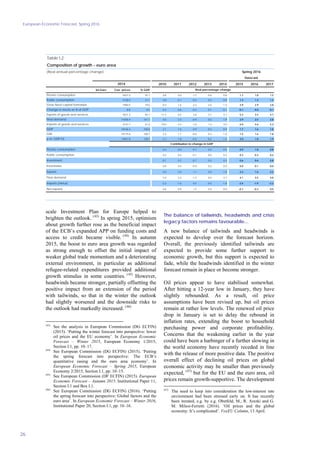
  • 158.
    European Economic Forecast,Spring 2016 146 wages, employment is expected to contract slightly over the forecast horizon, as corporates will be increasingly unable to cut costs without laying off workers. As a result, unemployment should also gradually increase, exceeding 6% as of 2016. Inflation on a downward trend After reaching new record lows in January 2016, reflecting a renewed decline in the oil price, the rouble recovered somewhat, while remaining at around half of its value in mid-2014 against the USD. Inflation decreased quite rapidly since the end of 2015 and reached 7.3% in March (from a peak of nearly 17% one year earlier) as a result of low domestic demand, reduced exchange rate pass- through due to lower imports and declining global food prices. Limited price pressures are expected to resume later in 2016 amid increased fuel excise duties, with average annual inflation remaining at 7.5% before falling to 5.4% in 2017 (i.e. closer to the Bank of Russia’s medium-term target of 4%). However, the central bank remains wary of inflation risks stemming from a slow reduction of inflation expectations, oil price volatility and uncertainty over budgetary prospects. Hence, it has refrained from introducing interest rate cuts since August 2015, although pressures for monetary easing are likely to mount as inflation declines further. Fiscal position to deteriorate further The fiscal deficit has sharply widened in 2015 due to lower revenues linked to the slump in oil prices and was to a large extent financed by tapping the Reserve Fund. It is set to increase further in 2016, as budget plans were based on overly optimistic assumptions about growth and oil price. Also, additional fiscal consolidation measures remain unspecified and are unlikely to be significant amid an election year. Hence, Russia is at serious risk of fully depleting the Reserve Fund by the end of the forecast horizon, which should trigger efforts to achieve a modest deficit reduction in 2017. Risks to the outlook Downside risks to the outlook are related to the possible prolongation of sanctions throughout 2017, which would worsen economic confidence and further delay investment recovery. A renewed volatility of oil prices, putting further pressure on the fiscal and financial sector, via additional revenue shortfall and rouble depreciation, respectively, could also weigh on the outlook. bn RUB Curr. prices % GDP 96-11 2012 2013 2014 2015 2016 2017 71406.4 100.0 3.8 3.4 1.3 0.6 -3.7 -1.9 0.5 38319.1 53.7 5.6 7.7 4.9 1.2 -10.0 -4.2 0.2 13932.3 19.5 1.4 2.6 1.1 -0.1 -1.8 -1.6 -0.5 14124.2 19.8 4.4 7.0 0.7 -2.1 -7.6 -4.6 0.3 - - - - - - - - - 21437.3 30.0 5.4 1.1 4.6 -0.1 3.1 2.5 2.0 16331.4 22.9 8.9 8.7 3.8 -7.9 -25.6 -3.2 0.8 68857.4 96.4 3.6 3.2 0.9 0.9 -3.4 -1.8 0.7 4.0 5.7 2.8 0.2 -7.2 -3.5 0.1 0.2 -0.7 -1.9 -1.2 -2.8 0.0 0.0 -0.5 -1.6 0.5 1.8 6.8 1.5 0.5 - 1.0 -0.2 0.3 -0.7 -0.7 -0.6 - 5.5 5.5 5.1 5.6 6.1 6.4 - - - - - - - - - - - - - - - - - - - - - - - - - - - - 21.2 7.4 5.0 7.2 5.7 5.2 5.7 - 5.1 6.8 7.8 15.5 7.5 5.4 5.1 2.7 -6.6 -4.0 -25.9 -9.8 -1.0 12.3 9.7 8.8 10.1 10.7 9.9 9.7 7.5 3.4 1.6 3.2 5.3 5.1 5.0 6.7 3.1 1.6 3.1 5.3 5.0 5.0 - 2.5 1.4 0.8 -1.6 -2.5 -1.3 - - - - - - - - - - - - - - - - - 12.7 14.0 17.5 19.5 22.6 23.7 GNI (GDP deflator) Structural budget balance (d) Saving rate of households (b) Main features of country forecast - RUSSIA Unemployment rate (a) Gross fixed capital formation Current-account balance (c) Contribution to GDP growth: General government gross debt (c) GDP deflator Compensation of employees / head of which: equipment Domestic demand Consumer-price index Table II.38.1: Net exports Public Consumption Trade balance (goods) (c) Employment Annual percentage change2014 GDP Private Consumption Exports (goods and services) Net lending (+) or borrowing (-) vis-a-vis ROW (c) (a) as % of total labour force. (b) gross saving divided by gross disposable income. (c) as a % of GDP. (d) as a % of potential GDP. Cyclically-adjusted budget balance (d) Real unit labour cost Imports (goods and services) General government balance (c) Unit labour costs whole economy Inventories Terms of trade goods
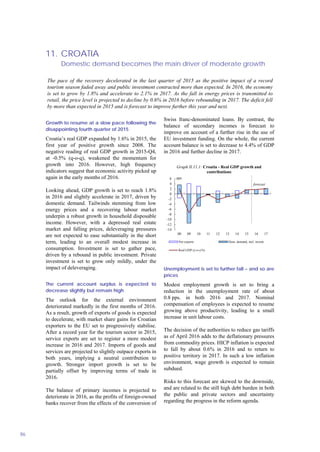
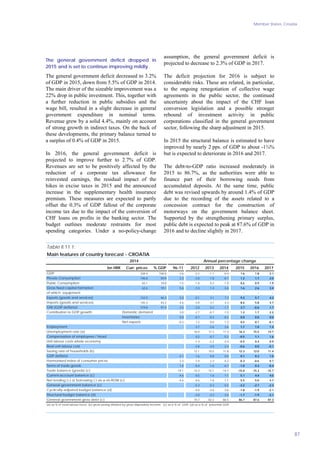
  • 159.
    ACKNOWLEDGEMENTS 147 This report wasprepared in the Directorate-General for Economic and Financial Affairs under the direction of Marco Buti – Director-General, Servaas Deroose – Deputy Director-General, and José Eduardo Leandro – Director “Policy, strategy, coordination and communication”. It has benefitted from the close collaboration with Directorate-General for Financial Stability, Financial Services and Capital Markets Union. Executive responsibilities were attached to Björn Döhring – Head of Unit “Economic situation, forecasts, business and consumer surveys”, Evelyne Hespel – Head of Sector “Macro-economic forecasts and short- term economic developments”, and the forecast coordinators – Reuben Borg and Laura González Cabanillas. The Overview was prepared by Evelyne Hespel. Chapter 1 on “Staying the course amid high risks” was prepared by Oliver Dieckmann under the responsibility of Björn Döhring. This chapter benefited from contributions by Božena Bobková, Reuben Borg, Chris Bosma, Lucian Briciu, João Capella Ramos, Suzanne Casaux, Salvador Ferrandis Vallterra, Alan Gilligan, Laura González Cabanillas, Dalia Grigonyte, Per Yann Le Floc’h, Bjorn Roelstraete, Anastasia Theofilakou, Rupert Willis, Przemysław Woźniak and Alexandru Zeana. Boxes were contributed by Paolo Bolsi, Pasquale D'Apice, Fillipo Ferroni, Marta Petrucci, Romanos Priftis, Rafal Raciborski, Beatriz Velazquez, Marco Ratto, Lukas Vogel and Martin Zeitler. The sections on “Member States” were prepared under the supervision of Daniel Daco, Carlos Martínez Mongay and István Pál Székely, Directors for the “Economies of the Member States”. These sections benefited from contributions by Frode Aasen, Emiel Afman, Hanna Aspegren, Wojciech Balcerowicz, Antonino Barbera Mazzola, Francisco Barros Castro, Barbara Bernardi, Stefan Bohner, Peghe Braila, Julien Castiaux, Guillaume Cléaud, Leonor Coutinho, Iván Csaba, Juliana Dahl, Stylianos Dendrinos, Felipe De la Mota, Živilė Didžiokaitė, Ben Deboeck, Francisco de Castro Fernández, Mirzha de Manuel Aramendía, Lauri Esala, Raffaele Fargnoli, Miroslav Florián, Norbert Gaál, Olivia Galgau, Luis García Lombardero, Oscar Gómez Lacalle, Malgorzata Goralczyk, Michael Grams, Oskar Grevesmühl, Valeska Gronert, Zoltán Gyenes, Julien Hartley, Michal Havlát, David Havrlant, Nora Hesse, Duy Huynh-Olesen, Isabelle Justo, Tobias Ketterer, Csanád Sándor Kiss, Violeta Klyviene, Juho Kostiainen, Robert Kraemer, Radoslav Krastev, Bettina Kromen, Robert Kuenzel, Cvetan Kyulanov, Baudouin Lamine, Milan Lisický, Martin Loeffler, Dimitri Lorenzani, Mart Maiväli, Janis Malzubris, Dorin Emil Mantescu, Fabrizio Melcarne, Vasiliki Michou, Alexander Molzahn, Allen Monks, Daniel Monteiro, Marie Mulvihill, Hans Naudts, Alberto Noriega Guerra, Kristian Orsini, Wojciech Paczynski, Mona Papadakou, Christos Paschalides, Presiyan Petkov, Ventsislav Petrov, Samuli Pietiläinen, Dino Pinelli, Aurélien Poissonnier, Dominik Pripužić, Diana Radu, Vito Ernesto Reitano, David Marco Riquelme, Francesco Rossi- Salvemini, Stefano Santacroce, Giedrius Sidlauskas, Sara Simões, Peeter Soidla, Vladimír Solanič, Nora Straehle, Matija Šušković, Peter Symons, Roberta Torre, Tsvetan Tsalinski, Ismael Valdés Fernández, Henk Van Noten, Hauke Vierke, Kai-Young Weissschaedel, Rafał Wielądek and Ingars Zustrups. Coordination and editorial support on the country-specific sections on public finances was provided by João Capella Ramos, under the supervision of Jakob Wegener Friis, Head of Unit "Policy, planning and coordination". The sections on “Candidate Countries” and “Other non-EU countries” were prepared under the supervision of Elena Flores, Director of the “International economic and financial relations, global governance”. These sections, and forecasts for all other non-EU economies, benefited from contributions by Gintautas Baranauskas, Bernhard Böhm, Samuel Borralho, Antonella Colavita, Judita Cuculić Župa, Felipe De La Mota, Stylianos Dendrinos, Hans Feddersen, Matteo Fumerio, Malgorzata Galar, Alan Gilligan, Matteo Governatori, Dalia Grigonyte, Renata Hrůzová, Sarah Jurreit, Plamen Kaloyanchev, Safwan Naser, Roxanne Rua, Antonio Sanchez Pareja, Barbara Stearns-Blasing, András Tari, Benjamin Trunk, Rupert Willis, Przemysław Woźniak and Norbert Wunner.
  • 160.
    148 Support in editingthe report by Peter Koh, and for its communication and publication by Johannes Bahrke, Nicolas Carpentiers, Sarka Novotna, Bjorn Pius, Enrico Portelli and Philip Tod is gratefully acknowledged. IT support was provided by Rudy Druine. Follow-up calculations were performed by Laura Fernández Vilaseca, Karel Havik, Vitor Martins, Kieran Mc Morrow, Rafał Raciborski, Werner Röger, Anna-Elisabeth Thum, Valerie Vandermeulen and Stefan Zeugner. Forecast assumptions were prepared by Lucian Briciu, Roberta Friz, Dalia Grigonyte, Gerda Symens, André Verbanck and Przemysław Woźniak. Statistical support for the production of the forecast tables was provided by Antoine Avdoulos, Noël Doyle, Salvador Ferrandis Vallterra and Bjorn Roelstraete. Further statistical and layout assistance was provided by Yves Bouquiaux, Paloma Cortés Payá, Paolo Covelli, Lazaros Dimitriadis, Andrzej Erdmann, Michel Gerday, Susanne Hoffmann, Jan Kattevilder, Johann Korner, Oscar Gomez Lacalle, Anders Lindqvist, Simona Pojar, Marc Puig, Francisco Maya Sepulveda, Ulrike Stierle-von Schuetz, Jacek Szelożyński, Ingrid Toming and Tomasz Zdrodowski. Valuable comments and suggestions by Laura Bardone, Gerrit Bethuyne, Božena Bobková, Reuben Borg, Suzanne Casaux, Paolo Casini, Nathalie Darnaut, Oliver Dieckmann, Marie Donnay, Patrick D’Souza, Luis Fau Sebastian, Jakob Wegener Friis, Carole Garnier, Gabriele Giudice, Laura González Cabanillas, Peter Grasmann, Heinz Jansen, Stefan Kuhnert, Paul Kutos, Martin Larch, Julia Lendvai, Per Yann Le Floc’h, Pim Lescrauwaet, Maarten Masselink, Josefina Monteagudo, Magda Morgese Borys, Karl Pichelmann, Elena Reitano, Eric Ruscher, Uwe Stamm, Michael Stierle, Anastasia Theofilakou, Michael Thiel, Charlotte Van Hooydonk, Christian Weise, Sam Whittaker, Florian Woehlbier, Norbert Wunner and Javier Yaniz Igal are gratefully acknowledged. Secretarial support for the finalisation of this report was provided by Károly Csiszár and Els Varblane. Comments on the report would be gratefully received and should be sent to: Directorate-General for Economic and Financial Affairs Unit A3: Economic situation, forecasts, business and consumer surveys European Commission B-1049 Brussels E-mail: ecfin-forecasts@ec.europa.eu
  • 161.
    Statistical Annex European EconomicForecast – Spring 2016
  • 162.
    Contents 150 Output : GDPand its components 1. Gross domestic product 152 2. Profiles (q-o-q) of quarterly GDP 152 3. Profiles (y-o-y) of quarterly GDP 153 4. GDP per capita 153 5. Final domestic demand 154 6. Final demand 154 7. Private consumption expenditure 155 8. Government consumption expenditure 155 9. Total investment 156 10. Investment in construction 156 11. Investment in equipment 157 12. Public investment 157 13. Potential GDP 158 14. Output gap relative to potential GDP 158 Prices 15. Deflator of GDP 159 16. Deflator of private consumption 159 17. Harmonised consumer prices index 160 18. Harmonised consumer prices quarterly profiles 160 19. Deflator of exports of goods 161 20. Deflator of imports of goods 161 21. Terms of trade of goods 162 Wages, population and labour market 22. Total population 162 23. Total employment 163 24. Unemployment rate 163 25. Compensation of employees per head 164 26. Real compensation of employees per head 164 27. Labour productivity 165 28. Unit labour costs, whole economy 165 29. Real unit labour costs 166 Exchange rates 30. Nominal bilateral exchange rates 166 31. Nominal effective exchange rates 167 32. Relative unit labour costs 167 33. Real effective exchange rates 168
  • 163.
    Statistical Annex 151 General Government 34.Total expenditure 168 35. Total revenue 169 36. Net lending (+) or net borrowing (-) 169 37. Interest expenditure 170 38. Primary balance 170 39. Cyclically-adjusted net lending (+) or net borrowing (-) 171 40. Cyclically-adjusted primary balance 171 41. Structural budget balance 172 42. Gross debt 172 Saving 43. Gross national saving 173 44. Gross saving of the private sector 173 45. Saving rate of households 174 46. Gross saving of general government 174 Trade and international payments 47. Exports of goods and services 175 48. Imports of goods and services 175 49. Merchandise trade balance (% of GDP) 176 50. Current-account balance (% of GDP) 176 51. Net lending (+) or net borrowing (-) 177 52. Current-account balance (bn EUR) 177 53. Export markets (goods and services) 178 54. Export performance (goods and services) 178 World economy 55. World GDP 179 56. World exports of goods and services 180 57. Export shares (goods) in EU trade 180 58. World imports of goods and services 181 59. Import shares (goods) in EU trade 181 60. World merchandise trade balances (bn USD) 182 61. World current-account balances (bn USD) 182 62. Primary commodity prices 182
  • 164.
    European Economic Forecast,Spring 2016 152 Table 1: 22.4.2016 5-year 1997-01 2002-06 2007-11 2012 2013 2014 2015 2016 2017 2015 2016 2017 2.7 2.2 1.3 0.2 0.0 1.3 1.4 1.2 1.6 1.3 1.3 1.7 2.1 1.0 1.2 0.4 0.3 1.6 1.7 1.6 1.6 1.7 1.8 1.8 6.3 7.9 -0.9 5.2 1.6 2.9 1.1 1.9 2.4 0.9 2.1 2.3 9.4 5.4 0.1 0.2 1.4 5.2 7.8 4.9 3.7 6.9 4.5 3.5 3.9 4.2 -3.3 -7.3 -3.2 0.7 -0.2 -0.3 2.7 0.0 -0.7 2.7 4.4 3.4 0.0 -2.6 -1.7 1.4 3.2 2.6 2.5 3.2 2.8 2.5 3.0 1.7 0.7 0.2 0.7 0.2 1.2 1.3 1.7 1.1 1.3 1.7 2.1 1.0 -0.6 -2.8 -1.7 -0.3 0.8 1.1 1.3 0.8 1.4 1.3 4.3 3.8 1.6 -2.4 -5.9 -2.5 1.6 1.7 2.0 1.4 1.5 2.0 6.0 9.3 -1.5 4.0 3.0 2.4 2.7 2.8 3.1 2.7 3.1 3.2 Lithuania 4.9 7.8 0.9 3.8 3.5 3.0 1.6 2.8 3.1 1.6 2.9 3.4 6.3 3.5 2.0 -0.8 4.3 4.1 4.8 3.3 3.9 4.7 3.8 4.4 3.9 2.3 2.0 2.8 4.1 3.7 6.3 4.1 3.5 4.9 3.9 3.4 4.0 1.6 0.9 -1.1 -0.5 1.0 2.0 1.7 2.0 2.0 2.1 2.3 2.8 2.1 1.2 0.8 0.3 0.4 0.9 1.5 1.6 0.7 1.7 1.6 3.8 0.8 -0.1 -4.0 -1.1 0.9 1.5 1.5 1.7 1.5 1.6 1.8 4.2 4.1 0.7 -2.7 -1.1 3.0 2.9 1.7 2.3 2.5 1.8 2.3 2.9 6.0 3.6 1.5 1.4 2.5 3.6 3.2 3.3 3.5 3.2 3.4 4.9 2.9 0.5 -1.4 -0.8 -0.7 0.5 0.7 0.7 0.0 0.5 0.9 2.9 1.8 0.5 -0.9 -0.3 0.9 1.7 1.6 1.8 1.6 1.7 1.9 0.9 6.3 2.1 0.2 1.3 1.5 3.0 2.0 2.4 2.2 1.5 2.0 1.5 4.7 1.5 -0.9 -0.5 2.0 4.2 2.1 2.6 4.5 2.3 2.7 2.6 1.9 -0.5 -0.1 -0.2 1.3 1.2 1.2 1.9 1.2 1.7 1.9 2.9 4.8 -0.5 -2.2 -1.1 -0.4 1.6 1.8 2.1 1.8 2.1 2.1 3.8 4.3 -0.6 -1.7 1.9 3.7 2.9 2.5 2.8 2.7 2.1 2.5 4.3 4.1 4.5 1.6 1.3 3.3 3.6 3.7 3.6 3.5 3.5 3.5 0.1 6.2 1.5 0.6 3.5 3.0 3.8 4.2 3.7 3.6 4.2 3.7 3.6 3.3 1.2 -0.3 1.2 2.3 4.1 3.4 2.9 3.6 3.2 2.9 3.2 2.8 0.3 1.2 2.2 2.9 2.3 1.8 1.9 2.3 2.1 2.1 3.0 2.1 0.6 -0.5 0.2 1.4 2.0 1.8 1.9 1.9 1.9 2.0 3.7 2.9 0.6 2.2 1.5 2.4 2.4 2.3 2.2 2.5 2.7 2.6 0.4 1.5 -0.1 1.7 1.4 0.0 0.5 0.8 0.4 0.7 1.1 0.5 Slovenia Malta Spring 2016 USA Latvia Croatia Estonia Bulgaria Netherlands Japan Sweden France Hungary Winter 2016 United Kingdom Italy Poland Greece Czech Republic Slovakia Austria Euro area Gross domestic product, volume (percentage change on preceding year, 1997-2017) Finland Portugal Luxembourg EU averages Cyprus forecast Romania Spain Denmark Germany Ireland Belgium forecast Table 2: 22.4.2016 2015/1 2015/2 2015/3 2015/4 2016/1 2016/2 2016/3 2016/4 2017/1 2017/2 2017/3 2017/4 0.3 0.5 0.2 0.3 0.3 0.2 0.3 0.4 0.4 0.4 0.5 0.5 0.4 0.4 0.3 0.3 0.5 0.3 0.4 0.4 0.4 0.4 0.4 0.4 -0.7 0.5 0.1 0.9 0.5 0.6 0.7 0.7 0.5 0.6 0.6 0.7 : : : : : : : : : : : : : : : : : : : : : : : : 0.9 1.0 0.8 0.8 0.7 0.5 0.3 0.5 0.6 0.7 0.8 0.8 0.6 0.0 0.4 0.3 0.4 0.3 0.4 0.5 0.5 0.4 0.4 0.3 0.4 0.3 0.2 0.1 0.3 0.3 0.4 0.4 0.3 0.3 0.3 0.3 : : : : : : : : : : : : 0.5 1.2 0.9 -0.3 0.9 0.7 0.8 0.8 0.8 0.8 0.9 0.9 Lithuania 0.3 0.6 0.5 0.5 0.7 0.7 0.7 0.8 0.7 0.8 0.8 0.8 -1.2 1.8 1.2 1.1 0.2 0.8 0.8 0.9 1.0 1.0 1.0 1.1 : : : : : : : : : : : : 0.6 0.2 0.2 0.3 0.4 0.6 0.7 0.7 0.5 0.3 0.3 0.3 0.7 0.3 0.0 0.2 0.4 0.5 0.5 0.4 0.4 0.4 0.3 0.3 0.5 0.4 0.1 0.2 0.2 0.6 0.6 0.6 0.4 0.3 0.3 0.3 0.7 0.8 0.4 0.6 0.3 0.3 0.4 0.4 0.6 0.8 0.7 0.6 0.9 1.0 1.0 1.0 0.4 0.9 0.7 0.8 0.8 0.9 0.9 0.9 0.4 0.5 -0.2 0.2 0.2 0.2 0.2 0.2 0.2 0.2 0.2 0.2 0.6 0.4 0.3 0.3 0.5 0.4 0.4 0.5 0.5 0.4 0.4 0.4 0.9 0.6 0.7 0.7 0.6 0.4 0.2 0.2 0.5 0.7 0.9 0.9 2.4 1.0 0.7 0.0 0.5 0.7 0.6 0.6 0.6 0.7 0.6 0.7 0.6 0.4 -0.6 0.1 0.5 0.5 0.5 0.5 0.5 0.5 0.4 0.4 0.3 0.9 1.4 -0.5 0.8 0.3 0.3 0.3 0.6 0.6 0.6 0.6 0.8 0.5 0.6 1.0 0.3 0.6 0.7 0.8 0.7 0.6 0.7 0.7 1.0 0.6 0.9 1.1 0.6 1.1 1.8 1.1 0.8 0.6 0.6 0.6 1.3 -0.2 1.5 1.1 1.2 0.6 1.4 0.9 1.0 0.9 0.8 0.8 0.9 1.2 1.0 1.3 0.6 0.6 0.6 0.8 0.7 0.7 0.7 0.8 0.5 0.6 0.4 0.6 0.4 0.6 0.6 0.4 0.3 0.3 0.3 0.3 0.6 0.5 0.4 0.4 0.5 0.5 0.5 0.5 0.5 0.4 0.4 0.4 0.2 1.0 0.5 0.3 0.2 0.9 0.9 0.7 0.4 0.4 0.4 0.5 1.1 -0.4 0.3 -0.3 0.3 0.5 0.4 0.4 1.1 -2.0 0.1 0.3Japan Profiles (qoq) of quarterly GDP, volume (percentage change from previous quarter, 2015-17) United Kingdom Euro area Germany Hungary Portugal France Greece Denmark Finland Latvia Belgium Sweden Croatia Austria Spain Estonia EU Bulgaria Luxembourg Italy Poland Slovenia Malta Ireland USA Czech Republic Cyprus Romania Slovakia Netherlands
  • 165.
    Statistical Annex 153 Table 3:22.4.2016 2015/1 2015/2 2015/3 2015/4 2016/1 2016/2 2016/3 2016/4 2017/1 2017/2 2017/3 2017/4 1.3 1.5 1.3 1.4 1.3 1.1 1.2 1.2 1.3 1.5 1.7 1.8 1.1 1.6 1.7 1.3 1.4 1.4 1.6 1.7 1.7 1.8 1.8 1.8 1.4 1.4 1.1 0.8 2.0 2.1 2.7 2.4 2.4 2.4 2.4 2.3 : : : : : : : : : : : : : : : : : : : : : : : : 2.7 3.2 3.4 3.5 3.3 2.8 2.3 2.0 2.0 2.3 2.7 3.0 1.0 1.1 1.2 1.4 1.1 1.3 1.3 1.5 1.6 1.7 1.7 1.5 0.2 0.6 0.8 1.0 0.9 1.0 1.2 1.5 1.5 1.5 1.4 1.3 : : : : : : : : : : : : 1.9 2.8 3.3 2.3 2.7 2.2 2.2 3.3 3.2 3.3 3.3 3.4 Lithuania 1.2 1.4 1.7 1.9 2.3 2.4 2.6 3.0 3.0 3.1 3.1 3.1 4.9 6.0 5.7 3.0 4.4 3.3 2.9 2.7 3.5 3.7 4.0 4.2 : : : : : : : : : : : : 2.6 2.2 1.9 1.2 1.0 1.4 1.9 2.4 2.5 2.2 1.8 1.4 0.3 0.9 0.9 1.2 0.9 1.1 1.7 2.0 1.9 1.8 1.5 1.4 1.7 1.5 1.4 1.3 0.9 1.2 1.7 2.0 2.2 1.9 1.6 1.3 3.0 2.6 2.2 2.6 2.2 1.6 1.6 1.4 1.7 2.2 2.5 2.7 3.1 3.5 3.8 4.0 3.5 3.4 3.1 2.9 3.3 3.2 3.4 3.5 0.1 0.8 0.4 0.9 0.7 0.4 0.9 0.8 0.7 0.7 0.7 0.7 1.3 1.6 1.6 1.6 1.6 1.5 1.6 1.8 1.8 1.8 1.8 1.8 2.6 2.6 2.9 3.0 2.7 2.5 2.0 1.4 1.4 1.6 2.2 3.0 3.9 4.5 4.6 4.0 2.2 1.9 1.8 2.5 2.6 2.6 2.6 2.6 1.6 2.0 0.7 0.5 0.4 0.5 1.6 2.1 2.1 2.0 1.9 1.8 0.2 1.5 2.7 2.0 2.5 1.9 0.8 1.7 1.5 1.9 2.2 2.6 3.3 2.7 2.6 3.0 2.5 2.5 2.6 2.4 2.9 2.9 2.8 2.8 3.7 3.4 3.6 3.7 3.3 3.8 4.7 4.7 4.8 4.3 3.1 2.6 4.0 3.7 3.6 3.8 3.7 4.5 4.3 4.1 3.9 4.2 3.6 3.5 3.0 3.6 4.2 4.5 4.2 3.5 3.2 2.6 2.7 2.8 2.9 2.9 2.6 2.4 2.2 2.1 2.1 2.1 2.3 2.1 2.0 1.7 1.4 1.3 1.7 1.9 1.9 1.8 1.8 1.8 1.9 2.0 2.0 2.0 1.9 1.8 2.9 2.7 2.1 2.0 2.0 2.0 2.4 2.7 2.9 2.4 2.0 1.7 -1.0 0.7 1.7 0.8 0.0 0.8 0.9 1.6 2.4 -0.1 -0.3 -0.5Japan Profile (yoy) of quarterly GDP, volume (percentage change from corresponding quarter in previous year, 2015-17) United Kingdom Euro area Germany Hungary Portugal France Greece Denmark Finland Latvia Belgium Sweden Croatia Austria Spain Estonia EU Bulgaria Luxembourg Italy Poland Slovenia Malta Ireland USA Czech Republic Cyprus Romania Slovakia Netherlands Table 4: 22.4.2016 5-year 1997-01 2002-06 2007-11 2012 2013 2014 2015 2016 2017 2015 2016 2017 2.5 1.6 0.4 -0.5 -0.4 0.9 0.9 0.6 0.8 0.7 0.7 1.3 2.1 1.0 1.5 0.2 0.0 1.2 1.0 0.7 1.3 1.0 1.1 1.5 6.8 8.5 -0.5 5.5 2.0 3.3 1.3 2.3 2.8 1.2 2.4 2.7 8.0 3.3 -1.3 -0.1 1.2 4.9 7.2 3.8 2.7 6.2 3.4 2.6 3.4 3.9 -3.4 -6.8 -2.5 1.3 0.1 -0.3 2.7 0.0 -0.7 2.7 3.9 1.7 -1.0 -2.7 -1.3 1.6 3.3 2.7 2.7 3.3 2.9 2.6 2.5 1.0 0.2 -0.3 0.2 -0.3 0.7 0.9 1.2 0.6 0.8 1.2 2.1 0.5 -1.1 -3.3 -2.2 -0.6 0.9 1.1 1.0 0.6 1.1 1.1 3.1 2.4 -0.9 -3.9 -5.7 -1.4 2.5 2.0 1.8 0.9 1.1 1.5 7.0 10.4 0.0 5.3 4.1 3.3 3.6 3.5 3.6 3.5 3.8 3.7 Lithuania 5.7 9.1 2.5 5.2 4.6 4.0 2.6 4.0 4.3 2.6 3.8 4.1 4.9 2.1 0.1 -3.1 1.7 1.6 2.9 0.9 1.5 2.2 1.4 2.0 3.2 1.7 1.5 2.1 3.1 2.7 5.4 3.3 2.7 3.9 3.2 2.8 3.4 1.2 0.5 -1.4 -0.8 0.6 1.6 1.1 1.3 1.5 1.7 1.9 2.6 1.6 0.9 0.3 -0.3 -0.4 0.0 0.7 1.1 -0.2 1.0 1.1 3.2 0.5 -0.1 -3.6 -0.6 1.5 1.9 2.0 2.2 2.0 2.1 2.3 4.1 4.0 0.3 -2.9 -1.2 2.9 2.8 1.5 2.2 2.3 1.7 2.1 2.8 6.0 3.6 1.4 1.3 2.4 3.5 3.2 3.3 3.4 3.2 3.4 4.6 2.6 0.1 -1.9 -1.2 -1.1 0.2 0.3 0.3 -0.4 0.2 0.6 2.6 1.2 0.1 -1.1 -0.5 0.7 1.4 1.2 1.5 1.3 1.4 1.6 1.9 7.0 3.0 0.8 1.8 2.1 3.5 2.6 3.0 2.9 2.2 2.7 1.7 4.6 1.0 -1.0 -0.5 1.8 4.0 1.9 2.4 4.3 2.1 2.5 2.2 1.6 -1.0 -0.4 -0.6 0.7 0.5 0.7 1.5 0.7 1.3 1.5 4.3 4.7 -0.4 -1.9 -0.8 0.2 2.1 2.0 2.3 2.0 2.3 2.3 4.0 4.5 -0.4 -1.2 2.2 4.0 3.2 2.7 3.0 2.9 2.3 2.7 4.3 4.2 4.3 1.5 1.3 3.3 3.7 3.8 3.6 3.6 3.5 3.5 0.2 7.4 2.6 1.1 3.9 3.3 4.0 4.3 3.9 3.8 4.4 3.9 3.5 2.8 0.4 -1.0 0.4 1.3 3.0 2.1 1.4 2.4 1.4 0.8 2.9 2.2 -0.5 0.5 1.5 2.1 1.5 0.9 1.1 1.5 1.2 1.3 2.8 1.8 0.2 -0.7 0.0 1.1 1.7 1.4 1.6 1.6 1.6 1.7 2.6 1.9 -0.3 1.5 0.7 1.7 1.6 1.4 1.4 1.7 1.9 1.8 0.2 1.4 -0.1 2.0 1.5 0.1 0.6 1.0 0.6 0.9 1.3 0.7 Slovenia Malta Spring 2016 USA Latvia Croatia Estonia Bulgaria Netherlands Japan Sweden France Hungary Winter 2016 United Kingdom Italy Poland Greece Czech Republic Slovakia Austria Euro area Gross domestic product per capita (percentage change on preceding year, 1997-2017) Finland Portugal Luxembourg EU averages Cyprus forecast Romania Spain Denmark Germany Ireland Belgium forecast
  • 166.
    European Economic Forecast,Spring 2016 154 Table 5: 22.4.2016 5-year 1997-01 2002-06 2007-11 2012 2013 2014 2015 2016 2017 2015 2016 2017 2.3 1.7 1.5 -0.2 -0.7 1.7 1.7 0.8 1.4 1.7 0.6 1.4 1.7 0.1 1.1 -1.0 0.8 1.3 1.6 2.5 1.9 1.6 2.2 2.2 6.7 10.8 -3.0 8.0 2.0 4.1 -0.7 2.7 2.6 0.0 2.7 3.3 8.4 6.2 -2.5 0.6 -1.1 5.7 9.3 5.4 3.9 8.4 5.0 3.9 4.2 4.4 -4.1 -9.9 -4.2 0.9 -1.4 -0.5 2.5 -0.7 -1.1 2.3 4.8 4.5 -1.2 -4.7 -3.1 1.6 3.8 3.0 2.6 3.7 3.1 2.5 3.0 2.0 1.0 -0.3 0.7 0.6 1.4 1.6 1.7 1.1 1.4 1.8 2.6 1.2 -0.6 -5.7 -2.6 -0.4 1.1 1.4 1.4 1.0 1.9 1.4 3.5 5.3 1.6 -4.1 -8.4 -1.0 2.8 2.0 1.6 1.6 1.7 1.5 6.0 11.3 -3.3 1.6 2.1 0.9 3.0 3.5 3.7 3.0 3.3 3.7 Lithuania 5.3 9.4 -0.6 -0.2 3.2 2.9 6.4 3.5 3.8 5.7 3.6 4.3 5.4 2.8 2.6 1.5 0.5 5.6 2.4 2.2 2.9 1.0 2.6 2.5 1.8 3.1 1.1 0.2 2.3 3.6 7.6 3.6 4.2 6.6 2.3 3.0 4.2 1.2 0.7 -2.3 -1.8 0.6 2.5 2.6 2.3 2.2 2.9 2.5 1.9 1.6 1.1 0.3 -0.4 -0.2 0.2 1.4 1.4 0.4 1.6 1.5 4.6 0.6 -0.9 -7.3 -2.0 2.2 2.4 1.5 1.9 2.1 1.8 2.0 4.2 3.7 0.0 -5.8 -2.2 1.6 2.1 1.3 2.8 1.6 1.6 2.4 2.6 4.9 2.1 -4.2 0.3 3.1 4.9 2.4 3.7 4.6 3.1 3.5 4.0 2.9 1.2 -1.2 -1.1 0.2 -0.7 0.9 0.7 -0.2 0.5 0.9 2.9 1.7 0.2 -2.4 -0.7 0.9 1.8 2.0 1.9 1.7 2.0 2.0 5.8 8.7 0.0 2.5 -1.3 2.7 0.9 0.9 1.7 0.6 0.6 1.4 1.3 3.8 0.9 -2.3 -0.5 2.3 4.7 1.9 2.6 5.2 2.2 2.7 2.3 2.9 -0.7 0.5 -0.2 1.3 1.1 2.0 1.9 1.1 2.0 1.9 2.7 6.2 -1.4 -3.3 -1.1 -1.7 1.2 1.7 2.2 1.6 1.9 2.0 4.2 4.1 -2.3 -3.1 1.5 4.2 1.9 2.0 2.7 1.2 1.3 2.3 4.4 4.0 4.5 -0.5 -0.7 4.9 3.4 4.1 3.9 3.2 3.9 3.8 1.5 9.1 1.9 -0.5 -0.1 3.1 5.3 6.4 4.9 4.7 5.7 4.7 3.0 2.5 1.8 -0.6 1.6 3.4 3.8 3.5 3.0 3.4 3.3 2.9 3.9 3.0 -0.3 2.3 2.6 3.2 2.6 2.3 2.0 2.7 2.5 2.2 3.0 2.1 0.3 -1.5 -0.1 1.5 2.1 2.2 2.1 2.0 2.2 2.1 4.3 3.2 0.1 2.1 1.2 2.5 3.0 2.9 2.6 2.9 3.1 2.9 0.2 0.8 -0.2 2.6 1.7 0.0 0.0 0.3 0.1 -0.2 0.8 0.3 Slovenia Malta Spring 2016 USA Latvia Croatia Estonia Bulgaria Netherlands Japan Sweden France Hungary Winter 2016 United Kingdom Italy Poland Greece Czech Republic Slovakia Austria Euro area Domestic demand, volume (percentage change on preceding year, 1997-2017) Finland Portugal Luxembourg EU averages Cyprus forecast Romania Spain Denmark Germany Ireland Belgium forecast Table 6: 22.4.2016 5-year 1997-01 2002-06 2007-11 2012 2013 2014 2015 2016 2017 2015 2016 2017 3.8 2.8 2.1 0.7 0.4 3.4 2.5 2.3 3.1 2.2 2.3 3.2 3.2 2.0 1.8 0.2 1.1 2.2 2.9 2.4 2.8 2.8 2.7 3.1 6.9 11.1 1.0 7.2 3.3 3.0 -0.9 2.3 3.1 -0.7 1.9 3.5 12.5 5.9 0.4 1.5 0.9 9.4 11.9 6.3 5.6 11.3 6.1 5.5 5.6 4.2 -3.5 -7.7 -2.9 2.4 -2.0 -0.3 2.9 -0.5 -0.4 2.7 5.7 4.2 -0.5 -3.4 -1.4 2.5 4.2 3.4 3.3 4.3 3.8 3.4 4.1 2.2 1.1 0.3 0.9 1.0 2.4 2.2 2.4 2.1 2.1 2.7 2.9 1.5 -0.5 -4.0 -1.9 0.4 1.9 1.7 2.0 1.8 2.2 2.1 3.6 3.3 1.6 -3.1 -4.9 -0.8 2.5 2.2 2.0 2.4 2.2 1.9 6.2 11.1 -0.9 4.5 1.7 1.7 2.4 2.7 3.4 2.6 3.1 3.5 Lithuania 6.2 10.6 2.1 5.0 6.1 3.0 4.0 3.3 3.8 3.7 3.4 4.3 8.8 5.5 2.9 0.6 5.2 6.5 5.9 3.8 4.5 5.9 3.3 4.3 2.7 4.1 4.8 4.4 1.1 1.4 4.4 3.5 4.1 4.2 3.6 4.1 5.6 2.6 1.5 0.5 0.1 2.3 3.8 3.6 3.3 3.4 3.6 3.5 3.9 2.9 1.5 0.8 0.0 0.6 0.8 1.9 2.2 1.2 2.3 2.2 4.9 1.4 -0.2 -4.7 0.5 2.7 3.2 2.3 2.8 2.9 2.5 3.0 5.4 5.9 1.2 -3.1 0.1 3.4 3.5 2.5 3.7 2.9 2.9 3.7 4.0 9.3 3.3 2.0 3.2 3.3 5.9 3.3 4.8 5.5 3.8 4.6 5.8 3.7 0.9 -0.5 -0.4 -0.1 -0.4 1.0 1.2 -0.3 0.8 1.4 4.1 2.6 0.8 -0.9 0.2 1.9 2.9 2.5 2.8 2.8 2.7 3.0 1.5 9.3 2.2 1.9 2.7 1.5 3.5 2.4 3.1 2.6 2.2 2.8 3.6 7.4 2.8 0.5 -0.3 5.3 5.8 3.7 3.9 6.1 4.0 4.2 3.7 3.5 -0.1 0.5 0.2 1.9 0.3 1.8 2.7 0.5 2.6 2.7 3.8 6.3 -1.1 -2.4 0.2 1.0 3.8 3.1 2.9 3.7 2.9 3.1 8.4 7.2 1.2 -2.5 3.9 5.8 5.1 4.1 4.6 4.8 3.8 4.4 5.4 5.3 5.0 1.0 1.4 5.4 4.5 4.8 4.8 4.1 4.4 4.7 3.4 9.7 2.6 -0.1 5.1 4.7 5.3 5.8 4.8 5.0 5.7 5.0 4.6 3.7 1.7 -0.1 0.8 3.4 4.5 3.7 3.4 3.8 3.5 3.4 4.1 3.6 -0.2 1.9 2.3 2.7 3.1 2.3 2.2 3.1 2.6 2.6 4.2 3.0 0.8 -0.4 0.6 2.3 3.1 2.6 2.9 2.9 2.8 3.0 4.3 3.3 0.5 2.2 1.4 2.6 2.8 2.7 2.7 2.7 3.0 3.0 0.5 1.7 -0.1 2.2 1.6 1.1 0.4 0.6 0.6 0.3 1.2 0.7 Slovenia Malta Spring 2016 USA Latvia Croatia Estonia Bulgaria Netherlands Japan Sweden France Hungary Winter 2016 United Kingdom Italy Poland Greece Czech Republic Slovakia Austria Euro area Final demand, volume (percentage change on preceding year, 1997-2017) Finland Portugal Luxembourg EU averages Cyprus forecast Romania Spain Denmark Germany Ireland Belgium forecast
  • 167.
    Statistical Annex 155 Table 7:22.4.2016 5-year 1997-01 2002-06 2007-11 2012 2013 2014 2015 2016 2017 2015 2016 2017 2.0 1.0 1.4 0.6 0.9 0.4 1.3 1.0 1.3 1.4 0.9 1.2 1.7 0.4 0.5 1.0 0.6 0.9 1.9 2.0 1.4 1.9 2.0 1.7 6.4 9.6 -2.2 4.4 3.8 3.5 5.0 3.3 2.6 4.8 3.2 3.0 7.8 4.8 0.1 -1.0 0.1 2.1 3.5 2.7 2.0 3.3 2.5 2.0 3.7 3.8 -2.2 -8.0 -2.3 0.5 0.3 -0.4 1.8 0.5 -0.7 1.8 4.1 3.4 -0.6 -3.5 -3.1 1.2 3.1 3.0 2.3 3.1 3.4 2.3 2.9 2.1 1.1 -0.2 0.4 0.6 1.4 1.5 1.4 1.4 1.3 1.3 2.4 0.9 -0.1 -3.9 -2.5 0.6 0.9 1.5 1.1 0.9 1.5 0.6 4.6 4.3 2.8 -0.8 -5.9 0.6 1.9 1.5 1.4 1.8 1.6 1.4 3.4 10.7 -2.1 3.2 5.1 2.3 3.3 3.8 3.9 3.4 3.8 3.9 Lithuania 5.3 9.8 -0.5 3.6 4.3 4.1 4.9 4.3 3.9 5.2 4.9 3.8 4.1 2.4 1.7 2.7 0.9 3.7 0.1 2.2 2.8 -0.1 2.9 2.0 4.0 2.2 1.0 -0.2 2.3 2.4 4.9 4.4 3.5 4.0 3.4 2.6 4.3 0.4 0.2 -1.2 -1.4 0.0 1.5 1.6 1.9 1.6 2.2 2.2 2.0 1.8 1.0 0.6 0.1 0.0 0.4 1.5 1.4 0.2 1.5 1.4 3.6 1.3 0.0 -5.5 -1.2 2.2 2.6 1.8 1.7 2.6 1.9 1.8 3.1 2.5 2.2 -2.5 -4.1 0.7 1.7 2.3 2.5 1.3 2.3 2.3 4.2 5.1 2.5 -0.4 -0.8 2.3 2.4 3.6 3.2 2.3 3.4 3.0 3.3 3.6 1.8 0.3 -0.5 0.6 1.4 0.7 0.5 1.3 0.6 0.6 2.6 1.5 0.3 -1.2 -0.6 0.8 1.7 1.8 1.5 1.7 1.8 1.5 0.2 7.5 2.4 3.3 -1.4 2.7 0.8 2.0 1.7 0.7 1.4 1.7 1.9 3.6 1.5 -1.5 0.7 1.5 2.8 2.8 2.7 2.9 2.8 2.7 1.2 2.8 -0.1 0.4 -0.1 0.5 2.1 2.0 2.1 2.2 2.0 2.1 2.9 4.6 -0.3 -3.0 -1.8 -0.7 1.2 1.7 2.0 1.0 1.8 1.9 4.3 4.5 -1.8 -2.2 0.3 1.8 3.0 3.2 3.0 3.0 3.2 2.5 4.5 3.4 4.3 0.7 0.2 2.6 3.0 4.1 4.0 3.0 4.0 3.9 1.5 10.6 2.3 1.2 0.7 3.8 6.1 6.9 5.0 4.8 6.9 4.5 3.2 2.6 2.0 0.8 1.9 2.2 2.6 2.8 2.9 2.4 2.6 2.8 4.6 3.2 -0.2 1.8 1.9 2.5 2.7 2.4 2.1 2.8 2.6 2.3 3.0 2.1 0.4 -0.6 -0.1 1.2 2.0 2.1 1.8 2.0 2.2 1.8 4.4 3.2 0.9 1.5 1.7 2.7 3.1 2.9 2.4 3.1 3.0 2.6 0.7 1.1 0.5 2.3 1.7 -0.9 -1.3 -0.3 0.0 -0.8 0.8 -0.1 Slovenia Malta Spring 2016 USA Latvia Croatia Estonia Bulgaria Netherlands Japan Sweden France Hungary Winter 2016 United Kingdom Italy Poland Greece Czech Republic Slovakia Austria Euro area Private consumption expenditure, volume (percentage change on preceding year, 1997-2017) Finland Portugal Luxembourg EU averages Cyprus forecast Romania Spain Denmark Germany Ireland Belgium forecast Table 8: 22.4.2016 5-year 1997-01 2002-06 2007-11 2012 2013 2014 2015 2016 2017 2015 2016 2017 1.8 1.5 1.6 1.5 -0.1 0.6 0.3 0.6 0.0 0.1 0.6 0.3 1.2 0.5 2.0 1.3 0.8 1.7 2.4 2.9 2.2 2.8 3.1 2.5 0.1 3.7 1.7 3.6 1.5 3.0 2.1 1.7 1.7 1.8 1.7 1.9 7.6 4.2 -0.3 -1.2 0.0 4.0 -0.1 1.3 2.0 2.4 2.0 2.3 2.2 4.1 -1.3 -6.0 -6.5 -2.6 0.0 -0.5 -0.1 -0.2 -1.0 -0.9 3.6 5.1 3.5 -4.5 -2.8 0.0 2.7 1.0 1.0 2.2 0.6 0.6 1.0 1.7 1.5 1.6 1.7 1.5 1.5 1.1 0.7 1.1 0.7 0.6 2.1 0.7 0.1 -1.4 -0.3 -1.0 -0.7 0.6 0.7 0.2 0.1 1.0 5.6 5.5 2.8 -3.7 -4.1 -9.0 1.1 -1.2 0.0 -2.4 -0.9 0.2 3.5 4.1 -2.2 0.3 1.6 4.9 3.1 3.2 2.5 2.7 2.4 2.0 Lithuania 1.3 3.0 -0.5 1.3 1.0 1.3 2.0 1.4 1.9 2.3 1.4 2.0 4.9 3.3 2.4 3.6 3.9 4.5 2.7 2.4 2.6 3.3 2.9 2.6 0.0 1.8 2.9 6.4 0.2 7.2 4.8 4.4 7.2 2.5 4.9 6.3 3.3 3.5 2.4 -1.3 0.1 0.3 0.3 0.8 0.9 0.1 0.9 1.0 1.8 1.8 1.5 0.2 0.6 0.8 1.0 0.9 0.7 0.9 0.8 0.7 4.1 1.9 -0.3 -3.3 -2.0 -0.5 0.6 0.6 0.4 0.3 0.4 0.4 3.8 2.9 1.6 -2.3 -1.5 -0.1 0.7 2.7 2.3 0.9 1.8 1.0 2.0 4.1 2.6 -2.6 2.2 5.9 3.4 0.9 2.6 3.7 1.4 2.3 2.1 1.7 0.8 0.5 1.1 -0.3 -0.9 -0.1 0.0 0.0 0.1 -0.1 1.8 1.8 1.5 -0.2 0.2 0.8 1.3 1.4 1.2 1.4 1.3 1.2 6.6 4.0 -1.8 -0.5 2.2 0.1 0.3 1.2 1.3 0.3 1.2 1.3 1.3 2.7 0.4 -1.8 2.3 1.8 2.8 3.0 1.9 3.5 3.3 1.9 2.3 1.5 1.5 0.0 -0.7 0.2 0.6 1.0 0.0 1.1 0.8 0.0 0.3 3.9 1.2 -1.0 0.3 -1.9 0.6 0.9 1.9 0.6 1.1 1.7 1.1 3.4 -0.5 -1.5 2.4 2.9 0.6 2.9 0.5 0.3 0.2 0.5 4.0 3.7 2.6 -0.4 2.2 4.7 3.4 4.0 2.9 3.1 3.4 2.7 0.7 -1.0 1.2 0.4 -4.6 0.3 1.6 6.3 2.4 1.4 3.5 3.1 0.9 0.9 1.2 1.1 1.3 1.3 2.5 4.5 3.0 2.0 3.6 2.5 2.3 3.2 0.9 1.8 0.5 2.5 1.5 0.2 0.6 1.7 0.4 -0.2 1.9 2.0 1.4 0.1 0.3 1.2 1.4 1.5 1.2 1.5 1.3 1.1 2.3 1.8 1.0 -0.9 -2.5 -0.5 0.4 1.7 1.8 0.4 1.7 2.1 2.9 1.4 1.3 1.7 1.9 0.1 1.1 1.2 1.0 1.1 0.9 0.9 Slovenia Malta Spring 2016 USA Latvia Croatia Estonia Bulgaria Netherlands Japan Sweden France Hungary Winter 2016 United Kingdom Italy Poland Greece Czech Republic Slovakia Austria Euro area Government consumption expenditure, volume (percentage change on preceding year, 1997-2017) Finland Portugal Luxembourg EU averages Cyprus forecast Romania Spain Denmark Germany Ireland Belgium forecast
  • 168.
    European Economic Forecast,Spring 2016 156 Table 9: 22.4.2016 5-year 1997-01 2002-06 2007-11 2012 2013 2014 2015 2016 2017 2015 2016 2017 3.8 2.3 1.0 0.2 -1.7 7.0 2.0 0.0 3.1 1.7 -0.2 3.1 1.8 0.1 1.4 -0.4 -1.3 3.5 2.2 2.5 2.7 1.7 2.4 3.2 10.6 16.9 -4.5 6.7 3.2 -3.1 -4.4 2.3 3.5 -5.8 2.8 5.4 10.9 9.4 -8.5 8.6 -6.6 14.3 28.2 13.4 8.3 26.0 12.0 8.3 8.1 4.4 -9.9 -23.5 -9.4 -2.8 0.7 -0.9 11.6 -8.4 -3.7 12.8 7.6 6.3 -5.9 -7.1 -2.5 3.5 6.4 4.7 5.0 6.1 4.6 4.8 4.8 2.2 0.2 0.2 -0.6 -1.2 0.0 1.5 4.0 -0.6 1.6 4.6 3.9 2.2 -2.9 -9.3 -6.6 -3.4 0.8 3.2 4.1 1.0 3.8 4.8 0.3 9.1 -2.7 -20.5 -15.2 -18.0 14.0 9.1 5.1 10.5 5.6 4.0 17.9 13.7 -5.9 14.4 -6.0 0.5 2.7 3.1 4.1 2.1 2.8 4.5 Lithuania 8.5 14.4 -2.6 -1.8 8.3 5.4 10.3 2.5 4.6 10.3 1.0 7.0 8.1 2.4 4.6 -0.3 -7.2 9.9 -2.9 1.9 3.4 0.7 1.9 3.5 0.6 5.8 -2.7 3.5 -1.7 7.3 21.4 1.0 3.0 19.1 -2.6 1.0 5.1 0.8 -0.1 -6.3 -4.4 3.5 10.3 5.9 4.5 9.1 4.6 4.7 1.9 0.6 0.5 1.3 -0.3 -0.2 0.4 1.8 1.9 0.7 2.6 2.5 7.3 -2.3 -3.7 -16.6 -5.1 2.8 3.9 1.6 4.9 4.3 3.0 4.7 7.5 5.0 -5.1 -8.8 1.7 3.2 0.5 -2.6 5.6 0.9 -0.7 4.7 1.4 5.2 1.7 -9.2 -1.1 3.5 14.0 1.5 5.7 12.7 3.8 5.7 6.8 1.8 0.3 -1.9 -4.9 -2.6 -1.1 2.5 2.1 -2.8 1.1 2.8 4.1 2.2 -1.3 -3.3 -2.6 1.3 2.9 2.9 3.8 2.3 2.8 4.2 29.3 14.7 -2.2 1.8 0.3 3.4 2.5 -2.4 2.2 0.4 -2.1 0.5 0.9 4.0 1.4 -3.2 -2.7 2.0 7.3 -0.5 3.0 7.9 0.0 3.3 4.8 4.5 -4.3 3.9 1.1 3.4 1.2 2.4 4.1 0.0 2.7 4.1 4.9 11.2 -3.7 -3.3 1.4 -3.6 1.6 2.6 3.4 1.7 2.6 2.7 7.3 4.1 -2.9 -4.4 7.3 11.2 1.9 -1.7 4.0 0.0 -2.0 3.6 6.4 4.5 6.6 -1.8 -1.1 10.0 5.8 4.4 4.5 7.1 4.1 4.5 1.6 12.9 2.4 0.1 -5.4 2.5 8.8 5.5 6.1 6.5 4.2 6.1 5.0 4.0 1.1 -0.2 0.6 7.5 7.3 4.0 3.2 7.1 4.2 3.7 2.0 2.9 -1.8 1.5 2.6 7.3 4.1 3.8 3.8 4.6 5.1 4.7 3.8 2.6 -1.2 -2.5 -1.7 2.7 3.4 3.0 3.8 3.0 3.2 4.3 6.0 3.1 -3.1 6.3 2.4 4.1 3.7 3.6 4.0 3.9 4.4 4.5 -1.9 -0.4 -2.8 3.4 2.5 1.3 -0.1 1.4 -0.4 0.2 0.9 0.6 Slovenia Malta Spring 2016 USA Latvia Croatia Estonia Bulgaria Netherlands Japan Sweden France Hungary Winter 2016 United Kingdom Italy Poland Greece Czech Republic Slovakia Austria Euro area Total investment, volume (percentage change on preceding year, 1997-2017) Finland Portugal Luxembourg EU averages Cyprus forecast Romania Spain Denmark Germany Ireland Belgium forecast Table 10: 22.4.2016 5-year 1997-01 2002-06 2007-11 2012 2013 2014 2015 2016 2017 2015 2016 2017 0.2 2.7 1.5 3.4 -4.0 4.1 1.4 1.2 3.2 1.2 1.0 3.2 -1.7 -2.3 1.3 0.5 -1.1 2.9 0.3 2.8 1.9 0.2 2.1 2.7 7.4 17.7 -5.7 -6.6 -2.8 -2.4 2.0 3.3 4.0 1.7 2.3 5.2 9.8 8.1 -18.4 -1.3 12.4 9.7 8.9 11.7 9.4 5.2 10.4 9.5 4.8 3.7 -11.6 -16.3 -16.1 -16.4 -10.6 -3.5 8.0 -9.2 -2.6 12.3 7.2 6.6 -8.4 -8.3 -7.1 -0.2 5.3 3.5 5.1 5.4 3.4 5.1 3.4 3.0 -0.8 -1.7 -0.9 -3.1 -2.1 -0.1 2.8 -3.2 -0.5 3.3 2.5 2.8 -4.1 -9.3 -8.0 -5.0 -0.5 2.4 2.8 -0.4 2.4 3.3 0.4 10.9 -4.3 -18.3 -21.0 -12.8 -5.2 9.5 4.3 12.0 3.6 1.9 13.0 18.0 -8.0 20.0 -10.3 3.8 -4.1 : : : : : Lithuania 4.2 13.9 -3.9 -4.4 8.0 7.9 8.2 2.7 3.2 11.6 3.8 5.0 5.7 3.7 1.7 -9.5 -1.0 5.1 1.4 4.6 3.9 4.9 4.6 3.8 : 4.2 -7.9 16.9 -7.2 16.9 -0.4 : : : : : 3.7 0.4 -2.2 -10.6 -6.6 4.3 12.3 7.2 4.3 12.3 5.0 4.6 -0.3 0.2 -1.7 2.2 -2.1 -1.0 -1.2 0.8 1.3 -1.2 1.7 2.1 6.5 -3.8 -5.2 -20.0 -12.1 -3.0 4.3 1.7 3.1 3.6 1.4 2.3 5.0 2.7 -7.8 -6.5 -7.8 12.1 -5.3 -14.3 3.9 -1.1 -7.0 4.1 1.6 6.7 -3.0 -8.8 4.1 -3.9 11.6 2.4 5.7 9.5 -0.3 5.4 6.7 2.9 0.5 -5.1 -3.8 -3.3 -1.1 3.1 2.1 -2.2 1.5 3.5 : 2.1 -2.9 -4.2 -3.6 -0.5 0.9 2.3 3.0 0.6 1.8 3.5 : 18.6 -2.0 9.5 -0.5 -4.1 2.5 -4.4 -0.1 0.6 -4.4 -1.5 -4.0 3.9 -0.5 -3.2 -5.0 2.2 8.3 -4.1 2.3 9.9 -3.9 3.8 2.7 5.0 -6.2 -0.9 -0.2 2.4 0.6 1.5 2.6 -1.0 1.7 2.6 : : : : : : : : : : : : 3.7 3.2 -5.8 -8.4 10.9 11.0 3.7 0.2 3.8 3.7 -1.4 3.6 6.0 4.1 7.4 -1.1 -5.0 11.7 4.9 3.0 4.6 6.4 3.7 4.5 -2.1 11.5 4.7 15.2 -15.0 -2.9 8.3 2.7 5.9 7.7 2.9 6.3 2.9 6.1 -1.0 -0.3 -1.3 15.1 10.0 4.4 3.1 10.7 4.6 3.5 4.9 2.8 -3.3 0.1 4.9 8.4 4.0 3.4 3.1 3.5 4.0 3.8 2.4 2.4 -2.7 -3.1 -2.5 1.6 2.0 2.4 3.1 1.7 2.2 3.6 3.7 1.1 -7.8 6.9 2.6 3.6 4.5 4.0 4.3 4.8 4.5 4.5 -4.3 -3.5 -3.8 2.9 4.5 -0.3 : : : : : : Slovenia Malta Spring 2016 USA Latvia Croatia Estonia Bulgaria Netherlands Japan Sweden France Hungary Winter 2016 United Kingdom Italy Poland Greece Czech Republic Slovakia Austria Euro area Investment in construction, volume (percentage change on preceding year, 1997-2017) Finland Portugal Luxembourg EU averages Cyprus forecast Romania Spain Denmark Germany Ireland Belgium forecast
  • 169.
    Statistical Annex 157 Table 11:22.4.2016 5-year 1997-01 2002-06 2007-11 2012 2013 2014 2015 2016 2017 2015 2016 2017 7.1 1.3 -1.1 -4.7 -0.1 10.4 1.9 2.2 2.9 1.7 2.0 3.1 6.0 2.7 0.6 -2.6 -2.3 4.5 4.8 1.8 3.8 3.6 2.6 4.5 14.4 16.1 -5.0 31.2 8.3 -5.9 -12.4 1.3 3.3 -15.9 3.8 6.2 9.1 13.2 -2.3 10.3 -8.1 27.2 -8.3 8.0 11.0 -17.0 14.0 11.0 15.9 5.3 -8.4 -36.5 -0.6 18.7 13.0 1.0 15.0 -5.0 -3.0 14.0 8.7 5.2 -3.0 -8.5 4.0 10.6 10.2 7.7 6.5 9.7 8.0 5.9 7.4 0.5 0.1 2.1 -1.5 1.2 2.5 4.8 6.2 1.3 3.9 6.4 5.3 2.1 -2.1 -13.6 -8.2 -2.7 3.5 4.1 5.8 4.0 5.8 7.1 0.2 5.7 -1.8 -26.1 -15.1 -32.7 64.8 10.5 5.2 8.0 6.6 5.2 22.7 10.3 -4.9 12.0 -5.4 -4.5 8.8 : : : : : Lithuania 13.7 15.8 -3.4 2.1 12.5 3.0 12.8 1.3 7.0 8.0 -5.0 11.2 9.4 2.2 10.1 23.6 -14.7 18.3 -8.7 -1.6 3.2 -5.0 -2.0 3.5 : 7.9 -1.2 -12.6 3.2 -0.7 57.2 : : : : : 5.8 0.4 2.7 -5.0 -4.0 0.9 13.5 6.9 5.1 9.4 5.7 5.2 2.7 -0.2 1.4 0.7 -0.1 1.3 2.8 3.1 2.8 2.9 3.7 3.2 9.4 -0.4 -4.4 -17.0 8.1 15.3 7.6 3.3 9.0 9.3 7.6 10.3 11.0 8.6 -4.5 -12.2 12.6 -4.5 8.3 8.4 9.1 3.1 6.0 6.3 3.2 4.3 6.2 -10.9 -9.4 17.0 17.3 0.8 5.7 17.2 7.0 6.7 4.8 -0.6 0.6 10.2 -8.7 -0.1 2.6 5.1 2.3 -2.5 1.6 2.7 : 2.4 -0.6 -4.9 -2.5 4.1 5.1 3.9 5.3 3.6 4.3 5.7 : 12.8 -3.7 -5.5 1.2 13.9 2.5 -0.3 4.7 0.2 1.0 2.1 5.3 4.3 3.2 -6.1 -0.2 3.8 7.9 3.0 4.0 7.8 3.3 3.5 5.6 4.3 -6.3 15.5 5.1 5.3 0.5 3.6 5.6 1.1 3.9 5.6 : : : : : : : : : : : : 11.0 4.9 -1.2 3.5 3.1 17.0 -4.0 0.0 4.0 -4.0 -3.0 3.6 7.0 5.3 5.7 -4.4 4.6 7.2 8.1 6.3 4.5 8.2 4.8 4.3 5.9 15.5 -0.4 -2.7 4.8 -2.0 9.0 7.4 6.2 6.0 6.0 6.1 5.3 4.8 2.6 2.8 0.1 -0.1 5.4 3.5 3.2 3.8 3.5 3.6 1.4 3.1 -1.7 3.0 -2.8 8.3 7.2 7.0 5.8 9.8 9.3 6.5 5.8 3.0 -0.5 -3.5 -1.8 4.5 5.3 4.3 5.2 4.4 4.8 5.6 7.8 5.0 -0.1 8.8 2.2 5.0 2.5 3.1 3.7 2.7 4.3 4.6 -0.5 2.7 -2.2 3.5 0.3 3.5 : : : : : : Slovenia Malta Spring 2016 USA Latvia Croatia Estonia Bulgaria Netherlands Japan Sweden France Hungary Winter 2016 United Kingdom Italy Poland Greece Czech Republic Slovakia Austria Euro area Investment in equipment, volume (percentage change on preceding year, 1997-2017) Finland Portugal Luxembourg EU averages Cyprus forecast Romania Spain Denmark Germany Ireland Belgium forecast Table 12: 22.4.2016 5-year 1997-01 2002-06 2007-11 2012 2013 2014 2015 2016 2017 2015 2016 2017 2.3 2.1 2.2 2.5 2.4 2.4 2.3 2.3 2.4 2.4 2.4 2.5 2.3 2.0 2.2 2.3 2.2 2.2 2.2 2.2 2.3 2.1 2.1 2.2 4.8 5.1 5.6 6.2 5.5 5.0 5.3 5.2 5.2 4.8 5.0 5.0 3.2 3.7 3.8 2.0 1.8 2.1 1.8 1.8 1.8 2.0 2.0 2.0 5.1 5.3 4.5 2.5 3.4 3.7 3.8 3.9 4.2 3.5 3.4 3.5 3.7 4.1 4.5 2.5 2.2 2.1 2.5 2.3 2.3 2.3 2.1 2.1 3.8 3.9 4.0 4.1 4.0 3.7 3.4 3.4 3.3 3.5 3.5 3.4 2.8 2.9 3.0 2.6 2.4 2.3 2.3 2.3 2.2 2.3 2.2 2.2 3.5 3.6 3.6 2.6 2.0 1.8 1.9 1.8 1.8 1.8 1.9 1.9 1.8 3.3 5.1 4.8 4.4 4.4 4.4 3.7 4.3 4.4 4.1 4.5 Lithuania 2.4 3.5 5.0 4.0 3.7 3.5 3.6 3.5 3.5 3.8 3.6 3.6 4.2 4.6 4.2 4.1 3.5 3.5 3.8 4.2 4.1 3.7 3.9 4.0 4.0 4.2 2.7 3.1 2.9 3.7 4.6 2.9 3.0 3.8 2.5 2.6 3.7 4.0 4.1 3.7 3.6 3.5 3.5 3.3 3.3 3.4 3.2 3.2 2.7 2.6 3.1 2.9 3.0 3.0 3.0 3.0 2.9 2.9 2.9 2.9 5.0 4.2 4.0 2.5 2.2 2.0 2.2 1.9 2.0 2.1 2.0 2.2 3.8 3.9 4.7 4.1 4.4 5.1 5.1 3.3 3.6 5.2 3.8 3.7 4.5 3.5 3.5 3.3 3.2 3.8 6.2 3.2 3.0 5.6 2.9 2.9 3.9 3.7 3.7 4.0 4.2 4.1 4.0 4.1 4.1 3.9 3.9 3.9 3.1 3.2 3.3 2.9 2.8 2.7 2.7 2.7 2.7 2.7 2.6 2.6 3.4 3.6 4.8 3.4 4.1 5.2 6.2 5.0 4.9 5.8 5.3 5.0 4.1 5.1 4.9 4.2 3.7 4.2 5.2 3.8 3.9 5.4 4.2 4.2 2.8 2.8 3.2 3.8 3.7 3.9 3.8 3.6 3.6 3.9 3.5 3.5 : 6.1 5.0 3.5 3.7 3.7 2.8 3.1 3.3 3.7 3.9 4.0 3.5 4.4 3.6 3.7 4.4 5.5 6.7 5.5 5.3 5.7 4.4 4.2 2.9 3.2 5.2 4.7 4.1 4.5 4.4 4.3 4.5 4.4 4.4 4.6 2.4 3.5 6.0 4.8 4.5 4.3 5.1 3.8 4.1 4.8 4.0 3.6 4.2 4.2 4.4 4.6 4.5 4.5 4.3 4.4 4.4 4.4 4.4 4.4 1.9 2.2 3.1 2.8 2.6 2.7 2.7 2.6 2.6 2.8 2.8 2.8 : 3.1 3.4 3.1 3.0 2.9 2.9 2.8 2.8 2.9 2.8 2.8 3.6 3.8 4.0 3.6 3.3 3.2 3.4 3.4 3.4 3.4 3.4 3.4 5.4 3.9 3.2 3.1 3.5 3.5 3.4 3.3 3.2 3.4 3.2 3.3 Slovenia Malta Spring 2016 USA Latvia Croatia Estonia Bulgaria Netherlands Japan Sweden France Hungary Winter 2016 United Kingdom Italy Poland Greece Czech Republic Slovakia Austria Euro area Public investment (as a percentage of GDP, 1997-2017) Finland Portugal Luxembourg EU averages Cyprus forecast Romania Spain Denmark Germany Ireland Belgium forecast
  • 170.
    European Economic Forecast,Spring 2016 158 Table 13: 22.4.2016 5-year 1997-01 2002-06 2007-11 2012 2013 2014 2015 2016 2017 2015 2016 2017 2.4 2.0 1.5 1.0 0.8 1.0 1.1 1.2 1.4 1.2 1.3 1.2 1.6 1.3 1.0 0.8 1.4 1.5 1.7 1.9 1.6 1.7 1.8 1.7 4.2 5.8 1.6 1.8 2.3 2.5 2.5 2.4 2.1 2.5 2.5 2.1 8.8 5.2 1.2 1.3 1.9 3.1 4.0 4.8 4.8 3.9 4.6 4.7 3.8 3.4 -0.6 -3.5 -3.4 -2.9 -2.1 -1.9 -1.4 -2.2 -2.0 -1.5 3.1 3.5 1.8 -0.6 -0.8 -0.3 0.0 0.4 0.7 0.0 0.5 0.7 2.0 1.8 1.3 0.9 0.9 0.9 0.8 1.0 1.1 0.9 1.1 1.2 1.7 1.1 0.1 -1.1 -0.8 -0.7 -0.3 -0.2 0.1 -0.2 0.0 0.1 : 3.4 2.4 -0.2 -1.9 -2.6 -1.3 -0.6 -0.3 -1.3 -0.9 -0.5 : 7.1 1.3 0.3 0.8 1.5 2.2 2.7 3.2 2.3 2.8 3.3 Lithuania : 5.9 2.8 1.3 1.9 2.1 2.5 2.4 2.5 2.4 2.5 2.8 4.8 4.1 2.6 2.6 2.3 3.3 2.9 3.2 3.2 3.2 3.3 3.4 3.5 2.3 2.3 2.8 3.2 3.7 4.4 4.3 4.2 4.2 3.9 3.7 3.5 1.9 1.2 0.3 0.1 0.4 0.8 1.0 1.2 0.9 1.0 1.2 2.6 2.2 1.2 1.0 1.0 0.7 0.9 1.2 1.3 1.1 1.3 1.2 3.3 1.4 0.2 -1.2 -1.0 -0.5 -0.1 0.3 0.6 -0.1 0.3 0.7 : 3.4 1.9 -0.2 -0.3 0.4 0.7 0.7 1.1 0.6 0.7 1.0 : 4.7 4.3 2.5 2.0 1.9 2.7 2.8 3.0 2.6 2.8 3.0 3.9 2.9 0.9 0.0 -0.1 -0.1 0.0 0.0 0.4 -0.1 -0.1 0.3 : 1.9 1.0 0.2 0.4 0.5 0.8 1.0 1.1 0.9 1.0 1.1 2.4 5.9 2.5 0.4 1.0 1.9 2.5 2.3 2.3 2.1 2.0 2.0 1.5 3.9 2.5 0.4 0.6 1.4 1.9 1.9 2.0 2.1 2.0 2.2 2.4 1.5 0.9 0.4 0.5 0.6 0.8 0.9 1.0 0.8 1.0 1.2 : 3.4 0.5 -0.6 -0.1 0.0 0.5 0.5 0.6 0.5 0.4 0.5 : 3.3 0.6 0.1 1.0 1.9 2.1 2.1 2.2 2.0 2.0 2.2 5.1 3.5 4.0 3.5 2.9 3.0 3.1 3.2 3.2 3.1 3.1 3.2 1.5 4.5 3.6 1.7 1.7 1.9 2.7 3.1 3.4 2.6 3.0 3.4 3.0 2.8 1.7 1.4 1.7 2.0 2.4 2.8 2.7 2.4 2.7 2.8 3.1 2.6 1.3 1.0 1.1 1.3 1.5 1.6 1.7 1.7 1.8 1.8 : 2.1 1.2 0.5 0.6 0.8 1.1 1.3 1.4 1.2 1.3 1.4 3.6 2.4 1.2 1.4 1.5 1.8 2.0 2.1 2.3 2.1 2.3 2.5 : : : : : : : : : : : : Slovenia Malta Spring 2016 USA Latvia Croatia Estonia Bulgaria Netherlands Japan Sweden France Hungary Winter 2016 United Kingdom Italy Poland Greece Czech Republic Slovakia Austria Euro area Potential GDP, volume (percentage change on preceding year, 1997-2017) Finland Portugal Luxembourg EU averages Cyprus forecast Romania Spain Denmark Germany Ireland Belgium forecast Table 14: 22.4.2016 5-year 1997-01 2002-06 2007-11 2012 2013 2014 2015 2016 2017 2015 2016 2017 0.7 0.4 0.6 -0.6 -1.4 -1.0 -0.7 -0.7 -0.5 -0.8 -0.8 -0.4 0.5 -1.1 -0.4 0.8 -0.3 -0.2 -0.3 -0.6 -0.6 -0.4 -0.4 -0.3 -1.7 5.3 0.8 2.1 1.4 1.8 0.3 -0.2 0.2 0.2 -0.2 0.0 2.4 1.4 -0.8 -3.4 -3.9 -1.9 1.6 1.7 0.6 1.6 1.5 0.3 0.7 1.8 -0.2 -12.9 -12.7 -9.5 -7.7 -6.3 -2.4 -8.1 -6.9 -2.8 1.2 2.5 -1.7 -7.5 -8.3 -6.7 -3.7 -1.5 0.3 -4.1 -1.9 -0.2 0.7 1.7 0.0 -1.2 -1.4 -2.1 -1.8 -1.5 -0.9 -1.7 -1.5 -1.0 0.9 0.8 -0.9 -3.4 -4.3 -3.9 -2.9 -1.6 -0.4 -2.9 -1.5 -0.3 : 1.9 2.5 -2.5 -6.5 -6.4 -3.6 -1.4 0.9 -4.3 -1.9 0.5 -0.5 3.0 -2.9 -1.8 0.4 1.2 1.7 1.8 1.7 1.5 1.8 1.8 Lithuania -0.5 1.7 -1.5 -1.6 0.0 1.0 0.1 0.5 1.1 0.4 0.8 1.4 2.2 0.6 -0.9 -5.5 -3.7 -2.9 -1.1 -1.0 -0.3 -1.3 -0.9 0.1 0.2 0.4 -0.2 -1.2 -0.4 -0.3 1.5 1.3 0.6 1.0 1.0 0.6 1.1 -1.4 -0.4 -2.5 -3.1 -2.5 -1.4 -0.7 0.0 -1.5 -0.5 0.5 0.5 -0.5 0.1 0.1 -0.6 -0.9 -1.0 -0.7 -0.3 -1.2 -0.8 -0.4 2.4 -0.7 -0.9 -5.0 -5.1 -3.8 -2.3 -1.1 0.0 -2.3 -1.1 0.0 : 1.5 1.3 -4.3 -5.0 -2.5 -0.4 0.6 1.8 -0.4 0.7 1.9 -0.2 -0.8 2.2 -1.9 -2.4 -1.8 -0.9 -0.6 -0.3 -1.1 -0.7 -0.3 1.4 0.1 0.1 -1.6 -2.3 -2.8 -2.3 -1.6 -1.2 -2.5 -1.8 -1.2 : 0.4 -0.5 -2.2 -2.8 -2.5 -1.7 -1.1 -0.5 -1.8 -1.1 -0.4 1.3 0.9 0.9 -0.6 -0.3 -0.7 -0.3 -0.6 -0.5 -0.2 -0.7 -0.8 -1.1 1.5 1.3 -1.6 -2.8 -2.2 0.0 0.2 0.7 0.0 0.4 0.8 2.1 1.7 -1.0 -3.0 -3.7 -3.1 -2.8 -2.5 -1.6 -2.9 -2.2 -1.5 : 1.3 2.1 -2.8 -3.7 -4.0 -2.9 -1.7 -0.3 -3.0 -1.4 0.2 -0.9 2.2 -0.8 -3.3 -2.4 -0.7 0.1 0.5 1.0 0.2 0.3 0.6 0.7 -2.8 2.2 0.4 -1.2 -1.0 -0.5 0.0 0.4 -0.5 -0.1 0.2 -3.5 3.2 0.7 -4.9 -3.1 -2.1 -1.1 0.0 0.3 -1.1 0.0 0.4 -0.1 0.1 -0.5 -1.9 -2.4 -2.1 -0.5 0.2 0.4 -0.6 0.0 0.0 0.6 0.9 -1.9 -3.1 -2.0 -0.6 0.2 0.3 0.5 0.0 0.3 0.7 : 0.5 -0.6 -2.3 -2.7 -2.2 -1.3 -0.8 -0.2 -1.4 -0.8 -0.2 0.6 0.3 -1.0 -0.6 -0.7 0.0 0.3 0.5 0.4 0.1 0.4 0.6 : : : : : : : : : : : : Slovenia Malta Spring 2016 USA Latvia Croatia Estonia Bulgaria Netherlands Japan Sweden France Hungary Winter 2016 ¹ When comparing output gaps between the spring and the winter forecast it has to be taken into account that the overall revisions to the forecast may have led to changes in the estimates for potential output. United Kingdom Italy Poland Greece Czech Republic Slovakia Austria Euro area Output gap relative to potential GDP ¹ (deviation of actual output from potential output as % of potential GDP, 1997-2017) Finland Portugal Luxembourg EU averages Cyprus forecast Romania Spain Denmark Germany Ireland Belgium forecast
  • 171.
    Statistical Annex 159 Table 15:22.4.2016 5-year 1997-01 2002-06 2007-11 2012 2013 2014 2015 2016 2017 2015 2016 2017 1.5 2.0 1.8 2.0 1.3 0.7 0.9 1.5 1.4 1.2 1.5 1.6 0.4 0.9 1.2 1.5 2.1 1.7 2.1 1.8 1.7 2.1 1.5 1.8 7.1 5.8 5.2 2.7 4.0 2.0 1.4 1.7 2.8 1.2 2.1 2.7 5.3 3.2 -1.3 0.4 1.2 0.1 5.3 1.8 1.2 2.1 1.9 1.3 4.1 3.1 2.4 -0.4 -2.5 -2.2 -0.6 -0.2 0.8 -1.1 0.0 0.7 3.0 4.0 1.2 0.0 0.6 -0.4 0.6 0.9 1.4 0.8 1.0 1.3 1.1 1.9 1.4 1.2 0.8 0.6 1.2 1.0 1.0 1.0 1.0 1.0 2.3 2.6 1.7 1.4 1.2 0.8 0.8 0.8 1.2 0.5 0.8 1.6 2.9 3.0 2.6 2.1 -1.4 -1.2 -1.4 -0.3 0.6 -1.1 0.4 0.8 3.6 8.0 5.0 3.6 1.3 1.2 0.6 1.0 2.2 1.0 1.2 2.3 Lithuania 2.8 3.1 4.4 2.7 1.3 1.2 0.4 1.7 1.9 0.1 0.1 3.6 0.8 3.6 2.8 4.1 2.4 1.0 1.6 0.9 1.9 3.6 1.2 2.1 2.0 2.4 2.9 2.0 1.8 1.9 2.3 2.3 2.5 2.4 2.5 2.6 2.8 2.3 1.2 1.4 1.4 0.8 0.4 1.1 1.1 0.6 1.2 1.6 1.0 1.7 1.8 2.0 1.5 1.6 1.5 1.3 1.7 1.9 1.2 1.7 3.7 3.3 1.2 -0.4 2.3 1.0 1.9 1.4 1.5 1.7 1.5 1.3 7.3 4.0 2.4 0.3 0.8 0.8 0.4 1.1 2.1 0.1 1.0 1.3 6.3 4.1 1.0 1.3 0.5 -0.2 -0.3 0.0 1.3 -0.3 0.6 1.5 2.2 0.7 2.1 3.0 2.6 1.7 0.4 0.8 1.0 1.2 0.9 1.7 1.6 2.1 1.4 1.2 1.3 0.9 1.3 1.2 1.3 1.2 1.2 1.5 75.0 5.0 6.2 1.6 -0.7 0.4 0.3 0.1 1.2 1.1 1.5 1.5 5.5 1.7 1.3 1.4 1.4 2.5 0.7 1.0 1.3 0.9 1.0 1.3 2.1 2.2 2.2 2.8 1.4 0.8 1.0 1.0 1.8 0.9 1.3 1.8 5.5 3.7 3.0 1.6 0.8 0.0 0.1 0.3 1.0 0.4 1.2 1.2 12.5 4.9 3.7 3.5 3.1 3.2 1.8 2.4 2.5 2.3 2.4 2.8 8.0 2.3 3.4 2.4 0.4 0.5 0.4 0.2 1.3 0.3 0.9 1.4 59.4 16.7 8.6 4.7 3.4 1.7 2.9 2.0 2.4 1.8 1.9 2.5 1.5 1.3 2.1 1.1 1.1 1.6 1.9 2.7 1.8 1.9 1.7 1.8 1.7 2.8 2.6 1.6 2.0 1.8 0.3 1.7 2.1 0.6 1.1 1.9 2.3 2.3 1.8 1.4 1.4 1.1 1.1 1.3 1.5 1.1 1.2 1.6 1.8 2.5 1.7 1.8 1.6 1.6 1.0 1.5 2.3 1.0 1.7 2.2 -0.6 -1.4 -1.3 -0.9 -0.6 1.7 2.0 0.2 1.1 1.6 0.9 1.6 Slovenia Malta Spring 2016 USA Latvia Croatia Estonia Bulgaria Netherlands Japan Sweden France Hungary Winter 2016 United Kingdom Italy Poland Greece Czech Republic Slovakia Austria Euro area Deflator of gross domestic product (percentage change on preceding year, 1997-2017) Finland Portugal Luxembourg EU averages Cyprus forecast Romania Spain Denmark Germany Ireland Belgium forecast Table 16: 22.4.2016 5-year 1997-01 2002-06 2007-11 2012 2013 2014 2015 2016 2017 2015 2016 2017 1.7 2.2 2.1 2.0 1.1 0.6 0.5 1.4 1.4 0.4 1.4 1.6 0.9 1.3 1.4 1.6 1.2 0.9 0.6 0.8 1.4 0.6 1.0 1.7 6.1 4.1 4.9 3.4 3.0 0.8 -0.1 0.6 2.5 0.2 1.3 2.4 3.7 2.9 -0.6 0.6 1.6 1.7 0.6 1.5 1.5 1.6 1.5 1.5 3.7 2.8 3.0 0.4 -2.0 -2.7 -1.3 -0.3 0.6 -1.0 0.5 0.8 2.8 3.3 2.1 2.4 1.0 0.3 -0.5 -0.1 1.4 -0.6 0.2 1.5 1.0 1.7 1.3 1.4 0.8 0.0 0.0 0.1 1.0 0.1 0.6 1.3 2.4 2.6 1.9 2.7 1.2 0.2 0.1 0.2 1.4 0.1 0.3 1.8 2.3 2.6 2.8 3.0 -0.1 -1.3 -1.9 -0.7 1.0 -1.9 0.3 1.3 4.1 7.4 4.8 3.3 0.2 0.8 0.4 0.3 2.1 0.3 0.5 2.1 Lithuania 2.8 1.0 5.3 3.1 1.0 0.1 -0.9 0.6 1.8 -0.7 -0.1 2.1 2.3 2.2 1.7 1.7 1.3 0.7 0.2 0.4 2.1 0.1 0.4 2.1 2.4 2.3 2.3 2.5 1.2 0.1 1.1 1.4 2.2 1.0 1.7 2.1 2.5 2.2 1.3 1.5 2.3 1.3 0.3 0.7 1.3 0.3 1.3 1.7 1.3 1.8 2.0 2.4 2.1 2.0 1.0 0.9 1.8 0.8 0.9 1.8 3.1 3.4 1.5 1.8 0.8 0.6 0.7 0.7 1.2 0.5 0.7 1.0 7.3 4.0 2.7 1.4 0.8 0.0 -1.1 -0.2 1.6 -0.8 -0.3 1.1 6.8 4.9 2.4 3.4 1.3 -0.1 -0.1 0.0 1.5 -0.3 0.3 1.7 2.2 1.1 2.3 2.8 2.5 1.6 0.2 0.3 1.0 0.3 0.4 1.4 1.7 2.1 1.6 1.9 1.1 0.5 0.2 0.4 1.3 0.2 0.7 1.6 73.3 3.3 4.5 3.6 -2.5 -0.1 -0.8 -0.7 0.9 -0.5 0.8 1.0 5.3 1.5 2.1 2.2 0.9 0.5 0.1 0.5 1.4 0.2 0.4 1.4 2.1 1.6 2.2 2.4 0.8 0.8 0.6 0.7 1.7 0.6 1.1 1.7 5.0 2.7 3.1 3.2 1.9 -0.4 -0.5 -0.5 0.7 0.0 0.4 1.5 12.3 4.5 4.7 6.3 2.1 1.0 0.1 0.8 2.3 0.5 2.0 2.5 8.9 2.1 3.4 3.4 0.4 -0.3 -1.2 0.0 1.6 -0.7 0.6 1.7 55.6 12.0 6.0 4.5 2.6 1.2 1.2 0.2 1.8 1.6 -0.2 2.1 1.3 1.2 2.0 0.5 0.7 0.7 1.0 1.1 1.3 1.3 1.5 1.7 1.3 1.9 3.4 1.8 2.3 1.6 0.2 1.0 1.8 0.2 0.8 1.8 2.4 2.1 2.1 2.0 1.3 0.7 0.2 0.5 1.4 0.2 0.7 1.6 1.7 2.3 1.9 1.9 1.4 1.4 0.3 1.2 2.3 0.3 1.2 2.2 -0.3 -0.8 -1.1 -0.9 -0.2 2.0 0.2 0.2 1.1 0.3 0.6 1.5 Slovenia Malta Spring 2016 USA Latvia Croatia Estonia Bulgaria Netherlands Japan Sweden France Hungary Winter 2016 United Kingdom Italy Poland Greece Czech Republic Slovakia Austria Euro area Price deflator of private consumption (percentage change on preceding year, 1997-2017) Finland Portugal Luxembourg EU averages Cyprus forecast Romania Spain Denmark Germany Ireland Belgium forecast
  • 172.
    European Economic Forecast,Spring 2016 160 Table 17: 22.4.2016 5-year 1997-01 2002-06 2007-11 2012 2013 2014 2015 2016 2017 2015 2016 2017 1.7 2.0 2.4 2.6 1.2 0.5 0.6 1.7 1.6 0.6 1.4 1.7 1.2 1.6 1.8 2.1 1.6 0.8 0.1 0.3 1.5 0.1 0.5 1.5 6.1 3.3 5.1 4.2 3.2 0.5 0.1 0.8 2.9 0.1 1.0 2.5 3.0 3.2 0.8 1.9 0.5 0.3 0.0 0.3 1.3 0.0 0.6 1.4 3.7 3.4 3.3 1.0 -0.9 -1.4 -1.1 -0.3 0.6 -1.1 0.5 0.8 2.4 3.3 2.4 2.4 1.5 -0.2 -0.6 -0.1 1.4 -0.6 0.1 1.5 1.2 2.1 1.8 2.2 1.0 0.6 0.1 0.1 1.0 0.1 0.6 1.3 2.1 2.4 2.2 3.3 1.2 0.2 0.1 0.2 1.4 0.1 0.3 1.8 2.7 2.6 2.6 3.1 0.4 -0.3 -1.5 -0.7 1.0 -1.6 0.2 1.3 3.9 4.9 6.3 2.3 0.0 0.7 0.2 0.2 2.0 0.2 0.4 2.0 Lithuania 4.0 1.4 5.3 3.2 1.2 0.2 -0.7 0.6 1.8 -0.7 -0.1 2.1 1.9 2.9 2.7 2.9 1.7 0.7 0.1 -0.1 1.8 0.1 0.4 2.4 3.1 2.5 2.4 3.2 1.0 0.8 1.2 1.4 2.2 1.2 1.7 2.1 2.6 2.1 1.6 2.8 2.6 0.3 0.2 0.4 1.3 0.2 0.9 1.5 1.3 1.7 2.2 2.6 2.1 1.5 0.8 0.9 1.7 0.8 0.9 1.8 2.7 2.9 1.8 2.8 0.4 -0.2 0.5 0.7 1.2 0.5 0.7 1.1 8.0 4.4 2.9 2.8 1.9 0.4 -0.8 -0.2 1.6 -0.8 -0.3 1.1 8.5 5.3 2.3 3.7 1.5 -0.1 -0.3 -0.1 1.5 -0.3 0.3 1.7 1.9 1.1 2.4 3.2 2.2 1.2 -0.2 0.0 1.3 -0.2 0.1 1.5 1.7 2.2 2.0 2.5 1.3 0.4 0.0 0.2 1.4 0.0 0.5 1.5 : 5.6 5.7 2.4 0.4 -1.6 -1.1 -0.7 0.9 -1.1 -0.1 0.9 5.6 1.5 2.6 3.5 1.4 0.4 0.3 0.5 1.4 0.3 0.4 1.4 2.1 1.8 2.2 2.4 0.5 0.4 0.2 0.3 1.5 0.2 0.9 1.7 4.3 2.7 2.8 3.4 2.3 0.2 -0.3 -0.6 0.7 -0.3 0.3 1.6 12.3 4.8 5.3 5.7 1.7 0.0 0.1 0.4 2.3 0.1 1.7 2.5 9.9 1.9 3.5 3.7 0.8 0.1 -0.7 0.0 1.6 -0.7 0.6 1.7 68.0 13.1 6.1 3.4 3.2 1.4 -0.4 -0.6 2.5 -0.4 -0.2 2.5 1.5 1.5 2.0 0.9 0.4 0.2 0.7 0.9 1.2 0.7 1.1 1.4 1.3 1.7 3.2 2.8 2.6 1.5 0.0 0.8 1.6 0.0 0.8 1.6 4.3 2.3 2.4 2.6 1.5 0.5 0.0 0.3 1.5 0.0 0.5 1.6 : 2.6 2.2 2.1 1.5 1.6 0.1 1.2 2.2 0.1 1.2 2.2 0.1 -0.2 -0.2 0.0 0.4 2.7 0.8 0.0 1.5 0.8 0.8 1.8 Slovenia Malta Spring 2016 USA Latvia Croatia Estonia Bulgaria Netherlands Japan Sweden France Hungary Winter 2016 United Kingdom Italy Poland Greece Czech Republic Slovakia Austria Euro area Harmonised index of consumer prices (national index if not available), (percentage change on preceding year, 1997-2017) Finland Portugal Luxembourg EU averages Cyprus forecast Romania Spain Denmark Germany Ireland Belgium forecast Table 18: 22.4.2016 2015/1 2015/2 2015/3 2015/4 2016/1 2016/2 2016/3 2016/4 2017/1 2017/2 2017/3 2017/4 -0.4 0.7 0.8 1.3 1.5 1.7 1.7 1.6 1.7 1.5 1.6 1.6 -0.1 0.4 0.0 0.2 0.1 -0.1 0.3 0.8 1.6 1.5 1.5 1.5 -0.3 0.4 0.0 0.1 0.3 0.3 0.9 1.6 3.3 2.8 2.8 2.9 -0.3 0.1 0.1 0.0 -0.2 -0.2 0.4 1.1 1.1 1.2 1.3 1.4 -2.2 -1.4 -0.8 0.1 -0.2 1.2 0.5 0.8 1.1 0.9 0.8 0.9 -1.1 -0.3 -0.6 -0.5 -0.8 -0.4 0.0 0.8 1.7 1.3 1.4 1.3 -0.2 0.3 0.1 0.2 0.0 -0.2 0.0 0.4 0.9 1.0 1.1 1.1 -0.1 0.1 0.3 0.2 0.0 -0.3 0.3 0.6 1.6 1.4 1.4 1.4 -1.0 -1.9 -2.1 -1.3 -1.8 -1.0 -0.4 0.2 0.9 0.8 1.1 1.1 0.1 0.8 -0.1 0.1 -0.5 -0.2 0.4 0.9 1.7 1.9 2.2 2.3 Lithuania -1.3 -0.3 -0.7 -0.4 0.7 0.1 0.7 1.1 1.5 1.7 2.0 2.1 -0.5 0.3 0.0 0.4 -0.2 -0.7 -0.1 0.6 1.7 1.6 1.8 1.9 0.6 1.3 1.4 1.4 0.9 1.4 1.6 1.9 2.4 2.4 2.2 1.9 -0.5 0.4 0.5 0.4 0.4 0.0 0.2 1.0 1.4 1.2 1.2 1.3 0.6 1.0 0.9 0.7 1.0 0.5 1.0 1.4 1.9 1.6 1.6 1.7 0.0 0.7 0.8 0.5 0.4 0.4 0.7 1.0 1.0 1.3 1.3 1.3 -0.5 -0.8 -0.8 -0.9 -0.9 -0.8 -0.4 1.0 2.1 1.5 1.6 1.3 -0.5 -0.1 -0.3 -0.5 -0.5 -0.5 0.0 0.6 1.2 1.4 1.6 1.7 -0.1 0.0 -0.3 -0.3 0.0 -0.2 -0.1 0.3 0.9 1.3 1.5 1.6 -0.3 0.2 0.1 0.2 0.0 -0.1 0.3 0.7 1.4 1.3 1.4 1.4 -1.7 -0.6 -0.9 -1.0 -1.1 -1.1 -0.6 0.1 0.6 0.7 0.8 1.2 0.0 0.7 0.3 0.0 0.5 0.2 0.5 0.9 1.2 1.4 1.5 1.6 0.0 0.4 0.4 0.2 0.1 0.1 0.3 0.6 1.3 1.5 1.5 1.7 -0.3 0.0 -0.3 -0.4 -0.5 -0.6 -0.9 -0.2 1.1 0.6 0.5 0.6 -0.9 0.4 0.2 0.6 0.4 0.2 0.6 0.2 1.9 2.1 2.7 2.3 -1.2 -0.7 -0.5 -0.5 -0.3 -0.4 -0.2 0.7 1.5 1.6 1.6 1.7 0.5 0.4 -1.5 -1.0 -2.0 -1.7 0.6 0.9 1.9 2.4 2.6 3.0 0.6 0.6 0.8 0.8 1.1 0.7 0.9 1.1 1.3 1.2 1.1 1.2 0.1 0.0 0.0 0.1 0.3 0.4 1.0 1.4 1.5 1.6 1.6 1.8 -0.3 0.1 0.0 0.1 0.0 0.0 0.4 0.9 1.4 1.4 1.4 1.5 -0.1 0.0 0.1 0.4 1.1 1.0 1.2 1.5 2.2 2.2 2.2 2.2 2.3 0.5 0.2 0.3 0.4 -0.3 -0.2 0.2 0.4 1.9 1.9 1.8Japan Harmonised index of consumer prices (national index if not available), (percentage change on preceding year, 2015-17) United Kingdom Euro area Germany Hungary Portugal France Greece Denmark Finland Latvia Belgium Sweden Croatia Austria Spain Estonia EU Bulgaria Luxembourg Italy Poland Slovenia Malta Ireland USA Czech Republic Cyprus Romania Slovakia Netherlands
  • 173.
    Statistical Annex 161 Table 19:22.4.2016 5-year 1997-01 2002-06 2007-11 2012 2013 2014 2015 2016 2017 2015 2016 2017 1.2 1.1 1.5 1.6 -0.6 -1.5 -3.0 0.0 1.4 -2.6 0.3 1.3 0.4 -0.1 0.8 1.5 -0.6 -0.5 0.8 -0.4 1.2 0.7 0.0 1.4 3.9 2.1 3.6 0.6 -0.1 -1.8 -1.9 -0.5 1.9 -2.1 -0.4 1.9 3.3 -2.5 -0.9 4.2 -1.4 -1.2 8.4 1.6 0.9 1.8 1.6 0.9 3.1 2.0 3.6 4.7 -2.0 -3.1 -8.6 -8.0 2.9 -12.0 2.0 1.5 2.0 1.5 1.7 2.5 -1.6 -2.6 0.4 0.6 1.1 0.7 0.8 1.3 0.0 -0.1 1.2 1.5 -0.5 -1.4 0.2 -1.0 0.1 0.2 0.5 1.1 1.8 1.1 1.9 1.9 -0.6 -0.4 -0.4 -0.3 1.5 -0.2 0.4 1.7 2.5 2.5 2.4 0.6 2.1 1.3 0.1 0.0 1.1 -1.2 0.5 2.6 -0.2 8.9 6.1 3.8 1.8 -1.4 0.2 0.2 1.5 0.0 -0.1 1.5 Lithuania 0.8 2.9 5.0 3.6 -1.9 -3.2 -5.4 -0.2 1.5 -5.5 -0.2 2.0 1.0 2.3 3.6 2.7 -0.5 -1.4 -1.3 -0.2 1.1 -1.7 -0.1 1.1 2.4 1.5 3.1 -4.0 -3.0 -4.1 1.4 -4.2 1.2 2.0 -3.3 2.0 0.9 0.7 2.0 3.0 -0.8 -2.2 -3.9 -4.2 1.3 -3.1 -1.4 1.4 0.4 1.0 1.4 0.9 -1.0 -0.8 0.4 -0.6 0.5 0.5 -0.3 0.9 1.8 0.9 1.5 1.7 -1.6 -1.4 -1.9 -1.5 1.4 -0.5 -0.5 1.1 5.3 2.7 1.5 0.7 -1.2 -0.4 -0.5 -0.5 1.6 0.1 -0.1 1.1 4.1 1.8 0.5 0.8 -2.2 -3.8 -1.5 -0.7 0.8 -1.9 -0.7 0.8 -1.6 -0.6 -0.1 0.7 -1.8 -1.4 -1.6 -0.5 3.2 -1.4 -0.6 1.8 0.9 0.4 1.3 1.9 -0.8 -1.2 -0.3 -0.8 1.1 -0.4 0.1 1.3 62.5 7.2 6.5 0.2 -3.6 -2.2 -2.7 -2.5 1.5 -1.0 -0.6 2.0 2.5 -1.6 -1.0 3.2 1.6 4.0 -1.5 -1.8 1.4 -1.4 -1.5 1.2 1.2 1.8 2.4 3.0 -0.4 -0.2 1.1 1.5 2.0 0.2 1.5 2.0 7.0 2.2 3.8 2.5 -2.0 -1.7 -2.4 -0.5 0.0 -2.2 -0.1 0.0 8.6 -0.3 0.7 3.0 -0.1 1.0 -0.3 -0.1 0.3 -0.9 0.0 1.0 6.8 3.8 4.3 4.4 0.5 0.0 1.8 0.5 1.5 1.0 1.5 1.5 50.8 9.8 8.0 3.8 -5.8 -0.9 0.2 -1.1 1.6 0.8 0.5 1.5 0.0 0.0 0.9 -1.7 -3.2 2.1 1.2 0.3 1.3 3.9 -2.1 1.3 -2.3 0.8 5.0 -0.4 1.2 -4.1 -8.8 2.0 2.0 -5.0 0.0 1.5 1.2 0.5 1.7 1.8 -0.7 -1.1 -0.9 -0.5 1.2 -0.6 0.0 1.4 -1.2 2.4 2.7 0.4 -0.5 -0.7 -6.8 -4.0 0.0 -6.7 -1.3 0.5 -1.9 -0.4 -3.5 -2.1 9.6 2.6 0.4 0.9 1.1 1.6 1.9 2.4 Slovenia Malta Spring 2016 USA Latvia Croatia Estonia Bulgaria Netherlands Japan Sweden France Hungary Winter 2016 United Kingdom Italy Poland Greece Czech Republic Slovakia Austria Euro area Price deflator of exports of goods in national currency (percentage change on preceding year, 1997-2017) Finland Portugal Luxembourg EU averages Cyprus forecast Romania Spain Denmark Germany Ireland Belgium forecast Table 20: 22.4.2016 5-year 1997-01 2002-06 2007-11 2012 2013 2014 2015 2016 2017 2015 2016 2017 2.1 1.5 2.3 1.4 -1.0 -1.9 -5.0 -0.4 1.6 -5.0 0.2 1.6 1.0 -0.1 1.0 1.9 -2.5 -2.3 -2.5 -2.5 1.1 -2.5 -1.0 1.4 2.7 0.3 3.6 2.4 -0.7 -1.8 -2.0 -0.7 1.7 -1.9 -0.6 1.7 1.5 -2.4 0.3 11.4 -1.7 0.1 3.0 1.3 1.0 1.4 1.3 1.0 3.7 2.2 3.9 4.9 -3.6 -4.0 -10.4 -7.6 3.0 -7.5 3.5 2.0 2.2 0.9 2.6 3.6 -2.6 -1.6 -2.7 -1.5 1.3 -2.9 -0.9 1.7 0.2 0.2 1.4 1.9 -1.8 -3.2 -4.1 -3.7 -0.2 -3.8 0.1 2.5 1.9 2.3 2.3 3.3 -2.3 -3.5 -4.8 -3.0 1.5 -3.8 -1.7 1.7 2.3 2.4 2.2 1.5 1.9 -5.5 -2.4 -2.2 1.4 -2.8 -1.5 1.8 2.3 8.5 4.3 7.8 0.5 -0.5 -2.1 -0.6 1.6 -1.0 -0.6 1.6 Lithuania -1.5 1.7 5.1 4.6 -1.9 -3.8 -8.3 -0.7 1.8 -8.6 -0.7 2.5 2.5 1.1 2.5 2.7 -0.6 -2.0 -4.6 -0.2 0.9 -2.5 -0.4 0.8 2.6 1.5 1.7 -2.1 -5.5 -5.7 -0.1 -4.0 1.0 1.1 -3.0 2.0 0.1 0.2 2.6 3.2 -1.6 -3.1 -5.2 -6.1 1.7 -4.6 -1.6 1.7 0.6 1.1 2.2 1.7 -0.9 -1.7 -1.5 -0.8 0.7 -1.7 -0.5 1.0 1.7 1.0 1.6 1.0 -3.2 -2.7 -4.9 -2.6 0.5 -4.0 -2.2 0.3 5.4 3.2 2.3 2.0 -2.0 -1.5 -1.7 -1.2 1.2 -0.4 -0.4 1.4 4.1 2.1 1.8 2.2 -1.7 -3.8 -1.1 -0.6 1.0 -1.8 -0.9 1.0 -1.0 1.9 1.0 2.0 -2.6 -2.5 -4.7 -1.9 3.5 -4.0 -1.3 1.5 1.2 0.7 1.8 2.6 -2.0 -2.6 -3.6 -2.7 1.1 -3.3 -0.8 1.7 64.1 4.2 4.3 3.8 -2.8 -2.9 -3.7 -3.0 1.6 -2.5 -1.8 1.7 2.2 -1.3 -0.4 3.8 0.0 1.9 -1.9 -2.4 1.3 -1.7 -2.1 1.1 0.6 0.7 2.1 2.7 -2.1 -0.7 -0.3 0.6 1.9 -0.6 0.6 1.9 5.1 0.8 2.5 2.9 -0.4 -1.0 -1.4 -0.7 0.4 -1.1 -0.8 1.6 9.1 0.5 1.1 4.3 -0.6 0.1 -1.1 -0.5 0.3 -1.9 -0.5 1.0 7.7 3.5 4.1 5.8 -1.2 -2.2 -1.3 0.0 2.0 -1.0 1.2 2.0 44.9 6.6 4.4 7.5 -6.2 -1.8 -2.3 -3.4 1.2 -0.4 -0.5 1.0 1.5 1.3 0.7 -1.9 -3.7 1.1 -0.7 -2.9 1.2 3.5 -2.3 1.3 -2.3 0.4 5.1 -0.1 0.2 -4.3 -7.1 0.5 1.0 -6.0 -0.8 1.0 1.4 0.8 2.3 2.4 -1.8 -2.5 -3.7 -2.1 1.1 -3.2 -0.7 1.5 -1.6 3.4 3.3 0.6 -1.1 -0.5 -8.9 -4.3 0.6 -8.7 -2.5 1.1 -1.1 4.7 -0.1 -0.2 12.1 3.8 -7.5 -0.1 1.4 -4.5 -1.5 2.0 Slovenia Malta Spring 2016 USA Latvia Croatia Estonia Bulgaria Netherlands Japan Sweden France Hungary Winter 2016 United Kingdom Italy Poland Greece Czech Republic Slovakia Austria Euro area Price deflator of imports of goods in national currency (percentage change on preceding year, 1997-2017) Finland Portugal Luxembourg EU averages Cyprus forecast Romania Spain Denmark Germany Ireland Belgium forecast
  • 174.
    European Economic Forecast,Spring 2016 162 Table 21: 22.4.2016 5-year 1997-01 2002-06 2007-11 2012 2013 2014 2015 2016 2017 2015 2016 2017 -0.8 -0.4 -0.8 0.2 0.4 0.4 2.1 0.4 -0.2 2.5 0.1 -0.3 -0.6 0.0 -0.2 -0.4 1.9 1.8 3.3 2.2 0.2 3.3 1.0 0.0 1.1 1.9 0.0 -1.7 0.6 0.0 0.1 0.2 0.2 -0.2 0.2 0.2 1.7 -0.1 -1.1 -6.4 0.3 -1.3 5.2 0.3 -0.1 0.4 0.3 -0.1 -0.6 -0.2 -0.2 -0.2 1.7 0.9 2.0 -0.4 -0.1 -4.9 -1.4 -0.5 -0.2 0.5 -0.9 -1.1 0.9 -1.0 3.2 2.1 -0.2 3.7 1.7 -0.4 -0.3 -0.3 -0.2 -0.3 1.3 1.8 4.5 2.8 0.3 4.2 0.5 -1.4 -0.1 -1.2 -0.4 -1.4 1.8 3.2 4.6 2.8 -0.1 3.7 2.2 0.0 0.2 0.1 0.2 -0.9 0.2 7.1 2.6 2.2 -0.3 1.7 2.1 0.8 -2.4 0.4 1.7 -3.7 1.3 -0.8 2.4 0.8 -0.1 1.0 0.5 -0.1 Lithuania 2.3 1.3 -0.1 -0.9 0.0 0.6 3.1 0.5 -0.3 3.4 0.5 -0.5 -1.5 1.2 1.1 0.1 0.1 0.6 3.5 0.0 0.2 0.8 0.3 0.3 -0.2 0.0 1.3 -1.9 2.6 1.7 1.4 -0.2 0.2 0.9 -0.3 0.0 0.7 0.4 -0.6 -0.2 0.7 0.9 1.3 2.0 -0.4 1.5 0.2 -0.3 -0.2 0.0 -0.7 -0.7 -0.1 0.9 2.0 0.2 -0.2 2.2 0.2 -0.1 0.2 -0.1 -0.1 0.7 1.7 1.3 3.1 1.1 0.9 3.6 1.7 0.8 -0.1 -0.4 -0.7 -1.3 0.8 1.1 1.2 0.7 0.4 0.5 0.3 -0.3 0.0 -0.3 -1.2 -1.3 -0.5 0.0 -0.4 -0.1 -0.2 -0.1 0.2 -0.2 -0.6 -2.4 -1.0 -1.3 0.8 1.1 3.3 1.4 -0.3 2.7 0.7 0.3 -0.2 -0.3 -0.5 -0.6 1.3 1.4 3.3 1.9 0.0 3.0 0.8 -0.3 -1.0 2.9 2.1 -3.5 -0.8 0.7 1.1 0.5 -0.1 1.5 1.2 0.3 0.3 -0.3 -0.6 -0.6 1.5 2.1 0.4 0.6 0.1 0.3 0.6 0.1 0.6 1.2 0.3 0.4 1.7 0.5 1.4 0.9 0.1 0.8 0.9 0.1 1.7 1.3 1.3 -0.4 -1.6 -0.7 -1.0 0.3 -0.4 -1.1 0.7 -1.6 -0.4 -0.9 -0.4 -1.2 0.5 1.0 0.8 0.4 0.0 1.0 0.5 0.0 -0.8 0.3 0.2 -1.3 1.7 2.2 3.1 0.5 -0.5 2.0 0.3 -0.5 4.0 3.0 3.5 -3.4 0.4 0.9 2.5 2.4 0.4 1.2 1.0 0.5 -1.5 -1.3 0.2 0.2 0.5 1.0 1.9 3.3 0.1 0.4 0.2 0.0 0.0 0.4 -0.1 -0.3 1.0 0.2 -1.8 1.5 1.0 1.1 0.8 0.5 -0.3 -0.2 -0.3 -0.8 1.3 1.1 2.4 2.0 0.1 2.2 0.9 -0.2 0.4 -1.0 -0.6 -0.2 0.6 -0.2 2.4 0.4 -0.6 2.2 1.3 -0.5 -0.8 -4.9 -3.4 -1.9 -2.2 -1.1 8.5 1.0 -0.3 6.4 3.5 0.4 Slovenia Malta Spring 2016 USA Latvia Croatia Estonia Bulgaria Netherlands Japan Sweden France Hungary Winter 2016 United Kingdom Italy Poland Greece Czech Republic Slovakia Austria Euro area Terms of trade of goods (percentage change on preceding year, 1997-2017) Finland Portugal Luxembourg EU averages Cyprus forecast Romania Spain Denmark Germany Ireland Belgium forecast Table 22: 22.4.2016 5-year 1997-01 2002-06 2007-11 2012 2013 2014 2015 2016 2017 2015 2016 2017 0.2 0.5 0.8 0.7 0.5 0.5 0.5 0.6 0.7 0.7 0.6 0.4 0.0 -0.1 -0.2 0.2 0.3 0.4 0.7 0.9 0.3 0.7 0.7 0.3 -0.5 -0.6 -0.3 -0.3 -0.4 -0.3 -0.2 -0.4 -0.4 -0.3 -0.4 -0.4 1.3 2.0 1.4 0.3 0.3 0.3 0.6 1.0 0.9 0.6 1.0 0.9 0.5 0.3 0.2 -0.5 -0.7 -0.7 -0.3 0.0 0.0 0.0 0.0 0.0 0.4 1.7 1.1 0.1 -0.4 -0.3 -0.1 -0.1 -0.1 -0.1 -0.1 -0.1 0.5 0.7 0.5 0.5 0.4 0.4 0.5 0.5 0.5 0.5 0.5 0.5 0.0 0.5 0.6 0.5 0.5 0.2 -0.1 0.0 0.3 0.2 0.3 0.3 1.2 1.4 2.5 1.5 -0.2 -1.1 -0.9 -0.3 0.2 0.5 0.5 0.4 -1.0 -1.0 -1.5 -1.2 -1.0 -0.9 -0.8 -0.7 -0.5 -0.8 -0.7 -0.5 Lithuania -0.7 -1.2 -1.5 -1.3 -1.0 -1.0 -1.0 -1.2 -1.1 -0.9 -0.8 -0.7 1.3 1.4 1.9 2.3 2.6 2.4 1.9 2.4 2.3 2.5 2.4 2.3 0.7 0.6 0.5 0.8 0.9 1.0 0.9 0.8 0.7 0.9 0.7 0.5 0.7 0.4 0.4 0.4 0.3 0.4 0.4 0.6 0.6 0.5 0.4 0.4 0.2 0.6 0.3 0.5 0.6 0.8 0.9 0.8 0.5 1.0 0.7 0.5 0.6 0.3 0.1 -0.4 -0.5 -0.5 -0.5 -0.5 -0.5 -0.5 -0.5 -0.5 0.0 0.2 0.4 0.2 0.1 0.1 0.1 0.1 0.2 0.2 0.2 0.2 0.0 0.0 0.0 0.2 0.1 0.1 0.1 0.0 0.0 0.0 0.0 0.0 0.2 0.3 0.5 0.5 0.5 0.4 0.3 0.4 0.4 0.4 0.4 0.4 0.3 0.5 0.4 0.3 0.2 0.2 0.3 0.4 0.3 0.3 0.4 0.3 -1.0 -0.6 -0.9 -0.6 -0.5 -0.5 -0.5 -0.6 -0.6 -0.7 -0.7 -0.7 -0.2 0.1 0.4 0.1 0.0 0.1 0.2 0.2 0.2 0.2 0.2 0.2 0.4 0.3 0.5 0.4 0.4 0.5 0.7 0.5 0.4 0.6 0.4 0.5 -1.3 0.1 -0.1 -0.3 -0.3 -0.6 -0.5 -0.2 -0.2 -0.2 -0.2 -0.2 -0.2 -0.2 -0.2 -0.5 -0.3 -0.3 -0.3 -0.1 -0.2 -0.2 -0.2 -0.1 0.0 -0.1 0.2 0.0 -0.1 0.0 -0.1 0.0 0.0 0.0 0.0 0.0 -0.2 -1.1 -1.0 -0.4 -0.4 -0.4 -0.2 -0.1 -0.2 -0.2 -0.2 -0.2 0.1 0.4 0.8 0.7 0.9 1.0 1.1 1.3 1.5 1.2 1.8 2.1 0.3 0.6 0.8 0.7 0.6 0.8 0.8 0.8 0.8 0.8 0.9 0.8 0.2 0.4 0.3 0.2 0.2 0.2 0.3 0.4 0.3 0.3 0.4 0.3 1.1 0.9 0.9 0.7 0.7 0.7 0.8 0.8 0.9 0.7 0.8 0.8 0.2 0.1 0.0 -0.2 -0.2 -0.2 -0.1 -0.2 -0.2 -0.2 -0.2 -0.2 Slovenia Malta Spring 2016 USA Latvia Croatia Estonia Bulgaria Netherlands Japan Sweden France Hungary Winter 2016 United Kingdom Italy Poland Greece Czech Republic Slovakia Austria Euro area Total population (percentage change on preceding year, 1997-2017) Finland Portugal Luxembourg EU averages Cyprus forecast Romania Spain Denmark Germany Ireland Belgium forecast
  • 175.
    Statistical Annex 163 Table 23:22.4.2016 5-year 1997-01 2002-06 2007-11 2012 2013 2014 2015 2016 2017 2015 2016 2017 1.4 0.7 1.1 0.4 -0.4 0.3 0.8 0.8 1.1 0.9 0.9 1.2 1.0 -0.1 1.0 1.2 0.6 0.9 0.8 1.1 0.8 0.8 0.8 0.8 -1.0 1.8 -1.7 1.6 1.2 0.8 2.9 -0.9 -0.2 2.3 -0.7 -0.1 5.6 3.3 -2.0 -0.6 2.4 1.7 2.6 1.7 1.4 2.3 1.6 1.4 0.9 1.8 -1.5 -6.3 -3.6 0.1 1.9 0.5 2.0 1.4 0.9 2.0 4.2 3.1 -1.6 -4.9 -3.5 1.1 3.0 2.5 2.0 3.0 2.6 2.0 1.8 0.6 0.2 0.1 0.0 0.3 0.4 0.5 0.7 0.3 0.6 0.8 1.0 0.8 -0.6 -1.4 -2.4 0.3 0.8 0.9 0.9 1.1 1.1 1.0 1.6 3.0 1.6 -3.2 -6.0 -2.3 0.9 1.0 1.3 0.8 0.9 1.2 0.1 1.8 -3.3 1.4 2.3 -1.4 1.4 0.3 0.5 0.5 0.5 0.6 Lithuania -2.1 1.0 -2.4 1.8 1.3 2.0 1.3 0.2 0.1 0.9 0.2 0.1 4.8 2.7 3.0 2.4 1.8 2.5 2.5 2.6 2.5 2.6 2.7 2.5 0.3 0.6 1.9 2.5 3.7 5.1 3.5 2.9 2.7 2.1 2.4 2.4 2.3 0.1 0.7 -0.6 -0.8 -0.3 0.9 1.1 1.2 0.9 1.0 1.0 1.0 0.8 1.1 1.1 0.5 0.9 0.6 0.9 0.9 0.7 0.9 1.0 2.2 -0.3 -1.1 -4.1 -2.9 1.4 1.4 0.9 0.7 1.1 0.8 0.7 0.3 0.5 0.1 -0.9 -1.4 0.6 1.4 0.7 0.7 0.9 0.6 0.6 -1.1 0.9 0.7 0.1 -0.8 1.4 2.0 1.8 1.5 1.9 1.4 1.1 2.3 1.0 0.5 0.9 -0.7 -0.9 -0.3 0.2 0.3 -0.4 0.3 0.5 1.6 0.8 0.0 -0.8 -0.8 0.6 1.1 1.1 1.0 1.1 1.0 1.0 -2.3 2.4 -0.5 -2.5 -0.4 0.4 0.4 0.3 0.5 0.3 0.4 0.5 -1.1 0.6 0.2 0.4 0.3 0.6 1.2 0.4 0.3 1.1 0.2 0.2 1.0 0.4 -0.4 -0.6 0.1 0.8 1.1 0.9 0.9 1.0 0.9 0.9 -0.9 2.1 -0.6 -3.7 -2.6 2.6 1.7 1.0 1.4 0.6 1.3 1.5 1.1 -0.2 -0.9 0.1 0.9 4.8 2.8 0.9 0.1 2.1 1.4 1.2 -1.0 0.5 1.3 0.1 -0.1 1.7 1.4 0.7 0.5 1.0 0.5 0.5 -1.0 -2.5 -0.5 -4.8 -0.9 0.8 -0.9 0.0 -0.1 0.2 0.1 0.1 1.4 0.1 0.8 0.7 1.0 1.4 1.5 1.6 1.6 1.4 1.7 1.7 1.2 1.0 0.2 1.1 1.2 2.3 1.5 1.0 0.9 1.7 1.1 0.9 1.0 0.6 0.0 -0.6 -0.4 1.0 1.1 1.0 0.9 1.1 1.0 0.9 1.5 1.1 -0.6 1.8 1.0 1.6 1.7 2.3 1.1 1.7 1.3 1.3 -0.6 0.1 -0.4 0.0 0.6 0.6 0.3 0.1 0.1 0.3 0.1 0.1 Slovenia Malta Spring 2016 USA Latvia Croatia Estonia Bulgaria Netherlands Japan Sweden France Hungary Winter 2016 United Kingdom Italy Poland Greece Czech Republic Slovakia Austria Euro area Total employment (percentage change on preceding year, 1997-2017) Finland Portugal Luxembourg EU averages Cyprus forecast Romania Spain Denmark Germany Ireland Belgium forecast Table 24: 22.4.2016 5-year 1997-01 2002-06 2007-11 2012 2013 2014 2015 2016 2017 2015 2016 2017 8.1 8.2 7.6 7.6 8.4 8.5 8.5 8.2 7.7 8.3 8.0 7.4 8.7 10.0 7.3 5.4 5.2 5.0 4.6 4.6 4.7 4.8 4.9 5.2 11.5 9.1 10.5 10.0 8.6 7.4 6.2 6.5 7.7 6.3 6.3 7.5 6.3 4.5 10.3 14.7 13.1 11.3 9.4 8.2 7.5 9.4 8.5 7.8 11.0 9.9 11.3 24.5 27.5 26.5 24.9 24.7 23.6 25.1 24.0 22.8 14.2 10.3 15.7 24.8 26.1 24.5 22.1 20.0 18.1 22.3 20.4 18.9 9.5 8.6 8.6 9.8 10.3 10.3 10.4 10.2 10.1 10.5 10.5 10.3 10.5 7.9 7.5 10.7 12.1 12.7 11.9 11.4 11.2 11.9 11.4 11.3 4.9 4.4 5.4 11.9 15.9 16.1 15.1 13.4 12.4 15.5 14.5 13.2 14.3 10.6 13.4 15.0 11.9 10.8 9.9 9.6 9.3 9.9 9.2 8.6 Lithuania 13.6 10.2 11.4 13.4 11.8 10.7 9.1 7.8 6.4 9.0 8.0 7.2 2.4 4.1 4.7 5.1 5.9 6.0 6.4 6.2 6.2 6.1 6.0 6.0 6.7 7.2 6.5 6.3 6.4 5.8 5.4 5.1 5.1 5.4 5.4 5.4 4.5 5.0 4.5 5.8 7.3 7.4 6.9 6.4 6.1 6.9 6.6 6.4 4.3 5.1 4.7 4.9 5.4 5.6 5.7 5.9 6.1 6.0 6.2 6.4 5.9 7.8 10.7 15.8 16.4 14.1 12.6 11.6 10.7 12.6 11.7 10.8 6.9 6.4 6.1 8.9 10.1 9.7 9.0 8.6 8.1 9.1 8.8 8.4 15.8 17.0 12.2 14.0 14.2 13.2 11.5 10.5 9.5 11.5 10.3 9.3 10.6 8.6 7.5 7.7 8.2 8.7 9.4 9.4 9.3 9.5 9.4 9.3 : 8.9 9.0 11.4 12.0 11.6 10.9 10.3 9.9 11.0 10.5 10.2 14.2 12.6 8.2 12.3 13.0 11.4 9.2 8.6 8.0 10.1 9.4 8.8 7.4 7.7 6.1 7.0 7.0 6.1 5.1 4.5 4.4 5.1 4.8 4.7 4.8 4.8 5.7 7.5 7.0 6.6 6.2 6.0 5.7 6.0 5.8 5.6 : 13.6 10.6 16.0 17.3 17.3 16.3 15.5 14.7 16.2 15.1 13.8 7.3 6.4 9.5 11.0 10.2 7.7 6.8 6.4 6.1 6.7 6.0 5.2 13.8 18.1 8.8 10.1 10.3 9.0 7.5 6.8 6.3 7.5 7.0 6.5 6.9 7.7 6.5 6.8 7.1 6.8 6.8 6.8 6.7 6.7 6.6 6.5 7.2 7.0 7.4 8.0 8.0 7.9 7.4 6.8 6.3 7.4 6.9 6.7 5.8 5.0 6.9 7.9 7.6 6.1 5.3 5.0 4.9 5.2 5.0 4.9 : 8.9 8.5 10.5 10.9 10.2 9.4 8.9 8.5 9.5 9.0 8.7 4.5 5.4 7.6 8.1 7.4 6.2 5.3 4.8 4.5 5.3 4.8 4.7 4.4 4.8 4.5 4.3 4.0 3.6 3.4 3.4 3.3 3.4 3.3 3.3 Slovenia Malta Spring 2016 USA Latvia Croatia Estonia Bulgaria Netherlands Japan Sweden France Hungary Winter 2016 ¹ Series following Eurostat definition, based on the Labour Force Survey. United Kingdom Italy Poland Greece Czech Republic Slovakia Austria Euro area Unemployment rate ¹ (number of unemployed as a percentage of total labour force, 1997-2017) Finland Portugal Luxembourg EU averages Cyprus forecast Romania Spain Denmark Germany Ireland Belgium forecast
  • 176.
    European Economic Forecast,Spring 2016 164 Table 25: 22.4.2016 5-year 1997-01 2002-06 2007-11 2012 2013 2014 2015 2016 2017 2015 2016 2017 2.7 2.6 2.5 3.2 2.6 0.9 0.1 0.7 1.5 0.5 0.4 1.8 1.2 0.8 1.7 2.5 1.8 2.6 2.7 2.5 3.0 2.7 2.8 3.2 12.7 11.8 6.9 6.9 5.8 5.9 3.9 5.6 5.2 5.3 5.1 5.1 6.0 5.3 1.0 0.0 -0.7 1.8 0.6 2.2 2.1 3.2 2.1 2.2 7.3 6.8 1.1 -3.0 -7.0 -2.1 -1.7 -0.8 1.5 -3.7 -2.2 0.9 2.6 3.6 3.5 -0.6 1.7 -0.6 0.5 0.8 1.0 0.6 0.5 1.0 2.0 3.1 2.5 2.4 1.6 1.4 1.2 1.1 1.5 0.8 1.3 1.7 2.2 3.3 2.4 0.4 1.3 -0.1 0.5 0.3 0.5 0.4 0.4 1.0 4.5 4.5 3.0 0.7 -3.3 -3.5 -1.0 1.1 1.4 -0.8 1.1 1.4 7.5 15.7 6.2 6.1 5.0 8.5 7.0 5.2 5.5 6.1 5.2 5.5 Lithuania 9.2 12.0 4.6 4.2 5.4 3.8 4.1 4.6 5.1 5.1 4.7 5.0 3.2 3.5 2.5 1.6 3.6 2.9 0.8 0.3 2.6 0.9 1.4 2.6 4.7 3.7 3.2 3.6 1.4 0.9 1.5 1.9 2.3 3.1 3.4 3.4 3.9 3.0 2.6 2.5 1.8 2.2 0.4 1.8 2.6 0.3 2.1 2.3 1.9 2.2 2.2 2.7 2.2 1.7 1.6 1.4 1.6 1.9 1.3 1.6 5.4 3.3 1.7 -3.1 3.6 -1.4 -0.6 1.6 1.4 0.1 1.6 1.4 10.2 7.0 4.1 -1.0 0.6 1.1 0.8 1.7 2.0 0.8 2.0 2.0 10.4 8.3 5.0 2.6 2.6 1.8 2.4 3.5 3.9 2.1 3.0 3.1 3.4 2.9 3.1 2.8 1.3 1.4 1.6 1.2 1.2 1.2 1.3 1.5 2.2 2.5 2.5 1.8 1.7 1.3 1.2 1.5 1.9 1.2 1.5 2.1 82.5 6.4 10.8 7.7 8.8 5.6 1.8 3.6 4.3 3.9 4.0 2.5 8.2 6.6 3.1 1.7 -0.3 1.5 2.4 3.2 3.6 2.4 3.6 3.6 3.7 3.5 3.0 1.7 1.2 1.8 1.9 2.0 2.3 1.5 2.1 2.3 10.8 5.9 3.5 0.2 -0.7 -5.2 -0.5 1.1 1.6 1.4 1.5 2.0 14.8 9.1 2.8 2.1 1.8 0.9 3.3 4.6 4.3 3.5 3.5 3.5 13.8 2.0 6.5 3.6 1.7 1.6 3.1 3.8 4.3 3.2 3.6 4.3 67.2 19.7 7.9 9.4 3.8 5.3 3.2 6.9 6.2 3.4 10.4 7.7 3.8 3.5 3.4 3.1 1.9 2.2 3.6 3.1 3.2 2.8 2.7 2.9 5.4 4.3 2.5 1.7 1.4 -0.1 1.5 3.3 3.5 2.6 2.8 3.2 3.9 2.9 2.6 2.0 1.6 1.0 1.4 2.0 2.4 1.6 2.0 2.4 : 3.3 2.5 2.2 1.5 2.8 2.8 2.7 3.9 2.8 3.7 3.7 -0.5 -1.4 -0.8 -0.2 0.0 1.1 0.5 0.6 0.4 0.8 1.2 0.6 Slovenia Malta Spring 2016 USA Latvia Croatia Estonia Bulgaria Netherlands Japan Sweden France Hungary Winter 2016 United Kingdom Italy Poland Greece Czech Republic Slovakia Austria Euro area Compensation of employees per head (percentage change on preceding year, 1997-2017) Finland Portugal Luxembourg EU averages Cyprus forecast Romania Spain Denmark Germany Ireland Belgium forecast Table 26: 22.4.2016 5-year 1997-01 2002-06 2007-11 2012 2013 2014 2015 2016 2017 2015 2016 2017 1.0 0.4 0.5 1.2 1.5 0.4 -0.3 -0.7 0.1 0.0 -1.0 0.2 0.3 -0.5 0.4 0.9 0.6 1.7 2.1 1.7 1.6 2.1 1.7 1.5 6.2 7.5 1.8 3.4 2.7 5.0 4.0 5.0 2.6 5.1 3.8 2.7 2.1 2.3 1.6 -0.7 -2.3 0.0 0.0 0.7 0.6 1.6 0.6 0.7 3.6 3.9 -1.8 -3.5 -5.1 0.6 -0.4 -0.5 0.9 -2.7 -2.7 0.1 -0.2 0.3 1.4 -2.9 0.7 -0.8 1.1 0.9 -0.4 1.2 0.4 -0.5 1.0 1.3 1.3 0.9 0.8 1.4 1.2 1.0 0.5 0.8 0.7 0.4 -0.2 0.7 0.6 -2.2 0.1 -0.3 0.4 0.2 -0.9 0.3 0.0 -0.8 2.1 1.8 0.2 -2.2 -3.2 -2.2 1.0 1.8 0.4 1.1 0.8 0.1 3.2 7.7 1.3 2.7 4.8 7.6 6.6 4.9 3.3 5.8 4.6 3.3 Lithuania 6.2 10.9 -0.6 1.1 4.3 3.7 5.0 3.9 3.2 5.8 4.7 2.8 0.9 1.2 0.8 -0.1 2.3 2.3 0.6 -0.1 0.5 0.8 1.0 0.5 2.3 1.3 0.9 1.1 0.2 0.8 0.4 0.4 0.1 2.1 1.7 1.3 1.3 0.8 1.3 1.0 -0.4 0.8 0.1 1.1 1.3 -0.1 0.8 0.6 0.6 0.4 0.2 0.3 0.1 -0.3 0.6 0.5 -0.2 1.1 0.4 -0.2 2.2 -0.1 0.2 -4.9 2.8 -2.0 -1.2 0.9 0.2 -0.4 0.8 0.3 2.7 2.9 1.4 -2.3 -0.2 1.1 1.9 2.0 0.4 1.6 2.3 0.9 3.4 3.3 2.6 -0.8 1.2 1.9 2.5 3.5 2.4 2.4 2.7 1.4 1.3 1.8 0.7 0.0 -1.1 -0.2 1.4 0.9 0.2 0.9 0.9 0.1 0.5 0.4 0.8 -0.1 0.5 0.8 1.1 1.0 0.6 1.0 0.8 0.5 5.3 3.0 6.0 4.0 11.6 5.7 2.6 4.3 3.4 4.4 3.2 1.5 2.8 5.1 1.0 -0.5 -1.1 1.0 2.3 2.7 2.1 2.2 3.2 2.1 1.6 1.8 0.9 -0.6 0.4 1.0 1.3 1.3 0.6 0.9 0.9 0.6 5.5 3.1 0.4 -2.9 -2.6 -4.8 0.0 1.6 0.9 1.4 1.1 0.5 2.2 4.4 -1.8 -3.9 -0.3 -0.2 3.2 3.7 2.0 3.0 1.4 1.0 4.5 -0.2 3.0 0.2 1.3 1.9 4.4 3.9 2.7 3.9 3.0 2.5 7.5 6.9 1.8 4.7 1.1 4.1 2.1 6.6 4.3 1.7 10.6 5.6 2.5 2.2 1.4 2.5 1.2 1.4 2.6 2.0 1.8 1.4 1.2 1.1 4.1 2.3 -0.8 -0.1 -0.9 -1.7 1.3 2.3 1.6 2.4 2.0 1.4 1.5 0.8 0.5 0.0 0.3 0.3 1.2 1.4 0.9 1.3 1.2 0.8 : 1.0 0.6 0.3 0.1 1.3 2.5 1.5 1.6 2.5 2.4 1.5 -0.3 -0.5 0.3 0.7 0.2 -0.8 0.3 0.4 -0.7 0.5 0.6 -0.9 Note: See note 6 on concepts and sources where countries using full time equivalents are listed. Slovenia Malta Spring 2016 USA Latvia Croatia Estonia Bulgaria Netherlands Japan Sweden France Hungary Winter 2016 ¹ Deflated by the price deflator of private consumption. United Kingdom Italy Poland Greece Czech Republic Slovakia Austria Euro area Real compensation of employees per head ¹ (percentage change on preceding year, 1997-2017) Finland Portugal Luxembourg EU averages Cyprus forecast Romania Spain Denmark Germany Ireland Belgium forecast
  • 177.
    Statistical Annex 165 Table 27:22.4.2016 5-year 1997-01 2002-06 2007-11 2012 2013 2014 2015 2016 2017 2015 2016 2017 1.3 1.5 0.2 -0.2 0.4 1.0 0.5 0.4 0.4 0.4 0.4 0.5 1.1 1.1 0.3 -0.7 -0.3 0.7 0.9 0.6 0.8 0.9 1.0 1.0 7.4 6.0 1.0 3.5 0.3 2.1 -1.8 2.9 2.6 -1.4 2.8 2.4 3.6 2.0 2.2 0.7 -0.9 3.4 5.1 3.1 2.2 4.5 2.9 2.1 2.9 2.3 -1.8 -1.1 0.4 0.5 -2.1 -0.8 0.7 -1.4 -1.6 0.7 0.2 0.3 1.7 2.4 1.9 0.3 0.2 0.1 0.5 0.2 0.1 0.5 1.2 1.2 0.6 0.1 0.7 -0.1 0.8 0.8 1.0 0.7 0.7 0.9 1.1 0.2 0.0 -1.5 0.7 -0.6 -0.1 0.2 0.4 -0.2 0.4 0.3 2.7 0.8 0.0 0.8 0.0 -0.2 0.7 0.8 0.7 0.6 0.7 0.8 5.9 7.4 2.1 2.5 0.7 3.8 1.4 2.4 2.6 2.2 2.6 2.6 Lithuania 7.2 6.7 3.4 2.0 2.2 1.0 0.3 2.6 3.0 0.6 2.7 3.3 1.4 0.8 -1.0 -3.2 2.5 1.5 2.3 0.7 1.3 2.0 1.1 1.9 3.6 1.7 0.1 0.3 0.3 -1.3 2.7 1.2 0.7 2.7 1.5 1.0 1.7 1.5 0.2 -0.4 0.3 1.3 1.1 0.5 0.7 1.1 1.0 1.2 1.8 1.3 0.1 -0.3 -0.1 -0.5 0.2 0.6 0.7 0.1 0.8 0.6 1.5 1.1 1.1 0.1 1.8 -0.5 0.1 0.6 1.1 0.4 0.8 1.1 3.8 3.6 0.7 -1.8 0.3 2.5 1.4 1.0 1.6 1.5 1.3 1.7 4.0 5.0 2.9 1.5 2.2 1.1 1.6 1.3 1.8 1.5 1.8 2.3 2.5 1.8 0.0 -2.3 0.0 0.2 0.9 0.5 0.4 0.4 0.2 0.4 1.3 1.0 0.5 -0.1 0.6 0.3 0.6 0.5 0.8 0.5 0.7 0.8 3.3 3.9 2.6 2.8 1.7 1.2 2.6 1.7 2.0 1.9 1.1 1.5 2.7 4.1 1.3 -1.3 -0.8 1.4 3.0 1.7 2.3 3.4 2.2 2.5 1.6 1.5 -0.1 0.5 -0.4 0.5 0.1 0.3 1.0 0.3 0.8 1.0 4.2 2.6 0.1 1.5 1.5 -2.8 0.0 0.7 0.7 1.2 0.8 0.5 2.7 4.5 0.3 -1.8 0.9 -1.1 0.1 1.6 2.7 0.6 0.7 1.3 5.4 3.6 3.2 1.4 1.3 1.5 2.2 3.0 3.0 2.6 3.0 2.9 1.1 9.1 2.1 5.7 4.4 2.1 4.7 4.2 3.8 3.4 4.1 3.6 2.2 3.1 0.4 -1.0 0.3 0.9 2.6 1.8 1.4 2.2 1.5 1.2 2.0 1.8 0.1 0.1 1.0 0.6 0.8 0.7 1.1 0.6 1.0 1.3 1.9 1.5 0.5 0.1 0.6 0.3 0.8 0.8 1.0 0.8 1.0 1.1 2.2 1.8 1.2 0.4 0.5 0.8 0.6 0.0 1.1 0.7 1.3 1.3 1.0 1.3 0.4 1.7 0.8 -0.6 0.2 0.7 0.3 0.4 1.0 0.4 Slovenia Malta Spring 2016 USA Latvia Croatia Estonia Bulgaria Netherlands Japan Sweden France Hungary Winter 2016 United Kingdom Italy Poland Greece Czech Republic Slovakia Austria Euro area Labour productivity (real GDP per occupied person) (percentage change on preceding year, 1997-2017) Finland Portugal Luxembourg EU averages Cyprus forecast Romania Spain Denmark Germany Ireland Belgium forecast Table 28: 22.4.2016 5-year 1997-01 2002-06 2007-11 2012 2013 2014 2015 2016 2017 2015 2016 2017 1.4 1.1 2.4 3.4 2.2 -0.1 -0.4 0.3 1.1 0.0 0.0 1.3 0.1 -0.2 1.5 3.3 2.2 1.9 1.8 1.9 2.2 1.8 1.8 2.2 5.0 5.5 5.8 3.3 5.5 3.7 5.8 2.7 2.5 6.8 2.3 2.7 2.3 3.2 -1.2 -0.8 0.2 -1.6 -4.2 -0.8 -0.1 -1.2 -0.8 0.1 4.3 4.4 2.9 -2.0 -7.4 -2.6 0.4 0.0 0.8 -2.3 -0.6 0.1 2.4 3.2 1.8 -2.9 -0.2 -0.8 0.3 0.7 0.6 0.4 0.4 0.6 0.8 1.9 2.0 2.3 0.9 1.5 0.4 0.3 0.6 0.1 0.6 0.8 1.1 3.1 2.4 1.9 0.6 0.6 0.6 0.2 0.1 0.6 0.0 0.6 1.8 3.6 2.9 0.0 -3.3 -3.3 -1.7 0.4 0.7 -1.5 0.4 0.6 1.5 7.8 4.0 3.5 4.3 4.6 5.6 2.7 2.8 3.8 2.5 2.9 Lithuania 1.9 4.9 1.2 2.2 3.1 2.8 3.8 1.9 2.0 4.4 1.9 1.7 1.8 2.6 3.6 4.9 1.1 1.4 -1.4 -0.4 1.2 -1.1 0.3 0.7 1.1 2.0 3.0 3.2 1.0 2.2 -1.2 0.7 1.6 0.4 1.9 2.4 2.1 1.5 2.4 2.9 1.5 0.8 -0.6 1.2 1.9 -0.8 1.0 1.0 0.1 0.9 2.1 3.0 2.3 2.3 1.4 0.8 0.9 1.8 0.5 0.9 3.8 2.2 0.6 -3.2 1.8 -0.9 -0.6 1.0 0.3 -0.3 0.8 0.3 6.2 3.3 3.4 0.8 0.2 -1.3 -0.6 0.7 0.4 -0.7 0.8 0.3 6.1 3.2 2.1 1.1 0.3 0.7 0.8 2.1 2.1 0.6 1.1 0.9 0.9 1.0 3.0 5.2 1.4 1.2 0.7 0.7 0.8 0.8 1.0 1.1 1.0 1.7 1.9 1.9 1.1 1.0 0.7 0.9 1.1 0.7 0.8 1.2 76.7 2.4 8.0 4.8 7.0 4.4 -0.7 1.9 2.3 2.0 2.9 1.1 5.3 2.5 1.9 3.1 0.6 0.1 -0.5 1.5 1.3 -0.9 1.4 1.0 2.1 1.9 3.1 1.2 1.5 1.3 1.9 1.7 1.3 1.3 1.2 1.3 6.3 3.2 3.4 -1.3 -2.2 -2.4 -0.5 0.4 0.9 0.1 0.7 1.4 11.8 4.4 2.5 4.0 0.9 2.0 3.2 2.9 1.5 2.8 2.7 2.2 7.9 -1.6 3.2 2.1 0.3 0.1 0.9 0.8 1.3 0.6 0.7 1.3 65.3 9.7 5.7 3.5 -0.6 3.1 -1.4 2.5 2.3 0.0 6.1 4.0 1.6 0.3 3.0 4.1 1.7 1.3 1.0 1.3 1.8 0.6 1.2 1.7 3.4 2.4 2.4 1.6 0.4 -0.6 0.7 2.6 2.4 2.0 1.8 1.9 2.1 1.8 2.2 1.9 1.0 0.7 0.7 1.3 1.3 0.9 1.1 1.4 : 1.5 1.3 1.7 1.0 1.9 2.1 2.7 2.8 2.1 2.3 2.4 -1.5 -2.6 -1.2 -1.9 -0.8 1.8 0.3 -0.1 0.1 0.4 0.2 0.2 Note: See note 6 on concepts and sources where countries using full time equivalents are listed. Slovenia Malta Spring 2016 USA Latvia Croatia Estonia Bulgaria Netherlands Japan Sweden France Hungary Winter 2016 ¹ Compensation of employees per head divided by labour productivity per head, defined as GDP in volume divided by total employment. United Kingdom Italy Poland Greece Czech Republic Slovakia Austria Euro area Unit labour costs, whole economy ¹ (percentage change on preceding year, 1997-2017) Finland Portugal Luxembourg EU averages Cyprus forecast Romania Spain Denmark Germany Ireland Belgium forecast
  • 178.
    European Economic Forecast,Spring 2016 166 Table 29: 22.4.2016 5-year 1997-01 2002-06 2007-11 2012 2013 2014 2015 2016 2017 2015 2016 2017 -0.1 -0.9 0.6 1.4 0.8 -0.7 -1.3 -1.1 -0.3 -1.2 -1.4 -0.3 -0.3 -1.1 0.2 1.8 0.1 0.2 -0.2 0.1 0.5 -0.3 0.3 0.5 -2.0 -0.3 0.6 0.6 1.5 1.7 4.3 0.9 -0.3 5.5 0.2 0.0 -2.8 0.1 0.1 -1.1 -1.0 -1.7 -9.0 -2.6 -1.3 -3.2 -2.6 -1.2 0.2 1.2 0.5 -1.6 -5.0 -0.4 1.1 0.2 0.0 -1.2 -0.7 -0.6 -0.6 -0.7 0.6 -3.0 -0.8 -0.4 -0.3 -0.2 -0.8 -0.3 -0.6 -0.7 -0.3 0.0 0.6 1.1 0.2 0.9 -0.9 -0.7 -0.4 -0.9 -0.4 -0.2 -1.2 0.5 0.7 0.5 -0.6 -0.2 -0.2 -0.6 -1.1 0.1 -0.8 -0.9 -1.1 0.6 0.4 -2.1 -2.0 -2.1 -0.3 0.7 0.1 -0.4 0.0 -0.2 -2.0 -0.2 -1.0 0.0 3.0 3.3 4.9 1.7 0.6 2.8 1.3 0.5 Lithuania -0.9 1.8 -3.1 -0.5 1.8 1.6 3.4 0.2 0.1 4.3 1.8 -1.8 0.9 -0.9 0.8 0.8 -1.2 0.4 -3.0 -1.3 -0.7 -4.6 -1.0 -1.4 -0.9 -0.5 0.1 1.2 -0.8 0.3 -3.5 -1.5 -0.9 -2.0 -0.6 -0.2 -0.6 -0.9 1.2 1.5 0.1 0.0 -1.0 0.1 0.7 -1.4 -0.2 -0.6 -1.0 -0.8 0.3 1.0 0.8 0.6 -0.1 -0.5 -0.8 -0.1 -0.7 -0.8 0.1 -1.1 -0.6 -2.8 -0.5 -1.8 -2.5 -0.3 -1.2 -1.9 -0.7 -1.0 -1.0 -0.7 1.0 0.6 -0.6 -2.1 -1.1 -0.5 -1.6 -0.8 -0.2 -0.9 -0.2 -0.9 1.1 -0.2 -0.2 0.9 1.0 2.1 0.8 0.9 0.5 -0.7 -1.3 0.3 0.9 2.2 -1.1 -0.4 0.3 -0.1 -0.2 -0.4 0.1 -0.6 -0.7 -0.5 0.5 0.7 -0.2 0.1 -0.6 -0.3 -0.2 -0.5 -0.3 -0.2 0.9 -2.5 1.7 3.2 7.8 3.9 -1.1 1.8 1.1 0.9 1.3 -0.4 -0.2 0.7 0.6 1.7 -0.8 -2.3 -1.3 0.4 0.0 -1.8 0.4 -0.3 0.0 -0.2 0.9 -1.5 0.2 0.6 0.8 0.6 -0.5 0.4 0.0 -0.5 0.7 -0.5 0.4 -2.8 -3.0 -2.4 -0.6 0.0 -0.1 -0.2 -0.5 0.3 -0.6 -0.5 -1.2 0.5 -2.2 -1.2 1.4 0.5 -0.9 0.5 0.3 -0.6 0.0 -3.8 -0.2 -0.3 -0.1 -0.4 0.4 0.6 -0.1 0.3 -0.2 -0.1 3.7 -6.0 -2.6 -1.2 -3.9 1.4 -4.2 0.5 -0.1 -1.8 4.1 1.5 0.1 -0.9 0.8 3.0 0.6 -0.3 -0.8 -1.3 0.0 -1.3 -0.5 -0.1 1.7 -0.3 -0.2 0.0 -1.5 -2.4 0.5 0.9 0.3 1.4 0.7 0.0 -0.3 -0.8 0.3 0.4 -0.5 -0.4 -0.5 -0.2 -0.2 -0.3 -0.2 -0.2 : -1.0 -0.4 -0.1 -0.7 0.3 1.1 1.1 0.5 1.0 0.6 0.1 -0.8 -1.3 0.2 -0.9 -0.2 0.1 -1.6 -0.3 -1.0 -1.2 -0.7 -1.3 Note: See note 6 on concepts and sources where countries using full time equivalents are listed. Slovenia Malta Spring 2016 USA Latvia Croatia Estonia Bulgaria Netherlands Japan Sweden France Hungary Winter 2016 ¹ Nominal unit labour costs divided by GDP price deflator. United Kingdom Italy Poland Greece Czech Republic Slovakia Austria Euro area Real unit labour costs ¹ (percentage change on preceding year, 1997-2017) Finland Portugal Luxembourg EU averages Cyprus forecast Romania Spain Denmark Germany Ireland Belgium forecast Table 30: 5-year 1997-01 2002-06 2007-11 2012 2013 2014 2015 2016 2017 2015 2016 2017 : : : : : : : : : : : : : : : : : : : : : : : : 15.6802 15.6466 : : : : : : : : : : : : : : : : : : : : : : : : : : : : : : : : : : : : : : : : : : : : : : : : : : : : : : : : : : : : : : : : : : : : : : 0.5781 0.5788 : : : : : : : : : : 0.6129 0.6559 0.7047 0.6973 0.7015 : : : : : : : Lithuania 4.1124 3.4541 3.4528 3.4528 3.4528 3.4528 : : : : : : : : : : : : : : : : : : 0.4211 0.4244 : : : : : : : : : : : : : : : : : : : : : : : : : : : : : : : : : : : : : : : : : : : : : : 197.1999 235.6156 : : : : : : : : : : 41.5357 40.0076 : : : : : : : : : : : : : : : : : : : : : : : : : : : : : : : : : : 1.9454 1.9526 1.9558 1.9558 1.9558 1.9558 1.9558 1.9558 1.9558 1.9558 1.9558 1.9558 35.7063 30.5328 25.8041 25.1491 25.9797 27.5359 27.2792 27.0308 27.0279 27.2792 27.0242 27.0242 7.4649 7.4424 7.4502 7.4437 7.4579 7.4548 7.4587 7.4465 7.4420 7.4587 7.4612 7.4612 7.3627 7.4408 7.3259 7.5217 7.5786 7.6344 7.6137 7.5250 7.4958 7.6137 7.6536 7.6537 244.3260 252.1100 267.6088 289.2494 296.8730 308.7061 309.9956 311.7262 311.6200 309.9956 315.7556 315.7570 3.9079 4.1405 3.9477 4.1847 4.1975 4.1843 4.1841 4.3037 4.2847 4.1841 4.3660 4.3663 1.6073 3.6159 3.9418 4.4593 4.4190 4.4437 4.4454 4.4752 4.4698 4.4454 4.5308 4.5308 8.8150 9.1892 9.6103 8.7041 8.6515 9.0985 9.3535 9.2521 9.2283 9.3535 9.2734 9.2738 0.6518 0.6730 0.8195 0.8109 0.8493 0.8061 0.7258 0.7933 0.8006 0.7258 0.7486 0.7487 : : : : : : : : : : : : 1.0280 1.1641 1.3907 1.2848 1.3281 1.3285 1.1095 1.1260 1.1336 1.1095 1.0846 1.0846 122.5931 133.2686 134.2481 102.4919 129.6627 140.3061 134.3140 124.4438 123.5960 134.3 127.9 127.9Japan United Kingdom Hungary Portugal Luxembourg Romania Denmark Netherlands USA Czech Republic Estonia EU Bulgaria Italy Poland Slovenia Sweden Finland Latvia Croatia Austria Spain Euro area France 22.4.2016 Slovakia Cyprus forecast Spring 2016 Nominal bilateral exchange rates against Ecu/euro (1997-2017) Malta Ireland Winter 2016 Belgium averages forecast Germany Greece
  • 179.
    Statistical Annex 167 Table 31:22.4.2016 5-year 1997-01 2002-06 2007-11 2012 2013 2014 2015 2016 2017 2015 2016 2017 -1.1 1.4 0.4 -1.9 2.4 0.7 -3.1 1.1 0.1 -3.1 0.5 0.0 -1.0 1.8 0.2 -2.3 3.2 1.1 -3.8 1.2 0.1 -3.8 0.6 0.0 -0.4 1.0 0.3 -1.7 1.5 1.5 -1.1 0.8 0.0 -1.1 0.6 0.0 -1.8 2.3 0.9 -3.6 3.1 0.1 -5.9 1.9 0.2 -5.9 0.4 0.0 0.3 1.7 0.7 -1.7 3.1 2.1 -2.3 1.5 0.0 -2.3 1.2 0.0 -1.1 1.4 0.5 -1.9 2.3 0.8 -2.9 1.2 0.1 -2.9 0.6 0.0 -1.0 1.7 0.3 -2.4 3.1 1.0 -3.6 1.0 0.1 -3.6 0.4 0.0 0.1 1.8 0.3 -2.1 2.9 1.1 -3.6 1.1 0.1 -3.6 0.6 0.0 4.9 1.6 0.4 -2.1 2.8 0.5 -3.5 1.5 0.1 -3.5 0.6 0.0 4.4 -3.4 0.1 0.1 1.1 1.0 -1.3 1.0 0.0 -1.3 0.9 0.0 Lithuania 8.4 2.1 0.4 -1.3 1.8 0.8 -1.7 1.2 0.0 -1.7 0.9 0.0 -1.0 0.8 0.4 -1.5 1.8 0.7 -2.2 1.1 0.0 -2.2 0.6 0.0 0.4 1.3 0.2 -2.1 2.6 0.8 -2.7 1.4 0.1 -2.7 0.7 0.0 -1.0 1.1 0.5 -1.8 2.0 0.5 -2.7 1.1 0.1 -2.7 0.5 0.0 -0.2 1.0 0.1 -1.3 2.0 0.9 -2.5 0.7 0.0 -2.5 0.5 0.0 -1.1 1.0 0.4 -1.5 1.7 0.4 -2.6 1.0 0.1 -2.6 0.4 0.0 -4.0 -1.2 0.3 -0.6 1.4 0.8 -1.4 0.6 0.0 -1.4 0.5 0.0 -1.3 3.5 4.6 -0.4 1.2 0.8 -1.3 0.9 0.0 -1.3 0.7 0.0 -1.0 1.7 0.2 -2.6 3.1 1.6 -3.0 0.9 0.0 -3.0 0.5 0.0 -1.7 3.5 0.8 -4.4 5.9 2.1 -6.8 2.3 0.1 -6.8 1.2 0.0 -32.2 1.7 0.8 -0.7 2.2 1.8 -1.5 1.2 0.0 -1.5 1.1 0.0 0.9 4.5 3.2 -3.2 -1.8 -5.2 -0.9 1.9 0.0 -0.9 1.7 0.0 -0.9 1.4 0.3 -2.6 2.6 1.5 -2.8 1.4 0.1 -2.8 0.7 0.0 -0.8 1.3 -0.1 -2.2 1.0 0.2 -1.7 1.9 0.4 -1.7 0.0 0.0 -4.7 0.2 -0.8 -4.4 -1.1 -3.1 -2.1 0.2 0.0 -2.1 -1.2 0.0 -1.1 -0.5 -0.9 -2.8 1.4 1.1 -1.7 -1.9 0.5 -1.7 -3.7 0.0 -30.1 -4.7 -3.1 -5.9 2.8 0.7 -1.7 0.3 0.1 -1.7 -1.1 0.0 -2.5 1.8 0.8 1.2 3.6 -3.8 -5.3 2.7 0.3 -5.3 2.1 0.0 4.8 0.2 -4.8 4.5 -1.7 6.9 7.1 -8.1 -0.9 7.1 -2.9 0.0 -0.9 5.2 -0.9 -5.2 8.0 4.6 -7.4 0.3 -0.1 -7.4 0.4 0.0 5.0 -3.9 -2.4 4.1 2.8 3.8 17.1 1.0 -0.9 17.1 5.5 0.0 1.5 -2.5 6.4 3.3 -18.4 -6.6 -3.2 10.0 0.9 -3.2 5.7 0.0 Slovenia Malta Spring 2016 USA Latvia Croatia Estonia Bulgaria Netherlands Japan Sweden France Hungary Winter 2016 ¹ 37 countries: EU, TR, CH, NO, US, CA, JP, AU, MX and NZ. United Kingdom Italy Poland Greece Czech Republic Slovakia Austria Euro area Nominal effective exchange rates to rest of a group ¹ of industrialised countries (percentage change on preceding year, 1997-2017) Finland Portugal Luxembourg EU averages Cyprus forecast Romania Spain Denmark Germany Ireland Belgium forecast Table 32: 22.4.2016 5-year 1997-01 2002-06 2007-11 2012 2013 2014 2015 2016 2017 2015 2016 2017 -0.7 -0.4 0.4 1.2 1.0 -1.3 -1.4 -1.2 -0.6 -1.0 -1.3 -0.3 -3.0 -2.0 -0.7 1.3 1.1 0.8 0.9 0.5 0.7 0.9 0.6 0.8 2.0 3.7 3.2 0.3 3.7 2.1 4.2 1.0 0.7 5.4 0.9 1.0 0.1 1.8 -3.0 -2.6 -0.9 -2.6 -5.2 -2.4 -1.9 -2.2 -2.1 -1.5 -1.4 2.2 0.4 -4.6 -9.0 -4.5 -1.4 -2.7 -1.7 -4.3 -3.2 -2.3 -0.2 1.5 -0.2 -4.9 -1.5 -2.0 -0.7 -0.8 -1.0 -0.6 -1.0 -1.0 -1.8 0.4 0.0 0.4 -0.2 0.4 -0.7 -1.3 -1.1 -1.0 -0.8 -0.8 -2.0 1.5 0.4 -0.1 -0.6 -0.8 -0.6 -1.5 -1.7 -0.5 -1.6 -1.1 -6.5 1.5 0.6 -1.1 -2.7 -3.7 -2.6 -1.1 -0.9 -2.0 -0.8 -0.8 -1.7 6.0 1.6 0.8 2.6 3.0 4.0 0.9 0.9 2.2 1.0 1.1 Lithuania -2.1 3.0 -1.3 -0.5 1.4 1.3 2.2 0.1 0.2 2.9 0.3 -0.1 -0.1 1.1 1.4 2.4 -0.2 0.1 -2.4 -1.9 -0.5 -2.1 -1.1 -0.9 -0.8 0.7 1.4 1.5 -0.2 1.0 -2.3 -1.1 -0.2 -0.9 0.3 0.7 0.1 0.1 0.4 0.7 0.2 -0.4 -1.7 -0.3 0.2 -1.9 -0.3 -0.6 -2.5 -0.5 0.1 0.7 1.0 1.0 0.3 -0.7 -0.8 0.7 -0.9 -0.8 1.8 0.4 -1.3 -4.4 0.8 -1.7 -1.5 -0.3 -1.1 -1.2 -0.4 -1.1 3.4 1.7 1.1 -1.5 -1.0 -2.5 -1.7 -0.8 -1.2 -1.8 -0.6 -1.3 2.8 1.8 -0.1 -1.5 -1.0 -0.5 -0.3 0.6 0.5 -0.5 -0.3 -0.8 -1.7 -0.4 0.9 2.8 0.0 -0.2 -0.5 -0.9 -1.0 -0.4 -0.3 -0.5 -3.9 -0.2 -0.3 0.3 0.3 -0.4 -0.8 -1.1 -0.9 -0.8 -1.1 -0.7 64.9 -0.3 5.4 2.1 5.9 2.6 -2.3 -0.5 0.1 0.4 0.6 -1.2 2.6 1.3 -0.2 0.6 -0.8 -1.2 -1.7 -0.1 -0.4 -2.1 0.0 -0.6 0.0 0.7 0.8 -1.1 0.1 0.1 0.8 0.1 -0.4 0.3 0.0 -0.2 3.2 1.4 1.1 -3.7 -3.5 -3.8 -1.7 -1.2 -0.7 -1.1 -0.7 -0.2 8.5 3.0 0.3 1.5 -0.5 0.6 2.2 1.3 -0.2 1.7 1.1 0.4 5.4 -3.1 1.1 -0.5 -1.1 -1.3 -0.3 -0.9 -0.5 -0.6 -0.9 -0.4 58.3 7.4 3.3 0.7 -2.1 1.5 -2.8 0.5 0.4 -1.5 4.2 2.1 -1.0 -1.2 0.6 1.8 0.1 0.0 -0.1 -0.3 0.1 -0.4 0.1 0.3 1.1 1.0 0.6 -0.3 -0.8 -1.9 -0.2 1.2 0.8 1.1 0.6 0.4 -3.1 0.2 0.3 0.2 -0.3 -1.5 -1.5 -1.4 -1.1 -1.1 -1.4 -1.0 -0.5 0.0 -0.7 0.1 -0.2 0.8 1.4 1.7 1.6 1.2 1.5 1.2 -3.9 -4.3 -3.1 -3.8 -2.0 0.5 -0.7 -1.8 -1.8 -0.6 -1.4 -1.5 Note: See note 6 on concepts and sources where countries using full time equivalents are listed. Slovenia Malta Spring 2016 USA Latvia Croatia Estonia Bulgaria Netherlands Japan Sweden France Hungary Winter 2016 ¹ 37 countries: EU, TR, CH, NO, US, CA, JP, AU, MX and NZ. United Kingdom Italy Poland Greece Czech Republic Slovakia Austria Euro area Relative unit labour costs, to rest of a group¹ of industrialised countries (nat. curr) (percentage change over preceding year, 1997-2017) Finland Portugal Luxembourg EU averages Cyprus forecast Romania Spain Denmark Germany Ireland Belgium forecast
  • 180.
    European Economic Forecast,Spring 2016 168 Table 33: 22.4.2016 5-year 1997-01 2002-06 2007-11 2012 2013 2014 2015 2016 2017 2015 2016 2017 -1.8 1.0 0.8 -0.7 3.4 -0.7 -4.4 -0.1 -0.5 -4.0 -0.9 -0.3 -4.0 -0.2 -0.4 -1.0 4.3 1.9 -2.9 1.8 0.7 -3.0 1.2 0.8 1.6 4.7 3.5 -1.4 5.3 3.7 3.1 1.8 0.7 4.2 1.5 1.0 -1.7 4.2 -2.1 -6.2 2.2 -2.5 -10.8 -0.5 -1.7 -8.0 -1.7 -1.5 -1.1 4.0 1.0 -6.2 -6.3 -2.5 -3.6 -1.2 -1.6 -6.5 -2.1 -2.3 -1.3 2.9 0.3 -6.6 0.8 -1.3 -3.6 0.4 -0.9 -3.5 -0.4 -1.0 -2.7 2.0 0.4 -1.9 2.9 1.4 -4.3 -0.3 -1.1 -4.6 -0.4 -0.8 -1.9 3.4 0.7 -2.3 2.3 0.3 -4.2 -0.4 -1.6 -4.1 -1.0 -1.1 -1.9 3.1 1.0 -3.2 0.0 -3.2 -6.0 0.4 -0.8 -5.4 -0.2 -0.8 2.6 2.3 1.6 0.9 3.7 4.0 2.7 1.9 0.9 0.9 1.8 1.1 Lithuania 6.1 5.2 -0.9 -1.8 3.2 2.1 0.4 1.2 0.2 1.1 1.2 -0.1 -1.1 2.0 1.8 0.9 1.6 0.8 -4.6 -0.9 -0.4 -4.3 -0.5 -0.9 -0.4 2.1 1.6 -0.6 2.5 1.8 -5.0 0.3 -0.1 -3.6 1.1 0.7 -0.9 1.2 0.9 -1.1 2.2 0.2 -4.3 0.9 0.3 -4.6 0.3 -0.6 -2.7 0.5 0.2 -0.6 3.0 1.9 -2.2 0.0 -0.8 -1.7 -0.5 -0.7 0.6 1.4 -0.9 -5.8 2.5 -1.3 -4.0 0.6 -1.1 -3.7 0.0 -1.1 -0.8 0.5 1.4 -2.1 0.4 -1.7 -3.1 -0.2 -1.2 -3.2 0.0 -1.3 1.4 5.4 4.5 -1.8 0.2 0.2 -1.6 1.4 0.5 -1.8 0.4 -0.8 -2.8 1.3 1.0 0.1 3.1 1.4 -3.4 0.0 -1.0 -3.3 0.2 -0.5 -5.5 3.3 0.5 -4.1 6.2 1.6 -7.6 1.1 -0.7 -7.5 0.1 -0.7 11.8 1.4 6.3 1.4 8.3 4.5 -3.8 0.7 0.1 -1.1 1.7 -1.2 3.5 5.8 2.9 -2.6 -2.6 -6.3 -2.6 1.8 -0.4 -3.0 1.6 -0.6 -0.9 2.1 1.1 -3.6 2.7 1.6 -2.1 1.5 -0.3 -2.6 0.7 -0.2 2.4 2.7 1.1 -5.8 -2.6 -3.5 -3.4 0.6 -0.3 -2.8 -0.8 -0.2 3.4 3.3 -0.5 -3.0 -1.6 -2.5 0.0 1.5 -0.2 -0.4 -0.2 0.4 4.3 -3.6 0.2 -3.2 0.2 -0.2 -2.1 -2.8 0.0 -2.3 -4.5 -0.4 10.6 2.4 0.1 -5.2 0.7 2.2 -4.4 0.9 0.6 -3.2 3.0 2.1 -3.5 0.6 1.4 3.0 3.7 -3.8 -5.4 2.4 0.4 -5.7 2.2 0.3 5.9 1.2 -4.3 4.1 -2.5 4.8 6.9 -7.1 -0.1 8.3 -2.3 0.4 -3.9 5.4 -0.6 -5.0 7.8 3.0 -8.8 -1.1 -1.2 -8.4 -1.0 -1.0 4.6 -3.9 -3.0 4.2 2.6 4.6 18.8 2.7 0.7 18.5 7.1 1.2 -2.5 -6.6 3.1 -0.7 -20.0 -6.2 -3.9 8.0 -0.9 -3.8 4.2 -1.5 Note: See note 6 on concepts and sources where countries using full time equivalents are listed. Slovenia Malta Spring 2016 USA Latvia Croatia Estonia Bulgaria Netherlands Japan Sweden France Hungary Winter 2016 ¹ 37 countries: EU, TR, CH, NO, US, CA, JP, AU, MX and NZ. United Kingdom Italy Poland Greece Czech Republic Slovakia Austria Euro area Real effective exchange rate : ulc relative to rest of a group ¹ of industrialised countries (USD) (% change on preceding year, 1997-2017) Finland Portugal Luxembourg EU averages Cyprus forecast Romania Spain Denmark Germany Ireland Belgium forecast Table 34: 22.4.2016 5-year 1997-01 2002-06 2007-11 2012 2013 2014 2015 2016 2017 2015 2016 2017 50.0 49.8 52.1 55.8 55.6 55.1 53.9 53.7 53.0 54.1 53.7 53.1 47.0 46.5 45.2 44.5 44.5 44.3 43.9 44.3 44.5 43.9 44.3 44.6 37.7 34.6 39.6 39.1 38.3 38.0 39.5 40.3 40.2 39.7 40.1 40.3 33.7 33.3 47.2 41.8 39.7 38.6 35.1 32.4 31.5 35.9 34.1 33.2 45.5 46.1 51.7 55.3 62.1 50.7 55.3 50.7 49.6 53.2 49.7 48.2 40.0 38.4 43.5 48.0 45.1 44.5 43.3 42.1 41.3 43.3 42.1 41.2 52.1 52.6 54.9 56.8 57.0 57.3 56.8 56.2 55.9 57.1 56.7 56.3 47.7 47.1 49.0 50.8 51.0 51.2 50.5 49.7 48.6 50.7 49.9 49.0 34.4 38.9 40.7 41.9 41.4 48.7 40.1 38.7 38.2 40.3 38.8 38.1 37.2 34.8 39.8 37.2 37.0 37.5 37.2 36.8 37.3 36.5 36.2 36.1 Lithuania 41.8 34.2 40.6 36.1 35.6 34.8 35.1 35.2 34.5 35.6 36.0 34.7 39.7 42.9 42.5 44.6 43.2 42.4 41.5 41.5 40.9 41.6 41.4 40.5 41.4 42.7 41.5 42.4 42.0 43.2 43.3 40.5 40.2 42.8 40.4 40.0 43.6 43.5 45.9 47.1 46.4 46.2 44.9 44.3 43.7 45.0 44.3 43.4 51.4 51.3 51.3 51.1 50.8 52.6 51.7 51.4 50.7 51.8 51.4 50.8 42.9 45.4 48.4 48.5 49.9 51.7 48.3 46.6 45.8 48.2 46.6 46.2 45.6 45.2 46.7 48.6 60.3 49.9 48.0 45.7 45.2 47.8 46.4 45.4 47.7 40.2 39.8 40.5 41.3 41.9 45.6 41.3 40.2 43.7 40.0 40.0 51.0 49.0 51.8 56.2 57.5 58.1 58.3 58.3 58.1 58.3 58.3 57.9 47.3 46.7 48.4 49.7 49.6 49.3 48.6 48.0 47.6 48.7 48.2 47.8 37.3 37.3 36.9 34.7 37.6 42.1 40.2 38.9 38.7 39.7 39.1 38.4 41.4 43.5 42.0 44.7 42.8 42.8 42.6 41.4 41.3 42.7 41.5 41.2 54.3 52.2 54.2 58.3 56.5 56.0 55.7 54.8 53.5 55.5 54.0 52.8 : 46.5 46.7 47.0 47.8 48.1 46.9 46.8 46.6 47.5 47.3 47.0 48.7 50.0 49.8 48.6 49.6 49.8 50.7 48.4 48.1 49.9 46.5 45.9 44.4 44.8 44.4 42.6 42.4 42.2 41.5 41.7 42.2 41.9 42.0 42.6 36.7 33.9 39.3 37.1 35.2 34.3 35.5 34.6 34.9 35.7 35.5 34.9 55.9 53.1 51.0 51.7 52.4 51.7 50.4 50.1 50.4 50.8 51.0 51.1 38.3 41.8 46.9 46.8 45.0 43.9 43.2 42.6 42.0 43.2 42.3 41.4 : 46.0 48.1 49.0 48.6 48.2 47.4 46.9 46.5 47.5 46.9 46.5 34.5 36.3 40.8 40.0 38.7 38.0 37.7 38.0 38.1 37.8 38.4 38.7 38.4 37.0 39.4 41.8 42.4 42.0 41.4 41.5 41.6 41.4 41.0 41.1 Slovenia Malta Spring 2016 USA Latvia Croatia Estonia Bulgaria Netherlands Japan Sweden France Hungary Winter 2016 United Kingdom Italy Poland Greece Czech Republic Slovakia Austria Euro area Total expenditure, general government (as a percentage of GDP, 1997-2017) Finland Portugal Luxembourg EU averages Cyprus forecast Romania Spain Denmark Germany Ireland Belgium forecast
  • 181.
    Statistical Annex 169 Table 35:22.4.2016 5-year 1997-01 2002-06 2007-11 2012 2013 2014 2015 2016 2017 2015 2016 2017 49.3 49.0 49.2 51.6 52.6 52.0 51.3 50.9 50.7 51.2 50.9 50.8 45.1 43.1 43.5 44.4 44.4 44.6 44.6 44.5 44.6 44.5 44.4 44.6 37.4 36.4 39.4 38.8 38.1 38.7 40.0 40.1 40.0 39.9 40.3 40.4 36.0 34.4 34.1 33.8 34.0 34.8 32.8 31.3 30.8 34.1 32.8 32.5 40.0 39.2 41.0 46.4 49.1 47.0 48.1 47.6 47.8 45.6 46.3 46.1 38.1 38.9 37.0 37.5 38.2 38.6 38.2 38.2 38.3 38.5 38.5 38.6 50.1 49.4 49.9 52.0 52.9 53.4 53.2 52.8 52.6 53.5 53.3 53.1 45.2 43.6 45.5 47.8 48.1 48.2 47.9 47.2 46.7 48.1 47.4 47.4 31.1 35.5 38.3 36.1 36.5 39.8 39.0 38.3 38.1 39.2 39.0 38.5 35.8 33.6 34.7 36.4 36.1 35.9 35.9 35.8 36.4 35.2 35.1 35.2 Lithuania 36.9 33.2 34.8 33.0 32.9 34.1 34.9 34.2 34.1 34.7 34.8 34.3 44.0 43.5 43.9 44.8 44.0 44.1 42.8 42.5 41.0 41.8 41.9 41.0 34.5 37.9 38.4 38.9 39.4 41.2 41.9 39.6 39.4 41.2 39.3 39.0 43.5 42.1 43.0 43.2 44.0 43.9 43.0 42.6 42.6 42.8 42.5 41.9 49.3 48.7 48.3 48.9 49.5 49.9 50.6 49.9 49.4 50.2 49.7 49.2 39.1 40.5 41.3 42.9 45.1 44.5 43.9 44.0 43.5 44.0 43.2 42.6 42.6 43.3 42.8 44.5 45.2 44.9 45.1 43.4 43.2 44.8 44.0 43.5 40.2 36.3 35.1 36.2 38.6 39.2 42.7 38.9 38.6 41.0 37.9 38.3 53.7 52.0 52.4 54.0 54.9 54.9 55.5 55.8 55.9 55.1 55.5 55.4 45.5 44.2 44.5 46.1 46.6 46.8 46.6 46.1 46.0 46.6 46.3 46.2 37.8 37.9 35.6 34.4 37.2 36.6 38.2 37.0 37.2 37.3 36.8 36.4 37.3 39.4 38.9 40.7 41.6 40.8 42.2 40.7 40.7 41.1 40.3 40.3 54.7 54.6 54.3 54.8 55.5 57.4 53.6 52.3 51.6 53.4 51.4 50.9 : 42.4 41.7 41.7 42.5 42.6 43.7 44.1 44.4 43.4 43.4 43.9 43.6 42.1 45.1 46.3 47.0 47.5 48.7 46.4 46.1 47.8 44.5 44.0 40.7 40.1 39.4 38.9 38.4 38.9 38.9 39.1 39.1 38.9 39.1 39.2 32.7 32.4 33.3 33.4 33.1 33.5 34.8 31.8 31.5 34.6 32.6 31.0 56.9 53.4 51.9 50.7 51.0 50.2 50.4 49.8 49.7 49.8 50.0 49.9 38.3 38.7 39.7 38.5 39.3 38.3 38.8 39.2 39.6 38.8 39.2 39.3 : 43.5 43.9 44.8 45.4 45.2 45.0 44.8 44.7 45.0 44.8 44.7 34.0 31.7 31.7 31.2 33.4 33.1 33.6 33.5 33.7 33.6 34.0 34.3 31.4 31.5 33.4 33.1 34.0 35.9 36.2 37.0 37.5 36.3 36.8 37.5 Slovenia Malta Spring 2016 USA Latvia Croatia Estonia Bulgaria Netherlands Japan Sweden France Hungary Winter 2016 United Kingdom Italy Poland Greece Czech Republic Slovakia Austria Euro area Total revenue, general government (as a percentage of GDP, 1997-2017) Finland Portugal Luxembourg EU averages Cyprus forecast Romania Spain Denmark Germany Ireland Belgium forecast Table 36: 22.4.2016 5-year 1997-01 2002-06 2007-11 2012 2013 2014 2015 2016 2017 2015 2016 2017 -0.7 -0.8 -2.9 -4.2 -3.0 -3.1 -2.6 -2.8 -2.3 -2.9 -2.8 -2.4 -1.9 -3.4 -1.7 -0.1 -0.1 0.3 0.7 0.2 0.1 0.5 0.1 0.0 -0.4 1.7 -0.2 -0.3 -0.2 0.8 0.4 -0.1 -0.2 0.3 0.2 0.1 2.3 1.2 -13.1 -8.0 -5.7 -3.8 -2.3 -1.1 -0.6 -1.8 -1.3 -0.8 -5.5 -7.0 -10.7 -8.8 -13.0 -3.6 -7.2 -3.1 -1.8 -7.6 -3.4 -2.1 -2.0 0.5 -6.5 -10.4 -6.9 -5.9 -5.1 -3.9 -3.1 -4.8 -3.6 -2.6 -2.1 -3.2 -5.0 -4.8 -4.0 -4.0 -3.5 -3.4 -3.2 -3.7 -3.4 -3.2 -2.5 -3.6 -3.4 -2.9 -2.9 -3.0 -2.6 -2.4 -1.9 -2.6 -2.5 -1.5 -3.4 -3.4 -2.4 -5.8 -4.9 -8.9 -1.0 -0.4 0.0 -1.0 0.1 0.4 -1.4 -1.2 -5.1 -0.8 -0.9 -1.6 -1.3 -1.0 -1.0 -1.3 -1.0 -1.0 Lithuania -4.9 -1.0 -5.8 -3.1 -2.6 -0.7 -0.2 -1.1 -0.4 -0.9 -1.2 -0.4 4.3 0.7 1.3 0.3 0.8 1.7 1.2 1.0 0.1 0.2 0.5 0.5 -6.9 -4.8 -3.1 -3.5 -2.6 -2.0 -1.5 -0.9 -0.8 -1.6 -1.1 -1.0 -0.1 -1.4 -2.9 -3.9 -2.4 -2.4 -1.8 -1.7 -1.2 -2.2 -1.8 -1.5 -2.1 -2.6 -3.0 -2.2 -1.3 -2.7 -1.2 -1.5 -1.4 -1.6 -1.7 -1.7 -3.8 -4.9 -7.0 -5.7 -4.8 -7.2 -4.4 -2.7 -2.3 -4.2 -3.4 -3.5 -3.0 -1.9 -3.9 -4.1 -15.0 -5.0 -2.9 -2.4 -2.1 -2.9 -2.4 -1.9 -7.4 -3.9 -4.7 -4.3 -2.7 -2.7 -3.0 -2.4 -1.6 -2.7 -2.1 -1.7 2.8 3.0 0.6 -2.2 -2.6 -3.2 -2.7 -2.5 -2.3 -3.2 -2.8 -2.5 -1.9 -2.6 -3.9 -3.7 -3.0 -2.6 -2.1 -1.9 -1.6 -2.2 -1.9 -1.6 0.5 0.6 -1.3 -0.3 -0.4 -5.4 -2.1 -2.0 -1.6 -2.5 -2.3 -2.0 -4.1 -4.2 -3.1 -3.9 -1.3 -1.9 -0.4 -0.7 -0.6 -1.6 -1.1 -1.0 0.5 2.4 0.1 -3.5 -1.1 1.5 -2.1 -2.5 -1.9 -2.0 -2.7 -1.9 : -4.1 -5.0 -5.3 -5.3 -5.5 -3.2 -2.7 -2.3 -4.2 -3.9 -3.2 -5.1 -7.9 -4.7 -2.3 -2.6 -2.3 -2.0 -2.0 -2.0 -2.1 -2.0 -1.9 -3.7 -4.7 -5.0 -3.7 -4.0 -3.3 -2.6 -2.6 -3.1 -3.0 -2.8 -3.4 -4.0 -1.5 -6.0 -3.7 -2.1 -0.9 -0.7 -2.8 -3.4 -1.1 -3.0 -3.8 1.0 0.3 0.9 -0.9 -1.4 -1.6 0.0 -0.4 -0.7 -1.0 -1.1 -1.2 0.0 -3.1 -7.2 -8.3 -5.6 -5.6 -4.4 -3.4 -2.4 -4.4 -3.1 -2.1 : -2.6 -4.2 -4.3 -3.3 -3.0 -2.4 -2.1 -1.8 -2.5 -2.2 -1.8 -0.5 -4.6 -9.2 -8.8 -5.3 -4.9 -4.0 -4.4 -4.4 -4.2 -4.3 -4.4 -7.0 -5.5 -6.0 -8.7 -8.5 -6.2 -5.2 -4.5 -4.2 -5.1 -4.2 -3.6 Slovenia Malta Spring 2016 USA Latvia Croatia Estonia Bulgaria Netherlands Japan Sweden France Hungary Winter 2016 United Kingdom Italy Poland Greece Czech Republic Slovakia Austria Euro area Net lending (+) or net borrowing (-), general government (as a percentage of GDP, 1997-2017) Finland Portugal Luxembourg EU averages Cyprus forecast Romania Spain Denmark Germany Ireland Belgium forecast
  • 182.
    European Economic Forecast,Spring 2016 170 Table 37: 22.4.2016 5-year 1997-01 2002-06 2007-11 2012 2013 2014 2015 2016 2017 2015 2016 2017 7.0 4.9 3.8 3.6 3.4 3.2 2.9 2.7 2.6 2.9 2.7 2.6 3.2 2.8 2.6 2.3 2.0 1.8 1.6 1.4 1.3 1.5 1.4 1.4 0.4 0.2 0.2 0.1 0.1 0.1 0.1 0.1 0.1 0.1 0.1 0.1 2.6 1.1 2.1 4.1 4.3 4.0 3.1 2.8 2.7 3.3 3.0 2.9 7.3 4.9 5.5 5.1 4.0 4.0 3.8 3.9 3.8 4.1 3.9 3.8 3.6 2.1 1.8 3.0 3.4 3.4 3.1 2.9 2.7 3.1 2.9 2.7 3.0 2.7 2.6 2.6 2.3 2.2 2.0 1.9 1.9 2.0 2.0 2.0 7.1 4.8 4.6 5.2 4.8 4.6 4.2 4.0 3.8 4.2 4.1 3.9 2.9 3.1 2.4 2.9 3.1 2.9 2.8 2.6 2.4 3.3 2.5 2.2 0.8 0.6 1.2 1.6 1.5 1.4 1.3 1.1 1.0 1.4 1.2 1.1 Lithuania 1.3 1.0 1.2 2.0 1.8 1.6 1.5 1.5 1.4 1.6 1.6 1.5 0.4 0.3 0.4 0.5 0.4 0.4 0.4 0.4 0.3 0.4 0.4 0.4 3.4 3.7 3.3 3.0 2.9 2.9 2.6 2.4 2.3 2.6 2.4 2.3 3.8 2.3 1.9 1.6 1.5 1.4 1.2 1.2 1.1 1.3 1.2 1.1 3.6 3.2 3.0 2.7 2.6 2.5 2.4 2.3 2.3 2.3 2.2 2.2 3.2 2.7 3.3 4.9 4.9 4.9 4.6 4.5 4.3 4.8 4.6 4.4 2.3 1.7 1.4 2.0 2.6 3.2 3.0 2.8 2.6 3.0 2.9 2.7 3.2 2.2 1.4 1.8 1.9 1.9 1.8 1.5 1.5 1.5 1.5 1.5 3.1 1.7 1.4 1.4 1.3 1.2 1.2 1.2 1.1 1.2 1.1 1.1 4.1 3.1 2.9 3.0 2.8 2.7 2.4 2.3 2.2 2.4 2.3 2.2 4.4 1.8 0.8 0.8 0.7 0.9 1.0 1.0 1.0 0.9 1.0 1.0 0.9 1.1 1.2 1.4 1.3 1.3 1.1 1.0 1.0 1.1 1.0 1.0 4.2 2.4 1.8 1.8 1.7 1.5 1.6 1.2 1.2 1.6 1.2 1.2 : 1.9 2.4 3.4 3.5 3.5 3.6 3.6 3.6 3.5 3.5 3.5 6.4 4.1 4.2 4.6 4.5 4.0 3.6 3.1 3.0 3.5 3.3 3.1 3.5 2.7 2.4 2.7 2.5 1.9 1.8 1.7 1.5 1.8 1.7 1.6 4.1 1.5 1.2 1.8 1.7 1.7 1.6 1.7 1.7 1.6 1.6 1.6 3.8 2.0 1.3 0.9 0.8 0.7 0.5 0.5 0.5 0.6 0.6 0.6 2.8 2.0 2.5 2.9 2.9 2.7 2.3 2.3 2.2 2.4 2.4 2.3 : 2.8 2.7 2.9 2.7 2.5 2.3 2.2 2.1 2.3 2.2 2.1 4.2 3.4 3.7 3.8 3.6 3.5 3.5 3.6 3.8 3.6 4.0 4.1 3.2 1.9 2.0 2.1 2.1 2.0 2.0 1.9 1.9 2.0 1.9 1.8 Slovenia Malta Spring 2016 USA Latvia Croatia Estonia Bulgaria Netherlands Japan Sweden France Hungary Winter 2016 United Kingdom Italy Poland Greece Czech Republic Slovakia Austria Euro area Interest expenditure, general government (as a percentage of GDP, 1997-2017) Finland Portugal Luxembourg EU averages Cyprus forecast Romania Spain Denmark Germany Ireland Belgium forecast Table 38: 22.4.2016 5-year 1997-01 2002-06 2007-11 2012 2013 2014 2015 2016 2017 2015 2016 2017 6.3 4.0 0.9 -0.6 0.3 0.1 0.3 -0.1 0.3 0.0 -0.1 0.2 1.3 -0.6 0.9 2.2 1.8 2.1 2.3 1.6 1.5 2.1 1.6 1.4 0.0 1.9 0.0 -0.1 -0.1 0.9 0.5 0.0 -0.1 0.4 0.2 0.2 4.9 2.3 -11.0 -3.9 -1.4 0.2 0.8 1.7 2.1 1.5 1.7 2.1 1.8 -2.1 -5.2 -3.7 -9.0 0.4 -3.4 0.8 2.0 -3.5 0.5 1.8 1.7 2.6 -4.6 -7.5 -3.5 -2.5 -2.0 -1.1 -0.4 -1.8 -0.7 0.1 1.0 -0.5 -2.4 -2.2 -1.8 -1.8 -1.5 -1.5 -1.3 -1.6 -1.4 -1.2 4.6 1.2 1.2 2.2 1.9 1.6 1.6 1.6 1.9 1.7 1.5 2.3 -0.5 -0.3 0.0 -2.9 -1.8 -6.0 1.8 2.2 2.4 2.2 2.6 2.6 -0.6 -0.6 -3.9 0.8 0.6 -0.1 0.1 0.1 0.0 0.1 0.1 0.2 Lithuania -3.5 0.0 -4.5 -1.2 -0.9 0.9 1.3 0.4 1.0 0.7 0.4 1.1 4.7 0.9 1.7 0.7 1.2 2.1 1.6 1.4 0.5 0.6 0.9 0.8 -3.5 -1.1 0.2 -0.6 0.3 0.8 1.1 1.5 1.4 1.0 1.3 1.3 3.7 0.9 -0.9 -2.2 -0.9 -0.9 -0.6 -0.5 0.0 -0.9 -0.6 -0.3 1.5 0.6 0.0 0.5 1.3 -0.2 1.2 0.9 0.9 0.7 0.6 0.5 -0.6 -2.2 -3.8 -0.8 0.0 -2.3 0.2 1.8 2.0 0.5 1.2 0.9 -0.7 -0.2 -2.5 -2.1 -12.5 -1.8 0.0 0.5 0.6 0.0 0.5 0.8 -4.2 -1.7 -3.4 -2.5 -0.8 -0.8 -1.2 -0.9 -0.2 -1.2 -0.6 -0.2 5.9 4.8 2.0 -0.8 -1.4 -1.9 -1.5 -1.4 -1.1 -2.1 -1.7 -1.4 2.3 0.5 -1.0 -0.6 -0.2 0.1 0.3 0.4 0.5 0.2 0.4 0.6 4.9 2.4 -0.5 0.5 0.3 -4.6 -1.1 -0.9 -0.5 -1.6 -1.3 -1.0 -3.1 -3.1 -1.9 -2.5 0.1 -0.6 0.7 0.3 0.4 -0.5 -0.1 0.1 4.6 4.8 1.9 -1.7 0.6 3.0 -0.5 -1.2 -0.7 -0.5 -1.5 -0.7 : -2.3 -2.7 -1.9 -1.8 -2.0 0.4 0.9 1.3 -0.6 -0.3 0.4 1.4 -3.8 -0.5 2.3 1.9 1.7 1.6 1.1 1.0 1.4 1.3 1.2 -0.2 -2.0 -2.7 -1.0 -1.5 -1.4 -0.8 -0.9 -1.5 -1.3 -1.1 -1.7 0.1 0.0 -4.8 -1.9 -0.4 0.8 0.9 -1.1 -1.6 0.5 -1.4 -2.2 4.8 2.3 2.2 0.0 -0.6 -0.9 0.5 0.1 -0.2 -0.4 -0.4 -0.6 2.8 -1.1 -4.7 -5.4 -2.8 -2.9 -2.1 -1.1 -0.1 -2.0 -0.8 0.2 2.4 0.2 -1.5 -1.4 -0.6 -0.4 -0.1 0.0 0.3 -0.2 0.0 0.4 3.7 -1.2 -5.5 -5.0 -1.7 -1.4 -0.5 -0.8 -0.6 -0.6 -0.3 -0.2 -3.8 -3.5 -4.0 -6.6 -6.4 -4.1 -3.2 -2.6 -2.3 -3.2 -2.3 -1.8 Slovenia Malta Spring 2016 USA Latvia Croatia Estonia Bulgaria Netherlands Japan Sweden France Hungary Winter 2016 ¹ Net lending/borrowing excluding interest expenditure. United Kingdom Italy Poland Greece Czech Republic Slovakia Austria Euro area Primary balance, general government ¹ (as a percentage of GDP, 1997-2017) Finland Portugal Luxembourg EU averages Cyprus forecast Romania Spain Denmark Germany Ireland Belgium forecast
  • 183.
    Statistical Annex 171 Table 39: 5-year 1997-012002-06 2007-11 2012 2013 2014 2015 2016 2017 2015 2016 2017 -1.1 -1.1 -3.3 -3.8 -2.2 -2.5 -2.2 -2.4 -2.0 -2.4 -2.3 -2.1 -2.2 -2.8 -1.5 -0.5 0.1 0.4 0.9 0.5 0.5 0.8 0.4 0.2 0.4 -0.6 -0.5 -1.2 -0.8 0.0 0.3 -0.1 -0.2 0.2 0.2 0.1 1.0 0.4 -12.6 -6.2 -3.6 -2.8 -3.2 -2.0 -1.0 -2.6 -2.0 -0.9 -5.9 -7.8 -10.6 -2.6 -6.9 0.9 -3.5 0.0 -0.6 -3.7 -0.1 -0.7 -2.6 -0.8 -5.5 -6.4 -2.4 -2.3 -3.1 -3.1 -3.2 -2.6 -2.6 -2.5 -2.5 -4.2 -5.0 -4.1 -3.2 -2.7 -2.4 -2.5 -2.7 -2.6 -2.5 -2.6 -3.0 -4.0 -3.0 -1.1 -0.6 -0.9 -1.1 -1.6 -1.7 -1.0 -1.7 -1.4 : -4.4 -3.7 -4.5 -1.5 -5.5 0.9 0.3 -0.5 1.2 1.1 0.2 -1.2 -2.3 -4.0 -0.1 -1.0 -2.0 -1.9 -1.7 -1.6 -1.9 -1.7 -1.6 Lithuania -4.7 -1.7 -5.2 -2.5 -2.6 -1.1 -0.3 -1.3 -0.8 -1.1 -1.5 -1.0 3.3 0.4 1.7 2.7 2.4 3.0 1.7 1.4 0.3 0.8 0.9 0.4 -7.0 -5.0 -3.0 -3.0 -2.4 -1.9 -2.1 -1.5 -1.1 -2.0 -1.5 -1.3 -0.8 -0.5 -2.6 -2.3 -0.4 -0.7 -0.9 -1.2 -1.2 -1.2 -1.5 -1.8 -2.4 -2.3 -3.1 -2.2 -1.0 -2.2 -0.6 -1.1 -1.2 -0.9 -1.2 -1.4 -5.0 -4.5 -6.6 : -3.1 -2.2 -5.2 -3.2 -2.1 -2.3 -3.1 -2.8 -3.5 : -2.6 -4.6 -2.1 -12.6 -3.8 -2.7 -2.6 -2.9 -2.7 -2.7 -2.8 -7.4 -3.6 -5.6 -3.6 -1.7 -2.0 -2.6 -2.2 -1.5 -2.3 -1.8 -1.6 2.0 3.0 0.6 -1.2 -1.3 -1.6 -1.4 -1.6 -1.5 -1.8 -1.8 -1.8 -2.3 -2.8 -3.6 -2.5 -1.5 -1.2 -1.2 -1.3 -1.4 -1.2 -1.3 -1.4 0.1 0.3 -1.6 -0.1 -0.3 -5.2 -2.0 -1.8 -1.4 -2.4 -2.1 -1.7 -3.6 -4.8 -3.6 -3.2 -0.1 -1.0 -0.4 -0.8 -0.9 -1.6 -1.3 -1.3 -0.8 1.3 0.7 -1.6 1.2 3.4 -0.4 -0.9 -0.9 -0.3 -1.3 -1.0 : -4.7 -6.0 -4.0 -3.6 -3.6 -1.8 -1.9 -2.1 -2.7 -3.2 -3.3 -4.6 -9.0 -4.3 -0.7 -1.4 -1.9 -2.1 -2.2 -2.5 -2.2 -2.1 -2.2 -4.1 -3.2 -6.2 -3.9 -3.4 -2.8 -2.4 -2.6 -3.3 -2.8 -2.8 -3.4 -2.8 -2.6 -6.2 -2.0 -1.1 -0.2 -0.4 -2.8 -3.4 -0.7 -3.0 -4.0 1.0 0.2 1.2 0.2 0.0 -0.3 0.3 -0.5 -0.9 -0.7 -1.0 -1.2 -0.3 -3.6 -6.1 -6.4 -4.4 -5.3 -4.5 -3.6 -2.7 -4.4 -3.3 -2.5 : -2.9 -3.9 -3.1 -1.9 -1.8 -1.7 -1.7 -1.6 -1.8 -1.7 -1.7 22.4.2016Cyclically-adjusted net lending (+) or net borrowing (-), general government¹ (as a percentage of potential GDP, 1997-2017) Sweden Finland Latvia Belgium Spring 2016 Romania Denmark Netherlands Greece Winter 2016 averages Croatia Austria Spain forecast Germany Euro area Estonia Ireland forecast France Hungary Portugal Luxembourg EU Bulgaria Italy Poland Slovenia Malta Czech Republic Slovakia Cyprus ¹ Cyclically-adjusted variables for Croatia are based on provisional values for fiscal semi-elasticities and subject to further revisions United Kingdom Table 40: 5-year 1997-01 2002-06 2007-11 2012 2013 2014 2015 2016 2017 2015 2016 2017 5.9 3.8 0.5 -0.2 1.2 0.7 0.7 0.3 0.6 0.5 0.4 0.4 1.0 0.0 1.1 1.8 2.0 2.2 2.5 1.9 1.8 2.3 1.8 1.5 0.8 -0.4 -0.3 -1.0 -0.7 0.1 0.4 0.0 -0.2 0.3 0.3 0.2 3.6 1.5 -10.5 -2.1 0.6 1.2 0.0 0.8 1.8 0.7 1.0 2.0 1.5 -3.0 -5.1 2.5 -2.9 5.0 0.3 3.9 3.2 0.4 3.8 3.1 1.0 1.2 -3.7 -3.5 0.9 1.1 0.0 -0.2 -0.5 0.4 0.3 0.2 0.5 -1.5 -2.4 -1.5 -0.9 -0.5 -0.4 -0.6 -0.8 -0.6 -0.5 -0.6 4.1 0.8 1.6 4.0 4.2 3.7 3.1 2.4 2.1 3.2 2.4 2.5 : -1.3 -1.3 -1.6 1.6 -2.7 3.7 2.9 1.9 4.5 3.6 2.4 -0.4 -1.7 -2.9 1.5 0.4 -0.6 -0.6 -0.6 -0.6 -0.5 -0.6 -0.5 Lithuania -3.4 -0.7 -3.9 -0.5 -0.9 0.5 1.3 0.2 0.6 0.6 0.0 0.5 3.7 0.7 2.1 3.2 2.9 3.4 2.1 1.8 0.6 1.2 1.3 0.8 -3.6 -1.3 0.3 0.0 0.4 1.0 0.4 0.9 1.2 0.5 0.9 1.0 2.9 1.8 -0.7 -0.6 1.1 0.7 0.3 -0.1 -0.1 0.1 -0.2 -0.7 1.2 0.9 -0.1 0.5 1.6 0.3 1.8 1.3 1.1 1.4 1.1 0.8 -1.9 -1.9 -3.3 : 1.7 2.6 -0.3 1.3 2.4 2.0 1.7 1.8 0.9 : -0.9 -3.1 0.0 -10.1 -0.6 0.2 0.2 -0.3 0.2 0.1 -0.1 -4.1 -1.4 -4.2 -1.8 0.1 -0.1 -0.8 -0.7 0.0 -0.8 -0.3 -0.1 5.1 4.7 1.9 0.2 0.0 -0.3 -0.2 -0.5 -0.4 -0.6 -0.6 -0.7 1.8 0.2 -0.8 0.5 1.3 1.4 1.3 1.0 0.8 1.2 1.0 0.8 4.5 2.1 -0.7 0.7 0.4 -4.4 -1.0 -0.7 -0.4 -1.5 -1.1 -0.7 -2.7 -3.8 -2.4 -1.8 1.3 0.3 0.7 0.2 0.1 -0.5 -0.2 -0.3 3.3 3.7 2.5 0.2 2.9 4.9 1.2 0.3 0.3 1.3 -0.1 0.2 : -2.9 -3.7 -0.6 0.0 -0.1 1.7 1.7 1.4 0.8 0.3 0.3 1.8 -4.9 -0.1 3.9 3.1 2.1 1.5 0.9 0.5 1.3 1.1 0.9 -0.6 -0.6 -3.8 -1.2 -0.9 -0.8 -0.6 -0.9 -1.7 -1.0 -1.1 -1.8 1.3 -1.1 -5.0 -0.3 0.7 1.5 1.3 -1.1 -1.7 0.9 -1.4 -2.3 4.8 2.3 2.5 1.1 0.8 0.4 0.8 0.0 -0.4 -0.1 -0.4 -0.6 2.5 -1.7 -3.6 -3.5 -1.6 -2.6 -2.2 -1.3 -0.5 -2.0 -0.9 -0.2 2.0 -0.1 -1.2 -0.2 0.8 0.7 0.6 0.5 0.4 0.5 0.5 0.5 22.4.2016Cyclically-adjusted primary balance, general government¹ (as a percentage of potential GDP, 1997-2017) Sweden Finland Latvia Belgium Spring 2016 Romania Denmark Netherlands Greece Winter 2016 averages Croatia Austria Spain forecast Germany Euro area Estonia Ireland forecast France Hungary Portugal Luxembourg EU Bulgaria Italy Poland Slovenia Malta Czech Republic Slovakia Cyprus ¹ Cyclically-adjusted variables for Croatia are based on provisional values for fiscal semi-elasticities and subject to further revisions United Kingdom
  • 184.
    European Economic Forecast,Spring 2016 172 Table 41: 5-year 1997-01 2002-06 2007-11 2012 2013 2014 2015 2016 2017 2015 2016 2017 : : : -3.5 -2.8 -2.8 -2.6 -2.3 -2.1 -2.7 -2.4 -2.2 : : : -0.4 0.1 0.7 0.8 0.4 0.4 0.8 0.3 0.0 : : : -0.2 -0.6 0.1 0.6 0.0 -0.2 0.5 0.3 0.1 : : : -6.2 -4.0 -2.7 -2.2 -2.0 -1.0 -2.6 -1.9 -0.9 : : : -0.3 1.6 1.0 0.5 0.0 -0.6 -0.6 -0.1 -0.7 : : : -3.4 -2.0 -1.9 -2.9 -3.1 -3.2 -2.5 -2.6 -2.5 : : : -4.1 -3.4 -2.7 -2.4 -2.4 -2.7 -2.7 -2.3 -2.5 -3.8 : -3.3 -1.2 -0.9 -1.1 -1.0 -1.7 -1.7 -1.0 -1.7 -1.4 : : : -4.7 -1.3 3.0 1.7 0.4 -0.5 0.4 0.7 -0.1 : : : -0.1 -1.0 -1.7 -1.9 -1.6 -1.6 -1.9 -1.7 -1.6 Lithuania : : : -2.6 -2.2 -1.5 -0.4 -1.2 -0.8 -1.1 -1.5 -1.0 : : : 2.7 2.4 2.8 1.7 1.4 0.3 0.8 0.9 0.4 : : : -3.3 -2.5 -2.2 -2.3 -1.6 -1.2 -2.2 -1.6 -1.3 : : : -2.3 -1.0 -0.6 -0.9 -1.5 -1.2 -1.2 -1.7 -1.8 : : : -1.8 -1.2 -0.7 0.0 -0.9 -1.2 -0.3 -1.0 -1.4 : : -6.0 : -3.1 -2.5 -1.4 -2.0 -2.2 -2.5 -1.9 -2.9 -3.5 : : : -2.0 -2.1 -2.6 -2.7 -2.5 -2.9 -2.6 -2.5 -2.8 : : : -3.7 -1.7 -2.0 -2.3 -2.1 -1.5 -2.1 -1.8 -1.6 : : : -1.2 -1.2 -1.6 -1.4 -1.6 -1.5 -1.8 -1.8 -1.8 : : : -2.1 -1.4 -1.0 -1.0 -1.3 -1.4 -1.1 -1.3 -1.4 : : : -0.1 -0.3 -2.0 -1.9 -1.8 -1.4 -2.3 -2.8 -1.7 : : : -1.5 0.0 -0.8 -0.4 -0.7 -0.9 -1.5 -1.2 -1.3 : : 0.7 -0.1 -0.3 0.2 -1.8 -1.0 -0.9 -1.7 -1.4 -1.0 : : : -4.0 -3.3 -3.5 -1.7 -1.9 -2.1 -2.7 -3.2 -3.3 : : : -1.4 -1.5 -2.2 -2.0 -2.9 -2.5 -2.2 -2.5 -2.2 : : : -4.0 -3.4 -2.6 -2.3 -3.0 -3.3 -2.7 -3.2 -3.4 : : : -2.6 -1.1 -0.2 -0.6 -2.8 -3.4 -1.0 -3.0 -4.0 : : : 0.2 0.0 -0.3 0.3 -0.5 -0.9 -0.7 -1.0 -1.2 : : : -6.4 -4.5 -5.2 -4.5 -3.6 -2.7 -4.4 -3.3 -2.5 : : : -2.7 -1.8 -1.7 -1.6 -1.7 -1.7 -1.8 -1.7 -1.7 22.4.2016Structural budget balance, general government¹ (as a percentage of potential GDP, 1997-2017) Sweden Finland Latvia Belgium Spring 2016 Romania Denmark Netherlands Greece Winter 2016 averages Croatia Austria Spain forecast Germany Euro area Estonia Ireland forecast France Hungary Portugal Luxembourg EU Bulgaria Italy Poland Slovenia Malta Czech Republic Slovakia Cyprus ¹ Cyclically-adjusted variables for Croatia are based on provisional values for fiscal semi-elasticities and subject to further revisions United Kingdom Table 42: 5-year 1997-01 2002-06 2007-11 2012 2013 2014 2015 2016 2017 2015 2016 2017 114.4 97.6 96.2 104.1 105.2 106.5 106.0 106.4 105.6 106.1 106.6 105.6 58.9 64.0 72.0 79.6 77.2 74.7 71.2 68.6 66.3 71.6 69.2 66.8 5.9 5.1 5.5 9.5 9.9 10.4 9.7 9.6 9.3 10.1 9.8 9.4 45.8 27.7 64.8 120.1 120.0 107.5 93.8 89.1 86.6 98.4 93.9 91.5 101.4 104.0 131.5 159.6 177.7 180.1 176.9 182.8 178.8 179.0 185.0 181.8 60.0 45.1 51.4 85.4 93.7 99.3 99.2 100.3 99.6 100.7 101.2 100.1 59.8 64.3 75.7 89.6 92.4 95.4 95.8 96.4 97.0 96.2 96.8 97.1 108.8 101.4 109.3 123.3 129.0 132.5 132.7 132.7 131.8 132.8 132.4 130.6 55.0 62.1 55.0 79.3 102.5 108.2 108.9 108.9 105.4 108.4 99.9 95.0 11.6 12.6 30.8 41.4 39.1 40.8 36.4 39.8 35.6 36.7 39.9 37.7 Lithuania 20.2 19.2 26.6 39.8 38.8 40.7 42.7 41.1 42.9 42.7 40.6 42.3 6.9 7.3 15.6 22.0 23.3 22.9 21.4 22.5 22.8 21.3 22.7 22.0 57.2 67.8 66.1 67.5 68.6 67.1 63.9 60.9 58.3 64.0 61.2 58.7 57.2 48.1 54.8 66.4 67.9 68.2 65.1 64.9 63.9 66.8 66.2 65.1 65.1 66.4 75.5 81.6 80.8 84.3 86.2 84.9 83.0 85.9 85.1 84.0 52.4 62.7 86.3 : 126.2 129.0 130.2 129.0 126.0 124.5 129.1 128.5 127.2 24.1 26.6 32.7 53.9 71.0 81.0 83.2 80.2 78.0 83.5 79.8 79.5 42.4 38.0 35.6 52.4 55.0 53.9 52.9 53.4 52.7 52.3 51.9 51.2 45.3 40.8 40.8 52.9 55.5 59.3 63.1 65.2 66.9 62.7 65.0 66.2 69.9 67.9 76.5 91.3 93.4 94.4 92.9 92.2 91.1 93.5 92.7 91.3 75.7 35.6 14.7 16.8 17.1 27.0 26.7 28.1 28.7 28.2 29.7 30.7 16.2 27.7 33.7 44.7 45.1 42.7 41.1 41.3 40.9 40.9 40.7 40.1 : 41.7 38.1 45.2 44.7 44.8 40.2 38.7 39.1 39.9 38.3 38.8 : 39.0 49.9 70.7 82.2 86.5 86.7 87.6 87.3 86.0 87.0 87.4 57.8 59.3 75.3 78.3 76.8 76.2 75.3 74.3 73.0 75.8 74.3 72.4 38.7 45.5 49.7 54.0 56.0 50.5 51.3 52.0 52.7 51.4 52.5 53.5 20.3 18.5 22.6 37.4 38.0 39.8 38.4 38.7 40.1 39.0 40.5 42.6 59.7 47.6 38.0 37.2 39.8 44.8 43.4 41.3 40.1 44.0 43.1 42.3 41.5 39.5 63.9 85.3 86.2 88.2 89.2 89.7 89.1 88.6 89.1 88.2 : 60.7 70.4 85.2 87.3 88.5 86.8 86.4 85.5 87.2 86.9 85.7 22.4.2016Gross debt, general government (as a percentage of GDP, 1997-2017) Sweden Finland Latvia Belgium Spring 2016 Romania Denmark Netherlands Greece Winter 2016 averages Croatia Austria Spain forecast Germany Euro area Estonia Ireland forecast France Hungary Portugal Luxembourg EU Bulgaria Italy Poland Slovenia Malta Czech Republic Slovakia Cyprus United Kingdom
  • 185.
    Statistical Annex 173 Table 43:22.4.2016 5-year 1997-01 2002-06 2007-11 2012 2013 2014 2015 2016 2017 2015 2016 2017 27.1 27.0 25.7 24.6 23.1 23.8 24.1 24.3 24.7 24.4 24.6 25.4 22.2 23.1 26.1 26.4 26.0 27.1 27.6 27.6 27.5 27.6 27.5 27.3 22.2 22.9 23.9 27.7 28.0 27.6 25.9 24.9 25.8 25.2 25.1 24.3 24.5 25.0 18.0 18.1 21.5 23.8 27.5 29.4 30.6 27.1 28.7 29.3 18.1 14.9 7.3 8.6 9.2 9.3 9.7 10.4 12.0 9.2 9.5 11.1 22.4 23.0 20.1 19.8 20.6 20.8 22.1 22.8 23.2 22.1 22.5 23.0 23.3 22.2 21.3 19.7 19.7 19.9 20.7 21.2 21.6 20.4 20.7 21.1 21.0 20.5 18.3 17.4 17.8 18.2 19.0 19.3 19.7 18.7 19.3 19.9 19.5 11.5 10.6 10.3 8.6 8.6 11.9 12.1 12.2 9.9 10.3 10.3 16.5 20.7 23.3 22.6 22.0 21.5 20.8 19.5 19.7 21.0 20.7 20.6 Lithuania 13.3 16.1 16.6 18.3 20.6 22.2 17.1 18.5 19.0 16.3 16.3 18.4 31.6 31.1 27.4 26.1 24.0 24.8 23.3 22.9 22.2 23.1 23.0 22.1 16.5 14.6 17.5 19.5 21.8 21.8 30.9 26.2 25.0 25.6 26.2 26.4 28.5 28.3 28.7 29.4 29.1 28.8 28.3 29.0 28.8 29.2 29.6 29.6 24.4 26.0 26.7 25.7 25.5 24.6 25.2 25.3 25.4 25.6 25.9 26.2 19.3 15.0 11.7 13.7 15.4 15.1 15.1 15.4 16.0 15.7 16.1 16.4 24.8 26.2 24.4 20.9 23.2 26.3 27.2 26.4 26.7 26.9 26.8 27.1 25.5 21.0 20.3 21.2 21.7 20.2 23.4 21.5 21.6 22.9 20.5 21.0 28.8 28.5 25.1 20.6 19.5 19.6 19.5 20.0 20.5 19.5 19.9 20.6 22.9 22.8 22.3 22.0 22.0 22.5 23.2 23.6 23.9 23.2 23.5 23.8 18.6 15.8 15.8 20.8 22.9 22.5 23.2 22.9 23.3 23.4 22.8 23.0 27.6 25.7 24.1 24.1 23.6 23.3 24.6 24.5 24.7 24.4 24.3 24.4 24.1 25.9 25.0 25.3 26.6 27.6 26.5 26.2 26.5 26.4 26.8 27.2 17.9 22.2 21.2 19.8 20.7 19.3 23.4 22.9 22.9 22.9 21.8 22.1 21.1 17.6 19.4 21.1 24.6 24.4 26.9 26.2 25.9 26.0 25.9 26.6 20.0 16.4 17.5 17.7 18.5 19.1 20.6 20.3 19.9 20.1 19.8 19.2 14.3 17.3 21.7 22.6 24.9 25.4 24.7 23.4 23.2 24.6 23.2 22.9 26.3 28.8 30.7 29.1 28.0 28.0 29.4 30.0 29.9 29.9 30.0 30.0 18.3 16.9 14.3 13.0 12.4 12.4 12.6 13.1 13.7 12.5 13.2 13.9 22.2 21.8 21.2 20.8 20.8 21.1 21.6 22.1 22.3 21.5 21.9 22.2 20.3 17.4 14.9 17.0 17.4 18.0 17.7 17.5 17.2 17.0 17.3 17.5 28.2 26.0 24.5 21.9 21.9 22.4 25.3 25.9 25.9 24.6 25.2 25.6 Slovenia Malta Spring 2016 USA Latvia Croatia Estonia Bulgaria Netherlands Japan Sweden France Hungary Winter 2016 United Kingdom Italy Poland Greece Czech Republic Slovakia Austria Euro area Gross national saving (as a percentage of GDP, 1997-2017) Finland Portugal Luxembourg EU averages Cyprus forecast Romania Spain Denmark Germany Ireland Belgium forecast Table 44: 22.4.2016 5-year 1997-01 2002-06 2007-11 2012 2013 2014 2015 2016 2017 2015 2016 2017 24.8 24.9 25.6 24.8 23.0 23.8 24.2 24.5 24.5 24.4 24.6 24.8 21.2 23.3 24.5 23.5 23.2 23.8 24.2 24.7 24.7 24.4 24.6 24.7 17.5 16.3 19.2 22.8 23.6 22.0 21.0 20.3 21.2 19.9 19.9 19.3 19.1 20.5 21.4 23.5 25.5 25.3 26.7 28.4 29.3 26.6 27.7 27.9 18.9 16.7 14.3 13.0 9.5 10.6 10.0 10.2 10.3 11.5 10.6 10.6 19.8 17.7 21.0 23.4 24.6 24.3 24.8 24.4 24.0 24.6 24.1 23.5 20.8 21.0 21.3 19.6 18.8 19.2 20.1 20.7 20.9 19.8 20.1 20.3 20.0 20.0 17.9 16.8 17.7 17.9 17.8 18.7 18.5 18.1 18.8 18.7 18.9 11.2 8.5 12.4 10.2 5.6 9.2 9.7 9.4 7.8 7.1 6.8 15.0 18.0 23.7 20.0 19.8 19.7 19.1 17.9 17.6 19.1 18.6 18.1 Lithuania 11.9 13.7 17.9 19.3 20.5 20.9 14.9 16.4 16.6 13.5 13.9 15.4 22.7 24.6 20.8 20.7 18.7 18.9 17.7 17.1 17.4 18.4 17.8 16.9 19.8 16.0 18.5 20.9 22.3 21.6 29.8 24.6 23.8 24.8 25.0 25.5 25.0 25.9 27.3 29.3 28.1 27.6 26.8 26.8 26.1 27.7 27.4 27.2 22.3 24.1 25.4 23.8 23.4 22.2 22.3 23.1 23.4 23.1 23.9 24.3 18.5 16.3 14.9 17.8 18.2 17.1 16.2 16.6 16.9 17.0 18.0 18.1 22.7 23.5 23.2 21.0 23.4 25.7 25.4 25.8 25.6 25.9 26.2 25.9 24.3 20.3 21.4 22.6 21.8 19.9 20.3 20.3 20.1 19.5 19.6 19.7 22.0 21.9 20.9 18.8 18.1 18.7 18.2 18.6 18.7 18.8 18.9 19.2 21.1 21.5 21.9 21.5 21.4 21.6 21.9 22.4 22.4 22.1 22.3 22.3 14.4 11.5 12.8 18.7 21.1 21.7 22.7 20.7 21.0 22.0 20.6 21.1 24.0 22.3 22.2 21.9 21.2 21.2 21.4 21.6 21.6 21.6 20.9 20.8 20.8 20.9 21.5 23.4 23.6 21.8 24.4 24.8 24.7 24.4 25.7 25.5 : 18.7 19.5 21.2 21.4 20.1 23.5 22.4 21.8 22.3 21.1 20.5 20.1 19.5 20.1 20.2 23.9 22.8 23.5 23.2 22.5 23.1 23.4 23.9 20.3 17.4 17.5 17.7 19.2 18.8 19.6 19.8 19.4 19.6 19.4 19.0 14.8 13.8 21.2 21.4 23.0 23.3 21.8 22.7 23.3 21.1 22.0 22.7 21.2 24.4 25.5 25.6 25.0 25.0 25.1 26.0 26.1 26.4 26.5 26.6 16.0 17.0 17.5 17.4 15.1 15.0 13.9 13.5 13.1 13.6 13.0 12.7 : 20.6 21.2 20.9 20.6 20.6 20.6 21.0 21.0 20.7 20.8 20.8 17.5 18.3 19.7 22.1 19.4 19.7 18.5 18.5 18.3 17.9 18.3 18.4 27.2 27.4 27.7 26.9 26.0 24.7 26.8 26.9 26.7 26.1 26.0 25.7 Slovenia Malta Spring 2016 USA Latvia Croatia Estonia Bulgaria Netherlands Japan Sweden France Hungary Winter 2016 United Kingdom Italy Poland Greece Czech Republic Slovakia Austria Euro area Gross saving, private sector (as a percentage of GDP, 1997-2017) Finland Portugal Luxembourg EU averages Cyprus forecast Romania Spain Denmark Germany Ireland Belgium forecast
  • 186.
    European Economic Forecast,Spring 2016 174 Table 45: 22.4.2016 5-year 1997-01 2002-06 2007-11 2012 2013 2014 2015 2016 2017 2015 2016 2017 16.6 15.6 15.7 13.5 12.3 12.6 12.3 12.5 12.0 12.3 12.3 12.2 15.7 16.1 16.8 16.4 16.4 16.8 17.0 17.0 16.9 17.0 17.1 17.1 6.5 -3.0 8.1 7.1 8.9 8.2 11.6 12.2 13.0 10.7 10.7 9.9 : 7.1 9.8 8.3 6.1 5.0 9.5 9.0 8.4 4.4 4.7 4.4 : : : : : : : : : : : : 11.2 10.0 9.7 8.8 10.0 9.6 9.4 9.5 9.6 9.5 9.6 9.7 15.0 15.1 15.2 14.7 14.3 14.8 14.8 14.9 14.8 14.8 14.8 14.7 15.0 14.7 12.6 9.4 11.0 10.5 10.4 10.7 10.7 11.0 11.6 11.9 7.9 8.1 6.9 0.6 -4.1 -10.8 -7.9 -6.2 -5.6 -11.3 -11.8 -11.6 : : : : : : : : : : : : Lithuania 4.8 5.0 2.9 1.6 1.8 0.1 -2.2 0.9 0.8 : : : : : : : : : : : : : : : : : : : : : : : : : : : 13.8 12.8 12.5 13.8 14.2 14.8 13.6 14.7 14.3 14.8 15.1 14.1 15.6 15.0 15.6 14.5 12.9 13.3 13.3 14.2 13.5 14.2 15.2 14.9 11.1 9.6 8.2 7.7 7.8 5.7 4.2 4.4 4.3 4.3 4.9 4.7 12.7 14.6 14.4 10.9 13.4 14.1 14.0 14.5 12.9 14.7 15.3 14.5 11.5 6.9 7.7 7.1 8.3 9.3 10.3 10.5 10.3 9.2 9.2 9.1 9.2 8.4 8.5 7.8 8.6 7.2 6.8 7.3 7.1 6.8 7.1 7.0 : 14.1 13.4 12.4 12.7 12.7 12.8 13.1 12.9 13.0 13.2 13.1 : : : : : : : : : : : : 11.4 11.1 12.1 11.3 10.8 10.9 10.3 10.4 10.4 10.8 10.7 10.5 3.8 6.5 6.8 7.5 7.9 4.4 13.8 13.9 13.3 9.8 11.8 10.5 : : : : : : : : : : : : 13.5 9.3 8.6 8.2 9.3 10.2 11.8 9.1 7.5 10.2 8.9 8.1 14.4 7.8 4.0 1.5 2.5 1.9 2.9 4.0 2.5 2.4 2.8 1.6 0.4 -9.6 -5.5 -14.6 13.3 -14.6 -15.4 -12.8 -11.3 -11.7 -9.1 -7.2 6.3 9.4 14.4 17.9 17.6 17.6 18.4 17.8 17.5 18.0 17.9 17.9 10.4 8.1 8.7 8.7 6.3 5.4 4.2 4.2 3.9 6.5 6.8 6.9 : 11.8 11.4 11.0 11.0 10.3 10.2 10.4 10.2 10.8 11.1 11.0 10.1 9.8 10.9 12.9 10.3 10.4 9.9 9.8 9.5 10.1 10.4 10.1 14.2 9.1 8.5 7.7 6.5 6.1 8.4 9.4 8.8 7.8 7.9 7.4 Slovenia Malta Spring 2016 USA Latvia Croatia Estonia Bulgaria Netherlands Japan Sweden France Hungary Winter 2016 United Kingdom Italy Poland Greece Czech Republic Slovakia Austria Euro area Saving rate of households (1997-2017) Finland Portugal Luxembourg EU averages Cyprus forecast Romania Spain Denmark Germany Ireland Belgium forecast Table 46: 22.4.2016 5-year 1997-01 2002-06 2007-11 2012 2013 2014 2015 2016 2017 2015 2016 2017 2.3 2.1 0.1 -0.2 0.1 0.0 0.0 -0.3 0.2 0.0 0.0 0.6 1.0 -0.2 1.7 2.9 2.8 3.2 3.4 2.9 2.8 3.2 2.8 2.6 4.7 6.6 4.6 4.9 4.5 5.6 5.0 4.6 4.6 5.4 5.2 5.0 5.4 4.5 -3.4 -5.5 -4.0 -1.5 0.9 1.0 1.4 0.5 1.0 1.4 -0.8 -1.8 -7.0 -4.5 -0.3 -1.3 -0.4 0.2 1.8 -2.2 -1.1 0.4 2.6 5.3 -0.8 -3.7 -4.0 -3.5 -2.7 -1.6 -0.8 -2.5 -1.5 -0.5 2.5 1.2 0.0 0.1 0.8 0.7 0.6 0.5 0.6 0.6 0.6 0.8 1.0 0.4 0.5 0.7 0.1 0.3 1.2 0.6 1.2 0.6 0.4 1.3 0.6 0.4 2.2 -2.0 -1.5 3.0 2.7 2.4 2.8 2.2 3.3 3.5 1.5 2.7 -0.4 2.6 2.2 1.8 1.6 1.6 2.1 1.9 2.1 2.5 Lithuania 1.4 2.4 -1.3 -1.0 0.0 1.3 2.2 2.1 2.4 2.7 2.4 3.0 8.9 6.5 6.6 5.3 5.3 5.9 5.6 5.8 4.8 4.7 5.2 5.2 -3.2 -1.4 -1.0 -1.4 -0.4 0.2 1.1 1.6 1.2 0.8 1.2 0.9 3.5 2.4 1.4 0.1 1.0 1.2 1.5 2.2 2.7 1.5 2.2 2.4 2.1 1.9 1.2 1.9 2.1 2.4 2.9 2.2 2.1 2.5 2.0 1.8 0.9 -1.3 -3.2 -4.2 -2.8 -2.0 -1.1 -1.2 -0.9 -1.3 -1.9 -1.6 2.1 2.7 1.2 -0.1 -0.2 0.6 1.8 0.7 1.1 1.0 0.6 1.1 1.2 0.7 -1.0 -1.4 -0.1 0.2 3.1 1.2 1.5 3.4 0.9 1.3 6.8 6.6 4.3 1.8 1.4 0.9 1.2 1.5 1.8 0.7 1.1 1.4 1.9 1.3 0.4 0.4 0.6 0.9 1.3 1.2 1.5 1.1 1.1 1.4 4.2 4.4 3.0 2.0 1.8 0.8 0.4 2.2 2.2 1.4 2.1 2.0 3.7 3.4 1.9 2.2 2.4 2.1 3.3 2.8 3.1 2.8 3.3 3.6 3.4 5.0 3.5 1.9 3.0 5.8 2.1 1.4 1.8 2.0 1.1 1.7 : 3.5 1.6 -1.4 -0.7 -0.8 0.0 0.5 1.1 0.6 0.8 1.6 1.0 -1.9 -0.7 0.9 0.7 1.6 3.4 3.0 3.3 2.9 2.5 2.7 -0.3 -1.0 -0.1 0.0 -0.7 0.2 1.0 0.5 0.5 0.5 0.4 0.2 -0.5 3.5 0.5 1.1 2.0 2.1 2.9 0.8 0.0 3.5 1.3 0.2 5.1 4.5 5.3 3.5 3.0 3.0 4.3 4.0 3.8 3.5 3.4 3.3 2.3 -0.1 -3.2 -4.4 -2.7 -2.6 -1.3 -0.4 0.6 -1.1 0.2 1.2 : 1.2 0.1 -0.2 0.3 0.5 1.0 1.0 1.4 0.8 1.1 1.4 2.8 -0.9 -4.8 -5.1 -2.0 -1.7 -0.8 -1.1 -1.1 -0.9 -0.9 -0.9 1.0 -1.4 -3.2 -5.0 -4.1 -2.3 -1.6 -1.1 -0.8 -1.5 -0.9 -0.1 Slovenia Malta Spring 2016 USA Latvia Croatia Estonia Bulgaria Netherlands Japan Sweden France Hungary Winter 2016 United Kingdom Italy Poland Greece Czech Republic Slovakia Austria Euro area Gross saving, general government (as a percentage of GDP, 1997-2017) Finland Portugal Luxembourg EU averages Cyprus forecast Romania Spain Denmark Germany Ireland Belgium forecast
  • 187.
    Statistical Annex 175 Table 47:22.4.2016 5-year 1997-01 2002-06 2007-11 2012 2013 2014 2015 2016 2017 2015 2016 2017 6.2 4.3 2.8 1.8 1.6 5.4 3.4 4.1 5.1 2.8 4.3 5.3 8.9 7.2 3.4 2.8 1.6 4.0 5.4 2.3 4.8 5.4 3.8 4.8 7.1 11.8 6.9 6.2 4.7 1.8 -1.1 1.8 3.6 -1.5 0.9 3.8 16.9 5.5 3.3 2.1 2.5 12.1 13.8 6.9 6.6 13.4 6.9 6.7 14.4 3.5 -0.4 1.2 2.2 7.5 -3.8 0.5 4.2 0.0 1.9 3.9 8.9 3.1 2.3 1.1 4.3 5.1 5.4 4.5 5.2 6.0 6.1 5.8 8.3 3.0 1.3 2.5 1.7 2.4 6.0 4.1 4.8 5.7 4.6 5.7 4.2 2.6 -0.2 2.3 0.6 3.1 4.3 2.4 4.0 4.3 3.1 4.4 3.8 0.0 1.7 -1.1 1.8 -0.5 1.9 2.4 2.6 3.6 3.2 2.6 6.6 10.5 5.2 9.8 1.1 3.1 1.4 1.2 2.8 1.8 2.7 3.2 Lithuania 8.1 13.2 6.9 12.2 9.6 3.0 1.2 3.1 3.8 1.2 3.1 4.3 10.9 6.8 3.0 0.2 6.9 6.8 7.0 4.3 4.9 7.5 3.5 4.9 4.3 4.9 7.6 6.9 0.4 0.1 2.4 3.4 4.0 2.7 4.5 4.8 7.8 4.7 2.5 3.8 2.1 4.0 5.3 4.5 4.4 4.6 4.3 4.7 8.9 5.4 2.4 1.7 0.8 2.1 1.7 2.6 3.6 2.6 3.5 3.6 5.9 4.7 2.4 3.4 7.0 3.9 5.2 4.1 5.1 4.9 4.3 5.3 8.2 9.8 3.1 0.6 3.1 5.8 5.2 3.9 4.9 4.5 4.4 5.1 7.0 16.3 5.0 9.3 6.2 3.6 7.0 4.3 5.9 6.4 4.6 5.7 10.2 5.6 0.1 1.2 1.1 -0.9 0.6 1.2 2.5 -0.7 1.5 2.8 8.1 5.0 2.3 2.6 2.1 4.1 5.2 3.5 4.7 5.1 4.2 5.0 -9.4 11.1 7.2 0.8 9.2 -0.1 7.6 4.6 5.0 5.7 4.4 4.8 9.3 14.0 5.6 4.3 0.0 8.9 7.0 5.7 5.4 7.2 6.0 5.8 7.1 4.7 1.1 0.6 0.9 3.1 -1.0 1.5 4.2 -0.4 3.7 4.2 7.1 6.3 -0.6 -0.1 3.1 7.3 9.2 5.7 4.2 8.1 5.0 5.3 16.7 12.3 5.5 -1.8 6.4 7.6 8.4 6.2 6.4 8.5 6.2 6.4 9.7 9.7 6.1 4.6 6.1 6.4 6.8 6.2 6.6 5.8 5.4 6.3 11.1 11.6 5.0 1.0 19.7 8.6 5.5 4.5 4.8 5.7 5.8 6.0 8.4 6.2 1.6 1.0 -0.8 3.5 5.9 4.1 4.3 4.6 4.1 4.5 5.1 6.1 0.4 0.7 1.2 1.2 5.1 2.5 2.8 4.6 3.1 4.2 7.8 5.5 2.3 2.3 2.2 4.0 5.3 3.5 4.6 5.1 4.2 5.0 3.7 4.9 4.7 3.4 2.8 3.4 1.1 1.0 3.5 1.3 2.6 3.6 2.9 9.5 0.8 -0.2 1.2 8.3 2.7 2.0 3.0 3.3 3.2 3.4 Slovenia Malta Spring 2016 USA Latvia Croatia Estonia Bulgaria Netherlands Japan Sweden France Hungary Winter 2016 United Kingdom Italy Poland Greece Czech Republic Slovakia Austria Euro area Exports of goods and services, volume (percentage change on preceding year, 1997-2017) Finland Portugal Luxembourg EU averages Cyprus forecast Romania Spain Denmark Germany Ireland Belgium forecast Table 48: 22.4.2016 5-year 1997-01 2002-06 2007-11 2012 2013 2014 2015 2016 2017 2015 2016 2017 5.7 3.9 3.2 1.4 0.8 5.9 3.8 3.6 5.0 3.3 3.6 5.1 7.7 5.5 3.5 -0.3 3.1 3.7 5.8 4.4 6.1 5.7 5.2 6.3 7.9 16.1 2.6 11.7 4.5 1.4 -1.8 2.8 3.9 -2.6 1.8 5.3 16.6 6.5 0.6 2.9 0.0 14.7 16.4 7.7 7.4 16.0 7.7 7.5 12.2 4.4 -4.0 -9.1 -1.9 7.7 -6.9 -0.1 3.8 -1.9 0.6 2.7 10.7 6.9 -2.4 -6.2 -0.3 6.4 7.5 5.8 5.8 7.9 7.4 6.2 8.8 4.2 2.3 0.7 1.7 3.8 6.4 4.8 4.7 5.7 4.9 5.8 7.1 3.5 0.0 -8.1 -2.3 3.2 6.0 3.8 4.7 5.3 4.9 4.9 2.6 2.5 1.7 -4.4 -3.0 2.0 4.0 2.9 2.0 4.0 3.4 1.9 6.6 14.6 -0.4 5.4 -0.2 0.8 1.8 2.5 3.8 2.4 3.1 4.0 Lithuania 8.4 15.9 3.9 6.6 9.3 2.9 7.0 4.0 4.7 6.3 4.1 5.5 11.2 7.0 3.5 1.5 5.7 8.0 6.5 4.1 4.8 6.6 3.0 4.3 2.2 5.6 6.8 5.3 -0.8 -0.2 3.0 3.0 4.5 3.7 3.5 4.7 8.5 4.4 2.4 2.7 0.9 4.0 6.4 6.2 5.3 5.3 5.7 5.3 6.5 4.6 2.2 1.1 0.0 1.3 1.7 2.7 3.2 2.1 3.5 3.5 8.1 3.3 -0.2 -6.3 4.7 7.2 7.4 4.3 5.6 6.5 4.9 6.0 8.0 9.1 2.0 -3.7 1.7 4.0 4.4 3.7 5.8 3.5 4.4 5.6 5.9 13.9 3.0 2.5 5.1 4.3 8.2 3.5 6.5 7.8 4.5 5.8 8.1 6.8 1.7 1.6 0.5 0.0 -0.4 2.0 2.4 -1.3 1.5 2.8 8.3 5.1 1.8 -1.0 1.3 4.5 6.0 4.6 5.3 5.7 5.0 5.6 2.9 15.4 2.7 4.5 4.9 1.5 4.4 3.1 4.1 3.2 3.2 4.1 8.3 12.5 4.9 2.7 0.1 9.8 7.9 5.8 5.7 8.2 6.1 6.0 7.0 7.4 0.9 1.8 1.1 3.3 -1.4 3.2 4.4 -1.0 4.5 4.4 5.9 9.6 -2.6 -3.0 3.1 4.3 8.6 5.8 4.7 7.9 4.6 5.3 17.6 11.7 3.4 -3.5 6.3 8.5 7.8 6.0 6.6 7.3 5.8 6.6 9.7 8.9 6.0 -0.3 1.7 10.0 6.3 7.1 7.4 5.2 6.4 7.2 13.1 17.8 4.9 -1.8 8.8 8.9 9.1 9.8 7.6 8.3 9.2 8.1 7.6 4.8 3.0 0.5 -0.1 6.3 5.4 4.3 4.6 4.2 4.3 4.8 8.0 6.3 -0.8 2.9 2.8 2.4 6.3 4.0 3.0 5.7 4.5 4.2 8.3 5.7 1.7 -0.3 1.6 4.7 5.9 4.7 5.1 5.6 5.1 5.5 8.9 6.4 0.5 2.2 1.1 3.8 5.0 3.7 5.1 5.1 4.8 4.8 1.7 4.2 0.4 5.3 3.1 7.2 0.2 0.6 2.0 0.6 3.0 2.6 Slovenia Malta Spring 2016 USA Latvia Croatia Estonia Bulgaria Netherlands Japan Sweden France Hungary Winter 2016 United Kingdom Italy Poland Greece Czech Republic Slovakia Austria Euro area Imports of goods and services, volume (percentage change on preceding year, 1997-2017) Finland Portugal Luxembourg EU averages Cyprus forecast Romania Spain Denmark Germany Ireland Belgium forecast
  • 188.
    European Economic Forecast,Spring 2016 176 Table 49: 22.4.2016 5-year 1997-01 2002-06 2007-11 2012 2013 2014 2015 2016 2017 2015 2016 2017 2.4 3.5 -0.2 -1.3 -0.7 -0.5 1.1 1.4 1.1 1.2 1.3 1.0 3.6 6.5 6.7 7.3 7.5 7.9 8.8 8.7 8.5 8.8 8.9 8.6 -18.6 -17.0 -7.7 -6.6 -4.7 -5.0 -4.1 -4.6 -4.8 -4.2 -4.4 -5.2 : 21.1 20.7 21.5 19.5 22.4 30.1 30.7 31.7 28.1 28.8 29.7 : : -15.5 -10.9 -10.5 -11.7 -8.3 -7.6 -7.8 -11.4 -12.0 -12.0 -4.7 -6.6 -5.8 -2.8 -1.4 -2.2 -2.0 -1.9 -2.4 -1.9 -2.0 -2.5 1.2 -0.2 -2.1 -2.5 -1.8 -1.5 -0.7 -0.4 -0.3 -0.6 -0.6 -1.0 1.9 0.3 -0.5 1.0 2.2 3.0 3.3 3.5 3.4 3.3 3.3 3.3 -24.8 -24.3 -24.7 -18.0 -16.3 -16.2 -18.4 -18.4 -18.6 -18.0 -18.1 -18.1 -16.3 -20.9 -14.1 -12.1 -11.2 -9.6 -8.7 -8.8 -9.3 -9.3 -9.0 -9.4 Lithuania : : -9.1 -3.3 -2.6 -2.6 -5.0 -5.2 -6.1 -4.3 -4.9 -6.3 : -8.6 -3.0 -3.6 -0.7 -0.6 0.0 0.4 1.0 -1.1 -1.5 -1.4 -17.0 -14.0 -18.0 -14.2 -13.0 -12.8 -16.0 -15.3 -15.6 -15.5 -14.2 -13.5 7.0 9.1 9.5 11.0 11.8 12.0 11.5 11.2 10.9 11.8 11.1 10.8 -1.8 0.3 -0.3 -1.0 -0.3 0.5 1.0 0.9 1.0 1.4 1.4 1.5 -11.3 -10.5 -10.5 -5.0 -4.0 -4.6 -4.2 -4.0 -4.1 -4.0 -3.6 -3.8 -5.2 -3.0 -2.9 0.1 1.1 3.3 4.2 4.6 4.5 3.7 3.8 3.4 -9.7 -6.2 -1.1 3.1 3.7 3.4 2.3 3.2 2.7 2.3 2.4 1.8 9.4 6.1 2.1 -0.4 0.1 0.4 1.2 1.2 1.1 1.2 1.3 1.5 1.8 1.9 0.9 2.0 2.7 3.1 3.9 4.0 3.9 3.9 3.9 3.7 : 0.7 0.4 1.3 2.1 2.4 3.1 3.2 3.2 3.3 3.3 3.1 -5.9 -20.6 -14.4 -9.7 -7.0 -6.5 -4.4 -3.3 -3.1 -4.1 -2.8 -2.4 -7.7 -2.4 1.0 3.1 4.1 5.4 4.7 5.1 5.2 5.0 5.4 5.5 3.3 3.1 1.9 2.7 2.7 2.2 3.0 2.5 2.3 2.8 2.6 2.5 : -21.5 -17.7 -14.3 -15.1 -14.7 -15.0 -15.3 -15.7 -15.0 -14.2 -14.9 -7.2 -3.9 1.3 2.9 3.4 2.5 3.9 4.4 4.3 4.0 4.7 4.7 -6.4 -2.9 -4.1 -2.1 -0.1 -0.8 0.5 0.3 -0.3 0.3 0.1 -0.4 -5.6 -8.7 -10.1 -5.8 -5.5 -4.2 -4.8 -5.9 -7.0 -4.8 -5.7 -6.5 7.9 7.3 4.8 3.7 3.2 2.9 2.9 3.5 3.4 3.0 3.0 2.9 -2.8 -4.9 -6.0 -6.4 -6.6 -6.8 -6.7 -6.9 -6.8 -6.4 -6.6 -6.6 0.9 0.6 -0.3 0.5 1.1 1.2 1.7 1.9 1.8 1.8 1.8 1.6 : -0.6 -1.1 -0.3 0.3 0.3 0.7 0.9 0.8 0.9 0.9 0.7 -3.4 -5.4 -4.9 -4.8 -4.4 -4.4 -4.3 -4.3 -4.6 -4.3 -4.3 -4.6 2.4 2.3 1.1 -1.2 -2.2 -2.5 -0.8 -0.4 -0.3 -1.1 -0.5 -0.3 Slovenia Japan Malta Spring 2016 EU Latvia Denmark Estonia Euro area, adjusted² ² See note 8 on concepts and sources. forecast Austria Sweden Italy Hungary Greece Ireland Bulgaria Slovakia Belgium ¹ See note 7 on concepts and sources. Netherlands EU, adjusted² Romania France Merchandise trade balance¹ (fob-fob, as a percentage of GDP, 1997-2017) Finland Portugal USA Luxembourg United Kingdom averages Cyprus forecast Poland Spain Czech Republic Germany Winter 2016 Croatia Euro area Table 50: 22.4.2016 5-year 1997-01 2002-06 2007-11 2012 2013 2014 2015 2016 2017 2015 2016 2017 4.4 4.6 2.0 1.4 1.0 0.8 1.3 1.8 1.9 1.6 2.1 2.5 -0.9 3.6 6.0 7.2 6.7 7.8 8.8 8.5 8.3 8.8 8.6 8.3 -8.0 -12.5 -3.7 -2.4 0.2 1.1 2.0 0.9 1.6 1.9 1.6 0.3 0.9 -1.5 -3.6 -1.5 3.1 3.6 4.4 4.6 4.6 3.6 3.7 3.1 -6.6 -10.3 -13.1 -4.2 -2.2 -3.0 -0.2 0.6 1.3 -1.8 -1.4 -0.9 -2.6 -6.0 -6.1 -0.4 1.5 1.0 1.4 1.5 1.3 1.5 1.4 1.3 2.2 0.3 -1.6 -2.9 -2.6 -2.3 -1.5 -1.1 -1.0 -1.4 -1.5 -2.0 1.0 -0.9 -2.6 -0.4 0.9 1.8 2.2 2.4 2.3 2.2 2.1 2.1 -1.9 -11.0 -13.2 -5.6 -4.5 -4.6 -3.5 -4.2 -4.6 -4.8 -4.9 -5.3 -8.1 -12.5 -5.4 -3.5 -2.1 -2.0 -1.2 -2.6 -2.4 -1.9 -2.0 -2.2 Lithuania -8.5 -7.3 -6.0 -0.9 1.4 3.9 -1.5 0.0 0.1 -1.1 0.2 0.0 9.5 9.8 7.6 6.1 5.7 5.5 5.5 5.3 4.8 4.8 4.9 4.2 -6.1 -4.7 -3.7 1.3 3.6 3.4 9.9 5.6 4.4 4.3 5.9 6.5 5.3 7.2 7.3 10.2 11.0 10.6 9.2 8.9 8.2 10.4 9.9 9.4 -1.5 2.0 2.9 1.7 2.1 2.1 3.1 3.1 3.3 3.3 3.5 3.6 -8.8 -9.2 -9.7 -2.0 0.7 0.0 -0.1 0.3 0.5 0.7 1.1 1.1 -2.5 -1.6 -2.2 2.1 3.9 6.5 7.0 7.0 6.9 6.9 7.2 6.9 -6.4 -7.5 -5.2 0.2 0.7 -0.8 0.8 -0.6 -1.1 0.3 -2.2 -2.2 6.4 5.2 1.8 -1.9 -1.9 -1.2 0.1 0.3 0.4 0.0 0.4 0.7 0.4 0.5 0.2 1.9 2.5 3.0 3.6 3.7 3.6 3.7 3.6 3.4 : 0.2 0.0 1.3 2.2 2.5 3.2 3.3 3.2 3.1 3.0 2.8 1.1 -9.4 -12.9 -1.3 1.5 2.8 1.9 2.3 2.7 1.9 2.2 2.8 -3.4 -3.9 -4.6 -2.2 -1.1 -2.0 -2.0 -1.5 -1.3 -2.4 -2.0 -1.9 2.2 3.6 3.8 5.7 7.1 7.7 7.0 6.3 6.2 7.1 7.3 7.2 -4.3 -5.6 -4.5 0.5 1.6 1.1 5.1 4.4 4.0 4.2 3.1 3.2 -6.4 -8.2 -2.8 1.6 3.9 2.2 4.9 5.0 4.5 5.0 5.6 6.3 -3.9 -3.3 -5.2 -3.3 -0.5 -1.3 0.1 -0.3 -0.9 -0.2 -0.7 -1.4 -5.4 -6.8 -7.6 -4.3 -0.6 0.2 -0.9 -2.1 -2.8 -1.0 -2.1 -2.9 4.6 6.8 7.4 6.5 5.5 4.2 4.9 5.8 5.7 5.4 5.3 5.3 -1.5 -1.8 -2.7 -3.3 -4.5 -5.1 -5.2 -4.9 -4.4 -5.0 -4.7 -4.3 0.0 0.1 -0.3 1.0 1.5 1.6 2.0 2.2 2.1 2.1 2.1 2.0 : -0.6 -0.9 0.6 1.1 0.9 1.1 1.3 1.3 1.3 1.4 1.3 -2.9 -5.0 -3.7 -2.9 -2.4 -2.3 -3.3 -2.8 -3.1 -3.3 -3.1 -3.2 2.5 3.5 3.4 1.1 0.7 0.5 3.3 3.9 4.1 2.7 3.4 3.7 Slovenia Japan Malta Spring 2016 EU Latvia Denmark Estonia Euro area, adjusted² ² See note 8 on concepts and sources. forecast Austria Sweden Italy Hungary Greece Ireland Bulgaria Slovakia Belgium ¹ See note 7 on concepts and sources. Netherlands EU, adjusted² Romania France Current-account balance¹ (as a percentage of GDP, 1997-2017) Finland Portugal USA Luxembourg United Kingdom averages Cyprus forecast Poland Spain Czech Republic Germany Winter 2016 Croatia Euro area
  • 189.
    Statistical Annex 177 Table 51:22.4.2016 5-year 1997-01 2002-06 2007-11 2012 2013 2014 2015 2016 2017 2015 2016 2017 4.3 4.6 1.8 2.1 0.9 0.6 1.1 1.5 1.7 1.5 2.0 2.4 -0.9 3.6 6.0 7.2 6.7 7.8 8.7 8.5 8.2 8.8 8.6 8.3 -7.6 -11.5 -1.0 0.9 2.9 2.1 4.0 2.1 3.1 2.7 2.7 1.5 1.8 -1.3 -3.5 -1.5 3.2 3.7 4.5 4.7 4.8 3.7 3.7 3.1 -4.9 -8.8 -11.4 -2.4 0.4 -1.2 1.8 2.6 3.2 0.1 0.6 1.0 -1.7 -5.1 -5.6 0.1 2.2 1.6 2.1 2.3 2.1 2.0 1.8 1.7 2.2 0.2 -1.6 -3.1 -2.6 -2.3 -1.2 -0.5 -0.5 -1.1 -1.0 -1.5 1.2 -0.8 -2.5 -0.2 0.9 2.1 2.4 2.5 2.4 2.4 2.3 2.2 -1.8 -10.3 -12.9 -5.5 -3.1 -3.7 -2.8 -3.6 -3.9 -4.1 -4.2 -4.7 -7.8 -11.7 -3.4 -0.5 0.4 1.2 1.6 0.0 0.1 1.2 0.9 0.5 Lithuania -8.5 -6.5 -3.0 1.9 4.5 6.6 1.4 2.4 2.7 1.2 2.5 2.5 : 9.8 6.9 5.2 4.0 3.5 4.4 5.8 5.3 4.9 5.1 4.5 -5.7 -3.2 -2.5 3.2 5.3 5.1 11.6 7.3 6.0 6.1 7.6 8.1 5.1 7.2 6.8 9.2 10.7 10.7 4.2 7.8 7.0 10.3 9.4 8.9 -1.7 1.9 2.8 1.5 2.0 2.0 3.0 3.1 3.3 3.1 3.4 3.6 -6.9 -7.5 -8.5 0.0 2.3 1.4 1.1 1.5 1.7 2.1 2.4 2.4 -2.5 -1.9 -1.7 2.6 4.5 7.0 8.2 7.5 7.6 8.3 8.1 7.7 -6.5 -7.9 -4.1 1.7 2.2 0.2 1.1 -0.9 -1.1 -0.2 -2.3 -2.3 6.5 5.3 1.9 -1.8 -1.8 -1.1 0.2 0.3 0.2 0.1 0.4 0.8 : 0.7 0.3 2.0 2.6 3.2 3.5 3.9 3.8 3.9 3.9 3.6 : 0.3 0.1 1.4 2.3 2.7 3.0 3.5 3.4 3.3 3.3 3.0 1.1 -8.9 -12.5 0.0 2.8 4.2 3.1 3.5 3.8 3.2 3.4 3.9 -3.3 -3.7 -3.2 -1.1 1.1 -0.2 1.1 0.3 0.5 0.1 -0.7 -0.7 2.3 3.7 3.8 5.7 7.1 7.7 7.0 5.7 5.8 7.2 7.3 7.2 -4.3 -5.6 -4.4 0.6 1.6 1.1 5.5 5.0 4.7 4.1 3.6 3.8 -6.3 -7.9 -1.2 4.1 7.5 6.0 9.1 7.7 7.7 8.2 7.9 8.2 -3.9 -3.0 -3.9 -1.2 1.5 0.4 1.6 0.9 0.4 1.4 0.5 0.0 -5.2 -6.4 -7.2 -2.9 1.5 2.8 1.5 0.1 -0.7 1.4 0.1 -0.8 4.3 6.7 7.3 6.3 5.2 4.1 4.7 5.6 5.5 5.3 5.2 5.1 -1.5 -1.9 -2.7 -3.3 -4.5 -5.1 -5.2 -5.0 -4.5 -5.1 -4.9 -4.5 : 0.2 -0.2 1.2 1.7 1.8 2.0 2.4 2.4 2.3 2.3 2.2 : -0.5 -0.8 0.8 1.3 1.2 1.1 1.5 1.5 1.6 1.6 1.5 -2.8 -5.0 -3.7 -2.9 -2.4 -2.3 -3.3 -2.8 -3.1 -3.3 -3.1 -3.2 2.3 3.4 3.3 1.0 0.5 0.5 3.3 3.8 4.0 2.7 3.4 3.7 Slovenia Japan Malta Spring 2016 EU Latvia Denmark Estonia Euro area, adjusted² ² See note 8 on concepts and sources. forecast Austria Sweden Italy Hungary Greece Ireland Bulgaria Slovakia Belgium ¹ See note 7 on concepts and sources. Netherlands EU, adjusted² Romania France Net lending (+) or net borrowing (-) of the nation¹ (as a percentage of GDP, 1997-2017) Finland Portugal USA Luxembourg United Kingdom averages Cyprus forecast Poland Spain Czech Republic Germany Winter 2016 Croatia Euro area Table 52: 2009 2010 2011 2012 2013 2014 2015 2016 2017 2015 2016 2017 3.4 13.0 0.4 5.5 3.9 3.2 5.5 7.6 8.3 6.5 8.9 11.0 144.6 148.2 167.3 197.8 187.8 226.2 265.2 265.7 267.5 266.8 269.6 268.9 0.4 0.3 0.2 -0.4 0.0 0.2 0.4 0.2 0.4 0.4 0.3 0.1 -7.0 -1.3 -2.0 -2.7 5.6 6.8 9.5 10.5 11.1 7.5 8.1 7.1 -29.7 -25.6 -21.3 -8.1 -4.0 -5.2 -0.3 1.1 2.3 -3.2 -2.4 -1.6 -46.5 -42.0 -35.3 -4.6 15.2 10.3 15.1 17.3 15.6 16.6 16.2 15.4 -31.2 -34.9 -46.0 -61.2 -56.0 -49.0 -32.4 -24.8 -24.1 -30.8 -33.2 -45.9 -30.5 -55.8 -50.4 -6.9 14.1 29.7 35.8 39.4 38.6 36.5 35.2 35.4 -1.4 -2.0 -0.8 -1.1 -0.8 -0.8 -0.6 -0.7 -0.8 -0.8 -0.9 -1.0 1.5 0.4 -0.6 -0.8 -0.5 -0.5 -0.3 -0.7 -0.7 -0.5 -0.5 -0.6 Lithuania 0.6 -0.1 -1.2 -0.3 0.5 1.4 -0.6 0.0 0.1 -0.4 0.1 0.0 2.7 2.7 2.6 2.6 2.6 2.7 2.9 2.9 2.8 2.5 2.7 2.5 -0.4 -0.3 -0.2 0.1 0.3 0.3 0.9 0.5 0.4 0.4 0.5 0.6 38.5 48.3 56.9 65.6 71.8 70.6 62.3 62.4 58.9 70.8 69.6 68.7 5.9 9.3 5.8 5.3 6.8 7.0 10.4 10.9 11.7 11.0 12.1 13.0 -17.7 -18.5 -9.6 -3.4 1.3 0.0 -0.1 0.6 1.0 1.3 1.9 2.1 -0.3 -0.2 0.0 0.8 1.4 2.4 2.7 2.8 2.9 2.6 2.8 2.8 -2.2 -3.2 -3.9 0.2 0.5 -0.6 0.6 -0.5 -0.9 0.2 -1.8 -1.8 3.7 2.7 -2.9 -3.8 -3.8 -2.4 0.3 0.7 0.9 0.0 0.9 1.6 34.3 40.9 59.0 184.6 246.7 302.2 377.3 395.8 396.1 387.5 390.3 378.1 17.3 36.1 39.9 128.5 215.2 251.3 329.5 348.1 348.3 323.0 325.8 313.7 -4.3 -0.8 0.1 -0.5 0.6 1.2 0.8 1.0 1.3 0.9 1.0 1.3 -5.7 -8.1 -7.4 -3.5 -1.8 -3.1 -3.3 -2.6 -2.3 -4.0 -3.5 -3.5 7.6 13.8 14.1 14.4 18.2 20.1 18.6 17.1 17.5 18.8 19.9 20.4 -2.2 -0.4 -0.3 0.2 0.7 0.5 2.3 2.0 1.9 1.9 1.4 1.5 -0.8 0.3 0.8 1.6 4.0 2.3 5.3 5.6 5.4 5.5 6.3 7.4 -10.4 -17.5 -18.1 -12.8 -2.0 -5.3 0.5 -1.4 -4.3 -0.7 -2.9 -6.2 -4.9 -5.7 -5.8 -5.7 -0.9 0.2 -1.5 -3.6 -5.0 -1.6 -3.5 -5.0 20.8 24.6 24.5 27.4 23.9 18.0 21.9 27.9 28.8 24.0 25.0 25.9 -50.7 -50.7 -31.6 -67.5 -91.7 -114.7 -132.6 -118.2 -109.2 -128.9 -122.5 -116.5 -16.3 -3.7 35.3 138.2 197.8 221.4 289.3 323.8 330.1 303.3 311.4 303.4 -77.6 -57.4 -32.9 80.7 149.1 129.6 161.6 196.1 202.4 196.4 204.5 196.6 -273.8 -336.3 -345.9 -364.4 -298.0 -301.9 -538.7 -457.8 -540.5 -534.0 -538.2 -585.3 105.4 156.4 88.5 49.2 24.9 18.9 122.8 157.8 167.7 100.5 136.1 152.1Japan Slovenia Malta EU EU, adjusted² Estonia Euro area, adjusted² forecast Netherlands Euro area 22.4.2016 Spring 2016 Belgium Austria ¹ See note 7 on concepts and sources. Sweden Italy Hungary Greece Finland Portugal USA Luxembourg Current-account balance¹ (in billions of euro, 2009-17) Romania France ² See note 8 on concepts and sources. Winter 2016 United Kingdom Cyprus Poland Spain Czech Republic forecast Germany Croatia Ireland Bulgaria Slovakia Latvia Denmark
  • 190.
    European Economic Forecast,Spring 2016 178 Table 53: 2009 2010 2011 2012 2013 2014 2015 2016 2017 2015 2016 2017 -10.6 10.3 5.0 1.1 1.3 3.8 4.6 4.2 4.7 4.4 4.5 5.1 -11.7 10.5 5.2 1.2 1.7 3.1 3.1 3.7 4.4 3.0 4.1 4.7 -17.7 9.6 7.4 1.5 1.2 1.4 0.2 2.6 3.7 0.2 3.1 4.1 -11.5 10.7 4.6 1.3 1.9 3.2 3.8 3.9 4.4 3.7 4.5 4.7 -12.4 10.4 4.9 1.1 2.1 2.8 2.5 3.6 4.3 2.6 4.2 4.6 -10.6 9.8 4.2 0.5 1.9 3.3 4.0 3.7 4.5 3.7 4.1 4.9 -11.1 10.3 4.9 1.0 1.9 3.8 3.8 3.7 4.6 3.7 4.3 4.8 -11.0 9.9 5.4 1.6 2.1 3.0 3.2 3.6 4.5 3.2 4.1 4.8 -13.6 8.1 7.4 1.3 3.5 0.8 -6.3 1.8 3.3 -4.2 2.9 3.8 -17.0 12.5 10.4 3.9 2.7 1.6 -0.5 2.8 4.1 -0.1 3.4 4.6 Lithuania -16.6 11.2 9.8 3.5 1.6 0.6 -2.3 2.2 4.1 -1.2 3.4 4.5 -11.2 10.1 4.2 0.4 1.6 5.3 5.8 4.3 4.8 5.4 4.8 5.1 -11.7 10.3 4.4 0.8 2.2 6.1 3.7 3.4 4.0 3.6 3.9 4.3 -11.2 10.4 5.2 0.9 1.5 4.2 4.6 3.9 4.9 4.4 4.4 5.2 -11.5 11.3 5.9 1.1 1.7 3.3 4.1 4.0 5.1 3.9 4.6 5.3 -12.6 9.7 3.9 -0.3 1.8 4.1 4.7 4.1 4.8 4.6 4.8 5.1 -13.1 9.8 5.5 0.4 1.0 3.3 3.6 3.9 4.9 3.7 4.4 5.2 -12.3 11.7 6.2 0.8 1.3 4.7 4.5 4.5 5.3 4.5 4.9 5.6 -12.2 11.9 7.7 2.7 2.2 2.7 0.4 3.0 4.2 0.8 3.7 4.5 -11.3 10.4 5.1 1.1 1.7 3.5 3.6 3.8 4.6 3.5 4.3 4.9 -12.8 9.4 5.6 0.0 1.6 3.4 1.7 3.6 4.7 2.4 4.2 4.9 -12.3 11.2 5.9 1.3 1.5 3.5 3.8 3.9 5.3 3.9 4.5 5.4 -11.4 11.4 5.4 1.5 1.7 4.0 3.7 3.7 4.5 3.6 4.4 4.8 -12.7 10.4 5.3 -0.4 1.4 3.2 3.6 3.8 4.7 3.3 4.5 4.9 -12.5 11.0 6.1 1.3 1.4 3.7 4.0 4.1 5.2 4.1 4.7 5.4 -12.4 11.4 6.2 1.7 1.4 3.0 3.2 3.6 4.9 3.4 4.4 5.2 -12.4 10.2 5.4 0.7 1.5 3.2 3.5 3.7 4.8 3.6 4.3 5.0 -11.9 9.7 5.0 1.7 2.0 3.1 2.6 3.3 4.2 2.5 3.9 4.6 -11.1 10.5 5.0 1.4 1.9 3.5 3.5 3.7 4.6 3.5 4.3 4.8 -11.5 10.5 5.2 1.2 1.7 3.5 3.6 3.8 4.6 3.5 4.3 4.9 -11.2 13.1 6.6 3.3 3.3 3.4 2.2 2.4 3.5 2.0 2.8 3.7 -9.0 14.8 7.0 3.4 3.3 3.3 1.5 2.6 3.6 1.5 3.1 4.0 (b) Intra- and extra-EU trade. Japan Sweden France Hungary Czech Republic Slovakia EU (b) (a) Imports of goods and services to the various markets (incl. EU-markets) weighted according to their share in country's exports of goods and services. Denmark Euro area (b) Slovenia Malta USA Latvia Croatia 22.4.2016 United Kingdom Italy Poland Export markets (a) (percentage change on preceding year, 2009-17) Greece Finland Portugal Luxembourg Winter 2016 Cyprus Romania Estonia Bulgaria forecastforecast Germany Spring 2016 Belgium Austria Netherlands Ireland Spain Table 54: 2009 2010 2011 2012 2013 2014 2015 2016 2017 2015 2016 2017 1.3 0.0 1.6 0.7 0.3 1.5 -1.2 -0.1 0.3 -1.5 -0.2 0.2 -2.9 3.7 2.9 1.5 -0.1 0.9 2.2 -1.4 0.4 2.3 -0.3 0.2 -3.2 13.2 15.6 4.7 3.5 0.4 -1.3 -0.8 -0.1 -1.7 -2.1 -0.2 11.8 -3.9 -2.4 0.8 0.5 8.6 9.7 2.9 2.1 9.4 2.3 1.9 -7.0 -5.0 -4.6 0.0 0.0 4.5 -6.2 -3.0 -0.1 -2.5 -2.2 -0.6 -0.5 -0.3 3.1 0.5 2.4 1.7 1.4 0.8 0.7 2.2 1.9 0.9 -0.2 -1.2 1.9 1.6 -0.3 -1.4 2.1 0.4 0.2 1.9 0.3 0.9 -7.9 1.7 -0.2 0.8 -1.4 0.1 1.1 -1.2 -0.5 1.0 -0.9 -0.4 10.8 -3.5 -3.0 -2.4 -1.7 -1.2 8.7 0.7 -0.7 8.2 0.3 -1.2 5.0 0.8 1.5 5.6 -1.6 1.5 1.9 -1.6 -1.3 1.9 -0.7 -1.3 Lithuania 4.6 7.0 4.6 8.4 7.9 2.4 3.5 0.9 -0.3 2.5 -0.2 -0.2 -0.9 -1.6 1.2 -0.2 5.2 1.4 1.2 0.0 0.1 2.0 -1.2 -0.3 12.8 -3.1 -2.1 6.1 -1.7 -5.7 -1.3 0.0 0.1 -0.8 0.5 0.5 2.6 0.1 -0.8 2.9 0.6 -0.1 0.7 0.6 -0.5 0.1 -0.1 -0.5 -4.0 2.3 0.1 0.6 -0.9 -1.2 -2.3 -1.3 -1.5 -1.3 -1.0 -1.7 2.7 -0.2 3.0 3.7 5.1 -0.2 0.4 0.0 0.3 0.1 -0.5 0.2 -4.0 0.3 1.3 0.2 2.0 2.4 1.5 0.0 -0.1 0.7 0.0 -0.1 -5.1 3.6 5.5 8.4 4.8 -1.0 2.4 -0.2 0.6 1.8 -0.3 0.1 -9.0 -5.1 -5.3 -1.4 -1.1 -3.5 0.1 -1.7 -1.6 -1.5 -2.1 -1.6 -1.5 0.8 1.3 1.5 0.4 0.6 1.5 -0.3 0.2 1.5 -0.1 0.1 1.2 7.1 5.6 0.8 7.5 -3.4 5.8 0.9 0.3 3.2 0.2 -0.1 2.8 3.3 3.2 2.9 -1.4 5.2 3.1 1.8 0.1 3.1 1.4 0.4 2.2 -8.5 1.8 -0.9 -0.8 -1.0 -4.5 -2.1 -0.4 -3.8 -0.6 -0.7 -1.6 -3.8 -2.9 0.3 1.7 4.0 5.4 1.8 -0.5 4.6 0.5 0.4 1.2 0.3 0.4 -3.1 4.9 3.8 4.2 2.0 1.2 4.3 1.5 1.0 7.0 1.3 1.6 2.9 4.6 3.3 3.5 2.5 1.6 2.4 1.0 1.1 8.1 4.6 6.2 0.3 17.9 5.2 1.9 0.8 0.0 2.0 1.4 0.9 -2.9 2.0 1.0 -0.7 -2.7 0.3 3.3 0.8 0.1 2.1 0.2 -0.1 2.6 -4.3 0.8 -0.6 -0.7 -2.3 1.5 -1.2 -1.7 1.0 -1.2 -0.6 -0.5 0.2 1.3 1.1 0.5 0.6 1.6 -0.2 0.0 1.5 -0.1 0.1 2.7 -1.1 0.2 0.1 -0.5 0.0 -1.1 -1.3 0.0 -0.7 -0.2 -0.1 -16.7 8.7 -6.9 -3.5 -2.0 4.9 1.2 -0.6 -0.6 1.8 0.0 -0.5 (b) Intra- and extra-EU trade. Japan Sweden France Hungary Czech Republic Slovakia EU (b) (a) Index for exports of goods and services divided by an index for growth of markets. Denmark Euro area (b) Slovenia Malta USA Latvia Croatia 22.4.2016 United Kingdom Italy Poland Export performance (a) (percentage change on preceding year, 2009-17) Greece Finland Portugal Luxembourg Winter 2016 Cyprus Romania Estonia Bulgaria forecastforecast Germany Spring 2016 Belgium Austria Netherlands Ireland Spain
  • 191.
    Statistical Annex 179 Table 55: (a ) 2011 2012 2013 2014 2015 2016 2017 2015 2016 2017 17.1 1.8 -0.5 0.2 1.4 2.0 1.8 1.9 1.9 1.9 2.0 12.1 1.6 -0.9 -0.3 0.9 1.7 1.6 1.8 1.6 1.7 1.9 0.4 1.8 0.2 0.0 1.3 1.4 1.2 1.6 1.3 1.3 1.7 0.1 1.6 0.2 1.3 1.5 3.0 2.0 2.4 2.2 1.5 2.0 0.3 2.0 -0.9 -0.5 2.0 4.2 2.1 2.6 4.5 2.3 2.7 0.2 1.2 -0.1 -0.2 1.3 1.2 1.2 1.9 1.2 1.7 1.9 3.4 3.7 0.4 0.3 1.6 1.7 1.6 1.6 1.7 1.8 1.8 0.0 7.6 5.2 1.6 2.9 1.1 1.9 2.4 0.9 2.1 2.3 0.2 2.6 0.2 1.4 5.2 7.8 4.9 3.7 6.9 4.5 3.5 0.3 -9.1 -7.3 -3.2 0.7 -0.2 -0.3 2.7 0.0 -0.7 2.7 1.4 -1.0 -2.6 -1.7 1.4 3.2 2.6 2.5 3.2 2.8 2.5 2.4 2.1 0.2 0.7 0.2 1.2 1.3 1.7 1.1 1.3 1.7 0.1 -0.3 -2.2 -1.1 -0.4 1.6 1.8 2.1 1.8 2.1 2.1 2.0 0.6 -2.8 -1.7 -0.3 0.8 1.1 1.3 0.8 1.4 1.3 0.0 0.4 -2.4 -5.9 -2.5 1.6 1.7 2.0 1.4 1.5 2.0 0.0 6.2 4.0 3.0 2.4 2.7 2.8 3.1 2.7 3.1 3.2 0.1 6.0 3.8 3.5 3.0 1.6 2.8 3.1 1.6 2.9 3.4 0.0 2.6 -0.8 4.3 4.1 4.8 3.3 3.9 4.7 3.8 4.4 0.2 1.8 -1.7 1.9 3.7 2.9 2.5 2.8 2.7 2.1 2.5 0.0 1.9 2.8 4.1 3.7 6.3 4.1 3.5 4.9 3.9 3.4 0.7 1.7 -1.1 -0.5 1.0 2.0 1.7 2.0 2.0 2.1 2.3 0.4 2.8 0.8 0.3 0.4 0.9 1.5 1.6 0.7 1.7 1.6 0.9 5.0 1.6 1.3 3.3 3.6 3.7 3.6 3.5 3.5 3.5 0.3 -1.8 -4.0 -1.1 0.9 1.5 1.5 1.7 1.5 1.6 1.8 0.4 1.1 0.6 3.5 3.0 3.8 4.2 3.7 3.6 4.2 3.7 0.1 0.6 -2.7 -1.1 3.0 2.9 1.7 2.3 2.5 1.8 2.3 0.1 2.8 1.5 1.4 2.5 3.6 3.2 3.3 3.5 3.2 3.4 0.2 2.6 -1.4 -0.8 -0.7 0.5 0.7 0.7 0.0 0.5 0.9 0.4 2.7 -0.3 1.2 2.3 4.1 3.4 2.9 3.6 3.2 2.9 2.4 2.0 1.2 2.2 2.9 2.3 1.8 1.9 2.3 2.1 2.1 1.5 8.0 1.8 4.0 2.7 3.8 3.4 3.6 3.0 3.3 3.6 1.4 8.8 2.1 4.2 3.0 4.0 3.5 3.7 3.1 3.4 3.6 0.0 2.3 -0.5 2.9 3.5 3.7 3.5 3.5 3.3 3.3 3.5 0.0 3.2 -2.7 3.5 1.8 3.2 3.6 3.9 3.9 4.0 4.1 0.1 1.4 -1.0 2.6 -1.8 0.7 2.0 2.5 0.8 1.6 2.5 0.0 2.5 1.4 1.1 2.0 2.6 3.2 3.5 2.7 3.2 3.5 0.1 2.6 0.6 2.2 0.5 2.9 3.2 3.4 2.9 3.2 3.5 15.9 1.6 2.2 1.5 2.4 2.4 2.3 2.2 2.5 2.7 2.6 4.4 -0.5 1.7 1.4 0.0 0.5 0.8 0.4 0.7 1.1 0.5 1.5 3.1 1.7 2.2 2.5 1.2 1.7 2.1 1.1 1.6 2.0 0.3 1.0 2.7 1.0 2.2 1.6 1.2 1.7 2.1 1.5 2.2 0.4 1.8 1.1 1.8 1.9 0.9 1.2 1.5 0.9 1.3 1.4 0.0 2.0 1.2 3.9 1.8 4.0 3.5 3.3 4.1 3.3 2.3 1.0 2.7 3.5 2.0 2.6 2.5 2.5 2.8 2.2 2.5 2.8 0.1 1.8 2.8 1.7 3.0 2.3 2.3 2.4 2.2 2.3 2.5 42.4 1.7 1.0 1.1 1.8 2.0 2.0 2.0 2.0 2.2 2.2 4.7 4.8 3.4 2.1 0.9 -2.9 -1.1 1.1 -3.1 -0.3 1.2 3.3 4.3 3.4 1.3 0.6 -3.7 -1.9 0.5 -3.7 -1.2 0.3 1.4 6.0 3.5 4.1 1.6 -1.0 0.7 2.4 -1.9 1.6 3.0 6.8 2.9 3.5 1.7 2.7 2.8 2.9 3.4 2.7 3.0 3.5 34.1 7.7 7.0 6.5 6.2 5.9 5.8 5.7 5.9 5.8 5.8 16.6 10.3 9.6 8.0 7.3 6.9 6.5 6.2 6.9 6.5 6.2 6.8 7.9 4.9 6.9 7.1 7.3 7.4 7.4 7.2 7.4 7.5 0.4 4.8 1.7 3.1 2.6 2.4 1.9 2.2 2.3 2.2 2.2 1.6 3.7 2.3 2.9 3.3 2.6 2.6 2.8 2.5 2.7 2.8 2.5 6.2 6.0 5.6 5.0 4.8 4.9 5.0 4.7 4.9 5.0 8.6 4.9 3.1 2.9 1.2 -0.1 -0.4 1.4 -0.6 0.1 1.6 3.0 3.9 1.8 2.7 0.1 -3.8 -3.7 0.3 -3.8 -3.0 0.3 2.0 3.9 4.0 1.4 2.2 2.5 2.2 2.4 2.5 2.4 2.5 3.2 4.5 4.4 5.0 5.0 3.3 3.3 3.9 4.2 4.0 4.2 57.6 6.2 5.5 4.9 4.5 3.8 3.9 4.4 3.7 4.1 4.5 100.0 4.1 3.5 3.2 3.3 3.0 3.1 3.4 3.0 3.3 3.5 82.9 4.7 4.4 3.9 3.7 3.2 3.3 3.7 3.2 3.6 3.8 87.9 4.6 4.2 3.7 3.7 3.2 3.3 3.6 3.2 3.5 3.8 Belgium Switzerland Netherlands - Indonesia - The former Yugoslav Republic of Macedonia - Serbia Lithuania Croatia - China Candidate Countries Greece New Zealand Portugal Norway Malta - Korea - India - Other CIS - Turkey (a) Relative weights in %, based on GDP (at constant prices and PPS) in 2014. World excluding EU World - Mexico USA - Montenegro World GDP, volume (percentage change on preceding year, 2011-17) Spain Finland Emerging and developing economies Germany Advanced economies Romania Winter 2016 Australia Slovakia Denmark Poland forecast Euro area forecast Italy World excluding euro area Bulgaria Sub-Saharan Africa Iceland Japan Austria Luxembourg - Brazil Latvia France Asia United Kingdom Ireland - Russia 22.4.2016 Spring 2016 EU Latin America - Albania Cyprus MENA Sweden Estonia CIS Slovenia Czech Republic Canada Hungary - Hong Kong Potential Candidates
  • 192.
    European Economic Forecast,Spring 2016 180 Table 56: ( a ) 2011 2012 2013 2014 2015 2016 2017 2015 2016 2017 34.1 6.6 2.3 2.2 4.0 5.3 3.5 4.6 5.1 4.2 5.0 25.5 6.5 2.6 2.1 4.1 5.2 3.5 4.7 5.1 4.2 5.0 1.1 6.6 16.0 1.4 7.0 0.0 1.4 3.4 0.0 1.6 3.8 1.0 6.5 18.3 -0.3 7.4 -0.8 0.8 3.0 -0.9 1.2 3.5 0.0 16.1 2.0 6.1 18.2 4.6 6.8 7.0 5.3 5.5 6.5 0.0 14.6 -0.3 -1.3 -0.7 10.2 0.9 3.2 8.6 2.1 4.6 0.1 5.0 0.8 21.3 5.7 7.8 6.9 6.3 8.0 4.7 5.3 0.0 7.4 -0.6 7.9 -17.5 0.0 3.8 4.6 -0.4 4.3 5.0 10.9 6.9 3.4 2.8 3.4 1.1 1.0 3.5 1.3 2.6 3.6 3.6 -0.4 -0.2 1.2 8.3 2.7 2.0 3.0 3.3 3.2 3.4 2.7 4.8 2.6 2.8 5.3 3.0 3.3 3.6 3.1 4.0 3.9 0.7 -0.8 1.4 -1.7 2.2 2.3 2.6 3.7 3.8 3.5 4.9 2.0 4.9 1.1 15.2 -6.9 3.2 3.1 3.2 1.0 2.5 2.6 0.0 3.4 3.6 6.7 3.1 8.1 6.1 4.8 7.5 5.2 4.7 1.2 0.1 5.8 5.9 6.7 6.1 5.6 5.6 5.5 5.5 5.7 0.3 2.6 1.9 0.8 3.0 4.1 2.1 2.4 3.6 2.3 2.6 56.5 5.7 2.6 2.8 3.9 4.0 2.9 4.2 3.9 3.7 4.5 2.7 4.4 2.8 0.6 -1.0 -2.1 -0.3 2.7 -5.8 1.0 3.7 1.8 0.3 1.1 4.6 -0.1 3.1 2.5 2.0 -3.7 0.8 2.2 0.9 12.5 6.1 -6.8 -2.8 -12.3 -5.9 4.1 -9.9 1.5 6.2 5.9 -5.0 -0.1 1.5 -0.1 2.5 2.6 3.4 2.4 2.8 3.5 27.7 10.3 3.5 5.8 3.9 -0.8 1.9 2.7 1.5 3.0 3.6 11.7 14.6 5.9 8.8 4.8 -1.4 2.1 3.0 3.0 3.5 4.0 2.1 10.5 1.1 4.4 4.4 -3.2 3.0 4.2 -2.2 3.8 4.9 2.8 3.9 1.9 6.2 0.9 -0.6 1.1 1.5 0.1 2.2 3.0 3.3 15.1 5.1 4.3 2.8 0.5 2.3 2.7 1.1 3.1 3.5 0.8 7.5 0.7 1.3 0.7 -1.0 2.6 4.0 0.3 3.0 4.4 5.7 6.1 2.6 1.3 1.6 4.7 2.3 2.9 4.0 2.5 3.1 1.2 5.0 0.1 2.3 -1.0 6.3 -0.5 1.9 7.0 -0.3 1.9 2.1 8.2 5.8 2.3 7.0 9.3 4.3 3.7 8.7 4.9 4.3 1.6 -2.1 -0.8 3.5 -0.7 2.9 2.8 3.5 3.0 2.9 3.4 43.5 6.2 2.5 3.9 2.3 0.4 1.9 2.9 1.4 2.8 3.6 100.0 5.9 2.5 3.3 3.2 2.5 2.5 3.6 2.8 3.3 4.1 65.9 5.5 2.7 3.8 2.8 1.0 1.9 3.1 1.6 2.9 3.6 74.5 5.7 2.5 3.7 2.9 1.5 2.2 3.2 2.0 3.0 3.8 (b) Intra- and extra-EU trade. Sub-Saharan Africa (a) Relative weights in %, based on exports of goods and services (at current prices and current exchange rates) in 2014 World excluding euro area forecast Iceland World - Mexico - Other CIS Emerging and developing economies World excluding EU Switzerland World exports of goods and services, volume (percentage change on preceding year, 2011-17) - The former Yugoslav Republic of Macedonia Canada Latin America - Serbia - Hong Kong - Turkey Asia CIS - China forecast Euro area (b) Japan - India MENA 22.4.2016 Spring 2016 EU (b) Australia - Brazil - Albania - Korea Advanced economies - Russia New Zealand Norway Winter 2016 Candidate Countries USA - Indonesia - Montenegro 22.4.2016 EU Euro Area Candidate Countries USA Japan Other Advanced Economies China Rest of Asia CIS MENA Latin America Sub- Saharan Africa EU 65.2 48.3 2.0 6.2 1.2 5.4 3.4 4.6 3.1 4.7 2.6 1.7 Euro area 65.1 47.8 1.9 6.3 1.3 4.8 3.6 4.5 2.9 4.8 2.9 1.8 Belgium 74.4 60.8 1.2 4.7 0.8 2.6 2.0 5.0 1.4 3.9 1.7 2.3 Bulgaria 62.8 47.3 13.0 1.6 0.3 1.5 3.1 3.3 5.2 7.3 0.5 1.3 Czech Republic 82.4 64.5 1.9 2.3 0.5 2.5 1.4 1.6 4.3 1.8 0.7 0.5 Denmark 66.1 39.5 0.9 6.4 1.9 8.7 3.2 4.5 2.2 2.7 2.5 0.8 Germany 60.0 38.9 2.1 7.5 1.5 6.2 6.1 5.1 3.6 3.7 3.0 1.2 Estonia 74.6 48.8 1.6 2.5 0.7 5.3 1.1 2.0 9.7 1.1 0.8 0.5 Ireland 57.5 38.1 0.6 21.7 2.4 7.5 2.4 2.6 0.9 1.9 1.6 0.8 Greece 50.9 34.9 19.2 3.3 0.4 1.6 1.5 3.0 2.9 15.1 1.2 1.0 Spain 65.9 53.1 2.2 3.8 1.2 3.5 1.9 2.7 1.8 8.2 6.6 2.1 France 60.1 47.5 1.5 6.9 1.8 4.6 3.7 6.3 2.2 6.9 3.1 2.8 Croatia 69.5 58.3 10.3 3.7 0.6 2.8 0.9 0.9 4.2 5.1 0.7 1.2 Italy 54.5 40.6 3.4 7.4 1.8 6.7 3.0 5.4 3.5 8.9 3.9 1.5 Cyprus 51.8 32.8 0.2 1.7 0.5 1.2 1.4 23.1 3.2 14.6 0.8 1.3 Latvia 70.8 49.9 1.3 1.6 0.5 3.4 0.8 1.9 14.9 3.8 0.4 0.5 Lithuania 63.8 42.5 0.6 4.5 0.3 3.6 0.4 1.2 22.0 2.9 0.3 0.4 Luxembourg 83.3 73.3 1.5 2.9 0.4 3.7 1.3 2.0 1.4 2.0 0.9 0.7 Hungary 79.1 56.8 2.9 2.9 0.6 1.7 1.9 1.5 5.0 2.3 1.3 0.7 Malta 44.4 35.0 1.2 3.4 4.3 2.3 9.2 21.5 1.4 9.7 1.4 1.2 Netherlands 79.5 62.5 0.9 3.2 0.7 2.7 1.6 3.2 1.5 2.9 1.8 1.9 Austria 72.6 54.9 1.5 5.1 1.0 5.6 2.5 3.1 3.5 2.5 1.9 0.6 Poland 78.6 55.6 2.1 2.2 0.4 2.8 1.1 1.5 7.9 1.6 1.0 0.6 Portugal 69.8 60.1 1.0 4.5 0.5 2.3 1.8 1.4 0.9 4.6 3.5 9.8 Romania 69.8 51.5 6.6 2.2 0.7 1.6 1.5 2.3 6.3 6.7 1.4 0.9 Slovenia 77.9 55.3 5.2 1.7 0.2 2.1 0.8 1.5 6.1 3.5 0.6 0.4 Slovakia 85.6 45.7 2.1 1.5 0.2 2.1 2.4 0.5 4.1 0.9 0.4 0.2 Finland 56.9 34.0 1.5 6.3 1.9 6.6 5.1 5.6 8.5 3.4 3.1 1.2 Sweden 61.4 42.6 1.3 5.6 1.3 11.9 3.7 4.4 2.3 4.1 2.7 1.3 United Kingdom 51.6 45.7 1.5 10.5 1.3 11.0 3.1 8.4 1.8 6.3 2.2 2.3 Table 57: Export shares in EU trade (goods only - 2014)
  • 193.
    Statistical Annex 181 Table 58: (a ) 2011 2012 2013 2014 2015 2016 2017 2015 2016 2017 32.2 4.2 -0.3 1.6 4.7 5.9 4.7 5.1 5.6 5.1 5.5 23.5 4.3 -1.0 1.3 4.5 6.0 4.6 5.3 5.7 5.0 5.6 1.3 10.3 -0.3 8.4 0.4 0.7 3.7 4.2 1.7 3.4 4.3 1.1 10.9 -0.5 9.0 -0.3 0.3 3.5 4.0 1.4 3.3 4.2 0.0 8.0 8.2 2.2 16.0 2.4 5.3 5.5 1.7 2.6 5.5 0.0 0.3 0.6 -3.1 1.6 7.9 3.4 2.9 4.7 3.2 4.5 0.1 7.9 1.4 5.0 5.6 5.5 5.3 5.2 6.1 4.1 4.8 0.0 6.1 -6.6 5.0 -8.2 -5.8 4.8 5.1 -3.6 5.3 5.2 13.7 5.5 2.2 1.1 3.8 5.0 3.7 5.1 5.1 4.8 4.8 3.8 5.9 5.3 3.1 7.2 0.2 0.6 2.0 0.6 3.0 2.6 2.9 5.6 3.6 1.5 1.8 0.2 0.7 2.1 0.4 0.7 2.0 0.6 4.0 3.1 4.9 1.5 0.6 0.6 2.8 0.8 2.7 4.0 1.6 9.2 -2.6 13.4 -8.1 2.9 3.4 3.4 1.5 2.7 3.0 0.0 6.8 4.6 0.2 9.8 13.3 9.5 7.0 10.7 8.0 6.7 1.4 11.1 6.2 -1.8 -1.6 1.0 0.4 1.9 -0.8 0.6 2.1 0.3 7.0 2.8 6.2 7.9 3.6 2.2 2.3 3.9 2.3 2.4 57.9 5.1 0.9 2.1 3.8 4.7 3.8 4.6 4.4 4.4 4.7 2.3 18.6 9.4 2.0 -8.2 -21.6 -4.8 1.2 -16.4 0.2 2.3 1.3 20.3 8.7 3.8 -7.9 -25.6 -3.2 0.8 -20.0 -0.3 1.9 1.0 16.0 10.4 -0.8 -8.7 -15.1 -6.9 1.7 -10.5 0.8 2.8 6.4 -0.1 7.5 4.2 6.2 4.0 3.4 3.8 4.0 3.7 3.9 25.2 10.8 4.3 5.1 3.9 0.1 2.4 3.2 0.3 2.9 3.9 9.9 17.7 6.6 10.6 5.4 0.6 2.7 3.7 0.5 3.1 4.6 2.2 8.8 1.6 -4.0 6.7 -3.1 2.8 4.5 -2.0 3.2 4.8 2.9 4.6 2.9 6.6 1.0 -0.8 1.4 1.7 -0.4 2.3 2.4 2.7 14.3 2.4 1.7 2.1 3.1 2.8 3.1 2.3 3.0 3.3 0.9 15.4 15.4 0.1 -1.1 -3.0 1.8 2.9 -2.1 2.6 3.6 6.2 11.8 4.5 3.0 0.4 -1.0 -0.2 2.8 -1.7 0.0 2.7 1.3 10.5 0.2 7.2 -1.0 -14.2 -6.6 2.5 -13.1 -3.5 1.8 2.2 8.1 5.5 2.6 6.0 5.4 2.9 3.4 5.3 3.2 3.7 2.0 8.8 7.1 2.6 4.0 4.0 3.4 4.0 4.2 3.5 4.1 42.1 9.9 5.3 4.3 2.7 -0.9 1.8 3.2 -0.5 2.5 3.6 100.0 7.0 2.7 3.0 3.4 2.3 2.9 4.0 2.4 3.6 4.3 67.8 8.5 4.3 3.7 2.7 0.5 2.1 3.4 0.8 2.9 3.7 76.5 7.9 3.9 3.5 3.0 1.1 2.4 3.6 1.3 3.1 3.9 - India Candidate Countries MENA World excluding euro area Latin America - Mexico - Indonesia - China - Other CIS Emerging and developing economies World excluding EU Advanced economies Switzerland Sub-Saharan Africa forecast Iceland World imports of goods and services, volume (percentage change on preceding year, 2011-17) - The former Yugoslav Republic of Macedonia Canada - Serbia 22.4.2016 Spring 2016 Winter 2016 USA - Montenegro forecast Euro area (b) Japan (b) Intra- and extra-EU trade. - Hong Kong - Turkey Asia CIS EU (b) Australia - Brazil - Albania - Korea - Russia World New Zealand Norway (a) Relative weights in %, based on imports of goods and services (at current prices and current exchange rates) in 2014. 22.4.2016 EU Euro Area Candidate Countries USA Japan Other Advanced Economies China Rest of Asia CIS MENA Latin America Sub- Saharan Africa EU 64.0 49.6 1.3 4.2 1.2 5.0 6.1 4.7 5.9 3.5 2.2 1.8 Euro area 63.3 48.6 1.3 4.3 1.3 4.7 5.9 4.7 6.1 4.1 2.5 1.9 Belgium 67.8 57.2 0.8 7.3 1.7 3.9 3.8 5.3 2.6 3.2 2.1 1.4 Bulgaria 63.4 45.0 8.1 0.9 0.2 1.6 3.3 1.9 17.1 1.1 1.7 0.6 Czech Republic 78.4 61.8 0.9 1.4 1.0 1.8 5.4 4.0 6.6 0.3 0.2 0.2 Denmark 72.4 48.7 1.1 2.2 0.4 8.4 6.0 4.0 1.7 1.2 1.6 1.1 Germany 66.8 47.0 1.5 3.9 1.6 6.5 6.2 4.6 4.7 1.5 1.6 1.1 Estonia 75.0 53.9 0.7 1.1 0.8 1.6 4.6 2.2 13.2 0.2 0.2 0.3 Ireland 72.5 28.2 0.5 9.6 1.5 4.6 3.8 3.7 0.5 0.9 1.9 0.5 Greece 49.1 38.3 3.3 1.1 0.3 1.9 5.0 4.7 17.4 15.4 1.5 0.4 Spain 57.0 47.5 1.5 3.1 0.7 2.8 5.7 4.2 3.6 9.8 7.2 4.6 France 69.8 58.8 1.0 4.4 0.9 4.3 4.4 3.8 3.0 5.1 1.3 1.9 Croatia 69.2 54.8 3.8 1.7 0.4 1.7 6.7 2.3 10.9 1.1 1.7 0.4 Italy 57.1 46.2 2.3 3.2 0.7 4.2 6.1 4.5 9.6 7.8 2.5 2.1 Cyprus 60.7 49.6 0.4 1.0 1.7 1.5 6.3 5.0 11.7 11.1 0.4 0.1 Latvia 61.0 45.5 0.5 1.3 0.1 1.5 3.9 2.0 28.7 0.3 0.6 0.0 Lithuania 59.4 40.1 0.9 1.8 0.1 1.6 3.7 1.2 30.0 0.4 0.7 0.1 Luxembourg 80.6 76.8 0.2 7.5 0.6 1.3 6.5 1.6 0.1 0.2 1.5 0.0 Hungary 73.6 56.7 1.2 1.5 1.2 1.0 6.4 4.0 9.4 0.5 1.1 0.1 Malta 42.2 33.3 4.5 3.1 1.1 2.7 11.8 11.9 18.3 3.8 0.2 0.5 Netherlands 46.1 34.4 0.6 6.6 2.2 5.4 10.8 7.1 9.6 4.0 4.7 2.8 Austria 80.5 66.6 1.1 2.0 0.5 5.1 2.3 2.9 3.1 1.3 0.3 0.9 Poland 72.4 58.5 1.0 1.6 0.7 2.1 5.8 3.4 11.7 0.3 0.7 0.3 Portugal 72.1 65.5 0.7 1.2 0.4 1.8 2.8 2.4 3.3 4.2 2.5 8.4 Romania 76.4 54.0 4.5 1.1 0.4 1.4 3.8 2.1 8.1 0.9 1.0 0.2 Slovenia 74.5 57.8 5.1 1.4 0.4 1.8 5.1 6.1 1.6 1.8 2.0 0.3 Slovakia 77.0 42.6 1.0 0.4 0.5 0.8 4.0 6.3 9.8 0.2 0.1 0.0 Finland 64.3 38.3 0.4 2.6 0.5 3.3 5.1 2.8 18.2 0.4 1.7 0.8 Sweden 72.0 51.5 0.8 2.7 0.9 8.4 4.8 3.4 3.9 0.5 1.3 1.3 United Kingdom 55.8 48.2 1.4 6.5 1.6 9.5 8.3 6.4 2.5 3.3 2.2 2.6 Table 59: Import shares in EU trade (goods only - 2014)
  • 194.
    European Economic Forecast,Spring 2016 182 Table 60: 2010 2011 2012 2013 2014 2015 2016 2017 2015 2016 2017 -28.9 -37.1 90.4 196.3 225.8 281.8 321.4 317.1 285.7 287.6 264.6 -151.0 -166.4 -48.3 57.0 62.5 112.5 149.5 144.1 143.8 148.8 125.9 122.5 117.3 253.5 359.2 414.5 452.6 487.8 493.2 447.9 451.8 439.7 52.9 50.5 161.2 279.7 328.9 356.8 390.6 395.3 378.0 383.4 371.4 -69.2 -102.7 -77.5 -89.6 -73.9 -56.4 -63.9 -73.2 -58.5 -55.2 -60.2 -670.3 -778.0 -778.7 -739.0 -767.5 -771.7 -807.4 -900.2 -773.1 -810.2 -899.2 91.0 -20.3 -72.9 -109.3 -117.3 -33.7 -19.3 -14.6 -43.9 -22.2 -14.0 49.3 66.8 69.0 60.9 50.0 25.5 24.7 26.6 35.2 34.7 37.4 34.2 29.5 40.2 53.7 54.0 61.2 60.1 61.2 49.6 48.0 47.9 -589.5 -816.1 -750.7 -628.3 -623.1 -534.2 -530.8 -631.6 -543.2 -564.2 -666.9 175.1 241.8 224.1 200.5 221.5 117.4 88.6 97.1 119.5 79.2 85.7 151.9 198.6 193.5 183.0 188.4 126.5 108.0 114.6 133.3 110.0 112.3 352.1 587.0 594.6 583.3 474.4 106.8 19.7 55.9 95.6 -68.9 -14.7 244.7 141.9 148.1 276.4 397.3 659.1 731.0 731.1 802.5 943.2 954.3 246.4 228.7 311.6 359.0 435.0 569.4 633.2 669.1 698.0 806.8 837.9 48.2 68.3 38.3 9.0 -0.9 -15.9 -8.6 -35.1 26.7 33.2 -17.6 80.4 94.9 73.6 69.2 31.1 -28.0 -43.9 -43.6 -26.2 -46.3 -44.7 900.5 1134.0 1078.8 1138.5 1123.5 839.4 786.9 805.4 1018.0 940.5 963.0 311.1 317.8 328.0 510.1 500.4 305.2 256.1 173.9 474.8 376.3 296.1 ¹ See note 8 on concepts and sources. CIS Japan Latin America Winter 2016 Sub-Saharan Africa MENA Asia Candidate Countries World Advanced economies EU Emerging and developing economies - China USA EU, adjusted¹ 22.4.2016 - Russia Euro area forecast Norway forecast World merchandise trade balances (fob-fob, in billions of US dollar, 2010-17) Euro area, adjusted¹ Switzerland Spring 2016 Table 61: 2010 2011 2012 2013 2014 2015 2016 2017 2015 2016 2017 -5.0 49.1 177.6 262.7 294.1 321.0 364.6 374.1 336.5 337.7 329.1 -76.1 -45.8 103.7 198.0 172.1 179.4 220.8 229.4 217.9 221.8 213.2 54.2 82.1 237.2 327.7 401.5 418.6 445.7 449.0 429.9 423.3 410.1 47.8 55.6 165.1 285.8 333.9 365.6 392.0 394.9 358.4 353.4 340.2 -49.7 -82.0 -54.9 -68.2 -48.8 -35.9 -41.1 -48.5 -38.3 -36.4 -42.5 -445.9 -481.5 -468.2 -395.8 -401.1 -597.7 -515.5 -612.7 -592.5 -583.7 -634.7 207.4 123.2 63.2 33.1 25.0 136.3 177.7 190.1 111.5 147.6 164.9 46.8 61.6 63.4 53.5 43.6 19.6 19.5 21.7 27.8 27.9 30.9 88.3 56.9 72.9 81.9 81.0 78.0 77.3 80.1 74.1 73.0 74.8 -263.7 -370.5 -279.7 -143.6 -93.2 -211.2 -36.9 -120.4 -204.3 -150.3 -194.0 72.7 104.3 63.6 17.8 57.1 48.7 37.3 46.5 44.2 33.0 40.7 71.0 93.7 67.7 33.8 58.8 63.1 54.9 59.8 63.0 52.8 54.0 184.0 421.8 433.4 356.3 212.2 -85.6 -172.3 -153.8 -111.4 -186.8 -147.9 370.9 250.6 271.0 279.5 468.0 651.9 679.0 646.0 723.2 801.3 783.9 237.8 136.1 215.4 148.2 277.4 359.4 376.3 369.6 426.7 474.6 460.1 -95.9 -112.3 -135.3 -155.2 -182.8 -182.5 -162.6 -165.5 -141.0 -126.5 -153.9 -3.5 -1.7 -22.3 -33.5 -63.8 -81.8 -84.2 -80.1 -77.6 -75.6 -72.4 528.2 662.8 610.6 464.9 490.5 350.7 297.2 293.1 437.4 445.5 450.4 264.5 292.2 330.8 321.3 397.3 139.5 260.4 172.7 233.1 295.2 256.4 ¹ See note 8 on concepts and sources. CIS Japan Latin America Winter 2016 Sub-Saharan Africa MENA Asia Candidate Countries World Advanced economies EU Emerging and developing economies - China USA EU, adjusted¹ 22.4.2016 - Russia Euro area forecast Norway forecast World current-account balances (in billions of US dollar, 2010-17) Euro area, adjusted¹ Switzerland Spring 2016 Table 62: 22.4.2016 2010 2011 2012 2013 2014 2015 2016 2017 2015 2016 2017 9.8 13.1 0.2 3.2 -3.7 -15.7 -4.7 -0.9 -15.7 -3.7 0.0 40.1 22.0 -15.9 -4.8 -4.7 -18.7 -6.7 1.7 -18.7 -6.1 0.2 31.1 32.5 -15.9 -4.7 3.8 -14.3 -2.9 3.3 -14.2 -3.3 0.1 6.2 9.0 -5.8 1.2 2.6 -3.7 0.3 0.7 -3.4 0.0 -0.1 46.6 15.2 -15.8 -4.9 -11.1 -22.5 -10.3 0.0 -22.5 -8.7 0.3 26.3 38.0 1.3 -2.9 -7.9 -45.0 -22.8 10.4 -44.8 -30.0 15.8 28.8 38.3 0.8 -2.7 -8.3 -46.5 -23.1 11.9 -46.5 -33.0 18.6 26.2 18.5 -9.7 -1.4 -4.3 -17.4 -5.8 0.5 -17.3 -5.0 0.1 26.3 34.5 -0.4 -2.7 -7.4 -41.0 -19.2 8.0 -40.7 -24.8 11.7 80.2 110.9 111.8 108.8 99.7 53.4 41.1 45.9 53.4 35.8 42.5 60.5 79.7 87.0 81.9 75.1 48.1 36.5 40.5 48.1 33.0 39.2 Primary commodity prices (in US dollar, percentage change on preceding year, 2010-2017) - Total including fuels Crude petroleum Agricultures non-food Food Spring 2016 Brent (euro) Winter 2016 - of which: STIC Classification Fuel products forecast Primary Commodities Minerals and metals - of which: Brent (usd) Wood and pulp Basic materials forecast Crude petroleum - price per barrel - Total excluding fuels - of which:
  • 195.
    Statistical Annex 183 1. 2. 3. 9. 4. 5. 6. 7. 8. Employmentdata used in tables 23-29 and 32-33 are based on full-time- equivalents (FTEs), where available. Currently, Spain, France, Italy, and the Netherlands report FTE data. In the absence of FTE data, employment is based on numbers of persons. In the calculation of EU and euro-area aggregates, priority is given to FTE data, as this is regarded as more representative of diverse patterns of working time. Bosnia-Herzegovina and Kosovo. Note on concepts and sources Euro area : Algeria, Tunisia, Morocco, Libya, Egypt, Israel, Jordan, Lebanon, Syria, Iraq, Iran, Yemen, Saudi Arabia, Bahrain, Oman, United Arab Emirates, Kuwait, and Qatar. EU, candidate countries, USA, Japan, Canada, Norway, Switzerland, Iceland, Australia, and New Zealand. EU28 (EA19, BG, CZ, DK, HR, HU, PL, RO, SE, and UK). All countries in that region except the African MENA countries. Turkey, the former Yugoslav Republic of Macedoni Montenegro, Serbia, and Albania. Source: National Accounts (ESA 2010). Discrepancies with balance of payments statistics may arise due to methodological differences and revision schedules. Latin America : EU and euro-area data are aggregated using exchange rates. World GDP is aggregated using Purchasing Power Standards (PPS). In the tables on world trade and international payments, All countries in that region. The potential output gap is calculated with reference to potential output as estimated via a production function, where the increase in the capital stock and the difference between actual unemployment and the NAWRU play a key role. European Union : Asia : MENA (Middle East and Northern Africa) : Advanced economies : In Tables 17 and 18, the data are based on the national index for USA and Japan, and for EU Member States and aggregates prior to 1996. Tables 5 and 6 on domestic demand and final demand respectively, present data including inventories. All countries in that region except Japan and the Asian MENA countries. EA19 (BE, DE, EE, IE, EL, ES, FR, IT, CY, LV, LT, LU, MT, NL, AT, PT, SI, SK, and FI) Sub-Saharan Africa : The directorate general for economic and financial affairs (DG ECFIN) produces, under its own responsibility, short-term fully-fledged economic forecasts in Winter, Spring and Autumn. These forecasts cover the principal macroeconomic aggregates for the Member States, the candidate countries, the European Union as a whole, the euro area and the international environment. the aggregation is carried out on the basis of current exchange rates. Tables 49 - 52, 60 and 61 show also EU and euro-area "adjusted" balances. Theoretically, balances of EU and euro area vis-à-vis third countries should be identical to the sum of the balances of the individual countries in the EU or the euro area. However, intra-EU or intra-euro-area balances are non-zero because of reporting errors. The creation of the internal market in 1993 reduced border controls and formalities, and accordingly the scope and precision of intra-EU trade coverage. Typically, intra-EU imports are underestimated compared to intra-EU exports, leading toerestimation of the surplus. For the past the "adjusted" balances are Eurostat estimates for EU and ECB estimates for the euro area. For the future, they are ECFIN's forecasts based on the extrapolation of the discrepancies observed in 2015. Potential candidates : Candidate countries : Geographical zones are defined as follows : Data for 2015, 2016, and 2017 are forecasts. The source for all tables is the European Commission, unless otherwise stated. Historical data for the Member States are based on the European System of Accounts (ESA 2010). US national accounts are based on SNA 2008, whilst the Japanese accounts use SNA 1993.
  • 197.
    EUROPEAN ECONOMY INSTITUTIONALSERIES European Economy Institutional series can be accessed and downloaded free of charge from the following address: http://ec.europa.eu/economy_finance/publications/eeip/index_en.htm Titles published before July 2015 can be accessed and downloaded free of charge from: • http://ec.europa.eu/economy_finance/publications/european_economy/index_en.htm (the main reports, e.g. Economic Forecasts) • http://ec.europa.eu/economy_finance/publications/occasional_paper/index_en.htm (the Occasional Papers) • http://ec.europa.eu/economy_finance/publications/qr_euro_area/index_en.htm (the Quarterly Reports on the Euro Area) Alternatively, hard copies may be ordered via the “Print-on-demand” service offered by the EU Bookshop: http://bookshop.europa.eu.
  • 199.
    HOW TO OBTAINEU PUBLICATIONS Free publications: • one copy: via EU Bookshop (http://bookshop.europa.eu); • more than one copy or posters/maps: - from the European Union’s representations (http://ec.europa.eu/represent_en.htm); - from the delegations in non-EU countries (http://eeas.europa.eu/delegations/index_en.htm); - by contacting the Europe Direct service (http://europa.eu/europedirect/index_en.htm) or calling 00 800 6 7 8 9 10 11 (freephone number from anywhere in the EU) (*). (*) The information given is free, as are most calls (though some operators, phone boxes or hotels may charge you). Priced publications: • via EU Bookshop (http://bookshop.europa.eu).
  • 200.