APPLICATION OF COMMUNITY
  EMPOWERMENT TO PRACTICE

NR.110.500 Philosophical, Theoretical, and Ethical Basis for
Nursing
Sara Cawrse, Jamie Hatcher, Sandeep Lehil, & Jessica Vargas
INTRODUCTION

Apply the Community
Empowerment theory
to socio-economically
disadvantaged, urban
African Americans with
uncontrolled type 2
diabetes
PROBLEM & SIGNIFICANCE

   According to ADA, African Americans (AA) are at
    high risk for diabetes due to:
    ď‚— Genetics
    ď‚— High rates of obesity
    ď‚— Low levels of physical activity

   In 2005, more than 18 million adults
     had diabetes in the United States
    ď‚—   AA accounted for a disproportionate amount (Green, McClellan,
        Gardner, & Larson, 2006).

   AA are 1.6 times more likely to develop diabetes
    than non-Latino Whites
PROBLEM & SIGNIFICANCE

   AA have higher rates of diabetes than their white
    counterparts, and tend to have poorer outcomes.

   Social, economic, and environmental factors
    contribute to health disparities (Green, McClellan, Gardner, & Larson,
    2006).


   Differences in glucose control persist between AA
    and Whites even after adjusting for socioeconomic
    status, access to health care, and severity of
    disease (Marshall, 2005).
PROBLEM & SIGNIFICANCE

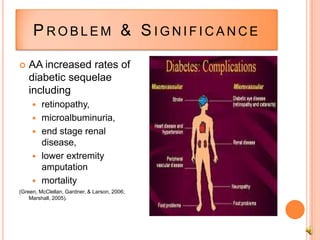
   AA increased rates of
    diabetic sequelae
    including
     ď‚—   retinopathy,
     ď‚—   microalbuminuria,
     ď‚—   end stage renal
         disease,
     ď‚—   lower extremity
         amputation
     ď‚—   mortality
(Green, McClellan, Gardner, & Larson, 2006;
    Marshall, 2005).
PROBLEM & SIGNIFICANCE

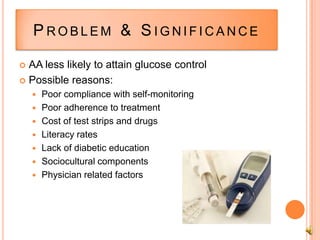
 AA less likely to attain glucose control
 Possible reasons:
    ď‚—   Poor compliance with self-monitoring
    ď‚—   Poor adherence to treatment
    ď‚—   Cost of test strips and drugs
    ď‚—   Literacy rates
    ď‚—   Lack of diabetic education
    ď‚—   Sociocultural components
    ď‚—   Physician related factors
PROBLEM & SIGNIFICANCE

   Patients who are able to control their diabetes, (Green,
    McClellan, Gardner, & Larson, 2006; Austin & Claiborne, 2011):

     ď‚— Often have friends or family with diabetes
     ď‚— Seek out information about the disease
     ď‚— Evidence-based self-management strategies
     ď‚— Accurate perceptions of their own diabetes control
      Experience “turning point” events
PROBLEM & SIGNIFICANCE

   Further focus needed on:

    ď‚—   Preventing and controlling diabetes in this population

    ď‚—   Alternative interventions to traditional primary care
         Peer support and education
         Community Empowerment Theory
N U R S I N G T H E O RY: C O M M U N I T Y
            EMPOWERMENT
   Developed by Eugenie Hildebrandt and Cynthia
    Armstrong Persily (Persily & Hildebrandt, 2008)

   Middle range nursing theory
    ď‚—   Built off both empowerment and the community
        development theories


   Creates a community involvement approach
    ď‚—   Members of the community take responsibility for
        increasing their knowledge and decision-making
        abilities.
N U R S I N G T H E O RY: C O M M U N I T Y
             EMPOWERMENT
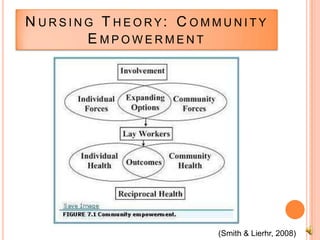
 Three main concepts:
  Involvement
  Lay Workers
  Reciprocal Health
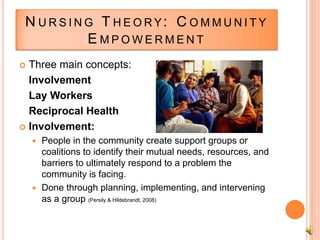
 Involvement:
    ď‚—   People in the community create support groups or
        coalitions to identify their mutual needs, resources, and
        barriers to ultimately respond to a problem the
        community is facing.
    ď‚—   Done through planning, implementing, and intervening
        as a group (Persily & Hildebrandt, 2008)
N U R S I N G T H E O RY: C O M M U N I T Y
            EMPOWERMENT
   Lay Workers (Persily & Hildebrandt, 2008):
     ď‚— Trained persons indigenous to the community to which
       they live in and work in.
     ď‚— Reach out to families in the community
     ď‚— Know community cultural values firsthand
     ď‚— Encourage preventative services, healthy behaviors,
       and assist with access to social services
N U R S I N G T H E O RY: C O M M U N I T Y
                EMPOWERMENT
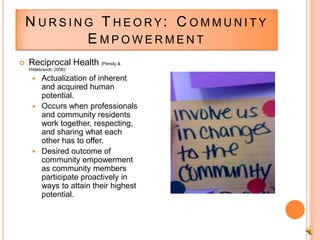
   Reciprocal Health (Persily &
    Hildebrandt, 2008):

     ď‚— Actualization of inherent
       and acquired human
       potential.
     ď‚— Occurs when professionals
       and community residents
       work together, respecting,
       and sharing what each
       other has to offer.
     ď‚— Desired outcome of
       community empowerment
       as community members
       participate proactively in
       ways to attain their highest
       potential.
N U R S I N G T H E O RY: C O M M U N I T Y
            EMPOWERMENT


                                  (Smith & Lierhr, 2008)
E VA L U AT I O N : S I G N I F I C A N C E

   Clearly addresses the metaparadigm concepts of the
    person, the environment, health, and nursing
    goals/processes.
   Person: members of the community (these are the
    individuals who will receive the care/intervention)
   Environment: community itself as well as the
    community's social constructs, the neighborhood, and
    the economy of the community
   Health: issues identified by the community as important
    to address
   Nursing goals/processes: empowerment of members
    of the community (lay persons and other community
    members) in order to promote changes that will address
    the needs and issues identified by the community
E VA L U AT I O N : S I G N I F I C A N C E

   The metaparadigm propositions addressed include:
    ď‚— life processes
    ď‚— patterns of human-environment interaction
    ď‚— processes that affect health
    ď‚— interaction between health and environment

   Philosophical basis: the foundation of this theory is
    that through empowerment change is possible.
E VA L U AT I O N : S I G N I F I C A N C E
   Derived from a merging of the empowerment theory and the community
    development theory.
   Posits that individuals and groups "grow through community participant
    interaction and achievement of identified goals."
   Guided by models that advocate for supporting individuals and
    communities to develop while working together on commonly identified
    problems.
   Empowerment involves developing problem-solving capacity and
    competence that allows individuals and communities to gain mastery
    over their lives.
    ď‚—   Critical in primary health care
    ď‚—   Part of the nurse-individual dyad
    ď‚—   Vital for linking health care providers and communities.
   When community development and empowerment are considered
    together, they demonstrate the "potential for empowerment of community
    people through the involvement of lay workers in promoting reciprocal
    health” (Persily & Hildebrant, 2008).
   It does not appear that the theory acknowledges use of adjunct or
    antecedent theories.
E VA L U AT I O N :
        CONSISTENCY & CLARITY


   Congruency between context and content
    ď‚— Context: includes both change through empowerment
      and that change must come from within (oneself or the
      community).
    ď‚— Content: includes identification of problems by the
      community and education of lay persons (members of
      the community) who will then educate others in the
      community, thus empowering them to change.
    ď‚— The content is semantically clear and consistent.
E VA L U AT I O N : A D E Q U A C Y

   The theory assertions appear to be fairly well
    supported by empirical evidence.

   The theory itself was developed based on the
    experiences and observations of the two theorists
    and has been applied by them in their research.
E VA L U AT I O N : F E A S I B I L I T Y
   Pragmatic adequacy:
    ď‚—   Special training and skills may be required
   Implementing the theory primarily be limited by the motivation of
    the community
    ď‚—   Cost may or may not be a factor
   Legally, the nurse will likely be practicing within her scope of
    practice when providing health education to the lay persons and
    measuring its effectiveness within the community.
    ď‚—   Education and empowerment and key components of nursing practice,
        The theory is organized in such a way that, should one want to,
   Comparisons could be made between a community in which this
    theory was applied and a community in which the theory was not
    used
   Outcomes to be measured would depend upon the problems
    identified by the community
    ď‚—   Measurement of such outcomes should accurately indicate the
        effectiveness of the theory.
RATIONALE FOR THEORY SELECTION

   Significant disparities exist between AA and whites with
    regards to diabetes management and the rates of
    associated morbidity and mortality,
   AA face several barriers: including poor access to care,
    limited resources for physical activity due to residential
    barriers, and interference of care due to other life events
    or stressors (Samuel-Hodge, et al., 2000).
   Can address barriers by:
     ď‚— Bringing the care to the patient through lay-educators,
     ď‚— Altering the care so that it is appropriate and reasonable for
       the patient’s lifestyle and culture.
   For diabetes management to be effective, it must be
    approached with an understanding of the population’s
    social, cultural, and familial influence (Chesla, et al., 2004; Samuel-
    Hodge, et al., 2000; Two Feathers, et al., 2005)
POSSIBLE SOLUTION
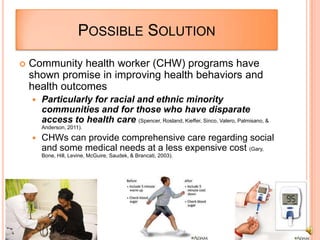
   Community health worker (CHW) programs have
    shown promise in improving health behaviors and
    health outcomes
    ď‚—   Particularly for racial and ethnic minority
        communities and for those who have disparate
        access to health care (Spencer, Rosland, Kieffer, Sinco, Valero, Palmisano, &
        Anderson, 2011).

    ď‚—   CHWs can provide comprehensive care regarding social
        and some medical needs at a less expensive cost (Gary,
        Bone, Hill, Levine, McGuire, Saudek, & Brancati, 2003).
POSSIBLE SOLUTION

 CHWs use their ethnic,
cultural, or geographic
backgrounds to promote
health within their own
communities.
    ď‚—   They are a bridge for those with disparities to accessible
        healthcare
       Become part of the patient’s support system
    ď‚—   Can also provide resources, transportation, and
        coordinate case management.
EXAMPLE OF THEORY IN USE

   In Heisler, Spencer, Forman, et al. (2009), participants
    felt CHWs gave them “clear and specific strategies on
    managing diabetes care, nonjudgmental assistance to
    increase confidence in maintaining diabetic care, and
    social and peer support”.

   CHW programs that provide both one-on-one support
    and group self-management training sessions may be
    effective in promoting more effective diabetes care and
    patient–doctor relationships among African-American
    adults with diabetes than without CHW support (Heisler,
    Spencer, Forman, et al., 2009).
POTENTIAL PROBLEMS WITH
                        IMPLEMENTING
   Most studies on community health workers have
    not used a randomized controlled trial design.

   Studies have small samples in a localized
    neighborhood and therefore have threats to
    external validity.

   Potential problems may arise with training and
    retaining community health workers when
    implementing programs (Hill-Briggs, Batts-
    Turner, Gary, Brancati, Hill, Levine, Bone, 2007).
REFERENCES

Austin, S. A., Claiborne, N. (2011). Faith wellness collaboration: A community-based approach to
    address type II diabetes disparities in an African-American community. Social Work Health
    Care, 50(5), 360-375.
Chesla, C. A., Fisher, L., Mullan, J. T., Skaff, M. M., Gardiner, P., Chun, K., & Kanter, R. (2004).
    Family and disease management in African-American patients with type 2 diabetes. Diabetes
    Care, 27: 2850-2855.
Fawcett, J. (2005). Criteria for evaluation of theory. Nursing Science Quarterly, 18(2), 131-135.
Gary, T. L., Bone, L. R., Hill, M. N., Levine, D. M., McGuire, M. Saudek, C., and Brancati, F. L.
    (2003). Randomized controlled trial of the effects of nurse case manager and community health
    worker interventions on risk factors for diabetes related complications in urban African
    Americans., 37 (1), 23–32.
Greene, C., McClellan, L., Gardner, T., & Larson, C. O. (2006). Diabetes management among low-
    income African Americans: A description of a pilot strategy for empowerment. Journal of
    Ambulatory Care Management, 29(2), 162-166.
Heisler, M., Spencer, M., Forman, J., Robinson, C., Shultz, G., Graddy Dansby, G., Kieffer, E.
    (2009). Participants' assessments of the effects of a community health worker Intervention on
    their diabetes self-management and interactions with healthcare providers. American Journal of
    Preventive Medicine, 37(6, 1), S270-S279.
Hill-Briggs, F. Batts-Turner, M., Gary, T. L., Brancati, F. L., Hill, M. N., Levine, D. M., Bone, L. R.
    (2007). Training community health workers as diabetes educators for urban African Americans:
    Value added using participatory methods. Progress in Community Health Partnerships:
    Research, Education, and Action, 1(2), 185-194.
REFERENCES

Madden, M. H., Tomsik, P., Tercheck, J., Navracruz, L., Reichsman, A., Clarck, T. C., & Werner, J.
   J. (2011). Keys to successful diabetes self-management for uninsured patients: Social support,
   observational learning, and turning points. Journal of the National Medical Association, 103(3),
   257-264.
Marshall, M. C. (2005). Diabetes in African Americans. Postgraduate Medical Journal, 81(962),
   734-740.
Persily, C. A. & Hildebrant, E. (2008). Theory of community empowerment. In Smith, M. J. & Lierhr,
   P. R. Middle Range Theories for Nursing (2nd Eds.). New York, NY: Springer Publishing
   Company.
Samuel-Hodge, C. D., Headen, S. W., Skelly, A. H., Ingram, A. F., Keyserling, T. C., Jackson, E. J.,
   & Elasy, T. A. (2000). Influences on day-to-day self-management of type 2 diabetes among
   African American women. Diabetes Care, 23: 928-933.
Shacter, H. E., Shea, J. A., Achabue, E., Sablani, N., & Long, J. A. (2009). A qualitative evaluation
   of racial disparities in glucose control. Ethnic Disparities, 19(2), 121-127.
Spencer, M. S., Rosland, A. Kieffer, E. C., Sinco, B. R., Valero, M., & Palmisano, G., Anderson, M.,
   Guzman, R., & Heisler, M. (2011). Effectiveness of a community health worker intervention
   among African American and Latino adults with type 2 diabetes: A randomized controlled trial.
   American Journal of Public Health, e1-e8.
Two Feathers, J., Kieffer, E.C., Palmisano, G., Anderson, M., Sinco, B., Janz, N., & James, S. A.
   (2005). Racial and ethnic approaches to community health (REACH) Detroit partnership:
   Improving diabetes-related outcomes among African American and Latino adults. The American
   Journal of Public Health, 95(9): 1552-1560.
Community Empowerment Presentation