IMAGE REGISTRATION USING
N-FOLD BLUR REMOVAL
CONTENTS
• Introduction
• Objective
• Existing system
• Proposed system
• Block diagram
• Formulae
• Output
1
INTRODUCTION
• The original method works for unknown blurs,
assuming the blurring point-spread function(PSF)
exhibits an N-fold rotational symmetry.
• This makes registration algorithm well-suited in
applications where blurred image registration must be
used as a preprocess step.
• This leads to an improvement of the image registration
performance.
2
OBJECTIVE
• To improve the performance of image registration and
reduce the error occurrence, we implement the N-fold
blur removal.
3
EXISTING SYSTEM
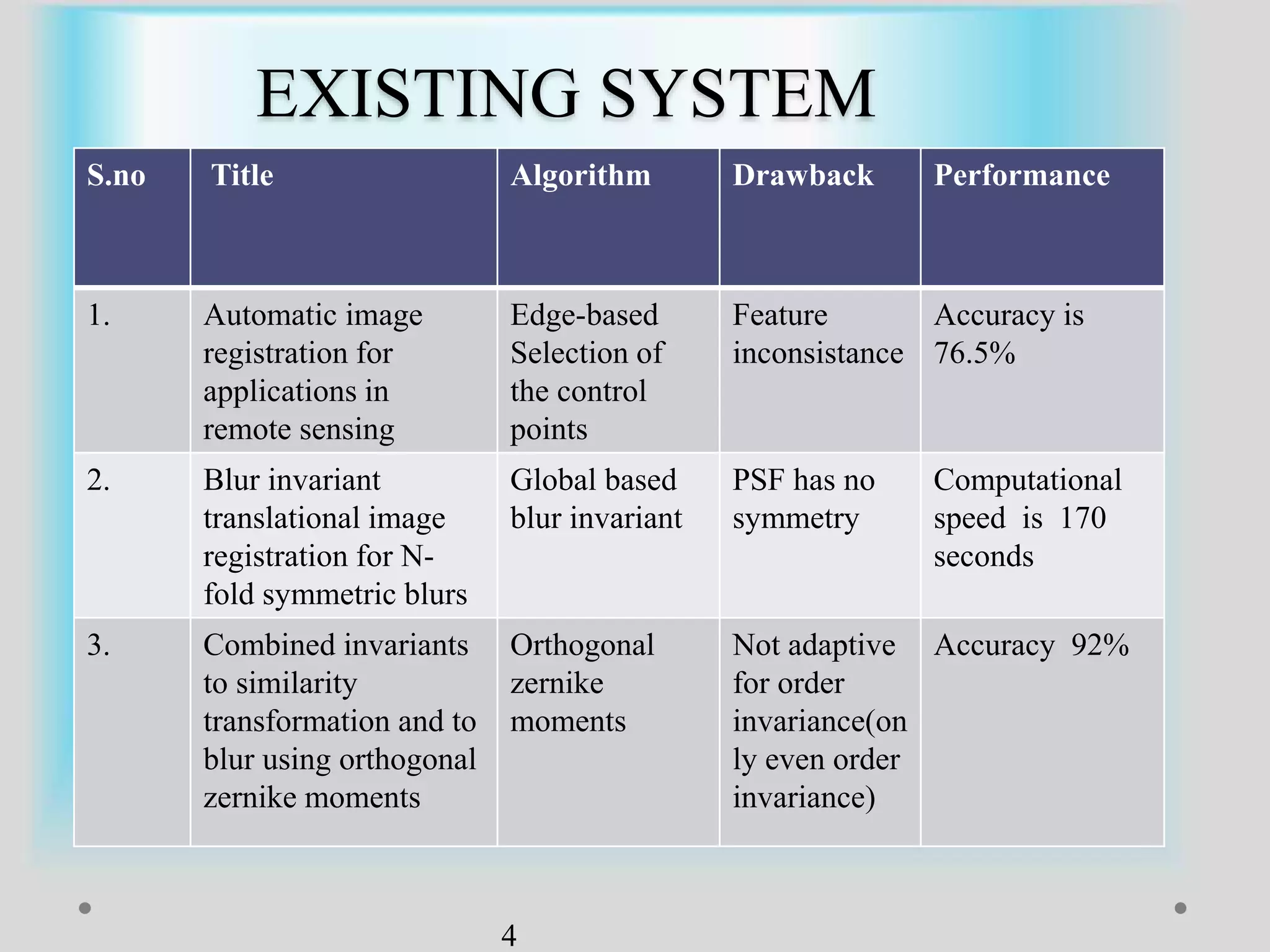
S.no Title Algorithm Drawback Performance
1. Automatic image
registration for
applications in
remote sensing
Edge-based
Selection of
the control
points
Feature
inconsistance
Accuracy is
76.5%
2. Blur invariant
translational image
registration for N-
fold symmetric blurs
Global based
blur invariant
PSF has no
symmetry
Computational
speed is 170
seconds
3. Combined invariants
to similarity
transformation and to
blur using orthogonal
zernike moments
Orthogonal
zernike
moments
Not adaptive
for order
invariance(on
ly even order
invariance)
Accuracy 92%
4
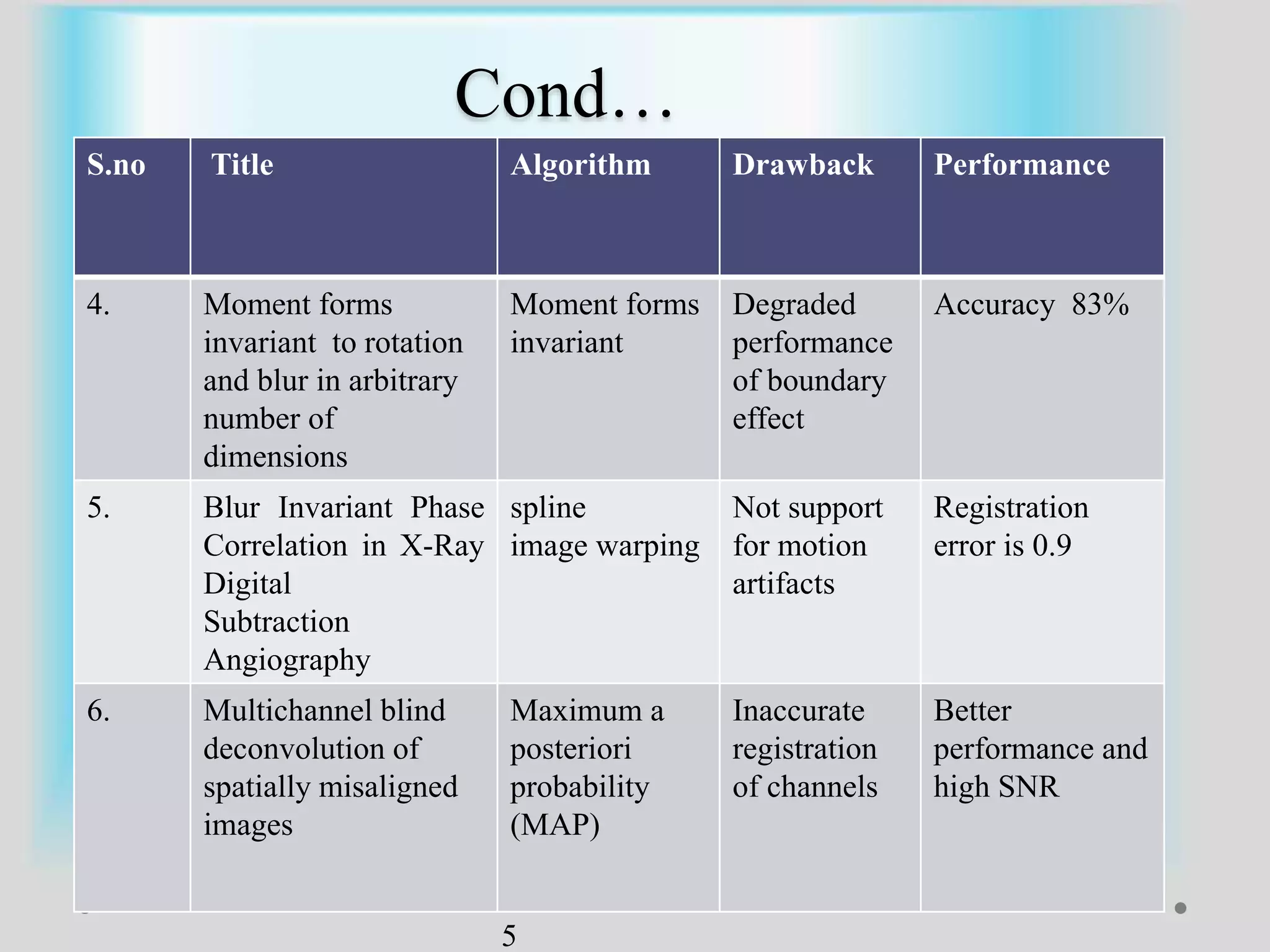
Cond…
S.no Title Algorithm Drawback Performance
4. Moment forms
invariant to rotation
and blur in arbitrary
number of
dimensions
Moment forms
invariant
Degraded
performance
of boundary
effect
Accuracy 83%
5. Blur Invariant Phase
Correlation in X-Ray
Digital
Subtraction
Angiography
spline
image warping
Not support
for motion
artifacts
Registration
error is 0.9
6. Multichannel blind
deconvolution of
spatially misaligned
images
Maximum a
posteriori
probability
(MAP)
Inaccurate
registration
of channels
Better
performance and
high SNR
5
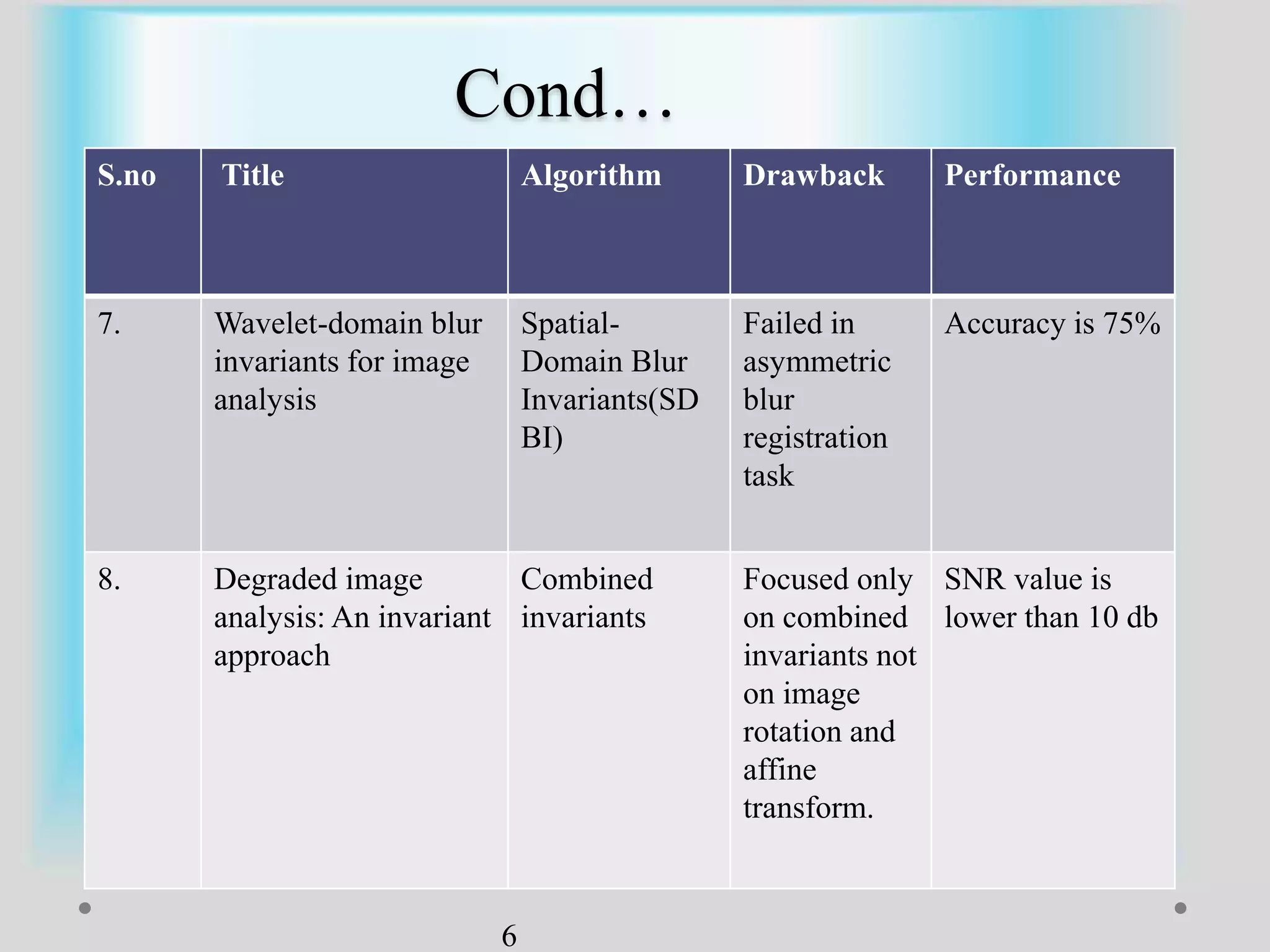
Cond…
S.no Title Algorithm Drawback Performance
7. Wavelet-domain blur
invariants for image
analysis
Spatial-
Domain Blur
Invariants(SD
BI)
Failed in
asymmetric
blur
registration
task
Accuracy is 75%
8. Degraded image
analysis: An invariant
approach
Combined
invariants
Focused only
on combined
invariants not
on image
rotation and
affine
transform.
SNR value is
lower than 10 db
6
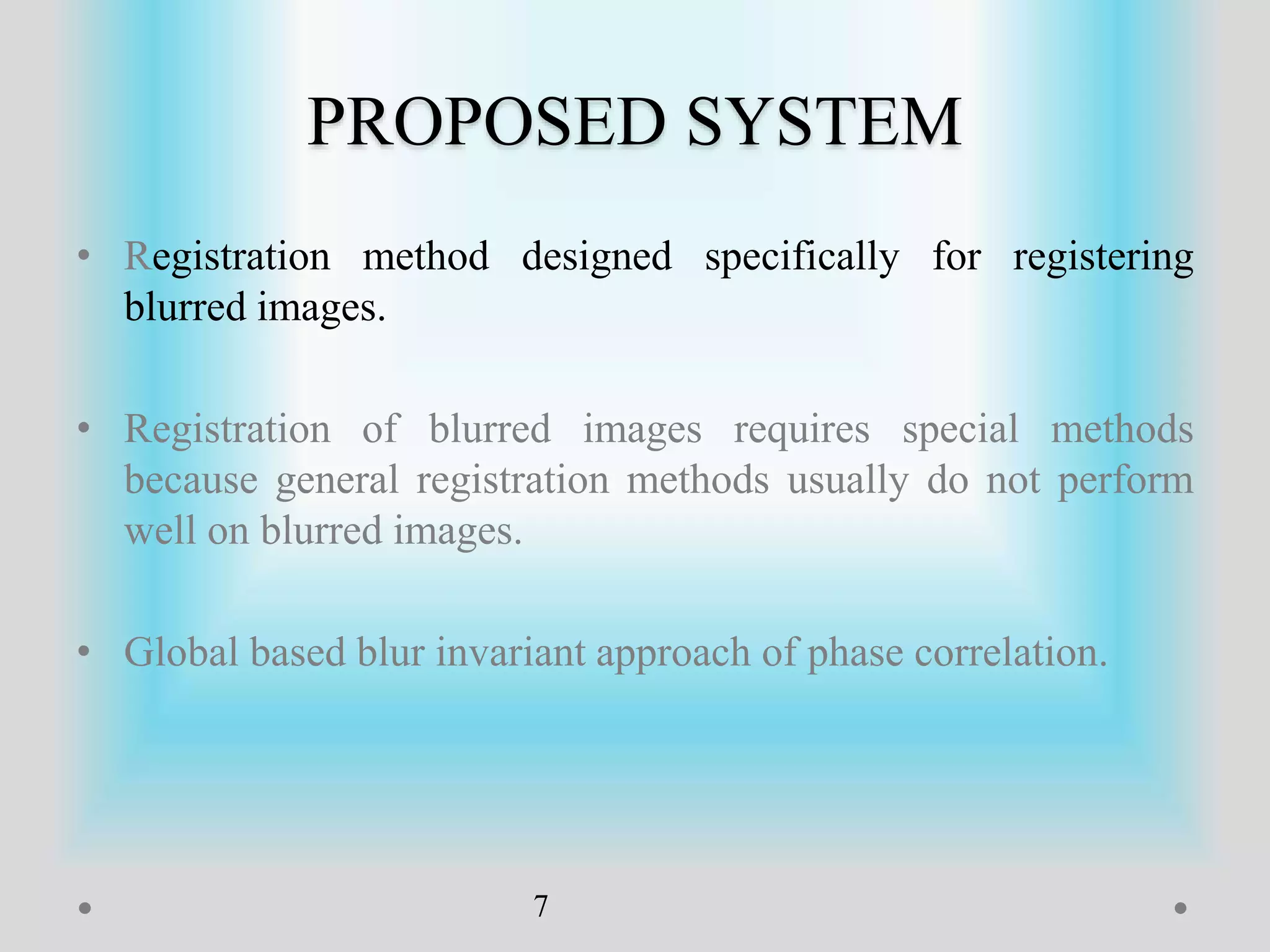
PROPOSED SYSTEM
• Registration method designed specifically for registering
blurred images.
• Registration of blurred images requires special methods
because general registration methods usually do not perform
well on blurred images.
• Global based blur invariant approach of phase correlation.
7
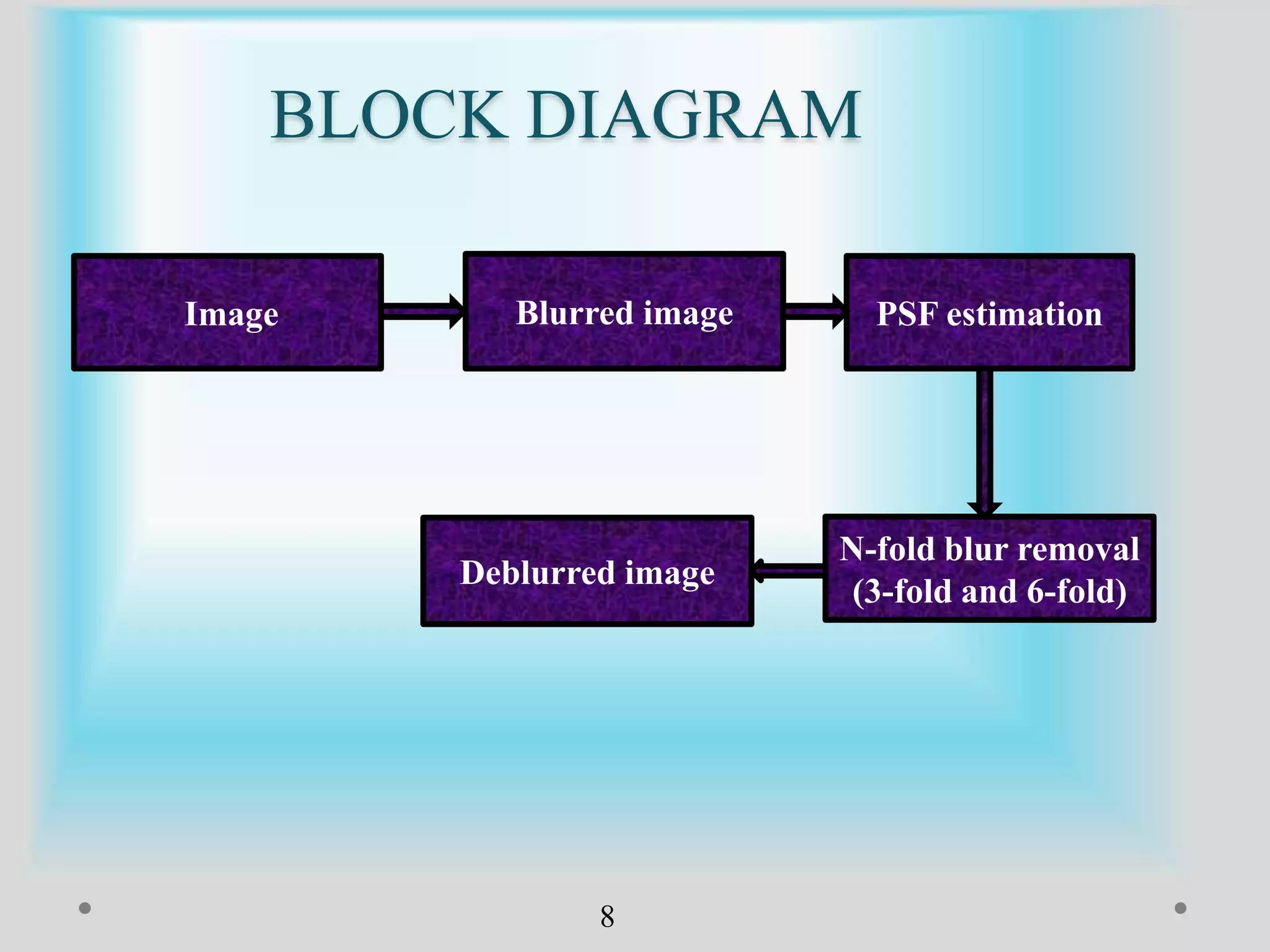
BLOCK DIAGRAM
8
Image Blurred image PSF estimation
N-fold blur removal
(3-fold and 6-fold)
Deblurred image
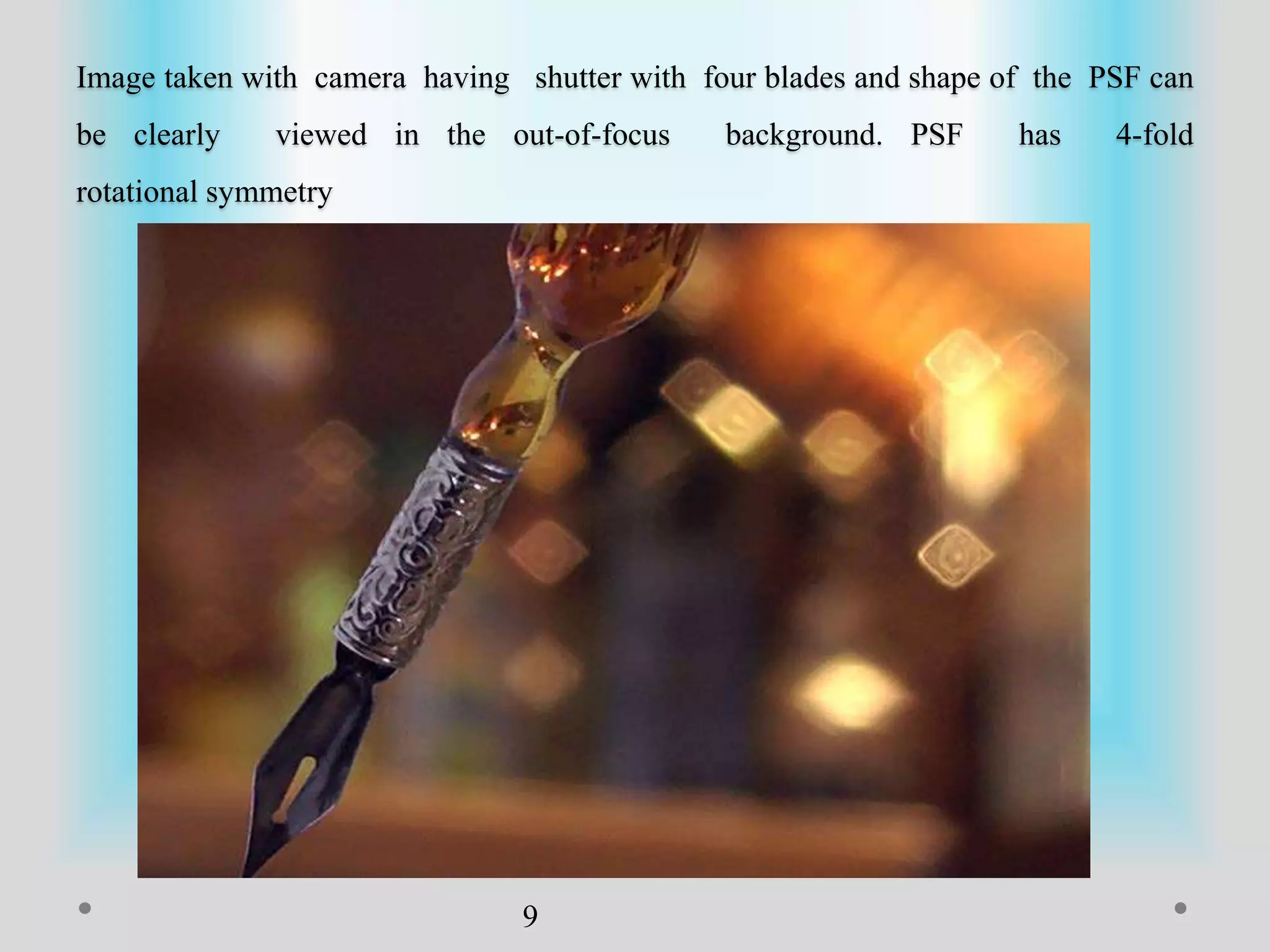
Image taken with camera having shutter with four blades and shape of the PSF can
be clearly viewed in the out-of-focus background. PSF has 4-fold
rotational symmetry
9
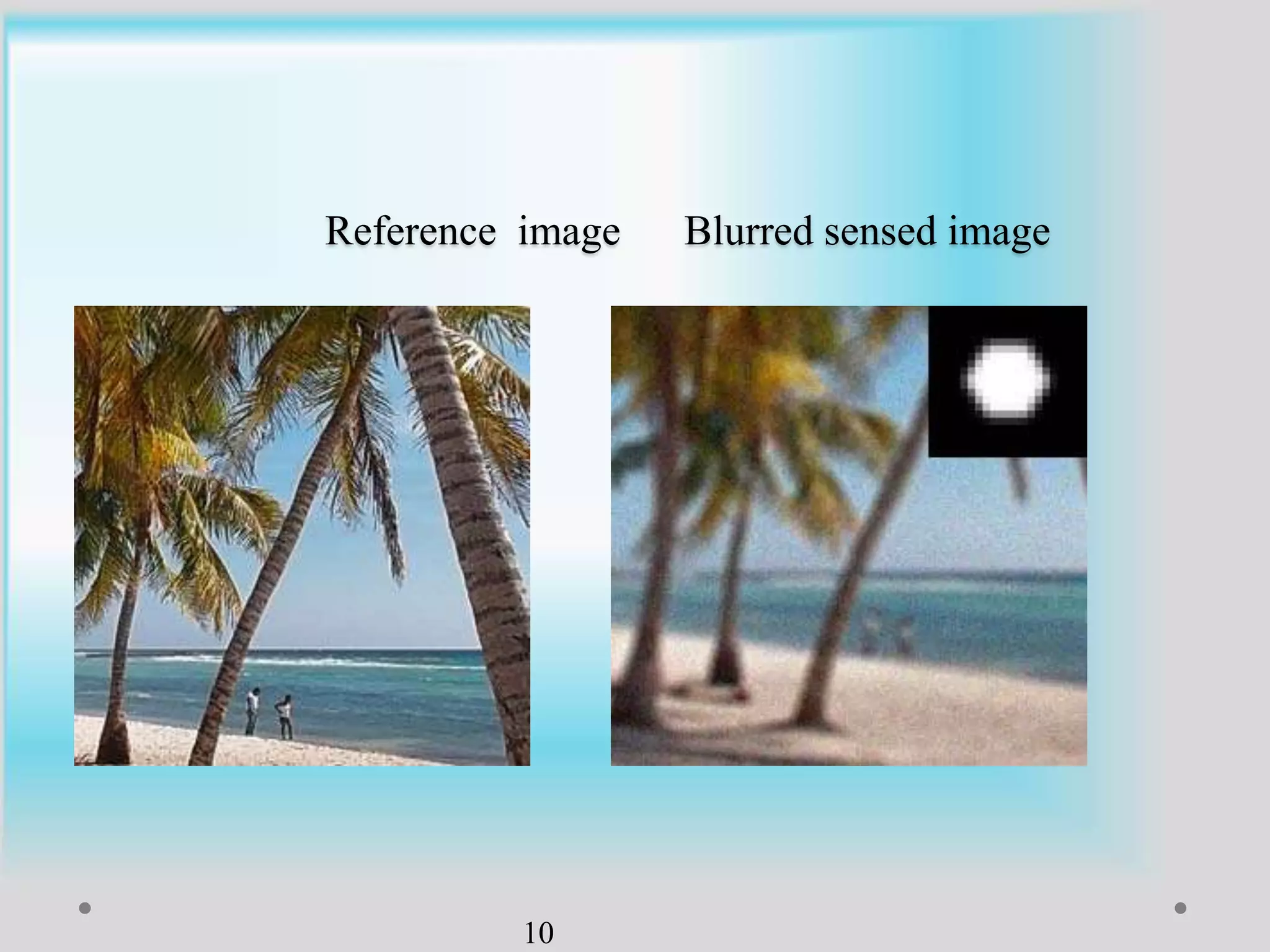
Reference image Blurred sensed image
10
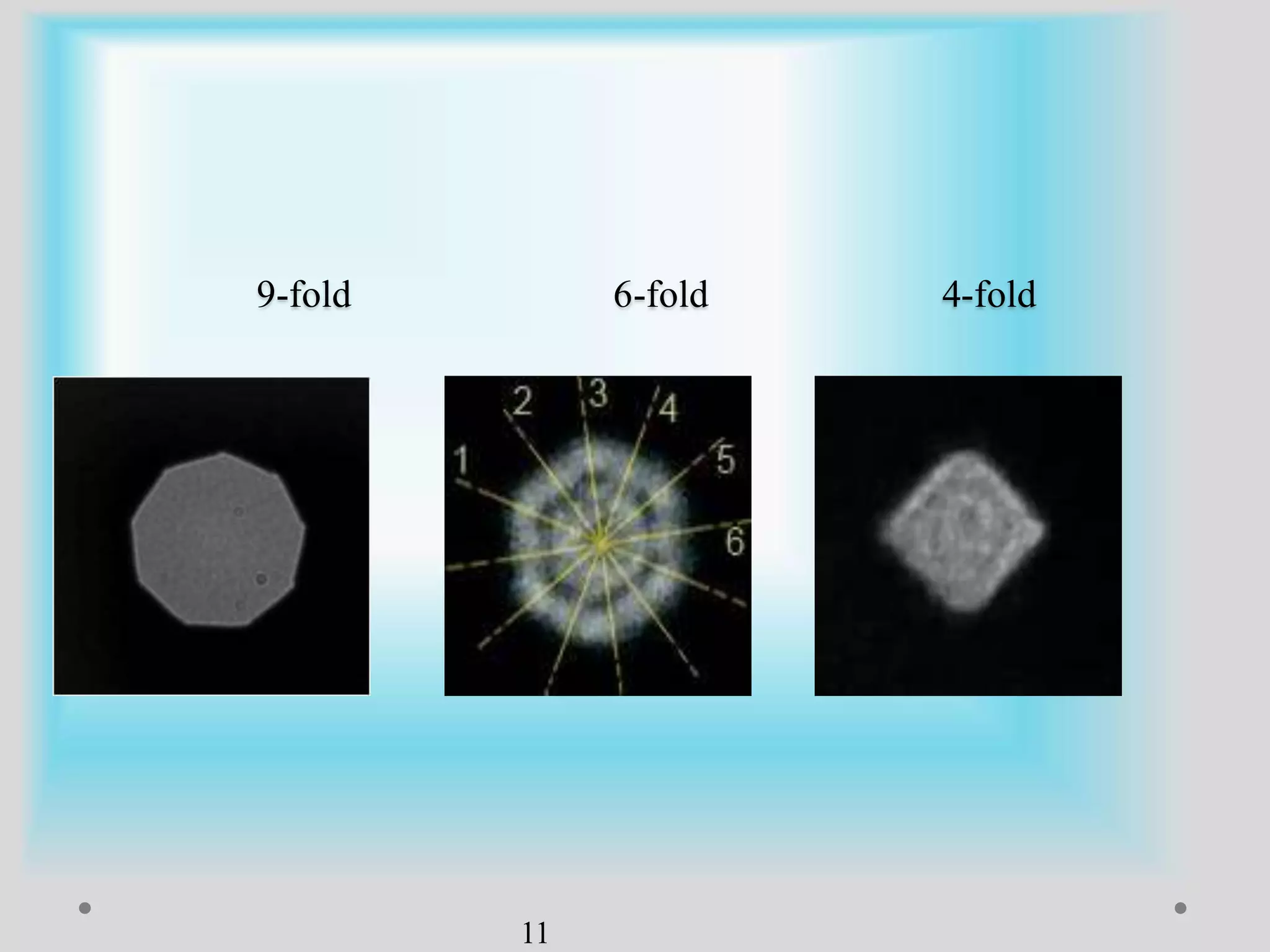
9-fold 6-fold 4-fold
11
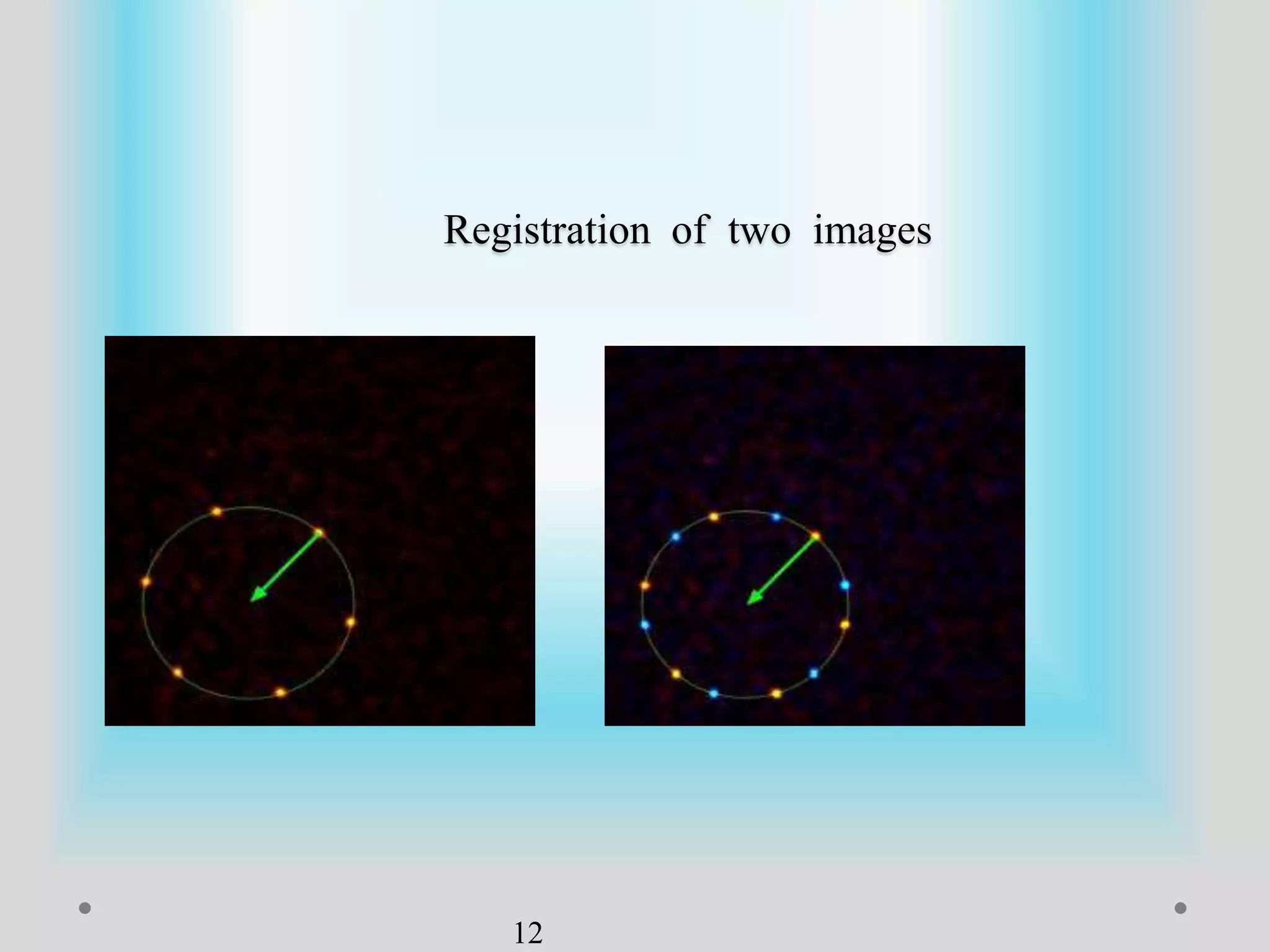
Registration of two images
12
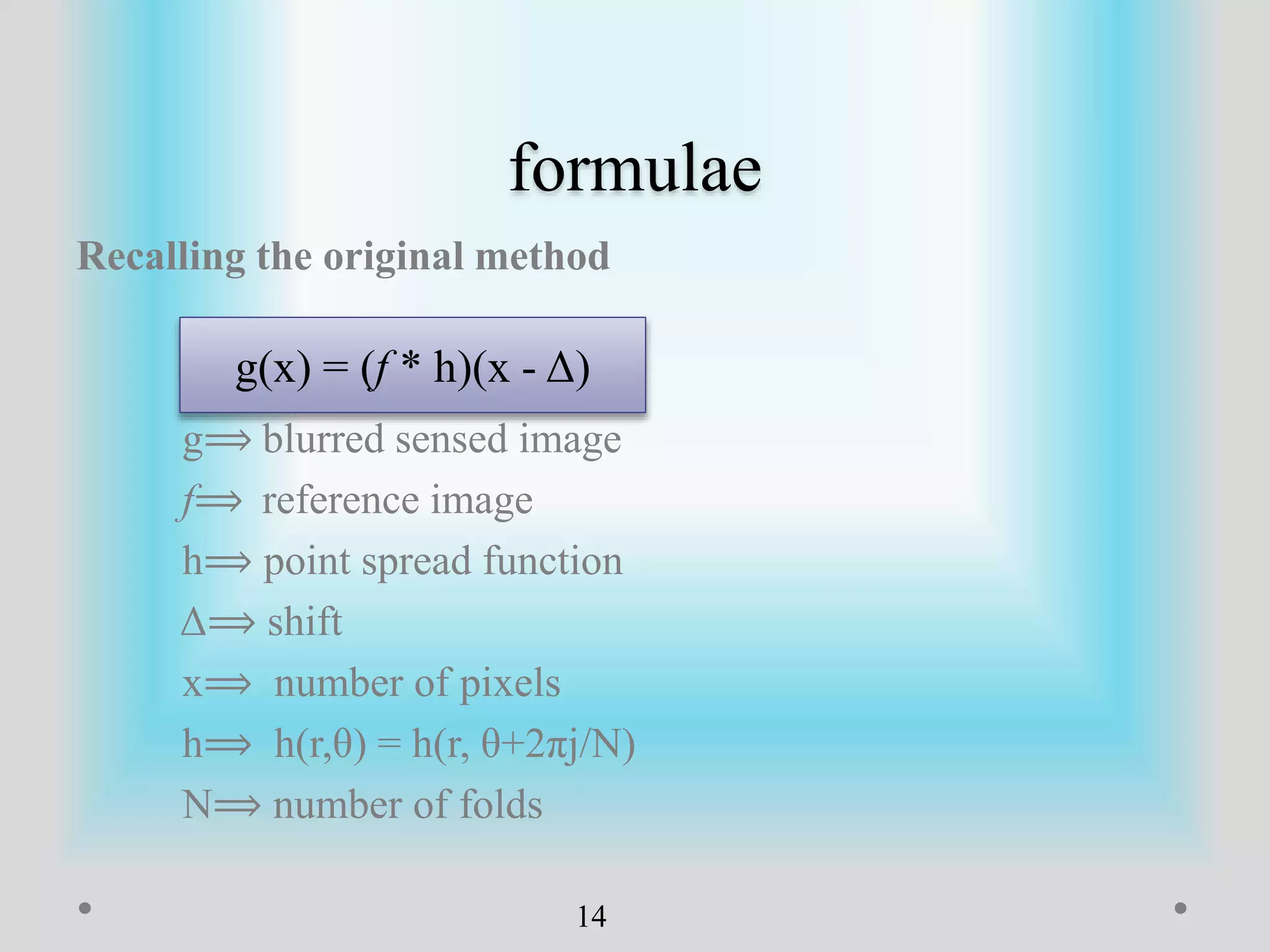
formulae
Recalling the original method
g⟹ blurred sensed image
f⟹ reference image
h⟹ point spread function
Δ⟹ shift
x⟹ number of pixels
h⟹ h(r,θ) = h(r, θ+2πj/N)
N⟹ number of folds
14
g(x) = (f * h)(x - Δ)
Cond…
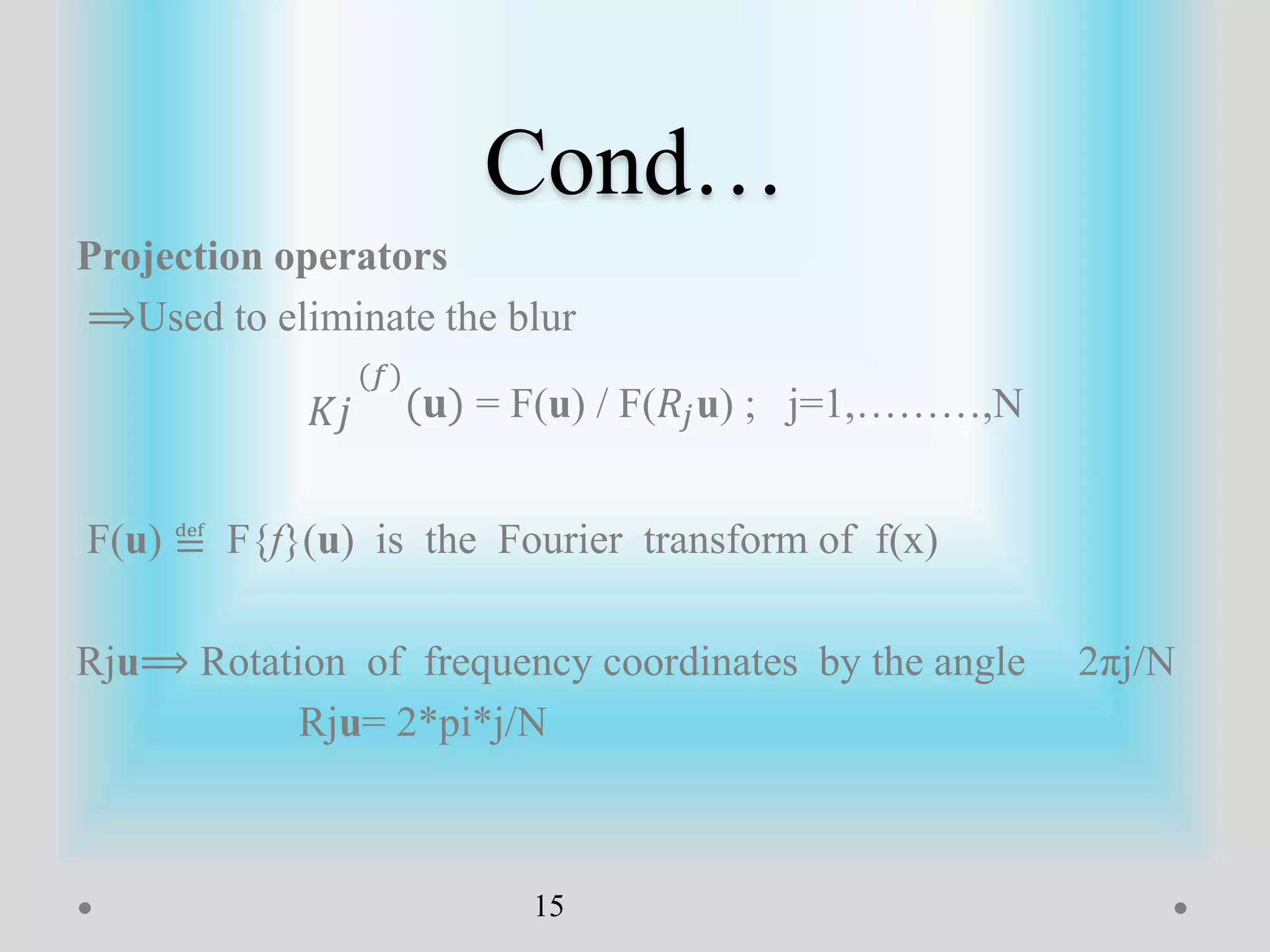
Projection operators
⟹Used to eliminate the blur
𝐾𝑗
(𝑓)
(𝐮) = F(u) / F(𝑅𝑗u) ; j=1,………,N
F(u) ≝ F{f}(u) is the Fourier transform of f(x)
Rju⟹ Rotation of frequency coordinates by the angle 2πj/N
Rju= 2*pi*j/N
15
Cond…
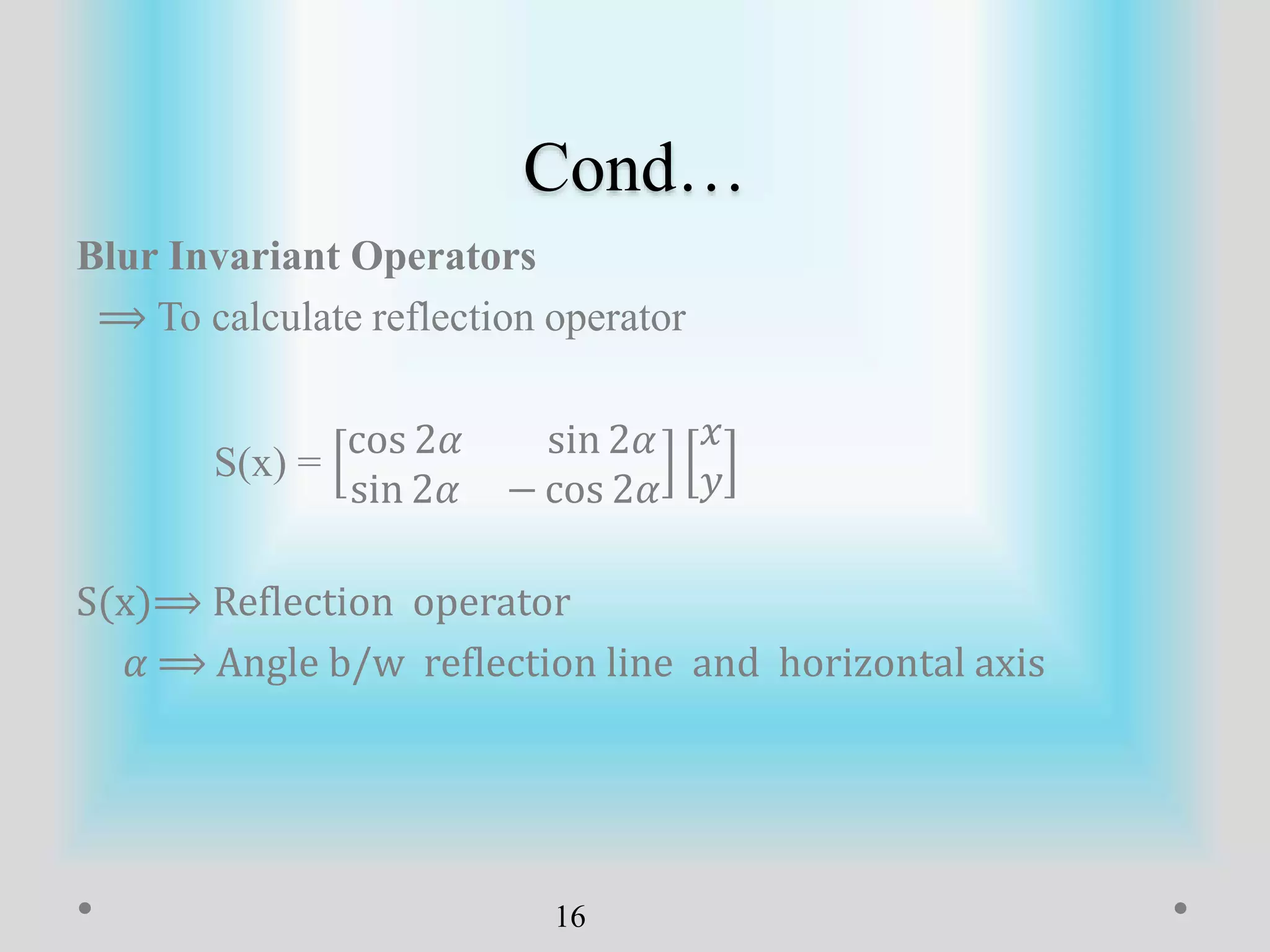
Blur Invariant Operators
⟹ To calculate reflection operator
S(x) =
cos 2𝛼 sin 2𝛼
sin 2𝛼 − cos 2𝛼
𝑥
𝑦
S(x)⟹ Reflection operator
𝛼 ⟹ Angle b/w reflection line and horizontal axis
16
Cond…
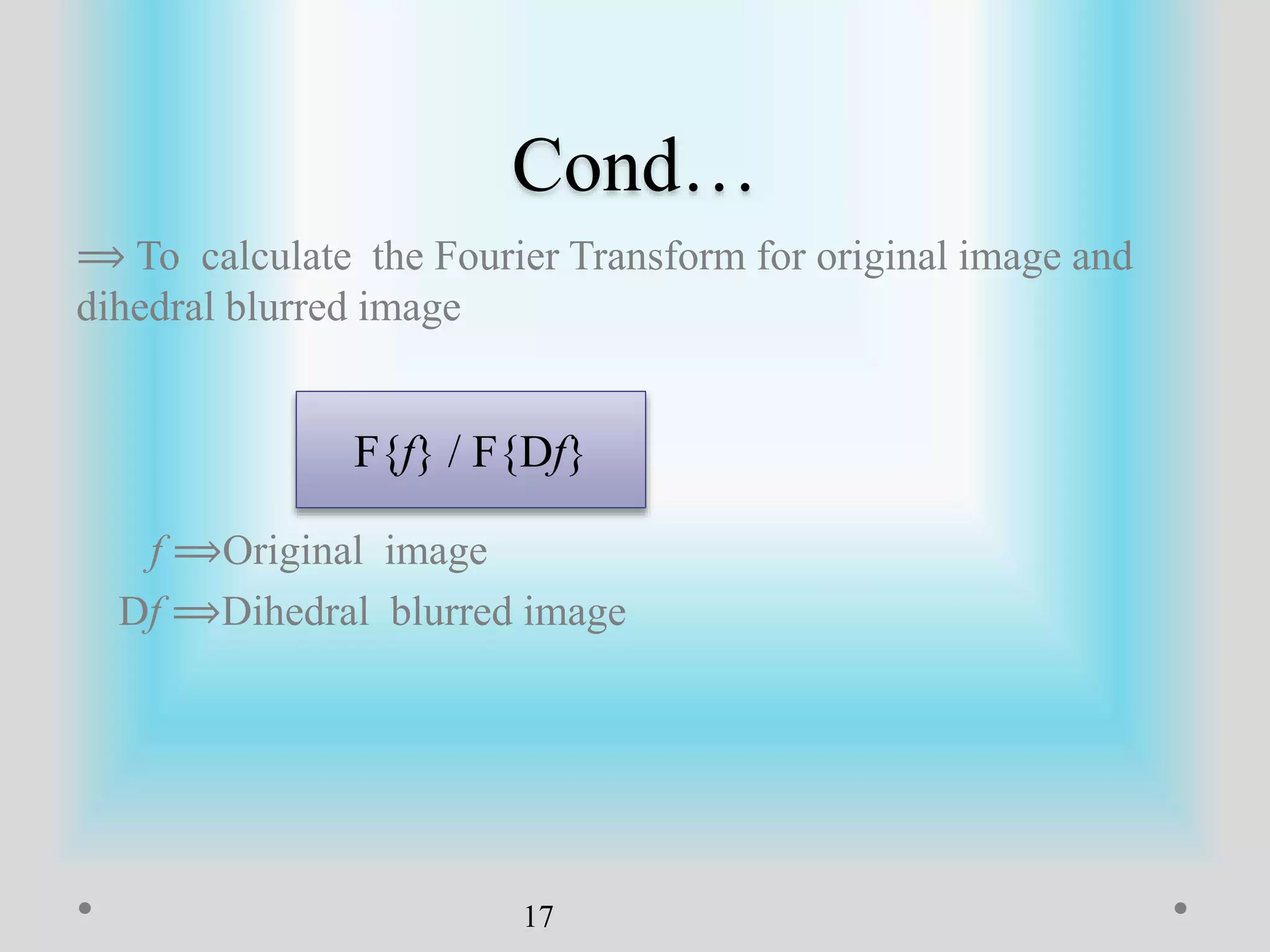
⟹ To calculate the Fourier Transform for original image and
dihedral blurred image
f ⟹Original image
Df ⟹Dihedral blurred image
17
F{f} / F{Df}
Cond…
⟹ To calculate the invariants to dihedral blur
𝐾𝑗 = F{f} / F{𝑅𝑗 𝑓} ; j=1,………,N
F{f} ⟹ Fourier transform of original image
F{𝑅𝑗 𝑓} ⟹ Rotational symmetry(Cyclic groups,Cf)
L𝑗 = F{f} / F{𝑅𝑗S𝑓} ; j=1,………,N
F{𝑅𝑗S𝑓} ⟹ Rotational and Reflectional symmetry (Dihedral
groups, Df)
18
Cond…
Image registration algorithm
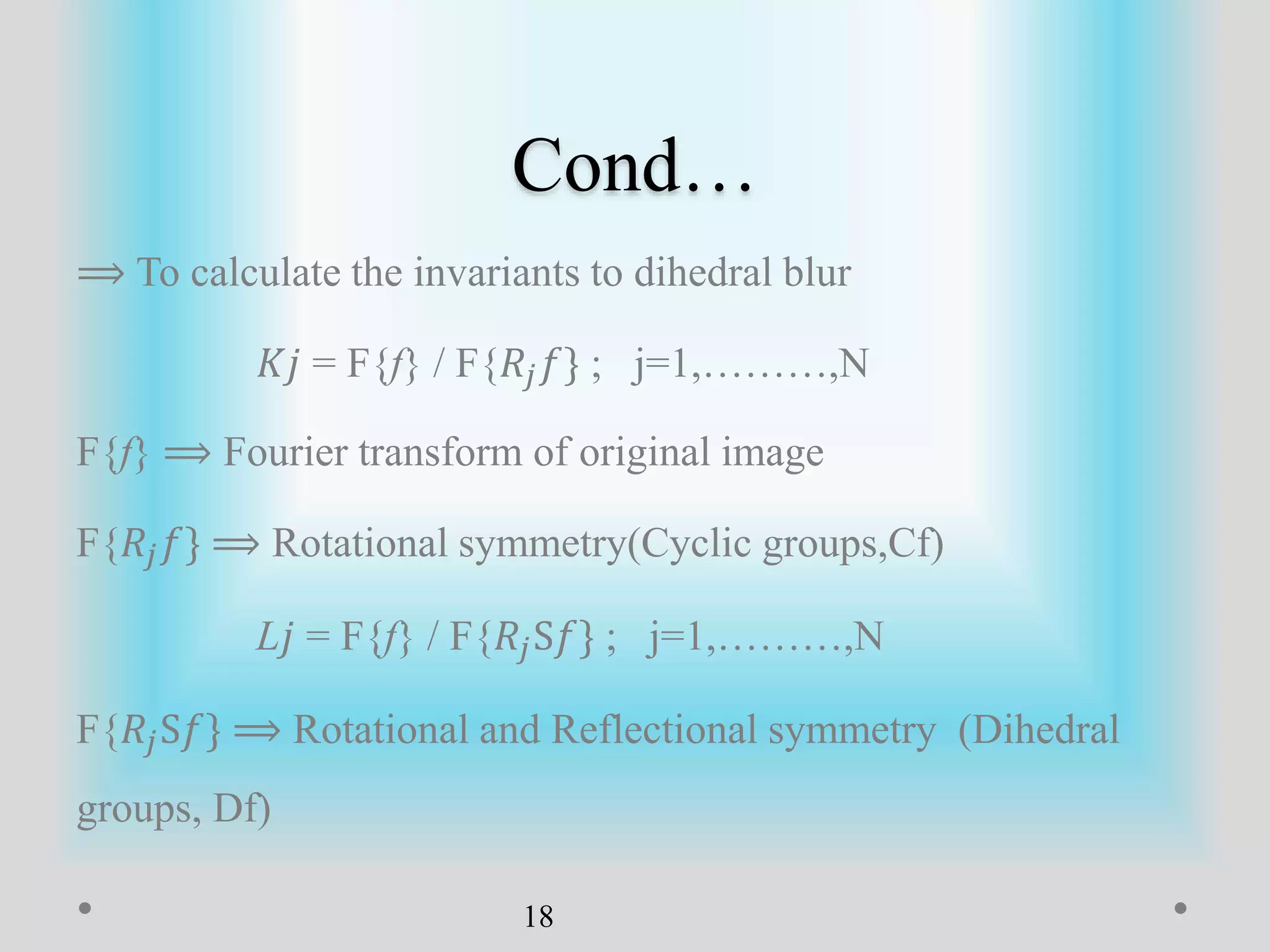
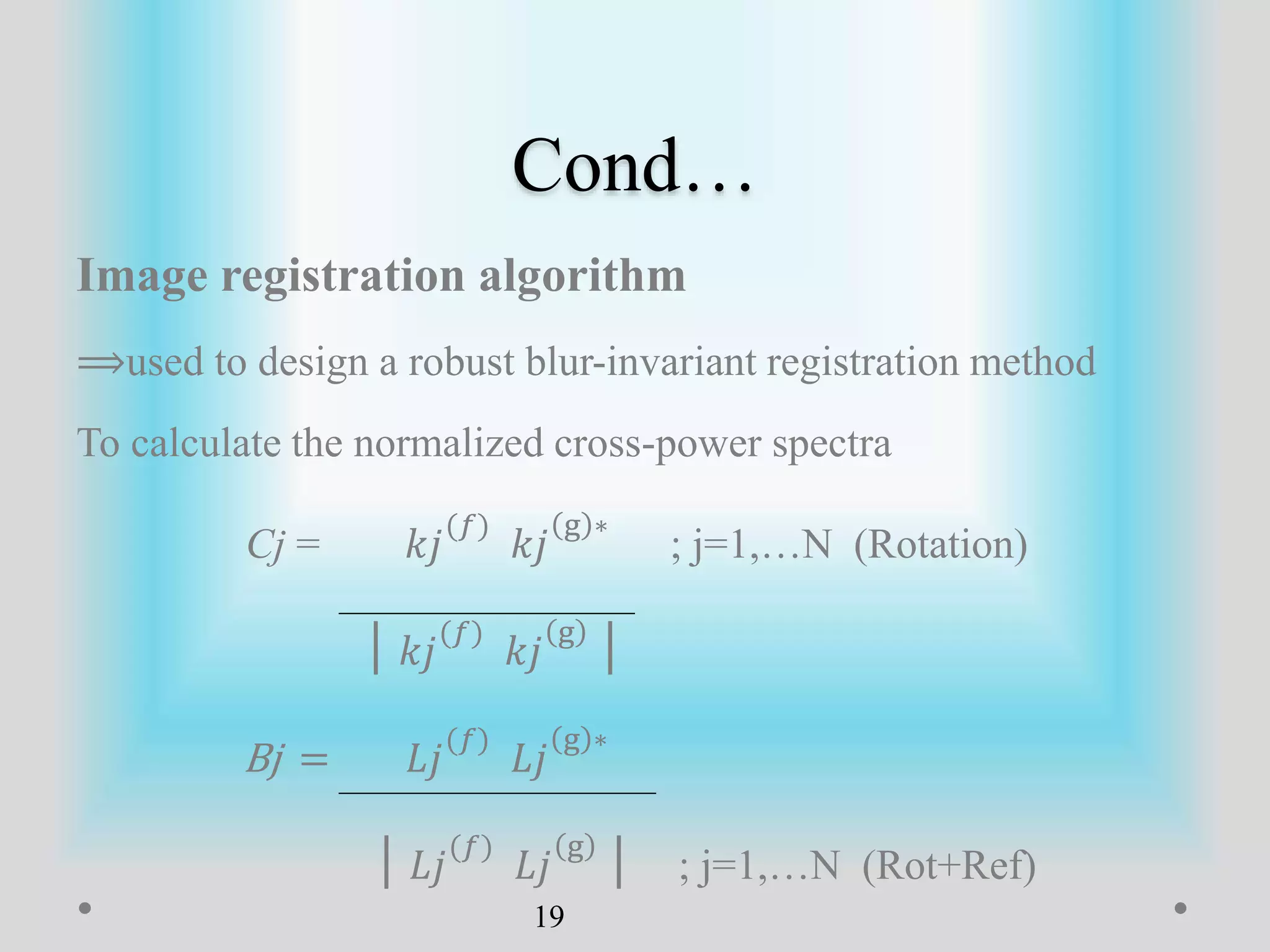
⟹used to design a robust blur-invariant registration method
To calculate the normalized cross-power spectra
Cj = 𝑘𝑗
(𝑓)
𝑘𝑗
g ∗
; j=1,…N (Rotation)
│ 𝑘𝑗
(𝑓)
𝑘𝑗
g
│
Bj = 𝐿𝑗
(𝑓)
𝐿𝑗
g ∗
│ 𝐿𝑗
(𝑓)
𝐿𝑗
g
│ ; j=1,…N (Rot+Ref)
19
Cond…
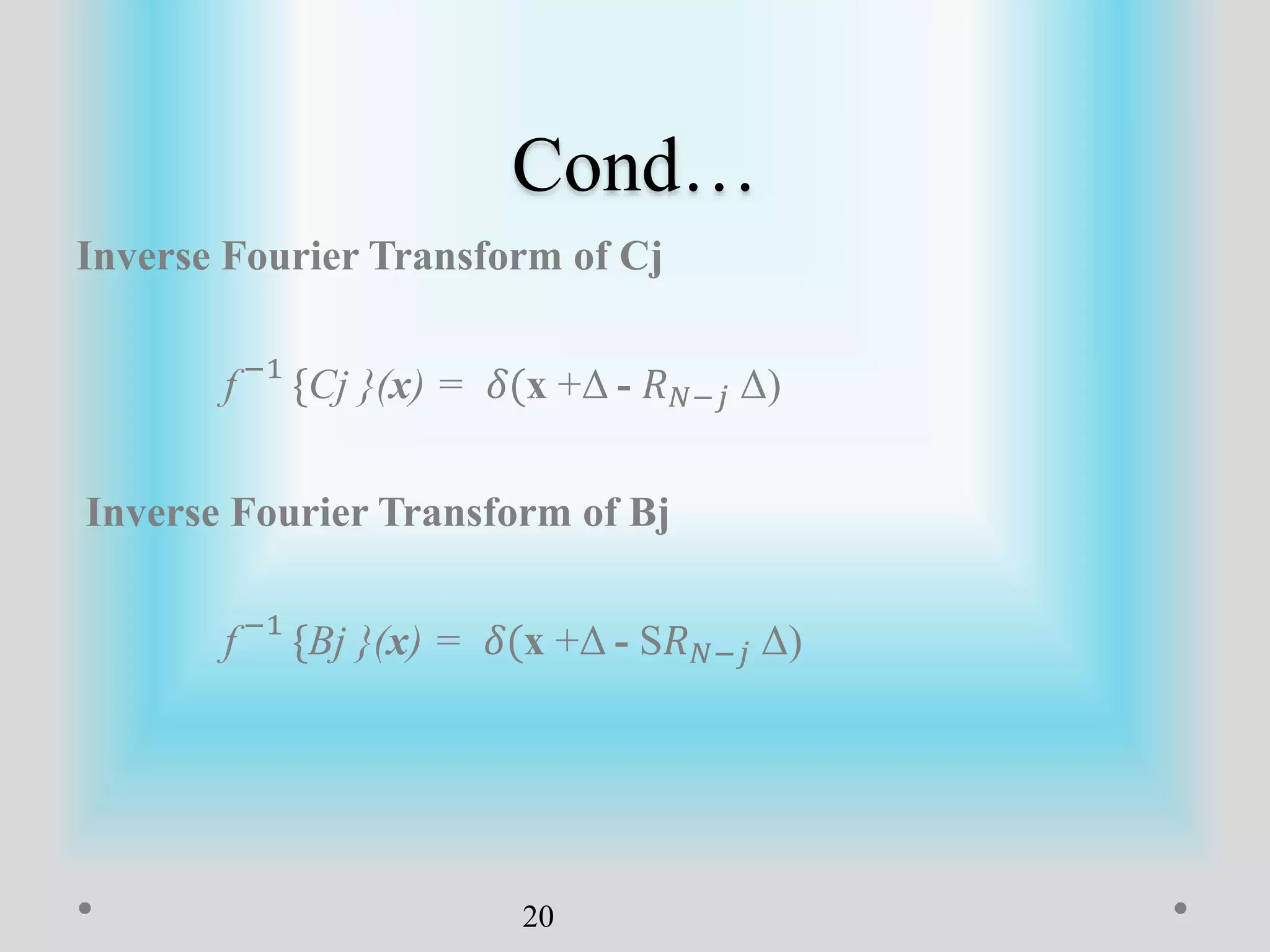
Inverse Fourier Transform of Cj
f −1
{Cj }(x) = 𝛿(x +Δ - 𝑅 𝑁−𝑗 Δ)
Inverse Fourier Transform of Bj
f −1
{Bj }(x) = 𝛿(x +Δ - S𝑅 𝑁−𝑗 Δ)
20
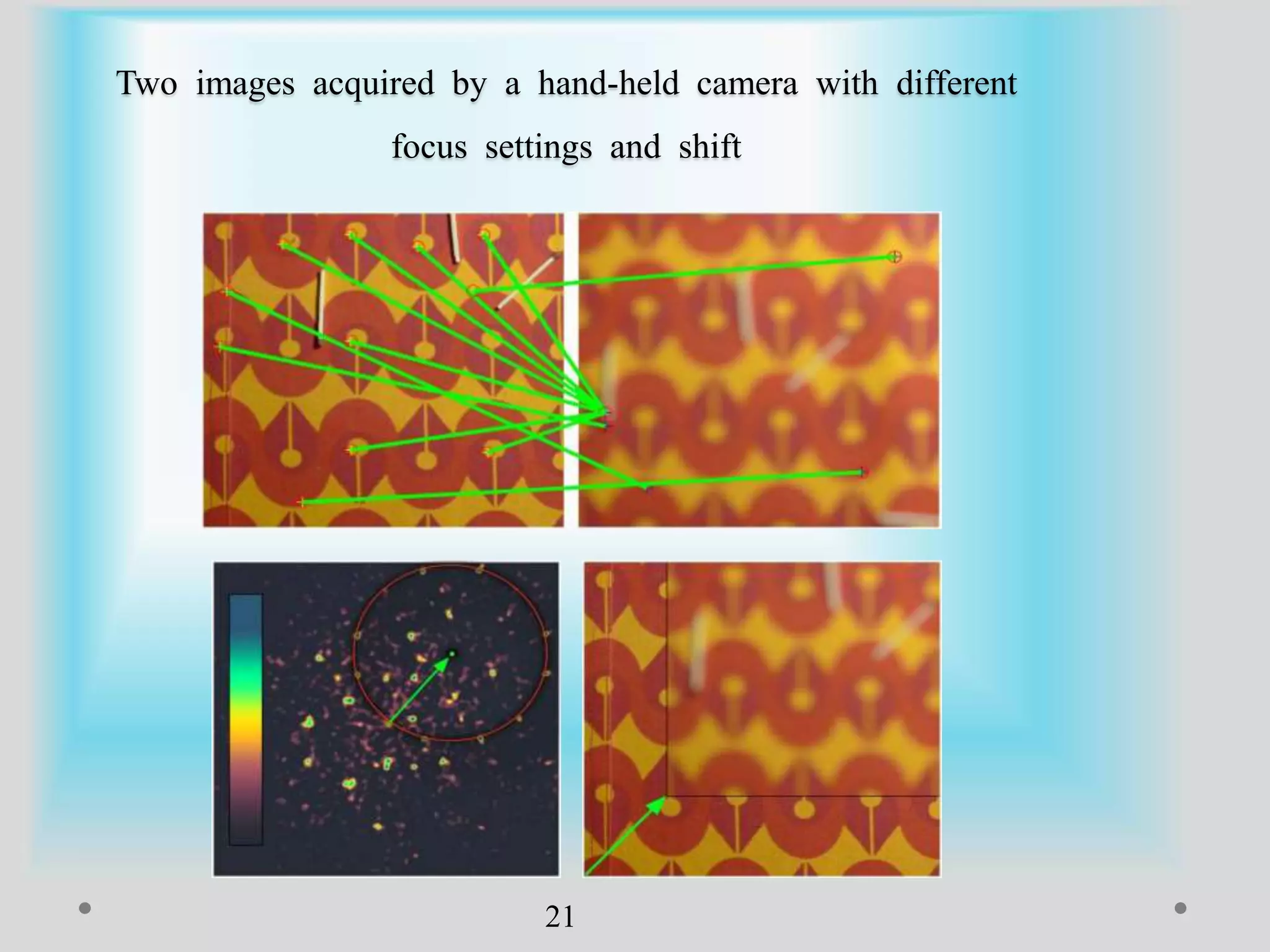
Two images acquired by a hand-held camera with different
focus settings and shift
21
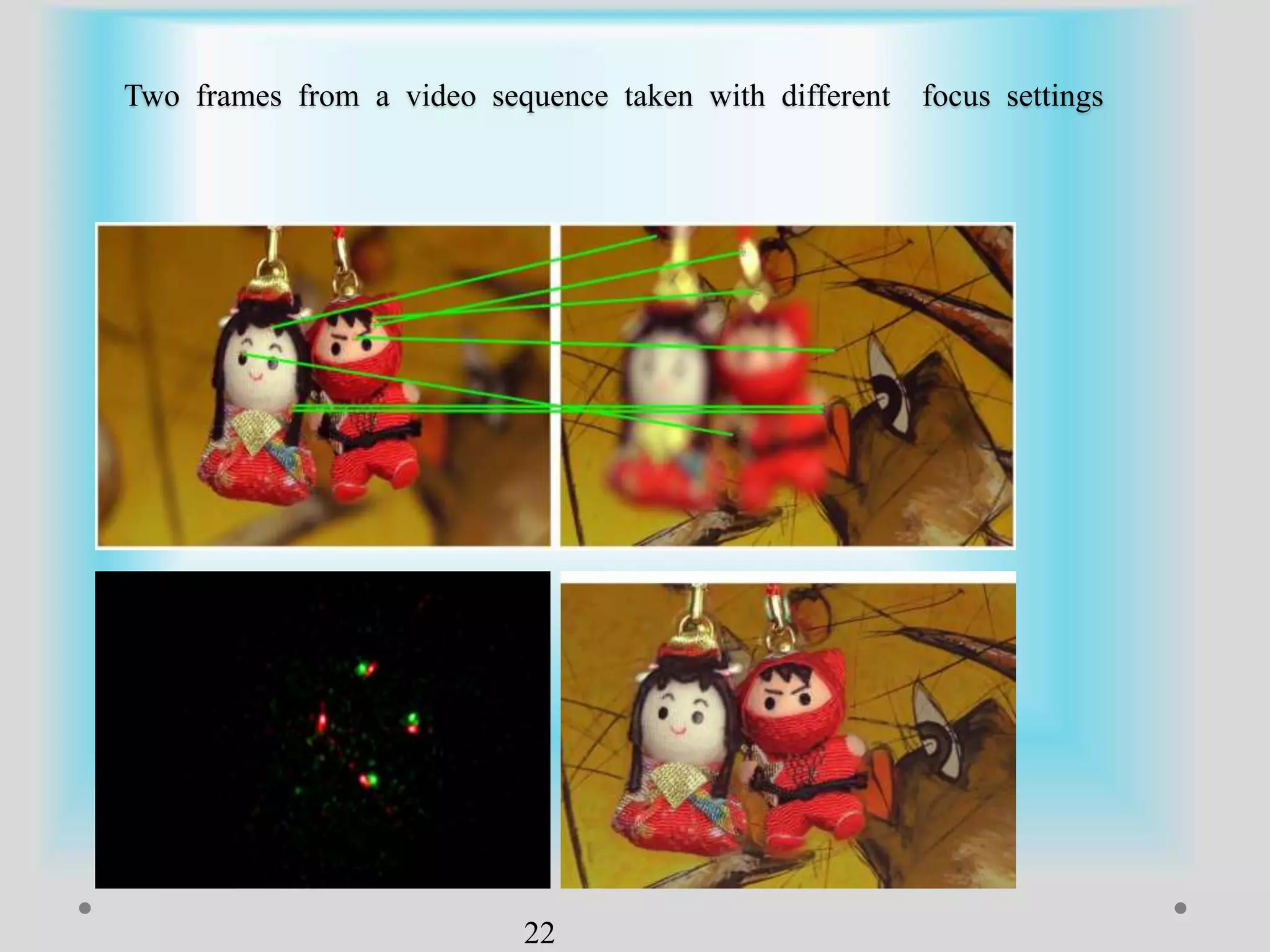
Two frames from a video sequence taken with different focus settings
22
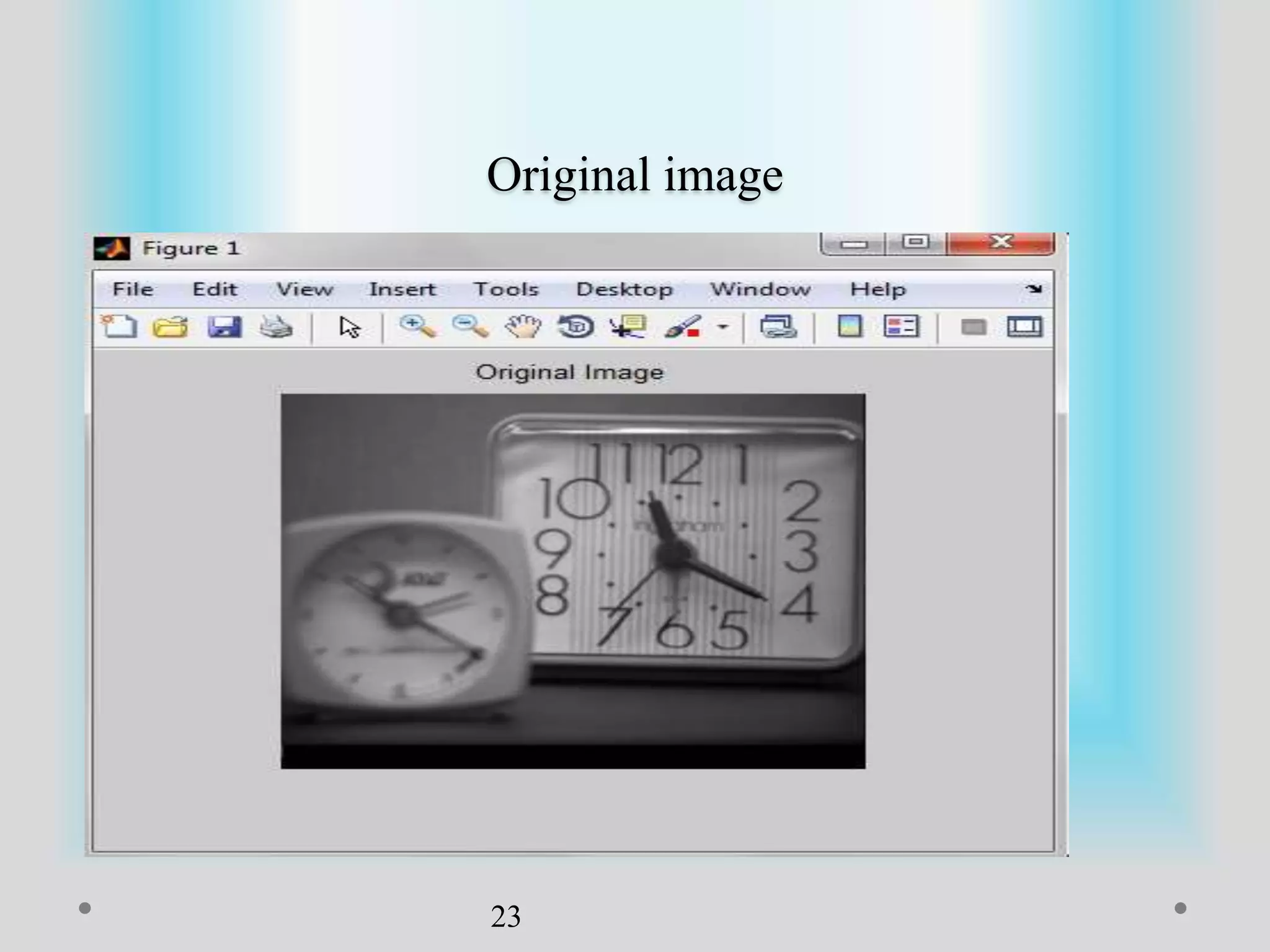
Original image
23
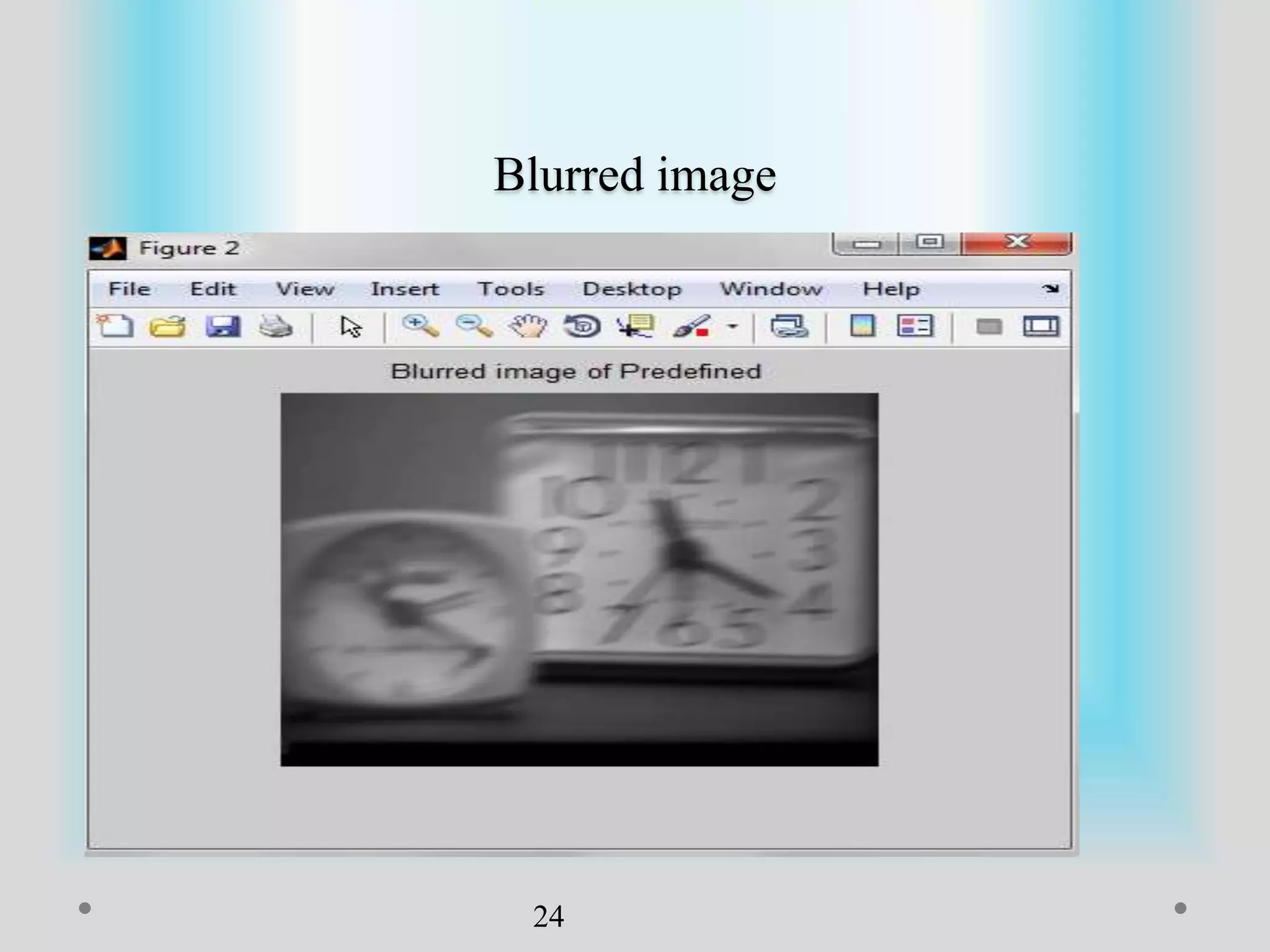
Blurred image
24
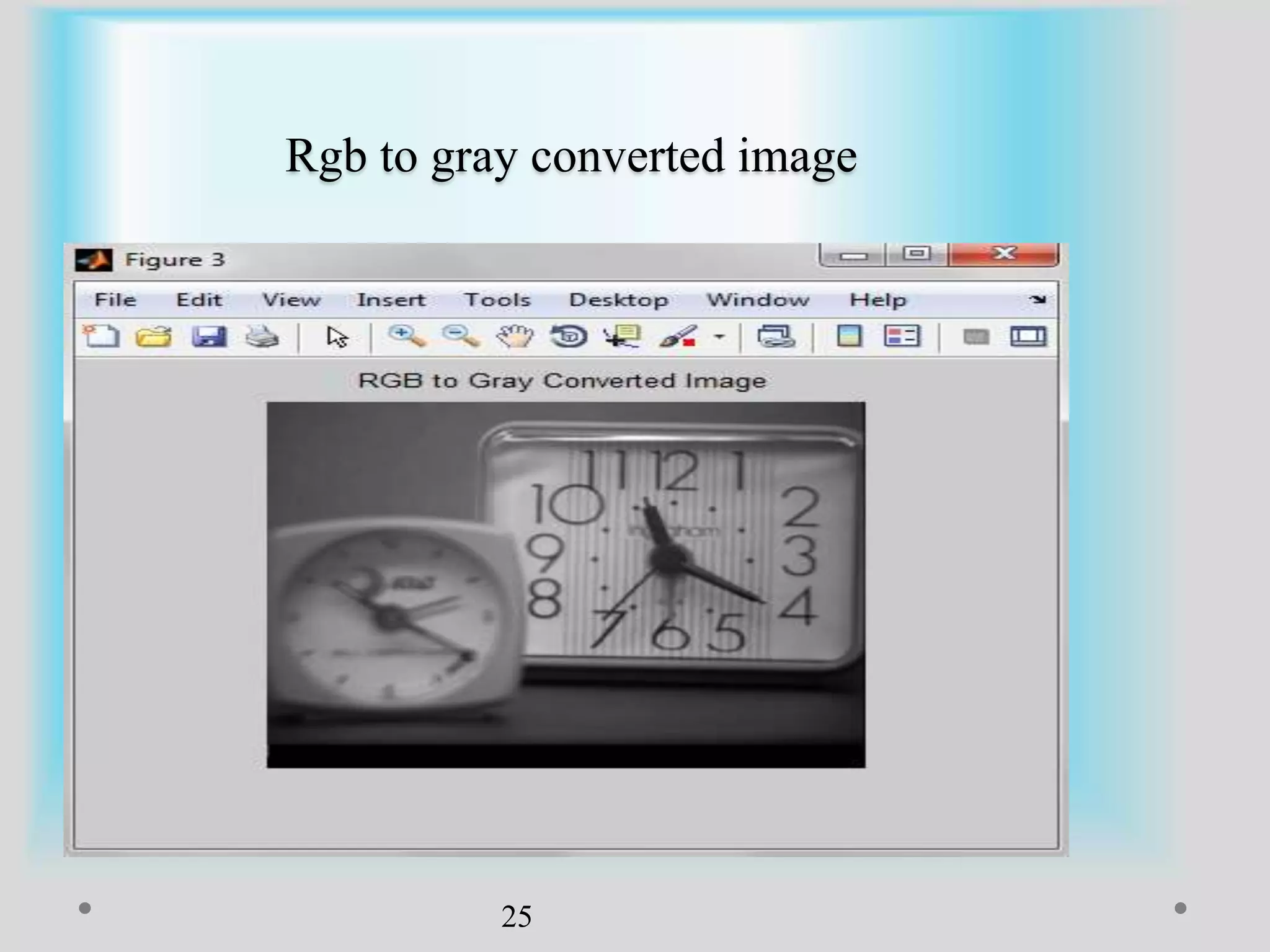
Rgb to gray converted image
25
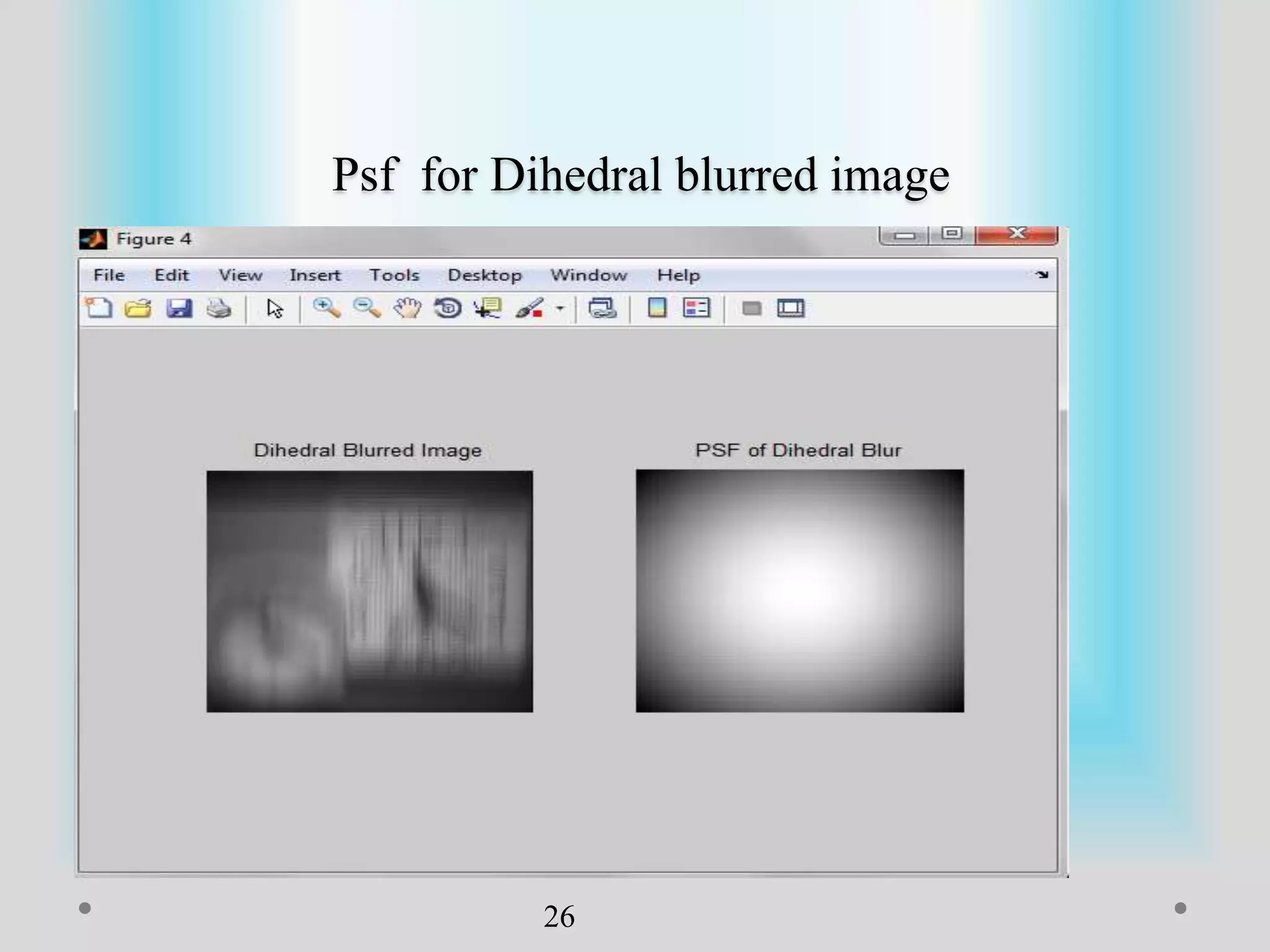
Psf for Dihedral blurred image
26
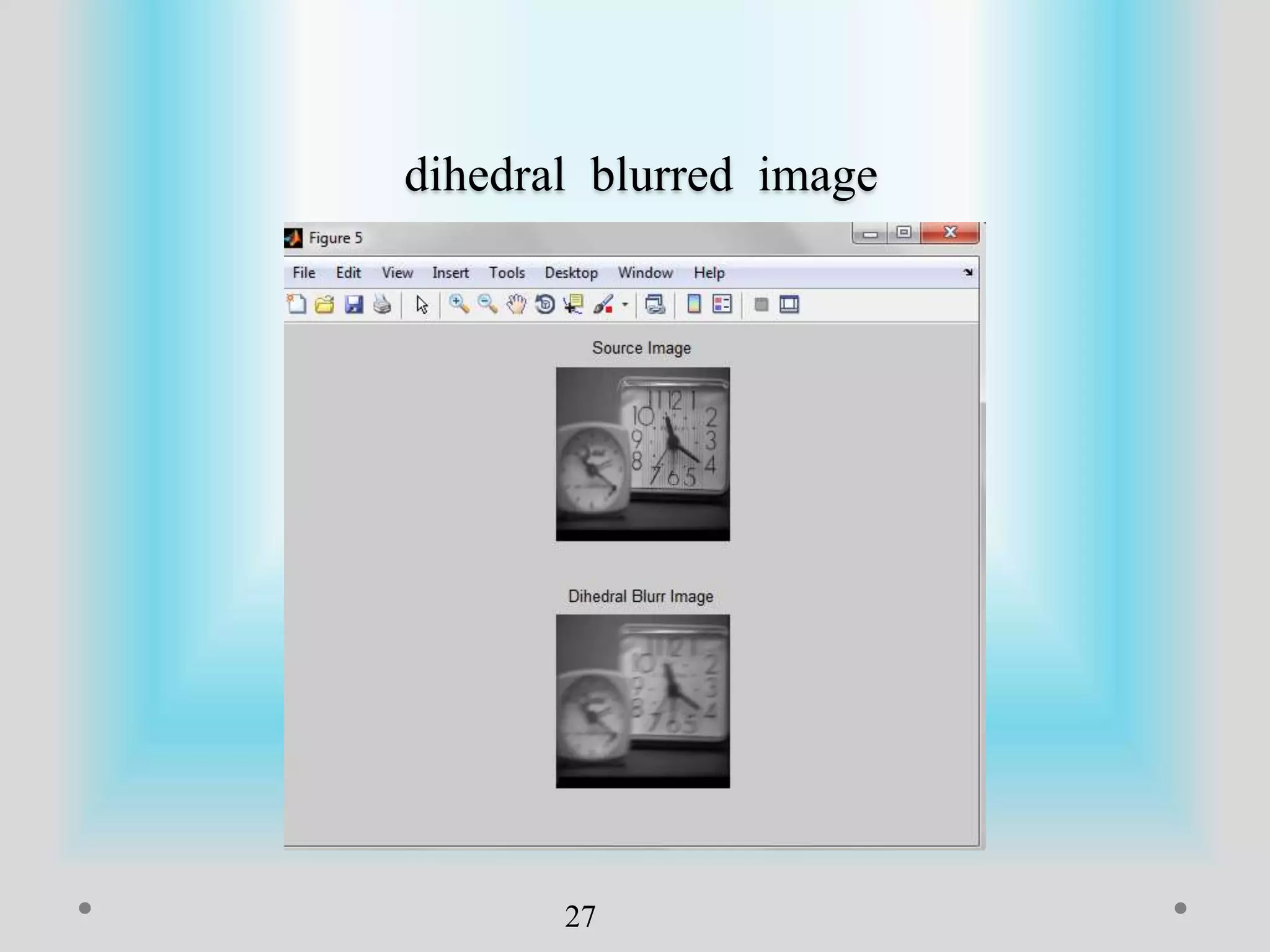
dihedral blurred image
27
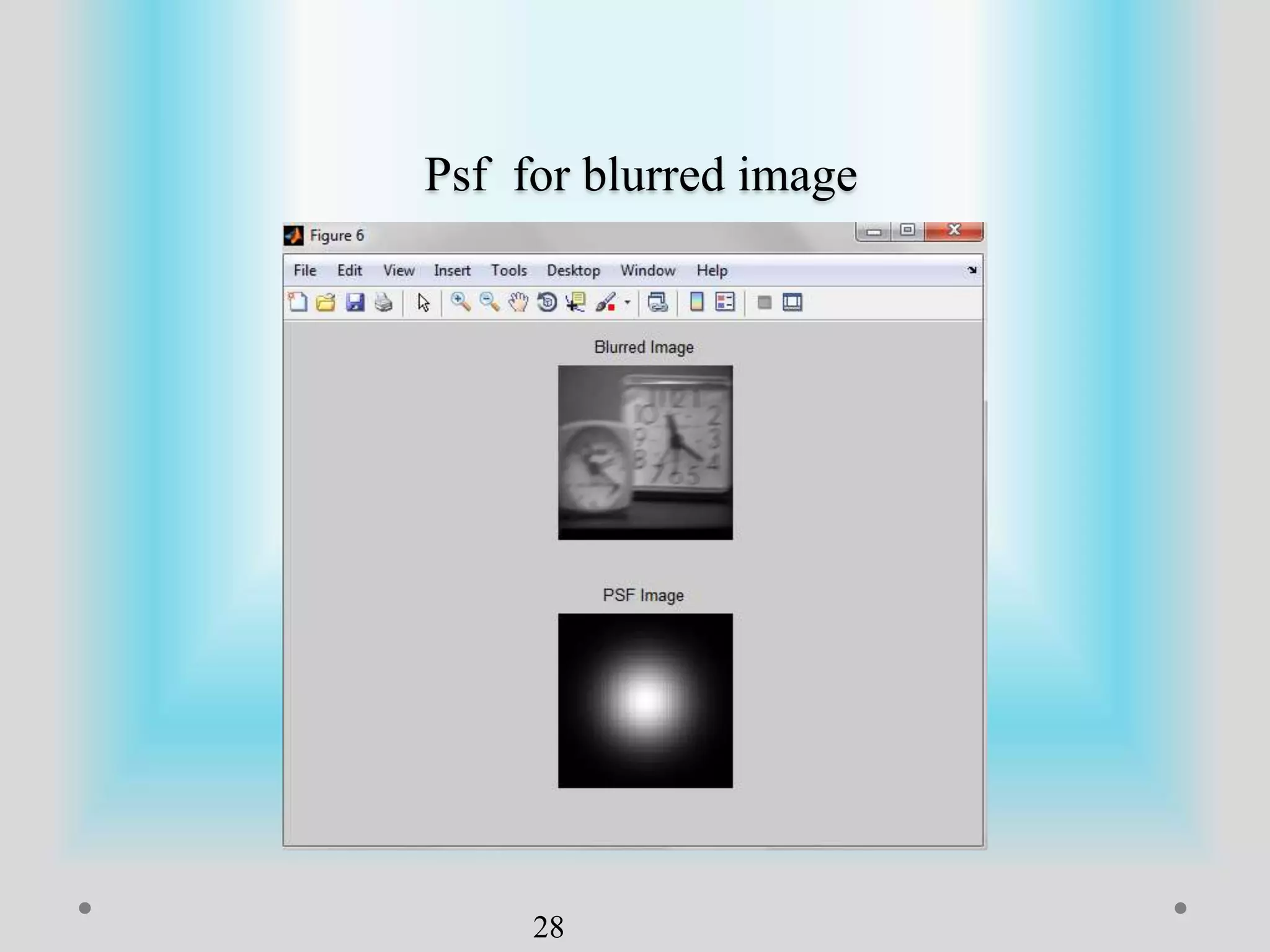
Psf for blurred image
28
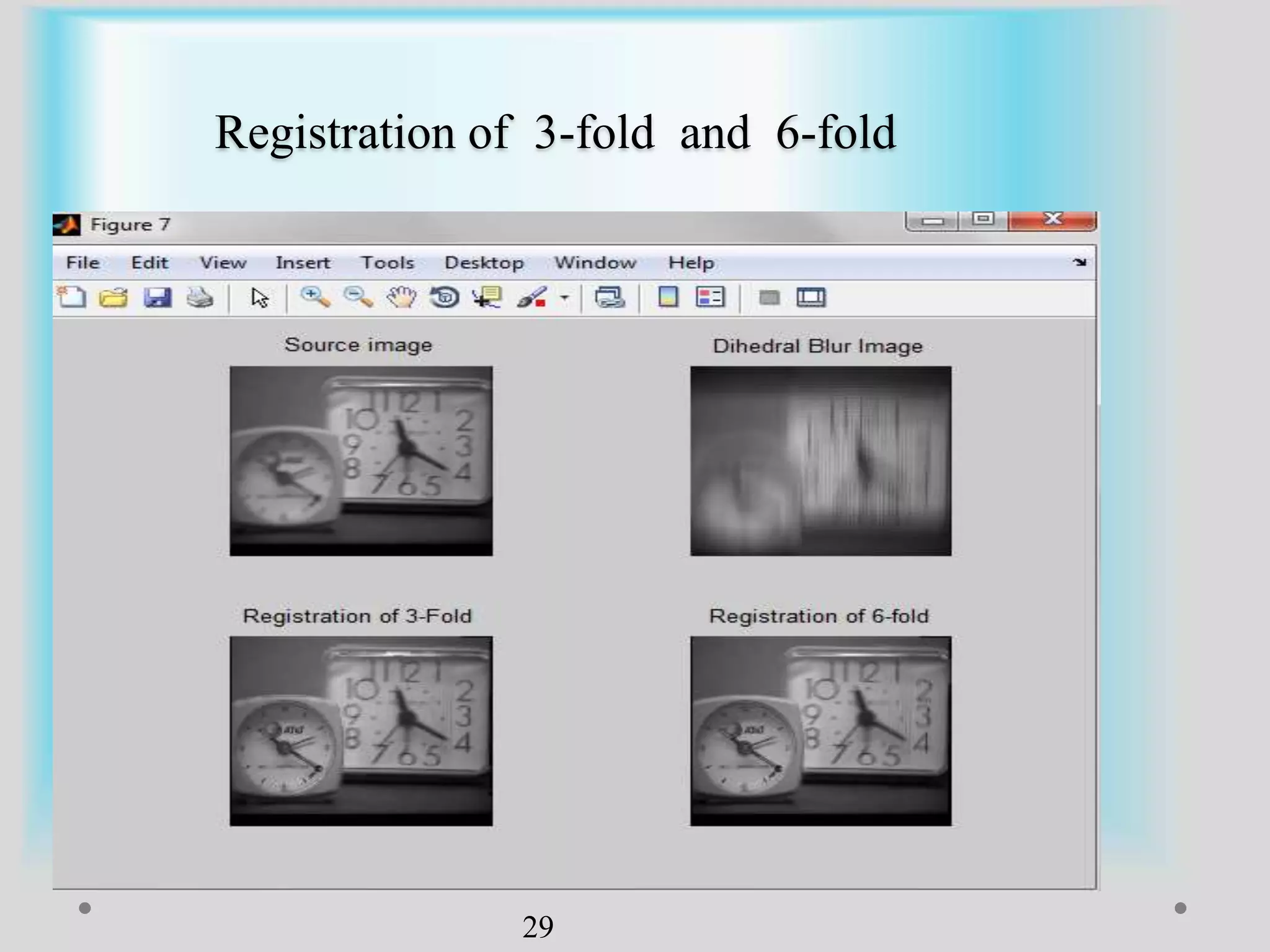
Registration of 3-fold and 6-fold
29
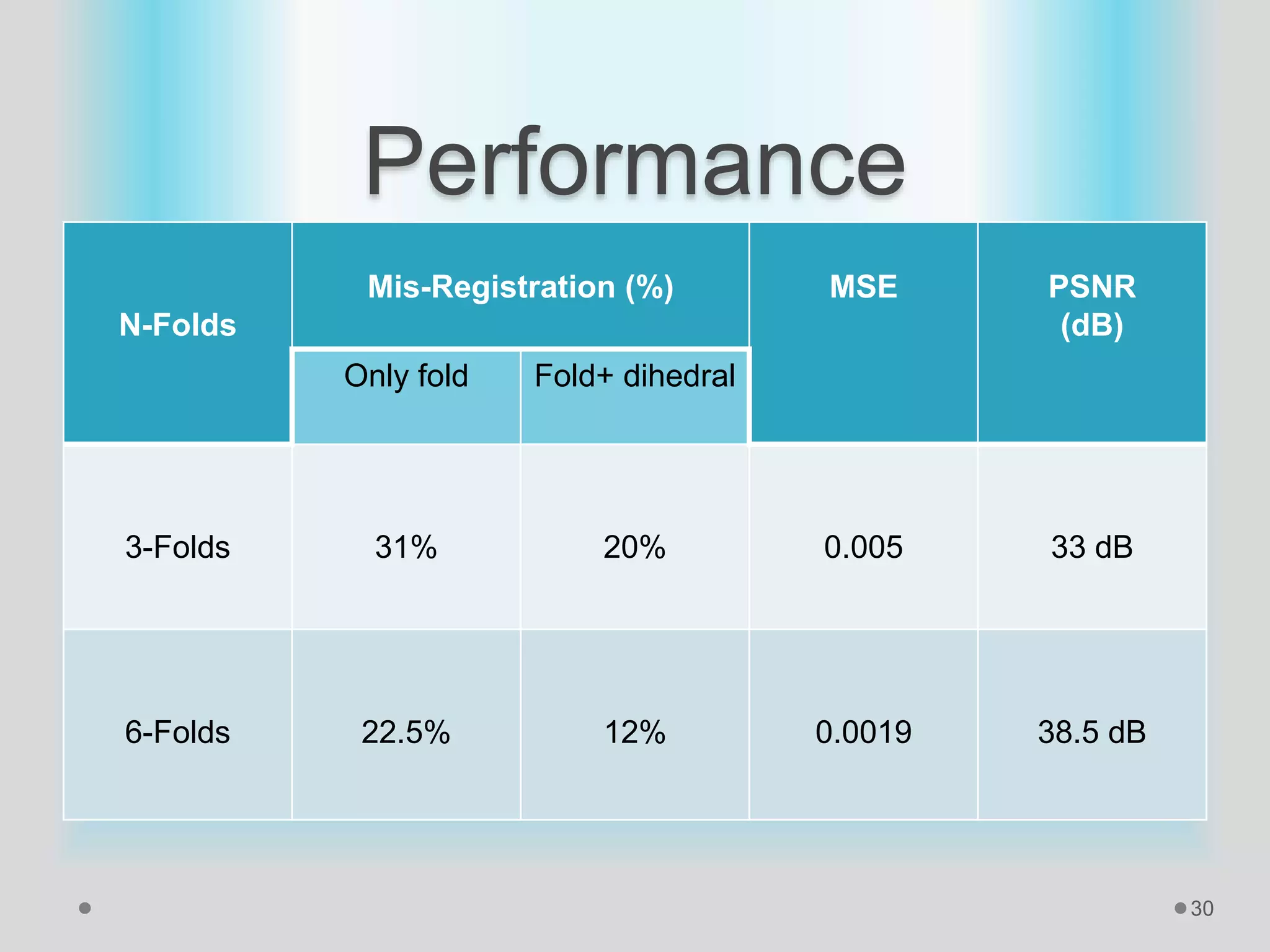
Performance
N-Folds
Mis-Registration (%) MSE PSNR
(dB)
Only fold Fold+ dihedral
3-Folds 31% 20% 0.005 33 dB
6-Folds 22.5% 12% 0.0019 38.5 dB
30
Thank you
30

Image registration using n-fold dihedral blur removal

  • 1.
  • 2.
    CONTENTS • Introduction • Objective •Existing system • Proposed system • Block diagram • Formulae • Output 1
  • 3.
    INTRODUCTION • The originalmethod works for unknown blurs, assuming the blurring point-spread function(PSF) exhibits an N-fold rotational symmetry. • This makes registration algorithm well-suited in applications where blurred image registration must be used as a preprocess step. • This leads to an improvement of the image registration performance. 2
  • 4.
    OBJECTIVE • To improvethe performance of image registration and reduce the error occurrence, we implement the N-fold blur removal. 3
  • 5.
    EXISTING SYSTEM S.no TitleAlgorithm Drawback Performance 1. Automatic image registration for applications in remote sensing Edge-based Selection of the control points Feature inconsistance Accuracy is 76.5% 2. Blur invariant translational image registration for N- fold symmetric blurs Global based blur invariant PSF has no symmetry Computational speed is 170 seconds 3. Combined invariants to similarity transformation and to blur using orthogonal zernike moments Orthogonal zernike moments Not adaptive for order invariance(on ly even order invariance) Accuracy 92% 4
  • 6.
    Cond… S.no Title AlgorithmDrawback Performance 4. Moment forms invariant to rotation and blur in arbitrary number of dimensions Moment forms invariant Degraded performance of boundary effect Accuracy 83% 5. Blur Invariant Phase Correlation in X-Ray Digital Subtraction Angiography spline image warping Not support for motion artifacts Registration error is 0.9 6. Multichannel blind deconvolution of spatially misaligned images Maximum a posteriori probability (MAP) Inaccurate registration of channels Better performance and high SNR 5
  • 7.
    Cond… S.no Title AlgorithmDrawback Performance 7. Wavelet-domain blur invariants for image analysis Spatial- Domain Blur Invariants(SD BI) Failed in asymmetric blur registration task Accuracy is 75% 8. Degraded image analysis: An invariant approach Combined invariants Focused only on combined invariants not on image rotation and affine transform. SNR value is lower than 10 db 6
  • 8.
    PROPOSED SYSTEM • Registrationmethod designed specifically for registering blurred images. • Registration of blurred images requires special methods because general registration methods usually do not perform well on blurred images. • Global based blur invariant approach of phase correlation. 7
  • 9.
    BLOCK DIAGRAM 8 Image Blurredimage PSF estimation N-fold blur removal (3-fold and 6-fold) Deblurred image
  • 10.
    Image taken withcamera having shutter with four blades and shape of the PSF can be clearly viewed in the out-of-focus background. PSF has 4-fold rotational symmetry 9
  • 11.
    Reference image Blurredsensed image 10
  • 12.
  • 13.
  • 14.
    formulae Recalling the originalmethod g⟹ blurred sensed image f⟹ reference image h⟹ point spread function Δ⟹ shift x⟹ number of pixels h⟹ h(r,θ) = h(r, θ+2πj/N) N⟹ number of folds 14 g(x) = (f * h)(x - Δ)
  • 15.
    Cond… Projection operators ⟹Used toeliminate the blur 𝐾𝑗 (𝑓) (𝐮) = F(u) / F(𝑅𝑗u) ; j=1,………,N F(u) ≝ F{f}(u) is the Fourier transform of f(x) Rju⟹ Rotation of frequency coordinates by the angle 2πj/N Rju= 2*pi*j/N 15
  • 16.
    Cond… Blur Invariant Operators ⟹To calculate reflection operator S(x) = cos 2𝛼 sin 2𝛼 sin 2𝛼 − cos 2𝛼 𝑥 𝑦 S(x)⟹ Reflection operator 𝛼 ⟹ Angle b/w reflection line and horizontal axis 16
  • 17.
    Cond… ⟹ To calculatethe Fourier Transform for original image and dihedral blurred image f ⟹Original image Df ⟹Dihedral blurred image 17 F{f} / F{Df}
  • 18.
    Cond… ⟹ To calculatethe invariants to dihedral blur 𝐾𝑗 = F{f} / F{𝑅𝑗 𝑓} ; j=1,………,N F{f} ⟹ Fourier transform of original image F{𝑅𝑗 𝑓} ⟹ Rotational symmetry(Cyclic groups,Cf) L𝑗 = F{f} / F{𝑅𝑗S𝑓} ; j=1,………,N F{𝑅𝑗S𝑓} ⟹ Rotational and Reflectional symmetry (Dihedral groups, Df) 18
  • 19.
    Cond… Image registration algorithm ⟹usedto design a robust blur-invariant registration method To calculate the normalized cross-power spectra Cj = 𝑘𝑗 (𝑓) 𝑘𝑗 g ∗ ; j=1,…N (Rotation) │ 𝑘𝑗 (𝑓) 𝑘𝑗 g │ Bj = 𝐿𝑗 (𝑓) 𝐿𝑗 g ∗ │ 𝐿𝑗 (𝑓) 𝐿𝑗 g │ ; j=1,…N (Rot+Ref) 19
  • 20.
    Cond… Inverse Fourier Transformof Cj f −1 {Cj }(x) = 𝛿(x +Δ - 𝑅 𝑁−𝑗 Δ) Inverse Fourier Transform of Bj f −1 {Bj }(x) = 𝛿(x +Δ - S𝑅 𝑁−𝑗 Δ) 20
  • 21.
    Two images acquiredby a hand-held camera with different focus settings and shift 21
  • 22.
    Two frames froma video sequence taken with different focus settings 22
  • 23.
  • 24.
  • 25.
    Rgb to grayconverted image 25
  • 26.
    Psf for Dihedralblurred image 26
  • 27.
  • 28.
  • 29.
  • 30.
    Performance N-Folds Mis-Registration (%) MSEPSNR (dB) Only fold Fold+ dihedral 3-Folds 31% 20% 0.005 33 dB 6-Folds 22.5% 12% 0.0019 38.5 dB 30
  • 31.

Editor's Notes

  • #2 Image registration is the process of aligning two or more images of the same scene. N-fold means number of folds. The formula for N-fold is no of points/2
  • #3 Blur can be originated from camera shake, wrong focus, scene motion, atmospheric turbulence, sensor imperfection, low sampling density etc.
  • #4 Blur is the relative motion between camera and scene. Point spread function(PSF) is the representation of an image. Point spread function consists of rotational and reflection symmetry. PSF describes the response of an imaging system to point object.
  • #5 The main objective of this project is to improve the performance of image registration and reduce the error occurrence by implementing N-fold blur removal.
  • #9 The special registration methods used are Global based blur invariant registration method.
  • #11 Rotational symmetry means an object that looks same after a certain amount of rotation.
  • #15 The original method works for unknown blurred image.
  • #20 The main idea is that we may consider the invariants to be Fourier transforms of hypothetical non-blurred images, which can be registered by phase correlation.