EE 7730
Image Enhancement
Bahadir K. Gunturk 2
Image Enhancement
 The objective of image enhancement is to process an
image so that the result is more suitable than the original
image for a specific application.
 There are two main approaches:
 Image enhancement in spatial domain: Direct
manipulation of pixels in an image
 Point processing: Change pixel intensities
 Spatial filtering
 Image enhancement in frequency domain: Modifying the
Fourier transform of an image
Bahadir K. Gunturk 3
Image Enhancement by Point Processing
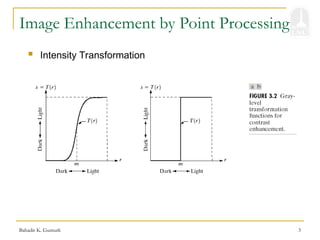
 Intensity Transformation
Bahadir K. Gunturk 4
Image Enhancement by Point Processing
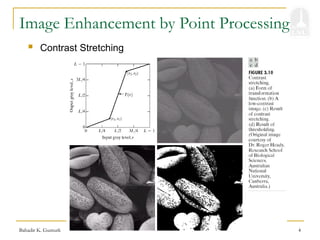
 Contrast Stretching
Bahadir K. Gunturk 5
Image Enhancement by Point Processing
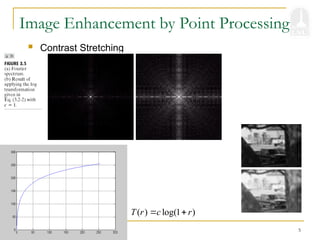
 Contrast Stretching
( ) log(1 )
T r c r
 
Bahadir K. Gunturk 6
Image Enhancement by Point Processing
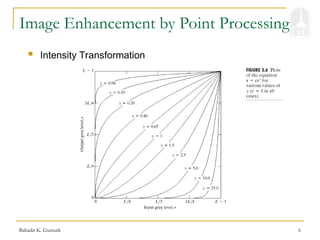
 Intensity Transformation
Bahadir K. Gunturk 7
Image Enhancement by Point Processing
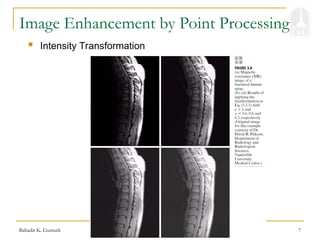
 Intensity Transformation
Bahadir K. Gunturk 8
Image Enhancement by Point Processing
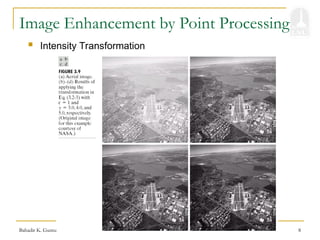
 Intensity Transformation
Bahadir K. Gunturk 9
Image Enhancement by Point Processing
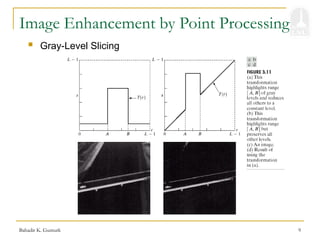
 Gray-Level Slicing
Bahadir K. Gunturk 12
Image Enhancement by Point Processing
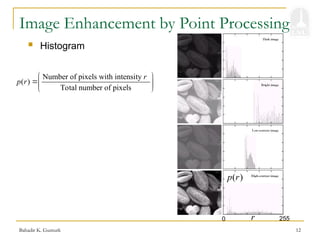
 Histogram
0 255
Number of pixels with intensity
( )
Total number of pixels
r
p r
 
 
 
( )
p r
r
Bahadir K. Gunturk 13
Histogram Specification
( )
s T r

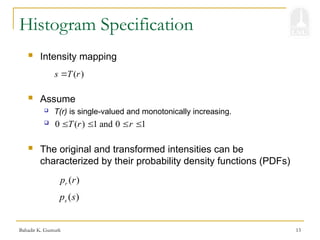
 Intensity mapping
 Assume
 T(r) is single-valued and monotonically increasing.

 The original and transformed intensities can be
characterized by their probability density functions (PDFs)
0 ( ) 1 and 0 1
T r r
   
( )
r
p r
( )
s
p s
Bahadir K. Gunturk 14
Histogram Specification
1
( )
( ) ( )
s r
r T s
dr
p s p r
ds 

 
 
 
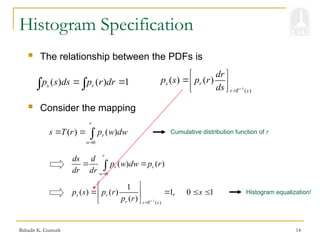
 The relationship between the PDFs is
0
( ) ( )
r
r
w
s T r p w dw

  
0
( ) ( )
r
r r
w
ds d
p w dw p r
dr dr 
 

 Consider the mapping
Cumulative distribution function of r
1
( )
1
( ) ( ) 1, 0 1
( )
s r
r r T s
p s p r s
p r 

 
   
 
 
Histogram equalization!
( ) ( ) 1
s r
p s ds p r dr
 
 
Bahadir K. Gunturk 15
Image Enhancement by Point Processing
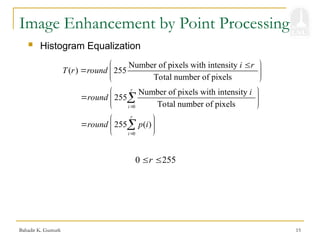
 Histogram Equalization
Number of pixels with intensity
( ) 255
Total number of pixels
i r
T r round
 

  
 
0 255
r
 
0
255 ( )
r
i
round p i

 
  
 

0
Number of pixels with intensity
255
Total number of pixels
r
i
i
round

 
  
 

Bahadir K. Gunturk 16
Image Enhancement by Point Processing
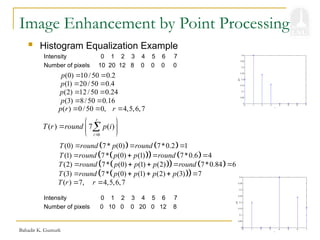
 Histogram Equalization Example
Intensity 0 1 2 3 4 5 6 7
Number of pixels 10 20 12 8 0 0 0 0
Intensity 0 1 2 3 4 5 6 7
Number of pixels 0 10 0 0 20 0 12 8
(0) 10/50 0.2
p  
(1) 20/50 0.4
p  
(2) 12/50 0.24
p  
(3) 8/50 0.16
p  
( ) 0/50 0, 4,5,6,7
p r r
  
0
( ) 7 ( )
r
i
T r round p i

 
  
 

   
(0) 7* (0) 7*0.2 1
T round p round
  
 
   
(1) 7* (0) (1) 7*0.6 4
T round p p round
   
 
   
(2) 7* (0) (1) (2) 7*0.84 6
T round p p p round
    
 
 
(3) 7* (0) (1) (2) (3) 7
T round p p p p
    
( ) 7, 4,5,6,7
T r r
 
Bahadir K. Gunturk 17
Image Enhancement by Point Processing
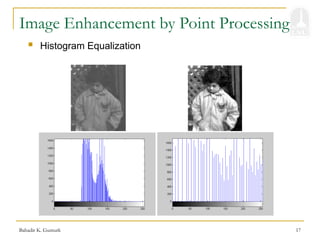
 Histogram Equalization
Bahadir K. Gunturk 18
Histogram Specification
( )
s T r

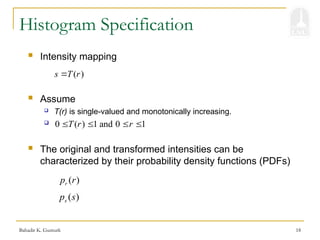
 Intensity mapping
 Assume
 T(r) is single-valued and monotonically increasing.

 The original and transformed intensities can be
characterized by their probability density functions (PDFs)
0 ( ) 1 and 0 1
T r r
   
( )
r
p r
( )
s
p s
Bahadir K. Gunturk 19
Histogram Specification
1
( )
( ) ( )
s r
r T s
dr
p s p r
ds 

 
 
 
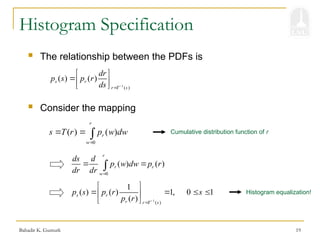
 The relationship between the PDFs is
0
( ) ( )
r
r
w
s T r p w dw

  
0
( ) ( )
r
r r
w
ds d
p w dw p r
dr dr 
 

 Consider the mapping
Cumulative distribution function of r
1
( )
1
( ) ( ) 1, 0 1
( )
s r
r r T s
p s p r s
p r 

 
   
 
 
Histogram equalization!
Bahadir K. Gunturk 20
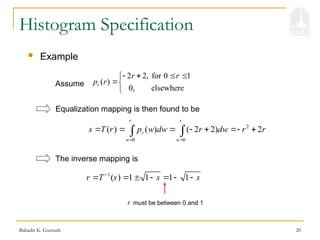
Histogram Specification
2 2, for 0 1
( )
0, elsewhere
r
r r
p r
   



 Example
2
0 0
( ) ( ) ( 2 2) 2
r r
r
w w
s T r p w dw r dw r r
 
      
 
Assume
Equalization mapping is then found to be
1
( ) 1 1 1 1
r T s s s

      
The inverse mapping is
r must be between 0 and 1
Bahadir K. Gunturk 21
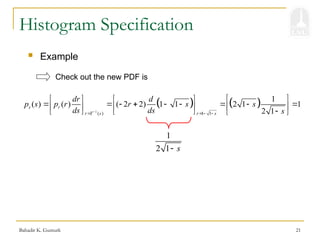
Histogram Specification
 Example
Check out the new PDF is
1
2 1 s

   
1
( ) 1 1
1
( ) ( ) ( 2 2) 1 1 2 1 1
2 1
s r
r T s r s
dr d
p s p r r s s
ds ds s

   
 
   
        
 
    
     
Bahadir K. Gunturk 22
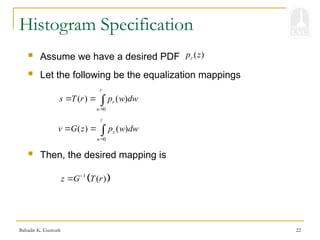
Histogram Specification
 Assume we have a desired PDF
 Let the following be the equalization mappings
( )
z
p z
0
( ) ( )
r
r
w
s T r p w dw

  
0
( ) ( )
z
z
w
v G z p w dw

  
 Then, the desired mapping is
 
1
( )
z G T r


Bahadir K. Gunturk 23
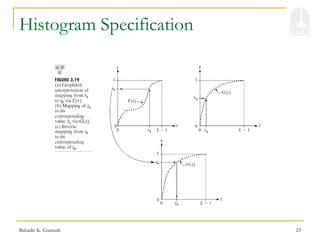
Histogram Specification
Bahadir K. Gunturk 24
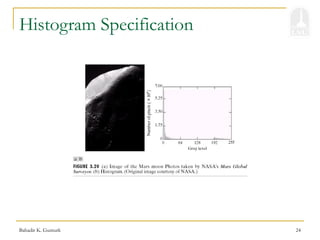
Histogram Specification
Bahadir K. Gunturk 25
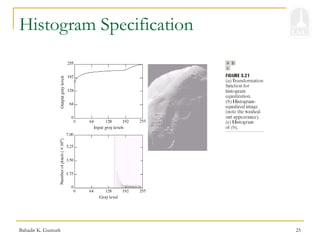
Histogram Specification
Bahadir K. Gunturk 26
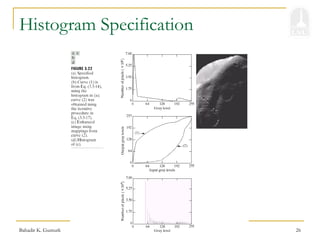
Histogram Specification
Bahadir K. Gunturk 27
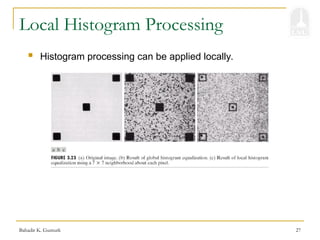
Local Histogram Processing
 Histogram processing can be applied locally.
Bahadir K. Gunturk 28
Image Subtraction
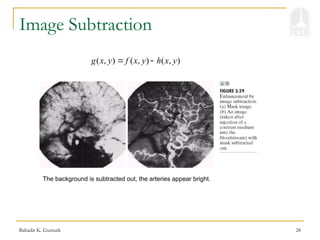
The background is subtracted out, the arteries appear bright.
( , ) ( , ) ( , )
g x y f x y h x y
 
Bahadir K. Gunturk 29
Image Averaging
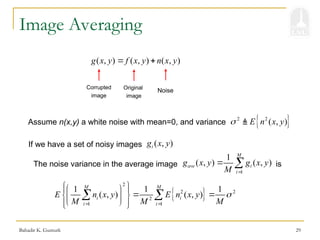
( , ) ( , ) ( , )
g x y f x y n x y
 
Original
image
Noise
Corrupted
image
Assume n(x,y) a white noise with mean=0, and variance  
2 2
( , )
E n x y
 
If we have a set of noisy images ( , )
i
g x y
The noise variance in the average image is
1
1
( , ) ( , )
M
ave i
i
g x y g x y
M 
 
 
2
2 2
2
1 1
1 1 1
( , ) ( , )
M M
i i
i i
E n x y E n x y
M M M

 
 
 
 
 
 
 
 
 
 
 
Bahadir K. Gunturk 30
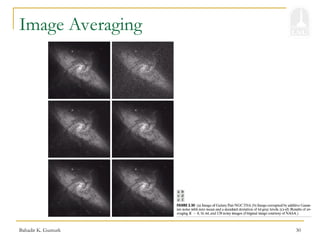
Image Averaging
Bahadir K. Gunturk 31
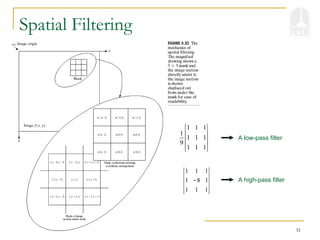
Spatial Filtering
1 1 1
1
1 1 1
9
1 1 1
 
 
 
 
 
1 1 1
1 8 1
1 1 1
 
 

 
 
 
A low-pass filter
A high-pass filter
Bahadir K. Gunturk 32
Spatial Filtering
 Median Filter
10 20 10
25 10 75
90 85 100
 
 
 
 
 
Sort: (10 10 10 20 25 75 85 90 100)
100 100 100 100 10 10 10 10 10
 Example
Original signal:
100 103 100 100 10 9 10 11 10
Noisy signal:
101 101 70 40 10 10 10
Filter by [ 1 1 1]/3:
100 100 100 10 10 10 10
Filter by 1x3
median filter:
Bahadir K. Gunturk 33
Spatial Filtering
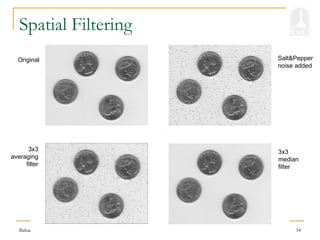
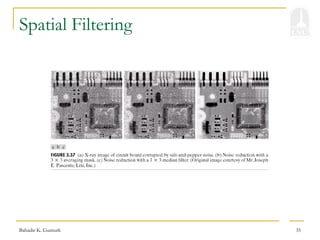
 Median filters are nonlinear.
 Median filtering reduces noise without blurring edges and
other sharp details.
 Median filtering is particularly effective when the noise
pattern consists of strong, spikelike components. (Salt-and-
pepper noise.)
Bahadir K. Gunturk 34
Spatial Filtering
Original
3x3
averaging
filter
Salt&Pepper
noise added
3x3
median
filter
Bahadir K. Gunturk 35
Spatial Filtering
Bahadir K. Gunturk 36
Spatial Filtering
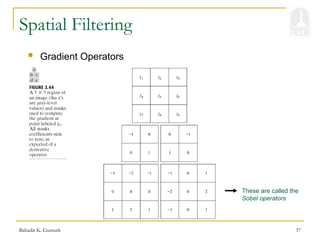
 Gradient Operators
 Averaging of pixels over a region tends to blur detail in an
image.
 As averaging is analogous to integration, differentiation can
be expected to have the opposite effect and thus sharpen an
image.
 Gradient operators (first-order derivatives) are commonly
used in image processing applications.
Bahadir K. Gunturk 37
Spatial Filtering
 Gradient Operators
These are called the
Sobel operators
Bahadir K. Gunturk 38
Spatial Filtering
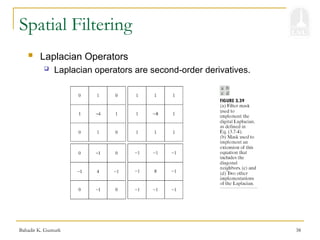
 Laplacian Operators
 Laplacian operators are second-order derivatives.
Bahadir K. Gunturk 39
Spatial Filtering
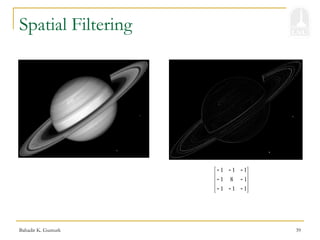
1 1 1
1 8 1
1 1 1
  
 
 
 
 
 
  
 
Bahadir K. Gunturk 40
Spatial Filtering
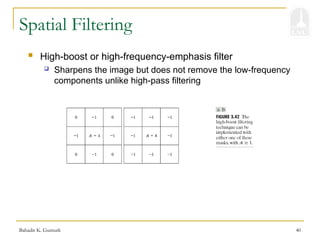
 High-boost or high-frequency-emphasis filter
 Sharpens the image but does not remove the low-frequency
components unlike high-pass filtering
Bahadir K. Gunturk 41
Spatial Filtering
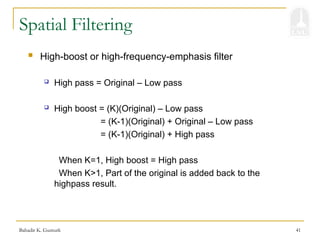
 High-boost or high-frequency-emphasis filter
 High pass = Original – Low pass
 High boost = (K)(Original) – Low pass
= (K-1)(Original) + Original – Low pass
= (K-1)(Original) + High pass
When K=1, High boost = High pass
When K>1, Part of the original is added back to the
highpass result.
Bahadir K. Gunturk 42
Spatial Filtering
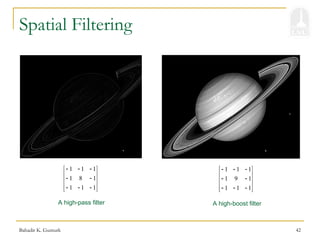
1 1 1
1 8 1
1 1 1
  
 
 
 
 
 
  
 
A high-pass filter A high-boost filter
1 1 1
1 9 1
1 1 1
  
 
 
 
 
 
  
 
Bahadir K. Gunturk 43
Spatial Filtering
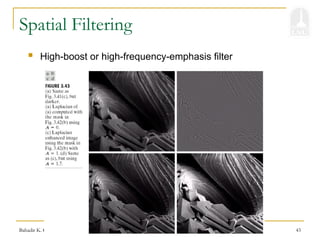
 High-boost or high-frequency-emphasis filter
Bahadir K. Gunturk 44
Spatial Filtering

IMAGE PROCESSING-----image enhancing.ppt

  • 1.
  • 2.
    Bahadir K. Gunturk2 Image Enhancement  The objective of image enhancement is to process an image so that the result is more suitable than the original image for a specific application.  There are two main approaches:  Image enhancement in spatial domain: Direct manipulation of pixels in an image  Point processing: Change pixel intensities  Spatial filtering  Image enhancement in frequency domain: Modifying the Fourier transform of an image
  • 3.
    Bahadir K. Gunturk3 Image Enhancement by Point Processing  Intensity Transformation
  • 4.
    Bahadir K. Gunturk4 Image Enhancement by Point Processing  Contrast Stretching
  • 5.
    Bahadir K. Gunturk5 Image Enhancement by Point Processing  Contrast Stretching ( ) log(1 ) T r c r  
  • 6.
    Bahadir K. Gunturk6 Image Enhancement by Point Processing  Intensity Transformation
  • 7.
    Bahadir K. Gunturk7 Image Enhancement by Point Processing  Intensity Transformation
  • 8.
    Bahadir K. Gunturk8 Image Enhancement by Point Processing  Intensity Transformation
  • 9.
    Bahadir K. Gunturk9 Image Enhancement by Point Processing  Gray-Level Slicing
  • 10.
    Bahadir K. Gunturk12 Image Enhancement by Point Processing  Histogram 0 255 Number of pixels with intensity ( ) Total number of pixels r p r       ( ) p r r
  • 11.
    Bahadir K. Gunturk13 Histogram Specification ( ) s T r   Intensity mapping  Assume  T(r) is single-valued and monotonically increasing.   The original and transformed intensities can be characterized by their probability density functions (PDFs) 0 ( ) 1 and 0 1 T r r     ( ) r p r ( ) s p s
  • 12.
    Bahadir K. Gunturk14 Histogram Specification 1 ( ) ( ) ( ) s r r T s dr p s p r ds          The relationship between the PDFs is 0 ( ) ( ) r r w s T r p w dw     0 ( ) ( ) r r r w ds d p w dw p r dr dr      Consider the mapping Cumulative distribution function of r 1 ( ) 1 ( ) ( ) 1, 0 1 ( ) s r r r T s p s p r s p r             Histogram equalization! ( ) ( ) 1 s r p s ds p r dr    
  • 13.
    Bahadir K. Gunturk15 Image Enhancement by Point Processing  Histogram Equalization Number of pixels with intensity ( ) 255 Total number of pixels i r T r round         0 255 r   0 255 ( ) r i round p i          0 Number of pixels with intensity 255 Total number of pixels r i i round         
  • 14.
    Bahadir K. Gunturk16 Image Enhancement by Point Processing  Histogram Equalization Example Intensity 0 1 2 3 4 5 6 7 Number of pixels 10 20 12 8 0 0 0 0 Intensity 0 1 2 3 4 5 6 7 Number of pixels 0 10 0 0 20 0 12 8 (0) 10/50 0.2 p   (1) 20/50 0.4 p   (2) 12/50 0.24 p   (3) 8/50 0.16 p   ( ) 0/50 0, 4,5,6,7 p r r    0 ( ) 7 ( ) r i T r round p i              (0) 7* (0) 7*0.2 1 T round p round          (1) 7* (0) (1) 7*0.6 4 T round p p round           (2) 7* (0) (1) (2) 7*0.84 6 T round p p p round          (3) 7* (0) (1) (2) (3) 7 T round p p p p      ( ) 7, 4,5,6,7 T r r  
  • 15.
    Bahadir K. Gunturk17 Image Enhancement by Point Processing  Histogram Equalization
  • 16.
    Bahadir K. Gunturk18 Histogram Specification ( ) s T r   Intensity mapping  Assume  T(r) is single-valued and monotonically increasing.   The original and transformed intensities can be characterized by their probability density functions (PDFs) 0 ( ) 1 and 0 1 T r r     ( ) r p r ( ) s p s
  • 17.
    Bahadir K. Gunturk19 Histogram Specification 1 ( ) ( ) ( ) s r r T s dr p s p r ds          The relationship between the PDFs is 0 ( ) ( ) r r w s T r p w dw     0 ( ) ( ) r r r w ds d p w dw p r dr dr      Consider the mapping Cumulative distribution function of r 1 ( ) 1 ( ) ( ) 1, 0 1 ( ) s r r r T s p s p r s p r             Histogram equalization!
  • 18.
    Bahadir K. Gunturk20 Histogram Specification 2 2, for 0 1 ( ) 0, elsewhere r r r p r         Example 2 0 0 ( ) ( ) ( 2 2) 2 r r r w w s T r p w dw r dw r r            Assume Equalization mapping is then found to be 1 ( ) 1 1 1 1 r T s s s         The inverse mapping is r must be between 0 and 1
  • 19.
    Bahadir K. Gunturk21 Histogram Specification  Example Check out the new PDF is 1 2 1 s      1 ( ) 1 1 1 ( ) ( ) ( 2 2) 1 1 2 1 1 2 1 s r r T s r s dr d p s p r r s s ds ds s                                 
  • 20.
    Bahadir K. Gunturk22 Histogram Specification  Assume we have a desired PDF  Let the following be the equalization mappings ( ) z p z 0 ( ) ( ) r r w s T r p w dw     0 ( ) ( ) z z w v G z p w dw      Then, the desired mapping is   1 ( ) z G T r  
  • 21.
    Bahadir K. Gunturk23 Histogram Specification
  • 22.
    Bahadir K. Gunturk24 Histogram Specification
  • 23.
    Bahadir K. Gunturk25 Histogram Specification
  • 24.
    Bahadir K. Gunturk26 Histogram Specification
  • 25.
    Bahadir K. Gunturk27 Local Histogram Processing  Histogram processing can be applied locally.
  • 26.
    Bahadir K. Gunturk28 Image Subtraction The background is subtracted out, the arteries appear bright. ( , ) ( , ) ( , ) g x y f x y h x y  
  • 27.
    Bahadir K. Gunturk29 Image Averaging ( , ) ( , ) ( , ) g x y f x y n x y   Original image Noise Corrupted image Assume n(x,y) a white noise with mean=0, and variance   2 2 ( , ) E n x y   If we have a set of noisy images ( , ) i g x y The noise variance in the average image is 1 1 ( , ) ( , ) M ave i i g x y g x y M      2 2 2 2 1 1 1 1 1 ( , ) ( , ) M M i i i i E n x y E n x y M M M                       
  • 28.
    Bahadir K. Gunturk30 Image Averaging
  • 29.
    Bahadir K. Gunturk31 Spatial Filtering 1 1 1 1 1 1 1 9 1 1 1           1 1 1 1 8 1 1 1 1            A low-pass filter A high-pass filter
  • 30.
    Bahadir K. Gunturk32 Spatial Filtering  Median Filter 10 20 10 25 10 75 90 85 100           Sort: (10 10 10 20 25 75 85 90 100) 100 100 100 100 10 10 10 10 10  Example Original signal: 100 103 100 100 10 9 10 11 10 Noisy signal: 101 101 70 40 10 10 10 Filter by [ 1 1 1]/3: 100 100 100 10 10 10 10 Filter by 1x3 median filter:
  • 31.
    Bahadir K. Gunturk33 Spatial Filtering  Median filters are nonlinear.  Median filtering reduces noise without blurring edges and other sharp details.  Median filtering is particularly effective when the noise pattern consists of strong, spikelike components. (Salt-and- pepper noise.)
  • 32.
    Bahadir K. Gunturk34 Spatial Filtering Original 3x3 averaging filter Salt&Pepper noise added 3x3 median filter
  • 33.
    Bahadir K. Gunturk35 Spatial Filtering
  • 34.
    Bahadir K. Gunturk36 Spatial Filtering  Gradient Operators  Averaging of pixels over a region tends to blur detail in an image.  As averaging is analogous to integration, differentiation can be expected to have the opposite effect and thus sharpen an image.  Gradient operators (first-order derivatives) are commonly used in image processing applications.
  • 35.
    Bahadir K. Gunturk37 Spatial Filtering  Gradient Operators These are called the Sobel operators
  • 36.
    Bahadir K. Gunturk38 Spatial Filtering  Laplacian Operators  Laplacian operators are second-order derivatives.
  • 37.
    Bahadir K. Gunturk39 Spatial Filtering 1 1 1 1 8 1 1 1 1                  
  • 38.
    Bahadir K. Gunturk40 Spatial Filtering  High-boost or high-frequency-emphasis filter  Sharpens the image but does not remove the low-frequency components unlike high-pass filtering
  • 39.
    Bahadir K. Gunturk41 Spatial Filtering  High-boost or high-frequency-emphasis filter  High pass = Original – Low pass  High boost = (K)(Original) – Low pass = (K-1)(Original) + Original – Low pass = (K-1)(Original) + High pass When K=1, High boost = High pass When K>1, Part of the original is added back to the highpass result.

  • 40.
    Bahadir K. Gunturk42 Spatial Filtering 1 1 1 1 8 1 1 1 1                   A high-pass filter A high-boost filter 1 1 1 1 9 1 1 1 1                  
  • 41.
    Bahadir K. Gunturk43 Spatial Filtering  High-boost or high-frequency-emphasis filter
  • 42.
    Bahadir K. Gunturk44 Spatial Filtering