Research Scholar’s Conclave presentation
on
Digital Image Forgery Detection using
Salient Keypoint Selection
Presented By:
Nitish Kumar
Ph.D. Scholar
Dept. of Electronics and Communication
Under the Guidance of:
Dr. Toshanlal Meenpal
Introduction
• With the advancement of image editing techniques, authenticity and reliability of digital image
has become very challenging.
• Realistic visual effect can be achieved in such a way that forged images are visually
indistinguishable from real ones.
• Image forgery aims to deliver deceptive information through the image graphic content.
• Image forensics verify the authenticity, ownership, and copyright of an image and detect changes
to the original image.
Fig.1 Example of a forged image
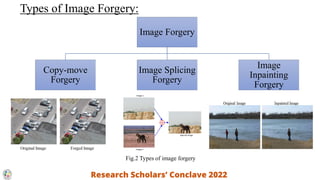
Types of Image Forgery:
Image Forgery
Copy-move
Forgery
Image Splicing
Forgery
Image
Inpainting
Forgery
Fig.2 Types of image forgery
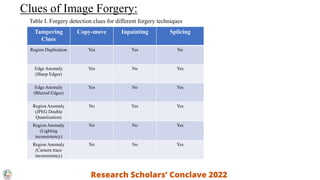
Clues of Image Forgery:
Table I. Forgery detection clues for different forgery techniques
Tampering
Clues
Copy-move Inpainting Splicing
Region Duplication Yes Yes No
Edge Anomaly
(Sharp Edges)
Yes No Yes
Edge Anomaly
(Blurred Edges)
Yes No Yes
Region Anomaly
(JPEG Double
Quantization)
No Yes Yes
Region Anomaly
(Lighting
inconsistency)
No No Yes
Region Anomaly
(Camera trace
inconsistency)
No No Yes
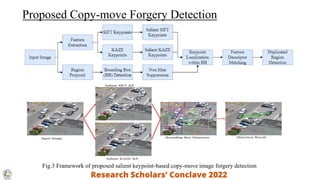
Proposed Copy-move Forgery Detection
Fig.3 Framework of proposed salient keypoint-based copy-move image forgery detection
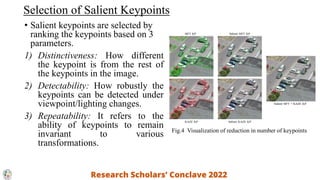
Selection of Salient Keypoints
• Salient keypoints are selected by
ranking the keypoints based on 3
parameters.
1) Distinctiveness: How different
the keypoint is from the rest of
the keypoints in the image.
2) Detectability: How robustly the
keypoints can be detected under
viewpoint/lighting changes.
3) Repeatability: It refers to the
ability of keypoints to remain
invariant to various
transformations.
Fig.4 Visualization of reduction in number of keypoints
Results and Discussion
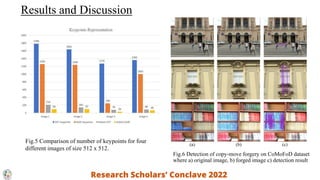
Fig.5 Comparison of number of keypoints for four
different images of size 512 x 512.
Fig.6 Detection of copy-move forgery on CoMoFoD dataset
where a) original image, b) forged image c) detection result
Cont..
Author Methods FPR Precision F1 Score
Hashmi et. al DyWT and SIFT 10.00 88.89 85.00
Ojeniyi et al. DCT and SURF 6.36 93.86 95.45
Niyishaka et al. DoG and ORB - 90.09 86.24
Liu et. al CKN 7.27 93.16 96.03
Soni et al. SURF and 2NN 8.4 - -
Proposed Salient SIFT and KAZE 3.6 96.22 94.87
Table II. Comparison of proposed method with existing
techniques on the MICC-F220 dataset.
Author Methods FPR Precision F1 Score
Malviya et. al Auto colour correlogram 16 95.65 93.62
Soni et al. LBP-HP 7.40 - -
Mahmood et al. SWT - 95.76 96.05
Niyishaka et. al Blob and BRISK 9 96.84 94.35
El Biach et al. Encoder-decoder - - 81.56
Proposed Salient SIFT and KAZE 6 97.90 95.73
Table III. Comparison of proposed method with existing
techniques on the CoMoFoD dataset.
Conclusion and Future Scope
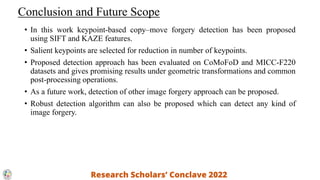
• In this work keypoint-based copy–move forgery detection has been proposed
using SIFT and KAZE features.
• Salient keypoints are selected for reduction in number of keypoints.
• Proposed detection approach has been evaluated on CoMoFoD and MICC-F220
datasets and gives promising results under geometric transformations and common
post-processing operations.
• As a future work, detection of other image forgery approach can be proposed.
• Robust detection algorithm can also be proposed which can detect any kind of
image forgery.
References
[1] Zheng L, Zhang Y, Thing VL. A survey on image tampering and its detection in real-world photos. J Visual
Commun Image Represent. 2019;58:380–399. doi:10.1016/j.jvcir.2018.12.022.
[2] Hashmi MF, Anand V, Keskar AG. Copy-move image forgery detection using an efficient and robust method
combining un-decimated wavelet transform and scale invariant feature transform. Aasri Procedia. 2014; 9:84–
91.
[3] Niyishaka P, Bhagvati C. Digital image forensics technique for copy-move forgery detection using DOG and
ORB. International conference on computer vision and graphics; 2018. p.472–483.
[4] Niyishaka P, Bhagvati C. Copy-move forgery detection using image blobs and brisk feature. Multimedia
Tools Appl. 2020;79(35):26045–26059. doi:10.1007/s11042-020-09225-6.
[5] X. Niu, H. Han, S. Shan, and X. Chen, “Synrhythm: Learning a deep heart rate estimator from general to
specific,” in 2018 24th International Conference on Pattern Recognition (ICPR), pp. 3580–3585, IEEE, (2018).
[6] Mukherjee P, Lall B. Saliency and KAZE features assisted object segmentation. Image Vis Comput.
2017;61:82–97. Available from: https://www.sciencedirect.com/science/article/pii/S0262885617300537.
[7] Lowe DG. Object recognition from local scale-invariant features. Proceedings of the Seventh IEEE
International Conference on Computer Vision; 1999. Vol. 2, p. 1150–1157.
[8] Alcantarilla PF, Bartoli A, Davison AJ. KAZE features. In: Fitzgibbon A, Lazebnik S, Perona P, Sato Y,
Schmid C, editors. Computer vision eccv 2012. Berlin (Heidelberg): Springer; 2012. p. 214–227.
Image Forgery Detection

Image Forgery Detection

  • 1.
    Research Scholar’s Conclavepresentation on Digital Image Forgery Detection using Salient Keypoint Selection Presented By: Nitish Kumar Ph.D. Scholar Dept. of Electronics and Communication Under the Guidance of: Dr. Toshanlal Meenpal
  • 2.
    Introduction • With theadvancement of image editing techniques, authenticity and reliability of digital image has become very challenging. • Realistic visual effect can be achieved in such a way that forged images are visually indistinguishable from real ones. • Image forgery aims to deliver deceptive information through the image graphic content. • Image forensics verify the authenticity, ownership, and copyright of an image and detect changes to the original image. Fig.1 Example of a forged image
  • 3.
    Types of ImageForgery: Image Forgery Copy-move Forgery Image Splicing Forgery Image Inpainting Forgery Fig.2 Types of image forgery
  • 4.
    Clues of ImageForgery: Table I. Forgery detection clues for different forgery techniques Tampering Clues Copy-move Inpainting Splicing Region Duplication Yes Yes No Edge Anomaly (Sharp Edges) Yes No Yes Edge Anomaly (Blurred Edges) Yes No Yes Region Anomaly (JPEG Double Quantization) No Yes Yes Region Anomaly (Lighting inconsistency) No No Yes Region Anomaly (Camera trace inconsistency) No No Yes
  • 5.
    Proposed Copy-move ForgeryDetection Fig.3 Framework of proposed salient keypoint-based copy-move image forgery detection
  • 6.
    Selection of SalientKeypoints • Salient keypoints are selected by ranking the keypoints based on 3 parameters. 1) Distinctiveness: How different the keypoint is from the rest of the keypoints in the image. 2) Detectability: How robustly the keypoints can be detected under viewpoint/lighting changes. 3) Repeatability: It refers to the ability of keypoints to remain invariant to various transformations. Fig.4 Visualization of reduction in number of keypoints
  • 7.
    Results and Discussion Fig.5Comparison of number of keypoints for four different images of size 512 x 512. Fig.6 Detection of copy-move forgery on CoMoFoD dataset where a) original image, b) forged image c) detection result
  • 8.
    Cont.. Author Methods FPRPrecision F1 Score Hashmi et. al DyWT and SIFT 10.00 88.89 85.00 Ojeniyi et al. DCT and SURF 6.36 93.86 95.45 Niyishaka et al. DoG and ORB - 90.09 86.24 Liu et. al CKN 7.27 93.16 96.03 Soni et al. SURF and 2NN 8.4 - - Proposed Salient SIFT and KAZE 3.6 96.22 94.87 Table II. Comparison of proposed method with existing techniques on the MICC-F220 dataset. Author Methods FPR Precision F1 Score Malviya et. al Auto colour correlogram 16 95.65 93.62 Soni et al. LBP-HP 7.40 - - Mahmood et al. SWT - 95.76 96.05 Niyishaka et. al Blob and BRISK 9 96.84 94.35 El Biach et al. Encoder-decoder - - 81.56 Proposed Salient SIFT and KAZE 6 97.90 95.73 Table III. Comparison of proposed method with existing techniques on the CoMoFoD dataset.
  • 9.
    Conclusion and FutureScope • In this work keypoint-based copy–move forgery detection has been proposed using SIFT and KAZE features. • Salient keypoints are selected for reduction in number of keypoints. • Proposed detection approach has been evaluated on CoMoFoD and MICC-F220 datasets and gives promising results under geometric transformations and common post-processing operations. • As a future work, detection of other image forgery approach can be proposed. • Robust detection algorithm can also be proposed which can detect any kind of image forgery.
  • 10.
    References [1] Zheng L,Zhang Y, Thing VL. A survey on image tampering and its detection in real-world photos. J Visual Commun Image Represent. 2019;58:380–399. doi:10.1016/j.jvcir.2018.12.022. [2] Hashmi MF, Anand V, Keskar AG. Copy-move image forgery detection using an efficient and robust method combining un-decimated wavelet transform and scale invariant feature transform. Aasri Procedia. 2014; 9:84– 91. [3] Niyishaka P, Bhagvati C. Digital image forensics technique for copy-move forgery detection using DOG and ORB. International conference on computer vision and graphics; 2018. p.472–483. [4] Niyishaka P, Bhagvati C. Copy-move forgery detection using image blobs and brisk feature. Multimedia Tools Appl. 2020;79(35):26045–26059. doi:10.1007/s11042-020-09225-6. [5] X. Niu, H. Han, S. Shan, and X. Chen, “Synrhythm: Learning a deep heart rate estimator from general to specific,” in 2018 24th International Conference on Pattern Recognition (ICPR), pp. 3580–3585, IEEE, (2018). [6] Mukherjee P, Lall B. Saliency and KAZE features assisted object segmentation. Image Vis Comput. 2017;61:82–97. Available from: https://www.sciencedirect.com/science/article/pii/S0262885617300537. [7] Lowe DG. Object recognition from local scale-invariant features. Proceedings of the Seventh IEEE International Conference on Computer Vision; 1999. Vol. 2, p. 1150–1157. [8] Alcantarilla PF, Bartoli A, Davison AJ. KAZE features. In: Fitzgibbon A, Lazebnik S, Perona P, Sato Y, Schmid C, editors. Computer vision eccv 2012. Berlin (Heidelberg): Springer; 2012. p. 214–227.