A TECHNICAL SEMINAR
ON
IMAGE PROCESSING IN
FORENSIC SCIENCE
Guided by
Mrs. M. Gnanapriya,
Assoc prof , ECE.
Presented by ,
V.Munisha ,
15F81A0429,
IV B .tech ,ECE.
Depatment of ECE
Gokula Krishna college of Engineering,Sullurpeta.
3/9/2019 1
CONTENTS:
What is Image Processing?
What is Forensic?
Introduction
Forensic Image Analysis
Methodology
Conclusion & Future Scope
Reference
3/9/2019 2
What is Image Processing?
Image processing is a method to perform some
operations on an image, in order to get an enhanced
image or to extract some useful information from it.
 It is a type of signal processing in which input is an
image and output may be image or
characteristics/features associated with that image
3/9/2019 3
What is Forensic?
 Forensic science is the application of science and
technology to the criminal justice system.
3/9/2019 4
INTRODUCTION:
Image Processing in Forensic Science is used to make
clear the content of an image in legal matters.
forensic experts need to perform mainly two tasks such as
image interpretation and image examination.
3/9/2019 5
FORENSIC IMAGE ANALYSIS:
The objective of forensic Image analysis is to recognize the
features, similarity measure components in the image and to
extract information from them for comparison and/or analysis.
There are four categories in forensic image analysis. They
are:
1. Photo image comparison
2. Image Content Analysis (ICA)
3. Image Authentication
4. Image Enhancement and Restoration
3/9/2019 6
PHOTO IMAGE COMPARISION:
Photo comparison deals with the similarities among the given
query image and known image.
3/9/2019 7
Query Image Known Image
3/9/2019 8
IMAGE CONTENT ANALYSIS:
ICA is the process of drawing conclusions about
an image.
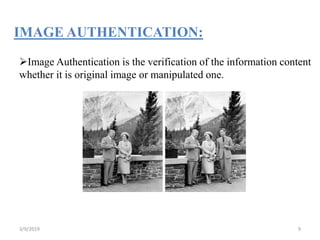
IMAGE AUTHENTICATION:
Image Authentication is the verification of the information content
whether it is original image or manipulated one.
3/9/2019 9
3/9/2019 10
Is it real or fake?
3/9/2019 11
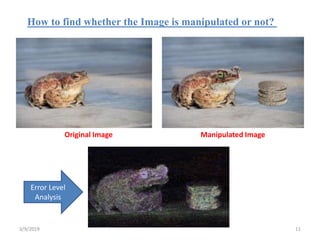
How to find whether the Image is manipulated or not?
Original Image Manipulated Image
Error Level
Analysis
3/9/2019 12
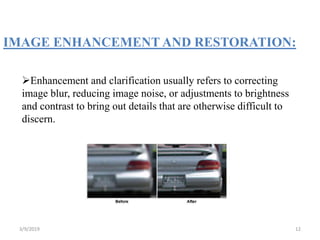
IMAGE ENHANCEMENT AND RESTORATION:
Enhancement and clarification usually refers to correcting
image blur, reducing image noise, or adjustments to brightness
and contrast to bring out details that are otherwise difficult to
discern.
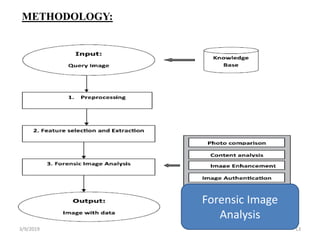
METHODOLOGY:
3/9/2019 13
Forensic Image
Analysis
3/9/2019 14
Conclusion & Future Scope:
forensic image analysis is very challenging field of research with
the continuous growth of interest and increasing security
requirements for the development of the modern society.
 The computer assisted image analysis will aid the forensic experts,
legal
experts, and policy makers in deriving appropriate conclusions for
the investigation.
3/9/2019 15
Reference:
[1] Gonzalez, Rafael C. and Woods Richards E., (1999), “Digital
Image Processing”, Addison Wesley.
[2] Christopher M. Bishop, E., (2006), Pattern recognition M.
Bishop,
Springer publications.
[3] Wang, Xiang-Yang, Ting Wang, and Juan Bu. "Color image
segmentation using pixel wise support vector machine
classification."
Pattern Recognition 44.4 (2011): [777-787].
3/9/2019 16

Image processing in forensic science

  • 1.
    A TECHNICAL SEMINAR ON IMAGEPROCESSING IN FORENSIC SCIENCE Guided by Mrs. M. Gnanapriya, Assoc prof , ECE. Presented by , V.Munisha , 15F81A0429, IV B .tech ,ECE. Depatment of ECE Gokula Krishna college of Engineering,Sullurpeta. 3/9/2019 1
  • 2.
    CONTENTS: What is ImageProcessing? What is Forensic? Introduction Forensic Image Analysis Methodology Conclusion & Future Scope Reference 3/9/2019 2
  • 3.
    What is ImageProcessing? Image processing is a method to perform some operations on an image, in order to get an enhanced image or to extract some useful information from it.  It is a type of signal processing in which input is an image and output may be image or characteristics/features associated with that image 3/9/2019 3
  • 4.
    What is Forensic? Forensic science is the application of science and technology to the criminal justice system. 3/9/2019 4
  • 5.
    INTRODUCTION: Image Processing inForensic Science is used to make clear the content of an image in legal matters. forensic experts need to perform mainly two tasks such as image interpretation and image examination. 3/9/2019 5
  • 6.
    FORENSIC IMAGE ANALYSIS: Theobjective of forensic Image analysis is to recognize the features, similarity measure components in the image and to extract information from them for comparison and/or analysis. There are four categories in forensic image analysis. They are: 1. Photo image comparison 2. Image Content Analysis (ICA) 3. Image Authentication 4. Image Enhancement and Restoration 3/9/2019 6
  • 7.
    PHOTO IMAGE COMPARISION: Photocomparison deals with the similarities among the given query image and known image. 3/9/2019 7 Query Image Known Image
  • 8.
    3/9/2019 8 IMAGE CONTENTANALYSIS: ICA is the process of drawing conclusions about an image.
  • 9.
    IMAGE AUTHENTICATION: Image Authenticationis the verification of the information content whether it is original image or manipulated one. 3/9/2019 9
  • 10.
    3/9/2019 10 Is itreal or fake?
  • 11.
    3/9/2019 11 How tofind whether the Image is manipulated or not? Original Image Manipulated Image Error Level Analysis
  • 12.
    3/9/2019 12 IMAGE ENHANCEMENTAND RESTORATION: Enhancement and clarification usually refers to correcting image blur, reducing image noise, or adjustments to brightness and contrast to bring out details that are otherwise difficult to discern.
  • 13.
  • 14.
    3/9/2019 14 Conclusion &Future Scope: forensic image analysis is very challenging field of research with the continuous growth of interest and increasing security requirements for the development of the modern society.  The computer assisted image analysis will aid the forensic experts, legal experts, and policy makers in deriving appropriate conclusions for the investigation.
  • 15.
    3/9/2019 15 Reference: [1] Gonzalez,Rafael C. and Woods Richards E., (1999), “Digital Image Processing”, Addison Wesley. [2] Christopher M. Bishop, E., (2006), Pattern recognition M. Bishop, Springer publications. [3] Wang, Xiang-Yang, Ting Wang, and Juan Bu. "Color image segmentation using pixel wise support vector machine classification." Pattern Recognition 44.4 (2011): [777-787].
  • 16.