Elliptic Curve Cryptography
Agenda
• Introduction
• Elliptic Curves Over the Real Numbers
• Elliptic Curves Over a Finite Field
• Elliptic Curve Cryptography Demo
• Elliptic Curve Cryptography – Key
Exchange
Introduction
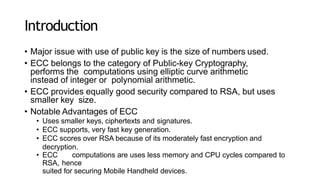
• Major issue with use of public key is the size of numbers used.
• ECC belongs to the category of Public-key Cryptography,
performs the computations using elliptic curve arithmetic
instead of integer or polynomial arithmetic.
• ECC provides equally good security compared to RSA, but uses
smaller key size.
• Notable Advantages of ECC
• Uses smaller keys, ciphertexts and signatures.
• ECC supports, very fast key generation.
• ECC scores over RSA because of its moderately fast encryption and
decryption.
• ECC computations are uses less memory and CPU cycles compared to
RSA, hence
suited for securing Mobile Handheld devices.
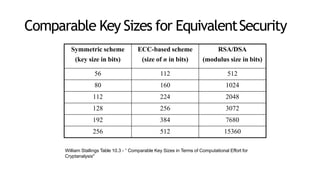
Comparable Key Sizes for EquivalentSecurity
Symmetric scheme
(key size in bits)
ECC-based scheme
(size of n in bits)
RSA/DSA
(modulus size in bits)
56 112 512
80 160 1024
112 224 2048
128 256 3072
192 384 7680
256 512 15360
William Stallings Table 10.3 - “ Comparable Key Sizes in Terms of Computational Effort for
Cryptanalysis"
Introduction
• An elliptic curve is defined by an equation in two variables
with coefficients.
• Elliptic curves are not ellipses. Elliptic curves are described by
cubic equations similar to those used for calculating the
circumference of an ellipse
• Elliptic curve cryptography makes use of elliptic curves, in
which the variables and coefficients are all restricted to
elements of a finite field.
ECC over RealNumbers
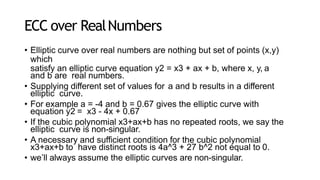
• Elliptic curve over real numbers are nothing but set of points (x,y)
which
satisfy an elliptic curve equation y2 = x3 + ax + b, where x, y, a
and b are real numbers.
• Supplying different set of values for a and b results in a different
elliptic curve.
• For example a = -4 and b = 0.67 gives the elliptic curve with
equation y2 = x3 - 4x + 0.67
• If the cubic polynomial x3+ax+b has no repeated roots, we say the
elliptic curve is non-singular.
• A necessary and sufficient condition for the cubic polynomial
x3+ax+b to have distinct roots is 4a^3 + 27 b^2 not equal to 0.
• we’ll always assume the elliptic curves are non-singular.
P + Q = R is the additive property defined
geometrically
Elliptic Curves Over FiniteFields
• Instead of choosing the field of real numbers, we can create elliptic
curves over other fields!
• Let a and b be elements of Zp for p prime, p>3. An elliptic curve E
over Zp is the set of points (x,y) with x and y in Zp that satisfy the
equation
together with a single element , called the point at infinity.
• As in the real case, to get a non-singular elliptic curve, we’ll require 4a3
+ 27 b2 (mod p)  0 (mod p).
• Elliptic curves over Zp will consist of a finite set of points
Elliptic Curves Over FiniteFields
• Just as in the real case, we can define addition of points on an
elliptic curve E over Zp, for prime p>3.
• This is done in the essentially the same way as the real
case, with appropriate modifications.
Point Addition over FiniteFieldFp
• Point addition and doubling
are now slightly different
visually.
• Lines drawn on this graph
will wrap around the
horizontal and vertical
directions, just like in a
game of Asteroids,
maintaining the same slope.
• So adding points (2, 22) and
(6,
25) looks like this:
• The third intersecting point is
(47, 39) and its reflection point
is (47, 28).
Ref: http://www.coindesk.com/math-behind-
bitcoin/
Elliptic Curve CryptographyDiscrete
Logarithm Problem [ ECCDLP]
• Addition is simple
P + P = 2P
Multiplication is faster , it takes only 8 steps to compute 100P, using point doubling
and add 1. P * 2 = 2P
2. P + 2P = 3P
3. 3P * 2 = 6P
4. 6P *2 = 12P
5. 12P * 2 =24 P
6. P + 24 P = 25 P
7. 25P * 2 = 50 P
8. 50P *2 = 100 P
Elliptic Curve CryptographyDiscrete
Logarithm Problem [ ECCDLP]
• Division is slow,
• In ECC Q is defined as product of n*P is another point on
the curve
Q = nP
given initial point P and final point Q, it is hard to
compute ‘n’ which serves as a secret key.
Brute force method, start with P,every step multiply P
with number 1, 2 and so on,
For each step compare result of P*x where x=1,2,3,…
with Q This problem is known as discrete log problem,
difficult to beak
Elliptic Curve point addition (R)-Demo
Elliptic Curve scalar multiplication (R)-Demo
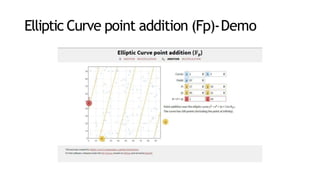
Elliptic Curve point addition (Fp)-Demo
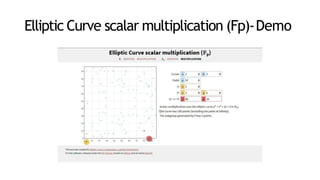
Elliptic Curve scalar multiplication (Fp)-Demo
ECCApplication
• ECC is being used in many places
such as
• PDAs
• VOIP
• Smart cards
• Mobile devices
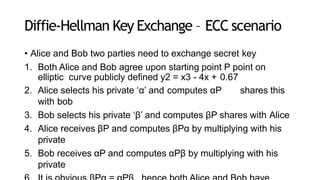
Diffie-Hellman Key Exchange – ECC scenario
• Alice and Bob two parties need to exchange secret key
1. Both Alice and Bob agree upon starting point P point on
elliptic curve publicly defined y2 = x3 - 4x + 0.67
2. Alice selects his private ‘α’ and computes αP shares this
with bob
3. Bob selects his private ‘β’ and computes βP shares with Alice
4. Alice receives βP and computes βPα by multiplying with his
private
5. Bob receives αP and computes αPβ by multiplying with his
private
Security Aspect
• Attacks on groups of elliptic curves are weaker than available
factoring algorithms attacks
• Best known attacks on elliptic curves based on cryptographic
criterions are the Baby-Step Giant-Step and Pollard-Rho method
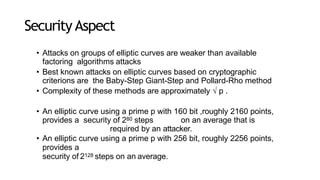
• Complexity of these methods are approximately √ p .
• An elliptic curve using a prime p with 160 bit ,roughly 2160 points,
provides a security of 280 steps on an average that is
required by an attacker.
• An elliptic curve using a prime p with 256 bit, roughly 2256 points,
provides a
security of 2128 steps on an average.
Reference
1. Network security and cryptography - William Stallings
2. Kwangjo Kim, Cryptography, Open Access Journal
3. Elliptic Curve Cryptography - Lecture notes by Wayne
Patterson
4. Elliptic Curve Cryptography: a gentle introduction,
http://andrea.corbellini.name/2015/05/17/elliptic-
curve- cryptography-a-gentle-introduction/
5. Certicom, https://www.certicom.com/ecc
Presented by: Ayush Jain
IU1941090004
EC 7TH Sem.

ellipticcurvecryptography.pptx

  • 1.
  • 2.
    Agenda • Introduction • EllipticCurves Over the Real Numbers • Elliptic Curves Over a Finite Field • Elliptic Curve Cryptography Demo • Elliptic Curve Cryptography – Key Exchange
  • 3.
    Introduction • Major issuewith use of public key is the size of numbers used. • ECC belongs to the category of Public-key Cryptography, performs the computations using elliptic curve arithmetic instead of integer or polynomial arithmetic. • ECC provides equally good security compared to RSA, but uses smaller key size. • Notable Advantages of ECC • Uses smaller keys, ciphertexts and signatures. • ECC supports, very fast key generation. • ECC scores over RSA because of its moderately fast encryption and decryption. • ECC computations are uses less memory and CPU cycles compared to RSA, hence suited for securing Mobile Handheld devices.
  • 4.
    Comparable Key Sizesfor EquivalentSecurity Symmetric scheme (key size in bits) ECC-based scheme (size of n in bits) RSA/DSA (modulus size in bits) 56 112 512 80 160 1024 112 224 2048 128 256 3072 192 384 7680 256 512 15360 William Stallings Table 10.3 - “ Comparable Key Sizes in Terms of Computational Effort for Cryptanalysis"
  • 5.
    Introduction • An ellipticcurve is defined by an equation in two variables with coefficients. • Elliptic curves are not ellipses. Elliptic curves are described by cubic equations similar to those used for calculating the circumference of an ellipse • Elliptic curve cryptography makes use of elliptic curves, in which the variables and coefficients are all restricted to elements of a finite field.
  • 6.
    ECC over RealNumbers •Elliptic curve over real numbers are nothing but set of points (x,y) which satisfy an elliptic curve equation y2 = x3 + ax + b, where x, y, a and b are real numbers. • Supplying different set of values for a and b results in a different elliptic curve. • For example a = -4 and b = 0.67 gives the elliptic curve with equation y2 = x3 - 4x + 0.67 • If the cubic polynomial x3+ax+b has no repeated roots, we say the elliptic curve is non-singular. • A necessary and sufficient condition for the cubic polynomial x3+ax+b to have distinct roots is 4a^3 + 27 b^2 not equal to 0. • we’ll always assume the elliptic curves are non-singular.
  • 7.
    P + Q= R is the additive property defined geometrically
  • 8.
    Elliptic Curves OverFiniteFields • Instead of choosing the field of real numbers, we can create elliptic curves over other fields! • Let a and b be elements of Zp for p prime, p>3. An elliptic curve E over Zp is the set of points (x,y) with x and y in Zp that satisfy the equation together with a single element , called the point at infinity. • As in the real case, to get a non-singular elliptic curve, we’ll require 4a3 + 27 b2 (mod p)  0 (mod p). • Elliptic curves over Zp will consist of a finite set of points
  • 9.
    Elliptic Curves OverFiniteFields • Just as in the real case, we can define addition of points on an elliptic curve E over Zp, for prime p>3. • This is done in the essentially the same way as the real case, with appropriate modifications.
  • 10.
    Point Addition overFiniteFieldFp • Point addition and doubling are now slightly different visually. • Lines drawn on this graph will wrap around the horizontal and vertical directions, just like in a game of Asteroids, maintaining the same slope. • So adding points (2, 22) and (6, 25) looks like this: • The third intersecting point is (47, 39) and its reflection point is (47, 28). Ref: http://www.coindesk.com/math-behind- bitcoin/
  • 11.
    Elliptic Curve CryptographyDiscrete LogarithmProblem [ ECCDLP] • Addition is simple P + P = 2P Multiplication is faster , it takes only 8 steps to compute 100P, using point doubling and add 1. P * 2 = 2P 2. P + 2P = 3P 3. 3P * 2 = 6P 4. 6P *2 = 12P 5. 12P * 2 =24 P 6. P + 24 P = 25 P 7. 25P * 2 = 50 P 8. 50P *2 = 100 P
  • 12.
    Elliptic Curve CryptographyDiscrete LogarithmProblem [ ECCDLP] • Division is slow, • In ECC Q is defined as product of n*P is another point on the curve Q = nP given initial point P and final point Q, it is hard to compute ‘n’ which serves as a secret key. Brute force method, start with P,every step multiply P with number 1, 2 and so on, For each step compare result of P*x where x=1,2,3,… with Q This problem is known as discrete log problem, difficult to beak
  • 13.
    Elliptic Curve pointaddition (R)-Demo
  • 14.
    Elliptic Curve scalarmultiplication (R)-Demo
  • 15.
    Elliptic Curve pointaddition (Fp)-Demo
  • 16.
    Elliptic Curve scalarmultiplication (Fp)-Demo
  • 17.
    ECCApplication • ECC isbeing used in many places such as • PDAs • VOIP • Smart cards • Mobile devices
  • 18.
    Diffie-Hellman Key Exchange– ECC scenario • Alice and Bob two parties need to exchange secret key 1. Both Alice and Bob agree upon starting point P point on elliptic curve publicly defined y2 = x3 - 4x + 0.67 2. Alice selects his private ‘α’ and computes αP shares this with bob 3. Bob selects his private ‘β’ and computes βP shares with Alice 4. Alice receives βP and computes βPα by multiplying with his private 5. Bob receives αP and computes αPβ by multiplying with his private
  • 19.
    Security Aspect • Attackson groups of elliptic curves are weaker than available factoring algorithms attacks • Best known attacks on elliptic curves based on cryptographic criterions are the Baby-Step Giant-Step and Pollard-Rho method • Complexity of these methods are approximately √ p . • An elliptic curve using a prime p with 160 bit ,roughly 2160 points, provides a security of 280 steps on an average that is required by an attacker. • An elliptic curve using a prime p with 256 bit, roughly 2256 points, provides a security of 2128 steps on an average.
  • 20.
    Reference 1. Network securityand cryptography - William Stallings 2. Kwangjo Kim, Cryptography, Open Access Journal 3. Elliptic Curve Cryptography - Lecture notes by Wayne Patterson 4. Elliptic Curve Cryptography: a gentle introduction, http://andrea.corbellini.name/2015/05/17/elliptic- curve- cryptography-a-gentle-introduction/ 5. Certicom, https://www.certicom.com/ecc
  • 22.
    Presented by: AyushJain IU1941090004 EC 7TH Sem.