ABOUT US
AH is a professional services firm that specializes in helping non-profit organizations
achieve their mission, create value, and advance their causes, industries, and
professions.
We have four main divisions within AH: A full-service association management
company (AMC); a marketing and communications agency; a meetings and events
management team; and a division that focuses on other custom solutions, such as
education, strategic planning, website builds, database integrations, public affairs,
certification management, and growing non-dues revenue.
www.AHredchair.com
Note:
• AH webinars are delivered by experienced association
executives who will share information in an easy to relate to
fashion.
• The sessions do not provide official legal or insurance advice,
rather just necessary information so you will feel more
confident in being able to ask the right questions.
We offer various live and on-demand webinars with topics ranging from board governance
to content marketing.
Today’s Topic:
IMAGE, BRAND & MESSAGING FOR YOUR NON-PROFIT
Your non-profit's brand is more than your logo. It has to do with your members and stakeholders' experiences with and recognition of your
organization.
After attending this webinar, attendees will:
• Understand branding definitions
• Get ideas for explaining the importance of branding and general buy-in from your Board
• Take away a number of branding essentials for your organization
• See branding examples from other non-profits
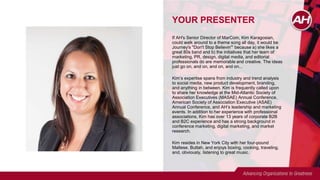
YOUR PRESENTER
If AH's Senior Director of MarCom, Kim Karagosian,
could walk around to a theme song all day, it would be
Journey's "Don't Stop Believin'" because a) she likes a
great 80s band and b) the initiatives that her team of
marketing, PR, design, digital media, and editorial
professionals do are memorable and creative. The ideas
just go on, and on, and on, and on...
Kim’s expertise spans from industry and trend analysis
to social media, new product development, branding,
and anything in between. Kim is frequently called upon
to share her knowledge at the Mid-Atlantic Society of
Association Executives (MASAE) Annual Conference,
American Society of Association Executive (ASAE)
Annual Conference, and AH’s leadership and marketing
events. In addition to her experience with professional
associations, Kim has over 13 years of corporate B2B
and B2C experience and has a strong background in
conference marketing, digital marketing, and market
research.
Kim resides in New York City with her four-pound
Maltese, Buttah, and enjoys boxing, cooking, traveling,
and, obviously, listening to great music.
Agenda
• Branding definitions
• Getting buy-in
• Essentials in Branding
Definitions
BRAND DEFINITIONSThe American Marketing Association
defines brand and branding as: “A
customer experience represented
by a collection of images and
ideas; often, it refers to a symbol
such as a name, logo, slogan, and
design scheme. Brand recognition
and other reactions are created by
the accumulation of experiences
with the specific product or service,
both directly relating to its use, and
through the influence of
advertising, design, and media
commentary.”
BRAND DEFINITIONS
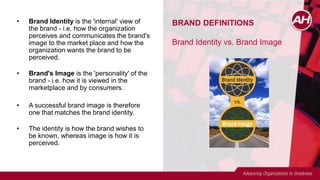
Brand Identity vs. Brand Image
• Brand Identity is the 'internal' view of
the brand - i.e. how the organization
perceives and communicates the brand's
image to the market place and how the
organization wants the brand to be
perceived.
• Brand's Image is the 'personality' of the
brand - i.e. how it is viewed in the
marketplace and by consumers.
• A successful brand image is therefore
one that matches the brand identity.
• The identity is how the brand wishes to
be known, whereas image is how it is
perceived.
Exercise
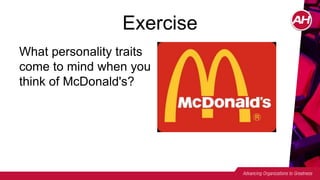
What personality traits
come to mind when you
think of McDonald's?
Branding is more than a logo
• As you think about your organization’s
brand, you must analyze and understand
your org’s purpose, target audience, and
how you want to be perceived. MORE
importantly than that, it includes helping
your audience to see the importance of
knowing these things about your
organization.
• Branding is everything you are putting
out into the world in regards to your
organization, and works to build
recognition, loyalty, and trust.
• Visually, it does include the logo. But, it
also includes how you tweet, what your
sidebar graphics look like on your
website, and whether or not your images
have a lot white space in them, and so
on. Outside of visuals it includes
understanding what your mission is,
where you want your org to go, and who
you serve. Most importantly, it all ties
together in a cohesive and memorable
way.
Getting Buy-in
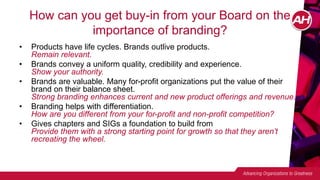
How can you get buy-in from your Board on the
importance of branding?
• Products have life cycles. Brands outlive products.
Remain relevant.
• Brands convey a uniform quality, credibility and experience.
Show your authority.
• Brands are valuable. Many for-profit organizations put the value of their
brand on their balance sheet.
Strong branding enhances current and new product offerings and revenue.
• Branding helps with differentiation.
How are you different from your for-profit and non-profit competition?
• Gives chapters and SIGs a foundation to build from
Provide them with a strong starting point for growth so that they aren’t
recreating the wheel.
Example
Example
When Four Seasons Hotels, Inc., sold for
billions of dollars, what did they buy?
Locations? Restaurants? Staff? Beach
front property?
No, they bought the brand.
Loyalty to Brands
• People don’t have relationships with
products, they are loyal to brands.
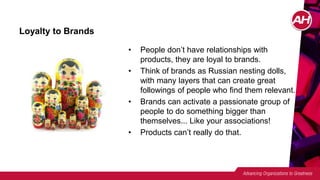
• Think of brands as Russian nesting dolls,
with many layers that can create great
followings of people who find them relevant.
• Brands can activate a passionate group of
people to do something bigger than
themselves... Like your associations!
• Products can’t really do that.
Essentials in Branding
1. Scalable Logo
Best Practices: Logo Design
• Scalability - a logo should be visually appealing and readable at extremely small or large
sizes.
• Simplicity – a clear and simple message. A logo that has several design elements and tricks
will be hard to see at small sizes and become dated quickly. Simple logos are the most
memorable.
• Versatile - easily and quickly readable, large or small, in black and white or full color in any
medium
• Recognizable – logos build brand recognition. The goal of the logo is to instantly call the
brand to mind.
• Appropriate – a logo should be appropriate for its intended purpose. It should suit the
company/organization.
• Typography – another important aspect of the logo. It should fit the brand. One to two fonts
are ideal. Avoid more than two. Size, script, italics, bold, serifs, are all considerations.
• Colors – use colors to your advantage. Colors near each other on the color wheel. The logo
must also look good in black and white.
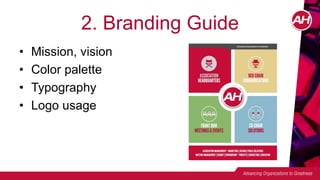
2. Branding Guide
• Mission, vision
• Color palette
• Typography
• Logo usage
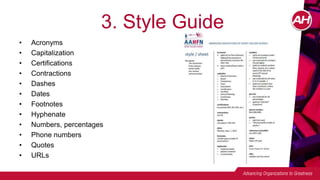
3. Style Guide
• Acronyms
• Capitalization
• Certifications
• Contractions
• Dashes
• Dates
• Footnotes
• Hyphenate
• Numbers, percentages
• Phone numbers
• Quotes
• URLs
4. Spokesperson Handbook
• Consistent messaging
• How to field questions on behalf of the brand
• Sound bites
– Facts about the association
– Facts about the industry
– General and product information
• Good for volunteer leaders and staff
5. Social Media Policy
• This is determined by each organization, but consider including:
– Goal of social media channel
– Grounds for Deletion of Comment
– Posts/Comments in a Different Language
– Scenarios
On NAPO’s FB page:
The goal of the NAPO Facebook page is to give its members and organizing enthusiasts a place
where they can share ideas and learn in an open forum. Ask questions about the industry and
receive advice on a peer to peer level. Whether the question is about running their business or a
specific organizational challenge they are dealing with, this is the best resource for help.
– Interested in a career as a professional organizer? Please visit
http://www.napo.net/our_profession/ for more information.
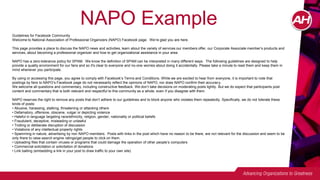
NAPO Example
Guidelines for Facebook Community
Welcome to National Association of Professional Organizers (NAPO) Facebook page. We’re glad you are here.
This page provides a place to discuss the NAPO news and activities, learn about the variety of services our members offer, our Corporate Associate member’s products and
services, about becoming a professional organizer and how to get organizational assistance in your area.
NAPO has a zero-tolerance policy for SPAM. We know the definition of SPAM can be interpreted in many different ways. The following guidelines are designed to help
provide a quality environment for our fans and so it's clear to everyone and no-one worries about doing it accidentally. Please take a minute to read them and keep them in
mind whenever you participate.
By using or accessing this page, you agree to comply with Facebook’s Terms and Conditions. While we are excited to hear from everyone, it is important to note that
postings by fans to NAPO’s Facebook page do not necessarily reflect the opinions of NAPO, nor does NAPO confirm their accuracy.
We welcome all questions and commentary, including constructive feedback. We don’t take decisions on moderating posts lightly. But we do expect that participants post
content and commentary that is both relevant and respectful to this community as a whole, even if you disagree with them.
NAPO reserves the right to remove any posts that don’t adhere to our guidelines and to block anyone who violates them repeatedly. Specifically, we do not tolerate these
kinds of posts:
• Abusive, harassing, stalking, threatening or attacking others
• Defamatory, offensive, obscene, vulgar or depicting violence
• Hateful in language targeting race/ethnicity, religion, gender, nationality or political beliefs
• Fraudulent, deceptive, misleading or unlawful
• Trolling or deliberate disruption of discussion
• Violations of any intellectual property rights
• Spamming in nature, advertising by non NAPO members. Posts with links in the post which have no reason to be there, are not relevant for the discussion and seem to be
only there to raise search engine ratings/get people to click on them.
• Uploading files that contain viruses or programs that could damage the operation of other people’s computers
• Commercial solicitation or solicitation of donations
• Link baiting (embedding a link in your post to draw traffic to your own site)
• Ensure you are being consistent
• Look at all your channels (print, web, social media, etc.)
• Types of photos and images that are being used
• Typography
6. Brand Review
7. Orientation for New
Stakeholders
• If new staff, board, committee, chapter, SIG, or task force leaders join your
organization, it’s important to have a check list of what’s included in their
orientation
• Branding should be included and provide them with a pre-recorded
branding webinar (or live), branding guide, style guide, and spokesperson
handbook
Q&A
kkaragosian@AHredchair.com

Image, Brand & Messaging for Your Non-profit

  • 2.
    ABOUT US AH isa professional services firm that specializes in helping non-profit organizations achieve their mission, create value, and advance their causes, industries, and professions. We have four main divisions within AH: A full-service association management company (AMC); a marketing and communications agency; a meetings and events management team; and a division that focuses on other custom solutions, such as education, strategic planning, website builds, database integrations, public affairs, certification management, and growing non-dues revenue. www.AHredchair.com
  • 3.
    Note: • AH webinarsare delivered by experienced association executives who will share information in an easy to relate to fashion. • The sessions do not provide official legal or insurance advice, rather just necessary information so you will feel more confident in being able to ask the right questions.
  • 4.
    We offer variouslive and on-demand webinars with topics ranging from board governance to content marketing. Today’s Topic: IMAGE, BRAND & MESSAGING FOR YOUR NON-PROFIT Your non-profit's brand is more than your logo. It has to do with your members and stakeholders' experiences with and recognition of your organization. After attending this webinar, attendees will: • Understand branding definitions • Get ideas for explaining the importance of branding and general buy-in from your Board • Take away a number of branding essentials for your organization • See branding examples from other non-profits
  • 5.
    YOUR PRESENTER If AH'sSenior Director of MarCom, Kim Karagosian, could walk around to a theme song all day, it would be Journey's "Don't Stop Believin'" because a) she likes a great 80s band and b) the initiatives that her team of marketing, PR, design, digital media, and editorial professionals do are memorable and creative. The ideas just go on, and on, and on, and on... Kim’s expertise spans from industry and trend analysis to social media, new product development, branding, and anything in between. Kim is frequently called upon to share her knowledge at the Mid-Atlantic Society of Association Executives (MASAE) Annual Conference, American Society of Association Executive (ASAE) Annual Conference, and AH’s leadership and marketing events. In addition to her experience with professional associations, Kim has over 13 years of corporate B2B and B2C experience and has a strong background in conference marketing, digital marketing, and market research. Kim resides in New York City with her four-pound Maltese, Buttah, and enjoys boxing, cooking, traveling, and, obviously, listening to great music.
  • 6.
    Agenda • Branding definitions •Getting buy-in • Essentials in Branding
  • 7.
  • 8.
    BRAND DEFINITIONSThe AmericanMarketing Association defines brand and branding as: “A customer experience represented by a collection of images and ideas; often, it refers to a symbol such as a name, logo, slogan, and design scheme. Brand recognition and other reactions are created by the accumulation of experiences with the specific product or service, both directly relating to its use, and through the influence of advertising, design, and media commentary.”
  • 9.
    BRAND DEFINITIONS Brand Identityvs. Brand Image • Brand Identity is the 'internal' view of the brand - i.e. how the organization perceives and communicates the brand's image to the market place and how the organization wants the brand to be perceived. • Brand's Image is the 'personality' of the brand - i.e. how it is viewed in the marketplace and by consumers. • A successful brand image is therefore one that matches the brand identity. • The identity is how the brand wishes to be known, whereas image is how it is perceived.
  • 10.
    Exercise What personality traits cometo mind when you think of McDonald's?
  • 11.
    Branding is morethan a logo • As you think about your organization’s brand, you must analyze and understand your org’s purpose, target audience, and how you want to be perceived. MORE importantly than that, it includes helping your audience to see the importance of knowing these things about your organization. • Branding is everything you are putting out into the world in regards to your organization, and works to build recognition, loyalty, and trust. • Visually, it does include the logo. But, it also includes how you tweet, what your sidebar graphics look like on your website, and whether or not your images have a lot white space in them, and so on. Outside of visuals it includes understanding what your mission is, where you want your org to go, and who you serve. Most importantly, it all ties together in a cohesive and memorable way.
  • 12.
  • 13.
    How can youget buy-in from your Board on the importance of branding? • Products have life cycles. Brands outlive products. Remain relevant. • Brands convey a uniform quality, credibility and experience. Show your authority. • Brands are valuable. Many for-profit organizations put the value of their brand on their balance sheet. Strong branding enhances current and new product offerings and revenue. • Branding helps with differentiation. How are you different from your for-profit and non-profit competition? • Gives chapters and SIGs a foundation to build from Provide them with a strong starting point for growth so that they aren’t recreating the wheel.
  • 14.
  • 16.
    Example When Four SeasonsHotels, Inc., sold for billions of dollars, what did they buy? Locations? Restaurants? Staff? Beach front property? No, they bought the brand.
  • 17.
    Loyalty to Brands •People don’t have relationships with products, they are loyal to brands. • Think of brands as Russian nesting dolls, with many layers that can create great followings of people who find them relevant. • Brands can activate a passionate group of people to do something bigger than themselves... Like your associations! • Products can’t really do that.
  • 18.
  • 19.
    1. Scalable Logo BestPractices: Logo Design • Scalability - a logo should be visually appealing and readable at extremely small or large sizes. • Simplicity – a clear and simple message. A logo that has several design elements and tricks will be hard to see at small sizes and become dated quickly. Simple logos are the most memorable. • Versatile - easily and quickly readable, large or small, in black and white or full color in any medium • Recognizable – logos build brand recognition. The goal of the logo is to instantly call the brand to mind. • Appropriate – a logo should be appropriate for its intended purpose. It should suit the company/organization. • Typography – another important aspect of the logo. It should fit the brand. One to two fonts are ideal. Avoid more than two. Size, script, italics, bold, serifs, are all considerations. • Colors – use colors to your advantage. Colors near each other on the color wheel. The logo must also look good in black and white.
  • 21.
    2. Branding Guide •Mission, vision • Color palette • Typography • Logo usage
  • 23.
    3. Style Guide •Acronyms • Capitalization • Certifications • Contractions • Dashes • Dates • Footnotes • Hyphenate • Numbers, percentages • Phone numbers • Quotes • URLs
  • 24.
    4. Spokesperson Handbook •Consistent messaging • How to field questions on behalf of the brand • Sound bites – Facts about the association – Facts about the industry – General and product information • Good for volunteer leaders and staff
  • 25.
    5. Social MediaPolicy • This is determined by each organization, but consider including: – Goal of social media channel – Grounds for Deletion of Comment – Posts/Comments in a Different Language – Scenarios On NAPO’s FB page: The goal of the NAPO Facebook page is to give its members and organizing enthusiasts a place where they can share ideas and learn in an open forum. Ask questions about the industry and receive advice on a peer to peer level. Whether the question is about running their business or a specific organizational challenge they are dealing with, this is the best resource for help. – Interested in a career as a professional organizer? Please visit http://www.napo.net/our_profession/ for more information.
  • 26.
    NAPO Example Guidelines forFacebook Community Welcome to National Association of Professional Organizers (NAPO) Facebook page. We’re glad you are here. This page provides a place to discuss the NAPO news and activities, learn about the variety of services our members offer, our Corporate Associate member’s products and services, about becoming a professional organizer and how to get organizational assistance in your area. NAPO has a zero-tolerance policy for SPAM. We know the definition of SPAM can be interpreted in many different ways. The following guidelines are designed to help provide a quality environment for our fans and so it's clear to everyone and no-one worries about doing it accidentally. Please take a minute to read them and keep them in mind whenever you participate. By using or accessing this page, you agree to comply with Facebook’s Terms and Conditions. While we are excited to hear from everyone, it is important to note that postings by fans to NAPO’s Facebook page do not necessarily reflect the opinions of NAPO, nor does NAPO confirm their accuracy. We welcome all questions and commentary, including constructive feedback. We don’t take decisions on moderating posts lightly. But we do expect that participants post content and commentary that is both relevant and respectful to this community as a whole, even if you disagree with them. NAPO reserves the right to remove any posts that don’t adhere to our guidelines and to block anyone who violates them repeatedly. Specifically, we do not tolerate these kinds of posts: • Abusive, harassing, stalking, threatening or attacking others • Defamatory, offensive, obscene, vulgar or depicting violence • Hateful in language targeting race/ethnicity, religion, gender, nationality or political beliefs • Fraudulent, deceptive, misleading or unlawful • Trolling or deliberate disruption of discussion • Violations of any intellectual property rights • Spamming in nature, advertising by non NAPO members. Posts with links in the post which have no reason to be there, are not relevant for the discussion and seem to be only there to raise search engine ratings/get people to click on them. • Uploading files that contain viruses or programs that could damage the operation of other people’s computers • Commercial solicitation or solicitation of donations • Link baiting (embedding a link in your post to draw traffic to your own site)
  • 27.
    • Ensure youare being consistent • Look at all your channels (print, web, social media, etc.) • Types of photos and images that are being used • Typography 6. Brand Review
  • 29.
    7. Orientation forNew Stakeholders • If new staff, board, committee, chapter, SIG, or task force leaders join your organization, it’s important to have a check list of what’s included in their orientation • Branding should be included and provide them with a pre-recorded branding webinar (or live), branding guide, style guide, and spokesperson handbook
  • 30.

Editor's Notes

  • #7 Throughout the presentation, I will be providing real-world examples, as well as some ideas for the organizations we have on this webinar today. I wanted to provide very relevant ideas to our audience.
  • #11 I think of "unhealthy", "fast food", which I am sure is a far cry from how they think of their brand image and how they want people to identify with their brand. McDonald's wants us to perceive their brand as "fast", "convenient", "family oriented", and even "fun".
  • #12 WHAT BRANDING ISN’T The way my brain works, it’s easier for me to understand what something isn’t first. Branding isn’t “just a logo.” Branding isn’t “just a website.” branding is way more than a simple one-word answer. Let’s talk about how branding isn’t just your logo. Do you know how many organizations I follow on Instagram? I don’t, but for purposes of this post, let’s say I follow 50 organizations. It can be anything from one-woman companies who sell crocheted blankets to corporate companies who sell a million dollars worth of apparel a day. Do you know how many times I see any organization’s LOGOS while scrolling through Instagram? 0. Like, literally, zilch. Do you know what I do see? Stylized photographs that are consistent in their mood and colors, or someone’s desk with all their tools laid out, or someone’s hand wearing really awesome rings drawing a picture. Whatever I see – it influences how I feel about that organization and what I think their values are and who their ideal customer or member is (and if I am that customer or not). Over time I learn about this organization, I perceive things about them and I still probably couldn’t tell you what their logo is. Now, eventually, I’ll decide I want to buy something or join and I think, oh I bet so-and-so offers that, and I’ll head to their website and I will think, “WOW! This looks exactly like what I imagined in would, based off their Instagram feed. Oh, that’s their logo? That’s awesome, it’s so fitting. They have a really well designed and considered brand identity.” Had their Instagram feed been just daily posts of their logo, would I even be following them? No. Branding is more than your logo. Your logo is an element of your branding, but just an element.
  • #13 Now you may understand or are beginning to understand the importance of branding, and how it’s more than your logo. It’s an identity. It’s a perception. But what about your Board? Often, your organization’s leaders don’t always understand the importance of branding or the time it actually takes to get it right. And that you might not get it right the first time, and how it’s important to keep adapting and testing until your identity is matching your image.
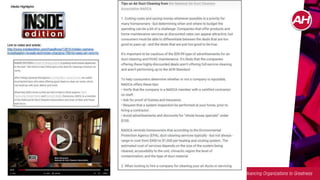
  • #15 The HVAC Inspection, Maintenance and Restoration Association, NADCA, has spent time helping to develop themselves as an authority in the space. I would consider NADCA a sage brand archetype, where Sage brands connect with a desire to understand the world and help enlighten consumers. NADCA’s brand is one of expertise and as they continue to build their brand, they dedicated a lot of effort to connecting with the media and being a go to resource for them. For example, NADCA was contacted by a producer with Inside Edition looking to do a sting operation to catch businesses who were making false claims about air duct cleaning and taking advantage of unsuspecting homeowners...mainly, the elderly. Inside Edition reached out to NADCA and asked if we could connect them with an NJ-area duct cleaner who could assist. We connected him with our volunteer leader who was head of NADCA’s Anti-Fraud Task Force. He had a call with the producer and discussed how NADCA could assist in the sting operation and a week later, he went to a home in North NJ and walked through with the Inside Edition team, looking through the duct work and making sure everything was clean and in good shape. The plan was to make sure the house was in great condition, and then set up a business to come in an say otherwise, advising the homeowner that they were in need of the cleaning. About two weeks later, our volunteer leader went back to the home and assisted with behind-the-scenes commentary when the business was in the house.  In addition to this spot, NADCA provided the producer with additional information for homeowners, which they included within an article on the Inside Edition website. NADCA was referenced several times as the source of the information and the industry authority. This is completely in-line with their sage brand archetype, connecting with the desire to understand the world and help enlighten consumers.
  • #17 Your brand effects everything. Think about partnerships your association is trying to establish, or speakers you are trying to secure for your event. They have a perception of your brand, and that is why branding should be top of mind and talked about with your board.
  • #18 Remember, people don’t have relationships with products, they are loyal to brands.
  • #19 So now, we have reviewed some brand definitions, and ideas to how to get buy-in with your Board on the importance of branding. Now let’s take that and go over some essentials in branding. If you take anything from this presentation, take some ideas from this section.
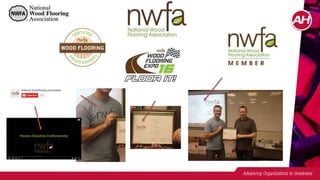
  • #21 This is actually an example from one of our organization’s participating in this presentation today. If someone from NWFA is on the phone and would like to chat along with some of my comments, please feel free, or add your thoughts for when we open up the phone lines at the end!! When I was doing some research, it appeared to me that the national wood flooring association went through a rebrand, where the top left logo was their old logo, and the new one is in the middle. Scalability - The new nwfa logo translates well in small or large sizes, and it is visually appealing Simplicity – It is simple and memorable. Versatile - easily and quickly readable, large or small, in black and white or full color in any medium. It also fits well in other facets, such as their conference, certification, and member design. Recognizable –The goal of the logo is to instantly call the brand to mind and I think this is a very recognizable logo. Appropriate – a logo should be appropriate for its intended purpose and in this case, in my mind, the brown color represents wood, and the leaf represents sustainability. Or perhaps growth of the hardwood flooring industry through research and education.  Typography – The typography translates well in different channels and I think it fits the brand. Colors – As mentioned, I think the color choice is appropriate and fits the organization.
  • #22 Every brand, from the smallest, to corporate giants such as Nike or McDonald’s, need a set of branding guidelines and rules to maintain their identity. This document, which can range from a couple of pages, to several hundred, is the thread that holds together what the public sees from an organization. It establishes the voice and personality of a company, as well as who the public will see, and it governs every aspect of communication from the organization.
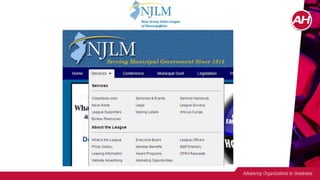
  • #23 I wanted to talk through another organization that is participating in today’s webinar. NJLM. And again, If you are on the call, please feel free to chat as I talk or when we open the phone lines at the end. I’m assuming there are many stakeholders that interact with NJLM. For example, just looking at the League’s services section of their website, I’m sure they have staff working on job resources and employers, events & meetings, advertisers and supporters, and with the Executive Board, League officers, government officials, members, etc. There are many people touching the NJLM brand – from staff to volunteers, and it’s important to have a consistent message, everyone understands and can communicate the League’s mission and vision, is using a consistent font and has a similar tone in their messaging. A branding guide that is shared with all stakeholders can help frame this consistency.
  • #27 On one of the tabs of FB, they include their guidelines for their fb community. This page talks about: Zero-tolerance policy for SPAM Postings by fans to NAPO’s FB page do not necessarily reflect the opinions of NAPO, no does NAPO confirm their accuracy NAPO has the right to remove any posts that don’t adhere to their guidelines and can block anyone who violates them repeatedly Specifics around the type of posts they do not tolerate
  • #28 I find it’s helpful for someone new to your organization or a third party to conduct a brand review. Someone that is not constantly involved with your overall communications.
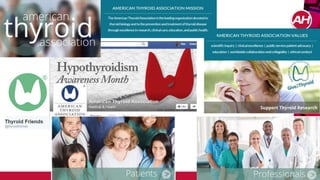
  • #29 -Another participant on today’s webinar is the American Thyroid Association. Again, if you would like to chat along or save your comments to the end, I welcome it. I did a quick brand review of their site and overall I thought it was very good -In terms of the types of photos, it looks like they rely on stock photography, -In social media, I would just recommend taking another look to seeing if the fonts and logos are consistent. -One idea I had was to perhaps incorporate the American thryroid association’s values more in your messaging and imagery. I thought the values of the organization are very strong, for example, public service patient advocacy, worldwide collaboration, and ethical conduct. I can see that being highlighted more, as these are integral pieces to your brand.
  • #31 I am more than happy to answer any questions now, or if someone of the organizations I featured would like to chime in, that would be great. Also, if you need any ideas or would like to talk through some of your upcoming branding projects, I’d be happy to set up a call with you.