Architects: Pierre Lescot , I.M. Pie
Consultant Engg. : Nicolet Chartrand Knoll Ltd
MUSÉE DU LOUVRE
Case study by
Harshil mehta {10110024}
Kopal gupta {10110028}
B.Arch Year III
INTRODUCTION
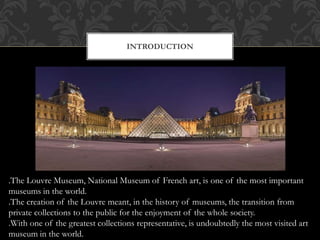
.The Louvre Museum, National Museum of French art, is one of the most important
museums in the world.
.The creation of the Louvre meant, in the history of museums, the transition from
private collections to the public for the enjoyment of the whole society.
.With one of the greatest collections representative, is undoubtedly the most visited art
museum in the world.
LOCATION
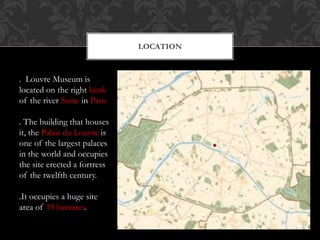
. Louvre Museum is
located on the right bank
of the river Seine in Paris
. The building that houses
it, the Palais du Louvre is
one of the largest palaces
in the world and occupies
the site erected a fortress
of the twelfth century.
.It occupies a huge site
area of 19 hectares.
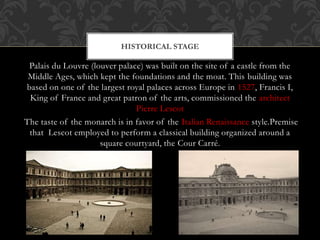
Palais du Louvre (louver palace) was built on the site of a castle from the
Middle Ages, which kept the foundations and the moat. This building was
based on one of the largest royal palaces across Europe in 1527, Francis I,
King of France and great patron of the arts, commissioned the architect
Pierre Lescot
The taste of the monarch is in favor of the Italian Renaissance style.Premise
that Lescot employed to perform a classical building organized around a
square courtyard, the Cour Carré.
HISTORICAL STAGE
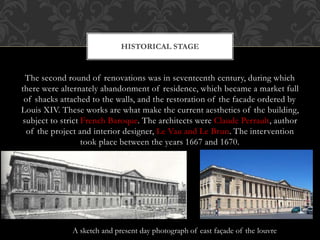
The second round of renovations was in seventeenth century, during which
there were alternately abandonment of residence, which became a market full
of shacks attached to the walls, and the restoration of the facade ordered by
Louis XIV. These works are what make the current aesthetics of the building,
subject to strict French Baroque. The architects were Claude Perrault, author
of the project and interior designer, Le Vau and Le Brun. The intervention
took place between the years 1667 and 1670.
HISTORICAL STAGE
A sketch and present day photograph of east façade of the louvre
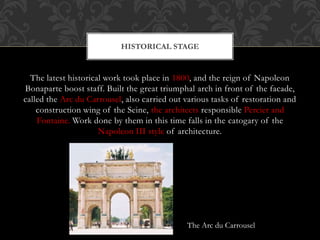
The latest historical work took place in 1800, and the reign of Napoleon
Bonaparte boost staff. Built the great triumphal arch in front of the facade,
called the Arc du Carrousel, also carried out various tasks of restoration and
construction wing of the Seine, the architects responsible Percier and
Fontaine. Work done by them in this time falls in the catogary of the
Napoleon III style of architecture.
HISTORICAL STAGE
The Arc du Carrousel
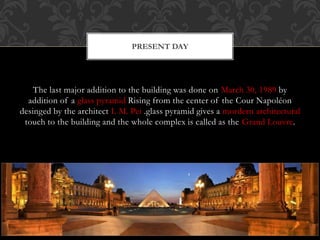
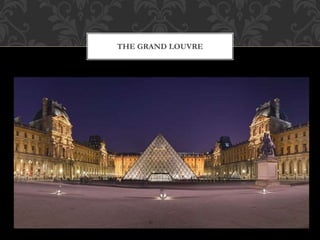
The last major addition to the building was done on March 30, 1989 by
addition of a glass pyramid Rising from the center of the Cour Napoléon
desinged by the architect I. M. Pei .glass pyramid gives a mordern architectural
touch to the building and the whole complex is called as the Grand Louvre.
PRESENT DAY
THE GRAND LOUVRE
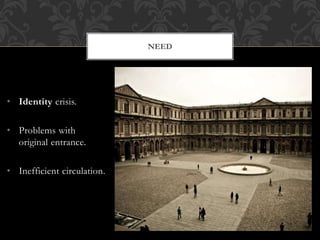
NEED
• Identity crisis.
• Problems with
original entrance.
• Inefficient circulation.
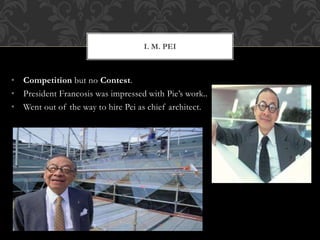
• Competition but no Contest.
• President Francosis was impressed with Pie’s work..
• Went out of the way to hire Pei as chief architect.
I. M. PEI
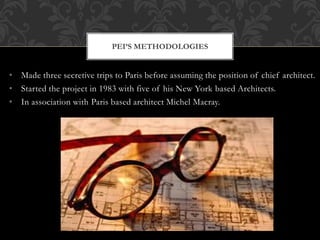
• Made three secretive trips to Paris before assuming the position of chief architect.
• Started the project in 1983 with five of his New York based Architects.
• In association with Paris based architect Michel Macray.
PEI’S METHODOLOGIES
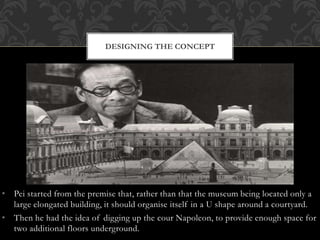
• Pei started from the premise that, rather than that the museum being located only a
large elongated building, it should organise itself in a U shape around a courtyard.
• Then he had the idea of digging up the cour Napoleon, to provide enough space for
two additional floors underground.
DESIGNING THE CONCEPT
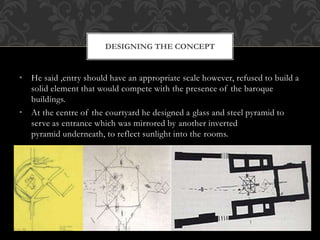
• He said ,entry should have an appropriate scale however, refused to build a
solid element that would compete with the presence of the baroque
buildings.
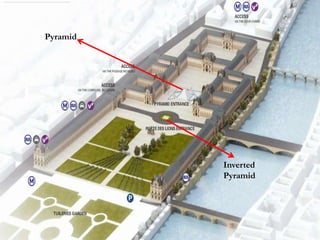
• At the centre of the courtyard he designed a glass and steel pyramid to
serve as entrance which was mirrored by another inverted
pyramid underneath, to reflect sunlight into the rooms.
DESIGNING THE CONCEPT
Pyramid
Inverted
Pyramid
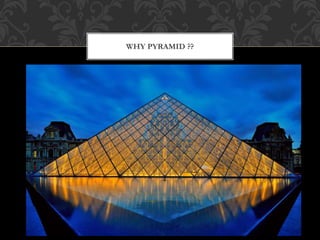
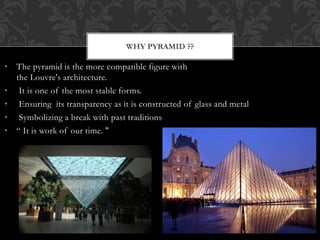
WHY PYRAMID ??
WHY PYRAMID ??
• The pyramid is the more compatible figure with
the Louvre's architecture.
• It is one of the most stable forms.
• Ensuring its transparency as it is constructed of glass and metal
• Symbolizing a break with past traditions
• “ It is work of our time. "
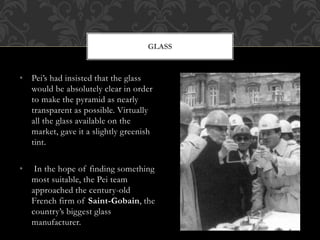
• Pei’s had insisted that the glass
would be absolutely clear in order
to make the pyramid as nearly
transparent as possible. Virtually
all the glass available on the
market, gave it a slightly greenish
tint.
• In the hope of finding something
most suitable, the Pei team
approached the century-old
French firm of Saint-Gobain, the
country’s biggest glass
manufacturer.
GLASS
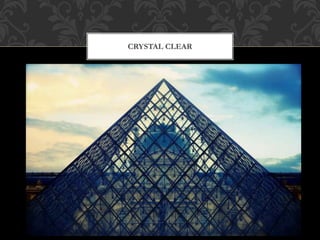
CRYSTAL CLEAR
• Difference in French and American Project Team Structuring.
• In France architects not involved in construction documentation and
building process ,unlike America.
CLASH OF METHODOLOGIES
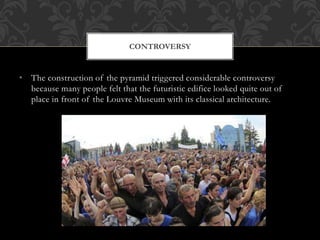
• The construction of the pyramid triggered considerable controversy
because many people felt that the futuristic edifice looked quite out of
place in front of the Louvre Museum with its classical architecture.
CONTROVERSY
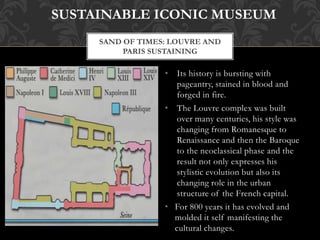
• Its history is bursting with
pageantry, stained in blood and
forged in fire.
• The Louvre complex was built
over many centuries, his style was
changing from Romanesque to
Renaissance and then the Baroque
to the neoclassical phase and the
result not only expresses his
stylistic evolution but also its
changing role in the urban
structure of the French capital.
• For 800 years it has evolved and
molded it self manifesting the
cultural changes.
SAND OF TIMES: LOUVRE AND
PARIS SUSTAINING
SUSTAINABLE ICONIC MUSEUM
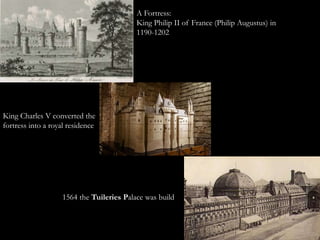
A Fortress:
King Philip II of France (Philip Augustus) in
1190-1202
King Charles V converted the
fortress into a royal residence
1564 the Tuileries Palace was build
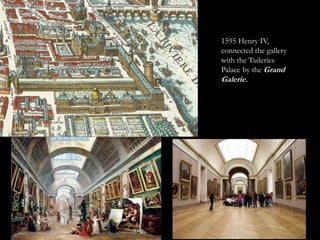
1595 Henry IV,
connected the gallery
with the Tuileries
Palace by the Grand
Galerie.
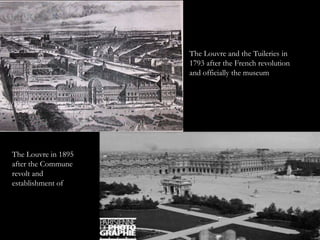
The Louvre in 1895
after the Commune
revolt and
establishment of
The Louvre and the Tuileries in
1793 after the French revolution
and officially the museum
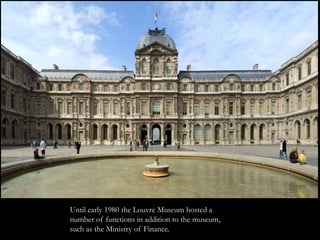
Until early 1980 the Louvre Museum hosted a
number of functions in addition to the museum,
such as the Ministry of Finance.
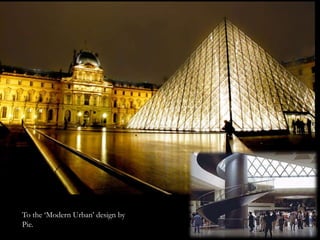
To the ‘Modern Urban’ design by
Pie.
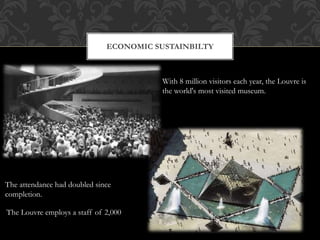
ECONOMIC SUSTAINBILTY
The attendance had doubled since
completion.
With 8 million visitors each year, the Louvre is
the world's most visited museum.
The Louvre employs a staff of 2,000
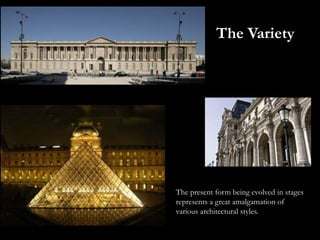
The present form being evolved in stages
represents a great amalgamation of
various architectural styles.
The Variety
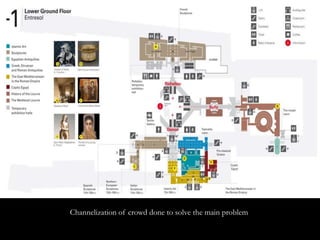
Channelization of crowd done to solve the main problem
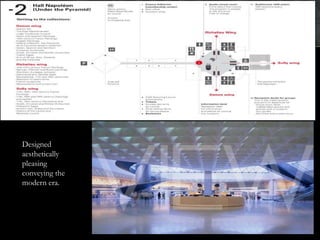
Designed
aesthetically
pleasing
conveying the
modern era.
• Opened on bicentennial of the French revolution, the pyramid gave a new
meaning to the museum to become an iconic image.
• The massing done by Pei shows basically ‘how to arrange the mess’….
• The selection of material like glass inspires to take bold decisions so as to
innovate in our design.
• The most aesthetic emphasis being placed on the pyramid gives the
importance of entrance and the first impression of a building.
• Public buildings reflect the culture of the society and hence their form
gives a whole lot of meaning.
• The Louvre dedicated to art has inspired many artist like Gustave Courbet
and has served the purpose of a world renowned museum.
INFERENCES
The Louvre is a morgue, you go there to identify your friends…..
- Jean Cocteau, French poet
The history of Paris is embedded in the stones
of the Louvre.
- I.M. Pei
I've been fifty thousand times to the Louvre. I have copied
everything in drawing, trying to understand.
-Alberto Giacometti, Swiss painter & sculptor
Love It, Hate It……it’s a change
Thank you

louvrecontemporary-1154-conversion-gate02.pdf

  • 1.
    Architects: Pierre Lescot, I.M. Pie Consultant Engg. : Nicolet Chartrand Knoll Ltd MUSÉE DU LOUVRE Case study by Harshil mehta {10110024} Kopal gupta {10110028} B.Arch Year III
  • 2.
    INTRODUCTION .The Louvre Museum,National Museum of French art, is one of the most important museums in the world. .The creation of the Louvre meant, in the history of museums, the transition from private collections to the public for the enjoyment of the whole society. .With one of the greatest collections representative, is undoubtedly the most visited art museum in the world.
  • 3.
    LOCATION . Louvre Museumis located on the right bank of the river Seine in Paris . The building that houses it, the Palais du Louvre is one of the largest palaces in the world and occupies the site erected a fortress of the twelfth century. .It occupies a huge site area of 19 hectares.
  • 4.
    Palais du Louvre(louver palace) was built on the site of a castle from the Middle Ages, which kept the foundations and the moat. This building was based on one of the largest royal palaces across Europe in 1527, Francis I, King of France and great patron of the arts, commissioned the architect Pierre Lescot The taste of the monarch is in favor of the Italian Renaissance style.Premise that Lescot employed to perform a classical building organized around a square courtyard, the Cour Carré. HISTORICAL STAGE
  • 5.
    The second roundof renovations was in seventeenth century, during which there were alternately abandonment of residence, which became a market full of shacks attached to the walls, and the restoration of the facade ordered by Louis XIV. These works are what make the current aesthetics of the building, subject to strict French Baroque. The architects were Claude Perrault, author of the project and interior designer, Le Vau and Le Brun. The intervention took place between the years 1667 and 1670. HISTORICAL STAGE A sketch and present day photograph of east façade of the louvre
  • 6.
    The latest historicalwork took place in 1800, and the reign of Napoleon Bonaparte boost staff. Built the great triumphal arch in front of the facade, called the Arc du Carrousel, also carried out various tasks of restoration and construction wing of the Seine, the architects responsible Percier and Fontaine. Work done by them in this time falls in the catogary of the Napoleon III style of architecture. HISTORICAL STAGE The Arc du Carrousel
  • 7.
    The last majoraddition to the building was done on March 30, 1989 by addition of a glass pyramid Rising from the center of the Cour Napoléon desinged by the architect I. M. Pei .glass pyramid gives a mordern architectural touch to the building and the whole complex is called as the Grand Louvre. PRESENT DAY
  • 8.
  • 9.
    NEED • Identity crisis. •Problems with original entrance. • Inefficient circulation.
  • 10.
    • Competition butno Contest. • President Francosis was impressed with Pie’s work.. • Went out of the way to hire Pei as chief architect. I. M. PEI
  • 11.
    • Made threesecretive trips to Paris before assuming the position of chief architect. • Started the project in 1983 with five of his New York based Architects. • In association with Paris based architect Michel Macray. PEI’S METHODOLOGIES
  • 12.
    • Pei startedfrom the premise that, rather than that the museum being located only a large elongated building, it should organise itself in a U shape around a courtyard. • Then he had the idea of digging up the cour Napoleon, to provide enough space for two additional floors underground. DESIGNING THE CONCEPT
  • 13.
    • He said,entry should have an appropriate scale however, refused to build a solid element that would compete with the presence of the baroque buildings. • At the centre of the courtyard he designed a glass and steel pyramid to serve as entrance which was mirrored by another inverted pyramid underneath, to reflect sunlight into the rooms. DESIGNING THE CONCEPT
  • 14.
  • 15.
  • 16.
    WHY PYRAMID ?? •The pyramid is the more compatible figure with the Louvre's architecture. • It is one of the most stable forms. • Ensuring its transparency as it is constructed of glass and metal • Symbolizing a break with past traditions • “ It is work of our time. "
  • 17.
    • Pei’s hadinsisted that the glass would be absolutely clear in order to make the pyramid as nearly transparent as possible. Virtually all the glass available on the market, gave it a slightly greenish tint. • In the hope of finding something most suitable, the Pei team approached the century-old French firm of Saint-Gobain, the country’s biggest glass manufacturer. GLASS
  • 18.
  • 19.
    • Difference inFrench and American Project Team Structuring. • In France architects not involved in construction documentation and building process ,unlike America. CLASH OF METHODOLOGIES
  • 20.
    • The constructionof the pyramid triggered considerable controversy because many people felt that the futuristic edifice looked quite out of place in front of the Louvre Museum with its classical architecture. CONTROVERSY
  • 21.
    • Its historyis bursting with pageantry, stained in blood and forged in fire. • The Louvre complex was built over many centuries, his style was changing from Romanesque to Renaissance and then the Baroque to the neoclassical phase and the result not only expresses his stylistic evolution but also its changing role in the urban structure of the French capital. • For 800 years it has evolved and molded it self manifesting the cultural changes. SAND OF TIMES: LOUVRE AND PARIS SUSTAINING SUSTAINABLE ICONIC MUSEUM
  • 22.
    A Fortress: King PhilipII of France (Philip Augustus) in 1190-1202 King Charles V converted the fortress into a royal residence 1564 the Tuileries Palace was build
  • 23.
    1595 Henry IV, connectedthe gallery with the Tuileries Palace by the Grand Galerie.
  • 24.
    The Louvre in1895 after the Commune revolt and establishment of The Louvre and the Tuileries in 1793 after the French revolution and officially the museum
  • 25.
    Until early 1980the Louvre Museum hosted a number of functions in addition to the museum, such as the Ministry of Finance.
  • 26.
    To the ‘ModernUrban’ design by Pie.
  • 27.
    ECONOMIC SUSTAINBILTY The attendancehad doubled since completion. With 8 million visitors each year, the Louvre is the world's most visited museum. The Louvre employs a staff of 2,000
  • 28.
    The present formbeing evolved in stages represents a great amalgamation of various architectural styles. The Variety
  • 29.
    Channelization of crowddone to solve the main problem
  • 30.
  • 31.
    • Opened onbicentennial of the French revolution, the pyramid gave a new meaning to the museum to become an iconic image. • The massing done by Pei shows basically ‘how to arrange the mess’…. • The selection of material like glass inspires to take bold decisions so as to innovate in our design. • The most aesthetic emphasis being placed on the pyramid gives the importance of entrance and the first impression of a building. • Public buildings reflect the culture of the society and hence their form gives a whole lot of meaning. • The Louvre dedicated to art has inspired many artist like Gustave Courbet and has served the purpose of a world renowned museum. INFERENCES
  • 32.
    The Louvre isa morgue, you go there to identify your friends….. - Jean Cocteau, French poet The history of Paris is embedded in the stones of the Louvre. - I.M. Pei I've been fifty thousand times to the Louvre. I have copied everything in drawing, trying to understand. -Alberto Giacometti, Swiss painter & sculptor
  • 33.
    Love It, HateIt……it’s a change
  • 34.