LIVES Capacity Development Approaches
and Interventions
Mamusha Lemma
ILRI Capacity Development Week, 14-17 December, 2015
Presentation outline
• LIVES capacity development objectives
• Focus of LIVES capacity development
interventions
• LIVES CD targeting and scaling out strategy
• LIVES approach in graduate training and
research
• Outcomes of LIVES CD interventions
• Key lessons learned
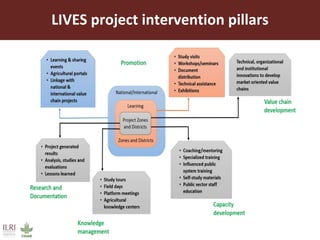
LIVES project intervention pillars
LIVES capacity development objectives
• Address issues of values, attitudes, motivations and
conditions in order to support market-oriented
agricultural development
• Enhance knowledge, skills, abilities and resources of
value chain actors and service providers to develop
sustainable livestock and irrigated agriculture value
chains
• Strengthen innovation, learning and collaborative
capacities of value chain actors and service providers
through facilitation of knowledge sharing, learning, and
commodity value chain networks.
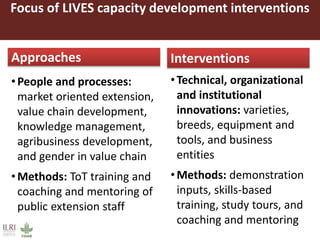
Focus of LIVES capacity development interventions
•People and processes:
market oriented extension,
value chain development,
knowledge management,
agribusiness development,
and gender in value chain
•Methods: ToT training and
coaching and mentoring of
public extension staff
•Technical, organizational
and institutional
innovations: varieties,
breeds, equipment and
tools, and business
entities
•Methods: demonstration
inputs, skills-based
training, study tours, and
coaching and mentoring
Approaches Interventions
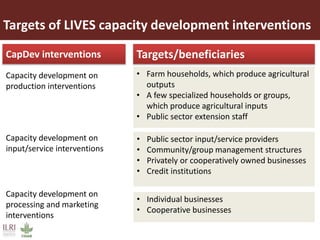
Targets of LIVES capacity development interventions
Capacity development on
production interventions
• Farm households, which produce agricultural
outputs
• A few specialized households or groups,
which produce agricultural inputs
• Public sector extension staff
CapDev interventions Targets/beneficiaries
Capacity development on
input/service interventions
Capacity development on
processing and marketing
interventions
• Public sector input/service providers
• Community/group management structures
• Privately or cooperatively owned businesses
• Credit institutions
• Individual businesses
• Cooperative businesses
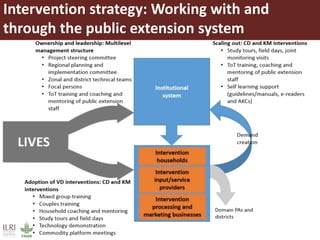
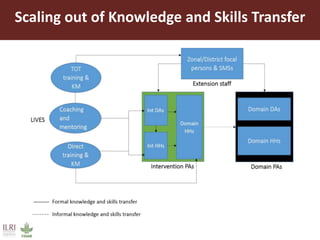
Intervention strategy: Working with and
through the public extension system
Scaling out of Knowledge and Skills Transfer
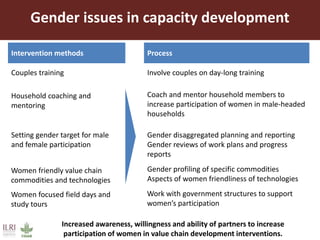
Gender issues in capacity development
Couples training
Intervention methods Process
Involve couples on day-long training
Household coaching and
mentoring
Coach and mentor household members to
increase participation of women in male-headed
households
Setting gender target for male
and female participation
Gender disaggregated planning and reporting
Gender reviews of work plans and progress
reports
Increased awareness, willingness and ability of partners to increase
participation of women in value chain development interventions.
Women friendly value chain
commodities and technologies
Gender profiling of specific commodities
Aspects of women friendliness of technologies
Women focused field days and
study tours
Work with government structures to support
women’s participation
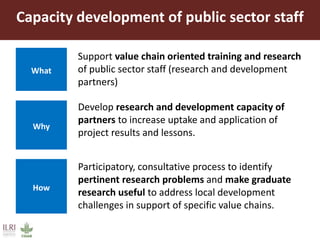
Capacity development of public sector staff
Participatory, consultative process to identify
pertinent research problems and make graduate
research useful to address local development
challenges in support of specific value chains.
Develop research and development capacity of
partners to increase uptake and application of
project results and lessons.
Support value chain oriented training and research
of public sector staff (research and development
partners)
What
Why
How
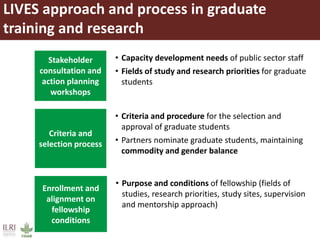
LIVES approach and process in graduate
training and research
Stakeholder
consultation and
action planning
workshops
Criteria and
selection process
• Capacity development needs of public sector staff
• Fields of study and research priorities for graduate
students
• Criteria and procedure for the selection and
approval of graduate students
• Partners nominate graduate students, maintaining
commodity and gender balance
Enrollment and
alignment on
fellowship
conditions
• Purpose and conditions of fellowship (fields of
studies, research priorities, study sites, supervision
and mentorship approach)
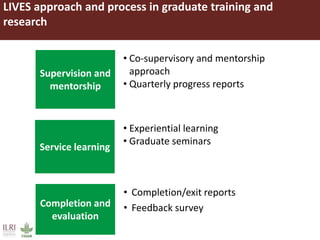
LIVES approach and process in graduate training and
research
Supervision and
mentorship
Service learning
• Co-supervisory and mentorship
approach
• Quarterly progress reports
• Experiential learning
• Graduate seminars
Completion and
evaluation
• Completion/exit reports
• Feedback survey
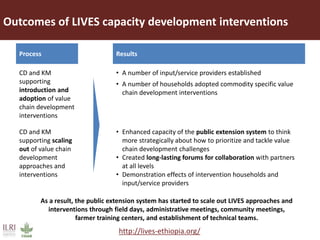
Outcomes of LIVES capacity development interventions
CD and KM
supporting
introduction and
adoption of value
chain development
interventions
Process Results
• A number of input/service providers established
• A number of households adopted commodity specific value
chain development interventions
CD and KM
supporting scaling
out of value chain
development
approaches and
interventions
• Enhanced capacity of the public extension system to think
more strategically about how to prioritize and tackle value
chain development challenges
• Created long-lasting forums for collaboration with partners
at all levels
• Demonstration effects of intervention households and
input/service providers
As a result, the public extension system has started to scale out LIVES approaches and
interventions through field days, administrative meetings, community meetings,
farmer training centers, and establishment of technical teams.
http://lives-ethiopia.org/
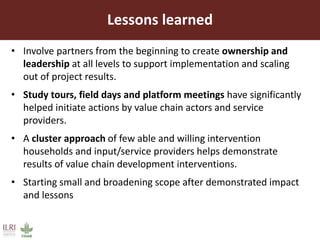
Lessons learned
• Involve partners from the beginning to create ownership and
leadership at all levels to support implementation and scaling
out of project results.
• Study tours, field days and platform meetings have significantly
helped initiate actions by value chain actors and service
providers.
• A cluster approach of few able and willing intervention
households and input/service providers helps demonstrate
results of value chain development interventions.
• Starting small and broadening scope after demonstrated impact
and lessons
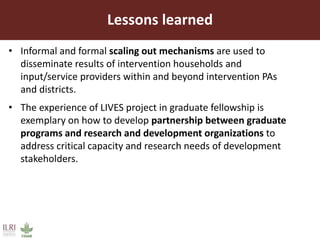
Lessons learned
• Informal and formal scaling out mechanisms are used to
disseminate results of intervention households and
input/service providers within and beyond intervention PAs
and districts.
• The experience of LIVES project in graduate fellowship is
exemplary on how to develop partnership between graduate
programs and research and development organizations to
address critical capacity and research needs of development
stakeholders.
LIVES project is financed by the
Government of Canada through the Department of Foreign
Affairs, Trade and Development Canada (DFATD).
It is implemented in a partnership with
the International Livestock Research Institute, International
Water Management Institute, Ministry of Agriculture, and
Ethiopian Institute of Agricultural Research.
Acknowledgement
The presentation has a Creative Commons licence. You are free to re-use or distribute this work, provided credit is given to ILRI.
better lives through livestock
ilri.org

LIVES Capacity Development approaches and interventions

  • 1.
    LIVES Capacity DevelopmentApproaches and Interventions Mamusha Lemma ILRI Capacity Development Week, 14-17 December, 2015
  • 2.
    Presentation outline • LIVEScapacity development objectives • Focus of LIVES capacity development interventions • LIVES CD targeting and scaling out strategy • LIVES approach in graduate training and research • Outcomes of LIVES CD interventions • Key lessons learned
  • 3.
  • 4.
    LIVES capacity developmentobjectives • Address issues of values, attitudes, motivations and conditions in order to support market-oriented agricultural development • Enhance knowledge, skills, abilities and resources of value chain actors and service providers to develop sustainable livestock and irrigated agriculture value chains • Strengthen innovation, learning and collaborative capacities of value chain actors and service providers through facilitation of knowledge sharing, learning, and commodity value chain networks.
  • 5.
    Focus of LIVEScapacity development interventions •People and processes: market oriented extension, value chain development, knowledge management, agribusiness development, and gender in value chain •Methods: ToT training and coaching and mentoring of public extension staff •Technical, organizational and institutional innovations: varieties, breeds, equipment and tools, and business entities •Methods: demonstration inputs, skills-based training, study tours, and coaching and mentoring Approaches Interventions
  • 6.
    Targets of LIVEScapacity development interventions Capacity development on production interventions • Farm households, which produce agricultural outputs • A few specialized households or groups, which produce agricultural inputs • Public sector extension staff CapDev interventions Targets/beneficiaries Capacity development on input/service interventions Capacity development on processing and marketing interventions • Public sector input/service providers • Community/group management structures • Privately or cooperatively owned businesses • Credit institutions • Individual businesses • Cooperative businesses
  • 7.
    Intervention strategy: Workingwith and through the public extension system
  • 8.
    Scaling out ofKnowledge and Skills Transfer
  • 9.
    Gender issues incapacity development Couples training Intervention methods Process Involve couples on day-long training Household coaching and mentoring Coach and mentor household members to increase participation of women in male-headed households Setting gender target for male and female participation Gender disaggregated planning and reporting Gender reviews of work plans and progress reports Increased awareness, willingness and ability of partners to increase participation of women in value chain development interventions. Women friendly value chain commodities and technologies Gender profiling of specific commodities Aspects of women friendliness of technologies Women focused field days and study tours Work with government structures to support women’s participation
  • 10.
    Capacity development ofpublic sector staff Participatory, consultative process to identify pertinent research problems and make graduate research useful to address local development challenges in support of specific value chains. Develop research and development capacity of partners to increase uptake and application of project results and lessons. Support value chain oriented training and research of public sector staff (research and development partners) What Why How
  • 11.
    LIVES approach andprocess in graduate training and research Stakeholder consultation and action planning workshops Criteria and selection process • Capacity development needs of public sector staff • Fields of study and research priorities for graduate students • Criteria and procedure for the selection and approval of graduate students • Partners nominate graduate students, maintaining commodity and gender balance Enrollment and alignment on fellowship conditions • Purpose and conditions of fellowship (fields of studies, research priorities, study sites, supervision and mentorship approach)
  • 12.
    LIVES approach andprocess in graduate training and research Supervision and mentorship Service learning • Co-supervisory and mentorship approach • Quarterly progress reports • Experiential learning • Graduate seminars Completion and evaluation • Completion/exit reports • Feedback survey
  • 13.
    Outcomes of LIVEScapacity development interventions CD and KM supporting introduction and adoption of value chain development interventions Process Results • A number of input/service providers established • A number of households adopted commodity specific value chain development interventions CD and KM supporting scaling out of value chain development approaches and interventions • Enhanced capacity of the public extension system to think more strategically about how to prioritize and tackle value chain development challenges • Created long-lasting forums for collaboration with partners at all levels • Demonstration effects of intervention households and input/service providers As a result, the public extension system has started to scale out LIVES approaches and interventions through field days, administrative meetings, community meetings, farmer training centers, and establishment of technical teams. http://lives-ethiopia.org/
  • 14.
    Lessons learned • Involvepartners from the beginning to create ownership and leadership at all levels to support implementation and scaling out of project results. • Study tours, field days and platform meetings have significantly helped initiate actions by value chain actors and service providers. • A cluster approach of few able and willing intervention households and input/service providers helps demonstrate results of value chain development interventions. • Starting small and broadening scope after demonstrated impact and lessons
  • 15.
    Lessons learned • Informaland formal scaling out mechanisms are used to disseminate results of intervention households and input/service providers within and beyond intervention PAs and districts. • The experience of LIVES project in graduate fellowship is exemplary on how to develop partnership between graduate programs and research and development organizations to address critical capacity and research needs of development stakeholders.
  • 16.
    LIVES project isfinanced by the Government of Canada through the Department of Foreign Affairs, Trade and Development Canada (DFATD). It is implemented in a partnership with the International Livestock Research Institute, International Water Management Institute, Ministry of Agriculture, and Ethiopian Institute of Agricultural Research. Acknowledgement
  • 17.
    The presentation hasa Creative Commons licence. You are free to re-use or distribute this work, provided credit is given to ILRI. better lives through livestock ilri.org

Editor's Notes

  • #2 There MUST be a CGIAR logo or a CRP logo. You can copy and paste the logo you need from the final slide of this presentation. Then you can delete that final slide   To replace a photo above, copy and paste this link in your browser: http://www.flickr.com/photos/ilri/sets/72157632057087650/detail/   Find a photo you like and the right size, copy and paste it in the block above.