Module 2
Lighting Schemes and calculations
Lighting design calculations - Definitions of luminous flux, Lumen, Luminous
intensity/illuminance (Lux), Illumination calculations, factors affecting Coefficients of
Utilisation (CoU) - and Light Loss Factor (LLF).
Benefits of LED lamps over the yesteryear luminaires – Efficacy of present-day LED
lamps.Design of illumination systems – Average lumen method - Space to mounting
height ratio
Design of lighting systems for a medium area seminar hall using LED luminaires .Exterior
lighting design- point to point method - road lighting and public area lighting- Space to
mounting height ratio - selection of luminaires- Metal Halide- High & Low pressure
Sodium– LED lamps.
Downloaded from Ktunotes.in
Basic definitions
•Light is a form of electromagnetic energy radiated from a body which is
capable of being perceived by human eye.
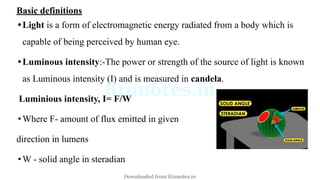
•Luminous intensity:-The power or strength of the source of light is known
as Luminous intensity (I) and is measured in candela.
Luminious intensity, I= F/W
•Where F- amount of flux emitted in given
direction in lumens
•W - solid angle in steradian
Downloaded from Ktunotes.in
•Luminous flux :-Flow of light from the source is known as Luminous flux
and its unit is lumen.
• When light emitted by the source falls on a surface, it is illuminated.
Illuminance (E) is the light falling on the surface. It is measured in lux.
• Illumination of 1 lumen/ sq.m is called 1 lux.
•Luminaire ( light fitting ): It is the apparatus which distributes, filters or
transforms the light given by a lamp. It includes all the items necessary for
fixing and protecting the lamps and for connecting them to the supply circuit.
Downloaded from Ktunotes.in
Laws of Illumination
Inverse Square Law
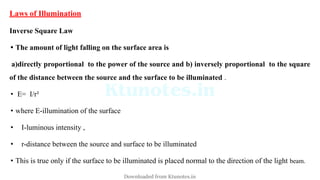
• The amount of light falling on the surface area is
a)directly proportional to the power of the source and b) inversely proportional to the square
of the distance between the source and the surface to be illuminated .
• E= I/r²
• where E-illumination of the surface
• I-luminous intensity ,
• r-distance between the source and surface to be illuminated
• This is true only if the surface to be illuminated is placed normal to the direction of the light beam.
Downloaded from Ktunotes.in
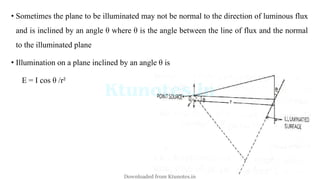
• Sometimes the plane to be illuminated may not be normal to the direction of luminous flux
and is inclined by an angle θ where θ is the angle between the line of flux and the normal
to the illuminated plane
• Illumination on a plane inclined by an angle θ is
E = I cos θ /r²
Downloaded from Ktunotes.in
•This is the cosine law which states that the illumination on a surface is
proportional to the cosine of the angle between the normal to the
surface and the line of flux.
•This laws can be applied to point sources where there are no reflecting
surfaces .
•This is applicable to outdoor lighting.
Downloaded from Ktunotes.in
Qualities of good lighting scheme
• Sufficient illumination level.
• Uniformity of illumination
• Contrast with surroundings and sunlight
• Correct colour effect
• Freedom from glare
• Aesthetic appearance
• Economical
• No hazard of fire and accidents
• Free from pollution and corrosion
• No ageing and deterioration
• Modular in construction and replacement
• Free from noise and humming and no magnetic radiations
Downloaded from Ktunotes.in
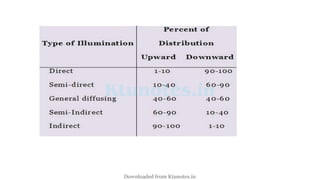
Types of Lighting Schemes
There are different types of lighting arrangements which can be classified
according to the proportion of light directing upward or downward from the
fittings.
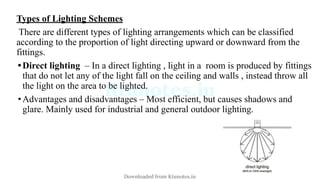
•Direct lighting – In a direct lighting , light in a room is produced by fittings
that do not let any of the light fall on the ceiling and walls , instead throw all
the light on the area to be lighted.
•Advantages and disadvantages – Most efficient, but causes shadows and
glare. Mainly used for industrial and general outdoor lighting.
Downloaded from Ktunotes.in
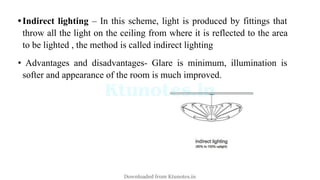
•Indirect lighting – In this scheme, light is produced by fittings that
throw all the light on the ceiling from where it is reflected to the area
to be lighted , the method is called indirect lighting
• Advantages and disadvantages- Glare is minimum, illumination is
softer and appearance of the room is much improved.
Downloaded from Ktunotes.in
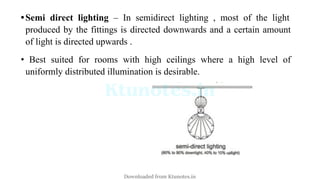
•Semi direct lighting – In semidirect lighting , most of the light
produced by the fittings is directed downwards and a certain amount
of light is directed upwards .
• Best suited for rooms with high ceilings where a high level of
uniformly distributed illumination is desirable.
Downloaded from Ktunotes.in
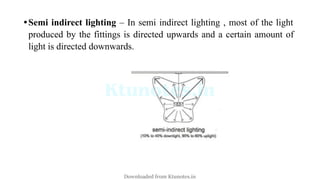
•Semi indirect lighting – In semi indirect lighting , most of the light
produced by the fittings is directed upwards and a certain amount of
light is directed downwards.
Downloaded from Ktunotes.in
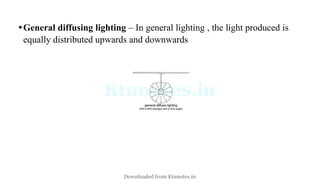
•General diffusing lighting – In general lighting , the light produced is
equally distributed upwards and downwards
Downloaded from Ktunotes.in
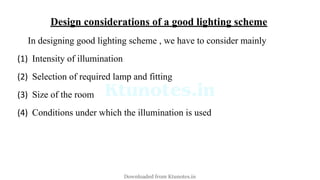
Design considerations of a good lighting scheme
In designing good lighting scheme , we have to consider mainly
(1) Intensity of illumination
(2) Selection of required lamp and fitting
(3) Size of the room
(4) Conditions under which the illumination is used
Downloaded from Ktunotes.in
(1) Intensity of illumination : Intensity of illumination required for
different types of work differ. Table shows the recommended intensity
of illumination for different types of work.
•Refer Table No: 4,5,6,7,8 of handbook
Downloaded from Ktunotes.in
(2)Selection of luminaries – A luminaire is the apparatus which distributes,
filters, transforms the light given by a lamp. It includes all the items
necessary for fixing and protecting these lamps and for connecting them to
the supply circuit. The choice of lamps for different types of ocupancies
differ.
• For small premises tubular fluorescent lamps or tungsten filament lamps
can be used .
•In large premises , lighting can be carried out by using high intensity
sources such as mercury or sodium discharge lamps. Depending on the type
of illumination required, (direct , indirect etc ) reflector types can be
selected
Downloaded from Ktunotes.in
(3) Size of the room – The lumen output of the sources is not fully utilised
at the work place. Part of it is lost in the fittings , part is directed to walls
and ceilings where part will be absorbed and part will be reflected. This is
taken into account by a factor called coefficient of utilization( CU).
•Coefficient of utilization depends on the lumen output of the fitting , size
and shape of the room , reflection factors of wall , ceiling , height of the
ceiling , arrangement of fittings etc.
•The ratio of lumens reaching the working plane to the total lumens
given out by the lamp is known as CU
Downloaded from Ktunotes.in
(4) Mounting heights and spacing of fittings : Distance of light source
from the wall should be equal to one half the distance between 2
adjacent light sources. Also distance between light fittings should not
exceed 1.5 times the mounting height.
Downloaded from Ktunotes.in
(5) Conditions of use : In different types of installations , conditions of use
of light fittings vary . Dust and dirt of the surroundings may get deposited on
the light fittings and hence deteriorate the lamp efficiency.
•If regular periodic cleaning and assuming good atmospheric conditions,
the value of maintenance factor may be taken as 0.8.
• But for dusty atmospheres, the factor may be assumed as 0.4.
•Depreciation factor = 1/(maintenance factor)
Downloaded from Ktunotes.in
Selection of light sources
The choice of source for public lighting is guided by the following
considerations
• Luminous flux
• Economy
• Dimensions of the light sources
• Colour characteristics
Downloaded from Ktunotes.in
The sources normally used in public lighting are
• Incandescent lamps
• Fluorescent lamp
• High Intensity Discharge lamp
• Mercury vapour lamps
• Metal halide lamps
• High pressure sodium vapour lamps
• Low pressure sodium vapour lamps
Downloaded from Ktunotes.in
Factors influencing coefficient of utilization
Downloaded from Ktunotes.in
Selection of light sources
The choice of source for public lighting is guided by the following
considerations
• Luminous flux
• Economy
• Dimensions of the light sources
• Colour characteristics
Downloaded from Ktunotes.in
The sources normally used in public lighting are
• Incandescent lamps
• Fluorescent lamp
• High Intensity Discharge lamp
• Mercury vapour lamps
• Metal halide lamps
• High pressure sodium vapour lamps
• Low pressure sodium vapour lamps
Downloaded from Ktunotes.in
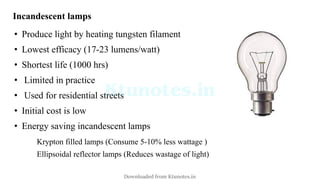
Incandescent lamps
• Produce light by heating tungsten filament
• Lowest efficacy (17-23 lumens/watt)
• Shortest life (1000 hrs)
• Limited in practice
• Used for residential streets
• Initial cost is low
• Energy saving incandescent lamps
Krypton filled lamps (Consume 5-10% less wattage )
Ellipsoidal reflector lamps (Reduces wastage of light)
Downloaded from Ktunotes.in
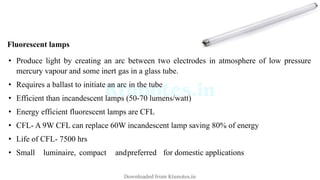
Fluorescent lamps
• Produce light by creating an arc between two electrodes in atmosphere of low pressure
mercury vapour and some inert gas in a glass tube.
• Requires a ballast to initiate an arc in the tube
• Efficient than incandescent lamps (50-70 lumens/watt)
• Energy efficient fluorescent lamps are CFL
• CFL- A 9W CFL can replace 60W incandescent lamp saving 80% of energy
• Life of CFL- 7500 hrs
• Small luminaire, compact andpreferred for domestic applications
Downloaded from Ktunotes.in
High Intensity Discharge Lamps (HID)
• Used to designate 3 distinct type of lamp- mercury vapour, metal halide and
high pressure sodium
• They produce light by establishing an arc between two electrodes, the
electrodes being few centimetres apart enclosed in a transparent arc tube
• Arc tube is then enclosed in an outer bulb.
Downloaded from Ktunotes.in
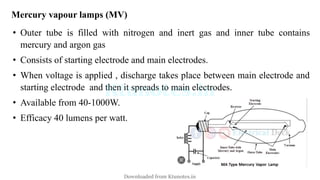
Mercury vapour lamps (MV)
• Outer tube is filled with nitrogen and inert gas and inner tube contains
mercury and argon gas
• Consists of starting electrode and main electrodes.
• When voltage is applied , discharge takes place between main electrode and
starting electrode and then it spreads to main electrodes.
• Available from 40-1000W.
• Efficacy 40 lumens per watt.
Downloaded from Ktunotes.in
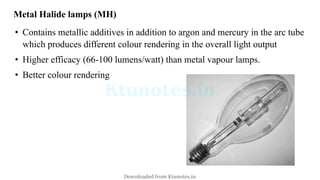
Metal Halide lamps (MH)
• Contains metallic additives in addition to argon and mercury in the arc tube
which produces different colour rendering in the overall light output
• Higher efficacy (66-100 lumens/watt) than metal vapour lamps.
• Better colour rendering
Downloaded from Ktunotes.in
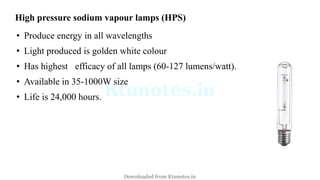
High pressure sodium vapour lamps (HPS)
• Produce energy in all wavelengths
• Light produced is golden white colour
• Has highest efficacy of all lamps (60-127 lumens/watt).
• Available in 35-1000W size
• Life is 24,000 hours.
Downloaded from Ktunotes.in
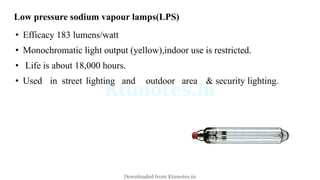
Low pressure sodium vapour lamps(LPS)
• Efficacy 183 lumens/watt
• Monochromatic light output (yellow),indoor use is restricted.
• Life is about 18,000 hours.
• Used in street lighting and outdoor area & security lighting.
Downloaded from Ktunotes.in
Factors considered for choice of luminaire
• Nature and power of the source
• Nature of optical arrangements and light distribution which they provide
• Light output ratio
• Whether the luminaire is open or closed type
• Protection against collection of dust and insects
• Resistance to atmospheric conditions
• Ease of installation and maintenance
• Fixing arrangements, weight and area exposed to wind pressure
Downloaded from Ktunotes.in
METHODS OF LIGHTING CALCULATIONS
•Average lumen or light flux method
•Point to point method or inverse square law method
Downloaded from Ktunotes.in
Point to point method or inverse square law method
•Illumination is calculated according to inverse square law and cosine law.
This method is most suited for large areas, especially outdoor lighting.
Limitations of this method are
(1) It is applicable only for point sources.
(2) It does not taken into account surface inter reflectance.
(3) This method is complicated if there are large no. of luminaries.
Downloaded from Ktunotes.in
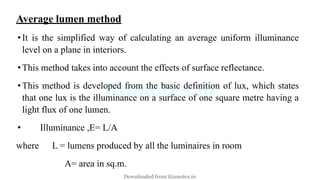
Average lumen method
•It is the simplified way of calculating an average uniform illuminance
level on a plane in interiors.
•This method takes into account the effects of surface reflectance.
•This method is developed from the basic definition of lux, which states
that one lux is the illuminance on a surface of one square metre having a
light flux of one lumen.
• Illuminance ,E= L/A
where L = lumens produced by all the luminaires in room
A= area in sq.m.
Downloaded from Ktunotes.in
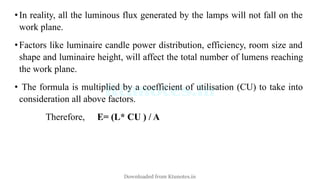
•In reality, all the luminous flux generated by the lamps will not fall on the
work plane.
•Factors like luminaire candle power distribution, efficiency, room size and
shape and luminaire height, will affect the total number of lumens reaching
the work plane.
• The formula is multiplied by a coefficient of utilisation (CU) to take into
consideration all above factors.
Therefore, E= (L* CU ) / A
Downloaded from Ktunotes.in
•The luminaire, lamp and even the surface will accumulate dust over a
period of time and the lamp lumen output will depreciate with time. To
obtain the maintained illuminance level, the formula now must be
multiplied by a ‘ light loss factor (LLF) or Maintenance factor’ to
account for the depreciation in light output.
E = (L*CU*LLF) / A
Where L represents total number of lumens produced by all luminaries in a
room.
Downloaded from Ktunotes.in
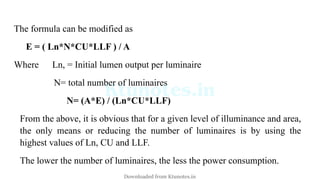
The formula can be modified as
E = ( Ln*N*CU*LLF ) / A
Where Ln, = Initial lumen output per luminaire
N= total number of luminaires
N= (A*E) / (Ln*CU*LLF)
From the above, it is obvious that for a given level of illuminance and area,
the only means or reducing the number of luminaires is by using the
highest values of Ln, CU and LLF.
The lower the number of luminaires, the less the power consumption.
Downloaded from Ktunotes.in
LIGHT LOSS FACTOR (LLF) or MAINTENACE FACTOR
•Periodic schedule and appropriate maintenance is very essential in
maintaining the initial lighting level.
•An LLF would not be required if light output remains constant throughout
the useful life. Inherent light loss characteristics of the luminaire and
unfavourable ambient conditions will force the net output to deteriorate with
time.
•The various factors that contribute to light loss are of two types.
(1) Recoverable
(2) Non-recoverable.
Downloaded from Ktunotes.in
The recoverable factors include:
• Luminaire dirt depreciation (LDD)
• Room surface dirt depreciation (RSDD)
• Lamp lumen depreciation (LLD) and
• Lamp burn out (LBO)
Downloaded from Ktunotes.in
Luminaire dirt depreciation (LDD)
• The greatest loss of light output is due to the dirt accumulation on lamps and
luminaire reflecting surface. Proper selection of maintenance is essential
• Air-conditioned spaces - Once in two years
• Non A/C offices, School, etc - Once in a year
• Industrial areas- 3-6 times a year
• Food preparation area - every week
Downloaded from Ktunotes.in
Room surface dirt depreciation (RSDD)
• This factor takes into account the dirt or dust accumulation on surfaces. A proper
schedule for cleaning the reflecting surface must be followed to maintain the
reflectance
Lamp lumen depreciation and lamp burn out (LLD and LBO)
• Lamp lumen depreciation is an inherent characteristic of all lamps.
• Two types
✔ Spot re-lamping:-Spot re-lamping refers to changing of lamps as and when a lamp
burns out
✔ Group re-lamping:-Group re-lamping is the process of replacing all the lamps in an
installation after the useful life period of the lamps irrespective of the fact whether
the lamps are in working condition or not
Downloaded from Ktunotes.in
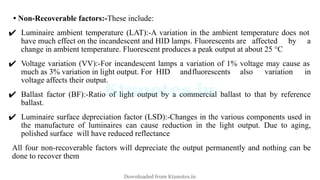
• Non-Recoverable factors:-These include:
✔ Luminaire ambient temperature (LAT):-A variation in the ambient temperature does not
have much effect on the incandescent and HID lamps. Fluorescents are affected by a
change in ambient temperature. Fluorescent produces a peak output at about 25 °C
✔ Voltage variation (VV):-For incandescent lamps a variation of 1% voltage may cause as
much as 3% variation in light output. For HID andfluorescents also variation in
voltage affects their output.
✔ Ballast factor (BF):-Ratio of light output by a commercial ballast to that by reference
ballast.
✔ Luminaire surface depreciation factor (LSD):-Changes in the various components used in
the manufacture of luminaires can cause reduction in the light output. Due to aging,
polished surface will have reduced reflectance
All four non-recoverable factors will depreciate the output permanently and nothing can be
done to recover them
Downloaded from Ktunotes.in
Light Emitting Diode
• Light-emitting diode is a two-lead semiconductor light source.
• The LED is a special type of diode and they have similar electrical
characteristics to a PN junction diode. Hence the LED allows the flow of
current in the forward direction and blocks the current in the reverse
direction.
• It is a specially doped diode and made up of a special type of
semiconductors. It emits light when forward biased.
Downloaded from Ktunotes.in
LED working
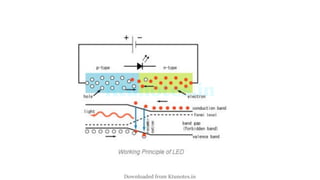
• When the diode is forward biased, then the electrons & holes are moving fast across the
junction and they are combined constantly, removing one another out.
• Hence it makes the complete atom & more stable and it gives the little burst of energy in
the form of a tiny packet or photon of light.
• The recombination indicates that the electrons in the conduction band jump down to the
valence band. When the electrons jump from one band to another band the electrons will
emit the electromagnetic energy in the form of photons and the photon energy is equal to
the forbidden energy gap.
Downloaded from Ktunotes.in
Types of Light Emitting Diodes
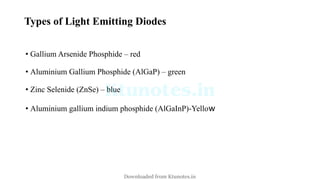
• Gallium Arsenide Phosphide – red
• Aluminium Gallium Phosphide (AlGaP) – green
• Zinc Selenide (ZnSe) – blue
• Aluminium gallium indium phosphide (AlGaInP)-Yellow
Downloaded from Ktunotes.in
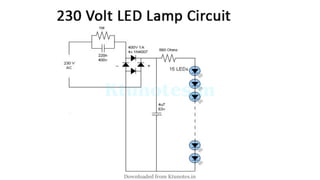
• The capacitor 220n 400V behaves as a voltage dropping resistor and ensures that the
current flowing is not more than 12 mA.
• The bridge rectifier turns the AC voltage into a DC voltage i.e. LEDs can only operate
from a DC voltage.
• These LEDs get damaged/fails when the DC voltage exceeds 5 V.
• The electrolytic capacitor has a double function firstly, it ensures there is a sufficient
voltage to power the LEDs when the main voltage is less than the forward voltage of
the LEDs and it takes care of the inrush current peak that occurs when the main is
switch on. This current pulse could otherwise damage the LEDs.
• Then there is the 560 Ω resistor, which ensures the current and the light output
through the LED is constant and uniform.
Downloaded from Ktunotes.in
Advantages of LED Lamps
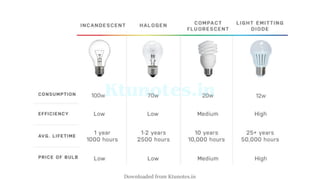
• Less Power-LED bulbs use less power than any other lamps. LED offers a 90%
saving over the old fashioned incandescent bulbs. For instance, a 25 w
incandescent bulb equates to a 6 watt CFL and a 4 watt LED bulb.
• Longer Lasting-The major benefit of LED bulbs is that they last significantly
longer than the old incandescent bulbs. A well manufactured bulb should last
around 50,000 hours compared to an incandescent bulb that cold last 1,000 hours.
Downloaded from Ktunotes.in
Advantages of LED Lamps continued
• Better Brightness-. LED bulbs now compare favourably with other light sources and,
unlike CFL lights, they provide it full light immediately rather than taking time to ‘warm
up’.
• Eco-friendly LED Bulbs- LED lighting uses less energy and so cutting down the CO2
emissions that come with electricity production
• Design Flexibility-LEDs are very small. This means that they can be used in almost any
application.
• Instant Lighting and the Ability to Withstand Frequent Switching-LED lights can turn
on and off instantly. LED lights are not affected by frequent switching. It does not cause
any reduction in their lifespan or efficiency.
Downloaded from Ktunotes.in
Luminous efficacy of LEDs
• The luminous efficacy of LEDs can be as high as 300 lumen/W, which is
over 18 times more than traditional light bulbs (17 lumen/W).
Downloaded from Ktunotes.in
• EXTERIOR LIGHTING
Lighting design for exterior application will have to consider the following aspects:-
• Functional lighting-Road lighting, yard lighting (area lighting), flood lighting
• Decorative lighting- Monumental lighting and special lighting for festivals
Street Lighting
• Primary aim of exterior lighting:- Safety and Security.
Luminaires used for exterior lighting can be classified into:-
• Static luminaries-Luminaries fixed on top of a pole, to produce light in a
predetermined manner.
• Adjustable luminaries - Luminaries mounted with adjustable brackets are referred to
as adjustable luminaries. Mostly used for flood lighting and area lighting.
Downloaded from Ktunotes.in
Terminologies
•Origin - The point on the road directly under the luminaire.
•Longitudinal Road Line (LRL) - Imaginary line running parallel to the
curb (a concrete margin along edge of a road) expressed as a multiple of
mounting height (MH).
•Transverse road Line (TRL) - Imaginary lines perpendicular to the curb
or LRL, expressed in terms of MH.
•Reference Line (0MH LRL and 0 MH TRL) - Reference line passing
through the origin.
•Street Side (SS) – The space located on the street side of 0 MH LRL
Downloaded from Ktunotes.in
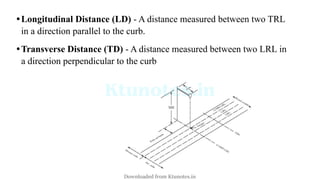
•Longitudinal Distance (LD) - A distance measured between two TRL
in a direction parallel to the curb.
•Transverse Distance (TD) - A distance measured between two LRL in
a direction perpendicular to the curb
Downloaded from Ktunotes.in
Luminarie Classification
According to their light distribution luminaries used for exterior lighting
are classified into
• Vertical light distribution or spread.
• Lateral light distribution.
• Control of light distribution at high angles.
Downloaded from Ktunotes.in
Vertical light distribution or spread.
Vertical light distribution is expressed as Short(S), Medium (M), and Long(L).
• If max candle power occurs between TRL 1 MH and 2.25 MH it called a
small spread.
• If max candle power occurs between TRL 2.25 MH and 3.75 MH it called
a medium spread.
• If max candle power occurs between TRL 3.75 MH and 6 MH it called a
long spread.
Downloaded from Ktunotes.in
Lateral light distribution
Lateral light distribution is classified into five types. All points on the road
receiving one half the maximum candle power are joined together to form half
max CP contour.
• Type I Half max CP contour lies within 0 MH to 1 MH LRL.
• Type II Half max CP contour lies within 1 MH to 1.75 MH.
• Type III Half max CP contour lies within 1.75 MH to 2.75 MH.
• Type IV Half max CP contour lies beyond 2.75 MH.
• Type V Circular symmetrical CP distribution around the luminaire in all lateral
angle.
Downloaded from Ktunotes.in
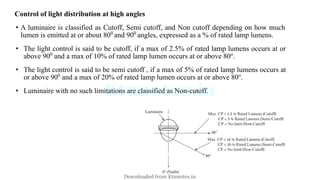
Control of light distribution at high angles
• A luminaire is classified as Cutoff, Semi cutoff, and Non cutoff depending on how much
lumen is emitted at or about 800
and 900
angles, expressed as a % of rated lamp lumens.
• The light control is said to be cutoff, if a max of 2.5% of rated lamp lumens occurs at or
above 900
and a max of 10% of rated lamp lumen occurs at or above 80o
.
• The light control is said to be semi cutoff , if a max of 5% of rated lamp lumens occurs at
or above 900
and a max of 20% of rated lamp lumen occurs at or above 80o
.
• Luminaire with no such limitations are classified as Non-cutoff.
Downloaded from Ktunotes.in
Classification of roads
•They are classified based on thevolume of traffic, speed and composition
of the traffic.
•For roads with width ranging from 6-9m, lamp posts are arranged on side of
the roads.
•For roads with width 9-12m, zig zag spacing is recommended. For roads
with width 12-20m, face to face spacing of lamp posts on both sides of the
road becomes necessary.
•For multi-lane roads, spacing of lamp posts on the median or on the median
plus the curbs on both sides may have to be chosen depending upon the
number of the lanes of traffic, planned on the road.
Downloaded from Ktunotes.in
Selection of light sources for street lighting
•Over the past century ,complete range of light sources available from
incandescent lamps to high intensity lamps are used.Now incandescent lamps
are not used due to its low efficacy and shorter span.
•Fluorescent lamps have better efficacy but drawbacks are difficulty in light
control, relatively large size and sensitive to temperature. For external use
,these lights should be enclosed in sealed housing.
•Mercury vapour lamps are used because of its longer life. But their efficacy
and light quality are not so good compared to HID( High Intensity Discharge)
lamps.
•Metal hallide lamps offer good color quality and efficacy.But they have lower
life span than HPS (High Pressure Sodium ) lamp.
Downloaded from Ktunotes.in
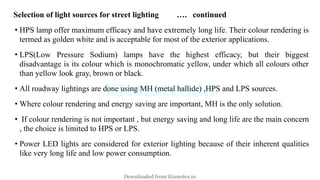
Selection of light sources for street lighting …. continued
• HPS lamp offer maximum efficacy and have extremely long life. Their colour rendering is
termed as golden white and is acceptable for most of the exterior applications.
• LPS(Low Pressure Sodium) lamps have the highest efficacy, but their biggest
disadvantage is its colour which is monochromatic yellow, under which all colours other
than yellow look gray, brown or black.
• All roadway lightings are done using MH (metal hallide) ,HPS and LPS sources.
• Where colour rendering and energy saving are important, MH is the only solution.
• If colour rendering is not important , but energy saving and long life are the main concern
, the choice is limited to HPS or LPS.
• Power LED lights are considered for exterior lighting because of their inherent qualities
like very long life and low power consumption.
Downloaded from Ktunotes.in
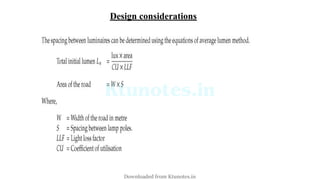
Design considerations
Downloaded from Ktunotes.in
• There are three popular models of pole arrangement.
1) Spaced continuously on one side of the road with a spacing of S metre.
2) Staggered spacing on both sides with a spacing of S metre between consecutive
poles
3) Spacing on opposite sides of the road with a spacing 2S metre between
consecutive poles on the same side.
• Ratio of spacing to mounting height should not be less than 3 or larger than 5.
Downloaded from Ktunotes.in
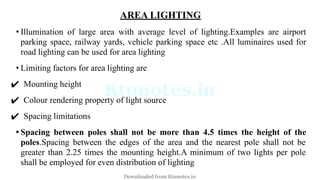
AREA LIGHTING
• Illumination of large area with average level of lighting.Examples are airport
parking space, railway yards, vehicle parking space etc .All luminaires used for
road lighting can be used for area lighting
• Limiting factors for area lighting are
✔ Mounting height
✔ Colour rendering property of light source
✔ Spacing limitations
• Spacing between poles shall not be more than 4.5 times the height of the
poles.Spacing between the edges of the area and the nearest pole shall not be
greater than 2.25 times the mounting height.A minimum of two lights per pole
shall be employed for even distribution of lighting
Downloaded from Ktunotes.in

EET402 -M2-Ktunotes.in.pdf,NOTESV ON ESD

  • 2.
    Module 2 Lighting Schemesand calculations Lighting design calculations - Definitions of luminous flux, Lumen, Luminous intensity/illuminance (Lux), Illumination calculations, factors affecting Coefficients of Utilisation (CoU) - and Light Loss Factor (LLF). Benefits of LED lamps over the yesteryear luminaires – Efficacy of present-day LED lamps.Design of illumination systems – Average lumen method - Space to mounting height ratio Design of lighting systems for a medium area seminar hall using LED luminaires .Exterior lighting design- point to point method - road lighting and public area lighting- Space to mounting height ratio - selection of luminaires- Metal Halide- High & Low pressure Sodium– LED lamps. Downloaded from Ktunotes.in
  • 3.
    Basic definitions •Light isa form of electromagnetic energy radiated from a body which is capable of being perceived by human eye. •Luminous intensity:-The power or strength of the source of light is known as Luminous intensity (I) and is measured in candela. Luminious intensity, I= F/W •Where F- amount of flux emitted in given direction in lumens •W - solid angle in steradian Downloaded from Ktunotes.in
  • 4.
    •Luminous flux :-Flowof light from the source is known as Luminous flux and its unit is lumen. • When light emitted by the source falls on a surface, it is illuminated. Illuminance (E) is the light falling on the surface. It is measured in lux. • Illumination of 1 lumen/ sq.m is called 1 lux. •Luminaire ( light fitting ): It is the apparatus which distributes, filters or transforms the light given by a lamp. It includes all the items necessary for fixing and protecting the lamps and for connecting them to the supply circuit. Downloaded from Ktunotes.in
  • 5.
    Laws of Illumination InverseSquare Law • The amount of light falling on the surface area is a)directly proportional to the power of the source and b) inversely proportional to the square of the distance between the source and the surface to be illuminated . • E= I/r² • where E-illumination of the surface • I-luminous intensity , • r-distance between the source and surface to be illuminated • This is true only if the surface to be illuminated is placed normal to the direction of the light beam. Downloaded from Ktunotes.in
  • 6.
    • Sometimes theplane to be illuminated may not be normal to the direction of luminous flux and is inclined by an angle θ where θ is the angle between the line of flux and the normal to the illuminated plane • Illumination on a plane inclined by an angle θ is E = I cos θ /r² Downloaded from Ktunotes.in
  • 7.
    •This is thecosine law which states that the illumination on a surface is proportional to the cosine of the angle between the normal to the surface and the line of flux. •This laws can be applied to point sources where there are no reflecting surfaces . •This is applicable to outdoor lighting. Downloaded from Ktunotes.in
  • 8.
    Qualities of goodlighting scheme • Sufficient illumination level. • Uniformity of illumination • Contrast with surroundings and sunlight • Correct colour effect • Freedom from glare • Aesthetic appearance • Economical • No hazard of fire and accidents • Free from pollution and corrosion • No ageing and deterioration • Modular in construction and replacement • Free from noise and humming and no magnetic radiations Downloaded from Ktunotes.in
  • 9.
    Types of LightingSchemes There are different types of lighting arrangements which can be classified according to the proportion of light directing upward or downward from the fittings. •Direct lighting – In a direct lighting , light in a room is produced by fittings that do not let any of the light fall on the ceiling and walls , instead throw all the light on the area to be lighted. •Advantages and disadvantages – Most efficient, but causes shadows and glare. Mainly used for industrial and general outdoor lighting. Downloaded from Ktunotes.in
  • 10.
    •Indirect lighting –In this scheme, light is produced by fittings that throw all the light on the ceiling from where it is reflected to the area to be lighted , the method is called indirect lighting • Advantages and disadvantages- Glare is minimum, illumination is softer and appearance of the room is much improved. Downloaded from Ktunotes.in
  • 11.
    •Semi direct lighting– In semidirect lighting , most of the light produced by the fittings is directed downwards and a certain amount of light is directed upwards . • Best suited for rooms with high ceilings where a high level of uniformly distributed illumination is desirable. Downloaded from Ktunotes.in
  • 12.
    •Semi indirect lighting– In semi indirect lighting , most of the light produced by the fittings is directed upwards and a certain amount of light is directed downwards. Downloaded from Ktunotes.in
  • 13.
    •General diffusing lighting– In general lighting , the light produced is equally distributed upwards and downwards Downloaded from Ktunotes.in
  • 14.
  • 15.
    Design considerations ofa good lighting scheme In designing good lighting scheme , we have to consider mainly (1) Intensity of illumination (2) Selection of required lamp and fitting (3) Size of the room (4) Conditions under which the illumination is used Downloaded from Ktunotes.in
  • 16.
    (1) Intensity ofillumination : Intensity of illumination required for different types of work differ. Table shows the recommended intensity of illumination for different types of work. •Refer Table No: 4,5,6,7,8 of handbook Downloaded from Ktunotes.in
  • 17.
    (2)Selection of luminaries– A luminaire is the apparatus which distributes, filters, transforms the light given by a lamp. It includes all the items necessary for fixing and protecting these lamps and for connecting them to the supply circuit. The choice of lamps for different types of ocupancies differ. • For small premises tubular fluorescent lamps or tungsten filament lamps can be used . •In large premises , lighting can be carried out by using high intensity sources such as mercury or sodium discharge lamps. Depending on the type of illumination required, (direct , indirect etc ) reflector types can be selected Downloaded from Ktunotes.in
  • 18.
    (3) Size ofthe room – The lumen output of the sources is not fully utilised at the work place. Part of it is lost in the fittings , part is directed to walls and ceilings where part will be absorbed and part will be reflected. This is taken into account by a factor called coefficient of utilization( CU). •Coefficient of utilization depends on the lumen output of the fitting , size and shape of the room , reflection factors of wall , ceiling , height of the ceiling , arrangement of fittings etc. •The ratio of lumens reaching the working plane to the total lumens given out by the lamp is known as CU Downloaded from Ktunotes.in
  • 19.
    (4) Mounting heightsand spacing of fittings : Distance of light source from the wall should be equal to one half the distance between 2 adjacent light sources. Also distance between light fittings should not exceed 1.5 times the mounting height. Downloaded from Ktunotes.in
  • 20.
    (5) Conditions ofuse : In different types of installations , conditions of use of light fittings vary . Dust and dirt of the surroundings may get deposited on the light fittings and hence deteriorate the lamp efficiency. •If regular periodic cleaning and assuming good atmospheric conditions, the value of maintenance factor may be taken as 0.8. • But for dusty atmospheres, the factor may be assumed as 0.4. •Depreciation factor = 1/(maintenance factor) Downloaded from Ktunotes.in
  • 21.
    Selection of lightsources The choice of source for public lighting is guided by the following considerations • Luminous flux • Economy • Dimensions of the light sources • Colour characteristics Downloaded from Ktunotes.in
  • 22.
    The sources normallyused in public lighting are • Incandescent lamps • Fluorescent lamp • High Intensity Discharge lamp • Mercury vapour lamps • Metal halide lamps • High pressure sodium vapour lamps • Low pressure sodium vapour lamps Downloaded from Ktunotes.in
  • 23.
    Factors influencing coefficientof utilization Downloaded from Ktunotes.in
  • 24.
    Selection of lightsources The choice of source for public lighting is guided by the following considerations • Luminous flux • Economy • Dimensions of the light sources • Colour characteristics Downloaded from Ktunotes.in
  • 25.
    The sources normallyused in public lighting are • Incandescent lamps • Fluorescent lamp • High Intensity Discharge lamp • Mercury vapour lamps • Metal halide lamps • High pressure sodium vapour lamps • Low pressure sodium vapour lamps Downloaded from Ktunotes.in
  • 26.
    Incandescent lamps • Producelight by heating tungsten filament • Lowest efficacy (17-23 lumens/watt) • Shortest life (1000 hrs) • Limited in practice • Used for residential streets • Initial cost is low • Energy saving incandescent lamps Krypton filled lamps (Consume 5-10% less wattage ) Ellipsoidal reflector lamps (Reduces wastage of light) Downloaded from Ktunotes.in
  • 27.
    Fluorescent lamps • Producelight by creating an arc between two electrodes in atmosphere of low pressure mercury vapour and some inert gas in a glass tube. • Requires a ballast to initiate an arc in the tube • Efficient than incandescent lamps (50-70 lumens/watt) • Energy efficient fluorescent lamps are CFL • CFL- A 9W CFL can replace 60W incandescent lamp saving 80% of energy • Life of CFL- 7500 hrs • Small luminaire, compact andpreferred for domestic applications Downloaded from Ktunotes.in
  • 28.
    High Intensity DischargeLamps (HID) • Used to designate 3 distinct type of lamp- mercury vapour, metal halide and high pressure sodium • They produce light by establishing an arc between two electrodes, the electrodes being few centimetres apart enclosed in a transparent arc tube • Arc tube is then enclosed in an outer bulb. Downloaded from Ktunotes.in
  • 29.
    Mercury vapour lamps(MV) • Outer tube is filled with nitrogen and inert gas and inner tube contains mercury and argon gas • Consists of starting electrode and main electrodes. • When voltage is applied , discharge takes place between main electrode and starting electrode and then it spreads to main electrodes. • Available from 40-1000W. • Efficacy 40 lumens per watt. Downloaded from Ktunotes.in
  • 30.
    Metal Halide lamps(MH) • Contains metallic additives in addition to argon and mercury in the arc tube which produces different colour rendering in the overall light output • Higher efficacy (66-100 lumens/watt) than metal vapour lamps. • Better colour rendering Downloaded from Ktunotes.in
  • 31.
    High pressure sodiumvapour lamps (HPS) • Produce energy in all wavelengths • Light produced is golden white colour • Has highest efficacy of all lamps (60-127 lumens/watt). • Available in 35-1000W size • Life is 24,000 hours. Downloaded from Ktunotes.in
  • 32.
    Low pressure sodiumvapour lamps(LPS) • Efficacy 183 lumens/watt • Monochromatic light output (yellow),indoor use is restricted. • Life is about 18,000 hours. • Used in street lighting and outdoor area & security lighting. Downloaded from Ktunotes.in
  • 33.
    Factors considered forchoice of luminaire • Nature and power of the source • Nature of optical arrangements and light distribution which they provide • Light output ratio • Whether the luminaire is open or closed type • Protection against collection of dust and insects • Resistance to atmospheric conditions • Ease of installation and maintenance • Fixing arrangements, weight and area exposed to wind pressure Downloaded from Ktunotes.in
  • 34.
    METHODS OF LIGHTINGCALCULATIONS •Average lumen or light flux method •Point to point method or inverse square law method Downloaded from Ktunotes.in
  • 35.
    Point to pointmethod or inverse square law method •Illumination is calculated according to inverse square law and cosine law. This method is most suited for large areas, especially outdoor lighting. Limitations of this method are (1) It is applicable only for point sources. (2) It does not taken into account surface inter reflectance. (3) This method is complicated if there are large no. of luminaries. Downloaded from Ktunotes.in
  • 36.
    Average lumen method •Itis the simplified way of calculating an average uniform illuminance level on a plane in interiors. •This method takes into account the effects of surface reflectance. •This method is developed from the basic definition of lux, which states that one lux is the illuminance on a surface of one square metre having a light flux of one lumen. • Illuminance ,E= L/A where L = lumens produced by all the luminaires in room A= area in sq.m. Downloaded from Ktunotes.in
  • 37.
    •In reality, allthe luminous flux generated by the lamps will not fall on the work plane. •Factors like luminaire candle power distribution, efficiency, room size and shape and luminaire height, will affect the total number of lumens reaching the work plane. • The formula is multiplied by a coefficient of utilisation (CU) to take into consideration all above factors. Therefore, E= (L* CU ) / A Downloaded from Ktunotes.in
  • 38.
    •The luminaire, lampand even the surface will accumulate dust over a period of time and the lamp lumen output will depreciate with time. To obtain the maintained illuminance level, the formula now must be multiplied by a ‘ light loss factor (LLF) or Maintenance factor’ to account for the depreciation in light output. E = (L*CU*LLF) / A Where L represents total number of lumens produced by all luminaries in a room. Downloaded from Ktunotes.in
  • 39.
    The formula canbe modified as E = ( Ln*N*CU*LLF ) / A Where Ln, = Initial lumen output per luminaire N= total number of luminaires N= (A*E) / (Ln*CU*LLF) From the above, it is obvious that for a given level of illuminance and area, the only means or reducing the number of luminaires is by using the highest values of Ln, CU and LLF. The lower the number of luminaires, the less the power consumption. Downloaded from Ktunotes.in
  • 40.
    LIGHT LOSS FACTOR(LLF) or MAINTENACE FACTOR •Periodic schedule and appropriate maintenance is very essential in maintaining the initial lighting level. •An LLF would not be required if light output remains constant throughout the useful life. Inherent light loss characteristics of the luminaire and unfavourable ambient conditions will force the net output to deteriorate with time. •The various factors that contribute to light loss are of two types. (1) Recoverable (2) Non-recoverable. Downloaded from Ktunotes.in
  • 41.
    The recoverable factorsinclude: • Luminaire dirt depreciation (LDD) • Room surface dirt depreciation (RSDD) • Lamp lumen depreciation (LLD) and • Lamp burn out (LBO) Downloaded from Ktunotes.in
  • 42.
    Luminaire dirt depreciation(LDD) • The greatest loss of light output is due to the dirt accumulation on lamps and luminaire reflecting surface. Proper selection of maintenance is essential • Air-conditioned spaces - Once in two years • Non A/C offices, School, etc - Once in a year • Industrial areas- 3-6 times a year • Food preparation area - every week Downloaded from Ktunotes.in
  • 43.
    Room surface dirtdepreciation (RSDD) • This factor takes into account the dirt or dust accumulation on surfaces. A proper schedule for cleaning the reflecting surface must be followed to maintain the reflectance Lamp lumen depreciation and lamp burn out (LLD and LBO) • Lamp lumen depreciation is an inherent characteristic of all lamps. • Two types ✔ Spot re-lamping:-Spot re-lamping refers to changing of lamps as and when a lamp burns out ✔ Group re-lamping:-Group re-lamping is the process of replacing all the lamps in an installation after the useful life period of the lamps irrespective of the fact whether the lamps are in working condition or not Downloaded from Ktunotes.in
  • 44.
    • Non-Recoverable factors:-Theseinclude: ✔ Luminaire ambient temperature (LAT):-A variation in the ambient temperature does not have much effect on the incandescent and HID lamps. Fluorescents are affected by a change in ambient temperature. Fluorescent produces a peak output at about 25 °C ✔ Voltage variation (VV):-For incandescent lamps a variation of 1% voltage may cause as much as 3% variation in light output. For HID andfluorescents also variation in voltage affects their output. ✔ Ballast factor (BF):-Ratio of light output by a commercial ballast to that by reference ballast. ✔ Luminaire surface depreciation factor (LSD):-Changes in the various components used in the manufacture of luminaires can cause reduction in the light output. Due to aging, polished surface will have reduced reflectance All four non-recoverable factors will depreciate the output permanently and nothing can be done to recover them Downloaded from Ktunotes.in
  • 45.
    Light Emitting Diode •Light-emitting diode is a two-lead semiconductor light source. • The LED is a special type of diode and they have similar electrical characteristics to a PN junction diode. Hence the LED allows the flow of current in the forward direction and blocks the current in the reverse direction. • It is a specially doped diode and made up of a special type of semiconductors. It emits light when forward biased. Downloaded from Ktunotes.in
  • 46.
    LED working • Whenthe diode is forward biased, then the electrons & holes are moving fast across the junction and they are combined constantly, removing one another out. • Hence it makes the complete atom & more stable and it gives the little burst of energy in the form of a tiny packet or photon of light. • The recombination indicates that the electrons in the conduction band jump down to the valence band. When the electrons jump from one band to another band the electrons will emit the electromagnetic energy in the form of photons and the photon energy is equal to the forbidden energy gap. Downloaded from Ktunotes.in
  • 47.
  • 48.
    Types of LightEmitting Diodes • Gallium Arsenide Phosphide – red • Aluminium Gallium Phosphide (AlGaP) – green • Zinc Selenide (ZnSe) – blue • Aluminium gallium indium phosphide (AlGaInP)-Yellow Downloaded from Ktunotes.in
  • 49.
  • 50.
    • The capacitor220n 400V behaves as a voltage dropping resistor and ensures that the current flowing is not more than 12 mA. • The bridge rectifier turns the AC voltage into a DC voltage i.e. LEDs can only operate from a DC voltage. • These LEDs get damaged/fails when the DC voltage exceeds 5 V. • The electrolytic capacitor has a double function firstly, it ensures there is a sufficient voltage to power the LEDs when the main voltage is less than the forward voltage of the LEDs and it takes care of the inrush current peak that occurs when the main is switch on. This current pulse could otherwise damage the LEDs. • Then there is the 560 Ω resistor, which ensures the current and the light output through the LED is constant and uniform. Downloaded from Ktunotes.in
  • 51.
    Advantages of LEDLamps • Less Power-LED bulbs use less power than any other lamps. LED offers a 90% saving over the old fashioned incandescent bulbs. For instance, a 25 w incandescent bulb equates to a 6 watt CFL and a 4 watt LED bulb. • Longer Lasting-The major benefit of LED bulbs is that they last significantly longer than the old incandescent bulbs. A well manufactured bulb should last around 50,000 hours compared to an incandescent bulb that cold last 1,000 hours. Downloaded from Ktunotes.in
  • 52.
    Advantages of LEDLamps continued • Better Brightness-. LED bulbs now compare favourably with other light sources and, unlike CFL lights, they provide it full light immediately rather than taking time to ‘warm up’. • Eco-friendly LED Bulbs- LED lighting uses less energy and so cutting down the CO2 emissions that come with electricity production • Design Flexibility-LEDs are very small. This means that they can be used in almost any application. • Instant Lighting and the Ability to Withstand Frequent Switching-LED lights can turn on and off instantly. LED lights are not affected by frequent switching. It does not cause any reduction in their lifespan or efficiency. Downloaded from Ktunotes.in
  • 53.
    Luminous efficacy ofLEDs • The luminous efficacy of LEDs can be as high as 300 lumen/W, which is over 18 times more than traditional light bulbs (17 lumen/W). Downloaded from Ktunotes.in
  • 54.
  • 55.
    • EXTERIOR LIGHTING Lightingdesign for exterior application will have to consider the following aspects:- • Functional lighting-Road lighting, yard lighting (area lighting), flood lighting • Decorative lighting- Monumental lighting and special lighting for festivals Street Lighting • Primary aim of exterior lighting:- Safety and Security. Luminaires used for exterior lighting can be classified into:- • Static luminaries-Luminaries fixed on top of a pole, to produce light in a predetermined manner. • Adjustable luminaries - Luminaries mounted with adjustable brackets are referred to as adjustable luminaries. Mostly used for flood lighting and area lighting. Downloaded from Ktunotes.in
  • 56.
    Terminologies •Origin - Thepoint on the road directly under the luminaire. •Longitudinal Road Line (LRL) - Imaginary line running parallel to the curb (a concrete margin along edge of a road) expressed as a multiple of mounting height (MH). •Transverse road Line (TRL) - Imaginary lines perpendicular to the curb or LRL, expressed in terms of MH. •Reference Line (0MH LRL and 0 MH TRL) - Reference line passing through the origin. •Street Side (SS) – The space located on the street side of 0 MH LRL Downloaded from Ktunotes.in
  • 57.
    •Longitudinal Distance (LD)- A distance measured between two TRL in a direction parallel to the curb. •Transverse Distance (TD) - A distance measured between two LRL in a direction perpendicular to the curb Downloaded from Ktunotes.in
  • 58.
    Luminarie Classification According totheir light distribution luminaries used for exterior lighting are classified into • Vertical light distribution or spread. • Lateral light distribution. • Control of light distribution at high angles. Downloaded from Ktunotes.in
  • 59.
    Vertical light distributionor spread. Vertical light distribution is expressed as Short(S), Medium (M), and Long(L). • If max candle power occurs between TRL 1 MH and 2.25 MH it called a small spread. • If max candle power occurs between TRL 2.25 MH and 3.75 MH it called a medium spread. • If max candle power occurs between TRL 3.75 MH and 6 MH it called a long spread. Downloaded from Ktunotes.in
  • 60.
    Lateral light distribution Laterallight distribution is classified into five types. All points on the road receiving one half the maximum candle power are joined together to form half max CP contour. • Type I Half max CP contour lies within 0 MH to 1 MH LRL. • Type II Half max CP contour lies within 1 MH to 1.75 MH. • Type III Half max CP contour lies within 1.75 MH to 2.75 MH. • Type IV Half max CP contour lies beyond 2.75 MH. • Type V Circular symmetrical CP distribution around the luminaire in all lateral angle. Downloaded from Ktunotes.in
  • 61.
    Control of lightdistribution at high angles • A luminaire is classified as Cutoff, Semi cutoff, and Non cutoff depending on how much lumen is emitted at or about 800 and 900 angles, expressed as a % of rated lamp lumens. • The light control is said to be cutoff, if a max of 2.5% of rated lamp lumens occurs at or above 900 and a max of 10% of rated lamp lumen occurs at or above 80o . • The light control is said to be semi cutoff , if a max of 5% of rated lamp lumens occurs at or above 900 and a max of 20% of rated lamp lumen occurs at or above 80o . • Luminaire with no such limitations are classified as Non-cutoff. Downloaded from Ktunotes.in
  • 62.
    Classification of roads •Theyare classified based on thevolume of traffic, speed and composition of the traffic. •For roads with width ranging from 6-9m, lamp posts are arranged on side of the roads. •For roads with width 9-12m, zig zag spacing is recommended. For roads with width 12-20m, face to face spacing of lamp posts on both sides of the road becomes necessary. •For multi-lane roads, spacing of lamp posts on the median or on the median plus the curbs on both sides may have to be chosen depending upon the number of the lanes of traffic, planned on the road. Downloaded from Ktunotes.in
  • 63.
    Selection of lightsources for street lighting •Over the past century ,complete range of light sources available from incandescent lamps to high intensity lamps are used.Now incandescent lamps are not used due to its low efficacy and shorter span. •Fluorescent lamps have better efficacy but drawbacks are difficulty in light control, relatively large size and sensitive to temperature. For external use ,these lights should be enclosed in sealed housing. •Mercury vapour lamps are used because of its longer life. But their efficacy and light quality are not so good compared to HID( High Intensity Discharge) lamps. •Metal hallide lamps offer good color quality and efficacy.But they have lower life span than HPS (High Pressure Sodium ) lamp. Downloaded from Ktunotes.in
  • 64.
    Selection of lightsources for street lighting …. continued • HPS lamp offer maximum efficacy and have extremely long life. Their colour rendering is termed as golden white and is acceptable for most of the exterior applications. • LPS(Low Pressure Sodium) lamps have the highest efficacy, but their biggest disadvantage is its colour which is monochromatic yellow, under which all colours other than yellow look gray, brown or black. • All roadway lightings are done using MH (metal hallide) ,HPS and LPS sources. • Where colour rendering and energy saving are important, MH is the only solution. • If colour rendering is not important , but energy saving and long life are the main concern , the choice is limited to HPS or LPS. • Power LED lights are considered for exterior lighting because of their inherent qualities like very long life and low power consumption. Downloaded from Ktunotes.in
  • 65.
  • 66.
    • There arethree popular models of pole arrangement. 1) Spaced continuously on one side of the road with a spacing of S metre. 2) Staggered spacing on both sides with a spacing of S metre between consecutive poles 3) Spacing on opposite sides of the road with a spacing 2S metre between consecutive poles on the same side. • Ratio of spacing to mounting height should not be less than 3 or larger than 5. Downloaded from Ktunotes.in
  • 67.
    AREA LIGHTING • Illuminationof large area with average level of lighting.Examples are airport parking space, railway yards, vehicle parking space etc .All luminaires used for road lighting can be used for area lighting • Limiting factors for area lighting are ✔ Mounting height ✔ Colour rendering property of light source ✔ Spacing limitations • Spacing between poles shall not be more than 4.5 times the height of the poles.Spacing between the edges of the area and the nearest pole shall not be greater than 2.25 times the mounting height.A minimum of two lights per pole shall be employed for even distribution of lighting Downloaded from Ktunotes.in