Topic: Oral Language
Presenters: Venessa Thomas-Vanriel
Kimesha Minzie-Bloomfield
This can be defined as an imitative process
where babies imitate sounds, intonations and
expressions and learn vocabulary as it is
presented to them.
 Interaction among genes (which hold innate
tendencies to communicate and be sociable),
 The environment
 The child's own thinking abilities
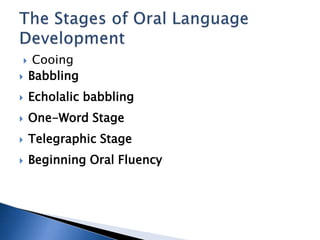
 Cooing
 Babbling
 Echolalic babbling
 One-Word Stage
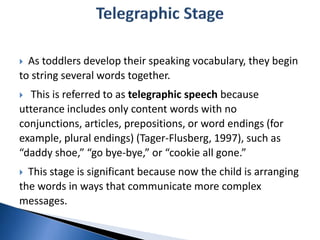
 Telegraphic Stage
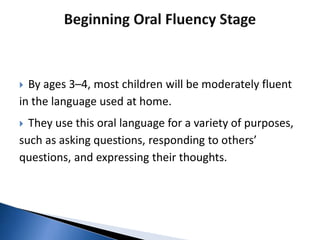
 Beginning Oral Fluency
 As early as six weeks, infants will begin to
spontaneously make cooing sounds (Reich,
1986; Wolff, 1969).
 These extended sounds resemble vowel
sounds, such as /aaa/, /ooo/, /ahhh/.
 At this stage children are learning to make
sounds by manipulating their tongues, mouths,
and breathing.
 Infants’ sound production becomes more
varied and complex around 4–6 months of
age.
 At this time they begin to babble, making
repeated consonant–vowel sounds, such as
ba-ba-ba (Clark & Clark, 1977; Stoel-
Gammon, 1998)
 A more complex type of babbling develops
around 8–10 months.
 This type of babbling varies in intonation and
rhythm and sounds like the child is talking.
 It is called echolalic babbling because it
reflects the intonation and rhythm of the
speech of the adults in the child’s environment
(Sachs, 1989).
 Around one year of age, children begin to produce word-
like units. These word-like units may be invented words,
also known as idiomorphs (Reich, 1986).
 For example, a child may have a special invented word
that refers to a toy or to his personal blanket.
 This idiomorph is a “word” in the sense that it is stable
and used to refer to a particular object on a consistent
basis. In addition to these invented words, children also
produce more conventional words that resemble adult
pronunciation and meaning.
 As toddlers develop their speaking vocabulary, they begin
to string several words together.
 This is referred to as telegraphic speech because
utterance includes only content words with no
conjunctions, articles, prepositions, or word endings (for
example, plural endings) (Tager-Flusberg, 1997), such as
“daddy shoe,” “go bye-bye,” or “cookie all gone.”
 This stage is significant because now the child is arranging
the words in ways that communicate more complex
messages.
 By ages 3–4, most children will be moderately fluent
in the language used at home.
 They use this oral language for a variety of purposes,
such as asking questions, responding to others’
questions, and expressing their thoughts.
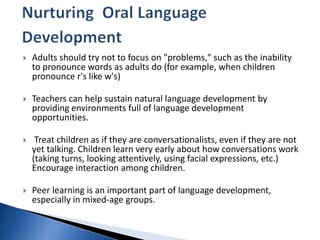
 Adults should try not to focus on "problems," such as the inability
to pronounce words as adults do (for example, when children
pronounce r's like w's)
 Teachers can help sustain natural language development by
providing environments full of language development
opportunities.
 Treat children as if they are conversationalists, even if they are not
yet talking. Children learn very early about how conversations work
(taking turns, looking attentively, using facial expressions, etc.)
Encourage interaction among children.
 Peer learning is an important part of language development,
especially in mixed-age groups.
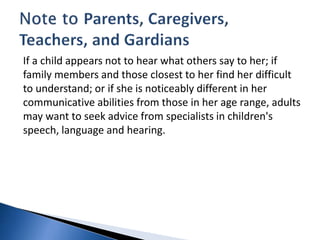
If a child appears not to hear what others say to her; if
family members and those closest to her find her difficult
to understand; or if she is noticeably different in her
communicative abilities from those in her age range, adults
may want to seek advice from specialists in children's
speech, language and hearing.
 http://www.ehow.com/about_6462383_oral-
language-development_.html#ixzz2s01aouW1
 Genishi, C. (1998). Young Children's Oral Language
Development. ERIC Digest. ERIC Clearinghouse on
Elementary and Early Childhood Education.

ILD

  • 1.
    Topic: Oral Language Presenters:Venessa Thomas-Vanriel Kimesha Minzie-Bloomfield
  • 2.
    This can bedefined as an imitative process where babies imitate sounds, intonations and expressions and learn vocabulary as it is presented to them.
  • 3.
     Interaction amonggenes (which hold innate tendencies to communicate and be sociable),  The environment  The child's own thinking abilities
  • 4.
     Cooing  Babbling Echolalic babbling  One-Word Stage  Telegraphic Stage  Beginning Oral Fluency
  • 5.
     As earlyas six weeks, infants will begin to spontaneously make cooing sounds (Reich, 1986; Wolff, 1969).  These extended sounds resemble vowel sounds, such as /aaa/, /ooo/, /ahhh/.  At this stage children are learning to make sounds by manipulating their tongues, mouths, and breathing.
  • 6.
     Infants’ soundproduction becomes more varied and complex around 4–6 months of age.  At this time they begin to babble, making repeated consonant–vowel sounds, such as ba-ba-ba (Clark & Clark, 1977; Stoel- Gammon, 1998)
  • 7.
     A morecomplex type of babbling develops around 8–10 months.  This type of babbling varies in intonation and rhythm and sounds like the child is talking.  It is called echolalic babbling because it reflects the intonation and rhythm of the speech of the adults in the child’s environment (Sachs, 1989).
  • 8.
     Around oneyear of age, children begin to produce word- like units. These word-like units may be invented words, also known as idiomorphs (Reich, 1986).  For example, a child may have a special invented word that refers to a toy or to his personal blanket.  This idiomorph is a “word” in the sense that it is stable and used to refer to a particular object on a consistent basis. In addition to these invented words, children also produce more conventional words that resemble adult pronunciation and meaning.
  • 9.
     As toddlersdevelop their speaking vocabulary, they begin to string several words together.  This is referred to as telegraphic speech because utterance includes only content words with no conjunctions, articles, prepositions, or word endings (for example, plural endings) (Tager-Flusberg, 1997), such as “daddy shoe,” “go bye-bye,” or “cookie all gone.”  This stage is significant because now the child is arranging the words in ways that communicate more complex messages.
  • 10.
     By ages3–4, most children will be moderately fluent in the language used at home.  They use this oral language for a variety of purposes, such as asking questions, responding to others’ questions, and expressing their thoughts.
  • 11.
     Adults shouldtry not to focus on "problems," such as the inability to pronounce words as adults do (for example, when children pronounce r's like w's)  Teachers can help sustain natural language development by providing environments full of language development opportunities.  Treat children as if they are conversationalists, even if they are not yet talking. Children learn very early about how conversations work (taking turns, looking attentively, using facial expressions, etc.) Encourage interaction among children.  Peer learning is an important part of language development, especially in mixed-age groups.
  • 12.
    If a childappears not to hear what others say to her; if family members and those closest to her find her difficult to understand; or if she is noticeably different in her communicative abilities from those in her age range, adults may want to seek advice from specialists in children's speech, language and hearing.
  • 13.
     http://www.ehow.com/about_6462383_oral- language-development_.html#ixzz2s01aouW1  Genishi,C. (1998). Young Children's Oral Language Development. ERIC Digest. ERIC Clearinghouse on Elementary and Early Childhood Education.