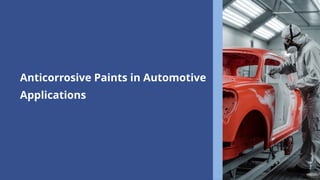
Anticorrosive Paints in Automotive
Applications
P. 0 2
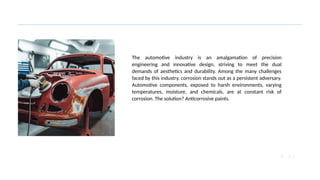
The automotive industry is an amalgamation of precision
engineering and innovative design, striving to meet the dual
demands of aesthetics and durability. Among the many challenges
faced by this industry, corrosion stands out as a persistent adversary.
Automotive components, exposed to harsh environments, varying
temperatures, moisture, and chemicals, are at constant risk of
corrosion. The solution? Anticorrosive paints.
Understanding Corrosion in Automotive Applications
Corrosion occurs when metals are exposed to oxygen, moisture, and other environmental elements, leading to
oxidation and the formation of rust. For automotive components, this degradation is more than just an aesthetic
issue—it compromises the structural integrity of vehicles.
From the undercarriage of a car constantly exposed to water, dirt, and road salt to the engine components
exposed to heat and oil vapours, every part of a vehicle faces a unique set of environmental challenges. Without
proper protection, corrosion can lead to costly repairs, reduced performance, and even safety hazards.
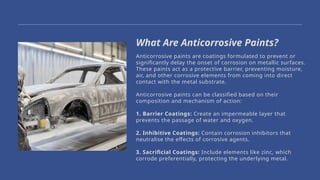
Anticorrosive paints are coatings formulated to prevent or
significantly delay the onset of corrosion on metallic surfaces.
These paints act as a protective barrier, preventing moisture,
air, and other corrosive elements from coming into direct
contact with the metal substrate.
Anticorrosive paints can be classified based on their
composition and mechanism of action:
1. Barrier Coatings: Create an impermeable layer that
prevents the passage of water and oxygen.
2. Inhibitive Coatings: Contain corrosion inhibitors that
neutralise the effects of corrosive agents.
3. Sacrificial Coatings: Include elements like zinc, which
corrode preferentially, protecting the underlying metal.
What Are Anticorrosive Paints?
1. High Adhesion
Anticorrosive paints exhibit excellent adhesion to metal surfaces, ensuring long-term protection
even under challenging conditions.
2. Resistance to Chemicals
Automotive components often encounter oils, greases, and chemicals. Anticorrosive paints resist
these substances, preventing degradation of the protective layer.
3. Durability
Designed to withstand wear and tear, these paints endure vibrations, impacts, and thermal cycling
without compromising performance.
4. Versatility
Available in a range of formulations, anticorrosive paints can be tailored to specific automotive
requirements, including resistance to heat, UV exposure, and abrasion.
5. Aesthetic Appeal
While their primary function is protection, modern anticorrosive paints also contribute to a vehicle’s
aesthetics, offering smooth finishes and vibrant colours.
Properties of Anticorrosive Paints
Applications of Anticorrosive Paints in the Automotive Industry
1. UThe undercarriage of vehicles is most susceptible to corrosion due to constant exposure to water,
mud, road salt, and debris. Anticorrosive paints provide a robust shield, protecting these components and
ensuring their longevity.
2. Engine Components
Engine parts such as cylinders, pistons, and exhaust manifolds operate under high temperatures and are
exposed to corrosive gases. Heat-resistant anticorrosive coatings safeguard these components, ensuring
optimal performance.
3. Chassis and Structural Components
The chassis forms the backbone of any vehicle. Coating it with anticorrosive paint ensures structural
integrity, even in harsh environments.
4. Fuel Tanks and Pipelines
Fuel tanks and pipelines are prone to corrosion due to exposure to fuel, moisture, and fluctuating
temperatures. Anticorrosive coatings prevent leaks and ensure the safe transport of fuel.
5. Exterior Panels
Body panels not only define the aesthetics of a vehicle but also shield its internal components. Applying
anticorrosive paint protects these panels from rust and maintains their appearance over time.
6. Automotive Fasteners
Bolts, nuts, and ndercarriage Protection
screws are integral to holding various components together. Anticorrosive coatings ensure these
fasteners remain intact, preventing structural failures.
Types of Anticorrosive Paints Used in Automotive Applications
1. Epoxy Coatings
Epoxy-based anticorrosive paints offer excellent adhesion, chemical resistance, and
durability. They are commonly used for undercarriages and engine components.
2. Polyurethane Coatings
Known for their UV resistance and flexibility, polyurethane paints are ideal for exterior
panels and components exposed to sunlight and weathering.
3. Zinc-Rich Primers
These sacrificial coatings provide cathodic protection to steel surfaces, making them
suitable for chassis and structural parts.
4. Acrylic Coatings
Acrylic-based anticorrosive paints are lightweight and provide a good balance between
performance and cost. They are often used for interior components and less critical
areas.
5. Heat-Resistant Paints
Designed to withstand high temperatures, these paints are used on exhaust systems,
engine blocks, and other heat-sensitive components.
Advantages of Anticorrosive Paints in Automotive Applications
1. Enhanced Vehicle Longevity
By preventing rust and degradation, anticorrosive paints extend the lifespan of automotive
components, reducing the need for frequent replacements.
2. Improved Safety
Corrosion can weaken critical components, leading to potential failures. Anticorrosive
coatings ensure vehicles remain safe and reliable.
3. Reduced Maintenance Costs
Preventing corrosion minimises the need for repairs and maintenance, resulting in cost
savings for both manufacturers and vehicle owners.
4. Environmental Benefits
Modern anticorrosive paints are designed to be eco-friendly, with low VOC formulations and
recyclable properties, contributing to sustainable automotive practices.
5. Aesthetic Durability
By maintaining the appearance of vehicles, anticorrosive paints ensure they retain their
visual appeal, enhancing brand value and consumer satisfaction.
Trends and Innovations in Anticorrosive Paint Technology
The automotive industry is witnessing several advancements in anticorrosive paint
technology:
•Nanotechnology: Nano-sized particles improve the protective properties of coatings,
enhancing their resistance to corrosion and wear.
•Smart Coatings: These coatings can self-heal minor scratches and cracks, ensuring
consistent protection.
•Eco-Friendly Formulations: Low-VOC and water-based anticorrosive paints are gaining
popularity, aligning with global sustainability goals.
•High-Solids Coatings: These formulations offer better coverage with fewer coats,
reducing application time and material usage.
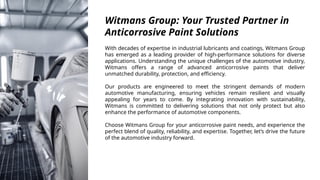
Witmans Group: Your Trusted Partner in
Anticorrosive Paint Solutions
With decades of expertise in industrial lubricants and coatings, Witmans Group
has emerged as a leading provider of high-performance solutions for diverse
applications. Understanding the unique challenges of the automotive industry,
Witmans offers a range of advanced anticorrosive paints that deliver
unmatched durability, protection, and efficiency.
Our products are engineered to meet the stringent demands of modern
automotive manufacturing, ensuring vehicles remain resilient and visually
appealing for years to come. By integrating innovation with sustainability,
Witmans is committed to delivering solutions that not only protect but also
enhance the performance of automotive components.
Choose Witmans Group for your anticorrosive paint needs, and experience the
perfect blend of quality, reliability, and expertise. Together, let’s drive the future
of the automotive industry forward.
• https://www.linshangtech.com/tech/tech978.htm
• https://wuling.id/en/blog/autotips/the-benefits-of-rust-proof-paint-on-your-car
• https://www.asianpaints.com/blogs/anti-corrosion-paint-guide.html
• https://housing.com/news/what-are-anti-corrosion-paints-types-benefits-and-price/
• https://www.zavenir.com/insight/corrosion-protection-automotive-industry
• https://www.pcimag.com/articles/112276-the-automotive-coatings-landscape
References
Thank You

Protecting Metal, Preserving Performance

  • 1.
    Anticorrosive Paints inAutomotive Applications
  • 2.
    P. 0 2 Theautomotive industry is an amalgamation of precision engineering and innovative design, striving to meet the dual demands of aesthetics and durability. Among the many challenges faced by this industry, corrosion stands out as a persistent adversary. Automotive components, exposed to harsh environments, varying temperatures, moisture, and chemicals, are at constant risk of corrosion. The solution? Anticorrosive paints.
  • 3.
    Understanding Corrosion inAutomotive Applications Corrosion occurs when metals are exposed to oxygen, moisture, and other environmental elements, leading to oxidation and the formation of rust. For automotive components, this degradation is more than just an aesthetic issue—it compromises the structural integrity of vehicles. From the undercarriage of a car constantly exposed to water, dirt, and road salt to the engine components exposed to heat and oil vapours, every part of a vehicle faces a unique set of environmental challenges. Without proper protection, corrosion can lead to costly repairs, reduced performance, and even safety hazards.
  • 4.
    Anticorrosive paints arecoatings formulated to prevent or significantly delay the onset of corrosion on metallic surfaces. These paints act as a protective barrier, preventing moisture, air, and other corrosive elements from coming into direct contact with the metal substrate. Anticorrosive paints can be classified based on their composition and mechanism of action: 1. Barrier Coatings: Create an impermeable layer that prevents the passage of water and oxygen. 2. Inhibitive Coatings: Contain corrosion inhibitors that neutralise the effects of corrosive agents. 3. Sacrificial Coatings: Include elements like zinc, which corrode preferentially, protecting the underlying metal. What Are Anticorrosive Paints?
  • 5.
    1. High Adhesion Anticorrosivepaints exhibit excellent adhesion to metal surfaces, ensuring long-term protection even under challenging conditions. 2. Resistance to Chemicals Automotive components often encounter oils, greases, and chemicals. Anticorrosive paints resist these substances, preventing degradation of the protective layer. 3. Durability Designed to withstand wear and tear, these paints endure vibrations, impacts, and thermal cycling without compromising performance. 4. Versatility Available in a range of formulations, anticorrosive paints can be tailored to specific automotive requirements, including resistance to heat, UV exposure, and abrasion. 5. Aesthetic Appeal While their primary function is protection, modern anticorrosive paints also contribute to a vehicle’s aesthetics, offering smooth finishes and vibrant colours. Properties of Anticorrosive Paints
  • 6.
    Applications of AnticorrosivePaints in the Automotive Industry 1. UThe undercarriage of vehicles is most susceptible to corrosion due to constant exposure to water, mud, road salt, and debris. Anticorrosive paints provide a robust shield, protecting these components and ensuring their longevity. 2. Engine Components Engine parts such as cylinders, pistons, and exhaust manifolds operate under high temperatures and are exposed to corrosive gases. Heat-resistant anticorrosive coatings safeguard these components, ensuring optimal performance. 3. Chassis and Structural Components The chassis forms the backbone of any vehicle. Coating it with anticorrosive paint ensures structural integrity, even in harsh environments. 4. Fuel Tanks and Pipelines Fuel tanks and pipelines are prone to corrosion due to exposure to fuel, moisture, and fluctuating temperatures. Anticorrosive coatings prevent leaks and ensure the safe transport of fuel. 5. Exterior Panels Body panels not only define the aesthetics of a vehicle but also shield its internal components. Applying anticorrosive paint protects these panels from rust and maintains their appearance over time. 6. Automotive Fasteners Bolts, nuts, and ndercarriage Protection screws are integral to holding various components together. Anticorrosive coatings ensure these fasteners remain intact, preventing structural failures.
  • 7.
    Types of AnticorrosivePaints Used in Automotive Applications 1. Epoxy Coatings Epoxy-based anticorrosive paints offer excellent adhesion, chemical resistance, and durability. They are commonly used for undercarriages and engine components. 2. Polyurethane Coatings Known for their UV resistance and flexibility, polyurethane paints are ideal for exterior panels and components exposed to sunlight and weathering. 3. Zinc-Rich Primers These sacrificial coatings provide cathodic protection to steel surfaces, making them suitable for chassis and structural parts. 4. Acrylic Coatings Acrylic-based anticorrosive paints are lightweight and provide a good balance between performance and cost. They are often used for interior components and less critical areas. 5. Heat-Resistant Paints Designed to withstand high temperatures, these paints are used on exhaust systems, engine blocks, and other heat-sensitive components.
  • 8.
    Advantages of AnticorrosivePaints in Automotive Applications 1. Enhanced Vehicle Longevity By preventing rust and degradation, anticorrosive paints extend the lifespan of automotive components, reducing the need for frequent replacements. 2. Improved Safety Corrosion can weaken critical components, leading to potential failures. Anticorrosive coatings ensure vehicles remain safe and reliable. 3. Reduced Maintenance Costs Preventing corrosion minimises the need for repairs and maintenance, resulting in cost savings for both manufacturers and vehicle owners. 4. Environmental Benefits Modern anticorrosive paints are designed to be eco-friendly, with low VOC formulations and recyclable properties, contributing to sustainable automotive practices. 5. Aesthetic Durability By maintaining the appearance of vehicles, anticorrosive paints ensure they retain their visual appeal, enhancing brand value and consumer satisfaction.
  • 9.
    Trends and Innovationsin Anticorrosive Paint Technology The automotive industry is witnessing several advancements in anticorrosive paint technology: •Nanotechnology: Nano-sized particles improve the protective properties of coatings, enhancing their resistance to corrosion and wear. •Smart Coatings: These coatings can self-heal minor scratches and cracks, ensuring consistent protection. •Eco-Friendly Formulations: Low-VOC and water-based anticorrosive paints are gaining popularity, aligning with global sustainability goals. •High-Solids Coatings: These formulations offer better coverage with fewer coats, reducing application time and material usage.
  • 10.
    Witmans Group: YourTrusted Partner in Anticorrosive Paint Solutions With decades of expertise in industrial lubricants and coatings, Witmans Group has emerged as a leading provider of high-performance solutions for diverse applications. Understanding the unique challenges of the automotive industry, Witmans offers a range of advanced anticorrosive paints that deliver unmatched durability, protection, and efficiency. Our products are engineered to meet the stringent demands of modern automotive manufacturing, ensuring vehicles remain resilient and visually appealing for years to come. By integrating innovation with sustainability, Witmans is committed to delivering solutions that not only protect but also enhance the performance of automotive components. Choose Witmans Group for your anticorrosive paint needs, and experience the perfect blend of quality, reliability, and expertise. Together, let’s drive the future of the automotive industry forward.
  • 11.
    • https://www.linshangtech.com/tech/tech978.htm • https://wuling.id/en/blog/autotips/the-benefits-of-rust-proof-paint-on-your-car •https://www.asianpaints.com/blogs/anti-corrosion-paint-guide.html • https://housing.com/news/what-are-anti-corrosion-paints-types-benefits-and-price/ • https://www.zavenir.com/insight/corrosion-protection-automotive-industry • https://www.pcimag.com/articles/112276-the-automotive-coatings-landscape References
  • 12.