http://www.iaeme.com/IJMET/index.asp 220 editor@iaeme.com
International Journal of Mechanical Engineering and Technology (IJMET)
Volume 9, Issue 11, November 2018, pp. 220–232, Article ID: IJMET_09_11_024
Available online at http://www.iaeme.com/ijmet/issues.asp?JType=IJMET&VType=9&IType=11
ISSN Print: 0976-6340 and ISSN Online: 0976-6359
© IAEME Publication Scopus Indexed
MODELLING THE ENERGY CONTENT OF
MUNICIPAL SOLID WASTE AND
DETERMINATION OF ITS PHYSICOCHEMICAL
CORRELATION, USING MULTIPLE
REGRESSION ANALYSIS
*Ibikunle, R.A
Landmark University, Omu-Aran, Kwara State, Nigeria
Titiladunayo, I.F
Landmark University, Omu-Aran, Kwara State, Nigeria
The Federal University of Technology, Akure, Ondo State, Nigeria
Akinnuli, B.O
Landmark University, Omu-Aran, Kwara State, Nigeria
The Federal University of Technology, Akure, Ondo State, Nigeria
Lukman, A. F
Landmark University, Omu-Aran, Kwara State, Nigeria
Ikubanni, P. P
Landmark University, Omu-Aran, Kwara State, Nigeria
Agboola, O.O
Landmark University, Omu-Aran, Kwara State, Nigeria
*corresponding author
ABSTRACT
Municipal solid waste (MSW) is an aggregate of unwanted and discarded materials
that are generated, as man interact with the environment, in his daily activities. The
agglomeration of MSW in the environment is huge and its inefficient management could
result in land degradation and pollution, unsightly scenes, ecological contamination and
global warming. The energy content of its individual components varies from 0
46.169	kJ/kg while that of overall composition remains a function of mix;
physicochemical and thermochemical characteristics of the components. Therefore, this
paper presents a waste-to-energy method for MSW management and energy recovery for
heating or electricity generation. A multiple regression analysis was used to develop a
predictive model for the energy content of MSW, while the effect of physicochemical
Ibikunle, R.A, Titiladunayo, I.F, Akinnuli, B.O, Lukman, A. F, Ikubanni, P. P and Agboola, O.O
http://www.iaeme.com/IJMET/index.asp 221 editor@iaeme.com
characteristic of the mix on the overall MSW energy values was established. Waste
samples were collected from Lasojo dumpsite in Ilorin Metropolis of Kwara State,
Nigeria. The wastes streams were identified and characterized to determine the properties
of the various fractions that were available for energy generation (kg). Three regression
models were therefore developed and fitted to variables derived from proximate analysis,
ultimate analysis and the physical compositions of MSW. A diagnostic check on the
models show that model 1 and 2 suffer the problem of multicollinearity. This necessitate
the use of ridge regression estimator. The models developed in this study can therefore,
accurately predict the energy content of municipal solid waste and correlate it with its
physicochemical characteristics.
Keywords: Municipal solid waste, Energy content, Regression analysis
Cite this Article Ibikunle, R.A, Titiladunayo, I.F, Akinnuli, B.O, Lukman, A. F, Ikubanni,
P. P and Agboola, O.O, Modelling the Energy Content of Municipal Solid Waste and
Determination of its Physicochemical Correlation, Using Multiple Regression Analysis,
International Journal of Mechanical Engineering and Technology, 9(11), 2018, pp. 220–
232.
http://www.iaeme.com/IJMET/issues.asp?JType=IJMET&VType=9&IType=11
1. INTRODUCTION
The growth of municipal solid waste (MSW) on a daily basis, result in environmental problems
which include pollution, land degradation and others (Shi et al., 2006; Akkaya and Demir, 2009).
This research study was primarily induced by the MSW management problems of Ilorin
metropolis in Kwara state, Nigeria. The predicted waste generation in the metropolis, amounts to
302,000 tons/year at a rate of 0.78 kg/capita/day. Presently, the MSW generated in Ilorin
metropolis is disposed of, at Lasoju-Eyenkorin (along Ibadan-Ilorin express way), which is the
only functional dumpsite at the period of this study. The dumpsite is already filled with waste to
about 2/3 of its maximum capacity; moreover the collection system is inefficient as evident by
the uncollected wastes blocking of the water ways during raining seasons and indiscriminate
disposal of MSW into open fields and water ways by the general public. Efficient and appropriate
waste management system is therefore critically required, to sustain clean and friendly
environment. Landfilling is recognized as a renowned method for municipal solid waste disposal
across the globe. The method has the capacity to accommodate large quantity of MSW,
particularly where large area of land to be designated for waste disposal is available. Nevertheless
the system has its disadvantages which include: production of some noxious odour, emission of
greenhouse gas, and leachate production (Akkaya and Demir, 2009). In addition, scarcity of a
sufficiently large area of land that could be sacrificed for landfilling. These reasons are sufficient
enough to consider an alternative method of municipal solid waste management. The recent
development in WTE technology makes it possible to consider the municipal solid wastes
generated continuously in cities, as an essential renewable energy resources; notwithstanding,
Ilorin still face crisis of power outage. Energy recovery from municipal solid waste is possible
through processes which include: gasification, aerobic digestion, combustion and pyrolysis
(Cynthia, 2013). The design of municipal solid waste fired power plant which will doubly serve
as an efficient waste management method as well as energy recovery device. The design and
operation of any energy recovery systems using MSW as energy resource depend on the heating
value of the considered municipal solid waste fractions. Therefore, it is very important to
determine the heating value of the waste fractions, in the metropolis to be able to perform the
efficient design and operation of the waste to energy conversion based technologies. The heating
value was experimentally determined by using (e 2k combustion calorimeter) electronic bomb
calorimeter. The heating value obtained from the bomb calorimeter, is the high heating value
Modelling the Energy Content of Municipal Solid Waste and Determination of its
Physicochemical Correlation, Using Multiple Regression Analysis
http://www.iaeme.com/IJMET/index.asp 222 editor@iaeme.com
(HHV); the required low heating value is obtained by the summation of the product of each waste
fraction’s percentage weight and its corresponding high heating value (Islam, 2006). In this study,
three models were developed based on: the proximate analysis, ultimate analysis and the physical
compositions of MSW. The aim of this study, is to develop empirical models that could be used
in the estimation of energy content, represented by the heating value of municipal solid
waste(MSW) fractions, using their physical and elemental characteristics viz moisture content,
volatile matter, fixed carbon, carbon, hydrogen, nitrogen, oxygen, and sulfur. The equation
coefficients of the developed model equations, were obtained from multiple regression analysis
(Juin, et al., 2012), using ordinary least square estimator and ridge regression estimator. The
prediction performances of the developed models have been evaluated by means of regression
and error analyses.
2. MATERIALS AND METHOD
2.1. Characteristics of municipal solid waste data
MSW samples of specific bin volume of 240 litres each were collected from dumpsite, and each
is weighed, and hand sorted into different components in a screening table of size 1.5m x 3 m
with 10 mm x 10mm mesh surface designed for heterogeneous solid waste (WHO, (1988) and
Issam, et al., 2010). The characterization study lasted for eight months, in which 62 samples were
considered to avoid eventual error that may occur due to insufficient samples. Nineteen waste
fractions were obtained and nine of them selected for energy generation, based on combustibility
and availability. They are: food residue, paper, plastic bottles, textiles (rag), wood, grass/garden
trimmings, nylon, packaging box (carton) and polythene-sac.
2.2. Determination of the heating value of the waste components
The high heating values (HHV) of the MSW fractions were determined with the aid of bomb calorimeter
(e 2k combustion Calorimeter), based on standard ASTM D5468-02 (Shi et al., 2016). Waste sample of
0.5g, was burnt in a bomb in the atmosphere of oxygen at the pressure of about 2000 M Pa; and the
result is displayed on the screen of the data logger. According to Islam (2006), low heating energy
obtained from the waste fractions selected for power generation is presented
																																											 = ∑ × 					 (1)
Where 	is	the	lower	heating	value, 	 typical heating values of MSW component- j
and is the weight fraction (%) of component- j.
2.3. Proximate analysis
The proximate analysis was carried out to determine the moisture content, volatile matter, fixed
carbon content and the ash content of each of the nine selected waste fractions, for energy
production based on ASTM D7582 – 12 Standard methods. Moisture content was determined by
drying 1g of grinded air-dried sample, in an Electric oven (DHG 9053, 200 o
C capacity), when
maintained at about 110 °C for 1 h; it was later removed and cooled in a desiccator and weighed.
The loss in weight is reported as moisture material according Vairam and Ramesh, (2013); Shi et
al., (2016) to by using Equation 2.
%& =
(&())
&
	× 100 (2)
Where	%+ is the wet moisture content %, w is the initial mass of sample as delivered (kg),
and d is the mass of sample after oven drying (kg).
After the determination of their moisture contents, the residue of moisture analysis, was
covered with a lid and placed inside an electric furnace (TDW, 1200 o
C capacity) maintained at
950°C. It was removed after 7 min of heating and cooled in a desiccator; then it was weighed to
Ibikunle, R.A, Titiladunayo, I.F, Akinnuli, B.O, Lukman, A. F, Ikubanni, P. P and Agboola, O.O
http://www.iaeme.com/IJMET/index.asp 223 editor@iaeme.com
determine the loss in weight; which is reported as volatile matter in percentage terms. (Adekunle
et al., 2015 and Shi et al., 2016) using Equation 3.
																																						 ) =	
,
-
	× 100	 (3)
Where 	 ) is the percentage volatile matter, A is the mass loss of the sample, and B is the
mass of the sample taken.
The residue left after determination of volatile matter was heated without the lid inside a
furnace at 700 °c for 0.5 h. The crucible was taken out, cooled in the desiccator and later weighed;
heating cooling and weighing was repeated until a constant weight is obtained. Ash content is the
amount of residue obtained after ignition of solid waste which was obtained according to Vairam
and Ramesh, (2013) and Kuleape et al (2014), using Equation 4.
.sh	(%) =
&
/
× 100 (4)
Where +, is the mass of ash and is the mass of the sample taken.
The fixed amount of carbon left behind was calculated according to ASTM D3172-73 by
deducting the percentage amount of ash, moisture, and volatile matter from 100, using Equation
5.
Fixed carbon (%) = 100 - (Moisture + Volatile matter + Ash) (5)
2.4. Ultimate Analysis
Ultimate analysis was performed to evaluate of the total carbon (C), hydrogen (H), nitrogen (N),
sulphur (S), oxygen (O) percentages after the removal of volatile matters, the moisture and ash
contents (Benjamin et al., 2014). Flash EA 1112 Elemental analyzer; was used based on the
standard ASTM D5291. About 0.5g of the powdered sample in put into a crucible with vanadium
(v) oxide catalyst, dropped into the reactor in an environment of oxygen. The temperature then
rises to about 1800°C, causing the sample to combust. The product of combustion was purified
by a reactor, then flowed into the chromatographic column, where separation occurred. Oxides
of Nitrogen and sulfur produced were reduced to elemental nitrogen and sulfur dioxide and excess
oxygen retained. The gas blend containing N2, CO2, H2O, and SO2 gasses, which were sent to the
TCD where electrical signs processed by ‘Eager 300 software’ gave percentages of nitrogen,
carbon, hydrogen, and sulfur contained in the sample. The samples were replicated three times in
the experiment, and the average values of the results considered as the typical values.
2.5. Multiple regression analysis
Three models were developed on the heating value as dependent variable, using proximate
products, ultimate products and physical components of the MSW as the independent variables.
GRATEL statistical software with ordinary least square method. Diagnostic check was performed
using Jarque-Bera test to determine the error distribution. The correlation of the regressors were
examined by using variance inflation factor (VIF) for a diagnostic check of a problem of
multicollinearity. The three models developed are specified in Equations 6-8.
Model for Ultimate Analysis is defined as:
SNHCHV 43210 βββββ ++++=
(6)
Where 0β , 1β ……... 4β are the regression coefficients; and carbon (C), hydrogen (H),
nitrogen (N), and Sulphur (S), are the selected independent variables.
Model for Proximate Analysis is defined as:
Modelling the Energy Content of Municipal Solid Waste and Determination of its
Physicochemical Correlation, Using Multiple Regression Analysis
http://www.iaeme.com/IJMET/index.asp 224 editor@iaeme.com
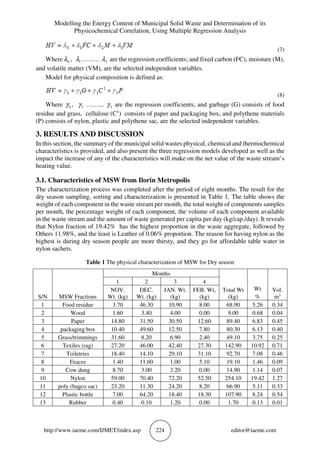
(7)
Where 0λ , 1λ ……... 3λ are the regression coefficients; and fixed carbon (FC), moisture (M),
and volatile matter (VM), are the selected independent variables.
Model for physical composition is defined as:
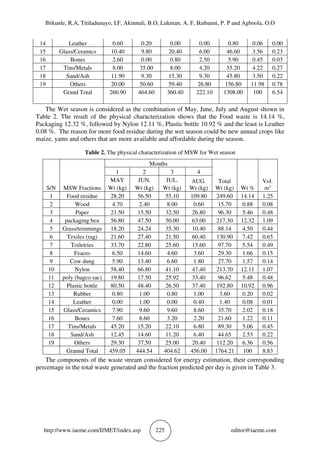
(8)
Where 0γ , 1γ ……... 3γ are the regression coefficients; and garbage (G) consists of food
residue and grass, cellulose (C1
) consists of paper and packaging box, and polythene materials
(P) consists of nylon, plastic and polythene sac, are the selected independent variables.
3. RESULTS AND DISCUSSION
In this section, the summary of the municipal solid wastes physical, chemical and thermochemical
characteristics is provided, and also present the three regression models developed as well as the
impact the increase of any of the characteristics will make on the net value of the waste stream’s
heating value.
3.1. Characteristics of MSW from Ilorin Metropolis
The characterization process was completed after the period of eight months. The result for the
dry season sampling, sorting and characterization is presented in Table 1. The table shows the
weight of each component in the waste stream per month, the total weight of components samples
per month, the percentage weight of each component, the volume of each component available
in the waste stream and the amount of waste generated per capita per day (kg/cap./day). It reveals
that Nylon fraction of 19.42% has the highest proportion in the waste aggregate, followed by
Others 11.98%, and the least is Leather of 0.06% proportion. The reason for having nylon as the
highest is during dry season people are more thirsty, and they go for affordable table water in
nylon sachets.
Table 1 The physical characterization of MSW for Dry season
S/N MSW Fractions
Months
Total Wt
(kg)
Wt
%
Vol.
m3
1 2 3 4
NOV.
Wt. (kg)
DEC.
Wt. (kg)
JAN. Wt.
(kg)
FEB. Wt,
(kg)
1 Food residue 3.70 46.30 10.90 8.00 68.90 5.26 0.34
2 Wood 1.60 3.40 4.00 0.00 9.00 0.68 0.04
3 Paper 14.80 31.50 30.50 12.60 89.40 6.83 0.45
4 packaging box 10.40 49.60 12.50 7.80 80.30 6.13 0.40
5 Grass/trimmings 31.60 8.20 6.90 2.40 49.10 3.75 0.25
6 Texiles (rag) 27.20 46.00 42.40 27.30 142.90 10.92 0.71
7 Toiletries 18.40 14.10 29.10 31.10 92.70 7.08 0.46
8 Feaces 1.40 11.60 1.00 5.10 19.10 1.46 0.09
9 Cow dung 8.70 3.00 3.20 0.00 14.90 1.14 0.07
10 Nylon 59.00 70.40 72.20 52.50 254.10 19.42 1.27
11 poly (bagco sac) 23.20 11.30 24.20 8.20 66.90 5.11 0.33
12 Plastic bottle 7.00 64.20 18.40 18.30 107.90 8.24 0.54
13 Rubber 0.40 0.10 1.20 0.00 1.70 0.13 0.01
Ibikunle, R.A, Titiladunayo, I.F, Akinnuli, B.O, Lukman, A. F, Ikubanni, P. P and Agboola, O.O
http://www.iaeme.com/IJMET/index.asp 225 editor@iaeme.com
14 Leather 0.60 0.20 0.00 0.00 0.80 0.06 0.00
15 Glass/Ceramics 10.40 9.80 20.40 6.00 46.60 3.56 0.23
16 Bones 2.60 0.00 0.80 2.50 5.90 0.45 0.03
17 Tins/Metals 8.00 35.00 8.00 4.20 55.20 4.22 0.27
18 Sand/Ash 11.90 9.30 15.30 9.30 45.80 3.50 0.22
19 Others 20.00 50.60 59.40 26.80 156.80 11.98 0.78
Grand Total 260.90 464.60 360.40 222.10 1308.00 100 6.54
The Wet season is considered as the combination of May, June, July and August shown in
Table 2. The result of the physical characterization shows that the Food waste is 14.14 %,
Packaging 12.32 %, followed by Nylon 12.11 %, Plastic bottle 10.92 % and the least is Leather
0.08 %. The reason for more food residue during the wet season could be new annual crops like
maize, yams and others that are more available and affordable during the season.
Table 2. The physical characterization of MSW for Wet season
S/N MSW Fractions
Months
Total
Wt (kg) Wt %
Vol.
m3
1 2 3 4
MAY
Wt (kg)
JUN.
Wt (kg)
JUL.
Wt (kg)
AUG.
Wt (kg)
1 Food residue 28.20 56.50 55.10 109.80 249.60 14.14 1.25
2 Wood 4.70 2.40 8.00 0.60 15.70 0.88 0.08
3 Paper 21.50 15.50 32.50 26.80 96.30 5.46 0.48
4 packaging box 56.80 47.50 50.00 63.00 217.30 12.32 1.09
5 Grass/trimmings 18.20 24.24 35.30 10.40 88.14 4.50 0.44
6 Texiles (rag) 21.60 27.40 21.50 60.40 130.90 7.42 0.65
7 Toiletries 33.70 22.80 25.60 15.60 97.70 5.54 0.49
8 Feaces 6.50 14.60 4.60 3.60 29.30 1.66 0.15
9 Cow dung 5.90 13.40 6.60 1.80 27.70 1.57 0.14
10 Nylon 58.40 66.80 41.10 47.40 213.70 12.11 1.07
11 poly (bagco sac) 19.80 17.50 25.92 33.40 96.62 5.48 0.48
12 Plastic bottle 80.50 48.40 26.50 37.40 192.80 10.92 0.96
13 Rubber 0.80 1.00 0.80 1.00 3.60 0.20 0.02
14 Leather 0.00 1.00 0.00 0.40 1.40 0.08 0.01
15 Glass/Ceramics 7.90 9.60 9.60 8.60 35.70 2.02 0.18
16 Bones 7.60 8.60 3.20 2.20 21.60 1.22 0.11
17 Tins/Metals 45.20 15.20 22.10 6.80 89.30 5.06 0.45
18 Sand/Ash 12.45 14.60 11.20 6.40 44.65 2.53 0.22
19 Others 29.30 37.50 25.00 20.40 112.20 6.36 0.56
Grannd Total 459.05 444.54 404.62 456.00 1764.21 100 8.83
The components of the waste stream considered for energy estimation, their corresponding
percentage in the total waste generated and the fraction predicted per day is given in Table 3.
Modelling the Energy Content of Municipal Solid Waste and Determination of its
Physicochemical Correlation, Using Multiple Regression Analysis
http://www.iaeme.com/IJMET/index.asp 226 editor@iaeme.com
Table 3 The waste components considered for Energy Generation
Waste fractions
Fractions predicted/day
(tons)
Total fractions characterized
for 8 months (kg) Wt.%
Food residue 85.76 318.50 10.37
Wood 6.62 24.70 0.80
Paper 49.95 185.70 6.04
Packaging box 80.14 297.60 9.69
Grass/Trimmings 36.97 137.24 4.47
Textiles (rag) 73.69 273.80 8.91
Nylon 125.95 467.80 15.23
Poly-sac 43.99 163.52 5.32
Plastic bottle 80.96 360.70 9.79
584.03 2169.56 70.62
3.2. Proximate Analysis results
Proximate analysis results given in Table 4. Show that the range of moisture content of the
components analyzed is 6%-13% and the dispersion is 0.58%-1.16 %; the highest is wood 13 %,
followed by grass/trimmings 10 % and the least is packaging box (carton) 6 %. Volatile matter’s
range is 2 %-67 % and the dispersion is 0.58 %-15.18 %; the highest is paper 68 %, wood 67 %
and the least is plastic bottle 2 %. Ash content’s range is 1 %-36 % with dispersion of 0.00 % -
4.04 %; the highest is grass 36 %, followed by Textile (rag) 23 % and the least is plastic 1.00 %.
Table 4. The result of proximate analysis of the waste sample
S/N MSW Fractions % FC % VM % Ash % Moisture HV (%)
1. Packaging Box 65. 32.22 16. 0 ± 2.7 14. 01.3 4.67±0.9 7.02
2. Nylon 80. 06.67 18.3±7.11 1.67±0.89 0. 0 ± 0.0 20.4
3. Textiles (rag) 43. 09.33 30.7±10.9 20. 02.0 6.33±0.4 6.96
4. Wood 27.7±9.56 59. 0 ±10.0 1.67±0.44 11.67±1.1 8.14
5. Grass/Trimmings 15.3±0.89 51.7±8.44 23.33±8.4 9.67±0.4 7.88
6. Plastic Bottle 97.7±0.44 1.33±0.44 1. 00 ±0.0 0. 0 ± 0.0 16.50
7. Paper Waste 24.3±4.89 58.7±5.56 10.33±0.4 5.67±0.9 7.53
8. Food Waste 88.7±3.11 2.67±2.22 2.33±0.44 6.33±0.44 18.03
9. Bagco-Bag 90.0±2.67 4.33±0.44 5.67±3.11 0.00±0.00 38.69
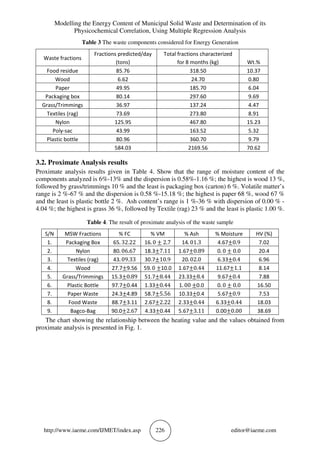
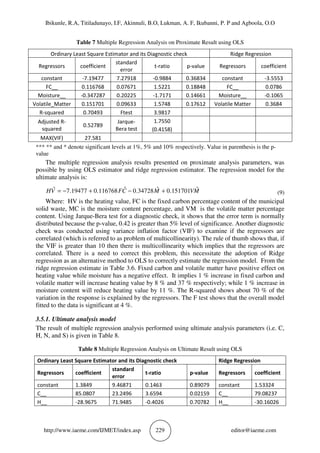
The chart showing the relationship between the heating value and the values obtained from
proximate analysis is presented in Fig. 1.
Ibikunle, R.A, Titiladunayo, I.F, Akinnuli, B.O, Lukman, A. F, Ikubanni, P. P and Agboola, O.O
http://www.iaeme.com/IJMET/index.asp 227 editor@iaeme.com
Figure 1 The heating values versus the proximate analysis of MSW.
3.3. Ultimate analysis results.
The ultimate analysis results in Table 5, show that the carbon range of the components analyzed
is 21 %-38 % with dispersion of 0.04 %-0.85 %; the highest is food residue 38.08 %, followed
by wood 37.45 % and polythene 21.07 %. Hydrogen range is 0.09 %-0.17 % with standard
deviation of 0.001 %-0.031 %; the highest is food residue 0.17 %, Polythene bagco-sac is 0.15
% and the least is Textile (rag) 0.09 %. Nitrogen range is 2.12 %-5.10 with dispersion of 0.01 %-
0.71 %; the highest is paper 5.10 % followed by food residue 5.01 % and the least is Polythene
bagco-sac 2.12 %. Oxygen range is 0.065 %-0.085 with dispersion of 0.0006%-0.001%; the
highest is nylon 0.085 %, followed by packaging box (carton) 0.083 % and grass/trimmings 0.065
%. Sulphur range is 0.05 % - 3.13 %. With dispersion of 0.002 %-0.039 %; the highest is food
residue 3.13 %, followed by wood 0.13 % and the least is nylon 0.52 %.
Table 5 the result of Ultimate analysis of the waste sample
MSW Fractions C % H % N % S % O % HV %
Food residue 38.020 ± 0.44 0.165±0.00 4.938±0.05 3.100 ± 0.02 0.081 ± 0.00 18.624
Wood 36.523 ± 0.62 0.105±0.02 4.501 ± 0.04 0.101 ± 0.02 0.067±0.00 18.418
Paper 35.327±0.08 0.107±0.02 4.748±0.24 0.081 ± 0.00 0.069±0.00 17.038
Packaging box 20.987±0.06 0.111 ± 0.00 2.765±0.10 0.078 ± 0.03 0.082 ± 0.00 15.883
Grass/Trimmings 30.860 ± 0.11 0.098 ± 0.02 3.862 ± 0.06 0.071 ± 0.00 0.064 ± 0.00 17.838
Textiles (rag) 34.047±0.14 0.098 ± 0.00 4.373 ± 0.00 0.084 ± 0.00 0.075 ± 0.00 15.747
Nylon 22.057±0.08 0.110 ± 0.00 2.823±0.02 0.052 ± 0.00 0.076±0.00 46.160
Poly sac 20.950±0.11 0.111 ± 0.02 2.669±0.01 0.052 ± 0.00 0.078±0.00 39.352
Plastic bottle 23.050±0.03 0.105±0.00 2.925±0.00 0.078±0.02 0.078±0.02 37.282
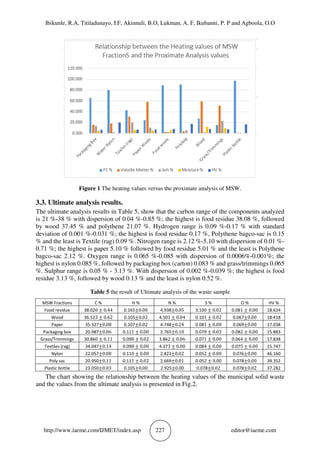
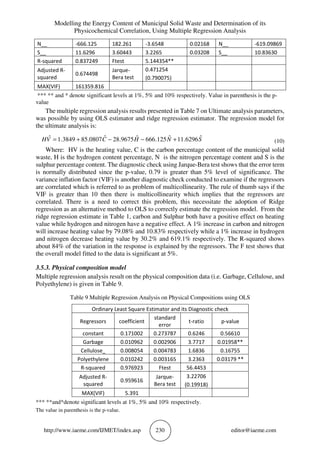
The chart showing the relationship between the heating values of the municipal solid waste
and the values from the ultimate analysis is presented in Fig.2.
Modelling the Energy Content of Municipal Solid Waste and Determination of its
Physicochemical Correlation, Using Multiple Regression Analysis
http://www.iaeme.com/IJMET/index.asp 228 editor@iaeme.com
Figure 2 The heating values versus the ultimate analysis of the MSW.
3.4. The results of Heating value analysis
In Table 6, the net heating value of the waste components is determined to be about 20 MJ/kg.
The heating value is about 44% of that of petrol, 46% of that of diesel, 49% of that of natural gas
and 38% of that of methane (WNA, 2018). It is which is about 50 % of energy contained in coal
and about 100 % of the energy contained in biomass. Nylon is the waste component that has the
highest heating value of 20.4 %, Polythene bagco-sac 17.4 %, Plastic 16.5 % and the least is
Textile (rag) 6.9 %.
Table 6 the thermo-chemical analysis of the waste components for energy Production.
S/N Waste fractions HHV(MJ/kg) Mean HHV% Wt.% HV=HHV*Wt.%
1 Food residue 18.624 18.624±0.545 8.23 10.37 1.9313
2 Wood 18.418 18.418±0.026 8.14 0.80 0.1473
3 Paper 17.038 17.038±0.920 7.53 6.04 1.0291
4 Packaging box 15.883 15.883±1.208 7.02 9.69 1.5391
5 Grass/Trimmings 17.838 17.838±0.251 7.88 4.47 0.7974
6 Nylon 46.160 46.160±0.246 20.4 15.23 7.0302
7 Textile (rag) 15.747 15.747±2.834 6.96 8.91 1.4031
8 Polythene sac 39.352 39.352±0.659 17.4 5.32 2.0935
9 Plastic bottle 37.282 37.282±0.734 16.5 9.79 3.6499
Total 226.324 100 70.62 19.6209
3.5. Multiple Regression analysis result.
3.5.1. Proximate analysis model
Multiple regression analysis result on the proximate analysis parameters (i.e. FC, M and VM) is
given in Table 7.
Ibikunle, R.A, Titiladunayo, I.F, Akinnuli, B.O, Lukman, A. F, Ikubanni, P. P and Agboola, O.O
http://www.iaeme.com/IJMET/index.asp 229 editor@iaeme.com
Table 7 Multiple Regression Analysis on Proximate Result using OLS
Ordinary Least Square Estimator and its Diagnostic check Ridge Regression
Regressors coefficient
standard
error
t-ratio p-value Regressors coefficient
constant -7.19477 7.27918 -0.9884 0.36834 constant -3.5553
FC__ 0.116768 0.07671 1.5221 0.18848 FC__ 0.0786
Moisture__ -0.347287 0.20225 -1.7171 0.14661 Moisture__ -0.1065
Volatile_Matter 0.151701 0.09633 1.5748 0.17612 Volatile Matter 0.3684
R-squared 0.70493 Ftest 3.9817
Adjusted R-
squared
0.52789
Jarque-
Bera test
1.7550
(0.4158)
MAX(VIF) 27.581
*** ** and * denote significant levels at 1%, 5% and 10% respectively. Value in parenthesis is the p-
value
The multiple regression analysis results presented on proximate analysis parameters, was
possible by using OLS estimator and ridge regression estimator. The regression model for the
ultimate analysis is:
MVMCFVH ˆ151701.0ˆ34728.0ˆ116768.019477.7ˆ +−+−= (9)
Where: HV is the heating value, FC is the fixed carbon percentage content of the municipal
solid waste, MC is the moisture content percentage, and VM is the volatile matter percentage
content. Using Jarque-Bera test for a diagnostic check, it shows that the error term is normally
distributed because the p-value, 0.42 is greater than 5% level of significance. Another diagnostic
check was conducted using variance inflation factor (VIF) to examine if the regressors are
correlated (which is referred to as problem of multicollinearity). The rule of thumb shows that, if
the VIF is greater than 10 then there is multicollinearity which implies that the regressors are
correlated. There is a need to correct this problem, this necessitate the adoption of Ridge
regression as an alternative method to OLS to correctly estimate the regression model. From the
ridge regression estimate in Table 3.6. Fixed carbon and volatile matter have positive effect on
heating value while moisture has a negative effect. It implies 1 % increase in fixed carbon and
volatile matter will increase heating value by 8 % and 37 % respectively; while 1 % increase in
moisture content will reduce heating value by 11 %. The R-squared shows about 70 % of the
variation in the response is explained by the regressors. The F test shows that the overall model
fitted to the data is significant at 4 %.
3.5.1. Ultimate analysis model
The result of multiple regression analysis performed using ultimate analysis parameters (i.e. C,
H, N, and S) is given in Table 8.
Table 8 Multiple Regression Analysis on Ultimate Result using OLS
Ordinary Least Square Estimator and its Diagnostic check Ridge Regression
Regressors coefficient
standard
error
t-ratio p-value Regressors coefficient
constant 1.3849 9.46871 0.1463 0.89079 constant 1.53324
C__ 85.0807 23.2496 3.6594 0.02159 C__ 79.08237
H__ -28.9675 71.9485 -0.4026 0.70782 H__ -30.16026
Modelling the Energy Content of Municipal Solid Waste and Determination of its
Physicochemical Correlation, Using Multiple Regression Analysis
http://www.iaeme.com/IJMET/index.asp 230 editor@iaeme.com
N__ -666.125 182.261 -3.6548 0.02168 N__ -619.09869
S__ 11.6296 3.60443 3.2265 0.03208 S__ 10.83630
R-squared 0.837249 Ftest 5.144354**
Adjusted R-
squared
0.674498
Jarque-
Bera test
0.471254
(0.790075)
MAX(VIF) 161359.816
*** ** and * denote significant levels at 1%, 5% and 10% respectively. Value in parenthesis is the p-
value
The multiple regression analysis results presented in Table 7 on Ultimate analysis parameters,
was possible by using OLS estimator and ridge regression estimator. The regression model for
the ultimate analysis is:
SNHCVH ˆ6296.11ˆ125.666ˆ9675.28ˆ0807.853849.1ˆ +−−+= (10)
Where: HV is the heating value, C is the carbon percentage content of the municipal solid
waste, H is the hydrogen content percentage, N is the nitrogen percentage content and S is the
sulphur percentage content. The diagnostic check using Jarque-Bera test shows that the error term
is normally distributed since the p-value, 0.79 is greater than 5% level of significance. The
variance inflation factor (VIF) is another diagnostic check conducted to examine if the regressors
are correlated which is referred to as problem of multicollinearity. The rule of thumb says if the
VIF is greater than 10 then there is multicollinearity which implies that the regressors are
correlated. There is a need to correct this problem, this necessitate the adoption of Ridge
regression as an alternative method to OLS to correctly estimate the regression model. From the
ridge regression estimate in Table 1, carbon and Sulphur both have a positive effect on heating
value while hydrogen and nitrogen have a negative effect. A 1% increase in carbon and nitrogen
will increase heating value by 79.08% and 10.83% respectively while a 1% increase in hydrogen
and nitrogen decrease heating value by 30.2% and 619.1% respectively. The R-squared shows
about 84% of the variation in the response is explained by the regressors. The F test shows that
the overall model fitted to the data is significant at 5%.
3.5.3. Physical composition model
Multiple regression analysis result on the physical composition data (i.e. Garbage, Cellulose, and
Polyethylene) is given in Table 9.
Table 9 Multiple Regression Analysis on Physical Compositions using OLS
Ordinary Least Square Estimator and its Diagnostic check
Regressors coefficient
standard
error
t-ratio p-value
constant 0.171002 0.273787 0.6246 0.56610
Garbage 0.010962 0.002906 3.7717 0.01958**
Cellulose_ 0.008054 0.004783 1.6836 0.16755
Polyethylene 0.010242 0.003165 3.2363 0.03179 **
R-squared 0.976923 Ftest 56.4453
Adjusted R-
squared
0.959616
Jarque-
Bera test
3.22706
(0.19918)
MAX(VIF) 5.391
*** **and*denote significant levels at 1%, 5% and 10% respectively.
The value in parenthesis is the p-value.
Ibikunle, R.A, Titiladunayo, I.F, Akinnuli, B.O, Lukman, A. F, Ikubanni, P. P and Agboola, O.O
http://www.iaeme.com/IJMET/index.asp 231 editor@iaeme.com
Multiple regression analysis on the physical composition data yielded the following model:
PCGVH ˆ010242.0ˆ008054.0ˆ010962.0171002.0ˆ +++= (11)
Where: HV is the heating value, G is the garbage composition of the municipal solid waste,
C is the cellulose components of the waste fractions and P the polyethylene fractions. Using
Jarque-Bera test for a diagnostic check, it shows that the error term is normally distributed
because the p-value, 0.20 is greater than 5% level of significance. Another diagnostic check was
conducted using variance inflation factor (VIF) to examine whether the regressors are correlated
(i.e. to check for multicollinearity problem). The variance inflation factor (VIF) is less than 10;
this infers there is no multi-collinearity which implies that the regressors are not correlated. The
results of p-value show that all the independent variables all have positive effect on the heating
value. .It implies 1 % increase in Garbage, Cellulose and Polyethylene fractions, will cause
heating value to increase by 2 %, 17 % and 3 % respectively. The R-squared shows about 98 %
of the variation in the response is explained by the regressors. Moreover, Garbage and
Polyethylene show that the model fitted to the data is significant at 5 %.
4. CONCLUSIONS
Energy content estimation of municipal solid waste is of practical interest in the design and
operation of the related energy conversion systems. Model development is necessary for the
accurate estimation of heating value in order to minimize cost in the design and operation of
municipal solid waste based engineering application. In this research, three models have been
developed based on multiple regression analysis, for the estimation of the high heating value of
municipal solid waste; using their contents of fixed carbon, moisture, volatile matter, carbon,
hydrogen, nitrogen, sulfur and the physical compositions. The multiple regression models
obtained from the physical composition, proximate and ultimate analyses give an accurate
prediction of the energy content of MSW from Ilorin metropolis. The results of this study show
that the developed model equations give high estimation performance. The model based on
ultimate analysis reveals that 1% increase in carbon and nitrogen will increase heating value by
79.08% and 10.83% respectively while a 1% increase in hydrogen and nitrogen decrease heating
value by 30.2% and 619.1% respectively. The model based on proximate analysis implies that
fixed carbon and volatile matter have positive effect on heating value while moisture has a
negative effect. It shows that 1 % increase in fixed carbon and volatile matter will increase the
heating value by 8 % and 37 % respectively; while 1 % increase in moisture content will reduce
heating value by 11 %. Also the model based on physical composition implies 1 % increase in
Garbage, Cellulose and Polyethylene fractions, will cause heating value to increase by 2 %, 17
% and 3 % respectively. This study reveals that the waste streams generated in Ilorin metropolis
have substantial combustible volatile matters, constituent elements, and organic matters that
could add to the heating values thereby making the MSW, suitable for energy generation. The
heating values of the MSW are 226 MJ/kg and 20 MJ/kg, high heating and low heating values
respectively. The regression model equations developed in this study constitute a reliable
reference study, for the estimation of heating value of municipal solid waste (MSW) and also
help the researchers that are working on MSW as an energy resource for power generation.
REFERENCES
[1] Adekunle, J.O., Ibrahim, J.S., Kucha, E.I., (2015): Proximate and Ultimate analysis of
Biological Briquettes of Nigerian’s Ogboyaga and Okaba Sub – bituminous Coal. British
Journal of Applied Science and Technology 7: 114 – 123.
[2] Akkaya, E., and Demir, A., (2009): Energy Content Estimation of Solid Waste by Multiple
Regression Analysis. 5 th International Advanced Technologies Symposiu. Karabuk.
[3] ASTM D1348-94: American Standard Test Method for Volatile matter content.
Modelling the Energy Content of Municipal Solid Waste and Determination of its
Physicochemical Correlation, Using Multiple Regression Analysis
http://www.iaeme.com/IJMET/index.asp 232 editor@iaeme.com
[4] ASTM D3172-73: American Standard Test Method for Fixed Carbon in Proximate Analysis.
[5] ASTM D5231: American Standard Test Method for Characterization of Municipal Solid
Waste Streams.
[6] ASTM D5291: American Standard Test Method), Standard Test Method for Ultimate
Analysis.
[7] ASTM D5468-02: American Standard Test Method for Gross Calorific and Ash Value of
Waste Materials.
[8] ASTM D5468-02: American Standard Test Method), Standard Test Method for Heating
value.
[9] ASTM D7582–12: American Standard Test Method for Proximate analysis of Coal and
Coke by Macro Thermo-gravimetric Analysis.
[10] Benjamin, T.A, Emmanuel, E.O, and Gideon, A.D., (2014): Characterization of Municipal
Solid Waste in the Federal Capital Abuja, Nigeria, Global Journal of Science Frontier
Research: Health, Environment and Earth Science, 14 (2).
[11] Cynthia, O., Keat, T.L., Moses, M., (2013): The prospect of electricity generation from
municipal solid waste (MSW) in Ghana: A better waste management option, Journal of fuel
processing Technology, 110: 94 -102.
[12] EC SWA-Tool (2012): European Commission Solid Waste Tool: Development of a
Methodology Tool to Enhance the Precision and Comparability of Solid Waste Analysis
Data. Available from www.wastesolutions.org. (Accessed 12 December 2016).
[13] Islam, K.M.N., (2016): Municipal Solid Waste to Energy Generation in Bangladesh: Possible
Scenarios to Generate Renewable Electricity in Dhaka and Chittagong City. Journal of
Renewable Energy. Available from www.hindawi.com/journals . (Accessed 25 November
2017).
[14] Issam, A.K.A, Maria, M.B, Salam, A.T., Saheed, H.Q., and Kassinos, D.B., (2010): Solid
waste characterization, qualification, and management practices in developing countries, “A
case study: Nubulus District-Palestine.” Journal of Environmental management: 91: 1131 –
1138.
[15] Juin. L., Rajendra, D. P., and Thomas, M.H., (2012): Modeling the Energy Content of
Municipal Solid Waste Using Multiple Regression Analysis. Available from
http://www.tandfonline.com/loi/uawm20. (Accessed 9 July 2017).
[16] Kuleape, R., Cobinna, S.J., Danpare, S.B., Duwiejuah, A.B., Amoako, E.E., Asare, W.,
(2014): Assessment of the energy recovery potentials of solid waste generated in Akosombo,
Ghana. Africa Journal Environmental Science and Technology. 8: 297-305.
[17] Majumder, A.K., Jain, R., Banerjee, P., and Barnwal, J.P., (2008): Development of a new
proximate analysis based correlation to predict calorific value off coal, Fuel 87: 3077-3081.
[18] Shi, H., Maphinpey, N., Aqsha, A., Silbermann, R., (2016): Characterization,
thermochemical conversion studies and heating value modeling of municipal solid waste,
Journal of Waste Management, 48: 34 – 47.
[19] Shu, H.Y., Lu, H.C., Fan, H.J., Chang, M.C; Chen, J.C., (2006): Prediction for energy content
of Taiwan, municipal solid waste using multilayer perceptron neural networks. Journal of
the Air & Waste Management Association 56:852-858.
[20] Vairam, S., and Ramesh, S., (2013): Engineering Chemistry. John Wiley and sons Ltd.,
Southern Gate, United Kingdom.

Ijmet 09 11_024

  • 1.
    http://www.iaeme.com/IJMET/index.asp 220 editor@iaeme.com InternationalJournal of Mechanical Engineering and Technology (IJMET) Volume 9, Issue 11, November 2018, pp. 220–232, Article ID: IJMET_09_11_024 Available online at http://www.iaeme.com/ijmet/issues.asp?JType=IJMET&VType=9&IType=11 ISSN Print: 0976-6340 and ISSN Online: 0976-6359 © IAEME Publication Scopus Indexed MODELLING THE ENERGY CONTENT OF MUNICIPAL SOLID WASTE AND DETERMINATION OF ITS PHYSICOCHEMICAL CORRELATION, USING MULTIPLE REGRESSION ANALYSIS *Ibikunle, R.A Landmark University, Omu-Aran, Kwara State, Nigeria Titiladunayo, I.F Landmark University, Omu-Aran, Kwara State, Nigeria The Federal University of Technology, Akure, Ondo State, Nigeria Akinnuli, B.O Landmark University, Omu-Aran, Kwara State, Nigeria The Federal University of Technology, Akure, Ondo State, Nigeria Lukman, A. F Landmark University, Omu-Aran, Kwara State, Nigeria Ikubanni, P. P Landmark University, Omu-Aran, Kwara State, Nigeria Agboola, O.O Landmark University, Omu-Aran, Kwara State, Nigeria *corresponding author ABSTRACT Municipal solid waste (MSW) is an aggregate of unwanted and discarded materials that are generated, as man interact with the environment, in his daily activities. The agglomeration of MSW in the environment is huge and its inefficient management could result in land degradation and pollution, unsightly scenes, ecological contamination and global warming. The energy content of its individual components varies from 0 46.169 kJ/kg while that of overall composition remains a function of mix; physicochemical and thermochemical characteristics of the components. Therefore, this paper presents a waste-to-energy method for MSW management and energy recovery for heating or electricity generation. A multiple regression analysis was used to develop a predictive model for the energy content of MSW, while the effect of physicochemical
  • 2.
    Ibikunle, R.A, Titiladunayo,I.F, Akinnuli, B.O, Lukman, A. F, Ikubanni, P. P and Agboola, O.O http://www.iaeme.com/IJMET/index.asp 221 editor@iaeme.com characteristic of the mix on the overall MSW energy values was established. Waste samples were collected from Lasojo dumpsite in Ilorin Metropolis of Kwara State, Nigeria. The wastes streams were identified and characterized to determine the properties of the various fractions that were available for energy generation (kg). Three regression models were therefore developed and fitted to variables derived from proximate analysis, ultimate analysis and the physical compositions of MSW. A diagnostic check on the models show that model 1 and 2 suffer the problem of multicollinearity. This necessitate the use of ridge regression estimator. The models developed in this study can therefore, accurately predict the energy content of municipal solid waste and correlate it with its physicochemical characteristics. Keywords: Municipal solid waste, Energy content, Regression analysis Cite this Article Ibikunle, R.A, Titiladunayo, I.F, Akinnuli, B.O, Lukman, A. F, Ikubanni, P. P and Agboola, O.O, Modelling the Energy Content of Municipal Solid Waste and Determination of its Physicochemical Correlation, Using Multiple Regression Analysis, International Journal of Mechanical Engineering and Technology, 9(11), 2018, pp. 220– 232. http://www.iaeme.com/IJMET/issues.asp?JType=IJMET&VType=9&IType=11 1. INTRODUCTION The growth of municipal solid waste (MSW) on a daily basis, result in environmental problems which include pollution, land degradation and others (Shi et al., 2006; Akkaya and Demir, 2009). This research study was primarily induced by the MSW management problems of Ilorin metropolis in Kwara state, Nigeria. The predicted waste generation in the metropolis, amounts to 302,000 tons/year at a rate of 0.78 kg/capita/day. Presently, the MSW generated in Ilorin metropolis is disposed of, at Lasoju-Eyenkorin (along Ibadan-Ilorin express way), which is the only functional dumpsite at the period of this study. The dumpsite is already filled with waste to about 2/3 of its maximum capacity; moreover the collection system is inefficient as evident by the uncollected wastes blocking of the water ways during raining seasons and indiscriminate disposal of MSW into open fields and water ways by the general public. Efficient and appropriate waste management system is therefore critically required, to sustain clean and friendly environment. Landfilling is recognized as a renowned method for municipal solid waste disposal across the globe. The method has the capacity to accommodate large quantity of MSW, particularly where large area of land to be designated for waste disposal is available. Nevertheless the system has its disadvantages which include: production of some noxious odour, emission of greenhouse gas, and leachate production (Akkaya and Demir, 2009). In addition, scarcity of a sufficiently large area of land that could be sacrificed for landfilling. These reasons are sufficient enough to consider an alternative method of municipal solid waste management. The recent development in WTE technology makes it possible to consider the municipal solid wastes generated continuously in cities, as an essential renewable energy resources; notwithstanding, Ilorin still face crisis of power outage. Energy recovery from municipal solid waste is possible through processes which include: gasification, aerobic digestion, combustion and pyrolysis (Cynthia, 2013). The design of municipal solid waste fired power plant which will doubly serve as an efficient waste management method as well as energy recovery device. The design and operation of any energy recovery systems using MSW as energy resource depend on the heating value of the considered municipal solid waste fractions. Therefore, it is very important to determine the heating value of the waste fractions, in the metropolis to be able to perform the efficient design and operation of the waste to energy conversion based technologies. The heating value was experimentally determined by using (e 2k combustion calorimeter) electronic bomb calorimeter. The heating value obtained from the bomb calorimeter, is the high heating value
  • 3.
    Modelling the EnergyContent of Municipal Solid Waste and Determination of its Physicochemical Correlation, Using Multiple Regression Analysis http://www.iaeme.com/IJMET/index.asp 222 editor@iaeme.com (HHV); the required low heating value is obtained by the summation of the product of each waste fraction’s percentage weight and its corresponding high heating value (Islam, 2006). In this study, three models were developed based on: the proximate analysis, ultimate analysis and the physical compositions of MSW. The aim of this study, is to develop empirical models that could be used in the estimation of energy content, represented by the heating value of municipal solid waste(MSW) fractions, using their physical and elemental characteristics viz moisture content, volatile matter, fixed carbon, carbon, hydrogen, nitrogen, oxygen, and sulfur. The equation coefficients of the developed model equations, were obtained from multiple regression analysis (Juin, et al., 2012), using ordinary least square estimator and ridge regression estimator. The prediction performances of the developed models have been evaluated by means of regression and error analyses. 2. MATERIALS AND METHOD 2.1. Characteristics of municipal solid waste data MSW samples of specific bin volume of 240 litres each were collected from dumpsite, and each is weighed, and hand sorted into different components in a screening table of size 1.5m x 3 m with 10 mm x 10mm mesh surface designed for heterogeneous solid waste (WHO, (1988) and Issam, et al., 2010). The characterization study lasted for eight months, in which 62 samples were considered to avoid eventual error that may occur due to insufficient samples. Nineteen waste fractions were obtained and nine of them selected for energy generation, based on combustibility and availability. They are: food residue, paper, plastic bottles, textiles (rag), wood, grass/garden trimmings, nylon, packaging box (carton) and polythene-sac. 2.2. Determination of the heating value of the waste components The high heating values (HHV) of the MSW fractions were determined with the aid of bomb calorimeter (e 2k combustion Calorimeter), based on standard ASTM D5468-02 (Shi et al., 2016). Waste sample of 0.5g, was burnt in a bomb in the atmosphere of oxygen at the pressure of about 2000 M Pa; and the result is displayed on the screen of the data logger. According to Islam (2006), low heating energy obtained from the waste fractions selected for power generation is presented = ∑ × (1) Where is the lower heating value, typical heating values of MSW component- j and is the weight fraction (%) of component- j. 2.3. Proximate analysis The proximate analysis was carried out to determine the moisture content, volatile matter, fixed carbon content and the ash content of each of the nine selected waste fractions, for energy production based on ASTM D7582 – 12 Standard methods. Moisture content was determined by drying 1g of grinded air-dried sample, in an Electric oven (DHG 9053, 200 o C capacity), when maintained at about 110 °C for 1 h; it was later removed and cooled in a desiccator and weighed. The loss in weight is reported as moisture material according Vairam and Ramesh, (2013); Shi et al., (2016) to by using Equation 2. %& = (&()) & × 100 (2) Where %+ is the wet moisture content %, w is the initial mass of sample as delivered (kg), and d is the mass of sample after oven drying (kg). After the determination of their moisture contents, the residue of moisture analysis, was covered with a lid and placed inside an electric furnace (TDW, 1200 o C capacity) maintained at 950°C. It was removed after 7 min of heating and cooled in a desiccator; then it was weighed to
  • 4.
    Ibikunle, R.A, Titiladunayo,I.F, Akinnuli, B.O, Lukman, A. F, Ikubanni, P. P and Agboola, O.O http://www.iaeme.com/IJMET/index.asp 223 editor@iaeme.com determine the loss in weight; which is reported as volatile matter in percentage terms. (Adekunle et al., 2015 and Shi et al., 2016) using Equation 3. ) = , - × 100 (3) Where ) is the percentage volatile matter, A is the mass loss of the sample, and B is the mass of the sample taken. The residue left after determination of volatile matter was heated without the lid inside a furnace at 700 °c for 0.5 h. The crucible was taken out, cooled in the desiccator and later weighed; heating cooling and weighing was repeated until a constant weight is obtained. Ash content is the amount of residue obtained after ignition of solid waste which was obtained according to Vairam and Ramesh, (2013) and Kuleape et al (2014), using Equation 4. .sh (%) = & / × 100 (4) Where +, is the mass of ash and is the mass of the sample taken. The fixed amount of carbon left behind was calculated according to ASTM D3172-73 by deducting the percentage amount of ash, moisture, and volatile matter from 100, using Equation 5. Fixed carbon (%) = 100 - (Moisture + Volatile matter + Ash) (5) 2.4. Ultimate Analysis Ultimate analysis was performed to evaluate of the total carbon (C), hydrogen (H), nitrogen (N), sulphur (S), oxygen (O) percentages after the removal of volatile matters, the moisture and ash contents (Benjamin et al., 2014). Flash EA 1112 Elemental analyzer; was used based on the standard ASTM D5291. About 0.5g of the powdered sample in put into a crucible with vanadium (v) oxide catalyst, dropped into the reactor in an environment of oxygen. The temperature then rises to about 1800°C, causing the sample to combust. The product of combustion was purified by a reactor, then flowed into the chromatographic column, where separation occurred. Oxides of Nitrogen and sulfur produced were reduced to elemental nitrogen and sulfur dioxide and excess oxygen retained. The gas blend containing N2, CO2, H2O, and SO2 gasses, which were sent to the TCD where electrical signs processed by ‘Eager 300 software’ gave percentages of nitrogen, carbon, hydrogen, and sulfur contained in the sample. The samples were replicated three times in the experiment, and the average values of the results considered as the typical values. 2.5. Multiple regression analysis Three models were developed on the heating value as dependent variable, using proximate products, ultimate products and physical components of the MSW as the independent variables. GRATEL statistical software with ordinary least square method. Diagnostic check was performed using Jarque-Bera test to determine the error distribution. The correlation of the regressors were examined by using variance inflation factor (VIF) for a diagnostic check of a problem of multicollinearity. The three models developed are specified in Equations 6-8. Model for Ultimate Analysis is defined as: SNHCHV 43210 βββββ ++++= (6) Where 0β , 1β ……... 4β are the regression coefficients; and carbon (C), hydrogen (H), nitrogen (N), and Sulphur (S), are the selected independent variables. Model for Proximate Analysis is defined as:
  • 5.
    Modelling the EnergyContent of Municipal Solid Waste and Determination of its Physicochemical Correlation, Using Multiple Regression Analysis http://www.iaeme.com/IJMET/index.asp 224 editor@iaeme.com (7) Where 0λ , 1λ ……... 3λ are the regression coefficients; and fixed carbon (FC), moisture (M), and volatile matter (VM), are the selected independent variables. Model for physical composition is defined as: (8) Where 0γ , 1γ ……... 3γ are the regression coefficients; and garbage (G) consists of food residue and grass, cellulose (C1 ) consists of paper and packaging box, and polythene materials (P) consists of nylon, plastic and polythene sac, are the selected independent variables. 3. RESULTS AND DISCUSSION In this section, the summary of the municipal solid wastes physical, chemical and thermochemical characteristics is provided, and also present the three regression models developed as well as the impact the increase of any of the characteristics will make on the net value of the waste stream’s heating value. 3.1. Characteristics of MSW from Ilorin Metropolis The characterization process was completed after the period of eight months. The result for the dry season sampling, sorting and characterization is presented in Table 1. The table shows the weight of each component in the waste stream per month, the total weight of components samples per month, the percentage weight of each component, the volume of each component available in the waste stream and the amount of waste generated per capita per day (kg/cap./day). It reveals that Nylon fraction of 19.42% has the highest proportion in the waste aggregate, followed by Others 11.98%, and the least is Leather of 0.06% proportion. The reason for having nylon as the highest is during dry season people are more thirsty, and they go for affordable table water in nylon sachets. Table 1 The physical characterization of MSW for Dry season S/N MSW Fractions Months Total Wt (kg) Wt % Vol. m3 1 2 3 4 NOV. Wt. (kg) DEC. Wt. (kg) JAN. Wt. (kg) FEB. Wt, (kg) 1 Food residue 3.70 46.30 10.90 8.00 68.90 5.26 0.34 2 Wood 1.60 3.40 4.00 0.00 9.00 0.68 0.04 3 Paper 14.80 31.50 30.50 12.60 89.40 6.83 0.45 4 packaging box 10.40 49.60 12.50 7.80 80.30 6.13 0.40 5 Grass/trimmings 31.60 8.20 6.90 2.40 49.10 3.75 0.25 6 Texiles (rag) 27.20 46.00 42.40 27.30 142.90 10.92 0.71 7 Toiletries 18.40 14.10 29.10 31.10 92.70 7.08 0.46 8 Feaces 1.40 11.60 1.00 5.10 19.10 1.46 0.09 9 Cow dung 8.70 3.00 3.20 0.00 14.90 1.14 0.07 10 Nylon 59.00 70.40 72.20 52.50 254.10 19.42 1.27 11 poly (bagco sac) 23.20 11.30 24.20 8.20 66.90 5.11 0.33 12 Plastic bottle 7.00 64.20 18.40 18.30 107.90 8.24 0.54 13 Rubber 0.40 0.10 1.20 0.00 1.70 0.13 0.01
  • 6.
    Ibikunle, R.A, Titiladunayo,I.F, Akinnuli, B.O, Lukman, A. F, Ikubanni, P. P and Agboola, O.O http://www.iaeme.com/IJMET/index.asp 225 editor@iaeme.com 14 Leather 0.60 0.20 0.00 0.00 0.80 0.06 0.00 15 Glass/Ceramics 10.40 9.80 20.40 6.00 46.60 3.56 0.23 16 Bones 2.60 0.00 0.80 2.50 5.90 0.45 0.03 17 Tins/Metals 8.00 35.00 8.00 4.20 55.20 4.22 0.27 18 Sand/Ash 11.90 9.30 15.30 9.30 45.80 3.50 0.22 19 Others 20.00 50.60 59.40 26.80 156.80 11.98 0.78 Grand Total 260.90 464.60 360.40 222.10 1308.00 100 6.54 The Wet season is considered as the combination of May, June, July and August shown in Table 2. The result of the physical characterization shows that the Food waste is 14.14 %, Packaging 12.32 %, followed by Nylon 12.11 %, Plastic bottle 10.92 % and the least is Leather 0.08 %. The reason for more food residue during the wet season could be new annual crops like maize, yams and others that are more available and affordable during the season. Table 2. The physical characterization of MSW for Wet season S/N MSW Fractions Months Total Wt (kg) Wt % Vol. m3 1 2 3 4 MAY Wt (kg) JUN. Wt (kg) JUL. Wt (kg) AUG. Wt (kg) 1 Food residue 28.20 56.50 55.10 109.80 249.60 14.14 1.25 2 Wood 4.70 2.40 8.00 0.60 15.70 0.88 0.08 3 Paper 21.50 15.50 32.50 26.80 96.30 5.46 0.48 4 packaging box 56.80 47.50 50.00 63.00 217.30 12.32 1.09 5 Grass/trimmings 18.20 24.24 35.30 10.40 88.14 4.50 0.44 6 Texiles (rag) 21.60 27.40 21.50 60.40 130.90 7.42 0.65 7 Toiletries 33.70 22.80 25.60 15.60 97.70 5.54 0.49 8 Feaces 6.50 14.60 4.60 3.60 29.30 1.66 0.15 9 Cow dung 5.90 13.40 6.60 1.80 27.70 1.57 0.14 10 Nylon 58.40 66.80 41.10 47.40 213.70 12.11 1.07 11 poly (bagco sac) 19.80 17.50 25.92 33.40 96.62 5.48 0.48 12 Plastic bottle 80.50 48.40 26.50 37.40 192.80 10.92 0.96 13 Rubber 0.80 1.00 0.80 1.00 3.60 0.20 0.02 14 Leather 0.00 1.00 0.00 0.40 1.40 0.08 0.01 15 Glass/Ceramics 7.90 9.60 9.60 8.60 35.70 2.02 0.18 16 Bones 7.60 8.60 3.20 2.20 21.60 1.22 0.11 17 Tins/Metals 45.20 15.20 22.10 6.80 89.30 5.06 0.45 18 Sand/Ash 12.45 14.60 11.20 6.40 44.65 2.53 0.22 19 Others 29.30 37.50 25.00 20.40 112.20 6.36 0.56 Grannd Total 459.05 444.54 404.62 456.00 1764.21 100 8.83 The components of the waste stream considered for energy estimation, their corresponding percentage in the total waste generated and the fraction predicted per day is given in Table 3.
  • 7.
    Modelling the EnergyContent of Municipal Solid Waste and Determination of its Physicochemical Correlation, Using Multiple Regression Analysis http://www.iaeme.com/IJMET/index.asp 226 editor@iaeme.com Table 3 The waste components considered for Energy Generation Waste fractions Fractions predicted/day (tons) Total fractions characterized for 8 months (kg) Wt.% Food residue 85.76 318.50 10.37 Wood 6.62 24.70 0.80 Paper 49.95 185.70 6.04 Packaging box 80.14 297.60 9.69 Grass/Trimmings 36.97 137.24 4.47 Textiles (rag) 73.69 273.80 8.91 Nylon 125.95 467.80 15.23 Poly-sac 43.99 163.52 5.32 Plastic bottle 80.96 360.70 9.79 584.03 2169.56 70.62 3.2. Proximate Analysis results Proximate analysis results given in Table 4. Show that the range of moisture content of the components analyzed is 6%-13% and the dispersion is 0.58%-1.16 %; the highest is wood 13 %, followed by grass/trimmings 10 % and the least is packaging box (carton) 6 %. Volatile matter’s range is 2 %-67 % and the dispersion is 0.58 %-15.18 %; the highest is paper 68 %, wood 67 % and the least is plastic bottle 2 %. Ash content’s range is 1 %-36 % with dispersion of 0.00 % - 4.04 %; the highest is grass 36 %, followed by Textile (rag) 23 % and the least is plastic 1.00 %. Table 4. The result of proximate analysis of the waste sample S/N MSW Fractions % FC % VM % Ash % Moisture HV (%) 1. Packaging Box 65. 32.22 16. 0 ± 2.7 14. 01.3 4.67±0.9 7.02 2. Nylon 80. 06.67 18.3±7.11 1.67±0.89 0. 0 ± 0.0 20.4 3. Textiles (rag) 43. 09.33 30.7±10.9 20. 02.0 6.33±0.4 6.96 4. Wood 27.7±9.56 59. 0 ±10.0 1.67±0.44 11.67±1.1 8.14 5. Grass/Trimmings 15.3±0.89 51.7±8.44 23.33±8.4 9.67±0.4 7.88 6. Plastic Bottle 97.7±0.44 1.33±0.44 1. 00 ±0.0 0. 0 ± 0.0 16.50 7. Paper Waste 24.3±4.89 58.7±5.56 10.33±0.4 5.67±0.9 7.53 8. Food Waste 88.7±3.11 2.67±2.22 2.33±0.44 6.33±0.44 18.03 9. Bagco-Bag 90.0±2.67 4.33±0.44 5.67±3.11 0.00±0.00 38.69 The chart showing the relationship between the heating value and the values obtained from proximate analysis is presented in Fig. 1.
  • 8.
    Ibikunle, R.A, Titiladunayo,I.F, Akinnuli, B.O, Lukman, A. F, Ikubanni, P. P and Agboola, O.O http://www.iaeme.com/IJMET/index.asp 227 editor@iaeme.com Figure 1 The heating values versus the proximate analysis of MSW. 3.3. Ultimate analysis results. The ultimate analysis results in Table 5, show that the carbon range of the components analyzed is 21 %-38 % with dispersion of 0.04 %-0.85 %; the highest is food residue 38.08 %, followed by wood 37.45 % and polythene 21.07 %. Hydrogen range is 0.09 %-0.17 % with standard deviation of 0.001 %-0.031 %; the highest is food residue 0.17 %, Polythene bagco-sac is 0.15 % and the least is Textile (rag) 0.09 %. Nitrogen range is 2.12 %-5.10 with dispersion of 0.01 %- 0.71 %; the highest is paper 5.10 % followed by food residue 5.01 % and the least is Polythene bagco-sac 2.12 %. Oxygen range is 0.065 %-0.085 with dispersion of 0.0006%-0.001%; the highest is nylon 0.085 %, followed by packaging box (carton) 0.083 % and grass/trimmings 0.065 %. Sulphur range is 0.05 % - 3.13 %. With dispersion of 0.002 %-0.039 %; the highest is food residue 3.13 %, followed by wood 0.13 % and the least is nylon 0.52 %. Table 5 the result of Ultimate analysis of the waste sample MSW Fractions C % H % N % S % O % HV % Food residue 38.020 ± 0.44 0.165±0.00 4.938±0.05 3.100 ± 0.02 0.081 ± 0.00 18.624 Wood 36.523 ± 0.62 0.105±0.02 4.501 ± 0.04 0.101 ± 0.02 0.067±0.00 18.418 Paper 35.327±0.08 0.107±0.02 4.748±0.24 0.081 ± 0.00 0.069±0.00 17.038 Packaging box 20.987±0.06 0.111 ± 0.00 2.765±0.10 0.078 ± 0.03 0.082 ± 0.00 15.883 Grass/Trimmings 30.860 ± 0.11 0.098 ± 0.02 3.862 ± 0.06 0.071 ± 0.00 0.064 ± 0.00 17.838 Textiles (rag) 34.047±0.14 0.098 ± 0.00 4.373 ± 0.00 0.084 ± 0.00 0.075 ± 0.00 15.747 Nylon 22.057±0.08 0.110 ± 0.00 2.823±0.02 0.052 ± 0.00 0.076±0.00 46.160 Poly sac 20.950±0.11 0.111 ± 0.02 2.669±0.01 0.052 ± 0.00 0.078±0.00 39.352 Plastic bottle 23.050±0.03 0.105±0.00 2.925±0.00 0.078±0.02 0.078±0.02 37.282 The chart showing the relationship between the heating values of the municipal solid waste and the values from the ultimate analysis is presented in Fig.2.
  • 9.
    Modelling the EnergyContent of Municipal Solid Waste and Determination of its Physicochemical Correlation, Using Multiple Regression Analysis http://www.iaeme.com/IJMET/index.asp 228 editor@iaeme.com Figure 2 The heating values versus the ultimate analysis of the MSW. 3.4. The results of Heating value analysis In Table 6, the net heating value of the waste components is determined to be about 20 MJ/kg. The heating value is about 44% of that of petrol, 46% of that of diesel, 49% of that of natural gas and 38% of that of methane (WNA, 2018). It is which is about 50 % of energy contained in coal and about 100 % of the energy contained in biomass. Nylon is the waste component that has the highest heating value of 20.4 %, Polythene bagco-sac 17.4 %, Plastic 16.5 % and the least is Textile (rag) 6.9 %. Table 6 the thermo-chemical analysis of the waste components for energy Production. S/N Waste fractions HHV(MJ/kg) Mean HHV% Wt.% HV=HHV*Wt.% 1 Food residue 18.624 18.624±0.545 8.23 10.37 1.9313 2 Wood 18.418 18.418±0.026 8.14 0.80 0.1473 3 Paper 17.038 17.038±0.920 7.53 6.04 1.0291 4 Packaging box 15.883 15.883±1.208 7.02 9.69 1.5391 5 Grass/Trimmings 17.838 17.838±0.251 7.88 4.47 0.7974 6 Nylon 46.160 46.160±0.246 20.4 15.23 7.0302 7 Textile (rag) 15.747 15.747±2.834 6.96 8.91 1.4031 8 Polythene sac 39.352 39.352±0.659 17.4 5.32 2.0935 9 Plastic bottle 37.282 37.282±0.734 16.5 9.79 3.6499 Total 226.324 100 70.62 19.6209 3.5. Multiple Regression analysis result. 3.5.1. Proximate analysis model Multiple regression analysis result on the proximate analysis parameters (i.e. FC, M and VM) is given in Table 7.
  • 10.
    Ibikunle, R.A, Titiladunayo,I.F, Akinnuli, B.O, Lukman, A. F, Ikubanni, P. P and Agboola, O.O http://www.iaeme.com/IJMET/index.asp 229 editor@iaeme.com Table 7 Multiple Regression Analysis on Proximate Result using OLS Ordinary Least Square Estimator and its Diagnostic check Ridge Regression Regressors coefficient standard error t-ratio p-value Regressors coefficient constant -7.19477 7.27918 -0.9884 0.36834 constant -3.5553 FC__ 0.116768 0.07671 1.5221 0.18848 FC__ 0.0786 Moisture__ -0.347287 0.20225 -1.7171 0.14661 Moisture__ -0.1065 Volatile_Matter 0.151701 0.09633 1.5748 0.17612 Volatile Matter 0.3684 R-squared 0.70493 Ftest 3.9817 Adjusted R- squared 0.52789 Jarque- Bera test 1.7550 (0.4158) MAX(VIF) 27.581 *** ** and * denote significant levels at 1%, 5% and 10% respectively. Value in parenthesis is the p- value The multiple regression analysis results presented on proximate analysis parameters, was possible by using OLS estimator and ridge regression estimator. The regression model for the ultimate analysis is: MVMCFVH ˆ151701.0ˆ34728.0ˆ116768.019477.7ˆ +−+−= (9) Where: HV is the heating value, FC is the fixed carbon percentage content of the municipal solid waste, MC is the moisture content percentage, and VM is the volatile matter percentage content. Using Jarque-Bera test for a diagnostic check, it shows that the error term is normally distributed because the p-value, 0.42 is greater than 5% level of significance. Another diagnostic check was conducted using variance inflation factor (VIF) to examine if the regressors are correlated (which is referred to as problem of multicollinearity). The rule of thumb shows that, if the VIF is greater than 10 then there is multicollinearity which implies that the regressors are correlated. There is a need to correct this problem, this necessitate the adoption of Ridge regression as an alternative method to OLS to correctly estimate the regression model. From the ridge regression estimate in Table 3.6. Fixed carbon and volatile matter have positive effect on heating value while moisture has a negative effect. It implies 1 % increase in fixed carbon and volatile matter will increase heating value by 8 % and 37 % respectively; while 1 % increase in moisture content will reduce heating value by 11 %. The R-squared shows about 70 % of the variation in the response is explained by the regressors. The F test shows that the overall model fitted to the data is significant at 4 %. 3.5.1. Ultimate analysis model The result of multiple regression analysis performed using ultimate analysis parameters (i.e. C, H, N, and S) is given in Table 8. Table 8 Multiple Regression Analysis on Ultimate Result using OLS Ordinary Least Square Estimator and its Diagnostic check Ridge Regression Regressors coefficient standard error t-ratio p-value Regressors coefficient constant 1.3849 9.46871 0.1463 0.89079 constant 1.53324 C__ 85.0807 23.2496 3.6594 0.02159 C__ 79.08237 H__ -28.9675 71.9485 -0.4026 0.70782 H__ -30.16026
  • 11.
    Modelling the EnergyContent of Municipal Solid Waste and Determination of its Physicochemical Correlation, Using Multiple Regression Analysis http://www.iaeme.com/IJMET/index.asp 230 editor@iaeme.com N__ -666.125 182.261 -3.6548 0.02168 N__ -619.09869 S__ 11.6296 3.60443 3.2265 0.03208 S__ 10.83630 R-squared 0.837249 Ftest 5.144354** Adjusted R- squared 0.674498 Jarque- Bera test 0.471254 (0.790075) MAX(VIF) 161359.816 *** ** and * denote significant levels at 1%, 5% and 10% respectively. Value in parenthesis is the p- value The multiple regression analysis results presented in Table 7 on Ultimate analysis parameters, was possible by using OLS estimator and ridge regression estimator. The regression model for the ultimate analysis is: SNHCVH ˆ6296.11ˆ125.666ˆ9675.28ˆ0807.853849.1ˆ +−−+= (10) Where: HV is the heating value, C is the carbon percentage content of the municipal solid waste, H is the hydrogen content percentage, N is the nitrogen percentage content and S is the sulphur percentage content. The diagnostic check using Jarque-Bera test shows that the error term is normally distributed since the p-value, 0.79 is greater than 5% level of significance. The variance inflation factor (VIF) is another diagnostic check conducted to examine if the regressors are correlated which is referred to as problem of multicollinearity. The rule of thumb says if the VIF is greater than 10 then there is multicollinearity which implies that the regressors are correlated. There is a need to correct this problem, this necessitate the adoption of Ridge regression as an alternative method to OLS to correctly estimate the regression model. From the ridge regression estimate in Table 1, carbon and Sulphur both have a positive effect on heating value while hydrogen and nitrogen have a negative effect. A 1% increase in carbon and nitrogen will increase heating value by 79.08% and 10.83% respectively while a 1% increase in hydrogen and nitrogen decrease heating value by 30.2% and 619.1% respectively. The R-squared shows about 84% of the variation in the response is explained by the regressors. The F test shows that the overall model fitted to the data is significant at 5%. 3.5.3. Physical composition model Multiple regression analysis result on the physical composition data (i.e. Garbage, Cellulose, and Polyethylene) is given in Table 9. Table 9 Multiple Regression Analysis on Physical Compositions using OLS Ordinary Least Square Estimator and its Diagnostic check Regressors coefficient standard error t-ratio p-value constant 0.171002 0.273787 0.6246 0.56610 Garbage 0.010962 0.002906 3.7717 0.01958** Cellulose_ 0.008054 0.004783 1.6836 0.16755 Polyethylene 0.010242 0.003165 3.2363 0.03179 ** R-squared 0.976923 Ftest 56.4453 Adjusted R- squared 0.959616 Jarque- Bera test 3.22706 (0.19918) MAX(VIF) 5.391 *** **and*denote significant levels at 1%, 5% and 10% respectively. The value in parenthesis is the p-value.
  • 12.
    Ibikunle, R.A, Titiladunayo,I.F, Akinnuli, B.O, Lukman, A. F, Ikubanni, P. P and Agboola, O.O http://www.iaeme.com/IJMET/index.asp 231 editor@iaeme.com Multiple regression analysis on the physical composition data yielded the following model: PCGVH ˆ010242.0ˆ008054.0ˆ010962.0171002.0ˆ +++= (11) Where: HV is the heating value, G is the garbage composition of the municipal solid waste, C is the cellulose components of the waste fractions and P the polyethylene fractions. Using Jarque-Bera test for a diagnostic check, it shows that the error term is normally distributed because the p-value, 0.20 is greater than 5% level of significance. Another diagnostic check was conducted using variance inflation factor (VIF) to examine whether the regressors are correlated (i.e. to check for multicollinearity problem). The variance inflation factor (VIF) is less than 10; this infers there is no multi-collinearity which implies that the regressors are not correlated. The results of p-value show that all the independent variables all have positive effect on the heating value. .It implies 1 % increase in Garbage, Cellulose and Polyethylene fractions, will cause heating value to increase by 2 %, 17 % and 3 % respectively. The R-squared shows about 98 % of the variation in the response is explained by the regressors. Moreover, Garbage and Polyethylene show that the model fitted to the data is significant at 5 %. 4. CONCLUSIONS Energy content estimation of municipal solid waste is of practical interest in the design and operation of the related energy conversion systems. Model development is necessary for the accurate estimation of heating value in order to minimize cost in the design and operation of municipal solid waste based engineering application. In this research, three models have been developed based on multiple regression analysis, for the estimation of the high heating value of municipal solid waste; using their contents of fixed carbon, moisture, volatile matter, carbon, hydrogen, nitrogen, sulfur and the physical compositions. The multiple regression models obtained from the physical composition, proximate and ultimate analyses give an accurate prediction of the energy content of MSW from Ilorin metropolis. The results of this study show that the developed model equations give high estimation performance. The model based on ultimate analysis reveals that 1% increase in carbon and nitrogen will increase heating value by 79.08% and 10.83% respectively while a 1% increase in hydrogen and nitrogen decrease heating value by 30.2% and 619.1% respectively. The model based on proximate analysis implies that fixed carbon and volatile matter have positive effect on heating value while moisture has a negative effect. It shows that 1 % increase in fixed carbon and volatile matter will increase the heating value by 8 % and 37 % respectively; while 1 % increase in moisture content will reduce heating value by 11 %. Also the model based on physical composition implies 1 % increase in Garbage, Cellulose and Polyethylene fractions, will cause heating value to increase by 2 %, 17 % and 3 % respectively. This study reveals that the waste streams generated in Ilorin metropolis have substantial combustible volatile matters, constituent elements, and organic matters that could add to the heating values thereby making the MSW, suitable for energy generation. The heating values of the MSW are 226 MJ/kg and 20 MJ/kg, high heating and low heating values respectively. The regression model equations developed in this study constitute a reliable reference study, for the estimation of heating value of municipal solid waste (MSW) and also help the researchers that are working on MSW as an energy resource for power generation. REFERENCES [1] Adekunle, J.O., Ibrahim, J.S., Kucha, E.I., (2015): Proximate and Ultimate analysis of Biological Briquettes of Nigerian’s Ogboyaga and Okaba Sub – bituminous Coal. British Journal of Applied Science and Technology 7: 114 – 123. [2] Akkaya, E., and Demir, A., (2009): Energy Content Estimation of Solid Waste by Multiple Regression Analysis. 5 th International Advanced Technologies Symposiu. Karabuk. [3] ASTM D1348-94: American Standard Test Method for Volatile matter content.
  • 13.
    Modelling the EnergyContent of Municipal Solid Waste and Determination of its Physicochemical Correlation, Using Multiple Regression Analysis http://www.iaeme.com/IJMET/index.asp 232 editor@iaeme.com [4] ASTM D3172-73: American Standard Test Method for Fixed Carbon in Proximate Analysis. [5] ASTM D5231: American Standard Test Method for Characterization of Municipal Solid Waste Streams. [6] ASTM D5291: American Standard Test Method), Standard Test Method for Ultimate Analysis. [7] ASTM D5468-02: American Standard Test Method for Gross Calorific and Ash Value of Waste Materials. [8] ASTM D5468-02: American Standard Test Method), Standard Test Method for Heating value. [9] ASTM D7582–12: American Standard Test Method for Proximate analysis of Coal and Coke by Macro Thermo-gravimetric Analysis. [10] Benjamin, T.A, Emmanuel, E.O, and Gideon, A.D., (2014): Characterization of Municipal Solid Waste in the Federal Capital Abuja, Nigeria, Global Journal of Science Frontier Research: Health, Environment and Earth Science, 14 (2). [11] Cynthia, O., Keat, T.L., Moses, M., (2013): The prospect of electricity generation from municipal solid waste (MSW) in Ghana: A better waste management option, Journal of fuel processing Technology, 110: 94 -102. [12] EC SWA-Tool (2012): European Commission Solid Waste Tool: Development of a Methodology Tool to Enhance the Precision and Comparability of Solid Waste Analysis Data. Available from www.wastesolutions.org. (Accessed 12 December 2016). [13] Islam, K.M.N., (2016): Municipal Solid Waste to Energy Generation in Bangladesh: Possible Scenarios to Generate Renewable Electricity in Dhaka and Chittagong City. Journal of Renewable Energy. Available from www.hindawi.com/journals . (Accessed 25 November 2017). [14] Issam, A.K.A, Maria, M.B, Salam, A.T., Saheed, H.Q., and Kassinos, D.B., (2010): Solid waste characterization, qualification, and management practices in developing countries, “A case study: Nubulus District-Palestine.” Journal of Environmental management: 91: 1131 – 1138. [15] Juin. L., Rajendra, D. P., and Thomas, M.H., (2012): Modeling the Energy Content of Municipal Solid Waste Using Multiple Regression Analysis. Available from http://www.tandfonline.com/loi/uawm20. (Accessed 9 July 2017). [16] Kuleape, R., Cobinna, S.J., Danpare, S.B., Duwiejuah, A.B., Amoako, E.E., Asare, W., (2014): Assessment of the energy recovery potentials of solid waste generated in Akosombo, Ghana. Africa Journal Environmental Science and Technology. 8: 297-305. [17] Majumder, A.K., Jain, R., Banerjee, P., and Barnwal, J.P., (2008): Development of a new proximate analysis based correlation to predict calorific value off coal, Fuel 87: 3077-3081. [18] Shi, H., Maphinpey, N., Aqsha, A., Silbermann, R., (2016): Characterization, thermochemical conversion studies and heating value modeling of municipal solid waste, Journal of Waste Management, 48: 34 – 47. [19] Shu, H.Y., Lu, H.C., Fan, H.J., Chang, M.C; Chen, J.C., (2006): Prediction for energy content of Taiwan, municipal solid waste using multilayer perceptron neural networks. Journal of the Air & Waste Management Association 56:852-858. [20] Vairam, S., and Ramesh, S., (2013): Engineering Chemistry. John Wiley and sons Ltd., Southern Gate, United Kingdom.