International Journal of Engineering and Technical Research (IJETR)
ISSN: 2321-0869 (O) 2454-4698 (P), Volume-5, Issue-3, July 2016
96 www.erpublication.org

Abstract— In today’s scenario, our personal life is highly
dependent on the technology. Technology has advanced with
years and so many changes have been brought about by these
continuous technological advancements. This approach of
technology has also increased the traffic hazards and the road
accidents are becoming very frequent and unavoidable which
causes huge loss of life. This is happens due to the negligence of
people who do not follow the traffic rules. Thereby in order to
avoid accidents and to have an integrated parking system this
paper mainly concentrates on vehicle collision avoidance
through vehicular communication and parking guidance system
to enable effective parking. The driver assistant features are
implemented using vehicle to vehicle and vehicle to
infrastructure communication. In this proposed paper a
prototype has been developed which facilitates all the three
features namely vehicle collision avoidance, emergency vehicle
alert and parking guidance. A forward collision avoidance
system in which the vehicles transmit details to other vehicles in
case of hard braking of the front vehicle or presence of any
obstacle through ultrasonic sensing. Emergency vehicles have a
hard time making people aware of their presence. We include
the emergency alert broadcast facility to emergency vehicles like
ambulances, fire engines, etc., where the driver can respond and
pave way for it. The parking in big cities has become one of the
key causes of the city traffic congestion. Sending parking details
directly to the vehicle is one of the effective way to improve the
parking situation. To design this parking guidance system we
are using Infrared sensors which can detect the presence and
absence of vehicles.
Index Terms— Global Positioning System (GPS), Motor
Vehicle Collision(MC), Vehicle To Vehicle(VTV).
I. INTRODUCTION
Road safety is a complex issue and there are a high number of
factors and indicators involved in the accidents. The problem
itself is underestimated in many countries, especially in
developing countries where the issue is challenging. Road
traffic safety refers to methods and measures for reducing the
risk of a person using the road network. The vehicle collision
and its impact emerged as the major problem in the last two
decades when the use of the automobile increased to a
subsequent number A traffic collision, also known as a motor
vehicle collision (MC), traffic accident, motor vehicle
accident, car accident, automobile accident, road traffic
collision, road traffic accident, wreck, car crash, or car smash
occurs when a vehicle collides with another vehicle,
pedestrian, animal, road debris, or other stationary
obstruction, such as a tree or utility pole. Traffic collisions
may result in injury, death, vehicle damage, or/and property
damage.
S.Elakshumi, Department of Embedded System Technologies, Easwari
Engineering College.
A number of factors contribute to the risk of collision,
including vehicle design, speed of operation, road design,
road environment, driver skill and/or impairment, and driver
behaviour. Out of these driver’s unawareness leads to
maximum number of accidents. Worldwide, motor vehicle
collisions lead to death and disability as well as financial costs
to both society and the individuals involved.
Road injuries resulted in 1.4 million deaths in 2013 up
from 1.1 million deaths in 1990. Almost all high-income
countries have decreasing death rates, while the majority of
low-income countries having increased deaths rates due to
traffic collisions. Middle-income countries have the highest
rate with 20 deaths per 80,000 inhabitants, 80% of all road
fatalities by only 52% of all vehicles.
In order to avoid such situations and provide the driver
with assistance researches are undertaken by different
companies and research centres. Different technologies like
VANET , WSN, Electromagnetic Interface etc.
Emerging wireless technologies for vehicle-to-vehicle
(VTV) and vehicle to-roadside (VTR) communications such
as DSRC are promising to dramatically reduce the number of
fatal roadway accidents by providing early warnings.
Fig. Statistics on number of road accident deaths
II. LITERATURE SURVEY
Internet can also be used monitor the traffic status. This
concept was prop by Hu Lingling et al(2011).According to
this concept, a vehicle is allotted with a unique identification
number and it’s written electronically in the RFID tag. When
the vehicle reaches the base station area, the RFID tag is read
and Internet facility is provided. Using GPS, the traffic status
is obtained through internet thereby the drivers can take
Vehicle Collision Avoidance with Integrated
Parking Guidance System
S. Elakshumi
Vehicle Collision Avoidance with Integrated Parking Guidance System
97 www.erpublication.org
ultimate free path to reach their destination easily. The
drawbacks of this system are given by
1. Unwanted delay in reading the RFID tag
2. Internet users are increased nowadays lads to network
traffic. Therefore deadline can’t be met some time in
real-time application using Internet.
Pravin P Ashtankar et al(2009) proposed a solution to
prevent accidents. The central idea of the system is to enable
vehicles within each other proximity to be aware of their own
location and then estimate their position with respect to other
vehicles. This is accomplished with the help of two main
technologies called GPS and RADAR. The drawbacks of this
system are given by
1. The non unique spectral properties of their retuned
RADAR signal that may lead to the improper
detection .
2. The targets which are nearer to the RADAR cannot be
detected easily rather it saturated the receiver
Navin kumar et al (2012) stated that traffic information
can be broadcasted using visible light communication.
According to their proposal the currently available traffic
light controller made with light emitting diode can be used to
broadcast the traffic data. This is line of sight communication.
The vehicle which receives the information can relay it to the
vehicle behind it using brake lights at the rear panel. This
leads to adhoc v2v communication. LOS communication
between the v2i and i2v are also possible to get information
about present traffic condition. This system is proved to be
effective if the communication range is less than 40m as
LED’s and currently available TLC have been used, this
system is cost effective. The drawbacks
1.the communication range must be within 40m and should be
LOS.
2.Since normal LED’s cannot be focused for long distance,
therefore high power led’s are needed which in turn increases
the cost.
Another major proposal was given by Mounib khanafer
et al (2009). The wireless sensor network for intelligent
transportation system(WITS) collects and communicates
information to organize the traffic at intersections. This
depends on fixed infrastructure composed of roadside units
and intersections. This depends on fixed infrastructure
composed of roadside units and intersection units. The
communication is supported between vtv and vti. Vehicle
units send vehicle parameters to roadside units. Roadside
units work on aggregating the received data before
transferring them to the intersection unit which relays them to
the final strategy subsystem. Drawbacks
1. This system is over dependent on infrastructure nodes
located on the roadside.
2. No solution is proposed to avoid the collision in the
communication between the vehicles.
Nazmus S Nafi and Jamil y khan(2012) suggested a
solution to avoid the long waiting time at the junctions for the
green signals. This scheme contains vehicles with onboard
unit and will communicate with RSU. The RSU will get status
info of the VLC and sends to OBU in range. Based on this
information the driver can increase or decrease the speed to
avoid wasting time. Drawbacks
1. Not suitable to reduce traffic congestion
2. status information must be updated frequently
Shival Dubey & Abdul Wahid Ansari proposed a
Electromagnetic anti-collision device to avoid Vehicular
Head to Head/Back collision that estimates the distance
between the two vehicles running extreme traffic condition. It
incorporates distance finding between two vehicles using
ultrasonic range finder. In will work in two stages: - A Range
finder will continuously track the distance between two
vehicles moving and sends it to the ECM using these inputs if
it finds the vehicle in the vicinity of the other it will
automatically actuate the sensor strip for Electromagnetic
Induction.
Drawbacks
1. It is not cost efficient
2. Includes more hardware
Jie Liu et al. proposed a vehicle-to-vehicle
communication protocol for cooperative collision warning.
One major technical challenge addressed in this paper is to
achieve low-latency in delivering emergency warnings in
various road situations. Based on a careful analysis of
application requirements, we design an effective protocol,
comprising congestion control policies, service
differentiation mechanisms and methods for emergency
warning dissemination. Simulation results demonstrate that
the proposed protocol achieves low latency in delivering
emergency warnings and efcient bandwidth usage in
stressful road scenarios.
Dr. Andreas Festag et al. Vehicular communication
based on short-range wireless technology opens up novel
applications improving road safety and travel comfort. Ad
hoc networking enables a direct communication among cars
as well as between cars and road-side communication devices.
Geocast is an ad hoc routing scheme which is specifically
considered in Europe as a core networking concept for future
CAR-2-X systems. It provides wireless multi-hop
communication and allows for geographical addressing and
routing. This paper describes advanced concepts and
mechanisms to deploy Geocast in realistic environments and
presents NEC’s CAR-2-X platform.
III. COMPONENTS FOR SYSTEM DESIGN
A. PIC MICROCONTROLLER 16F887
A microcontroller is a small computer on a single integrated
circuit containing a processor core, memory, and
programmable input/output peripherals used mainly for
embedded applications.
In our project, we use this powerful yet easy-to-program,
CMOS FLASH-based 8-bit PIC microcontroller which packs
Microchip's powerful PIC architecture into an 40 pin
package. For its low price, wide applications and easy
availability it is used in industries, machine control, etc.
The important features it includes are,
 RISC Architecture with 35 instructions, all of which
are single cycle instructions except for branches
which has two cycles.
International Journal of Engineering and Technical Research (IJETR)
ISSN: 2321-0869 (O) 2454-4698 (P), Volume-5, Issue-3, July 2016
98 www.erpublication.org
 Operating frequency of 0-20MHz.
 Precision internal oscillator with frequency range of
8-31 KHz.
 Power supply voltage of 2-5.5V.
 8K ROM memory with FLASH. The chip could be
reprogrammed upto 80,000 times.
 368 bytes RAM Memory.
 256 bytes EEPROM Memory.
B. ULTRASONIC SENSOR MODULE -HC - SR04
Ultrasonic ranging module HC - SR04 provides 2cm
- 400cm non-contact measurement function, the ranging
accuracy can reach to 3mm. The modules includes ultrasonic
transmitters, receiver and control circuit.
working principle :
1. Using IO trigger for at least 8us high level signal
2. The Module automatically sends eight 40 kHz and
detect whether there is a pulse signal back.
3. The Module automatically sends eight 40 kHz and
detect whether there is a pulse signal back.
Test distance = (high level time × velocity of sound (340m/s)
/ 2
Fig. Ultrasonic sensor principle
C. INFRARED SENSOR MODULE-LM358
An infrared sensor measures the IR light that is transmitted in
the environment to find object by the IR LED. This type of
sensor is very popular in navigation for object avoidance or
distance measured. On capturing a target in the left range, the
left LED connected to the relevant IR LED will illuminate and
vise versa. The ray reflected from target to IR receiver has a
photo transistor. The LM358 series can be directly operated
off of the standard +5V power supply voltage which is used in
digital systems and will easily provide the required interface
electronics without requiring the additional Âą15V power
supplies.
Fig. IR sensor detection
D. GPS MODULE
The Global Positioning System (GPS) is a multi-- functional
system, which has high-precision, all-weather, and global
radio navigation and positioning, timing functions. It used
satellite network formed by 24 satellite transmit positioning
signal to Earth, constantly firing. A GPS receiver anywhere
on the Earth, as long as three or more satellite signals
received, after calculating, you can report the location, time
and state of motion of a GPS receiver.
Fig . GPS module
E. CC 2500 RF MODEM –RADIO CHIP
CC2500 RF Modem is a transceiver module which provides
easy to use RF communication at 2.4 GHz. It can be used to
transmit and receive data at multiple baud rates from any
standard CMOS/TTL source. This module is a direct line in
replacement for the serial communication and it requires no
extra hardware and no extra coding to turn the wired
communication into wireless one.
It works in Half Duplex mode i.e. it provides
communication in both directions, but only one direction at
same time (not simultaneously). This switching from receiver
to transmitter mode is done automatically.
F. LIQUID CRYSTAL DISPLAY(LCD)
A liquid crystal display (LCD) is a thin, flat electronic visual
display that uses the light modulating properties of liquid
Vehicle Collision Avoidance with Integrated Parking Guidance System
99 www.erpublication.org
crystals (LCs). LCs does not emit light directly. They are used
in a wide range of applications, including computer monitors,
television, instrument panels, aircraft cockpit displays, etc.
LCDs have displaced cathode ray tube displays in most
applications. They are usually more compact, lightweight,
portable, less expensive, more reliable.
IV. PROPOSED SYSTEM
1. CIVILIAN VEHICLE--FORWARD COLLISION
AVOIDANCE
Forward collision avoidance feature is performed using
Ultrasonic sensors. The sensor allow us to look further away
in space and further ahead in time. The collision avoidance
system is an automobile safety system designed to reduce the
severity of an accident. Forward collision avoidance system
aims at avoiding or atleast mitigating host vehicle frontal
collision.The system gives an alert to encourage the driver to
decelerate in advance with signal on display.
Fig. Vehicle collision avoidance scenario
When the vehicle suddenly brakes and when the distance
between the vehicle and the one behind is lower , the vehicle
behind is alerted and further it transmits the alert message to
all the vehicles thereby avoiding collision occurance.
Fig. Block Diagram of Civilian vehicle
Working principle --- Ultrasonic sensors work on a principle
similar to radar or sonar which evaluates attributes of target
by interpreting the echoes from radio or sound waves
respectively. Ultrasonic sensors generate high frequency
sound wavesand evaluates the echo which is received back by
the sensor. Sensors calculate the time interval between
sending the signal and receiving the echo to determine the
distance to an object. This technology is used for measuring
distance.
This sensor works on Doppler Effect.It consists of a
ultrasonic transmitter and a receiver. The transmitter
transmits the signal in one direction. This transmitted signal is
reflected back by the obstacle and received by the receiver. So
the total time taken by the signal to get transmitted and to
received back will be used to calculate the distance between
the ultrasonic sensor and the obstacle.
Flow diagram --- The ultrasonic sensor installed in front of
the vehicle monitors the relative distance of the vehicle
directly ahead/obstacle. If the distance is greater than the
threshold value, the sensor indicates high threat of collision
and threatens the driver. The vehicle transmits alert messages
to other vehicles.
Fig. The flow diagram of civilian vehicle
2. EMERGENCY VEHICLE ALERT
Today, most cars are much more soundproof than ever before;
most have air-conditioning so windows are usually closed;
and many have high power stereos playing the radio or CD’s
at levels that cancel all sounds coming from outside the car.
Some drivers are hearing impaired. These factors combine to
make it difficult to build lights, sirens and horns that will alert
the drivers inside their cars. Emergency vehicles have a hard
time making people aware of their presence. In our project
emergency alert message is sent to all other vehicles and thus
providing the free passage for the fast moving emergency
vehicle.
International Journal of Engineering and Technical Research (IJETR)
ISSN: 2321-0869 (O) 2454-4698 (P), Volume-5, Issue-3, July 2016
100 www.erpublication.org
Fig. Block diagram of Emergency vehicle
Flow diagram --- The Emergency vehicle can act also as
ordinary vehicle. The latitude and longitude values are got by
the emergency vehicle thereby calculating the direction of the
vehicle approximately and sends emergency alert message to
all the vehicles in its proximity.
Fig. The flow diagram of emergency vehicle
3. PARKING GUIDANCE
The parking in big cities has become one of the key
causes of the city traffic congestion. Even when a collision
has occurred, the roads would be congested with vehicles and
to clear traffic until the road is cleared parking guidance is
absolute necessity for vehicles. Sending parking details
directly to the vehicle is one of the effective way to improve
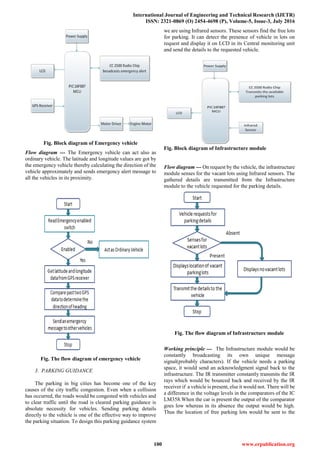
the parking situation. To design this parking guidance system
we are using Infrared sensors. These sensors find the free lots
for parking. It can detect the presence of vehicle in lots on
request and display it on LCD in its Central monitoring unit
and send the details to the requested vehicle.
Fig. Block diagram of Infrastructure module
Flow diagram --- On request by the vehicle, the infrastructure
module senses for the vacant lots using Infrared sensors. The
gathered details are transmitted from the Infrastructure
module to the vehicle requested for the parking details.
Fig. The flow diagram of Infrastructure module
Working principle --- The Infrastructure module would be
constantly broadcasting its own unique message
signal(probably characters). If the vehicle needs a parking
space, it would send an acknowledgment signal back to the
infrastructure. The IR transmitter constantly transmits the IR
rays which would be bounced back and received by the IR
receiver if a vehicle is present, else it would not. There will be
a difference in the voltage levels in the comparators of the IC
LM358.When the car is present the output of the comparator
goes low whereas in its absence the output would be high.
Thus the location of free parking lots would be sent to the
Vehicle Collision Avoidance with Integrated Parking Guidance System
101 www.erpublication.org
MCU in the infrastructure which in turn sends the same to the
vehicle which makes the requisition.
V. CONCLUSION
The paper considers three important features – forward
collision avoidance, emergency vehicle alert and parking
guidance. The paper is considered from the significant
conditions. The vehicle to vehicle communication is
implemented and is verified with the help of prototype. The
design is implemented for a short range and changing the
range can be implemented in real time applications. Message
is transmitted from the victim to the other vehicles present
within the range. This continuous transfer was established by
using the UART.
Under the emergency scenario the emergency
vehicles like ambulance, fire engine shall broadcast an alert
message to other vehicles within its proximity in real time.
The parking situation which is a major problem in big cities is
highly improved by sending the parking details directly to the
vehicles.
The features implemented in our project is an initiation
which could be implemented in real time cars with further
advancements. The advancements that could be made are as
follows,
 In Forward vehicle collision avoidance, speed sensors
and camera module can be added to enhance the
safety.
 In Infrastructure communication, traffic-light control
can also be included.
REFERENCES
[1] .“Vehicle Accident Detection and Messaging system Using GPS and
GSM”, Mr. Mangesh Neet, Mr. Sanjay Ambekar, Mrs. V.S. Jahagirdar,
Department of Electronics Design Technology from , National Institute
of Electronics and IT, Aurangabad.
[2].http://www.senouci.net/download/Publications/Book-
Chapters/Senouci_IC2- 2008_2.pdf.
[3].http://www.mikroe.com/chapters/view/2/chapter-1-pic16f887-
microcontroller-device-overview/
[4].Milan Verle , first edition (2009),"PIC Micro controllers -Programming
in C with examples", Mikro Electronica.
[5].“Road safety audit: An Identification Of Black spots on Busy Corridor
Between Narol- Naroda of Ahmedabad city”,Parikh Vaidehi Ashokbhai
i, Student, M.E. Civil (Transportation) – 4rth Sem L.D.College of
Engineering, Gujarat Technological University, Navrangpura,
Ahmedabad, Dr. A.M. Jain (Associate Professor, M.E. Civil
(Transportation) – 4rth Sem L.D.College of Engineering, Gujarat
Technological University, Navrangpura, Ahmedabad.
[6].“Automatic Speed Control and Accident Avoidance Of vehicle using
Multi Sensors”, S Nagakishore Bhavanam Dept. of ECE, ANUCET
Acharya Nagarjuna University Guntur,
India,kishore.ece.anu@gmail.com
[7].Elvik Rune, Second edition (2009),"The Handbook of road safety
measures, Emerald Group publishing Limited, UK.
S.Elakshumi, Department of Embedded System Technologies, Easwari
Engineering College

Ijetr042176

  • 1.
    International Journal ofEngineering and Technical Research (IJETR) ISSN: 2321-0869 (O) 2454-4698 (P), Volume-5, Issue-3, July 2016 96 www.erpublication.org  Abstract— In today’s scenario, our personal life is highly dependent on the technology. Technology has advanced with years and so many changes have been brought about by these continuous technological advancements. This approach of technology has also increased the traffic hazards and the road accidents are becoming very frequent and unavoidable which causes huge loss of life. This is happens due to the negligence of people who do not follow the traffic rules. Thereby in order to avoid accidents and to have an integrated parking system this paper mainly concentrates on vehicle collision avoidance through vehicular communication and parking guidance system to enable effective parking. The driver assistant features are implemented using vehicle to vehicle and vehicle to infrastructure communication. In this proposed paper a prototype has been developed which facilitates all the three features namely vehicle collision avoidance, emergency vehicle alert and parking guidance. A forward collision avoidance system in which the vehicles transmit details to other vehicles in case of hard braking of the front vehicle or presence of any obstacle through ultrasonic sensing. Emergency vehicles have a hard time making people aware of their presence. We include the emergency alert broadcast facility to emergency vehicles like ambulances, fire engines, etc., where the driver can respond and pave way for it. The parking in big cities has become one of the key causes of the city traffic congestion. Sending parking details directly to the vehicle is one of the effective way to improve the parking situation. To design this parking guidance system we are using Infrared sensors which can detect the presence and absence of vehicles. Index Terms— Global Positioning System (GPS), Motor Vehicle Collision(MC), Vehicle To Vehicle(VTV). I. INTRODUCTION Road safety is a complex issue and there are a high number of factors and indicators involved in the accidents. The problem itself is underestimated in many countries, especially in developing countries where the issue is challenging. Road traffic safety refers to methods and measures for reducing the risk of a person using the road network. The vehicle collision and its impact emerged as the major problem in the last two decades when the use of the automobile increased to a subsequent number A traffic collision, also known as a motor vehicle collision (MC), traffic accident, motor vehicle accident, car accident, automobile accident, road traffic collision, road traffic accident, wreck, car crash, or car smash occurs when a vehicle collides with another vehicle, pedestrian, animal, road debris, or other stationary obstruction, such as a tree or utility pole. Traffic collisions may result in injury, death, vehicle damage, or/and property damage. S.Elakshumi, Department of Embedded System Technologies, Easwari Engineering College. A number of factors contribute to the risk of collision, including vehicle design, speed of operation, road design, road environment, driver skill and/or impairment, and driver behaviour. Out of these driver’s unawareness leads to maximum number of accidents. Worldwide, motor vehicle collisions lead to death and disability as well as financial costs to both society and the individuals involved. Road injuries resulted in 1.4 million deaths in 2013 up from 1.1 million deaths in 1990. Almost all high-income countries have decreasing death rates, while the majority of low-income countries having increased deaths rates due to traffic collisions. Middle-income countries have the highest rate with 20 deaths per 80,000 inhabitants, 80% of all road fatalities by only 52% of all vehicles. In order to avoid such situations and provide the driver with assistance researches are undertaken by different companies and research centres. Different technologies like VANET , WSN, Electromagnetic Interface etc. Emerging wireless technologies for vehicle-to-vehicle (VTV) and vehicle to-roadside (VTR) communications such as DSRC are promising to dramatically reduce the number of fatal roadway accidents by providing early warnings. Fig. Statistics on number of road accident deaths II. LITERATURE SURVEY Internet can also be used monitor the traffic status. This concept was prop by Hu Lingling et al(2011).According to this concept, a vehicle is allotted with a unique identification number and it’s written electronically in the RFID tag. When the vehicle reaches the base station area, the RFID tag is read and Internet facility is provided. Using GPS, the traffic status is obtained through internet thereby the drivers can take Vehicle Collision Avoidance with Integrated Parking Guidance System S. Elakshumi
  • 2.
    Vehicle Collision Avoidancewith Integrated Parking Guidance System 97 www.erpublication.org ultimate free path to reach their destination easily. The drawbacks of this system are given by 1. Unwanted delay in reading the RFID tag 2. Internet users are increased nowadays lads to network traffic. Therefore deadline can’t be met some time in real-time application using Internet. Pravin P Ashtankar et al(2009) proposed a solution to prevent accidents. The central idea of the system is to enable vehicles within each other proximity to be aware of their own location and then estimate their position with respect to other vehicles. This is accomplished with the help of two main technologies called GPS and RADAR. The drawbacks of this system are given by 1. The non unique spectral properties of their retuned RADAR signal that may lead to the improper detection . 2. The targets which are nearer to the RADAR cannot be detected easily rather it saturated the receiver Navin kumar et al (2012) stated that traffic information can be broadcasted using visible light communication. According to their proposal the currently available traffic light controller made with light emitting diode can be used to broadcast the traffic data. This is line of sight communication. The vehicle which receives the information can relay it to the vehicle behind it using brake lights at the rear panel. This leads to adhoc v2v communication. LOS communication between the v2i and i2v are also possible to get information about present traffic condition. This system is proved to be effective if the communication range is less than 40m as LED’s and currently available TLC have been used, this system is cost effective. The drawbacks 1.the communication range must be within 40m and should be LOS. 2.Since normal LED’s cannot be focused for long distance, therefore high power led’s are needed which in turn increases the cost. Another major proposal was given by Mounib khanafer et al (2009). The wireless sensor network for intelligent transportation system(WITS) collects and communicates information to organize the traffic at intersections. This depends on fixed infrastructure composed of roadside units and intersections. This depends on fixed infrastructure composed of roadside units and intersection units. The communication is supported between vtv and vti. Vehicle units send vehicle parameters to roadside units. Roadside units work on aggregating the received data before transferring them to the intersection unit which relays them to the final strategy subsystem. Drawbacks 1. This system is over dependent on infrastructure nodes located on the roadside. 2. No solution is proposed to avoid the collision in the communication between the vehicles. Nazmus S Nafi and Jamil y khan(2012) suggested a solution to avoid the long waiting time at the junctions for the green signals. This scheme contains vehicles with onboard unit and will communicate with RSU. The RSU will get status info of the VLC and sends to OBU in range. Based on this information the driver can increase or decrease the speed to avoid wasting time. Drawbacks 1. Not suitable to reduce traffic congestion 2. status information must be updated frequently Shival Dubey & Abdul Wahid Ansari proposed a Electromagnetic anti-collision device to avoid Vehicular Head to Head/Back collision that estimates the distance between the two vehicles running extreme traffic condition. It incorporates distance finding between two vehicles using ultrasonic range finder. In will work in two stages: - A Range finder will continuously track the distance between two vehicles moving and sends it to the ECM using these inputs if it finds the vehicle in the vicinity of the other it will automatically actuate the sensor strip for Electromagnetic Induction. Drawbacks 1. It is not cost efficient 2. Includes more hardware Jie Liu et al. proposed a vehicle-to-vehicle communication protocol for cooperative collision warning. One major technical challenge addressed in this paper is to achieve low-latency in delivering emergency warnings in various road situations. Based on a careful analysis of application requirements, we design an effective protocol, comprising congestion control policies, service differentiation mechanisms and methods for emergency warning dissemination. Simulation results demonstrate that the proposed protocol achieves low latency in delivering emergency warnings and efficient bandwidth usage in stressful road scenarios. Dr. Andreas Festag et al. Vehicular communication based on short-range wireless technology opens up novel applications improving road safety and travel comfort. Ad hoc networking enables a direct communication among cars as well as between cars and road-side communication devices. Geocast is an ad hoc routing scheme which is specifically considered in Europe as a core networking concept for future CAR-2-X systems. It provides wireless multi-hop communication and allows for geographical addressing and routing. This paper describes advanced concepts and mechanisms to deploy Geocast in realistic environments and presents NEC’s CAR-2-X platform. III. COMPONENTS FOR SYSTEM DESIGN A. PIC MICROCONTROLLER 16F887 A microcontroller is a small computer on a single integrated circuit containing a processor core, memory, and programmable input/output peripherals used mainly for embedded applications. In our project, we use this powerful yet easy-to-program, CMOS FLASH-based 8-bit PIC microcontroller which packs Microchip's powerful PIC architecture into an 40 pin package. For its low price, wide applications and easy availability it is used in industries, machine control, etc. The important features it includes are,  RISC Architecture with 35 instructions, all of which are single cycle instructions except for branches which has two cycles.
  • 3.
    International Journal ofEngineering and Technical Research (IJETR) ISSN: 2321-0869 (O) 2454-4698 (P), Volume-5, Issue-3, July 2016 98 www.erpublication.org  Operating frequency of 0-20MHz.  Precision internal oscillator with frequency range of 8-31 KHz.  Power supply voltage of 2-5.5V.  8K ROM memory with FLASH. The chip could be reprogrammed upto 80,000 times.  368 bytes RAM Memory.  256 bytes EEPROM Memory. B. ULTRASONIC SENSOR MODULE -HC - SR04 Ultrasonic ranging module HC - SR04 provides 2cm - 400cm non-contact measurement function, the ranging accuracy can reach to 3mm. The modules includes ultrasonic transmitters, receiver and control circuit. working principle : 1. Using IO trigger for at least 8us high level signal 2. The Module automatically sends eight 40 kHz and detect whether there is a pulse signal back. 3. The Module automatically sends eight 40 kHz and detect whether there is a pulse signal back. Test distance = (high level time × velocity of sound (340m/s) / 2 Fig. Ultrasonic sensor principle C. INFRARED SENSOR MODULE-LM358 An infrared sensor measures the IR light that is transmitted in the environment to find object by the IR LED. This type of sensor is very popular in navigation for object avoidance or distance measured. On capturing a target in the left range, the left LED connected to the relevant IR LED will illuminate and vise versa. The ray reflected from target to IR receiver has a photo transistor. The LM358 series can be directly operated off of the standard +5V power supply voltage which is used in digital systems and will easily provide the required interface electronics without requiring the additional ±15V power supplies. Fig. IR sensor detection D. GPS MODULE The Global Positioning System (GPS) is a multi-- functional system, which has high-precision, all-weather, and global radio navigation and positioning, timing functions. It used satellite network formed by 24 satellite transmit positioning signal to Earth, constantly firing. A GPS receiver anywhere on the Earth, as long as three or more satellite signals received, after calculating, you can report the location, time and state of motion of a GPS receiver. Fig . GPS module E. CC 2500 RF MODEM –RADIO CHIP CC2500 RF Modem is a transceiver module which provides easy to use RF communication at 2.4 GHz. It can be used to transmit and receive data at multiple baud rates from any standard CMOS/TTL source. This module is a direct line in replacement for the serial communication and it requires no extra hardware and no extra coding to turn the wired communication into wireless one. It works in Half Duplex mode i.e. it provides communication in both directions, but only one direction at same time (not simultaneously). This switching from receiver to transmitter mode is done automatically. F. LIQUID CRYSTAL DISPLAY(LCD) A liquid crystal display (LCD) is a thin, flat electronic visual display that uses the light modulating properties of liquid
  • 4.
    Vehicle Collision Avoidancewith Integrated Parking Guidance System 99 www.erpublication.org crystals (LCs). LCs does not emit light directly. They are used in a wide range of applications, including computer monitors, television, instrument panels, aircraft cockpit displays, etc. LCDs have displaced cathode ray tube displays in most applications. They are usually more compact, lightweight, portable, less expensive, more reliable. IV. PROPOSED SYSTEM 1. CIVILIAN VEHICLE--FORWARD COLLISION AVOIDANCE Forward collision avoidance feature is performed using Ultrasonic sensors. The sensor allow us to look further away in space and further ahead in time. The collision avoidance system is an automobile safety system designed to reduce the severity of an accident. Forward collision avoidance system aims at avoiding or atleast mitigating host vehicle frontal collision.The system gives an alert to encourage the driver to decelerate in advance with signal on display. Fig. Vehicle collision avoidance scenario When the vehicle suddenly brakes and when the distance between the vehicle and the one behind is lower , the vehicle behind is alerted and further it transmits the alert message to all the vehicles thereby avoiding collision occurance. Fig. Block Diagram of Civilian vehicle Working principle --- Ultrasonic sensors work on a principle similar to radar or sonar which evaluates attributes of target by interpreting the echoes from radio or sound waves respectively. Ultrasonic sensors generate high frequency sound wavesand evaluates the echo which is received back by the sensor. Sensors calculate the time interval between sending the signal and receiving the echo to determine the distance to an object. This technology is used for measuring distance. This sensor works on Doppler Effect.It consists of a ultrasonic transmitter and a receiver. The transmitter transmits the signal in one direction. This transmitted signal is reflected back by the obstacle and received by the receiver. So the total time taken by the signal to get transmitted and to received back will be used to calculate the distance between the ultrasonic sensor and the obstacle. Flow diagram --- The ultrasonic sensor installed in front of the vehicle monitors the relative distance of the vehicle directly ahead/obstacle. If the distance is greater than the threshold value, the sensor indicates high threat of collision and threatens the driver. The vehicle transmits alert messages to other vehicles. Fig. The flow diagram of civilian vehicle 2. EMERGENCY VEHICLE ALERT Today, most cars are much more soundproof than ever before; most have air-conditioning so windows are usually closed; and many have high power stereos playing the radio or CD’s at levels that cancel all sounds coming from outside the car. Some drivers are hearing impaired. These factors combine to make it difficult to build lights, sirens and horns that will alert the drivers inside their cars. Emergency vehicles have a hard time making people aware of their presence. In our project emergency alert message is sent to all other vehicles and thus providing the free passage for the fast moving emergency vehicle.
  • 5.
    International Journal ofEngineering and Technical Research (IJETR) ISSN: 2321-0869 (O) 2454-4698 (P), Volume-5, Issue-3, July 2016 100 www.erpublication.org Fig. Block diagram of Emergency vehicle Flow diagram --- The Emergency vehicle can act also as ordinary vehicle. The latitude and longitude values are got by the emergency vehicle thereby calculating the direction of the vehicle approximately and sends emergency alert message to all the vehicles in its proximity. Fig. The flow diagram of emergency vehicle 3. PARKING GUIDANCE The parking in big cities has become one of the key causes of the city traffic congestion. Even when a collision has occurred, the roads would be congested with vehicles and to clear traffic until the road is cleared parking guidance is absolute necessity for vehicles. Sending parking details directly to the vehicle is one of the effective way to improve the parking situation. To design this parking guidance system we are using Infrared sensors. These sensors find the free lots for parking. It can detect the presence of vehicle in lots on request and display it on LCD in its Central monitoring unit and send the details to the requested vehicle. Fig. Block diagram of Infrastructure module Flow diagram --- On request by the vehicle, the infrastructure module senses for the vacant lots using Infrared sensors. The gathered details are transmitted from the Infrastructure module to the vehicle requested for the parking details. Fig. The flow diagram of Infrastructure module Working principle --- The Infrastructure module would be constantly broadcasting its own unique message signal(probably characters). If the vehicle needs a parking space, it would send an acknowledgment signal back to the infrastructure. The IR transmitter constantly transmits the IR rays which would be bounced back and received by the IR receiver if a vehicle is present, else it would not. There will be a difference in the voltage levels in the comparators of the IC LM358.When the car is present the output of the comparator goes low whereas in its absence the output would be high. Thus the location of free parking lots would be sent to the
  • 6.
    Vehicle Collision Avoidancewith Integrated Parking Guidance System 101 www.erpublication.org MCU in the infrastructure which in turn sends the same to the vehicle which makes the requisition. V. CONCLUSION The paper considers three important features – forward collision avoidance, emergency vehicle alert and parking guidance. The paper is considered from the significant conditions. The vehicle to vehicle communication is implemented and is verified with the help of prototype. The design is implemented for a short range and changing the range can be implemented in real time applications. Message is transmitted from the victim to the other vehicles present within the range. This continuous transfer was established by using the UART. Under the emergency scenario the emergency vehicles like ambulance, fire engine shall broadcast an alert message to other vehicles within its proximity in real time. The parking situation which is a major problem in big cities is highly improved by sending the parking details directly to the vehicles. The features implemented in our project is an initiation which could be implemented in real time cars with further advancements. The advancements that could be made are as follows,  In Forward vehicle collision avoidance, speed sensors and camera module can be added to enhance the safety.  In Infrastructure communication, traffic-light control can also be included. REFERENCES [1] .“Vehicle Accident Detection and Messaging system Using GPS and GSM”, Mr. Mangesh Neet, Mr. Sanjay Ambekar, Mrs. V.S. Jahagirdar, Department of Electronics Design Technology from , National Institute of Electronics and IT, Aurangabad. [2].http://www.senouci.net/download/Publications/Book- Chapters/Senouci_IC2- 2008_2.pdf. [3].http://www.mikroe.com/chapters/view/2/chapter-1-pic16f887- microcontroller-device-overview/ [4].Milan Verle , first edition (2009),"PIC Micro controllers -Programming in C with examples", Mikro Electronica. [5].“Road safety audit: An Identification Of Black spots on Busy Corridor Between Narol- Naroda of Ahmedabad city”,Parikh Vaidehi Ashokbhai i, Student, M.E. Civil (Transportation) – 4rth Sem L.D.College of Engineering, Gujarat Technological University, Navrangpura, Ahmedabad, Dr. A.M. Jain (Associate Professor, M.E. Civil (Transportation) – 4rth Sem L.D.College of Engineering, Gujarat Technological University, Navrangpura, Ahmedabad. [6].“Automatic Speed Control and Accident Avoidance Of vehicle using Multi Sensors”, S Nagakishore Bhavanam Dept. of ECE, ANUCET Acharya Nagarjuna University Guntur, India,kishore.ece.anu@gmail.com [7].Elvik Rune, Second edition (2009),"The Handbook of road safety measures, Emerald Group publishing Limited, UK. S.Elakshumi, Department of Embedded System Technologies, Easwari Engineering College