


Car to Car
Communication
Presentation By: Muhammad Usman
iamdexterous.blogspot.com
A simple wireless technology
promises to make driving
much safer.
Availability: 1-2 years
Presentation By: Muhammad Usman
iamdexterous.blogspot.com
• Breakthrough
• Cars that can talk to each other to avoid crashes.
• Why It Matters
• More than a million people are killed on roads worldwide
every year.
• Key Players
• General Motors
• University of Michigan
• National Highway Traffic Safety Administration
The technology that warned of the impending
collision will start appearing in cars in just a
couple of years. Called car-to-car or vehicle-to-
vehicle communication, it lets cars broadcast
their position, speed, steering-wheel position,
brake status, and other data to other vehicles
within a few hundred meters
Presentation By: Muhammad Usman
Iamdexterous.blogspot.com
The other cars can use such information
for following purposes
* to build a detailed picture of what’s unfolding around
them.
* revealing trouble that even the most careful and alert
driver, or the best sensor system, would miss or fail to
anticipate.
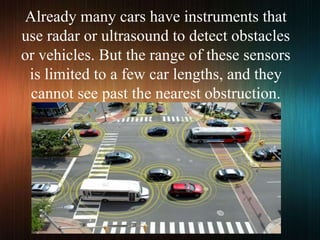
Already many cars have instruments that
use radar or ultrasound to detect obstacles
or vehicles. But the range of these sensors
is limited to a few car lengths, and they
cannot see past the nearest obstruction.
Car-to-car communication should also have a
bigger impact than the advanced vehicle
automation technologies that have been more
widely heralded. Though self-driving cars
could eventually improve safety, they remain
imperfect and unproven, with sensors and
software too easily bamboozled by poor
weather, unexpected obstacles or
circumstances, or complex city driving. Simply
networking cars together wirelessly is likely to
have a far bigger and more immediate effect
on road safety.
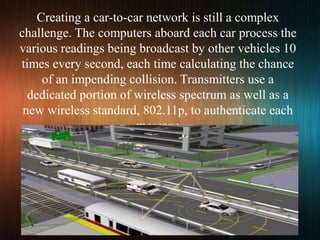
Creating a car-to-car network is still a complex
challenge. The computers aboard each car process the
various readings being broadcast by other vehicles 10
times every second, each time calculating the chance
of an impending collision. Transmitters use a
dedicated portion of wireless spectrum as well as a
new wireless standard, 802.11p, to authenticate each
message
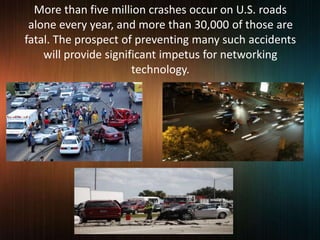
More than five million crashes occur on U.S. roads
alone every year, and more than 30,000 of those are
fatal. The prospect of preventing many such accidents
will provide significant impetus for networking
technology.
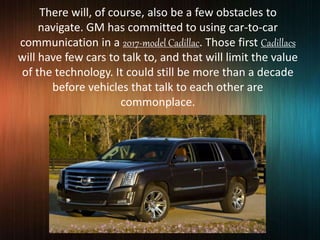
There will, of course, also be a few obstacles to
navigate. GM has committed to using car-to-car
communication in a 2017-model Cadillac. Those first Cadillacs
will have few cars to talk to, and that will limit the value
of the technology. It could still be more than a decade
before vehicles that talk to each other are
commonplace.
Thanks For Your Precious Time
Presentation By: Muhammad Usman
Reg # 30039
Iamdexterous.blogspot.com

Car to car communication

  • 1.
    Car to Car Communication PresentationBy: Muhammad Usman iamdexterous.blogspot.com
  • 2.
    A simple wirelesstechnology promises to make driving much safer. Availability: 1-2 years
  • 3.
    Presentation By: MuhammadUsman iamdexterous.blogspot.com • Breakthrough • Cars that can talk to each other to avoid crashes. • Why It Matters • More than a million people are killed on roads worldwide every year. • Key Players • General Motors • University of Michigan • National Highway Traffic Safety Administration
  • 4.
    The technology thatwarned of the impending collision will start appearing in cars in just a couple of years. Called car-to-car or vehicle-to- vehicle communication, it lets cars broadcast their position, speed, steering-wheel position, brake status, and other data to other vehicles within a few hundred meters Presentation By: Muhammad Usman Iamdexterous.blogspot.com
  • 5.
    The other carscan use such information for following purposes * to build a detailed picture of what’s unfolding around them. * revealing trouble that even the most careful and alert driver, or the best sensor system, would miss or fail to anticipate.
  • 6.
    Already many carshave instruments that use radar or ultrasound to detect obstacles or vehicles. But the range of these sensors is limited to a few car lengths, and they cannot see past the nearest obstruction.
  • 8.
    Car-to-car communication shouldalso have a bigger impact than the advanced vehicle automation technologies that have been more widely heralded. Though self-driving cars could eventually improve safety, they remain imperfect and unproven, with sensors and software too easily bamboozled by poor weather, unexpected obstacles or circumstances, or complex city driving. Simply networking cars together wirelessly is likely to have a far bigger and more immediate effect on road safety.
  • 9.
    Creating a car-to-carnetwork is still a complex challenge. The computers aboard each car process the various readings being broadcast by other vehicles 10 times every second, each time calculating the chance of an impending collision. Transmitters use a dedicated portion of wireless spectrum as well as a new wireless standard, 802.11p, to authenticate each message
  • 10.
    More than fivemillion crashes occur on U.S. roads alone every year, and more than 30,000 of those are fatal. The prospect of preventing many such accidents will provide significant impetus for networking technology.
  • 11.
    There will, ofcourse, also be a few obstacles to navigate. GM has committed to using car-to-car communication in a 2017-model Cadillac. Those first Cadillacs will have few cars to talk to, and that will limit the value of the technology. It could still be more than a decade before vehicles that talk to each other are commonplace.
  • 12.
    Thanks For YourPrecious Time Presentation By: Muhammad Usman Reg # 30039 Iamdexterous.blogspot.com