November 2018
www.insightssuccess.com
Hire Counsel:
Investing in Legal Human Capital to Create Value and
Opportunities in the Legal Stafng Industry
Disruptor of 2018
E-Disc very
The
Most Innovative
1010
In Brief
How can IoT Decelerate
the Climate Change?
Joan Davison
CEO & President
Recharging Environment
Wireless Charging: Future
of Green Automotive
Discovering
Seamless
Possibilities
he notion of discovering something is fascinating in itself. It means finding and unlocking the
Thidden door of opportunities. In the world of business, discovery is a more captivating term
flooded with seamless possibilities. Any vital discovery or invention aiming to simplify the
business processes allows companies to accelerate their expansion plans. Most of the times it creates better
job opportunities and enable youth to excel their wings. Marking it in other words, the discovery or
inventions guide them towards a new path and empower to discover their capabilities.
Every enterprise around the world contributing in various sectors has witnessed the flourishing benefits of
smallest of inventions. However, the discoveries in sectors like technology are capable of revolutionizing
numerous sectors. Another sector filled with immense potential is e-discovery. The industry and its
solutions and services have brought forward evolution in the legal processes and other law documentation
management.
Electronic discovery is a procedure by which parties involved in a legal case preserve, collect, review, and
exchange information in electronic formats for the purpose of using it as evidence. Today's law
departments need to adopt a proactive approach to e-discovery. Having strong e-discovery strategies
doesn’t just enable litigators to fulfill information requests – it also provides them with a window into
information that can be extremely useful to the outcome of a case.
Robust e-discovery isn't just about achieving baseline standards like data preservation. Increasingly, strong
e-discovery is becoming necessary for litigators who want to maintain a competitive edge on the global
stage. There’s an international push for better e-discovery standards, with nations from Canada to
Singapore and Japan to Italy implementing e-discovery guidelines. This global focus on refining e-
discovery is heightening the standard for attorney handling of ESI.
In addition to solidifying compliance and a competitive edge, comprehensive e-discovery can
provide litigators with an abundance of actionable case data that might not otherwise be uncovered.
Information from social media posts, emails, Excel spreadsheets and other digital sources can help
attorneys build a better case – but only if it's effectively reviewed and refined. And with the mounting
use of data-generating Internet of Things technology, attorneys will only have a greater need to
retain, analyze and use digital information moving forward.
By recognizing the importance of e-discovery and adopting solutions that help streamline the
process, attorneys can be ahead of the pack as digital information moves to the center stage of the
discovery process.
Considering these vital factors Insights Success has curated the list of “The 10 Most Innovative E-
Discovery Disruptors of 2018” which have revolutionized legal ecosystem with their unique,
scalable and cost-efficient offerings.
Featuring as our Cover Story we have Hire Counsel. Its Document Review Centers meet the highest
standards of security, quality, and efficiency. They provide comfortable work environments that are
conducive to collaboration and concentration.
The magazine also admires the contribution of other industry leaders including Anexsys, an

independent legal support and technology service provider, specialising in e-Discovery, Digital
Forensics, Legal Reprographics, and scanning services; Esquify, a cutting-edge legal technology
start-up that is augmenting the current in-person litigation document review process with a virtual
solution using its own patented and machine learning technology; TCDI is providing value to its
clients through proprietary eDiscovery and Litigation Management software solution and UnitedLex,
the leading enterprise legal services provider that drives digital transformation throughout the
corporate legal ecosystem.
Also don’t forget to flip through articles written by the industry leaders and our in-house editorial
team.
Shall we begin?
Bhavithiran Murugan
Wireless Charging: Future
of Green Automotive
Recharging Environment
Articles
How can IoT Decelerate the
Climate Change?
In Brief:
18
42
Be smart – or vanish:Why Utilities need to
actively develop smart Micro-Grids
Smart in Vision
Beyond Automation: AI powered
Autonomous Factories of the Future
Expert's Forsight
Blockchain: the next opportunity for
better, safer, smarter Cities
Tech Outlook
Hire CounselInvesting in Legal Human Capital to
Create Value and Opportunities in
the Legal Staffing Industry
10
Cover Story
30
36
24
Specializing in
eDiscovery Solutions
Indexed I/O:
Pioneering Data
Management and Protection
Solutions for the Cloud
UnitedLex:
Preserving Relationships and
Building Innovative Technology
TCDI:
Deep Technical Expertise
in a Changing Legal
Services Environment
Anexsys:
A Groundbreaking
AI platform for Law
Esquify:
Contents
22
28
34
40
46
sales@insightssuccess.com
Corporate Ofces:
October, 2018
Database Management Stella Andrew
Technology Consultant David Stokes
Circulation Managers Robert, Tanaji
Research Analyst Patrick James
Steve, Joe, Alan, Vishal
Anish MillerManaging Editor
Art & Design Director Amol Kamble
Associate Designer Sanket Zirpe
Visualiser David King
Senior Sales Manager Passi D.
Business Development Executives
Marketing Manager John Matthew
Jenny FernandesAssistant Editors
Bhushan Kadam
Art & Picture Editors BelinPaul
Co-designer Poonam Mahajan
KhannaJayant
Peter CollinsBusiness Development Manager
Sales Executives
David, Kevin, Mark, Manish
SME-SMO Executives
Prashant Chevale, Uma Dhenge, Gemson, Avdhut
Online Marketing Strategists
Alina Sege, Shubham, Anup
Digital Marketing Manager Marry D’Souza
Technical Specialists Amar, Pratiksha
Technical Head Jacob Smile
Copyright © 2018 Insights Success, All rights reserved. The content and images used in this magazine should not be reproduced or transmitted in
any form or by any means, electronic, mechanical, photocopying, recording or otherwise, without prior permission from Insights Success.
Reprint rights remain solely with Insights Success.
Follow us on : www.facebook.com/insightssuccess/ www.twitter.com/insightssuccess
We are also available on :
Insights Success Media Tech LLC
555 Metro Place North, Suite 100,
Dublin, OH 43017, United States
Phone - (614)-602-1754
Email: info@insightssuccess.com
For Subscription: www.insightssuccess.com
Insights Success Media and Technology Pvt. Ltd.
Off. No. 513 & 510, 5th Flr., Rainbow Plaza, Shivar Chowk,
Pimple Saudagar, Pune, Maharashtra 411017
Phone - India: +91 7410079881/ 82/ 83/ 84/ 85
Email: info@insightssuccess.in
For Subscription: www.insightssuccess.in
Executive Editor Bhavithiran Murugan
Contributing Editors
Kedar Kulkarni
Ishan Mittal
Editor-in-Chief Pooja M. Bansal
Technology, like change,
should be leveraged as a source
of opportunity, innovation, and
collaboration. In legal work,
the results are far more superior
when technology and the
human element intersect
and are leveraged.
CounselHireInvesting in Legal Human Capital to Create Value
and Opportunities in the Legal Staffing Industry
Cover Story
Joan Davison
CEO & President
The industry changes so incredibly fast that every present
moment feels like the future. We always look forward, but
more importantly, we are always moving forward, being
creative, and taking strategic risks in order to create
opportunities for our clients and workforce.
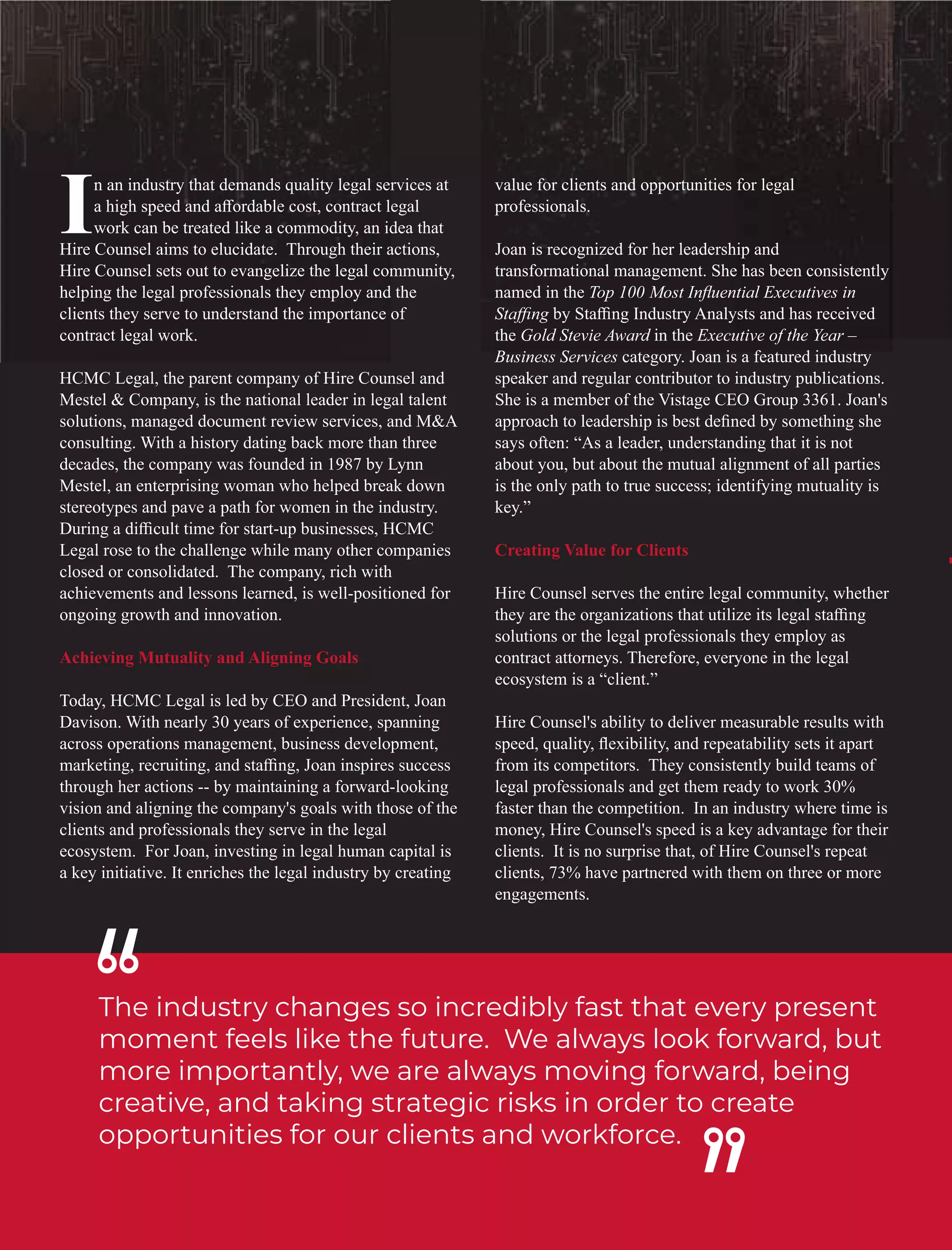
n an industry that demands quality legal services at
Ia high speed and affordable cost, contract legal
work can be treated like a commodity, an idea that
Hire Counsel aims to elucidate. Through their actions,
Hire Counsel sets out to evangelize the legal community,
helping the legal professionals they employ and the
clients they serve to understand the importance of
contract legal work.
HCMC Legal, the parent company of Hire Counsel and
Mestel & Company, is the national leader in legal talent
solutions, managed document review services, and M&A
consulting. With a history dating back more than three
decades, the company was founded in 1987 by Lynn
Mestel, an enterprising woman who helped break down
stereotypes and pave a path for women in the industry.
During a difficult time for start-up businesses, HCMC
Legal rose to the challenge while many other companies
closed or consolidated. The company, rich with
achievements and lessons learned, is well-positioned for
ongoing growth and innovation.
Achieving Mutuality and Aligning Goals
Today, HCMC Legal is led by CEO and President, Joan
Davison. With nearly 30 years of experience, spanning
across operations management, business development,
marketing, recruiting, and staffing, Joan inspires success
through her actions -- by maintaining a forward-looking
vision and aligning the company's goals with those of the
clients and professionals they serve in the legal
ecosystem. For Joan, investing in legal human capital is
a key initiative. It enriches the legal industry by creating
value for clients and opportunities for legal
professionals.
Joan is recognized for her leadership and
transformational management. She has been consistently
named in the Top 100 Most Influential Executives in
Staffing by Staffing Industry Analysts and has received
the Gold Stevie Award in the Executive of the Year –
Business Services category. Joan is a featured industry
speaker and regular contributor to industry publications.
She is a member of the Vistage CEO Group 3361. Joan's
approach to leadership is best defined by something she
says often: “As a leader, understanding that it is not
about you, but about the mutual alignment of all parties
is the only path to true success; identifying mutuality is
key.”
Creating Value for Clients
Hire Counsel serves the entire legal community, whether
they are the organizations that utilize its legal staffing
solutions or the legal professionals they employ as
contract attorneys. Therefore, everyone in the legal
ecosystem is a “client.”
Hire Counsel's ability to deliver measurable results with
speed, quality, flexibility, and repeatability sets it apart
from its competitors. They consistently build teams of
legal professionals and get them ready to work 30%
faster than the competition. In an industry where time is
money, Hire Counsel's speed is a key advantage for their
clients. It is no surprise that, of Hire Counsel's repeat
clients, 73% have partnered with them on three or more
engagements.
By diversifying our
partnerships, markets, and
resources, we can provide
creative and flexible solutions,
which is a significant
advantage because it allows
us to help our clients face any
and every challenge head-on.
Cover Story
Hire Counsel's proprietary candidate database of highly
vetted legal professionals has been developed over the
past 30+ years and continues to grow. Of these
contractors, about 2,800 are enrolled in their ESOP and
thousands choose to work with them on multiple
projects. In a tight staffing market, Hire Counsel
successfully attracts and retains high quality legal talent.
As legal talent is no longer centralized in major
metropolitan cities, Hire Counsel's deep national
footprint allows them to source exceptional legal talent
and create job opportunities in any location. With
dedicated document review centers strategically located
across the US, their Project Management and Workforce
Management teams provide clients with uninterrupted
“sunrise-to-sunset” service. Furthermore, they have the
ability to launch pop-up facilities anywhere.
By intentionally remaining technology and vendor
agnostic, Hire Counsel can work seamlessly with all
platforms. Through strategic partnerships that they have
developed with various eDiscovery vendors and channel
partners over time, Hire Counsel is able to deliver results
that drive clients' objectives and provide utmost
flexibility to their clients. “Hire Counsel does not
prescribe one-size-fits-all solutions,” Joan asserts.
Responding to Challenges Swiftly and Strategically
The challenges that exist in today's legal industry are
reflective of all industries. For every business, there is
the persistent need to improve processes, skills, and cost
structures in order to deliver a superior solution.
Furthermore, the impact of consolidation and technology
will likely continue. These challenges are further
compounded by the uber-competitiveness of the industry
and the incredible speed at which it changes.
Hire Counsel responds swiftly and strategically to
change by prioritizing the need for more customized
client engagement and mobilizing its operational
structure. In addition, Hire Counsel measures all aspects
of the business model for the client, including production
rates, on-time delivery rates, attendance statistics, and
many more. By quantifying human capital data, Hire
Counsel helps their clients drive results, instead of
waiting for them. This gives Hire Counsel's clients the
advantage of added speed and quality in the human
capital space.
Leveraging the Strengths of Human Capital and
Technology
Technology has enhanced the document review process
by allowing larger volumes of data to be analyzed and
certain laborious tasks to be eliminated. However,
technology is a tool that must be harnessed, especially
when it is leveraged in legal work. The human is more
reliable than technology in its ability to exercise ethics,
make judgment calls, and apply complex logic to make
important decisions. Therefore, the increased use of
technology has propelled the role of human capital in
legal services.
Given the high importance of the human element in
document review, the role of the contract legal
professional is not only elevated, but critical. It can no
longer be considered a temporary job or career stepping
stone. Rather, it is an invaluable part of the legal
profession. Contract legal work is also an excellent way
for legal professionals to utilize their skills, make an
impact, and step onto a career path that can lead to more
opportunities. By leveraging the strengths of both
artificial intelligence and human capital, HCMC Legal is
able to further drive ROI for their clients and create
opportunities for their contract workforce.
Redefining the Culture of Contract Legal Work
Hire Counsel is actively redefining the culture of
contract legal work by focusing on continuing education,
ownership, and engagement. Today, HCMC Legal
remains the only 100% employee owned company in the
legal staffing industry, offering ownership opportunities
to all core and contract staff. The company is among few
in the industry that sponsors ongoing education for
contract employees. They provide tuition support for
ACEDS courses, onsite eDiscovery bootcamp training
sessions and CEDS certification for all Project
Managers.
Creating a positive work environment helps their
contract legal professionals achieve long-term success
and satisfaction, which is then reflected in their
commitment to working with Hire Counsel and
delivering a quality work product for their clients. The
concept of mutuality, one that is recurring in Hire
Counsel's approach to business, has helped them remain
the industry leader.
Forecasting the Future
The company's success is widely recognized by the legal
and staffing industry today. In 2018 alone, they received
the award for Best Legal Staffing Provider – USA (CV
Magazine) and were named among the Best of Legal
Recruiters (Corporate Counsel), Best Professional
Recruiting Firms (Forbes), and Best Executive
Recruiting Firms (Forbes). The company is consistently
ranked among the Largest Legal Staffing Firms in the
US (2017 and 2018) by Staffing Industry Analysts.
Hire Counsel sees its future self as the unequivocal
leader in legal talent solutions and managed document
review services, and they are well on their way. Hire
Counsel is well-recognized in the legal industry for its
ability to customize legal solutions, provide creative
pricing models, and accommodate projects of varying
sizes, scopes, and locations. As a pioneer in the
industry, they plan to continue exploring unchartered
markets with underutilized legal talent and rich
resources for legal services.
We have a clear
vision to deliver effective,
flexible, and creative solutions,
based on the concept of
mutuality, to benefit all
of our stakeholders
– clients, contractors, and
employees alike.
Cover Story
Address :
Country :City : State : Zip :
Global Subscription
Date :Name :
Telephone :
Email :
READ
IT
FIRST
Never Miss an Issue
Yes, I would like to subscribe to Insights Success Magazine.
SUBSCRIBE
T O D A Y
Check should be drawn in favor of: INSIGHTS SUCCESS MEDIA TECH LLC
Insights Success Media Tech LLC
555 Metro Place North, Suite 100,
Dublin, OH 43017, United States
Phone: (614)-602-1754,(302)-319-9947
Email: info@insightssuccess.com
For Subscription: www.insightssuccess.com
CORPORATE OFFICE
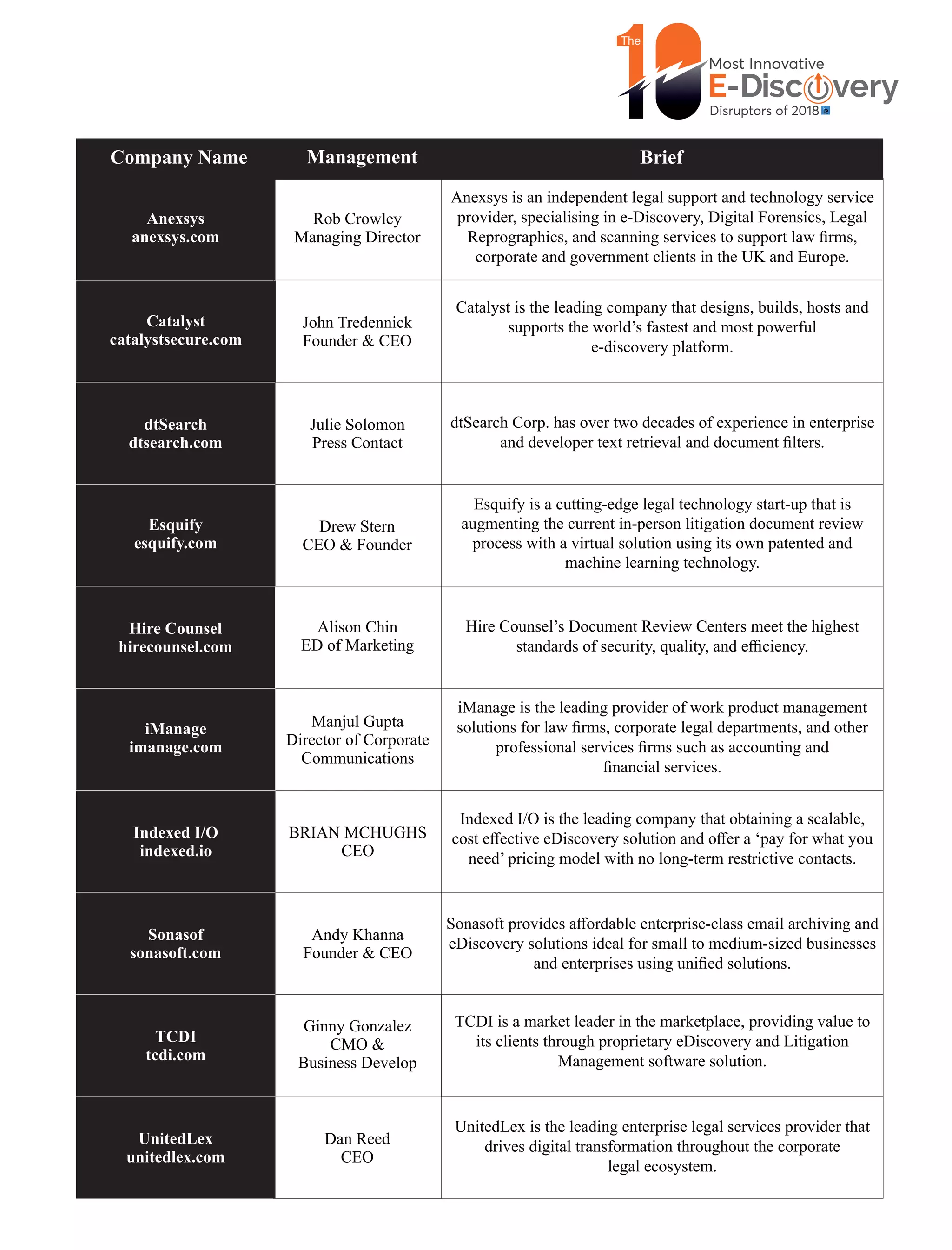
Management BriefCompany Name
Anexsys
anexsys.com
Rob Crowley
Managing Director
Anexsys is an independent legal support and technology service
provider, specialising in e-Discovery, Digital Forensics, Legal
Reprographics, and scanning services to support law firms,
corporate and government clients in the UK and Europe.
Catalyst
catalystsecure.com
John Tredennick
Founder & CEO
Catalyst is the leading company that designs, builds, hosts and
supports the world’s fastest and most powerful
e-discovery platform.
dtSearch
dtsearch.com
Julie Solomon
Press Contact
dtSearch Corp. has over two decades of experience in enterprise
and developer text retrieval and document filters.
Esquify
esquify.com
Esquify is a cutting-edge legal technology start-up that is
augmenting the current in-person litigation document review
process with a virtual solution using its own patented and
machine learning technology.
iManage is the leading provider of work product management
solutions for law firms, corporate legal departments, and other
professional services firms such as accounting and
financial services.
Indexed I/O is the leading company that obtaining a scalable,
cost effective eDiscovery solution and offer a ‘pay for what you
need’ pricing model with no long-term restrictive contacts.
Sonasoft provides affordable enterprise-class email archiving and
eDiscovery solutions ideal for small to medium-sized businesses
and enterprises using unified solutions.
TCDI is a market leader in the marketplace, providing value to
its clients through proprietary eDiscovery and Litigation
Management software solution.
UnitedLex is the leading enterprise legal services provider that
drives digital transformation throughout the corporate
legal ecosystem.
Hire Counsel
hirecounsel.com
Alison Chin
ED of Marketing
Hire Counsel’s Document Review Centers meet the highest
standards of security, quality, and efficiency.
iManage
imanage.com
Manjul Gupta
Director of Corporate
Communications
Indexed I/O
indexed.io
BRIAN MCHUGHS
CEO
Sonasof
sonasoft.com
Andy Khanna
Founder & CEO
TCDI
tcdi.com
Ginny Gonzalez
CMO &
Business Develop
UnitedLex
unitedlex.com
Dan Reed
CEO
Drew Stern
CEO & Founder
Be Smart – or Vanish
Why Utilities need to actively
develop smart Micro-Grids
The energy market is changing
rapidly. This is true not only
for the USA and Europe but
on a global level. Possibly the most
important change is the one towards
more decentralized systems. This is
challenging the utility industry.
Utilities historically have developed
by integrating small microgrids
which grew around mills and other
small-scale generators (today we
would say prosumers). This is why
utilities developed along the entire
value chain: They integrated these
micro distribution grids in a more
stable larger (Transport) grid and
replaced decentralized generation by
more cost-efficient central power
plants. This highly efficient
centralized system was allowing
industrial development as we know
it. At its time it was possibly the only
way to serve large, strongly energy
depending production like steel,
paper or the upcoming chemical
industry. The centralized energy
system did not result from an
oligopolistic market, but the industry
structure derived from an efficient
technical design.
There are several reasons why this
formerly beneficiary system is
challenged today. Not all apply in all
markets but some of them do, so
decentralization of energy markets is
a global trend. Specifically, in most
industrial markets the new energy
regime is driven by politics favoring
small scale, decentral renewable
generation. Subsidies on renewables
devalue existing large thermic power
plants. Even large-scale hydropower
plants do not easily pass strict
environmental and social feasibility
analysis. But independent of any
political setting there is another more
fundamental reason for the growing
competitiveness of a decentralized
energy design. While the first phase
of industrial development is known
for its industrial clusters (often
grown close to energy sources like
coal or water) which shaped many
geographic areas for more than a
century, later phases are much more
dynamic and do less depend on
geographic proximity. Within a
dynamic industry setting where
businesses are set up and closed or
moved somewhere else on a regular
basis a static centralized
infrastructure loses competitiveness.
In many emerging markets this
dynamism as well expands towards
those areas which are today not
connected to the central grid but offer
inexpensive land or new agricultural
products which can be sold abroad at
high prices. Finally, the political will
and the industrial demand for
decentralized systems today
encounter renewable generation even
at small size at competitive costs
compared to large size thermic power
plant. For the most prominent
renewable technology photovoltaic in
the North (with less radiation) this
competitiveness is given only as grid
parity, meaning central generation
plus transport is as expensive as
photovoltaic on site. In the Southern
hemisphere photovoltaic is already a
competitive source empowering
decentralized energy infrastructure.
While decentralized generation has
caught up with centralized generation
plants, distribution systems with a
large portion of decentralized
renewable generation capacity are
often inefficient. There are basically
four reasons for this inefficiency: (1)
Missing price mechanism supporting
grid operations, (2) high costs to
operate such a system stable, (3)
large amount of excess energy
(exported or not being used at all)
and (4) sub-utilized interface
between microgrid and its feeder
system. These are basically the same
reasons that in the last century
supported the centralization of the
grid system. What is needed is an
intelligent or smart decentralized
distribution system.
An intelligent distribution system
with mainly decentralized generation
requires more than smart meters and
it is different from today popular so
November 201818
Dr. Karl Kolmsee the CEO of Smart Hydro Power, studied agricultural and
philosophy at the universities of Hamburg and Goettingen, Germany. After his PhD he has
spent most of his professional career in the energy business – first as consultant at A.T.
Kearney later as manager at E.ON, Europe’s largest private utility, and member of the board
at Schmack biogas, one of the pioneers of the biogas market in Europe. In 2009 Karl
Kolmsee has been nominated professor for energy management at Applied University of
Kufstein, Austria. His main areas of academic work are international energy markets and
renewable energy. In 2010 he founded Smart Hydro Power to focus on design and
commercialization of kinetic pico hydro power systems with main focus on rural
electrification for emerging markets like India, Latin America and Eastern Africa. Today Smart
Hydro Power offers complete solutions for off grid solutions and micro grids.
About the Author
November 2018 19
called smart home or home storage solutions. These offer
photovoltaic, battery and basic load management for the
individual household. Some providers of home storage
solutions integrate customers in a community model to
allow exchange of autogenerated electricity. But these
communities are barely more than contract partners
within a fixed price net metering model. Individual home
solutions – even within sales-and-purchase communities
– do not solve any inefficiency issues decentralization
faces. These systems are either completely self-sufficient
– in this case they are expensive – or they rely on central
grid services like a parasite of its host. Sustainable
decentralization requires an intelligent control and
steering mechanism between the households which build
a microgrid.
While there are possibly different steering mechanisms,
establishing a local market with the price as variable that
guides demand and supply according to the aggregated
demand function and the aggregated cost functions
seems promising. Technically this does require a
dynamic forecasting and load management (at least for
major loads which are used in a price-sensitive manner).
At first glance a market model would solve the four
major issues shown above. It would set a price for
photovoltaic and battery storage which would control
demand and thereby reduce necessary installed reserve
storage and generation capacity. This mechanism would
as well be consistent with the functioning of the feeder
grid and could therefore supply itself services to this grid
which would be valued with the same “currency”.
Technically this steering mechanism might be
completely decentralized based on individual processors
in each household like the blockchain technology (once
necessary processing capacity comes down to acceptable
limits) or it might work between a central unit and
individual processors. In either way it steers the local
market place towards an efficient optimum given
generation, demand and battery storage capacity at a
defined point in time.
Micro grids do open (within a given legal framework) a
possibility for traditional utilities to re-define their role
using some of their traditional strengths. But new
entrants can equally well enter this space and perform
wherever the incumbent does not adapt. This gives room
to numerous co-operations between new entrants or
between new companies and the incumbent offering their
services or developing new business models along the
value chain. Incumbent utilities may be smart – or
vanish.
November 201820
Technical innovation in the legal
services industry continues
apace. Providers need to work
hard to keep their clients ahead of the
pack and with the latest techniques and
thinking at their disposal. Anexsys, a
UK-owned company, is one such
company providing deep technical
expertise and customer service to the
legal profession since 2004.
In an interview with Insights Success,
Rob Crowley, Managing Director of
Anexsys shares some relevant details
on how the company works hard to
provide innovative solutions to support
the legal, corporate and government
sectors.
1. Give a brief overview of the
company, its solutions and services?
We are a UK-owned, independent legal
services business, specializing in
electronic disclosure, managed
services, custom software
development, and archive digitization
alongside secure legal reprographics.
We are an independent legal services
business. Our team of experienced
consultants and developers provide
specialist advice and technical support
to law firms, corporations and public
sector clients.
Our services include e-discovery
consultancy, managed services and
custom software development which
we provide from five locations across
the UK.
Innovation is at the heart of everything
we do. Essentially, we are a group of
passionate and highly motivated
technologists aiming to push the
boundaries of what can be achieved in
the e-discovery industry.
2. How do you diversify your e-
discovering solutions in ways that
would benefit your clientele?
As well as developing our own
software to complement Relativity, we
regularly collaborate with our clients to
create bespoke e-discovery software
solutions which are specifically
tailored to their needs. We are driven
by our desire to find simple, intelligent
solutions that work. Having a small,
dedicated custom development team
allows us to be agile when translating
our clients’ needs into software
solutions.
Our custom development team
includes Relativity project managers
and certified Relativity administrators,
which gives us the ideal platform to
understand the potential limitations of
Relativity and the intended workflow.
3. Describe the experiences,
achievements or lessons learnt that
have shaped the journey of the
company.
For the past three years running, we
have achieved Relativity’s ‘Best in
Service – Blue’ designation from
Relativity. We are one of a very small
number of providers to have obtained
this designation, which is awarded to
firms who provide clients with an
outstanding Relativity experience.
Consistently meeting that standard has
given us an appetite for operating at
the highest level, which has had a
really positive knock on effect in other
areas of our business. Last year we
became part of the Crown Commercial
Service RM3717 eDisclosure
Framework which means that we are
authorized to handle HM Government
material at the highest Government
Security Classification. Earlier this
year we obtained the Cyber Essentials
accreditation, which means that an
independent assessor has verified the
organization’s ability to guard against
cyber threats.
Recently, we’re particularly pleased
that our cutting-edge electronic
bundling and batch printing solutions;
Document Folio Exhibit and Document
Folio Illuminate have had a very warm
reception from our law firm clients.
4. How does the company contribute
towards making the industry better?
Deep Technical Expertise in a Changing
Legal Services Environment Jon Chan
Head of Technical
Services
November 201822
We speak our clients’ language so that
they can work with us to help them
find the best technical solutions. We
also recognize the value in e-discovery
software and the need to give future
lawyers practical experience in using
it. This motivated us to lecture as part
of an e-discovery masters course run
by the Centre for Commercial Law
Studies at Queen Mary University
London.
Students were introduced to the core
features of the leading e-discovery
review platforms and they were given
insights into electronic data, filtering,
applying analytics and implementing a
review workflow. We are passionate
innovators and we love developing
new solutions to technical problems. It
is essential that innovation, pace and
acceleration is at the core of what
providers do to support and shape the
legal community.
5. Tell us about the
Founder/CEO/Management of the
company and his experience and
influences in this field?
Rob Crowley the managing director of
Anexsys. Rob has 10 years’ experience
in the fields of IT, computer forensics
and e-discovery.
Rob started his career within the
forensic technology team at the
accountancy firm KPMG, before
moving to Ernst & Young (EY).
During his time at EY, Rob helped
implement Relativity, and led one of
Europe’s largest e-discovery
engagements relating to a government
IT arbitration.
Our Head of Technical Services is
Jon Chan, a computer scientist. Jon
was one of the first practitioners in the
UK to gain Relativity Certified
Administrator accreditation. With an
extensive e-discovery and project
management consultancy background
at EY over four years; Jon led the
technical approach for a global FCPA
investigation for a Fortune 100
company involving several hundred
custodians across over 20 countries.
Rob and Jon had a joint vision for an
innovative, full-service specialist
eDiscovery ‘house’ where all
consultants could provide expert
insight and solutions to end-clients –
they joined the Hobs Group in 2013
and then began to grow the Anexsys
vision – consistently growing the
client-base and turnover every year
since.
6. Where does Anexsys see itself in
the long run and/or what are its
future goals?
The core of our long-term strategy is
our commitment to innovation and
development. This is not only through
the custom software we develop in-
house but also via strategic
partnerships with legal-tech companies
like Ayfie, who we recognize will
enhance the service we provide to our
clients.
We see a future where our relationship
with our clients is very much a
partnership rather than the traditional
‘service provider’ model of delivery e-
discovery services. We believe that in
order to truly innovate, and to create
solutions that our clients will benefit
from, we must make that journey
together in co-production and
collaboration.
7. Considering the rising number of
e-discovery solution providers, how
does Anexsys stand out from its
competitors?
Being independently, UK-owned keeps
us agile and focused on our market,
giving our clients the benefit of all of
our resources.
Our ability is to develop Relativity
enhancing custom software is
unparalleled, something that is
recognized by our competitors, many
of whom have licensed versions of
our software.
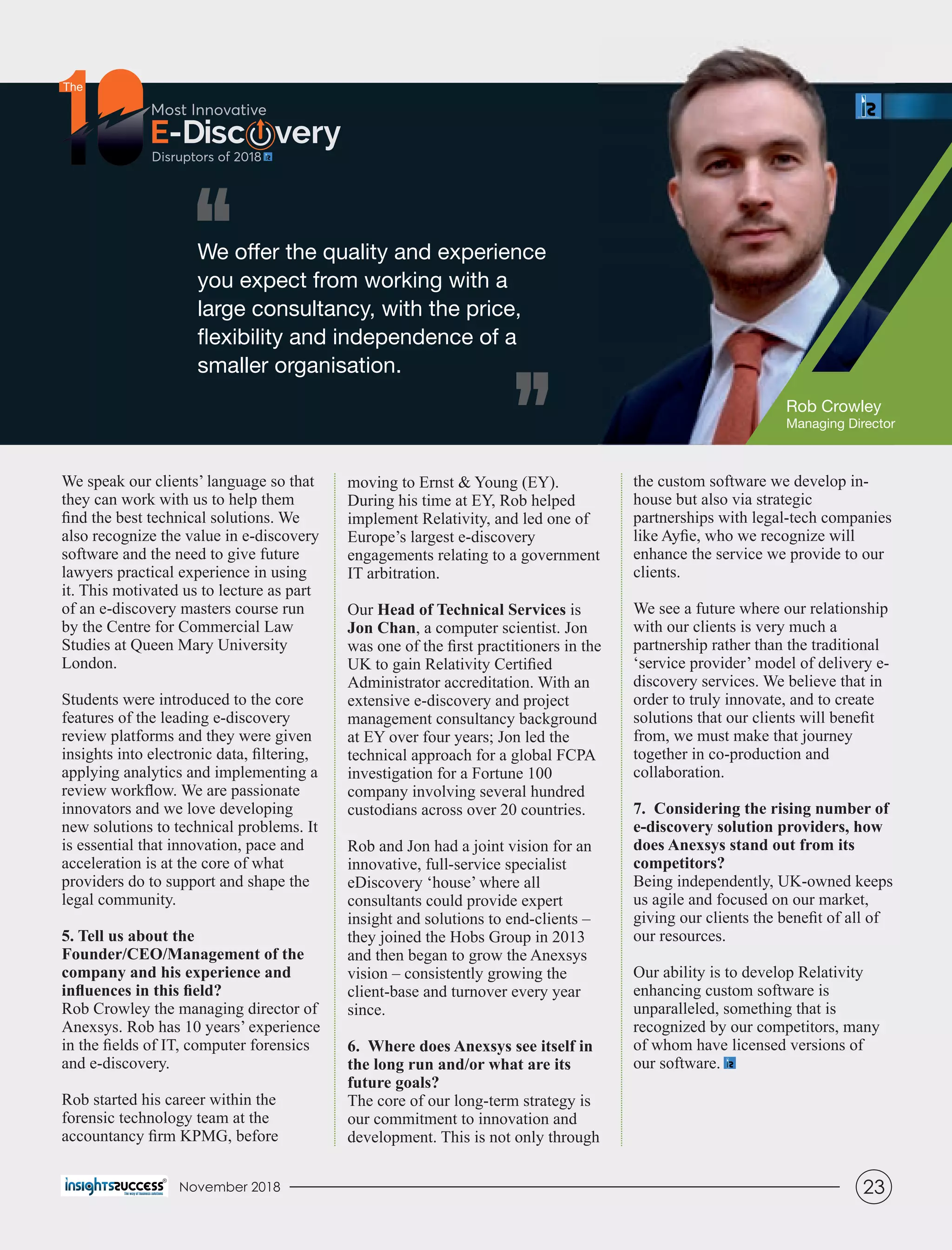
We offer the quality and experience
you expect from working with a
large consultancy, with the price,
flexibility and independence of a
smaller organisation.
November 2018 23
Rob Crowley
Managing Director
Till now we have witnessed about wireless charging
for electronic gadgets and devices only, but now we
can also charge electric bikes, cars and buses
wirelessly. Imagine that, we are driving on highway and our
car’s battery drains. Now, instead of finding a fuel pump,
electric power source, adapter, cable, etc. we just have to
stop or park our car on wireless charging platform for short
time, available at any shopping complex or food malls,
again no need to come-out of the car, besides anyone’s
assistance. This is really an amazing idea and this is going
to true.
History
Electromagnetic Induction, which dates to inventors such as
Michael Faraday in the year 1831 and Joseph Henry in the
year 1832. Faraday was the first to publish the results of his
experiments. Nikola Tesla utilized electromagnetic energy
to transmit the power between two coils in the early 1900s.
Faraday’s law of induction is a basic law of
electromagnetism forecasting how a magnetic field will
interact with an electric circuit and produces an
electromotive force (EMF)—a phenomenon called
electromagnetic induction. It is the fundamental working
principle of transformers, inductors, and many types of
electrical motors, generators, solenoids and wireless
charging.
Functioning
Working of wireless charging is nearly same as ‘electric
transformer’, but difference is in application
only—Transformers are used to increase or decrease the
alternating voltages in electric power applications through
electromagnetic induction and Wireless Charger are used
to transfer energy between two objects using
electromagnetic field.
How exactly it Works
Electric vehicle (EV) with wireless charging is having
secondary coil fitted at bottom of vehicle and primary coil
is securely installed on ground (i.e. charging platform).
Charging:
Future of Green Automotive
The basic wireless charging system needs two coils. The
primary coil, encased in a pad that sits on the floor of a
garage or parking platform, is connected to a power source.
Alternating current flows from an outlet into the coil, set up
an electromagnetic field that enables the power to jump to a
secondary coil in a pad attached to the bottom of the
vehicle. When the vehicle parks in the proper position over
the primary coil pad, an indicator light goes on and
charging begins. The two coils must be facing within about
8 inches of each other for effective charging.
Pre-eminence over Cable Charging
Wireless Charging gives a convenient, safe, and reliable
way to charge and power electrical vehicles at home, in the
workplace and in industry. Wireless power maintains safe,
continuous, and reliable transfer of power for all types of
electric vehicles.
Wireless charging eliminates the use of physical connectors
and cables. It provides a number of efficiency, cost and
safety pre-eminence over the traditional charging cable.
This make possible to install it anywhere like; on the side of
highways, parking lots, malls, multiplexes, toll plazas, etc.
Experts predict more powerful wireless stations will be like
to appear at office buildings, shopping centers and
restaurants. When anyone parks vehicle at office or at
restaurant it will get charged automatically in that space of
time.
Due to this effortless frequent power availability and safety,
a vehicle does not need large batteries unlike for
conventional cable charging. It makes vehicle light and
compact, that tends to increase overall efficiency of vehicle.
Plug-in stations can be easily damaged in crowded metro
cities. A number of municipalities have reported problems
that thieves have cut EV charging cables to steal the copper
from the wires. High-powered Level 3 stations, also called
DC fast-charge, have large cables, which make them even
more attractive to thieves.
Wireless
Recharging Environment
November 201824
“Imagine wireless electric-vehicle charging being as easy
and widespread as Wi-Fi is today,” said Chris Borroni-Bird,
former director of advanced technology vehicle concepts
for General Motors and who is a vice president of strategic
development at Qualcomm Technologies.
Implementation is in Progress
Wireless charging technology is almost ready for the big
stage. It is on the verge of initial deployment, starting from
the Mercedes-Benz S500e plug-in hybrid sedan next year.
They plan to fit wireless charging on the S500e plug-in
hybrid sedan in 2017.
BMW is also working together with Mercedes-Benz on the
technology, to develop a wireless charging system for its i3
electric vehicle and i8 plug-in hybrid. A prototype test
version, made by Qualcomm technologies, is already in use
in the BMW i8 safety car in the Formula E electric-vehicle
race series. Qualcomm has exhibited its Halo system in
various vehicles, including the Drayson B12/69 electric
racing car.
Evatran’s Plugless aftermarket system is now commercially
available for the LEAF and the Volt, and a Model S-
compatible version is likely to come. Several major
automakers have indicated that they’re working on offering
wireless charging for future EVs. Tesla is also on the way of
introducing its EV’s with wireless charging.
It is also already being piloted by some community bus
systems. Buses need to take number of stoppage in city. A
wireless charger can be installed on a stopping platform—
tends to reduce size of batteries— will improve efficiency
electric bus.
Wireless charging technology is really amazing as invention
of electric current. It is interesting to see how it will put
back the conventional fossil fuel powered vehicle with
clean, green, safe, silent and efficient electric vehicles with
wireless charging for healthy future of planet Earth.
November 2018 25
Omnichannel Agent
and Customer
Engagement Solutions
Simplify and personalize the customer experience,
empower agents and achieve business success
with one workspace for all channel interactions,
application integrations, and CX reporting.
Today, increasing eDiscovery workloads continue to
cause headaches, while corporate GCs and firms are
simultaneously seeking increased efficiency and
quality. Hence Esquify, a cutting-edge legal technology
start-up that is augmenting the current in-person litigation
document review process with a virtual solution using its
own patented and machine learning technology.
In an interview with Insights Success, Drew Stern, the
CEO and Co-founder of Esquify shares some insightful
views on how the company’s technology drives
accountability and oversight via detailed performance stats
on individuals, teams and overall review progress.
Below are the highlights of the interview between Drew
and Insights Success:
1. Give a brief overview of the company, its solutions
and services?
Esquify is the world’s first AI-Driven, workforce
management platform for law. As the recent winner of the
US Legal Tech Venture Day 2018, we are changing the
st
game by using 21 century technology to improve and
augment human, legal, document review within eDiscovery.
In an industry that has been struggling to contain costs and
achieve reliable results, Esquify’s platform delivers
benchmarking tools and analytics that not only heighten
cost efficiency but also increase overall accountability and
transparency of review teams. Esquify’s groundbreaking
SaaS platform is being used globally to run reviews with
major Legal Service Providers, Fortune 100 companies and
AM Law 100 firms. We’re venture-backed, Relativity
integrated and award winning.
2. How do you diversify your eDiscovery solutions in
ways that would benefit your clientele?
We diversify via our core philosophy that technology can
power review teams with improved performance. Esquify
transforms the document review experience by employing
patented, machine learning to supervise teams of reviewers
simultaneously and at scale wherever they are worldwide.
Equipped with communications features built for law and
real-time analytics on performance and progress, the
solution drives 25% more efficient reviews and client cost-
savings of 25%–45% or greater.
3. Describe the experiences, achievements or lessons
learnt that have shaped the journey of the company.
When we started Esquify, we had a vision of an eDiscovery
industry that relied on technology to enhance review team
performance, wherever the reviewers worked: in a review
center, in a bull pen, in another city, country or working
from home. You see, technology as an assist to reviewing
attorney’s efficiency is an entirely new innovation.
Document review and its supervision have historically been
completely manual, and quite inefficient to boot. While
there has been tremendous tech investment in the document
collection/collation aspect of eDiscovery, little attention has
been paid to the human element of the process- where the
documents and the teams of attorneys reviewing them
intersect.
Our stumble-upon was in how greatly our tech could
actually impact reviewer performance, manager
performance and eDiscovery quality. There was a huge gap
to fill and our tech is making a big difference in filling it.
For example, we can drive over 40% increase in reviewer
performance, increase reviewer focus on document review
by over 250% and provide measurable quality insights.
These successes have emboldened us to drive forward with
A Groundbreaking AI platform for Law
We strive to deliver our
clients amazing AI
technology and real-time
analytics that drive results.
‘‘‘‘
November 201828
new innovations and new features that
further enhance our platform for
clients.
4. How does the company contribute
towards making the industry better?
Two ways - through innovation and
workplace diversity within eDiscovery
While we’re a leading technology
company, we’re innovators at our core.
We see the possible, and we go out
there and create against a real need. We
created Esquify to deliver against real
pain points in the industry and our
innovation is driving performance and
accountability widely in the industry.
We’re also huge workplace diversity
advocates. We founded Esquify with a
diverse team which led to our big-tent,
out of the box thinking. Diversity and
inclusion, where everyone feels like
they have a seat at the table and the
ability to voice their opinion, is
incredibly important to us. So, we
regularly speak and write on the
importance of diversity in eDiscovery-
leading an ever important dialogue
around inclusion.
5. Tell us about the
Founder/CEO/Management of the
company and his experience and
influences in this field?
I founded Esquify with my husband
Scott Stuart who is an accomplished
attorney and technology executive. I
come from a background of high-tech
and used my real-world experiences to
lead our team and create a solution that
addressed real pain-points that Scott
and I were seeing within eDiscovery.
We pulled outside technology best
practices into law.
Prior to Esquify, I amassed a portfolio
of experience in creating and managing
successful start-ups, strategic alliances
and partnership ecosystems at
Salesforce, American Express, Buddy
Media, Sprout Social and completed
marquee projects with VCs, AM Law
100 firms, legal service providers,
major social networks and best-in-class
analytics providers.
These experiences have given me the
business knowledge to start and lead
Esquify to success and receive some
awesome recognition along the way
including, being named to “Chicago’s
Notable LGBTQ Executives 2018” list
by Crain’s Chicago Business and to
“40 Under 40” by M&AAdvisor.
6. Where does Esquify see itself in
the long run and/or what are its
future goals?
We see ourselves continuing to grow,
innovate and see our technology used
widely within the industry. Not only
that, we also see our technology being
used to address other pain-points both
within and outside of law.
7. Considering the rising number of
eDiscovery solution providers, how
does Esquify stand out from its
competitors?
We stand out from traditional players
who are not relying on real-time
analytics and big data to drive
performance of their discovery teams.
Through our unique approach focused
on the interplay of technology and
human performance, we enhance and
augment the capabilities of legal teams,
without replacing the great work they
are doing.
Our clients have seen awesome results
and the truth is in the metrics. They
have seen reviewer efficiency rise by
20-45%, review cost savings of up to
40%, increased review focus by over
250% and major insights into
individual and team performance that
have led directly to enhanced quality.
Our customers love the accountability
and measurement we bring in real-
time, directly to their fingertips.
Drew Stern
CEO & Co-Founder
November 2018 29
BEYOND
AUTOMATION:
AI powered Autonomous
Factories of the Future
Rise of the industrial robots in 1980s led to a
major evolution of Henry Ford’s assembly line
concept. Routine tasks that were being handled
by factory workers started to be performed by robots with
greater accuracy and efficiency. With the spread of
device-to-device communication and IoT protocols,
robots started taking a serious amount of responsibility
from factory workers. This movement was initially led by
th
German high tech firms that branded this shift as the 4
industrial revolution. On the opposite side, there was
China, taking advantage of their access to low cost
human labour as an alternative to automation. Very
recently, a few years ago, China flipped their strategy 180
degrees, becoming the biggest advocate of automation by
starting to invest aggressively on buying robots and
developing their own robotics know-how led by
government initiatives. So the technology won. There is
no question about the need for automation anymore and
major manufacturing companies, including the ones in
China, Germany and rest of the world are racing to
automate their industrial processes to increase
productivity.
Everything that can be automated will be
automated, according to Zuboff’s law.
However, some things are more difficult
to be automated than other things.
Those are non-repetitive tasks which
require higher level of cognition and
ability to adapt into unknown
conditions. These tasks can be
defined as the last mile in factory
automation. Tesla, the electric car
manufacturer, was recently
criticized by analysts for
automating their assembly line
more than necessary. The
reason of the criticism was the
fact that the cost of
automation exceeded the cost
of a human led assembly
Daghan Cam
Co-founder & CEO
Ai Build
November 201830
Expert's Forsight
line. This may be a valid argument for
today but the solution should be found
in increasing the bar for commercially
viable automation and not by going
back to lower levels of automation.
So if we are moving towards full
automation and lights-out
manufacturing, how can the last mile
in factories be automated without
overspending and over engineering?
Autonomy seems to be the answer,
therefore Artificial Intelligence…
There is a slight but important
difference between Automation and
Autonomy. Autonomy is the state of
being able to make independent
decisions in situations that were not
experienced before. By definition,
autonomous systems are always
automated, but the other way around is
not always the case. A system may be
fully automated but not autonomous.
“Blind Automation” is the term we use
for this category.
Systems that are blindly automated are
based on hard coded rules, as in expert
systems, and they tend to be very
difficult to be reconfigured if the
conditions or requirements change over
time. Autonomous systems, in contrast,
generalize the rules for decision
making in different scenarios by
allowing a higher level of abstraction
in their programming.
For example, in the blind automation
scenario, a robot may be programmed
to go to coordinates x, y, z in order to
pick up an object. This will work
without problems as long as the object
is found precisely at coordinates x, y, z.
However, if for any reason the object is
positioned at a slightly different
location, the robot will still go to x, y,
z, fail to pick the object up and
continue executing the rest of its
commands without noticing this
problem. Eventually every step
subsequent to this failure will also fail.
A better strategy for performing the
same task, is using a robot with vision
sensors, and programming it to go to
the object’s position (as a variable) to
pick it up. Regardless of where the
object is positioned, robot will localize
it using its sensors and successfully
pick it up. This difference between the
two programming paradigms; “go to x,
y, z” and “go to an object’s position”
makes a big difference in making the
system less prone to making mistakes
in unexpected conditions which is
crucial for last mile factory
automation.
Robots making hundreds of decisions
every second and receiving hundreds
of measurements from the environment
and from other devices also require
massive computation and storage
capabilities. Despite the popularity of
cloud computing in most applications
today, a decentralized compute power
is necessary for most robotic
applications and for IoT devices in
general. The throughput between the
edge and the cloud through internet
connectivity is simply not enough to
process all data generated by sensors
and make sensible decisions in real-
time. So edge computing, or fog
computing - dedicated servers on
premise as a layer between individual
devices and the cloud - will likely be
the norm in autonomous factories of
the future unless we experience a
breakthrough in science that leads to
infinitely fast and reliable internet
connectivity. However unlike compute
power, storage of important data, that
is filtered on the edge, should be
centralized in order to achieve the best
decision making models at every
location.
As a summary, a few conclusions and
predictions about the future are:
Ÿ We are moving towards an
autonomous black-box factory
model where the factory robots are
operated by themselves without
human intervention.
Ÿ These factories will be powered by
the data that is generated by
themselves and their productivity
will increase over time exceeding
human performance in every
process involved in manufacturing.
Ÿ Factories will compute on-premise /
on-edge and they will push
important data to cloud for
benefiting from a shared pool of
data with other factories.
www.ai-build.com
In this scenario where robots make
autonomous decisions by using real-
time sensor data, a feedback loop is
established between physical and
digital environments. The constant
flow of information from physical to
digital and vice versa create immense
amounts of structured data which is the
fuel for AI powered autonomous
factories of the future. Such action-
measurement-action strategies allow
the systems to self-improve over time,
creating a data network effect in
manufacturing. The more one process
is executed, the more efficient it will
get. This allows super-human
performance in almost every domain
given enough data.
Daghan Cam is the Co-founder
and CEO of Ai Build, a London
based startup developing
Artificial Intelligence and
Robotics technologies for the
construction industry. He is also
a visiting lecturer at University
College London doing research
on robotic fabrication, large scale
3d printing and parallel
algorithms with GPU computing.
His work focuses on developing
intelligence for automating
complex tasks in design and
manufacturing by using
computer vision and machine
learning techniques.
About the Author
November 2018 31
How can
the Climate Change?
November 201836
In Brief
The relation between technology and the environment of our planet is very old. The time has come to turn everything
in the surrounding eco-friendly. IoT (Internet of Things) products can be tailored to combat with the climate change
and its consequences. Whether it is a disaster like flood or an issue like deforestation, this technology is capable to
protect us and our environment in several ways. Have you ever wondered how technology could save our natural resources?
Yes, IoT has the potential to resolve such problems as it involves animals and plants in our connected world.
IoT business owners are getting encouragement from the governments and corporates to build smart and intelligent devices
that help us Go Green. In order to keep our environment safe, the IoT makers must come up with the good ideas that satisfy
the current demands of the ecosystem. Innovative products would be incorporated for domestic as well as industrial use.
Energy Saving
IoT products are aimed to save energy using automated systems. For instance, smart lighting can sense sunlight and is able to
maintain constant lighting level. The smart home appliances implement energy management. Smart buildings use solar
energy and other renewable energy sources to minimize environmental impact.
Animal Tracking
With IoT, it is becoming easier to track rare species. Animal tracking helps scientists and conservationists to know their
location and their tendency towards migration. The micro-sensors paired with IoT enable multiple devices to connect together
for the purpose to collect, transmit, and store data. Animal tracking is also important to maintain the way our ecosystem
works.
November 2018 37
Reduce Pollution
It is very interesting to see how IoT fight with the pollution. The real-time data is used for forecasting pollution parameters
and measuring the elements of air and water quality. The technology focuses on keeping pollution to a minimum. Air
pollution can be detected and evaluated across all the industries to ensure that they stick to the air quality policies.
Water Management
IoT devices can transform the way we manage the most precious resource—water. With the advanced water sensors, these
products make decisions and produce data analytics about the amount of water we use. It allows us to save money and to
minimize water usage for its conservation.
Smart Farming
Smart farming is shaping the future of agriculture, which impacts on the environment positively. These small devices
automate the process of farming using harvesting and irrigation. The technology can be used to choose fertilizers in
accordance with the conditions of the soil. Drones can play the crucial role in monitoring the whole cultivation.
Prevent Deforestation
Deforestation is one of the major causes of climate change. According to a study, there is a need to implant a billion trees a
year to recover, which can only be possible if an automated system is used. IoT and drones are assembled and deployed to
perform this task efficiently. It reduces manpower requirements and cost and uses agriculture techniques for planting and
maintenance.
Waste Management
When the IoT technology was introduced, it was predicted that it would increase e-waste. But this problem was mere a part of
the solution. IoT provides a great way to manage waste and recycle. The sensors installed in chips would be able to notify
consumers when it is ready to repair or recycle. They also inform the users which component can be reused so that they do
not go trash early. For the management of other wastage, IoT products can be designed to automate disposal system timely.
Natural Disaster Detection
Notably, natural disaster is a dreadful outcome of climate change. IoT products can be used to detect natural disaster at the
early stage and to minimize the damages. Earthquake and flood sensors send out the signals to the cloud-based servers
connected with the internet. In the case of detection, residents of that area get warning signals. Internet of underwater things
is used for monitoring activities of oceans and rivers.
There are hundreds of ideas to think upon and hundreds of solutions to work on. For example, traffic control reduces carbon
production by saving gasoline and food security assists in balancing the ecosystem. Undoubtedly, climate change is the
biggest challenge of our time and it is our concern to give healthier environment to the next generation. Other technologies
such as artificial intelligence can be associated with the IoT to get better insights and success in combatting with this
problem.
The connectivity among things (instead of devices only) can make our everyday life more sustainable. But, the efforts made
till yet to decelerate climate change are insufficient. The future demands a planet where all the living things get safety against
it. There is no exaggeration in saying that IoT enabled systems can make climate change turn back. IoT products make us
more organized, more sustaining, safer, and greener.
November 201838
TCDI:
Preserving Relationships
and Building Innovative
Technology
For over 30 years, TCDI has been a pioneer in the
legal market empowering law firms and corporate
legal departments. TCDI specializes in large-scale
litigation case management, eDiscovery, managed
document review, computer forensics and cybersecurity.
Their innovative proprietary legal technology solutions help
clients solve legal challenges by efficiently organizing and
managing large volumes of data. Their technology is
designed to decrease client cost by reducing data volumes
and making human review and production more accurate.
The TCDI Story
Upon arriving at TCDI’s headquarters in Greensboro, NC
visitors are likely to be greeted by a rare welcoming
committee, a group of Labradoodle dogs. This greeting is
one of many examples of the unique culture that can be
found at TCDI, the company behind client-designed
proprietary eDiscovery and Litigation Management
software. Thirty years ago, TCDI’s current CEO, Bill
Johnson, and now retired Jerry Eatherly, founded TCDI in
Northern Virginia. Initially formed to bridge the gap
between software development and legal services, TCDI
has spent the last 30 years evolving to meet the needs of
their clients. The once small company has grown to 71
employees, two offices and multiple virtual offices across
the U.S. with expanded service offerings including: large-
scale litigation case management, eDiscovery, managed
document review, computer forensics, and cybersecurity.
With an initial focus on providing long-term, full-service
support throughout the discovery process, TCDI realized
the need to provide customizable and comprehensive
software for their clients, rather than standard-off-the-shelf
software. Ultimately, TCDI recognized that the best way to
create client specific solutions was to concentrate on
building long-term partnerships with their clients.
Today, TCDI has client relationships extending beyond 20
years. Their team of design engineers and data scientists has
a true understanding of the clients’ obstacles and
challenges, which allows them to adapt their solutions to
meet those needs. This eliminates the burden of working
with third party development teams, resulting in increased
efficiencies and savings for their clients. Many clients
consider TCDI’s team to be an extension of their own.
Johnson exemplifies this by saying, “Once a team is built
with our clients, we believe that team needs to stay
together.” This philosophy extends internally as well.
TCDI’s goal is, and has always been, to cultivate long-
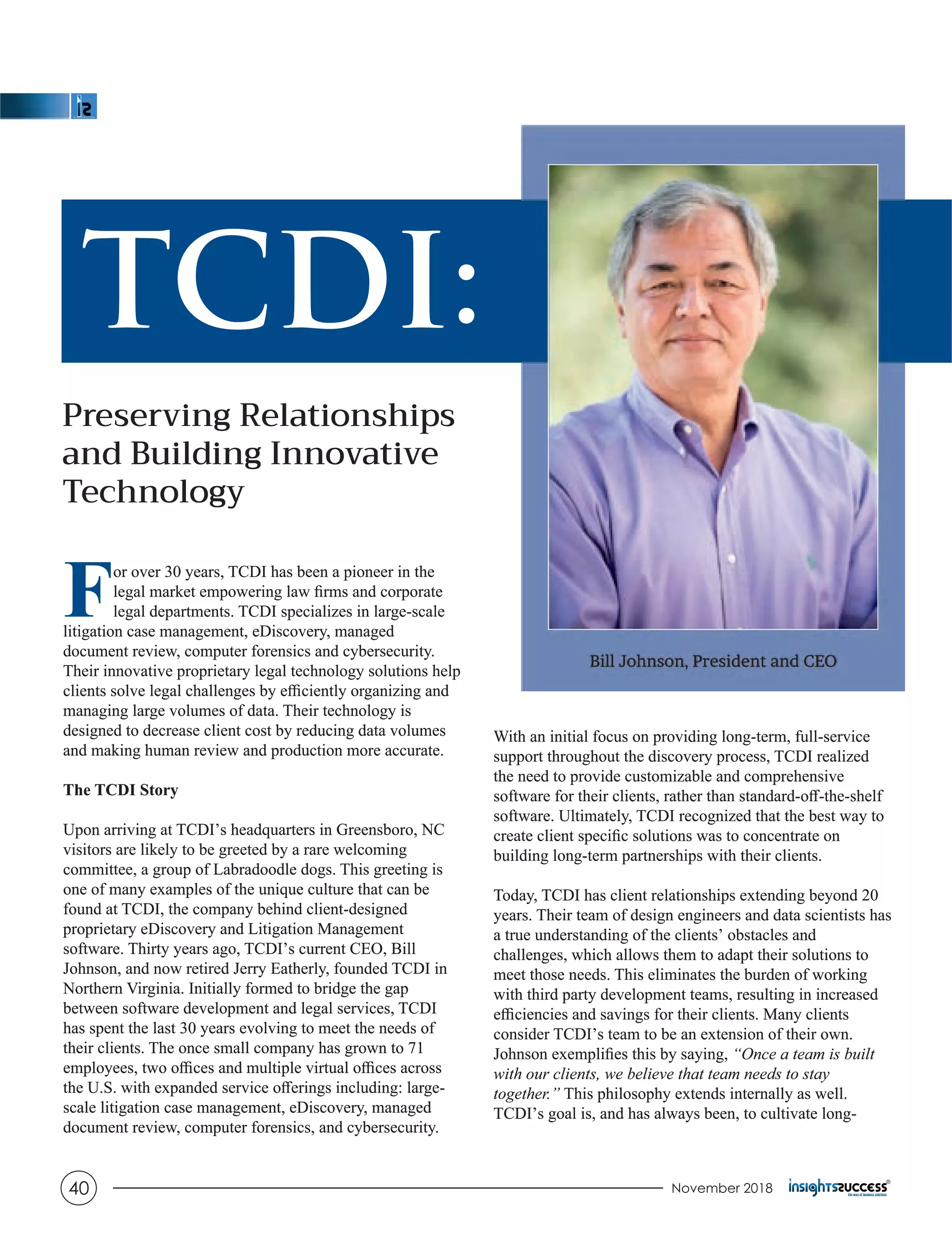
Bill Johnson, President and CEO
TCDI:
Preserving Relationships
and Building Innovative
Technology
For over 30 years, TCDI has been a pioneer in the
legal market empowering law firms and corporate
legal departments. TCDI specializes in large-scale
litigation case management, eDiscovery, managed
document review, computer forensics and cybersecurity.
Their innovative proprietary legal technology solutions help
clients solve legal challenges by efficiently organizing and
managing large volumes of data. Their technology is
designed to decrease client cost by reducing data volumes
and making human review and production more accurate.
The TCDI Story
Upon arriving at TCDI’s headquarters in Greensboro, NC
visitors are likely to be greeted by a rare welcoming
committee, a group of Labradoodle dogs. This greeting is
one of many examples of the unique culture that can be
found at TCDI, the company behind client-designed
proprietary eDiscovery and Litigation Management
software. Thirty years ago, TCDI’s current CEO, Bill
Johnson, and now retired Jerry Eatherly, founded TCDI in
Northern Virginia. Initially formed to bridge the gap
between software development and legal services, TCDI
has spent the last 30 years evolving to meet the needs of
their clients. The once small company has grown to 71
employees, two offices and multiple virtual offices across
the U.S. with expanded service offerings including: large-
scale litigation case management, eDiscovery, managed
document review, computer forensics, and cybersecurity.
With an initial focus on providing long-term, full-service
support throughout the discovery process, TCDI realized
the need to provide customizable and comprehensive
software for their clients, rather than standard-off-the-shelf
software. Ultimately, TCDI recognized that the best way to
create client specific solutions was to concentrate on
building long-term partnerships with their clients.
Today, TCDI has client relationships extending beyond 20
years. Their team of design engineers and data scientists has
a true understanding of the clients’ obstacles and
challenges, which allows them to adapt their solutions to
meet those needs. This eliminates the burden of working
with third party development teams, resulting in increased
efficiencies and savings for their clients. Many clients
consider TCDI’s team to be an extension of their own.
Johnson exemplifies this by saying, “Once a team is built
with our clients, we believe that team needs to stay
together.” This philosophy extends internally as well.
TCDI’s goal is, and has always been, to cultivate long-
Bill Johnson, President and CEO
November 201840
lasting relationships with their own
team members. Creating a people-
centric company through fun,
comfortable work environments,
company-wide team gatherings
(usually involving food) and an on-site
gym with personal trainer are just some
of the ways TCDI ensures team
members feel valued. This culture
reinforces the company’s commitment
to creating a healthy, fun and
productive work family. While TCDI’s
technology and services continue to
evolve, the focus on relationships
remains a priority.
Current Service Offerings
Cybersecurity breaches are
significantly impacting businesses due
to the increase in the number of attacks
as well as the rise of the costs
associated with them, TCDI
understands the importance of data
security and privacy. Their team of
trusted advisors, comprised of security
experts and industry thought leaders
take an innovative approach to data
security services by combining “best of
breed” technology with their
proprietary cybersecurity assessment
application to create custom-tailored
solutions to meet each client’s unique
needs. TCDI’s cybersecurity services
include: cybersecurity assessment,
penetration testing, comprehensive
security monitoring and management,
policy and plan development, data
breach response and investigative
services, security awareness training,
access to a team of certified and highly
skilled experts on an “as-needed basis
and law firm security evaluation.
TCDI also provides legal solutions that
support the entire eDiscovery process.
At some point, nearly every business
likely will produce electronic evidence
to comply with court mandates or
regulatory requests. From data
processing through managed document
review and production, TCDI has their
own proprietary software platforms
and capabilities to help clients manage,
organize and analyze large volumes of
electronic information to lower the risk
and costs that are associated with
electronic discovery.
TCDI also specializes in computer
forensics. In today’s world, evidence is
rarely preserved on paper, making it
imperative to know how to collect
digital evidence and recover data.
TCDI’s certified forensics analysts are
trained to collect and analyze
electronic evidence following forensic
methodologies and procedures.
With unparalleled experience,
exceptional service and sophisticated
technology – TCDI continues to push
the boundaries of the industry.
Outlining the Future
As TCDI looks towards the future, they
plan to expand carefully to ensure their
growth never extends beyond their
ability to deliver the highest level of
service. “Our goal has never been to
be the biggest, but to simply be the
best,” said Johnson. In striving to be
the best for their clients, TCDI invests
heavily in their employees through
programs such as Lean Six Sigma and
continuous process improvement. In
fact, TCDI has certified seventy
percent of its team members in Lean
Six Sigma. TCDI plans to use their
foundation of innovative legal
solutions, Lean Six Sigma
methodology and a highly experienced
staff to broaden their service offerings
in order to provide the most
comprehensive set of services to their
clients.
“It’s never about us;
it’s always about the client.”
lasting relationships with their own
team members. Creating a people-
centric company through fun,
comfortable work environments,
company-wide team gatherings
(usually involving food) and an on-site
gym with personal trainer are just some
of the ways TCDI ensures team
members feel valued. This culture
reinforces the company’s commitment
to creating a healthy, fun and
productive work family. While TCDI’s
technology and services continue to
evolve, the focus on relationships
remains a priority.
Current Service Offerings
Cybersecurity breaches are
significantly impacting businesses due
to the increase in the number of attacks
as well as the rise of the costs
associated with them, TCDI
understands the importance of data
security and privacy. Their team of
trusted advisors, comprised of security
experts and industry thought leaders
take an innovative approach to data
security services by combining “best of
breed” technology with their
proprietary cybersecurity assessment
application to create custom-tailored
solutions to meet each client’s unique
needs. TCDI’s cybersecurity services
include: cybersecurity assessment,
penetration testing, comprehensive
security monitoring and management,
policy and plan development, data
breach response and investigative
services, security awareness training,
access to a team of certified and highly
skilled experts on an “as-needed basis
and law firm security evaluation.
TCDI also provides legal solutions that
support the entire eDiscovery process.
At some point, nearly every business
likely will produce electronic evidence
to comply with court mandates or
regulatory requests. From data
processing through managed document
review and production, TCDI has their
own proprietary software platforms
and capabilities to help clients manage,
organize and analyze large volumes of
electronic information to lower the risk
and costs that are associated with
electronic discovery.
TCDI also specializes in computer
forensics. In today’s world, evidence is
rarely preserved on paper, making it
imperative to know how to collect
digital evidence and recover data.
TCDI’s certified forensics analysts are
trained to collect and analyze
electronic evidence following forensic
methodologies and procedures.
With unparalleled experience,
exceptional service and sophisticated
technology – TCDI continues to push
the boundaries of the industry.
Outlining the Future
As TCDI looks towards the future, they
plan to expand carefully to ensure their
growth never extends beyond their
ability to deliver the highest level of
service. “Our goal has never been to
be the biggest, but to simply be the
best,” said Johnson. In striving to be
the best for their clients, TCDI invests
heavily in their employees through
programs such as Lean Six Sigma and
continuous process improvement. In
fact, TCDI has certified seventy
percent of its team members in Lean
Six Sigma. TCDI plans to use their
foundation of innovative legal
solutions, Lean Six Sigma
methodology and a highly experienced
staff to broaden their service offerings
in order to provide the most
comprehensive set of services to their
clients.
“It’s never about us;
it’s always about the client.”
November 2018 41
Blockchain:
Today, about 55% of the world’s population lives
in urban areas, but this share is expected to
increase to 68% by 2050. Combined with the
overall growth of global population, this could add
another 2.5 billion people to urban areas by 2050, with
close to 90% of this increase taking place in Asia and
Africa, as reported by the United Nations’ 2018 Revision
of World Urbanization Prospects.
Since the world continues to urbanize, a wiser and far-
sighted management of urban resources is more and
more needed, especially in low-income and lower-
middle-income countries where the pace of urbanization
is projected to be the fastest. Smart technologies and
smart urban platforms can support City managers in
tackling the increasing demand for energy,
infrastructures, affordable housing, well-connected
mobility systems, healthcare and education, as well as
quality of life and jobs.
To understand how smart technologies work, we should
picture Cities as distributed communication systems,
where urban objects – think of streetlights, meters,
parking lots, waste bins, Wi-Fi hotspots, video
Passionate and eclectic technology
expert, Gianni Minetti is the President
and CEO, Paradox Engineering SA has
about 25 years of business experience
in information and telecommunication
systems, with peculiar interests in
Internet of Things, smart technologies,
blockchain and cryptography. In 2005
he founded Paradox Engineering as
the vehicle for bringing his unique
technology vision to the market
through pioneer IoT platforms for
Smart Cities and Smart Factories. He
is currently President and CEO of the
Company, which has been part of
MinebeaMitsumi Group since July
2015. Gianni is also chair of the
Southern Alps Chapter of the Crypto
Valley Association, active investor
and advisor to several blockchain
venture projects. He is based in
Ticino, Switzerland.
The Next Opportunity for
Better, Safer, Smarter Cities
About the Author: Gianni Minetti
November 201842
Expert's Forsight
surveillance cameras, etc. – are not dumb, isolated
devices, but smart nodes of a citywide network. With the
Internet of Things (IoT), all these objects are injected
with intelligence and acquire the capability to receive
and transmit data and execute commands, thus enabling
remote monitoring and dynamic, adaptive control
functions.
Acquiring and correlating data from urban assets is a
significant step forward to improve quality of public
services and citizen satisfaction, reduce energy
consumption, optimize costs and simplify processes for
City operators and managers. Even more, it provides
actionable information to feed strategic decisions about
services efficiency and improvements, and take
evidence-based actions where and when needed.
Let’s apply what we’ve just described to a basic service
such as street lighting. By connecting street lamps to a
wireless IoT network, it becomes possible to turn them
on/off and adjust brightness according to daily solar
times and ambient light levels, defining variable patterns
for working and festive days, residential and industrial
districts. Sensors can be integrated to bring lights up
when human or vehicle presence is detected, and on
demand actions can be triggered in real time for single or
grouped lamps – for instance when a car accident or an
emergency requires intense lighting in a specific area.
It is proven that implementing LED lighting and an IoT
remote management and control platform can cut energy
consumption and greenhouse emissions up to 70%.
Moreover, connected lamps can monitor key operating
parameters and automatically report failures, generating
extra savings on maintenance costs. Considering LED
technologies last about 50% longer than traditional light
sources, the US Federal Department of Energy estimated
that if the entire country converted to LED lighting over
the next 20 years, it would save a total of USD 120
billion.
Even more interesting developments are possible with
blockchain technology, which can make Smart Cities far
more secure, transparent, efficient and resilient. As an
original combination of mature technological concepts,
including peer-to-peer networks, distributed consensus
algorithms, validity rules, ledger technologies and
cryptography, blockchain can be successfully applied in
November 2018 43
generating notable cost savings and
increasing quality of service.
Considering citizen participation,
blockchain-based voting platforms
can improve present, analogue
electoral systems by achieving
secure, anonymous and unique
voting in a decentralized manner.
Same platforms can be used to poll
citizens on specific urban initiatives,
making sure contributions from civil
society are recognized in Smart City
planning and development.
Blockchain technology is still in its
early days, but most experts agree it
has a potential for disruption. And
some pioneer experiences – from
Dubai to Tokyo, from New York to
Tallinn – demonstrate that benefits
for Smart Cities can really be
worthwhile.
any domain where stakeholders’
relations are based on trust and may
be entirely disintermediated. This is
particularly true in Cities, as they
rely on accurate, secure, authentic
and trustworthy information
exchanges to deliver services to
people and businesses.
About energy distribution, for
instance, blockchain-based metering
solutions can accelerate the adoption
of real-time differential pricing
models and encourage users to
participate to power generation by
connecting their renewable energy
microgrids to the main grid. In water
networks, blockchain technologies
enable smart contracts and validated
rules to automate water supply in the
most possible efficient manner,
minimizing leakages and tampering.
Blockchain technology can be
combined with IoT solutions to
provide better waste collection
services: it allows to accurately track
waste input and optimize waste truck
routes upon parameters like bin
status, filling levels, etc. This
increases service quality and
efficiency, and generates further
savings on fuel expenses and overall
maintenance costs. Garbage-related
data could also support the
introduction of customized fees for
household and commercial users,
thus rewarding recycling and correct
waste separation.
Coming to public government and
administration, blockchain can be
used to automate and digitalize civil
registries, as well as property, real
estate and business registries,
November 201844
Driving Digital Transformation and Revolutionizing the Legal Industry
UnitedLex:
For too long, corporate law departments and law
firms have been constrained by business models that
reward inefficiency, lack transparency and
responsiveness, cost too much, and fail to provide lawyers
with the skills required to meet the needs of today’s global
enterprise clients in a fast-moving, hypercompetitive
marketplace. UnitedLex has tackled many of the root cause
problems that have blocked innovation in the legal industry
and taken a holistic approach that focuses on the underlying
economics and service delivery models for each key player
in the legal ecosystem – corporate legal departments, law
firms, and legal education.
UnitedLex is a leading enterprise legal services provider
with more than 2,700 attorneys, engineers, and consultants
all over the globe. The company deploys innovative
solutions to drive digital transformation and deliver
unparalleled business impact for global corporation and law
firms. UnitedLex’s suite of legal business solutions include
litigation and investigations, law department consulting,
digital contracting and commercial solutions, intellectual
property, compliance and data protection, and financial
advisory.
In December 2017, UnitedLex announced a landmark,
multi-year deal with DXC Technology, the world’s leading
independent IT services provider, to transform its law
function across 26 jurisdictions worldwide. After critically
evaluating all aspects of DXC’s global law function,
UnitedLex rebuilt DXC’s law department from scratch,
deploying cutting-edge contracting technology that
integrates with business CRM tools and
streamlining the roles of more than 175
rebadged DXC employees in the first
few months. UnitedLex reduced
DXC’s legal operating
costs by 30
percent and created a more agile, strategically-aligned, and
cost-efficient department.
Tackling Turbulences and Enabling Clients to Make
Better Decisions
UnitedLex was formed to drive innovation, excellence,
efficiency, and cost effectiveness within the legal industry
which was slow to apply technology and business metrics
to enhance operations, results, and client satisfaction.
The organization has received several industry awards for
its enterprise legal services platform, including the ACC
Value Champion Award (March 2018); the Buying Legal
Council Best in Legal Procurement Award (September
2018); and the First Annual American Lawyer Industry
Award for Best Alternative Legal Services Provider
(September 2018). UnitedLex is also a member of the
World Economic Forum – a highly select group of elite
organizations known for their innovative business models,
dynamic growth, corporate global citizenship, and visionary
leadership.
UnitedLex’s approach to solving eDiscovery challenges
focuses on better managing data volumes early in the
EDRM, which drives significant spend reduction and
increases speed to early legal intelligence. Through its
technology and strategic solutions, UnitedLex enables its
clients to make more informed, data-driven decisions in
litigation and investigation matters.
Revolutionizing the Industry
UnitedLex is transforming the entire legal ecosystem –
corporate law departments, law firms, and attorney
development – and pulling the legal industry into the digital
age. The organization uses technology to simplify and
increase the speed of legal service delivery; workflow to
November 201846
“UnitedLex combines innovative
service models, digitally powered
solutions, and legal expertise to
revolutionize the legal industry.
Welcome to the future of law.”
allocate tasks to stratified
resources; advanced analytics to
facilitate better business decisions; and legal teams
trained with practical skills needed to be competitive in a
changing market.
In addition to shaping new business models for law
departments and law firms, UnitedLex’s Legal Residency
Program allows recent graduates to participate in a two-year
program where they can learn “contemporary legal skills”
that are not a part of the typical law school curriculum:
project management, e-discovery technology, cyber
security, contract management, patent licensing, and IP
management. Residents acquire training in key legal
delivery growth areas, engage in significant client contact,
and earn a paycheck comparable to a judicial clerkship.
An Attorney Turned Leader
Dan Reed, the CEO of UnitedLex, is a tech enthusiast and
former practicing attorney who recognized that legal
service delivery was ripe for innovation. Melding his
passion for the legal space with his diverse entrepreneurial
background, Dan has overseen UnitedLex’s growth from a
handful of employees to a highly-skilled global workforce
of 2,700.
Prior to founding UnitedLex, Dan served as Chief Financial
Officer and General Counsel to Adjoined Consulting, and
then as a Managing Director of Kanbay International.
Before Adjoined, Dan guided SmartDisk Corporation
through early stage structuring and execution of
its initial public offering. During his tenure,
SmartDisk grew to greater than $1 billion in market cap.
Dan is an influential thought leader in the legal industry.
His relentless commitment to challenging the status quo,
delivering value to clients in a way that makes a difference
in their companies’ long-term success, and giving to the
community at large by supporting organizations devoted to
education and health, are cornerstones of UnitedLex.
Standing Tall Amongst the Competitors
UnitedLex’s Questio™ discovery service is a rich
composite of technology and expert consultant-led process.
Questio™ is industry game changer, which has already
proven its efficiency through the litigation lifestyle and has
also reduced overall eDiscovery spend by 25 percent.
Questio™ provides exceptional clarity and simplicity in
pricing and budgeting. There are no pricing games, no
gimmicks – just guaranteed results. That’s UnitedLex’s
Total Project Cost Guarantee, which is essentially a fiscal
partnership with clients to guarantee a budget while
working in concert to ensure investment is only made on
value adding and efficient work streams. The organization
stands by its performance operationally and financially.
—Dan Reed
CEO
November 2018 47
The 10 most e-discovery disruptor of 2018

The 10 most e-discovery disruptor of 2018

  • 1.
    November 2018 www.insightssuccess.com Hire Counsel: Investingin Legal Human Capital to Create Value and Opportunities in the Legal Stafng Industry Disruptor of 2018 E-Disc very The Most Innovative 1010 In Brief How can IoT Decelerate the Climate Change? Joan Davison CEO & President Recharging Environment Wireless Charging: Future of Green Automotive
  • 4.
    Discovering Seamless Possibilities he notion ofdiscovering something is fascinating in itself. It means finding and unlocking the Thidden door of opportunities. In the world of business, discovery is a more captivating term flooded with seamless possibilities. Any vital discovery or invention aiming to simplify the business processes allows companies to accelerate their expansion plans. Most of the times it creates better job opportunities and enable youth to excel their wings. Marking it in other words, the discovery or inventions guide them towards a new path and empower to discover their capabilities. Every enterprise around the world contributing in various sectors has witnessed the flourishing benefits of smallest of inventions. However, the discoveries in sectors like technology are capable of revolutionizing numerous sectors. Another sector filled with immense potential is e-discovery. The industry and its solutions and services have brought forward evolution in the legal processes and other law documentation management. Electronic discovery is a procedure by which parties involved in a legal case preserve, collect, review, and exchange information in electronic formats for the purpose of using it as evidence. Today's law departments need to adopt a proactive approach to e-discovery. Having strong e-discovery strategies doesn’t just enable litigators to fulfill information requests – it also provides them with a window into information that can be extremely useful to the outcome of a case. Robust e-discovery isn't just about achieving baseline standards like data preservation. Increasingly, strong e-discovery is becoming necessary for litigators who want to maintain a competitive edge on the global stage. There’s an international push for better e-discovery standards, with nations from Canada to Singapore and Japan to Italy implementing e-discovery guidelines. This global focus on refining e- discovery is heightening the standard for attorney handling of ESI.
  • 5.
    In addition tosolidifying compliance and a competitive edge, comprehensive e-discovery can provide litigators with an abundance of actionable case data that might not otherwise be uncovered. Information from social media posts, emails, Excel spreadsheets and other digital sources can help attorneys build a better case – but only if it's effectively reviewed and refined. And with the mounting use of data-generating Internet of Things technology, attorneys will only have a greater need to retain, analyze and use digital information moving forward. By recognizing the importance of e-discovery and adopting solutions that help streamline the process, attorneys can be ahead of the pack as digital information moves to the center stage of the discovery process. Considering these vital factors Insights Success has curated the list of “The 10 Most Innovative E- Discovery Disruptors of 2018” which have revolutionized legal ecosystem with their unique, scalable and cost-efficient offerings. Featuring as our Cover Story we have Hire Counsel. Its Document Review Centers meet the highest standards of security, quality, and efficiency. They provide comfortable work environments that are conducive to collaboration and concentration. The magazine also admires the contribution of other industry leaders including Anexsys, an independent legal support and technology service provider, specialising in e-Discovery, Digital Forensics, Legal Reprographics, and scanning services; Esquify, a cutting-edge legal technology start-up that is augmenting the current in-person litigation document review process with a virtual solution using its own patented and machine learning technology; TCDI is providing value to its clients through proprietary eDiscovery and Litigation Management software solution and UnitedLex, the leading enterprise legal services provider that drives digital transformation throughout the corporate legal ecosystem. Also don’t forget to flip through articles written by the industry leaders and our in-house editorial team. Shall we begin? Bhavithiran Murugan
  • 6.
    Wireless Charging: Future ofGreen Automotive Recharging Environment Articles How can IoT Decelerate the Climate Change? In Brief: 18 42 Be smart – or vanish:Why Utilities need to actively develop smart Micro-Grids Smart in Vision Beyond Automation: AI powered Autonomous Factories of the Future Expert's Forsight Blockchain: the next opportunity for better, safer, smarter Cities Tech Outlook Hire CounselInvesting in Legal Human Capital to Create Value and Opportunities in the Legal Staffing Industry 10 Cover Story 30 36 24
  • 7.
    Specializing in eDiscovery Solutions IndexedI/O: Pioneering Data Management and Protection Solutions for the Cloud UnitedLex: Preserving Relationships and Building Innovative Technology TCDI: Deep Technical Expertise in a Changing Legal Services Environment Anexsys: A Groundbreaking AI platform for Law Esquify: Contents 22 28 34 40 46
  • 11.
    sales@insightssuccess.com Corporate Ofces: October, 2018 DatabaseManagement Stella Andrew Technology Consultant David Stokes Circulation Managers Robert, Tanaji Research Analyst Patrick James Steve, Joe, Alan, Vishal Anish MillerManaging Editor Art & Design Director Amol Kamble Associate Designer Sanket Zirpe Visualiser David King Senior Sales Manager Passi D. Business Development Executives Marketing Manager John Matthew Jenny FernandesAssistant Editors Bhushan Kadam Art & Picture Editors BelinPaul Co-designer Poonam Mahajan KhannaJayant Peter CollinsBusiness Development Manager Sales Executives David, Kevin, Mark, Manish SME-SMO Executives Prashant Chevale, Uma Dhenge, Gemson, Avdhut Online Marketing Strategists Alina Sege, Shubham, Anup Digital Marketing Manager Marry D’Souza Technical Specialists Amar, Pratiksha Technical Head Jacob Smile Copyright © 2018 Insights Success, All rights reserved. The content and images used in this magazine should not be reproduced or transmitted in any form or by any means, electronic, mechanical, photocopying, recording or otherwise, without prior permission from Insights Success. Reprint rights remain solely with Insights Success. Follow us on : www.facebook.com/insightssuccess/ www.twitter.com/insightssuccess We are also available on : Insights Success Media Tech LLC 555 Metro Place North, Suite 100, Dublin, OH 43017, United States Phone - (614)-602-1754 Email: info@insightssuccess.com For Subscription: www.insightssuccess.com Insights Success Media and Technology Pvt. Ltd. Off. No. 513 & 510, 5th Flr., Rainbow Plaza, Shivar Chowk, Pimple Saudagar, Pune, Maharashtra 411017 Phone - India: +91 7410079881/ 82/ 83/ 84/ 85 Email: info@insightssuccess.in For Subscription: www.insightssuccess.in Executive Editor Bhavithiran Murugan Contributing Editors Kedar Kulkarni Ishan Mittal Editor-in-Chief Pooja M. Bansal
  • 12.
    Technology, like change, shouldbe leveraged as a source of opportunity, innovation, and collaboration. In legal work, the results are far more superior when technology and the human element intersect and are leveraged. CounselHireInvesting in Legal Human Capital to Create Value and Opportunities in the Legal Staffing Industry
  • 13.
  • 14.
    The industry changesso incredibly fast that every present moment feels like the future. We always look forward, but more importantly, we are always moving forward, being creative, and taking strategic risks in order to create opportunities for our clients and workforce. n an industry that demands quality legal services at Ia high speed and affordable cost, contract legal work can be treated like a commodity, an idea that Hire Counsel aims to elucidate. Through their actions, Hire Counsel sets out to evangelize the legal community, helping the legal professionals they employ and the clients they serve to understand the importance of contract legal work. HCMC Legal, the parent company of Hire Counsel and Mestel & Company, is the national leader in legal talent solutions, managed document review services, and M&A consulting. With a history dating back more than three decades, the company was founded in 1987 by Lynn Mestel, an enterprising woman who helped break down stereotypes and pave a path for women in the industry. During a difficult time for start-up businesses, HCMC Legal rose to the challenge while many other companies closed or consolidated. The company, rich with achievements and lessons learned, is well-positioned for ongoing growth and innovation. Achieving Mutuality and Aligning Goals Today, HCMC Legal is led by CEO and President, Joan Davison. With nearly 30 years of experience, spanning across operations management, business development, marketing, recruiting, and staffing, Joan inspires success through her actions -- by maintaining a forward-looking vision and aligning the company's goals with those of the clients and professionals they serve in the legal ecosystem. For Joan, investing in legal human capital is a key initiative. It enriches the legal industry by creating value for clients and opportunities for legal professionals. Joan is recognized for her leadership and transformational management. She has been consistently named in the Top 100 Most Influential Executives in Staffing by Staffing Industry Analysts and has received the Gold Stevie Award in the Executive of the Year – Business Services category. Joan is a featured industry speaker and regular contributor to industry publications. She is a member of the Vistage CEO Group 3361. Joan's approach to leadership is best defined by something she says often: “As a leader, understanding that it is not about you, but about the mutual alignment of all parties is the only path to true success; identifying mutuality is key.” Creating Value for Clients Hire Counsel serves the entire legal community, whether they are the organizations that utilize its legal staffing solutions or the legal professionals they employ as contract attorneys. Therefore, everyone in the legal ecosystem is a “client.” Hire Counsel's ability to deliver measurable results with speed, quality, flexibility, and repeatability sets it apart from its competitors. They consistently build teams of legal professionals and get them ready to work 30% faster than the competition. In an industry where time is money, Hire Counsel's speed is a key advantage for their clients. It is no surprise that, of Hire Counsel's repeat clients, 73% have partnered with them on three or more engagements.
  • 15.
    By diversifying our partnerships,markets, and resources, we can provide creative and flexible solutions, which is a significant advantage because it allows us to help our clients face any and every challenge head-on. Cover Story Hire Counsel's proprietary candidate database of highly vetted legal professionals has been developed over the past 30+ years and continues to grow. Of these contractors, about 2,800 are enrolled in their ESOP and thousands choose to work with them on multiple projects. In a tight staffing market, Hire Counsel successfully attracts and retains high quality legal talent. As legal talent is no longer centralized in major metropolitan cities, Hire Counsel's deep national footprint allows them to source exceptional legal talent and create job opportunities in any location. With dedicated document review centers strategically located across the US, their Project Management and Workforce Management teams provide clients with uninterrupted “sunrise-to-sunset” service. Furthermore, they have the ability to launch pop-up facilities anywhere. By intentionally remaining technology and vendor agnostic, Hire Counsel can work seamlessly with all platforms. Through strategic partnerships that they have developed with various eDiscovery vendors and channel partners over time, Hire Counsel is able to deliver results that drive clients' objectives and provide utmost flexibility to their clients. “Hire Counsel does not prescribe one-size-fits-all solutions,” Joan asserts. Responding to Challenges Swiftly and Strategically The challenges that exist in today's legal industry are reflective of all industries. For every business, there is the persistent need to improve processes, skills, and cost structures in order to deliver a superior solution. Furthermore, the impact of consolidation and technology will likely continue. These challenges are further compounded by the uber-competitiveness of the industry and the incredible speed at which it changes. Hire Counsel responds swiftly and strategically to change by prioritizing the need for more customized client engagement and mobilizing its operational structure. In addition, Hire Counsel measures all aspects of the business model for the client, including production rates, on-time delivery rates, attendance statistics, and many more. By quantifying human capital data, Hire Counsel helps their clients drive results, instead of waiting for them. This gives Hire Counsel's clients the advantage of added speed and quality in the human capital space.
  • 16.
    Leveraging the Strengthsof Human Capital and Technology Technology has enhanced the document review process by allowing larger volumes of data to be analyzed and certain laborious tasks to be eliminated. However, technology is a tool that must be harnessed, especially when it is leveraged in legal work. The human is more reliable than technology in its ability to exercise ethics, make judgment calls, and apply complex logic to make important decisions. Therefore, the increased use of technology has propelled the role of human capital in legal services. Given the high importance of the human element in document review, the role of the contract legal professional is not only elevated, but critical. It can no longer be considered a temporary job or career stepping stone. Rather, it is an invaluable part of the legal profession. Contract legal work is also an excellent way for legal professionals to utilize their skills, make an impact, and step onto a career path that can lead to more opportunities. By leveraging the strengths of both artificial intelligence and human capital, HCMC Legal is able to further drive ROI for their clients and create opportunities for their contract workforce. Redefining the Culture of Contract Legal Work Hire Counsel is actively redefining the culture of contract legal work by focusing on continuing education, ownership, and engagement. Today, HCMC Legal remains the only 100% employee owned company in the legal staffing industry, offering ownership opportunities to all core and contract staff. The company is among few in the industry that sponsors ongoing education for contract employees. They provide tuition support for ACEDS courses, onsite eDiscovery bootcamp training sessions and CEDS certification for all Project Managers. Creating a positive work environment helps their contract legal professionals achieve long-term success and satisfaction, which is then reflected in their commitment to working with Hire Counsel and delivering a quality work product for their clients. The concept of mutuality, one that is recurring in Hire Counsel's approach to business, has helped them remain the industry leader.
  • 17.
    Forecasting the Future Thecompany's success is widely recognized by the legal and staffing industry today. In 2018 alone, they received the award for Best Legal Staffing Provider – USA (CV Magazine) and were named among the Best of Legal Recruiters (Corporate Counsel), Best Professional Recruiting Firms (Forbes), and Best Executive Recruiting Firms (Forbes). The company is consistently ranked among the Largest Legal Staffing Firms in the US (2017 and 2018) by Staffing Industry Analysts. Hire Counsel sees its future self as the unequivocal leader in legal talent solutions and managed document review services, and they are well on their way. Hire Counsel is well-recognized in the legal industry for its ability to customize legal solutions, provide creative pricing models, and accommodate projects of varying sizes, scopes, and locations. As a pioneer in the industry, they plan to continue exploring unchartered markets with underutilized legal talent and rich resources for legal services. We have a clear vision to deliver effective, flexible, and creative solutions, based on the concept of mutuality, to benefit all of our stakeholders – clients, contractors, and employees alike. Cover Story
  • 18.
    Address : Country :City: State : Zip : Global Subscription Date :Name : Telephone : Email : READ IT FIRST Never Miss an Issue Yes, I would like to subscribe to Insights Success Magazine. SUBSCRIBE T O D A Y Check should be drawn in favor of: INSIGHTS SUCCESS MEDIA TECH LLC Insights Success Media Tech LLC 555 Metro Place North, Suite 100, Dublin, OH 43017, United States Phone: (614)-602-1754,(302)-319-9947 Email: info@insightssuccess.com For Subscription: www.insightssuccess.com CORPORATE OFFICE
  • 19.
    Management BriefCompany Name Anexsys anexsys.com RobCrowley Managing Director Anexsys is an independent legal support and technology service provider, specialising in e-Discovery, Digital Forensics, Legal Reprographics, and scanning services to support law firms, corporate and government clients in the UK and Europe. Catalyst catalystsecure.com John Tredennick Founder & CEO Catalyst is the leading company that designs, builds, hosts and supports the world’s fastest and most powerful e-discovery platform. dtSearch dtsearch.com Julie Solomon Press Contact dtSearch Corp. has over two decades of experience in enterprise and developer text retrieval and document filters. Esquify esquify.com Esquify is a cutting-edge legal technology start-up that is augmenting the current in-person litigation document review process with a virtual solution using its own patented and machine learning technology. iManage is the leading provider of work product management solutions for law firms, corporate legal departments, and other professional services firms such as accounting and financial services. Indexed I/O is the leading company that obtaining a scalable, cost effective eDiscovery solution and offer a ‘pay for what you need’ pricing model with no long-term restrictive contacts. Sonasoft provides affordable enterprise-class email archiving and eDiscovery solutions ideal for small to medium-sized businesses and enterprises using unified solutions. TCDI is a market leader in the marketplace, providing value to its clients through proprietary eDiscovery and Litigation Management software solution. UnitedLex is the leading enterprise legal services provider that drives digital transformation throughout the corporate legal ecosystem. Hire Counsel hirecounsel.com Alison Chin ED of Marketing Hire Counsel’s Document Review Centers meet the highest standards of security, quality, and efficiency. iManage imanage.com Manjul Gupta Director of Corporate Communications Indexed I/O indexed.io BRIAN MCHUGHS CEO Sonasof sonasoft.com Andy Khanna Founder & CEO TCDI tcdi.com Ginny Gonzalez CMO & Business Develop UnitedLex unitedlex.com Dan Reed CEO Drew Stern CEO & Founder
  • 20.
    Be Smart –or Vanish Why Utilities need to actively develop smart Micro-Grids The energy market is changing rapidly. This is true not only for the USA and Europe but on a global level. Possibly the most important change is the one towards more decentralized systems. This is challenging the utility industry. Utilities historically have developed by integrating small microgrids which grew around mills and other small-scale generators (today we would say prosumers). This is why utilities developed along the entire value chain: They integrated these micro distribution grids in a more stable larger (Transport) grid and replaced decentralized generation by more cost-efficient central power plants. This highly efficient centralized system was allowing industrial development as we know it. At its time it was possibly the only way to serve large, strongly energy depending production like steel, paper or the upcoming chemical industry. The centralized energy system did not result from an oligopolistic market, but the industry structure derived from an efficient technical design. There are several reasons why this formerly beneficiary system is challenged today. Not all apply in all markets but some of them do, so decentralization of energy markets is a global trend. Specifically, in most industrial markets the new energy regime is driven by politics favoring small scale, decentral renewable generation. Subsidies on renewables devalue existing large thermic power plants. Even large-scale hydropower plants do not easily pass strict environmental and social feasibility analysis. But independent of any political setting there is another more fundamental reason for the growing competitiveness of a decentralized energy design. While the first phase of industrial development is known for its industrial clusters (often grown close to energy sources like coal or water) which shaped many geographic areas for more than a century, later phases are much more dynamic and do less depend on geographic proximity. Within a dynamic industry setting where businesses are set up and closed or moved somewhere else on a regular basis a static centralized infrastructure loses competitiveness. In many emerging markets this dynamism as well expands towards those areas which are today not connected to the central grid but offer inexpensive land or new agricultural products which can be sold abroad at high prices. Finally, the political will and the industrial demand for decentralized systems today encounter renewable generation even at small size at competitive costs compared to large size thermic power plant. For the most prominent renewable technology photovoltaic in the North (with less radiation) this competitiveness is given only as grid parity, meaning central generation plus transport is as expensive as photovoltaic on site. In the Southern hemisphere photovoltaic is already a competitive source empowering decentralized energy infrastructure. While decentralized generation has caught up with centralized generation plants, distribution systems with a large portion of decentralized renewable generation capacity are often inefficient. There are basically four reasons for this inefficiency: (1) Missing price mechanism supporting grid operations, (2) high costs to operate such a system stable, (3) large amount of excess energy (exported or not being used at all) and (4) sub-utilized interface between microgrid and its feeder system. These are basically the same reasons that in the last century supported the centralization of the grid system. What is needed is an intelligent or smart decentralized distribution system. An intelligent distribution system with mainly decentralized generation requires more than smart meters and it is different from today popular so November 201818
  • 21.
    Dr. Karl Kolmseethe CEO of Smart Hydro Power, studied agricultural and philosophy at the universities of Hamburg and Goettingen, Germany. After his PhD he has spent most of his professional career in the energy business – first as consultant at A.T. Kearney later as manager at E.ON, Europe’s largest private utility, and member of the board at Schmack biogas, one of the pioneers of the biogas market in Europe. In 2009 Karl Kolmsee has been nominated professor for energy management at Applied University of Kufstein, Austria. His main areas of academic work are international energy markets and renewable energy. In 2010 he founded Smart Hydro Power to focus on design and commercialization of kinetic pico hydro power systems with main focus on rural electrification for emerging markets like India, Latin America and Eastern Africa. Today Smart Hydro Power offers complete solutions for off grid solutions and micro grids. About the Author November 2018 19
  • 22.
    called smart homeor home storage solutions. These offer photovoltaic, battery and basic load management for the individual household. Some providers of home storage solutions integrate customers in a community model to allow exchange of autogenerated electricity. But these communities are barely more than contract partners within a fixed price net metering model. Individual home solutions – even within sales-and-purchase communities – do not solve any inefficiency issues decentralization faces. These systems are either completely self-sufficient – in this case they are expensive – or they rely on central grid services like a parasite of its host. Sustainable decentralization requires an intelligent control and steering mechanism between the households which build a microgrid. While there are possibly different steering mechanisms, establishing a local market with the price as variable that guides demand and supply according to the aggregated demand function and the aggregated cost functions seems promising. Technically this does require a dynamic forecasting and load management (at least for major loads which are used in a price-sensitive manner). At first glance a market model would solve the four major issues shown above. It would set a price for photovoltaic and battery storage which would control demand and thereby reduce necessary installed reserve storage and generation capacity. This mechanism would as well be consistent with the functioning of the feeder grid and could therefore supply itself services to this grid which would be valued with the same “currency”. Technically this steering mechanism might be completely decentralized based on individual processors in each household like the blockchain technology (once necessary processing capacity comes down to acceptable limits) or it might work between a central unit and individual processors. In either way it steers the local market place towards an efficient optimum given generation, demand and battery storage capacity at a defined point in time. Micro grids do open (within a given legal framework) a possibility for traditional utilities to re-define their role using some of their traditional strengths. But new entrants can equally well enter this space and perform wherever the incumbent does not adapt. This gives room to numerous co-operations between new entrants or between new companies and the incumbent offering their services or developing new business models along the value chain. Incumbent utilities may be smart – or vanish. November 201820
  • 24.
    Technical innovation inthe legal services industry continues apace. Providers need to work hard to keep their clients ahead of the pack and with the latest techniques and thinking at their disposal. Anexsys, a UK-owned company, is one such company providing deep technical expertise and customer service to the legal profession since 2004. In an interview with Insights Success, Rob Crowley, Managing Director of Anexsys shares some relevant details on how the company works hard to provide innovative solutions to support the legal, corporate and government sectors. 1. Give a brief overview of the company, its solutions and services? We are a UK-owned, independent legal services business, specializing in electronic disclosure, managed services, custom software development, and archive digitization alongside secure legal reprographics. We are an independent legal services business. Our team of experienced consultants and developers provide specialist advice and technical support to law firms, corporations and public sector clients. Our services include e-discovery consultancy, managed services and custom software development which we provide from five locations across the UK. Innovation is at the heart of everything we do. Essentially, we are a group of passionate and highly motivated technologists aiming to push the boundaries of what can be achieved in the e-discovery industry. 2. How do you diversify your e- discovering solutions in ways that would benefit your clientele? As well as developing our own software to complement Relativity, we regularly collaborate with our clients to create bespoke e-discovery software solutions which are specifically tailored to their needs. We are driven by our desire to find simple, intelligent solutions that work. Having a small, dedicated custom development team allows us to be agile when translating our clients’ needs into software solutions. Our custom development team includes Relativity project managers and certified Relativity administrators, which gives us the ideal platform to understand the potential limitations of Relativity and the intended workflow. 3. Describe the experiences, achievements or lessons learnt that have shaped the journey of the company. For the past three years running, we have achieved Relativity’s ‘Best in Service – Blue’ designation from Relativity. We are one of a very small number of providers to have obtained this designation, which is awarded to firms who provide clients with an outstanding Relativity experience. Consistently meeting that standard has given us an appetite for operating at the highest level, which has had a really positive knock on effect in other areas of our business. Last year we became part of the Crown Commercial Service RM3717 eDisclosure Framework which means that we are authorized to handle HM Government material at the highest Government Security Classification. Earlier this year we obtained the Cyber Essentials accreditation, which means that an independent assessor has verified the organization’s ability to guard against cyber threats. Recently, we’re particularly pleased that our cutting-edge electronic bundling and batch printing solutions; Document Folio Exhibit and Document Folio Illuminate have had a very warm reception from our law firm clients. 4. How does the company contribute towards making the industry better? Deep Technical Expertise in a Changing Legal Services Environment Jon Chan Head of Technical Services November 201822
  • 25.
    We speak ourclients’ language so that they can work with us to help them find the best technical solutions. We also recognize the value in e-discovery software and the need to give future lawyers practical experience in using it. This motivated us to lecture as part of an e-discovery masters course run by the Centre for Commercial Law Studies at Queen Mary University London. Students were introduced to the core features of the leading e-discovery review platforms and they were given insights into electronic data, filtering, applying analytics and implementing a review workflow. We are passionate innovators and we love developing new solutions to technical problems. It is essential that innovation, pace and acceleration is at the core of what providers do to support and shape the legal community. 5. Tell us about the Founder/CEO/Management of the company and his experience and influences in this field? Rob Crowley the managing director of Anexsys. Rob has 10 years’ experience in the fields of IT, computer forensics and e-discovery. Rob started his career within the forensic technology team at the accountancy firm KPMG, before moving to Ernst & Young (EY). During his time at EY, Rob helped implement Relativity, and led one of Europe’s largest e-discovery engagements relating to a government IT arbitration. Our Head of Technical Services is Jon Chan, a computer scientist. Jon was one of the first practitioners in the UK to gain Relativity Certified Administrator accreditation. With an extensive e-discovery and project management consultancy background at EY over four years; Jon led the technical approach for a global FCPA investigation for a Fortune 100 company involving several hundred custodians across over 20 countries. Rob and Jon had a joint vision for an innovative, full-service specialist eDiscovery ‘house’ where all consultants could provide expert insight and solutions to end-clients – they joined the Hobs Group in 2013 and then began to grow the Anexsys vision – consistently growing the client-base and turnover every year since. 6. Where does Anexsys see itself in the long run and/or what are its future goals? The core of our long-term strategy is our commitment to innovation and development. This is not only through the custom software we develop in- house but also via strategic partnerships with legal-tech companies like Ayfie, who we recognize will enhance the service we provide to our clients. We see a future where our relationship with our clients is very much a partnership rather than the traditional ‘service provider’ model of delivery e- discovery services. We believe that in order to truly innovate, and to create solutions that our clients will benefit from, we must make that journey together in co-production and collaboration. 7. Considering the rising number of e-discovery solution providers, how does Anexsys stand out from its competitors? Being independently, UK-owned keeps us agile and focused on our market, giving our clients the benefit of all of our resources. Our ability is to develop Relativity enhancing custom software is unparalleled, something that is recognized by our competitors, many of whom have licensed versions of our software. We offer the quality and experience you expect from working with a large consultancy, with the price, flexibility and independence of a smaller organisation. November 2018 23 Rob Crowley Managing Director
  • 26.
    Till now wehave witnessed about wireless charging for electronic gadgets and devices only, but now we can also charge electric bikes, cars and buses wirelessly. Imagine that, we are driving on highway and our car’s battery drains. Now, instead of finding a fuel pump, electric power source, adapter, cable, etc. we just have to stop or park our car on wireless charging platform for short time, available at any shopping complex or food malls, again no need to come-out of the car, besides anyone’s assistance. This is really an amazing idea and this is going to true. History Electromagnetic Induction, which dates to inventors such as Michael Faraday in the year 1831 and Joseph Henry in the year 1832. Faraday was the first to publish the results of his experiments. Nikola Tesla utilized electromagnetic energy to transmit the power between two coils in the early 1900s. Faraday’s law of induction is a basic law of electromagnetism forecasting how a magnetic field will interact with an electric circuit and produces an electromotive force (EMF)—a phenomenon called electromagnetic induction. It is the fundamental working principle of transformers, inductors, and many types of electrical motors, generators, solenoids and wireless charging. Functioning Working of wireless charging is nearly same as ‘electric transformer’, but difference is in application only—Transformers are used to increase or decrease the alternating voltages in electric power applications through electromagnetic induction and Wireless Charger are used to transfer energy between two objects using electromagnetic field. How exactly it Works Electric vehicle (EV) with wireless charging is having secondary coil fitted at bottom of vehicle and primary coil is securely installed on ground (i.e. charging platform). Charging: Future of Green Automotive The basic wireless charging system needs two coils. The primary coil, encased in a pad that sits on the floor of a garage or parking platform, is connected to a power source. Alternating current flows from an outlet into the coil, set up an electromagnetic field that enables the power to jump to a secondary coil in a pad attached to the bottom of the vehicle. When the vehicle parks in the proper position over the primary coil pad, an indicator light goes on and charging begins. The two coils must be facing within about 8 inches of each other for effective charging. Pre-eminence over Cable Charging Wireless Charging gives a convenient, safe, and reliable way to charge and power electrical vehicles at home, in the workplace and in industry. Wireless power maintains safe, continuous, and reliable transfer of power for all types of electric vehicles. Wireless charging eliminates the use of physical connectors and cables. It provides a number of efficiency, cost and safety pre-eminence over the traditional charging cable. This make possible to install it anywhere like; on the side of highways, parking lots, malls, multiplexes, toll plazas, etc. Experts predict more powerful wireless stations will be like to appear at office buildings, shopping centers and restaurants. When anyone parks vehicle at office or at restaurant it will get charged automatically in that space of time. Due to this effortless frequent power availability and safety, a vehicle does not need large batteries unlike for conventional cable charging. It makes vehicle light and compact, that tends to increase overall efficiency of vehicle. Plug-in stations can be easily damaged in crowded metro cities. A number of municipalities have reported problems that thieves have cut EV charging cables to steal the copper from the wires. High-powered Level 3 stations, also called DC fast-charge, have large cables, which make them even more attractive to thieves. Wireless Recharging Environment November 201824
  • 27.
    “Imagine wireless electric-vehiclecharging being as easy and widespread as Wi-Fi is today,” said Chris Borroni-Bird, former director of advanced technology vehicle concepts for General Motors and who is a vice president of strategic development at Qualcomm Technologies. Implementation is in Progress Wireless charging technology is almost ready for the big stage. It is on the verge of initial deployment, starting from the Mercedes-Benz S500e plug-in hybrid sedan next year. They plan to fit wireless charging on the S500e plug-in hybrid sedan in 2017. BMW is also working together with Mercedes-Benz on the technology, to develop a wireless charging system for its i3 electric vehicle and i8 plug-in hybrid. A prototype test version, made by Qualcomm technologies, is already in use in the BMW i8 safety car in the Formula E electric-vehicle race series. Qualcomm has exhibited its Halo system in various vehicles, including the Drayson B12/69 electric racing car. Evatran’s Plugless aftermarket system is now commercially available for the LEAF and the Volt, and a Model S- compatible version is likely to come. Several major automakers have indicated that they’re working on offering wireless charging for future EVs. Tesla is also on the way of introducing its EV’s with wireless charging. It is also already being piloted by some community bus systems. Buses need to take number of stoppage in city. A wireless charger can be installed on a stopping platform— tends to reduce size of batteries— will improve efficiency electric bus. Wireless charging technology is really amazing as invention of electric current. It is interesting to see how it will put back the conventional fossil fuel powered vehicle with clean, green, safe, silent and efficient electric vehicles with wireless charging for healthy future of planet Earth. November 2018 25
  • 28.
    Omnichannel Agent and Customer EngagementSolutions Simplify and personalize the customer experience, empower agents and achieve business success with one workspace for all channel interactions, application integrations, and CX reporting.
  • 30.
    Today, increasing eDiscoveryworkloads continue to cause headaches, while corporate GCs and firms are simultaneously seeking increased efficiency and quality. Hence Esquify, a cutting-edge legal technology start-up that is augmenting the current in-person litigation document review process with a virtual solution using its own patented and machine learning technology. In an interview with Insights Success, Drew Stern, the CEO and Co-founder of Esquify shares some insightful views on how the company’s technology drives accountability and oversight via detailed performance stats on individuals, teams and overall review progress. Below are the highlights of the interview between Drew and Insights Success: 1. Give a brief overview of the company, its solutions and services? Esquify is the world’s first AI-Driven, workforce management platform for law. As the recent winner of the US Legal Tech Venture Day 2018, we are changing the st game by using 21 century technology to improve and augment human, legal, document review within eDiscovery. In an industry that has been struggling to contain costs and achieve reliable results, Esquify’s platform delivers benchmarking tools and analytics that not only heighten cost efficiency but also increase overall accountability and transparency of review teams. Esquify’s groundbreaking SaaS platform is being used globally to run reviews with major Legal Service Providers, Fortune 100 companies and AM Law 100 firms. We’re venture-backed, Relativity integrated and award winning. 2. How do you diversify your eDiscovery solutions in ways that would benefit your clientele? We diversify via our core philosophy that technology can power review teams with improved performance. Esquify transforms the document review experience by employing patented, machine learning to supervise teams of reviewers simultaneously and at scale wherever they are worldwide. Equipped with communications features built for law and real-time analytics on performance and progress, the solution drives 25% more efficient reviews and client cost- savings of 25%–45% or greater. 3. Describe the experiences, achievements or lessons learnt that have shaped the journey of the company. When we started Esquify, we had a vision of an eDiscovery industry that relied on technology to enhance review team performance, wherever the reviewers worked: in a review center, in a bull pen, in another city, country or working from home. You see, technology as an assist to reviewing attorney’s efficiency is an entirely new innovation. Document review and its supervision have historically been completely manual, and quite inefficient to boot. While there has been tremendous tech investment in the document collection/collation aspect of eDiscovery, little attention has been paid to the human element of the process- where the documents and the teams of attorneys reviewing them intersect. Our stumble-upon was in how greatly our tech could actually impact reviewer performance, manager performance and eDiscovery quality. There was a huge gap to fill and our tech is making a big difference in filling it. For example, we can drive over 40% increase in reviewer performance, increase reviewer focus on document review by over 250% and provide measurable quality insights. These successes have emboldened us to drive forward with A Groundbreaking AI platform for Law We strive to deliver our clients amazing AI technology and real-time analytics that drive results. ‘‘‘‘ November 201828
  • 31.
    new innovations andnew features that further enhance our platform for clients. 4. How does the company contribute towards making the industry better? Two ways - through innovation and workplace diversity within eDiscovery While we’re a leading technology company, we’re innovators at our core. We see the possible, and we go out there and create against a real need. We created Esquify to deliver against real pain points in the industry and our innovation is driving performance and accountability widely in the industry. We’re also huge workplace diversity advocates. We founded Esquify with a diverse team which led to our big-tent, out of the box thinking. Diversity and inclusion, where everyone feels like they have a seat at the table and the ability to voice their opinion, is incredibly important to us. So, we regularly speak and write on the importance of diversity in eDiscovery- leading an ever important dialogue around inclusion. 5. Tell us about the Founder/CEO/Management of the company and his experience and influences in this field? I founded Esquify with my husband Scott Stuart who is an accomplished attorney and technology executive. I come from a background of high-tech and used my real-world experiences to lead our team and create a solution that addressed real pain-points that Scott and I were seeing within eDiscovery. We pulled outside technology best practices into law. Prior to Esquify, I amassed a portfolio of experience in creating and managing successful start-ups, strategic alliances and partnership ecosystems at Salesforce, American Express, Buddy Media, Sprout Social and completed marquee projects with VCs, AM Law 100 firms, legal service providers, major social networks and best-in-class analytics providers. These experiences have given me the business knowledge to start and lead Esquify to success and receive some awesome recognition along the way including, being named to “Chicago’s Notable LGBTQ Executives 2018” list by Crain’s Chicago Business and to “40 Under 40” by M&AAdvisor. 6. Where does Esquify see itself in the long run and/or what are its future goals? We see ourselves continuing to grow, innovate and see our technology used widely within the industry. Not only that, we also see our technology being used to address other pain-points both within and outside of law. 7. Considering the rising number of eDiscovery solution providers, how does Esquify stand out from its competitors? We stand out from traditional players who are not relying on real-time analytics and big data to drive performance of their discovery teams. Through our unique approach focused on the interplay of technology and human performance, we enhance and augment the capabilities of legal teams, without replacing the great work they are doing. Our clients have seen awesome results and the truth is in the metrics. They have seen reviewer efficiency rise by 20-45%, review cost savings of up to 40%, increased review focus by over 250% and major insights into individual and team performance that have led directly to enhanced quality. Our customers love the accountability and measurement we bring in real- time, directly to their fingertips. Drew Stern CEO & Co-Founder November 2018 29
  • 32.
    BEYOND AUTOMATION: AI powered Autonomous Factoriesof the Future Rise of the industrial robots in 1980s led to a major evolution of Henry Ford’s assembly line concept. Routine tasks that were being handled by factory workers started to be performed by robots with greater accuracy and efficiency. With the spread of device-to-device communication and IoT protocols, robots started taking a serious amount of responsibility from factory workers. This movement was initially led by th German high tech firms that branded this shift as the 4 industrial revolution. On the opposite side, there was China, taking advantage of their access to low cost human labour as an alternative to automation. Very recently, a few years ago, China flipped their strategy 180 degrees, becoming the biggest advocate of automation by starting to invest aggressively on buying robots and developing their own robotics know-how led by government initiatives. So the technology won. There is no question about the need for automation anymore and major manufacturing companies, including the ones in China, Germany and rest of the world are racing to automate their industrial processes to increase productivity. Everything that can be automated will be automated, according to Zuboff’s law. However, some things are more difficult to be automated than other things. Those are non-repetitive tasks which require higher level of cognition and ability to adapt into unknown conditions. These tasks can be defined as the last mile in factory automation. Tesla, the electric car manufacturer, was recently criticized by analysts for automating their assembly line more than necessary. The reason of the criticism was the fact that the cost of automation exceeded the cost of a human led assembly Daghan Cam Co-founder & CEO Ai Build November 201830 Expert's Forsight
  • 33.
    line. This maybe a valid argument for today but the solution should be found in increasing the bar for commercially viable automation and not by going back to lower levels of automation. So if we are moving towards full automation and lights-out manufacturing, how can the last mile in factories be automated without overspending and over engineering? Autonomy seems to be the answer, therefore Artificial Intelligence… There is a slight but important difference between Automation and Autonomy. Autonomy is the state of being able to make independent decisions in situations that were not experienced before. By definition, autonomous systems are always automated, but the other way around is not always the case. A system may be fully automated but not autonomous. “Blind Automation” is the term we use for this category. Systems that are blindly automated are based on hard coded rules, as in expert systems, and they tend to be very difficult to be reconfigured if the conditions or requirements change over time. Autonomous systems, in contrast, generalize the rules for decision making in different scenarios by allowing a higher level of abstraction in their programming. For example, in the blind automation scenario, a robot may be programmed to go to coordinates x, y, z in order to pick up an object. This will work without problems as long as the object is found precisely at coordinates x, y, z. However, if for any reason the object is positioned at a slightly different location, the robot will still go to x, y, z, fail to pick the object up and continue executing the rest of its commands without noticing this problem. Eventually every step subsequent to this failure will also fail. A better strategy for performing the same task, is using a robot with vision sensors, and programming it to go to the object’s position (as a variable) to pick it up. Regardless of where the object is positioned, robot will localize it using its sensors and successfully pick it up. This difference between the two programming paradigms; “go to x, y, z” and “go to an object’s position” makes a big difference in making the system less prone to making mistakes in unexpected conditions which is crucial for last mile factory automation. Robots making hundreds of decisions every second and receiving hundreds of measurements from the environment and from other devices also require massive computation and storage capabilities. Despite the popularity of cloud computing in most applications today, a decentralized compute power is necessary for most robotic applications and for IoT devices in general. The throughput between the edge and the cloud through internet connectivity is simply not enough to process all data generated by sensors and make sensible decisions in real- time. So edge computing, or fog computing - dedicated servers on premise as a layer between individual devices and the cloud - will likely be the norm in autonomous factories of the future unless we experience a breakthrough in science that leads to infinitely fast and reliable internet connectivity. However unlike compute power, storage of important data, that is filtered on the edge, should be centralized in order to achieve the best decision making models at every location. As a summary, a few conclusions and predictions about the future are: Ÿ We are moving towards an autonomous black-box factory model where the factory robots are operated by themselves without human intervention. Ÿ These factories will be powered by the data that is generated by themselves and their productivity will increase over time exceeding human performance in every process involved in manufacturing. Ÿ Factories will compute on-premise / on-edge and they will push important data to cloud for benefiting from a shared pool of data with other factories. www.ai-build.com In this scenario where robots make autonomous decisions by using real- time sensor data, a feedback loop is established between physical and digital environments. The constant flow of information from physical to digital and vice versa create immense amounts of structured data which is the fuel for AI powered autonomous factories of the future. Such action- measurement-action strategies allow the systems to self-improve over time, creating a data network effect in manufacturing. The more one process is executed, the more efficient it will get. This allows super-human performance in almost every domain given enough data. Daghan Cam is the Co-founder and CEO of Ai Build, a London based startup developing Artificial Intelligence and Robotics technologies for the construction industry. He is also a visiting lecturer at University College London doing research on robotic fabrication, large scale 3d printing and parallel algorithms with GPU computing. His work focuses on developing intelligence for automating complex tasks in design and manufacturing by using computer vision and machine learning techniques. About the Author November 2018 31
  • 38.
    How can the ClimateChange? November 201836 In Brief
  • 39.
    The relation betweentechnology and the environment of our planet is very old. The time has come to turn everything in the surrounding eco-friendly. IoT (Internet of Things) products can be tailored to combat with the climate change and its consequences. Whether it is a disaster like flood or an issue like deforestation, this technology is capable to protect us and our environment in several ways. Have you ever wondered how technology could save our natural resources? Yes, IoT has the potential to resolve such problems as it involves animals and plants in our connected world. IoT business owners are getting encouragement from the governments and corporates to build smart and intelligent devices that help us Go Green. In order to keep our environment safe, the IoT makers must come up with the good ideas that satisfy the current demands of the ecosystem. Innovative products would be incorporated for domestic as well as industrial use. Energy Saving IoT products are aimed to save energy using automated systems. For instance, smart lighting can sense sunlight and is able to maintain constant lighting level. The smart home appliances implement energy management. Smart buildings use solar energy and other renewable energy sources to minimize environmental impact. Animal Tracking With IoT, it is becoming easier to track rare species. Animal tracking helps scientists and conservationists to know their location and their tendency towards migration. The micro-sensors paired with IoT enable multiple devices to connect together for the purpose to collect, transmit, and store data. Animal tracking is also important to maintain the way our ecosystem works. November 2018 37
  • 40.
    Reduce Pollution It isvery interesting to see how IoT fight with the pollution. The real-time data is used for forecasting pollution parameters and measuring the elements of air and water quality. The technology focuses on keeping pollution to a minimum. Air pollution can be detected and evaluated across all the industries to ensure that they stick to the air quality policies. Water Management IoT devices can transform the way we manage the most precious resource—water. With the advanced water sensors, these products make decisions and produce data analytics about the amount of water we use. It allows us to save money and to minimize water usage for its conservation. Smart Farming Smart farming is shaping the future of agriculture, which impacts on the environment positively. These small devices automate the process of farming using harvesting and irrigation. The technology can be used to choose fertilizers in accordance with the conditions of the soil. Drones can play the crucial role in monitoring the whole cultivation. Prevent Deforestation Deforestation is one of the major causes of climate change. According to a study, there is a need to implant a billion trees a year to recover, which can only be possible if an automated system is used. IoT and drones are assembled and deployed to perform this task efficiently. It reduces manpower requirements and cost and uses agriculture techniques for planting and maintenance. Waste Management When the IoT technology was introduced, it was predicted that it would increase e-waste. But this problem was mere a part of the solution. IoT provides a great way to manage waste and recycle. The sensors installed in chips would be able to notify consumers when it is ready to repair or recycle. They also inform the users which component can be reused so that they do not go trash early. For the management of other wastage, IoT products can be designed to automate disposal system timely. Natural Disaster Detection Notably, natural disaster is a dreadful outcome of climate change. IoT products can be used to detect natural disaster at the early stage and to minimize the damages. Earthquake and flood sensors send out the signals to the cloud-based servers connected with the internet. In the case of detection, residents of that area get warning signals. Internet of underwater things is used for monitoring activities of oceans and rivers. There are hundreds of ideas to think upon and hundreds of solutions to work on. For example, traffic control reduces carbon production by saving gasoline and food security assists in balancing the ecosystem. Undoubtedly, climate change is the biggest challenge of our time and it is our concern to give healthier environment to the next generation. Other technologies such as artificial intelligence can be associated with the IoT to get better insights and success in combatting with this problem. The connectivity among things (instead of devices only) can make our everyday life more sustainable. But, the efforts made till yet to decelerate climate change are insufficient. The future demands a planet where all the living things get safety against it. There is no exaggeration in saying that IoT enabled systems can make climate change turn back. IoT products make us more organized, more sustaining, safer, and greener. November 201838
  • 42.
    TCDI: Preserving Relationships and BuildingInnovative Technology For over 30 years, TCDI has been a pioneer in the legal market empowering law firms and corporate legal departments. TCDI specializes in large-scale litigation case management, eDiscovery, managed document review, computer forensics and cybersecurity. Their innovative proprietary legal technology solutions help clients solve legal challenges by efficiently organizing and managing large volumes of data. Their technology is designed to decrease client cost by reducing data volumes and making human review and production more accurate. The TCDI Story Upon arriving at TCDI’s headquarters in Greensboro, NC visitors are likely to be greeted by a rare welcoming committee, a group of Labradoodle dogs. This greeting is one of many examples of the unique culture that can be found at TCDI, the company behind client-designed proprietary eDiscovery and Litigation Management software. Thirty years ago, TCDI’s current CEO, Bill Johnson, and now retired Jerry Eatherly, founded TCDI in Northern Virginia. Initially formed to bridge the gap between software development and legal services, TCDI has spent the last 30 years evolving to meet the needs of their clients. The once small company has grown to 71 employees, two offices and multiple virtual offices across the U.S. with expanded service offerings including: large- scale litigation case management, eDiscovery, managed document review, computer forensics, and cybersecurity. With an initial focus on providing long-term, full-service support throughout the discovery process, TCDI realized the need to provide customizable and comprehensive software for their clients, rather than standard-off-the-shelf software. Ultimately, TCDI recognized that the best way to create client specific solutions was to concentrate on building long-term partnerships with their clients. Today, TCDI has client relationships extending beyond 20 years. Their team of design engineers and data scientists has a true understanding of the clients’ obstacles and challenges, which allows them to adapt their solutions to meet those needs. This eliminates the burden of working with third party development teams, resulting in increased efficiencies and savings for their clients. Many clients consider TCDI’s team to be an extension of their own. Johnson exemplifies this by saying, “Once a team is built with our clients, we believe that team needs to stay together.” This philosophy extends internally as well. TCDI’s goal is, and has always been, to cultivate long- Bill Johnson, President and CEO TCDI: Preserving Relationships and Building Innovative Technology For over 30 years, TCDI has been a pioneer in the legal market empowering law firms and corporate legal departments. TCDI specializes in large-scale litigation case management, eDiscovery, managed document review, computer forensics and cybersecurity. Their innovative proprietary legal technology solutions help clients solve legal challenges by efficiently organizing and managing large volumes of data. Their technology is designed to decrease client cost by reducing data volumes and making human review and production more accurate. The TCDI Story Upon arriving at TCDI’s headquarters in Greensboro, NC visitors are likely to be greeted by a rare welcoming committee, a group of Labradoodle dogs. This greeting is one of many examples of the unique culture that can be found at TCDI, the company behind client-designed proprietary eDiscovery and Litigation Management software. Thirty years ago, TCDI’s current CEO, Bill Johnson, and now retired Jerry Eatherly, founded TCDI in Northern Virginia. Initially formed to bridge the gap between software development and legal services, TCDI has spent the last 30 years evolving to meet the needs of their clients. The once small company has grown to 71 employees, two offices and multiple virtual offices across the U.S. with expanded service offerings including: large- scale litigation case management, eDiscovery, managed document review, computer forensics, and cybersecurity. With an initial focus on providing long-term, full-service support throughout the discovery process, TCDI realized the need to provide customizable and comprehensive software for their clients, rather than standard-off-the-shelf software. Ultimately, TCDI recognized that the best way to create client specific solutions was to concentrate on building long-term partnerships with their clients. Today, TCDI has client relationships extending beyond 20 years. Their team of design engineers and data scientists has a true understanding of the clients’ obstacles and challenges, which allows them to adapt their solutions to meet those needs. This eliminates the burden of working with third party development teams, resulting in increased efficiencies and savings for their clients. Many clients consider TCDI’s team to be an extension of their own. Johnson exemplifies this by saying, “Once a team is built with our clients, we believe that team needs to stay together.” This philosophy extends internally as well. TCDI’s goal is, and has always been, to cultivate long- Bill Johnson, President and CEO November 201840
  • 43.
    lasting relationships withtheir own team members. Creating a people- centric company through fun, comfortable work environments, company-wide team gatherings (usually involving food) and an on-site gym with personal trainer are just some of the ways TCDI ensures team members feel valued. This culture reinforces the company’s commitment to creating a healthy, fun and productive work family. While TCDI’s technology and services continue to evolve, the focus on relationships remains a priority. Current Service Offerings Cybersecurity breaches are significantly impacting businesses due to the increase in the number of attacks as well as the rise of the costs associated with them, TCDI understands the importance of data security and privacy. Their team of trusted advisors, comprised of security experts and industry thought leaders take an innovative approach to data security services by combining “best of breed” technology with their proprietary cybersecurity assessment application to create custom-tailored solutions to meet each client’s unique needs. TCDI’s cybersecurity services include: cybersecurity assessment, penetration testing, comprehensive security monitoring and management, policy and plan development, data breach response and investigative services, security awareness training, access to a team of certified and highly skilled experts on an “as-needed basis and law firm security evaluation. TCDI also provides legal solutions that support the entire eDiscovery process. At some point, nearly every business likely will produce electronic evidence to comply with court mandates or regulatory requests. From data processing through managed document review and production, TCDI has their own proprietary software platforms and capabilities to help clients manage, organize and analyze large volumes of electronic information to lower the risk and costs that are associated with electronic discovery. TCDI also specializes in computer forensics. In today’s world, evidence is rarely preserved on paper, making it imperative to know how to collect digital evidence and recover data. TCDI’s certified forensics analysts are trained to collect and analyze electronic evidence following forensic methodologies and procedures. With unparalleled experience, exceptional service and sophisticated technology – TCDI continues to push the boundaries of the industry. Outlining the Future As TCDI looks towards the future, they plan to expand carefully to ensure their growth never extends beyond their ability to deliver the highest level of service. “Our goal has never been to be the biggest, but to simply be the best,” said Johnson. In striving to be the best for their clients, TCDI invests heavily in their employees through programs such as Lean Six Sigma and continuous process improvement. In fact, TCDI has certified seventy percent of its team members in Lean Six Sigma. TCDI plans to use their foundation of innovative legal solutions, Lean Six Sigma methodology and a highly experienced staff to broaden their service offerings in order to provide the most comprehensive set of services to their clients. “It’s never about us; it’s always about the client.” lasting relationships with their own team members. Creating a people- centric company through fun, comfortable work environments, company-wide team gatherings (usually involving food) and an on-site gym with personal trainer are just some of the ways TCDI ensures team members feel valued. This culture reinforces the company’s commitment to creating a healthy, fun and productive work family. While TCDI’s technology and services continue to evolve, the focus on relationships remains a priority. Current Service Offerings Cybersecurity breaches are significantly impacting businesses due to the increase in the number of attacks as well as the rise of the costs associated with them, TCDI understands the importance of data security and privacy. Their team of trusted advisors, comprised of security experts and industry thought leaders take an innovative approach to data security services by combining “best of breed” technology with their proprietary cybersecurity assessment application to create custom-tailored solutions to meet each client’s unique needs. TCDI’s cybersecurity services include: cybersecurity assessment, penetration testing, comprehensive security monitoring and management, policy and plan development, data breach response and investigative services, security awareness training, access to a team of certified and highly skilled experts on an “as-needed basis and law firm security evaluation. TCDI also provides legal solutions that support the entire eDiscovery process. At some point, nearly every business likely will produce electronic evidence to comply with court mandates or regulatory requests. From data processing through managed document review and production, TCDI has their own proprietary software platforms and capabilities to help clients manage, organize and analyze large volumes of electronic information to lower the risk and costs that are associated with electronic discovery. TCDI also specializes in computer forensics. In today’s world, evidence is rarely preserved on paper, making it imperative to know how to collect digital evidence and recover data. TCDI’s certified forensics analysts are trained to collect and analyze electronic evidence following forensic methodologies and procedures. With unparalleled experience, exceptional service and sophisticated technology – TCDI continues to push the boundaries of the industry. Outlining the Future As TCDI looks towards the future, they plan to expand carefully to ensure their growth never extends beyond their ability to deliver the highest level of service. “Our goal has never been to be the biggest, but to simply be the best,” said Johnson. In striving to be the best for their clients, TCDI invests heavily in their employees through programs such as Lean Six Sigma and continuous process improvement. In fact, TCDI has certified seventy percent of its team members in Lean Six Sigma. TCDI plans to use their foundation of innovative legal solutions, Lean Six Sigma methodology and a highly experienced staff to broaden their service offerings in order to provide the most comprehensive set of services to their clients. “It’s never about us; it’s always about the client.” November 2018 41
  • 44.
    Blockchain: Today, about 55%of the world’s population lives in urban areas, but this share is expected to increase to 68% by 2050. Combined with the overall growth of global population, this could add another 2.5 billion people to urban areas by 2050, with close to 90% of this increase taking place in Asia and Africa, as reported by the United Nations’ 2018 Revision of World Urbanization Prospects. Since the world continues to urbanize, a wiser and far- sighted management of urban resources is more and more needed, especially in low-income and lower- middle-income countries where the pace of urbanization is projected to be the fastest. Smart technologies and smart urban platforms can support City managers in tackling the increasing demand for energy, infrastructures, affordable housing, well-connected mobility systems, healthcare and education, as well as quality of life and jobs. To understand how smart technologies work, we should picture Cities as distributed communication systems, where urban objects – think of streetlights, meters, parking lots, waste bins, Wi-Fi hotspots, video Passionate and eclectic technology expert, Gianni Minetti is the President and CEO, Paradox Engineering SA has about 25 years of business experience in information and telecommunication systems, with peculiar interests in Internet of Things, smart technologies, blockchain and cryptography. In 2005 he founded Paradox Engineering as the vehicle for bringing his unique technology vision to the market through pioneer IoT platforms for Smart Cities and Smart Factories. He is currently President and CEO of the Company, which has been part of MinebeaMitsumi Group since July 2015. Gianni is also chair of the Southern Alps Chapter of the Crypto Valley Association, active investor and advisor to several blockchain venture projects. He is based in Ticino, Switzerland. The Next Opportunity for Better, Safer, Smarter Cities About the Author: Gianni Minetti November 201842 Expert's Forsight
  • 45.
    surveillance cameras, etc.– are not dumb, isolated devices, but smart nodes of a citywide network. With the Internet of Things (IoT), all these objects are injected with intelligence and acquire the capability to receive and transmit data and execute commands, thus enabling remote monitoring and dynamic, adaptive control functions. Acquiring and correlating data from urban assets is a significant step forward to improve quality of public services and citizen satisfaction, reduce energy consumption, optimize costs and simplify processes for City operators and managers. Even more, it provides actionable information to feed strategic decisions about services efficiency and improvements, and take evidence-based actions where and when needed. Let’s apply what we’ve just described to a basic service such as street lighting. By connecting street lamps to a wireless IoT network, it becomes possible to turn them on/off and adjust brightness according to daily solar times and ambient light levels, defining variable patterns for working and festive days, residential and industrial districts. Sensors can be integrated to bring lights up when human or vehicle presence is detected, and on demand actions can be triggered in real time for single or grouped lamps – for instance when a car accident or an emergency requires intense lighting in a specific area. It is proven that implementing LED lighting and an IoT remote management and control platform can cut energy consumption and greenhouse emissions up to 70%. Moreover, connected lamps can monitor key operating parameters and automatically report failures, generating extra savings on maintenance costs. Considering LED technologies last about 50% longer than traditional light sources, the US Federal Department of Energy estimated that if the entire country converted to LED lighting over the next 20 years, it would save a total of USD 120 billion. Even more interesting developments are possible with blockchain technology, which can make Smart Cities far more secure, transparent, efficient and resilient. As an original combination of mature technological concepts, including peer-to-peer networks, distributed consensus algorithms, validity rules, ledger technologies and cryptography, blockchain can be successfully applied in November 2018 43
  • 46.
    generating notable costsavings and increasing quality of service. Considering citizen participation, blockchain-based voting platforms can improve present, analogue electoral systems by achieving secure, anonymous and unique voting in a decentralized manner. Same platforms can be used to poll citizens on specific urban initiatives, making sure contributions from civil society are recognized in Smart City planning and development. Blockchain technology is still in its early days, but most experts agree it has a potential for disruption. And some pioneer experiences – from Dubai to Tokyo, from New York to Tallinn – demonstrate that benefits for Smart Cities can really be worthwhile. any domain where stakeholders’ relations are based on trust and may be entirely disintermediated. This is particularly true in Cities, as they rely on accurate, secure, authentic and trustworthy information exchanges to deliver services to people and businesses. About energy distribution, for instance, blockchain-based metering solutions can accelerate the adoption of real-time differential pricing models and encourage users to participate to power generation by connecting their renewable energy microgrids to the main grid. In water networks, blockchain technologies enable smart contracts and validated rules to automate water supply in the most possible efficient manner, minimizing leakages and tampering. Blockchain technology can be combined with IoT solutions to provide better waste collection services: it allows to accurately track waste input and optimize waste truck routes upon parameters like bin status, filling levels, etc. This increases service quality and efficiency, and generates further savings on fuel expenses and overall maintenance costs. Garbage-related data could also support the introduction of customized fees for household and commercial users, thus rewarding recycling and correct waste separation. Coming to public government and administration, blockchain can be used to automate and digitalize civil registries, as well as property, real estate and business registries, November 201844
  • 48.
    Driving Digital Transformationand Revolutionizing the Legal Industry UnitedLex: For too long, corporate law departments and law firms have been constrained by business models that reward inefficiency, lack transparency and responsiveness, cost too much, and fail to provide lawyers with the skills required to meet the needs of today’s global enterprise clients in a fast-moving, hypercompetitive marketplace. UnitedLex has tackled many of the root cause problems that have blocked innovation in the legal industry and taken a holistic approach that focuses on the underlying economics and service delivery models for each key player in the legal ecosystem – corporate legal departments, law firms, and legal education. UnitedLex is a leading enterprise legal services provider with more than 2,700 attorneys, engineers, and consultants all over the globe. The company deploys innovative solutions to drive digital transformation and deliver unparalleled business impact for global corporation and law firms. UnitedLex’s suite of legal business solutions include litigation and investigations, law department consulting, digital contracting and commercial solutions, intellectual property, compliance and data protection, and financial advisory. In December 2017, UnitedLex announced a landmark, multi-year deal with DXC Technology, the world’s leading independent IT services provider, to transform its law function across 26 jurisdictions worldwide. After critically evaluating all aspects of DXC’s global law function, UnitedLex rebuilt DXC’s law department from scratch, deploying cutting-edge contracting technology that integrates with business CRM tools and streamlining the roles of more than 175 rebadged DXC employees in the first few months. UnitedLex reduced DXC’s legal operating costs by 30 percent and created a more agile, strategically-aligned, and cost-efficient department. Tackling Turbulences and Enabling Clients to Make Better Decisions UnitedLex was formed to drive innovation, excellence, efficiency, and cost effectiveness within the legal industry which was slow to apply technology and business metrics to enhance operations, results, and client satisfaction. The organization has received several industry awards for its enterprise legal services platform, including the ACC Value Champion Award (March 2018); the Buying Legal Council Best in Legal Procurement Award (September 2018); and the First Annual American Lawyer Industry Award for Best Alternative Legal Services Provider (September 2018). UnitedLex is also a member of the World Economic Forum – a highly select group of elite organizations known for their innovative business models, dynamic growth, corporate global citizenship, and visionary leadership. UnitedLex’s approach to solving eDiscovery challenges focuses on better managing data volumes early in the EDRM, which drives significant spend reduction and increases speed to early legal intelligence. Through its technology and strategic solutions, UnitedLex enables its clients to make more informed, data-driven decisions in litigation and investigation matters. Revolutionizing the Industry UnitedLex is transforming the entire legal ecosystem – corporate law departments, law firms, and attorney development – and pulling the legal industry into the digital age. The organization uses technology to simplify and increase the speed of legal service delivery; workflow to November 201846
  • 49.
    “UnitedLex combines innovative servicemodels, digitally powered solutions, and legal expertise to revolutionize the legal industry. Welcome to the future of law.” allocate tasks to stratified resources; advanced analytics to facilitate better business decisions; and legal teams trained with practical skills needed to be competitive in a changing market. In addition to shaping new business models for law departments and law firms, UnitedLex’s Legal Residency Program allows recent graduates to participate in a two-year program where they can learn “contemporary legal skills” that are not a part of the typical law school curriculum: project management, e-discovery technology, cyber security, contract management, patent licensing, and IP management. Residents acquire training in key legal delivery growth areas, engage in significant client contact, and earn a paycheck comparable to a judicial clerkship. An Attorney Turned Leader Dan Reed, the CEO of UnitedLex, is a tech enthusiast and former practicing attorney who recognized that legal service delivery was ripe for innovation. Melding his passion for the legal space with his diverse entrepreneurial background, Dan has overseen UnitedLex’s growth from a handful of employees to a highly-skilled global workforce of 2,700. Prior to founding UnitedLex, Dan served as Chief Financial Officer and General Counsel to Adjoined Consulting, and then as a Managing Director of Kanbay International. Before Adjoined, Dan guided SmartDisk Corporation through early stage structuring and execution of its initial public offering. During his tenure, SmartDisk grew to greater than $1 billion in market cap. Dan is an influential thought leader in the legal industry. His relentless commitment to challenging the status quo, delivering value to clients in a way that makes a difference in their companies’ long-term success, and giving to the community at large by supporting organizations devoted to education and health, are cornerstones of UnitedLex. Standing Tall Amongst the Competitors UnitedLex’s Questio™ discovery service is a rich composite of technology and expert consultant-led process. Questio™ is industry game changer, which has already proven its efficiency through the litigation lifestyle and has also reduced overall eDiscovery spend by 25 percent. Questio™ provides exceptional clarity and simplicity in pricing and budgeting. There are no pricing games, no gimmicks – just guaranteed results. That’s UnitedLex’s Total Project Cost Guarantee, which is essentially a fiscal partnership with clients to guarantee a budget while working in concert to ensure investment is only made on value adding and efficient work streams. The organization stands by its performance operationally and financially. —Dan Reed CEO November 2018 47