Ischaemic Heart Disease Clinical Pharmacology
Angina Stable Unstable Prinzmetal’s Myocardial Infarction NSTEMI STEMI Ischaemic Heart Disease
Angina Clinical syndrome – exertional central chest tightness radiating to arms & neck Oxygen demand exceeds supply Factors contributing: HR, preload(venous return), afterload, aortic impedance all determine myocardial O2 requirements
Management of stable angina Relieved/prevented by: Slowing HR Reducing preload (impacts on LV wall stress thru LVEDP) Reducing afterload - BP Dilating coronary arteries Reducing myocardial contractility Also- Correct anaemia, tachyarrhythmias Modify CV risk factors: Hypertension, DM, smoking cessation, Wt loss, graded exercise Prophylaxis before exercise
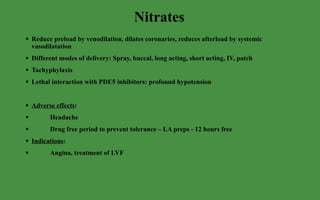
Nitrates Reduce preload by venodilation, dilates coronaries, reduces afterload by systemic vasodilatation Different modes of delivery: Spray, buccal, long acting, short acting, IV, patch Tachyphylaxis Lethal interaction with PDE5 inhibitors: profound hypotension Adverse effects : Headache Drug free period to prevent tolerance – LA preps - 12 hours free Indications : Angina, treatment of LVF
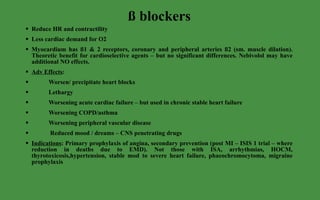
ß blockers Reduce HR and contractility Less cardiac demand for O2 Myocardium has ß1 & 2 receptors, coronary and peripheral arteries ß2 (sm. muscle dilation). Theoretic benefit for cardioselective agents – but no significant differences. Nebivolol may have additional NO effects. Adv Effects :  Worsen/ precipitate heart blocks Lethargy Worsening acute cardiac failure – but used in chronic stable heart failure Worsening COPD/asthma  Worsening peripheral vascular disease Reduced mood / dreams – CNS penetrating drugs Indications : Primary prophylaxis of angina, secondary prevention (post MI – ISIS 1 trial – where reduction in deaths due to EMD). Not those with ISA, arrhythmias, HOCM, thyrotoxicosis,hypertension, stable mod to severe heart failure, phaeochromocytoma, migraine prophylaxis
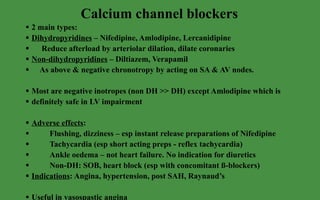
Calcium channel blockers 2 main types: Dihydropyridines  – Nifedipine, Amlodipine, Lercanidipine Reduce afterload by arteriolar dilation, dilate coronaries Non-dihydropyridines  – Diltiazem, Verapamil As above & negative chronotropy by acting on SA & AV nodes. Most are negative inotropes (non DH >> DH) except Amlodipine which is definitely safe in LV impairment  Adverse effects : Flushing, dizziness – esp instant release preparations of Nifedipine Tachycardia (esp short acting preps - reflex tachycardia) Ankle oedema – not heart failure. No indication for diuretics Non-DH: SOB, heart block (esp with concomitant ß-blockers) Indications : Angina, hypertension, post SAH, Raynaud’s Useful in vasospastic angina
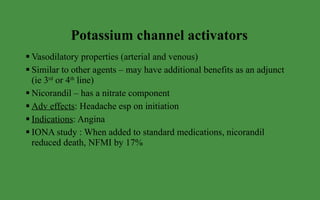
Potassium channel activators Vasodilatory properties (arterial and venous) Similar to other agents – may have additional benefits as an adjunct (ie 3 rd  or 4 th  line) Nicorandil – has a nitrate component Adv effects : Headache esp on initiation Indications : Angina  IONA study : When added to standard medications, nicorandil reduced death, NFMI by 17%
I f  channel inhibitor New anti-anginal - Ivabradine Blocks I f  (ionic funny channel) – an mixed Na-K inward current activated by hyperpolarization and autonomic nervous system -  lowers pacemaker activity in the SA-node Slows heart rate – different mechanism from beta-blockers Adverse effects : Luminous phenomena (retinal I h  channels similar to I f  channels) – self-limiting Indications : Angina  Restricted use
Management Strategy for Stable Angina  1.ASA 2.Lipid lowering agent 3. S/L GTN 4. ß-blocker or CCB which controls rate eg non-DH 5. Add CCB to ß-blocker or nitrate to CCB 6. CCB + ß-blocker(DH) + nitrate 7.Nicorandil 8. Coronary intervention – PCI or CABG
 
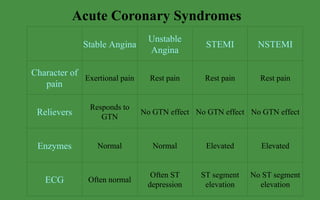
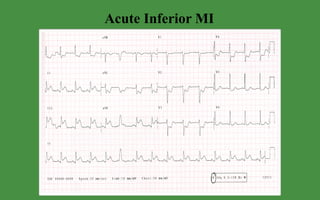
Acute Coronary Syndromes Stable Angina Unstable Angina STEMI NSTEMI Character of pain Exertional pain Rest pain Rest pain Rest pain Relievers Responds to GTN No GTN effect No GTN effect No GTN effect Enzymes Normal Normal Elevated Elevated ECG Often normal Often ST depression ST segment elevation No ST segment elevation
Acute Inferior MI
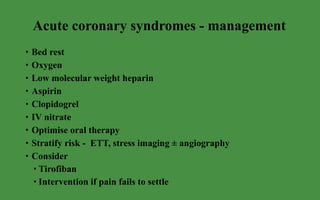
Acute coronary syndromes - management Bed rest Oxygen Low molecular weight heparin Aspirin Clopidogrel IV nitrate Optimise oral therapy Stratify risk -  ETT, stress imaging ± angiography Consider  Tirofiban Intervention if pain fails to settle
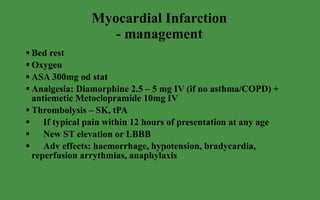
Myocardial Infarction - management Bed rest Oxygen ASA 300mg od stat Analgesia: Diamorphine 2.5 – 5 mg IV (if no asthma/COPD) + antiemetic Metoclopramide 10mg IV Thrombolysis – SK, tPA If typical pain within 12 hours of presentation at any age New ST elevation or LBBB Adv effects: haemorrhage, hypotension, bradycardia, reperfusion arrythmias, anaphylaxis
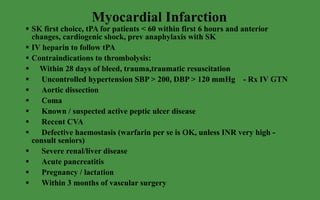
Myocardial Infarction SK first choice, tPA for patients < 60 within first 6 hours and anterior changes, cardiogenic shock, prev anaphylaxis with SK IV heparin to follow tPA Contraindications to thrombolysis: Within 28 days of bleed, trauma,traumatic resuscitation Uncontrolled hypertension SBP > 200, DBP > 120 mmHg  - Rx IV GTN  Aortic dissection Coma Known / suspected active peptic ulcer disease Recent CVA Defective haemostasis (warfarin per se is OK, unless INR very high - consult seniors) Severe renal/liver disease Acute pancreatitis Pregnancy / lactation Within 3 months of vascular surgery
Antithrombogens Aspirin – inhibits cyclo-oxygenase, prevents syntheses of TxA2 (pro-thrombotic) Thienopyridines (clopidogrel, ticlopidine) – irreversibly inhibit binding of ADP during platelet activation. Used with Aspirin with drug eluting stents & in NSTEMI. Expensive!! Glycoprotein 2b3a antagonists – potent inhibitors of platelet aggregation eg. abciximab, eptifibatide, tirofiban
IV ß-blockade - indications  Indication as for thrombolysis Atenolol 5-10mg IV slow Contraindications: Pulse < 50, SBP <100 mmHg, Asthma/COPD, conduction defects/sick sinus, uncontrolled CCF, severe PVD, poor LV function
Secondary prophylaxis for IHD Aspirin to all patients ß-blocker to all patients ACE inhibition – meta-analyses of SAVE, AIRE, TRACE in patients with LV dysfunction, HOPE in patients without LV dysfunction Lipid lowering for all patients Aggressive risk factor management – hypertension, DM ,smoking cessation, cardiac rehabilitation
EBM - MI ISIS (International Study of Infarct Survival) 1  : Atenolol reduces early mortality post MI (mainly due to reduction in EMD) ISIS 2  : SK and ASA reduces 5 week mortality in patients with AMI ISIS 3  : SK = rtPA but rtPA associated with more cerebral bleeds ISIS 4  : Captopril has a small but significant reduction in mortality post MI. IV Mg and nitrates – no benefit
EBM IHD CURE (Clopidogrel in Unstable Angina to prevent recurrent events) : In ACS, clopidogrel + ASA significantly reduces death from CV, non-fatal MI & stroke compared to ASA alone HOPE (Heart Outcome Prevention Evaluation Study)  : Ramipril reduced MI, stroke, CV death in high risk patients Lipids: 4S (Scand Simvastatin Survival Study)  : Simvastatin reduces risk of all major coronary events (relative risk reduction of 35%) in patients with CAD & mild-mod hypercholesterolemia (2º prevention) WOSCOPS  (West of Scotland Coronary Prevention Study)  : Pravastatin reduced deaths from CHD, all cardiovascular causes and nonfatal MI in patients with hypercholesterolemia and no previous IHD (1 º prevention)

Ihd

  • 1.
    Ischaemic Heart DiseaseClinical Pharmacology
  • 2.
    Angina Stable UnstablePrinzmetal’s Myocardial Infarction NSTEMI STEMI Ischaemic Heart Disease
  • 3.
    Angina Clinical syndrome– exertional central chest tightness radiating to arms & neck Oxygen demand exceeds supply Factors contributing: HR, preload(venous return), afterload, aortic impedance all determine myocardial O2 requirements
  • 4.
    Management of stableangina Relieved/prevented by: Slowing HR Reducing preload (impacts on LV wall stress thru LVEDP) Reducing afterload - BP Dilating coronary arteries Reducing myocardial contractility Also- Correct anaemia, tachyarrhythmias Modify CV risk factors: Hypertension, DM, smoking cessation, Wt loss, graded exercise Prophylaxis before exercise
  • 5.
    Nitrates Reduce preloadby venodilation, dilates coronaries, reduces afterload by systemic vasodilatation Different modes of delivery: Spray, buccal, long acting, short acting, IV, patch Tachyphylaxis Lethal interaction with PDE5 inhibitors: profound hypotension Adverse effects : Headache Drug free period to prevent tolerance – LA preps - 12 hours free Indications : Angina, treatment of LVF
  • 6.
    ß blockers ReduceHR and contractility Less cardiac demand for O2 Myocardium has ß1 & 2 receptors, coronary and peripheral arteries ß2 (sm. muscle dilation). Theoretic benefit for cardioselective agents – but no significant differences. Nebivolol may have additional NO effects. Adv Effects : Worsen/ precipitate heart blocks Lethargy Worsening acute cardiac failure – but used in chronic stable heart failure Worsening COPD/asthma Worsening peripheral vascular disease Reduced mood / dreams – CNS penetrating drugs Indications : Primary prophylaxis of angina, secondary prevention (post MI – ISIS 1 trial – where reduction in deaths due to EMD). Not those with ISA, arrhythmias, HOCM, thyrotoxicosis,hypertension, stable mod to severe heart failure, phaeochromocytoma, migraine prophylaxis
  • 7.
    Calcium channel blockers2 main types: Dihydropyridines – Nifedipine, Amlodipine, Lercanidipine Reduce afterload by arteriolar dilation, dilate coronaries Non-dihydropyridines – Diltiazem, Verapamil As above & negative chronotropy by acting on SA & AV nodes. Most are negative inotropes (non DH >> DH) except Amlodipine which is definitely safe in LV impairment Adverse effects : Flushing, dizziness – esp instant release preparations of Nifedipine Tachycardia (esp short acting preps - reflex tachycardia) Ankle oedema – not heart failure. No indication for diuretics Non-DH: SOB, heart block (esp with concomitant ß-blockers) Indications : Angina, hypertension, post SAH, Raynaud’s Useful in vasospastic angina
  • 8.
    Potassium channel activatorsVasodilatory properties (arterial and venous) Similar to other agents – may have additional benefits as an adjunct (ie 3 rd or 4 th line) Nicorandil – has a nitrate component Adv effects : Headache esp on initiation Indications : Angina IONA study : When added to standard medications, nicorandil reduced death, NFMI by 17%
  • 9.
    I f channel inhibitor New anti-anginal - Ivabradine Blocks I f (ionic funny channel) – an mixed Na-K inward current activated by hyperpolarization and autonomic nervous system - lowers pacemaker activity in the SA-node Slows heart rate – different mechanism from beta-blockers Adverse effects : Luminous phenomena (retinal I h channels similar to I f channels) – self-limiting Indications : Angina Restricted use
  • 10.
    Management Strategy forStable Angina 1.ASA 2.Lipid lowering agent 3. S/L GTN 4. ß-blocker or CCB which controls rate eg non-DH 5. Add CCB to ß-blocker or nitrate to CCB 6. CCB + ß-blocker(DH) + nitrate 7.Nicorandil 8. Coronary intervention – PCI or CABG
  • 11.
  • 12.
    Acute Coronary SyndromesStable Angina Unstable Angina STEMI NSTEMI Character of pain Exertional pain Rest pain Rest pain Rest pain Relievers Responds to GTN No GTN effect No GTN effect No GTN effect Enzymes Normal Normal Elevated Elevated ECG Often normal Often ST depression ST segment elevation No ST segment elevation
  • 13.
  • 14.
    Acute coronary syndromes- management Bed rest Oxygen Low molecular weight heparin Aspirin Clopidogrel IV nitrate Optimise oral therapy Stratify risk - ETT, stress imaging ± angiography Consider Tirofiban Intervention if pain fails to settle
  • 15.
    Myocardial Infarction -management Bed rest Oxygen ASA 300mg od stat Analgesia: Diamorphine 2.5 – 5 mg IV (if no asthma/COPD) + antiemetic Metoclopramide 10mg IV Thrombolysis – SK, tPA If typical pain within 12 hours of presentation at any age New ST elevation or LBBB Adv effects: haemorrhage, hypotension, bradycardia, reperfusion arrythmias, anaphylaxis
  • 16.
    Myocardial Infarction SKfirst choice, tPA for patients < 60 within first 6 hours and anterior changes, cardiogenic shock, prev anaphylaxis with SK IV heparin to follow tPA Contraindications to thrombolysis: Within 28 days of bleed, trauma,traumatic resuscitation Uncontrolled hypertension SBP > 200, DBP > 120 mmHg - Rx IV GTN Aortic dissection Coma Known / suspected active peptic ulcer disease Recent CVA Defective haemostasis (warfarin per se is OK, unless INR very high - consult seniors) Severe renal/liver disease Acute pancreatitis Pregnancy / lactation Within 3 months of vascular surgery
  • 17.
    Antithrombogens Aspirin –inhibits cyclo-oxygenase, prevents syntheses of TxA2 (pro-thrombotic) Thienopyridines (clopidogrel, ticlopidine) – irreversibly inhibit binding of ADP during platelet activation. Used with Aspirin with drug eluting stents & in NSTEMI. Expensive!! Glycoprotein 2b3a antagonists – potent inhibitors of platelet aggregation eg. abciximab, eptifibatide, tirofiban
  • 18.
    IV ß-blockade -indications Indication as for thrombolysis Atenolol 5-10mg IV slow Contraindications: Pulse < 50, SBP <100 mmHg, Asthma/COPD, conduction defects/sick sinus, uncontrolled CCF, severe PVD, poor LV function
  • 19.
    Secondary prophylaxis forIHD Aspirin to all patients ß-blocker to all patients ACE inhibition – meta-analyses of SAVE, AIRE, TRACE in patients with LV dysfunction, HOPE in patients without LV dysfunction Lipid lowering for all patients Aggressive risk factor management – hypertension, DM ,smoking cessation, cardiac rehabilitation
  • 20.
    EBM - MIISIS (International Study of Infarct Survival) 1 : Atenolol reduces early mortality post MI (mainly due to reduction in EMD) ISIS 2 : SK and ASA reduces 5 week mortality in patients with AMI ISIS 3 : SK = rtPA but rtPA associated with more cerebral bleeds ISIS 4 : Captopril has a small but significant reduction in mortality post MI. IV Mg and nitrates – no benefit
  • 21.
    EBM IHD CURE(Clopidogrel in Unstable Angina to prevent recurrent events) : In ACS, clopidogrel + ASA significantly reduces death from CV, non-fatal MI & stroke compared to ASA alone HOPE (Heart Outcome Prevention Evaluation Study) : Ramipril reduced MI, stroke, CV death in high risk patients Lipids: 4S (Scand Simvastatin Survival Study) : Simvastatin reduces risk of all major coronary events (relative risk reduction of 35%) in patients with CAD & mild-mod hypercholesterolemia (2º prevention) WOSCOPS (West of Scotland Coronary Prevention Study) : Pravastatin reduced deaths from CHD, all cardiovascular causes and nonfatal MI in patients with hypercholesterolemia and no previous IHD (1 º prevention)